aclu 2 civil liberties
918
see also
promotes to primary 1/18
~ voter suppress // naacp
card carrying member ?
see ice mass deport
---
---
2 26
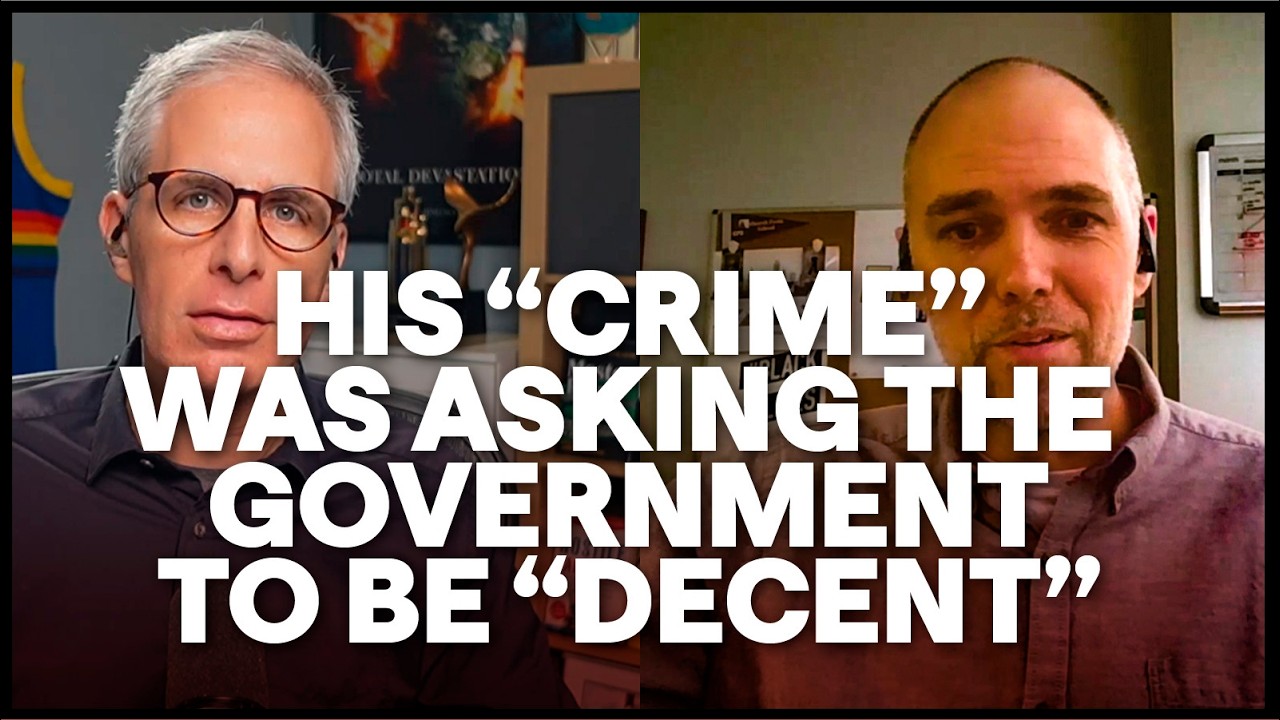
Secretive Tactic DHS Is Using to Target You (With Steve Loney)
[
27.9K subscribers
Feb 20, 2026 Lever Time
On this video episode of Lever Time, David Sirota sits down with ACLU attorney Steve Loney to ask some big questions: How are federal agencies obtaining your private data without a warrant? How are tech giants like Google enabling them? And what should you do if the feds come knocking on your door?
GMAIL 226
---
1 8 26
renee good shooting bovino proud aclu
know yr rights training
---
---
GUK 9 25
Trump issued a presidential memorandum on Thursday aimed at reining in what he has called a radical leftwing domestic “terror network” but which seemed likely to meet fierce legal pushback from critics depicting it as a licence for a broad crackdown on his political opponents.
Prompted by journalists, Trump suggested that George Soros, the billionaire Hungarian-born philanthropist who funds the Open Society Foundations, could be in his sights. He also identified Reid Hoffman, a billionaire venture capitalist, adding: “I hear about him. Maybe it could be him. It could be a lot of people.”
Earlier, the Open Society Foundations had hit back at reports that the justice department was planning to target the group and criticized the Trump administration for “politically motivated attacks on civil society”.
Hina Shamsi of the American Civil Liberties Union (ACLU) said in a statement: “After one of the most harrowing weeks for our first amendment rights, the president is invoking political violence, which we all condemn, as an excuse to target non-profits and activists with the false and stigmatizing label of ‘domestic terrorism’. This is a shameful and dangerous move.”
At a signing ceremony in the Oval Office, the memorandum was presented as aimed at “establishing a comprehensive strategy to investigate, disrupt and dismantle all stages of organized political violence and domestic terrorism”.
It was said to be part of an administration-wide response that would include the FBI’s joint terrorism taskforces, the Department of Justice and the Department of Treasury.
The ACLU said in a statement that joint terrorism task forces “already have a long history of investigations that wrongly target protestors, communities of color, and those engaged in dissent”.
Surrounded by members of his cabinet, Trump said the goal was to target “the funders of a lot of these groups”, some of whom he claimed to know. But he was vague when asked which groups he meant or who the funders were.
“These are anarchists and agitators, professional anarchists and agitators, and they get hired by wealthy people, some of whom I know, I guess, probably know,” he said. “You wouldn’t know at dinner with them. Everything’s nice, and then you find out that they funded millions of dollars to these lunatics.”
Daniel Richman, a professor at Columbia Law School and former federal prosecutor, said the memorandum itself probably doesn’t carry much legal weight. “You can’t by executive order create new crimes. This does not create new crimes. This says you will use the Terrorism Task Force to go after things they would usually go after,” Richman said.
But, he added: “The concern is that this administration has made clear it is only interested in pursuing politically oriented terrorism that disagrees with its political agenda.”
The Trump administration does not need to create new crimes in order to do this, he said. Laws already on the books “have and continue to provide the ability to go after ideological opponents”.
Though the memorandum may not hold up in court, “I fear how far they are going to take this,” said Jason Charter, a former activist who faced charges during Trump’s first term in connection with efforts to tear down the Andrew Jackson statue in front of the White House. “Antifa is antifascism, and antifascism is a very widely shared thing, and being against fascism should not be illegal.”
“It’s trying to slap terrorism charges on people doing protected activities under the Bill of Rights,” Charter said.
The memorandum comes amid a rightwing clamor for retribution in the wake of the 10 September murder of the far-right pundit Charlie Kirk, which Trump and his supporters have blamed on an organized leftwing network, despite early indications that the suspect acted alone.
It also followed Wednesday’s deadly attack on a US Immigration and Customs Enforcement (Ice) facility in Dallas that killed one detainee and injured two others. One of the bullets used in the attack was inscribed with the message “anti-Ice”.
The memorandum lumps together a series of apparently unrelated episodes, including a foiled 2022 assassination attempt on the supreme court justice Brett Kavanaugh, the murder of the CEO of United Healthcare in Manhattan last December, last year’s two failed attempts on Trump’s life, and unrest on the streets of Los Angeles and Portland, Oregon.
Stephen Miller, the influential White House deputy chief of staff – who has been vocal in the administration’s previous calls for a crackdown – called the initiative “historical and significant”.
“This is the first time in American history that there is an all-of-government effort to dismantle leftwing terrorism, to dismantle antifa, to dismantle the organizations that have been carrying out these acts of political violence and terrorism,” Miller said. The joint terrorism taskforce, a unit inside the FBI, would be “the hub” of the effort, he added.
He said “an entire system of feeder organisations” were funding “harassment, doxing, intimidation and, ultimately, attempted assassinations” of public officials.
“It is all carefully planned, executed and thought through,” said Miller. “It is terrorism on our soil. We are going to use the entire force of the federal government to uproot these organizations, root and branch.”
Trump and his allies have portrayed political violence as a phenomenon primarily associated with the left, overlooking recent incidents in which Democrats have been targeted by people who are believed to be rightwing extremists or incidents in which the perpetrator’s motives are unclear.
Postingon his Truth Social network on Wednesday, Trump clearly tied the Ice facility attack to the Democrats and their criticism of his immigration crackdown in a manner resembling his response to Kirk’s killing.
“This violence is the result of the radical left Democrats constantly demonizing law enforcement, calling for ICE to be demolished, and comparing ICE Officers to “Nazis,” he wrote. “The continuing violence from Radical Left Terrorists, in the aftermath of Charlie Kirk’s assassination, must be stopped. ICE Officers, and other Brave Members of Law Enforcement, are under grave threat.”
But authorities on Thursday said that they did not find evidence that the suspect was a member of “any specific group or entity, nor did he mention any specific government agency other than Ice”.
In the wake of Kirk’s killing, Trump issued an executive order designating antifa, a loose network of groups that has been involved in confrontations with the far right, as a “domestic terrorist organization”.
The new memorandum states: “This political violence is not a series of isolated incidents and does not emerge organically. Instead, it is a culmination of sophisticated, organized campaigns of targeted intimidation, radicalization, threats, and violence designed to silence opposing speech, limit political activity, change or direct policy outcomes, and prevent the functioning of a democratic society.
“A new law enforcement strategy that investigates all participants in these criminal and terroristic conspiracies – including the organized structures, networks, entities, organizations, funding sources, and predicate actions behind them – is required.”
“Intimidation tactics against those standing up for human rights and civil liberties are sadly not new in the history of this country,” Shamsi, the director of the ACLU’s national security project, said. “In an earlier era, civil rights movement leaders were also labeled security threats and investigated, monitored, threatened, and even arrested.”
*Lauren Gambino contributed reporting
---
MMA 9 25 KIRK SHOOT
Some right-wing media have urged the Trump administration to seek retribution for Kirk’s killing by using the government to attack left-leaning groups and individuals. Trump ally and right-wing podcaster Laura Loomer called for Trump to “shut down, defund, & prosecute every single Leftist organization”; Infowars' Harrison Smith wrote that we “need the Insurrection Act” and should “imprison radical leftists”; and Michael Savage said on Newsmax that Trump’s Justice Department needs to “unravel” the American Civil Liberties Union, and “you’ve got to bust them on the RICO.” Twitter/X, [9/10/25, 9/10/25; Newsmax, Carl Higbie Frontline, 9/15/25]
an 11 24
Legislation that would have handed President-elect Donald Trump sweeping power to investigate and shutter news outlets, government watchdogs, humanitarian organizations, and other nonprofits was defeated in the House of Representatives on Tuesday after a coalition of progressive advocacy groups and lawmakers mobilized against it, warning of the bill's dire implications for the right to dissent.
But 52 Democratic lawmakers—including Reps. Adam Schiff (D-Calif.), Henry Cuellar (D-Texas), and Ritchie Torres (D-N.Y.)—apparently did not share the grave concerns expressed by the ACLU and other leading rights groups, opting to vote alongside 204 Republicans in favor of the bill.
One Republican, Rep. Thomas Massie of Kentucky, joined 144 Democrats in voting no.
The measure ultimately fell short of the two-thirds majority needed to approve legislation under the fast-track procedure used by the bill's supporters, but progressives wasted no time spotlighting the Democrats who supported the measure.
"If you're looking for a handy list of Democrats who have no fucking clue what is about to hit and need their spines stiffened ASAP, this is a good place to start," wrote Leah Greenberg, co-executive director of the advocacy group Indivisible.
Rep. Rashida Tlaib (D-Mich.), who vocally opposed the legislation, wrote that "these 52 Democrats voted to give Trump the power to shut down any nonprofit he wants."
"The NAACP, ACLU, Planned Parenthood, no organization would be safe," Tlaib added. "Shameful."
If passed, the Stop Terror-Financing and Tax Penalties on American Hostages Act would grant the Treasury Department—soon to be under the control of a Trump nominee—the authority to unilaterally strip nonprofits of their tax-exempt status by deeming them supporters of terrorism.
The bill could be revived in the next Congress, which is likely to be under full Republican control.
Kia Hamadanchy, senior policy counsel with the ACLU, toldThe Intercept late Tuesday that "we will continue our sustained opposition."
It is already illegal under U.S. law to provide material backing for terrorism, and the executive branch has significant authority to target groups it considers terrorist-supporting.
"This isn't just an attack on our communities; it's a fundamental threat to free speech and democracy."
The ACLU noted ahead of Tuesday's vote that while the bill contains "a 90-day 'cure' period in which a designated nonprofit can mount a defense, it is a mere illusion of due process."
"The government may deny organizations its reasons and evidence against them, leaving the nonprofit unable to rebut allegations," the group said. "This means that a nonprofit could be left entirely in the dark about what conduct the government believes qualifies as 'support,' making it virtually impossible to clear its name."
Opponents of the bill warned that Palestinian rights organizations would be uniquely imperiled if it passed.
"This bill dangerously weaponizes the Treasury against nonprofit organizations and houses of worship—Christian, Jewish, or Muslim—that dare to support Palestinian and Lebanese human rights or criticize Israel's genocidal actions," said Robert McCaw, director of government affairs at the Council on American-Islamic Relations.
"Allowing such sweeping, unchecked power would set a chilling precedent, enabling the government to selectively target and suppress voices of dissent under the guise of national security," McCaw added. "This isn't just an attack on our communities; it's a fundamental threat to free speech and democracy."
Georgia State Rep. Ruwa Romman (D-97), a Palestinian American, echoed that sentiment following Tuesday's vote and condemned the legislation's 52 Democratic supporters.
"Every single Democrat who voted for this is not taking the threat of Trump remotely seriously and should be disqualified from any leadership positions moving forward," Romman wrote on social media. "This is no longer business as usual. To agree to give him this kind of power is beyond egregious."
===
===
7 Things You Need to Know About ETP’s Lawsuit Against Greenpeace - Greenpeace USA
12 2017
Learn how an abusive lawsuit is part of a dangerous trend of companies trying to silence dissent.
Energy Transfer Partners (ETP) – the company behind the Dakota Access Pipeline – has filed a lawsuit against Greenpeace and others, in its latest attempt to silence advocacy work and attack the fundamental right to free speech.
In response to the powerful alliance of Indigenous communities and climate activists who stood in opposition to the Dakota Access pipeline at Standing Rock, ETP has filed this SLAPP lawsuit claiming nearly a billion dollars in damages. on behalf of Energy Transfer. Here’s what you need to know about the suit.
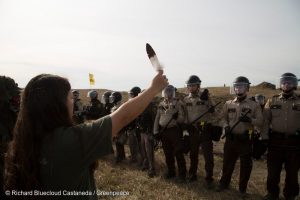
A phalanx of National Guard and police advance toward water protectors in Standing Rock.
1. What is a ‘SLAPP’ suit?
SLAPP stands for “Strategic Lawsuit Against Public Participation.” As the name implies, corporations, using this tactic are trying to shut down public participation. SLAPPs are generally filed without any kind of legal merit. The purpose of a SLAPP is to censor, intimidate, and silence critics by burdening them with legal claims and costs until they’re forced to abandon their criticism or opposition.
2. Why is ETP using a SLAPP?
ETP is SLAPPing its critics in an attempt to shut them up – or even better, to shut them down. ETP is suing Greenpeace for at least USD $900million. The corporation’s hope is that the prospect of having to pay this – or at least of spending a lot of time and legal costs on fighting the lawsuit – will intimidate Greenpeace and others into silence.
The goal of this suit is to silence opposition by misrepresenting what happened on the ground at Standing Rock — making outrageous and racist claims that big environmental organizations like Greenpeace orchestrated the Indigenous-led movement at Standing Rock.
3. This is a worrying trend
In 2016, Canadian company Resolute filed a SLAPP suit against Greenpeace, which was dismissed in full by a US federal judge. But the use of this dirty tactic by corporations is on the rise. As we face an upswing in a new global right-wing agenda, governments and corporations around the world are attempting to chip away at free speech. And it’s not just about environmental groups, either. The SLAPP suit is designed to send a loud message so that any activist or public-interest advocacy group that takes on giant corporations will have to think twice before standing up for what they believe in.
4. Who’s behind this suit
Just like the Resolute case, this one was filed by Michael Bowe. Bowe is also a member of Trump’s personal legal team, and part of the law firm Kasowitz Benson Torres – founded and run by Marc E. Kasowitz, Trump’s personal lawyer. The Times once described Kasowitz as “the Donald Trump of lawyering”. Bowe has publicly stated that he’s in conversations with other corporations considering filing their own SLAPPs against Greenpeace – suggesting this bullying and anti-democratic tactic is being shopped around to the highest bidder.
5. This is not a one-off.
There are many, many examples of SLAPP suits, here are a couple you may have heard of.
Earlier this year, coal magnate Bob Murray sued John Oliver after*Last Week Tonight*ran a segment on Coal – which prominently featured Murray. In the last 15 years, Murray and/or his company have also sued various other journalists.
The ACLU represented individuals in Uniontown, Alabama — a poor town predominantly made up of people of color — who were sued by Green Group Holdings for $30 million for standing up to a coal ash landfill in their town. The company revealed its motives when its lawyers approached the individuals in an attempt to cut a deal – if they agreed to give Green Group access to their electronic devices, access to their future social media postings, and extensive details about their group’s membership, advocacy and communications with other environmental groups.
Due to public outcry and the support of the ACLU, the residents reached a settlement in February and Green Group Holdings agreed to better environmental protections — but they shouldn’t have had to deal with this corporate bullying in the first place. There are hundreds of others across America and beyond who won’t be so lucky.
People march in support of the Standing Rock Nation at the Civic Center Plaza of San Francisco. The protest was one of many in a global day of action against the Dakota Access Pipeline (DAPL) calling on the U.S. Army Corps of Engineers to cancel the permit for the project.
6. They’re clutching at straws… [vid]
Just like in the , ETP is using the Racketeering Influenced and Corrupt Organizations Act (RICO) – a law which was originally created to prosecute the mafia – to claim treble damages and inflate the amount of money it is able to demand. In their lawsuit, ETP claims thatGreenpeace led a corrupt environmentalist enterprise that “cynically planted radical, violent eco-terrorists on the ground amongst the protesters, and directly funded their operations” – a baseless attempt to mislabel legal advocacy as criminal conduct through the use of these racketeering laws, and present constitutionally-protected free speech as defamatory. It’s as ridiculous as it sounds…
7. We can fight this
ETP and other corporate bullies are blatantly trying to stifle free speech and our right to peacefully protest. So let’s show them that that’s not going to happen: Refuse to be silent. Defend free speech. And let’s continue standing up for what is right.
You can take action against this SLAPP here and find more information about how you can fight back against SLAPPs generally.
===
---
no lnx 7 23
a federal judge on Monday blocked a provision of a recently enacted Florida law that the ACLU characterized as a "clear and brazen attack on civic participation in our democracy."
S.B. 7050, which Republican Gov. Ron DeSantis signed into law in May, would have imposed $50,000 fines on community organizations for every noncitizen individual who collected or handled voter registration forms for the groups—even if the people were legally authorized to work in the United States.
In a scathing 58-page order granting rights groups' request for a preliminary injunction, Chief U.S. District Judge Mark Walker of the Northern District of Florida called the law "Florida's latest assault on the right to vote" and agreed that the voter registration provision would have "substantially interrupted" community groups' outreach efforts.
"Tomorrow, Floridians across the state will commemorate our nation's birthday," Walker wrote. "They will endure the heat of the Florida summer to celebrate the Fourth of July with family and friends at barbecues and picnics. They will gather with their communities at public parks for music and fireworks. They will cheer and sweat at parades and block parties. And amid these patriotic festivities, some may feel moved, for the first time, to embrace their solemn privilege as citizens by registering to vote."
"That's where plaintiffs come in," the judge continued, pointing to the testimony of Veronica Herrera-Lucha, a lawful permanent resident who works as the Florida state field director for Mi Vecino, a nonprofit voter registration group.
"Absent the challenged provisions at issue in these cases, individuals like Ms. Herrera-Lucha and [third-party voter registration organizations] like the Florida NAACP and Hispanic Federation would be engaging with their communities and registering new voters," Walker wrote. "Ms. Herrera-Lucha, a noncitizen who, herself, lacks the right to vote, has spent years registering and encouraging citizens to exercise that solemn right. She may, at least for now, continue to do so andadd more voices to the millions of others singing a more perfect union into existence."
Frankie Miranda, president and CEO of the Hispanic Federation, celebrated Walker's ruling as confirmation of "what we knew from the very beginning: Florida's latest voter registration law was unconstitutional and served no other purpose than to silence our communities."
"This ruling is a win for all Floridians—especially for underrepresented communities who rely on nonpartisan organizations like us to help make their voices heard," said Miranda. "We applaud this ruling, and will not rest until everyone's right to participate in our democracy is protected."
The Hispanic Federation was one of several groups that sued the state of Florida over the provision targeting noncitizen voter registration advocates, part of a broader voter suppression effort by the state's governor and dominant Republican Party.
In addition to its sweeping attack on voter registration groups and restrictions on mail-in voting, S.B. 7050 includes a provision that allowed DeSantis to run for president without resigning as Florida's governor.
Walker wrote in his order Monday that Florida's political leaders in recent years have struggled to govern "within the bounds set by the United States Constitution."
"When state government power threatens to spread beyond constitutional bounds and reduce individual rights to ashes, the federal judiciary stands as a firewall," Walker added. "The Free State of Florida is simply not free to exceed the bounds of the United States Constitution."
Daniel Tilley, legal director at the ACLU of Florida, said in a statement that Walker's ruling "fortifies the idea that all Floridians have a right to participate in building a stronger democracy through civic engagement."
"While this is a step in the right direction, our work is not finished," said Tilley. "People in our communities, including noncitizens, work tirelessly to assist in voter registration efforts to empower Floridians to vote on issues that impact their daily lives. We applaud the court's decision, but we must ensure this harmful law is struck down altogether."
FROM YOUR SITE ARTICLES
Unequal Justice: The Supreme Court’s voting rights ruling is not as good as it seems ›
Fringe GOP presidential candidate wants to unconstitutionally raise voting age to 25 ›
Republicans have declared all-out war on younger voters: voting rights organizer ›
---
---
an 5 23
...Savage:
Why not do it? You know, the real problem here are the lawyers. Let's not forget it's the lawyers, the lawyers, the lawyers. Shakespeare had it right. But it's the ACLU. People don't understand. I've been onto these people for twenty-five years. Theanti-Christian libertines union are run by the most — the sickest people with law degrees imaginable, and they're rolling in big money. The ACLU is the head of the snake, as I declared the year 2002. It's the ACLU that stands behind all of this insanity and any administration that comes along that has the power should arrest all of them and try them for sedition and deport them if possible.Those are big words. I'm nothing but a podcast host, but I have a way of putting things in concrete form. It's the ACLU that's the head of the snake that's destroying America. It's the lawyers, the lawyers, the lawyers. They're killing the country. I could go on and on and on. As you know, I don't want to write a book here as a guest — fill in guy here — but Carl, it's Memorial Day. I look at those graves and I know I wouldn't be here if it were not for them. I wouldn't be here if it were not for them.
Higbie — a forty-year-old Millennial — then concluded the conversation:
Unfortunately, Michael, we have an entire generation that just is not appreciative of a lot of the things that are going on.
Watch below via Media Matters for America or at this link.
==
fundraising ad on trms 1 23? re dobbs?
---
not sure when written but on www 1 23
In Citizens United,the Supreme Court ruled that independent political expenditures by corporations and unions are protected under the First Amendment and not subject to restriction by the government. The Court therefore struck down a ban on campaign expenditures by corporations and unions that applied to non-profit corporations like Planned Parenthood and the National Rifle Association, as well as for-profit corporations like General Motors and Microsoft.
That decision has sparked a great deal of controversy. Some see corporations as artificial legal constructs that are not entitled to First Amendment rights. Others see corporations and unions as legitimate participants in public debate whose views can help educate voters as they form their opinions on candidates and issues.
We understand that the amount of money now being spent on political campaigns has created a growing skepticism in the integrity of our election system that raises serious concerns. We firmly believe, however, that the response to those concerns must be consistent with our constitutional commitment to freedom of speech and association. For that reason, the ACLU does not support campaign finance regulation premised on the notion that the answer to money in politics is to ban political speech.
At the same time, we recognize that the escalating cost of political campaigns may make it more difficult for some views to be heard, and that access to money often plays a significant role in determining who runs for office and who is elected.
In our view, the answer to that problem is to expand, not limit, the resources available for political advocacy. Thus, the ACLU supports a comprehensive and meaningful system ofpublic financing that would help create a level playing field for every qualified candidate. We support carefully drawn disclosure rules. We support reasonable limits on campaign contributions and we support stricter enforcement of existing bans on coordination between candidates and super PACs.
Some argue that campaign finance laws can be surgically drafted to protect legitimate political speech while restricting speech that leads to undue influence by wealthy special interests. Experience over the last 40 years has taught us that money always finds an outlet, and the endless search for loopholes simply creates the next target for new regulation. It also contributes to cynicism about our political process.
Any rule that requires the government to determine what political speech is legitimate and how much political speech is appropriate is difficult to reconcile with the First Amendment. Our system of free expression is built on the premise that the people get to decide what speech they want to hear; it is not the role of the government to make that decision for them.
It is also useful to remember that the mixture of money and politics long predates Citizens United and would not disappear even if Citizens United were overruled. The 2008 presidential election, which took place before Citizens United, was the most expensive in U.S. history until that point. The super PACs that have emerged in the 2012 election cycle have been funded with a significant amount of money from individuals, not corporations, and individual spending was not even at issue in Citizens United.
Unfortunately, legitimate concern over the influence of “big money” in politics has led some to propose a constitutional amendment to reverse the decision. The ACLU will firmly oppose any constitutional amendment that would limit the free speech clause of the First Amendment.
---
---
2018 9th circuit
https://www.politico.com/news/2021/07/01/supreme-court-california-disclosure-law-donors-497554
no lnx
Supreme Court nixes California disclosure law in blow to dark-money opponents
The high court ruled a state law requiring not-for-profit organizations that raise money in California to disclose their donors violated the donors' First Amendment rights.
The Supreme Court has ordered California to stop collecting the names and addresses of top donors to charities, siding with a nonprofit group with links to billionaire Charles Koch.
The Americans for Prosperity Foundation, backed by political megadonors Charles Koch and the late David Koch, brought one of the suits. | David Zalubowski, File/AP Photo
By JOSH GERSTEIN and ZACH MONTELLARO
07/01/2021
The Supreme Court dealt a blow Thursday to efforts to rein in so-called dark money political groups, issuing a ruling striking down California’s policy of demanding donor lists from nonprofit organizations.
The high court split 6-3 along ideological lines in its decision on a pair of cases challenging that California requirement, which forced non-profits raising money in California to give the state copies of federal tax forms containing donor information.
Chief Justice John Roberts, who wrote the majority opinion for the court, ruled that California’s “blanket demand” for that information “is facially unconstitutional.”
“When it comes to the freedom of association, the protections of the First Amendment are triggered not only by actual restrictions on an individual’s ability to join with others to further shared goals. The risk of a chilling effect on association is enough,” Roberts wrote for the court.
The ruling could have a political impact, complicating donor-disclosure requirements for groups that often pour large sums into elections but stop just short of the “express advocacy” for or against candidates that triggers stricter rules on revealing the sources of donations.
The court ruled that the California mandate for groups to turn over donor information to the state, even if kept confidential, was overly broad.
“The point is that a reasonable assessment of the burdens imposed by disclosure should begin with an understanding of the extent to which the burdens are unnecessary, and that requires narrow tailoring,” Roberts wrote.
Roberts’ ruling did not address the federal government’s authority to require the filing of donor information with the Internal Revenue Service. Most charities are still required to file lists of donors giving over $5,000 in a given year, but in 2018 the IRS dropped the requirement for some politically-oriented groups.
The justices’ ruling Thursday addressed lawsuits filed by two politically active, conservative nonprofit organizations in 2015. The Americans for Prosperity Foundation,backed by political megadonors Charles Koch and the late David Koch, brought one of the suits. The other was filed by the Thomas More Law Center, a Michigan-based legal organization active on behalf of Catholic causes that was bankrolled by Tom Monaghan, founder of Domino’s Pizza.
Both organizations argued that California rules requiring filing of donor lists with state officials violate the First Amendment by discouraging individuals from giving and by exposing them to threats and harassment.
In 2016, AFP persuaded a federal judge in Los Angeles to issue a permanent injunction against the requirement. The judge said the state rarely used the information, but often disclosed it accidentally with charities’ public tax filings.
However, two years later, a 9th Circuit Court of Appeals panel unanimously reversed that ruling,holding that the state had a legitimate need for the data and that the Koch-founded group had not shown a significant burden on donors.
It’s unclear how the Supreme Court’s conclusions will impact similar donor-disclosure requirements at the federal level. The Internal Revenue Service has generally done a better job of keeping filings it receives confidential.
Part of Roberts’ opinion does, however, open the door to challenges to other disclosure requirements: “While exacting scrutiny does not require that disclosure regimes be the least restrictive means of achieving their ends, it does require that they be narrowly tailored to the government’s asserted interest,” he wrote.
Justice Sonia Sotomayor, writing in dissent and joined by the two other liberal-leaning justices, did however predict that the decision would open the floodgates to weakening disclosure requirements.
“Today’s analysis marks reporting and disclosure requirements with a bull’s-eye,” she wrote. “Regulated entities who wish to avoid their obligations can do so by vaguely waving toward First Amendment ‘privacy concerns.’”
The high court rulings could have a broader impact on efforts by Democrats to broaden and increase disclosure requirements, particularly for groups that run ads that mention federal candidates while stopping short of explicitly endorsing or opposing them.
The For the People Act, congressional Democrats’ massive campaign and ethics reform legislation that is stalled in the Senate amid Democratic infighting and a successful Republican filibuster last week, also contains provisions that would remake campaign finance disclosure law if enacted.
Senate Majority Leader Chuck Schumer stands with Sens. Raphael Warnock and Amy Klobuchar while speaking with reporters before a vote on the For the People Act.
CONGRESS
[Senate Republicans block Dems’ sweeping elections reform bill
BY MARIANNE LEVINE AND ZACH MONTELLARO]
Amid the hundreds of pages of the bill is a long-fought-over proposal that would dramatically expand which organizations are required to disclose donors and expenditures if they spend a nominal amount on communications that broadly mention federal candidates.
Republicans are now broadly opposed to such measures, a turnabout from two decades ago when prominent GOP leaders backed robust disclosure rules as an alternative to attempts to restrict donations to campaigns and outside groups.
“Republicans are in favor of disclosure,” Sen. Mitch McConnell (R-Ky.) said in a 2000 interview. “Why would a little disclosure be better than a lot of disclosure?”
McConnell has said that soon after those comments — and the passage of the Bipartisan Campaign Reform Act despite his opposition in 2002 — he concluded that such rules for groups that don’t engage in express advocacy violate the First Amendment. In the AFP case decided Thursday, he filed an amicus brief saying donor-disclosure requirements should face the “strictest scrutiny” when reviewed in court.
While AFP and the Thomas More Law Center unsurprisingly garnered support for their legal challenges from other conservative organizations, several liberal groups and First Amendment advocates also urged the Supreme Court to rule in favor of donor privacy in the cases.
The NAACP Legal Defense & Educational Fund, the American Civil Liberties Union, the LGBTQ rights advocacy group Human Rights Campaign and others argued that the justices should hold that California’s failure to keep the donor information confidential violated the conservative groups’ rights.
However, the liberal organizations’ brief — which drew significant interest from conservative justices at oral arguments — pushed the court toward a narrow decision that would not upset disclosure requirements for political campaigns or address the rights of regulators with a better track record for confidentiality to gather donor information.
FILED UNDER: CAMPAIGN FINANCE, CALIFORNIA, U.S. SUPREME COURT,}}:
---
---
https://www.alternet.org/2021/05/dark-money/
salon
More than a decade ago, the U.S. Supreme Court issued its historic ruling in Citizens United v. FEC, opening the door for corporations to spend unlimited amounts of money on political causes (although not directly to political candidates). As corrosive as that decision was to democracy, it came with a slight proviso. As Justice Anthony Kennedy wrote: while "the Government may not suppress [corporate] speech altogether," it may "regulate corporate political speech through disclaimer and disclosure requirements." Citizens United found, in other words, that corporations could spend without limit, but government had a right to force public disclosure that spending to the public.
Since then, it's become abundantly clear that money in politics takes numerous forms, far beyond the obvious subterfuge of a corporation donating to a political action committee that then funds a political candidate. In the nonprofit world, big-money donors pump hundreds of millions into politically-motivated 501(c) organizations, which are not required to disclose their donors. Those groups then funnel this money into patently political ventures, even though they are technically forbidden from engaging in significant lobbying. That two-step process describes the phenomenon known as "dark money," which allows wealthy individuals and corporations to exert enormous influence on the political system behind a veil of anonymity.
Last year alone, more than $1 billion in dark money was spent in the 2020 election, a record high. Contrary to some people's assumptions, "both sides" actually do it — dark money flows to and from Democrats as well as Republicans. In truth, anonymous money has been part of America's political bloodstream for decades now, but not until relatively recently has the debate around it rose to a national level. Last month, in the firs major case of its kind since Citizens United, the issue of nonprofit donor disclosure returned to the highest court in the land.
In this case, Americans for Prosperity Foundation** v. Bonta (consolidated with another, functionally identical case, Thomas More Law Center**v. Bonta) the Supreme Court will decide whether political nonprofits can be compelled to disclose who their largest donors are. This case in question specifically concerns donor disclosure rules in California, but its implications are unmistakably nationwide. And while the Koch-funded Americans for Prosperity and the Christian-oriented Thomas More Center are distinctly right-wing in ideological terms, they have some surprising allies before the high court.
As things work now, the IRS annually collects from every nonprofit a form called Schedule B, which lists the personal information of each nonprofit's largest donors. The stated legal purpose is to regulate or prevent various financial crimes like fraud and money laundering. California is unique in requiring nonprofits to submit their Schedule B forms to the state attorney general's office — if they want to keep on raising tax-deductible donations.
To be clear, California collects the information, but does not release it to the public. But this seemingly innocuous bureaucratic regulation has sent shockwaves throughout the conservative nonprofit world — not to mention a number of liberal-leaning or civil-libertarian nonprofits as well, including the NAACP Legal Defense and Educational Fund, the ACLU and the Human Rights Campaign.
Broadly speaking, the strange coalition of plaintiffs in the Americans for Prosperity argue that the state's interest in collecting Schedule B's — which, once again, would not be made publicly accessible — does not outweigh the burden that the law would impose upon them. They further argue that this burden may be acute for nonprofits that advocate for or against controversial causes, like abortion. Furthermore, the plaintiffs have argued that if their donors are unmasked — by means of a hack or leak, for instance — these donors could be at risk of severe reprisal, causing a chilling effect on future donations.
John Bursch, vice president of appellate advocacy at Alliance Defending Freedom, a conservative-libertarian group, told Salon in an interview he sees this as "a free association problem."
"Whether it's a conservative organization or a liberal or progressive organization," Bursch said, "they all recognize that publicly exposing donors to groups that engage in public advocacy risks chilling — causing people to not donate, or to donate below thresholds where they won't appear on a Schedule B."
Bursch currently represents the Thomas More Law Center,a Christian conservative legal nonprofit that briefly embraced Donald Trump's efforts to overturn the presidential election and is now battling on behalf of donor privacy. He alleges that there have been several cases when donors have felt threatened because of their connections to Americans for Prosperity Foundation or Thomas More. Court documents detail purported instances of doxing, death threats and even assassination attempts. It's worth noting that the plaintiffs also fear "economic reprisal," such as boycotts or criticism of their businesses, activities that are clearly legal and constitutionally protected expressions of free speech.
To make their case, the plaintiffs draw upon an unlikely parallel: the Supreme Court's seminal 1958 ruling in NAACP v. Alabama, where the justices found that Alabama officials could not force the NAACP to turn over its membership list due to the possibility of violent public retaliation against its members.
At the time of that decision, Justice John Marshall Harlan wrote that the NAACP had made "an uncontroverted showing" that the "revelation of the identity of its rank-and-file members has exposed these members to economic reprisal, loss of employment, threat of physical coercion, and other manifestations of public hostility." Alabama's effort to expose NAACP members was largely understood by racial justice advocates as a clear attempt to dismantle the civil-rights group through the use of racial terror.
Bursch acknowledged that the historical circumstances around NAACP do not resemble those of the current case, but insisted, "To think that [Thomas More] donors might not face life or death is not really accurate."
Unsurprisingly, many critics of the corrosive force of money in politics reject any comparison between the cases. In a statement to Salon, Sen. Sheldon Whitehouse, D-R.I., drily observed "an enormous gap between the Supreme Court case cited by petitioners — a civil rights-era decision where NAACP members had reason to fear state-sanctioned bombings, assassinations and other violence — and theproblem of billionaires secretly running dark-money-funded political covert ops in our country."
Daniel Weiner, deputy director of the Brennan Center's Election Reform Program, echoed that analysis in an interview with Salon: "I always pause at any contemporary actor analogizing themselves to the NAACP in the South in 1958. And that includes folks on the right and left. AFP, whether or not it is right on the merits, represents some of the most powerful interests in the country. This is not comparable to the NAACP in the South prior to the civil rights movement."
There's another important difference between the two cases: While the plaintiffs in the Americans for Prosperity case are alleging a largely hypothetical risk of reprisal, they are demanding a result that in goes further than in the NAACP decision. As Vox's Ian Millhiser explained, "the plaintiffs insist that they are entitled to facial relief — meaning that the state's disclosure rule must be tossed out for all nonprofits, regardless of whether donors to those nonprofits face harassment, or even if they want to keep their donations secret."
Weiner said that a universal ban on mandatory donor disclosures is not warranted, arguing that the plaintiffs' case goes no further than claiming "that the law should not be applied to them. It's hard to see how all this adds up to 'the law is facially invalid,' which is a really sweeping position to take in light of a couple incidents."
Bursch responded that Americans for Prosperity "is precisely the type of case where a facial ruling would be appropriate," saying, "It's almost nonsensical to suggest that thousands of charities should have to individually sue California to keep their donor information confidential."
Even though California has no plans to release "dark money" donors' names, Bursch argues there is still likely to be a chilling effect, claiming that the state does not maintain a secure record-keeping system and leaves an "open door" for hackers. It's true that in 2012, a Schedule B for Planned Parenthood was leaked in California, potentially revealing hundreds of donors' names and addresses. But such occurrences have been rare.
As mentioned above, nonprofit donor disclosure is a particularly hot topic when it comes to dark money, which typically moves through 501(c)(4) nonprofits, or "social welfare organizations," which collect money from anonymous donors and then spend it on campaigns or candidates on said donors' behalf.
Americans for Prosperity Foundation, however, is a (501)(c)(3), meaning that in order to preserve its tax-exempt status, it's supposed to designate its funds for "charitable, religious, educational, scientific, literary, testing for public safety, fostering national or international amateur sports competition, and preventing cruelty to children or animals," according to IRS rules. However, Americans for Prosperity, the group's sister organization, is a 501(c)(4), meaning that it can more significantly engage in political advocacy and lobbying — largely in favor of reduced taxes, deregulation and other business-friendly policies — and has done so vigorously.
Bursch claimed earnestly that dark money has "nothing" to do with the current Supreme Court case, reminding this reporter that 501(c)(3) charities like AFPF are barred by federal law "from participating in any political advocacy, which is where the dark money issue arises." Explaining the relationship between Americans for Prosperity and its affiliated foundation, he said, "My understanding is that the 501(c)(3) can't fund the 501(c)(4). So, although they share a name and perhaps some common goals, the work they engage in is completely different. You can't cross those lines."
AFP did not respond to Salon's request to comment on its relationship with AFPF, which has been known to cross some lines.In 2010, the Democratic Congressional Campaign Committeeaccused AFPF of financing blatantly political commercials that criticized the Obama administration, alleging that the ads "made the Americans for Prosperity Foundation a de facto political action group in violation of the federal tax code," according to the New York Times.
Bursch said that he believed or understood that AFP and AFPF had a "different office, different directors, different employees and different purposes." In fact, a comparison of AFP and AFPF's 2018 tax filings shows that a significant number of officers, directors, trustees and key employees work at both entities, including Nancy Pfotenhauer, Mark Holden, Robert Heaton, Emily Seidel, Slade O'Brien and various others.
Supplemental information on AFPF's filings also states that "certain employees of Americans for Prosperity Foundation may perform services for Americans for Prosperity, a related organization, through a service contract between the organizations." (This relationship also goes the other way.) AFPF is additionally listed as AFP's "direct controlling entity," a designation whose legal meaning is not entirely clear but certainly suggests an intimate relationship.
Not all contributors to political nonprofits count as "dark money donors," to be sure. Some are ordinary citizens, no doubt, genuinely interested in contributing to what they believe are nonpartisan endeavors. But it's precisely the lack of donor disclosure that makes the whole process opaque.
Rep. Hank Johnson, D-Ga., a staunch critic of money in politics, affirmed the need for more effective disclosure in light of the AFP and AFPF's purposefully mysterious relationship. "Because we're dealing with dark money, we don't really know the relationship between AFPF and AFP," he said. "When a 501(c)(3) gives money to a 501(c)(4) to engage in electioneering activities, that's what dark money is all about." (Salon could not find clear evidence that money has flowed from AFPF to AFP, let alone how it might have been used.)
"The Federalist Society and the Federalist Society Foundation both share the same goals and aspirations," Johnson expressed. "People are trying to exert influence. That's the reason why they contribute to these organizations that have a political agenda."
FROM YOUR SITE ARTICLES
- Sen. Warren calls for investigation into 'dark money' used to fund US ... ›
- CVS Health quietly donated a staggering amount to a dark money ... ›
- Justice Amy Coney Barrett called on to recuse in big dark money ... ›
RELATED ARTICLES AROUND THE WEB
- "Dark Money" Funds Climate Change Denial Effort - Scientific ... ›
- What is political 'dark money' — and is it bad? – Center for Public ... ›
---
==
to get back in djt good graces?
https://www.alternet.org/2020/09/florida-gov-desantis-just-proposed-a-dangerous-bill-to-imperil-and-silence-protesters/
no lnx twt docs
florida Gov. DeSantis just proposed a dangerous bill to imperil and silence protesters
Written by Brett Wilkins / Common Dreams September 21, 2020
The American Civil Liberties Union joined Florida Democrats on Monday in condemning a proposed bill by Gov. Ron DeSantis that would newly classify certain forms of protest as felonies and impose harsh penalties on some protesters.
Flanked by Republican lawmakers and law enforcement officials at an afternoon press conference in Winter Haven, DeSantis referred to Black Lives Matter protests in Portland, Oregon as he announced the proposed legislation.
“I look at what goes on in Portland. They’ll have people, they’ll arrest them,” DeSantis said. “They’re all scraggly-looking Antifa-types. They get their mugshot taken, then they get released. It’s like a carousel; on and on it goes.”
“That’s not going to happen in here in Florida,” the governor vowed.
The “Combatting Violence, Disorder, and Looting and Law Enforcement Protection Act” would make it a felony to “obstruct traffic during an unpermitted protest,”while absolving motorists of liability for “injury or death caused if fleeing for safety from a mob.” It would also make it a felony for anyone gathered in a group of seven or more people “to cause damage to property or injury to other persons,” or to “destroy public property” or topple monuments. Jailed protesters will not be granted bail until at least their first court appearance.
The proposed bill levies mandatory minimum prison sentences for striking law enforcement officers, including with projectiles, and contains an enhancement for throwing objects that strike officers or civilians, and for out-of-state protesters who even participate in a demonstration that turns violent.
Furthermore, the measure attaches Racketeer Influenced and Corrupt Organizations Act (RICO) liability to “anyone who organizes or funds a violent or disorderly assembly.” It also contains provisions barring state grants to municipalities that defund police, and terminates state benefits to anyone “convicted of participating in a violent or disorderly assembly.”
State Democratic leaders decried the governor’s proposed bill. “The governor is attaching himself to [President] Donald Trump’s propaganda and manufacturing a non-existent law and order crisis in Florida,” said state Senate Democratic Leader Audrey Gibson. “It’s political fear-mongering to bolster a president’s re-election bid.”
“Non-violent protest has been a critical and basic principle of this nation, and has repeatedly changed the course of history for the better,” said state Sen. Bobby Powell. “The governor’s proposal has nothing to do with safeguarding that right. This crackdown is just that—a government sledgehammer to permanently silence opposing voices.”
“The governor could not name a single city, a single town, or a single community in Florida that was the victim of violent protests, because there has been none,” said state Sen. Perry Thurston. “The governor is attempting to link calls for justice to calls for anarchy, without any evidence to support such a claim.”
“This is using a problem from somewhere else to strip the liberty of people in this state to voice their constitutional right to peacefully dissent,” added Thurston. “And it’s the latest in a long line of efforts to quash the people’s ability to demand change when the government refuses to listen.”
The ACLU of Florida also condemned the proposed legislation.
“Gov. DeSantis’ proposal is undemocratic and hostile to Americans’ shared values,” said Micah Kubic, executive director of the ACLU of Florida. “This effort has one goal: silence, criminalize, and penalize Floridians who want to see justice for Black lives lost to racialized violence and brutality at the hands of law enforcement.”
According to the U.S. Crisis Monitor—a joint project between the Armed Conflict Location and Event Data Project (ACLED) and the Bridging Divides Initiative at Princeton University—over93% of this year’s racial justice protests have been peaceful.
DeSantis’ proposed bill came on the same day that the U.S. Department of Justice designated New York City, Seattle, and Portland—where anti-racism demonstrations continued 119 days after the Minneapolis police killing of George Floyd—as “anarchist jurisdictions.”
==
---
Tyrannical and un-American’: ACLU slams Barr for urging sedition charges against protesters
Brett Wilkins / Common Dreams September 17, 2020
Attorney General William Barr drew stinging rebuke from legal experts and civil liberties advocates including the ACLU Wednesday after he told federal prosecutors to more aggressively charge some protesters with…
---
https://www.alternet.org/2020/07/aclu-demands-special-counsel-probe-into-barr-over-police-assault-on-protesters-the-suspect-cant-be-the-investigator/
==
---
karlis
The times are a-changing in Silicon Valley. Once a reliable bastion of libertarianism from the CEOs at the top to the workers at the bottom, new schisms are forming between the workers and the owners — from white-collar software engineers unionizing at Kickstarter to Googlers and Amazon workers publicly denouncing their executives.
This article firstappeared in Salon.
Yet as employees have begun to wake up to the many ways in which their employers exploited them in exchange for nap pods and free snacks, the titans of industry themselves appear to be showing their true colors. The pandemic prompted mass layoffs and swift changes in policy for many tech titans; yet coupled with the anti-police racism protests, we are starting to see the far-right soul of Silicon Valley’s leaders — belying the stereotype of technology as synonymous with progressivism.
Jeff Bezos, CEO of Amazon, profited tremendously off the pandemic, seeing his wealth rise $30 billion. Yet his empire still saw fit to stop paying a $2 an hour hazard pay bonus to its warehouse workers — a high-risk job. Putting them at risk has resulted in a lawsuit from warehouse workers, claiming the company put their families at risk.
amazon continues to try and position itself as a progressive company, unlike other big corporations. Recently, Amazon tried to show solidarity with the Black Lives Matter movement by tweeting “the inequitable and brutal treatment of Black people in our country must stop. Together we stand in solidarity with the Black community — our employees, customers, and partners — in the fight against systemic racism and injustice.”
There was a tinge of irony to the statement, given the company’s history of enabled authoritarian surveillance. To that end, the American Civil Liberties Union quickly replied: “Cool tweet. Will you commit to stop selling face recognition surveillance technology that supercharges police abuse?”
Bezos isn’t the only CEO who treats his workers with utter disregard for safety or health. Tesla Inc. In mid-May,CEO Elon Musk announced on Twitter that he was defying Alameda County shelter-in-place order and restarting production at the Alameda County Tesla factory, which employs more than 10,000 people. On his Twitter account, Musk said he will be “on the [assembly] line with everyone else,” and stated that he was willing to be arrested for the noble “cause” of restarting production. Musk filed a lawsuit against Alameda County for injunctive relief and threatened to take his factory to another state, then took a jab at the Alameda County’s interim health officer, Dr. Erica Pan, whom Musk called “ignorant.”
Previously, Musk expressed repeated disdain for the virus or the potential for a pandemic (i.e. “the coronavirus panic is dumb“) mirroring much of the American right, who value economic activity over lives and pivoted their politics to that effect, in defiance of scientific evidence and models.
The Trumpian head-in-sand attitude coming from Musk is unsurprising. As I’ve written before, Musk and Trump have much in common: they’re both entitled, wealthy businessmen who profit off the backs of a vast underclass — which is why Musk played the victim card when his factory couldn’t operate during shelter-in-place.
Mark Zuckerberg, CEO of Facebook, has shown bitter resistance in the face of evidence that his platform has become a fount of disinformation around both the coronavirus and the ongoing Black Lives Matter protests. In an interview with Fox News last week, Zuckerberg said that he doesn’t believe social media platforms should become the “arbiter of truth”.
“We have a different policy than Twitter on this,” Zuckerberg said in comments that first aired Wednesday. “I believe strongly that Facebook shouldn’t be the arbiter of truth of everything that people say online. I think in general private companies, or especially these platform companies, shouldn’t be in the position of doing that.”
The comments mirror his attitude in 2017, when he commented on Facebook’s role in fomenting political disinformation amid the 2016 election. “Personally I think the idea that fake news on Facebook, which is a very small amount of content, influenced the election in any way — I think that is a pretty crazy idea,” Zuckerberg said then. “Voters make decisions based on their lived experience.”
Zuckerberg’s attitude towards the role of social media in serving as an arbiter of truth differs from his peers at Snapchat and, recently, Twitter, which made an about-face in its policies around Trump’s sophistic tweets. Twitter CEO Jack Dorsey fired back at Zuckerberg: “We’ll continue to point out incorrect or disputed information about elections globally. And we will admit to and own any mistakes we make. This does not make us an ‘arbiter of truth.’ Our intention is to connect the dots of conflicting statements and show the information in dispute so people can judge for themselves. More transparency from us is critical so folks can clearly see the why behind our actions.”
Zuckerberg’s inaction with regard to censoring or labeling Trump’s misinformation has led up to unprecedented internal actions this week, like employees staging a virtual walkout. Facebook employees are notorious for their fealty to their CEO; internal leaks or dissent were rare, until recently.
They say the bad times bring out the best in people. In that case, it’s certainly worth examining why Silicon Valley’s overlords appear to be a notable exception.
==
==
==
==
180 on CU?
==
https://insideclimatenews.org/news/07092018/protester-surveillance-anti-terrorism-training-keystone-xl-pipeline-aclu-lawsuit-federal-law-enforcement
This story follows an in-depth ICN report on efforts to pass laws in 31 states to crack down on protests.
The Keystone XL pipeline is expected to draw protests from indigenous and environmental activists when construction begins, and many activists are worried law enforcement agencies may be planning surveillance and a militarized response. Now, the American Civil Liberties Union is accusing federal agencies of trying to hide the extent of these preparations, which the group says are clearly underway.
The ACLU and its Montana affiliate sued several federal agencies this week, including the Departments of Justice, Defense and Homeland Security, saying the agencies are withholding documents that discuss planning for the expected protests and any coordination among state and local authorities and private security contractors.
Fears about the law enforcement response follow the 2016 armed crackdown on people protesting the Dakota Access Pipeline, where authorities used tear gas and turned water cannons on protesters in freezing temperatures. Since then, dozens of bills and executive orders have been introduced in at least 31 states to clamp down on protests. Activists say the bills are part of a concerted campaign by energy companies and their allies in government to suppress these protests by increasing criminal penalties for minor violations and in some cases trying to use anti-terrorism laws against activists.
The ACLU says documents it obtained from state agencies in Montana suggest law enforcement agencies have begun extensive trainings in preparation for the Keystone XL project, and that federal agencies are involved. The records raise concerns that law enforcement agencies are preparing to stifle any protests even before they've begun, said Alex Rate, legal director of the ACLU in Montana.
"What we're concerned about is the surveillance and crackdown on peaceful protesters," Rate said. The records suggest law enforcement officers were given anti-terrorism and social media trainings in preparation for anticipated construction of Keystone XL and any related protests. "I think it would come as news to many people that the government is doing this to prepare for environmental protests about legitimate issues," he said.
The group submitted public records requests to six federal offices and agencies in January, but received only a small number of records in response so far. Some agencies have said they have no records matching the request, while others have yet to respond. The Army Corps of Engineers provided some records but withheld others, saying they were exempt from disclosure because they would interfere with a law enforcement proceeding, among other reasons.
Montana Official: We're Just Doing Our Jobs
Documents that have been released suggest federal and state agencies have created an interagency team and have been conducting trainings for local law enforcement on how to handle the protests. One email from an intelligence specialist in the U.S. Attorney's Office in Montana to a state official said the office would be hosting an anti-terrorism training event in August.
A January email from David Loewen, head of the law enforcement division of Montana Fish, Wildlife and Parks, said the state's Division of Criminal Investigations had been in touch with officials in North Dakota "to learn what worked and what didn't" at Standing Rock during the Dakota Access Pipeline protests. The email noted that while "man-camps" to house workers would come along with pipeline construction and bring law enforcement challenges, "the primary enforcement focus is protest activity."
In an interview, Loewen said the ACLU's concerns about law enforcement agencies suppressing protests were "a bit silly."
"Our job is to prepare and train, that's what law enforcement does all the time," he said. "If we have a protest coming, chances are things are going to be peaceful and fine and dandy. But on the outside chance that they're not, we want to be prepared."
Leif Johnson, assistant U.S. attorney in Montana, confirmed the anti-terrorism training was held in August and said it was unrelated to Keystone XL. Burke Honzel, head of preparedness for Montana Disaster & Emergency Services, said his staff attended the training and that it "did not discuss Keystone XL or protests and was geared towards overseas terrorism tactics."
First Amendment Rights and Protester Arrests
Environmental and indigenous activists have describe harsh treatment by law enforcement and security officers in Louisiana, where at least 13 people have been arrested under a new law since it went into effect on Aug. 1, including four activists who were detained on Tuesday.
The law created a felony charge with up to five years in prison for anyone who trespasses on a pipeline easement, and many of the arrests came under questionable circumstances. Activists posted photos and video of the most recent arrests on Facebook, including a video showing two uniformed officers assisting a man who was not in uniform and who is holding a protester against the ground, his arm across her throat, while putting her hands in cuffs behind her back.
The records obtained by the ACLU in Montana echo others in Oklahoma, Louisiana, Virginia and other states that have shown law enforcement agencies focusing anti-terrorism resources on environmental activists and, in some cases, cooperating with private security companies employed by pipeline companies to surveil and arrest protesters.
In a blog post announcing the organization's lawsuit, Jacob Hutt of the ACLU said the organization hopes to determine from the documents its requested how and whether federal agencies are "thwarting, surveilling, and otherwise engaging with indigenous and environmental activists" opposed to Keystone XL.
"The First Amendment protects political speech from the threat of undue government scrutiny, and the extent of such scrutiny is currently unknown," he wrote. "If the government is planning to prevent or monitor indigenous and environmental protests, the activists involved have a right to know about it."
PUBLISHED UNDER:
---
https://www.alternet.org/right-wing/tom-cottons-cease-and-desist-letter-activist-raises-serious-first-amendment-questions
In October, Stacey Lane — a human resources professional of 19 years, got in the mail a cease-and-desist letter from Senator Tom Cotton, R-Ark. The letter, in an envelope addressed to Lane, said that all communication “must cease and desist immediately with all offices of U.S. Senator Tom Cotton.”
“Healthcare was really big issue before I got the letter. I did what I could to call senators and congressmen and raise the concerns I had,” Lane told Salon.
The letter — now getting attention in the national media — is raising questions about whether or not it's possible to bar a person from petitioning their government's representatives.
[ltr img]
Lane says she’d call the office once or twice a week, usually during times that preceded a major vote or legislative action. There would be several weeks where she wouldn’t call at all.
“My calls were purposeful typically surrounding a major vote or legislative action or call to action via the various activist groups. I was not a serial, daily caller-just-to-call type [of] person,” Lane said.
According to Tom Cotton’s office, Lane — a member of Ozark Indivisible, an activist group part of the Resistance movement against the Trump administration, used vulgar language on multiple occasions. The final incident, which prompted officials in Cotton’s office to administer a cease and desist, was when Lane allegedly called a 19-year-old intern a c**t. According to Cotton’s office, the letter was issued based on the guidance of the U.S. Capitol Police, who has not returned Salon’s request for immediate comment.
When the cease and desist letter started to make noise on Twitter, John Noonan, Senior Counselor for Military and Defense Affairs in Cotton’s office, tweeted about the event to set the record straight to anyone who criticized the move — like the ACLU.
---
https://www.nytimes.com/2017/11/15/opinion/how-prosecutors-turn-a-protest-into-a-riot.html
aclu helps j20
==
==
https://www.alternet.org/aclu-speaks-out-against-rules-shut-down-criticism-against-lapd
Los Angeles Police Department has apparently been arresting residents for speaking 20 seconds longer than their allotted time at public city hearings. Now the ACLU of Southern California is fighting an ordinance that could make it even harder for residents to speak out—especially those who dissent against the practices of the LAPD. If passed, the ordinance will make it "an arrestable offense to violate any posted rules of public facilities” and would empower law enforcement to make criminal trespass charges, tighten restrictions on speaking time and shut down criticism at meetings.
Pushing back on the proposed restrictions, the ACLU is circulating a petition targeted at councilmembers and tweeted out a call to action Wednesday morning:
...
---
==
decentralized?
http://volokh.com/2011/04/27/harvey-silverglate-on-the-aclu-and-free-speech/
==
s glantz said tob co got cato but alsdo aclu (kpfa 1/17/14
---
And that brings me to the ACLU today—the most depressing part of this story. I had an inkling that the ACLU had abandoned labor before my simple exercise check of their website. Mike Elk has shared with me some of his research into this subject. And it’s well known that the ACLU vigorously supported the disastrous Citizens United decision; the ACLU also took $20 million dollars from the Koch brothers, whose libertarian outfits have played a major role in making Citizens United a reality. Supposedly that money was meant to “fight the Patriot Act”—which is odd, considering that the director of the Koch brothers’ Center for Constitutional Studies at Cato and Vice President for Legal Affairs at Cato, Roger Pilon, explicitly supported the Patriot Act from 2002 through 2008, and that the Kochs’ Cato Institute hired John Yooto serve on their editorial advisory board for the Cato Supreme Court Review. One should be skeptical when it comes to Koch “donations” sold to the public as charity work in the service of human rights.
Maybe there’s no connection there whatsoever between the Kochs’ $20 million gift to the ACLU, and the ACLU’s advocacy for the Kochs’ pet political issue, Citizens United, which transferred greater power from democracy and into the hands of billionaire oligarchs like the Kochs. Maybe it’s all a coincidence, I don’t know. But we do know that there is precedent for the ACLU taking money from corporations, advocating their cause under the guise of “protecting free speech” and hiding the conflict of interest from the public in order to make their defense seem more convincing.
In the late 1980s and early 1990s, the ACLU vigorously defended the interests of the tobacco lobby under the guise of protecting their “first amendment rights”—and they did it for payments in-kind. Leaked tobacco documents in the 1990s exposed the ACLU working out explicit deals with the tobacco industry to take their money in exchange for advocating their interests in public, without disclosing that gross conflict of interest and violation of the public trust. The documents and memos revealed that the hundreds of thousands of dollars paid to the ACLU by the tobacco companies were payments in kind to for the ACLU’s defense of Big Tobacco, a relationship that both parties tried to hide in order to confuse the public into believing that the ACLU’s arguments for tobacco were motivated by purely altruistic constitutional arguments, rather than sleazy under-the-table cash payments. The ACLU is, after all, a trusted institution among progressives—that made them the ideal “Third Party Advocate” in PR terms for the tobacco industry’s interests....http://exiledonline.com/the-lefts-big-sellout-how-the-aclu-human-rights-groups-quietly-exterminated-labor-rights/
==
anti fedsoc? The American Constitution Society for Law and Policy (ACS) http://www.acslaw.org/ promotes the vitality of the U.S. Constitution and the fundamental values it expresses: individual rights and liberties, genuine equality, access to justice, democracy and the rule of law. The abiding principles are reflected in the vision of the Constitution's framers and the wisdom of forward-looking leaders who have shaped our law throughout American history. As a result of their efforts, the Constitution has retained its authority and relevance for each new generation.
In recent years, an activist conservative legal movement has gained influence - eroding these enduring values and presenting the law as a series of sterile abstractions. This new orthodoxy, which threatens to dominate our courts and our laws, does a grave injustice to the American vision.
The American Constitution Society for Law and Policy
1333 H St, NW, 11th Floor Washington, DC 20005 Telephone: (202) 393-6181 Fax: (202) 393-6189 E-mail: info@ACSLaw.org
CU http://www.acslaw.org/acsblog/states-struggle-to-find-way-in-a-post-citizens-united-world
States Struggle to Find Way in a Post-Citizens United World
July 31, 2012
by Clark Taylor
In Citizens United v. FEC, the Supreme Court paved the way for unprecedented amounts of outside campaign spending by powerful interests. As a result, billionaires like Sheldon Adelson and the Koch brothers have pledged to spend up to $400 million in an all-out effort to ensure that the voices of the richest few are heard the loudest.
The numbers support the trend. Richard L. Hasen, an election law expert at University of California, Irvine, says outside campaign spending through March 8 amounts to more than $88 million for federal elections. This represents a significant contrast to the $37.5 million in 2004 and $14.2 million in 2000. The growth is even starker in mid-term years as the same spending jumped from $1.8 million in 2006 to $15.8 million in 2010.
Perhaps most disconcerting, this regime has led to a situation in which the superrich can spend more and more on elections without any disclosure. Sen. Bernie Sanders (I-Vt.), in testimony before a Senate committee, claimed that there were at least 23 families worth over $1 billion who have given more than $250,000 in campaign contributions this cycle. Just 196 Americans have given more than 80 percent of the total money donated to super PACs.
��
Groups and individuals have proposed efforts to help blunt the or counter powerful interests seeking to sway elections. Professor Lawrence Lessig has advocated for a series of citizen conventions to craft a constitutional amendment. Sen. Dick Durbin (D-Ill.) has called for a constitutional amendment. The group Free Speech for Peoplealso proposes a constitutional amendment. Jeff Clements, co-founder and president of the group, stated in written testimony to the Senate, that a constitutional amendment was needed to restore congressional power over campaign finance regulation. Perhaps the closest Congress has come to reform was the DISCLOSE ACT, which would have required that independent groups disclose those donors who give more than $10,000. Though the bill received support from a majority of the Senate, Republicans blocked the measure using a procedural move.
But states also face growing challenges to ensure their elections are not bought by the superrich. The National Institute on Money in State Politics says that approximately $623M has been raised by candidates and committees for state offices so far this cycle. That number is in comparison to $2.9 billion which has been raised by federal campaigns, parties, and super PACs through March.
In spite of the Supreme Court’s decision to summarily reverse a century old Montana law put in place to protect the citizens of Montana from outright corruption at the hands of mining magnates, some states are forging ahead to fight for workable solutions.�� So far, 19 states have passed laws requiring more disclosure since Citizens United. Other states have eliminated limits, while others have no limits, and others still have limits in place only for corporations and unions.
Other states are finding it more difficult to forge a path forward. In Connecticut, Governor Malloy (D) vetoed a bill that would have required disclosure of campaign contributions. Though Malloy claimed to be for transparency, in his veto message he argued that the bill likely violated the Constitution in light of Citizens United. The business community applauded the veto.
Perhaps the most glaring example of a state struggling to find a path forward is Illinois. Earlier this month Governor Quinn (D) signed a law that eliminated campaign contribution limits. The law repealed another measure which had capped campaign contributions. While Quinn’s spokeswoman said the new law provided a ‘short-term fix,’ Brian Gladstein, executive director of the Illinois Campaign for Political Reform, knocked it as a way for the powerful to buy political favors.
slate:
The Numbers Don’t Lie
If you aren’t sure Citizens United gave rise to the super PACs, just follow the money.
By Richard L. Hasen|Posted Friday, March 9, 2012, at 2:56 PM ET
http://www.slate.com/articles/news_and_politics/politics/2012/03/the_supreme_court_s_citizens_united_decision_has_led_to_an_explosion_of_campaign_spending_.html
---
gangs of america:
[aclu forest for the trees problem]
...Not surprisingly, corporate America was delighted with the ACLU
position on free speech. According to one document released by the
U.S. House of Representatives Commerce Committee, “Strategy to
Combat Advertising Content Restrictions and Counter-Advertising Requirements,”
the tobacco industry considered the ACLU to be the “most
prominent and valuable of our constitutional ad ban allies.”
How did the ACLU capitulate so easily to the corporate framing of
First Amendment issues? It seems that the ACLU is motivated by a
“slippery slope” notions, believing that restricting the First Amendment
rights for one segment of society will inevitably undermine the protection
for other segments. Speech should be protected, no matter what the
source. After all, if the speech of pariahs such as pornographers or Nazis
deserves protection, then why should not the speech of a mainstream
element such as the corporation?
The problem with the ACLU position is that it bases its rationale
on the wrong metaphor. Protecting corporations is not a way of avoiding
the slippery slope, analogous to protecting the speech of an unpopular
speaker. After all, a corporation is not a speaker at all.speaker is
entirely the wrong metaphor. More aptly, the corporation might be
compared to a megaphone. Suppose you go to a PTA meeting, and you
notice that one of the other parents has brought along a megaphone that
allows him or her to drown out everyone else. By asking that person to
put the megaphone down, you’re not depriving him or her the opportunity
to speak. Rather, you’re protecting the ability of other speakers to
be heard....
The Corporate Megaphone and the Kasky Case
The fallacy of seeing the corporation as a “speaker” is demonstrated
in a recent case involving Nike, Inc. In 1996, Nike began to face
serious charges of sweatshop working conditions in the Asian factories
operated by its sub-contractors. Approximately 300,000 to 500,000
people, mostly young women, work in those factories, located mainly in
Vietnam, China, Indonesia, and Thailand. Reports in the news program
48 Hours and in the New York Times, the Financial Times, the San
Francisco Chronicle, the Kansas City Star, the Oregonian, the Buffao
News, and Sporting News contained a wide range of allegations. The
New York Times reported “grim conditions” and widespread human
rights abuses in factories where Nike shoes were made. A spot audit of
one Vietnamese factory found 77 percent of workers suffering respiratory
problems. An investigator for Vietnam Labor Watch found a pervasive
“sense of desperation” from interviews with the young women
making Nike shoes. In China, the Hong Kong Christian Industrial
Committee found workers subjected to 11- to 12-hour days, compulsory
overtime, and violation of minimum wage laws. Other reports described
physical, verbal, and sexual abuse, and exposure of young workers to
toxic chemicals, noise, heat, and dust without adequate safety equipment.
In response to the allegations, Nike mounted a publicity blitz in
which it denied the charges and asserted (1) that its workers were paid
double the minimum wage, on average, (2) that workers received free
meals and health care, (3) that its workers were not subjected to corporal
punishment or sexual abuse, and (4) that its products were made in
accordance with health and safety regulations.
208 .. GANGS OF AMERICA
Marc Kasky, a San Francisco resident, became convinced that
much of the information being used by Nike in its publicity campaign
was demonstrably false. Kasky decided to take action, and after coming
to the conclusion that Nike’s statements did not even accord with the
company’s own internal audits, he filed a false advertising lawsuit in
state court under California’s Business and Professions Code.
In response to Kasky’s lawsuit, Nike’s lawyers used an interesting
legal strategy. Rather than argue that the company’s advertisements
were factual, the lawyers asserted that factuality was irrelevant in the
case because Nike was protected by the First Amendment. Thus, the
company could publicize any sort of information it wanted.even
“facts” that the company knew to be completely false.
As the case worked its way through the courts, the legal arguments
became complex. Kasky’s attorneys argued that Nike’s statements constituted
“commercial speech,” which is subject to a lower level of First
Amendment protection because of the potential harm that can result
from misrepresentations about product safety and ingredients. Nike’s
lawyers, on the other hand, argued that the sweatshops issue was a political
debate, and that the entire of purpose of the First Amendment was
to ensure that no one in such a debate could be subjected to governmental
restriction.
Once the debate was set in these terms, Nike enjoyed a tremendous
advantage. The ACLU rushed to defend the company’s freedom of
speech, as did the AFL-CIO, a variety of corporations, editorials in major
newspapers, and the Bush Administration. Typical of the arguments
was that of the ACLU’s amicus brief, which cited “…the fundamental
First Amendment principles that protect the rights of those on both sides
of a debate to speak their minds freely….”
Here was the crux of the issue: the idea of a corporate mind. When
a corporation issues a press release or runs an advertising blitz, who is
actually speaking their mind? Obviously, a corporation itself does not
have a mind. It is merely a collection of papers.the name on a financial
statement. There are, of course, managers, directors, employees,
lawyers, and public relations firms involved in such campaigns. But do
JUDICIAL YOGA .. 209
the statements issued by the corporation actually reflect the personal
opinions of any of those people? Perhaps, perhaps not. But what is certain
is that holding a company accountable for the accuracy of its advertisements
and official statements about safety conditions, worker pay,
incidents of verbal or sexual abuse by factory supervisors, or other such
information hardly seems like a restriction on anyone’s freedom of
speech. Kasky’s suit was not directed at after-hours statements made by
human beings who happened to work for Nike.rather, the suit aimed at
official statements of the company.
The situation might be compared to the responsibilities of a corporation
in the financial arena. In official statements about its financial
status, a corporation is accountable for the truthfulness of all representations.
On the other hand, if an executive wants to go to a cocktail party
or a family reunion and brag about how successful his company is, he or
she should have every right to do so.
Ultimately, society must be able to make a distinction between the
rights and prerogatives of a $10 billion corporation such as Nike and an
ordinary human being like you and me. No one would ever propose that
a physical machine that emits words is entitled to free speech. It is human
speakers that the First Amendment protects, not machines. Contrary
to the fears of the ACLU that requiring corporate statements to be
truthful puts society on a slippery slope toward restricting human
speech, the actual slippery slope is different. The real slippery slope is
an ever-increasing tendency to treat corporations as though they were
human beings.
==
https://insideclimatenews.org/news/07092018/protester-surveillance-anti-terrorism-training-keystone-xl-pipeline-aclu-lawsuit-federal-law-enforcement
This story follows an in-depth ICN report on efforts to pass laws in 31 states to crack down on protests.
The Keystone XL pipeline is expected to draw protests from indigenous and environmental activists when construction begins, and many activists are worried law enforcement agencies may be planning surveillance and a militarized response. Now, the American Civil Liberties Union is accusing federal agencies of trying to hide the extent of these preparations, which the group says are clearly underway.
The ACLU and its Montana affiliate sued several federal agencies this week, including the Departments of Justice, Defense and Homeland Security, saying the agencies are withholding documents that discuss planning for the expected protests and any coordination among state and local authorities and private security contractors.
Fears about the law enforcement response follow the 2016 armed crackdown on people protesting the Dakota Access Pipeline, where authorities used tear gas and turned water cannons on protesters in freezing temperatures. Since then, dozens of bills and executive orders have been introduced in at least 31 states to clamp down on protests. Activists say the bills are part of a concerted campaign by energy companies and their allies in government to suppress these protests by increasing criminal penalties for minor violations and in some cases trying to use anti-terrorism laws against activists.
The ACLU says documents it obtained from state agencies in Montana suggest law enforcement agencies have begun extensive trainings in preparation for the Keystone XL project, and that federal agencies are involved. The records raise concerns that law enforcement agencies are preparing to stifle any protests even before they've begun, said Alex Rate, legal director of the ACLU in Montana.
"What we're concerned about is the surveillance and crackdown on peaceful protesters," Rate said. The records suggest law enforcement officers were given anti-terrorism and social media trainings in preparation for anticipated construction of Keystone XL and any related protests. "I think it would come as news to many people that the government is doing this to prepare for environmental protests about legitimate issues," he said.
The group submitted public records requests to six federal offices and agencies in January, but received only a small number of records in response so far. Some agencies have said they have no records matching the request, while others have yet to respond. The Army Corps of Engineers provided some records but withheld others, saying they were exempt from disclosure because they would interfere with a law enforcement proceeding, among other reasons.
Montana Official: We're Just Doing Our Jobs
Documents that have been released suggest federal and state agencies have created an interagency team and have been conducting trainings for local law enforcement on how to handle the protests. One email from an intelligence specialist in the U.S. Attorney's Office in Montana to a state official said the office would be hosting an anti-terrorism training event in August.
A January email from David Loewen, head of the law enforcement division of Montana Fish, Wildlife and Parks, said the state's Division of Criminal Investigations had been in touch with officials in North Dakota "to learn what worked and what didn't" at Standing Rock during the Dakota Access Pipeline protests. The email noted that while "man-camps" to house workers would come along with pipeline construction and bring law enforcement challenges, "the primary enforcement focus is protest activity."
In an interview, Loewen said the ACLU's concerns about law enforcement agencies suppressing protests were "a bit silly."
"Our job is to prepare and train, that's what law enforcement does all the time," he said. "If we have a protest coming, chances are things are going to be peaceful and fine and dandy. But on the outside chance that they're not, we want to be prepared."
Leif Johnson, assistant U.S. attorney in Montana, confirmed the anti-terrorism training was held in August and said it was unrelated to Keystone XL. Burke Honzel, head of preparedness for Montana Disaster & Emergency Services, said his staff attended the training and that it "did not discuss Keystone XL or protests and was geared towards overseas terrorism tactics."
First Amendment Rights and Protester Arrests
Environmental and indigenous activists have describe harsh treatment by law enforcement and security officers in Louisiana, where at least 13 people have been arrested under a new law since it went into effect on Aug. 1, including four activists who were detained on Tuesday.
The law created a felony charge with up to five years in prison for anyone who trespasses on a pipeline easement, and many of the arrests came under questionable circumstances. Activists posted photos and video of the most recent arrests on Facebook, including a video showing two uniformed officers assisting a man who was not in uniform and who is holding a protester against the ground, his arm across her throat, while putting her hands in cuffs behind her back.
The records obtained by the ACLU in Montana echo others in Oklahoma, Louisiana, Virginia and other states that have shown law enforcement agencies focusing anti-terrorism resources on environmental activists and, in some cases, cooperating with private security companies employed by pipeline companies to surveil and arrest protesters.
In a blog post announcing the organization's lawsuit, Jacob Hutt of the ACLU said the organization hopes to determine from the documents its requested how and whether federal agencies are "thwarting, surveilling, and otherwise engaging with indigenous and environmental activists" opposed to Keystone XL.
"The First Amendment protects political speech from the threat of undue government scrutiny, and the extent of such scrutiny is currently unknown," he wrote. "If the government is planning to prevent or monitor indigenous and environmental protests, the activists involved have a right to know about it."
PUBLISHED UNDER:
---