1st amend2bak
see PPL LOSE
---
an 5 26
A Canadian critic of President Donald Trump is fighting to block the Department of Homeland Security (DHS) from obtaining their personal and location information from Google.
A press release from the American Civil Liberties Union (ACLU) said that DHS issued an "administrative demand" after "John Doe" posted criticisms of the death of Renee Nicole Good and Alex Jeffrey Pretti. The individuals were killed earlier this year by federal officers who shot them during the so-called "Operation Metro Surge," in which agents were sent into Minneapolis and faced protests.
Doe's posts on X received over 100,000 views. The X account is connected to a Google account, which identifies who the individual is. However, he isn't a U.S. resident and hasn't even been in the U.S. for over a decade.
Google told the man that it can't hold out forever, but it's raising questions about the Trump administration using the power of the federal government to go after critics.
The ACLU’s complaint said that the demand for information is “a transparent gambit to chill speech the government doesn’t like.”
“I have long admired the United States for its commitment to free speech,”the plaintiff said. “Never in a million years did I think that, after criticizing the US government, I would be targeted with a summons seeking to find out who I am, where I live, where I go and what I read online.”
The ACLU's senior staff attorney, Michael Perloff, attacked the DHS effort, saying that "consequences of its potential release go beyond one individual, whether they are in the United States or elsewhere.”
Trump and his allies are known for doxing individuals, but it doesn't scare them into compliance. It has happened to federal judges who rule against the Trump administration. In one case, Trump pal Rudy Giuliani targeted two Fulton County, GA vote counters who faced death threats and harassment. They won a lawsuit, forcing Giuliani to pay millions in damages.
So far, DHS has demanded information on individuals from Google, Reddit, Discord and Meta, the New York Times reported in February, citing four people who are aware of the requests. In each case, the requests were sent directly to the tech companies, and there was no court order granting a warrant. In the past, DHS and ICE have been known to use what's called "Administrative subpoenas," which are simply written up by the departments and not issued by a court.
*The Washington Post* reported earlier this year that DHS is increasingly relying on the use of administrative subpoenas to get such personal information from companies. The report cited former officials and experts who estimate there have been thousands, possibly even tens of thousands of these kinds of subpoenas that are approved by mid-level staff who have no public accountability.
One such subpoena was issued for an individual who emailed an ICE attorney asking that they "[a]pply principles of common sense and decency" in immigration cases. The individual who sent the email filed a motion to quash, saying that the administrative subpoena was motivated by his speech and violated his First Amendment rights.
“Not satisfied with trying to suppress speech at home, the Trump administration is now targeting dissenters abroad,” the ACLU's Perloff said of the latest case of the Canadian.
Google said it requires that government requests not be overly broad.
“When we receive a subpoena, our review process is designed to protect user privacy while meeting our legal obligations,” a spokesperson told CBC News. “We inform users when their accounts have been subpoenaed, unless under legal order not to.”
Google didn't comment on whether it requires the subpoenas to come from a court or whether it accepts the made-up subpoenas issued by DHS.
---
---}:
an 1 26
A protest organizer in Grand Rapids, Michigan was recently arrested while speaking out against President Donald Trump's ouster of Venezuelan President Nicolás Maduro — while she was in the middle of speaking to reporters.
On Monday, Dallas, Texas-based small business owner Brandon Friedman posted a video to Bluesky showing a segment in which ABC affiliate WZZM interviewed Jessica Plichta of Grand Rapids Opponents of War, who organized a weekend protest in response to Maduro's capture. As Plichta was speaking, a police car is seen in the corner, and moments later two officers are seen putting Plichta in handcuffs.
"It's not just a foreign issue, it's our tax dollars that are being used to commit these war crimes," Plichta said. "It is also the duty of us, the people, to stand against the Trump regime, the Trump administration, for committing crimes both here in the U.S. and against people in Venezuela."
"What in the Gestapo is going on in Grand Rapids?" Friedman wrote on Bluesky.
WZZM reported that Plichta was arrested for "obstructing a roadway and failure to obey a lawful command from a police officer." Plichta told the outlet prior to her arrest that she was in Venezuela in December for the People's Assembly for Peace and Sovereignty of Our America summit.
"I saw Maduro in person,” Plichta said. “People loved him. Maduro was elected by the people. He is for the people and the people want to see his return. Free Maduro.”
The names of the two officers who arrested Plichta have not yet been released. AlterNet has contacted the Grand Rapids Police Department for comment.
Watch the video of Plichta's arrest below:
---
---
Public opposition to artificial intelligence data centers—and the push by corporations and officials to move forward with their construction anyway—were vividly illustrated in a viral video this week of a woman who was arrested after speaking out against a proposed data center in her community in Wisconsin.
Christine Le Jeune, a member of Great Lakes Neighbors United in Port Washington, spoke at a Common Council meeting in the town on Tuesday evening. The meeting was not focused on the recently approved $15 million “Lighthouse” data center set to be built a mile from downtown Port Washington—part of a project developed by Vantage Data Centers for OpenAI and Oracle—but the first 30 minutes were taken up by members of the public who spoke out against the project.
As CNBC reported last month, more than 1,000 people signed a petition calling on Port Washington officials to obtain voter approval before entering into the deal, but the Common Council and a review board went ahead with creating a Tax Incremental District for the project without public input. The data center still requires other approvals to officially move forward.
“We will not continue to be silenced and ignored while our beautiful and pristine city is taken away from us and handed over to a corporation intent on extracting as many resources as they can regardless of the impact on the people who live here,” said Le Jeune. “Most leaders would have tabled the issue after receiving public input and providing sufficient notice. But you did nothing, and you laughed about it.”
Le Jeune spoke for her allotted three minutes and went slightly over the time limit. She then chanted, “Recall, recall, recall!” at members of the Common Council as other community members applauded.
Police Chief Kevin Hingiss then approached Le Jeune while she was sitting in her seat, listening to the next speaker, and asked her to leave.
She refused, and another officer approached her before a chaotic scene broke out.
City officials had told attendees not to speak out of order during the meeting, and Le Jeune acknowledged that she and others had spoken out of turn at times.
But she told the Milwaukee Journal Sentinelthat she had been surprised by the police officers’ demand that she leave, and by the eventual violence of the incident, with officers physically removing her from her seat and dragging her and two other people across the floor.
The two other residents had approached Le Jeune to protest the officers’ actions.
“I never expected something like that to happen in a meeting. It was very strange,” she told the Journal Sentinel. “Suddenly this police chief showed up in front of me, and all I was thinking was: ‘Wait, what is going on? Why is he interrupting her speech? ... It felt like [police] were kind of primed tonight to pounce.”
State Sen. Chris Larson (D-7) said that “police should not be allowed to violently detain a person who is nonviolently exercising their free speech. This used to be something all Americans agreed on.”
William Walter, executive director of Our Wisconsin Revolution, filmed the arrest and told ABC News affiliate WISN, “I’ve never seen a response like that in my life.”
“What I did see was a lot of members of the Port Washington community who are really frustrated that they’re being ignored and they’re being dismissed by their elected officials,” he said.
AI data centers, he added, “will impact you. They’ll impact your friends, your family, your neighbors, your parents, your children. These are the kinds of things that are going to be dictating the future of Wisconsin, not just for the next couple of years but for the next decade, the next 50 years.”
After Le Jeune’s arrest, another resident, Dawn Stacey, denounced the Common Council members for allowing the aggressive arrest.
“We have so many people who have these concerns about this data center,” said Stacey. “Are we being heard by the Common Council? No we’re not. Instead of being heard we have people being dragged out of the room.”
“For democracy to thrive, we need to have respect between public servants and the people who they serve,” she added.
Vantage has distributed flyers in Port Washington, which has a population of 17,000, promising residents 330 full-time jobs after construction. But as CNBC reported, “Data centers don’t tend to create a lot of long-lasting jobs.”
Another project in Mount Pleasant, Wisconsin hired 3,000 construction workers and foresees 500 employees, while McKinsey said a data center it is planning would need 1,500 people for construction but only around 50 for “steady-state operations.”
Residents in Port Washington have also raised concerns about the data center’s impact on the environment, including through its water use, the potential for exploding utility prices for residents, and the overall purpose of advancing AI.
As Common Dreamsreported Thursday, the development of data centers has caused a rapid surge in consumers’ electricity bills, with costs rising more than 250% in just five years. Vantage has claimed its center will run on 70% renewable energy, but more than half of the electricity used to power data center campuses so far has come from fossil fuels, raising concerns that the expansion of the facilities will worsen the climate emergency.
A recent Morning Consult poll found that a rapidly growing number of Americans support a ban on AI data centers in their surrounding areas—41% said they would support a ban in the survey taken in late November, compared to 37% in October.
---
mma BEATS PAXTON MUSK
MMA
U.S. Court of Appeals for the District of Columbia Circuit rules in Media Matters’ favor on First Amendment grounds: Angelo Carusone statement
Written by Media Matters Staff
Published 05/30/25
Media Matters President and CEO Angelo Carusone issued the following statement after the U.S. Court of Appeals for the District of Columbia unanimously upheld the district court’s decision last year to block Texas Attorney General Ken Paxton’s civil investigative demand of Media Matters on First Amendment grounds.
“Elon Musk encouraged Republican state attorneys general to use their power to harass their critics and stifle reporting about X. Ken Paxton was one of those AGs who took up the call, and his attempt to use his office as an instrument for Musk’s censorship crusade has been defeated. Today's decision is a victory for free speech.
“We are also buoyed that yet another court has seen through the fog of Musk’s ‘thermonuclear’ legal onslaught and recognized it for the meritless attack to silence a critic that it is."
Key takeaways from the ruling:
- The judges ruled that “Media Matters is the target of a government campaign of retaliation” for exercising First Amendment rights, which “reflects concrete and present harm. And as the target of an arguablybad-faith investigation, Appellees are also experiencing special burdens on their newsgathering activities and operation of their media company.”
- “In addition, Paxton’s contention that Appellees’ conduct is not constitutionally protected because their articles were deliberately designed to mislead consumers about X is meritless. The record is utterly devoid of evidence to support such a claim.”
- “As to the first element, Appellees – a media organization and news reporter – are obviously engaged in conduct protected under the First Amendment. Indeed, the underlying incident that precipitated their claim involved their news reporting on a public figure and alleged political extremism on a popular social media platform. Their reporting on public issues are quintessential First Amendment activities."
The same day that X Corp. filed a meritless lawsuit against Media Matters for America for an accurate report on the platform’s extremism, Texas Attorney General Ken Paxton opened a similarly specious investigation into Media Matters under Texas’ Deceptive Trade Practices Act. Paxton subsequently issued an overbroad and invasive civil investigative demand – even though Media Matters has no relevant connection to Texas. The law firm Stone Hilton, led by former Paxton deputies Judd Stone and Chris Hilton, is representing X Corp. in its case against Media Matters. In April of 2024, Judge Amit Mehta of the United States District Court for the District of Columbia granted Media Matters a preliminary injunction against Paxton.
In April 2025, U.S. District Judge Vince Chhabria of the Northern District of California ruled that“it seems almost certain that the X entities’ decision to file multiple suits in multiple jurisdictions is designed more to bully Media Matters and inflict financial hardship upon it than to actually vindicate those entities’ rights.”
The nonpartisan U.S. Press Freedom Tracker, which catalogs press freedom violations in the United States, recently added an incident report related to the Texas attorney general's investigation to its database.
---
---
10/24/2025 RWW
by
- David Peisner @ Rolling Stone: A Company Is Building Communities for Right-Wing Christians. Some Neighbors Aren’t Happy
“Are you fed up with crime, corruption, and wokeness in your big, blue city?” says RidgeRunner CEO Josh Abbotoy. “Move here”
- Liliana Segura @ The Intercept: The Absurd Prosecution of a Man Who Posted a Charlie Kirk Meme
Larry Bushart Jr. posted trolling memes on a Facebook thread about a vigil for Kirk. He’s been in a Tennessee jail ever since.
The Absurd Prosecution of a Man Who Posted a Charlie Kirk Meme
By the time the cops showed up to arrest him for sharing a derisive meme responding to the killing of Charlie Kirk, Larry Bushart Jr. had posted on Facebook more than 100 times on Sunday alone.
It was past 11 p.m. on September 21, and Bushart, 61, was still up with his wife at their home in Lexington, Tennessee, a small city halfway between Nashville and Memphis. It had been a normal weekend. On Saturday, they went to see a community theater performance of “Arsenic and Old Lace.” The next day, they moved furniture to prepare for a new carpet delivery. And, as he did almost every day, Bushart spent hours on his phone, posting on Facebook a torrent of liberal memes.
Born and raised in West Tennessee, Bushart worked as a police officer and sheriff’s deputy for 24 years, then spent another nine with the Tennessee Department of Correction before retiring from law enforcement last year. His politics made him an outlier among his neighbors. Like many people, he reserved his most strident opinions for the internet. On Facebook, Bushart slammed President Donald Trump and his followers, whom he likened to a cult. He quarreled with vaccine skeptics and fought with election deniers. As things took a darker turn during Trump’s second term, Bushart posted memes decrying the president’s increasingly authoritarian moves. After Kirk’s killing on September 10, Bushart posted furiously, repeatedly, about why the right-wing activist did not deserve to be lionized — and warning about the escalating assault on free speech.
His posts were not limited to his own feed. That Saturday morning, in a Facebook group called “What’s Happening in Perry County,” Bushart spotted a thread about an upcoming candlelight vigil honoring Kirk in the county seat of Linden, a small town some 45 minutes away. He fired off a rapid series of trollish memes. One showed a scene from “The Sopranos.” “Tony, Charlie Kirk died,” Carmela Soprano says. “Who gives a shit,” Tony replies. Another quoted Kash Patel’s press conference after Kirk’s murder, where he said, “I’ll see you at Valhalla,” depicting the FBI director in a Viking costume and holding a rubber chicken. The most vulgar meme appeared to capture the moment Kirk was shot, accompanied by the words, “Release the Epstein Files.”
But it was a more innocuous post that would soon send Bushart’s life spiraling out of control. It was an image he had previously posted to his own feed to little response: a photo of Trump alongside a quote, “We have to get over it.” The meme, which had been circulating for more than a year, drew from remarks Trump made after a January 2024 school shooting in Perry, Iowa. Beneath the quote was a line providing context: “Donald Trump, on the Perry High School mass shooting, one day after.” Above the image were the words “Seems relevant today.”
Most Read
[
Teachers Scrambled After ICE Released Tear Gas Outside a Chicago Elementary School
Jessica Washington](https://theintercept.com/2025/10/19/chicago-schools-ice-national-guard-trump/)
[
Admiral’s Mystery Retirement Amid Secret War Leaves Key Command in Turmoil
Nick Turse](https://theintercept.com/2025/10/23/military-southcom-alvin-holsey-hegseth-trump-boat-strikes/)
[
The Left Put Its Faith in Graham Platner. Will He Break Its Heart?
Akela Lacy](https://theintercept.com/2025/10/25/graham-platner-tattoo-fetterman-democrats/)
If Bushart shared the posts to taunt those mourning Kirk, the reactions on the forum remained relatively mild. “Jeez Larry, take a stress pill or something,” one man commented. “Mow the lawn, get off the computer. A simple, concise statement like ‘I HATE Charlie’ would be sufficient.” Some of Bushart’s posts were received more positively; a meme arguing that “Billionaires fund the class war. Charlie Kirk sold it as a race war” got several likes. The Trump meme, meanwhile, was ignored.
By Sunday evening, however, the posts had gotten the attention of Perry County Sheriff Nick Weems. An avid Facebook user himself, Weems had shared the information about the Kirk vigil on his own page a few days earlier. He had also posted his own emotional response to the news of Kirk’s murder in September, warning ominously about the “evil” in our midst. “Evil could be your neighbor,” he wrote. “Evil could be standing right beside you in the grocery store. It could be your own family member and you never even know it.”
Weems contacted his investigator. Just under an hour later, in Lexington, Bushart wrote a two-line post on Facebook at 7:53 p.m. “Received a visit from Lexington PD regarding my posted memes on ‘What’s Happening in Perry County,’” he wrote. The police had come at the behest of Perry County, he said, but did not elaborate.
If he was concerned, Bushart didn’t show it. He went back to posting. At 9:48 p.m., Bushart shared a meme from a page called Blue Wave 2026, featuring an unhinged-looking Roseanne Barr. “Many maga are claiming that Obama used the pressure of his office and the FCC to get Rosanne cancelled just like Trump did to Kimmel,” it read. “Except Obama wasn’t president in 2018. Care to guess who was?”
It would be his last post that night. At 11:15 p.m., police knocked on his door again. This time there were four officers, one of whom was holding a warrant for his arrest, which had been sent from Perry County. Body camera footage obtained by The Intercept shows police following Bushart inside his house and waiting while he slips on his shoes. Then they handcuff him on his front porch and lead him away.
Arriving at the local jail, the officer with the warrant unfolded the piece of paper. “Just to clarify, this is what they charged you with,” he told Bushart, pointing and reading aloud: “Threatening Mass Violence at a School.”
“At a school?” Bushart said, sounding confused.
But the officer had no further explanation. “I ain’t got a clue,” he said, chuckling. “I just gotta do what I have to do.”
Bushart laughed too. “I’ve been in Facebook jail but now I’m really in it,” he said. He hadn’t committed a crime, he said. “I may have been an asshole but…”
“That’s not illegal,” the officer said.
Bushart was booked at the Perry County Jail in Linden on September 22, just before 2 a.m. He has been there ever since. His bail was set at $2 million — a shocking amount, wildly beyond his financial capacity. Under Tennessee law, Bushart would have to pay at least $210,000 to get out of jail, under onerous conditions. Although his defense attorney has filed a motion asking General Sessions Judge Katerina Moore to reduce his bail on the grounds that he is not a flight risk and does not pose a threat to the community, a hearing on the motion was reset at prosecutors’ request. Bushart’s next court date is not scheduled to take place until December 4.
[
Related
:{Trump’s Cult of Power Cancels Free Speech
https://theintercept.com/2025/09/19/briefing-podcast-charlie-kirk-trump-right/)}:
Bushart is one of countless people whose lives have been upended due to social media posts shared after Kirk’s death. The murder triggered an extraordinary crackdown on speech, wielded against Americans from every level of government, with the White House and its allies targeting those whose public reactions they considered offensive. Vice President J.D. Vance urged Americans to report people to their employers. At the Pentagon, nearly 300 employees were investigated. And more recently, the State Department revoked the visas of people who spoke ill of Kirk.
:{:{In Tennessee, a wave of firings and suspensions took place across the state, with numerous public employees and college and university staffers punished for their posts. A high school science teacher was suspended after being targeted by the right-wing website The Federalist for an Instagram story calling Kirk a “POS” and quoting his reaction to the 2023 Covenant School shooting in Nashville, which left seven dead, including three 9-year-old students. “It’s worth to have, unfortunately, some gun deaths every single year so that we can have the Second Amendment to protect our other God given rights,” Kirk had said. }:
And, under pressure from Republican Sen. Marsha Blackburn, who is running for Tennessee governor, a university fired a theater professor for posting an old article about Kirk’s comments, issuing a statement explaining that the professor had “reshared a post on social media that was insensitive, disrespectful and interpreted by many as propagating justification for unlawful death.”}:
But Bushart’s case is in a class of its own. He is almost certainly the only person who was arrested and held on a serious criminal charge for a Facebook post in the wake of Kirk’s death — a charge that seems clearly divorced from reality. Among those who have heard of it, the case has been met with shock, outrage, and considerable confusion. On TikTok, Reddit, and a “Justice for Larry Bushart” page on Facebook, many see the case as a form of government overreach that puts all Americans in danger. And though the case is undeniably part of the broader assault on free speech sparked by the Kirk assassination, it is also locally rooted: a perfect storm of bad law, overzealous policing, and a political climate that has emboldened law enforcement officials to punish perceived enemies.
At the heart of the controversy is elected Perry County Sheriff Nick Weems. In office since 2015, his previous claim to fame in Tennessee was his response to the 2018 shooting at Parkland High School in Florida, which killed 17 people. In an impassioned open letter, he criticized politicians who failed to protect students, pledging $500 of his own money to install barricade locks on school doors in Perry County. His rallying cry: “Not Our Children!”
More recently, Weems has availed himself of a Tennessee law passed after the Covenant School shooting, which sought harsh new punishments for “recklessly making a threat of mass violence.” The American Civil Liberties Union and other free speech experts cautioned at the time that the language was so broad, “it could potentially criminalize a wide range of adults and children who do not have any intent of actually causing harm or making a threat” — and this is precisely what has happened. The law has ensnared numerous students for social media activity that, by all rational interpretations, are not actually threatening actual violence. Earlier this year, ProPublica and WPLN/Nashville Public Radio reported on a group of middle school cheerleaders who were slapped with criminal charges by the local sheriff for filming a TikTok video in which one girl said, “Put your hands up,” while other girls dropped to the floor....
an 11 24
Legislation that would have handed President-elect Donald Trump sweeping power to investigate and shutter news outlets, government watchdogs, humanitarian organizations, and other nonprofits was defeated in the House of Representatives on Tuesday after a coalition of progressive advocacy groups and lawmakers mobilized against it, warning of the bill's dire implications for the right to dissent.
But 52 Democratic lawmakers—including Reps. Adam Schiff (D-Calif.), Henry Cuellar (D-Texas), and Ritchie Torres (D-N.Y.)—apparently did not share the grave concerns expressed by the ACLU and other leading rights groups, opting to vote alongside 204 Republicans in favor of the bill.
One Republican, Rep. Thomas Massie of Kentucky, joined 144 Democrats in voting no.
The measure ultimately fell short of the two-thirds majority needed to approve legislation under the fast-track procedure used by the bill's supporters, but progressives wasted no time spotlighting the Democrats who supported the measure.
"If you're looking for a handy list of Democrats who have no fucking clue what is about to hit and need their spines stiffened ASAP, this is a good place to start," wrote Leah Greenberg, co-executive director of the advocacy group Indivisible.
Rep. Rashida Tlaib (D-Mich.), who vocally opposed the legislation, wrote that "these 52 Democrats voted to give Trump the power to shut down any nonprofit he wants."
"The NAACP, ACLU, Planned Parenthood, no organization would be safe," Tlaib added. "Shameful."
If passed, the Stop Terror-Financing and Tax Penalties on American Hostages Act would grant the Treasury Department—soon to be under the control of a Trump nominee—the authority to unilaterally strip nonprofits of their tax-exempt status by deeming them supporters of terrorism.
The bill could be revived in the next Congress, which is likely to be under full Republican control.
Kia Hamadanchy, senior policy counsel with the ACLU, toldThe Intercept late Tuesday that "we will continue our sustained opposition."
It is already illegal under U.S. law to provide material backing for terrorism, and the executive branch has significant authority to target groups it considers terrorist-supporting.
"This isn't just an attack on our communities; it's a fundamental threat to free speech and democracy."
The ACLU noted ahead of Tuesday's vote that while the bill contains "a 90-day 'cure' period in which a designated nonprofit can mount a defense, it is a mere illusion of due process."
"The government may deny organizations its reasons and evidence against them, leaving the nonprofit unable to rebut allegations," the group said. "This means that a nonprofit could be left entirely in the dark about what conduct the government believes qualifies as 'support,' making it virtually impossible to clear its name."
Opponents of the bill warned that Palestinian rights organizations would be uniquely imperiled if it passed.
"This bill dangerously weaponizes the Treasury against nonprofit organizations and houses of worship—Christian, Jewish, or Muslim—that dare to support Palestinian and Lebanese human rights or criticize Israel's genocidal actions," said Robert McCaw, director of government affairs at the Council on American-Islamic Relations.
"Allowing such sweeping, unchecked power would set a chilling precedent, enabling the government to selectively target and suppress voices of dissent under the guise of national security," McCaw added. "This isn't just an attack on our communities; it's a fundamental threat to free speech and democracy."
Georgia State Rep. Ruwa Romman (D-97), a Palestinian American, echoed that sentiment following Tuesday's vote and condemned the legislation's 52 Democratic supporters.
"Every single Democrat who voted for this is not taking the threat of Trump remotely seriously and should be disqualified from any leadership positions moving forward," Romman wrote on social media. "This is no longer business as usual. To agree to give him this kind of power is beyond egregious."
===
===
11 24
alternet-no lnx
Trump didn't win — disinformation did
Sabrina Haake, Raw StoryNovember 11, 2024
America has made a terrible mistake. Despite everything we’ve seen from the right, voters have nonetheless moved toward it.
Rather than the mandate Trump/Musk/Christo-nationalists are claiming from the election, however, US voters merely reflected the same pattern emerging from around the globe, almost universally: Incumbent leaders and parties world-wide have been defeated, or their majorities reduced, in a global ‘radicalizing effect’ still lingering from the Covid economy. Across the political spectrum, voters have punished incumbent parties in Japan, South Africa, Italy, Austria, the UK, France, Sweden, Finland, New Zealand, Belgium, Portugal and the Netherlands. As Matthew Yglesias wrote for the NYT, “everywhere you look in the world of affluent democracies, the exact same thing is happening: The incumbent party is losing and often losing quite badly.”
As a healing balm, this may feel thin. After all, other countries don’t have a Trump equivalent (except perhaps Netanyahu, whose war is keeping him in office, and Putin, whose elections are a joke). Americans have seemingly embraced a known monster, someone who sells political violence and hatred, who tried to overthrow the last election. But it’s more complicated than that. Trump supporters in the US consume right wing propaganda far more than the rest of the country, which means they were either not informed about Trump’s sinister plans, or Fox and Musk succeeded in scaring them with a firehose of Harris disinformation.
First Amendment law needs to catch up with an altered media landscape
While it may feel better to think of Trump supporters as misinformed rather than hateful, the downside is that an un-informed public cannot sustain a freely elected democracy. This is exactly what Musk, Murdoch, Putin, and destabilizing forces from around the world are banking on. Like a snake gorging on its own tail, domestic disrupters are weaponizing America’s First Amendment to get rid of it so that the oligarchs funding them can drill, shoot, pollute, and defraud American consumers with impunity.
I’ve been a trial lawyer for decades, and I’ve had the misfortune of litigating arcane aspects of First Amendment law. Fox and Musk have gotten away with spreading disinformation because of a self-serving misapprehension of the political speech doctrine: The First Amendment protects ‘core political speech’ above all other forms of expression. But Musk purchasing the world’s town square only to weaponize it to support his own agenda, and Fox admittedly lying to viewers nonstop to promote Trump, isn’t political speech presumptively entitled to legal protection.
Weaponized disinformation will ultimately kill the First Amendment, which the Supreme Court recognized back in 1969 when it approved the Fairness Doctrine and required accuracy in the media. Even in politics, the foundational role of protecting free speech is the promotion of free ideas, not to protect a nefarious publisher’s monopoly.
Musk, Fox and Putin spread rampant election disinformation
Elon Musk is a disinformation superspreader who weaponized Twitter/X to amplify blatant anti-Harris lies to his 200 million followers. Fox is an admitted network of lies, one with nationwide reach close to that of Musk’s. Russia also disseminated false information to benefit Trump, spreading fake videos and election-related press releases across multiple social media platforms, including a hoax impersonating FBI officials to scare people away from the polls.
US courts need to carefully consider the political speech doctrine before it does us in, if it hasn’t already. Under the theory that only more speech can cure bad ideas, the right to speak one’s mind politically has been and must remain sacrosanct: “(T)he remedy to be applied (to expose falsehoods and fallacies) is more speech, not enforced silence.”Rampant disinformation from the 2024 election reveals the limitations of that approach: monopolized conversations ultimately become one-sided.
The bottom line is that speech is no longer the same because we don’t consume media the same way we did when the First Amendment was written.We don’t even consume media the same way we did more recently, when the Fairness Doctrine was embraced by SCOTUS.
We aren’t hateful.We’re just misinformed.
As I see it, Trump didn’t win this election. Disinformation did, demonstrating that the world’s richest men, funding disinformation, will stop at nothing to end government regulations and taxes, or to defeat democracy itself.
We aren’t a hateful nation, we’re a nation that’s been lied to. By Fox, by Russia, by Elon Musk.We have the strongest economy in the world, we recovered post-Covid better than any other advanced economy, unemployment is low, and the Biden stock market hit more records than Trump’s, yet Fox, Musk and Russia convinced half the country that we’re in economic peril. According to AP VoteCast’s sweeping survey and other network exit polls, most voters were focused on a ‘crumbling’ economy, and they broke hard for Trump.
While it’s true that Biden’s $1.9 trillion rescue plan temporarily exacerbated inflation by up to 3 percentage points, it also powered the US’ stunning comeback from Covid. Economists have observed that the gap between voters’ positive perceptions of their own financial health, compared to their negative perceptions of the country’s economic health, is mainly explained by what they are being told by the media.
The richest men in the world bought the election
In the final weeks before the election, Elon Musk hosted town halls throughout battleground states and promoted a fraudulent “lottery” that wasn’t really a lottery at all, giving away $1 million a day to promote Trump. Musk, the richest man in the world, says he and his America PAC, funded with $118 million of his own money, will “keep going after this election, and prepare for the midterms and any intermediate elections.” We shall see.
His and Fox’s willingness to skirt the law show the fruits of an intimidation campaign by Republican attorneys general and legislators designed to force social media to platform falsehoods and hate speech. These same nefarious forces will oppose any efforts to impose fairness in the media’s coverage of politics, because, for now, they benefit politically from the lies.
But there will come a day when their goals run counter to Trump/Musks, and even they, educated by federal courts, will see the value in protecting truth.
Sabrina Haake is a columnist and 25 year litigator specializing in 1st and 14th Amendment defense. She writes the Substack, The Haake Take.
===
==
Professor John C. Coates of Harvard Law School has documented the growing use of First Amendment claims by corporations. That trend was evident in 2014, the time of his study, and with an ever more conservative court, it has accelerated. Failure to address it means the rights of human beings will more and more be subservient to corporate power. padilla ltr by lawrence
===
belloti
Corporate_Hijacking_of_the_1st_Amendment_{-}_political_speech_
//
Corporate_Hijacking_of_the_1st_Amendment_{-}_excluding_political_speech_
SO MUCH FOR FREE SPEECH ABSOLUTISM
OMFG
mma 4 24
media Matters President and CEO Angelo Carusone issued the following statement after Judge Amit Mehta of the United States District Court for the District of Columbia granted Media Matters a preliminary injunction against Texas Attorney General Ken Paxton.
Elon Musk encouraged Republican state attorneys general to use their power to harass their critics and stifle reporting about X. Ken Paxton was one of those AGs that took up the call and he was defeated. Today's decision is a victory for free speech.
Key takeaways from the order:
- As Judge Mehta noted, Media Matters’ investigative journalism and reporting “are core First Amendment activities,” and any “loss of First Amendment freedoms, for even minimal periods of time, unquestionably constitutes irreparable injury.”
- Judge Mehta prohibited Paxton from taking any steps to enforce his unlawful demand to rifle through Media Matters’ confidential documents.
The same day that X Corp. filed a meritless lawsuit against Media Matters for America for an accurate report on the platform’s extremism, Texas Attorney General Ken Paxton opened a similarly specious investigation into MMFA under Texas’ deceptive trade practices act. Paxton subsequently issued an overbroad and invasive civil investigative demand – despite the fact that Media Matters has no relevant connection to Texas. The nonpartisan U.S. Press Freedom Tracker which catalogs press freedom violations in the United States recently recorded an incident report related to the Texas attorney general's investigation in their database.
---
---
an 4 24
republican state lawmaker Laurel Libby stood up on the Maine House floor to support the Second Amendment rights and right of freedom of association of neo-Nazis in the Pine Tree State. Rep. Libby, strongly opposing a bill that would place a ban on paramilitary activity or groups working to cause civil disorder, on Wednesday called the legislation “unconstitutional.” 26 states currently have similar laws.
Neo-Nazi groups have been popping up in Maine. The bill Libby spoke against was in response to neo-Nazi events and issues over the past year.
“Let’s talk about the Nazis,” Libby says in a clip (below) posted by the Maine House Democratic Campaign Committee. “I would like to know what they did that was illegal. I would like to know what they did, in detail if folks would like to share, that was wrong, that infringed on another person’s right.”
“Holding a rally, and even holding a rally with guns, is not illegal,” Libby noted.
“We don’t have to like what said Nazis did,” Libby also said, according to Spectrum News. “We don’t have to like what they stand for. We don’t have to agree with their positions. We don’t have to think well of them. But you know what we do have to do? We have to protect their First Amendment right to free speech and association.”
:{:{READ MORE: ‘Like Saying Stick ‘Em Up During a Bank Robbery’: Why Trump Just Got Slapped Down by a Judge}:
“It’s is our duty to protect the Nazis’ right to free speech and association, as long as it does not infringe on someone else’s rights – as long as they are not harming someone else,” Libby said, as the Portland Press Herald added.
In the full version of her floor speech, which she posted to Facebook, Rep. Libby also argues the bill is unconstitutional on First Amendment grounds.
“The First Amendment gives us the right to free speech. Not just free speech, the right to association,” she said, adding, “we have the freedom to associate with others who have a similar political, religious, or cultural beliefs.”
The legislation comes after Maine Attorney General Aaron Frey realized last summer, when a reported neo-Nazi purchased land in Maine to set up a white supremacist training camp, there was no way to stop that activity.
“The bill, sponsored by Rep. Laurie Osher, D-Orono, is aimed at preventing any unauthorized paramilitary group from establishing a headquarters in Maine – something that Christopher Pohlhaus, a prominent neo-Nazi, said he was trying to do in the rural northern Maine town of Springfield last year. It also follows an increase in public displaysof white nationalism around the state, including hateful literature drops and public rallies,” the Portland Press Herald reported in February.
Despite Rep. Libby’s opposition, the legislation passed the Maine House, by one vote.
READ MORE: Johnson: J6 Rioters and Insurrectionists Just ‘Happened to Be Walking Through the Building’
Last year, one neo-Nazi “group was seen in multiple locations in downtown Portland chanting, making Nazi salute gestures, and holding a sign that read: ‘Defend White Communities,'” NBC affiliate News Center Maine reported. “According to the Southern Poverty Law Center, a nonprofit dedicated to fighting hate, NSC-131 is a neo-Nazi group based in New England. The group is known to target LGBTQ+ communities, as well as Jewish and anti-fascist groups.”
Online, outrage over Libby’s remarks grew.
“This is the Republican Party in 2024,” said Democratic former Maine Speaker of the House, Ryan Fecteau.
Connecticut Democratic Senate Majority Leader Bob Duff commented, “What the actual $%#@? This is not normal. Vote to save democracy.”
Portland At-Large City Councilor April Fournier wrote: “Grateful to at least have the quiet part said out loud so Mainers and everywhere else can see LL for who she is.”
Maine Democratic state Rep. Amy Roeder said: “You ever been at work, just doing your job and enjoying the day when one of your coworkers stands up and asks why Nazis are so bad? No? Well, lemme tell ya ‘bout my day…”
Watch Rep. Libby’s remarks below or at this link.
READ MORE: Jack Smith’s ‘Blistering’ Response to Judge Cannon Could ‘Remove Her From the Case’: Experts
---
4 23 email drilled
on Monday this week the Supreme Court finally weighed in on whether it would take up the jurisdictional argument that oil companies are making in multiple climate liability suits. The companies have been arguing for the past five years that these cases, brought on behalf of municipalities and states, are asking state courts for judgements that would impact federal policy and thus belong in state court. Attorneys representing state and local arguments have argued that their cases—which claim that oil companies' delay tactics on climate increased the cost of adaptation and thus the companies are liable for a portion of those costs—were appropriately filed in state court. Every circuit court has agreed, as has the Department of Justice, and now the Supreme Court as well.
"The companies' history of climate, deception, and misinformation, coupled with their unchecked fossil fuel production promotion, and so on, it makes them liable for at least some of the costs that these communities face, so that these costs don't fall entirely on the taxpayers." — Marco Simons, EarthRights International, attorney representing Boulder and other Colorado municipalities against oil companies.
| Marco Simons, EarthRights International | 0:16 • Click to play audio |
Suncor, a Canadian company whose U.S. subsidiary is headquartered in Colorado, is a defendant in the Boulder climate case.
It's big news, but what will it mean for these cases? Some of them, including Boulder, which was the case invoked in the initial petition to the Supreme Court, will go back to arguing against other motion-to-dismiss arguments in state court. But others, starting with Hawaii, will move towards trial and that's a really big deal because it means some of these cases will get into the phase of litigation oil companies have been trying their hardest to avoid: discovery. In civil cases, the discovery phase is when companies will be asked to hand over documents and make their executives available for depositions. The evidence gathered during discovery in these cases could spell trouble for the oil company defendants in multiple other cases, including ongoing fraud suits in Massachusetts and Minnesota, a RICO, or racketeering, case filed on behalf of Puerto Rican municipalities, and even international cases given that the majority of these companies operate globally.
"At this point, we're optimistic about moving forward and securing justice for our clients, who have been facing significant harms and costs due to the climate crisis while the oil companies, of course, continue to profit from their deception and misinformation." —Marco Simons, EarthRights International
[audio]
But of course, oil majors have not put all their eggs in the jurisdictional basket. As I've been writing about for years now, one of the key arguments they're making in these cases is a First Amendment argument. In broad strokes, the argument goes like this: anything they've ever said about climate was in the interest of shaping policy, which makes it political speech (or "petitioning speech" in legalese), and therefore protected. It was clear this was going to be the driving force of these cases when the oil company defendants appointed Chevron's attorney, Ted Boutrous with Gibson Dunn, as their spokesperson across the board. Boutrous is a renowned First Amendment attorney, and Gibson Dunn is the firm that brought and won the most famous corporate free speech in the country's history: Citizens United. And now, even as the broader jurisdictional argument seems to be dead in the water, oil companies have formulated another one: the First Amendment question in these cases is foundational, and is not something that state courts should be weighing in on.
That argument has already been briefed in multiple cases, and it's only a matter of time before it makes its way to the most pro-corporate Supreme Court this country has had in decades...maybe ever. In the meantime, cases will move forward, and it's possible that so many cases moving into discovery will prompt discussion of a tobacco-style settlement. But I wouldn't go counting those chickens just yet.
===
===
3 23 yahoo greg c also https://www.**opednews**.com/articles/East-Palestine-Train-Derai-Democracy_Democracy-History_Real-Democracy_Train-Crash-230309-199.html
Norfolk Southern Corporation train derailment and subsequent hazardous chemical release in and beyond East Palestine, Ohio are the inevitable result of multiple anti-democratic realities.
Many are interconnected and are the same for the roughly 1000 train derailments per year.
Private ownership of railroads
Norfolk Southern Corporation’s record earnings in 2022 benefited its top managers, speculators and investors. Maximizing profits have been prioritized over necessary investments in technology upgrades and worker safety. The Railroad Workers United in response is calling for public ownership of railroads, as they once were in WWI.
Lack of worker power
Strikes are powerful tactics of workers to exert leverage against management on safety issues and fair treatment. Unions representing rail workers have been virtually unable to strike since passage of the Railway Labor Act in 1926, which gives the government, specifically the President and Congress, vast powers to force workers to accept alternative means of resolving disputes.
No community rights
Communities have little authority to control material coming into or even passing through their jurisdictions by trains or trucks if that material can be defined as “commerce,” based on the Constitution’s Commerce Clause. Ohio state and E. Palestine officials weren’t even notified the Norfolk Southern train that derailed was carrying vinyl chloride, ethylhexyl acrylate and other highly toxic chemicals.
Corporate campaign contributions
The Railroad industry has poured $85 million into federal candidate campaigns, political parties and outside spending groups since 2002. Norfolk Southern’s political investments have been $17 million since 1990.At the state level, the corporation invested $98,000 into Ohio political races since 2018, with Gov. Mike DeWine (who at first didn’t call for federal assistance following the E. Palestine disaster since he didn’t see a problem) being the largest recipient. At the very least, political campaign contributions buy access to public officials; at worst, buys favors.
Corporate lobbying
The railroad industry invested $24.6 million to employ 265 reported lobbyiststo influence the federal government in 2022 – Norfolk Southern’s portion was $1.8 million. Rail lobbyists and $6 million from the rail industry to GOP campaigns in 2017 effectively reversed requirements that rail cars carrying hazardous flammable materials have modern electronic braking systems. Lobbyists have sought for fewer workers on trains, trains to be longer and heavier, and reduced fines for penalties– as well as against installing modern electronic braking systems, paid sick leave for workers and having to define trains carrying hazardous chemicals like the Norfolk Southern that derailed in E. Palestine as “high hazard,” which would increase additional safety requirements, costs and public notification.
Supreme Court decisions
The High Court decided that corporate entities have the constitutional right to contribute to political campaigns. This has permitted corporations like Norfolk Southern to corrupt the political process favorable to their interests, such as the previously mentioned laws and regulations profitable to railroads, Supreme Court-granted corporate Fourth Amendment search and seizure rights prevent surprise inspections of corporate property like trains meant to protect workers and communities.
Ineffective and/or captured regulatory agencies
Public safety inspections are not only limited by constitutional rights, but by regulatory agency funding. The Federal Railroad Administration, the major railroad regulatory agency, has only 400 inspectors. This has forced the FHA to increasingly allow railroad corporations to inspect their own trains, tracks and signals. The EPA recently announced that its requiring Norfolk Southern to directly test for dioxins in East Palestine. Where’s the public accountability when, in effect, an entity guilty of crime gets to be the prosecutor, judge and jury?
Criminalization of protest
Forty-five states have considered 265 “anti-protest” bills, 39 of which have already passed in 20 states since 2017. Penalties of felonies serve as a deterrent to individuals to attend public events and send the message that those who protest must be extremists. This mindset is reflected in the reaction by federal and Ohio “law enforcement” agencies to therecent visit of whistleblower Erin Brockovich to E. Palestine. A report by the agencies "assesses that special interest extremist groups will continue to call for changes in governmental policy, which may lead to protests in/around East Palestine and/or at the Statehouse in Columbus.”
The East Palestine tragedy is sadly just a symptom of current political realities and calls for fundamental systemic change.
Enacting the We the People Amendment, HJR48 that would abolish all corporate constitutional rights and political money defined as free speech, is urgent. But fundamental self-governance goes beyond the amendment.
Independent people's movements led by individuals who’ve been historically treated unjustly is a prerequisite for how to get real democracy on track – for the very first time.
---
ref
ohio law enforcement issued a report late last month warning that events planned in East Palestine by the environmental activist Erin Brockovich could prompt a terrorist threat from violent extremists,according to an intelligence bulletin obtained by Yahoo News.
Dated Feb. 24 and distributed to law enforcement agencies by the Department of Homeland Security (DHS), the Ohio Statewide Terrorism Analysis & Crime Center Terrorism Analysis Unit Situational Awareness [STACC TAU] report obtained by Yahoo News "assesses that special interest extremist groups will continue to call for changes in governmental policy, which may lead to protests in/around East Palestine and/or at the Statehouse in Columbus.”
The report then singles out the reaction by Brockovich, a whistleblower who helped build a successful lawsuit against the California utility company Pacific Gas and Electric in a case involving contaminated groundwater, to the Feb. 3 train derailment and release of toxic chemicals in East Palestine.
"On 24 February, environmental activist Erin BrockovichUSPER [United States person] is scheduled to be in East Palestine to explain residents’ legal rights. Brokovich has urged the community to use common sense and ask questions. Brockovich is also placing blame solely on Norfolk Southern. The STACC TAU assess this event could potentially increase tensions within the community.”
The report assesses the risk posed by Brockovich and other activist groups that have planned events in East Palestine in the wake of the Norfolk Southern train derailment and the controlled burn of vinyl chloride, a carcinogenic ingredient used in the production of plastic products after the derailment.
“According to the FBI, special interest terrorism differs from traditional right-wing and left-wing terrorism in that extremist special interest groups seek to resolve specific issues, rather than effect widespread political change,” the report states. “Such extremists conduct acts of politically motivated violence to force segments of society, including the general public, to change attitudes about issues considered important to the extremists’ cause.”
Drone footage shows the freight train derailment in East Palestine, Ohio, on Feb. 6. (NTSB Gov/Handout via Reuters)]
Brockovich, who was played by the actress Julia Roberts in the 2000 film named after her, was in East Palestine on Thursday afternoon to host an event. She did not immediately respond to Yahoo News’ request for comment.
This situational awareness report is highly problematic, said former FBI agent Mike German, who worked on a recent Brennan Center report about issues with DHS fusion centers.
“Obviously, there is no reason to have included Erin Brockovich's name or a description of her advocacy in a law enforcement intelligence report, much less a ‘situational awareness’ report by a state fusion center's terrorism analysis unit,” German told Yahoo News. “Almost all of the activity described in this report is rightly protected by the First Amendment and poses no threat of harm, and therefore should be of no interest to terrorism intelligence units.”
Contacted by Yahoo News, the Ohio Department of Public Safety denied that it had issued a report identifying Brockovich as a possible terrorist threat.
“Erin Brokovich is listed as an ‘environmental activist’ and the brief mention of her falls under the heading of ‘various individuals or groups have responded to the train derailment,’” the Ohio Department of Public Safety’s Jay Carey told Yahoo News in an email. “The fact that she is an ‘environmental activist’ that has ‘responded to the train derailment’ is factual and has been well documented by media accounts. Any inference otherwise is incorrect.”
DHS posted the report on its intelligence sharing platform on Feb. 28, making it available to its more than 150,000 local, state and federal police and other partners nationwide.
“Fusion Centers are state and locally owned and operated centers that actively share, analyze, and operationalize threat-related information between federal, state, local, tribal, territorial, and private sector partners,” a DHS spokesperson said in an emailed statement to Yahoo News. “DHS supports Fusion Centers through the presence of DHS personnel and information sharing technology, but DHS does not run or operate Fusion Centers.”
The report also referred to the environmental group Earthjustice, which, it stated “called on Governor DeWineUSPER to declare a state of emergency," pointing to the "contaminated waterways" and subsequent deaths of thousands of fish.
[Environmental activist Erin Brockovich, right front, speaks to concerned residents as the host of a town hall meeting at East Palestine High School on Thursday. (Michael Swensen/Getty Images)
“Earthjustice works with communities across the country to protect people’s health,” Debbie Chizewer, managing attorney for Earthjustice’s Midwest Regional office, told Yahoo News.
“In East Palestine, Earthjustice is supporting partners that have been exposed to toxic chemicals as they call for much needed resources, monitoring, cleanup of the contamination, as well as protections to prevent disasters like the explosion of a chemical-carrying cargo train in the future.”
The report obtained by Yahoo News stated that East Palestine police and fire department officials reported having received threats but had determined they were not credible. It was not clear, however, why they were mentioned in the report.
“This report should not have described any noncriminal activity, particularly after it stated that the terrorism analysis unit is ‘unaware of any credible direct threats regarding the East Palestine train derailment,’” German said. “This flawed reporting only clogs our national intelligence networks with inappropriate materials that undermine effective counterterrorism and law enforcement analysis, by overwhelming intelligence analysts with unhelpful misinformation that dulls the response to genuine threat warnings.”
Former DHS Acting Undersecretary John Cohen agreed that the inclusion of Brockovich’s name was, as he put it, “a bit problematic,” and said that law enforcement needed to be more careful in describing what is and is not considered a threat.
“When reporting on online or other activity that may be protected speech, authorities need to be very clear how that speech relates to threat-related activities or other public safety issues,” Cohen told Yahoo News. “It’s fine to catalog what different people are saying, but from a law enforcement perspective, they need to be clear where there is a nexus with the need for an operational response.”
===
===
an 3 23
https://www.alternet.org/ron-desantis-2659533898/
https://www.flsenate.gov/Session/Bill/2023/1316
no lnx
How DeSantis declared war on the last century’s 'most important 1st Amendment decision': legal analyst
Alex Henderson March 08, 2023
Gov. Ron DeSantis and his MAGA Republican allies in the Florida State Legislature have made no secret of their disdain for the mainstream media. During a roundtable discussion that he hosted in February, DeSantis argued that it should be easier to sue journalists for defamation. And a Republican ally, Florida State Rep. Alex Andrade, later proposed a bill that would do exactly that: Florida House Bill 951.
:{:{}:
}:
Andrade's bill would be a blatant violation of New York Times v. Sullivan, the landmark 1964 U.S. Supreme Court decision that set a tough standard for proving defamation. Under Sullivan, defamation must involve "actual malice," which is very difficult to prove. Dominion Voting Systems is trying to show "actual malice" in its $1.6 billion defamation lawsuit against right-wing Fox News, and ironically, the voting technology company would have an easier time proving its case if the High Court overturned Sullivan and agreed with Andrade's bill. Andrade and DeSantis believe that Sullivan was wrongly decided.
Meanwhile, Florida State Sen. Jason Brodeur (another Republican DeSantis ally) has proposed a bill that would require bloggers who write about state officials to register with the state government and file regular reports on their activities. Even former House Speaker Newt Gingrich (R-Georgia) has slammed the Brodeur-sponsored Florida Senate Bill 1316 as unconstitutional, tweeting, "The idea that bloggers criticizing a politician should register with the government is insane. It is an embarrassment that it is a Republican state legislator in Florida who introduced a bill to that effect. He should withdraw it immediately."
READ MORE: Civil libertarians slam Ron DeSantis’ 'brazen and blatantly unconstitutional' war on press freedom
In a scathing op-ed published by The Guardian on March 7, journalist Trevor Timm — executive director and co-founder of the Freedom of the Press Foundation — warns that DeSantis and his allies have declared an all-out war on the U.S. Constitution's 1st Amendment. And Timm is as critical of Andrade's bill as he is of Brodeur's.
"Ron DeSantis, the Florida governor, and his cronies, not content with destroying free speech in public schools, have set for themselves a new target: destroying press freedom and every Floridian's right to criticize public officials," Timm argues. "Along the way, they aim to overturn the most important 1st Amendment U.S. Supreme Court decision of the 20th Century."
The decision that Timm is referring to is, of course, New York Times v. Sullivan. Timm notes that DeSantis and his allies are hoping to "weaken the 'actual malice' standard from Sullivan, to make it easier for public officials to sue newspapers or critics."
"Now, can states just pass laws that blatantly ignore Supreme Court precedent? Of course not," Timm explains. "Any responsible judge would strike this down as unconstitutional right away. But DeSantis may be hoping for a friendly appeals court ruling from a Trump-appointed judge or Supreme Court showdown to revisit the Sullivan ruling — following the same decades-long Republican strategy that finally overturned Roe v. Wade. And in the meantime, DeSantis can burnish his anti-media bona fides for his presidential run, and Republican legislatures around the country can use the opportunity to copy the bill or one-up him."
READ MORE: FL GOP bill would 'allow government officials to harass and bankrupt' opposers with defamation lawsuits
Timm points out that "many legal scholars consider" Sullivan the greatest 1st Amendment victory of "the last century" — a victory that DeSantis and his allies would like to roll back.
"It is one of the primary reasons newspapers in the U.S. can aggressively report on public officials and powerful wealthy individuals without the constant fear that they are going to be sued out of existence," Timm observes. "And up until a few years ago, when Justices Clarence Thomas and Neil Gorsuch started criticizing it, everyone assumed it was settled law."
Timm compares Brodeur's blogger bill to a draconian law that was passed under President Vladimir Putin in Russia in 2014.
"The proposed law, authored by state legislator Jason Brodeur, would — I kid you not — compel 'bloggers' who criticize the governor, other officers of the executive branch, or members of the legislature to register with the State of Florida," Timm observes. "Under the bill, anyone paid to write on the internet would have to file monthly reports every time they utter a government official's name in a critical manner. If not, they'd face potentially thousands of dollars in fines. It's a policy so chilling that it would make Vladimir Putin proud, and I wish that was hyperbole."
Timm continues, "In 2014, Russia's autocratic leader signed a very similar provision, then known as the 'blogger’s law.' As The Verge explained at the time, 'under it, any blogger with more than 3000 readers is required to register with the Roskomnadzor, Russia’s media oversight agency."
The agency that Brodeur has proposed would be similar to the pro-Putin Roskomnadzor, Timm argues.
"DeSantis has turned Florida into a national laboratory for speech suppression," the journalist warns. "And every American, Republican or Democrat, should be horrified."
READ MORE: How an overtly 'authoritarian' Florida GOP bill is designed to silence anti-DeSantis bloggers: journalist
Read Trevor Timm’s full op-ed for The Guardian at this link.
FROM YOUR SITE ARTICLES
Why DeSantis supporters’ response to Trump’s 'groomer' attack is 'hypocritical' and 'pathetic': conservative ›
How Fox News 'knowingly feeds viewers lies' with its 'cynical pander-for-profit' model: conservative ›
Joy Reid torches Ron DeSantis for trying to morph Florida into a 'petri dish for everything on 4Chan' ›
RELATED ARTICLES AROUND THE WEB
New Florida bill aims to limit legal protections for news media ›
Florida bill would require bloggers who write about governor ... ›
Florida's Anti-Political Blogging Bill Is Just as Crazy as It Sounds ›
===
===
mta congr ppt
First National Bank of Boston v. Bellotti [1978]
:{Corporate spending “for influencing or affecting voters’ opinions” is protected speech :{}:
}:
Pacific Gas & Electric Co. v. Public Utilities Commission [1986]: Corporations have “negative speech” rights to protect the corporation’s “freedom of mind.”
International Dairy Foods Assoc. v. Amestoy [1996]:
Laws requiring the labeling of all products violates a corporation’s negative speech rights.
:{:{}:
}:
notes: With the doctrine of corporate constitutional rights set by these precedent cases, the Supreme Court would lay the foundation for its Citizens United decision starting with…
First National Bank of Boston v. Bellotti [1977]
The First Amendment is used to overturn state restrictions on corporate spending on political referenda. The Court reverses its longstanding policy of denying such rights to non-media business corporations. This precedent is used, with Buckley v. Valeo, to thwart attempts to remove corporate money from politics.
International Dairy Foods Association v. Amestoy [1996]
Supreme Court overturns a Vermont law requiring the labeling of all products containing bovine growth hormone. The right not to speak inheres in political and commercial speech alike and extends to statements of fact as well as statements of opinion.
:{:{}:
}:
----
$ = speech
Buckley v. Valeo [1976]
Political Spending is considered “protected speech.”
Supreme Court creates doctrine of “Money Equals Speech.”
:{:{}:
}:
McCutcheon v. FEC [2014]
A landmark campaign finance decision that held that the contribution limits imposed by Section 441 of the Federal Election Campaign Act (FECA), to national party and federal candidate committees violates the First Amendment and is unconstitutional. Removed limits to campaign contributions from individual donors.
:{:{}:
}:
notes: With the doctrine of corporate constitutional rights set by these precedent cases, the Supreme Court would lay the foundation for its Citizens United decision starting with…
Buckley v. Valeo [1976]
The Supreme Court rules that political money is equivalent to speech. This ruling expanded the First Amendment’s protections to include financial contributions to candidates or parties.
---
:{:{}:
Citizens United v Federal Elections Commission [2010]
• Overturned McCain Feingold
• 24 states campaign finance laws removed/overturned as “Unconstitutional”
• Basically legalizes individual and corporate bribery/extortion
• Most recent and blatant time the Court has explicitly offered rationale for “Corporate Constitutional Rights” (Corporate Personhood)
:{:{}:
}:
---
restrict hu rights:
:{:{}:
Central Hudson Gas & Electric Corp. v. Public Utilities Commission [1980]: Corporate “commercial speech” rights preempt the state’s rights to protect the welfare of its people.
Hobby Lobby v. Burwell [2014]: Closely-owned corporations are exempt from laws its owners religiously object to, including requiring contraception coverage for women employees.
Janus v. American Federation of State, County, Municipal Employees [2018]: Public sector union fees violates First Amendment rights for non-union members, while still being required to represent those non-union members}:
}:
:{:{}:
}:
===
an 2 23
**Ron DeSantis** is denying any responsibility for new Florida restrictions on the First Amendment that ban protests at the state Capitol unless groups requesting a permit are sponsored by a state official and their protest “aligns” with his administration’s mission. On Wednesday, DeSantis joked about the January 6, 2021 insurrection while downplaying it as he spoke about the new state policy effectively curtailing the right to protest the government.
“I saw a little report that actually was not something that I was involved with. It didn’t necessarily come down from me,” DeSantis told reporters as he stood in front of a small airplane at a podium with a sign that read “Biden’s Border Crisis.”
DeSantis was likely referring to a report in Politico that firmly puts the DeSantis administration behind the new policy that restricts freedoms guaranteed by the U.S. Constitution: “Congress shall make no law … abridging the freedom of speech, or of the press; or the right of the people peaceably to assemble, and to petition the Government for a redress of grievances.”
“The DeSantis administration now requires events held at the Florida state Capitol to ‘align’ with its mission, a recent change that is sparking concerns that the governor’s office is trying to censor events it doesn’t like,” Politico reported Tuesday evening.
“The Department of Management Services, the administration department that oversees state facilities, over the past few months has changed rules for groups or individuals who want to reserve space inside the Capitol.The changes require organizations seeking to reserve areas to make their requests through specific administration officials or legislative leaders and require they line up with the mission of the state.”
That effectively bans all protest against any legislation or policy the DeSantis administration supports. For example, it would have banned any protest at the Capitol against DeSantis’ “Don’t Say Gay” law.
Continuing his remarks to reporters, DeSantis, an attorney, said, “I think I would imagine that it’s just, you go there and you speak your mind. Great, but you’ll have some groups that will try to take over capitals like we’ve seen in other other state capitals, he said. Protesting at state capitols is a hallmark of the right to protest and the right to “peaceably to assemble, and to petition the Government for a redress of grievances.” It is as old as the Magna Carta.
” And you know, it’s interesting,” DeSantis added, “if, if, if they’re, if they’re doing that from the left and the media says, ‘that’s democracy in action.’ They don’t say it’s an insurrection if you take over you know, a capital because of that, but but I think that’s what it’s getting to and so, you know, we’ve been very supportive of people being able to speak their mind, it’s their right.”
:{:{}:
\u201cGov. Ron DeSantis (R-FL) defends an impending rule that would limit opposition protests at the state capitol:\n\n\u201cSome groups will try to take over capitols \u2026 If they\u2019re doing that from the left, then the media says that\u2019s democracy in action. They don\u2019t say it\u2019s an insurrection.\u201d\u201d
— The Recount (@The Recount) 1677169014
}:
Florida Politics, reporting on DeSantis “joking” about insurrection while denying responsibility for the restrictions on the right to protest at the state capitol, notes the “Governor had commented on Jan. 6 previously, including last spring when he said concern about the riots that delayed congressional certification of the 2020 Presidential Election was a ‘dead horse’ and a ‘loser’ with voters.”
READ MORE: Special Counsel Forced to Ask Judge to Compel Mike Pence to Obey Subpoena and Testify
On the one-year anniversary of Trump’s insurrection, Florida Politics also noted, DeSantis said: “This is their Christmas,” referring to the media and Democrats
The January 6, 2021 insurrection was an insurrection because its goal was to stop lawmakers from certifying a free and fair election in order to overturn election results. Insurrectionists and rioters were not peaceably assembling, nor were they protesting a policy or law.
DeSantis has repeatedly mocked concern over the insurrection while attempting to minimize its significance.
In May he called the leak of the Supreme Court’s draft opinion that overturned Roe v. Wade a “judicial insurrection.”
:{:{}:
\u201c\u201cYou wanna talk about an insurrection, that\u2019s a judicial insurrection.\u201d\n\n\u2014 Gov. Ron DeSantis (R-FL) on the leaked Supreme Court draft opinion to overturn Roe v. Wade\u201d
— The Recount (@The Recount) 1651604071
}:
One month later, as the actual decision in that case was about to be handed down, DeSantis likened pro-choice activists protesting at the Supreme Court to insurrectionists trying to shut down government to overturn the election.
:{:{}:
\u201cGov. Ron DeSantis (R-FL) says protests outside a Supreme Court justice\u2019s house \u201cwould be considered an insurrection.\u201d\u201d
— The Recount (@The Recount) 1655129792
}:
Watch videos of DeSantis’ remarks above or at this link.
===
===
an ah 2 23
During his four years in the White House, former President Donald Trump repeatedly attacked the mainstream media as "the enemy of the people" and dismissed any reporting he didn’t like as "fake news." And others in the MAGA movement haven’t been shy about echoing that type of rhetoric.
Kari Lake, the far-right MAGA Republican who lost to Democratic now-Arizona Gov. Katie Hobbs in the 2022 midterms, described the mainstream media as "evil bastards" during a Conservative Political Action Conference (CPAC) speech. And she vowed to be the mainstream media's "worst freaking nightmare" when she was campaigning for governor. Lake’s critics responded that her willingness to threaten journalists underscored her authoritarian mindset.
Now, another MAGA Republican, Florida Gov. Ron DeSantis, and his GOP allies in the Florida State Legislature — including State Rep. Alex Andrade — are hoping to make it easier to sue journalists for defamation. Andrade has sponsored a bill that, according to Politico’s Matt Dixon, would "weaken state laws that have long protected journalists against defamation suits and frivolous lawsuits."
READ MORE: 'I struck a nerve': Robert Reich lays out a case for calling Ron DeSantis a 'fascist'
In an article published by Politico on February 23, Dixon reports that Andrade's bill — which he has been discussing with DeSantis’ office — is "being positioned to spark a larger legal battle with the goal of eventually overturning New York Times v. Sullivan, the landmark 1964 U.S. Supreme Court ruling that limits public officials' ability to sue publishers for defamation."
Andrade, a critic of the New York Times v. Sullivan decision, told Politico, "There is a strong argument to be made that the Supreme Court overreached. This is not the government shutting down free speech. This is a private cause of action."
Handed down by Warren Court 59 years ago, Sullivan was very clear about what does and doesn’t constitute defamation. According to Sullivan, defamation must involve "actual malice" — which isn’t easy to prove. Dominion Voting Systems is trying to prove "actual malice" in its defamation lawsuits against Fox News, Newsmax TV and others who, in 2020, promoted the false, thoroughly debunked conspiracy theory that Dominion’s voting equipment was used to help now-President Joe Biden steal the election from Trump.
Sullivan, a unanimous 9-0 ruling by the late Chief Justice Earl Warren and his colleagues, doesn’t offer protections for outright lies, but it offers considerable protections for edgy commentary — including the type of incendiary comments that are common at right-wing media outlets. Warren was a Republican appointee of GOP President Dwight D. Eisenhower, but his views are detested by today’s MAGA Republicans, social conservatives and far-right white evangelical Christian fundamentalists.
READ MORE:Florida judge rules against Ron DeSantis in firing of state attorney
Seth Stern, who serves as director of advocacy for the Freedom of the Press Foundation, views Andrade's bill as overtly authoritarian.
Stern told Politico, "I have never seen anything remotely like this legislation. I can't say I have seen every bill ever introduced, but I’d be quite surprised if any state legislature had seriously considered such a brazen and blatantly unconstitutional attack on speech and press freedoms…. This bill is particularly remarkable since its provisions have the vocal support of a governor and likely presidential candidate."
On Tuesday, February 7, Florida's governor held a roundtable discussion where he railed against the mainstream media and argued that it should be easier to sue publications for defamation.
Dixon notes, "Andrade’s proposal incorporates many of the elements DeSantis called for during the roundtable, including allowing plaintiffs who sue media outlets for defamation to collect attorneys' fees; adding a provision to state law specifying that comments made by anonymous sources are presumed false for the purposes of defamation lawsuits; lowering the legal threshold for a 'public figure' to successfully sue for defamation; repealing the 'journalist’s privilege' section of state law, which protects journalists from being compelled to do things likereveal the identity of sources in court."
READ MORE: Ron DeSantis' huge step toward academic control
Read Politico’s full report at this link.
===
an ah 2 23
In April, the U.S. Supreme Court will hear oral arguments in the case Billy Raymond Counterman v. The People of the State of Colorado. At issue is what constitutes a legitimate criminal threat on social media — and therefore, is not protected by the U.S. Constitution’s 1st Amendment.
In 2016, Counterman was sentenced to four and one-half years in prison after being convicted of stalking Coles Whalen, a singer/songwriter, and making threats against him over a six-year period. The prosecution and conviction has been upheld as constitutional by the Colorado Court of Appeals but has made its way to the U.S. Supreme Court, and it remains be seen whether or not the High Court will agree or disagree with earlier rulings.
Counterman’s ally in the case is the Cato Institute, a libertarian think tank. Cato has said of the case, "As the internet enhances our ability to communicate and express our views, it also enhances the government’s ability to police our communication and expression. Affirming that the 1st Amendment’s protections apply fully to online expression is an independent reason to take up this case."
READ MORE: **The Supreme Court's accelerating slide into illegitimacy**
Cato’s legal team, journalist Kyle Wagner reported for the Denver-based website Westword in late January, acknowledges that Counterman sent "admittedly abrasive online messages" but maintains that they were not true threats.
Journalist Adam Liptak, in an article published by the New York Times on February 20, notes that in a 2014 case, the U.S. Supreme Court grappled with what does and doesn’t constitute an actual threat but was vague in its ruling. In that case, Liptak recalls, the High Court’s majority opinion "overturned the conviction of an estranged husband, (Anthony Elonis), who had harassed his wife with ugly Facebook posts in the form of rap lyrics" but "ducked the 1st Amendment question."
Now, in Billy Raymond Counterman v. The People of the State of Colorado, the High Court is revisiting that question. Liptak points out that in 2017, Justice Sonia Sotomayor described the Elonis ruling as vague and wrote that the Court needs to "decide precisely what level of intent suffices under the First Amendment — a question we avoided two terms ago in Elonis."
In Elonis, then-Justice Anthony Kennedy — a right-wing Ronald Reagan appointee with libertarian views — argued, "I'm not sure that the Court did either the law or the English language much of a good service when it said 'true threat.' It could mean so many things."
READ MORE:**The Supreme Court's war on the future: 17 of the Roberts Court's worst decisions**
Yet the Court will once again address the "true threat" question when, according to SCOTUSblog, it hears Counterman arguments on April 19.
SCOTUSBLOG describes the issues the Court is weighing in Counterman as "whether, to establish that a statement is a 'true threat' unprotected by the First Amendment, the government must show that the speaker subjectively knew or intended the threatening nature of the statement, or whether it is enough to show that an objective 'reasonable person' would regard the statement as a threat of violence."
READ MORE:**The public now views the US Supreme Court as 'fundamentally partisan': report**
===
===
an 1 23 maya
Florida Governor Ron DeSantis has become well-known for his efforts to incite culture wars and influence the politics of education across Florida as he considers running in the 2024 presidential election.
In doing so, the potential GOP candidate has violated the First Amendment in numerous ways over the course of his gubernatorial reign, Vox Senior Correspondent Ian Millhiser reports. Millhiser offered an analysis of the ways DeSantis consistently violates the U.S. Constitution by enacting laws that blatantly challenge and disregard freedom of speech and expression.
During his reelection victory address in November, DeSantis promised Floridians that he would “fight the woke in the legislature,” “fight the woke in the schools,” and “fight the woke in the corporations,” which is what he’s already actively tried to achieve as governor.
With that, “DeSantis, in other words,” Millhiser wrote, “does not seem content to simply enact policies that hew to a right-wing economic or social vision.He wishes to use the sovereign powers of government to shape public discourse itself — punishing some ideas, rewarding others, and conscripting public schools and universities into his culture war.”
Millhiser also highlighted DeSantis’ goal of completely changing the trajectoryof education across the state, as he recently chose anti-critical race theory leader Christopher Rufo to sit on the board of the liberal New College of Florida. Rufo plans to do all he can to transform the school into an institution that mirrors the conservative Michigan-based Hillsdale College, which boasts ties to Donald Trump. DeSantis also appointed conservative Republican and former Senator Ben Sasse as president at the University of Florida last week.
AlterNet previously reported that journalist Jonathan Chait likened DeSantis’ approach to education in Florida to Hungarian politician Viktor Orbán, who used several strategies to implement an authoritarian educational system.
After his “Stop WOKE Act,” which would ban race-related coursework from college classrooms, was temporarily blocked by a judge, DeSantis distributed a memo requesting course data from state colleges that teach “diversity, equity and inclusion.” And following the governor’s successful passing of the “Don’t Say Gay” bill last year, some Florida schools have already removed books with LGBTQ characters from their libraries.
READ MORE:**Why 'massive bully' Ron DeSantis 'would be no better' than Donald Trump as presiden**t: columnist
However, when anyone speaks out against the governor’s authoritarian-like leadership decisions, he immediately retaliates.
After the Walt Disney Company denounced DeSantis’ “Don’t Say Gay” bill last April, he made claims that the company “tried to attack me to advance their woke agenda,” and he retaliated by signing a law that would ultimately disband the “Reedy Creek Improvement District,” a large area of land that houses Walt Disney World, and “where Disney has an unusual amount of control over local land use and taxation.”
Prior to signing the legislation, DeSantis gloated thatthe “Democrat machine Disney and other woke corporations won’t get away with peddling their unchecked pressure campaigns any longer.”
Millhiser argued that the law is unconstitutional because even though the state of Florida isn’t necessarily “required to maintain” the land,the state “cannot strip Disney of a legal benefit it already enjoys in order to punish Disney for expressing a political opinion.”
READ MORE:**'Tone of humility': Florida columnist issues dire warning to Ron DeSantis**
Millhiser provided a list of the legislative decisions a governor can make that are actually considered constitutional, such as “give speeches arguing that the United States is somehow miraculously immune from systemic injustice,” “sign legislation repealing programs intended to cure these injustices” or “appoint officials to public school boards that share his belief that the US is immune to these injustices.
"“He may even enact policies that help perpetuate these injustices, assuming that those policies violate neither the state nor federal constitution," Millhiser added
But, the correspondent asserted that DeSantis “goes much further than that” by “sanctioning speech” he simply doesn’t like.
Although Texas Governor Greg Abbott has enacted laws that are considered “even more aggressive than Florida’s," DeSantis’ rhetoric and unconstitutional actions appear much more alarming, Millhiser warns, as he could “take his speech war national if elected president” in 2024.
Millhiser argued that even though the Constitution acts as a shield, to some degree, to DeSantis’ efforts to violate the right to free speech, “it is a worthless shield if the judiciary is controlled by partisans and ideologues who will not enforce the First Amendment against men like DeSantis.”
READ MORE:**'A strange no-eye-contact oddball': Who is the real Ron DeSantis?**
In the same vein, what’s most alarming about the governor’s attack on freedom of speech is that, if elected president, DeSantis could appoint conservative judges who share his views to fill courts across the country — judges who will allow him to violate the First Amendment without consequence. If ultimately elected to national office, Millhiser wrote, “with the right judges in place, DeSantis could potentially transform American society and culture in ways that would be unrecognizable to everyone accustomed to how the First Amendment has been interpreted for the last 60 years.”
Lastly, in regards to the ongoing debacle between DeSantis and Disney, Millhiser noted that although a company as vast as Disney likely possesses the necessary resources to stand its ground against unconstitutional state government laws, the main disconcerting component here is “the fact that DeSantis targeted one of the largest and most popular producers of First Amendment-protected art in the world is also a warning about how far his agenda could reach if it is successful.”
READ MORE:**How 'authoritarian' Ron DeSantis has made Florida a 'laboratory of fascist politics': scholar**
===
===
[[GMO ===
https://www.triplepundit.com/story/2015/back-basics-when-ben-jerrys-dropped-rbgh/58011
when two childhood friends, Ben Cohen and Jerry Greenfield, started Ben & Jerry's in 1978, they operated out of a renovated gas station in Burlington, Vermont. This small company with a big personality served up novelty products with witty names, such as Chubby Hubby, Cow Power and Holy Cannoli. Chubby Hubby was later renamed in 'Hubby Hubby,' to voice support for same-sex marriage.
This is just one of many examples of how Ben & Jerry's has created a rich brand personality by standing by its social and environmental values. The company embraces its three-part mission: to make fantastic ice cream, manage for sustainable financial growth and make the world a better place. This triple-bottom line approach to business allowed Ben & Jerry's to become what Brad Edmondson described as "one of the most iconic mission-driven companies in the world" in his book, "Ice Cream Social: The Struggle for the Soul of Ben & Jerry's." The company even occasionally put financial goals below its commitment to food safety.
The fight against rBGH
In 1989, Ben & Jerry's came out in opposition of recombinant bovine growth hormone (rBGH) or recombinant bovine somatotropin (rBST), developed by the agricultural biotech company Monsanto. This genetically engineered hormone is given to cows to increase milk production by up to 30 percent, but sadly it has numerous known negative effects on cows and humans alike.
Cows treated with rBGH show a significant increase in health problems, including a greater risk of lameness, udder infections (commonly treated with antibiotics) and serious animal reproductive problems. Some studies have also linked rBGH to concerning human health effects, including the development of certain tumors and prostate, breast, colorectal and other cancers.
Even though rBGH brought the price of milk down, Ben & Jerry's didn't want any of it.The ice cream men decided to continue to source milk from St. Albans Cooperative, a co-op with 450 family farmers. The ice creamery paid a premium to exclusively purchase milk from farms that took a pledge not to use rBGH. Ben & Jerry's showed its large personality when it took the bold step of not only sourcing milk without rBGH for its own products, but also publicly opposing its approval and use. The company made these decisions because it was the right thing to do, even if it raised the cost of production.
Stealing headlines with a social mission
But the socially-minded dessert makers wanted to have some fun along the way. The company decided to make a splash with its public opposition, too: "Ben & Jerry's launched their rBGH-free label on the same day that Monsanto made rBGH commercially available, and they basically hijacked the story," Brad Edmondson explained. "They gave reporters a quick and easy way to summarize the anti-rBGH discussion. They stuck to that and were very vocal about it, and the coverage was not what Monsanto hoped it would be."
Consumers bought into the branding so this decision did help to boost sales, despite the increased cost of production. But it wasn't all smooth sailing. The Attorney General of Illinois and several other states initially prohibited Ben & Jerry’s from mentioning rBGH on their product labels, which effectively meant the ice cream couldn’t be sold in those states. But Ben & Jerry’s fought back: they sued and won the right to sell products with the rBGH-free label everywhere. Ben & Jerry's sued the city of Chicago and the state of Illinois, later winning the right to label their products as rBGH-free.
"Ben & Jerry's used their reputation to take a political position that no one else could have taken as effectively," Edmondson said. "It was the use of brand equity to push social change, and it had only had been done a few times before and not on this scale. It was a huge wake-up call to people, and it helped get the socially responsible business movement into gear."
It is consistent with the Ben and Jerry's brand to be vocal and unstoppable when confronting issues the company is passionate about, which likely led to the demise of rBGH sales. By 2007, a mere 17 percent of U.S. cows were treated with rBGH, and the hormone was banned in many countries, including Canada, Japan, Australia and the European Union, showing Monsanto's product was a failure. According to Janice Neitzel, principal of Sustainable Solutions Group and a responsible animal protein consultant, consumer demand is fueling the sales of rBGH-free products.
“For close to a decade, U.S. consumers have said they don’t want growth hormones like rBGH in their milk, as evidenced by the tremendous sales growth of organic milk, which forbids the use of rBGH,” Neitzel said.
New parent company, same long-term sustainability values
Beyond rBGH, Ben & Jerry's food safety story has taken some interesting twists and turns. In 2000, the British-Dutch conglomerate Unilever bought Ben & Jerry's for $326 million, making it a a wholly-owned autonomous subsidiary. However Ben & Jerry's continues to trumpet social causes, even those that conflict with its parent company's position.
For example, Ben & Jerry's supportsVermont's efforts to label genetically modified organisms (GMOs), while its corporate parent does not. The negative PR threat of trying to silence outspoken Ben & Jerry's has allowed the company to maintain its corporate values, despite the difference of opinion.
Now Ben & Jerry's is producing flavors sourced with non-GMO ingredients, and encouraging consumer's right to know with a "labelizing it" campaign. Its sense of humor and values have not faded, and Ben & Jerry's continues to be the poster child for social responsibility, although some activists are skeptical given its corporate parent.
"Ben & Jerry's has recently completed a very extensive and arduous process that get GMOs out of all their ingredients, and there are something like 110 ingredients in their products," Edmondson said. "That was another enormous commitment of resources and time. The effect on the bottom line is debatable, but the effect on the brand is clear."
Ben & Jerry's has led the way as a brand with purpose, showing other companies that it's possible to do the right thing -- even if it isn't always the easiest financial call.
ref
jun 2014
https://www.triplepundit.com/story/2014/big-food-battles-vermont-over-gmo-labeling-law/42906
The recently launched, four-pronged suit against the state of Vermont’s genetically modified organism (GMO)-labeling law comes as no surprise. Last week, a group of the country’s largest grocery organizations filed suit against Vermont for its passage of a law (Act 120) requiring all manufacturers to label those products that contain GMO ingredients.
Big Food four stand up for GMO
The four “Big Food” companies -- the Grocery Manufacturers Association(GMA), the Snack Food Association, the International Dairy Foods Association and the National Association of Manufacturers -- allege that Vermont’s newly minted law contravenes federal law and cites the First and Fourteenth Amendments, the right of free speech and the commerce clause. It also cites the due process clause of the Fifth Amendmentfor Act 120’s “vagueness” in its prohibition of the use of certain words, such as natural, and other descriptors that the Vermont law has deemed confusing to consumers.
The plaintiffs defend their suit based on four counts relating to labeling mandates, alleged marketing restrictions and violations of the commerce clause. They have argued that Act 120 imposes unreasonable requirements on food manufacturing companies, which would be required to amend the labels on thousands of products before the act goes into effect on July 1, 2016.
GMA: The consumer already has the tools
They also assert that the state has acted beyond its capacity and that provisions already exist at the federal level for the consumer to make informed decisions, called the Organic Food Production Act.
“The Act appears not to recognize that the USDA has established the very system that the Act suggests is missing. Under the USDA’s “certified organic” program, food that qualifies for the certified organic label cannot be produced using GE plants or GE derived ingredients,” says the suit. It also suggests thatvoluntary labelingthrough programs like the Non-GMO Project already provides a voluntary method for consumers to select foods that don’t contain GMOs.
The power of commerce
:{:{}:
It’s no surprise that the plaintiffs have hinged this suit on the powers of the federal commerce clause. It’s a popular tactic these days, as North Dakota demonstrated last May with its controversial suit against Minnesota’s New Energy Act. At the same time that Vermont’s GMO-labeling bill was moving through the state legislature last April, another issue was being fought out in Minnesota district court that would virtually upend the state’s efforts to regulate the purchase of “dirty” coal power. Stating that the New Energy Act regulated issues that were under the purview of the federal commerce clause, U.S. District Court Judge Susan Richards Nelson enjoined the state from enforcing parts of the law, effectively stalling some of the boldest efforts made to date to curb carbon emissions by power companies. In effect: Minnesota’s clean energy law conflicted with the Constitution.}:
In both situations, the power of the consumer to decide what is sold within his or her state has been placed at odds with federal agencies which many states say are failing to step up to the demands of their constituents – despite voters’ efforts to get federal laws enacted, first. In the case of GMA et al vs. Vermont, the plaintiffs allege that consumer desires and voting bloc expectations aren’t enough reason to provide manufacturing transparency.
Federal organic laws: A chicken-and-egg story
Interestingly, although the suit mentions the “certified organic” program, it fails to mention that federal organic laws were actually the outgrowth of enforced state regulations in California. This leads to a quandary not unlike the chicken-and-egg story: If states don’t have the right to regulate the foods imported and sold within their borders (except when there are proven safety issues at hand), then why has California been successful in regulating food production through laws enacted by the ballot box? And why did the federal government think it was such a great idea to pattern the majority of its regulations after California’s already-enforced laws?
The suit also doesn't mention the fact that a fair number of states have their own organic certification programs and regulations in force, which the USDA points out, "may also add more restrictive requirements due to specific environmental conditions or the necessity of production and handling practices in that State."
Where's Monsanto?
When this suit was announced, a number of advocacy groups jumped on board to alert consumers that “Monsanto had launched a suit against Vermont." Most publications do, in fact, point out that the suit is being launched by four associations, but few advocacy groups or publications have asked why Monsanto’s name is conspicuously absent from the lawsuit.
While advocacy organizations have worked hard over the past few years to link Monsanto to the GMA, the association has worked just as hard – particularly recently – to limit information about its membership, or whether Monsanto is in fact a voting member.
The list of plaintiffs on a court document such as this speaks volumes about the strength that a suit may have, but it also says a lot about just what those who fund its launch is expecting from the public, and what they may feel could be most vulnerable if consumers really don’t agree with their principles. The fact that the four associations are fighting the good fight for Monsanto’s interest but haven’t mentioned Monsanto’s membership unfortunately may not make it any easier for consumers to swallow the concept of GMO engineering.
And, as the suit has boldly pointed out, American consumers are quite adept at finding ways of moving away from products they don’t trust. With a rising number of countries rejecting or restricting GMO food manufacture and/or imports, clear labeling laws may turn out to be the easiest and least expensive compromise for all sides.
===]]
===
https://www.desmog.com/2022/10/07/slapp-lawsuits-exxon-chemrisk-dapl-climate-change-raskin/
Emily Sanders
In 2018, Krystal Two Bulls received notice that she was being sued for criminal conspiracy.
Two Bulls, who is Oglala Lakota and North Cheyenne, has been organizing for environmental justice for much of her life. She was raised on the North Cheyenne Indian Reservation of Lame Deer, Montana, part of a community that had resisted coal developments for nearly 40 years. In 2016, she helped defeat Arch Coal’s plans to build a massive strip mining operation on the reservation’s border. The project would’ve been one of the largest coal mines in the United States.
Later that same year, Two Bulls received an urgent call for assistance from land and water protectors at Standing Rock, North Dakota, who were working to oppose the construction of the Dakota Access pipeline, which transports crude oil from North Dakota to Illinois.
When Two Bulls arrived, the conflict between protestors and local police was escalating. Her auntie, Dr. Sara Jumping Eagle, had recently been arrested after standing in the path of a bulldozer set to dig up human remains at an ancestral burial site. Two Bulls spent three-and-a-half months supporting and sustaining the camp — handling basic logistics like providing protestors with food, warm clothing, and other necessities — all in the face of violence by state police. She then helped to launch the No DAPL Solidarity Campaign, a global movement to back the Indigenous opposition to the pipeline.
It wasn’t until a year after camp was shut down that Two Bulls, who came to North Dakota on her own dime and left in debt, found out she was being sued for millions of dollars by the pipeline developer, Energy Transfer Partners. The charges were brought under the Racketeering Influenced Corrupt Practices (RICO) Act,a law originally designed to prosecute the mafia. The company claimed that through her “calls to action,” including a statement on Greenpeace’s website asking “all people from around the world to take action” and “come stand with us” against the Dakota Access pipeline, Two Bulls and others had conspired to interfere with Energy Transfer’s business operations and engaged in organized crime. The individuals and groups’ opposition, the company claimed, was defamatory and cost key investments in its pipeline.
In 2017, The Intercept reported on documents leaked from former personnel at an international security firm, TigerSwan, revealing that Energy Transfer had paid the firm to use military-style surveillance and infiltration tactics to gather information that could be deployed in a RICO lawsuit against the anti-pipeline activists.
Two Bulls is just one of many victims of the fossil fuel industry’s use of SLAPPs— strategic lawsuits against public participation — to silence and intimidate its critics. A report released last month by legal advocacy nonprofit EarthRights International identified 152 instances of legal and judicial harassment by fossil fuel corporations to suppress dissent in the United States over the past 10 years, including 93 SLAPP lawsuits.
Just this week, a California oil industry trade association paid nearly $650,000 in fees to the city of Los Angeles and several environmental advocacy groups the company had targeted in court for years following the city’s implementation of new environmental safety requirements for drilling applicants. After declaring bankruptcy, the California Independent Petroleum Association was allowed to pay only a fraction of a judgment initially awarded to the city and groups by a trial court that ruled the lawsuit was a SLAPP.
“With the strengthening of our movements, the revelation of how long the fossil fuel industry has been aware of how their practices impact and contribute to climate change, and the rise of legal cases against oil and gas corporations, these companies are becoming more desperate to silence the voices of their critics,” said Deepa Padmanabha, deputy general counsel at Greenpeace USA.
A wide range of concerned groups, from community organizers to members of Congress, are taking up the fight against SLAPPs. Last month, the House Oversight Subcommittee on Civil Rights and Civil Liberties held a hearing to expose the fossil fuel industry’s use of SLAPPs and its backing of bills to criminalize protest. The committee’s witnesses, including Padmanabha and others, explained that corporations were using these tactics to suppress activists’ ability to freely voice dissent.
The day after the hearing, Rep. Jamie Raskin (D-MD), the subcommittee chairman, introduced the SLAPP Protection Act of 2022 — the first federal legislation that would “establish a procedure to dismiss, punish, and deter strategic lawsuits against public participation.” Advocates say the bill could create a sorely needed protection for individuals and community groups who speak out against fossil fuel infrastructure, and an important safeguard for free speech at large.
According to EarthRights International, the proposed legislation would provide a federal mechanism for SLAPP suits to be quickly identified and dismissed while balancing the rights of plaintiffs and defendants. The bill would also force those bringing SLAPP suits to pay their opponents’ legal fees if the lawsuit is proven to have abusive intent.
Advocacy organizations are also tackling the issue. EarthRights is a member of the Protect the Protest coalition, an initiative created in response to the rise of SLAPP suits. “If a corporation can sue a nonprofit organization out of business for criticizing its activities, then that’s extremely dangerous,” Kirk Herbertson, senior policy advisor at EarthRights International, said.
About a year after Energy Transfer filed its lawsuit against Two Bulls and others, a district court judge in North Dakota dismissed the case, denying the RICO claims with prejudice — meaning the company could not refile those claims.
RICO claims, which can triple the amount of damages sought in a SLAPP suit, can be financially devastating — even for a larger, well-resourced organization like Greenpeace USA,which was named in the original suit. While Energy Transfer’s RICO claims against the organization have been dismissed, the pipeline company filed a second lawsuit in North Dakota state court, which is scheduled for trial in June 2023. In its current case, which also names Two Bulls as a defendant, Energy Transfer argues that Greenpeace USA conspired with others to defame, trespass, and interfere with business relationships, among many other charges.
Energy Transfer did not respond to a request for comment.
“Companies are becoming more desperate to silence the voices of their critics”– Deepa Padmanabha
Fighting these lawsuits not only takes vast amounts of money, but also time and energy. Padmanabha said that since mid-2016, her career has been almost entirely dedicated to advocating against corporate lawfare — corporations’ use of the legal system to attack opponents — preventing her from engaging more in the dire work needed to prevent climate catastrophe.
“The next decade is so critical in our fight against climate change. And if we didn’t have to deal with these lawsuits, we would really be putting every penny and every minute we have into fighting the existential threat of climate change,” Padmanabha said, adding that they are also intended to intimidate and deter individuals and lesser-resourced, smaller groups from speaking out.
Karen Savage was working in Massachusetts as a middle-school math teacher when she got hit with a SLAPP suit. In 2013, she and another environmental activist, Cherri Foytlin, wrote an unpaid article for the Huffington Post about a so-called independent study fromscientific consulting firm ChemRisk. The study had claimed that there was no connection between chemicals released during the BP Deepwater Horizon oil spill and the serious health problems reported by cleanup workers and coastal residents in its aftermath.
As their reporting revealed, ChemRisk — a company with a long history of working with polluters, including defendant PG&E in the infamous Erin Brockovich case — produced “science” on behalf of BP that the oil major could use to defend itself from liability in court.
After the article was published, the Huffington Post received an immediate request from the company to retract it, which they forwarded on to Cherri Foytlin. (In a note on her Facebook page, Foytlin told ChemRisk to “kiss my derriere.”)
Foytlin’s Facebook post, along with many other social media posts from the two writers, appeared in a defamation suit filed against them by ChemRisk in New York state. The company claimed their article contained falsehoods — though, according to Savage, ChemRisk couldn’t explain what those falsehoods were — and that as long as it was kept online, the article would “continue to do substantial harm to ChemRisk’s reputation.”
“Basically what they wanted to do was shut us up,” Savage told me. “It was an intimidation tactic.”
With pro-bono representation, Savage and Foytlin were able to get the suit dismissed in New York. Within two weeks, the company refiled in Massachusetts, where Savage lived. At one point, she said, the company’s lawyers even attempted to serve her in her classroom while she was teaching.
Cardno ChemRisk, the parent company of ChemRisk, did not respond to a request for comment.
The case was eventually dismissed under the state’s anti-SLAPP laws, and ChemRisk was forced to pay Savage and Foytlin’s attorney’s fees. Savage said she believes that ChemRisk never sued them in Louisiana, where Foytlin lived, because of the three states, Louisiana’s anti-SLAPP laws were the strongest, and the suit would’ve been dismissed faster and with greater consequences for the company.
That tactic of searching for the most favorable court, called forum shopping, is something Raskin’s anti-SLAPP statute would address by creating a standard applicable across the United States. At present, 32 states and the District of Columbia have anti-SLAPP laws, yet they have varying degrees of efficacy. And while the fate of a federal bill could depend on the outcome of midterm elections, most state anti-SLAPP laws have passed with bipartisan support.
Savage — who has since become a journalist and haswritten for DeSmog about being arrested by pipeline security while reporting — said she hopes Raskin’s bill would help put an end to this tactic. “If you know the truth, and you’ve got factual backup, and someone comes at you, you can’t back down on that,” Savage said. “The whole reason they’re coming at you is because they also know that you have the truth.”
While the fossil fuel industry works to stamp out the speech of environmental advocates on the one hand, it is now arguing that its climate denial is protected speech on the other. At the same time that Raskin held his hearing into the fossil fuel industry’s assault on the First Amendment, the House Natural Resources Oversight and Investigations Subcommittee held a separate hearing to examine how public relations firms market climate disinformation and delay action on behalf of Big Oil. In that hearing, chaired by Rep. Katie Porter (D-CA), Republicans and their witness argued that the committee was attacking the corporations’ right to free speech.
“Taken together, the two [hearings] are a perfect illustration of the industry’s First Amendment strategy: expand free speech for corporations, curb it for citizens,” Amy Westervelt recently wrote in The Intercept. The fossil fuel industry, she explained, has been developing the argument that its public statements on climate policy are protected speech since the late 1960s, all while working to expand the right of corporations to buy influence over politics behind the scenes.
In a paradoxical twist, fossil fuel companies are even attempting to wield existing anti-SLAPP laws to shield themselves from legal accountability. After a Massachusetts court ruled that Attorney General Maura Healey’s climate fraud lawsuit against Exxon could proceed in state court, the oil giant told the state’s supreme court that the case was actually a conspiracy to silence Exxon’s views on climate policy in violation of the state’s anti-SLAPP statute.But so far, the idea that Exxon’s fraud is protected free speech has not gone over well with judges.
“We have seen that the industry is trying to build up this argument around a conspiracy against them, and it’s coming up in things like anti-SLAPP motions in courts. But they have continued to fail in that effort so far,” Herbertson of EarthRights International said. Raskin’s newly proposed federal legislation, he said, is clearly and explicitly designed to be used by real peopleand organizations that have been victim to SLAPP suits,and will be harder for corporations to use in their own defense.
But if you ask Padmanabha of Greenpeace, the industry’s tactics are on thin ice. “There is this recognition and an increasing awareness that speech should not be bought,” she said. “And I think that the [Oversight Civil Rights and Civil Liberties] hearing and the bill that followed it are really just emblematic examples of how these attempts to control the narrative are crumbling.”
Emily Sanders writes ExxonKnews, a newsletter covering climate accountability and the oil and gas industry. She is editorial lead at the Center for Climate Integrity, and is based in New York City. This piece was co-published by DeSmog and ExxonKnews, a project of the Center for Climate Integrity.
===
https://www.alternet.org/2022/10/ted-cruz-campaign-spending/
an 10 22
Documents from the Federal Election Commission (FEC) show that over the summer, Sen. Ted Cruz of Texas received a payment of $555,000 from his campaign. Reporter Bryan Metzger, in an article published by Business Insider on October 18, explains why Cruz “has the U.S. Supreme Court to thank for it.”
Cruz, Metzger notes, challenged part of a 2002 law that “set a $250,000 limit on the amount of money that candidates could raise after the election for the purpose of paying off personal loans to their campaign committee.” The case, Federal Election Commission v. Ted Cruz for Senate, went all the way to the U.S. Supreme Court — and the Court, in a 6-3 ruling, agreed with Cruz. Chief Justice John Roberts used some Citizens United-influenced language in the ruling, writing that Section 304 of the 2002 law “inhibits candidates from loaning money to their campaigns in the first place, burdening core speech."
The 2002 law was the Bipartisan Campaign Reform Act, also known as the McCain/Feingold Act (as in Republican Sen. John McCain of Arizona and Democratic Sen. Russ Feingold of Wisconsin). The High Court’s ruling in Federal Election Commission v. Ted Cruz for Senate struck down Section 304.
READ MORE: Senate Republicans unanimously filibuster bill to get dark money out of politics
“When Cruz first ran for the United States Senate in 2012,” Metzger explains, “he loaned his campaign over $1 million of his own money amid a heated primary campaign against then-Lt. Gov. David Dewhurst of Texas. Cruz would go on to win a run-off against Dewhurst. However, the 2002 Bipartisan Campaign Reform Act — championed by the late Republican Sen. John McCain of Arizona — set a $250,000 limit on the amount of money that candidates could raise after the election for the purpose of paying off personal loans to their campaign committee. Thus, Cruz essentially lost $545,000 of his own money after the campaign, with the outstanding portion of the loans converted to an in-kind contribution.”
Metzger continues, “Six years later, facing an unexpectedly competitive reelection campaign against then-Rep. Beto O'Rourke in 2018, Cruz opted to challenge the law. He lent his campaign $260,000 — just $10,000 more than the limit — on November 5, just one day before the election. That allowed Cruz to initiate a lawsuit against the Federal Election Commission, which eventually made its way up to the Supreme Court.”
When six of the nine High Court justices found Section 304 of the 2002 law unconstitutional, Roberts’ reference to “burdening core speech” was right out of the Court’s 2010 ruling in Citizens United v. FEC — a decision that equated campaign spending with “speech.”
:{:{}:
The three dissenters in Federal Election Commission v. Ted Cruz for Senate were all appointed by Democratic presidents: Justice Elena Kagan, Justice Sonia Sotomayor and then-Justice Stephen Breyer, who has since been replaced by President Joe Biden’s appointee, Justice Ketanji Brown Jackson.}:
READ MORE: Barack Obama was 'right' about the negative impact Citizens United would have: legal expert
In her dissent, Kagan wrote, “It takes no political genius to see the heightened risk of corruption — the danger of 'I'll make you richer and you'll make me richer' arrangements between donors and officeholders. In discarding the statute, the Court fuels non-public-serving, self-interested governance."
READ MORE: End Citizens United ad hits Mehmet Oz over New Jersey ties
===
===
https://www.desmog.com/2016/05/11/ted-wells-exxon-big-tobacco-nfl-concussions/
no lnx many, no docs
Exxon's Lawyer in Climate Science Probe Has History Helping Big Tobacco and NFL Defend Against Health Claims
BySteve Horn on May 11, 2016
Ted Wells, an attorney hired by ExxonMobil to represent the company against accusations it lied about the climate risks of burning fossil fuels, also represented the tobacco industry in the lawsuit brought by the U.S. Department of Justice in 1999 under the Racketeer Influenced and Corrupt Organizations (RICO) Act, DeSmog has found. Wells also defended the National Football League (NFL) in the infamous “Deflategate” matter as well as in litigation over the far more serious issue of concussions.
Wells has represented ExxonMobil since at least December 2015, following New York Attorney General Eric Schneiderman’s announcement that his office would probe Exxon’s role in funding climate change denial despite its long-held understanding and pioneering research into climate change.
Wells’ name also appears on an April 13 legal filing Exxon submitted in response to a subpoena issued by the Virgin Islands’ AG Office, a sign the “private empire” has retained him for the wider probe being carried out by a group pf Attorneys General.
Wells has made a career out of working on behalf of clients with legal claims often flying in the face of well-established science, with legal industry trade publication Inside Counsel referring to him as a top attorney-for-hire for crisis situations in an April 2007 article.
A DeSmog investigation has also found parallels in legal and public relations defense tactics deployed by Wells on behalf of those past clients and the tactics currently being utilized for his current big-ticket client, ExxonMobil.
Naomi Oreskes, a Harvard historian of science who has long studied the denial industry and wrote the indispensable book “Merchants of Doubt: How a Handful of Scientists Obscured the Truth on Issues from Tobacco Smoke to Global Warming,” sees Exxon’s hire of Wells as a positive and as a potential sign the company sees the writing on the wall.
“Call me an optimist, but I think this is good news,” she told DeSmog. “The tobacco industry was successfully prosecuted, and, perhaps with that history in mind, the NFL has recently agreed to a major settlement with its players. So perhaps Mr. Wells will guide Exxon towards a sensible path towards the future, rather than a misguided retreat into the past.”
Dan Zegart, a senior fellow at the Climate Investigations Center and author of the book “Civil Warriors: The Legal Siege on the Tobacco Industry,” told DeSmog: “Bringing in Ted Wells is a sign that ExxonMobil isn’t thinking settlement — they’re going to fight these attorney general actions tooth and nail. This is a guy who will throw up every possible defense for Exxon, like he did for tobacco. Every move in this playbook has been pressure-tested over decades.”
Exxon Representation
This is far from the first prominent lawsuit for which Wells has offered his billable services to Exxon, a company which funded climate denial to the tune of $31 million, by conservative estimates, between 1998 and 2014.
In the early 2000’s, Wells counseled ExxonMobil in a federal corruption case, with an ex-Mobil official named J. Bryan Williams pleading guilty to tax evasion and conspiracy as part of corruption that was at the time endemic in Kazakhstan.
Wells proclaimed Exxon’s innocence in the case outside of the courthouse after Williams’ guilty plea, distancing himself from Williams by stating that “Exxon Mobil had no knowledge of the over $7 million in secret payments that he received and hid in secret bank accounts.”
Wells, too, provided legal representation to Exxon in the lawsuit filed against it by citizens of Indonesia who alleged they had been tortured by private security guards on the company payroll.
That case, which reached the U.S. Court of Appeals, became somewhat moot when the U.S. Supreme Court ruled in the Kiobel v. Royal Dutch Petroleum case that the Alien Tort Statute does not offer non-U.S. citizen victims of human rights abuses committed abroad by U.S.-based corporations a path to legal justice in U.S. courts.
More recently, Wells represented Exxon in New Jersey in a lawsuit filed against the company by the State of New Jersey in 2004, which alleged the corporation’s responsibility for rampant statewide pollution. This culminated in an August 2015 $225 million settlement, far less than the $8.9 billion asked for by the plaintiffs.
NFL Science Denial
Yet for most of the U.S. population, Wells is best known for the “tough guy” role he has played in the “DeflateGate” case on behalf of the National Football League (NFL). It turns out that story, like Exxon and like the tobacco wars, has an anti-science spin too.
Embed from Getty Images
In that case, famed New England Patriots quarterback Tom Brady faces a four-game NFL suspension for allegedly deflating footballs in a 2015 playoff game against the Indianapolis Colts in order to gain a competitive edge. Wells has provided the NFL with legal representation for the ongoing saga.
But contrary to the NFL‘s crackdown on cheating narrative, the science points to the fact that Brady and the Patriots actually may not have cheated. It all centers around what is known as the “Wells Report” — an investigation by Ted Wells of the allegedly deflated footballs.
That report’s findings have come under question by numerous scientists, the NFL Players Association (NFLPA) and even the conservative think tank American Enterprise Institute.
The most ardent criticism of the study centers around the scientific report outsourced to a firm called Exponent Inc. that the Wells Report relies upon to make its case. The tobacco industry also used Exponent Inc. research to claim secondhand smoke does not cause cancer.
“The first thing you know is that when Exponent is brought in to help a company, that company is in big trouble,” Cindy Gage, owner of an environmental and agricultural consulting firm in California, told the Los Angeles Times in 2010.
While Wells represented the NFL for “DeflateGate,” he also provided his legal services for the much more scandalous — from a human health and public interest perspective — concussion lawsuit the NFL faced, brought against it by over 4,800 former players. That lawsuit ended with a $1 billion settlement, which some players have appealed, and some have pointed to as being rife with loopholes allowing the NFL to get out of trouble on-the-cheap.
A recent New York Times investigation pointed to myriad links between the tobacco industry and the NFL, including overlap in lobbyists and legal representation, though Wells’ name goes unmentioned in the article. Wells’ law firm, though, responded to the article in a letter published by Politico.
“Tossing around unsubstantiated allegations of links between an industry and Big Tobacco is reckless and dangerous. Like all broad-brush attacks, it undermines reasoned, fact-based debate,” reads the March 28 letter. “In short, there is nothing in the Times’s story that can fairly, credibly and objectively support the false and defamatory charge that the NFL had ties to the tobacco industry.”
Wells and Big Tobacco
Just over a decade ago, Wells went to bat for Philip Morris in the United States v. Philip Morris lawsuit filed against the company by the DOJ in a case ending with a prosecution, but with actual penalties tantamount to kid glove treatment. The treatment, which came from DOJ political appointees, motivated lead DOJ prosecutor for the case Sharon Eubanks to resign from her post.
In court documents reviewed by DeSmog, Wells’ tobacco arguments parallel, in many ways, those Wells made for Exxon in its April 13 response to the Virgin Islands’ subpoena. Much of that line of argumentation over a decade ago in the tobacco case centered around proving or disproving that Philip Morris would likely commit fraud in the future if left unprosecuted, a key tenet of a successful RICO prosecution.
Throughout the tobacco RICO case, in legal filings and in the courtroom, Wells emphasized how Philip Morris’ behavior had changed and how it had become more a socially responsible corporate entity. In the main, Wells said Philip Morris had done so by withdrawing from the industry-manufactured debate on smoking as it relates to health and addiction, as well as by deferring to the judgment of the public health community on smoking’s human health impacts.
As a document obtained from University of California-San Francisco’s (UCSF) Legacy Tobacco Documents Library details, Wells cross-examined Philip Morris’ “point person“ — General Counsel Denise Keane — about its public relations website. That site attempted to convey that the company no longer participated in the scientific denial of tobacco’s human health impacts.
“The company’s purpose was, number one, to make in a very public way its commitment to no longer being part of what I would call an old world, but to take a step that would codify really for all purposes going forward the fact that it was going to be aligned with the public health community, that it was going to communicate the message of the public health community,” Keane testified under oath at a January 19, 2005 hearing. “And when we talk about what’s on the website, you know, to me, the guiding principle is communicating the message of the public health community.”
But first and foremost, it appears the website existed for Philip Morris’s public relations purposes. A 2008 academic paper published in the journal Public Health Nursing by Ruth Malone and Elizabeth Smith, both professors at UCSF, concluded the website’s existence did not signify any sort of radical shift in company culture on public health.
That paper cites a June 1999 memorandum published in the UCSF tobacco archives, which describes the rationale behind the website.
Ted Wells ExxonMobil
“The objective of this is to increase the awareness of our social programs and to improve the public perception of our company in the US during these very challenging times resulting from the very negative environment for our tobacco business,” reads the memo. “Hence, we want to capitalize on this advertising campaign by inviting viewers to a Website, where they can learn more about these programs and Philip Morris in general.”
ExxonMobil currently appears to be positioning itself as having moved away from the “old world,” announcing it would be hiring a new climate change researcher in the midst of New York Attorney General Eric Schneiderman announcing his office had opened an investigation on Exxon.
Keane also declared, under cross-examination by Wells, that her company had, under the auspices of an October 2, 1997 Statement of Position, withdrawn from the debate it had manufactured on the human health impacts of tobacco use. As Wells put it in his opening statement for the federal trial, this served as proof Philip Morris had entered into a ”permanent irreversible” dawn of a ”new era.“
Philip Morris Hatch Statement
A similar notion of involvement in public policy “debate” before it had reached an overwhelming scientific consensus arose in Exxon’s response to the Virgin Islands’ subpoena signed off on by Wells on April 13, with the word “debate” used 11 times by the company’s legal team.
Free Speech Attack?
Like with the Philip Morris precursor, Wells and the Exxon legal team attempted to convey the company’s shift from student of climate change science, to funder of climate denial and attacks on science, and then the shift back again to being a responsible corporate citizen concerned about climate change impacts and policy solutions.
“ExxonMobil has publicly and repeatedly acknowledged risks related to climate change” in recent years, Wells and his legal team wrote in response to the Virgin Islands’ AG Office subpoena, citing three example of such acknowledgment in recent years. In so doing, Exxon also claimed the Virgin Islands’ AG Office had launched an attack on its free speech rights and its ability to take part in such debates in earlier years.
“The chilling effect of this inquiry, which discriminates based on viewpoint to target one side of an ongoing policy debate, strikes at protected speech at the core of the First Amendment,” wrote Wells and the Exxon legal team.
The Virgin Islands rebutted Wells and Exxon in an April 25 response.
“Your argument that this investigation targets protected speech mirrors arguments that were decisively rejected in the United States’s case against tobacco, which held tobacco companies financially responsible for and imposed sweeping injunctive relief to address a decades-long scheme by those defendants to misrepresent the scientific facts regarding smoking,” reads the letter signed by Virgin Islands Attorney General Claude Earl Walker. “If ExxonMobil knowingly deceived consumers and investors about climate change, it, too, is not above the law.”
Numerous conservative groups — some with ties to the climate change denial echo chamber such as Koch-funded groups like Competitive Enterprise Institute, Pacific Legal Foundation, and Heritage Foundation — have also called the Virgin Islands subpoena a First Amendment attack.
So too did the editorial boards of the Wall Street Journal and the National Review Magazine.The Free Speech in Science Project, a group whose funding stream has yet to be revealed, has also pushed a First Amendment argument.
“Doubt is Our Product”
The tobacco industry is now infamous for writing in a 1969 memo that “Doubt is our product since it is the best means of competing with the ‘body of fact’ that exists in the mind of the general public.” Yet, Exxon has even said in its own late 1970s studies that “there is no doubt” that pumping carbon dioxide into the atmosphere was harmful.
Related Reading: “There is no doubt”: Exxon Knew CO2 Pollution Was A Global Threat By Late 1970s
If doubt is the product, then Wells has produced a legal career representing and defending doubt — from the tobacco wars, through to the NFL‘s concussion crisis and now into today’s “ExxonKnew” saga.
Wells did not respond to multiple requests for comment for this article.
lnx
ted Wells, an attorney hired by ExxonMobil to represent the company against accusations it lied about the climate risks of burning fossil fuels, also represented the tobacco industry in the lawsuit brought by the U.S. Department of Justice in 1999 under the Racketeer Influenced and Corrupt Organizations (RICO) Act, DeSmog has found. Wells also defended the National Football League (NFL) in the infamous “Deflategate” matter as well as in litigation over the far more serious issue of concussions.
Wells has represented ExxonMobil since at least December 2015, following New York Attorney General Eric Schneiderman’s announcement that his office would probe Exxon’s role in funding climate change denial despite its long-held understanding and pioneering research into climate change.
Wells’ name also appears on an April 13 legal filing Exxon submitted in response to a subpoena issued by the Virgin Islands’ AG Office, a sign the “private empire” has retained him for the wider probe being carried out by a group pf Attorneys General.
Wells has made a career out of working on behalf of clients with legal claims often flying in the face of well-established science, with legal industry trade publication Inside Counsel referring to him as a top attorney-for-hire for crisis situations in an April 2007 article.
A DeSmog investigation has also found parallels in legal and public relations defense tactics deployed by Wells on behalf of those past clients and the tactics currently being utilized for his current big-ticket client, ExxonMobil.
Naomi Oreskes, a Harvard historian of science who has long studied the denial industry and wrote the indispensable book “Merchants of Doubt: How a Handful of Scientists Obscured the Truth on Issues from Tobacco Smoke to Global Warming,” sees Exxon’s hire of Wells as a positive and as a potential sign the company sees the writing on the wall.
“Call me an optimist, but I think this is good news,” she told DeSmog. “The tobacco industry was successfully prosecuted, and, perhaps with that history in mind, the NFL has recently agreed to a major settlement with its players. So perhaps Mr. Wells will guide Exxon towards a sensible path towards the future, rather than a misguided retreat into the past.”
Dan Zegart, a senior fellow at the Climate Investigations Center and author of the book “Civil Warriors: The Legal Siege on the TobaccoIndustry,” told DeSmog: “Bringing in Ted Wells is a sign that ExxonMobil isn’t thinking settlement — they’re going to fight these attorney general actions tooth and nail. This is a guy who will throw up every possible defense for Exxon, like he did for tobacco. Every move in this playbook has been pressure-tested over decades.”
Exxon Representation
This is far from the first prominent lawsuit for which Wells has offered his billable services to Exxon, a company which funded climate denial to the tune of $31 million, by conservative estimates, between 1998 and 2014.
In the early 2000’s, Wells counseled ExxonMobil in a federal corruption case, with an ex-Mobil official named J. Bryan Williams pleading guilty to tax evasion and conspiracy as part of corruption that was at the time endemic in Kazakhstan.
Wells proclaimed Exxon’s innocence in the case outside of the courthouse after Williams’ guilty plea, distancing himself from Williams by stating that “Exxon Mobil had no knowledge of the over $7 million in secret payments that he received and hid in secret bank accounts.”
Wells, too, provided legal representation to Exxon in the lawsuit filed against it by citizens of Indonesia who alleged they had been tortured by private security guards on the company payroll.
That case, which reached the U.S. Court of Appeals, became somewhat moot when the U.S. Supreme Court ruled in the Kiobel v. Royal Dutch Petroleum case that the Alien Tort Statute does not offer non-U.S. citizen victims of human rights abuses committed abroad by U.S.-based corporations a path to legal justice in U.S. courts.
More recently, Wells represented Exxon in New Jersey in a lawsuit filed against the company by the State of New Jersey in 2004, which alleged the corporation’s responsibility for rampant statewide pollution. This culminated in an August 2015 $225 million settlement, far less than the $8.9 billion asked for by the plaintiffs.
NFL Science Denial
Yet for most of the U.S. population, Wells is best known for the “tough guy” role he has played in the “DeflateGate” case on behalf of the National Football League (NFL). It turns out that story, like Exxon and like the tobacco wars, has an anti-science spin too.
in that case, famed New England Patriots quarterback Tom Brady faces a four-game :{NFL:(style="box-sizing:border-box"):}: suspension for allegedly deflating footballs in a 2015 playoff game against the Indianapolis Colts in order to gain a competitive edge. Wells has provided the :{NFL}: with legal representation for the ongoing saga.
But contrary to the NFL‘s crackdown on cheating narrative, the science points to the fact that Brady and the Patriots actually may not have cheated. It all centers around what is known as the “Wells Report” — an investigation by Ted Wells of the allegedly deflated footballs.
That report’s findings have come under question by numerous scientists, the :{NFL:(style="box-sizing:border-box"):}: Players Association (:{NFLPA}:) and even the conservative think tank American Enterprise Institute.
The most ardent criticism of the study centers around the scientific report outsourced to a firm called Exponent Inc. that the Wells Report relies upon to make its case. The tobacco industry also used Exponent Inc. research to claim secondhand smoke does not cause cancer[vid nfl]
The first thing you know is that when Exponent is brought in to help a company, that company is in big trouble,” Cindy Gage, owner of an environmental and agricultural consulting firm in California, told the Los Angeles Times in 2010.
While Wells represented the NFL for “DeflateGate,” he also provided his legal services for the much more scandalous — from a human health and public interest perspective — concussion lawsuit the :{NFL}: faced, brought against it by over 4,800 former players. That lawsuit ended with a $1 billion settlement, which some players have appealed, and some have pointed to as being rife with loopholes allowing the NFL to get out of trouble on-the-cheap.
A recent New York Times investigation pointed to myriad links between the tobacco industry and the NFL, including overlap in lobbyists and legal representation, though Wells’ name goes unmentioned in the article. Wells’ law firm, though, responded to the article in a letter published by Politico.
“Tossing around unsubstantiated allegations of links between an industry and Big Tobacco is reckless and dangerous. Like all broad-brush attacks, it undermines reasoned, fact-based debate,” reads the March 28 letter. “In short, there is nothing in the Times’s story that can fairly, credibly and objectively support the false and defamatory charge that the NFL had ties to the tobacco industry.”
Wells and Big Tobacco
Just over a decade ago, Wells went to bat for Philip Morris in the *United States v. Philip Morris* lawsuit filed against the company by the DOJ in a case ending with a prosecution, but with actual penalties tantamount to kid glove treatment. The treatment, which came from DOJ political appointees, motivated lead DOJ prosecutor for the case Sharon Eubanks to resign from her post.
In court documents reviewed by DeSmog, Wells’ tobacco arguments parallel, in many ways, those Wells made for Exxon in its April 13 response to the Virgin Islands’ subpoena. Much of that line of argumentation over a decade ago in the tobacco case centered around proving or disproving that Philip Morris would likely commit fraud in the future if left unprosecuted, a key tenet of a successful RICO prosecution.
Throughout the tobacco RICO case, in legal filings and in the courtroom, Wells emphasized how Philip Morris’ behavior had changed and how it had become more a socially responsible corporate entity. In the main, Wells said Philip Morris had done so by withdrawing from the industry-manufactured debate on smoking as it relates to health and addiction, as well as by deferring to the judgment of the public health community on smoking’s human health impacts.
As a document obtained from University of California-San Francisco’s (UCSF) Legacy Tobacco Documents Library details, Wells cross-examined Philip Morris’ “point person“ — General Counsel Denise Keane — about its public relations website. That site attempted to convey that the company no longer participated in the scientific denial of tobacco’s human health impacts.
“The company’s purpose was, number one, to make in a very public way its commitment to no longer being part of what I would call an old world, but to take a step that would codify really for all purposes going forward the fact that it was going to be aligned with the public health community, that it was going to communicate the message of the public health community,” Keane testified under oath at a January 19, 2005 hearing. “And when we talk about what’s on the website, you know, to me, the guiding principle is communicating the message of the public health community.”
But first and foremost, it appears the website existed for Philip Morris’s public relations purposes. A 2008 academic paper published in the journal Public Health Nursing by Ruth Malone and Elizabeth Smith, both professors at UCSF, concluded the website’s existence did not signify any sort of radical shift in company culture on public health.
That paper cites a June 1999 memorandum published in the UCSF tobacco archives, which describes the rationale behind the website.
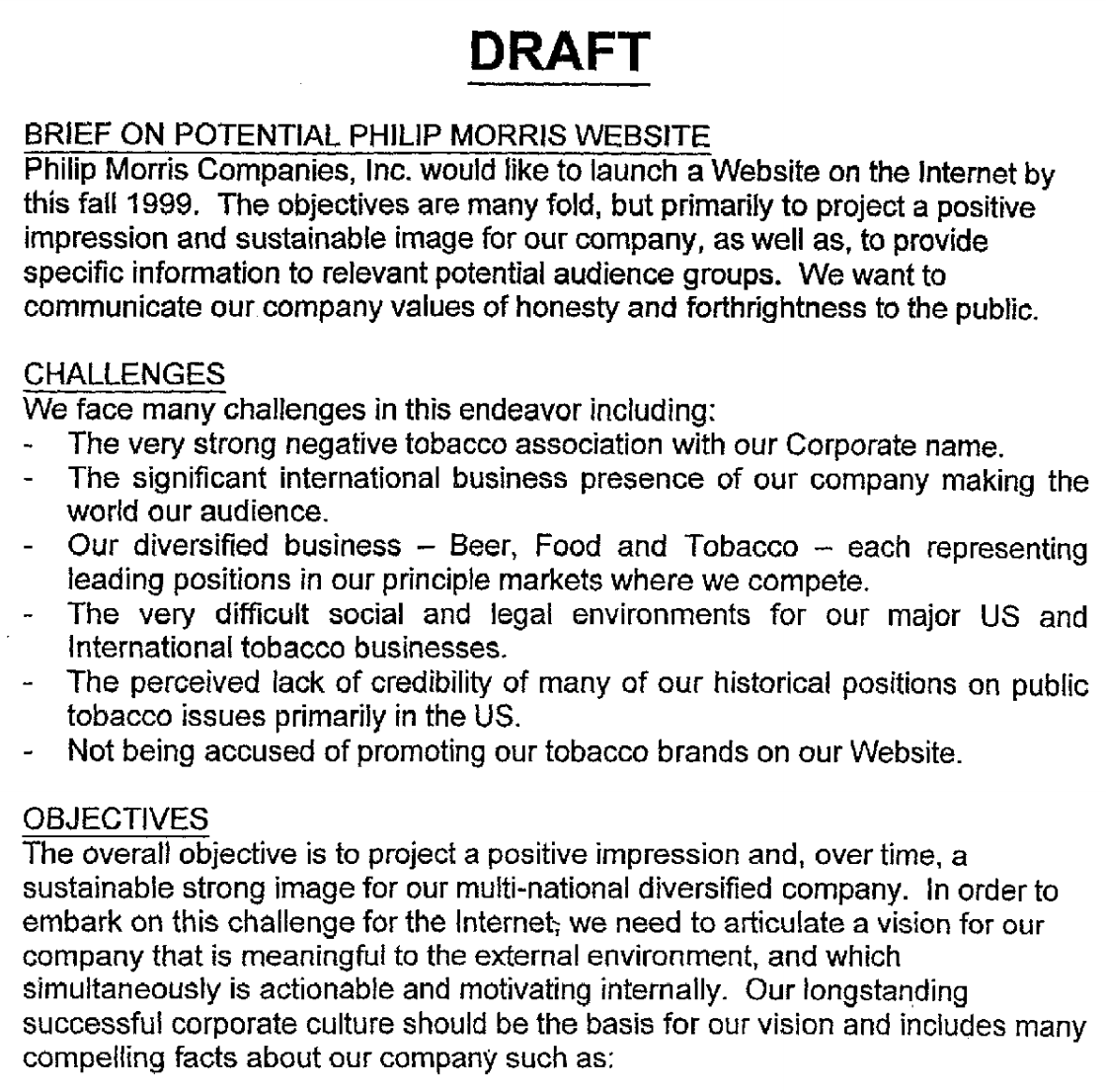
Image Credit: :{University of California-San Francisco}:
“The objective of this is to increase the awareness of our social programs and to improve the public perception of our company in the US during these very challenging times resulting from the very negative environment for our tobacco business,” reads the memo. “Hence, we want to capitalize on this advertising campaign by inviting viewers to a Website, where they can learn more about these programs and Philip Morris in general.”
ExxonMobil currently appears to be positioning itself as having moved away from the “old world,” announcing it would be hiring a new climate change researcher in the midst of New York Attorney General Eric Schneiderman announcing his office had opened an investigation on Exxon.
Keane also declared, under cross-examination by Wells, that her company had, under the auspices of an October 2, 1997 Statement of Position, withdrawn from the debate it had manufactured on the human health impacts of tobacco use. As Wells put it in his opening statement for the federal trial, this served as proof Philip Morris had entered into a ”permanent irreversible” dawn of a ”new era.“
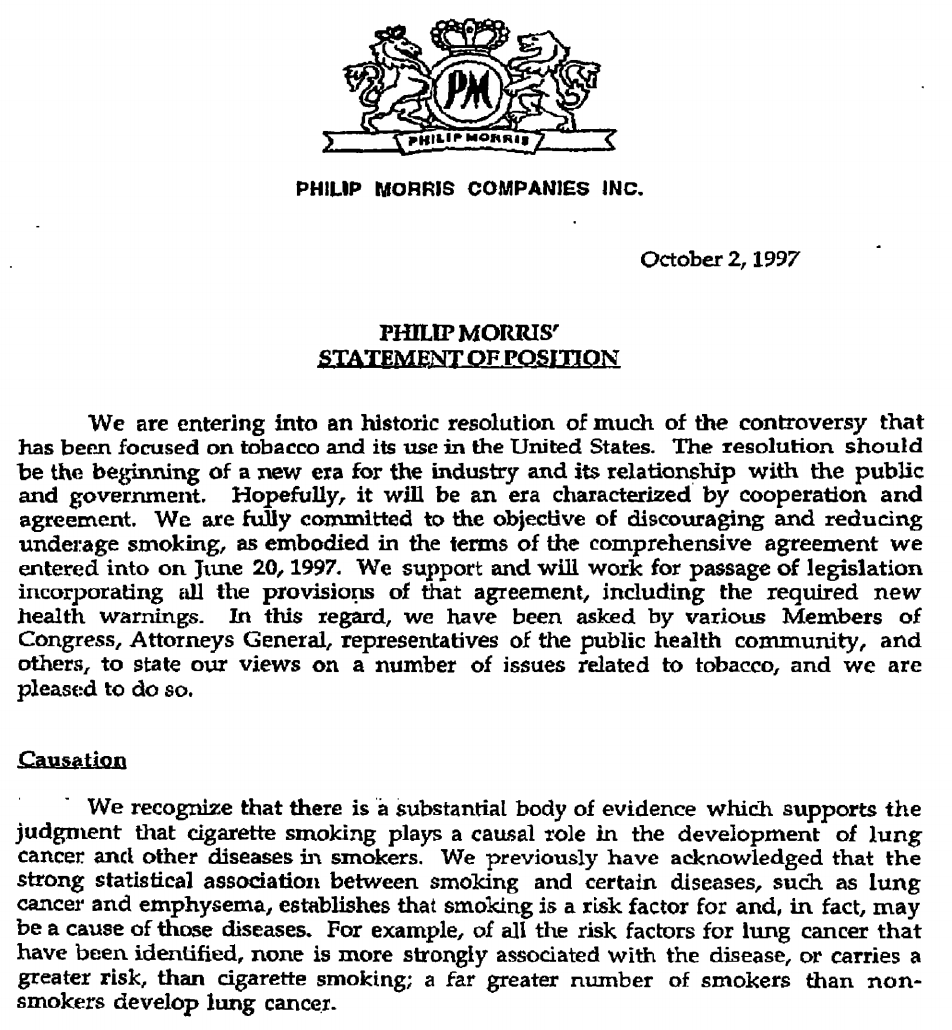
Image Credit: :{University of California-San Francisco:(style="box-sizing:border-box"):}:
A similar notion of involvement in public policy “debate” before it had reached an overwhelming scientific consensus arose in Exxon’s response to the Virgin Islands’ subpoena signed off on by Wells on April 13, with the word “debate” used 11 times by the company’s legal team.
Free Speech Attack?
Like with the Philip Morris precursor, Wells and the Exxon legal team attempted to convey the company’s shift from student of climate change science, to funder of climate denial and attacks on science, and then the shift back again to being a responsible corporate citizen concerned about climate change impacts and policy solutions.
“ExxonMobil has publicly and repeatedly acknowledged risks related to climate change” in recent years, Wells and his legal team wrote in response to the Virgin Islands’ AG Office subpoena, citing three example of such acknowledgment in recent years. In so doing, Exxon also claimed the Virgin Islands’ AG Office had launched an attack on its free speech rights and its ability to take part in such debates in earlier years.
“The chilling effect of this inquiry, which discriminates based on viewpoint to target one side of an ongoing policy debate, strikes at protected speech at the core of the First Amendment,” wrote Wells and the Exxon legal team.
The Virgin Islands rebutted Wells and Exxon in an April 25 response.
“Your argument that this investigation targets protected speech mirrors arguments that were decisively rejected in the United States’s case against tobacco, which held tobacco companies financially responsible for and imposed sweeping injunctive relief to address a decades-long scheme by those defendants to misrepresent the scientific facts regarding smoking,” reads the letter signed by Virgin Islands Attorney General Claude Earl Walker. “If ExxonMobil knowingly deceived consumers and investors about climate change, it, too, is not above the law.”
Numerous conservative groups — some with ties to the climate change denial echo chamber such as Koch-funded groups like Competitive Enterprise Institute, Pacific Legal Foundation, and Heritage Foundation — have also called the Virgin Islands subpoena a First Amendment attack.
So too did the editorial boards of the Wall Street Journaland the National Review Magazine. The Free Speech in Science Project, a group whose funding stream has yet to be revealed, has also pushed a First Amendment argument.
“Doubt is Our Product”
The tobacco industry is now infamous for writing in a 1969 memo that “Doubt is our product since it is the best means of competing with the ‘body of fact’ that exists in the mind of the general public.” Yet, Exxon has even said in its own late 1970s studies that “there is no doubt” that pumping carbon dioxide into the atmosphere was harmful.
Related Reading: “There is no doubt”: Exxon Knew :{CO2:(style="box-sizing:border-box"):}: Pollution Was A Global Threat By Late 1970s
If doubt is the product, then Wells has produced a legal career representing and defending doubt — from the tobacco wars, through to the NFL‘s concussion crisis and now into today’s “ExxonKnew” saga.
Wells did not respond to multiple requests for comment for this article.
===
===
june 2022
https://www.vox.com/23058987/sec-climate-finance-disclosure
as drought spreads and sea levels rise, the economic impacts of climate change will run in the trillions of dollars. The insurance firm Swiss Re projects climate disasters would cost the world as much as $23 trillion by 2050, bigger than the impact from the pandemic and the Great Recession of 2009 combined.
It’s reasonable business planning to account for all this foreseeable risk — just like planning for cyberattacks or business disruptions from a pandemic. Last year, for instance, the US had to spend $145 billion dealing with floods, fires, and other climate-related disasters.
Yet somehow, climate change has fallen through the cracks of US financial regulation. Publicly traded companies are required to disclose information about “material” risks that affect their company regardless of their cause, from sanctions to supply chain chaos. But there are no uniform standards for disclosing how much fossil fuel pollution they generate or the impact that climate change could have on their future growth. Instead, companies have been left free to inflate their environmental progress, all with little scrutiny from the public.
This kind of information is, in theory, essential to a functioning free market, so investors can make decisions based on complete information. But fossil fuel interests, conservative ideologues, and corporate trade groups are striving to keep shareholders in the dark on climate risks.
The Biden administration is trying to make companies more publicly accountable for the risk of the climate crisis. A linchpin of Biden’s plan is a draft rule the Securities and Exchange Commission (SEC) proposed in March. Over 500 pages, the SEC rule proposes that publicly traded companies disclose how climate change affects their business outlook and identify a board member or board committee to focus on climate-related risks.
Once the rule is finalized, companies will have to disclose how their operations are affected by extreme weather events and the impact of climate change on the short- and medium-term business outlook. They’ll also have to report the emissions both from their company’s operations and from how their products are used. This is particularly bad news for fossil fuel companies with business models predicated on selling pollution. Until this rule, they haven’t had to fully account for the environmental impact from things like selling gas that’s burned by consumers’ cars.
This is a rule, in other words, that helps the free market act like the free market, giving investors exactly the information they need to make the decisions,” Emory University business law expert George Georgiev said.
As the draft rule’s comment period came to a close, it’s clear any regulation on climate change faces serious headwinds. The loudest protests have come from right-wing groups and corporate-aligned nonprofits that have flooded the public comments with previews of the argument they’ll take to courts.
Plenty of businesses in the financial sector stand to benefit from this rule, like the investing giant BlackRock, which has pledged to align its assets with climate goals. But some could be hurt. The companies that benefit from greenwashing their climate commitments are doing everything they can to protect the chaotic status quo.
Financial transparency on climate change is hardly a radical idea
The SEC has required and standardized public company disclosures since 1933. In recent decades, the SEC has issued nonbinding guidance on how publicly traded companies should consider Covid-19 disruptions, Russia’s invasion of Ukraine, and even a feared “Y2K” meltdown at the turn of the 21st century, so the companies would meet their fiduciary duty.
But the SEC has been painfully slow on climate change. Right now, businesses disclose the risks and costs of their business on the climate on a voluntary, patchy basis with no clear standardization.
A 2020 Government Accountability Office surveyed 32 midsize and large publicly traded companies and found little consistency. Airlines, for example, used years anywhere between 1990 and 2017 as the baseline for calculating their climate footprint. Water companies have used completely different measurements for reporting water extraction. Some companies would just report carbon emissions, while others would report total greenhouse gas emissions (including sources like methane).
The proposed SEC rule cites other evidence of companies not paying attention to this risk, like an internal survey of climate-related keywords in companies’ 10-Ks between June 2019 and December 2020. They found only 31 percent mentioned climate change at all.
This information is not just to benefit climate change efforts; it is also useful to investors. It makes clearer, for instance, that a retail company’s warehouses might be threatened by increased flooding, that an airline company might have to ground more flights because of rising heat waves, or that a bank’s backing of major fossil fuel expansion has the strong chance of backfiring in a world that transitions to renewables. Without any regulation and standardization, companies will just continue to try to outshine one another on their environmental and social commitments without hard data to back it. This mismatch will become an existential risk to financial instability if, for example, extreme weather pummels a business that did not prepare accordingly.
Environmental activists have pushed for more from companies by proposing shareholder resolutions at annual meetings that ask for more transparency, but have met with mixed success in shareholder votes that don’t bind the company to taking action.
In this regulatory vacuum, voluntary global affiliations have cropped up, including the Net Zero Assets Managers Initiative, representing some $43 trillion in assets, and Climate Action 100+, representing more than $60 trillion. Another of these groups is run out of the Financial Stability Board as a Task Force on Climate-related Financial Disclosures (TCFD), a voluntary system that has grown to more than 3,000 companies. The task force’s recommendations tell companies to consider the short-, medium-, and long-term climate impacts, emissions that result from investment decisions, and their operations’ pollution, and account for the changing climate’s consequences for the business. The hundreds of companies that voluntarily comply with these standards aren’t necessarily green or good for the environment, but it’s an extra gold star for their sustainability transparency.
Eight countries, including the UK, have passed laws that will mirror the TFCD’s recommendations, but the US would remain an outlier without the SEC rule. “Investors put their money where they think there’s a good opportunity and good information,” said Steven Rothstein, managing director of the Ceres Accelerator for Sustainable Capital Markets. “If we don’t have good information, we run the risk of falling behind internationally.”
The SEC’s rule is basically the US playing catch-up, based on standards the mainstream corporate community aligned with TFCD have already backed.
Initially, companies will have to spend extra to comply with the rule — up to $530,000 a year for larger companies by the SEC’s estimate, but it will vary depending on how much companies are doing already on climate disclosure. Typically, the costs of rules shrink over time. Otherwise, the rule itself is quite modest. The SEC is “not saying you should or shouldn’t invest in climate products,” Rothstein said. “They’re just saying, tell investors what you’re doing and do it in a consistent way.”
Environmentalists and some Democratic lawmakers argue the SEC could be doing even more. The SEC does not change how companies disclose climate-related activities like PR campaigns and political influence, the kind of activities that tend to be outsourced to nonprofits that shield their activities from the public. In March, Sen. Sheldon Whitehouse (D-RI) called it a “failure of nerve that shies away from a perfectly legal, necessary response to the climate danger we face” because political efforts remain “the single most material disclosures a company could make to achieve climate safety.”
Right-wing groups claim financial transparency is an attack on free speech
Unsurprisingly, the SEC is facing immense pressure to withdraw this rule because of the same shadowy political spending that companies don’t have to disclose in the first place. Groups like the US Chamber of Commerce, the National Association of Manufacturers, Americans for Prosperity, and the Competitive Enterprise Institute have flooded the SEC with comments that argue company free speech would be violated.
Trade groups and right-wing think tanks have argued that requiring companies to report these emissions is akin to violating their First Amendment rights of free speech, pointing to a court case that ruled a regulation requiring the disclosure of conflict-zone minerals would amount to :{“}::{compelled speech”}: and violated the companies’ rights.
The American Petroleum Institute, the oil industry lobby, has argued the rule “could raise serious First Amendment issues under recent applying strict scrutiny to content-based laws compelling speech.”
The argument has found purchase with conservative lawmakers, like West Virginia Attorney General Patrick Morrisey,who picked up the argument in his 2021 letter to Treasury last year. In Congress, 19 Republican senators argued in their submitted comments that the rule is “not within the SEC’s mission to protect investors, maintain fair, orderly, and efficient markets, and facilitate capital formation.” Another 40 Republican representatives wrote that the rule will act to “undermine and shame public companies,” while Republican attorneys general describes the rule as a “total reordering of [the SEC’s] present disclosure regime.”
The attack on regulation under the guise of First Amendment rights has become more familiar in recent years. “Unfortunately, the Supreme Court has been steadily giving corporations more and more leeway, more and more rights,” said Ciara Torres-Spelliscy, a corporate law expert who has published several books on corporate speech.
The court also opened the door to more of these lawsuits, striking down a California law that required nonprofits to disclose their donors, siding with the Americans for Prosperity Foundation’s argument against disclosing their donors and providing IRS 990 forms to the state. Other legal challenges to campaign finance laws and unions have used the First Amendment.
Legal experts supportive of the SEC rule consider the argument a long shot in courts. “I think that argument is really far-fetched,” Emory’s Georgiev said.
But it’s still worrisome. If it succeeds, whether in courts or as a scare tactic to get the SEC to backtrack, it sets a dangerous precedent for the financial system at large. “If this climate rule is violating the First Amendment, it’s been all nine decades [the SEC has been] violating the First Amendment,” Georgiev said. “They will definitely try it out in courts. At the end of the day, a lot of far-fetched arguments succeed in courts.”
---
https://www.documentcloud.org/documents/20892344-comments-to-sec-on-esg-rule#document/p33/a2075289
comments from acc chem, AEI, AFP, API, cato, cei heartland etc CTT, CoC, co2 coalition, conoco phillips, enbridge, inst for free speech, heritage, nam, NMA, noia, lifepoerwed TPPF, WEA western energy? US oil and gas
Comments to SEC on ESG rule
supports principles based framework p. 1
Any reporting framework adopted by the Commission should be conductive to flexible and diverse climate change disclosures that reflect the different factors driving a company's business. p. 2
railroad industry has already taken steps to voluntarily comply with... SASB and TCFD... Adopting an existing, widely used program would lessen transition time. p. 2
not impose strict liability. furnish separately instead of file p. 2
Supports "furnishing" approach p. 5
We believe a business-specific "materiality standard that acknowledges differences across and within industries... p. 5
ACCinvolved in development of SASB standards, ACC member companies are using for voluntary disclosure p. 5
private market standard-setters often develop climate change disclosures with an implicit bias based on their perception of an industry's reputation p. 5
The liability standard imposed on information filed with the SEC is an inappropriate standard for such forward-looking and aspirational disclosures p. 6
ESG reporting "futile" p. 8
If public companies are driven to use the same (or similar) sets of assumptions about central parameters, a very real danger would arise of more-or-less homogenous predictions inconsistent with historical, ongoing, and prospective climate phenomena." p. 9
...and there is no evidence in support of the ubiquitous assertions of a climate "crisis," whether ongoing or looming, and no evidence in support of the even more extreme "existential threat" argument. p. 10
Again, public companies conducting climate "risk" analysis will have powerful incentives to choose among assumptions on future emissions and atmospheric concentrations, climate sensitivity, and other crucial parameters so as to insulate themselves from political attack, adverse regulatory actions, and litigation p. 14
Again, public companies conducting climate "risk" analysis will have powerful incentives to choose among assumptions on future emissions and atmospheric concentrations, climate sensitivity, and other crucial parameters so as to insulate themselves from political attack, adverse regulatory actions, and litigation p. 14
Those political pressures will lead public companies and government agencies not to consider the benefits of increasing atmospheric concentrations of GHG p. 14
...it is not easy to separate natural from anthropogenic effects on temperatures and other climate phenomena. p. 15
Accordingly, the data are unclear as to whether there is occurring an acceleration in sea level rise p. 16
The reality is that a "climate risk" disclosure requirement would be deeply speculative. p. 18
What about massive volcanic eruptions? Asteroid impacts? Powerful earthquakes? p. 19
Constitutional objection to ESG reporting p. 22
SEC Climate Disclosure Mandates Risk Compelling Speech at Odds with the First Amendment p. 23
...expressing views they may not hold or would prefer to express in different ways. p. 23
...could imply that the speaker had adopted a position on the topic of climate change... p. 24
Commissioner Hester Peirce identified some of the risk of compelled speech in this context during June 2019 remarks before the American Enterprise Institute, including public shaming and shunning based on nebulous, incomplete, arbitrary, inconsistent, and political information which would be incorporated as part of an SEC climate or ESG disclosure regime. p. 25
explain in a forthcoming article p. 25
...the evidence of ESG-certified investments -- whether by governments or third parties -- achieving financial or environmental objectives is likely overblown. p. 26
As Commissioner Peirce has articulated, the use of global, one-size-fits-all ESG and climate disclosure regimes may undermine the bottom-up, non-government innovations that respond to those investor and consumer interests p. 27
...represents a sweeping expansion of government power and mission creep for many parts of the federal government. p. 27
APIseeks to serve as a resource and an active participant p. 29
API developing framework based on EEI/AGA template p. 30
disclosure requirements beyond materiality "could raise serious First Amendment issues" p. 33
Central Hudson Doctrine p. 34
"industry issuers may be best positioned to define the standard for require climate disclosures" p. 34
API encourages SEC to view industry resources as key starting points for evaluating need to develop new reporting requirements p. 37
constitutional limitations on SEC's ability to require companies p. 38
look forward to working with SEC "through the rulemaking process" p. 40
ESG reporting "important" and AXPC is committed to "progress" p. 42
AXPCmetric framework and template p. 43
materiality is key p. 43
'neutrality'; any disclosures should not "discriminate against any economic sector or sectors" p. 44
urging adherence to procedural requirements/allowing additional input from industry p. 45
AXPC urges SEC not to include scope 3 emissions in reporting requirements p. 47
does not believe SEC should require auditing/believes companies should be able to rely on third party auditors p. 50
would urge Commission to not require certification of climate disclosures p. 51
"strong supports a 'comply or explain' framework" p. 51
unclear mandatory disclosure can provide a net benefit p. 53
the SEC is not tasked with environmental regulation p. 53
...also raises questions about the SEC's ability to evaluate prescriptive disclosure frameworks and fairly enforce compliance with them. p. 53
90% of the companies in the S&P 500 were publishing a sustainability report. p. 54
the SEC would be stepping in to pick "winners" and "losers" p. 55
Evolving understandings of climate change p. 56
Corporate environmental sustainability disclosures--and ESG disclosures more generally--have come to fruition as a result of exogenous demand for such information, and an industry has grown up around the provision of such information. p. 57
The SEC should not extend any climate change-related disclosures requirements to private companies. p. 59
"name and shame" -type of strategy p. 59
...the losses they may incur as climate policies devalue and strand their assets and courts compel them to pay compensation to climate change victims. p. 61
In practice, however, it is often hard to distinguish what component of current risks is due to climate change rather than just plain old climate. p. 62
Advocates for climate risk disclosure: p. 64
If the state of the world is improving, including in regard to cilmate-related risks, why now compel publicly-traded companies to quantify climate-related risks as though their financial lives depend on it? p. 72
Third, CO2 emissions have positive as well as negative externalities. p. 74
adaptation requires wealth, and mitigation targets that strand 42.1 percent fossil fuel industry assets by 2030 would destroy trillions of dollars of wealth. p. 77
The NetZero agenda is the political equivalent of war on the fossil fuel industry. p. 77
Death spiral p. 78
Disclosure advocates warn of a carbon bubble but the Paris treaty and NetZero agendas may be setting the stage for a green bubble. p. 85
Solyndra! p. 85
ESG exceeds powers of SECp. 93
...mission creep for the agency... p. 93
Accounting firms, consultants, and law firms with compliance practices can be expected to welcome more disclosure requirements for self-interested professional reasons. p. 97
the Scientification of Non-Knowledge p. 100
...some climate and ESG-themed disclosure mandates could become compelled speech thatconflicts with First Amendment protections. p. 100
At least some proposed climate disclosure provisions, by which companies must confess to having metaphorical blood on their hands with regard to future catastrophic effects of climate change, would face similar First Amendment concerns." p. 101
Should a U.S. firm end a contract with a textile factory in Bangladesh over the average age of its workers or will that simply cause those teenage employees and their families to fall even further into poverty when their factory closes? Isn't poverty alleviation itself a major ESG goal? p. 104
The agency should continue to defer to the materiality threshold to help continue to prevent securities from becoming politicized p. 107
companies are already required to disclose material ESG information under current law p. 108
advocating a flexible, principles-based approach with tailoring for different industries and companies p. 110
it is critical to avoid finding "fraud by hindsight" p. 110
Third-party standard setters may not be insulated enough from stakeholder and other policy agendas... important questions to answer about organizational governance, due process, and funding sources. p. 111
SEC should take a closer look at transparency and conflicts of interest [in third party ESG assessments] p. 112
SEC should allow a commensurate market-based approach to third-party assurance for climate-related reporting p. 113
Disclosure... should not be a tool for advancing political interests or achieving policy goals p. 113
Chevron has a "long history" of reporting on ESG p. 115
supports disclosure for "consistency and comparability of climate-related information" with existing frameworks and a phased approach p. 115
support for reporting times to line up with other agencies p. 116
Chevron working with API to develop 'voluntary template' p. 116
"Chevron's climate change reporting experience" p. 117
urging a "phased" approach p. 118
advocating for a principle-based approach rooted in 'materiality' p. 118
SEC should focus on "decision-useful information" p. 118
SEC should build on existing sustainability-related disclosure requirements p. 118
support for global sustainability standard; encouraging SEC to use TCFD framework/voluntary standards/private sector industry standards p. 119
Chevron offers assistance as the SEC "moves forward with Climate disclosure" p. 119
"There is no climate crisis" p. 120
"We have long recognized the need for action to address climate change" and "understand investor interest" in ESG p. 122
recommend SEC adopt existing reporting frameworks (TCDF, SASB) p. 122
standards-setting organizations and industry can successfully/should work together p. 123
phased approach / based in materiality / "harmonize" disclosure requirements with other sustainability reporting requirements p. 123
urging a "hybrid-approach" to disclosure: company specific while "minimizing categorical discrimination among industries" p. 123
data should be presented in way that is useful for investors p. 124
"materiality" for climate disclosures: "reasonable investor would consider it important in deciding how to vote" p. 124
should apply liability protections / ESG disclosures should be "furnished" not "filed" p. 125
Our members are leading the transition to the lower-carbon energy economy p. 127
brags about "recognizing the importance of climate change disclosure" p. 127
"we support the Commission's focus" p. 128
ESG requirement should be collab between registrants and investors, flexible, sector-specific p. 128
best to work with investors to disclose relevant information p. 129
"climate change data and disclosure are inherently uncertain" - companies should not be liable p. 130
"forward-looking societal climate impacts or other externalities" are not useful to investors/decision-making p. 131
"forward-looking societal climate impacts or other externalities" are not useful to investors/decision-making p. 131
should not be a one-size fits all approach p. 132
"caution against delegating the development of public-company disclosure requirements to NGOs or private companies" p. 134
"we recommend the Commission prioritize standards applicable to registrants subject to its rules" p. 139
advocating for ownEEI-AGA ESG/Sustainability Reporting Template p. 140
do not believe additional certifications or reviews are necessary p. 140
need to be careful that disclosures do not lead to additional litigation p. 141
"existing requirement to disclose material risk factors" re climate is sufficient p. 142
"our perspective is drawn from our long and sustained history of voluntary disclosure" related to ESG p. 148
ESG must remain rooted in SEC's mission "to protect investors; maintain fair, orderly and efficient markets; and facilitate capital formation" p. 149
SEC must remember "purpose of reporting": investors and materiality at forefront p. 149
need to allow degree of flexibility/customization p. 149
"harmonized and uniform global framework for climate change disclosure... seems unrealistic" p. 149
advocating for adoption of existing frameworks p. 149
disclosures "should be subject to a safe harbor or limitation on liability" p. 150
"phased approach" needed p. 150
"no statutory authority" for ESG disclosure p. 151
"compelling ESG information from companies... is the type of humanitarian and social benefit regulation that has been struck down as unconstitutional under the First Amendment" p. 151
SEC climate regulation "cannot overcome even Central Hudson intermediate scrutiny" p. 152
ESG regulation will have negative consequences p. 154
Climate Science "Highly Uncertain" p. 160
calls for policing of fund management firms for ESG fraud p. 162
arguing ESG is essentially a tax on workers p. 177
arguing ESG is essentially a tax on workers p. 177
"allow for flexible disclosure" but in support of "principle based framework" p. 184
Any rule is premature p. 201
supports "new regulatory framework" p. 213
supports "a systemic approach to addressing the climate challenge" p. 216
TPPF comment through "Life:Powered" p. 217
"Risks to Human Welfare from Climate Are Decreasing, Not Increasing" p. 218
Additional disclosure requirements will result in First Amendment violations p. 220
Example of conflict minerals disclosure.p. 220
WEA and USOGA Comment p. 222
"uncertainties" on "extent of anthropogenic contributions and the amount of warming " p. 223
WEA uses paper that critiques decades long campaign to promote misinformation on climate by oil and gas p. 226
Preference for SASB on governance issues p. 229
WEA questions SEC's sincerity p. 231
Original Document (PDF) »
Contributed by Jesse Coleman (Documented)
Document
===
===
an 722
no lnx guk
A judge ruling in favor of a billion-dollar defamation lawsuit moving forward signals the possibility of looming financial woes for Rupert Murdoch's Fox News. According to The Guardian, Delaware Supreme Court Judge Eric David in June ruled that Dominion Voting Systems could proceed with its defamation lawsuit against Fox News and its parent company, Fox Corporation.
The lawsuit is a legal pushback against Fox News' reporting and perpetuation of voter fraud and election misinformation following the 2020 presidential election.
Per The Guardian, David determined "that it was a reasonable inference that Murdoch and son Lachlan either knew outright that Dominion had not manipulated the election or 'recklessly disregarded the truth' when Fox disseminated lies initially launched by Donald Trump."
READ MORE: Right-wing media outlets continue to rage against Dominion’s defamation lawsuits: report
Speaking to The Guardian, a number of legal experts have offered their perspective on the case and why it suggests trouble ahead of Fox News. Ciara Torres-Spelliscy, a Stetson University constitutional law professor and fellow at the Brennan Center for Justice, weighed in on Dominion's case as she noted that the voting technology company appears to have a substantial argument.
“Dominion has a very strong case against Fox News,” Torres-Spelliscy said to the news outlet, adding that "all of the 'conspiracy theories about Dominion’s machines were just pure bunk,'" She also noted that "Fox as a news organization should have known that and not given this aspect of [Trump’s] ‘big lie’ a megaphone.”
“I think once you start to pull the discovery material, what you’re going to find is there was a lot of communication between the Trump people both internally and externally about pushing very specific lies and narratives,” said Media Matters for America chief executive, Angelo Carusone.
However, Fox News is confident that it will survive this legal battle.
READ MORE: The 'Fox News of justice': Jon Stewart slams SCOTUS justices' flurry of controversial and conservative rulings
A Fox spokesman told also released a brief statement to the news outlet on behalf of the network. “We are confident we will prevail in this case, as the First Amendment is the foundation of our democracy and freedom of the press must be protected,” the spokesman said.
In addition to the lawsuit against Fox News, Dominion also has a $1.6 billion lawsuit against conservative news networks One America News Network (OAN) and Newsmax.
===
=
https://www.expressnews.com/business/eagle-ford-energy/article/Inside-Exxon-Mobil-s-fight-to-stop-climate-12994450.php
BUSINESS
Inside Exxon Mobil’s fight to stop climate change litigation in its tracks
James Osborne
Staff Writer
June 15, 2018
[FILE - In this May 31, 2006 file photo, an ice sculpture fashioned by protesters, to demonstrate their view of how the company's policies are affecting the environment, slowly melts outside the Exxon Mobil shareholders meeting in Dallas. The Massachusetts Supreme Judicial Court ruled Friday, April 13, 2018, that Exxon Mobil must hand over documents for Attorney General Maura Healey's probe into whether the company misled investors and consumers about what it knew about the link between fossil fuels and climate change. (AP Photo/LM Otero, File)]
WASHINGTON — Imagine this storyline: One of the largest oil companies in the world becomes the victim of a left-wing conspiracy, funded by wealthy liberals who convince Democratic attorneys general across the nation to sue the company to stop it from offering different views about climate change.
What sounds like the stuff of a bad Hollywood thriller is, in fact, the narrative Exxon Mobil’s attorneys are telling as they seek to defend the company from myriad lawsuits and investigations into what oil companies knew about climate change and when they knew it. With a surprising procedural victory in a Texas court recently, Exxon is attempting to gain greater latitude in what it and other oil companies can say — or not say — about climate change and the impact on their businesses, seeking to build on legal rulings that have expanded corporations’ rights of free speech in recent years, legal scholars say.
The U.S. government has long limited First Amendment protections for corporations, prohibiting them from making false statements to further business interests — a staple of U.S. consumer protection laws going back to the days of snake-oil salesmen peddling so-called magic elixirs. But Exxon’s case could test how far the courts are willing to go to uphold governments’ ability to regulate commercial speech.
Exxon is arguing that the state and local governments suing the company have gone too far, trying to impose an Orwellian code of conduct to drown out those who call attention to uncertainties about how climate change will play out over the long term and affect the global economy.
“Exxon is framing (climate change) as a legitimate political debate in which they are a participant, rather than a for-profit company trying to make a buck,” said Tamara Piety, a law professor at University of Tulsa. “There has been a growing movement (among corporations) to raise the First Amendment. If something can be proven to be unconstitutional it’s completely off the table”
Over the past two decades, companies have successfully used the free speech strategy to challenge government regulations on everything from the placement of workplace signs explaining employee rights to the distribution of patients’ medical data. A key win for corporate America came in 2010 Citizens United case, when the Supreme Court ruled that limits on corporate spending in political campaigns violated companies’ free speech rights.
Now Exxon is seeking to expand corporate rights one step further, arguing that the government legal action, based on the company’s past statements, is little more than leverage to get oil companies to agree to a wide-arching climate change deal that would restrict what they can say about the issue — in violation of “of Exxon Mobil’s constitutional rights.” That includes investigations launched by the New York and Massachusetts attorneys general into whether Exxon lied to shareholders and consumers about the risks of climate change to the environment and its business, and lawsuits filed by cities and counties in California and Colorado, which are seeking damages from Exxon and other oil companies for the costs of rising sea levels and increased wildfires.
Exxon in January asked a state court in Fort Worth to order more than a dozen city and county officials from California to sit for depositions by Exxon’s attorneys to determine whether they are conspiring with plaintiffs’ attorneys and environmentalist activists to force Exxon into accepting a deal. A New York federal judge in March dismissed a similar request by Exxon to depose the New York and Massachusetts attorneys general, ruling it was based on “extremely thin allegations and speculative inference,” but the Texas judge, R.H. Wallace Jr., decided to give the company more room to prove its claim, ruling in April that Exxon could begin making requests to depose specific officials.
Exxon declined to comment. But James Coleman, a law professor at Southern Methodist University in Dallas and a contributor to the conservative Federalist Society, said Exxon, which has come out in support of the Paris climate accords and a national carbon tax, is simply protecting its First Amendment rightsto communicate about climate change and the effects on its finances as it sees fit.
“It’s an unusual claim (by Exxon) but it doesn’t mean it’s wrong,” he said. “The government can make you give accurate information, but the government can’t force you to say things you disagree with. For instance, the government couldn’t make Exxon say climate change is the defining challenge of our time, even if they consider it a fact.”
San Francisco and other California communities are challenging Wallace’s ruling in the Texas 2nd Circuit Court of Appeals, potentially setting the case on a path to the Texas Supreme Court. And considering the political makeup of the state’s high court, Exxon stands a good chance of winning its argument, said Tom McGarity, a law professor at the University of Texas, who sits on an advisory board to the California plaintiffs.
“It presents a very sympathetic venue,” he said. “It’s a pro-business Supreme Court.”
Conspiracy
The case in Texas comes three years into a legal campaign against Exxon and other oil companies. In Exxon’s telling, it all stems from meeting of environmental activists in the beach town ofLa Jolla, California, in 2012.
Activists and attorneys discussed a strategy for addressing climate change based on the tobacco lawsuits of the 1990s, which successfully argued tobacco companies were liable for smokers’ deaths because executives knew the risks but still claimed publicly they did not, according to an account of the meeting published by the Union of Concerned Scientists, an environmental group that helped organize the event
If Exxon and other oil companies could be shown to have known the risks to health and safety of climate change but did nothing to warn the public and investors, then perhaps activists could create a groundswell of public outrage to change the political and economic landscape for oil companies, much as they had for tobacco companies.
“We wrote up a report so other lawyers and policymakers could pick up on those lessons (from tobacco) and use them, like you would any science you would hope is actionable,” said Peter Frumhoff, head of policy and science at the Union of Concerned Scientists. “The first tenet of good science is being transparent.”
But the activists also gave Exxon a potential weapon to counterattack.
The company’s lawyers have focused on one line in the Union of Concerned Scientists account, in which activists describe how they could could use litigation for “maintaining pressure on the industry that could eventually lead to its support for legislative and regulatory responses to global warming.” That game plan, Exxon lawyers said, was then adopted by government prosecutors, including former New York Attorney General Eric Schneiderman, who recently resigned amid allegations of sexual abuse.
Wallace, the Texas judge, agreed with the company lawyers, writing that environmentalists who attended the La Jolla meeting “aimed to chill and suppress Exxon Mobil’s speech.”
California and Colorado officials dismiss Exxon’s legal maneuvers as little more than intimidation tactics aimed at frightening and bogging them down in paperwork. A spokesman for the New York Attorney General’s Office called Exxon’s strategy an attempt to “distract and deflect from the facts at hand.”
Public opinion
Within conservative circles, Exxon’s conspiracy message seems to be gaining traction.
:{:{}:
}:
Earlier this year, David Bookbinder, an attorney with the libertarian Niskanen Center, filed suit against Exxon and the Canadian oil company Suncor,claiming they were responsible for the costs sustained by Colorado local governments in fighting wildfires and other effects of climate change.
:{:{}:
}:
A few weeks later, he began seeing his name pop up on conservative websites, including theDaily Caller and one owned by the U.S. Chamber of Commerce. Articles suggested Bookbinder and his colleagues were part of a conspiracy funded by the Rockefeller Brothers Fund, a New York charity with more than $800 million in assets that is overseen by the descendants of the late oil tycoon John D. Rockefeller, whose Standard Oil was the precursor to Exxon Mobil.
The claim was based on a $200,000 grant the Niskanen Center received shortly before the Colorado lawsuit was filed. Bookbinder said the grant had nothing to do with the lawsuit and scoffed at the idea his plaintiffs were part of a conspiracy to damage Exxon.
:{:{}:
}:
“My clients don’t want Exxon out of business,” he said. “Then they don’t get paid.”
The Rockefeller Brothers Fund said in a statement that it does consider a willingness to take oil companies to court in awarding grants to climate activists. “Litigation is one tool that can help to level the playing field by leaning into legal standards that are meant to serve the common good,” the statement said.
In its legal filings, Exxon maintains that the Rockefellers and the hedge fund billionaireTom Steyer, who is funding a campaign to impeach President Donald Trump, are behind the wave of litigation. Exxon lawyers cited a $30,000 campaign donation Steyer made to a former mayor of San Francisco shortly before that city filed suit, as well as a Columbia Journalism School investigation into how Exxon’s past statements questioning climate science conflicted with what its scientists were saying internally.
The Rockefeller Family Fund, another charity controlled by Rockefeller descendants, funded the Columbia investigation.
There’s nothing illegal about using money to try to influence a company’s behavior. But that’s besides the point for Exxon. Just as climate activists succeeded in convincing more Americans that climate change is a large and growing threat, Exxon wants to promote the idea of a liberal conspiracy to undermine a fossil fuel industry that employs hundreds of thousands of people and literally fuels the U.S. and global economies.
Exxon is now considering an appeal of a ruling by the Massachusetts Supreme Judicial Court that found the state’s attorney general’s office had not violated the company’s constitutional rights when it demanded the company turn over documents. Such an appeal would go to the U.S. Supreme Court, where Exxon’s success in convincing the public of its liberal conspiracy narrative could make the difference between winning and losing.
“I don’t think the Supreme Court is completely oblivious to public opinion,” said Piety, the Tulsa law professor, “and the more Exxon can marshal public opinion, the better chance they have of convincing the courts.”
===
all purpose get out of jail card for libtard assholes?
FRREEEEEDUUUUUMMMB!
an 3 22
federal judge dismissed an anti-mask lawsuit against Speaker of the House Nancy Pelosi on Wednesday, brought last year by three far-right-wing members of Congress, including Rep. Marjorie Taylor Greene.The three extremist Republicans argued that the mask mandate, instituted to protect their fellow members of Congress and their staffs, was a violation of the First and the Twenty-Seventh Amendments.
The judge disagreed:
U.S. Reps. Marjorie Taylor Greene (R-GA), Thomas Massie (R-KY), and Ralph Norman (R-SC) “said they were fined for entering the House to vote without wearing masks in May 2021,” Bloomberg Law reports.They were initially fined $500, but Congresswoman Greene has since racked up thousands of dollars in fines since last May.
“The representatives said they wanted to engage in a ‘protest against the double standard being enforced,’ and to demonstrate ‘the well-founded beliefs’ they shared that mask wearing ‘is not scientifically based’ and ‘not necessary for the vaccinated or naturally immune.'”
It was clear during oral arguments in December thatSenior U.S. District Judge Reggie Walton, a Bush 43 appointee, disagreed.
“Maybe if we took this pandemic seriously we wouldn’t have so many Americans in the grave,” Judge Walton said at the time, admonishing the three extremists.
In his ruling, Judge Walton was also dismissive of their victimization claim of being discriminated against for what the three called, “contrary viewpoint-based symbolic speech.”
Judge Walton also rejected their false claim of “recent scientific findings that the use of face coverings has no appreciable effect on slowing or halting the spread of COVID-19.”
Walton “said the consensus within the scientific community is clear that masks—and, in particular, well-fitting, protective masks—are effective in slowing the spread of the Covid-19 virus.”
A large part of their argument was the 27th Amendment makes it unconstitutional for them to be fined, which they claimed is a reduction in salary. The judge also tossed out that argument.
Here’s Congressman Massie complaining on Fox Business last year. “We’re ready to take this all the way to the Supreme Court,” he declared.[twt vid]
===
===
feb 2018
https://blog.ucsusa.org/elliott-negin/exxonmobils-climate-disinformation-campaign-is-still-alive-and-well/
In a recent blog post, ExxonMobil executive Suzanne McCarronreiterated her company’s claim that it fully accepts the reality of climate change and that it wants to do something about it....“I want to use this opportunity to be 100 percent clear about where we stand on climate change,” she wrote. “We believe the risk of climate change is real and we are committed to being part of the solution. So why is the company still a part of—in fact, a major part of—the problem?An exchange between Oklahoma Sen. James Inhofe and Environmental Protection Agency (EPA) Administrator Scott Pruitt during a recent is a case in point, providing a window into how ExxonMobil’s undue influence continues to block climate action.
During the January 30 hearing, which was held by the Senate Environment and Public Works (EPW) Committee, Sen. Cory Booker inadvertently provoked Inhofe by raising the issue of environmental justice.The New Jersey Democrat cited the threat climate change-induced flooding poses to three dozen Superfund sites in his state and asked Pruitt if he was “taking into account the environmental burdens disproportionately impacting communities of color, indigenous communities and low-income communities.”
Inhofe seized the opportunity to contradict Booker, claiming that minority and low-income communities are disproportionately harmed by environmental protections, specifically citing the Obama administration’s Clean Power Plan, which would have dramatically reduced carbon emissions from coal-fired power plants if Pruitt hadn’t repealed it.
Booker, Inhofe said, was implying that Pruitt was trying to “punish” vulnerable Americans. “I wanted to just remind you,” Inhofe told the committee, “that we had a guy I remember so well, Harry Alford. He was the president of the National Black Chamber of Commerce. He provided some of the most powerful testimony that I have ever heard when it comes to the effects of the Clean Power Plan and some of the other regulations … on black and Hispanic poverty, including job losses and increased energy costs.
“[Alford] was very emphatic as to who was paying the price on these,” the Oklahoma Republican continued, “and I think sometimes that the previous administration forgot that there are already people out there who are paying all they can pay just to try to eat and keep their house warm.”
ExxonMobil’s Echo Chamber
Inhofe’s source for his assertion? A discredited, ExxonMobil-funded study by an Exxon-funded advocacy group that was based on discredited studies by other ExxonMobil-funded organizations.
Inhofe rested his argument on previous congressional testimony by Harry Alford, president of the National Black Chamber of Commerce (NBCC), a shoestring, mom-and-pop operation that is unapologetic about taking fossil fuel industry money. “Of course we do and it is only natural,” Alford wrote on NBCC’s website. “The legacy of Blacks in this nation has been tied to the miraculous history of fossil fuel…. [F]ossil fuels have been our economic friend.”
One of NBCC’s closest economic friends is ExxonMobil, which has donated more than $1.14 million to the group since 2001.
What did the company get for that money?
In 2015, NBCC commissioned a report that claimed the Clean Power Plan would “inflict severe and disproportionate economic burdens on poor families, especially minorities.”
In fact, unchecked climate change would more than likely hurt those communities most, and investments in energy efficiency under the plan would ultimately lower electricity bills across the country.
How did NBCC arrive at its upside-down assessment? The Union of Concerned Scientists took a close look at the report and found it was based on several flawed fossil fuel industry-friendly studies. Two of those bogus studies were produced by ExxonMobil grantees: the Heritage Foundation, which received $340,000 from ExxonMobil between 2007 and 2013, and the U.S. Chamber of Commerce, which received $3 million between 2014 and 2016.
The Chamber study, which came out just days before the EPA released a draft of the Clean Power Plan, was debunked not only by the EPA, but also by *PolitiFact.com* and *The Washington Post*. Among its many faults, the Chamber study—which was co-sponsored by the American Petroleum Institute—wildly inflated the cost of the plan and failed to consider the benefits of cutting carbon emissions.
ExxonMobil Spreads its Money Around
But there’s more than just the fact that ExxonMobil financed deliberately flawed studies to try to derail the Clean Power Plan. The company also is a major supporter of a number of Senate EPW Committee members, including Inhofe, who are adamant climate science deniers.
Inhofe has deep ties to the oil and gas industry, which has donated $1.85 million to his campaign war chest over his long career in Congress, more than twice than any other industry.Three oil and gas companies are among the senator’s top 10 corporate contributors: Koch Industries, Devon Energy and …ExxonMobil.
Six of the other 10 Republicans on the EPW Committee also are on ExxonMobil’s donation list, including Wyoming Sen. John Barrasso, the current committee chairman. Roughly half of the $119,500 ExxonMobil contributed to the seven senators over the last decade went to Barrasso and Inhofe, the committee’s previous chairman.
Then there’s ExxonMobil’s link to Pruitt, Oklahoma’s attorney general before President Trump tapped him to run the EPA. From 2012 through 2013, he chaired the Republican Attorneys General Association (RAGA)and afterward served on the organization’s executive committee. From 2014 through 2016, ExxonMobil gave RAGA $160,000 in three annual installments.
Just a few weeks after the company made its 2016 donation of $50,000,Pruitt and then-RAGA Chairman Luther Strange, at the time Alabama’s attorney general, co-authored a National Review column attacking a coalition of state attorneys general investigating ExxonMobil and other fossil fuel companies for misleading investorsand the general public about climate change. Parroting ExxonMobil’s argument, Pruitt and Strange charged that the coalition was violating the company’s first amendment right to free speech.
“The debate” over climate change, they wrote “is far from settled. Scientists continue to disagree about the degree and extent of global warming and its connection to the actions of mankind. That debate should be encouraged — in classrooms, public forums, and the halls of Congress. It should not be silenced with threats of prosecution. Dissent is not a crime.”
Inhofe Upstaged
In this case, Inhofe’s counterfactual comment didn’t make it into the ensuing media coverage. Along with nearly everything else that was said during the two-and-a-half hour marathon, it was eclipsed by a bombshell dropped by Sen. Sheldon Whitehouse. The Rhode Island Democrat revealed that during a February 2016 radio interview, Pruitt said Trump would be “more abusive to the Constitution than Barack Obama, and that’s saying a lot.” Whitehouse read Pruitt’s remark aloud and asked him if he recalled making it.
“I don’t,” Pruitt responded, “and I don’t echo that today at all.”
“I guess not,” Whitehouse replied.
Not surprisingly, that embarrassing nugget was the story. There was no way that Inhofe’s rambling, ExxonMobil-sponsored falsehood could compete in the media with red meat like that. But overshadowed or not, Inhofe provided yet another incontrovertible piece of evidence that—despite ExxonMobil’s statements to the contrary—the company is still very much engaged behind the scenes in trying to stymie any government attempt to seriously address climate change.
Posted in: Climate Change, Energy, Science and Democracy, Scientific Integrity
Tags: disinformation
===
===
an 1 22
where are gop rw 1st amend absolutists?
this is also LEGAL suppression:
i'm sure FIRE is on the case; accred by who?
an 1 22
Baker College, one of the largest private schools in Michigan, is threatening legal action against a former faculty member who spoke to ProPublica and the Detroit Free Press for an investigation published this month.
Jacqueline Tessmer, who taught digital media for 14 years at Baker’s campus in Auburn Hills, told the news organizations that students often came to the nonprofit college unprepared to succeed and exited without degrees or good jobs but with heavy debt from loans. “Baker College has ruined a lot of people’s lives,” she said in the story.
A Jan. 19 letter to Tessmer — sent by the law firm Plunkett Cooney on behalf of Baker — demanded she retract her statements, which it described as “false and defamatory.” It did not specify what, if anything, was false. Arguing that Tessmer was in violation of a nondisparagement clause in a settlement she reached with Baker in an employment dispute, attorney Courtney L. Nichols also demanded that she “agree voluntarily to remit payment to Baker College for the damages it has suffered as a result of your violation(s), including attorney fees.” The letter did not include a dollar amount.
Since publication, Baker has not contacted either news organization to contest the validity of her statements. Before publication, the Free Press and ProPublica informed Baker that Tessmer would be quoted and shared her comments. Baker did not specifically address those quotes or Tessmer’s time at the college.
Baker’s letter to her after publication gave her seven days to respond. Tessmer said in an interview this week she stands by her comments and will not meet the college’s demands.
She said she didn’t see how it would be possible to make a retraction even if she wanted to, given that she expressed her opinion “based on what I did in service to the college” and her comments were only “a couple of sentences in a giant article.”
“I could be quiet, but is it really going to matter at this point?” she added.
The story on Baker examined the college’s low graduation rates, its aggressive marketing and the oversight of a Board of Trustees that has included former presidents of the school.
In addition to the letter to Tessmer, Baker responded to the article by emailing students, writing a letter to the editor in the Free Press, and placing a statement on its website that disparaged the story and touted the school’s achievements. Officials have defended the 111-year-old college as an affordable open enrollment school whose practices are reviewed by regulators and accreditors.
Neither Baker nor its lawyer has responded to a request for comment on the legal threat.
Tessmer’s relationship with Baker ended in a lawsuit she filed for breach of contract and retaliation. The school disputed her claims in a countersuit, and the case ended in a settlement in 2014. The letter from Baker’s lawyer also suggested that if Tessmer had spoken about the settlement, she would be in violation of it.
“This is what they do,” said Tessmer, now self-employed. “They scare. They huff and they puff, and it works a lot of the time. I mean, it’s worked on me.”
The letter to Tessmer said that if she did not comply, “Baker College will consider its available recourse.”
As of Thursday evening, Tessmer had not heard again from the law firm.
===
don't say gay or climate change
does not mention exxon cei or 1st amend specifically but...
https://www.nationalreview.com/2016/05/climate-change-attorneys-general/
no lnx
POLITICS & POLICY
The Climate-Change Gang
By SCOTT PRUITT
& LUTHER STRANGE
May 17, 2016
The Obama administration lawlessly rewards its supporters and punishes its enemies.
The United States was born out of a revolution against, in the words of the Declaration of Independence, an “arbitrary government” that put men on trial “for pretended offences”and “abolish[ed] the Free System of English laws.” Brave men and women stood up to that oppressive government, and this, the greatest democracy of them all, one that is governed by the rule of law and not by men, is the product.
Some of our states have forgotten this founding principle and are acting less like Jefferson and Adams and more like George III. A group of Democratic attorneys general has announced it intends to criminally investigate oil and gas companies that have disputed the science behind man-made global warming. Backed bygreen-energy interests and environmentalist lobbying groups, the coalition has promised to use intrusive investigations, costly litigation, and criminal prosecutions to silence critics of its climate-change agenda. Pretended offenses, indeed.
We won’t be joining this coalition, and we hope that those attorneys general who have joined will disavow it. Healthy debate is the lifeblood of American democracy, and global warming has inspired one of the major policy debates of our time. That debate is far from settled. Scientists continue to disagree about the degree and extent of global warming and its connection to the actions of mankind. That debate should be encouraged — in classrooms, public forums, and the halls of Congress. It should not be silenced with threats of prosecution. Dissent is not a crime.
RELATED: Obama’s Latest Executive Action: Spend Hundreds of Billions to Not Help the Environment]
Sadly, this isn’t the first time we’ve seen this tactic of advancing the climate-change agenda by any means necessary. President Obama’s Clean Power Plan is a particularly noteworthy example. This EPA regulation, one of the most ambitious ever proposed, will shutter coal-fired power plants, significantly increase the price of electricity for American consumers, and enact by executive fiat the very same cap-and-trade system for carbon emissions that Congress has rejected.
The Clean Power Plan was promulgated without any consultation with Congress.No bills were debated, no votes were taken, and the representatives of the American people had no opportunity to object or offer their own suggestions. The checks and balances built into our system of government were simply ignored as inconvenient impediments to the president’s agenda.
The Clean Power Plan was promulgated without any consultation with Congress. No bills were debated, no votes were taken.
But in our states, we believe in and govern with respect for the rule of law, rather than by ambition to use the power of our governments to stifle political opponents. That is why we are part of a very different kind of coalition, a coalition of 29 states seeking to vindicate the rule of law by challenging the legality of the Clean Power Plan in our courts. The 29 states and state attorneys general who are part of this effort respect our proper role, which is neither to pick winners and losers in the energy sectornor to silence those with whom we disagree. Rather, our job is to hold the EPA accountableto the laws that created it and to fulfill our statutory duties to ensure that consumers in our states have access to reliable, affordable energy. We will continue to pursue those goals and to present our arguments in the courts and in the public square, treating our opponents with the respect they deserve.
RELATED: Obama’s ‘Clean Power Plan’ Punishes Workers, Consumers, and States That Voted for Romney]
It’s unfortunate that this respect is not always returned. In their press conference, the group of state attorneys general called themselves an “unprecedented coalition.” On this point, they are correct. Rarely in our nation’s history has the police power of the state been so eagerly used to intimidate citizens [corporations?] into silence.
But even more troubling are internal e-mails and other documents that indicate that this coercion was orchestrated not by the attorneys general themselves, but by green-energy advocacy groups using these officials as puppets to further their extreme agendas. This should frighten us all. Outside groups should not be able to use the power of the government as a sword to go after their political opponents.
We do not doubt the sincerity of the beliefs of our fellow attorneys general about climate change and the role human activity plays in it. [why/how could you? thy can and shd doubt yours?] But we call upon them to press those beliefs through debate [like in a courtroom?], not through governmental intimidation of those who disagree with them. Few things could be more un-American.
— Scott Pruitt is the attorney general of Oklahoma. Luther Strange is the attorney general of Alabama.
===
===
https://www.motherjones.com/politics/2012/05/tobacco-book-golden-holocaust-robert-proctor/
“Golden Holocaust” is the Book Big Tobacco Doesn’t Want You to Read
Stanford historian Robert Proctor breaks down an industry that still kills more than 400,000 Americans a year.
Mike Mechanic
MICHAEL MECHANIC
Senior Editor
Proctor shows off his collection of tobacco paraphernalia]
Amid the impressive collection of cactuses outside his modern two-story abode on the Stanford University campus, science historian Robert Proctor points to a few sad-looking tobacco plants that he’s growing just for the hell of it. “They’re not thriving here,” he tells me offhandedly.
They obviously know their enemy. “I like to write about the history of the unseen and the untold,” he explains. “Of controversy, but also of evil. Of abuse of science. Of science used for horrific purposes.” Proctor’s wide-ranging scholarly interests include Charles Darwin, the politics of gemstones, and Nazi doctors. But his magnum opus is Golden Holocaust, a devastating new compendium of the tobacco industry’s sins that lays out in head-shaking detail how a handful of companies painstakingly designed, produced, and mass-marketed the most lethal product on the planet.
Knowing that Proctor’s book was coming, RJ Reynolds subpoenaed his unfinished manuscript in 2009. Though his lawyers beat back the attempt, it cost him $50,000, not to mention days of depositions.
“They didn’t want this book to come out,” says Louis Kyriakoudes, an associate professor at the University of Southern Mississippi and one of just three historians, including Proctor, who have testified against the tobacco industry in court. (More than 70 of their historian colleagues have quietly collected millions testifying and consulting on the industry’s behalf.) “I suspect that if they were successful subpoenaing the work in progress, they could try to discredit it and diminish its impact,” says Kyriakoudes.
“You can put things in cigarettes you can’t put in dog food,” Proctor says.
By his own estimate, Proctor spent a decade poring over more than 100,000 tobacco industry documents unearthing details such as a primer on how to reach “young starters” and a 1970 Lorillard memo suggesting that “Negroes” smoke menthols to “mask” their “real/mythical odor.” The 57-year-old prof is a walking encyclopedia of tobacco arcana, apt to mention things like “beaver,” a rodent anal secretion sometimes added to cigarettes, perhaps to enhance “pack aroma.” Or that as much as 90 percent of America’s licorice supply is used as a cigarette sweetener. (Honey, chocolate, and sugar are also employed to make cigarette smoke more inhalable—and thus more addictive.) Or that around 4 percent of a cigarette’s weight is made up of humectants like propylene glycol—basically antifreeze.* “You can put things in cigarettes you can’t put in dog food,” Proctor says.
Yucky Strikes
If nicotine wasn’t bad enough: 10 weird cigarette ingredients.
Beeswax
Butter
Caffeine
Chocolate
Maple Syrup
Patchouli
Pine Oil
Prune Juice
Rum
Urea
Even though tobacco companies have assumed a lower profile since the massive lawsuits of the ’90s, Proctor’s work shows that their influence has not waned. Since 2008 they have spent more than $87 million on lobbying and have doled out more than $7 million to members of Congress. The results are obvious: In 2009, the industry convinced Congress to prohibit the Food and Drug Administration from ordering the removal of nicotine or banning cigarettes entirely. When lawmakers outlawed kid-friendly tobacco flavorings such as grape, vanilla, and strawberry in the same year, they didn’t touch menthol, which cigarette makers have long used for its cooling, anesthetic effects. Congress passed a law in 1993 requiring all Navy ships to sell tobacco, directly contradicting the goal of a “smoke-free Navy” by 2000. Smoking was eventually banned in submarines only—in 2010.
It’s easy to see why plaintiff lawyers have hired Proctor as an expert witness in dozens of cases—and why tobacco lawyers keep close tabs on him, even attending his talks incognito. He recounts confronting one mole who showed up at a conference cluelessly wearing “leather pants and shirt, all slit, the way an undergraduate might look if you were trying to copy what an undergraduate looks like.” The same law firm that went after Proctor’s book persuaded a Florida judge to let it troll his private emails in hopes of unearthing messages that would disqualify him as an expert witness. In the end, the judge didn’t buy it; Proctor had simply asked another historian whether the grad students hired by her industry-funded colleague knew who they were working for.
One of the most pervasive myths about smoking is that it’s history: “It’s still two jumbo jets crashing every day,” Proctor says.
One of the most pervasive myths about smoking, Proctor says, is that it’s history. “Americans still smoke 350 billion cigarettes a year. It’s still the leading cause of death. It still kills over 400,000 Americans per year. It’s still two jumbo jets crashing every day.” The six trillion cigarettes smoked annually around the world “are enough to go from the earth to the sun and back with enough left over for several round trips to Mars.” For every $10,000 in profits the industry earns, he calculates, another smoker dies.
Proctor recalls his recent courtroom examination by lawyers from Lorillard, whose brands include Newport, the nation’s top-selling menthol, and Kent, whose Micronite filters were once made withasbestos. “They said, ‘You want Lorillard to go out of business, don’t you?’ I said, ‘No, I just want them to make a product that doesn’t kill millions of people.'”
===
===
a bit like 2nd freedumb rightwingers see as absolute with no acctability eg
an 12 21
...Bombarded with criticism for his childish stunt, the 35-year-old Schmeck told the Oregonian, “Now, I am being attacked for utilizing my freedom of speech.”And Obeidallah slams Schmeck for painting himself as a victim.
“Schmeck is now doing the cliché conservative move of saying he's being unfairly criticized because people have slammed his ‘joke’…. Aww, poor ‘victim’ Schmeck,” Obeidallah argues. “Apparently, he thinks he should be able to tell Biden to basically go f**k himself while on a family-friendly holiday call,but no one should be able to take issue with his actions. Sorry, that's not how freedom of speech works.”
Obeidallah continues, “If you want to troll a president to apparently make others on the right happy, you can expect criticism. If you don't want criticism because you are painfully thin-skinned, then don't say ‘Let's go, Brandon’ on a live Christmas Eve special. It's as simple as that.”...
===
===
aha-let: claim 1st amend is just cover for freedumb priviledge // PC cancel culture BS = ID victim = Powell Memo not level field
// lib lamestream media reality has leftwing bias
https://www.alternet.org/2021/10/law-professor-expertly-shuts-down-sen-ron-johnson-s-false-claim-that-social-media-biased-against-the-right/
no lnx twt
Law professor expertly shuts down Sen. Ron Johnson's false claim that social media is biased against the right
Meaghan Ellis October 30, 2021
One law expert had a particularly insightful response to Ron Johnson's (R-Wisc.) arguments suggesting social media oversight typically tilts in favor of the left. During the Senate Committee on Homeland Security and Government Affairs on Friday, October 29, Johnson shared his grievances about social media appearing to be more favorable for liberal media.
However, Dr. Mary Anne Franks pushed back against Johnson's claims as she decimated his suggestion of liberal bias on social media platforms. Franks, a professor of law at the University of Miami School of Law and Michael R. Klein Distinguished Scholar Chair, masterfully explained how right-wing extremism is at the root of the problem and why right-wing content must be regulated.
While she did acknowledge that Americans have a right to free speech, she also explained why it does not apply in this particular case.
"Yes, we do have a First Amendment," Franks said. "We do have a right to free speech but we also know, of course, that private companies are not obligated under the First Amendment to take all comers. They are allowed to make their own decisions about what is considered to be high-quality and low-quality content. They can make any number of decisions and I think we would applaud them in many cases to make those decisions.
In a hearing in the Senate Committee on Homeland Security & Gov Affairs today, @ma_franks had a sharp response to S… https://t.co/jqiJcjDNjv
— Justin Hendrix (@Justin Hendrix) 1635450216.0
She went on to pinpoint the real problem with right-wing content and why it appears to be censored more than left-wing content. In short, it has to be.
"When it comes to the questions of conservative vs. liberal bias, this is not a notion that I am suggesting here. This is not about intuitions or impressions although I know that those can go in many different directions," Franks explained.
She continued, "This is about what the data actually suggests. The data actually do indicate that right-wing content is more amplified on these social media platforms than left-wing content and that right-wing content is more disproportionately associated with real-world violence; not hurt feelings, people being upset but, in fact, actual violence, actual armed insurrections, actual notions of terrorism, and anarchy."
==
EXXON ASSERTS 1ST 4TH 14TH
other cases
http://climatecasechart.com/climate-change-litigation/principle-law/fourteenth-amendment/
http://climatecasechart.com/climate-change-litigation/case/exxon-mobil-corp-v-healey/
Exxon Mobil Corp. v. Healey
Filing Date: 2016
Case Categories:
Principal Laws:
First Amendment, Fourth Amendment, Fourteenth Amendment, Commerce Clause, Supremacy Clause, State Law—Common Law
Description: Action by Exxon Mobil Corporation to bar enforcement of civil investigative demand issued by Massachusetts attorney general and subpoena issued by New York attorney general.
[LONG LIST OF DOCS, OTHER CASES]
no lnx
Skip to main content
HOMECONTACTABOUTSEARCH
SEARCH US
SEARCH NON-US
NON-U.S. LITIGATIONU.S. LITIGATION
Exxon Mobil Corp. v. Healey
Filing Date: 2016
Case Categories:
Constitutional Claims Commerce Clause
Constitutional Claims First Amendment
State Law Claims Enforcement Cases
Constitutional Claims Fourteenth Amendment
Constitutional Claims Other Constitutional Claims
Principal Laws:
First Amendment, Fourth Amendment, Fourteenth Amendment, Commerce Clause, Supremacy Clause, State Law—Common Law
Description: Action by Exxon Mobil Corporation to bar enforcement of civil investigative demand issued by Massachusetts attorney general and subpoena issued by New York attorney general.
Exxon Mobil Corp. v. Healey
Docket number(s): 18-1170 Court/Admin Entity: 2d Cir.
CASE DOCUMENTS:
FILING DATE TYPE FILE ACTION TAKEN SUMMARY
01/24/2020 Letter Download Letter filed on behalf of Exxon Mobil Corporation to update court about recent developments in Massachusetts and New York litigation.
01/24/2020 Letter Download Letter filed by New York Attorney General in response to Exxon's letter of January 13, 2020.
01/16/2020 Letter Download Letter filed on behalf of Exxon Mobil Corporation in response to Massachusetts Attorney General's letter of December 18, 2019.
01/13/2020 Letter Download Letter filed on behalf of Exxon Mobil Corporation regarding recent decision in New York case.
12/18/2019 Letter Download Letter filed by Massachusetts Attorney General in response to Exxon's letter of November 15, 2019.
12/03/2019 Letter Download Letter filed by New York Attorney General in response to Exxon letter of November 15, 2019.
12/17/2018 Opposition Download Memorandum of law filed by plaintiff-appellant in opposition to New York attorney general's motion to dismiss appeal.
12/14/2018 Letter Download Letter submitted by Massachusetts attorney general concerning Exxon's notice of supplemental authority.
12/07/2018 Motion Download Motion to dismiss appeal as moot filed by New York attorney general.
11/30/2018 Letter Download Letter submitted by New York attorney general concerning Exxon's notice of supplemental authority.
11/20/2018 Letter Download Exxon submitted notice of supplemental authority. Exxon Told Second Circuit That District Court Decision in NRA Case Supported Exxon’s Viewpoint Discrimination Claims Against Attorneys General. On November 20, 2018, Exxon Mobil Corporation’s counsel in its appeal of the dismissal of its lawsuit challenging the climate change-related investigations of the New York and Massachusetts attorneys general submitted a letter to advise the Second Circuit Court of Appeals of a district court decision in the Northern District of New York that denied New York State officials’ motion to dismiss viewpoint discrimination claims by the National Rifle Association (NRA). Exxon argued that its allegations against the attorneys general should have been reviewed under the same standards as were applied to the NRA’s claims, and contended that the court in the NRA case had rejected many of the arguments made by the attorneys general and their amici, including that actual chilled speech was necessary for a First Amendment claim and that viewpoint discrimination cannot arise from statements that might qualify as “government speech.”
10/25/2018 Letter Download Letter submitted clarifying roles of States of Maine and Mississippi in amicus briefs.
10/19/2018 Reply Download Reply brief filed for plaintiff-appellant. Briefing Completed in Exxon’s Second Circuit Appeal of Dismissal of Lawsuit Against State Attorneys General. Briefing was completed in Exxon Mobil Corporation’s appeal to the Second Circuit Court of Appeals of the dismissal of Exxon’s lawsuit seeking to bar—largely on constitutional grounds—investigations by the New York and Massachusetts attorneys general of Exxon’s climate change-related disclosures. Exxon filed its reply brief on October 19, contending that its allegations established viewpoint discrimination in violation of the First Amendment and that it had also plausibly alleged other claims. Exxon contended its constitutional claims were ripe and that res judicata did not bar its claims against the Massachusetts attorney general because the company did not have a full and fair opportunity to litigate its First Amendment and other constitutional claims in state court.
10/12/2018 Amicus Brief Download Amicus brief filed in support of defendants-appellees by states and District of Columbia. Nineteen states and the District of Columbia argued in their brief that the First Amendment did not preclude states from conducting anti-fraud investigations and securities regulation. The amici states said they had an compelling interest in maintaining their investigative and consumer protection functions and contended that immunizing misleading and deceptive statements under an overbroad reading of the First Amendment would detrimentally affect consumers, investors, and financial markets.
10/12/2018 Amicus Brief Download Amicus brief filed by former Massachusetts attorneys general in support of appellees and urging affirmance. In their amicus brief, former Massachusetts attorneys general addressed how the Massachusetts consumer protection law operates and asserted that Exxon should not be permitted to collaterally attack an investigation in federal court that it had unsuccessfully challenged in state court.
10/12/2018 Amicus Brief Download Amicus brief filed by professors of law in support of appellees. Three amicus briefs were filed in support of the attorneys general. A group of law professors with expertise in First Amendment law asserted in their amicus brief that profit-seeking companies do not have First Amendment rights to issue false or misleading statements that deceive investors or consumers.
10/05/2018 Brief Download Brief filed for Massachusetts attorney general. The Massachusetts attorney general argued that Exxon failed to state plausible claims and also argued that Massachusetts state court decisions independently precluded Exxon’s claims.
10/05/2018 Brief Download Brief filed for New York attorney general. On October 5, 2018, both attorneys general filed their briefs urging the Second Circuit to affirm the dismissal of the case. The New York attorney general argued that Exxon’s lawsuit was not ripe because failure to comply with its investigative subpoena would not have automatic consequences. The New York attorney general further argued that, in any event, the district court had correctly concluded that Exxon failed to adequately plead a First Amendment claim or any other claim, including Fourth Amendment, due process, conspiracy, and dormant Commerce Clause claims. The attorney general also contended that the district court had properly found that amendment of Exxon’s complaint would be futile.
08/10/2018 Amicus Brief Download Motion filed for leave to file brief of amici curiae National Association of Manufacturers and Chamber of Commerce of the United States of America in support of plaintiff-appellant.
08/03/2018 Amicus Brief Download Amicus brief filed by states in support of appellant and urging reversal. NAM, U.S. Chamber of Commerce, and 12 States Weighed in to Support Exxon. Two motions were filed seeking leave to amicus briefs in support of Exxon. The National Association of Manufacturers (NAM) and U.S. Chamber of Commerce—which characterized their organizations as “two of the main representatives of the business community”—asserted that their proposed brief would be helpful “because this matter presents important and complex issues regarding the scope of a state’s power to subject private businesses to overbroad and burdensome legal investigations that chill First Amendment expression.” Twelve states, led by Texas, said they had “a direct and vital interest in the issues before the Court” because “state attorneys general possess an inherent duty to preserve their roles as evenhanded enforcers of the law.” The states argued that the New York and Massachusetts attorneys general were “embracing one side of a multi-faceted and robust policy debate, and simultaneously seeking to censor opposing viewpoints and that “[i]n doing so, they are violating ExxonMobil’s constitutional rights, abusing their power, and eroding public confidence in public officers.” The attorneys general’s briefs are due on October 5.
08/03/2018 Brief Download Brief and special appendix filed by Exxon Mobil Corporation. Exxon Argued for Reversal of District Court’s Dismissal of Lawsuit Against Attorneys General. On August 3, 2018, Exxon Mobil Corporation (Exxon) filed its opening brief asking the Second Circuit Court of Appeals to reverse the dismissal of Exxon’s lawsuit challenging the constitutionality of investigations by the New York and Massachusetts attorneys general of climate change-related disclosures. Exxon argued that the district court had failed to address its viewpoint discrimination claims, which Exxon described as the “centerpiece” of its complaint. Exxon also contended that the district court had erroneously imposed an evidentiary burden on Exxon rather than accepting what Exxon argued were plausible allegations while also improperly drawing inferences favoring the attorneys general. Exxon further argued that it had adequately pleaded its claims under the Fourth Amendment, Fourteenth Amendment, and Commerce Clause regardless of whether it had adequately pleaded that the attorneys general were motivated by an improper purpose. Exxon also sought to reverse the dismissal on res judicata grounds of its claims against the Massachusetts attorney general. Exxon argued that its constitutional claims were not raised or decided in Massachusetts state court proceedings and that it had not had a full and fair opportunity to raise the claims.
05/31/2018 Order Download Exxon's motion for removal of the case from the expedited appeals calendar granted. On May 31, 2018, a Second Circuit Court of Appeals motions panel granted Exxon Mobil Corporation’s (Exxon’s) motion to move Exxon’s appeal of the dismissal of its challenge to the Massachusetts and New York attorneys general climate change investigations from the expedited calendar to the regular calendar. Exxon’s opening brief is due on August 3.
05/25/2018 Opposition Download Memorandum of law filed in opposition to appellant's motion to remove appeal from expedited calendar. The New York attorney general said removing the appeal from the expedited calendar would “harm the public interest by prolonging the pendency of this meritless and disruptive lawsuit” and noted that failure to state a claim was the sole basis for dismissal of claims against the New York attorney general.
05/24/2018 Motion Download Memorandum of law filed in support of motion for removal of case from expedited appeals calendar. In a motion to remove its appeal from the expedited calendar, Exxon argued that the appeal did not meet the Second Circuit’s requirements for expedited treatment because it had been dismissed in part on res judicata grounds based on a Massachusetts state court decision declining to set aside the attorney general’s civil investigative demand. Exxon said the res judicata ruling was not for failure to state a claim and that the res judicata ruling’s complexity and novelty made it unsuitable for expedited review, as did the appeal’s raising of “novel issues with far-reaching consequences for the First Amendment’s protection against viewpoint discrimination.”
05/24/2018 Opposition Download Opposition filed by Massachusetts attorney general to Exxon's motion to remove case from expedited appeals calendar. Both attorneys general opposed removing the appeal from the expedited calendar. The Massachusetts attorney general argued that there was “nothing particularly complex or novel” about the district court’s opinion, that it was a “paradigmatic case” for inclusion on the expedited docket, and that expedited appeal would serve the public interest by preserving the attorney general’s ability to conduct her investigation without further delay.
Exxon Mobil Corp. v. Schneiderman
Docket number(s): 1:17-cv-02301 Court/Admin Entity: S.D.N.Y.
CASE DOCUMENTS:
FILING DATE TYPE FILE ACTION TAKEN SUMMARY
04/20/2018 Notice of Appeal Download Notice of appeal filed by Exxon. Exxon Filed Notice That It Would Appeal Dismissal of Lawsuit Against New York and Massachusetts Attorneys General. Exxon Mobil Corporation (Exxon) filed a notice of appeal on April 20, 2018, three weeks after the federal district court for the Southern District of New York dismissed the company’s lawsuit seeking to bar the New York and Massachusetts attorneys general from pursuing their investigations of Exxon’s climate change-related disclosures.
03/29/2018 Opinion and Order Download Motions to dismiss granted and motion to amend denied as futile. New York Federal Court Dismissed Exxon’s Lawsuit Claiming Attorney General Investigations Violated Its Constitutional Rights. The federal district court for the Southern District of New York dismissed Exxon Mobil Corporation’s action against the New York and Massachusetts attorneys general. Exxon alleged that the investigations of the attorneys general into Exxon’s climate change-related disclosures were part of a conspiracy to “silence and intimidate one side of the public policy debate on how to address climate change.” Exxon asserted that the attorneys general had violated its constitutional rights, and that the investigations were preempted, violated the dormant Commerce Clause, and constituted common law abuse of process. The court found that “Exxon’s allegations that the [attorneys general] are pursuing bad faith investigations in order to violate Exxon’s constitutional rights are implausible and therefore must be dismissed for failure to state a claim.” The court also found that Exxon had not plausibly alleged essential elements of a dormant Commerce Claim and that its preemption claim also failed. In addition, the court found that it had personal jurisdiction over the Massachusetts attorney general but that res judicata barred the claims against her, based on an ongoing proceeding in Massachusetts state court.
02/22/2018 Letter Download Letter submitted by Exxon in response to supplemental authority submitted by New York attorney general.
02/16/2018 Letter Download Letter submitted by New York attorney general regarding supplemental authority.
02/01/2018 Reply Download Reply filed by Exxon in further support of motion for leave to file a second amended complaint.
01/19/2018 Reply Download Reply memorandum of law filed in support of New York attorney general's motion to dismiss. The New York attorney general asserted that the proposed amendment of the complaint “does nothing to shore up Exxon’s deficient claims.” In particular, the New York attorney general said controlling Second Circuit precedent foreclosed a claim of politically motivated conspiracy and that, in any event, the “purportedly new information” offered by Exxon “would not make this claim plausible.”
01/19/2018 Reply Download Reply filed in further support of Attorney General Healey's renewed motion to dismiss. In reply papers in support of dismissal, the Massachusetts attorney general asserted that the amended complaint added no further facts regarding Attorney General Healey and would not cure the “fatal defects” of the claims against her.
01/12/2018 Complaint Download Proposed second amended complaint filed as exhibit to motion for leave to amend.
01/12/2018 Complaint Download Redlined second amended complaint filed as exhibit to motion for leave to amend.
01/12/2018 Motion Download Motion for leave to file a second amended complaint filed by Exxon. Exxon sought permission to amend its complaint to incorporate “additional documentary evidence” that had “come to light” since Exxon last amended its complaint in November 2016. The additional allegations included that organizers of a 2012 workshop had lobbied the attorneys general to pursue the investigations and that the New York attorney general had contacts with “billionaire activist Tom Steyer about campaign support in connection with his investigation of ExxonMobil.” Exxon’s proposed amended complaint also contained allegations regarding communications with the Rockefeller Family Fund and regarding the Fund’s financing of “so-called investigative journalism that the Attorneys General have used as a pretext,” and allegations of improper concealment of public records and regarding a shift in the New York attorney general’s “investigative theory.”
01/12/2018 Opposition Download Opposition filed by Exxon to motions to dismiss. In its opposition to the motions for dismissal for failure to state a claim, Exxon contended that its allegations established viewpoint discrimination and unlawful conspiracy to violate its rights. Exxon also asserted that it had preserved its right to bring a Fourth Amendment unreasonable search claim and had adequately pled such a claim. In addition, Exxon argued that its allegations stated a due process violation based on the “impermissible bias” of the attorneys general, that the allegations stated a claim under the dormant Commerce Clause based on the attempts by the attorneys general to regulate out-of-state speech, that the claim that SEC reporting requirements preempted investigation of Exxon’s reserves and asset impairments was timely, and that the Eleventh Amendment did not bar its state law claims.
12/21/2017 Brief Download Supplemental memorandum of law filed by Attorney General Healey in support of renewed motion to dismiss. The Massachusetts attorney general’s supplemental memorandum of law argued that none of Exxon’s claims were plausible or legally cognizable. The attorney general argued that Exxon’s “bald, baseless” allegations that the investigation was undertaken “out of personal animus and in bad faith” to chill political speech did not meet pleading standards and could not sustain claims of conspiracy or abuse of process, or of violations of the First, Fourth, and Fourteenth Amendments. The Massachusetts attorney general further argued that Exxon’s preemption, dormant Commerce Clause, and other state claims failed as a matter of law.
12/21/2017 Brief Download Memorandum of law filed by New York attorney general in further support of motion to dismiss. Parties Briefed Whether Exxon Stated Viable Claims Challenging Massachusetts and New York Climate Change Investigations. On December 21, 2017, the New York and Massachusetts attorneys general filed supplemental memoranda of law arguing that the federal district court for the Southern District of New York should dismiss Exxon Mobil Corporation’s (Exxon’s) lawsuit seeking to block their investigations of Exxon’s climate change-related disclosures for failure to state a claim. The attorneys general previously filed motions to dismiss based on the absence of a ripe injury or the Colorado River abstention doctrine. The Massachusetts attorney general also argued that a Massachusetts state court decision precluded Exxon’s claims and that the court lacked personal jurisdiction. At a hearing on November 30, 2017, the district court requested that the attorneys general update their briefing on dismissal pursuant to Rule 12(b)(6) (previously brief in Texas federal court) to reference Second Circuit law. In its supplemental filing, the New York attorney general argued that Exxon’s claim that the investigation was an attempt to “suppress Exxon’s corporate viewpoint on climate change, in violation of the First Amendment,” was not plausible. The New York attorney general also argued that Exxon’s claims that the attorney general’s subpoena called for an unreasonable search in violation of the Fourth Amendment and violated the dormant Commerce Clause were without merit. In addition, the attorney general contended that Exxon’s allegations of “political bias” did not support a procedural due process claim, that Exxon’s claim that a Securities and Exchange Commission rule preempted the investigation was premature, and that the court was without jurisdiction to hear state law claims.
08/03/2017 Letter Download Letter submitted by Exxon in response to Attorney General Healey's August 1, 2017 letter.
08/01/2017 Letter Download Letter filed by Massachusetts attorney general. In a letter to the court, the Massachusetts attorney general's office contended that the Massachusetts Supreme Judicial Court's taking Exxon's appeal of the trial court's order requiring it to comply with the civil investigative demand provided additional support for abstention by the federal court.
06/30/2017 Reply Download Reply filed by Massachusetts attorney general in support of motion to dismiss. Briefing Completed on Motions by Attorneys General to Dismiss Exxon Federal Lawsuit. Briefing was completed for the motions by the Massachusetts and New York attorneys general to dismiss Exxon Mobil Corporation’s (Exxon’s) action in New York federal court to block the states’ investigation of its climate change-related disclosures. Massachusetts Attorney General Maura Healey argued in her reply that a Massachusetts Superior Court order requiring Exxon to comply with her office’s Civil Investigative Demand precluded Exxon’s federal court action. Healey also argued that Exxon’s opportunities to present its case in state court made its federal claims unripe and that the federal court should abstain on Colorado River abstention grounds.
06/30/2017 Reply Download Reply filed by New York attorney general in support of motion to dismiss. In his reply in support of the motion to dismiss, New York Attorney General Eric Schneiderman asserted that Exxon’s federal claims were not ripe and that the Colorado River abstention doctrine compelled dismissal of “this duplicative and wasteful federal action.” Schneiderman said Exxon’s representations in New York state court that it had fully and voluntarily complied with the attorney general’s subpoena “fatally undermine[d]” any claim of ripe injury. Schneiderman also said “the only conceivable effect of prospective federal relief” would be to interfere with the attorney general’s inquiry into Exxon’s alleged withholding or spoliation of evidence.
06/23/2017 Amicus Brief Download Amicus brief filed by states in opposition to motions to dismiss.
06/16/2017 Opposition Download Opposition to motions to dismiss filed. Exxon Said Federal Court Should Not Dismiss Its Constitutional Claims Against Attorneys General. Exxon Mobil Corporation (Exxon) argued to the federal district court for the Southern District of New York that its lawsuit against the attorneys general of New York and Massachusetts to bar their investigations into Exxon’s climate change-related disclosures should not be dismissed. Exxon argued that its constitutional claims were ripe, and that the “exceptionally narrow” Colorado River abstention doctrine was not justified because there was no pending state court proceeding that could result in comprehensive disposition of the litigation. Exxon also said the “narrow” decision in a pending Massachusetts state court action did not preclude its federal claims and that Massachusetts Attorney General Healey was subject to the court’s jurisdiction. Exxon said dismissal would “set a precedent with nationwide consequences” by “granting state officials license to harass perceived political opponents unimpeded by review in federal courts.”
05/19/2017 Motion to Dismiss Download Motion to dismiss filed by New York attorney general. New York and Massachusetts Attorneys General Asked Federal Court to Dismiss Exxon Action. New York Attorney General Eric Schneiderman and Massachusetts Attorney General Maura Healey asked the federal district court for the Southern District of New York to dismiss Exxon Mobil Corporation’s (Exxon’s) action seeking to block their investigations into Exxon’s climate change-related disclosures. Schneiderman’s motion to dismiss relied on the absence of ripe claims and the Colorado River abstention doctrine. Schneiderman contended that there was no ripe injury because his office’s subpoena was not self-executing and Exxon had purported to have voluntarily complied with the subpoena. He also argued that the federal court should defer to the parallel state proceeding rather than allow Exxon to assert some objections to the investigation in federal court and others in state court.
05/19/2017 Motion to Dismiss Download Motion to dismiss filed by Massachusetts attorney general. In her motion to dismiss the action, Healey argued that a January 2017 decision in her favor by the Massachusetts Superior Court precluded Exxon from litigating its claims in federal court; that abstention was warranted under the Colorado River doctrine; and that Exxon’s claims were not ripe because Exxon had—and was pursuing—an avenue for relief in state court. Healey also said that the New York federal court did not have personal jurisdiction over her.
04/24/2017 Order Download Order issued continuing stay of discovery and setting schedule for motions to dismiss. New York Federal Court Declined to Reopen Jurisdictional Discovery in Exxon’s Action Against Attorneys General; Schedule Set for Renewed Motions to Dismiss. After the transfer of Exxon Mobil Corporation’s (Exxon’s) lawsuit seeking to block investigations by the New York and Massachusetts attorneys general from Texas federal court to the federal district court for the Southern District of New York, the New York court declined to reopen jurisdictional discovery into the attorneys general’s motivations for commencing the investigations. The court also ordered the dismissal without prejudice of the attorneys’ general pending motions to dismiss and set a schedule for renewal of the motions. Briefing on the motions was to be completed by June 30, 2017. The order authorized the attorneys general to seek dismissal on the grounds of personal jurisdiction, ripeness, abstention pursuant to the Colorado River doctrine (which may apply where there are concurrent federal and state lawsuits pending), and collateral estoppel and res judicata. The court did not authorize the defendants to seek dismissal based on Younger abstention—the abstention doctrine on which the attorneys general primarily had relied in their motions before the Texas federal court. (Younger abstention applies when ongoing state judicial proceedings implicate important state interests and provide adequate opportunity to raise constitutional challenges.) Expressing concern that the attorneys general had commenced their investigations in bad faith, the Texas federal court had ordered discovery into the motivations of the attorneys general to determine whether the “bad faith” exception to Younger abstention applied. The New York court’s order followed a status conference held on April 21, at which the judge reportedly stated that she had a “different view” of the case than the Texas judge.
04/20/2017 Amicus Brief Download Amicus brief filed by states in support of plaintiff's request to lift the stay of discover and in opposition to defendants' requests for dismissal. One day before a status conference, the attorneys general from Texas and 10 other states sought permission to file an amicus brief in support of Exxon. The 11 attorneys general said that the Massachusetts and New York investigations were “an attempt to establish and enforce a singular climate change viewpoint despite the fact that climate change is the subject of an ongoing international debate and far from settled” and that they would provide the court with a different perspective than the defendants “on the nature of the power being employed, the correct use of [civil investigative demands] and subpoenas, and where the boundaries of government power end and the protections of the First Amendment begin.” In their proposed brief, the 11 attorneys general argued that the Massachusetts and New York attorneys general were targeting critics and abusing their power, and argued that the politicized investigations would undermine public confidence. Echoing the concerns raised by the Texas federal district court, the 11 attorneys general argued that abstention under the Younger doctrine was not warranted because the defendants had commenced their investigations in bad faith.
04/20/2017 Amicus Motion Download Brief filed by states in support of opposed motion for leave to file brief as amici curiae in support of plaintiff.
04/12/2017 Letter Download Joint status letter submitted. Prior to a status conference on April 21, 2017, the parties submitted a joint letter at the direction of the court in which Exxon proposed that jurisdictional discovery continue and the attorneys general requested that their motions to dismiss be decided after rebriefing under Second Circuit law. The attorneys general asserted that developments in the ongoing state court proceedings made Younger abstention particularly appropriate.
03/30/2017 Order Download Order issued scheduling status conference and directing parties to submit a joint preconference letter.
Exxon Mobil Corp. v. Schneiderman
Docket number(s): 4:16-cv-00469 Court/Admin Entity: N.D. Tex.
CASE DOCUMENTS:
FILING DATE TYPE FILE ACTION TAKEN SUMMARY
03/29/2017 Order Download Order issued transferring action. Texas Federal Court Transferred Exxon Lawsuit Against Attorneys General to New York Federal Court, Expressed Concerns Regarding Prosecutors’ Motivations. The federal district court for the Northern District of Texas transferred Exxon Mobil Corporation’s (Exxon’s) lawsuit challenging climate change investigations by the New York and Massachusetts attorneys general to the Southern District of New York. The Texas federal court said that the Southern District of New York was the proper venue because a substantial part of the events or omissions giving rise to Exxon’s claims occurred in New York City at the AGs United for Clean Power press conference on March 29, 2016. The Texas federal court continued to express concerns about the motives of the attorneys general for commencing their investigations, citing evidence offered by Exxon that the attorneys general acted to further their own political goals in conjunction with the 2016 national election. The court also asked whether the reluctance of the attorneys general to disclose information shared at the March 2016 meeting and information shared after state attorneys general entered into a Climate Change Coalition Common Interest Agreement suggested the attorneys general were “trying to hide something from the public.” The court also noted Exxon’s assertions that the New York attorney general’s investigation had shifted in focus from focusing on historic climate change research to Exxon’s disclosures regarding oil and gas reserves and assets, which Exxon said indicated that the attorney general was “searching for a way to have leverage over Exxon in the public policy debate about climate change.” The court indicated that if the attorney general was “genuinely concerned about seeking protection for New York’s citizens for Exxon’s possible securities fraud regarding its oil and gas reserves and assets,” then he could seek protection for them in a securities class action, Ramirez v. Exxon Mobil Corp., currently pending before the court.
02/01/2017 Brief Download Brief submitted by Exxon in support of court's personal jurisdiction over defendants.
02/01/2017 Brief Download Brief submitted by Attorney General Healey in support of dismissal for lack of personal jurisdiction.
02/01/2017 Brief Download Memorandum of law submitted by New York attorney general in support of dismissal for lack of personal jurisdiction.
01/06/2017 Reply Download Reply memorandum filed by New York Attorney General in support of motion to dismiss.
01/03/2017 Reply Download Healey submitted reply in support of motion to dismiss first amended complaint.
12/19/2016 Opposition Download Exxon filed opposition to Healey motion to dismiss first amended complaint.
12/15/2016 Order Download Order issued staying discovery. Texas Federal Court Suspended Discovery in Exxon’s Action Against Attorneys General. On December 15, the federal district court for the Northern District of Texas stayed all discovery pending further order of the court in Exxon Mobil Corporation’s (Exxon’s) lawsuit seeking to bar ongoing climate change-related investigations by the attorneys general of Massachusetts and New York.
12/15/2016 Order Download Order issued extending deadline for submitting briefs on personal jurisdiction to February 1, 2017.
12/12/2016 Order Download Order issued requiring submission of briefs on whether the court had personal jurisdiction over the attorneys general by January 4, 2017.
12/12/2016 Order Download Order issued cancelling deposition of Attorney General Healey.
12/09/2016 Motion Download Memorandum of law filed by 350.org in support of motion to quash non-party subpoena issued by Exxon Mobil Corporation.
12/09/2016 Order Download Order issued denying Schneiderman motion to quash discovery and Healey motion for stay pending appellate review.
12/07/2016 Opposition Download Exxon submitted opposition to Schneiderman motion to quash discovery requests. In opposing the motion to quash, Exxon characterized its efforts as a “a set of narrowly tailored party discovery requests—including requests for production, requests for admission, interrogatories, and notices of deposition.”
12/07/2016 Opposition Download Exxon filed opposition to Healey motion for stay pending appellate review.
12/06/2016 Motion Download Healey filed motion for stay pending appellate review.
12/05/2016 Motion Download Schneiderman filed motion to quash discovery. The New York attorney general filed a motion to quash discovery, calling Exxon’s efforts to obtain internal information about New York’s ongoing state investigation “highly improper.”
12/05/2016 Motion to Dismiss Download Schneiderman filed motion to dismiss first amended complaint. The New York attorney general filed a motion to dismiss the action on the grounds that the court lacked personal and subject matter jurisdiction, that venue was improper, that action was not ripe, and that Exxon did not have a plausible claim for relief.
12/05/2016 Order Download Order issued denying Healey motions to reconsider jurisdictional discovery order and to vacate and reconsider November 17 order, stay discovery, and enter a protective order.
11/29/2016 Opposition Download Opposition filed by Exxon to Healey's motion to vacate order for her deposition, to stay discovery, and for protective order. Exxon opposed Healey’s motion to vacate the deposition and discovery orders, arguing that the motion was improper and that the court had acted within its discretion to order jurisdictional discovery and Healey’s deposition.
11/28/2016 Motion to Dismiss Download Motion to dismiss first amended complaint filed by Healey.
11/26/2016 Motion Download Motion filed by Healey to vacate order for her deposition, to stay discovery, and for protective order. On November 26, Healey filed a motion to vacate both the court’s deposition order and an earlier jurisdictional discovery order in which the court expressed concern that Healey had commenced the Massachusetts investigation in “bad faith,” based in part on Healey’s participation in a press conference with other state attorneys general and climate change advocates. Healey also asked the court to stay discovery until it had ruled on Healey’s motion to dismiss the amended complaint, which was filed on November 28, and to issue a protective order prohibiting Exxon from taking her deposition. Healey also said the court should defer all activity in the case while a Massachusetts Superior Court considered Exxon’s motion to set aside the civil investigative demand (CID). Healey argued that the court had abused its discretion by ordering discovery and issuing the deposition order where the court lacked personal jurisdiction, the action was unripe, and venue was improper. In addition, Healey argued that circumstances did not warrant deposition of a top executive department official or discovery in a collateral action challenging a lawful CID, and that the court’s concerns regarding Healey’s “bad faith” in commencing the Exxon climate change investigation would not justify discovery because the concerns would not trigger the bad faith exception to abstention under the Younger doctrine. Healey also argued that it was common for state attorneys general to coordinate and to make public statements regarding coordinated investigations.
11/23/2016 Letter Download Attorneys for 350.org submitted letter to Exxon attorneys objecting to subpoena. Outside of court, the organization 350.org sent a letter to Exxon’s attorneys objecting to a subpoena it had received seeking, among other things, communications between 350.org and state attorneys general and other climate activists.
11/17/2016 Order Download Order issued requiring Healey to respond to written discovery and to appear for deposition and advising Schneiderman to be available for deposition. Texas Federal Court Ordered Massachusetts Attorney General to Appear in Texas for Deposition. On November 17, 2016, the federal district court for the Northern District of Texas ordered Massachusetts Attorney General Maura Healey to appear for a deposition in Texas on December 13 in Exxon Mobil Corporation’s action against Healey and New York Attorney General Eric Schneiderman challenging the states’ climate change investigations. The court’s deposition order also advised that Schneiderman should be available for deposition in Texas on December 13 but said that it would wait to enter an order until after Schneiderman filed an answer to the first amended complaint.
11/10/2016 Complaint Download First amended complaint filed.
11/10/2016 Order Download Order issued granting Exxon's motion for leave to file first amended complaint. Over Massachusetts Attorney General Maura Healey’s objections, the federal district court for the Northern District of New York granted Exxon Mobil Corporation's motion for leave to add New York Attorney General Schneiderman as a defendant and to add new claims.
11/09/2016 Reply Download Reply filed by Exxon in support of motion for leave to file first amended complaint.
11/09/2016 Subpoena Download Subpoena issued by Exxon to Union of Concerned Scientists. Exxon issued a subpoena to Union of Concerned Scientists, seeking documents and other materials related to communications with state attorneys general, including materials related to the press conference involving the state attorneys general, and certain materials related to other events regarding climate change litigation against fossil fuel companies, to political fundraising, and to Exxon and other fossil fuel companies.
11/07/2016 Opposition Download Opposition filed by Healey to Exxon's motion for leave to file first amended complaint.
10/31/2016 Reply Download Reply filed by Healey in response to Exxon's opposition to her motion to reconsider jurisdictional discovery order.
10/25/2016 Motion to Intervene Download Motion to intervene filed. A Texas resident (who also filed a lawsuit under the Racketeer Influenced and Corrupt Organizations Act against a number of environmental organizations) sought to intervene in Exxon Mobil Corporation’s lawsuit against the Massachusetts attorney general. The plaintiff asserted in his motion to intervene that Exxon could not adequately represent his interests, citing the “pressure” exerted on Exxon by “climate alarmist politicians at home and abroad.”
10/21/2016 Opposition Download Opposition filed by Healey to Exxon Mobil Corp.'s motion to expedite. After Exxon Mobil Corporation (Exxon) filed a motion requesting that the federal district court for the Northern District of Texas expedite consideration of Exxon's motion for leave to amend its complaint to add the New York attorney general as a defendant and to add new claims, the Massachusetts attorney general asked the court to deny the request. The Massachusetts attorney general argued that the “actual but unstated reason” for the “rush” to add the New York attorney general was to avoid the jurisdiction of the New York Supreme Court, which was then considering the New York attorney general’s motion to compel Exxon and its accountant to respond to a subpoena.
10/20/2016 Motion Download Motion filed by Healey for reconsideration of jurisdictional discovery order. Attorney General Healey asked the court to reconsider its jurisdictional discovery order, arguing that the action should be dismissed based on a lack of personal jurisdiction. Healey also argued that venue was improper, and that “ample substantive evidence” was already in the record regarding the decision to issue the civil investigative demand.
10/19/2016 Motion Download Motion filed by Exxon Mobil Corp. to expedite briefing and consideration of motion for leave to amend.
10/17/2016 Motion Download Motion for leave to filed first amended complaint filed. Exxon Sought to Block New York Attorney General Investigation in Texas Federal Court. Exxon Mobil Corporation (Exxon) filed a motion for leave to add the Attorney General of New York as a defendant in the action in the federal district court for the Northern District of Texas in which Exxon seeks to bar enforcement of a civil investigative demand issued by Massachusetts Attorney General Maura Healey. Exxon indicated that the New York attorney general’s “sweeping subpoena” issued in November 2015 seeking 40 years of climate change-related documents was issued in furtherance of the illegal objective of depriving Exxon of its constitutional rights. (Exxon’s filings included the subpoena itself, which had not previously been publicly available.) Exxon said that it initially cooperated with the New York attorney general’s investigation believing it would be “fair and impartial” but that subsequent events—including a March 2016 press conference at which state attorneys general pledged to use their enforcement powers to address climate change and the disclosure of a common interest agreement between state attorneys general—had revealed the political and “pretextual nature” of the investigation. In addition to adding the New York attorney general as a defendant, Exxon also sought leave to add claims of federal preemption and for conspiracy to deprive Exxon of its constitutional rights. In support of the preemption claim, Exxon contended that the attempt by the Massachusetts and New York attorneys general to impose liability on Exxon for failing to take into account future climate change regulation was at odds with Securities and Exchange Commission rules and regulations for incorporating assumptions about future events.
10/13/2016 Order Download Jurisdictional discovery order issued. Texas Federal Court Ordered Jurisdictional Discovery in Exxon Case Against Massachusetts Attorney General, Citing Concern That State’s Investigation Was Undertaken in Bad Faith. The federal district court for the Northern District of Texas ordered the parties to conduct jurisdictional discovery to aid the court in determining whether it lacked subject matter jurisdiction over Exxon Mobil Corporation’s (ExxonMobil’s) action seeking to block the civil investigative demand (CID) issued by Massachusetts Attorney General Maura Healey. Healey issued the CID in connection with an investigation into unfair or deceptive acts or practices in trade or commerce with respect to fossil fuel products and securities. Healey argued in a motion to dismiss that Younger abstention—which is based on a “a strong federal policy against federal court interference with pending state judicial proceedings”—should apply because ExxonMobil was pursuing a parallel action in Massachusetts state court to challenge the CID. The Texas federal court said that ExxonMobil’s allegations raised concerns that Healey had issued the CID in bad faith, which would preclude Younger abstention. The court said that Healey’s actions and remarks leading up to issuance of the CID caused the court concern and presented the question of whether Healey “issued the CID with bias or prejudgment about what the investigation of Exxon would discover.” The court cited Healey’s participation in the AGs United for Clean Power Press Conference in March 2016 and her attendance at a pre-press conference closed-door meeting with a climate change activist and a lawyer with a “well-known global warming litigation practice.” The court also cited “anticipatory” remarks made by Healey about the ExxonMobil investigation.
09/22/2016 Amicus Brief Download Parties that interceded in the lawsuit on ExxonMobil’s behalf included 11 states that expressed concern regarding unconstitutional use of investigative powers by state attorneys general, and a Massachusetts doctor to whom the attorney general had submitted a CID in an unrelated Medicaid fraud investigation.
09/22/2016 Order Download Order issued appointing mediator and ordering parties to mediate. Texas Federal Court Ordered Mediation in ExxonMobil’s Suit Against Massachusetts Attorney General. In Exxon Mobil Corporation’s (ExxonMobil’s) action challenging a civil investigative demand (CID) issued by Massachusetts Attorney General Maura Healey, the federal district court for the Northern District of Texas appointed a mediator and ordered Exxon Mobil Corporation and Massachusetts Attorney General Maura Healey to mediate within 16 days of the court’s order (by October 8). ExxonMobil’s lawsuit alleged that the CID—which sought up to 40 years of ExxonMobil records related to climate change—violated constitutional and common law rights. The court’s mediation order followed a hearing at which the judge encouraged the parties to attempt to resolve their dispute out of court.
09/16/2016 Reply Download Reply filed in support of motion to dismiss. In the reply in support of her motion to dismiss ExxonMobil's action, Attorney General Healey stated that she was not conceding the sufficiency of ExxonMobil’s claims and argued that ExxonMobil had misapplied precedents regarding personal jurisdiction. The attorney general reiterated that the court should abstain because ExxonMobil could pursue—and was pursuing—relief in Massachusetts state court. The attorney general also reiterated that Texas was not the proper venue.
09/08/2016 Amicus Brief Download Amicus brief submitted by states in support of ExxonMobil.
09/08/2016 Amicus Motion Download Brief filed in support of states' motion for leave to participate as amici curiae in support of ExxonMobil.
09/08/2016 Opposition Download Opposition filed to motion to dismiss. ExxonMobil filed its opposition to the attorney general’s motion to dismiss the case, arguing that the court had personal jurisdiction over the attorney general and that abstention would not be appropriate. ExxonMobil also said that the constitutional claims were ripe for adjudication and that the venue was proper, and asserted that the attorney general had not contested the adequacy of the complaint’s allegations.
08/24/2016 Reply Download Reply filed in support of motion for preliminary injunction. In reply to the Massachusetts Attorney General's opposition to its motion for preliminary injunction, ExxonMobil reiterated its arguments that the attorney general's civil investigative demand violated the First, Fourth, and Fourteenth Amendments of the Constitution, as well as the dormant Commerce Clause, and argued that a violation of constitutional rights constituted irreparable harm and that the public had an interest in ensuring that law enforcement powers were executed constitutionally.
08/17/2016 Amicus Brief Download Memorandum of law filed by amici curiae parties in support of defendant. Eighteen states, the District of Columbia, and the Virgin Islands submitted an amicus curiae brief supporting the Massachusetts Attorney General. They argued that Exxon could not ask a federal court to impede a state attorney general’s investigation where a process for challenging the subpoena was available in state court.
08/08/2016 Motion to Dismiss Download Motion to dismiss filed. Massachusetts Attorney General Asked Texas Federal Court to Dismiss ExxonMobil Challenge to Civil Investigative Demand. Massachusetts Attorney General Maura Healey filed a motion to dismiss Exxon Mobil Corporation’s (ExxonMobil’s) lawsuit against her in a Texas federal court. Healey argued that the federal district court for the Northern District of Texas was not the proper forum for ExxonMobil’s action, which sought to bar enforcement of a civil investigative demand (CID) issued by Healey in connection with her office’s investigation into unfair or deceptive acts or practices in trade or commerce with respect to fossil fuel products and securities. Healey said the federal court did not have personal jurisdiction over her, that abstention was warranted, that the action was unripe, and that the venue was improper.
08/08/2016 Opposition Download Opposition to motion for preliminary injunction filed. Massachusetts Attorney General Healey also opposed ExxonMobil’s motion for a preliminary injunction, stating that ExxonMobil had not demonstrated that it would suffer irreparable harm or that it was substantially likely to prevail on its constitutional claims. Healey also argued that a preliminary injunction would undermine Massachusetts’ investigatory powers and harm the state’s consumers and investors and the public interest.
06/30/2016 Order Download Order issued granting joint motion.
06/22/2016 Motion Download Joint motion filed for enlargement of defendant's time to respond.
06/15/2016 Complaint Download Complaint filed. ExxonMobil Asked Texas Federal Court to Block Civil Investigative Demand from Massachusetts Attorney General. ExxonMobil filed a complaint in the federal district court for the Northern District of Texas against the Massachusetts Attorney General, asking the court to bar enforcement of a civil investigative demand (CID) issued to ExxonMobil in April 2016 and to declare that the CID violated ExxonMobil’s rights under federal and state law. ExxonMobil also moved for a preliminary injunction in the Texas federal court, and said that it would file a protective motion in Massachusetts state court to argue that the court lacked personal jurisdiction. ExxonMobil said it would lodge its objections to the CID in state court but would ask the Massachusetts court to stay its consideration of the objections because the Texas federal court should resolve the issue of the CID’s enforceability in the first instance. ExxonMobil’s complaint in the Texas federal court said that the CID indicated that ExxonMobil was the subject of an investigation under a Massachusetts statute concerning unfair or deceptive acts or practices in trade or commerce. ExxonMobil argued that it could not have violated the statute because it had not sold fossil fuel products, operated retail stores, or sold any form of equity to the general public in Massachusetts in the past five years. ExxonMobil alleged that the CID violated its rights under the First, Fourth, and Fourteenth Amendments and Dormant Commerce Clause of the U.S. Constitution and constituted an abuse of process under common law. At the end of June, the Texas federal court granted the parties’ joint motion to enlarge the time period for the Massachusetts Attorney General to respond to the complaint and motion for preliminary injunction “[i]n light of the complex nature of the case and the extensive documents filed by ExxonMobil.”
06/15/2016 Motion Download Motion for preliminary injunction filed.
04/19/2016 Subpoena Download Civil investigative demand issued.
In re Healey
Docket number(s): 16-11741 Court/Admin Entity: 5th Cir.
CASE DOCUMENTS:
FILING DATE TYPE FILE ACTION TAKEN SUMMARY
12/09/2016 Motion Download Emergency motion for stay pending mandamus filed.
12/09/2016 Petition Download Petition for writ of mandamus filed by Healey. On December 9, the Massachusetts attorney general asked the Fifth Circuit Court of Appeals for an emergency stay of discovery pending the Fifth Circuit’s disposition of the attorney general’s petition for a writ of mandamus challenging the district court’s jurisdictional discovery orders, in which the district court raised concerns regarding whether the attorney general commenced her investigation of Exxon in good faith. The Massachusetts attorney general filed the petition for writ of mandamus after the district court denied her motion for reconsideration of the jurisdictional discovery order and her request for stay of discovery and vacatur and reconsideration of the order requiring her to appear for the deposition.
12/09/2016 Response Download Response filed by Exxon to emergency motion for stay.
© 2021 · Sabin Center for Climate Change Law · U.S. Litigation Chart made in collaboration with Arnold & Porter Kaye Scholer LLP
These materials are intended to be a useful resource and may be considered attorney advertising in some jurisdictions. They are for informational purposes only and do not constitute legal advice. You should consult with counsel to determine applicable legal requirements in a specific fact situation.
This website uses cookies as well as similar tools and technologies to understand visitors' experiences. By continuing to use this website, you consent to Columbia University's usage of cookies and similar technologies, in accordance with the Columbia University Website Cookie Notice.OkColumbia University Website Cookie Notice
no lnx, highlight here
1stamend2320
DRA Corporate Speech and the First Amendment: History, Data, and Implications">Constitutional Commentary, Forthcoming
41 Pages Posted: 9 Mar 2015 Last revised: 14 May 2015
John C. Coates, IV
Harvard Law School
Date Written: February 27, 2015
Abstract
This Article draws on empirical analysis, history, and economic theory to show that corporations have begun to displace individuals as direct beneficiaries of the First Amendment and to outline an argument that the shift reflects economically harmful rent seeking.
The history of corporations, regulation of commercial speech, and First Amendment case law is retold, with an emphasis on the role of constitutional entrepreneur Justice Lewis Powell, who prompted the Supreme Court to invent corporate and commercial speech rights. The chronology shows that First Amendment doctrine long post-dated both pervasive regulation of commercial speech and the rise of the U.S. as the world’s leading economic power – a chronology with implications for originalists, and for policy. Supreme Court and Courts of Appeals decisions are analyzed to quantify the degree to which corporations have displaced individuals as direct beneficiaries of First Amendment rights, and to show that they have done so recently, but with growing speed since Virginia Pharmacy, Bellotti, and Central Hudson.
Nearly half of First Amendment challenges now benefit business corporations and trade groups, rather than other kinds of organizations or individuals, and the trend-line is up. Such cases commonly constitute a form of corruption: the use of litigation by managers to entrench reregulation in their personal interests at the expense of shareholders, consumers, and employees. In aggregate, they degrade the rule of law, rendering it less predictable, general and clear. This corruption risks significant economic harms in addition to the loss of a republican form of government.
---
===
420 random grab drilled
fossil Fuel Companies Try Again to Shake Baltimore’s Climate Liability Suit
ExxonMobil, Chevron, Shell, and BP, along with nearly two dozen other fossil fuel defendants named in a climate liability suit by the city of Baltimore, have asked a state court to dismiss the case, in part because they maintain it is a violation of their First Amendment right to free speech. Story coming soon!
==
==
https://washingtonmonthly.com/magazine/janfeb-2014/the-corporate-free-speech-racket/
very long, cf 2 other neutral/con by kent g?
January/February 2014
The Corporate “Free Speech” Racket
How corporations are using the First Amendment to destroy government regulation.
by Haley Sweetland Edwards
In late summer 2011, the National Labor Relations Board (NLRB) released a new rule requiring businesses to put up an eleven-by-seventeen-inch black-and-white poster notifying employees of their rights under federal law.
The poster, drafted over the course of a year by a committee of rule makers taking into account more than 7,000 public comments and dozens of meetings with industry groups, labor unions, and “right-to-work” advocacy organizations, emerged as would have been expected: even-keeled and rather bland. Beneath the official NLRB seal and above the phrase “This is an official government poster,” it informed employees that they have the right to join or not to join a union, and that they cannot be coerced into doing either.
Still, the business community was incensed. Describing the new rule as yet another government intrusion that would do nothing more than “create unemployment,” “weaken the economy,” and cause “immediate, irreparable harm for which no adequate remedy at law exists,” a coalition of industry groups led by the U.S. Chamber of Commerce and the National Association of Manufacturers (NAM) launched a firestorm of litigation, eventually suing the agency in two federal appellate courts.
On its face, this little drama isn’t all that surprising. For the past decade or so, industry groups have made a habit of waging war in the form of endless litigation on regulatory agencies, hoping to slow the rule-making process, drain agency resources, and, when possible, get final rules thrown out. In most cases, these lawsuits play out in the weedy battleground of administrative law, where lawyers tussle over economic analyses or some minutiae within the Administrative Procedure Act. But this time was different.
This time, NAM, the biggest trade group in the country, was arguing that by forcing companies to “engage in speech they would not otherwise issue,” the government was “in violation of their rights under the First Amendment.”
And that, dear readers, is a pretty ballsy claim. For one, it’s a little like dealing with your gopher problem by firebombing the neighborhood. By claiming that the government cannot, under the Constitution, compel companies to “engage in speech they would not otherwise issue,” NAM is essentially undercutting nearly all economic regulation. “If that seems alarmist, it’s not,” wrote University of Tulsa law professor Tamara Piety, the author of Brandishing the First Amendment. In the legal context, the current definition of “speech” is famously fuzzy and could, depending on the situation, include very nearly everything a company does, from advertising and performing financial transactions to transferring data and utilizing computer algorithms. So if NAM’s claim were true, it’s very possible that the government couldn’t regulate any of those activities. “If you cannot regulate commercial speech,” Piety wrote, “you cannot regulate commerce, period.”
The other reason it’s such a ballsy claim is simply that until very recently, it would have been laughed out of court.
Most jurisprudence from at least the past eighty or so years backs up the idea that the government, acting in the interest of the greater public, has the authority to force companies to convey certain non-ideological, government-mandated messages, so long as it’s clear that it’s the government “speaking,” not the company. Those messages can take the form of posters or warning labels, or those little placards in bathrooms reminding employees to wash their hands, or some other form of government-mandated “fine print” informing consumers, investors, shareholders, employees, or job seekers about risks or rights or government protections.
So with that, hold on to your socks. In September 2012, a three-judge panel of the U.S. Court of Appeals in the D.C. Circuit, made up of A. Raymond Randolph and Karen Henderson, both appointed by George H. W. Bush, and Janice Rogers Brown, a George W. Bush appointee, heard the case. And in May last year, they published their final decision, striking down the NLRB’s rule—on First Amendment and statutory free speech grounds.
It did not matter that the “speech” in question here was a non-ideological poster clearly stating U.S. law, the judges said. And it did not matter that the rule placed no other constraints on companies’ speech or on the free flow of information. (The mere act of compelling a company to “host or accommodate another speaker’s message” was enough to violate its free speech, according to the opinion.) And it did not matter that, in 2003, this same court—and the same judge, Randolph!—had confirmed the legality ofPresident George W. Bush’s executive order requiring federal contractors to put up explicitly anti-union posters in their workplaces on the grounds that “[a]n employer’s right to silence is sharply constrained in the labor context and leaves it subject to a variety of burdens to post notices of rights and risks.”
It is tempting, of course, to simply write off this decision; to chock it up to the fact that it had to do with organized labor, an incendiary topic these days, or that it was decided by a very conservative panel on a very conservative court. After all, Republican senators repeatedly filibustered Obama nominees to precisely this court, leading Democrats last November to end filibusters for all nominees except those for the Supreme Court. And indeed, ideology was a factor. But there’s also something else going on here.
As crazy as this decision was, as ill-founded and sweeping in its implications for government regulations going forward, it’s not exactly an outlier. In the past decade, both the U.S. Supreme Court and lower federal courts have begun, with increasing frequency, to strike down rules and sometimes entire laws, on the grounds that they infringe on companies’ First Amendment rights to free speech and expression.
This spring, for example, the Supreme Court will hear a case brought by the Christian-owned national craft supply chain,
Hobby Lobby
, claiming that the mandate in Obamacare requiring corporations to pay for some of their employees’ contraception is a violation of the company’s First Amendment right of religious expression.
In another pending case, the Department of Justice filed a suit alleging that the credit rating agency Standard & Poor’s behaved fraudulently in giving high, and often AAA, ratings to toxic securities before the housing collapse. S&P is claiming that the DOJ’s case is retaliatory and therefore a violation of its First Amendment rights. As Columbia law professor Tim Wu put it in the New Republic last year, it’s tempting to call industry’s use of the First Amendment “the new nuclear option for undermining regulation, except that its deployment is shockingly routine.”
The mother of all corporate First Amendment cases is, of course, Citizens United, in which the Supreme Court held in 2010 that any law constraining corporate political expenditures was a violation of companies’ rights to free speech. But it neither began nor ended there.
Just a year after that precedent-contorting decision, the Supremes scrapped a Vermont state law on similar grounds. The law restricted data miners from selling pharmacy records to pharmaceutical companies, which were, in turn, using that data to target certain doctors for their sales pitches. The Vermont law was designed to protect doctors’ privacy and control health care costs, but the Court decided those weren’t compelling enough state interests to warrant violating the companies’ First Amendment-protected commercial speech. It was one of those decisions, a constitutional law professor told me, that was “like getting whacked by a two-by-four: what the hell? Where did that come from?”
There have been dozens more cases like it.
Over the past few years, corporations like Nike, Verizon, Google, and the big credit ratings agencies like S&P and Moody’s have been crafting innovative new First Amendment defenses to parry all sorts of “government intrusions,” from antitrust suits to false advertising.
Last summer, the U.S. Chamber of Commerce attacked two new Securities and Exchange Commission rules mandated by the Dodd-Frank Wall Street Reform and Consumer Protection Act that required publicly traded international corporations, including Exxon and Chevron, to disclose certain information to the public (such as how much they were paying host countries for their extraction rights). Forcing those companies to speak, the Chamber argued, was a violation of their First Amendment-protected commercial speech. The Chamber and Business Roundtable have appealed one of those cases to the D.C. Court of Appeals, which will hear it this month.
The same court will also hear another case this month from the American Meat Institute, representing behemoth meat-packers like Tyson and Cargill, which is taking a similar tack in an attempt to kill a Department of Agriculture rule mandated by consumer protection requirements in the 2002 Farm Bill. It requires meat-packers to label their products indicating in what country the animal, or animals, in their meat had been born, raised, and slaughtered. Forcing companies to use those labels, the meat-packers say, is equivalent to making them engage in speech they would not otherwise issue and is therefore a violation of their First Amendment-protected commercial speech.
While none of these cases is by itself a game changer, the collective weight of all of them—combined with sweeping decisions, like the one in the recent NLRB case—is enough to begin to bend legal precedent in favor of industry
. Frederick Schauer, who was a First Amendment scholar at Harvard for nearly two decades and is now a professor of law at the University of Virginia School of Law,
coined the term “First Amendment opportunism” more than a decade ago to describe precisely this trend. “It used to be that if a lawyer claimed free speech in most of the cases we’re seeing now, the judge would have looked at him and said, ‘Counselor, you can’t be serious,’” Schauer told me. “But now you see them being taken seriously. That’s a very big battle they’ve already won.”
And if industry goes on to win the war—if they collect a body of First Amendment case law establishing that corporations’ First Amendment-protected speech cannot reasonably be fettered by economic regulation—our society will be in a world of hurt. There will be no corporate transparency whatsoever. No way to enforce workers’ rights. No way to compel companies to protect investors or shareholders. And all regulations that require corporate disclosure, including most financial regulations, will cease to exist in any meaningful way.
And if you don’t believe me, how about the late William Rehnquist? After the Supreme Court first granted that commercial speech considerations can trump state law in the 1970s, the famously conservative Supreme Court justice described a similar vision in his dissent, recalling, with a shudder, the “bygone era of Lochner v. New York.” Named for a case in which the Supreme Court overturned a law limiting the number of hours bakers could be forced to work, the Lochner Era describes a period from the Gilded Age to the Great Depression characterized by unchecked corporate power, untouchable monopolists, very few worker or consumer rights, rampant environmental degradation, and extreme inequality.
One of the primary reasons those social conditions persisted for so long was because of a fiercely libertarian intellectual culture in many federal courts at the time, and especially the U.S. Supreme Court, which, during a fifty-year period, struck down all or part of more than 200 state and federal laws, including those outlawing child labor, banning sweatshops, and establishing a minimum wage and fair working hours. In the Lochner Era, big industry groups and their allies on the Court wielded the notion of “freedom of contract”—any regulation that abridged it was chucked.
Today, the notion of “freedom of speech” is being used virtually the same way, just as Rehnquist worried it might be. Any rule or law that abridges a company’s claims to First Amendment-protected speech is now vulnerable to attack.
Many members of the younger, more radical generation of conservative lawyers and judges now working in the lower federal courts and the U.S. Supreme Court dismiss their conservative forebears’ calls for judicial restraint; Rehnquist’s quaint worries are seen as outmoded by conservative activists today. They instead regard the First Amendment as one of the most powerful weapons in the battle to achieve “economic liberty.” And they are joined in their efforts by a cadre of eminent liberals who, having made their name in the 1970s arguing for the inviolability of the First Amendment under any circumstances, have been unwilling to unpack the flawed logic that got us here to begin with, and are now defending industry’s claims to free speech, lending both credibility and respectability to an argument powerful enough to dismantle the entire regulatory state.
The First Amendment dictates that “Congress shall make no law … abridging the freedom of speech.” It makes no mention of corporations, commercial transactions, or advertising, but nor does it name dissidents, or anarchists, or seditious radicals of any stripe, and for a long time, justices, judges, lawyers, and jurists were more or less in agreement that the First Amendment didn’t protect any of those things. In fact, it wasn’t until about eighty years ago that liberal judges and justices like Oliver Wendell Holmes and Louis Brandeis began, in isolated cases, to use the broad language of “free speech” to protect religious minorities and marginalized groups like Jehovah’s Witnesses and labor rights activists.
Our modern imagination of the First Amendment as a robust, powerful, content-blind doctrine didn’t even really hit the scene until about fifty years ago, in the 1960s and ’70s, when the definition of “speech” began to stretch and morph, becoming both more generous and more distorted in its scope. It was then that liberal Americans and the broader legal establishment began to embrace for the first time the rather radical notion that the First Amendment protects all political speech, regardless of who said it, or what was said. Almost overnight, acts that would have been considered seditious, blasphemous, or profane, and therefore jailable offenses just a generation before, became, by the late ’70s, cultural touchstones, symbols of an age defined by radical individualism. Under the banner of the First Amendment, a teenager could wear a jacket printed with the words “Fuck the Draft”; a man could burn the American flag; the New York Times could print top-secret government records that would help bring down a president.
By the end of the ’70s, it was written squarely into First Amendment case law that, aside from a handful of exceptions for libel, slander, and hate speech, no government—federal, state, or local—could pass a law that abridged citizens’ political speech, no matter how unpopular or despicable the speaker, no matter how unsavory his message.
This idea was sanctified in American lore in 1977, when the American Civil Liberties Union stepped in to defend the Nazis’ First Amendment right to parade through the predominately Jewish streets of Skokie, Illinois.
That’s generally where our high school textbooks stop. But a less-well-known redefinition of the First Amendment was beginning to appear at the same time. In the early ’70s, intellectual contrarians like Martin Redish, ingenious lawyers working for businesses and corporations, and liberal purists, who distrusted any constraints on any speech, began to promote in legal journals and the occasional lawsuit the idea that companies’ advertisements and marketing campaigns ought to count as “speech,” too. Conservative jurists like Robert Bork dismissed these ideas as wrongheaded and dangerous, writing that “the protection of the First Amendment must be cut off when it reaches the outer limits of political speech.” And for years, most legal experts shared Bork’s view. The notion that commercial entities possessed the ability to “speak,” much less that such “speech” should be afforded constitutional rights, was laughable.
But again, that changed almost overnight. In 1975, the consumer group Public Citizen, then still controlled by Ralph Nader, sued the state of Virginia over a law restricting pharmacies from advertising the price of their drugs. In that now-famous case, known as Virginia Pharmacy, Public Citizen argued that since consumers could benefit from “hearing” that speech—they could get a better deal by comparing pharmacies’ prices—the government should not be allowed to limit such speech without a “compelling state interest.” It’s important here to note that Public Citizen was arguing that commercial speech is deserving of protection only insofar as it’s valuable to the public. But the Supreme Court’s decision in 1976, in which it sided with Public Citizen and struck down the Virginia law, made a much larger point. It established, first, that a commercial entity can be legally defined as a “speaker” with limited claims to free speech, and second, that even “purely economic” speech, like advertising and marketing, enjoys some First Amendment protections.
Having flown us up to 10,000 feet and opened the hatch, however, the justices forgot to show us how to work the parachutes. “[W]e of course do not hold that [commercial speech] can never be regulated in any way,” wrote Justice Harry Blackmun for the majority. “Some forms of commercial speech regulation are surely permissible.” In other words: commercial entities’ economic speech is protected, but at a lower standard of scrutiny than citizens’ political speech. What, exactly, was that “lower standard of scrutiny”? It was left unsaid.
While liberals celebrated the decision as a win for consumer rights, conservatives like Rehnquist saw the writing on the wall. “The logical consequences of the Court’s decision in this case, a decision which elevates commercial intercourse … to the same place as had been previously reserved for the free marketplace of ideas, are far reaching indeed,” he wrote in a dissenting opinion.
The years that followed would bear out his warnings as the legal establishment fumbled with the parachute strings. A handful of cases in the 1980s attempted to address the questions that the Supreme Court had left unanswered: What is the definition of commercial speech? What forms of commercial speech regulation are permissible? And under what circumstances can commercial speech be abridged? A tangled and sometimes contradictory “doctrine of commercial speech” emerged, which attempted to set down criteria under which the government can regulate commercial speech—for instance, if the regulation is “narrowly tailored” to address a “substantial” government interest—and under which companies have the right “not to divulge accurate information.”
But these criteria and definitions have been Silly Putty in the hands of clever industry lawyers, stretched and molded over the years to fit their needs.
Take, for example, the very definition of “commercial speech.” In the Virginia Pharmacy opinion, Blackmun wrote almost exclusively about advertising and other marketing materials designed for consumers. But in subsequent years, lawyers have stretched that definition, sometimes successfully, to include basically anything whatsoever that involves information—a very, very broad umbrella in today’s information economy—including the act of accessing or transferring digital data.
That 2011 Supreme Court decision striking down the Vermont law barring data miners from selling information to pharmaceutical companies hinged on the assumption that the act of purchasing and utilizing digital records to facilitate a marketing strategy fell under the auspices of First Amendment-protected commercial speech. A dismayed Justice Stephen Breyer asked in his dissent
why the Court had not given “significant weight to legitimate commercial regulatory objectives,” as precedent demanded. “The far stricter, specially ‘heightened’ First Amendment standards … are out of place here.”
In the midst of this intellectual tumult in the mid-’70s, another, even more powerful, idea began to take root. If commercial entities’ economic speech is protected by the First Amendment, but at a lower standard of scrutiny, and citizens’ political speech is protected by the First Amendment, at the highest standard of scrutiny, then what would happen if a commercial entity issued political speech? Would that get the highest standard of scrutiny, too?
This question bubbled all the way up to the U.S. Supreme Court in 1978. A few years before, Massachusetts had passed a law barring companies from spending money to sway public referenda, unless their business was directly affected. The First National Bank of Boston sued Massachusetts Attorney General Francis
Bellotti,
arguing that spending money was a corporations’ form of political speech, and therefore protected by the First Amendment at the highest standard of scrutiny. The Supreme Court agreed: prohibiting corporate spending on political ends indeed violates corporations’ “protected speech in a manner unjustified by a compelling state interest.”
The decision threw legal theorists into a tizzy. If the First Amendment treats corporations’ political speech the same way it treats citizens’ political speech, does that make corporations citizens?
And if so, do corporations get the same rights as citizens? Justice Lewis Powell, writing for the majority in the Bellotti decision, sidestepped that burning question: it doesn’t matter “whether corporations have First Amendment rights and, if so, whether they are coextensive with those of natural persons,” he wrote. The only question that matters is whether speech “that the First Amendment was meant to protect” is being abridged. In other words, it was all about the speech itself. Political speech, no matter who—or what!—the speaker was, or what was said, enjoys the fullest First Amendment protections, the Court decided.
Three decades later, Justice Anthony Kennedy would cite the Bellotti case as precedent twenty-four times in the Citizens United opinion, claiming that “the Government lacks the power to restrict political speech based on the speaker’s corporate identity.”
But at the time, traditional conservatives were appalled by the idea that corporations and other commercial entities would be afforded the same rights as people when it came to political speech.
Rehnquist argued that since the government allows corporations to exist by providing them with “special privileges or immunities different from those of natural persons,” it’s only logical that those entities would “be subject to like regulation.” The government, furthermore, allows corporations to exist so that they may perform a circumscribed economic purpose, not so that they can become political participants, he wrote. “[L]iberties of political expression are not at all necessary to effectuate the purposes for which States permit commercial corporations to exist.”
Yet while traditional conservatives fulminated, a younger generation of conservatives was outright celebratory. Unlike their elders, these more radical conservatives “saw a link between the First Amendment and the larger project of restoring the ‘economic liberty’ that they believed had been eroding since the New Deal,”
wrote Columbia law professor
Wu.
By granting complete, unlimited, inviolable protections to commercial entities’ political speech, Bellotti dramatically elevated the stature of corporations under the First Amendment.
If liberals insisted on brandishing the First Amendment to protect anarchists and communists, they reasoned, why couldn’t they could use it to protect businesses and restrict government interference in the economy? And that is more or less exactly what they did. Beginning in the early 1970s, a new crop of conservative think tanks, clubs, and legal funds, like the Pacific Legal Foundation, the Heritage Foundation, and what later became the CATO Institute, funded by the Koch brothers, formed alliances with the U.S. Chamber of Commerce and other powerful trade groups, in an effort to push an anti-regulatory, pro-business agenda, with expanded corporate free speech rights as a key weapon.
This revolution was aided in no small part by many in the liberal establishment, who, even today, continue to support the Bellotti decision on the grounds that it was framed as an anti-discriminatory measure: all political speech by all speakers enjoyed First Amendment protection—even if the speaker was a bank or a corporation.
Many of the traditionally liberal First Amendment lawyers, like Floyd Abrams, Laurence Tribe, and Walter Dellinger, who made their names in the ’70s as defenders of the oppressed, have in more recent years dedicated themselves to advancing and defending this idea—that the identity, even the corporate identity, of a speaker cannot be a determining factor of whether or not speech is regulated
.
As a result, they have, along with organizations like the ACLU, lent their talents, as well their credibility and respectability, to corporations’ First Amendment attacks, often finding themselves among unlikely allies, like the National Rifle Association, Monsanto, and Exxon.
Abrams, for example, who earned his reputation defending the New York Times in the Pentagon Papers case, later wrote the brief in support of Mitch McConnell in Citizens United and, in 2012, successfully argued on behalf of the tobacco industry.
In that case, the tobacco industry had claimed that a Food and Drug Administration rule, mandated by the 2009 Family Smoking Prevention and Tobacco Control Act, that required newer, more graphic warning labels on cigarette packaging was a violation of companies’ First Amendment-protected speech. Abrams now represents the massive credit rating agency Standard & Poor’s, which has argued, repeatedly and successfully, that its irresponsible, dangerous, and overly optimistic ratings are just speech—the “world’s shortest editorials,” as one legal scholar put it—and that the company therefore cannot be held responsible for using those ratings to line its own pockets while fleecing investors of billions of dollars and contributing to the collapse of the housing market.
By the early 2000s, First Amendment jurisprudence had become a vague, messy, and sometimes-contradictory mess, vulnerable to exploitation.
On the commercial speech side, it was clear that the First Amendment provided some limited protections to companies, but it wasn’t clear what activities were included under the definition of commercial speech, or where that “lower standard of scrutiny” began or ended. On the political speech side, the Supreme Court had clearly ruled that the First Amendment provided total protection at the “highest standard of scrutiny” to all speakers, including corporations, but it wasn’t clear what speech should be considered political, or what would happen in circumstances in which a company’s political and economic speech overlapped. And in the area of compelled speech—requiring companies to disclose certain information, say, or refrain from making false claims—things were even murkier.
Take, for example, the recent cases brought against the government by Hobby Lobby, a Christian-owned
national craft supply chain with 578 stores and tens of thousands of employees across the country. Hobby Lobby argues that the mandate in Obamacare requiring businesses of a certain size to pay for their employees’ contraception violates the company’s First Amendment-protected rights of religious expression. The company’s owners do not believe personally in using certain types of contraception. While that case is slightly different since it involves First Amendment protections of religious expression, rather than speech, much of the same case law applies.
In October, the U.S. Court of Appeals in the Tenth Circuit, based in Colorado, cited the First Amendment precedent of Citizens United to decide in favor of Hobby Lobby, leaving its thousands of employees, including those who do not share the religious beliefs of their employers, out of luck.
“We see no reason the Supreme Court would recognize constitutional protection for a corporation’s political expression but not its religious expression,” wrote Judge Timothy M. Tymkovich for the majority. The U.S. Supreme Court will hear the case this year.
Or for another example, consider the aftermath of the Citizens United decision in 2010. Perhaps in an effort to quell fears, Justice Kennedy, writing for the majority, noted that while the Court held that laws restricting commercial entities’ expenditures on political messages violated their First Amendment-protected speech, he very pointedly left the door open for Congress to pass laws compelling commercial entities to disclose their expenditures. “Citizens and shareholders” must be able to “make informed decisions and give proper weight to different speakers and messages,” he wrote. It sounded reasonable at the time. After all, if we can’t restrict corporate expenditures, at least we can see how much they’re spending on what, right?
Not so fast. In the months and years since that decision, corporations and industry groups have been fighting tooth and nail any laws or regulations that would require commercial entities to disclose their political expenditures on the grounds that—drum roll, please!—any such action would infringe on commercial entities’ First Amendment-protected political speech.
They argue that such disclosure might subject them to criticism for making the expenditures, which would, in turn, have a “chilling effect” on their ability to spend—er, “speak”—in the future. Just as the government cannot force a citizen to speak or not speak about his political beliefs, they argue, the government cannot force a corporation to disclose its political donations either. Welcome to the NFL.
It helps to think of the current state of First Amendment jurisprudence the same way you might think of a sci-fi novel. Within its own self-contained universe, organized according to its own laws and assumptions, everything makes logical sense. Kennedy, Abrams, the ACLU, and all the rest of those “purists” make three main assumptions. First, they assume that the information issued by a corporation is “speech” and that the corporation itself should be considered a “speaker.” Second, they assume that all political speech, no matter what is said, enjoys the full protections of the First Amendment. And third, they assume that we cannot discriminate against any political speech regardless of the speaker’s identity. On the basis of those three assumptions, their conclusion is logically inevitable: political speech issued by a corporate speaker enjoys the full protections of the First Amendment.
But there’s one fatal problem with that little proof: there’s no reason why the first premise—that information issued by a corporation qualifies as “speech”—should pass the test of common sense. As Rehnquist, Bork, and other old-guard conservatives noted decades ago, a corporation is a legal entity that exists because our laws allow it to exist, so that it may perform an economic purpose. It issues information to consumers and the public so that it might advance that economic purpose. That seems like a very, very different thing than a natural person, who is not a legal entity, and exists regardless of the will of the government, speaking about beliefs and convictions. Why not agree that entities that are not alive create information, while only people create speech?
It’s at this stage in the conversation that the First Amendment purists, having worked themselves into a bit of a froth, make three points.
First, they argue that if we limit the definition of speech or wade into the muck of deciding who gets to be a “speaker” under the law and who does not, then we position ourselves on a
slippery slope:
we are in danger of creating loopholes that allow the First Amendment to protect one type of speaker but not another. Without total absolutism, wherein all speech, by all speakers is protected, they argue, we risk creating a world in which, say, Muslims are silenced just because they’re Muslims, or anarchists are denied free speech just because they’re anarchists. It is, admittedly, a scary prospect, but in reality, it seems that we are in no danger at all of that actually happening. Would it not be perfectly possible to guarantee, absolutely, free speech rights for every single solitary American—full stop, no exceptions!—without also agreeing to guarantee those rights to corporations? If the line is drawn between people and non-people, that slippery slope seems pretty sticky to me.
The second point the purists raise is
what happens when people, who individually enjoy full First Amendment protections, arrange themselves into a group and form legal entities, like corporations, unions, or nonprofits. And the answer, again, seems fairly simple. After all, the government already treats legal entities differently than it treats people. Legal entities are taxed differently, they’re afforded different privileges, and they’re subject to different duties, punishments, and rights. Legal entities cannot be jailed. They cannot plead the Fifth so as not to perjure themselves. They can only be held to limited liability for their financial mistakes. So, in the same way that the law already treats a legal entity differently than it treats a person, so too should it treat the information issued (and cash spent) by a legal entity differently than it treats the speech created (and cash spent) by a person.
The third point the purists make is that since many newspapers and media outlets are corporations, any jurisprudence that does not consider corporations’ speech to be protected by the First Amendment threatens the freedom of the press.
Again, that sounds scary, but it seems that there is no reason that must be the case. As Stanford law professor Michael McConnell points out,
the First Amendment specifically names the “press” as worthy of its protections, and our laws reflect that, carefully defining and affording protections to editorial activities.
“No one disputes that corporations, such as the New York Times Company, can editorialize during an election, and other groups performing the press function have the same right, even if they are not part of the traditional news media industry,” he wrote.
But there is no reason to assume that the First Amendment’s press clause should apply to activities, like “campaign contributions, which are not an exercise of the freedom of the press.”
And that, of course, leads to the most important point of all. Shouldn’t our democratically elected governments—local, state, and federal—have the power to police commerce within their jurisdictions?
That doesn’t mean that corporations, unions, or nonprofits would be unable to issue commercial or political information. They would simply have to fight, alongside the citizens who benefit from that information, for favorable laws in the political arena, lobbying elected officials and regulators, as they do now. What they wouldn’t be able to do is use the courts, marshalling a supposed constitutional right to circumvent the political process.
Of course, the only way to ensure that these commonsense lines between people and legal entities get redrawn is for political leaders to first understand the threat posed by runaway commercial speech rights, and then to put on the bench judges who do, too—and soon. Legal precedent is powerful and consequential, but it can, as we’ve seen, evolve or devolve over time, depending on who is making the calls.
Obama’s ability to shift the Court has been immeasurably strengthened by the Senate’s decision this past fall to end the filibuster for judicial appointments. He should use that power decisively and quickly. But that’s not the same as moving the Court “to the left,” at least on this issue. Rather, what’s needed are jurists dubious of both liberal First Amendment purism and radical corporate libertarianism. What’s needed are moderate judges willing to admit that when it comes to commercial information, old-guard conservatives like Rehnquist were right, and so too was Justice John Marshall, when he wrote in 1819, “A corporation is an artificial being, invisible, intangible, and existing only in contemplation of law.”
[sadly gorsuch, brett k and moscow mitch ct packing]
*** rec'd
==
contrast:
Exxon Tries To Bury Climate Documents By Claiming First ...
www.huffingtonpost.com/.../exxon-first-amendment_us_571662c6e4b0060ccda46d6...
Apr 19, 2016 - Exxon's invocation of the First Amendment is fairly unusual for a ... But others have tried to defend the oil company's free speech rights on this ...
First Amendment Freedoms Must Be Protected | The Daily Caller
dailycaller.com/.../texas-is-fighting-back-against-the-activist-ags-dangerous-climate-su...
Jun 2, 2016 - A view of the Exxon Mobil refinery in Baytown, Texas, in this ... Texas AG's Decision To Fight In Favor Of ExxonMobile's Constitutional Rights?
https://dailycaller.com/2016/06/02/texas-is-fighting-back-against-the-activist-ags-dangerous-climate-subpoena/
Ken PAXTON
TEXAS ATTORNEY GENERAL
June 02, 2016
While the debate over climate change has been, at times, contentious and even mean-spirited, it’s never been criminalized.
Until now.
Recently, Claude Earl Walker, the attorney general for the U.S. Virgin Islands, issued a criminal subpoena to ExxonMobil in Texas. What crime are they investigating? Thoughts. Walker is investigating Exxon’s expressed doubts on the issue of climate change and those who they communicated with about this questionable subject.
Now, anyone who has expressed such thoughts has increasingly found themselves under vocal assault from politicians, federal funding agencies, universities, professional societies, and journalists. But this may be the most shocking assault yet. A government official is actually using his prosecutorial power to attack a company for nothing more than expressing an opinion that’s unpopular with the environmental left.
That is why my office and the Alabama Attorney General have joined ExxonMobil in an effort to have this abusive and unconstitutional subpoena thrown out of court.
This is the strongest demonstration yet of the almost-religious zeal with which climate change proponents attack those with whom they disagree, and how little the First Amendment freedoms mean to people with such an agenda. During a press conference announcing the investigation, Walker – along with a coalition of other environmentally activist AGs – said that his office has launched an investigation into a company whose “product is destroying the earth.”
Those words reveal the true motive behind this effort. Walker and the environmental activists he is beholden to are not neutral parties investigating possible wrongdoing. They are zealots on the hunt for a trophy.
Today, Walker is targeting ExxonMobil. But the coalition of activist Attorneys General that are operating alongside him suggests that the campaign for absolute orthodoxy on climate change could go national at any time, and who knows who could be next.
Unlike being criticized in the media or on college campuses, this isn’t merely an unfair annoyance. Companies being targeted will have to spend substantial financial resources to defend themselves, which serves as a massive de facto “fine” before any wrongdoing is even demonstrated. And that’s money that could otherwise go toward paying higher wages, hiring more employees, and investing more in the company.
In the subpoena, Walker demands four decades worth of ExxonMobil records, which is the very definition of a massive fishing expedition. They’re hoping to bring in as much information as possible so they can pore over it later in the hopes of finding somebody at ExxonMobil who did something wrong at some point in the company’s history — perhaps as far back as the Ford Administration.
Walker has floated a “theory” that the company’s speech somehow amounted to a criminal racketeering violation. In reality, this is an obvious attempt to criminalize views on one side of a debate, in flagrant disregard of the First Amendment.
Once we cross the line into prosecuting people for what they believe, we will have abandoned one of America’s founding principles. Our First Amendment freedoms must be protected.
===
Does Exxon Have a Constitutional Right to Deny Climate Change ...
https://www.motherjones.com/environment/2016/.../exxon-ken-paxton-first-amendme...
Jun 30, 2016 - Texas Attorney General Ken Paxton took Exxon's side in the company's ... In March, US Virgin Islands Attorney General Claude Walker served the ... The brief was also signed by Alabama Attorney General Luther Strange (R).
==
https://www.rightwingwatch.org/post/the-constitution-gives-david-barton-more-protection-than-the-rest-of-you/
Earlier this month, Religious Right pseudo-historian David Barton asserted on his “WallBuilders Live” radio program that “religious folks” are entitled to “more protection” under the First Amendment than everyone else.
Barton was praising recent Supreme Court rulings having to do with the issues of religious liberty and expression, such as the Bladensburg cross case, and hailed the Court for supposedly recognizing that the Founding Father intended for religious citizens to be granted “added, special protection” under the Constitution … three times more protection, to be exact.
“Secular speech is protected by the Constitution,” Barton said, “but religious speech has several protections in the First Amendment.”
Barton said that while everyone has a right to free speech, religious speech and expression are “protected by three clauses,” which means that his speech is entitled to “more protection, if you will, than just normal, secular speech.”
He insisted that the idea that secular speech or expression should receive the same protections as religious speech or expression is unconstitutional because “that’s not what the First Amendment gave me.”
“It gave me more protection because I get my speech but if it’s religious, I get it twice, and if it is religious with others, I get it three times,” Barton claimed. “In addition to free speech, there is also free exercise of religion, which often involves free speech. For me to exercise my faith means I will speak about it, I will live it out, I will activate it, I will do it. And, by the way, I have the right to assembly, so I can get together with other believers and we can act out our faith … While religious folks have at least three different forms of protection under the First Amendment for their speech, secular folks have their protections as well for speech and assembly, but they just don’t have the same religious motivations.”
When Barton’s son, Tim, tried to clarify that all citizens “have the exact same protections that a religious person does,” Barton disputed that assessment.
“You actually get added protection because it singles out your religious expression,” he said, “That’s a level of protection the Founding Fathers wanted to make sure that religious folks had, so they singled that out to give, if you will, added protection if you’re a religious folk … The First Amendment says, ‘Hey, religion is so vitally important that you get added, special protection.’”
===
==
https://www.cnbc.com/2019/07/08/us-judge-halts-trump-hhs-rule-requiring-drug-prices-in-tv-ads.html
...A federal judge on Monday blocked the Trump administration from implementing a new rule that would force pharmaceutical companies to include the wholesale prices of their drugs in television advertising.
U.S. District Judge Amit Mehta in Washington, D.C., sided with drugmakers Merck & Co, Eli Lilly and Co and Amgen by halting the U.S. Department of Health and Human Services rule from taking effect on Tuesday as planned HS Secretary Alex Azar announced the rule on May 8, saying that forcing drugmakers to disclose their prices in direct-to-consumer TV advertising could help drive down skyrocketing prescription drug costs if the companies were embarrassed by them or afraid they would scare away customers.
The rule was originally suggested last May as part of U.S. President Donald Trump’s “blueprint” to lower prescription drug costs for U.S. consumers....
==
am pro
July 10, 2019 by Susie Fagan
A Trump administration-backed rule requiring pharmaceutical companies to disclose drug prices in TV ads was blocked in federal court. Among the arguments was drug companies’ claim that the rule would violate their First Amendment rights.
A new rule to require pharmaceutical companies to publish drug prices in their television advertising was blocked by a federal court a day before it was to take effect. President Donald Trump’s administration pushed for the rule as part of its effort to reduce prescription drug prices for U.S. consumers.
Three drugmakers—Merck, Eli Lilly and Amgen—filed the legal challenge along with the advertising trade group the Association of National Advertisers, arguing that the rule:
Went beyond the authority of the U.S. Department of Health and Human Services because Congress did not authorize the requirement.
Would confuse consumers by forcing them to disclose a price irrelevant to patients with insurance.
Violated their free speech rights under the First Amendment of the U.S. Constitution.
That last argument leans on the U.S. Supreme Court ruling in the 2010 Citizens United v. FEC case. In that 5-4 decision, the court lifted restrictions on corporate political spending, calling the restrictions violations of corporations’ 1st Amendment free speech rights, enshrining constitutional rights for corporations and unleashing a wave of political spending from Super PACs and other outside groups.
A Hot Topic in Congress
A federal judge this week blocked a White House initiative on prescription drug costs, saying the Trump administration lacked the legal authority to require drugmakers to disclose their prices in television ads.
The rule, which would have required ads for any medicine with a list price over $35 a month to disclose the cost during the commercial, is just one of several recent attempts on both sides of the aisle to rein in drug prices.
Nearly a quarter of Americans say they have trouble affording the cost of their prescription drugs, according to a recent Kaiser Family Foundation poll, and nearly a third say they don’t take their medicines as prescribed because of high costs. A cross-partisan majority of Americans say drug companies should have to list prices in their ads, as proposed by the Trump administration and advocated for by consumer rights groups, and that regulations should be changed to speed access to generic drugs.
Drug prices are a hot topic during this session of Congress, with notable bipartisan support—yet initial efforts have stalled in the face of pharmaceutical industry lobbying, according to the Center for Responsive Politics. Lawmakers are considering several pieces of legislation designed to limit rising costs:
The Affordable Prescriptions for Patients Act, introduced by Sens. John Cornyn (R-Texas) and Richard Blumenthal (D-Conn.), would classify certain patent practices as anticompetitive, making it easier for the Federal Trade Commission to bring lawsuits against drug companies that try to block generic alternatives. After backlash from the pharmaceutical industry, the bill is undergoing changes in what is being called “a major victory” for the drug industry.
In late May, Sens. Lamar Alexander (R-Tenn.) and Patty Murray (D-Wash.) introduced a more comprehensive bill that targets drug prices as well as other health care issues such as surprise billing.
In June, Reps. Hakeem Jeffries (D-N.Y.), Debbie Mucarsel-Powell (D-Fla.), Doug Collins (R-Ga.) and Ben Cline (R-Va.) introduced a bill that seeks to allow for more generic drugs by increasing the burden of proof for companies seeking additional patents on an existing medication.
The pharmaceutical industry has long ranked among the top industries for campaign donations, with the three drug companies that filed the lawsuit among among the industry’s top four political contributors for the 2017-2018 campaign cycle.
Overcoming Big Money
In ruling that corporate political spending was protected free speech in Citizens United, the Supreme Court based its decision on the assertion that corporations deserve these constitutional protections because they are assemblies of people. However, corporations typically don’t represent the opinions of all of the people who comprise them—and most Americans agree that corporations are not people.
The 28th Amendment will affirm the rights of people in our government—rather than corporations, unions, special interest groups and other big-money influences—by addressing reforms to political spending and other issues, including corporate rights, gerrymandering and term limits for Congress.
Through a constitutional amendment, Americans can strengthen our elections, prevent corruption, and ensure equal representation and political equality.
==
==
AN 619
==
Kansas City Star editorial board blasts Missouri Republican for bill aimed at big tech companies: ‘A dangerous assault on the First Amendment’
by Alex Henderson June 20, 2019
Republican Sen. Josh Hawley is drawing criticism from both the left and the right for a bill they are stressing would reduce First Amendment protections for large tech companies. And…
===
==
dn 619
SCOTUS Rules Public Access Station Not Bound by 1st Amendment
==
==
https://www.climateliabilitynews.org/2018/01/16/exxon-continues-first-amendment-defense-climate-fraud-probes/
Karen Savage
Exxon continues to cry foul, alleging that two state attorneys general are violating its First Amendment right to express its opinion on climate change.
In a brief filed last week in New York, attorneys for Exxon once again asserted that that investigations by Massachusetts Attorney General Maura Healey and New York Attorney Eric Schneiderman are part of a politically motivated conspiracy against the company and an attempt to silence the oil giant through intimidation.
The filing was the latest effort by Exxon to thwart investigations by the attorneys general into possible climate change-related deception by the company. It follows a filing by the AGs in December urging a dismissal of Exxon’s suit against them, based on the company’s recent announcement that it would begin considering climate risks on its business in disclosures to its stockholders. Healey and Schneiderman contend that announcement equates to an admission that Exxon has not been forthcoming about those risks as the AGs have alleged.
But Exxon continues to insist that the investigations are an abuse of Healey’s and Schneiderman’s political positions and are violations of the oil giant’s First, Fourth and Fourteenth amendment rights.
In November, New York U.S. District Court Judge Valerie Caproni ordered each side to submit written arguments in the case, which was first filed by Exxon in the U.S. District Court for the Northern District of Texas in June 2016, but has since been transferred to New York.
In its most recent brief, attorneys for Exxon said the attorneys general are targeting Exxon with “burdensome” and “harassing” investigations because of the company’s views on climate change. Attorneys also link Healey and Schneiderman to climate activists who Exxon says are seeking to “harass perceived political opponents” and “delegitimize” Exxon.
Attorneys for Healey call Exxon’s allegations absurd, particularly considering Exxon has taken the public stance of supporting the overwhelming scientific consensus on climate change.
“Exxon asserts that Attorney General Healey has joined in an illegal conspiracy to violate Exxon’s rights because she does not agree with Exxon’s views about climate change. Yet Exxon also states that it now endorses climate science, the existence of climate change, and efforts to combat it—consistent with Attorney Healey’s position,” Healey’s attorneys wrote in a recent brief.
Schneiderman’s attorneys said that for Exxon to prevail on a free speech allegation, it must plead and prove its right to free speech has been violated, something they contend Exxon has not done.
They point to Exxon’s own court filings, in which the company said it speaks publicly about the risks of climate change and shares its perspective on climate change on the company’s website.
In a website posting last week, Exxon denounced a recent climate change-related lawsuit filed against it by New York City and reiterated its climate change perspective. A video shared on the company’s Twitter page carried a similar message.
“These public statements demonstrate that, far from being muzzled, Exxon regularly engages in corporate advocacy concerning climate change,” wrote attorneys for Schneiderman, adding that a state investigation is not a violation of Exxon’s constitutionally protected rights.
Schneiderman also said that fraudulent statements are not protected by the First Amendment.
Exxon fired back, alleging that not only are its statements protected but also the company has been harmed by having to endure the “burden and expense” of the investigations.
“Based on the record before this Court, there is no basis to classify ExxonMobil’s speech on climate change and climate policy as anything but fully protected by the First Amendment,” wrote attorneys for Exxon.
But attorneys for Healey said Exxon’s recent filing with the Securities and Exchange Commission that promised climate risk disclosure raises further questions about the company’s truthfulness.
That decision came after 62 percent of Exxon shareholders voted in favor of requiring the company to produce a report outlining financial risks to the company from global efforts to prevent temperatures from rising more than 2 degrees Celcius.
“This filing makes clear that, at a minimum, Exxon’s prior disclosures to investors, including Massachusetts investors, may not have adequately accounted for the effect of climate change on its business and assets,” attorneys for Healey wrote.
Exxon Will Continue to Fight Climate Probes by State Attorneys General
Exxon's First Amendment Claims in Climate Fraud Case Draw Judge's Skepticism
Federal Judge Dismisses Exxon Lawsuit Challenging State Climate Probes
no lnx
Exxon Faces Another Shareholder Climate Lawsuit
Chamber of Commerce Reports: Government Should Squelch Municipal Climate Suits Chamber of Commerce Reports: Government Should Squelch Municipal Climate Suits
What Oil Companies Knew About Climate Change and When: A Timeline What Oil Companies Knew About Climate Change and When: A Timeline
Human Rights Claims Show Promise in Climate Cases, Report Says Human Rights Claims Show Promise in Climate Cases, Report Says
Inside the GCC: The Industry Group That Mobilized to Fight Global Climate Action Inside the GCC: The Industry Group That Mobilized to Fight Global Climate Action
Global Climate Coalition: Documents Show How a Fossil Fuel Lobby Group Manipulated UN Climate Negotiations Global Climate Coalition: Documents Show How a Fossil Fuel Lobby Group Manipulated UN Climate Negotiations
Government Says Kids Have No Right to Sue Over Climate Change Government Says Kids Have No Right to Sue Over Climate Change
Recent Posts
Chamber of Commerce Reports: Government Should Squelch Municipal Climate Suits
Exxon Faces Another Shareholder Climate Lawsuit
UK Court Rejects Climate Challenge to Heathrow Airport Expansion
Human Rights Claims Show Promise in Climate Cases, Report Says
Toronto Will Explore Suing Big Oil for Climate Costs
===
ref filing
https://www.documentcloud.org/documents/4349504-Exxon-Response-Jan-12-2018.html
UNITED STATES DISTRICT COURT
SOUTHERN DISTRICT OF NEW YORK
EXXON MOBIL CORPORATION,
Plaintiff,
No. 17-CV-2301 (VEC) (SN)
v.
ERIC TRADD SCHNEIDERMAN, Attorney
General of New York, in his official capacity, and
MAURA TRACY HEALEY, Attorney General of
Massachusetts, in her official capacity,
Defendants.
EXXON MOBIL CORPORATION’S OPPOSITION TO DEFENDANTS’
MOTIONS TO DISMISS THE AMENDED COMPLAINT UNDER RULE 12(B)(6)
PAUL, WEISS, RIFKIND,
WHARTON & GARRISON LLP
1285 Avenue of the Americas
New York, NY 10019-6064
HAYNES & BOONE, LLP
2323 Victory Avenue, Suite 700
Dallas, TX 75219
Tel: (214) 651-5579
CANTEY HANGER LLP
600 W. 6th St. #300
Fort Worth, TX 76102
Tel: (817) 877-2800
Counsel for Exxon Mobil Corporation
...PRELIMINARY STATEMENT
The Attorneys General of New York and Massachusetts (the “Attorneys General”) ask
this Court to abdicate its duty to protect constitutional rights from overreaching state power. In
their telling, it is “speculative” and “implausible” for a plaintiff to allege that public officials
took adverse action against ExxonMobil because they disagreed with the viewpoint expressed in
the Company’s speech.
The Federal Reporter abounds with decisions holding precisely the
opposite. Consistent with that precedent, ExxonMobil has alleged that the Attorneys General,
acting individually and as members of an unlawful conspiracy, determined that certain speech
about climate change presented a barrier to their policy objectives, identified ExxonMobil as one
source of that speech, launched investigations based on the thinnest of pretexts to impose costs
and burdens on ExxonMobil for having spoken, and hoped their official actions would shift
public discourse about climate policy. Each of those specific, concrete factual allegations is
supported by statements and documents in the public record. A plaintiff in federal court is not
required to do more at the pleading stage.
Faced with a pleading standard that ExxonMobil has easily satisfied, the Attorneys
General urge this Court to apply a heightened standard of review unsupported by rule or
precedent. It would be improper to do so. While the Attorneys General claim that their motives
are pure and their actions justified, those assertions are entitled to no weight at this point in the
proceedings. Were it otherwise, no action against state officials would ever proceed beyond the
pleading stage. The Attorneys General also ask this Court to conduct fact-finding and draw
inferences in their favor, but fact-finding at the motion to dismiss stage would be inappropriate
(particularly, as here, in the absence of discovery) and all inferences must be drawn in favor of
the plaintiff, ExxonMobil. In another futile gambit, the Attorneys General present arguments
loss
http://www.pfaw.org/blog-posts/confirmed-judges-confirmed-fears-trump-circuit-judge-tries-to-strike-down-lobbyist-registration-and-disclosure-law-as-applied-to-unpaid-lobbyist-on-free-speech-grounds/?utm_medium=email&utm_source=nl&utm_campaign=december2018
"Confirmed Judges, Confirmed Fears” is a blog series documenting the harmful impact of President Trump’s judges on Americans’ rights and liberties.
Trump Eighth Circuit Judge David Stras dissented from an opinion by two other Republican-appointed judges in late November and argued that Missouri’s lobbyist registration and disclosure law violated the First Amendment as applied to an unpaid conservative lobbyist. The majority strongly disagreed with Stras’ attempt to expand the reach of decisions like Citizens United and explained that the state’s interest in transparency and public disclosure of who is trying to influence legislation clearly warranted the minimal burdens imposed by the law.
Ronald Calzone is the president, director, and unpaid lobbyist for Missouri First, a conservative nonprofit organization that regularly lobbies members of the state legislature. He filed a First Amendment challenge to the Missouri lobbying registration and disclosure law. The law simply requires filling out a form and paying a $10 fee once each year, as well as filing additional reports concerning lobbying-related expenditures. The district court rejected his claim that the law was unconstitutional as applied to him as an unpaid lobbyist, and he appealed.
In Calzone v. Summers, Judges Steven Colloton and Bobby Shepherd, both appointed by President George W. Bush, affirmed the lower court decision, but Judge Stras dissented. The majority explained that it was improper to consider Calzone’s additional argument that he makes no lobbying-related expenditures, as Judge Stras did in dissent, because that argument had not been raised below or even in the court of appeals until oral argument, noting that Stras’ view to the contrary was “unfair” to the lower court and to the state. All three judges agreed that Citizens United required “exacting scrutiny” of the law as applied to Calzone, but Stras claimed that the state’s interest in “transparency” was not enough.
The majority strongly disagreed, explaining that based on precedent, there was a strong interest in disclosure of who is “pressuring and attempting to influence legislators.” They also noted that even unpaid lobbyists could offer “things of value” to legislators, raising the state interest in “avoiding the fact or appearance of public corruption.” The burden of complying with the law was “minimal,” they stated, particularly if Calzone did not make lobbying-related expenditures as he claimed in the court of appeals.
Overall, the majority concluded, the state system was “precisely that which we have previously held would satisfy” the requirement that such a disclosure law have a “substantial relationship” to the state’s interests. Stras’ dissent, on the other hand, would have further extended efforts in Citizens United and similar cases to misuse the First Amendment to undermine important public disclosure laws.
Tags: Confirmed Judges Confirmed FearsDavid StrasFighting Big Money in Politicslobbyingmoney in politics
==
==
https://grist.org/article/exxon-says-climate-lawsuits-violate-its-right-to-free-speech-seriously/
Exxon says climate lawsuits violate its right to free speech. Seriously.
By Zoya Teirstein on Jun 19, 2018
Just a short time ago, it seemed like Exxon might finally be forced to reckon with the harm it had inflicted through the digging up, selling, and burning of fossil fuels.
A wave of cities led by San Francisco and Oakland filed suit against Exxon and other major polluters last year, alleging that the companies had purposefully misled the public about the effects of climate change in order to keep profits high. In March, a federal judge handed the California cities a small win: the chance to publicly debate polluters in court about their role in denying climate science.
But if we’ve learned anything from the way the tobacco industry rapidly went on the offensive when it was accused of peddling cancer sticks, it’s that getting industry to fess up to its wrongdoings is easier said than done. And Exxon, it seems, will do anything to shift the blame from its own shoulders, even if that means spinning an entirely new narrative around who the real victim is.
After the California cities filed suit, Exxon brought a petition before the Texas 2nd Circuit Court of Appeals claiming the lawsuits were part of a conspiracy intended to waylay the company’s right to free speech and force it to change its position on climate change. Yes, you read that correctly. Exxon argued that the cities were trying to make the company agree to a number of truths about climate change, which, in effect, violated Exxon’s First Amendment rights to say whatever the hell it wants about climate change.
Yeah, sounds crazy! But the Texas judge, R.H. Wallace Jr., bought the argument and handed Exxon a victory in April. That means the company can now grill California city officials about whether the climate suits, from the Bay to New York City, have been one big conspiracy to violate the company’s right to free speech.
Michael Burger, Executive Director of Columbia University’s Sabin Center for Climate Change Law, doesn’t think Exxon’s free speech argument holds up under scrutiny. Exxon already tried a similar tactic in a New York court. Former Attorney General Eric Schneiderman, who recently resigned after four women accused him of sexual assault, started investigating the company over climate change in 2015. Exxon’s lawyers argued Schneiderman tried to “silence and intimidate one side of the public policy debate on how to address climate change” by launching the probe.
The New York judge dismissed the case this year. When Exxon tried to edit, or “amend,” its original complaint, the judge denied the amendment “as futile,” which is a fancy way of saying the judge kicked Exxon in the gnads. The fact that Exxon already tried and failed to invoke its First Amendment rights doesn’t bode well for the company’s latest attempt in California. “The idea that these lawsuits could infringe on First Amendment rights is, as the judge in New York said, implausible,” Burger says.
So, while the Texas judge gave Exxon a small window of opportunity to question California officials about the alleged “conspiracy,” Burger says that doesn’t mean it’ll turn into a full-blown court case. California has already appealed Judge Wallace Jr.’s decision.
The First Amendment claim isn’t an entirely new invention — big companies have asserted such claims before, says Peter Lehner, former chief of the Environmental Protection Bureau of the New York State Attorney General’s office. But Exxon’s argument that the climate lawsuits are a big conspiracy, he says, is based on “flimsy ground.”
First of all, attorneys general communicate with each other often. And second of all, he says, “If the company is lying to their shareholders and to their consumers, then that is fraud.” It all comes back to the underlying issue: If California can prove Exxon knew about climate change and lied to the public about it, the company probably won’t be able to get out of an investigation by crying free speech. Why? Because the First Amendment doesn’t protect liars!
As for why Exxon might be pulling out the flawed free speech argument again, Burger raises one possibility: “It may well be that Exxon is threatening to bring a lawsuit in an effort to intimidate those [California] officials or enact some form of retribution.”
A major oil company acting like a huge bully? Nah, doesn’t sound like good ol’ Exxon. Psyche!
BUT NOTE CTR-SUIT ON CITY FRAUD?!
===
Exxon says climate lawsuits violate its right to free speech. Seriously ...
https://grist.org/.../exxon-says-climate-lawsuits-violate-its-right-to-free-speech-seriousl...
Jun 19, 2018 - “The idea that these lawsuits could infringe on First Amendment ... If California can proveExxon knew about climate change and lied to the ...
Missing: 1st ?| ?Must include: ?
1st
Donald Trump Thinks the First Amendment Protects Deliberate Lies ...
https://www.theatlantic.com/politics/archive/2016/...first-amendment...lies/496004/
Aug 16, 2016 - Does the First Amendment Protect Deliberate Lies? ... The idea that lies are part of “freedom of speech” or “of the press” seems wrong.
Missing: exxon ?| ?Must include: ?
exxon
Did Exxon lie to its investors as well as the public? - Los Angeles Times
www.latimes.com/opinion/op-ed/la-oe-mckibben-exxon-proxy-20170608-story.html
Jun 8, 2017 - Former Exxon president and current Secretary of State Rex Tillerson on June 2, at the ... the Empire State's attorney general, laid out the first real fruits of his ... But telling that kind of lie may be protected by the 1st Amendment; ...
Does the First Amendment Protect Lying?
law2.umkc.edu/faculty/projects/ftrials/conlaw/lying.html
In New York Times v Sullivan (1964), the Court extended First Amendment protection to false statements of fact in a defamation suit. The Court held such ...
Missing: exxon ?| ?Must include: ?
exxon
Dem Congressmen: First Amendment Doesn't Protect Global Warming ...
https://dailycaller.com/.../dem-congressmen-first-amendment-doesnt-protect-global-w...
Jun 13, 2016 - Nineteen Democratic lawmakers told Harris her “investigation as to whether ExxonMobil lied about the truth of climate change and misled ...
Exxon Tries To Bury Climate Documents By Claiming First ...
https://www.huffingtonpost.com/.../exxon-first-amendment_us_571662c6e4b0060ccd...
Apr 19, 2016 - ExxonMobil is fighting a subpoena seeking its internal documents on climate ... Exxon'sinvocation of the First Amendment is fairly unusual for a ...
Missing: 1st ?lie
How Corporations Hijacked the First Amendment to Evade Regulation ...
https://newrepublic.com/.../how-corporations-hijacked-first-amendment-evade-regulat...
Jun 2, 2013 - But when it comes to the First Amendment, we live in interesting times. ... Last summer, the tobacco industry used the First Amendment to have ..... Every time that strategy succeeds, the under- lying debate is placed beyond ...
===
trump blocks ppl on twitter:
===
wtf mccutcheon
https://knightcolumbia.org/sites/default/files/content/CRF_amicus_Knight_v_Trump.pdf
http://www.coolidgereagan.org/crf-amici-kfai-v-trump
Knight First Amendment Institute at Columbia University,
Rebecca Buckwalter, Phillip Cohen, Holly Figueroa, Eugene Gu,Brandon Neely, Joseph Papp, and Nicholas Pappas,Plaintiffs-Appellees, v. Donald J. Trump, President of the United States, and Daniel Scavino, White House Director of Social Media and Assistant to the President,Defendants-Appellants.__On Appeal from the U.S. District Courtfor the Southern District of New York_
BRIEF OF AMICUSCOOLIDGE-REAGAN FOUNDATIONIN SUPPORT OF DEFENDANTS-APPELLANTS_Dan BackerPOLITICAL.LAW PLLC
441 N. Lee Street, Suite 300 Alexandria, VA 22314 (202) 210-5431 dan@political.lawCounsel for Amicus Coolidge- Reagan Foundation*Application for admission pending
...
CORPORATE DISCLOSURE STATEMENT Amicus Coolidge-Reagan Foundation has no parent corporation, and no publicly held corporation owns 10% or more of its stock.
...
CRF presents this brief because it believes the district court has misconstrued the First Amendment in this case, and its ruling could have problematic consequences for other areas of law. CRF’s President, undersigned counsel Dan Backer, has authorized it to file this brief. ARGUMENT I. THE DISTRICT COURT SHOULD NOT HAVE ADJUDICATED THE KNIGHT FIRST AMENDMENT INSTITUTE’S CLAIMS The district court erred by adjudicating the Institute’s claims because the Institute lacked standing to complain of the President’s decision to block the individual, non-institutional plaintiffs (hereafter, “Blocked Users”) from Twitter. Moreover, the district court’s ruling in favor of the Blocked Users mooted the Institute’s claims, resolving its Article III case or controversy against the Government. Finally, given the tremendously different legal consequences between
...
===
==
common scam/distortion:
avuncular happy warrior often on pbs newshour
https://www.alternet.org/trump-backer-rants-about-his-first-amendment-rights-after-host-accuses-him-using-fancy-rhetorical
CNN’s Alisyn Camerota on Wednesday battled conservativeMatt Schlapp over the legal implications of Donald Trump’s former personal lawyer and onetime campaign chairman both landing on the wrong side of the law, after Michael Cohen struck a plea deal with the Southern District of New York on the same day Paul Manafort was convicted of eight counts in the Eastern District of Virginia.
Asked if Cohen’s plea deal impacts his support of Trump, Schlapp insisted the only thing made clear by the deal is that the president’s personal attorney, like Manafort, “had an elaborate scheme to not pay their taxes and committed a lot of financial crimes and in Cohen's case, because they had him over a barrel.”
“I believe what happened is Michael Cohen pled to charges that are actually not crimes according to the FEC but that are an attempt to try to do anything to connect Cohen's wrongdoing to potential wrongdoing by Trump, and I think it’s a travesty,” Schlapp argued. “I don't believe that the transactions associated with these two people are FEC crimes and I believe that Michael Cohen pled guilty to crimes in the plea deal that aren't in fact crimes,” he later said.
“What I think you're doing is a lot of fancy rhetorical footwork,” Camerota replied.
“I'm answering your question,” Schlapp shot back.
“My question to you was does at all affect your support of Donald Trump knowing these things?”
Schlapp rehashed the conservative talking point that he knew “Donald Trump had an extravagant life-style” and “nobody in my party or nobody of the folks that made up the Trump coalition were naive to the fact of the life he had.”
“So you were okay with those things?” Camerota asked, referring to Trump’s payouts to multiple women who claim they’ve had affairs with the president.
“No, I never said I was okay with those things,” Schlapp claimed, before complaining that Camerota was treating him with less respect than she had with her previous guest.
“I would like this interview to be along the same tone as Elizabeth Warren just had,” Schalpp whined. “Ask your questions and let me answer them.”
“I'd like that, Matt, but you have to answer my questions and not redirect,” Camerota said.
“I get to do whatever I want,” Schapp insisted. “I have a First Amendment right to answer.I will answer any question you pose to me. If you're going to turn this into a morals case against Donald Trump what the reason for the special counsel was to determine whether or not there was collusion with Putin's government, I think that that is the ultimate redirect and I think it bastardizes the very reason for this investigation.”...
===
https://www.desmogblog.com/2018/01/02/suing-spree-oil-and-gas-industry-risks-speech-chilling-precedents
In 2017, while the Trump administration absorbed media attention with its cries of “fake news,” the oil and gas industry was busy launching private legal actions across the U.S., attacking critics who presented information and opinions to the public.
Those lesser-noticed legal maneuvers, if successful in 2018, could create chilling new precedents, keeping important facts away from the public eye and making it more expensive and risky to talk about the fossil fuel industry's real and potential impacts on human health and the air, land, and water.
The past year brought some of the most aggressive lawsuits by the oil and gas industry against environmentalists in recent decades. They included legal moves aimed at preventing researchers from discussing their findings, motions painting political movements as for-profit conspiracies, and even a $5 million dollar lawsuit brought against a cancer patient whose tap water, state investigators determined years ago, was contaminated by gas drilling — by the company that is now suing him.
That lawsuit, filed by a shale gas drilling company, claims that a Pennsylvania landowner violated a non-disclosure agreement by talking to the press about his fouled drinking water, his home's plummeting property value, the impacts of truck traffic on his community, the poor air quality around his home since drilling and fracking began in the area, or other problems he believes the company itself caused.
These oil and gas industry cases — involving novel uses of conspiracy, defamation, and even wire fraud laws — represent new and concerted efforts by large corporations to make individuals and groups pay for presenting information and opinions to the public.
Cancer Patient Gagged
Dimock, Pennsylvania, landowner Ray Kemble, who was diagnosed with bladder cancer in March 2017, was sued in August by Cabot Oil and Gas, which drilled a series of Marcellus shale wells in Kemble's hometown.
Back in 2010 state environmental regulators concluded that Cabot Oil and Gas's drilling operations had contaminated the area's groundwater and ordered the company to cough up $4.6 million. In May 2016, federal health officials concluded that the drinking water in Dimock was indeed unsafe, and in December 2016, the U.S. Environmental Protection Agency's (EPA) long-awaited national study warned that hydraulic fracturing (fracking) has contaminated drinking water supplies across the U.S. (without directly commenting on Kemble's situation).
Cabot signed settlements with virtually all of the families drawing water from the contaminated Pennsylvania aquifer, though the precise terms of those agreements remain secret. A separate federal lawsuit, brought by two families down the road from Kemble, the Elys and the Huberts, was settled in September for an undisclosed amount, a sign that the Ely and Hubert settlement also includes a non-disclosure clause.
Cabot's new lawsuit argues that a 2012 settlement bars Kemble from “disparaging” the company by discussing any harm he believes the company caused him — or even talking about things the company did after the settlement was reached.
But good luck finding out what exactly a settlement agreement between Kemble and the company might have said: In December, Cabot argued in court that it didn't need to provide the document at the heart of the case to the attorneys representing Kemble's co-defendents, nevermind the public.
Non-disparagement and non-disclosure agreements have been in the public spotlight lately amid the #MeToo scandals, after it came to light that powerful sexual harassers and assaulters frequently used the clauses to prevent those they assaulted from talking publicly.
Critics argue that non-disclosure and non-disparagement agreements (NDAs) should also not be used in cases where the public health could be at risk, warning that NDAs could, for example, keep someone sickened after drinking bad water from warning their neighbors about the danger.
Legal experts have questioned whether courts would ever actually enforce such an order — so the case brought by Cabot against Kemble could set a significant precedent.
Cabot also sued Kemble's attorneys and the law firms where they work for representing Kemble in his earlier lawsuit against Cabot, which Kemble withdrew a few months after his cancer diagnosis (Kemble's attorneys have cited unspecified “new information” in explaining the decision to drop the case). Kemble's supporters say they fear that by including Kemble's attorneys in the lawsuit, Cabot is trying to make it harder for those harmed by powerful companies to find representation.
On December 21, 2017, Susquehanna County Judge Jason J. Legg allowed Cabot's claims against the attorneys to go forward, while admonishing Cabot for breaking Pennsylvania's Rules of Civil Procedure by claiming $5 million in damages, even though the rules forbade Cabot to name a specific figure higher than $50,000 in their complaint. The judge noted that the claiming damages of $5 million “may have been designed to attract media attention” and “likely” served no legitimate legal purpose.
To Kemble, the lesson is clear. “This is just a way to shut the people up of the county and of the state, and I just don’t think it’s right,” Kemble said, according to NPR's State Impact. “We the people have the right to talk.”
Stop Citing Working Paper, Gas Supplier Demands
In a December 11, 2017 letter, natural gas supplier Eversource Energy demanded that environmental advocacy group Environmental Defense Fund (EDF) stop citing a study that found evidence that Eversource and another utility legally manipulated natural gas pipeline markets in ways that caused astronomical gas price spikes during cold snaps from mid-2013 to mid-2016.
That analysis found that Eversource and Avangrid booked pipeline capacity and then left it unused, driving down New England's natural gas supplies while demand was high, costing New England's power customers over $3.6 billion.This working paper, prepared by a group of researchers including an EDF economist, emphasized that researchers hadn't found that anything the company's did was illegal, but suggested that the laws might need reform.
Those price spikes have been heavily touted by pipeline builders, who say they prove that New England needs to build more pipelines to carry fracked natural gas to the northern states in winter. The new study calls into question whether gas shortages were caused by a lack of pipelines or a failure to fully use the ones already built.
“Limited pipeline capacity is indeed partly responsible for these extreme prices,” the researchers wrote. “But we also find strong evidence that two firms that held significant shares of the contracts to flow gas on the Algonquin Gas Transmission Pipeline — one of the two major pipelines serving New England — regularly restricted capacity to the region by scheduling deliveries without actually flowing gas.”
The cease and desist letter warns EDF that Eversource could sue the environmental group if it continues to cite claims the company describes as “unsupported by fact.”
EDF told DeSmog that the study has been presented for peer review, the method the scientific and academic communities use to ensure research is rigorous. “The Working Paper is going through the process for academic publication in a peer-review journal,” EDF spokesperson Jon Coifman told DeSmog. “Versions have been presented at several academic conferences and workshops.”
Cease and desist letters are often sought in defamation cases, which allow people and companies to sue when someone harms their reputation by deliberately spreading false factual claims — which means it's unusual to see a cease and desist letter sent over scientific analysis.
The study was authored by Levi Marks, PhD candidate at the University of California, Santa Barbara and Charles Mason, Chair in Petroleum and Natural Gas Economics at the University of Wyoming, along with EDF researcher Kristina Mohlin, and Matthew Zaragoza-Watkins, Assistant Professor of Economics at Vanderbilt.
In November, Eversource and Avangrid were hit with a class action lawsuit over the same general allegations made in the study. The class action argues that the companies violated consumer protection and anti-trust laws, and unjustly enriched themselves by driving up power prices by 20 percent.
EDF has rebuffed the cease and desist demand. “We stand by the analysis and reject this obvious attempt to intimidate and chill legitimate public inquiry,” Coifman told UtilityDive shortly after receiving Eversource's letter.
Suing the Grassroots
In August, Dakota Access pipeline builder Energy Transfer Partners (ETP) filed a major lawsuit alleging racketeering and conspiracyby the grassroots environmental movement Earth First!, along with environmental groups Greenpeaceand Banktrack.
The lawsuit accuses the non-profits of seeking to profit through environmental activism.“Maximizing donations, not saving the environment, is Greenpeace's true objective,” ETP's complaint alleges, while accusing pipeline opponents of violating anti-racketeering laws (meant to protect against mafia-style organized crime) and characterizing emails and tweets sent by Dakota Access pipeline (DAPL) critics as wire fraud.
The lawsuit claims that ETP suffered nearly a billion dollars in damages and seeks to legally bar defendants from engaging in political protests. But civil rights advocates have taken issue with the coporation's approach.
“Defendants employed time-honored, lawful means to advance their views, protected by core constitutional rights of free speech and association,” the American Civil Liberties Union (ACLU) wrote in a friend-of-the-court brief objecting to ETP's claims of racketeering, defamation, and conspiracy. “Under ETP’s theories, ordinary political speech that runs counter to a corporation’s business interests could expose the speaker to enormous, unwarranted liability.”
In December, attorneys for Earth First Journal, a publication whose name echoes the name of the activist group Earth First!, arrived in federal court to argue that Earth First! is a social movement based on a shared set of ideas, and not a legal entity like a corporation, and therefore isn't a thing that you can sue.
Earth First!, the journal's attorney said, lacks the sorts of characteristics you'd find at something like a corporation, like a leadership structure, employees, or even members.
Even if the oil industry's 2017 lawsuits don't make it very far, the specter of defending multi-million dollar legal claims could make non-profits and social movements nervous about publicly criticizing powerful corporations.
And that, opponents say, is exactly the point.
“Defending major lawsuits like these against deep-pocketed corporations is extremely expensive, time consuming, and stressful, particularly for cash strapped non-profits,” ACLU staff attorney Brian Hauss wrote in a December 6, 2017 post about ETP's 231-page lawsuit. “If the courts have any sense, this case won’t get to trial. But ETP doesn’t need to win in court to do major damage.”
===
https://www.desmogblog.com/2018/03/10/exxon-accuses-california-cities-misleading-investors-climate-change
In January, ExxonMobil filed a legal petition seeking to depose more than a dozen city and county government officials in California, claiming that the municipal officials are defrauding investors by not fully disclosing the risks posed by climate change.
You read that right. Exxon is legally challenging cities and counties for not talking up the risks of climate change enough to the investors who purchase municipal bonds for those localities. Has Exxon had a change of heart and now become concerned about transparency and the impacts of climate change?
Let's take a closer look.
Exxon is responding to the municipalities which have filed lawsuits seeking to hold Exxon and other oil companies accountable for the damages to their cities from sea level rise. Exxon's legal petition is calling those lawsuits a “conspiracy” because — according to its petition — “A collection of special interests and opportunistic politicians are abusing law enforcement authority and legal process to impose their viewpoint on climate change.”
The oil giant goes on to say: “ExxonMobil finds itself directly in that conspiracy’s crosshairs. Even though it has long acknowledged the risks presented by climate change …”
You have to give Exxon’s lawyers credit for the sheer audacity of this legal maneuver and the claims that Exxon “has long acknowledged the risks presented by climate change.”
According to its legal filing, Exxon just wants to be able to talk about climate change but claims its First Amendment rights are being taken away by the lawsuits the various municipalities have filed:
“Through abusive law enforcement tactics and litigation in California, Respondents and others are attempting to stifle ExxonMobil’s exercise, in Texas, of its First Amendment right to participate in the national dialogue about climate change and climate policy.”
How the lawsuits have stifled Exxon’s free speech is not clear from the legal document, but law experts say it certainly looks like an attempt to intimidate anyone considering holding Exxon and the industry accountable for the impacts of climate change.
“It’s an aggressive move,” Howard Erichson, a law professor at Fordham with expertise in the procedure and ethics of complex litigation, explained to Bloomberg. “Does Exxon really need these depositions or is Exxon seeking the depositions to harass mayors and city attorneys into dropping their lawsuits?”
Misleading Investors — Pot Meet Kettle
Exxon’s claim that these municipalities are misleading investors on climate change is interesting because that is — of course — exactly what Exxon has been accused of in multiple lawsuits and in the national dialogue over climate liability.
One recent example of Exxon’s failure to disclose the risks of climate change to investors is its 2018 Energy and Carbon Summary. This is the report in which Exxon says none of its oil and gas reserves are at risk of becoming stranded assets due to climate action and that all of those reserves can be produced and consumed as the world pursues efforts to limit global warming to 2°C (3.6°F).
Kathy Mulvey of the Union of Concerned Scientists highlighted how she believes Exxon is misleading investors in a recent statement:
“Already facing liability from a rising number of climate-related lawsuits, the company has chosen to add another layer of risk by failing to disclose the challenges to its business model posed by assets that may not be profitable to extract in a carbon-constrained world, costly litigation, and climate impacts to its operations. ExxonMobil is leaving its shareholders in the dark as climate change barrels down the tracks.”
In an interesting turn of events, Exxon is using the tactic of accusing its opponents of what it appears to be guilty of when it comes to climate risks.
Panic in San Francisco
San Francisco is one of the cities targeted in Exxon's latest legal effort. The company makes the following claim:
“The San Francisco Complaint contains panicked allegations about the 'imminent threat of catastrophic storm surge flooding' that global warming purportedly poses to San Francisco.”
Yet earlier in the same legal document, Exxon said it had “long acknowledged the risks presented by climate change.” Bit of a change of tone.
As for the “panicked allegations” about the threat of flooding in San Francisco, a brand new peer-reviewed study from UCBerkeley and Arizona State University appears to give San Francisco reason to panic. The study notes that San Francisco is even more vulnerable to sea level rise than previously thought because — unfortunately — the city is sinking. When combined with rising seas, concern about the city's future seems to be warranted.
Considering sea level rise alone, models show that, on the low end, 20 square miles could be inundated by 2100. But factor in subsiding land and that estimate jumps to almost 50 square miles. The high end? The San Francisco Bay Area is looking at 165 square miles lost.
The image below shows various scenarios for San Francisco’s future. The colored sections represent areas that would be experiencing “significant inundation by 2100.” SFO is the city's main airport.
[maps]
Scenarios for local land subsidence only (top), sea level rise in 2100 under a business-as-usual emissions pathway (middle), and a combination of the two (bottom) for Foster City, Union City, and San Francisco International Airport (SFO). Credit: Shirzaei and Bürgmann 2018, Science Advances
Exxon Sticking to its Playbook
Exxon has known about the reality of climate change and its contribution to it for decades and actively worked to mislead the public, both directly and by funding climate science-denying groups, about that reality ever since. However, 40 years ago when Exxon realized the impact its business was having on the world’s climate, it was much easier to deny the scientific evidence.
The idea of regular flooding in downtown Boston probably seemed like science fiction at the time. In all likelihood, no one used the phrase “sunny day flooding” back then. Major prosperous cities weren’t running out of water. No one was sailing through the Arctic without an icebreaker. Those were different times.
The stakes have been raised as today the very real impacts of climate change are much more difficult to deny. But after committing to decades of climate science denial, it appears that Exxon intends to continue that approach and is even upping the ante with aggressive legal actions.
Because even though Exxon fails to mention the company’s exposure to climate liability to its investors, the possibility remains that international efforts to address climate change could seriously cut into Exxon’s profits. It should be expected that as the impacts of climate change continue to intensify, Exxon’s attacks on those looking to hold them accountable will ramp up as well.
==
==
https://www.alternet.org/news-amp-politics/alt-right-verge-collapse
no link
March 5, 2018
Michael Edison Hayden
Posted with permission from Newsweek
The white supremacist, alt-right movement that rose during the presidential campaign of President Donald Trump appears to be splintering.
Kyle Bristow, an attorney and key ally to alt-right leader Richard Spencer said this weekend he was dropping out of politics a day before he was slated to host a white nationalism-themed conference in Detroit, Michigan. As this was happening, other key figures in the movement lashed out at one another in a public way, accusing each other in heated terms of sabotaging their efforts to organize.
The chaos, defection and infighting shows a political movement mired in turmoil seven and a half months after appearing united at the deadly Unite the Right event in Charlottesville, Virginia.
Bristow, a white nationalist lawyer based in Michigan, defected from the movement on Saturday just before his own organization, Foundation for the Marketplace of Ideas, was to hold an event in Detroit on Sunday. The event, which was billed as an opportunity to hash out the direction of the anti-immigrant, anti-Semitic alt-right movement, was cancelled. Spencer, who had been scheduled to attend Bristow’s event ahead of a speaking engagement on Monday at Michigan State University in East Lansing, was forced to hold a small gathering at a private residence as a substitute, he told Newsweek.
“I support Kyle in whatever path he chooses to take,” Spencer told Newsweek. “We’re in touch.”
Spencer spoke at Michigan State University in front of a sparse crowd of fewer than 50 people on Monday. He didn't address the subject of splintering in his movement, but acknowledged that the alt-right was going through “growing pains.” The meager turnout for Monday’s rally showed a significant decline from rallies the alt-right held as recently as last October, when slightly more than 200 people showed up to a “White Lives Matter” in Tennessee.
Bristow represented Spencer in his attempts to give speeches at several colleges throughout the country, and argued successfully to allow his client a chance to speak Monday at Michigan State University, his own alma mater. He was also an integral and unifying figure in the so-called racist right going back for the better part of a decade. Bristow published in 2010 a novel called White Apocalypse, which detailed violent fantasies directed at Jewish people, people of color and characters that eerily resembled staffers at the Southern Poverty Law Center. He also voiced big plans of creating his own rights group, as a way to defend the alt-right movement on grounds of free speech, and was in the middle of raising money on the crowdsourcing site Patreon toward that goal. Bristow did not respond to a request for comment, but he blamed his exit from the movement on journalists in a statement.
“In light of the recent relentless and unjustifiable vilification of me, as well as the mischaracterizations of who I am as a person, I have unilaterally made the decision to provide this clarification and to withdraw from politics,” Bristow wrote on Saturday in a parting statement to the alt-right, which was published on his wesbite.
Ryan Lenz of the Southern Poverty law Center told Newsweek Monday that Bristow's unexpected departure was significant for the movement in part because it would force Spencer to find new representation to continue his current efforts at galvanizing press attention, which typically occur when protesters mobilize to shut down his speaking engagements. Bristow has bragged in the past that Foundation for the Marketplace of Ideas was the “sword and shield of the Alt-Right.” ?
To be sure, recent turmoil in the alt-right movement has spread beyond Spencer's inner circle. Daily Stormer, a neo-Nazi website that once served as the de facto homepage for young white supremacists, was uncharacteristically silent Monday about Spencer’s speaking appearance at Michigan State University. When Spencer spoke at the University of Florida in October, in contrast, the website promoted that event. The shift may have something to do with Spencer’s recent alignment with the Traditionalist Worker’s Party, a small, neo-Nazi group that has become a regular fixture at alt-right protests throughout the country over the last few years.
Andrew Anglin, Daily Stormer’s editor, sniped publically atMatt Heimbach, the leader of the Traditionalist Worker’s Party, calling him a “good-natured but socially awkward fat kid” on a popular alt-right forum on Saturday, while denouncing his influence as a leader. Anglin, and his colleague, Andrew “Weev” Auernheimer, took turns ridiculing the presentation of Traditionalist Worker’s Party rallies, suggesting their uniforms and “communist” rhetoric were discouraging people from aligning with their cause.
“Everyone in the alt-right is a malignant contrarian,” Lenz said about the growing divisions in their movement following the united front the alt-right displayed in Charlottesville. “They come from a culture where insults are the coin of the realm.”
Anglin and Auernheimer were in turn criticized in a public way on the same forum throughout Saturday and Sunday for linking the alt-right to overt neo-Nazism, violence and misogyny. Auernheimer has publically praised Atomwaffen, for example, a neo-Nazi group linked to a string of brutal murders, a move that has caused embarrassment to Traditionalist Worker’s Party and members of the “Southern Nationalist” outfit League of the South, two groups that marched in Charlottesville last August. Anglin has spoken in sadistic terms about white women, going so far as to celebrate the idea of them being raped and physically abused.
Daily Stormer are “hypocrites who are clinging to failed reactionary politics,” Heimbach told Newsweek on Monday about the public collapse into infightin
==
===
http://www.alternet.org/news-amp-politics/inmate-sues-prison-imposing-christian-propaganda
Shari Webber-Dunn, an inmate serving a murder charge in Kansas, said herFirst Amendment rights were violated by "Christian propaganda" imposed by the all-female prison.
The lawsuit alleged that the Topeka Correctional Facility in Kansas unconstitutionally embraces Christianity by displaying an eight-foot-tall wooden cross in its basement, publically posting prison-related prayers, soliciting book donations for a spiritual library and offering prayer request submission on a Christian bulletin board. Christian movies are also broadcasted on facility televisions and spiritual quotes are posted at the laundry room workplace, the lawsuit explained.
Webber-Dunn believed that the correctional center was "imposing strong Christian values on inmates" and creating "a coercive atmosphere where inmates are pressured to spend their time in a highly religious atmosphere and to participate in religious activities and prayers."
Inmates are prohibited from removing anything from the public bulletin boards, which Webber-Dunn said violates the establishment clause prohibiting government agencies from establishing a religion.
"There is no valid reason why Christian materials should be displayed there in a state-owned and operated correctional facility," the lawsuit said, referring to the prison laundry room, where inmates are required to drop off and pick up clothes three times a week.
Webber-Dunn wants the religious items removed and the eight-foot cross covered when it's not being used for Christian religious services. She is partnering with the American Humanist Association—a nonprofit organization dedicated to advancing the separation of church and state. The group champions the constitutional rights of humanists and atheists. Webber-Dunn is registered with the prison as a practicing Thelemite, a system that encourages people to follow their true will and not interfere with the true will of another person.
...
==
==
http://www.prwatch.org/news/2017/05/13240/bradley-foundation-bankrolls-front-groups-richard-berman
In addition, Bradley is recommending a $200,000 grant in renewed support for ALEC in 2016 as it continues to build a "comprehensive communications infrastructure" in response to citizen campaigns targeting its funders. The grant summary reads: "ALEC has been under sustained, organized attack from the Left for several years, as well-documented in Bradley Prize recipient Kimberly Strassel's new book The Intimidation Game: How the Left Silences Free Speech. Under Executive Director Lisa Nelson and at Bradley's urging, ALEC is aggressively, but thoughtfully responding." "The plan consciously mimics the Left's Citizen Engagement Laboratory (CEL)...the parent organization of Forecast the Facts and Color of Change."
ALEC also redesigned and beefed up its website, deployed more social media, and partnered with CrowdSkout a data analytics company to track, view and engage supporters (ALEC, Grant Proposal Record, 8/16/2016).
Bradley outlines the bigger game plan for ALEC: "The larger plan also has an important component for aggressive 'opposition research,' which has yielded many beneficial outcomes, including to Strassel for her helpful book, among others." This last comment in the Bradley documents suggests that ALEC provided Wall Street Journal editorial writer Kim Strassel with information for her book Intimidation Game. In it, Strassel portrayed the sustained citizen campaigning against ALEC as a well-funded, nefarious effort to crush the "free speech" rights of ALEC and its enormous funders, including Koch Industries, ExxonMobil, Pfizer, and ALTRIA/Phillip Morris (Strassel received a $250,000 Bradley Prize in 2014).
As part of its opposition research funding, Bradley recommended $115,000 in 2016 for the Capital Research Center run by Bradley-ally Scott Walter to develop "an online encyclopedia of the left" in conjunction with Berman that mimics the Center for Media and Democracy's Sourcewatch.org wiki. CRC wants to focus on the anti-ALEC groups and the Democracy Alliance, a group of liberal funders.
==
U.S.
FEB 18, 11:44 AM EST
BUSINESS
Food Labeling Laws Could Be Undermined By First Amendment Court Challenge
BY CONNOR ADAMS SHEETS @CONNORASHEETS ON 05/20/14 AT 12:24 PM
The meat processing industry’s drive to overturn revised country-of-origin labeling (COOL) laws continued Monday, when the full U.S. Court of Appeals for the D.C. Circuit considered the industry’s argument that the regulations violate free speech laws.
If the court sides with the meat industry, the fallout could have far-reaching consequences, as it would potentially undermine a wide range of labeling laws, particularly COOL regulations, which require companies to disclose where their products and ingredients are produced and manufactured through the display of packaging labels. Most American consumers are familiar with common COOL labels like "Made in China" or "product of the United States" from everything from sneakers to frozen hamburger patties, even if they are not aware of how exactly they are regulated.
The meat industry made its case during Monday’s en banc review -- an uncommon type of proceeding conducted before all 11 judges on the court rather than the typical three-judge panel -- that the COOL laws as revised in 2013 infringe on companies’ First Amendment rights by compelling speech.
An upcoming court decision could undermine a whole host of food labeling laws that serve to inform consumers about the origins of what they eat.
Chief Judge Merrick Garland said that in order to decide that First Amendment rights were being violated under the regulations, the court would “have to strike down at least half a dozen statutes on the books since the 1930s,” according to Politico. He also pointed out that many products far beyond the scope of the meat industry, including the razor he shaved with Monday morning, are required to display COOL labels, Politico reported.
As such, a decision by the court that the COOL labels infringe on companies’ free speech rights could mean changes for industries that rest far beyond the food realm.
A three-judge panel of the court handed down a decision on March 28 suggesting that the en banc hearing on just the First Amendment issues be held at a future date, but otherwise affirming a district court’s decision not to allow a preliminary injunction against the 2013 COOL laws. The case is known as American Meat Institute vs. U.S. Department of Agriculture.
“We suggest that the full court hear this case en banc to resolve for the circuit whether, under Zauderer, government interests in addition to correcting deception can sustain a commercial speech mandate that compels firms to disclose purely factual and non-controversial information,” the three-judge panel wrote in the March 28 decision.
The National Farmers Union and other American farmers’ and food production industry groups like the U.S. Cattlemen’s Association and the Consumer Federation of America continue to support the laws, which provide clarity about food origins.
“The information required by the regulation to be provided is factual and noncontroversial,” NFU President Roger Johnson said, according to the Ohio’s Country Journal agricultural publication. “I am hopeful that the full Circuit will affirm the panel’s prior decision and continue to deny the preliminary injunction requested by appellants.”
But the American Meat Institute has consistently argued that the laws will have serious negative impacts on the meat industry.
Related Stories
Vermont Becomes First State To Mandate GMO Labeling
Pro-GMO Bill Could Repeal Rules To Label GMOs In Food
“It is incomprehensible that USDA would finalize a controversial rule that stands to harm American agriculture, when comments on the proposal made clear how deeply and negatively it will impact U.S. meat companies and livestock producers,” AMI Senior Vice President of Regulatory Affairs and General Counsel Mark Dopp said last year. “This rubber stamping of the proposal begs the question of the integrity of the process: many people spoke, but no one at USDA listened.”
Food labeling is a major issue in food and agriculture circles, as food safety advocates and right-to-know groups have gone head-to-head with food manufacturers and industry groups over whether foods containing GMOs should be labeled, as well as what exactly labels like “natural” or “organic” should really mean.
The GMO labeling debate has made headlines in recent months, particularly in Vermont, where Gov. Peter Shumlin signed the nation’s first unconditional mandatory GMO labeling bill into law on May 8.
The Vermont law is the first in the nation to require a state to begin labeling foods that contain genetically modified ingredients no matter how other states' lawmakers decide to address the issue. Connecticut and Maine had already passed GMO labeling laws, but the launch of their labeling regimes does not begin unless other states pass similar bills.
===
pwl memo : Another significant shift in the law since Powell’s memo was circulated has been the gradual expansion of corporate constitutional rights (referred to by some business groups as “business civil liberties”), especially in the realms ofcommercial and political speech. The most infamous example is the Supreme Court’s 2010 decision in Citizens United v. Federal Election Commission. In the commercial sphere, companies have similarly used corporate speech doctrines to challenge various restrictions on corporate advertising (e.g. direct-to-consumer advertising of prescription drugs for off-label uses), limits on media ownership, and product safety labeling requirements (e.g. cigarettes and genetically modified foods).
Corporate constitutional rights are regularly claimed (with the implicit threat of litigation) in opposition to new or proposed regulations. One recent example came during recent attacks on regulations created by the Dodd-Frank financial reform package, which contained a provision requiring that companies report their use of tin, gold and other minerals that can be traced back to the conflict-ridden Democratic Republic of the Congo. In its comments to the SEC, Tiffany & Co. claimed the SEC rules would “compel speech in a manner that violates the First Amendment.”
===
D.C. Circuit Vacates Dodd-Frank Conflict MineralsProvision & SEC Rule as Violating First Amendment Free Speech
By Leland E. Beck on April 14th, 2014
Posted in Agency Authority, Constitutional Issues in Regulations, Regulatory Process
The United States Court of Appeals for the District of Columbia today, in National Association of Manufacturers v. SEC, affirmed a district court judgment that the Securities and Exchange Commission (SEC) did not violate procedural requirements or misconstrue the statute in promulgating the Conflict Minerals Rule, but vacated the specific underlying statutory provision and the rule because the requirements compelled speech in violation of the First Amendment to the United States Constitution.
Compelling reporting, disclosure, and publication to the extent that entails “compelled speech” pose a distinct constitutional limitation on both statutes and rulemaking under statutes. Agencies must consider carefully this developing caselaw in formulating any reporting requirement that will be publicly disclosed – and provide a detailed justification for such requirements in the preamble of any such rule – or counsel for regulated parties will, and should, press judicial review.
Dodd-Frank Act: In the 2010 Dodd-Frank Wall Street Reform and Consumer Protection Act, Congress required the SEC to issue regulations requiring companies using “conflict minerals” – gold, tantalum, tin, and tungsten mined from the Democratic Republic of the Congo or an adjoining country – to investigate and disclose the origin of those minerals. The statutory scheme applies only to “person[s] described” in the Act – those if conflict minerals are necessary to the functionality or production of a product manufactured by the company. A covered company must disclose annually, whether the necessary conflict minerals originated in the DRC or an adjoining country. If so, the company must file a report with the SEC, describing the due diligence measures taken to establish the source and chain of custody of the minerals, including a private sector audit of the report. The report must also list the products manufactured or contracted to be manufactured that are not “DRC conflict free.” A product is “DRC conflict free” if it’s necessary conflict minerals did not “directly or indirectly finance or benefit armed groups” in the covered countries.
==
Sorrell v. IMS Health Inc., 564 U.S. 552 (2011), was a United States Supreme Court case in which the Court held that a Vermont statute that restricted the sale, disclosure, and use of records that revealed the prescribing practices of individual doctors violated the First Amendment.[A]
1 Background
2 Opinion
2.1 Dissent
3 Notes
4 References
Background
In 2007, Vermont passed the Prescription Confidentiality Law which required among other things that records containing a doctor's prescribing practices not be sold or used for marketing purposes unless the doctor consented. The law was a response to a Vermont Medical Society resolution stating that using the prescribing history of doctors in marketing was an intrusion into the way doctors practice medicine.[2][3] The Vermont Medical Society had found that the marketing efforts of pharmaceutical companies used in large part the data of individual doctors' prescribing patterns, sold to the companies by pharmacies without the doctors' consent[4] and successfully lobbied the Vermont legislature to enact the law.[5]
Data mining companies and pharmaceutical manufactures contended that the law violated their First Amendment rights and sought declaratory and injunctive relief against Vermont officials.[B] The United States District Court for the District of Vermont denied relief; the plaintiffs appealed to the United States Court of Appeals for the Second Circuit which reversed, holding that the law violated the First Amendment by restricting the speech of the companies without adequate justification.[C] Vermont's Attorney General appealed to the The Supreme Court, which granted certiorari to resolve the contradiction of a ruling of the United States Court of Appeals for the First Circuit US Court of Appeals for the First Circuit, which had overturned similar laws in New Hampshire and Maine, concluding that the laws regulated economic conduct. not commercial speech.[6]
Opinion[edit]
The first finding of the Court was that the law placed content and speaker based restrictions on speech.[D] Citing Cincinnati v. Discovery Network, Inc., the Court noted that these restrictions warranted heightened judicial scrutiny.[E]Associate Justice Anthony Kennedy delivered the opinion of the Court, which Chief Justice Roberts, Justice Scalia, Justice Thomas, Justice Alito, and Justice Sotomayor joined. The Court held that the law violated the First Amendment and affirmed the judgment of the Court of Appeals.
The Court rejected Vermont's argument that the law was only a commercial regulation and not a regulation of speech on the grounds that the law imposed more than an incidental burden on speech.[F]
The second and final finding of the Court was that Vermont did not meet its burden to justify its content-based law as consistent with the First Amendment. According to Board of Trustees, State Univ. of N. Y. v. Fox, Vermont must demonstrate that the law directly advances a substantial government interest.[G] The Court rejected Vermont's claims that the law was necessary to protect medical privacy and achieve improved public healthcare.[H]
Dissent
Associate Justice Stephen Breyer wrote a dissenting opinion, which Justice Ginsburg and Justice Kagan joined. Breyer argued that the law should be reviewed as an economic regulation, not under a heightened standard applied for First Amendment issues. Breyer found that the legitimate regulatory objectives outweighed the small harm done to First Amendment interests.[I] Breyer also noted that applying a strict First Amendment standard whenever a legislative program burdened speech would give judges the power to choose to undermine or support legislative efforts.[J
]
==
===
no lnx
Erik Prince Recruits Ex-Spies to Help Infiltrate Liberal Groups
Mr. Prince, a contractor close to the Trump administration, contacted veteran spies for operations by Project Veritas, the conservative group known for conducting stings on news organizations and other groups.
Erik Prince, the former head of Blackwater Worldwide and the brother of Education Secretary Betsy DeVos, has at times served as an informal adviser to Trump administration officials.
Erik Prince, the former head of Blackwater Worldwide and the brother of Education Secretary Betsy DeVos, has at times served as an informal adviser to Trump administration officials.Credit...Jeenah Moon/Reuters
Mark MazzettiAdam Goldman
By Mark Mazzetti and Adam Goldman
March 7, 2020
WASHINGTON — Erik Prince, the security contractor with close ties to the Trump administration, has in recent years helped recruit former American and British spies for secretive intelligence-gathering operations that included infiltrating Democratic congressional campaigns, labor organizations and other groups considered hostile to the Trump agenda, according to interviews and documents.
One of the former spies, an ex-MI6 officer named Richard Seddon, helped run a 2017 operation to copy files and record conversations in a Michigan office of the American Federation of Teachers, one of the largest teachers’ unions in the nation. Mr. Seddon directed an undercover operative to secretly tape the union’s local leaders and try to gather information that could be made public to damage the organization, documents show.
Using a different alias the next year, the same undercover operative infiltrated the congressional campaign of Abigail Spanberger, then a former C.I.A. officer who went on to win an important House seat in Virginia as a Democrat. The campaign discovered the operative and fired her.
Both operations were run by Project Veritas, a conservative group that has gained attention using hidden cameras and microphones for sting operations on news organizations, Democratic politicians and liberal advocacy groups. Mr. Seddon’s role in the teachers’ union operation — detailed in internal Project Veritas emails that have emerged from the discovery process of a court battle between the group and the union — has not previously been reported, nor has Mr. Prince’s role in recruiting Mr. Seddon for the group’s activities.
Both Project Veritas and Mr. Prince have ties to President Trump’s aides and family. Whether any Trump administration officials or advisers to the president were involved in the operations, even tacitly, is unclear. But the effort is a glimpse of a vigorous private campaign to try to undermine political groups or individuals perceived to be in opposition to Mr. Trump’s agenda.
Mr. Prince, the former head of Blackwater Worldwide and the brother of Education Secretary Betsy DeVos, has at times served as an informal adviser to Trump administration officials. He worked with the former national security adviser Michael T. Flynn during the presidential transition. In 2017, he met with White House and Pentagon officials to pitch a plan to privatize the Afghan war using contractors in lieu of American troops. Jim Mattis, then the defense secretary, rejected the idea.
Mr. Prince appears to have become interested in using former spies to train Project Veritas operatives in espionage tactics sometime during the 2016 presidential campaign. Reaching out to several intelligence veterans — and occasionally using Mr. Seddon to make the pitch — Mr. Prince said he wanted the Project Veritas employees to learn skills like how to recruit sources and how to conduct clandestine recordings, among other surveillance techniques.
James O’Keefe, the head of Project Veritas, declined to answer detailed questions about Mr. Prince, Mr. Seddon and other topics, but he called his group a “proud independent news organization” that is involved in dozens of investigations. He said that numerous sources were coming to the group “providing confidential documents, insights into internal processes and wearing hidden cameras to expose corruption and misconduct.”
“No one tells Project Veritas who or what to investigate,” he said.
A spokesman for Mr. Prince declined to comment. Emails sent to Mr. Seddon went unanswered.
Mr. Prince is under investigation by the Justice Department over whether he lied to a congressional committee examining Russian interference in the 2016 election, and for possible violations of American export laws. Last year, the House Intelligence Committee made a criminal referral to the Justice Department about Mr. Prince, saying he lied about the circumstances of his meeting with a Russian banker in the Seychelles in January 2017.
Once a small operation running on a shoestring budget, Project Veritas in recent years has had a surge in donations from both private donors and conservative foundations. According to its latest publicly available tax filing, Project Veritas received $8.6 million in contributions and grants in 2018. Mr. O’Keefe earned about $387,000.
Last year, the group received a $1 million contribution made through the law firm Alston & Bird, a financial document obtained by The New York Times showed. A spokesman for the firm said that Alston & Bird “has never contributed to Project Veritas on its own behalf, nor is it a client of ours.” The spokesman declined to say on whose behalf the contribution was made.
The financial document also listed the names of others who gave much smaller amounts to Project Veritas last year. Several of them confirmed their donations.
The group has also become intertwined with the political activities of Mr. Trump and his family. The Trump Foundation gave $20,000 to Project Veritas in 2015, the year that Mr. Trump began his bid for the presidency. The next year, during a presidential debate with Hillary Clinton, Mr. Trump claimed without substantiation that videos released by Mr. O’Keefe showed that Mrs. Clinton and President Barack Obama had paid people to incite violence at rallies for Mr. Trump.
In a book published in 2018, Mr. O’Keefe wrote that Mr. Trump years earlier had encouraged him to infiltrate Columbia University and obtain Mr. Obama’s records.
Last month, Project Veritas made public secretly recorded video of a longtime ABC News correspondent who was critical of the network’s political coverage and its emphasis on business considerations over journalism. Many conservatives have gleefully pounced on Project Veritas’s disclosures, including one particularly influential voice: Donald Trump Jr., the president’s eldest son.
The website for Mr. O’Keefe’s coming wedding listed Donald Trump Jr. as an invited guest.
Mr. Prince invited Project Veritas operatives — including Mr. O’Keefe — to his family’s Wyoming ranch for training in 2017, The Intercept reported last year. Mr. O’Keefe and others shared social media photos of taking target practice with guns at the ranch, including one post from Mr. O’Keefe saying that with the training, Project Veritas will be “the next great intelligence agency.” Mr. Prince had hired a former MI6 officer to help train the Project Veritas operatives, The Intercept wrote, but it did not identify the officer.
Mr. Seddon regularly updated Mr. O’Keefe about the operation against the Michigan teachers’ union, according to internal Project Veritas emails, where the language of the group’s leaders is marbled with spy jargon.
They used a code name — LibertyU — for their operative inside the organization, Marisa Jorge, who graduated from Liberty University in Virginia, one of the nation’s largest Christian colleges. Mr. Seddon wrote that Ms. Jorge “copied a great many documents from the file room,” and Mr. O’Keefe bragged that the group would be able to get “a ton more access agents inside the educational establishment.”
The emails refer to other operations, including weekly case updates, along with training activities that involved “operational targeting.” Project Veritas redacted specifics about those operations from the messages.
In August 2017, Ms. Jorge wrote to Mr. Seddon that she had managed to record a local union leader talking about Ms. DeVos and other topics.
“Good stuff,” Mr. Seddon wrote back. “Did you receive the spare camera yet?”
As education secretary, Ms. DeVos has been a vocal critic of teachers’ unions, saying in 2018 that they have a “stranglehold” over politicians at the federal and state levels. She and Mr. Prince grew up in Michigan, where their father made a fortune in the auto parts business.
AFT Michigan sued Project Veritas in federal court, alleging trespassing, eavesdropping and other offenses. The teachers’ union is asking for more than $3 million in damages, accusing the group of being a “vigilante organization which claims to be dedicated to exposing corruption. It is, instead, an entity dedicated to a specific political agenda.”
Project Veritas has said its activities are legal and protected by the First Amendment, and the case is scheduled to go to trial in the fall.
Other Project Veritas employees on the emails include Joe Halderman, an award-winning former television producer who in 2010 pleaded guilty to trying to extort $2 million from the comedian David Letterman. Mr. Halderman was copied on several messages providing updates about the Michigan operation, and in one message, he gave instructions to Ms. Jorge. Project Veritas tax filings list Mr. Halderman as a “project manager.”
Two other employees, Gaz Thomas and Samuel Chamberlain, were also identified in emails and appeared to play important roles in the Michigan operation. Efforts to locate Mr. Thomas were unsuccessful. A man named Samuel Chamberlain who matched the description of the one employed by Mr. O’Keefe denied he worked for Project Veritas. He did not respond to follow-up phone messages or an email.
Last year, Project Veritas submitted a proposed list of witnesses for the trial over the lawsuit. Mr. Chamberlain and Mr. Thomas were on the list. Mr. Seddon was not.
Ms. Jorge, 23, did not respond to email addresses associated with her Liberty University account. In an archived version of her LinkedIn page, Ms. Jorge wrote she had a deep interest in the conservative movement and hoped one day to serve on the Supreme Court after attending law school.
In a YouTube video, Mr. O’Keefe described the lawsuit as “frivolous” and pointed to a portion of the deposition in which David Hecker, the president of AFT Michigan, said that one of the goals of the lawsuit was to “stop Project Veritas from doing the kind of work that it does.”
Randi Weingarten, the president of the American Federation of Teachers, said in a statement: “Let’s be clear who the wrongdoer is here: Project Veritas used a fake intern to lie her way into our Michigan office, to steal documents and to spy — and they got caught. We’re just trying to hold them accountable for this industrial espionage.”
In 2018, Ms. Jorge infiltrated the congressional campaign of Ms. Spanberger, posing as a campaign volunteer. At the time, Ms. Spanberger was running to unseat a sitting Republican congressman in a race both parties considered important for control of the House. Ms. Jorge was eventually exposed and kicked out of the campaign office.
It was unclear whether Mr. Seddon was involved in planning that operation.
Mr. Seddon was a longtime British intelligence officer who served around the world, including in Washington in the years after the attacks of Sept. 11, 2001. He is married to an American diplomat, Alice Seddon, who is serving in the American consulate in Lagos, Nigeria.
Mr. O’Keefe and his group have taken aim at targets over the years including Planned Parenthood, The New York Times, The Washington Post and Democracy Partners, a group that consults with liberal and progressive electoral causes. In 2016, a Project Veritas operative infiltrated Democracy Partners using a fake name and fabricated résumé and made secret recordings of the staff. The year after the sting, Democracy Partners sued Project Veritas, and its lawyers have since deposed Mr. O’Keefe.
In that deposition, Mr. O’Keefe defended the group’s undercover tactics, saying they were part of a long tradition of investigative journalism going back to muckraking reporters like Upton Sinclair. “I’m not ashamed of the methods that we use or the recordings that we use,” he said.
He was asked whether he had provided any of the group’s secret recordings of Democracy Partners to the Republican National Committee or any member of the Trump family. He said that he did not think so.
In 2010, Mr. O’ Keefe and three others pleaded guilty to a federal misdemeanor after admitting they entered a government building in New Orleans under false pretenses as part of a sting.
Kitty Bennett contributed research.
===
https://www.aft.org/press-release/federal-judge-denies-james-okeefes-attempt-dodge-accountability-illegal
Federal Judge Denies James O’Keefe’s Attempt to Dodge Accountability for Illegal Michigan Sting
Case Exposing Infiltration and Eavesdropping of Union Offices by Fake Intern Moves Ahead
For Release:
Thursday, March 28, 2019
Contact:
Andrew Crook
o: 202-393-8637 | c: 607-280-6603
acrook@aft.org
DETROIT—A federal judge has rejected right-wing smear merchant James O’Keefe’s bid to dismiss a lawsuit over an illegal sting operation perpetrated on Michigan teachers.
O’Keefe’s organization, Project Veritas, orchestrated an intrusion on AFT Michigan’s offices in 2017, dispatching a mole to covertly access documents and record private discussions. AFT Michigan sued Project Veritas, seeking injunctive relief, compensatory damages and punitive damages. Discovery was granted in June 2018.
Today, Judge Linda Parker of the United States District Court for the Eastern District of Michigan denied Project Veritas’ motion to dismiss the union’s lawsuit seeking accountability and redress. It upheld the majority of the union’s claims, including eavesdropping, breach of duty of loyalty, fraudulent misrepresentation, trespass, civil conspiracy and unlawful interception of oral communications.
The scam began in May 2017, when the mole, Marisa Jorge, adopted the pseudonym “Marissa Perez” and posed as a student at the University of Michigan to secure a job as an AFT Michigan intern. In fact, Jorge, a graduate of Liberty University, was a clandestine operative deployed by O’Keefe’s network to infiltrate the union.
Jorge exploited her access to hack computers, steal private documents and covertly record union employees with her smartphone. Portions of her spliced-and-diced recordings were later uploaded to YouTube and promoted by O’Keefe.
This is the second time this month that Project Veritas has lost a legal bid to have a case against it tossed. A case involving a Democratic National Committee sting is now moving forward to a jury trial.
AFT Michigan President David Hecker said: “The court has agreed that the illegal political espionage carried out by Marisa Jorge was substantive. Jorge callously exploited the goodwill of our staff with the goal of damaging the union that represents 30,000 Michigan educators. We look forward to proceeding with this case to hold O’Keefe and the other scammers associated with Project Veritas to account.”
AFT President Randi Weingarten said: “Judge Parker’s decision means we can now move forward to expose how Project Veritas perpetrated an illegal scam meant to harm Michigan educators and their representatives by undermining our union’s fight for a better life for our communities—including great public schools. We went to court to pierce Project Veritas’ veil and to halt, once and for all, its dirty tricks. Project Veritas has tried to cloak itself in the First Amendment to shield itself from breaking the law—but today’s ruling means that we can now do everything in our members’ power to make sure James O’Keefe’s reprehensible organization pays the price for its brazen deception.”
===
https://patch.com/michigan/across-mi/aft-president-responds-report-mi-teachers-union-spy-operation
Lori Higgins, Chalkbeat Detroit
Originally published on Sunday, March 8
The case was strange from the beginning. In 2017, the American Federation of Teachers filed a lawsuit against a controversial conservative organization, accusing it of planting a spy within the union to secretly and illegally record conversations and steal documents.
That spy, the union said, secured a job as an intern and was given access to "a substantial amount of confidential and proprietary information," according to the lawsuit, which was filed against the conservative group, Project Veritas, and Marisa Jorge, the alleged spy.
The case got more interesting over the weekend, when the New York Times — citing interviews and documents — reported that Erik Prince, the brother of Betsy DeVos, was behind the recruitment of the British spy who helped run the operation. DeVos, the U.S. secretary of education, is a West Michigan native who has been influential in promoting school choice policies in Michigan and beyond.
the newspaper described it as one of multiple instances in which Prince had recruited former American and British spies for operations that included "infiltrating Democratic congressional campaigns, labor organizations and other groups considered hostile to the Trump agenda."
This is what the Times story said about the spy operation against the union:
"One of the former spies, an ex-MI6 officer named Richard Seddon, helped run a 2017 operation to copy files and record conversations in a Michigan office of the American Federation of Teachers, one of the largest teachers' unions in the nation. Mr. Seddon directed an undercover operative to secretly tape the union's local leaders and try to gather information that could be made public to damage the organization, documents show."
David Hecker, the president of the AFT-Michigan, declined to comment this weekend.
But Randi Weingarten, the president of the national American Federation of Teachers, of which the Michigan union is an affiliate, was vocal on social media.
.@BetsyDeVosED brother #ErikPrince now found part of #projectveritas attempt to spy & steal @aftmichigan documents. They didn't succeed in their attempt to hurt our union but note what the right wing will do to try to eliminate workers' voice. https://t.co/E2UHyOIgNv
— Randi Weingarten (@rweingarten) March 7, 2020
"@BetsyDeVosED brother #ErikPrince now found part of #projectveritas attempt to spy & steal @aftmichigan documents. They didn't succeed in their attempt to hurt our union but note what the right wing will do to try to eliminate workers' voice," Weingarten wrote on Twitter.
Let's be clear who the wrongdoer is here: Project Veritas used a fake intern to lie her way into our @AFTMichigan office, to steal documents and to spy — and they got caught. We're just trying to hold them accountable for this industrial espionage. https://t.co/An8Cc65eGf
— Randi Weingarten (@rweingarten) March 7, 2020
Later, she said: "Let's be clear who the wrongdoer is here: Project Veritas used a fake intern to lie her way into our @AFTMichigan office, to steal documents and to spy — and they got caught. We're just trying to hold them accountable for this industrial espionage."
She noted Sunday that Project Veritas has subpoenaed her to sit for a deposition, the latest action in the history of the lawsuit. The union has filed a motion to limit the subject matter of the deposition to the facts underlying the current claims and defenses in the lawsuit.
James O'Keefe, the founder of Project Veritas, had this to say on Twitter, in response to the New York Times story:
Retracto the Correction Alpaca is going to be very busy in the coming days. May he continue to keep the Fourth Estate honest.
We are a proud independent news organization. No one tells @Project_Veritas who or what to investigate. We are bound by no "commercial imperative." pic.twitter.com/uTXTZtcRNn
— James O'Keefe (@JamesOKeefeIII) March 7, 2020
"We are a proud independent news organization. No one tells @Project_Veritas who or what to investigate. We are bound by no 'commercial imperative.' "
The lawsuit, which seeks $3 million, accuses Project Veritas and Jorge — who is also known as Marissa Perez — of fraudulent misrepresentation, trespassing, eavesdropping, larceny, civil conspiracy, breach of fiduciary duty, unlawful interception of oral communications, and violating the electronic communications privacy act.
The case was originally filed in Wayne County Circuit Court, where a judge issued a temporary restraining order preventing Project Veritas from distributing any information it obtained from the union. Months later, after the case was moved to federal court, a judge revoked that earlier order.
Last year, Michigan Attorney General Dana Nessel intervened in the case, pushing the federal court to ask the Michigan Supreme Court to resolve a claim by the defendants that Michigan's eavesdropping law is unconstitutional and vague.
Documents filed in the court case provide a glimpse into how Jorge pulled off the scam. The union offers internships during the summer to people who have an interest in the labor movement or public education. Jorge, who was going by Perez, was recommended to the union by the friend and colleague of an AFT Michigan official. She claimed to be a University of Michigan student pursuing a career in teaching.
Once hired, according to the lawsuit, "she was seen sitting in offices of staff members when those staff members were not in their offices, which we now know she was not authorized to do, using computers which we now know she had not been authorized to use, and seen looking through paper files which we now know she was not authorized to view."
AFT Michigan staff became suspicious "following several conversations with staff regarding her behavior," according to the documents.
"AFT Michigan staff had begun to share information about 'Perez' including her contradictions about the residence, her reasons for being in the office late at night, her apparent review of files regarding matters to which she had not been assigned, and her habit of carrying a cell phone with her everywhere."
===