mainstream legacy media
9/22 distinction from slam terms liberal mainstream and corp media; LEGACY = NYT AND USUALLY WAPO BEZOS AND?---- REUTERS AP, LAT? OLIG OWNER
merri ok
SEE PRESS SUPPRESS DEFAM TRUMP
see bias media /soc media bias
see jrnl fail
SEE CORRECTION ~ ALT FACT EARTH2 LIE GASLIGHT
see corp mainstreaM = LEGIT CRITIQUE
sparked by vlad/trump authoritarian attacks (recall gingrich approach every gop statement starts w/ links Dems w/ fake news
---
---
AN 2 26
Donald Trump is losing support from almost every voting bloc there is as his second term wears on, but according to a new analysis from Thomas Edsall, the richest Americans are sticking by him. These "superrich" donors are now fueling a "Republican financial juggernaut," and they want favors in return.
"Determined to get a piece of the action, the very wealthy are lining up in droves," Edsall wrote in his latest New York Times column. "Despite Trump’s having lost ground in almost every demographic during his second term, one group stands firmly in the president’s camp: the superrich who have their wallets open."
These superrich voters, Edsall explained, are standing by with Trump thanks to his economic policies, which "have reinforced and, in some cases, intensified trends toward the increasing concentration of wealth and income at the highest levels." Citing data from the Federal Reserve, he noted that by the third quarter of last year — months into Trump's second term and right around the time he signed the "One Big Beautiful Bill" — the richest 0.1 percent's share of all the wealth in the U.S. had grown to 14.4 percent, up from 8.6 percent in 1989, while the share for the rest of the richest 1 percent grew to 17.3 from 14.2 percent.
Edsall further broke down how these superrich voters made a striking shift towards overt support for Republicans in the 2024 election. In years prior, the split between donations they made to Republicans and Democrats was closer to even, though the GOP held the edge. Citing data from the Washington Post, Edsall demonstrated just how much they made a rightward shift in 2024.
"Then that pattern abruptly shifted," Edsalld wrote. "Contributions by the very rich to Republicans grew from roughly $300 million in 2022 to just under a billion in 2024, while donations to Democrats fell from roughly $300 million to less than $200 million."
The Post's original report noted that "more than 80 percent of the federal campaign spending by the 100 wealthiest Americans in 2024 went to Republicans." Reporting from OpenSecrets found that one-time Trump ally Elon Musk was the biggest contributor that year, donating nearly $300 million.
By way of contributions to Trump's MAGA Inc. super PAC, the wealthy have continued to flood Trump with more money. The committee currently boasts over $300 million in cash-on-hand, with 90 percent of that amount coming in donations over $1 million. Edsall cited another report from the New York Times earlier this month, which found that the GOP overall has "an unheard-of edge of more than $550 million" over Democrats.
"The wealthy have created what amounts to a Republican financial juggernaut," Edsall wrote.
That level of fundraising around a president like Trump, who has no legal path to running for a third term, seems odd on the surface. However, Edsall observed, these donors are backing Trump in exchange for preferential treatment, including regulatory changes and investments, and favors, such as pardons.
"Evidence of the pervasive corruption is endemic, in the presidential pardons to donors and the well connected, in the regulatory favoritism found at key agencies, in the flow of special interest and foreign investments into the Trump family’s cryptocurrencybusinesses."
===
---
January 6: One year later, Americans still view the Capitol takeover with dismay | YouGov
---
nyt
Trump Still Pushing Conspiracies
False Narrative Posted
A Day of Rage
Presidential Rally Turned Rampage
Pardoned Rioters Rally
White House Posts False Jan. 6 Narrative on Riot’s 5th Anniversary
A new web page on the official White House site blames the Capitol Police and Democrats for the pro-Trump mob riot, absolving the president of responsibility and calling participants “innocent.”
Rioters enter the capitol building in riot gear.
Rioters walking through the Capitol on Jan. 6, 2021.Credit...Erin Schaff/The New York Times
Luke BroadwaterAlan Feuer
By Luke Broadwater and Alan Feuer
Luke Broadwater is a White House reporter who helped cover the Jan. 6 riot. Alan Feuer has reported on the hundreds of criminal cases stemming from the riot.
Jan. 6, 2026
On the fifth anniversary of the pro-Trump mob attack on the Capitol, the Trump administration created a new page on the official White House website that represented the president’s most brazen bid yet to rewrite the history of the Jan. 6 riot with false claims aimed at absolving him of responsibility.
The site blames Capitol Police officers, who defended lawmakers that day, for starting the assault; Democrats, who were the rioters’ main targets, for failing to prevent it; and former Vice President Mike Pence, who rejected falsehoods about the 2020 election, for allowing the results to be certified.
Mr. Trump has long sought to whitewash the violence and vandalism committed on Jan. 6, 2021, and reject responsibility for having instigated it. But the webpage, promoted on government social media accounts, put the official imprimatur of the White House on an astonishingly misleading account of the Capitol attack.
In one section, the webpage mentions several members of the pro-Trump mob who died during or in connection with the assault, identifying them by name. But it excises altogether any reference to the nearly 140 police officers who were injured when they were assaulted that day with weapons that included bear spray, stun guns, hockey sticks, fireworks, broken pieces of furniture and at least one flagpole flying the American flag. Nor does the page mention any of the officers who died in its aftermath. In fact, at one point, the timeline asserts: “Zero law enforcement officers lost their lives.”
Image
Demonstrators and police officers both pull at a guard rail. People in the background are waving Trump and American flags.
The violent rampage that unfolded over nearly five hours on that day caused injuries to roughly 140 police officers and left five people dead.Credit...Kenny Holston for The New York Times
Image
A door with its windows damaged. Rioters are gathered on the other side.
The attackers used a wide variety of weapons: bear spray, stun guns, hockey sticks, fireworks, broken pieces of furniture and even a flagpole holding a U.S. flag.Credit...Erin Schaff/The New York Times
The webpage includes a timeline of events on Jan. 6 that accuses the Capitol Police, who were attacked by the rioters for hours, of instigating the violence, and blames Mr. Pence for refusing to subvert the will of the voters to keep Mr. Trump in power.
“Vice President Mike Pence, who had the opportunity to return disputed electoral slates to state legislatures for review and decertification under the United States Constitution, chooses not to exercise that power in an act of cowardice and sabotage,” the webpage states.
“Stolen Election Certified,” another section says.
In a breathtaking reversal of reality, the site accuses Democrats of creating a “gaslighting narrative” about Jan. 6 in their efforts to certify “a fraud-ridden election” and to “persecute innocent Americans,” though those who were prosecuted for storming the Capitol were caught on video taken either by surveillance cameras or by other participants.
Instead, it is the White House account that twists the facts of the riot.
The timeline asserts, for example, that Mr. Trump invited his followers to come to Washington on Jan. 6 for “a peaceful and historic protest” over the 2020 election. It fails to mention that he also tweeted, “Be there, will be wild!” — a presidential imperative that, within hours of its posting, prompted scores of his supporters to issue calls for violence, even to post online images of the weapons, including assault rifles, that they said they planned to bring to the rally.
Image
President Donald J. Trump speaking to a crowd. The White House is behind him.
President Trump spoke at a rally in the Ellipse on the morning of the riot. Credit...Pete Marovich for The New York Times
Image
A man with his face masked with a U.S. flag and holding a pole with a flag, stands by the Capitol as others clamber up one of its walls.
The riot began after those at the rally streamed from the Ellipse to the Capitol. The violent attack lasted for hours. Credit...Jason Andrew for The New York Times
The White House’s timeline also fails to take note of how far-right extremist groups, like the Proud Boys and the Oath Keepers militia, reacted to Mr. Trump’s summons: quickly setting up encrypted communications channels, acquiring protective gear and, in one instance, preparing heavily armed “quick reaction forces” to be staged outside Washington. Many later took the lead in attacking officers and breaching police security lines.
A separate section of the timeline, beginning at 1:10 p.m., asserts that the Capitol Police “aggressively” fired tear gas and other crowd control munitions at the crowd, suggesting falsely that the authorities had acted without cause and saying they “turned a peaceful demonstration into chaos.” But that account leaves out entirely what happened in the minutes leading up to the police response.
Shortly before 1 p.m. that day, a small group of pro-Trump protesters confronted and attacked police officers at metal barricades set up at an area outside the Capitol known as the Peace Circle. Once the barricades fell, thousands of protesters trampled over them and were able to gain access to a plaza where they massed, greatly outnumbering the police officers defending the building.
The webpage also contains blatant falsehoods about the Justice Department’s efforts to hold the rioters accountable. In a section the timeline titled, “Mass Arrests of Patriotic Protesters,” it says that the “Biden DOJ” began “a coordinated nationwide dragnet” leading to the arrest of more than 1,500 rioters.
In fact, the arrests began well before Mr. Trump left office on Jan. 20, 2021, and the investigation was carried out for weeks by Justice Department leaders that he had put in place.
Moreover, the webpage claims that hundreds of Jan. 6 defendants were held as “political prisoners for years” and were given “lengthy sentences.” In reality, far fewer rioters were held in pretrial detention than in cases brought against drug or immigration violation defendants, and the median sentence for the rioters was about 60 days in prison.
Mr. Trump, in one of the first official acts of his second term, issued a sweeping grant of clemency to all of the nearly 1,600 people charged.
Luke Broadwater covers the White House for The Times.
Alan Feuer covers extremism and political violence for The Times, focusing on the criminal cases involving the Jan. 6 attack on the Capitol and against former President Donald J. Trump.
See more on: Donald Trump, United States Capitol Police
Share full article
---
---
11 PPL ON BD SO LIKELY HUMAN SMUGGLING?
MMA
September 5, 2025, edition of Fox News' The Faulkner Focus
HARRIS FAULKNER (ANCHOR): We begin with this Fox News alert. The Trump administration ramping up its mission to stop narco-terrorists who are bringing in deadly drugs to the United States. Now he has slowed things down to a crawl at the border. So that has helped. But we have a tremendous amount of things coming into the country in other ways. I mean, you know, they are being pushed from China, we know that. That's where the original sourcing is. The Pentagon is reportedly deploying ten advanced fighter jets to Puerto Rico now to join the fight against the drug cartels. Those jets will join a growing military build-up into the Caribbean. So I want to get into how this is still getting into the country. We will. I'm Harris Faulkner. You are in the Faulkner focus.
This week the U.S. Military took out a vessel the administration says was carrying Venezuelan gang members and drugs. It's hard to believe that that wouldn't be a good thing for everybody — because it is. Somebody's not really telling the truth on this. Under a Trump administration, the people on the left and the legacy media say this is a bad thing. Why?
...
FAULKNER: I love that part about: It feels to me. That's not exactly how any of this works. So are they just fooling around on the left or do they realize what they actually sound like? Are they working against America and for the drug cartels with their support? These are questions they need to answer.
---
===
AN 11 24
“The press freedom fire is at our door step now," saidone Washington Post journalist on Thursday night after news broke that two months before President-elect Donald Trump is set to take office, he has already begun to wage legal warfare against on the news media.
The Columbia Journalism Review (CJR)reported that days before the election, a lawyer for Trump, Edward Andrew Paltzik, sent a letter toThe New York Times and Penguin Random House demanding $10 billion in damages for publishing articles and a book that were critical of the president-elect, who was convicted of 34 felony counts earlier this year.
Trump's legal team took issue with a book by Times journalists Susanne Craig and Russ Buettner titled Lucky Loser: How Donald Trump Squandered His Father’s Fortune and Created the Illusion of Success. They also said they were demanding damages over "false and defamatory statements" in the October 20 article "For Trump, a Lifetime of Scandals Heads Toward a Moment of Judgment" by Peter Baker and the October 22 piece "As Election Nears, Kelly Warns Trump Would Rule Like a Dictator"by Michael Schmidt.
The former article covered numerous wrongdoings by the president-elect and accusations against him, pointing out that he "is the only president in American history impeached twice for high crimes and misdemeanors, the only president ever indicted on criminal charges, and the only president to be convicted of a felony (34, in fact)," and that he has also boasted about sexually assaulting women and spearheaded numerous businesses that went bankrupt.
The latter article detailed comments by Trump's former chief of staff, John Kelly, who told the Times that the definition of fascism accurately describes Trump.
The president-elect himself said while campaigning that he planned to govern as a dictatoronly on "Day One"of his term in office.
"Governments and powerful figures threatening journalists and media outlets with costly legal battles and bankruptcy is a common tactic against press freedom in repressive countries."
Paltzik told the newspaper that the articles demonstrate the Times' "intention of defaming and disparaging the world-renowned Trump brand that consumers have long associated with excellence, luxury, and success in entertainment, hospitality, and real estate, among many other industries, as well as falsely and maliciously defaming and disparaging him as a candidate for the highest office in the United States."
TheCJR reported that theTimes responded to Paltzik's letter, telling him the newspaper stood by its reporting on Trump.
As Barry Malone, deputy editor-in-chief of the Thomson Reuters Foundation,saidon social media on Friday, Trump's legal threats may be designed not to actually win billions of dollars in damages but "to tie the media up with time-consuming and often prohibitively expensive cases."
The Timesand Penguin Random House threats were reported two weeks after Trump suedCBS News for another $10 billion, claiming an interview with Democratic Vice President Kamala Harris, who lost the November 5 election, was unfairly edited to present her in a positive light and qualified as "election interference."
CBS said it would "vigorously defend" its journalistic practices and called the lawsuit "completely without merit"—a similar response to the one by The Washington Post, which was accused by Trump on the same day of making an illegal in-kind donation to Harris.
Anne Champion, an attorney who has represented several journalists and CNN in legal cases initiated by Trump, told the CJR that the legal threats will likely have "a mental chilling effect" on reporters and news outlets in the United States as Trump prepares to take office.
"It is both conscious and unconscious," said Champion. "Journalists at smaller outlets know very well that the costs for their organization to defend themselves could mean bankruptcy. Even journalists at larger outlets don't want to burden themselves or their employees with lawsuits. It puts another layer of influence into the journalistic process."
Trump has a longstanding disdain for the media, saying numerous times during his first term that journalists were the "enemy of the people." During one campaign rally just before the election he said he wouldn't "mind" if reporters at the event were shot, and he called the media the "enemy camp" during his victory speech last week.
During his first term he also threatened to "take a strong look at our country's libel laws"—which are actually controlled by states, not the federal government—and ensure that "when somebody says something that is false and defamatory about someone, that person will have meaningful recourse in our courts."
The American Civil Liberties Unionpointed outat the time that the First Amendment and the lack of federal libel laws would stand in Trump's way, but on Thursday Lachlan Cartwright wrote atCJR that "the drumbeat of legal threats signals a potentially ominous trend for journalists during Trump's second term in office."
AsWashington Post columnist Karen Attiah noted on the social media platform Bluesky, "governments and powerful figures threatening journalists and media outlets with costly legal battles and bankruptcy is a common tactic against press freedom in repressive countries."
---
-----
10 24 ymail judd pop info
owner Jeff Bezos spreads his hands after a ceremonial ribbon cutting during dedication ceremonies for the new Washington Post offices on January, 28, 2016 in Washington, DC. (Photo by Bill O'Leary/The Washington Post via Getty Images)
Jeff Bezos is the second-richest person in the world, with a net worth of approximately $211 billion. Most of Bezos' wealth is derived from his 9% stake in Amazon, the company he founded. Bezos also founded and owns Blue Origin, a private space exploration company worth billions.
Bezos also owns the Washington Post, which he purchased in 2013 for $250 million in cash. Is Bezos now making decisions at the Washington Post to protect and enhance the value of his other enterprises? Many current and former employees of the Washington Post believe so.
The business interests of Amazon and Blue Origin — and, therefore, Bezos — are inextricably linked to the federal government. Consider:
In 2021, Amazon was awarded a $10 billion cloud-computing contract with the National Security Agency. It also has a portion of a $9 billion cloud-computing contract inked in 2022 with the Department of Defense and a multi-billion dollar cloud-computing contract with the CIA.
In 2023, the Federal Trade Commission sued Amazon, alleging "the online retail and technology company is a monopolist that uses a set of interlocking anticompetitive and unfair strategies to illegally maintain its monopoly power." The lawsuit seeks "a permanent injunction in federal court that would prohibit Amazon from engaging in its unlawful conduct and pry loose Amazon’s monopolistic control to restore competition."
> In May 2023, Blue Origin was awarded a $3.4 billion contract to build a lunar lander for NASA. Between 2025 and 2029, the company is expected to compete for $5.6 billion in space launch contracts for the Pentagon.
The Washington Post, unlike Amazon and Blue Origin, has been a money loser for Bezos, reportedly running a deficit of $100 million last year. More importantly, Bezos believes that former President Trump's hostility toward the Washington Post, which produced critical coverage of Trump's presidency, cost his companies billions in government contracts. In 2019, Amazon sued the federal government for awarding a $10 billion cloud-computing contract to Microsoft, alleging that Amazon lost out on the contract based on Bezos' ownership of the Washington Post:
President Trump has made no secret of his personal dislike for Mr. Bezos, Amazon, and the Washington Post, or of his express desire to harm them. The seeds of this animus originate with the Washington Post's coverage of him before he even was elected President. That coverage placed Mr. Bezos, Amazon, and the Washington Post directly in the crosshairs of President Trump's wrath.
…After he assumed office, President Trump grew "obsessed" with Mr. Bezos and determined to "f'*** with him." His new powers expanded his ability to punish Mr. Bezos for the Washington Post's coverage of him
…President Trump has frequently referred to the "Amazon Washington Post" as a single entity, and he has frequently hurled invective against Amazon whenever the Washington Post publishes articles that he believes slight him or his Administration. President Trump has also repeatedly claimed the Washington Post is selling "fake news," and he has called it an "[e]nemy of the [p]eople[.]"
In a few months, it is possible that Trump will be president again. This time, Bezos faces an even more acute threat to his business interests. Elon Musk, who owns Blue Origin's chief rival SpaceX, has aligned himself closely with Trump, spending tens of millions in support of Trump's campaign and making appearances in swing states on Trump's behalf.
On Friday, days before the election, Washington Post publisher William Lewis — installed by Bezos earlier this year — announced that "the Washington Post will not be making an endorsement of a presidential candidate in this election." The announcement, less than 2 weeks before Election Day, was a break from decades of precedent. Bezos made the decision, according to the New York Times, after the Washington Post "editorial board had already drafted an endorsement of Vice President Kamala Harris."
Marty Baron, the former Executive Editor of the Washington Post, slammed Bezos' decision as "cowardice" and linked it to Bezos' desire to appease Trump. Baron said it would backfire, and Trump would "see this as an invitation to further intimidate owner [Bezos]."
Hours after Lewis published the announcement, Trump was seen meeting with Blue Origin CEO David Limp. Steven Cheung, the Trump campaign's chief spokesman, embraced the suggestion that the meeting and the announcement of the non-endorsement were linked.
Robert Kagan, who worked at the Washington Post for two decades and resigned immediately following Lewis' announcement, said the meeting was evidence of a quid pro quo. “Trump waited to make sure that Bezos did what he said he was going to do, and then met with the Blue Origin people,” Kagan told The Daily Beast. “Which tells us that there was an actual deal made, meaning that Bezos communicated, or through his people, communicated directly with Trump, and they set up this quid pro quo.”
According to CNN, "Amazon CEO Andy Jassy also recently reached out to check in" with Trump.
The apparent capitulation to Trump illustrates the danger of billionaires scooping up major media organizations as a side hustle. For nearly everyone, the price Bezos paid for the Washington Post is an unfathomable amount of money. For Bezos, it's less than half the $575 million he paid for his new 417-foot superyacht, Koru, and its 246-foot support yacht, Abeona, which has a helipad, accommodations for staff, and storage for smaller boats and jet skis.
Bezos did not get to the point where he could afford such yachts through his dedication to journalistic integrity. He became the second-wealthiest person in the world by prioritizing the bottom line. And it appears that continues to be his priority.
The Washington Post's incoherent defense
Lewis claims that the decision not to endorse a presidential candidate was based on principle. Specifically, Lewis says the decision was guided by the belief that the Washington Post's mission "is to provide through the newsroom nonpartisan news for all Americans, and thought-provoking, reported views from our opinion team to help our readers make up their own minds."
Lewis doesn't explain why, if that was the case, the Washington Post editorial board endorsed candidates for U.S. Senate and House earlier this month. If it is about the principle that readers should "make up their own minds," why does that principle only apply to presidential candidates?
Further, Lewis tried to insulate Bezos from the fallout. The Washington Post reported that the "decision to no longer publish presidential endorsements was made by The Post’s owner, Amazon founder Jeff Bezos, according to four people who were briefed on the decision."
Lewis attempted to undermine his own paper's reporting, claiming that "[r]eporting around the role of The Washington Post owner and the decision not to publish a presidential endorsement has been inaccurate." But Lewis did not directly dispute that it was Bezos' decision. Instead, he said only that Bezos "was not sent, did not read and did not opine on any draft" — a claim that no one actually made.
Washington Post staff was not buying it. 17 members of the paper's opinion staff signed onto a statement calling the decision not to endorse a "terrible mistake." The Washington Post Guild, the union that represents the paper's reporters, said in a statement that the decision "undercuts the work of our members at a time when we should be building our readers’ trust, not losing it." Legendary Washington Post journalists Carl Bernstein and Bob Woodward called the decision "surprising and disappointing, especially this late in the electoral process."
One could legitimately conclude that newspaper endorsements have outlived their usefulness. It is the timing and context of the Washington Post's change that is raising alarm bells.
The billionaire owner of the LA Times
Patrick Soon-Shiong, the billionaire owner of the LA Times, also abruptly demanded his publication stay neutral in the presidential election. Soon-Shiong bought the paper for $500 million in 2018.
Soon-Shiong is a healthcare and biotech entrepreneur whose companies rely on the federal government. His companies regularly seek FDA approval for new drugs, vaccines and therapies and federal funding for research.
The editorial board had planned to endorse Kamala Harris and publish a series of columns tentatively titled "The Case Against Trump." But in a post on X, Soon-Shiong said he offered the LA Times editorial board "the opportunity to draft a factual analysis of all the POSITIVE AND NEGATIVE policies by EACH candidate during their tenures at the White House, and how these policies affected the nation." Soon-Shiong said that "[i]nstead of adopting this path as suggested, the Editorial Board chose to remain silent and I accepted their decision."
Soon-Shiong did not explain why he did not demand a similar approach for U.S. House and Senate races, state ballot initiatives, and many other contests facing California voters. Beginning in September, the LA Times has endorsed in dozens of races up and down the ballot.
In response to the spiking of the presidential endorsement, 200 LA Times staff members signed an open letter calling on Soon-Shiong to "provide readers with an explanation for not issuing an endorsement, along with clarity about the broader endorsement process."
Three members of the paper's editorial board have resigned. "I am resigning because I want to make it clear that I am not okay with us being silent," Mariel Garza, the LA Times editorials editor, said. "In dangerous times, honest people need to stand up. This is how I’m standing up."
---
---
aha yikes // experts say truth degrades trust?!
mma 1 24
As many regions of the country experienced dangerously low temperatures, right-wing media used the cold weather to push climate change denial, delegitimize climate protesters at Iowa caucus events, and gripe about supposed bias toward science-based climate reporting.
Millions of Americans were under wind chill advisories and winter weather advisories this January as an arctic blast brought subzero temperatures, snow, and ice across the Northeast, Midwest, Pacific Northwest, and South. At least one power company made an appeal for energy conservation.
Amid the cold weather, figures across right-wing media have yet again been making claims that global warming is a “hoax,” and that the scientists and politicians who discuss it are part of a “cult.” Several influencers and climate scientists debunked the claim that cold weather means global warming is not occurring, and pointed out its absurdity.
Substack author Andrew Wortman called the conflation of cold weather with the absence of climate change “hopelessly stupid.”
“We will always have winter even as our climate continues to warm,” wrote meteorologist Marshall Shepherd in a Forbes article explaining how we can have a polar vortex in a warming world. Former columnist for The Boston Globe and Union of Concerned Scientists fellow in climate and energy Derrick Z. Jackson. also amplified this message:
"Despite the skepticism from those Republicans that cold weather and climate change can co-exist, it’s important to remember that, for many of us, the cold snap is just a moment of discomfort, while climate change is a long-term disaster. … All signs point to an overall trend of warmer winters."
Right-wing media falsely claimed that the spate of cold weather discredits global warming
The drumbeat of climate change denial during cold weather persisted this winter, as right-wing media figures conflate day-to-day weather with long-term changes to the climate.
- Fox Business host Larry Kudlow said that “the immediate danger from global warming is a hoax.”“What about all the subfreezing, subzero record temperatures we're talking about?” he said. “That sounds like global freezing. I even remember the big freeze cover of Time magazine way back in the early 1970s. … The immediate danger from global warming is a hoax. It's a left-wing Biden-esque hoax. It’s a socialist Green New Deal hoax. And there may be climate change over the next hundred years, but like Bjorn Lomborg or physicist Steve Koonin, I'm more than willing to wait for technological innovation and economic growth to take care of all that, but there is no immediate threat.” Fox Business, *Kudlow*, [1/12/24]
- Newsmax host Chirs Salcedo said that the cold temperatures in Iowa are “contradicting the Democrats’ man-made global warming religion.”Newsmax, *The Chris Salcedo Show*, [1/13/24]
- Trump loyalist and America First Policy Institute ambassador Nick Adams: “This is how cold it is at Arrowhead Stadium tonight. Where is your global warming now, Democrats?” Twitter/X, [1/13/24]
- Right-wing political commentator and serial plagiarist Benny Johnson: “Can’t wait to experience Global Warming first hand in Iowa!” Twitter/X, [1/14/24]
- Right-wing troll account Catturd: “The global warming cult sure is quiet right now.” Twitter/X, [1/15/24]
- Right-wing social media personality Amuse: “Brrr… illegal aliens believed the global warming hype pushed by the WEF and now they’re complaining it is too cold in the US.” Twitter/X, [1/16/24]
Right-wing media targeted bundled-up climate protesters disrupting Iowa caucus events
This year’s Iowa caucuses were the coldest on record. Climate protesters interrupted several campaign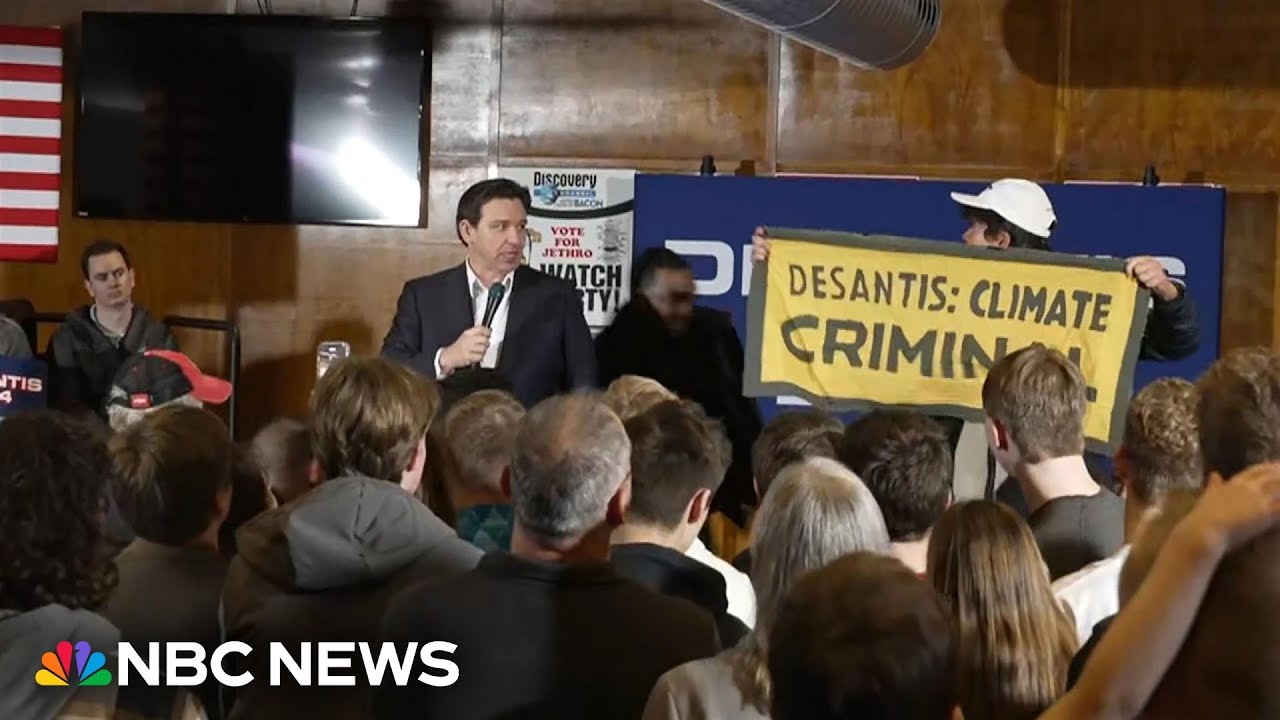 to voice their opposition to the candidates’ climate change denial or refusal to address the climate crisis.
- On Newsmax’s Wake Up America, hosts and guests delegitimized climate protesters at the Iowa caucus because “it was below 20.” “OK, by the way, that was a climate change protester. It was 20 below in Iowa yesterday, so I don't know. What are they — ‘It's too cold now?'”asked host Rob Finnerty. Guest Hogan Gidley then asked whether they were “protesting for global warming because it's so cold.” Newsmax, *Wake Up America*, [1/15/24]
- Fox host Dana Perino suggested cold weather in Iowa delegitimizes the message of climate activists there. “I would just say that it reminds me of the day that…Al Gore released An Inconvenient Truth in 2002 or 2003; it was the coldest day of the year,” she said. “That’s what these climate protesters remind me of. It’s ridiculous and they’re persuading no one.” The Daily Beast, [1/15/24]
Mainstream media were baselessly accused of downplaying coverage of the Arctic blast to push a “green agenda”
Even though the cold weather was widely covered, right-wing media complained that coverage of extreme heat has been purposefully exaggerated in comparison. Some figures also suggested that reporting on a wide range of extreme weather events in the context of climate change, including winter storms, somehow made media outlets dishonest.
But as some mainstream media outlets are correctly reporting, cold weather doesn’t mean climate change isn’t happening. A warming winter looks different in different parts of the world. Even if there are some unusually cold days, overall, temperatures are trending upward. Other countries, such as Oman and Argentina, have seen record-high temperatures in January.
As The New York Times explained, “Global climate change unfolds a history of extremes: Historically wet areas are likely to experience increased precipitation (sometimes in the form of snow), while historically dry areas may see more drought.”
- Climate denier Steve Milloy said the Times needs to “get its story straight.”He added: “Jan. 2: Global warming to end snow. Jan. 12: Global warming to increase snow. That is the say-anything 'science' behind the climate hoax.” Twitter/X, [1/13/24]
- The Five accused The New York Times of “trafficking global warming hysteria” by allegedly publishing contradicting stories. The segment featured the chyron “Climate Confusion: NYT cries ‘end of snow’ days before saying ‘increase’” and was seemingly inspired by a tweet from climate denier Steve Milloy from a few days prior. “Well it was global warming, and then, I don’t know, every time it was snowing or blizzarding, then Democrats want it to be climate change,” said America Reports co-anchor Sandra Smith. Fox News, *The Five*, [1/17/24]
- Larry Kudlow asked, “Why hasn’t there been front page stories?” and called climate change a “hoax.” “There's a story in the Washington Post today, 60 degrees below normal, parts of Montana, where we were married, minus 40 degrees,” he said. “ This is The Washington Post. So, I just want to know of Mr. Kerry, whatever happened to global warming? Why hasn't there been front page stories? I mean every time you get a little heat wave or every time you get a bad rainstorm, everyone runs with these crazy stories about global warming, global warming, global warming, and climate change. … The whole thing is a — I just want to — it is a hoax. Global warming is a hoax.” Fox News, *America Reports*, [1/12/24]
- Right-wing media personality Tim Young: “The AP is covering for the climate grift today… Can't let the extreme cold weather disprove the obvious.” Twitter/X, [1/17/24]
- Arizona Sun-Times and Townhall reporter Rachel Alexander asked where are “all the dramatic headlines they run like when the temperature is hotter than expected?”She wrote: “Oh no, global warming hitting Arizona now. They're saying this cold spell is expected to linger. Where's all the dramatic headlines they run like when the temperature is hotter than expected?” Twitter/X, [1/12/24]
-----
===
September 5, 2024, edition of Fox News' America's Newsroom
TREY GOWDY (FOX NEWS HOST): This is the way I break it down Dana: So it looks like Russia likes Trump and Iran likes Harris, okay? There is a difference between interference and preference. I am more worried about the fact that if you ask most of our fellow citizens what the greatest threat to our democracy is, they wouldn't say Russia or Iran. They would say it is the mainstream media in this country, which you just proved with that previous story you did with Lindsey Graham and Amazon. Those two answers are, are baffling.
Then you combine that with Google or Meta or whatever they call themselves and this -- the Hunter Biden laptop where 50 different so-called intelligence experts countermanded what John Ratcliffe said, which was this was actually not Russian disinformation. So if I'm an American, yeah, I kind of expect Russia and Iran to want to mess with us and sow the seeds of discord. I really don't expect it to be The New York Times and The Washington Post and Politico. But I'll bet you most Americans would say they fear that more than they do foreign interference.
===
an 9 24
Dangerously misleading': How the beltway media sanitizes Trump’s 'unhinged' rambling
September 04, 2024
Former President Donald Trump often accuses the mainstream media of pushing "fake news" when they give him any type of negative coverage. The mainstream media, Trump argues, are hopelessly biased against him. And Trump has, at times, even accused right-wing Fox News and Fox Business of being unfair to him in their coverage.
But journalist Parker Molloy has a totally different perspective.
In an article published by The New Republic on September 4, Molloy argues that many mainstream media reporters are guilty of "sanitizing" Trump in their coverage and downplaying just how "unhinged" his "incoherent ramblings" are.
READ MORE:Deep-red states meet 'wall of hostility' in forcing Christian nationalism on public schools
Molloy previously addressed this topic in an article published by Media Matters on March 12, 2020. And the reporter believes the problem has "only worsened" since then.
"As Trump's statements grow increasingly unhinged in his old age," Molloy warns, "major news outlets continue to reframe his words, presenting a dangerously misleading picture to the public."
Molloy cites the New York Times' recent coverage of Trump's speech at Moms for Liberty's annual summit as an example.
"While speaking at an event put on by the extremist group Moms for Liberty," Molloy observes, "Trump spread a baseless conspiracy theory that 'your kid goes to school and comes home a few days later with an operation' — referring to transition-related surgeries for trans people. In their write-up of the event, a glowing piece about how Trump 'charmed' this group of 'conservative moms,' the Times didn't even mention the moment where he blathered on and on about a crazy conspiracy that has and will never happen."
READ MORE:'Gender chasm': GOP panics over huge Harris lead among women as Trump chases 'bro vote'
Molloy emphasizes that reporters do their audience a disservice when they treat Trump like a normal politician and fail to adequately report the more "unhinged" things he says.
"This 'sanewashing' of Trump's statements isn't just poor journalism; it's a form of misinformation that poses a threat to democracy," Molloy argues. "By continually reframing Trump's incoherent and often dangerous rhetoric as conventional political discourse, major news outlets are failing in their duty to inform the public and are instead providing cover for increasingly erratic behavior from a former — and potentially future — president."
Molloy continues, "The consequences of this journalistic malpractice extend far beyond misleading headlines. By laundering Trump's words in this fashion, the media is actively participating in the erosion of our shared reality."
READ MORE:'They all think you’re nuts': Latest Conway ad shows GOP voices in Trump’s head
*Read Parker Molloy's full article for The New Republic at this link.
---
joe conason an 5 24
nobody likes Big Oil, a monopolistic and heavily polluting industry with a legendary history of abusing its excessive power that can be traced back over the past hundred years.
But Donald Trump has promised to be the oil industry's best friend -- if its bosses give him a billion dollars.
In the latest instance of the former president's mind-blowing corruption, he is reported to have entertained a group of two dozen top U.S. oil company executives at Mar-a-Lago. Over dinner at his Palm Beach sanctum, Trump is quoted as telling the chiefs of Chevron, Exxon, and Occidental Petroleum and their colleagues that if they collectively coughed up $1 billion to ensure his reelection, he would take very good care of their corporate needs.
According to The Washington Post, he promised to toss out all of President Joe Biden's efforts to mitigate climate changes, including new rules aimed at reducing automotive exhaust and promoting electric vehicles. For that measly billion bucks, he vowed to increase oil drilling in the Gulf of Mexico, where we have already seen catastrophic well blowouts, rescind restrictions on drilling in the Alaskan wilderness, pull down the windmills that he hates, and cancel the recent White House decision to pause new natural gas export permits.
"You'll get it on the first day," said Trump, according to someone who was present and blabbed to the Post. Speaking as crudely as any gangster, he informed the oilmen that they and their companies can easily raise that kind of money, and that paying him off would be "a deal" because of the high return on their investment.
No doubt they found it hard to argue with Trump's logic, since oil lobbyists are already writing dozens of executive orders that they want him to rubber-stamp if and when he returns to the Oval Office.
So is anybody surprised?
Only perhaps by the audacity of Trump explicitly soliciting a gigantic bribe, before a large group of witnesses, at a time when he is in fact on trial for campaign finance offenses and facing scores of additional criminal charges. But he has never felt abashed in displaying his venality. He lives in a world of miscreants who behave much the same way, from his son-in-law Jared Kushner, who sought and obtained an even bigger payoff from the Saudi dictator, to his adviser Steve Bannon, who will face criminal charges next fall for swindling the dopey donors to his fake "We Build the Wall" outfit.
As the eminent journalist Laurie Garrett observed on social media, Trump's attempt to extort the oil industry echoes one of the greatest government scandals in American history, under another Republican president owned by corporate power. Beginning in 1921, the Teapot Dome affair implicated officials of President Warren G. Harding's administration in the crooked leasing of public lands for oil exploration. Harding's Interior secretary Albert B. Fall ultimately went to prison for bribery, although none of the oilmen who paid him off did any time.
What we can expect from a second Trump administration is the most naked orgy of swindling and boodling that this country has ever seen. He thoroughly exploited the presidency during his first term, as outlined in my forthcoming book, "The Longest Con." But his second term, should such a disaster occur, would be the conman's last big chance to score, and he can be expected to enrich himself to the maximum -- at ruinous cost to the rest of us.
---
an 5 24
former President Donald Trump recently made a controversial proposal to a gathering of oil executives and lobbyists at his Mar-a-Lago residence in Florida: Favorable policy in exchange for $1 billion in campaign cash. Now, it looks as if the U.S. Senate may launch an official inquiry into the ex-president.
That's according to the New Republic's Greg Sargent, who spoke to Sen. Sheldon Whitehouse (D-Rhode Island) about Trump's recent entreaty to the oil industry. Whitehouse said it was "highly likely" that the Senate Budget Committee would investigate the former president over his brazen offer.
"The phrase that instantly came to mind as I was reading the story was ‘quid pro quo,’" Whitehouse said, adding that he was also concerned about a series of proposed executive orders oil lobbyists drafted for Trump and to have ready to sign on day one should he win a second term in November. "Put those things together and it starts to look mighty damn corrupt."
READ MORE:'Undisguised corruption': Critics slam Trump for 'selling the White House' to Big Oil
Billionaire oil magnate Harold Hamm arranged the Mar-a-Lago event, which the Washington Post reported was designed to allow for the fossil fuel industry to be able to bring concerns over environmental regulations directly to Trump. At the meeting, Trump reportedly promised to overhaul President Joe Biden's policies relating to electric vehicles and wind energy.
"The contrast between the two candidates on climate policy could not be more stark. Biden has called global warming an 'existential threat,' and over the last three years, his administration has finalized more than 100 new environmental regulations aimed at cutting air pollution and greenhouse gas emissions, restricting toxic chemicals, and conserving public lands and waters," wrote the Post's Josh Dawsey and Maxine Joselow. "In comparison, Trump has called climate change a 'hoax,' and his administration weakened or wiped out more than 125 environmental rules and policies over four years."
Whitehouse, who chairs the Budget Committee, said Trump's proposal to oil executives was "practically an invitation to ask more questions." He added that the inquiry would hopefully shed light on the myriad ways in which industries like Big Oil exploit the campaign finance system and find ways to make the system more transparent and accountable. Noah Bookbinder, who is president of the anti-corruption watchdog group Citizens for Responsibility and Ethics in Washington (CREW), said that while Trump's offer was technically legal, there is still plenty of work to do in cleaning up the grey areas in federal campaign finance laws.
"There’s a clear legislative purpose in determining what happened at the meeting,” Bookbinder told Sargent. "If this really constituted “an attempt to link significant campaign contributions with specific policy promises, that suggests a huge loophole that needs to be closed.”
READ MORE:'Corrupt': Jared Kushner's business deals under fire as Trump runs for president
Many of the environmental policies Trump suggested he would do away with in a second term are in the Inflation Reduction Act, which was the $485 billion bill Biden signed into law in 2022 that included a swath of clean energy infrastructure initiatives and incentives for electric vehicle development. Economists projected the clean energy development grants could generate roughly $1.5 trillion in new economic activity, and could reduce carbon dioxide emissions by five billion tons before the next decade.
Conversely, some of the executive orders the oil industry has prepared for Trump would undo the progress on climate Biden has made since taking office. Politico reported that some of the orders would lift Biden's pause on new natural gas export permits, open up new protected federal lands for more oil drilling and allow for more offshore oil drilling leases.
Trump casting Biden as an opponent of Big Oil is somewhat confusing, given that the United States officially hit record-high domestic oil production levels earlier this year. The U.S. Energy Information Administration found that in 2023, the U.S. produced 13 million barrels of oil per day on average, making the United States the world's largest oil producer.
Click here to read Sargent's full essay in the New Republic (subscription required).
---
---
an 1 24
The mainstream media is full of incompetent idiots
D. Earl Stephens
andRaw Story
January 13, 2024}:
Let’s get right to it …
Too many journalists who occupy, or spend their professional lives orbiting the newsrooms of our mainstream media are incompetent, and most likely working in their important jobs for all the wrong reasons.
Worse yet, most of the leaders of these newsrooms are either bought-off corporate tools or dangerous innocents, who have absolutely no idea what they are doing in their crucial jobs, while the end of life as we know it hinges in large part on their ability to sound the alarms and let the world know what is at stake this year.
READ: Behold: Donald Trump the chosen son — and religious con
I am sadly not wrong about this.
At a time when we’ve never needed fair, hard-hitting coverage of the fascist Republican Party’s attack on our Democracy more, our journalists are catastrophically failing us, and the Fourth Estate as a whole is facing a crisis in confidence from the American public that might ultimately lead to its extinction.
The decline of the press and their inability to do the most basic thing in the news business — identify and cover the biggest stories of the day — has hit extreme levels.
How else do you explain the dangerous and shoddy coverage of the most ominous internal threat to the United States of America since the Civil War: the end of our Democracy.
How is it after watching and listening to the anti-American deviant, Donald Trump, and his pathetic minions in the Republican Party recklessly comport themselves can our media forget that one of the first things to go under fascist, authoritarian regimes is their right to conduct their business freely?
These people are inches from losing their professional freedoms because in large part of their blinding incompetence, and we are THIS close to losing our Democracy forever because they seemingly haven’t even gotten as far as identifying this very real threat to us, and their livelihood.
It boggles the mind, and as a veteran of nearly 30 years in newsrooms, 16 of those years in leadership, I am absolutely disgusted.
How DARE they.
Ever since the fatal election of the racist, soulless Trump in 2016, the press has come under fire for how they helped enable one of the darkest days in American history.
This is not breaking news.
Many members of the working press have since acknowledged their mistakes in the run-up to that election. Their failure to call a lie a lie and a racist a racist, for instance, helped normalize the savage, Trump.
Their nonstop coverage of his unhinged, heinous rallies where he insulted the disabled, and our war veterans, and failure to easily draw the stark distinctions between him and the accomplished, decent woman he was running against was journalistic malpractice.
Many of them told us they learned their lesson, and if Trump, or something like him, ever ran again they would be ready.
If only.
They have actually gotten worse.
The examples are many but let’s take a look this past weekend for just one sample of their massive incompetence these days.
Consider what happened on Meet the Press Sunday. This news program used to be the shining example of nonpartisan, hard-hitting journalism. Power was called into account on a weekly basis.
Now it is a complete mess that has no sense of itself. It’s where politicians eagerly go to recite their party’s talking points, and slap back hard at any host who dares to interrupt them.
On Sunday’s episode of ineptitude, Meet the Press host Kristen Walker was interviewing Elise Stefanik, the House Republican chairwoman.
Stefanik is currently steeped in warped, dark MAGA propaganda. Like many woman in her party, she is strutting down every runway she can find, to see if maybe, just maybe she can catch the vulgar Trump’s bloodshot eye, and have the honor of being his ceremonial whipping-girl on his fascist ticket.
It’s disgusting.
Sure as hell, it took Stefanik no time at all to do her Radical Right routine of telling one known lie after another. The doe-eyed Welker tried to politely nudge her back in her lane, before Stefanik knocked her off the road altogether, and took control of the wheel.
Stefanik: “We will see if this (2024 election) is a legal and valid election.”
Welker: “Will you only commit to certifying the results (of the election) if former President Trump wins? Does that mean only if former President Trump wins?”
Stefanik: “No, it means if they’re constitutional. What we saw in 2020 was unconstitutional circumventing of the Constitution, not going through state legislators when it comes to changing election law.”
I mean, holy shit. In other words, if the election doesn’t work out for us democratically, we’ll just once again move onto some hard-core lawbreaking to change minds.
Short of hitting back with facts, Welker should have just ended the interview about nine times, but didn’t.
Instead, Stefanik just kept backing up and running over her, and was going completely unchallenged when she vomited that the convicted attackers of our Democracy were actually “January 6 hostages" and should be pardoned.
Excuse me?
What in the hell is going on here?
Welker and Meet the Press aren’t the lone offenders of course. The New York Times and The Washington Post can spend three days reporting on completely unreliable polls they paid to conduct, while Trump spends his time literally telling all us “vermin” the new and creative ideas he has come up with for burning everything to the ground around him.
Those newspapers barely even take a sniff at the madman’s unhinged plan of attack, and instead spend their editorial resources wondering how he is polling in some diner in Pennsylvania.
Last month, while Ukrainian President Volodymyr Zelenskyy was on Capitol Hill literally begging for help while his country fights against our shared enemy, Vladimir Putin, the radical right-wing Heritage Foundation decided it was a good time to fly in one of Putin’s greatest allies, Hungary’s leader, Viktor Orbán, for talks with unspecified Republican members of Congress.
You couldn’t ask for a more stark juxtaposition of what the two parties stand for than that. You also couldn’t ask for a better example of how little the press cares for the subject of our Democracy.
Orbán’s visit barely got a sniff in the mainstream media.
Ironically, we only know of this meeting thanks to some tremendous reporting from outside the mainstream media’s toxic bubble by the The Guardian.
In their story about this fascist confab, The Guardian illuminated that:
Hungary has been portrayed by conservative media as an anti-“woke” paradise and model for the United States. Some far-right Republicans, such as Kari Lake and Paul Gosar, said they would like to see the “Hungarian model” transplanted to the US, especially when it comes to immigration and family policies. CPAC went to Hungary for the second time this year, and former Fox News host Tucker Carlson shot multiple episodes in Hungary touting Orbán policies.
Orbán has returned the favour by lavishing praising Trump … The Hungarian prime minister has criticized the multiple federal indictments against the former US president and called the judicial procedure a “very communist methodology” in a recent interview with Carlson.
So on December 11, while Democrats were trying to rally support for Ukraine, Republicans in Congress were meeting behind closed doors with a Hungarian dictator, Tucker Carlson bestie, and close Putin ally.
So, I say again: What in the hell is going on here?
I am sympathetic to a point to the argument that the corporate overlords who own too large a percentage of our major media companies are squeezing budgets, and worse, trying to dictate editorial policy in their newsrooms.
I know this is a popular theory, but it doesn’t explain why the alleged journalists who populate these places put up with that. Have they no shame?
I know scores of damn good journalists who were forced out of the business because of the death of newspapers over the past couple of decades, and the ever-shrinking opportunities to apply their journalistic expertise elsewhere.
There’s not one of them I talk to, however, who can believe what they are seeing with the pathetic coverage a majority of the press is giving to our threat to Democracy. There’s not one of them who wouldn’t have walked out the door and sounded the alarm if they had been ordered by management to ignore this threat.
So I’m back to where I started.
I now believe the media’s appalling treatment of the attack on our Democracy is a simple matter of incompetence, and/or lack of guts on the part of too many in the journalism field. Welker’s display on Sunday was the best example you’ll ever see of both.
What are these so-called journalists doing in their editorial meetings each day when they are discussing the news?
Why haven’t they setup Democracy Desks that do nothing but cover the greatest threat to America in 160 years? Why aren’t they breaking down and detailing what is at stake if, God forbid, our Democracy is overrun by a fascist leader who will never leave office and starts jailing them if they don’t toe the party line?
You’ll find some phenomenal reporting on this subject in places like The Atlantic, but we need more than monthly deep dives into this attack if we hope to survive it.
I never thought I’d type this, but the only place I feel I can get accurate reporting these days is when a natural disaster is threatening America. If a hurricane is bearing down on the United States, you can count on mass pandemonium, and all-hands-on-deck treatment in all these newsrooms.
It’s a bit much, but at least there is some real urgency in the way they approach these looming disasters.
They can’t wait to report on all the gory possibilities if we take a direct hit by one of these storms. They remind us what we need to do to be prepared, and where we can go to get help if necessary.
They make sure we understand the stakes.
They do this because they want to protect their readers and viewers. They do this because people are vulnerable. They do this because they never want to be accused of ignoring such an ominous threat. They do this because they know people are watching, and there is some real money to be made ...
If only they were smart enough to approach the catastrophic threat to our Democracy with the same sense of responsibility and vigor.
NOW READ: A 38-year-long Republican scam may soon be over — thanks to women
D. Earl Stephens is the author of “Toxic Tales: A Caustic Collection of Donald J. Trump’s Very Important Letters” and finished up a 30-year career in journalism as the Managing Editor of Stars and Stripes. Follow @EarlofEnough and on his website.
---
many grf not here
mma 12 23 matt g
the failures of legacy news outlets paved Donald Trump’s path to the presidency in 2016.
Obsessive, spectacle-minded coverage from major broadcast and cable networks and print and digital publications helped push the real estate mogul and reality TV star ahead of the pack during the Republican primary, as their top executives touted the resulting boom in ratings and profits.
And while critical scrutiny of Trump’s bigotry and authoritarianism increased during the general election campaign, outlets remained wedded to a “both sides” vision of journalism which resulted in disproportionate coverage of relatively minor scandals involving Trump’s Democratic opponent, Hillary Clinton — particularly in the days just before the election.
The result was a narrow Trump victory, followed by four years of chaos, corruption, cruelty, conspiracy theories, mass death, proto-fascism, election subversion, and, ultimately, insurrection.
The twice-impeached, four-times-indicted former president is now seeking a return to office, with a stated goal of using the federal government to exact “retribution.” He has openly toyed with the “termination” of the Constitution’s limits on presidential power, promised to unleash the FBI and Justice Department on his enemies, and said he would act as a “dictator,” albeit only on “day one” of his term.
But for much of this year, the legacy news outlets that helped usher Trump to power were complacent. Nakedly authoritarian comments from the would-be president drew relatively muted coverage, while his potentially disastrous policy proposals were often ignored. If the press’s over-coverage aided Trump’s previous ascendance, this time around he has benefited from its relative neglect.
Media Matters is naming the legacy media our Misinformer of the Year for 2023.
The press plays an essential agenda-setting role in American politics. Decisions made by news executives, editors, TV newscasters and bookers, reporters, and pundits determine which issues the public sees, reads, and hears about, and the tone with which those topics are covered.
Media Matters produced a series of studies this year assessing the news coverage of Trump by the nation’s five largest newspapers by circulation (the Los Angeles Times, The New York Times, USA Today, The Wall Street Journal, and The Washington Post); the Big Three broadcast networks (ABC, CBS, and NBC); and the three major cable news networks (CNN, MSNBC, and Fox News). While the news media have become increasingly fragmented, those outlets feature relatively large audiences and both retain an outsized influence on and reflect broader trends in the industry.
Our studies found that while many individual journalists at those networks and publications produced vital reporting on Trump’s actions and plans, the overall coverage of the outlets often did not meet the moment.
Data: Major news outlets keep downplaying Trump’s incendiary remarks and hazardous policies
Trump’s involvement in the January 6 insurrection, in which his supporters stormed the U.S. Capitol in an effort to subvert the results of the 2020 election, is perhaps the single most salient aspect of his political career.
But after Trump launched his new campaign with two January rallies, 77% of cable segments, 62% of top newspaper articles, and all broadcast news segments about the campaign failed to mention that role.

After President Joe Biden announced his reelection bid in April, we found that media coverage would often highlight his age but not Trump's, even though the former president is only three years younger.
Reviewing five months of coverage in major newspapers, we found that of all the articles that mentioned the age of either candidate, all five papers mentioned Biden’s age a great deal more.

We further determined that cable news mentioned Biden’s age 4 times as often as Trump’s in a four-day period in September beginning with the release of a poll that included questions about both candidates’ ages and health.

Major outlets not only provided comparatively little coverage of Trump’s age, but they also downplayed a series of verbal gaffes and incoherent statements he made. In September and October, Trump mixed up the authoritarian leaders of Hungary and Turkey; confused his former Republican opponent Jeb Bush and Jeb’s brother, former President George W. Bush; mixed up a number of his Democratic opponents with former President Barack Obama; and made a garbled statement accusing Biden of leading the country into “World War II.”
None of those remarks were covered on broadcast news, and they received relatively light coverage from the cable networks.

We also found that Trump received relatively lax coverage for a series of unhinged, extremist comments he made over the last four months of the year.
When the former president and likely Republican nominee suggested that Gen. Mark Milley, then chairman of the Joint Chiefs of Staff, deserved to be executed for his criticism of Trump, the comments were ignored by the Big Three broadcast networks and Fox, and they received 21 and 41 minutes of coverage, respectively, from CNN and MSNBC.
We subsequently reviewed coverage after Trump complimented the terrorist group Hezbollah as “very smart”; accused migrants of “poisoning the blood of our country”; said that “liberal Jews” are voting “to destroy America”; and called for “ideological screening” of immigrants and the barring of those who don’t like “our religion.”
Only the Hezbollah remark received more than 12 minutes of coverage from a cable news network or any broadcast coverage at all (just over 1 minute of coverage combined across ABC and NBC).

Likewise, in November Trump repeatedly pledged to “root out” his political opponents, who he claimed “live like vermin within the confines of our country” and want to “destroy America,” drawing comparisons from experts on authoritarianism to the rhetoric of genocidal fascist dictators.
But the remarks were largely ignored, drawing significantly less coverage from major outlets than the outlets gave Clinton’s description of some Trump supporters as a “basket of deplorables” in 2016.
grf]
The legacy press did no better in covering some of Trump’s most consequential policy ideas this year.
Trump announced in August that he plans to impose a 10% tariff on all imported goods, the revenue from which his campaign team said would go toward tax cuts slanted toward the rich. Experts decried the tariff plan as “a disaster for the U.S. economy” that would raise prices for American consumers, particularly the poor and middle class, and potentially trigger “global economic chaos.”
But Trump’s tariff proposal received vanishingly little television coverage over the following month. ABC, CBS, and NBC did not cover it on their national morning, evening, or Sunday political talk shows. CNN and MSNBC each provided less than 1 minute of coverage, within a single segment, and neither addressed the potential impact for Americans, while Fox ignored the plan.
In November, Trump said that if he is elected he wants to “terminate” the Affordable Care Act, which provides health coverage to 35 million Americans and protects the coverage of many more with preexisting conditions. We found that the broadcast networks totally ignored Trump’s threat. While the cable news networks covered Trump’s threat in 35 segments, they largely ignored its potential consequences for the public.
2024 will push political journalism to the breaking point
There were signs of improvement as the year came to a close. The New York Times produced major investigations on the Trump team's radical, authoritarian plans for if he returns to power, while The Atlantic devoted an entire issue to analyzing what will occur “If Trump Wins.” Each set the agenda for the rest of the press, drawing substantial secondary coverage.
The legacy press also might be turning a corner on coverage of Trump’s extremist rhetoric. When he first accused migrants of “poisoning the blood of our country” in a September speech, ABC, CBS, and NBC all ignored the comment, while CNN, Fox, and MSNBC combined to give it only 22 minutes of coverage over two weeks. But when he repeated the vile remark in December, the same outlets gave it the attention it deserved: Each broadcast network ran at least 3 segments on the comment, and the cables combined for more than 11 times as much airtime (245 minutes) over the course of only four days.
It's possible that as the presidential primaries come to a close, reporting focusing on “not the odds, but the stakes” will become more of the norm rather than the exception.
But the job of the political press will become only more difficult over the next year. Republicans and right-wing media will pressure journalists to repeat the mistakes they made during Trump’s first general election campaign. They have spent years assembling a series of debunked conspiracy theories and bad-faith innuendoes related to the business interests of Biden’s son, Hunter, and next year they plan to leverage those phony grievances to impeach the president. Republicans recognize that they lack actual incriminating evidence of wrongdoing by Joe Biden — but they know that if they can stir up a scandal, they can give legacy news outlets something to talk about besides Trump’s alleged criminality.
Fox News host Jesse Watters laid out the plan in August.
“Without the impeachment, you have back-to-back-to-back-to-back Trump trials,” he explained. “The media’s not going to cover anything else. Biden’s going to hide, and Trump is going to be criminalized on TV. But if Republicans time this right and follow the evidence where it leads, impeachment is going to run counter to the Trump trials next year.”
Watters knows that such a plan could work on journalists because a similar approach succeeded in 2016. A return to that form would put the American experiment in democracy — and the free press itself — in jeopardy.
---
---
---
---
---
https://www.alternet.org/republicans-are-disproportionately-credulous-misinformation/
Why Republicans are 'disproportionately credulous about health-related misinformation': analysis
WASHINGTON, DC - JULY 20: Rep. Marjorie Taylor Greene (R-GA) speaks to reporters following a Senate Health, Education, Labor, and Pensions Committee hearing at the Dirksen Senate Office Building on July 20, 2021 in Washington, DC. The committee heard testimony about the Biden administration's ongoing plans to deal with the COVID-19 pandemic and Delta variant. (Photo by Stefani Reynolds-Pool/Getty Images).
Brandon Gage August 22, 2023
Throughout the COVID-19 pandemic, conservative politicians like United States Representative Marjorie Taylor Greene, (R-Georgia), Florida Governor Ron DeSantis (R), and former President Donald Trump established themselves as faucets of "wildly conspiratorial" "health-related misinformation," according to The Washington Post's Philip Bump, who examines why those tactics have been successful amongst Republican votersin a Tuesday analysis of KFF surveys.
"Greene, of course, has a well-earned reputation as a purveyor of conspiracy theories and misinformation," Bump notes. "But this particular bit of performed skepticism was not an area in which she was freelancing. In recent days there has been a resurgence in the idea that the government is attempting to manipulate the citizenry through COVID-19, with 'I WILL NOT COMPLY' trending — yes, in all caps — on X, the social media platform formerly known as Twitter, on Tuesday morning. That refusal to comply centers on nonexistent or theoretical mandates, which doesn't seem to have dissipated the energy."
Bump adds that "new research shows the extent to which Republicans are disproportionately credulous about health-related misinformation. It's not just that there is an uprising against an imaginary imposition, it's also that Republicans are consistently more likely to express belief in false claims related to COVID-19 and other things. Greene is by no means alone."
The data, Bump explains, shows that "Republicans were on average 20 percent more likely to state that they believed the false claims were accurate. Foremost among them: the regularly debunked idea that the coronavirus vaccine has caused thousands of deaths in otherwise healthy people. Nearly half of Republicans think that's true."
Moreover, nearly fifty percent "also think thativermectin is an effective treatment for the COVID-19 virus, which it is not. This has long been a leading example of how partisanship infiltrated the discussion about COVID-19 treatments, with other research showing that in places that voted for Donald Trump, people were more likely to seek information about the drug, and more prescriptions for it were written."
Bump points out that there is a correlation between belief in fake facts about SARS-COV-2 and deaths from the disease, mainly due to doubts about the efficacy of vaccinations, stating that "research made public last year found that after vaccines became widely available, Republicans made up more of the COVID-19-related deaths in Ohio and Florida."
Bump continues, "KFF found that abouttwo-thirds of Democrats didn’t believe any of the false claims about COVID-19 or vaccines. Only about a quarter of Republicans — and not many more independents — fell into the same category."
READ MORE: 'Clearly defined body count': Florida and Ohio Republicans experienced 43 percent more COVID deaths than Dems
Respondents were questioned about "other health-related subjects, including gun violence," Bump adds. "Again, Republicans were more likely than Democrats to believe false claims about gun violence. In this case, independents landed closer to the middle."
Bump contends that partisan bias lies at the heart of the disparity, writing, "The claims centered on COVID-19 and vaccines are largely ones that have been debunked by health professionals or government actors, groups that are viewed more skeptically by independents. KFF's research shows that while most Americans trust their personal doctors' health recommendations, that trust drops off when respondents were asked about the Centers for Disease Control and Prevention or state and local health officials. Independents were less trusting of state and local health officials' recommendation than were Republicans."
Bump stresses that "Democrats are far more trusting of recommendations from the Biden administration than Trump; for Republicans, it's the opposite," which based on KFF's figures is attributable to the absorption of alternative media narratives
"That Republicans often cite Fox News as a source for information — and are about as likely to say they consume Newsmax as they are to view CNN — comports with the higher acceptance of false claims about guns," says Bump. "These are not generally questions adjudicated in the context of public health (despite the obvious overlap with health concerns). Things like Fox News' frequent presentations about gun crime or school shootings, generally framed through a right-wing lens, likely contribute to the imbalance."
Bump observes that "it's probably less that the respondents believe the false claims than they are willing to express some acceptance of them, given how their politics establishes that as a standard response."
Bump concludes, "In Ohio and Florida, at least, this seems to have been proved — at times — deadly."
View Bump's report at this link (subscription required).
BUSTED: ‘Right-wing misinformation’ newspaper gave a GOP presidential candidate up to $5 million in salary
FROM YOUR SITE ARTICLES
Jamie Raskin nails GOP at Covid hearing: Lab leak 'would only deepen Trump's culpability' ›
Top GOP senator is positive for COVID-19 at age 87 ›
Arizona GOP holds QAnon hearings attempting to expose so-called COVID-19 'atrocities': report ›
RELATED ARTICLES AROUND THE WEB
GOP senators threaten to block NDAA over COVID-19 vaccine ... ›
Covid death rates higher among Republicans than Democrats ... ›
Republicans' excess death rate spiked after COVID-19 vaccines ... ›
---
---
// gop talk pts
https://www.alternet.org/2021/03/immigration
---
---
uhoh
https://www.alternet.org/stupefying-their-material-liberal-media/
an 7 23
'Stupefying their material': The problem with the liberal corporate media
Ralph Naderand Common DreamsJuly 01, 2023
It was bad. Now it's gotten worse.
David Ignatius, a long-time Washington Post columnist on military intelligence topics, probably never dreamed his newspaper would fill over three full pages serializing his latest work of thrilling fiction, “The Tao of Deception.” On June 28, 2023, the “Breaking news and latest headlines” in the A section of the paper featured the first installment. Part II appeared today, Friday, June 30th.
What’s occurring at the Washington Post, the New York Times and big regional daily newspapers is a flight toward stupefying their material in a desperate plunge to retain readers – print and online. Maybe surveys show a tsunami of aliteracy from the rising iPhone generations.
To adjust to digital age readers, the New York Times has replaced much of its content with gigantic photographs, graphics and other visuals, not just in its regular sections on style/arts, sports and food, but also in the daily news departments as well as the Sunday Business and Opinion sections.
The influential New York Times Editorial Page – once featuring some fifteen or more editorials a week – is now down to three editorials a week. Moreover, this space is now largely taken up by a handful of regular opinion columnists, many predictably redundant and tired. Imagine a historic newspaper intentionally diminishing its editorial advice to this country. There is no precedent.
It gets worse. Various forms of its daily features – entertainment, sports and style/arts – are given enormous space, while coverage of daily local and national civic activity is severely restricted. What used to be reported about the findings, litigation, lobbying and regulatory advocacy of national citizen groups in the nineteen sixties and seventies – leading to major betterment of consumer, worker and environmental health and safety – now is sharply curtailed. As a result, good members of Congress, seeing virtually no news coverage of vital citizen concerns, become indifferent to necessary public hearings and legislation essential to addressing the needs of the public.
Right-wing politicians have learned to game the vulnerable-to-sensationalism New York Times and Washington Post. Trump led the way in 2015-2016 with his presidential run. Most of his outrageous lies, deceptions and defamations were showcased by these two August newspapers. The Times would even reprint his tweets with their CAPITAL LETTERS verbatim without giving the falsely accused any right of reply. (Belated corrections by columnists could not keep up.)
This chronic tragedy has gotten worse in the last year. The Times can hardly resist making crazy politicians into Big Acts. The antics of switcheroo J.D. Vance was a regular news story, with huge photographs, while his Democratic opponent in prime position for the pivotal Ohio Senate race last year, Rep. Tim Ryan, was of little interest to the Times.
In 2021, the Times devoted eleven pages over three days to a mini-biography of Fox’s Tucker Carlson. As well, the Times seems strangely drawn to the profane and violent rhetoric of the ignorant junior Representative from rural Georgia, putting Rep. Marjorie Taylor Greene (R-GA) on the cover of its Sunday New York Times Magazine, in addition to more frequent daily coverage of her outrages.
What’s wrong with this journalism? First, it does not give space to serious political opponents whose positions, by the way, are closer to the editorial stances of the Times. Second, these “in-depth” profiles, as well as regular columns, do not lay a glove on the featured miscreants who rush to use these articles in their publicity and fundraising. Third, the trivial crowds out more important, serious subjects with material that is mostly vacuous since it is about vacuous people that the Times grants greater celebrity status. (TV and radio pick up such coverage from the Times).
I remember years ago when members of Congress, working with civic leaders on important legislation, would drop their more expressive denunciations for fear that the Times and the Post would not cover them because they might appear too extreme. It is exactly the opposite today with crazed right-wing, political corporatists bellowing themselves into prime time.
The Washington Post Live podcasts long ago crossed the barrier between news and advertisers. The tilt toward corporatism, away from the liberal civic community, is pronounced. One example of many is Grover Norquist, the avatar of no-tax super-rich and corporations,who gets a big photo alongside the announcement of his interview by the Washington Post Live’s podcast while the paper ignores inviting civic leaders like Robert Weissman of Public Citizen, Jordan Davis or Marilyn Carpinteyro of Common Cause or Karen Friedman of the Pension Rights Center. Why? Because corporate advertisers do not find these people congenial to their sponsored topics. Sponsors get to approve or veto the participants, as with the participants in the recent Post podcast “Chasing Cancer: Equity and Disparities,” brought to us by the giant drug company AstraZeneca. You can be assured the discussion will not cover outsourcing cancer drugs to a single troubled corporation in India, now causing serious shortages in our country and risking people’s lives.
Both the Post and the Times reporters did report about the cancer drug crisis in their news pages, but didn’t deal with the question of why U.S. drug companies outsource such categories of drugs, which includes outsourcing virtually all antibiotic production to China and India. This is a national security risk if there ever was one. The Washington Post did, however, run an op-ed by Ezekiel J. Emanuel on this topic (See: https://www.washingtonpost.com/opinions/2023/01/16/fix-drug-shortage-tax-breaks/).
Business ads in newspapers have been around forever, but until recent years, such ads did not openly and brazenly sponsor, engage and shape the content of the “news side” of the papers.
Unfortunately, journalistic critics of these concessions are few, whether in the publications at journalism schools or in liberal magazines. Certainly, the media critics for NPR and PBS do not see this as part of their beat, with very few exceptions. In-house critics or an ombudsman are long gone from the Times and the Post.
Would their editors have a greater estimate of their own significance to the unrepresented peoples of the United States? People deserve the empowering right to know about what the foundational civil society struggles daily to accomplish, at the local, national and international levels. (See, Reporters Alert: https://reportersalert.org/).
Coverage of active citizenry from the neighborhoods on up might even increase circulation.
---
60 min cts as legacy rep before lara fail?
morano 5 23
allison blonde glasses blk blazer but cleavage in focus 11b biden electric rural TVA running water new deal; literally a money lander scheme GND
solandra make work job blackout, $ to rt ppl but well connected donors; higher energy cost, less electricity
wow pretty terrifying hope ppl wake up rather than go along w corrupt agenda; corp media cbs in focus insect eat sci in germany soybean deforestation livestock feed; newsflash there is no global food crisis related to climate,gov't made supply chain problemw/ policy; chem farming, eu crush small fam farm to meet net zero goal that's what6o min dutifully reports; psyop kids in school, mfg food crisis; ad oan live 5/mo credible unbiased less than cable stay informed; cleavage
gmail oann.com/video/in-focus-video/climate-depot-founder-on-team-biden-the-radical-climate-agenda/
---
---
{{===
no lnx etc
https://www.mediamatters.org/elon-musk/twitter-ceo-elon-musk-goes-further-down-right-wing-rabbit-hole-amplifying-conspiracy
mma 5 23
despite once claiming that “Twitter needs to become by far the most accurate source of information about the world,” CEO Elon Musk is using the site to amplify dangerous conspiracy theories and right-wing talking points. In just the last few days, Musk has peddled conspiracy theories about a mass shooting in Allen, Texas, fearmongered about migrants, and seemingly suggested that white people are being discriminated against.
After a gunman in Allen, Texas, killed eight people and injured seven last weekend, Musk followed the lead of right-wing media, undermining reporting that the shooter expressed neo-Nazi beliefs. In the days after the shooting, Musk tweeted, “this is either the weirdest story ever or a very bad psyop” and seemingly expressed doubt about reported connections to far-right ideology. (He did so without providing any evidence and disregarding multiple reports from research centers and outlets that confirmed the shooter had expressed neo-Nazi beliefs online.)
Musk has a history of flirting with bad actors and dangerous content on Twitter; he has previously amplified and seemingly given credence to conspiracy theories, boosted a QAnon influencer at least two dozen times, and catered to right-wing accounts that promote bigotry, extremism, and misinformation. And in recent days, he has done more of the same.
Here are a few examples of Musk amplifying and engaging with right-wing users and misinformation within the last few days.
Musk has engaged with right-wing figures to fearmonger and push anti-immigrant rhetoric
This week, Musk has engaged with multiple right-wing media figures about immigration, seemingly agreeing with Turning Point USA’s Charlie Kirk that “America is being invaded” by migrants and responding to anti-immigrant Fox News reporter Bill Melugin’s fearmongering tweets with “Wow.” After Collin Rugg, co-founder of conservative site Trending Politics, wrote that the end of Title 42 will lead to “an invasion along the southern border,” Musk responded, “This is next-level!” Musk also ostensibly agreed with right-wing account End Wokeness after it bashed the Biden administration for its immigration and other policies, responding with “!!”
Musk is engaging with dangerous rhetoric that is evocative of the white nationalist “great replacement” conspiracy theory. Anti-immigrant “invasion” language has previously contributed to real-life incidents of violence, including the 2019 El Paso, Texas, shooting where 22 people were killed by a shooter who expressed similar anti-immigrant beliefs. Additionally, the Biden administration has already announced plans to further secure the southern border after Title 42 ends, and blaming the current White House for a broken immigration system is disingenuous, as the GOP has and continues to obstruct immigration reform policies.
Musk has engaged — and seemingly agreed — with far-right users who claim that white people are being discriminated against
After Jordan Neely was held in a chokehold on a New York City subway and later died, some on the far right have “pushed unsubstantiated, misleading, and false information to suggest that the media is only covering the story because Neely was Black” and the other rider was white — and Musk was quick to latch on to this anti-white bias narrative.
Musk interacted with a series of posts from QAnon influencer KanekoaTheGreat, who seemingly argued that themedia are biased against white people, and thus are at least partly responsible for the “division and polarization of society.” (The posts included graphs created by two different employees at the right-wing Manhattan Institute, one of whom is a self-proclaimed “wokeness studies scholar.”) Musk engaged with these posts by replying with responses like “interesting,” “wow,” and “I wonder why.” Quote-tweeting another user who previously wrote an essay attacking the “Woke Left,” Musk also claimed that the media are engaging in “massive public manipulation” for apparently using the terms “racist,” “racists,” and “racism” more frequently within the last decade than before.
zach goldberg https://www.mediamatters.org/media/4005227
https://www.tabletmag.com/sections/news/articles/media-great-racial-awakening<[ton bad code] AUGUST 05, 2020 zzz
Popular Information debunked Musk’s suggestion that the media display an anti-white bias: “Since the 1990s, research has shown that the media propagates negative stereotypes of Black people as criminals.” Also, not only do the media struggle to fairly cover race, but the Center for American Progress found that Black Americans are actually overrepresented in the media as perpetrators of crime.
Additionally, Musk and his right-wing allies have shared these graphs about the media’s coverage without the necessary sociopolitical context of the last decade; police officers have killed scores of Black Americans, white supremacist violence is becoming an increasing concern, and former President Donald Trump “upped the ante on race.”
Musk has responded to bad-faith actors' suggestions for Twitter features and encouraged his followers to subscribe to their accounts
One doesn’t need to scroll long to see an example of Musk engaging with a right-wing user. In just the last few days, Musk has laughed at anti-trans content, instructed his followers to subscribe to at least two different right-wing users, and mocked Vice President Kamala Harris.
After anti-LGBTQ bigot and Babylon Bee CEO Seth Dilion begged for people to subscribe to The Babylon Bee’s Twitter account, snarkily prefacing the ask with, “We know you have important things to spend your money on, like reparations and other people's student loans,” Musk responded, “I subscribed!”
Wannabe governor of California Michael Shellenberger wrote a Twitter thread about “woke” culture war issues and pleaded for subscribers, to which Musk responded, “I recommend subscribing.” Musk is also evidently one of his subscribers.
Musk responded to requests for new Twitter features from conspiracy theorist Jack Posobiec and QAnon influencer Ron Watkins, who may have posted as “Q,” with “coming” and “coming soon.”
Responding to right-wing personality ALX, Musk posted a laughing emoji on an anti-trans tweet and made fun of a decision to name Harris “AI Czar.”
Musk is working to court back advertisers that have previously fled his platform, but they should take caution, considering the sort of content their ads might run alongside. As BBC reporter Shayan Sardarizadeh wrote on Twitter competitor Bluesky: “These days, if you want to find the latest conspiracy theories trending on Twitter, the easiest thing to do is to check the tweets Elon Musk replies to, you’ll find most of them.”
---
ref 1
how the Media Led the Great Racial Awakening
Years before Trump’s election the media dramatically increased coverage of racism and embraced new theories of racial consciousness that set the stage for the latest unrest
BY
ZACH GOLDBERG
AUGUST 05, 2020
in the wake of the protests, riots, and general upheaval sparked by the police killing of George Floyd in Minneapolis, the United States is experiencing a racial reckoning. The response from America’s elite liberal institutions suggests that many have embraced the ideology of the protesters. Here, for instance, is a sampling of the titles of opinion pieces and news stories published over the past month by thecountry’s two most influential newspapers, The Washington Post and The New York Times:
“When black people are in pain, white people just join book clubs”
“Black Activists Wonder: Is Protesting Just Trendy for White People?”
“To White People Who Want to Be ‘One of the Good Ones’”
“America’s Enduring Caste System: Our founding ideals promise liberty and equality for all. Our reality is an enduring racial hierarchy that has persisted for centuries.”
The last entry on the list, a lengthy feature on America’s “caste system” in The New York Times Magazine, explicitly compares the United States to Nazi Germany.
Countless articles have been published in recent weeks, often under the guise of straight news reporting,in which journalists take for granted the legitimacy of novel theories about race and identity. Such articles illustrate a prevailing new political morality on questions of race and justice that has taken power at the Times and Post—a worldview sometimes abbreviated as “wokeness” that combines the sensibilities of highly educated and hyperliberal white professionals with elements of Black nationalism and academic critical race theory. But the media’s embrace of “wokeness” did not begin in response to the death of George Floyd. This racial ideology first began to take hold at leadingliberal media institutions years before the arrival of Donald Trump and, in fact, heavily influenced the journalistic response to the protest movements of recent years and their critique of American society.
Starting well before Donald Trump’s rise to power, while President Obama was still in office, terms like “microaggression” and “white privilege”were picked up by liberal journalists. These terms went from being obscure fragments of academic jargon to commonplace journalistic language in only a few years—a process that I document here in detail. During this same period, while exotic new phrases were entering the discourse, universally recognizable words like “racism” were being radically redefined. Along with the new language came ideas and beliefs animating anew moral-political framework to apply to public life and American society.
Consider the graph below, which displays the usage of the terms “racist(s)” and “racism” as a percentage of all words in four of the nation’s largest newspapers from (depending on the publication) 1970 through 2019.
[no grx in wayback]
In 2011, the terms racist/racists/racism accounted for 0.0027% and 0.0029% of all words in The New York Times and The Washington Post, respectively. What we see over the past decade is a continual dramatic increase in usages of “racism” and its variations. Moreover, the graph shows that this increase occurred a half decade before the arrival of Donald Trump. By 2019, they would constitute 0.02% and just under 0.03% of all words published in the Times and Post—an increase of over 700% and just under 1,000%, respectively, from 2011. While increases in usage frequency are also observed for the more center-right Wall Street Journal, they are comparatively more gradual and modest. Notably, the shifts in the Times and Post trends precede those of the Journal by about a year, suggesting that the center-right Journal appears to react to the rhetorical and ideological trends on race advanced by the two biggest left-leaning newspapers. Over the period in question, starting in the mid ’90s, the Times and Post had always featured these terms more frequently than the Journal but, until recently, the difference was minor. Today, the gap is enormous, which suggests that the explosion in the usage of racialized terminology and ideological constructs isn’t simply a neutral reflection of an increase in racial incidents.
In 2016, The New York Times published a news article detailing efforts on college campuses to train new students on how to avoid and deal with microaggressions—one of the novel categories of racism popularized over the past decade that hascontributed to the perception of pervasive racial injustice. As an example of a microaggression, the article cites the following comment: “Everyone can succeed in this society if they work hard enough.” This is supposedly racist because it emphasizes individual agency and implies “that race plays a minor role in life’s outcomes.”In the absence of legal discrimination, in the post-affirmative-action era, and in light of the immense absolute improvements in the quality of life of the average Black person over the past half century, [note no evidence]concepts like “microaggression” and “implicit bias” have been critical in cultivating the perception, amplified by the media, that America still practices a form of insidious racial apartheid. This occurs by a process of concept creep—a stretching of the terminological and normative boundaries of what constitutes racism and racist behavior. In other words: The racialization of things that weren’t previously viewed or understood through the lens of race. The upshot is that the more aspects of social life the media racializes, the more “racism” there is for the media to report on.
In 2011, just 35% of white liberals thought racism in the United States was “a big problem,” according to national polling. By 2015, this figure had ballooned to 61% and further still to 77% in 2017.
In December of 2006, 45% of white Democrats and 41% of white Republicans reported that they knew someone they considered racist. By June of 2015, this figure increased to 64% among white Democrats, while remaining at a steady 41% among white Republicans. No increases were observed for any of the nonwhite Democrat groups. In fact, what (statistically insignificant) change occurred among Black (52.7% to 47.2%) and Hispanic (41.1% to 33.8%) Democrats were actually in the opposite direction.
Did white Democrats simply come to know more racists in these years? It’s possible, but if so that would indicate that the media’s increased reporting on racism actually correlated to a marked increase in racists being detected by white Democrats. It was during this same period, as I documented in a previous article, when the racial attitudes of white liberals became radically more liberal, relative to changes observed among nonwhite Democrats and white conservatives. For example, data from the General Social Survey shows that beginning in 2010, the percentage of white liberals who disagreed with the statement: “Blacks should work their way up without special favors,” has grown in almost every subsequent year the question was asked. Starting in 2010, when 24% of white liberals (21% of white Democrats) said they disagreed with the statement, the number rose to 30% (23%) in 2012, then 36% (26%) in 2014, and finally to 52% (39%) in 2016. It sits at around 50% as of 2018. Between 1994 and 2012, there was never a year in which more white liberals or Democrats gave this response than their nonwhite counterparts. By 2016, however, a divide that started appearing in the preceding few years came into full relief—that year, 29% of nonwhite liberals (28% of nonwhite Democrats) and 38% of Black liberals(34% of Black Democrats), disagreed that “Blacks should work their way up without special favors.” In other words, by 2016, white liberals were almost 80% more likely to give this response than nonwhite liberals, and almost 40% more likely than Black liberals.
One possible way of explaining these statistics, is that America experienced an explosion of racism over the past decade and white liberals are uniquely reflective of that change. But another possibility, perhaps more likely, is that ascendant progressive notions about race reflected in a steady drumbeat of reporting and editorializing on the subject from leading national media outlets, encouraged white liberals to label a larger number of behaviors and people as racist. In other words, while the world may have stayed more or less the same, elite liberal media and its readership—especially its white liberal readership—underwent a profound change.
There is a body of social science research arguing that shifts in race-related media coverage have a causal effect on racial attitudes. For instance, political scientist Paul Kellstedthas provided evidence showing that shifts in racial attitudes follow shifts in race-related news content. But, while building on Kellstedt’s findings, my own research suggests that not all demographics are equally or even similarly responsive to such media trends. Specifically, I find that the causal effects of race-related media coverage are strongest for white Democrats and liberals, weaker for nonwhite Democrats and liberals, and are largely nonexistent for white Republicans and conservatives. This differential effect is partly due to ideological differences in understandings of racial inequality, which influences how white liberals and conservatives respond (particularly in the moral-emotional sense) to related information.
Like Kellstedt, I compiled dozens of time series of racial attitudes—ranging from perceptions of discrimination and attributions of racial inequality to race-conscious policy attitudes—and ran them through an algorithm that was originally developed by James Stimson to generate singular aggregate indexes of general public policy liberalism. I then added the resulting “racial liberalism” index to my dataset of media term-usage, which provides the basis for the analysis in this article. While many of the terms were strongly correlated with the racial liberalism index, subsequent analysis showed that the latter was most uniquely associated with a scale (which I labeled the “Woke Term-Usage Index”) generated from the usage frequency of terms like, “privileged,” “systemic racism,” and “racial disparities,” in The New York Times.
In the graph above, we see that shifts in the Times’ usage of woke-related terminology (green line) almost perfectly coincides (r=0.95) with shifts in racial liberalism (darker blue line) among white Democrats (and among white liberals as well). The same relationship is significant but much weaker for nonwhite Democrats (light blue line), and both insignificant and negligible for white Republicans (red line). The visible trends along the y-axis underscore how much racial attitudes have moved for each subgroup. For instance, across all years (1970-2019), white Democrats averaged a racial liberalism score of 54—just above the midpoint of the scale. In 2019, however, the score of the average white Democrat sat at 78—almost three standard deviations above their mean for the entire series. While nonwhite Democrats have also become more racially liberal, their 2019 score (also 78) is just 12 points above their series mean (66). In contrast, the average white Republican in 2019 scores 30.1, only around 2 points away from the white Republican series mean (32.4).
These relationships, in and of themselves, don’t necessarily prove anything. Based on this data alone, it could be the case, for instance, that racial liberalism drives shifts in media coverage as opposed to the reverse. However, further analysis shows that woke-related term-usage significantly predicts subsequent racial liberalism while racial liberalism does not significantly predict subsequent term-usage. Additionally, term-usage remains a strong and significantly positive predictor of Democrats’ and liberals’ racial liberalism across variables like consumer sentiment, general policy liberalism, and generational replacement.
Yet, even these findings, while suggestive, don’t prove that the media coverage at leading liberal outlets like The New York Times and Washington Post is causing shifts in racial attitudes. What it shows dispositively is that the newspapers covered here are both talking about racial inequality and race-related issues far more frequently than they have since at least 1970 as well as increasingly framing those issues using the terms and jargon associated with “wokeness.” Additionally, it shows that the racial liberalism of white liberals has closely followed these trends in media coverage, rather than preceding them.
It is beyond the scope of this article to fully explain the underlying causes of these changes but it should be noted that even the most powerful traditional media outlets—whether that’s The New York Times or cable news[ tucker gt replacement BS?] —exist within a larger ecosystem that is increasingly shaped by digital actors. The agenda-setting and issue-framing powers that social media platforms like Twitter have provided to progressive activists appears to be a central driver of both the shifts in white liberals’ racial attitudes and the transformations within traditional media. Even the most powerful and storied names in newspaper publishing are increasingly responsive to and influenced by political sentiments percolating on social media, where all manner of racialist ideology thrives.
The idea of “concept creep” originates with Nick Haslam, a professor of psychology at the University of Melbourne, Australia. In a research paper published in 2016, “Concept creep: Psychology’s expanding concepts of harm and pathology,” Haslam posits that: “Concepts that refer to the negative aspects of human experience and behavior have expanded their meanings so that they now encompass a much broader range of phenomena.” This expansion, according to Haslam, “primarily reflects an ever-increasing sensitivity to harm, reflecting a liberal moral agenda.”
One of the primary drivers behind the conceptual creep around racism is the idea that all observed disparities between different groups in a society are a product of bias. This view as well as its policy implications for any institution that takes it seriously are captured succinctly by one of the most influential voices in the racial consciousness industry, Atlantic magazine writer and author Ibram X. Kendi. In a line from his book Stamped from the Beginning, Kendi writes: “We have a hard time recognizing that racial discrimination is the sole cause of racial disparities in this country and in the world at large … When you truly believe that racial groups are equal, then you also believe that racial disparities must be the result of racial discrimination.” Kendi is saying that any evidence of uneven outcomes between groups—for example, Black people being underrepresented in a particular profession relative to other groups and their share of the overall population—is necessarily evidence of racism that should be remedied by discriminating against the non-Black groups. Yet this reasoning is intuitively appealing only when (in addition to ignoring the various nonwhite groups that outperform whites) it utilizes the very same racial categories that those like Kendi rightfully criticize for being arbitrarily or socially constructed (if statistically and politically convenient).
When one disaggregates “whites” into different ancestral groups, the disparities between many of them are unmistakable. For instance, and for what is likely a host of different reasons, there is a great deal of between-group variance in higher-degree attainment among American-born whites of single European ancestry. According to data from the 2017 American Community Survey, roughly 50% of those reporting singleRussianancestry have bachelor’s degrees or more, while this is true of only 27% of those of French and 18% of those of Portuguese ancestry, respectively. To put this into perspective, these gaps are double and nearly triple the size, respectively, of the degree-attainment gap between aggregate Blacks (16.2%) and whites (27.2%). Would Kendi insist that this, too, is dispositive proof of discrimination?
The truth is that unless or until one is able to determine the “baseline disparities” between populations—i.e., disparities that would obtain even in the absence of racism and discrimination—there is no way to quantify or determine with certainty the extent that disparities can be attributed to discrimination and bias. In certain domains, there may appear to be a fairly straightforward correlation between historical racism—for example in biased hiring practices—and unequal outcomes. But in other fields the connections will not be as clear and disparities may be better explained by other variables, such as cultural customs and preferences. In either case, it would be impossible to know for sure which was the cause. Nevertheless, the new doctrines of anti-racism insist that any differences in group outcomes must be attributable to racist social structures and institutional biases—any other account of disparities in outcome would be tantamount to “blaming the victim.” Though the academic theories advancing this idea are decades-old, they only became the conventional wisdom at major newspapers over the past decade, as mentions of racial inequalities multiplied. For instance, as the graph below illustrates, from 1970 until 2014, the combined usage frequency of the three “macro-level” racism terms—systemic racism, structural racism, institutional racism—never exceeded 0.00006% of all words in any of the four newspapers. By 2014, however, this ceiling was shattered, particularly in the Times and Post. In the final year of the series (2019), the Times (0.0004% of all words) and Post (0.00056%) were using these terms roughly 10 times more frequently than they were in 2013 (0.00004%, 0.00005%).
While the frequency of macro-level racism references and terms tied to inequality-related “disparities” (the figures represent the sum of the proportions of all listed terms: Racial inequality + Racial inequalities + Racial inequity + Racial inequities + Racial gap + Racial gaps) appear to move in unison, the data shows this to be a fairly recent correspondence. Prior to 2014, there was only somewhere between a weak relationship to none at all between the two sets of terms. From 2014 and onward, though, movement in frequency of the inequality-related terms is consistently attended (at least in the Times and Post) by similar movement in the frequency of macro-level racism. In other words, the data suggests not only that more attention has been given to racial disparities, but also that racial disparities themselves are increasingly framed in terms of systemic racism theory. Although this frame is now commonplace, it wasn’t so until just a few years ago.
A deeper textual analysis of the Times data lends additional support for the connection between references to racial disparities and theories of systemic racism and “white supremacy.” The degree or frequency at which the two terms appear in the same body of text (which, in technical jargon, can be referred to as “latent association”) climbed to a record high in the second half of the past decade. This means that Times articles that include these disparity-related terms are now more likely than ever to also feature those referring to macro-level racism.
Research showsthat how members of advantaged or “privileged” social groups react to group inequality is informed by his/her views of its legitimacy. Those who are inclined or habituated to see it as illegitimate (such as white liberals) are likely to experience feelings of shame, guilt, and/or in-group-directed anger. These aversive feelings, in turn, correspond to needs for moral acceptance and validation vis-à-vis members of disadvantaged out-groups. These needs then motivate the adoption of pro-out-group (or “woke”) attitudes and behaviors that both signal one’s moral solidarity with the unjustly disadvantaged out-group while also distinguishing oneself from the undeservingly privileged in-group. In the other direction, group members that don’t perceive that such inequalities are entirely or at all illegitimate are likely to resent being unjustly blamed for them and to consider the maligning of their moral status unfair.
The divergent moral reactions toward perceived inequities have not emerged in a vacuum. Rather, the informational or media environment interacts with underlying orientations to elicit them. Members of society can be encouraged to see themselves and others as belonging to homogenous in-groups and out-groups. They can, further, be made aware, through frequent reminders and exposure, of the outcome disparities between them and the pervasiveness of discrimination. Finally, these inequalities must be framed as illegitimate and resulting from the past and/or present injustices perpetrated by the advantaged against the disadvantaged. Taken together, and in the context of the “Great Awokening,” white people need to see themselves as belonging to a collective that enjoys illegitimate privileges at the expense of racial others. Similarly, nonwhites need to be frequently reminded of their victimhood and unjust social position. They see themselves as belonging to a collective that is bound by their experience of racial oppression. The effect overall in terms of the coverage at publications like the Times and Post is that quite often, articles about racism are not reports about events occurring in a particular time and place—they are part of a totalizing theory of the world.
As the graph below illustrates, the greater the mentions of “racism” and “racist(s)” in newspaper accounts, the greater the mentions of “white people.” Though the correlation between the two terms are strong across all four newspapers, it is near perfect (i.e., r=1) for the left-leaning New York Times, and weakest for the center-right Wall Street Journal. Of course, this association—white people and racism/racist(s)—is both predictable and sensible given American history. One might conclude, then, that as the media devotes more coverage to racism and race-related issues, it is inevitable that white people would be mentioned more as well since, as a group, they are implicated in these discussions.
And yet, it is not simply the case that most discussions of racism contain some reference to white people. In fact, when terms for Blacks/African American(s), Hispanics/Latinos, and Asian/Asian(s) are entered together or separately into a model for each of the four newspapers, “white people” emerges as the strongest positive predictor of “racism/racist(s)” usage. Further, it’s not just that these terms are being used more frequently independent of each other. As the graph of their latent association below suggests, the extent that they occupy the same lexical space has never been stronger than it has in the past few years.
What the evidence suggests, is that leading publications have not only vastly expanded the definition of racism and actively promoted a more racialized view of American society—in a period beginning under a Black president and during which many indicators showed slow and frustrating, but consistent, racial progress—but have done so, in part, by normalizing and popularizing the notion of “white people’s” collective guilt. The latest offering from The New York Times’ popular podcast lineup, introduced just last week, is called “Nice White Parents” and perfectly illustrates the point. The Times’ description of the podcast, focused on why reform initiatives have failed to fix the problems in American public schools, suggests it has found the source of the problem: “Arguably the most powerful force in our schools: White parents.”
Until just a few years ago, such reductive and Manichaean racial narratives were largely confined to overtly white nationalist and Black nationalist groups and the pages of little-read academic critical theory and sociology journals. But as the graph below reveals, this once-rare framework has been incorporated into the lexicon of mainstream, particularly left-leaning, newspapers.
Prior to 2013, the terms “white” and “racial privilege(s)” appeared in an average of 0.000013% and 0.000015% of all words in the Times and Post, respectively. Between 2013 and 2019, these average frequencies grew by an astounding 1,200% in the Times, which was surpassed by nearly 1,500% increase at the Post. Meanwhile, the frequency at which “privilege” shared the same lexical space as terms like “white,” “color,” and “skin” reached a record high.
The spike in the usage of “whiteness” was similarly sudden, if comparatively modest. Until 2015, the term averaged a usage rate of approximately 0.0001% of all words in the Times and Post, respectively. Since 2015, however, it’s frequency has ranged from 0.0005% to nearly 0.0007% of all Times words, and from 0.00032% to 0.00055% of all words in the Post—that is an average yearly increase of roughly 500% and 360% respectively, in the two leading national papers.
The spikes for “white supremacy” and variant terms are remarkable given that they are by no means novel and so started from a higher baseline. Until a few years ago, their usage was likely limited to references to actual card-carrying white supremacists. But as with “racism,” these terms have since been radically expanded by a rapid and ideologically driven concept creep. White supremacy is now a vague and all-encompassing label. Instead of describing the demonstrably discriminatory ideas and actions of particular institutions or individuals, white supremacy is now understood by many progressives to be the fundamental ethos of the American system as a whole.
Whatever it used to mean, “white supremacy” is now everywhere and applicable to any context. Consider that until 2015, terms related to “white supremacy” almost never registered at more than 0.001% of all words in a given year in any of the above newspapers. With the exception of The Wall Street Journal, whose upswing was less consistent, this ceiling has been comfortably breached in every year since. By 2019, the Times and Post were respectively using these terms approximately 17 and 18 times more frequently than they were in 2014. Incidentally, white liberal readership of the Times and Post saw marked growth across this same period. In 2014, the Pew American Trends Panel survey asked panelists to indicate the sources they received political news from over the previous week. As is shown in the graph below, 27% and 10% of white liberals reported getting news from the Times and Post, respectively. When this same question was asked five years later (2019), these figures had climbed to 46% and 36%.
These increases accord with those observed in the American National Election Studies survey, where, in 2012, 19% and 6% of white liberals reported regularly getting news from the Times and Post, respectively, as compared to 34% and 24% in 2016. And to the extent that these and other publications have gone increasingly and largely “digital” in recent years, they are also consistent with the significant growth in the percentage of white liberals (from 36% in 2014 to 55% in 2019) who list the internet and/or social media as their primary news medium.
If white people have become increasingly associated with racism, unearned privilege, and white supremacy in the media, what of nonwhites? Well, first off, they are no longer “nonwhites”—they are “People of Color.” And because they are “People of Color,” they are necessarily “marginalized” and rendered “vulnerable” by the “whiteness” around them. Or at least this is how they are seemingly portrayed in today’s media environment. As is evident in the graph below, until very recently, usage of “of color” terms were rare across all of the four listed newspapers. For instance, until 2014, the highest usage frequency for these terms in The New York Times was 0.00017% (in 1992 and 2007, respectively). By 2014, this record was broken and replaced by one double in size (0.00035%). And every subsequent year has broken the record established in the previous. By 2019 (0.0027%), the Times was using “of color” terms 19 times more frequently than it was in 2013 (0.00014%).
A very similar pattern is observed for the “marginalized/vulnerable” terms (note that I averaged these terms after finding them very strongly correlated). In fact, the data suggest that, for most of the listed newspapers, movement in the frequencies of these terms almost perfectly coincides with movement in that of the “of color” terms. Before 2014, the highest usage frequency for the “marginalized/vulnerable” terms in the Times was in 2009, when it came in at just under 0.00003% of all words. From 2014 (0.00005%) and onward, it has steadily increased. By 2019 (0.00023%), these terms were appearing over seven times more frequently than they were in 2013.
An analysis of latent associations in the Times (depicted below) shows that the word “color” increasingly appears together in a passage of text with words like “marginalized/marginalization,” “vulnerable,” and “oppressed/oppression.”
For decades, the term “racial equality” was the ubiquitous framework for understanding and evaluating racial justice. This is now changing as “equality” gives way to newer concepts such as “racial equity,” which refers to the redistribution of resources from the supposedly privileged to the supposedly disadvantaged as a means to redress claimed discrimination. As Ibram Kendi puts it: “If discrimination is creating equity, then it is antiracist. If discrimination is creating inequity, then it is racist ... The only remedy to racist discrimination is antiracist discrimination. The only remedy to past discrimination is present discrimination. The only remedy to present discrimination is future discrimination.” Thus the goal is no longer ‘racial equality’ or equal treatment under the law. It is, rather, the attainment of a state of the world in which all groups have equal outcomes—even if some are deliberately disadvantaged in the process. Until very recently, “racial equity” was a largely unfamiliar phrase only rarely featured in the pages of the major newspapers. But this has changed dramatically in the last few years. In 2013 “racial equity” constituted 0.000003% of all words in The New York Times. One year later, it was being used six times more frequently (0.00019%). And, by 2019, nearly 32 times more frequently (0.000096%). Remarkably, in The Washington Post, “racial equity” was not only being used 27 times more frequently in 2019 (0.00032%) than in 2013 (0.00012%), but it’s rate of usage actually surpassed that of “racial equality.”
It might be pointed out that the frequency changes reported here are negligible in absolute terms. As such, what difference do they really make? First, remember that the figures in question are the percentages of all words in a given newspaper during a given year. And newspapers like The Washington Post and New York Times publish hundreds of thousands of articles every year. Thus, what may seem like a small absolute change can actually become significant in the aggregate. Second, the terms featured above do not exhaust the gamut of race-related terminology—they are only a sample used to illustrate a far broader pattern of change.
For some Americans all of this is surely good news. For them, the rapid proliferation of articles employing the tropes of critical race theory to ascribe racial guilt in the American system represents a reckoning with white supremacy and inequality that is long overdue. There are many possible objections to this line of argument: To start, there’s the fact that dividing a diverse, multiethnic society into oppressed and oppressor categories on the basis of skin color has, as a matter of historical precedent, more often led to sectarian bloodshed than enhanced justice and equity. NOEVID
What’s more, the narratives promoting this new system of racial division are both factually fraudulent—built on false or misleading premises and assumptions—and deeply hostile to any attempts at factual correction. If one points out, for instance, that accounts of white supremacy as an all-powerful force in American society tend to discount that some nonwhite groups like Nigerian Americans, Indian Americans, and East Asian Americans all have more income equity than the average white person, [NO EVID ]this itself is invalidated as a racist microaggression. The media has actively promoted a theory of racism that misrepresents facts about the world while stigmatizing any effort to criticize those facts as racist.
Of course there are real inequities in America, some of which are grounded in the legacies of racial discrimination. But visions to transform the country must reflect as complete and accurate a picture of social reality as can possibly be achieved. Steamrolling or suppressing inconvenient facts leaves us with a picture of reality that’s likely to be incomplete, erroneous, and consequently, harmful to progress. LOMBORGIAN BS
Which brings us to the media’s selective and race-driven reporting on deadly police shootings. If the ultimate goal of such media coverage and the protests they generate is to effect police reform—greater transparency, accountability, etc.—the fetishization of Black victims of police shootingis hard to understand. Indeed, if this objective is paramount, then it would be best served by saturating the newswire whenever a person of any race is unjustly killed by law enforcement. Indeed, the more radical the goal of the movement, the more important it would appear to be that it attempt to appeal to the largest possible segment of the populace. That there is no dispositive evidence of racial bias in police use of deadly force would make this approach even more advisable. However, a recent analysis of mine shows that the opposite is happening.
Using data from The Washington Post Police Shootings database (2015-2020), I tallied and compared the number of search results for unarmed white versus Black police-shooting victims in a large data archive (ProQuest).In the end, and as depicted in the graph below, unarmed Black police-shooting victims generated nine times the number of news search results as white victims. What is more, roughly 32% of white victims generated zero search results as compared to just 12% of Black victims. None of these differences are explained by the elapsed time since the shooting nor any of the contextual, victim, or incident-related variables included in The Washington Post dataset (e.g., whether the victim fled from the responding officer, whether the victim attacked the responding officer, or whether the responding officer wore a body cam). DIDNT THE DB SHOW aa SHOT MUCH MORE FREQ?!]
What the data presented here suggests is that editorial decisions made over the past decade at some of the most powerful media outlets in the world about what kind of language to use and what kind of stories merited coverage when it came to race—whatever the intention and level of forethought behind such decisions—has stoked a revival of racial consciousness among their readers. Intentionally or not, by introducing and then constantly repeating a set of key words and concepts, publications like The New York Times have helped normalize among their readership the belief that “color” is the defining attribute of other human beings. For those who adopt this singular focus on race, a racialized view of the world becomes baseline test of political loyalty. It requires adherents to overlook the immense diversity among so-called “People of Color” and “People Not-of-Color” (i.e., whoever is being lumped together as “white” according to the prevailing ideological fashion). In doing so, ithas made stereotypes socially acceptable, if not laudable.
The same media institutions that have promoted revanchist identitarianism and the radical transformation of American society along racial lines, could instead have focused their attention and influence on improving the quality of life for all. Working to ensure that Americans of any background aren’t unjustly victimized by the police and have access to quality health care, schools, and affordable housing doesn’t require the promotion of a “race-consciousness” that divides society into “oppressed” and “privileged” color categories. To the contrary, it requires that we de-emphasize these categories and unite in pursuit of common interests. This may not suit the media’s prerogatives, and it may not appeal to activists whose desire for cultural “recognition” trumps their devotion to material progress, but it does offer the potential benefit of improving the lives of ordinary Americans.
Zach Goldberg is adoctoral candidate in Political Science at Georgia State University. His Twitter feed is @ZachG932.
#MEDIA
#RACE
#RACISM
#NEW YORK TIMES
#WASHINGTON POST
#SOCIAL JUSTICE
#LANGUAGE
---
musk retweet 2 graphs
ref 2 musk
no lnx pix bad code hero date?
https://freebeacon.com/media/yes-the-media-bury-the-race-of-murderers-if-theyre-not-white/
Yes, the Media Bury the Race of Murderers—If They're Not White
Free Beacon analysis shows how homicide coverage downplays the race of minority offenders
Brooklyn shooting suspect Frank James / Getty Images
Charles Fain Lehman
April 14, 2022
Frank James, the man arrested for Tuesday's New York City subway shooting, is a black nationalist and outspoken racist who railed against whites, Jews, and Hispanics. A careful reader of the New York Times could be forgiven for overlooking that. In a nearly 2,000-word article on the attack, James's race is not mentioned. The same is true for the coverage offered up by Reuters; theWashington Post only mentioned James's race in relation to his condemnation of training programs for "low-income Black youths."
Media critics on the right say that the conspicuous omission of James's race from these news reports illustrates a trend among prestige papers, which deemphasize or omit the race of non-white criminals while playing up the race of white offenders. But is it a real pattern?
Yes. A Washington Free Beacon review of hundreds of articles published by major papers over a span of two years finds that papers downplay the race of non-white offenders, mentioning their race much later in articles than they do for white offenders. These papers are also three to four times more likely to mention an offender's race at all if he is white, a disparity that grew in the wake of George Floyd's death in 2020 and the protests that followed.
The Free Beacon collected data on nearly 1,100 articles about homicides from six major papers, all written between 2019 and 2021. Those papers included the Chicago Tribune, Los Angeles Times, New York Times, Philadelphia Inquirer, San Francisco Chronicle, and Minneapolis's Star-Tribune—representatives of each paper did not return requests for commentfor this article. For each article, we collected the offender's and victim's name and race, and noted where in the article the offender's race was mentioned, if at all.
The data suggest an alarming editorial trend in which major papers routinely omit information from news reports, presenting readers with a skewed picture of who does and doesn't commit crime. These editorial choices are part and parcel with the "racial reckoning" that swept newsrooms in the wake of Floyd's murder, which saw journalists dramatically overhauling crime coverage to emphasize the view that the criminal justice system is racist at the root—perhaps at the expense of honesty about individual offenders' crimes.
The chart above indicates that papers are far quicker to mention the race of white murderers than black. (Those two races account for 92 percent of mentions in the data, so others are not shown.) Half of articles about a white offender mention his race within the first 15 percent of the article. In articles about black offenders, by contrast, mentions come overwhelmingly toward the end of the piece. Half of the articles that mention a black offender's race do not do so until at least 60 percent of the way through, and more than 20 percent save it until the last fifth of the article.
Of course, journalists choose not only where in a piece to mention an offender's race, but also whether to mention it at all, and omissions can skew a reader's perspective.
To measure these choices, we identified the race of the offender in roughly 900 stories where his name, but not his race, was mentioned, first by looking at the race of people with the same name in Census data, and then hand-confirming race based on mug shots or other images published in local news stories.
Doing so permits an estimate of how often journalists highlight an offender's race—or don't. Again, the skew is startling: White offenders' race was mentioned in roughly 1 out of every 4 articles, compared with 1 in 17 articles about a black offender and 1 in 33 articles about a Hispanic offender.
This effect is driven in part by a handful of major news stories involving white perpetrators, though the attention paid to these stories is also an editorial choice. But even after omitting reports about white offenders Kyle Rittenhouse, Derek Chauvin, and the killers of Ahmaud Arbery, the race of white offenders is mentioned in 16 percent of cases, two to three times the rate at which the race of black offenders is mentioned. (Middle Eastern offenders were labeled as Asian in this analysis, but labeling them as white results in only a small change to the race mention rate.)
This disparity widened following George Floyd's murder. Before May of 2020, papers were roughly twice as likely to mention the race of a white (13 percent of stories) versus a black perpetrator (7 percent). After May of 2020, the numbers were 28 percent and 4 percent, a ratio of seven to one. Even omitting the above-mentioned stories, papers still mentioned race in 23 percent of stories about white killers post-Floyd, a six-to-one ratio.
It could be that there were more stories in which a white offender's race was relevant after Floyd's death than before. But it is also easy to see how the increased attention to white murderers represents a change in what reporters and editors thought it was, and was not, important for their readers to hear about, particularly after they publicly committed to revamping their crime reporting following Floyd's death.
Newspapers across the country—including the Inquirer—stopped publishing mugshot galleries in part because, two Florida newspapers wrote, they "may have reinforced negative stereotypes." Others committed to overhauling their language, substituting phrases like "formerly incarcerated person" for "felon" to respond to what the Poynter Institute described as an "inextricabl[e]" link between reporting on crime and "race and racism." And the Associated Press amended its style guide to discourage the use of the word "riot," which allegedly has racist connotations.
At the same time, major newsrooms have prioritized"racial justice" coverage, part of a push for what the journalist-cum-activist Wesley Lowery called "moral clarity" over "objectivity": writing news reports that take the sides on contested issues with the goal of advancing a political objective.
Such "moral clarity" may mean downplaying black crime and emphasizing white crime. In the case of offenders like James, it means leaving readers in the dark about an important element of the story—journalistic malfeasance that is, of course, in service of the greater good.
Charles Fain Lehman is a fellow at the Manhattan Institute and a contributing editor of City Journal.
Published under:Crime , Media , Media Bias , Murder , New York Times , Racism , The Washington Post , woke
}}:
---
an 9 22
For Americans who are old enough to remember the Cold War and the Reagan era, it is ironic that some of today’s MAGA Republicans aren’t shy about openly expressing their admiration for Russian President Vladimir Putin — even during Russia’s invasion of Ukraine. This admiration for Putin, liberal New York Times opinion writer Paul Krugman noted in a scathing column published on September 12, has been expressed by everyone from Fox News’ Tucker Carlson to former New York City Mayor Rudy Giuliani to the leader of the MAGA movement: former President Donald Trump. In that column, Krugman argued that praising Putin’s authoritarianism fits right in with the “MAGA ethos.”
But liberals and progressives certainly aren’t the only ones who have been calling out the pro-Putin attitudes in the MAGA movement. More than a few Never Trump conservatives have been slamming Putin’s MAGA sympathizers, including veteran columnist Mona Charen. In an article published by The Bulwark on September 14, Charen lambasts “pro-Putin, pro-authoritarian” Republicans as the “new useful idiots.”
“At the moment when freedom-loving people around the world are elated, if on tenterhooks, at the progress of Ukrainian forces in pushing back the Russian invaders, Heritage Action, the political arm of the conservative Heritage Foundation, has joined with other self-styled conservative groups to oppose helping Ukraine fight for its life,” laments the 65-year-old Charen, who was a speechwriter for First Lady Nancy Reagan during the 1980s. “I know, I know, the Trumpification of the GOP has been a fact for six years, and yet, this heel turn is remarkable. It’s as if People for the Ethical Treatment of Animals announced that they support puppy mills for medical research.”
READ MORE: Why Ukraine’s victories are a humiliation for 'MAGA tough guys': Paul Krugman
Charen adds, “Responding to President Biden’s request that Congress appropriate another $13.7 billion to help the Ukrainians cope with energy price hikes and other security needs, Heritage Action urged a no vote, railing that ‘These funding requests ignore the concerns of the American people.’”
The conservative journalist/author points out that “pro-Putin” Republicans are also likely to be admirers of far-right Hungarian Prime Minister Viktor Orbán.
“The pro-Putin, pro-authoritarian voices in the GOP are not yet a majority — about a quarter of House Republicans and 11 of 50 Senators voted against the $40 billion aid package for Ukraine in May — but they’re not a small minority either, and the wind is at their backs,” Charen explains. “CPAC has all but canonized Hungary’s strongman Viktor Orbán, and in the first hours after Putin rolled into Ukraine, Trump reveled in the murderer’s ‘savvy’ and ‘genius.’ The 2022 election could bring more authoritarian-friendly Republicans to Congress, and meanwhile, hatcheries of conservative orthodoxy like Fox News and The Federalist are doing the spade work of persuading the base that Kremlin propaganda is more trustworthy —pravda, if you will — than the New York Times.”
Charen continues, “Just two weeks ago, Tucker Carlson, Putin’s favorite American broadcaster — clips from his show are routinely featured on Russian state TV — told viewers that Biden’s steadfast support of Ukraine was absurd…. It was bad enough to excuse Putin before February 24 on the risible grounds that he represented some sort of Christian champion (against the) scourge of wokeness. But after? That a spokesman for a so-called ‘conservative’ TV network can cheer the rape of a free country — Carlson has said he ‘roots’ for Russia to win — is not just morally depraved, it violates the basic tenets of what used to be conservatism.”
READ MORE:Libertarian writer slams MAGA Republicans' ‘creepy’ affection for Viktor Orbán
Charen also calls out two Trump-backed U.S. Senate candidates — Blake Masters in Arizona and “Hillbilly Elegy” author J.D. Vance in Ohio — for their indifference to the invasion of Ukraine.
“The vapidity of this new ‘conservatism’ is bottomless,” Charen writes. “They haven’t bothered to consider that brutal aggression by a larger against a smaller state invites a Hobbesian international disorder in which no one is safe….
Putin’s Russia differs from the USSR in ideology, but in repression and rapacity, it is comparable. And it’s scarcely believable that the ‘useful idiots’ who make excuses for it today — who actually root for its success — are ‘conservatives.’”
READ MORE:CPAC official melts down over Joe Biden's 'semi-fascist' label despite its embrace of Viktor Orbán
---