Thompson, Tommy
--
benji backer incubator
recent 4 22 house? bill ~ surprise billing?
Consulting assists clients by providing services in the offering areas of Strategy, Analytics and M&A, Customer and Marketing, Core Business Operations, Human Capital, and Enterprise Technology and Performance. Consulting is Deloitte's largest business, bringing over 40% of total revenues in 2021.[4]
In An American Sickness (2017), Dr. Elisabeth Rosenthal attributed to Deloitte a key role in counseling the adoption of "strategic billing" as a way of increasing revenues from hospital business. She dates this development from 2005, when Deloitte hired Tommy Thompson, former secretary of health and human services, as chairman of its global healthcare practice.[60]In 2011, Deloitte was ranked No. 1 by revenue in all areas of healthcare consulting—life sciences, payer, provider, and government health.[61]
Fiscal Bureau’s Bob Lang, ‘The Gold Standard,’ Awarded for Public Service
Posted on February 23, 2022
February 23, 2022: Wisconsin State Journal The Wisconsin State Journal wrote an article on Bob Lang receiving the inaugural Tommy G. Thompson Distinguished Public Leadership Award.
Posted in News
Bob Lang to Receive the Tommy G. Thompson Distinguished Public Leadership Award
Posted on February 21, 2022
February 21, 2022: The Tommy G. Thompson Center on Public Leadership is delighted to announce that Bob Lang will be honored as the inaugural Tommy G. Thompson Distinguished Public Leadership Award recipient. The ceremony will …
Posted in Press Releases:{
}:fix the debt peterson?
https://www.opensecrets.org/revolving/rev_summary.php?id=34063
https://www.opensecrets.org/federal-lobbying/firms/summary?id=D000000162&cycle=2021
akin, Gump et al is a lobbying firm that was hired by 267 clients in 2021, for a total amount of $53,230,000.
Groups That Have Retained Akin, Gump et al in 2021
Filter results
Client Total Subsidiary (Lobbied For) Industry
1776 Pharmaceuticals $140,000 - Pharm/Health Prod
1Huddle Inc $50,000 - Unknown Business
Aardvark Mobile Tours $90,000 - Unknown Business
Abbott Laboratories $200,000 - Pharm/Health Prod
Abiomed Inc <$5000 - Pharm/Health Prod
Accenture $320,000 - Business Services
AdvaMed $10,000 - Pharm/Health Prod
Advanced Drainage Systems $60,000 - Chemicals
Aercap Holdings $60,000 - Air Transport
Air Evac Lifeteam $1,060,000 - Health Services
Akebia Therapeutics $100,000 - Pharm/Health Prod
Alabama Shipyard $160,000 - Unknown Business
Alden Torch Financial $240,000 - Real Estate
Allegiant Travel Co $170,000 - Air Transport
Alliance for Automotive Innovation $200,000 - Automotive
Alliance for Olive Oil Quality Standards $30,000 - Food Process/Sales
Alliance for Trade Enforcement $240,000 - Business Assns
Alliance of Dedicated Cancer Centers $90,000 - Hospitals/Nurs Homes
Altice USA $60,000 - Telecom Svcs
Altria Group $200,000 Altria Client Services Tobacco
Amazon.com $260,000 - Internet
American Airlines Group $130,000 American Airlines Air Transport
American Bankers Assn $50,000 - Commercial Banks
American Bus Assn $210,000 - Misc Transport
American Coalition/Independent Content Production $240,000 - TV/Movies/Music
Showing 1 to 25 of267 entries
...
end
https://en.wikipedia.org/wiki/Tommy_Thompson
tommy George Thompson (born November 19, 1941) is an American Republican politician and most recently served as interim president of the University of Wisconsin System.[1][2] He previously served as the 42nd Governor of Wisconsin and was the 19th United States Secretary of Health and Human Services, in the cabinet of U.S. President George W. Bush.
He is the longest-serving governor in Wisconsin history, holding office from January 1987 until February 2001, and is the only person to be elected to the office four times. During his tenure as governor he was alsochair of Amtrak, the nation's passenger rail service.He was chairman of the Republican Governors Association in 1991 and 1992, and the National Governors Association in 1995 and 1996. After his time in the Bush Administration, Thompson became a partner in the law-firm Akin Gump and Independent Chairman of Deloitte's Center for Health Solutions. He has served on the boards of 22 other organizations.[3]
Thompson was a candidate for President of the United States, running in the 2008 Republican Party presidential primaries, but withdrew from the race before voting began.[4] He was the Republican nominee for United States Senate in Wisconsin in the 2012 election, vying to replace retiring senator Herb Kohl, but was defeated by Democrat Tammy Baldwin in what was his only statewide election loss.[5]
- :{:{Early life, education, and military service:(style="display:table-cell"):}::(style="display:table-cell;padding-left:0px;padding-right:0.5em"):}:
- :{1.1:(style="display:table-cell;padding-left:0px;padding-right:0.5em"):}::{Childhood and family:(style="display:table-cell"):}:
- :{1.2:(style="display:table-cell;padding-left:0px;padding-right:0.5em"):}::{Education:(style="display:table-cell"):}:
- :{1.3:(style="display:table-cell;padding-left:0px;padding-right:0.5em"):}::{Vietnam and military service:(style="display:table-cell"):}:
- :{2:(style="display:table-cell;padding-left:0px;padding-right:0.5em"):}::{Early political career (1966–1987):(style="display:table-cell"):}:
- :{2.1:(style="display:table-cell;padding-left:0px;padding-right:0.5em"):}::{Wisconsin Assembly:(style="display:table-cell"):}:
- :{2.2:(style="display:table-cell;padding-left:0px;padding-right:0.5em"):}::{American Legislative Exchange Council:(style="display:table-cell"):}:
- :{2.3:(style="display:table-cell;padding-left:0px;padding-right:0.5em"):}::{1979 congressional election:(style="display:table-cell"):}:
- :{3:(style="display:table-cell;padding-left:0px;padding-right:0.5em"):}::{Governor of Wisconsin (1987–2001):(style="display:table-cell"):}:
- :{3.1:(style="display:table-cell;padding-left:0px;padding-right:0.5em"):}::{Elections:(style="display:table-cell"):}:
- :{3.2:(style="display:table-cell;padding-left:0px;padding-right:0.5em"):}::{Tenure:(style="display:table-cell"):}:
- :{3.2.1:(style="display:table-cell;padding-left:0px;padding-right:0.5em"):}::{Transportation focus:(style="display:table-cell"):}:
- :{3.2.2:(style="display:table-cell;padding-left:0px;padding-right:0.5em"):}::{Taxes:(style="display:table-cell"):}:
- :{3.2.3:(style="display:table-cell;padding-left:0px;padding-right:0.5em"):}::{Executive power consolidation:(style="display:table-cell"):}:
- :{3.2.4:(style="display:table-cell;padding-left:0px;padding-right:0.5em"):}::{Tobacco:(style="display:table-cell"):}:
- :{3.2.5:(style="display:table-cell;padding-left:0px;padding-right:0.5em"):}::{Abortion:(style="display:table-cell"):}:
- :{3.3:(style="display:table-cell;padding-left:0px;padding-right:0.5em"):}::{Treatment of Ojibwa spearfishers:(style="display:table-cell"):}:
- :{3.4:(style="display:table-cell;padding-left:0px;padding-right:0.5em"):}::{Other leadership roles:(style="display:table-cell"):}:
- :{4:(style="display:table-cell;padding-left:0px;padding-right:0.5em"):}::{Vice presidential discussion:(style="display:table-cell"):}:
- :{5:(style="display:table-cell;padding-left:0px;padding-right:0.5em"):}::{Health and Human Services Secretary:(style="display:table-cell"):}:
- :{5.1:(style="display:table-cell;padding-left:0px;padding-right:0.5em"):}::{Key initiatives:(style="display:table-cell"):}:
- :{5.2:(style="display:table-cell;padding-left:0px;padding-right:0.5em"):}::{Medicare prescription drug-benefit:(style="display:table-cell"):}:
- :{5.3:(style="display:table-cell;padding-left:0px;padding-right:0.5em"):}::{2001 anthrax scare:(style="display:table-cell"):}:
- :{5.4:(style="display:table-cell;padding-left:0px;padding-right:0.5em"):}::{Alleged politicizing of science:(style="display:table-cell"):}:
- :{5.5:(style="display:table-cell;padding-left:0px;padding-right:0.5em"):}::{Resignation press conference:(style="display:table-cell"):}:
- :{6:(style="display:table-cell;padding-left:0px;padding-right:0.5em"):}::{Post-government career:(style="display:table-cell"):}:
- :{6.1:(style="display:table-cell;padding-left:0px;padding-right:0.5em"):}::{Health care consulting and law firm:(style="display:table-cell"):}:
- :{6.2:(style="display:table-cell;padding-left:0px;padding-right:0.5em"):}::{Medicare:(style="display:table-cell"):}:
- :{6.3:(style="display:table-cell;padding-left:0px;padding-right:0.5em"):}::{Public interest activities:(style="display:table-cell"):}:
- :{7:(style="display:table-cell;padding-left:0px;padding-right:0.5em"):}::{2008 presidential campaign:(style="display:table-cell"):}:
- :{7.1:(style="display:table-cell;padding-left:0px;padding-right:0.5em"):}::{Statement about sexual orientation and workplace protections:(style="display:table-cell"):}:
- :{7.2:(style="display:table-cell;padding-left:0px;padding-right:0.5em"):}::{Political contributions:(style="display:table-cell"):}:
- :{7.3:(style="display:table-cell;padding-left:0px;padding-right:0.5em"):}::{Gaffe about Jews, Israel:(style="display:table-cell"):}:
- :{7.4:(style="display:table-cell;padding-left:0px;padding-right:0.5em"):}::{Iowa Straw Poll:(style="display:table-cell"):}:
- :{7.5:(style="display:table-cell;padding-left:0px;padding-right:0.5em"):}::{Endorses Giuliani:(style="display:table-cell"):}:
- :{8:(style="display:table-cell;padding-left:0px;padding-right:0.5em"):}::{2012 U.S. Senate election:(style="display:table-cell"):}:
- :{9:(style="display:table-cell;padding-left:0px;padding-right:0.5em"):}::{Later years:(style="display:table-cell"):}:
- :{10:(style="display:table-cell;padding-left:0px;padding-right:0.5em"):}::{Electoral history:(style="display:table-cell"):}:
- :{10.1:(style="display:table-cell;padding-left:0px;padding-right:0.5em"):}::{Wisconsin Assembly (1966, 1968, 1970):(style="display:table-cell"):}:
- :{10.2:(style="display:table-cell;padding-left:0px;padding-right:0.5em"):}::{Wisconsin Assembly (1972, 1974, 1976, 1978):(style="display:table-cell"):}:
- :{10.3:(style="display:table-cell;padding-left:0px;padding-right:0.5em"):}::{United States House of Representatives (1979):(style="display:table-cell"):}:
- :{10.4:(style="display:table-cell;padding-left:0px;padding-right:0.5em"):}::{Wisconsin Assembly (1980, 1982, 1984):(style="display:table-cell"):}:
- :{10.5:(style="display:table-cell;padding-left:0px;padding-right:0.5em"):}::{Wisconsin Governor (1986, 1990, 1994, 1998):(style="display:table-cell"):}:
- :{10.6:(style="display:table-cell;padding-left:0px;padding-right:0.5em"):}::{United States Senate (2012):(style="display:table-cell"):}:
- :{11:(style="display:table-cell;padding-left:0px;padding-right:0.5em"):}::{References:(style="display:table-cell"):}:
- :{12:(style="display:table-cell;padding-left:0px;padding-right:0.5em"):}::{External links:(style="display:table-cell"):}:
Early life, education, and military service
Childhood and family
Thompson was born in Elroy, Wisconsin.[6][7] His mother, Julie (née Dutton), was a teacher, and his father, Allan Thompson, owned and ran a gas station and country grocery store.[8][9][10] His brother, the late Ed Thompson, was a mayor of Tomah, Wisconsin, and was the Libertarian Party nominee for Governor of Wisconsin in 2002.[11]
Education
Thompson earned his bachelor and law degrees from the University of Wisconsin–Madison in 1963 and 1966, respectively.[6][7] While in law school, Thompson was elected chairman of the Madison Young Republicans.[12][13][14]
Vietnam and military service
Thompson held a student deferment from military service during the Vietnam War until he completed law school in June 1966.[15] The following year, 1966, Thompson enlisted in the National Guard.[15]
After completing six years in the National Guard, Thompson served in the Army Reserves for another four years.[16][17] His final rank was captain.[17]
Early political career (1966–1987)
Wisconsin Assembly
Immediately after completing law school in 1966, Thompson ran for the Wisconsin State Assembly.[15] In the Republican primary, he defeated incumbent Assemblyman Louis Romell by 635 votes, after Romell had underestimated the challenge Thompson represented.[15]
In 1973, Thompson became the Assembly's assistant minority leader and, in 1981, its minority leader.[18] Thompson aggressively used parliamentary procedure to block bills favored by the Democratic majority and stop legislative progress, earning him the nickname "Dr. No" by the frustrated majority.[19][20]
American Legislative Exchange Council
As a state legislator, Thompson was involved in the early years of the American Legislative Exchange Council (ALEC), a conservative legislative organization.[21][22][23][24] Speaking at a 2002 ALEC meeting, Thompson stated: "I always loved going to [ALEC] meetings because I always found new ideas. Then I'd take them back to Wisconsin, disguise them a little bit, and declare, 'That's mine.'"[21][22][23] ALEC awarded Thompson its "Thomas Jefferson Award" in 1991.[25]
1979 congressional election
While Thompson was Assistant Minority Leader in the Assembly, incumbent Republican U.S. Congressman William Steiger of Wisconsin's 6th congressional district died at the age of 40 from a heart attack.[26] Thompson was one of seven Republican candidates who ran to replace Steiger in the special election in 1979.[27] Tom Petri won the primary and general elections and represented the 6th district until his retirement in January 2015.
Governor of Wisconsin (1987–2001)
Thompson served as the 42nd Governor of Wisconsin, having been elected to an unprecedented four terms. As of April 2013, Thompson has the tenth longest gubernatorial tenure in post-Constitutional U.S. history at 5,141 days.[28]
...
thompson is best known nationally for changes in Wisconsin's welfare system,[20] which was radically downsized,[34] before similar ideas were adopted nationally.[20] Under his leadership, Wisconsin reduced its welfare rolls by almost 90%, cutting welfare spending but increasing investments in child care and health care, especially for low-income working families.[20]
[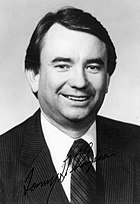 ](https://en.wikipedia.org/wiki/File:Tommy_Thompson_%28WI%29.jpg)

:{Thompson was called a ":(style="background-color:#ffffff;"):}::{pioneer" for two key initiatives of his governorship, the :(style="background-color:#ffff66;"):}:Wisconsin Works welfare reform (sometimes called W-2) and school vouchers.[35][36] In 1990 Thompson pushed for the creation of the country's first parental school-choice program, which provided Milwaukee families with a voucher to send children to the private or public school of their choice. He created the BadgerCare program, designed to provide health coverage to those families whose employers don't provide health insurance but make too much money to qualify for Medicaid. Through the federal waiver program, Thompson helped replicate this program in several states when he became Secretary of Health and Human Services.[citation needed]
Thompson was well known for his extensive use of the veto, particularly his sweeping line-item veto powers. At the time, Wisconsin governors had the power to strike out words, numbers, and even entire sentences from appropriations bills. In his first two terms alone, he used the line-item veto 1,500 times to cancel a total of $150 million in spending; none of these vetoes were overridden.[37]
Thompson's welfare reform policies were criticized.[20] Wendell Primus of the Center on Budget and Policy Priorities wrote that "Many families have actually lost ground even though they are no longer on welfare." Many of Wisconsin's poor remained well below the federal poverty line. In addition, slightly more of the state's poorest children reportedly lacked health insurance than before Thompson's welfare overhaul.[20]
The growth of the state budget during Thompson's 14-year tenure became a subject of attacks on his record as governor later by conservative opponents in the 2012 U.S. Senate primary.[38]
Transportation focus
While governor, Thompson was appointed to the Amtrak Board of Directors by President Bill Clinton, served as chairman, and had an Amtrak locomotive named for him from 2001[39][40][41] through 2006, when his name was removed from the side of the locomotive as part of a routine overhaul.[42]
Thompson is a rail enthusiast, and was a supporter of mass transit, which earned him distrust on the issue from other Republicans.[20] Prior to being selected as HHS Secretary, Thompson made clear that his first choice in the Bush Administration would be Secretary of Transportation.[20]
Taxes
In 1996, Thompson bragged that he never raised taxes in Wisconsin.[15] Thompson claimed to cut taxes 91 times—including eliminating the estate tax in 1987,[43] cutting income tax rates three times[44] and a $1.2 billion property tax cut in 1995.[45][46]
When Thompson made the same claim, in 2012, that he "never raised taxes", he earned a rating of "False" from PolitiFact-Wisconsin.[46] PolitiFact found numerous examples of taxes that had increased during Thompson's terms. Politifact said in its rating, "Thompson has a long list of taxes he cut and, on balance, he can claim to have reduced taxes. But he also raised some specific taxes along the way." Politifact rated Mostly True Thompson's claim that Wisconsin's overall tax burden went down while he served as governor from 1987 to 2001.[46]
Two of the tax increases that Thompson did fight, using the Wisconsin governor's partial-veto power, were taxes on the state's wealthiest residents.[15] In a budget bill in 1987, Thompson vetoed two tax increases on capital gains and the alternative minimum tax, that would have largely affected the wealthy,[15] at the same time that he pushed forward a six percent cut in welfare benefits.[15]
Executive power consolidation
As governor, Thompson took major steps to transfer decision-making power from elected constitutional officers and independent agencies to his political appointees.[15] Among the changes:
- The Secretary of State's office was gutted of its responsibilities concerning business registration and Uniform Commercial Code administration.[47] These functions were in turn vested in Thompson's appointee at the newly created Department of Financial Institutions, which also regulates depository institutions and the securities industry.
- Enforcement of consumer protection laws was taken away from the elected Wisconsin Attorney General and transferred to Thompson's appointee at what is now the Department of Agriculture, Trade and Consumer Protection.
- The Wisconsin Office of Public Intervenor, which for decades prior functioned as an ombudsman for the state's natural resources protected under the Public Trust Doctrine, had its budget significantly reduced, shrinking its staff and eliminating its power to sue in environmental cases; Thompson effectively shifted these powers to an appointed natural resources secretary.
- An attempt was made to transfer education policy to an appointed education secretary after the constitutional head of the Wisconsin Department of Public Instruction, the elected Superintendent of Public Instruction of Wisconsin, saw most of the office's powers gutted. The Wisconsin Supreme Court later ruled the move unconstitutional.[15][48]
Thompson also had two other acts overturned by the courts as unconstitutional.[15] His plan to include church schools in his school voucher plan was found unconstitutional.[15] Thompson also insisted on keeping Good Friday as a half-holiday for state workers, "despite a clear ruling" from the Seventh Circuit, earning a rebuke from the court.[15]
Tobacco
As governor, Thompson was friendly to tobacco interests.[20] His campaign accepted tens of thousands of dollars in campaign contributions and trips from Philip Morris.[20] He also vetoed a tobacco excise tax and "delayed authorizing the state attorney general to join other state[s] in a lawsuit against cigarette manufacturers.[20]
Abortion
Thompson is Catholic and opposes abortion. His support for legislation in Wisconsin restricting abortions led Planned Parenthood, NARAL, and other pro-choice groups to oppose his nomination to head HHS.[20]
Treatment of Ojibwa spearfishers
In 1983, the U.S. Court of Appeals for the Seventh Circuit issued its "Voigt Decision", which found that Wisconsin's Ojibwa tribe had a treaty-guaranteed right to engage in traditional spearfishing off-reservation and that the state of Wisconsin was prohibited from regulating fishing on Ojibwa land.[49] The decision was upheld by the Supreme Court of the United States in 1983.[49][50]
During his 1986 gubernatorial campaign, Thompson suggested abrogating the Ojibwa's rights.[49] Once in office, Thompson called on two Ojibwa tribes to sell their treaty-guaranteed rights: the Lac du Flambeau Band of Lake Superior Chippewa, for $42 million, and the Mole Lake Band of Lake Superior Chippewa, for $10 million.[49] Thompson's administration tried an unsuccessful legal challenge to the "Voigt Decision".[49] The State of Wisconsin argued that Native Americans' lives were in danger from protesters if they continued spearfishing.[49]
In 1989, federal judge Barbara Crabb ruled against the Thompson Administration's legal efforts. The judge rebuked the state for attempting to avoid violence by punishing the Ojibwa, since it was violence by non-Native American protesters that was the threatened danger.[50] Crabb issued an injunction against violent anti-spearfishing protests in 1991, and made it permanent in 1992.[51] On May 20, 1991, the Thompson administration declared it would no longer attempt to appeal the 1983 Voight Decision.[49]
Other leadership roles
During his time as governor, Thompson served as chairman of the National Governors Association and the Education Commission of the States,[15] in addition to the Council of State Governments, the Republican Governors Association, the Council of Great Lakes Governors, and the Midwestern Governors Association.
Vice presidential discussion
Thompson's name had been in the press as a possible vice presidential pick during several election seasons. By 1992, Thompson himself had openly discussed his desire to be the Republican vice presidential nominee for 1996.[15]
Republican presidential nominee Bob Dole considered Thompson as a possible vice presidential nominee in 1996 and Thompson openly lobbied for the position.[15] However, Thompson was forced to fight off perceptions of being someone to "bluster through a speech, turn bombastic during public statements", and have difficulty thinking on his feet. During the 1996 vetting process, Dole also reportedly remarked on Thompson's lack of finesse in their interactions.[15]
After Dole disclosed that Thompson was no longer under consideration, Thompson stated that he was relieved because he had been "scared to death" of the process and the spotlight of the position.[52] In 2000, Thompson was mentioned as a possible vice presidential running mate for George W. Bush.[53]
Health and Human Services Secretary
:{
While Secretary, he launched initiatives to increase funding for the National Institutes of Health,[54] reorganize the Centers for Medicare & Medicaid Services to encourage greater responsiveness and efficiency, and clear the backlog of waivers and state plan amendments. He approved 1,400 state plans and waiver requests, thereby providing health insurance to 1.8 million lower-income Americans.[55] In the aftermath of 9/11, he also worked on strengthening the nation's preparedness for a bio-terrorism attack, by stockpiling smallpox vaccines and investing heavily in state and local public health infrastructure.[56]Thompson left the governorship when he was appointed by President George W. Bush as HHS Secretary.}: He was confirmed by the Senate on January 24, 2001. Thompson announced his resignation from HHS on December 3, 2004,[54] and served until January 26, 2005, when the Senate confirmed his successor, Michael O. Leavitt.
Key initiatives
Thompson's major initiatives were "efforts to strengthen U.S. preparedness for a bioterrorism attack, increase funding for the National Institutes of Health, expand health insurance coverage to lower-income Americans, and focus attention on health problems such as obesity and diabetes."[57] He also was elected chairman of the Global Fund to Fight AIDS, Tuberculosis and Malaria in 2003.[58]
Medicare prescription drug-benefit
Thompson was one of the key architects of the 2003 passage of Bush's Medicare Modernization Act, which was slated to provide public funding for prescription drugs for Medicare recipients starting in 2006. On the prescription drug-benefit issue, the major piece of health care legislation of President Bush's first term, Thompson frequently served as the president's point man. National analysts cite the passage of Medicare reform as the most important achievement of Thompson's tenure as HHS secretary.[59]
As part of the debate over the adoption of Medicare Part D, Thompson was involved in a dispute over whether the Center for Medicare and Medicaid Services had to share cost estimates to Congress for legislation that would create a prescription drug benefit. Critics accused Thompson and HHS of downplaying the true cost of the law by $150 billion. CMS Administrator Tom Scully threatened to fire a CMS actuary if he revealed to Congress his estimate. Investigators determined that the data was improperly hidden from Congress, but did not conclude whether laws had been broken.[60] In 2011 the trustees of Medicare found that the prescription drug benefit had come in 40% below estimates, the Congressional Budget Office (using different budgeting numbers) determined that the program had come in 28% below projections.[61]
In her Senate campaign, Rep. Tammy Baldwin (D-WI) said in 2012 that Thompson was responsible for forbidding Medicare to negotiate drug prices, a statement that Politifact rated as "True."[62] Thompson said that he had nothing to do with that provision, a statement Politifact rated as "False."[63][64] The New York Times reported, "In December (2004), just before leaving office, Mr. Leavitt’s predecessor, Tommy G. Thompson, said he wished Congress had given him the authority to negotiate prices for Medicare beneficiaries, as he negotiated discounts on antibiotics during the anthrax scare of 2001."[65]
2001 anthrax scare
Early in his term, Thompson faced an emergency situation with the 2001 anthrax attacks. Thompson was given poor marks for seeming "utterly overtaken by events" and issuing "early statements that the government was prepared to deal with any biological emergency [that] never squared with the facts."[66]
At a White House briefing following the first anthrax death of the scare, Thompson made a statement to the press that "would be cited for years afterward as a historic blunder in crisis communication."[67] Thompson offered the media a "far-fetched" suggestion that the individual who died had come into contact with anthrax from drinking water from a creek.[68] Thompson's words were criticized by a range of experts as unwarranted, potentially undermining public confidence, and as the "kind of statements that lead to mistrust of officials and experts."[69][70] Thompson was also faulted for positioning himself as the voice of the Administration to the public on this issue, having had no formal training in medicine or public health.[67]
Alleged politicizing of science
In 2001, early in his term as Secretary of Health and Human Services, Thompson's office rejected 19 of 26 people, including a Nobel laureate, recommended for seats on the advisory board for the NIH developing nations unit by the unit's director.[71] In return, Thompson's office sent back to the unit's director, Gerald Keusch of the Fogarty International Center, résumés for other scientists that Keusch described as "lightweights" with "no scientific credibility." Keusch relayed to one of thoserejected, Nobel laureate**Torsten Wiesel**, that he was pushed aside for having "signed too many full-page letters in The New York Times critical of President Bush."[72] This incident was cited by the advocacy group Union of Concerned Scientists as part of a report detailing their allegations of a "politicization of science" under President George W. Bush's administration.[73][74]
Resignation press conference
Thompson resigned on December 3, 2004, in a press conference at which he issued warnings over the dangers of avian flu and the poisoning of U.S. food supplies by terrorists.[57] Thompson stated that he had attempted to resign in 2003, but remained until after the President's reelection at the administration's request.[75][76][77] Some noted, in particular, his words: "I, for the life of me, cannot understand why the terrorists have not, you know, attacked our food supply because it is so easy to do. And we are importing a lot of food from the Middle East, and it would be easy to tamper with that."[57]
Post-government career
After leaving the public sector at the end of the Bush Administration, Thompson joined the law firm Akin Gump, and the consulting firm Deloitte and joined the boards of directors of other companies.[3][78]
Thompson also joined the board of about two dozen private companies and nonprofit groups.[79]
In 2011, Thompson was paid more than $1.1 million in cash and stock incentives from five public companies, Thompson's consulting firm was paid $471,000 by six companies, and Thompson himself received $3 million from the sale of a healthcare firm he chaired. Thompson's work with these companies and other investments led him to accumulate a disclosed net worth of $13 million.[79]
A number of those companies and organizations "he helps oversee have faced an array of troubles, including claims of making faulty and dangerous medical implants, failing grades from a corporate watchdog and allegations of misleading investors." An expert with one agency that gave failing marks three of the six public companies who boards Thompson sits on commented that "either [Thompson] has really bad luck choosing companies...or he is one of the directors on company boards who is not exercising sufficient oversight."[79]
Health care consulting and law firm
Thompson became a partner at law firm Akin Gump, a Washington, D.C., law firm that engages in federal lobbying.[3] There, Thompson provided "strategic advice" to the lobbyists in the firm's health care practice, advising them on how to most successfully lobby government officials on behalf of the firm's clients.[3]
He also became a senior advisor at the professional services firm Deloitte and became Independent Chairman of its Deloitte Center for Health Solutions.[78][80] Thompson was no longer associated with Deloitte by October 2011.[78]
For the United States presidential election in 2016 Thompson initially endorsed fellow Republican John Kasich.[citation needed] In early July Thompson, a delegate to the Republican national convention, endorsed Donald Trump.[81]
Medicare
After leaving office, Thompson began offering policy solutions for a variety of programs that he had overseen as HHS Secretary.[82] However, critics claimed many changes would benefit companies Thompson owned or had a financial stake in (including Centene and the Deloitte Center for Health Solutions).[82] These included transferring some Medicaid beneficiaries from federal to state responsibility and requiring digitization of medical records, which would directly benefit those companies.[82]
Public interest activities
Thompson spoke as a panelist at a 2005 Kennedy School of Government conference on global poverty, where he discussed medical diplomacy.[83] Thompson also authored a Boston Globe op-ed on the topic.[84]
One of the nonprofit organizations that Thompson joined the board of, Medical Missions for Children, recruited Thompson to co-host a number of episodes of one of its health instructional series, Plain Talk about Health.[85]
2008 presidential campaign
Main article: Tommy Thompson 2008 presidential campaign
After first announcing the formation of an exploratory committee in late 2006, Thompson announced his candidacy for the 2008 presidential election on April 1, 2007.[86]
Statement about sexual orientation and workplace protections
During a May 3, 2007, presidential debate at the Ronald Reagan Presidential Library Thompson was asked by moderator Chris Matthews whether a private employer opposed to homosexuality should have the right to fire a gay worker.[87] He said, "I think that is left up to the individual business. I really sincerely believe that that is an issue that business people have got to make their own determination as to whether or not they should be." He called CNN the following morning to say he did not hear the question correctly. He apologized, saying, "It's not my position. There should be no discrimination in the workplace."
Political contributions
Thompson made campaign contributions to two Democrats in 2008[88] – $250 to Michigan Senator Carl Levin and $100 to Bev Perdue, who was running for Governor of North Carolina. Both Democrats won in that year's elections. All told, Thompson contributed $11,350 to Republican candidates for federal office in the 2008, 2010 and 2012 election cycles, while contributing another $4,900 to Wisconsin Republicans during those same cycles.
Gaffe about Jews, Israel
I'm in the private sector and for the first time in my life I'm earning money. You know that's sort of part of the Jewish tradition and I do not find anything wrong with that. [...]
I just want to clarify something because I didn't in any means want to infer or imply anything about Jews and finances and things. What I was referring to, ladies and gentlemen, is the accomplishments of the Jewish religion. You've been outstanding business people and I compliment you for that.
— Tommy Thompson, address to the Religious Action Center of Reform Judaism – Consultation on Conscience, Washington, DC, April 16, 2007
Thompson was courting public support, not trying to alienate people—which means he somehow believed that repeating an age-old stereotype about Jews and money would please his Jewish listeners! There could be no more vivid illustration of how deeply ingrained these stereotypes have become.
— Abraham Foxman, National Director, Anti-Defamation League, Jews and Money: The Story of a Stereotype (Macmillan, 2010, p. 139)
In April 2007, Thompson was compelled to apologize for remarks he made about Jews and Israel during an address to an assembled crowd of Jewish social activists in Washington, D.C.[89]
On April 16, 2007, appearing before a conference organized by the Religious Action Center of Reform Judaism, Thompson referenced his lucrative transition from public service to the private sector[90][91] and invoked old, slanderous stereotypes linking Judaism with finance.[92] Thompson stated: "You know that's sort of part of the Jewish tradition and I do not find anything wrong with that."[91] Thompson then returned to the podium with the intention of clearing up his earlier comments,[93] adding: "I just want to clarify something because I didn't (by) any means want to infer or imply anything about Jews and finances and things. What I was referring to, ladies and gentlemen, is the accomplishments of the Jewish religion. You've been outstanding business people and I compliment you for that."[91] Thompson's comments caused "unease in the room" as the attendees tried to decode the meaning of Thompson's use of this stereotype.[90][92]
Thompson made a variety of other lesser gaffes, including referring to the Anti Defamation League as the fringe Jewish Defense League, and to Israel bonds as "Jewish bonds".[90][94][95] He discussed his connections to politically conservative Israeli and Jewish leaders while speaking to the mostly liberal leaning group[90][94]
Conference organizers noted the unease with Thompson's words but otherwise limited their comments on the faux pas, instead thanking Thompson for being one of the speakers at the conference.[96]
The national director of the Anti-Defamation League, Abraham Foxman, later wrote of the incident that "there could be no more vivid illustration of how deeply ingrained these stereotypes [about Jews and finances] have become" than Thompson's belief that "repeating an age-old stereotype about Jews and money would please his Jewish listeners!"[92]
After the event, Thompson told Politico that his remarks could be blamed on fatigue and a persistent cold.[89] Journalists believed that Thompson had instead failed to prepare for the event, acquaint himself beforehand with the likely audience, and recruit an adviser to properly brief him before the event.[90][94]
Iowa Straw Poll
Thompson had stated he would drop out of the race if he did not finish either first or second in the Ames straw poll on August 11, 2007. Thompson finished sixth, with just 7% of the vote, despite the fact that some major contenders were not competing in the poll. On August 12, Thompson officially announced he would drop out of the race.[citation needed]
Endorses Giuliani
In October 2007, Thompson endorsed Rudy Giuliani. Thompson told the Associated Press in a statement that "Rudy Giuliani has shown that he is a true leader. He can and will win the nomination and the presidency. He is America's mayor, and during a period of time of great stress for this country he showed tremendous leadership." He then endorsed Senator John McCain after Giuliani's withdrawal from the presidential race.[97] In a New York Times article published October 11, 2008, Thompson was quoted in response to a question regarding whether he was happy with McCain's campaign as saying, "No. I don't know who is."[98]
2012 U.S. Senate election
Main article: 2012 United States Senate election in Wisconsin
On September 19, 2011; Thompson announced he would run for the seat vacated by Sen. Herb Kohl,[99] formally announcing on December 1, 2011. He won the Republican nomination on August 14, 2012, after a bitter four-way primary battle against a field that included millionaire hedge fund manager Eric Hovde, former Congressman Mark Neumann, and Wisconsin State Assembly Speaker Jeff Fitzgerald.[100]
The attacks on Thompson led to his defense and endorsement by former Arkansas governor, presidential candidate, and conservative media figure Mike Huckabee.[101]
ALEC member the American Chemistry Council spent nearly $650,000 in support of Thompson's bid for US Senate in the autumn of 2012. Thompson faced Democratic Congresswoman Tammy Baldwin in the general election. Although most polls from the spring through September showed Thompson ahead, he ultimately lost to Baldwin in the general election, taking 45.9 percent to Baldwin's 51.5 percent. Ultimately, Thompson could not overcome a combined 260,000-vote deficit in the state's two largest counties, Milwaukee and Dane – home to Milwaukee and Madison, respectively. It was the first time Thompson had lost a statewide election.[citation needed]
Political positions
During the 2012 campaign, Thompson, speaking to a Tea Party group, said, "who better than me, that's already finished one of the entitlement programs, to come up with programs that do away with Medicaid and Medicare?"[102] When a videotape of his remarks surfaced, Thompson stated that he did not want to eliminate Medicare, but instead wanted a system that would provide a subsidy to individuals to help them purchase private health insurance.[102]
Thompson favors making the Bush tax cuts permanent and adopting a 15 percent flat tax.[103]
Later years
University of Wisconsin System President
Thompson as UW System President atUW Oshkosh in March 2022.

In the fall of 2019, incumbent University of Wisconsin System President Ray Cross announced his intention to retire. This kicked off a search by the University of Wisconsin System Board of Regents to find his successor.[104] In what was seen as a flawed candidate search, complicated by the COVID-19 pandemic in Wisconsin, the board initially was poised to offer the position to University of Alaska System President Jim Johnsen.[1] Johnsen was ultimately forced to withdraw amidst vocal opposition from University of Wisconsin System faculty and students.[105] A week later, after closed-door sessions, the board named Thompson as the interim president.[1] Thompson served nearly two years as interim president before announcing in January 2022 that he would step down, effective March 18, 2022.[106]
Electoral history
...
http://www.alternet.org/personal-health/fat-political-issue
There are now more than 700 million obese people worldwide, 108 million of them children, reported the New York Times recently. In Brazil, food giant Nestle sends vendors door to door hawking its high-calorie junk food and giving customers a full month to pay for their purchases. Such a deal. Nestle calls the junk food hawkers, who are themselves obese, "micro-entrepreneurs." Right.
Big Food is increasing targeting poor countries as "emerging markets" to please shareholders, supplanting their indigenous diets with fast food, packaged goods and soft drinks. In addition to creating obesity, diabetes, heart disease and chronic illnesses, the junk food supplants subsistence agriculture crops with sugar cane and GMO corn and soybeans. Even philanthropic groups like the Bill & Melinda Gates Foundation have drunk Big Food's Kool-aid about GMOs "feeding the world." Actually, GMOs drench the fields of poor communities with toxic pesticides and pollute their waters.
Nestle's exploitation of the poor goes back more than 40 years when it convinced poor mothers to reject their own breast milk––the one thing poor mothers actually have to give their babies–– in favor of its infant formula. Activist groups say babies die in poor areas of Asia, Africa and Latin America because their mothers bottle-feed them with Western-style infant milk.
In Brazil, meat giant JBS and Coca-Cola have donated millions to congressional campaigns and McDonald’s $561,000, effectively burying dialogue about the health of junk food and its role in obesity. A few years ago, Reuters reported that the World Health Organization's Pan American Health Organization takes hundreds of thousands of dollars and "obesity" advice from junk food and soft drink companies. No wonder the advice stresses "exercise" and gives junk food ubiquity and its marketing to children and a pass.
Big Food also keeps America fat. A 2014 movie by Katie Couric called "Fed Up" exposed how the U.S. government admonishes people to eat right, while pushing the foods that make them fat, and how school lunchrooms have been bought by Big Food.
The film reveals how the egg, sugar and other Big Food industries revised guidelines generated from the 1977 McGovern Report that recommended people eat less foods high in fat and sugar to favor them and overruled Sen. McGovern.
In 2006, a similar Big Food triumph occurred. Faced with the United Nation’s WHO food recommendations that were similar to the McGovern Report, then Secretary ofHealth and Human Services (HHS) Tommy G. Thompson actually flew to Geneva to threaten WHO that if the guidelines stood, the U.S. would withdraw its WHO financial support. Yes––U.S Ag was––and is––more important than world health.
In July, the New York Times revealed the devastating toll that junk food, obesity and diabetes have on poor people in Appalachia most of whom have minimal or no health care. People in Appalachia are sicker than in Central America, said Dr. Joseph Smiddy, a health volunteer in Virginia. “In Central America, they’re eating beans and rice and walking everywhere. They’re not drinking Mountain Dew and eating candy. They’re not having an epidemic of obesity and diabetes.” At least not until Nestle gets there.
In Chicago, there is a bitter fight over a recently instituted penny-per-ounce tax on sweetened beverages. The beverage industry has spent more than $1.4 million on television ads trying to reverse the decision and cast the desire to drink high-calorie, obesity-, diabetes- and dental cavity-producing soft drinks as "consumer choice." Poor communities, in Chicago and in the world, are the ones most hurt by soft drinks and the ones the beverage industry is now most desperately trying to enlist in the fight against the tax.
Someone on a typical 2,000-calorie-a-day diet should derive only 200 calories a day from sugar—equal to one 16-ounce soda. Yet most Americans consume at least twice the recommended amount and few people who have the soda “habit” only drink one soft drink a day.
Once upon a time, “sugar” meant sugar from sugar cane or sugar beets. But since 1980, soft drink producers have favored high fructose corn syrup (HFCS) and they have been followed by most major food producers and processors. Trade restrictions in other countries to protect local sugar production made sugar more expensive to use even as U.S. farmers were growing copious amounts of corn because of farm subsidies. HFCS is also cheaper to produce, store and ship.
While HFCS is linked to obesity, diabetes, liver damage, memory problems and even possible mercury contamination, artificial sweeteners are not clearly better. An increase in the use of aspartame, found in Diet Coke, and sucralose, found in Pepsi One, actually correlated with a rise in the number of people who are obese, reported the Yale Journal of Biology and Medicine.
Whether in Brazil or Chicago, Big Food is succeeding in adding "poor health" to the plight of poor people.
==
==
cmd 2015 report
WISCONSIN
In 2009, Wisconsin was awarded up to $69.7 million in a CSP grant that ran through 2015. As with other states, Wisconsin was praised for the “flexibility” given to charter schools by state law. Wisconsin was in the first wave of states to approve charter schools, in 1993, through a bill modeled on the “Charter Schools Act” pushed by the American Legislative Exchange Council, which took credit for it being introduced and becoming law.(Governor Tommy Thompson (R-WI) was an early ALEC legislative member, and as governor he became known for numerous “reforms” that later were spawned by ALEC, which Thompson essentially conceded in a public speech years later.) Initially, Wisconsin capped the number of charters but today it has over 240 charters with nearly 50,000 students enrolled. Earlier this year, Wisconsin expanded who can authorize charters. More than 90 charters have failed and closed in Wisconsin, including more than two dozen just in Milwaukee alone. The reasons cited for closures include allegations of financial improprieties and fraud, financial mismanagement, poor academic performance, low enrollment, failure to hire enough qualified teachers, and more. Among those failed charters are nearly a dozen, at least, that were federal CSP sub-grantees, as noted in the list below....
http://www.prwatch.org/files/new_charter_school_black_hole_report_oct_21_2015.pdf
==
==
7/13 n 1990, Milwaukee was the first city in the nation to implement a school voucher program, under then-governor (and ALEC alum) Tommy Thompson. ALEC quickly embracedthe legislation, and that same year offered model bills based on the Wisconsin plan. For-profit schools in Wisconsin now receive up to $6,442 per voucher student, and by the end of the next school year taxpayers in the state will have transferred an estimated $1.8 billion to for-profit, religious, and online schools. The "pricetag" for students in other states is even higher.
Last week, one of Thompson's senior advisers sent an email attacking Rep. Baldwin's fitness for office just because she is gay. After refusing to address the issue for six days, Thompson finally denounced the attack and told reporters that adviser, Brian Nemoir, had been demoted. However, two days later, Nemoir was still sending out emails for the Thompson campaign using the same title he held before the attack. Further, Nemoir is publicly standing by his remarks.
--- --
By Associated Press, Published: August 14 | Updated: Wednesday, August 15,
WASHINGTON — While two veteran Republicans, former Wisconsin Gov. Tommy Thompson and Rep. John Mica of Florida, survived conservative challenges in Tuesday’s congressional primaries, a veterinarian and political novice named Ted Yoho stole much of the spotlight.
Florida tea party challenger Yoho won a major upset against 12-term GOP Rep. Cliff Stearns by slightly more than 800 votes, about 1 percentage point, as four states held primaries, including Connecticut and Minnesota. Stearns conceded the race on Wednesday.
==
sw
Tommy G. Thompson stepped down as the Secretary of the Department of Health and Human Services (2001-2005) after U.S. presidential election, 2004. "In taking over health and human services, Thompson [succeeded] Donna Shalala, who once worked for him as the University of Wisconsin chancellor." Thompson was replaced by Michael O. Leavitt. [
In December 2006, Thompson created an exploratory team for the 2008 presidential election. [2]
Main article: U.S. presidential election, 2008
Thompson "played a central role in the**Bush campaign**, serving as platform chair at the Republican National Convention and acting as Bush's campaign chairman in Wisconsin." [3]
Thompson, a Republican, was Wisconsin's longest-serving governor, elected in 1986, 1990, 1994, 1998. His last term was to expire January 2003.
Contents[hide] |
Tobacco issues
Tommy Thompson has been linked with the Washington Legal Foundation (WLF), an organization that is strongly hostile to tobacco control and that opposes public health measures. In 1994, as governor of Wisconsin, Tommy Thompson joined the policy advisory board of the WLF, an organization that receives funding from Philip Morris. In turn, WLF has defended PM on its issues. In one 1998 example, the WLF ran a highly inflammatory, pro-tobacco advertisement in several large papers including the New York Times, the Washington Post, the National Journal, the CongressDaily AM, and others. Easily recognizeable in the article are many of the tobacco industry's arguments (freedom of speech, the Bill of Rights, "slippery slope" arguments about enacting "prohibition" as well as emotion-laden phrases like "anti-tobacco zealots"). In addition to running this type of ad, the WLF has also repeatedly sued government agencies that oversee public health functions, like the Food and Drug Administration and the Enivronmental Protection Agency, who WLF sued over workplace smoking policies.
Controversy
Corporate Connections
"The former Wisconsin governor was forced to sell his stock in drugmakers Merck and Abbott Laboratories once he was confirmed as health and human services secretary. But he reportedly kept the $15,000 to $50,000 worth of stock he owned in AOL Time Warner and General Electric because they weren’t considered a conflict of interest. Thompson also raised some eyebrows over his close relationship with Philip Morris. He sold his stock in the tobacco giant (worth between $15,000 and $50,000), but as governor, he accepted more than $72,000 in campaign donations from the company, according to the Wisconsin Democracy Campaign. Philip Morris also subsidized a number of Thompson’s international trips to promote free trade. Thompson was appointed to the board of Amtrak by former Presidents Bush and Clinton. Amtrak regularly fights for increased government funding, despite Congress’ request that the railroad wean itself from government subsidies." Source: *OpenSecrets.org*.
Profiles
- "Secretary Thompson has dedicated his professional life to public service, most recently serving as governor of Wisconsin from 1987 through 2000. Secretary Thompson made state history when he was re-elected to office for a third term in 1994 and a fourth term in 1998. Secretary Thompson began his career in public service in 1966 as a representative in Wisconsin's state Assembly. He was elected assistant Assembly minority leader in 1973 and Assembly minority leader in 1981. Secretary Thompson received both his undergraduate and law degrees from the University of Wisconsin at Madison." Source:Official Government Bio.
- "Former Wisconsin Gov. Tommy Thompson is a member of the Council for National Policy, a secretive right-wing group that meets to set strategy for their movement. CNP's membership roster includes prominent politicians like Senate Majority leader Trent Lott as well as Religious Right leaders Gary Bauer, James Dobson, Jerry Falwell, Ralph Reed, and Pat Robertson." --People for the American Way.
- "TOMMY G. THOMPSON was born in Elroy, Wisconsin. He received his bachelor's degree in political science in 1963 and his law degree in 1966 from the University of Wisconsin. He is a former Army captain and a former member of the U.S. Army Reserve. Thompson was first elected to the Wisconsin Assembly in 1966 and was elected assistant minority leader in 1973. In 1981 he was elected Republican floor leader. He is a member of the Wisconsin Bar Association, the Juneau County Bar Association, the Juneau County Republican Party, and St. Patrick's Catholic Church. Governor Thompson is the recipient of the American Legislative Exchange Council's 1991 Thomas Jefferson Award, City and State magazine's 'Most Valuable Public Official' award, The Free Congress Foundation's 'Governance Award,' Governing magazine's 1997 'Public Official of the Year Award,' the American Legion's 1998 'National Award for Americanism,' and the 1998 'Horatio Alger Award.' Governor Thompson is the chairman of the Amtrak Board of Governors and co-chair of ACHIEVE, a resource center for Governors and business leaders on academic standards, assessment, accountability, and technology. The Governor has served as chairman of the National Governors' Association, the Council of State Governments, the Republican Governors Association, the Council of Great Lakes Governors, the Midwestern Governors' Conference and the USTR Intergovernmental Policy Advisory Committee. Governor Thompson is also a member of the Export/Import Bank Chairman's Advisory Board, the Inter-American Dialogue, and the National Education Goals Panel. He currently serves on NGA's Executive Committee." --Wisconsin Governor Tommy G. Thompson's Profile.
Resources and articles
Related SourceWatch articles
Profiles
- Personal Financial Disclosure for Tommy G. Thompson, 2002 and 2003, Open Secrets.
- Health and Human Services Secretary-Designate: President-elect Bush has named Wisconsin Governor Tommy Thompson to head the Department of Health and Human Services, PBS Online NewsHour, December 29, 2000.
- Jonathan Cohn, "Is Tommy Thompson W.'s Jack Kemp?. Moral Minority," The New Republic (prisonactivist.org), posted January 4, 2001; January 15, 2001, issue.
External articles
2000
- "Bush Taps Welfare Reformer," Associated Press (CBS News), December 29, 2000.
2001
- "Thompson Says He Won't Leave Amtrak," BMWE.org, March 3, 2001: "Amtrak officials say they want Thompson to continue in his post. Since 1998 he has filled a key niche for Amtrak's public and government relations -- a passionate defender of the national passenger railroad who is neither a Democrat nor from the Northeast."
- "Thompson to Give Up His Amtrak Post," BMWE.org, May 5, 2001: "If Bush names Mineta to the board, the Democratic appointee of a Republican president would replace the Republican appointee of a Democratic president. It also would mark the second time in less than six months that Mineta won a job coveted by Thompson, who had sought to become transportation secretary."
- Alexandra Starr, "The Bush Cabinet: Muzzling 'King Tommy'. Is Tommy Thompson the real compassionate conservative?" Business Week, May 7, 2001.
- Jill Lawrence, "Anthrax answer man in hot seat," USA Today, October 26, 2001.
2004
- Tom Still, "Could Tommy Thompson’s next stop be Transportation, Homeland Security, or the private sector?" Wisconsin Technology Network, November 10, 2004.
- Patricia Simms, "Thompson won't discuss future plans," Star-Times (Juneau County), November 15, 2004.
2005
- "Former HHS head Tommy Thompson on board of Verichip Corp," Lone Wacko Blog, October 6, 2005. Thompson joined the VeriChip Corporation board in July 2005.
2006
- "Thompson Creates Exploratory Committee," Taegan Goddard's Political Wire, December 17, 2006. (According to CNN, December 16, 2006.)
2007
- John Kifner, "Good Form Once, but Now a Dark Horse," New York Times, June 8, 2007.
| Search the Documents Archives of the Tobacco Industry | Search the Documents Archives of the Tobacco Industry | Search the Documents Archives of the Tobacco Industry | Search the Documents Archives of the Tobacco Industry |
|---|---|---|---|
| Legacy Tobacco Documents Library: |
http://www.sourcewatch.org/index.php?title=Tommy_Thompson
WLF:
In 1994, Wisconsin Governor Tommy Thompson (who preceded Mike Leavitt as head of the U.S. Department of Health and Human Services, which oversees the tobacco control functions of federal government) joined the policy advisory board of the Washington Legal Foundation. WLF, which receives funding from the Philip Morris tobacco company (PM), publicly defends the tobacco industry. In 1998, the WLF ran an inflammatory, pro-tobacco advertisement titled "In all Fairness: A Constitutional tragedy in the making" in several large papers including the New York Times, the Washington Post, the National Journal, the CongressDaily AM, and others. Easily recongizeable in the article are many of the tobacco industry's arguments (freedom of speech, the Bill of Rights, "slippery slope" arguments about enacting "prohibition" as well as emotion-laden phrases like "anti-tobacco zealots").[11]
In addition to running this type of ad, the WLF has also repeatedly sued government agencies that oversee public health functions, like the Food and Drug Administration and the Enivironmental Protection Agency,who they sued over workplace smoking policies.
An April 1994 activity report by Philip Morris employee Roy E. Marden states he was "Working with the Washington Legal Foundation (WLF)in the development of a strategy to counteract and attack the efforts of the antis [public health advocates]..."[12]
WLF was listed as a think tank housing "policy analysts sympathetic with our views" in a February 25, 1999 memo from BSMG Worldwide to Philip Morris describing strategies to "support a full court press to thwart the filing of a federal lawsuit against the tobacco industry in order to force the industry to settlement." The objective of the strategy was to "[Enlist] allies and other potential third parties to help provide a "echo chamber" of opinion in local, regional,and national media, consistent with our messages.[13]