ballard, brian
---
bari w?
BONSI
WILES DTR NEPO VAPE
---
NEPO BABY VAPE
AN 5 26
The Daily Beast confirms that President Donald Trump’s abrupt passion to make the FDA approve vaping products came after a tobacco firm lobbied his office in each of the last four quarters, according to lobbying reports, either directly or through a firm where Chief of Staff Susie Wiles’ daughter works.
The DB reports Wiles was previously registered as a lobbyistfor Ballard Partners, which lobbied the government on behalf of SI Group Client Services, an associated branch of U.S. international tobacco company Swisher. Wiles represented the tobacco firm in 2019, 2021, and 2022 and is “name-checked in filings at least once in each of those years,” says DB. She later lobbied Congress with Mercury Public Affairs, which also acted on behalf of SI Group in 2023 and 2024, according to Public Citizen.
“In the Swisher filings where she’s named, the most common lobbying issues were ‘Monitor FDA issues regarding flavoring in tobacco products’ and ‘FDA regulations,’” reports DB. “Since Wiles, 68, began working at the White House, Continental Strategy has lobbied consistently on behalf of Swisher.”
Katie Wiles was reportedly promoted by Continentalthe day after her mom was appointed White House chief of staff. She is now a partner in the firm but not a registered lobbyist.
Meanwhile, the Wall Street Journal reported on Tuesday that Trump scolded Food and Drug Administration commissioner Marty Makary for not moving fast enough to approve flavored vapes. The Journal reported that Trump’s advisers told him Makary had blocked his ambition to get those flavors approved, citing sources who said he and Trump, 79, had discussed them directly.
“Makary had reportedly pushed against the flavors because he was concerned about their appeal to children and possible public health risks,” reports DB.
“White House spokesperson Kush Desai said in a statement to the Beast: “President Trump consistently pledged to expand access to vapes in light of an abundance of evidence finding that these products are beneficial for Americans trying to quit smoking.
The FDA announced on Tuesday that it had given the thumbs-up to vape firm Glas to manufacture menthol, mango, and blueberry flavors.
Flavored vaping products have become a significant regulatory battleground, particularly regarding their appeal to youth. Public health organizations including the American Academy of Pediatrics have documented concerns that flavored vapes—especially fruity and dessert varieties—serve as gateway products for young people.
The FDA has previously restricted flavored e-cigarettes in certain contexts, citing youth addiction rates. However, the tobacco industry argues flavored products help adult smokers transition away from traditional cigarettes. The tension between these positions has intensified as vaping use among teenagers has fluctuated in recent years.
Makary's resistance to approving additional flavors aligns with FDA guidance emphasizing youth protection as a central regulatory concern. Trump's pressure to accelerate approvals represents a significant shift in FDA priorities, potentially prioritizing industry interests over the public health precautions that animated the agency's previous stance on flavor restrictions.
:{---
---
AN 3 26
Secretary of State Marco Rubio has shared a 20-year relationship with a man that the government alleges is a foreign agent for Venezuela. It turns out, that man also has very close ties to several people in President Donald Trump's orbit
The sprawling case centers on a $50 million Venezuelan lobbying scheme allegedly orchestrated by Rep. David Rivera (R-Fla.), convicted cocaine trafficker Hugo Perera, and sanctioned media mogul Raúl Gorrín on behalf of Nicolás Maduro’s regime, a Tuesday report from The Lever said.
Court documents also reveal connections to White House chief of staff Susie Wiles, former Trump advisor Kellyanne Conway, Rep. Pete Sessions (R‑Texas), oil executive Harry Sargeant (now advising Trump on Venezuela policy), Iran‑Contra figure Otto Reich, and even Ghislaine Maxwell’s lawyer.
It all began in 2017, when the lobbying company Ballard Partners, which Wiles co-led at the time, was connected to Rivera through Gorrín and Perera. In fact, one of Rivera's lawyers' arguments is that if his associations make him a foreign agent, then Wiles should be considered one too. Ballard's "work for Gorrín appears to have been extensive," the report said and Wiles has been asked to testify. There are about 400 pages of documents connecting Wiles' firm to the men. The documents include numerous emails.
The court filings allege that Gorrín helped facilitate the foreign-agent relationship and served as a go-between for the Venezuelan government. He was involved in several meetings that Rivera set up, including those with Rubio. At one point, Rivera tried to use Gorrín's private jet for the meetings with Conway.
"Gorrín, who was sanctioned by the U.S. government in 2019 for his purported involvement in foreign bribes and money laundering, was reportedly paid handsomely for his work," the report noted. That same year, Attorney General Pam Bondi was also working at Ballard.
Emails exchanged between Wiles and Gorrín also included lobbyist Otto Reich, known for his work on weapons sales during the Ronald Reagan administration. It became known as the Iran-Contra scandal because the U.S. secretly funneled the weapons to Iran through the Contras, a Nicaraguan rebel group. There was an arms embargo at the time and Reich ran the State Department's Office of Public Diplomacy for Latin America and the Caribbean, which helped coordinate everything.
Oil executive Harry Sargeant was also among the email discussions. He's currently working with Trump on stabilizing Venezuela after Trump took out Maduro.
---
---
ref
The Miami Trial Exposing Foreign Influence In Trumpland
Inside a $50 million Venezuelan lobbying deal and a court battle ensnaring White House power brokers — including Secretary of State Marco Rubio and chief of staff Susie Wiles.
 Luke Goldstein
ShareFollow *The Lever* On Google
At every stage in Marco Rubio’s political ascent, David Rivera has been by his side.
Twenty years ago, the two Miami-raised Cuban-American Republicans earned the nicknames “Batman and Robin” as they rose to power in the Florida House of Representatives. When Rubio sought the speaker’s gavel, Rivera, known as Rubio’s “enforcer,” whipped the necessary votes. The young legislators even put down a mortgage together for a Tallahassee bachelor pad near the state Capitol.
Later, when Rubio was debating whether to launch a long-shot bid for the U.S. Senate, Rivera convinced him to run and campaigned for him across Florida. And when Rubio decided to propose to his now-wife, Rivera helped him pick out the engagement ring.
This month, the two will be by one another’s side once again — except this time on opposite sides of a courtroom.
Rivera is standing trial in Miami federal court for allegedly acting as a foreign agent on behalf of Venezuela, and Rubio, now secretary of state, is scheduled to testify as a government witness against him.
The blockbuster case hasn’t just ensnared Rubio, a central architect of President Donald Trump’s recent overthrow of the Venezuelan government. It provides a rare glimpse into a constellation of powerful figures in Trump’s orbit — including his White House chief of staff — who have profited from shaping U.S. policy on Venezuela, potentially without always disclosing the true nature of their work.
Now-Secretary of State Marco Rubio, left, talks to reporters as David Rivera looks on. (AP Photo/Alan Diaz)
Alongside Rubio, the cast of characters in the case includes a Florida oilman currently advising Trump on Venezuela policy; former Trump senior counselor Kellyanne Conway; a powerful Republican congressman code-named “Sombrero”; a notorious player in the Iran-Contra scandal; a convicted cocaine trafficker with cartel ties; the legal counsel for Jeffrey Epstein’s associate, Ghislaine Maxwell; and even Venezuela’s deposed president, Nicolás Maduro.
Filings in the case, alongside those in related lawsuits and countersuits, hint at hundreds of pages of unreleased documents detailing illicit business networks running from Caracas, Venezuela, to Miami and Washington, D.C. The limited records available describe clandestine operations, government bribes, multimillion-dollar kickbacks, drug smugglers, FBI informants, and secret deals involving Venezuela’s acting president.
The biggest bombshell of all? Documents presented by defense attorneys indicate that Rivera may not have been the only unregistered foreign agent working for Venezuela. According to a subpoena and a judicial decision, representatives of an ascendant lobbying firm in D.C. may also have been hired to promote the Venezuelan government’s interests without the proper disclosures. That includes one of Trump’s top officials: Susie Wiles, his chief of staff.
The trial — and its revelations about foreign influence — is poised to bedevil the White House, even as it tries to move on from its Venezuela ventures to its next regime-change operations in Iran. Under Trump’s increasingly hawkish second administration, the foreign lobbying industry has been booming, with new foreign-agent registrants reaching record highs over the past year.
Legal insiders in Miami interviewed by The Lever never expected the Justice Department’s case against Rivera, initiated in 2022 during the Biden administration, to reach trial under Rubio’s watch. Many still anticipate it will end in a sweetheart deal, given the Trump administration’s freewheeling approach toward pardoning allies.
“This Trump DOJ has been notorious for dropping cases and giving pardons, pointing the finger at the Biden administration, claiming this is some sort of witch hunt,” said Joseph DeMaria, a former prosecutor with the Justice Department’s organized crime strike force who is now a Miami-based defense attorney familiar with the Rivera case. “The question is, why wait until the eve of the trial for this one?”
The Justice Department did not respond to a request for comment on the case. But whichever route it chooses, the government is caught in a bind.
Dropping the case — and appearing to go soft on an alleged Venezuelan foreign agent just as government prosecutors build their narco-terrorism case against the country’s former leader and reportedly prepare corruption charges against his replacement — could spark a media firestorm.
Keeping the case alive, however, could expose the administration’s inner circle to scrutiny and potentially damning revelations.
A $50 Million Mystery
By the time Rubio and Rivera sold their Tallahassee home in 2015 after facing foreclosure over disputed bank payments, Rivera had become a political liability.
During their four terms together in the Florida state legislature, Rubio harnessed the flair and showmanship of political theater. Rivera was the workhorse.
A power broker with meticulous attention to detail, Rivera wielded political muscle behind the scenes to pass landmark legislation on projects ranging from the buildout of the Port of Miami tunnel to a free trade agreement with Colombia. An inveterate policy wonk, Rivera would fondly cite arcane provisions from these measures years later.
But alongside those accomplishments came accusations of graft. In Tallahassee, Rivera garnered a reputation as a “Nixonian” political operator for the lengths he would go to win. He once rear-ended a truck carrying incriminating campaign leaflets from his political opponent, according to a 2002 police report.
By the time Rivera lost his reelection for U.S. Congress in 2013 after serving one term, he had been plagued by so many scandals that colleagues described his behavior as “pathological.” And some of his schemes reportedly implicated Rubio.
In the 2000s, the FBI investigated Rivera for a variety of transgressions, although it never brought charges. Among other matters, agents examined whether the legislator accepted bribes from gambling industry executives seeking to block Native American tribes from expanding their casino operations.
In a separate incident, both Rivera and Rubio faced scrutiny for voting to exonerate a fraudulent investment company that wagered on life insurance policies held by elderly and infirm AIDS patients after the two lawmakers received thousands of dollars in donations from a political action committee cofounded by the head of the operation.
Soon after, federal authorities investigated the company for allegedly laundering drug cartel money, eventually shutting it down and sending its top executive to prison.
In 2017, the Federal Election Commission filed a lawsuit against Rivera, alleging that he financed a straw candidate to run against his Democratic opponent in the 2012 primary for Florida’s 25th district in an unsuccessful effort to damage his electoral prospects. After pursuing the matter for years, regulators dropped the case at the start of 2025.
The State Department did not respond to a request for comment regarding Rubio and Rivera’s long-standing friendship and other matters. But for years, despite the slew of controversies, Rubio publicly defended his old roommate as he rose through the Republican ranks.
In 2022, however, Rivera faced charges that were far more difficult to overlook.
That year, federal prosecutors arrested Rivera and charged him — along with a fellow political consultant, Esther Nuhfer — with working for Venezuela in violation of the Foreign Agents Registration Act (FARA), which requires individuals and organizations to register with the Department of Justice when engaging in U.S. political activity on behalf of foreign governments.
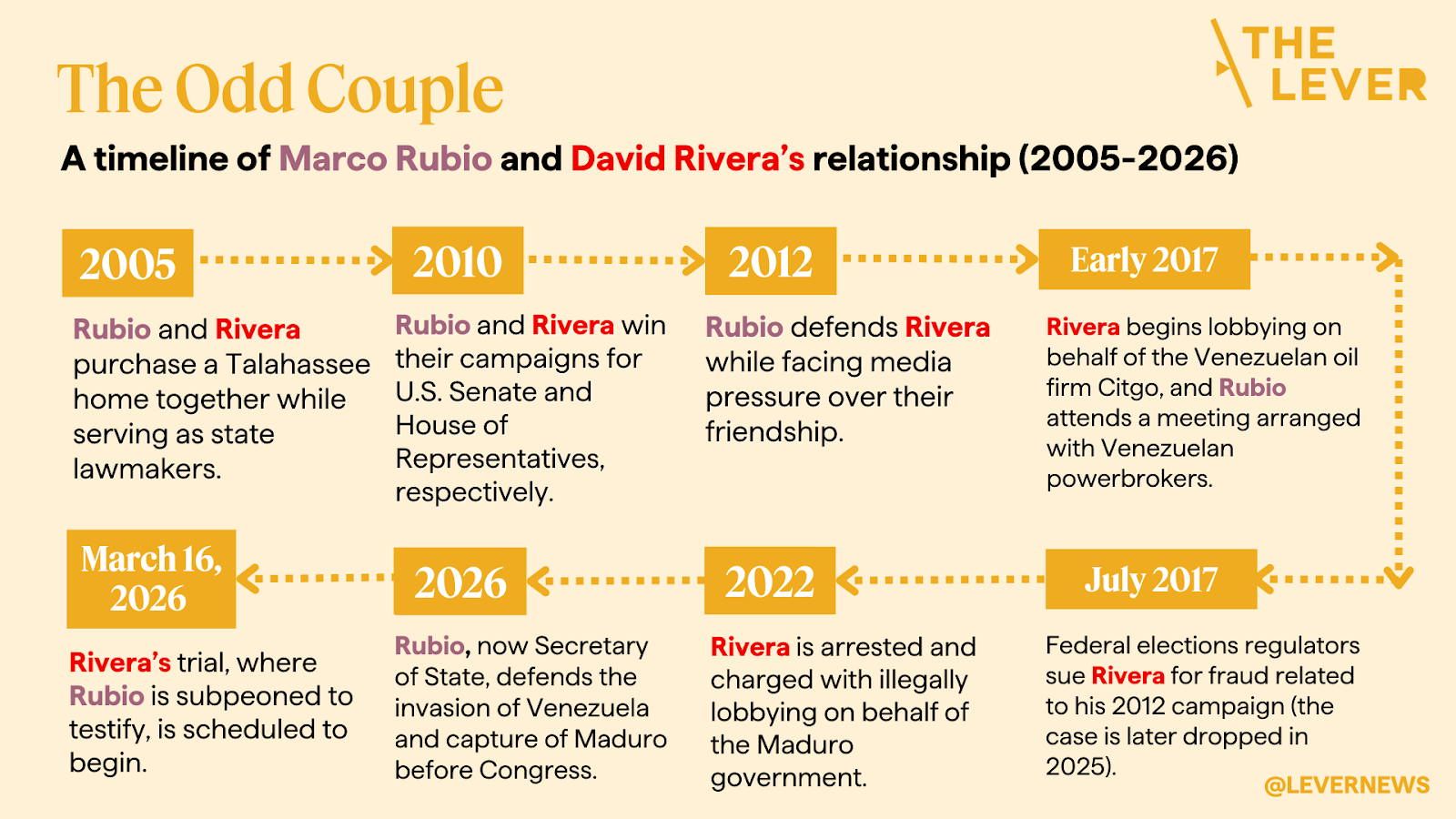 A graphic illustrating Marco Rubio and David Rivera’s relationship. (Source: The Lever)
Enacted in 1938 in response to rising Nazi propaganda in the United States, the Foreign Agents Registration Act requires more stringent disclosures than ordinary lobbying, since foreign clients may have national interests that conflict with those of the United States.
“The question under the law is whether the benefit [of the lobbying] is purely private, divorced from a benefit or control by a foreign government or party,” said Joshua Rosenstein, a lawyer at the Washington firm Sandler Reiff, which advises clients on compliance with lobbying and ethics laws. “The greater the involvement of a foreign government or political party, the less likely it is that you can shoehorn your activities under an exemption.”
The statute also applies to “a person whose activities are directly or indirectly supervised, directed, controlled, financed, or subsidized” by a foreign principal.
According to the Justice Department’s indictment of Rivera, the problems originated in 2017, when he began lobbying on behalf of Citgo, the U.S. subsidiary of Venezuela’s state-owned oil company.
For his work, Citgo paid Rivera’s consulting firm $50 million, a massive sum of money for a single lobbying firm. For comparison, the entire U.S. oil and gas industry spent just over $120 million on federal lobbying in 2022.
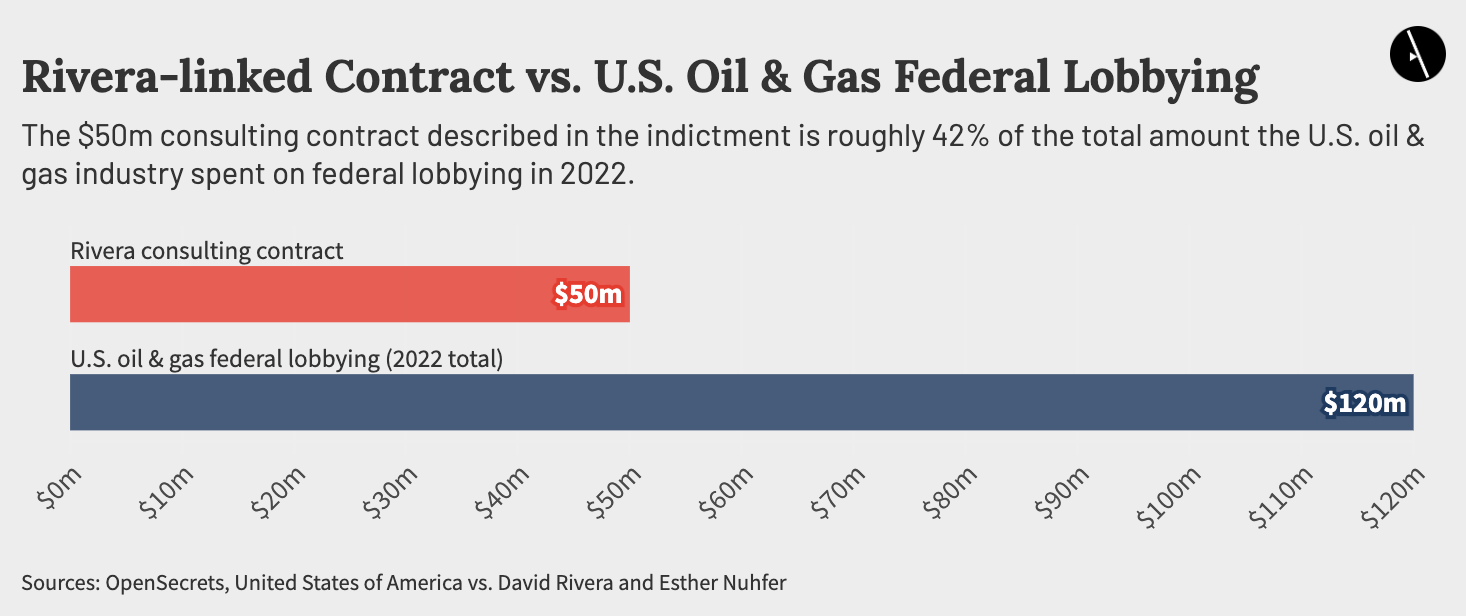 A graphic illustrating the size of David Rivera’s Citgo lobbying contract. (Source: The Lever)
Federal prosecutors allege that Rivera’s lobbying contract was actually a front for a foreign-influence campaign designed to avoid registering under the Foreign Agents Registration Act to conceal the full scope of the operation.
According to the indictment, Rivera was operating as an unregistered foreign agent to normalize relations between Venezuela and the U.S. — two countries that have been adversaries since socialist leader Hugo Chávez came to power in 1999.
Rivera was allegedly working for representatives of the Maduro government, which took power after Chávez’s death in 2013. Among the officials involved, prosecutors say, was then-Vice President Delcy Rodríguez, who now serves as Venezuela’s president.
“It was the purpose of the conspiracy for the defendants to unlawfully enrich themselves… in an effort to influence United States foreign policy towards Venezuela and to conceal these efforts by failing to register under FARA as agents of the Government of Venezuela,” the indictment reads.
Rivera allegedly used his political connections as a longtime Republican lawmaker to arrange meetings between Venezuelan power brokers and U.S. officials.
According to prosecutors, those meetings included a sit-down with Rubio as well as a meeting in Caracas between Maduro and Rep. Pete Sessions (R-Texas), who represents the oil-rich Lone Star State, which has financial interests in Venezuela’s mammoth oil reserves. At the time, Sessions chaired the House Rules Committee, which plays a pivotal role in deciding what legislation receives votes on the House floor.
Kellyanne Conway, a senior counselor to Trump during his first term, also participated in several of the meetings, according to text messages included in the indictment.
Sessions and Conway could not be reached for comment.
In text message exchanges cited by prosecutors, Rivera and his associates used pseudonyms to obscure the specifics of these meetings. The Texas congressman was referred to as “Sombrero,” while millions of dollars were called “melones.” Their code name for Maduro was “El Guaguero,” a reference to the president’s early career as a bus driver.
These 2017 and 2018 meetings— some reported at the time — came at a fraught moment in U.S.-Venezuela relations. Inside the Trump administration, officials were split over Venezuela policy, including proposals to tighten sanctions or normalize U.S. business ties.
Officials ultimately chose the former, ramping up sanctions in 2017 and again in 2020.
At the end of 2025, Rivera’s defense team subpoenaed Rubio to testify about those meetings. Federal prosecutors subsequently decided to call Rubio themselves, apparently concluding that his testimony would strengthen the government’s case.
Rivera, whose lawyers refused to make him available for an interview with The Lever, denies any wrongdoing. His attorneys have argued in court filings that Rivera, a longtime critic of Venezuela’s communist government, was working to undermine Maduro, not help him.
“We confidently believe that the evidence proves the opposite of what the government has alleged,” Rivera’s lawyers wrote in a December letter to the State Department requesting Rubio’s testimony.
“Specifically, then Senator Rubio and Mr. Rivera were focused only on their support for the Opposition [political leaders] in Venezuela, on sanctions against the Maduro government, and on removing Maduro as head of state in Venezuela.”
The Tycoon, The Trafficker, And The Trump Whisperer
As part of their defense, Rivera’s attorneys appear ready to suggest that the foreign-agent violations leveled against their client could just as easily be applied to another political operative: Wiles, Trump’s chief of staff.
To make their case, Rivera’s lawyers are zeroing in on two businessmen named in the indictment: a wealthy Venezuelan media mogul named Raúl Gorrín and a convicted cocaine trafficker named Hugo Perera.
Court documents claim that Gorrín, the politically connected head of a Caracas-based media company called Globovisión, helped orchestrate the alleged foreign-agent operation and served as a go-between for Rivera and the upper echelons of the Venezuelan government.
According to Rivera’s indictment, Gorrín took part in several of the meetings brokered by Rivera, including a sit-down with Rubio. Rivera also reportedly tried to use Gorrín’s private jet for the rendezvous with Conway.
An employee at Globovision works at the channel’s headquarters in Caracas, Venezuela. (AP Photo/Leslie Mazoch)
Gorrín, who was sanctioned by the U.S. government in 2019 for his purported involvement in foreign bribes and money laundering, was reportedly paid handsomely for his work.
In 2020, Citgo filed a lawsuit against Rivera for breach of contract. According to the suit, Rivera paid $4 million of his $50 million contract fee to Gorrín as a kickback for helping him land the arrangement. Rivera apparently funneled the money through Gorrín’s Miami-based yacht company.
The Lever did not receive a response from Globovisión for a request for comment from Gorrín.
The Citgo lawsuit also alleges Rivera paid $5 million to another subcontractor for help arranging the Citgo contract: Perera, a Miami real estate developer who was convicted in the 1990s for his role in a drug-smuggling operation run by the Cali Cartel in Colombia.
Perera’s name is notably absent in the government’s indictment, and he’s agreed to act as a cooperating witness against Rivera at trial. In retaliation, Rivera has countersued Perera for allegedly violating their confidentiality agreement. Rivera has also claimed in a court deposition that the FBI told him that Perera was an informant.
Perera, who now runs a Miami real estate company, did not respond to a request for comment.
At the same time that Gorrín and Perera were working with Rivera, court documents indicate that both men were engaged in related activities for Ballard Partners, a powerful U.S. lobbying firm that Wiles co-led at the time.
In 2017, the first year of the alleged foreign-agent scheme involving Rivera, Ballard Partners also registered to lobby on behalf of Gorrín’s Globovisión, seeking to expand the network’s presence on U.S. television platforms. Ballard earned $450,000 from the contract, making Globovisión the firm’s third-largest client that year.
Ballard’s work for Gorrín appears to have been extensive. In a subpoena letter sent to the White House requesting Wiles to testify in the upcoming trial, Rivera’s defense team describes roughly 400 pages of documents related to Wiles’ lobbying work gathered during the discovery phase of the case.
Court filings also reference numerous emails exchanged between Gorrín, Wiles, and other Ballard lobbyists. One of those lobbyists was Otto Reich, a former U.S. ambassador to Venezuela who previously ran the interagency office that helped coordinate the Iran-Contra weapons sales during the Ronald Reagan administration.
Other Ballard emails went to Harry Sargeant, an oil executive who is currently advising Trump on his post-regime-change efforts in Venezuela. (Trump’s attorney general, Pam Bondi, began working at Ballard Partners in 2019 after serving as Florida’s attorney general, though she is not referenced in the correspondence described in the filings.)
Based on these email exchanges, Rivera’s lawyers also claim Perera was simultaneously working for Ballard while also serving as a subcontractor for Rivera.
“Discovery documents show that Hugo Perera, an important government witness in the case, was involved in these pro-Venezuelan activities through Ballard Partners at the same time the government has alleged that Mr. Rivera and Ms. Nuhfer were supporting pro-Maduro efforts on behalf of Venezuela,” the attorneys wrote.
 A graphic showing how Venezuelan oil money moved through a network of Washington power brokers. (Source: The Lever)
“I Happen To Know That My Government Wants A Way Out”
Rivera’s lawyers do not accuse Wiles or her Ballard colleagues of illegal conduct. But their filings suggest the government’s legal standard for charging Rivera could potentially implicate a far wider circle of MAGA operatives — including the president’s chief of staff.
No federal records show that Wiles or Ballard Partners ever registered under the Foreign Agents Registration Act for any Venezuelan entity.
“We’re not taking a position on that [legal question] in the case,” said Ed Shohat, one of the defense attorneys representing Rivera.
Ballard Partners did not respond to multiple requests for comment. But the firm has publicly maintained that it complied with all foreign and domestic lobbying laws and that its work related only to Globovisión’s commercial interests in the U.S. The lobbying firm dropped Gorrín as a client in 2018, amid a federal investigation that would lead to U.S. sanctions against him the following year.
“Ballard Partners’ work for Globovisión involved Globovisión’s efforts to expand its TV network into the U.S. market,” Brian Ballard, the founder of Ballard Partners, said in a statement to the Miami Herald.
But a key document in the Rivera case obtained by the Miami Herald appears to suggest that Ballard’s work for Gorrín may have gone beyond strictly commercial interests.
In 2017, Ballard reportedly drafted a memo for Gorrín to provide to Trump, though he ultimately never delivered it. The letter apparently outlined a proposal to mend strained U.S.-Venezuela relations by offering Maduro a path out of the country in exchange for a transition in leadership. As described by the Miami Herald, the document did not directly relate to, or mention, Globovisión’s access to U.S. markets or other commercial interests.
“I happen to know that my government wants a way out, a way to save their skins and fortunes,” the draft letter from Gorrín read. “The opposition, on the other hand, wants a way in but is not unified in how to achieve its goals.”
Should Ballard Partners’ work on the Gorrín letter — or its other lobbying efforts — have required the firm to register under the Foreign Agents Registration Act? That’s likely impossible to determine without additional information about Globovisión’s relationship with the Venezuelan government.
“An exemption [to FARA] would be available, provided the client (Globo) isn’t directed/controlled by a foreign government or political party, and the principal beneficiary of the work wasn’t a government or political party,” said Rosenstein, the lobbying lawyer. “That’s a factual question.”
According to Rosenstein, foreign lobbying involves many legal gray areas, in part because the Justice Department has prosecuted relatively few cases, leaving the law with limited judicial precedent. Under Attorney General Pam Bondi, the Trump Justice Department has curtailed enforcement of foreign corruption and lobbying laws.
Made with Flourish • Create a chart
A graphic illustrating where key figures connected to the alleged Venezuelan lobbying network are based. (Source: The Lever)
The hundreds of pages of Ballard records described by Rivera’s attorneys could shed light on the matter, but the documents may never become public. Last month, a federal magistrate judge in Florida’s Southern District Court granted a Justice Department petition allowing Wiles to avoid testifying at Rivera’s trial, thereby permitting related documents to remain under seal.
But in his ruling, the judge made a surprising admission.
“To be clear, no one disputes that Ballard Partners registered under FARA and dealt with Gorrín openly,” wrote Magistrate Judge Edwin Torres.
Torres’ office refused to comment. But if Torres is correct, it would mean that — despite no publicly available record of the filing — Trump’s chief of staff previously worked as a registered foreign agent for a government the U.S. recently moved to overthrow.
Under Pressure
Miami insiders say Rivera’s aggressive defense strategy isn’t just legal maneuvering ahead of trial; it’s also a political effort to pressure the Trump administration to drop the case.
That campaign includes issuing subpoenas to a striking list of high-profile witnesses, including not just Rubio, but also Conway and Sessions. Rivera’s attorneys even subpoenaed Maduro, Venezuela’s deposed president, who is currently awaiting his own trial on U.S. narco-terrorism charges. Maduro’s attorneys resisted the subpoena, saying their client would plead the Fifth.
Former U.S. Rep. David Rivera speaks with media outside Miami federal court in Miami, Dec. 20, 2022. (AP Photo/Joshua Goodman)
While Miami defense lawyer Joseph DeMaria believes some of these witnesses could provide crucial testimony for Rivera’s defense, he also notes the political optics of such subpoenas.
“A lot of this strategy is political — to try to put pressure on the Trump administration to leave Rivera alone,” said DeMaria. ”Depending on how the judge rules on [the defense’s requests for testimony], that could lead them to wanting to make a deal with Rivera.”
Rivera’s legal team has a track record of exploiting political leverage when evidence-based legal defenses don’t pan out in the courtroom. One of Rivera’s attorneys is David Markus, a renowned Miami defense lawyer who also represents Ghislaine Maxwell, Jeffrey Epstein’s associate and convicted sex trafficker.
“A lot of this strategy is political — to try to put pressure on the Trump administration to leave Rivera alone.”
As Maxwell’s counsel, Markus has openly proposed a deal with the Trump administration in which his client would receive “clemency” in exchange for being allowed to speak “fully and honestly” about whether the president was involved in any potential sex crimes, or the crimes for which she was convicted.
In a *Vanity Fair*interview about his work, Markus embraced the ethos of a defense attorney: “I love representing the underdog.”
If David Rivera is an underdog, he’s an underdog with powerful friends in Washington — some of whom may soon be called to testify.
---
---
duck ai 1 26
A superlobbyist is a very powerful and successful lobbyist who influences politicians and officials to support specific causes or legislation. They often have significant resources and connections to achieve their goals in the political arena.
Cambridge University Press
 Merriam-Webster
Definition of Superlobbyist
A superlobbyist is an extremely powerful and successful lobbyist. This term refers to individuals who have significant influence in political circles, often using their connections and strategies to persuade politicians or official groups to support specific legislation or policies.
Characteristics of a Superlobbyist
Influence and Power
- Superlobbyists often have a vast network of contacts within government and political organizations.
- They utilize tactics derived from political playbooks to achieve their goals.
Examples of Activities
- They may represent corporations or special interest groups, advocating for laws that benefit their clients.
- Some superlobbyists leverage their celebrity status or public recognition to enhance their lobbying efforts.
Notable Figures
One of the most recognized superlobbyists is Jack Abramoff, known for his controversial lobbying practices. He was involved in various scandals, including lobbying against his own clients, which raised questions about ethics in lobbying.
Historical Context
The term "superlobbyist" has been in use since at least 1913, indicating a long-standing presence of powerful lobbying figures in politics.
Cambridge University Press
 Merriam-Webster
Explore More
What are the key strategies used by superlobbyists to influence legislation?
How do superlobbyists differ from regular lobbyists in terms of power and resources?
Super-lobbyists typically have greater influence than regular lobbyists due to their extensive connections, experience, and access to significant resources, allowing them to sway political decisions more effectively. They often represent large organizations or interests and can leverage their relationships to achieve favorable outcomes in legislation.
 lobbyit.com
What ethical concerns arise from the activities of superlobbyists in politics?
Ethical concerns surrounding superlobbyists include potential conflicts of interest, lack of transparency, and the influence of money on political decisions, which can undermine the fairness of the democratic process. These issues may lead to biased policymaking that does not serve the public interest.
publicpolicy.pepperdine.edu
 Santa Clara University
---
free press
Drain the Swamp? MAGA Lobbyists Say They’re ‘Drinking from a Fire Hose.’
(Illustration by The Free Press)
Once upon a time, Donald Trump promised to clean up Washington. But for the swampiest industry of all, business is booming.
05.05.25 —U.S. Politics
U.S. Politics
Breaking news, deep investigations, and eye-opening commentary that favor no party.
Since 2016, Donald Trump has promised his supporters that he will  ”—the president’s catchall pledge to end corruption in Washington. But as his second administration gets busy remaking the federal government, business is good for one of D.C.’s most lucrative—and “swampiest”—lines of work: lobbying. And for those lobbyists enmeshed in MAGA World, business has never been better.
One of the biggest winners is Jeff Miller, a veteran Republican lobbyist who has raised hundreds of millions of dollars in donations for Trump and the GOP. His phone has been ringing off the hook ever since election night, which he spent in the grand ballroom of Mar-a-Lago, a few tables away from the incoming president, along with J.D. Vance and Elon Musk.
“We went all-in to make sure President Trump had the resources to win, and we’ve been drinking from a fire hose ever since,” he told The Free Press.
Miller’s firm, Miller Strategies, posted at least $8.5 million in lobbying revenue in the first quarter of 2025—a 190 percent increase from its $2.9 million haul at the same time last year.
His is just one of the lobbying firms with close ties to Trump that cashed in on their influence between January and March, the period captured in the latest lobbying disclosures. They illustrate how, in Trump’s Washington, the “swamp” is far from drained.
Along with other close allies of Trump, Miller is a founding member of a new, invite-only MAGA moguls club in Georgetown called Executive Branch. The club costs $500,000 to join and already has a waitlist. Its co-founders include Donald Trump Jr.; Alex Witkoff and Zach Witkoff, the sons of Steve Witkoff, Trump’s special envoy to the Middle East; and Omeed Malik, a megadonor who was a seed investor in Tucker Carlson’s new media venture.
Miller Strategies, based in Washington, D.C., is lobbying on behalf of powerhouse companies like Zoom, NASDAQ, Apple, Sam Altman’s OpenAI, and Comcast. In March, it signed Cornell University, which, along with other elite colleges, has been roped into Trump’s investigations into alleged racial discrimination and antisemitism on their campuses.
Another new Miller client is Palantir, a data software company that was awarded a $30 million contract from the Trump administration to assist in the government’s deportation efforts.
“Despite all the rhetoric about ‘draining the swamp,’ there remains a thriving industry of lobbying firms who will help those willing to pay for access in Washington, D.C.,” said Michael Beckel, the senior research director for Issue One, a nonpartisan money-in-politics watchdog group.
It’s an echo of the good times that had been enjoyed by Democratic lobbyists with close ties to the Biden White House. For instance, Jeff Ricchetti, the brother of then–White House counselor Steve Ricchetti, saw his lobbying business boom during the Biden years: His lobbying revenues increased fivefold in the first three months of Biden’s presidency. Thus it has always been: When a Republican is in office, firms tied to the GOP thrive; when Democrats are in, the Democratic lobbying firms do well.
Except that Trump has long promised to clean up Washington. On the campaign trail in 2016 he committed to “a complete ban on foreign lobbyists raising money for American elections.” But that pledge has long been forgotten. In the 2024 election, lobbyists registered as agents of foreign governments helped raise more than $10 million for Trump, according to research by Issue One.
Miller was listed in that report because of his work for the Japanese government, his firm’s only foreign client. Miller refuses to sign Chinese clients—“even the ones who say things like, ‘Oh, we just moved into Singapore,’ or wherever,” Miller told The Free Press.
Other firms aren’t so picky.
Ballard Partners, the firm of Republican superlobbyist and Trump fundraiser Brian Ballard, has signed more than 130 clients since Trump’s victory last November. It’s a staggering number given that the firm had signed a total of 178 between 2021 and 2024. White House Chief of Staff Susie Wiles and Attorney General Pam Bondi both previously worked at the firm.
With 10 offices around the world, including in Istanbul, Tel Aviv, and Riyadh, Ballard posted at least $14 million in lobbying revenue in the first quarter of 2025. That’s triple its $4.2 million haul during the first quarter of 2024.
One new client of Ballard’s is Pirelli, an Italian tire manufacturer that the firm signed one month before Trump’s inauguration. Pirelli’s largest shareholder, with a 37 percent stake, is a Chinese state-owned company called Sinochem. In 2021, Sinochem merged with ChemChina, a company identified by the U.S. Department of Defense as an arm of the Chinese military. Pirelli has paid Ballard at least $120,000 since that December lobbying registration, filings show.
Among Ballard’s controversial clients, perhaps the most high-profile is TikTok. Trump delivered a major win for Ballard and TikTok on his first day in office, when he signed an executive order that extended a congressionally mandated deadline for a sale of the popular social media platform by its Chinese parent company, ByteDance.
Foreign ties are nothing new for Ballard. Before Bondi was attorney general, she worked as a lobbyist at Ballard for the gas-rich country of Qatar, which has long harbored the leaders of Hamas. Bondi also lobbied for iGas USA—a Florida-based company that received a large investment from a Chinese state-owned enterprise. Until July of last year, Brian Ballard and his partner, John O’Hanlon, lobbied for iGas USA. Ballard Partners declined to comment.
[ ](https://substackcdn.com/image/fetch/$s_!4Ynd!,f_auto,q_auto:good,fl_progressive:steep/https%3A%2F%2Fsubstack-post-media.s3.amazonaws.com%2Fpublic%2Fimages%2F9e2b06b7-44c1-4fb6-adc0-94b419c66ac4_1320x30.png)
Another firm flexing its influence early on in Trump’s Washington is Florida-based Continental Strategy. It was founded in 2021 by former Trump adviser Carlos Trujillo and employs both Katie Wiles, the daughter of the White House chief of staff, and Alberto Martinez, who served as a chief of staff in the Senate to now–Secretary of State Marco Rubio.
Lobbying disclosures show that Continental netted $3.6 million in the first quarter of 2025, compared to revenue of $127,500 for the same period last year. The firm has added at least 50 clients since Trump’s victory.
It’s hardly a surprise that the firm is in Trump’s good graces. One insider told The Free Press that Trujillo and his colleagues helped raise $15 million for Trump’s inauguration. Trujillo did not dispute the figure.
“We didn’t just show up in Trump World two months ago,” Trujillo told The Free Press—saying that his relationships “make it easy to navigate” Washington.
As business booms for Continental, it is already delivering wins for some clients—with Trump’s blessing. The firm helped broker a deal for a consortium led by BlackRock—that included Continental’s client, the Swiss-based Mediterranean Shipping Company—to pay $23 billion for ports in Panama and across the world. According to a person familiar with the lobbying push, Trujillo’s firm privately secured support from Trump and previewed the deal to federal officials. The president hailed the deal in his March speech to Congress, calling it a step toward “reclaiming” the Panama Canal, a top priority of his administration.
Continental has established an in-house policy of working only with foreign clients that it sees as aligned with American interests, according to two people familiar with the firm.
Then there’s Mercury Public Affairs, where now–White House Chief of Staff Susie Wiles worked as a lobbyist until 2024. Former Trump campaign adviser Bryan Lanza is a partner at the firm, where revenue climbed to $5.2 million in the first quarter of 2025—doubling since the last quarter of 2024. It registered on behalf of around 70 clients in 2024 and 2025, according to lobbying filings.
“The calls started coming in last summer, before Biden dropped out,” said one person familiar with Mercury’s booming operation.
After the election, Lanza registered to lobby for the Chinese electronics giant Xiaomi, which was placed on a Pentagon blacklist during Trump’s first term over alleged Chinese military ties. (The designation was later removed under Biden.)
Mercury clients have included Qatar, the Turkish government, a Chinese surveillance firm linked to China’s persecution of the Uyghurs, and a Chinese solar panel manufacturer called JinkoSolar that saw its Florida factory raided in 2023 after reports the company was linked to forced labor in China.
Mercury has hauled in hundreds of thousands of dollars since 2020 to lobby for China’s Alibaba Group and millions of dollars from Gotion—an electric vehicle battery manufacturer and subsidiary of a Chinese company that pledged in 2022 group documents to “carry out” activities for the Chinese Communist Party. Multiple reports in 2020 linked Alibaba Group to China’s surveillance of Uyghur Muslims. An early client for Lanza upon his joining in 2017 was ZTE, a Chinese telecommunications giant for which Mercury said its work “may inure to the benefit of the People’s Republic of China,” Justice Department filings show.
“As long as evil political regimes like the Chinese Communist Party and the companies they control have willing representatives in Washington, the ‘swamp’ is never going to be fully drained,” said Michael Sobolik, a senior fellow at the Hudson Institute who specializes in U.S.-China relations.
There are, however, limits to how much foreign baggage lawmakers are willing to tolerate.
:{“The problem with Mercury is that so many of their clients are total shitbags,” said one senior Republican congressional staffer, “so they have trouble getting meetings.”
Drain the Swamp? MAGA Lobbyists Say They’re ‘Drinking from a Fire Hose.’}:
endit?
... “so they have trouble getting meetings.”}:
---
---
ggl 11 24
[### 3 of Trump's top cabinet-level picks recently worked as ...

Business Insider
https://www.businessinsider.com › Politics](https://www.businessinsider.com/trump-lobbyists-ties-wiles-bondi-duffy-ballard-2024-11)
5 days ago — Incoming White House chief of staff Susie Wiles, attorney general nominee Pam Bondi, and Transportation secretary nominee Sean Duffy have all ...
- several of Donald Trump's top picks have recently been lobbyists.
- Susan Wiles, Trump's incoming chief of staff, maintained ties to a lobbying firm until this month.
- Sean Duffy, Trump's pick for Transportation secretary, has lobbied for a group of major airlines.
President-elect Donald Trump is set to rely on a trio of former lobbyists to help implement his agenda to shake up Washington.
Incoming White House chief of staff Susie Wiles, attorney general nominee Pam Bondi, and Transportation secretary nominee Sean Duffy have all been registered lobbyists. According to disclosure filings, Bondi and Wiles did lobbying work as recently as this year, with Duffy working as a lobbyist into 2023.
Their combined clients range from blue chip companies — including Amazon, GM, and Uber — to insurance giants like MetLife and Fidelity National Financial. Wiles and Bondi were also separately registered to lobby for foreign interests, which included one of Nigeria's largest political parties and the Qatarian embassy.
Wiles and Bondi have both once worked for Ballard Partners, once a regional firm in Florida that exploded in popularity due to its ties to Trump world. Earlier this summer, the firm opened an office in Riyadh, Saudi Arabia.
"Part of why you hired Ballard Partners over the last few years is knowing that if Trump is president, the people you are working with stand at having a pretty good chance at having influence in a Trump administration," Jeff Hauser, executive director of the Revolving Door Project, a public interest group, told Business Insider.
Brian Ballard, a major Republican fundraiser and founder of the firm, did not immediately respond to Business Insider's request for comment.
Wiles continued to have K-Street ties as she helped run Trump's campaign.
Wiles, according to The New York Times, did not cut ties to her most recent firm until Trump announced his intention to have her lead his second White House.
Her past work included an effort to get the Trump administration to approve a cooper and gold mine in a sensitive area of Alaska. Sen. Lisa Murkowski, an Alaska Republican, widely viewed as a key vote in the narrowly divided US Senate, and other top state officials have long opposed the Pebble Partnership. The EPA, under Obama, Trump, and Biden's administrations, have repeatedly opposed efforts to mine in the bay, home to one of the world's largest salmon fisheries.
Duffy, who if confirmed would oversee the Federal Aviation Administration, lobbied in 2020 for an airline group that includes American, Delta, and United among its members.
Starting not long after he left Congress in 2019, Duffy lobbied for Polaris, a US auto manufacturer known its off-road and recreational vehicles. Former lawmakers are only restricted from lobbying Congress for a year, though they can immediately lobby the rest of the federal government. According to his disclosures, Duffy's work at times included advising the company on how to navigate EV incentives and tariffs.
ProPublica previously reported that Duffy lobbied White House trade adviser Peter Navarro as Polaris sought to win exemptions to tariffs on the parts it was importing. ProPublica found that Polaris' efforts, including use of Duffy, ultimately led the company to get most of what it wanted.
Bondi's work for Amazon was related to trade and tariff policy, according to disclosures. She also lobbied for General Motors, Uber, Fidelity National, Carnival North America, and even Major League Baseball.
Trump didn't start the revolving door, but the swamp could get larger.
Wiles, Bondi, and Duffy's respective work all fits within the larger revolving door narrative that dominates Washington, even as Trump portrays himself as ready to shake up the status quo.
Ron Klain, President Biden's first chief of staff and longtime adviser, was a lobbyist for Fannie Mae in the early 2000s. Steve Ricchetti, another longtime Biden fixture, spent so much time lobbying that top Obama administration officials tried to prevent then-Vice President Biden from hiring him after the 2008 election. His brother Jeff Ricchetti, who remains a registered lobbyist, saw his business boom after Biden won the 2020 election.
President Barack Obama initially received high praise for his limits on hiring lobbyists who had recently lobbied the federal agency they sought to join, though he granted some limited waivers including to a former top lobbyist to Raytheon. Ultimately, Obama was unable to stop the revolving door, as Politico reported in 2015.
Hauser said what stands out about the Trump team so far is their unorthodox approach to the transition, including refusing to sign formal agreements with the current administration which would include ethics guidelines.
While Trump, like Obama and Biden, issued an ethics-related executive order after taking office in 2017, Hauser isn't convinced it will happen again.
"Given the aversion of his transition to the ethics process of the transition, I think it's an open question whether or not he is going to make his appointees sign additional ethics pledges in office this time," Hauser said.
---
[### The Florida effect: Trump's administration heavily shaped ...

NBC News
https://www.nbcnews.com › politics › donald-trump › f...](https://www.nbcnews.com/politics/donald-trump/florida-effect-trump-administration-sunshine-state-rcna181638)
9 hours ago — It was supposed to be treasury day at Mar-a-Lago, or so President-elect Donald Trump's team thought.
[### Pam Bondi, Trump's Attorney General Pick, Lobbied ... - Sludge

readsludge.com
https://readsludge.com › 2024/11/22 › pam-bondi-trum...](https://readsludge.com/2024/11/22/pam-bondi-trumps-attorney-general-pick-lobbied-for-amazon-uber-and-qatar/)
6 days ago — Bondi is a partner at the lobbying firm of Trump bundler Brian Ballard, where she lobbied alongside incoming White House chief of staff ...
[### Inside the Lobbying Career of Trump's New Chief of Staff

The New York Times
https://www.nytimes.com › U.S. › Politics](https://www.nytimes.com/2024/11/21/us/politics/susie-wiles-trump-lobbying.html)
6 days ago — Before managing the campaign of President-elect Donald J. Trump, Susie Wiles represented a tobacco company and a mining project, ...
[### 6 things to know about Pam Bondi, Trump's new pick for ...

PBS
https://www.pbs.org › newshour › politics › 6-things-to...](https://www.pbs.org/newshour/politics/6-things-to-know-about-pam-bondi-trumps-new-pick-for-attorney-general)
5 days ago — NEW YORK (AP) — Pam Bondi, the former Florida attorney general, was chosen by Donald Trump to serve as U.S. attorney general hours after his ...
[### Who is Pam Bondi, Donald Trump's new attorney general ...

ABC7 Los Angeles
https://abc7.com › post › what-know-pam-bondi-donal...](https://abc7.com/post/what-know-pam-bondi-donald-trump-new-attorney-general-pick-after-matt-gaetz-withdraws/15570593/)
6 days ago — On the same day that Gaetz withdrew as President-elect Donald Trump's attorney general pick, he announced that he will pick Florida AG Pam ...
[### As a Lobbyist, Bondi Had Clients Including Amazon, G.M., ...

The New York Times
https://www.nytimes.com › U.S. › Politics](https://www.nytimes.com/2024/11/21/us/politics/pam-bondi-trump-ag-lobbyist.html)
6 days ago — President-elect Donald J. Trump's new choice to be attorney general joined a powerhouse Republican firm after her second term as Florida's ...
[### 5 things you need to know about Pam Bondi

Politico
https://www.politico.com › news › 2024/11/21 › 5-thin...](https://www.politico.com/news/2024/11/21/5-things-pam-bondi-00191199)
6 days ago — Pam Bondi, the former attorney general of Florida, was chosen Thursday to be the nation's top law enforcement official by Donald Trump.
[### Trump Reaches Into Ballard Partners—Again

O'Dwyer's PR
https://www.odwyerpr.com › story › public › trump-rea...](https://www.odwyerpr.com/story/public/22180/2024-11-22/trump-reaches-into-ballard-partnersagain.html)
5 days ago — Donald Trump has picked Ballard Partners partner Pam Bondi as his nomination for attorney general.
[### Pam Bondi: What We Know About Trump's New Pick For ...

Forbes
https://www.forbes.com › Business](https://www.forbes.com/sites/antoniopequenoiv/2024/11/21/pam-bondi-what-we-know-about-trumps-new-pick-for-ag-after-gaetzs-exit/)
6 days ago — Topline. President-elect Donald Trump nominated former Florida Attorney General Pam Bondi as U.S. attorney general Thursday, making the pick ...
---
with Congress mulling legislation to slap new sanctions on Russia for its attack on the 2016 American election, an important Russian bank connected to Vladimir Putin’s government has turned for help to a well-positioned lobbyist in Washington: a Trump insider and former Republican House member named John Sweeney. In August Sweeney signed a whopping contract to lobby on behalf of this bank to stave off sanctions from the US government.
Sweeney, who formerly represented district near Albany, filed paperwork late last month with the Justice Department’s Foreign Agents Registration Act unit to represent Vnesheconombank, known as VEB, a Kremlin-controlled investment bank. The bank’s chair, Igor Shuvalov, was appointed last year by Russian President Vladimir Putin, who gave him orders to increase funding of national development projects.
The filing says that Sweeney will “engage in meetings and other communications with U.S. government officials regarding potential new sanctions legislation…that could affect” the bank.
The Obama administration sanctioned the bank in 2014 as part of the U.S. response to Russia’s invasion of Crimea. Shuvalov, along with all members of the bank’s supervisory board, was also included on a January 2018 Treasury Department report listing officials closely affiliated with the Russian government. That report, which Congress required Treasury to issue, did not lead to sanctions against those individuals. But the bank could be hurt by pending legislation.
Election security legislation proposed by Sens. Marco Rubio (R-Fla.) and Chris Van Hollen (D-Md.) would sanction VEB and other Russian banks. Sanctions legislation proposed by Sens. Lindsey Graham (R-SC) and Robert Menendez (D-NJ), which would bar US firms and citizens from investing in Russian energy projects or participating in ventures that involve Russian government debt, which could harm the country’s ability to finance infrastructure projects. That bill and a separate measure proposed in the House aim at punishing Russia for interfering in the 2016 election.
VEB also had a role in the Trump-Russia scandal. A December 13, 2016 meeting between Shuvalov’s predecessor as the bank’s chairman, Sergey Gorkov, and Jared Kushner, Trump’s son-in-law, was scrutinized as part of former Special Counsel Robert Mueller’s investigation. Disclosure of meeting drew suspicion that Kushner hoped the bank would bailout a debt-laden building, 666 Fifth Avenue, owned by his family. The exact purpose of the meeting remains unclear. VEB claims the meeting was purely business-oriented, related to Kushner’s real estate work. Kushner told Mueller’s office it was diplomatic.
Sweeney was hired to work for Vnesheconombank by the International Centre for Legal Protection, a Moscow entity formed to help Russia and Russian entities enmeshed in complex international legal disputes. The onetime House member will receive $62,500 per month for 12 months for the work, according a contract he filed with Justice Department.
Reached by phone Thursday, Sweeney said he would call back, but he did not. He did not respond to a voicemail or questions sent by text message.
Sweeney represented an upstate New York district from 1999 through 2006, when he was defeated for reelection by Kirsten Gillibrand, now the junior senator from New York. In the final weeks of the 2006 race, Sweeney faced domestic abuse allegations (claims that he has denied). In the years that followed, Sweeney twice pleaded guilty to drunk driving charges. Sweeney stopped drinking and recently announced10 years of sobriety. He also weathered a federal grand jury investigation, into whether he took official acts while in office to help three clients of an Albany lobbying firm in exchange for “a stream of financial benefits,” according to FBI records cited by the Albany Times Union. He was never charged in that case, which lasted from 2006 until at least 2008.
An early Trump backer, Sweeney led Trump’s successful primary campaign in New York.Sweeneyserved on Trump’s presidential transition team, helping to vet potential senior national security and intelligence officials, ambassadors, and political appointees for multiple agencies.
Sweeney began lobbying the White House soon after Trump took office. In 2017 and 2018 he worked on behalf of the Nord Stream 2 pipeline, a project partly owned by Russia’s state-run gas giant, Gazprom. Sweeney’s work, for which he reported receiving $470,000 in lobbying fees, included opposing “potential financial sanctions affecting the project.” Lobbying disclosure forms he filed with Congress say he focused on influencing the “Executive Office of the President.”
Sweeney has also represented Ihor Kolomoisky, a politically influential Ukrainian tycoon who previously controlled a Ukrainian bank seized by that country’s government in 2016 due to purported lack of capital and financial improprieties. In a lawsuit filed in May, the bank sued Kolomoisky and another former owner, alleging that the men forced it to issue loans to entities they controlled and then laundered the proceeds through shell companies that bought up commercial real estate in the United States. The Daily Beast reported in April that the FBI is investigating Kolomoisky, who has assets in the United States, for alleged money laundering and other crimes. (Kolomoisky has denied the allegations.)
Sweeney is among a small group of Trump insiders who have become lobbyists for Russian firms and related interests. Bryan Lanza, a former Trump campaign and transition aide, is now a lobbyist at Mercury Public Affairs, where he has represented the EN+ Group, an aluminum company founded byOleg Deripaska, an oligarch close to Putin. Lanza and Mercury helped the company win relief from US sanctions.
Brian Ballard, who formerly lobbied for Trump in Florida and has since built a thriving Washington practice, has represented David Yakobashvili, a Russian oligarch with interests in gas and the food industry. Yakobashvili identifies himself as president of the Russian–American Council for Business Cooperation, a group that says it was created at Putin’s behest to boost trade between the countries.
==
---
https://www.alternet.org/2020/01/how-trumps-trade-war-is-making-lobbyists-rich-and-devastating-small-businesses
no lnx
How Trump’s trade war is making lobbyists rich — and devastating small businesses
Written by Lydia DePillis / Pro Publica January 6, 2020
Mike Elrod voted for Donald Trump in 2016, hoping for a break from tight government oversight that his business had endured for years, which he often found unreasonable.
“There was a time when every day I dreaded opening the mail,” said Elrod, who founded a small firm in South Carolina called Eccotemp that makes energy-efficient, tankless water heaters. “The Department of Energy would put in an arbitrary rule and then come back the next day and say, ‘You’re not in compliance.’ We had no input into what was changing and when the change was taking place.”
Elrod also thought that big businesses had long been able to buy their way out of problems, either by spending lots of money on compliance or on lobbyists to look for loopholes and apply political pressure. Trump, of course, had promised to address that — to “drain the swamp.”
Elrod is in his mid-60s, tall with a white beard and deliberative drawl. He trusted the president even as Trump started a trade war with China, where Elrod manufactures his heaters. The administration said U.S. companies that could prove they had no other source for their imports and whose business would be gravely injured could be spared the punishing tariffs that Trump was imposing. They would simply have to file for an exemption.
“I had every reason to believe they were talking about us,” Elrod said. Eccotemp had spent 15 years developing different models of tankless heaters with manufacturers in China. Simply finding new factories in other countries seemed impossible.
So in the summer of 2018, Elrod settled in at his desk, strewn with brass valves, a pressure tester and a smiling jade Buddha from a Chinese supplier, and began typing. He and his dozen U.S. employees — designers, engineers, salespeople and customer service representatives — operate out of a squat cinder block building in a woodsy suburb of Charleston that used to be a film studio and now doubles as a distribution warehouse.
In letters to the Office of the U.S. Trade Representative, Elrod asked that gas-powered water heaters be exempted from the administration’s 25% tariffs, writing that the cost would be “devastating” for the company’s balance sheet. “We had all the boxes checked,” Elrod said. “Or so I thought.”
The process didn’t go as he expected. It’s the stuff that libertarians like Elrod dread: Low-level staffers with limited industry knowledge issuing seemingly arbitrary decisions that can save or smash a company’s bottom line.
Every few weeks, a list comes out with a new batch of lucky winners, and losers. “Non-electrical wall candelabras, of wood, each with 3 wrought iron candle holders” received a pass, for example, but none with one or two candles.
There is no mechanism for appeals.
Overall, Trump’s tariffs have not had the effect that the self-described “Tariff Man” promised. Companies have moved manufacturing out of China — and it has mostly gone to Vietnam, Taiwan and Mexico. Tariffs are chiefly behind a months-long decline in domestic manufacturing, Federal Reserve researchers have found. The total loss of jobs across the economy may be as high as 300,000.
But constantly up-in-the-air trade agreements and the byzantine, opaque exclusion process has been a blessing for one set of players: Washington’s influence industry, including the firms of former Trump officials and allies like inauguration committee chief Brian Ballard, former White House chief of staff Reince Priebus and Trump fundraiser Marc Lampkin.
Ballard was once Trump’s lobbyist in Florida. He’s since been dubbed “the most powerful lobbyist in Trump’s Washington.” A cancer therapy firm, Varian Medical Systems, paid Ballard and a colleague $540,000 to lobby the White House, the trade office and Vice President Mike Pence on trade issues, filings show. The outreach included a meeting with Trump’s director of trade and manufacturing policy, Peter Navarro.
Since then, four of Varian’s five exclusion requests have been approved — which, the company said in an SEC filing, boosted revenues by $23 million. (Navarro said he doesn’t intervene in the exclusion process.)
Priebus’ firm, Michael Best Strategies, was hired by a Wisconsin company, Primex, to handle exemptions for its timekeeping and temperature measurement devices. “You’re not gonna do it on your own,” Primex CEO Paul Shekoski said in an interview. “It’s suicide actually.”
Shekoski said he wanted help understanding the process and making sure all the requests were filed correctly. With Michael Best’s guidance, he personally wrote letters to and met with his representatives in Washington.
The collective effort may have made it all the way to the Oval Office. Shekoski said in an email last fall that he heard from his lobbyist at Michael Best, Denise Bode, that Sen. Ron Johnson, R-Wis. cited Primex as an example of a Wisconsin company suffering from tariffs when the senator took the issue to the president. “He not only called USTR, he was able to bring our specific case up to Trump directly,” Shekoski said. Bode did not respond to a request for comment, and a Johnson spokesman did not respond to questions about the Trump contact, saying only that Johnson had advocated for many Wisconsin companies.
==
Former Florida attorney general Pam Bondi joins D.C. lobbying firm with ties to Trump
Pam Bondi was an early supporter of Donald Trump’s 2016 presidential campaign. (J. Scott Applewhite/AP)
By John Wagner January 22
Former Florida attorney general Pam Bondi has joined Ballard Partners, a lobbying firm led by a lawyer with ties to President Trump whose Washington operations have expanded significantly since Trump arrived in the White House.
Just last week, the firm announced it was hiring former deputy White House press secretary Raj Shah to help launch a new media group.
Bondi, an early supporter of Trump’s 2016 presidential campaign, had been talked about as a potential replacement for Attorney General Jeff Sessions. In November, Trump told reporters that “I’d consider Pam Bondi for anything” in his administration. The president subsequently picked current attorney general nominee William P. Barr.
Bondi left office earlier this month after serving eight years as attorney general in Florida.
A news release from Ballard Partners said she has been hired to lead the firm’s corporate regulatory compliance practice.
In a statement, the firm’s president, Brian Ballard, praised Bondi as “one of Florida’s most accomplished Attorneys General” and said she had “earned a reputation among her colleagues as one of the toughest law enforcement officials in the country.”
Ballard, whose firm is rooted in Florida, has represented Trump’s company in Tallahassee.
==
https://www.politico.com/magazine/story/2018/04/02/most-powerful-lobbyist-in-trump-washington-217759
When Brian Ballard signed the lease last year for an office on the second floor of the Homer Building, a downtown Washington
edifice that's home to a number of lobbying firms, he promised himself he would stay in the space for five years. He lasted one.
In February, his firm, Ballard Partners, moved into a bigger office on the fourth floor to accommodate the new lobbyists
Ballard has hired since the election of one of his former clients, President Donald Trump.
:{:{}:
}:
At the firm's first staff meeting in the new offices, Ballard and five of his Washington lobbyists sat in new leather chairs around a small conference table, with Ballard at the head. Robert Wexler, a former Democratic congressman from Florida whom Ballard hired last year, phoned in from Paris with an update on the firm's work for the Turkish government. Jamie Rubin, a former assistant secretary of state in the Clinton administration, called from Brussels and updated Ballard on a meeting he'd had with Moise Katumbi, an exiled opposition leader from the Democratic Republic of the Congo, who’s a client. ...“You'll be happy to hear that we signed the Maldives today,” Syl Lukis, another Ballard lobbyist, told Rubin.
“Let's fire away quickly on Kosovo and Turkey,” Ballard said. (The government ofKosovois another Ballard client.)
Other Ballard lobbyists gave updates on their meetings with Trump administration officials and other work on behalf of the dozens of clients they represent in Washington, including Amazon, Dish Network, Uber, Pernod Ricard (the makers of Jameson whiskey and Absolut vodka) and Trulieve (a Florida-based medical marijuana company). Rebecca Benn, a former congressional staffer Ballard hired last year, updated Ballard and another lobbyist, Susie Wiles, on a meeting she'd set up for a client. “They were very, very happy — thank you, Susie — for the meeting at the White House last week,” Benn said. “It went very, very well.”
Ballard is a veteran Florida lobbyist who’s been in Washington for barely a year — the blink of an eye in an industry in which many of the top practitioners have spent decades inside the Beltway. But Ballard is closer to the president than perhaps any other lobbyist in town. He’s parlayed that relationship into a booming business helping clients get their way with the Trump administration — and his clients and even some of his rivals say his firm has a better grasp of what’s going on in the West Wing than almost anyone else on K Street. Ballard was one of the top fundraisers in the country for Trump’s campaign and continues to raise millions for his reelection campaign. Wiles, one of his top lieutenants, ran Trump’s campaign in Florida and delivered the nation’s biggest swing state to the president.
Ballard's relationship with Trump has helped him solve a lucrative puzzle that has frustrated more established players. For all of the president’s “drain the swamp” rhetoric, the new administration has given corporate America and its lobbyists the opportunity to revive dreams of tax cuts, regulatory rollbacks and rule changes that were mothballed during the Obama administration. But Trump also presents a challenge for the influence business — a White House in which key positions at least initially were as likely to be staffed by Trump loyalists as by old Washington hands with ties to K Street. Ballard has helped to bridge the gap. He’s a Trump-friendly out-of-towner who can connect with the establishment — he is a close ally of Senator Marco Rubio as well as Charlie Crist, the former centrist Republican governor of Florida who is now a Democratic congressman — and make corporate clients comfortable.
Ballard isn't the only person in Trump’s orbit who decided to try his or her luck in Washington. Campaign veterans from Corey Lewandowski, Trump's fired-but-never-forgotten campaign manager, on down have flocked to “the swamp” to lobby the administration — or, in Lewandowski's case, to offer clients a glimpse into Trump's thought process without actually registering to lobby. But Ballard appears to have landed the biggest fish. He has signed more than 60 clients since setting up shop in Washington after Trump’s inauguration, including blue-chip companies like American Airlines and Sprint. Those clients paid Ballard nearly $10 million last year for help navigating Trump's first year in office. (Those numbers don't include the $3.1 million the firm says it brought in representing foreign clients such as Turkey and the Dominican Republic.)
“He’s the only guy that’s done it,” said Robert Stryk, a lobbyist who runs in the same circles as some former Trump campaign hands and moved to Washington himself after the election. (Stryk's company, SPG, bills itself as a “private diplomacy” firm rather than a traditional lobbying shop.)
Lobbyists at some of Washington’s established firms are quick to praise Ballard, but they also wonder how long his success can last, given the unique nature of the Trump administration. There are risks to building a shop around one principal’s relationships. The now-defunct firms of Ed Gillespie, who was one of Washington’s most powerful lobbyists during George W. Bush’s administration, or Tony Podesta, who thrived under Barack Obama, might be regarded as cautionary tales. “Brian is building a strong Washington office, but the question is what happens when the circus leaves town,” one Republican lobbyist with close ties of his own to the administration told me.
Unlike Lewandowski, who hasn't been able to resist boasting about his relationship with Trump as he hustles for clients, Ballard has taken pains to avoid the appearance of cashing in on his relationship with the president. He refuses to speak on the record about how often he talks with the president. But his clients say he's been able to figure out how the Trump administration works in a way no one else has. For now, at least, it’s working for him.
***
Trump called Ballard in the days before he announced he would run for president. The two men have known each other for nearly 30 years. Ballard met Trump after picking up a copy of The Art of the Deal in the 1980s. He read the book and was so struck by it that he wrote Trump a letter telling him how much he'd enjoyed it. “I loved the idea of 15-minute meetings,” Ballard told me years later. “That's one of the things in the book that still stands out to me.” He later told the Orlando Sentinel that he didn't believe in meetings that lasted any longer. Trump wrote “this beautiful letter” back, Ballard says, and they kept in touch.
Ballard ended up working on and off as Trump’s Florida lobbyist, helping the Trump Organization negotiate state and local government when issues came up with Trump’s Doral golf club. A decade before Trump announced his presidential run, Ballard helped orchestrate a fundraiser in 2005 at Trump Tower in Manhattan for Crist’s campaign for Florida governor. “A friend told me about his record,” Trump told the St. Petersburg Times at the time, referring to Crist. “I checked him out. I met him, I liked him, and I said I could help.”
Ballard, like most of Florida's Republican establishment, backed Jeb Bush in the primary, but when Trump called he offered to do what he could for his client. In September, as it became clear that Trump's lead in the polls wasn't going away, Ballard dispatched Wiles to New York to meet with Trump. Wiles was named the Trump campaign's Florida co-chairwoman a few weeks later.
It took months for Ballard himself to come around to Trump. He jumped ship first to Rubio’s campaign and signed on with Trump only once it was clear he would be the Republican nominee. But once he was in, Ballard proved a valuable asset. Florida is home to lots of of wealthy Republican donors, and Ballard knew most of them after raising money for John McCain and Mitt Romney’s presidential campaigns. Trump named Ballard his Florida finance chairman, and Ballard raised millions for his campaign. He spoke with Trump often and traveled on the campaign plane with him. The effort also put him in close touch with Reince Priebus, the Republican National Committee chairman who would be tapped as White House chief of staff, and Steven Mnuchin, the campaign's finance chairman, who’s now treasury secretary. Trump spent more time in Florida in the general election than in any other state. And “whenever we did an event in Florida I was there,” Ballard said.
Ballard watched the election returns come in with Lukis at an apartment he keeps in Manhattan. They didn’t know whether Trump would win — although Wiles later said she was confident he would pull it off — but they hoped he’d at least carry Florida. When it became clear Trump would become president, they high-fived and walked over to the victory party. The calls from clients started the next day. “To say they were freaking out is absolutely maybe even an understatement,” Wiles said.
Some Trump campaign hands almost immediately began trying to figure out whether they would be working in the new administration or lobbying it. Ballard, who was raising money for the inaugural committee, moved more slowly, waiting to open his Washington office until after the inauguration. (His firm began representing a half dozen federal clients before Trump took office, according to disclosure filings, but Ballard says he didn’t do any lobbying until later). Within three months of the inauguration, though, Ballard had signed two dozen clients, not just Amazon and American Airlines, but also Prudential and the GEO Group, a private prison operator.
Many early clients were companies Ballard already represented in Florida. Those clients beget more clients. “We started representing Dish [Network],” Ballard said. “They referred us to MGM, who referred us to H&R Block, who’s referring us to another client right now.” Signing high-profile corporate clients helped Ballard lobbyists get meetings with Trump administration officials, which helped him snag more clients. No one screened Ballard’s calls during his first months in Washington, so he ended up turning away some “squirrely” would-be clients himself: people who wanted to lobby the State Department to buy their patents, bitcoin speculators, people with “some really weird gold issues.” “If it’s anyone who says I want to pay you to set up a meeting with the president or whatever, we just say no out of hand,” Ballard said. “We end that conversation. We don’t do that stuff.”
“I’ll be very honest about this: I still don’t feel this town has caught up," Richard Haselwood, a lobbyist for one of Ballard's clients, the tobacco giant Reynolds American, said one night in February as he sipped a martini. Ballard, Wiles and I, along with a couple of other Ballard lobbyists, had met Haselwood for drinks at Mastro's, a steakhouse across the street from Ballard's Washington office (and three blocks east of the White House) that’s become enough of a haunt for Ballard lobbyists that they've started to learn the names of the waitresses.Ballard isn’t the only Washington lobbyist who has a personal relationship with Trump. Dave Urban, a veteran lobbyist who helped Trump carry Pennsylvania, is also widely believed to be close to the president. But Ballard’s clients say many other Republican lobbyists in town haven’t figured out how to negotiate the Trump administration more than a year into his presidency.
Congressman Matt Gaetz dropped by the table, cocktail in hand. Gaetz, a baby-faced freshman from Florida, is closer to Trump than most House Republicans. He’s flown on Air Force One and is a frequent presence defending Trump on Fox News, CNN and MSNBC, which has gotten the president’s attention. Gaetz has bragged that Trump sometimes calls him when he gets off the air. But even Gaetz sometimes needs help from Ballard lobbyists to get what he wants from the West Wing. “Even as a friend of the president who speaks frequently with the president, sometimes I have to call Susie Wiles to get my way,” he said.
Haselwood was one of a number of lobbyists for Ballard’s Florida clients who urged him in the weeks after the election to consider setting up shop in Washington. Reynolds American, like other big companies, was struggling to figure out how to negotiate what would soon be Trump’s Washington. Haselwood recalled Ballard being mobbed at the Republican Governors Association meeting in Orlando the week after the election. “Everyone is down there,” he said. “No one knew what was going on. Brian came in and people were, like, rushing to him.”
Ballard has helped clients like Reynolds map out who’s really calling the shots in Trump’s administration, where aides and even Cabinet members can be influential one week and out of favor the next. “Brian jumped in and jumped in big, and I’m thrilled,” Haselwood added. “I’d feel naked without him.”
***
Ballard spent nearly two decadesfiguring out how to dine and golf with Florida’s governors without abusing his relationships with them. He told the St. Petersburg Times a decade ago that he avoided lobbying Crist unless the governor’s staffers were present. “I don’t sneak it in while we're shooting the breeze,” Ballard told the paper. “It doesn't work that way. It would be gross.”
He grew up in Delray Beach, Florida, one of six children raised by a single mother. He got his start in politics at 24, when he took time off from law school to work as a travel aide and driver to Tampa Mayor Bob Martinez, a Republican waging a long-shot campaign for governor. When Martinez won, Ballard moved to Tallahassee to work for him and traded in his 1980 Toyota Tercel for a silver BMW. By the time the *Orlando Sentinel* profiled him in 1990, Ballard was the governor’s chief of staff and had just married Kathryn Smith, the daughter of Florida Secretary of State Jim Smith, in what another newspaper called “Tallahassee's wedding of the year.” (George Steinbrenner, a future Ballard client, was a guest.) The Sentinel profile recounted Ballard yukking it up on the phone with Jeb Bush — who was chairman of Martinez's reelection campaign — and described him as the “brat-savant of Florida politics.”
Martinez lost reelection in 1990 to Lawton Chiles, a Democrat, and Ballard stuck around Tallahassee as a lobbyist. It wasn't an easy time to start out as a Republican lobbyist: Democrats held majorities in both chambers of the Florida Legislature and the governorship. But Republicans won control of the Florida Senate in 1994 and took the House two years later. And in 1998, Ballard’s old pal Jeb Bush was elected governor.
A few weeks after the election, the Ledger of Lakeland, Florida, reported that Ballard's firm — called Smith, Ballard, Bradshaw and Logan at the time — had something other Tallahassee lobbying firms “only wish they could claim: an undeniably special relationship with Bush that is being cautiously defended.” Ballard brashly told the paper his firm had no more access to Bush than anyone else. “Anyone who thinks that when they are hiring us they have secured some special niche in the administration is wrong and should save their money,” Ballard said. “Don't hire us. Go somewhere else.”
Despite his protestations at the time, Ballard proved remarkably successful over the next two decades at cultivating friendships with Florida's Republican governors. He was an early supporter of Crist’s successful campaign to succeed Bush. When Rick Scott, a former hospital executive, beat the candidate Ballard was backing in the Republican primary to replace Crist, Ballard hustled to win him over, raising enough money for Scott’s general-election campaign that Scott named him chairman of his inaugural committee after he won. Ballard also hired the woman who’d managed Scott’s dark-horse campaign: Wiles, who would help Trump win Florida six years later. Mac Stipanovich, a longtime Republican lobbyist in Florida who hired Ballard to work on the Martinez campaign three decades ago, said Ballard has had “private, mansion-dinner relationships with every governor of Florida since” Bush. (The two men remain friends even though Stipanovich claims to “hate Trump worse than a snake.”)
Ballard is 56, with a tanned face and slightly sandy brown hair. He splits his time between Tallahassee, New York and Washington these days, but he retains something of a Florida air about him. When I met him at his office one morning in January, he wore a blue suit, a bright white shirt open at the collar and loafers. Lobbyists who know Ballard in Florida say he can be intensely competitive, but in person he's warm and laughs easily. Unlike many other Washington lobbyists, he doesn't seem like he's trying to ingratiate himself with you.
“I think the fastest way to get shut out is to start talking about who you can influence and who you can’t influence,” Lukis, a Ballard managing partner who moved to Washington after the election to open the new office, said over breakfast one morning at the Old Ebbitt Grill. "I don’t even like the word ‘influence.’ I’m not trying to influence anybody. What I’m trying to do is to have input into the ultimate decision-making process that’s being made regarding the issue that we’re working on. And I’d just as soon talk to a staffer than I would the secretary, because I think ultimately if you can get the staff to agree with you, 98 percent of the time you’re probably going to get the secretary to agree with you.”
If Ballard hadn't helped to elect Trump, it’s easy to imagine he might be one of the many Republican lobbyists in Washington who aren't enamored of the president. He's raised money and professed admiration over the years for several Republicans who have been harsh Trump critics: Jeb Bush, John McCain, Mitt Romney. He's occasionally even given to Democrats, including his old friend Crist, who became an independent during his failed Senate campaign in 2010 and is now a Democratic congressman. “Brian is a fairly moderate Republican, I think I would say,” Crist said when I asked him what it was like to be on the other of the partisan divide from Ballard. “So it’s fine.” He laughed.
Ballard has taken criticism from Republicans who would have rather seen Hillary Clinton elected than Trump. It’s cost him friendships. After the “Access Hollywood” tape came out late in the campaign, he said, “I can recall a very active Republican that I was trying to get to help at an event after that asking me if I was ashamed of myself.” No, not at all, he replied. “No one's going to be fooled by electing Donald Trump,” he told me. “He is what he is.”
If he didn’t know Trump, he might have ended up as a Trump critic rather than a supporter, he told me. “But I know him,” he said.
Ballard’s relationship with Trump isn't all that different from the bonds that hundreds if not thousands of lobbyists in Washington have with members of Congress they used to work for. Like Ballard, many lobbyists help sustain those relationships by giving money and hosting fundraisers for their old bosses’ reelection campaigns. The difference is that Ballard's relationship is with the president of United States. Lobbyists and former campaign big shots such as Lewandowski had it particularly easy in the first months of the administration, before John Kelly replaced Priebus as chief of staff and cracked down on outside access to Trump. “You were walking in, you were having dinner,” said a lobbyist for one of Ballard's clients, who estimated Ballard talks with Trump every few weeks. “It was like dealing with a Senate office or a small-time governor.”
***
Ballard won't talk about what he does for his clients, for the most part. He made an exception for his work on behalf of Katumbi, the exiled Congolese opposition leader. Katumbi, who fled the Democratic Republic of the Congo in 2016 to avoid being thrown in prison by President Joseph Kabila, hired Ballard to help persuade the Trump administration to pressure Kabila to allow him to return. Ballard, Lukis and Katumbi met with a deputy to Nikki Haley, the U.S. ambassador to the United Nations, in October before Haley traveled to the Democratic Republic of the Congo, and Haley forcefully called for the country to hold elections this year on her trip.
Not all of Ballard's foreign clients are as sympathetic. Ballard signed a contract with the Turkish government worth $125,000 a month on May 11, days before Turkish President Recep TayyipErdogan’s security guards beat up peaceful protesters outside Turkey's embassy, according to a Justice Department filing. Another filing shows Ballard met several times with administration officials on Turkey's behalf, including Sean Cairncross, a senior adviser to the White House chief of staff, and Matt Mowers, a State Department official who worked on Trump's campaign.
A photo of President Trump taken on inauguration day on the wall of Brian Ballard’s new minted offices, photographed March 13, 2018, at his office in Washington, D.C. | M. Scott Mahaskey/POLITICO
Domestic lobbying filings don't require the same level of disclosure, and Ballard's are especially lacking in detail. But they give a sense of the scope of his lobbying efforts. Ballard Partners has lobbied nearly two dozen federal agencies, from the Treasury Department to the Army Corps of Engineers, as well as the White House, Vice President Mike Pence's office and Congress. Ballard and his partners pulled in $550,000 last year lobbying the White House and the Justice Department for theGEO Group, the private-prison operator, which won the administration's first immigrant-detention contract in April, less than three months after signing Ballard.
He lobbied the Office of the U.S. Trade Representative on behalf of LG, the South Korean electronics manufacturer, and two solar-panel installation companies as the administration considered whether to slap tariffs on imported washing machines and solar panels. And he started lobbying the White House for Crowley Maritime, a Florida shipping company, four days after the administration waived the Jones Act in an effort to speed the delivery of hurricane relief to Puerto Rico. Thomas Crowley, the company's chief executive, told the *Washington Post* at the time that waiving the Jones Act — which requires shipments between U.S. ports to be carried on American-flagged vessels — wouldn't help relief efforts. The Jones Act, Crowley added, “is very important to our company and America's shipping industry.” Trump allowed the waiver to lapse days later.
The staff at Ballard Partners remains small, at least compared with how much money Ballard is pulling in. The firm had just six registered lobbyists handling domestic work in the fourth quarter of 2017, when it took in $3.6 million. That made it the No. 17 firm in Washington, ahead of many long-established firms, according to a POLITICO analysis of lobbying disclosure filings. Peck Madigan Jones, the No. 16 lobbying firm by revenue, had twice that many lobbyists.
Ballard insists he wants to build a firm that will outlast Trump, but some lobbyists are skeptical that he’ll succeed. If Trump leaves before his term is finished or fails to win reelection, “I would imagine there would be significant drop-off” in Ballard's business, a prominent Democratic lobbyist said. “Because it’s a straight Trump play.”
Still, Ballard wouldn't be the first state-level lobbyist to make a permanent leap to Washington. The Denver law firm Brownstein Hyatt Farber Schreck, for instance, opened a Washington office in 1995 and is now the No. 2 lobbying shop in town by revenue. Norm Brownstein, the chairman of the firm’s board, told me he admires what Ballard has achieved so far, before adding, “I believe as long as [Trump] is president, he will have a great practice.”
Ballard’s fundraising prowess means he’ll remain valuable to Trump at least through 2020, the lobbyist for one of Ballard’s clients told me. Washington lobbyists, of course, have hosted fundraisers and given money as a way of ingratiating themselves with lawmakers for decades. But relatively few lobbyists are raising serious money for Trump, whom many Republicans on K Street freely disparage in private. Ballard is one of only three lobbyists who's a vice chairman of the Republican National Committee's fundraising committee. “He’s a ferocious fundraiser. I mean, if that coffee cup could give money,” Wiles told me over coffee one morning, gesturing toward a mug on the table.
Stipanovich, Ballard's old friend in Florida, said he was willing to make a prediction: Ballard, unlike other Trump campaign veterans who have come to Washington, will be in business long after Trump is out of office. “When Trump is gone, Lewandowski might as well buy a bed-and-breakfast in Vermont,” Stipanovich said. “But not Brian."
==
https://washingtonbabylon.com/meet-venezuelas-three-stooges-of-regime-change-the-gang-that-couldnt-coup-straight/
https://www.yahoo.com/news/exile-group-planning-overthrow-venezuelan-government-tried-hire-trump-connected-lobbyists-161002859.html
ken silverstein 11.18
Working from an office near the Miami airport, three Venezuelan exiles are plotting the overthrow of the government of President Nicolas Maduro, claiming they have military forces standing by in five countries, including the United States. And they say they’re making inroads with the Trump administration, which has expressed support for regime change in the country.
Last March, the exiles created a Miami-registered nonprofit called Venezuela Freedom Inc., which was soon rechristened with the less business-minded moniker of Venezuela Freedom Foundation. The website includes a nine-slide “Strategic Plan” from May 2018. The first slide after the cover page is entitled, “Venezuela Needs a Regime Change.”
The three men see themselves as part of a government in exile and are putting together a list of post-coup Cabinet ministers. They plan to move back to their homeland as soon as “the invaders are thrown out,” Jean Pierre Chovet, a businessman and one of the three leaders, said in a phone interview. He said action is needed swiftly as anassortment of narco-traffickers and terrorist groups, including the Islamic State, have established five government-approved training camps in Venezuela, including one on Margarita Island, a popular tourist destination.
Chovet’s two business partners are Julio Rodriguez Salas, a former Army colonel, and Carlos Molina Tamayo, an ex-Navy vice admiral. The pair were both key players in a botched, deeply unpopular 2002 coup attempt against Hugo Chavez, Maduro’s predecessor. (Rodriguez and Molina did not reply to requests for comment sent through Chovet.)
The Venezuela Freedom Foundation says it is sending humanitarian aid to Venezuela, but its plans include “a piece of military action” that will topple Maduro,Chovet said. It will be led, he said, by “clean” anti-Maduro army personnel in Venezuela, along with military forces said to be mustered in the United States, Colombia, Peru, Brazil and from a Caribbean island Chovet said was best not to identify. He said the foundation had support from the governments of Colombia and from officials close to Jair Bolsonaro, the incoming right-wing president of Brazil.
Now, they hope — with some help from the Trump administration — the second time’s a charm. “We don’t believe in dialogue,” he said. “The regime are assassins.”
The Venezuela Freedom Foundation’s work — from within the borders of the United States — to launch an armed overthrow of a foreign government raises a fundamental question. While the Trump administration has been openly calling for regime change in Venezuela, which would seem to encourage or at least embolden groups like the Venezuela Freedom Foundation, it’shighly likely to be a crime for private American citizens to actually get involved in Maduro’s forcible overthrow.
And that’s precisely what the foundation has sought to do. In an effort to curry favor with the Trump administration, the trio of exiles sought to retain as a lobbyist Otto Reich, a U.S. ambassador to Venezuela under Ronald Reagan and a senior official in the George W. Bush administration who supported a failed 2002 coupin the country. They’ve also publicly claimed — falsely, it turns out — to have retained a prominent lobbying firm headed by a close friend of President Trump’s.
No matter what the position of the Trump administration, it’s illegal for private U.S. citizens to seek the forcible toppling of a foreign government, according to Brett Kappel, a prominent Washington attorney and expert on foreign lobbying.“If they had successfully enlisted Americans to support violently overthrowing the Venezuelan government, those Americans would be facing serious criminal jeopardy for violating the Neutrality Act,” Kappel said. Normally, not registering as a foreign lobbyist while carrying out such work would be a crime. But if anyone registered to advocate for a violent regime change operation, they would have been simultaneously confessing to a felony, Kappel added.
Nicolas Maduro, a former labor leader and vice president of Venezuela, took over when Hugo Chavez, a longtime bête noire of official Washington, died of cancer in 2013. Maduro won a special election that same year by less than 1 percent and was reelected in a landslide in May of this year. The election was boycotted by most of the opposition, and the United States and many other governments refused to recognize the results.[grup de lima?]
President Trump has long made clear he favors regime change in Venezuela, which has been suffering record-setting hyperinflation along with critical shortages of food and medicine. (The Venezuelan government has said sanctions have greatly contributed to the country’s economic problems.) Starting last fall, the Trump administration “held secret meetings with rebellious military officers from Venezuela to discuss their plans to overthrow President Maduro,” the New York Times reported earlier this year.
But the administration is now openly calling for Maduro’s ouster.“For the safety and the security of all people in Latin America, it is time for Maduro to go,” Nikki Haley, U.S. ambassador to the United Nations, said earlier this year during the Washington Conference on the Americas. Trump made similar comments in late summer, including, “Venezuela is a mess. The place needs to be cleaned up.”
Early this month, U.S. national security adviser John Bolton spoke at Freedom Tower, a building where anti-Castro Cubans were welcomed in 1960 after Castro’s revolution toppled dictator Fulgencio Batista. “The troika of tyranny in this hemisphere — Cuba, Venezuela and Nicaragua — has finally met its match,” he declared. He referred to the leaders of that trio of countries as “clowns” who were “akin to Larry, Curly and Moe” of the Three Stooges.
[National security adviser John Bolton talks to the Miami Herald on Latin American policy atMiami’s Freedom Tower on Nov. 1. (Photo: Emily Michot/Miami Herald via AP)
Yet the trio of exiles who want to topple Maduro may have a greater claim to that name. Even before incorporating the foundation, they appeared last year at a number of public events in Florida, home to an estimated 140,000 Venezuelan exiles and Venezuelan-Americans. They were anything but subtle about their plans.
During a February 2018 event in Tampa, Molina Tamayo said that the only means to “rescue” Venezuela was to “intervene in the country, detain the delinquents,put in place a transitional government and within a prudent period of time call legitimate elections,” according to a Spanish-language account in the Orlando Sentinel. He claimed Maduro was negotiating to give Russia and China military bases in Venezuela and that the country was being “hijacked” by Iran, Colombian drug cartels and “Palestinian Hezbollah.” (Hezbollah is a Lebanese organization.)
The opposition in Venezuela was divided about whether to participate in last May’s presidential election, but the trio opposed it. “We don’t believe in negotiations,” Chovet told the audience. Another local account said the exiles called for “international humanitarian intervention, even if that intervention has to be armed,” which the trio believed would be necessary.
They incorporated the Venezuela Freedom Foundation last spring with Rodriguez as the president and registered agent, while Chovet and Molina Tamayo share the title of vice president. “The corporation will serve as a Florida nonprofitorganization focusing on humanitarian and political issues and providing advisory services for the rescue of the Venezuelan people,” read the registration papers.
Three prominent Republicans with direct knowledge of the trio’s activities, and Reich’s relationship with them, viewed the exiles as self-promoting opportunists and dangerous zealots. “They were anti-government bomb throwers,” one said. “They talked about sending humanitarian aid, but the main plan was for the army to take over. They bragged they could have 1,000 people on the ground to run the new government a day after Maduro was ousted.”
[ foto:Carlos Molina Tamayo, center, a retired Venezuelan naval admiral and former national security adviser of Hugo Chavez, protests against Venezuelan President Nicolas Maduro’s government in Spain, where he was then in exile, in 2014. (Photo: Jon Nazca/Reuters)
The three Republicans loathe Maduro, but they wanted nothing to do with a plan for regime change. “They were the gang that couldn’t coup straight,” said another of the Republicans, who have all long been active in national party politics. “I agree with them about getting rid of Maduro, but not with their approach. There are laws about that.”
The three men talked up plans to create a group called Mothers to the Rescue, whose ostensible purpose was to send humanitarian aid to Venezuela. But the three GOP sources familiar with their plans told me that the charity was nothing more than an afterthought and effectively a facade. The trio never created the organization and while they reserved a website for it with GoDaddy.com, it never launched.
Rodriguez, the head of the foundation, does have coup experience, though not a successful one. In April 2002, he was among a junta of military officers and right-wing leaders that briefly ousted President Chavez in a coup andinstalled in his place Pedro Carmona, director of Venezuela’s equivalent of the U.S. Chamber of Commerce.
Molina Tamayo, one of the foundation’s vice presidents, also has a coup attempt on his CV. A former Venezuelan Navy admiral who has spent much of the last two decades in Spain, he publicly denounced Chavez as “unpatriotic” two months before the coup and called on him to resign. The Chicago Tribune reportedthat he was one of key military officers “building support … in the armed forces” for the coup. Carmona, Molina Tamayo and another military officer were the first three members of the post-coup government.
After proclaiming democracy, Carmona quickly dissolved the legislature and Supreme Court, and suspended the constitution. (Then-Col. Rodriguez appeared on national TV soon after it was underway and told viewers he and other military officials had been planning the operation for many months.) However, Chavez was immensely popular at the time. The streets of Caracas exploded in protest, and within a few days the Carmona government collapsed and Chavez was back in power.
[ looks like a shot out of central casting: Venezuelan Navy Vice Adm. Carlos Molina Tamayo, center, speaks with the media at Navy Headquarters in Caracas, Venezuela, in February 2002, less than two months before the coup. (Photo: Fernando LLano/AP)
Turning toReich — a right-wing Cuban-American and longtime leader of Miami’s anti-Castro movement — for support would have been a no-brainer. Reich has strong ties with the Trump administration, which has appointed a number of his colleagues in the anti-Castro movement to top Latin America policy positions. And he also has a history of supporting coups in Venezuela.On the day Carmona took power, Reich, who was then an assistant secretary of state, met ambassadors from Latin America and the Caribbean in his office and endorsed Chavez’s removal from office.
Reich now heads a Washington PR and advocacy firm and has a consulting relationship with Ballard Partners — headed by Brian Ballard, a close friend of the president’s and described by Politico as the “most powerful lobbyist in Trump’s Washington” — which the exiles hoped to retain as part of the deal.
Ballard once represented Trump in Florida and was a state finance chairman for his presidential campaign and a vice chairman for his inaugural committee. For the Venezuela project, Reich partnered with Sylvester Lukis, a Ballard managing partner who moved to Washington after the 2016 election to open the D.C. office.
The foundation’s “Strategic Plan” claimed that it worked closely with “the lobbying firms of Ballard Partners and Otto Reich and Associates” to interface with the Trump administration. (The plan was taken off the site less than a day after this writer inquired about it.) Chovet says the group had inked the deal with Reich after a series of discussions that began last March. “Otto is not working for us at the moment, but he introduced us to the right people in Washington,” Chovet said. “He did a good job for us.”
In private, the exiles were even more aggressive. At least through March they were boasting to two of the Republican sources that Reich was touting them in GOP political circles and would be lining up congressional and Trump administration support for Maduro’s overthrow. “Otto is a fervent anti-Communist, and these guys passed muster with him,” one of the sources said. “All they cared about was getting American support to overthrow Maduro, by any method.”
A second GOP source said the trio made similar claims to him. “I sympathized, people in Venezuela are suffering and I don’t like Maduro,” this person recalled. “But all they wanted was inside baseball to bring about Maduro’s overthrow.”
Reichconfirmed that he had multiple conversations and meetings with the trio of exiles, but disputed significant components of Chovet’s account. He denied that he ever closed a commercial deal with the Venezuela Freedom Foundation or received any compensation from it. He said he had written a proposal for the group — which he described as “strictly humanitarian” — and that he may have signed “some piece of paper” about a potential lobbying arrangement, but nothing ever came of it and “no money changed hands..
In a phone conversation, Reich said he met Rodriguez roughly four or five years ago at a public event, and that a mutual colleague, whom he declined to identify, put them back in touch earlier this year. “I guess he didn’t know how to get in touch with me,” he said.
Reich described Rodriguez as a friend. “I have had numerous conversations with Julio,” he said. “I have other reasons to talk to Julio beyond Venezuela Freedom.”
He said that Rodriguez and he had a one-on-one meeting to discuss a potential business deal involving advocacy against the Maduro government. That was followed by a meeting with the former colonel, Chovet, Molina and several other people, whose names had escaped him since.
After that, Reich arranged a conference call between the three men and “about half a dozen Washington entities.” Lukis of Ballard Partners participated in the conversation, he remembered. “I have a consulting relationship with Ballard,” he said. “They have right of first refusal. They [the trio] wanted Ballard involved, and I said, ‘I’ll see what they say.’”
Ballard flatly denied that his firm had worked for the exiles.“I’ve never even met these guys,” he wrote in an email. He confirmed that Reich and Lukis had met with the trio and raised the opportunity of representing them.
But Reich said negotiations foundered, in part because the exiles had too lofty expectations. “I don’t want to disparage them but they wanted to do some things I knew we couldn’t do,” he said. “I had sort of an agreement with Julio, but he couldn’t get the agreement of the others. I never did any work for them and I never contacted anyone on their behalf, including Sen. Rubio.”
Reich said that in his discussions with the trio, he was acting as a representative of his firm, Otto Reich Associates LLC, not Ballard Partners.
Chovet declined to comment further after being informed that Ballard and Reichhad disputed his version of events and had denied ever taking money from the trio or its foundation. “There is information classified as P&C [Private & Confidential] so we need to sign an NDA [non-disclosure agreement] before we continue our conversation,” he wrote in a text message.
No work contract exists between Reich and the trio, the lobbyist insists. “We talked several times, but we never reached an agreement,” Reich said. “I asked certain questions and never got satisfactory answers and moved on. I’m a U.S. citizen and I have to abide by U.S. laws. There are laws about the use of military force. I know where the lines are drawn and certain alarm bells went off."
It would be easy to dismiss the Venezuela Freedom Foundation as a hobby for buffoonish, wannabe coup leaders, but the group appears to be well funded. One of the Republican sources said the trio claimed to have millions of dollars available for its 2018 budget. One of their top donors, he said, was a Venezuelan construction executive, whom he described as “a Gucci loafer type.” The executive was an “integral part of the fundraising mechanism for these guys,” the source said.
Chovet had declined to discuss where his group’s money was coming from other than to say it was provided by private individuals in the United States and Europe. It’s clear, though, that the trio had access to substantial funding. Chovet said their group had two offices in the Miami area as well as a small office in Houston, headquarters of Citgo, an energy firm majority-owned by Venezuela’s state-owned PDVSA oil company.
The foundation had a financial committee that raised cash, Chovet said, but it was “never enough.” However, the trio had been “assured there will be more money” as progress toward overthrowing Maduro is made.
It’s not clear how much, if any, support the Trump administration is offering the exiles, and some potential allies have shunned them because of their extremist positions. Chovet stated that hisgroup has allies in Congress, including Sen. Rubio of Florida, who has expressed tacit support for removing Maduro by force, and within the Trump administration. “We have had special discussions with the Department of Defense,” Chovet said. “I’m not the one dealing with them directly, that’s my partners in Venezuela Freedom.”
The White House and Rubio’s office did not reply to requests for comment.
Putting aside the question of legality, even many critics of Maduro think a military overthrow is a bad idea, especially if it involves troops or direct support from the Trump administration.
“Maduro is not a good ruler, but he hasn’t done anything to threaten the United States and there are no U.S. national security interests that require regime change,” said Robert Moore, a public policy adviser for Defense Priorities and former national security and defense staffer for GOP Sens. Mike Lee and Jim DeMint. “Any issues between our two countries can be better mitigated by statesmanship and negotiations. There’s no way I can see how a regime change operation will improve things for Venezuelans, and it means more time, treasure and blood for the United States.”
Andrew Bacevich, professor of history and international relations at Boston University, was equally dubious. “We know how to topple regimes, but we don’t know how to establish a stable political order afterwards, and our experiences over the last two decades or so have affirmed that time and again,” he said. “I see no reason to think that overthrowing the government of Venezuela will be any more successful than what happened in Afghanistan, Libya and Iraq.
“For any advocate of regime change in Venezuela, the operative question is, ‘What’s next?’ If they don’t have a good answer, it’s an invitation to folly.”
For the foundation’s leaders, what’s next would be high-level roles for themselves. They all planned to get top positions in the post-Maduro government they were hoping to install, one of the sources told me. Rodriguez and Molina dreamed of bagging high-level military positions, while Chovet was shooting for a slot in the oil ministry or at PDVSA, the state oil company, the source said.
However, It’s not apparent how much support the exiles have inside Venezuela for their grand plans. Chovet said the foundation is working closely with select opposition groups in the country and with the self-declared Supreme Court in Exile, which operates out of Panama. However, he complained that some politicians had “betrayed” the trio by promising to align with them but separately negotiating with the Maduro government. “We lost a lot of time and money,” he lamented.
Nonetheless, Chovet and his colleagues are optimistic and gearing up for a new push to depose Maduro now that the U.S. midterm elections are over, he said. They’re hoping for an invasion early next year.
“We’re putting together a broader alliance before we go back to Washington, that’s what the Trump administration is waiting for,” he said. “Everything has been on standby because of last Tuesday’s election, but we have all the pieces in place so now it will be easier to get things started.”
---
ref
https://www.politico.com/states/florida/story/2017/01/trumps-florida-lobbyist-opens-dc-shop-109221
Trump's Florida lobbyist to open D.C. shop
By MARC CAPUTO
01/31/2017 03:12 PM EST
MIAMI — President Donald Trump’s longtime Florida lobbyist and general-election fundraiser, Brian Ballard, plans to open a branch in Washington with a team that includes Reagan-era Ambassador to Venezuela Otto Reich.
Joining Reich at Ballard Partners: Susie Wiles, who served as Trump’s Florida campaign manager; Dan McFaul, former congressional staffer for U.S. Reps. Joe Scarborough, Jeff Miller and Matt Gaetz; and Sylvester “Syl” Lukis, a former attorney for the U.S. Department of Health and Human Services, U.S. Attorney’s office in D.C. and the U.S. Department of State.
The foreign-policy firepower Ballard is assembling for his firm comes amid foreign-policy turmoil following Trump’s recent executive orders concerning terrorism and immigration.After Trump’s pledge to build a wall along the Mexico border and pay for it by taxing some Mexican imports, for instance, the Mexican President Enrique Peña Nieto canceled his meeting this week with Trump.
Reich said he joined the team because he shared a client a decade ago with Ballard and because the two share mutual friends. He will work as senior counselor for international affairs at Ballard Partners.
“It all fit together like a jigsaw puzzle,” said Reich, who was appointed ambassador to Venezuela by President Reagan and then served as Assistant Secretary of State for the Western Hemisphere. He also served under both Bush administrations, including as Special Envoy for Western the Hemisphere under President George W. Bush, who also appointed him senior staff member for the National Security Council.
Reich is in good standing with Trump’s administration, having notably avoided signing a letter — penned last year by numerous foreign-policy experts from prior Republican administrations — that warned Trump “swings from isolationism to military adventurism within the space of one sentence [and that] … His advocacy for aggressively waging trade wars is a recipe for economic disaster in a globally connected world.”
Ballard, unable to be reached, was silent on his potential clients in Washington, but said in a draft press statement obtained by POLITICO that he had a “first class team” and they “look forward to representing our clients on a path to success at the federal level.”
Before expanding to Washington, Ballard was expanding his practice in Miami. Long ago, he secured a spot as one of the Florida Capital’s most-influential lobbyists. He’s also Florida’s top Republican fundraiserand, for years, represented Trump’s organization in Tallahassee.
This article tagged under:
---