Reich, Otto
---
ref
The Miami Trial Exposing Foreign Influence In Trumpland
Inside a $50 million Venezuelan lobbying deal and a court battle ensnaring White House power brokers — including Secretary of State Marco Rubio and chief of staff Susie Wiles.
 Luke Goldstein
ShareFollow *The Lever* On Google
At every stage in Marco Rubio’s political ascent, David Rivera has been by his side.
Twenty years ago, the two Miami-raised Cuban-American Republicans earned the nicknames “Batman and Robin” as they rose to power in the Florida House of Representatives. When Rubio sought the speaker’s gavel, Rivera, known as Rubio’s “enforcer,” whipped the necessary votes. The young legislators even put down a mortgage together for a Tallahassee bachelor pad near the state Capitol.
Later, when Rubio was debating whether to launch a long-shot bid for the U.S. Senate, Rivera convinced him to run and campaigned for him across Florida. And when Rubio decided to propose to his now-wife, Rivera helped him pick out the engagement ring.
This month, the two will be by one another’s side once again — except this time on opposite sides of a courtroom.
Rivera is standing trial in Miami federal court for allegedly acting as a foreign agent on behalf of Venezuela, and Rubio, now secretary of state, is scheduled to testify as a government witness against him.
The blockbuster case hasn’t just ensnared Rubio, a central architect of President Donald Trump’s recent overthrow of the Venezuelan government. It provides a rare glimpse into a constellation of powerful figures in Trump’s orbit — including his White House chief of staff — who have profited from shaping U.S. policy on Venezuela, potentially without always disclosing the true nature of their work.
Now-Secretary of State Marco Rubio, left, talks to reporters as David Rivera looks on. (AP Photo/Alan Diaz)
Alongside Rubio, the cast of characters in the case includes a Florida oilman currently advising Trump on Venezuela policy; former Trump senior counselor Kellyanne Conway; a powerful Republican congressman code-named “Sombrero”; a notorious player in the Iran-Contra scandal; a convicted cocaine trafficker with cartel ties; the legal counsel for Jeffrey Epstein’s associate, Ghislaine Maxwell; and even Venezuela’s deposed president, Nicolás Maduro.
Filings in the case, alongside those in related lawsuits and countersuits, hint at hundreds of pages of unreleased documents detailing illicit business networks running from Caracas, Venezuela, to Miami and Washington, D.C. The limited records available describe clandestine operations, government bribes, multimillion-dollar kickbacks, drug smugglers, FBI informants, and secret deals involving Venezuela’s acting president.
The biggest bombshell of all? Documents presented by defense attorneys indicate that Rivera may not have been the only unregistered foreign agent working for Venezuela. According to a subpoena and a judicial decision, representatives of an ascendant lobbying firm in D.C. may also have been hired to promote the Venezuelan government’s interests without the proper disclosures. That includes one of Trump’s top officials: Susie Wiles, his chief of staff.
The trial — and its revelations about foreign influence — is poised to bedevil the White House, even as it tries to move on from its Venezuela ventures to its next regime-change operations in Iran. Under Trump’s increasingly hawkish second administration, the foreign lobbying industry has been booming, with new foreign-agent registrants reaching record highs over the past year.
Legal insiders in Miami interviewed by The Lever never expected the Justice Department’s case against Rivera, initiated in 2022 during the Biden administration, to reach trial under Rubio’s watch. Many still anticipate it will end in a sweetheart deal, given the Trump administration’s freewheeling approach toward pardoning allies.
“This Trump DOJ has been notorious for dropping cases and giving pardons, pointing the finger at the Biden administration, claiming this is some sort of witch hunt,” said Joseph DeMaria, a former prosecutor with the Justice Department’s organized crime strike force who is now a Miami-based defense attorney familiar with the Rivera case. “The question is, why wait until the eve of the trial for this one?”
The Justice Department did not respond to a request for comment on the case. But whichever route it chooses, the government is caught in a bind.
Dropping the case — and appearing to go soft on an alleged Venezuelan foreign agent just as government prosecutors build their narco-terrorism case against the country’s former leader and reportedly prepare corruption charges against his replacement — could spark a media firestorm.
Keeping the case alive, however, could expose the administration’s inner circle to scrutiny and potentially damning revelations.
A $50 Million Mystery
By the time Rubio and Rivera sold their Tallahassee home in 2015 after facing foreclosure over disputed bank payments, Rivera had become a political liability.
During their four terms together in the Florida state legislature, Rubio harnessed the flair and showmanship of political theater. Rivera was the workhorse.
A power broker with meticulous attention to detail, Rivera wielded political muscle behind the scenes to pass landmark legislation on projects ranging from the buildout of the Port of Miami tunnel to a free trade agreement with Colombia. An inveterate policy wonk, Rivera would fondly cite arcane provisions from these measures years later.
But alongside those accomplishments came accusations of graft. In Tallahassee, Rivera garnered a reputation as a “Nixonian” political operator for the lengths he would go to win. He once rear-ended a truck carrying incriminating campaign leaflets from his political opponent, according to a 2002 police report.
By the time Rivera lost his reelection for U.S. Congress in 2013 after serving one term, he had been plagued by so many scandals that colleagues described his behavior as “pathological.” And some of his schemes reportedly implicated Rubio.
In the 2000s, the FBI investigated Rivera for a variety of transgressions, although it never brought charges. Among other matters, agents examined whether the legislator accepted bribes from gambling industry executives seeking to block Native American tribes from expanding their casino operations.
In a separate incident, both Rivera and Rubio faced scrutiny for voting to exonerate a fraudulent investment company that wagered on life insurance policies held by elderly and infirm AIDS patients after the two lawmakers received thousands of dollars in donations from a political action committee cofounded by the head of the operation.
Soon after, federal authorities investigated the company for allegedly laundering drug cartel money, eventually shutting it down and sending its top executive to prison.
In 2017, the Federal Election Commission filed a lawsuit against Rivera, alleging that he financed a straw candidate to run against his Democratic opponent in the 2012 primary for Florida’s 25th district in an unsuccessful effort to damage his electoral prospects. After pursuing the matter for years, regulators dropped the case at the start of 2025.
The State Department did not respond to a request for comment regarding Rubio and Rivera’s long-standing friendship and other matters. But for years, despite the slew of controversies, Rubio publicly defended his old roommate as he rose through the Republican ranks.
In 2022, however, Rivera faced charges that were far more difficult to overlook.
That year, federal prosecutors arrested Rivera and charged him — along with a fellow political consultant, Esther Nuhfer — with working for Venezuela in violation of the Foreign Agents Registration Act (FARA), which requires individuals and organizations to register with the Department of Justice when engaging in U.S. political activity on behalf of foreign governments.
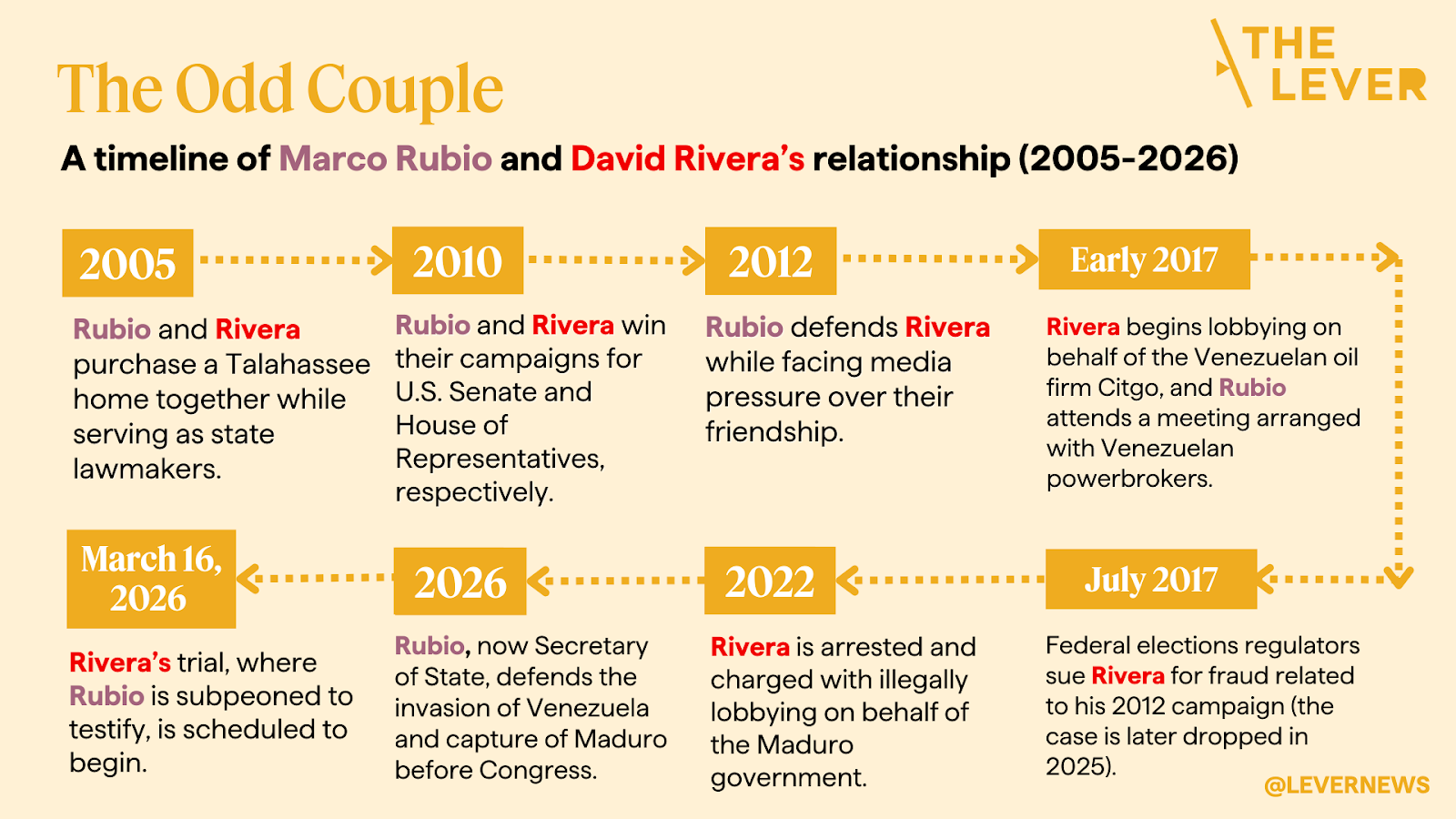 A graphic illustrating Marco Rubio and David Rivera’s relationship. (Source: The Lever)
Enacted in 1938 in response to rising Nazi propaganda in the United States, the Foreign Agents Registration Act requires more stringent disclosures than ordinary lobbying, since foreign clients may have national interests that conflict with those of the United States.
“The question under the law is whether the benefit [of the lobbying] is purely private, divorced from a benefit or control by a foreign government or party,” said Joshua Rosenstein, a lawyer at the Washington firm Sandler Reiff, which advises clients on compliance with lobbying and ethics laws. “The greater the involvement of a foreign government or political party, the less likely it is that you can shoehorn your activities under an exemption.”
The statute also applies to “a person whose activities are directly or indirectly supervised, directed, controlled, financed, or subsidized” by a foreign principal.
According to the Justice Department’s indictment of Rivera, the problems originated in 2017, when he began lobbying on behalf of Citgo, the U.S. subsidiary of Venezuela’s state-owned oil company.
For his work, Citgo paid Rivera’s consulting firm $50 million, a massive sum of money for a single lobbying firm. For comparison, the entire U.S. oil and gas industry spent just over $120 million on federal lobbying in 2022.
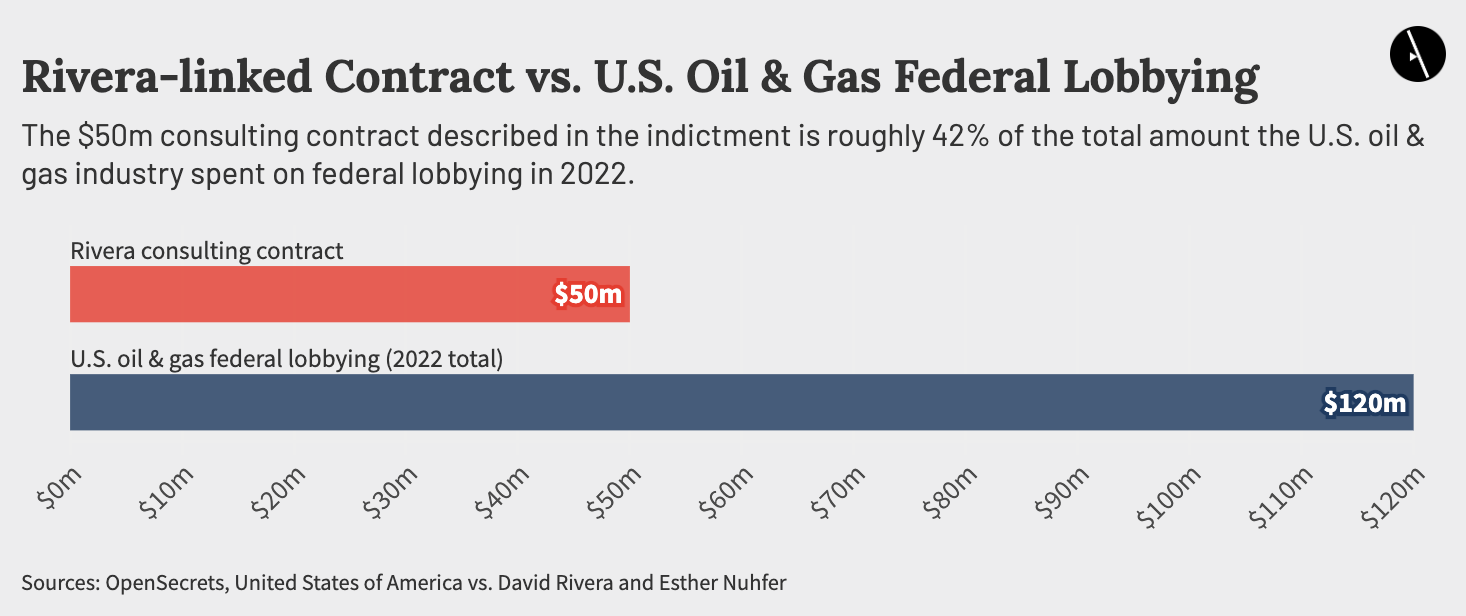 A graphic illustrating the size of David Rivera’s Citgo lobbying contract. (Source: The Lever)
Federal prosecutors allege that Rivera’s lobbying contract was actually a front for a foreign-influence campaign designed to avoid registering under the Foreign Agents Registration Act to conceal the full scope of the operation.
According to the indictment, Rivera was operating as an unregistered foreign agent to normalize relations between Venezuela and the U.S. — two countries that have been adversaries since socialist leader Hugo Chávez came to power in 1999.
Rivera was allegedly working for representatives of the Maduro government, which took power after Chávez’s death in 2013. Among the officials involved, prosecutors say, was then-Vice President Delcy Rodríguez, who now serves as Venezuela’s president.
“It was the purpose of the conspiracy for the defendants to unlawfully enrich themselves… in an effort to influence United States foreign policy towards Venezuela and to conceal these efforts by failing to register under FARA as agents of the Government of Venezuela,” the indictment reads.
Rivera allegedly used his political connections as a longtime Republican lawmaker to arrange meetings between Venezuelan power brokers and U.S. officials.
According to prosecutors, those meetings included a sit-down with Rubio as well as a meeting in Caracas between Maduro and Rep. Pete Sessions (R-Texas), who represents the oil-rich Lone Star State, which has financial interests in Venezuela’s mammoth oil reserves. At the time, Sessions chaired the House Rules Committee, which plays a pivotal role in deciding what legislation receives votes on the House floor.
Kellyanne Conway, a senior counselor to Trump during his first term, also participated in several of the meetings, according to text messages included in the indictment.
Sessions and Conway could not be reached for comment.
In text message exchanges cited by prosecutors, Rivera and his associates used pseudonyms to obscure the specifics of these meetings. The Texas congressman was referred to as “Sombrero,” while millions of dollars were called “melones.” Their code name for Maduro was “El Guaguero,” a reference to the president’s early career as a bus driver.
These 2017 and 2018 meetings— some reported at the time — came at a fraught moment in U.S.-Venezuela relations. Inside the Trump administration, officials were split over Venezuela policy, including proposals to tighten sanctions or normalize U.S. business ties.
Officials ultimately chose the former, ramping up sanctions in 2017 and again in 2020.
At the end of 2025, Rivera’s defense team subpoenaed Rubio to testify about those meetings. Federal prosecutors subsequently decided to call Rubio themselves, apparently concluding that his testimony would strengthen the government’s case.
Rivera, whose lawyers refused to make him available for an interview with The Lever, denies any wrongdoing. His attorneys have argued in court filings that Rivera, a longtime critic of Venezuela’s communist government, was working to undermine Maduro, not help him.
“We confidently believe that the evidence proves the opposite of what the government has alleged,” Rivera’s lawyers wrote in a December letter to the State Department requesting Rubio’s testimony.
“Specifically, then Senator Rubio and Mr. Rivera were focused only on their support for the Opposition [political leaders] in Venezuela, on sanctions against the Maduro government, and on removing Maduro as head of state in Venezuela.”
The Tycoon, The Trafficker, And The Trump Whisperer
As part of their defense, Rivera’s attorneys appear ready to suggest that the foreign-agent violations leveled against their client could just as easily be applied to another political operative: Wiles, Trump’s chief of staff.
To make their case, Rivera’s lawyers are zeroing in on two businessmen named in the indictment: a wealthy Venezuelan media mogul named Raúl Gorrín and a convicted cocaine trafficker named Hugo Perera.
Court documents claim that Gorrín, the politically connected head of a Caracas-based media company called Globovisión, helped orchestrate the alleged foreign-agent operation and served as a go-between for Rivera and the upper echelons of the Venezuelan government.
According to Rivera’s indictment, Gorrín took part in several of the meetings brokered by Rivera, including a sit-down with Rubio. Rivera also reportedly tried to use Gorrín’s private jet for the rendezvous with Conway.
An employee at Globovision works at the channel’s headquarters in Caracas, Venezuela. (AP Photo/Leslie Mazoch)
Gorrín, who was sanctioned by the U.S. government in 2019 for his purported involvement in foreign bribes and money laundering, was reportedly paid handsomely for his work.
In 2020, Citgo filed a lawsuit against Rivera for breach of contract. According to the suit, Rivera paid $4 million of his $50 million contract fee to Gorrín as a kickback for helping him land the arrangement. Rivera apparently funneled the money through Gorrín’s Miami-based yacht company.
The Lever did not receive a response from Globovisión for a request for comment from Gorrín.
The Citgo lawsuit also alleges Rivera paid $5 million to another subcontractor for help arranging the Citgo contract: Perera, a Miami real estate developer who was convicted in the 1990s for his role in a drug-smuggling operation run by the Cali Cartel in Colombia.
Perera’s name is notably absent in the government’s indictment, and he’s agreed to act as a cooperating witness against Rivera at trial. In retaliation, Rivera has countersued Perera for allegedly violating their confidentiality agreement. Rivera has also claimed in a court deposition that the FBI told him that Perera was an informant.
Perera, who now runs a Miami real estate company, did not respond to a request for comment.
At the same time that Gorrín and Perera were working with Rivera, court documents indicate that both men were engaged in related activities for Ballard Partners, a powerful U.S. lobbying firm that Wiles co-led at the time.
In 2017, the first year of the alleged foreign-agent scheme involving Rivera, Ballard Partners also registered to lobby on behalf of Gorrín’s Globovisión, seeking to expand the network’s presence on U.S. television platforms. Ballard earned $450,000 from the contract, making Globovisión the firm’s third-largest client that year.
Ballard’s work for Gorrín appears to have been extensive. In a subpoena letter sent to the White House requesting Wiles to testify in the upcoming trial, Rivera’s defense team describes roughly 400 pages of documents related to Wiles’ lobbying work gathered during the discovery phase of the case.
Court filings also reference numerous emails exchanged between Gorrín, Wiles, and other Ballard lobbyists. One of those lobbyists was Otto Reich, a former U.S. ambassador to Venezuela who previously ran the interagency office that helped coordinate the Iran-Contra weapons sales during the Ronald Reagan administration.
Other Ballard emails went to Harry Sargeant, an oil executive who is currently advising Trump on his post-regime-change efforts in Venezuela. (Trump’s attorney general, Pam Bondi, began working at Ballard Partners in 2019 after serving as Florida’s attorney general, though she is not referenced in the correspondence described in the filings.)
Based on these email exchanges, Rivera’s lawyers also claim Perera was simultaneously working for Ballard while also serving as a subcontractor for Rivera.
“Discovery documents show that Hugo Perera, an important government witness in the case, was involved in these pro-Venezuelan activities through Ballard Partners at the same time the government has alleged that Mr. Rivera and Ms. Nuhfer were supporting pro-Maduro efforts on behalf of Venezuela,” the attorneys wrote.
 A graphic showing how Venezuelan oil money moved through a network of Washington power brokers. (Source: The Lever)
“I Happen To Know That My Government Wants A Way Out”
Rivera’s lawyers do not accuse Wiles or her Ballard colleagues of illegal conduct. But their filings suggest the government’s legal standard for charging Rivera could potentially implicate a far wider circle of MAGA operatives — including the president’s chief of staff.
No federal records show that Wiles or Ballard Partners ever registered under the Foreign Agents Registration Act for any Venezuelan entity.
“We’re not taking a position on that [legal question] in the case,” said Ed Shohat, one of the defense attorneys representing Rivera.
Ballard Partners did not respond to multiple requests for comment. But the firm has publicly maintained that it complied with all foreign and domestic lobbying laws and that its work related only to Globovisión’s commercial interests in the U.S. The lobbying firm dropped Gorrín as a client in 2018, amid a federal investigation that would lead to U.S. sanctions against him the following year.
“Ballard Partners’ work for Globovisión involved Globovisión’s efforts to expand its TV network into the U.S. market,” Brian Ballard, the founder of Ballard Partners, said in a statement to the Miami Herald.
But a key document in the Rivera case obtained by the Miami Herald appears to suggest that Ballard’s work for Gorrín may have gone beyond strictly commercial interests.
In 2017, Ballard reportedly drafted a memo for Gorrín to provide to Trump, though he ultimately never delivered it. The letter apparently outlined a proposal to mend strained U.S.-Venezuela relations by offering Maduro a path out of the country in exchange for a transition in leadership. As described by the Miami Herald, the document did not directly relate to, or mention, Globovisión’s access to U.S. markets or other commercial interests.
“I happen to know that my government wants a way out, a way to save their skins and fortunes,” the draft letter from Gorrín read. “The opposition, on the other hand, wants a way in but is not unified in how to achieve its goals.”
Should Ballard Partners’ work on the Gorrín letter — or its other lobbying efforts — have required the firm to register under the Foreign Agents Registration Act? That’s likely impossible to determine without additional information about Globovisión’s relationship with the Venezuelan government.
“An exemption [to FARA] would be available, provided the client (Globo) isn’t directed/controlled by a foreign government or political party, and the principal beneficiary of the work wasn’t a government or political party,” said Rosenstein, the lobbying lawyer. “That’s a factual question.”
According to Rosenstein, foreign lobbying involves many legal gray areas, in part because the Justice Department has prosecuted relatively few cases, leaving the law with limited judicial precedent. Under Attorney General Pam Bondi, the Trump Justice Department has curtailed enforcement of foreign corruption and lobbying laws.
Made with Flourish • Create a chart
A graphic illustrating where key figures connected to the alleged Venezuelan lobbying network are based. (Source: The Lever)
The hundreds of pages of Ballard records described by Rivera’s attorneys could shed light on the matter, but the documents may never become public. Last month, a federal magistrate judge in Florida’s Southern District Court granted a Justice Department petition allowing Wiles to avoid testifying at Rivera’s trial, thereby permitting related documents to remain under seal.
But in his ruling, the judge made a surprising admission.
“To be clear, no one disputes that Ballard Partners registered under FARA and dealt with Gorrín openly,” wrote Magistrate Judge Edwin Torres.
Torres’ office refused to comment. But if Torres is correct, it would mean that — despite no publicly available record of the filing — Trump’s chief of staff previously worked as a registered foreign agent for a government the U.S. recently moved to overthrow.
Under Pressure
Miami insiders say Rivera’s aggressive defense strategy isn’t just legal maneuvering ahead of trial; it’s also a political effort to pressure the Trump administration to drop the case.
That campaign includes issuing subpoenas to a striking list of high-profile witnesses, including not just Rubio, but also Conway and Sessions. Rivera’s attorneys even subpoenaed Maduro, Venezuela’s deposed president, who is currently awaiting his own trial on U.S. narco-terrorism charges. Maduro’s attorneys resisted the subpoena, saying their client would plead the Fifth.
Former U.S. Rep. David Rivera speaks with media outside Miami federal court in Miami, Dec. 20, 2022. (AP Photo/Joshua Goodman)
While Miami defense lawyer Joseph DeMaria believes some of these witnesses could provide crucial testimony for Rivera’s defense, he also notes the political optics of such subpoenas.
“A lot of this strategy is political — to try to put pressure on the Trump administration to leave Rivera alone,” said DeMaria. ”Depending on how the judge rules on [the defense’s requests for testimony], that could lead them to wanting to make a deal with Rivera.”
Rivera’s legal team has a track record of exploiting political leverage when evidence-based legal defenses don’t pan out in the courtroom. One of Rivera’s attorneys is David Markus, a renowned Miami defense lawyer who also represents Ghislaine Maxwell, Jeffrey Epstein’s associate and convicted sex trafficker.
“A lot of this strategy is political — to try to put pressure on the Trump administration to leave Rivera alone.”
As Maxwell’s counsel, Markus has openly proposed a deal with the Trump administration in which his client would receive “clemency” in exchange for being allowed to speak “fully and honestly” about whether the president was involved in any potential sex crimes, or the crimes for which she was convicted.
In a *Vanity Fair*interview about his work, Markus embraced the ethos of a defense attorney: “I love representing the underdog.”
If David Rivera is an underdog, he’s an underdog with powerful friends in Washington — some of whom may soon be called to testify.
---
https://yyy.theguardian.com/world/2002/apr/21/usa.venezuela
no lnx guk
Venezuela coup linked to Bush team
Specialists in the 'dirty wars' of the Eighties encouraged the plotters who tried to topple President Chavez
Observer Worldview
Ed Vulliamy in New York
Sun 21 Apr 2002 09.30 EDT First published on Sun 21 Apr 2002 09.30 EDT
The failed coup in Venezuela was closely tied to senior officials in the US government, The Observer has established. They have long histories in the 'dirty wars' of the 1980s, and links to death squads working in Central America at that time.
Washington's involvement in the turbulent events that briefly removed left-wing leader Hugo Chavez from power last weekend resurrects fears about US ambitions in the hemisphere.
It also also deepens doubts about policy in the region being made by appointees to the Bush administration, all of whom owe their careers to serving in the dirty wars under President Reagan.
One of them, Elliot Abrams, who gave a nod to the attempted Venezuelan coup, has a conviction for misleading Congress over the infamous Iran-Contra affair.
The Bush administration has tried to distance itself from the coup. It immediately endorsed the new government under businessman Pedro Carmona. But the coup was sent dramatically into reverse after 48 hours.
Now officials at the Organisation of American States and other diplomatic sources, talking to The Observer, assert that the US administration was not only aware the coup was about to take place, but had sanctioned it, presuming it to be destined for success.
The visits by Venezuelans plotting a coup, including Carmona himself, began, say sources, 'several months ago', and continued until weeks before the putsch last weekend. The visitors were received at the White House by the man President George Bush tasked to be his key policy-maker for Latin America, Otto Reich.
Reich is a right-wing Cuban-American who, under Reagan, ran the Office for Public Diplomacy. It reported in theory to the State Department, but Reich was shown by congressional investigations to report directly to Reagan's National Security Aide, Colonel Oliver North, in the White House.
North was convicted and shamed for his role in Iran-Contra, whereby arms bought by busting US sanctions on Iran were sold to the Contra guerrillas and death squads, in revolt against the Marxist government in Nicaragua.
Reich also has close ties to Venezuela, having been made ambassador to Caracas in 1986. His appointment was contested both by Democrats in Washington and political leaders in the Latin American country. The objections were overridden as Venezuela sought access to the US oil market.
Reich is said by OAS sources to have had 'a number of meetings with Carmona and other leaders of the coup' over several months. The coup was discussed in some detail, right down to its timing and chances of success, which were deemed to be excellent.
On the day Carmona claimed power, Reich summoned ambassadors from Latin America and the Caribbean to his office. He said the removal of Chavez was not a rupture of democra tic rule, as he had resigned and was 'responsible for his fate'. He said the US would support the Carmona government.
But the crucial figure around the coup was Abrams, who operates in the White House as senior director of the National Security Council for 'democracy, human rights and international operations'. He was a leading theoretician of the school known as 'Hemispherism', which put a priority on combating Marxism in the Americas.
It led to the coup in Chile in 1973, and the sponsorship of regimes and death squads that followed it in Argentina, El Salvador, Honduras, Guatemala and elsewhere. During the Contras' rampage in Nicaragua, he worked directly to North.
Congressional investigations found Abrams had harvested illegal funding for the rebellion. Convicted for withholding information from the inquiry, he was pardoned by George Bush senior.[ cheney blocked invest by congress that shd have put him in jail?!]
A third member of the Latin American triangle in US policy-making is John Negroponte, now ambassador to the United Nations. He was Reagan's ambassador to Honduras from 1981 to 1985 when a US-trained death squad, Battalion 3-16, tortured and murdered scores of activists. A diplomatic source said Negroponte had been 'informed that there might be some movement in Venezuela on Chavez' at the beginning of the year.
More than 100 people died in events before and after the coup. In Caracas on Friday a military judge confined five high-ranking officers to indefinite house arrest pending formal charges of rebellion.
Chavez's chief ideologue - Guillermo Garcia Ponce, director of the Revolutionary Political Command - said dissident generals, local media and anti-Chavez groups in the US had plotted the president's removal.
'The most reactionary sectors in the United States were also implicated in the conspiracy,' he said.
https://washingtonbabylon.com/meet-venezuelas-three-stooges-of-regime-change-the-gang-that-couldnt-coup-straight/
https://www.yahoo.com/news/exile-group-planning-overthrow-venezuelan-government-tried-hire-trump-connected-lobbyists-161002859.html
ken silverstein 11.18
Working from an office near the Miami airport, three Venezuelan exiles are plotting the overthrow of the government of President Nicolas Maduro, claiming they have military forces standing by in five countries, including the United States. And they say they’re making inroads with the Trump administration, which has expressed support for regime change in the country.
Last March, the exiles created a Miami-registered nonprofit called Venezuela Freedom Inc., which was soon rechristened with the less business-minded moniker of Venezuela Freedom Foundation. The website includes a nine-slide “Strategic Plan” from May 2018. The first slide after the cover page is entitled, “Venezuela Needs a Regime Change.”
The three men see themselves as part of a government in exile and are putting together a list of post-coup Cabinet ministers. They plan to move back to their homeland as soon as “the invaders are thrown out,” Jean Pierre Chovet, a businessman and one of the three leaders, said in a phone interview. He said action is needed swiftly as anassortment of narco-traffickers and terrorist groups, including the Islamic State, have established five government-approved training camps in Venezuela, including one on Margarita Island, a popular tourist destination.
Chovet’s two business partners are Julio Rodriguez Salas, a former Army colonel, and Carlos Molina Tamayo, an ex-Navy vice admiral. The pair were both key players in a botched, deeply unpopular 2002 coup attempt against Hugo Chavez, Maduro’s predecessor. (Rodriguez and Molina did not reply to requests for comment sent through Chovet.)
The Venezuela Freedom Foundation says it is sending humanitarian aid to Venezuela, but its plans include “a piece of military action” that will topple Maduro,Chovet said. It will be led, he said, by “clean” anti-Maduro army personnel in Venezuela, along with military forces said to be mustered in the United States, Colombia, Peru, Brazil and from a Caribbean island Chovet said was best not to identify. He said the foundation had support from the governments of Colombia and from officials close to Jair Bolsonaro, the incoming right-wing president of Brazil.
Now, they hope — with some help from the Trump administration — the second time’s a charm. “We don’t believe in dialogue,” he said. “The regime are assassins.”
The Venezuela Freedom Foundation’s work — from within the borders of the United States — to launch an armed overthrow of a foreign government raises a fundamental question. While the Trump administration has been openly calling for regime change in Venezuela, which would seem to encourage or at least embolden groups like the Venezuela Freedom Foundation, it’shighly likely to be a crime for private American citizens to actually get involved in Maduro’s forcible overthrow.
And that’s precisely what the foundation has sought to do. In an effort to curry favor with the Trump administration, the trio of exiles sought to retain as a lobbyist Otto Reich, a U.S. ambassador to Venezuela under Ronald Reagan and a senior official in the George W. Bush administration who supported a failed 2002 coupin the country. They’ve also publicly claimed — falsely, it turns out — to have retained a prominent lobbying firm headed by a close friend of President Trump’s.
No matter what the position of the Trump administration, it’s illegal for private U.S. citizens to seek the forcible toppling of a foreign government, according to Brett Kappel, a prominent Washington attorney and expert on foreign lobbying.“If they had successfully enlisted Americans to support violently overthrowing the Venezuelan government, those Americans would be facing serious criminal jeopardy for violating the Neutrality Act,” Kappel said. Normally, not registering as a foreign lobbyist while carrying out such work would be a crime. But if anyone registered to advocate for a violent regime change operation, they would have been simultaneously confessing to a felony, Kappel added.
Nicolas Maduro, a former labor leader and vice president of Venezuela, took over when Hugo Chavez, a longtime bête noire of official Washington, died of cancer in 2013. Maduro won a special election that same year by less than 1 percent and was reelected in a landslide in May of this year. The election was boycotted by most of the opposition, and the United States and many other governments refused to recognize the results.[grup de lima?]
President Trump has long made clear he favors regime change in Venezuela, which has been suffering record-setting hyperinflation along with critical shortages of food and medicine. (The Venezuelan government has said sanctions have greatly contributed to the country’s economic problems.) Starting last fall, the Trump administration “held secret meetings with rebellious military officers from Venezuela to discuss their plans to overthrow President Maduro,” the New York Times reported earlier this year.
But the administration is now openly calling for Maduro’s ouster.“For the safety and the security of all people in Latin America, it is time for Maduro to go,” Nikki Haley, U.S. ambassador to the United Nations, said earlier this year during the Washington Conference on the Americas. Trump made similar comments in late summer, including, “Venezuela is a mess. The place needs to be cleaned up.”
Early this month, U.S. national security adviser John Bolton spoke at Freedom Tower, a building where anti-Castro Cubans were welcomed in 1960 after Castro’s revolution toppled dictator Fulgencio Batista. “The troika of tyranny in this hemisphere — Cuba, Venezuela and Nicaragua — has finally met its match,” he declared. He referred to the leaders of that trio of countries as “clowns” who were “akin to Larry, Curly and Moe” of the Three Stooges.
[National security adviser John Bolton talks to the Miami Herald on Latin American policy atMiami’s Freedom Tower on Nov. 1. (Photo: Emily Michot/Miami Herald via AP)
Yet the trio of exiles who want to topple Maduro may have a greater claim to that name. Even before incorporating the foundation, they appeared last year at a number of public events in Florida, home to an estimated 140,000 Venezuelan exiles and Venezuelan-Americans. They were anything but subtle about their plans.
During a February 2018 event in Tampa, Molina Tamayo said that the only means to “rescue” Venezuela was to “intervene in the country, detain the delinquents,put in place a transitional government and within a prudent period of time call legitimate elections,” according to a Spanish-language account in the Orlando Sentinel. He claimed Maduro was negotiating to give Russia and China military bases in Venezuela and that the country was being “hijacked” by Iran, Colombian drug cartels and “Palestinian Hezbollah.” (Hezbollah is a Lebanese organization.)
The opposition in Venezuela was divided about whether to participate in last May’s presidential election, but the trio opposed it. “We don’t believe in negotiations,” Chovet told the audience. Another local account said the exiles called for “international humanitarian intervention, even if that intervention has to be armed,” which the trio believed would be necessary.
They incorporated the Venezuela Freedom Foundation last spring with Rodriguez as the president and registered agent, while Chovet and Molina Tamayo share the title of vice president. “The corporation will serve as a Florida nonprofitorganization focusing on humanitarian and political issues and providing advisory services for the rescue of the Venezuelan people,” read the registration papers.
Three prominent Republicans with direct knowledge of the trio’s activities, and Reich’s relationship with them, viewed the exiles as self-promoting opportunists and dangerous zealots. “They were anti-government bomb throwers,” one said. “They talked about sending humanitarian aid, but the main plan was for the army to take over. They bragged they could have 1,000 people on the ground to run the new government a day after Maduro was ousted.”
[ foto:Carlos Molina Tamayo, center, a retired Venezuelan naval admiral and former national security adviser of Hugo Chavez, protests against Venezuelan President Nicolas Maduro’s government in Spain, where he was then in exile, in 2014. (Photo: Jon Nazca/Reuters)
The three Republicans loathe Maduro, but they wanted nothing to do with a plan for regime change. “They were the gang that couldn’t coup straight,” said another of the Republicans, who have all long been active in national party politics. “I agree with them about getting rid of Maduro, but not with their approach. There are laws about that.”
The three men talked up plans to create a group called Mothers to the Rescue, whose ostensible purpose was to send humanitarian aid to Venezuela. But the three GOP sources familiar with their plans told me that the charity was nothing more than an afterthought and effectively a facade. The trio never created the organization and while they reserved a website for it with GoDaddy.com, it never launched.
Rodriguez, the head of the foundation, does have coup experience, though not a successful one. In April 2002, he was among a junta of military officers and right-wing leaders that briefly ousted President Chavez in a coup andinstalled in his place Pedro Carmona, director of Venezuela’s equivalent of the U.S. Chamber of Commerce.
Molina Tamayo, one of the foundation’s vice presidents, also has a coup attempt on his CV. A former Venezuelan Navy admiral who has spent much of the last two decades in Spain, he publicly denounced Chavez as “unpatriotic” two months before the coup and called on him to resign. The Chicago Tribune reportedthat he was one of key military officers “building support … in the armed forces” for the coup. Carmona, Molina Tamayo and another military officer were the first three members of the post-coup government.
After proclaiming democracy, Carmona quickly dissolved the legislature and Supreme Court, and suspended the constitution. (Then-Col. Rodriguez appeared on national TV soon after it was underway and told viewers he and other military officials had been planning the operation for many months.) However, Chavez was immensely popular at the time. The streets of Caracas exploded in protest, and within a few days the Carmona government collapsed and Chavez was back in power.
[ looks like a shot out of central casting: Venezuelan Navy Vice Adm. Carlos Molina Tamayo, center, speaks with the media at Navy Headquarters in Caracas, Venezuela, in February 2002, less than two months before the coup. (Photo: Fernando LLano/AP)
Turning toReich — a right-wing Cuban-American and longtime leader of Miami’s anti-Castro movement — for support would have been a no-brainer. Reich has strong ties with the Trump administration, which has appointed a number of his colleagues in the anti-Castro movement to top Latin America policy positions. And he also has a history of supporting coups in Venezuela.On the day Carmona took power, Reich, who was then an assistant secretary of state, met ambassadors from Latin America and the Caribbean in his office and endorsed Chavez’s removal from office.
Reich now heads a Washington PR and advocacy firm and has a consulting relationship with Ballard Partners — headed by Brian Ballard, a close friend of the president’s and described by Politico as the “most powerful lobbyist in Trump’s Washington” — which the exiles hoped to retain as part of the deal.
Ballard once represented Trump in Florida and was a state finance chairman for his presidential campaign and a vice chairman for his inaugural committee. For the Venezuela project, Reich partnered with Sylvester Lukis, a Ballard managing partner who moved to Washington after the 2016 election to open the D.C. office.
The foundation’s “Strategic Plan” claimed that it worked closely with “the lobbying firms of Ballard Partners and Otto Reich and Associates” to interface with the Trump administration. (The plan was taken off the site less than a day after this writer inquired about it.) Chovet says the group had inked the deal with Reich after a series of discussions that began last March. “Otto is not working for us at the moment, but he introduced us to the right people in Washington,” Chovet said. “He did a good job for us.”
In private, the exiles were even more aggressive. At least through March they were boasting to two of the Republican sources that Reich was touting them in GOP political circles and would be lining up congressional and Trump administration support for Maduro’s overthrow. “Otto is a fervent anti-Communist, and these guys passed muster with him,” one of the sources said. “All they cared about was getting American support to overthrow Maduro, by any method.”
A second GOP source said the trio made similar claims to him. “I sympathized, people in Venezuela are suffering and I don’t like Maduro,” this person recalled. “But all they wanted was inside baseball to bring about Maduro’s overthrow.”
Reich confirmed that he had multiple conversations and meetings with the trio of exiles, but disputed significant components of Chovet’s account. He denied that he ever closed a commercial deal with the Venezuela Freedom Foundation or received any compensation from it. He said he had written a proposal for the group — which he described as “strictly humanitarian” — and that he may have signed “some piece of paper” about a potential lobbying arrangement, but nothing ever came of it and “no money changed hands..
In a phone conversation, Reich said he met Rodriguez roughly four or five years ago at a public event, and that a mutual colleague, whom he declined to identify, put them back in touch earlier this year. “I guess he didn’t know how to get in touch with me,” he said.
Reich described Rodriguez as a friend. “I have had numerous conversations with Julio,” he said. “I have other reasons to talk to Julio beyond Venezuela Freedom.”
He said that Rodriguez and he had a one-on-one meeting to discuss a potential business deal involving advocacy against the Maduro government. That was followed by a meeting with the former colonel, Chovet, Molina and several other people, whose names had escaped him since.
After that, Reich arranged a conference call between the three men and “about half a dozen Washington entities.” Lukis of Ballard Partners participated in the conversation, he remembered. “I have a consulting relationship with Ballard,” he said. “They have right of first refusal. They [the trio] wanted Ballard involved, and I said, ‘I’ll see what they say.’”
Ballard flatly denied that his firm had worked for the exiles.“I’ve never even met these guys,” he wrote in an email. He confirmed that Reich and Lukis had met with the trio and raised the opportunity of representing them.
But Reich said negotiations foundered, in part because the exiles had too lofty expectations. “I don’t want to disparage them but they wanted to do some things I knew we couldn’t do,” he said. “I had sort of an agreement with Julio, but he couldn’t get the agreement of the others. I never did any work for them and I never contacted anyone on their behalf, including Sen. Rubio.”
Reich said that in his discussions with the trio, he was acting as a representative of his firm, Otto Reich Associates LLC, not Ballard Partners.
Chovet declined to comment further after being informed that Ballard and Reich had disputed his version of events and had denied ever taking money from the trio or its foundation. “There is information classified as P&C [Private & Confidential] so we need to sign an NDA [non-disclosure agreement] before we continue our conversation,” he wrote in a text message.
No work contract exists between Reich and the trio, the lobbyist insists. “We talked several times, but we never reached an agreement,” Reich said. “I asked certain questions and never got satisfactory answers and moved on. I’m a U.S. citizen and I have to abide by U.S. laws. There are laws about the use of military force. I know where the lines are drawn and certain alarm bells went off."
It would be easy to dismiss the Venezuela Freedom Foundation as a hobby for buffoonish, wannabe coup leaders, but the group appears to be well funded. One of the Republican sources said the trio claimed to have millions of dollars available for its 2018 budget. One of their top donors, he said, was a Venezuelan construction executive, whom he described as “a Gucci loafer type.” The executive was an “integral part of the fundraising mechanism for these guys,” the source said.
Chovet had declined to discuss where his group’s money was coming from other than to say it was provided by private individuals in the United States and Europe. It’s clear, though, that the trio had access to substantial funding. Chovet said their group had two offices in the Miami area as well as a small office in Houston, headquarters of Citgo, an energy firm majority-owned by Venezuela’s state-owned PDVSA oil company.
The foundation had a financial committee that raised cash, Chovet said, but it was “never enough.” However, the trio had been “assured there will be more money” as progress toward overthrowing Maduro is made.
It’s not clear how much, if any, support the Trump administration is offering the exiles, and some potential allies have shunned them because of their extremist positions. Chovet stated that hisgroup has allies in Congress, including Sen. Rubio of Florida, who has expressed tacit support for removing Maduro by force, and within the Trump administration. “We have had special discussions with the Department of Defense,” Chovet said. “I’m not the one dealing with them directly, that’s my partners in Venezuela Freedom.”
The White House and Rubio’s office did not reply to requests for comment.
Putting aside the question of legality, even many critics of Maduro think a military overthrow is a bad idea, especially if it involves troops or direct support from the Trump administration.
“Maduro is not a good ruler, but he hasn’t done anything to threaten the United States and there are no U.S. national security interests that require regime change,” said Robert Moore, a public policy adviser for Defense Priorities and former national security and defense staffer for GOP Sens. Mike Lee and Jim DeMint. “Any issues between our two countries can be better mitigated by statesmanship and negotiations. There’s no way I can see how a regime change operation will improve things for Venezuelans, and it means more time, treasure and blood for the United States.”
Andrew Bacevich, professor of history and international relations at Boston University, was equally dubious. “We know how to topple regimes, but we don’t know how to establish a stable political order afterwards, and our experiences over the last two decades or so have affirmed that time and again,” he said. “I see no reason to think that overthrowing the government of Venezuela will be any more successful than what happened in Afghanistan, Libya and Iraq.
“For any advocate of regime change in Venezuela, the operative question is, ‘What’s next?’ If they don’t have a good answer, it’s an invitation to folly.”
For the foundation’s leaders, what’s next would be high-level roles for themselves. They all planned to get top positions in the post-Maduro government they were hoping to install, one of the sources told me. Rodriguez and Molina dreamed of bagging high-level military positions, while Chovet was shooting for a slot in the oil ministry or at PDVSA, the state oil company, the source said.
However, It’s not apparent how much support the exiles have inside Venezuela for their grand plans. Chovet said the foundation is working closely with select opposition groups in the country and with the self-declared Supreme Court in Exile, which operates out of Panama. However, he complained that some politicians had “betrayed” the trio by promising to align with them but separately negotiating with the Maduro government. “We lost a lot of time and money,” he lamented.
Nonetheless, Chovet and his colleagues are optimistic and gearing up for a new push to depose Maduro now that the U.S. midterm elections are over, he said. They’re hoping for an invasion early next year.
“We’re putting together a broader alliance before we go back to Washington, that’s what the Trump administration is waiting for,” he said. “Everything has been on standby because of last Tuesday’s election, but we have all the pieces in place so now it will be easier to get things started.”
ref
https://www.politico.com/states/florida/story/2017/01/trumps-florida-lobbyist-opens-dc-shop-109221
Trump's Florida lobbyist to open D.C. shop
By MARC CAPUTO
01/31/2017 03:12 PM EST
MIAMI — President Donald Trump’s longtime Florida lobbyist and general-election fundraiser, Brian Ballard, plans to open a branch in Washington with a team that includes Reagan-era Ambassador to Venezuela Otto Reich.
Joining Reich at Ballard Partners: Susie Wiles, who served as Trump’s Florida campaign manager; Dan McFaul, former congressional staffer for U.S. Reps. Joe Scarborough, Jeff Miller and Matt Gaetz; and Sylvester “Syl” Lukis, a former attorney for the U.S. Department of Health and Human Services, U.S. Attorney’s office in D.C. and the U.S. Department of State.
The foreign-policy firepower Ballard is assembling for his firm comes amid foreign-policy turmoil following Trump’s recent executive orders concerning terrorism and immigration. After Trump’s pledge to build a wall along the Mexico border and pay for it by taxing some Mexican imports, for instance, the Mexican President Enrique Peña Nieto canceled his meeting this week with Trump.
Reich said he joined the team because he shared a client a decade ago with Ballard and because the two share mutual friends. He will work as senior counselor for international affairs at Ballard Partners.
“It all fit together like a jigsaw puzzle,” said Reich, who was appointed ambassador to Venezuela by President Reagan and then served as Assistant Secretary of State for the Western Hemisphere. He also served under both Bush administrations, including as Special Envoy for Western the Hemisphere under President George W. Bush, who also appointed him senior staff member for the National Security Council.
Reich is in good standing with Trump’s administration, having notably avoided signing a letter — penned last year by numerous foreign-policy experts from prior Republican administrations — that warned Trump “swings from isolationism to military adventurism within the space of one sentence [and that] … His advocacy for aggressively waging trade wars is a recipe for economic disaster in a globally connected world.”
Ballard, unable to be reached, was silent on his potential clients in Washington, but said in a draft press statement obtained by POLITICO that he had a “first class team” and they “look forward to representing our clients on a path to success at the federal level.”
Before expanding to Washington, Ballard was expanding his practice in Miami. Long ago, he secured a spot as one of the Florida Capital’s most-influential lobbyists. He’s also Florida’s top Republican fundraiserand, for years, represented Trump’s organization in Tallahassee.
This article tagged under:
https://www.alternet.org/2013/06/exposing-dark-forces-behind-snowden-smears/
no lnx
Exposing the Dark Forces Behind the Snowden Smears
written by Max Blumenthal / AlterNet June 28, 2013
Since journalist Glenn Greenwald revealed the existence of the National Security Agency’s PRISM domestic surveillance program, he and his source, the whistleblower Edward Snowden, have come in for a series of ugly attacks. On June 26, the day that the New York Daily News published a straightforward smear piece on Greenwald, the website Buzzfeed rolled out a remarkably similar article, a lengthy profile that focused on Greenwald’s personal life and supposed eccentricities.
Both outlets attempted to make hay out of Greenwald’s involvement over a decade ago on the business end of a porn distribution company, an arcane detail that had little, if any, bearing on the domestic spying scandal he sparked. The coordinated nature of the smears prompted Reuters media columnist Jack Shafer to ask if an opposition research firm was behind them. “I wonder who commissioned the file,” he mused on Twitter.
A day before the Greenwald attacks appeared, Buzzfeed published an anonymously sourced story about the government of Ecuador, which had reportedly offered asylum to Snowden (Ecuador has just revoked a temporary travel document issued to Snowden). Written by Rosie Gray and Adrian Carasquillo, the article relied on documents marked as “secret” that were passed to Buzzfeed by sources described as “activists who wished to call attention to the [Ecuadorian] government’s spying practices in the context of its new international role” as the possible future sanctuary of Snowden.
Gray and Carasquillo reported that Ecuador’s intelligence service had attempted to procure surveillance technology from two Israeli firms. Without firm proof that the system was ever put into use, the authors claimed the documents “suggest a commitment to domestic surveillance that rivals the practices by the United States’ National Security Agency.” (Buzzfeed has never published a critical report on the $3 billion in aid the US provides to Israel each year, which is used to buy equipment explicitly designed for repressing, spying on and killing occupied Palestinians).
Buzzfeed’s Ecuador expose supported a theme increasingly advanced by Snowden’s critics — that the hero of civil libertarians and government transparency activists was, in fact, a self-interested hypocrite content to seek sanctuary from undemocratic regimes. Curiously, those who seized on the story had no problem with Buzzfeed’s reporters relying on leaked government documents marked as classified. For some Snowden detractors, the issue was apparently not his leaking, but which government his leaks embarrassed.
Questionable journalism ethics, evidence of smears
At first glance, Buzzfeed's Ecuador expose might have seemed like riveting material. Upon closer examination, however, the story turned out to be anything but the exclusive the website promoted it as. In fact, the news of Ecuador’s possible deal with Israeli surveillance firms was reported hours before Buzzfeed’s piece appeared by Aleksander Boyd, a blogger and activist with close ties to right-wing elements in South America. “Rafael Correa's Ecuadorian regime spies on its citizens in a way strikingly similar to what Snowden accuses the U.S. of doing,” claimed Boyd.
Later in the day, Boyd contacted Buzzfeed’s Gray through Twitter, complimenting her piece before commenting, “Evidently Ecuadorian source leaked same info to you guys, seems I jumped the gun before you…”
Since Boyd contacted Gray, who has not publicly responded, Buzzfeed has not credited him or altered its headline to acknowledge that its story was not an exclusive. Buzzfeed’s refusal to acknowledge Boyd was not only a testament to the kind of questionable practices that have plagued the outlet since its inception, it helped obscure the story’s disturbing origins.
Boyd’s disclosure that a single source shopped opposition research to him and Buzzfeed at the same time confirmed the existence of a coordinated campaign orchestrated by elements exploiting the Snowden drama for political gain. Boyd’s remark that he “jumped the gun” suggests that the source intended for Buzzfeed to be the first to publish the story, and that he inadvertently embarrassed the site by running with it before them. There is also the possibility that Boyd was the source all along, and that his tweet to Gray was designed to establish deniability. Either way, the source seemed to be carefully managing the operation, wielding Snowden as a cudgel against the Ecuadorian government and timing the story for maximum impact.
Soliciting smears, dreaming of headless opponents
Who is Boyd, and how did he appear in the middle of the Snowden saga?
A London-based representative of Venezuela’s political opposition, Boyd solicits his services as an opposition researcher, informing potential clients through his official bio, “Alek can be contracted to do due diligence on individuals and companies in Venezuela and LatAm.”
As I reported for The Electronic Intifada, Boyd has repeatedly promoted terrorism and assassination against members of the elected government of Venezuela. Back in 2004, Boyd wrote, “I wish I could decapitate in public plazas [Venezuelan politicians] Lina Ron and Diosdado Cabello. I wish I could torture for the rest of his remaining existence Vice President Jose Vicente Rangel … I wish I could fly over Caracas slums throwing the dead bodies of the criminals that have destroyed my country … Only barbaric practices will neutralize them, much the same way [Genghis] Khan did. I wish I was him.” A year later, he declared, “Re: advocating for violence yes I have mentioned in many occasions that in my view that is the only solution left for dealing with [Hugo] Chavez.”
In 2008, Boyd’s services were contracted by the Human Rights Foundation (HRF), an NGO run by a veteran conservative activist named Thor Halvorssen. The son of a Venezuelan oligarch and former CIA asset who funneled money to the Nicaraguan Contras,Halvorssen founded HRF to publicize the human rights abuses of Hugo Chavez’s government. His first cousin, Leopoldo Lopez, the son of an oil industry executive, is one of the most visible leaders of the Venezuelan opposition, and as such, has received substantial financial support from the US. In 2002, Lopez was among the politicians who momentarily seized power from Chavez during a failed coup attempt. At the 2010 Oslo Freedom Forum, a yearly confab Halvorssen promotes as “the Davos of human rights,” Lopez was presented to an audience of foreign correspondents and diplomats as a “human rights leader.”
Boyd claimed that during his year and a half working for Halvorssen, he successfully campaigned for the release of Guadelupe Llori, an Ecuadorian opposition politician jailed by Correa under charges of sabotage and terrorism for her role in leading a crippling oil workers’ strike. (After her release, Llori was junketed to Halvorssen’s Oslo Freedom Forum). During this time Boyd visited Llori in prison in Ecuador while meeting opposition activists “to coordinate future projects,” as he told an interviewer. Whether this was how he made initial contact with the source that supplied him and Buzzfeed with the documents on Ecuador’s deal with the Israeli surveillance firms is unknown.
Boyd may have never met Buzzfeed’s Gray, however, each are well acquainted with Halvorssen. This May, Gray was among the select cadre of journalists flown to the Oslo Freedom Forum to provide positive PR for Halvorssen and his global operation. Gray returned with a fawning profile of Halvorssen, portraying him as an iconoclastic activist whose “job of opposing strongmen is arguably more media-friendly than that of anyone doing human rights work today.”
In contrast to Buzzfeed’s profile of Greenwald, Gray cast Halvorssen’s eccentricities as charming quirks that bore little relevance to the larger story. And his intimate ties to the right-wing Venezuelan opposition and the oligarchic forces seeking to topple socialist-oriented governments in South America went unmentioned.
Right-wing corporate lobbyists target Correa
Ecuador’s Correa is among the most popular of the Latin American leaders to embrace Hugo Chavez’s socialist economic model. Having defiantly defaulted on $3.2 billion in foreign loans, he has been able to leverage his country’s oil wealth to drastically expand social programs, improving access to education and doubling spending on healthcare while lowering poverty rates by a remarkable five percent since he took office in 2007. Naturally, Correa’s rejection of neoliberal policies has earned him a fair share of enemies, especially among the elites who have traditionally governed Ecuador. In 2010, he resisted a coup attempt led by Lucio Gutierrez, a former president who earned the wrath of Ecuador’s poor by implementing crushing IMF-imposed austerity measures.
Correa’s opponents may have resorted to zero-sum politics, but his response has not always been judicious. He has, for example, advanced criminal libel laws as a means of punishing opposition media and has battled indigenous groups that protested his attempts to open their land up to wide-scale state mining operations. The Committee to Protect Journalists has accused Correa of leading Ecuador “into a new era of widespread repression.”
Of all the enemies Correa has earned, some of his fiercest reside not in Quito, but in the conservative think tanks of Washington. They include George W. Bush’s former Latin America handlers and a coterie of corporate-bankrolled right-wing radicals determined to unravel the South American socialist bloc.
Ezequiel Vazquez Ger, an Argentina-born economist, is among the most aggressive of Correa’s antagonists. Vazquez Ger works for a DC-based lobbying firm run by Otto Reich, a Cuban exilewho served as the Assistant Secretary of State for Western Hemisphere Affairs under the second Bush administration. In 1987, Reich was singled out during the US Comptroller General’s investigation of Iran-Contra for having “engaged in prohibited, covert propaganda activities” on behalf of the Nicaraguan Contras. He is also suspected of helping the anti-Castro terrorist Orlando Bosch escape prosecution in Venezuela.
Reich contracted Vazquez Ger in 2011 to help him oversee a portfolio ofcorporate clients that included Lockheed Martin, Exxon Mobil, and Bacardi International, the rum company whose lawyers drafted much of the 1996 Helms-Burton Act tightening the US embargo of Cuba. Before he partnered with Reich, Vazquez Ger served as a Latin American fellow at the Atlas Economic Research Foundation, a corporate funded think tank that promotes climate change denialism and sweeping deregulation policies.
To compliment their lobbying operation, Vazquez Ger and Reich have churned out a steady stream of op-eds for publications from Foreign Policy to Fox News to the Miami Herald, demonizing the socialist leaders of South America who have stifled the ambitions of multi-national corporations. During the past year, they homed in on Correa, assailing him for sheltering Assange while he cracked down on opposition media. In a June 2012 op-ed for the right-wing Newsmax website, Reich and Vazquez Ger cited Assange as a key reason why the US should refuse to sign any further trade agreements with Ecuador. “Signing or renewing trade agreements with Ecuador will only allow Rafael Correa to continue undermining US foreign policy,” they wrote, “trading with our enemies, and destroying his country’s democracy.” (Following threats from Congress over its alleged offer to shelter Snowden, Ecuador’s government unilaterally rejected US trade preferences).
When Buzzfeed published its expose on Ecuador, Vazquez Ger was overjoyed. A heavily trafficked US news site had recycled he and Reich’s attacks on Correa’s support for Assange, this time framing Ecuador’s president as a hypocrite for supposedly offering asylum to Snowden. At 7:28 PM on June 25 — a full 27 minutes after the article appeared — Vazquez Ger took to Twitter to promote the piece to his Spanish-language followers. Next, he personally thanked Buzzfeed Editor-in-Chief Ben Smith “for unmasking [Correa’s] hypocrisy.”
The following day, at a press conference in Ecuador, Interior Minister Jose Serrano was asked to answer for the Buzzfeed report. Buzzfeed’s Gray quickly picked up Serrano’s defensive comments, quoting them in a follow-up story alongside a strident denunciation of Correa’s sheltering of Assange by Cléver Jiménez, a key opposition leader. Meanwhile, Alek Boyd projected the story of Ecuador’s surveillance deal into South American media, publishing it as an “exclusive” in Semana, a leading Colombian daily.
Whoever planted the story with Buzzfeed appeared to have scored a major success, exploiting the Snowden drama to tarnish the image of Ecuador’s government. Though the identity of the source that triggered the operation may never be known, their agenda does not seem to be much of a mystery anymore.
==
https://www.mintpressnews.com/the-making-of-juan-guaido-how-the-us-regime-change-laboratory-created-venezuela-coup-leader/254387/
Project — Before the fateful day of January 22, fewer than one in five Venezuelans had heard of Juan Guaidó. Only a few months ago, the 35-year-old was an obscure character in a politically marginal far-right group closely associated with gruesome acts of street violence. Even in his own party, Guaidó had been a mid-level figure in the opposition-dominated National Assembly, which is now held under contempt according to Venezuela’s constitution.
But after a single phone call from US Vice President Mike Pence, Guaidó proclaimed himself as president of Venezuela. Anointed as the leader of his country by Washington, a previously unknown political bottom dweller was vaulted onto the international stage as the US-selected leader of the nation with the world’s largest oil reserves.
Echoing the Washington consensus, the New York Times editorial board hailedGuaidó as a “credible rival” to Maduro with a “refreshing style and vision of taking the country forward.” The Bloomberg News editorial board applauded him for seeking “restoration of democracy” and the Wall Street Journal declared him “a new democratic leader.” Meanwhile, Canada, numerous European nations, Israel, and the bloc of right-wing Latin American governments known as the Lima Group recognized Guaidó as the legitimate leader of Venezuela.
While Guaidó seemed to have materialized out of nowhere, he was, in fact, the product of more than a decade of assiduous grooming by the US government’s elite regime change factories.Alongside a cadre of right-wing student activists, Guaidó was cultivated to undermine Venezuela’s socialist-oriented government, destabilize the country, and one day seize power. Though he has been a minor figure in Venezuelan politics, he had spent years quietly demonstrated his worthiness in Washington’s halls of power.
“Juan Guaidó is a character that has been created for this circumstance,”Marco Teruggi, an Argentinian sociologist and leading chronicler of Venezuelan politics, told the Grayzone. “It’s the logic of a laboratory – Guaidó is like a mixture of several elements that create a character who, in all honesty, oscillates between laughable and worrying.”
Diego Sequera, a Venezuelan journalist and writer for the investigative outlet, Mision Verdad, agreed: “Guaidó is more popular outside Venezuela than inside, especially in the elite Ivy League and Washington circles,” Sequera remarked to the Grayzone, “He’s a known character there, is predictably right-wing, and is considered loyal to the program.”
While Guaidó is today sold as the face of democratic restoration, he spent his career in the most violent faction of Venezuela’s most radical opposition party, positioning himself at the forefront of one destabilization campaign after another. His party has been widely discredited inside Venezuela, and is held partly responsible for fragmenting a badly weakened opposition.
“‘These radical leaders have no more than 20 percent in opinion polls,” wrote Luis Vicente León, Venezuela’s leading pollster. According to Leon, Guaidó’s party remains isolated because the majority of the population “does not want war. ‘What they want is a solution.’”
But this is precisely why he Guaidó was selected by Washington: he is not expected to lead Venezuela towards to democracy, but to collapse a country that for the past two decades has been a bulwark of resistance to US hegemony. His unlikely rise signals the culmination of a two-decades-long project to destroy a robust socialist experiment.
Targeting the “troika of tyranny”
Since the 1998 election of Hugo Chavez, the United States has fought to restore control over Venezuela and is vast oil reserves. Chavez’s socialist programs may have redistributed the country’s wealth and helped lift millions out of poverty, but they also earned him a target on his back. In 2002, Venezuela’s right-wing opposition briefly ousted him with US support and recognition before the military restored his presidency following a mass popular mobilization. Throughout the administrations of US Presidents George W. Bush and Barack Obama, Chavez survived numerous assassination plots before succumbing to cancer in 2013. His successor, Nicolas Maduro, has survived three attempts on his life.
The Trump administration immediately elevated Venezuela to the top of Washington’s regime change target list, branding it the leader of a “troika of tyranny.”Last year, Trump’s national security team attempted to recruit members of the military brass to mount a military junta, but that effort failed. According to the Venezuelan government, the US was also involved in a plot codenamed Operation Constitution to capture Maduro at the Miraflores presidential palace, and another called Operation Armageddon:{ to assassinate him at a military parade in July 2017. Just over a year later, exiled opposition leaders }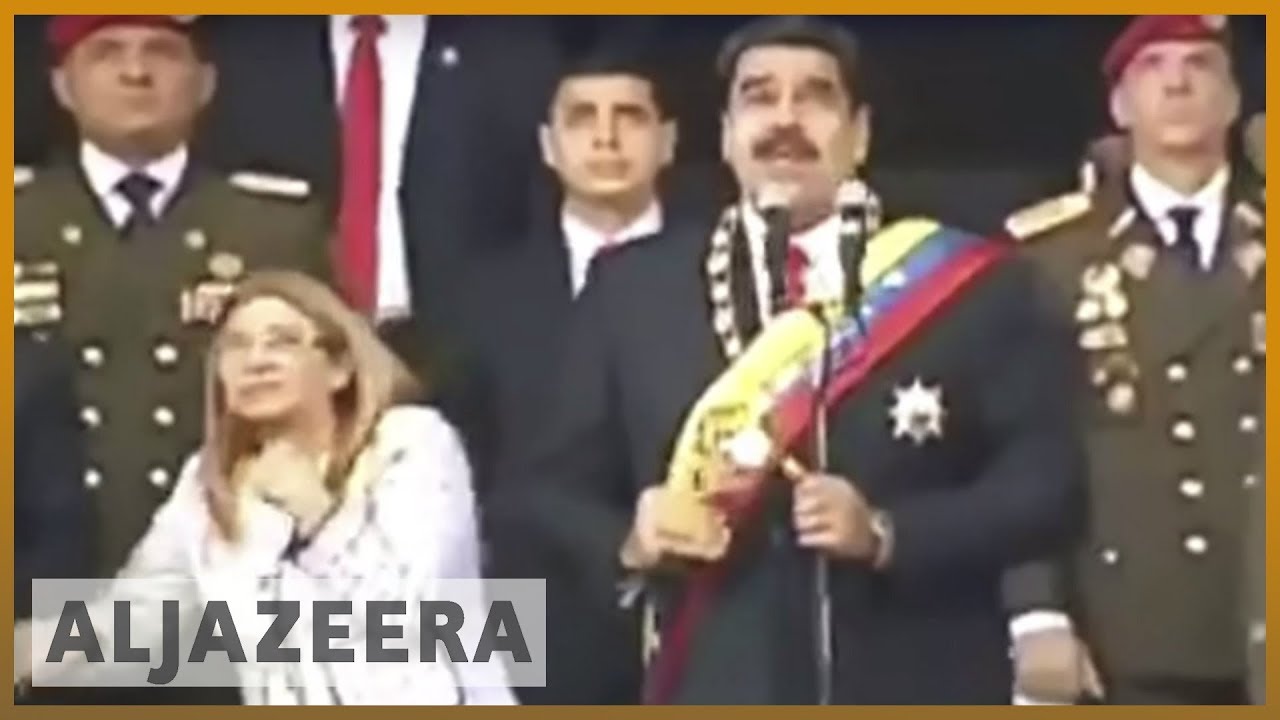 :{ with drone bombs during a military parade in Caracas.}:
More than a decade before these intrigues, a group of right-wing opposition students were hand selected and groomed by an elite, US-funded regime change training academy to topple Venezuela’s government and restore the neoliberal order.
Training from the “‘export-a-revolution’ group that sowed the seeds for a NUMBER of color revolutions”
On October 5, 2005, with Chavez’s popularity at its peak and his government planning sweeping socialist programs, five Venezuelan “student leaders” arrived in Belgrade, Serbia to begin training for an insurrection.
The students had arrived from Venezuela courtesy of the Center for Applied Non-Violent Action and Strategies, or CANVAS. This group is funded largely through the National Endowment for Democracy, a CIA cut-out that functions as the US government’s main arm of promoting regime change; and offshoots like the International Republican Institute and the National Democratic Institute for International Affairs. According to leaked internal emails fromStratfor, an intelligence firm known as the “shadow CIA,”“[CANVAS] may have also received CIA funding and training during the 1999/2000 anti-Milosevic struggle.”
CANVAS is a spinoff of Otpor, a Serbian protest group founded by Srdja Popovic in 1998 at the University of Belgrade. Otpor, which means “resistance” in Serbian, was the student group that gained international fame – and Hollywood-level promotion – by mobilizing the protests that eventually toppled Slobodan Milosevic. This small cell of regime change specialists was operating according to the theories of the late Gene Sharp, the so-called “Clausewitz of non-violent struggle.” Sharp had worked with a former Defense Intelligence Agency analyst, Col. Robert Helvey, to conceive a strategic blueprint that weaponized protest as a form of hybrid warfare, aiming it at states that resisted Washington’s unipolar domination.
A fence covered with posters of Slobodan Milosevic behind bars, titled “When?” and “People’s Movement Otpor” in Belgrade, Serbia, March 30, 2001. Darko Vojinovic | AP]
Otpor was supported by the National Endowment for Democracy, USAID and Sharp’s Albert Einstein Institute. Sinisa Sikman, one of Otpor’s main trainers, once said the group even received direct CIA funding. According to a leaked email from aStratfor staffer, after running Milosevic out of power, “the kids who ran OTPOR grew up, got suits and designed CANVAS… or in other words a ;export-a-revolution’ group that sowed the seeds for a NUMBER of color revolutions. They are still hooked into U.S. funding and basically go around the world trying to topple dictators and autocratic governments (ones that U.S. does not like ;).”
Stratfor revealed that CANVAS “turned its attention to Venezuela” in 2005 after training opposition movements that led pro-NATO regime change operations across Eastern Europe.
While monitoring the CANVAS training program, Stratfor outlined its insurrectionist agenda in strikingly blunt language: “Success is by no means guaranteed, and student movements are only at the beginning of what could be a years-long effort to trigger a revolution in Venezuela, but the trainers themselves are the people who cut their teeth on the ‘Butcher of the Balkans.’ They’ve got mad skills. When you see students at five Venezuelan universities hold simultaneous demonstrations, you will know that the training is over and the real work has begun.”
Birthing the “Generation 2007” regime change cadre
The “real work” began two years later, in 2007, when Guaidó graduated from Andrés Bello Catholic University of Caracas. He moved to Washington DC to enroll in the Governance and Political Management Program at George Washington University under the tutelage of Venezuelan economist Luis Enrique Berrizbeitia, one of the top Latin American neoliberal economists. Berrizbeitia is a former executive director of the International Monetary Fund who spent more than a decade working in Venezuelan energy sector under the oligarchic old regime that was ousted by Chavez.
That year, Guaidó helped lead anti-government rallies after the Venezuelan government declined to to renew the license of Radio Caracas Televisión (RCTV). This privately-owned station played a leading role in the 2002 coup against Hugo Chavez. RCTV helped mobilize anti-government demonstrators, falsified information blaming government supporters for acts of violence carried out by opposition members, and banned pro-government reporting amid the coup. The role of RCTV and other oligarch-owned stations in driving the failed coup attempt was chronicled in the acclaimed documentary, The Revolution Will Not Be Televised.
That same year, the students claimed credit for stymying Chavez’s constitutional referendum for a “21st century socialism” that promised “to set the legal framework for the political and social reorganization of the country, giving direct power to organized communities as a prerequisite for the development of a new economic system.”
From the protests around RCTV and the referendum, a specialized cadre of US-backed class of regime change activists was born. They called themselves “Generation 2007.”
The Stratfor and CANVAS trainers of this cell identified Guaidó’s ally – a street organizer named Yon Goicoechea – as a “key factor” in defeating the constitutional referendum.The following year, Goicochea was rewarded for his efforts with the Cato Institute’s Milton Friedman Prize for Advancing Liberty, along with a $500,000 prize, which he promptly invested into building his own Liberty First (Primero Justicia) political network.
[milton prize px]
no lnx pix
Goicoechea receives the Milton Friedman Prize for Advancing Liberty at the Waldorf-Astoria in New York, May 15, 2008. Seth Wenig | AP
Friedman, of course, was the godfather of the notorious neoliberal Chicago Boys who were imported into Chile by dictatorial junta leader Augusto Pinochet to implement policies of radical “shock doctrine”-style fiscal austerity. And theCato Institute is the libertarian Washington DC-based think tank founded by the Koch Brothers, two top Republican Party donors who have become aggressive supporters of the right-wing across Latin America.
Wikileaks published a 2007 email fromAmerican ambassador to Venezuela William Brownfield sent to the State Department, National Security Council and Department of Defense Southern Command praising “Generation of ’07” for having “forced the Venezuelan president, accustomed to setting the political agenda, to (over)react.” Among the “emerging leaders” Brownfield identified were Freddy Guevara and Yon Goicoechea. He applauded the latter figure as “one of the students’ most articulate defenders of civil liberties.”
Flush with cash from libertarian oligarchs and US government soft power outfits, the radical Venezuelan cadre took their Otpor tactics to the streets, along with a version of the group’s logo, as seen below:
Otpor | Venezuela px]
“Galvanizing public unrest…to take advantage of the situation and spin it against Chavez”
In 2009, the Generation 2007 youth activists staged their most provocative demonstration yet, dropping their pants on public roads and aping the outrageous guerrilla theater tactics outlined by Gene Sharp in his regime change manuals. The protesters had mobilized against the arrest of an ally from another newfangled youth group called JAVU. This far-right group “gathered funds from a variety of US government sources, which allowed it to gain notoriety quickly as the hardline wing of opposition street movements,” according to academic George Ciccariello-Maher’s book, “Building the Commune.”
While video of the protest is not available, many Venezuelans have identified Guaidó as one of its key participants. While the allegation is unconfirmed, it is certainly plausible; the bare-buttocks protesters were members of the Generation 2007 inner core that Guaidó belonged to, and were clad in their trademark Resistencia! Venezuela t-shirts, as seen below:
Juan Guaido | Protest
Is this the ass that Trump wants to install in Venezuela’s seat of power?
That year, Guaidó exposed himself to the public in another way, founding a political party to capture the anti-Chavez energy his Generation 2007 had cultivated. Called Popular Will, it was led byLeopoldo López, a Princeton-educated right-wing firebrand heavily involved in National Endowment for Democracyprograms and elected as the mayor of a district in Caracas that was one of the wealthiest in the country. Lopez was a portrait of Venezuelan aristocracy, directly descended from his country’s first president. He was also thefirst cousin of Thor Halvorssen, founder of the US-based Human Rights Foundation that functions as a de facto publicity shop for US-backed anti-government activists in countries targeted by Washington for regime change.
Though Lopez’s interests aligned neatly with Washington’s, US diplomatic cables published by Wikileaks highlighted the fanatical tendencies that would ultimately lead to Popular Will’s marginalization. One cable identified Lopez as “a divisive figure within the opposition… often described as arrogant, vindictive, and power-hungry.” Others highlighted his obsession with street confrontations and his “uncompromising approach” as a source of tension with other opposition leaders who prioritized unity and participation in the country’s democratic institutions.
Leopoldo Lopez | Wealth
Popular Will founder Leopoldo Lopez cruising with his wife, Lilian Tintori.]
By 2010, Popular Will and its foreign backers moved to exploit the worst drought to hit Venezuela in decades. Massive electricity shortages had struck the country due the dearth of water, which was needed to power hydroelectric plants. A global economic recession and declining oil prices compounded the crisis, driving public discontentment.
Stratfor and CANVAS – key advisors of Guaidó and his anti-government cadre – devised a shockingly cynical plan to drive a dagger through the heart of the Bolivarian revolution. The scheme hinged on a 70% collapse of the country’s electrical system by as early as April 2010.
“This could be the watershed event, as there is little that Chavez can do to protect the poor from the failure of that system,” the Stratfor internal memo declared. “This would likely have the impact of galvanizing public unrest in a way that no opposition group could ever hope to generate. At that point in time, an opposition group would be best served to take advantage of the situation and spin it against Chavez and towards their needs.”
By this point, the Venezuelan opposition was receiving a staggering $40-50 million a year from US government organizations like USAID and the National Endowment for Democracy, according to a report by the Spanish think tank, the FRIDE Institute. It also had massive wealth to draw on from its own accounts, which were mostly outside the country.
While the scenario envisioned by Statfor did not come to fruition, the Popular Will party activists and their allies cast aside any pretense of non-violence and joined a radical plan to destabilize the country.
Towards violent destabilization
In November, 2010, according to emails obtained by Venezuelan security services and presented by former Justice Minister Miguel Rodríguez Torres, Guaidó, Goicoechea, and several other student activists attended a secret five-day training at the Fiesta Mexicana hotel in Mexico City. The sessions were run by Otpor, the Belgrade-based regime change trainers backed by the US government. The meeting had reportedly received the blessing of Otto Reich, a fanatically anti-Castro Cuban exile working in George W. Bush’s Department of State, and theright-wing former Colombian President Alvaro Uribe.
At the Fiesta Mexicana hotel, the emails stated, Guaidó and his fellow activists hatched a plan to overthrow President Hugo Chavez by generating chaos through protracted spasms of street violence.
Three petroleum industry figureheads – Gustavo Torrar, Eligio Cedeño and Pedro Burelli – allegedly covered the $52,000 tab to hold the meeting.Torrar is a self-described “human rights activist” and “intellectual” whose younger brother Reynaldo Tovar Arroyo is the representative in Venezuela of the private Mexican oil and gas company Petroquimica del Golfo, which holds a contract with the Venezuelan state.
Cedeño, for his part, is a fugitive Venezuelan businessman who claimed asylum in the United States, and Pedro Burelli a former JP Morgan executive and the former director of Venezuela’s national oil company, Petroleum of Venezuela (PDVSA). He left PDVSA in 1998 as Hugo Chavez took power and is on the advisory committee of Georgetown University’s Latin America Leadership Program.
Burelli insisted that the emails detailing his participation had been fabricated and even hired a private investigator to prove it. The investigator declared that Google’s records showed the emails alleged to be his were never transmitted.
Yet today Burelli makes no secret of his desire to see Venezuela’s current president, Nicolás Maduro, deposed – and even dragged through the streets and sodomized with a bayonet, as Libyan leader Moammar Qaddafi was by NATO-backed militiamen.
View image on TwitterView image on Twitter
Pedro Mario Burelli
@pburelli
.@NicolasMaduro, jamas me has hecho caso. Me has fustigado/perseguido como @chavezcandanga jamás osó. Óyeme, tienes sólo dos opciones en las próximas 24 horas:
- Como Noriega:pagar pena por narcotráfico y luego a @IntlCrimCourt La Haya por DDHH.
- O a la Gaddafi.
Escoge ya!
1,051
10:09 PM - Jan 16, 2019
1,252 people are talking about this
The alleged Fiesta Mexicana plot flowed into another destabilization plan revealed in a series of documents produced by the Venezuelan government. In May 2014, Caracas released documents detailing an assassination plot against President Nicolás Maduro. The leaks identified the Miami-based Maria Corina Machado as a leader of the scheme. A hardliner with a penchant for extreme rhetoric, Machado has functioned as an international liaison for the opposition, visiting President George W. Bush in 2005.
maria corina machado | george bush
Machado and George W. Bush, 2005.]
“I think it is time to gather efforts; make the necessary calls, and obtain financing to annihilate Maduro and the rest will fall apart,” Machado wrote in an email to former Venezuelan diplomat Diego Arria in 2014.
In another email, Machado claimed that the violent plot had the blessing of US Ambassador to Colombia, Kevin Whitaker. “I have already made up my mind and this fight will continue until this regime is overthrown and we deliver to our friends in the world. If I went to San Cristobal and exposed myself before the OAS, I fear nothing. Kevin Whitaker has already reconfirmed his support and he pointed out the new steps. We have a checkbook stronger than the regime’s to break the international security ring.”
Guaidó heads to the barricades
That February, student demonstrators acting as shock troops for the exiled oligarchy erected violent barricades across the country, turning opposition-controlled quarters into violent fortresses known as guarimbas. While international media portrayed the upheaval as a spontaneous protest against Maduro’s iron-fisted rule, there was ample evidence that Popular Will was orchestrating the show.
“None of the protesters at the universities wore their university t-shirts, they all wore Popular Will or Justice First t-shirts,” a guarimba participant said at the time. “They might have been student groups, but the student councils are affiliated to the political opposition parties and they are accountable to them.”
Asked who the ringleaders were, the guarimba participant said, “Well if I am totally honest, those guys are legislators now.”
Around 43 were killed during the 2014 guarimbas. Three years later, they erupted again, causing mass destruction of public infrastructure, the murder of government supporters, and the deaths of 126 people, many of whom were Chavistas. In several cases, supporters of the government were burned alive by armed gangs.
Guaidó was directly involved in the 2014 guarimbas. In fact, he tweeted video showing himself clad in a helmet and gas mask, surrounded by masked and armed elements that had shut down a highway that were engaging in a violent clash with the police. Alluding to his participation in Generation 2007, he proclaimed, “I remember in 2007, we proclaimed, ‘Students!’ Now, we shout, ‘Resistance! Resistance!’”
Guaidó has deleted the tweet, demonstrating apparent concern for his image as a champion of democracy.
On February 12, 2014, during the height of that year’s guarimbas, Guaidó joined Lopez on stage at a rally of Popular Will and Justice First. During a lengthy diatribe against the government, Lopez urged the crowd to march to the office of Attorney General Luisa Ortega Diaz. Soon after, Diaz’s office came under attack by armed gangs who attempted to burn it to the ground. She denounced what she called “planned and premeditated violence.”
Leopoldo Lopez | Juan Guaido
Guaido alongside Lopez at the fateful February 12, 2014 rally. Photo | PanAm Post]
In a televised appearance in 2016, Guaidó dismissed deaths resulting from guayas – a guarimba tactic involving stretching steel wire across a roadway in order to injure or kill motorcyclists – as a “myth.” His comments whitewashed a deadly tactic that had killed unarmed civilians like Santiago Pedroza and decapitated a man named Elvis Durán, among many others.
This callous disregard for human life would define his Popular Will party in the eyes of much of the public, including many opponents of Maduro.
Cracking down on Popular Will
As violence and political polarization escalated across the country, the government began to act against the Popular Will leaders who helped stoke it.
Freddy Guevara, the National Assembly Vice-President and second in command of Popular Will, was a principal leader in the 2017 street riots. Facing a trial for his role in the violence, Guevara took shelter in the Chilean embassy, where he remains.
Lester Toledo, a Popular Will legislator from the state of Zulia, was wanted by Venezuelan government in September 2016 on charges of financing terrorism and plotting assassinations. The plans were said to be made with former Colombian President Álavaro Uribe. Toledo escaped Venezuela and went on several speaking tours with Human Rights Watch, the US government-backed Freedom House,the Spanish Congress and European Parliament.
Carlos Graffe, another Otpor-trained Generation 2007 member who led Popular Will, was arrested in July 2017. According to police, he was in possession of a bag filled with nails, C4 explosives and a detonator. He was released on December 27, 2017.
Leopoldo Lopez, the longtime Popular Will leader, is today under house arrest, accused of a key role in deaths of 13 people during the guarimbas in 2014. Amnesty International lauded Lopez as a “prisoner of conscience” and slammed his transfer from prison to house as “not good enough.” Meanwhile, family members of guarimba victims introduced a petition for more charges against Lopez.
Yon Goicoechea, the Koch Brothers posterboy and US-backed founder of Justice First, was arrested in 2016 by security forces who claimed they found a kilo of explosives in his vehicle. In a New York Times op-ed, Goicoechea protested the charges as “trumped-up” and claimed he had been imprisoned simply for his “dream of a democratic society, free of Communism.” He was freed in November 2017.
View image on Twitter
@YonGoicoechea
Hoy, en Caricuao. Llevo 15 años trabajando con @jguaido. Confío en él. Conozco la constancia y la inteligencia con la que se ha construido a sí mismo. Está haciendo las cosas con bondad, pero sin ingenuidad. Hay una posibilidad abierta hacia la libertad
5:10 PM - Jan 19, 2019
136 people are talking about this
David Smolansky, also a member of the original Otpor-trained Generation 2007, became Venezuela’s youngest-ever mayor when he was elected in 2013 in the affluent suburb of El Hatillo. But he was stripped of his position and sentenced to 15 months in prison by the Supreme Court after it found him culpable of stirring the violent guarimbas.
Facing arrest, Smolansky shaved his beard, donned sunglasses and slipped into Brazil disguised as a priest with a bible in hand and rosary around his neck. He now lives in Washington, DC, where he was handpicked bySecretary of the Organization of American States Luis Almagro to lead the working group on the Venezuelan migrant and refugee crisis.
This July 26, Smolansky held what he called a “cordial reunion” with Elliot Abrams,the convicted Iran-Contra felon installed by Trump as special US envoy to Venezuela. Abrams is notorious for overseeing the US covert policy of arming right-wing death squads during the 1980’s in Nicaragua, El Salvador, and Guatemala. His lead role in the Venezuelan coup has stoked fears that another blood-drenched proxy war might be on the way.
David Smolansky
@dsmolansky
Cordial reunión en la ONU con Elliott Abrams, enviado especial del gobierno de EEUU para Venezuela. Reiteramos que la prioridad para el gobierno interino que preside @jguaido es la asistencia humanitaria para millones de venezolanos que sufren de la falta de comida y medicinas.
10:46 AM - Jan 26, 2019
2,619 people are talking about this
Four days earlier, Machado rumbled another violent threat against Maduro, declaring that if he “wants to save his life, he should understand that his time is up.”
A pawn in their game
The collapse of Popular Will under the weight of the violent campaign of destabilization it ran alienated large sectors of the public and wound much of its leadership up in exile or in custody. Guaidó had remained a relatively minor figure, having spent most of his nine-year career in the National Assembly as an alternate deputy. Hailing from one of Venezuela’s least populous states, Guaidó came in second place during the 2015 parliamentary elections,winning just 26% of votes cast in order to secure his place in the National Assembly. Indeed, his bottom may have been better known than his face.
Guaidó is known as the president of the opposition-dominated National Assembly, but he was never elected to the position. The four opposition parties that comprised the Assembly’s Democratic Unity Table had decided to establish a rotating presidency. Popular Will’s turn was on the way, but its founder, Lopez, was under house arrest. Meanwhile, his second-in-charge, Guevara, had taken refuge in the Chilean embassy. A figure named Juan Andrés Mejía would have been next in line but reasons that are only now clear, Juan Guaido was selected.
“There is a class reasoning that explains Guaidó’s rise,” Sequera, the Venezuelan analyst, observed. “Mejía is high class, studied at one of the most expensive private universities in Venezuela, and could not be easily marketed to the public the way Guaidó could. For one, Guaidó has common mestizo features like most Venezuelans do, and seems like more like a man of the people. Also, he had not been overexposed in the media, so he could be built up into pretty much anything.”
In December 2018, Guaidó sneaked across the border and junketed to Washington, Colombia and Brazil to coordinate the plan to hold mass demonstrations during the inauguration of President Maduro. The night before Maduro’s swearing-in ceremony, both Vice President Mike Pence and Canadian Foreign Minister Chrystia Freeland called Guaidó to affirm their support.
A week later, Sen. Marco Rubio, Sen. Rick Scott and Rep. Mario Diaz-Balart – all lawmakers from the Florida base of the right-wing Cuban exile lobby – joined President Trump and Vice President Pence at the White House. At their request, Trump agreed that if Guaidó declared himself president, he would back him.
Secretary of State Mike Pompeo met personally with Guaidó on January 10, according to the Wall Street Journal. However, Pompeo could not pronounce Guaidó’s name when he mentioned him in a press briefing on January 25, referring to him as “Juan Guido.”
Embedded video
Dan Cohen
@dancohen3000
Secretary of State Mike Pompeo just called the figure Washington is attempting to install as Venezuelan President "Juan *Guido*" - as in the racist term for Italians. America's top diplomat didn't even bother to learn how to pronounce his puppet's name.
1:58 PM - Jan 25, 2019
By January 11, Guaidó’s Wikipedia page had been edited 37 times, highlighting the struggle to shape the image of a previously anonymous figurewho was now a tableau for Washington’s regime change ambitions. In the end, editorial oversight of his page was handed over to Wikipedia’s elite council of “librarians,” who pronounced him the “contested” president of Venezuela.
Guaidó might have been an obscure figure, but his combination of radicalism and opportunism satisfied Washington’s needs. “That internal piece was missing,” a Trump administration said of Guaidó. “He was the piece we needed for our strategy to be coherent and complete.”
“For the first time,” Brownfield, the former American ambassador to Venezuela, gushed to the New York Times, “you have an opposition leader who is clearly signaling to the armed forces and to law enforcement that he wants to keep them on the side of the angels and with the good guys.”
But Guaidó’s Popular Will party formed the shock troops of the guarimbas that caused the deaths of police officers and common citizens alike. He had even boasted of his own participation in street riots. And now, to win the hearts and minds of the military and police, Guaido had to erase this blood-soaked history.
On January 21, a day before the coup began in earnest, Guaidó’s wife delivered a video address calling on the military to rise up against Maduro. Her performance was wooden and uninspiring, underscoring the her husband’s limited political prospects.
At a press conference before supporters four days later, Guaidó announced his solution to the crisis: “Authorize a humanitarian intervention!”
While he waits on direct assistance, Guaidó remains what he has always been – a pet project of cynical outside forces. “It doesn’t matter if he crashes and burns after all these misadventures,” Sequera said of the coup figurehead. “To the Americans, he is expendable.”
Top Photo | Venezuela’s self-declared interim leader Juan Guaido, center, greets supporters after a rally at a public plaza in Las Mercedes neighborhood of Caracas, Venezuela, Jan. 26, 2019. Fernando Llano | AP]
Dan Cohen is a journalist and filmmaker. He has produced widely distributed video reports and print dispatches from across Israel-Palestine. Dan is a correspondent at RT America and tweets at @DanCohen3000.
Max Blumenthal is the founder and editor of GrayzoneProject.com, the co-host of the podcast Moderate Rebels, the author of several books and producer of full-length documentaries including the recently released Killing Gaza. Follow him on Twitter at @MaxBlumenthal.
Source | GrayZone Project
==
==
Soliciting smears, dreaming of headless opponents
Who is Boyd, and how did he appear in the middle of the Snowden saga?
A London-based representative of Venezuela’s political opposition, Boyd solicits his services as an opposition researcher, informing potential clients through his official bio, [13] “Alek can be contracted to do due diligence on individuals and companies in Venezuela and LatAm.”
As I reported for The Electronic Intifada [14], Boyd has repeatedly promoted terrorism and assassination against members of the elected government of Venezuela. Back in 2004, Boyd wrote, “I wish I could decapitate in public plazas [Venezuelan politicians] Lina Ron and Diosdado Cabello. I wish I could torture for the rest of his remaining existence Vice President Jose Vicente Rangel … I wish I could fly over Caracas slums throwing the dead bodies of the criminals that have destroyed my country … Only barbaric practices will neutralize them, much the same way [Genghis] Khan did. I wish I was him.” A year later, he declared, “Re: advocating for violence yes I have mentioned in many occasions that in my view that is the only solution left for dealing with [Hugo] Chavez.”
In 2008, Boyd’s services were contracted by the Human Rights Foundation (HRF), an NGO run by a veteran conservative activist named Thor Halvorssen. [14] The son of a Venezuelan oligarch and former CIA asset who funneled money to the Nicaraguan Contras, Halvorssen founded HRF to publicize the human rights abuses of Hugo Chavez’s government. His first cousin, Leopoldo Lopez, the son of an oil industry executive, is one of the most visible leaders of the Venezuelan opposition, and as such, has received substantial financial support from the US. In 2002, Lopez was among the politicians who momentarily seized power from Chavez during a failed coup attempt. At the 2010 Oslo Freedom Forum, a yearly confab Halvorssen promotes as “the Davos of human rights,” Lopez was presented to an audience of foreign correspondents and diplomats as a “human rights leader.”
Boyd claimed [15] that during his year and a half working for Halvorssen, he successfully campaigned for the release of Guadelupe Llori, an Ecuadorian opposition politician jailed by Correa under charges of sabotage and terrorism for her role in leading a crippling oil workers’ strike. (After her release, Llori was junketed to Halvorssen’s Oslo Freedom Forum). During this time Boyd visited Llori in prison in Ecuador while meeting [16] opposition activists “to coordinate future projects,” as he told an interviewer. Whether this was how he made initial contact with the source that supplied him and Buzzfeed with the documents on Ecuador’s deal with the Israeli surveillance firms is unknown.
Boyd may have never met Buzzfeed’s Gray, however, each are well acquainted with Halvorssen. This May, Gray was among the select cadre of journalists flown to the Oslo Freedom Forum to provide positive PR for Halvorssen and his global operation. Gray returned with a fawning profile [17] of Halvorssen, portraying him as an iconoclastic activist whose “job of opposing strongmen is arguably more media-friendly than that of anyone doing human rights work today.”
In contrast to Buzzfeed’s profile of Greenwald, Gray cast Halvorssen’s eccentricities as charming quirks that bore little relevance to the larger story. And his intimate ties to the right-wing Venezuelan opposition and the oligarchic forces seeking to topple socialist-oriented governments in South America went unmentioned.
Right-wing corporate lobbyists target Correa
Ecuador’s Correa is among the most popular of the Latin American leaders to embrace Hugo Chavez’s socialist economic model. Having defiantly defaulted on $3.2 billion in foreign loans, he has been able to leverage his country’s oil wealth to drastically expand social programs, improving access to education and doubling spending on healthcare while lowering poverty rates by a remarkable five percent since he took office in 2007. Naturally, Correa’s rejection of neoliberal policies has earned him a fair share of enemies, especially among the elites who have traditionally governed Ecuador. In 2010, he resisted a coup attempt [18] led by Lucio Gutierrez, a former president who earned the wrath of Ecuador’s poor by implementing crushing IMF-imposed austerity measures.
Correa’s opponents may have resorted to zero-sum politics, but his response has not always been judicious. He has, for example, advanced [19] criminal libel laws as a means of punishing opposition media and has battled indigenous groups that protested his attempts to open their land up to wide-scale state mining operations. The Committee to Protect Journalists has accused [20]Correa of leading Ecuador “into a new era of widespread repression.”
Of all the enemies Correa has earned, some of his fiercest reside not in Quito, but in the conservative think tanks of Washington. They include George W. Bush’s former Latin America handlers and a coterie of corporate-bankrolled right-wing radicals determined to unravel the South American socialist bloc.
Ezequiel Vazquez Ger, [21] an Argentina-born economist, is among the most aggressive of Correa’s antagonists. Vazquez Ger works for a DC-based lobbying firm run by Otto Reich, a Cuban exile who served as the Assistant Secretary of State for Western Hemisphere Affairs under the second Bush administration. In 1987, Reich was singled out [22] during the US Comptroller General’s investigation of Iran-Contra for having “engaged in prohibited, covert propaganda activities” on behalf of the Nicaraguan Contras. He is also suspected [23] of helping the anti-Castro terrorist Orlando Bosch escape prosecution in Venezuela.
Reich contracted Vazquez Ger in 2011 to help him oversee a portfolio of corporate clients [24] that included Lockheed Martin, Exxon Mobil, and Bacardi International, the rum company whose lawyers drafted much of the 1996 Helms-Burton Act tightening the US embargo of Cuba. Before he partnered with Reich, Vazquez Ger served as a Latin American fellow at the Atlas Economic Research Foundation, [25] a corporate funded think tank that promotes climate change denialism and sweeping deregulation policies.
To compliment their lobbying operation, Vazquez Ger and Reich have churned out a steady stream [21] of op-eds for publications from Foreign Policy to Fox News to the Miami Herald, [26]demonizing the socialist leaders of South America who have stifled the ambitions of multi-national corporations. During the past year, they homed in on Correa, assailing him for sheltering Assange while he cracked down on opposition media. In a June 2012 op-ed [27] for the right-wing Newsmax website, Reich and Vazquez Ger cited Assange as a key reason why the US should refuse to sign any further trade agreements with Ecuador. “Signing or renewing trade agreements with Ecuador will only allow Rafael Correa to continue undermining US foreign policy,” they wrote, “trading with our enemies, and destroying his country’s democracy.” (Following threats from Congress over its alleged offer to shelter Snowden, Ecuador’s government unilaterally rejected [28] US trade preferences).
When Buzzfeed published its expose on Ecuador, Vazquez Ger was overjoyed. A heavily trafficked US news site had recycled he and Reich’s attacks on Correa’s support for Assange, this time framing Ecuador’s president as a hypocrite for supposedly offering asylum to Snowden. At 7:28 PM on June 25 -- a full 27 minutes after the article appeared -- Vazquez Ger took to Twitter topromote [29] the piece to his Spanish-language followers. Next, he personally thanked [30] Buzzfeed Editor-in-Chief Ben Smith “for unmasking [Correa’s] hypocrisy.”
The following day, at a press conference in Ecuador, Interior Minister Jose Serrano was asked to answer for the Buzzfeed report. Buzzfeed’s Gray quickly picked up Serrano’s defensive comments,quoting them [31] in a follow-up story alongside a strident denunciation of Correa’s sheltering of Assange by Cléver Jiménez, a key opposition leader. Meanwhile, Alek Boyd projected the story of Ecuador’s surveillance deal into South American media, publishing it as an “exclusive” [32] in Semana, a leading Colombian daily.
Whoever planted the story with Buzzfeed appeared to have scored a major success,exploiting the Snowden drama to tarnish the image of Ecuador’s government. Though the identity of the source that triggered the operation may never be known, their agenda does not seem to be much of a mystery anymore.
Selling NAFTA
In 1990 the Mexican government hired B-M to sell NAFTA to the American public, media and politicians. B-M subcontracted this job to one of its subsidiaries, The Brock Group (TBG), a consulting firm that has done work for American Express, Bell Atlantic, Bacardi, Toyota and the Taiwanese government. TBG is headed by former senator, Republican National Committee chairman, US trade representative and labor secretary William Brock. He was certainly qualified for the job. As US trade representative, Brock engineered the Caribbean Basin Initiative and the US-Israel Free Trade Agreement, and began the negotiations that would eventually culminate in the signing of the US-Canada Free Trade Agreement.
William Brock co-chairs the Multilateral Trade Negotiations (MTN) Coalition, which was founded in 1990 to 'educate' the public-- and lobby for--the now-completed Uruguay Round of the General Agreement on Tariffs and Trade (GATT). The coalition's members include American Express, General Motors, IBM, General Electric, Cargill, Citicorp, Procter & Gamble and other companies and trade associations. According to Malaysian activist Martin Khor Kok Peng, the MTN Coalition had a big influence on the 1990 G-7 Summit meeting held in Houston, USA, in which GATT figured prominently. At the Houston Summit, MTN held a high- profile press conference and released a report by an 'eminent persons group' on world trade.
The Contra Connection
One of TBG's top executives happens to be former Miami businessman and ambassador to Venezuela Otto Reich.During the Reagan administration, the Cuban-born Reich headed the US state department's Office of Public Diplomacy (OPD), whose task was to disseminate disinformation about the Sandinistas and discourage reporting critical of the contras. This outfit, whose operations were later found to be illegal by the US General Accounting Office, was staffed with five psychological warfare specialists from the 4th Psychological Operations Group of Fort Bragg. According to John Stauber and Sheldon Rampton, "the OPD...helped spread a scurrilous story that some American reporters had received sexual favors from Sandinista prostitutes in return for writing slanted stories". In 1987, after the US Congress shut down the OPD, congressman Jack Brooks called it "an important cog in the (Reagan) administration's effort to manipulate public opinion and congressional action".
Interestingly enough, the OPD was conceived at an August 1983 meeting between then CIA director William Casey and a small group of PR industry executives. The meeting, whose purpose was to create a propaganda strategy for the Nicaraguan contras, was attended by B-M senior vice- president Kenneth D. Huszar and Philip Morris publicist James Bowling, who later moved to B-M. Their advice to Casey included the creation of a communications function within the White House, a recommendation that led to the creation of the OPD.
B-M, Mexico and the Neoliberal Project
B-M's success in insuring the passage of NAFTA encouraged the Mexican governing elite to retain the firm's services. It now has a luxurious office in the posh Colonia Anzures district on Mexico City that caters to customers like the Council of Businessmen, the National Stockbrokers' Association, the ministry of commerce and industrial development, and the Office of the President of the Republic. In addition to this, B-M parent Young & Rubicam rakes in over $100 million every year from Mexican clients. It is not an exaggeration to say that the credibility of the neoliberal project in the western hemisphere hinges on Mexico. Businessmen, politicians and neoliberal ideologues all over the hemisphere have touted Mexico as a symbol of capitalist success because of its privatization policy and its faithful adherence to the economic formulas prescribed by multilateral development banks (a.k.a. the Bretton Woods institutions). After the massive expenditure of political energy in getting NAFTA passed, business elites in both Mexico and the US are hard-pressed to put on a convincing performance in order to give credibility to future trade agreements. Bringing Guatemala and Chile into NAFTA has already become an agenda item.
However, neoliberal designs for Mexico are endangered by a series of crises, including the blatantly fraudulent elections of 1994, the embarassing collapse of the peso, revelations of drug-related corruption that compromise the Mexican elite all the way up to the president's office, a spate of political assassinations that seems to be beheading the ruling political party's leadership, and the popularity of the EjE9rcito Zapatista de LiberaciF3n Nacional (EZLN). B-M has a lot of work to do in Mexico. In the words of reporter Jon Reed, who investigated B-M's activities in Mexico, "Burson-Marsteller and other Mexican and transnational PR firms have demonstrated their effectiveness by working behind the scenes-- gauging public opinion, counseling government and corporate leaders, shaping media coverage, and facilitating elite-to-elite communications-- in short, guaranteeing that the inevitable upheavals in an authoritarian and unjust society do not interrupt business as usual".
the holl
Amb. Otto Reich and Ezequiel Vázquez-Ger: More questions about Iran’s activities in Ecuador
1
2
By Otto J. Reich & Ezequiel Vázquez-Ger - 08/06/12 02:14 PM EDT
Last month the Ecuadorian press widely published evidence of President Rafael Correa’s efforts to establish a financial mechanism that would allow Iran to move money easily throughout Latin America, in effect hiding Iranian money in Ecuador’s banking structure.
Negative public reaction to the articles forced Correa — and his cousin Pedro Delgado, who is also president of the Central Bank — to finally admit that Ecuador was, in fact, negotiating the opening of accounts by the government-administered Bank Cofiec in Iranian banks. After years of official silence, they also said that there was nothing illegal in the accounts, and that the banking relationship with Iran was strictly for commercial reasons. After the articles appeared, however — and after members of the Ecuadorian National Assembly and the press began inquiring — the CEO and other members of the suspect Bank Cofiec quit their jobs. This is a drastic move, if their actions were just “commercial.”
ADVERTISEMENT
The mystery regarding the relations between Ecuador and Iran, and the increasing tensions between Ecuador and the United States, make it necessary for the U.S. government and the Ecuadorian people to ask several questions of Correa and Delgado so as to have a clearer understanding of the situation. The questions are:
1) Delgado had meetings in three banks in Moscow in February of this year. One of them was Bank Melli, an Iranian bank that has been sanctioned by the U.S. Treasury Department’s Office of Foreign Assets Controls (OFAC) due to its businesses with Iran’s Defense establishment. Furthermore, according to internal memoranda, Delgado tried to sell Bank Cofiec to the Export Development Bank of Iran (EDBI), a bank that has also been designated by the U.S. Treasury Department. Why does Delgado insist on having meetings with banks that have been sanctioned by the United States? Is it true, as we have been shown, that he opened safe deposit boxes in another Moscow bank, and deposited $500,000 in cash? If so, where did that money come from? Why was it in Delgado’s hands?
2) Also in February, a delegation from Petroecuador, Ecuador’s state oil company, flew to Iran with the goal of “advancing relations” between both countries. On February 25, there was a meeting in the Iranian Petroleum Ministry in Tehran with the presence of delegates from Petroecuador, the National Iranian Oil Refining and Distribution Co. and the Export Development Bank of Iran. During the meeting EDBI offered a $400 million dollar credit line to Petroecuador. How does Correa intend to implement this credit line since EDBI has been banned from making international transactions?
3) Between July 2009 and July 2011, Ecuador signed four contracts with PetroChina that committed Ecuador to selling a total of 385,560,000 barrels of oil in the next four years at highly discounted prices (between $2 and $8 per barrel below the spot price). Considering that this transaction will cost the Ecuadorian people around $2 billion, who are the intermediaries who are profiting from an operation so financially detrimental to Ecuador? Furthermore, Ecuador signed an irrevocable letter in favor of PetroChina through which the latter is granted the right to seize any Ecuadorian oil sold to another company other than PetroChina and the China Development Bank in case Ecuador does not fulfill the contracts. Why has Correa decided to grant China such control over Ecuador’s sovereignty and oil resources? In addition, according to bills of lading in our possession, the aforementioned oil is not being shipped to China, but to the United States and Panama. Since Iran is one of China’s main oil suppliers, is it possible that Ecuador is swapping oil deliveries with China to benefit Iran?
4) Why does Correa insist on strengthening financial relations with Iran even though Ecuador’s trade with that country is minimal, and given the high risks that this relationship implies for Ecuador’s financial system? Could the answer be that he has decided to help Iran move money throughout Latin America? U.S. Ambassador to Ecuador Adam Namm has said that although Ecuador is free to have bilateral relations with any country in the world, it could have to contend with sanctions from the United States if it infringes on U.S. sanctions regarding Iran. He also said that officials from the U.S. Treasury Department went to Ecuador months ago to explain this situation in person.
The evidence of the above financial chicanery is in the hands of the U.S. government. The government has a responsibility to enforce U.S. law. If Delgado has indeed broken the U.S. Iran Sanctions Act, as the evidence indicates, the very least the United States should do is designate Delgado and the Central Bank of Ecuador. Delgado has properties and businesses in the United States and still holds a valid U.S. visa. Why is someone who is actively collaborating with Iran on behalf of a foreign government still enjoying the privileges of U.S. hospitality?
Reich is a former U.S. assistant secretary of State for the Western Hemisphere under former President George W. Bush and U.S. ambassador to Venezuela. Vázquez-Ger is an associate at Otto Reich Associates LLC and member of the non-profit organization The Americas Forum.
note links lost and images: nb blog
Daily Archives: February 1, 2010
The Declassified Record of Amb. Otto Juan Reich–Off. Public Diplomacy
Posted on February 1, 2010 by therearenosunglasses
The National Security Archive—George Washington University
Ad placed by the Young Republicans, one of the groups under the cognizance of the Office of Public Diplomacy and discussed by Oliver North in a March 20, 1985 memorandum.
A National Security Archive
Electronic Briefing Book
Edited by
Thomas Blanton
March 2, 2001
Jump to the document list
The Bush administration has floated the name of Otto Juan Reich for possible nomination as Assistant Secretary of State for Latin American Affairs (see Al Kamen, “In the Loop,” The Washington Post, 15 February 2001). Mr. Reich served in the Reagan administration as assistant administrator of the Agency for International Development (AID) from 1981 to 1983, then as the first director of the State Department’s Office of Public Diplomacy for Latin America and the Caribbean (S/LPD) from 1983 to 1986, and finally as ambassador to Venezuela.Mr. Reich’s tenure at the Office of Public Diplomacy generated major controversy during the exposure of the Iran-contra scandal and left an extensive document trail, some of the highlights of which are included in this Briefing Book. For example:
* The Comptroller-General of the U.S., a Republican appointee, found that some of the efforts of Mr. Reich’s public diplomacy office were “prohibited, covert propaganda activities,” “beyond the range of acceptable agency public information activities….” The same September 30, 1987 letter concluded that Mr. Reich’s office had violated “a restriction on the State Department’s annual appropriations prohibiting the use of federal funds for publicity or propaganda purposes not authorized by Congress.” The letter also said, “We do not believe, however, that available evidence will support a conclusion that the applicable antilobbying statute has been violated.”
* The General Accounting Office in an October 30, 1987 letter and report found that Mr. Reich’s office “generally did not follow federal regulations governing contractual procedures” in its contracting “with numerous individuals and several companies.” The GAO quoted Mr. Reich as saying “he was generally unfamiliar with the details related to the office’s contracting procedures. Instead he relied on his staff as well as State’s procurement office to ensure that federal regulations were adhered to.”
* The bipartisan report of the Congressional Iran-contra committees (November 1987, p. 34) found that “[i]n fact, ‘public diplomacy’ turned out to mean public relations-lobbying, all at taxpayers’ expense.” The committees concluded their discussion by quoting the Comptroller-General’s findings in the September 30, 1987 letter. A detailed critique of the public diplomacy operation, written by Iran-contra committee staff, was deleted from the Iran-contra report after heated partisan debate (see Robert Parry and Peter Kornbluh, “Iran-Contra’s Untold Story,” Foreign Policy, No. 72, Fall 1988, pp. 3-30).
* A staff report by the House Foreign Affairs Committee (September 7, 1988) summarized various investigations of Mr. Reich’s office and concluded that “senior CIA officials with backgrounds in covert operations, as well as military intelligence and psychological operations specialists from the Department of Defense, were deeply involved in establishing and participating in a domestic political and propaganda operation run through an obscure bureau in the Department of State which reported directly to the National Security Council rather than through the normal State Department channels…. Through irregular sole-source, no-bid contracts, S/LPD established and maintained a private network of individuals and organizations whose activities were coordinated with, and sometimes directed by, Col. Oliver North as well as officials of the NSC and S/LPD. These private individuals and organizations raised and spent funds for the purpose of influencing Congressional votes and U.S. domestic news media. This network raised and funneled money to off-shore bank accounts in the Cayman Islands or to the secret Lake Resources bank account in Switzerland for disbursement at the direction of Oliver North. Almost all of these activities were hidden from public view and many of the key individuals involved were never questioned or interviewed by the Iran/Contra Committees.”
* Mr. Reich responded in detail to questioning by staff of the Iran/Contra Committees in a formal deposition on July 15, 1987. The full text of the 122-page deposition is included here. Part of the questioning revolved around a lengthy March 20, 1985 memo written by Oliver North to National Security Adviser Robert McFarlane, providing “the chronology of events aimed at securing Congressional approval for renewed support to the Nicaraguan Resistance Forces.” The chronology contains repeated listings of actions to be taken by “State/LPD (Reich)”; however, Mr. Reich testified that he “never saw it as a tasking memorandum” and that he was unaware that his contractors were involved in lobbying efforts or ads targeted on specific members of Congress. North’s memo also referred to an advertisement (“53 cents per day supports a freedom fighter”) that was off-message; the text of the ad was attached to Mr. Reich’s deposition as an exhibit.
* On March 12, 1985, one of Mr. Reich’s staff, Daniel “Jake” Jacobowitz, on detail from the U.S. Air Force, wrote a detailed “public diplomacy action plan” that paralleled the North chronology, with candid commentary about the lobbying campaign including a three-item list of audiences: “U.S. Congress,” “U.S. media,” and “interest groups.”
* On March 13, 1985, Mr. Reich’s deputy, Johnathan S. Miller, wrote a two-page report to White House director of communications Pat Buchanan, giving what Miller called “[f]ive illustrative examples of the Reich ‘White Propaganda’ operation.” These included op-eds the office had written or placed covertly, without any acknowledgement of the government’s role, and planned op-eds under the contra leaders’ bylines.
* Mr. Reich sought and obtained staff for his office by getting them detailed from various U.S. military units engaged in “psychological operations.” The declassified documents include requests for these detailees on March 5, 1985 and on September 18, 1985, a staff discussion of the need for detailees on December 10, 1985, a December 16, 1985 request for certificates of appreciation for five detailees, and a plaintive memo to NSC staffer and former CIA official Walt Raymond on January 5, 1986 complaining that the Pentagon had turned down a new request for detailees. Perhaps the most illuminating discussion of the psyops detailees can be found in a May 30, 1985 memo from Jake Jacobowitz to Mr. Reich about the impending arrival of five detailees, calling them the “A-team” and including the comment “Since he is a PSYOP type he will also be looking for exploitable themes and trends….”
* The final document included here is an April 15, 1984 memo drafted by Mr. Reich for Secretary of State George Shultz to send to President Reagan, describing a specific intervention by Mr. Reich with CBS News as an example of the day-to-day work of the public diplomacy office.
Posted in Uncategorized
Head of Reagan’s Disinformation Network Still Undermining Nations, Honduran Coup
Posted on February 1, 2010 by therearenosunglasses
[SEE: A CIA propaganda apparatus aimed at the American people–Oct. 2001]
Ad placed by the Young Republicans, one of the groups under the cognizance of the Office of Public Diplomacy and discussed by Oliver North in a March 20, 1985 memorandum.
Otto Reich and the Honduran Coup D’Etat:
The Provocateur, his Protege, and the Toppling of a President – Part One
The story of Otto Reich’s role in fomenting the June coup d’etat in Honduras is not a brief one. This report will be posted over two days.
OTTO REICH AND THE HONDURAN COUP D’ETAT:
The Provocateur, his Protégé, and the Toppling of a President (Part One)
By Machetera*
The very same day that the coup d’etat in Honduras began, in an emergency session of the Organization of American States (OAS) in Washington D.C., Roy Chaderton, the Venezuelan ambassador to the OAS, spoke with a simmering fury as he looked directly at Hector Morales, the U.S. Ambassador to the OAS.
“There’s a person who’s been very important within U.S. diplomacy, one who has re-connected with old friends and colleagues and helped encourage the coup perpetrators,” he said.
“The gentleman’s name is Otto Reich, former Assistant Secretary of State for Western Hemisphere Affairs during the government of George [W.] Bush. We in Venezuela have suffered this man, as the U.S. Ambassador in Venezuela, as an interventionist, we suffered him later in his position as Assistant Secretary of State…we had the First Reich, later, the Second Reich, now unfortunately we’re facing the Third Reich, moving within the Latin American ambit through an NGO [non-governmental organization], to fan the flames of the coup.”
Following Chaderton’s furious denunciation, Reich penned a strange non mea-culpa opinion piece which the Miami Herald obligingly printed, complete with Reich’s deliberate misspellings of Chaderton’s name. He said that he was not the coup’s “architect,” which is quite some distance from a total denial.
Shortly thereafter, news reports began to circulate about an unusual guest making the rounds in Tegucigalpa. He had checked into the Plaza Libertador Hotel under the pseudonym Armando Valladares, and was seen making frequent visits to the Presidential Palace and the National Congress. Armando Valladares was the Cuban prisoner who faked paralysis to gain worldwide support for his release, and went on to become chairman of a CIA-linked non-profit front group in New York: the Human Rights Foundation, until he resigned this July, angry that the Foundation had not supported the coup. The man traveling under his name was actually Robert Carmona-Borjas, Reich’s protégé and the notorious figurehead for yet another “non-profit” front group: the Arcadia Foundation. This was the NGO Chaderton was talking about. Until now, a detailed summary of Arcadia’s activities in Honduras has not been reported outside Latin America.
The story that emerged outside Honduras about Zelaya’s insistence on holding a public opinion poll being the trigger for the coup is only a partial one, because the effort to undermine Zelaya was proceeding on several tracks in the years leading up to the coup. A whispering campaign about corruption was one of them. Juiced with Reich’s contacts at the highest levels of the U.S. government, the Arcadia Foundation coordinated a farcically one-sided media campaign against the Honduran state telephone company, Hondutel, in order to create the public perception, similar to the accusations made some years ago against Haiti’s deposed president, Jean Bertrand Aristide, that Zelaya’s government was hopelessly corrupt from the top on down, and that Zelaya was unfit for the presidency.
Reich’s history in U.S./Latin American relations is a repellent one. He has worked tirelessly in support of the U.S. economic blockade of Cuba, helped the anti-Cuban terrorist Orlando Bosch find shelter in the United States, and produced domestic anti-Sandinista propaganda for the Reagan White House,reich through the State Department Office of Public Diplomacy for Latin America. In that post, he worked with a non-profit front group called Citizens for America tospread that propaganda throughout the U.S. press. He came to his final State Department post under such a cloud of controversy due to these activities and so many others just like them, that Bush II was forced to install him through a one-year recess appointment in 2001, in order to avoid a Congressional confirmation process that was likely to fail, not to mention dredge up unpleasant reminders. Once installed, Reich busied himself supporting the unsuccessful 2002 coup against Hugo Chávez in Venezuela and the successful 2004 coup against Jean Bertrand Aristide in Haiti.
Carmona-Borjas is a Venezuelan attorney who drafted the Carmona decree, named not for himself but for Pedro Carmona, to rcb2whom he bears no evident relation. Pedro Carmona seized power in Venezuela during the two days of the unsuccessful 2002 coup d’etat against Hugo Chávez. The Carmona decree was the document that dissolved the Constitution, the Congress and all other democratic institutions in Venezuela during those two days. Following his involvement in the failed coup, Carmona-Borjas sought and easily received political asylum in the United States.
Just as there were remarkable similarities in the kidnapping of President Aristide in 2004 in Haiti, and President Zelaya in Honduras, both being put on planes with the shades drawn and flown to unannounced destinations, there were similarities in the use of telecom as a propaganda tool to turn public opinion against them and set the groundwork for them to be prematurely removed from office, and once out, kept out.
A Brief History of Washington’s Relationship to Telecom
From a neoliberal political point of view there are two advantages to a propaganda offensive centered upon telecom corruption. The first is obvious. If telecom corruption can be tied directly to a leader who is not following Washington’s agenda, it promotes public support for the leader’s removal. The second is a little less obvious, but equally as important. It promotes the argument that telecom companies under state control really ought not to be, especially in underdeveloped countries, and would be better off privatized.
To make that argument, one must of course ignore the abundant evidence of telecom corruption in the United States, where men like Bernie Ebbers and Joseph Nacchio, who became telecom kingpins thanks to privatization (called “deregulation” in the U.S.) are serving federal prison terms for accounting fraud and insider trading. The fact is that telecom, as an essential service in the modern world, has always been a kind of money printing press, and the fight over state control vs. private control is all about who gets to control the switch, and what will be done with the profits.
ITT, which owned the Cuban phone company at the time of the revolution in 1959, was the first foreign owned property to be nationalized in Cuba, in 1961. In 1973, ITT was so fearful of repeating the experience in Chile that John McCone, a board member and former allende2CIA man promised Henry Kissinger a million dollars to prevent Salvador Allende’s election. According to the U.S. Ambassador to Chile at the time, Edward Korry, ITT did pay $500,000 to a member of the compensation committee for expropriated properties in Chile, until Allende found out about the payments and nixed the compensation entirely.
In Venezuela in 2007, privatization was also reversed, and Verizon was paid $572 million for its share in the Venezuelan phone company, Cantv. This sent chills down the spine of every U.S. politician and telecom executive or consultant (like Reich) invested in expanding telecom privatization extra-territorially. And the chill was bipartisan. Democrats as well as Republicans had benefited equally from global privatization of the telecom mint.
As someone who counted AT&T and Bell Atlantic (Verizon) among his former (acknowledged) clients and a proven antipathy for leftist governments, Reich had plenty of motive. A front group disguised as a foundation would provide the opportunity.
A Brief History of Washington Front Groups
Political front groups are a relatively recent Washington phenomenon, at least on an overt basis. The CIA of course, has been in the front group business since its inception. But during the Reagan years, public front groups with pleasant names and non-profit status began to flourish. The National Endowment for Democracy (NED), is the largest federally funded non-profit front group, set up to funnel enormous amounts of money to the International Republican Institute (IRI) and the National Democratic Institute (NDI). Allan Weinstein, one of the NED’s founders, said “A lot of what we [NED] do today was done covertly 25 years ago by the CIA.” The NED was formed in 1983, the same year as the corporate funded non-profit Citizens For America, which received contributions from Northrup, Shell Oil, Chase Manhattan and a variety of right-wing tycoons to drive its anti-communist agenda.
The IRI and NDI provide money and resources to foreign groups working in support of U.S. foreign policy, which basically means that in non-capitalist countries or those with non-capitalist leanings, they fund whoever is in opposition. The corporate supported non-profit front group on the other hand usually has a domestic agenda and is above all, a propaganda tool, used to facilitate favorable press coverage that in turn drives policy. Relatively unencumbered by burdensome government reporting requirements, they are quite a bit more agile and can be comparatively opaque, both useful qualities in the propaganda business. In Latin America, where the press is highly concentrated in the hands of a small oligarchy, the front group provides a unique opportunity. When an oligarchy is eager to topple a leftist president, a front group can be a third-party source of useful allegations which can be printed without question, as well as a distanced, albeit fake, source of comment on reaction to those allegations, adding fuel to the fire. It’s a kind of self-licking ice-cream cone, and it is exactly the role Arcadia has played in Honduras.
The one thing this type of front group must be certain to do is file for non-profit status in the U.S. They therefore must make at least a passing effort to put together a plausible board of directors and a credible mission statement, and comply with tax and other public disclosure requirements. The Arcadia Foundation has the mission statement – a rambling treatise on democracy and civil society, but little else. Carmona-Borjas shares billing at the group with Betty Bigombe, a Ugandan World Bank consultant who appears to have lent Arcadia nothing beyond her name. Although Carmona-Borjas has insisted the group’s activities are entirely legal, he has concealed the documents he is required to make available to any member of the public upon request and is reportedly hostile to those who ask to see them.
Both Reich and Carmona-Borjas have denied Reich’s connection to the group, but a legal connection would have been both unnecessary and inconvenient. Reich could have worked the same way with Arcadia as he did with “Citizens For America,” without being legally tied to the group, and based on the available evidence it seems likely that this is exactly what he did.
The Launch
In the fall of 2007, the El Universal newspaper in Mexico printed a story based on a report it had received from the Arcadia Foundation. Interestingly, the report itself is not available at the Arcadia website, but there are clues to its contents and objectives in the newspaper stories which followed.
The report evidently contained allegations about corruption in the Honduran phone company, peppered with innuendo, a Reich trademark. It claimed that income to Honduras’s phone company, Hondutel, had declined by nearly 50% between 2005 and 2006. Out of the dozens, if not hundreds of companies involved in Honduran telecom, Arcadia exclusively targeted one: Cable Color, a company owned by the wealthy and influential Honduran family, the Rosenthals, for diverting calls away from Hondutel, thereby depriving the phone company of revenue.
It was an old horse that had seen service once before, in Haiti, against Aristide.
Interconnection and the Haiti Case
All international telecom traffic is subject to interconnection fees with the phone company in the country where the call is terminated. These interconnection fees are split 50/50 between the company sending the call and the company receiving the call so that they are only paid if there is an excess of traffic in one direction or another.
With underdeveloped countries such as Honduras or Haiti, there is an overwhelming excess of one-way traffic as a result of emigrants to the U.S. ortcm4other Western countries calling their families back home. It is precisely in these extremely poor countries, where the telephone company has not been privatized, that interconnection settlements represent a vital source of revenue to the state. Until recently, the Federal Communications Commission (FCC) intervened on behalf of the multiple carriers who’d emerged as a result of privatization (deregulation) in the United States, to negotiate interconnection rates with other countries that would apply equally to all carriers. In 2004 the FCC’s intervention began to be phased out, and since 2006 it has vanished entirely except for a short list of countries that does not include Haiti or Honduras.
During the fixed-rate years, some U.S. companies still tried to get a better deal regardless, and while state owned companies such as Haiti’s Teleco and Honduras’s Hondutel were free to offer lower interconnection rates than those set by the FCC, they were supposed to be offering them equally to all carriers, not just a privileged few, so as not to make a mockery of the FCC’s system. If payments from the U.S. carrier were involved in securing the discount it would also be a violation of the U.S. Foreign Corrupt Practices Act (FCPA).
This appears to be what occurred with IDT, a New Jersey telecom company that negotiated a special rate to interconnect with Haiti’s Teleco. The FCC’s rate at the time was supposed to be 23 cents per minute for connections to Haiti, but IDT negotiated and received a contract for 9 cents a minute. When a former IDT employee claimed that part of that fee was a kickback to Aristide, the anti-Aristide lobby went crazy.
The Wall Street Journal’s Mary Anastasia O’Grady, followed by Lucy Komisar writing for another non-profit front group sponsored by a Haitian oligarch, theHaiti Democracy Project, claimed thatjbaAristide knew of and personally benefited from the kickback. Before, corruption allegations against Aristide had tended to be confined to equally unproven insinuations about profiting from drug trafficking, such as those Reich provided to O’Grady when he sat down with her for an interview in 2002.
None of the defamatory allegations about Aristide’s involvement in any of the schemes could be proven, and a much publicized court case brought against Aristide by the Haitian (U.S.) puppet government was quietly shelved. But proving the case was secondary to floating the allegations, both as a propaganda tactic against Aristide, and political intimidation of his supporters in the U.S. Congress.
Grey Traffic
In Honduras, Arcadia had no “whistleblower” to rely on, like Michael Jewett, the ex-IDT employee who originally smeared Aristide and whose wrongful dismissal case provided much of the fuel for O’Grady’s and Komisar’s strident accusations. Carmona-Borjas would have to be a little more creative. The report he fed El Universal claimed that the Rosenthal’s company, Cable Color, had diverted the incoming international calls and turned them into “grey traffic.”
Grey traffic means that a call is being diverted to an Internet (IP) network rather than a switched one. Voice over IP (VoIP) which is essentially telecom over a broadband connection works this way – Skype and Vonage are both well-known varieties of this kind of service.
Theoretically, an internet service provider (ISP) could purchase lines from a regular phone company like Hondutel, but then use those lines to sell cheap international phone calls to its own customers, providing international phone service at a vastly discounted rate. This is said to be an exploding practice in Africa. The only problem with it is that it is usually illegal for an ISP to offer such a service – when phone calls are handled this way, the state or incumbent telephone company, quite naturally, prefers to make an interconnection agreement with whoever is buying the lines for voice purposes, so as not to completely lose out on the revenue.
Carmona-Borjas wasn’t claiming that Cable Color was ending up with the termination fees, as this would have been impossible. He just mentioned Hondutel’s traffic decline, pointed to Cable Color, said “grey traffic” and left the rest to the reader’s imagination. And he threw in a few extra details.
yr“According to the report,” said El Universal, “the Cable Color business is owned by the prominent Rosenthal family, with strong political and financial interests, and according to the document, is presently headed by Jaime Rosenthal, proprietor of the El Tiemponewpaper, the television Channel 11, and father of Yani Rosenthal, a presidential minister and someone who is considered in Honduras to be a potential presidential candidate.”
The report was likely fed first to the Mexican paper rather than the Honduran papers, because with the exception of El Tiempo, all are owned by Zelaya’s bitter opponents, the Canahuati Larach family, (Roberto Micheletti, the president of the Honduran National Congress, who would later rise to dictator in the 2009 coup, owns La Tribuna) and the self-interest in publishing such a report was a bit too obvious. Once the story had been safely floated in Mexico however, El Heraldo, La Prensa and La Tribuna were delighted to run with it and over the next two years, would go on to print Carmona-Borjas’s allegations whenever they surfaced (with frequency), always describing him as the “Vice President of an NGO based in Washington” and raising no questions whatsoever about his funding or other “anti-corruption” projects.
Jaime Rosenthal sent a letter to El Universal which said that the Arcadia report had been “planted” by someone “interested in divulging in Honduras what couldn’t [be published] or wasn’t convenient to publish directly within [Honduras itself].” Rosenthal pointed out that the decline in Hondutel’s revenues between 2005 and 2006 was directly attributable to the end of its monopoly on terminating international calls, which disappeared on December 31, 2005, when Hondutel opened contracts with two international cellphone service providers. International calls were valued at 16 U.S. cents per minute, he said, “but wireless providers don’t pay anything to Hondutel.”
In a subsequent radio debate between Carmona-Borjas and the Rosenthals, they also explained that Cable Color was in the business of selling phone lines to ISPs and whenever it found that the ISPs were illegally repackaging the service as telephone service rather than internet service, without the benefit of an interconnection agreement, it notified Hondutel, whose responsibility it was to take action.
Arcadia vs. Rosenthal
In that radio debate on September 12, 2007, Yani Rosenthal asked why, if Otto Reich had nothing to do with the Arcadia Foundation, his name had appeared on the foundation’s website until September 10th, and was then erased on September 11th? Carmona-Borjas initially avoided answering the question, insisting that the Foundation was legally set up within the United States and it had nothing against Yani personally – “…caramba! We congratulate him [on his campaign] and wish him the best…” returning to his accusation that Cable Color had 340 lines connected to Hondutel that were causing great losses for the phone company because they were being used for grey traffic.
Yani responded: “… yesterday when Mr. Roberto Carmona spoke with Channel 5, he said unequivocally that the honorable Otto Reich, whom he respects and deeply admires for being a fighter for democratic principles in the region had nothing to do with the Arcadia Foundation. These were his words, here you can see what he said last night on Channel 5 and here I’m showing you Arcadia’s website until September 10, where Otto Reich appeared. And then I show you that here, on September 11, the erasure of the list of the Arcadia Foundation’s members begins and also the report here that Robert Carmona himself signed and sent to Hondutel on July 14, 2006 was also copied to Ambassador Otto Reich. So, if Mr. Carmona will lie so shamelessly and obviously on something as simple as this where the lie can so easily be seen, what else will he lie about?….I can also show you communication between Cable Color and Hondutel, and how Cable Color cooperated with Hondutel so that Cable Color’s clients who dedicated themselves to this [illegal grey traffic] operation were punished. And Hondutel even knows about it, there were two businesses who had these numbers and their equipment was confiscated…”
Carmona-Borjas insisted again that Arcadia had nothing whatsoever to do with Reich, qualifying the statement by adding, “from a legal point of view,” and said that any columns that appeared at the Arcadia website were not even necessarily related to Arcadia, which was really more or less an open bulletin board, where even Rosenthal could express his ideas if he wished. (The only media reports on the Arcadia site then, and now, are those generated by Carmona-Borjas.)
The Rosenthals said they’d been forced to go to the U.S. Embassy in Tegucigalpa to explain the situation, since Carmona-Borjas, a Venezuelan/U.S. citizen, had so helpfully gone there first, supplying the Embassy with a copy of his Arcadia report.
Rasel Tomé, the president of the Honduran telecom regulatory authority CONATEL, joined in, adding that there were no complaints on record at CONATEL against Hondutel or Cable Color for grey traffic, to which Carmona-Borjas repeated that grey traffic was the only possible explanation for such a serious decline in revenue, insinuating that Tomé’s position was based on the fact that he had been the Rosenthal’s attorney for many years.
Tomé would find later find himself the focus of Carmona-Borjas’s unique contacts within the Honduran justice system, when shortly before the coup d’etat tomeon June 28, 2009, he was ordered not to leave the country as a result of an investigation prompted by Carmona-Borjas and a business called Eldi, that had complained that Tomé, along with two other commissioners had illegally granted the license for television channel 12 to the Rosenthals, rather than Eldi.
The previous fall, Carmona-Borjas also filed a complaint at the Public Ministry against Tomé for illegal enrichment, based on the fact that he believed Tomé’s advertising campaign for a seat in the National Congress was so massive that Tomé could not possibly have afforded it.
In yet another radio debate, Tomé called Carmona-Borjas “an international blackmailer, a mercenary, who was being investigated for money laundering and was paid by powerful groups.” Tomé was running for Congress under the Micheletti wing of the Liberal Party.
https://therearenosunglasses.wordpress.com/2010/02/01/
Otto Reich and the Honduran Coup D’Etat: The Provocateur, his Protege, and the Toppling of a President – Part Two
(Part Two)
By Machetera*
(continued from Part One)
The Circling Sharks
“What is going to happen in this country if the government no longer receives the important revenues that are going to be generated through Hondutel? We’ve come to this company with one mission from President Manuel Zelaya Rosales: We have to go out and defend this company, because they want to eat it like sharks, and that’s what we’re doing, defending it tooth and nail and only with the collaboration of certain friends who are opening this kind of space for us.”
– Marcelo Chimirri, Hondutel Director, September 13, 2007 (From an interview conducted 5 days after Arcadia’s corruption accusations were first reported.)
Arcadia would wage its “grey traffic” crusade in Honduras from September 2007 until the present. Carmona-Borjas first targeted the Rosenthal media family, but his focus and passion quickly began to shift to the fertile territory offered by Marcelo Chimirri Castro, Hondutel’s director.
chimIf you were to look for the colorful personification of a character from a Latin telenovela, it would be hard to find a better candidate than Marcelo Chimirri. Born in Sicily to an Italian father and Honduran mother who later returned to Honduras, he bears a passing resemblance to Antonio Banderas and has a fondness for thoroughbred horses, luxury vehicles, Harley Davidsons and beautiful women. He did appear in Arcadia’s original report, in a deeply slanderous way: “despite having been considered innocent, [Chimirri] remains the object of attention by the Honduran chim2attorney general for the death of his ex-girlfriend Yadira Miguel Mejia, and for threats and aggressive behavior toward journalists.” Another man was convicted for that crime, and there are no indications new evidence exists, yet Arcadia had no qualms about trying to connect him to a brutal murder. Chimirri is also the nephew of Zelaya’s wife, Xiomara Castro.
Like Zelaya, he is plainspoken, and appears to have a sense of humor. After many months of being hounded by Carmona-Borjas, Chimirri finally told El Heraldo that the reason Carmona-Borjas could not stop talking about him was that he was fatally attracted to him.
Arcadia’s contacts within the Honduran justice system may have been unusual but they were trivial compared with its connections to the U.S. Justice Department and Immigration and Customs Enforcement. Carmona-Borjas informed La Prensa that two small U.S. telecom companies who had interconnection contracts with Hondutel had transferred $70,000 to the bank account of a business owned by Chimirri: Inversiones Chicas, or Inverchicas (Little Investments), and helpfully supplied the dates of the transfers and the bank account number. The newspaper had no questions about how Carmona-Borjas would have come by such specific information, which Chimirri denied, explaining that Inverchicas had long since closed by the time of the supposed transfers.
Carmona-Borjas insisted that Chimirri had overseen not only the grey traffic diversion, which he claimed had robbed Hondutel of some $48 million dollars, but also that the payments to Inverchicas were indicative of a bribe of some kind.
Micheletti, who at that time presided over the Honduran Congress and had held Chimirri’s important position as director of Hondutel in the late 1990’s, weighed in early on Carmona-Borjas’s accusations. “Those responsible for grey traffic deserve to go to jail, just like any other criminal,” he said.
The Cobra Raid and the Wiretapping
It wasn’t long before Arcadia’s whispering campaign bore fruit, and in early November, 2007, the state-sponsored Cobra paramilitary force launched cb3dramatic and violent raids on Hondutel’s offices, as well as Chimirri’s home. Chimirri said guns had been pointed at his children’s heads. A year and a half later, TeleSUR’s president, Andrés Izarra, would identify the Cobra squadron as the force responsible for monitoring and threatening TeleSUR journalists reporting on the aftermath of the coup, that is, until they were thrown out of the country.
The justification for the raid was that Chimirri was accused of “abuse of authority, illegal weapons possession, and revelation of secrets.” Zelaya was furious about it, and called it a brutal assault on Chimirri’s family, that better belonged in a terror film, and said that a simple citation summoning the Hondutel officials to court would have sufficed.
A couple of weeks earlier, on October 22, President Zelaya had filed a complaint for telephone espionage, after his phone was illegally tapped without his knowledge and he was taped speaking to subordinates, including Chimirri, about strategies to control hostile press coverage and emerging problems with Micheletti. Two other Hondutel employees were charged with participation in the wiretapping: Oscar Danilo Santos, and Luis Alejandro Arriaga.
Arcadia helpfully posted the criminally obtained recordings on YouTube.
The Mounting Accusations
The U.S. Embassy in Tegucigalpa didn’t wait for the case against Chimirri to work its way through the Honduran courts. On January 24, 2008 it announced that Chimirri was no longer allowed to enter the United States, because of his links to “serious cases of public corruption.” With an Italian passport, Chimirri had never needed a visa but now even that would not get him through U.S. customs. Visas had always been a Reich specialty.
Then the dead bodies showed up. On Friday, February 8, four people were found dead inside a truck with Guatemalan license plates, under a bridge. They had been shot and later set on fire.
Again, Carmona-Borjas surged forward with an explanation. Two of the bodies were Guatemalan, a third was unidentifiable, and the last was said to have been a computer technician by the name of Alejandro Laprade Rodriguez. According to Carmona-Borjas, Laprade had come to Washington on March 27, 2007 to deliver a 49 minute tape recording which he claimed was proof of an extortion attempt by Hondutel employees. Laprade claimed that they had raided his business for no reason whatsoever and demanded $100,000 so as not to be hauled directly to jail. This too was posted by Arcadia to YouTube.
The fact that the crime scene looked very much like a drug deal comygone bad was for Carmona-Borjas only proof of the opposite and he insisted it was all a big show. Having no ability to oblige Carmona-Borjas to come to Honduras, and with Carmona-Borjas, (like his mentor) refusing to come anyway because of what he called “the prevailing climate of insecurity in the country,” the Public Prosecutor who was responsible for investigating the supposed extortion spoke of going to Washington to interview Carmona-Borjas.
By the end of March, La Prensa published a report that said that forensic specialists had positively ID’d one of the burned bodies as Laprade, with 21 matches between the teeth of one of the cadavers, and a mold that Laprade’s dentist happened to have on hand. But several days later, the head of the Honduran Police Detective Force (DGIC), Francisco Murillo Lopez, said not so fast. “A dental analysis is credible when 75 points coincide,” not 21, he said, “and when it is done by a dental forensic specialist…As a police detective I respect the position of the Public Ministry, but I believe that this case ought to be examined further and as a detective, I have my doubts,” he added. He also asked to see the preliminary DNA results for all four cadavers.
Carmona-Borjas shot back, dismissing Murillo’s comments and throwing some new information into the mix. He claimed that just days before Laprade was murdered, he had called Carmona-Borjas again, claiming this time to have a tape of Marcelo Chimirri confessing his involvement in grey traffic. Unfortunately, Laprade’s computer expertise did not appear to extend to YouTube uploads, and Carmona-Borjas did not have a copy of the tape because he claimed that Laprade had been looking for a way to deliver it to him without raising suspicion, when he disappeared.
With his fondness for the collective pronoun combined with strategic insinuation, Carmona-Borjas said, “We told him that he should be extremely careful considering that…Marcelo Chimirri had been linked at one time between 1997 and 1998 to the crime against the young girl, Yadira Mejia.” After that, he said, he did not hear from Laprade again. The tape has never been proven to exist.
Over the summer and fall of 2008, Carmona-Borjas would continue to stalk Chimirri, but he also began to turn up the heat against Arcadia’s real target. At the end of July, he reportedly presented a formal complaint against President Zelaya, at the Honduran embassy in Washington, accusing him of acting against the legal order in Honduras and against democratic principles. It was a shot across the bow.
Real Corruption of No Interest Whatsoever to Arcadia
Suddenly, at the beginning of April, 2008, the tension between the Public Prosecutor’s office (Public Ministry, in Honduras) and the DSCN5977National Congress erupted into something extraordinary. Four prosecutors began a hunger strike on April 6, which they held on the ground floor of the National Congress building. The motive for the strike had its origins in 14 records of supposed corruption involving “well known figures, influential in the country’s political and economic sector” which had been shelved for years without any follow-up or investigation, let alone public revelation of their names.
As the hunger strike continued, it gained sympathizers and by the time a month had gone by, 22 additional people from a wide variety of organizations had joined the original four prosecutors, among them two priests and the evangelical Pastor Evelio Reyes.
After Pastor Reyes interceded, the Honduran Congress named a commission to mediate, consisting of Ramón Custodio, the commissioner for Human Rights and the executive secretary of the National Anti-Corruption Council, Juan Ferrera. The fasting prosecutors rejected the idea of mediation. Both Ferrera and Custodio went on to support the illegal coup government of Roberto Micheletti the following year.
Micheletti’s own proposal for resolving the standoff involved bringing the complaint to the Organization of American DSCN6022States (OAS); a proposal that was also rejected by the prosecutors, who insisted that the problem be addressed in Honduras. The prosecutors were also demanding that the current Attorney General, Leonidas Rosa Bautista and the Assistant Attorney General, Omar Cerna, step down, for having engaged in illegal activities.
President Zelaya supported the group, visiting them at the National Congress and also asking that Cerna resign, saying “The real problem in Honduras is that the law is not applied to those who break it.”
The Honduran press and those allied with the Attorney General characterized the strike as an attempt by the president to replace the AG and his assistant with people from his own Liberal Party, rather than the National Party that the two belonged to. The prosecutors rejected this, insisting that they simply wanted an investigation into the reasons for the Public Ministry’s weakness, and a review of the cases of organized crime, corruption and environmental and human rights abuses which had never been punished.
Cerna refused to resign, saying that it would be a terrible precedent, and in a refrain that would come to be repeated by the putschists a year later, added that his decision to reject the president’s request, was really a “strengthening of institutions and democracy [in Honduras].”
For his part, the astonishingly arrogant Rosa Bautista denied that he had done anything improper, and anyway, if he had, he had done it while in private practice as a trial lawyer, and not as an administrator. Therefore, Decree 49-2008, lrbwhich was passed by the Congress the previous year to provide sanctions for administrative offenses did not apply to him. Furthermore, he said that people were confusing the issue, that he was actually more like a judge, not a run of the mill administrator, and as a sort-of-judge, he was subject to the Supreme Court rather than the National Congress. He threatened to go to the Inter-American Commission on Human Rights to ask that precautionary measures be taken to guarantee his freedoms as well as the freedoms of the Public Ministry.
Despite his declarations, the public demonstrations in support of the hunger strikers were clearly beginning to unnerve Rosa Bautista, and he began traveling in cars provided by the Secretary of Defense. “If the people’s protests for the benefit of the media had taken place within the framework of the Constitution, something would have been done a long time ago,” he said. “But these threats to the peace, to the freedom of the press, the demonstrations, the irresponsible accusations of everyone…we should return to peace and tranquility.”
It ought to have been a prime opportunity for the anti-corruption crusader from Washington to weigh in, and finally Carmona-Borjas did. He was convinced the whole hunger strike was nothing but theatre and accused the hunger strikers of lounging on comfortable Coleman brand camping mattresses, sustaining themselves with energy drinks, energy bars and Evian. Why all the fuss over a few corruption cases when there was grey traffic to be dealt with and Chimirri on the loose?
Carmona-Borjas directed most of his wrath at Pastor Reyes however, an interesting choice considering that DSC_0077Reyes came out in support of the coup a year later, but like many sectors in Honduras, the evangelical’s relation to politics is complicated and cannot be distilled into a simple right-wing/left-wing narrative. No stranger himself to the charms of an expensive suit, Carmona-Borjas lashed out in a radio “debate” at the pastor for his luxurious attire worth “hundreds of thousands of dollars” (sic) and gold Rolex.
In return, Reyes delivered what must have been a far more cutting insult to Carmona-Borjas. He had never heard of him.
A month and a half after it began, the hunger strike ended, when a commission of congressional representatives was named to investigate Rosa Bautista and Cerna. The commission went nowhere. One of the four original hunger strikers, Jari Dixon Herrera, said that the commission’s report “did not surprise us much, it’s what they were going to do [all along], they were never going to allow those cases to be reviewed.” Referring to Rosa Bautista and Cerna, he added, “Nor were they going to allow their best two workers inside the Public Ministry to be exposed, seeing as they’ve protected so many.”
Latinode
In April of 2009, Arcadia’s accusations against Hondutel finally gained traction when a $2 million fine was leveled by the U.S. federal court for the Southern District of Florida miamicourtagainst Latinode, a telecom company that was fined under the Foreign Corrupt Practices Act (FCPA) for supposedly paying more than a million dollars in bribes to “third parties” that were then to pass “some or all of those funds” to Hondutel employees in order to receive a discount on their interconnection rates. (IDT on the other hand was sanctioned by the FCC in the Haitian telecom case, but no FCPA case has ever been brought against it.)
Latinode had been under investigation by the FBI and the Miami office of U.S. Immigration & Customs Enforcement (ICE). According to the Department of Justice (DOJ) news release on the settlement, Latinode also bribed officials in Yemen to receive interconnection discounts. DOJ said that Latinode received interconnection discounts between 2004 and 2007, and that the payments were meant to eventually go to five Hondutel employees. The “intended payment recipients” were not named, but the “deputy general manager (who later became the general manager)” could only be Chimirri.
Hondutel denied it, and said that an internal audit performed between January 1, 2005 and December 31, 2007 had revealed discrepancies in Latinode’s traffic that eventually reached $4.6 million dollars owed to Hondutel. Paying a $2 million fine (over a three year period, according to DOJ) in Miami and shutting Latinode down was therefore a no-brainer, especially for eLandia, the Coral Gables telecom firm that had paid $25 million to purchase Latinode in 2007.
But the DOJ news release had another curious note. It said “The resolution of the criminal investigation of Latinode reflects, in large part, the actions of Latinode’s corporate parent, eLandia International Inc. (eLandia), in disclosing potential FCPA violations to the Department of Justice after eLandia’s acquisition of Latinode and post-closing discovery of the improper payments. “
Similarly to Arcadia, the made-in-Washington front group, the Latinode case has the flavor of a made-in-Miami event. Despite the DOJ English language press release, neither Arcadia nor the Latinode case are very important for U.S. consumption, yet they are playing significant political roles in Honduras. Although the DOJ’s settlement with Latinode does not prove the guilt of any Hondutel employee, that is exactly how Arcadia and the coup government have interpreted it, and spread it through the media. When Chimirri and other officials of the Zelaya administration were arrested on July 2, 2009, the sole evidence cited by the pro-coup press relates to the Latinode accusations made public by the U.S. court settlement. The same federal court in Miami tried the Cuban Five case and the recent “suitcase scandal” case, demonstrating that the DOJ there is not above politicizing events in order to serve hard-right foreign policy objectives in Latin America.
The New Third Reich
“[This] huge network of people who are going after communications, not just in Honduras but in Central America – the same who achieved their objective in Guatemala, El Salvador and Nicaragua where they managed to totally privatize the telecommunications sector without a single benefit to the people…So they already have a perfectly planned out scheme through which they are taking over all telecoms in Central America.”
– Marcelo Chimirri, September 13, 2007 interview
Emerging from the shadows, Reich could not resist the opportunity to comment on the Miami case: “President Zelaya 89853_21has allowed or encouraged these kinds of practices and now we’ll see that he’s behind this as well,” he told Miami’s El Nuevo Herald. He also referenced Chimirri for the first time in the U.S. press, casually mentioning the family connection (to the Zelayas) and the fact that he’d been accused in Honduras of a series of illegal acts in regard to his management of Hondutel contracts. He did not mention Chimirri’s accuser.
For Zelaya, it was the last straw. Two members of his cabinet as well as his personal secretary were sent to the U.S. to hire legal counsel to sue Reich for defamation. The secretary, Enrique Reina, said that Reich was upset because Hondutel had cancelled the interconnection contract of a firm he represented.
Carmona-Borjas weighed in, repeating his accusation to the Honduran media that Zelaya had acted “unconstitutionally.”
Zelaya would have little time to press the case. Two months later he was awoken by the Cobra paramilitary force which shot its way into his house and put him on a plane to Costa Rica, still wearing his pajamas.
In his strange non-denial op-ed for the Miami Herald, Reich taunted Zelaya, claiming that a little thing like a coup d’etat was no reason for him not to proceed with his defamation lawsuit, and in floating the accusations against Chimirri, inflated the amount of missing Hondutel funds from $48 to $100 million.
The CAFTA Link
The explanation for the wild price inflation may have less to do with Reich’s penchant for hyperbole than it does with CAFTA, the Central American Free Trade Agreement. The pressure to privatize Hondutel did not materialize until CAFTA was implemented. It is a key piece of the neoliberal puzzle, even expanding multinational corporations’ rights in Central America to include the ability to sue for 17“lost” or “future” profits under a clause that protects companies from “measures equivalent to expropriation.” (CAFTA-DR Treaty, Article 10.7)
CAFTA clearly states that legitimate state actions such as the enacting of environmental and consumer protection laws, may trigger Article 10.7 and allow U.S. corporations to sue signatory countries for all of the money that they might have made otherwise. Illegitimate government actions such as corruption are therefore definitely covered, and mere accusations of corruption could provide the fulcrum to pressure governments into settling in the secret tribunals of ICSID, the World Bank’s arbitration court. But that may not be necessary, since Reich is a self-proclaimed expert in handling “anti-corruption activities, political risk analysis and non-litigious dispute settlement” for US multinationals in Latin America. His backdoor expertise can make it so that multinationals never have to publicly make these immoral and reputation-damaging arguments.
Given Reich’s telecom ties, not to mention those of the Cormac Group and AP on TV Fox's Democratsthose of Hillary Clinton’s friend, Lanny Davis, who set up a press and congressional lobbying tour in Washington for the Honduran coup regime, the possibility of a future lawsuit of this type cannot be discounted. CAFTA’s rules regarding such lawsuits are broader than NAFTA’s infamous Chapter 11, and such threats are already being utilized by multinationals to pressure the cash-strapped governments of El Salvador and Guatemala into handing over millions.
The Aftermath
Reich admitted to having engaged in “pointing to Zelaya as the enabler of the corruption in Honduras” and added, “had I really been the ‘architect’ of Zelaya’s removal, I would had (sic) advised that he be charged with the almost 20 crimes with which the Honduran Judiciary has now charged him, and be arrested by civilian authorities. I would have urged that the constitutional process be followed: the elevation to the presidency of the next-in-line, President of the Congress Roberto Micheletti, and the continuation of the electoral process, culminating in a November election.”
Except for omitting the part about flying the president to Costa Rica, this was how the coup played out, to the letter, although Reich coyly insisted these events unfolded “without my involvement.”
To La Prensa in Honduras, Reich once again denied any legal association with Arcadia. “I’m not a member of the Arcadia Foundation. I know the Arcadia Foundation very well and the work it has done.” It was exactly the kind of statement he could have made 25 years earlier about Citizens For America.
For his part, Carmona-Borjas fulminated to what was left of the Honduran press about how kicking TeleSUR out of Honduras was not really restricting anyone’s freedom of expression, adding jabs at CNN en Español for not completely ignoring demonstrations in support of Zelaya, and of course, his pet target, Chimirri.
In Honduras, with Zelaya safely out of the way, the new putschist leaders would crank up the witch hunt, nabbing Chimirri and other Zelaya officials post-haste and sending them directly to the national penitentiary, but not without personally introducing Carmona-Borjas at a pro-coup rally and commending him for being the first to incriminate Hondutel and thanking him for Chimirri’s arrest.
An order was issued to Interpol for the capture of the Hondutel employees implicated in the Latinode case: Jorge Alberto Rosa, Julio Daniel Flores, and Oscar Danilo Santos. Charges were also concocted against Rixi Moncada, who was one of the people Zelaya had earlier sent to Miami to hire the firm to sue Reich, and who would play a visible role at the mediation talks with Oscar Arias, arranged by Hillary Clinton. Rebeca Santos, and Aristides Mejía, formerly associated with the state electric company were also targeted.
Although Arcadia’s role was unreported and therefore unknown outside Honduras, the Venezuelans and Hondurans understood it completely. Ambassador Chaderton promised to forward a dossier on the matter to the U.S. mission to the OAS, and in an interview with La Jornada following his remarks to the OAS, Chaderton said they had “absolutely no doubts about it.”
In Latin America, there are many more important state companies to be targeted for privatization, and if not, many more leftist leaders who remain to be convinced or toppled. Meanwhile in Washington, the Arcadia Foundation still exists, like a sleeper cell, awaiting its master’s voice.
==
One of TBG's top executives happens to be former Miami businessman and ambassador to Venezuela Otto Reich. During the Reagan administration, the Cuban-born Reich headed the US state department's Office of Public Diplomacy (OPD), whose task was to disseminate disinformation about the Sandinistas and discourage reporting critical of the contras. This outfit, whose operations were later found to be illegal by the US General Accounting Office, was staffed with five psychological warfare specialists from the 4th Psychological OperationsGroup of Fort Bragg. According to John Stauber and Sheldon Rampton, "the OPD...helped spread a scurrilous story that some American reporters had received sexual favors from Sandinista prostitutes in return for writing slanted stories". In 1987, after the US Congress shut down the OPD, congressman Jack Brooks called it "an important cog in the (Reagan) administration's effort to manipulate public opinion and congressional action".
Interestingly enough, the OPD was conceived at an August 1983 meeting between then CIA director William Casey and a small group of PR industry executives. The meeting, whose purpose was to create a propaganda strategy for the Nicaraguan contras, was attended by B-M senior vice- president Kenneth D. Huszar and Philip Morris publicist James Bowling, who later moved to B-M. Their advice to Casey included the creation of a communications function within the White House, a recommendation that led to the creation of the OPD.
==