West Virginia
---
SEE RED STATE BITE ASS
split off in civil war from traitor rebs
see coal, trump: Trump easily won West Virginia, with 68.5% of the vote, giving him his largest share of the vote in any state
see red for ed
no merri
see manchin
xian
kty 2appalachia
see AG pat morrisey raga --> scotus ACE
bak 7 23 endit1
---
-=-=
-=-=
AN 10 26
A Republican House of Delegates candidate in Berkeley County remains on the ballot after authoring several racist posts on social media that targeted Black women and Muslims. He reportedly called the Confederate flag “beautiful.”
Chris Clagett’s social media activity, first reported by West Virginia Watch in September, drew ire from House Speaker Roger Hanshaw, R-Clay.
“If the voters of Berkeley County choose to send that attitude to the House of Delegates, it will be a lonely place,” Hansshaw told MetroNews in an interview last month.
If elected, Clagett could be left off House committees, giving him little input in the legislative process.
Early voting is underway across West Virginia and continues through Oct. 31. Clagett faces Democratic challenger David Michaels in the race.
State law prohibits the West Virginia Republican Party from replacing him at this point if Clagett had chosen to resign.
“The West Virginia Republican Party condemns the language used on social media. It is not reflective of the values of our party nor the values of our candidates running for office,” said Josh Holstein, chair of the West Virginia GOP.
The West Virginia Democratic Party called for Clagett to withdraw from the race “because he is unfit to serve the people of this district.”
Clagett did not return an email for this story nor has he responded to previous interview requests about his social media activity. He confirmed he authored the posts during a radio interview with Eastern Panhandle station WRNR about the social media posts.
In January, Clagett posted on X, “Maybe because black women are the most ill-mannered, ill-behaved, loud-mouthed demographics on the face of the Earth. Does that clarify it for you … ?” He responded to a post that said, “They always think saying I’m not doing anything means they’re not resisting arrest.”
He told WRNR radio hosts that, “context is everything,” then later said the post he responded to with the words “ill-mannered” included Black women “behaving in exactly the manner I described.”
Clagett is running to represent the 91st District in the House, which covers mostly southern Berkeley County. He ran unopposed in the May primary election.
The district is heavily Red.
Clagett’s political platform focuses on medical freedom from vaccinations, immigration enforcement and curriculum reform in public schools.
His fundraising activity has been light, with the latest campaign filing showing he has about $2,800 in cash on hand.
Michaels has $10,307 cash on hand with about a week to go until Nov. 3 Election Day. He has focused his campaign on locality pay for teachers and improving infrastructure in Berkeley County during its population increase.
No candidates with the Constitution Party, Libertarian Party or Mountain Party filed to run in the race.
The 91st district has seen a string of controversies involving its Republican House candidates. Previous candidate Joseph de Soto was arrested after making terrorist threats against sitting lawmakers.
House Republicans in January voted to vacate the seat instead of expelling de Soto, saying it was the correct way to deal with the seat since de Soto was on house arrest and never sworn in.
De Soto switched his party affiliation to Democrat before his arrest, prompting an ongoing legal challenge from the state Democratic Party that the seat should have been filled by a Democratic candidate under state law.
Gov. Patrick Morrisey appointed Ian Masters to the House seat after Republican delegate-elect Joseph de Soto, who won the November 2024 election.
Last summer, Masters denied allegations that he was responsible for an antisemitic comment made by a private Instagram account that used his name and is linked to an organization he recently led.
Masters is not seeking reelection.
-=-=
AN 10 26
Rural West Virginia town voted 76 percent for Trump — now it’s starving
BITE ASS
The Republicans' "One Big Beautiful Bill" ushered in such significant budget cuts that one rural West Virginia town is experiencing a hunger crisis.
Dunlow, West Virginia, has been hit particularly hard by cuts to two programs: the Supplemental Nutrition Assistance Program (SNAP) and federal food-purchasing cuts.
The GOP's budget bill mandated new eligibility and work-reporting requirements that have been particularly difficult in rural coal country, where jobs and training programs are scarce. While Trump claimed he'd bring back coal jobs during the 2024 campaign, he hasn't delivered. So, those who counted on those jobs are still struggling. Then Congress cut whatever safety net was left.
NBC reported Friday that approximately 24,000 West Virginians, including 8,000 children, have lost food-stamp benefits since last summer. Those are statewide figures, not counts specific to Dunlow or Matewan, but GOP Rep. Carol Miller, who covers that district, voted in support of the cuts. The state's senators, Jim Justice (R) and Shelley Moore Capito (R), also supported the legislation.
In fact, Wayne County, where Dunlow is located, voted 76 percent for President Donald Trump in 2024.
The second problem comes from the food-purchasing cuts. The GOP eliminated a $400 million program that purchased food from local farmers and put it in food banks to ensure that the needy could have access to healthy food. It also helped American farmers. The hit was twofold, hurting the food banks and farmers, who are also now suffering under tariffs and high diesel prices.
Facing Hunger told NBC News that its federal food supply has fallen by one-third. In Dunlow, that means the food pantry only has 2.5 pounds of USDA food per household in the entire month of August, said Bill Likens, who runs the pantry. A few years ago, that number was closer to 20 pounds a month.
The report noted that it isn't entirely the fault of the federal officials, however. Separate reporting by Mountain State Spotlight reported that West Virginia’s state allocation for food banks fell from $10 million annually under a previous funding to just $1.4 million in the current budget.
At a time when folks have less money for groceries because fuel costs and grocery prices have spiked, families are also losing programs designed to support them.
Speaking with residents, NBC News highlighted Washington D.C.'s distance from these kinds of communities and the struggles that they face. Dr. Mehmet Oz fumed at Molly Martinez of Gray Media's Washington News Bureau in an interview this week when she cited sweeping Medicaid spending cuts totaling $911 billion over the next 10 years. That includes $137 billion for rural America.
Now that hospitals and clinics are starting to close, the government is rushing to throw in $50 billion, but it hardly makes up for the $87 billion shortfall. The only response from the celebrity doctor was to allege the reporter was "deliberately duplicitous."
Retired school bus driver Bonnie Newsome told NBC News she remains affectionate toward Trump but admitted he has disappointed her. Without the food pantry, she said, couldn't survive.
Joanne Girvin, 73, told NBC that she has lost 20 pounds so far because she cannot afford enough food. She has started relying on eggs from backyard chickens and deer meat.
In an economically depleted region with limited jobs, significant disability and persistent child poverty, neighbors are sharing milk and redistributing pantry supplies.
White House spokesperson Anna Kelly claimed, “President Trump is strengthening SNAP for the Americans who need it by ensuring these programs are sustainable for future generations." Thanks to him, she said, they can "crack down on waste, fraud and abuse.”
===
===
an 10 25
no lnx
Red state official who claimed CIA rigged election against Trump now leads election probe
U.S. President Donald Trump speaks during a swearing-in ceremony for the interim U.S. Attorney for the District of Columbia, Jeanine Pirro, at the White House in Washington, D.C., U.S., May 28, 2025. REUTERS/Leah Millis
Ailia ZehraOctober 23, 2025
A former red state chief election official who once alleged that the CIA rigged the 2020 presidential race is now playing a central role in the Justice Department’s (DOJ) controversial investigation into that same election — a move that critics say deepens fears of political retribution within federal agencies.
Democracy Docket reported Thursday that Andrew McCoy “Mac” Warner, who served as West Virginia’s Republican secretary of state until earlier this year, has emerged as a senior attorney in DOJ’s Civil Rights Division.
“His work appears to be part of a dangerous cross-government unit aimed at exacting retribution against President Donald Trump’s perceived enemies,” the report noted.
According to the report, Warner is involved in the “Interagency Weaponization Working Group,” a secretive unit created to carry out President Donald Trump’s executive order targeting alleged “weaponization” of the federal government.
Since joining the department, Warner has reportedly taken steps to advance voting restrictions and investigate false claims surrounding 2020 — including demanding access to voting machines used that year.
The report highlighted a memo from the Missouri Association of County Clerks and Election Authorities said Warner contacted local officials to “physically inspect and perhaps take physical custody” of Dominion machines, but the requests were denied.
Association president Sherry Parks said such access “would be illegal under state law.”
Warner has continued to push for stricter voting rules in his federal roles, per the report.
At a May 2025 meeting of the Election Assistance Commission’s Board of Advisors, he urged adoption of Trump’s order requiring “documentary proof of citizenship to register to vote.”
Warner’s past as West Virginia’s top election official was marked by efforts to restrict voter access and promote election conspiracy theories.
During a 2023 debate, he claimed, “The CIA interfered in the 2020 election and stole it from President Trump.”
---
Fox Business hosts question West Virginia Gov. Patrick Morrisey about necessity of government handouts for coal
Electric bills in the state, which gets 86% of energy from coal, are rising faster than the national average
Special ProgramsClimate & Energy
Written by Ilana Berger
Published 10/03/25 MMA
Leaders in West Virginia are cheering on Trump’s recently announced effort to aggressively invest in coal, but residents have been feeling the consequences of being forced to rely on energy that is no longer economically viable.
In the September 30 edition of Fox Business’ The Bottom Line, host Dagen McDowell and guest host Guy Benson asked West Virginia Gov. Patrick Morrisey if it was really necessary for the administration to pour $625 million into coal-fired plants, and whether this would ultimately benefit his state.
Benson said, “Some conservatives would say, great, unleash that industry, take off the shackles, but why give taxpayer money?”
McDowell later followed up by asking, “Do you need this money from the federal government? What does the coal industry need it for?”
Morrisey’s familiar answers to these questions parroted those of some right-wing media figures and other Trump officials who have tried to use AI to bolster the fossil fuel industry.
“We’re looking to make sure that we can increase coal production. And so there’s going to be an important use to get the mines to be able to last for another 20- 25 years, the power plants to last another 20-25 years. You have to have that base load power, otherwise you’re not going to compete with China,” he said. “China is producing one coal fire power plant after another. And they’re doing it in order to gain supremacy for AI and for data and technology. America must view this as a national security fight.”
Video
Citation
From the September 30, 2025, edition of Fox Business' The Bottom Line
Data center construction to power AI will indeed require massive amounts of energy. OpenAI recently announced a plan to build a series of new data centers with Nvidia, which would use “close to the total electricity demand of Switzerland and Portugal combined,” according to Fortune.
The demand is contributing to rising electric costs across the nation, which right-wing media inaccurately have blamed on Democrat-led decarbonization efforts. Ignoring tech companies’ lobbying efforts to keep renewable energy tax credits specifically for powering data centers, the Trump administration canceled $7.56 billion in funding for “projects aimed at research and deployment of clean energy and other climate-friendly technology” on October 1. This figure does not include the other $14 billion in clean energy projects that were scrapped or downsized as of May.
Even some on Fox News have pointed out that this strategy could conflict with Trump’s stated goals for energy production. The administration's massive effort to hinder renewable energy and revive coal is similarly confounding if the goal is to compete with China, whose solar and wind installations in May alone “could generate as much electricity as Poland, Sweden or the United Arab Emirates.”
During the Fox Business interview, Morrissey claimed that “taxpayers were really getting hurt tremendously in recent years with a lot of these green new deal scams” and that more coal is necessary “for the ability of the country to survive long-term to meet the energy demands of tomorrow.”
Taxpayers in West Virginia are hurting in part because the state gets about 86% of its electricity from coal. On the same day that Trump announced his plan for coal, The New York Times reported that “the state’s electricity costs have risen much faster than the national average.” Though the average cost for electricity is still below average, West Virginians tend to earn less overall than elsewhere, with a 2024 average salary about $23,000 less than the national average.
The Times explained that on top of COVID-19 and the war in Ukraine squeezing energy prices, regulators are pushing utilities in West Virginia into long-term contracts with coal plants, even as some plants shut down because of “failing demand for their products nationally.” For example, the electric utility Appalachian Power is “locked into contracts that require it to buy coal at relatively high prices.”
The very policies that Morrisey and Trump denounce have actually helped spur major economic growth in West Virginia. In Weirton, Form Energy's battery production plant created hundreds of jobs, hiring former steelworkers. When the project broke ground in 2023, the Senate Committee on Energy and Natural Resources put out a press release on then-Sen. Joe Manchin’s (D-WV) attendance of the ceremony in Weirton, West Virginia, saying, “Form Energy’s investment in West Virginia is a result of the Inflation Reduction Act.”
In December 2024, the think tank Rocky Mountain Institute predicted that West Virginia’s funding potential from the IRA could have been $17 billion, 60% of which could have gone toward the electricity sector.
an 4 25
Through what Sen. Joey Garcia, D-Marion, called “dirty tricks” in the last 30 minutes of the 2025 regular session, Republican lawmakers in the Senate passed a bill Saturday to ban nearly all diversity, equity and inclusion initiatives in the state of West Virginia.
The bill passed the House at 10:41 p.m. after nearly three hours of debate.
When the bill advanced to the Senate, 13 amendments from Garcia appeared to be pending on the legislation.
Then, confusion reigned.
Sen. Eric Tarr, R-Putnam, made a motion to suspend legislative Joint Rule 3 — a rule that governs how amendments to amendments and disagreements are handled between the two legislative chambers. That motion was adopted and the Senate then concurred with and passed the House’s version of the bill 31-2 without any consideration of Garcia’s amendments.
After a short break — and as several attorneys and the chamber’s parliamentarian gathered at Senate President Randy Smith’s podium — Tarr withdrew his initial motion to suspend legislative Joint Rule 3 due to a technical error. The vote would need to be done again.
Another member then moved the previous question to consider the Joint Rule 3 motion again and concur with and pass the House’s version of Senate Bill 474. Again, the Senate voted 31-2 approving the bill.
As motion after confusing motion was considered, the microphones for both Garcia and Sen. Mike Woelfel, D-Cabell — the lone no votes on the bill — were muted while they attempted to call points of order on Tarr’s motions as well as Smith’s rulings.
In an interview after the chaos, Smith, R-Preston, said he also didn’t quite understand the legislative procedures that led to the passage of SB 474. His job, he said, is to preside over the body and the process, but other people tell him what is within the rules and not.
“This was a procedure I’ve never seen in my 13 years in the House or the Senate,” Smith said “… We have a parliamentarian who knows the rules very well, probably better than anybody in the Senate. Sen. Tarr knows the procedure very well … As far as I’m concerned, as the procedure and rules, everything was in order.”
If it wasn’t, Smith said, someone will need to challenge the law’s legitimacy in court. But for now, it heads to Gov. Patrick Morrisey’s desk for approval.
Garcia, in an interview after the Senate adjourned Sine Die for the session, said he believed there is a “legal deficiency” in the legislation.
“I have questions whether this bill actually did pass,” Garcia said. “… [Republicans in the Senate] will take short cuts, break rules, whatever it takes to get their agenda passed.”
Senate Bill 474 bans the offering of specific services or opportunities to people based on their race, color, ethnicity, country of origin and, in some instances, sex.
The bill only applies to DEI policies and initiatives in state and local governments and schools, including institutions of higher education.
Garcia’s attempt to hold up the bill came after his colleagues in the House — mostly Democrats — employed similar tactics. There, 27 amendments were filed by lawmakers. Just three of those were adopted.
Those voted down included moves to include the Crown Act — a policy banning discrimination based on hairstyles and textures — in the bill, as well as adding nondiscrimination measures based on political beliefs and exempting parts of the bill from applying to veterans, among other measures.
Democrats in the body gave fiery speeches against the overall bill, namely Del. Anitra Hamilton, D-Monongalia, who is one of just three Black lawmakers in the state Legislature.
Hamilton told her colleagues that DEI measures are not about giving people of color or other classes special treatment; they’re about ensuring everyone has equal ability to apply for and access the same opportunities.
She shared her experiences dealing with system racism in West Virginia and, specifically, at the Legislature. Her points were echoed by her colleagues, Minority Leader Sean Hornbuckle, D-Cabell, and Del. Hollis Lewis, D-Kanawha, who are also Black.
Not recognizing the existence of racism or sexism, Hamilton said, will only hold West Virginia back.
“Diversity, equity and inclusion matters,” Hamilton said. “If we don’t embrace these principles, we don’t have a bone in the race of this Backyard Brawl. We’ll continue to lose every year … I just pray that we can not only abolish this legislation, we can abolish the mentality and ideology that goes along with it, and the energy.”
YOU MAKE OUR WORK POSSIBLE. SUPPORT
West Virginia Watch is part of States Newsroom, a nonprofit news network supported by grants and a coalition of donors as a 501c(3) public charity. West Virginia Watch maintains editorial independence. Contact Editor Leann Ray for questions: info@westvirginiawatch.com.
===
===
AN 1 25
The highest rate of battery on a school employee from a child is occurring in West Virginia’s kindergarten classrooms — an alarming statistics that the state schools superintendent said is tied to the state’s multigenerational drug epidemic.
State Superintendent of Schools Michele Blatt told lawmakers that 19% of battery cases were in kindergarten classes, and the number drastically dropped off as children moved up in grade levels.
“I don’t believe that we have kindergartners who are doing this out of willful intent to harm someone,” said Blatt, who spoke with lawmakers Jan. 7 at the state Capitol. “As we are thinking about these students, we know that we’re dealing with either students who are born addicted to alcohol or drugs. We’re dealing with students who are being raised by parents who are addicted to one of those substances.”
Del. Joe Statler, R-Monongalia, said the number of violent incidents was likely much larger than the data reported.
“These numbers are alarming to say the least,” he said.
West Virginia’s overdose rate is declining since its spike during the COVID-19 pandemic, but the state continues to lead the nation in overdose death rates and has the highest number of babies born with neonatal abstinence syndrome. Fetal drug exposure is tied to a higher likelihood of mental disorders, adverse behavior problems and needing an Individualized Education Plan (IEP).
Lawmakers are grappling with how to help elementary teachers address an uptick in violent and disruptive student behavior.
Teachers told lawmakers that they need more staff to help these children, who sometimes spend their school day in the principal’s office because there’s nowhere to put them. Test scores won’t improve until it’s addressed, educators said.
Many counties don’t have alternative learning centers for young students, and Blatt said creating those spaces must be a priority.
“What are we going to do with those students when those supports aren’t enough? Where is that alternative education placement? … I do believe in most instances, if we can get the proper supports and treatments in place for those students, and the support for those teachers in the classroom, then for many of these children we can change their trajectory,” she said.
Senate Education Committee Chair Amy Grady, R-Mason, has proposed asking counties to use their opioid settlement funds to build alternative environments.
The second highest rate of battery on a teacher (13% of incidents) occurred in third grade classrooms.
Blatt said that many children had never been taught how to behave in a classroom.
“We are truly dealing with students where no one has ever taught them how to behave in school or how to behave in any situation. Many of them have physical issues from the addictions they were born with,” she said.
Lawmakers will try again on student discipline bill
Blatt updated lawmakers on the West Virginia Department of Education’s STRIVE Initiative, which is meant to bolster schools’ resources for addressing kids’ behavioral health, chronic absenteeism and more. It offers financial resources, alternative learning programs, behavioral support and more.
“The STRIVE model is to make sure that not only do have have a touch point with what’s going on in all of our counties and what their needs are, but also that they are aware of all the resources that are available to them to support, whether it’s academic, social, emotional or behavioral needs,” Blatt said.
Additionally, the WVDE will work with Marshall Behavior/Mental Health Technical Assistance Center to examine seven schools with an excessive amount of battery on a school employee.
“While there were 511 of these incidents, we’re looking at 131 students. If you look at the data … what we’re finding is there’s a lot of incidents of the same child repeatedly,” Blatt said. “Whatever’s being done with that student to address those concerns, their needs are not being met, and we need to find a different way to address those needs.”
Del. Buck Jennings, R-Preston, said that discipline was one of “our biggest issues.”
“I hope you can come up with an answer that’s more than having another group study,” he said.
Lawmakers last year failed to pass legislation that would have given elementary teachers greater authority to remove students for disruptive, aggressive or violent behaviors. It outlined steps for how schools should deal with students who needed to be removed from their classrooms. Critics of the bill worried that it didn’t do enough to help address children’s mental health needs, and they noted that it didn’t come with funding to hire additional staff or create alternative learning spaces.
Some version of the elementary discipline legislation is expected to be considered during the upcoming 60-day legislative session. It begins Feb. 12.
West Virginia Watch is part of States Newsroom, a nonprofit news network supported by grants and a coalition of donors as a 501c(3) public charity. West Virginia Watch maintains editorial independence. Contact Editor Leann Ray for questions: info@westvirginiawatch.com.
---
11 23 Joe Conason
when Joe Manchin announced his plan to retire from the United States Senate, he offered the following explanation: "I believe in my heart of hearts that I have accomplished what I set out to do for West Virginia." Manchin went on to add that while serving out the remainder of his term, he will also be "traveling the country and speaking out to see if there is an interest in building a movement to mobilize the middle, finding common ground and bringing Americans together."
Which was another way of saying that, although nominally a Democrat, he will consider running as a third-party candidate for president on the "No Labels" ticket, possibly drawing enough votes away from President Joe Biden to return former President Donald Trump to the White House.
The supposed purposes of the No Labels enterprise, which supposedly aims to bolster democracy while conducting its business behind closed doors, without accountability or transparency, are not plausible at all. Its principal leaders are Mark Penn, the pollster best known for being thrown out of Hillary Clinton's 2016 campaign, and his spouse Nancy Jacobson, both amply discredited already. The company they keep (or purchase), including such figures as former Sen. Joe Lieberman and former Nation of Islam official Ben Chavis, will not improve their operation's image.
Nobody should be surprised to learn that the financiers of this dubious outfit are the usual Republican billionaires whose real aim is to bring back Trump. They're the same fat cats who have become the biggest donors to Manchin in recent years. These rich right-wingers find the West Virginia senator charming, despite that "D" next to his name, because he is actually a wealthy coal baron. He opposed the child tax credit because, he told colleagues, parents in his state would use the money to buy illegal narcotics -- a very Republican remark, just brimming with compassion.
What remains puzzling is why the No Labels grifters would expect Manchin to have any great appeal as a national candidate. In the Senate he helped to kill voting rights, opposed abortion rights and did what he could to frustrate Biden's clean energy agenda. So he won't draw young, minority or female voters away from the Democrat.
For that matter, why would anyone support Joe Manchin? In departing the Senate, he boasted about a long list of political triumphs. But on closer inspection, that vaunted record consists chiefly of the federal spending projects he brought to his home state -- an argument that cuts sharply against his claim to have protected the nation from Biden's "excessive spending." (That spending looks quite wise at this point, since it boosted employment and protected us from the horrendous recession predicted by so many alleged experts.)
"I have accomplished what I set out to do for West Virginia," said Manchin as he patted his own back. What did he accomplish, though? The Mountain State is still impoverished, underinvested, poorly educated and lacking in most of the things that people need to thrive -- and that government is supposed to help provide.
The latest state rankings by U.S. News & World Report, a nonpartisan news outlet, tell the dismal story of what Manchin has in fact accomplished. In short, not much. West Virginia ranks at or near the very bottom in public health and health care quality, infrastructure, transportation, employment, economic opportunity, education and income inequality. Although the state is a top producer of coal and natural gas, it even ranks near the bottom in power grid reliability. And Manchin's beloved state is at 46 in overall livability.
Of course, life is a lot better if you're a West Virginian like Joe Manchin, who is worth a fortune, drives a Maserati and lives aboard a $700,000 yacht on the Potomac River. Yes indeed, he did a wonderful job as senator, at least for himself. It will be amusing to hear him explain why the average West Virginian's life improved so little despite his herculean efforts -- and why he felt that job was done -- if and when he runs for president.
---
BB 7 23
A federal judge in West Virginia ruled this week that the state cannot force an atheist incarcerated there to attend religious programming to be eligible for parole. Andrew Miller was given a 1-to-10 year indeterminate sentence for breaking and entering and would could get out early only if he signed up for worship posed as a recovery program. The course featured Christian reading materials, recitals of the Serenity and Lord's Prayer, and required further participation in other religion-"infused" meetings such as Alcoholics Anonymous or Narcotics Anonymous. A book the course is based on states that atheists and agnostics are "doomed to alcoholic death" unless they "seek Him."
In a sweeping 60-page decision issued Tuesday, Charleston-based U.S. District Court Judge Joseph Goodwin said Saint Marys Correctional Center inmate Andrew Miller "easily meets his threshold burden of showing an impingement on his rights."
The state's "unmitigated actions force Mr. Miller to choose between two distinct but equally irreparable injuries," the judge wrote. He can either "submit to government coercion and engage in religious exercise at odds with his own beliefs," or "remain incarcerated until at least April 2025."
Consider how far the rug had already been pulled, with all the compulsory Christianity in prison until someone made a fuss.
an 4 23 no lnx
Missouri Republican defends letting adults marry 12-year-old kids
Brad Reedand Raw Story April 12, 2023
Missouri State Sen. Mike Moon (R) this week defended the rights of parents to marry off children as young as 12 years old.
The Springfield News-Leader reports that Moon made the remarks during a contentious debate over banning gender-affirming care for transgender minors in which Democratic State Rep. Peter Meredith accused him of hypocrisy for supporting the bill despite positioning himself as a champion of parents' rights.
"I've heard you talk about parents' rights to raise their kids how they want," argued Meredith. "In fact, I just double-checked, you voted no on making it illegal for kids to be married to adults at the age of 12 if their parents consented to it!"
Meredith went on to accuse Moon of making it legal for a 12-year-old to be "raped by an adult" as long as their parents agreed to let it occur, which prompted an angry response from Moon.
"Do you know any kids who have been married at age 12?" he asked Meredith. "I do. And guess what? They're still married."
As the News-Leader notes, "Moon's support of child marriage in some instances has been long documented," as in the past he has discussed "a couple he met in college who had married one another at age 12."
Watch the video below or at this link.
FROM YOUR SITE ARTICLES
Nearly 50 million people are enslaved around the world: report ›
Tennessee GOP drafts 'completely ridiculous' bill to eliminate age requirements for marriage ›
West Virginia Republicans vote to keep child marriage legal ›
RELATED ARTICLES AROUND THE WEB
'Why Is Child Marriage Still Legal?': A Young Lawmaker Tackles a ... ›
Child Marriage Ban Struck Down by West Virginia Republicans ... ›
Wyoming Limiting Child Marriage Sparks Republican Outrage ›
https://www.alternet.org/west-virginia-republicans-child-marriage/
manchin a coal millionaire (son and bro?) trying to block climate in BBB
coal is making electricity more expensive than mortgages in West Virginia: 'It does feel wrong'
October 25, 2021
Centrist Democratic Sen. Joe Manchin, not unlike former President Donald Trump, has been unwavering in his support of fossil fuels — which he obviously believes plays well with West Virginia voters. But the...
biden’s $3.5 trillion infrastructure plan is 'popular' is deep red West Virginia — even among Trump voters: report
West Virginia wasn't even remotely close in the 2020 presidential election; Donald Trump won the state by 38%. But that doesn't automatically mean that all parts of President Joe...
https://www.alternet.org/2021/05/west-virginia-coal-mines/
salon
on Earth Day this year, as President Biden assembled world leaders to a climate summit to focus on a "clean energy future," retired coal miner Chuck Nelson hunkered down in the green hills of West Virginia, recovering from a recent stroke and with one remaining kidney, as thousands of tons of explosives from mountaintop removal strip mining operations detonated nearby with a toxic haze of coal dust.
Yes, Greta (Thunberg), we still blow up mountains in the United States to mine deadly coal.
While coal mining has decreased dramatically in recent years, state permits for reckless mountaintop removal operations by absentee corporations, which involve only small numbers of non-union heavy equipment operators and explosives, in contrast to labor-intensive underground mines, continue to be doled out in central Appalachia in a desperate attempt to shake down the region for a final coal tattoo.
In fact, the West Virginia Department of Environmental Protection celebrated Earth Day by rubber-stamping a new strip-mining permitfor an out-of-state coal company, slated to destroy 1,085 acres of forested ridges and wreak havoc for neighboring communities for the next eight years, despite decades of protestby local citizens and reams of shocking health studies on heightened cancer, heart andbirth defect rates associated with mountaintop removal mining dust.
The endless war on the central Appalachian mountains continues. Needlessly, we should add.
"Millions of acres of Appalachian mountains have been permanently destroyed, and thousands of miles of streams have been permanently buried," emailed Nelson, whose wife died from chronic obstructive pulmonary disease in 2019. "With a flow of permits being processed right now, thousands more acres are planned to be wiped away forever. As devastating as mountaintop removal mining is to our majestic mountains, and the people's health impacts, only 3% of it is for electrical demand — only 3%. Mountaintop removal mining goes against everything we're fighting for in trying to deal with the climate crisis. These are criminal acts carried out by criminal enterprises."
Instead of recognizing thecentury-old legacy of ruin in coal country, from Appalachia to Alaska and 20-odd states and several First Nations in between — including an enduring array of abandoned mines, dangerous coal slurry impoundments, fraudulent "reclamation" projects, polluted waterways, desperate black lung victims, and gutted and sick communities with few economic options — the Biden administration risks falling into the trap of outdated policies.
Two days after Earth Day applause, the Department of Energy quietly awarded millions of dollars "to boost the economic potential of coal and power plant communities," and subsidize "critical mineral extraction from coal and associated waste streams," as well as widely debunked carbon capture and storage schemes.
Listen here: Advocates in coal country have been calling for a Green New Deal since 2008 — and acoalfields regeneration fund for everyone in coal mining communities, not simply the out-of-state companies, and not just throwing out a few job training opportunities for the dwindling ranks of largely non-union miners.
If the Biden administration and Congress truly want to build back better, they should have passed the RECLAIM ACT years ago, simply to start the process of reclaiming and reinvesting in all mining regions. And they should now double down on the commitment and make the Appalachian region, like all extraction zones from the Illinois Basin to the Navajo Nation to the Powder River Basin, a showcase for a clean energy economy, not a backwoods of denial.
If the Biden administration and Congress want to end the war on Appalachia, they should simply pass the Appalachian Community Health Emergency (ACHE) Act,which calls for a moratorium on such devastating operations until a basic health study is completed.
This is one of the most shameless realities in regulation: One of the Trump administration's first acts was to cancel a long-term health study on the impacts of mountaintop removal mining.
The sad truth is that this humanitarian and environmental crisis has been a federally sanctioned disaster since Jimmy Carter begrudginglysignedthe Surface Mining Control and Reclamation Act in 1977, complaining that it would allow "the mining companies to cut off the tops of Appalachian mountains to reach entire seams of coal."
Let's repeat that phrase, "cut off the tops of Appalachian mountains" — as in the tops of more than 500 mountains for over a half-century, literally clear-cutting deciduous forests and the region's ancient carbon sink, blowing ridges into oblivion with explosives and dumping the toxic remains and pulverized heavy metals in polluted streams, and ravaging the lives of citizens considered collateral damage, along with everything else in the way.
It doesn't have to be like this. Last month, Canadian government officials reversed their own 45-year policy for open-pit coal mining, admitting, "We didn't get this one right."
It's time for Biden and Congress to get this one right in Appalachia and all mining communities.
Just listen to Vernon Haltom, director of Coal River Mountain Watch, based in the frontline extraction zones of West Virginia, not in Washington, an organization that deserves as much support as possible:
With millions of Americans seriously ill or dead from the COVID pandemic, the stockholders and executives of Alpha Metallurgical Resources have no qualms about filling the air in Appalachian communities with carcinogenic blasting dust. Their enablers at the West Virginia Department of Environmental Protection have no qualms about rubber stamping new and renewed mountaintop removal permits, "just following the law" to sentence innocent people to death and misery. People like WVDEP permit supervisor Laura Claypool face no negative consequences for their actions, apparently not even remorse, but the people face the consequences of death. How do they sleep at night? It's not as if they don't know about the dozens of peer-reviewed health studies demonstrating that mountaintop removal is a deadly public health threat. No, they sleep soundly in the comfort of a steady job doing the coal barons' bidding. The WVDEP has made it personal by approving the death of friends and family like Judy Bonds, Larry Gibson and Joanne Webb, so they shouldn't be surprised if we make it personal about their cold, inhumane decisions. But since they've proven their incapacity for basic human decency, we need the Appalachian Communities Health Emergency (ACHE) Act, H.R. 2073 in this U.S. Congress, to protect the people.
FROM YOUR SITE ARTICLES
- Who made Joe Manchin 'The Decider'? Here's why West Virginia's ... ›
- This billionaire governor's coal companies owe millions more in ... ›
- Mining History Museum Preserves the Labor History That Led to ... ›
RELATED ARTICLES AROUND THE WEB
- West Virginia Mining | American Experience | Official Site | PBS ›
- Interactive map of coal mines in West Virginia | American ... ›
- Life After Coal: The Decline and Rise of West Virginia Coal Country ... ›
an 121
"We're in! Let's go, keep it moving, baby!" shouted Derrick Evans, a newly elected Republican member of West Virginia's House of Delegates, as he is seen pushing his way through the rotunda at the U.S. Capitol with a throng of violent Trump supporters in a _{video}_ live-streamed on Facebook.
"Trump, Trump, Trump!" he chanted as attackers rushed the doors.
The video, deleted by Evans after circulating Twitter, shows him donning a helmet and military gear, shouting, "Derrick Evans is in the Capitol [...] Patriots inside, baby!"
Evans, 34, won his first term as a state lawmaker in November and was charged by the Department of Justice on Friday for illegally entering the Capitol. He is one of several elected Republican lawmakers across the country who have been identified as either participating in or aiding violent pro-Trump attacks on legislative bodies this week.
Virginia state Sen. Amanda Chase, who describes herself as "Trump in heels," spoke at the rally that preceded the riot on Wednesday. She later praised the rioters and blamed the violence on "antifa or BLM agents of destruction," for which her Facebook account was suspended on Friday. After Arizona state Rep. Mark Finchem posted photos of himself at Trump's rally, he continued to push a baseless conspiracy theory— that anti-fascist activists, not Trump supporters, broke into the Capitol — which had already been debunked by the Department of Justice.
Missouri state lawmaker Rep. Justin Hill skipped his own swearing-in ceremony to travel to Trump's coup, where he admits he sat back and watched as an angry mob descended on the U.S. Capitol. Pennsylvania state Sen. Doug Mastriano, a retired military colonel who said he helped organize a bus ride to the demonstrations, posed for photos with former Republican state representative Rick Saccone, who served for 18 years in the U.S. Air Force.
"We're storming the Capitol!" Saccone said in a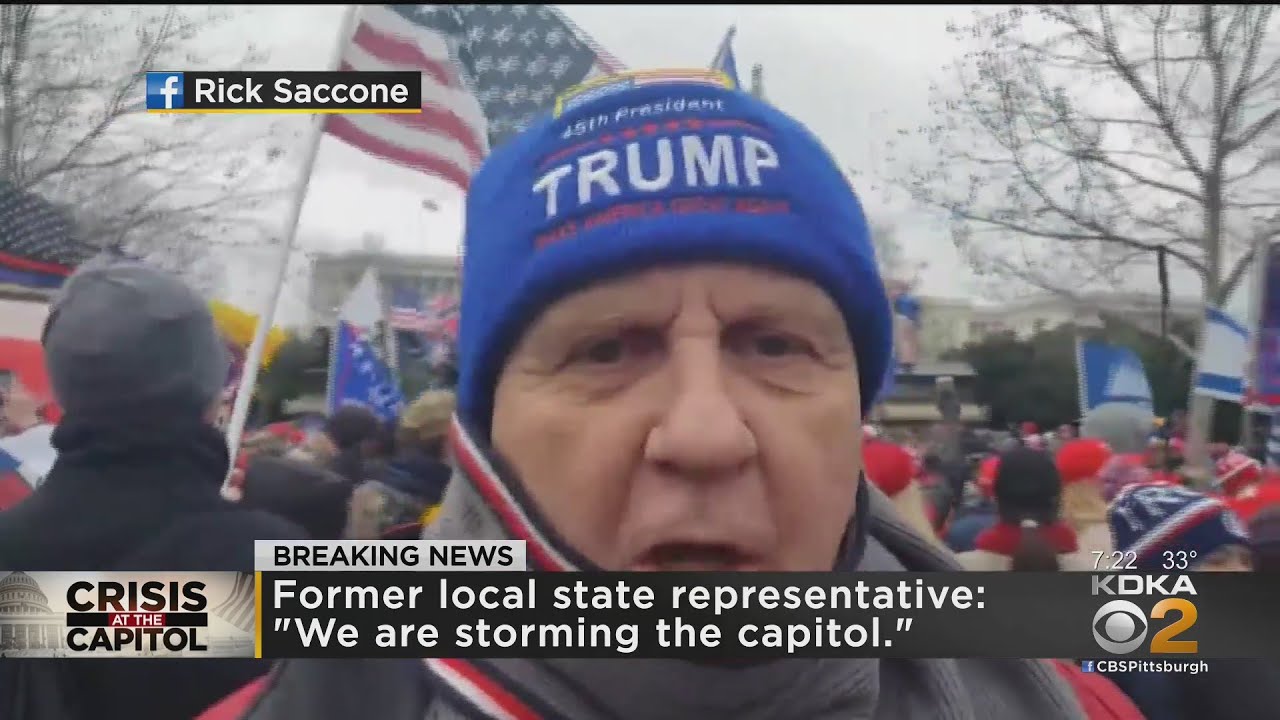 . "They broke down the gates!" he continued. "They're macing them up there. We're trying to run out all of the evil people and all the RINOs that have betrayed our president. We're going to run them out of their offices!"
oregon Republican Rep. Mike Nearman was caught on video opening a door to protestors who rushed into the state Capitol in Salem on Dec. 21. Some rioters then sprayed six law enforcement officers with a chemical substance and others violently attacked journalists.
In light of his actions, West Virginia officials are now calling for Evans' hasty prosecution and resignation.
The West Virginia Democratic Party _{declared}_ in a statement, "[Evans] must be held accountable for participating in an act of insurrection against the United States government and risking the lives of lawmakers and Capitol police." The Party added, "The West Virginia Democratic Party calls for his immediate resignation from the House of Delegates and that he be prosecuted to the fullest extent of the law." A Change.org _{petition}_, with over 50,000 signatories, has also called for Evans' immediate removal from office.
Roger Hanshaw, the speaker of the West Virginia's House of Delegates, _{said}_ Evans will have to "answer to his constituents and colleagues regarding his involvement in what has occurred today."
Evans _{responded}_ to sharp rebukes online by claiming that he did not participate in any violence or destruction of property, and defended his involvement in the riot as "an independent member of the media." He added, "I want to assure you all that I did not have any negative interactions with law enforcement."
Evans' attorney John H. Bryan _{told}_ NBCthat his client "did nothing wrong." Bryan explained, "He was exercising his First Amendment rights to peacefully protest and film a historic and dynamic event [...] He engaged in no violence, no rioting, no destruction of property, and no illegal behavior."
FROM YOUR SITE ARTICLES
- Conservative GOP congresswoman blames Trump for violent ... ›
- Newly sworn-in West Virginia lawmaker live-streamed his ... ›
- Here's a list of charges the pro-Trump mob could face for storming ... ›
RELATED ARTICLES AROUND THE WEB
- Kid gloves for pro-Trump mob as Black Lives Matter face strongarm ... ›
- How a pro-Trump mob besieged the Capitol - CNN.com ›
- Pro-Trump mob storms US Capitol – in pictures | US news | The ... ›
https://www.alternet.org/2020/09/this-billionaire-gop-governors-coal-company-is-poised-to-get-a-big-break-from-his-own-regulators-propublica/
west Virginia environmental regulators are proposing to reduce the fines that a coal company owned by the state’s governor could pay for water pollution violations that are the focus of a federal court case. The move comes after the company stopped paying penalties required as part of a settlement four years ago to clean up its mines across the Appalachian coalfields.
Environmental groups allege that the Red Fox Mine, a large strip-mining site in southern West Virginia owned by Gov. Jim Justice’s Bluestone Coal Corp., continues to exceed discharge limits for harmful substances. The suit could result in substantial payouts — the maximum potential federal penalties are nearly $170 million — that would go to the U.S. Treasury.
In the weeks before a trial in the case, lawyers for Bluestone filed documents detailing a draft deal worked out separately with the state’s Department of Environmental Protection. The state agency, whose administrator is appointed by Justice, has agreed to settle the violations for a fine of $125,000, according to a court filing by the environmental groups’ lawyers. (State and federal governments share the authority to enforce water pollution rules.) Lawyers for Bluestone are asking the judge to throw out the federal case, saying the state settlement and hundreds of thousands of dollars in federal fines the company already paid for the same violations should resolve the matters.
Lawyers for the Ohio Valley Environmental Coalition and other groups say the state settlement doesn’t moot their suit, and they urged a federal judge not to grant Bluestone’s request to throw out the case.They called the state action “a self-dealing administrative order” and said the proposed penalties “are insufficient to deter future violations, leaving a realistic prospect of continued noncompliance.” At best, the lawyers say, the amount paid would offset potential fines in the federal court action.
The fight to force Justice’s empire to follow pollution rules, the groups say, symbolizes the larger ongoing fight over how aggressively to regulate an industry that remains politically powerful, even as its economic influence declines.
The state’s environmental regulators are seen as friendly to coal companies, so the reduced fines are in keeping with prior actions. In one significant example from a decade ago, a $20 million federal settlement with Massey Energy revealed that West Virginia officials were not even reviewing disclosures that Massey had filed reporting thousands of water pollution violations.
“Coal companies pollute,” said Vivian Stockman, executive director of the Ohio Valley Environmental Coalition. “There seems to be little consequence to carrying on business in disregard for the law. This has been the case over decades.”
The proposed settlement is the latest in which government agencies overseen by Justice have had to regulate businesses owned by Justice, a billionaire whom Forbes has labeled the richest person in the state. He owns a vast array of businesses, including coal mines, resort hotels and agricultural interests, many of them regulated by the state agencies that report to him.
An investigation this year by ProPublica found that companies run by the governor’s family have accumulated $128 million in judgments and settlements in cases brought by vendors and other businesses and government entities over unpaid bills. Justice companies that own or are affiliated with the historic Greenbrier Resort have said in court filings that they are “near financial insolvency.”
Mike Carey, a lawyer for Bluestone Coal, called any suggestion that the company is getting preferential treatment “completely baseless.”
The court records filed in the federal case indicate that state regulators first proposed the settlement more than a year ago, and that it then included a suggested penalty of $883,000. But in its new proposal, which must face public comment before it is finalized, WVDEP proposed a $2.1 million fine, but then dropped that to $125,000. The agency noted that’s the maximum allowed under state law but did not explain why it had earlier proposed a larger amount.
While Justice’s adult children have day-to-day control over the family’s business operations, the governor continues to guide the empire. Justice has repeatedly said his role as governor poses no conflict, and he wants nothing from the state for his businesses or his family.
The last tussle over the governor’s coal mines came to a head in 2016, when weeks before Justice won that year’s general election, his company agreed to pay a $900,000 fine for past violations, penalties for future violations and millions of dollars for new pollution control measures.
The deal resolved more than 23,000 water pollution violations between 2009 and 2014 by Justice mines in West Virginia, Virginia, Tennessee, Kentucky and Alabama, then under the umbrella corporate parent, Southern Coal Corporation, according to court records filed as part of that settlement. (Southern Coal, like Bluestone, was also owned by the Justice family.)
“This settlement is designed to bring the companies into compliance with the Clean Water Act and requires actions that should prevent future violations,” Assistant Attorney General John Cruden said at the time.
But hundreds of times since that 2016 federal deal, those mines discharged more solids, iron, manganese, aluminum and other pollutants than allowed by their environmental permits, the company’s own public reports show.
Justice’s companies have paid hundreds of thousands of dollars in fines for those violations, which are fairly common and seen as a cost of doing business in the coal industry. In August 2019, the environmental groups filed suit against Bluestone, alleging excess discharges of selenium, which can be toxic to fish and other aquatic life.
State and federal agencies have somewhat overlapping authority to regulate coal industry pollution. Federal law also allows citizens to file suit over Clean Water Act violations, both to seek fines, payable to the government, and to force measures to stop further violations.
Then, this year, the Justice companies “apparently stopped paying” some of the stipulated penalties, citing the lawsuit, according to a court filing by the plaintiffs. In a May report to federal regulators, Bluestone Coal marked a list of some of those selenium violations as “in litigation payment not applied.”
A federal judge has cited that report and noted unpaid stipulated penalties for 40 selenium violations that date back to July 2018.
A spokeswoman for the Environmental Protection Agency said that the earlier settlement does not allow Bluestone to stop paying stipulated penalties, but she declined to say what action, if any, federal officials might take “because this is an active enforcement case.”
Carey said that the report indicating those fine payments were being held back because of the litigation “was an error.”
In a court filing Tuesday, Carey indicated that a $35,000 payment for some of the fines was made on Sept. 4. Carey also alleged that the environmental groups had offered during settlement negotiations to resolve their lawsuit, and give the company three years to come into compliance, if Bluestone Coal would donate $600,000 and 850 acres of land near the New River Gorge, a scenic area, to the West Virginia Land Trust, a group that tries to protect wilderness in the state.
Bluestone Coal lawyers had earlier tried to have the selenium case dismissed, arguing that it was preempted by the 2016 settlement.
But in a ruling in June, U.S. District Judge David A. Faber in Bluefield, West Virginia, declined to throw out the case, saying that the continuing violations, and Bluestone Coal’s failure to comply with a timeline for installing a treatment system, showed the need for the citizen suit. Then, in July, Faber issued a second ruling that found Bluestone liable for the selenium violations. The judge noted that Bluestone Coal could be liable for more than 3,000 days of water permit violations, which could amount to a maximum fine of $169.2 million, according to the citizen groups.
On Tuesday, Faber postponed a Sept. 23 bench trial meant to determine a remedy for the violations. Instead, he scheduled a hearing that day on Bluestone’s request to have the case thrown out.
Like his political ally President Donald Trump, Justice has been clear that he wants to curb government regulations meant to protect the environment, especially as those apply to the coal industry and other fossil energy operations.
In his first State of the State address in February 2017, Justice said that, under his administration, the state Department of Environmental Protection would stop saying “no” to business and industry. A week later, he belittled WVDEP inspectors when he told a natural gas industry group that they would have to stop showing up for work with “a tank top and flip-flops on” and looking like they “haven’t shaved in three months.”
At the WVDEP, Justice put in charge a former coal company executive and energy industry consultant, Austin Caperton. In an early speech once he took office as WVDEP secretary, Caperton said he “doesn’t trust” the science that says human activities such as burning fossil fuels are warming the planet, a position that puts him at odds with mainstream science.
As recently as 2017, the federal Office of Surface Mining Reclamation and Enforcement issued a report outlining continuing failures by the state to police water pollution by coal companies. OSMRE has said it is continuing to monitor WVDEP’s efforts to improve oversight of the coal industry.
Over the years, selenium pollution has been especially tricky for coal companies to deal with, presenting expensive and long-term treatment challenges. Violations have prompted other citizen group lawsuits like the one against Bluestone and scientific studies that warned of stream damage from the selenium discharged by mining operations.
In response to questions about Bluestone Coal and its policing of the coal industry more broadly, the WVDEP provided a statement that indicated it was considering a change in the selenium limits for the Red Fox permit that, if approved, would “resolve that component of the enforcement action for the site.”
==
==
https://www.alternet.org/2020/03/jerry-falwell-jr-just-unmasked-conservatism-and-we-should-seriously-thank-him-for-it/
no lnx
Jerry Falwell Jr. just unmasked conservatism — and we should seriously thank him for it
Written by John Stoehr, The Editorial Board March 15, 2020
I suppose we owe Jerry Falwell Jr. a debt of gratitude. I’m serious.
Falwell is the son of the late Jerry Falwell, the man most responsible for bringing fundamentalist Christianity out of the political wilderness during Ronald Reagan’s presidency. Junior, along with Franklin Graham, himself a scion of a religious dynasty, is perhaps the president’s greatest champion among white evangelical Christians.
He appeared on “Fox & Friends” yesterday.Among other things, he accused Donald Trump’s enemies, including the press, of hyping COVID-19, the new strain of the coronavirus spreading around the world, panicking global markets and closing down entertainment and cultural events here and elsewhere. He, like Tom Cotton, the fascist senator from Arkansas, believes the disease outbreak can be blamed on totalitarian regimes in the east. For Cotton, that’s China. For Falwell, that’s North Korea. (While Falwell was on air, the president announced a state of national emergency related to the outbreak, undermining his and Cotton’s search for a scapegoat for his sake.)
Falwell’s demagoguery isn’t what we should be thankful for. What we should be thankful for is his confessing, without appearing to know it, that a pillar of “principled conservatism” in the United States is no pillar at all. Not in practice. Once you see that this pillar rests on a bed of sand, rather than constitutional bedrock, you start seeing other “conservative principles” do, too. “States’ rights,” “gun rights,” “the right to life” and even “religious freedom” are nearly always about something other than what they seem to be. Falwell and his ideological confederates can’t be honest about it, though. If they were, they’d lose. Dishonesty, fraudulence and bad faith are central to their aims.
What would Jesus do? Not that.
Here’s some context, courtesy of the Christian Science Monitor (my italics):
“As in many states, residents in parts of rural, conservative Virginia say they seem to inhabit an increasingly different daily reality than that of urban and suburban districts. That feeling of separation was compounded by last November’s Democratic sweep of the state’s elected offices. Now residents in Frederick County are mulling a radical proposal: seceding from Virginia and joining neighboring West Virginia.”
Apparently Falwell is part of the effort. He’s the head of something called “Vaxit,” according to Fox & Friends. Whether that’s a real organization I have no idea, but that’s not what I’m most interested in. I’m most interested in expressing gratitude to the good reverend for admitting that “states’ rights” have nothing to do with conservatism.
Think about it.
If the principle of “states’ rights” meant what conservatives have said it meant to them, not one of them, not Jerry Falwell Jr. nor anyone calling him or herself a “principled conservative,” would dare suggest that a county secede from a state. If states are sovereign, as conservatives have alleged since Strom Thurmond ran as a Dixiecrat in 1948, calling for a county to secede from a state is traitorous. If “states’ rights” are as sacred as conservatives have said they are, the idea of secession is an abomination.
In saying counties should leave the state as casually as ordering unsweet tea with his burger and fries, the Rev. Falwell told us without knowing he was telling us that conservatism in theory is authoritarianism in practice. It cannot and will not tolerate democratic change, despite change coming with the blessing of the majority. If the majority rules, Falwell and his confederates will abandon commitments to democracy.
Once you abandon democracy—once you open the door to treason—there’s no end in sight. Once it seceded, “the Confederacy began to deny states’ rights,” wrote James W. Loewen in Lies My Teacher Told Me. “Jefferson Davis denounced states’ rights as destructive to the Confederacy. The mountainous counties in western Virginia bolted to the Union. Confederate troops had to occupy east Tennessee to keep it from emulating West Virginia. Winn Parish, Louisiana, refused to secede from the Union. Winston County, Alabama, declared itself the Free State of Winston. Unionist farmers and woodsmen in Jones County, Mississippi, declared the Free State of Jones.”
By February 1864, Davis despaired: “Public meetings of treasonable character, in the name of state sovereignty, are being held.” Thus states’ rights as an ideology was contradictory and could not mobilize the white South for the long haul.
What mobilized the white South was the defense of slavery. Falwell and his new breed of confederate aren’t doing that, of course, but the spirit of treason, if not the act of treason, is the same. Conservatives tell us they prefer slow and gradual change, and stand united against radical attempts to bring it swiftly. But that’s not their true face. Conservatism in practice is a radical ideology reserving the right to betray its stated principles, and to betray community and brotherhood, if it doesn’t get what it wants.
Thanks to Jerry Falwell Jr., that’s now easy to see.
==
==
Climate Change Threatens a Giant of West Virginia’s Landscape, with Ecosystems at Stake BY: KATE MISHKIN, CHARLESTON GAZETTE-MAIL "We lose this, and we lose that," a former state scientist says, "and what's unique and beautiful starts to fall apart." |
| Read More |
Appalachia’s Strip-Mined Mountains Face a Growing Climate Risk: Flooding
BY: JAMES BRUGGERS
A new analysis of satellite images shows how the area of West Virginia with the most strip-mine damage is also the most susceptible to increased stream flow as the planet warms
:{
}:
:{
}:
==
==
just saw interview bookTV 1119 gop snuck limited charters in on 3rd try during recess?
==
gov insulted teachers, jack medical premiums and require fitbit?
beat him badly with rallies (al 55 counties) and amb from other states that followed eg oklahoma
==
Teachers in West Virginia celebrated a major victory Tuesday when a contested education reform bill was blocked by House delegates, just hours into a statewide strike protesting the legislation. The bill would have legalized charter schools, which are currently not allowed in West Virginia. Teachers’ unions say they were not consulted in the drafting of the legislation and that it was retaliation for last year’s historic strike, which was credited with launching a wave of teacher walkouts in other red states. Teachers are set to continue their strike for now.
2/19 dn
==
==
https://www.alternet.org/2019/07/west-virginia-bets-big-on-plastics-and-the-backing-of-trumps-administration/
no lnx
West Virginia’s industrial might has faded, but as 2020 approaches, the state has two resources that could be crucial to President Donald Trump as he seeks reelection and tries to make good on his pledge of “American energy dominance” — Republican votes and abundant natural gas.
It was a stretch of rural counties along the Ohio River in West Virginia, Ohio and Pennsylvania that form the largest natural gas field in the world and helped Trump win the states in 2016.
West Virginia’s elected leaders see the vast reserves as a path to renewed political and economic relevance for the Mountain State, which they envision rivaling the Gulf Coast as a center for processing natural gas and producing plastics.
And to make that a reality, the state’s top officials have lined up behind a plan to spend as much as $10 billion to build a mammoth underground storage facility — big enough to hold the U.S. Capitol complex, or 10 million barrels of the liquid byproducts used in plastics manufacturing.
By providing a sizable and stable storehouse for ethane and other so-called gas liquids, the facility would, its proponents say, encourage the expansion of a chemical production corridor that is emerging along the upper Ohio River and would help bring thousands of jobs to a region that has seen its industrial moorings slip away over the past two generations.
The prospect of an energy jobs bonanza in a politically vital state stirred the interest of the White House. A senior Energy Department manager has been assigned to work on the project, known as the Appalachian Storage and Trading Hub. In April, the president issued an executive order on energy that encouraged “opportunities, through the federal government or otherwise, to promote economic growth of the Appalachian region, including growth of petrochemical and other industries.” And the president’s newest budget proposal includes funds to study the region’s gas-related industrial potential.
But a ProPublica examination has found that the proposed storage facility would be far larger than the region could support and that questions about its cost, its viability and its environmental risks have been overshadowed by a public relations strategy heavy on the politics of jobs and light on the economics of energy policy.
“The scale of the Appalachian hub is out of line with what industry needs or will require in the region,” said Michael Tritt, president of Lane Power and Energy Solutions, a Houston-based construction company that designs and builds energy storage caverns.
The Trump administration’s relations with China and Russia are adding to the questions about the hub. China had agreed to invest tens of billions of dollars in West Virginia’s natural gas industry but now is embroiled in a trade war with Trump. And American Ethane, a Houston-based company financed by three Russian businessmen, has signed 20-year contracts to send ethane produced in the United States to China, which could raise prices and weaken demand for the facility proposed for West Virginia.
Far from being dissuaded, state leaders, led by Sen. Joe Manchin III, are pressing forward, talking up the project and perhaps most significantly trying to secure a $1.9 billion federal loan guarantee that could attract billions of dollars in private investment.
If the hub’s developers succeed, taxpayers could be on the hook for a big piece of any failure. The federal loan guarantee sought for the hub is nearly four times as large as a guarantee awarded more than a decade ago to Solyndra, the California solar firm that collapsed in 2011. “This whole project is a gamble,” said Dustin White, project coordinator with the Ohio Valley Environmental Coalition, an environmental group in Huntington, West Virginia. “Billions of dollars could go up in smoke. We just need to stop it now.”
Banks, though, would be in line for tens of millions of dollars in finance fees. “If that project gets a federal loan guarantee, banks will be lining up 10 deep,” said James Cutler, an energy industry investor and veteran chemical plant builder from Houston. “Anybody who gets involved gets 1.5 to 2% in fees just for getting the deals together. If you have a $4 billion, $5 billion project, that’s $80 million, $100 million.”
Other big winners could be Manchin, a Democrat, and Gov. Jim Justice, a Republican. The energy, construction and labor sectors contributed $841,591 to Manchin’s 2018 election campaign. Energy, finance, construction and labor contributed $169,600 to Justice’s 2016 campaign, according to Vote Smart, which tracks election campaign financing.
In an interview, Manchin said that he is looking to Energy Secretary Rick Perry for help in “streamlining” the loan review and that he is urging the Treasury Department to invoke national security concerns to halt American Ethane’s export plans.
John Houghtaling, the chief executive of American Ethane, said Manchin is wrong. “The national security threat is not exporting ethane to China,” Houghtaling said in an interview. “They need the gas. If they don’t get it from us they’ll get it from Russia and Qatar, people who don’t like us so much.”
Manchin, the ranking member of the Senate Energy and Natural Resources Committee, said the federal government has to intervene. If it doesn’t step in, the project is doomed, he said. “You can write off the storage hub for sure. You can write off everything.”
From its start where two tributaries meet at a wedge of parkland in Pittsburgh, the Ohio River surges north, then south, then west past high banks that have been the stage of every era of American industrial development. Thousands of feet below the river are thick layers of salt and seams of shale and hard rock that encompass eons of geological evolution.
Few regions of the country have been endowed with such a rich repository of water, land and minerals, or have seen natural resources so grossly mismanaged, than the three states and 50 counties along the first 180 miles of the Ohio. Forests fell to the mills that provided the first burst of manufacturing wealth in the 18th century and that produced gaping tracts that poured great gouts of mud into the river.
...
===
2020
A bad Democratic senator is a whole lot better than a Republican one’: If Joe Manchin leaves the Senate, his GOP successor will be even worse
On Thursday, The Hill reported that West Virginia Sen. Joe Manchin, feeling fed up with the bitter partisanship in Congress, is considering leaving the U.S. Senate — and some of…
==
==
https://www.alternet.org/2019/03/economist-paul-krugman-proves-just-how-badly-west-virginians-screwed-themselves-by-voting-for-trump/
Trump promised to bring back coal, an energy source that’s becoming increasingly less viable by the day. And largely because of this, he won West Virginia in a landslide.
Of course, in the long run, the coal industry is screwed. Renewables are getting cheaper and cheaper, so even if you don’t force coal companies to pay for the negative externalities they create (like pollution and health care costs related to dirty air and occupational hazards), coal will be unable to compete in the long run.
But facts have never stopped Trump or his supporters.
Enter Paul Krugman, who recently made a handy little chart showing just how bad a bargain voting for Trump was, even — or especially — for West Virginians:
[twit]
chart: big bar vs tiny one https://twitter.com/paulkrugman/status/1110568596558807040/photo/1
With the new Trump effort to destroy the ACA, I’m thinking about West Virginia, where a lot of people gained insurance under the Medicaid expansion, but voted for Trump because he promised to bring back coal. So I made a little chart pic.twitter.com/UrtIIXHn4v
— Paul Krugman (@paulkrugman) March 26, 2019
Of course, that’s nothing compared to convincing an entire state to stubbornly live in the past instead of preparing for the future.
Eventually, every last coal job will be gone and Trump’s purpling corpse will be embalmed with McNugget sauces and given a nautical burial in a New Jersey sewer somewhere. But West Virginians will always need health care. And we’ll all need a green economy, sooner or later.
==
impasse
https://www.alternet.org/news-amp-politics/west-virginia-supreme-court-margaret-workman-impeachment-illegal
==
https://www.motherjones.com/politics/2018/08/what-the-hell-is-going-on-in-west-virginia/
Earlier this month, Republicans in West Virginia impeached the state’s entire Supreme Court, a first in US history, over a scandal involving allegations of wasteful spending, poor administrative decisions, and criminal misconduct. Now the state’s governor, a Republican, has appointed two Republican lawmakers to temporarily serve as justices—a move he says will restore confidence to the judiciary. But Democrats are crying foul, saying the appointments are a clear political power grab aimed at stacking the bench with conservatives.
Gov. Jim Justice announced Saturday morning that state House Speaker Tim Armstead and US Rep. Evan Jenkins will serve on the state’s highest court until the midterm elections in November, when voters can elect new justices from a pool of 20 candidates. (Armstead and Jenkins are among those candidates.) They will replace Justice Robin Davis, who resigned on August 14 shortly after the House of Delegates moved to impeach the Supreme Court, and Justice Menis Ketchum, who resigned in late July shortly before he was charged with federal wire fraud.
The court’s other three justices will soon go before state lawmakers in an impeachment trial, accused of wasteful spending and failure to carry out administrative duties. If they are removed from their seats, the governor can appoint interim justices who will serve on the bench until the 2020 election. (One of them, Justice Allen Loughry, has already been suspended because he faces 25 federal charges and has been indicted on an obstruction-of-justice charge; he has pleaded not guilty.)
“We need true conservatives—this is really important—with honor and integrity to restore the trust from the blow to the stomach we’ve suffered in the last few months,” Gov. Justice said as he announced the two new appointments Saturday. Armstead has left his position in the House of Delegates, and Jenkins will resign from Congress when he takes the bench.
Jenkins is also a failed candidate for US Senate, having lost the Republican nomination to challenge Democratic Sen. Joe Manchin back in May. As my colleague Jeremy Schulman reported during the campaign, Jenkins put out racist political ads that appeared to blame West Virginia’s opioid epidemic on African Americans in cities like Baltimore, Detroit, and Chicago who he suggested were flooding his state with heroin. And his appointment to the judiciary comes despite earlier reports that he may be ineligible to serve on the state Supreme Court because of an inactive law license.
Democrats in West Virginia are outraged about the new appointments, likening the situation to a coup. “Governor Justice’s picks to fill the Supreme Court means more corruption and political positioning from Republican Leadership in West Virginia,” Belinda Biafore, chair of the state Democratic Party, said in a statement. “Not only do Armstead and Jenkins lack necessary experience, but by aligning with Justice they have proven that they are nothing more than political peas in a pod and will continue to make decisions based on politics and not people.”
The impeachment of the Supreme Court justices was approved on August 13 along party lines, with Democrats voting in opposition. (Three of the five justices were elected as Democrats.) “They’re going after everyone because it’s the balance of the court,” Delegate Mike Pushkin, a Democrat on the House Judiciary Committee, said at the time. Delegate Chad Lovejoy said that while he did not agree with the justices’ lavish spending, which included a $32,000 sofa for Loughry’s office, the budget decisions were technically legal and he believed a mass judicial impeachment was inappropriate. “It’s unprecedented in the United States that one branch of the government goes in and lops off another,” he said.
“The majority have ignored the will of the people who elected the justices of this court,” Davis, one of the justices who resigned, said. She is named in impeachment articles regarding her $500,000 office renovation and allegations that she overpaid a senior status judge and failed to hold other justices accountable. “They have erased the lines of separation between the branches of government. In fact, the majority in the legislature is positioning to impose their own party preferences.”
==
8/22 rally
https://www.alternet.org/parallel-universe-trump-fans-chant-lock-her-west-virginia-rally-two-former-aides-become-felons
Like a Parallel Universe': Trump Fans Chant 'Lock Her Up' at West Virginia Rally As Two Former Aides Become Felons
"Trump's campaign manager and personal lawyer both became felons today. And Trump supporters still thought it made sense to chant 'Lock Her Up.'"
By Jake Johnson / Common Dreams August 22, 2018, 5:25 AM GMT
President Donald Trump on Tuesday was directly implicated in a criminal conspiracy by his former personal attorney Michael Cohen and—almost simultaneously—a federal jury found his former campaign manager guilty on eight counts of financial crimes, but you wouldn't know it by watching Trump's inane campaign-style rally in West Virginia Tuesday night, where his frenzied supporters belted out chants of "lock her up" and "drain the swamp" while the president bragged about his luxury apartments and deadly new coal rules.
"It's like a parallel universe," historian Kevin Kruse noted on Twitter as the Charleston rally kicked off late Tuesday.
While Tuesday's event featured plenty of ranting and raving about the "Russia witch hunt," the president didn't once mention the fact that his former fixer admitted under oath that he was directed by then-candidate Trump to violate campaign finance laws by paying hush money to a former model and an adult film actress.
The fact that Trump's former campaign manager Paul Manafort was just found guilty of a slew of crimes—including tax and bank fraud—also didn't come up during the hour-long rally.
Trump supporters in attendance Tuesday night—wielding signs that ranged from "Trump Digs Coal" to "Keep America Great"—didn't seem to mind these glaring omissions, nor did they seem to appreciate the irony of chanting "lock her up" after the first mention of Hillary Clinton while two men previously very close to the president are likely headed to jail.
@JordanUhl
Trump's campaign manager and personal lawyer BOTH became felons today.
And Trump supporters still thought it made sense to chant "Lock Her Up."
Both Manafort—who the president praised as a "good man" ahead of Tuesday's rally—and Cohen face prison time, and "Donald Trump himself would almost certainly be facing charges" if he wasn't president, noted the New Yorker's Adam Davidson.
"The question can no longer be whether the president and those closest to him broke the law. That is settled. Three of the people closest to Trump as he ran for and won the presidency have now pleaded guilty or have been convicted of significant federal crimes," Davidson concluded. "Tuesday's news also helps build an increasingly compelling case for impeachment and removal from office. It is now clear that the president engaged in at least one conspiracy to hide the truth from the public in an election he won with a tiny margin in three states."
==
https://www.propublica.org/series/the-new-power-brokers
series: THE NEW POWER BROKERS
West Virginia’s Natural Gas Industry
Coal, long West Virginia’s most dominant industry, is ailing. Natural gas is taking over, as a powerful economic and political force. Is the state making the same mistakes again with a different fossil fuel?
eg
Coal Industry Extracted a Steep Price From West Virginia. Now Natural Gas Is Leading the State Down the Same Path.
“It’s déjà vu for the people who sat here 130 years ago and gave away our coal wealth to big out-of-state companies,” one state senator said. “That’s what we’re about to do again.”
warm Monday afternoon in late February. Thousands of teachers, public school employees and supporters rallied on the steps of West Virginia’s Capitol building, on the banks of the Kanawha River in Charleston.
Schools in all 55 counties were closed again. Teachers, cooks and janitors were in the third day of a strike. They wanted pay raises and a fix to the skyrocketing cost of their health insurance.
On the other end of the state, at a town hall meeting with teachers in Wheeling, Gov. Jim Justice tossed out a possible solution: Fund the pay raises with an increase in taxes on the state’s booming natural gas industry.
West Virginia “benefited from the extraction of coal and we benefited from the extraction of timber, but we were still dead last in everything,” said Justice, whose family made its fortune in coal. “And now we have this gas situation and we’re on fire, and we have a real opportunity again.” If the state doesn’t pass a gas-tax hike, the governor said, “we’re going to be left holding the bag again.”
But what seemed like a stunning change of direction proved to be little more than a feint. Gas industry lobbyists strongly criticized the proposal and the governor’s tax hike idea quickly faded.
West Virginia has been here before.
Sixty-five years ago, then-Gov. William Marland, the son of a mine superintendent, shocked state lawmakers by proposing a new tax on coal to upgrade schools and roads.
Marland’s proposal was soundly defeated following an onslaught of criticism. One biographer called it “political suicide.”“Let’s use this equitable source of revenue, because whether we like it or not, West Virginia’s hills will be stripped, the bowels of the earth will be mined and the refuse strewn across our valleys and our mountains in the form of burning slate dumps,” Marland told a joint session of the Legislature in February 1953.
Today, West Virginia’s headlong race into the gas rush is taking the state down the same path that it’s been on for generations with coal.
Elected officials have sided with natural gas companies on tax proposals and property rights legislation. Industry lobbyists have convinced regulators to soften new rules aimed at protecting residents and their communities from drilling damage.
In 2011, for example, then-Gov. Earl Ray Tomblin, a Democrat, and his party’s legislative leadership weakened a measure to regulate the growing industry, at the urging of gas company lobbyists. Among other changes, language was eliminated that would have given state regulators more authority to deny drilling permits that threatened water supplies and populated areas.
Supporters say the state’s actions over the past few years have positioned West Virginia to compete for growth.
“We have a regulatory body and a legislative body and an industry that are all willing to work together,” said Al Schopp, chief administrative officer for Antero Resources, the state’s biggest natural gas producer. “That makes it a good environment.”
But critics fear that West Virginia won’t fully share in the riches the industry creates and will be forced to bear the long-term environmental, health and infrastructure costs, much as it has for the now-dwindling coal industry.
...
One West Virginia County Tried to Break Its Dependence on the Energy Industry. It Was Overruled.
After seeing the scars of coal, Fayette County banned the disposal of natural gas drilling waste. Industry fought back, arguing the community doesn’t get a say
==
https://www.propublica.org/article/west-virginia-supreme-court-justice-beth-walker-gave-natural-gas-a-big-victory-and-shortchanged-residents
Republican-led West Virginia House of Delegates received national attention last week for impeaching all four of the state’s sitting Supreme Court justices. Lawmakers cited a swirling scandal over court spending that ranged from using state cars for personal business to extravagant office renovations that included a $32,000 couch.
Among the targets was Beth Walker, who was impeached over allegations of irresponsible spending and poorly managing the court’s administrative affairs.
But left unmentioned in the impeachment and the debate around it has been a peculiar vote by Walker that benefited the natural gas industry. In one of her earliest votes, Walker made a highly unusual decision to reopen a case and then reverse a Supreme Court ruling that would have forced drillers to pay more in profits to residents. Walker voted to reopen the case around the time her husband owned stock in a variety of energy companies, including those participating in West Virginia’s growing gas boom.
The case focused on whether natural gas companies are allowed to deduct a variety of expenses — for the transportation and processing of gas, for example — when they calculate payments for West Virginia residents or companies that lease them drilling rights to their gas. Millions of dollars in gas royalty payments, the riches from the industry’s dramatic growth in West Virginia over the past decade, were at stake.
In November 2016, the court — before Walker joined it — voted in favor of the residents, ruling that producers weren’t allowed to take such deductions.
The decision has been a source of significant dispute. This year, lawmakers passed a bill to reverse the court’s second decision. That prompted EQT Corp., the state’s second-largest gas producer, to file a lawsuit in federal court challenging the Legislature’s action, as well as a 36-year-old state law that sets minimum royalty payments for new gas wells. The company said the state law “infringes on EQT’s vested drilling rights” under its leases.Two months later, just weeks into her term, Walker provided the pivotal vote to have the court reconsider the ruling. The court then overturned it, siding with the industry and against the residents.
That case is pending in U.S. District Court in Clarksburg and is among the major battles playing out amid the economic shift in West Virginia from coal to natural gas.
Land ownership across West Virginia has often been complex and confusing. Someone may own the surface land, while someone else owns the the coal, oil or gas underneath it. Tracts such as natural gas reserves become divided among multiple owners, as land and minerals are passed down across generations.
Much of the natural gas in West Virginia is produced under leases that are decades or more than a century old. When they were signed in the early 1900s, paying residents and mineral owners $100 to $300 a year for gas was considered reasonable, maybe even generous. Most drillers at the time were after oil. Gas was mostly an undesirable byproduct.
When the market for natural gas increased, it became more common for leases to pay a share of the sales. Residents and others owning the mineral rights would make more money as production increased.
But many West Virginians were stuck with older leases paying a set amount per year, regardless of production. The Legislature decided to step in with a bill in 1982 to increase royalty payments for new wells drilled under older leases. While existing wells were grandfathered in, new wells drilled under those old leases would now have to pay the gas owner at least 12.5 percent of the gas sales price.
It was one of these leases, signed in 1906, that governed the deal between Patrick and Katherine Leggett and EQT, and that led to the case involving Walker.
The Leggetts were supposed to be getting a 12.5 percent royalty on the gas produced from the new wells on their land. But they were actually getting much less, because EQT was taking deductions from their payments for expenses incurred after the gas was extracted.
The Leggetts and their lawyers thought the law was clear: West Virginia courts had already ruled that gas firms couldn’t take deductions unless leases explicitly allowed them. And the 1982 royalty law didn’t mention allowing deductions. (The Leggetts were represented by Charleston lawyer Marvin Masters, who is among a group of local investors who bought the Charleston Gazette-Mail this year.)
EQT, though, argued that the Leggett case was different, because the court was interpreting the 1982 statute, rather than simply deciding a dispute over the language of a gas lease.
So EQT and the Leggetts went to court, and the case ended up before the state Supreme Court — at a very unusual time....
The five-member court already has lost two members; another has been suspended.
Ketchum retired last month, and he subsequently agreed to plead guilty to one federal count of wire fraud. He was charged with using a state vehicle to take multiple trips to a golf club in Virginia.
Then, last week, after the House impeachment vote, Justice Robin Davis announced that she was retiring. Davis criticized the impeachment process, saying House Republican leaders were attempting “to dismantle a separate branch of government.”
Loughry, whose spending practices prompted investigations of the court in the first place, was indicted in June on federal charges of fraud, making false statements and witness tampering. Loughry has pleaded not guilty, and his criminal trial has been set for early October. In the meantime, he has been suspended from the court.
The Senate is meeting today to set its schedule for trials for Walker, Loughry and Chief Justice Margaret Workman that could remove them from office. In the meantime, Walker and Workman remain active on the court, as does a temporary justice Workman appointed to fill in for Loughry. Workman has said there “is no basis” for her impeachment, and that she looks forward “to putting all the facts before the Senate in the next phase of this process.”
Whatever the ultimate composition of the court, additional natural gas cases await it.
Another group of West Virginia residents is asking the court to overturn the dismissal of a major lawsuit alleging that the state’s largest producer, Antero Resources, is creating a nuisance with its natural gas operations — with unbearable traffic, mountains of dust, constant heavy-equipment noise and bright lights that shine into their homes day and night.
Oral arguments are scheduled for Sept. 5.
Covering West Virginia’s Long History of Broken Promises
In the face of a major decline in the coal industry, families and entire communities that depended on it are hurting. Now that natural gas is booming, I’m reporting on whether we’ve learned anything from the past.
==
https://www.alternet.org/west-virginia-moves-impeach-entire-state-supreme-court
Tuesday night, the West Virginia House of Delegates Judiciary Committee took a stunningly drastic measure. Lawmakers on the committee approved articles of impeachment against every single sitting justice on the state Supreme Court of Appeals.
In total, there are 14 articles of impeachment: two against Justice Beth Walker, four each against Chief Justice Margaret Workman and Justice Robin Davis, and eight against Justice Allen Loughry. The charges, according to the Charleston Gazette-Mail, include "maladministration, corruption, incompetency, neglect of duty and certain high crimes."
The charges stem from a series of allegations that the justices have abused their power to spend state taxpayer funds lavishly on themselves. Alone among states, West Virginia's Supreme Court has total power to set its own budget, a power the justices allegedly exploited with total abandon. The justices apparently spent hundreds of thousands of dollars on office furniture and luxury renovations. The total tab for Davis's office renovations was over $500,000, with $28,000 alone being spent on rugs.
Loughry, in particular, is further accused of improperly using state vehicles for personal travel to American University and the Pound Civil Justice Institute, then turning around and seeking travel reimbursement from those institutions even though he already put the costs on state accounts. He is also accused of moving priceless, historic state office furniture to his home for personal use, and enlisting a state-contracted moving company to do it. Perhaps most amazingly, he even improperly billed the state for a book-signing tour of his nonfiction book about political corruption in West Virginia.
In addition to facing impeachment, Loughry is currently suspended without pay from the bench and faces over a dozen federal charges of fraud, witness tampering, and lying to investigators, according to the Gazette-Mail.
West Virginia's high court has five seats, one of which was already vacated by the resignation of Justice Menis Ketchum, who was also implicated in the scandal. Davis and Workman are Democrats, Loughry is a Republican, and Walker is Republican-leaningbut officially nonpartisan, as the first justice to be elected following the legislature's abolition of partisan judicial races in 2015.
If every justice is successfully removed from office, GOP Gov. Jim Justice will have the authority to appoint an entire new interim bench from candidates approved by the state Judicial Vacancy Advisory Commission.
https://www.ecowatch.com/mountain-valley-pipeline-construction-halted-2593256634.html
FERC Halts Work on Mountain Valley Pipeline
On Friday, the U.S. Federal Energy Regulatory Commission (FERC) ordered work stopped on the controversial Mountain Valley Pipeline that would carry fracked natural gas along a 303-mile route from West Virginia to Virginia, Reuters reported.
The order is the consequence of a legal victory for pipeline opponents July 27, in which three federal appeals judges revoked two permits for the pipeline to cross the Jefferson National Forest, ruling that the U.S. Forest Service and the Bureau of Land Management had not properly reviewed the project before issuing the permits, The Washington Post reported. The judges ordered the agencies to redo the permits.
"Should the agencies authorize alternative routes, (Mountain Valley) may need to revise substantial portions of the project route across non-federal lands, possibly requiring further authorizations and environmental review," FERC said in explaining its decision to halt construction, Reuters reported.
TheSierra Club, one of the environmental groups that brought the suit against the pipeline, applauded the FERC's decision.
==
https://www.ecowatch.com/transcanada-pipeline-explodes-west-virginia-2576042392.html
http://bigthink.com/strange-maps/map-shows-huge-differences-in-educational-attainment-across-us
- District of Columbia is the best-educated part of the country: 56.8% of its residents have at least a Bachelor's degree.
- Second is Massachusetts, with 42.7%. While a lot of dark blue clusters on the East Coast, the third-highest score is for Colorado, way out west: 39.9%.
- Worst-scoring state isWest Virginia,where just 20.8% of the residents 25 and older have at least a Bachelor's degree. That's just over a third of the share of Bachelor's degree holders in DC.
- The Mountain State is marginally outperformed by Mississippi, where 21.8% have completed a college or university education.
Educational attainment is linked to income. In 2016, the average median income as divided per highest attained degree was as follows:
- $27,800 – didn't finish high school
- $36,700 – high school or equivalent
- $67,300 – Bachelor's degree
- $95,200 – advanced degree
Map found here at Overflow Data, via Simon Kuestenmacher. Additional information here at Marketing Charts.
==
teacher strike Kty, Az? WV and ---? up to 5?
https://rewire.news/article/2018/03/12/west-virginia-teacher-strike-made/
While the pussy hat became the best-known symbol of the Women’s March in 2017, the West Virginia education strikers of 2018 had their own head gear: red bandanas and occasional bunny ears. The bandanas were a nod to labor history in West Virginia—striking miners at the Battle of Blair Mountain tied the bandanas around their necks to symbolize solidarity that spanned differences in ethnicities and languages, making them the original rednecks. But it was also a defiant gesture to Gov. Jim Justice (R), who told a crowd at a town hall at Wheeling Park High School that he could be “the town redneck, too.”
The bunny ears came after Governor Justice declared the teachers were “dumb bunnies” if they trusted other politicians rather than him.
West Virginia teachers were angry, not just about rising health care costs, but about the asinine behavior, lack of concern, and obvious contempt from their legislators.
The anger of the teachers took some of those legislators, and even union leadership, by surprise. Others say it was a long time coming and clearly visible. State Del. Mike Pushkin (D) said in a phone interview with Rewire.News that he believes it goes back to the governor’s State of the State address, when he and his newly adopted Republican Party did “a victory lap before they’d run the race.” Pushkin said Justice declared the state was in the black, but the governor hadn’t contended with, among other things, the lack of a dedicated revenue stream for the Public Employees Insurance Agency (PEIA), which covers health care for thousands of current and retired public employees and their families. ...
http://thehill.com/homenews/senate/382030-gop-worries-blankenship-surge-will-cost-party-w-va-senate-seat
OMFG
W.VA. — A former coal CEO’s post-prison rise is scrambling the GOP battle to unseat Democratic Sen. Joe Manchin(W.Va.).
Don Blankenship, released from jail less than a year ago, now appears to be within striking distance of the party’s nomination.
Strategists — and even his primary opponents — acknowledge he’s managed to turn an expected showdown between Rep. Evan Jenkins(W.Va.) and Attorney General Patrick Morrisey into a three-way fight with roughly a month to go until the May 8 primary election.
“It is a weird little race right now, [but] it’s looking like a legitimate three-person race,” said a national GOP strategist who is monitoring the Senate fight.
Blankenship’s anti-establishment message is resonating in a state that has turned increasingly red. Recent internal polling from Morrisey and Jenkins place him in second place — with first place varying based on the candidate releasing the polling.
...
==
On Friday, February 9, Lissa Lucas — a Democratic Party candidate for West Virginia's House of Delegates — was forcibly removed from a Senate hearing for calling out how many thousands of dollars legislators backing a pro-oil and gas industry bill have received from that very industry.
The video of Lucas's public comment and removal has gone viral and served as a launching pad for her campaign, which has raised more than $46,000 since the incident. Previously, she had raised just over $4,000. Coincidentally, Lucas supportsa publicly funded campaign finance system.
The bill (HB 4268) she opposed, however, has passed in the West Virginia House of Delegates.
That law, “forced pooling” legislation which makes it easier for the oil and gas industry to obtain mineral rights from private landowners as a precursor to drilling, has the support of the West Virginia Oil and Natural Gas Association. It enables oil and gas companies to perform more hydraulic fracturing (“fracking”) on private land in the state by mandating that, rather than securing land lease contracts from all landowners, companies only need 75 percent of those living in an area to sign leases and are granted the remaining 25 percent by default.
Appalachian Storage Hub Advances
Beyond HB 4268, in the days surrounding Lucas's removal from the hearing, both the West Virginia legislature and congressional delegation took steps to advance a proposal that would create a petrochemical storage and refining hub in the state, which would be fueld by fracked oil and gas development in the region's Marcellus and Utica shale basins.
That hub is set to receive $83.7 billion in capital from China, an agreement finalized in a ceremony overseen by President Donald Trump and Chinese President Xi Jinping and which took place during a U.S. Department of Commerce trade mission to China in November.
On February 7, one day after DeSmog published an investigation on the proposed Appalachian Storage Hub, which would also cover Kentucky, Ohio, and Pennsylvania, the West Virginia House of Delegates introduced a resolution (H.R. 7) calling on Congress to pass various pieces of legislation which would create favorable regulatory conditions for the hub. This was also one day before Lucas was ousted from the hearing on the forced pooling bill.
The same day as the Lucas incident, U.S. Sen. Joe Manchin (D-WV), a major backer of the federal bills, co-wrote a letter asking the Senate Appropriations Committee to support and continue funding the Department of Energy's Title XVII loan guarantee program, which came under scrutiny after providing a $535 million loan to the ill-fated solar company, Solyndra. The Energy Department, as DeSmog previously reported, is considering offering a $1.9 billion loan guarantee to develop the petrochemical hub in West Virginia, a move lauded by Manchin, who is up for re-election in November.
In his office's press release about the letter supporting the loan guarantee program, Manchin explicitly linked the funding request with the prospective creation of the petrochemical hub in his state.
“The Title XVII Innovative Loan Guarantee has a successful track record of helping finance innovative American energy technologies,” reads the press release. “In 2017, Senator Manchin introduced the Capitalizing American Storage Potential (CASP) Act to ensure a regional storage hub, like the proposed Appalachian Storage Hub, is eligible for the Department of Energy’s successful Title XVII loan guarantee program.”
The proposed state bill, H.R. 7, requests that Congress “renew its support for and fully fund the Department of Energy’s highly successful Loan Programs Office.”

Credit: West Virginia Legislature
The day after introducing the Appalachian Ethane Storage Hub Study Act, Manchin received a $10,000 campaigncontribution from the American Chemistry Council — a major lobbying force behind the prospective hub whose membersinclude ExxonMobil, Shell Oil, Chevron, Dow Chemical, and Monsanto. The Storage Hub Study Act is among those supported by the West Virginia House of Delegates resolution.
The American Chemistry Council recently announced that the Chinese state-owned petrochemical company Wanhua Chemical had joined as a dues-paying member, giving it new powers to influence the U.S. political and electoral systems via the trade group.
'About Human Decency'
The West Virginia law on forced pooling, which Lucas was protesting, will now proceed to a Senate vote. Republican Governor Jim Justice, a former coal mining executive, is expected to sign it should it reach his desk. Opponents of the bill, above and beyond Lucas, have strong words explaining why they believe it should get the ax.
...
==
West Virginia’s anti-science gubernatorial candidates
September 14, 2011 by Ken Ward Jr.
Well, given their earlier answers to similar questions during the primary campaign (see here, here and here), none of this should have come as much of a shock.
But it’s still something to see when the anti-science attitudes of West Virginia political leaders and candidates are put out there so clearly …
At last night’s debate between the Democratic and Republican gubernatorial candidates (the broadcasters group that sponsored the event refused to allow third-party candidates to take part), Hoppy Kercheval of West Virginia MetroNews asked:
Do you believe man’s actions are causing the world to warm?
Republican Bill Maloney replied simply:
We’re in a cooling cycle.
Democrat Earl Ray Tomblin said:
Once again, there are differences of opinion as to whether we’re in global warming now.
OK … where to start here? What can you say about answers like these, except that they are extreme views — they are out on the fringe of what the science tells us. That they’re simply wrong?
Let’s just review very quickly here: The world is clearly warming, according to repeated analysis by all sorts of scientific agencies and scientific bodies, from NOAA to the National Academy of Sciences to the World Meteorological Association.
So to just answer Hoppy’s question, well — the science clearly shows Tomblin and Maloney are just both wrong. And to get to that you don’t even have to get into the issue of what’s causing the warming (though it’s clearly human activity like burning coal) or what should be done about it (most experts say we need to move quickly to reduce these emissions).
Now, I credit Hoppy for asking about global warming — and in the interest of full disclosure, he asked me for some suggested questions on issues I write about. Here’s the global warming question I suggested:
What is your reading of the current science about global warming? Do you believe the climate is changing, that those changes are caused by human activities such as the burning of coal? What specifically would you have our state do about climate change?
Both candidates answered Hoppy’s version differently than they answered a similar Gazette question during the primary. We asked:
Do you accept the science that global warming is occurring, and is largely caused by the emissions from coal-fired power plants? If so, what specifically would you have our state do about it?
Tomblin said at that time:
I recognize that there is significant evidence that our planet is warming, and that some of that warming is caused by carbon emissions. I fundamentally disagree, however, with the current approach taken by the Federal Government to resolve this problem, and I will work to protect our coal economy.
And Maloney said:
When I’m governor, West Virginia will mine coal. The EPA and the OSM are out of control. I’ll continue the fight and the lawsuits against the EPA, and I’ll also assert the primacy of West Virginia laws, so that our coal miners can make a living.
During last night’s debate, Hoppy spent a lot of time following up on questions about Tomblin’s family business, but he didn’t ask one single follow-up question about what is arguably the most pressing issue facing the planet — and also one of the biggest challenges facing West Virginia.
I suggested two other coal-related questions that didn’t make the cut:
— If coal is so good for West Virginia, why is the state — especially its coal-producing counties — so poor?
— Most projections indicate that — even without any new environmental restrictions on mining or air emissions — coal production in Central Appalachian is expected to decline dramatically over the course of this decade. Given that, what would you do to move the state’s coalfield counties — especially in southern West Virginia — toward a more stable and diverse economy that isn’t so dependent on coal?
To his credit, Hoppy also tried to raise the level of discussion of coal issues by taking my advice and asking the candidates about the growing science indicating associations between illnesses such as cancer and birth defects and living near mountaintop removal mines.
Unfortunately, he phrased the question as is there has been only one peer-reviewed study about this issue — not 18 studies and counting:
A peer-reviewed study recently suggested that there are negative health effects for those who live near mountaintop removal sites. Do you believe that’s true, and, if so, should something be done about it?
Maloney simply said:
That science is not proven to me. I’ve looked at it briefly and I don’t see it.
Tomlin said:
I think that was one report that was done. Before I would believe it, there would have to be additional studies done to prove that fact.
Maloney didn’t offer — and Hoppy didn’t ask for — any explanation from Maloney about what in the studies he questions, why he thinks they’re not accurate. He didn’t ask him which ones he had read. He didn’t follow up at all.
And of course, Hoppy gave Tomblin his out on the issue, by asking about only one study when, in fact there have been at least 18 studies in the last few years on this issue.
Science apparently has no place in West Virginia politics.
==
weirdly iconic role that coal mining played in the last election, and the weirdly iconic role it has played in the administration's rhetoric since then, continues to amaze and astound. In a time in which the reliance on fossil fuels and the subsequent emissions of CO2 have endangered the future of the planet, a successful presidential candidate ran on bringing back a dying industry that, even in its salad days, killed and maimed people with distressing regularities, an industry in which the labor strife was the most serious armed conflict between Americans since Appomattox, and an industry that crippled the economy of several states. This president* ran on the most pro-coal platform of any presidential candidate since Theodore Roosevelt stepped in to mediate the coal strikes in 1905. It was as though we were living through some sort of presidential re-enactors convention.
Of course, in the real world, the coal industry continues to be dangerously unhealthy and environmentally ruinous. So, naturally, having handed environmental policy over to people like EPA director Scott Pruitt, an extraction industry sublet, the way to solve these perennial problems with coal is not to study them any more. The Charleston Gazette-Mail seems somewhat stunned by this development.
In an August 18 letter, the U.S. Department of the Interior's Office of Surface Mining Reclamation and Enforcement informed the National Academies of Sciences, Engineering, and Medicine that it should cease all work on a study of the potential health risks for people living near surface coal mine sites in Central Appalachia. The letter states that the Department has begun an agency-wide review of its grants and cooperative agreements in excess of $100,000, largely as a result of the Department's changing budget situation.
Mountaintop removal is probably the worst possible form of coal mining. It is a tantrum of a process that has been known to unleash untold poisons into the water tables in surrounding areas. A month ago, a researcher talked to the National Academy of Sciences and told that panel that enough studies have been conducted to conclude that mountaintop removal mining threatens the health and safety of citizens living in and around the coalfields.
"We know enough," researcher Michael Hendryx told the panel during a meeting in Washington. "If all we do is call for more research, we're asking people to be research subjects without their consent." While at WVU, Hendryx became a target for coal industry criticism when he published dozens of peer-reviewed papers that found coalfield residents living near mountaintop removal operations faced increased risks of cancer, birth defects and premature death, among other health problems. The National Academy of Sciences, with funding from the U.S. Office of Surface Mining Reclamation and Enforcement, is conducting a two-year study of the issue, an exercise that in many ways amounts to a review of scientific papers that Hendryx either authored or inspired with his work at WVU. Hendryx, who is not on the academy panel, now is an assistant professor of public health at the University of Indiana Bloomington.
The project was announced in August 2016 and funding was in place before the Donald Trump administration — which has promised to roll back regulations on the coal industry — took office. State Public Health Commissioner Dr. Rahul Gupta and former state Department of Environmental Protection Secretary Randy Huffman had asked the U.S. Interior Department for help on the issue, and Interior's OSM provided $1 million in funding for the academy review. West Virginia political and governmental leaders have mostly either ignored the growing body of science on mountaintop removal's health effects or tried to belittle the work. Coal industry officials have, likewise, attacked the studies, funding a large effort to discredit the work.
But, if you don't study something, it doesn't really exist. The damage already done to this country and its institutions is going to take decades to fix.
==
http://www.alternet.org/economy/how-democrats-lost-west-virginia-and-coal-miners-trump
...Johnson in 1964 buried Barry Goldwater in West Virginia, 67.9 percent to 32.1 percent. By 2016, Trump completely reversed that landslide by defeating Hillary Clinton 67.9 percent to 26.2 percent. What happened to turn such a deep blue state into flaming red?
The Democratic Party establishment has a simple explanation: West Virginians are so hung up on cultural issues like guns, gays, abortion and their mythical self-image as "coal country" that they vote against their own material interests. They seem impervious to the fact that they are major beneficiaries of Obamacare and Medicaid. They don't seem to notice that health care jobs far exceed coal-related jobs, which have been decimated by new technologies, and market competition from natural gas and renewables.
As New York Times columnist Paul Krugman recently writes, "So West Virginia voted overwhelmingly against its own interests. ...Coal country residents.... were voting on behalf of a story their region tells about itself, a story that hasn’t been true for a generation or more."
The Democrat Party's Love Affair with Neoliberalism
But is the real problem inside the heads of West Virginians? Or is it in the story the Democrats have been telling themselves for the past 40 years—namely that neoliberal capitalism can solve all problems by making the rich even richer?
Ever since Bill Clinton triangulated the Democrats onto Wall Street and declared "the era of big government is over," the neoliberal catechism has spread throughout both political parties—that unleashing the private sector will bring jobs and prosperity to all.
Hillary Clinton, to her credit, candidly revealed during the primaries just how she would use neoliberalism to turn around West Virginia's economy.
"I'm the only candidate which has a policy about how to bring economic opportunity using clean renewable energy as the key into coal country. Because we're going to put a lot of coal miners and coal companies out of business, right?
... Now we've got to move away from coal and all the other fossil fuels, but I don't want to move away from the people who did the best they could to produce the energy that we relied on. ... So I am passionate about this, which is why I have put forward specific plans about how we incentivize more jobs, more investment in poor communities, and put people to work."
Her passion for "incentivizing" private investment with government tax breaks and cash is at the core of Democratic neoliberalism. Put simply, the idea is to bribe the private sector to come into hard-hit areas like West Virginia to create jobs.
Except this never happens. Bill Clinton and Barack Obama failed to bring a modicum of economic prosperity to West Virginia. Donald Trump's deregulatory approach will also leave West Virginia in poverty. The fact is that encouraging the rich to make more and more money does not create good-paying jobs. For at least 40 years this has failed miserably leading to an ever increasing gap between the super-rich and the rest of us.
Contrast this failed approach to the Democratic Party of FDR, JFK and LBJ. Those presidents, though staunch defenders of capitalism, understood that the excruciating poverty of Appalachia could not be cured by free enterprise alone. They made a difference through direct government interventions. The New Deal put the unemployed back to work building hundreds of parks, roads and other facilities in West Virginia. The creation of Social Security supported the elderly. The Kennedy-Johnson administration provided Medicare and Medicaid. Little wonder that West Virginians idolized these Democratic leaders.
Those days are over. Coal isn't coming back, nor should it. West Virginia, however, remains poor and will become even more so unless the federal government intervenes directly.
A Real Economic Transformation for Coal Country?
The alternative to economic and environmental devastation is for the federal government to guarantee all the unemployed in West Virginia a job at a living wage. And there's plenty to do. Tens of thousands of workers could be employed to restore in some way the mountain tops that have been removed to satiate the greed of the coal mine owners. Following the New Deal's WPA model, these scarred mountains could be turned into recreation sites, locations for alternative energy or other uses limited only by our creativity and imagination.
To protect the population and create more jobs, Medicare should be improved and expanded to cover all West Virginians. Free pre-K programs should be made available for 2- to 5-year-olds, and tuition eliminated at all public post-high school educational institutions. And for those who want to leave the area to seek employment in other regions, moving expenses should be provided.
While we may disagree on the mix of policy interventions needed, the point is that only massive government intervention can bring shared prosperity to West Virginians.
Will Environmentalists Abandon Neoliberal Wishful Thinking?
Environmental activists want to shut down the coal industry, and for good reason. They are rightly concerned that unless fossil fuel emissions are dramatically curtailed, we will cook the planet.
Environmental groups use the phrase "just transition" to explain how current fossil fuel workers and their communities can move to a safer, more prosperous green economy. Yet too often this approach relies on the neoliberal model to get from here to there: ...
==
4/17
...Let's be clear. American business is at risk of plunging into a race to the bottom—not only must Americans resist Trump directly, they must resist the culture of law-breaking and recklessness he is trying to trigger.
One of the most spectacular examples is only a few hundred miles from the White House, in Charleston, West Virginia. The state led the nation in mining deaths in 2016 and has already seen two deaths in 2017; but in spite of this grim history the coal industry has proposed the complete elimination of state health and safety regulations and inspections in the West Virginia coal mines. This in a state where, only a few months ago, a federal appellate court upheld a prison sentence for Massey Energy CEO Don Blankenship for his role in a mining catastrophe that killed 29 miners in Massey's Upper Big Branch Mine, the direct result of poor enforcement of safety standards.
The West Virginia Gazette summed up the bill: "The heart of the legislation is a section that simply eliminates the ability of state mine safety office inspectors to issue notices of violation or levy fines for mine operators or coal companies for any safety hazards unless they can prove there is an 'imminent danger' of death or serious physical harm." If the coal industry has its way the much overblown Obama "War on Coal" will be replaced by a stealthy, Trump inspired "War on Coal Miners."
The coal industry has long enjoyed a reputation for callousness. But the new mood exemplified by President Trump has spread to companies that invest a lot of resources in portraying themselves as responsible, sustainable corporate citizens. Take Monsanto.
==
As Barack Obama moves out of the White House to thunderous applause from the scientific community, what's on the energy and environment docket for Day One of the Trump Administration? Trump aides have promised swift and aggressive action on a long list of various campaign priorities, but remain opaque about the process and order of possible immediate changes.
img]
Regardless, climate hawks should keep an eye out: Bloomberg reported this morning that advisors have prepared an energy/enviro "short list," which includes reversing Obama administration guidelines on factoring climate change into pipeline construction and steps to suspend the social cost of carbon.
And campaign advisor and oil CEO Harold Hamm told CNBC he projects energy deregulation will be a "Day One agenda" item. The GOP got an early start moving their deregulation goals Thursday, as Rep Evan Jenkins, R-WV, introduced a resolution to permanently block the Obama administration's stream protection regulations.
==
odd politics in primary coal hillary?
This story was originally published by Mother Jones and is reproduced here as part of the Climate Desk collaboration.
In 2004, with his company facing a $50 million fraud judgment, Don Blankenship, then the CEO of coal giant Massey Energy, spent $3 million in a successful effort to elect a little-known attorney named Brent Benjamin to the West Virginia Supreme Court, where Blankenship planned to appeal the judgment. A few years later, Benjamin voted to overturn the $50 million verdict. It was such a perfect illustration of money’s corrupting influence that it inspired a John Grisham novel.
Twelve years later, Blankenship has been sentenced to a year in prison for conspiring to violate mine safety regulations in the lead-up to a deadly explosion at one of his company’s mines in 2010. But the legacy of his political activism in the state — where he poured millions of dollars into conservative candidates and causes — has not ebbed. As Benjamin runs for reelection for the first time on Tuesday, following a 12-year term, funds from Blankenship allies are again flooding the race. But this time, this outside money is working against Benjamin, whom Blankenship’s allies deem insufficiently conservative. And Benjamin, without the financial backing of the business community, has been forced to turn to the very public financing system that was established as a response to his initial Blankenship-funded election.
Benjamin’s 2004 race haunts this year’s contest. The state Supreme Court justice he challenged that year was a liberal stalwart named Warren McGraw. Blankenship anticipated he would lose his appeal unless he could change the makeup of the five-member court, so he spent about $3 million to elect McGraw’s Republican challenger, Benjamin, then a Charleston attorney. Much of that money was channeled through a nonprofit called And for the Sake of the Kids, which ran accusing McGraw of voting to set a child molester free. Blankenship also personally paid for ads supporting Benjamin, solicited money to help elect him, and sent out letters urging doctors to donate to Benjamin’s campaign on the grounds that he would help lower their malpractice premiums, according to court documents.
Benjamin won. When Blankenship’s case came before the state Supreme Court a few years later, Benjamin joined a 3-2 majority in support of Blankenship and Massey Energy, tossing out the $50 million judgment.
That wasn’t the end of the case. Hugh Caperton, the man who had sued Massey, appealed to the U.S. Supreme Court on the grounds that Benjamin’s failure to recuse himself violated his right to a fair trial. The Supreme Court agreed with Caperton and sent the case back to West Virginia to be reheard with Benjamin recused. (Blankenship won again on the basis that the case should have been filed in the state of Virginia, where it is ongoing.)
Now, as he campaigns for reelection, Benjamin has found the dynamics that helped put him on the bench 12 years ago reversed. In 2004, Blankenship carried the torch for conservative causes in the state; today, Blankenship’s former personal aides continue his work to elect Republican legislators and pro-business justices. The difference is that Benjamin is no longer one of the candidates they favor.
“They’ve turned on him viciously,” says Tim Bailey, a prominent plaintiff’s lawyer who often challenges the coal companies in the state.
Operatives and allies once in Blankenship’s orbit are now actively working against Benjamin. Greg Thomas, whom Blankenship hired to run And for the Sake of the Kids, was until last year the executive director of a conservative legal advocacy group called West Virginia Citizens Against Lawsuit Abuse (CALA). Last summer, CALA began raising questions about Benjamin’s record, highlighting cases where Benjamin joined the more liberal justices in favor of personal-injury plaintiffs and against the interest of businesses. When a conservative lawyer named Beth Walker announced that she would challenge Benjamin last June, CALA supported her. (CALA’s current executive director, Roman Stauffer, ran Walker’s first Supreme Court campaign in 2008, which she narrowly lost.) Thomas, who is now a Republican consultant, told the Charleston Gazette-Maillast year that Blankenship spent heavily on the 2004 race in order to unseat McGraw — not because he particularly liked Benjamin.
Walker was formerly a partner at one of the state’s top corporate law firms, Bowles Rice, which frequently represents coal companies and big business. Walker’s husband, Mike Walker, is a former executive at his family’s machinery company, which was a major contractor with coal companies. Walker Machinery donated $25,000 to And for the Sake of the Kids in 2004.
Leading conservative groups have rallied around Walker, using outside spending to flood the airwaves in the final weeks before Tuesday’s election. As of May 5, the Republican State Leadership Committee, which is active in judicial elections across the country, had spent nearly $750,000 on Walker’s behalf and another $1.9 million against her opponents. The West Virginia Chamber of Commerce has spent almost $270,000 to back Walker.
“Conservative business people, who are mostly Republicans, expected that after [Benjamin] got elected that he would rule their way all the time, and he hasn’t done that,” says Anthony Majestro, a personal-injury attorney who also represents Democrats running for office. “In a couple of high-profile cases, he voted, I think the business community would say, the wrong way. I think they saw a 12-year seat up for grabs and they handpicked somebody they think will vote their way all the time.”
One case cited by CALA, the conservative legal group, as evidence that Benjamin does not deserve reelection was a 2006 decision in which Benjamin joined the majority in ruling that an injured forklift operator in Virginia had the right to sue the product distributor in West Virginia. (The only dissenting justice was photographed vacationing with Blankenship in the French Riviera the same month the case was decided.) CALA also cites a case in which Benjamin joined a 3-2 majority in finding that individuals addicted to prescription drugs could sue the pharmacies that encouraged and profited from that addiction. CALA argued that the addicts shouldn’t be able to sue because they obtained or took the drugs illegally, and CALA’s executive director wrote last November that Benjamin “decided to enable criminals and their attorneys to profit from illegal behavior.”
“CALA and the people who support them care about stopping lawsuits,” says Majestro. “And so what their problem with Justice Benjamin was, is he didn’t go far enough.”
Without the support of the business community, Benjamin turned to the state’s public financing program to fund his reelection campaign — a program that was born as a reaction to the conspicuous circumstances of his 2004 election. “From a personal standpoint,” Benjamin explained to the West Virginia radio network Metro News, “I made the decision I could not judge cases and then know that my campaign committee was going to those very same people appearing in front of me, whether they be lawyers or clients of the lawyers, and asking for money.”
But it’s not easy to qualify for public financing in West Virginia. Benjamin needed to raise at least $35,000 from a minimum of 500 individual contributors from across the state. So an unlikely group helped secure Benjamin public financing: the trial attorneys and personal-injury lawyers who go up against the coal and business interests who backed Benjamin’s 2004 election.
In 2004, Majestro helped McGraw raise money in his race against Benjamin. This year, he went to work for Benjamin. “I helped qualify him for public financing, which is among the ironies of this,” he says. Majestro says he helped Benjamin raise about $20,000 in a few days from fellow plaintiff’s attorneys.
That the plaintiff’s bar decided to help out Benjamin is a testament to his record on the bench. “Most lawyers feel that he’s conservative but very fair,” says Bob Fitzsimmons, a well-known personal-injury lawyer in Wheeling. “A lot of the stuff that went on in that whole [2004] election gives an impression that I don’t necessarily ascribe to. I always have felt that he was a really good lawyer and a good person.” Bailey says that, considering who backed Benjamin in 2004, he turned out to be “a heck of a lot more fair than we assumed.”
A group run by plaintiff’s lawyers, Just Courts for West Virginia Political Action Committee, has spent more than $200,000 on an ad attacking Walker. It invokes Blankenship’s role in the 2004 election, portraying Walker — not Benjamin — as beholden to Blankenship. “In 2004, Massey Energy CEO Don Blankenship spent $3 million to elect a Supreme Court justice,” the narrator says, not mentioning that that justice was Benjamin. “Before her first campaign, Beth Walker met with Blankenship and hired his operative to run it. Now, Blankenship’s operatives and executives are funding Walker’s current campaign.” The ad concludes, “Don’t let special corporate interests buy Beth Walker a seat on our Supreme Court.”
Benjamin and Walker aren’t the only candidates in the race. In 2014, Republicans took control of the West Virginia legislature for the first time in more than 80 years and moved quickly to pass several judicial reforms. Among them, the legislature made judicial elections nonpartisan — a longtime goal for Republicans, since Democrats still outnumber them in party registration — and eliminated primaries, instead setting the election on the day of the state’s primaries. The result is a system in which a candidate can win a 12-year Supreme Court term with a plurality of the vote in a low-turnout election.
This year, there are five candidates in the race, allowing a candidate with high name recognition to come out on top over a divided field. On Jan. 30, the deadline for candidates to file, a surprise entrant upended the race: Darrell McGraw, the 79-year-old brother of former Justice Warren McGraw, whom Benjamin unseated in 2004. Darrell McGraw is well known throughout the state. He already served as a state Supreme Court justice from 1976 to 1988, and then spent 20 years as the Democratic state attorney general. The 2014 judicial reforms, intended to help elect conservative justices, may instead hand the seat to one of the state’s most prominent liberals.
McGraw took the lead in an early poll — there have not been any recent polls — and became the main target of attack ads from outside Republican groups. The presidential primary election could also pose a problem for Walker and Benjamin. The fact that Donald Trump is now the de facto Republican nominee could dampen GOP turnout, while the Democratic primary between Hillary Clinton and Bernie Sanders is still drawing Democrats to the polls. (Trump reportedly told supporters on Thursday to stay home from the primary now that he is the presumptive nominee.) The Supreme Court hopefuls are also near the bottom of the ballots, which may run longer than 20 pages in some counties, and many voters may stop voting before they reach the end.
The number of twists and turns in this contest have made the outcome anyone’s guess. In the 12 long years since Benjamin was elected, alliances have been turned upside down, nonpartisan campaigns have replaced partisan ones, and a public financing system has emerged. But in other ways, not a lot has changed.
“If Don Blankenship drops $3 million into an election years ago with a shadow group called And for the Sake of the Kids,” says Bailey, the plaintiff’s attorney, “and [now] the Chamber and the Republican Party drop in $2 million on a nonpartisan, one-shot primary type deal, you tell me what improvement we’ve had.”
http://www.prwatch.org/news/2016/02/13030/koch-fueled-groups-launch-offensive-against-wv-working-families
West Virginia Senate President Bill Cole's spokesman said Monday that Cole "will travel throughout West Virginia and beyond...." to talk about his legislative agenda that limits workers' rights.
And, boy, did he go beyond, according to David Gutman of the Charleston Gazette-Mail.
Cole flew to a world far away from West Virginia when he traveled this weekend to the luxurious Esmeralda resort, which describes itself as creating "an atmosphere of luxury and relaxation unmatched" in Palm Springs, California, the winter playground of the rich and powerful like billionaire Charles Koch, who has an estate there.
The entire Esmeralda resort was reserved for the weekend by the billionaire Koch brothers for an exclusive gathering with other billionaires who paid at least $100K to be members of their little club of the super-rich and plot behind closed doors about how to spend nearly half a billion dollarsmore this year, to get what they want in federal, state, and local elections and the changes to our laws that come with victory.
David and Charles Koch's billionaires' club--dubbed the "Freedom Partners Chamber of Commerce"-- has already spent nearly $400 million over the past few months to influence 2016, but where most of it has been spent and which of the 500 elite gave how much is being kept secret from the public--at least for now.
(Meanwhile, at the billionaires' event, the Koch PR operation got free press about its new "poverty" initiative, which was trying "to raise" $15 million from attendees. That may sound like a lot, but Koch Industries makes almost that much every single hour of every single day, with more than $115,000,000,000 in estimated annual revenue; the Koch brothers' combined wealth is estimated to be nearly $100 billion. With millions of Americans in poverty, some might call the initiative "greedwashing.")
Anyway, Cole's office says his meeting with the Kochs and other out-of-state billionaires at the luxury spa was not a "political event" because he did no fundraising or campaigning, at that event.
Will the people of West Virginia be told who paid for his travel to sunny Palm Springs in the heart of winter or for his hotel and meals at the posh resort? Did he get a speaker's fee to talk "in his official capacity" to the Kochs and their billionaire buddies? Did club Koch pay him and cover his meals and drinks, under exceptions from gift rules the West Virginia legislature has created for itself?
One thing that is known is Cole "specifically addressed his legislation to make West Virginia the 26th right-to-work state" in his remarks to the "500 high-spending donors," as Gutman noted. Those big spenders are part of what is increasingly known as the "Kochs' secret cabal," despite the efforts of Charles Koch's PR machine to woo select press.
The Right to Work "Fix"--Is the Fix in?
Cole has claimed that "Right to Work" would "fix" West Virginia's economy.
That's one way of putting it.
But as expert economists at the Economic Policy Institute have demonstrated repeatedly:
"Misleadingly named right-to-work (RTW) laws do not, as some unfamiliar with the term may assume, entail any guarantee of employment for people ready and willing to go to work.Rather, by making it harder for workers' organizations to sustain themselves financially, state RTW laws aim to undermine unions' bargaining strength. Because RTW laws lower wages and benefits, weaken workplace protections, and decrease the likelihood that employers will be required to negotiate with their employees, they are advanced as a strategy for attracting new businesses to a state. But EPI research shows that RTW laws do not have any positive impact on job growth."
While the buying power of most American workers has stagnated, the 20 richest people in the country have accumulated more wealth than the combined wealth of 150 million of their fellow citizens, most of whom have worked hard their whole lives--but didn't inherit multi-million dollar trust funds and corporations from their dad, like David and Charles Koch did.
Who could possibly be behind the push for policies that make it harder for workers--in West Virginia and other states--to negotiate for better wages, safer working conditions, and basic benefits to protect their families from bankrupting illnesses?
Good question.
The answer: the Kochs and the operations they help finance to remake state law to fit their hostile view of workers' rights to collectively bargain or to secure measures like prevailing wage.
Welcome to the murky world of ALEC (the American Legislative Exchange Council), the State Policy Network (SPN), and David Koch's Americans for Prosperity (AFP)—all of which are financially aided by the Kochs' riches along with funding from some of their fellow billionaire travelers.
(SPN, which directs funding to its affiliates, has received funding from Koch-controlled philanthropy and also from secretive donor vehicles connected to the Kochs. SPN has recently stepped into a more prominent role in coordinating the defense of attacks on workers' rights, as with their efforts working with other Koch operatives around the Supreme Court's hearing in the Friedrichs case.)
RTW is backed by that Koch-fueled alliance, groups that front for the interests of corporations and CEOs like the Kochs, whose legislative agenda helps the rich get richer despite their recent PR coup on "addressing" poverty.
How are the groups pushing that legislative agenda?
Through RTW and Prevailing Wage Repeal bills. These are just two of parts of the ALEC agenda, bills that drive down wages of Americans who work for a living. (Let's save discussion of their wage-killing free trade measures for another day.)
RTW severely limits union power and, with it, worker power and pressure for better wages; similarly, the prevailing wage repeal sends construction wages into a race to the bottom.
It's like Goliath lobbying to outlaw slingshots.
The syndicate backing RTW is financed by bully billionaires, led by two brothers raised on hatred of unions by their extremist daddy--who praised the Axis powers led by Hitler, Mussolini, and Hirohito, whom many of our grandfathers later risked their lives or died to defeat, and who belittled the American work ethic, saying in 1938 that "the only sound countries in the world are Germany, Italy, and Japan, simply because they are all working and working hard," as Jane Mayer notes in her book "Dark Money."
Here's the Koch-Fueled Playbook Deployed, in State after State
The Koch-fueled alliance of ALEC, SPN, and AFP follows a predictable script:
* a state legislator introduces an ALEC-style Right to Work bill (state Sen. Cole is an ALEC member);
* some think tank experts from SPN or its allies provide "reports" and/or testimony extolling the purported benefits of RTW;
* and the Koch Brothers' phoney "grassroots" group, AFP, throws some small rallies in while making targeted media buys.
That's the formula we saw in Michigan, when an ALEC politician introduced a word-for-word copy of the ALEC RTW bill in late 2012.
The Michigan SPN affiliate, the Mackinac Center, played a key role in making the bill law; it was given the top award by billionaire allies of the Kochs at the next SPN meeting for its role in enacting right to work, despite telling the IRS it did "0" lobbying.
And, David Koch's AFP, through its Michigan operation, orchestrated rallies to back up the ALEC/SPN lobbying agenda.
The Koch cabal's operatives followed the same formula in Wisconsin last year: with the ALEC RTW bill introduced, testimony from a Mackinac Center rep, and a "study" authored by ALEC "scholar" Richard Vedder commissioned by a Wisconsin SPN affiliate. In Wisconsin, AFP not only organized rallies in support of the measure but also spent around $1 million on pro-RTW ads.
A few months after Wisconsin's governor, Scott Walker (an ALEC alum) signed RTW into law, a similar cast of characters took up prevailing wage repeal in the state.
There was an ALEC model bill and backing from the Mackinac Center and the Wisconsin SPN affiliate, and then AFP bought ads to peddle the repeal.
The National Federation of Independent Business (NFIB) also weighed in; despite claims that it just represents small businesses, it has received big sums from—you'll never guess—Kochs' Freedom Partners. Koch Industries, which is one of the biggest and richest corporations in the world, is about as far from being a small business as possible.
Will West Virginia Become the Latest Victim of the Koch-Fueled Hit Job on Workers?
The latest showdown, with the Koch Billionaire Cash Machine in one corner and many Working People in the other, is in West Virginia, where team Koch is looking for billionaire-friendly politicians to pack the one-two punch that helped put Wisconsin on the ropes: RTW and prevailing wage repeal.
RTW passed the West Virginia Assembly last year, and was the number one priority of the state Senate, apparently: it was the first bill introduced this session, SB-1.
Guess who the bill's sponsor is?
Bill Cole. The guy who just spent the weekend with the Kochs and their billionaire buddies, in the lap of luxury in Palm Springs.
Perhaps it should come as no surprise that Cole is a big fan of ALEC's "Rich States Poor States" report, which Koch money has underwritten before. It's part of the Koch game plan.
Now in its 8th edition, Rich States, Poor States is a severely discredited study that ranks the "economic outlook" of states based on--wait for it--whether they've adopted all of the Koch-fueled ALEC's legislative agenda. Like what? Like RTW.
According to ALEC, West Virginia's economic outlook dropped from 30th to 36th among the 50 states. But passing RTW could fix things, when it comes time for the next manufactured rankings of ALEC.
What's the Matter with Kansas? Success in Koch/ALEC World, Not the Real World
Let's take a closer look at those ALEC rankings.
Astonishingly, ALEC ranks Kansas 16th and puts West Virginia at 36. ALEC spent a lot of time in its report trying to defend Kansas. After all, it's the home of Charles Koch and Koch Industries and it's the land of the economic disaster wrought by Koch politicians going almost full Koch on economic policy.
By comparison, Democratic-led Minnesota's economy is so booming that it has been able to increase support for its public university system and invest in its infrastructure, but it is ranked by ALEC as 48th worst out of 50 states.
Welcome to the up-is-down, good-is-bad worldview of ALEC. It's like some sort Bizarro Superman planet.
Under the Koch/ALEC economic analysis, West Virginia should change its laws to be more like Kansas than Minnesota. For the second year in a row, Minnesota is the top state in the nation for residents' confidence in the state's economy while West Virginia's economic confidence has fallen at the highest rate in the nation, according to that annual Gallup poll.
But, as CMD recently noted, "The biggest benefits of Governor Brownback's tax program went to the top 1% while actually increasing taxes for the bottom 20%. Kansas now has the 9th most unfair tax system of any state in the country, according to the Institute on Taxation and Economic Policy. The poorest 20% of Kansans pay 11.1% of their income in state taxes, while the richest 1% pay just 3.6%. ALEC's supply-side policies are getting a cold reception among Kansas residents."
Adopting the Koch/ALEC agenda in Kansas has been such a disaster that in 2014 more than 100 Republicans--including the former state chairman--endorsed Brownback's Democratic opponent for governor. Although he somehow managed--with help from the Kochs--to keep his seat, a recent poll found that "Governor Brownback is the most disliked governor in the country, with an approval rating of only 26%."
Yet, Cole seems to think ALEC's rankings are worth more than the paper they are written on. Some Republicans in Kansas seem to have seen it differently.
But a Former Politician, a Koch Man from Michigan, Says Go for It
When not hobnobbing in Palm Springs with the Koch brothers and other billionaires, Cole has been busy urging his colleagues in the state Senate to follow the lead of Pete Lund, who used to be the Majority Whip in the Michigan House.
According to information provided to PRWatch, Cole has told West Virginia Republicans that Lund, "who led the charge when Michigan adopted a right-to-work law, urged West Virginia lawmakers to stay the course and be confident that making West Virginia a RTW state is the right thing to do."
He even quoted Lund as saying "Once the bill has passed, the false scare tactics from the opposition will stop all-together as workers begin to celebrate their now freer workplace and the economic boost inherent in RTW states."
Lund says that, but what's the reality, not the ALEC version of it?
A comprehensive examination has shown that "Wages in RTW states are 3.1 percent lower than those in non-RTW states, after controlling for a full complement of individual demographic and socioeconomic factors as well as state macroeconomic indicators. This translates into RTW being associated with $1,558 lower annual wages for a typical full-time, full-year worker."
Why ignore the math that becoming a RTW state is basically like voting to give your constituents a pay cut?
Perhaps you noticed the part about Lund being a former legislator. In 2014, two years after Michigan became a RTW state, Lund decided not to seek re-election.
Where did he go?
To David Koch's AFP. Of course.
As of at least two months ago, Lund was the state director of the Michigan arm of Americans for Prosperity. How much he has been paid to peddle the Kochs' agenda from outside the state legislature is unknown.
So a state legislator pushes through divisive legislation, sought by one of the Kochs' key advocacy/elections groups, that has the effect of making it harder for Michigan workers to make ends meet. And then he gets a sweet gig leading that Koch group in the state. Those are the kind of revolving door politics that most Americans, no matter their political party, despise.
Yet here is Peter Lund--Koch man--telling West Virginians what they should do.
Peter Lund is another voice in the chorus for the ventriloquist Kochs whose money makes it appear as though there is a groundswell of wide public demand to pass billionaire-backed legislation like RTW. It's on their wish list and it meets the ALEC purity test--even if it leaves workers in RTW states with about one mortgage payment less per year than workers in states whose leaders have not drank the Koch Kool-aid.
But ALEC Is already Celebrating that WV May Give It a Win
Meanwhile, the Koch-funded ALEC is already celebrating the prospect of West Virginia becoming the 26th right to work state, and it is cooing about the supposed benefits of the legislation, according to--shocker--its own Rich States Poor States report.
West Virginia has the distinction of having one of its top industries, coal mining, also rank as one of the country's most dangerous professions. Study after study has found that labor unions significantly improve worker safety, as well as better wages and benefits. But the low prices for methane gas, known commercially as natural gas, has led utilities to switch from coal, and the economy of West Virginia and hundreds of small towns have staggered.
In that climate of fear about the future, ALEC's Rich States, Poor States offers an elixir that purports to cure what ails you--like snake oil salesmen in days of yore.
No matter what the problem, to Koch-fueled groups the solution is always trickle down policies that have failed America, like more tax cuts for the rich along with RTW and repealing the prevailing wage--which mean fewer obstacles to prevent managers and CEOs of corporations from paying themselves more by paying workers less.
But "get paid less" is hardly a winning slogan, so the Koch machine peddles the RTW/anti-prevailing wage agenda under the guise of helping worker "freedom."
So again the formula is set in motion: a model bill echoing the ALEC agenda is introduced. Next come the SPN "scholars" making cookie-cutter claims to back ALEC's cookie-cutter legislation.
Enter Vincent Vernuccio of the Mackinac Center for Public Policy in Michigan who testified in support of the ALEC-SPN legislative agenda in Wisconsin last year.
Apparently, if you are looking for people to testify in favor of RTW, it's a small world.
"Aside from right-to-work states having lower unemployment, higher job growth, higher wage growth, and higher population growth," Vernuccio said in a memo sent to a West Virginia lawmaker, "Right-to-work is really about one thing: freedom."
Sure. Freedom. Freedom for corporations to pay hard-working Americans less.
Also chiming in was Jim Shaffer of the Public Policy Foundation, West Virginia's affiliate of the State Policy Network, reciting that RTW is "a personal choice."
Model bill. Check. SPN think tank supports. Check. Now cue up the marketing blitz for David Koch's Americans for Prosperity.
As the National Journal reported, "Americans for Prosperity is pushing for a right to work bill in West Virginia with mailers and an online ad campaign backed by ‘a strong five figure buy,' according to AFP regional communications director Christian Hertenstein. The group also launched a website dedicated to the issue."
"The two direct mail pieces ... were sent out beginning in December, encourage people to call their state representatives and ask them to support the measure."
AFP even boasted about its PR campaign: "The statewide effort to support right to work will include radio ads, direct mail, door-knocking, phone-banking and direct engagement with legislators." Cue former Rep./current AFP leader Lund.
What is the return on investment for the Koch-fueled playbook so far? The bill passed the House of Delegates on January 27, and the state Senate is about to consider it--now that Cole is back from his fab trip to see the Kochs on the West coast.
Repealing Prevailing Wage Is also in the Queue in West Virginia
West Virginia is also about to take up a repeal of the prevailing wage law, too, even though reputable studies have consistently found that prevailing wage laws do not increase government contracting costs. Independent studies have show that repealing prevailing wage laws does not save taxpayer money, primarily because higher-wage construction workers are much more productive or effective than lower-paid, less skilled workers.
Repealing the prevailing wage does, however, drive down "labor costs" while increasing profits for CEOs and corporations, if that's how worker in West Virginia want to measure success--at the expense of their own wages.
It will come as no surprise that the Koch-funded ALEC has long lobbied for the "Prevailing Wage Repeal Act."
ALEC's fingerprints in West Virginia were also caught on film: last year, as the House Judiciary Committee held a hearing on repealing the prevailing wage law, one state lawmaker was seen perusing the ALEC.org website, according to a photo snapped by state Sen. Bob Beach.
Koch funding has planted the seeds for the repeal effort in countless other ways. For example, as far back as 2009, the state SPN affiliate published a report authored by the "Charles G. Koch Doctoral Fellow" at West Virginia University who--guess what--called for the repeal of the state's prevailing wage.
A more recent study--commissioned by the state building trades union--calculated how repealing the prevailing wage would reduce worker pay by tens of millions of dollars each year cumulatively.
Times are tough in West Virginia.
And for those working for a living they could get even tougher--if the ALEC-SPN-AFP playbook goes unchecked and the Koch machine gets its way.
http://www.motherjones.com/politics/2016/02/majority-states-now-have-right-work-laws
West Virginia, once a bastion of organized labor, will soon join the ranks of the right-to-work states that have undercut union participation. The Republican-dominated state legislature on Friday overrode Democratic Gov. Earl Ray Tomblin’s veto of a right-to-work bill, becoming the 26th state in the nation to pass such legislation.
Right-to-work laws bar unions from negotiating contracts that require all workers represented by a union to pay dues—in effect guaranteeing workers the union’s protections and representation regardless of whether they contribute. The laws are broadly understood to weaken unions.
The bill faced fierce opposition from unions, who organized protests at the state capitol and launched TV and radio ad campaigns to fight the legislation. But it also had money behind it, courtesy of Americans for Prosperity, the conservative advocacy group backed by the Koch brothers that has lobbied for right-to-work laws across the nation. One of the West Virginia bill’s key proponents, Republican gubernatorial candidate and state Senate president Bill Cole, touted his efforts to pass the right-to-work bill at a Palm Springs retreat organized by the Kochs earlier this year.
According to the US Census Bureau, West Virginia had a higher poverty rate than all but 10 states between 2011 and 2013. Many communities have been hit hard by the loss of thousands of mining jobs in recent years. Republican lawmakers claimed that loosening labor laws was necessary to attract businesses to the state. Democrats have argued that it will ultimately hurt workers, and that the bill was aimed primarily at diminishing unions’ political clout.
==
http://www.prwatch.org/news/2016/02/13031/reporters-guide-koch-playbook-right-work
West Virginia is the latest front in a national battle to undermine worker rights bankrolled by the billionaire Koch brothers.
The effort in West Virginia to enact a Right to Work law (Senate Bill 1) and repeal the state's prevailing wage (HB4005) is following the same playbook used in Michigan and Wisconsin, involving a similar cast of Koch-backed out-of-state characters to drive the agenda.
The connections to the Koch brothers are numerous:
◘ Last weekend, January 30-31, the Koch brothers held an exclusive donor gathering at a luxury hotel in Palm Springs, California. West Virginia Senate President (and Right to Work bill sponsor) Bill Cole was one of only seven elected officials from the entire country to attend the event. “He specifically addressed his legislation to make West Virginia the 26th right-to-work state,” Cole's spokesperson told the *Charleston Gazette-Mail*.
◘ Both anti-worker bills, Right to Work (Senate Bill 1) and Prevailing wage repeal (HB4005), mirror model legislation promoted by the American Legislative Exchange Council (ALEC), which receives a substantial part of its funding from Koch Industries and other entities controlled and funded by the Koch brothers. ALEC is closely tracking the West Virginia legislation.
◘ David Koch's Americans for Prosperity (AFP) has spent significant resources in West Virginia to push Right to Work, including through direct mail and television ads. AFP conducted similar activities promoting Right to Work in Michigan (2012) and Wisconsin (2015).
◘ An AFP representative named Pete Lund has been promoting Right to Work in West Virginia and offering advice to legislators. Lund was previously the Michigan House Majority Whip, and after sponsoring Right to Work in that state in 2012, he received a job at AFP as State Director for Michigan.
◘ The Koch-funded State Policy Network (SPN) is playing a similar role in West Virginia as it played in other states. In Michigan, the state SPN affiliate the Mackinac Center played a key role in promoting Right to Work in 2012, and later received SPN's top award for that effort. Then, SPN published a document titled “You Can Too” in which it promoted the successful campaign to pass Right to Work in Michigan using the ALEC model. In 2015, the Mackinac Center's Victor Vernuccio testified in Wisconsin, and the Wisconsin SPN affiliate also supported Right to Work. In West Virginia, Mackinac's Vernuccio has similarly testified in favor of right to work, and the state SPN affiliate, The Public Policy Foundation of West Virginia, has backed the anti-worker measures.
◘ Koch and SPN groups are also backing prevailing wage repeal. In 2009, for example the state SPN affiliate The Public Policy Foundation of West Virginia published a study authored by the “Charles G. Koch Doctoral Fellow” at West Virginia University, which called for the repeal of West Virginia’s prevailing wage.
For further details, contact the Center for Media and Democracy.
=
==
In W.Va., New GOP Majority Defangs Renewable Energy Law That Never Had a Bite
In a largely symbolic move, West Virginia legislators have repealed a law that required utilities to generate a quarter of their power from renewable or alternative sources by 2025.
==
That could finally change with the newly appointed Department of Health and Human Service Secretary Sylvia Burwell, who was born and raised in Hinton, West Virginia.
“We implore you to come home for a visit, come to our mountaintop removal communities in the Coal River Valley,” nationally-honoredWest Virginia advocate Bo Webb wrote in a letter to Burwell this week. “Come to Twilight and Lindytown and see what mountaintop removal is doing to us.”
Recognizing the staggering human and health crisis from the extreme form of strip mining, including high birth defects and cancer rates, besieged residents and coal mining families in Burwell’s neighboring West Virginia communities have now issued an urgent appeal to the HHS chief to make a breakthrough visit to afflicted residents.
“All of us who have been born and grown up in West Virginia recognize our close connection to coal and the coal industry,” wrote Webb, a Vietnam veteran, who co-founded the Appalachian Community Health Emergency group. “My father, uncles, grandfather, and cousins, all worked in underground coal mines. Mining has been an honorable job in West Virginia.” He added:
==
endit1