WISC2
==
SEE THREE 2 25
see main earlier, tag WI
voter suppression bigly state scotus
see wisc scotus
===
AN 2 25
'A lot of fear': Republicans a no show as Wisconsin farmers complain of Trump chaos
---
---
an 2 25
Wisconsinites voted for Donald Trump by a narrow margin in November. Does that mean a majority of voters here want to cancel farmers’ federal contracts, shut down Head Start centers across the state and turn loose Elon Musk to feed federal agencies into the woodchipper while hoovering up private citizens’ financial information?
The new Trump era is putting Republican nihilism to the test. In our closely divided swing state, the first official indication of whether Trump voters are developing buyers’ remorse will come, fittingly, on April Fool’s Day.
In the Wisconsin Supreme Court race, candidate Brad Schimel has received Elon Musk’s endorsement and is benefitting from a huge ad buy by Musk’s political action committee. And while some Republicans have expressed qualmsabout Trump and Musk’s assertions that they have unchecked power to ride roughshod over judges and the U.S. Constitution, Schimel has, notably, sided with Trump and Musk against the courts.
Last month, Schimel took to Vicki McKenna’s rightwing talk radio show to denounce the prosecution and sentencing of the Jan. 6 rioters who stormed the U.S. Capitol after Trump lost in 2020, saying juries in Washington, D.C., were too liberal to deliver a fair verdict. Recently, on the same talk radio program, he criticized federal judges for blocking the ransacking of federal agencies by Musk’s Department of Government Efficiency (DOGE), accusing the judges of “acting corruptly” by daring to issue temporary restraining orders.
The race between Schimel and Democratic-backed candidate Susan Crawford will determine the ideological balance of the Court and, it seems, whether a majority of justices believe in the integrity of the court system at all.
Also on the April 1 ballot is the race for state schools superintendent, which pits a lobbyist for the private school voucher industry against a defender of public schools — an existential choice as the growth of schools vouchers is on track to bankrupt our state’s public school system and enrollment caps on voucher programs are set to come off next year.
The ideological struggle over the future of our state was on stark display this week as Gov. Tony Evers presented his budget plan — an expansive vision that uses the state surplus to boost funding for K-12 schools and the University of Wisconsin, health care, clean water and rural infrastructure, and leaves a cushion to help protect communities against what Evers called the “needless chaos caused by the federal government” under Trump.
In a familiar ritual, Republican legislators immediately shot down Evers’ plan, denounced it as “reckless spending” and promised to throw it in the trash and replace it with a stripped-down alternative based on austerity and tax cuts.
“Wisconsin voted for Donald Trump and his agenda to cut spending and find inefficiency in government,” Assembly Speaker Robin Vos declared.
But did they?
It’s not clear that most Wisconsinites wanted what Trump and Musk are delivering — cuts to health care and veterans’ services, the claw-back of infrastructure projects, mass firings at the park service and the chaotic suspension of promised federal funds for child care and other essential services in Wisconsin.
For generations, Republicans have complained about “red tape” and “big government” and promised “freedom” and lower taxes to constituents who liked the sound of all that. Under Trump, we are seeing anti-government ideology reach its full, unchecked fruition. Trump’s No. 1 private donor, the richest man in the world, is laughing all the way to the bank. He’s using his access to trillions of dollars in taxpayer funds to cancel food programs for poor children and to bolster federal contracts that enrich himself.
This, in the end, is what privatization is all about — taking the collective wealth of millions of people who contribute to maintaining a decent, healthy society and concentrating it in the hands of one very rich, self-interested man.
The long-term, existential struggle between private wealth and the public good in Wisconsin includes the fight over whether to fund public schools or give away money to subsidize the tuition of private school families. It includes whether to be the second-to-last state to finally offer 12 months of postpartum Medicaid coverage to new mothers — something even our Republican legislators support, minus Vos. The two sides of our divided government are locked in a battle over whether our universities, public parks, infrastructure, clean water and affordable housing are a boondoggle or something we ought to protect.
Given what’s happening to our country, Wisconsinites will have to think hard about which side they’re on.
Wisconsin Examiner is part of States Newsroom, a nonprofit news network supported by grants and a coalition of donors as a 501c(3) public charity. Wisconsin Examiner maintains editorial independence. Contact Editor Ruth Conniff for questions: info@wisconsinexaminer.com.
---
2 25
Republican state lawmakers said Tuesday they would introduce a bill to force local law enforcement to verify the citizenship status of people in custody for a felony offense and to notify Immigration and Customs Enforcement (ICE) if citizenship cannot be verified. Counties that do not comply would be at risk of losing state money.
Lawmakers said that Wisconsin needs to assist President Donald Trump and the federal government with its work deporting “illegal immigrants” from the United States. Since inauguration day, federal agents have arrested more than 8,000 people, including some people who had no criminal history.
State Sen. Julian Bradley (R-New Berlin) said at a press conference that the legislation is meant to “keep communities safe” and that the message to sheriffs is “do not put your personal politics above the safety of the citizens who elected you.”
Under the bill, noncompliance by a sheriff would result in a 15% reduction in the county’s shared revenue payments from the state in the next year. Counties across Wisconsin rely on those payments to fund public safety, emergency medical services, transportation and other services. Sheriffs would have to certify compliance each year with the Wisconsin Department of Revenue.
The bill would also require sheriffs to comply with detainers and administrative warrants received from the U.S. Department of Homeland Security for individuals held in the county jail for a criminal offense. Sheriffs would also need to seek reimbursement from the federal government for any costs incurred while holding people.
“We don’t want Wisconsin on the hook for this,” Bradley said.
The only thing this proposal accomplishes is to bankrupt Wisconsin law enforcement both morally and fiscally.
– Milwaukee County Supervisors
The bill would also require sheriffs to keep a record of people who were verified as unlawfully residing in the U.S. and submit the information to the Legislature in a biannual report.
Lawmakers said that sheriffs would continue to have discretion over whether to report people who aren’t detained for a felony offense.
Bradley said that only “far left extremists in this country believe that someone here illegally that commits a felony should be allowed to stay.” He noted that the Laken Riley Act, which expands the mandatory detention requirements of immigrants charged and arrested on petty and other crimes, passed Congress with the help of 46 House and 12 Senate Democrats. He said the issue should be one with bipartisan support and called on his Democratic colleagues to sign on.
The Milwaukee Journal Sentinel first reported the legislation after obtaining a copy of the draft bill.
Similar legislation was enacted in North Carolina last year.
Democratic opposition
Gov. Tony Evers has already committed to vetoing the legislation should it make it to his desk.
In a statement released to the Journal Sentinel, Evers’ spokesperson Britt Cudaback called the bill an “unserious proposal” that is “trying to micromanage local law enforcement decisions by threatening to gut state aid by 15% for our local communities — that’s a non-starter.”
“We shouldn’t be threatening law enforcement with deep budget cuts, we should be working together with local law enforcement to improve public safety, reduce crime, and keep dangerous drugs and violent criminals off of our streets,” Cudaback said.
Assembly Majority Leaders Tyler August (R-Walworth) said it’s “unbelievable” Evers would threaten a veto of the legislation.
“It’s unbelievably unfortunate, but not unexpected that the governor would threaten to veto a bill that he hasn’t even seen yet,” August said. “[It] seems to be his M.O. that he governs by veto.”
Currently, seven Wisconsin counties have agreements with ICE to hold in jail immigrants without legal status to reside in the U.S. At one point, that number was eight, but Lafayette County ended its participation in ICE’s 287(g) program.
August said lawmakers talked with county officials, including those in Waukesha, while drafting the bill.
“A lot of the sheriffs already do this by practice because they know that it’s what’s right for their communities,” August said.
Dane, Milwaukee counties considered noncooperative
In a cosponsorship memo, lawmakers point to a June 2024 ICE report that lists Dane and Milwaukee counties as “noncooperative institutions.”
Dane County until recently participated in the State Criminal Alien Assistance Program (SCAAP), in which it provided the names of immigrants lacking legal status to the federal government and in return were reimbursed for the costs of their incarceration.
Dane County Sheriff Kalvin Barrett recently ended the county’s participation in the program. He told Channel 3000 that it’s a “different time” and that the “the previous administration is completely different than our current administration, and we have to be able to continue to represent the values of our community.”
Milwaukee County Supervisors Caroline Gómez-Tom, Juan Miguel Martínez, Anne O’Connor, Steven Shea, Sky Z. Capriolo and Justin Bielinski denounced the legislation in a statement, calling it a “dangerous” proposal that would make sheriffs “a tool of the Trump administration’s bigoted obsession with scapegoating immigrants.”
The supervisors said that mandating that sheriffs honor ‘administrative warrants’ not approved by a judge would “bog down law enforcement with false alarms — preventing them from focusing on real public safety concerns like reckless driving, drug overdoses, and rising crime.”
They also warned that the bill could force Wisconsin residents to carry documents at all times to prove they have “the right to live in their homes, go to work and pick their children up from school,” and that “anyone detained by a Wisconsin sheriff who cannot immediately prove their legal status would be at risk of being handed over to federal authorities.”
A 2024 survey conducted by the Center for Democracy and Civic Engagement at the University of Maryland in conjunction with the Brennan Center for Justice found that more than 9% of American citizens of voting age don’t have documents — including a passport, birth certificate, or naturalization papers — to serve as proof of citizenship readily available. The survey found that the lack of documentation could be for various reasons including documents being in the home of another family member or in a safety deposit box or that the documents have been lost, destroyed or stolen.
“The only thing this proposal accomplishes is to bankrupt Wisconsin law enforcement both morally and fiscally,” the supervisors said, adding that they encourage the Milwaukee County Sheriff’s office to “remain focused on actual public safety instead of enabling the worst policies of Trump extremists.”
ACLU of Wisconsin condemned the legislation, saying it “sends the wrong message.” The group noted that it could mean that any one who invokes their Fifth Amendment right to remain silent would have to be reported to ICE along with anyone who cooperates but fails to have access to the specific documents listed in the bill.
“It sends the message that local law enforcement should take on the additional tasks and risks of immigration status investigations,” Executive Director Melinda Brennan said in a statement. “It will encourage xenophobic sheriffs to investigate the status of not just persons accused of serious crimes but of anyone who enters their custody.”
Republican lawmakers accused Democrats of being extremist. Democratic lawmakers announced a proposal last week that would block state and local government officials from cooperating with federal deportation efforts without a judicial warrant. It would apply to detentions in a public building or facility, school, place of worship, place where child care services are provided, or place where medical or other health care services are provided.
August said Democrats’ proposal “basically would turn the entire state into a sanctuary state.”
Wisconsin Examiner is part of States Newsroom, a nonprofit news network supported by grants and a coalition of donors as a 501c(3) public charity. Wisconsin Examiner maintains editorial independence. Contact Editor Ruth Conniff for questions: info@wisconsinexaminer.com.
---
2024 RACE
Eric Hovde.
---
AN 12 24
Two of President-elect Donald Trump's former attorneys and one of his former aides have been criminally charged in Wisconsin as part of the "fake electors" plot from 2020.
According to the Guardian, attorneys Kenneth Chesebro and James Troupis, along with Republican operative Michael Roman, have all been charged by Wisconsin's Justice Department with conspiracy to commit a crime and several additional counts of fraud. While Wisconsin has previously pursued civil action as part of the fake electors scheme, this marks the first time the Badger State has filed criminal charges in response to the plot to overturn the 2020 election in the critical battleground state.
The criminal complaint mentioned Chesebro as the brains of the operation, having authored a memo entitled: "The Real Deadline for Settling a State’s Electoral Votes." That memo laid out the plan for Republicans to falsely submit their names to seven different swing states as the duly appointed presidential electors, even though President Joe Biden actually won the election in those states.
READ MORE: Trump, Giuliano and Meadows revealed as 'unindicted co-conspirators' in MI investigation
Chesebro's new charges are particularly noteworthy, as CNN reported in 2023 that Chesebro was cooperating with the fake elector investigations in both Michigan and Wisconsin. He also cooperated with law enforcement in both Arizona and Nevada, and pleaded guilty after Fulton County, Georgia District Attorney Fani Willis indicted him and more than a dozen others in her RICO case. His plea of conspiracy to commit to filing false documents guaranteed no prison time provided he cooperated with Willis' office and testified against his co-defendants.
Andrew Hitt, who was the chair of the Wisconsin Republican Party in 2020, told 60 Minutes earlier this year that he felt pressured to go along with the fake elector plot out of fear of Trump's supporters. And in a 2022 deposition, Hitt said he regularly got threatening calls and emails from both sides of the political aisle, with some demanding to know his exact location.
"If my lawyer is right, and the whole reason Trump loses Wisconsin is because of me, I would be scared to death," Hitt told journalist Anderson Cooper. "It was not a safe time."
Attorney Scott Grubmann, who represents Chesebro, insistes that his client "never believed" that Trump won the 2020 election despite his role in hatching the fake elector plot.
READ MORE:[Former Trump lawyer and Ga co-defendant now cooperating in 2 new 'fake elector' investigations
Click here to read the Guardian's report in fulL.
---
an 11 24
The 2024 presidential election was particularly bleak for Democrats, as Republicans swept every battleground state in the Electoral College and even won the popular vote for the first time in 20 years. But at the state level, Democratic candidates notched several big wins that will allow the party to have a few extra arrows in its quiver over the next few years.
The Guardian reported that in multiple state legislatures — including statehouses in several key swing states — Democrats are now well-positioned to use their new gains to frustrate President-elect Donald Trump's agenda in their own backyards. In addition to keeping three governorships in Democratic hands, the party also managed to flip numerous Republican seats in both chambers of several state capitols.
Some of the bigger marquee wins include keeping their one-seat majority in the Pennsylvania House of Representatives, despite Vice President Kamala Harris and Sen. Bob Casey (D-Penn.) losing at the federal level. In North Carolina, Democrats elected Attorney General Josh Stein to become the next governor. Stein dispatched Republican nominee Mark Robinson by a whopping 14-point margin despite Harris losing the Tar Heel State by more than 173,000 votes. North Carolina Democrats also managed to finally wipe out Republicans' legislative supermajority, meaning Stein's future vetoes can't be overridden.
READ MORE:[Mark Robinson on track for 'largest defeat in more than 40 years' of any NC gov candidate
Daniel Squadron, who is the co-founder of the States Project, told the Guardian that Democratic state legislative candidates outperforming Harris was likely due to both their reliance on face-to-face campaigning, and on the high quality field of state house and senate candidates across the country.
"That is the only way it was possible to hold the Pennsylvania house when the statewide results were so disappointing," Squadron said. "It’s the reason the North Carolina house supermajority was broken."
One of the most significant victories for Democrats on election night was in Wisconsin, where Democrats flipped 10 seats in the state assembly and four seats in the state senate. This win notably came a year after the Wisconsin Supreme Court — which has a 4-3 liberal majority — struck down Republicans' heavily gerrymandered state legislative maps in favor of fairer ones.
According to the Princeton Gerrymandering Project, Wisconsin's prior legislative districts were among the most unfair in the United States, with Princeton giving "F" grades to both the state assembly map and the state senate map in 2022. Vox writer Ian Millhiser referred to the Badger State's old maps "America's worst gerrymander" in 2023. Democrats are poised to make additional gains in the Wisconsin legislature in the 2026 elections, when the governor's mansion will also be on the line.
READ MORE:**'America's worst gerrymander' official overturned by Wisconsin Supreme Court**
Andrew Whitley, who is the executive director of the Wisconsin senate Democratic caucus, attributed his party's gains to candidates' deep knowledge of local issues in their own respective districts. He also pointed out that candidates were able to use hot-button national issues like abortion bans to convince voters to send them to the capitol.
“It’s very rare when you have bottom-of-the-ticket state legislators over-perform Kamala and Senator [Tammy] Baldwin,” Whitley said. “They worked their a—es off.”
“It’s going to be truly historic,” he added. “Gone are the days where a manufactured majority can override vetoes and pass super-regressive policies. We’re actually going to have some balance, and we’re on the cusp of not only having a balanced legislature, but a trifecta.”
Click here to read the Guardian's full article.
READ MORE:[Ex-North Carolina GOP gov admits Republicans knew Mark Robinson was a 'ticking time bomb'
---:
===
11 24 an dr earl b
...Don’t breathe the noxious gas that there is a Republican mandate right now. Battleground States flipped. It happens. Here in Wisconsin, Kamala Harris actually got more votes than Joe Biden did on 2020. We worked our asses off up here and simply got beat in large part by the massive rightwing propaganda machine that I warned about above. Wisconsin is 90 percent white and under conventional wisdom should be a bright-red state. It’s not, because we have leaders and ideas that resonate with everybody. In fact … the best thing we can hope for is that Republicans read this election as a mandate, because as you know most of their odious plans will sting their voters at least as much as everybody else. Let them get out over their skies as far as possible, and then watch them crash.
===
an 11 24
In Kenosha, the local Democratic Party office has received calls about residents who put up yard signs supporting Vice President Kamala Harris receiving letters, warning of reprisal and biblical hell fire if they don’t vote for former President Donald Trump.
Lori Hawkins, chair of the Kenosha County Democratic Party, said that people have been reporting the letters to the Kenosha Police Department. “There’s a couple different versions of it, but most people I know have gotten both of them,” Hawkins told Wisconsin Examiner.
One of the letters, images of which were shared with Wisconsin Examiner, opens with the line, “We see that you have Democrat signs on your property.” The letter asks, “are you not aware that when you die that you will be held accountablebefore almighty God for voting for an open border that allows millions of illegal immigrants to freely enter, many of which are felons and evil people that have been doing deadly harm and will continue to do so [?]” The letter goes on to warn that voters will be held accountable by God “for voting for communism to take over America,” ending that “we don’t want anyone going to horrible hell, but you are on a fast path to it.”
After receiving multiple reports about the letters, Hawkins said that the Kenosha County Democratic Party decided to make a social media post, to ensure that people knew that they weren’t alone. The letters are typed and unsigned. “We know that the people who are putting these letters in mailboxes really believe the topics or the issues that are in the letters, and they’re probably doing it because they are fearful,” said Hawkins. “We know that it’s a bigger organization that’s fomenting this kind of fear, and playing to people’s anxieties and worries.”
Hawkins feels that the letters are “twisting the platform of Democrats who are on the ballot in a way that is, you know, pretty vile and false.” Hawkins has also received reports of Democratic yard and barn signs being slashed, defaced, driven over, or stolen. “And let’s be clear, I have heard and seen none of that happening with the large political signs belonging to Republican Party candidates,” said Hawkins. “So this is just an attempt to silence people, and make people fearful.”
Still, hundreds of people turned out for recent canvassing days held by the Kenosha County Democratic Party. Nancy Locante, a volunteer with the Kenosha County Democratic Party, received one of the letters, mailed to her with no return address. “America is at a crossroads,” one of the letters she received stated. The letter described “transgender ideology infecting our children’s schools,” high grocery bills, immigration, and persecution of “Christian values.” The letter urged Locante to vote for “biblical truths.” Locante said, “that’s quite a bit of intimidation, but of course they don’t have the guts to put their names on it. It can be a little unsettling knowing that they are watching you. But it’s unfortunate that these people’s beliefs are so misguided.” Locante hasn’t been deterred. “I’m walking around with all my buttons and merch on,” she said.
Locante plans to continue helping the Kenosha County Democratic Party canvass neighborhoods ahead of Nov. 5.
In Milwaukee, Leaders Igniting Transformation (LIT)have knocked on over 600,000 doors urging people to get out and vote. LIT’s organizers said they have received reports of identical letters in communities between Milwaukee and Kenosha.
In early October, the Milwaukee suburban city of Wauwatosa experienced a string of sign vandalism, which targeted Democratic-endorsed yard signs. From Wauwatosa’s southeastern corner near 55th street and Wisconsin, all the way up to the northwestern corner of 81st street and Meinecke avenue, signs were defaced with red spray paint. The Republican Party of Milwaukee County denounced the vandalism in Wauwatosa, and said those responsible should be held accountable. In September, red spray paint was used to deface Democratic signs in Madison.
Both presidential campaigns continue to focus heavily on Wisconsin. Harris and Trump held competing rallies in Milwaukee Friday night ahead of Election Day on Tuesday.
Wisconsin Examiner is part of States Newsroom, a nonprofit news network supported by grants and a coalition of donors as a 501c(3) public charity. Wisconsin Examiner maintains editorial independence. Contact Editor Ruth Conniff for questions: info@wisconsinexaminer.com. Follow Wisconsin Examiner on Facebook and X.
===
Election denial groups and right-wing media figures are talking about their election interference plans as voting begins
Election denial groups have publicly talked about their plans to challenge voter rolls, monitor ballot drop boxes, and recruit and train poll workers to be a “spy in the camp” on Election Day
Written by Payton Armstrong
Research contributions from Media Matters Staff
Published 10/31/24
Election denial groups and some right-wing media figures have been discussing their plans to interfere in the 2024 voting process, building on previous efforts to overturn the 2020 presidential election and interfere with the 2022 midterm election.
Leading up to the 2024 presidential election, election denial groups and right-wing media figures have discussed their plans to challenge citizens’ right to vote, vowed to monitor drop boxes, claimed to be recruiting and training poll workers, launched apps to track supposed fraud on Election Day, and encouraged activists to monitor for noncitizen voting.
In the 2022 midterm elections, right-wing media supported election denial groups recruiting poll workers and poll watchers and asking for volunteers to monitor ballot drop boxes. These efforts had seemingly grown out of conspiracy theories from former President Donald Trump and right-wing media that the 2020 election was rife with voter fraud and had been stolen, culminating in a violent attempt to overturn the election by storming the Capitol on January 6, 2021.
As voting begins for the 2024 election, “election officials across the country are ramping up their security measures at polling places,” as reported by NBC News, including “beefing up law enforcement presence to donning bulletproof vests to deploying drones for surveillance amid an increasingly hostile environment.”
Right-wing groups and media figures are encouraging challenges to voter rolls, including asking supporters to flag “suspicious voter[s]” with “Hispanic-sounding last names”
- Election denial group True the Vote has urged followers to submit voter-eligibility complaints by using an app, resulting in thousands of challenges to voter registrations.True the Vote is run by Catherine Engelbrecht and Greg Phillips, who regularly promote the group’s activities in right-wing media. CNN reported: “One of the main drivers of the fruitless challenges is a conservative Texas-based nonprofit group called True the Vote, an election-monitoring organization that has long peddled debunked voter-fraud theories. The group’s founder, Catherine Engelbrecht, has called on followers to help clean voter rolls by using an app called IV3 that enables users to research voter data and submit voter-eligibility challenges to local election offices.” CNN, [7/29/24; Media Matters, 1/26/23]
- Cleta Mitchell — who leads the Election Integrity Network and has appeared frequently in right-wing media to promote the group and its activities, and fearmonger about noncitizen voting — was reportedly involved in helping the development of EagleAI for mass voter challenges in various states.As reported by Documented, “Eagle AI draws from public data sources like voter files and newspaper obituaries to build a dashboard for activists to conduct their own ‘list maintenance’ and generate potentially thousands of challenges to voter eligibility with a few clicks.” Documented, [8/17/23; Media Matters, 6/14/24, 10/2/24]
- Mitchell’s Election Integrity Network, a coalition of election-denying activists, has reportedly been recruiting people at the state level to “target the registrations of potentially left-leaning voters.”The New Republic reported that the coalition “recruits activists at the state level and trains them to target the registrations of potentially left-leaning voters in an effort to tilt the balance of the electorate toward conservative-leaning voters.” The New Republic, [10/16/24]
- In the last several months, the Ohio chapter of Election Integrity Network has reportedly “mounted a statewide effort to kick thousands of registered voters off the rolls in the runup to the 2024 election.”According to local reporting, at least 13 counties “have received thousands of voter registration challenges, the vast majority of which have been rejected” and that “most of those challenges, the officials say, come from locals identifying themselves as members of the Election Integrity Network.” Cleveland.com, [9/25/24]
- On CBS News, the head of the North Carolina chapter of the Election Integrity Network encouraged people to flag “Hispanic-sounding last names” for potential voter roll challenges. In an interview with the network, James Womack, head of the North Carolina Election Integrity Team, discussed creating a “list of suspicious voters” who may be on the voter rolls in North Carolina. CBS also aired a clip of a video in which Womack also said, “If you’ve got folks that you, that were registered and they’re missing information … and they were registered in the last 90 days before the election, and they've got Hispanic-sounding last names, that probably is, is a suspicious voter.” Media Matters, [10/22/24; CBS News, 10/21/24]
- On Steve Bannon’s War Room podcast, the founder of Fight Voter Fraud, Linda Szynkowicz, offered the MAGA audience voter data for mass eligibility challenges in Georgia. “Go to our website, download the request data so you can have a list of people in your county that we believe should not be voting in your county, and you can actually hang on to those,” she said, adding, “Do your due diligence. We’ll even teach you how to do it.” Media Matters, [10/7/24]
- ## Right-wing groups and media figures have been recruiting and training poll workers and observers
- Election Integrity Network claims to have recruited tens of thousands of “election integrity patriots” and holds regular online coordinating calls. The Guardian, [10/21/24]
- Right-wing group Judicial Watch announced that “as part of its ongoing election integrity efforts, its trained observers will monitor polling sites in Wisconsin on November 5.”Judicial Watch President and podcast host Tom Fitton was quoted in the press release saying, “Judicial Watch’s teams will monitor the election in Wisconsin to expose and deter any fraud.” Per Democracy Docket, Judicial Watch is “a right-wing legal group that’s constantly filing all manner of litigation against the government — Freedom of Information Act lawsuits, challenges to immigration policy, attempts to thwart environmental actions and any other issue that riles up Republicans. ‘Judicial Watch’s strategy is simple: Carpet-bomb the federal courts with Freedom of Information Act lawsuits,’ the New York Times wrote of the organization in a 2016 profile.” Judicial Watch, [10/22/24; Democracy Docket, 6/11/24]
* Tea Party Patriots, which sponsored Trump’s January 6 rally, is apparently doing “poll watcher trainings specifically in Georgia” in collaboration with Election Integrity Network.On War Room, election denial figure and Tea Party Patriots founder Jenny Beth Martin claimed her group is also partnering with Turning Point Action and America First Works on door knocking efforts. Martin also described the groups’ efforts in Georgia in a separate interview, saying they are “making sure that poll watchers are recruited and trained.” Media Matters, [9/9/24, 1/30/24]
- Right-wing group VoterGA — co-founded by Garland Favorito, who has fundraised for his election denial organization during appearances on a far-right show — collaborated with the Election Integrity Network on poll-watcher training.CNN reported that “VoterGA, a nonprofit led by a computer consultant-turned-activist named Garland Favorito who has a long history of promoting debunked conspiracy theories, has made inroads with some election officials.” In a phone interview with CNN, “Favorito argued that he and his group are fighting for election integrity and that some state and local officials have sought to cover-up elections malfeasance in Georgia. As an example, he cited his inability to review ballots from the 2020 election,” ignoring that state law requires for the ballots to be sealed after the elections. CNN, [10/9/24; Media Matters, 6/14/23]
- On the Christian nationalist program FlashPoint, Republican National Committee co-chair Lara Trump recruited poll watchers and promoted the RNC’s new “election integrity division” to “ensure that there is no funny business” in the election.During the appearance, Trump said that the RNC is working to stop “3:00 a.m. dumps” and “ballots in suitcases that miraculously appear places,” and she called on the audience to “volunteer to be part of our team, ballot harvest with us where it's legal, you know, be a poll watcher, be a poll worker.” Media Matters, [5/30/24]
- Christian nationalist “prophet” and podcast host Lance Wallnau has been traveling the country on his “Courage Tour” recruiting conservative Christians as poll workers to be a “spy in the camp” on Election Day.During Wallnau’s tour — which recently got a boost from Trump’s running mate Sen. JD Vance (R-OH) — attendees were directed to a group called Lion of Judah, which ProPublica reported “offers a free course titled ‘Fight the Fraud,’ with modules detailing poll workers’ basic duties and helping people find their local elections offices so they can apply as well as email templates to streamline the process.” Notably, Wallnau has already declared that “there will be cheating” in the 2024 election. ProPublica, [10/16/24; Media Matters, 9/27/24]
- A Turning Point Action member used QAnon supporter Melody Jennings’ podcast to recruit poll workers in Milwaukee, Wisconsin.The member, Brett Galaszewski, urged Jennings’ audience to become poll workers and get involved with the Milwaukee County, Wisconsin, Republican Party’s “Election Integrity Committee.” Jennings is an election denier who participated in election denial efforts during the 2022 elections by coordinating attempts to intimidate voters at ballot drop boxes. Jennings even took credit for armed men who staked out drop boxes in Arizona. Media Matters, [11/15/23; The New York Times, 11/1/22]
- Right-wing “Stop the Steal” activist Scott Presler, who has previously pushed the QAnon conspiracy theory, called on Donald Trump Jr.'s Rumble podcast audience to become poll workers and to investigate county voter rolls in Pennsylvania.Media Matters, [9/5/24, 1/30/23]
- ## True the Vote is planning to monitor ballot drop boxes for supposed fraud, including partnering with Steven Crowder and “working with sheriffs”
- True the Vote claims to be planning to monitor ballot drop boxes in Michigan and Wisconsin with “24/7 streaming video” that will be “available for anyone.” On War Room, founder Catherine Engelbrecht declared, “This cycle, we do intend to have eyes on those drop boxes with surveillance footage.” Media Matters, [9/5/24]
- True the Vote also claims it “is reaching out to sheriffs across the country” to monitor ballot drop boxes.In different media interviews, Engelbrecht claimed to be working with “three very influential sheriffs” in Wisconsin and said the organization is offering local sheriffs “camera equipment” to monitor drop boxes and, in exchange, the public can livestream the footage to “see for themselves what’s happening.” Media Matters, [8/6/24]
- YouTuber Steven Crowder is apparently “partnering” with True the Vote for “the scoop” from the group’s drop box monitoring.True the Vote claims it has been “setting up teams and schedules for drop boxes” to monitor “with a little handheld camera” in multiple states and says Crowder is “opening up” the organization’s efforts “to a whole new crowd.” Media Matters, [10/19/24]
- ## Right-wing groups have launched apps, hotlines, and websites for people to report supposed voter fraud and issues at the polls on Election Day
- True the Vote launched a new app for users “to quickly report problems at the polls” and “document and report instances of suspected election fraud” to funnel to local law enforcement.True the Vote claims to be “working with sheriffs” in Wisconsin and plans to funnel reports of supposed “problems at the polls” from users of its new app. Media Matters, [9/12/24, 9/20/24, 8/6/24]
- Election denial group The America Project launched an app “for people to hop on and report different things that they see that they know are illegal,” as described by the group’s Director of Rights & Freedoms, Amanda Freytes.The America Project was founded by former Overstock CEO Patrick Byrne, who following the 2020 election, became one of the country’s biggest election denial funders. Twitter/X, [10/5/24; Media Matters, 1/26/23]
- Right-wing group United Sovereign Americans launched a new “election complaint” webpage, where people can submit supposed voter fraud to authorities.Founder Marly Hornik has promoted the webpage on War Room. CNN, [10/23/24; Democracy Docket, 5/29/24]
- Judicial Watch announced it “will run an Internet hotline for voters in all states to report suspicions of election and voter fraud.”The hotline’s poster asks people to send Judicial Watch a detailed email “if you witness any suspicious activity at your polling place, have issues with your voting machine, or witness voter fraud or intimidation.” Judicial Watch, accessed [10/23/24, 10/23/24]
* YouTuber Steven Crowder touted a plan to have “boots on the ground” on Election Day because “this already is election theft,” saying there will be a “live electoral integrity map” where his audience can “see any shenanigans going on” in real time.Crowder claimed there will be “investigative journalism units and team leaders, managers in every major swing city.” Crowder also said that he would be “partnering” with True the Vote for “Election Night,” and claimed that they “will have tens of thousands of volunteers” combined “watching hundreds of key polling locations and ballot drop boxes around the country.” Media Matters, [9/23/24; Truth Social, 10/28/24]
- ## Right-wing figures are also encouraging people to monitor for noncitizens voting, or registering to vote
- During a so-called election integrity call, election denier Cleta Mitchell called on MAGA activists to watch their local Department of Motor Vehicles for noncitizen voter registration and distribute her group’s materials on the ground.Mitchell said: “There are things you can do in your local communities. Watching at your DMVs, watching - going to your election board, asking your local election officials what are you doing to ensure that noncitizen are not getting registered to vote and getting — we've got sample resolutions. We've got signs, you can download and leaflets you could hand out.” Media Matters, [10/8/24]
- On a Rumble live stream, Election Integrity Network leader Kerry Toloczko said that “we don't want noncitizen voting,” and she offered materials for right-wing activists who are planning to monitor for noncitizen voting at the local level.Toloczko, who has also appeared on Newsmax to push baseless claims of noncitizen voting, said that their activists are “everywhere” trying to “suppress the people who are trying to vote unlawfully,” asserting, “We have activists, grassroots activists, so we're handing these [signs] out in churches, in parking lots, in voting centers.” Media Matters, [10/17/24, 10/18/24]
- Wisconsin-based talk radio host Vicki McKenna urged her listeners to go to polling locations and “stand with very large signs that say in Spanish, ‘Noncitizens are not permitted to vote in the state of Wisconsin.’” McKenna warned of noncitizens voting and complained that “they don’t want you in the field. They don’t want you participating. They don’t want you observing elections.” 1310 WIBA,*The Vicki McKenna Show*, [10/18/24]
[### 'We are fed up': Ballot drop boxes are dividing neighbors in ...

CNN
https://www.cnn.com › 2024/10/16 › politics › drop-bo...](https://www.cnn.com/2024/10/16/politics/drop-box-wisconsin-presidential-election/index.html)
Oct 16, 2024 — In one conservative Wisconsin county, the sheriff appeared onstage at a Donald Trump campaign rally last week to brag about his efforts to ...
[### Clerks debunk the Dodge County sheriff's claim of 'zero' ...

TMJ4 News
https://www.tmj4.com › about-us › lighthouse › clerks-...](https://www.tmj4.com/about-us/lighthouse/clerks-debunk-the-dodge-county-sheriffs-claim-of-zero-ballot-drop-boxes-for-voters)
Oct 9, 2024 — Sheriff Dale Schmidt told the crowd "zero" drop boxes are being used in his county in the November election. Our Lighthouse team found that ...
[### Dodge County sheriff encouraged clerks not to use drop ...

WisPolitics
https://www.wispolitics.com › Archive](https://www.wispolitics.com/2024/dodge-county-sheriff-encouraged-clerks-not-to-use-drop-boxes-this-fall/)
Sep 11, 2024 — Dodge County's Republican sheriff pressed three municipal clerks not to use absentee ballot drop boxes this fall, warning it could create the appearance of ...
[### Drug Drop Box | Dodge County, WI

Dodge County, WI (.gov)
https://www.co.dodge.wi.gov › community-programs](https://www.co.dodge.wi.gov/departments/departments-p-z/sheriff/community-programs/drug-drop)
This allows citizens the opportunity to deposit unused, unwanted or expired prescription drugs. The box is checked daily and the contents are collected and ...
[### Dodge County clerks backtrack on using drop boxes after ...

WPR
https://www.wpr.org › news › dodge-county-clerks-back...](https://www.wpr.org/news/dodge-county-clerks-backtrack-on-using-drop-boxes-after-concerns-from-republican-sheriff)
Sep 9, 2024 — Sheriff Dale Schmidt cited 'concerns' and strongly encouraged clerks not to use drop boxes, which are again legal in Wisconsin.
GGL DAVID CLARKE AND
NO DATE Alexandria, VA – The National Sheriffs’ Association (NSA) announced today that Dane County, WI, Sheriff David Mahoney was sworn in as its new president....
Former Sheriff Dave Mahoney on appointment to lead Dane County Department of Justice reform
MADISON, Wis. - After ending his 15-year stint as Dane County Sheriff and retiring in 2021, Dave Mahoney is stepping back into county government.
"In many ways, this is returning to my 41-year commitment to Dane County to serve others before oneself and that in itself is very exciting for me," Mahoney said.
For the next six months, he'll lead Dane County's brand new Department of Justice Reform, working to get it up and running while the county searches for a permanent director.
READ MORE: Parisi taps former Dane Co. Sheriff Dave Mahoney to launch Department of Justice Reform
"What I hope to begin putting into place is implementing the programs that will make a difference in our criminal justice system, both for victims of crime but also those committing non-violent offenses," Mahoney said.
During his time as sheriff, Mahoney worked on the Criminal Justice Council alongside other city and county officials on how to improve the system.
"What's exciting here is that the County Board and the County Executive have created a department to actually put into effect some of the recommended outcomes of the Criminal Justice Council," said Mahoney.
For him, changing the criminal justice system starts with understanding the people in it.
"This is an opportunity to change the potential trajectory of young people intertwined in the criminal justice system and to really look at what the core fundamental reasons are for being involved," Mahoney said.
He says he's especially focused on mental health and addiction.
"The driving force behind incarceration in the Dane County Jail, of roughly 16,000 people a year, was 80% of those individuals suffered from a drug or alcohol addiction," said Mahoney. "Across the country, our largest mental health institutions are our jails, and it's very unfortunate."
Mahoney says he's also excited to establish a community court, another restorative justice option for non-violent offenders.
"The community is most deeply impacted when a crime is committed, and sometimes that community impact can be lost in a sterile courtroom," Mahoney said. "Having the community involvement where they can explain what it means to be impacted by a member of our community involved in these activities."
RELATED: Dane County receives $600K grant to establish community court
Mahoney will lead the six-person department while the county conducts a nationwide search for a permanent director. But until they find one, Mahoney is more than happy to serve again.
"I'm looking forward to getting back into county government and being involved in criminal justice reforms, something I had a passion for throughout my tenure as sheriff," Mahoney said. "I look forward to placing my mark once again on the future of Dane County."
kelly spew bile ~ concession
hooray tho most $ ever 3x senate, state rep vow to impeach
https://www.alternet.org/liberal-victory-in-wisconsin-supreme-court-race-is-a-five-alarm-warning-to-republicans-wsj-editorial-board/
---
---
alternet- 2 24 no lnv
Wisconsin Ethics Commission recommends felony charges for Trump fundraising committee}:
Alex Henderson
February 23, 2024
Wisconsin is one of the key battleground states where President Joe Biden and former President Donald Trump will need to campaign extra hard if 2024 brings, as expected, a Biden/Trump rematch. If Trump is the nominee, the Biden campaign will no doubt be reminding Wisconsin voters of all the legal problems the GOP presidential frontrunner is facing — legal problems that may have become even more complicated now that the bipartisan Wisconsin Ethics Commission is recommending criminal charges against the Trump-associated Save America Joint Fundraising Committee.
The Washington Post's Patrick Marley reports that the Ethics Commission has "found probable cause that Trump's Save America committee and several state and local Republican officials committed felonies and recommended several district attorneys investigate and prosecute them, according to records released Friday, (February 23)."
The Wisconsin Ethics Commission, according to Marley, alleges that Save America was involved in "a scheme that they say was meant to circumvent campaign finance laws to take out a powerful GOP lawmaker who has turned against Trump."
READ MORE:Ex-federal prosecutor: Why 'criticism' of Alvin Bragg’s case against Trump 'lacks merit'
Marley reports, "The (Ethics) Commission's investigation centers on the 2022 primary race between Assembly Speaker Robin Vos, one of the most powerful Republicans in Wisconsin, and Adam Steen, a political newcomer who embraced Trump…. The Commission alleges Steen, Steen's campaign and three county Republican parties arranged to sidestep campaign finance laws by having donors give money to one of the county parties, which would then steer it to Steen's campaign or his vendors, according to the records released Friday.
READ MORE: Trump wants daughter-in-law to co-chair RNC — but 'didn’t even like her' for 'many years'
Read the Washington Post's full report at this link (subscription required).
---
an 12 23
in 2020, Republican Robert Spindell Jr. was among the fake electors who tried to help then-President Donald Trump overturn the election results. Spindell is a member of the Wisconsin Election Commission, but if Wisconsin Secretary of State Sarah Godlewski has her way, he won't be much longer.
In a Monday, December 11 letter to Wisconsin State Senate Majority Leader Devin LeMahieu, a Republican, Godlewski called for Spindell to be removed from the Wisconsin Election Commission because of his actions in 2020.
Godlewski told LeMahieu, "I find it abhorrent that Election Commissioner Robert Spindell Jr. knowingly submitted a fraudulent election document to Wisconsin's Secretary of State as part of a larger coordinated effort to overturn the will of the people. Wisconsin deserves Election Commissioners that have the utmost respect for the law and a strong moral compass."
The Wisconsin secretary of state continued, "Based on his acknowledgement of his role in the scheme to overturn the election, I am calling on you to immediately remove Robert Spindell from the Election Commission…. Wisconsinites deserve a Wisconsin Election Commissioner who will uphold the law and not defraud the government."
The Hill's Lauren Sforza, in an article published on December 11, notes that Spindell "was one of the 10 Wisconsin fake Trump electors who conceded that their actions were part of an effort to overturn the state’s election results in a settlement last week.
"LeMahieu first appointed Spindell to the (Wisconsin Election) Commission in 2019 and reappointed him to the Commission in 2021 for a five-year term," Sforza explains. "Spindell will then be a member of the Commission through the 2024 election unless he steps down or is removed."
===
AN 12 23
Many voters who served as fake electors in support of ex-President Donald Trump during the 2020 election are adamantly rejecting the idea of helping the MAGA hopeful again next year.
"How do you convey laughter in a newspaper article?" former Wisconsin Republican Party chairman and GOP elector Andrew Hitt said to The Washington Post. "No, I will not be serving as an elector again."
Hitt's comments come as ten Wisconsin GOPers earlier this week, according to ABC News, "settled a civil lawsuit and admitted their actions were part of an effort to overturn President Joe Biden's victory."
Additionally this week, former Trump attorney and Georgia election case co-defendant Kenneth Chesebro — "who was one of the architects of the 'fake elector' scheme that attempted to overturn the 2020 election in multiple swing states — "is now assisting state attorneys general in both Michigan and Wisconsin's fake elector investigation," CNN reports.
"Knowing what I know now? No," Republican Party activist and Ken Carroll told the Post in response to whether he'd serve as a fake elector again. "But hindsight provides a wealth of knowledge we don't have at the time of an event."
Noting that "Carroll was one of 84 Republican presidential electors who convened to cast votes for Trump in 2020 across seven states where Joe Biden had been declared the certified winner," the Post reports, "In the past few months, 25 of those 84 electors have been charged with felonies, such as forgery, false statements and filing false documents."
The Post notes:
*Another force will make it harder for electors to do what Trump’s slates did in 2020: The Electoral Count Reform Act of 2022, bipartisan legislation intended to prevent the chaos surrounding the events of the last presidential election.
*Among other provisions, the new law empowers a state executive, typically the governor, to determine which slate of electors — Republican or Democratic — will be counted during the joint session of Congress. No other entity or individual is given the power to do so, and Congress is required to accept that determination, absent a court ruling.
:{:{READ MORE:Why 'real consequences' for fake electors is 'good news for democracy': Glenn Kirshner}:
"I think the message being sent on a state-by-state basis, without necessarily any coordination and without the overarching reach of a federal prosecution is: don't mess around with the integrity of state election proceedings," ex-US attorney Carol Lam told the Post.
Still, Atlanta, Georgia GOP consultant Brian Robinson said, "The party will find no shortage of volunteers for the job," but some might hesitate. He added, "With the precedent now set by the district attorney, electors of both parties might get a little nervous if it's once again a razor-thin margin, which is quite possible."
Hitt, who no longer supports Trump, the Post notes "has been cooperating with federal special counsel Jack Smith's investigation since May 2022, said Trump won't have any problem finding people who will serve as electors next year if he wins the party's nomination."
He said, "There will be activists who will do it, no doubt about it. They're not going to have a hard time because they still have people who will do anything for the guy.
READ MORE:Former Trump lawyer and GA co-defendant now cooperating in 2 new 'fake elector' investigations
*The Washington Post's full report is here (subscription required).
---
an 12 23
no lnx
republican Scott Walker went down in history as one of the most anti-union governors in Wisconsin history. Act 10, aggressively pushed by Walker through the Wisconsin State Legislature, attacked collective bargaining for public-sector unions and required public workers to pay more for health care.
Act 10's critics challenged Act 10 in the courts. But in 2014, the Wisconsin Supreme Court, in a 5-2 vote, upheld the law as constitutional.
Since then, there has been a major change in the state's highest judicial body. Liberal Janet Protasiewicz, in April, enjoyed a double-digit victory in a Wisconsin Supreme Court race — giving liberals a majority.
In an article published on December 5, The Nation's John Nichols reports that Act 10's future may be in jeopardy given the Wisconsin High Court's new makeup.
"With the April 2023 election win by Justice Janet Protasiewicz," Nichols explains, "the (Wisconsin Supreme) Court now has a 4-3 majority that could well be inclined to reconsider the constitutionality of Act 10. And they will likely get a chance to do so."
Nichols elaborates, "Last week, a coalition of unions, including several affiliates of the Wisconsin Education Association Council, AFSCME, and the Teamsters, as well as SEIU Wisconsin and the Teaching Assistants Association (TAA/AFT) — which represents graduate student workers on the University of Wisconsin-Madison campus and is the oldest graduate students union in the world — filed a lawsuit demanding that Act 10 be struck down."
In an official statement, union members cited "low pay, staffing shortages and worsening working conditions" as some of their reasons for filing their anti-Act 10 lawsuit.
READ MORE: Wisconsin court case could end 'virtually impenetrable' GOP 'near-supermajorities' in state legislature
The Nation's full report is available at this link.
--===
an 8 23
Alarm grows over Wisconsin GOP's Supreme Court impeachment threats
Jake JohnsonandCommon Dreams August 31, 2023
Wisconsin Democrats are urging the U.S. public to pay close attention to the Republican Party's maneuvering in the key battleground state, where GOP lawmakers are floating impeachment proceedings against a recently elected liberal Supreme Court justice if she doesn't recuse herself from cases related to the state's gerrymandered legislative maps.
"We've been sounding the alarm bells on the dangerous threats from Republicans to impeach justices who don't follow their orders. And yesterday, they doubled down," Wisconsin Senate Democrats wrote in a social media post on Wednesday after state Assembly Speaker Robin Vos (R-63) left open the possibility of an impeachment push against Wisconsin Supreme Court Justice Janet Protasiewicz.
Speaking to reporters on Tuesday, Vos suggested that Protasiewicz has "pre-judged" a potential case challenging the legality of Wisconsin's legislative maps. If Protasiewicz doesn't recuse, Vos said that would be "a pretty clear violation" and indicated impeachment proceedings would be on the table.
Wisconsin Republicans have the simple Assembly majority needed to impeach and the two-thirds Senate majority needed to convict. State Republicans are also currently attempting to remove Wisconsin's nonpartisan head of elections.
"This is crazy," Wisconsin Senate Democrats wrote Wednesday. "The entire country should know what's happening here in Wisconsin. Spread this far and wide."
In a statement, Senate Minority Leader Melissa Agard (D-16) said that "considering impeachment mere weeks after Justice Protasiewicz has been sworn in is utterly absurd."
"Legislative Republicans will jump over any hurdle to usurp the will of the majority," said Agard.
Earlier this month, a day after Protasiewicz was sworn in, voting rights organizations filed a legal challenge urging the Wisconsin Supreme Court to toss out the state's maps, which the groups argue have entrenched an unfair electoral advantage for Republicans and allowed them to cling to power in the Legislature for more than a decade.
A second legal challenge against the maps was filed days later.
Protasiewicz's victory over right-wing former Wisconsin Supreme Court Justice Dan Kelly in April wrested control of the state's high court from conservatives for the first time in 15 years.
During her campaign, Protasiewicz described Wisconsin's legislative maps as "rigged" and "unfair," an assessment that is widely shared by legal experts and voting rights campaigners. Protasiewicz did not say how she would rule should the Wisconsin Supreme Court take up a gerrymandering case.
Vos and other Wisconsin Republicans nevertheless seized upon Protasiewicz's comments as evidence that she has already decided how she would rule and should therefore recuse from any redistricting cases. Last week, Wisconsin Senate Republicans filed a motion demanding Protasiewicz's recusal from challenges to the constitutionality of the state's maps, which are so warped that they've been described as "Swiss cheese."
In response to the Republican motion, law firms that are suing over the state's maps argued that Republicans are pushing for Protasiewicz's recusal because they are "unhappy" with her election victory, "which they could not prevent through gerrymandering."
Wisconsin Republicans "now seek to nullify the election and pick their judges," the firms added. "Respondents' arguments in support of recusal are without merit, and this motion should be denied."
===
...You could also call an election in my town for literally anything and within minutes there’d be lines wrapped around every corner of the city. We are furious voters who have fought to reclaim what’s good and right about Wisconsin and America.
Choice for one thing.
We stand with the women and the right to vote. We stand up for the climate and put down racist hate. You could throw a rock in any direction around here and hit an activist. We are everywhere, and we are paying attention.
We are also growing by the second, which I can tell you positively terrifies Republicans.
I’d argue we have the most organized get-out-the-vote machine in the country, which is really saying something for such an odd group of people.
In the most recent statewide election here in April to decide the majority of our Supreme Court, Dane County and Madison voters showed up and pushed the liberal justice, Janet Protasiewicz, to an 11-point thumping of Trump’s conservative candidate, Dan Kelly.
:{
}:
Protasiewicz got 82 percent of the vote here in Dane to Kelly’s pathetic 18, winning 197,029 votes to Kelly’s 43,372. Our turnout was 63 percent. Those are remarkable numbers for an off-year election in the spring with no other state or national races on the ballot.
:{
}:
Just in case I haven’t impressed you yet, consider this: When Joe Biden beat Trump in Wisconsin in 2020, the turnout for registered voters here in Madison was an incredible 89.3 percent. The turnout across America was 66.1 percent.
:{
}:
Biden beat Trump by more than 20,000 votes statewide, but he beat Trump here in Madison by more than 181,000 votes.
Madison and Dane County are the engines that have led the Democrats’ resurgence in this battleground state. Since the disaster of 2016, liberal voters have flipped the Supreme Court, elected and reelected Democrat Tony Evers as governor and elected and reelected Democrat Josh Kaul as the state’s attorney general.
Currently, you will find us at all the choice spots, drinking beer, knocking back brats, hiking our beautiful parks, fishing our pristine streams, and readying ourselves to put in the necessary work in 2024 in this the battlegroundiest of all the battleground states.
We aren’t much about toxic masculinity or bragging about the size of our guns. We will put on a pink hat, however, organize and drive people of all shapes and colors to the polls.
Mostly, we are winners.
You don’t come around my town unless yer lookin’ to vote.
D. Earl Stephens is the author of “Toxic Tales: A Caustic Collection of Donald J. Trump’s Very Important Letters” and finished up a 30-year career in journalism as the Managing Editor of Stars and Stripes. Follow @EarlofEnough
===
wisc
https://www.alternet.org/lower-age-serving-alcohol-14/
===
===
https://www.rightwingwatch.org/post/wi-state-rep-chuck-wichgers-says-demons-control-the-wisconsin-state-capitol/
===
===
https://www.alternet.org/Bank/wisconsin-democrats-are-still-fighting-to-overcome-scott-walker-s-ugly-political-legacy-report/
===
an 4 23 won by 10 pts
no lnx
after winning the supermajority in Wisconsin's senate Tuesday, Republicans are already vying to impeach newly elected Democratic State Supreme Court Justice Janet Protasiewicz from the seat that she won Tuesday, April 4, NBC reports.
Per NBC, with this new power, the GOP senators "will have the ability to pursue removal proceedings of certain elected officials if the Assembly votes to impeach them."
State Republican Rep. Dan Knodl won the special election over Democratic attorney Jodi Habush Sinykin, according to NBC, which gives the GOP "even more power in that branch of the Wisconsin State Legislature."
READ MORE: Republicans win supermajority with Wisconsin Senate victory
Referring to the state senate's ability to impeach officials, Knodl told WISN-TV, "If there are some that are out there that are corrupt, that are failing at their tasks, then we have the opportunity to hold them accountable."
Knodl added, "Janet Protasiewicz is a Circuit Court judge right now in Milwaukee, and she has failed," noting he "would consider it" if his colleagues wanted to impeach her.
NBC reports:
Under the Wisconsin Constitution, the state Assembly can impeach with a simple majority 'all civil officers of this state for corrupt conduct in office, or for crimes and misdemeanors.' The Wisconsin Supreme Court has previously ruled that those civil officers include the governor, lieutenant governor and judges.
According to WISN-TV,Knodl doesn't believe impeachment "should be a Supreme Court decision."
READ MORE: Wisconsin judge slams far-right state supreme court candidate as 'unfit to serve' in a scathing op-ed
The Wisconsin GOP has heavily criticized Protasiewicz for supporting abortion rights, and for slamming her Republican opponent, "extremist" Dan Kelly, who she said was "vehemently anti-abortion and would, if elected to the Wisconsin Supreme Court, help enforce a pre-Civil War abortion ban that goes back to 1849."
NBC reports, "it remains unclear whether Knodl" would impeach the Democratic judge from her current "position on the Milwaukee Circuit Court, or whether he would also consider impeaching her" from her Supreme Court seat.
READ MORE: Abortion rights enjoy a double-digit victory in contentious Wisconsin Supreme Court race
NBC's full report is available at this link. WISN-TV'S report is here.
FROM YOUR SITE ARTICLES
Judge who aided Trump’s efforts to overturn 2020 election moves forward after Wisconsin Supreme Court primary ›
'A big deal': Wisconsin’s upcoming Supreme Court race could 'determine the fate' of the state ›
How a Wisconsin Supreme Court race previews the abortion battles that lie ahead in 2024: conservative ›
RELATED ARTICLES AROUND THE WEB
Republicans' best hope for Wisconsin Senate is a Trump critic ... ›
Republican election tactics no surprise to Wisconsin's Black voters ›
Wisconsin Supreme Court race breaks records : NPR ›
===
no lnx an 3 23
on Wisconsin on Tuesday, April 4, voters will elect either a far-right MAGA Republican or a liberal to a seat on the state's supreme court. Republican Dan Kelly is up against liberal Milwaukee County Circuit Judge Janet Protasiewicz, who has been railing against Kelly relentlessly over his severe anti-abortion views as well as for his sympathy for election denialists.
:{
Kelly has given Protasiewicz plenty of material to work with. On March 21, he spoke at an event headlined by the Rev. Matthew Trewhella — a Christian fundamentalist who has described killing abortion providers as "justifiable homicide." Trewhella, a supporter of the militia movement, has also called for evangelicals to receive paramilitary training and wage a holy war against adversaries.}:
:{
The seat on the Milwaukee Supreme Court that Kelly and Protasiewicz are competing for is up for grabs because of former Chief Justice Pat Roggensack's retirement. In an op-ed published by the Milwaukee Journal-Sentinel on March 28, Milwaukee County Circuit Court Judge Ellen Brostrom — who is Roggensack's daughter — endorses Protasiewicz and emphasizes that Kelly is "unfit" for the position}:.
READ MORE:How a Wisconsin Supreme Court race previews the abortion battles that lie ahead in 2024: conservative
"As judges, we take an oath to support the constitutions of the United States and the State of Wisconsin," Brostrom argues. "Instead of supporting our constitutional rights, however, Kelly has worked to undermine the constitution and our democracy. He has never served as a front-line judge, and instead, most recently served as a legal advisor to the Republican Party of Wisconsin as it implemented the fake elector scheme — part of a multifaceted conspiracy to overturn the 2020 presidential election."
The judge continues, "In the United States, we proudly elect our leaders. Our leaders do not install themselves. Our entire democracy — indeed, the very idea of America — is built on this bedrock constitutional right. Whatever our flaws and shortcomings, America, and Wisconsin specifically, has been a 'city on a hill' for the peaceful transition of power."
Wisconsin is among the five states that former President Donald Trump won in 2016 but lost in 2020. And Brostrom slams Kelly for being sympathetic to the MAGA Republicans who tried to overturn the democratic election results in a state that now-President Joe Biden won fairly.
"Instead of peaceful transition, however, since the last presidential election, the country has been subject to a massive fraud designed to convince fellow citizens that the election was stolen," Brostrom explains. "It seems the losing side — led by President Trump, Fox News, and his allies — believes the results should be overturned by any means necessary. To that end, they have intentionally lied to the American people and conspired to keep Trump illegally in power."
READ MORE:WI Supreme Court hopeful spoke at event with pastor who says killing abortion doctors is 'justifiable homicide’
Brostrom continues, "Kelly assisted in this scheme, and that makes him unfit to serve on our state's highest court…. I believe we all have a patriotic and moral obligation to vote against candidates who have helped this conspiracy along, even if we are not fully comfortable with their opponent or would not vote for them otherwise. Kelly helped this conspiracy along, working to overturn the 2020 presidential election. That is not 'conservative,' and it is not American. Kelly is unfit to serve on our highest court."
READ MORE:Judge who aided Trump's efforts to overturn 2020 election moves forward after Wisconsin Supreme Court primary
Read Judge Ellen Brostrom's full op-ed at this link.
FROM YOUR SITE ARTICLES
Democrats get a big win in Wisconsin after scandalous election — and Trumps gets a red flag for 2020 ›
'A big deal': Wisconsin’s upcoming Supreme Court race could 'determine the fate' of the state ›
'Shut this fake investigation down': Wisconsin AG slams Trumpian election probe as a 'waste of taxpayer money' ›
RELATED ARTICLES AROUND THE WEB
Wisconsin Supreme Court candidate worked for Republicans | AP ... ›
What Daniel Kelly and Janet Protasiewicz say about the 2023 ... ›
Democracy is at risk by sending Dan Kelly to Wisconsin Supreme ... ›
===
no lnx
'Absolutely hideous': Wisconsin Republican buried for saying there are 'positive outcomes in rape situations'
Brandon Gage March 15, 2023
Republicans in Wisconsin unveiled a bill on Wednesday to carve out exceptions for rape and incest in the state's abortion ban that dates back to 1849.
:{
}:
The legislation would "clarify when abortions that protect the health of the mother would be allowed," although it "would not return the same rights that were in place under Roe v. Wade," the Associated Press reported.
:{
}:
Despite garnering "immediate bipartisan opposition," as AP noted, one GOP lawmaker insisted that the changes would be good for victims – if they would only look toward the bright side of their trauma, so to speak.
READ MORE: 'Absurd and inflammatory': TX activists condemn 'outrageous' wrongful death lawsuit over abortion medication
That was the argument presented by State Representative Donna Rozar (R-69th District) at a press conference.
"One thing that I would like to say is that because we, because I personally believe in life from conception to natural death, it is important that we tell women who are victims of rape and incest to support them if they choose to carry those pregnancies to term," Rozar, a registered nurse, said.
"I have had friends and family members who have been a victim of rape, not of incest," Rozar chuckled, "but of rape, and that pregnancy was carried to term. There was support there."
Rozar recalled that the "baby was relinquished for adoption and I'm sure blessed the family in another state that the baby was adopted into."
READ MORE: 'Wrong on the law': Experts fact-check Walgreens' claim its hands are tied on abortion pill
Rozar then stated that "there can be positive outcomes in rape situations where babies are carried to term and then, um, relinquished for adoption. We need to make sure that those supports are there for those women, and I am part of some support groups that do that."
Rozar's comments were swiftly condemned.
Jessica Clarice יִסְכָּה: "Yuck. Positive for who? The victim forced to carry a rapist's baby who didn't want to be pregnant? Just gross."
Michael E.: "I was beaten and robbed once. There was no positive outcome to my traumatic and terrifying ordeal. I suspect a rape victim would feel the same."
From Little Acorns: "I guess if being reminded each day of what I can only imagine was a person's worst trauma that one could ever experience every day for the rest of one's life then sure."
Old and out of patience: "It's so arrogant of her to say this is the case for all women. She simply does not have the right to say all women can make rape a positive. How sick."
July Baby: "I have never heard anything this horrible in my life. A rape victim should keep a baby that was conceived by a violent act b/c something good might come of that. Would she think the same if her daughter or loved was a rape victim?"
Umer: "Why force a baby to grow up without parents? How horrible."
T.D.: "What an absolutely hideous woman and sadly typical among Republicans."
The Gimp Factory: "Pro-Rape Republicans."
Donna Gratehouse Domestic Infant Supply 1968 model: "Your family made a rape victim give birth and then relinquish for adoption? You suck, Donna Rozar."
Watch below or at this link.
READ MORE: Gavin Newsom hits Walgreens where it hurts after company refuses to dispense abortion pill
FROM YOUR SITE ARTICLES
Wisconsin GOP appointees are still serving on state boards despite expired terms: report ›
Paul Ryan is only 'interested' in attending RNC in Wisconsin if GOP nominee is 'someone not named Trump' ›
'Be on standby if there’s any stunts we need to pull': New audio proves Wisconsin GOP knew Dems won in 2020 ›
RELATED ARTICLES AROUND THE WEB
In tight and tense Wisconsin GOP governor race, Kleefisch, Michels ... ›
New Wisconsin GOP chair pushes early voting | Wisconsin Public ... ›
Wisconsin Republicans to add referendum questions on crime ... ›
===
https://www.alternet.org/wisconsin-republicans-converstion-therapy-ban/
===
3 23 yahoomail
Dear MoveOn member,
I'm Tony Evers, the governor of Wisconsin. I've never emailed you before, but I'm emailing you today because I need to talk to you about an incredibly urgent matter: the Wisconsin Supreme Court election on April 4 that will decide whether the far right controls the court or not.
My state is one of the most critical battleground states in the country, and the Wisconsin Supreme Court will rule on hugely consequential election cases that could end up deciding the 2024 presidential election.
That's why Republican billionaires are flooding Wisconsin with cash—all to elect their right-wing candidate, a radical extremist who collaborated with Trump's plot to undermine fair elections in Wisconsin.1
Even the man who financed the January 6 insurrection is pouring money into our state.2
That's why I'm partnering with MoveOn to stop the far right and to win this election. But we need your help.
...
It's not just democracy and voting rights that are on the line in this election.
...
Sources:
1. "Trump ally with ties to 'fake elector' scheme advances in Wisconsin Supreme Court race,"NBC News, February 21, 2023
https://act.moveon.org/go/170624?t=4&akid=347354%2E20164584%2E_YYjVx
no lnx
Trump ally with ties to 'fake elector' scheme advances in Wisconsin Supreme Court race
Daniel Kelly, a conservative with connections to a plan to reverse the 2020 election results, will face liberal Janet Protasiewicz in an April 4 election to determine control of the court.
Feb. 21, 2023,
By Adam Edelman
A Donald Trump ally who advised Republicans on legal efforts to overturn the 2020 presidential race has advanced to the Wisconsin Supreme Court general election, putting him one step closer to a seat on the powerful bench.
Daniel Kelly is a former state Supreme Court justice with connections to a plan hatched by the former president's allies to reverse the 2020 election results in Wisconsin through the use of “fake electors.” He was one of two candidates to advance in Tuesday’s Supreme Court primary, according to projections by The Associated Press.
The other to move forward was liberal candidate Janet Protasiewicz, a Milwaukee County circuit judge who was endorsed by the Democratic abortion rights group Emily’s List.
Protasiewicz and Kelly will face off in an April 4 general election that will determine political control of the court — and, with it, the future of many pivotal issues the court is likely to decide in the coming years, including abortion rights, elections and gerrymandering. The winner is elected to a 10-year term.
Although the court and its members are technically nonpartisan, conservatives hold a 4-3 majority. But with conservative Justice Patience Roggensack retiring, that majority hangs in the balance.
There has not been a liberal majority on the court in 15 years, and Democrats see the election as a prime opportunity to shift the balance.
Kelly was one of two conservative candidates in the primary election; the other, Jennifer Dorow, is a Waukesha County circuit judge best known in the state for having presiding over the criminal trial of Darrell Brooks, who was convicted last year of killing six people at a Waukesha Christmas parade in 2021 when he crashed his SUV into the crowd.
Wisconsin faces high-stakes Supreme Court race
FEB. 21, 2023
Protasiewicz won about 46% of the vote Tuesday, a commanding victory based on Democratic turnout, particularly in Milwaukee and Dane counties, that was especially high for an off-year, down-ballot, winter primary election.
The two liberal candidates in the race together won 54% of the vote, compared to about 46% for the two conservative candidates combined.
Kelly only narrowly bested Dorow for a second-place finish, with the two basically splitting the support of voters who turned out for a conservative candidate. Kelly outperformed Dorow in rural counties, while Dorow outdid Kelly in the heavily Republican suburban counties surrounding Milwaukee.
Kelly is a former state Supreme Court justice who lost his seat in a 2020 election to liberal Jill Karofsky. He was appointed to the seat in 2016 by former Gov. Scott Walker, a Republican. He has remained tied to Trump allies through a plan that was intended to reverse the results of the 2020 presidential election in the state with the use of “fake electors.”
In a deposition to the House committee investigating the Jan. 6, 2021, attack on the Capitol, former Wisconsin GOP chairman Andrew Hitt said he and Kelly had “pretty extensive conversations” about the plan, and the Milwaukee Journal Sentinel reported last week that the Republican Party at the state and national levels had paid Kelly $120,000 to advise it on “election integrity” issues.
[Recommended
CONGRESS
Democrats, led by Warren and Porter, unveil bill to repeal Trump-era bank law
GUNS IN AMERICA
Biden seeks to expand gun background checks with new executive order]
A spokesperson for Kelly's campaign did not respond to questions about his involvement in those efforts. Kelly spokesperson Jim Dick told the Journal Sentinel that Kelly "believes Joe Biden is the duly elected president of the United States." Dick also suggested to the newspaper that Kelly's beliefs about the election were not necessarily aligned with what his clients believed, saying, "It is a maxim in the legal profession that the views of clients are not attributable to their attorneys."
Kelly based much of his campaign on heavy criticism of Protasiewicz for having openly suggested how she would rule on pivotal cases likely to come before the court involving hot-button issues with national ramifications, like abortion rights, elections and gerrymandering.
Protasiewicz, one of two liberal candidates in the race (the other was Everett Mitchell, a Dane County circuit judge), focused her campaign heavily on her support for abortion rights. Her television advertisements, for example, emphasized that support: One featured her talking directly to the camera, saying, “I believe in a woman’s freedom to make her own decision on abortion,” while a second featured several women touting that support and slamming “extremists” on the other side of the argument.
[pix Daniel Kelly, Scott Walker
Attorney Daniel Kelly in Madison, Wis., on July 22, 2016.John Hart / AP file]
The issue has taken center stage in the race. After the U.S. Supreme Court overturned Roe v. Wade last year, an 1849 state law banning abortion in almost all cases snapped back into effect.
Gov. Tony Evers and Attorney General Josh Kaul, both Democrats, have said they will not enforce the law, and Kaul has filed a lawsuit alleging that it is unenforceable. The suit is expected to eventually make its way before the state Supreme Court, most likely giving the court the power to decide on abortion rights in Wisconsin.
Kelly, who has refrained from saying how he would rule in such a case, was endorsed by three groups that oppose abortion rights.
The court is also very likely to hear various challenges to existing election laws, as well as cases that might relate to recounts, absentee ballots and other facets of election administration that could have material impacts on the outcomes of close elections in the perpetual battleground — including the 2024 presidential election.
For example, in a 4-3 decision last year, the state Supreme Court deemed all ballot drop boxes outside election clerks’ offices illegal — a setback for Democrats, who had advocated to preserve one of the more lenient rules about the boxes that arose during the coronavirus pandemic. Two years earlier, the court, in another 4-3 vote, narrowly upheld the 2020 election results in the state. Court watchers predict similar cases in the future.
Other issues that could make it before the court in the coming years include challenges to Act 10, a law enacted by then-Republican Gov. Scott Walkerthat eliminated collective bargaining for most public workers. It could also hear cases about redrawn legislative maps (the current map, which experts have said is one of the most gerrymandered in the country, was approved by the current state Supreme Court last year). As is the case in many states, in Wisconsin, if the governor and the Legislature cannot agree on legislative maps, the issue falls to the state Supreme Court.
The general election is on pace to be the most expensive Supreme Court race in Wisconsin history. Candidates and outside groups have already spent more than $9.2 million, an amount that, through the general election, will clearly exceed the record $10 million spent in 2020.
2. "PAC linked to megadonor Dick Uihlein says it's prepared to spend millions backing Kelly for state Supreme Court," WISPolitics, November 18, 2022
https://act.moveon.org/go/170738?t=6&akid=347354%2E20164584%2E_YYjVx
- "Work for anti-abortion group issue in Wisconsin court race," AP News, February 23, 2023
https://act.moveon.org/go/170739?t=8&akid=347354%2E20164584%2E_YYjVx
===
https://www.alternet.org/2022/02/wisconsin-gop-election/
ppl quit disgusted by big lie?
===
see green bay sweep! fake electors
WISCONSIN (10)
Andrew Hitt*: The chairman of the Republican Party of Wisconsin from 2019 until 2021, Hitt is a partner at consulting and lobbying firm Michael Best Strategies.
Kelly Ruh*: Ruh was an alderperson for De Pere but :{lost her bid for reelection}: in April. She has also been chairwoman of the 8th Congressional District Republican Party and a controller for Bay Industries in Green Bay.
Carol Brunner: Brunner is the vice chairwoman of Wisconsin’s 1st Congressional District Republican Party.
Edward Scott Grabins: Chairman of the Dane County Republican Party, Grabins is a technology professional, according to his LinkedIn profile.
Bill Feehan: A business manager based in La Crosse, Feehan was a 2012 candidate for District 32 of the Wisconsin state Senate.
Robert F. Spindell Jr.: Spindell has been a :{commissioner:(style="box-sizing:border-box"):}: on the Wisconsin Election Commission since 2019 and recently ran to chair the commission and lost. After Biden won the election, Spindell :{appeared at a “stop the steal” rally:(style="box-sizing:border-box"):}: at the state Capitol.
Kathy Kiernan: Kiernan is the 5th Congressional District chairman for the Republican Party of Wisconsin.
Darryl Carlson: Currently executive director of conservative organization No Better Friend Corp., Carlson ran an unsuccessful campaign in 2014 for the Wisconsin State Assembly. He is a veteran and has also represented the 3rd aldermanic district in Sheboygan.
Pam Travis: [ron johnson?] Travis has served as treasurer of the Wisconsin Federation of Republican Women and is currently the 7th Congressional District vice chairman for the Republican Party of Wisconsin.
Mary Buestrin: A former national committeewoman of the Republican Party of Wisconsin, Buestrin :{says she has done}: volunteer work supporting Republican candidates for more than 50 years.
Slated to appear but replaced:
Tom Schreibel: Schreibel is a partner at consulting and lobbying firm Michael Best Strategies and a national committeeman of the Republican Party of Wisconsin.
===
===
troupis --> ron johnson?
wisconsin election fuckery?
8 pp memo?
https://legis.wisconsin.gov/assembly/59/ramthun/media/1351/eastman-memo-final-draft.pdf
...from copy paste
December 30, 2021
Representative Timothy Ramthun
Wisconsin State Assembly
409 North, State Capitol
P.O. Box 8953
Madison, WI 53708
Re: Decertification of Elector Votes
Dear Representative Ramthun:
You have asked me to provide an opinion letter addressing whether a state legislature has the constitutional authority to decertify previously certified electoral votes for a candidate for the office of President of the United States upon a definitive showing of illegality and/or fraud sufficient to have altered the results of the election.
analysis which follows. And I want
legally necessary for the
legislature to re-assume its plenary authority over the appointment of presidential electors, I do
think it is politically necessary, or at least strongly advised as a matter of prudent statesmanship...
~ jan 6 exec priv BS
27 pp
CONCLUSION For the reasons stated above and previously, plaintiff requests this Court order that the materials identified on plaintiff’s privilege logs are protected from disclosure to the defendants by the attorney client and work product privileges.
Anthony T. Caso (Cal. Bar #88561) Email: atcaso@ccg1776.com CONSTITUTIONAL COUNSEL GROUP 174 W Lincoln Ave # 620 Anaheim, CA 92805-2901 Phone: 916-601-1916 Fax: 916-307-5164
Charles Burnham (D.C. Bar# 1003464)* Email: charles@burnhamgorokhov.com BURNHAM & GOROKHOV PLLC 1424 K Street NW, Suite 500 Washington, D.C. 20005 Telephone: (202) 386-6920 * admitted pro hac vice Attorneys for Plaintiff
UNITED STATES DISTRICT COURT CENTRAL DISTRICT OF CALIFORNIA, SOUTHERN DIVISION
JOHN C. EASTMAN, Plaintiff, vs. BENNIE G. THOMPSON, et al. Defendants Case No.: 8:22-cv-00099-DOC-DFM PLAINTIFF’S REPLY BRIEF IN SUPPORT OF PRIVILEGE ASSERTIONS
Judge: Hon. David O. Carter Magistrate Judge: Hon. Douglas F. McCormick Crtrm.: 9D Trial Date: not set
===
===
https://www.alternet.org/2022/09/ginni-thomas-attempts-influence-overturn/
david b ncrm
**Ginni Thomas**‘ efforts to influence the overturning of the 2020 presidential election are even wider than previously known. Thomas, a far-right activist and lobby who happens to also be the spouse of the most right-wing U.S. Supreme Court justice, not only engaged in a months-long pressure campaign to influence then-Trump White House Chief of Staff Mark Meadows to help overturn the results of the election, and pressured 29 GOP lawmakers in Arizona to overturn the election, but also pressured lawmakers in another critical battleground state, Wisconsin, to do so as well.
The Washington Post Thursday reports “new emails show that Thomas also messaged two Republican lawmakers in Wisconsin: state Sen. Kathy Bernier, then chair of the Senate elections committee, and state Rep. Gary Tauchen. Bernier and Tauchen received the email at 10:47 a.m. on Nov. 9, virtually the same time the Arizona lawmakers received a verbatim copy of the message from Thomas. The Bernier email was obtained by The Post, and the Tauchen email was obtained by the watchdog group Documented and provided to The Post.”
The Post published the text of the emails sent by Thomas.
READ MORE: Legal Experts Urge Committee to Subpoena Ginni Thomas After She Backs Away From Testifying
“Please stand strong in the face of media and political pressure,” the emails read. The Post notes they were sent “just days after major media organizations called the presidency for Biden.”
“Please reflect on the awesome authority granted to you by our Constitution. And then please take action to ensure that a clean slate of Electors is chosen for our state,” they also say.
Thomas has promoted vile conspiracy theories about the 2020 election and other events.
“In posts on Facebook, she shared a George Soros conspiracy-theory meme and criticized the teenage survivors of the school massacre in Parkland, Fla., for supporting gun control,” The New York Times Magazine reported in February. “She complained when a town near her Virginia home put up a banner in support of Black Lives Matter, saying the group was filled with extremists ‘seeking to foment a cultural revolution,’ and traded barbs on her public Facebook page.”
Thomas sits on the board of the highly-influential and highly-secretive religious right wing **Council for National Policy**, which also includes more prominent members like **Turning Point USA**‘s Charlie Kirk, where Thomas has also served.
===
https://www.alternet.org/2022/11/wisconsin-governor-slams-his-trump-backed-gop-opponent-as-a-danger-to-our-democracy/
super maj plus gerry plus gov = one party rule
===
https://wisconsinexaminer.com/2020/12/08/spindell-conspiracies-political-violence/
no lnx many pix
Elections official stands by at rally as speakers spread conspiracies, promote political violence
BY: HENRY REDMAN - DECEMBER 8, 2020
Wisconsin Trump election rally
Wisconsin Elections Commissioner Robert Spindell is seen speaking between two people draped in the flags of right wing movements, the Tea Party and Trumpism. (Henry Redman | Wisconsin Examiner)
One of the six officials charged with administering and protecting Wisconsin’s elections system stood on the steps of the State Capitol Monday afternoon as a group of President Donald Trump’s supporters chanted “stop the steal.”
:{
}:
Robert Spindell, one of three Republicans on the Wisconsin Elections Commission stood by as speakers spread conspiracy theories about election fraud and COVID-19, compared the 2020 presidential election to Pearl Harbor and advocated for the violent overthrow of the government.
:{
}:
Spindell, in his short speech to the flag-waving and MAGA hat wearing crowd of Trump voters, said he was attending the rally as a private citizen, not in his capacity as a government official. He said the election fraud committed in the 1950s and 60s by former Chicago Mayor Richard J. Daley shows election fraud could have been committed this year.
Wisconsin Trump election rally
Wisconsin Elections Commissioner Robert Spindell speaks at the rally. (Henry Redman | Wisconsin Examiner)
While he did not give any specific examples of voter fraud in Wisconsin, Spindell implied, falsely, that it had happened.
“There’s no evidence vote fraud did not occur,” Spindell said, calling for election officials to prove a negative.
Spindell also went through a laundry list of grievances about elections this year.
He complained about pre-election lawsuits filed by the Democratic Party of Wisconsin and Democratic National Committee that attempted to change some election rules to make voting easier during a pandemic. Ultimately these changes were struck down by a federal appellate court and the U.S. Supreme Court.
He complained that the Democrats on the elections commission and the body’s non-partisan staff refused to remove from the voter rolls hundreds of thousands of people who may have moved or died — a decision that was made to avoid mistakenly disenfranchising people. The status of Wisconsin’s so-called voter purge is still pending an order from the Wisconsin Supreme Court but there’s no evidence dead people voted and people who have moved can update their registration at the polls on Election Day.
Wisconsin Trump election rally]
Evidence of Wisconsin’s year of political protest with pro-Trump protesters stand near anti-police graffiti from Black Lives Matter protests. (Henry Redman | Wisconsin Examiner)]
Spindell complained that municipal clerks filled in missing addresses on absentee ballots, a practice allowed under guidance provided by the Wisconsin Elections Commission and which has been in place for previous elections.
Finally, he complained that candidates from the Green Party and Kanye West were not allowed on the presidential ballot because of issues with their paperwork. Emails showed Spindell attempted to assist the Green Party in its efforts to get on the ballot despite failing to properly file nomination papers. Spindell has repeatedly complained that not allowing West on the ballot, even though his campaign missed the deadline to file, was disenfranchisement of Black voters.
Wisconsin Trump election rally
A QAnon flag flies in front of the Wisconsin State Capitol at the Dec. 7 pro-Trump election rally. (Henry Redman | Wisconsin Examiner)
“How about Kenyon (sic.) West?” Spindell said.
At the start of the rally, the largely un-masked crowd gathered closely together to sing “God Bless America,” “The Star Spangled Banner” and “The Battle Hymn of the Republic.” The group was outside; still, singing is considered by the CDC to be an especially effective vector of COVID-19 spread.
Near the singers, a group of 15 people carrying Trump flags did laps of the Capitol while praying the rosary.
Appearing alongside Spindell was the rally’s headliner, Minnesota native, MyPillow CEO and Trump ally Michael Lindell. Lindell also recently donated to the bail fund of Kyle Rittenhouse, the teenager charged with killing two people at a racial justice protest in Kenosha in August.
Wisconsin Trump election rally
MyPillow CEO Mike Lindell speaks to the crowd. (Henry Redman | Wisconsin Examiner)]
Even though other Republicans on the elections commission have definitively announced there were no issues with the state’s election machines, Spindell stood by as Lindell claimed Trump lost Wisconsin because of issues with Dominion voting machines — a disproven conspiracy theory.
“I would like to stay officially on the record that I have complete confidence in the voting equipment in use in Wisconsin, that I think there is no evidence of systemic problems of software problems programming problems hacking, there’s no evidence of switched votes,” Republican commissioner Dean Knudson said last week.
Lindell, as he argued for the Electoral College to be bypassed so the selection of the president could go to state congressional delegations, stated that Trump had actually won in Wisconsin, Michigan, Minnesota, Arizona and Pennsylvania.
Lindell’s proof that Trump won these states was that on election night, the odds at the sportsbooks said Trump was the 3-1 favorite to win. Betting odds on presidential elections aren’t an adequate predictor of outcome. For example, PredictIt, a popular political prediction site, gave Hillary Clinton a chance at being elected president for most of 2020.
[Wisconsin Trump election rally
A rally attendee sits draped in a “Thin Blue Line” pro-police blanket. (Henry Redman | Wisconsin Examiner)]
The most prominent speaker was Lindell, but the rally featured a number of other right-wing speakers who spread conspiracy theories and railed against the threats of communism, socialism and Marxism that they believe President-elect Joe Biden represents.
The rally, which was part of a “March for Trump” bus tour, is stopping in 27 cities across the country in an attempt to somehow overturn the results of the election.
“We’re trying to go through all the corrupt states with all the corruption,” one speaker said.
[Wisconsin Trump election rally
Release the Kraken is catchphrase for right wing conspiracies signifying the dubious legal strategy of conservative lawyer Sidney Powell. (Henry Redman | Wisconsin Examiner)]
But short of any legal remedies, which appear to be dwindling as the president continues to lose in court, the rally speakers said there are other options to fight the election results.
“The Electoral College is going to fear We the People,” said another speaker. “Learn our 2nd Amendment, we need to know how to fire those handguns, fire those rifles.”
https://upnorthnewswi.com/2022/02/01/what-to-know-about-wisconsin-republicans-fake-2020-electors/
no lnx
What To Know About Wisconsin Republicans’ Fake 2020 Electors
Written By
Jonathon Sadowski
Last Updated
FEBRUARY 2, 2022 3:27 PM CST
Originally Published
FEBRUARY 1, 2022
Republicans created fake documents certifying Trump as the winner in 2020. Here’s what you need to know.
In a typical presidential election, the Electoral College serves as little more than a formality as electors from all 50 states cast votes for the candidate who won their state’s popular vote.
But the 2020 presidential election was anything but typical. Republicans in seven states Donald Trump lost, including Wisconsin, convened to fill out official-looking paperwork declaring him—not Joe Biden—the winner. Then, they sent those fake documents to Congress.
Those Republicans’ actions are now under the scrutiny of federal prosecutors after voting rights advocates and Democrats raised the alarm, and two of Wisconsin’s false electors have been subpoenaed by the US House committee investigating the Jan. 6, 2021, insurrection.
“These people got together and tried to take the choice for president away from the people of Wisconsin,” said Mel Barnes, staff counsel with progressive legal firm Law Forward, which provided copies of the fake documents to UpNorthNews.
The false electors were: then-Wisconsin GOP Chair Andrew Hitt, Wisconsin Elections Commissioner Bob Spindell, 8th Congressional District GOP Chair Kelly Ruh, 1st Congressional District GOP Vice Chair Carol Brunner, Midwest Region for the Republican National Committee Vice Chair Mary Buestrin, 6th Congressional District GOP Chair Darryl Carlson, La Crosse County GOP Chair Bill Feehan, Dane Party GOP Chair Scott Grabins, 5th Congressional District GOP Chair Kathy Kiernan, and 1st Congressional District GOP Vice Chair Pam Travis.[paul ryan distr]
RELATED: Jan. 6 Committee Subpoenas Wisconsin Republicans Over False Trump Electors]
Hitt told the Wisconsin State Journal he would comply with the subpoena and that the fake electoral certificates were filled out according to the “guidance of Wisconsin legal counsel.” Trump and his allies filed multiple lawsuits in their efforts to overturn the election, but the fake electors mailed their paperwork after Trump’s efforts had been defeated and the election had been officially settled.
It is unclear if the would-be Republican electors in Wisconsin, Pennsylvania, Michigan, Arizona, Nevada, New Mexico, and Georgia will face criminal charges.
Jan. 6 Committee Chair Rep. Bonnie Thompson (D-Mississippi) said the committee hopes to investigate “the planning and coordination efforts” and find out “who was behind that scheme.” In a December 2020 Fox News interview, former Trump Adviser Stephen Miller laid out the fact that it was a coordinated effort and outlined Trump allies’ plans to install “alternate electors.”
‘This Is Not Something That Happens’
“It is bizarre and completely unusual. This is not something that happens after presidential elections in the United States anymore,” Barry Burden, director of UW-Madison’s Elections Research Center, said of the effort to certify Trump as the winner of the election.
The only other similar occurrence Burden said he is aware of was when Hawaii sent two slates of electors in 1960 during a close recount. Electors initially voted for Richard Nixon before a recount revealed John F. Kennedy was the true winner, causing the then-new state to send a second slate of electors. But the incident in Hawaii was far different; it was not a coordinated effort across seven states to overturn settled election results.
A bipartisan group of senators is in talks to author legislation that would close loopholes in the current system. Until then, Burden said, there is nothing preventing a losing party from attempting a coordinated alternative slate of electors again because federal election law has essentially left certifying elections to “an honor system for the last 150 years.”
“There are real opportunities and incentives, I think, for losing parties to try this strategy again, and they might have success because the law is so poorly written. And because Congress is so partisan, they may be willing to override the facts and go with the losing party,” Burden said.
For now,Wisconsin Attorney General Josh Kaul has declined to prosecute the fake electors, but he said he supports federal action.
“I believe it’s critical that the federal government fully investigates and prosecutes any unlawful actions in furtherance of any seditious conspiracy,” Kaul said in a statement to UpNorthNews.
Hitt is now chair of Republican Adam Jarchow’s campaign for Wisconsin attorney general.Jarchow has already said he would not prosecute the fake electors. Spindell continues to serve on the Wisconsin Elections Commission; Law Forward filed a complaint about the electors with the commission, and Barnes said Spindell should recuse himself from considering the complaint.
“So many of our democratic institutions really rely on people doing the right thing, and Wisconsinites trust people to do the right thing, to do their job, to not be sore losers,” Barnes said. “And what we saw is, that didn’t happen here in Wisconsin. Instead, people who lost the election wanted to reach out and take power anyway.”
an 2 22
no lnx twt
John Eastman wrote another 'election subversion memo' — this time for Wisconsin: report
Alex Henderson February 08, 2022
Throughout much of U.S. history, the types of things that Republican attorney and Donald Trump ally John C. Eastman did following the 2020 presidential election would have been unthinkable. Eastman wrote an infamous memo in which he laid out a plan for overturning the election results and keeping now-President Joe Biden, who legitimately won the election, out of the White House.
Now, according to Rolling Stone’s Washington, D.C bureau chief, Andy Kroll, Eastman is arguing for decertifying the election results in Wisconsin. And one of the far-right MAGA Republicans who is very much in favor of that is Wisconsin State Rep. Timothy Ramthun.
In an article published by Rolling Stone on February 6, Kroll reports, “Nowhere is this crusade to subvert the 2020 election result more on display than in Wisconsin. Even though Republicans there do not control all the levers of power — the governor, Tony Evers, is a Democrat — they have launched a multi-front effort to cast doubt on the 2020 election, intimidate local officials, and, in Ramthun’s case, throw out the state’s presidential-election result.”
Kroll notes that Ramthun is not universally loved by Republicans in Wisconsin.
“In Wisconsin, as in other states, the energy in the conservative movement burns hottest among those voters who believe the Republican-controlled Legislature should empower people like Ramthun and throw out Biden’s 2020 victory,” Kroll explains. “Moderate Republicans have responded by ostracizing Ramthun or blasting their party’s descent into a post-fact cult of conspiracy theorists.”
But Ramthun, according to Kroll, has an ally in Eastman.
“Ramthun…. received an eight-page analysis from John Eastman, the same lawyer who wrote the infamous memos arguing for how (Vice President Mike) Pence could overturn the election result on January 6, 2021,” Kroll writes. “Eastman’s memo for Ramthun, dated December 30, 2021, argues that if there was ‘acknowledged illegality’ in an election, then the result of that election was rendered null and the State Legislature had the power to pick the electors ‘as it sees fit.’”
Kroll interviewed Evers for his article, and the Democratic Wisconsin governor lamented that MAGA Republicans in his state have been tireless in their assault on voting rights.
Evers told Kroll, “This is an all-hands-on-deck moment here. If I weren’t able to veto bills without the Republicans overriding my veto, we’d be Georgia right now. We’d be Texas. We’d be Arizona.”
Kroll warns that the MAGA campaign against voting rights in Wisconsin will only grow worse if Evers isn’t reelected in the 2022 midterms.
“The threat to democracy in Wisconsin isn’t coming from a lawless election commission, hacked voting machines, or illegal ballots coming out of nursing homes,” Kroll writes. “It comes from a political party that united around suspicions and lies, and sought to bend reality to its will. Wisconsin is more than a laboratory for new policies and bold ideas; it’s a trial for whether democracy can survive at all.”
https://www.jsonline.com/story/news/politics/2022/01/20/robin-vos-strips-vocal-denier-2020-election-outcome-staffer/6591998001/
no lnx many ish
Assembly Speaker Robin Vos disciplines GOP lawmaker who is the most vocal denier of 2020 election outcome
Molly Beck
Milwaukee Journal Sentinel
Rep. Timothy Ramthun, R-Campbellsport, listens to testimony.]
MADISON – The Republican leader of the state Assembly on Thursday placed sanctions on one of his members who has for more than a year falsely claimed former President Trump won the 2020 election in Wisconsin and has proposed legislation to pull back Wisconsin's electoral votes, which is impossible.
Assembly Speaker Robin Vos stripped Rep. Timothy Ramthun of Campbellsport of his only staffer after Ramthun falsely accused Vos of signing a deal with attorneys for former Democratic presidential candidate Hillary Clinton to authorize ballot drop boxes, according to Vos's office.
:{
}:
Vos told reporters Thursday that no one agrees with Ramthun’s claim that Wisconsin can revoke the 10 electoral votes it delivered to President Joe Biden more than a year ago. He said an election review he authorized last summer is aimed at changing how future elections are conducted.
:{
}:
“There are some who believe — there's one who believes — that we somehow have the right (to withdraw electoral votes) even though every lawyer that we have worked with in Wisconsin says we cannot undo the 2020 elections, “ Vos said. “You know, Rep. Ramthun has that belief. That’s his right. But I think that what we're focusing on is not the past. We are looking at the past to learn from it.”
Ramthun did not return a phone call from the Milwaukee Journal Sentinel.
More:A who's who guide to the Republican review of Wisconsin's 2020 presidential election]
Intra-party tension exposed
The move underscores the tension between Vos and members of his caucus who do not believe Vos is doing enough to litigate the outcome of the 2020 election, despite the ongoing taxpayer-funded election review Vos authorized in 2021.
It sparked a backlash from some within a contingent in the Wisconsin Republican base who believe Vos, who is a conservative Republican, is not conservative enough.
More:Wisconsin Republican leader Robin Vos is caught in the middle over the election probe as he faces criticism from the left and right]
Jonathan Wichmman, a political newcomer running for the Republican nomination for governor, called for Vos to resign and called the move to discipline Ramthun "a declaration of war."
"Robin Vos is doing this as a power play to keep every other Assembly rep from going against him," Wichmann said in an interview with Justin Schmidtka, host of the Badger State Resistance Podcast. "We need to clean house."
Jonathan Wichmann, a 2022 candidate for Wisconsin governor
In response, Vos downplayed the number of people who support Wichmann.
“Mr. Wichmann, I think he's probably — what? — at one percent,” Vos told reporters. “He has the right to say whatever he wants, but I will stand with my colleagues. I think I'm in pretty good shape. I think most people appreciate what we're doing and that we need to focus on the future, not on trying to decertify the election and focus on the past.”
Assembly Republican leaders released a statement Thursday backing Vos and denouncing Ramthun's theories as misinformation.
"The word 'misinformation' is too often used in today’s political discourse as a way to completely discount your opponent’s position. However, adhering to the true sense of the word, Rep. Ramthun and his staffer are spreading misinformation," the leaders said.
Ramthun proposed a resolution on Tuesday that would "reclaim" the state's 10 Wisconsin electoral votes, which the Legislature's own attorneys has determined to be impossible. In a taped statement, Ramthun also called on the public to demand lawmakers take action on the resolution.
:{
}:
Ramthun has released a series of videos taped from his legislative office in the state Capitol detailing theories about the 2020 election and how, in his view, it was incorrectly called for Biden. His staffer Tristan Johannes produced the videos and at times appeared in them.
More: Wisconsin Republican invokes the QAnon theme as he seeks private funding for an Arizona-style election audit]
Ramthun has long called for lawmakers to move to overturn the election results despite there being no mechanism to do so and has largely been ignored by legislative leaders, with Vos once dismissing it as a "talking point of the far left and far right."
On Tuesday, Vos also publicly questioned the authority members of his own caucus who lead the Assembly's elections committee. He told reporters that committee chairwoman Rep. Janel Brandtjen of Menomonee Falls did not have power to sign a contract with a lawyer who is helping her fight a lawsuit over the Assembly's partisan review of the 2020 election.
Assembly Speaker Robin Vos, left, and Rep. Janel Brandtjen, right.]
“He has no contract with the Legislature,” Vos said of the attorney. “The committee can't sign one. … There's no contract.”
Vos last summer hired former state Supreme Court Justice Michael Gableman to review the presidential election at a cost of $676,000 to taxpayers on behalf of Assembly Republicans.
Recounts and court rulings found Joe Biden beat Donald Trump by nearly 21,000 votes in Wisconsin. Independent reviews have found no signs of widespread voter fraud.
Ramthun has criticized the Gableman review and called on Vos and Assembly leadership to do more but has been rebuffed before.
When Ramthun issued a similar proposal in November to pull back electoral votes, Assembly Majority Leader Jim Steineke said Ramthun's proposal was not based in law.
"I’ve always encouraged our members to have a full understanding of the law before putting out bills or resolutions," he said in a statement at the time.
Patrick Marley of the Milwaukee Journal Sentinel contributed to this report.
Contact Molly Beck at molly.beck@jrn.com. Follow her on Twitter at @MollyBeck.
an 12 21
'No, shame on you!' Sparks fly at Wisconsin hearing after Dem exposes Trump ties to election investigation
David Edwards and Raw Story December 02, 2021
Former Wisconsin Supreme Court Justice Michael Gableman, who is leading a partisan investigation into the 2020 election, clashed with state Rep. Mark Spreitzer (D) on Wednesday.
At a hearing before the Wisconsin Assembly Committee on Campaigns and Elections, Spreitzer challenged Gableman for hiring investigators with a history of working to overturn the 2020 election. Gableman has been previously criticized over the "shamefully biased" investigation.
"It seems that you are firmly in the lane of suggesting that the outcome of the election should have been overturned," Spreitzer pointed out.
"I'm going to stop you right there, Mr. Spreitzer!" Gableman interrupted. "I'm not going to let you put words in my mouth for your cheap political advancement."
"Stop!" the former justice screamed. "I have not said anything about overturning any election! Stop making things up, Mark."
"Then why hire [Ron Heuer]?" Spreitzer wondered.
"Shame on you!" Gableman shouted.
"Shame on you!" Spreitzer shot back. "Why have you hired Mr. Heuer who tried to overturn the will of the people of Wisconsin?"
"I'll get to Ron Heuer in a second," Gableman stated.
"I'd like you to get to him now," Spreitzer pressed.
"I listened to you. You're going to listen to me," Gableman grumbled before saying the election may have been "rigged."
Spreitzer continued to press: "If you wanted this investigation to have the appearance of legitimacy, if you wanted people to withhold judgment and wait for your final report and then to have confidence in that final report, shouldn't you have avoided hiring people who sued to try to change the outcome of the past election? Shouldn't you have avoided hiring people with direct ties to the Trump Organization and, frankly, shouldn't this investigation be headed up by somebody other than you?"
The Republican committee chair then cut off Spreitzer by accusing him of "disparaging" Gableman.
Watch the video below.
republicans in Wisconsin have upped the operational tempo in their ongoing war on free and fair elections. Trump stalwart United States Senator Ron Johnson is exhorting state GOP legislators in his home state to illegally seize control of federal election administration over the objections of the governor. Johnson's plan is contravened not only by a Wisconsin Supreme Court ruling, but also by a ruling of the US Supreme Court. But who's counting?
Johnson is buoyed by a fringe constitutional theory popularized by Trump lawyer John Eastman in his notorious coup memos. Eastman asserted that state legislatures had ultimate power over election administration, including the right to cast aside the popular vote for Biden and choose Trump electors instead, provided a Republican yells "fraud" loudly enough.
A long-awaited report commissioned by the Republican state legislature found no evidence of election fraud in 2020. Instead of reflecting on the life choices that have led their state to the brink of one-party rule, the Wisconsin GOP has redirected its rage towards the non-partisan Wisconsin Elections Commission. These legislators are looking for a pretext to abolish the WEC and usurp its powers.
The report alleged a handful of picayune violations of election law by the WEC, including sending absentee ballots to nursing homes. WEC Administrator Meagan Wolfe defended her commission's work and said the report contains errors. These errors could have been resolved if the WEC had been allowed to review the report before publication, as audited agencies typically are. But the first rule of endlessly re-litigating the 2020 election is never to let the facts get in the way of a good smear.
Republican vindictiveness knows no bounds. It's not enough to slander Wolfe and her colleagues, and demand their resignations. Earlier this month, the Republican sheriff of Racine County asked the Republican district attorney to file felony charges against five of the WEC's six members. Their alleged crime? Helping little old ladies vote in nursing homes while protecting them from Covid.
If Racine County DA Patricia Hanson agrees to go along with this charade, these dedicated public servants could each be charged with two Class 1 felonies, which, in the vanishingly unlikely event they are convicted, could carry up to three and a half years in prison apiece.
Wisconsin law requires pairs of officials known as "special voting deputies" to visit every nursing home in the state twice to help residents vote. However, during that phase of the pandemic, most nursing homes banned all visitors, including the deputies. And for good reason. It didn't seem very safe to send these officials and their various hangers-on traipsing from one nursing home to the next, interacting with patients, and possibly spreading the virus.
Therefore, the WEC voted to stop trying to send deputies to nursing homes (where they were already banned) and instead to send absentee ballots to nursing homes. The sheriff alleges that illegal votes were cast because cognitively impaired residents were assisted in voting. This despite the fact that people with cognitive disabilities retain their right to vote in Wisconsin unless a judge determines that they are incompetent. A family member's gut feeling that Mom is too senile to vote is legally worthless.
Wolfe insists the decision to send absentee ballots was not only legal but required by state law: "The law says if you cannot accomplish those two visits by special voting deputies, if a voter cannot vote during those two visits, that you have to send the ballots to the voters in those care facilities," Wolfe explained. She also noted that if they hadn't sent absentee ballots, these elderly and disabled voters would have been disenfranchised.
Elections officials across the country have been subjected to death threats from voters who have been duped by the Big Lie of election fraud. The threat of felony charges is taking the terror campaign to the next level.
omg
https://wisconsinexaminer.com/2021/08/23/conservative-think-tank-end-wisconsin-elections-commission/
looks legit
conservative think tank — run by a former staffer for then-Senate Majority Leader Scott Fitzgerald and connected to former Gov. Scott Walker — has called for abolishing the Wisconsin Elections Commission (WEC) and moving the administration of state elections to the elected secretary of state.
The think tank, the Institute for Reforming Government, called for the change to state election law in a news release Monday morning.
“It is time to abolish WEC and implement good government accountability when it comes to Wisconsin’s elections and work to restore confidence among Wisconsin residents,” Chris Reader, executive vice president of IRG, said in a statement. “When unelected bureaucrats oversee Wisconsin’s elections it can lead to the erosion of faith and confidence in our electoral system. Thirty-three other states have elected officials overseeing the election process, providing a good measure of accountability by empowering people across ideological spectrums to provide a check on who manages elections. This is a good government measure that will benefit all Wisconsinites.”
The think tank’s president is CJ Szafir, who previously worked on Fitzgerald’s staff and served as the executive vice president for the right wing legal outfit, the Wisconsin Institute for Law & Liberty. Walker is named on the think tank’s website as its former national honorary chairman.
According to the think tank’s most recently available :{tax records:(style="box-sizing:border-box"):}:, it paid Walker’s consulting firm, the Walker Group, more than $164,000 in 2019.
The call comes as Republicans continue an effort to delegitimize state election administration in the wake of the 2020 presidential election and former President Donald Trump’s false claims that the election was stolen.
This weekend, Assembly Speaker Robin Vos (R-Rochester) :{met with Trump:(style="box-sizing:border-box"):}:to discuss an ongoing investigation into the election led by former Supreme Court Justice Michael Gableman. Gableman recently traveled to South Dakota for a conspiracy theory-laden convention, run by MyPillow CEO Mike Lindell, where lies were spread about the 2020 election.
Gableman was joined by a state lawmaker and Robert Spindell, a member of the Elections Commission who has frequently spread conspiracy theories about last year’s election as well.
The conservative group’s call to disband the Wisconsin Elections Commission — made up of six members, three appointed by Democrats and three by Republicans — comes just six years after Republicans themselves created the commission. Rep. Janel Brandtjen (R-Menomonee Falls), who chairs the Assembly Campaigns and Elections Commission, has continued an effort to hold a “forensic audit” of the 2020 election — similar to the widely derided audit held in Arizona.
Fitzgerald, now a member of Congress, and Walker were behind the creation of the WEC in 2015 after they disbanded the Government Accountability Board (GAB) over some similar complaints to the present complaints about the WEC. The GAB was made up of members appointed by a panel of appellate judges and was responsible for administration of the state’s election, ethics and campaign finance laws.
Republicans disbanded the GAB after it began investigating Walker for violations of campaign finance laws through so-called John Doe investigations.
GOP leaders, including Assembly Speaker Robin Vos, :{directly cited:(style="box-sizing:border-box"):}: those investigations as the reason for the disbanding of the GAB and the creation of two new commissions to take its place — the Wisconsin Elections Commission and Wisconsin Ethics Commission.
:{
The legislation that created the WEC was introduced by then-Rep. Dean Knudson (R-Hudson). Knudson is now a member of the WEC and its former chair.
The current Wisconsin secretary of state is Democrat Doug La Follette. The office is largely responsible for maintaining government records, as Republicans took nearly all of the other responsibilities — and most of the staff — away from the office they now want to run elections under Walker, moving La Follette to a storage room in the Capitol basement. In 2015, a different right wing think tank, the MacIver Institute, called for :{abolishing the position:(style="box-sizing:border-box"):}:.
The Institute for Reforming Government did not respond to a request for comment.
}:
521 raw an
Some members of a rural Wisconsin community wanted to demonstrate a commitment to inclusion during the racial protests last year, but the debate over how to express that has ripped the town apart.
Older white conservatives in Marathon County, whose 135,000 residents are 91 percent white and backed Donald Trump by more than 56 percent in each election, objected to naming the resolution "No Place for Hate," which they found too inflammatory, and the county board's executive committee shot down "A Community For All" last week with a 6-2 vote, reported the *New York Times*.
"They're creating strife between people labeling us as racist and privileged because we're white," said supervisor Arnold Schlei, a 73-year-old retired veal farmer and longtime board member. "You can't come around and tell people that work their tails off from daylight to dark and tell them that they got white privilege and they're racist and they've got to treat the Hmongs and the coloreds and the gays better because they're racist. People are sick of it."
The proposed resolution grew out of the protests over George Floyd's police killing, with the county's people of color wanting an acknowledgement that they faced some disparities based on race -- but conservatives have been whipped into a froth by local GOP chairman Jack Hoogendyk, who claims it would "end" private property and lead to "race-based redistribution of wealth."
The resolution, of course, would not do those things, but even acknowledging the existence of racism in the community is too much for some residents.
"[Systemic racism] doesn't exist here," said dairy farmer James Juedes, a public opponent of the resolution who's also organized counter protests against Black Lives Matter demonstrations.
"I have yet to recall any type of racial instances that has been reported in this community that has caused any type of stress," Juedes said.
La'Tanya Campbell, a 39-year-old Black social worker who was at the meeting last week, related a different experience. Ms. Campbell works as an advocate for victims of domestic violence, sexual assault and human trafficking, and said she sometimes had to enlist white colleagues to help clients find apartments to rent in Wausau.
"Typically, the racism you experience is behind closed doors, but since I've started on this resolution I can't believe some of the things that I'm hearing," Campbell said. "You feel unsafe being a woman, I feel unsafe being a Black woman, and doing anti-oppression work, it adds up."
The experience has been crushing to non-white residents, who say they're disappointed in their conservative neighbors for seemingly turning their backs -- or worse.
"I don't have the same type of confidence or faith in the community like I used to," said supervisor Ka Lo, a 39-year-old of Hmong descent who fielded death threats during the debate. "I was born and raised here, and I don't recognize the community that I grew up in right now."
FROM YOUR SITE ARTICLES
- Here's what the resistance can learn from the anti-Vietnam War ... ›
- Here's how the midterms lay out the path for a New Reconstruction ›
- Metallica's 'not-so-secret' charity gives community colleges $1 ... ›
RELATED ARTICLES AROUND THE WEB
- Wisconsin Community Action Program Association ›
- Is Marathon County A 'Community For All'? Diversity Resolution ... ›
- A 'Community for All'? Not So Fast, This Wisconsin County Says ... ›
1120 an
amistad pjt of th more , erick g kaardal, gregory m erickson mohrman minne
https://wkow.com/2020/11/24/group-files-lawsuit-with-state-supreme-court-to-void-results-of-wisconsin-presidential-election/#.X74nbMUqZEQ.reddit
Although President-elect Joe Biden's Electoral College victories in Michigan, Pennsylvania and other battleground states have been certified, President Donald Trump and many of his Republican allies are still refusing to accept the election results — and in Wisconsin, the right-wing and pro-Trump Wisconsin Voters Alliance is asking the Wisconsin Supreme Court to void Biden's victory in that Rust Belt state.
With its lawsuit, the Wisconsin Voters Alliance is hoping to prevent the Wisconsin Elections Commission from certifying the election results. And the group is asking the Wisconsin Supreme Court to take up that case.
Journalist Dan Plutchak, reporting for the ABC-affiliated WKOW in Wisconsin,explains that the group is hoping to prevent the Wisconsin Elections Commission "from certifying the election so that the Republican-controlled state legislature could pick the representatives to the Electoral College. The lawsuit also would require Gov. Tony Evers, a Democrat, to certify those electors."
According to Plutchak, "Attorneys are asking the court for emergency action to take up the case. The court has ordered the Wisconsin Election's Commission to respond to the request for the Supreme Court to take up the case by 4 p.m Friday. The lawsuit comes as both Dane and Milwaukee Counties are in the process of recounting ballots in the presidential race."
FROM YOUR SITE ARTICLES
- Trump campaign coughs up $3 million for partial Wisconsin recount ... ›
- Struggling Wisconsin voters are unimpressed with Trump bragging ... ›
- Donald Trump campaign must pay $7.9 million for Wisconsin ... ›
RELATED ARTICLES AROUND THE WEB
- Wisconsin officials: Trump observers obstructing recount - ABC News ›
- In Wisconsin recount, Trump challenges pile up, slow tally ›
- Attorney heading up Trump recount wants to throw out his own vote ›
https://www.alternet.org/2020/10/foxconn-wisconsin/
Kenosha shooter Kyle Rittenhouse's Mom receives standing ovation at GOP event in Wisconsin
September 25, 2020
Highlights from a Republican women's event in Waukesha, WI., have left many Twitter users appalled by the series of events that unfolded.
NO LNX
Wisconsin Supreme Court rules to keep Green Party off the ballot
Patrick Marley
Milwaukee Journal Sentinel
MADISON - The Wisconsin Supreme Court kept the Green Party's presidential ticket off the ballot Monday, disappointing party members but ensuring more than a million absentee ballots will be sent to voters Thursday as required by state law.
The ruling also bolsters hopes for Democrats, who feared presidential nominee Joe Biden could lose a small share of his votes to the liberal third party. Republicans had hoped the Green Party would shave just enough votes from Biden's total to give President Donald Trump a victory this fall in a state he narrowly won in 2016.
Justice Brian Hagedorn broke with his fellow conservatives to form a majority with the court's liberals that kept Green Party nominee Howie Hawkins off the ballot.
The majority found Hawkins and his running mate, Milwaukee native Angela Walker, waited too long to bring their legal challenge.
"Even if we would ultimately determine that the petitioners’ claims are meritorious, given their delay in asserting their rights, we would be unable to provide meaningful relief without completely upsetting the election," the majority wrote in its unsigned opinion.
The state Elections Commission split 3-3 last month on whether to put Hawkins and Walker on the ballot. The Republican members of the commission backed putting Hawkins on the ballot but the Democratic members opposed doing so because Walker had listed two addresses on her campaign paperwork.
Walker said she listed two addresses because she moved while the Green Party collected signatures to get on the ballot. She and Hawkins this month asked the Supreme Court to put them on the ballot, contending the state Elections Commission hadn't followed the law.
"We were screwed," Hawkins said in a statement. "Partisan hacks should not be running elections for their own parties."
The justices on Thursday issued a 4-3 order telling election officials not to send absentee ballots while they decided whether to take the case.
:{
}:
That order was issued by conservatives who control the court. The court's liberals dissented.
But in a second 4-3 decision, the court on Monday vacated its earlier order and determined ballots could be mailed now. This time, the majority consisted of Hagedorn and the court's liberals, Justices Ann Walsh Bradley, Rebecca Dallet and Jill Karofsky.
In dissent were three conservatives, Chief Justice PatienceRoggensack and Justices Rebecca Bradley and Annette Ziegler. (The Bradleys are not related.)
Roggensack called the Elections Commission "lawless" for keeping Hawkins and Walker off the ballot.
"This lawsuit is not about the Green Party sleeping on its rights," she wrote in an opinion joined by the other dissenters. "It is about the treatment that independent candidates from a small political party received from the Commission, who repeatedly refused to follow the law relative to nomination papers."
In a separate dissent, Ziegler wrote that keeping a worthy candidate off the ballot is "the ultimate voter suppression."
The majority "deprives the Wisconsin people of a voice and strips them of one of the most fundamental tenets of this republic: the right to express one's will at the ballot box," Ziegler wrote.
The majority decided not to take the case because of looming deadlines. Clerks are required under state law to mail absentee ballots to those who have requested them by Thursday. A separate federal law sets a Saturday deadline for mailing absentee ballots to military and overseas voters.
The majority concluded some ballots may have already been sent, and found that confusion would reign if clerks had to send those voters a second ballot with the names of additional candidates.
The Milwaukee Journal Sentinel on Friday identified clerks across the state who together had prepared hundreds of thousands of absentee mailings. But none of the clerks reached by the newspaper said they had actually mailed any ballots yet.
Clerks will mail more than a million absentee ballots on Thursday and then send others as they receive requests from voters. Absentee voting this fall is expected to set a record because of the coronavirus pandemic.
Claire Woodall-Vogg, executive director of the Milwaukee Election Commission, expressed relief Monday that she would not have to reprint ballots.
"I’m just glad that they made a decision today and recognized the expediency that election administrators and voters need, that they didn’t delay any further," she said.
The case had significant implications for this fall's presidential race. Both Republicans and Democrats believe Hawkins could have siphoned off some of Biden's support, hurting his chances of beating Trump in Wisconsin.
Trump beat Democrat Hillary Clinton in 2016 by fewer than 23,000 votes in Wisconsin. That year Green Party nominee Jill Stein received about 31,000 votes in the state.
Hawkins' legal team has links to Republicans. One of his aides asked Robert Spindell, a Republican on the Elections Commission, for advice last month on who to hire as an attorney, according to emails between Spindell and Hawkins aide Kevin Zeese.
Hawkins' lead attorney, Andrew Phillips of von Briesen & Roper, was hired last year by Republicans on the Legislature's budget committee to help them sort out a long-running dispute with Democratic Attorney General Josh Kaul over how to handle court settlements.
Another attorney on the case, Jacob Curtis, has worked for Republican former Gov. Scott Walker, Republican state Sen. Duey Stroebel of Saukville and the conservative Wisconsin Institute for Law & Liberty.
Phillips also represents the Wisconsin Counties Association, and most counties didn't want the Green Party ticket added to the ballot because they didn't want to reprint ballots. Some supervisors in Milwaukee and Dane counties raised the prospect of quitting the association because its lawyers were working against their interests.
The court issued its ruling as rapper Kanye West also tries to get on Wisconsin's ballot.West, who has praised Trump and gotten help from Republicans, was kept off the ballot after the state Elections Commission ruled 5-1 that his team missed a filing deadline by seconds or minutes.
West sued to get on the ballot, but a Brown County judge on Friday ruled he shouldn't be on Wisconsin's ballot because of the late filing.
He could appeal, but Monday's ruling in the Green Party case suggests he would have little chance of getting on the ballot at this stage.
Hagedorn offers a swing vote
Hagedorn was elected in 2019 with the support of Republicans, but he has departed from his conservative colleagues at times.
In January, he sided with liberals on the court to decline quickly taking a lawsuit over whether people who are believed to have moved should be taken off the voter rolls. That initial decision means those voters are likely to stay on the rolls at least through the Nov. 3 election.
:{
}:
In May, Hagedorn, joined liberals in dissent over a ruling that struck down the stay-at-home order issued by Democratic Gov. Tony Evers' administration to combat the pandemic.
Since then, the stakes have become higher for cases involving close votes. Karofsky last month was sworn in as a justice after defeating conservative Justice Daniel Kelly this spring.
Her victory narrowed the court's conservative majority from 5-2 to 4-3. That means liberals can form a majority when they can pick off at least one conservative vote, as they did Monday.
Alison Dirr of the Journal Sentinel staff contributed to this report.
Contact Patrick Marley at patrick.marley@jrn.com. Follow him on Twitter at @patrickdmarley.
==
nyt
The Wisconsin Supreme Court ruled on Monday that the Green Party’s presidential candidate will not appear on the state’s presidential ballot, a decision that came as a sigh of relief to election officials who had worried that a wholesale reprinting of thousands of ballots could bring chaos to an already stressed electoral system.
The decision against the candidate, Howie Hawkins, also could provide a small but potentially significant lift to Joseph R. Biden Jr., whose Democratic allies had expressed concern that the presence of a third-party progressive candidate on the ballot could siphon votes away from Mr. Biden and help President Trump.
Both the Biden and Trump campaigns view a path to victory through Wisconsin, which Mr. Trump carried by less than 23,000 votes in 2016.
Days before the start of mail voting, the court ruled that Mr. Hawkins and his running mate, Angela Walker, had waited too long to appeal a decision from the Wisconsin Elections Commission that denied their placement on the ballot, giving the court no recourse.
“Given their delay in asserting their rights, we would be unable to provide meaningful relief without completely upsetting the election,” the court ruled.
The Wisconsin Elections Commission had denied the request on Aug. 20 because of a discrepancy in Ms. Walker’s address on petitions, and it took the Green Party candidates two weeks to file a request for review with the court. The request was filed on Sept. 3.
The court did not rule on the merits of the Green Party case, but concluded that the candidates’ delay in a situation with “very short deadlines” made it impossible to grant the motion without causing “confusion and undue damage to both the Wisconsin electors who want to vote and the other candidates in all the various races on the general election ballot.”
In an interview on Sunday, Mr. Hawkins said his campaign had been working to find a lawyer to take its case to the State Supreme Court and had reached out to a number of progressive lawyers before finally finding a firm that would take the case, acknowledging that the firm was a conservative one whose representation was being financed by an unnamed conservative benefactor.
More than a million Wisconsin voters have already requested absentee ballots, and the prospect of an enormous reprinting would have affected every county and municipal election official in the state....
lgm
speaking of lawless judiciaries, the Wisconsin Supreme Court has a new single out, a duet with Howie Hawkins called “How to ratfuck an election”:
On Thursday morning, it looked like Wisconsin was positioned to run a smooth election this fall. The state’s 1,850 municipal clerks had printed at least 2.3 million absentee ballots and mailed 378,482 of them. They were well positioned to beat the Sept. 17 deadline by which, under state law, ballots must go out. In April, these clerks were crushed by a last-minute surge in requests from residents who decided to vote absentee for fear of the pandemic. The resulting delays led to mass confusion and disenfranchisement. Not this time: Officials had learned their lesson and planned far head, setting the stage for the prompt and orderly mailing of millions of ballots.
Then the Wisconsin Supreme Court stepped in. On Thursday afternoon, by a 4–3 vote divided along partisan lines, the court issued a strange, cryptic order that could throw the election into chaos. The conservative majority directed the Wisconsin Elections Commission to turn over a massive amount of information it did not actually have. These justices then halted the mailing of more absentee ballots while they consider nullifying every ballot that has been printed or mailed and forcing the state to start over. Their stunning eleventh-hour intervention could force election officials into an impossible position: either comply with the court’s order or violate both state and federal law.
The latest trouble in Wisconsin centers on Green Party candidates Howie Hawkins and Angela Walker. To get on the ballot, Hawkins and Walker were required to submit 2,000 valid signatures. But the paperwork they filed had a problem: Many signature sheets included an address, a motel in South Carolina, that was different from the one that Walker listed in her sworn declaration of candidacy. Walker had an opportunity to explain this discrepancy but declined. In accordance with state law, the Wisconsin Elections Commission rejected the signatures collected under the wrong address. That left Walker with fewer than the required 2,000 signatures, so the commission declined to place the Green Party ticket on the ballot. Hawkins and Walker waited two weeks—the critical period during which clerks printed and began mailing ballots—before asking the Wisconsin Supreme Court to force their names onto the ballot anyway.
A responsible court would have rejected this challenge for two reasons: Hawkins and Walker waited an unreasonably long time to bring it, and it has no plausible legal basis. But instead of dismissing the case, the infamously irresponsible court ordered the commission to reveal who has requested absentee ballots, who has been mailed a ballot already, and when these ballots were mailed. It also demanded to know who requested the ballots to be printed, implying the existence of some conspiracy to rush them out. In the meantime, the conservative majority effectively shut down the state’s election machinery, suspending the printing of more absentee ballots. Its order suggests that four justices are seriously considering a decision in favor of the Green Party. Such a ruling would compel the state to throw out every existing ballot and begin the entire, grueling, monthslong process anew.
Just great. And anyone on any part of the left who defends the national Green Party at this late date is in the kindest construction a massive stooge.
==
https://www.washingtonpost.com/politics/wisconsin-ballot-green-party/2020/09/11/797aa4d2-f44a-11ea-bc45-e5d48ab44b9f_story.html
wapo no lnx
Politics
Pending Wisconsin Supreme Court decision on whether to add Green Party ticket to the presidential ballot upends election preparations
An election worker in Milwaukee sorts absentee ballots for Wisconsin's spring primary on April 8.
By
Amy Gardner
September 11, 2020
An imminent Wisconsin Supreme Court decision on whether the Green Party presidential ticket has qualified to appear on the state ballot has upended election preparations and raised the prospect of a last-minute addition that could benefit President Trump in a state he won by a hair in 2016.
The pending court case comes after the Wisconsin Elections Commission declined on Aug. 20 to put presidential contender Howie Hawkins and his Green Party running mate, Angela Walker, on the Nov. 3 ballot because their signature petitions featured two different addresses for Walker. State election officials argued against letting the ticket on the ballot, saying the campaign failed to meet the requirements.
Hawkins and Walker filed a legal petition with the state’s high court, which on Thursday ordered local governments not to send any ballots out until it reaches a decision.
That has left election clerks across the state in limbo. They warned that millions of ballots have already been printed, and cities and towns have begun stuffing and labeling envelopes and preparing to send out more than 1 million ballots that have been requested so far by voters.
Now, local officials may need to order new ballots — and cough up the money to pay for them — while facing imminent state and federal deadlines to send them to voters. The state requires that ballots be sent to voters who have requested them by Sept. 17, and the federal deadline for mailing ballots to overseas and military voters is two days later, Sept. 19.
After those deadlines, local governments must send ballots out on a rolling basis as they receive additional requests, up until the state deadline for requesting a ballot on Oct. 29.
“This is really nuts, honestly,” said Scott McDonell, the clerk in Dane County, who was on the phone with the county’s printing contractor this week in preparation for the ruling and expected his staff to work through the weekend to prepare envelopes, instructions and mailing labels for the arrival of new ballots.
Democrats say they fear that a last-minute change to the ballot will create havoc for election officials and confusion among voters with just weeks to go before the election. There is also the possibility that a Green Party ticket could siphon votes from their nominee, former vice president Joe Biden.
In a state that Trump won by just under 23,000 votes four years ago — less than a percentage point — a third-party candidate could attract a difference-making number of votes. In 2016, Green Party presidential candidate Jill Stein won more than 30,000 votes in Wisconsin.
Hawkins suggested in an interview that Trump supporters had helped the Green Party ticket with its legal claim before the state Supreme Court. The party’s petition was filed by attorneys from the Milwaukee-based von Briesen & Roper law firm, which has a history of representing Wisconsin Republicans.
“You get help where you can find it,” Hawkins told The Washington Post when asked whether Republicans had financed the legal action. “They have their reasons and we have ours.”
Hawkins’s campaign manager, Andrea Merida, later denied that, saying she “literally used Google” to find a law firm because others had turned her down. She said she doesn’t know the partisan affiliation of donors from Wisconsin supporting the Green Party ticket.
A von Briesen lawyer listed on the court filing, Andrew Phillips, did not respond to a request for comment. The chairman of the Republican Party of Wisconsin, Andrew Hitt, denied any involvement in the effort. A spokesman for the Republican National Committee declined to comment.
Questions about the Green Party ballot petition began in August, when a state voter complained that there was a discrepancy in Walker’s address on the party’s signature pages. The campaign said that Walker had moved during the signature-gathering phase.
But campaign officials failed to respond to a request from the state elections commission to fix their signature sheets, which they could have done by submitting an affidavit explaining the address discrepancy.
In a report to the Wisconsin Elections Commission ahead of its Aug. 20 meeting, the commission’s staff argued that the affidavit would have “easily cleared up confusion” — but absent that, the commission is left with “legitimate arguments” against the petition’s validity.
Weeks later, the Green Party ticket asked the Supreme Court to intervene.
The state Supreme Court is controlled by a 4-to-3 conservative majority that has regularly ruled in favor of Republican interests over the past decade, notably in 2014, when it upheld a law ending collective bargaining for teachers championed by then-Gov. Scott Walker (R).
Wisconsin is one of at least five states where The Post has identified Republicans, including activists who had recently voiced support for Trump, working on an effort to put rapper Kanye West on the ballot. As with the Green Party ticket, the GOP involvement has raised fears among Democrats that West’s candidacy is intended to peel votes from Biden.
In West’s case, Lane Ruhland, a Madison lawyer and former general counsel for the state Republican Party, delivered his ballot petition to state regulators in early August.
Kanye West’s presidential bid bolstered by Republican operatives in at least five states
The commission voted 5-to-1 in August to bar West from the ballot, arguing his petition had been submitted moments after a 5 p.m. deadline on Aug. 4. West challenged that decision in state court. A judge ruled against him Friday night, but the decision is expected to be appealed.
Like other county clerks across Wisconsin, McDonell is now waiting to find out if he must order new ballots.
McDonell and other officials said they were particularly frustrated that the Green Party ticket waited two weeks to ask the state Supreme Court to intervene, especially because the Wisconsin Elections Commission gave the campaign an opportunity to fix the deficient signatures when they were filed.
“If they had just sent an email confirming that they had moved, they would be on the ballot right now,” McDonell said. “We could have added the Green Party and it would have been fine, and that’s not still true today. The fact that the Green Party took two weeks to file — I don’t even know what to say about that.”
Local governments were made aware of the possibility of a ruling on Thursday, when the Supreme Court ordered them not to send out any ballots until it determined whether the Green Party would qualify.
The state elections commission’s online system shows that as many as 378,000 ballots have been mailed by cities and towns, but most local governments reported Friday that they had not actually sent any yet, but were still in the preparatory stages, stuffing envelopes and affixing mailing labels.
A decision for the Green Party would force all counties to print new ballots — an expensive job for the state’s larger jurisdictions but less so for smaller communities. Dane County, for instance, will have to spend around $100,000 to replace its ballots.
McDonell said it would probably take a week for the new ballots to arrive once he orders them, meaning voters will have that much less time to return their ballots by Wisconsin’s Nov. 3 deadline.
That’s significant at a time when the U.S. Postal Service is under fire for recent operational changes, such as a reduction of overtime and limits on mail trips, that have prompted reports of backlogs nationwide.
This week, the Postal Service sent a mailer to postal customers urging them to “start today” on the process of voting by mail, and to mail ballots “at least” seven days before Election Day.
Rosalind S. Helderman and Alice Crites contributed to this report.
Election 2020: What to know
Updated September 12, 2020
Amy Gardner joined The Washington Post in 2005. She has worked stints in the Virginia suburbs, covered the 2010 midterms and the tea party revolution, and covered the Republican presidential nominating contest in 2011-2012. She was a politics editor for five years and returned to reporting in 2018.
==
https://www.lawyersgunsmoneyblog.com/2020/09/the-green-party-using-republican-money-to-undermine-democracy-and-get-republicans-elected
tHE GREEN PARTY: USING REPUBLICAN MONEY TO UNDERMINE DEMOCRACY AND GET REPUBLICANS ELECTED
497 Comments
BY SCOTT LEMIEUX / ON SEPTEMBER 12, 2020 / AT 3:44 PM / IN GENERAL
In the least surprising development ever, the Greens are using Republican lawyers to execute their pro-Trump ratfuck in Wisconsin:
Hawkins suggested in an interview that Trump supporters had helped the Green Party ticket with its legal claim before the state Supreme Court. The party’s petition was filed by attorneys from the Milwaukee-based von Briesen & Roper law firm, which has a history of representing Wisconsin Republicans.
“You get help where you can find it,” Hawkins told The Washington Post when asked whether Republicans had financed the legal action. “They have their reasons and we have ours.”
And the reasons are the same!
We should be absolutely clear what’s happening here, because it reveals the nature of the Green Party beyond any possible doubt. This is not about access to the ballot. Requirements to get on the ballot in Wisconsin are not onerous. The Greens screwed up basic paperwork, and still could have at just submitted a simple affidavit to get on the ballot:
Questions about the Green Party ballot petition began in August, when a state voter complained that there was a discrepancy in Walker’s address on the party’s signature pages. The campaign said that Walker had moved during the signature-gathering phase.
But campaign officials failed to respond to a request from the state elections commission to fix their signature sheets, which they could have done by submitting an affidavit explaining the address discrepancy.
In a report to the Wisconsin Elections Commission ahead of its Aug. 20 meeting, the commission’s staff argued that the affidavit would have “easily cleared up confusion” — but absent that, the commission is left with “legitimate arguments” against the petition’s validity.
Weeks later, the Green Party ticket asked the Supreme Court to intervene.
But rather than do that, they sued, and moreover they waited to sue until ballots had already been printed and it would be incredibly hard to re-start the process (especially in large urban precincts.) And they sued knowing that a hyper-partisan Republican court would seize on any opportunity to destroy the vote-by-mail process, deliberately choosing timing that would maximize their ability to disrupt the election.
And their “reasons” for doing this are straightforward. Mere access to the ballot is almost certainly not enough to ratfuck the election. The fundamental lie that animates the American Green Party — “Republicans winning elections is no big deal” — persuades virtually nobody when a Republican is actually president and blowing up the world, so they can only attract a handful of dead-enders who were never gettable Dem voters anyway. But by filing a last minute lawsuit with a Republican court in the third-most likely tipping point state, they can prevent Democratic voters from having their voices heard, and potentially fulfill the only goal the party has (other than pure personal grift, that is) — getting Republicans elected.
The Green Party is a pro-fascist ratfucking operation, nothing more, and they’re now willing to facilitate the dirtiest Republican vote suppression efforts to help Trump win. There isn’t the slightest moral difference between supporting Howie Hawkins and Donald Trump; the former just involves an extra layer of bad faith.
wi scotus, roger coup
https://www.alternet.org/2020/09/the-gop-is-staging-chaos-on-the-way-to-a-coup/
d a wamo
Two news stories story that almost speak for themselves without the need for commentary.
First, the 4-3 conservative majority on the Wisconsin Supreme Court has made a bizarre, nonsensical ruling that will throw Wisconsin’s entire election into disarray for no good reason.
Then the Wisconsin Supreme Court stepped in. On Thursday afternoon, by a 4–3 vote divided along partisan lines, the court issued a strange, cryptic order that could throw the election into chaos. The conservative majority directed the Wisconsin Elections Commission to turn over a massive amount of information it did not actually have. These justices then halted the mailing of more absentee ballots while they consider nullifying every ballot that has been printed or mailed and forcing the state to start over. Their stunning eleventh-hour intervention could force election officials into an impossible position: either comply with the court’s order or violate both state and federal law.
Essentially, the Green Party failed to submit proper documents in Wisconsin. They refused to state reasons, or to seek redress in a timely manner. Then they asked the state at the last minute to place the Green Party on the ballot, anyway, despite the fact that hundreds of thousands of ballots had already gone out to voters.
A responsible court would have rejected this challenge for two reasons: Hawkins and Walker waited an unreasonably long time to bring it, and it has no plausible legal basis.But instead of dismissing the case, the infamously irresponsible court ordered the commission to reveal who has requested absentee ballots, who has been mailed a ballot already, and when these ballots were mailed. It also demanded to know who requested the ballots to be printed, implying the existence of some conspiracy to rush them out. In the meantime, the conservative majority effectively shut down the state’s election machinery, suspending the printing of more absentee ballots. Its order suggests that four justices are seriously considering a decision in favor of the Green Party.Such a ruling would compel the state to throw out every existing ballot and begin the entire, grueling, monthslong process anew.
There is no plausible rationale for the decision, and no way to implement it in a manner that won’t throw the election into chaos. The Wisconsin Supreme Court was made very well aware of this, and the conservative Koch-purchased majority choose this course of action, anyway. Nor was the cynical Green Party acting alone:
Hawkins suggested in an interview that Trump supporters had helped the Green Party ticket with its legal claim before the state Supreme Court. The party’s petition was filed by attorneys from the Milwaukee-based von Briesen & Roper law firm, which has a history of representing Wisconsin Republicans.
“You get help where you can find it,” Hawkins told The Washington Post when asked whether Republicans had financed the legal action. “They have their reasons and we have ours.”
If the presidential election is at all close, everything may hinge on the outcome in Wisconsin. And if Wisconsin is beset by legal challenges from thousands of voters casting legally received ballots prior to a court order demanding that different ballots be sent, even if those ballots go out later than the legally mandated deadline, you have a recipe for a chaos of litigation that will ultimately only be resolved by Justice Roberts of the Supreme Court.
Meanwhile, Donald Trump’s pardoned felonious close advisor and Russia-Wikileaks conduit Roger Stone just told Alex Jones that Trump should seize total power in a coup should he lose the election:
Roger Stone is making baseless accusations of widespread voter fraud in the 2020 presidential election and is urging Donald Trump to consider several draconian measures to stay in power, including having federal authorities seize ballots in Nevada, having FBI agents and Republican state officials “physically” block voting under the pretext of preventing voter fraud, using martial law or the Insurrection Act to carry out widespread arrests, and nationalizing state police forces.
We know that Trump listens to Stone as the closest person he still has in his orbit to his beloved Roy Cohn, and cares enough about him to have sprung him out of jail. And he’s recommending this course of action:
Beyond Nevada, Stone recommended that Trump consider several actions to retain his power. Stone recommended that Trump appoint former Rep. Bob Barr (R-GA) as a special counsel “with the specific task of forming an Election Day operation using the FBI, federal marshals, and Republican state officials across the country to be prepared to file legal objections and if necessary to physically stand in the way of criminal activity.”
Stone also urged Trump to consider declaring “martial law” or invoking the Insurrection Act and then using his powers to arrest Facebook CEO Mark Zuckerberg, Apple CEO Tim Cook, “the Clintons” and “anybody else who can be proven to be involved in illegal activity.”
Even if Trump doesn’t actively take any of these measures–and there is a great deal of evidence that he might–right-wing groups may well take some of these matters into their own hands.
The context for all of this upheaval is that conservatives know they have lost the argument and the culture. The nation’s greatest problems, from police racism to inequality to climate change to the pandemic itself, simply do not lend themselves to conservative “solutions.” Conservatism itself would have to change to adapt to the moment, and it is unwilling to do so.
Meanwhile, the Right is losing the culture wars, evangelicals are declining as a percentage of the population, and older social conservatives are aging out of the electorate, replaced by young progressives. White supremacists know that whites are declining as a percentage of the population, Black Lives Matter is broadly popular, and the country is also slowly coming to grips with some of the consequences of toxic masculinity. Universal healthcare, taxing the rich and even previously radical solutions like an income floor funded by taxes on Wall Street speculation are increasingly mainstream.
And finally, they know that the consequence of McConnell’s brinksmanship and Trump’s norm destruction is that Democrats are increasingly unafraid to actually wield power and govern in a way that finally maximizes majoritarian power: eliminating the filibuster, adding states to the union, bypassing the Electoral College, changing the composition and size of the courts, enacting broad voter rights and gerrymandering reforms, and much else. If they do, the conservative movement as it currently exists may not be able to hold national power again–not because the Democrats staged a coup, but rather because they simply undercut the apartheid structures that prevented the voice of the majority from being heard and implemented into law.
The conservative response to all this is to create as much chaos as possible, with a view toward seizing power in a coup–thereby short-circuiting the consequences of failing to secure the legitimacy of popular will.
The Republican Party has become the Chaos Party. And it will take all citizen hands on deck to resist them, overwhelm them at the ballot box, and move the country forward in a stable and more progressive direction.
==
https://www.alternet.org/2020/07/the-trump-campaigns-legal-strategy-includes-suing-a-tiny-tv-station-in-northern-wisconsin/
Trump campaign’s legal strategy includes suing a tiny TV station in northern Wisconsin
Meg Cramer, Katherine Sullivan / WNYC, Pro PublicaJuly 23, 2020
ProPublica is a Pulitzer Prize-winning investigative newsroom. Sign up for The Big Story newsletter to receive stories like this one in your inbox. This year, President Donald Trump’s reelection campaign…
This year, President Donald Trump’s reelection campaign filed defamation lawsuits against three of the country’s most prominent news outlets: The New York Times, The Washington Post and CNN. Then it filed another suit against a somewhat lower-profile news organization: northern Wisconsin’s WJFW-TV, which serves the 134th-largest market in the country.
The Trump campaign sued the station over what it claims is a false and defamatory ad WJFW aired that showed Trump downplaying the threat of the coronavirus as a line tracking new COVID-19 infections ticks up and up on the screen.
Dozens of stations ran the ad. But the Trump campaign chose to sue just NBC-affiliate WJFW, which is owned by a relatively small company that only has two other local TV stations, both in Bangor, Maine. The campaign did not initially sue the political organization that produced the ad. That group later joined the case as a defendant.
The curious lawsuit is part of a larger, aggressive and exceedingly expensive legal operation by the Trump campaign that’s the focus of our latest “Trump, Inc.” podcast.
The campaign has spent over $16 million on litigation and other legal costs — more than any past presidential campaign and more than 10 times what presumptive Democratic nominee Joe Biden has spent on legal services, according to disclosures.
Trump has long boasted about his penchant for filing lawsuits. The president and his businesses have reportedly filed over 2,000 lawsuits. After losing a 2006 defamation lawsuit against the journalist Tim O’Brien, Trump told the Post that he knew he couldn’t win, but he sued anyway. “I spent a couple of bucks on legal fees, and they spent a whole lot more,” Trump said. “I did it to make his life miserable, which I’m happy about.”
As with other areas, Trump has taken his approach to running his personal life and business to the presidency.
Multiple media law experts told us that the suit against tiny WJFW has little chance of succeeding. Susan Seager, a media defense lawyer and adjunct professor at The University of California, Irvine, School of Law, said, “The courts are very deferential and very protective of opinions about public figures and political issues.”
So if Trump isn’t likely to win, what might he be trying to do? Matthew Sanderson, who served as counsel for Sens. John McCain and Mitt Romney, said he thinks the Trump campaign is “engaging in scare tactics.”
“The reason in my opinion that the Trump campaign is filing these types of lawsuits is not necessarily to punish the Wisconsin station — they’re not going to be successful,” Sanderson said. “The reason they’re doing this is to send a message to the rest of the stations to be careful” about running anti-Trump ads.
Unlike many other states, Wisconsin doesn’t have a law that makes complainants pay for defendants’ legal costs if a defamation suit ends up being dismissed as frivolous.
Seager estimates that fighting a defamation lawsuit brought by a high-profile group like the Trump campaign could cost anywhere from $100,000 to $250,000, just to go through the process of getting it dismissed.
We asked the Trump campaign and its lawyers about the suit and why they chose WJFW. They did not respond.
The TV station commented, through a lawyer, that “WJFW has no choice but to fight the Trump campaign’s attempt to bully a small-market broadcaster into surrendering its First Amendment rights. The public counts on local broadcasters, especially in an election year, to remain free to air criticisms of public officials.”
Of course, one critical difference between lawsuits Trump used to file in his business dealings and the ones his campaign is filing is that Trump no longer has to use his own money. His donors are picking up the tab.
Trump’s disclosures show his campaign has paid about $200,000 to the firm handling the Wisconsin case.
The campaign has also paid $3.3 million to the firm ofattorney Charles Harder, who specializes in high-profile reputation defense lawsuits.Harder is representing the Trump campaign in the three other defamation suits against media organizations. Harder is perhaps best known as the lawyer who successfully sued Gawker into bankruptcy on Hulk Hogan’s behalf while being surreptitiously funded by venture capitalist Peter Thiel.
Another set of expenses in the disclosures is also interesting. It shows the Trump campaign spent $95,161 on “legal & IT consulting” paid to … “The Trump Corporation.” Neither the campaign nor Trump’s company responded to questions about those charges.
Contact Us
You can contact us via Signal, WhatsApp or voicemail at 347-244-2134. Here’s more about how you can contact us securely.
You can always email us at tips@trumpincpodcast.org.
And finally, you can use the postal service:
Trump Inc at ProPublica
==
https://www.alternet.org/2020/04/meet-the-billionaire-trump-donor-pushing-for-recall-of-wisconsins-governor-over-stay-at-home-order-after-claiming-the-media-is-overblowing-covid-19/
no lnx
Meet the billionaire Trump donor pushing for recall of Wisconsin’s governor over stay-at-home order after claiming ‘the media is overblowing COVID-19’
Richard and Elizabeth Uihlein
Written by Alex Henderson April 22, 2020
In the business world, supporters of stay-at-home orders and aggressive social distancing have been arguing that ending them prematurely — and causing unnecessary deaths from coronavirus — will ultimately hurt the U.S. economy a lot more than the financial pain that is presently being felt. But one person who doesn’t see it that way is billionaire shipping magnate Liz Uihlein, a major GOP donor and an economic adviser to President Donald Trump. And Bloomberg News reporters Anders Melin and Polly Mosendz, in an April 21 article, describe some of the actions Uihlein is taking politically to discourage social distancing and stay-at-home orders.
Uihlein, Melin and Mosendz report, is supporting a petition to recall Democratic Wisconsin Gov. Tony Evers for his stay-at-home order.
“As protests grip Wisconsin and other states with Democratic governors, the debate is dividing neighbors, politicians and business executives,” the Bloomberg journalists notes. “Big company CEOs — Democrats and Republicans alike — have generally urged caution about reopening because of the health risk, yet some of the GOP’s biggest donors have been pushing hardest on the side of lifting restriction.”
Melin and Mosendz observed that although Koch Industries Chairman Charles Koch has “questioned blanket shutdowns…. few have objected more strongly than Liz Uihlein, chief executive officer of closely held Uline.”
Uihlein has a history of downplaying the severity of COVID-19. In a March 13 e-mail to Illinois politicians, the Uline CEO asserted, “The media is overblowing COVID-19. At what point do we go back to our normal lives? This has been a huge disruption.”
But the pandemic that Uihlein believes the media are “overblowing,” according to researchers at John Hopkins University in Baltimore, has killed at least 178,845 people worldwide (as of early Wednesday morning, April 22). And that includes over 45,000 deaths in the United States, which has become the coronavirus epicenter of the world.
Uihlein has been criticized for not doing enough to encourage Uline employees to work from home. Melin and Mosendz note that Uline is offering an extra $5 per hour to employees who work on site rather than working from home.
==
trms had head of legis in full ppe saying perfectly safe mofo
republicans can’t seem to help themselves from weaponizing this public health crisis to advance their own self interest and cement their grip on power. And they’re getting help from right-wing judges – including the far-right majority on the U.S. Supreme Court!
Yesterday, the Wisconsin GOP – with the help of the right-wing majority on the Supreme Court – forced Wisconsin voters to choose between risking their health and the health of others and exercising their right to vote ... during the pandemic ... with the number of polling places drastically reduced so, for instance, voters in Milwaukee, who usually have nearly 200 polling places, would have to crowd into FIVE.
==
aN 420
‘enormous gamble’: Wisconsin Republicans slammed for discouraging mail-in voting ballots during deadly coronavirus pandemic
In Wisconsin, Gov. Tony Evers and other Democrats have — in response to the coronavirus pandemic — been encouraging alternatives to in-person voting. But they have run into a bricK...
==
4/20 election pushed tho pandemic cf prev voter suppress; state scotus 5-2 one of worst guys (appt?) by walker vs smart dem woman
==
why judges will likely play a crucial role deciding how 2020 elections are run during the pandemic
Steven Rosenfeld / Independent Media Institute April 3, 2020
The jaw-dropping conclusion of a federal court hearing on April 1 about Wisconsin’s statewide elections on April 7 was no April Fools’ joke. U.S. District Judge William Conley said the…
==
excess evil or just well covered by cmd?
wisconsin Assembly Passes Bill Designed to Chill Campus Protests
by David Armiak | February 12th, 2020 Modeled after a similar measure drafted by the right-wing Goldwater Institute, the bill imposes mandatory disciplinary sanctions on anyone under the jurisdiction of an institution “who engages in violent or other disorderly conduct that materially and substantially disrupts the free expression of others.”
radical Resolution Calling for a Constitutional Rewrite Passes Wisconsin Assembly
By :{David Armiak:(style="font-variant-numeric:normal;font-variant-east-asian:normal;white-space:pre-wrap"):}: | February 25th, 2020 at 10:24 AM (CST)
If passed, Wisconsin would become the 16th state to back right-wing efforts to call for a constitutional convention to propose sweeping amendments to the Constitution to curtail the powers of the federal government.
cmd 120
group Behind Wisconsin Voter Purge Lawsuit Has Strong GOP Ties
by David Armiak | January 15th, 2020
Crusade to remove 200,000 voters from the rolls by the Wisconsin Institute for Law & Liberty stands to benefit Trump, a right-wing state Supreme Court justice, and the big Republican donors and strategists that lead and bankroll the group – and have donated at least $12 million to Wisconsin GOP causes and candidates.
https://www.alternet.org/2020/01/how-right-wing-groups-use-old-law-and-imperfect-data-to-purge-voters-from-statewide-rolls/
no lnx
How right-wing groups use old law and imperfect data to purge voters from statewide rolls
Written by Steven Rosenfeld / Independent Media Institute January 21, 2020
Wisconsin has become early 2020’s Exhibit A for political fights surrounding the updating of statewide voter lists, where escalating court battles over conflicting law, procedures and underlying data could lead to removing thousands of legal but infrequent voters.
The fray’s epicenter is a series of rulings by a county judge against Wisconsin’s bipartisan but deadlocked state election board, which has refused to immediately delete 209,000 voter registrations in a swing state with 3.3 million voters. The conflict may preview legal battles coming to other states. California, Pennsylvania, North Carolina, Colorado and Virginia have all received letters from Judicial Watch, a right-wing group, threatening to file suits like the complaint from the Wisconsin Institute for Law and Liberty (WILL) against the Wisconsin Elections Commission (WEC).
WILL’s lawsuit, where two of its three plaintiffs are donors to state Republican campaigns, seeks the immediate removal of 209,000 infrequent voters who were flagged for the WEC by an interstate data consortium run by top election officials. In March 2019, the WEC’s staff recommended taking 12 to 24 months to vet those voters because in 2018 after using the consortium’s analytics, 24,270 inactive but registered voters—or 7 percent of those flagged and delisted—showed up to vote, as a memo from the WEC explained. (Those voters could re-register under a same-day registration law after showing the correct documentation.)
The affected voters, whose numbers were slightly larger than Donald Trump’s 22,748-vote margin over Hillary Clinton in Wisconsin in 2016, were mostly traced to quirks in the state’s driver’s license database where addresses were extracted and used to verify a voter’s status. The bipartisan WEC initially decided to postpone removing the 209,000 voters, but has since split on party lines. (An appeals court has stayed the lower court’s purge order, and the state chapter of the League of Women Voters has filed a federal lawsuit to stop it.)
But Wisconsin is not the only state wrestling with voter analytics. In Georgia, the process used last fall to remove 300,000-plus old registrations (out of 7.4 million statewide) led to 22,000 voters being reinstated in December. The reversal came after Secretary of State Brad Raffensperger moved up the date up for Georgia’s data query by six months, restoring the inactive voters’ status. In Iowa, election officials pressed pause after finding a 100,000-person database that may have incorrectly listed former felons, who cannot vote until they reapply and regain that right.
Thus, in early 2020, there is an emerging trend of the potential disqualification of thousands of infrequent voters in swing states. While partisan claims surrounding these developments often dominate their news coverage, this trend is driven by a confluence of conflicting laws, regulatory precedents and imperfect voter data.
“The voter registration process and the list maintenance process have become incredibly polarizing,” said Matthew Weil, the Elections Project director at Washington’s Bipartisan Policy Center. “Any removal from the [statewide voter] list is now considered by some to be a purge. And any perceived deadweight is considered ripe for fraud. Neither one of those views is right. There should be reasons to remove people. And there are reasons why we don’t want to remove people too quickly also.”
“Part of the problem here is we are using antiquated, outmoded systems,” said Barbara Arnwine, who from 1989 to 2015 ran the nation’s largest Election Day legal hotline and has since founded the Transformative Justice Coalition. “And it [mass removals] is not required under the NVRA [the National Voter Registration Act of 1993]. But even for those states that chose to do it, they are purposely engaging in a process that is fundamentally outdated and ineffective—and has the predictable consequence of removing valid voters from registration lists.”
Weil and Arnwine both said that the NVRA, which was crafted for an era when people used paper registration forms and postcard mail to contact voters, needed updating. But such modernization was not part of House-passed H.R. 1, an election reform package now stuck in the Senate. Thus, today’s partisan litigants who see advantages in using old and sometimes conflicting state and federal laws, their accompanying bureaucratic procedures and imperfect government data, will likely continue to unfold in 2020 to help their political allies.
“Dirty voting rolls can mean dirty elections and Judicial Watch will insist, in court if necessary, that states follow federal law to clean up their voting rolls,” Judicial Watch President Tom Fitton said in its January 2 statement threatening more list maintenance suits. “Judicial Watch found major voting list issues in California, Pennsylvania, North Carolina, Virginia, and Colorado.”
Ground Zero: Wisconsin
Self-appointed voting list vigilantes are not new. But Wisconsin, which had 2016’s second-closest presidential election margin and has seen some of the past decade’s most bitter fights over voting rules, has not seen a voting list fight for many years. Nor does the state have a history of voter fraud. Instead, its election administration has been seen as a model led by a bipartisan panel that valued civic participation.
Part of that legacy led the state to join an interstate consortium—the Electronic Registration Information Center (ERIC)—that draws on several state and federal government databases to help officials update their statewide voter rolls, and to identify and then contact eligible but unregistered voters. (Disclosure: Voting Booth’s reporter was part of the Pew Center on the States team that designed ERIC.) More than half the states now use ERIC.
Soon after Wisconsin joined ERIC, its state election board found a unique but deepening problem. Unlike all but one other state in the consortium, Wisconsin’s Division of Motor Vehicles never offered a voter registration option to residents getting a driver’s license. That is because when theNVRA—or so-called Motor Voter law—was passed in 1993 (and primarily required the drivers’ agencies to offer registration), it exempted states with Election Day registration. Wisconsin was a same-day state. Its reward for good behavior had come back to haunt it.
The NVRA also had other provisions and timelines for updating voter rolls, which become bloated after people move or die. The bottom line in 2020 is that people who have not voted since the 2012 presidential election could be removed if they have had no subsequent contact with election officials. The law envisions that contact as responding to postcard mailings—which many people ignore—or showing up and voting.
In 2017, when Wisconsin’s election board sent various public databases to ERIC for data mining, or using redundant records to update the voter files, it ran into an unexpected problem. Because the state DMV did not manage addresses for voter registration purposes, its files did not have some voters’ actual home addresses. (Voter registration must have actual addresses for voters to get a correct ballot.)
“In these situations, the voters may have provided an address in their transaction with the DMV that was different from their voting address, even though DMV asked for their residential address on their forms,” the March 2019 WEC memo said. “These voters were likely unaware that the information provided to the DMV would affect their voter registration status.”
The reason for the incongruity has nothing to do with elections. It was because people who had registered cars for others—such as a family member who lives elsewhere—used their addresses to avoid paying a county car tax. That tax-evading move was what was behind most of the voters who were removed in 2017 but showed up to vote in 2018, said Kevin Kennedy, the former director of Wisconsin’s Government Accountability Board (which preceded the WEC) and who worked in Wisconsin elections for nearly four decades. The ERIC algorithms used to verify the voter rolls could not tie the same address to that individual. Being exempt from the NVRA’s requirement to register voters at its DMVs hid this address snafu.
Instead, Wisconsin had an older state law on its books for voter list maintenance. That law required removing voters “upon receipt of reliable information” within a month. That deadline and ERIC’s list of 209,000 infrequent voters (most of whom had moved or died) was cited in the Wisconsin Institute for Law and Liberty suit. In suburban Ozaukee County north of Milwaukee, a GOP stronghold, Circuit Court Judge Paul Malloy cited that state law as he repeatedly ordered the mass purge to proceed. Malloy has since held the WEC in contempt for not acting, including issuing penalties and additional fines for its three Democratic members. (An appeals court stayed his rulings.)
WILL’s argument is typical of right-wing lawsuits targeting voter registration lists. It alleges that various vague harms that “impair” or “threaten… the legal rights and privileges” of its plaintiffs. On the other side of this partisan lens are voting rights activists who say that no list maintenance process can ever be error-free, and cite errors made by ERIC in Wisconsin and Maryland. (ERIC’s defenders say these problems come with managing any large and fluid list, and note that ERIC has helped to identify and to register more than 5 million new voters nationally.)
Broad Swipes, Local Remedies
But all of these arguments and details—which come from a conflicting mix of laws, bureaucracy and porous data—obscure some bigger points, said Justin Levitt, a professor of constitutional law at Loyola Law School and former staff attorney with the U.S. Department of Justice’s Voting Section.
“There are only a few states where nonvoting is still used to trigger the NVRA removal procedure, and they tend to be [citing] legacy laws from decades ago when ham-handed approaches to list maintenance were more common,” he said. “The vast majority of states only start the NVRA process when there’s some affirmative evidence of ineligibility, which is a little more like using a scalpel rather than a chainsaw to do surgery.”
In other words, activist right-wing law groups are targeting an imperfect landscape surrounding the way voter rolls are updated. And the most likely impact—should they prevail in court—could be disrupting or discrediting the 2020 voting process in swing states. But it is hard to estimate the magnitude of their impact apart from noting thousands of voters could be affected in states with close elections.
“We don’t have great data on how many of the registrations at issue in these battles correspond to voters who are still eligible,” said Levitt, who added that the remedy for voters was checking their registration status two months before Election Day. “Purges unquestionably affect voters. But this is an area where voters have more control than other aspects of election administration.”
Kevin Kennedy noted that any incorrectly purged Wisconsin voter could re-register on Election Day, when people have to present proof of residency and a photo ID. While unsuspecting voters might not have all those documents with them, he said that the state does accept emailed bills as proof of one’s addresses.
“If anything, it’s actually gotten better because you can do it electronically,” said Kennedy. “You can show your electronic bills. [But] they are not always the best for students, because sometimes their bills are at their parents’ house.”
Stepping back, the former state election director said the fray over voter rolls was a sign of how hard-fought 2020’s election cycle would likely be in his state.
“In Wisconsin in 2020, the big thing besides the voter purge issue will be a voter turnout issue,” Kennedy said. “The Democrats are saying they need to mobilize voters. They can look back to last April and see they were clearly out-mobilized in the state Supreme Court race. It was supposed to be a non-partisan race, but clearly had partisan motivations going on there. You’re not going to see Republicans sit back. They will redouble their efforts.”
Steven Rosenfeld is the editor and chief correspondent of Voting Booth, a project of the Independent Media Institute. He has reported for National Public Radio, Marketplace, and Christian Science Monitor Radio, as well as a wide range of progressive publications including Salon, AlterNet, the American Prospect, and many others.
This article was produced by Voting Booth, a project of the Independent Media Institute.
==
==
Wisconsin: A trio of rulings from three separate Wisconsin courts on Monday and Tuesday has resulted, for now, in a halt to a conservative group’s effort to require the state to remove 209,000 voter registrations from the rolls.
On Monday, a lower court judge, who had previously ordered the purge to go forward, held Democratic election officials in contempt for not proceeding with the removal. These officials, who’d asked the judge, Daniel Malloy, to issue a stay while they appeal, pointed out that Malloy’s order had not specified a deadline by which they were obligated to act.
Later that same day, the state Supreme Court declined to expedite an appeal requested by the plaintiff, a conservative organization called the Wisconsin Institute for Law and Liberty. WILL had hoped that the Supreme Court, which is dominated by right-wing jurists, would give it a friendly reception, one but conservative justice who’s up for re-election this year recused himself and another sided with the court’s two liberals in declining to fast-track the case. That resulted in a 3-3 tie, meaning the plaintiff’s request was rejected.
Finally, on Tuesday, the state’s intermediate Court of Appeals stayed Malloy’s decisions: both his order directing the purge to proceed and his contempt ruling. That amounted to a victory for voting rights advocates, who, if they cannot halt the purge, at least want to delay it until after November’s elections.
The win is only temporary, though: The state Supreme Court’s refusal to expedite the case does not guarantee that the court will stop the purge if the case eventually reaches them. A separate federal lawsuit opposing the purge remains ongoing.
https://www.prwatch.org/news/2019/11/13503/who-capturing-our-courts-wisconsin-edition
==
https://www.alternet.org/2019/12/major-republicans-take-sides-in-primary-battle-for-key-wisconsin-congressional-district/
==
Foxconn wants Wisconsin to keep paying it billions, but it won't disclose what kind of factory it will buildCORY DOCTOROW
==
==
2018 election: Trump beat Clinton by less than a point in Wisconsin. Since then,Democrat Tony Evers squeaked out a win for governor against Republican incumbent Scott Walker. That should firmly place the state in the “swing” column.
==
DEM!
Wisconsin Governor Signs Bill Criminalizing Pipeline Protesters
Wisconsin’s Democratic Governor Tony Evers has signed a bill making it a felony to trespass on the grounds of an oil or gas pipeline. Critics say the bill was inspired by ALEC — the American Legislative Exchange Council — and pushed through the Wisconsin legislature by the American Petroleum Institute. Opponents of the law include members of the Bad River Band of Lake Superior Chippewa, whose reservation is crossed by the Enbridge Line 5 tar sands oil pipeline. The tribe’s chair, Mike Wiggins, said, “Over and over, we’ve seen peaceful, nonviolent protests met with militarization, threats of violence and actual violence from some of these corporate mechanisms.”
TOPICS:
https://www.alternet.org/2019/10/students-could-be-a-major-force-in-2020-but-not-if-republicans-can-help-it/
no lnx
Students could be a major force in 2020 — but not if Republicans can help it
Written by Laura Clawson / Daily Kos October 25, 2019
Republicans are always looking for ways to find people likely to vote for Democrats and keep them from voting, and that’s putting a big voter-suppression target on college campuses, where one poll has found45% of students to be Democrats and just 24% Republicans.This is where Republican creativity truly flowers—not in the arts or music, but in finding ways to keep students from voting.
Voter ID laws are always fruitful, with state after state passing laws making it anywhere from confusing to completely impossible to use a college ID to vote. That’s the case in Wisconsin and North Carolina and Texas and Tennessee. In New Hampshire, legislators jumped over that and required out-of-state college students to get New Hampshire drivers licenses and auto registrations, effectively a poll tax. This stuff can make a big difference, reports The New York Times: “Nationwide, student turnout in the 2016 presidential election exceeded that of the 2012 presidential vote — but according to the Tufts institute, it fell sharply in Wisconsin, where the state’s voter ID law first applied to students that year.” Donald Trump prevailed in Wisconsin by fewer than 23,000 votes, and there are more than 170,000 students in just the University of Wisconsin system
In Texas, in case a punitive voter ID law wasn’t enough,Republicans passed a law against polling places that are only open for part of the state’s 12-day early-voting period. That affects a significant number of college campus polling places. Florida Republicans, too, took aim at early-voting places on college campuses, and when their first effort was struck down by the courts, they found a backdoor way to revive it.
Students can also run into trouble knowing at what address to register to vote, with some campuses spread across multiple precincts and elections officials not always sympathetic to helping them figure it out.
Wouldn’t it be nice if Tom Steyer was investing the tens of millions of dollars he’s currently spending on ads for his own presidential campaign in helping make sure students are able to vote?
ref
Politics
Civil rights group challenges rejection of George Mason student voter registrations
iron stache vs ryan, bails!
==
https://www.alternet.org/2019/07/wisconsin-gop-wants-to-rewrite-constitution-to-strip-democratic-governors-veto-powers
no lnx
isconsin Republican lawmakers want to rewrite the state’s constitution to limit Democratic Gov. Tony Evers’ veto powers after he used his veto pen to increase school funding.
Wisconsin Republicans voted to approve numerous new gubernatorial powers when Republican Gov. Scott Walker was in office but immediately moved to roll those back in a lame-duck session after Evers defeated Walker last year, along with limiting some longstanding gubernatorial authority. After Evers issued 78 partial vetoes of a Republican-authored budget last week, Republicans are now trying to limit the veto powers governors have held for years, the Associated Press reports.
ADVERTISING
Republican state Sen. David Craig and state Rep. Mike Kuglitsch proposed an amendment to the state constitution that would limit the governor’s veto powers to increase funding levels in state budgets passed by the legislature.
The move comes after the lawmakers accused Evers of a “power grab” because he used his veto power over the state budget to steer $65 million more toward schools, stop plans for a new prison, restore funding to Milwaukee’s child welfare system, and roll back work and drug testing requirements for the state’s food assistance program, according to the Milwaukee Journal Sentinel.
“This unilateral abuse of power taken by the executive branch cannot go unchecked by the Legislature without seriously damaging the separation of powers doctrine in Wisconsin,” Craig and Kuglitsch wrote in a memo to colleagues.
00:00
00:33
Evers spokeswoman Melissa Baldauff said that Republicans were just “sore losers” who want to “change the rules every time they don’t get their way.”
“Republicans in the Legislature chose to ignore the will of the people, but Gov. Evers listened to the people who overwhelmingly said they wanted to see more investments in our public schools,” she told Wisconsin Public Radio. “To be clear, this is a temper tantrum in response to Gov. Evers using his authority to align the budget more closely with the will of the people and put more money into our kids’ schools.”
Evers’ vetoes came after Republican lawmakers rejected his budget proposals, including a $1 billion expansion of Medicaid, a $1.4 billion increase in school funding and the creation of a nonpartisan redistricting commission.
Wisconsin governors of both parties have had strong veto powers for years. The state’s governors have the authority to remove any part of the state budget. Walker issued 99 partial vetoes of the last state budget during his tenure and former Gov. Tommy Thompson, also a Republican, was such a fan of the veto power that he struck individual letters from budgets to structure the language into entirely different words than the legislature intended, according to the Journal Sentinel.
Democratic Senate Minority Leader Jennifer Shilling said the attempt to roll back Evers’ veto powers are part of the Republican Party’s goals that they made clear when they rolled back much of his authority before he even took office.
“Republicans are still in election denial and continue to look for ways to undermine our democratically elected governor every step of the way,” Shilling told the Journal Sentinel.
Assembly Minority Leader Gordon Hintz, a Democrat, called the Republicans’ proposal an “attack on the institution of democracy.”
“The public should be outraged at the repeated attempts to change the powers of the office because they disagree with how those powers were used,” he said.
In order for a constitutional amendment to be enacted, it must be passed in two consecutive legislative sessions and then be approved by a statewide voter referendum.
Before Evers took office, Republicans used a lame-duck session to jam through dozens of Walker’s nominees and pass bills limiting the incoming governor’s authority and even barring him from pulling out of a multi-state lawsuit seeking to undo Obamacare. Evers was still able to withdraw Wisconsin from the suit after a judge temporarily blocked the laws earlier this year.
https://www.alternet.org/2019/06/wisconsin-supreme-court-reinstates-laws-to-seriously-limit-democratic-power/
poster child for state scotus capture?
no lnx
Striking a blow to Democrats, the Wisconsin Supreme Court has reinstated legislation that was passed by Republicans in late 2018 in order to limit Democratic power in that state.
2018 was a disappointing year for Republicans in Wisconsin. Democratic Sen. Tammy Baldwin was reelected by 11% (defeating Republican Leah Vukmir), Democrat Josh Kaul became state attorney general (narrowly defeating GOP incumbent Brad Schimel) and Republican Gov. Scott Walker was voted out of office when Democrat Tony Evers won the gubernatorial race.
But during Wisconsin’s lame-duck session in late 2018, Republicans in the state legislature passed a series of laws that were blatantly designed to weaken Democratic power in that state come 2019. Much of that legislation had been blocked by lower courts, but the Wisconsin Supreme Court reinstated most of it on Tuesday, June 11.
There were a few exceptions, however. The Wisconsin Supreme Court didn’t vote to reinstate a law that would limit early voting in Wisconsin; that law is still on hold.
In December, the lame-duck laws passed by Republicans in Wisconsin’s state legislature were widely criticized by Democrats as a blatant power grab meant to reject the will of Wisconsin voters and make it more difficult for Evers and Kaul to govern after they took office. But in March, Circuit Judge Richard G. Niess blocked all of the lame-duck laws Wisconsin Republicans had passed in December. Wisconsin Republicans, as expected, appealed, and the Wisconsin Supreme Court’s ruling rejects most of Niess’ decision.
One of the things some of the lame-duck legislation was designed to do was prevent Evers and Kaul from withdrawing Wisconsin from Texas v. Azar — a multi-state GOP lawsuit that calls for the Affordable Care Act of 2010, a.k.a. Obamacare, to be struck down as unconstitutional. In 2018, both Evers and Kaul campaigned on upholding the ACA and removing Wisconsin from Texas v. Azar. And during the lame-duck session, Wisconsin Republicans passed laws prohibiting the governor from withdrawing from lawsuits without the state legislature’s permission — such as Texas v. Azar, for example — or the state attorney general from settling lawsuits without the state legislature’s approval.
Although Wisconsin has historically been a blue state, Republicans gained a lot of ground in Wisconsin when Democrat Barack Obama was president — and the GOP, in 2019, still controls both houses of the state legislature.
==
==
WISCONSIN
Supreme Court puts Republicans back on PSC
Jeffrey Tomich, E&E News reporter
Published: Thursday, May 2, 2019
Ellen Nowak is back on the job as a Wisconsin utility regulator after the state Supreme Court overturned Democratic Gov. Tony Evers' decision to rescind her appointment to the Public Service Commission.
==
https://www.alternet.org/2019/05/when-will-people-realize-theyre-being-duped-by-republicans MI WI swing foconn
no lnx
Trump beat Clinton by less than a point in Wisconsin. Since then, Democrat Tony Evers squeaked out a win for governor against Republican incumbent Scott Walker. That should firmly place the state in the “swing” column.
As a resident of next-door Minnesota, the symbol that most represents Wisconsin is the ubiquitous cheesehead.
The fact that an entire state—but especially its Packer fans—have associated themselves with the dairy industry tells you just how important cows are in Wisconsin. All kidding aside, that suggests that this is really bad news.
Wisconsin is known as “America’s Dairyland,” but the milk makers who gave the state its moniker are vanishing, falling prey to a variety of impediments, including President Trump and his global trade war.
Over the past two years, nearly 1,200 of the state’s dairy farms have stopped milking cows and so far this year, another 212 have disappeared, with many shifting production to beef or vegetables. The total number of herds in Wisconsin is now below 8,000 — about half as many as 15 years ago. In 2018, 49 Wisconsin farms filed for bankruptcy — the highest of any state in the country, according to the American Farm Bureau Federation.
Racine, Wisconsin, located in the southeastern part of the state on the shore of Lake Michigan, isn’t known for cows.
The Racine County area was once among the wealthiest in the state, credited with inventing products from the garbage disposal to malted milk, and home of the Frank Lloyd Wright-designed headquarters of SC Johnson, maker of Pledge, Raid and Drano. The county lost major employers with the manufacturing decline. The city of Racine has one of the state’s highest poverty rates.
Early in his presidency, Trump promised Racine a megadeal with the Taiwanese firm Foxconn, which was slated to bring 13,000 jobs to the area. The state of Wisconsin offered $2.85 billion in tax credits, while the city and county mortgaged their future and borrowed around $350 million to buy land and make infrastructure improvements.
Contractors have bulldozed about 75 homes in Mount Pleasant and cleared hundreds of farmland acres. Crews are widening Interstate 94 from Milwaukee to the Illinois state line to accommodate driverless trucks and thousands of employees.
On Foxconn’s part, here is the latest.
As of Dec. 31, the Taiwanese manufacturing giant, famous as an Apple Inc. supplier, had spent only $99 million, 1% of its pledged investment, according to its latest state filings. The company projected as many as 2,080 in-state employees by the end of 2019 but had fewer than 200 at last year’s end, state filings show. The village is still awaiting factory building plans for review. Locals said Foxconn contractors have recently been scarce on the site.
Lately, Foxconn representatives aren’t even showing up at town hall meetings to discuss the project.
You have to wonder how much the residents of a state like Wisconsin can take from Republicans before they realize that they’ve been duped.
==
When President Trump appointed Betsy DeVos to be U.S. Secretary of Education and made charter schools, vouchers, and other forms of “school choice” practically the sole emphasis for his K-12 education policy—other than slashing funding and programs for public schools—he brought national attention to a decades-long battle over privatizing public education that was already raging in communities across the nation.
The community that’s been on the frontline of the fight for the longest has been Milwaukee, where the city’s public schools have been undermined by a nearly 30-year-old voucher program—the nation’s oldest—and an invasion of charter schools going back to 1993, when the state passed its first charter school law just a year after the very first charter school law in the nation passed in Minnesota.
Despite the decades-long effort to privatize Milwaukee’s local school, recent events in that community have revealed how public school advocates can successfully fight back against the forces of privatization.
In Milwaukee’s recent school board election, a slate of five candidates swept into office under a banner of turning back years of efforts to privatize the district’s schools. The win for public schools was noteworthy not only because it took place in a long-standing bastion of school choice, but also because the winning candidates were backed by an emerging coalition that adopted a bold, new politics that demands candidates take up a full-throated opposition to school privatization rather than cater to the middle.
Unsurprisingly, the coalition includes the local teachers’ union, who’ve long been skeptical of charters, vouchers, and other privatization ideas, but joining the teachers in their win are progressive activists, including the Wisconsin chapter of the Working Families Party, and local civil rights advocacy groups, including Black Leaders Organizing for Communities and Voces de la Frontera.
==
Koch Network and Christian Right Celebrate Apparent Hagedorn Victory in Wisconsin Supreme Court Race
By David Armiak — Right-wing Judge Brian Hagedorn leads Judge Lisa Neubauer by less than half a percent.
==
Scott Walker won’t go away.
The former Republican governor of Wisconsin, once seen as a leading presidential contender before his short-lived 2016 campaign flamed out, appears poised for a political comeback, only months after he was ousted as the Badger State’s top executive in last fall’s midterm elections. Walker announced this week that he is re-entering the political fray with a series of new endeavors aimed at strengthening the Republican Party and promoting conservative policies nationwide.
On the same day that a Wisconsin judge ruled against Walker and Republican legislators — who tried to strip power from the incoming Democratic governor and attorney general during a lame-duck session late last year — Walker announced that he will be the chief fundraiser for a Republican group dedicated to protecting partisan gerrymandering across the country. The group will focus on drawing maps for Congress and state legislatures.
“There is not nearly the level of intensity right of center as there’s been on the far left,” Walker told Politico, admitting that his new job is a direct response to Democratic efforts to fight partisan gerrymandering. “I know firsthand the impact the other side’s efforts can have on this,” he said.
After years of Republican dominance, Wisconsin staged close to a clean sweep last fall. Democrat Tony Evers defeated Walker, and voters also re-elected Sen. Tammy Baldwin and a Democratic secretary of state, along with voting in a new Democratic attorney general. But even as Democratic candidates for the state assembly garnered 54 percent of the popular vote, Republicans held enough seats to control 66 percent of the legislature due to extreme gerrymandering. That didn’t save Walker, and Evers, the new governor, has proposed a nonpartisan redistricting process in his new budget. Walker now appears to blame national Democrats for his political misfortune.
“Barack Obama and Eric Holder want to gerrymander Democrats into permanent control, so we are working to ensure that our side has the organization and resources to combat their efforts,” Walker said in a statement.
Holder, who was Obama’s first attorney general, has overseen a national effort to redistrict gerrymandered districts across the country. Last year his group helped liberals in Wisconsin sue Walker to force him to schedule special elections for two open seats in the state legislature. Holder’s group, the National Democratic Redistricting Committee, is back in the Badger State this year for an upcoming race for the Wisconsin supreme court.
“We’re not here to gerrymander for Democrats,” Holder said at a stop in Milwaukee last week. “I just want to have a fair process and I’m confident that if we have a fair process, Republicans, conservatives, will not do as well as progressives, as Democrats in a fair fight.”
Litigation over Wisconsin’s maps began in 2011, the year Walker signed off on them as governor. By all accounts they are among the most extreme in political history. His new effort to stave off nonpartisan redistricting commissions comes as the GOP prepares for the 2020 census, after which politicians will redraw congressional and state legislative district maps. Walker’s group, the National Republican Redistricting Trust, plans to raise $35 million to fight court battles over political maps.
Before he left office in January, Walker signed three controversial bills to limit Evers’ powers as governor and pushed through 82 appointments to various state boards and commissions. These lame-duck moves were immediately challenged in court and a Wisconsin judge ruled on Thursday that the entire session had been unconstitutional. The GOP had attempted to prevent newly empowered Democrats from withdrawing from a multistate challenge to the Affordable Care Act. The law signed by Walker also stripped the state’s attorney general of discretion and gave the legislature powers usually and exclusively reserved for the attorney general. After the judge’s Thursday ruling, Evers withdrew Walker’s 82 appointments the next day. It was an ignominious end to Walker’s comeback week.
On Monday, Walker garnered profiles in major publications for his other new job when the Center for State-Led National Debt Solutions, a nonprofit established by a former tech executive in 2015, announced the former Wisconsin governor as its new chairman. The group advocates for the so-called Article V movement, a push for an unprecedented national convention to amend the U.S. Constitution to require a balanced budget amendment. In 1995, a proposed amendment passed the U.S. House of Representatives but failed by one vote in the Senate.
Under Walker, Wisconsin became the 27th state to pass a resolution in support of an Article V convention — named for the article of the U.S. Constitution that allows such a process. According to the Constitution, two-thirds of the states must request such a convention for one to occur and three-fourths of states must vote to ratify any amendment. Walker has been tasked with convincing six other states to follow suit.
“This is really going to have to be state driven,” Walker told the Washington Post this week. He said he plans to “elevate” the issue during the 2020 presidential election and intends to campaign for the issue in states like South Carolina, Virginia and Minnesota this year.
Walker, who often boasts that he balanced Wisconsin’s budget every year in office, drastically cut public school funding — including to the University of Wisconsin system — to do so. Since coming into office, however, President Trump has overseen a major increase in both the national debt and deficit, as Republicans passed a massive corporate tax cut without making significant cuts in government spending.
So Walker’s most recent push could set him up as a credible outsider equipped to take on profligate spending by Republicans in the Trump era, as the Washington Post’s James Hohman noted.
“Common-sense conservative ideas are making a comeback and they are turning our states around,” Walker said to announce his new weekly column in the conservative Washington Examiner. As the Post reported, Walker’s also signed with a speaker’s bureau and is eyeing an opportunity to guest-host a news-talk AM radio show in Milwaukee. He’s running for something; we just don’t know what
Walker told the Post that he might be interested in running for governor again, or perhaps for the U.S. Senate seat that Sen. Ron Johnson, a Republican, has hinted he will vacate in 2022.
“I would defer to him,” Walker said. “If he chose to run again, I wouldn’t run.”
With Robert Mueller’s report now complete (if not yet released to the public), Republicans may soon start seriously looking around for a conservative challenger, either to run against Trump or succeed him. Don’t count Scott Walker out just yet.
==
A conservative Christian running for Wisconsin Supreme Court just said he thinks homosexuality equates to ‘bestiality’
https://insideclimatenews.org/news/24012019/great-lakes-governors-climate-change-clean-enegy-pipelines-michigan-illinois-attorney-general-clean-power-plan-lawsuits
Climate change poses risks to the economy and identity of a Great Lakes landscape, much of it defined by bountiful farms, pine forests and clear waters. But political leaders haven't always treated it that way.
That's starting to change as a wave of new governors and attorneys general take office across the region with promises—and actions—to address climate change.
The regional changes may signal a new dynamic for national debates, as climate policy advocates broaden their base of support to include some of the country's hubs of manufacturing and farming. It also is happening at a time of growing urgency for concerted state-level efforts on climate change in response to the federal government's push to roll back greenhouse gas emissions rules.
"It's really crucial in this time when there are so many environmental policies going the wrong way to have more hands on deck," said Kim Smaczniak, a staff attorney for Earthjustice.
This year, Michigan, Illinois and Wisconsin each switched from a Republican governor to a Democrat. In both Michigan and Illinois, the governors have made moves on climate change issues in their first 10 days.
Michigan and Wisconsin also have new Democratic attorneys general replacing Republicans. The upshot from the 2018 election is that Democrats now hold both the governor's and attorney general's office in six of the eight states that border the Great Lakes.
[map]
Democratic electoral waves have hit the Great Lakes region before and given hope to environmental advocates, only to be undone by later political cycles. In 2007, a group of states and a Canadian province aimed to start a cap-and-trade system for reducing carbon emissions. But their Midwest Greenhouse Gas Reduction Accord ceased to function by about 2010 as newly elected officials dropped their states' support for the plan.
Today, climate change is increasingly evident in the extreme weather, heat waves and algae blooms that hurt agriculture, drinking water and tourism, as the Midwest chapter of the 2018 National Climate Assessment describes.
Falling prices for renewable power are also shifting the energy landscape. While most utilities in the region still depend heavily on coal, many are now exploring expanding their use of clean energy and retiring coal-fired power plants early. There is potential for offshore wind energy in the Great Lakes and advancements in onshore wind, solar and energy storage. And the new governors are bringing different views on the construction of fossil fuel pipelines.
"We want it to be bipartisan. We want it to be pragmatic," said Tyler Huebner, executive director of RENEW Wisconsin, a clean energy advocacy group. "We want it to be everyone understanding the benefits so this transition can continue unimpeded."
Michigan: Challenging a Pipeline – and Trump
The new dynamic was on display on Jan. 2, when newly elected Michigan Gov. Gretchen Whitmer started a legal fight against Enbridge Line 5, an aging fossil fuel pipeline that passes under the Great Lakes at the Straits of Mackinac.
She sent a letter to state Attorney General Dana Nessel seeking a legal opinion that could help to undo a plan to replace the pipeline. Nessel is also brand new to the job, and, like Whitmer, very different from her Republican predecessor.
...
Wisconsin: Changing the Tone After Walker
At a renewable energy conference last week, Wisconsin Gov. Tony Evers also spoke about the need to address climate change.
"We shouldn't have to choose between investing in new industries and protecting our natural resources like our land, rivers and waters," Evers said.
His predecessor, Republican Scott Walker, was criticized during his tenure for ignoring climate change and for downplaying humans' role in causing it....
red tide post election dirty tricks
https://www.alternet.org/heres-rundown-gops-anti-democratic-red-tide-and-what-you-can-do-stop-it
In the wake of the 2018 “blue wave,” we’re now seeing a “red tide” of anti-democratic power-grabs -- strategies, tactics and rationales designed to deny the will of the voters — not just in Wisconsin, but in Michigan, Ohio, North Carolina, Maine and elsewhere.
In mid-November, Salon’s Igor Derysh reported on GOP efforts to rush unpopular laws through three state legislatures: Rolling back minimum wage raises and paid sick leave protections in Michigan, a new new voter-ID requirement in North Carolina, and restricting Democratic Gov.-elect Tony Evers’ executive powers in Wisconsin. But the picture has darkened considerably since then, both within these three states and beyond.
The power grab politics we’re seeing fall into three main categories:
- InWisconsin, Michigan, Ohio, and North Carolina lame -uck legislaturesare engaged in overriding will of the voters, with the back-up protection of gerrymandering protecting them from reversal and from voters' wrath. (Something similar may be happening with county board of supervisors in Maricopa County, Arizona, with noise being made about stripping the Democratic election supervisor of powers as well.)
- In Maine, GOP Rep. Bruce Poliquin has brought a lawsuit against the ranked-choice vote election of his Democratic opponent, Jared Golden. As I’ve described before (here and here), RCV makes democracy more robust, which drives GOP crazy, so here they’re trying to attack it arguing the opposite. The power-grab mentality simply cannot understand the power-sharing benefits involved in ranked-choice voting, and can only see it as some kind of trick.
- In North Carolina’s 9th congressional district race, there’s overwhelming evidence of actual electoral fraud(involving hundreds, if not thousands of ballots), driven by the power-grabbing mentality. This flies in the face of the myth of voter fraud, which has never been supported by more than a few scattered examples among many millions of votes. Both the myth and the reality reflect the underlying worldview of right-wing Republican activists, and given how fact-free the “voter fraud” myth is, we should expect this example of GOP electoral fraud to be used to further suppress Democratic voters.
The first category is so overflowing with examples that it’s impossible to do justice to the other two in a single story, but they need to be recognized as parts of the same overall dynamic, a zero-sum quest for power, eerily estranged from any sense of shared purpose that power might serve.
As noted at Vox, the New York Times and elsewhere, after Democrat Roy Cooper won the North Carolina governor’s race in 2016, North Carolina Republicans wrote the playbook for lame-duck power grabs that Wisconsin and Michigan Republicans are using today — playbooks focused on stripping power from the executive branch and assuming it for themselves. But as the list above shows, Wisconsin and Michigan aren’t alone, nor are GOP power grabs limited to legislatures grabbing power from the executive branch, nor is the 2016 North Carolina playbook the sole origin point for the power grabs going on.
As Vox notes, the basis of most such power grabs is the GOP’s unprecedented post-2010 gerrymandering. Former Salon executive editor David Daley wrote the book on this, “Ratf**ked.” (Salon interview here.) But there’s also a history of legislative power grabs attacking state courts since the early 2000s, as I wrote about earlier this year.
In addition, 2003 stands out as especially significant because of power grabs in two of the most populous, politically consequential states: The unprecedented recall of California Gov. Gray Davis (the first governor ever recalled for purely political reasons, with no allegations of malfeasance) and the equally unprecedented mid-decade redistricting of Texas’s congressional districts. Both were legally permissible, but violated long-standing norms,a category of political action described by Harvard Law professor Mark Tushnet as “constitutional hardball.” While 2003 was hardly the beginning of constitutional hardball, it signaled the start of a new phase, focused on state-level machinations, which is now more intensified than ever.
Yet more recently, a counter-movement from below has suddenly emerged. Redistricting reform— taking the process out of politician’s hands — proved enormously popular this year, the Brennan Center noted. Ballot measures passed in five states — Colorado, Michigan, Missouri, Ohio and Utah — putting the breaks on future extreme partisan gerrymandering. While uniformly more popular with Democrats, the measures received more than 60 percent support from Republicans in four of the five states. The Brennen Center analyzed the county-level approval rate and compared support to that in statewide partisan elections, finding that “these proposals did strikingly well among Republicans, far outperforming candidates of either party in nearly every instance.”
Michigan was a particularly interesting example, because GOP officials openly opposed the citizen initiative, as “a Democratic power grab,” the Center noted. “Despite that, the measure won more than 61 percent of the statewide vote and a majority of the vote in 66 of the state’s 84 counties,” including all of the most populous GOP-leaning counties, as can be seen from this chart:
What this tells us, in no uncertain terms, is that there’s light at the end of the tunnel, if only we can manage to find our way. But finding our way includes understanding where we are. So let’s take a closer look at the forms that power-grab politics has taken this post-election season.
Wisconsin
In Wisconsin, Democrats Tony Evers and Josh Kaul ran for governor and attorney general, respectively, on a promise to defend the Affordable Care Act, and remove the state from a GOP lawsuit challenging the law. The GOP power grab would block them from doing that. It gives GOP lawmakers control of litigation involving the state, and allows them to replace the attorney general with state-funded private attorneys. It also entirely eliminates the position of solicitor general, the state’s in-court representative in high-profile cases. It’s as if Congress took over the Department of Justice, and farmed out work to private law firms—a jaw-dropping violation of the separation of powers.
As Dan Kaufman, author of "The Fall of Wisconsin," told Governing magazine, “Tony Evers campaigned on certain things. He ran on the position of defending the Affordable Care Act. That was a central part of his campaign. Nobody ran on their side on stripping power away from the incoming governor, whoever it may be.”
While there are many other aspects to the GOP power grab —“It's a dense, 141-page bill, with a lot of changes,” Kaufman said — this stands out as a defining feature, if only because so much else was simply smuggled through. “Like most of what has happened in the last eight years, there was no public input, with one limited hearing,” Kaufman explained. “The process itself is maybe the biggest outrage for people.”
The Wisconsin story actually starts two years before North Carolina Republicans wrote their playbook, and its essence is straight-up deception of the voters, as University of Wisconsin professor Michael Wagner explained in a Salon interview last week:
Gov. Walker took office and immediately pursued legislation curtailing the power of labor unions. He had not campaigned on it. It was so controversial it filled the capitol with protestors for weeks. He leaves office with the capitol filled with protesters once again as he is asked to sign legislation that he and his fellow Republicans did not campaign on during the election season.
More than that, Wisconsin had long observed the norm that once an election was held those in power would stop pursuing any contested policies, as Wagner explained:
When Gov. Walker replaced outgoing Gov. Doyle, Doyle halted his signature high-speed rail project at Walker’s request, as Walker had been against it. What is happening now in Wisconsin is a subversion of democracy – Wisconsin Republican lawmakers are changing the job descriptions of the governor and attorney general between Election Day and Inauguration Day simply because their side lost. This is a textbook example of how democracies die. That is, when norms about the peaceful transfer of power are violated, we are in trouble.
Georgetown public policy professor Donald Moynihan, late of the University of Wisconsin, agreed. “It’s impossible in Wisconsin history to find anything even remotely similar,” he told Salon for this story.
The new legislation also restricts the governor’s power to negotiate state-federal relations, another key feature of executive power. “That might sound like inside baseball, but it’s a huge deal, since Medicaid and Medicare drive state budgets,” Moynihan said, going on to explain:
Evers’ predecessors used this power to put their impri
... quite long]
==
==
Wisconsin Republicans jam through 82 Scott Walker nominees in one day
https://www.alternet.org/news-amp-politics/wisconsin-power-grab-protestors-state-capitol
failed in n carolina? also done now in MI
Stinging from their defeat at the polls in November, Republicans are now rushing a set of bills through a special session of the Wisconsin State Assembly nakedly designed to curb the power of Democratic Governor-elect Tony Evers and Attorney General-elect Josh Kaul, and handicap Democrats' competitiveness in upcoming elections. The bills are scheduled for a vote on Tuesday, with the plan of getting them on outgoing GOP Gov. Scott Walker's desk so he can sign them before losing his job in a few weeks.
But Republicans didn't plan on the furious wave of protests that would descend on the state capitol in Madison on Monday afternoon.
Demonstrators crowded outside as the bills were debated, trying to shout down Republicans' power grab: [pix tweets]
The protests were spurred along by MoveOn political director Ben Wikler, who has been covering the GOP's power play closely since last Friday when the bills were first introduced, and who urged his followers in other states to call senators in key districts:
==
Here's the outrageous way Wisconsin Republicans are trying to ram through their lame-duck power grab ahead of Democrats taking office
==
wi walker keeps showing up odd places eg deason JCN, spoke russian to butina, she came to his prez launch
==
Hundreds of Thousands of Wisconsin Voters Purged from Rolls Since 2016 General Election By ExposedByCMD Editors — The Center for Media and Democracy finds that almost 700,000 Wisconsin voters have been removed from the voter rolls since the end of December 2016. |
==
Dan Kaufman reported on the Republican takeover of Wisconsin and the Democrats working to reclaim seats in the state House and Senate.
https://www.c-span.org/video/?452065-19/discussion-the-fall-wisconsin
==
https://www.jsonline.com/story/opinion/contributors/2018/09/23/secret-cash-helped-those-who-rewrote-state-law-block-lead-claims/1405053002
no lnx
Secret cash helped those who rewrote Wisconsin law to block claims of lead-poisoned kids
ONE ADVOCATE CALLS WISCONSIN THE ‘DARKEST OF DARK MONEY STATES’ AS MILLIONS FLOW INTO RACES FOR GOVERNOR, LEGISLATURE AND STATE SUPREME COURT
Pawan Naidu
Published 3:51 p.m. CT Sept. 23, 2018
At age 2, Yasmine Clark was lead-poisoned so severely that she had to be hospitalized for emergency chelation treatment to cleanse her blood of life-threatening levels of the heavy metal.
At age 5, Yasmine was again diagnosed with lead poisoning. She suffered significant brain damage. Her IQ declined. She developed attention deficit hyperactivity disorder.
So, in 2006, at age 5, Yasmine became a plaintiff in a Milwaukee County lawsuit filed against multiple paint companies, including National Lead, now called NL Industries, which had made lead paint like that found in the rental homes where she was raised in Milwaukee.
She was among about 170 Wisconsin children named as plaintiffs in lawsuits against the paint companies. The suits sought compensation for medical expenses and other damages for what their attorneys said were severe and permanent injuries from ingesting lead-tainted paint chips.
While these children had compelling personal stories, NL Industries had something even more powerful on its side: Republican politicians facing recall elections in 2011 and 2012 who secretly benefitted from $750,000 contributed by NL’s owner, Harold Simmons, to an “independent” political group.
At the request of NL’s lobbyist, Republicans inserted a handful of words into the 2013-15 state budget that sought to halt such lead-paint lawsuits, including the one filed by Yasmine, according to a memo obtained by the Center for Media and Democracy, a left-leaning watchdog organization that exposes corruption in government.
The politicians’ effort — ultimately blocked by judges — demonstrates the power of secret contributions to reshape state law while the public is kept in the dark.
Contributions up, citizens alarmed
The flow of cash to outside groups seeking to influence Wisconsin elections has widened since the U.S. Supreme Court’s 2010 Citizens United decision held that corporations could not be barred from making so-called independent expenditures. The court declared that corporations have the same First Amendment free speech rights as do people.
George Penn, a volunteer withSouth Central Wisconsin United to Amend, presents to the group at the Sequoya Library in Madison on April 10. The nonpartisan citizens group meets twice a month to discuss ways to overturn the U.S. Supreme Court's 2010 Citizens United decision that loosened restrictions on campaign contributions.
(Photo: Coburn Dukehart, Wisconsin Center for Investigative Journalism)
In 2015, the Wisconsin Supreme Court threw out a state-led John Doe investigation into coordination between Gov. Scott Walker’s campaign, Club for Growth and other “issue ad” groups by overturning a state law that prohibited such coordination. The four conservative members of the court who ordered an end to the investigation had themselves been beneficiaries of an estimated $8 million in outside spending by the same political groups under scrutiny in the Walker investigation.
Later that year, the Wisconsin Legislature passed a law that allows corporations to donate to political parties and legislative campaign committees.The law overturned a corporate contribution ban that had been in place since 1905. Republicans said the change gave corporations parity with labor unions, which could contribute to political parties and which traditionally supported Democrats.
The loosening of Wisconsin’s rules comes as a large majority of the American public is concerned about the influence of money in politics. A nationwide poll released in June by the bipartisan Democracy Project found that 77% of respondents agreed that “the laws enacted by our national government these days mostly reflect what powerful special interests and their lobbyists want.”
Activists, alarmed by the rise of corporate influence on politicians and the electoral process, are fighting back.
United to Amend, a nonpartisan national campaign active in Wisconsin, aims to get local and state governments to endorse changing the U.S. Constitution to counteract the effects of Citizens United. And several states, including Arizona, Colorado, Massachusetts, Missouri, North Dakota and South Dakota, have or are working toward measures on the November ballot that seek to further regulate campaign spending.
Four powerful words
The Guardian news organization, citing leaked documents from the Wisconsin John Doe investigation, found that lead executive Simmons had made donations totaling $750,000 to Wisconsin Club for Growth between April 2011 and January 2012. The spending was used to beat back recall elections against Walker and Republican senators sparked by passage of the controversial Act 10 collective bargaining law.
Lead poisoning of children has largely been tied to contact with old, peeling paint. Here, a Milwaukee rental home is investigated for lead in a 2015 inspection. Language was inserted into the 2013-15 state budget at the request of a paint industry lobbyist whose client had secretly given $750,000 to a group seeking to help Gov. Scott Walker and Senate Republicans recalled in 2011 and 2012. The budget language sought to block lawsuits filed on behalf of lead-poisoned children, but that move ultimately failed. Photo taken Nov. 23, 2015.
In 2013, four words were inserted into an omnibus budget motion passed in the early morning hours by the Republican-run Joint Finance Committee.
Those words, “whenever filed or accused,” effectively halted the claims of Yasmine and the other 170 or so lead-poisoned children by retroactively exempting NL Industries and the other lead-paint manufacturers from liability.
In the memo obtained by the Center for Media and Democracy, Senate Majority Leader Scott Fitzgerald, R-Juneau, documented the request by NL lobbyist Eric Petersen to insert the language into the budget.
Milwaukee attorney Peter Earle represents plaintiffs
Milwaukee attorney Peter Earle represents plaintiffs suing paint companies for lead poisoning. Four words inserted into the 2013-15 state budget at the request of a paint industry lobbyist sought to block the plaintiffs from pursuing claims against the industry, but two judges ruled the move could not block the lawsuits, allowing them to proceed.
(Photo: Kevin Harnack, Wisconsin Law Journal)
Attorney Peter Earle, who represented Yasmine in the lead-paint case, said the language inserted into the 2013-15 budget was “obscure and last-minute,” and added “without notice, sponsors or a public hearing.”
“It was done because of greed,” the Milwaukee attorney said. “Politicians chose the interests of their donors and corporate special interest groups over the rights of innocent children.”
The secretive budget move was short-lived, however. Milwaukee County Circuit Judge David Hansher found that Yasmine had the right to bring her lawsuit, a decision that was upheld on appeal.
“The sole inquiry before the court is whether it is constitutional for the Legislature to deprive innocent and injured plaintiffs of their vested right to pursue claims against manufacturers and sellers of white lead carbonate,” Hansher wrote. “In this Court's view, it is not.”
In 2017, Hansher granted a motion filed by Earle to dismiss the case with the option of re-filing it at a later time. Earle said he cannot discuss the reasons for the dismissal.
‘Darkest of dark money states’
Wisconsin and Florida are the only two states in the nation that have legalized coordination between candidates and outside special interest groups that engage in “issue advocacy,” according to Daniel Weiner, senior counsel at New York University’s Brennan Center for Justice,which aims to reform, revitalize and defend democracy and justice.
Contributions to “issue ads,” which often support or oppose candidates without using words including “vote for” or “vote against,” are not required to be reported to the Wisconsin Ethics Commission.
David Buerger, staff counsel at the ethics commission, said the state now bans coordination only involving “express advocacy” — communication that specifically calls for the election or defeat of a candidate.
In a 2015 move that further obscures the influence of money on politics, Wisconsin’s Legislature on a party-line vote eliminated the requirement that candidates list the employers of their donors, removing a key detail behind publicly reported campaign contributions.
In the same bill, lawmakers legalized unlimited contributions to political parties and legislative campaign committees,except for corporations and groups such as labor unions, which can contribute up to $12,000 a year.
Madison attorney Mike Wittenwyler is a campaign finance
Madison attorney Mike Wittenwyler is a campaign finance law specialist. Polls show most Americans are concerned about loosening restrictions on campaign contributions, but Wittenwyler agrees with court decisions that have found spending on elections to be a free-speech right. "I want to live in a society where everyone is allowed to speak without any government oppression of what you're going to hear." Wittenwyler appears here on Wisconsin Public Television explaining coordination in campaign finance law in 2014.
(Photo: Wisconsin Public Television)
Mike Wittenwyler, a Madison attorney who specializes in campaign finance issues and who has represented outside political groups, said the law changes were “long overdue.” The last major rewrite was in the 1970s, he said, prior to several key court decisions that clarified the limits and rights of donors and candidates.
A Marquette Law School poll found that most citizens of Wisconsin disagreed with the Legislature’s 2015 decision to remove contribution limits on state political parties. In a poll, 61% of respondents said they opposed unlimited contributions, while 13% supported them. Another 25% said they had not heard enough on the issue.
Taken together, these changes have made Wisconsin the “darkest of dark money states,” said Jay Heck, executive director of the Common Cause in Wisconsin, which promotes clean, open and responsive state government.
Matt Rothschild, executive director of the Wisconsin Democracy Campaign, another good government group, offers a similar assessment. “Wisconsin,” he said, “is open for bribery.”
Matt Rothschild, executive director of the Wisconsin
Matt Rothschild, executive director of the Wisconsin Democracy Campaign, speaks at Maps Madness: Voters vs. Politicians, a rally organized by the Wisconsin Fair Maps Coalition on March 7, 2018. Rothschild has called the secretive process used by Republicans in the Legislature in 2011 a “grotesque” deprivation of people’s “First Amendment rights to speak and be heard.”
(Photo: Cameron Smith, Wisconsin Center for Investigati)
Weiner said secret campaign contributions can come from interests on the left or the right, especially in state elections.
“On the state level, we see a lot more ‘Company X wants a mining concession,’ or something like that,” Weiner said. “And they put a lot of dark money in to basically influence legislative officials to get what they want.”
That is not just an idle example. Documents briefly unsealed during the John Doe investigation show that Gogebic Taconite secretly donated $700,000 to Wisconsin Club for Growth during the recalls in 2011 and 2012. The next year, in 2013, Walker signed the bill loosening mining restrictions — a bill that Senate Majority Leader Fitzgerald acknowledged in a video was written by the company seeking to build a controversial mine in northern Wisconsin. After several years, the company abandoned the project as not feasible.
People vs. Citizens United
Some advocates for stricter campaign finance laws feel that the only way to blunt such corporate influence over the political system is with a constitutional amendment to override the Citizens United decision.
Wisconsin United to Amend is mobilizing people to sign a petition and to convince city councils and town and village boards to vote on resolutions calling for this constitutional amendment.
The campaign’s messages are: “Money is not speech” and “Corporations are not people.” Currently, more than 130 local governments in Wisconsin and 19 state legislatures have passed the resolution.
“More and more people are understanding … these politicians cannot fix it, because they are bought by those who don’t want to fix it,” said George Penn, a representative from South Central Wisconsin United to Amend.
Many on the left see the Citizens United decision as a stab at the heart of democracy. Wittenwyler takes the opposite view. He believes the decision expands free speech rights.
“Everyone should be able to speak and you shouldn’t make arbitrary decisions based on how an entity may or may not be established,” Wittenwyler said. “I want to live in a society where everyone is allowed to speak without any government oppression of what you’re going to hear.”
Voter John Tyler, speaking outside his Lake Mills polling station during the Aug. 14 primary election, said corporations have too much influence in our democracy.
“How is the regular person supposed to stand up and be counted compared to corporations that give millions of dollars and influence policy and have the legislatures just do what they wanted?” Tyler asked.
Eric Blumreich, a Green Bay resident who participated in Wisconsin Public Radio’s Beyond the Ballot series, agreed. But he believes voters still have some leverage.
“The 2016 presidential election was decided by razor-thin victories for (President) Trump in Wisconsin, Michigan and Pennsylvania,” Blumreich said in an email. “In my opinion, this indicates that your vote counts in Wisconsin and that vote is perhaps the best indicator … when it comes to political power and having a voice.”
Dee J. Hall contributed to this story, which was produced as part of an investigative reporting class in the University of Wisconsin-Madison School of Journalism and Mass Communication under the direction Hall, the Wisconsin Center for Investigative Journalism’s managing editor.
==
https://www.motherjones.com/politics/2017/03/scott-walker-trump-wisconsin-teacher-union/
school of education at the University of Wisconsin-Madison never used to have trouble attracting applicants with dreams of becoming teachers. Its graduate program is ranked fourth in the country by *U.S. News & World Report*, and until recently, its undergraduate program in elementary education typically received between 300 and 400 applications for its 125 spots. Now, says Michael Apple, a professor in the program, it only gets about one applicant per opening.
What happened? Scott Walker became Wisconsin’s governor in 2011 and promptly enacted a wide-scale rollback of unionization rights for state employees. That law, Act 10, effectively wiped out the ability of teachers and other public-sector workers to bargain collectively over salary and benefits.
Walker’s assault on unions has had well-publicized effects, including an unsuccessful recall election against him, a sharp reduction in union membership, and a proliferation of anti-union legislation in other states. Unions’ diminished organizing power for Democrats helped Donald Trump become the first Republican presidential candidate to win Wisconsin in more than 30 years. But less visible consequences have colored nearly every facet of Wisconsin society. One is a sudden and drastic teacher shortage. “The attack on teacher unions has an echo that is often invisible,” Apple says. “That invisibility is many fewer teachers.”
Wisconsin teachers now earn less total compensation than they did seven years ago, thanks to cuts in benefits. They face larger classes and less job security, and in some districts they’ve been asked to teach extra sections. Fewer people are applying to teacher education programs. One Wisconsin education student, who asked not to be named to avoid hurting his job prospects, warns that “better conditions and job security will lead some of us elsewhere.”
The downturn for Wisconsin teachers is so bad that when a Minnesota public school district sent representatives to a job fair at UW-Madison’s education school last fall, they made a point of boasting about the benefits their state still offered. “I actually heard them promote having unions as a sales pitch, which I found interesting coming from administrators,” says the student.
That Wisconsin is the front of the war on unions is particularly poignant. The American Federation of State, County and Municipal Employees(AFSCME), which represents public workers at all levels of government, began as an association of local workers in Madison in 1932. Twenty-seven years later, Wisconsin became the first state to recognize state government employee unions. But when Walker signed Act 10 on March 11, 2011, that long chapter of progressivism came to an end and the state became a radical experiment in the opposite direction.
The battle over the law was as dramatic as its effects: The entire 14-person Democratic caucus in the state Senate fled to Illinois in a bid to prevent it from passing, and about 100,000 union advocates demonstrated, with some camping in the hallways of the Capitol and singing union anthems. Teachers protested by calling in sick, and schools were forced to close.
In the end, it wasn’t enough. Act 10 prevailed and other conservative state governments soon followed with their own anti-union legislation. It attacked public-sector unions from a variety of angles. Wisconsin workers can no longer negotiate to improve their health or retirement benefits. Raises can’t exceed the rate of inflation. Job-security measures like tenure were tossed aside, and managers were given the freedom to fire employees at will. Dues are no longer deducted directly from paychecks, forcing public-sector unions to track down members individually to raise funds.
At the time, Walker sold Act 10 as a way to close a $3.6 billion budget gap. But there was never much question that the real motivation was to hobble liberal causes. A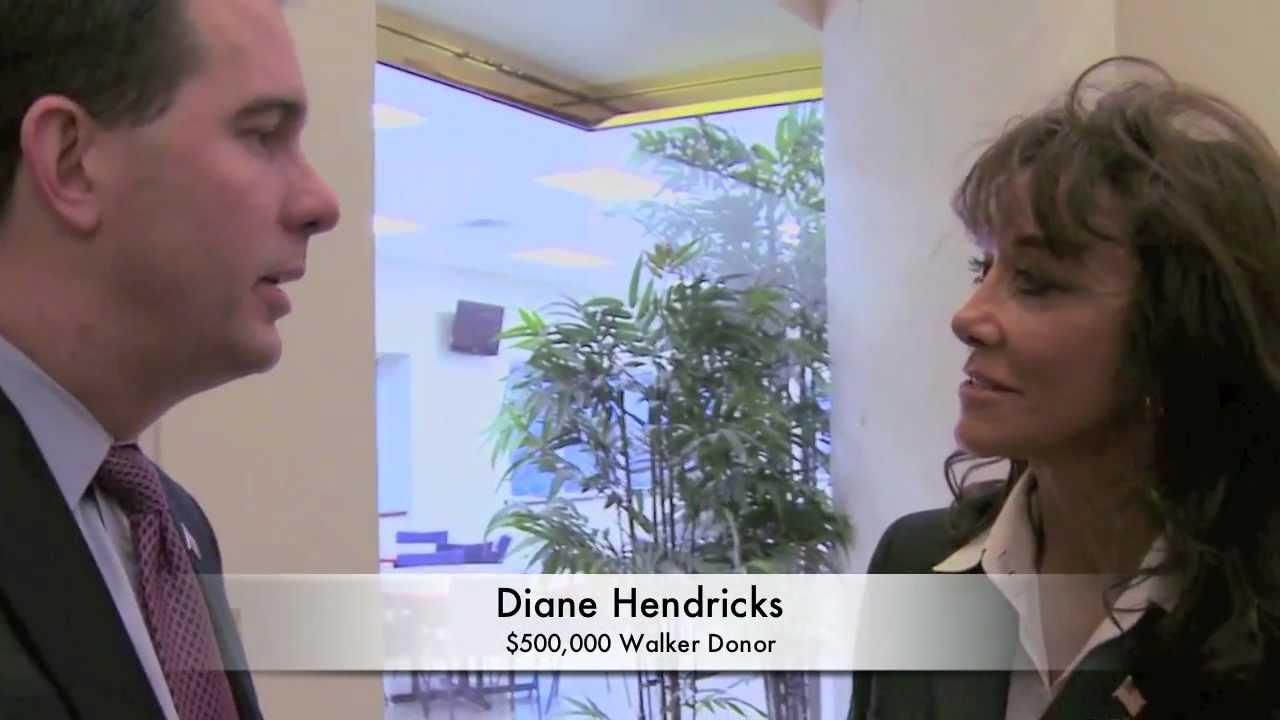 showing Walker hobnobbing with billionaire donor Diane Hendricks, founder and chairwoman of Wisconsin-based ABC Supply, two weeks after taking office. “Any chance we’ll ever get to be a completely red state and work on these unions and become a right-to-work?” she asked. (So-called right-to-work laws slash union revenue by prohibiting unions from compelling employees to pay dues, allowing employees to benefit from a union’s efforts without contributing their share.) Walker replied, “The first step is, we’re going to deal with collective bargaining for all public employee unions, because you use divide and conquer.”
That strategy could soon become national policy. Former House Speaker Newt Gingrich, a Trump adviser, has pointed to Walker’s anti-union crusade as a model for how the new administration could target public-sector unions at the federal level. Trump’s pick for education secretary, Betsy DeVos, chaired a group called the American Federation for Children, which claims it has spent more than $4.2 million on Wisconsin races since 2010. The AFC tapped Walker as its keynote speaker at the group’s 2015 policy summit.
“Scott Walker just won the presidential race in 2016 by passing Act 10 five years ago.”
Six years after the passage of Act 10, a small band of retirees still gathers in the Capitol rotunda every weekday at noon for a pro-union Solidarity Sing-Along. But it barely draws the attention of passing school groups, let alone lawmakers. State labor organizations, struggling to maintain their membership rolls, have little time or money to press legislators for policy changes. One AFSCME council saw its budget drop from $5 million before Act 10 to $1.5 million in 2013.
Before Walker’s crusade, 14.2 percent of Wisconsin’s workforce belonged to a union. By 2015, that figure had dropped to 8.3 percent, significantly below the national average for the first time. That year, Walker and the Legislature passed a law that extended the right-to-work provisions to private-sector unions as well. That law’s central provision is still on hold pending legal challenges.
It’s no coincidence that 2016 was the first election in which the state voted Republican for president since Ronald Reagan. According to exit polls, Hillary Clinton won union households in the state by 10 percentage points. But 79 percent of voters didn’t belong to a union household, and they went in Trump’s favor by 8 points—enough to deliver him a surprise victory in Wisconsin. “Scott Walker just won the presidential race in 2016 by passing Act 10 five years ago,” anti-tax crusader Grover Norquist tweeted on election night.
Teachers’ unions have been hit hardest. Prior to the law, the Wisconsin Education Association Council (WEAC)—the state’s largest association of local teachers’ unions and an affiliate of the National Education Association—counted about 98,000 members. Now it has fewer than 40,000. The WEAC spent $93,481 on lobbying in 2015, compared with more than $2.2 million in 2011. The union recently put its Madison headquarters up for saleto shore up its finances.
As unions have lost their sway, teaching has become a less attractive profession. School districts have struggled to hire and retain teachers. A study from the Milwaukee-based Public Policy Forum found that between the 2008-09 and 2013-14 school years, the number of people entering Wisconsin teacher-training programs declined by 28 percent and the number of teachers in the state dropped by 2.4 percent, even as the number of students remained nearly constant. In 2013, schools attracted an average of 4.9 applicants per open teaching position, according to data from the Wisconsin Education Career Access Network. By 2015, that average had dipped to 3.3 applicants. Last August, with the start of the school year weeks away, state Superintendent Tony Evers was forced to offer more emergencyone-year teaching licenses in order to expand the pool of applicants.
Act 10 has thinned the ranks of both veteran teachers and younger ones. Thanks to the old collective bargaining agreements, Wisconsin teachers used to enjoy generous benefits that allowed people to retire at age 55 and receive a full pension, though many teachers continued teaching into their 60s. But Act 10 threatened to strip away those benefits once the agreements expired, leading many teachers who were eligible for retirement to make their exit years earlier than planned. “We lost a lot of people who developed the expertise over the years to reach kids at their various learning styles,” says John Matthews, who led Madison’s teachers’ union for 48 years. “Those people were leaving en masse.”
The teachers who remain, meanwhile, have been forced to take on extra work to make up for the shortage. The La Crosse school district, for example, tried to solve budget problems by saddling its newest high school teachers with an additional class, at the expense of time spent developing a curriculum and grading papers. John Havlicek, a Spanish teacher in his 21st year and a union representative, says he’s never seen so few teachers take on secondary roles as coaches—they simply don’t have the time for sports. “Within two years, you had teachers leaving because they just couldn’t keep up,” Havlicek says. “It doesn’t seem like it, but 30 more kids and one less period in which to help kids who come in for help was a double whammy.” (The school district is rolling back the change after pressure from teachers and parents.)
In 2011, Walker signed legislation that cut the state’s K-12 education funding by $792 million over two years. If districts want to increase taxes for school funding, they’re required to hold referendums. Last November, 67 such measures were on ballots across the state, with 55 passing. Schools are also getting crunched by state Republicans’ zeal for voucher programs that use public funds to send students to religious and other private schools. Walker has called vouchers a “moral imperative” and expanded their use in 2015, lifting income caps for families to qualify. That year, the Wisconsin Department of Public Instruction warned that school districts would receive less funding because of the voucher program. In the two years since, those schools have lost $41.4 million.
“The shortage of money is causing class sizes to be larger than they should be,” Matthews says. “It’s causing teachers not to have the resources like new textbooks, workbooks. Those resources just aren’t there. And there’s been a cutback in assistance work in the classrooms, a cutback in music, art, and phys-ed teachers. It’s hit the quality of education.”
“I’m from Wisconsin. I’m from your future. There’s some lessons to learn.”
With unions diminished at the state level, conservatives have shifted their attention to weakening them and their influence in liberal cities where they remain relatively strong. In the old manufacturing city of Kenosha, the school board continued to negotiate with the local teachers’ union, although it didn’t have to under Act 10. So in a 2014 election, Americans for Prosperity—the main political arm of the Koch brothers—got involved in the school board race, in which two seats held by vocally pro-union members were up for grabs. The group set up phone banks and sent people campaigning door to door. The incumbents were replaced with anti-union candidates.
Act 10 requires annual recertification elections in which at least 51 percent of all eligible members—including those who don’t show up—must vote in favor of a union to keep the chapter alive. Bob Peterson, the head of the Milwaukee teachers’ union from 2011 to 2015, says these annual elections can cost thousands of dollars and force unions to run full-scale phone-banking operations. Last year, 11 WEAC affiliates lost recertification votes. In the small eastern Wisconsin town of New Holstein, all 42 teachers who voted backed recertification, but there were another 42 members who didn’t vote, so the local union disappeared.
Peterson has warned his peers in other states for years that Wisconsin could be the test case for the country. “I generally start out by saying, ‘I’m from Wisconsin,'” he explains. “‘I’m from your future. There’s some lessons to learn.’ I sort of thought I was exaggerating, but with the Trump election I don’t think I was. What has gone on in Wisconsin for the last five and a half years is what very well could happen nationwide.”
==
==
https://www.exposedbycmd.org/2018/07/17/book-review-fall-wisconsin-uplifting-read
A must-read on the summer book list is The Fall of Wisconsin: The Conservative Conquest of a Progressive Bastion and the Future of American Politics, by Dan Kaufman. This remarkable book takes readers on a winding journey through the Native American, Scandinavian, and Socialist roots of the Badger State to its latest incarnation as a Trump satellite state.
“Donald Trump’s victory may have shocked the Clinton campaign and media pundits, but the result merely heralded the final stage of Wisconsin’s dramatic transformation from a pioneering beacon of progressive, democratic politics to the embodiment of that legacy’s national unraveling,” writes Kaufman.
Wisconsinites have had a front row seat to this unraveling. But this is not a gloomy book, nor the dry, didactic reporting of the mainstream newspapers stripped of historical context and evocative language. It is a beautifully drawn portrait of resistance told via the voices of the state’s beleaguered citizenry.
PORTRAIT OF RESISTANCE
The book highlights Mike Wiggins, the chairman of the Bad River Band, and other tribal leaders who successfully battled theGogebic Taconite iron-ore strip minein the Penokee Hills after the company crafted its own bill and paid millions to buy off the state legislature. “The tribes, Wisconsin’s first conservationists, have now become the last hope, the only group with any power to stop the dismantling of the state’s environmental heritage,” writes Kaufman in one of the book’s most affecting chapters.
It stresses the national importance of the fight over Act 10, Walker’s union-busting legislation, which blindsided the voters–even Republicans.“Walker’s agenda, which was always there but nobody knew it, really came from somewhere else, like the Koch brothers, the national party, and ALEC [the American Legislative Exchange Council]. I don’t think it was a local agenda, frankly,” said former GOP State Senator Barbara Lorman.
It details the chutzpah of average citizens who step up to run for office when no one else will. From Lori Compass, who single-handedly launched a recall against Senate Majority Leader Scott Fitzgerald in 2011, to Randy Bryce, the ironworker who battled ALEC’s anti-union “right to work” bill and the gutting of prevailing wage. In 2018, Bryce decided to step up and take on one of America’s most prominent politicians, Speaker of the House Paul Ryan.
Dozens of other Wisconsinites, including Tia Nelson, Jesse Barnes, Tim Cullen, Curt Meine, Todd Albaugh, Dave Poklinkoski, Marvin DeFoe, Dale Schultz, Tim Cullen, and more, are interviewed and paint a portrait of a resistance that didn’t waver though the deck was stacked against them. Included in this list is Rep. Fred Kessler, who found a way to challenge the GOP’s unprecedented partisan gerrymandering in federal court and get it ruled unconstitutional. Woven into the these tales are the stories of Chief Buffalo, “Fighting Bob” La Follette, socialist Emil Seidel, environmentalist Aldo Leopold, educator John Bascom, Congressman Victor Berger, Earth Day founder Gaylord Nelson, and other historical figures.
CRITICAL INFRASTRUCTURE
Kaufman writes that “ALEC played an essential role in the conservative network that has transformed Wisconsin,” highlighting three ALEC measures: school vouchers, right to work, and voter ID.[CRONON?]
This became crystal clear to a young mom living and working in Madison named Chris Taylor. Walker’s attack on unions and on the public schools where her kids went to school inspired Taylor to run for office in 2012 and, once elected, she continued to dig deeper into the group’s radical agenda, which has prompted over 100 American companies to stop funding it. Just last week, long-time supporter ExxonMobil stopped funding ALEC.
“ALEC defines the parameters of what’s possible,” Taylor explains in the book. Since being elected to the State Assembly, Taylor has taken it upon herself to attend ALEC meetings as often as possible in order to report on the organization for multiple outlets. Taylor describes in the book how isolated she feels in a sea of conservatives, including being chased through the halls of one meeting by a drunken legislator.
Taylor explains well the critical “infrastructure” that the GOP built in the state with the support of the $900 million Lynde and Harry Bradley Foundation, which the Center for Media and Democracy exposed in an 11-part series in 2017, and how that infrastructure was critical to the election of Trump and the defeat of Clinton. This infrastructure included candidate training, ALEC politicians, state-based “think tanks,” legal teams, and phony media outlets.
Even in Democratic circles, the expanse and effectiveness of this infrastructure is not widely understood. “‘Republicans have a network, they have an infrastructure.’ We don’t. We might pick up a seat or two here and there, but until we have an infrastructure as strong as theirs, we’re going to lose,” says Taylor.
A NATIONAL MODEL
The book tells a tale of how Wisconsin “went from a state widely admired as a ‘laboratory of democracy’ to a testing ground for national conservatives” bent on making key states Republican strongholds. “Those efforts have been wildly successful, culminating in Wisconsin’s startling deliverance of the White House to Donald Trump,” writes Kaufman.
Grover Norquist explains the centrality of Walker’s Act 10legislation to the Trump election in the book: “Donald Trump’s unexpected victory in 2016 did not lay the groundwork for Republican political dominance. But the March 2011 signing of Act 10, a dramatic reform of public-sector labor laws, by Wisconsin’s Scott Walker certainly did. To understate it: If Act 10 is enacted in a dozen more states, the modern day Democratic Party will cease to be a competitive power in American politics. It’s that big a deal.”
Norquist’s anti-union coalitional efforts, hyper-funded by the Kochs and the Bradley Foundation, helped take the Wisconsin “model” national. The nation is now facing an Act 10 of its own, as Trump’s pick to the Supreme Court, Neil Gorsuch, served up the deciding vote for the June Janus vs. AFSCME Council 31 decision, which will introduce “right to work” conditions nationwide, as the Center for Media and Democracy detailed in an award-winning investigation in February.
HOPING FOR AN ENCORE
Kaufman followed his book with a New York Times essay “Progressive Populism Can Save Us From Trump.” Many in Wisconsin, who gave Bernie Sanders 71 of 72 counties in 2016, hope he is right.
There is only one flaw in Kaufman’s important book.Walker’s brain, R.J. Johnson, is only mentioned once. Johnson, a native of Florida, is not only Scott Walker’s chief political advisor, but he also oversaw and funneled some $20 million in dark money into the 2011-2012 recall races, and millions more into Senate, Assembly, and judicial races, prompting a criminal investigation by a Republican state prosecutor. Johnson has been responsible for the most disgusting political ads ever aired in the state, the utter destruction of the Wisconsin Supreme Court (turning one of the state’s most respected institutions into what The New Yorker called a “disgraceful mess”), and the wholesale dismantling of Wisconsin’s clean election laws. Few political operatives have had such as impact on the state as this slavish servant of secret money in campaigns and elections.
Let’s hope Kaufman is saving material for his next book.
no lnxgraphic/info
https://www.motherjones.com/politics/2014/10/judicial-elections-citizens-united-karl-rove/
Is Your Judge for Sale?
Thanks to Karl Rove and Citizens United, judicial elections have been overtaken by secretive interest groups, nasty ads, and the constant hustle for campaign cash.
:{
}:
ANDY KROLLNOVEMBER/DECEMBER 2014 ISSUE
The 30-second TV spot is stark and brutal. First it shows the bespectacled face of candidate Louis Butler, then a grainy mug shot of an ex-con. “Louis Butler worked to put criminals on the street,” the narrator warns, “like Reuben Lee Mitchell, who raped an 11-year-old girl with learning disabilities.” After Mitchell’s release from prison, the narrator continues, he raped again. “Can Wisconsin families feel safe with Louis Butler?”
This attack ad wasn’t from a bitterly fought congressional race. It was from a 2008 campaign for state Supreme Court justice—a position that until recently was considered above the fray of partisan politics. Butler, the first African American Supreme Court justice in Wisconsin history,was defending his seat against a trial court judge whose campaign tactic recalled the GOP’s infamous Willie Horton hit job on Michael Dukakis during the 1988 presidential campaign. Long before ascending to his state’s highest court, Butler had been assigned as Reuben Lee Mitchell’s public defender—he wasn’t the judge in the case, as the nasty ad implied.
Butler’s opponent, Michael Gableman, had been showered with campaign donations from business leaders, who were keenly aware of Butler’s role in two decisions. One was a 4-3 ruling to strike down a $350,000 limit on so-called pain-and-suffering damages in malpractice suits. The other held that if an individual harmed by lead paint exposure couldn’t identify the producer, then multiple paint companies could be held liable under a legal theory known as “risk contribution.”
Read our graphical explainer on how dark money is taking over judicial elections.
While Butler’s and Gableman’s campaigns spent a combined total of $1.2 million on the race, outside groups aligned with the US Chamber of Commerce and the state’s labor unions spent $3.6 million, funding 89 percent of all the TV ads. Butler was the first sitting justice to get booted from the court in 40 years.
By 2011, with Wisconsin reeling from political battles over Gov. Scott Walker’s union-busting agenda, the next Supreme Court race was equally ugly. This time it was conservative Justice David Prosserdefending his seat; a misleading ad from a partisan group backing his opponent claimed that Prosser, as a district attorney in 1978, had helped cover up sexual abuse of two young boys at the hands of a Catholic priest. (The abuse had only emerged years later; the victims called the ad “offensive, inaccurate, and out of context.”)
Although Prosser successfully defended his seat, he says that the election—which saw nearly$5 million in total campaign spending—poisoned relationships on the court. The tension boiled over weeks later, when Prosser and Ann Walsh Bradley, a liberal justice, engaged in an argument that got physical as four of their fellow justices looked on. Bradley claimed Prosser choked her, while Prosser said he raised his hands in self-defense as Bradley charged at him. In police interviews, two conservative justices sided with Prosser, and two liberal justices with Bradley. Investigations by the county sheriff, the local DA, and a special independent prosecutor all cleared Prosser of any wrongdoing, but the controversy still festers. When I spoke with Prosser in September, written in chalk on the sidewalk outside the state Capitol was an invitation to visit him for “free chokes.”
“They wanted to make sure we were punished for our decision and that other judges witnessed that,” says former Iowa Supreme Court Justice Marsha Ternus.
Bitter, costly judicial elections are by no means unique to Wisconsin. These days, as more candidates for the bench face rough contests—buffeted increasingly by outside money, thanks to the US Supreme Court’s 2010 decision in Citizens United—state judges around the country often raise six- and seven-figure sums, mount statewide campaigns, and fend off attack ads from groups that don’t disclose their donors. This trend has escalated over the last decade and a half as partisan groups realize that donating to judges can get them more influence, for less money, than bankrolling legislative campaigns.After all, the donors often end up with business before the very judges they are helping elect.
These are also the judges that most citizens who interact with the system have to face. Can Americans still trust in getting their fair day in court?
Court cases that make big news are usually in the federal system, where most judges are appointed by the president and confirmed by the Senate. Yet the vast majority of justice is done at the state level, where more than 100 million cases are filed annually (versus about 400,000 in federal courts). The nation’s approximately 30,000 state court judges vastly outnumber their federal counterparts, and 85 percent of them will stand in at least one election during their career.
No two states pick their judges exactly the same way. Some hold partisan judicial elections, others have nonpartisan elections, and still others use merit selection—that’s when legal experts select a short list of qualified candidates, the governor appoints one to the bench, and that judge later stands in a retention election.
The system has its roots in the Panic of 1837, a mini-depression fueled by rampant cronyism and massive overspending by corrupt governors and legislatures. Partisan elections replaced the tradition of elected officials appointing their friends to the bench, but for decades connections and loyalty still mattered most, with party bosses determining who won. Eventually states embraced nonpartisan elections and merit selection, and for most of the 20th century, judicial elections were a little-noticed corner of American politics.
Still, on occasion a contentious race attracted national attention. In 1977, Rose Birdbecame the first woman appointed to the California Supreme Court and its first female chief justice. An avowed foe of capital punishment, she voted to vacate all 61 death penalty verdicts that came before her, prompting Republican Gov. George Deukmejian to label her a “soft-on-crime liberal.” With Bird up for retention in 1986, oil and agribusiness companies, which generally saw Bird’s liberal views as a threat to their interests, poured more than $5.6 million into a campaign that would unseat her. It was an early glimpse of a reliable strategy for big business: Using the soft-on-crime theme to oust judges considered unfriendly to corporations.
Around that time, a political consultant by the name of Karl Rove was plotting his own assault on the Texas Supreme Court. Rove had helped launch the “tort wars” in response to what some Republicans saw as a court system too cozy with trial lawyers and too eager to slam corporations with hefty judgments that Rove had dubbed “junk lawsuits.”
Running on the slogan “Clean Slate ’88,” conservative candidates backed by Rove’s operation won five of the six open seats on the Texas Supreme Court. Not long after, Rove teamed up with the Business Council of Alabama to engineer a similar Republican takeover in that state.
Direct spending on supreme court races, 2000-14
Two years later, the US Chamber of Commerce, under the leadership of an aggressive new president named Tom Donohue, picked up on Rove’s strategy.Pledging to “play hardball” against “frivolous” lawsuits, the Chamber spent $10 million on judicial races in 2000 alone. It pumped $4.4 million into Ohio’s Supreme Court election—the largest expenditure from a single source on a court race in US history. In the following years, the Chamber injected tens of millions into races in Illinois, Michigan, Mississippi, and Wisconsin. Corporate America had grasped the potential to install friendly judges who could crack down on costly class actions and neutralize the efforts of consumer advocates. “We’re clearly engaged in hand-to-hand combat,” as Donohue put it, “and we’ve got to step it up if we’re going to survive.”
Unions spent millions on these races as well—particularly across the Upper Midwest, as labor leaders recognized they could get a great return on investment by backing justices sympathetic to workers’ rights. As an official with the Ohio AFL-CIO once said: “We figured out a long time ago that it’s easier to elect seven judges than to elect 132 legislators.”
A major showdown came in 2004, in West Virginia’s Supreme Court election.Don Blankenship, the former CEO of Massey Energy, donated $3 million to Republican candidate Brent Benjamin. Meanwhile, a nonprofit funded primarily by Massey Energy ran TV ads accusing incumbent Justice Warren McGraw of getting a child rapist out of prison and into a job at a high school. After Benjamin won, the investment paid off big time: He later cast the deciding vote to overturn a lower court’s $50 million verdict against Massey Energy. Two years later, the US Supreme Court ruled that Benjamin should have recused himself. It overturned the decision and sent the case back to West Virginia. (Massey Energy ultimately prevailed in state court.)
Corporate interests also reaped a huge return on investment in the 2004 Supreme Court election in Illinois. Five years earlier, a jury had handed down a $1.19 billion penalty to the insurance company State Farm for requiring millions of claimants to accept subpar replacement auto parts. State Farm and its employees—working through the US Chamber, the Illinois Republican Party, and an Illinois-based tort reform group—steered $4 million to elect a sympathetic judge named Lloyd Karmeier to the Supreme Court, which was considering State Farm’s appeal of the auto parts verdict. Karmeier, his opponent, and various outside groups spent a record $9.3 million on the race. Karmeier, who would later acknowledge that the sum was “obscene,” won easily. And the millions State Farm spent were a pittance compared with what it gained: The next year, Karmeier cast the deciding vote to overturn the more than $1 billion verdict against State Farm.
Up to this point, the big spenders were mostly targeting contested judicial elections—ones in which a candidate challenged a sitting justice. Then came the Iowa Supreme Court’s 2009 decision in Varnum v. Brien, in which the seven justices unanimously ruled that the state’s ban on same-sex marriage violated the state constitution. Social-conservative groups leapt into action, targeting three of the seven justices who were up for retention election—ones where voters only check “yes” or “no.” The National Organization for Marriage and its allies spent nearly $1 million and defeated all three. “They wanted to make sure we were punished for our decision and that other judges witnessed that so they wouldn’t do it either,” former Justice Marsha Ternus told me.
The strategy of turning sleepy retention elections into political showdowns has been spreading. In Florida’s 2012 retention elections, theKoch-backed Americans for Prosperityand the Republican Party of Florida spent hundreds of thousands of dollars to unseat three sitting justices. A group called Defend Justice From Politics spent $3.1 million on the justices’ behalf, helping them prevail. In Michigan in 2012, two anonymously funded nonprofits, the Judicial Crisis Network and Americans for Job Security, poured $2.1 million into attack ads against five judges on Michigan’s 6th Circuit Court, though the judges won out. And earlier this year,Tennessee’s lieutenant governor, Ron Ramsey, took it upon himself to spearhead an effort to unseat three sitting state Supreme Court justices—and, along with them, the attorney general, who is appointed by the court. Ramsey’s PAC pumped $425,000 into a group running negative ads that blasted the three justices as “liberal on crime”and for “helping advance Obamacare.”Funds were also contributed by Americans for Prosperity and the GOP’s State Government Leadership Foundation, which said it planned to spend an additional $5 million in 2014 on judicial races in North Carolina, Tennessee, and elsewhere.
Though the three Tennessee justices prevailed in the end, one of them, Connie Clark, told me she’s concerned about the precedent set by the fight. “As long as there are no limits on outside money,” she says, “then this will become the new normal.”
The transformation of judicial campaigns has alarmed another veteran of the court system. “Judicial elections pose a serious threat,” former US Supreme Court Justice Sandra Day O’Connor told Mother Jones. “If judicial decisions are in fact not fair and impartial—or even if they are perceived as being biased—the basis of support for our courts crumbles.”
Initially, the 2011-12 election season—the first full cycle since Citizens United—saw a modest dip in overall reported spending on state judicial races, compared to four years earlier. But that is likely because much of the new spending does not have to be disclosed or tracked. This year, for example, Americans for Prosperity-Tennesseeannounced a “major new effort” to educate the public about the “liberal records” of the three justices—and not a penny of that spending was reported to the state. The outside spending on judicial races that we do know about rose to a record-high $24.9 million—a nearly sevenfold increase since 2000, and now accounting for 40 percent of the total spending on these campaigns.
Direct vs. outside judicial spending (in 2014 dollars)
Recent research suggests this flood of political money could be influencing judges’ decisions. Emory University analyzed 2,345 state supreme court decisions from all 50 states between 2010 and 2012 and concluded that the more campaign money justices received from business interests, the more likely they were to vote in favor of businesses appearing before them. (Interestingly, the study found a stronger tie between business donations and Democratic justices’ decisions. Republican justices, it speculated, were already more favorably inclined toward business interests, so the campaign money didn’t make as much of a difference.) Another analysis, by the left-leaning think tank Center for American Progress, suggested that as more money was spent on soft-on-crime attack ads in campaigns, justices were increasingly siding with the prosecution.
The public may be starting to catch on: A 2013 poll by Justice at Stake, a nonprofit group focused on reforming the system, found that 87 percent of Americans believe that campaign donations could influence court rulings. “You can’t expect judges to act like Huey Long on the campaign trail and expect them to be Solomon in the courtroom,” says Bert Brandenburg, the group’s executive director.
A case pending before the US Supreme Court could inject even more politics into judicial races. In Lanell Williams-Yulee v. the Florida Bar, a county-level judge wants the nation’s high court to strike down laws in 30 states blocking judges from personally asking donors for campaign cash. In those states, treasurers and fundraising consultants typically make the ask on behalf of a judicial candidate. Only nine states currently allow judges to solicit donations directly for their campaigns, but in those states, “the road to victory begins with the solicitation of money,” Wallace Jefferson, the former chief justice of the Texas Supreme Court, has written. “The ‘ask’ is undignified, and the ‘give’ is fairly compelled.” For those fighting to insulate judges from electoral politics, the elimination of the fundraising ban would be yet another step in the wrong direction.
Some researchers dispute the notion that rough-and-tumble judicial elections are a problem. One recent Michigan State University study of supreme court races concluded that attack ads did not hurt incumbents in partisan elections. Other studies found that nonpartisan elections are less likely to draw a challenger, are less competitive even when there is a challenger, and attract fewer voters than partisan elections do.
The debate boils down to a fundamental notion: whether the judicial branch of government is unique from the other two and should be insulated from politics. With court integrity hanging in the balance, should judges be chosen the same way we pick presidents and members of Congress?
Randy Shepard, who served as the chief justice of the Indiana Supreme Court for 25 years, retired from the court in 2012 as the longest-serving state chief justice in American history. A lifelong Republican in a red state, Shepard has gone through the merit selection process and run in multiple elections. “What’s at stake in these big-money elections is the promise of due process and an impartial court,” he told me. “Do I as a citizen walk into that courtroom standing on a relatively level playing field?”
He offered up a hypothetical from a law review article he wrote that, he proudly noted, was cited by Justices Ruth Bader Ginsburg and Anthony Kennedy in the Massey Energy case—the one where the high court ruled that a judge who’d received massive campaign contributions connected to a company had to recuse himself from a case involving that company. “Say you’re going before a trial judge making a decision about the custody of your grandchildren, and your evil son-in-law or daughter-in-law had made a very large contribution to the judge. How would you feel about that? You wouldn’t feel very optimistic, would you?”
==
==
https://www.ecowatch.com/rooftop-solar-state-policies-2563502732.html
Ten of the nation's sunniest states get a failing grade for policies that actively block, or don't encourage, rooftop-solar development, according to Throwing Shade, a new report from the Center for Biological Diversity.
Alabama, Florida, Georgia, Indiana, Louisiana, Oklahoma, Tennessee, Texas, Virginia and Wisconsin account for more than 33 percent of the total rooftop-solar potential of small buildings in the contiguous U.S. but less than 8 percent of net generation in 2017. All of them get an "F" in today's report.
"Instead of leading us out of the climate crisis, these sunny states are casting a long shadow across our potential for rooftop solar," said Greer Ryan, a renewable energy and research specialist with the Center for Biological Diversity and author of the report. "The Trump administration certainly isn't going to fix our climate, so it's vital that these states step up."
...
===
am promise
3/18
The 28th Amendment is winning everywhere, not just in New Mexico and New Hampshire. In Wisconsin, Citizen Leaders are pushing their legislature to put a resolution on the ballot after nearly 100 local communities passed resolutions – including one in Speaker Paul Ryan’s hometown, Janesville, WI, where it passed with 84 percent support.
==
==
https://www.alternet.org/news-amp-politics/supreme-court-just-blocked-order-north-carolina-redraw-gerrymandered-congressional
North Carolinians may vote in the 2018 midterm elections under a congressional map that has been gerrymandered by Republicans. The U.S. Supreme Court has blocked a lower court ruling ordering the U.S. House of Representatives district lines be redrawn by January 24.
Justices Ruth Bader Ginsburg and Sonia Sotomayor both objected to the order.
Reuters explains the initial ruling that ordered the district lines be redrawn:
"The three-judge panel ruled that the Republican-drawn districts violated the U.S. Constitution’s guarantee of equal protection under the law by intentionally hobbling the electoral strength of non-Republican voters. Two of the three judges also said the plan ran afoul of the Constitution’s First Amendment by discriminating based on political belief and association."
The Supreme Court is reviewing cases of alleged gerrymandering in Wisconsin and Maryland. The implications of these cases on other states, including North Carolina, remain to be seen.
...
==
==
https://www.alternet.org/right-wing/voter-id-suppressed-vote-exactly-wisconsin-republicans-predicted
mary b cmd
Anew study of registered voters in Dane and Milwaukee Counties who did not vote in the 2016 presidential election found that approximately 17,000-23,000 eligible voters in those counties were prevented or deterred from voting by Wisconsin’s voter ID law. Due to financial constraints, the social scientists were only able to do a study of two of Wisconsin’s 72 counties, but the authors say that extrapolating statewide as many as 45,000 people stayed home because of the law.
Donald Trump won the state of Wisconsin by only 22,000 votes, the first GOP presidential victory in the state since Ronald Regan in 1984. The shocking upset garnered national attention and helped deliver the electoral college to Trump as the popular vote went to Clinton.
The study, conducted by Ken Mayer and Michael G. DeCrescenzo, at the University of Wisconsin Department of Political Science, provides definitive evidence that the controversial voter ID bill, passed in 2011 and held up in the courts until 2016, worked precisely as Wisconsin Republicans intended — to make it more difficult for targeted voters to cast their ballots.
Although voter preferences were not included in the study, the survey documents that the burdens of voter ID fell disproportionately on low-income and minority populations considered likely to support Democrats. Among low-income registrants (household income under $25,000), 21.1% were deterred, compared to 7.2% for those whose household income was over $25,000. 8.3% of white registrants were deterred, compared to 27.5% of African Americans.
Roughly 80% of registrants who were deterred from voting by the law, and 77% of those actually prevented from voting, cast ballots in the 2012 election. The number of voters negatively impacted is far greater than the number of “fraud” cases the law was designed to stop. When the law was challenged in federal court and initially ruled a violation of the Voting Rights Act, the state failed to present a single case of voter impersonation that the law would have prevented.
The results prompted the county clerks from Milwaukee and Madison to issue strongly worded statements and a call for a suspension of the voter ID law. “I was shocked by the numbers and am furious to see that Jim Crow laws are alive and well,” said Milwaukee County Clerk George Christenson.
“The photo ID law must be suspended until changes can be made to restore every voter’s access to the ballot box,” said Dane County Clerk Scott McDonell whose office commissioned the study.
“What I am concerned about here is winning”
While most Republican stuck to the official talking points that the photo ID law was all about preventing nonexistent “voter fraud,” some forgot the script.
On the night of Wisconsin’s 2016 presidential primary, Republican Congressman Glenn Grothman (R-WI) flatly stated in an interview with WTMJ’s Charles Benson that Wisconsin’s photo ID law would help the GOP win Wisconsin in the November 2016 election.
When asked about the fact that Wisconsin has consistently voted for Democrats in recent presidential elections, Grothman assured Bensen that Democratic front-runner Hillary Clinton was a “weak candidate,” then added “and now we have photo ID, and I think photo ID is gonna make a little bit of a difference as well.”
Rep. Grothman was a State Senator in 2011 when Wisconsin debated and passed its voter ID law, so he was privy to the back room conversations and dealings on the issue.
Those back room conversation came to light five years later when the bill was implemented and people immediately started having problems. Former GOP staffer turned coffee shop owner, Todd Albaugh, was frustrated when one of his employees could not vote in the 2016 spring elections and decided to blow the whistle.
“I was in a closed Senate Republican Caucus when the final round of multiple Voter ID bills were being discussed. A handful of GOP Senators were giddy about the ramifications and literally singled out the prospects of suppressing minority and college voters. Think about that for minute. Elected officials panning and happy to help deny a fellow American’s constitutional right to vote in order to increase their own chances to hang onto power.”Albaugh, who once worked for Wisconsin Senator Dale Shultz (R-Richland Center), stated in a social media post:
“A vigorous debate on the ideas wasn’t good enough,” said Albaugh “they had to take the coward’s way out and come up with a plan to suppress the vote under the guise of ‘voter fraud.'”
Later on the witness stand in a lawsuit brought by One Wisconsin Now challenging the voter ID law, Albaugh described the tension in closed door caucus as provisions in the bill were being debated.
As described by the *Milwaukee Journal Sentinel*, Albaugh testified that Committee Chair Sen. Mary Lazich (R-New Berlin) made the case for passing the bill, which made it much harder for students, the elderly and the poor to vote:
“She got up out of her chair and hit her fist or her finger on the table and said, ‘Hey, we’ve got to think about what this would mean for the neighborhoods around Milwaukee and the college campuses,” Allbaugh said.
“Grothman said, ‘What I’m concerned about here is winning, and that’s what really matters here. … We better get this done quickly while we have the opportunity,'” Allbaugh said.
Allbaugh named two other senators — Leah Vukmir and Randy Hopper — as being gleeful over passing the bill.
“They were politically frothing at the mouth,” he said of Vukmir and Hopper, who lost a recall election a few months after the voter ID law passed.
ALEC Members Toe the Koch Party Line
All four of the legislators named by Albaugh were at the time members of the American Legislative Exchange Council (ALEC). Leah Vukmir, described as “frothing at the mouth” over the bill, served for years as an officer of ALEC, was ALEC’s national chairman in 2016, and was given ALEC’s “Iron Woman” Award in 2017.
The Koch-funded American Legislative Exchange Council (ALEC) drafted and approved a “model” “Voter ID Act” in August of 2009. The wave of bills that followed were constructed differently by different GOP legislatures, but have a common purpose to disenfranchise constituencies that are more likely to vote Democratic.
ALEC has attempted to distance itself from this ugly history of voter suppression (it did away with its “Public Safety and Elections Task Force” and no longer touts voter ID as a “model bill”) after sustained campaigning by the online civil rights group Color of Change and others, but ALEC has done nothing to get voter ID policies repealed in the states where its members pushed for and passed the bill.
The partisan motivation behind the Voter ID Act comports with vision of ALEC’s founder, the late Paul Weyrich of Wisconsin, who in 1980 told a group of religious fundamentalists: “I don’t want everybody to vote. Elections are not won by a majority of people, they never have been from the beginning of our country and they are not now. As a matter of fact, our leverage in the elections quite candidly goes up as the voting populace goes down.”
dapl
dane pulled out b/c pressure back home?
–Data Collection Nationwide–
Other police departments are similarly sketchy when pressured to speak on their surveillance technologies. Wisconsin’s Milwaukee PD hid the use of cell site simulators, or Stingrays, from courts for months.Stingrays mimic cellphone towers, thus tricking phones into providing all manner of user information and data.
Nearby, the Wauwatosa Police Department, despite having admitting to “collecting and analyzing cell phone data” in its public reports, denied ever even coming close to a Stingray. It took the department 5 weeks to respond to that open records request, which is considered unusually long. It remains unknown how Wauwatosa PD, which has been blasted for lack of transparency before, collects cell phone data.
But deeper than that: WI Cheddar Cheese mafia: Eric O'Keefe (Wisconsin, Club for Growth) ran the Sam Adams Alliance that built the Tea party, despite longstanding a vigorous denials by Kochs). WII Reince Priebus and paul Ryan are old pals, and though trump attacked GOP leadership, they caved. Gov Scott Walker has been a major implementer of the Koch agenda, anti-union, anti-environment, privatization of all, including schools and prisons). The Kochs had to intervene massively to stop the recall, and it is still a mystery about why Walker abruptly bailed from 2016 race, though will probably involve the John Doe dark money; however, Kochs have been investing in WI supreme court for quite some time).
Walker is an ally of neighboring MI Gov Snyder, and have implemented similar programs. The ultimate fruit of free-marketeering is the lead poisoning of poor black kids, which will permanently lead to cognitive impairment. These two are part of the larger ALEC-Koch-alypse (Four Horsemen: privatization, financialization, militarization, and criminalization). They have funded quite a few midwestern governors, including Kasich and Pence. Some “failed up” and revolving door in Bush admin eg Homeland, but Brownback was perhaps most faithful implementer of Koch Libertarianism program and crashed his state (hired ALEC's Laffer to sell tax plan).
https://kpfa.org/program/economic-update/
8/4
foxconn 3k jobs, wolff 8/4/17 3 bill subsidy Ryan, trump, walker photo-op; 1mil$ subsidy/job; 50K/yr = 60K ppl
==
http://www.prwatch.org/news/2017/06/13256/WILL-voucher-study-bradley-funded-groups
==
new report has called into question whether President Trump would have actually won Wisconsin during the 2016 presidential election without the state’s strict voter ID law. The study published by the progressive advocacy group Priorities USA says the law suppressed the votes of more than 200,000 residents—the majority of whom were African-American and Democratic-leaning. President Trump won only 22,748 more votes than Hillary Clinton in Wisconsin.
==
https://www.thenation.com/article/wisconsins-voter-id-law-suppressed-200000-votes-trump-won-by-23000/
no link
Prior to the 2016 election, Eddie Lee Holloway Jr., a 58-year-old African-American man, moved from Illinois to Wisconsin, which implemented a strict voter-ID law for the first time in 2016. He brought his expired Illinois photo ID, birth certificate, and Social Security card to get a photo ID for voting in Wisconsin, but the DMV in Milwaukee rejected his application because the name on his birth certificate read “Eddie Junior Holloway,” the result of a clerical error when it was issued. Holloway ended up making seven trips to different public agencies in two states and spent over $200 in an attempt to correct his birth certificate, but he was never able to obtain a voter ID in Wisconsin. Before the election, his lawyer for the ACLU told me Holloway was so disgusted he left Wisconsin for Illinois.
Holloway’s story was sadly familiar in 2016. According to federal court records, 300,000 registered voters, 9 percent of the electorate, lacked strict forms of voter ID in Wisconsin. A new study by Priorities USA, shared exclusively with The Nation, shows that strict voter-ID laws, in Wisconsin and other states, led to a significant reduction in voter turnout in2016, with a disproportionate impact on African-American and Democratic-leaning voters. Wisconsin’s voter-ID law reduced turnout by 200,000 votes, according to the new analysis. Donald Trump won the state by only 22,748 votes.
The study compared turnout in states that adopted strict voter-ID laws between 2012 and 2016, like Wisconsin, to states that did not.
While states with no change to voter identification laws witnessed an average increased turnout of +1.3% from 2012 to 2016, Wisconsin’s turnout (where voter ID laws changed to strict) dropped by -3.3%. If turnout had instead increased by the national no-change average, we estimate that over 200,000 more voters would have voted in Wisconsin in 2016.
This reduction in turnout particularly hurt Hillary Clinton’s campaign.
The lost voters skewed more African-American and more Democrat. For example, Wisconsin’s 2016 electorate was 6.1% more Republican, and 5.7% less Democrat, than the group of ‘lost voters’. Furthermore, the WI electorate was 3.7% more White and 3.8% less African American than the group of ‘lost voters.’ This analysis suggests that the 200,000 lost voters would have both been more racially diverse and have voted more Democratic.
(Priorities USA is a progressive advocacy group and Super PAC that supported Clinton in 2016 and Barack Obama in 2012. The study was conducted by Civis Analytics, a data science firm founded by the chief analytics officer for Obama’s reelection campaign in 2012.)
Though Wisconsin saw the most dramatic reduction in turnout among voter-ID states, it was reflective of a worrisome broader national trend.
:{
}:
In states where the voter identification laws did not change between ’12 and ’16, turnout was up +1.3%. In states where ID laws changed to non-strict (AL, NH, RI) turnout increased less, and was only up by +0.7%. In states where ID laws changed to strict (MS, VA, WI) turnout actually decreased by – 1.7%.
The drop in turnout in these six states led to 400,000 fewer votes relative to turnout in states where ID laws did not change. In Mississippi, Virginia, and Wisconsin, strict voter-ID laws had an especially pronounced negative impact on African-American voters.
:{
}:
In counties where African Americans make up less than 10% of the population AND there were no changes to voter ID laws, 2016 turnout was up +1.9% from 2012, but in similar <10% African American counties where ID laws changed to be strict, total turnout decreased by -0.7%. In counties where African Americans make up more than 40% of the population, however, 2016 turnout was down -2.2% from 2012 in states where ID laws did not change, but down -5 points in states where ID laws changed to be strict.
The study also compared turnout in Wisconsin to Minnesota, which has very similar demographics but no voter-ID law, and found “turnout in African-American counties dropped off at significantly higher levels than in their Minnesota-counterparts.”
It’s important to note that this study was conducted by a Democratic Party–affiliated group and has not been peer-reviewed or gone through the typical academic vetting process. While some studies have shown big reductions in turnout among minority voters because of voter-ID laws, others have not. But the Priorities USA study is consistent with a 2014 study by the Government Accountability Office, which found that strict voter-ID laws in Kansas and Tennessee reduced turnout by 2 percent, enough to swing a close election, with the largest drop-off among newly registered voters, young voters, and voters of color.
This study provides more evidence for the claim that voter-ID laws are designed not to stop voter impersonation fraud, which is virtually nonexistent, but to make it harder for certain communities to vote. This matters greatly today, because 87 bills to restrict access to the ballot have been introduced in 29 states this year, including voter-ID laws in 19 states. Arkansas and Iowa have already passed strict voter-ID laws in 2017.
“Americans’ fundamental right to vote is under attack by Republican governors and state legislatures around the country,” said Guy Cecil, Chairman of Priorities USA. “Under the false pretense of combating voter fraud, Republicans are passing laws that make it more difficult and time-consuming for average citizens to participate in the democratic process.”
==
tipped election to Trump? i360?
==
we've gained TWO new cosponsors for the We the People Amendment (HJR48) - Rep. Tim Walz (D-MN) and Rep. Ron Kind (D-WI). We don't yet know much of the backstory behind Kind, but we do know that Walz is the result of much hard work on the part of our folks on the ground in Minnesota - so hats off to everyone there who helped make this happen!
==
betsy devos scott jensen charter fail
==
cmd 2015 report
WISCONSIN
In 2009, Wisconsin was awarded up to $69.7 million in a CSP grant that ran through 2015. As with other states, Wisconsin was praised for the “flexibility” given to charter schools by state law. Wisconsin was in the first wave of states to approve charter schools, in 1993, through a bill modeled on the “Charter Schools Act” pushed by the American Legislative Exchange Council, which took credit for it being introduced and becoming law.(Governor Tommy Thompson (R-WI) was an early ALEC legislative member, and as governor he became known for numerous “reforms” that later were spawned by ALEC, which Thompson essentially conceded in a public speech years later.) Initially, Wisconsin capped the number of charters but today it has over 240 charters with nearly 50,000 students enrolled. Earlier this year, Wisconsin expanded who can authorize charters. More than 90 charters have failed and closed in Wisconsin, including more than two dozen just in Milwaukee alone. The reasons cited for closures include allegations of financial improprieties and fraud, financial mismanagement, poor academic performance, low enrollment, failure to hire enough qualified teachers, and more. Among those failed charters are nearly a dozen, at least, that were federal CSP sub-grantees, as noted in the list below....
http://www.prwatch.org/files/new_charter_school_black_hole_report_oct_21_2015.pdf
==
==
The current justices of the court are:
| Justice | Tenure | Selected by | Party |
|---|---|---|---|
| Justice Shirley Abrahamson | 1976-2019 | Gov. Patrick Lucey (D) | |
| Justice Ann Walsh Bradley | 1995-2025 | Elected | |
| Chief Justice Patience Roggensack | 2003-2023 | Elected | |
| Justice Annette Ziegler | 2007-2017 | Elected | |
| Justice Michael Gableman | 2008-2018 | Elected | |
| Justice Rebecca Bradley | 2015-2026 | Gov. Scott Walker (R) | |
| Justice Daniel Kelly (Wisconsin) | 2016-2020 | Gov. Scott Walker (R) |
Judicial selection
The court is composed of seven justices who are elected to 10-year terms in statewide, nonpartisan elections. Wisconsin holds supreme court elections every year; only one justice may be elected in any year. In the event of a vacancy on the court, the governor has the power and duty to appoint an individual to the vacancy; that justice must then stand for election in the first subsequent year in which no other justice's term expires.[2]
...
Responses
Brandon Scholz, an organizer of the pro-amendment group Vote Yes for Democracy, made the following statement in response to the lawsuit:
| “ | I find it surprising that someone who has served as long as Justice Abrahamson has, for what would appear to be self-serving reasons, files the lawsuit in federal court against the will of the people.[9][10] | ” |
Both the Milwaukee Journal Sentinel and Beloit Daily News called on Abrahamson to drop the lawsuit.[19][20] The Capital Times editorial board, on the other hand, backed Abrahamson's lawsuit.[21]
On April 14, 2015, members of Citizens for Responsible Government, a political action committee, asked the court to allow it to intervene in the case. The group argued against the validity of Abrahamson's lawsuit and sought to have the case thrown out. David Rivkin, an attorney for those asking to intervene, contended, "The office of chief justice of the Supreme Court of Wisconsin is not Justice Abrahamson's personal property. It belongs to the people of Wisconsin, and their will is clear."[22]
==
recount tiktok
http://abcnews.go.com/Politics/wireStory/latest-wisconsins-walker-expect-vote-43927472
he Latest on presidential recount efforts in Wisconsin, Michigan and Pennsylvania (all times local):
4 p.m.
A federal court in Wisconsin on Friday rejected an attempt by pro-Donald Trump groups to stop a recount of the state's presidential vote, saying there was no harm in allowing it to continue.
Two pro-Trump political action committees and a Wisconsin voter on Thursday filed a lawsuit and a request for a temporary restraining order seeking to stop the recount, arguing that it was an unconstitutional violation of the Constitutional rights of people who had voted for Trump.
But U.S. District Judge James Peterson on Friday denied the motion to temporarily halt the recount, saying there would be no harm in allowing it to proceed while the state prepares arguments in defense.
Peterson scheduled a hearing for Dec. 9 on the underlying lawsuit.
———
4:30 p.m.
President-elect Donald Trump's margin of victory in Pennsylvania is shrinking as more counties finish tallying their votes.
An updated count Friday by state election officials shows Trump's lead over Democrat Hillary Clinton has shrunk to 49,000, from 71,000.
That puts Trump's lead at 0.8 percent, down from over 1 percent, out of 6 million votes cast. It's still shy of Pennsylvania's 0.5 percent trigger for an automatic statewide recount. Trump's Pennsylvania victory was crucial to his capturing the White House.
The update comes as Green Party presidential candidate Jill Stein spearheads recount efforts in Pennsylvania, Michigan and Wisconsin. Trump narrowly beat Clinton in all three states.
Trump's lead in Pennsylvania dropped as counties wrapped up the counting of overseas ballots and settled provisional ballot challenges.
Some counties are also fielding precinct recount requests, and final counts are outstanding in some places, including Philadelphia.
————
12:40 p.m.
Michigan's elections board has deadlocked on President-elect Donald Trump's request to prevent a recount, which means it will start next week unless the courts intervene.
Two Republicans voted Friday to prevent the recount, while two Democrats said it should proceed. A state spokesman says the statewide recount requested by Green Party candidate Jill Stein will begin Tuesday or Wednesday barring a court order.
Michigan Attorney General Bill Schuette, a Republican, asked the state Supreme Court on Friday to intervene and stop the recount. That motion is pending.
A Wisconsin recount is underway, though his supporters have filed a federal lawsuit trying to stop in. In Pennsylvania, Trump is asking a court to dismiss Stein's recount request.
———
12:20 p.m.
President-elect Donald Trump and the Pennsylvania Republican Party have asked a court to dismiss a Green Party-backed request for a recount of the state's presidential election vote.
In a filing late Thursday, Republican lawyers accused Green Party presidential candidate Jill Stein of legal antics that threaten Pennsylvania's ability to certify its presidential electors by the Dec. 13 federal deadline.
A Monday court hearing is scheduled in the case.
The GOP argues there's no evidence or even allegations that the state's voting systems were tampered with and that the law doesn't specifically allow a court-ordered recount.
Stein has also requested recounts in two other states Trump narrowly won, Michigan and Wisconsin. The Wisconsin recount is underway.
———
9:50 a.m.
Supporters of President-elect Donald Trump have filed a federal lawsuit trying to stop Wisconsin's ongoing presidential election recount.
The lawsuit and request for a temporary restraining order was filed late Thursday in federal court in Madison. It was filed by the Great America PAC, the Stop Hillary PAC and Wisconsin voter Ronald R. Johnson.
The lawsuit contends that the recount that started Thursday threatens the due process rights of Johnson and others who voted for Trump. Trump won Wisconsin and the recount was requested by Green Party presidential nominee Jill Stein.
The lawsuit also argues that errors are likely in the recount, as election officials are rushing to meet a Dec. 13 deadline.
———
10 a.m.
Michigan's attorney general has asked the state Supreme Court to block a potential recount of the state's presidential vote, which was won by his fellow Republican, Donald Trump.
Attorney General Bill Schuette, like the Trump campaign, argues that Green Party candidate Jill Stein cannot seek the recount because she was not "aggrieved" to the point at which a potential miscounting of votes could have cost her the election. She garnered 1 percent of Michigan's vote.
The filing Friday delayed the start of a state election board meeting to consider Trump's request to block the hand recount of all 4.8 million ballots cast in Michigan. Trump defeated Democrat Hillary Clinton in Michigan by 10,700 votes.
A recount is already underway in Wisconsin. Stein also wants a court-ordered statewide recount in Pennsylvania.
———
8:40 a.m.
Wisconsin Gov. Scott Walker says he doesn't think the presidential recount ongoing in his state will result in any significant change in the results.
Donald Trump won Wisconsin by about 22,000 votes, or less than 1 percentage point, over Hillary Clinton. Green Party presidential nominee Jill Stein requested the recount which began on Thursday and has to be completed by Dec. 13....
==
AHA
cheddar mafia wi
gerrymander, voter ID Koch alecKochaplyse
ryan, sykes, preibus, okeefe, john doe, cfg
http://www.prwatch.org/news/2016/04/13083/dark-money-is-contested-convention-paul-ryan
history: sewer socialism?
==
key fight on redmap:
In Wisconsin, a court has ruled the state Legislature engaged in unconstitutional gerrymandering to favor the Republican Party when it redrew the State Assembly districts in 2011. The case is likely to go to the Supreme Court.
==
jcn state scotus:
The lower court money bomb
While turning, and keeping, the Wisconsin court conservative was a high priority for JCN and others on the right, the group didn’t spend much cash there directly. But the opposite was true in neighboring Michigan, where JCN laid out more than $2 million on two 2012 court races. About half the money went to an effort to keep law professor Bridget McCormack from sitting on the state Supreme Court, including a accusing McCormack of volunteering to represent terrorists, featuring the mother of a soldier killed in Afghanistan. (McCormack did volunteer one of her law school clinics to represent a Guantanamo detainee, though he was released before the students communicated with him.)
The other $1 million, though, was spent attempting to kick an Oakland County Circuit Court judge off the bench — and JCN’s spending in that race was matched by Americans for Job Security, which had earlier benefited from Wellspring largesse.
Such staggering spending on a lower court contest may be unprecedented, and it was far from clear why the groups were interested. One possible explanation: a funder with an ax to grind.
Who that was may never be known. But “pretty much everyone believed” it to be Manoj Bhargava or a person or entity linked to him, said a Michigan lawyer who had a ringside seat at the time; other attorneys and journalists in the state told The Daily Beast the same thing.
The Indian-born Bhargava, who invented the now-ubiquitous 5-Hour Energy shot, might be seen by some as a walking contradiction. On the one had, he lived as a monk in India for years and has taken a pledge to give more than half his wealth to charity. But he’s also a fierce competitor who, according to a profile in Forbes, displays in his office cardboard tombstones bearing the names of rivals his company has beaten in court.
A 2012 case before Circuit Judge Phyllis McMillen may shed light on the origins of the campaign against her. Bhargava, through 5-Hour’s parent company Innovation Ventures, was suing a key 5-Hour contractor for allegedly stealing trade secrets. At first McMillen issued a temporary restraining order against the contractor. As facts emerged, though, she lifted the TRO. To allow Innovation Ventures to “crush competitors” unfairly, she said in court February 10, “is certainly not something that’s supported by public policy.”
McMillen was running for her first full term in 2012. That spring, soon after she lifted the TRO, she and her colleagues who were also on the ballot learned they had opposition: a couple of lawyers from Republican Attorney General Bill Schuette’s office. Three non-Michiganders had provided the seed money for their candidacies: Andrew McKenna of Virginia, a fundraising consultant with ties to Bhargava, according to a well-placed source; John Templeton, one of Ann Corkery’s funding sources; and John Bryan of Oregon, a retired oil and chemicals executive who spoke at one of the Koch confabs.
TV ads sponsored by JCN and its dark money ally showed up closer to the election, with some attacking McMillen (one made her appear to have been lenient with a habitual offender) and others praising the challengers. “They were on every half-hour,” McMillen told The Daily Beast. “It was relentless.” There was radio, too, and a torrent of direct mail.
McMillen says she doesn’t know who went after her. “I have no idea,” she said. “There are people who don’t like the way I’ve decided; we handle big litigation.”
Bhargava did not respond to numerous requests for comment.
In any case, JCN’s Wolverine State crusades didn’t work out too well. McCormack is now a Supreme Court justice and McMillen won her contest, too. In early 2013, she ruled against Bhargava.
But in 2014 he clearly emerged as a national mega donor to boost GOP governors at a time when his energy drink company was facing probes by as many as 33 state AGs into allegations of deceptive advertising. In the last election cycle Bhargava’s ETC Capital investment firm gave nearly $2.8 million to the Republican Governors Association, putting him at the top of RGA’s donor heap right after David Koch and his company and casino billionaire Sheldon Adelson.
Attorneys general become focus
JCN’s surging dark money dollars found a new outlet last year when the network ponied up $1 million to the Republican Attorneys General Association for its 2014 drive to help the GOP capture AG seats in Nevada, Colorado, and elsewhere. That made JCN RAGA’s third-largest donor in a year when RAGA was instrumental in helping Republicans capture enough AG posts that they now hold the majority. RAGA and similar 527 organizations must disclose their donors, but the sources of JCN’s contributions remain in the dark.
On top of that, JCN sent $750,000 to the Iowa-based American Future Fund, which started its own AG project between July 1, 2012, and June 30, 2013, tax filings show — JCN’s largest grant of that fiscal year. In turn, AFF chipped in $680,000 to RAGA last year.
State attorneys general had been moving higher on JCN’s political radar. Policy director and chief counsel Carrie Severino, who succeeded Wendy Long as JCN’s counsel in 2010 and, like her, once clerked for Justice Thomas, wrote in *National Review* right before the 2012 elections that conservative AGs are “emerging as key leaders in the battle for limited constitutional government.” Many of them, she noted, had joined the challenge to Obamacare, and a number were also fighting the Dodd-Frank financial services overhaul and EPA regulations.
Dark money ties that bind
The JCN spending through RAGA to boost the GOP’s share of AG slots is just one example of the synergies that the network has forged as a dark money vehicle. Other ties binding JCN to various groups it has funded — and received money from — are evident in the comings and goings of personnel, consultants, and board members. For instance, when Gary Marx stepped down as JCN’s executive director in mid-2011, he took a similar post with Ralph Reed’s Faith and Freedom Coalition (a group that Wellspring helped in 2010 with a $250,000 check). Likewise, last year Chris Jankowski became a consultant to JCN after spending several years running the Republican State Leadership Committee until he departed suddenly in early 2014, according to multiple sources. Both JCN and Wellspring had funneled hundreds of thousands to the RSLC, which has helped the GOP chart major gains in legislatures and other state offices. (RAGA had been part of that group but was spun off early last year.)
But JCN’s tightest ties with any group or individual revolve around Ann and Neil Corkery, which meant that Wellspring’s links to JCN were personal as well as political. Serendipitously Ann Corkery’s husband Neil was JCN’s treasurer, a paid part-time gig. The group’s small board also includes Dan Casey, a veteran GOP operative and “the political and PR brains” of that shop, says one source. Wellspring’s board was made up of Ann Corkery and two people the Corkerys knew from their work with Catholic groups.
But in 2011, the ties between these two dark money machines grew even closer when Ann Corkery sacked her two fellow board members at Wellspring and replaced them with her daughter and the son of JCN board member Casey, according to IRS filings and former board members. One of those ousted, treasurer Steven Wagner, said, “I never saw any financial records. I was treasurer in name only.”
In fact, Wellspring and JCN are the tip of a nonprofit iceberg when it comes to the Corkery family. In 2012, tax records show that Neil Corkery was not only treasurer of JCN, president of its allied Judicial Education Project, and executive director of a charity called the Sudan Relief Fund, all of which paid him salaries; but he also drew paychecks from at least four other organizations: the anti-gay union National Organization for Marriage, ActRight Action, the Catholic Association Foundation, and Catholic Voices. His total earnings were almost $450,000, and his weekly workload was 105 hours in the first half of the year, the groups’ IRS filings show, before dropping back to a mere 80.
Some who are familiar with the groups are dubious about that workaholic schedule — especially at the Sudan charity, where Corkery was paid $235,000 for a supposed 40-hour workweek. Neither Ann nor Neil Corkery responded to phone messages or written requests for comment on this story.
Moving ahead
Critics notwithstanding, the board changes at Wellspring a few years ago seemed to spell good news for JCN, coinciding with the two recent years in which JCN received close to $3 million from Wellspring and allowing the network to ramp up its efforts in the states.
And JCN has been otherwise busy, too — churning out, for example, amicus briefs for major legal challenges to Obama administration policies, including the high-profile case that now threatens to undermine key sections of Obamacare which was argued before the Supreme Court in early March.
The group doesn’t always toe the mainstream GOP line: It has at times weighed in against Republicans in what look like internal party spats fueled by donor preferences.
Ultimately JCN looks poised to continue its role as a dark money juggernaut in 2016 in state and federal elections — both directly and via allied dark money and 527 conduits. If JCN’s recent history proves a guide, that means voters going to the polls in 2016 will remain largely uninformed about who’s writing the network’s big checks for ad and grassroots drives to help elect the highest judicial and legal officers in the states, and senators who may well have to approve nominees to fill future Supreme Court vacancies.
Robert Maguire of the Center for Responsive Politics contributed to this piece
Peter Stone, who covered lobbying and the influence of money in politics at National Journal for 18 years, has been writing for Mother Jones, The Huffington Post, The Daily Beast and others.
Categories: 501(c) groups Campaign finance Outside Money
Tags: 5-hour energy, American Future Fund, americans for job secuirty, ann corkery, Antonin Scalia, bhargava, bridget mccormack, Charles Koch, dark money, David Koch, judiciai crisis network, judicial confirmation network, koch, Neil Corkery, patience roggensack, Paul Singer, Peter Stone, phyllis mcmillen, republican attorneys general association, Robin Arkley, Shadow Money Trail, steve wagner, Supreme Court, templeton, Viveca Novak, voter id, Wisconsin Club for Growth
https://www.opensecrets.org/news/2015/03/the-jcn-story-building-a-secretive-gop-judicial-machine/
==
https://www.thenation.com/article/the-gops-attack-on-voting-rights-was-the-most-under-covered-story-of-2016/
There were 25 debates during the presidential primaries and general election and not a single question about the attack on voting rights, even though this was the first presidential election in 50 years without the full protections of the Voting Rights Act. Fourteen states had new voting restrictions in place for the first time in 2016—including crucial swing states like Wisconsin and Virginia—yet we heard nary a peep about it on Election Day except from outlets like The Nation. This was the biggest under-covered scandal of the 2016 campaign.
We’ll likely never know how many people were kept from the polls by restrictions like voter-ID laws, cuts to early voting, and barriers to voter registration. But at the very least this should have been a question that many more people were looking into. For example, 27,000 votes currently separate Trump and Clinton in Wisconsin, where 300,000 registered voters, according to a federal court, lacked strict forms of voter ID. Voter turnout in Wisconsin was at its lowest levels in 20 years and decreased 13 percent in Milwaukee, where 70 percent of the state’s African-American population lives, according to Daniel Nichanian of the University of Chicago. I documented stories of voters in Wisconsin—including a 99-year-old man—who made two trips to the polls and one to the DMV on Election Day just to be able to vote, while others decided not to vote at all because they were denied IDs. When Margie Mueller, an 85-year-old woman from Plymouth, Wisconsin, wasn’t allowed to vote with her expired driver’s license, her husband, Alvin, decided not to vote either. They were both Democrats. “The damn Republicans,” he said, “don’t want Latinos and old people to vote.” Andrew Voegele, a schoolteacher, recently moved from Minnesota to Wisconsin and was forced to cast a provisional ballot yesterday that will not be counted unless he surrenders his Minnesota license and spends $34 for a Wisconsin driver’s license by Friday. The ACLU filed a court order last night to have his vote count. Over 200 people in Wisconsin petitioned the DMV on Election Day to get a voter ID.
How many people were turned away from the polls? How many others didn’t bother to show up in the first place? These are questions we need to take far more seriously. In 2014, a study by Rice University and the University of Houston of Texas’s 23rd Congressional District found that 12.8 percent of registered voters who didn’t vote in the election cited lack of required photo ID as a reason they didn’t cast a ballot, even though only 2.7 percent of registered voters actually lacked an acceptable ID. Texas’s strict voter-ID law blocked some voters from the polls while having an ever larger deterrent effect on others. Eighty percent of these voters were Latino and strongly preferred Democratic candidates. On Election Day, there were 868 fewer polling places in states with a long history of voting discrimination, like Arizona, Texas, and North Carolina. These changes impacted hundreds of thousands of voters, yet received almost no coverage. In North Carolina, as my colleague Joan Walsh reported, black turnout decreased 16 percent during the first week of early voting because “in 40 heavily black counties, there were 158 fewer early polling places.”
Even if these restrictions had no outcome on the election, it’s fundamentally immoral to keep people from voting in a democracy. The media devoted hours and hours to Trump’s absurd claim that the election was rigged against him, while spending precious little time on the real threat that voters faced. I want to salute the people that did cover voting rights doggedly, including Rick Hasen of the Election Law Blog; Michael Wines of The New York Times; Sari Horwitz of The Washington Post; Alice Ollstein, Kira Lerner, and Ian Millhiser of Think Progress; Tierney Sneed of Talking Points Memo; Zack Roth, Joy Reid, Chris Hayes, Rachel Maddow and Al Sharpton of MSNBC; Mark Joseph-Stern and Jamelle Bouie of Slate; David Graham of The Atlantic; Brad Friedman of The Brad Blog, in addition to great local reporters like Bryan Lowry of the Wichita Eagle; Patrick Marley of the Milwaukee Journal-Sentinel; and Colin Campbell of the Raleigh News & Observer. ProPublica organized an essential Electionland project with reporters across the country. But when it really mattered, too many in the media treated the right to vote as a fringe issue instead of the most fundamental issue in the election...
==
==
States falling behind this blue wall generally included those the Democrats had carried since the 1992 election,[3][4] and included (in order of decreasing population): California, New York, Illinois, Pennsylvania, Michigan, New Jersey, Washington, Massachusetts, Maryland, Wisconsin, Minnesota, Oregon, Connecticut, Hawaii, Maine, Rhode Island, Delaware, and Vermont, as well as the District of Columbia. The last time any of these states cast their votes for the Republican candidate before 2016 was when George H. W. Bush beat Michael Dukakis in 1988, and several of them go back to Ronald Reagan's landslide in 1984. One of these states, Minnesota, has not been carried by a Republican presidential candidate since 1972. (The District of Columbia has voted for the Democratic candidate in every election since it was admitted to the electoral college for the 1964 election.)
In the 2016 election, Donald Trump made major inroads into the wall, winning in Michigan, Pennsylvania, Wisconsin, and Maine's 2nd congressional district, giving him victory despite not winning certain swing states such as Nevada, Colorado, New Hampshire and Virginia.
==
ktm
Chapter 3 The Party of Koch p. 51
Am Spect guys wd write ltr to scaife and get 6 figures to do BC oppo.
david koch 1980 VP run (ltr in basement found sez loophole allow him to fund whole race if a cand). 57
wrote letter to RR told him to stop calling himself libertarian b/c he was not conserve enough.
abolish fed res, dept of ed and energy, no min wage, no hwy $ abolish soc security # threat to nukes 58.
Fail --> 3 change: don't be cand 2) don't run to rt of gop but pull part rt 3) fund movement, not elections.59.
vertically horizontally integrated strategy " 59 idea --> policy to educ, to grassroots org to lobby to litigation to pol action 59
mercatus at least 14m$ koch
koch funded FREE legal retreats 60 mercatus hit list regs 14 of 23 61
2102 400m$ fed elections
2007 82 house gop voted for; 2008 Mccain and gop platform acknowledged agw, McC cap and trade 63. [now zombies].
after CU N Carolina election $ 4x in 4 yrs, 3/4 from Pope 66; 70% of outside $ went to gop gov cand mcCrory (7 of top 10 gop)
GOP ran NC 1st time in 100 yrs; "claice away social safety net" reverse focus on schools ?
NC 300 bills 1st yr; cut unemployment, daycare .... all John Locke fdn book ideas done 67 2 doz ALEC bills;
2010 aspen/koch 1.6$m ~ dems incumbent state reps, got 80% incl Feingold
WI flipped
Justice Prosser 2.7M$ kochs, broke tie to uphold walker kill collective bargaining. 68
afp 1.5M$ on ads alone to beat recall; bus in ppl $10 m total; printed absentee ballots w/ wrong date 68
cut $800m from schools, stopped min wage up, added work req
for food stamps (lost 30k ppl) voter ID...
2010 gop got control of 12 states
2012 dems got 1 mil more votes, but held house; VA BO 51%, 8 gop 3 dems house; mich 54% 9/3 dem
Thom Tillis NC speaker house beat Kay hagan w/ 50M$ outside $ lots AFP so Reid lost mjr.
==
http://www.alternet.org/civil-liberties/wisconsin-redistricting-lawsuit-could-reverberate-nationally
After a century as a trailblazer for progressive democracy reforms, Wisconsin has become what one local union leader ruefully calls “a kind of laboratory for oligarchs to implement their political and economic agenda.”
This assessment, delivered by David Poklinkoski, president of International Brotherhood of Electrical Workers Local 2304, captures Wisconsin Democrats’ dim view of the brazenly partisan redistricting plan masterminded by GOP Governor Scott Walker.
But the redistricting plan, so central in empowering Walker and his legislative allies to roll back social reforms in Wisconsin, is now the target of a federal lawsuit. First heard by federal judges in May, the suit is now before an appeals court that is expected to rule this summer. That ruling could reverberate in other states around the country with heavily GOP-tilted electoral maps. While a few Democratic-controlled state governments have district maps that favor their party, the 2010 Republican electoral sweep set off a nationally-coordinated and harshly partisan round of redistricting in states where both the governor and legislative majorities were Republican.
Now, Republican-imposed plans in a number of other states—including Michigan, Ohio, Pennsylvania, Virginia, North Carolina, Florida, and Texas—stand to be affected by Wisconsin’s redistricting ruling, which will be handed down by the U.S. Seventh Court of Appeals. Such redistricting experts as Michael Li, chief counsel on the issue for the Brennan Center for Justice, predict the case could eventually land before the Supreme Court. The death of conservative Justice Antonin has altered the ideological balance on the now evenly divided court, and Li says Justice Anthony Kennedy has shown a strong interest in the case.
“The Wisconsin lawsuit is the most significant gerrymandering challenge in 30 years,” says Li. “This lawsuit could be a rare opportunity to contest unfair redistricting. It comes at a time when both the Supreme Court and the public are aware of the dysfunctionality of our legislative bodies.”
In Wisconsin, the redistricting plan imposed in 2011 was conceived in tight secrecy behind a private law firm’s closed doors as part of a large-scale national Republican strategy to block Democrats from power through the careful manipulation of state legislative district lines. The plan exaggerates actual GOP electoral strength and marginalizes Democratic voters, critics say. Indeed, it takes partisan gerrymandering to new heights, transforming what would otherwise be majority votes for Democrats into overwhelming Republican victories.
The Republican-rigged electoral map has been crucial in enabling Walker and the state’s GOP-controlled legislature to gut labor laws, weaken environmental protections, bestow new tax breaks on corporations, attack women’s reproductive rights, and reduce funding for the University of Wisconsin and public education in general.
Known as***Whitford v. Nichol***, the suit was brought by 12 Democratic plaintiffs who argue that the plan unfairly discounts the values of votes cast by Democrats. The Wisconsin Attorney General’s office has defended the map on the grounds that it is not a “gerrymander,” typically defined as a set of district lines with illogical and strangely-shaped borders, and drawn for ideological advantage.
But the state’s district map exemplifies the extremes to which Republicans have taken the political practice of gerrymandering districts for maximum political advantage. The result has been an indirect form of voter disenfranchisement.The plaintiffs charged that the redistricting violated their right to equal protection under the 14th Amendment. Further, as they asserted in their brief: “Extreme partisan gerrymandering is also contrary to core democratic values because it enables a political party to win more legislative districts—and thus more legislative power—than is warranted by that party’s popular support.”
Refracted through the lens of redistricting, electoral outcomes in Wisconsin fail to reflect voters’ intent, the suit alleges. “By distorting the relationship between votes and assembly seats, it causes policies to be enacted that do not accurately reflect the public will,” the plaintiffs asserted. “In the end, a political minority is able to rule the majority and to entrench itself in power by periodically manipulating election boundaries."
The Republicans’ heavily disproportionate share of legislative seats has represented a particularly blatant trampling of the popular will, critics say. For example, in Wisconsin’s 2012 Assembly races, Democratic candidates gathered 1.4 million votes to the Republicans’ 1.2 million. Yet the Republicans walked away with 60 state Assembly seats, while the Democrats were left with just 39. In 2014, Walker won re-election as governor with 52 percent of the vote, but Republicans won 63 of 99 Assembly seats, while the number Democrat-held seats shrank to 36.
The dramatic gap between Republicans’ actual share of the electorate and their vastly higher level of representation threatens democratic representation, the plan’s critics say.
In his closing statement May 27 to the judges in defending the GOP electoral map, Wisconsin Assistant Attorney General Brian Keenan insisted that this is what democracy looks like. “This is actually democracy,” Keenan stated. “The Republicans won the 2010 election. The Constitution gives them the right to [draw district lines].”
But the plaintiffs countered that the plan subverts democracy. “When a minority party stays in power, even though they garner fewer votes, then the health of our democracy depends on our courts to fix the problem,” declared Earle Peter, an attorney for the plaintiffs, at a news conference. “We have one of the worst partisan gerrymanders in modern political history.”
In drawing their controversial Wisconsin map, state Republicans ignored the successful model used in neighboring Iowa for the past 35 years. That state uses a nonpartisan state agency to adjust districts to keep pace with population shifts reflected in the Census held every 10 years.
But back in Wisconsin, the GOP super-majority created by the map has pushed through a conservative agenda that arguably does not enjoy strong public support. Even the right-of-center Milwaukee Journal Sentinel in 2015 noted in an editorial the close linkage between the GOP-drawn map and Walker’s successful enactment of legislation that severely weakened unions: Wisconsin’s new “right-to-work” law “is a reminder of the role redistricting has played in forging the party’s ironclad legislative majorities.”
The heavily-tilted Wisconsin redistricting has its roots in a national effort known as REDMAP(the Redistricting Majority) project, launched shortly after Obama’s 2008 election by the the Republican State Leadership Committee, a tax-exempt political group that backs GOP state legislative candidates.Led by former Republican National Committee chairman Ed Gillespie and supported by GOP operative Karl Rove, REDMAP coordinated a national effort to provide sophisticated technical support to Republicans drawing district lines at the state level. The project was designed to both magnify Republican representation in state legislatures and to carve up U.S. House districts in such a way as to give the Republicans a pronounced edge.
In developing their redistricting plan, Wisconsin Republicans received assistance from such friendly experts as University of Oklahoma political science professor Ronald Keith Gaddie. In testimony videotaped for the Seventh District judges considering the case, Gaddie explained that he had provided detailed data based on sophisticated mathematical formulae so that Republicans could shape districts to strengthen their hold on the legislature. Gaddie called the redistricting plan approved in 2011 “a map that makes an assertive move towards a Republican advantage.”
Gaddie’s work, like the entire redistricting process, was conducted without any public scrutiny. The immensely significant electoral map was crafted entirely behind closed doors at the Republican-linked law firm of Michael Best & Friedrich. The process of developing the plan, which cost state taxpayers about $2 million, was so secretive that Republican legislators were required to sign a pledge of confidentiality before being permitted to look at the map. And even then, the GOP legislators were allowed only to see the maps for their individual districts.
No members of the general public, news media, or Democratic legislators, were permitted to review the redistricting plan until days before it was rushed through the legislature with only one hearing by the Republicans in charge. The shroud of secrecy continued to envelop the districting plan when the redistricting plan was first challenged in 2011 by a lawsuit brought by the AFL-CIO, the Fair Elections Project, and Latino rights group Voces del la Frontera. In 2012, the three-judge panel considering that suit fined the Michael Best firm nearly $17,500 and warned its lawyers to stop “the sort of disinformation, foot-dragging, and obfuscation now being engaged in.”
In 2013, the judges again found that “fraud, misrepresentation, or misconduct” had likely taken place, and ordered a post-trial investigation into thousands of missing records. Ultimately, however, the federal judges in that lawsuit ordered only limited changes, to protect two primarily Latino districts covered by the Voting Rights Act. However, the judges’ ruling excoriated the Republicans’ redistricting process, and stated that “the people of Wisconsin deserve better” than this “peculiarly furtive process adopted by the majority party.”
Five years later,political scientists are testifying in the current lawsuitthat Republicans employed strategies known as “cracking” and “packing” to diminish the number of seats that Democratic candidates could plausibly win, and throwing their legislative representation out of whack with their share of the popular vote. “Cracking” refers to breaking up concentrations of Democratic votes and diluting Democratic strength by parceling them out in small pieces to larger GOP bastions to virtually guarantee that Republicans win election. “Packing” is the process of concentrating as many Democratic voters as possible into a limited number of districts, so that their votes affect the outcomes of only a limited number of races.
The success of the Republican plan can be measured in what the plaintiffs’ lawyer and University of Chicago Law Professor Nicholas Stephanopoulos labeled, in remarks to the judges, the “efficiency gap.” This is the percentage of votes that effectively do not count when districts are so thoroughly dominated by one party. In almost 800 state legislative elections that Stephanopoulos has studied over the last 40 years, the average “efficiency gap” has actually been zero, suggesting that neither party gained an advantage from redistricting.
But the “efficiency gap” in Wisconsin after the state’s 2011 redistricting plan went into effect was a full 13 percent in favor of the Republicans in 2012 and 10 percent in 2014, according to research by Stephanopoulos.
“The 2012 figure is the 28th worst score in modern American history, out of nearly 800 total plans,” Stephanopoulos testified.
Defying precedent, the Republican-drawn electoral map splits up 58 of the state’s 72 counties, points out Matt Rothschild, director of the clean-government group Wisconsin Democracy Campaign.
But Democrats aren’t the only ones complaining about Wisconsin’s electoral map. While filed by Democrats, the lawsuit is backed by several former Republican legislators who have denounced the redistricting plan. The GOP ex-legislators argue that the imbalanced redistricting has made incumbent Republican lawmakers more vulnerable than ever to pressure from big-money campaign contributors. Since the lawmakers no longer have to pay attention to a diverse constituency, special-interest donors expect that legislators will automatically deliver on legislation that serves their narrow agendas, says Rothschild, of the Wisconsin Democracy Campaign.
“The majority of our legislators have been relegated to nothing more than pawns awaiting bills written by special interests themselves, and told how and what to do,” former Republican state Senator Dale Schultz told the Wisconsin State Journal.
The Wisconsin case illustrates one of the ways Republicans engage in voter disenfranchisement, voting rights advocates say. While progressives have focused heavily on the proliferation of “voter suppression” laws in Republican-controlled legislatures, redistricting has given the GOP yet another, if subtler, means to block the popular will and negate voting rights.
“Their [the plaintiffs’] right to vote is fundamental,” thundered the Campaign Legal Center’s Gerry Hebert, one of the lawyers representing the plaintiffs, in his closing arguments before the court. “It's our voice in the government. It's the only voice many of us have. It's not right to target people and harm them because of their voting history. What did they do? They had the nerve to participate in the political process and go to the polls.
Roger Bybee is a Milwaukee-based freelance writer whose work has appeared in numerous national publications, including Z magazine, theProgressive, American Prospect and Foreign Policy in Focus. His e-mail address iswinterbybee@gmail.com.
zoom info
Cullen and Schultz, who ...
badgerherald.com [cached]
Cullen and Schultz, who drafted their own mining bill that does not change environmental regulations, chide the current GOP bill for making it easier for mining companies to harm the environment, according to Schultz's spokesperson Todd Allbaugh.
...
Allbaugh cited Schultz's main issues with the bill, emphasizing how it walks back on a previous bill's promise to provide upfront tax revenue to locals, who would be most affected by a mine. With this proposal, communities would be guaranteed $1 million a year in tax revenue for five years following the implementation of a mine, allowing for investment in infrastructure, he said.
The current bill also increases uncertainty by implementing wetland reform laws and ignores a year's worth of legislation and recommendations, according toAllbaugh.
"While refreshing, it doesn't appear these proposals address any of the deep and real concerns held by Schultz," Allbaugh said.
Schultz's Chief of Staff ...
www.wausaudailyherald.com [cached]
Schultz's Chief of Staff Todd Allbaugh says, "Well, it's not the first thing you expect when you come to work this morning.
Schultz's spokesman, ...
www.greenbaypressgazette.com [cached]
Schultz's spokesman, Todd Allbaugh, said the two sides came closer to an agreement on the hearings but remain far apart on the bill's environmental components.
Sen. Dale Schultz, R-Richland ...
www.realrawmilkfacts.com [cached]
Sen. Dale Schultz, R-Richland Center, is chairman of the committee, but Todd Allbaugh, Schultz's chief of staff, said action is not expected anytime soon.
"Dale has met with folks on both sides of the issue and his preference would be for people to work out a compromise on their own," Allbaugh said.
Legal opinion says voting practice might violate state law | The Janesville Gazette | Janesville, Wisconsin, USA
www.gazetteextra.com [cached]
Schultz' spokesman, Todd Allbaugh, said the Senate majority leader would meet with senators before deciding what to do next.
WI 6/16
Voter Suppression Measures on Trial in Walker's Wisconsin
By David Armiak — The second day of a trial over measures implemented by Wisconsin's GOP to restrict voting rights in the state commenced Tuesday in Madison.
...
ALEC Legislators "Giddy" About Voter Suppression Potential of Voter ID
The expert testimony followed Monday's bombshell statements by Todd Allbaugh, a former Republican staffer who worked for then-Sen. Dale Schultz (R-Richland Center) in 2011 when Voter ID was proposed in Wisconsin.
Back then, Senate elections committee Chair Mary Lazich told the public it was all about preventing voter fraud: "When this bill is finally signed into law, it will provide Wisconsin voters more confidence in the integrity of their elections and will not disenfranchise legitimate voters."
But behind closed doors at a GOP caucus meeting, Albaugh testified that Lazich and other GOP senators were excited at the prospect that Voter ID could prevent some Democratic populations from voting. "She got up out of her chair and she hit her finger on the table and said, 'Hey, we've got to think about what this could mean for the neighborhoods around Milwaukee and the college campuses around the state,'" Allbaugh said. Several other senators were "ashen faced" at the discussion.
Allbaugh testified that Sen. Glenn Grothman (now a U.S. Representative), told fellow Republicans, "'What I’m concerned about is winning. You know as well as I do the Democrats would do this if they had power … so we better get this done while we have the opportunity."
- See more at: http://www.prwatch.org/news/2016/05/13108/voter-suppression-laws-go-to-trial#sthash.aXiSsLii.dpuf
==
http://www.prwatch.org/news/2016/05/13111/high-tech-gerrymandering-trial-wisconsin
A case that advocates hope could go up to the U.S. Supreme Court and set a new standard against partisan gerrymandering is being heard in federal court in the U.S. District Court for the Western District of Wisconsin this week.
A group of Democratic Wisconsin voters are suing the State of Wisconsin, arguing that the legislative district maps drawn by GOP politicians in 2011 are so skewed and long-lasting that their voting rights were violated.
==
battleground: lafollete replaced by son then tailgunner Joe McCarthy
alec-koch-alypse
liberal college town vs sticks?
he Kochs Make News in Wisconsin as Voters Threaten to Turn Races Upside Down By Mary Bottari — The Kochs are going to bat for U.S. Senator Ron Johnson. What else are they up to in the Koch subsidiary formerly known as Wisconsin? MADISON -- It's primary day in Wisconsin and voters are predicted to turn the political establishment upside down. According to last week's Marquette University poll, Wisconsin voters are backing candidates who are not frontrunners in both parties—highly unusual behavior in a state that has tended to vote for the frontrunner (at least since 1988 when Wisconsin Democrats swung with Gary Hart). While Ted Cruz and Bernie Sanders may have the edge, no one is counting out Hillary Clinton or Donald Trump. Trump even jetted to far north Superior in a bid for the delegates in the 7th Congressional District. Superior may not have seen a presidential candidate since John Kennedy in 1960. But it is not just the candidates who are making news in Wisconsin this week. Once again the Koch brothers are in the headlines in a state that they have heavily influenced since helping to elect Scott Walker in 2010. Charles Koch Has a Plan for the GOP Convention Ryan Grimm and Sam Stein reported yesterday in the *Huffington Post*that Charles Koch is confident that Wisconsin native and current House Speaker Paul Ryan could emerge from the Republican National Convention as the party's nominee if Donald Trump comes up short on delegates. According to their unnamed sources, "Koch believes Ryan would be a 'shoo-in' at a contested convention, should the campaign get to that point." Although Ryan has been dismissing such talk, Ryan also rejected calls for him to be Speaker of the House until he took the gavel from Boehner in 2015. Koch Industries PAC is one of Ryan's top 10 career contributors, according to Open Secrets. It was notable to CMD that Ryan recently did a 180-degree turn on criminal justice reform, shortly after the Kochs signaled their support for self-serving criminal justice reform. Ryan has appeared at several Koch summits, has spoken frequently to the Kochs' Americans for Prosperity group, and Politico's Ken Vogel reported in 2012 that the Kochs may have helped Ryan secure the VP slot on the Romney ticket. Kochs Go to Bat for U.S. Senator Ron Johnson In other Koch news, Patrick Marley at the *Milwaukee Journal Sentinel* reported yesterday the Kochs' Americans for Prosperity astroturf group would be spending in Russ Feingold's race against incumbent U.S. Senator Ron Johnson. They will spend $1 million in four weeks with Other dark money groups backed by millionaires and billionaires are prepping to unload on Feingold including "Restoration PAC," bankrolled by Wisconsin businessman Richard Uihlein, and "Reform America Fund," bankrolled by toilet magnate Terry Kohler. Uihlein spent some $500,000 on ads supporting Johnson last year. Reform America was recently registered by Koch operative Lorri Pickens at the FEC. Kohler has long worked with Scott Walker's campaign guru R.J. Johnson, and was last spotted in an unseemly scandal regarding a $500,000 government appropriation for a phony sporting organization packed with Koch insiders. This is an unprecedented pattern in Wisconsin politics. Politicians no longer have to travel the state, meet constituents, and earn media if they have millionaires willing to spend on positive ads to boost their poll numbers and attack their opponents. Will Undisclosed Dark Money Be the Big Winner in the WI Supreme Court Race? Finally, Koch money could also be in play in a close Wisconsin Supreme Court race where a dark money group called "Wisconsin Alliance for Reform" is spending $2.6 million on misleading attack ads on Wisconsin Judge Joanne Kloppenburg, according to an estimate from the nonprofit Wisconsin Democracy Campaign. As CMD uncovered, WAR was also registered by Pickens, who has served as a dark money maven in the state for many decades. Pickens was involved in another Supreme Court race in 1997 that resulted in $60,000 in fines for illegal coordination between the committee of Justice Jon Wilcox and a purportedly independent third party group run by Pickens' husband and Mark Block. Pickens has worked for the Koch's Americans for Prosperity and numerous other groups that pushed for a trio of bills in 2015 that laid to waste Wisconsin's anti-corruption laws. One of the bills allowed unlimited undisclosed dark money into Wisconsin campaigns and elections for the first time. While the Kochs and their servants are working hard to keep voters in the dark on election day, disclosure in campaign financing is broadly supported by the American public, including Republicans. In a recent poll, 77 percent of Americans want limits on money in politics and 88 percent wanted to "make fundamental changes" or "completely rebuild" the campaign finance system. Koch Fingerprints on Wisconsin Voter Supression Today also marks for many Wisconsin voters their first encounter with the state's Koch-backed and ALEC-inspiredvoter ID lawwhich threatens to disenfranchise up to 300,000 eligible voters who lack needed ID. While the law explicitly requires a public campaign to educate voters about new ID requirements, it is no coincidence that the state legislature hasn't appropriated money to run public service ads in this cycle. Democracy advocates will be on the look-out for problems, and voters facing problems can call an emergency hotline: 1-866- OUR-VOTE. Despite a near-total absence of in-person voter fraud, voter ID was passed in 2011 but immediately drew legal challenges and a court injunction. An all-Republican panel of 7th Circuit justices reinstated voter ID just a few weeks before the November 2014 election. When the full court—whose eleventh seat has been vacant since 2010—heard the case, it issued a 5-5 decision split along party lines, leaving the panel's ruling intact. Backed by the same political network that pushed voter ID through in the first place, the Senator who has been blocking that 7th Circuit appointment for nearly six years is none other than Ron Johnson.
|
|---|
WAR on Voters: Big Money Streams into WI Supreme Court Race with No Disclosure By Jessica Mason and Mary Bottari — Here we go again. Another dark money shell game in a critical Wisconsin Supreme Court race. |

--
4/1
Once again, the biggest spender in Wisconsin's Supreme Court race isn't one of the candidates. It's a little-know dark money group, which is keeping its funders secret from Wisconsinites. Plus, thanks to a recent law change, the supposedly "independent" group is now allowed to coordinate directly with its favored candidate without disclosing that coordination to the public.
The secret money group, Wisconsin Alliance for Reform (WAR), was registered by Lorri Pickens, a Koch network operative with ties to the largest-ever campaign finance violation in Wisconsin history.
- See more at: http://www.prwatch.org/news/2016/03/13073/war-wisconsin-voters-big-money-streams-wisconsin-supreme-court-race-no-disclosure#sthash.IyIC4Qkp.dpuf
As of March 29, WAR has spent an estimated $1.4 million on television and radio ads attacking Judge JoAnne Kloppenburg, who challenges Justice Rebecca Bradleyin the April 5 election. Bradley was recently appointed to the court by Governor Scott Walker after the death of Justice N. Patrick Crooks in September 2015.
WAR's total spending so far appears to be greater than the spending of the candidates combined, according to a Brennan Center analysis.
Coincidentally, two other groups that have spent millions in previous Supreme Court races, WCFG and Wisconsin Manufacturers and Commerce (WMC), have yet to report any spending on the current race. The Wisconsin Democracy Campaign is not the only group that suspects these groups are bankrolling WAR as a means of keeping their controversial names and practices out of the headlines.
The misleading WAR ads try to paint Kloppenburg as soft on crime. One ad that Kloppenburg let a sex offender off "on a technicality" was ruled "Mostly False" by Politifact. WAR claimed on March 16 that it would stop running another misleading ad on child sexual abuse after one of the families involved in the case complained that it was "political slander," but as of March 30 the ad was still running on TV and
 online.
At the last minute, the liberal secret money group, Greater Wisconsin Committee, dropped its own ad spending at least $400,000 attacking Bradley for 2006 column arguing that pharmacists should be allowed to deny people birth control and for for anti-gay columns she penned as a college student.
WAR Advances Dark Money Agenda in WI
WAR's website was registered in April 2015 by Lorri Pickens, a former associate director of state operations for David Koch's Americans for Prosperity (AFP) astroturf organization.
A well-connected right-wing operative with a long history in Wisconsin, Pickens has previously worked with the Sam Adams Alliance and the Lucy Burns Institute institutions tied to WCFG Director Eric O'Keefe and his wife, Leslie Graves. She also worked as a lobbyist for the anti-LGBT and anti-abortion Wisconsin Family Action. She was also a field coordinator for the campaign to ban same-sex marriage in Wisconsin in 2006.
CMD first reported on WAR in October 2015, when the newly-formed group began running radio ads to support a bill to cripple the state elections board. AFP also lobbied in favor of that bill.
At the time there was trio of bills undermining Wisconsin anti-corruption laws and clean government tradition. The bills: 1) destroyed the non-partisan board governing campaigns and elections in Wisconsin, putting in place partisan appointees; 2) allowed for unlimited undisclosed money in Wisconsin campaigns by permitting for the first time direct coordination between candidates and so-called issue ad groups; and, 3) exempted politicians from ever being investigated by prosecutors for violations of campaign finance law under the state's unique "John Doe" process, which Wisconsin had traditionally used in lieu of a grand jury.
AFP, Wisconsin Family Action, and Wisconsin Right to Life were the only institutions registered as lobbying in support of the bills undermining Wisconsin's anti-corruption laws, although not every group lobbied for each bill.
Prior Pickens Group Violated Elections Law in 1997 Supreme Court Race
Using secret money groups to influence campaigns and elections is nothing new for Pickens.
In 1997, Pickens was an officerfor an "independent" group that received the largest penalty ever levied for election violations in the state of Wisconsin. The case involved a new spending group called the Wisconsin Coalition for Voter Participation (WCVP). Investigators found that WCVP illegally coordinated with the campaign of state Supreme Court Justice Jon Wilcox on campaign mailers. While Pickens herself was not prosecuted, her husband Brent, who set up WCVP, was fined $15,000 and banned from politics for five years. Marc Block, who simultaneously served as Wilcox's campaign chair and headed WCVP, was fined $10,000 and banned from politics for three years. In total, some $60,000 in fines were levied. Block later took his talents to the Koch's AFP group and the campaign of Herman Cain where he ran into more trouble.
Groups Implicated in the John Doe Investigation of Dark Money
Pickens did not seem to learn much from the 1997 experience....
- See more at: http://www.prwatch.org/news/2016/03/13073/war-wisconsin-voters-big-money-streams-wisconsin-supreme-court-race-no-disclosure#sthash.IyIC4Qkp.dpuf
==
http://www.prwatch.org/comment/36613#comment-36613
ban bag bills state trumps local "preemption"
The pay-to-play model of government advanced by the American Legislative Exchange Council (ALEC) scored another victory this week. On Tuesday, the Wisconsin Senate voted along party lines to approve a bill that would prohibit local communities from issuing their own rules on plastic bags and other containers.
This is part of an emerging national trend.
Preventing local governments from banning, charging a fee for, or otherwise regulating plastic bags is part of a national strategy by corporate interests and groups they fund, like ALEC to override progressive policy gains at the city and county level.
Similar state "preemption," or state intervention, measures have gone after popular city measures to increase the minimum wage, require paid sick leave, ban fracking, and bar discrimination.
The Wisconsin bill, AB 730/SB 601, was introduced by ALEC legislators including Reps. Rob Swearingen, David Craig, Mike Kuglitsch, David Murphy. ALEC legislator co-sponsors include Sens. Frank Lasee, Chris Kapenga, and Devin LeMahieu. (Through ALEC, corporate lobbyists get an equal vote with state legislators on ALEC task forces considering “model” bills that are priorities to the corporate legislative agendas of the special interests that fund ALEC or underwrite trips by ALEC legislators to resort meetings where they are wined and dined.)
In Wisconsin, no city had adopted a plastic bag ban to address the proliferation of the bags used to carry groceries or other goods, even though some such bags can take hundreds of years to degrade if left in the sun (and may never degrade if put in a landfill).
==
==
Most importantly, he's drafted sample legislation for states. Near the close of a long interview in his spacious office, Tozzi stands up, saunters past his piano and a globe containing a hidden alcohol stash, and collects from his desk a sheet of paper that he's been saving for me. The state of Wisconsin, Tozzi says, has adopted a version of the Data Quality Act. "It's like kudzu, baby," says Tozzi. "You can spray it, shoot it--here," he says, handing over the text of the act. "Now there'll be a whole rumor mill around Washington," he continues. "There's that goddamn Tozzi…."[end mooney]
==
8/15
Scott Walker Wins Koch Straw Poll, $900 Million in the Offing
The Koch brothers and the American Legislative Exchange Council (ALEC) held their annual summits in California this year. Wisconsin Governor Scott Walker was a featured speaker at both, capturing enthusiastic applause as he won the Koch summit straw poll reports Politico. As the Koch network of funders gets ready to unleash an unimaginable $900 million on the 2016 campaign, they are busily trying to remake their public image and spin undisclosed dark money as a plus in political campaigns.
==
Note walker gearing up for 2016 run, based on cracking heads /unions in blue state
but fighting john doe rear action,
Center for Media and Democracy (CMD) and other open records advocates worked fast and furiously to blow the whistle on a last-minute, anonymous effort to gut the Wisconsin open records law in a 2,000 page “must pass” budget bill over the 4th of July weekend.
Wisconsin’s open records law has helped set the standard for transparent and accountable government for 33 years.
No one would claim ownership of the changes called "cowardly" and "devastating" to open government. While legislative leaders dodged the press, CMD suspected that Governor Walker himself was behind the changes.
Why? One provision created a carve-out for “deliberative materials” that would permanently hide Walker's internal communications (and those of other politicians at every level of government) from public view.
The truth is that Walker already refused an open records request by CMD claiming a right to keep these "deliberative materials" secret, even though Wisconsin courts have expressly rejected such an exception.
So in May, we sued. And we were not at all surprised when Walker's spokesperson finally admitted under pressure yesterday that Walker’s office was behind the changes.
But that's not the whole story. Despite the apparent about-face, the reality is that behind-the-scenes, Walker's lawyers are still fighting to gut the open records law.
“It appears Walker is trying to create the same open records carve-out through the courts that they failed to obtain in the legislature,” said Brendan Fischer, our in-house General Counsel.
CMD's lawsuit is asking a judge to order Walker to turn over correspondence and communications about his claim that it was a “drafting error” or “mistake” that resulted in the Wisconsin Idea and the “search for truth” being struck from the University of Wisconsin’s mission statement. But, Walker has so far refused to comply with the law.
It makes you wonder what he has to hide.
The public has a right to know if powerful special interests were behind the #draftingerror fiasco, and the public has a right to know the truth behind the PR spin.
Wisconsin's open records law has been crucial to shining a light not just on this issue, but on the ALEC agenda and many other issues of national importance.
We only file open records lawsuits if the public is being wrongfully denied information it has a right to know.
415 capt
==
4/15 capt edit fail in www
Wisc has long leftist history (sewer socialism(?) Bob Lafollette;
interesting that alec and cfg big
==
**In Wisconsin, Dark Money Got a Mining Company What It Wanted**, ProPublica, October 2014
When a Florida company proposed building an iron mine in Wisconsin, it touted the hundreds of jobs the project would generate. But the company wanted something in return — a change in Wisconsin law to speed up the process for getting a mining permit. A court filing accidentally made public in August revealed that the company had given $700,000 to a dark money group that poured money into a critical state senate race in 2012. The targeted senator lost her race, and the company got the law it wanted.
==
fed ct updolds voter ID?
http://www.prwatch.org/node/12603
==
walker/ john doe suit:
10/14
A federal appellate court has shut down Judge Rudolph Randa's decision halting the criminal probe into Wisconsin Governor Scott Walker and allied groups, rejecting Randa's interpretation of campaign finance law and declaring the investigation best resolved by state courts.
The investigation remains halted by a state court decision from January, and the probe's future now rests with Wisconsin appellate courts. However, some justices on the Wisconsin Supreme Court could have a conflict of interest: the four-justice Republican majority was elected by millions in spending from the same groups under investigation in the coordination probe, calling into question whether they can be impartial.
"Imprudent," "Unnecessary" Ruling Reversed on Federalism Grounds
Wednesday's decision from the 7th Circuit Court of Appeals ordered Judge Randa to throw out the federal lawsuit filed by Wisconsin Club for Growth and its director Eric O'Keefe, declaring that Randa never should have taken the case in the first place. The unanimous decision was authored by Judge Frank Easterbrook, a Ronald Reagan appointee and prominent conservative jurist.
Judge Easterbrook, writing for the three-judge panel, held that Randa's May 6 ruling halting the investigation was "imprudent," "unnecessary," and "an abuse of discretion." Randa regularly attended judicial junkets funded by the Koch and Bradley foundations, financial interests tied to the groups under investigation, the Center for Media and Democracy discovered earlier this year.
Randa acted improperly when he interfered with an ongoing state criminal investigation, being conducted under state law, and overseen by state courts, Easterbrook wrote. Randa ran afoul of the federal Anti-Injunction Act barring federal courts from enjoining state proceedings, as well as judicial principles of federalism and comity, the 7th Circuit panel held.
“State courts are free to conduct their own litigation, without ongoing supervision by federal judges, let alone threats by federal judges to hold state judges in contempt,” Easterbrook wrote.
Randa's Holding on Campaign Finance Overturned
Perhaps the most closely-watched aspect of the case was how the 7th Circuit would treat Randa's far-out rulingon regulation of money in politics.
Prosecutors had been investigating whether Walker and his campaign were part of what they called a "criminal scheme" to evade Wisconsin disclosure requirements and contribution limits, by coordinating activities with nonprofit groups like WiCFG (which accept secret, unlimited donations) during the 2011 and 2012 recall elections. WiCFG and the Walker campaign argued that any coordination only involved electoral "issue ads" that stop short of telling viewers to vote for or against a candidate, which they claimed are beyond the reach of Wisconsin law.
In his May 6 decision, Judge Randa sided with WiCFG's arguments, holding not only that "issue ad" coordination does not violate state law, but that it is protected First Amendment activity.
Randa's ruling gave ammunition to Walker and his supporters in the state. Walker declared that Randa's ruling showed that "there is nothing wrong with what we did." Allies of Governor Walker, like Wisconsin Institute for Law & Liberty director Rick Esenberg, argued thatthe 1999 Wisconsin court of appeals decision in Wisconsin Coalition for Voter Participation and a 2008 Government Accountability Board advisory opinion -- which both stated that "issue ads" coordinated with candidates would be counted as campaign contributions, subject to disclosure and contribution limits -- had been rendered unenforceable by the U.S. Supreme Court and the 7th Circuit.
Easterbrook solidly rejected those claims.
"Until the district court’s opinion in this case, neither a state nor a federal court had held that Wisconsin’s (or any other state’s) regulation of coordinated fundraising and issue advocacy violates the First Amendment," Easterbrook wrote, with a nod towards the Wisconsin Coalition for Voter Participation precedent.
Because of this, the appellate court rejected Randa's assertion that the bipartisan group of prosecutors acted in "bad faith," and pursued the investigation only as a means or harassment and retaliation. Prosecutors are entitled to immunity for enforcing a legitimate (and constitutional) interpretation of Wisconsin law, Easterbrook wrote.
"No opinion issued by the Supreme Court, or by any court of appeals, establishes . . . that the First Amendment forbids regulation of coordination between campaign committees and issue-advocacy groups—let alone that the First Amendment forbids even an inquiry into that topic."
As the Center for Media and Democracy explained in a *Milwaukee Journal Sentinel* editorial, even if Walker and WiCFG thought that campaign finance law was evolving on regulation of "issue ads" or coordination, this did not mean they could ignore prevailing interpretations of state law. Easterbrook echoed this sentiment.
"Although the Court’s views about the proper limits of campaign finance regulation continue to change," he wrote, "as the Supreme Court’s doctrine stands it is not possible to treat as 'bad faith' a criminal investigation that reflects Buckley’s interpretation of the First Amendment," referencing the landmark campaign finance decision Buckley v. Valeo.
Walker Circumventing Campaign Finance Laws?
Easterbrook noted that rules against coordination are a constitutional means of preventing circumvention of campaign finance laws (a point that CMD has repeatedly emphasized.)
"If campaigns tell potential contributors to divert money to nominally independent groups that have agreed to do the campaigns’ bidding, these contribution limits become porous, and the requirement that politicians’ campaign committees disclose the donors and amounts becomes useless," Easterbrook wrote.
This statement has particular relevance to the Walker investigation. Documents released late last month showed the governor soliciting funds for WiCFG from out-of-state millionaires, billionaires, and corporations, with the promise that donations to WiCFG "are not disclosed," and not subject to contribution limits, according to a set of fundraising talking points prepared for Walker.
The 7th Circuit acknowledged that the "Supreme Court has yet to determine what 'coordination' means," and did not take a position on whether WiCFG and Walker broke state law, declaring that this is an issue best resolved at the state level.
This isn't the first time that the 7th Circuit reversed Randa in a politically-charged case.
In 2006, Randa oversaw the wrongful conviction of state purchasing supervisor Georgia Thompson for allegedly steering state travel contracts towards a firm linked with Wisconsin's then-Governor Jim Doyle, a Democrat. The conviction came just before the gubernatorial elections, and Republicans spent $4 million on ads tying Thompson's "corruption" to Doyle, who was reelected. Within hours after the 7th Circuit heard Thompson's appeal in 2007, they immediately ordered her release, with Judge Diane Wood calling the evidence used to convict her "beyond thin."
The U.S. Attorney who prosecuted Thompson, Steven Biskupic, is now Walker's campaign attorney, and his wife is Randa's judicial assistant.
Conflict of Interest at Wisconsin Supreme Court
The future of the investigation now rests with Wisconsin courts -- where things will really get interesting.
The probe currently remains halted at the state level, after a state court judge quashed subpoenas issued to WiCFG and the Walker campaign in January. However, that same judge then stayed his own order, acknowledging long-standing Wisconsin precedent on coordinated issue advocacy and calling the prosecutors’ theory an “arguable interpretation” of the statutes.
The Wisconsin Court of Appeals was then asked to resolve the dispute between dueling interpretations of Wisconsin campaign finance law; they have been sitting on the case for seven months. A separate petition was filed with the Wisconsin Supreme Court asking that they take the case directly, since it will eventually come before those seven justices, but they have not acted on the petition.
Four of the seven members of the Wisconsin Supreme Court have a potential conflict of interest in hearing the case. At least two of the groups under investigation in the probe, Wisconsin Club for Growth and Wisconsin Manufacturers & Commerce, played a key role in electing the four justices in the conservative majority, in most cases spending more than the candidates themselves.
In every single one of the elections for the court's four Republican justices -- Justices David Prosser, Annette Ziegler, Michael Gableman, and Patience Roggensack -- spending by WiCFG, its surrogates, and WMC amounted to almost all of the independent support for the candidate. Together, the two groups have spent $7.88 million since 2007 helping elect the court's four-justice conservative majority, and have been among the top spenders in judicial elections.
According to data from the Wisconsin Democracy Campaign, WiCFG spent at least $1,615,860 on the last four Supreme Court races, and groups it funds has spent $836,000 more. WMC has spent at least $5.43 million electing the court's conservative majority. In three out of the four Supreme Court races since 2007 where WMC has been active, it has spent more than the candidate it supported.
Any ruling by the Wisconsin Supreme Court would directly affect the same groups that helped put four of the justices on the bench.
Although the Wisconsin Supreme Court has grown notorious for its lax recusal practices, the level of spending by the groups in this case -- and their direct stake in the outcome -- could demand recusal under the U.S. Constitution, following the 2009 U.S. Supreme Court decision in Caperton v. Massey. In that case, the U.S. Supreme Court held that a West Virginia Supreme Court justice should have recused himself from a decision involving a major campaign contributor, when the election was decided by less than 50,000 votes and the donor had a disproportionate influence on the election's outcome.
"This could be a landmark case for applying the Caperton standards," Matthew Menendez, counsel at the Brennan Center for Justice, told the Center for Media and Democracy earlier this year.
Groups Under Investigation Had Significant and Disproportionate Influence on Supreme Court Elections
In 2011, Justice Prosser won reelection by just 7,000 votes. WMC, the powerful state chapter of the U.S. Chamber of Commerce, spent around $1 million helping reelect Prosser. A new front group, Citizens for a Strong America, :{came out of nowhere:(style="background-color:#fff200"):}: and spent $836,000 backing Prosser and attacking his opponent; it was entirely funded by Wisconsin Club for Growth that year. Wisconsin Club for Growth itself spent $415,860 supporting Prosser. Prosser's campaign spent only $700,000. Together those groups spent three times as much combined as the Prosser campaign.
Justice Gableman won his 2008 election by around 20,000 votes. WMC spent $1.76 million getting Gableman elected. Wisconsin Club for Growth spent over $500,000 to elect Gableman. Another phony issue ad group, Coalition for America's Families, which received funding from Wisconsin Club for Growth and shared a board member, spent $480,000 supporting Gableman that year. The Gableman campaign spent only $411,000 -- meaning that WMC alone spent four times as much as the justice's own campaign.
In 2007, WMC spent an eye-popping $2.2 million to put Justice Ziegler on the court. Wisconsin Club for Growth added $400,000. Together they nearly doubled the $1.4 million spent by the Ziegler campaign.
In last year's Supreme Court race, WMC spent $470,000 supporting Justice Roggensack, and Wisconsin Club for Growth spent $300,000, together outspending the justice's own campaign.
A justice who was not a beneficiary of WCFG or Citizens for a Strong America spending, Justice Ann Walsh Bradley, recused herself in a separate challenge to the John Doe in March, on grounds that her son practices with one of the attorneys in the case.
Justice Bradley's letter announcing the recusal, though, appeared to be a subtle call to other justices to join her: despite Bradley's reasons for recusing herself having nothing to do with election spending, she quoted from Caperton v. Massey, writing, "The inquiry [requiring recusal] centers on the contribution's relative size in comparison to the total amount of money contributed to the campaign, the total amount spent in the election, and the apparent effect such contribution had on the outcome of the election."
“This court has been subject to extensive criticism for its recusal rules and practices,” Bradley wrote. “Weak recusal rules and lapses in recusal practices undermine the public trust and confidence in a fair and impartial judiciary."
The justices have not yet stated whether they will take the case.
- See more at: http://www.prwatch.org/node/12609#sthash.JA6IKHZm.dpuf
early TP hist/koch:
State and Local Involvement
Another off-shoot of Americans for Prosperity is "The Prosperity Network."The state chapters and their leaders and activities are hard to track, as is where the chapters get their money. Looking at the Wisconsin Prosperity Network chapter is a good illustration of how the Network works on a state and local level.[90]
Information is surprisingly scant for an organization with so many high-profile members and funders. As of March 2011, there is no Web site (it looks as if it was taken down) and the only contact information found is the email address: info@wisconsinprosperity network.com.
Mark Pitsch, a reporter at the Wisconsin State Journal, wrote an in-depth article in May 2009 about the then newly-formed Wisconsin Prosperity Network. In the article, Pitsch describes the group as, "dubbed the Wisconsin Prosperity Network, the effort calls for an annual budget of $6.4 million and the creation of 14 new organizations, according to a draft outline of the network obtained by the State Journal."[91] The draft shows that these groups, existing outside of the Republican National or State Parties, recruits local and state candidates, mobilizes voters, uses lawsuits to advance conservative issues in court, researches public policy issues and fights perceived media bias towards the left.
Not all of the 14 groups are known, but one of the first ones to be established was theMacIver Institute, a right-wing think tank named after Republican operative John MacIver. Also, Fight Back Wisconsin and Refocus Wisconsin (a part of The Wisconsin Policy Research Institute, Inc., of which James R. Klauser is Chairman, as well as a major supporter of WPN) are both listed on the Americans for Prosperity - Wisconsin Web site.[92]
First Freedoms Foundation is another group on the AFP-Wisconsin Web site that has a similar Board Member as reported by the Wisconsin State Journal article, "New Wisconsin Prosperity Network group would push GOP causes."
AFP has also worked to take over schools boards in North Carolina, Colorado, and Wisconsin.[93]
Local and State Leaders
The leaders of Wisconsin Prosperity Network are difficult to find, but Pitsch obtained a list that is in his article. The following are known members of WPN:[94]
- James Klauster - Klauster is a GOP power broker and top aide to former Gov. Tommy Thompson. He is also a Chairman on the The Wisconsin Policy Research Institute Inc. board and Senior Vice President at Wisconsin Energy Corp. He was a consultant from 1992 to 1996 for the Republican National Committee and Republican Governors Association, a General Chairman of the Thompson for Governor Committee, Co-Chairman of the Bush for President-Wisconsin committee in 2000 and as Chairman in 2004.[95] Klauser and his wife Shirley have given $96,683.45 to Wisconsin politicians since 1992.[96]
- Michael Grebe - Grebe is the Bradley Foundation President and Chairman of the Republican Party of Washington.He also served on the Commission on Judicial Elections and Ethics board in 1997. Grebe is also the former boss of Barack Obama at Foley & Lardner LLP. He also chaired Scott Walker's electoral campaigns. Grebe and his wife Margaret have given $120,850 to Wisconsin politicians since 1992.[97]
- Fred Luber – Luber is a businessman and the founder and chairman of Super Steel Corp. He also is a MacIver Institute Chair, was a Scott Walker Campaign Finance Co-Chair and founder of the Anne And Fred Luber Foundation. He also served on the Commission on Judicial Elections and Ethics board in 1997. Luber and his wife Anne has given $114,973 to Wisconsin politicians since 1992.[98]
- Mark Block – Former President of Americans for Prosperity Wisconsin chapter, Main organizer of Wisconsin Prosperity Network, on the Board of Directors of the MacIver Institute and the First Freedoms Foundation. In 2008, Block was appointed a member of the Wisconsin Advisory Committee to the U.S. Commission on Civil Rights. He was also a consultant and fundraiser in the past with Mark Block and Associates, and did fundraising and consulting for Presidential candidates like George W. Bush and Governors like Tommy Thompson and Wisconsin Supreme Court Justices Janine Geske and Jon Wilcox. The Wilcox campaign that Block managed holds the record for the highest paid election law penalties in Wisconsin history. Block settled the case brought against him in 2001 by the State Elections Board for illegal campaign activity - illegally raising $200,000 with a front group pretending to operate independently from a political party. Block paid $15,000 in fines and had to stay away from Wisconsin political campaigns for three years; The leader of the front group paid $35,000 and was banned from Wisconsin politics for five years; And Jon Wilcox paid $10,000 in fines.[99] Block was also involved in a "voter caging" controversy in Wisconsin during the 2010 elections.[100] The Center for Media and Democracy filed a letter with the Internal Revenue Service, requesting that it investigate Block's Prosperity USA, a nonprofit organization that spent money on Herman Cain's presidential campaign.[101] Block has given $5,643.19 to Wisconsin politicians since 1992.[102]
- Scott Jensen – Jensen is the former Chief of Staff for Tommy Tompson between 1990 to 1992. He was voted into the Wisconsin State Assembly from 1991 - 2006. Jensen was the former Assembly Speaker from 1995 - 2002. He is also an advisor on the American Federation for Children Government Team.[103][104] Jensen was convicted of three felonies and a misdemeanor in 2002, facing prison time for "misconduct in public office on accusations of using state resources and state workers to campaign for Assembly Republicans in 1998 and 2000 elections."[105] In 2010, Jensen reached a plea deal after his original sentence was overturned for a technicality.[106] The *Milwaukee Journal Sentinel* reported that "Jensen resolved the criminal case against him involving misconduct in office charges by agreeing Monday to pay a $5,000 civil forfeiture and reimbursing the state $67,174 in legal fees initially borne by taxpayers, according to a plea deal."[107] Jensen has given $3,090 to Wisconsin politicians since 1992.[108]
Complaints About AFP's Activities
On February 23, 2012, Wisconsin Democrats filed a complaint with the Government Accountability Board and the Internal Revenue Service about AFP's activities in the state. The complaint was issued in response to comments made by David Koch in an interview with the the Palm Beach Post. Koch acknowledged his efforts to aid Scott Walker's campaign to win the likely recall election he will be facing this spring, stating that "We've spent a lot of money in Wisconsin. We're going to spend a lot more." As a 501(c)(3), AFP is not allowed to engage in "activities which constitute participation or intervention in a political campaign on behalf of or in opposition to a candidate," so Koch's comments suggest that AFP's activities may be unlawful.[109] Democratic Party Chairman Mike Tate also called on television stations airing AFP ads to immediately remove the ads from their broadcasts. [110]
http://www.sourcewatch.org/index.php?title=Americans_for_Prosperity#Americans_for_Prosperity_and_the_Tea_Party
==
With your support, the Center for Media and Democracy has gone head to head with our Republican Attorney General and prevailed in our open records lawsuit against ALEC's vice-chair, Wisconsin Senator Leah Vukmir.
For months, Sen. Vukmir insisted that she had no records in her possession and made an unprecedented claim of immunity from lawsuit -- but after a year of litigation, we finally received over 100 pages of emails pertaining to ALEC's Spring 2013 meeting. As part of the settlement, Sen. Vukmir was saddled with $2,500 in damages.
Even the conservative Wisconsin State Journal said that the docs show the "lobbying group pulling legislators strings."
The newly-released records show a Florida State Policy Network "think tank" instructing legislators to introduce model policy -- undermining ALEC's claim that only legislators propose model bills.
The SPN group even drafted an entire script for multiple legislators to parrot when proposing the resolution suggesting that expanding health care to more American citizens would be disastrous (!).
Sen. Vukmir, a former nurse, agreed to work on behalf of this SPN group to sponsor a resolution rejecting Medicaid expansion, which would deprive health coverage to millions of Americans. (Read it here).
An ALEC spokesman says CMD is engaging in a “witch hunt” and “the notion that legislators are puppets is an indictment of the United States and our Constitution as a whole."
We think he has that backwards. It is ALEC legislators who should be considering their obligations under the Constitution to represent their constituents, rather than ALEC corporations and “stink tank” lobbyists.
==
Note: promoted to primary despite not being particlarly involved in climate change, but b/c he and wisc have been lab for Koch funded move to right, and Wiscv was where important early labor rights established. Wisconsin is key in ideological fight, why?
==
Now that the Republicans have opened the MacIver Institute, yet another GOP front group to go with the Wisconsin Public Research Institute, the Wisconsin Taxpayers Alliance, Wisconsin Institute for Leadership,Wisconsin Manufacturers and Commerce, Americans for Prosperity, Coalition for America’s Families, Club for Growth, All Children Matter, Americans for Tax Reform, Wisconsin Family Council and School Choice Wisconsin (whew), One Wisconsin Now thought it might be good for the media to have information on exactly who the leaders of this Republican operation are.
WI Senate Fast-Tracks Bill To Close Forest to Benefit Out-of-State Mining Firm
by Alex Oberley [1] — September 11, 2013 - 8:29am
- Topics: Right Wing [2], Corporations [3], Environment [4]
 Share this [5]
A controversial out-of-state mining company is closer to gaining control over a 3,600-acre swath of publicly available forest near where it is planning a massive open-pit iron ore mine in Northern Wisconsin. The Florida firm, Gogebic Taconite, has begun test drilling in the area and has already stirred controversy by hiring out-of-state armed security with automatic assault weapons to guard their activities. The Arizona firm was kicked out of the state after the media uncovered they were not licensed here. Now Gogebic Taconite is attempting to shut down whole forests to keep its controversial mining activities from protestors and curious eyes.

Armed guards from AZ Bulletproof Securities in WI (source: The UpTake)
The Wisconsin Senate Committee on Workforce Development, Forestry, Mining, and Revenue passed Senate Bill 278 [6], which would give Gogebic Taconite the right to close the forest for up to 18 months, on a party line 3-2 vote in a hurried executive session last week. The bill is headed to the full Senate, when it reconvenes later this month.
Managed Forests Would Be Closed to Hunting, Fishing, and Winter Recreation
The land in contention has been enrolled in the state's Managed Forest Law [7] program. Wisconsin has long encouraged landowners to maintain open and accessible forests with tax breaks. Managed forest land is used by thousands of Wisconsinites across the state, and most specifically in the vast North Woods, for hunting, fishing, hiking, sight-seeing, and cross-country skiing. The bill rushed through the Senate committee last week would turnover public access decisions to the firm.
Another option the firm has is to withdraw the land from the managed forest program, but then the company would lose its tax break, costing it some $477,000 in back taxes and a higher tax rate in the future.
"The bottom line is that they are about to shut off thousands of acres of land that is not being mined any time in the near future," with a goal, "to limit recreational activity and give a special benefit to one company alone," said Democratic Senator Bob Jauch.
Proponents of the bill say it is needed because of a June incident when a small group of protesters confronted company staff, shouting obscenities. The incident led to criminal charges against a Stevens Point woman for theft of a camera. Committee chair Republican Senator Tom Tiffany started the hearing with video of mining protesters [8]. He repeatedly invoked the specter of "eco-terrorism" during the five-hour hearing.
In response to the June 11 incident, the company hired anArizona-based private security firm, Bulletproof Securities[9]. Bulletproof employees created a stir when they were spotted in camouflage and masks with automatic assault weapons in hand. The firm was ultimately removed from the site [10] for not securing a license to operate in Wisconsin.Bob Seitz, the Gogebic lobbyist, said the firm has spent nearly a half-million dollars onBulletproof [11] so far,and was ready to spend much more. If Gogebic Taconite secures permission for further sampling of mineral deposits, the security firm may return [12].
Al Gedicks, a professor emeritus of environmental sociology at UW-La Crosse, testified at the hearing yesterday against the [13]of mining activity and resource extraction. Comparing the presence of Bulletproof Security to "psychological warfare," he says the real target is not 15 protesters but growing resistance from 11 Indian tribes and the local communities.
Florida Firm Builds Four Mile Pit in the Penokee Range
Referred to as "The Alps of Wisconsin [14]," the Penokee Range has long been considered a crown jewel of the state, if not the Midwest. A pristine area with dense forest, rushing streams, and hilly ranges, people visit the area from all over the country.
Gogebic Taconite is based [15] in Florida and is a subsidiary of the Cline Resource and Development Group of West Virginia. Billionaire CEO Chris Cline was heralded as the "New King Coal" [16] by Bloomberg in 2010.After experiencing great windfalls with mountaintop-removal with West Virginia coal-mining, Cline wants to bring those practices to Wisconsin.
The proposed mine would be the largest in Wisconsin's history, a $1.5 billion open-pit iron ore mine stretching from Ashland to Iron counties. It would be 4½ miles long and one mile wide. Gogebic Taconite has a $20,000-a-year lease option [17] on the mineral rights of approximately 3,600 acres in the Penokee Range. It has leased the land from RGGS Land & Minerals, LaPointe Iron Company, and Chester Co. Limited, all participants in the Managed Forest Law program. Gogebic Taconite claims it will operate for 35 years there.
Among the opponents to the mining are Wisconsin tribes, who have long been concerned about the hazards posed by this dirty extractive industry to the vital Bad River watershed [18]. Gogebic Taconite has threatened [19] the Bad River Band of Lake Superior Chippewa with legal action if a wetlands expert came on the mining site. Heavy industrial work such as mining is generally prohibited in wetlands; legislators already rewrote state laws earlier this year to allow mining in these ecologically vulnerable areas.
In March of this year, members of the Lac Courte Oreilles tribe began a Treaty Harvest and Education Project [20], often referred to as the harvest camp [21], in the forest near the site of the mine. The camp is both an effort to educate the public about the ecology of the region and part of a legalstrategy [22] to assert treaty rights.
“The water is sacred to our people and vitally important to the survival of the all the people in Northern Wisconsin. Tribal members depend on clean, healthy water to meet their physical, social, cultural, economic, and spiritual needs. Any activity, mining or otherwise, that threatens those resources must be the subject of careful and thorough scrutiny, including input from all aspects of Wisconsin, so a proper healthy decision can be made," states Lac Courte Oreilles Chairman Gordon Thayer.
Senator Tiffany claims the harvest camp will not be affected and they will respect native tribes' sovereignty. Yet on the radio recently he denounced the harvest camp as a "squatters' camp."
Gogebic Taconite Continues to Write WI Law
Senator Tiffany repeatedly made clear during the public hearing this is a "narrowly designed bill," essentially written solely on Gogebic Taconite's behalf. CMD has reported previously [23], that the original bill permitting the iron ore mine and exempted Gogebic Taconite from major provisions of Wisconsin's environmental laws, appeared to be written by the company itself, a claim confirmed [24]. Tiffany repeatedly looked at Gogebic Taconite's lobbyist Bob Seitz as questions were raised that he could not answer about the bill.
CMD has reported that "grassroots" support for the mine has come chiefly from out-of-state Republican political organizations including David Koch's Americans for Prosperity [25] and Club for Growth. [23]
All Republican members on the Senate Committee on Workforce Development, Forestry, Mining, and Revenue have receivedsignificant campaign donations from the mining industry [26]. Mine supporters contributed $15.6 million in total [26] to Scott Walker and the Republican-controlled Legislature, reports the Wisconsin Democracy Campaign. Those contributions outweighed environmental groups opposing mining deregulation by a $610 to $1 ratio, with 79 percent of the contributions going to Republicans.
"This legislation has nothing to do with mining or job creation. It is simply a brazen act of selfishness by one out-of-state company whose owner continually demonstrates insensitivity to the neighboring communities and is too cheap to pay his responsible share like any other citizen in the managed forest land," said Senator Jauch.
Center for Media and Democracy • 520 University Avenue, Suite 260 • Madison, Wisconsin 53703
Phone: 608-260-9713 • Fax: 608-260-9714
Source URL: http://www.prwatch.org/news/2013/09/12234/wi-senate-fast-tracks-bill-close-forest-benefit-out-state-mining-firm
Links:
[1] http://www.prwatch.org/users/35310/alex-oberley
[2] http://www.prwatch.org/topics/politics/right-wing
[3] http://www.prwatch.org/topics/corporations
[4] http://www.prwatch.org/topics/environment
[5] http://www.addtoany.com/share_save?linkurl=http%3A%2F%2Fwww.prwatch.org%2Fnews%2F2013%2F09%2F12234%2Fwi-senate-fast-tracks-bill-close-forest-benefit-out-state-mining-firm&linkname=WI%20Senate%20Fast-Tracks%20Bill%20To%20Close%20Forest%20to%20Benefit%20Out-of-State%20Mining%20Firm%20
[6] https://docs.legis.wisconsin.gov/2013/proposals/sb278
[7] http://dnr.wi.gov/topic/ForestLandowners/openToPublic.html
[8] http://wsau.com/news/articles/2013/jul/16/woman-charged-with-role-in-gogebic-taconite-mine-protester-incident
[9] http://www.bulletproofsecurities.com
[10] http://www.twincities.com/politics/ci_23832639/wisconsin-officials-didnt-check-mine-security-firms-licensure
[11] http://www.jsonline.com/news/statepolitics/scott-walkers-aide-others-notified-by-security-firm-of-plans-for-mine-site-b9972362z1-219035771.html
[12] http://www.wisconsinwatch.org/2013/07/09/paramilitary-style-guards-are-going-to-stay-mining-company-vows/
[13] http://www.youtube.com/watch?v=wiX3UBwu2_A
[14] http://www.backpacker.com/october_1999_destinations_wisconsin_penokee_mountains/destinations/606
[15] http://web.archive.org/web/20120501185124/http://www.cbsnews.com/8301-505244_162-57364890/wis-panel-oks-mining-bill-sends-it-to-assembly
[16] http://www.bloomberg.com/news/2010-10-12/new-king-coal.html
[17] http://www.northwoodalliance.org/GogebicTaconite/GTAC_Lease_Option.pdf
[18] http://www.badriverwatershed.org/index.php/bad-river-watershed
[19] http://www.jsonline.com/news/statepolitics/mining-company-tells-tribe-to-keep-wetlands-expert-away-from-site-b9982420z1-220849461.html
[20] http://www.lco-nsn.gov/mining.php
[21] http://www.wisconsinwatch.org/2013/08/14/slideshow-inside-the-penokee-harvest-camp
[22] http://www.wisconsinwatch.org/2013/07/28/in-penokees-camp-tribes-flex-treaty-muscles-to-block-mine/
[23] http://www.prwatch.org/news/2012/02/11309/wisconsin-gop-attempts-ram-through-special-interest-mining-bill
[24] https://www.youtube.com/watch?v=IfUX0bkCbyg
[25] http://www.prwatch.org/news/2013/01/11956/americans-prosperity-provides-grassroots-controversial-wisconsin-mining-bill
[26] http://www.wisdc.org/pr012813.php
==
Scott Walker's Sand Grab: Wisconsin Wants a Piece of the Fracking Boom, No Matter Who Gets Hurt
by Molly Redden | August 21, 2013
s
On the night that he was elected governor of Wisconsin in 2010, a beaming Scott Walker told the hundreds of supporters sandwiched into Waukesha’s little Country Springs Hotel ballroom that his state was “open for business.” It was shorthand for his promise to slash taxes and lay waste to state regulations, all to create a quarter of a million new jobs by the end of his fourth year in office. But halfway through Walker’s term, Wisconsin had added only a quarter of the promised jobs, it ranked 44th in private-sector job creation, and private-sector wages were falling at twice the average rate nationally. A non-partisan audit of the Wisconsin Economic Development Corp., a job-creation agency Walker started, found it repeatedly broke state laws in its first year. Still, among the detritus of the Republican governor’s job creation efforts, one sector of Wisconsin’s economy has been roaring: the sand-mining industry.
The hydraulic fracturing boom that has transformed the plains of North Dakota into an industrial mecca observable from space is fueled by tiny grains of silica sand from southwestern Wisconsin’s hillsides. In fracking, “frac sand” is used to prop open fissures in the earth, creating an escape route for natural gas. A single well can require 2,000 tons of sand over its lifetime. As fracking sites have proliferated across the nation, silica sand mines and processing facilities have too, with Wisconsin far and away the leading provider of frac sand. Just five years ago, there were fewer than 10 sites in the state; today, the state has greenlit a little more than 100, most of which are operational. Rich Budinger, the president of the Wisconsin Industrial Sand Association, estimates that the industry has brought 2,000 jobs to the state so far.
Republicans, who control the state Senate and House, want the boom to be even bigger. Their 2013 budget set aside $6.4 billion for freight rail and roadway improvements, which Walker said would allow companies to export frac sand in even greater quantities. At an event in Sparta, a small city in west-central Wisconsin, he said that improving rail transport makes the shipping of frac sand “a lot more environmentally sound … because you can connect it right there and not put as much burden on county and town roads and things of that nature.”
But public health advocates aren’t so sure about that, worrying instead that the frac sand boom will have broad, lasting environmental consequences for Wisconsin. There is accumulating evidence that mine emissions, when poorly regulated, can be toxic to those who live and work nearby. Frac sand facilities have the potential to ruin groundwater reserves. And local leaders have limited options for regulating the new facilities that are popping up like mushrooms—often because there’s always a town nearby looking to make a buck.
Yet the way things stand, with new facilities opening at breakneck speed, any new regulations await conclusive research on the health and environmental effects. And state environmental regulators have neither the time nor resources to ensure compliance with existing law. “It’s certainly hard to wrap your head around the effects,” said Deb Dix, a spokesperson for the frac sand regulation division of the Wisconsin Department of Natural Resources (DNR). “The industry, it’s just so large, so quickly. We’re trying to get all the answers, but it’s just not happening quickly enough.” When those answers finally arrive, will they be too late?
The hilly, wooded area of southwestern Wisconsin where frac sand mining has exploded goes by the romantic name of the Driftless Area, so called because it was bypassed by the glaciers that ironed flat the rest of the Midwest during the last Ice Age. “It is the most beautiful part of the state,” said Kevin Lien, the director of the Trempealeau County Department of Land Management. It is also, thanks to its unique geology, the best source in the nation for diamond-strong kernels of silica sand: smooth, round grains of almost pure quartz that can be found in lower Wisconsin’s sandstone bluffs.
The rapid industrialization of this corner of rural Wisconsin has sparked inevitable NIMBY clashes between miners and the farmers, retirees, and nth-generation locals who fret about unsightly dig sites and truck traffic. In Trempealeau County, home to a quarter of all new frac sand sites in the state, residents overwhelmed state Senator Kathleen Vinehout’s inbox with exactly those complaints. “It was clanging railroad cars at night, underground blasting that put cracks in the walls of peoples’ kitchens,” she said. “I had emails that said, ‘I don’t know what they’re doing, but there’s sand all over the inside of my house.’”
Yet it’s what Wisconsinites can’t see that scares public health advocates. Blasting, digging, crushing, drying, sorting, and transporting silica sand can cause microscopic flecks of crystalline silica—particles smaller than 2.5 micrometers, or PM2.5, which is about one-twentieth the width of a strand of human hair—to become airborne and, when inhaled by humans, they can become lodged in the deep tissue of the lungs. These particles are associated with an increased risk of a battery of illnesses that Pierce ticked off for me: “Silicosis, bronchitis, tuberculosis, chronic pulmonary diseases—it’s a really nasty, toxic substance.” But it's disputed whether frac sand mining produces these particles in dangerous quantities, and whether the particles pose a threat outside of confined spaces.1(http://www.newrepublic.com/node/114320/print#footnote-1) The industry refrain is that it has silica emissions under control—but that they don’t pose a risk to non-workers anyway. “There is no community health issue,” said Marty Lehman, the chair of the board of the Wisconsin Industrial Sand Association. “There has never been a non-occupational issue of an adverse health effect [from silica exposure] reported in the U.S.” Health watchdogs, meanwhile, point out that the Occupational and Safety Hazard Administration has already warned the fracking industry of the dangers associated with using silica frac sand. A report published this year by the state Environmental Quality Board in Minnesota—where a nascent frac sand mining business is also taking root—concluded: “More study is needed, but there is evidence of potential health risks in areas of elevated silica concentration.”
What distance from frac sand operations is considered safe? Lien’s not sure. “Right now, I cannot tell you if you’re safe living one hundred feet from a mine or line of transport, or safe living ten thousand feet from a mine,” he said. “And I can’t tell you you’re not in harm’s way, because we don’t entirely know.” The DNR enforces an annual, regional cap set by the Environmental Protection Agency on the amount of PM2.5 that can enter the atmosphere—12 micrograms per cubic meter. But Crispin Pierce, a professor of environmental public health at the University of Wisconsin–Eau Claire, fears that in enforcing this cap, the DNR is under-measuring particulate matter. The DNR relies on stationary equipment that may be miles from the nearest mine; Eau Claire’s regional air quality monitor is 14 miles from the nearest major frac sand operation. Pierce, who leads a loose group of researchers trying to determine the exact health risks posed by the industry, has captured his own samples much nearer to the mines—sometimes across the street, sometimes a quarter of a mile away. With the caveat that he can only take “snapshots” of air quality—not long exposure readings—and uses portable detectors rather than the prohibitively expensive, stationary ones certified for EPA enforcement, he says he found emissions far above the EPA’s annual limit. Recently, a sample he took at a Chippewa Falls processing plant owned by EOG Resources registered 41 micrograms. “We have measured increases along train routes, at processing plants, near mines,” he said, “and every time we’ve taken samples, our levels are higher than DNR’s levels—except for areas where there is no sand plant.”
Air quality permit reviews undertaken by the nonprofit Midwest Environmental Advocates have found that the DNR is commonly issuing permits that treat frac sand sites as smaller emissions sources than they are in reality—placing them in a category that doesn’t require mine operators to police their own emissions, and where they receive less state scrutiny. In some cases, the DNR is setting emissions targets for frac sand facilities that don’t take into account the emissions already being generated by a nearby, existing mine. “You look at some of these, and there is no way they can meet their emissions goals,” said Sarah Williams, an attorney with Midwest Environmental Advocates. “And the DNR doesn’t intend to monitor them to see if they do.”
The DNR disputes criticisms that their regulatory oversight is lax. Dix pointed out that a new mine triggers a whole raft of regulations. “We deal with stormwater permits, waste water issues, wetland regulation permits, shoreline zoning issues. There’s a point of too much regulation,” she said. “You can say, ‘Wouldn’t it be nice to be out there at every site once a week?’ It might be nice, but it might be seen as over-regulation.”
In response, environmentalists have accused Walker of stacking the DNR with leaders who refuse to reprimand lawbreakers. (When Walker named his first DNR executive, a former legislator who had been a loud critic of environmental regulation, one Democratic state senator said it was “like putting Lindsay Lohan in charge of a rehab center.” Walker’s office did not respond to repeated requests for comment for this article.) Two former DNR heads, appointed by Democrats, have called the situation under current leadership “unprecedented” and “indefensible.” Lien, the land management director, said the environmental protection unit of the Wisconsin Department of Justice to which the DNR frequently refers cases has been incredibly slow to prosecute offenders. DNR reprimands are delayed and the equivalent of “a rap on the fingers,” said Lien. “But If you shot a deer out of season, I can guarantee [the DNR’s] wrath would rain down on you.” Meanwhile, the land use committee in Lien’s department “has adopted the Scott Walker mentality,” he said. “It has warped into an economic growth and development committee.”
It’s no surprise, then, that the Wisconsin legislature has been loathe to scrutinize the frac sand industry. In 2012, Democratic state Senator Jennifer Shilling requested that the Republican-controlled Joint Legislative Council, which can authorize research committees, put together a committee to hear testimony and assemble a report on frac sand mining issues. Her request went nowhere. “Nothing happens in this state without the approval and the support of Republican leadership,” she said.2(http://www.newrepublic.com/node/114320/print#footnote-2) And those Republicans have campaign donations to consider. A study compiled by the Wisconsin Democracy Campaign found that in the past five years, Republican candidates for state office received more than $710,000 from frac sand interests—15 times what Democrats took in. Walker’s share of that money, in 2010 and in his 2012 recall election, was more than half a million.
In the tiny township of Arcadia, where activist Paul Winey lives, there are 12 permitted mines, eight of which are within a five-mile radius of one another. “Neither the town, the county, or the Wisconsin Department of Natural Resources seems be concerned about what the cumulative effect of putting these operations side by side is going to be,” Winey said. Thanks in part to his agitation, the latest mine to be permitted in Arcadia, for a company called FTS International, is now the subject of a legal challenge by Midwest Environmental Advocates. They argue that the DNR has capped emissions at a level that FTSI is clearly not going to achieve—and that the DNR is not going to monitor—based on the pollution controls the plant proposes to use.3(http://www.newrepublic.com/node/114320/print#footnote-3)
But Williams, the MEA lawyer, says it’s not feasible for her non-profit to investigate every instance where the DNR might have been trigger-happy with its permits. In fact, the reason why advocates are so focused on reshaping the state’s regulations is that there is very little to stop a company from building a mine once it decides to—not the DNR, and not local officials who often want their town to get a piece of the mining boom. “When they came here, the bars, the restaurants, [they were filled] with the people this industry brings,” said Gary Peterson, the village president when an existing mine in his village, Maiden Rock, doubled in size.
The Driftless Area also has a frontier-like fondness for self-determination that has caused many towns to forsake any zoning laws—without which, said Dan Masterpole, the land conservationist for Chippewa County, “You have a difficult time saying, ‘We’re not ever going to have any frac sand mining.’ A court would throw that right out.” As of summer 2012, a third of all mines permitted in the state were located in zoning-free townships, where companies can locate their mines wherever they’re able to buy land—and by offering landowners tens of thousands of dollars per acre plus six-figure royalties, companies are finding plenty of takers. Sometimes these mines are located miles from the nearest house, but sometimes they’re mere feet from an adjacent property. “This industry draws clear lines between neighbors,” Lien said. “In some cases, it’s pitting neighbor against neighbor.”
Township officials are getting more sophisticated at cutting deals with mining companies that safeguard their citizens—particularly after word got out that the town of Howard exacted a remarkable agreement from EOG Resources in 2011 to become liable for lost property value and road repairs. But the fact remains that dozens of frac sand mines have been permitted by gatekeepers on county, township, or village boards who had little knowledge of frac sand issues. “At one point in Buffalo County, the board of review was made up of two dairy farmers and a fisherman,” said Vinehout. Parochial officials, she said—some of whom are elected by no more than a few dozen votes—are only as educated about frac sand as they want to be.
On the other end of the spectrum are municipal officials who seek to profit themselves from the boom. The Minneapolis Star Tribune found that officials in at least three counties—including Trempealeau, which has permitted more frac sand mines than any county in the state—have gone into business with mining companies. Vinehout recalled that in Arcadia, one Board of Supervisors member used his position to impose heavy restrictions on a proposed mine on a neighbor’s land; a month later, his board colleagues approved a mine on his property to be built by the same company. Lien told of a Trempealeau County land use committee member whose property has been approved, by his fellow committee members, for a frac sand loading site. And although they technically skirt Wisconsin’s bans on quid-pro-quo, frac sand mining companies frequently lavish gifts upon the tiny, penny-wise towns where they operate. “Donations of land for a park, a new firetruck—one of the mines bought elf costumes for the 4H club in town,” Vinehout said.
“We’ve had things like that travel back to us,” Lien said. “‘Your kids in your school district will never have to buy sports equipment again.’” Frac sand companies call this acting like upstanding members of their new communities. Their skeptics call this bribery.
Whether intentional or not, frac sand companies are also creating huge backlogs at the beleaguered local offices that help oversee them by hiring away regulators for their expertise. But the most devious way that mining companies avoid local impositions is through a process called annexation. Wisconsin counties are divided into townships; in each township, some of the land has been incorporated into small villages, while the rest is the township’s alone. Villages have the power to vote to annex land within a few miles of their borders without the township being able to stop them. After five years’ time, the village collects all of the tax revenue from businesses operating on that land.
In February, as chronicled by the Star Tribune, the village of Blair leadership did exactly that, annexing the largest frac sand mine in Trempealeau County from the Preston Township. Thus, many of the conditions Preston had exacted from the Pennsylvania-based Preferred Sands—like routine air-quality monitoring—loosened or simply evaporated. “Of course,” said Lien, “the land itself doesn’t pick up and move. The people [in Preston] are still affected—they just don’t have a voice.” By 2018, the tens of thousands in tax revenue the plant generates will transfer entirely to Blair, population 1,366.
The words “open for business” are now emblazoned on all the welcome signs greeting drivers as they cross the Wisconsin state line. Fittingly, the first of these to be installed faced southeastern Minnesota, which has refused to engage with what Minnesota Democrats see as Walker’s race to the bottom. This has had the effect of keeping the frac sand industry small and slow-growing. As of April, Minnesota had only eight operational frac sand mines. Few doubt that without Minnesota’s far stricter environmental regulations, they would have more.
And yet, with frac sand so valuable, companies are increasingly willing to operate in Minnesota. This, in spite of the fact that the state Health Commissioner is designing limits on airborne crystalline silica around mines—and pushing municipalities to scrutinize environmental impact, instead of compete with one another. Seeing the frac sand industry operate under a stricter environmental regime just across the border pains Wisconsin state officials like Senator Vinehout. Even the best reporting on frac sand conflicts, she points out, come from across state lines at the Star Tribune. Lien feels the sting of jealousy, too, although he insists, like most of those bullish on regulation whom I spoke to, that he is not anti-mining. “I’m just against the Scott Walker mentality: ‘Our doors [are] open to all business, no matter the cost to the environment.’”
Molly Redden is aNew Republicstaff writer. Follow her on Twitter @mtredden.
Source URL: http://www.newrepublic.com//article/114320/frac-sand-mining-wisconsin-rides-fracking-boom
==
pioneer voucher:cmd
In 1990, Milwaukee was the first city in the nation to implement a school voucher program, under then-governor (and ALEC alum) Tommy Thompson. ALEC quickly embracedthe legislation, and that same year offered model bills based on the Wisconsin plan. For-profit schools in Wisconsin now receive up to $6,442 per voucher student, and by the end of the next school year taxpayers in the state will have transferred an estimated $1.8 billion to for-profit, religious, and online schools. The "pricetag" for students in other states is even higher....
In addition to the DeVos family foundations, the Milwaukee-based Bradley Foundation is one of the top school privatization funders in the country, spending over $31 million over the past eleven years promoting "school choice" nationwide, according to One Wisconsin Now; for decades, Bradley has also been a major ALEC funder. The foundation has over $600 million in assets and is headed by Michael Grebe, Scott Walker's campaign co-chair.
Before Milwaukee became the first city in the nation to implement a school voucher program, Bradleybankrolled the groups that laid the groundwork. When the plan was challenged in Wisconsin courts, Bradleyfunded its legal defense, which included hiring Kenneth Starr -- later known for pursuing Bill Clinton over Whitewater and Monica Lewinsky -- to represent the state.
Gov. Walker Vetoes Bail Bonds, Attack on Investigative Journalism
by Brendan Fischer — July 1, 2013 - 11:57am
- Projects: ALEC Exposed, Wisconsin Protests
 Share this
Wisconsin Governor Scott Walker has vetoed a budget provision that would have radically changed the state's pre-trial justice system and another that would have kicked an independent journalism outfit off of University of Wisconsin campuses.
ALEC-Supported Bail Bonding Vetoed
Since 1979, Wisconsin has been ahead of most U.S. states in banning for-profit bail bonding, joining many nations like Canada and the United Kingdom in recognizing that the practice warps the criminal justice system. Wisconsin's pre-trial release system, unlike 46 other states, is managed by courts and law enforcement rather than for-profit companies.
Republicans tried changing this system by adding a privatized bail bonding provision into the budget at the last minute with zero public input or debate. The proposal prompted outcry from prosecutors, judges and attorneys across the political spectrum, including Wisconsin's Attorney General J.B. Van Hollen, a Republican.
Nobody in Wisconsin's criminal justice system was calling for the privatization of pre-trial programs -- and the source of the budget provision may be tied back to the American Legislative Exchange Council (ALEC). The American Bail Coalition, the for-profit bail bond industry's national organization and lobbying wing, calls ALEC the industry's "life preserver". ABC pays for ALEC membership, and a representative sits on the ALEC corporate board, as well as ALEC's Executive Committee. The trade group boasts that "during its two decade involvement with ALEC, ABC has written 12 model bills fortifying the commercial bail industry." The most outspoken supporter of bail bonding in Wisconsin has been the ALEC State Co-Chair for Wisconsin, Assembly Speaker Robin Vos.
Sen. Leah Vukmir, the other ALEC State Co-Chair for Wisconsin and a member of the ALEC Board of Directors, met with the President and CEO of the American Bail Coalition, William Carmichael, at an ALEC meeting last month.
The bail industry has long targeted Wisconsin. In 2003, Rep. Scott Suder, a longtime ALEC member, introduced a standalone bill to reinstate commercial bail bonding, with backing from ABC, whose chair had donated to Suder's campaign the previous year. Almost exactly two years ago, when the Republican-led legislature was writing the 2011-2012 budget, ALEC State Chair Rep. Robin Vos again squeezed a similar last-minute provision into the budget, which was similarly vetoed by Walker.
Investigative Journalism Center Saved from Eviction
Walker also vetoed a provision that would have evicted the Wisconsin Center for Investigative Journalism from its offices at the University of Wisconsin-Madison and barred collaboration with university staff.
The Center receives no state funding, but has been housed at the university's journalism school because it offers students valuable training in investigative journalism -- and its hard-hitting investigative pieces have apparently raised the ire of Republican lawmakers. The last-minute eviction notice was slipped into the budget by an unnamed lawmaker, which many described as an attack on journalistic independence and may have been payback for bringing important stories to light, such as reports of Wisconsin Supreme Court Justice David Prosser choking fellow Justice Ann Walsh Bradley. Even right-wing talker Charlie Sykes criticized the budget provision.
Kringle is Now the Official State Pastry
Walker signed the budget Sunday afternoon, leaving intact a $651 million income tax cut that primarily benefits the wealthy and rejects federal funds to expand Medicaid.
He also left untouched at least one non-fiscal item: a budget provision naming the kringle as the official pastry of Wisconsin.
==
walker with alec on vouchers, and Wisconsin Governor Scott Walker got a boost last week from the American Legislative Exchange Council (ALEC) in its annual Rich States, Poor States report. Despite Bureau of Labor Statistics data putting Wisconsin in 44th placefor private-sector job creation, ALEC placed the state as 15th in the country in its ranking of economic outlook, giving Walker -- a former ALEC member -- a boost as he lays the groundwork for a re-election campaign and a possible Presidential bid.
The ALEC report ranks the states by "economic outlook," based on factors including the existence of "right to work" anti-union laws, and the rates at which personal and corporate taxes are levied by the state. Wisconsin gains points in the ALEC assessment for having no inheritance tax, the lowest possible minimum wage, and for having a lower than average number of public employees. But ALEC also docks points because, despite Walkers' infamous attack on the right of public-sector workers to organize in Wisconsin, the state has not passed a private-sector "right to work" law.
The report effectively grades states in line with the very policy positions that ALEC promotes through its "model" legislation, including the privatization of public services, the elimination of regulations, and attacks on workers rights.
Even the U.S. Chamber of Commerce Knows WI Has a Jobs Problem
Since Walker took office in 2010, job growth in Wisconsin has taken a nosedive. Wisconsin has consistently lagged behind neighboring states and the nation as a whole in terms of new job creation, a trend that was predicted by Federal Reserve economistsshortly after reviewing Walker's 2011-2012 austerity budget. Walker's steep and controversial budget cuts abruptly moved Wisconsin from positive territory into negative territory as the graph below illustrates.
Gov. Scott Walker(R) has pushed legislation that would hamper wind developments, and some state lawmakers and local officials have also tried to throw roadblocks in front of the wind industry.
http://grist.org/news/wisconsin-left-way-way-behind-in-wind-energy-boom/
Wisconsin Bill Would Treat Organic Milk, Sharp Cheddar, Brown Eggs as "Junk Food"
by Rebekah Wilce [1] — May 6, 2013 - 11:55am
- Projects: Food Rights Network [4]
 Share this [5]
Wisconsin ranks 44th in the nation for new job creation. Rather than rolling up their sleeves and finding new and innovative ways to help create jobs, the Wisconsin legislature is spending its time telling people needing food assistance what they should be eating. AB 110, which will be up for a vote in the Assembly on Tuesday, May 7, is geared toward limiting "the amount of food stamp benefits that could be spent on junk food [6]." But some of the fine print of the bill, bizarrely, would ban people from choosing more healthy and less expensive options for their families. The bill is one of many being considered that are unduly punitive of the poor.
Restricting Access to Organic and Other Whole Foods
 As of March 2013, 858,000 Wisconsinites receive FoodShare benefits. The bill, AB 110 [7], would limit FoodShare, Wisconsin's food stamp program funded through the federal Supplemental Nutrition Assistance Program (SNAP). As the Center for Media and Democracy (CMD) has reported [8], Governor Scott Walker has already proposed to require all "able-bodied adults" who receive food stamps (and don't have dependent children) to train or search for work in order to continue receiving those benefits. This even though Walker has failed to create the 250,000 jobs he promised when running for office in 2010.
Now Representative Dean Kaufert (R-Neenah) is sponsoring another bill to further limit FoodShare. Kaufert told [9] the Wisconsin Radio Network that the bill would make it so that a benefit recipient "can't buy six bags of nachos and four cases of soda." WHY ISN'T THIS NANNY STATE?
Specifically, the amended [10] program would allow only a third of an individual's FoodShare benefits to be spent on a full range of food as they currently can be. The remaining two-thirds would be subject to the same restrictions as the federal Women, Infants, and Children (WIC) nutritional program, with some small modifications. (Both programs, of course, bar restaurant food, cigarettes, alcohol, and pet foods.)
WIC is a federal program intended to supplement food stamp benefits for a particularly vulnerable population of women and young children. As such, it has strict -- and at times very odd -- guidelines [11] to focus these supplemental food dollars on nutritionally dense staple foods.
Wisconsin's AB 110 would mandate that two-thirds of a person's FoodShare benefits could be spent only on foods on the WIC-approved list. Exemptions have been added so recipients can also purchase fish, beef, pork, chicken, and potatoes. Strangely, exemptions were not added so that the "healthy" two-thirds could also be spent on a full range of healthy Wisconsin farm products and fresh food.
The result is that the bulk of your FoodShare dollars can be spent on milk, but not organic milk; on eggs, but only on white eggs by the dozen, not on brown, free-range, or organic eggs; on 100 percent whole wheat bread, but not on gluten-free bread for those with Celiac disease; on slices of American cheese, but not sharp cheddar. FoodShare dollars can be spent on dry beans, but not if they come from a money-saving bulk bin at your local food coop. You can get juice boxes for your children, but only Juicy Juice brand juice boxes.
In order for the state Department of Health Services to implement changes to FoodShare purchasing guidelines, it would need to attain a federal waiver from the U.S. Department of Agriculture (USDA). But when Minnesota tried to prohibit purchase of candy or soda in 2004, and New York City tried to ban purchase of certain sugary drinks in 2010, both waiver requests were denied [6]. The USDA points out [12] the lack of clear standards to define foods as healthy or unhealthy.
As Bill Approaches Vote, Public Input Needed
According to the Associated Press, the Assembly committee heard input from food companies, grocery stores, and food banks. They told Wisconsin lawmakers that restrictions "would shame recipients [6] and burden businesses with enforcement." Democrats on the committee -- who voted against the measure -- said it "would stigmatize poor people who already have limited options in buying food."
In addition to Rep. Kaufert, AB 110's supporters include Representatives John Nygren (R-Marinette), Kathy Bernier (R-Chippewa Falls), Ed Brooks (R-Reedsburg), Jeff Stone (R-Greendale), Paul Tittl (R-Manitowoc), Garey Bies (R-Sister Bay), Samantha Kerkman (R-Powers Lake), Scott Krug (R-Wisconsin Rapids), Pat Strachota (R-West Bend), Daniel LeMahieu (R-Cascade), Howard Marklein (R-Spring Green), Mike Kuglitsch (R-New Berlin), Michael Schraa (R-Oshkosh), Alvin Ott (R-Forest Junction), Mike Endsley (R-Sheboygan), Jeffrey Mursau (R-Crivitz), and Travis Tranel (R-Cuba City). In the Senate, the bill's supporters include Senators Robert Cowles (R-Shawano), Joe Leibham (R-Sheboygan), Frank Lasee (R-Casco), and Glenn Grothman (R-West Bend).
As Wisconsin Assemblymembers gather to vote on this bill May 7, these elected officials should expect to hear from [13] those whose lives and food choices would be directly affected by the bill.
NOTE: AB 110 passed [14] the Wisconsin State Assembly on May 7, 2013.
Center for Media and Democracy • 520 University Avenue, Suite 260 • Madison, Wisconsin 53703
Phone: 608-260-9713 • Fax: 608-260-9714
Source URL: http://www.prwatch.org/news/2013/05/12095/wisconsin-bill-would-treat-organic-milk-sharp-cheddar-brown-eggs-junk-food
Links:
[1] http://www.prwatch.org/users/35294/rebekah-wilce
[2] http://www.prwatch.org/topics/food
[3] http://www.prwatch.org/topics/politics
[4] http://www.prwatch.org/projects/food-rights-network
[5] http://www.addtoany.com/share_save?linkurl=http%3A%2F%2Fwww.prwatch.org%2Fnews%2F2013%2F05%2F12095%2Fwisconsin-bill-would-treat-organic-milk-sharp-cheddar-brown-eggs-junk-food&linkname=Wisconsin%20Bill%20Would%20Treat%20Organic%20Milk%2C%20Sharp%20Cheddar%2C%20Brown%20Eggs%20as%20%22Junk%20Food%22
[6] http://host.madison.com/news/state-and-regional/wis-assembly-panel-approves-junk-food-stamp-bill/article_e929a789-fd73-5055-82e3-0cc04cf31572.html
[7] http://docs.legis.wisconsin.gov/2013/related/proposals/ab110
[8] http://www.prwatch.org/news/2013/03/12005/walker-walks-away-john-doe-investigation-pushes-budget-deal-only-alec-could-love
[9] http://www.wrn.com/2013/04/kauferts-foodshare-reform-bill-advances-audio/
[10] http://docs.legis.wisconsin.gov/2013/related/amendments/ab110
[11] http://www.dhs.wisconsin.gov/publications/P4/P44578.pdf
[12] http://www.fns.usda.gov/ora/menu/Published/snap/FILES/ProgramOperations/FSPFoodRestrictions.pdf
[13] http://legis.wisconsin.gov/Pages/waml.aspx
[14] http://insession.legis.wisconsin.gov/SessionInfo/Proposal/45/872
It’s “National Prosperity Action Day.” Tea Partiers, Republican volunteers and conservative activists are being summoned by Americans for Prosperity—the group founded and financed by several large corporations, and led by the billionaire Koch brothers—to begin mobilizing to defeat President Obama and Congressional Democrats.
They’re gathering in newly set up offices in critical swing states. Some of the locations have a tinge of irony for a supposedly grassroots, ordinary citizens-led organization: In Saddlebrook, Arizona, they’ll be meeting in a country club; in Clearwater, Florida, the local AFP field director rented space from an outsourcing company called TAC Worldwide. But the work the AFP machine is doing is no laughing matter for liberals. The Koch network has a sophisticated targeting system, as well as an army of experienced Republican campaign hands to guide the effort. The volunteers even receive Samsung Galaxy tablets to quickly log information and move on to the next potential Romney voter.
It’s the beginning of an extremely well-planned get-out-the-vote effort that duplicates what an entire national party would attempt. And it’s been four years in the making.
In 2009, the Koch network created a model called the Wisconsin Prosperity Project to move the state to the far right. After witnessing the Democrats’ stunning 2008 ground game, the operatives in Wisconsin were determined to out-organize liberals. They hired Tea Party organizers, invested heavily in front groups (like the MacIver Center), ran constant advertising and coordinated with employers to hold propaganda meetings with workers. Tea Party bus tours in the state, fully financed by AFP, were “designed” to help elect Republicans.
And in 2010, Wisconsin turned harder to the right than almost any other state in the nation during the midterm elections. At least from the Koch perspective, the investments worked. (The Koch theory of change was also reinforced by the savvy Scott Walker recall campaign, in which Koch operatives bused**seventy-five canvassers**to the state to out-perform the unions.) ...http://www.thenation.com/blog/170103/koch-group-kicks-massive-voter-mobilization-effort#
...
==
The Wisconsin Supreme Court election of 2011 took place on Tuesday, April 5, 2011. Unlike past elections for the Wisconsin Supreme Court, the race between 12-year incumbent David Prosser, Jr. and challenger Assistant Attorney General JoAnne Kloppenburg gained significant nationwide publicity as it was widely seen as a referendum on Governor Scott Walker's proposed budget reforms in Wisconsin, and a part of the 2011 Wisconsin protests.[1][2][3][4][5][6][7][8][9]
Contents |
Campaign
Wisconsin: Wisconsin’s five Dirty Air Villains are Senator Ron Johnson (R-WI) and Reps. Paul
Ryan (R-WI1), James Sensenbrenner (R-WI5), Sean Duffy (R-WI7) and Reid Ribble (R-WI8).
Wisconsin’s Clean Air Hero is Rep. Tammy Baldwin (D-WI2).
==
So what about a simple, direct approach? Why not simply ban corporations
from the political arenaperiod? Far from being a pie-in-the178
GANGS OF AMERICA
sky proposition, such laws once existed in some states. Consider Wisconsin,
for example. Until 1970, that state had the following statute on
the books:
No corporation doing business in this state shall pay or contribute,
or offer consent or agree to pay or contribute, directly or indirectly,
any money, property, free service of its officers or
employees or thing of value to any political party, organization,
committee or individual for any political purpose whatsoever, or
for the purpose of influencing legislation of any kind, or to promote
or defeat the candidacy of any person for nomination, appointment
or election to any political office. [Wis. Laws, Section
4479a (Sec. I, ch 492, 1905)]
==
Fighting Bob La Follette fdr progressive mag (joe mccarthy)-
--
R REED and AFP in recall:
In Virginia, Reed said, "...we ran the Faith and Freedom program, and we contacted every social conservative and fiscal conservative voter an average of seven times -- we mailed 'em, we phoned 'em, we knocked on their door, we e-mailed them," Reed said. "What percentage of the electorate was conservative in 2009? Forty-one percent, according to exit polls. So the electorate went from 33 percent conservative to 41 percent conservative."
McDonnell's pollster, Glen Bolger, had projected a 10-point lead for his candidate, according to Reed, but McDonnell actually won by 18. Where did those other eight points come from? Subtract 33 from 41 and you'll find your answer, Reed said.
This year, consequently, Virginia is hardly a state Obama can take for granted. There, Reed said, FFC is building a file of 350,000 conservative households that will account for some 600,000 voters. In Florida, where Reed said Obama's 2008 margin of victory was 200,000 votes, Reed has set his sights on some 225,000 social conservatives who are not currently registered to vote, but who will be, if he has anything to say about it.
In the Wisconsin recall, Reed continued, FFC's 600,000 voter contacts ranged in form from mobile media, e-mail and snail-mail to old-fashioned door-knocking and the method that became the hallmark of the Christian Coalition under Reed's leadership during its heyday: the church-distributed voter guide. FFC doled out 100,000 of them, he said.
"So there were voters in Wisconsin who were getting e-mail from us, they were getting a text message from us, when they went to church on Sunday, our voter guide was in their church bulletin, and on Monday they got a knock on their door," Reed said. "Okay?"
��
After the session, I asked Reed why, if the unions are as good at turning out their base as everyone believes they are, did their Democratic allies lose the recall race.
"I think they did their job," he said. "We just did our job better...they worked to get their vote out, we worked even harder to get our vote out...But in '08, they got their vote out and we didn't get our vote out, and Obama won by a landslide. And that's what happens when you don't get your vote out."
��
Doing 'Better' With a Bit of Help
But Reed had more than a little help in doing his job "better," as he said. First, he was able to deploy sophisticated mobile marketing technology that the other side apparently didn't have. Second, he was able to sync his efforts to those of an old friend, Tim Phillips, president of Americans for Prosperity (the astroturf group founded by the Koch brothers) and Reed's former business partner at Century Strategies. (In fact, Reed's public unveiling of his Faith and Freedom Coalition took place at an Atlanta rally, co-sponsored by AFP, staged in opposition to healthcare reform during the 2009 summer of town-hall rage.
��
The Wisconsin chapter of Americans for Prosperitywas one of the organization's first state-level entities, and was long run by the hard-working but notoriously :{dirty political operative Mark Block:(style="background-color:#fff200"):}:, who left the organization in 2011 to run Herman Cain's presidential campaign. Most of the politicians on Wisconsin's right-wing roster owe all or part of their careers to AFP: U.S. Representatives Reid Ribble and Sean Duffy, elected in the 2010 Tea Party wave, were nurtured under the AFP wing, as was Gov. Scott Walker. Rep. Paul Ryan, chairman of the House Budget Committee, is a favorite speaker at AFP gatherings. Reince Priebus, who chaired the state Republican Party before winning the chairmanship of the Republican National Committee, at the time it was implicated in a Milwaukee vote-caging scheme executed by AFP in 2010.
When the uprising against Walker's attack on teachers and other public workers began in the state capitol in 2011, AFP launched a "Stand With Walker" campaign that it carried through to the day of the recall vote, organizing rallies and bus tours, and flooding the airwaves with advertisements.
By July of last year, Faith and Freedom Coalition was sending out direct-mail fundraising letters touting its voter canvassing efforts for the Wisconsin recall. In a letter obtained by Religion Dispatches' Sarah Posner, FFC executive director Gary Marx, who co-founded Century Strategies with Reed, used language that virtually mirrored the AFP messaging on taxes and labor unions:
Please join...the fight with 100 plus FFC activists who will be going door-to-door encouraging the Badger State to vote for candidates who share our values of lower taxes, less government, faith, and who will stand up to union thugs who support Obama's tax and spend solutions. We need your financial support to make our Wisconsin get-out-the-vote program work.
A theme common to Walker's campaign and ads from multiple sources was the notion that the recall was somehow anti-democratic, when, in fact, it is about as direct an expression of democracy as one can find. John Nichols, Wisconsinite and labor advocate, writing in theNation, tells of a ubiquitous ad carrying that message that appeared in the final days of the campaign, paid for by a shadowy super-PAC called the Campaign for American Values. Of the $54,265 in total receipts collected by CAV, per its last FEC filing, $50,000 came from a single donor, Rebekah Mercer, daughter of hedge -fund manager Robert Mercer, who often makes common cause with David Koch. More than a third of those PAC receipts were delivered to Herman Cain Solutions, which is run by Cain (who once famously described himself as Charles and David Koch's "brother from another mother") and Mark Block, the former state director for the Americans for Prosperity Wisconsin chapter. You with me?
So, it was hardly surprising that Reed took up the anti-recall line in his brief conversation with me after his strategy session....
http://www.alternet.org/module/printversion/156141
BILL MOYERS: And a star was born that election night: Wisconsin’s new governor, a son of ALEC named Scott Walker.
GOV.-ELECT SCOTT WALKER: Wisconsin is open for business!
JOHN NICHOLS: I’ve known Scott Walker, the governor of Wisconsin, for the better part of 20 years. And Scott is a classic career politician. And I don’t say that in a negative way.
BILL��MOYERS: Journalist and Wisconsinite John Nichols has tracked Scott Walker’s career since the ’90s, when Walker was a state legislator and then-ALEC member.
JOHN NICHOLS: And in 2010, he ran, not presenting himself as anALEC alumni or as a ally of big corporations or big business people outside the state; he ran a very down-home campaign.
SCOTT WALKER: This is my lunch. I pack a brown bag each day so I can save some money to spend on, you know, the more important things in life, like sending my kids to college.
BILL MOYERS: Nichols says that despite the folksy image, in the years leading up to Walker’s 2010 campaign, he had become a master political fundraiser.
JOHN NICHOLS: And he began to really forge incredibly close ties with a lot of corporate interests that he had first been introduced to in ALEC, individuals and groups like the Koch brothers.
BILL MOYERS: David and Charles Koch, the billionaire businessmen behind the vast industrial empire, are also political activists with an agenda. Their companies and foundations have been ALEC members and funders for years.
JOHN NICHOLS: The Koch brothers were among the two or three largest contributors to Scott Walker’s campaign for governor of Wisconsin. And the Koch brothers get that if you really want to influence the politics of this country, you don’t just give money to presidential campaigns, you don’t just give money to congressional campaign committees. The smart ones, the smart players, put their money in the states.
SCOTT WALKER: Hi. I’m Scott Walker.
JOHN NICHOLS: It’s state government that funds education, social services. And it taxes.
SCOTT WALKER: If you want lower taxes and less government, I���m Scott Walker, and I know how to get the job done.
JOHN NICHOLS: And so, the smart donors can change the whole country without ever going to Washington, without ever having to go through a congressional hearing, without ever having to lobby on Capitol Hill, without ever having to talk to the president.
JUSTICE SHIRLEY ABRAHAMSON: Please raise your right hand and repeat after me.
BILL MOYERS: The new governor moved quickly with a raft ofALEC-inspired bills. They included one similar to Florida’s "stand your ground." Another made it easier to carry concealed weapons. There was a resolution opposing the mandated purchase of health insurance. And, of course, there was one limiting corporate liability. The Wisconsin legislature passed a so-called tort reform measure that included parts of eight different ALEC models. ALEC was elated, praising Walker and the legislature in a press release for their, quote, "immediate attention to reforming the state’s legal system." But Scott Walker was also shooting for another big ALEC prize.
GOV. SCOTT WALKER: Now, some have questioned why we have to reform collective bargaining.
BILL MOYERS: Taking away workers’ collective bargaining rights, that had long been an ALEC goal. A candid video caught Scott Walker talking about it with one of his financial backers, the billionaire businesswoman Diane Hendricks.
GOV. SCOTT WALKER: Well, we’re going to start in a couple weeks with our budget adjustment bill. The first step is, we’re going to deal with collective bargaining for all public employee unions.
DIANE HENDRICKS: Right.
GOV. SCOTT WALKER: Because you just divide and conquer.
BILL MOYERS: Despite an extraordinary public outcry and after a brief but intense political struggle, Walker’s anti-collective-bargaining measures became state law.
JOHN NICHOLS: It was ALEC’s ideas, ALEC’s values, that permeated the bill and undid almost 50 years—more than 50 years of collective bargaining law in Wisconsin.
more alec, walker, cronon
andy kroll in Mojo tries to track down Coalition of American Values see DN 27 june: http://www.democracynow.org/2012/6/27/dark_money_inside_the_final_frontier
ALEC in Wisconsin: The Hijacking of a State
by Mary Bottari [1] — May 21, 2012 - 9:11am
- Topics: Corporations [2], Politics [3]
- Projects: ALEC Exposed [4]
Governor Scott WalkerWisconsinites were shell shocked in 2011 by a wide-ranging legislative agenda in their State Capitol that seemed to come out of the blue. Anti-consumer bills, union busting legislation, voter ID, enormous tax cuts for corporations and the wealthy along with requirements for "super majority" votes to raise revenue were fast tracked through the legislature.
The extreme agenda sparked massive protests [5] regularly topping 100,000 and an 18-day Capitol occupation. In the middle of all this, mild mannered UW Professor William Cronon posted a personal blog [6] speculating that the legislative onslaught may not be home grown, but might have to do with a little known cadre of politicians and corporations known as the American Legislative Exchange Council. The Wisconsin GOP kicked up a media firestorm when it demanded all of Cronon's emails in a fruitless attempt to prove that this highly regarded historian was involved in partisan political activities.
A year later, Professor Cronin's thesis has been upheld by a new report [7] detailing the hijacking of Wisconsin by 49 ALEC members and their corporate sponsors. This massive ALEC caucus (Wisconsin only has 132 legislators), which includes top leadership in both houses, has worked with ALEC alum Scott Walker to transform the state in a manner only an ALEC corporation could love.
Walker's Early ALEC Agenda
Before Milwaukee County Executive Scott Walker ran for governor, he was a state legislator from 1993-2002 and a proud member of American Legislative Exchange Council (ALEC). At ALEC, corporate and legislative members gather behind closed doors to craft and pre-vote on legislation that is later introduced in state houses across the land with no disclosure of its ALEC roots.
In his first year in office, Walker cosponsored "Right to Work" legislation (1993 SB 459) making it harder for public and private sector unions to organize or exist. That bill failed to pass, but Walker kept trying sponsoring "Paycheck Protection" legislation (1997 AB 624), which would make it tough for unions to spend money on elections. He also worked hard to pass "Truth in Sentencing" (1997 AB 351), which would greatly increase the number of inmates in prison at the same time that he attempted to privatize Wisconsin's prison system (1997 AB 634, 1999 AB 176 and AB 519), He also co-sponsored a bill (1997 AB 745) which would have prohibited all state agencies, including higher education, from providing goods and services that could be procured from the private sector, with rare exceptions.
All these measures reflect long-standing ALEC bills and priorities. This week, a new report [7] from the Center for Media and Democracy shows that Walker is still one of ALEC's most able and effective politicians. In the 2011-2012 session, the Wisconsin legislature passed at least 32 bills reflecting 41 ALEC provisions, the vast majority of which were signed into law by Governor Walker.
No doubt the ALEC team trophy is in the mail.
Going for Broke, Walker's ALEC Agenda Today
After his election in 2010, Governor Walker delivered a one-two punch only ALEC would love. His first proposal was an "omnibus" tort bill that draws on numerous ALEC templates to make it much harder for Wisconsin families to hold corporations accountable when dangerous products injure or kill their loved ones.
When asked by the Milwaukee Journal Sentinel [8] if Walker was drawing from the ALEC playbook, Walker's press secretary Cullen Werwie replied "absolutely not." But as the bill was pending in the legislature, ALEC sent an email to Wisconsin members stating ALEC "supports this legislation which includes numerous provisions that reflect ALEC's civil justice reform policy and model legislation." The bill benefits Big Pharma and other ALEC firms.
After Act 2 became law, ALEC issued a release applauding team Walker for their "immediate attention to reforming the state's legal system." Walker promoted the bill as needed to entice new businesses to the state; he promised 10,000 new businesses and 250,000 jobs while on the campaign trail.
On Feb. 11, 2011, Walker sent shock waves through the state by introducing a "Budget Repair Bill," which effectively eliminates collective bargaining for state workers -- making way for a race to the bottom in wages and benefits for some 380,000 workers. A key aspect of Act 10 Act, which prohibits the state from collecting union dues, reflects ALEC's Public Employer Payroll Deduction Policy Act. Another key aspect, which does not allow unions to re-certify unless they get the majority of 100 percent of their members to vote, was just approved as an ALEC "model bill" at their May 2012 meeting in Charlotte.
While consumers and working families were most injured by these bills, it did not escape notice that unions and trial lawyers -- who traditionally support Democrats -- were also harmed. In introducing the budget repair bill, Walker said the state was "broke" [9] and he had no other option. In public, he stuck to these talking points with admirable discipline, but he told a different story when talking to his top campaign contributor.
How to Become a Red State? Divide and Conquer
In sworn testimony [10] before Congress in April 2011, Gov. Walker said his controversial measure was not political and that he had no intention of going after the donor base of the Democratic Party. He specifically denied ever having a conversation along those lines. A video [11] recently released by the Milwaukee Journal Sentinel provides evidence to the contrary.
The video catches Walker talking to a campaign contributor in January 2011, before he introduced the union-busting bill. Billionaire Diane Hendricks greets Walker with enthusiasm and asks two critical questions: how he was going to make Wisconsin a "red state" and if he would be implementing "Right to Work" legislation. Walker replies that the "first step" would be "to divide and conquer" [10] the unions through a budget bill dealing with public sector workers. He also discusses legislation to limit corporate liability.
This frank talk to a woman who would later hand his recall campaign committee as single check for $500,000, puts the Walker agenda in a new light.
So How is the ALEC Economy Working for You?
Walker's efforts to dismantle unions and kneecap trial lawyers are completely in synch with the ALEC agenda. CMD's published over 800 ALEC model bills last year and the ALECexposed.org [7] archive reveals that ALEC has dozens of bills to dismantle unions and to protect companies that produce dangerous and deadly products. No other issue area, except perhaps school privatization, contains such a raft of bills.
But what has the Walker/ALEC agenda gotten Wisconsin residents? Rather than delivering the 10,000 new businesses and 250,000 jobs, Walker is down 4,338 businesses [12] from when he took office and the state ranks dead last in job creation according to the most recent [13] Bureau of Labor Statistics data.
The only real winners have been the global corporations that back ALEC and its radical agenda. Walker has received $406,553 dollars in recent years in campaign contributions from ALEC member corporations, and millions more funneled though 3rd party groups by the Koch brothers and Koch Industries, which funds ALEC and sits on the governing board of ALEC. David Koch's Americans for Prosperity, is spending undisclosed millions on TV and is reportedly tasking some 70 staff to the Walker recall election on June 5.
These corporations will fight tooth and nail to prevent the recall of their single best investment.
Center for Media and Democracy • 520 University Avenue, Suite 260 • Madison, Wisconsin 53703
Phone: 608-260-9713��• Fax: 608-260-9714
Source URL: http://www.prwatch.org/news/2012/05/11518/alec-wisconsin-hijacking-state
Links:
[1] http://www.prwatch.org/users/35270/mary-bottari
[2] http://www.prwatch.org/topics/corporations
[3] http://www.prwatch.org/topics/politics
[4] http://www.prwatch.org/projects/alec-exposed
[5] http://www.usatoday.com/news/nation/2011-02-26-wisconsin-saturday-rally_N.htm
[6] http://scholarcitizen.williamcronon.net/2011/03/15/alec/
[7] http://www.alecexposed.org/wiki/ALEC_Exposed
[8] http://www.jsonline.com/watchdog/noquarter/125510523.html
[9] http://www.huffingtonpost.com/2011/10/07/scott-walker-economic-development-ipad_n_1000578.html
[10] http://www.thenation.com/blog/167881/did-scott-walker-lie-under-oath-congress
[11] http://www.jsonline.com/news/statepolitics/in-film-walker-talks-of-divide-and-conquer-strategy-with-unions-8o57h6f-151049555.html
[12] http://www.politifact.com/wisconsin/promises/walk-o-meter/promise/527/create-10000-new-businesses/
[13] http://gallery.mailchimp.com/5fdce0a26f89c28febc13998d/files/BLSApr11_Apr12.pdf
alec report:
Here are some of the key findings from the new report:
32 bills or budget provisions reflecting ALEC model legislation were introduced in Wisconsin's 2011-2012 legislative session;
21 of these bills or budget provisions have passed, two were vetoed;
More than $276,000 in campaign contributions were made to ALEC legislators in Wisconsin from ALEC corporations since 2008;
More than $406,000 in campaign contributions were made to ALEC alumnus Governor Walker from ALEC corporations over the same time period to his state campaign account;
At least 49 current Wisconsin legislators are known ALEC members, including the leaders of both the House and Senate as well as other legislators holding key posts in the state. Additionally, the Governor, the Secretary of the Department of Administration, and the Chairman of the Public Service Commission are ALEC alumni; and
At least 17 current legislators have received thousands of dollars of gifts cumulatively from ALEC corporations in the past few years, in the form of flights and hotel rooms filtered through the ALEC “scholarship fund” (complete “scholarship” information is not available).
ALEC describes itself as the largest "independent member association of state legislators" in the country, but over 98 percent of its nearly $7 million in annual revenue comes from corporations and sources other than legislative dues, which are $50 a year. Representatives from America’s largest corporations, including Koch Industries, Wal-Mart, Exxon Mobil, Reynolds, and Altria/Phillip Morris fund ALEC and sit on its private sector governing board.
The full report can be found at ALECexposed.org. The letter to the Attorney General can be found here (PDF).
MADISON -- The Center for Media and Democracy (CMD) filed a complaint today with the Government Accountability Board (GAB) based on newly discovered documents revealing that numerous Wisconsin legislators have received corporate-funded gifts through their connections to the American Legislative Exchange Council (ALEC). Although ALEC describes itself as the largest membership group for legislators, over 98% of its $7 million budget is from corporations and sources other than legislative dues. Documents obtained via Wisconsin open records law and other sources show that ALEC corporations are funding lawmakers’ out-of-state travel expenses to posh resorts for ALEC meetings with corporate lobbyists, in addition to gifts of entertainment and exclusive parties.
Wisconsin has some of the nation���s strongest ethics rules and prohibits legislators from accepting anything of value from lobbyists (or corporations that employ lobbyists here). Wisconsin statutes also prohibit elected officials from taking anything of value that could reasonably be expected to influence how they vote on legislation. CMD’s findings include:
The “scholarship fund” that pays for legislators’ travel to resorts is funded entirely by ALEC corporations, many of which employ lobbyists to influence Wisconsin law; Despite public claims the “scholarships” are in a “blind” trust, documents(PDF) obtained through an open records request to Senator Scott Fitzgerald shows which corporations have bankrolled legislators’ travel; The drug companies’ trade group, PhRMA, gave over $350,000 to the ALEC scholarship fund in 2010 via the Madison address of ALEC’s corporate co-chair of Wisconsin, a state-registered lobbyist on behalf of several ALEC companies in Wisconsin, including Koch Industries; and Many Wisconsin state senators and representatives who received money from the “scholarship fund” held in trust by ALEC did not disclose this on their Statements of Economic Interests.
Documents unveiled today by CMD also show that in 2011 numerous Wisconsin legislators received an invitation (PDF) offering free tickets to a Cincinnati Reds game and free food and drinks paid for by the ALEC corporate member Time Warner Cable in conjunction with ALEC’s spring meeting. Two weeks later, a major telecommunications bill that would benefit Time Warner Cable was introduced in the state legislature and many of the legislators invited to the party added themselves as co-sponsors. The next day, many of those same Wisconsin legislators may have partied at the Reds ballpark, courtesy of the corporation that stood to benefit from the bill. CMD is asking the board to evaluate all these activities.
ALEC:
The pharmaceutical drug lobby PhRMA gave $356,075 to the American Legislative Exchange Council (ALEC) "scholarship fund" in 2010, but listed the recipient's address at a lobbying firm steps away from the Wisconsin State Capitol, rather than ALEC's Washington, D.C. offices, according to filings with the Internal Revenue Service. The PhRMA contribution is leading to calls for greater transparency about how the ALEC scholarship fund operates.
In its 2010 IRS filings, the Pharmaceutical Research and Manufacturers of America, better known as PhRMA, listed a $356,075 contribution to the "ALEC Scholarship Fund." That fund pays for flights and hotels for state legislators to attend ALEC conferences in places like New Orleans or Florida.
PhRMA's contribution to the scholarship fund is not its only involvement with ALEC. A PhRMA representative sits on the ALEC Private Enterprise Board, and two representatives are on the Executive Committee of the ALEC Health and Human Services Task Force. A PhRMA executive was given ALEC's "Private Sector Member of the Year" award in 2011. PhRMA was a "Chairman" level sponsor of the 2011 ALEC conference (which cost $50,000 in 2010), and sponsored a plenary luncheon at that conference (where its CEO also spoke).
A number of ALEC "model" bills also favor the interests of PhRMA and its members, including bills that would limit the liability of pharmaceutical manufacturers when they release dangerous drugs. There is even an ALEC "Resolution In Support of the PhRMA Code and Corporate Self Regulation."
ALEC Located in Madison, Wisconsin?
A closer look at the IRS filing shows that PhRMA listed the address for the ALEC Scholarship Fund not at the ALEC headquarters in Washington, D.C., but at an address in Madison, Wisconsin.
The apparent recipient of PhRMA's $356,075 donation was located at 10 East Doty Street, Suite 500, just steps away from the Wisconsin State Capitol. That is the same address as the lobbying offices of Hamilton Consulting.
Lobbyist Amy Boyer
Lobbyist Amy Boyer of Hamilton Consulting is the ALEC corporate co-chair for Wisconsin. Boyer's lobbying clients include ALEC members like Koch Industries, Wal Mart, and Xcel Energy.
As CMD has reported, the role for the corporate chairs, as defined in ALEC's bylaws, is to work with the ALEC legislative chairs to raise funds for the ALEC scholarships that pay for legislators to attend ALEC meetings....
PhRMA's Investment Pays Off in Wisconsin
Legislation introduced in Wisconsin during the year following PhRMA's contribution suggests the investment in "scholarships" paid dividends.
 One of Governor Walker's first actions upon taking office was to push a package of tort reform measures lifted from the ALEC playbook. So-called "tort reform" bills benefit drug companies and other major corporations by making it harder for Americans to sue companies whose products or services result in injury or death. PhRMA has long supported "tort reform" and used ALEC to push it.
Wisconsin Act 2 was the first bill Walker signed into law on January 27, 2011. As the January 2011 "special session" of the Wisconsin legislature began, ALEC sent an issue alert to Wisconsin's ALEC politicans stating the organization "supports this legislation which contains numerous provisions that reflect ALEC's civil justice reform policy and model legislation." Act 2 adopted a variety of ALEC models, including the ALEC "Constitutional Guidelines for Punitive Damages Act", limiting the ability to hold corporations accountable for causing injury or death, and the ALEC "Product Liability Act", making it easier for corporations like drugmakers to escape liability for manufacturing dangerous products or products with insufficient warnings about hazards. Passage of the bill was promptly lauded by ALEC in a press release, where they "commended newly-elected Gov. Walker and the new Wisconsin legislature for their leadership in responding quickly to their mandate to restore business confidence and for making tort reform one of their top priorities to achieve this goal."
In October 2011, Wisconsin GOP legislators introduced LRB 2890, a version of the ALEC "Drug Liability Act." The bill gives drug and medical device manufacturers complete immunity from lawsuits based on strict liability if the product was approved by the Food and Drug Administration (FDA) and complied with FDA regulations (see the side-by-side comparison here). Lawsuits might be unnecessary if there were limitless funds for independent clinical trials and if the FDA approval process worked perfectly to weed out dangerous products. But it does not. Numerous drugs have been approved by the FDA only to be recalled after people died or were seriously injured. PhRMA and its members lobbied on this bill.
Lack of Transparency Keeps Public in Dark
...
http://www.prwatch.org/node/11342
The Sunday Show with Philip Maldari 2/12/12 author of uprising, john nichols on WI nation books
says WI was 1st to have some sort of union
walker had surplus, looted to cronies (no bid selloff) then declared budget emergency, blamed workers
1st madison rally was students, then parents; capitol occupied 18 day, 8-10k ppl inside
million signed walker recall
david koch bro punk call blogger ian murphy buffalo beast (orig idea was to be honi mubarak, tell gov to hold on) 2o min on how to get unions, send in agent provocateurs into rally [difference is that not edited like okeefe) led to cops for labor
Wisconsin's Scott Walker recall workers face intimidation
By Cory Doctorow at 7:49 am Wednesday, Dec 14 
Activists collecting signatures for the recall of Wisconsin's governor Scott Walker report widespread intimidation from the governor's supporters, including an incident recently captured "on tape" (I'm pretty sure tape wasn't involved). Kudos to the volunteers who stand their ground in the face of harassment from people who think "democracy" includes threatening people who disagree with you.
18 Arrested in Wisconsin Assembly for Using Cameras; Guns Still Allowed
Submitted by Brendan Fischer on November 2, 2011 - 7:36am
Eighteen people were arrested Tuesday, November 2 for using cameras in the Wisconsin Assembly gallery, including the editor of The Progressive magazine, Matt Rothschild.
Rothschild and others had gone to the capitol to protest a series of arrests in recent weeks of individuals who carried signs or took photos or video in defiance of an Assembly ban.
"We ought to have a right to take a picture," Rothschild said.
Guns, Yes. Cameras, No.
The protest was organized through a Facebook event called "Concealed Camera Day at the Capitol!" The event coincided with the implementation of Wisconsin's new concealed carry law, which allows residents to carry a concealed firearm -- including inside the Assembly gallery.
"The message behind the ad was to our supporters that we're on a roll, we're excited about what's happening," said Block, who was banned from Wisconsin politics for three years and forced to pay a $15,000 fine after state regulators accused him of breaking election laws as campaign manager in a 1997 Supreme Court race. Mark Block Koch
~ health care:
In December, he says, he and 20 to 30 other Wisconsin GOP lawmakers attended ALEC's national meeting Washington D.C., where a key topic of study and conversation was federal health care reform. The "State Legislators' Guide to Repealing Obamacare" was handed out at this meeting, and its model legislation discussed. "A good example of that is a bill Joe Leibham is working on right now," Fitzgerald says.
Sen. Joe Leibham, R-Sheboygan, and Rep. Robin Vos, R-Rochester, introduced the bill Fitzgerald is talking about on Thursday. The "Health Care Freedom Amendment" would change the Wisconsin constitution to prohibit the government from forcing anyone to participate in any public or private health care or insurance program. The amendment is meant to block the implementation of federal health care reform.
The "State Legislators' Guide to Repealing Obamacare" urges the passage of "freedom laws" exactly like this, which ALEC has been pushing for a while. A flood of similar bills was introduced in 42 states in 2010, according to the manual, which provides legislators with talking points, data and research supporting such legislation. "Introduce ALEC's Freedom of Choice in HealthCare Act, the primary legislative vehicle for state pushback of the individual mandate and Canadian-style, single-payer health care," the guide says.
Several other GOP health proposals quickly coasting through the legislative process in the Capitol also show up in the guide.
Wisconsin Republicans, without going on-the-record with a vote, have used a legislative trick to block an election board rule that would have shed light on the corporate interests laundering election spending through front groups. The move echoes the American Legislative Exchange Council agenda and will likely ensure a flood of secret ads and robo-calls for Wisconsin's 2012 elections.
Attack on Election Transparency Rule
In late June, the Republican-controlled Joint Committee for Review of Administrative Rules (JCRAR) passed a party-line "objection" to state election board rules that would have expanded the scope of political campaign advertisements that require the group running an ad, like Americans for Prosperity or Club for Growth, to disclose the identities of the corporations, CEOs, or foundations funding it. JCRAR then voted on party lines to introduce Assembly Bill 196 to not only overturn the election board's ability to make these types of rules, but to remove its authority to regulate ANY corporate "independent expenditure" election spending.
Four of the six Republicans on the JCRAR (Leah Vukmir, Daniel LeMahieu, Joe Leibham, and Glenn Grothman) are affiliated with the American Legislative Exchange Council, and their opposition to election transparency tracks an ALEC resolution. (tip from Badger Democracy)
http://www.prwatch.org/node/11026
~ corp
Published on Friday, July 1, 2011 by CommonDreams.org
Movement to Abolish Corporate Personhood Gaining Traction
In the year and a half since the Citizens United��decision, Americans from all walks of life have become concerned about corporate dominance of our government and our society as a whole. In Citizens United v. FEC, the U.S. Supreme Court (in an act of outrageous “judicial activism) gutted existing campaign finance laws by ruling that corporations, wealthy individuals, and other entities can spend unlimited amounts of money on political campaigns.
Throughout the country people have responded by organizing against “corporate personhood,” a court-created precedent that illegitimately gives corporations rights that were intended for human beings.
The movement is flowering not in the halls of Congress, but at the local level, where all real social movements start. Every day Americans experience the devastation caused by unaccountable corporations. Thanks to the hard work of local organizers, Boulder, CO could become the next community to officially join this growing effort. Councilmember Macon Cowles is proposing to place a measure on the November ballot, giving Boulder voters the opportunity to support an amendment to the U. S. Constitution abolishing corporate personhood and declaring that money is not speech.
At the forefront of this movement is Move to Amend, a national coalition of hundreds of organizations and over 113,000 individuals (and counting). Move to Amend is committed to building a grassroots movement to abolish corporate personhood, to hold corporations accountable to the public, and ultimately to fulfill the promise of an American democratic republic.
Boulder is not alone in this fight, nor is it the first community to consider such a resolution. In April, voters in Madison and Dane County, WI overwhelmingly approved measures calling for an end to corporate personhood and the legal status of money as speech by 84% and 78% respectively. Similar resolutions have been passed in nearly thirty other cities and counties. Resolutions have also been introduced in the state legislatures of both Vermont and Washington.
http://www.commondreams.org/view/2011/07/01-14
cmd:
Strangling Dissent: David Prosser Accused of Attacking Fellow Justice
Submitted by Mary Bottari on June 27, 2011 - 1:02pm
David ProsserThe Wisconsin Center for Investigative Journalism and Wisconsin Public Radio broke the latest blockbuster from Wisconsin. The story alleges that recently-elected Wisconsin Supreme Court Justice David :{Prosser:(style="background-color:#ffff66;"):}: grabbed fellow Justice, Ann Walsh Bradley, in a chokehold earlier this month. The incident took place on June 13, the day before as the Justices issued their split ruling on Wisconsin's controversial collective bargaining bill. Bradley released a statement late Saturday to the Milwaukee Journal Sentinel confirming the incident. Prosser's defense? An unnamed source said that Bradley had charged Prosser with fists raised and somehow her neck fell into his hands. Bradley responded by saying, "You can try to spin those facts and try to make it sound like I ran up to him and threw my neck into his hands, but that's only spin." According to news reports, Bradley was asking Prosser to leave her office after he made disparaging remarks about the Chief Justice. In March, theJournal Sentinelreported that Prosser had called Chief Justice Shirley Abrahamson a "total bitch," threatening to "destroy her." The story dropped like a bombshell into a hotly contested Supreme Court race that was widely considered a referendum on the governor's anti-union policies. Prosser was declared the victor after a recount and investigation into the discovery of 7,300 misplaced votes in Waukesha County. The latest incident involving Prosser's abusive behavior has been brought to the attention of the Wisconsin Judicial Commission and the Capitol Police. While calls for Prosser resignation rolled in, FOX News anchor and Wisconsinite Greta Van Susteren had a unique take on Prosser's behavior. She called upon the Chief Justice Abrahamson to step aside for not keeping control in her court.
Wisconsin Facts
Based in Wichita, Kan., Koch Industries, Inc. is one of the largest private companies in America according to Forbes magazine. It owns a diverse group of companies involved in refining and chemicals; process and pollution control equipment and technologies; minerals; fertilizers; polymers and fibers; commodity trading and services; forest and consumer products; and ranching. Koch companies have a presence in nearly 60 countries and employ about 70,000 people. Since 2003, Koch companies have completed more than $32 billion in acquisitions and investments, and nearly $11 billion in capital expenditures.
- _Companies in Wisconsin
_Flint Hills Resources, LLC,through its subsidiaries, is a leading refining and chemicals company. Its subsidiaries market products such as gasoline, diesel, jet fuel, ethanol, olefins, polymers and intermediate chemicals, as well as base oils and asphalt. A subsidiary distributes refined fuel through its strategically located pipelines and terminals in Junction City, Waupun, Madison and Milwaukee. Another subsidiary manufactures asphalt that is distributed to terminals in Green Bay and Stevens Point.
- Koch Pipeline Company, L.P.operates a pipeline system that crosses Wisconsin, part of the nearly 4,000 miles of pipelines owned or operated by the company.
- The C. Reiss Coal Company is a leading supplier of coal used to generate power. The company has locations in Green Bay, Manitowoc, Ashland and Sheboygan.
- Georgia-Pacificcompanies have six facilities in the state that manufacture consumer tissue, towel and wiper products, corrugated packaging, and hardboard. In addition, the company has offices and a research center in the state. Georgia-Pacific LLC, based in Atlanta, and its subsidiaries have approximately 300 manufacturing facilities across North America, South America and Europe, ranging from large pulp, paper and tissue operations to gypsum plants, box plants and building products operations. companies have six facilities in the state that manufacture consumer tissue, towel and wiper products, corrugated packaging, and hardboard. In addition, the company has offices and a research center in the state. Georgia-Pacific LLC, based in Atlanta, and its subsidiaries have approximately 300 manufacturing facilities across North America, South America and Europe, ranging from large pulp, paper and tissue operations to gypsum plants, box plants and building products operations.
- ===
- 6/11: However incomplete, though, the data reveal that over the course of those three years, Koch Industries' facilities emitted over 5.4 million pounds (PDF)1 of toxic discharges into Wisconsin's air and water. Of these discharges, nearly 100,000 pounds (PDF) were of substances known or suspected to cause cancer.
see k notes http://www.prwatch.org/node/10722