CLIMATE LAWSUIT 3
ESTB 1 25
MERRI OK
SEE BONDI DOJ 3
SEE TRUMP XO
see LEO 4 CRC ALEC ~ STATE LOCAL REGS
TARGET HORNER 3 NOT THE GAO ACAD SUPPRESS ANN CARLSON
SEE YOO
SEE CLASS ACTION
SEE API
-=-=
-=-=
----=-=
no lnx pix
-=-=
gmail 10 26 heated amy
if you read, watched, or listened to any news in 2018 and 2019, you almost certainly came across Exxon’s ads for algae biofuel.
They were everywhere: in TV commercials, in print ads and digital banners, and in a New York Times paid post about “The Future of Energy.” They all promoted the idea that Exxon was helping to solve climate change by turning green algae into a renewable, sustainable fuel source that could one day replace petroleum.
Between 2017 and 2019, the company spent $60 million airing just three algae commercials, including during the World Series and NBA championships. So we can only imagine how much they spent on all the algae ads cumulatively across platforms.
These ads have already faced a ton of scrutiny and accusations of greenwashing. And by 2023, Exxon had pulled its funding for algae research entirely, acknowledging that they could not hit the targets they had promised.
But now, newly reported testimony shows that Exxon always knew its algae biofuel ads were complete bullshit—at least, well before they aired most of these ads.
HEATED is a reader-supported publication.
The testimony comes from documents disclosed in Massachusetts’ ongoing climate deception lawsuit against Exxon, which Inside Climate News reporter Nicholas Kusnetz examined for a story published last week.
During a deposition, attorneys for Massachusetts asked an Exxon scientist who worked on the algae biofuels program about the company’s claim that it could produce 10,000 barrels of algae biofuel a day by 2025. The attorneys asked: Was that claim misleading?
”Yes,” the scientist said, pointing to a 2018 press release that advertised the claim. “All the clauses in there are patently false. And I told them so, of course.”
Attorneys also asked the Exxon scientist if he had any concerns about the company publicly advertising that it could produce 10,000 barrels of algae biofuel a day.
The scientist replied: “I thought it was something that was irresponsible to say.”
“Because you didn’t think it was possible?” the attorneys asked.
“Right,” the scientist replied. He added that the target “was completely impossible to achieve.”
Excerpts from an Exxon scientist’s deposition in Massachusetts’ climate-deception lawsuit. Asked about the company’s algae biofuel claims, he called them “patently false,” adding: “And I told them so, of course.”
And this new deposition is just the latest piece of evidence that Exxon knew it was promising more than its algae research could deliver. In March, The Wall Street Journal reported that Exxon kept promoting algae to investors after its scientists warned senior leadership in 2020 that the program was falling far short of its goals.
The reason this testimony is so important is that it shows how Exxon used advertising as a tool to mislead consumers about the risks of its business model. As we’ve covered before in HEATED, convincing people you’re already solving climate change is a powerful way to undermine public support for regulation. Indeed, the IPCC has identified corporate PR as a major obstacle to climate action.
But this testimony also offers a glimpse of what climate lawsuits can uncover if they are allowed to proceed. Indeed, it is exactly the kind of evidence that Exxon and other Big Oil companies are trying desperately to make sure never comes to light.
Last week, Exxon and Suncor asked the Supreme Court to block Boulder, Colorado’s climate lawsuit, seeking a ruling that could stop other climate damages cases across the country.
Meanwhile, the industry is pushing Congress and state legislatures to grant it legal immunity, while attacking the climate science and judicial education efforts that help inform these cases. It’s an effort to shut down accountability from every direction.
I think Big Oil’s multi-tiered campaign to shut down climate lawsuits is one of the most important, most under-covered stories of the year. That’s why last month at Climate Week in New York, I moderated an extensive panel discussion about these efforts with former Washington Governor Jay Inslee, former New Jersey Executive Assistant Attorney General Angela Cai, Tennessee Representative Justin Jones, and Dr. Pallavi Phartiyal of the Union of Concerned Scientists.
Together, we examined the different pieces of this campaign, and what can be done to fight back. You can watch the full discussion here.
===
AI Overview GGL 7 26
The U.S. Department of Justice (DOJ) has officially renamed its Environment and Natural Resources Division (ENRD) to the Energy and Natural Resources Division (ENRD). The division is actively hiring and shifting its focus toward prioritizing energy security and promoting domestic oil, gas, and power production. [1, 2]
Key Changes and Actions
- The Rename: The division dropped the word "Environment" to signal a broader policy shift towards energy development, infrastructure, and "American energy dominance". The agency's official website is available on the DOJ Energy and Natural Resources Division Portal. [1, 2, 3, 4, 5]
- The Rationale: Officials leading the change stated that "energy security is national security," highlighting a renewed focus on defending the administration's energy policies and pushing back against state-level climate litigation. You can read the division leadership's official announcement via the Wall Street Journal Op-Ed. [1, 2]
- Key Hires: The DOJ has appointed Robert Levy, former executive counsel at ExxonMobil, as a senior counsel within the newly renamed division. [1]
- Litigation Pivot: The department is refocusing efforts to defend federal orders on fossil fuel production and challenging state laws (such as climate legislation in California, Hawaii, and New York) that it argues obstruct energy progress. [1, 2]
---
no immunity for big oil com
climaTE TOWM 7 26
that shoulder belongs to this woman. Her name is Sharon Eubanks and she's the former
24:5024 minutes, 50 secondsdirector of the tobacco litigation team for the United States Department of Justice.
24:5524 minutes, 55 secondsBoth industries lied to the public and regulators about what they knew about the harms of their products and when they knew it. The deceptive advertising
25:0425 minutes, 4 secondsand the PR of the fossil fuel industry is now under intense legal scrutiny.
25:1025 minutes, 10 secondsMore than 1,800 lawsuits has been fi have been filed regarding climate liability worldwide. Many of these cases
25:1825 minutes, 18 secondsconcern the misleading fake science that the industry per purposefully distributed to the public for decades.
25:2625 minutes, 26 secondsBut luckily for big oil, the US government looks a little different these days. Don't you ever accuse me of a crime.
25:3325 minutes, 33 secondsAfter some lobbying from the oil companies, the Trump administration is actively trying to prevent these lawsuits from going forward. In early
25:4125 minutes, 41 secondsMay, the Trump DOJ filed its own lawsuit to stop a Minnesota case, which was on track to begin discovery after the Minnesota Supreme Court upheld the suit.
25:4925 minutes, 49 secondsThat same Justice Department filed similar lawsuits in Hawaii and Michigan, also designed to stop these state level cases. [music] I think we actually have a clip of the Trump DOJ here.
25:5925 minutes, 59 secondsOh no.
26:0226 minutes, 2 secondsOh no. Oh, [ ] my life. And to top it all off, Republicans have now introduced federal legislation that would give big
26:1026 minutes, 10 secondsoil full legal immunity from any lawsuit and the discovery process that goes along with them. Here's the Senate
26:1826 minutes, 18 secondsversion introduced by stand-up comedian John Kennedy's number one fan, Ted Cruz, to prohibit liability against those
26:2526 minutes, 25 secondsengaged in the mining, extraction, production, refinement, transportation, distribution, marketing, manufacture, or
26:3226 minutes, 32 secondssale of energy for damages or injunctive or other relief from the use of their products and for other purposes. So,
26:3926 minutes, 39 secondshere we are with some lawmakers arguing, "Yeah, maybe we should give open-ended absolute immunity to the biggest oil companies in the world." Well, also we get this [music] in the Senate.
crc attack politico
April 28, 2026 Mr. Vic Sher Partner Sher Edling, LLP. 100 Montgomery St #1410 San Francisco, CA 94104 Dear Mr. Sher: The Committee on the Judiciary is investigating allegations of improper attempts by the Environmental Law Institute (“ELI”) and its Climate Judiciary Project (“CJP”) to influence federal judges.1 ELI has stated that “CJP does not participate in litigation, provide support for or coordinate with any parties in litigation, or advise judges on how they should rule on any issue or in any case.”2 However, evidence has emerged that raises questions about whether ELI, CJP, or one of its affiliates have coordinated with your law firm, Sher Edling LLP, on climate-related litigation, lectures for judges, or other activities aimed at predisposing judges to side with plaintiffs in climate-related cases. Over the past decade, your law firm has filed several lawsuits against oil and gas companies alleging that they are responsible for harms from adverse weather. 3 At the same time, ELI established the CJP as a “first-of-its-kind resource” with the goal of providing “judges and the judiciary with reliable, up-to-date information . . . about the legal and scientific issues in the climate litigation of today and tomorrow.”4 The CJP, which claims to give “neutral, objective
---
CPP SHADOW DOCKET; LEO 3 ACTUALLY KOCH?! MAJOR QUESTIONS GROOMED
1 END LEGIS 2 REGULATION 3 LITIGATION LEO 3 AND 4
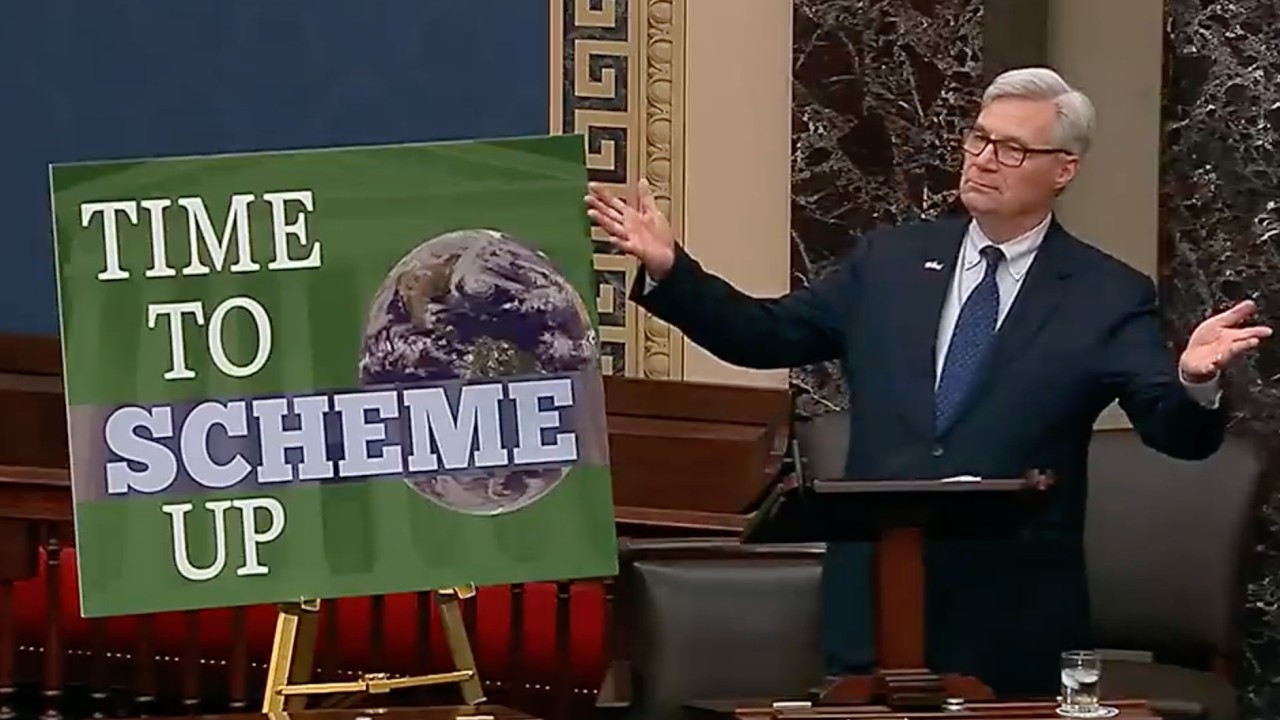
The Scheme Time to Wake Up | Senator Whitehouse's Speeches Converge
Apr 23, 2026
April 22 | Senator Sheldon Whitehouse (D-RI) delivers his 306th speech in his Time to Wake Up series, converging with his 36th Scheme speech. The billionaire-backed scheme to capture and control the Supreme Court was developed largely to protect the fossil fuel industry’s free-to-pollute business model. Here’s the proof.
---
---
AN PP 4 26
Across the country, Republican-led state legislatures are passing a slate of laws that effectively shield oil and gas companies from legal claims that they are responsible for the destruction and mounting toll caused by climate change. Fifteen laws have either been passed or are currently being debated in 11 states. Together, they threaten to remove long-standing tools for the public to hold corporations accountable.
A ProPublica investigation has found that most of these bills are part of a coordinated effort, orchestrated by a constellation of groups that share staff or have funding ties to the prominent conservative activist Leonard Leo, who is credited with placing conservative justices on the U.S. Supreme Court. These groups have drafted state legislation, planned its dissemination and engaged a well-connected lobbying firm to get them signed into law.
The effort is unfolding as courts are weighing more than 30 significant lawsuits by states, counties and municipalities accusing fossil fuel companies of misrepresenting the risks their products posed to consumers and seeking to recoup the costs of disasters and other climate impacts like wildfire losses or coastal flooding that their products helped cause. A goal of the legislation is to block these cases from going forward and prevent new ones from being filed.
The strategy to establish state laws that will make it all but impossible to sue oil and gas companies was laid out in detail by a group of lobbyists and political operatives in December, during a panel presentation at the annual States and Nation Policy Summit of the American Legislative Exchange Council — the influential organization that brings together state lawmakers, corporate leaders and conservative activists to draft and promote legislation.
During the session, one of the panelists, Will Hild, the executive director of a nonprofit called Consumers’ Research, described the climate cases as a liberal effort to use the judicial system to exact a new tax on energy companies in the form of civil judgments. Another panelist, Oramel H. Skinner, the former solicitor general for Arizona and the executive director of the nonprofit Alliance for Consumers, warned that those judgments will trickle down to make citizens’ lives less affordable and ultimately make many of their choices — whether to own pickup trucks or purchase a side of beef — illegal.
ProPublica reviewed an audio recording of the event obtained by the nonpartisan watchdog group Documented.
Hild and Skinner had come to the session with a ready-made fix: a set of pre-written bills and plenty of funding.
Consumers’ Research and the Alliance for Consumers are both funded by organizations connected to Leo. ProPublica examined lobbying records across 25 states, federal tax disclosures for more than a dozen organizations and notes from other closed-door strategy sessions among ALEC members and found that several Leo-supported groups are part of a national strategy to give legal immunity to companies for their climate emissions.
Since 2021, Leo has been deploying a $1.6 billion gift through a series of nonprofits and other organizations that obscure the source and the recipients of donations — so-called dark money groups. Much of that money has been routed through a nonprofit judicial advocacy group Leo founded — now called The 85 Fund — which both receives and disseminates Leo’s funding. Many of these nonprofits are increasingly focused on issues related to climate change.
The panel session’s moderator, Michael Thompson, is a senior vice president at CRC Advisors, Leo’s for-profit Virginia-based political and corporate consulting firm. He also sits on ALEC’s Private Enterprise Advisory Council. Hild’s organization, Consumers’ Research, received more than 65% of its funding in 2024 through a dark money group called Donors Trust. The 85 Fund contributed more than $67 million to Donors Trust in 2024. Consumers’ Research also works closely with — and contracted more than $670,000 of work in 2024 to — CRC Advisors. Another panelist, Paul N. Watkins, was a legal fellow at Consumers’ Research. According to tax filings, his law firm received more than $2.2 million in 2024 from the group. As recently as 2024, Skinner was also counsel for Leo’s 85 Fund, according to the nonprofit’s tax filings.
= POWELL MEMO BS
“For decades, the left has leveraged immense resources to capture the institutions that shape our society — the legal system, universities, medical and scientific bodies, the entertainment industry, and our biggest corporations,” Leo wrote to ProPublica in a text message. “That takeover resulted in a radically woke culture that does not reflect the will of the American people, or the pillars of limited constitutional government that made our country great. That is why our enterprise supports organizations that are committed to crushing liberal dominance and restoring balance in the institutions that shape society.”
At the ALEC session, Skinner presented a model bill that would effectively bar cities and towns from bringing public nuisance lawsuits against corporations and others when the issue is a broad public harm like climate change. In several cases, plaintiffs have argued that the impacts of climate change — the buckling of a road from extreme swings in temperature, for example — are a “nuisance” caused by fossil fuel companies.
Nuisance claims are common in the American legal system, giving individuals, companies or communities a way to sue when someone else’s actions damage their property, degrade the health or safety of the environment around them or interfere with their rights. Under these laws, parties can ask for financial compensation or seek court orders to remedy problems, such as pollution. Skinner, however, argues that nuisance laws should only be used to address local, easily fixable problems, like excessive noise from a bar. His bill would curtail the use of public nuisance suits in climate cases by limiting liability for manufacturers and other businesses and giving state attorneys general the sole authority to bring them.
“Think really hard about every lever you have in your states to shut off the ability for this woke lawfare machine to churn,” Skinner told the audience. “The left’s goal is to reshape society around you using the courtroom.”
The second draft law, called the Energy Freedom Act, was produced by the policy nonprofit associated with Hild’s organization. It would, among many provisions, shield businesses from liability related to emissions of greenhouse gases if those releases did not violate the federal Clean Air Act.
Critics of the bills say they subvert the rights of local communities. They send the message that “you can pollute with impunity,” said Carly Phillips, a senior scientist with the Union of Concerned Scientists. “It’s really a thumb in the eye of places that are affected by climate change.”
The push to block climate suits across the states comes as several of the cases against the oil industry approach, or have already entered, the perilous legal phases of discovery, when plaintiffs will have the opportunity to seek confidential industry documents and depose oil executives. The stakes for oil companies are enormous. By some estimates more than $10 trillion in damages can be attributed to U.S. emissions.
:{:{There’s a reason why state and local governments have increasingly brought these suits. The frequency and cost of climate-influenced disasters, including severe storms, drought and flooding, continues to mount — between $350 billion and $450 billion in each of the last three years — stretching government budgets.}:
Significantly, the science that makes it possible to attribute how much any one disaster was influenced by climate change has steadily advanced. To cite one example, the March heat waves across the U.S. would have been virtually impossible without the emissions that have caused climate change, according to the European science group World Weather Attribution, and were about four times as likely to happen as they were a decade ago.}:
Boulder, Colorado, is among the places facing increasing droughts, more extreme precipitation and larger wildfires — all of which are significantly propelled by climate change linked to the emissions from the use of fossil fuels. The state has estimated the costs of these perils will run into the many hundreds of millions of dollars. In 2018, Boulder County sued Exxon Mobil and the Canadian oil company Suncor Energy, accusing the companies of “intentional, reckless and negligent conduct.”
Among its claims, the county alleged the oil companies engaged in a conspiracy to mislead the public and violated consumer protection rules by mischaracterizing the dangers of their products. They accused the oil companies of creating a public nuisance by altering the environment and leaving the county to pay to abate growing hazards such as the flooding that tests roads and bridges. Exxon Mobil and Suncor Energy have never filed a response in Colorado but asked for the case to be dismissed.
Ever since, the lawsuit has been mired in a dispute over whether Colorado courts were the correct venue, with the state Supreme Court ultimately ruling last May that they were. Suncor filed to the U.S. Supreme Court to reconsider, and this fall it will weigh the company’s petition asking whether federal environmental law preempts the state law.
:{:{The high-profile national court case is just one facet in an increasingly tense fight over liability for the fossil fuel industry. In January, the American Petroleum Institute, the largest fossil fuel industry group in the United States, said fighting the climate liability lawsuits was one of its top priorities in 2026. Lobbying records for the group from last year show that it advocated for legislation to protect oil producers from climate lawsuits at the state level. }:
The Trump administration; other industry groups, including the Chamber of Commerce; and several of the nonprofit advocacy groups associated with Leo have argued that state courts are the wrong venue for claims that ultimately concern emissions that drift widely across borders, and they wish to see other cases moved or dismissed. They say that because the federal government already has the authority to regulate those emissions, the federal courts, not the states, should hear the claims.}:
In an interview, Hild told ProPublica that he sees the suits as an illegitimate effort to enact policy through the courts and to “regulate the entire U.S. economy from a single state.”
In an email, Skinner wrote: “Our effort is not one focused on climate change. But it is true that left-wing activists and their dark money donors have put vast sums of money and years of groundwork into pushing a coast-to-coast campaign of climate-focused public nuisance lawsuits.”
Neither Watkins nor Thompson responded to requests for comment.
When Skinner and Hild finished their presentation at ALEC they made a QR code available to download the language of the model bills and directed the audience to a woman named Catherine Gunsalus, who was in the back of the room. She would be able to answer any questions, they said.
Gunsalus until recently worked for the Heritage Action Fund, the political and lobbying arm of the Heritage Foundation, the Trump-aligned think tank that is most recently known for promoting the Project 2025 agenda. Records show that Gunsalus has also lobbied in collaboration with another Leo-affiliated group, Americans for Public Trust.
In April 2025, she formed a lobbying firm called Varidon Strategies and began registering in states almost immediately afterward, according to records. By mid-summer, Varidon was representing Alliance for Consumers Action Fund; Consumers’ Research; The Honest Election Project, an affiliate of The 85 Fund; as well as other Leo entities in 25 states. In the majority of those filings, Varidon used an email address at the domain of Holtzman Vogel, a Virginia-based law firm that is often retained by Leo’s organizations.
Gunsalus did not reply to a detailed list of questions.
In the four months since the ALEC summit, there has been substantial activity in the states where Varidon has registered. On Jan. 5, representatives in Missouri introduced the loosely related Eliminate Criminal Profiteering Act, which could stop revenues flowing to law firms from settlements in the sort of nuisance suits often used in climate cases. Two days later, legislators took up the Public Nuisance Reform Act, which proposes narrowing the definition of what could be considered a nuisance.
That same month, similar bills were introduced in Indiana, Oklahoma and Tennessee. In February, eight more followed in Oklahoma, Iowa, South Carolina, Utah, Louisiana and Kansas. Skinner, who is registered to lobby in Kansas, was invited to testify in a hearing about that state’s bill and launched a new “End the Lawfare” website targeting the “left-wing” agenda. As of April 2, versions of the model legislation offered at the ALEC meeting have been introduced across 11 states altogether. In Utah, the governor has signed two related bills into law, and in Tennessee and Indiana, bills are awaiting their governors’ signature.
The more states there are with some sort of waiver in place, the narrower the pathway for cities and states to seek redress as environmental conditions worsen, and the costs continue to rise. Hild and Skinner and the Leo network’s bills also serve another purpose: teeing up a conflict that pits states against one another, a conflict that only the Supreme Court or Congress can finally resolve.
As Hild put it at the ALEC gathering, “This is economic civil war.”
---
---
WAPO SAME DAY NO LNX
The oil industry takes its critics to court
The oil and gas industry is ramping up its attacks on climate Superfund laws.
March 27, 2025
Jodi Kelly and her husband, Dan Kelly, use a canoe to remove surgical supplies from a flooded area in Montpelier, Vermont, on July 11, 2023. (Steven Senne/AP)
By Maxine Joselow and Anna Phillips
At the White House last week, the nation’s top oil executives asked President Donald Trump for help fighting state laws that seek billions of dollars from fossil fuel companies.
In Michigan, a group with ties to the fossil fuel industry is suing to obtain the emails of a professor who supports these laws.
And in North Dakota, the oil company that operates the Dakota Access pipeline last week won a $667 million defamation judgment in its lawsuit against an environmental group.
Across the country, fossil fuel firms are ramping up a decades-long fight against policymakers, academics and activists who have sought to make them pay for their role in causing climate change. They are taking particular aim at “climate Superfund laws,” which seek billions of dollars from oil companies to help cover the costs of coping with stronger storms, rising seas and other weather disasters fueled by rising global temperatures.
“I’m seeing a tectonic shift in the way the fossil fuel industry is now going on the offense,” said Pat Parenteau, an emeritus professor and senior fellow for climate policy at Vermont Law School.
Follow Trump’s second term
New York and Vermont have each enacted climate Superfund laws modeled after the 1980 federal Superfund law, which requires polluting companies to pay for cleaning up hazardous waste sites. At least seven other Democratic-led states are considering similar bills, according to the Federalist Society, a conservative legal group.
Vermont became the first state to pass a climate Superfund law in June — nearly a year after catastrophic flooding caused millions of dollars in damage to roads, bridges, homes and businesses. Scientists have said global warming increased the likelihood of the extreme rainfall that triggered the flooding, since a warmer atmosphere holds more moisture.
Vermont’s measure, which Republican Gov. Phil Scott allowed to become law without his signature, charges fossil fuel firms for the greenhouse gas emissions they produced between 1995 and 2024. It doesn’t specify how much money should be paid. Instead, it tasks the state treasurer with calculating the costs of responding to past climate damage and preparing for future climate disasters. The final tally is expected to be comprehensive, factoring in possible expenses such as lower worker productivity amid extreme heat.
In contrast, the climate Superfund law signed by New York Gov. Kathy Hochul (D) in December would fine the largest greenhouse gas emitters $3 billion annually for the next 25 years. The charges would be based on the companies’ contributions to overall emissions between 2000 and 2018.
Seeking Trump’s support
As Trump sat with the nation’s top oil and gas executives at the White House last week, he asked what was on their minds.
In response, the executives asked for help battling climate Superfund laws, according to two oil industry representatives who spoke on the condition of anonymity to describe a private conversation. The Wall Street Journal first reported this request.
Executives also complained about dozens of climate lawsuits brought by state and local governments against oil companies, the two industry representatives said. The lawsuits accuse the companies of deceiving the public for decades about the harms they knew their petroleum products would cause — an allegation the industry rejects.
Interior Secretary Doug Burgum, left, and Energy Secretary Chris Wright deliver remarks outside the White House after meeting with oil executives on March 19. (Kevin Dietsch/Getty Images)
After listening to the executives’ concerns, Trump told a White House staffer to look for ways the administration could help, the two industry representatives said. The president did not commit to taking any specific actions, they said.
Some industry executives want the Justice Department to sue New York and Vermont over their climate Superfund laws. The American Petroleum Institute (API), the U.S. oil and gas industry’s top lobbying arm, has already sued over Vermont’s law, alleging that it encroaches on the federal government’s power to regulate greenhouse gas emissions.
The U.S. Chamber of Commerce, the nation’s biggest business lobby, joined the lawsuit filed in December. The two groups argued that Vermont lacked the authority to impose penalties on greenhouse gas emissions beyond its borders — an authority, they said, that the Clean Air Act reserves for the federal government.
“This partisan legislation illegally and retroactively penalizes U.S. oil and natural gas producers for delivering the energy consumers need, and that should be a concern for our leaders in Washington,” Justin Prendergast, an API spokesman, said in an email. “We are exploring all options to correct this overreach by certain states.”
Representatives for several executives who attended last week’s meeting — including the CEOs of Chevron, ConocoPhillips, ExxonMobil and Phillips 66 — declined to comment or did not return requests for comment. A White House official said the meeting focused on boosting oil production on federal lands in red states.
:Republican-led states are also coming to the industry’s defense. A coalition of 22 red states, led by West Virginia, sued New York over its climate Superfund law in February, arguing that it would put coal and oil producers out of business.
Critics of climate Superfund laws also argue that they unfairly punish oil companies instead of consumers who use fossil fuels, whether to drive their cars or heat their homes.
“It’s actually not the companies’ production of fossil fuels that created the emissions — it’s the use of the fuels,” said Jeff Holmstead, a partner at the law and lobbying firm Bracewell LLP, which represents energy industry clients. “You can’t have one without the other.”
Proponents of these laws counter that they would raise funds desperately needed for withstanding the worsening effects of warming. They argue this money is already coming out of the pockets of taxpayers, who might not be able to afford it — and who have produced far fewer emissions than fossil fuel firms.
“The idea that the companies who bear responsibility are now scheming with the president in order to avoid being held accountable is sickening,” said Paul Burns, executive director of the Vermont Public Interest Research Group, an advocacy group that supported Vermont’s law. “For those whose homes were washed away, whose farms were destroyed, it’s the worst kind of insult to injury.”
Targeting an academic
The industry’s allies have targeted climate Superfund laws, as well as an academic who has advocated for them.
In May, the nonprofit Government Accountability and Oversight sued the University of Michigan in an effort to obtain emails between Rachel Rothschild, an assistant law professor, and a collection of environmental advocacy groups in 2023. The group accused the university, which is subject to state public records requests, of refusing to search for the emails before ultimately denying its request.
While Government Accountability and Oversight does not disclose its funding sources, bankruptcy filings show that it received $300,000 from Murray Energy, a coal company now operating under the name American Consolidated Natural Resources. When the group was incorporated in D.C. in 2018, business filings also listed its CEO as Chris Horner, a lawyer who previously worked for the coal company Alpha Natural Resources.
The group later followed up with a second public records request, this time for correspondence related to a “Climate Superfund Act Memorandum” that Rothschild had written. Zach Larsen, a lawyer for Government Accountability and Oversight, said the group should be able to view such correspondence because Rothschild is a public employee.
“This suit seeks to enforce the Legislature’s promise of transparency by sorting out whether Professor Rothschild’s work on Climate Superfund Acts, about which she regularly speaks, advocates, and publishes scholarship all using her University title … is related to her official duties as a public employee such that the public has a right to know about it,” Larsen said in an email.
Rothschild has testified in support of climate Superfund legislation in several states, including Vermont. In her work, she has examined potential flaws in the oil industry’s legal arguments against these measures. She has raised doubts about the industry’s claim that, under the Constitution, federal law preempts states from passing statutes that seek to hold fossil fuel companies accountable for damage linked to climate change.
“Part of the reason that I think these companies are going to President Trump with their concerns is because the preemption argument right now is fairly weak,” Rothschild said in an interview.
Rothschild declined to comment on the lawsuit, which is pending in state court. Horner and a lawyer for the University of Michigan did not respond to requests for comment.
Ann Carlson, an environmental law professor at the UCLA School of Law, said the same group had previously targeted her, her colleagues and law school donors with more than a dozen public records requests seeking emails related to climate lawsuits against fossil fuel companies. After the university released the records, Carlson said a conservative dark-money group used them to attack her nomination to lead the National Highway Traffic Safety Administration. In the end, with her Senate confirmation in doubt, President Joe Biden named her acting administrator of the agency.
Carlson said the campaign against her had a chilling effect.
“It absolutely gives people pause about what they’re willing to work on,” she said. “It may chill outside groups, like nonprofits, and their willingness to work with academics at public institutions.”
---
---
NYT
NO LNX
She Inspired Laws to Hold the Fossil Fuel Industry Accountable. Now She’s a Target.
A conservative group is suing for emails of a law professor who helped create legislation to force oil, gas and coal companies to pay for climate damage.
By Coral Davenport
March 27, 2025
Fresh out of law school in 2022, Rachel Rothschild wrote a memo laying out the legal justification for a new strategy to fight climate change: States could force oil and gas companies to pay for the damage caused by extreme floods and wildfires that are made worse by the use of their products.
Ms. Rothschild’s work was foundational. It provided the basis for the nation’s first “climate superfund” laws, which were passed in New York and Vermont last year and could be adopted by as many as six more states as soon as this year. If implemented, they could cost oil companies billions of dollars.
Her work made Ms. Rothschild a target. She is one of a number of lawyers, law professors and judges who have been the focus of a campaign to discredit them led by a conservative group with ties to the fossil fuel industry and the Trump administration.
Shortly after the passage of the Vermont law last June, the group sued the University of Michigan, where Ms. Rothschild now teaches, after the university refused its request for Ms. Rothschild’s emails related to “climate superfunds.” As a public institution, the university is subject to the state’s public records law. The group, called Government Accountability and Oversight, has also sought to have Ms. Rothschild undergo a deposition.
The university, which has filed a motion to dismiss the lawsuit, maintains Ms. Rothschild’s communications are not subject to public records requests because they were written on her private email account. Still, the university told Ms. Rothschild that she must comply with the request for a deposition.
Experts said the actions against Ms. Rothschild seemed designed to discourage her or others from similar work.
“Legal actions and public records requests may be used in a manner that can intimidate or silence scholars, and when that happens, it threatens not only the targeted individuals but also the progress of knowledge and informed debate,” Kyle Logue, the interim dean of the University of Michigan Law School, said in a statement.
The actions regarding Ms. Rothschild appear to be part of a campaign by the fossil fuel industry to quash new legal tools for holding companies accountable for climate pollution. As President Trump moves to end federal efforts to fight climate change, the new state-level “polluter-pays” laws and lawsuits are seen as the next frontier in the battle over global warming.
Image
Protesters unfurl a banner sign outside an office building that shows the Statue of Liberty partially submerged in rising waters. The sign says, "Gov. Hochul: Sign or Sink! Make Polluters Pay!"
Climate activists held a rally outside New York Gov. Kathy Hochul’s office in Manhattan to deliver thousands of petitions asking her to sign the Climate Change Superfund Act last year.Credit...Erik McGregor/Sipa USA, via Reuters Connect
Executives from nearly two dozen oil and gas companies raised their concerns about the climate superfund laws at a meeting last week with President Trump at the White House. They want the Justice Department to file briefs in support of their litigation against the state laws, said two people familiar with the matter who spoke on the condition of anonymity because they were not authorized to publicly discuss the private meeting.
The campaign is being waged by a group that has largely been funded by the foundation created by Joseph Craft III, chief executive of the nation’s third largest coal company and an ally of and campaign donor to President Trump.
Ms. Rothschild’s initial memo — now making its way through statehouses — laid out the case for states to use the model of the 1980 Superfund law, which requires polluters to pay to clean abandoned toxic waste sites, and apply it to the climate damage caused by emissions from the burning of oil, gas and coal. Lawmakers in California, Maryland, Massachusetts, New Jersey, Oregon, Rhode Island and Connecticut are now considering climate superfund legislation.
In addition, more than 30 lawsuits have been filed by states and municipalities aimed at forcing oil and gas companies to pay for repairs or adaptations linked to damage from climate change. Many of those cases, some of which could end up before the Supreme Court, argue that the companies knew for years about the dangers of climate change linked to their products but concealed that information.
The approach is similar to those of past lawsuits that led to landmark settlements with the tobacco industry and opioid manufacturers.
The fossil fuel industry counters that climate change is a global problem and that individual state laws are an unconstitutional attempt to assert control over the nation’s energy system.
“These extraordinary, unprecedented laws impose massive retroactive penalties going back decades for lawful, out-of-state conduct that was regulated by Congress,” said Daryl Joseffer, executive vice president and chief counsel for the litigation arm of the United States Chamber of Commerce, which has sued both New York and Vermont to overturn the climate superfund laws.
Twenty-two other states, led by their Republican attorneys general, are challenging the New York law in federal court.
Ryan Meyers, senior vice president and general counsel at the American Petroleum Institute, an industry group that is also fighting to overturn the climate superfund laws in New York and Vermont, said they were part of “a coordinated campaign against an industry that is vital to everyday life and serves as the engine of America’s economy.”
A key player in the campaign to stop the effort to hold fossil fuel companies financially accountable for damages is Christopher Horner, a lawyer and conservative activist who served on the transition team for the Environmental Protection Agency during Mr. Trump’s first term.
For years, Mr. Horner has used public records laws to unearth emails of climate scientists and disseminate them in ways that aim to undermine their work.
“Chris Horner is the nation’s most prolific user of FOIA and its state equivalents to go after anyone fighting climate change who works for a public entity,” said Michael Gerrard, an expert in climate law at Columbia University.
In 2011, the board of the American Association for the Advancement of Science complained that Mr. Horner was making “unreasonable, excessive Freedom of Information Act requests for personal information and voluminous data that are then used to harass and intimidate scientists.”
When President Barack Obama tried to pass a climate law, allies of Mr. Horner worked to spread the emails of climate scientists, gathered by Mr. Horner, to Republicans in Congress.
In a 2017 interview with The New York Times, Mr. Horner said that had helped kill the bill.
Now, Mr. Horner and his allies are focused on the architects behind the “polluter pays” laws.
Mr. Horner did not respond to several requests for comment.
From 2018 to 2021, Mr. Horner served as a board member for Government Accountability and Oversight, the group that filed suit against Ms. Rothschild. As recently as January, Mr. Horner wrote an article for The Washington Reporter, a conservative media website, in which he said he represented the Government Accountability and Oversight group in federal and state open records matters.
According to public records, a major donor to the group is a nonprofit foundation formed by Mr. Craft, the chief executive of Alliance Resource Partners, the country’s third largest coal company. The Joseph Craft III Foundation contributed $300,000 a year to the Government Accountability and Oversight group from 2020 to 2023, for a total of $1.2 million, according to its public tax filings. That appears to make it a major funder of the group’s activities: During those years, G.A.O.’s total annual revenue averaged $576,172.
Mr. Craft and his wife, Kelly, who served as ambassador to the United Nations in the first Trump administration, have given nearly $3 million to Mr. Trump’s presidential campaigns, the Republican Party and a Republican super PAC.
Image
Joseph Craft III, dressed in a dark sports jacket, white shirt, dark pants and sunglasses, walks on a brick sidewalk next to Kelly Craft, who is wearing a white blouse, a black and white polka-dot skirt and pointy shoes.
Joseph Craft III with his wife, Kelly, in Washington in 2018.Credit...Brendan Smialowski/Agence France-Presse — Getty Images
The Craft foundation and Alliance Resource Partners did not respond to requests for comment.
Matthew Hardin, who serves on the board of Government Accountability and Oversight, wrote in a statement, “Like all nonprofits, G.A.O. relies on contributions from donors to fulfill its independent, charitable mission of seeking transparency in public institutions and educating the public.”
The group’s interest in Ms. Rothschild appears focused on her communications with Lee Wasserman, the director of the Rockefeller Family Fund, a philanthropy that has supported efforts to sue oil companies over what it calls climate deception.
It was Mr. Wasserman who first wondered if lawmakers could combine the old Superfund law with new penalties for climate polluters.
Mr. Wasserman brought the idea to the Institute for Policy Integrity, a nonprofit research organization that is housed in New York University’s law school, where Ms. Rothschild was then working as a fellow. She researched whether the idea could stand up legally. The Rockefeller Family Fund donated $50,000 to the Institute for Policy Integrity to fund her research, which led New York and Vermont lawmakers to propose legislation.
When it comes to climate and environmental matters, states often rely on academics for legal advice because many private law firms represent fossil fuel companies, which can create a conflict of interest.
After writing her memo, Ms. Rothschild joined the faculty at the University of Michigan, where she continued to work on climate superfund legislation in her free time, briefing lawmakers and testifying before legislative committees.
“I’m proud of the fact that I do a lot of pro bono work in areas where I have particular expertise, and I was glad I could help states like Vermont and New York draft these laws,” she said in a statement.
Ms. Rothschild’s pro bono work was “critical” to passage of the law in New York, said Justin Flagg, director of environmental policy for Liz Krueger, a Democratic New York state senator who sponsored the legislation. “This was something that had not yet been tested in court,” he added. “So we really hung our hat on her analysis.”
Environmental law professors at other public universities have been targets of similar campaigns. During the Biden administration, Mr. Horner used the state public records law to obtain the emails of Ann Carlson, who teaches at the University of California, Los Angeles.
Ms. Carlson, who had consulted on climate damage lawsuits, was nominated by President Joseph R. Biden Jr. to run a federal agency that writes rules aimed at reducing climate-warming tailpipe pollution — a position requiring Senate confirmation.
Government Accountability and Oversight gave Ms. Carlson’s emails to Fox News, which published stories about her on its website including one titled, “Biden nominee coordinated dark money climate nuisance lawsuits involving Leonardo DiCaprio.”
Image
Ann Carlson, who has shoulder-length wavy brown hair and large glasses, looks into the distance.
Professor Ann Carlson at the University of California, Los Angeles.Credit...Joyce Kim for The New York Times
Senator Ted Cruz, Republican of Texas, used the emails to fight Ms. Carlson’s confirmation, at one point calling her an “ethically challenged, environmental zealot.” He introduced an amendment on the Senate floor to strip the salary from her position.
While the amendment failed, she ultimately withdrew her nomination, although she did end up serving in the role in an acting capacity.
“It was ruthless, relentless and baseless,” Ms. Carlson said of the experience of having her emails used against her. “This is a tactic designed to dissuade people from working on important climate policies.”
The campaign has extended to at least one judge. In 2023, Mark Recktenwald, the chief justice of the Hawaii Supreme Court, wrote a unanimous decision that the local government in Honolulu could move forward with a climate liability lawsuit against major oil companies.
Justice Recktenwald gave a remote presentation to the Environmental Law Institute, a Washington, D.C.-based nonprofit group that runs seminars on environmental litigation.
Conservative media outlets including as The Daily Caller and Fox News ran stories noting that a member of the institute’s board had worked at a law firm that defended the climate law in the Honolulu case. The stories did not mention that oil executives also serve on the institute’s board. Justice Recktenwald had also asked both parties in the Honolulu lawsuit for any concerns about his plans to speak at the seminar, and neither side had objected.
But in virtually every story, a group called Energy Policy Advocates, which has named Mr. Horner as its lawyer, charged that Justice Recktenwald’s participation showed improper bias.
Justice Recktenwald declined to comment. The effort to devalue the legal scholars involved in the climate cases reflects the potential impact of the new laws and litigation, experts said.
“These new state laws and this avalanche of lawsuits are threatening the survival of these fossil fuel companies,” said Patrick Parenteau, an emeritus professor at the Vermont Law and Graduate School.
Karen Zraick contributed reporting.
Coral Davenport covers energy and environment policy, with a focus on climate change, for The Times.
A version of this article appears in print on March 29, 2025, Section A, Page 11 of the New York edition with the headline: Her Work Inspired Climate Superfund Laws. Now She’s a Target..
---
---
1 26 GMAIL
Big Oil’s coordinated lobbying efforts to secure legal immunity from climate accountability lawsuits are ramping up. State-level bills aiming to block communities from taking the fossil fuel industry to court have been introduced in Oklahoma and Utah while lobbyists continue to push Congress for a liability shield that could force the rising bill for climate change onto taxpayers and set a harmful legal precedent that protects corporations instead of communities.
Communities across the country are coming together for a national Week of Action to Make Polluters Pay. During the week of January 26, communities will gather in the streets, coordinate letter writing campaigns, and raise attention to Big Oil’s push for legal immunity. See what events are happening near you. If you live in Minnesota or Washington State, you can also sign your state’s petition demanding No Immunity for Big Oil.
Upcoming bills in New York and Hawaiʻi would empower the states to sue Big Oil for fueling the insurance crisis. As climate-related extreme weather triggers higher insurance premiums across the country, states are looking to make the fossil fuel industry — not everyday Americans — pay for the climate damage they knowingly fueled for decades.
“Shouldn’t the entities that caused climate change contribute? Why do residents have to foot the whole bill for the situation we’re now in when they did not profit off it the way the polluters did?”
Hawaiʻi state Sen. Jarrett Keohokalole
Climate change has reduced U.S. incomes by 12% since 2000, a new study finds. Climate chaos — fueled by decades of Big Oil deception — has caused nationwide delays and disruptions to production and trade, leading to significant income loss.
CCI January 15, 2026
Big Oil and its allies have spent the past year quietly building a campaign urging Congress to give fossil fuel companies total legal immunity from the growing wave of climate deception lawsuits filed by communities demanding accountability for their climate lies. As of this week, they’re saying the quiet part out loud.
The American Petroleum Institute (API), the nation’s largest oil and gas trade association, said this week that one of its top 2026 priorities is to stop “state climate lawsuits.”
In his speech at its annual State of American Energy event, API President and CEO Mike Sommers claimed that the U.S. has reached “public consensus” on the need for increased oil production that is currently being “blocked by red tape, delay and endless lawsuits.”
The declaration comes after numerous news outlets have reported that the fossil fuel industry has been lobbying Congress for immunity from climate accountability lawsuits filed by 11 attorneys general and dozens of municipal and tribal governments across the U.S. While Big Oil defendants have been fighting to block and delay the cases at every turn, lawsuits from communities across the country continue to move through the courts and closer to discovery and trial.
“Big Oil is openly asking Congress for a ‘get-out-of-jail-free’ card because fossil fuel companies are desperate to avoid facing the evidence of their climate lies in court,” CCI President Richard Wiles said in response to API’s priorities. “Congress must make clear that any proposal to strip Americans of their right to hold corporations accountable for the damage they cause when they lie to the public about the harms of their products will be dead on arrival.”
Big Oil’s push to put itself above the law is already in the works. Last year, 16 Republican attorneys general proposed creating a “liability shield” for fossil fuel companies modeled on a 2005 law protecting gun manufacturers from lawsuits, and state-level immunity bills for the fossil fuel industry have already been introduced this year in Utah and Oklahoma.
These efforts are not without pushback. A Congressional appropriations bill introduced last year originally included language that would prohibit the District of Columbia from using any funds to enforce its consumer protection laws “against oil and gas companies for environmental claims,” clearly targeting D.C.’s ongoing climate accountability lawsuit against ExxonMobil, BP, Shell, and other oil majors. However, the latest version of the bill no longer includes the restrictive language that aimed to bar D.C. communities from accessing the courts.
“I think anyone in America who breathes the air around them and also believes in corporate accountability ought to be very concerned about these types of end-runs against accountability,” Jay Inslee, the former governor of Washington state, told *The Guardian.
---
CCI GMAIL 1 26
2025 was full of wins and challenges in the climate accountability world.Check out *_The Guardian_*_’s latest explainer_ on the progress communities across the country made in holding Big Oil accountable in court and the industry’s latest efforts to escape facing the evidence of its lies in court.
- A Hawaiʻi state judge last week_rejected oil companies’ attempts_to have Honolulu’s climate deception case dropped,sending the case forward toward discovery.
- We may know as early as Monday whether the U.S. Supreme Court will grant_Big Oil’s plea_ to review the Colorado Supreme Court’s decision in Boulder, Colorado’s, climate deception lawsuit. Keep an eye out on our socials for timely updates.
REF GUK
AS the Trump administration boosts fossil fuels, Americans are increasingly turning to courts to hold big oil accountable for alleged climate deception. That wave of litigation swelled in 2025, with groundbreaking cases filed and wins notched.
But the year also brought setbacks, as Trump attacked the cases and big oil worked to have them thrown out. The industry also worked to secure a shield from current and future climate lawsuits.
Here are some major trends that emerged in US climate accountability litigation last year.
1. Big oil suits progressed but faced challenges
In recent years, 70-plus US states, cities, and other subnational governments have sued big oil for alleged climate deception. This year, courts repeatedly rejected fossil fuel interests’ attempts to thwart those cases. The supreme court denied a plea to kill a Honolulu lawsuit, and turned down an unusual bid by red states to block the cases. Throughout the year, state courts also shot down attempts to dismiss cases or remand them to federal courts which are seen as more favorable to oil interests.
But challenges against big oil also encountered stumbling blocks. In May, Puerto Rico voluntarily dismissed its 2024 lawsuit under pressure. Charleston, South Carolina also declined to appeal its case after it was dismissed.
In the coming weeks, the supreme court is expected to decide if it will review a climate lawsuit filed by Boulder, Colorado, against two major oil companies. Their decision could embolden or hinder climate accountability litigation.
“So far, the oil companies have had a losing record trying to get these cases thrown out,” said Richard Wiles, president of the Center for Climate Integrity, which backs the litigation against the industry. “The question is, does Boulder change that?”
After Colorado’s supreme court refused to dismiss the lawsuit, the energy companies filed a petition with the supreme court asking them to kill the case on the grounds that it is pre-empted by federal laws. If the high court declines to weigh in on the petition – or takes it up and rules in favor of the plaintiffs – that could be boon for climate accountability cases. But if the justices agrees with the oil companies, it could void the Boulder case – and more than a dozen others which make similar claims.
That would be a “major challenge”, said Wiles, “but it wouldn’t be game over for the wave of litigation”.
“It would not mean the end of big oil being held accountable in the court,” he said.
The American Petroleum Institute, the nation’s largest oil lobby group, did not respond to a request to comment.
2. New and novel litigation
Climate accountability litigation broke new ground in 2025, with Americans taking up novel legal strategies to sue big oil. In May, a Washington woman brought the first-ever wrongful-death lawsuit against big oil alleging the industry’s climate negligence contributed to her mother’s death during a deadly heat wave. And in November, Washington residents brought a class action lawsuit claiming fossil fuel sector deception drove a climate-fueled spike in homeowners’ insurance costs.
“These novel cases reflect the lived realities of climate harm and push the legal system to grapple with the full scope of responsibility,” said Merner.
Hawaii this year also became the 10th state to sue big oil over alleged climate deception, filing its case just hours after the Department of Justice took the unusual step of suing Hawaii and Michigan over their plans to file litigation. It was a “clear-eyed and powerful pushback” to Trump’s intimidation, Merner said.
3. Accountability shield
Big oil ramped up its efforts to evade accountability for its past actions this year, said Wiles. They were aided by allies like Trump, who in April signed an executive order instructing the Justice Department to halt climate accountability litigation and similar policies.
In July, members of Congress also tried to cut off Washington DC’s access to funding to enforce its consumer protection laws “against oil and gas companies for environmental claims” by inserting language into a proposed House appropriations bill. A committee passed that version of the text, but the full House never voted on it.
2025 also brought mounting evidence that big oil is pushing for a federal liability shield, which could resemble a 2005 law that has largely insulated the firearms industry from lawsuits. In June, 16 Republican state attorneys general asked the Justice Department to help create a “liability shield” for fossil fuel companies against climate lawsuits, the New York Times reported. Lobbying disclosures further show the nation’s largest oil trade group, as well as energy giant ConocoPhillips, lobbying Congress about draft legislation on the topic, according to Inside Climate News.
Such a waiver could potentially exempt the industry from virtually all climate litigation. The battle is expected to heat up next year.
“We expect they could sneak language to grant them immunity, into some must-pass bill,” said Wiles. “That’s how we think they’ll play it, so we’ve been talking to every person on the Democratic side so that they keep a lookout for this language.”
4. What to watch in 2026: plastics and extreme weather cases
Despite the challenges ahead, 2026 will almost definitely bring more climate accountability lawsuits against not only big oil but also other kinds of emitting companies. This year, New York’s attorney general notched a major win by securing a $1.1m settlement from the world’s biggest meat company, JBS, overalleged greenwashing. The victory could inspire more cases, said Merner, who noted that many such lawsuits have been filed abroad.
Wiles expects more cases to accuse oil companies of deception about plastic pollution, like the one California filed last year. He also expects more lawsuits which focus on harms caused by specific extreme weather events, made possible by advances in attribution science – which links particular disasters to global warming. Researchers and law firms are also developing new theories to target the industry, with groundbreaking cases likely to be filed in 2026.
“Companies have engaged in decades of awful behavior that creates liability on so many fronts,” he said. “We haven’t even really scratched the surface of the numerous ways they could be held legally accountable for their behavior.”
---
---
icn
As efforts continue to hold some of the world’s largest fossil fuel corporations liable for destructive and deadly climate impacts, backlash from the politically powerful oil and gas industry and its allies in government is on the rise, bolstered by the Trump administration’s allegiance to fossil fuels.
From lobbying Congress for liability protection to suing states over their climate liability laws and lawsuits, attempts to shield Big Oil from potential liability and to shut down climate accountability initiatives are advancing on multiple fronts.
“The effort has escalated dramatically in the past six or seven months,” said Richard Wiles, president of the Center for Climate Integrity, an organization that advocates for holding fossil fuel companies accountable for selling products they knew were dangerously warming the planet.
Pushback to liability initiatives from fossil fuel interests is not new. But the political landscape has shifted dramatically this year as the second Trump administration works to reward loyalists and campaign donors, including fossil fuel interests.
The oil and gas industry spent $445 million during the last election cycle to influence President Donald Trump and Congress, including $96 million on Trump’s re-election campaign, according to the progressive advocacy group Climate Power.
“What has changed is that there is a new administration,” said Lisa Graves, founder and executive director of True North Research, a national investigative watchdog group. And the Trump administration, she said, “is continuing to defend the fossil fuel industry and assail anyone who dares try to hold them accountable.”
Over the past eight years, communities across the country have filed tobacco-style lawsuits targeting ExxonMobil and major players in the fossil fuel industry, seeking to recover damages for localized climate impacts or to force companies to cease greenwashing and other misleading behavior.
More than 30 of these lawsuits brought by municipal, tribal and state governments are working their way through the courts, and several are now closer than ever to reaching trial.
At the same time, some states are enacting or considering so-called climate superfund legislation that would hold large fossil fuel companies strictly liable for climate damages and require them to help pay for a portion of climate change costs incurred by state governments. Vermont and New York both passed climate superfund laws last year, and similar legislation is pending in a handful of other states.
In response to these budding accountability efforts, the fossil fuel industry, the Trump administration, Republicans in Congress and GOP attorneys general are mounting what Wiles describes as a “massive orchestrated campaign” to try to stop climate liability laws and lawsuits in their tracks, and to push for legal immunity akin to what gun manufacturers received two decades ago. Trump’s Department of Justice has even filed highly unusual, if not unprecedented, lawsuits against Vermont and New York seeking to overturn their climate superfund statutes.
“It’s just this superbly choreographed effort on the part of the oil industry and its allies to get gun-industry-style legal immunity for all the damage that they’ve caused,” Wiles told Inside Climate News.
Oil Industry Is Lobbying Congress for a Liability Shield
Among the climate liability lawsuits inching closer to trial: a consumer protection case brought by Massachusetts against ExxonMobil, and suits seeking damages filed by Honolulu, Hawaii, and Boulder, Colorado.
As reported by The Wall Street Journal earlier this year and confirmed by The New York Times last month, industry representatives are lobbying Congress for a liability shield of some kind.
The details remain unclear. But the American Petroleum Institute, a trade group, reports lobbying on “draft legislation related to state efforts to impose liability on the oil and gas industry,” while disclosures from ConocoPhillips show that the company has lobbied on the matter of “state superfund legislation,” including draft legislation in Congress addressing it.
Neither API nor ConocoPhillips responded to requests for comment.
Pat Parenteau, emeritus professor of law at Vermont Law and Graduate School, told Inside Climate News that he thinks immunity provisions for the fossil fuel industry are unlikely to pass the Senate.
But the fact that the fossil fuel industry is lobbying for legal protections suggests to Wiles that the industry realizes it could be facing serious legal jeopardy. “Let’s be clear. You don’t seek a [liability] waiver unless you know you’re guilty,” Wiles said.
Darren Woods, CEO of ExxonMobil, speaks alongside Energy Secretary Chris Wright (left) and Dario Amodei, CEO of Anthropic, at the Pennsylvania Energy and Innovation Summit at Carnegie Mellon University on July 15 in Pittsburgh. Credit: Jeff Swensen/Getty Images
Over the summer, language emerged in a draft House Appropriations Committee spending bill that specifically would prohibit the District of Columbia from using funds to enforce its consumer protection law “against oil and gas companies for environmental claims.” The bill that included this provision passed the committee but was not brought to the full House for a vote.
But climate accountability advocates say the provision was still alarming because it effectively would have shut down D.C.’s ongoing consumer protection lawsuit against Big Oil. That suit, filed in 2020, alleges that several major oil companies lied to consumers about the climate risks of their products and that they continue to mislead consumers through greenwashing campaigns. In April the D.C. Superior Court rejected the companies’ motions to dismiss the suit.
Anne Havemann, deputy director and general counsel at Chesapeake Climate Action Network, said the appropriations provision “is a threat to this ongoing lawsuit.”
“If [D.C.] can’t use any money to prosecute these cases and advance these cases, then it effectively can’t work on them,” she said.
Big Oil Lawyers Seek Supreme Court Intervention
A parallel effort to skirt accountability is playing out in the courts. Fossil fuel companies are vigorously defending themselves in climate liability lawsuits, and they have seen some success in recent months getting cases dismissed by state trial courts.
Now Boulder’s lawsuit is back before the nation’s highest court on a fresh petition from the oil company defendants, after Colorado courts, including the state Supreme Court, refused to dismiss the case. The question posed by the companies in their petition is whether federal law precludes such state law claims.
It is unclear whether the Supreme Court will take up the case this time.
In January the Supreme Court denied a similar petition from oil companies in a case brought by Honolulu. Courts in Hawaii have rejected the companies’ bids to have the case dismissed, and with the Supreme Court declining to intervene, Honolulu’s case is advancing toward a trial.
Parenteau said the prospect of facing a trial and a potential adverse verdict likely has the oil companies extremely worried. “They’re certainly frightened of a trial just from a reputational standpoint,” he said.
The new petition in the Boulder case now offers the Supreme Court another opportunity to step in. Should the justices decide to intervene, legal experts say that it could essentially shut down all climate liability attempts.
“If they do step in, that’s huge. That changes everything,” Parenteau said. “That is the end game.”
“In one fell swoop it could get rid of all of these cases,” said James May, a law professor at Washburn University.
On Oct. 9, over 100 Republican House members submitted an amicus brief to the Supreme Court backing oil companies ExxonMobil and Suncor in their petition to block Boulder’s lawsuit from moving forward. It is the first time that Republicans in Congress have called on the Supreme Court to intervene in this litigation and to shut down not just this one lawsuit but all others like it.
“In recent years, multiple state and local governments have launched a courtroom war against the American energy industry,” the brief asserts in its opening. “It must stop now.”
The 103 Republican House members who signed onto the brief argue that the municipal and state lawsuits against oil and gas companies are trying to “dictate national energy policy” and that only the federal government has the authority to regulate transboundary greenhouse gas emissions.
“They are arguing that it’s solely EPA’s role to regulate greenhouse gases, but the Trump administration is attempting to eliminate that role by revoking the Endangerment Finding. If that revocation goes through and survives in the courts, it will greatly weaken the oil companies’ preemption defense,” Michael Gerrard, founder and faculty director of the Sabin Center for Climate Change Law at Columbia University, told Inside Climate News.
“This full-court press to block these lawsuits shows that the oil companies and their allies in Congress are really nervous about what would come out if any of these cases actually went to trial,” Gerrard added.
Trump Administration on the Offensive
The Trump administration, through its Department of Justice, is fully backing the fossil fuel industry in climate liability litigation, filing amicus briefs, for example, in cases now pending before the U.S. Supreme Court and the Maryland Supreme Court.
But its efforts to shield the industry from accountability extend beyond friend-of-the-court briefs.
Following a White House meeting where oil company executives raised concerns about state climate laws and lawsuits, Trump issued an executive order in April directing Attorney General Pam Bondi to try to put a stop to these legal initiatives.
In response, the DOJ then sued four states, including preemptive suits brought against Hawaii and Michigan before either state had filed such a lawsuit (Hawaii sued major oil companies the next day). The DOJ’s other lawsuits targeted Vermont and New York to try to strike down their climate superfund laws, which are based on the “polluter pays” logic of the Environmental Protection Agency’s Superfund program aimed at forcing polluting companies to remediate damage from toxic waste sites.
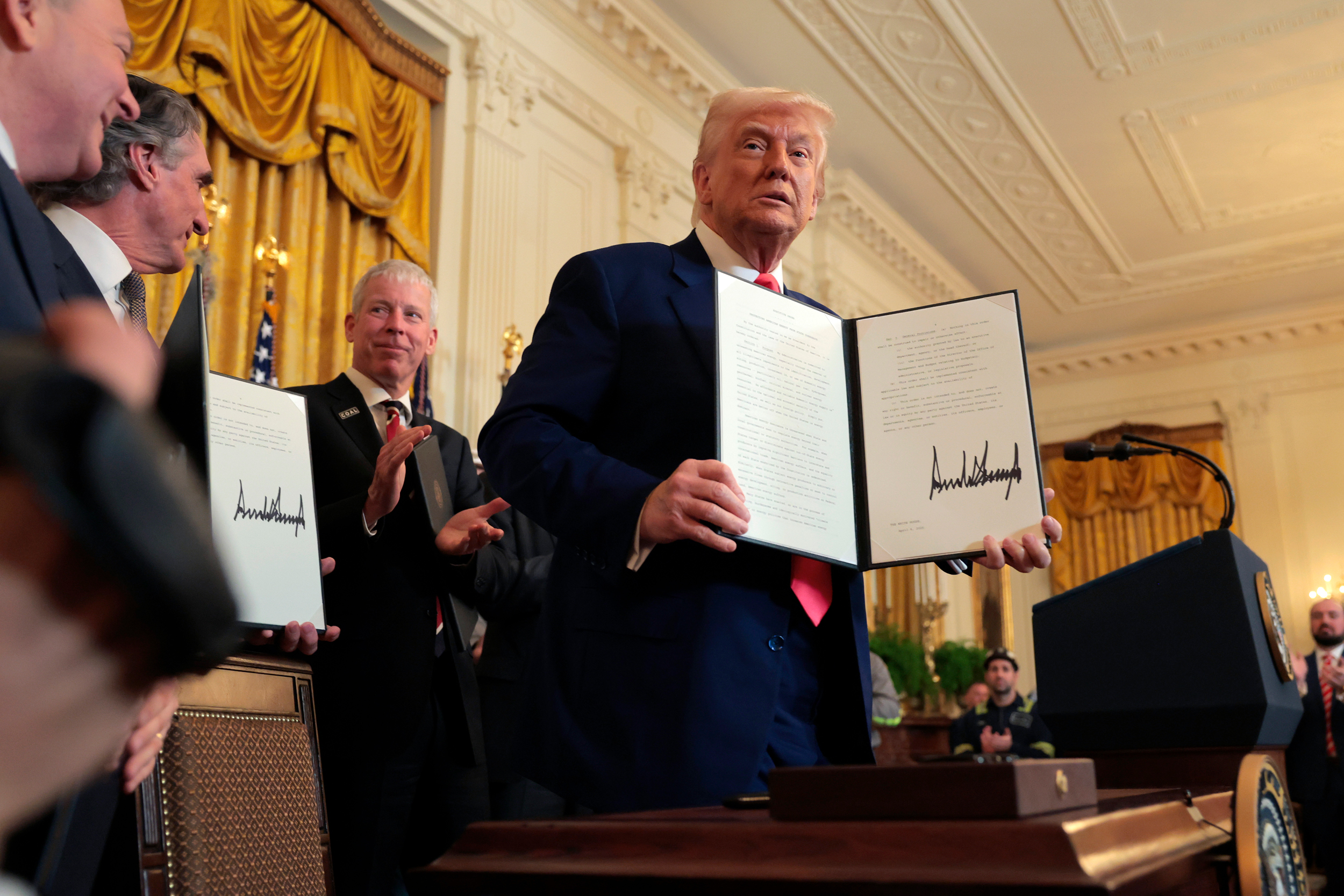 President Donald Trump poses for photos after signing a series of executive orders on American energy production during a ceremony in the East Room of the White House on April 8. Trump was joined by (from left) EPA Administrator Lee Zeldin, Interior Secretary Doug Bergum and Energy Secretary Chris Wright. Credit: Anna Moneymaker/Getty Images
Advances in a field known as climate attribution science have made the “polluter pays” aspect of the superfund laws possible, enabling scientists to quantify the individual contributions of major fossil fuel producers to climate impacts such as sea level rise and heat waves.
The DOJ has now filed motions for summary judgment in both of these lawsuits, asking federal courts to permanently block the states’ climate superfund laws.
“Vermont’s flagrantly unconstitutional statute threatens to throttle energy production, despite this Administration’s efforts to unleash American energy. It’s high time for the courts to put a stop to this crippling state overreach,” Acting Assistant Attorney General Adam Gustafson said in a statement issued by the DOJ on Sept. 16.
Havemann, with the Chesapeake Climate Action Network, told Inside Climate News that the current Trump administration seems to be taking a more aggressive approach to protecting the fossil fuel industry and to fighting attempts to hold it accountable.
“The Trump administration has come in and used many different tools in its toolbox to go after these accountability lawsuits and the laws that also seek to hold the biggest polluters accountable for climate damages,” she said. “It’s very much on the radar of the Trump administration in a way that it has not been in the past.”
The White House did not immediately respond to a request for comment.
“Enter the Dragon”
With U.S. Sen. Ted Cruz (R-Texas) holding the gavel, climate litigation came up as the subject of a Republican-led congressional hearing this summer before a Judiciary Committee subcommittee.
The hearing’s provocative title: “Enter the Dragon—China and the Left’s Lawfare Against American Energy Dominance.”
Cruz used the hearing to attack climate liability lawsuits and claim that they are a nefarious left-wing plot that is in part funded by, and that benefits, the Chinese Communist Party. “Both China and the Democrats want to bankrupt the American energy industry,” Cruz said during the hearing.
NPR’s Michael Copley reported last month that “Cruz’s office has not offered evidence that China or a China-linked nonprofit that Cruz identified by name has funded climate lawsuits in the United States.”
In response to that reporting, Cruz told Inside Climate News that “NPR deliberately ignored objective facts.”
“The Chinese Communist Party uses cut-outs and ‘nonprofits’ to shape U.S. energy policy, funding propaganda, advocacy, and litigation that harm American workers,” Cruz said in an emailed statement, which was also included in the NPR story after it was published. The “China-linked nonprofit” referenced in the NPR story, Energy Foundation China, does fund some climate initiatives, Cruz said in his statement.
“In January 2024, three House committee chairs opened an investigation into Chinese influence, citing EFC’s ties and funding of groups like [the Natural Resources Defense Council] and RMI,” he added.
A spokesperson for RMI, a nonprofit group working on the global energy transition, said that the organization “does not participate in litigation.” RMI’s “work supported by Energy Foundation China, which is a U.S. based charitable organization, is focused squarely on the energy transition inside of China,” the spokesperson added.
The Natural Resources Defense Council (NRDC), a nonprofit group that works to protect public health and the environment, does some “work in China for one reason: there’s not a single global environmental problem that can be fixed unless China is part of the solution,” NRDC spokesperson Josh Mogerman said. He added that the organization “does not fundraise in China” and that “money from China does not fund NRDC litigation in the United States, period.”
Cruz, who represents the country’s biggest oil and gas producing state, did not respond to Inside Climate News’ question about whether he supports immunizing oil companies from liability.
GOP Attorneys General Enter the Fray
During the Cruz-led hearing, the Republican attorney general for the state of Kansas, Kris Kobach, testified as one of the majority witnesses. He referenced the New York and Vermont climate superfund laws, claiming these statutes impose extraterritorial regulation on energy companies, and mentioned that his state and other Republican-led states are suing to try to overturn these state laws.
“We will continue these fights in court as state attorneys general. But we do need some help from Congress,” Kobach said. He suggested that Congress could legislate to expressly preempt state climate laws like the climate superfund laws.
Kobach and 15 other Republican state attorneys general also made this suggestion, along with several other recommendations for congressional action, in a letter addressed to Bondi, the U.S. attorney general.
The June 12 letter references Trump’s executive orders to “unleash” fossil fuels and protect the fossil fuel industry from “state overreach.” The letter says its purpose is to “suggest additional steps” the Department of Justice could take to effectuate these orders and assist in the “fight against anti-energy interests.”
Specifically, the Republican AGs suggest the DOJ could recommend legislation to reinforce federal preemption of state climate liability laws or lawsuits; restrict federal funding for states seeking to impose liability on energy companies; create a right of removal to federal district court for climate suits; and, among other items, stop “activist-funded climate lawsuits” with a liability shield, similar to the law that granted immunity for gun manufacturers.
Wiles, with the Center for Climate Integrity, said it is especially striking to see Republican attorneys general explicitly recommend a similar liability shield for fossil fuel companies. “The attorneys general actually called for Congress to enact a gun-style liability waiver for the oil industry,” he said. “We saw how that [gun industry immunity] ended up. It certainly was not helpful in curbing gun violence or in serving any public interest objective.”
The coordinated litigation strategies and actions of Republican state attorneys general in defense of fossil fuel and other industries stem from an organization called the Republican Attorneys General Association (RAGA), which Graves said was created in the wake of the tobacco industry being held accountable through the 1998 Master Settlement Agreement.
The organization, which currently lists 29 Republican state attorneys general as members, has been funded through donations from conservative judicial activists like Leonard Leo as well as from corporate interests including those in the fossil fuel industry. The American Petroleum Institute gave over $125,000 to RAGA in 2024, and in the first six months of this year Chevron’s Policy, Government and Public Affairs division donated $25,000 to the organization, for example.
Graves describes RAGA as a “pay-to-play organization.”
“It has a pay sheet listing what kind of access you get to attorneys general based on how much you give,” she told Inside Climate News.
“These attorneys general use the prestige of their office and their power and the resources that their taxpayers are providing to serve the interests of industry, select industries that they are most tied to, and that certainly includes the fossil fuel industry,” Graves added.
The Republican Attorneys General Association did not respond to a request for comment.
“A Perilous Moment”
The intensifying backlash to climate accountability efforts coming from the fossil fuel industry and its political defenders is happening at a time when some political scholars warn that the U.S. is sliding into some form of authoritarianism, which advocates say magnifies the challenges of holding powerful interests to account writ large.
“It’s a perilous moment for democratic norms and institutions,” said Kathy Mulvey, accountability campaign director for the climate and energy program at the Union of Concerned Scientists.
“Anybody who is pursuing policy change or litigation for accountability or enforcement is counting on the courts to be a real backstop for democratic institutions,” Mulvey told Inside Climate News.
Should the fossil fuel industry somehow succeed in securing legal immunity, Wiles said it “would be consistent with the erosion of the rule of law that we’re seeing.”
“No industry should be above the law,” he added.
---
---
RAGA TEAM RED
guk ref 404 ag
5 pp ltr to bondi
2025.06.12%20--%20Letter%20to%20Dep%27t%20of%20Justice%20on%20Energy%20Actions
Dear Attorney General Bondi:
We, the undersigned Attorneys General, write to applaud the Department of Justice’s recent
actions to curtail the climate lawfare that has intensified our Nation’s energy crisis.
The energy industry is foundational to American flourishing. President Trump rightly
observed that our Nation “is blessed with an abundance of energy and natural resources that
historically powered our Nation’s economic prosperity.”1 The industry has created millions of
American jobs and annually generates billions of dollars in tax revenue. This money supports
schools, hospitals, and public infrastructure; it also helps ensure that everything from electricity to
transportation to consumer goods remains both available and affordable for all Americans.
Altogether, “[t]he development of domestic energy resources is of paramount public interest.”2
And traditional energy resources like “oil, natural gas, and coal provide 80% of American
energy.”3
President Trump’s recent Executive Orders recognize just how important the energy
industry is to American success. The President noted that the “burdensome and ideologically
motivated ‘climate change’ [and] energy policies” enacted by some States “weaken our national
security and devastate Americans by driving up energy costs for families coast-to-coast, despite
1 Unleashing American Energy, Exec. Order No. 14154, 90 Fed. Reg. 8353, 8353 (Jan. 29, 2025).
2 U.S. Dep’t of Energy, The Economic Benefits of Oil & Gas (2025), https://perma.cc/7R3GTZCP.
3 Nat. Res. Def. Council v. Kempthorne, 525 F. Supp. 2d 115, 127 (D.D.C. 2007).
...3
Unfortunately, the United States Supreme Court has declined up to this point to tackle these
modern-day climate lawsuits and anti-energy state laws head on. For instance, the Court has
recently denied petitions asking the Court to consider whether these state-law-based claims against
energy companies belong in federal court (as they undoubtedly do). Our own efforts before that
Court to protect the interests of our citizens in a strong American energy industry have largely been
rebuffed.14 Thus, we expect that only legislative and executive actions can provide real answers to
these continuing problems.
We therefore write to suggest additional steps the Department could take to effectuate the
President’s Executive Orders and assist our States in continuing the fight against anti-energy
interests. In particular, the Department could recommend legislation that would:
11 E.g., Patrick Brown, How Much Did Increasing “Climate Whiplash” Impact the Los Angeles
Fires?, Breakthrough Inst. (Jan. 29, 2025), https://perma.cc/UEH2-LYF9.
12 Climate Change Superfund Act, N.Y. S.2129-B, 2023–24 Session; Climate Superfund Act, Vt.
S.259, 2023–24 Session.
13 City of San Francisco v. Exxon Mobil Corp., No. 02-18-00106-CV, 2020 WL 3969558, at *20
(Tex. App. June 18, 2020).
14 E.g., Alabama v. California, 145 S. Ct. 757 (Mar. 10, 2025).
p2 notes
4 Protecting American Energy From State Overreach, Exec. Order 14260, 90 Fed. Reg. 15513,
15513 (Apr. 8, 2025).
5 Id. at 15513–14.
6 Ibid.
7 Press Release, U.S. Dep’t of Just., Justice Department Files Complaints Against Hawaii,
Michigan, New York and Vermont Over Unconstitutional State Climate Actions (May 1, 2025),
https://perma.cc/HSZ7-GK4H.
8 Press Release, U.S. Dep’t of Just., Justice Department Launches Anticompetitive Regulations
Task Force (Mar. 27, 2025), https://perma.cc/XGR5-EJYH.
9 E.g., S. Comm. On Com., Sci., & Transp. And H.R. Comm. on Oversight & Accountability,
Republican Staff, Report, Investigation into Sher Edling, LLP (Oct. 7, 2024),
https://perma.cc/4YNQ-GQXE.
10 Am. Energy Inst., The Environmental Law Institute’s Climate Judiciary Project (CJP) Is
Corruptly Influencing the Courts and Destroying the Rule of Law to Promote Questionable
Climate Science (2024), https://perma.cc/8TJT-JNZD.
These protective measures could complement other initiatives that could affirmatively
strengthen our American energy industry. Among other things, Congress and the Administration
could streamline required permitting for energy-related facilities (including related environmental
assessment requirements), extend current grant and tax-incentive programs limited to so-called
“green” energy to domestic energy producers, and continue peeling back anti-energy regulations
:{:{from past administrations.}:
Measures like these could be expected to re-empower American}:
industry, better enabling it to fend off unjustified attacks like that seen in recent years.
We unhesitatingly support President Trump’s goals to “restore American prosperity” and
“rebuild our Nation’s economic and military security” by unleashing American energy, and his
commitment to protecting American energy from state overreach. Ending the unlawful assault on
American energy is critical to achieving those objectives. We commend the Department for already
taking action to stop climate lawfare and hope that you will consider our suggestions to further
bolster your efforts.
Sincerely,
Mike Hilgers John B. McCuskey
Nebraska Attorney General West Virginia Attorney General
Steve Marshall Tim Griffin
Alabama Attorney General Arkansas Attorney General
James Uthmeier Chris Carr
Florida Attorney General Georgia Attorney General
Brenna Bird Kris Kobach
Iowa Attorney General Kansas Attorney General
Russell Coleman
Austin Knudsen
Kentucky Attorney General Montana Attorney General
Drew Wrigley Dave Yost
North Dakota Attorney General Ohio Attorney General
Ken Paxton Alan Wilson
Texas Attorney General South Carolina A
marty Jackley
South Dakota Attorney General
Ryan Schelhaas
Interim Wyoming Attorney General
---
---
gmail cci 1225
Washington residents are arguing that Big Oil’s “coordinated and deliberate scheme to hide the truth about climate change and the effects of burning fossil fuels” has led to escalating home insurance costs, according to a _recently-filed lawsuit_. The federal class action lawsuit is the first of its kind, aiming to hold oil companies accountable not just for their decades of climate deception, but for the resulting insurance crisis that has stemmed from more frequent and severe weather disasters.
We may know as early as Monday whether the U.S. Supreme Court will grant Big Oil’s pleato review the Colorado Supreme Court’s decision in Boulder's climate deception lawsuit. Keep an eye out on our socials for timely updates.
connecticut-is-closer-than-ever-to-putting-exxon-on-tria
December 1, 2025
Connecticut’s climate accountability lawsuit is one step closer to trial after a state judge last week rejected ExxonMobil’s attempts to strike the case, delivering a major win for the state’s effort to hold the oil giant accountable for its decades of climate deception.
“ExxonMobil is throwing the kitchen sink at us, trying every angle to invalidate our case,” Connecticut Attorney General William Tong said in a statement. “Once again, they have failed on every count.”
The lawsuit, filed in 2020, argues that Exxon’s historic and ongoing “campaign of deception” about the climate harms of fossil fuels violated the state’s consumer protection law and has inflicted “decades of avoidable harm” and “catastrophic consequences” on Connecticut’s people, infrastructure, and ecosystems. The storms hitting Connecticut’s coastline and flooding communities’ homes have been supercharged by climate change that Exxon knew it was fueling decades ago. By one estimate, sea-level rise caused by climate change created an additional $8.1 billion in damages during Hurricane Sandy, which hit Connecticut in 2012.
In a ruling Wednesday, Connecticut Superior Court Judge John B. Farley rejected all of Exxon’s claims that the state’s case was preempted by federal law, barred by the First Amendment, and other unfounded legal arguments.
“[T]he fundamental objective of the lawsuit,” Judge Farley wrote, is “to remedy the defendant’s alleged unfair and deceptive marketing practices.”
Connecticut’s case — which aims to make Exxon stop deceiving the public, disclose internal climate change research, disgorge profits made while engaging in illegal activity, and fund a “corrective education campaign” about climate change — now enters the discovery phase of litigation.
“Our case is simple and strong — ExxonMobil amassed billions of dollars in profits off a decades-long campaign of lies, and they must be held accountable,” Attorney General Tong said. “We are in the midst of discovery and are aggressively prosecuting this case in Connecticut to uncover and expose ExxonMobil’s lies and to hold the company accountable for the harm their deception has caused.”
As climate accountability cases like Connecticut’s move closer to trial, the oil and gas industry is trying to find ways to block accountability outside the courthouse. Fossil fuel companies are lobbying Congress for a legal shield that would block communities from being able to access the courts and limit the ability of state lawmakers to demand accountability for the industry’s illegal actions. In June, more than a dozen Republican attorneys general proposed creating a “liability shield” for fossil fuel companies modeled on a 2005 law protecting gun manufacturers from lawsuits, and the New York Times later confirmed that securing similar legal protections is a priority for the fossil fuel industry this Congress.
“Exxon and other Big Oil companies are desperate to avoid facing the evidence of their climate lies, but as this ruling makes clear, the people of Connecticut deserve their day in court,” CCI President Richard Wiles said about the ruling. “As the fossil fuel industry lobbies Congress for a ‘get-out-jail-free’ card in cases like Connecticut’s, it’s critical for elected officials to stand up and protect communities’ access to the courts.”
ref 1
September 9, 2025
Earlier this year, the Wall Street Journal reported that lobbyists for the oil and gas industry were “urging members of Congress to consider granting legal protection for oil companies against lawsuits over their contributions to climate change.”
Now the New York Times confirms that this lobbying campaign to secure legal immunity is a “priority” for the fossil fuel industry in the current Congress.
In a story about the Trump administration’s efforts to help Big Oil companies avoid paying for climate damages, Karen Zraick reports that:
There is also a brewing effort to get Congress to pass a federal shield law protecting fossil fuel companies from litigation, similar to the measure that immunizes gun manufacturers. In a letter to the Justice Department in June, 16 Republican state attorneys general asked the administration for such protections for the fossil fuel industry. [...] The liability shield they have proposed for fossil fuel companies is modeled on a 2005 law that protects gun manufacturers from litigation when their guns are used in crimes.
Communities across the country are paying nearly $1 trillion per year for damages from extreme heat, floods, wildfires, and rising seas and other extreme weather events that fossil-fuel driven climate change is making more intense, deadly, and destructive. Major oil and gas companies knew decades ago that their products would fuel these climate damages, but they orchestrated a Big Tobacco-style campaign of deception to mislead the public and protect their profits. More than 1 in 4 Americans now live in a state or community taking Big Oil companies to court to hold them accountable for this deception and make polluters pay for the harm they have caused.
A legal shield for Big Oil could forever shut the courthouse doors for all Americans, forcing the rising bill for climate change onto taxpayers, and setting a harmful legal precedent that protects corporations instead of communities.
“It’s a nonstop effort by the oil and gas industry to somehow get a get-out-of-jail-free card in regard to these cases,” CCI President Richard Wiles told The Times.
But as the paper noted, a growing number of voices are calling on Congress to make clear that Big Oil should not be above the law:
This year, nearly 200 nonprofit groups signed a letter to Democratic leaders asking them to oppose a liability shield.
And, over the summer, the National Association of Counties, which includes more than 3,000 counties, passed a resolution opposing “any legislation that would limit or pre-empt counties’ access to courts or give companies immunity from lawsuits over damages and costs.” The resolution noted that extreme weather events were straining municipal budgets and resources.
No industry should be above the law — especially one with a documented history of deceiving the public. Congress must oppose the fossil fuel industry’s lobbying efforts and keep the courthouse doors open for communities seeking accountability.
ref 2
...
• Reinforce and further confirm existing federal preemption 15 of state laws or causes of action that seek to impose liability on, or require payment from, energy companies for climate change or out-of-state greenhouse-gas emissions;
• Restrict federal funding for States that seek to impose liability on, or require payment from, energy companies for climate change or out-of-state greenhouse-gas emissions;
• Create a right of removal to federal district court for any suit involving claims that implicate climate or ambient greenhouse-gas-related harms;
• Stop activist-funded climate lawsuits with a liability shield protecting necessary and federally permitted and compliant activity, similar to the Protection of Lawful Commerce in Arms Act of 2005;
• Clarify that the Supreme Court’s original jurisdiction is mandatory, so that the Court cannot willfully ignore claims brought by one State against another State, including claims related to state climate laws and litigation; and
:{:{These protective measures could complement other initiatives that could affirmatively strengthen our American energy industry. Among other things, Congress and the Administration could streamline required permitting for energy-related facilities (including related environmental assessment requirements), extend current grant and tax-incentive programs limited to so-called “green” energy to domestic energy producers, and continue peeling back anti-energy regulations from past administrations. Measures like these could be expected to re-empower American industry, better enabling it to fend off unjustified attacks like that seen in recent years.}:
We unhesitatingly support President Trump’s goals to “restore American prosperity” and “rebuild our Nation’s economic and military security” by unleashing American energy, and his commitment to protecting American energy from state overreach. Ending the unlawful assault on American energy is critical to achieving those objectives. We commend the Department for already taking action to stop climate lawfare and hope that you will consider our suggestions to further bolster your efforts.}:
Sincerely, Mike Hilgers John B. McCuskey Nebraska Attorney General West Virginia Attorney General
Steve Marshall Tim Griffin Alabama Attorney General Arkansas Attorney General James Uthmeier Chris Carr Florida Attorney General Georgia Attorney General Brenna Bird Kris Kobach Iowa Attorney General Kansas Attorney General Russell Coleman Austin Knudsen Kentucky Attorney General Montana Attorney General Drew Wrigley Dave Yost North Dakota Attorney General Ohio Attorney General Ken Paxton Alan Wilson Texas Attorney General South Carolina Attorney General Marty Jackley South Dakota Attorney General Ryan Schelhaas Interim Wyoming Attorney General
---
GMAiL 11 25
- California law requiring major companies to disclose their carbon emissions annually can stay in place for now, a _federal appeals court ruled_ despite business groups’ attempts to block enforcement of the law pending appeal. The U.S. appeals court, however, paused a different California law that would require large companies to report how climate change could hurt them financially.
The Makah Indian and Shoalwater Bay Indian Tribes are fighting for their day in court with Big Oil. The tribes are scheduled to argue against ExxonMobil and other fossil fuel companies’ attempts to dismiss their climate accountability cases on December 12. The tribes have previously _won arguments_ to keep their lawsuits in Washington State court, where they were originally filed.
Sincerely, Mike Hilgers John B. McCuskey Nebraska Attorney General West Virginia Attorney General
James Uthmeier Chris Carr Florida Attorney General Georgia Attorney General Brenna Bird Kris Kobach Iowa Attorney General Kansas Attorney General Russell Coleman Austin Knudsen Kentucky Attorney General Montana Attorney General Drew Wrigley Dave Yost North Dakota Attorney General Ohio Attorney General Ken Paxton Alan Wilson Texas Attorney General South Carolina Attorney General Marty Jackley South Dakota Attorney General Ryan Schelhaas Interim Wyoming Attorney General
===
ref
https://www.exxonknews.org/p/exxon-uses-free-speech-argument-to
exxon uses free speech argument to fight climate laws
It’s not the first time the oil giant has tried to ward off accountability using the First Amendment.
Oct 29, 2025
ExxonMobil has sued California over a pair of state laws that force big companies to disclose financial climate risks to shareholders and the full greenhouse gas emissions resulting from their businesses — arguing that the measures violate the company’s free speech. It’s the latest example of Exxon, the biggest U.S. oil company, wielding the First Amendment as both a shield and sword in court.
The California Climate Accountability Package, which passed in 2023, would make companies doing business in California disclose emissions that result from the use of their products — also known as “Scope 3” emissions. That category makes up the vast majority of emissions from the oil and gas industry, but companies including Exxon have fought to avoid making them transparent.
Exxon’s new lawsuit argues that by requiring it to account for the entirety of its emissions, the laws would force it to “espouse California’s preferred framing for issues of immense public concern” and to “describe its emissions and climate-related risks in terms the company fundamentally disagrees with.” The lawsuit asks a U.S. District Court to stop California from enforcing the laws.
The case targets the country’s only existing disclosure laws for greenhouse gas emissions, even as the federal government ends emissions reporting and required climate disclosures at the federal level. But it’s also part of a years-long trend of corporations using First Amendment arguments in an attempt to shield themselves from scrutiny and regulation, experts say.
“This is part of a long history of companies including Exxon trying to use the First Amendment to block regulation that they dislike,” said Amanda Shanor, an associate professor of legal studies and business ethics at the Wharton School of the University of Pennsylvania, who has chronicled some of those high-stakes efforts. “That’s not really how the First Amendment works or is supposed to work.”
The fossil fuel industry, in particular, has leveraged First Amendment arguments to repel criticism over their role in the climate crisis. In recent years, oil companies have claimed that lawsuits across the country accusing them of misleading the public about climate change violate their free speech rights. From Oregon to Massachusetts, the District of Columbia to California, Exxon has brought motions to dismiss states’ and municipalities’ climate deception lawsuits under anti-SLAPP (Strategic Lawsuits Against Public Participation) statutes — laws that were developed to protect the free speech of press and civil society groups.
One of those motions, responding to lawsuits filed by the state of California and eight California municipalities, argues that oil companies “have long exercised their rights to participate in the public debate over which policies best balance the challenges posed by a changing climate and the world’s increasing need for energy,” and that “This lawsuit threatens Defendants’ continued participation in those debates.”
The law firm representing Exxon in that motion, O’Melveny and Myers, is the same as in the latest First Amendment lawsuit against California. The argument seeks to cast Exxon’s public statements on climate change as political speech, which concerns public policy and has stringent First Amendment protections, rather than commercial speech, which does not enjoy the same level of protections.
“We’ve seen this movie before,” said Robert Brulle, an environmental sociologist and professor at Brown University and director of research at the Climate Social Science Network, who has co-authored briefs in support of climate deception lawsuits. “Their fallback defense is freedom of speech — ‘nobody ever said we have to be truthful.’”
Mobil Oil, now part of ExxonMobil, helped pioneer the idea of corporations as citizen-like entities with free speech rights in an effort to revive their reputation back in the 1970s. Exxon and Mobil backed other corporations’ First Amendment lawsuits, arguing that companies should be free to express their views on “matters of public concern,” including climate change. In Supreme Court cases like First National Bank v. Bellotti and Citizens United v. FEC, the idea of corporate free speech was expanded to usher in nearly unlimited corporate money in politics.
Still, none of oil companies’ anti-SLAPP arguments has been validated by judges. Under existing First Amendment law, Shanor explained, Exxon’s lawsuit against California’s disclosure laws should be very unlikely to succeed, too.
“Exxon is grasping at straws,” said Maggie Coulter, a senior attorney for the Climate Law Institute at the Center for Biological Diversity. “Courts have already rejected companies’ weak arguments rebranding their greenwashing and misinformation as free speech.”
Exxon and other corporations could be hoping that the U.S. Supreme Court might eventually use such a case to alter the boundaries between political and commercial speech — or “change what the rules are in a way that will favor them,” Shanor said.
“You just keep throwing the same basic core argument up there, wave the flag of the First Amendment and say, ‘leave us alone.’ Kind of like holding up a cross to a vampire,” said Brulle. “Now they’re playing it out in California to try to build a record in the court.”
‘Disproportionate blame’ on Exxon
According to Exxon’s lawyers, California’s disclosure framework would place “disproportionate blame on large companies like ExxonMobil for being large.”
“ExxonMobil understands the very real risks associated with climate change and supports continued efforts to address those risks,” reads the complaint. Such frameworks “send the counterproductive message that large companies are uniquely responsible for climate change no matter how efficiently they satisfy societal demand for energy, goods, and services.”
Michael Gerrard, director of the Sabin Center for Climate Change Law at Columbia University, said that Exxon should “let the readers decide.”
“If Exxon doesn’t like California’s framing, it’s free to supplement it with its own framing and offer an explanation of why it thinks that one is better,” he said.
The company’s own framing hasn’t gone over well so far, at least with climate experts. Exxon is the top investor-owned carbon emitter in the world, according to the latest Carbon Majors database by researchers at the nonprofit think tank InfluenceMap, and one of the most profitable. But Exxon officials have often blamed the company’s emissions largely on the habits of consumers. In an interviewwith Fortune last year, ExxonMobil CEO Darren Woods said that “the people who are generating the emissions need to be aware of and pay the price … for generating those emissions,” and referred to Scope 3 emissions as “essentially the emissions of our customers.”
Just before that interview, Exxon sued its own shareholders in an effort to block a proposal for the oil giant to limit its Scope 3 emissions. The lawsuit was dismissed, but not before shareholders revoked their proposal.
“What Exxon is asking for in this case is to say that shareholders should have no right to question companies on climate-related issues,” Danielle Fugere, president & chief counsel of shareholder advocacy group As You Sow, told ExxonKnewsat the time.
Both that lawsuit and another last year brought by the U.S. Chamber of Commerce against the California Air Resources Board, which also alleged California’s climate disclosure laws violated the First Amendment, were argued by law firm Gibson Dunn — a favorite of fossil fuel companies. The industry has also used the firm to pursue massive legal damages from their opponents, including this year’s nearly $667 million verdict against Greenpeace for its role in the protests against Energy Transfer’s Dakota Access pipeline.
Earlier this year, after California Attorney General Rob Bonta and a group of nonprofits sued Exxon for a “decades-long campaign of deception” about the efficacy of plastic recycling, Exxon sued them back under defamation laws — a clear example of a SLAPP, legal experts said.
Though climate deception lawsuits face growing attacks from fossil fuel allies and the Trump administration in the United States, they have seen recent successes abroad — a Paris Court just ruled that French oil giant Total’s advertising about “net zero” and leading the energy transition was misleading consumers. And over the last week, two new lawsuits have been brought against major polluters in the UK and Germany by victims of climate disasters. “I think that the evidence is pretty solid that Exxon and Mobil and all sorts of other folks knew all about climate damages and lied about it, and it’s just going to get more solid the more information we get,” said Brulle.
California officials said they would fight to uphold the disclosure laws, which could soon show up in other states, too. “These laws are about transparency,” said Christine Lee, a spokesperson for the California Department of Justice, in a statement.“ExxonMobil might want to continue keeping the public in the dark, but we’re ready to litigate vigorously in court to ensure the public’s access to these important facts.”
---
---
GMAIL 10 25
NO LNX MANY
In this issue:
Record breaking climate disasters in 2025 ⬇️
Big Oil’s predicted “catastrophic events” are coming true in Jamaica ⬇️
A major win in French court ⬇️
Let’s get into it.
Here's the Latest
Americans are spending more than ever on climate disasters. Of the $20 trillion in GDP growth the U.S. has seen since 2000, $7.7 trillion — or about 36% — stems from spending to recover from or prepare for climate disasters. No wonder Big Oil is scared of paying its fair share.
Climate disasters during the first half of 2025 were the costliest on record, new data shows. Fourteen different weather disasters battered the U.S. in the first six months of the year, racking up $101 billion in damages — and taxpayers are being left to foot the bill.
“We’ve got extremely lucky we’ve not had any bigger disasters than we’ve already had this year. We are basically sitting ducks for when the next major disaster hits.”
Emergency management expert Samantha Montano
Hurricane Melissa is barreling toward Jamaica, bringing an estimated 40 inches of rain and the threat of “catastrophic” flooding. Sound familiar? That’s because Exxon warned in 1982 that if the use of fossil fuels was not reduced, it could cause “potentially catastrophic” climate events.
Voters want to hold Big Oil accountable
Across the U.S., voters of all stripes — and political ideologies — support holding fossil fuel companies accountable for climate change costs. When people hear more about Big Oil’s decades-long deception and the actual dollar costs of climate change, support often increases.
CCI’s polling has found that more than two-thirds of nationwide voters support suing oil companies to pay for climate damages.
READ THE POLLS
Dig Deeper
Big Oil is not a partner in the energy transition, new research shows
Big Oil companies are contributing minuscule amounts of renewable energy to the global market, a new study found — contradicting industry claims that fossil fuel companies are partners in climate solutions. The research comes at a time when fossil fuel companies such as ExxonMobil, BP, Shell, and Chevron are facing a growing number of lawsuits that argue the companies are deceiving the public about their role in the climate crisis through false or misleading advertising and other means.
The study, published in Nature Sustainability, found that, despite years of advertising to the contrary, the largest 250 oil and gas companies own just 1.42% of global renewable energy capacity in operation, more than half of which can be attributed to renewable energy operations that the fossil fuel companies acquired.
Of the Big Oil companies headquartered in North America and Europe — including ExxonMobil, Shell, BP, and Chevron — renewable energy makes up less than half a percent of each company’s energy generation.
READ THE BLOG
On The Record
TAP INTO THE CLIMATE ACCOUNTABILITY CONVERSATION
Imagine how much more progress could have been made to secure cheaper and cleaner energy if these giant polluters had not fought so hard to keep us hooked on their dirty products. Now the local costs of fossil-fueled climate change are falling on our residents while the corporations that imposed them on us pay nothing."
Maryland Senator Pamela Beidle in the Baltimore Sun.
Legal Action Against Big Oil
French oil giant TotalEnergies is misleading consumers with claims about its "net-zero ambitions" and role in the energy transition, a Paris court ruled this month. The ruling is the first of its kind.
ExxonMobil sued the state of California last week over new laws that would require the oil giant to disclose its greenhouse gas emissions and climate-related financial risks. “They’re scared they won’t be able to greenwash anymore,” California Senator Scott Wiener said about the suit. California already has two ongoing lawsuits that seek to hold Exxon accountable for deceiving the public about climate change and plastic recycling.
More than 60 survivors of Super Typhoon Odette are suing Shell in UK court, demanding the fossil fuel major pay for the damages the climate-charged disaster caused in the Philippines. The lawsuit is the first civil claim to directly link polluters to deaths and personal injuries that have already happened in the global south.
ICYMI
(IN CASE YOU MISSED IT)
🥤 Big Soda wants to turn MAGA against MAHA — and Big Oil’s fingerprints are all over it.
🤨 A Los Angeles Times investigation into how Exxon went "from embracing the science of climate change to publicly questioning it" was published 10 years ago last week. Evidence unearthed in that piece has been cited in a growing number of lawsuits against the oil giant.
🔎 READ: Trump and Republicans Join Big Oil’s All-Out Push to Shut Down Climate Liability Efforts
Check out this post ⬇️
You may have heard that the pesticide industry is seeking a liability shield from Congress — but did you know that the fossil fuel industry is also seeking legal immunity from Congress? Big Oil is fighting tooth and nail to escape a growing number of lawsuits that could make them pay for lying about the climate and health harms of their polluting products.
CCI’s President Richard Wiles explains why every American should oppose efforts to put these powerful industries above the law.
WATCH HERE
Who is cheerleading for Big Oil?
John Yoo thinks that communities shouldn’t have the right to sue Big Oil for lying about the safety of their products.
The law professor has also been accused of war crimes and been investigated for violations of domestic and international law. 🙄
WATCH HERE
Until next time 👋,
Isabella Garcia
Communications Strategist, Center for Climate Integrity
---
---
gmail 10 25
CCI
Center for Climate Integrity on Big Oil’s Climate Deception | Center for Climate Integrity
no lnx pix
his week, we’re talking about how Big Oil is still deceiving the public about its role in the climate crisis while trying to stick communities with the ever-increasing bill.
In this issue:
A massive rate hike for California’s insurer of last resort ⬇️
Actually, Big Oil companies are not partners in the energy transition ⬇️
Maryland communities are fighting for their day in court ⬇️
Let's get into it.
Here's the Latest
Oil and gas majors contribute marginally to the creation of renewable energy, a new study found. Like, 1% or less in some cases — and they still have the audacity to claim to be partners in the energy transition.
California’s insurer of last resort is seeking a 36% average rate hike following a $4 billion loss from catastrophic and deadly wildfires. This is just the latest example of rising climate-driven insurance costs falling on everyday Americans instead of the Big Oil companies fueling the climate crisis.
Big Oil and its political allies are still trying to stop dozens of communities from putting the companies on trial for climate deception. While fossil fuel companies are urging the Supreme Court to intervene, industry backers are also lobbying Congress for a legal shield against accountability. "They have no shame," University of Vermont law professor Pat Parenteau told AFP about the move.
Minnesotans deserve their day in court against Big Oil, Minnesota Representative Larry Kraft said in a recent op-ed. Rep. Kraft applauded the state’s ongoing climate deception lawsuit and called on his state's congressional delegation to oppose a legal shield for Big Oil.
“No industry should be above the law, especially one that spent decades lying to the public. Say no to a legal shield for Big Oil.”
Minnesota Representative Larry Kraft
Evidence of Deception
Scientists and executives at fossil fuel companies knew more than 50 years ago that burning fossil fuels would raise global temperatures and could lead to "catastrophic" consequences — and we have the documents to prove it.
Explore the evidence of Big Oil’s deception, unearthed by journalists, researchers, and officials, on CCI’s website.
READ THE DOCS
Dig Deeper
Maryland Supreme Court weighs future of local climate deception lawsuits
Maryland communities are fighting to have their day in court with Big Oil companies. Last week, the Maryland Supreme Court heard arguments for why Baltimore, Annapolis, and Anne Arundel County should have the opportunity to move their climate deception cases forward in court.
“[The Big Oil companies] have an obligation to give warnings commensurate with the risk,” Vic Sher, a lawyer representing the communities, said. “None of them have ever given any warnings. In fact, the essence of the complaint is that they actively sought to undermine the science, the scientists, and the knowledge about this to minimize the effects or say that it isn’t real or doesn’t need addressing or there is no immediacy to it.”
Legal experts have urged the Maryland Supreme Court to reverse lower court decisions siding with the oil companies and allow the cases to move forward to trial where Maryland communities can present evidence of Big Oil’s lies to a jury.
READ THE BLOG
On The Record
TAP INTO THE CLIMATE ACCOUNTABILITY CONVERSATION
The fossil fuel companies want the courts to believe they are being sued for their greenhouse gas emissions. They are not. They are being sued for their deception, and for failing to warn consumers about the climate dangers associated with their products. Now, the Supreme Court of Maryland has an opportunity to weigh in and protect the rights of Marylanders to go to court and seek recovery for that conduct."
Former federal judge and Baltimore city solicitor Andre Davis in the Baltimore Sun.
Legal Action Against Big Oil
The Department of Justice wants to stop Michigan’s planned climate deception lawsuit against Big Oil before it’s even filed. Michigan filed a motion to dismiss the DOJ’s case on the basis that the state’s lawsuit doesn’t exist yet, and the Justice Department responded by asking the court to deny the state’s motion.
Big Oil and its allies are once again urging the U.S. Supreme Court to stop climate deception lawsuits against the companies before they reach trial. The Supreme Court has turned down requests to review cases against Big Oil five times since 2021, but now the companies are asking the justices to review a Colorado Supreme Court ruling that allowed Boulder’s lawsuit against ExxonMobil and Suncor Energy to proceed toward trial.
More than 100 House Republicans are supporting Big Oil’s call for the U.S. Supreme Court to intervene in Boulder’s case. Their amicus brief falsely claims that Boulder’s case aims to control national energy policy — an argument one judge in the case previously dismissed as “arguing against a case the Local Governments did not plead."
ICYMI
(IN CASE YOU MISSED IT)
🎤 CCI Director of Special Investigations Kert Davies appeared on a recent episode of Drilled, discussing how the fossil fuel industry sabotages climate action.
🙄 Big Oil’s cheerleaders are amplifying calls for the U.S. Supreme Court to overturn lower court decisions in favor of communities. Among those cheerleaders is John Yoo, a former George W. Bush administration official whose Wikipedia page has an entire section dedicated to “war crimes accusations."
♲ “Almost any solution that is based on the idea that plastics can widely be recycled just isn’t really going to work,” CCI’s Davis Allen told CalMatters as “advanced recycling” continues to be pushed as a plastic waste solution.
Check out this post ⬇️
Explore the internal documents on our website that show how Exxon (and other fossil fuel companies) deliberately sowed doubt to undermine scientific evidence on our website.
VIEW THE DOCS
Subsidizing Big Oil
The U.S. government will now provide more than $34 billion a year to the fossil fuel industry in subsidies — but Chris Wright, the country’s top energy official, is claiming that those subsidies… don’t exist.
Emily Sanders of ExxonKnews unpacks why that might be.
---
7 25 GMAIL
Read our_full blog post_on our website.
An attempt to defund the District of Columbia’s consumer protection lawsuit against Big Oil is part of a wider attack on climate accountability lawsuits
As Big Oil and its allies lobby to shield the fossil fuel industry from a growing number of climate deception lawsuits, Congress is now taking aim at a case filed by the nation’s capital.
Recently proposed legislation would prohibit the District of Columbia from using any funds to enforce its consumer protection laws “against oil and gas companies for environmental claims” — a clear attack on D.C.’s ongoing lawsuit against ExxonMobil, Chevron, BP, and Shell.
“The fossil fuel industry and its allies are trying to kill any and all lawsuits that would hold Big Oil companies accountable for their climate lies and the damage they’ve caused — and this assault on D.C.’s ability to enforce its own consumer protection laws is part of their playbook,” said CCI President Richard Wiles.
Read our full blog post on our website:
July 24, 2025
As Big Oil and its allies lobby to shield the fossil fuel industry from a growing number of climate deception lawsuits, Congress is now taking aim at a case filed by the nation’s capital.
Under a newly released appropriations bill, Congress would prohibit the District of Columbia from using any funds to enforce its consumer protection laws “against oil and gas companies for environmental claims.” The legislation clearly targets D.C.’s ongoing lawsuit against ExxonMobil, Chevron, BP, and Shell, which argues the companies violated D.C.’s consumer protection law by engaging in misleading acts and practices around the marketing, promotion, and sale of fossil fuel products. In April, a D.C. court rejected the Big Oil companies’ motions to dismiss the case, bringing it one step closer to trial.
“The fossil fuel industry and its allies are trying to kill any and all lawsuits that would hold Big Oil companies accountable for their climate lies and the damage they’ve caused — and this assault on D.C.’s ability to enforce its own consumer protection laws is part of their playbook,” said CCI President Richard Wiles.
The attack on D.C.’s case comes after 16 Republican attorneys general asked U.S. Attorney General Pam Bondi to help erect a “liability shield” for fossil fuel companies against climate lawsuits. Among its tactics, the attorneys general recommended that the federal government restrict funding for state and local governments that seek to make fossil fuel companies pay for climate damages.
:{:{CCI and nearly 200 other groups have urged Congress to support climate accountability and oppose immunity for Big Oil. Now a growing number of public officials are joining those calls. U.S. Delegate Eleanor Holmes Norton, who represents D.C. in Congress, vowed to fight the attack on D.C.’s lawsuit. The National Association of Counties, representing thousands of county officials across the U.S., is urgingCongress to reject any legislation that “would limit or preempt counties’ access to courts or give companies immunity from lawsuits over damages and costs.” }:
And Oregon’s congressional representatives called for President Trump to rescind an order that targeted state climate actions. “Governments, residents, businesses, and others must have access to legal and legislative remedies in order to hold fossil fuel companies accountable, seek justice, and make polluters pay for the damage they have caused,” they wrote.}:
“No industry should be above the law, especially one as powerful and harmful as Big Oil,” said CCI’s Wiles. “Members of Congress must reject this underhanded attempt to help Big Oil escape accountability and protect access to the courts for every community.”
REF 1 CCI
June 26, 2025
As communities across the country get closer than ever to putting Big Oil companies on trial for decades of climate lies, fossil fuel industry allies are ramping up their efforts to secure blanket immunity for the industry and protect oil companies from facing accountability for their harmful deception.
In a letter to U.S. Attorney General Pam Bondi, more than a dozen Republican attorneys general this month called on the Department of Justice to recommend legislation aimed at barring the courthouse doors for dozens of communities’ fighting to hold fossil fuel companies accountable for their ongoing climate deception and the harm it has caused. Earlier this year, the U.S. Supreme Court rejected a “desperate” and “highly unusual” request from many of the same attorneys general that sought to block states from suing Big Oil. Having failed to escape accountability in court, Big Oil lobbyists have reportedly been urging members of Congress to pass legal protections for the companies.
The new letter includes a laundry list of legislative recommendations, including creating a “liability shield” for fossil fuel companies “similar to the Protection of Lawful Commerce in Arms Act of 2005,” (PLCAA) — the notorious law that gave broad immunity to gun manufacturers and sellers from lawsuits for injuries “resulting from the criminal or unlawful misuse” of a firearm. Victims of gun violence and their families have said that PLCAA has taken away their constitutional right to be heard in court and has shut down avenues for accountability and the healing it can bring.
"This is simply the latest in a long line of desperate maneuvers to help the fossil fuel industry escape accountability in court for their well-documented climate deception and the astronomical damage it has caused,” said CCI President Richard Wiles about the letter. “They want dishonest and polluting corporations to be completely above the law, and if they get their way they would block access to the courts for communities, businesses, and their own constituents who have been harmed by Big Oil."
During a farcical Senate subcommittee hearing yesterday that sought to cast doubt on climate accountability cases, one of those attorneys general, Kris Kobach from Kansas, was pressed by U.S. Senator Richard Blumenthal about his opposition to lawsuits against Big Oil. Blumenthal pointed out that Connecticut and other states are suing ExxonMobil for lying about the harms of its products — just as Kansas is suing Pfizer for, in Kobach’s words, making “certain representations about their product that turned out to be contrary to the information they had.”
Under questioning, Kobach conceded that "I'm not saying the claims [against Big Oil] are wrongly brought." But when he tried to blame individuals for their fossil fuel use, Blumenthal, who successfully sued tobacco companies as Connecticut Attorney General, pointed out the flaw in that logic.
“I could take the words exactly that you’ve just uttered and substitute ‘tobacco,’ and they would be identical to what the tobacco industry was saying about our lawsuit at the time,” Blumenthal commented.
At the top of the hearing, Ranking Member Senator Sheldon Whitehouse of Rhode Island explained that climate accountability lawsuits come down to a simple question: Who should pay for climate damages? Taxpayers, or the fossil fuel companies responsible for the climate crisis?
KICKASS
Earlier this year, nearly two hundred groups, including CCI, called on members of Congress to oppose any efforts to shield Big Oil companies from legal accountability.
REF 2
July 23, 2025
Members of Oregon’s congressional delegation are urging President Trump to repeal an “unprecedented and illegal” executive order that aims to block local governments’ attempts to hold Big Oil companies accountable for climate deception and damages. The letter, signed by U.S. Senators Jeff Merkley and Ron Wyden along with five of Oregon’s six House representatives, comes as oil companies and their allies have ramped up their attempts to escape the growing number of climate accountability lawsuits filed against them.
“Our communities across the country are suffering grave threats to our public health, safety, and economic security as a result of Big Oil’s climate deception and pollution,” the letter says. “Governments, residents, businesses, and others must have access to legal and legislative remedies in order to hold fossil fuel companies accountable, seek justice, and make polluters pay for the damage they have caused.”
The administration’s April executive order called on U.S. Attorney General Pam Bondi to “expeditiously take all appropriate action” to stop climate accountability lawsuits that “could result in crippling damages” for fossil fuel companies. In response, the Justice Department sued Hawai’i and Michigan in an attempt to block those states from filing previously announced lawsuits against fossil fuel companies. In response, Hawai’i officially filed its climate deception lawsuit against Big Oil and Michigan Attorney General Dana Nessel vowed to move forward with her plan to sue fossil fuel companies, calling the Justice Department’s lawsuit “at best frivolous and arguably sanctionable.”
The Oregon letter also questions the legality of the administration’s actions, arguing that the executive order “threatens the ability of states and localities to hold polluters responsible for the costs of their actions.”
“Extreme weather events are already harming households across the country, and the impacts are only going to get worse,” the letter says. “Trillions of dollars will be needed for our country to adapt to the climate future, as well as to help people rebuild in the face of natural disasters. The question is who is going to be responsible for paying those costs: taxpayers, or the oil and gas companies that have profited from the crisis?”
More than one in four Americans live in a community suing oil companies for their climate deception. Oregon’s most populous county, Multnomah County, is suing ExxonMobil, Chevron, Shell, and other fossil fuel companies for knowingly fueling extreme weather events like the 2021 Pacific Northwest heat dome, which killed 69 county residents. In recent court filings, experts noted that Multnomah County was unaware that the heat dome was even possible because of the “misinformation fossil fuel producers have long used to deny or downplay the magnitude and timing of harmful climate change.”
“As members of Oregon’s congressional delegation, we will not stand idly by while this Administration attempts to undercut efforts to combat climate chaos,” Oregon’s congressional delegation letter states. “The Administration cannot only respect the principle of states' rights when it thinks the state is right. We urge you to repeal your executive order so that states are able to protect their citizens as they see fit.”
Oregon’s letter is signed by U.S. Senators Ron Wyden and Jeff Merkley, and U.S. Representatives Suzanne Bonamici, Maxie Dexter, Janelle Bynum, Val Hoyle, and Andrea Salinas.
---
---
---
---
EMAIL 525
Chevron’s latest attack on Rhode Island’s climate deception lawsuit was rejected by a state judge last month, keeping the state on a path to put fossil fuel companies on trial for their decades of climate deception.
Rhode Island was the first state in the U.S. to take fossil fuel giants to court to make them pay for local climate damages they knowingly caused.
The companies have fought for years to escape accountability, but the people of Rhode Island deserve their day in court.
Read our full blog post on our website
===}:
an 525
Defenders of climate and the rule of law blasted the Trump administration on Friday for using what one consumer campaigner called a "phony" emergency to wage lawfare agaist states trying to hold Big Oil financially accountable for the planetary crisis.
On Thursday, the U.S. Department of Justice (DOJ) filed complaints against New York and Vermont over their climate superfund laws, which empower states to seek financial compensation from fossil fuel companies to help cover the costs of climate mitigation. The burning of fossil fuels is the main driver of human-caused global heating.
Separately, the DOJ also sued Hawaii and Michigan "to prevent each state from suing fossil fuel companies in state court to seek damages for alleged climate change harms."
"The use of the United States Department of Justice to fight on behalf of the fossil fuel industry is deeply disturbing."
Hours later, Hawaii became the 10th state to sue Big Oil for lying about the climate damage caused by fossil fuels. The Aloha State's lawsuit targets ExxonMobil, Chevron, Shell, BP, and other corporations for their "decadeslong campaign of deception to discredit the scientific consensus on climate change" and sow public doubt about the existence and main cause of the crisis.
"The federal lawsuit filed by the Justice Department attempts to block Hawaii from holding the fossil fuel industry responsible for deceptive conduct that caused climate change damage," Hawaii Attorney General Anne E. Lopez said. "The use of the United States Department of Justice to fight on behalf of the fossil fuel industry is deeply disturbing and is a direct attack on Hawaii's rights as a sovereign state."
The DOJ on Thursday cited President Donald Trump's April 8 executive order, " Protecting American Energy From State Overreach," which affirms the president's commitment "to unleashing American energy, especially through the removal of all illegitimate impediments to the identification, development, siting, production, investment in, or use of domestic energy resources—particularly oil, natural gas, coal, hydropower, geothermal, biofuel, critical mineral, and nuclear energy resources."
Trump also signed a day-one edict declaring a "national energy emergency" in service of his campaign pledge to "drill, baby, drill" for climate-heating fossil fuels. The "emergency" has been invoked to fast-track fossil fuel permits, including for extraction projects on public lands.
Acting Assistant Attorney General Adam Gustafson of the DOJ's Environment and Natural Resources Division said in a statement Thursday, "When states seek to regulate energy beyond their constitutional or statutory authority, they harm the country's ability to produce energy and they aid our adversaries."
"The department's filings seek to protect Americans from unlawful state overreach that would threaten energy independence critical to the well-being and security of all Americans," Gustafson added.
Robert Weissman, co-president of the consumer advocacy watchdog Public Citizen, on Friday accused the Trump administration of "using a phony energy emergency declaration to illegally attack state climate and clean energy laws."
"There is no energy emergency, and Trump's stated reasoning for it is as much a scam as every other pathetic con and hustle this president attempts," Weissman continued. "Fake constitutional claims based on a fake emergency cannot and will not displace sensible and long overdue state efforts to hold dirty energy corporations accountable."
"These corporations have imposed massive costs on society through their deceptive denial of the realities of climate change, and through rushing us toward climate catastrophe," he added. "It's good policy, common sense, and completely within state authority, for states to hold these corporations accountable."
---
heated 2 25
- Earthjustice has filed “the first environmental lawsuit against the Trump administration.”The environmental law firm sued “to stop the Trump administration from opening up vast new areas to offshore oil and gas drilling,” the New York Times reports. “The suit is an opening shot in what is likely to be a series of cases aimed at thwarting the White House’s push for what it calls “energy dominance” by pivoting toward fossil fuels and away from cleaner energy sources like solar and wind.
- Minnesota’s lawsuit seeking to hold Big Oil financially responsible for climate change is moving forward. A state judge denied a motion seeking to dismiss Minnesota’s 2020 lawsuit accusing Exxon, the American Petroleum Institute, and Koch Industries of running a “campaign of deception” to mislead consumers about climate change.
---
desmog
An Israeli private investigator wanted by U.S. authorities for allegedly carrying out a hack-and-leak operation commissioned on behalf of ExxonMobil is fighting against his extradition to a Brooklyn, NY, detention center.
During a packed hearing last week at London’s Westminster Magistrates’ Court attended by DeSmog, lawyers for Amit Forlit used a legal strategy that one climate accountability advocate is referring to as “bizarre.”
The defense is arguing that Forlit, who is accused of being hired by the Washington D.C.-based public relations and lobbying firm DCI Group to illegally hack into the emails of environmental activists and others involved with climate change litigation against Exxon, shouldn’t be extradited on the grounds that the charges against him are politically motivated.
Last Wednesday was the first time Exxon and DCI were officially named in connection with the allegations – part of the defense’s claim that Forlit is “a form of collateral damage” in the legal pursuit of ExxonMobil.
To support his case, Forlit’s lawyers sought to present evidence from “expert” witness Scott Walter, president of a conservative U.S. think tank called the Capital Research Center (CRC) that for years publicly argued that the science of climate change is faulty and uncertain – including publishing a post last year disputing that “climate change” is “settled science.”
In his affidavit, Walter claimed that current efforts to hold ExxonMobil accountable in court for lying to the public about the dangers of climate change are at their core a political project connected to the U.S. Democratic Party.
Forlit is facing up to 45 years in prison for allegedly carrying out cyberattacks and hacking against groups and individuals involved with efforts to file lawsuits against ExxonMobil for misleading the public over the impact of burning fossil fuels on the earth’s climate, and spearheading public communications efforts to undermine the science.
Drawing on Walter’s affidavit, Forlit’s UK-based lawyer Rachel Scott stated in court, “we submit that these lawsuits are politically motivated.”
“It’s a bizarre strategy,” said Kert Davies, director of special investigations at the nonprofit Center of Climate Integrity, which has been involved with climate litigation. “Trying to claim that this guy is facing political persecution when, in fact, he was allegedly paid large sums of money to execute a massive hacking operation aimed at hundreds of employees at environmental nonprofit organizations and even those people’s spouses and kids.” Davies was one of the 128 individuals targeted by the hackers.
‘Opinion presented as fact’
On a grey January day, journalists packed into the London courtroom gallery where prosecutors representing the U.S. Department of Justice argued that Forlit should be extradited to New York. Upon his extradition, Forlit faces a federal indictment charging him “with three offences consisting of conspiracy to commit computer hacking, conspiracy to commit wire fraud, and wire fraud,” according to prosecution documents. “The maximum sentences are five, 20, and 20 years’ imprisonment, respectively.” The indictment has not been made public.
Wearing casual trousers and a blue shirt, Forlit watched from the side of the courtroom as lawyers argued about the political implications of his case. Acting on behalf of U.S. authorities, lawyer Adam Payter, with the firm 6KBW, took aim at the affidavit from CRC’s Walter, calling it “opinion presented as fact” and arguing that it was “inadmissible” as evidence.
Payter presented written material from the CRC’s website claiming that “environmentalist groups” and others are attempting to “undermine Americans’ freedoms.” The lawyer pointed out that CRC has on multiple occasions professed skepticism about human-caused climate change and advocated against solutions to the crisis by publishing a newsletter titled “Green Watch,” which outlines these positions. Payter then informed the court that, according to publicly available filings, Walter’s group has previously received funding from ExxonMobil – a conflict of interest Walter did not disclose in his affidavit.
In a blow to Forlit’s defense, District Judge John McGarva ruled that Walter’s affidavit could not be admitted as evidence.
Contrary to the defense’s claims that the charges against Forlit are politically motivated, Forlit “has been sought to be prosecuted for straight-forward criminal allegations that he orchestrated the hacking of persons for money,” the prosecution argued in a legal document submitted to the court.
“That Forlit, as the alleged orchestrator of a hacking scheme designed to politicise Climate Change Litigation,” should claim that he cannot be extradited and prosecuted because this Climate Change Litigation is politicised, “may be thought ironic,” stated Payter in a written submission to the court.
While the judge dismissed Walter’s statement, he agreed to consider supplementary reports and other material provided by Walter. This supplementary material included a report by Christopher Horner a former senior fellow with the Competitive Enterprise Institute (CEI), another group whose representatives have historically expressed climate skeptic viewpoints. According to publicly available data, CEI received at least $2.1 million in funding from ExxonMobil between 1997 and 2006. In 2018, when CEI published Horner’s report, five of CEI’s eleven board members had links to groups funded by present or historic players in the fossil fuel industry.
In court, Payter stated that he would like to add further context on CEI on the final day of the hearing scheduled next month.
Paid $16 million
The allegations against Forlit come from a Department of Justice investigation started in 2018. According to federal investigators, Forlit was the leader of several Israeli-based intelligence-gathering firms that specialized in “offensive and defensive cyber capabilities, including computer intrusions.”
In a court filing, Payter alleged that Forlit’s firms were paid $16 million between 2013 and 2018 by a Washington, D.C. lobbying firm, which, in turn, was acting on behalf of one of the world’s biggest oil companies, a company based in Irving, Texas, that wanted to undermine groups connected to climate litigation.
Scott, the lawyer representing Forlit, filed papers that named the names that Payter, the U.S.government’s lawyer, did not; she wrote that the hacking effort “is alleged to have been commissioned by DCI Group, a lobbying firm representing ExxonMobil…”
Some of the specific hacking initiatives were led by another Israeli private investigator named Aviram Azari, who oversaw hackers in India who in turn illegally accessed the electronic accounts of environmental campaigners. Azari was arrested in 2019, and sentencedto 80 months’ imprisonment after pleading guilty to computer hacking, identity theft, and wire fraud. (Azari’s sentence incorporated lengthy time in pre-sentence custody, and on January 3, he was released from prison and briefly transferred to the custody of U.S. Immigration and Customs Enforcement, after which he was sent to Israel.)
Prosecutors contend that DCI provided the hacked documents to Exxon and selected media outlets, including the Wall Street Journal. Exxon has used the allegedly stolen materials – which include a proposed legal strategy against the company – in its defense against ongoing climate litigation in Hawaii.
Both ExxonMobil and DCI have previously stated that they were not involved in the hacking operation.
Forlit was arrested in April 2024 under an Interpol Red Notice at London’s Heathrow Airport as he was attempting to board a flight to Israel. He was released on bail, forced to surrender his passport and make a security payment of £200,000 ($257,370).
The allegations in this case suggest oil and gas producers are willing to go to extreme lengths to discredit their environmental opponents, explained Robert Brulle,visiting research professor of environment and society at Brown University.
“The climate change countermovement is a sophisticated effort, involving multiple organizations engaging in a wide variety of strategies to obstruct climate mitigation efforts and to maintain business as usual,” he wrote in an email to DeSmog. “Climate litigation represents a threat to the business model of fossil fuel corporations, and so opposition to it is a core part of their efforts.”
The hearing will continue in early February.
*Rebecca John is a research fellow at the Climate Investigations Center founded by Kert Davies, who is mentioned in this story.
---
===
Sierra Club’s Response to ExxonMobil’s Countersuit
January 7, 2025
Contact
Jonathon Berman, jonathon.berman@sierraclub.org
Beaumont, Texas – On Monday, ExxonMobil filed a countersuit against the Sierra Club, California Attorney General Robert Bonta, and others in the Eastern District of Texas. This comes in response to a lawsuit the groups filed in September against the company, which is the world’s largest producer of single-use plastic polymers. The original complaint, which was filed in San Francisco County Superior Court, alleges violations of California nuisance law and California unfair competition law and alleges ExxonMobil concealed the harms caused by plastics.
In response, Sierra Club spokesperson Jonathon Berman issued the following statement:
“Exxon is clearly confused about the difference between defamation and accountability. This lawsuit is a shameless attempt at intimidation by a multibillion dollar polluter corporation that covered up its climate change denial for decades. The Sierra Club will not sit back as ExxonMobil attempts to use their billions to bully those standing up for the health of working families.”
===
[### Profit Over Planet: Exxon Sued for Hiding the Truth About ...

Sierra Club
https://www.sierraclub.org › press-releases › 2024/09 › p...](https://www.sierraclub.org/press-releases/2024/09/profit-over-planet-exxon-sued-hiding-truth-about-plastic-harms)
Sep 23, 2024 — ... Sierra Club, Surfrider Foundation, Heal the Bay, and San Francisco Baykeeper, filed a lawsuit against ExxonMobil (“Exxon”), the world's ...
Sierra Club's Response to ExxonMobil's Countersuit

Sierra Club
https://www.sierraclub.org › press-releases › 2025/01 › si...](https://www.sierraclub.org/press-releases/2025/01/sierra-club-s-response-exxonmobil-s-countersuit)
Jan 7, 2025 — The Sierra Club will not sit back as ExxonMobil attempts to use their billions to bully those standing up for the health of working families.”.
[### ExxonMobil Lied About Plastics Recycling, Lawsuits Claim

Sierra Club
https://www.sierraclub.org › sierra › exxonmobil-lied-ab...](https://www.sierraclub.org/sierra/exxonmobil-lied-about-plastics-recycling-lawsuits-california-sierra-club-claim)
Sep 24, 2024 — The State of California and environmental groups including the Sierra Club say the petrochemical giant always knew recycling wouldn't work.
[### Sierra Club v. ExxonMobil Corp.

Climate Change Litigation Databases
https://climatecasechart.com › Case Bundles](https://climatecasechart.com/case/sierra-club-v-exxon-mobil-corp/)
Environmental organizations filed a complaint against Exxon Mobil Corporation asserting nuisance and violation of California's Unfair Competition Law in ...
[### Surfrider, the Sierra Club, Heal the Bay, and San Francisco ...

Cotchett, Pitre & McCarthy, LLP
https://www.cpmlegal.com › news-Surfrider-the-Sierra-...](https://www.cpmlegal.com/news-Surfrider-the-Sierra-Club-Heal-the-Bay-and-San-Francisco-Baykeeper-Sue-Exxon-for-Hiding-the-Truth-About-Plastic-Harms)
Sep 23, 2024 — Surfrider, the Sierra Club, Heal the Bay, and San Francisco Baykeeper Sue Exxon for Hiding the Truth About Plastic Harms.
[### Environment Texas, Sierra Club v. ExxonMobil

National Environmental Law Center
https://www.nelc.org › Cases](https://www.nelc.org/cases/environment-texas-sierra-club-v-exxonmobil/)
Following trial and appeal, ExxonMobil ordered to pay record $19.95 million civil penalty; penalty provisionally reduced to $14.25 million, pending final ...
[### CalPERS must hold ExxonMobil accountable

Sierra Club
https://www.sierraclub.org › articles › 2024/03 › calpers-...](https://www.sierraclub.org/articles/2024/03/calpers-must-hold-exxonmobil-accountable)
Mar 22, 2024 — Investors who want to preserve their shareholder rights must hold the oil major accountable. And we need CalPERS to lead the way.
---
ymail 1 25
the Supreme Court this morning denied oil majors’ petition to review a Hawai`i Supreme Court decision rejecting the companies’ efforts to stop a climate lawsuit filed against them by the City and County of Honolulu, putting the case back on track to become the first of its kind to reach a jury trial.
The one-line order denying the petition is a major blow to fossil fuel defendants battling cases brought by state and local governments across the country. The lawsuits argue ExxonMobil, Chevron, Shell, BP, and other oil and gas companies spent decades deceiving the public about the dangers their products would cause in order to stall action to address the climate crisis. Many of those cases, like Honolulu’s, are seeking to recover some of the skyrocketing costs of adapting to and rebuilding after worsening climate disasters, including wildfires, heat waves, hurricanes, and floods.
If the Supreme Court had agreed to hear Big Oil’s argument, it likely would have created major hurdles and delays for communities fighting to go to trial. “That sound you hear is a huge exhale from the plaintiffs’ side of these cases,” said Pat Parenteau, an environmental law professor and senior fellow at Vermont Law School. “A grant of review would have frozen the cases for a year or more and could have resulted in a death blow ruling. Now they can move more quickly to trial.”
The Hawai`i Supreme Court had thrown out oil companies’ motions to dismiss Honolulu’s case, positioning it to be one of the first climate deception lawsuits to reach trial and, as a case that could help determine who pays for the costs of climate disasters wrecking havoc on communities, “the most important climate case in the United States,” according to former Hawai‘i Supreme Court Justice Michael Wilson. The defendants, including Exxon, Shell, Sunoco, and others, had asked the Supreme Court to consider its arguments to dismiss the case, primarily arguing that it was preempted by the federal Clean Air Act.
In a December brief encouraging the justices to toss Big Oil’s petition, the Department of Justice sided with the Hawai`i Supreme Court on the grounds that “the Clean Air Act does not categorically preempt [Honolulu’s] claims,” which “target only the [fossil fuel] products’ deceptive marketing.” In other words, the lawsuit isn’t trying to set limits on Big Oil’s emissions — it’s seeking to make them help pay for climate damages Honolulu says these companies knowingly caused and lied about.
The Supreme Court’s order today “should not be surprising given the Court’s long-standing respect for federalism,” said Robert Percival, a law professor and director of the University of Maryland’s environmental law program. “These are state tort cases that the Supreme Court has no business getting involved in despite the oil companies’ desperate attempts to get the Court to quash all climate litigation.”
The companies’ petition was bolstered by an “unprecedented” pressure campaign, run by initiatives of far-right billionaire Leonard Leo that are possibly tied to defendant Chevron (according to reporting by the Guardian), urging the justices to take up the industry’s request. Another petition to the Supreme Court by Republican state attorneys general, which asks the justices to intervene in states’ climate deception cases against Big Oil under different grounds, is still pending.
The denial is the fourth time since 2023 that the justices have rejected an appeal from Big Oil in similar cases, though it is the first time on the question of whether federal law preempts the state law under which the climate deception lawsuits are brought. Fossil fuel defendants spent years trying to move cases like Honolulu’s, which were filed in state court under state law, to federal court – and despite being repeatedly denied, the companies continued to seek review from the Supreme Court. Parenteau cautioned that “this is not the last word from the Supreme Court on the preemption issue that is at the heart of the oil companies’ argument.”
The Supreme Court’s order is likely to have implications for climate deception lawsuits across the country. The same preemption issue Big Oil raised in Honolulu will be the subject of arguments heard by the Colorado Supreme Court next month in oil companies’ appeal of a lawsuit brought by the City and County of Boulder. Fossil fuel defendants’ motions to dismiss another lawsuit brought by Maui County, where more than 100 people were killed in the devastating 2023 wildfires on Lahaina, have been on hold pending the decision in Honolulu.
In light of the Supreme Court’s order, Honolulu’s case can now move into full discovery, a pre-trial stage where both parties can seek additional evidence that would be relevant to the case. A consumer protection lawsuit that Massachusetts brought against Exxon is currently in discovery.
“This is a significant day for the people of Honolulu and the rule of law,” Ben Sullivan, executive director and chief resilience officer at the City and County of Honolulu's Office of Climate Change, Sustainability, and Resiliency, said in a statement. “This landmark decision upholds our right to enforce Hawaii laws in Hawaii courts, ensuring the protection of Hawai`i taxpayers and communities from the immense costs and consequences of the climate crisis caused by the defendants’ misconduct.”
The order comes as communities across Los Angeles County still face raging wildfires that have taken more than 20 lives, destroyed countless homes and entire neighborhoods, and are estimated to become one of the costliest climate disasters in U.S. history. The state of California has its own climate deception lawsuit against Big Oil seeking to recover climate costs.
The Supreme Court’s order “will allow the cases to build a powerful record of evidence on the damages caused by [oil companies’] deception,” said Parenteau. “Imagine how a jury in Los Angeles might view that evidence today.”
ExxonKnews!}:
---
1 15
e xxon resorts to “intimidation” in legal battle over plastics recycling
The oil giant is accusing its opponents of engaging in a “deliberate smear campaign” at the cost of Exxon’s reputation and business prospects.
Months after California Attorney General Rob Bonta and a group of nonprofits separately sued ExxonMobil for a “decades-long campaign of deception” about the viability of plastic recycling, Exxon is suing them back, accusing Bonta and the nonprofits of defaming the oil giant and intentionally harming its efforts to develop new “advanced” recycling technologies.
Bonta’s lawsuit argues that despite knowing that recycling couldn’t effectively handle significant amounts of plastic waste, Exxon marketed it to the public to assuage environmental concerns and delay limits on plastic production. Now that it’s clear traditional recycling methods are insufficient, California’s lawsuit says, Exxon is once again deliberately misleading the public to believe that “advanced” or chemical recycling technologies are a safe and effective solution to plastic waste. A group of environmental nonprofits — including Sierra Club, Surfrider, Heal the Bay, and Baykeeper — filed a similar lawsuit against Exxon on the same day in September.
Exxon’s new complaint says those cases and accompanying public statements amount to a conspiracy between Bonta, advocates, and “foreign interests” to falsely “attack and defame ExxonMobil’s integrity and reputation.” But others say Exxon’s case is a textbook SLAPP — or strategic lawsuit against public participation — intended to ensnare its opponents in lengthy legal battles and prevent them from speaking out.
“This is a classic lawfare and SLAPP suit,” said Pat Parenteau, an environmental law professor and senior fellow at Vermont Law School. “Intimidation is the whole point of lawsuits like this.”
Exxon’s chemical recycling claims have come under sharp scrutiny in recent years, with government and nonprofit reports and Exxon’s own internal documents obtained by California’s attorney general revealing a widening gap between the company’s promotion of chemical recycling and the technology’s capacity to work as promised, even in the future. Those reports also documented the harm caused by the process of chemical recycling, which involves releasing toxic and carcinogenic pollutants, in close proximity to people — and how these facilities have been most often sited in low-income communities and communities of color.
According to Exxon’s complaint, such criticism — and the legal actions that followed — have derailed Exxon’s existing and prospective business deals, and “further threaten to derail advanced recycling by preventing it from achieving the scale necessary to ensure effective and efficient recycling.” But advocates say that’s a diversion from the fact that chemical recycling doesn’t work to significantly reduce plastic waste, and would only perpetuate the increased production of plastic.
"There is consistent data showing that plastics recycling does not achieve a high level of recycling and that chemical recycling is not a real solution to the growing problem of plastic waste,” said Judith Enck, president of U.S. nonprofit Beyond Plastics and former EPA regional administrator. “It would be so much more productive if ExxonMobil simply told the truth and refrained from attempting to intimidate elected officials and advocates who are working to actually solve the problem."
In the complaint against Bonta, Exxon reports having recycled 70 million pounds of plastic waste to date — just 7% total of its goal of recycling one billion pounds per year via chemical recycling by year-end 2026, which appeared on its website as recently as October 31, 2024. Their website now says that goal will be reached by 2027.
A history of retaliation
The new lawsuit was filed Monday in a federal court in Texas, where Exxon’s chemical recycling operations are focused and where the company says defendants’ “disparaging and defamatory conduct” was targeted. According to law professor Parenteau, the venue was more likely seen as a friendlier court than where the original cases were filed, as “California has one of the strongest anti-SLAPP laws in the country to protect constitutional rights of free speech and access to justice.”
It isn’t the first time that Exxon has dragged its critics into a Texas court. In 2016, the company asked a federal court in Dallas to block investigations by New York and Massachusetts attorneys general into whether Exxon deceived investors and the public about climate change. That case was eventually transferred to New York, where it was dismissed.
After California municipalities sued Exxon for climate deception in 2017, the company requested that a Texas state court allow pre-suit depositions of municipal officials and lawyers involved in the case to determine whether they were aiming “to suppress the Texas energy sector’s Texas-based speech.” Their request was ultimately denied.
Since California brought its plastics suit against Exxon, the oil giant has been named in two separate class-action suits that focus on plastic recycling deception, one filed by Ford County, Kansas, and the other by four individuals in a federal court in Missouri. By Exxon’s own admission, the oil giant “is likely to become involved in additional legal matters bringing similar allegations against ExxonMobil in the near future.” To protect the company from facing “a multiplicity of suits in various forums throughout the country,” Exxon is asking the Texas court to issue a declaratory judgement making clear that the company has a legal right to “engage in and promote advanced recycling.”
That may be an unusual request. “Courts do not normally issue that kind of blanket declaration on an emerging technology with all kinds of technical, economic and environmental considerations that are better left to the legislative and executive branches,” said Parenteau.
The case could be part of a growing trend — by Exxon and other fossil fuel majors including Chevron, Italian oil giant Eni, and oil pipeline company Energy Transfer — to use SLAPPs, and defamation claims in particular, as a way to silence opposition and dodge accountability.
Rebecca Tushnet, a First Amendment professor at Harvard Law School, said Exxon’s lawsuit against Bonta and advocates should be considered a SLAPP. “Under current doctrine, the First Amendment strongly protects the speech at issue,” she said. “Even though we're in a period of rapid constitutional change, speech in connection with a lawsuit is really at the core of First Amendment protection, and this is pretty appalling (though perhaps not surprising).”
A matter of public concern
In its complaint, Exxon argues that chemical recycling is in fact “part of the solution to plastic waste,” and that the company “has not engaged in a decades-long secret mission to brainwash or deceive the public.” But the complaint hinges on another central point: that criticisms about chemical recycling have gotten in the way of Exxon’s business deals.
“As a result of Defendants’ false statements, major international brands have refused to jointly promote advanced recycling with ExxonMobil,” the complaint reads. “Potential customers have expressed concern and hesitancy to work with ExxonMobil and explicitly referenced statements by Bonta and the US Proxies as the cause of that concern. And, a number of companies have backed out of proposed transactions with ExxonMobil for advanced recycling.”
Exxon claims Attorney General Bonta worked in concert with U.S. nonprofits and Australian-based Intergenerational Environmental Justice Fund (IEJF) — a charity initiative of nonprofit group Minderoo, funded by Australian mining company Fortescue, a competitor of Exxon’s in the “low carbon solution” sector — to falsely malign Exxon’s chemical recycling business and file their lawsuits as “proxies.” Exxon also accuses IEJF of hiring the nonprofits’ law firm, Cotchett, Pitre, & McCarthy, LLP, to “recruit and enlist willing plaintiffs to stand in for the foreign interests’ agenda.” Bonta, IEJF, Minderoo, Fortescue, and the law firm have refuted Exxon’s descriptions of their connections and work
The company is now asking for an injunction requiring the named parties to “take down and retract defamatory statements and to cease interfering with existing and prospective business relationships.”
Michael Gerrard, director of the Sabin Center for Climate Change Law at Columbia University, suggested that the case could face challenges for its attempts to rein in public debate — even in Texas. “The anti-SLAPP laws adopted by almost every state, including Texas, are designed to protect citizens from defamation and similar claims over matters of public concern,” he said. “The viability of plastics recycling is certainly a matter of public concern.”
===
Taking The Climate Killers To Court
12 24 THE LEVER
ON a cold October Saturday in 2020, Elisa got a panicked call from her brother in France. He hadn’t heard from their mother in several days.
In the hazy hours of caring for a newborn, Elisa hadn’t known a major storm was pummeling Europe. Abnormally warm air had risen above Greenland, swirling into a cyclone that swept toward the Alps. When Storm Alex finally made landfall, it dropped 19 inches of rain over the course of the next day, the equivalent of six months’ average precipitation. Flash floods began to pour down the mountain sides, the worst deluge since France began keeping records 120 years ago.
All communications to the Vésubie Valley, where their mother lived in southeastern part of the country, were cut off. (To protect her family’s privacy, Elisa asked to be identified only by her first name.)
Elisa tried calling the emergency hotline in nearby Nice, the closest city, but the road to her mother’s village had been destroyed, and hundreds of people were evacuated. In the chaos, no one could tell them if she had managed to get out.
So Elisa got online. Into the dark hours of the night, she watched video after video of floodwaters sweeping houses away. “I was trying to find any footage, like anything on the Internet,” she says, “trying to see her home.”
Each time she clicked a new video and witnessed another house crumbling, or someone with a flashlight wading through the murky floodwaters, her breath caught. “I was like, ‘Oh my God, where [is] my mom? What happened to her?” she says. As the clips blurred together, a dawning horror began to pierce Elisa’s shock.
Meanwhile, her brother and uncle hiked on foot over a mountain into St. Martin Vésubie. Elisa waited anxiously by her phone until William found enough reception to call his sister. “There was no trace,” he told her. The house had been torn completely off its foundation. Eventually, her brother tracked down an emergency responder, who said by the time officials tried to evacuate that part of the valley, it was already too late. Land routes were impossible, and rescue helicopters couldn’t withstand the gale-force winds.
It would take another ten days for her mother’s body to be found. Even then, her remains were only discovered because a neighbor noticed wolves behind his house. “I guess they were smelling the body decomposing,” Elisa says. Her mother was only 67 years old.
A photo of the soil where Elisa’s mother’s body was found. Credit: Elisa
Watching the familiar made strange in all those videos, Elisa immediately wondered about the climate’s role. Storm Alex hit unusually early in the season; the national weather service Météo-France later found that these kinds of extreme events have intensified by 22 percent since 1961.
This spring, she and her brother became two of eight plaintiffs in a criminal lawsuit targeting TotalEnergies, a French oil company that’s one of the world’s six largest carbon emitters. It’s the first-ever attempt to claim polluters are guilty of homicide.
The involuntary manslaughter case claims that TotalEnergies’ board of directors and its main shareholders, like global asset company BlackRock, have deliberately endangered the lives of others. Each offense in the lawsuit is punishable with at least a year in prison, as well as a fine. (TotalEnergies did not respond to requests for comment.)
Climate disasters, including this summer’s extreme heat, are claiming ever more lives. At the same time, advances in science have made it possible to pinpoint the responsibility for the emissions that caused these catastrophes, meaning the world can begin trying to hold the culprits accountable.
While dozens of civil cases have already been filed against fossil fuel companies, some believe that to capture the true scale of climate crimes — and their growing death toll — companies should also be tried for homicide. Advocates in the United States and abroad hope these cases can help spur urgent changes.
“When I saw the images of that storm, I was like, my mom died [from] climate change,” Elisa says. Now, she’s trying to bring those responsible to justice.
Identifying The Suspects
Oil has always been a bloody business. In the heady days following World War I, when the internal combustion engine transformed armies and navies, governments began to scramble for control over the fuel of the future. In 1924, France’s prime minister created a private company, Compagnie française des pétroles, to secure petroleum access. A few years later, it sent several geologists into the dry wadis of Mesopotamia, what is today’s Iraq.
The employees camped in tents near the low hills of Kirkuk, where a steam engine drove a drill bit through the night. Then, ninety-three years before Storm Alex hit France, as dawn rose over the desert, crude oil burst out of the ground. A huge geyser shimmered into billowing clouds. “A black cloud hung like an upturned umbrella,” an eyewitness recalled. Before the well could be capped, close to a million barrels of oil spilled onto the sands. The company’s first Middle East strike was also its first environmental disaster.
After a few decades of discoveries and acquisitions, the Compagnie française des pétroles rebranded as Total, a name specifically chosen because it “hinted at the Group’s intention to expand.” Today, the company is still planning more new fossil fuel development than almost any other.
TotalEnergies’ central role in the climate crisis weighs heavily on Hadrien Goux, an anti-fossil fuel campaigner at the French nonprofit Bloom Association, one of several organizations behind the climate homicide case Elisa and seven other victims filed this spring.
Sitting in his office in Paris, Goux’s dressed casually in a cheerful graphic shirt with clashing colors, but his face’s angular lines grow serious as he argues that it’s time to move beyond civil lawsuits against major oil companies, since they’ve failed to spur systematic changes.
“The main objective of our litigation is really to hold [TotalEnergies] responsible for past decisions, and past and current and future impacts of climate change,” he says.
To support the case, Bloom and its collaborators have turned to attribution researchers, scientists trying to determine how climate change is intensifying extreme weather. It’s now possible to say with confidence just how much warmer temperatures have contributed to a particular heat wave or hurricane, says Fredi Otto, a senior lecturer at the Grantham Institute for Climate Science at Imperial College London.
Otto is one of the world’s leading climate attribution researchers. In 2015, she formed a group of international scientists called World Weather Attribution, who quantify how climate change influences the intensity and likelihood of disasters in almost real time, circumventing the lengthy academic process that normally takes years.
They’ve now conducted dozens of rapid attribution studies. When the Pacific Northwest hit a record-shattering 116 degrees in 2021, for example, World Weather Attribution found less than two weeks later that the heat dome was “virtually impossible” without climate change.
Otto explains that advances in computing power have increased climate models’ accuracy and precision, as well as made it much easier to combine them, increasing confidence in their results.
“A few years ago, many people were still thinking this is uncertain,” she says, “and I think that has changed.”
Otto says that robust research now clearly supports the argument that the emissions of a company like TotalEnergies have made climate change worse, and that warming temperatures have led to more people in certain regions dying. “There’s just nothing scientifically you can say against that,” she says.
She recently spoke to defense attorneys in states from Oregon to Texas who are considering pursuing climate homicide lawsuits, an experience that she says highlighted the difference in how scientists and lawyers think about uncertainty. Researchers like her see calculating uncertainty as a sign of a study’s strengths, whereas lawyers see it as liability.
To avoid this conflict, Otto encouraged the prosecutors to think about qualitative statements that can be made with very high levels of certainty, like the fact that major oil companies’ emissions knowingly and definitively made heatwaves worse, rather than focusing on specific numbers, such as the exact degree of change compared to historical temperatures.
But attribution science hasn’t yet had its day in court, says Delta Merner, the lead scientist for climate litigation at the Union of Concerned Scientists, who develops scientific evidence to support legal cases. Courtrooms often lag behind science: It took many years to bring DNA evidence into criminal cases, for example.
“The scientific community needs to be thinking about the needs of the litigation community,” Merner says, “asking relevant questions in time to be meaningful for court cases.”
Nevertheless, a growing body of evidence has been gathering to support these types of legal arguments. In 2017, Merner’s colleagues used attribution analysis to find that 90 companies contributed to over half of all global temperature rise. More than half of these emissions were produced after 1986, they write, “the period in which the climate risks of fossil fuel combustion were well established.”
Merner herself published a paper last year finding the emissions from a similar list of fossil fuel companies were responsible for more than a third of the total area burned by forest fires in North America. “Just to give you an idea, that’s roughly equivalent to the size of the state of Maine,” she says — forest that otherwise might not have burned.
Now, groups like Bloom are hoping to use this kind of research to demonstrate how oil and gas companies like TotalEnergies are directly responsible for deaths of people like Elisa’s mother.
“This causal link could end up being a proof for the judges of the link between activities of fossil fuel companies, and impacts of climate change,” Goux says.
Collecting The Evidence
Watching it rain during Rhode Island’s winters when it used to snow depressed Aaron Regunberg, but it wasn’t until he decided to have a kid that he felt the creeping changes around him with a new urgency. What would winters be like for his son, when he reached adulthood?
These kinds of questions prompted Regunberg, as senior climate policy counsel at the non-profit think tank Public Citizen, to try to lay the groundwork for potential U.S. climate homicide cases.
The first challenge, he says, is establishing the causal chain between a fossil fuel company’s conduct and climate-related deaths. To do so, you have to show beyond a reasonable doubt that a company’s emissions contributed to climate change, which caused a climate-related disaster, which led to someone’s death.
“We should be thinking of those harms not just as tragedies, but as crimes,” he says.
“We should be thinking of those harms not just as tragedies, but as crimes.”
In the United States, the law considers some killings worse than others, separated in degree from negligence to extreme indifference to human life. The least serious homicide charge Public Citizen believes that fossil fuel companies can be tried for is negligent homicide, meaning that the company caused deaths through their careless behavior. The most would be second-degree murder, which implies acting with indifference to human life.
In addition to how recklessly someone acts, their intent also matters, a legal concept sometimes called mens rea.You don’t necessarily have to intend to kill someone to be charged. If “you basically knew if you do this thing, people are probably going to die, and you did it anyway,” Regunberg says, that’s a crime.
It’s surprisingly easy to show that oil companies knew that their behavior was harmful — decades earlier than they admitted to the public. All the way back in 1965, the American Petroleum Institute found that fossil fuels were causing rising amounts of carbon dioxide.
“The substance of the report is that there is still time to save the world’s peoples from the catastrophic consequences of pollution, but time is running out,” the institute’s President, Frank Ikard, wrote then. “Carbon dioxide is being added to the Earth’s atmosphere by the burning of coal, oil, and natural gas at such a rate that by the year 2000, the heat balance will be so modified as possibly to cause marked changes in climate beyond local or even national efforts.”
The consequences were well understood within the industry. Last year, researchers at Harvard University and the Potsdam Institute for Climate Impact Research found that forty years ago, ExxonMobil also knew the repercussions of their business with shocking precision. In the 1980s, company scientists projected fossil fuel burning would cause around 0.2 degrees Celsius of global warming per decade.
“We find that most of their projections accurately forecast warming consistent with subsequent observations,” the researchers concluded in their 2023 report.
But there was a huge gap between what ExxonMobil knew and what it told the public. Oil companies denied and delayed releasing this kind of information, spending millions on research and campaigns to refute climate science.
Between 1989 and 2004, for example, ExxonMobil ran ads intended to seed doubt about warming temperatures.
ExxonMobil continues to use third-party groups to mask its involvement. Former ExxonMobil lobbyist Keith McCoy admitted in 2021 to Unearthed,a journalism project funded by the environmental nonprofit Greenpeace, “Did we join some of these ‘shadow groups’ to work against some of the early efforts on climate? Yes… Did we aggressively fight against some of the science? Yes.” (ExxonMobil did not respond to requests for comment.)
These strategies make it difficult to calculate the true extent of fossil fuel companies’ ongoing spending on climate denial. Well-known conservative foundations consistently fund these tactics, including through groups like DonorsTrust and Donors Capital Fund, which as donor-advised funds are not required to disclose their funding sources.
Billionaire Charles Koch, who made his fortune in oil, has funneled at least $8 million — and likely much more untraceably — through Donors Trust. In 2022, Donors Trust in turn gave more than a million to the climate-denying Heartland Institute; roughly $600,000 to the American Enterprise Institute, which has claimed “climate change is not an existential threat”; and $130,000 to the Committee for a Constructive Tomorrow, which in 2009 called global warming “man-made hysteria.”
This dark money has buoyed the efforts of fossil fuel companies. ExxonMobil, for example, has continued to publish advertising in the New York Times with misleading statements about unproven biofuels, while companies like Shell and BP spend millions on climate branding, despite only investing negligible amounts in renewable energy.
Regunberg argues that companies’ potentially criminal recklessness hinges not just on their total greenhouse gas contributions, but on their ongoing duplicity.
“They deceive the public about the dangers,” he says, “specifically in order to produce, market, and sell fossil fuels.”
This misinformation campaign has undeniably made climate change worse. The Intergovernmental Panel on Climate Change’s sixth assessment report directly blames “vested economic and political interests for organising and financing misinformation and ‘contrarian’ climate change communication” for delaying climate action.
Underscoring how industry influence shapes American climate policy, Project 2025, a lengthy manifesto that outlines goals for a future Republican administration, aims to “stop the war on oil and natural gas,” cut clean energy programs, and abolish the national climate assessment, a federal report that monitors the impacts of climate change.
Meanwhile, former President Donald Trump has overtly promised to aid the oil and gas industry, going so far as to ask executives from companies like ExxonMobil, Chevron, and ConocoPhillips for $1 billion in campaign donations.
But distinguishing between fossil fuel companies and the people working for them isn’t always straight-forward. Public Citizen acknowledges this could be a legal challenge, but explains that in most jurisdictions, companies can be held criminally liable for the behavior of their employees, or activities done at the behest of the company. The CEO and top management, Regunburg argues, controlled decisions about the quantity of oil production, marketing and advertising of decisions, and how they communicated the link between climate change and fossil fuels.
“And they were absolutely aware of the decades of internal research,” Regunberg says, “precisely predicting the exact climate harms that we’re seeing now.”
In July, Public Citizen published a prosecutorial memo outlining a potential legal strategy for trying such a case in the U.S., using a lethal heat wave in Phoenix last year as an example. As temperatures stayed above 110 degrees for a record-breaking 31 days, an average of 13 people died from the heat every day.
The task will require rethinking the definition of violent crime, says Cindy Cho, who after a decade as a federal prosecutor now teaches at Indiana University’s Maurer School of Law. At a recent Public Citizen meeting, she explained that when she first read the proposal, she was pretty skeptical. But the longer she thought about it, the more enthusiastic she became.
In Arizona, for example, research shows the extended heat wave likely wouldn’t have occurred without climate change. The heat was the direct cause of death for hundreds of victims.
“It is violence,” Cho says, “And prosecutors are concerned with looking for solutions to violence.”
She points to legal precedents in cases against Big Tobacco, which just like fossil fuel companies, once marshaled a formidable arsenal of lawyers, deep-pocketed budgets, and widespread advertising. For years, the tobacco industry argued people chose to use their products and that there was no definitive proof of their harms, efforts that were accompanied by aggressive lobbying.
But in the 1990s, mounting scientific evidence undermined the companies’ claims. Leaked documents and whistleblowers emerged, proving that the companies knew their products were dangerous. A turning point came when state attorneys general began filing civil lawsuits against cigarette manufacturers for deaths and illnesses caused by smoking.
Regunberg believes that the threat of matters escalating to criminal charges led the corporations to come to the table — leading to a major $206 billion settlement agreement that substantially shaped public opinion about the dangers of tobacco products.
Cho believes a similar process may now play out for oil companies. “Drawing a line from one person’s decisions to five people down the line, that’s the prosecutor’s work,” she says.
Of course, oil companies disagree they should be held responsible for the emissions they’ve made possible. “We expect the oil majors to use as much defense as they can,” says Goux at Bloom. Since their lawsuit was filed in France this spring, Goux says TotalEnergies has argued that it was being singled out, that other companies behaved worse, and that its pollution was the responsibility of consumers using its products.
Legally, prosecutors don’t have to prove that fossil fuel companies were the only or exclusive cause of climate-induced deaths — just that they contributed in a significant way. In previous civil lawsuits, even small amounts of emissions, like 2.5 percent of global totals, have been considered a meaningful contribution to climate harms.
Blaming consumers is also a tenuous defense. Companies like TotalEnergies may try to claim that the people burning the fuels they produce in their cars or houses breaks the chain of causation, but it will be hard to argue that companies didn’t foresee their products being used just as they were intended.
Regunberg says his goal for climate homicide cases isn’t necessarily to put people in jail, but to apply pressure on fossil fuel companies to change their business model. The best outcome, he says, would be a bellwether case that led to a significant settlement or court order, like Purdue Pharma’s recent $4.5 billion settlement over its role in the deadly opioid epidemic.
Even if climate homicide cases aren’t initially successful, Merner says these lawsuits could reveal critical information about the industry’s behavior.
In late July, for example, Ohio-based Marathon Petroleum released documents as part of a lawsuit brought by the city of Honolulu against several fossil fuel companies for allegedly violating public- and private-nuisance laws. The files showed the company knew almost fifty years ago that global temperature rise linked to their product could eventually cause “widespread starvation and other social and economic calamities.”
In the Big Tobacco cases, this discovery process played an important role in shifting public opinion, as the industry had to disclose internal scientific studies and corporate communication that showed just how clearly the companies knew their products were causing harm.
“That was really when the industry said, ‘Oh no, we don’t want all of this out there,’” Merner says. “Those pieces can be really transformative for how the public sees these industries, because they can understand what’s really happening.”
Awaiting Justice
In late June of 2021, the National Weather Service announced a warning for residents of Oregon. A looming high-pressure system had effectively trapped a mass of hot air over the Northwest, like a lid on a simmering pot. The forecast predicted “life-threatening” conditions.
Jollene “Jolly” Brown was one of many Portland-area residents who weren’t ready for it. The sixty-seven-year-old lived alone in an apartment, and her air conditioner was broken. As the mercury climbed, Brown’s son Shane stopped by one evening to see if he could fix it. She shrugged her situation off, saying, “I’ll get through it.” By the next morning, the city’s crisping hills shimmered, the air blistering as soon as you opened the door. The sidewalks grew hot enough to give third-degree burns.
When Brown didn’t answer his calls, Shane drove over and found his mother had passed away in her recliner. Inside, it was 99.5 degrees. Brown was one of sixty-nine people to eventually die in Multnomah County, where Portland is located. The record-breaking heat dome was the county’s largest-ever single mortality event.
“Even in an environmentally conscious community like Multnomah County, people never imagined it would be 124 degrees in downtown Portland,” said Jeffrey Simon, a trial lawyer and outside counsel to Multnomah County. “And so they weren’t ready for it.”
Like Brown, many lacked air-conditioning; it didn’t used to be necessary.
Simon is now helping Multnomah County sue fossil fuel companies for $52 billion in damages and future costs for climate adaptation — one of the most ambitious civil lawsuits to date.
While no criminal climate cases have yet been filed in the U.S., Multnomah County’s effort is part of a groundswell of civil lawsuits against Big Oil. The attorneys general of California, Connecticut, Delaware, Massachusetts, Minnesota, New Jersey, Rhode Island, Vermont, and the District of Columbia, as well as dozens of municipal governments have recently filed cases against major oil and gas companies.
Part of the impetus, says Multnomah County chair Jessica Vega Pederson, is that managing the climate emergency is extremely expensive. In a written statement, she said, “They have profited massively from their lies and left the rest of us to suffer the consequences and pay for the damages.”
The 2021 heat dome is a harbinger of what’s to come. Since 2015, says Chris Voss, the director of emergency management for Multnomah County, the county has seen a dramatic uptick in people seeking heat-related medical assistance. Last year, for the first time, the County allocated $2.3 million just to deal with severe weather as part of its regular budget cycle. Now, “we have these events every summer,” Voss says.
While extreme heat is the deadliest natural disaster, the Federal Emergency Management Agency doesn’t offer assistance for events like heat domes. That’s because the Stafford Act, the federal law that gives the agency the authority to respond to emergencies, doesn’t include heat in its list of major disasters. Last year, Rep. Ruben Gallego (D-Arizona) introduced legislation to add heat to FEMA’s classification, but the bill failed to progress. This June, 14 attorney generals petitioned the agency to expand its list to include extreme heat and wildfire smoke.
In the meantime, local governments like Multnomah County have been left to grapple with the rising costs of climate change alone. That’s especially true in small jurisdictions, Voss says, which can be severely impacted without the damage reaching the necessary financial thresholds to qualify for state assistance. These are the kinds of costs Multnomah’s lawsuit aims to recoup from fossil fuel companies.
But climate lawsuits are not just about recouping losses; they’re about changing people’s minds. Elisa, mourning for her mother in Montreal, hopes these legal tactics can help shatter the illusion that these disasters will only affect someone else.
“If we talk about our own experiences, and how climate change affects us personally, and the people we love,” she says, people are “going to realize that this can happen to anyone — to everyone.”
Before the flood, Elisa’s mother had recently retired and was loving spending time in her garden. Two days before it hit, when Elisa called to show off her new son, she admired the strawberries and raspberries her mother had just picked. That’s what Elisa was remembering when her older son recently asked how his grandmother died.
“I told him the truth, but without too much explanation,” she says. “I just said that it was a storm, and she was in the house, and the house was [taken] away by the water.”
Last month, another devastating flood swept over the Alps, killing at least seven in the same region where Elisa’s mother died. A few weeks after that, an extreme heatwave swept over Oregon, killing 17 others.
Environmental scholar Joanna Macy says the only alternative to despair is something she calls active hope, or the idea that hope is something we do, not something we have. Elisa has come to the same conclusion.
To her, that means taking steps to hold the people who made this crisis accountable. In 2022, ExxonMobil made a record nearly $56 billion in profit. That’s more than $100,000 every minute. And last year, ExxonMobil, Chevron, and Shell collectively made another $85.6 billion — producing more oil and gas in the U.S. than ever before.
Elisa still struggles to talk about what happened to her mom. “I feel like I’m putting myself naked in the middle of the road, basically.”
But she worries about the environment her children are growing up in. At the end of July, the Earth hit the highest temperatures in recorded history — twice. It’s heartbreaking to know the world she was born into has vanished. In Elisa’s lifetime, Montreal’s climate is expected to match that of southwestern Kentucky’s.
“It’s just going to happen again and again and again,” she says. And she wants to be able to tell her kids that she did what she could to try to turn things around, that as hard as it is to talk about her mother’s death, “I tried something.”
===
===