subsidy fossil fuel
neglected
---
ref 2 brennan Fossil Fuel Industry Donors See Major Returns in Trump’s Policies
owen b
fossil fuel interests donated heavily to President Trump’s 2024 reelection bid. Months after his victory, oil and gas moguls have continued to pump money into his political coffers. Now, as promised by Trump during the campaign, his administration is embracing their policy agenda and governing in a way that is netting the industry billions.
Part of
Corruption in America**
More on
Trump asked oil and gas executives in 2024 to raise $1 billion for his campaign and told them he’d grant their policy wish list if he won. The investment, he said, would be a “deal” given the taxes and regulation they would avoid under his presidency. He also offered to help fast-track fossil fuel industry mergers and acquisitions if he won.
The industry responded by spending lavishly to elect Trump, giving at least $75 million to his campaign and affiliated PACs, thereby making them a top corporate backer of his reelection bid and a crucial source of funding.
Several oil tycoons gave millions on their own and hosted fundraisers with Trump and his associates. Some oil and gas executives who hadn’t given Trump money during previous cycles made major donations after attending fundraisers where he pledged to start acting on the industry’s policy priorities as soon as he retook the White House.
That’s just the spending we know about. The 2024 election saw record levels of “dark money” spending, where wealthy interests keep their role secret by funneling money through groups that do not disclose their donors. The fossil fuel industry has a history of deploying dark money tactics, and any such spending in 2024 would inherently be obscured.
Even after Trump’s victory in 2024, oil and gas interests have continued to pour money into his political operation. They gave $11.8 million to his inauguration fund, and even though Trump cannot run for a third term, his main super PAC has raked in millions more from the industry since he took office — including $25 million from oil producer Energy Transfer Partners and its CEO, Kelcy Warren.
As promised, Trump is rewarding the industry by adopting its policy agenda as his own. His signature legislative package — which one executive deemed “positive for us across all of our top priorities” — gives oil and gas firms $18 billion in tax incentives while rolling back incentives for clean energy alternatives. He’s placed fossil fuel allies in charge of the agencies that oversee the industry and fast-tracked drilling projects on public lands. In just his first 100 days back in office, Trump took at least 145 actions to undo environmental rules — more than he reversed during his entire first term as president. Before Trump even reentered the White House, the industry was reportedly pre-drafting executive orders for him to issue.
The profits are already rolling in for the industry. Take Warren and Energy Transfer Partners. Trump ended a Biden-era pause on liquefied natural gas exports and cleared the way for Energy Transfer Partners (which extracts liquefied natural gas) to extend a major project. Warren’s personal wealth grew nearly 10 percent after the administration greenlit the project as Energy Transfer Partners reported a boost in profits.
There’s also Occidental Petroleum, which donated $1 million to Trump’s inaugural committee, and whose CEO cohosted a major fundraiser for Trump in May 2024. Occidental is especially well positioned to see boosted profits from the sprawling array of favorable subsidies and tax incentives in his signature bill, passed into law this summer.
Now the Trump administration is taking its biggest swing yet for fossil fuel interests: repealing the “endangerment finding,” the federal government’s formal acknowledgement that global warming from greenhouse gases, produced by burning fossil fuels, endangers the public. The finding gives the government legal authority to set clean air rules, and it’s long been the subject of the fossil fuel lobby’s ire, surviving more than 100 challenges in court. Revoking the finding would erase scores of clean air rules that the industry opposes.
The fossil fuel industry is reaping major returns on its investment in the Trump administration. But what about the costs? Extreme weather events such as flooding, wildfires, and severe storms — which overwhelming scientific consensus has concluded are driven by global warming from fossil fuel usage — are becoming increasingly common, inflicting billions of dollars of damage on American communities and costing thousands of people their lives and livelihoods each year. Life-threatening summer heat affected more than 255 million Americans this year alone. It does not appear that these concerns are having any major impact on government policy, and instead, the administration fired hundreds of scientists tasked with tracking these issues.
Trump is far from the first president to use the office in ways that reward wealthy donors. Decades of harmful Supreme Court decisions, decaying anticorruption and campaign finance guardrails, and inadequate enforcement of existing rules around money in politics have enabled an unprecedented concentration of wealth and political power. So while Trump’s embrace of the fossil fuel industry’s agenda isn’t breaking entirely new ground, it offers yet another stark example of how wealthy interests are shaping policies that affect the lives of all Americans.
-=-=
-=-=
BO said 100 yrs enough? biden ran on pledge
SW 9 25
Time to Wake Up 301: The Four Phases of Climate Denial - YouTube
...FREE-TO-POLLUTE BUSINESS MODEL. THE VALUE TO FOSSIL FUEL INTERESTS OF THAT SUBSIDY, FROM
8:30
BEING ALLOWED TO POLLUTE FOR FREE, HAS BEEN CALCULATED BY THE
8:36
INTERNATIONAL MONETARY FUND AT NORTH OF $600 BILLION EVERY
8:45
YEAR. EVERY SINGLE YEAR, 600-PLUS
8:50
BILLION DOLLARS WORTH OF FREE POLLUTION THAT WE ALL PAY FOR IN VARIOUS WAYS.
8:58
HONEST CALCULATIONS OF WHAT'S CALLED THE SOCIAL COST OF CARBON POLLUTION DIFFER A BIT, BUT
9:06
THEY'RE ALL IN THE HUNDREDS OF BILLIONS OF DOLLARS.
---
3 25 house budget ff subsidy ~ pro publ ymail
---
---
Fox Business hosts question West Virginia Gov. Patrick Morrisey about necessity of government handouts for coal
Electric bills in the state, which gets 86% of energy from coal, are rising faster than the national average
Special ProgramsClimate & Energy
Written by Ilana Berger
Published 10/03/25 MMA
Leaders in West Virginia are cheering on Trump’s recently announced effort to aggressively invest in coal, but residents have been feeling the consequences of being forced to rely on energy that is no longer economically viable.
In the September 30 edition of Fox Business’ The Bottom Line, host Dagen McDowell and guest host Guy Benson asked West Virginia Gov. Patrick Morrisey if it was really necessary for the administration to pour $625 million into coal-fired plants, and whether this would ultimately benefit his state.
Benson said, “Some conservatives would say, great, unleash that industry, take off the shackles, but why give taxpayer money?”
McDowell later followed up by asking, “Do you need this money from the federal government? What does the coal industry need it for?”
Morrisey’s familiar answers to these questions parroted those of some right-wing media figures and other Trump officials who have tried to use AI to bolster the fossil fuel industry.
“We’re looking to make sure that we can increase coal production. And so there’s going to be an important use to get the mines to be able to last for another 20- 25 years, the power plants to last another 20-25 years. You have to have that base load power, otherwise you’re not going to compete with China,” he said. “China is producing one coal fire power plant after another. And they’re doing it in order to gain supremacy for AI and for data and technology. America must view this as a national security fight.”
Video
Citation
From the September 30, 2025, edition of Fox Business' The Bottom Line
Data center construction to power AI will indeed require massive amounts of energy. OpenAI recently announced a plan to build a series of new data centers with Nvidia, which would use “close to the total electricity demand of Switzerland and Portugal combined,” according to Fortune.
The demand is contributing to rising electric costs across the nation, which right-wing media inaccurately have blamed on Democrat-led decarbonization efforts. Ignoring tech companies’ lobbying efforts to keep renewable energy tax credits specifically for powering data centers, the Trump administration canceled $7.56 billion in funding for “projects aimed at research and deployment of clean energy and other climate-friendly technology” on October 1. This figure does not include the other $14 billion in clean energy projects that were scrapped or downsized as of May.
Even some on Fox News have pointed out that this strategy could conflict with Trump’s stated goals for energy production. The administration's massive effort to hinder renewable energy and revive coal is similarly confounding if the goal is to compete with China, whose solar and wind installations in May alone “could generate as much electricity as Poland, Sweden or the United Arab Emirates.”
During the Fox Business interview, Morrissey claimed that “taxpayers were really getting hurt tremendously in recent years with a lot of these green new deal scams” and that more coal is necessary “for the ability of the country to survive long-term to meet the energy demands of tomorrow.”
Taxpayers in West Virginia are hurting in part because the state gets about 86% of its electricity from coal. On the same day that Trump announced his plan for coal, The New York Times reported that “the state’s electricity costs have risen much faster than the national average.” Though the average cost for electricity is still below average, West Virginians tend to earn less overall than elsewhere, with a 2024 average salary about $23,000 less than the national average.
The Times explained that on top of COVID-19 and the war in Ukraine squeezing energy prices, regulators are pushing utilities in West Virginia into long-term contracts with coal plants, even as some plants shut down because of “failing demand for their products nationally.” For example, the electric utility Appalachian Power is “locked into contracts that require it to buy coal at relatively high prices.”
The very policies that Morrisey and Trump denounce have actually helped spur major economic growth in West Virginia. In Weirton, Form Energy's battery production plant created hundreds of jobs, hiring former steelworkers. When the project broke ground in 2023, the Senate Committee on Energy and Natural Resources put out a press release on then-Sen. Joe Manchin’s (D-WV) attendance of the ceremony in Weirton, West Virginia, saying, “Form Energy’s investment in West Virginia is a result of the Inflation Reduction Act.”
In December 2024, the think tank Rocky Mountain Institute predicted that West Virginia’s funding potential from the IRA could have been $17 billion, 60% of which could have gone toward the electricity sector.
https://www.alternet.org/2022/06/critics-blast-republican-climate-agenda/
no lnx many no twt
'Poisoning our communities and cooking our planet': Critics blast 'destructive' Republican climate agenda
Matthew Rozsa.
Brett Wilkins and Common DreamsJune 02, 2022
Climate campaigners and progressive U.S. lawmakers reacted with disdain and derision Thursday to news that House Republicans would put forth a purported climate strategy that calls for increased fossil fuel production and sets no targets for reducing planet-heating greenhouse gas emissions.
Politico reports the "energy, climate, and conservation task force" created last year byHouse Minority Leader Kevin McCarthy (R-Calif.) will release a six-point strategy that recommends increasing all types of energy production with the goal of reducing record-high fuel and other energy costs, and with an eye on the 2022 midterm elections.
The plan—which would also boost gas exports while easing the permitting process for fossil fuel infrastructure—contains six elements: "Unlock America's Resources," "Beat China and Russia," "Let America Build," "Build Resilient Communities," "American Innovation," and "Conservation with a Purpose."
While the U.S. Chamber of Commerce welcomed the proposal, Jamal Raad, executive director at the climate advocacy group Evergreen Action, blasted it as "little more than a how-to guide for accelerating the climate crisis."
Brett Hartl, government affairs director at the Center for Biological Diversity, said in a statement that "this climate plan sounds like it was concocted by a comic book supervillain."
"Republicans have managed to devise a scheme that would make climate change even more destructive," Hartl added. "It's an oil industry wish list that would throw future generations under the bus to make a buck."
The advocacy group Food & Water Action called the plan a "climate farce" and a "pro-fossil fuels road map to climate chaos."
"Over a dozen years ago, no one would have mistaken 'Drill, Baby, Drill' for serious climate policy," the group's managing director of policy Mitch Jones said in a statement referring to 2008 Republican vice presidential candidate Sarah Palin's infamous campaign slogan.
"The fact that Republicans have not changed course in the face of overwhelming scientific evidence and cascading climate-fueled disasters speaks volumes," Jones continued. "What's needed now are serious plans that meet the monumental scale of the crisis, and also deliver the economic benefits and job opportunities that are so desperately needed."
"We need to elect climate champions this year who will prioritize shifting off of dirty fossil fuels that poison communities and enrich corporate polluters," he added.
Those corporate polluters contribute tremendous amounts of campaign cash to congressional lawmakers and candidates. The House Oversight Committee noted last October that just four fossil fuel giants—BP, Chevron, ExxonMobil, and Shell—plus the industry group American Petroleum Institute spent a combined $452.6 million lobbying the federal government since 2011.
According to the consumer advocacy group Public Citizen, McCarthy has received nearly $2.1 in career oil and gas industry contributions. GOP task force chair Rep. Garret Graves—whose Louisiana district is one of the most fossil fuel infrastructure-intense in the nation and is experiencing climate-driven sea level rise and increased illness—has taken nearly $700,000 in Big Oil donations.
With $414,824 in campaign contributions during the 2022 election cycle alone, McCarthy is the House's leading beneficiary of oil and gas contributions, according to data from the watchdog group OpenSecrets.
In return, the government lavishes the fossil fuel industry with around$20 billion in annual subsidies,which Joe Biden promised to end while campaigning for president.
However, doing so would require congressional approval, and even members of his own party—notably Sen. Joe Manchin (D-W.Va.), Congress' number one recipient of fossil fuel contributions during the 2022 election cycle and the seven-figure beneficiary of a family coal business—are fighting to protect subsidies.
"Lining the pockets of fossil fuel companies is not a long-term fix; it puts American families' health and the future of the planet at risk," tweeted Rep. Don Beyer (D-Va.). "The cost of climate-fueled extreme weather events in the most recent year for which we have data was $100 billion."
"The solution is blindingly obvious: clean energy," he added. "The more we are able to shift to clean energy, the better it will be for our health, and the less dependent we will be on fossil fuels, and the less susceptible our economy and American families will be to oil price swings."
Raad of Evergreen Action asserted that "real and effective climate solutions are at our fingertips, but McCarthy and his caucus are so beholden to their donors in the fossil fuel industry that they'd rather double down on the technologies of the past that are poisoning our communities and cooking our planet."
"Every election year, Republicans in Congress try to greenwash their records to mislead voters who overwhelmingly support common-sense climate action—and every time they seize power, they stand in the way of real solutions and subsidize the industries that are fueling this crisis," he added. "This stunt is a not-even-thinly veiled attempt to bullshit the press and the public. It's time to stop falling for it."
5 22 bryce on booktv cspan attacking renewable energy subsidy and trying to pretend there were none on FF?!
desmog IER
April 2012
Shortly after the Senate’s vote to block a repeal on the 4 billion a year in subsidies going to oil companies, the Institute for Energy Research compiled a report attempting to disprove the Administration’s report on a point-by-point basis.
:{DeSmogBlog:(style="box-sizing:border-box"):}: reportshow the IER‘s report is “riddled with falsehoods and inaccurate information.”[17]
==
3/15
Over the years, critics of clean energy have learned a few things about dirty politics. In their latest attempt to protect fossil fuel special interests—and stop the progress of renewable energy dead in its tracks—they have turned to a tried-and-true tactic: someone in Congress asks for a half-baked study on energy subsidies, designed to leave skewed results and certain to draw the interest of government watchdog groups. Then, a front group for the Koch brothers steps in and starts trashing clean energy, and Americans find themselves confused.
Welcome to Washington, Mr. Smith. As Mark Twain once mused, “A lie can travel half way around the world while the truth is putting on its shoes.”
This latest dustup started with a new report by the Energy Information Administration (EIA), which offers a snapshot in time of the different incentives for various energy sources, and was requested by several Republican members of Congress. Predictably, Watchdog.org then picked up the report and posted a story with the less-than-flattering headline, “Solar and wind energy pack a wallop—in federal subsidies.” While Watchdog.org did a good job of seeking comment from both the solar and wind industries, the real truth about clean energy incentives was consistently clouded by an organization known as The Institute for Energy Research,which—surprise, surprise—was founded by Charles Koch and former Enron executive Robert Bradley, who wrote speeches for disgraced Enron CEO—and I should add, corporate crook—Ken Lay.
For its part, EIA did what it was asked to do, but the request was narrowly defined to only include subsidies with clear identifiable impacts on the U.S. Treasury and that are provisions specific to energy. This restrictive definition leaves out some of the largest fossil and nuclear subsidies, which results in a skewed, apples-to-oranges comparison. For example, the EIA report omits:
- Price-Anderson nuclear insurance liability limitations (because it has no identifiable impact on the Treasury), even though American taxpayers are on the hook for an unlimited amount of money in insurance costs in the event of a catastrophic accident.
- It does not account for royalties on foreign crude oil being classified as income taxes, which makes these royalties eligible for the foreign income tax credit. Huh? If they were accurately classified as royalties they would be treated as expenses and would only be eligible for a deduction, instead of a tax credit. This distinction is likely worth billions of dollars a year to Big Oil.
- It does not count the externalities of pollution from fossil-fueled power plants as subsidies (which they are).
Additionally, EIA did not include any loan guarantees in the subsidy numbers because guarantees, or outlays, were not made in 2013. This goes for nuclear, renewables and others. But it’s important to point out, nuclear did get a disproportionate share of the loan guarantees in prior years.
To put this in some perspective, DBL Investors looked at the historical incentives given to fossil fuels, nuclear and renewables—and the numbers weren’t even close: $447 billion for fossil fuels; $185.5 billion for nuclear; and less than $6 billion for renewables—less than 1 percent of the total amount given to fossil fuels and nuclear.
In a previous iteration of this report, EIA refused a request to display subsidies per unit of energy, or per unit of capacity, because it is an invalid/misleading metric for judging subsidies. Because most subsidies are frontloaded, traditional generation—such as coal, nuclear and hydro—received their government support years or decades ago, and the plants built with that support continued to exist and generate energy in 2013—even if their support did not include substantial outlays in 2013. This is one of the key points of the widely-respected Baker Center study.
The Baker Center study also shows that solar incentives are in line with those given to other energy industries. What’s more, solar is following a similar curve in development as traditional energy sources (coal, gas, oil), which received substantial subsidies during their growth period and are still getting many of them today.
Even the nonpartisan Congressional Research Service has explained, “For more than a half a century, federal energy tax policy focused almost exclusively on increasing domestic oil and gas reserves and production. There was no major tax incentive promoting renewable energy or energy efficiency.” In other words, the Koch brothers and fossil fuel interests were given a stranglehold on the marketplace—thanks, in large part, to preferential tax treatment and federal subsidies—and now they want to freeze everyone else out.
For example, by its own figures, the oil and gas industry will receive nearly $100 billion over the next 10 years in special tax breaks, including: expensing of intangible drilling costs; the domestic manufacturers tax deduction; use of the “last-in, first-out,” or LIFO, accounting method; exemption from Superfund waste cleanup taxes; and preferential treatment that reduces taxes for master limited partnerships. And the list goes on.
In truth, the oil and gas industry has been getting substantial tax breaks since 1913, while solar has only been receiving the 30 percent Investment Tax Credit (ITC) since 2006.
Most troubling, the EIA report only looks at the “costs” to the U.S. Treasury of solar subsidies—without considering a single dime of economic benefits—or return on investment—created by one of the fastest-growing industries in America. Today, solar employs nearly 175,000 Americans—with 140,000 of those jobs created since the ITC was implemented—and we pump nearly $20 billion a year into the U.S. economy. We’re also providing enough clean electricity to power 4 million homes.
Similarly, the report does not take into account the huge amount of income taxes paid by solar developers, distributors, installers, manufacturers and employees, as well as the taxes paid by support industries including engineering, financing and legal. Nor does the report include any indirect, or induced, benefits from widespread solar development.
From an environmental prospective, the EIA report does not take into account the staggering costs from harmful carbon pollution to the health and well-being of Americans.Today, the solar industry is helping to displace an estimated 20 million metric tons of damaging carbon emissions, which is the equivalent of removing 4 million cars off U.S. highways and roads. So, through this omission, the report mistakenly dismisses the real health care costs of “dirty air,” which is associated with asthma, lung disease, heart disease and even cancer.
And finally, the report also fails to include the benefits that solar provides when it comes to national security, emergency preparedness, grid reliability, America’s clean energy future and on and on.
We’re very proud of the progress made by the solar industry in a very short period of time—and we appreciate the faith put in us by both Republicans and Democrats in Congress, by both President Obama and President Bush, and by 9 out of 10 Americans who want to see an expanded use of solar nationwide. By any measurement, the solar ITC is paying huge benefits to the U.S. and to American taxpayers, and we believe it should be extended to maintain a level playing field with long-time, entrenched energy sources.
Unfortunately, you would never know any of this by reading the EIA report, or listening to the subsequent scathing attacks on solar and wind by the Koch brothers’ cronies. But before getting all worked up by their nonsense, I’m reminded of something else Mark Twain once said: “Never argue with stupid people. They will drag you down to their level and then beat you with experience.”
==
https://www.washingtonpost.com/climate-environment/2021/10/28/oil-executives-testimony-live-updates/
new republic kate a
https://newrepublic.com/article/164208/exxon-shell-chevron-oversight-hearing
lnx
....Oil and gas industry executives have a lot to be thankful for. On Thursday, hours before the execs were set to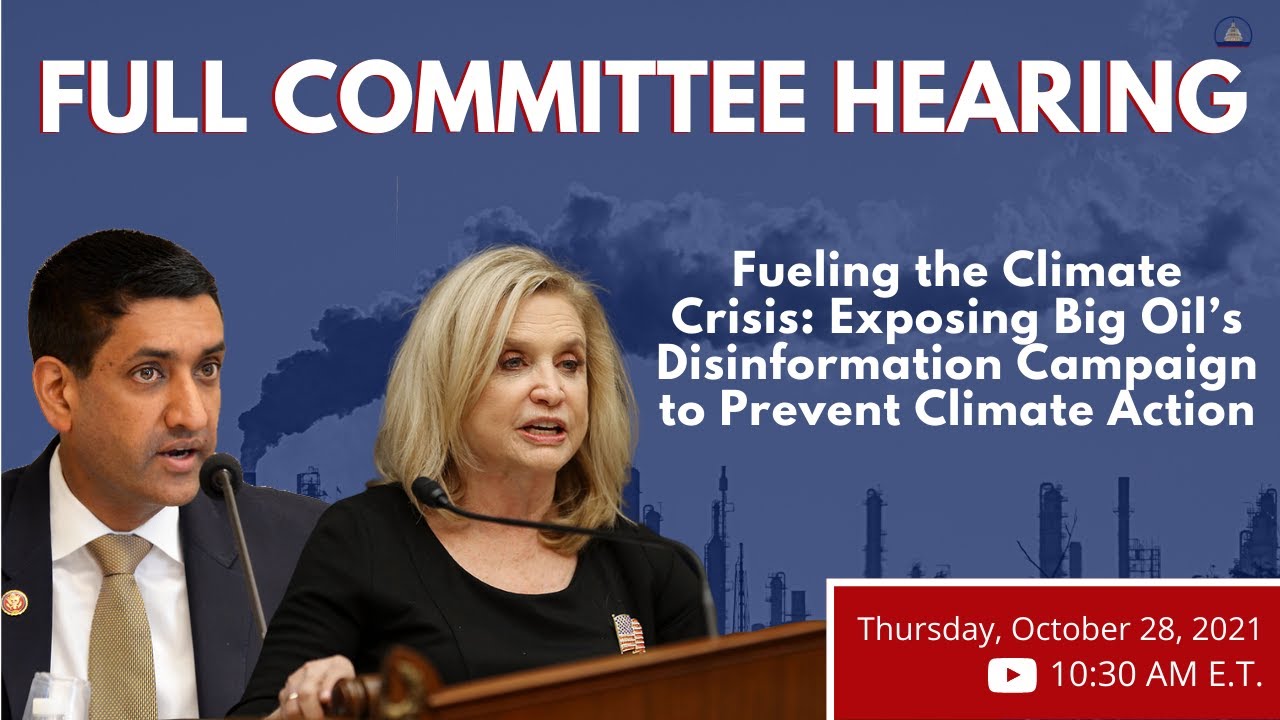 before the House Oversight Committee, alongside the heads of the American Petroleum Institute, or API, and the Chamber of Commerce, the Biden administration announced its framework for a $1.75 trillion reconciliation budget.
..."We’re leaving everything on the field here, in terms of our opposition to anti-energy provisions,” API CEO Mike Sommers told CNN earlier this month. (Ocasio-Cortez repeated the quote.) Representative Rashida Tlaib pointed out generous industry funding for front groups that have kneecapped national and state-level climate policy efforts. The industry spent $40 million, for instance, protecting the oil and gas industry’s ability to drill within 1,000 feet of playgrounds from a 2018 ballot initiative. Then there are all the documents, reported on at length by Inside Climate News, showing the disconnect between what Exxon told the public about climate change and what its own scientists knew to be true. Shell knew, too.
Watkins and her colleagues on the virtual stand—ExxonMobil CEO Darren Woods, Chevron CEO Mike Wirth, BP America CEO David Lawler, API CEO Mike Sommers, and Chamber of Commerce CEO Suzanne Clark—had plenty to be happy about elsewhere in the Capitol, too.
Having already funneled $462,500 in political action committee money to Senator Joe Manchin, who killed the Clean Electricity Payment Program (the centerpiece of the Build Back Better Act’s climate provisions), they could now claim another win. The text of the Build Back Better Act bill released during Thursday’s hearing revealed that the last remaining provision directly targeting fossil fuel emissions—a fee on methane emissions—had been stuffed with a$775 million fossil fuel subsidy....