Gilens Princeton Page
disambig
see EG poll popular
for stuff am ppl want (and pols fail on?) drug cost/negotiate
---
https://wareagle.substack.com/p/the-iran-war-exposes-the-farce-of
SUBSTACK
NO LNX
The Iran War Exposes the Farce of American “Representative Democracy”
J Richard Duke
Mar 03, 2026
The Iran War Exposes the Farce of American “Representative Democracy”
Ryan McMaken
“The Trump administration has unilaterally—without any Congressional debate or vote, of course—forced Americans into yet another war. This time, the war is a large-scale military campaign against Iran. Was there any groundswell of public support for this war? Did the Congress vote to spend more American tax dollars on another war? Apparently not. According to a March 1 poll from Reuters, only 27 percent of Americans polled said they support the US’s new war on Iran. Needless to say, few Americans have been calling their representatives in Congress asking for yet another Middle Eastern war.
:{:{So, why is the US now at war with Iran? Not even the administration appears to know for sure. After the war had already begun, the White House repeatedly changed its stated rationale for opening hostilities against Iran. At the beginning the US regime had been claiming it wanted regime change in Iran to “liberate” Iranians. Yet, by Monday, when Trump listed his reasons for starting the war, he didn’t mention regime change at all. Rather, the administration now seems to have settled on claims that the Iran regime was creating a missile program that, somehow, endangers the United States.}:
Yet, virtually no one believes that the Iranian regime has ever had long-range missiles capable of getting anywhere near US territory. Rather, the only “threat” to the United States is a threat to US bases which the US government has insisted on building 10,000 miles from US territory, and which have nothing to do with the safety of Americans in the United States.}:
On Monday, Rubio said that the United States began the war because the State of Israel planned to attack Iran, and that this would lead to Iranian reprisals against US bases. Rubio was essentially stating that Tel Aviv forced the US into the war. Trump today directly contradicted his Secretary of State—as well as the GOP Speaker of the House and GOP Senator Tom Cotton—and claimed “I might’ve forced their hand.”
Completely absent from all these confused and retroactive attempts to justify the war is any mention of the American people, their tax dollars, their freedoms, or even their alleged representatives in Congress. Nor is this surprising. The current war is a timely reminder that the US ruling elites regard the US taxpayers and ordinary Americans as little more than inconvenient afterthoughts in the formation of US foreign policy. At the same time, the US regime also claims to have the moral high ground precisely because the American regime is supposedly “democratic” with the support of “the people.”
Indeed, the Trump administration overall has helped make it abundantly clear that US elections and public opinion are almost completely irrelevant to the foreign policy. Throughout his campaigns, Donald Trump repeatedly claimed to be the peace candidate, announcing in his speeches that he would end wars, rather than start them. In the days before the 2024 election, the GOP posted this image in social media, clearly presenting the Trump administration as “the pro-peace ticket”:
Yet, less than a year into his second term, Donald Trump’s foreign policy looks largely indistinguishable from that of the foreign policy of Barack Obama or Joe Biden. Indeed, if the current war drags on, we’ll be able to say Trump’s foreign policy is reminiscent of the George W. Bush administration.
It was clear during the campaign that the Trump ticket was trying to take advantage of public sentiment which favored less US involvement in foreign wars. With American foreign policy, however, elections don’t matter. This was recently emphasized by the bumbling US ambassador to Israel, Mike Huckabee, in a recent interview with Tucker Carlson. Carlson began with a simple question for Huckabee:
Carlson: How much does it matter what Americans think?
Huckabee: Well, it matters every bit what Americans think.
[Huckabee is a delusional liar. - JRD]
Carlson then points out that about 21% of Americans support war with Iran. He asks Huckabee if that’s enough for the US regime to start a war with Iran. Huckabee states “We don’t live in a world where you have a poll taken to find out whether our policy should be in a particular direction...”
Carlson then points out that Huckabee had just said public opinion matters a lot and Huckabee says “we care deeply about it...”
[Huckabee is a liar. - JRD]
Carlson: “If we’re ignoring it, in what sense to we ‘care deeply about it?’”
Huckabee then offers a non sequitur: “I think we care deeply when we see there’s a threat.” Huckabee then continued with more word salad in a desperate attempt to make a connection between public opinion and his preferred policy of repeatedly starting elective wars with Middle Eastern regimes that are no threat to the US population.
[Huckabee, the Ambassador to Israel, is a former pastor who does NOT understand the Bible and is puts Israel first and American somewhere below. - JRD]
The reality, of course, is closer to Rubio’s explanation for the US’s involvement in the war: following the lead of the State of Israel.
This is apparently fine with Ambassador Huckabee, of course, who in his Carlson interview, was asked if Huckabee thinks the State of Israel has a “right” to take over most of the Middle East. Carslon stated: ”Does Israel have the right to that land?” Huckabee responded ”It would be fine if they took it all.”
And what if most Americans don’t share this opinion? Clearly, the US regime doesn’t care, and neither does Huckabee, or Donald Trump.
In spite of all the US regime’s posturing about “the will of the people” and “representation” in Congress, what really matters in Washington is serving powerful interest groups. The taxpaying public simply exists as a resource to be bled dry in favor of wars, protectionism, and federal spending which serves the ruling elite’s complex system of patrons and clients that keeps the elite in power.
When it comes to US foreign policy in the middle east, the dominant interest group is the State of Israel. This is executed through the American-Israeli Political Action Committee (AIPAC) and other elements of what foreign-policy scholars John Mearsheimer and Stephen walt call “the Israel lobby.” When Mearsheimer and Walt released their book The Israel Lobby in 2007, they were predictably accused of anti-semitism. Yet, the book was ahead of its time in describing how pro-Israel interest groups have been extremely successful in gaining financial, military, and strategic favors for Israel from US policymakers. It has all been done at the expense of American taxpayers. The result has been an American foreign policy elite that overwhelmingly favors incessant foreign intervention to favor a foreign state—the State of Israel—regardless of any concern for the cost borne by Americans or the potential for drawing the US into broader conflicts that do not in any way increase the security of the United States.
In 2007, The Israel Lobby seemed controversial to many. In 2026, it is merely a statement of the obvious—that US foreign policy is tailored to favor certain interest group, rather than the interests of ordinary voters. This, however, is how all interest group politics works. The voting public doesn’t matter, and it hasn’t mattered for a long time.
This is shown in empirical studies that have tried to find a connection between public opinion and actual policies favored in Washington. The connection is tenuous at best.
For example, in a 2014 study by Martin Gilens and Benajmin Page, the authors note that when it comes to “impacts on U.S. government policy ... average citizens and mass-based interest groups have little or no independent influence.” Gilens and Page note that “the preferences of economic elites ... have far more independent impact upon policy change than the preferences of average citizens do.”
This can be seen in Trump’s own fundraising given how one of his biggest donors, billionaire Miriam Adelson, is notable for an extreme pro-Israel position. This is, not surprisingly, reflected in Trump’s foreign policy.
The final conclusions of Gilens and Page are clear:
In the United States, our findings indicate, the majority does not rule—at least not in the causal sense of actually determining policy outcomes. When a majority of citizens disagrees with economic elites or with organized interests, they generally lose. Moreover, because of the strong status quo bias built into the U.S. political system, even when fairly large majorities of Americans favor policy change, they generally do not get it.
Perhaps no group of “economic elites” is more influential in foreign policy than those who control campaign funds distributed through pro-Israel interest groups like AIPAC, or through the spending of wealthy individuals like Adelson.
Other studies have come to similar conclusions. For example, in a 2017 paper on voter preferences, John Matsusake concluded that legislator preferences don’t correlate with voter preferences:
[W]hen legislator preferences differed from district opinion on an issue, legislators voted congruent with district opinion only 29 percent of the time. The data do not show a reliable connection between congruence and competitive election, term limits, campaign contributions, or media attention. The evidence is most consistent with the assumption of a citizen-candidate model that legislators vote their own preferences.
There is, of course, no such thing as a “district opinion,” but the general idea is clear enough: if a legislator’s campaign war chest depends on pleasing a specific interest group, then the preferences of the voters don’t really matter.
Similarly, in a 2016 study from Michael Barber, he writes on how votes in the US Senate bear little relation to public opinion: “[S]enators’ preferences diverge dramatically from the preference of the average voter in their state. The degree of divergence is nearly as large as if voters were randomly assigned to a senator.”
So, if policymakers are largely independent of the voters who the policymakers ostensibly “represent,” then what determines federal policy?
The current war is just the latest reminder that pluralism is wrong and elite theory is right. There is no “we the people.” There is no “representative democracy.” And, when it comes to the big stuff like war, federal spending, and the central bank, elections don’t matter. It’s why, no matter who gets elected, US foreign policy proceeds more or less as usual, year after year after year.
This is why it doesn’t matter that only about one in four Americans is interested in being on the hook for yet another Middle Eastern war with no apparent benefits for any average American. This is why the administration continues to engage in shifting claims about the origins of this conflict. The administration knows that claims about Iran being a threat to the American people are not tenable, and are on the same level as claims about Iraqi WMDs. Nor can the regime just come right out at say “our pro-Israel funders told us to fight Iran.” So, we have Rubio telling us the war was a “preemptive strike” against the potential blowback from US-funded Israeli strikes on Iran. This explanation is already falling apart, which is why Trump now denies it.
In the end, the regime doesn’t even really need to come up with a plausible explanation. The political fallout will settle largely on the current administration, and this will have little effect on the real governing elite which remains in control regardless which party is ostensibly “in power.”
Open link
SEE:
Why Parts of MAGA Feel ABANDONED After Trump Goes to War with Iran, with Marjorie Taylor Greene
---
---
CONTEXT CORROBORATION
AN 1 26
An extensive new study from a team of Ivy League economists has uncovered just how much the Supreme Court has shifted towards favoring the wealthier side in any given case, with a New York Times report concludingreport concluding that you can "follow the money" to determine how it will in any given case.
The new study, dubbed "Ruling for the Rich," was published on Monday and hailed from the team of Yale's Fiona Scott Morton, Columbia's Andrea Prat and Columbia's Jacob Spitz. Adam Liptak, the leading Supreme Court correspondent for the Times, dug into its findings, noting that "the wealthy have the wind at their backs before the justices," and questioning whether or not they are living up to their oath to "do equal right to the poor and to the rich."
Per Liptak's analysis, the study found that Republican appointees, who have held a 6-3 majority on the Supreme Court since 2020 and an overall majority for much longer, are "far more likely than Democratic ones to side with the wealthy," and adding "that the Supreme Court has become deeply polarized in cases pitting the rich against the poor." This is now in sharp contrast to the court of the mid-20th Century, "when appointees of the two parties were statistically indistinguishable" in terms of favoring wealthier parties.
Specifically, the study found that Republican-appointed justices sided with wealthier parties in cases around 70 percent of the time. By comparison, in 1953, conservative justices sided with them only 45 percent of the time.
Speaking with Liptak about the findings, Adam Cohen, author of the book "Supreme Inequality," noted that the study essentially reiterated ideas about the court's conduct that "some of us have been observing for a long time."
“But it is great to see,” Cohen added. “Respected academics crunching the numbers and producing the data to show that this is exactly what has been going on.”
These findings come as leaders in both political parties are ramping up plans to radically alter their campaign finance plans ahead of an upcoming decision, in which the court is widely expected to lift the limits on how much party committees and campaigns are allowed to coordinate with each other. This, experts argue, would hand even more power to the wealthiest donors and further erode the power of small-dollar donors.
---
---
AN 9 25
ROBT R
It’s too easy to accept the conventional view that the widening polarization of our society, and the decline of democracy, are due to the demagogue in the Oval Office.
That conventional view is way too simple. Follow the money. The underlying cause is the tsunami of legal bribes flowing from huge, wealthy corporations (and their oligarchic CEOs and major investors) into American politics.
That tsunami has grown dramatically over the last forty years. It underlies the crisis of democracy. It is fueling polarization. Democracy and social cohesion are impossible to sustain when big money is dictating political outcomes.
Over the last four decades, corporate political spending has more than quadrupled, adjusted for inflation.
Labor unions no longer provide a counterweight. Forty years ago, union PACs contributed about as much as corporate PACs. In the 2024 election, corporations outspent labor by more than 3 to 1.
According to a landmark study published in 2014 by Princeton professor Martin Gilens and Northwestern professor Benjamin Page, the preferences of the typical American have no influence at allon legislation emerging from Congress.
Gilens and Page analyzed 1,799 policy issues in detail, determining the relative influence of economic elites, business groups, mass-based interest groups, and average citizens. Their conclusion:
“The preferences of the average American appear to have only a minuscule, near-zero, statistically non-significant impact upon public policy.”
Gilens and Page found that lawmakers listen mainly to the policy demands of big business and wealthy individuals — those with the most lobbying prowess and deepest pockets to bankroll campaigns and promote their views.
It’s far worse now. Gilens and Page’s data came from the period 1981 to 2002 —before the Supreme Court opened the floodgates to big money in the Citizens United case, before Super PACs, before “dark money,” and before the Wall Street bailout.
Decades before Trump, corporations were already getting a high return on the money they invested in politics. I know. I was there. I had a front-row seat.
Over the last 40 years, corporate tax rates have plunged. Regulatory protections for consumers, workers, small investors, and the environment have been defanged. Antitrust has become so ineffectual that many big corporations face little or no competition.
Corporations have fought off safety nets and public investments that are common in other advanced nations, such as universal health care and paid family leave. They’ve attacked labor laws — reducing the portion of private-sector workers belonging to a union from a 35 percent forty years ago to just over 6 percent now.
They’ve collected hundreds of billions in federal subsidies, bailouts, loan guarantees and sole-source contracts. Corporate welfare for Big Pharma, Big Oil, Big Tech, Big Ag, Wall Street, and the largest military contractors now dwarfs welfare for people.
The profits of big corporations have reached record highs, and the ratio of CEO pay in large companies to average workers has ballooned from 20-to-1 in the 1960s, to nearly 300-to-1 now.
Most Americans, however, are going nowhere. The typical worker’s wage is only a bit higher today than it was forty years ago when adjusted for inflation.
The biggest casualty has been public trust in democracy.
In 1964, only 29 percent of voters thought government was “run by a few big interests looking out for themselves.” By 2013, 79 percent of Americans thought so.
A large portion of the American public has become so frustrated and cynical about democracy that they believe the blatant lies of a self-described strongman and support a political party that no longer stands for democracy.
Capitalism is compatible with democracy only if democracy is in the driver’s seat. But the absence of democracy doesn’t strengthen capitalism. It fuels despotism.
Ironically, the CEOs of many large American corporations are now finally confronting this reality. Despotism is bad for capitalism. Despots don’t respect property rights. They don’t honor the rule of law. They are arbitrary and unpredictable. All of this harms the owners of capital. Despotism also invites civil strife and conflict, which destabilize a society and an economy.
My message to every CEO in America: You need democracy but you’re actively undermining it by polluting it with big money and throwing much of your support behind a tyrant whose arbitrary and capricious decisions are threatening your businesses. It’s time for you to join the pro-democracy movement.
This is not only about economics. Widening inequality and a weakening democracy take a toll on the moral wellbeing of the nation, on the implicit social contract that binds us together, on the trust and cohesion we need to accomplish anything worthwhile.
In one of his first interviews, on September 14, Pope Leo XIV — history’s first U.S.-born pope — talked about the causes of the deep polarization he sees in America and elsewhere:
“Very significant is the continuously wider gap between the income levels of the working class and the money that the wealthiest receive. …Yesterday the news that Elon Musk is going to be the first trillionaire in the world. What does that mean and what’s that about? If that is the only thing that has value anymore, then we’re in big trouble.”
Trump is not the cause of the growing cynicism about democracy and the deepening polarization of our society. He’s the consequence and culmination of decades of neglect. We could not have remained on the road we were on toward ever-widening inequality and ever-greater political corruption.
If there’s a silver lining to this darkening cloud, it is that Trump may finally force us to confront this long-term crisis.
---
https://www.alternet.org/2022/01/corporate-seditionists-are-no-better-than-the-seditionists-who-attacked-the-capitol/
Capitalism and democracy are compatible only if democracy is in the driver’s seat.
That’s why I took some comfort just after the attack on the Capitol when many big corporations solemnly pledged they’d no longer finance the campaigns of the147 lawmakers who voted to overturn election results.
**
Btw, if you’d like my daily analyses, commentary, and drawings, please subscribe to my free letter: robertreich.substack.com
**
Well, those days are over. Turns out they were over the moment the public stopped paying attention.
A report published last week by Citizens for Responsibility and Ethics in Washington shows that over the past year, 717 companies and industry groups have donated more than $18m to 143 of those seditious lawmakers. Businesses that pledged to stop or pause their donations have given nearly $2.4m directly to their campaigns or political action committees.
But there’s a deeper issue here. The whole question of whether corporations do or don’t bankroll the seditionist caucus is a distraction from a more basic problem.
The tsunami of money now flowing from corporations into the swamp of American politics is larger than ever. And this money – bankrolling almost all politicians and financing attacks on their opponents – is undermining American democracy as much as did the 147 seditionist members of Congress. Maybe more.
The Democratic senator KyrstenSinema – whose vocal opposition to any change in the filibuster is on the verge of dooming voting rights – received almost $2m in campaign donations in 2021 even though she is not up for re-election until 2024. Most of it came from corporate donors outside Arizona, some of which have a history of donating largely to Republicans.
Has the money influenced Sinema? You decide.Besides sandbagging voting rights, she voted down the $15 minimum wage increase, opposed tax increases on corporations and the wealthy and stalled on drug price reform– policies supported by a majority of Democratic senators as well as a majority of Arizonans.
Over the last four decades, corporate PAC spending on congressional elections has more than quadrupled, even adjusting for inflation.
Labor unions no longer provide a counterweight. Forty years ago, union PACs contributed about as much as corporate PACs. Now, corporations are outspending labor by more than three to one.
According to a landmark study published in 2014 by the Princeton professor Martin Gilens and Northwestern professor Benjamin Page, the preferences of the typical American have no influence at all on legislation emerging from Congress.
Gilens and Page analyzed 1,799 policy issues in detail, determining the relative influence of economic elites, business groups, mass-based interest groups and average citizens. Their conclusion: “The preferences of the average American appear to have only a minuscule, near-zero, statistically non-significant impact upon public policy.” Lawmakers mainly listen to the policy demands of big business and wealthy individuals – those with the most lobbying prowess and deepest pockets to bankroll campaigns and promote their views.
It’s probably far worse now. Gilens and Page’s data came from the period 1981 to 2002: before the supreme court opened the floodgates to big money in the Citizens United case, before Super Pacs, before “dark money” and before the Wall Street bailout.
The corporate return on this mountain of money has been significant. Over the last 40 years, corporate tax rates have plunged. Regulatory protections for consumers, workers and the environment have been defanged. Antitrust has become so ineffectual that many big corporations face little or no competition.
Corporations have fought off safety nets and public investments that are common in other advanced nations (most recently, Build Back Better). They’ve attacked labor laws, reducing the portion of private-sector workers belonging to a union from a third 40 years ago to just over 6% now.
They’ve collected hundreds of billions in federal subsidies, bailouts, loan guarantees and sole-source contracts. Corporate welfare for big pharma, big oil, big tech, big ag, the largest military contractors and biggest banks now dwarfs the amount of welfare for people.
The profits of big corporations just reached a 70-year high, even during a pandemic. The ratio of CEO pay in large companies to average workers has ballooned from 20-to-1 in the 1960s, to 320-to-1 now.
Meanwhile, most Americans are going nowhere. The typical worker’s wage is only a bit higher today than it was 40 years ago, when adjusted for inflation.
But the biggest casualty is public trust in democracy.
In 1964, just 29% of voters believed government was “run by a few big interests looking out for themselves”. By 2013, 79% of Americans believed it.
Corporate donations to seditious lawmakers are nothing compared with this 40-year record of corporate sedition.
A large portion of the American public has become so frustrated and cynical about democracy they are willing to believe blatant lies of a self-described strongman, and willing to support a political party that no longer believes in democracy.
As I said at the outset, capitalism is compatible with democracy only if democracy is in the driver’s seat. But the absence of democracy doesn’t strengthen capitalism. It fuels despotism.
Despotism is bad for capitalism. Despots don’t respect property rights. They don’t honor the rule of law. They are arbitrary and unpredictable. All of this harms the owners of capital. Despotism also invites civil strife and conflict, which destabilize a society and an economy.
My message to every CEO in America: you need democracy, but you’re actively undermining it.
It’s time for you to join the pro-democracy movement. Get solidly behind voting rights. Actively lobby for the Freedom to Vote Act and the John Lewis Voting Rights Advancement Act.
Use your lopsidedly large power in American democracy to protect American democracy – and do it soon. Otherwise, we may lose what’s left of it.
***
Btw, if you’d like my daily analyses, commentary, and drawings, please subscribe to my free letter: robertreich.substack.com
Robert B. Reich is Chancellor's Professor of Public Policy at the University of California at Berkeley, Senior Fellow at the Blum Center for Developing Economies, and writes at robertreich.substack.com. Reich served as Secretary of Labor in the Clinton administration, for which Time Magazine named him one of the ten most effective cabinet secretaries of the twentieth century. He has written fifteen books, including the best sellers "Aftershock", "The Work of Nations," and "Beyond Outrage," and, his most recent, "The Common Good," which is available in bookstores now. He is also a founding editor of the American Prospect magazine, chairman of Common Cause, a member of the American Academy of Arts and Sciences, and co-creator of the award-winning documentary, "Inequality For All." He's co-creator of the Netflix original documentary "Saving Capitalism," which is streaming now.
https://www.alternet.org/2019/11/radio-host-thom-hartmann-explains-how-we-could-slide-into-straight-fascism-in-the-next-year
...one one thing that causes me to think that we might not — and which is the subject of my new book “The Hidden History of the Supreme Court and the Betrayal of America” — is how the United States Supreme Court has basically betrayed our country. The definition of a democracy is where the people vote for what they want and then they get that through the government. That has not been the case since 1981.
Whether it’s the social safety net, protecting the environment, decreasing our military activity abroad, making policing more humane, recognizing civil rights, encouraging voter rights, strengthening the middle class and protecting Social Security and Medicare, none of those things have happened. In fact, the opposite has happened.
How is Trumpism a symptom and not the cause of much bigger social, political, economic and other cultural problems in America? Renewing the country’s democracy to prevent another fascist president is going to require deep systemic change, not just voting Donald Trump out of office.
The thing that concerns me the most is that in the United States we now have corporations and billionaires who have taken over our political system completely.**Social scientists have shown that what the bottom 90% of income earners want in America is literally random noise for America’s policymakers**. By comparison, what the top 10% want is consistently enacted through legislation. This means no more democracy. And then on top of that power dynamic the courts have swung to the far right and are hard corporatist.....
==
ref 2014
https://www.vox.com/2014/4/18/5624310/martin-gilens-testing-theories-of-american-politics-explained
Who really matters in our democracy — the general public, or wealthy elites? That's the topic of a recent studyby political scientists Martin Gilens of Princeton and Benjamin Page of Northwestern. The study's gotten lots of attention over the past year, because the authors conclude, basically, that the US is a corrupt oligarchy where ordinary voters barely matter. Or as they put it, "economic elites and organized interest groups play a substantial part in affecting public policy, but the general public has little or no independent influence."
But can that be right? Let's walk through the study and explain what it shows.
What does their study measure, exactly?
Gilens and "a small army of research assistants" compiled nearly 2,000 polls and surveys that asked for opinions about a proposed policy change. Since he wanted to separate out the preferences of economic elites and average citizens, he only used surveys that asked about respondents' income. He found 1,779 poll results that fit that description, spanning from 1981 to 2002. Then he took the answers of median-income voters to represent what average voters think, and the answers of respondents at the 90th income percentile to represent what economic elites think.
BASICALLY, AVERAGE CITIZENS ONLY GET WHAT THEY WANT IF ECONOMIC ELITES OR INTEREST GROUPS ALSO WANT IT
Next, the authors had to measure what interest groups thought about all of those issues. They decided to use Fortune magazine's yearly "Power 25" lists of the most influential lobbying groups, but since it "seemed to neglect certain major business interests," they added the ten industries that had reported the most spending on lobbying. Their final list includes 29 business groups, several major unions, and other well-known interest groups like the AARP, the Christian Coalition, the NRA, the American Legion, and AIPAC. Each interest group's position on those 1,779 policy change proposals were coded, along with how strongly each group felt about each proposal. The results were combined to assess how interest groups in general, felt.
Finally, they wanted to measure which of those 1,779 proposed policy changes actually happened. To do so, "Gilens and his research assistants spent many hours poring over news accounts, government data, Congressional Quarterly publications, academic papers, and the like."
So, which groups actually impact policy change?
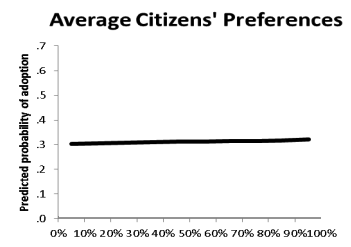
When the authors look only at the preferences of average citizens, it appears that they do have a pretty big effect on policy change. But when they add the preferences of economic elites and interest groups to the analysis, the impact of average citizens vanishes entirely. Basically, average citizens only get what they want if economic elites or interest groups also want it.

:{
In contrast, the preferences of economic elites and interest groups — especially economic elites — are each quite influential, when the preferences of the other two groups are held constant.}:
Are there charts that can help explain this?
Yes, check out these charts from Gilens and Page below, edited slightly for clarity. This first one shows that as more and more average citizens support an issue, they're not any more likely to get what they want. That's a shocking finding in a democracy:
:{
In contrast, the next charts show that as more and more economic elites and interest groups want a certain policy change, they do become more likely to get what they want:}:
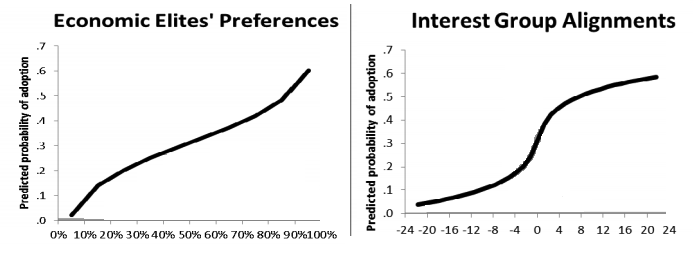
Specifically, if fewer than 20 percent of wealthy Americans supported a policy change, it only happened about 18 percent of the time. But when 80 percent of them were in support, the change ended up happening 45 percent of the time. There's no similar effect for average Americans.
Why does the study look at what the top 10 percent wealthiest Americans want, rather than what billionaires want?
There isn't sufficient survey data on the preferences of the ultrawealthy, so Gilens and Page settle for using respondents from the 90th income percentile — people who made $146,000 a year in 2012 dollars. But the authors argue that, if anything, using such an "imperfect measure" strengthens their arguments. Since they found such strong effects even here, they write, "it will be reasonable to infer that the impact upon policy of truly wealthy citizens is still greater."
What are some criticisms of the study?
Gilens uses survey responses to represent voters' preferences on issues, and he was criticized for this when his last book came out, in 2012. "Is it meaningful when public opinion is split between budget proposals no one understands?" wrote Harvard professor Nancy Rosenblum. UCLA professor Barbara Sinclair added, "Cutting the deficit is broadly supported, but there are few government programs — other than foreign aid — that a majority of Americans favor cutting. Sometimes it is literally impossible to follow public opinion."
It's also not clear that a democracy should necessarily be doing the bidding of the average voter on most issues. "The purpose of a political system is to resolve political questions in a satisfactory way … the watchword of democracy should not be responsiveness but rather accountability," Matt Yglesias wrote.
Economist Tyler Cowen of George Mason University made a similar point: "Many lower- or middle-income voters decide to vote retrospectively over outcomes … That suggests we should judge the responsiveness of the system in terms of how well it aims toward those outputs, not whether it gives lower-income voters their preferred policy inputs." So for instance, average people might vote on whether politicians have produced economic prosperity, not necessarily on what specific policies they chose to get there. A system that was listening to average voters, in this model, would be a system that produced prosperity, not that followed public whims on individual issues.
I'd like to read more depressing things on this topic.
You've come to the right place! Check out our articles on "The doom loop of oligarchy," Thomas Piketty's book about global wealth, and our video about this study below: