Princeton Univ
===
merri ok
===
The Princeton Tory is a magazine of conservative political thought written and published by Princeton University students. Founded in 1984 by Yoram Hazony, the magazine has played a role in various controversies, including a national debate about white privilege. Notable alumni associated with the magazine include United States Senator Ted Cruz, Wendy Kopp, the founder of Teach for America, and the current United States Secretary of Defense, Pete Hegseth. Four editors have gone on to be Rhodes Scholars.
History
Founding
In the early 1980s, there were several failed efforts to create a magazine with a conservative viewpoint at Princeton University, including the Madison Report, which had a circulation of 2,500 but folded due to financial difficulties.[1] In October 1984, a group of students including Yoram Hazony and Amy Bix, began publishing the Princeton Tory, planning for six issues in the initial year. They sought to publish a "thinking journal" and provide a forum for moderate and conservative viewpoints on a campus that was in their view dominated by left-wing politics. Hazony attributed the failure of the previous attempts at conservative publications to their tendency for sensationalism and mud-slinging. In contrast, the Tory was founded to highlight cogent argumentation with early issues addressing topics such as religion in politics, the composition of the Supreme Court, and the university's endorsement of a nuclear freeze.[2]
"Pen over the sledgehammer"
In 1986, the Tory found itself in disagreement with future noted conservative Dinesh D'Souza. At Dartmouth College, student staff members of the conservative Dartmouth Review had taken sledgehammers to a shanty town set up by protesters calling for divestment from South Africa over its Apartheid policies.[3] D'Souza, a Dartmouth alumnus, in arguing that Princeton would not see similar political violence, was quoted in the Daily Princetonian as saying, "At Dartmouth there is a healthy activism on both the left and the right. At Princeton, politics masquerades as fashion. There are more conservatives who are more confident in their actions at Dartmouth. At Princeton, you only have the Tory, which is too cerebral to be considered."[4] This critique promoted a response from Tory publisher Dan Polisar: "D'Souza criticized the Tory for being 'too cerebral.' If that means that we do not favor using sledgehammers as a tool for political debate, then we do not object. We would rather demonstrate that the problems symbolized by shanties are exacerbated by divestment, as we did in our October issue, than to stage an attack on the symbols themselves... Campus conservatives are proud of this restraint, and should receive credit, not blame, for choosing the pen over the sledgehammer."[5]
Controversies
Tal Fortgang and "White Privilege"
In April 2014, Princeton freshman Tal Fortgang penned an essay in the Tory entitled, "Checking My Privilege: Character as the Basis of Privilege." Fortgang wrote the essay in response to being told by a classmate, after expressing his views on welfare and the national debt, to "check his privilege." He stated, "The phrase, handed down by my moral superiors, descends recklessly, like an Obama-sanctioned drone, and aims laserlike at my pinkish-peach complexion, my maleness, and the nerve I displayed in offering an opinion rooted in a personal Weltanschauung."[6] The essay was picked up by *Time* magazine,[7] led to an appearance on Fox News[8] and caused a firestorm of criticism from the left and support from the right.[9][10][11][12]
Fortgang made use of his own family's history, with a grandfather exiled to Siberia, a grandmother sent to the Bergen-Belsen concentration camp, and a great-grandmother and five great-aunts and uncles who were shot in an open grave outside their hometown. His grandfather and father built a wicker basket business and emphasized education. Fortgang wrote, "While I haven't done everything for myself up to this point in my life, someone has sacrificed themselves so that I can lead a better life, but that is a legacy I am proud of. I have checked my privilege. And I apologize for nothing."[13]
Wendy Kopp and Teach for America
Wendy Kopp, the founder of noted educational non-profit Teach for America, has come under some criticism for having been a staff writer for the Tory while a student. Corey Robin, a fellow member of the Princeton class of 1989, wrote critically of her association with a paper committed, in his view, to the selfishness of capitalism, and some of whose founders, Hazony and Polisar, he describes as "hardcore Zionists" with "storied if peculiar careers on the Israeli right."[14][15]
Notable alumni
- Lawrence Otis Graham, Class of 1985. Author, "Member of the Club", ISBN 0060184124
- Yoram Hazony, Class of 1986. Founder of the Shalem Center.
- Wendy Kopp, Class of 1989. Founder, Teach for America.[16]
- Ted Cruz, Class of 1992. United States Senator from Texas,[16] presidential candidate.
- Danielle Allen, Class of 1993. Harvard political scientist, Marshall scholar.[17]
- Pete Hegseth, Class of 2003. Secretary of Defense, United States Senate candidate, Executive Director of Vets for Freedom, CEO of Concerned Veterans for America.
See also

References
TALK 10 25
Malkiel Incident was a one time event posted on the Magazine's website without authorization by the editors or publisher. It should not be the highlight of a three sentence article.
Items should not be censored from Wikipedia on account of their being "one time" events. It was written about in the campus newspaper, so it was obviously newsworthy. Joamiq (talk) 18:33, 23 May 2009 (UTC)
Why I reverted article to a previous version
Previously, the article read as follows:
The Princeton Tory is a student-run conservative publication at Princeton University. The Tory was founded in 1984.[1] While the Tory is Princeton's primary source of conservative intellectual discourse, it is known to create campus controversy[2] and its writers have come under fire for reporting inaccuracies[3].
References
- http://www.princeton.edu/~tory/about.html
- http://www.dailyprincetonian.com/2004/02/12/9590/
- http://www.dailyprincetonian.com/2008/03/03/20342/
===
5 24 heated see that for annotations
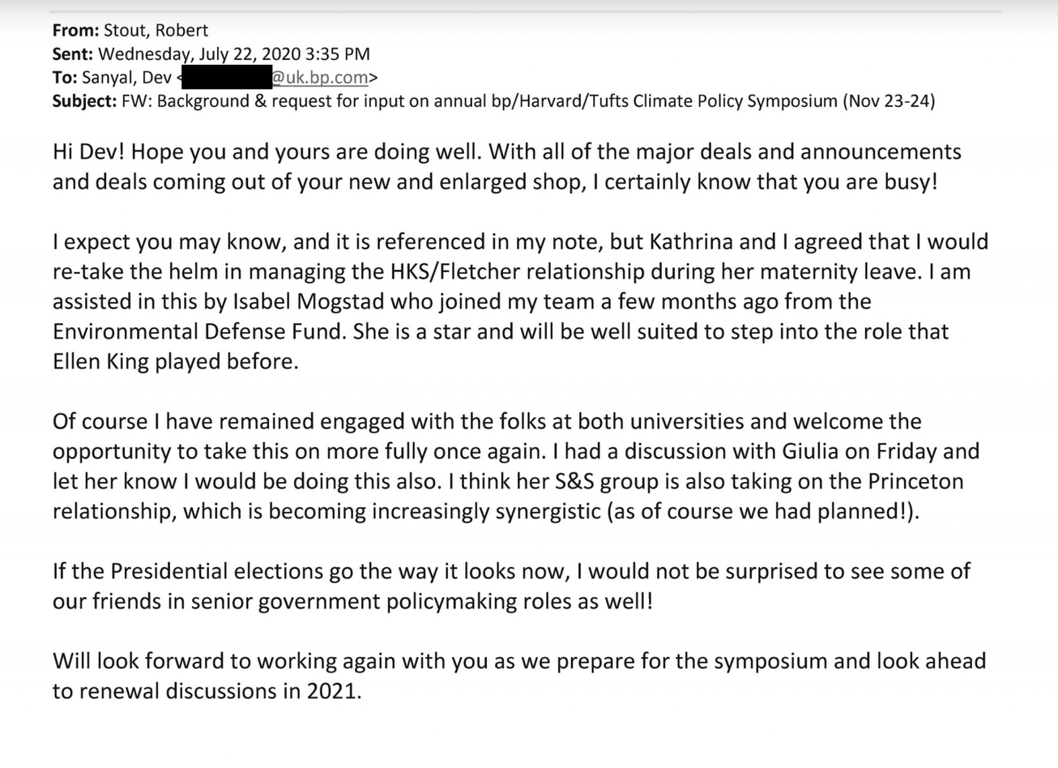
In July of 2020, Robert Stout, then the head of US policy at BP, wrote an email to his colleague laying out a few updates to the oil company’s relationships with Harvard, Tufts, and Princeton Universities, where BP funded various programs. Stout wrote that Princeton was becoming “increasingly synergistic” with the oil company—“as of course we had planned.”
“If Presidential elections go the way it looks now, I would not be surprised to see some of our friends in senior government policymaking roles as well!” Stout wrote of BP’s counterparts at Princeton.
The “synergistic” nature between Princeton and BP, which has funded the university’s Carbon Mitigation Initiative (CMI) for more than 20 years, is no accident. Big Oil and U.S. universities have long enjoyed a mutually beneficial relationship, as fossil fuel money has flowed to academic centers for decades in exchange for research that advances their objectives, access to policymakers, and civic goodwill. Yet this relationship has for years gone mostly unquestioned by mainstream media and regulators.
Tomorrow’s Senate Budget Committee hearing—and the wealth of subpoenaed documents and bicameral reportreleased in advance of the hearings—mark the first time the U.S. government is calling out the relationship between academia and Big Oil. As students on campuses across the country revolt against their universities’ financial relationships with companies profiting off the war in Gaza, the hearing comes at a time when U.S. academic powerhouses are already in an uncomfortable spotlight.
What, exactly, is in these documents that illustrate how Big Oil works with academic institutions to launder its image and lay the groundwork for industry-friendly policy? Here are some key takeaways.
New Numbers
In 2023,research from Data for Progress estimated that fossil fuel companies have donated at least $700 millionto 27 US universities over the past decade. Calculating the exact breakdown of these numbers can be an inexact science. Funding streams and financial ties on campus can become complex, and the vast majority of university research centers do not disclose their donors publicly. Even when asked directly to disclose their fossil fuel-backed research donations, only a handful have done so.
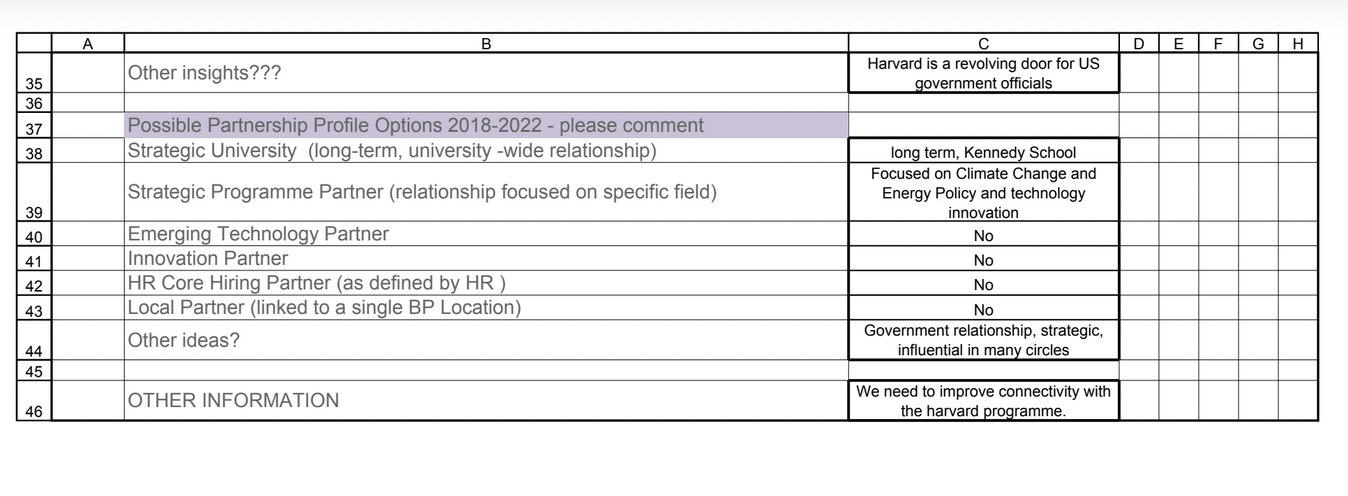
Previously, only the University of California at Berkeley has provided a complete accounting of its fossil fuel-funded research ($108 million from 2010 to 2020). The new documents put some real numbers on BP’s relationships with Princeton, Tufts, and Harvard. . According to the Senate report, BP funneled between $2.1 and $2.6 million to the Princeton CMI program between 2012 and 2017. BP also paid $416k to Harvard and $250k to Tufts each year between 2019 and 2021 for partnerships with programs at Tufts’s Fletcher School and Harvard’s Kennedy School. The focus of these grants is worth noting, too: Harvard’s Kennedy School and Tufts’s Fletcher School are both focused explicitly on policy; at Tufts, BP funds the Climate Policy Lab. These donations don’t just give BP a window into what some of the country’s top public policy schools are researching, it also gives them influence and access to future policy makers.On a spreadsheet detailing the value of these grants, for example, it’s noted that “Harvard is a revolving door for U.S. government officials.”
“BP is committed to transitioning from an international oil company to an integrated energy company,” the company told Drilled in response to a request for comment. “To do this, we are investing in today’s energy system while helping to build out tomorrow’s.”
While the new documents contain the most information on the relationship between BP and US universities, BP wasn’t alone. Exxon planned between 2016 and 2017 to donate hundreds of thousands of dollars to schools across the country, per the Senate report: “$600,000 to MIT; $325,000 to George Washington University’s Regulatory Studies Center; $175,000 to Indiana University’s School of Public and Environmental Affairs; $140,000 to Stanford University; and $50,000 to the University of Massachusetts Amherst.”
In 2017, Shell announced it would spend $25 million over 5 years on funding Berkeley’s Energy Biosciences Institute. In an email uncovered by the subpoena, Shell wrote it had “plans to ‘embed’ Shell scientists at UCB and likewise invite faculty to spend time at Shell’s research hub to further foster deep collaboration.” (EBI was originally created with a $500 million commitment from BP to develop “a sole focus on biofuels”; Shell acknowledged in the email that it was “taking advantage of the huge sunk costs already borne by BP” in funding the program.)
In late 2020, academics at Princeton gave BP a heads-up on a major study it issued modeling pathways for the U.S. to reach net zero by 2050. In emails revealed by the Senate investigation, one BP staffer noted that BP contributed “just under” $2 million of the study’s funding through its partnership with Princeton. (Whether or not this was an additional expense on top of the regular institutional gift was not made clear.)
“BP supports the High Meadows Environmental Institute’s Carbon Mitigation Initiative with an annual contribution that is completely controlled by Princeton academics,” Princeton told Drilled in an email. “The funder has no involvement in the selection of specific research projects for support, in the execution of the research projects, nor in the presentation of final results. All HMEI research is submitted for peer review by independent, external academic experts.”
Not all oil companies’ relationships with universities were accounted for in the new documents. The Senate report documented that despite public partnerships with universities across the country, Chevron did not “[produce] relevant documents on this subject, even though the scope of the House Oversight Committee’s subpoena covered these documents.”
What Oil Companies Pay For
Importantly, the documents also lay out in clear detail what, exactly, fossil fuel companies expected their university money will be going towards: research that supports their objectives, access to academics and policymakers, and positive public associations with climate solutions.
“Our policy programs at Harvard and Tufts provide BP access to unparalleled expertise at the forefront of research in the areas of climate change science, technology, and policy,” one undated document from Dev Sandyal, then an executive VP at BP, explained to staff. The document sought feedback on the programs within these two universities, which, the note says, has “been an opportunity for [BP] to provide a business perspective to help shape international policy thinking in low carbon energy discussions.”
The 2020 Princeton net zero report is a key example of the company leveraging university research for positive PR. In an email discussing press strategy ahead of the report’s release, Omayma Khan, a BP communications official, wrote to other executives that the study “plays to our aims of helping the world get to net zero.”
“The team that worked on [this report] are already advising Biden’s transition team,” Khan added. In a separate email, Stout wrote that BP would make “a continuing effort to leverage the study with the USG [U.S. government].”
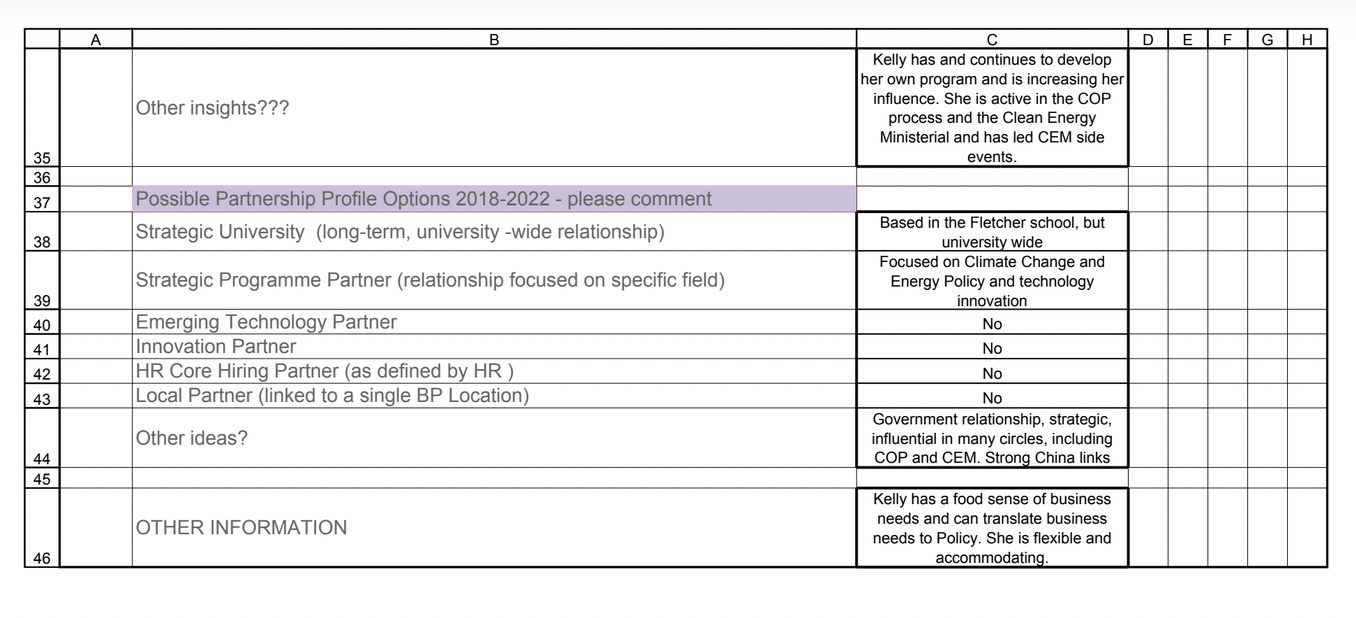
Access to staff at these programs—and their relationship to policymakers—was a clear focus for BP in keeping up these relationships as well. Representatives from universities across the country routinely pop up in industry invite lists; BP’s invite list for a private reception at CERAWeek in 2018 included Jason Bordoff, the head of Columbia’s Center on Global Energy Policy, as well as staffers from the Kennedy School, Stanford’s Natural Gas Initiative, and Georgetown University. The same BP document that references Harvard as a “revolving door for U.S. government officials” notes that “Kelly”—referencing Kelly Sims-Gallagher, the Dean of Fletcher School of Law and Diplomacy—is “active in the COP process,” calls her “flexible and accommodating” in her relationships with businesses, and notes that Tufts is “influential in many circles,” including COP and the Clean Energy Ministerial.
In a 2020 email to high-level BP staff describing the Harvard and Tufts partnerships, Stout writes about how many former Obama administration officials are involved in both programs, calling out their “deep insight, credibility, and influence with US and global policymakers.”
Regardless of the independence of Princeton’s research, BP often discussed leveraging its relationship with Princeton to advance its own priorities. In 2020, a BP VP emailed notes from a call with Stephen Pacala, a researcher at Princeton, where they noted their recommendation of developing an infrastructure program “with an emphasis on CCUS [carbon capture, usage and storage]—building ‘backbone’ of pipelines to transport carbon.” In a 2017 email, Stout called Pacala “a big advocate” for BP making its case for natural gas. BP also used its relationship with Princeton as part of a 2020 presentation to the Rocky Mountain Institute, a nonprofit influential with renewable energy circles, noting how it intended to “advance methane science” through its partnerships.
In one 2018 document, BP also discussed a plan to “advance and protect the role of gas—and BP—in the energy transition” following negative press around methane emissions from natural gas. The plan included proposals to fund whitepapers from researchers at Princeton and Imperial College in London “highlighting [the] role of gas as a friend to renewables.”
Not All Programs Created Equal
Simply buying an association with a top-level university is just the first step in the Big Oil PR playbook. The documents reveal that some oil companies are also constantly reevaluating their relationships with universities to maximize their rates of return.
One spreadsheet included in the tranche of released documents lists meticulous details of each of BP’s partnerships with Tufts, Harvard, and Princeton. The spreadsheet includes ranking the universities’ research programs as aligned with BP’s “strategic priorities”—like the “shift to gas,” “advantaged oil” (an industry term used to describe the most desirable oil to be extracted during the energy transition). The spreadsheet also includes details like the number of graduates hired from each school by BP, the number of visit days or meetings for BP executives, and scoring each academic institution on its “Industrial Relations Strategy Maturity” (all schools scored a “Medium” ranking.)
In notes from a 2016 meeting, BP executives mention that the Harvard “relationship began as the climate policy adjunct to the Princeton CMI technical work;” BP executives discussed how to reduce contributions to a program that had, in their eyes, grown beyond its scope in order to “avoid damaging the Harvard/BP relationship.”
“The CMI discussions are directly relevant to BP, whereas the Harvard/Tufts discussions are directed by the Universities and much less relevant to BP,” the notes read.
“The Fletcher School's Climate Policy Lab received a general support grant from BP which concluded at the end of 2021 and has not been extended,” a spokesperson from Tufts told Drilled in an email. “Throughout the duration of that collaboration, Fletcher's research was conducted autonomously and without any influence from the funding source. We remain committed to conducting rigorous, unbiased research that serves the public interest.”
How Academics “Sharpen Corporate Perspective”
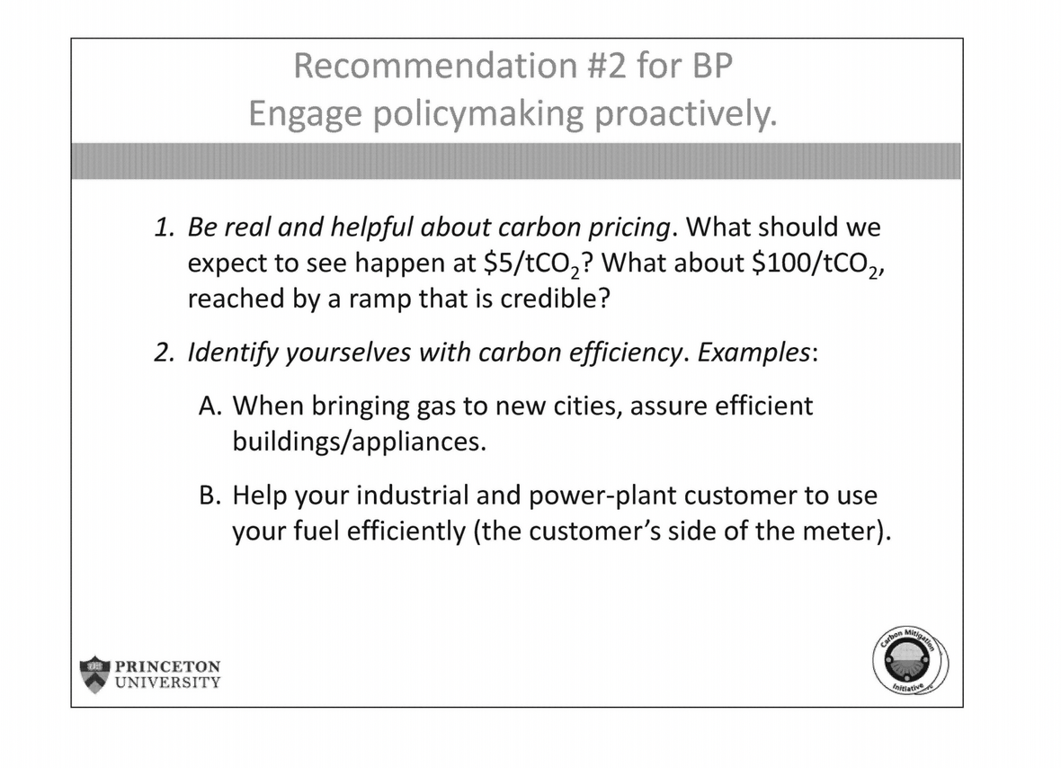
The new documents also show how academic centers helped oil companies refine public messages on climate change. A 2016 presentation to BP by Pacala and Robert Socolow, the co-director of the Carbon Mitigation Initiative at Princeton, included a slide titled “Risks of climate change to BP.”
“Effective climate policies can emerge that discourage fossil fuel consumption, that impose environmental performance standards on production processes, and that subsidize or otherwise promote efficiency and low carbon energy,” the slide reads. In the next slide, Pacala and Socolow point out that “BP benefits when CMI disseminates sound information that supports effective public policy discussions.” The center’s research, the researchers point out, also helps “[sharpen] BP’s corporate perspective on climate change.” Later in the presentation, Pacala and Socolow make a series of recommendations to BP, including to “engage policymaking proactively.”
“Identify yourselves with carbon efficiency,” the slide says.
In July of 2019, staffers from Columbia’s Center on Global Energy Policy, including Jason Bordoff, emailed executives at BP a draft of a chapter on carbon capture, utilization, and storage (CCUS) that would be included in an upcoming report from the National Petroleum Council. Gardiner Hill, then the company’s VP of carbon, emailed back several thoughts.
Hill recommended that the chapter “be clearer and bolder on the role of the USA in the emerging energy transition … Low cost oil and gas create a substantial advantage domestically and internationally for the USA. CCUS extends this considerably as the world transitions to a low carbon energy economy.”
“I’m very conscious of the fact that many will read this report as the oil and gas industry saying let’s do CCUS so we can keep on doing oil and gas as usual,” Bordoff responded. “Need to avoid that perception. We heard that from all the independent academics and think tank types involved with putting this chapter together. …I think the credibility of the report will be enhanced if we err on the side of staying away from claims that sound self-serving for the industry.”
“I understand your point about the perception that the remarks regarding low cost oil and gas may look self serving,” Hill responded. “This was genuinely not my intent. It is good to be reminded how others may perceive this—thank you.”
The National Petroleum Council’s page on the final CCUS reportnotes that of the 300 people tasked with writing the study, “less than 33% are from the oil and natural gas industry.”
What’s Next
The subpoenaed documents, which range from 2015 to 2021, cover an unusual time for oil companies: directly during or after the Exxon Knew investigation, through the Trump years and the early start of the pandemic. As the documents show, oil companies were eager to let the public know that they were working towards climate solutions, moving away from outright denial—while privately pulling the cultural, economic, and political levers of power available to them, including their relationships with universities, to ensure their voices were heard to keep fossil fuels on the table.
Now, many of these companies have reported some of their most profitable earnings to date for the past two years, as the global energy crisis kicked off by Russia’s invasion of Ukraine has jacked up oil prices once more. Many oil majors, including BP, have since walked back on their climate commitments. The Biden administration, meanwhile, proved to be more of an ally to oil and gas companies than a foe, keeping up production levels and carving out advantages for favorite solutions like CCUS and hydrogen. Another potential Trump administration—with its heavy emphasis on American energy independence—would only benefit the industry.
Universities are, similarly, in a much different position than they were during the time of this subpoena. Many have faced divestment campaigns from their student bodies in recent years, with some success for activists. In 2022, Princeton agreed to a partial divestment from fossil fuels—but did not agree to divest funding from programs like CMI. Now, an unexpected new wave of student activism around Palestine is gripping college campuses—and forcing the nation’s attention on where universities’ financial allegiances lie. Perhaps it’s time for these universities’ relationships with Big Oil to help focus that spotlight.
*This is the first of several deep dives into the new documents we’ll be doing here at Drilled, along with coverage of the May 1st hearing. Come back for more throughout the week!
===
ymail 4 24
In 2021, Congressional Democrats subpoenaed Big Oil for internal documents detailing the industry’s role in worsening the climate crisis.
Some of the documents have already been released. But today, we got some more.
The internal materials are from Exxon, Chevron, Shell, BP, the American Petroleum Institute, and the Chamber of Commerce. They’re being released today as part of the Senate Budget Committee’s upcoming hearing on Wednesday morning, titled “Denial, Disinformation, and Doublespeak: Big Oil’s Evolving Efforts to Avoid Accountability for Climate Change.”
 Source: X
Both the hearing and the documents mark the revival of the House Oversight Committee’s two-year investigation into the fossil fuel industry, and its role in misleading Americans about climate change. That investigation was put on ice when Republicans won back control of the chamber in late 2022.
Democrats say their new findings provide “a rare glimpse into the extensive efforts undertaken by fossil fuel companies to deceive the public and investors about their knowledge of the effects of their products on climate change and to undermine efforts to curb greenhouse gas emissions.”
HEATED got a chance to review the new documents prior to their publication today. And while we don’t think the revelations are necessarily all that “rare,” here are five things we found notable.
1. BP really, really loves Princeton
To influence academia, fossil fuel companies have spent at least $700 million on partnerships with U.S. universities. The longest-running of these partnerships is between BP and Princeton.
The new documents provide some insight into why: because Princeton gives BP unprecedented access to discussions about research. In 2016 emails, BP officials discussed cutting funding to Harvard and Tufts and boosting it for Princeton, because research discussions at Harvard and Tufts “are directed by the universities and much less relevant to BP.” They said “personality and structural issues” at Harvard and Tufts made it “difficult to achieve the same BP focus.”
Achieving a “BP focus” meant two things: pushing research about the benefits of carbon capture and methane gas. And that’s what Princeton’s Carbon Mitigation Initiative did.
In 2018, an internal BP presentation marked “confidential” recommended Princeton CMI director Stephen Pacala as a preferred expert in defending methane gas as a climate solution. And in a 2020 email, BP officials discussed an upcoming call with Pacala, in which BP would recommend developing a net zero plan “with emphasis on CCUS [carbon capture utilization and storage] — building ‘backbone’ of pipelines to transport carbon from emitters to the Permian and Gulf Coast sites.”
CMI did eventually develop a net zero study with an emphasis on carbon capture. BP officials celebrated, writing, “Princeton’s net zero study is expected to be a guide for the Biden Administration.”
Today, sure enough, the Biden Administration is making massive investments in carbon capture—just as BP’s vice president of U.S. policy and regulatory affairs predicted. In a 2020 email, he said BP’s relationship with Princeton was “becoming increasingly synergistic.” If Biden won, the VP said, “I would not be surprised to see some of our friends in senior government policymaking roles, as well!”
2. Oil companies know they can’t meet their public climate goals
While they publicly tout their efforts to fight climate change, oil companies privately say they don’t believe the world could ever reach a safe, livable climate.
For example: Exxon first publicly supported the Paris Agreement in 2015, but internally the company revealed that it did not believe the climate treaty’s goals were realistic. “We don’t yet see the world even approaching a 2°C pathway … let alone a 1.5°C pathway,” Exxon’s former manager of environmental policy and planning Peter Trelenberg wrote in a 2018 email. “Both 2°C and 1.5°C would require unprecedented changes to the global energy system and economy, at a rate and scale never before demonstrated, and with technologies not yet available and affordable.”...
===
CHICU DEI
After the cancellation of his MIT lecture, Abbot was offered a lecture appearance by Robert George, the director of Princeton University’s James Madison Program in American Ideals and Institutions, which he gave on October 21 to a virtual audience of around 3,000. George, a well-known conservative intellectual, announced on Twitter that “MIT’s caving in to a cancel mob’s demand to disinvite a distinguished scientist who had been invited on the basis of his achievements to give an honorific lecture shows just how badly science today has been politicized. The integrity of science can’t survive politicization.”
GGL 6 26
AI Overview
Robert P. George is Princeton University’s McCormick Professor of Jurisprudence and Director of the James Madison Program in American Ideals and Institutions. A prominent conservative Christian legal scholar, his work bridges philosophy and constitutional law, focusing on natural law, civil liberties, and the cultural foundations of free societies. [1, 2, 3, 4]
The capitalized terms in your query likely refer to his engagements with or recognition by several notable organizations and foundations that support classical liberal, free-market, or conservative intellectual endeavors:
- KOCH: George has been a notable recipient of support, fellowships, and program backing from foundations associated with Charles Koch, which often fund academic initiatives focused on free markets and constitutional principles.
- IHS (Institute for Humane Studies): He has frequently engaged with or lectured at this organization, which supports the study of classical liberalism and individual liberty. [1]
- HUMANE: This likely refers to the Intercollegiate Studies Institute (ISI), which provides fellowships and educational programming where George serves as a lecturer and prominent intellectual figure.
- HAYEK: George is deeply aligned with classical liberal and free-market philosophies, and his programs at Princeton regularly engage with the ideas of F.A. Hayek and the Austrian School of Economics regarding the rule of law and limited government. [1]
===
https://www.alternet.org/big-oil-colonized-college-campuses/
no lnx
environmentalists are not hard to find on college campuses, and many of them are sounding the alarm about the dangers of climate change. Terms like "green energy" and "carbon footprint" are not uncommon at universities.
But not everyone who lectures about climate change on campus has a plan for fighting it. In an article published by The Guardian on March 27, journalist Oliver Milman details the fossil fuel industry's efforts to promote its agenda on college campuses.
:{
Milman cites Tim Barckholtz as an example. Barckholtz has lectured extensively at Princeton University in New Jersey about the challenges of moving away from fossil fuels, but he is a scientific adviser for ExxonMobil.}:
READ MORE:'You've got to be kidding me': MSNBC host spooked by revelation that climate change is making fungus deadlier
"Dozens of U.S. universities…. retain links with the fossil fuel industry in a variety of ways, despite the growing pressure on them to cut them," Milman explains. "Several host Exxon representatives on campus and even provide them with office space, similar to Princeton's previous arrangement, a Guardian investigation has found."
Princeton student Claire Kaufman told The Guardian she was "quite shocked" to find out that Barckholtz worked for ExxonMobil.
According to Kaufman, "The fact there was an Exxon employee in this undergrad class blew my mind. It's weird and problematic. He then took the class, but the biggest issue is that public opinion is against Exxon. So, they are looking to install themselves as impartial-looking bodies in classrooms."
The student added, "This is not a neutral industry. It has an agenda; it wants to shape the conversation around climate change and energy. They aren't putting people in classrooms for fun."
READ MORE:'Inequality kills': Author Naomi Klein explains why climate change is an 'economic justice' issue
:{According to Georgia Tech student Evan Montoya, ExxonMobil has a presence on that campus as well.
Montoya told The Guardian, "I see something with Exxon on it once a week, at least. They have a very evident presence on campus. They definitely have a substantial influence here."}:
For decades, the late far-right radio host Rush Limbaugh claimed that climate change was a myth and was a cheerleader for fossil fuels (Limbaugh also claimed that there was no link between cigarettes and lung cancer, which was the cause of his death in 2021). But these days, allies of the fossil fuel industry don't necessarily claim that climate change doesn't exist; instead, they might acknowledge that it's a reality but say that fossil fuels aren’t a major cause.
Milman reports, "Even as elite American universes such as Harvard have bowed to pressure to divest their multibillion-dollar endowments from fossil fuels, and student activists take recalcitrant holdouts to court, oil and gas companies continue to exert a grip upon campus life, through funded research and the physical presence of oil and gas industry employees in lectures and meetings with faculty.Fossil-fuel firms have purposely sought to 'colonize' academia with industry-friendly science, rather than seed overt climate denial, according to Ben Franta, a senior research fellow at the University of Oxford who has studied industry's influence over universities."
READ MORE:Texas agriculture agency: Climate change threatening state's food supply
Read The Guardian's full report at this link.
FROM YOUR SITE ARTICLES
Alexandria Ocasio-Cortez has the perfect response to centrists dragging their feet on climate change action ›
Green energy companies encouraged to sue Tucker Carlson over lie that Texas power grid is 'totally reliant on windmills' ›
Offloading climate responsibility on the victims of climate change ›
RELATED ARTICLES AROUND THE WEB
How Is Climate Change Affecting Floods? - The New York Times ›
How climate change drives floods : NPR ›
What is the 'Green New Deal,' and how would it work? ›
===
ref guk
https://yyy.theguardian.com/education/2023/mar/27/fossil-fuel-firms-us-universities-colonize-academia
students at Princeton describe unease that Exxon employee had an office on campus, while dozens of universities have big oil links
:{Mon 27 Mar 2023
}:
the lecturer looked, and sounded, the part. Sporting a pale blue shirt and **:{Princeton }:**University ID badge, he had his own office on campus, a short stroll from the room where several dozen students were gathered to hear him confidently talk about the challenges in moving away from fossil fuels.
Tim Barckholtz is not a Princeton professor, however. He is a senior scientific adviser at ExxonMobil, the oil giant that has done so much to both perpetuate and downplay the climate crisis. Barckholtz, an affable figure who has touting its emissions reduction research, spent around six months sitting in and contributing to lectures and research groups, based in his own office space at the elite university.
In September, with the university poised to cut its extensive ties with certain fossil-fuel companies including Exxon, Barckholtz even taught a class of engineering students on “negative emissions technologies”, during which, over pizza and soda, he criticized the divestment decision, warned that the transition away from oil and gas will be “very difficult” and that the unfolding climate emergency was “not our fault”.
“It’s hard for me to figure out who wins [from divestment],” Barckholtz told the class, a recording of it shows. “There are, like, 10 people who win. They are sleeping better at night, but technology is the loser.” Barckholtz then noted that Exxon makes the type of rubber that goes into most car tires. “Are all of the Princeton security cars going to go back to the Flintstones and have no tires?” he asked. “There are some parts of this they didn’t think through completely.”
Asked by a student about the Paris climate agreement, Barckholtz expressed doubt that it could be met, as it was too hard to ditch fossil fuels. “I’m not optimistic, I’m going to call it the way I see it,” he said. “The system is just too big to be flipped.”
“A few of the students thought it was weird he was in the class and that he then taught the class,” said Claire Kaufman, a second year master’s student in public affairs who said she started talking to Barckholtz during one of the first negative emissions technology classes and was “quite shocked” to discover he was an Exxon employee.
Dozens of US universities, however, retain links with the fossil-fuel industry in a variety of ways, despite the growing pressure on them to cut them. Several host Exxon representatives on campus and even provide them with office space, similar to Princeton’s previous arrangement, a Guardian investigation has found.
According to Kaufman, Barckholtz told her Exxon had no interest in renewable energy – aside from, perhaps, offshore wind – beyond using it as a public relations exercise, and that he was looking to fund the work of the professor whose class he sat in. He showed her his Princeton office space, which included a list of a dozen Exxon-funded research projects on a whiteboard.
He later told the class that he was there to “scout out” useful things for Exxon’s nearby research center in New Jersey, and that the company has had someone, like him, monitoring Princeton classes for the previous five years. (In 2015, Princeton said it was “delighted” to forge a new “e-filliates” partnership with Exxon). Barckholtz did not respond to questions from the Guardian over his role at Princeton.
“The fact there was an Exxon employee in this undergrad class blew my mind,” said Kaufman, who is also an organizer at the Divest Princeton group. “It’s weird and problematic he then took the class, but the biggest issue is that public opinion is against Exxon so they are looking to install themselves as impartial-looking bodies in classrooms.
“This is not a neutral industry. It has an agenda, it wants to shape the conversation around climate change and energy. They aren’t putting people in classrooms for fun.”
Barckholtz has since vacated his office, following Princeton’s announcement on 29 September that 90 companies, including Exxon, would not only be divested from its endowment but also would have research funding ties cut, following years of pressure from students for Princeton to follow other major universities in dropping fossil-fuel investments.
But Exxon, which is among a group of oil and gas companies that have funneled more than $700m into research partnerships with leading US universities since 2010, still maintains close ties to dozens of universities, and has a regular on-campus presence at a clutch of prestigious colleges.
At MIT, Exxon is provided office space through its funding of the MIT Energy Initiative research collaboration, and company representatives “come to campus from time to time to meet with principal investigators who are doing sponsored research and student fellows they sponsor”, a university spokesperson said.
Ellie Rabenold, an engineering student and part of the MIT Divest group, said she was unaware that Exxon had office space at her university, and that divestment is a “touchy subject” for members of the faculty that have been bankrolled by various fossil-fuel-funded initiatives. In 2019, an auditorium at MIT was set to be named after Shell, another oil company, until a student and faculty backlash forced a rethink.
Exxon researchers do not have their own office space at Stanford, a university Exxon has given $120m to over the past two decades for climate and energy research, although the company’s researchers are often seen on campus. At other universities, Exxon employees are present at jobs fairs, or as guest speakers or to treat students to meals.
“I see something with Exxon on it once a week, at least.They have a very evident presence on campus,” said Evan Montoya, a third-year student at Georgia Tech. “They definitely have a substantial influence here.”
Even as elite American universes such as Harvard have bowed to pressure to divest their multibillion-dollar endowments from fossil fuels, and student activists take recalcitrant holdouts to court, oil and gas companies continue to exert a grip upon campus life, through funded research and the physical presence of oil and gas industry employees in lectures and meetings with faculty.
Fossil-fuel firms have purposely sought to “colonize” academia with industry-friendly science, rather than seed overt climate denial, according to Ben Franta, a senior research fellow at the University of Oxford who has studied industry’s influence over universities.
Their research dollars, he said, had effectively discouraged academic endeavors that challenge the core business model of burning oil and gas, instead shifting the focus to favored topics such as capturing carbon emissions from polluting facilities, a still niche technology that would allow industry to continue business as usual.
[pix Barckholtz at Princeton in an office and in a university class. Photograph: Divest Princeton
“When you have these companies in class and on campus, it’s like an audition for academics to get research grants,” Franta said. “Sometimes a researcher who’s funded by industry does drift into an anti-industry posture, and then they just cut off their funding. You have professors who will quietly say: ‘I think divestment is a great idea, but I can’t support it because I’ll lose my research funding from oil companies.’
“A standard strategy that industries under threat try is to influence what gets studied and what doesn’t get studied, and how the problem is framed. The tobacco industry did the same thing. For Exxon to have someone with an office at Princeton, and for that person to teach a class, is a shocking example of this.”
The reach of fossil fuels into academia “never ceases to amaze me”, said Robert Brulle, an environmental sociologist at Brown University. “You can barely study climate change at elite universities and not be funded by fossil-fuel companies,” he added. “They drive all this study into carbon capture, so that influences policy and becomes a part of the Biden administration’s agenda. The influence is profound, and the students are right to be wondering what kind of education they are getting here.”
Researchers have stressed that proper academic guardrails ensure no funder dictates outcomes they desire and that important, scientifically sound studies have come from work backed by arm’s-length fossil-fuel interests. Exxon has financed studies and research groups into areas such as carbon capture and dangerous chemical exposures, often alongside other independent researchers.
princeton denies Exxon has had an undue influence over the university’s Andlinger Center for Energy and the Environment,which has received fossil-fuel funding and has produced annual reports in which Exxon expresses gratitude for “access to extraordinary talent and facilities”. Barckholtz sat in some class meetings but “did not play a role in developing the course or its learning objectives”, a Princeton spokesperson said.
Barckholtz was a “fun and productive collaborator” on a project to burn biomass such as forests for energy and capture and bury the resulting emissions, said Eric Larson, a senior researcher at the Andlinger Center. More than a dozen Exxon-funded research projects at Princeton, including work on technologies to offset or capture carbon emissions, will have to be funded by other means itself following the disassociation, a move that Larson considers unnecessary and potentially counterproductive.
“We chose the project, and Exxon was interested enough to support it. My research agenda isn’t impacted at all by who is funding it,” Larson said. “I’m OK with taking Exxon stock out from the Princeton endowment – that’s a way to make a statement – but this was taking research money away from work designed to decarbonize our society as rapidly as possible. We need everyone inside the tent to solve this problem, including the fossil-fuel industry.”
An Exxon spokesperson said that the company “enjoyed a long and fruitful relationship with Princeton, but it has become clear that there are individuals associated with the university who are choosing to put their individual views above the opportunity to accelerate the energy transition we all seek”
Exxon, which has provided more than $10.7m in research funding to Princeton over the past 10 years, had more than 25 research projects with the university, the company spokesperson added.
But even Princeton has not jettisoned all fossil-fuel partners. Its Carbon Mitigation Initiative will continue to be financed by BP, which has given $26.4m to the university over the past decade and does not fall under the precise terms of the divestment, which was only aimed at companies with coal or tar sands assets, rather than all oil firms.
Other oil and gas companies, such as Shell, may even join as partners under these terms in a new “energy research fund”. Princeton’s ties to the industry are deep and historical – letters buried in the university’s library archive show its leadership aggressively courted Exxon in the 1970s, complaining in one instance it has “not received its fair share from Exxon”.One PhD student told the Guardian she was almost certain her work was being funded by fossil fuels, but that she had not received a straight answer from the university over this.
Michael Oppenheimer, a Princeton climate scientist, said he was disappointed the university’s trustees did not enact a divestment broad enough to also evict businesses such as BP, but that it is difficult to criticize researchers for getting funding where they can.
"They have to live with whatever decisions they make. I try to not judge others,” he said. “Personally, I would never take a penny from Exxon due to their disinformation on climate change. You can talk to the devil sometimes, but you don’t have to take to take money from the devil, and the devil is Exxon.”
The presence of carbon-intensive industries in Princeton classrooms has not dissipated, either. Two weeks ago, a class called Oil, Energy and the Middle East featured a guest appearance from Sheikh Nawaf Saud Al Sabah, chief executive of the Kuwait Petroleum Corporation, who told the gathered students that “we are never going to get out of fossil fuels: we need them for plastics and medicine … we are too reliant upon them”, according to Frida Ruiz, a sophomore in mechanical engineering who took the class.
Just before the class, Ruiz was perusing the shared class materials on a Princeton phone app, and saw a professor had posted a cartoon mocking supporters of fossil-fuel divestment, showing them near-naked and befuddled without any of the modern appliances that require fossil fuels.
“I thought, ‘Huh, I guess I now have a sense of what this class is going to be like,’” Ruiz said, adding she heard later it was meant as an example of industry propaganda.
:{
Are you a student at a US university where fossil fuels industry staffers have an on campus presence? If so we would like to hear from you. Contact oliver.milman@theguardian.com
}:
Topics
===
desmog 12 22
Congressional investigators released a new set of documents that underscored the oil and gas industry’s ongoing attempts to block climate policies and confuse the public about their long-term investments in fossil fuels. The latest tranche of documents caps off a nearly two-year investigation that appears set to come to an end with Republicans taking control of the House of Representatives in January.
On December 9, the U.S. House Oversight and Reform Committee published its latest set of documents as part of its ongoing investigation into the oil industry’s history of climate denial and obfuscation. The documents offer more evidence showing that the industry’s “greenwashing” continues up to the present day.
“They’re basically saying, ‘we’re going to increase production, we’re going to increase emissions, but we’re also going to be able to claim being this clean tech company, this green company, because we can take some symbolic actions that make it look like we’re in the climate fight,’” Rep. Ro Khanna, (D-CA), a member of the committee, told NBC News.
“The cynicism was breathtaking, and unfortunately, it was quite successful,” he said, “It’s been a successful PR strategy.”
[twt]
the framing over the role of methane gas offers one glaring example. For years, the industry and its supporters have claimed that methane gas serves as a “bridge fuel” due to its perceived climate benefit over burning coal. That claim has not been backed up by the science, which increasingly shows that methane leaks can erase the upside of gas compared to coal.
But even if true, internal communications show that despite their external claims, oil executives view gas not as a temporary “bridge,” but as something more permanent.
“For sure the bridge is very long in any event, but it is conceivable that gas could serve as a destination fuel to back up intermittent renewables (possibly with CCS) in the much longer term,” Bob Stout, a former BP vice president said in a 2017 email. “We would not want to spell all this out, but also not implicitly concede the point by referring to it mainly as a ‘bridge.’”
Another revelation points to the oil industry’s efforts to cultivate influence through its financial support for Ivy League universities. In another 2019 email from Stout, in which he discusses BP’s efforts at “nurturing” its relationship with Princeton University, he admits that ties with major American universities is part of a strategy of burnishing the industry’s image and also enhancing its influence.
“I would only add that in addition to the value in informing our understanding of climate science and policy, these relationships (along with those we have with Harvard, Tufts and Columbia) are key parts of our long-term relationship-building and outreach to policy makers and influencers in the US and globally,” Stoutwrote. He added that BP gets “valuable intel” from its ties to the handful of prestigious universities, and that the company is able to “tell the story of what we are doing and why in a more personal and compelling way,” adding that “[i]n return they are able to give us valuable input on our strategies and messaging.”
DeSmog has previously reported on the oil industry’s attempts to push its agenda through Ivy League universities. And a podcast collaboration between Drilled and Earther explored how oil companies have long been influencing American education for corporate benefit, from elementary schools to universities like Harvard. The latest release adds even more explicit evidence of an intentional strategy.
BP and Princeton University did not respond to a request for comment....
===
===
oligarch study:
https://www.vox.com/2016/5/9/11502464/gilens-page-oligarchy-study
...
I reached out to Gilens and Pageto see what they made of the emerging critique of their work, and in particular the one included in the Bashir and Branham/Soroka/Wlezien papers.
Gilens made four main points. First, the definition of "rich" here is "at the 90th percentile of the income distribution." Households at the 90th percentile currently make $160,000 a year. They're rich, for sure, but not superrich. It's impractical to use surveys to measure the opinions of the ultra rich (millionaires, billionaires), but Gilens argues that their opinions would diverge from the middle class more dramatically. That might be, but it's somewhat orthogonal to the claims about the influence of the 90th percentile made in the original Gilens/Page paper.
Second, he insists that the issues where the rich win despite middle-class opposition are important ones relating to redistribution and economic policy. But Branham, Soroka, and Wlezien found that win rates for the rich weren't significantly different between economic and social issues.
Third, he writes that even though the middle class and rich agree on most things, "a political system that responds to the preferences of average citizens is profoundly different from one in which average citizens get their way only when they happen to agree with the preferences of the well to-do." This is a fair point, but again, the average citizen does not onlywin when they agree with the well-to-do. When they disagree, they win about half the time anyway.
Finally, Gilens argues that the use of "win rates" by Branham, Soroka, and Wlezien is misleading. By focusing on whether majorities of each group support a policy, they ignore gradations in the level of support. He also takes issue with them lumping in wins that consisted of a policy not passing — pretty common in a system with strong status quo bias, like American politics — with ones that consisted of a policy passing, a much rarer event:
When the rich (but not the middle-class)favor a policy, the policy is adopted 37 percent of the time; when the middle-class (but not the rich) favor a policy, the policy is adopted 26 percent of the time. Conversely, when the rich (but not the middle-class) oppose a policy, the policy fails 74 percent of the time and when the middle-class (but not the rich) oppose a policy, the policy fails 63 percent of the time."
In other words, the tiny gap in win rates gets somewhat wider when you break it down a little. Branham, Soroka, and Wlezien say this criticism misses the point. "While the rich do slightly better when explicitly taking into account the status quo, the rich still do not dominate the middle," they note. The middle class still gets its preferred policies enacted 26 percent of the time even when the rich are opposed. The picture Gilens and Page painted of a world where the opinions of the middle class literally count for nothing doesn't hold up.
"Our argument is not that American democracy is perfect," they say in a prepared response to Gilens. "Our paper responds to a specific claim made by Gilens and Page, namely, that when a majority of citizens disagrees with economic elites or with organized interests, they generally lose." That contention, they argue, is vastly overstated.
===
salte:
Does it matter what the poor think about policymaking? Depressingly in American politics, their opinion counts only once every four years—when it’s a presidential election year. That’s the only time policies adopted by the federal government bear any resemblance to those the poor say they prefer. Martin Gilens, a political scientist at Princeton University, came to this conclusion, described in his 2012 essay for *Boston Review*, looking at data on public opinion surveys from the 1960s to earlier 2000s.
Interest groups and affluent Americans—whom Gilens defined as the top 10 percent of income earners—have disproportionate influence on the direction policymaking takes. Policies included on national household opinion surveys have a 1-in-5 chance of passing if they are favored by 20 percent of the rich. If they are favored by 80 percent, the policy passes just under half the time.An average voter’s preferences hardly matter. Even labor unions, civil rights organizations, and the like do little to boost the influence of poor and middle-income Americans.
Gilens and his collaborator Benjamin Page of Northwestern University have just published a study to further explain this relationship. In it, the authors examine four theories for who’s shaping policymaking in the United States—average voters; elite individuals; interest groups representing the wishes of different voter segments; and interest groups advocating for particular policies (e.g., pro-business groups). Most commentators have been startled by its conclusions (some of which were addressed in Gilen’s earlier work). It ends with pessimistic tones: “Our analyses suggest that majorities of the American public actually have little influence over the policies our government adopts,” the authors write. And if “policymaking is dominated by powerful business organizations and a small number of affluent Americans,” as they found, “America’s claims to being a democratic society are seriously threatened.”
Has American politics always been so? As the authors point out, plenty of scholars argue that “a chief aim of the framers of the U.S. Constitution was to protect private property”, and this “favor[ed] the economic interests of [the] wealthy … rather than the interests of the then-majority.” Yet populism has had its moments in American politics. Few rich Americans liked the New Deal; most poor and middle-income ones did. FDR was indubitably elected with a popular mandate.
But in the more recent decades Gilens and Page examine, neither party has enacted policy that fulfilled the wishes of average Americans alone. It did not matter whether the majority party was Democrat or Republican—both tend to ignore the median public opinion. This does not necessarily mean the average voter always loses: Just as poor folk in Kansas sometimes favor policies that benefit the rich, affluent individuals and interest groups can favor policies that benefit the poor. Gilens points out in his 2012 essay that LBJ’s landmark Great Society bills enjoyed only slightly less popularity among elites than among low- and middle-income Americans, but were supported by both groups. Warren Buffett saying he ought to pay higher taxes may not be as unusual as it seems.But it is the support of the rich that matter. Policies favored by the average voter are likelier to pass based on the chance that the rich support them.
Over at the New York Times, Ruy Teixeira thinkspolitical inequality aggravates economic inequality; Jelani Cobb thinks we’re letting the oligarchs rule. Paul Krugman’s response from Monday was more hopeful than most others. He writes:
“Obama has in fact significantly raised taxes on very high incomes, largely through special surcharges included in the Affordable Care Act; and what the Act does with the extra revenue is expand Medicaid and provide subsidies on the exchanges, both means-tested programs whose beneficiaries tend to be mainly lower-income adults.”
Indeed, it is worth pointing out that the most recent data analyzed for the paper ends in 2002. While the relative political clout of the rich has probably only increased, it also means that the data predate the clear expansions of welfare since then. Rich whites are more likely to dislike the Affordable Care Act, and yet it is here to stay. So I don’t think we should be unduly dour. Studying the relative fairness of representation between rich and poor and individuals and political groups is only possible in a mature, self-aware democracy with an eye toward self-improvement. Gilens concluded as much two years ago, when he wrote:
“American democracy is imperfect—so much so that its claim to that title is suspect. But our democracy was even more imperfect in earlier eras, lending some hope that, through their hard work, Americans’ attempts to build a more perfect union might not be in vain.”
P.S.— I asked Gilens and Page whether they thought the affluent and interest groups had more clout at local and state levels. Though their data couldn’t predict the answer, they suspect that the rich may be even more influential there.
==
Is America an Oligarchy? | The New Yorker
https://www.newyorker.com/news/john-cassidy/is-america-an-oligarchy
1.
Gilens and Page find that rich Americans rule politics, but despair the ...
www.slate.com/.../gilens_and_page_find_that_rich_americans_rule_politics_but_desp...
2.
Major Study Finds The US Is An Oligarchy - Business Insider
https://www.businessinsider.com/major-study-finds-that-the-us-is-an-oligarchy-2014-4
1.
Scholar Behind Viral 'Oligarchy' Study Tells You What It Means ...
https://talkingpointsmemo.com/.../princeton-scholar-demise-of-democracy-america-tp...
2.
Princeton Study: U.S. No Longer An Actual Democracy – Talking ...
https://talkingpointsmemo.com/livewire/princeton-experts-say-us-no-longer-democracy
2.
McCormick Professor of Jurisprudence
Director of the James Madison Program in American Ideals and Institutions
:{Advisors
}::{
}:CHAIRMANDonald L. Drakeman *88, Venture Partner, Advent Venture Partners
VICE-CHAIRMAN William L. Garwood, Jr. '79, President, Cypress Asset Management Eileen Harvey Bakke '75, Vice President, Imagine Schools, Inc.
Peter R. Brinckerhoff '64, Private Investor The Honorable Edith B. Clement, Judge, U. S. Court of Appeals for the 5th Circuit
Michael Crofton, President, Philadelphia Trust Company
Katherine ‘89 and Harlan Crow, Civic Volunteers
Professor John J. DiIulio, Jr., University of Pennsylvania
Lisa Drakeman *88, Private Investor
J. Douglas Esson '63, Private Investor
Steve Forbes '70, President & CEO and Editor-in-Chief, Forbes Inc.
Roger Hertog, President, Hertog Foundation, Inc.
Daniel Mezzalingua, Private Investor Professor David Novak, University of Toronto
Mark O'Brien '73, President, O'Brien, Greene and Company
Dr. Rachel A. Polonsky *88, University of Cambridge
Michael J. Scharf '64, Private Investor
William E. Simon, Jr., Co-Chairman, William E. Simon & Sons LLC
Paul Singer, General Partner, Elliott Associates L.P.
Luis E. Tellez, President, Witherspoon Institute
Thomas N. Trkla '81, Chairman and CEO, Brookwood Financial Partners, LLC
:{Professor Michael M. Uhlmann, Claremont Graduate University
Stephen T. Whelan '68, Partner, Blank Rome LLP}:
==
2015-16 Visiting Fellows and Postdoctoral Research Associates :{
}:
Joseph Brutto, 2015-16 Thomas W. Smith Postdoctoral Research Associate, holds a Ph.D. in Political Science at the University of Notre Dame. His dissertation on “The Many Faces of Aristotle: Neo-Aristotelianism and Contemporary Political Theory” catalogues and critically analyzes the work of a number of contemporary political theorists heavily influenced by Aristotle. He received his B.A. in political science and philosophy from the University of Notre Dame in 2007 and his M.A. in political science from Notre Dame in 2011. Beginning with the spring semester 2013, he has designed and taught a course entitled “Political and Constitutional Theory: Ancient and Modern” for the Program of Liberal Studies at Notre Dame. He has previously worked as the editorial intern for the academic journal American Political Thought: A Journal of Ideas, Institutions, and Culture. He is also an article referee for Review of Politics and currently serves as the book review editor for American Political Thought.
Office: Whelan Hall, 16 Stockton Street, Princeton, NJ 08540 Tel: (609) 258-0753
---
María Bueno, 2015-2016 Visiting Fellow, is Professor of Ethics and Political Philosophy at the Austral University in Buenos Aires, Argentina where she has taught since 2002. She also taught Philosophy of Law at the Catholic University of Asunción in Paraguay. Her areas of interest are reason and natural law, consequentialism, Aristotle’s ethics and politics, the relationship between virtue and citizenry, and the history of political thought. She received her J.D. in Law at the Complutense University of Madrid, Spain and she earned a Ph.D. in Philosophy from the University of Navarra, Spain in 2011. Her dissertation was on “The Good Man and the Good Citizen in Aristotle.”
Office: Whelan Hall, 16 Stockton Street, Princeton, NJ 08540 Tel: (609) 258-1485
---
Juan Pablo Couyoumdjian, 2015-16 Visiting Fellow, is Associate Professor at the School of Government and the School of Economics and Business at the Universidad del Desarrollo in Santiago, Chile. His research areas include Political Economy, Economic History, and the History of Economics. He has published in journals in economics, politics, and economic history. His most recent edited volume was entitled Reformas Económicas e Instituciones Políticas: La experiencia de la Misión Klein-Saks en Chile. He holds a B.A. in Economics from the University of Chile, and a Ph.D. in Economics from George Mason University.
Office: 005 Bobst Hall, 83 Prospect Avenue, Princeton, NJ 08540 Tel: (609) 258-1648
---
Charles R. Drummond, IV, 2015-16 Garwood Postdoctoral Research Associate, is currently finishing a Ph.D. in history at the University of Cambridge. At Cambridge, he has organized seminars and symposia and has taught courses on British political history and the history of political thought. His dissertation, sponsored by the Cambridge Overseas Trust, is entitled “Political Thinking and Military Power in Later Stuart Britain, 1660-1701.” Recently, Drummond’s research has shifted forward into the eighteenth century and westward towards colonial America. He is working on a project on the Second Amendment to the U.S. Constitution. The resulting monograph will connect patterns of republican political thought in the early modern British Atlantic to the “original meaning” of this most controversial of amendments. Drummond, who hails from Plymouth, Michigan, earned an M.Phil. in early modern European history at the University of Cambridge in 2010 as an Eben Fiske Scholar. He graduated Phi Beta Kappa and magna cum laude from Harvard University in 2009 and did research for his senior thesis at the University of St Andrews, Scotland. He has worked in private equity in London and as an aide for state and federal political campaigns in the U.S. In addition, he has held internships in Washington, D.C. relating to human rights, law, and national security.
Office: Whelan Hall, 16 Stockton Street, Princeton, NJ 08540 Tel: (609) 258-7114
**charles.drummond@austin.utexas.edu**
---
Peter S. Field, 2015-16 Garwood Visiting Professor and Visiting Fellow, is Associate Professor of American History at the University of Canterbury in New Zealand. A winner of both the highest university and student-selected teaching awards, he currently serves as associate head of the School of Humanities and Creative Arts. After graduating from Columbia University, he held research posts at Yale, Princeton, and the Gilder Lehrman Institute for American History. In 2009-10 he was a Visiting Fellow at the James Madison Program in American Institutions and Ideals at Princeton University. The author of several books, includingRalph Waldo Emerson: The Making of a Democratic Intellectual and The Crisis of the Standing Order, he has recently completed a survey of American History entitled The Promise and Paradox of American Freedom. As the Madison Program’s Garwood Teaching Fellow for Fall 2015, Professor Field will be teaching POL 332: Topics In American Statesmanship – American Statesmanship and Symbolism. He holds a Ph.D. in History from Columbia University.
Office: 243 Corwin Hall, Princeton University, Princeton, NJ 08544 Tel: (609) 258-9934
---
Christopher R. Green ‘94, Fall 2015 Ann and Herbert W. Vaughan Visiting Fellow, is an Associate Professor of Law and the H.L.A. Hart Scholar in Law and Philosophy at the University of Mississippi. He is the author of Equal Citizenship, Civil Rights and the Constitution: The Original Sense of the Privileges or Immunities Clause (Routledge, 2015), and his work on the Equal Protection Clause was cited by Justice John Paul Stevens inMcDonald v. Chicago. As the Ann and Herbert Vaughan Visiting Fellow in the James Madison Program, he will work on mental reservations, the ethics of oath-keeping as a foundation for constitutional obligation, and the legitimacy of the Fourteenth Amendment. He received an A.B. in Politics from Princeton University (Phi Beta Kappa, summa cum laude), a J.D. from Yale Law School, and a Ph.D. in Philosophy from the University of Notre Dame.Office: 208 Bobst Hall, 83 Prospect Avenue, Princeton, NJ 08540 Tel: (609) 258-7431
green1@princeton.edu
---
Maria Maddalena Giungi, 2015-16 Thomas W. Smith Postdoctoral Research Associate, holds a Ph.D. in Public Law from the University of Milan. In 2007 and 2009, she completed a Bachelor and a Masters degree in Moral Philosophy and Ethics at the Catholic University of Milan. She was visiting scholar at Notre Dame Law School in 2008, under the supervision of Professor Paolo Carozza; and in 2013, under the supervision of Professor Carter Sneed. In 2014-2015 she was visiting doctoral student at the Oxford Law Faculty (Michaelmas Term 2014), where she completed her doctoral dissertation under the supervision of Professor Paul Yowell. Her dissertation focused on fundamental rights protection within the European Union constitutional system, with special reference to the EU Fundamental Rights Agency - i.e. a monitoring agency created to assist the EU institutions in their policy making activities, and to reinforce a common awareness of fundamental rights as general values of the EU. Her current research interests are focused on three areas: EU fundamental rights protection and constitutionalization, the legal concept of human dignity, and legal issues related to surrogacy practices. Her postdoctoral project extends her doctoral research focusing on the EU strategies for the creation of a common culture of fundamental rights and values in comparison with other constitutional systems.Office: Whelan Hall, 16 Stockton Street, Princeton, NJ 08540 Tel: (609) 258-7121
mgiungi@princeton.edu
---
Daniel I. Mark ’03 *13, 2015-16 Visiting Fellow, is Assistant Professor of Political Science at Villanova University. Appointed by Speaker John Boehner, Mark also serves on the nine-member, bipartisan US Commission on International Religious Freedom. He is Associate Editor of Interpretation: A Journal of Political Philosophy, and he is a fellow of the Witherspoon Institute. At Villanova, he is a faculty associate of the Matthew J. Ryan Center for the Study of Free Institutions and the Public Good, and he is affiliated with the Navy ROTC program. He works with the Tikvah Fund in New York and has taught at the Straus Center for Torah and Western Thought at Yeshiva University. He holds a B.A., M.A., and Ph.D from the Department of Politics at Princeton University, where he wrote his dissertation under Professor Robert P. George.
Office: Whelan Hall, 16 Stockton Street, Princeton, NJ 08540 Tel: (609) 258-0694
---
Dwight Newman, 2015-16 Visiting Fellow, is Professor of Law and Canada Research Chair in Indigenous Rights in Constitutional and International Law at the University of Saskatchewan. Prior to entering a faculty role, he clerked at the Supreme Court of Canada, worked for non-governmental organizations in South Africa and Hong Kong, and for the Canadian Department of Justice. He is a member of the Ontario and Saskatchewan bars. He has published on various topics related to constitutional law, Indigenous rights (both broader theory work on collective rights and as related to natural resource development), and other topics. While at Princeton, he will be working on a project on “Conservatism and Indigenous Rights.” He completed his graduate studies at Oxford University.
Office: 208 Bobst Hall, 83 Prospect Avenue, Princeton, NJ 08540 Tel: (609) 258-7102
---
Russell J. Snell, 2015-16 William E. Simon Visiting Fellow in Religion and Public Life, is Professor of Philosophy at Eastern University, where he teaches in the Templeton Honors College and is Executive Director of the Agora Institute for Civic Virtue and the Common Good. His research interests include the Great Books, liberal education, Bernard Lonergan, Charles Taylor, natural law theory, and contemporary Thomism, especially Thomistic personalism and the turn to subjectivity. His books include Through a Glass Darkly: Bernard Lonergan and Richard Rorty on Knowing without a God's-Eye View, Authentic Cosmopolitanism: Love, Sin, and Grace in the Christian University (with Steve Cone), The Perspective of Love: Natural Law in a New Mode, and, most recently Acedia and Its Discontents: Metaphysical Boredom in an Empire of Desire. He is editing, with Steve McGuire, Subjectivity: Ancient and Modern. During his fellowship year he'll be working on 'Too Many Thomisms': Engaged Agency and the Moral Perspective, exploring the role of modernity and the turn to the subject found in quite distinct contemporary thinkers, including broadly Thomistic thinkers, such as Bernard Lonergan, John Paul II, Martin Rhonheimer, John Finnis, Robert Spaemann, and Angelo Scola. He earned his Ph.D. in Philosophy from Marquette University.
Office: 004 Bobst Hall, 83 Prospect Avenue, Princeton, NJ 08540 Tel: (609) 258-8721
---
Karen Taliaferro, 2015-16 Thomas W. Smith Postdoctoral Research Associate, holds a Ph.D. in Political Theory from Georgetown University. Her dissertation was on “The Possibility of Religious Freedom: Unwritten Law in Pagan, Islamic, and Christian Traditions.” She was most recently a Research Fellow at Georgetown University's School of Foreign Service in Doha, Qatar. Her work focuses on political philosophical approaches to law, religion and human rights, with a particular interest in Islam. Prior to her graduate studies at Georgetown University, Karen was a Peace Corps Volunteer in Morocco and a Fellow at the John Jay Institute for Faith, Society and Law. She was a recipient of a National Security Educational Program Boren Fellowship for Arabic language studies and field research on human rights curriculum in Morocco. A graduate of Marquette University, Karen has also studied at the Université Catholique de Lyon and Northwestern University.
Office: Whelan Hall, 16 Stockton Street, Princeton, NJ 08540 Tel: (609) 258-7117
---
Andrew M. Yuengert, 2015-16 William E. Simon Visiting Fellow in Religion and Public Life, is the Blanche Seaver Professor of Social Science and Professor of Economics at Pepperdine University. He arrived at Pepperdine in 1994 from the Federal Reserve Bank of New York. Professor Yuengert has made research contributions across several fields: economic philosophy, Catholic social thought, labor economics, and finance. He is a former President of the Association of Christian Economists, and was editor of its journal, Faith & Economics. He is the author of three books: The Boundaries of Technique, Inhabiting the Land, and most recently Approximating Prudence: Aristotelian Practical Wisdom and Economic Theories of Choice. He holds a B.A. in Economics from the University of Virginia (1983) and a Ph.D. in Economics from Yale University (1990).
Office: 209 Bobst Hall, 83 Prospect Avenue, Princeton, NJ 08540 Tel: (609) 258-0071
yuengert@princeton.edu
===
Moses Taylor (January 11, 1806 – May 23, 1882) was a 19th-century New York merchant and banker and one of the wealthiest men of that century. At his death, his estate was reported to be worth $70 million, or about $1.7 billion in today's dollars. He controlled the National City Bank of New York (later to become Citibank), the Delaware, Lackawanna & Western railroad, the Moses Taylor & Co. import business, and he held numerous other investments in railroads and industry.
Contents
Early life and career[edit]
His parents were Jacob B. Taylor and Martha (Brant) Taylor. His father was a close associate of John Jacob Astor and acted as his agent by purchasing New York real estate while concealing Astor's interest. Astor's relationship with the Taylor family provided Moses with an early advantage.
Moses began his career at age 15 at J. D. Brown shippers, but soon moved to a clerk's position in the firm of G. G. & S. Howland Company of New York, a shipping and import firm that traded with South America. By 1832, at age 26, Moses had sufficient wealth to marry, leave the Howland company, and start his own business as a sugar broker. As a sugar broker, Moses dealt with Cuban sugar growers, found buyers for their product, exchanged currency, and advised and assisted them with their investments. Although he never visited Cuba, Taylor's friendship with Henry Augustus Coit, a prominent trader who was fluent in Spanish, allowed him to trade with the Cuban growers. Taylor soon discovered that loans and investments provided returns that were as good as, or better than, those from the sugar business. By the 1840s his income was largely from interest and investments. By 1847, Moses Taylor was listed as one of New York City's 25 millionaires.
Banking and Investments[edit]
When the Panic of 1837 allowed Astor to take over what was then City Bank of New York (Citibank), he named Moses Taylor as director. Moses himself had doubled his fortune during the panic, and brought his growing financial connections to the bank. He acquired equity in the bank and in 1855 became its president, operating it largely in support of his and his associates' businesses and investments.
In the 1850s Moses invested in iron and coal, and began purchasing interest in the Delaware, Lackawanna & Western railroad. When the Panic of 1857 brought the railroad to the brink of bankruptcy, Moses obtained control by purchasing its outstanding shares for $5 a share. Within seven years the shares became worth $240, and the D. L. & W was one of the premier railroads of the country. By 1865 Moses held 20,000 shares worth almost $50 million.

Thomas Nast cartoon of the "White-washing Committee" (L-R John Jacob Astor, Moses Taylor, Marshall O. Roberts)
Moses held an interest in the New York, Newfoundland, and London Telegraph Company that Cyrus West Field had founded in 1854. Although its attempts to lay a cable across the Atlantic were initially unsuccessful, it eventually succeeded and in 1866 became the first transatlantic telegraph company.
Taylor also had controlling interest in the largest two of the seven gas companies in Manhattan that were merged (after his death) to form the Consolidated Gas Company in 1884, eventually becoming Consolidated Edison. Taylor's Manhattan Gas Company and New York Gas Light Company were 45% of the merged Consolidated Gas.
Tammany Hall[edit]
After the Civil War, during which he assisted the Union with financing the war debt, he continued to invest in iron, railroads, and real estate. His real estate holdings in New York brought him into close association with Boss Tweed of New York's Tammany Hall, and in 1871, Moses sat on a committee made up of New York's most influential and successful businessmen and signed his name to a report that commended Tweed's controller for his honesty and integrity, a report that was a notorious whitewash.
Legacy[edit]
Not noted for philanthropy during his life, at the end in 1882 Moses Taylor donated $250,000 to build a hospital in Scranton, Pennsylvania to benefit his iron and coal workers, and workers of the D. L. & W railroad. The Moses Taylor hospital continues in operation today.
Moses died in 1882 and although he owned a vault at the New York City Marble Cemetery which already contained members of his family, he was buried in Green-Wood Cemetery in Brooklyn, New York.
Descendants[edit]
Moses left his fortune to his wife and children: his son Henry Augustus Coit Taylor, his daughter Albertina Shelton Taylor Pyne, his daughter Katherine Wilson Taylor Winthrop, his daughter Mary Taylor Lewis, and his son George Campbell Taylor. Several prominent wealthy families owe a substantial portion of their fortunes to those inheritances.
Percy Rivington Pyne (1820–1895), an assistant to Moses, had married Moses' daughter Albertina in 1855 and became president of City Bank upon his father-in-law's death. The Pynes established a dynasty of bankers that survives to this day. Percy's son Moses Taylor Pyne was a benefactor of Princeton University who supported its development from a college into a university and left an estate worth $100 million at his death in 1921.
The Winthrop family descendants of John Winthrop inherited the wealth of Moses's daughter Katherine Wilson Taylor (1839–1925) who married Robert Winthrop (1833–1892). Katherine's daughter married Hamilton Fish Kean (1862–1941), ancestor of the political Kean family which includes the former governor of New Jersey.
Moses' son Henry A. C. Taylor left an estate worth $50 million upon his death in 1921, just a few months before the death of his nephew Moses Taylor Pyne.
The Taylor family descendants of Moses's son Henry Augustus Coit Taylor were prominent New York and Newport socialites.
References[edit]
- "The Business Career of Moses Taylor" by Daniel Hodas, New York: New York University Press (1976).
- Capital City : New York City and the Men Behind America's Rise to Economic Dominance, 1860–1900, Thomas Kessner
- "An Old Merchant's Death", obituary of Moses Taylor in the New York Times, May 24, 1882.
- "An Old Merchant's Death", Alan Singer, Graduate Director: Social Studies Education, Hofstra University
- Dynastic America and Those Who Own It, 1921 by Henry H Klein, p. 30
- Banking Alliances, by Hazel J. Johnson, World Scientific, 2000, p 47
- Thomas Nast: His Period and His Pictures, Albert Bigelow Paine, Macmillan, 1904, p. 144
External links[edit]
 | Wikimedia Commons has media related to Moses Taylor. |