POLL POPULAR
OOPS SEE MAJORITY POPULAR SUPPORT POLLS
for stuff am ppl want (and pols fail on?)
mebbe belated 1/22
---
January 6: One year later, Americans still view the Capitol takeover with dismay | YouGov
---
---
Oct 28, 2025
New polling commissioned by Issue One and conducted this month by YouGov reveals that overwhelming majorities of Americans — and Montanans — broadly believe that large-scale political spending by corporations, dark money groups, and wealthy donors undermines democracy, creates the appearance of corruption, and reduces trust in government.
The results show that voters across the political spectrum, both nationally and in Montana specifically, reject key assumptions made by the U.S. Supreme Court in its controversial 2010 decision Citizens United v. Federal Election Commission, which unleashed a deluge of big money in elections.
Montanans were polled because a new proposed 2026 ballot measure would eliminate corporate and dark money spending in elections by amending state law governing corporate charters.
Overall, Issue One’s new poll found that nearly 8 in 10 Americans (79%) agreed that large independent expenditures (the technical name for political ads that are not coordinated with a candidate) by wealthy donors and corporations in elections give rise to corruption or the appearance of corruption. This included 84% of Democrats, 74% of Republicans, and 79% of independents.
Relatedly, more than 3 in 4 Americans (76%) — including 84% of Democrats, 68% of Republicans, and 77% of independents — agreed that “the appearance of wealthy donors or corporations gaining influence over or access to elected officials causes me to lose faith in this democracy.”
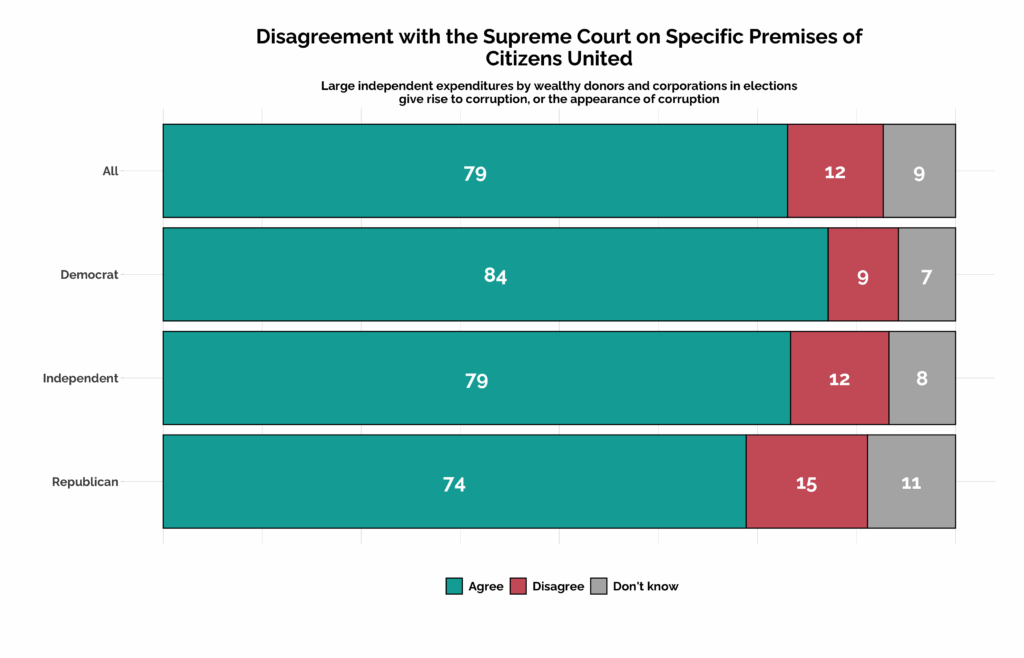 Source: YouGov national survey, Oct. 7-15, 2025
In response to these findings, Issue One Senior Research DirectorMichael Beckel, who oversaw the polling project, said: “Policymakers on both sides of the aisle should be tuning into the fact that overwhelming majorities of Americans across the political spectrum are alarmed by the huge sums being spent in elections by corporations, dark money groups, and wealthy donors.”
Beckel continued: “These findings fly in the face of two of the key assumptions that the U.S. Supreme Court made 15 years ago in Citizens United, namely that independent expenditures do not give rise to corruption or the appearance of corruption, and secondly, that the appearance of influence or access would not cause the electorate to lose faith in democracy. These perceptions of corruption are corrosive to the foundation of our democracy. Our political system cannot function if the public assumes the government is for sale to the highest bidder.”
Added Issue One Policy LeadLiana Keesing: “Montanans are sending a clear message that echoes around the country: Our democracy should be owned by voters, not bought by the wealthy few. These new findings show that people in every corner of the state — and across party lines — want a government that works for all of us, not just those with the deepest pockets. The proposed ballot measure is a bold, practical step toward restoring trust in our political system by ensuring that elections reflect the voices of citizens, not corporate interests. If Montana succeeds, it won’t just reform its own laws; Montanans can pave a path for states across the nation that want to reclaim democracy for the people.”
In Montana, Issue One’s new poll found that nearly 3 in 4 Montanans (74%) — including 84% of Democrats, 69% of Republicans, and 64% of independents — would vote in favor of this proposed ballot measure to eliminate corporate and dark money spending in elections by amending state law governing corporate charters, compared to only 11% opposed.
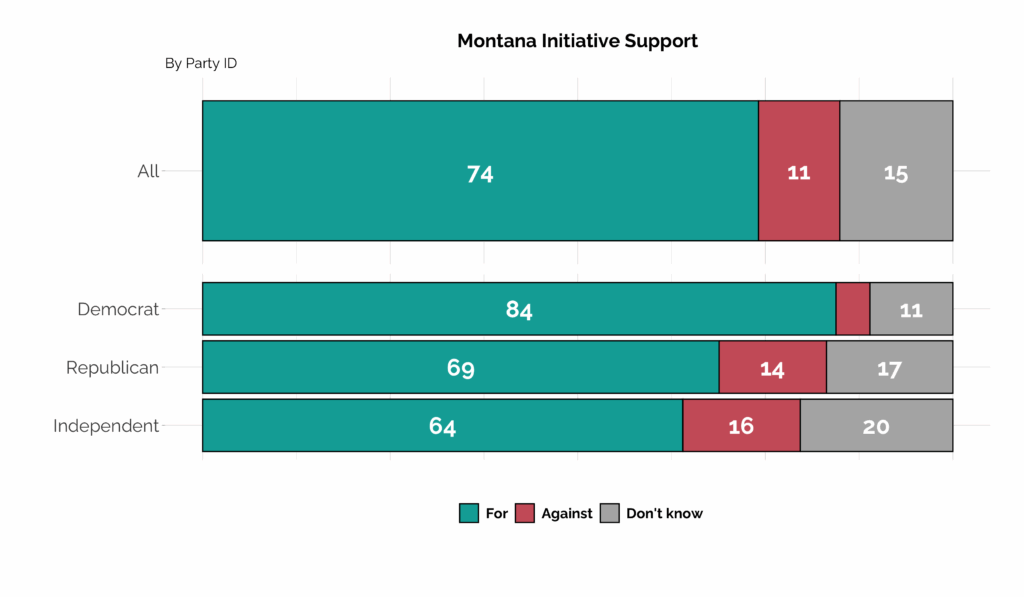 Source: YouGov survey of Montana voters, Oct. 7-20, 2025
Nationally, Issue One’s poll tested a comparable proposal — asking voters how they would respond if a similar measure were considered in their own state. Support was nearly as strong, with 72% of Americans said they would support such a reform, compared to only 12% opposed, after respondents were exposed to messaging from both supporters and opponents. That included support from 81% of Democrats, 64% of Republicans, and 60% of independents.
These high levels of support persisted even when voters were reminded that proposed reforms to curb corporate and dark money spending in elections could apply to their own preferred groups, or raise free speech concerns.
Other key findings from these two polls included:
- 77% of Americans — including 84% of Democrats, 70% of Republicans, and 78% of independents — agreed that anti-corruption rules strengthen our democracy and constitutional rights by ensuring everyone has equal political representation, regardless of money.
- 75% of Americans — including 84% of Democrats, 65% of Republicans, and 73% of independents — said unlimited spending in elections makes our democracy weaker because it gives wealthy special interests too much influence over elected officials. Only 13% of Americans said unlimited spending by people and organizations makes our democracy stronger by protecting the constitutional right to free speech.
- 73% of Americans — including 81% of Democrats, 67% of Republicans, and 71% of independents — agreed that “if a wealthy donor or corporation gains influence over or access to an elected official, I consider that official to be corrupt.”
- 69% of Americans — including 76% of Democrats, 61% of Republicans, and 64% of independents — believe that technology and social media companies have too much influence in politics.
- 63% of Americans — including 73% of Democrats, 53% of Republicans, and 61% of independents — disagreed with the Supreme Court’s Citizens United decision that corporations and labor unions have a First Amendment right to spend unlimited money to influence elections.
- 72% of Montanans — including about 70% of both Democrats and Republicans — continued to support the ballot initiative passed by roughly 75% of voters in 2012 that established a state policy that corporations are not entitled to constitutional rights, such as First Amendment free speech rights, because they are not human beings.
Read the toplines, crosstabs, and interested parties’ memo prepared by YouGov for Issue One’s national poll.
Read the toplines, crosstabs, and interested parties’ memo prepared by YouGov for Issue One’s Montana poll.
===
---
sutter 1 26
New polling illuminates how the Supreme Court got Citizens United wrong and shows bipartisan momentum for money-in-politics reforms, including proposed Montana ballot measure
Oct 28, 2025
Media Contact
Cory Combs
Director of Media Relations
- 202-204-8553
- media@issueone.org
New polling commissioned by Issue One and conducted this month by YouGov reveals that overwhelming majorities of Americans — and Montanans — broadly believe that large-scale political spending by corporations, dark money groups, and wealthy donors undermines democracy, creates the appearance of corruption, and reduces trust in government.
The results show that voters across the political spectrum, both nationally and in Montana specifically, reject key assumptions made by the U.S. Supreme Court in its controversial 2010 decision Citizens United v. Federal Election Commission, which unleashed a deluge of big money in elections.
Montanans were polled because a new proposed 2026 ballot measure would eliminate corporate and dark money spending in elections by amending state law governing corporate charters.
Overall, Issue One’s new poll found that nearly 8 in 10 Americans (79%) agreed that large independent expenditures (the technical name for political ads that are not coordinated with a candidate) by wealthy donors and corporations in elections give rise to corruption or the appearance of corruption. This included 84% of Democrats, 74% of Republicans, and 79% of independents.
Relatedly, more than 3 in 4 Americans (76%) — including 84% of Democrats, 68% of Republicans, and 77% of independents — agreed that “the appearance of wealthy donors or corporations gaining influence over or access to elected officials causes me to lose faith in this democracy.”
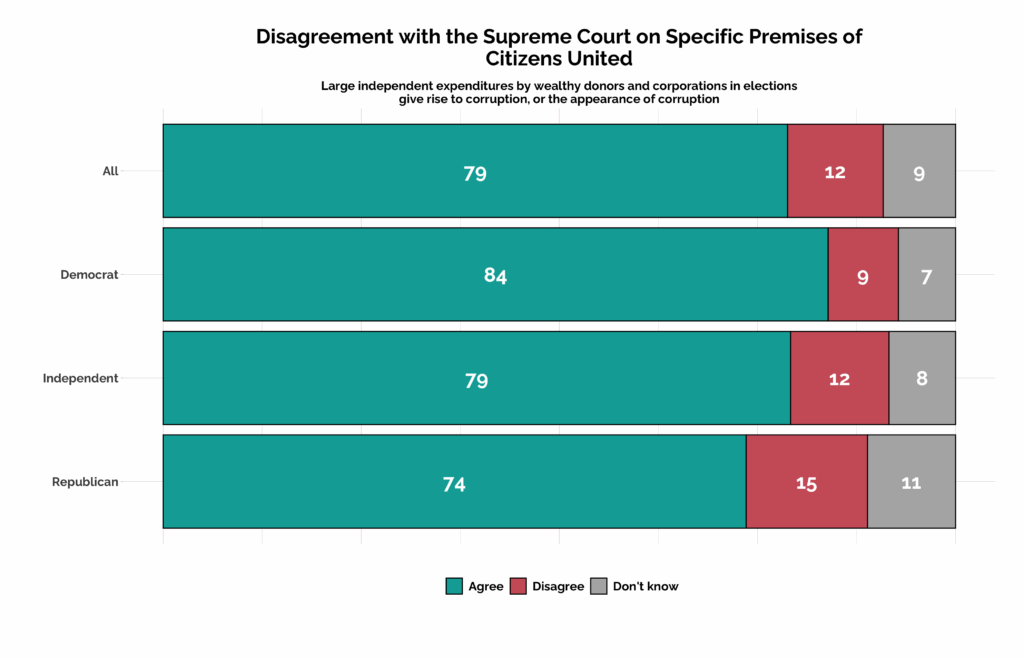 Source: YouGov national survey, Oct. 7-15, 2025
In response to these findings, Issue One Senior Research DirectorMichael Beckel, who oversaw the polling project, said: “Policymakers on both sides of the aisle should be tuning into the fact that overwhelming majorities of Americans across the political spectrum are alarmed by the huge sums being spent in elections by corporations, dark money groups, and wealthy donors.”
Beckel continued: “These findings fly in the face of two of the key assumptions that the U.S. Supreme Court made 15 years ago in Citizens United, namely that independent expenditures do not give rise to corruption or the appearance of corruption, and secondly, that the appearance of influence or access would not cause the electorate to lose faith in democracy. These perceptions of corruption are corrosive to the foundation of our democracy. Our political system cannot function if the public assumes the government is for sale to the highest bidder.”
Added Issue One Policy LeadLiana Keesing: “Montanans are sending a clear message that echoes around the country: Our democracy should be owned by voters, not bought by the wealthy few. These new findings show that people in every corner of the state — and across party lines — want a government that works for all of us, not just those with the deepest pockets. The proposed ballot measure is a bold, practical step toward restoring trust in our political system by ensuring that elections reflect the voices of citizens, not corporate interests. If Montana succeeds, it won’t just reform its own laws; Montanans can pave a path for states across the nation that want to reclaim democracy for the people.”
In Montana, Issue One’s new poll found that nearly 3 in 4 Montanans (74%) — including 84% of Democrats, 69% of Republicans, and 64% of independents — would vote in favor of this proposed ballot measure to eliminate corporate and dark money spending in elections by amending state law governing corporate charters, compared to only 11% opposed.
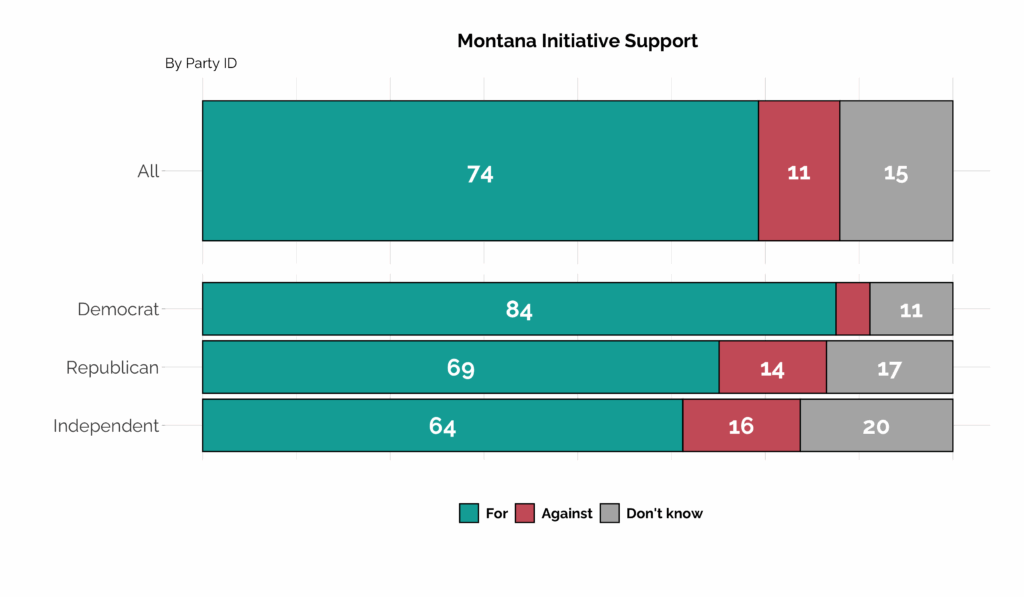 Source: YouGov survey of Montana voters, Oct. 7-20, 2025
Nationally, Issue One’s poll tested a comparable proposal — asking voters how they would respond if a similar measure were considered in their own state. Support was nearly as strong, with 72% of Americans said they would support such a reform, compared to only 12% opposed, after respondents were exposed to messaging from both supporters and opponents. That included support from 81% of Democrats, 64% of Republicans, and 60% of independents.
These high levels of support persisted even when voters were reminded that proposed reforms to curb corporate and dark money spending in elections could apply to their own preferred groups, or raise free speech concerns.
Other key findings from these two polls included:
- 77% of Americans — including 84% of Democrats, 70% of Republicans, and 78% of independents — agreed that anti-corruption rules strengthen our democracy and constitutional rights by ensuring everyone has equal political representation, regardless of money.
- 75% of Americans — including 84% of Democrats, 65% of Republicans, and 73% of independents — said unlimited spending in elections makes our democracy weaker because it gives wealthy special interests too much influence over elected officials. Only 13% of Americans said unlimited spending by people and organizations makes our democracy stronger by protecting the constitutional right to free speech.
- 73% of Americans — including 81% of Democrats, 67% of Republicans, and 71% of independents — agreed that “if a wealthy donor or corporation gains influence over or access to an elected official, I consider that official to be corrupt.”
- 69% of Americans — including 76% of Democrats, 61% of Republicans, and 64% of independents — believe that technology and social media companies have too much influence in politics.
- 63% of Americans — including 73% of Democrats, 53% of Republicans, and 61% of independents — disagreed with the Supreme Court’s Citizens United decision that corporations and labor unions have a First Amendment right to spend unlimited money to influence elections.
- 72% of Montanans — including about 70% of both Democrats and Republicans — continued to support the ballot initiative passed by roughly 75% of voters in 2012 that established a state policy that corporations are not entitled to constitutional rights, such as First Amendment free speech rights, because they are not human beings.
Read the toplines, crosstabs, and interested parties’ memo prepared by YouGov for Issue One’s national poll.
Read the toplines, crosstabs, and interested parties’ memo prepared by YouGov for Issue One’s Montana poll.
Issue: Dark Money & Super PACs
AN 10 25
Devastating poll shows Trump 'underwater' in all 7 swing states he won
https://www.alternet.org/2022/02/big-pharma/
Dozens of vulnerable House Democrats are worried that the party's stalled spending negotiations with Joe Manchin will cost them seats in the midterms — and hand Congress to the Republicans
Democrats planned to include legislation allowing Medicare to negotiate drug prices, fulfilling a campaign promise that helped them win control of the House in the "blue wave" of 2018, as part of President Joe Biden's Build Back Better legislation. The plan ran into an expensive lobbying blitz from the pharmaceutical industry, prompting Democrats to significantly water down the bill to limit the number of drugs Medicare could negotiate amid pushback from Sen. Kyrsten Sinema, D-Ariz., and other industry-aligned Democrats –– and that was before Manchin blew up the Build Back Better package entirely.
"We cannot overstate the paramount urgency of fulfilling the promise of lowering drug prices now for the American people," a group of 40 House Democrats, led by Rep. Susan Wild, D-Pa., said in a letter to party leaders on Monday.
The letter came after pharmaceutical companies hiked prices on hundreds of medications to start the year. A recent report from the patient advocacy group Patients for Affordable Drugs found that drug companies have increased prices on more than 550 drugs, including 183 drugs whose prices were raised by $100 or more, and 118 drugs that now cost more than $5,000. Pfizer alone raised prices on 125 drugs, more than any company, even as it shattered profit records thanks to $36 billion in sales from its widely-used COVID vaccine.
"Even as we enter the third year of a pandemic, Big Pharma continues its practice of targeting American patients and consumers with price increases, completely undeterred by the financial and health challenges facing American families," David Mitchell, the founder of Patients for Affordable Drugs, said in a statement.
"Drug corporations can do this because we let them — unlike other nations that use their purchasing power to get a better deal," said Mitchell, who suffers from an incurable blood cancer that is treated with a cocktail of drugs carrying a list price of more than $900,000 per year. The original drug-pricing agreement in the Build Back Better Act, he said, "would curb rising drug prices for millions of patients and halt abusive annual price hikes by limiting increases to the rate of inflation, which is projected to return to 2.3 percent in 2023."
Election forecasts generally suggest that Democrats will lose control of the House in the midterms, making the popular drug legislation a key priority, especially after Manchin and Sinema effectively killed off several other popular Democratic proposals, including a rollback of the Trump-era tax cuts, an extension of the expanded Child Tax Credit, and paid family leave.
A Data for Progress poll last fall found that likely voters support the Medicare legislation by a 55-point margin, including 83% of Democrats, 71% of independents, and 65% of Republicans.
"Taking action on prescription drugs is one of the most popular political issues Democrats can pursue — it's overwhelmingly supported by a bipartisan majority of voters," Sean McElwee, the founder and executive director of Data for Progress, said in an email. "Democrats need to take every opportunity to lower costs for voters and deliver popular legislation that visibly improves their lives this November."
Manchin, who walked away from Build Back Better negotiations in December after the White House called him out by name in a statement over the bill's delay, said on Tuesday that the Build Back Better bill is "dead" and any negotiations on potential spending programs would have to start from scratch. Biden has said that he hopes to include "chunks" of the original bill in a potential compromise package with Manchin.
Last year, Manchin said he supported the drug-price legislation, calling it the "one thing that should be done for sure." But the West Virginia senator appears to be prioritizing bipartisan negotiations to reform the Electoral Count Act over any would-be spending bill, leaving a key Democratic campaign promise in limbo.
"President Biden supports this plan. We support this plan," the House Democratic group said in their letter. "Every Democratic member of the U.S. Senate supports this plan. And most importantly, the American people support this plan. It is time to enact it into law. Already this year, drug corporations have raised prices on more than 400 drugs. Action can't happen soon enough to make medicines more affordable for the millions who need them."
The price increases came after the pharmaceutical lobby shattered its own record for lobbying spending as it rallied around the cause of defeating Biden's legislation. Democrats like Sinema and Rep. Scott Peters, D-Calif., two of the biggest recipients of Big Pharma donations, led an effort to cut the number of drugs that could be negotiated by Medicare. Even so, the compromise legislation would save taxpayers an estimated $80 billion while capping price increases on certain medications, capping out-of-pocket costs for seniors, and capping the cost of insulin at $35 for people on Medicare and on private plans.
Medicare is the only government agency that is barred from negotiating bulk pricing discounts — the result of an infamous scheme hatched by Big Pharma lobbyists and a Republican leader who rammed the provision into a bill that required Medicare to cover the cost of prescription drugs, shortly before he left Congress and became the top lobbyist for the industry. A three-year investigation by the House Oversight and Reform Committee last month found that pharmaceutical companies exploit the Medicare program to boost revenues, noting that taxpayers could have saved more than $25 billion over five years if Medicare was allowed to negotiate the cost of just seven popular drugs such as Humira and Lyrica.
The investigation also found that drug companies "aggressively raise prices" to hit revenue targets and incentives for executives and have targeted the U.S. market for higher prices while keeping costs lower overseas. The report also concluded that drug companies "abuse the patent system" to suppress competition and maintain monopoly pricing. Drug companies contend that their huge profits are necessary to fund research and development, but the investigation found that the 14 leading drug companies spent $577 billion on stock buybacks and dividends over just five years, $56 billion more than they spent on research and development over that same period.
The limited Medicare negotiation bill approved by the House last year would allow Medicare to negotiate the cost of 20 popular drugs and dozens of insulin products used by 8.5 million Medicare beneficiaries,according to a recent analysis by the Kaiser Family Foundation, although many of the drugs with the highest Medicare spending would be exempt.
The Congressional Progressive Caucus, which pushed for a more expansive bill that would have saved taxpayers an estimated $450 billion over 10 years but ultimately agreed to back the scaled-down version, set a target date of March 1 to pass the revised spending plan ahead of Biden's State of the Union address.
"This is both achievable and necessary,"CPC Chairwoman Pramila Jayapal, D-Wash., said in a statement, noting that in the weeks since negotiations had stalled out, "the case for this legislation has only become more urgent."