Collective Bargaining RTW
neglected cat:
merri ok
promote primary 10/18 basically = union
see union
right to work. kochs
powell memo endorses as essential freedom needed for mkt to work?!
---
---
1 24 an robt reich
when I was a boy, my father sold dresses and blouses to the wives of factory workers. As the wages of those workers rose through the 1950s, my father earned enough to expand his business to a second shop in another factory town not far away. We were by no means rich, but he earned enough to put us in the middle class.
For three decades after World War II, the average hourly compensation of American workers rose in lockstep with the nation’s productivity gains. In other words, as workers produced more value, they got more pay.
It was a virtuous cycle, from which our family and tens of millions of others benefited: The economy grew, and the middle class expanded. Its purchasing power rose, causing the economy to grow faster. This fueled new investments and innovations that further enriched and enlarged the middle class.
But then, beginning in the late 1970s, the virtuous cycle came to a halt.
While productivity gains continued much as before and the economy continued to grow, wages began to flatten. Starting in the early 1980s, the median household’s income stopped growing altogether, when adjusted for inflation.
Today, the median household is earning just a bit more than it did in 1979, 45 years ago (adjusted for inflation).
If you’re a non-supervisory worker who relies on an hourly wage — still the vast majority of workers — you’re earning no more than you earned in 1969. Job security also declined.
So, despite an economy that’s far larger and more productive than it was 40 or 50 years ago, the typical American worker has gone nowhere.
The standard explanation attributes this to neutral “market forces,” especially globalization and technological innovations that have made many working Americans less competitive.
While surely important, the standard explanation can’t account for much of what’s happened. It doesn’t explain why the transformation occurred so suddenly, over a relatively small number of years. Nor why other advanced economies facing similar forces didn’t succumb to them. Nor why so much of the nation’s income and wealth have gone to the top.
America’s middle class has shrunk because of its declining bargaining power — orchestrated and directed by America’s oligarchy. The economic gains that would otherwise have gone to the middle class went instead to the moneyed interests at the top. Let me explain.
1. The financialization of the economy
Before the 1980s (as I noted in our discussion about the decline of the common good), large corporations were in effect owned by all their stakeholders, who were assumed to have legitimate claims on them.
As early as 1914, the popular columnist and public philosopher Walter Lippmann called on America’s corporate executives to be stewards of America. “The men connected with [the large corporation] cannot escape the fact that they are expected to act increasingly like public officials …. Big businessmen who are at all intelligent recognize this. They are talking more and more about their ‘responsibilities,’ and their ‘stewardship.’”
This vision of corporate governance came to be widely accepted by the end of World War II. Frank Abrams, chairman of Standard Oil of New Jersey, declared in a 1951 address that typified what other chief executives were saying at the time:
*“The job of management is to maintain an equitable and working balance among the claims of the various directly affected interest groups … stockholders, employees, customers, and the public at large. Business managers are gaining professional status partly because they see in their work the basic responsibilities [to the public] that other professional men have long recognized as theirs.”
Pulp and paper executive J.D. Zellerbach told Timemagazine that “[t]he majority of Americans support private enterprise, not as a God-given right but as the best practical means of conducting business in a free society … . They regard business management as a stewardship, and they expect it to operate the economy as a public trust for the benefit of all the people.”
But a radically different vision of corporate ownership emerged in the late 1970s and early 1980s. It came from corporate “raiders” who mounted hostile takeovers with high-yield junk bonds.
The raiders used leveraged buyouts and undertook proxy fights against the “industrial statesmen” who, in their view, were depriving shareholders of the wealth that properly belonged to them.
The raiders assumed shareholders were the only legitimate owners of the corporation and that the only valid purpose of the corporation was to maximize shareholder returns.
This transformation did not happen by accident. It was a product of changes in laws governing corporations and of financial markets — changes that were promoted by the monied interests, America’s oligarchs.
In 1974, at the urging of pension funds, insurance companies, and Wall Street, Congress enacted the Employee Retirement Income Security Act. Before then, the giant portfolios of pension funds and insurance companies could be invested in only high-grade corporate and government bonds. Legally, it was their fiduciary obligation.
The 1974 Act changed that, allowing pension funds and insurance companies to invest in the stock market — thereby making a huge pool of capital available to Wall Street.
In 1982, another large pool of capital became available when Congress allowed savings and loan banks — the bedrocks of local home mortgage markets — to invest their deposits in a wide range of financial products, including junk bonds and other risky ventures promising high returns.
The convenient fact that the government insured savings and loan deposits against losses made these investments all the more tempting (and ultimately cost taxpayers some $124 billion when many of the banks went bust).
Meanwhile, the Reagan administration loosened other banking and financial regulations and simultaneously cut the enforcement staff at the Securities and Exchange Commission.
All this made it possible for corporate raiders to get the capital and the regulatory approvals they needed to mount unfriendly takeovers.
During the whole of the 1970s, there had been only 13 hostile takeovers LBO of companies valued at $1 billion or more. During the 1980s, there were 150.
Even where raids did not occur, CEOs felt pressured to maximize shareholder returns for fear their firms might otherwise be targeted. Hence, they began to see their primary role as driving up share prices.
The easiest and most direct way for CEOs to accomplish this feat was to cut costs — especially payrolls, which constitute most firms’ largest single expense.
Accordingly, the corporate statesmen of the 1950s and 1960s were replaced by the corporate butchers of the 1980s and 1990s, whose nearly exclusive focus was to “cut out the fat” and “cut to the bone.”
When Jack Welch took the helm of GE in 1981, the company was valued by the stock market at less than $14 billion. When he retired in 2001, it was worth about $400 billion. Welch accomplished this largely by cutting payrolls.
Before his tenure, most GE employees had spent their entire careers with the company. But between 1981 and 1985, a quarter of them — 100,000 in all — lost their jobs, earning Welsh the moniker “neutron Jack.” Even when times were good, Welch encouraged his senior managers to replace 10 percent of their subordinates every year in order to keep GE competitive.
Other CEOs tried to outdo even Welch. As CEO of Scott Paper, “Chainsaw” Al Dunlap laid off 11,000 workers, including 71 percent of headquarters staff. Wall Street was impressed, and the company’s stock soared.
When Dunlap moved to Sunbeam in 1997, he promptly laid off half of Sunbeam’s 12,000 employees. (Unfortunately for Chainsaw Al, he was caught cooking Sunbeam’s books; the SEC sued him for fraud, and he settled for $500,000, agreeing never again to serve as an officer or director of any publicly held company.)
In consequence of this change in the purpose of the American corporation, share prices soared, as did the compensation packages of CEOs. The results have been touted as “efficient” because resources theoretically have been shifted to “higher and better uses.”
But the human costs of this transformation have been huge. Millions of workers have lost jobs and wages. Many communities have been abandoned.
Nor have the efficiency benefits been widely shared.
As corporations have steadily weakened their workers’ bargaining power, the link between productivity and workers’ income has been severed.
Almost all the gains from growth have gone to the top. As noted, the average worker today is no better off than his or her equivalent 40 years ago, adjusted for inflation. Most are less economically secure.
Not incidentally, few own any shares of stock.
The richest 1 percent of Americans now own 52 percent of all the shares of stock owned by Americans. The richest 10 percent, 93 percent. The nation’s economic gains, once distributed broadly to the working and middle class — have been siphoned to the top.
2. Globaloney
Wages have also been suppressed because workers who are worried about keeping their jobs have accepted lower pay, relative to the economy’s productivity gains, than they did 40 years ago.
Here again, political decisions steered by the nation’s oligarchy have played a significant role. Some of the prevailing job insecurity is the result of trade agreements that invited American companies to outsource jobs abroad.
The conventional view equating “free trade” with the “free market” — in contrast to government “protectionism” — is wrong.
Just as all nations’ markets reflect political decisions about how they should be organized, so-called “free trade” agreements entail complex negotiations about how different market systems are integrated.
Within these negotiations, the interests of large corporations and Wall Street, to fully protect the value of their intellectual property and financial assets, have repeatedly trumped the interests of average working Americans to protect the value of their labor.
3. The Fed and inflation
When the Federal Reserve raises interest rates and Congress opts for austerity to reduce federal budget deficits — two policies favored by the oligarchy — the resulting unemployment also undermines the bargaining power of average workers.
Higher unemployment keeps wages low. This means higher corporate profits, leading to higher returns for shareholders.
The high inflation after the pandemic was driven in part by supply shortages and a major government stimulus. But it was also driven by monopolistic corporations using the excuse of inflation to raise their prices.
The Fed, however, believed that a root cause of inflation was wage growth, and it set out to slow the economy and loosen the labor market by raising interest rates. Here, too, the strategy was consistent with the views of the moneyed interests and was pushed by them.
4. The risk-shift to workers
Public policies that emerged during the New Deal and World War II placed most of the risks of economic change on large corporations rather than workers — through Social Security, worker’s compensation, 40-hour workweeks with time-and-a-half for overtime, and employer-provided health benefits (wartime price controls encouraged such tax-free benefits as substitutes for wage increases).
By the 1950s and 1960s, a majority of the employees of large companies remained with the companies for life. Their paychecks rose steadily with seniority, productivity, the cost of living, and corporate profits. When they retired, they received generous corporate pensions.
But after the junk-bond and takeover mania of the 1980s, that relationship broke down.
Even full-time workers who have put in decades with a company can now find themselves without a job overnight — with no severance pay, no help finding another job, no health insurance, and little or no pension.
Nearly one out of every five working Americans is now in a part-time job. Many are temporary workers, freelancers, independent contractors, or consultants, whose incomes and work schedules vary from week to week or even day to day. Two-thirds of American workers are living paycheck to paycheck.
The risk of getting old without a pension is rising.
In 1980, more than 80 percent of large and medium-sized firms gave their workers “defined-benefit” pensions that guaranteed them a fixed amount of money every month after they retired.
Now, fewer than 10 percent of companies provide their workers defined-benefit pensions. Instead, they offer “defined contribution” plans whose risks have been shifted to the workers. When the stock market tanks, as it did in 2008 and then again in 2020, their 401(k) plans tank along with it.
A quarter of all workers with so-called “matching” defined-benefit plans get no match because they don’t earn enough to contribute to them.
Meanwhile, the risk of a sudden loss of income continues to rise. Even before the crash of 2008, the Panel Study of Income Dynamics at the University of Michigan found that over any given two-yearstretch, about halfof all families experienced some decline in income.
Those downturns have become progressively larger. In the 1970s, the typical drop was about 25 percent. By late 1990s, it was 40 percent. By the mid-2000s, family incomes rose and fell twice as much as they did in the mid-1970s, on average.
Workers who are economically insecure are not in a position to demand higher wages. They are driven more by fear than by opportunity.
This is another central reality of American capitalism as organized by those with the political power to make it so.
5. The demise of labor unions
Fifty years ago, when General Motors was the largest employer in America, the typical GM worker earned $35 an hour in today’s dollars.
Today, America’s largest employer is Walmart, and the typical entry-level Walmart worker earns about $11 an hour.
This doesn’t mean the typical GM employee a half-century ago was “worth” four times what the typical Walmart employee today is worth. The GM worker was not better educated or motivated than today’s Walmart worker.
The real difference is that GM workers a half-century ago had a strong union behind them that summoned the collective bargaining power of all autoworkers to get a substantial share of company revenues for its members.
Because more than a third of workers across America then belonged to a labor union, the bargains those unions struck with employers raised the wages and benefits of non-unionized workers as well. Non-union firms knew they would be unionized if they did not come close to matching the union contracts.
Today’s Walmart workers do not have a union to negotiate a better deal. They are on their own. Because only 6 percent of today’s private-sector workers are unionized, most employers across America have no incentive to match union contracts. This puts unionizedfirms at a competitive disadvantage.
The result has been a race to the bottom.
Some argue that the decline of American unions is simply the result of “market forces.” But other nations have been subject to many of the same “market forces” and continue to have strong unions. In Sweden, 90 percent of workers in the private sector are unionized. These unions continue to provide their middle classes sufficient bargaining power to command a significant share of economic growth — a much larger share than that received by the middle class in the United States.
Why the difference? Look to politics and the allocation of power.
***
The National Labor Relations Act of 1935 guaranteed American workers the right to organize into unions and imposed on employers the legal responsibility to bargain with them.
As unions gained economic power in the late 1930s and 1940s, they gained greater. political power and wielded it to further enlarge the bargaining clout of American workers. After the legendary Treaty of Detroit in 1950, when Big Business and Big Labor agreed to share productivity gains in exchange for labor peace, the rate of unionization increased dramatically, as did wages and benefits.
Which is why, by the mid-1950s, almost a third of all American employees in the private sector of the economy belonged to a union, and why the median wage increased in tandem with productivity growth.
But starting in the late 1970s, the process went into reverse. Union membership began to decline, as did the economic and political power of unions, along with the bargaining clout of most workers.
The reasons for the decline involved the changes I’ve already noted — globalization, labor-replacing technologies, and a shift in the purpose of the corporation to maximizing shareholder returns.
But the decline of labor unions was also the consequence of political and legal decisions demanded by the monied interests.
When the Taft-Hartley Act of 1947 allowed states to enact “right-to-work” laws, workers who did not pay dues got a free ride off of those who did, thereby undermining the incentive for anyone to join a union in the first place.
Until the 1980s, such laws had minimal effect because they were enacted in southern and western states. Most industries remained in the north.
But as corporations came under increasing pressure to show high returns and cut labor costs, many CEOs found “right-to-work” states more alluring. Even the old heartland industrial states of Indiana and Michigan have enacted “right-to-work” laws.
CEOs whose corporations had high percentages of unionized workers moved, or threatened to move, to “right-to-work” states.
Additionally, Reagan’s notorious firing of the nation’s air traffic controllers for going on strike (which he had a right to do because they had no right to strike) signaled to the nation’s large employers that America had embarked on a different era of labor relations.
Workers who inhabited the local service economy — retail, restaurants, custodial, hotels, elder and child care, hospitals, transportation — faced a different challenge. Their jobs were in less danger of disappearing, because they couldn’t be outsourced abroad and most would not be automated. In fact, the number of local service jobs in America has continued to grow.
But because so many workers expelled from the older industrialized economy had no choice but to seek local service jobs, service-sector employers easily found people willing to work for low wages, few benefits, and little chance of advancement.
Walmart and major fast-food chains, such as Starbucks, have been aggressively anti-union. They’ve blocked union votes, fired workers who tried to organize, refused to enter into contract negotiations, and intimidated others into rejecting the union — all in violation of the National Labor Relations Act.
A succession of Democratic presidents have promised legislation streamlining the process for forming unions and increasing penalties on employers who violate the law, but nothing has come of these promises. (President Biden has been the first to strengthen the National Labor Relations Board and encourage it to enforce the law.)
The result of all this has been a steady decline in the percentage of private-sector workers who are unionized. Despite the jolt of labor activism in 2023, that percentage continues to drop.
The decline parallels the declining share of total income going to the middle class.
Take a look:

6. Summary
The underlying problem is that average working Americans have steadily lost the bargaining power to receive as large a portion of the economy’s gains as they received in the first three decades after World War II. As a result, instead of the middle class growing, it has shrunk.
To attribute this to the impersonal workings of the “free market” is to ignore how the market has been reorganized since the 1980s. America’s oligarchs — the moneyed interests — have spearheaded this reorganization in order to receive a steadily larger share of the nation’s economic gains. As those gains have risen, so has the oligarchy’s power to accumulate even more.
But it doesn’t have to be this way. Next week we’ll look at whether — and how — countervailingpower can be restored so that more of America’s poor and working class can ascend into the middle class once again.
*Robert Reich is a professor at Berkeley and was secretary of labor under Bill Clinton. You can find his writing at https://robertreich.substack.com/.*
---
---
aha note gop sez ppl lazy and moral hazard of soc safe net but at same time quash vax mask andate EVEN WHEN LOCAL PPL /REPS VOTE FOR THEM, THEN PPL QUIT CRAPPY LOW WAGE DANGEROUS JOBS
https://www.alternet.org/2021/10/unemployment-2655355131/
The business owners whose blood, sweat, and tears—or at least their fancy, high-priced educations, family connections and access to venture capital—built this country, dammitwere hellbent and determined to show American workers who was boss. This COVID-19 nonsense was not going to interfere with their profits any longer. It was time totake a stand.
So they all had their administrative assistants conference in their favorite state legislators, the same ones who helpfully passed legislation a few years back, keeping pesky unions out of their states. They called in their chits for all those campaign contributions to the governor. They called their Republican House reps and senators. Damn that Fauci, they complained. My business is hurting. No more lockdowns, no more of this "social distancing "crap. This state is going to open for business and I don't want to hear another word about body counts or stressed hospitals. I need workers and I need them now. I paid for your damn campaigns, so do something!
And those state representatives and senators leapt into action. In a matter of a few weeks we saw state after state brimming with self-appointed medical experts in their legislatures, railing about the tyrannical mask mandates and business lockdowns. CEOs and white-collar professionals cracked their whips—many still from the comfort of their fine second homes and pools. And thus the support staff, the retail clerks and the service workers, many of whom who had once been adoringly lionized as "essential" at the outset of the COVID-19 pandemic, were told it was time to return to work. And for added good measure, Republican governors in those statescut offtheir unemployment aid. That'll show them, they thought ...
But strangely enough, not all of those workers heeded the call. In fact, a good many of them quit.
As reported by Alyssa Fowers and Eli Rosenberg, writing for The Washington Post:
Kentucky, Idaho, South Dakota and Iowa reported the highest increases in the rates of workers who quit their jobs in August, according to a new glimpse of quit rates in the labor market released Friday.
The largest increase in the number of quitters happened in Georgia, with 35,000 more people leaving their jobs. Overall, the states with the highest rates of workers quitting their jobs were Georgia, Kentucky and Idaho.
As The Post points out, the interesting thing about this data is that service-sector jobs are most highly concentrated in urban areas. So why would people be quitting their jobs at such astronomical rates in such relatively rural states as Kentucky, South Dakota, Iowa and Idaho?
Fowers and Rosenberg offer a clue:
Employees quit or were hired at rates matching or exceeding the national average in the ten states with the highest rates of new infections that month: Alabama, Arkansas, Florida, Georgia, Kentucky, Louisiana, Mississippi, Oklahoma, South Carolina and Tennessee.
So the highest rate of turnover in August—employees quitting or getting hired—was found in the states which had the highest rate of COVID-19 infection for that month. Logically, that seems to make sense. Workers who live in one of those states were also likely to have a governor or, in the case of Kentucky, a Republican-dominated legislaturewho opposed business closures, even while the delta variant ravaged the state's population. Such workers were essentially forced by these states policies to return to work if they could not work from home.
Those people forced back to work in an unsafe environment simply decided to quit—many of them likely before ever venturing back into their workspace. After all, they saw a job the other day that was offering more money. Or their next-door neighbor's cousin got a job that pays more and allows them to work from home. The Post article quotes Nick Bunker, an economist for the job search portal Indeed, who notes that the high quit rate in these red and rural states "may be a sign there's more competition in those parts of the country than other parts."
The other interesting point aboutallof the states having both the highest level of turnover and the highest infection rates? They are all so-called"right to work" states,where legislatures passed legislation to disincentivize and discourage unions.So these workers have essentially no protection, no one to turn to for help remedying unsafe conditions, and no collective bargaining power; they can, for the most part, be terminated at will. That's what "right-to work"has always been about.
As one commenter to The Post story points out:
So, when you have a crappy job, for crappy wages, and a crappy employer who doesn't value you at all, and all of a sudden you find yourself in a labor market situation that actually encourages you to look for work elsewhere--what do you think is going to happen? The 'Great Resignation' is largely about working class people attempting to use what little leverage they have in order to make a moderately better wage for themselves in a mostly hostile, oppressive national work environment.
For employers, the downside of "right to work"— one they never saw coming—was the fact that workers in those states had little, if any, incentive to stay, especially when once-in-a lifetime opportunities arose for them to leave, while competition for higher wages and better working conditions further drove that exodus.
Some employers are responding by antagonizing would-be applicants.
In Missouri, a group of businesses, still frustrated by labor shortages more than three months after the state cut off the $300-a-week federal jobless checks, paid for billboards in Springfield that said: "Get Off Your Butt!" and "Get. To. Work."
The state has seen no growth in its workforce since ending emergency benefits.
"We don't know where people are," said Brad Parke, general manager of Greek Corner Screen Printing and Embroidery, who helped pay for the billboards. "Obviously, they're not at work. Apparently, they're at home."
The attempt to force workers back to dangerous, unsafe pandemic working conditions—brought on by short-sighted Republican policymakers for political ends—has collided with a culture where workplace protections and the ability to bargain have been completely devalued (also by Republican politicians), leaving workers as essentially dispensable commodities.
No wonder they're quitting for greener pastures in those states. Republican elected officials and their business donors in those same states have no one to blame but themselves. They created this environment, and now they're going to have to cope and adjust with workers who want more out of their jobs … and know they can get it. They have to keep up and do better, or see their businesses go under.
Funny how that worked out.
---
---
https://www.washingtonpost.com/education/2020/02/18/what-it-really-means-when-trump-devos-their-allies-refer-public-schools-government-schools/
some lnx not here
Answer Sheet
Analysis
What it really means when Trump, DeVos and their allies refer to public schools as ‘government schools’
[pix President Trump and Education Secretary Betsy DeVos, shown in2017, refer to public schools as “government schools.” (Jabin Botsford/The Washington Post)]
By
Valerie Strauss
Feb. 18, 2020
If you were listening to President Trump deliver his State of the Union address this month, you heard him refer to public schools as “government schools.” It was not the first time, and you can expect to hear it with increasing frequency from him, Education Secretary Betsy DeVos and their allies as they push to increase programs that use public money for private and religious school education.
Trump and DeVos use the term most often with the adjective “failing” attached as a broad denunciation of the public school system, which advocates see as the nation’s most important civic institution. The president and education secretary say their goal is to provide families with the most education options even as they disparage the one that enrolls most of America’s schoolchildren and continues to get high marks from the public.
It isn’t entirely clear where “government schools” originated in this context. This term showed up in a1929 encyclical from Pope Pius XI on Christian education in which he calls “unjust and unlawful” any “monopoly, educational or scholastic, which, physically or morally, forces families to make use of government schools, contrary to the dictates of their Christian conscience, or contrary even to their legitimate preferences.”
In 1954, a white Southern segregationist [not confed dabney/]who opposed school desegregation used it, as did free-market economist Milton Friedman in 1955. In the mid-2010s, conservatives in Kansas invoked the term during a battle over public education funding. Now, Trump and DeVos use it as they push their No. 1 education priority: Getting Congress to pass a $5 billion tax credit program that would allow use of public money for children to attend private and religious school.
“Government schools” is invoked mostly by people who are suspicious of public institutions and see government as a problem rather than a solution. That sentiment was perhaps best encapsulated by President Ronald Reagan in an Aug. 12, 1986, speech in which he famously said, “'The nine most terrifying words in the English language are: I’m from the government, and I’m here to help.'”
In this line of thinking, schools should be operated like businesses because the private sector and competition always produce better results, which critics say is not supported by evidence. Many of the people who use the term “government schools” also oppose unions and have been antagonistic to the two major teachers unions — the National Education Association and the American Federation of Teachers — and the right of public workers to bargain collectively.
Traditional public schools continue to enroll the vast majority of American schoolchildren despite the growing number of alternatives, and opinion polls shows the public still supports them despite serious problems in some districts. The latest and best-known poll on the subject, the 2019 PDK poll of the public’s attitudes on public schools, found that 76 percent of parents with children in kindergarten through 12th grade gave their own child’s school an A or B grade, even though just 19 percent of Americans overall gave the nation’s schools an A or B.
Trump has been saying “government schools” ever since he took office in 2017 to appeal to people who are suspicious of government. DeVos has been using the phrase even longer.
In her home state of Michigan, she and her husband, Amway heir Richard DeVos Jr., spent millions of dollars on an unsuccessful effort in the early 2000s to change the state constitution to allow school vouchers and successfully pushed for a law that would allow for charter schools to open there. The DeVoses have long supported Christian schools, too, and have donated millions of dollars to them over the years.
In 2015, DeVos made clear her position on traditional public schools: She called them “a dead end” during a speech at the SXSW EDU conference in Austin that year. She said:
“We are the beneficiaries ofstart-ups, ventures, and innovationin every other area of life, but we don’t have that in education because it’s a closed system, a closed industry, a closed market. It’s a monopoly, a dead end. And the best and brightest innovators and risk-takers steer way clear of it. As long as education remains a closed system, we will never see the education equivalents of Google, Facebook, Amazon, PayPal, Wikipedia or Uber. We won’t see any real innovation that benefits more than a handful of students.” [mrs zuck fail NJ? Gates fdn?]
That speech is why the education world was stunned when Trump tapped DeVos to be education secretary, and why her confirmation became controversial: It was the first time that a Cabinet member was confirmed by the Senate only after the vice president, in this case Mike Pence, broke a tie vote.
In 2002, DeVos’s husband used the phrase “government schools” in a speech he gave at a conservative think tank about expanding school vouchers across the country.He offered a four-part strategy and encouraged choice advocates to stop using the term “public schools.” His comments offered one of the common rationales given by pro-choice supporters for a change in terminology:
“l’ve used the word public schools a fair bit [but] I am beginning to change my own terminology. I would encourage you to either improve on mine or adopt it. ‘Public schools’ is such a misnomer today that I really hate to use that. I’ve begun to use the word ‘government schools’ or ‘government-run-schools’ to describe what we used to call public schools because it’s a better descriptor of in fact what they are. Because the public school creates this aura that if anyone walks in off the street into a quote unquote public school they would be welcome. And you and I both know that in America today, unfortunately, if you don’t live in the appropriate school district you are about as welcome in a particular public school as a virus is welcome on a cruise ship." [PRESUMABLY REFERS TO POOR POC WHO TRY TO ENROLL IN BETTER SCH FROM RICHER NEIGHBORHOOD?]
Traditional public schools are required to accept all students who live in their district or who have been assigned to them by lottery. Private and religious schools are not required to accept any students, and religious schools are allowed to legally discriminate against some students, such as LGBTQ students. [IN FACT CREAM FOR TEST SCORES]
In any case, Richard DeVos also made clear that choice advocates should tread lightly, urging them to “be cautious about talking too much about these activities” so the issue is not “appropriated” and viewed as “only a conservative idea."
Betsy DeVos and her allies are trying to redefine ‘public education.' Critics call it ‘absurd.'
Three years before Richard DeVos’s speech, the term “government schools” was prominent in a 1999 school choice primer for "freedom in education” issued by the ultraconservative Michigan-based Mackinac Center for Public Policy.[LINK]
The center was founded with a big contribution from the DeVoses, and it hosted an event in 2013 at which Jeb Bush, the former governor of Florida and a prominent DeVos ally, said: “Our governance model includes over 13,000 government-run monopolies run by unions.” He also said, “We can’t just outsource public education to bureaucracies and public education unions and hope for the best.”
Richard DeVos has had a long history, too, of opposing unions; he and his family were instrumental in the Michigan legislature passing a law eliminating union contracts between companies and labor unions that charge dues to members, making it a “right to work” state after it had long been union-friendly.
Interestingly, Friedman — the man many people credit with coining “government schools,” or at least the philosophy behind it — did not support right to work laws.Friedman, a Nobel laureate who advocated free markets, has been called the father of the school voucher movement because of a 1955essay, “The Role of Government in Education.” In it, he argues government’s role should essentially be limited to paying for education, not operating schools. He wrote:
In terms of effects, the denationalization of education would widen the range of choice available to parents. Given, as at present, that parents can send their children to government schools without special payment, very few can or will send them to other schools unless they too are subsidized. Parochial schools are at a disadvantage in not getting any of the public funds devoted to education; but they have the compensating advantage of being run by institutions that are willing to subsidize them and can raise funds to do so, whereas there are few other sources of subsidies for schools. Let the subsidy be made available to parents regardless where they send their children — provided only that it be to schools that satisfy specified minimum standards — and a wide variety of schools will spring up to meet the demand.
A year before that essay, Mississippi segregationist Tom P. Brady gave a speech (later expanded into a book) that became an informal manifesto for Southern segregationist leaders. In “Black Monday,” Brady wrote: “The public school is a socialized or politically monopolized institution, and suffers from weakness inherent in all monopolies."
According to Steve Suitts, an academic and author of the new book, “Overturning Brown: The Segregationist Legacy of the Modern School Choice Movement”: “Southern segregationists used the term ‘government schools’ throughout the 1960s to discredit public schools. In 1964, for example, Mississippi white Citizens Council leader William Simmons condemned the monopoly of ‘government school systems.’ The Mississippi Citizens Council later worked to develop a private school system of choice, supported by vouchers, as their leaders condemned ‘government schools’ as ‘socialism in its purest form.’”
The phrase continued to be used by those opposing the system of common schools open to all and funded, operated and governed by the public through local governments.
Strauss is an education writer who authors The Answer Sheet blog. She came to The Washington Post as an assistant foreign editor for Asia in 1987 and weekend foreign desk editor after working for Reuters as national security editor and a military/foreign affairs reporter on Capitol Hill. She also previously worked at UPI and the LA Times
==
---
https://en.wikipedia.org/wiki/Mohawk_Valley_formula
The Mohawk Valley formula is a plan for strikebreaking purportedly written by the president of the Remington Rand company James Rand, Jr. around the time of the Remington Rand strike at Ilion, New York in 1936/37.
The plan includes discrediting union leaders, frightening the public with the threat of violence, using local police and vigilantes to intimidate strikers, forming associations of "loyal employees" to influence public debate, fortifying workplaces, employing large numbers of replacement workers, and threatening to close the plant if work is not resumed.[1][2]
The authenticity of the written plan has never been clearly established. Although it was allegedly published in the National Association of Manufacturers Labor Relations Bulletin, no original copy has been found, nor does NAM list it among its pamphlets from that era.[3][non-primary ^source ^needed] Parts of the plan use language sympathetic to the views of labor organizers. The Remington Rand company did indeed ruthlessly suppress the strikes, as documented in a ruling by the National Labor Relations Board, and the plan has been accepted as a guide to the methods that were used. At least one source names the strikebreaker Pearl Bergoff and his so-called "Bergoff Technique" as the origin of the formula.[4] Rand and Bergoff were both indicted by the same federal grand jury for their roles in the Remington Rand strike.
Noam Chomsky has described the formula as the result of business owners' trend away from violent strikebreaking to a "scientific" approach based on propaganda. An essential feature of this approach is the identification of the management's interests with "Americanism," while labor activism is portrayed as the work of un-American outsiders. Workers are thus persuaded to turn against the activists and toward management to demonstrate their patriotism.[5][6]
Elements of the formula
The following is the text of the Mohawk Valley formula as quoted in the labor press:
- When a strike is threatened, label the union leaders as "agitators" to discredit them with the public and their own followers. Conduct balloting under the foremen to ascertain the strength of the union and to make possible misrepresentation of the strikers as a small minority. Exert economic pressure through threats to move the plant, align bankers, real estate owners and businessmen into a "Citizens' Committee".
- Raise high the banner of "law and order", thereby causing the community to mass legal and police weapons against imagined violence and to forget that employees have equal rights with others in the community.
- Call a "mass meeting" to coordinate public sentiment against the strike and strengthen the Citizens' Committee.
- Form a large police force to intimidate the strikers and exert a psychological effect. Utilize local police, state police, vigilantes and special deputies chosen, if possible, from other neighborhoods.
- Convince the strikers their cause is hopeless with a "back-to-work" movement by a puppet association of so-called "loyal employees" secretly organized by the employer.
- When enough applications are on hand, set a date for opening the plant by having such opening requested by the puppet "back-to-work" association.
- Stage the "opening" theatricallyby throwing open the gates and having the employees march in a mass protected by squads of armed police so as to dramatize and exaggerate the opening and heighten the demoralizing effect.
- Demoralize the strikers with a continuing show of force.If necessary turn the locality into a warlike camp and barricade it from the outside world.
- Close the publicity barrage on the theme that the plant is in full operation and the strikers are merely a minority attempting to interfere with the right to work.With this, the campaign is over—the employer has broken the strike.[2]
A similar, although more nuanced and longer, version was published in The Nation in 1937.[1]
---
https://www.alternet.org/2019/01/how-the-government-shutdown-exposed-the-lie-at-the-heart-of-the-anti-union-right-to-work-movement/
steel union
==
==
see act 10 wi walker
https://www.motherjones.com/politics/2017/03/scott-walker-trump-wisconsin-teacher-union/
==
==
http://documentedinvestigations.org/2018/07/12/janus-decision-rooted-koch-wishlist/
With last month’s monumental Janus decision by the Supreme Court, the Koch family won a major victory in their multi-generational attack on unions.
The ruling spreads to the entire public sector one of the laws the Koch fortune first helped push through in Kansas 60 years ago: “right-to-work.” And in doing so it enshrines the union-busting agenda their fossil fuel money has helped advance for decades.
(This story was first published by In These Times.)
Through a single vote, the Court’s 5-4 Janus decision reverses decades of legal precedent that had obstructed part of the Koch’s pro-corporate agenda. That vote was secured with the Kochs’ help in bankrolling efforts that include: helping to maintain a GOP Senate majority; helping the Senate block President Obama from filling the February 2016 Supreme Court vacancy; and helping to win the confirmation of right-wing corporate activist Neil Gorsuch.
Janus helps cement the nation’s highest court as the Koch Court, and Charles Koch wants to keep it that way.
As Documented first detailed in partnership with the Intercept, for months the Kochs had been investing heavily in anticipation of Justice Anthony Kennedy’s retirement from the Court, which was announced on June 27, the same day as Janus. Earlier this year, the Koch group “Americans for Prosperity” (AFP) hired Sarah Field from the Koch-funded Federalist Society to spearhead its campaign to extend the Koch hold on the Court for perhaps a generation or more.
Despite claims by AFP that helping to seat Gorsuch was their “first” foray into Supreme Court nominations, the Koch effort to influence who becomes a judge and how they interpret the law goes back much further.
In fact, the Kochs have been investing in reshaping the law to suit their personal agenda for decades.For example, the Koch group Citizens for a Sound Economy, AFP’s predecessor, backed Clarence Thomas’ controversial confirmation to the Court more than 25 years ago.
The Kochs’ long-term agenda to remake the United States in their image is a multi-pronged effort that includes changing both the law and who makes or interprets the laws, including the anti-union Janus decision.
THE SEEDS OF JANUS
The effort to roll back union rights actually began almost a century ago, as wealthy industrialists objected to the National Labor Relations Act of 1935, known as the Wagner Act, which enshrined the right to collective bargaining in the United States.
Many tycoons of the time, like Alfred Sloan, head of General Motors, opposed those rights along with other business reforms of FDR’s New Deal.
Fred Koch, co-founder of the corporation that later became Koch Industries, harshly criticized American workers under New Deal policies in 1938. He extolled the economic policies of Emperor Hirohito and fascists Adolf Hitler and Benito Mussolini:
Although nobody agrees with me, I am of the opinion that the only sound countries in the world are Germany, Italy, and Japan, simply because they are all working and working hard… The laboring people in those countries are proportionately much better off than they are any place else in the world. When you contrast the state of mind of Germany today with what it was in 1925 you begin to think that perhaps this course of idleness, feeding at the public trough, dependence on government, etc., with which we are afflicted is not permanent and can be overcome.
Only recently, through the investigative work of Jane Mayer, has the public learned that the Koch fortune was actually built in part on directly aiding Hitler by building the oil-cracking factory that became “a key component in the Nazi war machine.” As Mayer noted in her 2016 book Dark Money:The Hidden History of the Billionaires Behind the Rise of the Radical Right, that factory refined high-octane fuel needed for the Luftwaffe, which targeted, terrorized, and killed many thousands of innocent civilians. Fred Koch’s praise of Germany came afterHitler’s air bombers helped murder 136 men, women, and children in Guernica in the Basque region, a tragedy made famous by the mural painted by Pablo Picasso.
Meanwhile, industrialists like Sloan pursued efforts to undo New Deal reforms. In 1947, Congress amended the Wagner Act with the Taft-Hartley Act. It gave states the power to pass “right-to-work” laws that undermined collective bargaining by not requiring workers who benefit from bargained rights to pay dues to the unions that secured and enforced them.
HOW THE KOCHS FERTILIZED “RIGHT-TO-WORK”
As Mayer noted:
[Fred Koch] was an early and active member of the Wichita-based DeMille Foundation for Political Freedom, an anti-labor group [founded in 1945] that was a forerunner of the National Right to Work Defense Foundation. In a revealing private letter, one of its staff members explained the group’s ‘Astroturf’ strategy. In reality, he said, big-business industrialists would run the group, serving as its ‘anonymous quarterbacks,’ and ‘call the turns.’ But he said they needed to sell the ‘yarn’ that the group was ‘composed of housewives, farmers, small businessmen, professional people, wage earners-not big business industrialists.’ Otherwise, he admitted, the movement was ‘almost certainly doomed to failure.’
By 1954, an engineer from Wichita, Kan., Reed Larson,took a leave from his job at the Coleman Company, to launch Kansans-for-the-Right-to-Work. The following year, former Rep. Fred Hartley, Jr., (R-N.J.) co-founded the National Right to Work Committee (NRTWC). By 1958, the NRTWC was targeting six states to adopt right-to-work laws but it failed in every place, except Kansas.
“Fred [Koch] co-led a referendum drive to alter the state constitution in order to make it harder for unions to take root in Kansas,” Duke University Professor Nancy MacLean noted.
On Nov. 9, 1958, the New York Timesreported that right-to-work won in Kansas because anti-union views had taken hold, noting:
More campaign efforts and more money were expended on the emotion-provoking issue than on the campaigns of all Republican and Democratic state and Congressional candidates combined. … For the last 10 days or so before Election Day an organization called Kansans-for-the-Right-to-Work flooded newspapers, television channels and other advertising media with appeals to ‘vote yes.’ These by far outnumbered the ‘vote no’ advertisements of unions opposing the amending.
A month later, Fred Koch joined Robert Welch and ten other men in Indianapolis to found the extreme rightwing group dubbed the “John Birch Society” (JBS).
As the Washington Post noted in its 1961 profile of JBS:
At the top of the Society’s structure in Wichita are several very wealthy industrialists. Oil engineer Fred Koch is president of the Rock Island Oil and Refining Co. A millionaire several times over, he is on the Society’s national council. … Wichita is the John Birch Society’s center of strength in Kansas, and one of its greatest in the country. … The leadership of the Birch Society overlaps heavily with the leadership of the organizations that successfully campaigned in 1958 for a right to work amendment to the State’s Constitution.
As detailed by Group Research Inc. in its 1962 history of JBS, Koch worked with both NRTWC and the Christian Crusade in arguing against union dues like those at issue in the Januscase.
A History of Hostility
In 1959, Fred Koch joined the Executive Committee to plan the JBS strategy to push back against what it viewed as communism in nearly every American institution.
In 1960, Koch published his polemic “A Business Man Looks at Communism” and distributed it to JBS chapters across the country. That pamphlet makes a variety of hysterical claims against unions, including:
Labor Unions have long been a Communist goal. How far they have been penetrated by Communists I have no idea, but it must be very far indeed, judging the hatred andvenom poured out in some labor papers….
Koch also accused the U.S. Supreme Court under former Gov. Earl Warren (R-CA) of issuing pro-Communist decisions, the universities of having thousands of Communist professors, the United Nations of being subversive, and former GOP President Dwight Eisenhower of being soft on Communism.
Similar sentiments were expressed in numerous other publications the JBS also pushed. The organization pitched a screed against the union workers who organized against Kohler fixtures in Wisconsin. It pushed attacks on the UAW’s Walter Reuther, who was posthumously awarded a Presidential Medal of Freedom.
It published and peddled right-wing writer Rosalie Gordon’s attack on the U.S. Supreme Court for decisions enforcing collective bargaining rights as protecting the “labor-union monopoly,” along with what she called the “plague” of desegregation caused by Brown v. Board of Education.
The JBS also pushed reprints of tomes by Ludwig von Mises attacking unions as illegitimate intervenors in the “free market,” artificial inflators of wages for workers, and thieves of the profits of tycoons. It promoted F.A. Hayek’s vilification of government regulation of corporations as leading to fascism and Hilaire du Berrier’s conspiracy theories that American labor unions were supposedly using union dues to finance communist terrorist violence abroad.
Fred Koch’s son Charles urged visitors to the John Birch Society bookstore in Wichita to read copies of JBS pamphlets, including those by anti-labor writers from the Austrian School of Economics, like Mises.
Indeed, as the present author first documented for the Center for Media and Democracy, Charles Koch became active in JBS after returning home to Wichita to help with the family business. Charles was a leader and fundraiser for JBS, including underwriting its publications and national radio network, while it attacked collective bargaining and leaders of the civil rights movement such as the Reverend Martin Luther King, Jr., and Rosa Parks.
CHARLES KOCH IN ACTION
Though he left JBS in 1968, Charles Koch never abandoned its core anti-union agenda and the lessons of his father’s commitment to right-to-work. He did try to shed some of the rhetoric around communist conspiracies, though of late he was painted by Koch political strategist Richard Fink as a martyr against “collectivism,” in audio obtained by the Undercurrent, which also included outlandish claims linking fascism and the minimum wage.
It was Charles Koch’s investment in lifting up the work of Mises and Hayek, who made similar claims, that helped preserve and extend their legacy. As Stephen Moore noted in a 2006 profile on Charles for the Wall Street Journal:
The authors who have had the most profound influence on his own political philosophy include
, Ludwig von Mises, Joseph Schumpeter, Julian Simon, Paul Johnson and Charles Murray. Mr. Koch says that he experienced an intellectual epiphany in the early 1960s, when he attended a conference on free-market capitalism hosted by the late, great Leonard Reed.
Charles brought Mises to Wichita to speak and deployed F.A. “Baldy” Harper’s Institute for Humane Studies (IHS) to promote Mises and his protégé Hayek. As lauded by Reed’s Foundation for Economic Education (FEE), Hayek argued that unions violated the very idea of the “rule of law” and that the Wagner Act was central to that violation, a sentiment he promoted in numerous writings.
Charles Koch is deeply devoted to an alternative universe in which collective bargaining undermines the rule of law and is not a major cause of increased wages.Moore noted in his interview:
As we continue, Mr. Koch becomes increasingly animated. He discusses another seminal work in his collection, F.A. Harper’s 1957 Why Wages Rise. The book demonstrates ‘that wages rise not because of unions or government action, but because of marginal productivity gains — people get more money when they produce more value for other people.’ Then he confides, “I was so thrilled by this revelation that I had what Maslow called a ‘peak experience.’'”
Koch has also supported the NRTWC, which “sought to put a new face on the anti-union campaign by building its rhetoric on the arguments of Hayek, Mises, and others with a ‘respectable’ pedigree.” The NRTWC argues that:
Compulsory unionism itself violates the dignity of the individual worker, regardless of how the forced union tribute is spent. As the late Nobel Prize-winning economist Friedrich A. von Hayek wrote: “[T]he coercion which unions have been permitted to exercise … is primarily the coercion of fellow workers.
Deep Devotion and Investment
Hayek and Mises are not the only two virulently anti-union economists Charles Koch backed. As Nancy MacLean documented in Democracy in Chains, one of the key architects of the Koch agenda domestically and internationally,James Buchanan, also railed against the so-called “union monopolies” for distorting “free market” wages.
And, as UnKoch My Campus has detailed, Koch money has funded scores of academics to push their agenda at universities, buying control over content and personnel with restrictive dictates attached to their donations.
Many of the rightwing groups Charles Koch is known to have made a major investment in since the 1970s have pushed right-to-work or attacked collective bargaining rights. These include Reason magazine, the Cato Institute, Americans for Prosperity, the American Legislative Exchange Council, the State Policy Network and many more.
During David Koch’s 1980 bid to become vice president, running on the ticket of Libertarian Ed Clark—which was pushed by Charles and fueled with Koch cash—the campaign platform included making right-to-work the law of the land:
[W]e urge repeal of the National Labor Relations Act, and all state Right to Work Laws, which prohibit employers from making voluntary contracts with unions. We oppose all government back-to-work orders as imposing a form of forced labor.
That is, there would be no need for state right-to-work laws if there were no NLRA that protects collective bargaining rights. As a result, right-to-work would be effectively nationalized at the determination of the employer.
After badly losing that election, the Kochs have invested heavily in changing the culture—and courts of America—to make their anti-union vision a reality.
Right-to-work is part of that vision.
MILLIONS SPENT
A leak of the Kochs’ summer retreat in 2010 revealed that they featured NRTWC leaders at their gathering of billionaires to plot plans for that year’s midterm elections.
In 2012, before most of America even knew that the Kochs had branded their billionaire conclave as “Freedom Partners,” that group injected $1 million directly into the NRTWC among the more than $200 million of its known spending that cycle.
In 2016, they focused much of their known political spending on keeping a GOP majority in the Senate, and they influenced the make-up of the U.S. Supreme Court by helping to block Judge Merrick Garland’s confirmation.
For the 2018 election, they’ve pledged to spend more than $400 million through the Seminar Network, the latest rebranding of their network of tycoons.
To be clear, the Koch family fortune is not the only one that has been expended pushing right-to-work laws to try to weaken the power of ordinary people to negotiate through unions. A major funder of right-to-work effort has been the Lynde and Harry Bradley Foundation, along with Donors Trust and Donors Capital Fund, which Mother Jones has dubbed “the ATM” of the right wing.
Collective bargaining has provided women with greater economic opportunities and job security. Right-to-work laws also have a disproportionate impact on people of color, who are union members at a higher rate than whites. Black women will likely be the group most adversely affected by the Janus case. Notably, workers in right-to-work states also have lower wages than in states that have rejected this agenda.
UNDERMINING PROGRESSIVES TOO
The spread of right to work through Janusalso will affect our elections.
As In These Times has documented with the Center for Media and Democracy,the national push for right-to-work is designed to undermine the power of unions and to “defang and defund” them as a way to weaken the chances for progressives to win in politics and policy.
The Koch investment in making right-to-work a national reality represents one of the longest and deepest commitments to this agenda, aside from NRTWC itself.
And this year marks the 60th anniversary of Fred Koch’s victory of making right-to-work legally binding in Kansas.
Now, six decades later, Charles Koch has helped make his father’s wish binding on the rest of America through helping to make the Janusruling a reality.
---
Lisa Graves
==
http://www.peoplesworld.org/article/pence-leads-under-the-radar-attack-on-unions/
Since he took office, Vice President Pence has been working with high-level Trump backers to develop a comprehensive strategy to weaken labor unions. The strategy he is developing revolves around so-called “right to work” laws that have already been rammed through numerous state legislative bodies. Among the GOP bright lights attending the closed-door sessions with Pence have been Wisconsin Governor Scott Walker and former House Speaker Newt Gingrich.
Pence’s role as architect of a new federal assault on unions is one of the topics tackled recently in an excellent article* in the March/April issue of The Voice of the ILWU, published by the union’s local 142 in Hawaii. The article, entitled “Trump backs attack on union,” delves into the history of “right to work” and how it has been used to bash workers and their unions.
After a January 28 meeting with Pence and Gingrich, it is noted, Walker bragged that he showed how “bits and pieces” of what he did in Wisconsin to “reform” union law and civil service, can be “applied at the national level.”
The advice Walker gave to the Trump administration is to begin the attack on labor by first going after public workers and their unions.Pence and Trump are likely to oblige that advice since they had already promised to do just that during their campaign.
“So-called right to work laws are designed and funded by big business to weaken unions,” the Voice article says. “They force unions into an impossible situation by making them legally responsible for representing all workers in a shop, while stripping the union’s ability to collect enough fees to cover those representation costs. Strong union shops where everyone is a paying member would be outlawed under the proposed law and replaced with ‘open shops’ where division, disunity and financial hardship weaken the union and leave workers with lower pay, meager benefits and little say over working conditions.”
Perhaps the most powerful feature of the piece is a hard-hitting section on the “ugly origins of right to work.”
The first “right to work” laws, it is noted, were instituted in 1936 by a Texas organization, “the Christian American Association.” The Voice describes the group as a racist outfit run by Southern oilmen and Northern industrialists. Today, their work is continued by organizations like ALEC.
“A top associate of the group once explained her hostility toward workers by criticizing what President Roosevelt’s wife, Eleanor, had done to help workers, especially African Americans: “…Roosevelt stands for a $15 a week salary for all n****** house help, Sundays off, no washing, and no cleaning upstairs,” adding, “My n***** maid wouldn’t dare sit down in the same room with me unless she sat on the floor at my feet!”
The first right to work laws, the article points out, were passed in 1944. The first two states to approve them were Arkansas and Florida and by 1947 they were law in some 14 southern states. That was the same year that the GOP-controlled Congress passed the infamous Taft-Hartley law which removed from unions and workers numerous rights they had gained under the Wagner Act, passed during the tenure of President Roosevelt. “The anti union laws were popular in the South,” the ILWU article says, “where segregationists warned that union shops and civil rights would lead to ‘race mixing and communism.’”
The Rev. Martin Luther King Jr. waged a campaign against right to work laws in the 1960’s. He is quoted: “We must guard against being fooled by false slogans, such as ‘right to work.’ It is a law to rob us of our civil rights and our job rights. Its purpose is to destroy labor unions and the freedom of collective bargaining by which unions have improved wages and working conditions of everyone. Wherever these laws have been passed, wages are lower, job opportunities are fewer and there are no civil rights.”
Another interesting part of the article is how it treats the conservative and right wing reaction to the civil rights gains of the 1960’s including the passage of the Civil Rights Act of 1964 and the Voting Rights Act of 1965, drawing the connection between the attacks on civil rights and the attacks on labor rights:
“Richard Nixon won in 1968 with a ‘Southern Strategy’ that used racist code language, including talk about ‘welfare, less government, violent criminals and states right,’ to win white votes in the South – plus blue collar votes from whites in the Midwest and Northern industrial cities. Nixon’s Chief of Staff, H.R. Haldemann, explained: ‘You have to face the fact that the whole problem is really Blacks. The key is to develop a system that recognized this while not appearing to.’ Ronald Reagan’s campaign strategist, Lee Atwater, explained how racist appeals had won white votes:
“You start out in 1954 by saying, “n*****, n*****, n*****,” By 1968 you can’t say “n*****”- that hurts you. Backfires. So you say stuff like forced busing, states’ rights and all that stuff…”
“This is how,” the ILWU article concludes on this point, the term “right to work” became one of the many racist code words that white politicians used to communicate bigotry and win elections; beginning in the South, and now throughout much of the country.”
We all know all too well that, unlike Las Vegas, what happens in the South does not stay in the South. As of today 28 states, a majority of the states in the country, have “right to work” laws on the books. And we have Vice President Pence working hard on a strategy to make “right to work” national law.
The ILWU’s president, Robert McEllrath, remains undaunted, however. Interviewed for the article in the Voice, he said, “Workers and unions have never gotten anything handed to them on a silver platter, because progress only gets made by pushing the powerful to do what’s right. That’s the way it has always been. And that’s what we need to be doing now and in the future.”
[Mie Omori, the editor of the ILWU Local 142 newspaper The Voice,informed PW that the article that appeared in The Voice is actually from the Dispatcher, ILWU’s headquarters’ newspaper. Roy SanFilippo is the editor of the Dispatcher and most likely wrote it. — Eds]
==
==
http://www.alternet.org/labor/trump-gutting-labor-unions-advancing-right-work
Alternative facts are nothing new; politicians have been making stuff up since they first crawled out of the primordial swamp. One of the most successful lies in modern US politics has been that of “right to work” laws, which break unions under the guise of protecting workers, one of which was introduced in Congress on Wednesday afternoon and will probably break unions in the country for good.
A national right to work law has been a pipe dream of corporate lobbyists, the chamber of commerce, the Koch brothers, and the politicians on their payroll for decades, and is about to become a reality. Right to work laws already exist in more than half the states in the country, where unions are weak or nonexistent, wages are correspondingly low, and workers are correspondingly disposable. In theory, these laws are about guaranteeing workers’ freedom of association. In practice, they’re about keeping workers from forming unions, by making unions financially unsustainable.
The main lie told by right to work proponents is that such laws put an end to “compulsory union membership”. It’s flat-out false; there is no such thing, and hasn’t been since 1947, when the Taft Hartley Act made the closed shop – a type of contract where union membership was a condition of employment – illegal. Nowhere in the US, whether you’re in a right to work state or not, can you be forced to be a member of a union, or fired for refusing to join one.
The second lie is that such laws protect workers from having their dues money go to political causes they don’t support. Nowhere in the country can you be forced to donate to a politician, campaign or political organization you don’t support. If you’re a dues-paying union member, you already have a right to simply not donate to your union’s political fund, and plenty of union members exercise it.
What right to work laws, including this bill, do is outlaw a specific type of voluntary, private employment contract that employers and employees may agree on. Under this agency shop contract, which must be voted on and approved by a majority of employees, workers agree to pay a fair share provision – a fraction of the dues amount that union members pay – to cover the costs of bargaining and enforcing the workplace contract.
The reason such contracts exist at all is because, under the same 1947 law that banned compulsory union membership, unions are bound by what are called “duties of fair representation”. Under DFRs, they are legally required to provide the same services to everyone in a workplace, such as filing grievances, providing legal counsel, or defending someone if they’re disciplined, whether they are union members or not.
This also assures that everyone gets the same benefits from a union contract: health insurance, vacations, rules that say your boss can’t just fire you if he wakes up one day and decides he doesn’t like your face. The idea is to prevent unions from discriminating against those who choose not to join. Obviously, if you’re going to receive a benefit automatically whether you join or not, the incentive is to free-ride. Agency shop contracts are set up to make sure everyone shares the costs so that those grievances get filed. Right to work laws encourage everyone to free-ride until the union is broke, can’t provide those benefits to anyone, and eventually ceases to exist.
Right to work proponents often point to the money unions throw at politicians, mostly Democrats, as justification for starving unions financially. But right to work laws don’t defund political activities, because no worker is compelled to fund them in the first place. The only union functions this law will defund are things like contract bargaining and grievance filing: precisely those everyday workplace activities that Republicans say unions should be restricted to doing.
It bears repeating: the contracts this law will ban are voluntary and agreed on democratically. They are not imposed on anyone by the government, the union or the company. Normally, outlawing a voluntary business contract between private parties is the kind of thing Republicans consider government meddling. And there’s something distinctly unconservative about forcing an institution to provide benefits to non-paying non-members while encouraging them to freeload. But if it’s about crushing unions, they always manage to find an excuse.
Certainly bill sponsors Steve King and Joe  ” Wilsonwould never let ideological consistency get in the way of an opportunity to crush their opponents. Nor would President Trump, who was elected promising to fight for American workers. Unions are, after all, the only real vehicle for workers to defend their interests, whether in the workplace or the political arena. Taking that away from them leaves workers at the mercy of their bosses and politicians. Which is the whole point, and the only thing this law was ever designed to do.
Michael Paarlberg is a lecturer in government at Georgetown University, and author of the Center for American Progress report, Making Contracting Work for the United States. He
==
http://www.prwatch.org/news/2016/04/13081/alec-right-work-law-tossed-out-wisconsin
MADISON — Dane County Circuit Court Judge William Faust struck down the state's private-sector "right-to-work" law late today.
In February 2015, Governor Walker and the Wisconsin legislature pushed through a private-sector right-to-work bill over the objections of thousands of workers and 450 Wisconsin construction firms who rallied against the bill. Workers in right to work states have significantly lower wages and fewer benefits. The battle over "right to work" and the future of Wisconsin's workforce was the subject of a *New York Times* magazine cover story.
CMD quickly exposed the bill as a verbatim American Legislative Exchange Council (ALEC) measure authored by ALEC member legislators, including ALEC's National Chair and Wisconsin State Senator Leah Vukmir.
The Wisconsin AFL-CIO, Machinists Local Lodge 1061 in Milwaukee and United Steelworkers District 2 in Menasha filed the lawsuit challenging the measure. The groups argued that the law was an unconstitutional seizure of union property because it required private-sector unions to extend benefits to workers who don't pay dues.
In his ruling today, Judge Faust found that the unions had "a legally protectable property interest in the services they perform for their members and non-members."
"When members pay their dues and non-members their fair share fees, all would say the union is building a treasury that it holds as property. When it expends those funds to perform services, as it must, no one would dispute that that money is the union's property. Plaintiffs will be obligated to spend treasury—their property—on services for which they cannot legally request compensation. This is enough to establish that unions do have a legally protectable property interest at stake," read the ruling, in part.
"Right-to-work goes against the Wisconsin principles of fairness and democracy and hurts all of Wisconsin by eroding the strength of our middle class. Right to Work has always been unjust, now it's proven unconstitutional," said Phil Neuenfeldt, President of Wisconsin AFL-CIO, late on Friday.
Classic Koch-ALEC Power Play
The Madison-based Center for Media and Democracy reported at the time that the passage of right-to-work in Wisconsin was a classic Koch-ALEC power play.
...
---
http://www.huffingtonpost.com/mary-bottari/koch-tied-group-pushes-ne_b_6263462.html
Just weeks after Wisconsin’s controversial Governor Scott Walker was elected to a second term, a group with ties to the billionaire Koch brothers has launched a new effort to destroy unions.
In 2011, Wisconsin passed Act 10, a complex bill that forced public sector unions to re-certify annually, made it harder for unions to collect dues, and eliminated the incentive of people to join unions by severely limiting issues on the bargaining table. The bill was designed to destroy public sector unions, a powerful force in Democratic politics in the state, and subsequently union membership dropped dramatically.
Now out-of-state special interests and the Wisconsin GOP will use that drop in membership to argue that private sector workers deserve the same “choice.” The poison pill for private sector unions is likely be a model bill from the American Legislative Exchange Council (ALEC) with the Orwellian name of “right to work.”
The A Team: Americans for Prosperity, ALEC and ACCE
So-called “right to work” laws allow non-union members to enjoy the benefits of union representation, like higher wages, improved working conditions and a voice in the workplace, but without paying the costs of that representation. Supporters of the measures say they want to give workers the “freedom” not to join a union, butstudies have shown that wages are lower for both union and non-union members in states with right to work laws, workers are less likely to have health insurance and more likely to have dangerous work places.
Funding from the billionaire industrialists Charles and David Koch has found its way to a multitude of think tanks, advocacy organizations and legal centers, like the National Right to Work Committee, dedicated to destroying organized labor, the most powerful voice for average Americans in the workplace.
On December 1, a new 501(c)(4) “social welfare” organization calling itself “Wisconsin Right to Work,” popped up in Wisconsin promising to “aggressively promote sound public policies and individual freedoms from a grassroots citizen engagement organization.” The language is familiar to those who read press releases cranked out by David Koch’s Americans for Prosperity(AFP) group, so it is no surprise that new group is led by Lorri Pickens, who has worked for the Koch brothers for years, most recently as AFP’s Director of State Operations in Washington, D.C. Pickens was previously associate state director for AFP’s Wisconsin chapter from 2005 until 2009. The group is organized as a 501 (c) 4 “social welfare” organization designed to disguise its funders. The group’s website was registered by Kurt Luidhart of the Indiana-based “Prosper Group,” a GOP digital media firm that Walker’s campaign hired in 2014 to run their online fundraising. Luidhart attended Walker’s election night party, and has previously done contract work with AFP.


The Kochs and AFP have spent millions in recent years in support of Wisconsin’s GOP leadership. AFP was very active in providing astroturf or phony grassroots support for right to work when the state of Michigan took it up, verbatim from the ALEC bill, in 2012.
Although AFP says it is not behind the Wisconsin push, the legislation has long been a priority for the Kochs, whose funding network bankrolls AFP as well asALEC and the American City and County Exchange (ACCE) the new ALEC-style entity for city and county level politicians.
ALEC and ACCE are meeting in Washington this week for the annual “State and Nation” policy summit. CMD recently reported that the top of the agenda items at this week’s meeting is state preemption of local ordinances to raise the wage and a new proposal fresh off the drawing board at the Koch-funded Heritage Foundationfor local right to work laws.
Wisconsin ALEC Members Enthused
While Walker repeatedly during the campaign that had no interest in further divisive union-busting measures, Wisconsin’s two most powerful legislative leaders, both members of ALEC, quickly followed the announcement with words of support.
A spokeswoman for Senate Majority Leader Scott Fitzgerald told the Wisconsin State Journal: “Sen. Fitzgerald has previously expressed his openness to a discussion of making right-to-work legislation a priority for the upcoming legislative session.” Assembly Speaker Robin Vos, the former ALEC state chair for Wisconsin, said earlier this year that right to work was not on the agenda for 2015, but celebrated the arrival of the group. “I have long been a supporter of right-to-work and drafted a proposal in the past,” Vos told the Racine Journal Times. “I look forward to a healthy discussion as the case is made for the benefits of being a right-to-work state.”
The day after Wisconsin Right to Work launched, ALEC member Rep. Chris Kapenga announced that he would be introducing a right to work bill in 2015.
Pickens Is Longtime Wisconsin Activist
Lorri Pickens, the Executive Director of the Wisconsin Right to Life Group, has long been active in Wisconsin politics. She was implicated in the 1997 campaign finance coordination probe that resulted in the harshest penalty ever levied for election violations in the state, and which established the legal precedent for the ongoingWalker criminal investigation.
In 1997, Pickens was an officer in the group Wisconsin Coalition for Voter Participation, which illegally coordinated $200,000 worth of “issue ad” mailings with the campaign of Supreme Court Justice Jon Wilcox. Her husband Brent Pickens was fined $35,000 and barred from politics for five years. Wilcox’s campaign manager,Mark Block, was fined $10,000 and banned from politics for three years. Pickens was not penalized.
Block would reemerge years later as the head of AFP-Wisconsin, with Lorri Pickens as associate director. Block later gained national attention in 2012 as Herman Cain’s presidential campaign manager.
The Wisconsin Coalition for Voter Participation prosecution — and the 1999 Court of Appeals case that upheld it — set the stage for the criminal investigation into coordination between Walker’s 2012 campaign and Wisconsin Club for Growth, an “independent” group led by Walker’s top campaign advisor R.J. Johnson and longtime Koch associate Eric O’Keefe.O’Keefe has spent an enormous amount of money fighting the probe in state and federal courts and arguing, with limited success, that the Wisconsin Coalition for Voter Participation precedent is no longer valid.
Notably, Pickens worked for O’Keefe’s Sam Adams Alliance between 2009 and 2010. The Walker probe is currently stalled pending a decision from Wisconsin appellate courts.
Walker Spoke Candidly to Billionaire Funder About Plans to “Divide and Conquer” Public from Private Sector Unions
Walker has publicly claimed that he has no intention of extending his anti-union effort to the private sector, even stating in 2012 that “private sector unions are our partners in job creation.” Yet, Walker has sung a different tune when speaking to funders in private. Just days after Walker was first sworn-in as governor, he spoke frankly about his plans to “divide and conquer” Wisconsin unions in a taped conversation with billionaire GOP financier Diane Hendricks,which became public more than a year later. Hendricks gave Walker $500,000 for his 2012 recall effort, and gave $1 million to the Republican Party of Wisconsin in 2014.
“Any chance we’ll ever get to be a completely red state and work on these unions?,” Hendricks asks in the January 2011 video.
“Oh, yeah!” says Walker.
“And become a right-to-work [state]?,” Hendricks asks.
Walker replies: “Well, we’re going to start in a couple weeks with our budget adjustment bill. The first step is we’re going to deal with collective bargaining for all public employee unions, because you use divide and conquer.... That opens the door once we do that.”
Some Wisconsin ALEC members have been floating the idea of right to work sinceRepublicans took control of the legislature in 2010.
In a December 2010 roundtable discussion, Majority Leader Senator Scott Fitzgerald, a former ALEC state chairman, was asked by Jeff Mayers of WisPolitics about making Wisconsin a right to work state.
Fitzgerald replied: “I just attended an American Legislative Exchange Council meeting and I was surprised about how much momentum there was in and around that discussion, nothing like I have seen before.”
“Here We Go Again”
Many in the state feel under assault by out-of-state special interests. “Here we go again” was a common refrain.
Kevin Gundlach is the head of the South Central Federation of Labor, which represents private sector unions in the southern part of the state. “All year round, we knock on doors in South Central Wisconsin and we ask people what is on their minds. Never have I heard anyone say ‘we need right to work’. People are worried about low wages, health care, benefits and making ends meet in this economy. Right to work will take us in the opposite direction from where people want to go.”
More:
Scott Walker Koch Brothers Right To Work American Legislative Exchange Council
==
==
http://www.prwatch.org/news/2016/04/13081/alec-right-work-law-tossed-out-wisconsin
WI Dane County Circuit Court Judge William Faust struck down the state’s private-sector “right-to-work” law late today.
In February 2015, Governor Walker and the Wisconsin legislature pushed through a private-sector right-to-work bill over the objections of thousands of workers and 450 Wisconsin construction firms who rallied against the bill. Workers in right to work states have significantly lower wages and fewer benefits. The battle over "right to work" and the future of Wisconsin's workforce was the subject of a *New York Times* magazine cover story.
CMD quickly exposed the bill as a verbatim American Legislative Exchange Council (ALEC) measureauthored by ALEC member legislators, including ALEC's National Chair and Wisconsin State Senator Leah Vukmir.
The Wisconsin AFL-CIO, Machinists Local Lodge 1061 in Milwaukee and United Steelworkers District 2 in Menasha filed the lawsuit challenging the measure. The groups argued that the law was an unconstitutional seizure of union property because it required private-sector unions to extend benefits to workers who don't pay dues.
In his ruling today, Judge Faust found that the unions had “a legally protectable property interest in the services they perform for their members and non-members.”
“When members pay their dues and non-members their fair share fees, all would say the union is building a treasury that it holds as property. When it expends those funds to perform services, as it must, no one would dispute that that money is the union’s property. Plaintiffs will be obligated to spend treasury—their property—on services for which they cannot legally request compensation. This is enough to establish that unions do have a legally protectable property interest at stake,” read the ruling, in part.
“Right-to-work goes against the Wisconsin principles of fairness and democracy and hurts all of Wisconsin by eroding the strength of our middle class. Right to Work has always been unjust, now it’s proven unconstitutional,” said Phil Neuenfeldt, President of Wisconsin AFL-CIO, late on Friday.
Classic Koch-ALEC Power Play
The Madison-based Center for Media and Democracy reported at the time that the passage of right-to-work in Wisconsin was a classic Koch-ALEC power play.
A short time before ALEC member Rep. Chris Kapenga dropped the bill, Koch operative Lorri Pickens announced a new 501(c)(3) "charitable" organization called "Wisconsin Right to Work." While the group claimed to be "a grassroots citizen engagement organization," it consisted of a P.O. Box and a website registered by Kurt Luidhart, an Indiana resident whose media firm had run online fundraising for Walker's campaign. Luidhart, like Pickens, had worked with the Koch frontgroup Americans for Prosperity.
There were so few businesses and citizens in favor of right to work that it was pushed through the legislature with help from a traveling team of out-of-state Koch allies, including an ALEC "scholar" Richard Vedderwho rolled out a misleading cookie-cutter study on the alleged benefits of the bill. “Expert” James Sherk, with the Koch-funded Heritage Foundation, also flew out to testify. Sherk's effort to devise a local right-to-work strategy and peddle it though ALEC was featured on the front page of the New York Times in 2015 in an article entitled "Foes of Unions Try Their Luck at the County Level."
Greg Mourad from the National Right to Work Committee also flew in. Mourad’s group received $1 million from the Koch brothers' "secret bank" Freedom Partnersin 2012. State Senator Chris Larson grilled the Koch crew in the Senator Labor Committee, which abruptly cut off testimony and abruptly ended its hearing fearing demonstrators.
Americans for Prosperity popped up its usual TV commercials in support of the bill and Governor Scott Walker, who called right-to-work "a distraction" during the 2014 campaign, then rapidly reversed course to support it shortly after the election.
In the meantime, the real grassroots, the actual 450 Wisconsin construction firms that formed a coalition to fight this interference into private sector contracts, were sidelined and ignored.
Wisconsin Attorney General Brad Schimel has already said he will appeal the measure, and the issue may be settled by the right-wing Supreme Court which was elected to office with massive expenditures by Wisconsin Manufacturers and Commerce and Wisconsin Club for Growth, both supporters of the bill.
- See more at: http://www.prwatch.org/news/**2016/04**/13081/alec-right-work-law-tossed-out-wisconsin#sthash.JZu1hAYc.dpuf
==
http://www.opensecrets.org/news/2015/09/scott-walkers-labor-plan-aims-at-major-democratic-fundraising-source
---
....In Iowa, Republican Gov. Terry Branstad cited [20] research (flawed, it turned out [21]) by SPN's Public Interest Institute [22] in his January 2011 budget address to justify curbing the state's collective bargaining law for public workers. (Last month, the GOP-controlled Iowa House passed a bill limiting bargaining rights, but the measure died[23] in the Democratic-controlled Senate.)
In Michigan, as *Mother Jones* previously reported [24], the Mackinac Center for Public Policy, an SPN member, published a list [25] of four policy recommendations that would give unelected "emergency managers" more power to go into municipalities and wipe out union contracts and fire local elected officials, all in the name of repairing broken budgets. All four ended up [26] in Governor Rick Snyder's "financial martial law," as one GOP lawmaker described it. The bill was signed into law [27] in March.
The Nevada Policy Research Institute (NPRI) has for more than a decade bashed the Silver State's efforts to pass collective bargaining laws and accused unions of trying to"monopolize the public sector." [28] In March, Nevada Republicans, citing [29] NPRI data, introduced a bill of their own [30] to weaken bargaining rights. There, as in other states considering similar measures, GOP lawmakers called on [31] an SPN staffer to testify on the bill, which he did favorably. FOOD SERVICE UNION KEY? SWING?
In California, where a Republican lawmaker introduced a bill [32] in February to repeal collective bargaining on retirement benefits for public workers, the Pacific Research Institute (PRI) has churned out a steady stream of reports and op-eds claiming [33] that teachers unions use collective bargaining to "neuter school board authority, protect bad teachers, restrict principals, emphasize seniority over performance, and limit teacher evaluation and accountability." That is, bargaining is to blame for just about everything that's gone wrong. A 2003 PRI paper recommended that policymakers "streamline or repeal" collective bargaining for teachers.
When SPN think tanks are not providing conservative lawmakers with ammo, they're providing them with cover as they take on organized labor. In Wisconsin, asRepublican Gov. Scott Walker weathered criticism and sinking approval ratings for his anti-union "repair" bill, the MacIver Institute [34] and Wisconsin Policy Research Institute [35], both SPN members, rushed to his defense. MacIver lauded [36] Walker's controversial bill as a "step in taming the behemoth" of big government caused by public-sector unions. Meanwhile, a staffer for the Wisconsin Policy Research Institute (and former Wisconsin legislative aide) defended [37] Walker's bill in an error-riddled [38] New York Times op-ed as "fiscally modest, but politically bold." As tens of thousands poured into the streets of Madison to oppose Walker's bill, MacIver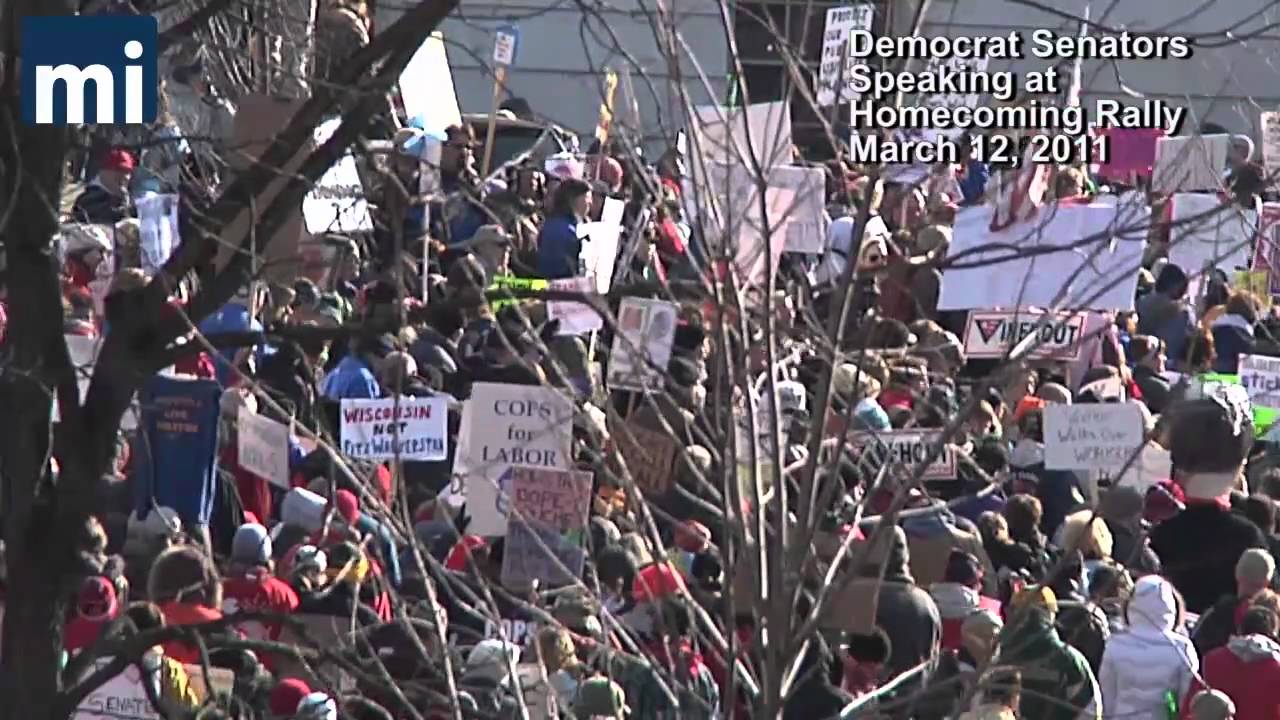 [39] that dismissed the pro-labor protesters as radicalized communists and socialists.
More recently, the Oklahoma Council of Public Affairs, another SPN member, urged lawmakers [40] to "follow Wisconsin's lead" and curb collective bargaining rights for public workers, and the GOP-controlled state Senate voted to do so soon after. Republican Gov. Mary Fallin is expected [41] to sign the repeal into law....
from spn
==