Teachers Unions
---
yikes target groomer gubmint moral panic
this is sorta generic cat for teachers, include wildcat? strikes
no idea how central act 10 wi was to defund the left, end dems
see gov't school devil term
see charter/voucher parochial/pvt
SEE RUFO CRT --> TRUMP 2 DEI WOKE STORY 1
see public sector union
see randi Aft
see NEA
see ryan walters okla org ~ // teachers
---
-=-=
RWW
08/18/2026
by
Dominionist and MAGA activist Jim Garlow devoted his World Prayer Network call Sunday night to an attack on public education. One of the speakers, Liberty University Vice President of Strategic Partnerships and Alliances Rev. Glenn Clary, described how Liberty is planning to take advantage of a provision in the Republicans’ “big, beautiful bill” designed to funnel tax dollars into Christian schools.
Hostility toward public education is a defining characteristic of the Christian right political movement, which has fought for years to funnel public education funds into religious schools and the conservative-dominated homeschooling movement.
Televangelist Jerry Falwell, founder of Liberty University, wrote in 1979, “I hope I live to see the day when, as in the early days of our country, we won’t have any public schools. The churches will have taken them over again and Christians will be running them. What a happy day that will be!”
Garlow began Sunday’s broadcast by telling his prayer warriors, “We want to help you understand why you've got to help your children, your nephews, your nieces, and your grandkids get out of the public school.” He described public education as “rotten to the core,” and said 75 to 80 percent of students raised in the church lose their faith when they go to college because they had not been “properly grounded.”
Clary, the Liberty vice president and a former chair of the Alaska GOP, described public schools as “anti-God indoctrination centers.” He claimed that public schools are controlled by the National Education Association, an educators’ union that he said he calls the “National Evil Association,” adding, “And so I just think that we need to get the kids out of these public schools.”
An important background to this story is the history of Liberty’s rise to become a billion-dollar behemoth in among conservative Christian colleges. That wasn’t achieved by founder Falwell, but by his now-discredited son Jerry Jr., who saw early on the potential financial windfall of online education, which allowed Liberty to take tuition dollars—much of it funded by taxpayers indirectly through federal student loans—from a huge number of students that didn’t require a lot of physical infrastructure. Liberty devoted millions to high-pressure call centers to recruit tens of thousands of online students.
Liberty University Online Academy, which Clary was promoting on Garlow’s call, is the university’s online K-12 school. Clary says more than 75,000 students have gone through its program. Clary described his current mission as recruiting pastors to turn their church’s used space during the week into classrooms for students taking (and paying for) Liberty’s online classes. It’s a way, he said, for churches to create Christian schools without having to worry about hiring and managing teachers. Students who graduate from the online high school can get 50 percent off their tuition if they become a residential college student at Liberty.
For pastors who might be asking, “How would I pay for this?” Clary suggested that parents and grandparents can contribute. B
The 2025 legislation set up a scheme that allows any taxpayer to get a dollar-for-dollar reduction in taxes for any contribution up to $1,700 to a scholarship granting organization (SGO) beginning on Jan.1, 2027. The SGO in turn can use those dollars to provide “scholarships” or vouchers to pay for tuition at a private school. There is no cap on the program, which the National Center for Public Education has noted could direct “tens of billions of dollars annually towards private school education.”
Clary was enthusiastic about what this could mean for money flowing into Christian schools like Liberty's online academy:
So if you and your wife did your taxes and you owe $2,000 and you contributed $1,700 to an SGO, scholarship granting organization, you could take that $1,700 off your tax bill and you would pay $300 to the government and you have directed your tax dollars to a Christian school organization in order for a child to have a Christian education.
Clary said that Liberty is going to “stand up” its own SGO. “Liberty is going to have this and make it available to the students that come to Liberty and any of the pastors that stand up affiliate schools,” he said.
It’s worth noting that earlier this year, Sens. Mark Kelly (D-AZ) and Mazie Hirono (D-HI) introduced the Keep Public Funds in Public Schools Act, legislation that would repeal the SGO tax credit, which is essentially a federal private school voucher program. The bill was co-sponsored by 28 other Democratic senators.
After Clary spoke, Garlow turned to his next guest, Dr. Lisa Dunne, who has a similar contempt for the “anti-Christian” public education system, calling it “anti-faith, anti-family, anti-freedom—a system that hates our God, hates us, and hates our nation.”
We say education is formation and unfortunately, as you heard from Doctor Clary and you heard from Doctor Garlow, we're wasting a lot of time in the in the educational systems today forming children in a non-biblical worldview. I would say we're raising up atheist armies, and I would say that is not an--that's not hyperbolistic, that’s not an exaggeration in any way.
Dunne, who founded a Christian college and network of Christian schools, is pursuing her vision of replacing public education with church-run schools:
We've done the stats in California, and if 75% of our churches in the state of California would open their doors to 250 students, we would shut down the dysfunctional public school system in our state.
Many religious-right activists have adopted part of the worldview taught by Christian Reconstructionists that there is no biblical basis for public education because God assigned that responsibility to the family and church. Dunne made the same claim, citing Kevin Novak, a right-wing attorney who promotes the abolition of the “civil government school system,” which he calls a “tyrannical mechanism that commands our youth to think in anti-Christian terms.” Dunne called Novak a friend and said he is about to start at her Chula Vista Christian University.
And he goes through biblically, he goes through all of the Word and shows that the government, the secular pagan government, has no jurisdiction to educate our children. None. Zero. The mantle of responsibility is on our shoulders as parents. Now we can choose to partner with a trusted agency like our local church, but it is our responsibility. We will stand before the Lord for how we raised or did not raise our children.
While some religious-right activists call for the abandonment of the public school system, others are using political muscle to try to turn public schools into places to proselytize students or use charter school systems to promote taxpayer funded religious indoctrination.
And while anti-public education religious-right voices may have bigger media platforms, it’s also important to recognize that there are many Christian teachers and administrators in public schools, and many pastors and Christian parents who support the mission of public education.
On the Watchlist
Jim Garlow
-=-=
---
7 26 misgender spk = child abuse
multicultural tick box oppressed minority
parental rights
red card ~ ICE rights; tcher union organized student walkouts ~ICE
students pawns in govt school, danger in traffic
anti AI, do not care about getting performance up
amend 11 cardiac post vax clots
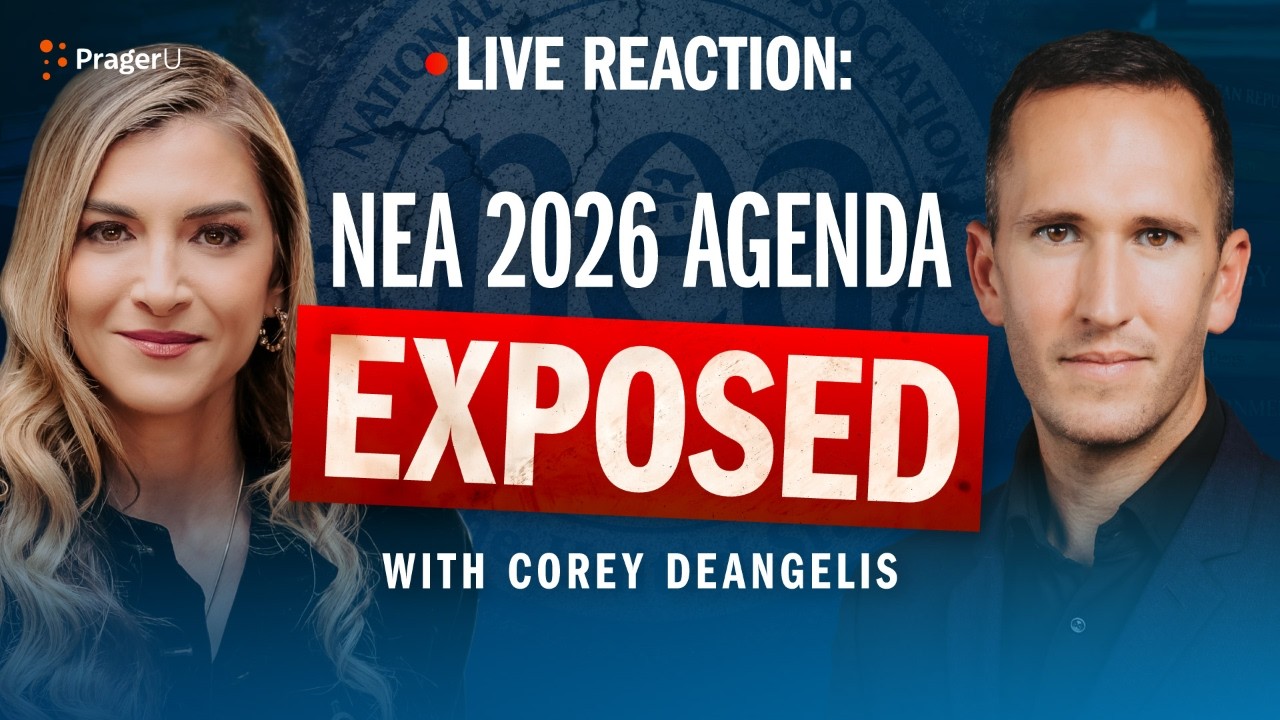
Education advocate Corey DeAngelis joins PragerU CEO Marissa Streit to discuss the National Education Association’s 2026 agenda and what it reveals about America’s largest teachers union. Instead of focusing on academic excellence, the NEA is prioritizing progressive activism, including efforts to impeach President Trump, oppose ICE, defend anti-Israel activism, and support trans legal services. Together, they break down how the NEA is built to influence your children, with an agenda that flows into book publishers to teacher training to the lesson plans in your child’s classroom.
---
---
7/18/2022
Stuck on the Rufo Road
by Jennifer Berkshire
Jennifer C. Berkshire hosts the education podcast Have You Heard. She is the author, with Jack Schneider, of*A Wolf at the Schoolhouse Door.
Last spring, taking a break from waging conspiratorial campaigns against the republic, an assortment of luminaries associated with the Claremont Institute gathered to lay out a plan to foment a culture war against the nation’s schools. The Clubhouse event, entitled “Building A New Right: Red States vs. Wokeness,” featured a grab bag of Claremont fellows and friends. The star attraction was Manhattan Institute agitprop specialist Christopher Rufo, chief sower of the panics against critical race theory (CRT) and “grooming.”
In a now familiar exercise, Rufo sketched out his campaign to make CRT toxic as part of a larger propaganda war against public institutions. The ultimate goal, he explained, was essentially to do away with those institutions and redirect school funding to families and individuals based on their “values.” Rufo waxed apocalyptic about the scourge of “wokeness,” and yet he struck a hopeful note. After all, he reminded listeners, it had only taken the country a few years to go from the Black Panthers to Nixon.
In the ensuing months, Rufo’s propaganda campaign would grow increasingly lurid, but on this occasion, he urged his audience to raise the discussion to a higher level. Focus on “excellence,” he admonished them, and attack public schools for failing to meet that standard. Conservative communications guru David Reaboi, who helped seed a previous moral panic on the right against the sinister spread of Sharia law, weighed in with some messaging advice of his own: Go full bore against the teachers unions. Do damage.
Today, this coordinated plan to wage a public relations war against the nation’s public schools is an undeniable success. Forty-two states have moved to restrict teaching about oppression, race or gender. According to one estimate, more than one third of students in the country attend school in a state where educators are now subject to some kind of classroom gag order.
The achievement of Rufo and his allies is all the more astonishing, given the deep unpopularity of the policies they champion. Polls consistently show that voters across party lines are repelled by the GOP’s education extremism. Across the chasm of our current political divide, bipartisan majorities are largely in agreement that banning books and gagging teachers is bad.
And for all of the insurgent right’s bold rhetoric about mining parent outrage for electoral gold, the polls that matter most have shown remarkably poor results for candidates running on scorched-earth education platforms. In New Hampshire, New York, Montana, Georgia, Wisconsin and beyond, voters are rejecting right-wing culture warriors, often by wide margins—a movement that might be summed up as “keeping the crazy away from the kids.”
There’s just one problem, though: The leadership of the Democratic party doesn’t seem to have gotten the memo.
Read entire article at **The Forum
---
===
6 25 wonkette
...Mike Lee also had another tweet about it that said “Nightmare on Walz Street.” Ohio Republican Senator Bernie Moreno — another Republican dude with a lot in common with Vance Boelter — tweeted this, a retweet of another right-wing liar connecting “No Kings” fliers found in Boelter’s car with Randi Weingarten and teachers unions somehow.
---
---
mma
05/29/25
05/29/25
---
---
5 25 email
the AFT, along with AFT-Maryland, the American Sociological Association and Eugene (Ore.) School District 4J, has won a temporary pause on the Trump administration’s threat to take funding away from universities and school districts that teach lessons referencing race and racism, or provide support to students through diversity, equity and inclusion programming. The preliminary injunction addresses a “Dear Colleague” letter from the Department of Education that required institutions to demonstrate compliance or lose funding. Read more here.
===
===
no lnx
Alternet
The devastating truth about the GOP's war on education
Thom Hartmann December 31, 2024
“Those who control the present, control the past; and those who
control the past control the future.” —George Orwell, 1984
From outlawing the polio vaccine to ignoring the scientific consensus on gender dysphoria to refusing to wear masks in hospitals to trying to strip evolution and science from our schools, stupid has become fashionable in today’s GOP.
When Republican politicians want to score points, they criticize their opponents as having had “elite” educations; the GOP’s war against Ivy League colleges was particularly evident during the student protests of Israel’s slaughter in Gaza. Congressional Republican inquisitors voices' dripped with scorn and contempt as they grilled university presidents.
It wasn’t always this way.
I remember when the USSR launched Sputnik, the first satellite to orbit the Earth. It was the fall of 1957, I was six years old, and my dad and I watched it arc over our house from our back yard one clear October night. My best friend’s father, a ham radio operator, let us listen on his shortwave radio to the “beep beep beep” it was emitting when it was over North America. I’d never seen my dad so rattled.
That dramatic technological achievement lit a major fire under the Eisenhower administration and Congress. In his January 27, 1958 State of the Union address, Republican President Eisenhower pointed to Sputnik and demanded Congress fund a dramatic transformation of America’s educational system:
“With this kind of all-inclusive campaign, I have no doubt that we can create the intellectual capital we need for the years ahead, invest it in the right places--and do all this, not as regimented pawns, but as free men and women!”
In less than a year Congress wrote and passed the National Defense Education Act that poured piles of money into our public schools and rolled out programs for gifted kids.
I was lucky enough to be enrolled in one of those in 1959: by the time I left elementary school I was functioning at high school and college levels in math, science, and English. I’d had two years of foreign language and two years of experimental music instruction. IQ tests were all the rage: mine was 141 and my best friend, Terry, was 142, something he never let me forget.
Most all of those programs died over the following decades as a result of Reagan’s war on public education, which began with his bringing private religious school moguls like Jerry Falwell and bigots like Bill Bennett into the White House.
Repudiating Eisenhower’s embrace of public education, Reagan put Bennett in charge of the Department of Education, which Reagan had campaigned on shutting down altogether. Bennett is probably best known for defending his proclamation that:
“If you wanted to reduce crime you could, if that were your sole purpose, you could abort every Black baby in this country, and your crime rate would go down.”
Much like Bennett back in the day, the catch phrase among white supremacists and their fellow travelers today is that “Western Civilization” is either under attack or at risk because we teach history, tolerance, and critical thinking skills in our public schools, which are often racially integrated. The answer, Republicans will tell you, is to defund our public schools.
When Reagan was elected in 1980, the federal share of total education spending in America was 12 percent; when he left office in disgrace in 1989 amid “Iran/Contra” rumors he’d cut a deal with the Iranians to keep the American hostages to screw Jimmy Carter, that share had collapsed to a mere 6 percent. (It’s 3 percent today.)
Reagan also wanted to amend the Constitution to allow mandatory school prayer, and unsuccessfully proposed a national tax credit — a sort of tax-system-based national voucher system — that parents could use to send their kids to religious schools like Falwell’s.
Reagan made anti-intellectualism a political weapon, repeatedly criticizing colleges and professors throughout his political career. When asked why he’d taken a meat-axe to higher education and was pricing college out of the reach of most Americans, he said that college students were “too liberal” and America “should not subsidize intellectual curiosity.”
Four days before the Kent State Massacre of May 5, 1970, Governor Reagan called students protesting the Vietnam war across America “brats,” “freaks” and “cowardly fascists,” adding, as The New York Timesnoted at the time, “If it takes a bloodbath, let’s get it over with. No more appeasement!”
Before Reagan became president, states paid 65 percent of the costs of colleges, and federal aid covered another 15 or so percent, leaving students to cover the remaining 20 percent with their tuition payments.
That’s how it works in many developed nations; in most northern European countries college is not only free, but the government pays students a stipend to cover books and rent.
Here in America, though, the numbers are pretty much reversed from pre-1980, with students now covering about 80 percent of the costs. Thus the need for student loans here in the USA.
Ever since Reagan’s presidency, the core of Republican positions on public education have been five-fold:
- Let white students attend schools that are islands of white privilege where they don’t have to confront the true racial history of America,
- Use public money to support private, for-profit, and religious schools that can accomplish this (and cycle some of that money back to Republican politicians),
- Destroy public schools’ teachers’ unions,
- End the teaching of science, critical thinking, evolution, and sex ed, and,
- Bring fundamentalist Christianity into the classroom.
Earlier this year, Republican Senator Marco Rubio called America’s public school system a “cesspool of Marxist indoctrination.”
“Dangerous academic constructs like critical race theory and radical gender theory are being forced on elementary school children,” Rubio wrote for the American Conservative magazine, adding, “We need to ensure no federal funding is ever used to promote these radical ideas in schools.”
Instead, multiple Republican-controlled states are now actively gutting their public schools with statewide voucher programs, and instituting mandatory bible instruction or posting of the Ten Commandments. Book bans and panics around queer kids using bathrooms or playing sports are the new wedge issues.
There is no more powerful urge we humans can experience than to protect and defend our children. For most people it beats hunger, sex, and money. So if you’re a politician looking for an issue to motivate voters, just tell them their children are under attack. It’s cynical, but effective.
In an interview for Semafor, Trump’s former Secretary of State Mike Pompeo laid it out:
“I tell the story often — I get asked ‘Who’s the most dangerous person in the world? Is it Chairman Kim, is it Xi Jinping?’ The most dangerous person in the world is [American Federation of Teachers President] Randi Weingarten. It’s not a close call. If you ask, ‘Who’s the most likely to take this republic down?’ It would be the teacher’s unions, and the filth that they’re teaching our kids…”
Just a few months ago, Donald Trump laid out his plan to deal with the “major problem” America is facing. That problem, he said, is:
“[W]e have ‘pink-haired communists teaching our kids.’”
Turning the Constitution upside down and arguing the Founders intended to protect teaching schoolchildren religion, Trump elaborated, arguing that mixing religion, politics, and education was the intention of that document:
“The Marxism being preached in our schools is also totally hostile to Judeo-Christian teachings, and in many ways it’s resembling an established new religion. We can’t let that happen. For this reason, my administration will aggressively pursue intentional violations to the establishment clause and the free exercise clause of the Constitution.”
As Jonathan Chait wrote for New York magazine:
“More ominously, at every level of government, Republicans have begun to act on these beliefs. Over the past three years, legislators in 28 states have passed at least 71 bills controlling what teachers and students can say and do at school. A wave of library purges, subject-matter restrictions, and potential legal threats against educators has followed.”
George W. Bush followed the trend, bragging about his pathetic performance in college at Yale’s 2001 commencement:
“To those of you who received honors, awards, and distinctions, I say, well done. And to the C students I say, you, too, can be president of the United States!”
Similarly, JD Vance gave a speech in 2021 titled Universities Are The Enemy.
This isn’t the first time elected officials have used public education as a political weapon. In 1844, 25 people died and over 100 were severely injured in riots in Philadelphia over whether there should be daily Bible readings in that city’s schools. Two churches and several city blocks of homes were burned to the ground.
The Scopes Monkey Trial of 1925 didn’t provoke riots, but was a major event in the history of public education. Tennessee high school teacher John Scopes was charged and convicted of the crime of teaching evolution. Mississippi and Arkansas joined Tennessee in passing laws making such instruction a crime that stood until the 1967 repeal of the Butler Act.
While Republicans across the country successfully rode a wave of white outrage about Critical Race Theory in November’s election, polls suggest the issue is really only meaningful to a fragment of the American electorate: an anti-science “Christian” subset of white Republican voters.
The annual PRRI American Values Survey found:
“Americans overwhelmingly favor teaching children history that includes both the good and bad aspects of our history so that they can learn from the past, versus refraining from teaching aspects of history that could make them feel uncomfortable or guilty about what their ancestors did in the past (92% vs. 5%).
“There are no substantial partisan differences, though Republicans favor excluding aspects of history slightly more (7%) than Democrats and Independents (both 4%). There are few differences across religious traditions or demographics. This consensus holds up across different levels of exposure to critical race theory: 92% of those who have heard a lot about critical race theory, 94% of those who have heard a little, and 93% of those who have heard nothing about it state that we should teach children the good and bad of history.”
Nonetheless, they note:
“[A] majority of Republicans (54%), compared with 27% of independents and only 7% of Democrats, believe that teachers and librarians are indoctrinating children.”
America spent $794.7 billion on primary education last year. For-profit private schools and megachurches that run schools look at that pile of money and drool. Republicans are committed to delivering as much of it to them as possible, regardless of the damage it does to our nation’s kids.
Their strategy for privatizing our public schools is pretty straightforward, and echoes the plan of action Republicans are using right now to replace real Medicare with the privatized Medicare Advantage scam.
First, they falsely claim that they’ll deliver a better product at a lower cost. In the education realm, we see this with Florida and several other Red states now offering vouchers that can be used at private or religious schools to every student in the state.
(Nearly 2,300 private schools in Florida accept vouchers, but “69 percent are unaccredited, 58 percent are religious, and nearly one-third are for-profit.”)
As more and more students use the vouchers to flee public schools, the public schools sink into deeper and deeper financial troubles. Those cut the quality of teaching and upkeep of the school buildings, causing even more students to use the vouchers.
Because the vouchers never cover the full cost of private school tuition (typically they pay for half to two-thirds), the truly poor can’t use them: the result is the public school system becomes ghettoized, leading to even more flight by middle- and upper-class (mostly white) people.
Once the public schools are dead and the state has transitioned entirely to private schools, the state will claim budget problems and begin to dial back the amounts available for vouchers. (The same will happen with Medicare Advantage once real Medicare is dead.)
This will widen the relationship between the educational and wealth divides; the racial and class cleavage will become so great that the state will have effectively gone back to a “separate but equal” educational system. Which, of course, is the GOP’s goal and has been since 1954.
Republicans are generally convinced — and surveys show they’re right — that when people have a good, well-rounded education they will vote for Democrats, who explicitly value science and egalitarian social values.
Thus, keeping our kids ignorant and destroying one of America’s largest unions, all while helping their education and religion industry friends get rich, is a complete win-win.
Much of this battle is playing out in state houses around the country, but there’s a huge and well-funded effort to take control of local school boards as well.
Driving this ethos with a constant flood of anti-intellectual, anti-science propaganda are an army of rightwing podcasters, YouTubers, hate radio hosts, and the billionaire-owned Fox “News” network (among others). They argue, essentially, that “stupid is the new smart.”
Barely coherent politicians like Tommy Tuberville and Marjorie Taylor Greene are their heroes. Donald Trump, who still refuses to release his grades, is their avatar. Bob Kennedy is their avenging angel. And people with college educations — and teachers/professors — are their enemies.
Bottom line: the Republican war on public education and science is real, and if we want to stop it we must get involved. Show up for your local school board meetings and, if you have the time and ability, run for a position on the board.
Lobby your state legislators and support pro-science and pro-education politicians. It’s time to make smart cool again!
Our children’s and grandchildren’s futures are literally at stake.
NOW READ: Poor Trump supporters are about to get a rude awakening — but we shouldn't be celebrating
===
---
context
anti-commie teachers new ?
rww 2 24
Former Trump aide Stephen Miller told the MAGA activists gathered near Washington, D.C. last week for the annual Conservative Political Action Conference that conservatives must be willing to use power more aggressively against their opponents. He railed against district attorneys and other officials for not arresting teachers who violate new state laws that restrict teaching on race, gender, and sexuality.
Miller, an architect of the Trump administration’s anti-immigration policies, has been promising MAGA activists that if Trump returns to the White House, he “will unleash the vast arsenal of federal powers to implement the most spectacular migration crackdown.” Miller’s America First Legal group is part of the far-right Project 2025, which has prepared a battle plan for the movement to “take the reins of government” in a new Trump administration. The Heritage Foundation, ringleader of the Project 2025 scheme, was at CPAC recruiting foot soldiers willing to carry out the plan.
In a recent article for Political Research Associates’ “The Public Eye” magazine, I noted that Project 2025 reflected a “movement-level, ideological shift away from a libertarian mistrust of government power and toward an authoritarian view of government power being used ruthlessly—whether as a righteous force wielded to advance a ‘biblical worldview’ or turned against an ‘administrative state’ supposedly captured by a radical Marxist left.”
Miller provided ample confirmation about the MAGA movement’s intentions, down to his dismissal of libertarianism as “a terrible ideology” that might be fine for academic debates but not in the real world, where he said public officials have a responsibility to “defeat evil.”
Excerpts from Miller’s appearance on a Friday, Feb. 23 CPAC panel:
Call it a mental illness, call it a spiritual failing, call it a moral deficiency, call it weakness, softness, or just being pathetic. There is something really broken in the conservative brain. They’re afraid not only of conflict, we know that. But there’s an even deeper fear, a deeper fear than all that, which is having power, and using power. Conservatives are addicted to the language of libertarianism, which is fine–you know, it’s a terrible ideology, but in an academic setting, okay, have these debates. …
You elect a state supreme court justice, you elect an Attorney General, and so on and so forth, to have an office with specific powers, duties, and responsibilities, with the expectation that they will use that authority to defeat evil, to protect the good, and to accomplish positive change in society. And you have to use that power fearlessly. …
A number of states, for example, have passed laws, saying that you can’t have this in the curriculum, or you can’t have that in the curriculum, and you can’t teach DEI and so on and so forth. Without exception, I can promise you, all the commies in the classroom changed the name of their lecture, changed one word, changed one little paragraph in the syllabus and did the exact same damn thing every single day because they’re communists and that’s what they do. Were they sued? No! Were they arrested if they broke a law and it’s applicable? No! Did any D.A. anywhere, if you’re talking about trans issues, think of arresting somebody for abusing children with trans ideology? No, we write blog posts about it. That’s what we do. So until we get serious, all the way down to the local DA, all the way up to the state A/G. and every office in between, including judges, electing people who have power and will use that power and measure their success by change in the real world, then we aren’t going to be able to beat the left.
---
6 23 reed conf rww
Also on display was the right-wing political strategy of “parents’ rights” as a rallying cry and voter mobilization tool. Moms for Liberty, a group founded to resist mask requirements that moved quickly into promoting book bans, school board takeovers, anti-LGBTQ smears, and authoritarian politics in general, had a significant presence at Road to Majority, which was held just a week beforetheir own national summit in Philadelphia. During Q&A at a panel on school choice, M4L’s national director Catalina Stubbe called teachers unions “enemies”and claimed that public schools are “abusing” and “indoctrinating” children.From the main stage, M4L cofounder Tiffany Justice claimed that “our parental rights are being obliterated by our government every single day.” She said that the group’s 135,000 members in close to 300 chapters spread out over 45 states are “unifying” their communities, a laughable assertion given the anger and chaos they have created at school board meetings and after they take over school boards.
same week randi vicious &
AA woman young renta zz: AMALA EKPUNOBI (GUEST): It is truly unbelievable to see some of the resources that the NEA has at their disposal for young children here and the NEA is really public enemy number one when it comes to American children. We're talking about an organization that has allowed for kids to be out of school for two years during the pandemic and then when they returned to what should be a normal, wholesome American education, they're getting inundated with, like Sean said, critical race theory and gender theory. It is ridiculous the things that these teachers unions are endorsing.
new fox target?
**Laura Ingraham** is the latest on the far right to attack a bedrock institution of American society: public schools. The Fox News propagandist on Thursday called to “defund government education” and wrongly implied the National Education Association, a labor union, was responsible for establishing education standards and curricula, which is the responsibility of government agencies.
Ingraham hosted Terry Stoops of the right-wing think tank The John Locke Foundation, which Accountable.US has said “repeatedly alleged Democrats conspired to allow widespread voter fraud.”
Stoops complained that Twitter took action against him after he posted what allegedly were proposed agenda items from the National Education Association’s annual meeting. Ingraham showed excerpts saying the NEA will support the right to abortion, LGBTQ rights, and other mainstream positions, which Ingraham attacked as “whackpot declarations.”
Reading some of the proposed items, Ingraham mocked them, saying, “Reading, writing, and abortion.”
Stoops berated the NEA’s discussion of critical issues facing America, suggesting the group, America’s largest labor union and not a think tank or government education agency, was advancing an “insane agenda.”
Ingraham jumped in, calling for an end to public schools, and saying taxpayer funds should be diverted to private education.
As Media Matters reports, Ingraham said the NEA’s annual meeting “is more like a political rally for the far left.”
READ MORE: How can community schools rescue a ‘troubled’ district?
“I mean, it’s kind of a combination of Human Rights Campaign, BLM, you know, Earth Justice League, whatever it is,” Ingraham continued, conflating a union agenda with a government agency’s work.
“But what it’s not about is education and this is why I think, Terry, a lot of people are saying it’s time to defund government education or at least defund it by giving vouchers to parents so they can say, ‘No, we’re not doing this anymore.’ And I think that just has to happen. We have to stop funding this madness.”
Since colonial times in America public schools, supported by taxes, have existed. In the mid-1800s states began to make public education mandatory. But as the religious right has grown in power, conservatives have tried to steer tax dollars away from public schools and into private and religious schools.
Watch below or at this link:
422 BS attack
apparently an aggregator, but RW slat
LaborUnionNews.com
Amazon Objects To Union Threatening Employees If They Voted Against ALU And Bribing Employees With Pot
Amazon objects to union’s Staten Island victory, reuters/ny post
alleges NLRB interference
Forbes Staff
SUBSCRIBE TO LABOR UNION NEWS’ DAILY DIGEST
{{denver gazette
actual old paper bought by anschutz [clarity media?]
30 East Pikes Peak Ave., Suite 100 Colorado Springs, CO
Publisher: Christopher P. Reen
303-569-5804
chris.reen@gazette.com
Largest teachers union spent twice as much on politics as on member needs
Jeremiah Poff, Washington Examiner Apr 7, 2022
Largest teachers union spent twice as much on politics as on member needs
EXCLUSIVE — The National Education Association, the nation's largest teachers union, spent more than twice as much money on politics-related expenditures than on its membership, an analysis of the union's filings shows.
The data, compiled by the right-to-work nonprofit organization Americans for Fair Treatment, shows the teachers union donated $66 million to political activities and another $117 million to "contributions, gifts, and grants" that were primarily political donations.
The data reviewed by Americans for Fair Treatment, which was provided exclusively to the Washington Examiner, showed that the political activities donations totaled 18% of the union's $374 million budget for 2020-2021. The "contributions, gifts, and grants" totaled 32% of expenditures.
BIDEN RULE COULD FORCE CHARTER SCHOOLS TO CLOSE, FORMER EDUCATION OFFICIAL WARNS
Meanwhile, only 9% of the NEA's budget was spent on direct assistance to its members, who pay an annual fee of $200 to maintain their membership in the union.
"The National Education Association's political and charitable spending in 2020-2021 makes the NEA look more like a political organization than a membership organization," Americans for Fair Treatment told the Washington Examiner. "The union spent $2 on politics for every $1 it spent on representing its members."
The largest beneficiary of the NEA's political spending was its own political action committee, the NEA Advocacy Fund, which received $15.7 million from the union in the 2020-2021 school year.
Other donations included $6.7 million to the State Engagement Fund, which funnels donations to left-wing political groups and Democratic candidates. A similar organization, the Strategic Victory Fund, received $1.85 million from the union.
Donations to both organizations were counted among the union's "contributions, gifts, and grants" expenditures rather than as political activities. The union also designated as a contribution a $1 million donation to Future Forward USA Action, a political action committee that backed then-candidate Joe Biden's 2020 presidential campaign.
The political donations by the NEA dwarfed the $48.8 million in political activities and $5.9 million in contributions spent by the nation's second-largest teachers union, the American Federation of Teachers, according to Americans for Fair Treatment. The combined total of the AFT's political spending was less than 30% of its 2020-2021 expenses, as opposed to the nearly 50% spent by the NEA.
"Those numbers show where [the NEA's] priorities lie," said Americans for Fair Treatment CEO David Osborne.
In addition to supporting political action committees backing Democratic candidates, the NEA also made sizable donations to liberal advocacy groups, including a $125,000 donation to the nonprofit organization Project 2043, which helps "companies and nonprofit organizations achieve their Inclusion, Diversity, Equity, and Accessibility goals."
The project's website includes multiple phrases and verbiage often associated with critical race theory, which says U.S. institutions and culture are systemically racist and oppressive to racial minorities.
CLICK HERE TO READ MORE FROM THE WASHINGTON EXAMINER
The NEA has previously supported the use of critical race theory in developing classroom curricula, even as Democratic politicians and liberal pundits have claimed the theory is not taught in public schools.
The NEA did not respond to a request for comment.
Original Location: Largest teachers union spent twice as much on politics as on member needs
Washington Examiner Videos}}
https://www.alternet.org/2021/02/how-many-teachers-have-died-of/
Republicans think they have their new plan to divide and conquer and distract the nation from extremists within their own party and the attack on the U.S. Capitol. They're going to attack teachers for not wanting to go into unsafe working conditions in a pandemic.
Well, they say they're attacking teachers unions, but make no mistake: Republicans are attacking teachers. Because the thing is, unions are made up of workers, and teachers are the workers in teachers unions (most of them, anyway), and in the cities where there have been contentious debates over in-person schooling, it is absolutely the teachers, not some abstract bureaucracy, fighting to stay out of poorly ventilated, crowded classrooms.
"Science is not the obstacle. Federal money is not the obstacle. The obstacle is a lack of willpower," Senate Minority Leader Mitch McConnell**s**aid Wednesday. "Not among students. Not among parents. Just among the rich, powerful unions that donate huge sums to Democrats and get a stranglehold over education in many communities."
What, we're to believe that the "rich, powerful unions" just decided to pick this specific fight for no good reason? Like, Randi Weingarten, president of the American Federation of Teachers, and Becky Pringle, president of the National Education Association, got together and decided that the best way to build power was to use a ton of political capital blocking in-person education? Oh, please. This is definitely a case where the teachers have pressured their leaders, and the reason for that is that teachers are scared.
What's more, teachers are scared because people keep telling them that going into the classroom is safe if a long list of precautions are observed, and they know that in many of their school systems, there is no chance of that.They have stories of being in crowded classrooms where the windows don't open to circulate fresh air in, and they're not allowed to prop doors open because that could put them in danger in case of a school shooting. They have stories of schools where the way students are kept from being within six feet of each other for 15 minutes is that every 12-14 minutes they're told to get up and walk around. They have photos showing creative interpretations of how far six feet really is.
What teachers are saying is that, contrary to McConnell's claim that "Federal money is not the obstacle," federal funding has been totally inadequate to the task of making schools safe, and local leaders haven't necessarily been any better. They're pointing out that studies of COVID-19 transmission in schools have been and continue to be all over the map when it comes to the role of schools in transmission, while the media lines up to highlight the most comforting data.
In Chicago, the teachers union is forcefully pointing out that parents, too, are voting with their feet. Just 19% of Chicago students went back to school in person this January even as the city did everything possible to force teachers into classrooms. The teachers union points to racial disparities in which students have gone back—white parents are far more likely to send their kids in person than are Black parents—and points out that the plans for simultaneous in-person and remote teaching will further disadvantage remote students. Students who are, again, disproportionately likely to be Black.
It's not just Chicago where Black families are opting out of in-person school during the pandemic. So, yes, basically everyone agrees that remote education is not great. But you don't get to cite in-person learning as a racial equity issue when the kids who will go back will be disproportionately white. You get to criticize a system that has for too long given Black families reason to be suspicious of how much it values their children's safety. You get to point out the inequities that are being exacerbated by a pandemic year in which some schools have the resources to open safely while others don't; in which some kids have private support for remote learning while others don't even have internet access; in which there have been chasms between the rates at which different racial groups have gotten sick, been hospitalized, died.
As all this is happening, as political leaders are saying that the schools are safe while generally refusing to do the things that would make the schools safe—the things that the studies they point to as showing schools to be safe stipulate are what makes schools safe—teachers are also in many states getting bumped down the vaccination priority list. This is not exactly the way to show that you really want to prioritize making schools safe, let's say.
And when it comes to reopening schools, the fears of teachers and the political power of their unions are not the only factors. Montgomery, Alabama, recently shifted to all-remote learning after the deaths of four teachers. It's safe to say that it's not the awesome power of teachers unions in Alabama that motivated that decision. In at least several other districts, schools have had to close or go all-remote because they simply couldn't keep up staffing levels given teachers who were sick or quarantining due to exposure. In Utah, some schools had to go remote so many times due to outbreaks that it added up to 40% of the fall semester.
Vaccinating teachers won't be a perfect silver bullet until we have better data on whether and how much COVID-19 transmission the vaccines block, or until the potentially vulnerable family members of teachers are also vaccinated. But it would be a huge step, and it's one that the same political leaders who are pressing for schools to reopen are not as committed to.
Now, will Republicans be successful at turning parents against teachers by squawking about teachers unions? Probably more than they should be, at least among the white suburbanites they're targeting with that message. It's also possible, though, that Republicans are underestimating just how many people know a teacher. Just a person they know who's a teacher, who may be scared herself.
Either way, this message deserves the utmost pushback. And anyone who doesn't think teachers should be moved up the vaccination priority lists can definitely pound sand. All the sand. All day long.
FROM YOUR SITE ARTICLES
- How Arizona blew it: Experts say Gov. Doug Ducey did nearly ... ›
- Trump health secretary says US healthcare workers 'don't get ... ›
- Los Angeles telling ambulance drivers 'not to transport' patients ... ›
RELATED ARTICLES AROUND THE WEB
- Educators We've Lost to the Coronavirus ›
- Empty desks: Coronavirus robs US classrooms of teachers - ABC ... ›
- Opinion: Teachers are more than Covid data points - CNN ›
dn 820
White House Declares Teachers “Essential Workers” as Unions Threaten Strikes over Coronavirus
==
aha-let: any number of smart ppl say we need to resotre unions are ctr-balance to corp power, but teachers are often women and not terribly well paid, so trad workers w/o power/leverage but Red for Ed; teacher union longtime target; workers MOST in danger of covid are undoc immigrant meatpackers
https://www.mediamatters.org/fox-news/mark-levin-likens-teachers-unions-want-covid-19-protections-schools-segregationists-orval
trump threatened pull fed $ from schools if not reopen
==
https://www.washingtonpost.com/education/2020/02/18/what-it-really-means-when-trump-devos-their-allies-refer-public-schools-government-schools/
some lnx not here
Answer Sheet
Analysis
What it really means when Trump, DeVos and their allies refer to public schools as ‘government schools’
[pix President Trump and Education Secretary Betsy DeVos, shown in2017, refer to public schools as “government schools.” (Jabin Botsford/The Washington Post)]
By
Valerie Strauss
Feb. 18, 2020
If you were listening to President Trump deliver his State of the Union address this month, you heard him refer to public schools as “government schools.” It was not the first time, and you can expect to hear it with increasing frequency from him, Education Secretary Betsy DeVos and their allies as they push to increase programs that use public money for private and religious school education.
Trump and DeVos use the term most often with the adjective “failing” attached as a broad denunciation of the public school system, which advocates see as the nation’s most important civic institution. The president and education secretary say their goal is to provide families with the most education options even as they disparage the one that enrolls most of America’s schoolchildren and continues to get high marks from the public.
It isn’t entirely clear where “government schools” originated in this context. This term showed up in a1929 encyclical from Pope Pius XI on Christian education in which he calls “unjust and unlawful” any “monopoly, educational or scholastic, which, physically or morally, forces families to make use of government schools, contrary to the dictates of their Christian conscience, or contrary even to their legitimate preferences.”
In 1954, a white Southern segregationist [not confed dabney/]who opposed school desegregation used it, as did free-market economist Milton Friedman in 1955. In the mid-2010s, conservatives in Kansas invoked the term during a battle over public education funding. Now, Trump and DeVos use it as they push their No. 1 education priority: Getting Congress to pass a $5 billion tax credit program that would allow use of public money for children to attend private and religious school.
“Government schools” is invoked mostly by people who are suspicious of public institutions and see government as a problem rather than a solution. That sentiment was perhaps best encapsulated by President Ronald Reagan in an Aug. 12, 1986, speech in which he famously said, “'The nine most terrifying words in the English language are: I’m from the government, and I’m here to help.'”
In this line of thinking, schools should be operated like businesses because the private sector and competition always produce better results, which critics say is not supported by evidence. Many of the people who use the term “government schools” also oppose unions and have been antagonistic to the two major teachers unions — the National Education Association and the American Federation of Teachers — and the right of public workers to bargain collectively.
Traditional public schools continue to enroll the vast majority of American schoolchildren despite the growing number of alternatives, and opinion polls shows the public still supports them despite serious problems in some districts. The latest and best-known poll on the subject, the 2019 PDK poll of the public’s attitudes on public schools, found that 76 percent of parents with children in kindergarten through 12th grade gave their own child’s school an A or B grade, even though just 19 percent of Americans overall gave the nation’s schools an A or B.
Trump has been saying “government schools” ever since he took office in 2017 to appeal to people who are suspicious of government. DeVos has been using the phrase even longer.
In her home state of Michigan, she and her husband, Amway heir Richard DeVos Jr., spent millions of dollars on an unsuccessful effort in the early 2000s to change the state constitution to allow school vouchers and successfully pushed for a law that would allow for charter schools to open there. The DeVoses have long supported Christian schools, too, and have donated millions of dollars to them over the years.
In 2015, DeVos made clear her position on traditional public schools: She called them “a dead end” during a speech at the SXSW EDU conference in Austin that year. She said:
“We are the beneficiaries ofstart-ups, ventures, and innovationin every other area of life, but we don’t have that in education because it’s a closed system, a closed industry, a closed market. It’s a monopoly, a dead end. And the best and brightest innovators and risk-takers steer way clear of it. As long as education remains a closed system, we will never see the education equivalents of Google, Facebook, Amazon, PayPal, Wikipedia or Uber. We won’t see any real innovation that benefits more than a handful of students.” [mrs zuck fail NJ? Gates fdn?]
That speech is why the education world was stunned when Trump tapped DeVos to be education secretary, and why her confirmation became controversial: It was the first time that a Cabinet member was confirmed by the Senate only after the vice president, in this case Mike Pence, broke a tie vote.
In 2002, DeVos’s husband used the phrase “government schools” in a speech he gave at a conservative think tank about expanding school vouchers across the country.He offered a four-part strategy and encouraged choice advocates to stop using the term “public schools.” His comments offered one of the common rationales given by pro-choice supporters for a change in terminology:
“l’ve used the word public schools a fair bit [but] I am beginning to change my own terminology. I would encourage you to either improve on mine or adopt it. ‘Public schools’ is such a misnomer today that I really hate to use that. I’ve begun to use the word ‘government schools’ or ‘government-run-schools’ to describe what we used to call public schools because it’s a better descriptor of in fact what they are. Because the public school creates this aura that if anyone walks in off the street into a quote unquote public school they would be welcome. And you and I both know that in America today, unfortunately, if you don’t live in the appropriate school district you are about as welcome in a particular public school as a virus is welcome on a cruise ship." [PRESUMABLY REFERS TO POOR POC WHO TRY TO ENROLL IN BETTER SCH FROM RICHER NEIGHBORHOOD?]
Traditional public schools are required to accept all students who live in their district or who have been assigned to them by lottery. Private and religious schools are not required to accept any students, and religious schools are allowed to legally discriminate against some students, such as LGBTQ students. [IN FACT CREAM FOR TEST SCORES]
In any case, Richard DeVos also made clear that choice advocates should tread lightly, urging them to “be cautious about talking too much about these activities” so the issue is not “appropriated” and viewed as “only a conservative idea."
Betsy DeVos and her allies are trying to redefine ‘public education.' Critics call it ‘absurd.'
Three years before Richard DeVos’s speech, the term “government schools” was prominent in a 1999 school choice primer for "freedom in education” issued by the ultraconservative Michigan-based Mackinac Center for Public Policy.[LINK]
The center was founded with a big contribution from the DeVoses, and it hosted an event in 2013 at which Jeb Bush, the former governor of Florida and a prominent DeVos ally, said: “Our governance model includes over 13,000 government-run monopolies run by unions.” He also said, “We can’t just outsource public education to bureaucracies and public education unions and hope for the best.”
Richard DeVos has had a long history, too, of opposing unions; he and his family were instrumental in the Michigan legislature passing a law eliminating union contracts between companies and labor unions that charge dues to members, making it a “right to work” state after it had long been union-friendly.
Interestingly, Friedman — the man many people credit with coining “government schools,” or at least the philosophy behind it — did not support right to work laws.Friedman, a Nobel laureate who advocated free markets, has been called the father of the school voucher movement because of a 1955essay, “The Role of Government in Education.” In it, he argues government’s role should essentially be limited to paying for education, not operating schools. He wrote:
In terms of effects, the denationalization of education would widen the range of choice available to parents. Given, as at present, that parents can send their children to government schools without special payment, very few can or will send them to other schools unless they too are subsidized. Parochial schools are at a disadvantage in not getting any of the public funds devoted to education; but they have the compensating advantage of being run by institutions that are willing to subsidize them and can raise funds to do so, whereas there are few other sources of subsidies for schools. Let the subsidy be made available to parents regardless where they send their children — provided only that it be to schools that satisfy specified minimum standards — and a wide variety of schools will spring up to meet the demand.
A year before that essay, Mississippi segregationist Tom P. Brady gave a speech (later expanded into a book) that became an informal manifesto for Southern segregationist leaders. In “Black Monday,” Brady wrote: “The public school is a socialized or politically monopolized institution, and suffers from weakness inherent in all monopolies."
According to Steve Suitts, an academic and author of the new book, “Overturning Brown: The Segregationist Legacy of the Modern School Choice Movement”: “Southern segregationists used the term ‘government schools’ throughout the 1960s to discredit public schools. In 1964, for example, Mississippi white Citizens Council leader William Simmons condemned the monopoly of ‘government school systems.’ The Mississippi Citizens Council later worked to develop a private school system of choice, supported by vouchers, as their leaders condemned ‘government schools’ as ‘socialism in its purest form.’”
The phrase continued to be used by those opposing the system of common schools open to all and funded, operated and governed by the public through local governments.
Strauss is an education writer who authors The Answer Sheet blog. She came to The Washington Post as an assistant foreign editor for Asia in 1987 and weekend foreign desk editor after working for Reuters as national security editor and a military/foreign affairs reporter on Capitol Hill. She also previously worked at UPI and the LA Times
==
Teachers’ Union Prepared to Strike If Schools Aren’t Made Safe from Coronavirus
dn 720
==
https://www.alternet.org/2019/12/betsy-devos-foundation-funds-right-wing-propaganda-operation-tax-filing/
no lnx
Betsy DeVos’ foundation funds right-wing ‘propaganda operation’: tax filing
Written by Igor Derysh / Salon December 19, 2019
The family foundation of Education Secretary Betsy DeVos and her billionaire husband, Dick, gave more than $1 million to purportedly “independent” right-wing groups that have helped boost her assault on public education, according to a recent tax filing obtained by the government watchdog group Allied Progress and shared with Salon.
The 2018 filing shows that the couple put $5 million into the Dick and Betsy DeVos Family Foundation while doling out more than $11.6 million in contributions and pledges. As in previous years, much of the funding went to Christian charities and local initiatives in and around Grand Rapids, Michigan, and the couple’s home. But more than $1 million went to supposedly independent right-wing think tanks and groups like the American Enterprise Institute and the National Review Institute, which have heaped praise on Secretary DeVos and helped promote her agenda.
“Secretary DeVos is effectively funding an outside propaganda operation to help her bash teachers’ unions and promote private voucher schemes that undermine public education,” said Jeremy Funk, communications director for Allied Progress, a nonpartisan watchdog organization.
The DeVos Foundation contributed $500,000 to the American Enterprise Institute (AEI) for public policy research last year and pledged another $250,000 in future payments to the organization, according to the filing.
AEI, whose board includes Dick DeVos, is a libertarian think tank that maintains a “close relationship with incoming Republican administrations,” according to The Guardian, and assists them with “staff and readymade policies.
AEI officials have repeatedly publicly praised DeVos and her policies.
Frederick Hess, AEI’s director of education policy studies, recently backed DeVos’ push to gut the Borrower Defense Rule, which allows defrauded students to seek debt relief. Hess praised DeVos’ proposal to base debt forgiveness on student income as “clearly better for colleges, taxpayers, and students” in a National Review op-ed. A judge later blocked the initiative, although DeVos is now implementing new rules that again seek to restrict the amount of debt that can be forgiven to students defrauded by for-profit colleges.
AEI senior fellow Peter Wallison also praised DeVos’ controversial changes to Title IX, which made it harder to report sexual abuse on campus, in an op-ed last year. Wallison wrote that DeVos’ rule change puts “sexual harassment rules back into compliance with the Constitution and laws” and “should be an example for other administrative agencies.”
The DeVos Foundation also donated $10,000 to the Foundation for Individual Rights in Education (FIRE), a group whose top officials have publicly backed DeVos’ proposal to require colleges to allow cross-examination of sexual assault and harassment accusers that advocates say would discourage victims from coming forward.
FIRE later promoted DeVos’ comments at the Independent Women’s Forum earlier this year, where she criticized Title IX.
“FIRE has long expressed sentiments much like that of Secretary DeVos” on Title IX, the group said, and its leadership was “heartened by the positions signaled in Secretary DeVos’ speech.”
The DeVos Foundation also made a $350,000 contribution to the Mackinac Center, according to the filing.
The Mackinac Center is a longtime opponent of teacher unions that urged teachers to opt out of their unions after the Supreme Court ruled that non-union workers cannot be forced to pay fees to public-sector unions.
Secretary DeVos herself attended Supreme Court arguments in the case. DeVos is a longtime supporter of “efforts to reduce the power of public-sector unions”and previously made a $125,000 donation to a Michigan group that opposed collective-bargaining rights, according to The Washington Post. Employees at the Department of Education employees have also accused DeVos of “gutting a long-standing labor agreement” and enforcing a new deal that was “roundly rejected” by their union, according to the Post.
The DeVos Foundation also contributed $100,000 to the National Review Institute,whose board of trustees includes Dick DeVos, according to the filing.
After receiving the donation in 2018, the National Review Institute hosted Secretary DeVos at its 2019 Ideas Summit in March, where she vowed to make school choice a “top priority.”
That same month, The National Review praised DeVos’ school choice plan and her Education Freedom Scholarship program, a tax-deductible private scholarship program similar to school vouchers that critics say will reduce tax revenue that could otherwise pay teacher salaries. The National Review hailed it as a “bold” plan and a “huge step in the right direction.”
The DeVos Foundation also contributed $10,000 to the Institute for Justice, according to the filing, a group that funds a “variety” of lawsuits defending school vouchers and tax credit programs supported by DeVos, according to The Times.
Prior to the contribution, DeVos met with the group’s top officials so they could “suggest a few areas where the department could facilitate school-choice efforts and offer the [secretary] help in those areas,” The Times reported.
Earlier this year, the Education Department hosted a blog post by the Institute for Justice’s Tim Keller in which he promoted school choice efforts.
The foundation’s 2017 filings showed similar contributions that included nearly $3.2 million to conservative nonprofits that favor school choice and promote other right-wing policies.
Along with giving or pledging $1 million to AEI in 2017, the DeVos Foundation also contributed or pledged $1 million to the Alliance for School Choice, which Secretary DeVos previously chairedbefore joining the Trump administration. DeVos also chaired the American Federation for Children, which controls the Alliance for School Choice. The federation has continued to lobby the Education Department even after DeVos took over.
Along with contributing to right-wing organizations that promote education policy, the DeVos Foundation has also contributed to numerous advocacy groups that oppose abortion and deny climate change.
The DeVos Foundation and the Education Department did not immediately return a request for comment. Dick DeVos told MLive in 2017 that the majority of their donations are not political.
“These are not political organizations that are advocating or advancing any political agenda. They are trying to serve people,” he said.
Mark Brewer, the former longtime chairman of the Michigan Democratic Party, dismissed the other contributions as “nothing more than a smokescreen to divert attention away from the disclosures of the political contributions.”
Lonnie Scott, the head of progressive advocacy group Progress Michigan, told NPR that the family foundation’s contributions are an example of how conservatives wield their charitable foundations’ checkbooks for political power.
“I think what we see overall is really the purchasing of political power that crosses the spectrum of political and foundation giving,” he said. “The right is very quick to use foundation funding in a way that the left does not in supporting specific policies.”
See the DeVos Family Foundation’s full 990 tax filing below:
DeVos Foundation 990 2018 by Igor Derysh on Scribd
Igor Derysh is a New York-based political writer whose work has appeared in the Los Angeles Times, Chicago Tribune, Boston Herald and Baltimore Sun.
==
==
https://www.rightwingwatch.org/post/devos-slams-union-bullies-for-opposing-her-plan-to-send-federal-tax-dollars-to-private-and-religious-schools/
w. kellyanne at aei]
US. Secretary of Education Betsy DeVos was the headliner at an American Enterprise Institute event Tuesday morning to promote “Education Freedom Scholarships,” the Trump administration’s education tax credit proposal. In her remarks, DeVos attacked opponents of the plan as “union bullies” and declared that “union bosses don’t put kids first.”
Vilifying teachers’ unions is standard operating procedure for DeVos. In January, she used a Heritage Foundation event marking the avowedly “nonpolitical” National School Choice Week to complain that teachers’ unions were “the only thing standing in the way” of more “school choice.”As Right Wing Watch noted at the time:
DeVos is an old hand at this. She has, in the words of Mother Jones’s Krisina Rizga, been “trying to gut the public schools for years.” Indeed, DeVos and her allies have spent many years and many millions of dollars engaged in bare-knuckled politics to elect politicians who will advance an anti-public-education, anti-labor, pro-privatization agenda, and her family has played a key role in building right-wing anti-public-education infrastructure.
At AEI, DeVos and White House spokesperson Kellyanne Conway promoted the administration’s plan, which was proposed in February but hasn’t moved through either house of Congress. One news report from today’s event called it DeVos’s effort to “breathe new life” into the proposal by “calling out Republicans in Congress who have refused to entertain the idea and conservative education policy experts who’ve opposed the plan.”
At AEI, DeVos and Conway said conservatives who worry about increasing federal involvement in education are off-base, because states would have the freedom to use the federal money to design their own programs or simply supplement existing programs.
State “tax credit scholarship” programs are basically a way for legislators to divert tax dollars to private and religious schools without using vouchers, which have been consistently unpopular with voters. The Trump-DeVos proposal would allow for up to $5 billion every year in federal tax credits for businesses and individuals who donate to state-based “scholarship granting organizations.”
In response to a questioner who said he was from the Alliance Defending Freedom, DeVos said the administration’s proposal included language that would require participating states not to prevent religious schools or nonprofits from accessing the tax dollars. DeVos has previously slammed state restrictions on public funding for religious schools.
DeVos and Conway had a lot of praise for Florida, one of the states that has most aggressively pushed “school choice” proposals. RWW’s Adele Stan reported last year that DeVos and her family had pumped hundreds of thousands of dollars into a political action committee promoting voucher proponent Ron DeSantis, who narrowly defeated Andrew Gillum in last year’s governor’s race.
Following DeVos’ and Conway’s appearance was a panel conversation featuring officials from Arizona, Pennsylvania, and Tennesseetouting their own school–choice programs and backing the administration’s proposal.
When Trump announced DeVos’s nomination, People For the American Way called it “a high-water mark in the right wing’s long war on public education.”When DeVos was confirmed, the secretive right-wing Council for National Policy had its own ambitious policy agenda for her: “a gradual, voluntary return at all levels to free-market private schools, church schools and home schools as the normative American practice.”
Tags: Betsy DeVosKellyanne ConwayChurch-StateSchool ChoiceVouchersAmerican Enterprise InstituteTrump Administration
==
==
https://www.alternet.org/2019/08/how-the-teacher-movement-against-charter-schools-helped-send-puerto-ricos-governor-packing/
no lnx
How the teacher movement against charter schools helped send Puerto Rico’s governor packing
Written by Jeff Bryant / Independent Media Institute August 2, 2019
As Americans lament the current sorry state of democracy in Washington, D.C., government by the will of the people was very much alive recently in Puerto Rico, where a prolonged general strike that virtually shut down the island forcedGovernor Ricardo Rosselló to announce his resignation.
During the strike, huge crowds mobbed the governor’s mansion around the clock, closed highways in the capital of San Juan, and persuaded some presidential candidates in the Democratic Party to join in calling for the governor to resign.
Protesters had multiple grievances, but a “final straw” seems to have been a series of text messages leaked to an independent news organization in which the governor and his closest associates insulted political opponents and allies, members of the news media, and the LGBTQ community. Another notable target for insults in the text exchanges were the island’s public school teachers, whom the governor’s chief financial officer at the time, Christian Sobrino, called, “terrorists.” (Sobrino and other top officials participating in the chats have resigned since the messages went public.)
Puerto Rico’s school teachers have been a constant nemesis to the Rosselló regime, and the island’s largest teachers’ union, the Asociación de Maestros de Puerto Rico (AMPR), united with other labor unions on the island to organize the general strike. Randi Weingarten, the leader of the American Federation of Teachers, which AMPR is an affiliate of, joined in the calls for Rosselló’s resignation.
The teachers’ disagreements with Governor Rosselló started long before the release of the insulting texts.
“People in Puerto Rico felt betrayed by the governor,” says Myrna Ortiz-Castillo in a phone conversation. Ortiz-Castillo is a third-grade teacher and serves as finance secretary at the AMPR local in Bayamon. She insists, “He is supposed to be the person who takes care of the people. Instead he took care of his friends.”
One of the “friends” Ortiz-Castillo is referring to is the charter school industry. During his tenure, Rosselló pushed through the first law allowing charter schools on the island, and after the bill passed, he continued to press for opening more charters. Now it seems his ousting, and the legacy of corruption he leaves behind, will likely damage prospects for the charter industry in Puerto Rico for some time.
‘Friends’ of Charters Take Charge
Much of the teachers’ disillusion with Rosselló goes back at least to December 2016 when then Governor-elect Rosselló appointed Julia Keleher to be the Puerto Rico secretary of education.
Keleher, a native of Philadelphia who barely speaks Spanish, was effectively already on the government payroll, as her firm Keleher & Associates had been awarded almost $1 million in contracts to consult on the island’s education system. Her outsized salary—$250,000 to oversee a system where the average teacher pay is only $27,000—also created controversy.
Shortly after taking office, Keleher pushed for a plan to close nearly 200 public schools across the island, which would have led to thousands of teachers losing their jobs. She also pledged to decentralize the school system and delegate school services, terms often used to introduce the idea of charter schools and other forms of public-private education partnerships.
Keleher’s proposals drew immediate pushback from multiple political factions on the island, but barely nine months into her tenure, she got the perfect opportunity to turn her proposals into policies when Hurricane Maria slammed the island. The storm inflicted $142 million in damages to schools, and 40 days after the storm, only 109 of Puerto Rico’s 1,100 schools had reopened.
Keleher repeatedly referred to the catastrophe as an “opportunity.”
A New Orleans-Style Agenda
While Keleher worked the policy channels to introduce charter schools to the island, teachers were in communities delivering aid and comfort.
Ortiz-Castillo recalls being a first-line responder to the widespread destruction. In her phone call to me, she describes traveling to devastated communities as part of the union’s outreach effort to use its extensive membership network to identify where parents and their children were struggling and advise where to direct supplies, food, and drinking water. Many schools became, essentially, relief centers.
Keleher seemed to have other priorities.
As Education Week’s correspondent on the ground in Puerto Rico reported, she was “diving deep into the lessons of loss and opportunity in previous natural disasters, including Hurricane Katrina, which struck New Orleans in 2005.”
In a tweet, Keleher said New Orleans should be a “point of reference; we should not underestimate the damage or the opportunity to create new, better schools.”
After Katrina, a state-appointed board shut down New Orleans schools, fired over 7,000 teachers, and deposed the school board. Today, 100 percent of schools in New Orleans have been converted to privately operated charter schools.
With nearly a third of Puerto Rico’s schools still without power and hundreds more plagued with crumbling walls, leaky roofs, and spotty internet, Rosselló announced a new fiscal plan that included closing nearly 300 schools and introduced a new bill legalizing charter schools on the island.
Rachel Cohen, writing for the Intercept, described the bill as “vague,” a weakness that could invite the types of fraud and corruption that have dogged charter schools wherever they go. Cohen also noted Keleher had sought the advice of U.S. Secretary of Education Betsy DeVos, a charter school advocate, to help craft the bill.
Analysts at the National Education Association had similar concerns, saying the law “left unanswered” whether for-profit companies would be allowed to manage charter schools and whether charter schools would have to serve students with disabilities—services needed by 40 percent of the island’s students.
Teachers registered their opposition to the bill by holding a one-day strike that shut down schools across Puerto Rico.
The bill passed nevertheless.
Public Funds to Private Pockets
“Teachers have had big problems with the education secretary the governor hired,” says Ortiz-Castillo. “We suggested from the very start that she be investigated. We could see that money intended for school children wasn’t arriving in the classroom.”
Teachers had good reasons to be suspicious.
After justifying her call for closing schools by claiming a savings of $7 million, Keleher signed a $16.9 million contract with the California-based Josephson Institute of Ethics to teach “values” in Puerto Rican schools—an addition to the curriculum teachers believed was not needed, especially at a time when students didn’t have adequate supplies of basic materials and textbooks.
After the storm, Keleher barnstormed the island in a relentless marketing campaign to promote charter schools at a time when, according to a survey conducted by the teachers’ union, dozens of schools still had moldy classrooms, leaky roofs, unusable bathrooms, and rat infestations.
Keleher’s intention to redirect education funds to private enterprises seemed all the more obvious when the island opened its first new charter, a comparatively gleaming facility where teachers had smaller class sizes but were being paid $13,000 more than average teacher salaries. The fact that much of the school’s funding was being provided by a nonprofit did nothing to offset the resentment many teachers felt.
“Bringing charter schools to Puerto Rico is not a good thing,” says Ortiz-Castillo. “Charter schools are a way for politicians to redirect money to their friends. The money for the school should go to the school and to the children.”
Corruption Comeuppance
The backroom collusion between the Rosselló administration and those connected with charter schools continued even when Keleher decided to resign earlier this year.
As part of her departure, her consulting company received a contract to work with a law firm assisting parties interested in participating in the establishment of charter schools in Puerto Rico.The firm also employs Governor Rosselló’s brother Jay Rosselló,who serves as “contact person” to receive the requests for advice.
The law firm’s relationship with Keleher dates back to 2017 when the Puerto Rico Education Department under her leadership hired it for legal advice and technical assistance in education policy.
Keleher’s apparent propensity to steer public dollars to friends, however, seems to have finally caught up with her.
Days before the general strike would shut down the island and force out the governor, news outlets reported Keleher had been arrested for steering $13 million of education federal money to unqualified, politically connected contractors. She is alleged to have bypassed official bidding procedures to award contracts to her friends and to have committed money laundering and fraud.
In her statement calling on Rosselló to resign, Weingartendeclared, “Rossello and Keleher ignored repeated requests from the Asociación de Maestros de Puerto Rico and the AFT to use federal recovery money to fund and restore public education on the island” and instead “diverted much-needed funding from public schools to start charter schools.”
A Lesson About Democracy
Though Keleher is out of office and Rosselló is likely heading that way, Puerto Rico’s teachers are not about to let up.
According to Ortiz-Castillo, teachers intend to meet with the new secretary of education and demand to hear what changes are being planned for the schools. They also participated in protests against a possible successor to Rosselló, Justice Secretary Wanda Vásques, who has since expressed some reluctance to occupy the position. Rosselló has recently inserted another possible successor into the mix, the island’s former representative to the U.S. Congress Pedro Pierluisi, and it’s not clear, as of press time, how teachers would receive his nomination.
But what Ortiz-Castillo and her fellow teachers want people to understand most is the teachers “demonstrated that, without guns and violence, we can hold politicians accountable to the will of the people. Now, we want voters to be more aware of who they are voting for. Candidates need to demonstrate they’re going to do what’s best for all the people and not just what’s good for themselves or their friends. We also want people to understand they should never give up.”
That seems like a lesson all Americans can benefit from.
Jeff Bryant is a writing fellow and chief correspondent for Our Schools, a project of the Independent Media Institute. He is a communications consultant, freelance writer, advocacy journalist, and director of the Education Opportunity Network, a strategy and messaging center for progressive education policy. His award-winning commentary and reporting routinely appear in prominent online news outlets, and he speaks frequently at national events about public education policy. Follow him on Twitter @jeffbcdm.
To learn more about school privatization, check out Who Controls Our Schools? The Privatization of American Public Education, a free ebook published by the Independent Media Institute.
Click here to read a selection of Who Controls Our Schools? published on AlterNet, or here to access the complete text.
This article was produced by Our Schools, a project of the Independent Media Institute.
==
JOK
many alias
aft mich v pv
infiltrate dem and dem soc austin
https://www.projectveritas.exposed/marisa-jorge
==
https://www.alternet.org/2019/05/this-trump-loving-gop-governor-is-in-danger-of-losing-re-election-and-the-white-house-is-worried-report/
Three gubernatorial races are scheduled to take place in 2019, but the one that might have President Donald Trump most worried is Kentucky.
According to Politico, White House officials are deeply worried about the re-election prospects of Trump-loving GOP Gov. Matt Bevin, who polls as the least popular governor in America. His approval ratings in recent months have been stuck in the low 30s.
Trump has gradually been ramping up efforts to help Bevin’s campaign. But the president’s allies are worried that if Trump stakes his political capital on rescuing Bevin, only for him to lose, it will damage the president’s credibility with Republican candidates and loosen his grip on the party.
Despite Kentucky’s conservative lean, partisan control of the state has historically been heterogeneous. Indeed, Bevin is the first GOP governor to ever preside over unified Republican control of the state legislature — and it has been working out horribly for him.
Bevin’s term has been plagued by faction fighting, and his repeated efforts to gut the state educational system has earned him wrath from educators and triggered a string of teacher strikes and sickouts. Bevin has responded with a war of words, blaming striking teachers for child sexual assault and accidental shootings.
Democrats lining up to take on Bevin include state attorney general Andy Beshear, who is currently suing to block Bevin’s war on teachers; Rocky Adkins, the state House Minority Leader; and former state auditor Adam Edelen. Bevin also faces a primary challenge from GOP state Rep. Robert Goforth.
==
==
2/19 dn
==
https://www.commondreams.org/views/2018/10/31/how-teachers-might-end-beating-back-koch-brothers-plan-privatize-arizona-schools
The moment Beth Lewis realized the powerful political forces she was up against was when she was seated in the gallery of the Arizona House watching Republican legislators, one-by-one, fall into line to support a new bill she and her fellow teachers had come to the capitol to oppose.Republican Governor Doug Duceyand others “working the bill” on the floor took any wavering members into a back room for a “conversation,” while lobbyists in the wings nodded and hand-signaled with lawmakers to track the bill’s progress. When the bill’s handlers agreed a vote was in order, it passed easily. Then, “it was like a party,” Lewis recalls, with lawmakers high-fiving each other and lobbyists shaking hands and backslapping. “It was sickening,” she says. “I realized our state legislators weren’t at all interested in representing the people.”
The bill, which the State Senate also passed and the governor quickly signed, opened up education savings accounts, calledEmpowerment Scholarship Accounts, to all of the state’s 1.1 million students. The new accounts, previously restricted to students with special needs and students attending schools receiving a grade of D or F on the state’s school report card, would provide $4,400 a year, 90 percent of the amount of money the state would typically send a district for enrolling a student, for a family to spend as they wish on their children’s education. Students with disabilities and poor students would receive more money than other students.
For parents to receive the money, on a debit card, they must agree not to enroll their children in a public school—essentially giving up their children’s right to a free public education. Other than that, the program has few regulations and there’s little oversight in how public money is being spent. For that reason, Lewis, an Arizona public school teacher, and others who oppose the bill, call the savings accounts “vouchers” that drain funding from public education.
The lobbyists working the House floor that night were from the Goldwater Institute, a right-wing advocacy group based in Arizona with extensive connections to the Koch brothers and a number of organizations and networks with close Koch ties including ALEC (the American Legislative Exchange Council), the State Policy Network, and the Franklin Center for Government and Public Integrity. For years, Charles and David Koch and their associated foundations have invested heavily in electing Arizona lawmakers, including Governor Ducey, and expanding the education savings accounts was one of their crowning achievements.
Passing the bill was also a moment of triumph for the education agenda of the Trump administration. Shortly after news of the passage of the voucher expansion broke, U.S. Secretary of Education Betsy DeVos tweeted, “A big win for students & parents in Arizona tonight with the passage of ed savings accts. I applaud Gov. @DougDucey for putting kids first.”
But in the upcoming Arizona midterm elections, that achievement is at risk, as Lewis and her colleagues with Save Our School Arizona have successfully pushed a referendum onto the ballot, Proposition 305, that lets Arizona voters decide the fate of the bill. Should the initiative fail, the Koch brothers’ plan to expand vouchers would be defeated.
Arizona Democrats running for office, including Democratic gubernatorial candidate David Garcia, who is taking on Ducey, have embraced opposition to the voucher program and thrown their support behind teachers who are calling for more funding of public schools.
Should pro-education candidates win, and Prop 305 go down in flames, the teachers would have led a remarkable campaign that not only would be a victory for public schools but also would threaten to topple the Koch brothers’ political empire in the Grand Canyon State.
Before There Was #RedforEd
“The teachers’ protest movement, which calls itself #RedforEd, has transformed the political battleground” in Arizona, says an article in the New York Times.
The weeklong walkouts that happened earlier this year demanded higher teacher pay and more funding for schools. #RedforEd not only won concessions from Ducey and the state legislature; it culminated in placing a referendum on the ballot, called InvestInEd, that would have raised income taxes on individuals and households earning more than $250,000 and directed the increased revenues to public schools. However, the State Supreme Court struck the initiative from the ballot, for technical questions about its wording.
But months before there was #RedforEd, there was the fight against school vouchers.
After Lewis and her colleagues watched the statewide voucher expansion pass in the Arizona capitol, they began to meet regularly and formed Save Our Schools Arizona. At first, their effort to overturn the legislation got few supporters, Lewis recalls, even among teachers. Few understood that “scholarships” is just another word for “vouchers” and that “empowerment” actually means parents have to give up the right for their children to receive a free public education.
The “turning point,” according to Lewis, was the revelation that citizens could use a petition campaign to refer legislation to a ballot. That gave anti-voucher advocates a specific goal and steps—how many signatures they’d need and how many volunteers they’d need to recruit to circulate the petitions.
A Costly Program for Wealthier Families
Also aiding to their communications effort was an accumulation of evidence of how poorly the voucher program measured up to its purported intention to “save” low-income families from “failed” public schools.
Most of the students who participate in the program, 70 percent, come from some of the state’s most highly rated schools—rated A or B on the state report card. Only 7 percent of the money is being used by students leaving D- or F-rated schools. The majority of these families are also not low-income, but instead reside in the wealthier suburban communities in the state.
Other analyses have found that the vast majority of parents participating in the program use the money to pay for private school tuition. Given that most private schools in Arizona are religious schools, a reasonable conclusion is that the education saving accounts are mostly subsidizing wealthier families’ desires to leave public schools to seek out religious educations for their children.
Furthermore, since the average payout from the voucher program is $5,700 per year for children without disabilities, and the average private school tuition in Arizona is $6,126 for elementary schools and $19,162 for high schools, the vouchers are supplementing parents, who may already be able to afford private schools, with a “coupon” that heavily discounts the tuition. Families of students with disabilities, who receive $19,000 in voucher money on average, could even be “profiting” from the program, as there is very little to no monitoring of how they spend from the accounts.
Currently, Arizona’s voucher program drains $141 million from the public school system, and in fact, costs the state an additional $62 million each year—roughly $4,700 per student, adding 75 percent more to what the state pays to educate a regular public school student.
Kochs vs. ‘a Bunch of Volunteers’
Armed with information about how the voucher program was defrauding the state of millions of education dollars, the SOS Arizona team formed their campaign to get 75,321 signatures to place Prop 305 on the ballot.
“We did most of our outreach through social media,” recalls Sharon Kirsch, another leader in SOS Arizona. “SOS never had any money.”
Kirsch, a university professor, became interested in overturning the voucher expansion after she saw the bill zoom through the State Senate without serious consideration of what the expansion would do to public schools. Its sponsor was former State Senator Debbie Lesko—a recipient of large campaign donations from the Koch brothers and other conservative donors—who now sits in Congress and is up for reelection in November. Lesko is also Arizona state chairman for ALEC.
Relying on a network of volunteers—made up mostly of retired educators, parents, and community activists—SOS Arizona submitted 111,540 signatures in August 2017.
After SOS Arizona announced it had successfully gathered more than enough signatures to place the referendum on the ballot, the Koch network intervened again. On the night SOS delivered the signatures for review by the secretary of state’s office, Lewis recalls, they were told “both sides” would be allowed to be present at the review. Who was the other “side”?
“All of a sudden all these men in dark suits came into the room,” says Lewis. “They paired up with each examiner from the state and hovered over their shoulders, pointing to signatures they felt should be challenged or thrown out.”
The “suits” were from Americans for Prosperity, a right-wing pressure group that operates as a political arm of the Koch brothers to advocate and lobby at state and local levels for small government, deregulation, privatization, and anti-labor union policies.
“When I investigated what these right-wing organizations were doing to oppose us,” Kirsch explains, “I realized how strategic they’ve been. They’ve been working on their privatization efforts for years. They fund teams to work full-time on the issues. They’re breeding their own PhDs through academic centers they sponsor. And we just have a bunch of volunteers.”
Americans for Prosperity, along with the American Federation for Children, formerly led by Secretary DeVos, sued to block the referendum. But in January 2018, a judge dismissed the lawsuit.
In the meantime, Governor Ducey was meeting with donors in the Koch network, pledging to go big on passing Prop 305 and asking for their support. “This is a very real fight in my state,” he said. “I didn’t run for governor to play small ball.”
“In 2018, Koch donors see Arizona as ground zero in their push,” the Washington Post reports, and Koch brothers’ money has continued to pour into the state through Americans for Prosperity and the Libre Institute, an astroturf group spending “hundreds of thousands of dollars,” according to a local news outlet, “targeting Arizona Latino families with ads, mailers and phone calls” urging them to vote “yes” on Prop 305.
“We had to bring in Spanish-speaking volunteers to counter the propaganda being spread by the Koch Brothers’ Libre group,” says Kirsch. “We reached out to community organizations like LUCHA (Living United for Change in Arizona),” an Arizona-based grassroots group advocate for social and economic justice in the Latinx community. “They’ve been very helpful in spreading our literature,” Kirsch says.
In addition to its stealth campaign in the Latinx community, supporters of school vouchers also created a #YesforEd campaign that mimics the logo of the teachers’ #RedforEd campaign—a blatant attempt to mislead voters about the initiative and convince them to vote yes.
“This is the lowest of the low when it gets to political dirty tricks,” says Dawn Penich-Thacker of SOS Arizona. “They are obviously trying to mimic #RedforEd,” and create the false impression that a “yes” vote on Prop 305 supports teachers and public-school funding, when it would in fact do the exact opposite.
‘Education Is the Driving Issue’
While SOS Arizona has tried to keep its effort to block voucher expansion nonpartisan, its cause has champions running for office in the Democratic Party.
In the race for governor, Democratic candidate David Garcia is stridently opposed to the voucher expansion and urges voters to vote no. Should Garcia win, he would be the state’s first Latinx governor, but education issues could be what propels him over the top.
“A change in education is Arizona’s No. 1 issue,” Garcia said in a televised debate. “It is my strength, it is Ducey’s weakness, and it’s going to be the difference.”
Ducey has extended his small lead in recent polls, but Garcia insists the surveys likely miss a rising new electorate in the state that includes Latinx voters and teachers and pro-education voters energized by #RedforEd and the presence of Prop 305 on the ballot.
Someone with insights on both those issues—the rising power of Latinx voters and the significance of education in the Arizona elections—is Alex Gomez, the co-executive director of LUCHA.
She tells me LUCHA recently completed an effort to register over 20,000 new voters in the Latinx community and is now canvassing them to ensure they vote. Working with other like-minded organizations, LUCHA’s goal is to turn out 190,000 new voters from the Latinx community in the midterm elections.
LUCHA supported the educators who walked out of schools statewide this spring. “The midterms caught its wind after the teacher strike,” says Gomez. “That moment when there were 75,000 people at the capitol was a big part of building momentum. It became so clear that the legislature is more interested in their corporate donors than in doing the right thing for education and moving the state forward.”
Gomez expects its support for Garcia’s pro-education platform and opposition to Prop 305 will energize new voters, particularly those in the Latinx community who “are very grateful because no one has ever come to them before.”
“Education is the driving issue in Garcia’s campaign,” she says, and “we’re encouraging voters to vote against 305.
In many down-ballot races, Democratic candidates are uniting around education and opposition to Prop 305. In the race to unseat Debbie Lesko in U.S. House District 8, Hiral Tipirneni has drawn a sharp contrast to the Republican incumbent on education, calling Lesko, “the ringleader behind the infamous voucher bill, which takes our tax dollars out of public schools and uses them to pay for private school tuition.” Tipirneni nearly defeated Lesko in a special election in April.
In state legislative races, two Democratic candidates and LUCHA endorsees, Raquel Terán, running in Legislative District 30, and Gilbert Romero, in LD 21, are canvassingand phone-banking on Prop 305 and urging voters to vote no.
‘No Hiding Behind the Curtain’
Those leading the opposition to Prop 305 hope to do more than just defeat the bill; they want to expose the corrupt network behind the effort to privatize Arizona public schools and change the conversation about what would truly help education in the state.
“Teachers are carrying the torch against privatization in ways they never did before,” says Lewis. “They have a level of understanding of the issues I’ve never seen before.”
“Even if we defeat 305, I know folks at Goldwater are already crafting a new bill to replace the voucher bill with something else,” says Kirsch. “But people are paying attention in ways they never have in the past. They’re changing the conversation to making public schools the priority instead of all these other schemes that take money away from them.”
“We’re leaving everything out on the field and are really hopeful about the results,” says Gomez. “Even before election day, we’ve already won because we’ve exposed the corruption of the Republican Party. There’s no hiding behind the curtains anymore.”
To learn more about school privatization, check outWho Controls Our Schools? The Privatization of American Public Education, a free ebook published by the Independent Media Institute.
Click here to read a selection of Who Controls Our Schools? published on AlterNet, or here to access the complete text.
This article was produced by the Independent Media Institute.
==
https://www.alternet.org/two-new-studies-show-just-how-underpaid-teachers-are-and-thats-exactly-how-republicans-want-it
Teachers are underpaid, say a majority of Americans … and they’re right. Two new studies give different angles on just how underpaid teachers are these days. Teacher pay has dropped since the recession, one finds, and teachers are more and more underpaid relative to other workers with similar qualifications, says the other.
Brookings fellow Michael Hansen looked into the theory that teacher pay dropped because experienced teachers retired and were replaced by younger, cheaper teachers. Not so. Not only has teacher pay declined by 2.2 percent, after adjusting for inflation, but teachers are older and more qualified than they were before the recession, with higher percentages having masters and doctoral degrees. That means pay should have gone up, creating a larger combined deficit of 3.5 percent.
That’s a drop for teachers now vs. teachers just over a decade ago. There’s an even bigger problem when you compare teachers with other college graduates, as Economic Policy Institute researchers Sylvia Allegretto and Lawrence Mishel did. Looking at the period from 1996 to 2017, they find a slight drop in teacher pay while wages for other college graduates rose by more than $100 per week.
For all public-sector teachers, the relative wage gap (regression-adjusted for education, experience, and other factors known to affect earnings) has grown substantially since the mid-1990s. The teacher wage penalty was 1.8 percent in 1994, grew to 4.3 percent in 1996, and reached a record 18.7 percent in 2017.
Teachers do have an advantage in the benefits they earn, but it’s not enough to overcome the pay deficit: “The bottom line is that the teacher compensation penalty grew by 11.4 percentage points from 1994 to 2017.”
Meanwhile, state after state has passed tax cuts:
A recent study found that most of the 25 states that were still spending less for K–12 education in 2016 than before the recession had also enacted tax cuts between 2008 and 2016. In fact, eight of the 10 states with the largest reductions in education funding since 2008 were states that had reduced their overall “tax effort”—meaning through tax cuts or other measures they were collecting less in taxes relative to their capacity to generate tax revenue. Theseeight states were Alabama, Arizona, Florida, Georgia, Idaho, Kansas, Oklahoma, and Virginia.
Low teacher pay is on the way to becoming a crisis, as that and other attacks on the profession make teaching a less appealing career for young people. That, of course, is as Republicans want it, though they didn’t foresee the teacher uprising that tax cuts coupled with low teacher pay and inadequate education funding would give rise to over the past year. But while that wave of activism has produced real change in several states, a greater change needs to come.
==
note berman attacks, crc
some smart person put attack on teachers as part of trumpian revolt against elite, which teacher reps at micro level, an authority figure (woman?) who knows more than you.
see union, charter, voucher, privatization, collective barg
==
Teachers Were the Real Heroes of School Desegregation
gengler h new netw
“There was not a manual, and there was not anything other than let’s try this, and with the overriding principle that these young people should not have to pay too big a price both in terms of their academic learning, in terms of their safety, by going through this process, because they didn’t volunteer for it either. And we’re all in it, in that sense. And that was the beauty of it, I mean, there were so many beautiful moments, but a lot of ugly stuff.”– Shelton Boyles, a former English teacher, Gainesville, Florida
Often overlooked in histories of school desegregation are the teachers. Most were products of segregated colleges. Nothing in their training prepared them to teach integrated classes. After the lawyers and the courts had their say, the teachers had to make desegregation work. Failure was not an option. We have public schools in the South today because of their courage and tenacity.
School desegregation in the South proceeded in two stages. The Supreme Court in Brown v. Board of Education (two opinions, 1954 and 1955), decreed that each segregated school district must change to a “racially nondiscriminatory school system.” The lower courts quickly decided that test was satisfied if black students could choose to transfer from their historically black schools to white schools. The South’s dual system of white and black schools remained in place.
SPONSORED
I graduated from the white Gainesville High School in Florida in 1962, two years before the first blacks entered white schools there. My research of the Gainesville experience with desegregation has informed this article.
During the “freedom of choice” era of desegregation, only a minority of black students chose to transfer to white schools. They were expected to conform to the white schools’ expectations. Many of those students were middle class and college bound. Curricula, clubs, student government, and other activities in the white schools did not change.
The NAACP Legal Defense Fund in 1968 persuaded the Supreme Court that the South’s dual school system, even with freedom of choice, was not a “racially nondiscriminatory school system.” The black schools would have to be integrated or closed. In Florida, virtually all of the black high schools were closed. In Gainesville, the entire student body of Lincoln High School struck for 11 days in 1969 to protest its closing.
With full desegregation, teachers had to engage disaffected students of both races. African American teachers were expected not only to continue their normal instructional roles but also to help black students accommodate to desegregation. Frequently, that role included calming student disturbances. White teachers had to begin working with their new black students from the point at which segregation had left those students academically.
Unencumbered by reforms such as No Child Left Behind, teachers in the newly integrated classrooms could innovate. At Gainesville High, two white and one black teachers developed a three-hour block course called “Man and His Environment.” The course satisfied English, science and social studies requirements. The class included a representative group of students of both races and differing academic abilities. In other classes, many teachers took time out for students to tell something of their personal lives. Coaches fielded integrated sports teams. Principals found ways to get students of both races to work together on projects.
Masked by segregation, reading deficits were a major problem. Reading skills were needed not just for English classes but for all other subjects, even math. At the high school level, teachers were not expected to teach reading. However, in 1970, ten Gainesville High teachers enrolled in a junior college course for problem readers, to learn how to address their students’ reading issues. Curricula had to be revised to accommodate varying reading skills. Every teacher and every school were affected by student reading deficits.
Principal and football coach were the two most important positions in the high schools. In Gainesville, two new high schools opened in 1970. At the east side school, the last principal of Lincoln High School, a black, became principal and a white became football coach. On the more affluent, white west side, the new school’s principal was white and Lincoln’s last football coach took over the athletic program. At Lincoln, he fed his players Kentucky Fried Chicken before games. Speaking to a friend about his posting to the west side, he commented, “These kids, they ain’t going to be able to play football off of salads.” But he molded a successful program. A white player says the teams played all the harder for him, to protect him from the occasional racist sideline taunts.
Although the schools increased the numbers of deans who enforced discipline, at times the teachers had to be first responders. One white GHS English teacher recalls breaking up a fight in class between a white boy and a black boy. “I got right down on the floor in my little dress and high heels and I rolled around with them. I got them apart.”
Public education in Florida had been tarnished by the antics of Republican Governor Claude Kirk. Recruiting black teachers, already difficult, was made more so because of Kirk. The school district sent out a recruiting team of a white teacher and a black teacher to visit out-of-town colleges. When passing through Taylor County, Florida, the teacher who was not driving would get down on the floor of the car to avoid potentially hostile attention.
After the 1969-70 and 1970-71 school years, each of the principals of Gainesville High resigned. For 1971-72, 30-year-old Dan Boyd took over. The school board told him that if he resigned, there would be no other position for him in the county school system. Although without special training in racial matters, Boyd remained principal for 24 years. He did not lead from his desk. He worked out with the athletes in the weight room, traveled with the football team, and was visible on campus. A female student, remembering Boyd’s tight jeans, says all the girls had crushes on him.
Despite serious outbreaks of violence in 1970, the Gainesville schools slowly but steadily regained educational equilibrium. However, student engagement continues to be a key problem facing public schools. We can still learn from both white and black educators who taught through the desegregation years.
==
https://www.exposedbycmd.org/2018/07/17/book-review-fall-wisconsin-uplifting-read
A must-read on the summer book list is The Fall of Wisconsin: The Conservative Conquest of a Progressive Bastion and the Future of American Politics, by Dan Kaufman. This remarkable book takes readers on a winding journey through the Native American, Scandinavian, and Socialist roots of the Badger State to its latest incarnation as a Trump satellite state.
“Donald Trump’s victory may have shocked the Clinton campaign and media pundits, but the result merely heralded the final stage of Wisconsin’s dramatic transformation from a pioneering beacon of progressive, democratic politics to the embodiment of that legacy’s national unraveling,” writes Kaufman.
Wisconsinites have had a front row seat to this unraveling. But this is not a gloomy book, nor the dry, didactic reporting of the mainstream newspapers stripped of historical context and evocative language. It is a beautifully drawn portrait of resistance told via the voices of the state’s beleaguered citizenry.
PORTRAIT OF RESISTANCE
The book highlights Mike Wiggins, the chairman of the Bad River Band, and other tribal leaders who successfully battled theGogebic Taconite iron-ore strip minein the Penokee Hills after the company crafted its own bill and paid millions to buy off the state legislature. “The tribes, Wisconsin’s first conservationists, have now become the last hope, the only group with any power to stop the dismantling of the state’s environmental heritage,” writes Kaufman in one of the book’s most affecting chapters.
It stresses the national importance of the fight over Act 10, Walker’s union-busting legislation, which blindsided the voters–even Republicans.“Walker’s agenda, which was always there but nobody knew it, really came from somewhere else, like the Koch brothers, the national party, and ALEC [the American Legislative Exchange Council]. I don’t think it was a local agenda, frankly,” said former GOP State Senator Barbara Lorman.
It details the chutzpah of average citizens who step up to run for office when no one else will. From Lori Compass, who single-handedly launched a recall against Senate Majority Leader Scott Fitzgerald in 2011, to Randy Bryce, the ironworker who battled ALEC’s anti-union “right to work” bill and the gutting of prevailing wage. In 2018, Bryce decided to step up and take on one of America’s most prominent politicians, Speaker of the House Paul Ryan.
Dozens of other Wisconsinites, including Tia Nelson, Jesse Barnes, Tim Cullen, Curt Meine, Todd Albaugh, Dave Poklinkoski, Marvin DeFoe, Dale Schultz, Tim Cullen, and more, are interviewed and paint a portrait of a resistance that didn’t waver though the deck was stacked against them. Included in this list is Rep. Fred Kessler, who found a way to challenge the GOP’s unprecedented partisan gerrymandering in federal court and get it ruled unconstitutional. Woven into the these tales are the stories of Chief Buffalo, “Fighting Bob” La Follette, socialist Emil Seidel, environmentalist Aldo Leopold, educator John Bascom, Congressman Victor Berger, Earth Day founder Gaylord Nelson, and other historical figures.
CRITICAL INFRASTRUCTURE
Kaufman writes that “ALEC played an essential role in the conservative network that has transformed Wisconsin,” highlighting three ALEC measures: school vouchers, right to work, and voter ID.[CRONON?]
This became crystal clear to a young mom living and working in Madison named Chris Taylor. Walker’s attack on unions and on the public schools where her kids went to school inspired Taylor to run for office in 2012 and, once elected, she continued to dig deeper into the group’s radical agenda, which has prompted over 100 American companies to stop funding it. Just last week, long-time supporter ExxonMobil stopped funding ALEC.
“ALEC defines the parameters of what’s possible,” Taylor explains in the book. Since being elected to the State Assembly, Taylor has taken it upon herself to attend ALEC meetings as often as possible in order to report on the organization for multiple outlets. Taylor describes in the book how isolated she feels in a sea of conservatives, including being chased through the halls of one meeting by a drunken legislator.
Taylor explains well the critical “infrastructure” that the GOP built in the state with the support of the $900 million Lynde and Harry Bradley Foundation, which the Center for Media and Democracy exposed in an 11-part series in 2017, and how that infrastructure was critical to the election of Trump and the defeat of Clinton. This infrastructure included candidate training, ALEC politicians, state-based “think tanks,” legal teams, and phony media outlets.
Even in Democratic circles, the expanse and effectiveness of this infrastructure is not widely understood. “‘Republicans have a network, they have an infrastructure.’ We don’t. We might pick up a seat or two here and there, but until we have an infrastructure as strong as theirs, we’re going to lose,” says Taylor.
A NATIONAL MODEL
The book tells a tale of how Wisconsin “went from a state widely admired as a ‘laboratory of democracy’ to a testing ground for national conservatives” bent on making key states Republican strongholds. “Those efforts have been wildly successful, culminating in Wisconsin’s startling deliverance of the White House to Donald Trump,” writes Kaufman.
Grover Norquist explains the centrality of Walker’s Act 10legislation to the Trump election in the book: “Donald Trump’s unexpected victory in 2016 did not lay the groundwork for Republican political dominance. But the March 2011 signing of Act 10, a dramatic reform of public-sector labor laws, by Wisconsin’s Scott Walker certainly did. To understate it: If Act 10 is enacted in a dozen more states, the modern day Democratic Party will cease to be a competitive power in American politics. It’s that big a deal.”
Norquist’s anti-union coalitional efforts, hyper-funded by the Kochs and the Bradley Foundation, helped take the Wisconsin “model” national. The nation is now facing an Act 10 of its own, as Trump’s pick to the Supreme Court, Neil Gorsuch, served up the deciding vote for the June Janus vs. AFSCMECouncil 31 decision, which will introduce “right to work” conditions nationwide, as the Center for Media and Democracy detailed in an award-winning investigation in February.
HOPING FOR AN ENCORE
Kaufman followed his book with a New York Times essay “Progressive Populism Can Save Us From Trump.” Many in Wisconsin, who gave Bernie Sanders 71 of 72 counties in 2016, hope he is right.
There is only one flaw in Kaufman’s important book.Walker’s brain, R.J. Johnson, is only mentioned once. Johnson, a native of Florida, is not only Scott Walker’s chief political advisor, but he also oversaw and funneled some $20 million in dark money into the 2011-2012 recall races, and millions more into Senate, Assembly, and judicial races, prompting a criminal investigation by a Republican state prosecutor. Johnson has been responsible for the most disgusting political ads ever aired in the state, the utter destruction of the Wisconsin Supreme Court (turning one of the state’s most respected institutions into what The New Yorker called a “disgraceful mess”), and the wholesale dismantling of Wisconsin’s clean election laws. Few political operatives have had such as impact on the state as this slavish servant of secret money in campaigns and elections.
Let’s hope Kaufman is saving material for his next book.
mojo
school of education at the University of Wisconsin-Madison never used to have trouble attracting applicants with dreams of becoming teachers. Its graduate program is ranked fourth in the country by *U.S. News & World Report*, and until recently, its undergraduate program in elementary education typically received between 300 and 400 applications for its 125 spots. Now, says Michael Apple, a professor in the program, it only gets about one applicant per opening.
What happened? Scott Walker became Wisconsin’s governor in 2011 and promptly enacted a wide-scale rollback of unionization rights for state employees. That law, Act 10, effectively wiped out the ability of teachers and other public-sector workers to bargain collectively over salary and benefits.
Walker’s assault on unions has had well-publicized effects, including an unsuccessful recall election against him, a sharp reduction in union membership, and a proliferation of anti-union legislation in other states. Unions’ diminished organizing power for Democrats helped Donald Trump become the first Republican presidential candidate to win Wisconsin in more than 30 years. But less visible consequences have colored nearly every facet of Wisconsin society. One is a sudden and drastic teacher shortage. “The attack on teacher unions has an echo that is often invisible,” Apple says. “That invisibility is many fewer teachers.”
Wisconsin teachers now earn less total compensation than they did seven years ago, thanks to cuts in benefits. They face larger classes and less job security, and in some districts they’ve been asked to teach extra sections. Fewer people are applying to teacher education programs. One Wisconsin education student, who asked not to be named to avoid hurting his job prospects, warns that “better conditions and job security will lead some of us elsewhere.”
The downturn for Wisconsin teachers is so bad that when a Minnesota public school district sent representatives to a job fair at UW-Madison’s education school last fall, they made a point of boasting about the benefits their state still offered. “I actually heard them promote having unions as a sales pitch, which I found interesting coming from administrators,” says the student.
That Wisconsin is the front of the war on unions is particularly poignant. The American Federation of State, County and Municipal Employees(AFSCME),which represents public workers at all levels of government, began as an association of local workers in Madison in 1932. Twenty-seven years later, Wisconsin became the first state to recognize state government employee unions. But when Walker signed Act 10 on March 11, 2011, that long chapter of progressivism came to an end and the state became a radical experiment in the opposite direction.
The battle over the law was as dramatic as its effects: The entire 14-person Democratic caucus in the state Senate fled to Illinois in a bid to prevent it from passing, and about 100,000 union advocates demonstrated, with some camping in the hallways of the Capitol and singing union anthems. Teachers protested by calling in sick, and schools were forced to close.
In the end, it wasn’t enough. Act 10 prevailed and other conservative state governments soon followed with their own anti-union legislation. It attacked public-sector unions from a variety of angles. Wisconsin workers can no longer negotiate to improve their health or retirement benefits. Raises can’t exceed the rate of inflation. Job-security measures like tenure were tossed aside, and managers were given the freedom to fire employees at will. Dues are no longer deducted directly from paychecks, forcing public-sector unions to track down members individually to raise funds.
At the time, Walker sold Act 10 as a way to close a $3.6 billion budget gap. But there was never much question that the real motivation was to hobble liberal causes.A showing Walker hobnobbing with billionaire donor Diane Hendricks, founder and chairwoman of Wisconsin-based ABC Supply, two weeks after taking office. “Any chance we’ll ever get to be a completely red state and work on these unions and become a right-to-work?” she asked. (So-called right-to-work laws slash union revenue by prohibiting unions from compelling employees to pay dues, allowing employees to benefit from a union’s efforts without contributing their share.) Walker replied, “The first step is, we’re going to deal with collective bargaining for all public employee unions, because you use divide and conquer.”
That strategy could soon become national policy. Former House Speaker Newt Gingrich, a Trump adviser, has pointed to Walker’s anti-union crusade as a model for how the new administration could target public-sector unions at the federal level. Trump’s pick for education secretary, Betsy DeVos, chaired a group called the American Federation for Children, which claims it has spent more than $4.2 million on Wisconsin races since 2010. The AFC tapped Walker as its keynote speaker at the group’s 2015 policy summit.
“Scott Walker just won the presidential race in 2016 by passing Act 10 five years ago.”
Six years after the passage of Act 10, a small band of retirees still gathers in the Capitol rotunda every weekday at noon for a pro-union Solidarity Sing-Along. But it barely draws the attention of passing school groups, let alone lawmakers. State labor organizations, struggling to maintain their membership rolls, have little time or money to press legislators for policy changes. One AFSCME council saw its budget drop from $5 million before Act 10 to $1.5 million in 2013.
Before Walker’s crusade, 14.2 percent of Wisconsin’s workforce belonged to a union. By 2015, that figure had dropped to 8.3 percent, significantly below the national average for the first time. That year, Walker and the Legislature passed a law that extended the right-to-work provisions to private-sector unions as well. That law’s central provision is still on hold pending legal challenges.
It’s no coincidence that 2016 was the first election in which the state voted Republican for president since Ronald Reagan. According to exit polls, Hillary Clinton won union households in the state by 10 percentage points. But 79 percent of voters didn’t belong to a union household, and they went in Trump’s favor by 8 points—enough to deliver him a surprise victory in Wisconsin. “Scott Walker just won the presidential race in 2016 by passing Act 10 five years ago,” anti-tax crusader Grover Norquist tweeted on election night.
Teachers’ unions have been hit hardest. Prior to the law, the Wisconsin Education Association Council (WEAC)—the state’s largest association of local teachers’ unions and an affiliate of the National Education Association—counted about 98,000 members. Now it has fewer than 40,000. The WEAC spent $93,481 on lobbying in 2015, compared with more than $2.2 million in 2011. The union recently put its Madison headquarters up for saleto shore up its finances.
As unions have lost their sway, teaching has become a less attractive profession. School districts have struggled to hire and retain teachers. A study from the Milwaukee-based Public Policy Forum found that between the 2008-09 and 2013-14 school years, the number of people entering Wisconsin teacher-training programs declined by 28 percent and the number of teachers in the state dropped by 2.4 percent, even as the number of students remained nearly constant. In 2013, schools attracted an average of 4.9 applicants per open teaching position, according to data from the Wisconsin Education Career Access Network. By 2015, that average had dipped to 3.3 applicants. Last August, with the start of the school year weeks away, state Superintendent Tony Evers was forced to offer more emergencyone-year teaching licenses in order to expand the pool of applicants.
Act 10 has thinned the ranks of both veteran teachers and younger ones. Thanks to the old collective bargaining agreements, Wisconsin teachers used to enjoy generous benefits that allowed people to retire at age 55 and receive a full pension, though many teachers continued teaching into their 60s. But Act 10 threatened to strip away those benefits once the agreements expired, leading many teachers who were eligible for retirement to make their exit years earlier than planned. “We lost a lot of people who developed the expertise over the years to reach kids at their various learning styles,” says John Matthews, who led Madison’s teachers’ union for 48 years. “Those people were leaving en masse.”
The teachers who remain, meanwhile, have been forced to take on extra work to make up for the shortage. The La Crosse school district, for example, tried to solve budget problems by saddling its newest high school teachers with an additional class, at the expense of time spent developing a curriculum and grading papers. John Havlicek, a Spanish teacher in his 21st year and a union representative, says he’s never seen so few teachers take on secondary roles as coaches—they simply don’t have the time for sports. “Within two years, you had teachers leaving because they just couldn’t keep up,” Havlicek says. “It doesn’t seem like it, but 30 more kids and one less period in which to help kids who come in for help was a double whammy.” (The school district is rolling back the change after pressure from teachers and parents.)
In 2011, Walker signed legislation that cut the state’s K-12 education funding by $792 million over two years. If districts want to increase taxes for school funding, they’re required to hold referendums. Last November, 67 such measures were on ballots across the state, with 55 passing. Schools are also getting crunched by state Republicans’ zeal forvoucher programsthat use public funds to send students to religious and other private schools. Walker has called vouchers a “moral imperative” and expanded their use in 2015, lifting income caps for families to qualify. That year, the Wisconsin Department of Public Instruction warned that school districts would receive less funding because of the voucher program. In the two years since, those schools have lost $41.4 million.
“The shortage of money is causing class sizes to be larger than they should be,” Matthews says. “It’s causing teachers not to have the resources like new textbooks, workbooks. Those resources just aren’t there. And there’s been a cutback in assistance work in the classrooms, a cutback in music, art, and phys-ed teachers. It’s hit the quality of education.”
“I’m from Wisconsin. I’m from your future. There’s some lessons to learn.”
With unions diminished at the state level, conservatives have shifted their attention to weakening them and their influence in liberal cities where they remain relatively strong. In the old manufacturing city of Kenosha, the school board continued to negotiate with the local teachers’ union, although it didn’t have to under Act 10. So in a 2014 election,Americans for Prosperity—the main political arm of the Koch brothers—got involved in the school board race, in which two seats held by vocally pro-union members were up for grabs. The group set up phone banks and sent people campaigning door to door. The incumbents were replaced with anti-union candidates.
Act 10 requires annual recertification elections in which at least 51 percent of all eligible members—including those who don’t show up—must vote in favor of a union to keep the chapter alive. Bob Peterson, the head of the Milwaukee teachers’ union from 2011 to 2015, says these annual elections can cost thousands of dollars and force unions to run full-scale phone-banking operations. Last year, 11 WEAC affiliates lost recertification votes. In the small eastern Wisconsin town of New Holstein, all 42 teachers who voted backed recertification, but there were another 42 members who didn’t vote, so the local union disappeared.
Peterson has warned his peers in other states for years that Wisconsin could be the test case for the country. “I generally start out by saying, ‘I’m from Wisconsin,'” he explains. “‘I’m from your future. There’s some lessons to learn.’ I sort of thought I was exaggerating, but with the Trump election I don’t think I was. What has gone on in Wisconsin for the last five and a half years is what very well could happen nationwide.”
==
==
alec koch a lypse:
walker says standing up to teachers and nurses quqalifies him to go after ISIS
4/17
http://www.alternet.org/education/sorry-charter-boosters-record-numbers-teachers-chicago-charter-schools-are-organizing
==
Among Democratic observers of the GOP presidential primary, John Kasich,the former Lehman Brothers executive and current governor of Ohio, is seen as the relatively sane one. And it’s not an entirely unjustifiable characterization. He gets all the credit in the world for overcoming conservative foes and expanding Medicaid, for example; and his stance on same-sex marriage, while still wrong, is admirably humane.
Still, as a not-very-funny joke about teachers that Kasich made in New Hampshire earlier this week shows, his ability to transcend the conservative movement’s default approach of sneering callousness has its limits. And for all his passionate defenses of Christian charity, the man is much more comfortable playing the role of benevolent patriarch than seeing the less-powerful organize themselves to demand they be given what they’re owed.
The joke in question, which was delivered during a Campbell Brown-hosted candidates’ forum on education, was about teachers’ lounges. Kasich is against them, largely because they cause teachers to “sit together and worry about ‘Woe is us.’” Kasich doesn’t like the idea of workers communicating with each other, apparently. Perhaps he thinks the strategy that successfully repealed his anti-union bill in 2011 was hatched during lunch block and over lukewarm cups of bad coffee.
Whatever the cause of his animosity for teachers’ lounges in particular, Kasich’s lack of faith in teachers in general was shared by his co-participants in the forum. New Jersey Gov. Chris Christie, for one, was all too happy to repeat a zinger that previously earned him some attention, telling Campbell that he had “no problem with saying that the teachers’ unions deserve a political punch in the face, which they do.” He also described the prospect of teachers’ unions being destroyed completely as “nirvana.”
Former Hewlett-Packard CEO Carly Fiorina, meanwhile, didn’t threaten bodily harm against unionized teachers, which was nice of her. But she did argue that the Department of Education should be audited, though how that would help children get a better education was unclear. “When Washington spends more money,” Fiorina declared, “the quality of the education does not improve.” The same was true, she said, of “spending money on mandated programs either at the state or the federal level.”
The idea that “choice,” rather than funding, was the secret to educational improvement abounded. And that makes perfect sense if we remember that Brown, the forum’s moderator, is a prominent friend of charter schools and foe of teachers’ unions. Louisiana Gov. BobbyJindalcertainly knew his audience. “One of the things that I’d like to see,” he said, “is universal choice.” That means replacing unionized public schools with anti-union charters, as Jindal has done for nearly every student in New Orleans.
There were other candidates there, too (Wisconsin Gov. Scott Walker and former Florida Gov. Jeb Bush, specifically) but they said little that differed from the anti-teacher platitudes and applause lines offered by the rest. Fundamentally, everyone seemed to agree that whatever problems existed in American public education — and all agreed that the system was in “crisis” — could be laid at teachers’ feet. Why they’d reached this conclusion, however, was less clear.
Which brings us back to Kasich, and his seemingly off-the-cuff joke about teachers’ lounges. Kasich and his supporters would no doubt urge us not to read too much into the comment; but there’s a grain of truth in every joke, as they say, and I think this case is no different. In this instance, the little bit of revealed truth pertains not to teachers themselves but rather to the way Kasich — who, remember, is supposed to be the normal one — views them. He seems to think they’re a bunch of whiners.
If teachers didn’t have a chance to sit around and commiserate, how would that improve educational outcomes? It’s hard to imagine. Unless, that is, you think that the reason public schools in the U.S. are underperforming is because public school teachers are underperforming; and unless, that is, you think the reason public school teachers are underperforming is because they’re lazy and entitled. By this logic, the unions have transformed from safety-nets into hammocks — and it’s the kids who pay.
In other contexts, the right would describe this scenario as one in which labor needs to be “disciplined.” And if that sounds to you like a defense of a de facto caste system, that’s because it is. For Kasich and other conservatives, teachers serve a valuable role — but only as long as they keep quiet and know their place. The moment they step outside of their prescribed lane, they became the root of any and all systemic problems. Kasich is the reasonable Republican, all right. But only if you do exactly what he tells you.
==
http://www.alternet.org/labor/why-supreme-court-should-leave-well-enough-alone-and-let-workers-build-unions
rrent discussions regarding the Friedrichs v. California Teachers Association case now before the U.S. Supreme Court are missing the critical implication of this debate. The case revolves around whether a public sector union employer negotiated collective bargaining agreement can include a provision for what is known as “agency fee.” Agency fee refers to a payment that employees who choose not to join a labor union pay the union for purposes of representation. It is not, contrary to some statements in the media, union dues. It is something very different.
News reports regarding the Friedrichs case suggest that the main threat to unions and workers posed by the elimination of agency fee is the draining of union resources that can be used for political action, a major objective of the political right. Yet that threat, while real, is secondary to the more fundamental threat: the elimination of resources badly needed in order to represent workers in their work lives.
Central to the National Labor Relations Act, which has guided labor relations since its passage in 1935, and the subsequent Supreme Court decision upholding it in 1937, are two notions: first, that the public policy of the United States was to support collective bargaining and industrial peace, both of which were seen as crucial cornerstones to labor/employer relations in the USA. Second, that a union selected by a vote of eligible workers is the exclusive representative of the workers of the particular bargaining unit.
The Court has been very clear, especially since its seminal ruling in Steele v. Louisville Railroad (1944), that a labor union must represent the collective interests of the workforce and must also represent the interests of individual workers who are threatened by actions on the part of management that allegedly violate the collective bargaining agreement. The Court has maintained that the union must represent such workers irrespective of union membership.
What does this mean concretely? It means that an individual worker who chooses not to join the union that represents his or her bargaining unit will benefit by what the union negotiates and can go to the union and demand representation in the face of any contract violation. Thus, a non-union worker can gain all of the benefits of representation yet pay nothing. This defines “right to work,” the clear intent of which is to make it exceedingly difficult for a labor union to represent workers and build their power.
Some on the political right suggest that the Friedrichs case has something to do with freedom of speech. That is pure sophistry. There are no freedoms being suppressed. Consider this scenario. Let’s say that a town has a voluntary tax program. Citizens may voluntarily pay taxes but should they choose not to, they are, nevertheless, entitled to public services, e.g., police and fire department; water and sewer. How many towns in the USA operate on that basis? How many towns and cities would even consider such an approach? Would a voluntary tax program advance the freedom of speech of those who disagree with decisions by the local government?
Labor unions cannot fully operate without funds derived from fees paid by workers covered by the collective bargaining agreement. The agency fee was created as a mechanism to offset the costs of representation. It does not require that a worker pay union dues. It does not compel a worker to adopt a position any issue. It acknowledges that the beneficiaries of a system of collective bargaining have a responsibility to shoulder some of the costs of collective bargaining.
A decision by the U.S. Supreme Court against the California Teachers Association is a decision that advances the notion that an institution obligated by law and precedent to represent all, must do that using only the resources of those who are committed to the organization rather than the resources of all those benefiting from the work of that institution.
A friend told me a story that put this all together. A postal worker chose not to join his union. As part of the federal sector, he was not obligated to join. One day his hours of work were changed. The worker went ballistic because this change would unsettle his entire life. Despite the fact that he was not a member of the union he went to the union for representation. The union fought on his behalf and won him back his original hours. My friend then asked this worker whether he was going to now join the union. The worker smiled and said, “No, I don’t have to.”
A decision against the California Teachers Association is a decision in favor of greed and against the notion of personal and collective responsibility. It is nothing more than a cynical move in equally cynical times.
Bill Fletcher, Jr. is a talk show host, writer and activist. He is the author of 'They’re Bankrupting Us!' And Twenty Other Myths about Unions. Follow him at http://www.billfletcherjr.com.
"National School Choice Week" Fueled by Major Right-Wing Funders and Corporate Lobby Groups
By PRWatch Editors -- With 32 governors proclaiming the week "School Choice Week," #NationalSchoolChoiceWeek became a big deal, and not by accident.
http://www.prwatch.org/news/2016/01/13024/national-school-choice-week-fueled-major-right-wing-funders-and-corporate-lobby