Sanctuary city state
2/20 maybe belated
TARGET 4 25 SEE RETALIATION
SEE MASS DEPORTATION MARTIAL LAW MILITARIZATION POSSE COMM
SEE DEMONIZATION POLARIZATION RACISM GUBMINT
NOEM LIBERATE FROM SOCIALIST
SEE BLUE CITIES/ STATES
neglected but note mirroring, who uses to protect whom
initially used to protect immigrants but led to target backlash, then imitation (for guns?!)
---
trump allies warn California leaders they could go to prison...

https://sacramento.newsreview.com › News
By Wendy Fry and Jeanne Kuang for CalMatters
California's southern border, long ‘ground zero' in the fight between federal and local officials over immigration policy, is now at the center of renewed controversy over how far local leaders can go to protect people from deportation.
After San Diego County took steps earlier this month to strengthen safeguards for undocumented residents, an organization led by President-elect Donald Trump's adviser Stephen Miller sent a letter warning that elected leaders and employees of “sanctuary” jurisdictions could be “criminally liable” if they impede federal immigration enforcement.
In the Dec. 23 letter, America First Legal Foundation wrote: “We have identified San Diego County as a sanctuary jurisdiction that is violating federal law.”
The conservative legal nonprofit that day announced that it had identified 249 elected officials in sanctuary jurisdictions who it said could face “legal consequences” over immigration policies. The California Attorney General's office and Los Angeles Mayor Karen Bass were sent similar letters.
The letter also suggests sanctuary city officials could be civilly liable under federal anti-racketeering laws.
With Trump pledging to carry out the “largest mass deportation campaign in U.S. history,” San Diego's board of supervisors enacted a policy on Dec. 12 prohibiting local law enforcement from communicating with immigration authorities about undocumented people in local jails without a judicial warrant.
San Diego's newly enacted ordinance goes a step further than California's existing state “sanctuary” law, which only limits cooperation between local law enforcement and the federal Immigration and Customs Enforcement (ICE). The law prevents jailers from notifying ICE about non-citizen inmates who are about to be released from local criminal custody unless they committed one of about 800 serious crimes. State prison officials regularly communicate with ICE about people in their custody, including U.S. citizens, public records show.
San Diego County's action faced immediate pushback, with the county's top law enforcement official, Sheriff Kelly Martinez, saying she would not follow the new policy and would continue allowing immigration authorities access to the jail inmates.
American First Legal Foundation sent its letter to the chair of San Diego County's Board of Supervisors, Nora Vargas, who stepped down from her position on Friday citing security concerns just weeks after being elected to a second term.
“Federal law is clear: aliens unlawfully present in the United States are subject to removal from the country, and it is a crime to conceal, harbor, or shield them. It is also a crime to prevent federal officials from enforcing immigration law,” states the letter, dated three days after the resignation.
Vargas, who was born in Tijuana, has long championed rights for asylum seekers and immigrants. She was the first immigrant and Latina to serve on San Diego's board of supervisors. She was elected to the board in 2020, flipping the seat from Republican to Democrat for the first time in decades.
Vargas said the new board policy was developed through “rigorous legal review and stands in full compliance with federal, state and local laws.”
“This nation's foundation was built on the strength and contributions of immigrants,” she posted on social media. “Now it's time to turn our focus to honoring the humanity of those who help make this country the beacon of hope it continues to be.”
Spokespersons for Trump's transition team did not immediately respond to inquiries about whether the administration plans to prosecute local officials in sanctuary cities. Trump has named Miller to be his deputy chief of staff for policy and homeland security advisor.
California preparing legal battles with Trump administration
State officials have asked the Legislature, in a special session called by Gov. Gavin Newsom last month, for $25 million for legal fights with the incoming administration on issues including immigration.
“This is a scare tactic, plain and simple,” read a statement from the Attorney General Rob Bonta's office, in response to the America First letter. “While we are unable to comment on the specifics of the letter, we want to be clear: SB 54 was upheld by the courts during the first Trump administration, and it prevents the use of state and local resources for federal immigration enforcement with certain narrow exceptions. SB 54 does nothing, however, to block federal agencies from conducting immigration enforcement themselves. California will continue to comply with all applicable state and federal laws, and we expect all local law enforcement agencies to do the same.”
Democratic state Senate leader Mike McGuire, of Healdsburg, in response to the letters called the incoming administration's proposed immigration policies “draconian” and damaging to California's economy.
“The previous Trump administration came at California before on a variety of legal fronts and the majority of the time, lost,” said McGuire, whose office did not receive a letter. “Mark my word, we'll be prepared again.”
The state is home to several major cities with policies limiting cooperation between local police and federal immigration authorities. Proponents say such policies make immigrants less fearful of deportation when reporting crimes to or cooperating with the police. Los Angeles adopted a sanctuary city ordinance in November, fast-tracking the policy after Trump's election.
Asked for comment on the America First letter, Zach Seidl, a spokesperson for Los Angeles Mayor Karen Bass, called it “wrong on public safety and wrong on the law.”
“Sanctuary policies are against the law, make a mockery of America's democratic principles, and demonstrate a shocking disrespect for our Constitution and our citizens. The officials in charge of sanctuary jurisdictions have no excuse and must be held accountable,” read a statement from James Rogers, a senior counsel with America First Legal.
Trump targeted California sanctuary cities before
The state's own sanctuary law, signed by then-Gov. Jerry Brown in 2017, curbs local sheriffs' transfers of detainees to federal immigration custody and also prohibits police from asking people about their immigration status. That law, Senate Bill 54, contains an exception for state prisons, which regularly transfer ex-inmates who have completed their sentences to Immigration and Customs Enforcement for deportation proceedings.
Trump advisers, including Miller, have been considering using federal pressure, such as withholding federal funds, against jurisdictions that won't cooperate with federal immigration authorities. The last Trump administration tried to get the California sanctuary law overturned in federal court, but the Supreme Court in 2020 declined to hear its petition. And in 2018, Trump's Department of Homeland Security floated criminal charges against politicians of cities that enact sanctuary policies. It did not file charges.
“So-called ‘sanctuary' jurisdictions that forbid compliance with federal immigration law and cooperation with the officials who enforce it are, therefore, breaking the law. Moreover, sanctuary jurisdictions are strictly prohibited from requiring their employees to violate federal immigration law,” the America First letter states.
But Ahilan Arulanantham, co-director of the Center for Immigration Law and Policy at the UCLA School of Law, said the letter's reasoning that sanctuary policies amount to “harboring” or concealing federal fugitives is flawed.
“Not inquiring about someone's status is not harboring. Neither is declining to share such information,” Arulanantham said in a text message Friday. “I'm not aware of any criminal protections based on such conduct, and the letter fails to cite any.”
To carry out his plan to deport more people than any other president, Trump will need the cooperation of local officials. Immigrant Legal Resource Center, a national nonprofit that provides legal training and does pro-immigrant policy work in California and Texas, estimates 70 to 75% of ICE arrests in the interior of the U.S. are handoffs from another law enforcement agency, such as local jails or state or federal prisons. Since 2019, California's state prison system has delivered more than 5,700 formerly incarcerated immigrants to ICE, federal data shows.
San Diego was the epicenter of a surge of unauthorized crossings earlier this year, straining local resources. In April, 37,370 people crossed between ports of entry in the San Diego sector, with the majority surrendering to Border Patrol to claim asylum. This made it the top spot for crossings in the country for a few weeks in 2024, according to federal data. The number of unauthorized crossings dropped sharply after the Biden administration implemented new asylum restrictions in June.
---
From the October 7, 2025, edition of Real America's Voice's War Room
STEVE BANNON (HOST): I talked to Madeline about the Insurrection Act and what President Trump's doing in cities like Portland, and cities like Chicago, and what will happen in Memphis and Los Angeles. And she writes, they don't think they're actually part of the United States, because they're not part of the United States right now.
They're sanctuary cities run by these - overseen by these radical governors, Pritzker and Newsom, and radical mayors.
And that's why President Trump is, for the sake of the country, in defense of the country, and for the mass deportations, having to do this. Nobody else would do that.
:{:{10/07/25}:
10/07/25
---
---
AN 6 25
Just one day after a widely criticized, multimillion-dollar military parade marking both the U.S. Army’s birthday and his own—and amid millions attending thousands of nationwide “No Kings” protests—President Donald Trump announced on Sunday night a new crackdown targeting undocumented immigrants exclusively in Democratic-led strongholds, declaring that blue cities “are the core of the Democrat Power Center.”
Some critics also note that the move comes after a suspect, reportedly a Trump supporter, allegedly assassinated a Democratic Minnesota lawmaker and her spouse and gravely shot and wounded another Democratic lawmaker and his spouse on the same day as the anti-Trump rallies in all 50 states.
In a 400-word Sunday night “order” on social media, President Trump claimed that Immigration and Customs Enforcement agents (ICE) every day face “threats from Radical Democrat Politicians,” as he announced “the single largest Mass Deportation Program in History,” before baselessly claiming voter fraud.
READ MORE:‘Coup’: What DHS Secretary’s ‘Liberate’ Comment Means, According to Experts
“Every day, the Brave Men and Women of ICE are subjected to violence, harassment, and even threats from Radical Democrat Politicians, but nothing will stop us from executing our mission, and fulfilling our Mandate to the American People. ICE Officers are herewith ordered, by notice of this TRUTH, to do all in their power to achieve the very important goal of delivering the single largest Mass Deportation Program in History,” the President wrote.
“In order to achieve this, we must expand efforts to detain and deport Illegal Aliens in America’s largest Cities, such as Los Angeles, Chicago, and New York, where Millions upon Millions of Illegal Aliens reside,” Trump continued. “These, and other such Cities, are the core of the Democrat Power Center, where they use Illegal Aliens to expand their Voter Base, cheat in Elections, and grow the Welfare State, robbing good paying Jobs and Benefits from Hardworking American Citizens. These Radical Left Democrats are sick of mind, hate our Country, and actually want to destroy our Inner Cities — And they are doing a good job of it! There is something wrong with them. That is why they believe in Open Borders, Transgender for Everybody, and Men playing in Women’s Sports.”
Critics blasted the President and issued warnings.
“This is illegal on so many levels,” charged John Jackson, a former trial lawyer. “He’s declaring war on specific areas based entirely on their voter registration, which is a form of speech and protected political choice. It’s ‘vote Republican or I will punish you.’ Incredible. Out in the open. Lawless.”
“2 implications of Trump specifically targeting immigrants in Democratic cities: He’s NOT going after immigrants in places where they are least welcome,” observed former Washington Post editor Robert McCartney. “He IS doing what’s most likely to provoke backlash. We conclude that his goal is not to ‘solve’ the problem but to stir chaos.”
“This is the politicization of law enforcement. It’s not about ‘immigration,’ it’s about demonizing cities, harming political enemies and winning elections,” declared The Atlantic’s Anne Applebaum. “Also, those are the cities that had the biggest No Kings protests.”
RELATED: In Reversal, Trump Uses Term Tied to Ethnic Cleansing Amid Renewed Mass Deportation Demand
Pointing to Trump’s full screed, political strategist Rachel Bitecofer noted, “Please go study how the Nazis talked about the Jews to whip the public up into accepting restricting them from society, deporting them, and ultimately murdering them. It will sound a lot like this.”
“Trump is going after Blue cities based on nothing more than the crazy, conspiratorial voices in his head,” wrote Melanie D’Arrigo, executive director of the Campaign for New York Health. “He’s already violating our 1st, 4th, 5th & 14th Amendments, and deploying the U.S. military against citizens in L.A. This is what authoritarianism looks like.”
“He’s openly admitting that he’s politicizing law enforcement,” observed Chuck Todd, the former NBC News Chief Political Analyst and “Meet the Press” moderator. “This will not help ICE’s image because he’s asking them to perform a political task. Throw in the decision to shield the red states from law enforcement and he’s clearly hoping to provoke an angry response. At a moment when we need a president to de-escalate, he does the opposite.”
“Trump’s ugly plan is clear: Incite violence in blue cities & blue states only, and then put the military on the streets in those blue cities & blue states only,” warned former Tea Party GOP Congressman Joe Walsh, now a Democrat and political commentator. “Everything he does is meant to divide us. He is the absolute worst of us.”
“This sort of dehumanizing language about political opponents is exactly what leads to the horrific shootings we saw yesterday, wrote MeidasTouch News. “Disgraceful and dangerous.”
“One of his crazed supporters just assassinated a Democrat and he continues to instigate division and hatred, noted Arizona Democratic state Senator Analise Ortiz. “We need an adult in the White House, not a dictator hell bent on escalating tensions and political violence.”
Progressive media outlet The Tennessee Holler wrote that “the president posting that Dems are ‘sick of mind’ and ‘hate our country’ immediately after 2 Dem lawmakers and their spouses were shot in their homes is the opposite of leadership. Gas on the fire.”
“A US president is supposed to be the president of all the people,” wrote retired Professor of Law Anne Arbor. “This man instead foments hatred of his own political party against his political opponents. This statement verges on a declaration of civil war against half the country.”
READ MORE: ‘You Don’t Care’: Gay Congressman Blasts Defense Secretary Over LGBTQ Troops
---
---}:
an 6 25
A House Oversight Committee hearing grew tense Thursday when Rep. Gary Palmer (R-Ala.) accused several Democratic governors of breaking federal law.
“You're in violation of federal law. Charges for obstruction should be brought against each one of you for doing this, I'll leave that up to the Department of Justice,” Palmer told New York Gov. Kathy Hochul (D), who quickly pushed back: “That's 100% false.”
Palmer escalated, calling for obstruction charges against the governors. Rep. Alexandria Ocasio-Cortez (D-N.Y.) pushed back sharply with a point of order to chairman Jim Comer (R-Ky.) : “That was intimidation of the witness ... Raising the prospect of charges against witnesses is a form of intimidation. Is it not?”
READ MORE: ‘Changes Are Coming!’: Trump Appears Stunned to Learn Farms Rely on Undocumented Workers
Palmer then responded, “I strike those words.”
Hochul appeared on Capitol Hill alongside Illinois Gov. J.B. Pritzker (D) and Minnesota Gov. Tim Walz (D) to defend their states’ sanctuary policies before the House Oversight Committee. Republicans on the panel linked those policies to rising crime tied to undocumented immigrants, while Democrats argued the protections are more critical than ever.
One of the most pointed exchanges came between Hochul and Rep. Elise Stefanik (R-N.Y.), a longtime critic who has hinted at challenging Hochul for governor in 2026.
Stefanik used her full questioning time to go after Hochul, citing violent crimes in New York City that she blamed on the state’s sanctuary stance.
READ MORE: ‘Mouthpiece for the Kremlin’: Rubio Scorched for ‘Russia Day’ Congratulations
"You are not advocating on behalf of these victims. You are shielding illegals. Even in your opening statement, you prioritize putting illegals first," Stefanik said.
"That is not true," Hochul responded. "Rather than going after the viral moment, I suggest you look at the facts."
"No, no, no, I'm standing up for New Yorkers," Stefanik shot back.
Watch the video of the confrontation below, or byclicking this link.
---
AN 6 25
A Thursday House Oversight Committee hearing in which Republicans attempted to grill Democratic governors over immigration policy grew heated during one particular exchange between a governor and a congresswoman from the same state.
In the exchange, which Harvard Cyberlaw Clinic instructor Alejandra Caraballo posted to Bluesky, Illinois Governor JB Pritzker (D) is seen answering questions by Rep. Mary Miller (R-Ill.) about Illinois' "sanctuary" status, in which local law enforcement agencies are actively prohibited from engaging in federal immigration enforcement activities.
"Do you stand by your policy of tying the hands of Illinois law enforcement?" Miller asked. "Yes or no, sir?"
READ MORE:'Hushed the entire chamber': Democrat confronts GOP rep on House floor in 'shouting fight'
"You know, Congresswoman Miller, I am not going to be lectured to by somebody who extols the virtue of Adolf Hitler, or someone who has allowed the pardoning of January 6—"
"—I am reclaiming my time," Miller said repeatedly while Pritzker spoke.
Pritzker's comment is likely in relation to Miller's comments in early January of 2021 just days after she was sworn in, in which she quoted the Nazi dictator while speaking about the importance of relating to young voters. Miller's office initially defended the comment before ultimately apologizing for quoting Hitler in a positive way.
“Each generation has the responsibility to teach and train the next generation,” Miller said at a January 5, 2021 rally (just one day before the January 6 insurrection). “You know, if we win a few elections, we’re still going to be losing, unless we win the hearts and minds of our children. This is the battle. Hitler was right on one thing: He said, ‘Whoever has the youth, has the future.’ Our children are being propagandized.”
READ MORE:'Monarchy': Federal judge compares Trump to 'King George'
Watch the video of the exchange below, or byclicking this link.
---
---
AN 525
Homeland Security Secretary Kristi Noem is scheduled to fly to the Illinois State Capitol on Wednesday for a press conference decrying the state's approach to immigration. Now, the Prairie State's Democratic chief executive is trolling Noem ahead of her visit.
Chicago Tribune political reporter Rick Pearson tweeted Tuesday that Gov. J.B. Pritzker's office issued an announcement ahead of Noem's arrival. The statement asked "all pet owners in the region to make sure all of your beloved animals are under watchful protection while the Secretary is in the region."
That statement is almost certainly a reference to Noem's autobiography in which she recalled taking her family dog, Cricket, into a gravel pit and shooting it to death because it wasn't good at hunting prey. After experiencing severe backlash over the passage, she later defended killing Cricket by pointing out that she also killed three horses in that same gravel pit.
READ MORE:'Non-stop smear campaign': Veterans unleash on Trump's sweeping VA cuts
Noem's office has stated that her press conference in Springfield, Illinois will "highlight how sanctuary policies in Illinois have unleashed violence on American citizens — including rape, sexual assault, murder, shoplifting, and more — while shielding illegal aliens responsible from facing consequence."
However, Pritzker spokesperson Alex Gough told the*Tribune* that Illinois is "fully compliant with federal law" regarding immigration, and that one state law House Oversight Committee chairman James Comer (R-Ky.) criticized was "was bipartisan and signed into law by a Republican [former Governor Bruce Rauner]."
"Despite the rhetoric of Republicans in Congress, this public safety law ensures law enforcement can focus on doing their jobs well while empowering all members of the public, regardless of immigration status, to feel comfortable calling police officers and emergency services if they are in need of help," Gough said.
Pritzker — who is rumored to run for the 2028 Democratic presidential nomination – has said he plans to "voluntarily appear" before Comer's committee alongside Govs. Kathy Hochul (D-N.Y.) and Tim Walz (D-Minn.) on June 12. Comer and committee Republicans plan to question the governors about their respective states' approach to enforcing federal immigration law.
READ MORE:'Massive deception': Trump voters 'feel betrayed' after ICE detains son
---
---
AN 4 25
The most important constraints on the Trump regime during its heinous first hundred days have been (1) federal courts, (2) stock and bond markets, (3) China and its response to Trump’s tariff madness, (4) some state and local governments (in ways I’ll get to in a moment), and (5) we the people (as I’ll also describe).
Trump has temporarily backed down from the tariffs that shook stock and bond markets. He has also backed away from a trade war with China.
Increasingly, though, the Trump regime has ignored federal court orders (see: Abrego Garcia), but has not yet overtly thumbed its nose at the Supreme Court.
What about state and local governments? What about we the people?
Yesterday, Trump signed an executive order targeting local jurisdictions that are not cooperating with its aggressive crackdown on immigration.
The order directs Attorney General Pam Bondi and Secretary of Homeland Security Kristi Noem to publish a list of “sanctuary cities” — places that limit or refuse to cooperate with federal efforts to arrest undocumented immigrants — and pursue “all necessary legal remedies and enforcement measures” against them.
The Trump regime has already sued the city of Rochester, N.Y., accusing its officials of illegally impeding immigration enforcement.
It could sue individuals who obstruct immigration agents. The Justice Department is already prosecuting a Milwaukee judge on charges of obstructing immigration agents.
You may find yourself in the midst of this, particularly if you do as I suggested Sunday — help ensure that undocumented residents of your community know their rights (getting them red cards in their own languages), and seek to prevent local law enforcement from cooperating with ICE — especially with regard to access to schools, hospitals, courts, and other necessary facilities.
Are you willing to be arrested for obstructing the regime’s pursuit of undocumented immigrants?
This is not just a humanitarian issue. All the residents of our communities — regardless of legal status — need to feel safe when seeking medical attention, when reporting a crime, and when getting their children to and from school and meeting with teachers and counselors.
If they do not feel safe and do not seek these services, our communities can suffer the consequences. Diseases can spread. Crimes can go unreported. Children may not get the education they need.
Besides, legally and constitutionally we live in a system in which cities, counties, and states possess their own powers and authorities. We do not live in a dictatorship in which a ruler can dictate how people live in their localities, and whether they can have access to doctors, hospitals, police, or judges — at least not yet.
Which is why some courts are protecting sanctuary cities.
Last Thursday, a federal judge in San Francisco temporarily blocked the Trump regime from enforcing part of a previous executive order directing federal agencies to withhold funds from cities and counties that do not cooperate with federal immigration enforcement.
Judge William H. Orrick of the Federal District Court for the Northern District of California found that freezing federal funds for jurisdictions that don’t cooperate with federal immigration enforcement threatens local governance — causing budget uncertainty, deprivation of constitutional rights, and undermining trust between the cities and counties and the communities they serve.
When it comes to Trump’s latest executive order, Judge Orrick and other federal judges are likely to rule similarly.
This means that in coming months three of the bulwarks against Trump’s tyranny that I mentioned at the start — the federal courts, state and local governments, and many of us as individual citizens — are likely to be attacked by the Trump regime for much the same reason: for protecting vulnerable people in our communities.
Be warned and be ready.
---
===
FUCKERY
an 4 25
A federal judge ruled today that the Trump administration, including U.S. Homeland Security Secretary Kristi Noem, violated his court order to unfreeze Federal Emergency Management Agency (FEMA) relief to at least 19 states. The judge says the administration appears to be making a “covert” effort to punish states who oppose Trump’s oppressive immigration practices.
The New Republic reports U.S. District Judge John McConnell issued an injunction in March on behalf of 23 states suing the White House after the administration moved to pause FEMA aid to states. The Obama era judge ruled the hold-up “fundamentally undermines the distinct constitutional roles of each branch of our government.”
The federal reluctance applies only to states with Democratic attorneys general, and McConnell found the Trump administration ignored his March court order, with at least 19 states submitting “undisputed evidence” they were not receiving FEMA funds appropriated by Congress. Hawaii reported that FEMA had yet to respond to its $6 million request and subsequent $500k reimbursement for climate-related wildfires. The state of Oregon, meanwhile, reported that FEMA had yet to respond to a request for $129.4 million in federal funds for wildfires, severe winter storms, flooding, and mudslides.
READ MORE:'Step down': Marjorie Taylor Greene blows up at GOP rep over help for new moms in Congress
“The Court’s intervention is necessary,” states wrote in a filing, because they “have continued to experience significant obstacles to accessing federal funds” while the government “reviews” spending.
Federal foot-dragging is not a “pause or a withholding of grants,” they say, “but an internal control” that appears to be used as a brick wall, with FEMA implementing a “manual review process based, covertly, on the President’s Jan. 20, 2025, executive order “Protecting the American People Against Invasion” targeting so-called “sanctuary cities.” McConnell noticed the connection between FEMA’s manual review process and the Invasion EO and ordered FEMA to “immediately cease” the manual review process and comply with his original court March order.
States became suspicious of being targeted as immigrant sanctuaries in January, after the administration released and order describing “the use of federal resources to advance Marxist equity, transgenderism, and Green New Deal social engineering policies is a waste of taxpayer dollars that does not improve the day-to-day lives of those we serve.”
As of today, states have not sought to hold the Trump administration in contempt.
READ MORE:'This. Will. Not. End. Well.' George Will slams Trump's 'fanciful assumptions' on economy
Click here to read the New Republic's article in full.
---
===
mma
02/05/25
AN 1 25
As Gov. Bill Lee’s immigration enforcement plan moves swiftly through the Tennessee Legislature, one component of the bill — aimed at arresting local officials who support sanctuary policies for immigrants — drew scrutiny Tuesday.
Included in the governor’s wide-ranging proposal to coordinate with the Trump Administration on mass immigrant detentions and deportations is a provision that creates a Class E felony for public officials who vote to adopt or enact sanctuary policies. Sanctuary policies can shield undocumented immigrants and limit cooperation with enforcement action
The felony charge, punishable by up to six years in prison and a $3,000 fine, would apply to any public official who votes in favor of a sanctuary law, policy or on non-binding resolutions.
Sen. Todd Gardenhire, the Republican chair of the Senate Judiciary Committee, blasted the provision Tuesday as a “dangerous precedent.”
“We are a Republic, and a Republic is one that we elect people to vote the way they feel like is best for the district, the city, county or the state,” he said.
“If we set the precedent of penalizing any elected official for voting their conscience, whether it’s good or bad, then we set a dangerous precedent for the future,” he said.
Under Trump, immigration arrests at school could be a step too far for some Tennessee conservatives
Democrats characterized the provision as a “slippery slope” that could be invoked in future legislation to criminalize votes on any controversial issue.
“It is alarming we are sitting here talking about felonizing elected officials taking votes on behalf of their constituency,” Sen. Heidi Campbell, a Nashville Democrat, said. “Boy, this is a slippery slope and be careful what you wish for if you vote for this.”
Gardenhire was in the minority among Republicans who dominate the Senate Judiciary Committee. They quickly shot down Gardenhire’s efforts to amend the bill to remove criminal penalties before voting to advance it in the legislature.
Sanctuary policies are already prohibited by a 2019 Tennessee law that sought to prevent local governments from adopting sanctuary city status —as some other Democrat-led cities across the country have done.
The 2019 Tennessee law gives citizens the right to file civil suits challenging any jurisdiction’s adoption of sanctuary policies and the state the power to withhold funding over violations.
“When the state banned sanctuary cities, its remedies were to deny cities grants and to seek a court order,” said Ken Paulson, director of the Free Speech Center at Middle Tennessee State University.
“Here the state is trying to control the actions of duly-elected officials through the police power,” he said. “That’s a dramatic escalation.”
One national government accountability expert said he knew of no other state law that threatened to prosecute public officials for how they cast a vote.
I don’t know of any other laws, state or federal, that penalize elected officials on the basis of how they vote. This seems to defeat the whole purpose of democratic-republican (representative) government.
– John Vile, Middle Tennessee State University
“It’s an unprecedented power grab and criminalization of political discourse,” said Dan Vicuña, director of redistricting and representation for Common Cause, a Washington, D.C. advocacy group.
“It puts at risk the basic right to local representative and democratic government,” he said.
And local legal experts, among them the legislature’s own attorney, said the provision may be “constitutionally suspect.”
“Generally speaking Tennessee courts have found legislative bodies have legislative immunity for acts that serve part of their legislative function and that legislative immunity extends to local legislative bodies,” Elizabeth Insogna, a Legislative attorney, told the committee.
‘Be prepared’ Nashville leaders caution immigrant communities about looming crackdowns
“It’s possible that a criminal provision that is enforced against a member of a legislative body may be constitutionally suspect,” she said. “It would be up for a court to determine.”
John Vile, professor of political science and Dean of the University Honors College at Middle Tennessee State University said “legislators should heed Article 1” of the Tennessee Constitution, which establishes a “Declaration of Rights” for citizens and their elected representatives.
“I don’t know of any other laws, state or federal, that penalize elected officials on the basis of how they vote,” he said. “This seems to defeat the whole purpose of democratic-republican (representative) government.
Republicans however noted the criminal penalties are aimed at elected officials attempting to pass legislation already outlawed in Tennessee.
“I think everybody would agree that’s something that elected officials should be prohibited from doing, or should not do,” said Sen. Kerry Roberts, a Springfield Republican. “The fact there’s a consequence for it, I personally don’t have a problem with that, because they ought not to be doing it in the first place. It’s illegal.”
Only two current laws provide criminal penalties for lawmakers acting in their official capacities, according to Stephen Crump, executive director of the Tennessee District Attorneys General Conference. One longstanding law allows criminal charges to be brought against county commissioners who fail to adequately fund local jails. Other lawmakers may be charged if their vote violates official misconduct statutes.
Tennessee Lookout is part of States Newsroom, a nonprofit news network supported by grants and a coalition of donors as a 501c(3) public charity. Tennessee Lookout maintains editorial independence. Contact Editor Holly McCall for questions: info@tennesseelookout.com.
===
10 24 trump rally appLauSE line cf illegal voters, thug poster aurora rally, mass deport RNC
Fox News
White House mum amid outrage over data showing how many illegal immigrant criminals are in US
1 day ago
FOX NEWS ALERT ROBERTS AND BLONDE NANTUCKET GOTAWAYS CHILD RAPE
The White House has yet to comment on new data released to lawmakers showing the number of illegal immigrants with convictions for sex offenses and homicide convictions who are not in Immigration and Customs Enforcement (ICE) detention.
The agency provided data to Rep. Tony Gonzales, R-Texas, about illegal immigrants with criminal charges or convictions. The data, as of July 2024, is broken down by those in detention and those who are not in detention, known as the non-detained docket.
The non-detained docket includes noncitizens who have final orders of removal or are going through removal proceedings but are not in ICE custody.
There are more than 7.4 million people on that docket, up from around 3.7 million when former President Trump left office.
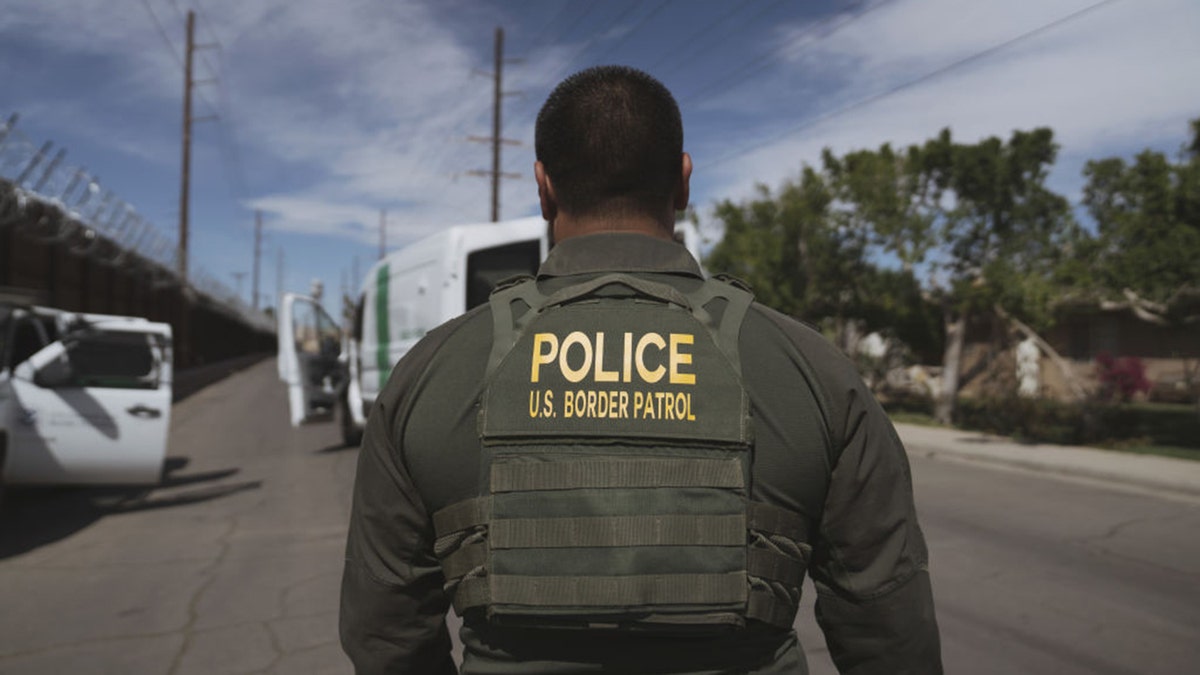
U.S. Border Patrol agents at the U.S. and Mexico border fence in Calexico, Calif. ( Eric Thayer/Bloomberg via Getty Images)
The data shows that, among those not in detention, there are 425,431 convicted criminals and 222,141 with pending criminal charges. The data does not reveal how many of those criminals are recent arrivals.
For comparison, in August 2016, toward the end of the Obama administration, ICE said there were about 2.2 million noncitizens on the non-detained docket and about 368,574 were convicted criminals.
In the latest data, the criminals include 62,231 convicted of assault, 14,301 convicted of burglary, 56,533 with drug convictions and 13,099 convicted of homicide. An additional 2,521 have kidnapping convictions, and 15,811 have sexual assault convictions. There are an additional 1,845 with pending homicide charges, 42,915 with assault charges, 3,266 with burglary charges and 4,250 with assault charges.
The White House did not immediately respond to requests for comment on the data and whether it had been aware of the numbers. Vice President Kamala Harris’ campaign also did not comment. Harris is at the southern border in Arizona.
Fox News Digital has also reached out to the Department of Homeland Security.
The news sparked outrage from Republicans, who tied the numbers to the policies of the Biden administration and those sanctuary jurisdictions who refuse to cooperate with ICE.
Rep, Gonzales called the data "beyond disturbing" and said "it should be a wake-up call for the Biden-Harris administration and cities across the country that hide behind sanctuary policies."
"It’s time for Washington to move past rhetoric and toward results. Americans deserve to feel safe in their communities. As an appropriator, I will do everything in my power to ensure ICE has the resources necessary to deport noncitizens with a criminal record. This must be a priority," Gonzales said in a statement.
"The Biden-Harris administration also plays a part in cleaning up the mess their failed policies have created. They have the ear of sanctuary city mayors. It’s time to encourage them to reverse course and put the safety of American citizens first."
Homeland Security Committee Chairman Mark Green said the release of illegal immigrants into the U.S. "defies all common sense."
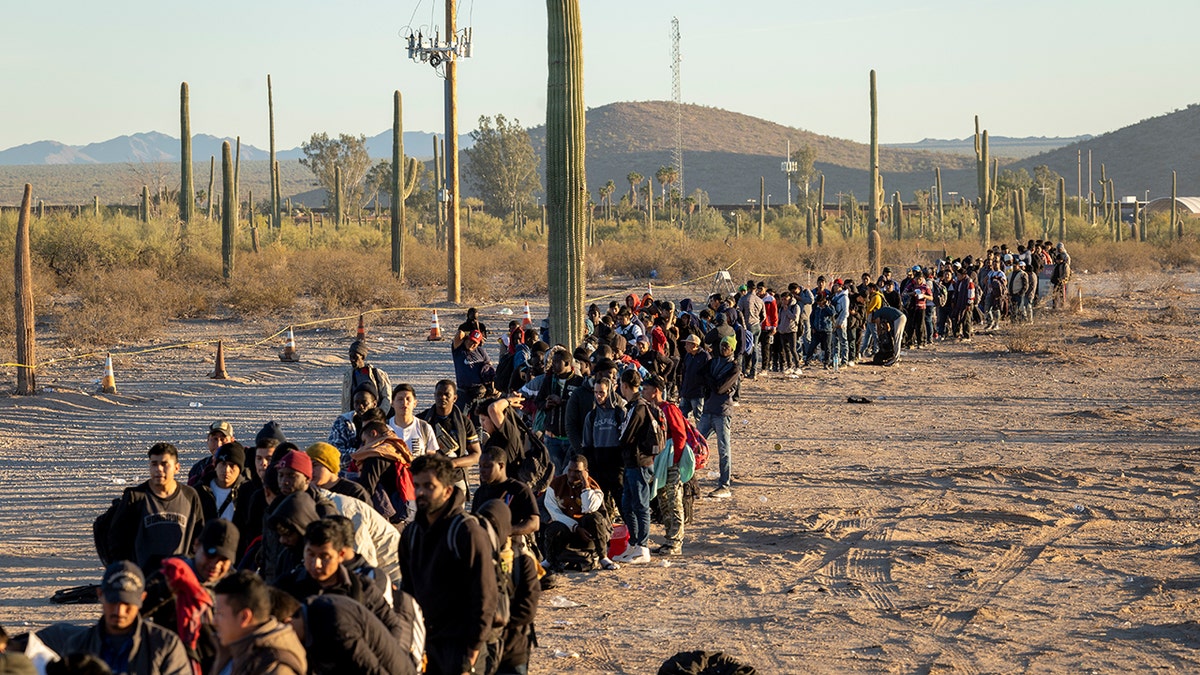
Immigrants line up at a remote U.S. Border Patrol processing center after crossing the U.S.-Mexico in Lukeville, Ariz. (John Moore/Getty Images)
"This is madness. It is something no civilized, well-functioning society should tolerate," he said.
In the letter to Gonzales, ICE took aim at so-called "sanctuary" cities that refuse to cooperate with federal law enforcement in deporting illegal immigrant criminals.
"ICE recognizes that some jurisdictions are concerned that cooperating with federal immigration officials will erode trust with immigrant communities and make it harder for local law enforcement to serve those populations. However, ‘sanctuary’ policies can end up shielding dangerous criminals, who often victimize those same communities," it said.
reporter sez trump will strip fema money
It also stressed DHS’s efforts to remove illegal immigrants.
"From mid-May 2023 through the end of July 2024, DHS removed or returned more than 893,600 individuals, including more than 138,300 individuals in family units. The majority of all individuals encountered at the Southwest Border over the past three years have been removed, returned or expelled."
In a statement on Saturday, DHS said the data was being "misinterpreted."
"The data goes back decades; it includes individuals who entered the country over the past 40 years or more, the vast majority of whose custody determination was made long before this Administration," a spokesperson said. "It also includes many who are under the jurisdiction or currently incarcerated by federal, state or local law enforcement partners."
The administration has said it needs more funding and reforms from Congress to fix a "broken" immigration system, including via a bipartisan Senate bill introduced this year – which has been rejected by Republicans. DHS said that bill would have provided much-needed resources, including additional immigration enforcement agents and officers and additional detention resources.
It has also pointed to a sharp drop in arrivals since President Biden signed an executive order limiting asylum at the border in June. DHS also said it has removed over 180,000 noncitizens with criminal convictions since Jan. 2021.
**CLICK HERE FOR MORE COVERAGE OF THE BORDER SECURITY CRISIS**
The Biden administration has prioritized the removal of public safety and national security threats in narrowed priorities it released in 2021, but critics have linked those priorities with a drop in ICE removals.
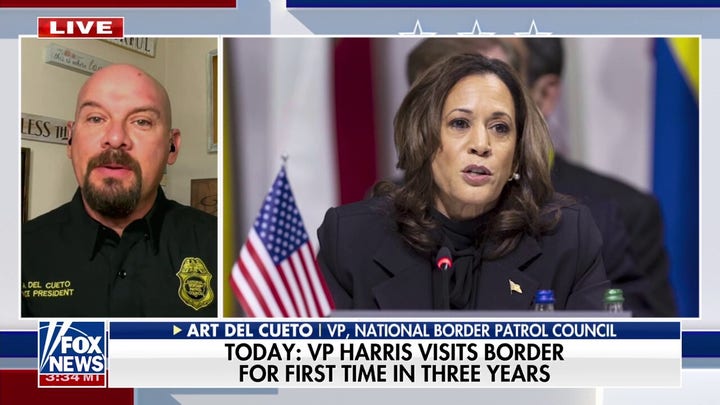 Video
Republicans have blamed the border crisis on the policies of the administration, including rolling back Trump policies that limited "catch and release."
Asked about the increase in the non-detained docket this summer, a White House spokesperson pointed to that bill.
"Congressional Republicans had an opportunity to support the fairest and toughest set of reforms in decades, and they chose to put partisan political interests ahead of fixing our immigration system and securing our borders," the spokesperson said.
"Congressional Republicans have proven that they do not care about securing our border because, frankly, if they did, they would have supported the bipartisan agreement."
**CLICK HERE TO GET THE FOX NEWS APP**
The data’s release comes as Harris visits the southern border in Arizona and seeks to present herself as tougher on the border than former President Trump, who she blames for the border bill not passing.
"Donald Trump tanked a bill to improve border security — just so he can win this election," she said Friday. "As I have shown throughout my career, I won’t back down from my plan to make our border more secure."
*Fox News' Bill Melugin contributed to this report.
Adam Shaw is a politics reporter for Fox News Digital, primarily covering immigration and border security.
an 2 23
kentucky State Representative Josie Raymond (D-31st District) delivered an impassioned floor speech on Wednesday in opposition to legislation that would nullify federal firearm restrictions across The Bluegrass State.
Assemblyman Josh Bray's (R-71st District) House Bill 153 "would make Kentucky a Second Amendment sanctuary" and "is a duplicate bill filed last year that would essentially prevent a federal ban on firearms — were it to happen — from applying inKentucky," where "115 out of 120 counties already have Second Amendment sanctuaries in place," Link nky reported on Tuesday.
After the measure was approved by the Republican-dominated House Veterans, Military, and Public Protection Committee, the proposal advanced for debate by the full chamber, at which point Raymond stood up and excoriated her GOP colleagues for prioritizing weapons of mass death over human lives.
READ MORE: 'This is the second mass shooting': MSU and Sandy Hook survivor's video goes viral
"So I think I speak for a lot of people watching when I say, what are y'all doing? Why are we wasting time and resources passing unnecessary, unwise, unconstitutional legislation to pledge allegiance to hunks of metal that are being used to kill our children?" Raymond asked. "Sometimes in public policy, you know that it takes a tragedy to force policy change to force action from elected representatives. Unfortunately, when it comes to gun violence, we know better."
Raymond recalled that "when children were killed at Marshall County High School, this body did not act to keep guns out of the hands of children. Instead, this body said that newspapers could not publish pictures of the mutilated little bodies of our children after they've been shot and killed at school."
Raymond noted that "against the wishes of police,this body passed legislation to allow the carrying of guns – concealed guns – without any permit or training. Practical or merely symbolic, mere posturing, when we pass legislation that salutes guns over the lives of Kentuckians, we're making it known who we really serve."
Concluding her remarks, Raymond exclaimed that "this is lunacy, Mr. Speaker! This is idiocy. And I vote no."
Watch below or at this link.
aha: state of exception/marginal is where criminalization and militarization (related) are deployed 1st (except maybe loss of privacy 1st surveillance)
eg
https://www.vox.com/2020/2/14/21138272/cbp-tactical-ice-immigrants-sanctuary-cities
i'm using sanc city as proxy fro Dem/target by barr, trump and
...an 920
On top of the Trump administration’s disinformation campaign, the notion that the federal government is going to withhold federal funds from three of its top contributing cities is ludicrous.
All three cities rank in the top 10 per capita income for the 25 most populated cities in the U.S.: Seattle was second, Portland eighth, and New York 10th. Because states and cities with a larger share of higher income residents contribute more to the federal government, these three cities alone likely contribute more tax dollars to federal coffers than most red states, which have been feeding at the federal trough for decadeswhile contributing far less money to its bottom line. New York and the northeastern states, in particular, are “giver” states, while most red states, especially in the southeast, are “getter” states, according to a Rockefeller Institute of Government study.
But now that Barr has homed in on the cities he wants to target and delivered supposed criteria for determining which cities fall into that category, the next step, according to Trump’s presidential memo, is for thedirector of the Office of Management and Budget, Russell Vought, to issue guidance to the heads of certain agencies on “restricting eligibility of or otherwise disfavoring, to the maximum extent permitted by law, anarchist jurisdictions in the receipt of federal grants.”
Again, such a direction will undoubtedly be challenged in court and tied up until long after the election. So at this point, it’s nothing more than another lawless effort by Trump to target cities run by Democrats in order to gin up and delight his “getter” constituency in the red states.
If Joe Biden wins, this ridiculous presidential directive will obviously fall onto a scrap heap of other lawless Trump directives targeting Democrats, liberals, and certain demographic groups purely for Trump’s political benefit and pandering to his supporters.
But if Trump manages to somehow steal this election, the directive is simply one more reason why we could see a serious effort by Democratic states to leave the union. There’s absolutely no reason for those states and their densely populated liberal cities to stick around for Trump’s presidential harassment while the federal government bleeds them dry.
==
MIRROR OPPOSITE APPROACH:
https://www.alternet.org/2020/09/bill-barr-had-deep-links-to-the-origins-of-central-american-migration-crisis-long-before-trump/
...
JUAN GONZÁLEZ: Well, Roberto, you begin the book talking about a tour you were giving in 1992 in Los Angeles at the time you were working with the immigrant rights group CARECEN in Los Angeles. And you’re touring around a foundation program officer, one of these people who decides whether to give money to worthy organizations. And you had very mixed feelings taking him around the Pico-Union area of Los Angeles. There’s a sudden shootout at one point. Could you talk about that whole part of your work with CARECEN? Also, what lessons might be drawn for a lot of activists today, Black Lives Matter activists and prison reform activists, who are suddenly being courted by foundations who suddenly have discovered that they haven’t been properly funding antiracism programs around the country?
ROBERTO LOVATO: That’s a great question, Juan. Yeah, the opening, the introduction of the book, is 1992, right after the L.A. riots had hit. We had foundations and corporations come in, along with scholars, and it was just people interested in post-riot L.A. And we were in MacArthur Park touring, like we did. I felt like — and I say at one point I felt like, you know, I was getting tired of being like Virgil to these Dantes, you know, these aspiring Dantes wanting to see the underworld. And so, I’m showing this guy, Leland, MacArthur Park,when I’m approached by the first MS-13 member I ever met, this kid named José. And, you know, we were — and I could tell that Leland was scared out of his wits, like he was in a lion’s den or something, and he was looking to me for security.
And so, I open it that way because it shows kind of the way that the whole issue of youth and urban youth and gangs, even foundations and corporations will kind of shy away from, as do legislators, including legislators of color here in California, where the gangs were born, in fact, where MS-13 and 18th Street were born. And then, after they were born, they kind of adopted the structures of like the Mexican Mafia. And so, I’m there when this is starting to escalate and get more violent.
And then, Attorney General William Barr, again, and at the avatar, from the Bush administration, who’s now in the Trump administration, deployed all these FBI resources to L.A. and other cities to start the gang war, which, you know, we see the products as we speak, right? And so, then he also introduced the INS to then join the LAPD and law enforcement to deport the “problem,” the gang structures, to El Salvador.
...
AMY GOODMAN: Finally, William Barr, the current attorney general, the attorney general under George H.W. Bush — we just have a minute, but as you wrap up, Roberto, what is his connection to this story?
ROBERTO LOVATO: William Barr, as attorney general under the first Bush, redeployed FBI resources, in the greatest deployment of FBI resources up to that point, taking FBI agents who were fighting foreign — you know, looking at foreign “threats,” and started focusing them on gangs. And then he starts looking at MS-13 and other gangs right after the L.A. riots. You can see he was there in L.A., and he started us on the path to eventually, like, militarizing the police, that we have right now. And then, he then also had the INS deport the gang “problem” to El Salvador, and then he exported, after the war, U.S.-style policing. And then, I found out that military trainers from El Salvador actually came to train LAPD in counterinsurgency, and other police forces. It’s just when you start seeing the Robocopization of cop uniforms — right? — and that we have now. And William Barr had everything to do with — had not everything, but he had a lot to do with this. I had to sing his song, because he deserves all the credit he deserves for what he did to El Salvador and to L.A. and to our national situation long before Trump....
==
https://www.alternet.org/2020/09/donald-trump-and-william-barr-plan-to-defund-americas-cities-using-authority-they-just-made-up/
==
820
border Patrol Launches Militarized Raid of Borderlands Humanitarian Aid Camp
Ryan Devereaux
For the second time in two years, Border Patrol launched a raid against No More Deaths within days of the group releasing embarrassing information about the agency.
==
https://en.wikipedia.org/wiki/Sanctuary_city
Sanctuary city (French: ville sanctuaire; Spanish: ciudad santuario) refers to municipal jurisdictions, typically in North America, that limit their cooperation with the national government's effort to enforce immigration law. Leaders of sanctuary cities say they want to reduce fear of deportation and possible family break-up among people who are in the country illegally, so that such people will be more willing to report crimes, use health and social services, and enroll their children in school. In the United States, municipal policies include prohibiting police or city employees from questioning people about their immigration status and refusing requests by national immigration authorities to detain people beyond their release date, if they were jailed for breaking local law.[1] Such policies can be set expressly in law (de jure) or observed in practice (de facto), but the designation "sanctuary city" does not have a precise legal definition. The Federation for American Immigration Reform estimated in 2018 that 564 U.S. jurisdictions, including states and municipalities, had adopted sanctuary policies.[2][3][4]
Studies on the relationship between sanctuary status and crime have found that sanctuary policies either have no effect on crime or that sanctuary cities have lower crime rates and stronger economies than comparable non-sanctuary cities.[5][6][7][8] Opponents of sanctuary cities argue that cities should assist the national government in enforcing immigration law. Supporters of sanctuary cities argue that enforcement of federal law is not the duty of localities, and that law enforcement resources can be prioritized towards better purposes.[9]
European cities have been inspired by the same political currents of the sanctuary movement as American cities, but the term "sanctuary city" now has different meanings in Europe and North America.[10] In the United Kingdom and Ireland, and in continental Europe, sanctuary city refers to cities that are committed to welcoming refugees, asylum seekers and others who are seeking safety. Such cities are now found in 80 towns, cities and local areas in England, Wales, Scotland and Northern Ireland.[11] The emphasis is on building bridges of connection and understanding, which is done through raising awareness, befriending schemes and forming cultural connections in the arts, sport, health, education, faith groups and other sectors of society.[12] Glasgow and Swansea have become known as noted sanctuary cities.[11][13][14]
- :{1:(style="display:table-cell;padding-left:0px;padding-right:0.5em"):}::{Tradition:(style="display:table-cell"):}:
- :{2:(style="display:table-cell;padding-left:0px;padding-right:0.5em"):}::{United States:(style="display:table-cell"):}:
- :{2.1:(style="display:table-cell;padding-left:0px;padding-right:0.5em"):}::{History:(style="display:table-cell"):}:
- :{2.2:(style="display:table-cell;padding-left:0px;padding-right:0.5em"):}::{Terminology:(style="display:table-cell"):}:
- :{2.3:(style="display:table-cell;padding-left:0px;padding-right:0.5em"):}::{Electoral politics:(style="display:table-cell"):}:
- :{2.4:(style="display:table-cell;padding-left:0px;padding-right:0.5em"):}::{Effects:(style="display:table-cell"):}:
- :{2.4.1:(style="display:table-cell;padding-left:0px;padding-right:0.5em"):}::{Crime:(style="display:table-cell"):}:
- :{2.4.2:(style="display:table-cell;padding-left:0px;padding-right:0.5em"):}::{Economy:(style="display:table-cell"):}:
- :{2.4.3:(style="display:table-cell;padding-left:0px;padding-right:0.5em"):}::{Health and well-being:(style="display:table-cell"):}:
- :{2.5:(style="display:table-cell;padding-left:0px;padding-right:0.5em"):}::{Laws and policies by state and city:(style="display:table-cell"):}:
- :{2.5.1:(style="display:table-cell;padding-left:0px;padding-right:0.5em"):}::{Alabama:(style="display:table-cell"):}:
- :{2.5.2:(style="display:table-cell;padding-left:0px;padding-right:0.5em"):}::{Arizona:(style="display:table-cell"):}:
- :{2.5.3:(style="display:table-cell;padding-left:0px;padding-right:0.5em"):}::{Arkansas:(style="display:table-cell"):}:
- :{2.5.4:(style="display:table-cell;padding-left:0px;padding-right:0.5em"):}::{California:(style="display:table-cell"):}:
- :{2.5.5:(style="display:table-cell;padding-left:0px;padding-right:0.5em"):}::{Colorado:(style="display:table-cell"):}:
- :{2.5.6:(style="display:table-cell;padding-left:0px;padding-right:0.5em"):}::{Connecticut:(style="display:table-cell"):}:
- :{2.5.7:(style="display:table-cell;padding-left:0px;padding-right:0.5em"):}::{Florida:(style="display:table-cell"):}:
- :{2.5.8:(style="display:table-cell;padding-left:0px;padding-right:0.5em"):}::{Georgia:(style="display:table-cell"):}:
- :{2.5.9:(style="display:table-cell;padding-left:0px;padding-right:0.5em"):}::{Illinois:(style="display:table-cell"):}:
- :{2.5.10:(style="display:table-cell;padding-left:0px;padding-right:0.5em"):}::{Iowa:(style="display:table-cell"):}:
- :{2.5.11:(style="display:table-cell;padding-left:0px;padding-right:0.5em"):}::{Louisiana:(style="display:table-cell"):}:
- :{2.5.12:(style="display:table-cell;padding-left:0px;padding-right:0.5em"):}::{Maine:(style="display:table-cell"):}:
- :{2.5.13:(style="display:table-cell;padding-left:0px;padding-right:0.5em"):}::{Maryland:(style="display:table-cell"):}:
- :{2.5.14:(style="display:table-cell;padding-left:0px;padding-right:0.5em"):}::{Massachusetts:(style="display:table-cell"):}:
- :{2.5.15:(style="display:table-cell;padding-left:0px;padding-right:0.5em"):}::{Michigan:(style="display:table-cell"):}:
- :{2.5.16:(style="display:table-cell;padding-left:0px;padding-right:0.5em"):}::{Minnesota:(style="display:table-cell"):}:
- :{2.5.17:(style="display:table-cell;padding-left:0px;padding-right:0.5em"):}::{Mississippi:(style="display:table-cell"):}:
- :{2.5.18:(style="display:table-cell;padding-left:0px;padding-right:0.5em"):}::{Missouri:(style="display:table-cell"):}:
- :{2.5.19:(style="display:table-cell;padding-left:0px;padding-right:0.5em"):}::{Nevada:(style="display:table-cell"):}:
- :{2.5.20:(style="display:table-cell;padding-left:0px;padding-right:0.5em"):}::{New York:(style="display:table-cell"):}:
- :{2.5.21:(style="display:table-cell;padding-left:0px;padding-right:0.5em"):}::{New Jersey:(style="display:table-cell"):}:
- :{2.5.22:(style="display:table-cell;padding-left:0px;padding-right:0.5em"):}::{North Carolina:(style="display:table-cell"):}:
- :{2.5.23:(style="display:table-cell;padding-left:0px;padding-right:0.5em"):}::{Ohio:(style="display:table-cell"):}:
- :{2.5.24:(style="display:table-cell;padding-left:0px;padding-right:0.5em"):}::{Oregon:(style="display:table-cell"):}:
- :{2.5.25:(style="display:table-cell;padding-left:0px;padding-right:0.5em"):}::{Pennsylvania:(style="display:table-cell"):}:
- :{2.5.26:(style="display:table-cell;padding-left:0px;padding-right:0.5em"):}::{Rhode Island:(style="display:table-cell"):}:
- :{2.5.27:(style="display:table-cell;padding-left:0px;padding-right:0.5em"):}::{South Carolina:(style="display:table-cell"):}:
- :{2.5.28:(style="display:table-cell;padding-left:0px;padding-right:0.5em"):}::{Tennessee:(style="display:table-cell"):}:
- :{2.5.29:(style="display:table-cell;padding-left:0px;padding-right:0.5em"):}::{Texas:(style="display:table-cell"):}:
- :{2.5.30:(style="display:table-cell;padding-left:0px;padding-right:0.5em"):}::{Vermont:(style="display:table-cell"):}:
- :{2.5.31:(style="display:table-cell;padding-left:0px;padding-right:0.5em"):}::{Washington:(style="display:table-cell"):}:
- :{3:(style="display:table-cell;padding-left:0px;padding-right:0.5em"):}::{Canada:(style="display:table-cell"):}:
- :{4:(style="display:table-cell;padding-left:0px;padding-right:0.5em"):}::{Colombia:(style="display:table-cell"):}:
- :{5:(style="display:table-cell;padding-left:0px;padding-right:0.5em"):}::{United Kingdom:(style="display:table-cell"):}:
- :{6:(style="display:table-cell;padding-left:0px;padding-right:0.5em"):}::{See also:(style="display:table-cell"):}:
- :{7:(style="display:table-cell;padding-left:0px;padding-right:0.5em"):}::{References:(style="display:table-cell"):}:
- :{8:(style="display:table-cell;padding-left:0px;padding-right:0.5em"):}::{Further reading:(style="display:table-cell"):}:
Tradition[
The concept of a sanctuary city goes back thousands of years. It has been associated with Christianity, Islam, Judaism, Buddhism, Baha'i, Sikhism, and Hinduism.[15] In Western Civilization, sanctuary cities can be traced back to the Old Testament. The Book of Numbers commands the selection of six cities of refuge in which the perpetrators of accidental manslaughter could claim the right of asylum. Outside of these cities, blood vengeance against such perpetrators was allowed by law.[16] In AD 392, Christian Roman emperor Theodosius I set up sanctuaries under church control. In AD 600 in medieval England, churches were given a general right of sanctuary, and some cities were set up as sanctuaries by Royal charter. The general right of sanctuary for churches in England was abolished in 1621.[15]
United States[
See also: Illegal immigration to the United States
History[
The movement that established sanctuary cities in the United States began in the early 1980s. The movement traces its roots to religious philosophy, as well as the histories of resistance movements to perceived state injustices.[17] The sanctuary city movement took place in the 1980s to challenge the US government's refusal to grant asylum to certain Central American refugees.[18] These asylum seekers were arriving from countries in Central America like El Salvador and Guatemala that were politically unstable. More than 75,000 Salvadoreans and 200,000 Guatemalans were killed by their governments in efforts to suppress the communist movement in those countries at the time.[19] Faith based groups in the US Southwest initially drove the movement of the 1980s, with eight churches publicly declaring to be sanctuaries in March 1982.[20] John Fife, a minister and movement leader, famously wrote in a letter to Attorney General William Smith: "the South-side United Presbyterian Church will publicly violate the Immigration and Nationality Act by allowing sanctuary in its church for those from Central America."[21]
A milestone in the U.S. sanctuary city movement occurred in 1985 in San Francisco, which passed the largely symbolic “City of Refuge” resolution. The resolution was followed the same year by an ordinance which prohibited the use of city funds and resources to assist federal immigration enforcement–the defining characteristic of a sanctuary city in the U.S.[22] As of 2018 more than 560 cities, states and counties considered themselves sanctuaries.[4]
...
Electoral politics:{:(style="margin-right:0.25em"):}:[edit:{]}:
This issue entered presidential politics in the race for the Republican Party Presidential Nomination in 2008. Colorado Congressman Tom Tancredo ran on an anti-illegal immigration platform and specifically attacked sanctuary cities. Former Massachusetts Governor Mitt Romney accused Former New York City Mayor Rudy Giuliani of running it as a sanctuary city.[28] Mayor Giuliani's campaign responded saying that Governor Romney ran a sanctuary Governor's mansion, and that New York City is not a "haven" for undocumented immigrants.[28]
Following the shooting death of Kathryn Steinle in San Francisco (a sanctuary city) by an undocumented immigrant, Former Secretary of State Hillary Clinton (D-NY) told CNN that "The city made a mistake, not to deport someone that the federal government strongly felt should be deported. I have absolutely no support for a city that ignores the strong evidence that should be acted on."[29] The following day, her campaign stated: "Hillary Clinton believes that sanctuary cities can help further public safety, and she has defended those policies going back years."[30]
Trump administration agenda:{:(style="margin-right:0.25em"):}:[edit:{]}:
On March 6, 2018, the U.S. Justice Department sued the state of California, the Governor Jerry Brown, and the state's attorney general, Xavier Becerra, over three state laws passed in recent months, saying the laws made it impossible for federal immigration officials to do their jobs and deport criminals who were born outside the United States. The Justice Department called the laws unconstitutional and asked a judge to block them. The lawsuit says the state laws “reflect a deliberate effort by California to obstruct the United States’ enforcement of federal immigration law.”[31] The Trump administration previously released a list of immigration principles to Congress. The list included funding a wall along the U.S.-Mexico border, a crackdown on the influx of Central American minors, and curbs on federal grants to sanctuary cities.[32] A pledge to strip "all federal funding to sanctuary cities" was a key Trump campaign theme. President Trump issued an executive order which declared that jurisdictions that "refuse to comply" with 8 U.S.C. 1373—a provision of federal law on information sharing between local and federal authorities—would be ineligible to receive federal grants.[33]
States and cities have shown varying responses to the executive order. Thirty-three states introduced or enacted legislation requiring local law enforcement to cooperate with ICE officers and requests to hold non-citizen inmates for deportation. Other states and cities have responded by not cooperating with federal immigration efforts or by showcasing welcoming policies towards immigrants.[33] California openly refused the administration's attempts to "clamp down on sanctuary cities". A federal judge in San Francisco agreed with two California municipalities that a presidential attempt to cut them off from federal funding for not complying with deportation requests was unconstitutional,[34] ultimately issuing a nationwide permanent injunction against the facially unconstitutional provisions of the order.[35] On March 27, 2018, the all-Republican Board of Supervisors in Orange County, California voted to join the Justice Department's lawsuit against the state.[36] In Chicago a federal judge ruled that the Trump administration may not withhold public safety grants to sanctuary cities. These decisions have been seen as a setback to the administration's efforts to force local jurisdictions to help federal authorities with the policing of illegal immigrants.[37] On July 5, 2018, a federal judge upheld two of California's Sanctuary laws, but struck down a key provision in the third.[38]
Local officials who oppose the president's policies say that complying with federal immigration officers will ruin the trust established between law enforcement and immigrant communities. Supporters of the president's policies say that protection of immigrants from enforcement makes communities less safe and undermines the rule of law.[37] On July 12, 2019 federal appeals court in Seattle in a 2-to-1 opinion overturned a nationwide injunction issued last year by a federal judge in Los Angeles. The appeals court said awarding extra points in the application process to cities that cooperate was consistent with the goals of the grant program created by Congress.[39]
Federal Law:{:(style="margin-right:0.25em"):}:[edit:{]}:
The Illegal Immigration Reform and Immigrant Responsibility Act of 1996 addressed the relationship between the federal government and local governments. Minor crimes, such as shoplifting, became grounds for possible deportation.[40] Additionally, the legislation outlawed cities' bans against municipal workers reporting a person's immigration status to federal authorities.[41]
Section 287(g) makes it possible for state and local law enforcement personnel to enter into agreements with the federal government to be trained in immigration enforcement and, subsequent to such training, to enforce immigration law. However, it provides no general power for immigration enforcement by state and local authorities.[42] This provision was implemented by local and state authorities in five states, California, Arizona, Alabama, Florida and North Carolina by the end of 2006.[43] On June 16, 2007 the United States House of Representatives passed an amendment to a United States Department of Homeland Security spending bill that would withhold federal emergency services funds from sanctuary cities. Congressman Tom Tancredo (R-Colo.) was the sponsor of this amendment. 50 Democrats joined Republicans to support the amendment. The amendment would have to pass the United States Senate to become effective.[44]
In 2007, Republican representatives introduced legislation targeting sanctuary cities. Reps. Brian Bilbray, R-Calif., Ginny Brown-Waite, R-Fla., Thelma Drake, R-Va., Jeff Miller, R-Fla., and Tom Tancredo introduced the bill. The legislation would make undocumented immigrant status a felony, instead of a civil offense. Also, the bill targets sanctuary cities by withholding up to 50 percent of Department of Homeland Security funds from the cities.[45]
On September 5, 2007, Department of Homeland Security Secretary Michael Chertoff told a House committee that he certainly wouldn't tolerate interference by sanctuary cities that would block his "Basic Pilot Program" that requires employers to validate the legal status of their workers. "We're exploring our legal options. I intend to take as vigorous legal action as the law allows to prevent that from happening, prevent that kind of interference."[46][47]
On January 25, 2017 President Donald Trump signed Executive Order 13768 directing the Secretary of Homeland Security and Attorney General to defund sanctuary jurisdictions that refuse to comply with federal immigration law.[48] He also ordered the Department of Homeland Security to begin issuing weekly public reports that include "a comprehensive list of criminal actions committed by aliens and any jurisdiction that ignored or otherwise failed to honor any detainers with respect to such aliens."[48] Ilya Somin, Professor of Law at George Mason University, has argued that Trump's withholding of federal funding would be unconstitutional: "Trump and future presidents could use [the executive order] to seriously undermine constitutional federalism by forcing dissenting cities and states to obey presidential dictates, even without authorization from Congress. The circumvention of Congress makes the order a threat to separation of powers, as well."[49] On April 25, 2017, U.S. District Judge William Orrick issued a nationwide preliminary injunction halting this executive order.[50][51] The injunction was made permanent on November 20, 2017, when Judge Orrick ruled that section 9(a) of the order was "unconstitutional on its face".[52] The judgment concluded that the order violates "the separation of powers doctrine and deprives [the plaintiffs] of their Tenth and Fifth Amendment rights."[53]
In December 2018 the Ninth U.S. Circuit Court of Appeals struck down a federal law that criminalized encouraging people to enter or live in the U.S. illegally. The court said the law was too broad in restricting the basic right of free speech under the First Amendment to the U.S. Constitution. Opponents of the law argued that it was a danger to lawyers advising immigrants and to public officials who support sanctuary policies.[54][55][56]
Jurisdiction
Whether federal or local government has jurisdiction to detain and deport undocumented immigrants is a tricky and unsettled issue, because the U.S. Constitution does not provide a clear answer. Both federal and local government offer arguments to defend their authority. The issue of jurisdiction has been vigorously debated dating back to the Alien Act of 1798.[57] Opponents of local level policing tend to use the Naturalization Clause and the Migration clause in the Constitution as textual confirmation of federal power. Because the Supremacy Clause is generally interpreted to mean that federal law takes priority over state law, the U.S. Supreme Court in the majority of cases has ruled in favor of the federal government. Certain states have been affected by illegal immigration more than others and have attempted to pass legislation that limits access by undocumented immigrants to public benefits. A notable case was Arizona's SB 1070 law, which was passed in 2010 and struck down in 2012 by the Supreme Court as unconstitutional.[58]
States like Arizona, Texas and Nevada justify the aggressive actions they have taken to be the result of insufficient efforts by the federal government to address issues, like the use of schools and hospitals by illegal immigrants, and changes to the cultural landscape—impacts that are most visible on a local level.[59] Ambiguity and confusion over jurisdiction is one of the reasons why local and state policies for and against sanctuary cities vary widely depending on the location in the country.
Effects:{:(style="margin-right:0.25em"):}:[edit:{]}:
Crime:{:(style="margin-right:0.25em"):}:[edit:{]}:
Studies show that sanctuary cities either have no impact on crime or that they lower the crime rate.[7][60][61][62][63][6][64][65] A 2017 study in the journal Urban Affairs Review found that sanctuary policy itself has no statistically meaningful effect on crime.[63][5][66][67][68] The findings of the study were misinterpreted by Attorney General Jeff Sessions in a July 2017 speech when he claimed that the study showed that sanctuary cities were more prone to crime than cities without sanctuary policies.[69][70] A third study in the journal Justice Quarterly found evidence that the adoption of sanctuary policies reduced the robbery rate, but had no impact on the homicide rate except in cities with larger Mexican undocumented immigrant populations, which had lower rates of homicide.[62]
According to a study by Tom K. Wong, associate professor of political science at the University of California, San Diego, published by the Center for American Progress, a progressive think tank: "Crime is statistically significantly lower in sanctuary counties compared to non-sanctuary counties. Moreover, economies are stronger in sanctuary counties – from higher median household income, less poverty, and less reliance on public assistance, to higher labor force participation, higher employment-to-population ratios, and lower unemployment."[6] The study also concluded that sanctuary cities build trust between local law enforcement and the community, which enhances public safety overall.[71] The study evaluated sanctuary and non-sanctuary cities while controlling for differences in population, the foreign-born percentage of the population, and the percentage of the population that is Latino."[6]
A 2020 study found that California Senate Bill 54 (2017), a sanctuary city legislation, had no significant impact on violent and property crime rates in California.[72]
Economy:{:(style="margin-right:0.25em"):}:[edit:{]}:
Advocates of local enforcement of immigration laws argue that more regulatory local immigration policies would cause immigrants to flee those cities and possibly the United States altogether,[73] while opponents argue that regulatory policies on immigrants wouldn't affect their presence because immigrants looking for work will relocate towards economic opportunity despite challenges living there.[9] Undocumented migrants tend to be attracted to states with more economic opportunity and individual freedom.[74] Because there is no reliable data that asks for immigration status, there is no way to tell empirically if regulatory policies do have an effect on immigrant presence. A study comparing restrictive counties with nonrestrictive counties found that local jurisdictions that enacted regulatory immigration policies experienced a 1–2% negative effect in employment.[9]
Health and well-being:{:(style="margin-right:0.25em"):}:[edit:{]}:
A preliminary study's results imply that the number of sanctuary cities in the U.S. positively affects well-being in the undocumented immigrant population.[75] Concerning health, a study in North Carolina found that after implementation of section 287(g), prenatal Hispanic/Latina mothers were more likely than non-Hispanic/Latina mothers to have late or inadequate prenatal care. The study's interviews indicated that Hispanics/Latinos in the section 287(g) counties had distrust in health services among other services and had fear about going to the doctor.[76]
Laws and policies by state and city

Alabama[
Alabama has banned sanctuary cities.[77] The state law (Alabama HB 56) was enacted in 2011, calling for proactive immigration enforcement; however, many provisions are either blocked by the federal courts or subject to ongoing lawsuits.[78]
- On January 31, 2017, William A. Bell, the mayor of Birmingham, declared the city a "welcoming city" and said that the police would not be "an enforcement arm of the federal government" with respect to federal immigration law. He also stated that the city would not require proof of citizenship for granting business licenses. The Birmingham City Council subsequently passed a resolution supporting Birmingham being a "sanctuary city".[79]
Arizona:{:(style="margin-right:0.25em"):}:[edit:{]}:
Arizona has banned sanctuary cities.[77] Following the passage of Arizona SB 1070, a state law, few if any cities in Arizona are "sanctuary cities." A provision of SB 1070 requires local authorities to "contact federal immigration authorities if they develop reasonable suspicion that a person they've detained or arrested is in the country illegally."[80]
- The Center for Immigration Studies, an anti-immigration group, labels only one city in the state, South Tucson, a "sanctuary city"; the label is because South Tucson does not honor ICE detainers "unless ICE pays for cost of detention".[80]
Arkansas:{:(style="margin-right:0.25em"):}:[edit:{]}:
Arkansas has banned sanctuary cities.[77]
California:{:(style="margin-right:0.25em"):}:[edit:{]}:
On October 5, 2017, Governor Jerry Brown signed a bill, SB 54, that makes California a "sanctuary state". It prohibits local and state agencies from cooperating with ICE regarding illegal criminals who have committed misdemeanors.[81] According to the National Immigration Law Center in 2016, about a dozen California cities have some formal sanctuary policy, and none of the 58 California counties "complies with detainer requests by U.S. Immigration and Customs Enforcement."[82]
- Berkeley became the first city in the United States to pass a sanctuary resolution on November 8, 1971.[83] Additional local governments in certain cities in the United States began designating themselves as sanctuary cities during the 1980s.[84][85] Some have questioned the accuracy of the term "sanctuary city" as used in the US.[86] The policy was initiated in 1979 in Los Angeles, to prevent the Los Angeles Police Department (LAPD) from inquiring about the immigration status of arrestees. Many Californian cities have adopted "sanctuary" ordinances banning city employees and public safety personnel from asking people about their immigration status.[87][88]
- Coachella - 95% Latino, 2nd highest percentage Latino city in Southern California, adopted the sanctuary policy in 2015.[89]
- Huntington Beach obtained a ruling from the state Supreme Court that the protections in California for immigrants who are in the country illegally do not apply to the 121 charter cities. The Orange County city is the first to successfully challenge SB 54.[90]
- Los Angeles – In 1979, the Los Angeles City Council adopted Special Order 40, barring LAPD officers from initiating contact with a person solely to determine their immigration status.[91] However, the city frequently cooperates with federal immigration authorities.[82] Los Angeles Mayor Eric Garcetti does not use the phrase "sanctuary city" to describe the city because the label is unclear.[82]
- San Francisco "declared itself a sanctuary city in 1989, and city officials strengthened the stance in 2013 with its 'Due Process for All' ordinance. The law declared local authorities could not hold immigrants for immigration officials if they had no violent felonies on their records and did not currently face charges."[82] The city issues a Resident ID Card regardless of the applicant's immigration status.[92] The 2015 shooting of Kathryn Steinle provoked debate about San Francisco's "sanctuary city" policy.[93]
- Seaside – On March 29, 2017, Seaside became Monterey County's first sanctuary city.[94]
- Williams - 75% Latino, largest percentage Latino town in Northern California, adopted the policy in 2015.[95]
Colorado:{:(style="margin-right:0.25em"):}:[edit:{]}:
On May 29, 2019, Governor Jared Polis signed House Bill 1124 immediately prohibiting law enforcement officials in Colorado from holding undocumented immigrants solely on the basis of a request from U.S. Immigration and Customs Enforcement.[96]
- Boulder[97] became a sanctuary city in 2017.
- Denver does not identify as a sanctuary city. The Denver Post reports: "The city doesn't have an ordinance staking out a claim or barring information-sharing with federal officials about a person's immigration status, unlike some cities. But it is among cities that don't enforce immigration laws or honor federal 'detainer' requests to hold immigrants with suspect legal status in jail past their release dates.[98]
- Estes Park police chief Wes Kufeld stated that, "As far as day-to-day policing, people are not required to provide proof of immigration status, and our officers are not required by ICE to check immigration status, nor to conduct sweeps for undocumented individuals. So, we don’t do these things." He added that town police do assist ICE in the arrest and detainment of any illegal immigrant suspected of a felony.[99]
Connecticut:{:(style="margin-right:0.25em"):}:[edit:{]}:
See also: Elm City Resident Card
In 2013, Connecticut passed a law that gives local law enforcement officers discretion to carry out immigration detainer requests, though only for suspected felons.[100]
- Hartford passed an ordinance providing services to all residents regardless of their immigration in 2008. Said ordinance also prohibits police from detaining individuals based solely on their immigration status, or inquiring as to their immigration status. In 2016, the ordinance was amended to declare that Hartford is a "Sanctuary City", although the term itself does not have an established legal meaning.[101]
- On February 3, 2017, Middletown, CT declared itself a sanctuary city. This was in direct response to President Trump's executive order. Middletown's mayor, Daniel T Drew, said: “We don't just take orders from the President of the United States”[102]
Florida:{:(style="margin-right:0.25em"):}:[edit:{]}:
Florida has banned sanctuary cities.[77][103]
- In January 2017 Miami-Dade County rescinded a policy of insisting the U.S. government pay for detention of persons on a federal list. Republican Mayor Carlos Gimenez ordered jails to "fully cooperate" with Presidential immigration policy. He said he did not want to risk losing a larger amount of federal financial aid for not complying. The mayor said Miami-Dade County has never considered itself to be a sanctuary city.[104]
- St. Petersburg Democratic Mayor Rick Kriseman said residents from all backgrounds implored him to declare a sanctuary city. In February 2017 he blogged that, "I have no hesitation in declaring St. Petersburg a sanctuary from harmful federal immigration laws. We will not expend resources to help enforce such laws, nor will our police officers stop, question or arrest an individual solely on the basis that they may have unlawfully entered the United States." He said the county sheriff's office has ultimate responsibility for notifying federal officials about people illegally in the city. The mayor criticized President Trump for "demonization of Muslims."[105][106]
- In June 2019, Florida Governor Ron DeSantis signed a bill that bans sanctuary cities. The bill prohibits local governments from enacting "sanctuary" policies that protect undocumented immigrants from deportation and all law enforcement agencies in Florida will have to cooperate with federal immigration authorities.[107][108][109] Florida became the 12th state to ban sanctuary cities.[110]
Georgia:{:(style="margin-right:0.25em"):}:[edit:{]}:
Georgia banned "sanctuary cities" in 2010, and in 2016 went further by requiring local governments, in order to obtain state funding, to certify that they cooperate with federal immigration officials.[111]
- The mayor of Atlanta, Georgia in January 2017 declared the city was a “welcoming city” and “will remain open and welcoming to all”. This statement was in response to President's Trump's executive orders related to “public safety agencies and the communities they serve”. Nonetheless, Atlanta does not consider itself to be a “sanctuary city”.[112] Atlanta also has refused to house new ICE detainees in its jail, but will keep the current detainees.
Illinois:{:(style="margin-right:0.25em"):}:[edit:{]}:
On August 28, 2017, Illinois Governor Bruce Rauner signed a bill into law that prohibited state and local police from arresting anyone solely due to their immigration status or due to federal detainers.[113][114][115][116] Some fellow Republicans criticized Rauner for his action, claiming the bill made Illinois a sanctuary state. However, the Illinois associations for Sheriffs and Police Chiefs stated that the bill does not prevent cooperation with the federal government or give sanctuary for illegal immigrants. Both organizations support the bill.[117][118][119]
...
Oregon:{:(style="margin-right:0.25em;color:#54595d;"):}:[edit:{]}:
State law passed in 1987: "Oregon Revised Statute 181.850, which prohibits law enforcement officers at the state, county or municipal level from enforcing federal immigration laws that target people based on their race or ethnic origin, when those individuals are not suspected of any criminal activities.[169][170]
- Beaverton city council passed a resolution in January 2017 stating, in part, "The City of Beaverton is committed to living its values as a welcoming city for all individuals ...regardless of a person's ... immigration status" and that they would abide by Oregon state law of not enforcing federal immigration laws.[171]
- Corvallis[172]
- Portland[173]...
Washington:{:(style="margin-right:0.25em;color:#54595d;"):}:[edit:{]}:
Washington enacted a measure in June 2019 in favor of sanctuary cities, similar to California and Oregon laws which are among the strongest statewide mandates in the nation.[186]
- Seattle[187]
an 420
Trump says he might use pandemic relief funding to extort so-called sanctuary cities
https://www.alternet.org/2020/02/trumps-secret-police-things-are-heading-in-that-direction/
no lnx
Trump’s secret police? Things are heading in that direction
[President Donald J. Trump speaks with U.S. Customs and Border Protection officers coming in for their shift change, after President Trump attended a Roundtable on Immigration and Border Security Thursday, January 10, 2019, at the U.S. Border Patrol McAllen Station in McAllen, Texas. (Official White House Photo by Shealah Craighead)]
Written by John Stoehr, The Editorial Board February 18, 2020
I wrote this morning about the president’s new intimidation of sanctuary cities. He’s deploying 100 CBP agents, including BORTAC, which is a SWAT team for border security. The official goal is increasing deportations by 35 percent, but it’s pretty clear the aim is bullying local law enforcement into cooperating with federal authorities. I set the Times report in historical context, trying to explain, as I see it, how 9/11 sparked a chain reaction leading to what appears to be Donald Trump’s secret police force.
I end the piece by quoting Jenn Budd, a former Border Patrol agent turned civil rights activist, who reported a conversation she had with a former CBP official. She wrote:
Border Patrol does not believe they are a civilian law enforcement agency. They believe they are kin to the Marine Corps. They do not believe they are accountable to Congress, which is why they have no issues lying to them even while under oath.
They believe they are only accountable to … presidents like Trump. Border Patrol believes it is not required to answer to local police, FBI, CIA or any other law enforcement agency. They claim to be the “premiere” law enforcement agency, superior to all others. They say they will become a “national police force” to be used by a president to enforce laws even among citizens. (Italics are mine.)
Check out the whole thing here.
And while you’re there, please support my work by becoming a member!
Thanks. —John Stoehr
zoe also chair thompson?
w/ nadler demand info on military swat to sanct cities
==
==