UNIVERSITIES
===
target 3 25
see sinecure
SEE SCIENCE EXPERTISE DATA ~FASCISM
see also Hackademics, incubators
content lost? pages of space? fix capt 218
see campus free speech
see student suppression
see academic suppression pinko prof DEI
see divest
COI medical research, pharma
html fanning capt bak 621
---
cli obstr robts
...
Journalists
Journalists, like NGOs, have played a significant role in exposing climate
obstruction and debunking misinformation. For example, investigative outlets
such as Inside Climate News and DeSmog have helped to expose misinformation
and obstruction campaigns in the oil, gas, and coal industries, among many
others. Their work has included revealing the role that “influencers” hired by
PR firms play to promote their oil and gas clients (Chapter 6). Other news orga-
nizations, such as The Guardian, have run series examining the political tactics
of fossil fuel corporations (from whom they have stopped accepting advertis-
ing; Chapter 13). Early efforts by journalists to expose climate obstruction have
developed into coordinated actions to fight its spread. Groups such as Climate
Feedback, comprising science journalists, have emerged to fact-check climate
news stories and help readers evaluate the sources of these stories (Chapter 6).
As discussed, debunking misleading claims in this way is considered vital to
inoculating the public and making climate misinformation harder to spread.
Scholars
Academics, including scientists, also aid the efforts of policymakers, NGOs,
and journalists to expose and counter climate obstruction, and the results have
prompted legislative investigations, legal proceedings, newspaper reports, and
social media campaigns. CSSN,91 which includes 800 scholars worldwide,
encourages peer-reviewed research into obstruction. Some academics work
closely with journalists from organizations such as Climate Feedback to expose
and debunk misinformation. University researchers have also participated in
institutional campaigns to convince universities to disclose funding from the
fossil fuel industry, and more recently to “disassociate” from firms and indus-
tries that advance climate misinformation.92 While many of these campaigns
have been led by students, professors have also pressured their home institu-
tions to act. For example, campaigns by faculty at Brown University and the
University of California, San Diego in the United States and the University
Cambridge in the United Kingdom, among others, have sought to dissuade the
schools from engaging with companies that promote climate disinformation
by, for example, refusing their research funding (Chapter 13).
Students
Campuses around the world now face growing pressure to mitigate the risks
from taking industry funding, including its influence over research agendas
---
---}:
AN 10 25
The 27-page settlement proposal of demands sent by President Donald Trump to UCLA in exchange or $1.2 billion in funding, made public Friday, is being called a "gross federal overreach," according to anew report in Cal Matters.
The document was made public after public after the UCLA Faculty Association and the Council of University of California Faculty Associations sued the public university to disclose the information under the California Public Records Act.
The proposal outlines the administration’s vision for higher education that is free from efforts to promote diversity and transgender inclusion, according to Cal Matters.
While the university system argued that making the proposal public would cause it “irreparable harm” during ongoing negotiations with the Trump administration, it was released after a California superior court judge ordered it to do so, and the state Supreme Court rejected its appeal.
The list of demands was the result of the U.S. Department of Justice in July accusing the university of not doing enough to combat antisemitism during last year’s pro-Palestine protests, and for allegedly violating federal civil rights law.
Governor Gavin Newsom has characterized the fine as “extortion,” and UC President James Milliken said that paying the settlement would “completely devastate” the university system.
So far, Brown University, Dartmouth College, Massachusetts Institute of Technology (MIT), University of Arizona, University of Pennsylvania, University of Southern California (USC) and University of Virginia (UVA) have rejected Trump's compact due to concerns over academic freedom and institutional independence.
"In issuing the demands, the Trump administration initially withheld more than $500 million in research grants to UCLA. But its leverage remains unclear now after a federal judge ordered the administration to restore nearly all those grants in August and September," Cal Matters reports.
Among Trump's demands of UCLA:
*Hire a senior administrator to review UCLA’s policies related to diversity, equity and inclusion efforts, and eliminate “identity-based preferences” in faculty hiring and scholarship programs.
Prohibit the use of “personal statements, diversity narratives, or any applicant reference to racial identity as a means to introduce or justify discrimination” in its admissions process. (A 2023 U.S. Supreme Court ruling already prohibits race-based admissions, though students are free to submit essays that detail how race affected their lives.)
Prohibit the UCLA School of Medicine and its affiliated hospitals from performing gender affirming surgeries or hormone therapy for patients under 18.
Issue a public statement saying that it will comply with Trump’s executive order that recognizes male and female as the only two sexes.
Ban female transgender student athletes from participating in women’s sports.
Establish a process so that “foreign students likely to engage in anti-Western, anti-American, or antisemitic disruptions or harassment” are not admitted to UCLA. (That seems to be at odds with the letter’s goal of protecting UCLA “faculty and students from retaliation for expressing minority opinions or engaging in free expression.”)
Develop training materials to “socialize international students to the norms of a campus dedicated to free inquiry and open debate.”*
Cal Matters notes that some of these, including the elimination of diversity statements in faculty hiring and banning overnight demonstrations, are already UC policy.
In regards to the Trump administration's use of "antisemitism" as an impetus for these demands, over 600 Jewish students, faculty and alumni publicly opposed the settlement in an open letter published in August titled, "Jews in defense of UC."
The UCLA Faculty Association agrees.
“It is not just today’s students and workers who will be harmed by this gross federal overreach — but generations of Californians," said association president Anna Markowitz.
---
---
AN
825
NO LNX
Home | How MAGA is threatened by exposure to certain truths that challenge Trump's lies
Lindsay Beyerstein August 24, 2025
Yale professor Evan Morris argues that it’s time to “unyoke the sciences from the humanities,” by which he means that faculties of science should split off from the humanities and form science-only universities to avoid the wrath of Donald Trump.
Scientists at Columbia and Harvard lost grants because Trump falsely accused their administrators of indulging antisemitism on the part of their students.
It was a flimsy pretext to bring the Ivy League to heel, but instead of blaming Trump, Morris incongruously blames humanities professors.
“The humanities are going down and taking the rest of us — grant-funded scientists who focus on medical research or the physical sciences — with them,” he laments.
Morris’ take is shockingly naive.
Trump is at war with all independent sources of knowledge, from unbiased government statisticians to the free press. Any expert who can tell Trump he’s wrong about climate change, vaccines, public health, or sex differences is a direct threat to his power.
Science, therefore, is squarely in his crosshairs.
Let’s review a small part of what Trump has already done.
Trump’s racist crackdown on international students is an existential threat to American science. International grad students do much of the day-to-day work of science in this country. Foreign students are also a major source of revenue for their universities because they pay full tuition. For years, universities have recruited international students to offset dwindling state funding. An all-science university would suffer just as much, if not more than, a regular university from a collapse of international student enrollment because STEM programs draw more students from overseas.
To make matters worse, Trump is trying to cap indirect research funding for the medical and physical sciences. The cap is a direct threat to grant-getting research scientists. This is the money that keeps the lights on in their labs.
It gets worse.
Trump’s handpicked acting US Attorney for Washington, DC, even tried to launch a frivolous criminal prosecution of green energy grantees. He admitted he had no probable cause to show that any of these people had committed crimes, but he still wanted to claw the grant money out of their bank accounts for the crime of working on green energy. The effort fizzled, but this fiasco should serve as a warning. Trump and his allies aren’t done trying to prosecute scientists for inconvenient truths.
Morris wants to ditch the social scientists, but they warned us that populists like Trump demonize intellectuals and experts of all stripes, scientists included.
Any scientist who’s doing work on epidemiology, vaccines, climate, evolution, or sex differences could find themselves in conflict with the White House and its MAGA allies.
And it’s not just scientists in controversial fields who are at risk. International collaboration is the lifeblood of science but congressional Republicans are already trying to label collaborations with Chinese scientists as a national security threat.
What about theoretical mathematicians? Surely that’s apolitical.
There’s still no escape.
If your work has no obvious applications to weapons, artificial intelligence, or crypto, MAGA will label you a decadent parasite and demand that your job be eliminated to pay for tax cuts.
We don’t need to guess how they feel. Vice president JD Vance once gave a talk entitled “The Universities are the Enemy.”
“So much of what we want to do in this movement and in this country, I think, are fundamentally dependent on going through a set of very hostile institutions, specifically the universities, which control the knowledge in our society, which control what we call truth and what we call falsity, that provides research that gives credibility to some of the most ridiculous ideas that exist in our country,” Vance told his audience. “If any of us want to do the things that we want to do for our country, and for the people who live in it, we have to honestly and aggressively attack the universities in this country.”
Universities are a threat to the MAGA agenda because they produce knowledge that contradicts Donald Trump’s lies.
Splitting science from the arts and humanities will shortchange students without protecting the sciences.
NOW READ: Trump choked — but the rest of the GOP followed him anyway
---
---
note not xo?
an 8 25
Trump will sign a memorandum ordering colleges and universities to submit information on their admissions to ensure they are complying with a 2023 U.S. Supreme Court order banning affirmative action and gutting race-conscious admissions. The order would expand the current admissions data the government collects.
“Admissions data has increasingly become a focus of the Trump administration as part of its effort to change the ideological balance of the higher education system, which the president views as hostile to conservatives,” The New York Times reported.
Several Ivy League schools have agreed to hand over to the Trump administration certain admissions data, including “standardized test scores and grade point averages of all applicants, as well as information about their race, a measure that could profoundly alter the competitive college admissions process,” according to the Times.
READ MORE: Governor Wants Maps to Reflect State’s ‘Christian Conservative Majority’ Says GOP Lawmaker
The 2023 6-3 Supreme Court ruling banned public and private colleges and universities from considering race as a factor in its admissions decisions. Schools had said they needed to do so to protect the constitutional guarantee of equal protection, as Justice Sonia Sotomayor said in her dissenting opinion.
Bloomberg News called Thursday’s order “a new and expansive front” in the Trump administration’s “pressure campaign against colleges.”
Angel Perez, CEO of the National Association for College Admission Counseling, Bloomberg added, “said the data transparency mandate could drive institutions away from the kinds of holistic admissions practices that have helped them increase diversity on campuses.”
“The bottom line,” Perez said, “is that colleges that don’t admit enough White students will be punished.”
READ MORE: Trump Revives Constitutionally Conflicting Census Overhaul Plan
---
NOTE HOW MANY UNI // SCI // EXPERT
AN 7 25
Health and Human Services Secretary Robert F. Kennedy Jr.’s latest attack on public health is drawing fierce backlash from medical and scientific experts after he canceled or altered nearly two dozen mRNA-related contracts—the very technology that enabled the rapid development of COVID shots credited with saving millions of lives since late 2020.
Among those projects affected are ones “creating an H5N1 bird flu vaccine and developing respiratory virus therapeutics,” The Washington Post reported. About $500 million in contracts are affected. The Post referred to Secretary Kennedy as “the founder of a prominent anti-vaccine group who once falsely called coronavirus shots the ‘deadliest vaccine ever made.'”
“The cancellations dismayed scientists who believe mRNA shots offer the best protection for Americans in a pandemic,” reported The New York Times.
READ MORE: Trump Melts Down Over Elizabeth Warren’s Accusations
“Kennedy’s decision to terminate the projects is the latest in a string of decisions that have put the longtime vaccine critic’s doubts about shots into full effect at the nation’s health department,” the Associated Press reported. “Kennedy has pulled back recommendations around the COVID-19 shots, fired the panel that makes vaccine recommendations, and refused to offer a vigorous endorsement of vaccinations as a measles outbreak worsened.”
“We reviewed the science, listened to the experts, and acted,” Secretary Kennedy said in a statement. “We’re shifting that funding toward safer, broader vaccine platforms that remain effective even as viruses mutate.”
Experts strongly disagree, and the Washington Post reported that large-scale studies have shown that mRNA vaccines are “safe and effective.”
“Completely horrifying,” commented Timothy Caulfield, a Professor of Law at the University of Alberta’s School of Public Health and a Research Director at the Health Law Institute. He appeared to call the HHS Secretary an “Anti-science monster.”
“I don’t think I’ve seen a more dangerous decision in public health in my 50 years in the business,” Mike Osterholm, a University of Minnesota expert on infectious diseases and pandemic preparations told the AP.
Dr. Jeffrey Klausner, Professor of Clinical Population and Public Health Sciences at the University of Southern California’s Keck School of Medicine is a former CDC Medical Officer.
READ MORE: Transportation Secretary Warns US Is Behind in ‘Race to the Moon’
Responding to video of RFK Jr.’s remarks, Dr. Klausner wrote that the HHS Secretary “is increasingly positioning himself as the most corrupt and ill-informed Secretary of Health in US history. His legacy will be one of foolish decisions that destroyed medicine and public health.”
Dr. Simon Maechling, who has a PhD in organic chemistry, remarked that the mRNA contracts were cut not because the vaccines “failed” or were “unsafe,” but “because of ideology.”
“Twenty-two projects – gone overnight. These weren’t fringe efforts. They included next-gen vaccines for COVID-19, influenza, RSV, and even H5N1 bird flu,” he wrote. “Pulling support for them isn’t a safety move – it’s an anti-vaccine statement dressed in bureaucratic language.”
“RFK Jr. isn’t making America safer,” Maechling added. “He’s dismantling the infrastructure we’ll need for the next crisis – in the name of belief over biology. It’s not principled. It’s reckless.”
Dr. Catharine Young, a senior fellow at the Harvard T.H. Chan School of Public Health, noted, “mRNA technology didn’t appear overnight. it is the result of DECADES of research – now driving some of the most promising advances in cancer, HIV, and rare disease. It is precise, fast, and adaptable – and yes – revolutionary. And it is now very much being dismantled.”
Dr. Jake Scott, an infectious diseases specialist and clinical associate professor at Stanford blasted RFK Jr.’s claimed reason for cutting the contracts as “naive,” and wrote that it “reveals a fundamental misunderstanding of vaccinology. It conflates the unrealistic goal of blocking all infections with the real, achievable goal: reducing serious illness and death.”
Infectious Diseases doctor and clinician scientist Dr. Neil Stone also slammed Kennedy:
“RFK Jr’s attack on mRNA vaccines is not based on science. As a life long anti vaxxer he disproportionately listens to those who expouse anti vaccine views And he believes them. It’s outrageous.”
Dr. Michael White, an Associate Professor of Genetics at Washington University in the St. Louis School of Medicine declared it a “Completely insane decision to walk away from one of the most promising medical technologies, allowing the US to get smoked in this area of biotech by other countries with more foresight.”
“A bad day for science, and huge blow to our national security,” declared immunologist and virologist Rick White. “This decision will have dangerous repercussions.”
---
ink 7 25
After Columbia University deal, Trump Administration puts the screws on Harvard and other prominent universities.
In the wake of Columbia University’s $220 million settlement with the Trump Administration to restore federal funding, the Administration is now putting pressure on other universities around the country to make similar deals. Vox explains why Columbia’s agreement is a troubling blueprint for higher education as more schools face pressure from the Trump Administration to concede not just money but also federal oversight over programs and admissions that erode academic freedom and autonomy. Columbia also adopted the controversial IHRA definition of ‘antisemitism’ into its antidiscrimination policy, which lists criticism of the Israeli government as ‘antisemitic’ and
'These deaths are on Trump's hands': Republicans ripped for assault on science
AN 7 25
---
AN 7 25
The Trump regime’s battle with Harvard University will be aired in court today when a federal judge hears arguments in Harvard’s lawsuit challenging Trump’s attack on it.
At stake is not just $2.2 billion in grants for scientific research, but the larger question of whether Trump can impose his agenda on independent universities in America — forcing them to bring their admissions, disciplinary procedures, academic hiring, and curricula in line with his priorities.
With the Trump regime ramping up its attacks on colleges and universities across America — using the pretexts of “DEI,” antisemitism, and transgender athletes to undermine academic freedom — it would seem more important than ever for universities to join together to stop him.
There is strength in solidarity. If each college and university seeks only to protect itself, the dictator-in-chief can pick off one after another — as he’s trying to do with law firms, the media, judges, and every other institution of civil society.
Which brings me to Dartmouth College.
I graduated from Dartmouth in 1968. It gave me a wonderful education. I was also a Dartmouth trustee in the 1980s when its president, James O. Freedman, who was Jewish, endured the antisemitic barbs of an ascendant right-wing student group that included such people as Laura Ingraham, Dinesh D’Souza, and Harmeet Dhillon.
Now, Dartmouth is headed by Sian Beilock, who has turned Dartmouth into a Trumpy academic outpost.
Beilock declined to join more than 600 other academic institutions —including all of Dartmouth’s Ivy League peers — in signing a letter in defense of Harvard, which proclaimed “one voice against the unprecedented government overreach and political interference now endangering American higher education.”
This March, as Trump escalated his threats against universities, Beilock hired the former top lawyer at the Republican National Committee, Matt Raymer, as the college’s general counsel. (Raymer is a Dartmouth alumnus who, as recently as January, argued in a conservative online publication called The Federalist that Trump was right about birthright citizenship.)
Around the time Beilock declined to sign the letter defending Harvard, Beilock met with Harmeet Dhillon, Trump’s recently confirmed assistant attorney general for civil rights, who posted on X after their meeting: “I was so impressed to learn how Dartmouth (my alma mater) is getting it right, after all these years. Kudos to Dartmouth!”
In 1988, as editor of The Dartmouth Review, Dhillon became momentarily notorious for publishing a column depicting Dartmouth’s then president Freedman as Adolf Hitler under the headline “Ein Reich, Ein Volk, Ein Freedmann” — a play on a Nazi slogan, “One Empire, One People, One Leader,” but substituting and misspelling Freedman’s name for “Fuhrer.”
Using the analogy of Nazi Germany and the Holocaust, the column satirically described how “Der Freedmann” and his associates rid the campus of conservatives. The column referred to the “‘Final Solution’ of the Conservative Problem” and to “survivors” of the Dartmouth “holocaust” and described Dartmouth conservatives being “deported in cattle cars in the night.”
A drawing on the cover of the following issue, on October 26, also depicted Freedman, who had been critical of The Review, as Hitler.
As I said, I was a trustee of Dartmouth at the time. I saw up close how much Dhillon’s publication hurt Freedman. The student newspaper The Dartmouthtook The Reviewto task: “The column is anti-Semitic; its impact rings through this community today and will remain long after its publishers have completed their stints in Hanover.”
Several faculty members wrote to outside advisers of The Review, asking them to reconsider allowing their names to be associated with the publication. The regional office of the Anti-Defamation League of B’nai B’rith, in Boston, condemned the column.
Now, twenty-seven years later, as assistant attorney general for civil rights, Dhillon is investigating most of the Ivy League for antisemitism. Notably, she is not investigating Dartmouth.
Dartmouth has so far avoided the sort of threats Trump has leveled against Harvard, which are being litigated today. In fact, Dartmouth is the only Ivy aside from Yale to escape targeted attacks to its funding.
Presumably that’s because Beilock has appeased Trump, at least for now.
This week’s New Yorker contains a piece by Rob Wolfe titled “How Dartmouth Became the Ivy League’s Switzerland.” I don’t think the analogy holds. Dartmouth isn’t like Switzerland, which stayed neutral in World War II. It’s more like Neville Chamberlain’s Great Britain just before the war, which sought to appease the tyrant.
As the world painfully learned, tyrants can’t be appeased. Tyrants view appeasement as weakness, and always want more.
Were it not for FDR’s United States and Winston Churchill’s Britain, Hitler might have won, and both Dartmouth and Harvard might now be teaching Nazi versions of history, science, and everything else.
Which is why Sian Beilock gets this week’s Neville Chamberlain award.
---
---
NUMB 1 ON SCHIFF LIST 7 25
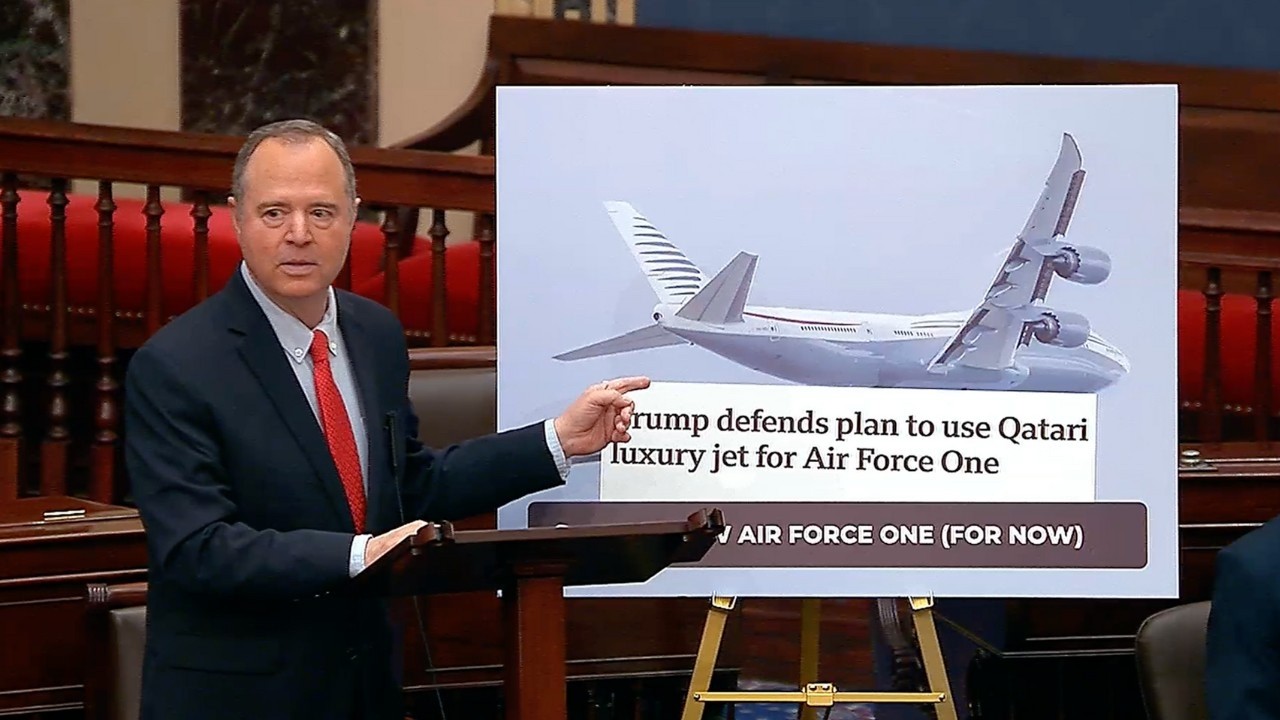
WATCH: Sen. Schiff Outlines 10 Ways Trump is Wrecking the Country, Redefining the Idea of America
July 10, 2025
WATCH: Sen. Schiff Outlines 10 Ways Trump is Wrecking the Country, Redefining the Idea of America
*“I will never forgive him for the damage he has done, and for the damage he continues to do, to the very idea of America, for how the rest of the world now views this country, and more critically, more catastrophically, how we have come to view ourselves.”
MOST CORRUPT ACTS 6 25
---
AN 7 25
University of Pennsylvania philosophy professor Jennifer Morton writes in the New York Times' piece "Why Hiring Professors With Conservative Views Could Backfire on Conservatives," that hiring conservative professors because they’re conservative is no more a smart move than hiring liberals because they’re liberal.
The Trump administration is threatening to cut Harvard’s federal funding, demanded that the university foster greater “viewpoint diversity,” essentially by engaging DEI hiring for conservative professors and employing fewer progressives. But such a policy would “discourage curiosity and reward narrowness of thought,” Morton argues by “creating incentives for professors and students to have and maintain certain political positions.”
“Admitting students for viewpoint diversity would turn the holding of conservative ideas into a quasi-identity, subject to some of the same concerns,” said Morton, akin to the expectation society puts on students of color “that they will represent what is presumed to be, say, the Black or Latino view on any given issue.”
READ MORE: 'You've not even done your homework': Senator embarrasses 'unqualified' Trump nominee
Additionally, professors hired for their political beliefs, she says, will feel pressured to maintain those views, despite their ever-evolving philosophies.
Libertarian Robert Nozick, one of the most prominent and effective defenders of libertarianism, entered college as a socialist. But he encountered the writings of political economist Friedrich Hayek, a Nobel Prize-winning libertarian, which set him on a different path with some very good arguments.
That kind of evolution doesn’t happen as easily if you are hired for your political beliefs. Now you have “a tenure-track position, your salary, health insurance and career prospects” all dependent upon “the inflexibility of your ideology.”
“The smart thing to do in that situation would be to interact with other scholars who share your point of view and to read publications that reinforce what you already believe,” writes Morton. “Or you might simply engage with opposing ideas in bad faith, refusing even to consider their merits. This would create the sort of ideological echo chamber.”
READ MORE;'Disgrace': Trump mocked over letter that 'reads as if it was written by a fifth grader'
“That [Nozick] was hired on the basis of the quality of his work, and not the ideological category to which his views belonged, was as important to Mr. Nozick as it is to all of us who make thinking and writing about ideas our life’s work,” Morton argues.
Had he been accepted at Princeton because of his political beliefs, would he have been so willing to change them, Morton asks?
“If, on reading Mr. Nozick, some of my students are persuaded to reconsider their liberal positions, then I have done my job well, even if I don’t agree with Mr. Nozick’s conclusions,” writes Morton. “Those students might even become part of the next generation of conservative thinkers. And if they end up making valuable arguments, I can assure you it won’t be because they were pressured to think in just one way.”
Read the full New York Times report at this link.
---
nyt
no lnx
Trump Has Targeted These Universities. Why?
President Trump has set his sights on defunding colleges, singling out some of the world’s wealthiest schools in what critics say is an attack on academic freedom.
By Alan Blinder
May 27, 2025
The Trump administration is seeking to exert extraordinary influence over American universities by threatening to cut them off from funding and, in some cases, students.
President Trump and his allies have focused their attacks on elite universities, which they say are bastions of antisemitism and ideological indoctrination. But the moves could remake higher education across the country. Billions in funds for research have been frozen, while administration officials have also threatened to prevent universities from enrolling international students.
Though the higher education industry has acknowledged shortcomings and failures, especially regarding antisemitism on campuses since the Hamas attack on Israel in October 2023, it has warned that reducing schools’ federal funding could backfire on American society as a whole.
University leaders have warned that in addition to cutting crucial research dollars, the federal government is also trying to stamp out academic freedom, a cornerstone of the American education system.
The Trump administration has given broad reasons for the cuts, often claiming that the schools tolerate antisemitism. But the choice of schools it has targeted and even some of its demands have sometimes confused educators and experts. Northwestern University, for example, released a list of steps it had taken to combat antisemitism that closely tracked with a list of demands the Trump administration had given to Columbia University. Northwestern was targeted several days later, nonetheless.
The issue reveals the dollars-and-cents consequences of the tensions between campus leaders and the administration. The outcome of the underlying debate — over the very purpose of higher education — could shape the country for years to come.
Which schools have been targeted?
The Trump administration has said it would end federal money to a number of universities.
Harvard University, has approximately $9 billion at stake. Trump administration officials have cut billions in funds already, and said they would direct federal agencies to end all of their remaining contracts with the school. Harvard sued the administration over the cuts, and the case is pending. The president has also threatened Harvard’s tax-exempt status, and in late May his administration said it would prevent the university from enrolling international students.
Brown University, which the Trump administration said stood to lose $510 million.
Columbia, which is hoping to regain about $400 million in canceled grants and contracts after it bowed to a list of demands from the federal government.
Cornell University, the target of a cut of at least $1 billion.
Northwestern, which administration officials said would be stripped of $790 million.
The University of Pennsylvania, which saw $175 million in federal funding suspended because of its approach to a transgender athlete who participated in school sports in 2022.
Princeton University, which said “dozens” of grants had been suspended. The White House indicated that $210 million was at risk.
Officials at some of the universities have been puzzled by the cuts, which they have sometimes learned about through social media, and insisted that they had taken action to combat antisemitism.
Dozens of other schools are also under scrutiny, largely by the Department of Education’s Office for Civil Rights, and are aware that some of their federal funding is imperiled. But much of the focus is on 10 schools that a Trump administration task force, which says it is devoted to rooting out antisemitism, identified for particular attention: Columbia; George Washington University; Harvard; Johns Hopkins University; New York University; Northwestern; the University of California, Berkeley; the University of California, Los Angeles; the University of Minnesota; and the University of Southern California.
Critics of the administration have not hesitated to point out that all of these schools are in states, or, in George Washington’s case, a federal district, that voted for the Democratic ticket in 2024.
Why are the schools being criticized?
The administration has frequently claimed that the targeted schools harbor antisemitism. When a protest movement against Israel’s war in Gaza swept campuses around the country in 2024, for example, some of the most volatile scenes unfolded at Columbia.
But the roots of the administration’s hostility are deeper than the turmoil tied to that war alone. Conservatives have looked askance at the elite echelons of higher education for decades, disturbed by affirmative action admissions programs, high tuition costs, the views of liberal professors and the proliferation of diversity, equity and inclusion initiatives on campuses.
Many conservatives say their views have been marginalized in lecture halls, and regard top schools as incubators of so-called wokeness. They have said they want universities to emphasize academic programs that will lead students to jobs that are essential to the economy.
The Trump administration has expanded its list of complaints about Harvard to touch on a variety of conservative complaints with academia. It has argued that there’s a lack of viewpoint diversity among faculty members, and has accused the school of still considering race in admissions in violation of a Supreme Court ruling, for example.
How do schools use the federal funding?
It has taken time for universities to understand which grants and programs are being affected. But researchers at a number of schools recently began receiving stop work orders.
At Harvard’s T.H. Chan School of Public Health, which was set to receive more than $200 million in federal grants and contracts in the current fiscal year, research on tuberculosis and multiple sclerosis has been halted.
At Penn, the president, J. Larry Jameson, wrote in an open letter that the cuts could affect “research on preventing hospital-acquired infections, drug screening against deadly viruses, quantum computing, protections against chemical warfare, and student loan programs.”
How have schools responded?
Beyond statements of frustration and concern, they have generally not done much publicly.
But there are two enormous exceptions. In March, Columbia agreed to comply with demands from the administration so it could enter negotiations over the future of $400 million that the government had canceled. Some of the most important concessions included agreeing to place the university’s Middle Eastern, South Asian and African Studies Department under new oversight; strengthening its campus security force; and toughening its disciplinary and protest policies.
Columbia’s capitulation alarmed higher education leaders across the country.
On April 14, Harvard tried a different strategy. It rejected proposals from the federal government, including one for the use of an outsider “to audit those programs and departments that most fuel antisemitic harassment or reflect ideological capture.” The government also wanted Harvard to curb the power of its faculty and report international students who committed conduct violations.
Harvard refused, and its president, Alan M. Garber, said that the university “will not surrender its independence or relinquish its constitutional rights.” The university filed a lawsuit a week later.
To many veterans of academia, Harvard’s choice to fight the administration marked a potential turning point.
Lee C. Bollinger, a former Columbia president, said Harvard’s resistance was “precisely what has been needed.” The university’s pushback, he said, amounted to “a major institution willing to defend the fundamental values at stake, not only with universities but also with other institutions and organizations vital to American democracy.”
These schools are rich. Why is the government funding them in the first place?
Around World War II, the U.S. government began leaning on academic institutions to conduct research projects whose findings trickle into the public and private sectors. Federally funded research has almost always had bipartisan support, though there have been occasional complaints (and sometimes outright mockery) surrounding particular projects.
In their scramble to counter the Trump administration’s recent moves, universities have tried to tell elected officials and the public that they make important contributions to the country’s health and prosperity. They have also sought to frame university-based research as imperative to the nation’s future, especially as China gains global influence.
Can’t schools just tap their endowments?
Many big schools do indeed have substantial endowments. Every endowment is different, though, and university leaders note that many donors restrict how their money may be used. Republicans, including Vice President JD Vance, have openly discussed raising the excise tax on the largest endowments.
Harvard has an endowment worth about $53 billion, far more than any other American university. Even so, a few days after the Trump administration announced a review of Harvard’s federal funding, the university announced a plan to issue $750 million in bonds. Proceeds would give the school, which has been engaged in contingency planning, some financial breathing room.
Alan Blinder is a national correspondent for The Times, covering education.
A version of this article appears in print on , Section A, Page 17 of the New York edition with the headline: Reasons for Singling Out Universities for Defunding Run Deep
---
https://www.insidehighered.com/news/government/politics-elections/2025/04/18/what-know-about-trumps-funding-threats-colleges
---
ihe april 2025
What to Know About Trump’s Funding Threats to Colleges
over the course of just 13 weeks, President Donald Trump has made it clear that he’ll use billions of dollars in federal grants and contracts, primarily for research, as a lever to force colleges and universities to bow to his agenda and increase the representation of conservative ideology on their campuses.
The cuts don’t follow any typical investigative process and sometimes lack clear explanations or legal justifications. And such an aggressive ad hoc strategy is one that that many higher education lawyers, policy analysts and administrators say could reshape postsecondary education for years to come.
“It’s certainly unprecedented and deeply disturbing,” said John King Jr., former secretary of education under President Obama and current chancellor of the State University of New York system. Trump’s actions “really threaten the long-standing partnership between the federal government and higher education in the pursuit of both innovation and economic mobility.”
Most Popular
- Fulbright Applicants Rejected Over “DEI” Research Proposals
- How I Lost Faith in My University’s Mission (opinion)
- Calif. Community Colleges Ramp Up Battle Against the Bots
Trump and his advisers have signaled their intent to crack down on “woke” higher education but haven’t said how they will do so. Instead, a cadre of conservative policy analysts plotted how to leverage other agencies and sources of funding, beyond access to the $130 billion distributed annually in federal student loans and Pell Grants.
“At the beginning it felt like I was the only one fighting,” Chris Rufo, an influential anti-DEI advocate and a member of the Board of Trustees at New College of Florida, said on *The Daily*, a*New York Times*podcast last week. “Now, fast-forward five years, [and] some of the ideas that I had cobbled together have suddenly become reality, they’ve become policy, they affect billions of dollars in the flow of funds.”
But efforts to send colleges and universities into “an existential terror,” as Rufo put it, have required the Trump administration to move at a dizzying pace and leverage multiple mechanisms that most higher education lawyers, policy analysts and officials say are incredibly novel.
To catch up, here are four things you should know about Trump’s funding threats to colleges and universities.
Broad Scope of Attack
A large part of what makes the Trump administration’s current push to crack down on colleges and align their actions with his agenda so unprecedented, experts say, is its sheer magnitude, from the amount of money at risk to the number of investigations involving various agencies.
The Education Department has historically taken the lead on holding colleges accountable, leveraging institutions’ eligibility for student aid programs to force compliance. But this time around, it’s an all-hands-on-deck effort with a magazine of federal programs used as ammunition.
At least four departments beyond Education—Justice, Defense, Energy and Health and Human Services—have also been involved, cutting off scientific research grants, which are typically considered immune from political attacks.
James Nussbaum, who leads the higher education practice at the Indiana law firm Church Church Hittle + Antrim, said that as Trump took office he often warned clients to be aware of any contracts they held with the Department of Education. But some of the cuts caught even him by surprise.
“People had their focus on one ball in the air and hadn’t seen that these others might be affected,” he said.
To review federal funding for colleges that it believes have violated students’ civil rights, the Trump administration launched a federal antisemitism task force that spanned several agencies and has led some of the most public actions against colleges so far.
Editors' Picks
- Trump Administration Strips Harvard’s SEVP Certification
- McMahon Plays Defense on the Hill
- University of Florida Board Votes Unanimously to Hire Ono
The group launched reviews of Columbia and Harvard Universities, demanded sweeping changes and froze $400 million and $2.2 billion in grants and contracts, respectively. The funds at risk support a wide range of research at the universities, including on cancer, tuberculosis and the effects of environmental pollution on health. Faculty have warned of dire consequences if the freezes continue.
In addition to Columbia and Harvard, Northwestern, Cornell, Brown andPrinceton Universities have had some of their federal funds frozen, though it’s not clear why or who made that decision and under what legal authority. (The Wall Street Journal reported that White House staff were behind the Cornell funding freeze.)
The Trump administration also froze $175 million at the University of Pennsylvania to penalize administrators for allowing a transgender athlete to swim on the women’s team three years ago.
What the Trump administration is doing enters a “whole new territory,” Princeton president Christopher Eisgruber said in a recent interview with The New York Times.
Starting with the freeze at Columbia, “the government was using its tremendous power over research dollars to try to control what a private university was doing in terms of matters that are generally considered part of academic freedom,” Eisgruber added. “There’s a very fundamental threat here right now … to America’s research universities that anybody who cares about the strength of this country, our economy, our prosperity, our security, our health should be worried about.”
Colleges also face other threats from the federal government. The Department of Education has launched or actively pursued at least 97 investigations concerning alleged antisemitism and DEI programs, which could imperil those institutions’ access to federal financial aid. And the National Institutes of Health and the Department of Energy moved to cap reimbursements for costs indirectly related to research, which, if enacted, could cost colleges billions.
Bypassing Standard Processes
Adding to the difficulty for colleges, the Trump administration is largely ignoring regulatory standards and procedures when it cuts funding.
For instance, cabinet members have broadly used the term “investigation” to describe the ways they are cracking down on colleges. But in most cases, the review process has lasted only a few days and resulted in little to no evidence of the alleged violation. Often, universities have been presented with a list of ultimatums or policy changes they must make in order to avoid a funding freeze or restore their funds.
The stop-work orders that have been issued so far have been “arbitrary” and “often unsupported,” said King of SUNY. If there is rationale, it often “seems disingenuous.”
And some universities have yet to receive a formal notification about a funding freeze. For example, Brown officials have not received any official word of a rumored $510 million cut.
“We have nothing to actually substantiate what’s being reported,” Brian Clark, Brown’s vice president for news, told Inside Higher Edin an email.
For civil rights investigations, investigations typically begin when the Education Department notifies an institution of the allegations made in thorough detail, experts explained. Then, the Office for Civil Rights conducts an in-depth investigation that includes talking to students, faculty and staff and gathering documents or data regarding the allegations. That process allows colleges to voluntarily resolve the investigation and negotiate a settlement with the department. The resulting agreement usually outlines various changes that colleges must make to comply with federal law. Some conservative critics have said those settlements or resolution agreements were “toothless.”
If the parties cannot agree or a college refuses to comply with the federal law, the department could sue a college. But that’s rare, and the Education Department has never pulled a college’s federal funding over civil rights violations—a move that’s considered a nuclear option.
Brendan Cantwell, a higher education professor at Michigan State University, noted that despite the quick turnaround, the administration’s investigations do, at times, parallel the motivations of traditional reviews. But what makes this approach so unprecedented and unlawful, in his mind, Cantwell said, is its “unmeasured” and “blanketed” nature.
“So while there are precedents and similar examples in the past, beyond very superficial similarities, the similarities fall apart,” he said.
Breaking Contract Law
The means by which Trump is terminating grants and contracts is also novel, a lawyer who specializes in government contracts told Inside Higher Ed.
Generally, the only people who have authority to take contract-based actions on behalf of the United States are contracting officers or agreements officers, said Jayna Marie Rust, a partner at Thompson Coburn LLP. But under the Trump administration, it’s often unclear if this is the case, especially with the Department of Government Efficiency reviewing contracts and grants and touting decisions to cancel millions in agreements.
Rust said she has not seen any of the direct communications between government agencies and universities regarding contract/grant termination that are due to the identity of the institution and therefore can’t say if the notifications come from contracting or agreements officers. But notifications coming from others is something she has seen in other terminations that schools are receiving.
“But to the extent these communications are not coming from the agreements officers or contracting officers, that is unusual,” Rust said.
And much like the procedure for investigating and addressing policy violations, the government is supposed to ensure due process before excluding schools from receiving federal funds, which is effectively what the terminations have done. The Trump administration has seemingly bypassed those steps. (Several faculty groups and associations have sued to restore the canceled funding.)
Even when the administration has completed a process to determine whether an entity can be excluded from receiving federal funds, contracting and agreements officers also often conduct a risk analysis to see if the benefit of letting that entity complete a contract or grant outweighs the benefit of cutting ties (which could result in losing the benefit of work that’s already completed), Rust said. It appears that the Trump administration also hasn’t gone through that review.
More Than Money at Stake
As a result of the sweeping scope of Trump’s attacks and the lack of precedent, the risks for colleges and universities are more than financial, higher ed experts say.
Yes, losing billions of dollars in federal funding is a problem, and not one that elite institutions’ endowments can solve. But more than that, what’s at risk is the core mission and ethos of American higher education, King said.
“From the technology inside of your phone to the treatment you may receive at your doctor—all of that can be traced back to research conducted at America’s higher ed institutions. And it’s under threat,” he said.
And though the dollar amounts of funding pulled from smaller private liberal arts institutions and state universities may be “more modest,” they’re still significant, he added. “For those researchers, it’s heartbreaking, and it will ultimately harm economic development and national security.”
The full impact of these funding freezes is not yet clear. But until the courts weigh in, colleges are stuck between a rock and a hard place, said Nussbaum, of Church Church Hittle + Antrim.
“Schools are trying to make that decision of how can we make decisions consistent with our mission and values in a way that’s not going to get us called out?” Nussbaum said. “I think we’ll have a little bit more certainty on where the means and bounds of the discretion of the executive agency is in the funding. But I think in the meantime, a lot of schools are trying to wait out that clock.”
---}:
aug 2024 IHE
no lnx
Why Did Shafik Step Down Now?
Congress grilled seven leaders over campus antisemitism in three hearings. Columbia President Minouche Shafik is now the third leader to resign in the aftermath.
By Josh Moody
Shafik endured the wrath of lawmakers, students, faculty and alumni, only to resign weeks before the fall semester starts.
When Columbia University President Minouche Shafik resigned abruptly on Wednesday, she became the third campus leader since December to step down amid Congressional pressure over how they handled sprawling student protests tied to the war between Israel and Hamas.
But unlike her peers, Liz Magill of the University of Pennsylvania and Harvard’s Claudine Gay, who stepped down soon after their widely criticized performance before lawmakers last year, Shafik seemed to be in the clear. Following her own grueling inquisition by the House Education and Workforce Committee in April, she weathered the wrath of lawmakers, students, faculty and alumni, but maintained the support of Columbia’s board of trustees.
So why did she bow out now, just weeks before the start of the fall semester and during a period of relative calm on campus? The move seemed more likely in a turbulent spring semester, when students set up an encampment on campus and occupied an administrative building, resulting in dozens of arrests, and sharp scrutiny of Shafik.
Most Popular
Where Students Have Had Their Visas Revoked
Government Defends Itself Against Visa Revocations
NIH Resumes Key Grant Review Panels
Thus far, Columbia administrators have had little to say about the timing of her exit. Shafik, in her resignation letter, touched lightly on the matter: “Over the summer, I have been able to reflect and have decided that my moving on at this point would best enable Columbia to traverse the challenges ahead. I am making this announcement now so that new leadership can be in place before the new term begins,” she wrote.
Columbia University did not respond to questions about Shafik’s resignation.
Now Shafik plans to work with the United Kingdom’s Foreign Secretary in an international development role, an area where she has experience, and a job she set up before announcing her departure. Shafik, who holds British, American and Egyptian citizenship, was already a member of the U.K. House of Lords. But it is not clear when talks began for her return to London; the Foreign Secretary’s office did not respond to a request for comment from Inside Higher Ed.
Terrence Casey, a professor of political science at Indiana’s Rose-Hulman Institute of Technology, wrote by email that given Shafik’s “life peer” appointment to Parliament’s upper house in 2020, “there really is no vetting process for Dr. Shafik” to accept a role in the U.K.
Janet Laible, a professor of political science at Lehigh University in Pennsylvania, wrote by email “that since the current [U.K.] government was only appointed after winning elections on July 4, there would not have been any formal communication with her before that.” Still, Laible added, “that is not to say that there was no informal communication” between Shafik and the U.K. government.
When Shafik stepped down, Dr. Katrina Armstrong was announced as interim on the same night. A Columbia administrator and professor, Armstrong will be at the helm when the fall semester begins in early September—and students have made it clear that protests are likely to resume.
Students for Justice in Palestine, a group active in campus protests, has warned that any leader who spurns their demands to divest from Israel and those profiting off the war “will end up exactly as President Shafik did.”
Shafik angered protesters by failing to act on their divestment demands, as well as by allowing police on campus to clear Hamilton Hall, the building they occupied, and arrest those inside. Faculty have likewise expressed outrage over both Shafik’s handling of the occupation and her performance on Capitol Hill, where many believe she failed to defend professors targeted by Congress.
“President Minouche Shafik threw me under the bus when she testified before Congress, but I’m still an employee of Columbia University, she's not. Turns out that capitulating to the bullies didn’t work out well for her. It never does,” Columbia faculty member Katherine Franke wrote on X, referring to Shafik’s acquiescence to Congressional criticism.
Editors' Picks
How Trump’s Early Actions Compare to Project 2025, Other Blueprints
NIH Freezes Millions More in Funding for Columbia
Community Colleges Make Difficult Calls and Cuts Under Trump
Congressional Republicans also blasted Shafik for not cracking down on protesters sooner. On Wednesday night, Several GOP critics took a victory lap as news of Shafik’s resignation spread.
In the immediate aftermath of her resignation, free speech advocacy organizations and the American Association of University Professors (AAUP) condemned Shafik’s leadership at Columbia.
“By suppressing academic freedom and the free speech rights of students and faculty and inviting punitive discipline and a brutal police crackdown on student protests at Columbia, Shafik failed to protect basic tenets of higher education and capitulated to a new McCarthyist witch hunt against the Academy,” AAUP President Todd Wolfson said Thursday. “This is her legacy.”
How We Got Here
Shafik’s resignation was preceded by Liz Magill stepping down as president of Penn in December and Claudine Gay resigning the top job at Harvard in January. Both succumbed to public anger over their disastrous performance at the first Congressional hearing on campus antisemitism, when they and Massachusetts Institute of Technology President Sally Kornbluth gave legalistic and equivocating answers to a hypothetical question about calls for the genocide of Jews on campus. Only Kornbluth, who is Jewish, managed to hold onto her job at MIT.
Shafik had been asked to appear before Congress at that hearing in December, but was unable to do so because she was traveling overseas.
Instead, Shafik received a hearing of her own in April. Flanked by members of Columbia’s Board of Trustees and co-chair of the university’s antisemitism task force, Shafik largely avoided the missteps of her predecessors in the hot seat. When asked the same question that stymied her peers—whether calling for the genocide of Jewish people would violate university policies—Shafik stated clearly that it would at Columbia.
But even as she temporarily escaped the fury of Congress, Shafik outraged many Columbia faculty members who believed she threw them under the bus. And as she was testifying, pro-Palestinian protesters set up an encampment on Columbia’s campus, which would soon spark a wave of similar demonstrations at colleges coast to coast.
Congress held a third hearing on campus antisemitism in May, featuring the presidents of Northwestern University, Rutgers University and the University of California at Los Angeles. Where are they now? Here’s a look at the other six presidents who spoke to Congress, and what happened afterward.
Liz Magill
The Penn president was the first to go. Already under fire for her initial statements on the Israel-Hamas war—and for allowing a Palestinian literary festival to proceed on campus—she apologized and sought to clarify her remarks from the Congressional hearing. But the damage was done; Magill resigned in December amid withering criticism from Congressional Republicans and donors, who threatened to close their checkbooks should she remain at Penn. She had been in the role for a little more than a year.
Penn Board of Trustees chair Scott Bok also stepped down following Magill’s resignation, issuing a warning about allowing donors to wield too much influence.
Claudine Gay
Harvard’s first Black president survived the Congressional hearing only to be felled by another scandal.
Like Magill, she apologized for her missteps before Congress and seemed poised to keep her job until accusations of plagiarism suddenly emerged in December. Harvard initially batted away allegations trafficked by conservative activists but the clamor soon became too loud to ignore; Gay submitted corrections and acknowledged mistakes.
But it failed to placate the critics, and she resigned in January. Afterward, the former Harvard president defended herself, acknowledging she had made some mistakes but arguing that the effort to oust her was racially motivated.
Gay, who has retained a tenured faculty role, was president of Harvard for less than a year.
Sally Kornbluth
Of the first three presidents to speak to Congress, Kornbluth emerged relatively unscathed.
Like her peers, Kornbluth apologized for her missteps in the December hearing. That apology, and a subsequent plan to improve the campus climate by rethinking student disciplinary processes, free expression policies, and diversity, equity and inclusion programs—as well as by launching quality-of-life surveys for students and employees—seemed to satisfy her critics.
At the time of the hearing, Kornbluth, too, was relatively new to the job, with less than a year under her belt as MIT’s president. She is unique, however, in keeping her position despite the fallout.
Gene Block
When the UCLA chancellor spoke to Congress at the third antisemitism hearing in May, he was already on the way out, having announced last August his intent to retire at the end of the academic year. Block, who is Jewish, led UCLA for nearly two decades. But his last year in the job was marred by violence at campus protests.
Block faced criticism from Congress for allowing a large pro-Palestinian encampment to grow on the UCLA campus, a site that later came under attack from pro-Israel counter demonstrators. Violent clashes erupted and videos of pro-Palestinian protesters blocking Jewish students from accessing parts of campus went viral, prompting Congress to haul Block in for questioning.
Flanked by the presidents of Northwestern and Rutgers, the long-time UCLA leader and his peers stood their ground at the hearing, pushing back at times in response to pointed questions.
Block stepped down last month as planned.
Michael Schill
Congressional Republicans took aim at Northwestern’s president during the May hearing—and missed.
Schill was a frequent target at that hearing, with Republicans pressing him about striking a deal with protesters to take down an encampment in exchange for more transparency on investments, scholarships for Palestinian undergraduates and other concessions. They also took issue with the speech and conduct of some Northwestern faculty members, and the university’s business dealings with Qatar.
But Schill pushed back, rejecting the premise of several questions and refusing to discuss individual faculty members or to comment on student speech.
Schill, who has led Northwestern since fall 2022, remains in his role as president.
Jonathan Holloway:
Fresh off of an agreement with campus protesters to remove an encampment in exchange for a discussion about university investment policies and other concessions, the Rutgers president, who has said he opposes divestment, was also called before Congress in May.
Republicans accused both Schill and Holloway of making “shocking concessions to the unlawful antisemitic encampments on their campuses” when they first called the presidents in to testify. But at the hearing, Holloway rejected the notion he made concessions to a mob, as Congress alleged, emphasizing that he was speaking with his students and seeking to minimize disruption.
He was evasive at times, prompting Republican representative Bob Good to ask pointedly: “Are you in a position to answer any questions? Do you have an opinion on anything?”
Despite that criticism, Holloway managed to avoid the major missteps and viral moments that upended other presidents.
Holloway, who has led the university since 2020, remains president of Rutgers.
Next Story
Campus police at the University of Central Florida walk amid student protesters.
Government State Policy
Florida Universities Sign Agreements With ICE
Amid a state crackdown on undocumented migrants, at least 10 public universities are giving campus police immigr
---
---
an 4 25
Historian and presidential biographer Jon Meacham says the United States is not a stable and safe environment for scientists and builders anymore, because they can no longer pursue ideas that "may not find favor with" the Republican Party.
He referred to the Trump administration's recent steps to cut funding for the National Institutes of Health (NIH), which will lead to a decline in crucial scientific research, as a "self-inflicted wound" during an appearance on MSNBC's "Morning Joe" on Tuesday.
"I think that's one of the particular tragedies," he said, adding that several things are "unfolding at the moment, but it's a self-inflicted wound and one that may or may not be generational."
ALSO READ:'Unconstitutional usurpation of power': Small businesses sue Trump over 'devastating' tariffs
Meacham, who serves as the Canon Historian of the Washington National Cathedral, said that former Presidents Harry Truman and Dwight D. Eisenhower, who served between the 1940s and 1960s, could not "stand each other," but were still able to agree to invest government resources in research.
"We might not see instant returns on a dollar, but that's what research is," Meacham said, referring to the views held by leaders during the Cold War period.
He added that many supporters of President Donald Trump don't want to "undo" the America that was "built by the institutions, the impulses, the investments."
"I don't think they really voted for that. They voted for this man. And whatever this man does, they're willing to follow," he said.
ALSO READ:The 'war on vaccines has started': Scientists blast 'ridiculous' Trump admin request
The cancellations of NIH-funded scientific projects “tears the long-standing fabric of the government’s contract to pursue medical research that seeks to better the healthspan and lifespan for all Americans”, Francis Collins, a geneticist who led the NIH, based in Bethesda, Maryland, for 12 years, told scientific journal Nature last week.
On Monday, the Trump administration said it would suspend $2.2 billion in multi-year grants and $60 million in multi-year contract funding for Harvard University after the institution indicated it would not comply with the administration's policy requests. Earlier that day, Harvard announced its decision to decline the administration's demands for policy modifications.
ALSO READ:'Bloodbath': Shock as Trump fires thousands at HHS amid outbreaks
Watch the video below or at this link.
---
Colleges in Nazi Germany thought giving in to government demands would save them
an 4 25
---
---
an 3 25
Another academic has been arrested by President Donald Trump's Department of Homeland Security (DHS) on legally dubious grounds, according to a new report.
Politico reported Wednesday that Indian national Dr. Badar Khan Suri was recently arrested outside of his Virginia home by "masked agents" who said they were with the DHS. Suri — who is in the United States legally on a student visa and who is married to a U.S. citizen — was not charged with any crime and has no criminal record, yet he is being targeted for deportation and awaiting transfer to Texas.
Suri is being put into deportation proceedings under the same vaguely worded statute that the Trump administration invoked after it arrested Palestinian activist Mahmoud Khalil (a legal permanent resident and Columbia University graduate student who led pro-Palestine protests last year). That statute claims that an administration has the authority to deport any foreign-born resident who it suspects could be a threat to U.S. foreign policy.
READ MORE:Justices' 'cozy ties' to right-wing kingpin sparks outrage as critics demand recusal
“We’re trying to speak with him. That hasn’t happened yet,” Hassan Ahmad, who is Suri's lawyer, told Politico. “This is just another example of our government abducting people the same way they abducted Khalil.”
Ahmad is alleging that Suri is being targeted because his wife, Mapheze Saleh, is of Palestinian heritage and that the couple have been outspoken about the United States' continued support of Israel. He also told Politico that the two have been repeatedly doxxed on far-right websites over their criticism of the Israeli government. The Hindustan Times (one of the largest English-language newspapers in India) reported in a 2018 article that Saleh's father, Ahmed Yousef, was once a "senior political adviser to the Hamas leadership."
According to his faculty page on the Georgetown University website, Suri is a postdoctoral fellow at the Alwaleed Bin Talal Center for Muslim-Christian Understanding at the Edmund A. Walsh School of Foreign Service. His LinkedIn profile shows that he has a Ph.D. in peace and conflict studies from an Indian university. A Georgetown University spokesperson told Politico in a statement that Suri was "duly granted a visa to enter the United States to continue his doctoral research on peacebuilding in Iraq and Afghanistan."
“We are not aware of him engaging in any illegal activity, and we have not received a reason for his detention," the spokesperson continued. "We support our community members’ rights to free and open inquiry, deliberation and debate, even if the underlying ideas may be difficult, controversial or objectionable. We expect the legal system to adjudicate this case fairly.”
READ MORE:French scientist denied entry to the US because he 'expressed a personal opinion' about Trump
Click here to read Politico's article in its entirety.
---
---
target pending 3 25
an 3 25
The Trump administration on Tuesday appeared to step up its clash with Maine's Democratic-led government over the state's support for transgender women who play on women's sports teams, as the University of Maine announced $100 million in its federal funding had been halted.
The university system said the U.S. Department of Agriculture (USDA) funding was being temporarily paused while the Trump administration investigates whether the University of Maine System (UMS) is violating Title VI or Title IX of the Civil Rights Act, which prohibit discrimination based on race or national origin and sex, respectively.
The USDA began a review of UMS compliance with the Civil Rights Act in February, a day after Gov. Janet Mills told President Donald Trump at a White House event that she was prepared to defend Maine's decision to continue allowing transgender students to play on girl's and women's sports teams.
The National Collegiate Athletic Association (NCAA) updated its policies to comply with Trump's executive order requiring the Department of Education to notify school districts that allowing transgender students to compete on women's teams violates Title IX.
"If all of their funding was removed from USDA, that would have a really big impact on farmers on the ground here."
But Mills told Trump that she will "comply with state and federal law." In 2021, Maine's state laws were updated to allow student athletes to compete on teams that correspond to their identity as long as there are no safety concerns.
Since the USDA opened its review of UMS policies, the university system has confirmed to the department that its athletic programs are in compliance with state and federal laws and that its schools that are part of the NCAA are following the association's recently updated policies.
UMS said in a statement Tuesday that after notifying the USDA of its compliance on February 26, it did not hear from the department until the notice of the funding pause was sent on March 10, with the USDA accusing the university of "blatant disregard" for Trump's executive order.
The agency said last month that UMS "receives over $100 million in USDA funding."
UMS said Tuesday that it has received funding from federal agencies including the USDA since its founding in 1865, with the USDA awarding $29.78 million in 2024 for research benefiting the largely rural state.
UMS has used its current USDA funding to invest in numerous projects, including but not limited to:
- Research on per- and polyfluoroalkyl substances (PFAS), also known as forever chemicals, on Maine farms;
- The development of sustainable packaging materials derived from Maine's forests;
- Research on the health and sustainability of the state's lobster fishery;
- Support for 4-H youth leadership and STEM skill development programs serving tens of thousands of Maine youth annually; and
- Education and outreach to Maine livestock farmers on farm biosecurity and disease outbreak preparedness.
"If all of their funding was removed from USDA, that would have a really big impact on farmers on the ground here," Sarah Alexander, executive director of the Maine Organic Farmers and Gardeners Association, toldReuters last month after the agency launched its review of UMS.
U.S. Rep. Chellie Pingree (D-Maine) denounced the USDA's "vindictive" funding pause, noting that the agency "shared no findings, and offered no opportunity for a hearing."
"It fails to provide any sort of timeline or opportunities for recourse," she said in a statement posted on social media. "Let's be clear about what this latest funding freeze will do: It will hurt farmers and rural Mainers, it will halt critically-needed research innovation, and it will slash educational opportunities for students throughout Maine. Once again, it appears as though this administration is targeting our state for retribution—all because our elected officials are standing up for the rule of law."
---
12 23 an
america’s prestigious universities play a big role in determining who gets into America’s wealthy elite.
A degree from Harvard, Penn, or M.I.T., to take three examples, is a meal ticket to a lucrative job on Wall Street or a corporate law firm and to the richest and most influential people in the land.
But as America becomes increasingly stratified by wealth, those tickets are easily abused.
Universities that give preference in admissions to the children or grandchildren of major donors serve to widen inequality even further.
Universities that allow major donors to influence what is taught or expressed on campus could be seen to suppress ideas that threaten the wealthy — which could chill freedom of expression and fuel social resentment.

Which brings us to the latest imbroglio.
Last Tuesday, the presidents of the University of Pennsylvania, Harvard, and M.I.T. tried to give precise answers to questions from members of Congress about whether their university cultures had encouraged hostility towards Jews — hostility that has surged since Hamas’s October 7 attack on Israel and Israel’s attack on Gaza in response.
In their opening remarks, all three denied it, and repeatedly condemned antisemitism.
Then Elise Stefanik, a Republican representative from New York (and herself a Harvard graduate) asked a yes or no question: would calls for genocide of Jews on campus violate their codes of conduct or harassment policies?
The presidents hedged. “If the speech turns into conduct, yes, it can be harassment,” Penn’s president, M. Elizabeth Magill, a former dean of Stanford Law School, replied in lawyer-like fashion.
“I’m asking if specifically calling for the genocide of Jews — does that constitute bullying or harassment?” Stefanik pressed her point.
“If it is directed and severe or pervasive, it is harassment,” said Magill.
“So the answer is yes?”
“It is a context-dependent decision, congresswoman,” Magill said.
Faced with the same question, Harvard’s president, Claudine Gay, also temporized. “It can be,” she said, “depending on the context.”
The university presidents should have answered unambiguously and unequivocally that calls for genocide of any group are intolerable.
Their failure to do so has fueled a firestorm.
Ross Stevens, a hedge fund manager, said he would withdraw a $100 million gift to Penn. Other wealthy Penn donors called for Magill to resign.
Even prior to the hearing, a campaign had been launched by some of Wall Street’s most powerful figures to oust all three university presidents for failing to adequately condemn Hamas’s October 7 attack on Israel.
The influential board of advisers of Penn’s Wharton School’s, chaired by Marc Rowan of Apollo Global Management, one of the world’s largest private equity firms, called on alumni to withhold donations to Penn.
The billionaire investor Bill Ackman, Harvard alumnus and head of New York hedge fund Pershing Square Capital Management, called for the three university presidents to be fired.
The day after their testimony, Magill and Gay issued statements in efforts to contain the damage.
But on Saturday evening, after an emergency meeting of Penn’s board of trustees, Magill resigned under pressure.
Over the weekend, calls from donors for Harvard’s Claudine Gay to resign grew louder, as prominent donors demanded her ouster, too.
I can well understand the anger and frustration of these donors. In their congressional testimony, the university presidents should have been clearer that their institutions do not tolerate calls for genocide. Period.
But to use their power as major donors to force or seek the ouster of these presidents is almost as repugnant as the failures of these presidents to unambiguously condemn calls for genocide. It endangers the autonomy of America’s universities.
Who’s kidding whom? Those of us who have spent our lifetimes teaching in prestigious universities are well aware of the influence of big donors. The major job of today’s university presidents is to solicit money, and their largest targets are typically denizens of Wall Street.
For the same reason, boards of trustees are packed with wealthy alumni, often from the Street, who routinely veto candidates for university presidentships harboring views they find offensive.
But not until now have major donors so brazenly used their financial influence to hound presidents out of office for failing to come out as clearly as the donors would like on an issue of campus speech or expression.
As a Jew, I cannot help but worry, too, that the actions of these donors will fuel the very antisemitism they claim to oppose — based on the perilous stereotype of wealthy Jewish bankers controlling the world.
*Robert Reich is a professor at Berkeley and was secretary of labor under Bill Clinton. You can find his writing at https://robertreich.substack.com/.*
---
evil b/c pervert class action
https://www.rawstory.com/jim-jordan-2661556363/
no lnx raw 6 23
Jim Jordan leads GOP push to cripple 'fight against disinformation': report
Matthew Chapman
June 19, 2023,
Republican lawmakers are joining forces with far-right activists to attack universities and even private businesses that are investigating the spread of disinformation online — claiming that this amounts to an effort to silence conservatives on the internet, according to a report.
The New York Times posted a details of the actions they are taking on Monday.
"The effort has encumbered its targets with expansive requests for information and, in some cases, subpoenas — demanding notes, emails and other information related to social media companies and the government dating back to 2015. Complying has consumed time and resources and already affected the groups’ ability to do research and raise money, according to several people involved," reported Steven Lee Myers and Sheera Frenkel.
"They and others warned that the campaign undermined the fight against disinformation in American society when the problem is, by most accounts, on the rise — and when another presidential election is around the corner. Many of those behind the Republican effort had also joined former President Donald J. Trump in falsely challenging the outcome of the 2020 presidential election."
The House Judiciary Committee, under Rep. Jim Jordan (R-OH), has been leading the charge. Meanwhile, a group founded by far-right former Trump adviser Stephen Miller has filed a class-action lawsuit in federal court going after the same entities.
"Targets include Stanford, Clemson and New York Universities and the University of Washington; the Atlantic Council, the German Marshall Fund and the National Conference on Citizenship, all nonpartisan, nongovernmental organizations in Washington; the Wikimedia Foundation in San Francisco; and Graphika, a company that researches disinformation online," said the report.
"In a related line of inquiry, the committee has also issued a subpoena to the World Federation of Advertisers, a trade association, and the Global Alliance for Responsible Media it created. The committee’s Republican leaders have accused the groups of violating antitrust laws by conspiring to cut off advertising revenue for content researchers and tech companies found to be harmful."
The new push is part of a broader, years-long conspiracy theory among right-wing activists that the government and "big tech" companies are colluding to silence conservative speech on the internet. There is no evidence of any such conspiracy; in fact, research shows conservative content actually spreads more easily on Facebook and Twitter.
:{
}:
LNX
There is no evidence of any such conspiracy; in fact, research shows conservative content actually spreads more easily on Facebook and Twitter.
y mail 6 23
New Blog: The American Petroleum Institute Loves Pennsylvania, As Its Lobbying Shows
As one of the top fossil fuel producing states, Pennsylvania is a key focus for the oil and gas industry. In fact, with $1.8 million spent in 2022 alone, the American Petroleum Institute reported spending more money on lobbying in Pennsylvania than in any other state last year. Read more from Aly Shaw at the LittleSis Eyes on the Ties blog.
New Blog: Fossil Fuel Directors’ Ties to University Boards Run Deep
While Harvard professor Jody Freeman’s board seat at ConocoPhillips -- and her lobbying on the company’s behalf -- has been in the headlines, directors from other Big Oil companies and dirty utilities are well-represented on university boards and in other higher ed roles. We mapped out some key ties between the boards of Chevron, Marathon Petroleum, Valero, Southern Company and others to different universities and colleges. Some of the findings may be shocking -- for example, that the chair of the board of trustees of the very liberal Wesleyan University is a Chevron director or that three Chevron directors have prominent roles at USC. These relationships don’t only greenwash oil companies -- they throw into doubt the climate gestures made by universities who give fossil fuel directors governing roles at their institutions. Read our latest blog post here.
==
interesting ~ to myth of gubmint scientist paid
https://yyy.theguardian.com/science/2022/mar/21/universities-must-reject-fossil-fuel-cash-for-climate-research-say-academics
no lnx many
Universities must reject fossil fuel cash for climate research, say academics
Open letter from 500 academics likens fossil-energy funding of climate solutions to tobacco industry disinformation
Michael Mann, director of the Earth System Science Center at Pennsylvania State University, speaks to media before a Climate Emergency Summit in Melbourne
Michael Mann, director of the Earth System Science Center at Pennsylvania State University, said fossil-fuel funding ‘has been used to compromise leading academic institutions’. Photo]
Fiona Harvey environment correspondent
Mon 21 Mar 2022
Universities must stop accepting funding from fossil fuel companies to conduct climate research, even if the research is aimed at developing green and low-carbon technology, an influential group of distinguished academics has said.
Rowan Williams, the former archbishop of Canterbury, the Nasa data scientist Peter Kalmus, and prominent US climate scientist Michael Mann are among close to 500 academics from the US and the UK who have written an open letter addressed to all university leaders in the two countries, calling on them to reject all funding from fossil fuel companies.
Accepting money from fossil fuel companies represented “an inherent conflict of interest” and could “taint” essential research and “compromise” academic freedom, they wrote. For the companies, it was a chance to “greenwash” their reputations and skew the findings of research in a way favourable to them.
The letter draws a comparison to the tobacco industry and its disinformation campaigns, noting that numerous public heath and research institutions reject tobacco funding for these reasons and calling on fossil fuel cash to be treated similarly.
“Universities and the research they produce are vital to delivering a rapid, just transition away from fossil fuels. However, such efforts are undermined by fossil fuel industry funding. Academics should not be forced to choose between researching climate solutions and inadvertently aiding corporate greenwashing,” the signatories wrote.
Michael Mann, director of the Earth System Science Center at Pennsylvania State University, told the Guardian: “This sort of funding has been used to compromise leading academic institutions. It’s a two-for for polluters: they purchase the imprimatur of these institutions and their presumed authority and objectivity, while funding research that often translates into advocacy for false solutions and ‘kick the can down the road’ prescriptions like massive carbon capture, which is unproven at scale, and geoengineering, which is downright dangerous. That is entirely the wrong path forward.”
Genevieve Guenther, founder and director of the End Climate Silence campaign, and an affiliate at the New School university in New York, said: “Funding research enables oil and gas companies to ground their promotional statements in enough truth to give substance to the green shadows in which they hide their most polluting and deadly activities. We must remove fossil-energy interests from our institutions so that our children can have a chance at a liveable future.”
Universities have been under pressure from their students and some academics for several years to divest their investments, such as pension funds and endowments, away from fossil fuels, and many have done so. However, this is the first major call from senior academics for them to go further and cut all research ties with fossil fuel companies.
There is no clear estimate for how much money universities accept from fossil fuel companies, as most do not publish their sources. An investigation for the Observer last year found UK universities alone had taken at least £89m from oil companies in the previous four years.
Some scientists disagree with the letter. James Hansen, former chief scientist at Nasa and one of the first scientists to warn governments of the impending climate crisis, told the Guardian: “It’s the wrong focus, causing young people to waste their energy on unproductive activities, while they actually have the potential to lead a solution.”
Bob Ward, policy director at the Grantham Research Institute on Climate Change and the Environment at the London School of Economics, said it was reasonable for universities to accept funding from fossil fuel companies if those businesses showed genuine commitment to transforming themselves. “Fossil fuel companies that are genuinely committed to the transition [to a low-carbon economy], including net zero emissions, can and should receive help from university researchers, particularly with the development of technologies for carbon capture and storage, renewables and emissions reductions. However, universities should be careful about accepting funding directly or indirectly from oil, gas and coal companies that are not genuinely committed to the clean energy transition and which are attempting to greenwash their reputations.”
A spokesperson for Imperial College London, which the Observer found last year had accepted £54m from oil companies since 2017, said: “Decarbonisation is our top priority when working with energy companies. This goal requires a radical shift in industrial systems, technologies and business models in the energy sector. We are using our influence and expertise to accelerate this transition and actively engage with energy companies to push them to meet the Paris Agreement targets. We will monitor progress and only continue to work with companies who demonstrate commitment and credible action to achieving these targets.”
Some academics argue that fossil fuel funding is needed to develop the technologies necessary for a low-carbon economy, and that if western universities reject such funding it will be accepted in other countries around the world.
Guenther disagreed: “It’s a myth that fossil-energy companies are spending large sums to aid the green transition. According to the IEA’s 2021 World Energy Investment report, a mere 1% of fossil-energy companies’ capital expenditure is devoted to research, development or deployment of technologies that either abate or do not produce greenhouse gas emissions.”
At the end of this month, the Intergovernmental Panel on Climate Change will publish the third part of its comprehensive review of climate science, examining the potential ways of cutting greenhouse gas emissions. This will include technology such as renewable energy and nuclear power, and novel ideas such as sucking carbon dioxide out of the air.
The report will throw the spotlight on the potential technological solutions to the climate crisis, which will require tens or hundreds of billions of pounds in funding to be brought to market and deployed widely around the world.
Jason Hickel, an economic anthropologist who is signatory to the letter, said the funding should come from governments. “The US and UK are among the richest countries on Earth, and their governments enjoy total monetary sovereignty. They have the capacity to finance the necessary research many times over, at the touch of a button. Most of the major innovations and public projects that have changed history over the past century have relied on public funding for research,” said Hickel, who is professor of environmental science at the Autonomous University of Barcelona and a fellow of the LSE.
The letter did not specify whether companies with interests in fossil fuels amid a broader portfolio should be included in the ban. Ilana Cohen, a Harvard student who led the organisation of the letter, said it was directed at the top 200 fossil fuel companies.
Cohen said the organisers had confined the call to US and UK universities for now as these are where many fossil fuel companies are concentrating their funding, but that it could be widened in future to a global effort.
===
univ is an institution (// "gov't schools") that does science, is rational , teaches critical thinking, questioning; but AM values Story 1 sacred, sacrosanct so evil to attack them.
trad DTricks is used in election to get pwr, now used to hold onto power, using tools of state = fascism [tho nixon]
aha: // mlk on switch out modifier: good trouble, gang of 5 we are the new/true radicals; appropriation/inversion/perversion of lefty god term[at the same time attacking woke, new PC]; for left/reality racial diversity does being intellecti\ial diversity dofferent POV; builds on Lichter? Horo BS of how lefty commie profs discriminate ~ conservatives; gop is in death spiral, at least demographically so must cheat to preserve minority power[states rights BS ~ HR1 ~ voter suppress, gerry, dark corp $); GOP can't win in mktplace of ideas[libtard bankrunpted by covid fail; must explain away fail by saying media, soc media and univ ~ them
msnbc moral panic: you raise kids w/ right values/american and univ makes them into liberals[and/or gay?]
https://www.alternet.org/2021/06/ron-desantis-2653505905/
Florida goes full fascist': Ron DeSantis sparks furious backlash with ‘authoritarian’ campus political surveys
Raw Story June 23, 2021
Gov. Ron DeSantis signed legislation requiring Florida students, faculty, and staff to register their political views in surveys in an effort to promote "intellectual diversity" at colleges and universities, and the measure set off backlash across social media.
Critics decried the law, which DeSantis claims will promote freedom of speech, as a "thoroughly Orwellian" attempt to gain control over academic debate at institutions of higher learning.
Well, this is thoroughly Orwellian. ?? Faculty and students of Florida, you know what to do! Freep Mini-Trump's stup… https://t.co/N2nEE5UzuM
— Betty Cracker ?? (@Betty Cracker ??)1624454881.0
Well that's got to be unconstitutional: Florida students required to register political views with the state to pro… https://t.co/b1Bh8p98uN
— David Rothkopf (@David Rothkopf)1624455537.0
DeSantis wants to survey university students and staff, with the threat of budget cuts if he doesn't get his way???… https://t.co/IWfcM8nGhI
— Witty Librarian In a Mask (@Witty Librarian In a Mask)1624455089.0
===
edit bd an 621
One hundred political scientists who study an array of topics,including the back-sliding of democracies into autocracies, co-signed a letter Tuesday urging the United States Congress to pass legislation protecting and expanding access to the franchise. The joint letter came as the president called for the same thing during a speech commemorating the 1921 Tulsa Massacre. It came as conservative Democrats in the Senate are wrestling with ways to pass such legislation, and even if they should.
The letter was in reaction to myriad efforts by lawmakers in GOP-controlled states to continue efforts begun in 2013 to shrink their electorates to sizes prejudicial to the Republicans. Those efforts were supercharged in the wake of the 2020 presidential election. The former president keeps lying about losing due to voter fraud. State-level Republicans are using the lie to suppress voting in the name of "election integrity."
"The most effective remedy for these anti-democratic laws at the state level is federal action to protect equal access of all citizens to the ballot and to guarantee free and fair elections," said the letter, posted by New America, a think-tank. "Just as it ultimately took federal voting rights law to put an end to state-led voter suppression laws throughout the South, so federal law must once again ensure that American citizens' voting rights do not depend on which party or faction happens to be dominant in their state legislature, and that votes are cast and counted equally, regardless of the state or jurisdiction in which a citizen happens to live. This is widely recognized as a fundamental principle of electoral integrity in democracies around the world."
This letter is good in and of itself, and I trust the Democratic leadership is taking notes. What I find most interesting, though, is its effort to define democracy morally. The Republicans "are seeking to restrict access to the ballot,the most basic principle underlying the right of all adult American citizens to participate in our democracy."1 If you're not looking for it, you might miss it. What this does is place equality at the heart of democracy. Vitally, without equality, a democracy can't be free, fair or full. This is what's at stake. This is what pro-democracy activists are fighting to preserve.
Of course, democracy is at the heart of our national myth. But anyone with any sense of our history knows democracy really was not at the heart of the founding. Many of the framers likened democracy to anarchy and violence. A republic was the preserve of those who had the capacity to participate in it, which was to say, enough invested in the established order to fight efforts to blow it up. The "men" in "all men are created equal" was meant to convey equality among equals, which, to the founders, obviously didn't include property-less men, non-white men and sure-as-hell not women.
So what we're really talking about when we talk about democracy is the slow, crawling expansion of the democratic franchise since the founding. First, political participation was restricted to property-owning white men. Then it was expanded to all white men. Then all men, white and non-white (after the Civil War and the ratification of the 14th Amendment). Then all women. With each expansion, the franchise became more equal but not fully equal. That didn't happen until the civil-rights era of the last century.
The 100-year reign of Jim Crow in the American South (but by no means restricted to the American South) was back-sliding of the kind we are now being warned about. After all, the Reconstruction amendments (the 13th, 14th and 15th) granted equal rights and protection to former slaves. But just as Republican-controlled states are now shrinking electorates down to prejudicial sizes, Democrat-controlled states back then did, too. District-by-district, state-by-state, they whittled at equal rights and protection until white people were, in effect, feudal lords. It took federal law and federal power (the 1964 Civil Rights Act and the 1965 Voting Rights Act) to smash these autocracies. It took federal law and power to make American democracy liberal.2
So when 100 political scientists call on Congress to protect democracy, what they are really calling for is the protection of all the gains made in our history, and that reversing them not only offends democracy but morality, too. This is important to keep in mind. The Republicans in Georgia, Florida, Texas and other states, most of them in the American South, deny allegations of voter suppression. They say they are defending democracy. That can be true only if democracy is defined by the mere possibility of voting. It cannot be true when democracy is defined morally. Without a commitment to a moral principle — equality — a democracy can't be free, fair or full.
FROM YOUR SITE ARTICLES
- Nobel Peace Laureates to Human Rights Watch: Close Your ... ›
- US Marks 100th anniversary of Tulsa Race Massacre, when white ... ›
- A new warning from 100+ scholars raises alarm that 'the future of our ... ›
RELATED ARTICLES AROUND THE WEB
- GOP Is Putting US Democracy in Mortal Danger, Over 100 Scholars ... ›
- Opinion | A frantic warning from 100 leading experts: Our democracy ... ›
- More than 100 scholars, including 9 from Mass., sign statement ... ›
===
https://www.alternet.org/2021/01/trump-administration/
vet admin rats eg grenell carnegie mellon
ME
political appointees have a long history of moving into higher education after leaving White House administrations. However, universities are being urged to take extra steps to thoroughly vet former Trump administration officials before offering them future employment.
According to The Washington Post, faculty members and students at a number of universities across the United States believe collegiate institutions should "should apply more scrutiny to former Trump officials looking to make similar transitions."
The first wave of criticism came back in May when former Trump official Richard Grenell was granted a one-year fellowship by Carnegie Mellon University. An open letter was written to the university's administrators challenged the decision arguing that "a well-documented record of sexism and support for racist political movements." The criticism leveled at Grenell escalated in November when he publicly supported President Donald Trump's attempt to undermine the outcome of the presidential election.
At the time, Carnegie Mellon administrators defended its decision to hire Grenell but swiftly established committees to review Grenell's appointment and the university's policies in place for hiring. Jonathan Aldrich, a CMU professor and member of the committee put in place to review Grenell's hiring, offered an opinion from both perspectives.
He noted the difficulties that may arise in trying to vet potential hires in light of possible political disagreements. He also questioned whether or not political views would be held to the same standard as behavior and ethics.
"They're going to have to do the hard job of figuring out, even if we disagree with this person's politics, are our issues about politics, or are they about behavior?" Aldrich said, adding, "And maybe if there's serious doubt, we should give the benefit of the doubt to the person."
But despite the damaging impact of Trump's attempted coup, Robert Shibley, executive director of the Foundation for Individual Rights in Education, argues that attempts to vet former Trump appointees before hiring them to work on college campuses could be akin to "a well with no bottom."
"I think it's likely to lead for a tit-for-tat campaign that's going to lead campuses basically scrambling to find somebody, anybody, who can talk interestingly about an issue without being subject to a de-platform campaign," he said.
FROM YOUR SITE ARTICLES
- 7 bombshell allegations in a damning new Trump administration ... ›
- Government official confirms stunning report about Trump ... ›
- Dr. Birx finally shares her real take on working in the Trump ... ›
RELATED ARTICLES AROUND THE WEB
- Trump Administration Again Weakens LGBT Protections | Human ... ›
- Tracking turnover in the Trump administration ›
- The Trump Administration Rolled Back More Than 100 ... ›
- Dr. Scott Atlas resigns from Trump administration - CNNPolitics ›
kochademia 100M$
https://www.exposedbycmd.org/2020/11/23/koch-funding-of-universities-topped-100-million-in-2019/
==
sci comm skill ~ univ PR
https://www.alternet.org/2020/11/anti-vaxxer/
===
an salon 1120
...Although Yale recently renamed its John C. Calhoun College to cease honoring that champion of white supremacy and Black slavery, it just as recently repurposed and renamed its civic center as the Stephen A. Schwarzman Center, honoring the man who bankrolls and counsels the current champion of white supremacy and, sotto voce, of Black death at the hands of rogue police officers and COVID.
The hypocrisy isn't confined to private universities like Yale. Christopher Newfield, a professor of English at the University of California, Santa Barbara, and a trenchant critic of misguided business policies that undermine higher education, showed recently in his authoritative blog Remaking the University that liberal Democrats capitulated decades ago to business leaders' worst priorities and practices. The universities did little to offset their own growing sense of themselves as corporations in an education industry that incentivizes students to become self-marketing, indebted buyers and sellers instead of deliberating citizens. That sea-change in liberal Democrats' own priorities is symbolized by Yale's renaming of Commons, but it's also devastating to the public universities fiscally and ideologically, as Newfield makes strikingly clear.
* * *
Democracy's genuflection to plutocracy isn't hard to detect in convergences among participants in Sonnenfeld's meeting. He and Schwarzman grew up in suburban Philadelphia in the 1950s, albeit seven years apart, both attending public school in the Abington township, both working in their fathers' small businesses (the Sonnenfelds' men's clothing store, the Schwarzmans' dry goods store). Both sons went on to the Ivy League, Sonnenfeld to Harvard College and then to the Harvard Business School, which Schwarzman also attended after graduating from Yale. Both emerged as fanatical self-promoters, not only in business but also in education and public life. Schwarzman's "edifice complex," as egregious as Trump's, has driven him to put his name on countless public institutions, as I reported in Dissent magazine.
Sonnenfeld, an effusive business pundit on MSNBC and in many other venues, is almost infamously ravenous for public attention and respect from business elites. "He's the Oprah Winfrey of business schools," the late political scientist Robert Pastor told Philip Weiss, a Harvard College classmate of Sonnenfeld who profiled him for The New York Observer. Although Sonnenfeld is acutely skeptical of Trump — in 2004, he disparaged "The Apprentice" for teaching wrong lessons about business leadership — it takes one to know one. Trump's compulsive attention-getting rides more on combat than on connecting, but both he and Sonnenfeld have had to fight maniacally to restore and embellish almost-ruined careers — Trump through bankruptcy after bankruptcy, and Sonnenfeld owing to an incident at Emory University in 1997 that ended with his vindication only after an excruciatingly long fight that impels him to advise CEOs on how to stage comebacks from career disasters. It's worth noting that Trump got his B.A. and MBA in Sonnenfeld's native Philadelphia, at the University of Pennsylvania and the Wharton Business School.
* * *
Historian R.H.Tawney characterized the hypocrisies of leaders who try to put a righteous face on their uncontrollable power-lust and greed:
:{
}:
"Few tricks of the unsophisticated intellect are more curious than the naïve psychology of the business man, who ascribes his achievements to his own unaided efforts, in bland unconsciousness of a social order without whose continuous support and vigilant protection he would be as a lamb bleating in the desert," Tawney wrote in 1926."That individualist complex owes part of its self-assurance to the suggestion of Puritan moralists that practical success is at once the sign and the reward of ethical superiority. … The demonstration that distress is a proof of demerit, though a singular commentary on the lives of Christian saints and sages, has always been popular with the prosperous. By the lusty plutocracy … roaring after its meat and not indisposed, if it could not find it elsewhere to seek it from God, it was welcomed with a shout of applause."
Plutocrats and their apologists don't exactly "roar" after their meat at redoubts such as Davos, the Aspen Ideas Festival and Sonnenfeld's Chief Executive Leadership Institute. Surveying the degradation and ruin of the democratic public that their own practices and premises have demoralized, they sigh sagely and wonder piously how "the people" might return to self-government, even as plutocrats like Trump show that they can barely govern themselves, let alone anyone else.
Democracy benefits only fleetingly when some plutocrats oppose others who've gotten out of hand: The historian Snyder, writing recently in the liberal Catholic journal Commonweal, contends that Trump is driven now by desperation to escape the legal and economic ruin that awaits him when he loses presidential immunity against civil and criminal indictment. Trump has come very close indeed to derailing the election with more than a little help from his Republican Party, thanks to which even Congress won't uphold the rule of law unless public resistance to current arrangements moves beyond episodic looting and assaults and beyond tweeting, texting, signing petitions and writing articles like this one.
Ultimately there's no substitute for disciplined, humane democratic movements such as those led by Mahatma Gandhi, Adam Michnick, Vaclav Havel, Nelson Mandela, Martin Luther King Jr. and the founders of the American republic. They've reconfigured and sometimes replaced national-security states and regimes built on grinding inequality and corruption.Often, as in Eastern Europe and the American South, they've done it without perpetrating violence: Even the American Revolution "was effected before the War commenced ... in the Minds and Hearts of the People," wrote John Adams.
Perhaps the clearest assessment of such movements is the late Jonathan Schell's "The Unconquerable World: Power, Nonviolence, and the Will of the People." He recounts how leaders of such movements discovered that power flows ultimately not from the few who are daunting, dazzling or wealthy but from seemingly powerless masses who stop obeying and who reconfigure their lives together without official permission or reward, through disciplined non-cooperation that's nonviolent but all the more effectively coercive. Time and again, Schell wrote, rulers driven by power-lust and greed respond to such movements "with refreshed ignorance": A state that militarizes its police and floods its streets with soldiers, surveillance and thugs ends up displaying its impotence before massive but principled non-cooperation.
There's no revolutionary thrill in discovering that America has come to this. Elites, too, must act, but in ways that heal and empower others, not just by pouring money into Democratic Party coffers.And universities that fund institutes and programs for elite leadership and grand strategy-making should fund more courses like the one on nonviolence and power that Schell taught at Yale for years, along with programs that prepare organizers for the movements that democracies everywhere need now.
===
desmog STATS gmu
June 5, 2013
The Statistical Assessment Service's Jon Entine (STATS Senior fellow and Executive Director of the Genetic Literacy Project) is a signatory toCenter for Industrial Progress' letter titled, “:{Don’t Divest:(style="background-color:#ffff66;"):}:, Educate—An Open Letter to American Universities.” [22]
In the letter, Alex Epstein and several other notable climate change deniers, including Peter Ferrara, J. Scott Armstrong, Steve Goreham, S. Fred Singer, David Schnare, Richard Lindzen, and Matt Ridley, proclaim that they are “proud to stand in favor of fossil fuels.” [22]
The “undersigned scientists, philosophers, energy experts, and economists” of the letter ask for a “more rigorous education on energy and environmental issues,” and “are willing to debate anytime, anywhere to defend what [they] believe is righ:{t.” :(style="background-color:#ffffff;"):}:[22]
[suggests opponent are afraid to debate // gore BS?]
an 1/20
How colleges can help reverse regional inequality
Most of us know by now that the richest Americans are getting even richer. What’s less well known is that America’s richest places are getting richer too. From 2005 to…
==
https://theconversation.com/all-public-universities-get-private-money-but-some-get-much-more-than-the-rest-120401
https://www.chronicle.com/article/Hillsdale-College-Sues-U-of/246656
Hillsdale College Sues U. of Missouri for a Dead Donor’s Money. It Gets Weirder.
By Liam Knox JULY 11, 2019 PREMIUM CONTENT FOR SUBSCRIBERS. SUBSCRIBE TODAY
The Missouri donor had stipulated that professors hired with his gift must be “dedicated and articulate” believers in the free-market Austrian School of Economics. Hillsdale’s ties to that ideology may be why it was entrusted to oversee the donation.
https://www.ecowatch.com/climate-emergency-colleges-universities-2639161884.html
7K univs
no lnx
7,000 Colleges and Universities Declare Climate Emergency, With a Plan to Fight It
Common Dreams Jul. 11, 2019 08:16AM EST CLIMATE
Case Library and Geyer Center for Information Technology on the campus of Colgate University in Hamilton, New York. The university announced in April that it has achieved carbon neutrality. Colgate University / CC BY-SA 4.0
By Jessica Corbett
More than 7,000 colleges and universities across the globe declared a climate emergency on Wednesday and unveiled a three-point plan to collectively commit to addressing the crisis.
The declaration came in a letter — which other education institutions are encouraged to sign — that was organized by the Environmental Association for Universities and Colleges (EAUC), U.S.-based higher education climate action organization Second Nature, and UN Environment Program's (UNEP) Youth and Education Alliance.
The letter, according to a statement from organizers, "marks the first time further and higher education establishments have come together to make a collective commitment to address the climate emergency," and outlines the three-point plan:
Committing to going carbon neutral by 2030 or 2050 at the very latest;
Mobilizing more resources for action-oriented climate change research and skills creation; and
Increasing the delivery of environmental and sustainability education across curricula, campus, and community outreach programs.
"The young minds that are shaped by our institutions must be equipped with the knowledge, skills, and capability to respond to the ever-growing challenges of climate change," the letter says. "We all need to work together to nurture a habitable planet for future generations and to play our part in building a greener and cleaner future for all."
UN Environment
?
@UNEnvironment
#ClimateAction
Networks representing more than 7,000 higher & further education institutions from 6 continents ?????? are declaring a #ClimateEmergency & agreed to undertake a 3??-point plan to address the crisis through their work with students. https://www.unenvironment.org/news-and-stories/press-release/higher-and-further-education-institutions-across-globe-declare …
1,033
9:21 PM - Jul 9, 2019
Twitter Ads info and privacy
Higher and Further Education Institutions across the globe declare Climate Emergency
Today, networks representing more than 7,000 higher and further education institutions from 6 continents announced that they are declaring a Climate Emergency, and agreed to undertake a three-point...
unenvironment.org
481 people are talking about this
The letter, which calls on other institutions and governments to declare a climate emergency and pursue urgent action to combat it, was presented at a Wednesday event hosted by the Higher Education Sustainability Initiative — a partnership of various United Nations agencies — at UN headquarters in New York City.
"The expectation is that over 10,000 institutions of higher and further education will come on board before the end of 2019, with governments invited to support their leadership with incentives to take action," said the organizers' statement. So far, the letter has been signed by 25 networks that represent approximately 7,050 institutions and 59 individual institutions that, combined, have about 652,000 students.
The individual institutions that have joined the declaration include five in the continental U.S. and two in Puerto Rico as well as colleges and universities in Argentina, China, Colombia, Costa Rica, Denmark, France, Germany, Honduras, India, Indonesia, Ireland, Kenya, Kuwait, Mauritius, Mexico, Nigeria, Panama, Saudi Arabia, Spain, Uganda, the United Arab Emirates, the United Kingdom and Venezuela.
"What we teach shapes the future. We welcome this commitment from universities to go climate neutral by 2030 and to scale-up their efforts on campus," said UNEP executive director Inger Andersen. "Young people are increasingly at the forefront of calls for more action on climate and environmental challenges. Initiatives which directly involve the youth in this critical work are a valuable contribution to achieving environmental sustainability."
The declaration follows months of students — from all levels of education — taking to the streets around the world as part of the school strike for climate movement, which calls on governments and powerful institutions to pursue bolder policies targeting the human-caused climate crisis.
Praising the college and universities' letter on Wednesday, Charlotte Bonner of Students Organizing for Sustainability (SOS) said that "young people around the world feel that schools, colleges, and universities have been too slow to react to the crisis that is now bearing down on us."
"We welcome the news that they are declaring a climate emergency, we have no time to lose," Bronner added. "We will be calling on those who haven't yet supported this initiative, to come on board. Of course, the most important element is the action that follows."
Read the full letter below. Representatives for education institutions can sign the letter here.
As institutions and networks of higher and further education from across the world, we collectively declare a Climate Emergency in recognition of the need for a drastic societal shift to combat the growing threat of climate change.
The young minds that are shaped by our institutions must be equipped with the knowledge, skills and capability to respond to the ever-growing challenges of climate change. We all need to work together to nurture a habitable planet for future generations and to play our part in building a greener and cleaner future for all.
We are today committing to collectively step up to the challenge by supporting a three-point plan which includes:
Mobilizing more resources for action-oriented climate change research and skills creation;
Committing to going carbon neutral by 2030 or 2050 at the very latest;
Increasing the delivery of environmental and sustainability education across curriculum, campus and community outreach programmes.
We call on governments and other education institutions to join us in declaring a Climate Emergency and back this up with actions that will help create a better future for both people and our planet.
EcoWatch
@EcoWatch
77 Health Organizations Call for #ClimateAction to Fight #Public Health Emergency http://bit.ly/2YAMLsE
30
3:03 PM - Jul 6, 2019
Twitter Ads info and privacy
77 Health Organizations Call for Climate Action to Fight Public Health Emergency
More than 70 leading public health groups, including the American Medical Association and the American Academy of Pediatrics, agree that the
ecowatch.com
33 people are talking about this
Reposted with permission from our media associate Common Dreams.
https://www.alternet.org/2019/06/why-do-conservatives-hate-oberlin-college-so-much/
Why do conservatives hate Oberlin College so much?
Keith Spencer / SalonJune 19, 2019
The reasons that Oberlin bears the unique brunt of right-wing hate, and the reason it has become synecdoche for “social justice warrior troops,” is probably partly because of its location.
no lnx twt
Why do conservatives hate Oberlin College so much?
[ Protesters unite to peacefully object to national emergency on border issues in Oberlin, Ohio at the corner of N Main St and W College St.]
written by Keith Spencer / Salon June 19, 2019
When I was an undergraduate at Oberlin in the mid-Aughts, there was a student in my class year who was obsessed with 19th-century British Royal Naval culture. Every Friday evening, he would host a sing-along in a dorm lounge, for which he would bring xeroxes of historical sea shanty lyrics and pass them around so that we could sing along, waving our glasses of “grog.” This was a semi-established event — he had distributed flyers around campus advertising the weekly British Royal Naval sea-shanty singalong and grog-drinking event, which would extend late into the night. Though he was not a resident of the dorm where it took place, he was welcomed into the lounge by its members, and became a fixture of sorts.Like many well-endowed liberal arts schools in rural areas, Oberlin College functions as a sort of de facto social welfare state, and is designed to encourage and cultivate one’s passions, even if they are not strictly academic. Thus, after writing up a proposal for the student-run activities board, the same student, the British Royal Navy culture guy, was able to plan, organize and execute a ticketed Royal Naval Ball, held in the atrium of the science center. The event featured 20 dishes of authentic British era-appropriate cuisine, cooked by student chefs, several courses of wine and port, and a violinist present to play period-specific music. The whole affair culminated with a traditional, British partner line dance — its sole inauthenticity the fact that we didn’t pay attention to our dance partners’ genders the way the Brits would have.
I mention this story because when I try to explain succinctly what attending Oberlin was actually like, it is a good synthesis of the experience. You could be really into something totally esoteric, even if it wasn’t strictly academic, and often get direct or indirect support for doing it while you were a student. I am a firm believer in the cultivation of these kinds of eccentricities; I imagine a postcapitalist welfare state will encourage the pursuit of intellectual and physical labor that extends outside of what is typically considered “productive,” which has always been an arbitrary category anyway.
In any case, this kind of open-ended intellectual atmosphere isn’t unique to Oberlin. All kinds of liberal arts colleges are like this — creative pseudo-welfare states where you are encouraged to pursue your weird interests. And even though most of my college experience involved, well, taking classes and doing homework, I am frankly thankful my education included a crash course in British Royal Naval culture.
Compare my experience among the students and staff of Oberlin to this description of the college from one of the biased right-wing blogs gleefully covering the recent lawsuit between a local bakery and the college:
The victory of the ordinary men and women of Gibson’s Bakery over the smug, dismissive, arrogant higher ed bureaucrats and their social justice warrior troops is a large part of the reader reaction. It was the deplorables prevailing, once again, and I don’t mean that politically.
There are many reasons to make fun of Oberlin, and I will be the first to do that: There is a small but overly visible minority of entitled Manhattanite trust-fund children, from whose privileged ranks people like Lena Dunham (’08) sprang. As with many nonprofits, the wealthiest donors have untoward power to dictate the institutional whims of the college — and many of those wealthy donors reaped their money from unsavory activities, particularly investment banking and hedge fund management. Like most young people finding their footing in the world, the students are forming and articulating their identities in a way that is often unnecessarily performative and/or self-righteous. The students are not nearly as class-diverse as those at a public university. And it seems to be a magnet for socially awkward young people — though most are charming once you get to know them.
But the idea of Oberlin students as “social justice warrior troops” is so abominably stupid as to defy rebuttal. Indeed, that kind of rhetoric speaks to a fantasy about Oberlin that many conservatives have. You can see it in the way the right-wing media seizes on every story about Oberlin as a chance to smear it. Breitbart has long been on the Oberlin hate train. Similarly, The Daily Caller gleefully spins any news at the school as bad news, as if the school were a right-wing punching bag on par with Hillary Clinton.
Apparently, there is something deeply, indescribably evil about Oberlin, though what precisely is unclear. And thus, none of these conservative outlets nor commentators ever realize that their idea about Oberlin is a fable.
These fantasies are fully realized in the reactions to just about any article about Oberlin. Salon writer Shira Tarlo wrote a reported story on the Oberlin-Gibsons Bakery lawsuit late last week; she said she got more fury in her inbox from merely presenting the reported facts than any other story she had ever written. Here is one of the more astonishing emails, from a writer who needs a constitutional law refresher course:
You are not a journalist, you are apolitical actor spreading propaganda.
You are in violation of federal laws regarding fraud propaganda and malice, and are not protected under the 3rd amendment as you are not a journalist.
Enjoy your time writing your Bolshevik propaganda while you can, but know you will be spending your life behind bars or on the street at a certain point. I’d say learn to code, but I believe it is more likely you will be jailed fortreason in the coming years.
Sincerely, A ConcernedUnited States Citizen
And another favorite:
Why am I not surprised that Salon would attempt to weasel around on this matter. So glad they nailed these scumbags, many more to come. Mob rule by the Left needs to be stopped.
In the now-famous essay “Eternal Fascism: Fourteen Ways of Looking at a Blackshirt,” Italian critic and novelist Umberto Eco, who himself lived through Mussolini’s regime, identifies fourteen features that presage a totalitarian regime. One of his bullet points, “irrationalism [and] action for action’s sake,” epitomizes to the right-wing rhetoric (and reaction) to anything written about Oberlin:
Irrationalism [confused with agnotology?] also depends on the cult of action for action’s sake. Action being beautiful in itself, it must be taken before, or without, reflection. Thinking is a form of emasculation. Therefore culture is suspect insofar as it is identified with critical attitudes. Distrust of the intellectual world has always been a symptom of Ur-Fascism, from Hermann Goering’s fondness for a phrase from a Hanns Johst play (“When I hear the word ‘culture’ I reach for my gun”) to the frequent use of such expressions as “degenerate intellectuals,” “eggheads,” “effete snobs,” and “universities are nests of reds.” The official Fascist intellectuals were mainly engaged in attacking modern culture and the liberal intelligentsia for having betrayed traditional values.
It is evident that the mere name “Oberlin” — the concept, the notional idea of it — seems to represent something deeply evil and threatening to the right-wing commentariat. The specific evil is not quite nameable; the aforementioned right-wing legal blog never fully explicates why or how Oberlin harbors “social justice warrior troops”; it is tucked in at the end of a self-congratulatory blog post, as though that fact were somehow self-evident. Likewise, the “Concerned United States Citizen” can’t quite articulate why the Oberlin-Gibsons suit inspires such ire; it merely does. The right-media apparatus has instilled something intriguingly Pavlovian here, in that just as a dog can be made to salivate at the sound of a bell, an infuriated group of “deplorables” can be enraged at the sound of the word Oberlin.
Working at Salon, I know how this works; our magazine’s name, too, causes ejaculatory triggerings among the right-wing, online and angry. Indeed, I have a front-row seat to the immense power of the right-wing punditry to perpetuate a violent fantasyabout what we are as a magazine. In the two years I have worked here, we have twice vacated the office due to violent threats from right-wing plotters. Suspicious packages and threatening letters come every few months. The right-wing media loves to paint us as a fount of some form of evil politics — though the specifics to them are often vague, and those outlets never take any responsibility for the hate they engender and the fear in my own life that myself and my co-workers must endure. It is the cult of action for action’s sake, hate without reflection or articulation, wrapped in a cardboard box of anti-intellectualism.
This far-right hate-mongering towards Oberlin long predated the Gibson’s lawsuit; indeed, it exists independently of the lawsuit entirely. Interestingly, the Gibson’s family seems nominally uninterested in the way that their case has become seized upon by sadistic right-wingers who see it as symbolic of a cultural victory. I agree with the commentators who have noted that the sum awarded seems absurd and the legal outcome appears to defy First Amendment guarantees; regardless, I don’t begrudge the Gibson family. I know the right-wing hypocrisies keep piling up here, but I feel compelled to point out again: if the right genuinely believes itself to be the new protectors of First Amendment rights, they seem to have conveniently discarded that belief in reporting on this lawsuit.
The reasons that Oberlin bears the unique brunt of right-wing hate, and the reason it has become synecdoche for “social justice warrior troops,” is probably partly because of itslocation. Bard, Hampshire or Carleton probably have similar politics, while Wesleyan or Colgate or Williams probably have similar student bodies; but all of those colleges are in blue states (or counties). Oberlin’s situation in the Ohio part of the Rust Belt means that some on the right imagine there is some eternal culture war happening there. But the same kinds of identity politics debates are happening at just about every other school in the country, too — they are merely uniquely exaggerated at Oberlin, because of how closely its tribulations are followed by the aforementioned outlets.
Ironically for the right-wing haters, the staff of Oberlin largely resembles the composition of its midwestern environs. The college staff is comprised of rural local Ohioans that, the right imagines, detest the college. If the right imagines themselves as allies to these “real” Americans, blue-collar folks who work as landscapers, bursars and carpenters, then surely will grieve when some lose their jobs due to the college’s endowment being diminished by the Gibsons lawsuit? Just kidding. Of course they won’t. Theirs is not an ideology rooted in sense.
One of the right’s most reliable Oberlin tropes is the idea that the college and its students are at odds, somehow, with the surrounding community. This, too, is a fact belied by history. The school intentionally shed all gates and walls around its facilities around the turn of the last century; unlike Vassar or Columbia or other peer colleges, it is integrated with the surrounding town — no walls, no security guards stationed at its building entrances. Compared to its surrounding townships, the town of Oberlin is economically vibrant, in part due to the college’s largesse: when the local movie theater went out of business, the college bought it, renovated it and kept it open to the public. An annual open-ended creativity festival, The Big Parade, is put on jointly by students and townsfolk. Students and townies commingle in the Experimental College, an open-ended, free school for which anyone can apply to teach a class on anything that anyone can take.
Moreover, the idea that the town is opposed to the college unilaterally is also wrong: a recent campaign by the college’s union, which I witnessed when on campus last month, featured posters detailing testimony from staff members as to how they’d helped out students in need during holidays, hosted students for holiday dinners, and fed them when they were hungry. “We are Oberlin too,” the flyers read.
Many on the right disparage left-wing campus activism as having been reduced to “grievance politics” — articulating things that are wrong with the world and moaning about them endlessly. Ironically, this is now the fundament of the right. You get the impression from the right-wing reaction to the Oberlin case that they believe so deeply that they are aggrieved, that they are under ideological siege from all sides, that they are suffering so much. Indeed, Trump’s ideological army, the so-called “deplorables,” can be identified with the set of non-specific grievances about their culture, that is “white,” “normal” American culture (to them). These people feel that they are under siege by an imagined enemy — the fictitious “social justice warrior” and their “arrogant bureaucrat” leaders. I’m not sure how to convince them that they don’t exist. They could drink grog in the co-op and sing sea shanties, or perhaps hang out with the campus staff — to prove to them that, for the most part, Oberlin College consists of college students doing normal college student stuff. But I fear that their fantasies are too vivid now to be refuted by reality.
==
==
the uber lie: darwin invis hand meritocracy
univ supposed to be great equalizer, but poor get screwed by pred student loans, online trump U scams
https://www.democracynow.org/2019/3/13/cheating_bribes_lies_doj_charges_dozens
Operation Varsity Blues. That’s the name of a sweeping federal probe into what the Justice Department calls the biggest college admissions scam the agency has ever uncovered. On Tuesday, 50 people, including 13 college coaches, were arrested for taking part in a scheme where wealthy parents paid exorbitant bribes to secure spots for their unqualified children in elite schools, including Yale, Stanford, Georgetown, UCLA, USC and Wake Forest. Prosecutors have charged 33 parents, including Hollywood stars Felicity Huffman and Lori Loughlin; Loughlin’s husband, the fashion designer Mossimo Giannulli; and Bill McGlashan, a founder of TPG Capital, one of the largest private equity investment firms in the world. We speak with Ivory Toldson, professor of counseling psychology at Howard University and president of Quality Education for Minorities. His new book is titled “No BS (Bad Stats): Black People Need People Who Believe in Black People Enough Not to Believe Every Bad Thing They Hear About Black People.”
....
:{
GOODMAN: So, that’s the FBI special agent talking about this scandal. No actual schools were charged, though people within the schools, like, you know, the head of soccer at Yale, for example. You had these pictures sent in of athletes with their heads photoshopped to be a student who didn’t even play the particular game, in cases like water polo. What message does this scandal send to black and brown children, to white not wealthy children, who believe that higher education is a meritocracy? What do you say to them?
IVORY TOLDSON: Yeah, yeah. Well, I hope it’s a wake-up call for people who have bought into the system that people become wealthy because they have worked hard. It’s a deception that’s pervasive in our society. Among the wealthy, their objective is passive income. You know, they talk actively about making money without working.That’s what they talk about in their own social networks. But yet, when they’re talking to people who may work for them, they try to make it seem like it’s all about working hard. In reality, it should be about working hard. Everybody should work hard for what they have. But there are people in this country, unfortunately, who wouldrather manipulate the system so that some people work hard to get enough, and other people work not at all and get more.
And I think it also does a disservice to their children, because their children will grow up feeling a false sense of entitlement, believing in unearned privilege, believing in inherited wealth and all of the things that will lead to certain types of predatory behaviors, whether it be predatory lending,manipulating markets, predatory landlords—you know, different aspects of society that we’ve all grown to loathe. All of this is cultivated in these types of environments.
}:
https://www.alternet.org/news-amp-politics/why-russian-spies-love-american-universities
Under the alias Cynthia Murphy, Russian spy Lydia Guryeva attended Columbia Business School, and ingratiated herself with a key fundraiser for Hillary Clinton’s 2008 presidential campaign. Guryeva’s instructions from Moscow, according to a 2010 FBI complaint, were to “strengthen…ties w. classmates on daily basis incl. professors who can help in job search and who will have (or already have) access to secret info” and to report “on their detailed personal data and character traits w. preliminary conclusions about their potential (vulnerability) to be recruited by Service.”
Now another graduate student at an urban East Coast university, who similarly cultivated powerbrokers and political operatives, is accused of being a Russian spy and taking orders from high-ranking officials in her homeland. Maria Butina,who received a master’s degree in international relations this past spring from American University in Washington, D.C., courted the National Rifle Association’s top guns and sought access to Republican presidential candidates Scott Walker and Donald Trump. She pleaded innocent last week to charges of conspiring to act as a foreign agent.
If the charges against Butina are accurate, she’s only the latest in a long line of Russian agents to infiltrate U.S. universities. Dating back to the Soviet era, Russian spies have sought to take advantage of academia's lax security, collaborative, global culture, and revolving door with government. Russian intelligence understands that today’s professor of international relations may be tomorrow’s assistant secretary of state, and vice versa. Although cyber-spying and hacking offer opportunities to glean secrets at less personal risk, the traditional strategies of human espionage persist, and sending a spy to school is prominent among them. In that respect, little has changed since 1938, when Semyon Markovich Semyonov became the first Soviet agent to enroll at Massachusetts Institute of Technology, and made contacts vital to stealing scientific secrets. Or since 1958, when KGB officer Oleg Kalugin entered Columbia’s journalism school. After graduation, posing as a Radio Moscow correspondent at the United Nations, Kalugin attended events at Columbia and reported back on them to Moscow. His report on a speech about U.S.-Soviet relations by Zbigniew Brzezinski, then a Columbia professor and later national security adviser to President Jimmy Carter, earned kudos from the Communist Party’s Central Committee.
After that, “I went all across the country, from Harvard to Columbia and the West Coast, listening to what people said and reporting it if I thought it was interesting,” Kalugin told me. He rose to head the KGB’s foreign counterintelligence branch before falling out of favor in Russia, moving to Washington, D.C., and becoming an American citizen.
Sometimes, Russian agents join the academic community as students or instructors. Of Guryeva and the other nine “illegals” — sleeper agents without diplomatic cover — who pleaded guilty in 2010 to conspiring to act as foreign agents and were swapped back to Russia, seven went to U.S. universities, including Harvard, The New School, and the University of Washington. One taught politics for a semester at Baruch College, lambasting American foreign policy.
In other cases, agents hold diplomatic posts at an embassy or consulate and forage in nearby campuses for recruits and information. It’s easier, cheaper and less conspicuous for Russian intelligence to enlist a student or professor who can be steered to a federal agency than to lure someone already in a sensitive government position. Exploiting open campuses, spies slip unnoticed into lectures, seminars and cafeterias, where they befriend the computer scientist or Pentagon adviser sitting beside them.
Butina enrolled in American University’s School of International Service in the summer of 2016, university spokesman Mark Story said. She concentrated in cyber policy and became a research assistant at the university’s Kogod School of Business. With research funding from the Kogod Cybersecurity Governance Center, she and two professors, Mark A. Clark and J. Alberto Espinosa, co-authored a March 2018 paper on “Cybersecurity Knowledge Networks.” (The paper is still on the center’s website.) Clark and Espinosa declined comment.
University spokesman Story declined to say whether Butina’s involvement with the center raises any concerns, or if the university plans to review her activities. He added that the center doesn’t do classified work and has no contracts with intelligence agencies.The cybersecurity center was founded in 2015 to provide “guidance specifically to boards of directors, senior executives, and other leaders so that they can make informed decisions about cybersecurity.” It has a partnership with defense contractorRaytheon Co., and was headed from June 2017 to March 2018 by a former lawyer for the National Security Agency.
Raytheon spokesman Michael Doble said, “There is no connection between our support of this respected school and what one of its students may or may not have done.”
Butina participated in February 2017 in a “weekend of seminars and cultural immersion” in Gettysburg, Pennsylvania, which brought together 10 American University students from Russia, Ukraine, Belarus and Azerbaijan with a dozen students from Gettysburg College to discuss U.S.-Russian relations in the post-Soviet era. Susan Eisenhower — a frequent adviser to businesses and the U.S. Department of Energy, and an expert on foreign policy and national security issues —led the seminars as well as a tour of the Gettysburg home of her grandfather, President Dwight Eisenhower....
==
618 capt
==
https://www.alternet.org/heres-how-higher-education-was-destroyed-5-basic-steps
no lnx 1st bit
Here's How Higher Education Was Destroyed in 5 Basic Steps
Higher education is not what it used to be, and that's no accident.
By Debra Leigh Scott / Junct Rebellion June 2, 2018, 3:57 AM GMT
A few years back, Paul E. Lingenfelter began his report on the defunding of public education by saying,
“In 1920 H.G. Wells wrote, ‘History is becoming more and more a race between education and catastrophe.’ I think he got it right. Nothing is more important to the future of the United States and the world than the breadth and effectiveness of education, especially of higher education. I say especially higher education, but not because pre- school, elementary, and secondary education are less important. Success at every level of education obviously depends on what has gone before. But for better or worse, the quality of postsecondary education and research affects the quality and effectiveness of education at every level.”
In the last few years, conversations have been growing like gathering storm clouds about the ways in which our universities are failing. There is talk about the poor educational outcomes apparent in our graduates, the out-of-control tuitions and crippling student loan debt. Attention is finally being paid to the enormous salaries for presidents and sports coaches, and the migrant worker status of the low-wage majority faculty. There are movements to control tuition, to forgive student debt, to create more powerful “assessment” tools, to offer “free” university materials online, to combat adjunct faculty exploitation. But each of these movements focuses on a narrow aspect of a much wider problem, and no amount of “fix” for these aspects individually will address the real reason that universities in America are dying.
To explain my perspective here, I need to go back in time. Let’s go back to post-World War II, 1950s when the GI bill, and the affordability – and sometimes free access – to universities created an upsurge of college students across the country. This surge continued through the ’60s, when universities were the very heart of intense public discourse, passionate learning, and vocal citizen involvement in the issues of the times. It was during this time, too, when colleges had a thriving professoriate, and when students were given access to a variety of subject areas, and the possibility of broad learning. The liberal arts stood at the center of a college education, and students were exposed to philosophy, anthropology, literature, history, sociology, world religions, foreign languages and cultures. Of course, something else happened, beginning in the late '50s into the '60s — the uprisings and growing numbers of citizens taking part in popular dissent — against the Vietnam War, against racism, against destruction of the environment in a growing corporatized culture, against misogyny, against homophobia. Where did much of that revolt incubate? Where did large numbers of well-educated, intellectual, and vocal people congregate? On college campuses. Who didn’t like the outcome of the '60s? The corporations, the war-mongers, those in our society who would keep us divided based on our race, our gender, our sexual orientation.
I suspect that, given the opportunity, those groups would have liked nothing more than to shut down the universities. Destroy them outright. But a country claiming to have democratic values can’t just shut down its universities. That would reveal something about that country which would not support the image they are determined to portray – that of a country of freedom, justice, opportunity for all. So, how do you kill the universities of the country without showing your hand? As a child growing up during the Cold War, I was taught that the communist countries in the first half of the 20th century put their scholars, intellectuals and artists into prison camps, called “re-education camps.” What I’ve come to realize as an adult is that American corporatism despises those same individuals as much as we were told communism did. But instead of doing anything so obvious as throwing them into prison, here those same people are thrown into dire poverty. The outcome is the same. Desperate poverty controls and ultimately breaks people as effectively as prison…..and some research says that it works even more powerfully.
So: here is the recipe for killing universities, and you tell me if what I’m describing isn’t exactly what is at the root of all the problems of our country’s system of higher education. (Because what I’m saying has more recently been applied to K-12 public education as well.)
Step I: Defund public higher education.
Anna Victoria, writing in Pluck Magazine, discusses this issue in a review of Christopher Newfield’s book, Unmaking the Public University: “In 1971, Lewis Powell (before assuming his post as a Supreme Court Justice) authored a memo, now known as the Powell Memorandum, and sent it to the U.S. Chamber of Commerce. The title of the memo was “Attack on the American Free Enterprise System,” and in it he called on corporate America to take an increased role in shaping politics, law, and education in the United States.” How would they do that? One, by increased lobbying and pressure on legislators to change their priorities. “Funding for public universities comes from, as the term suggests, the state and federal government. Yet starting in the early 1980s, shifting state priorities forced public universities to increasingly rely on other sources of revenue. For example, in the University of Washington school system, state funding for schools decreased as a percentage of total public education budgets from 82% in 1989 to 51% in 2011.” That’s a loss of more than a third of its public funding. But why this shift in priorities? U.C. Santa Barbara English professor Christopher Newfield, in his new book Unmaking the Public University posits that conservative elites have worked to defund higher education explicitly because of its function in creating a more empowered, democratic, and multiracial middle class. His theory is one that blames explicit cultural concern, not financial woes, for the current decreases in funding. He cites the fact that California public universities were forced to reject 300,000 applicants because of lack of funding. Newfield explains that much of the motive behind conservative advocacy for defunding of public education is racial, pro-corporate and anti-protest in nature...
...
ultimate objective, as outlined in the (Lewis Powell) memo, was to purge respectable institutions such as the media, arts, sciences, as well as college campus themselves of left-wing thoughts. At the time, college campuses were seen as 'springboards for dissent,' as Newfield terms it, and were therefore viewed as publicly funded sources of opposition to the interests of the establishment. While it is impossible to know the extent to which this memo influenced the conservative political strategy over the coming decades, it is extraordinary to see how far the principles outlined in his memo have been adopted.”
Under the guise of many “conflicts,” such as budget struggles, or quotas, defunding was consistently the result. This funding argument also was used to reshape the kind of course offerings and curriculum focus found on campuses. Victoria writes, “Attacks on humanities curriculums, political correctness, and affirmative action shifted the conversation on public universities to the right, creating a climate of skepticism around state funded schools. State budget debates became platforms for conservatives to argue why certain disciplines such as sociology, history, anthropology, minority studies, language, and gender studies should be defunded…” on one hand, through the argument that they were not offering students the “practical” skills needed for the job market — which was a powerful way to increase emphasis on what now is seen as vocational focus rather than actual higher education, and to devalue those very courses that trained and expanded the mind, developed a more complete human being, a more actively intelligent person and involved citizen.
Another argument used to attack the humanities was “…their so-called promotion of anti-establishment sentiment. Gradually, these arguments translated into real -- and often deep -- cuts into the budgets of state university systems,” especially in those most undesirable areas that the establishment found to run counter to their ability to control the population’s thoughts and behavior. The idea of “manufactured consent” should be talked about here – because if you remove the classes and the disciplines that are the strongest in their ability to develop higher level intellectual rigor, the result is a more easily manipulated citizenry, less capable of deep interrogation and investigation of the establishment “message.”
Step II: Deprofessionalize and impoverish the professors (and continue to create a surplus of underemployed and unemployed Ph.D.s).
There was recently an article talking about the long-term mental and physical destruction caused when people are faced with poverty and “job insecurity” — precarious employment, or “under-employment.” The article says that, in just the few short years since our 2008 economic collapse, the medical problems of this group have increased exponentially. This has been the horrible state of insecurity that America’s college professors have experienced now for 30 years. It can destroy you — breaking down your physical and emotional health. As an example: the average yearly starting salary of a university professor at Temple University in 1975 was just under $10,000 a year, with full benefits – health, retirement, and educational benefits (their families could attend college for free). And guess what? Average pay for Temple’s faculty is still about the same — because adjuncts now make up the majority of faculty, and earn between $8,000 to $14,000 a year (depending on how many courses they are assigned each semester – there is NO guarantee of continued employment) — but unlike the full-time professors of 1975, these adjunct jobs come with NO benefits, no health care, no retirement, no educational benefits, no offices. How many other professions report salaries that have remained at 1975 levels?Vice-President Joe Biden, a few months back, said that the reason tuitions are out of control is because of the high price of college faculty. He has no idea what he is talking about. At latest count, we have 1.5 million university professors in this country, 1 million of whom are adjuncts. One million professors in America are hired on short-term contracts, most often for one semester at a time, with no job security whatsoever – which means that they have no idea how much work they will have in any given semester, and that they are often completely unemployed over summer months when work is nearly impossible to find (and many of the unemployed adjuncts do not qualify for unemployment payments). So, one million American university professors are earning, on average, $20K a year gross, with no benefits or healthcare, no unemployment insurance when they are out of work. Keep in mind, too, that many of the more recent Ph.Ds have entered this field often with the burden of six figure student loan debt on their backs.
This is how you break the evil, wicked, leftist academic class in America — you turn them into low-wage members of the precariat – that growing number of American workers whose employment is consistently precarious. All around the country, our undergraduates are being taught by faculty living at or near the poverty line, who have little to no say in the way classes are being taught, the number of students in a class, or how curriculum is being designed. They often have no offices in which to meet their students, no professional staff support, no professional development support. One million of our college professors are struggling to continue offering the best they can in the face of this wasteland of deteriorated professional support, while living the very worst kind of economic insecurity. Unlike those communist countries, which sometimes executed their intellectuals, here we are being killed off by lack of healthcare, by stress-related illness like heart-attacks or strokes. While we’re at it, let’s add suicide to that list of killers.
Step III: Move in a managerial/administrative class that takes over governance of the university.
This new class takes control of much of the university’s functioning, including funding allocation, curriculum design, course offerings. If you are old enough to remember when medicine was forever changed by the appearance of the HMO model of managed medicine, you will have an idea of what has happened to academia. If you are not old enough – let me tell you that once upon a time, doctors ran hospitals, doctors made decisions on what treatment their patients needed. In the 1970s, during the Nixon administration, HMOs were an idea sold to the American public, said to help rein in medical costs. But once Nixon secured passage of the HMO Act in 1973, the organizations went quickly from operating on a non-profit organization model, focused on high quality health care for controlled costs, to being for-profit organizations, with lots of corporate money funding them – and suddenly the idea of high-quality healthcare was sacrificed in favor of profits – which meant taking in higher and higher premiums and offering less and less service, more denied claims, more limitations placed on doctors, who became a “managed profession.”
You see the state of healthcare in this country, and how disastrous it is. Well, during this same time, there was a similar kind of development, something akin to the HMO — let’s call it an “EMO,” Educational Management Organization, began to take hold in American academia. From the 1970s until today, as the number of full-time faculty jobs continued to shrink, the number of full-time administrative jobs began to explode. As faculty was deprofessionalized and casualized, reduced to teaching as migrant contract workers, administrative jobs now offered good, solid salaries, benefits, offices, prestige and power. In 2012, administrators now outnumber faculty on every campus across the country. And just as disastrous as the HMO was to the practice of medicine in America, so is the EMO model disastrous to the practice of academia in America, and to the quality of our students’ education. Benjamin Ginsburg writes about this in great detail in his book The Fall of the Faculty.
I’d like to mention here, too, that universities often defend their use of adjuncts – which are now 75% of all professors in the country — claiming that they have no choice but to hire adjuncts, as a “cost saving measure” in an increasingly defunded university. What they don’t say, and without demand of transparency will never say, is that they have not saved money by hiring adjuncts — they have reduced faculty salaries, security and power. The money wasn’t saved, because it was simply re-allocated to administrative salaries, coach salaries and outrageous university president salaries. There has been a redistribution of funds away from those who actually teach, the scholars – and therefore away from the students’ education itself — and into these administrative and executive salaries, sports costs — and the expanded use of “consultants,” PR and marketing firms, law firms. We have to add here, too, that president salaries went from being, in the 1970s, around $25K to 30K, to being in the hundreds of thousands to MILLIONS of dollars – salary, delayed compensation, discretionary funds, free homes, or generous housing allowances, cars and drivers, memberships to expensive country clubs.
Step IV: Move in corporate culture and corporate money.
To further control and dominate how the university is "used” -- a flood of corporate money results in changing the value and mission of the university from a place where an educated citizenry is seen as a social good, where intellect and reasoning is developed and heightened for the value of the individual and for society, to a place of vocational training, focused on profit. Corporate culture hijacked the narrative – university was no longer attended for the development of your mind. It was where you went so you could get a “good job.” Anything not immediately and directly related to job preparation or hiring was denigrated and seen as worthless — philosophy, literature, art, history.
Anna Victoria writes:
“Many universities have relied on private sector methods of revenue generation such as the formation of private corporations, patents, increased marketing strategies, corporate partnerships, campus rentals, and for-profit e-learning enterprises. To cut costs, public universities have employed non-state employee service contractors and have streamlined their financial operations.”
So what is the problem with corporate money, you might ask? A lot. When corporate money floods the universities, corporate values replace academic values. As we said before, humanities get defunded and the business school gets tons of money. Serious issues of ethics begin to develop when corporate money begins to make donations and form partnerships with science departments – where that money buys influence regarding not only the kinds of research being done but the outcomes of that research. Corporations donate to departments, and get the use of university researchers in the bargain — and the ability to deduct the money as donation while using the labor, controlling and owning the research. Suddenly, the university laboratory is not a place of objective research anymore.
As one example, corporations that don’t like climate change warnings will donate money and control research at universities, which then publish refutations of global warming proofs. Or, university labs will be corporate-controlled in cases of FDA-approval research. This is especially dangerous when pharmaceutical companies take control of university labs to test efficacy or safety and then push approval through the governmental agencies. Another example is in economics departments — and movies like The Inside Job have done a great job of showing how Wall Street has bought off high-profile economists from Harvard, or Yale, or Stanford, or MIT, to talk about the state of the stock market and the country’s financial stability. Papers were being presented and published that were blatantly false, by well-respected economists who were on the payroll of Goldman Sachs or Merrill Lynch.
Academia should not be the whore of corporatism, but that’s what it has become. Academia once celebrated itself as an independent institution. Academia is a culture, one that offers a long-standing worldview which values on-going, rigorous intellectual, emotional, psychological, creative development of the individual citizen. It respects and values the contributions of the scholar, the intellectual, to society. It treasures the promise of each student, and strives to offer the fullest possible support to the development of that promise. It does this not only for the good of the scholar and the student, but for the social good. Like medicine, academia existed for the social good. Neither should be a purely for-profit endeavor. And yet, in both the case of the HMO and the EMO, we have been taken over by an alien for-profit culture, our sovereignty over our own profession, our own institutions, stripped from us.
A corporate model, where profit depends on 1) maintaining a low-wage work force; and 2) charging continually higher prices for their “services” is what now controls our colleges. Faculty is being squeezed from one end and our students are being squeezed from the other.
Step V: Destroy the students.
While claiming to offer them hope of a better life, our corporatized universities are ruining the lives of our students. This is accomplished through a two-prong tactic: you dumb-down and destroy the quality of the education so that no one on campus is really learning to think, to question, to reason. Instead, they are learning to obey, to withstand “tests” and “exams,” to follow rules, to endure absurdity and abuse. Our students have been denied full-time available faculty, the ability to develop mentors and advisors, faculty-designed syllabi which changes each semester, a wide variety of courses and options. Instead, more and more universities have core curriculum which dictates a large portion of the course of study, in which the majority of classes are administrative-designed “common syllabi” courses, taught by an army of underpaid, part-time faculty in a model that more closely resembles a factory or the industrial kitchen of a fast-food restaurant than an institution of higher learning.
The Second Prong: You make college so insanely unaffordable that only the wealthiest students from the wealthiest of families can afford to go to the school debt-free. Younger people may not know that for much of the 20th century many universities in the U.S. were free, including the CA state system: you could establish residency in six months and go to Berkeley for free, or at very low cost. When I was an undergraduate student in the mid- to late-1970s, tuition at Temple University was around $700 a year. Today, tuition is nearly $15,000 a year. Tuitions have increased, using California as an example again, over 2000% since the '70s. This is the most directly dangerous situation for our students: pulling them into crippling debt that will follow them to the grave.
Another dangerous aspect of what is happening can be found in the shady partnership that has formed between the lending institutions and the financial aid departments of universities. This is an unholy alliance. I have had students in my classes who work for financial aid. They tell me that they are trained not to say “This is what you need to borrow,” but instead, “This is what you can get,” and to always entice the student with the highest possible number. There have been plenty of kick-back scandals between colleges and lenders — and I’m sure there is plenty undiscovered shady business going on. So, tuition costs are out of control because of administrative, executive and coach salaries, and the loan numbers keep growing, risking a life of indebtedness for most of our students. Further, there is absolutely no incentive on the part of this corporatized university to care.
The propaganda machine here has been powerful. Students, through the belief of their parents, their K-12 teachers, their high school counselors, are convinced by constant repetition that they HAVE to go to college to have a promising, middle-class life, they are convinced that this tuition debt is “worth it” — and learn too late that it will indenture them. Let’s be clear: this is not the fault of the parents, or K-12 teachers or counselors. This is an intentional message that has been repeated year in and year out that aims to convince us all about the essential quality of a college education.
So, there you have it.
Within one generation, in five easy steps, not only have the scholars and intellectuals of the country been silenced and nearly wiped out, but the entire institution has been hijacked, and recreated as a machine through which future generations will all be impoverished, indebted and silenced. Now, low wage migrant professors teach repetitive courses they did not design to students who travel through on a kind of conveyor belt, only to be spit out, indebted and desperate into a jobless economy. The only people immediately benefitting inside this system are the administrative class – whores to the corporatized colonizers, earning money in this system in order to oversee this travesty. But the most important thing to keep in mind is this: The real winners, the only people truly benefitting from the big-picture meltdown of the American university are those people who, in the 1960s, saw those vibrant college campuses as a threat to their established power. They are the same people now working feverishly to dismantle other social structures, everything from Medicare and Social Security to the Post Office.
Looking at this wreckage of American academia, we have to acknowledge: They have won.
But these are victors who will never declare victory — because the carefully maintained capitalist illusion of the “university education” still benefits them. Never, ever, admit that the university is dead. Quite the opposite. Instead, continue to insist that the university is the only way to gain a successful, middle-class life. Say that the university is mandatory for happiness in adulthood. All the while, maintain this low-wage precariate class of edu-migrants, continually mis-educate and indebt the students to ensure their docility, pimp the institution out to corporate interests. It’s a win-win for those right-wingers – they’ve crippled those in the country who would push back against them, and have so carefully and cleverly hijacked the educational institutions that they can now be turned into part of the neoliberal/neocon machinery, further benefitting the right-wing agenda.
So now what?
This ruination has taken about a generation. Will we be able to undo this damage? Can we force refunding of our public educational system? Can we professionalize faculty, drive out the administrative glut and corporate hijackers? Can we provide free or low-cost tuition and high-quality education to our students in a way that does not focus only on job training, but on high-level personal and intellectual development? I believe we can. But only if we understand this as a big-picture issue, and refuse to allow those in government, or those corporate-owned media mouthpieces to divide and conquer us further. This ruinous rampage is part of the much larger attack on progressive values, on the institutions of social good. The battle isn’t only to reclaim the professoriate, to wipe out student debt, to raise educational outcomes — although each of those goals deserve to be fought for. But we will win a Pyrrhic victory at best unless we understand the nature of the larger war, and fight back in a much, much bigger way to reclaim the country’s values for the betterment of our citizens.
We have a big job ahead of us, and are facing a very powerful foe in a kind of David and Goliath battle. I’m open to hearing ideas about how to build a much, much better slingshot.
==
Introductory College Textbooks Shortchange Climate Science
Despite a widespread scientific consensus that it is taking place, K-12 education about climate change has been a surprisingly contentious issue in the U.S.
National Center for Science Education deputy director Glenn Branch told Business Insider in 2017 that it, along with evolution, was one of the topics that "arouse[d] the most discontent and controversy" when it came to determining state science standards.
But less attention has been paid to climate education at the university level, until now.
In a paper published Sunday in Environment Communications, Arizona State University (ASU) graduate student Rachel Yoho scanned through 1500 pages of undergraduate introductory science textbooks and found that less than four percent of them focused on climate change, global warming, related environmental problems or renewable energy, an Arizona State University press release published in ScienceDaily reported.
Less than two percent of the pages focused on just climate change, she found.
"It's a difficult balance in an introductory course," Yoho said in the press release. "There's so much information to cover in a short time. However, our students are facing these issues inside and outside of the classrooms. Our communities feel the impacts of our energy decisions and climate."
The textbooks selected for the study were the current editions of the primary 16 biology, chemistry and physics textbooks published from 2013 to 2015. Yoho and her co-author, ASU Biodesign Center for Environmental Biotechnology director Bruce Rittmann, did notice variations between the three disciplines in terms of what climate or energy related topics they did cover.
Biology textbooks spent the most page space discussing climate change and its impacts, but that discussion still only took up less than two percent of those pages. They spent the least amount of page space on renewable energy.
Physics and chemistry textbooks, on the other hand, included more information about renewable energy, alternative fuels and other clean transportation technologies.
Nuclear energy was discussed separately from other alternative sources on less than one percent of the pages and was painted in a negative light.
Further, none of the topics they searched for were likely to have units devoted to them, and the climate- and energy-related content was usually not a factor in why certain textbooks were selected.
==
https://www.alternet.org/education/republicans-are-becoming-less-educated
There are several key attributes that define the Republican Party in its modern incarnation: its overwhelming whiteness; its self-reported religiosity; its slavish devotion to a man who boasts he
a single vote, thus proving his point. Moving forward, that list should probably also include as a distinguishing factor the fact that the party is less educated than its Democratic political rivals, and growing increasingly more so.
That’s according to a study released earlier this month by the Pew Research Center. The polling organization now finds “the widest educational gap in partisan identification and leaning seen at any point in more than two decades” between Republicans and Democrats. In 1994, the majority of U.S. residents with four-year college degrees leaned or identified as Republican, at 54 percent; just 39 percent of college graduates leaned or identified as Democrats. As of 2017, those numbers have switched exactly, with the majority of college degree holders now leaning Dem-ward.
Voters with post-graduate degrees are even more likely to cast their votes for Democratic politicians, Pew finds. Sixty-three percent of postgraduates identify as Dems or Dem-leaning, while just 31 percent describe themselves as Republican or GOP leaning.That’s a huge difference from the mid-1990s, when postgraduates were almost equally likely to opt for either party, with 45 percent supporting Republicans and 47 percent backing Democrats.
While Dem ranks have filled with more educated voters, Republicans saw increased support from those whose highest education attainment level is a high school diploma or less. “Among those with no more than a high school education, 47 percent affiliate with the GOP or lean Republican, while 45 percent identify as Democrats or lean Democratic,” Pew researchers write in their report. That’s a shift from the late 1990s and early aughts, when a plurality of those without college degrees voted Democratic, 47 to 42 percent.
As always in America, race can’t be removed from these numbers. Since 2009, the first year of Obama’s presidency, Pew researchers have found that “white voters with no more than a high school education have moved more to the GOP.” In the near-decade that has elapsed since then, among voters without a degree, “Republicans have held significant advantages, including a 23-percentage-point lead in 2017 (58 percent Republican, 35 percent Democratic).” Whites with college degrees mostly leaned or identified as Democrats at 49 percent, just slightly outpacing the 46 percent who lean or identify as Republican. Among whites with postgraduate degrees, “59 percent align with Democrats and 37 percent Republicans.”
Pew notes that “white voters continue to be somewhat more likely to affiliate with or lean toward the Republican Party than the Democratic Party (51 percent to 43 percent).”
An obvious contributor to the declining education level within the GOP is the party’s hostility toward higher education, which has grown more ardent in recent years, though dates back decades. In 1952, vice presidential candidate Richard Nixon labeled Democratic presidential contender Adlai Stevenson an “egghead,” a reference to both his intellect and emerging pate. People often point to William F. Buckley as epitomizing a more enlightened and pro-intellectual conservative movement, but that gives posh transatlantic accents too much credit while ignoring what’s actually being stated. In fact, the National Review founder declared in 1963 he “should sooner live in a society governed by the first 2,000 names in the Boston telephone directory than in a society governed by the 2,000
.” (He also argued American blacks weren’t quite civilized enough to have civil rights, because he was awful on multiple fronts.) In his campaign for California governor, Ronald Reagan suggested that “universities should not subsidize intellectual curiosity,” an argument that collapses in on itself under the weight of its vacuousness. And George W. Bush won infinite points with the anti-intellectualism crowd when he announced he wasn’t much for “sitting down and reading a 500-page book on public policy or philosophy or something.”
The GOP opposition to learnedness is also manifest in overtly anti-education policy and various other consequences. The most plainly obvious might be how Donald Trump’s know-nothingness, along with a healthy dose of racism, ultimately granted him access to the nuclear codes. (
!” Trump condescended to supporters during his campaign.) In Wisconsin, Scott Walker is currently fighting to eliminate 13 liberal arts courses from the University of Wisconsin because why know stuff you can’t immediately put a price on? Education Secretary Betsy DeVos (those four words only make sense in sequence because of the GOP war on education) is scrapping Obama-era rules benefiting college faculty and students. Teachers in a handful of red states have been forced to walk out on classes in an effort to get decent pay and per-student spending. From the White House’s proposal to hack up budgets for science agencies to its attacks against journalists reporting facts and statistics, GOP anti-intellectualism is a driver of a notable portion of its goals.The cumulative effect of so much big, dumb posturing is a pervasive culture of animosity toward not just education, but sites of learning themselves. Institutions of higher learning are among the primary targets of Republican ire in the culture wars, with conservatives imagining universities as liberal indoctrination factories staffed by Marxists who transform impressionable white youth into communist feminazi agents of their own racial extinction. Last year, Pew researchers discovered that “a majority of Republicans and Republican-leaning independents (58 percent) now say that colleges and universities have a negative effect on the country, up from 45 percent last year.” The same poll found 72 percent of those who identify or lean Democrat believe colleges are a positive impact on society. Similarly, a 2017 Gallup survey found that just one-third of Republicans and GOP leaning voters have “a great deal or quite a lot of confidence in colleges.” Conversely, a majority, 56 percent, of Democrats gave higher education a thumbs-up. Republicans and Democrats who expressed no-confidence votes in colleges did so for vastly different reasons: GOPers complained campuses are “too liberal and political,” while Dems said “colleges are too expensive, are not well-run or have deteriorating quality, or that college graduates aren't able to find jobs.”
College isn’t for everyone, obviously—just ask dropout Bill Gates, whom conservatives also hate. But the devaluation of education and knowledge, and the idea that book learnin’ is anathema to societal well-being, is absurd and destructive. As a rule, in every Congress including this majority-Republican body, nearly every member has a four-year degree, and the number of House and Senate legislators who possess postgraduate educations is far higher than in the general population. If nothing else, that proves elite GOP lawmakers actually do value education, at least where they and their children are concerned. They just want their voters to shun learning and to believe that knowing less is somehow better.
Kali Holloway
==
Why the Right Wing Is So Interested in Narrowing Down Education into 'Skills'
The politics behind the push to expand vocational education.
By Jennifer Berkshire / AlterNet February 17, 2018, 7:52 AM GMT
When California home health aide Maya Luna signed up for community college several years ago, she was after one thing: a better paying job. But taking classes in subjects like history, anthropology and art ignited a love of learning she didn’t know she had, and transformed her into a community activist. A clear success, right? Not if your goal is to mold the next generation of compliant employees.
In the latest episode of the Have You Heard podcast, AlterNet education contributor Jennifer Berkshire and co-host Jack Schneider explore the push to limit higher education for working-class and poor students to vocational skills. Mike Rose, a research professor in Education and Information Studies at UCLA and the author of Back to School, argues that narrowing what students learn also means controlling what they’re exposed to, and what they’re likely to demand after graduation.
The following is an edited transcript. Listen to the entire episode.
Have You Heard: We just heard the story of a home health aide who went back to school and was basically transformed into an activist. Maya Luna’s story seems like the right’s worst nightmare, and exactly what’s being targeted in the push to make school for poor and working-class students strictly vocational.
Mike Rose: The more narrowly you craft a training program or an educational trajectory for somebody, the more likely you are to control what it is they're going to be exposed to. That story you just shared doesn't surprise me at all, by the way; I've seen it again and again. It's not like people are politically naïve, but you take a class in political science or you hear speakers on campus and it can begin to sharpen your awareness. You learn more facts. You're exposed to a more complex points of view. You actually read some of the statistics about, oh gosh, anything from income levels to child poverty. People always have a voice, but these kinds of experiences sharpen their voices or intensify or channel them in new ways. They end up getting involved in civic, political, social causes and issues in a way that they might not had the chance to do before.
Have You Heard: You had a great quote in the New York Times in response to President Trump’s State of the Union Address. You described his remarks on vocational education as 'characteristically ignorant.' As you point out, the working-class kids that he’s appealing to have seen firsthand how industries die. Nobody knows better than they do the danger of being trained to do a single job.
MR: There is a lot of talk as you know, about the need for people to go to college, if not a four year, at least a community college, and the rationale is always an economic one: this kind of education, this kind of training will give people more skills and that will make them more viable in this economy. I get that. I come from a working-class background. I know the difference it can make a if you have a secure job or a set of skills that enable you to gain employment versus if you don't. So I have no beef at all with the economic motive for this kind of education and training.
But what is so interesting to me is that's all you hear. There’s no justification beyond economics for folks to go off to college or to get some kind of further certification or training. But what interests me is that even folks going back to school for strictly economic reasons, all kinds of other things happen along the way. They talk about it. They say things like this. They say things like: Gosh, you know, it's really good to feel my mind working again. Or they get really excited about the new tools and technologies that they're learning. You hear people talking this way and acknowledging what this kind of training is doing for their sense of themselves as thinkers and what it's doing to their sense of their own intelligence.
Have You Heard: If Trump’s remarks were 'characteristically ignorant, it’s an ignorance that’s widely shared. In recent weeks Betsy DeVos has called for letting employers help determine what gets taught by colleges, and Dan Patrick, the far-right lieutenant governor of Texas, warned that too many students were getting what he called 'BS degrees in BS.' What should we talking about as far as skills training and education?
MR: The conversation we should be having is how do we provide a good basic education and the arts and sciences for everybody. I always go back to the turn of the 20th century when in the comprehensive high school for a whole complex set of historical reasons. Um, they split the curriculum up into various tracks. One of the tracks with the college preparatory track and another was the more vocational track and this separation of the vocational or occupational from the academic I think has bedeviled us as a nation for over a century. We somehow are just not good at thinking at one and the same time about how you can provide a good, strong occupationally oriented or vocationally oriented education for people and simultaneously provide them with a decent education and the arts and sciences. That's the debate we ought to be having. How do we do a better job of this?
Listen to the entire interview.
==
https://www.c-span.org/video/?438461-1/for-common-good
history:
For the Common Good
Bowdoin College Academic Affairs Dean Charles Dorn examined the value and impact of higher education.
==
Most Republicans Think Colleges Are Bad for the Country. Why?
By Clara Turnage JULY 10, 2017
Media portrayals of campus controversies, as when students shouted down Charles Murray at Middlebury College earlier this year, contribute to negative views of colleges among Republicans.
A majority of Republicans and right-leaning independents think higher education has a negative effect on the country, according to a new study released by the Pew Research Center on Monday. The same study has found a consistent increase in distrust of colleges and universities since 2010, when negative perceptions among Republicans was measured at 32 percent. That number now stands at 58 percent.
“The divides between folks on the left and folks on the right are getting more serious.”
By comparison, 72 percent of Democrats or left-leaning Independents in the study said colleges and universities have a positive impact on the United States.
In an increasingly polarized culture, the drastic shift is the latest piece of evidence that institutions of higher education — along with labor unions, banks, churches, and the news media — have been plunged headfirst into a hyperpartisan war.
That war started a long time ago, though it’s intensified lately. "The divides between folks on the left and folks on the right are getting more serious," said Neil L. Gross, a professor of sociology at Colby College and author of the book, Why Are Professors Liberal and Why Do Conservatives Care? "I don’t think there’s any evidence that it’s going to subside anytime soon."
For years, higher education has been viewed favorably by liberals and less so by conservatives, Mr. Gross said, but political controversies in the past year have drawn attention and increased the negative perception. Protests and incidents of speakers being actively opposed or threatened by students are widely reported, he said, and are often one of the few ways in which the general population encounters college campuses.
"It’s not surprising how people hold onto publicly available narratives on college campuses," he said. "I think it’s understandable, though regrettable."
David Hopkins, an associate professor at Boston College and co-author of Asymmetric Politics: Ideological Republicans and Group Interest Democrats, said the negative view of colleges and universities is an expectable manifestation of this increase in coverage of college campuses. For instance, the website Campus Reform is a steady purveyor of perceived liberal bias on college campuses, and such controversies are often featured on the Fox News program Tucker Carlson Tonight.
RELATED CONTENT
Weeks After Charles Murray’s Visit, Middlebury Continues to Debate the Contours of Free Speech PREMIUM
Mayhem at Berkeley Hardens New Battle Lines on Free Speech PREMIUM
Intimidation Is the New Normal on Campus PREMIUM
"This has become a major subject of conservative coverage of contemporary politics and contemporary campus life," Mr. Hopkins said. "It’s no surprise an echo of that coverage would start to show up in public opinion on the right."
That reporting, Mr. Hopkins said, has only exacerbated an existing distrust of colleges and universities among conservative thinkers.
The conservative critique of the social sciences in the mid- and late-1900s, he said, has grown to include the hard sciences in the last 20 years, largely among subjects like stem-cell research, climate change, and evolution.
A change in the demographics of both parties has also influenced the mistrust of colleges, he said. Whereas 50 years ago, the best predictor of conservative alignment was a high level of education, Mr. Hopkins said, "the popular base of the Republican party is less and less white-collar professionals and is more and more white working-class non-college-educated voters." Whether or not someone had a college degree was considered by many observers to be the most compelling predictor of whether they voted Republican or Democrat in the last presidential election.
This change has given rise to a perception by conservatives of liberal elitism — an impression that can frame institutions of higher education as inherently partisan, according to Sean J. Westwood, an assistant professor of social science at Dartmouth College and a co-author of the recent study "Fear and Loathing Across Party Lines: New Evidence on Group Polarization."
“Colleges are simply seen as a production facility for Democratic beliefs and Democratic ideology.”
"There is a perception that Democratic elites are well-educated and Republicans are more of the common man," Mr. Westwood said. "Colleges are simply seen as a production facility for Democratic beliefs and Democratic ideology."
In the Pew Research Center’s study, distrust of colleges was strongest in the highest income bracket and the oldest age group, with approval levels of just 31 percent among respondents whose family income exceeds $75,000 a year and 27 percent among those older than 65.
Favor for higher education was highest among Republicans who are younger than 29 (52 percent) and those who have not completed a college degree (37 percent).
Outside of party beliefs, Mr. Gross said, higher education is not a big part of an average person’s life. If that’s true, he said, then many of the answers given on such polls may not come from personal experience. "They’re very likely just filling in the blanks from their partisan knowledge and opinions," Mr. Gross said. "Part of what it means to be a conservative and a Republican is to voice opposition to liberal tendencies on college campuses."
"People are essentially taking cues from party leaders and conservative media," he said, "about opinions they are supposed to have."
A version of this article appeared in the July 21, 2017 issue.
==
==
THE CORPORATE ASSAULT ON **HIGHER** **EDUCATION**.
Full Text Available
By: LAFER, GORDON. Chronicle of Higher Education. 5/5/2017 Supplement Section B, pB8-B10. 3p.
Subjects:CORPORATIONS; HIGHER education; ACADEMIC freedom -- United States; UNIVERSITIES & colleges; ELITISM in education; EDUCATION & state; ELITE (Social sciences); EQUALITY; UNITED States
BARRAGE of policy proposals threatens to fundamentally transform higher education. In Kansas, the Board of Regents erases the notion of academic freedom by deciding that faculty members can be fired for social-media comments deemed "contrary to the best interests of the university." An Iowa lawmaker says he doesn't think that "bad professors should have a lifetime position." In Florida, the governor proposes a system of "differentiated tuition" that would raise fees on the humanities while keeping them low for business and computer-science majors. And legislators around the country are demanding that state universities use online courses to create a four-year degree costing less than $10,000.
These and similar policies have raised cries of alarm, but how should we understand them? What, if anything, links such disparate initiatives? Why are they all happening now? Are these the manifestations of cultural conservatives trying to impose a political order on young minds? The backlash from families sick of watching tuition grow ever steeper while their own wages stagnate? Working-class resentment toward arrogant eggheads?
No. They are part of a coherent and well-coordinated agenda that is fueled by the largest and most powerful political forces in the country: the nation's premier corporate lobbies. The key to understanding the attacks on academe -- and to revealing the bleak future toward which they lead -- is understanding the ways in which these proposals serve what the country's biggest corporations believe is their interest.
To understand their agenda, don't look at congressional hearings or presidential tweets but to the 50 state legislatures, where business lobbyists have spent the past decade waging an ambitious campaign to reshape the relationships between citizens and their government, and between workers and their employers.
The Supreme Court's 2010 Citizens United decision ushered in a new legislative era, shaped by unlimited corporate spending on politics. That fall's elections were the first conducted under the new rules, and they brought dramatic change. Eleven states switched from Democratic or divided control to Republican control of the governorship and both houses of the legislature. Since those lawmakers took office in early 2011, the United States has seen an unprecedented wave of legislation aimed at lowering labor standards and slashing public services.
The best-known effort came in Wisconsin, where Gov. Scott Walker pushed through legislation that effectively eliminated the right to collective bargaining for his state's 175,000 public employees. Yet what happened in Wisconsin was part of a much broader pattern. In the five years following Citizens United, bills restricting public employees' collective-bargaining rights were adopted in 15 states. Labor standards were undermined for nonunion workers as well during this period, with 12 states passing laws restricting the minimum wage, four easing limits on child labor, and 19 imposing new caps on unemployment benefits. Citizens United also brought drastic cuts in education, health services, mass transit, libraries, and other public services. K-12 education too has seen vast funding cuts in recent years, resulting in increased student-teacher ratios, the reversal of a 30-year trend.
At the heart of this legislative activism are the country's premier business lobbies: the U.S. Chamber of Commerce, the National Association of Manufacturers, and the National Federation of Independent Business, along with the Koch-funded Americans for Prosperity. At the state level, corporate lobbying is coordinated above all by the American Legislative Exchange Council, known as ALEC, which counts most other business lobbies among its affiliates.
The corporate agenda is carried out through an integrated network that operates on multiple channels at once. It finances ALEC to write bills, craft legislative talking points, and provide a meeting place for legislators and lobbyists to build relationships. It supports local think tanks in the ALEC-affiliated State Policy Network to produce white papers, legislative testimony, opinion columns, and media experts. It contributes to candidate campaigns and party committees. It underwrites independent expenditures on behalf of lawmakers or issues. And it deploys field organizers to key legislative districts.
MOST SCHOLARLY work on business influence in U.S. politics focuses on the federal government. To understand the current political agenda of the country's biggest corporate lobbies, however, it is much more fruitful to study the states. For starters, there is simply a much larger volume of legislation to examine. In a given two-year Congress, only a handful of significant policies are enacted. By contrast, ALEC alone estimates that 200 of its sponsored bills are adopted every year in state legislatures. At the same time, many of the factors that strengthen corporate political influence are magnified in the states.
For example, far fewer people pay attention to state government, granting wider latitude for well-funded interests. The political scientist Martin Gilens notes that only when policy debates attract widespread public attention are politicians even modestly responsive to the bottom 90 percent of the population. If such attention is rare at the federal level, it is rarer still in the states. Less than one-quarter of adults are able to name their state representative, and less than half even know which party is in the majority. Apart from unions and a handful of progressive activists, the corporate agenda encounters little resistance at the state level because hardly anyone knows about or understands the issues.
Corporate lobbies' financial advantage is also magnified in the states. Because of Citizens United, as of 2010, 22 states maintained bans on independent political expenditures by corporations or labor unions; all were overturned by the Supreme Court's decision. The result was an increase by four percentage points in the odds of a Republican being elected, primarily as a result of increased business contributions.
Because state legislative races are so much cheaper than federal elections, those contributions go further. Consider North Carolina, where a network of organizations overseen by the retail executive and corporate activist Art Pope spent $2.3 million on legislative races in 2010, single-handedly doubling the budgets of his chosen candidates. Republicans won nearly 80 percent of the seats Pope targeted in 2010, enabling the GOP to gain complete control of the state legislature for the first time since Reconstruction.
The struggle between employers and employees -- and the outsized influence of business lobbies -- is hardly new. Chambers of commerce fought against the eight-hour day, Social Security, and the minimum wage. An impressive body of scholarship has shown that the country's big business lobbies have consistently sought to minimize or reverse the complishments of the New Deal, starting shortly after it began. Yet the shape of the struggle changes, and we cannot understand corporate lobbies' aims in the 21st century simply by examining their behavior in the 1940s or 1970s.
ONE of the distinguishing features of the current U.S. economy is the degree of globalization. It may never have been entirely true that "what was good for our country was good for General Motors," as the company's president suggested in 1953. But the alignment between corporate and national interests was certainly much closer when companies relied on Americans both to make and to buy their products. Currently, a majority of GM employees and nearly two-thirds of the cars it sells are over seas, with the number of cars sold in China alone surpassing the U.S. total. GM has remained highly engaged in American politics, including in recent years serving as an ALEC Task Force member, a member of NAM's Board of Directors, and a partner of the U.S. Chamber of Commerce. But this influence is now exercised on behalf of a company for which American workers' skills and household incomes matter less than ever before.
GM's situation is far from unique. For the first time, many of the country's most powerful political actors are companies whose headquarters may be located in America but whose profitability does not primarily depend on the fortunes of American society. Foreign sales now account for 48 percent of the S&P 500's total corporate revenues. Among recent ALEC member corporations, Exxon Mobil, Caterpillar, Procter & Gamble, Pfizer, Dow Chemical, and IBM all earn more than 60 percent of their revenue outside the U.S. This marks a new departure in American politics: Some of the most influential actors in the legislative process have political interests that are increasingly disconnected from the fate of the country's citizens.
Corporate politics in the 21st century are further marked by a fundamental pessimism about the American economy. The United States is an economy in decline, with an increasing number of Americans unable to support their families at a minimally decent standard of living. In just three years, the post-2008 Great Recession erased two decades of growth in average household income. But the larger concern is a longer-term trend: the dismantling of the New Deal policies that created a booming middle class for several decades in the mid -20th century. In the new economy, decline -- gradual but relentless -- has become the new normal for an increasing share of the country.
For the corporate lobbies, growing inequality poses a central political challenge: how to advance policies that are bound to exacerbate inequality, while avoiding a populist backlash. ALEC and chamber of commerce lobbyists are aware that much of their agenda is broadly unpopular. This problem was particularly acute in the heat of the 2008 financial crisis and during the onset of the Great Recession. Most of the country blamed the financial crisis on insufficient government regulation. An overwhelming majority -- including three-quarters of Republicans -- believed the government should ban bonuses in banks that received federal assistance. From 2007 through 2009, a significant majority of Americans not only supported a "public option" for health insurance, but wanted a single-payer system. And for at least a decade, two-thirds of the country has consistently held that corporations pay too little in taxes; in 2015, a majority supported the proposition that "our government should redistribute wealth by heavy taxes on the rich."
The corporate lobbies, understandably nervous about managing these sentiments, have sought to defang economic resentment. The legislative record suggests that this concern has been embodied in four types of actions:
* Laws that constrain or abolish the institutional vehicles through which working people seek to challenge corporate power. These include the elimination of labor unions, restrictions on citizens' right to sue for corporate malfeasance, and limits on government's authority to regulate corporate behavior.
* Privatization of public services, removing focal points around which public demands or protest might coalesce, erasing the notion that government is responsible for meeting essential needs, and heightening the population's dependence on private employers.
* Initiatives to restrict the public's right to vote on redistributive policies, making it illegal for city councils to vote on regulating fracking, policing wage theft, or raising the minimum wage.
* Finally, and most subtly, the corporate lobbies appear to be encouraging a broad cultural shift toward lowered expectations regarding what workers may demand from their employers and what citizens may demand from their government. In this sense, draconian cuts in public services may serve a long-term political strategy, quite apart from their short-term impact on taxes or government regulations: normalizing downward mobility. And a key public service among those is higher education.
RECENT years have seen state legislative actions that aim to eliminate tenure, replace human instruction with technology, defund the liberal arts, and eliminate the system of higher education conceived as an obligation of the states to provide affordable college education to academically worthy citizens as a public good.
In multiple states, higher-education budgets have been cut even when there was no fiscal crisis, and often at the same time that new tax cuts were offered to corporations and the wealthy. In Kansas, lawmakers cut higher-education funding at the same time that they reduced taxes for the state's wealthiest citizens by 25 percent -- more than enough to keep the university system intact. In Illinois, Gov. Bruce Rauner has forced a 34-percent cut on the state university system and continues to insist a new budget can be signed only if the legislature addresses the crisis of the faculty's "hugely expensive pensions" and "very expensive work rules."
In Wisconsin, the only state where the right to tenure was written into state law, this legal protection was abolished in 2015. Under the new regime, any tenured faculty member can be fired "when such an action is deemed necessary due to a budget or program decision." In 2017, bills have been proposed eliminating tenure for all Iowa faculty, and for all new hires in Missouri. The proponents' arguments are strikingly similar to recent attacks on schoolteachers and public employees more generally. "Where else in any other industry do you have a protection to where after you work somewhere for so long you're basically immune?" asks State Rep. Rick Brattin of Missouri, a Republican. "That doesn't exist anywhere except for our education system, and that's just un-American."
State officials and corporate lobbyists alike are calling for particularly heavy cutbacks in the liberal arts. In Florida, the governor's higher-education task force -- chaired by the president of that state's Chamber of Commerce Foundation -- called for "differentiated tuition," whereby students in STEM, business, and other majors demanded by industry would pay lower rates, while those who chose to study literature or philosophy would face higher tuition.
Finally, ALEC proposes to erase the line between public and private education -- in higher education as in K-12 -- through a voucher system that would allow in-state students to take their share of the state's higher-education funding and use it to attend private colleges. In North Carolina, the James G. Martin Center for Academic Renewal (formerly known as the Pope Center -- think tank of the state's leading Republican donor and Koch collaborator) argues for raising tuition in the public university system, and using state tax dollars for tuition grants usable at private colleges.
These pieces fit together in a coherent if disturbing vision. For the corporate elite, the institution of mass higher education has become an expensive and unnecessary luxury. To the extent that university graduates are needed to staff corporations, this is more easily accomplished by targeting funding to specific programs. Not only are the liberal arts themselves superfluous, but the very idea of liberal education -- universities as a place outside the competitive pressures of the rat race, where students and faculty are protected by standards of academic freedom -- has become a hindrance rather than a help.
The corporate vision of 21st-century higher education is simply professional job training. This not only reduces the number of disciplines deemed deserving of funding, but also fundamentally alters the meaning of education. Career training is not about broad-mindedness, critical thinking, self-discovery, or personal expression; it is about conveying facts and competencies. These do not require academic freedom, hence tenure comes to seem like nothing but an undeserved perk. This is the logic that led Governor Walker of Wisconsin to propose stripping out of the University of Wisconsin mission statement the notion that "the University exists to provide public service and improve the human condition" and that "the search for truth" is fundamental to the university's purpose.
Cutting education funding is not simply a means to facilitate tax cuts for the rich. It also serves to lower expectations for the masses. The institutions of public higher education embody the idea that people have a right -- simply by dint of citizenship -- to an affordable postsecondary education. That sense of entitlement is itself a danger for the corporate elite. Thus, the proposal to turn higher-education funding into vouchers not only drains public money into the private sphere, it undercuts the notion of higher education as a public good. Ultimately, if public and private schools are both simply alternative venues for professional job training, why should there even be a public system?
In 1970, an education aide to President Richard Nixon warned that "we are in danger of producing an educated proletariat. We have to be selective about who we allow through higher education. If not, we will have a large number of highly trained and unemployed people." Now as then, one of the most dangerous things the corporate elite can contemplate is a large number of highly educated people who feel entitled to a standard of living they are being denied. For all the reasons outlined here, then, the reconfiguration of higher education as job training -- devoid of protections of academic freedom, with no need for tenure and no rationale for state sponsorship, conceived not as an escape from the rat race but an essential component of it -- fits the self-interests of 21st-century American corporations.
This is a gloomy vision of the future. But it is not a popular one. At the same time that corporate lobbies have won an impressive string of victories in state legislatures, Bernie Sanders mounted an effective presidential campaign in large part on the promise of free higher education, an idea New York State is now experimenting with. As we move into an uncertain future, it is the battle between these two visions that will shape the education and life chances of coming generations.
~~
By GORDON LAFER
Gordon Lafer is an associate professor at the Labor Education and Research Center at the University of Oregon and the author of the new book The One Percent Solution: How Corporations Are Remaking America One State at a Time (ILR Press/Cornell University Press).
http://www.alternet.org/human-rights/why-are-us-universities-arming-themselves-grenade-launchers
Sending an ominous signal to student protest movements nationwide,universities across the US are once again able to equip their police forces with castoff military gear, tying them ever more intimately into the military-industrial complex.
In August, Attorney General Jeff Sessions announced at a Fraternal Order of Police convention that Program 1033 would resume providing ex-military equipment to police organizations, including university police departments.
Program 1033 has been running since the 1990s but was stopped two years ago by President Obama. Part of the program’s initial aim was for “use in drug enforcement by federal and state law enforcement.” As we well know, the “war on drugs” has been an abysmal failure.
As part of the program, already at least 117 colleges and universities received surplus-military gear. At least 117 places of higher education felt they needed military gear. At least 117 educational institutions are now armed and armored. This is the state of higher education in the US.
Jen Day Shaw, associate vice president and dean of students at the University of Florida, told The Chronicle of Higher Education, “For me, this is a cost savings for taxpayers.”
Meanwhile, Michael Qualls, an associate professor of criminal justice at Fort Valley State University, said, “If we continue on with the 1033 program, as those items become obsolete at the military level and if they become available, why not get ’em? It’s better to be prepared than not prepared.'” The flimsy — if paranoid — excuse for obtaining these items is boiled down to its purest essence: Why not?
What Universities Are Receiving
The list of items that are included in these transfers includes things as mundane as gauze — yes, gauze — and some standard pickup trucks. The University of Wisconsin-Milwaukee received mundane items, such as four adapter sockets, two key set socket heads and fours shelves for food service. No one, I would guess, has any problem with a university owning these items.
At the other end of the spectrum are armored vehicles. As part of the program, throughout the US, in total nine armored vehicles were exchanged — some being armored pickup trucks, and others being “Mine Resistant Vehicles.” MRAPS, as they’re known, were originally designed to withstand improvised explosive devices in Iraq and Afghanistan. The University of Florida was one of the recipients of an armored truck.
Across the country, numerous universities also received guns and ammunition. These include small arms (pistols) and rifles (M-14), as well as assault rifles (M-16). And two universities — Hinds Community College and University of Central Florida — obtained grenade launchers. For scale, the 2014 report states that 930 guns were provided in total to 87 different universities.
This supply of military gear is part of the process of universities throughout the US taking on various policing roles outside of their buildings. At many universities, these roles addressed issues that fell under the label “public safety” — often mostly about alcohol. In the past 20 or 30 years, universities have begun having increasingly active, working police forces dedicated solely to policing the life and boundaries of the university. It is these organizations that are receiving these weapons and vehicles.
Concerns about this supply of military gear is exacerbated by the reality that many campus police organizations are privatized, leading to less oversight and accountability in many cases. A 2014 Vice article laid out the difficulties faced regarding the University of Chicago Police force, which is privatized, and the fact that these private police forces often have “the legal status of a private police force and the powers of a public one.” How these privatized police forces are themselves policed is a critical question that is still, in many ways, unanswered.
Reinstituting Program 1033
The assertion that this is about fiscal responsibility seeks to waylay the reality that arming police on campuses has a dramatic impact on the campus community, and an even greater impact on the engagement with communities outside of the student body. The increased policing in all communities is worrying. When on campus, this increased policing acts as a deterrent to student resistance, and as an obstacle between dialogue within and outside of the university communities.All of this is crucial, as President Trump and Jeff Sessions, making good on a campaign promise, stated that they would be resuming the transfer of weapons to police departments across the country. Jeff Sessions said, “We will not put superficial concerns above public safety…. The executive order the president will sign today will ensure that you can get the lifesaving gear that you need to do your job and send a strong message that we will not allow criminal activity, violence and lawlessness to become the new normal. And we will save taxpayer money in the meantime.”
All of this is part of a broader pattern of police enforcement, and is simultaneously connected to unemployment. At this juncture in history, the system is producing not simply excess workers, as capitalism almost always has, but completely expendable workers to a degree that it never has before. And in the US, we are asking many of these expendable workers to pay tens of thousands of dollars to attend university. The average student who graduated in 2016 is left with $37,172 in student loan debt.
It should not be surprising that the majority of the military gear requisitions went to states with the highest poverty rate. High levels of poverty with increases in military-grade equipment is a recipe for disaster. These weapons are not only designed to keep students in line, they also perpetuate a racial and class divide between campus and community. This is especially true for urban campuses, where brand new multimillion-dollar buildings sit comfortably just inside the invisible walls of campus, while run-down houses and apartments sit precariously just outside. This invisible wall is where many of these police acquisitions will be utilized, as the wall is the most common route for squad cars on many campuses.
University Campuses as Police Zones
The US public should be outraged that colleges are undertaking a militarization of their campuses and that higher education administrators are actively supporting this process. Administrators are actively engaged in violently assaulting and bludgeoning our 17-22-year-olds, demonstrating to them the force of the state. Henry Giroux has written previously about these changes in higher education in his prescient book “University in Chains: Confronting the Military-industrial-academic Complex.” The continued supplying of weapons to universities now moves the connections between higher education and the military industrial complex even closer.
Academia is now becoming an even more direct part of the violent controlling arm of the neoliberal state apparatus by enmeshing itself in the military-industrial complex. Nowhere is this more clear than in the continuation of Program 1033, where “money savings” is used as a way of introducing the military to campus, and where administrators oversee the elaboration of a system whereby dissent is quelled by a show of direct force. For what else is an armored vehicle besides a show of force? Bringing the military to campus is providing students an education in living in a police state, and giving them a front-row seat in the classroom of neoliberal politics in the 21st century.
==
==
http://www.alternet.org/books/capitalist-university-book-henry-heller
following is an excerpt from the new book The Capitalist University: The Transformations of Higher Education in the United States since 1945 by Henry Heller (Pluto Press, December 2016):
The fact that today there are over 4,000 colleges and universities in the United States represents an unparalleled educational, scientific, and cultural endowment. These institutions occupy a central place in American economic and cultural life. Certification from one of them is critical to the career hopes of most young people in the United States. The research produced in these establishments is likewise crucial to the economic and political future of the American state. Institutions of higher learning are of course of varying quality, with only 600 offering master’s degrees and only 260 classified as research institutions. Of these only 87 account for the majority of the 56,000 doctoral degrees granted annually. Moreover, the number of really top-notch institutions based on the quality of their faculty and the size of their endowments is no more than 20 or 30. But still, the existence of thousands of universities and colleges offering humanistic, scientific, and vocational education, to say nothing of religious training, represents a considerable achievement. Moreover, the breakthroughs in research that have taken place during the last two generations in the humanities and social sciences, not to speak of the natural sciences, have been spectacular.
But the future of these institutions is today imperiled. Except for a relatively few well-endowed universities, most are in serious financial difficulty. A notable reason for this has been the decline in public financial support for higher education since the 1980s, a decline due to a crisis in federal and state finances but also to the triumph of right-wing politics based on continuing austerity toward public institutions. The response of most colleges and universities has been to dramatically increase tuition fees, forcing students to take on heavy debt and putting into question access to higher education for young people from low- and middle-income families. This situation casts a shadow on the implicit post-war contract between families and the state which promised upward mobility for their children based on higher education. This impasse is but part of the general predicament of the majority of the American population, which has seen its income fall and its employment opportunities shrink since the Reagan era. These problems have intensified since the financial collapse of 2008 and the onset of depression or the start of a generalized capitalist crisis.
Mounting student debt and fading job prospects are reflected in stagnating enrollments in higher education, intensifying the financial difficulties of universities and indeed exacerbating the overall economic malaise.[1] The growing cost of universities has led recently to the emergence of Massive Online Open Courses whose upfront costs to students are nil, which further puts into doubt the future of traditional colleges and universities. These so-called MOOCs, delivered via the internet, hold out the possibility, or embody the threat, of doing away with much of the expensive labor and fixed capital costs embodied in existing university campuses. Clearly the future of higher education hangs in the balance with important implications for both American politics and economic life.
The deteriorating situation of the universities has its own internal logic as well. In response to the decline in funding, but also to the prevalence of neoliberal ideology, universities—or rather the presidents, administrators, and boards of trustees who control them—are increasingly moving away from their ostensible mission of serving the public good to that of becoming as far as possible like private enterprises. In doing so, most of the teachers in these universities are being reduced to the status of wage labor, and indeed precarious wage labor. The wages of the non-tenured faculty who now constitute the majority of teachers in higher education are low, they have no job security and receive few benefits. Although salaried and historically enjoying a certain autonomy, tenured faculty are losing the vestiges of their independence as well. Similarly, the influence of students in university affairs—a result of concessions made by administrators during the upheavals of the 1960s and 1970s—has effectively been neutered. These changes reflect a decisive shift of power toward university managers whose numbers and remuneration have expanded prodigiously. The objective of these bureaucrats is to transform universities as much as possible to approximate private and profit-making corporations, regarded as models of efficient organization based on the discipline of the market. Indeed, scores of universities, Phoenix University for example, have been created explicitly as for-profit businesses and currently enroll millions of students.
Modern universities have always had a close relationship with private business, but whereas in the past faculty labor served capital by producing educated managers, highly skilled workers, and new knowledge as a largely free good, strenuous efforts are now underway to transform academic employment into directly productive, i.e., profitable, labor. The knowledge engendered by academic work is accordingly being privatized as a commodity through patenting, licensing, and copyrighting to the immediate benefit of universities and the private businesses to which universities are increasingly linked. Meanwhile, through the imposition of administrative standards laid down in accord with neoliberal principles, faculty are being subjected to unprecedented scrutiny through continuous quantified evaluation of teaching and research in which the ability to generate outside funding has become the ultimate measure of scholarly worth. At the same time, universities have become part of global ranking systems like the Shanghai Index or the Times Higher Education World University Rankings in which their standing in the hierarchy has become all important to their prestige and funding.
Several intertwined questions emerge from this state of affairs. In the first place, given the rising expense and debt that attendance at university imposes and declining employment prospects especially for young people, will there continue to be a mass market for higher education? Is the model of the university or college traditionally centered on the humanities and the sciences with a commitment to the pursuit of truth compatible with the movement toward converting the universities into quasi- or fully private business corporations? Finally, what are the implications of changes in the neoliberal direction for the future production of objective knowledge, not to speak of critical understanding?
Universities during the Cold War produced an impressive amount of new positive knowledge, not only in the sciences, engineering, and agriculture but also in the social sciences and humanities. In the case of the humanities and social sciences such knowledge, however real, was largely instrumental or tainted by ideological rationalizations. It was not sufficiently critical in the sense of getting to the root of the matter, especially on questions of social class or on the motives of American foreign policy. Too much of it was used to control and manipulate ordinary people within and without the United States in behalf of the American state and the maintenance of the capitalist order. There were scholars who continued to search for critical understanding even at the height of the Cold War, but they largely labored in obscurity. This state of affairs was disrupted in the 1960s with the sudden burgeoning of Marxist scholarship made possible by the upsurge of campus radicalism attendant on the anti-war, civil rights, and black liberation struggles. But the decline of radicalism in the 1970s saw the onset of postmodernism, neoliberalism, and the cultural turn. Postmodernism represented an unwarranted and untenable skepticism, while neoliberal economics was a crude and overstated scientism. The cultural turn deserves more respect, but whatever intellectual interest there may be in it there is little doubt that the net effect of all three was to delink the humanities and social sciences from the revolutionary politics that marked the 1960s. The ongoing presence in many universities of radicals who took refuge in academe under Nixon and Reagan ensured the survival of Marxist ideas if only in an academic guise. Be that as it may, the crisis in American society and the concomitant crisis of the universities has become extremely grave over the last decade. It is a central contention of this work that, as a result of the crisis, universities will likely prove to be a key location for ideological and class struggle, signaled already by the growing interest in unionization of faculty both tenured and non-tenured, the revival of Marxist scholarship, the Occupy Movement, the growing importance of the Boycott, Divestment, and Sanctions movement, and heightening conflicts over academic freedom and the corporatization of university governance.
The approach of this work is to examine the recent history of American universities from the perspective of Marxism, a method which can be used to study these institutions critically as part of the capitalist economic and political system. ...
==
http://www.huffingtonpost.com/2015/02/02/koch-brothers-catholic-university_n_6594834.html
==
Jane M dark $ bk says 307 college koch $
---
2005-14 100M$
http://www.huffingtonpost.com/connor-gibson/to-charles-koch-professor_b_9100904.html
Koch uses Piereson's exact model today, financing neutral-sounded operations on dozens of campuses receiving six, seven and eight-figure donations from Koch and its donors partners. Recent examples include:
- Arizona State University's $5 million Center for the Study of Economic Liberty, co-financed with the W.P. Carey Foundation.
- University of Arizona's $2.5 million Center for the Philosophy of Freedom, co-financed by Ken and Randy Kendricks and Karl Eller.
- University of Kentucky's $12 million Institute for the Study of Free Enterprise, co-financed with Papa Johns CEO John Schnatter.
- University of Louisville's $6 million Center for Free Enterprise, co-financed with Papa Johns CEO John Schnatter in Kentucky.
- University of Maryland at College Park's $6 million Center for Enterprise and Markets, co-financed with Philadelphia Flyers owner Ed Snider.
- Creighton University's $4.5 million Institute for Economic Inquiry, co-financed with Gail Werner-Robertson in Nebraska.
- West Virginia University's $5 million Center for Free Enterprise, co-financed by Ken Kendricks
==
all that hate, it’s easy to forget sometimes that the Millennial generation is also the one that faces staggering levels of debt, a bleak job market (even when one does get a college degree, which has become ever more important), and the overall prospect of having a less prosperous future than one’s parents. While today’s 18 to 34 year olds are thebest-educated generation in American history — 22.3 percent with a bachelor’s degree — they also have lower median earnings (inflation adjusted) than 18 to 34 year olds did in 1980, when just 15.7 percent had a bachelor’s degree. Furthermore, becoming the best-educated generation has made Millennials the most indebted generation. Back in 1993, while the oldest Millennials were busy playing Sega Genesis, the average debt per borrower in the graduating class was under $10,000; by 2015, that number had more than tripled to about $35,000 — earning the class of 2015 the honor of being the most indebted ever.
Even worse, choosing to avoid higher education and all the debt that comes with it makes one’s future prospects that much worse. The unemployment rate for high school graduates aged 25 to 32, for example, is about three times that of those with bachelor degrees. The rate of high school graduates living in poverty is likewise high, at 21.8 percent, compared to 5.8 percent for those with a bachelor’s degree or more.
A lot of the aforementioned Millennial critics tend to be particularly critical of political correctness in higher education. But political correctness is hardly the biggest problem in academia. Over the past few decades, higher education has been almost completely corporatized. As retired Adjunct Professor Joseph A. Domino puts it in The Huffington Post, there has been a “Walmartization” of our colleges and universities.
In plain English, college has gone from being a place where young adults go to learn how to think critically and question things — including authority — to a place where young adults go to find careers and monetary success (which explains why “business” is the #1 degree). In the process, universities seem to have shifted their focus towards everything but education in the hopes of attracting students from wealthy backgrounds. Sports arenas, food courts, athletic facilities, and an army of bureaucratic administrators to go along with it. “These amenities are extremely expensive and contribute to the escalating cost of college,” said former Secretary of Labor, Robert Reich, in a recent interview with U.S. News & World Report. “Moreover, they have very little or anything to do with the education of most young people.”
Meanwhile, salaries for top administrators increased by 39 percent from 2000 to 2010, while full-time professors saw their salaries grow by just 19 percent. And between 1978 and 2014, administrative positions rose by 369 percent, while full-time tenure and tenure-track appointments increased by just 23 percent. In a recent survey done by the Chronicle of Higher Education, it was found that 32 private university presidents earned $1 million or more in 2013, while many professors had unlivable wages. It’s not just our fast-food workers who struggle.
Clearly, administrator priorities are not in providing the best education for America’s young adults, but in climbing the national ranks, creating country club atmospheres, and attracting the wealthiest students, while increasing the cost of tuition in the process.
The corporatization of higher education, which has affected the Millennial generation the most, is a mere symptom of our political economy. Since the era of neoliberalism emerged sometime in the seventies, and exploded with the elections of Margaret Thatcher in the United Kingdom and Ronald Reagan in the United States, our political economy has had a complete makeover. The neoliberal ideology of economic liberalization — e.g. privatization, deregulation, free trade, commercial imperialism — promoted by both Republicans (Reagan, Bush Sr. & Jr.) and Democrats (Clinton, Obama), transformed the United States into what it is today. And with it came the financialization of our economy, a metamorphosis that eventually led to the crash of ’07-’08 and the vast economic inequalities that we currently have.
So then, is it any wonder that Millennials — especially those who are currently in college or recently graduated, who happened to grow up during the biggest economic downturn in nearly a century and witnessed how the greed of a few could hurt an entire society — are the biggest supporters of Sen. Bernie Sanders (I-Vt)? Millennials have inherited an inherently unfair economy and corrupt political system that is a result of nearly four decades of a neoliberal consensus. Or to put it a bit more crudely: Neoliberalism has screwed the Millennial generation. And Sanders is the antithesis of a neoliberal.
The latest pollfrom the Harvard University Institute of Politics found that Sanders, who trails Clinton overall by about 25 points, actually leads her 41 percent to 35 percent among Democrats aged 18 to 29. It also found that the term “Democratic Socialist” has, if anything, a positive connotation among this age group — 66 percent said the label makes “no difference,” 24 percent said it would make them “more likely” to support Sanders, and only 9 percent said “less likely.” This seems to back up past polls that have shown Millennials reacting slightly more positively to the word “socialism” than “capitalism.”
...
http://www.alternet.org/news-amp-politics/millennials-have-gotten-royally-screwed-thats-why-theyre-voting-bernie-sanders
==
Charles Koch gave $90 million to influence higher ed in the South
Last month, the provost of Western Carolina University in North Carolina asked the public school's chancellor to approve an academic center funded by the Charles Koch Foundation, a private nonprofit run by the billionaire chairman, CEO, and co-owner of the Koch Industries oil and chemical corporation. The foundation funds academic programs, professorships, scholarships, conferences, lecture series and economics centers, all for the purpose of promoting the free-market agenda embraced by Koch and his brother David.
The chancellor has come out in support, and on Dec. 4 the school's trustees will vote on the fate of the Center for the Study of Free Enterprise, which would launch with $2 million from the Charles Koch Foundation over five years and $1.4 million from the university.
The proposed agreement has come under fire from the school's faculty senate, which voted 21-3 to oppose the center's creation. The group raised concerns about academic freedom, cost, reputation, and the lack of peer review.
"The Charles Koch Foundation has previously set forth explicit expectations in line with their political views in exchange for monetary gifts to universities," the faculty senate said in a statement, "thereby constraining academic freedom by influencing and interfering with the development of new knowledge."
The proposed center at WCU is part of a long campaign by Koch to influence higher education. The Charles Koch Foundation along with three other groups led by Koch gave nearly $108 million to 366 colleges and universities from 2005 to 2014, finds an Institute for Southern Studies investigation, building on research by Greenpeace. The other groups are the Fred and Mary Koch Foundation, the Claude R. Lambe Foundation, and the Charles Koch Institute. (For more about these groups, see "The Koch-led charities funding higher education" at the end of this story.)
Eighty-five percent of the donations — or $91 million — went to 147 Southern colleges and universities.
The bulk of the money given by the four nonprofits — $77.7 million — went to George Mason University, a public school in Fairfax, Virginia. Much of that went to the school's Mercatus Center and Institute for Humane Studies, nonprofits housed at the university that focus on teaching and promoting free-market economics. But even when the GMU donations are excluded from the total giving, Southern schools received 45 percent of the remaining contributions.
Besides GMU, the other schools that received the most money from the Koch foundations are all in the South:Florida State University at $2.3 million, West Virginia University at $1.3 million, Clemson University of South Carolina at $1.3 million, and Troy University of Alabama at $1.1 million...
==
ExxonMobil has invested more than £2.36 million in 15 top UK universities over the last five years, figures show.
The University of Cambridge, Imperial College London and Oxford University are the top three recipients of Exxon’s fossil fuel funding. According to data recently released by a Greenpeace investigation, Cambridge received £660,088 from the oil giant, while Imperial got £602,567, and £382,000 was given to Oxford. Read more.
==
http://www.alternet.org/education/how-colleges-train-work-not-thought
==
divergent trends? converge? increasingly look for corp $ but peonize professorate (hey, Pwell memo did not even consider that)
http://www.alternet.org/education/number-adjunct-professors-public-assistance-shocking
...
The recession, which lasted from 2007 to around 2010, was particularly severe on this population. During that time, “the number of people with master's degrees who received food stamps and other aid climbed from 101,682 to 293,029, and the number of people with Ph.D.'s who received assistance rose from 9,776 to 33,655.”
“Everyone thinks a Ph.D. pretty much guarantees you a living wage and, from what I can tell, most commentators think that college professors make $100,000 and more,” said Michael Bérubé, the president of the Modern Language Association, who was interviewed for the report. “But I've been hearing all year from non-tenure-track faculty making under $20,000, and I don't know anyone who believes you can raise a family on that. Even living as a single person on that salary is tough, if you want to eat something other than ramen noodles every once in a while."
==
hedges dlc:
:{
}:
Universities no longer train students to think critically, to examine and critique systems of power and cultural and political assumptions, to ask the broad questions of meaning and morality once sustained by the humanities. These institutions have transformed themselves into vocational schools. They have become breeding grounds for systems managers trained to serve the corporate state. In a Faustian bargain with corporate power, many of these universities have swelled their endowments and the budgets of many of their departments with billions in corporate and government dollars. College presidents, paid enormous salaries as if they were the heads of corporations, are judged almost solely on their ability to raise money. In return, these universities, like the media and religious institutions, not only remain silent about corporate power but also condemn as “political” all within their walls who question corporate malfeasance and the excesses of unfettered capitalism.
art no longer to understand world, so pollock makes spectacle 113
daniel bell the end of ideology 114 art and sci sch produce specialists 115 conform to taste of pwr elite so no challenge to SYSTEM of pwr 115 which req broader scope, to get phd req timid and mediocre and narrow CW Mills aid brilliance creativity not wanted in univ; 122
New L short lived (// VN) never equalled Pop Front 1930's diverse vs fractured and white;
post-str French ~ pol 123, tossed marxist --> cult critics, multi-culty ghetto; pluralism becomes catchall, abandon goal of progress; (j hillis miller, greg ulmer, fredric jameson) not the public intellectuals like mumford, jacobs, dw mcD CWM; now multicult watered down to hiring, Patronage not revolution 125.
Rockford coll sp dead on predictions gulf 2 removed by sec; Spker Disrupts Graduation' headline.
media complicit w/ power but pretends to objective; pedals myth that vision/spectacle is understanding 131
lib = rule of law, international institution, eg Amnesty intl 149 (hobbled in israel); pro-palestine scholar pays price; Dershowitz enforcer; nat assoc of scholars has Sidney Hook award: said name names in 50's; Congress for Cultural Freedom took CIA $ 152
left ossified, tepid and technical jargon lip service reform, but corps have gutted actual mechanisms for actual reform" 153
==
726K asu 2007-11?
clemson
INFLUENCING THE NEXT GENERATION
The Kochs have been involved in influencing higher education for more than 30 years, beginning with what is now called the Mercatus Center and the Institute for Humane Studies, both based at George Mason University in the Virginia suburbs of Washington. Between 2007 and 2011, the Kochs gave **$30.5 million to 221 universities**through their charitable foundations. More than half of that giving, roughly $16 million, has gone to George Mason University and its foundation. Recently, however, the Koch brothers’ influence has expanded outside Northern Virginia and created potential conflicts of interest for the universities accepting their donations.
The May-June 2012 issue of Academe, the magazine of the American Association of University Professors, focused on corporate influence in higher education. Kent Miller and Ray Bellamy wrote about the Koch influence in the Florida State University economics department. The Charles G. Koch Foundation offered to give the university $1.5 million to hire two assistant professors and fund fellowships and undergraduate curriculum on free-enterprise topics. The foundation appointed an advisory board that would award money to faculty and make sure that the work they completed fit with the foundation’s mission. Miller and Bellamy wrote, “In exchange for his ‘gift,’ the donor got to assign specific readings, select speakers brought to campus and instruct them with regard to the focus of their lectures, shape the curriculum with new courses and specify the number of students in the courses, name the program’s director, and initiate a student club.”
It’s not just at Florida State, which was a high-profile case, but also at other universities where the Kochs and John Allison, retired chairman and CEO of the financial institution BB&T, have donated money. Allison is on the board of directors at the Mercatus Center, which is funded by the Kochs, and following an intense fight in which the Kochs backed him, is now the president of the Cato Institute. BB&T sponsors chaired professors, typically in economics departments, and the universities where they sponsor a chaired professor often line up with where the Kochs donate.
An Investigative Reporting Workshop analysis found that the Kochs had donated to 10 universities where there were BB&T-chaired professors, including West Virginia University, Clemson University and smaller universities, such as Hampden-Sydney College and Barton College. According to Inside Higher Ed in 2011, Clemson “spent several years cultivating the Charles G. Koch Foundation to support its Clemson Institute for the Study of Capitalism, and has received $1 million thus far.”
At the core of the Kochs’ philosophy are the works of Ayn Rand, the objectivist philosopher and author of “The Fountainhead” and “Atlas Shrugged” (Rand’s writings are also emblematic of the readings recommended to students by the Institute for Humane Studies at George Mason University). The new course that the Charles G. Koch Foundation wanted approved at Florida State was called “Market Ethics: The Vices, Virtues, and Values of Capitalism,” featuring the work of Rand as required by the memorandum of understanding. Through their charitable foundations, the Kochs gave $100,000 to the Ayn Rand Institute from 2009 to 2011.
And in the interest of full disclosure, in the course of this investigation, we discovered that American University, where the Investigative Reporting Workshop is based (within the School of Communication), received $17,500 in two separate grants from the Charles G. Koch Foundation. The university’s Office of Special Programs (OSP) reports that both grants are for a program called “Lectures in Classical Liberalism,” which is under the direction of Tom Merrill and Alan Levine. Both professors are in the School of Public Affairs.
OSP said the following language describes the program that the grants supported:
“We seek to build on and expand the program of lectures in classical liberalism funded by the Koch Foundation to date. At least two of these lectures would be designated “Koch Lectures on Classical Liberalism”; all of the funded lectures, however, will discuss some aspect of classical liberalism whether in its theoretical and historical roots or in its contemporary applications. This series of lectures is primarily designed to encourage our students to have a sustained engagement with the ideas of classical liberalism, and secondarily at presenting an opportunity for classical liberal ideas to be heard in the larger university community and the D.C. policy conversation. To that end, we also require our speakers to meet and take questions from our students in an informal session separate from the public lecture, either in one of our classes or in a breakfast or lunch session during the speaker’s campus visit.”
==
Robt r; sellout, moderation
4/15
Not long ago I was asked to speak to a religious congregation about widening inequality. Shortly before I began, the head of the congregation asked that I not advocate raising taxes on the wealthy.
He said he didn’t want to antagonize certain wealthy congregants on whose generosity the congregation depended.
I had a similar exchange last year with the president of a small college who had invited me to give a lecture that his board of trustees would be attending. “I’d appreciate it if you didn’t criticize Wall Street,” he said, explaining that several of the trustees were investment bankers.
It seems to be happening all over.
A non-profit group devoted to voting rights decides it won’t launch a campaign against big money in politics for fear of alienating wealthy donors.
A Washington think-tank releases a study on inequality that fails to mention the role big corporations and Wall Street have played in weakening the nation’s labor and antitrust laws, presumably because the think tank doesn’t want to antagonize its corporate and Wall Street donors.
A major university shapes research and courses around economic topics of interest to its biggest donors, notably avoiding any mention of the increasing power of large corporations and Wall Street on the economy.
It’s bad enough big money is buying off politicians. It’s also buying off nonprofits that used to be sources of investigation, information, and social change, from criticizing big money.
Other sources of funding are drying up. Research grants are waning. Funds for social services of churches and community groups are growing scarce. Legislatures are cutting back university funding. Appropriations for public television, the arts, museums, and libraries are being slashed.
So what are non-profits to do?
“There’s really no choice,” a university dean told me. “We’ve got to go where the money is.”
And more than at any time since the Gilded Age of the late nineteenth century, the money is now in the pockets of big corporations and the super wealthy.
So the presidents of universities, congregations, and think tanks, other nonprofits are now kissing wealthy posteriors as never before.
But that money often comes with strings.
When Comcast, for example, finances a nonprofit like the International Center for Law and Economics, the Centersupports [3] Comcast’s proposed merger with Time Warner.
When the Charles Koch Foundation pledges $1.5 million to Florida State University’s economics department, it stipulates [4] that a Koch-appointed advisory committee will select professors and undertake annual evaluations.
The Koch brothers now fund 350 programs at over 250 colleges and universities across America. You can bet that funding doesn’t underwrite research on inequality and environmental justice.
David Koch’s $23 million of donations to public television earned him positions on the boards of two prominent public-broadcasting stations. It also guaranteed that a documentary critical of the Kochs didn’t air [5].
As Ruby Lerner, president and founding director of Creative Capital, a grant making institution for the arts, told [5] the New Yorker’s Jane Mayer, “self-censorship” practiced by public television … raises issues about what public television means. They are in the middle of so much funding pressure.”
David Koch has also donated tens of millions of dollars to the American Museum of Natural History in New York and the Smithsonian National Museum of Natural History, and sits on their boards.
A few weeks ago dozens of climate scientists and environmental groups asked that museums of science and natural history “cut all ties” with fossil fuel companies and philanthropists like the Koch brothers.
“When some of the biggest contributors to climate change and funders of misinformation on climate science sponsor exhibitions … they undermine public confidence in the validity of the institutions responsible for transmitting scientific knowledge,” their statement [6] said.
Even though gift agreements by universities, museums, and other nonprofits often bar donors from being involved in decisions about what’s investigated or shown, such institutions don’t want to bite hands that feed them.
This isn’t a matter of ideology. Wealthy progressives can exert as much quiet influence over the agendas of nonprofits as wealthy conservatives.
It’s a matter of big money influencing what should and should not be investigated, revealed, and discussed – especially when it comes to the tightening nexus between concentrated wealth and political power, and how that power further enhances great wealth.
Philanthropy is noble. But when it’s mostly in the hands of a few super-rich and giant corporations, and is the only game available, it can easily be abused.
Our democracy is directly threatened when the rich buy off politicians.
But no less dangerous is the quieter and more insidious buy-off of institutions democracy depends on to research, investigate, expose, and mobilize action against what is occurring.
Robert B. Reich has served in three national administrations, most recently as secretary of labor under President Bill Clinton. He also served on President Obama's transition advisory board. His latest book is "Aftershock: The Next Economy and America's Future." His homepage is www.robertreic
= http://www.alternet.org/robert-reich-colleges-churches-and-non-profits-doing-wealthys-dirty-work" style="color: rgb(0, 0, 0);">http://www.alternet.org/robert-reich-colleges-churches-and-non-profits-doing-wealthys-dirty-work
Links:
[1] http://www.alternet.org/authors/robert-reich-0
[2] http://alternet.org
[3] http://www.nytimes.com/2015/04/06/business/media/comcast-recruits-its-beneficiaries-to-lobby-for-time-warner-deal.html?_r=0
[4] http://www.tampabay.com/news/business/billionaires-role-in-hiring-decisions-at-florida-state-university-raises/1168680
[5] http://www.newyorker.com/magazine/2013/05/27/a-word-from-our-sponsor
[6] http://thenaturalhistorymuseum.org/open-letter-to-museums-from-scientists/
[7] http://www.robertreich.org
[8] mailto:corrections@alternet.org?Subject=Typo on Robert Reich: Colleges, Churches and Non-Profits Doing the Wealthy's Dirty Work
[9] http://www.alternet.org/
[10] http://www.alternet.org/%2Bnew_src%2B
==
npr/kpfa; univ become increasingly corporatized (b/c state $ declines) so brand needs to be protected; thus silence on rape, throw ais prof unde bus object to israel
also gives rise to hacademics? emertius sellouts?
http://www.alternet.org/how-higher-education-us-was-destroyed-5-basic-steps
==
yikes, history
inside higher ed
https://www.insidehighered.com/views/2006/06/16/jones
Connecting the Dots
Submitted by Alan Jones on June 16, 2006 -
By all objective measures, the dawning of the 21st century should be a golden era for American higher education. A recent issue of The Economist described America’s system of higher education as “the best in the world” and provided convincing documentation for its claim. A recent review article [1] by Jonathan Cole, provost at Columbia University, meticulously documents the preeminence of U.S. higher education in the world today as an established fact.
Perhaps sensing the current domestic political climate, however, Cole uses his analysis as the basis for sounding a strong cautionary note. “The United States paid a heavy price when the leaders of its research universities in the 1950’s failed to defend the leader of the Manhattan Project J. Robert Oppenheimer; the double Nobel Prize chemist Linus Pauling; and the China expert Owen Lattimore. But a wave of repression in American universities today is apt to have even more dramatic consequences for the nation than the repression of the Cold War.”
This broad-based and even global acclaim for higher education in the United States is strangely at odds with the concentrated political attacks that Cole warns us about and that the academy is currently experiencing. It is particularly out of step with the dark and dysfunctional picture of the academy painted by David Horowitz and his Center for the Study of Popular Culture. [2] If Horowitz were simply a disaffected political crank, as many have hitherto regarded him, then his views on the academy could be easily dismissed. Such dismissal would seem to be all the more in order following his disastrous testimony before the legislative subcommittee in Pennsylvania in which he was forced to recant as unsubstantiated [3] several of the cases that he had been widely circulating as documentation of alleged malfeasance in the academy.
Oddly, however, his campaign goes on. Horowitz, with assistance from Karl Rove and the former House majority whip, Tom DeLay, has briefed Republican members of Congress on his Academic Bill of Rights campaign and DeLay has even distributed copies [4] of Horowitz’s political primer The Art of Political Warfare: How Republicans Can Fight to Win to all Republican members of Congress. Rove refers to Horowitz’s pamphlet as “a perfect pocket guide to winning on the political battlefield."
In a more recent development, last fall, Secretary of Education Margaret Spellings appointed a Commission on Higher Education. Spellings, described as a protégé of Rove, [5] gained considerable attention as the principal architect of President Bush’s controversial “No Child Left Behind” initiative. Among the proposals being discussed by Spellings’s new commission is one that calls for scrapping the current system of accreditation, [6] which is done by independent regional bodies, in favor of a National Accreditation Foundation that would be created by Congress and the president.
The current system of institutional review through independent accreditation boards is one of the hallmarks of American higher education and is one of the most important structural safeguards of the academy’s ability to ensure academic quality and intellectual excellence. The introduction of oversight by an inherently partisan political body in lieu of the currently independent accreditation process is a peculiar remedy if the perceived ailment in the academy is political bias. Carol Geary Schneider, president of the American Association of Colleges and Universities, has said [7] that “the commission is sending out firebolts, one after another." To chair this extraordinary committee Secretary Spellings chose Charles Miller, a former chairman of the University of Texas Board of Regents and, historically, a large contributor to the President’s election campaigns.
The question of why the academy is under such focused and persistent attack by individuals like David Horowitz and his political supporters despite the fact that it appears to be an extraordinarily successful enterprise and an unrivaled resource for the nation is a question that many Americans are asking. In understanding the origins, scope and staying power of this attack it is crucial to understand not only the political relationships that Horowitz enjoys, but the sources of funding that created and sustain his Center for the Study of Popular Culture and its Academic Bill of Rights campaign. It is also critical to understand that the same funding sources that brought Horowitz’s organization into being, also created and sustain a large and integrated network of ideologically defined think tanks and centers both outside of and within the higher education establishment.
When Michael S. Joyce died in February 24, his death received scant attention in the mainstream press. Although very few people in academic circles are familiar with his name, he was, nonetheless, one of the foundational pillars of the current ideological attacks on the academy. A tribute to him [8] by Peter Collier was published in FrontPage, Horowitz’s Web site. Joyce and his intellectual muse -- the late University of Chicago political philosopher Leo Strauss [9] -- would have been pleased by the level of anonymity that he maintained during his lifetime. Joyce's ability to maintain such anonymity despite the enormous influence that he wielded in shaping and developing the infrastructure of the neoconservative movement in this country is quite remarkable.
Although The Atlantic Monthly, as early as 1986, was describing Joyce as "one of the three individuals most responsible for the triumph of the conservative political movement," he nevertheless adhered rigorously to the secretive and profoundly antidemocratic principles advocated by the enigmatic Strauss. As characterized by Jeet Heer in The Boston Globe, [10] Strauss held that "the best regime is one in which the leaders govern moderately and prudently, curbing the passions of the mob while allowing a small philosophical elite to pursue the contemplative life of the mind. Such a philosophical elite may discover truths that are not fit for public consumption.... For Strauss the art of concealment and secrecy was among the greatest legacies of antiquity."
In 1979, Michael Joyce entered the world of large-scale philanthropy with assistance from his mento
r Irving Kristol, when he assumed the reins of the John M. Olin Foundation from the retiring president, William Simon. At Olin, one of Joyce’s first projects was to organize support for the launching of the Federalist Society. [11] Joyce’s work in creating and fostering the development of the Federalist Society is instructive and foreshadows the role that he has played in current efforts by neoconservatives to restructure American higher education. The Federalist Society, with Joyce’s ongoing support, not only fostered the development of ultra-conservative legal scholars and politicians such as Antonin Scalia, Clarence Thomas, Robert Bork, Samuel Alito, John Ashcroft, Alberto Gonzales and Kenneth Starr (all of whom are members) but organized them into a powerful force for reshaping American jurisprudence in support of a larger neoconservative agenda.
Also significant in this regard is a report by Jerome Shestack, [12] former president of the American Bar Association,that the Federalist Society is being increasingly being used as a platform from which to launch ideological attacks on the mainstream legal community. Through the device of the Federalist Society publication, ABA Watch, the society has launched a vicious attack on the ABA. In a special edition of the Watch, U.S. Sen. Orrin Hatch (R-Utah), co-chair of the society, announced that he would no longer invite the ABA to participate on a pro forma basis in the Senate judicial confirmation process. Employing rhetoric eerily parallel to that being used in the current attacks on the academy, Justice Clarence Thomas openly denounced the ABA, declaring “I am doubtful that the ABA can ever reform itself.”
In her testimony [13] before Pennsylvania's Select Committee on Academic Freedom in Higher Education, which convened in Philadelphia, Anne Neal, president of the American Council of Trustees and Alumni, expressed a similar sentiment as to the ability of the academy to reform itself. “Faced with growing legislative pressure on this issue, the higher education establishment issued the American Council on Education statement, figured it would pretend to have a quick conversion, endorse intellectual diversity, get those yahoo legislators off their backs and go back to business as usual. DO NOT LET THEM GET AWAY WITH THIS CHARADE.”
In 1985, Michael Joyce left the Olin Foundation to assume the presidency of the Lynde and Harry Bradley Foundation, in Milwaukee. During this time, he not only built the Bradley Foundation into the largest and most influential right-wing foundation in the country, he also forged a formidable alliance among a small group of the nation’s largest, far right-wing foundations so that their resources could be more strategically deployed in support of the developing neoconservative agenda. Included in this alliance are the Koch Foundation (either directly or through its subsidiary the Claude Lambe Foundation), the Castle Rock Foundation (Coors) and the Sarah Scaife Foundations (either directly or through its subsidiaries the Carthage Foundation and the Alleghany Foundation) which, together with Olin and Bradley, have collectively financed the rise of the neoconservative movement in this country and have done so with an impressive display tactical precision.
It is a telling marker of the ideological cohesiveness and extremism of this core group of philanthropies that three of the five founding members, Joseph Coors, David Koch and Harry Bradley, were members and financial supporters [14] of the John Birch Society. The Scaife foundations, headed by Richard Mellon Scaife, are also involved, [15] albeit in less direct ways.
In the past 20 years this core group of funders has, by many reports, built and strategically linked an impressive array of almost 500 think tanks, centers, institutes and "concerned citizens groups" both within and outside of the academy. It is particularly telling to observe the funding sources of these organizations during the first 10-15 years of their existence, when their ideological identities were being established. A small sampling of these entities include the Cato Institute, [16] the Heritage Foundation, [17] the American Enterprise Institute, [18] the Manhattan Institute, [19] the Hoover Institution,[20] the Claremont Institute, [21] the American Council of Trustees and Alumni,[22] Middle East Forum,[23]Accuracy in Media, [24] and the National Association of Scholars, [25] as well as Horowitz's Center of the Study of Popular Culture. [26]
The absence of formal organizational linkages between the entities within these networks creates an illusion of independent analytical voices reaching similar conclusions about strategic policy issues, a technique known in the public relations industry as “astroturfing.” This network has developed an enormous capacity to generate “data” consistent with the targeted political agenda and world views of its core group of funders to quickly and redundantly represent these issues in the mainstream press by what appear to be the voices of independent analysts and to translate these viewpoints into public policy that serves the focused ideological agenda of this core group of funders. The Bradley Foundation under Michael Joyce's leadership has even established a publishing house, Encounter Books, [27] to ensure that grantees like Horowitz have a quasi-academic outlet for their viewpoints.
The degree of interconnectedness within this network of organizations is considerable but almost invisible to the casual observer. For example, when ACTA’s president, Anne Neal, introduced herself to the Select Committee on Academic Freedom in Higher Education in the Pennsylvania House of Representatives, she presented ACTA as “a bipartisan network of college and university trustees and alumni across the country dedicated to academic freedom.”
Full disclosure should have required some mention of the fact that ACTA (see funding sources above), which changed its name from the National Alumni Forum [28] in 1998, was established by theIntercollegiate Studies Institute [29] in 1994. The Intercollegiate Studies Institute in turn evolved from William Bennett’s Madison Center for Educational Affairs [30] and the Institute for Educational Affairs founded by Irving Kristol, Michael Joyce’s mentor, and William Simon, the first president of the John M. Olin Foundation. Bennett and Kristol also sit on ACTA’s Board of Directors. The remarkably consistent record of funding across all of the incarnations of this organization and the high degree of redundancy with Horowitz’s own, highly partisan Center for the Study of Popular Culture is not consistent with Neal’s definition of ACTA as an independent, non-partisan organization.
Another example illustrative of the quietly incestuous nature of this network is presented by an article by the Boston Globe columnist Cathy Young. The article is entitled “Liberal bias in the ivory tower” [31]and by all appearances is an independent opinion piece written by a regular Globe columnist. At the end of the article Young identifies herself as “a contributing editor at Reason Magazine.” What is undisclosed in the article is that Reason Magazine is the publication of the Reason Foundation, whosefunding sources [32] are virtually the same as those funding Horowitz’s "Academic Bill of Rights" project and Neal’s ACTA.
Young’s premise for the article is stated in her opening sentence: “Yet another study has come out documenting what most conservatives consider to be blindingly obvious: the leftwing tilt of the American professoriate.” The study that she references [33] was conducted by Stanley Rothman, now emeritus professor at Smith College; S. Robert Lichter, emeritus professor at George Mason University; and Neil Nevitte of the University of Toronto, and was published in the online journal Forum. This study was also cited by Neal in her testimony in Pennsylvania. Young does not inform her readers that Rothman is director of the Center for the Study of Social and Political Change, [34] a center with funding sources that are remarkably redundant with Horowitz’s Center for the Study of Popular Culture. Lichter is also president of the Center for Media and Public Affairs, [35] which again has funding sources that are redundant with those referenced earlier.
In addition, a recent article in Fairness and Accuracy in Reporting [36] is highly critical of Lichter’s research methodology. Another example of such conflicted interests is provided by Professor Thomas Reeves. When Reeves writes in strong support of Horowitz’s proposals on the History News Network,[37] he fails to note that he is a spokesman for the California Association of Scholars, a branch of the National Association of Scholars (see funding sources above) and that he is director of the Wisconsin Policy Research Institute, [38] which was, again, brought into being by the Olin and Bradley Foundations.
This manufactured drumbeat against “academic bias” is amplified by Stanley Kurtz [39] of the Hoover Institution (see funding sources above), Heather MacDonald, [40] a John M. Olin fellow at the Manhattan Institute (see funding sources above), and Brian C. Anderson, [41] editor of the Manhattan Institute’s City Journal and a former research fellow at the American Enterprise Institute (see funding sources above).
The relentlessness with which columnists and experts with direct funding relationships with Olin, Scaife, Bradley, Koch and Coors level charges of academic bias and assert the need for legislative reform of higher education is remarkable. The goal of this narrowly focused and ideologically driven public relations campaign can only be understood in terms of its fostering of a political climate in which federal regulatory “reform” of what is universally recognized as the finest system of higher education in the world, will be tolerated.
Indeed, as has been discussed, such regulatory oversight may already be in the offing. The academy stands today as one of the last spaces in America where the democratic ideas that shape the social, economic and political fabric of the nation can be openly and independently debated on the basis of their merits and without coercion or distortion from vested economic and political interests. It is certainly in the national interest that it remain such.
Author/s:
Alan Jones
Author's email:
info@insidehighered.com
Alan Jones is dean of the faculty and professor of psychology and neuroscience at Pitzer College.
- * *
Source URL: https://www.insidehighered.com/views/2006/06/16/jones?width=775&height=500&iframe=true
Links:
==
bs
http://www.studentsforacademicfreedom.org/abor.html
About SAF
The Students for Academic Freedom Information Center is a clearing house and communications center for a national coalition of student organizations whose goal is to end the political abuse of the university and to restore integrity to the academic mission as a disinterested pursuit of knowledge.
— 22 May 2006
islamo facscism petition
--
THE CAMPUS TODAY
Studies on Faculty and Campus Diversity
Existing Academic Freedom Regulations
ACTIONS NATIONWIDE
Students for Academic Freedom Timeline
Pennsylvania Academic Freedom Hearings
First National Academic Freedom Conference
Second National Academic Freedom Conference
Horowitz Testimonies To Legislative Bodies
NEW FACULTIES
Charter establishing The Alexander Hamilton Center
REPLIES TO CRITICS
Exchange Between Horowitz and Larkin
Frequently Made Attacks on the Academic Bill of Rights
REPORTS
Pennsylvania’s Academic Freedom Reforms
Students for Academic Freedom: A New Campus Movement
Students for Academic Freedom Second Year Achievement Report
--
yaf top Conservative College list includes Christendom College, College of the Ozarks, Colorado Christian University, Franciscan University, Grove City College, Harding University, Hillsdale College,The King's College, Liberty University, Patrick Henry College, Regent University, Saint Vincent College,Thomas Aquinas College, Thomas More College, and Wisconsin Lutheran College.
CounterPunch [1] / By Noam Chomsky [2]
Chomsky: How America's Great University System Is Getting Destroyed
February 28, 2014 |
The following is an edited transcript of remarks given by Noam Chomsky via Skype on 4 February 2014 to a gathering of members and allies of the Adjunct Faculty Association of the United Steelworkers [3] in Pittsburgh, PA. The transcript was prepared by Robin J. Sowards and edited by Prof. Chomsky.
On hiring faculty off the tenure track
That’s part of the business model. It’s the same as hiring temps in industry or what they call “associates” at Wal-Mart, employees that aren’t owed benefits. It’s a part of a corporate business model designed to reduce labor costs and to increase labor servility. When universities become corporatized, as has been happening quite systematically over the last generation as part of the general neoliberal assault on the population, their business model means that what matters is the bottom line. The effective owners are the trustees (or the legislature, in the case of state universities), and they want to keep costs down and make sure that labor is docile and obedient. The way to do that is, essentially, temps. Just as the hiring of temps has gone way up in the neoliberal period, you’re getting the same phenomenon in the universities. The idea is to divide society into two groups. One group is sometimes called the “plutonomy” (a term used by Citibank when they were advising their investors [4] on where to invest their funds), the top sector of wealth, globally but concentrated mostly in places like the United States. The other group, the rest of the population, is a “precariat,” living a precarious existence.
This idea is sometimes made quite overt. So when Alan Greenspan was testifying before Congress [5] in 1997 on the marvels of the economy he was running, he said straight out that one of the bases for its economic success was imposing what he called “greater worker insecurity.” If workers are more insecure, that’s very “healthy” for the society, because if workers are insecure they won’t ask for wages, they won’t go on strike, they won’t call for benefits; they’ll serve the masters gladly and passively. And that’s optimal for corporations’ economic health. At the time, everyone regarded Greenspan’s comment as very reasonable, judging by the lack of reaction and the great acclaim he enjoyed. Well, transfer that to the universities: how do you ensure “greater worker insecurity”? Crucially, by not guaranteeing employment, by keeping people hanging on a limb than can be sawed off at any time, so that they’d better shut up, take tiny salaries, and do their work; and if they get the gift of being allowed to serve under miserable conditions for another year, they should welcome it and not ask for any more. That’s the way you keep societies efficient and healthy from the point of view of the corporations. And as universities move towards a corporate business model, precarity is exactly what is being imposed. And we’ll see more and more of it.
That’s one aspect, but there are other aspects which are also quite familiar from private industry, namely a large increase in layers of administration and bureaucracy. If you have to control people, you have to have an administrative force that does it. So in US industry even more than elsewhere, there’s layer after layer of management—a kind of economic waste, but useful for control and domination. And the same is true in universities. In the past 30 or 40 years, there’s been a very sharp increase in the proportion of administrators to faculty and students; faculty and students levels have stayed fairly level relative to one another, but the proportion of administrators have gone way up. There’s a very good book on it by a well-known sociologist, Benjamin Ginsberg, called The Fall of the Faculty: The Rise of the All-Administrative University and Why It Matters [6] (Oxford University Press, 2011), which describes in detail the business style of massive administration and levels of administration—and of course, very highly-paid administrators. This includes professional administrators like deans, for example, who used to be faculty members who took off for a couple of years to serve in an administrative capacity and then go back to the faculty; now they’re mostly professionals, who then have to hire sub-deans, and secretaries, and so on and so forth, a whole proliferation of structure that goes along with administrators. All of that is another aspect of the business model....
Salon.com / By Thomas Frank [1]
Congratulations, Class of 2014: You’re Totally Screwed
May 18, 2014 |
Welcome to the wide world, Class of 2014. You have by now noticed the tremendous consignment of debt that the authorities at your college have spent the last four years loading on your shoulders. It may interest you to know that the average student-loan borrower among you is now $33,000 in debt [2], the largest of any graduating class ever. According to a new study by the Pew Research Center [3], carrying that kind of debt will have certain predictable effects. It will impede your ability to accumulate wealth, for example. You will also borrow more for other things than people without debt, and naturally you will find your debt level growing, not shrinking, as the years pass.
As you probably know, neither your parents nor your grandparents were required to take on this kind of burden in order to go to college. Neither are the people of your own generation in France and Germany and Argentina and Mexico.
But in our country, as your commencement speaker will no doubt tell you, the universities are “excellent.” They are “world-class.” Indeed, they are all that stands between us and economic defeat by the savagely competitive peoples of Europe and Asia. So a word of thanks is in order, Class of 2014: By borrowing those colossal amounts and turning the proceeds over to the people who run our higher ed system, you have done your part to maintain American exceptionalism, to keep our competitive advantage alive.
Here’s a question I bet you won’t hear broached on the commencement stage: Why must college be so expensive? The obvious answer, which I’m sure has been suggested to you a thousand times, is because college is so good. A 2014 Cadillac costs more than did a 1980 Cadillac, adjusting for inflation, because it is a better car. And because you paid attention in economics class, you know the same thing must be true of education. When tuition goes up and up every year, far outpacing inflation, this indicates that the quality of education in this country is also, constantly, going up and up. You know that the only way education can cost more is if it is worth more.
In sum, you paid nearly sixty grand a year to attend some place with a classy WASP name and ivy growing on its fake medieval walls. You paid for the best, and now you are the best, an honorary classy WASP entitled to all the privileges of the club. That education your parents got, even if it was at the same school as yours, cost them far less and was thus not as good as yours. That’s the way progress works, right?
Actually, the opposite is closer to the truth: college costs more and more even as it gets objectively worse and worse. Yes, I know, universities today offer luxuries unimaginable in the 1960s: fine gymnasiums, gourmet dining halls, disturbing architecture. But when it comes to generating and communicating knowledge—the essential business of higher ed—they are, almost all of them, in a frantic race to the bottom.
According to the Delphi Project on the Changing Faculty [4], only about 30 percent of the teachers at American colleges these days are tenured or tenure-track, which means that fewer than a third of your profs actually enjoy the security and benefits and intellectual freedom that we associate with the academic lifestyle. In 1969, traditional professors like these made up almost 80 percent of the American faculty. Today, however, it is part-time workers without any kind of job security who are the majority of the instructors on campus, and in general these adjuncts are paid poorly and receive few benefits. That is who does the work of knowledge-transmission at the ever-so costly, ever-so excellent American university: Freelancers. Contract laborers.
The awful lives of these workers is the subject of a vast and popular literature. Read around and you will discover that these adjuncts sometimes collect food stamps and live out of cars [5], that they race from job to job [6], that they inflate grades [7] and endure whining rich kids [8] and come todespise the academics [9] they once sought to join. The most shocking tale [10]of all (so far) concerned an 83-year-old adjunct at a university in Pittsburgh who was reduced almost to the level of a homeless person before dying last year from an illness that she endured without benefit of health insurance from her employer.
What makes all these stories so irresistible, of course, is their overwhelming sense of irony. These adjuncts are people who once believed they were signing up for a life of teaching, writing and highbrow contemplation. And just look at the world of shit they got instead. Many of them have PhDs and many work hard at teaching. But it seems that all the learning in the world, all the good grades and high test scores—which they had too, remember, just like you—don’t mean a goddamned thing when people have no bargaining power.
Yes, you are a screwed generation, Class of 2014, with a helping of debt that will take you many years to digest. But consider this other generation that has also been screwed, and screwed by the very same people who secured that millstone to your neck. You borrowed and forked over enormous sums in exchange for the privilege of hearing lectures . . . lectures that were then delivered by people who earned barely enough to stay alive. It is a double disaster of the kind that only we Americans are capable of pulling off.
Actually, it’s worse than that. This is a disaster not only for individual adjuncts but for the production of knowledge itself. What do we really expect college classes to be like when they are taught by people in such dire situations? Is our new precarious professoriate able to research or write at the same pace as its predecessor? How many of them feel secure enough in their position to defy the prevailing conventions of their disciplines?
“No major new works of social theory have emerged in the United States in the last thirty years,” wrote the anthropologist David Graeber in an important 2012 essay [11]about this age of diminishing innovation. “We have been reduced to the equivalent of medieval scholastics, writing endless annotations of French theory from the seventies. . . .” I emailed Graeber and asked him to elaborate. Here’s what he said:
“If you look at the lives and personalities of almost any of the Great Thinkers currently lionized in the American academy, certainly anyone like Deleuze, or Foucault, Wittgenstein, Freud, Einstein, or even Max Weber, none of them would have lasted ten minutes in our current system. These were some seriously odd people. They probably would never have finished grad school, and if they somehow did discipline themselves to appear sufficiently “professional,” “collegial,” conformist and compliant to make it through adjunct hell or pre-tenure, it would be at the expense of leaving them incapable of producing any of the works for which they have become famous.”
It is not easy to discover how heavily any one school uses adjuncts, because the data depends on voluntary disclosures by the institutions themselves and because the number of adjuncts reported doesn’t tell us how many classes those adjuncts teach or how much time they spend on campus. Still, numbers do exist for some institutions, thanks to a survey [12]done by the Department of Education. What you’ll find: some of the most expensive universities in America are also big employers of part-time, non-tenure-track labor. Remarking on this situation, a spunky website for the college-bound asks [13], “There’s No Other Way to Put It: They Like Adjuncts. What’re You Gonna Do?”
It’s a good question. What are you gonna do? The obvious answer, for adjuncts themselves, is to organize, and they are doing it [14] all over the country. The rest of us need to ponder how to stop this insane situation from getting any worse. We might begin by understanding college less as a mystical place of romance and achievement and more as a cartel or a predator, only a couple of removes from a company like Enron or a pharmaceutical firm that charges sick people $1,000 per pill. We might ask why the numbers of university administrators have grown by some 369 percent since 1976 [15], why college presidents are sometimes paid over a million dollars a year, and why state legislatures keep cutting education budgets and passing the burden along to students and their parents.
The word we always hear in connection to university price increases is “unsustainable.” The price tag of college can’t keep going up forever. But of course it can, and the party that will “sustain” it, just as soon as you get those loans paid off, will be you.
See more stories tagged with:
millennials [17],
college [18],
CLASS OF 2014 [19],
college debt [20],
adjunct [21],
Editor's Picks [22],
tom frank [23],
thomas frank [24],
business news [25],
Life News [26]
- * *
Source URL: http://www.alternet.org/education/congratulations-class-2014-youre-totally-screwed
===
is the university the great incubator of liberals that rw charges?
The Charles Koch Foundation and the now defunct Claude R. Lambe Foundation are member organizations of the Koch Family Foundations. Each year, the family's foundations contribute hundreds of thousands of dollars to academic institutions. According to the Charles G. Koch Foundation website, "the Foundation primarily supports research and higher education programs that analyze the impact of free societies, in particular how they advance the well-being of mankind."[1]
| Koch Wiki |
| --- |
| The Koch brothers -- David and Charles -- are the right-wing billionaire co-owners of Koch Industries. As two of the richest people in the world, they are key funders of the right-wing infrastructure, including the American Legislative Exchange Council (ALEC) and the State Policy Network (SPN). In SourceWatch, key articles on the Kochs include: Koch Brothers, Koch Industries, Americans for Prosperity, American Encore, and Freedom Partners. |
Contents
- [1.1 2012^\[2\]^](http://sourcewatch.org/index.php/Koch_Universities#2012.5B2.5D) - [1.2 2011^\[3\]^](http://sourcewatch.org/index.php/Koch_Universities#2011.5B3.5D) - [1.3 2010^\[4\]^](http://sourcewatch.org/index.php/Koch_Universities#2010.5B4.5D) - [1.4 2009^\[5\]^](http://sourcewatch.org/index.php/Koch_Universities#2009.5B5.5D) - [1.5 2008^\[6\]^](http://sourcewatch.org/index.php/Koch_Universities#2008.5B6.5D) - [1.6 2007^\[7\]^](http://sourcewatch.org/index.php/Koch_Universities#2007.5B7.5D) - [1.7 2006^\[8\]^](http://sourcewatch.org/index.php/Koch_Universities#2006.5B8.5D) - [1.8 2005^\[9\]^](http://sourcewatch.org/index.php/Koch_Universities#2005.5B9.5D) - [1.9 2004^\[10\]^](http://sourcewatch.org/index.php/Koch_Universities#2004.5B10.5D) - [1.10 2003^\[11\]^](http://sourcewatch.org/index.php/Koch_Universities#2003.5B11.5D) - [1.11 2002^\[12\]^](http://sourcewatch.org/index.php/Koch_Universities#2002.5B12.5D) - [1.12 2001^\[13\]^](http://sourcewatch.org/index.php/Koch_Universities#2001.5B13.5D) - [1.13 2000^\[14\]^](http://sourcewatch.org/index.php/Koch_Universities#2000.5B14.5D) - [1.14 1999^\[15\]^](http://sourcewatch.org/index.php/Koch_Universities#1999.5B15.5D) - [1.15 1998^\[16\]^](http://sourcewatch.org/index.php/Koch_Universities#1998.5B16.5D)- [2.1 2009^\[17\]^](http://sourcewatch.org/index.php/Koch_Universities#2009.5B17.5D) - [2.2 2005^\[18\]^](http://sourcewatch.org/index.php/Koch_Universities#2005.5B18.5D) - [2.3 2004^\[19\]^](http://sourcewatch.org/index.php/Koch_Universities#2004.5B19.5D) - [2.4 2003^\[20\]^](http://sourcewatch.org/index.php/Koch_Universities#2003.5B20.5D)- [3.1 SourceWatch Articles](http://sourcewatch.org/index.php/Koch_Universities#SourceWatch_Articles) - [3.2 References](http://sourcewatch.org/index.php/Koch_Universities#References)Contributions from the Charles Koch Foundation to Academic Institutions
2012[2]
- Albany State University Foundation: $11,00 for "General Support"
- Alma College: $8,500 for "General Support" xian?
- American University: $15,000 for "General Support"
- Assumption College: $6,000 for "General Support"
- Augustana College: $5,000 for "General Support"
- Azusa Pacific University: $15,000 for "General Support"
- Ball State University: $3,000 for "General Support"
- Barton College: $9,300 for "General Support"
- Beloit College: $6,000 for "General Support"
- Berry College: $11,900 for "General Support"
- Bethel College: $12,100 for "General Support"
- Birmingham Southern College: $6,500 for "General Support"
- Boise State University Foundation: $7,800 for "General Support"
- Brown University: $13,000 for "General Support"
- Buena Vista University: $500 for "General Support"
- California State University Easy Bay Foundation: $27,000 for "General Support"
- Campbell University: $24,000 for "General Support"
- Carthage College: $9,500 for "General Support"
- Cedarville University: $9,000 for "General Support"
- Chapman University: $18,000 for "General Support"
- Charleston Southern University: $7,500 for "General Support"
- Chestnut Hill College: $6,00 for "General Support"
- Christopher Newport University: $14,000 for "General Support"
- Claremont McKenna College: $29,400 for "General Support"
- Clemson University: $165,000 for "General Support"
- College of Charleston: $40,000 for "General Support"
- College of William and Mary: $2,500 for "General Support"
- Cornell College: $3,000 for "General Support"
- Dartmouth College: $10,000 for "General Support"
- Duquesne University: $22,000 for "General Support"
- Florida Gulf Coast University: $37,500 for "General Support"
- Florida State University: $297,341 for "General Support"
- George Fox University: $12,650 for "General Support"
- George Mason University Foundation: $5,455,000 for "General Support"
- George Washington University: $116,000 for "General Support"
- Georgia State University Foundation: $9,000 for "General Support"
- Grove City College: $32,800 for "General Support"
- Hampden-Sydney College: $30,600 for "General Support"
- Hanover College: $3,800 for "General Support"
- Harvard University: $7,500 for "General Support"
- High Point University: $6,000 for "General Support"
- Hillsdale College: $34,000 for "General Support"
- Indiana University: $8,000 for "General Support"
- Indiana University Foundation: $26,000 for "General Support"
- James Madison University: $21,200 for "General Support"
- John Brown University: $3,000 for "General Support"
- Johns Hopkins University: $10,000 for "General Support"
- Johnson and Wales University: $8,000 for "General Support"
- Kennesaw State University: $2,500 for "General Support"
- Kenyon College: $2,000 for "General Support"
- La Sierra University: $7,500 for "General Support"
- Lake Forest College: $7,000 for "General Support"
- Lakeland College: $7,000 for "General Support"
- Lee University: $6,500 for "General Support"
- Lindenwood University: $6,000 for "General Support"
- Long Island University: $8,000 for "General Support"
- Loyola University New Orleans: $42,000 for "General Support"
- Massachusetts Institute of Technology: $25,000 for "General Support"
- McGill University: $10,000 for "General Support"
- McKendree University: $7,000 for "General Support"
- Menlo College: $2,000 for "General Support"
- Mercer University: $21,300 for "General Support"
- Metropolitan State College Denver Foundation: $18,000 for "General Support"
- Michigan State University: $20,000 for "General Support"
- Middle Tennessee State University: $10,000
- Mississippi State University: $10,000 for "General Support"
- Montana State University: $5,500 for "General Support"
- Mount St. Mary's University: $1,800 for "General Support"
- Murray State University: $7,500 for "General Support"
- New York University: $35,500 for "General Support"
- Nicholls State University: $-395 for "General Support"
- North Carolina State University: $9,000 for "General Support"
- Northwest Nazarene University: $5,500
- Northwest University: $8,000
- Northwestern Oklahoma State University: $3,500 for "General Support"
- Northwestern University: $404 for "General Support"
- Northwood University: $34,000 for "General Support"
- Ohio State University: $12,000 for "General Support"
- Ohio State University Foundation: $100,000 for "General Support"
- Ohio University: $4,400 for "General Support"
- Ohio University Foundation: $37,500 for "General Support"
- Pennsylvania State University: $14,500 for "General Support"
- Pepperdine University: $17,500 for "General Support"
- Presbyterian College: $2,500 for "General Support"
- Providence College: $7,700 for "General Support"
- Ramapo College Foundation: $8,000 for "General Support"
- Regent University: $23,000 for "General Support"
- Rensselaer Polytechnic Institute: $8,000 for "General Support"
- Robert Morris University: $8,000 for "General Support"
- Rockford College: $14,000 for "General Support"
- Rogers State University Foundation: $8,000 for "General Support"
- Rutgers University: $13,500 for "General Support"
- Ryan Foundation: $17,500 for "General Support"
- Salisbury University: $12,000 for "General Support"
- Sarah Lawrence College: $5,500 for "General Support"
- Seton Hall University: $12,000 for "General Support"
- Skidmore College: $4,600 for "General Support"
- Southeastern Baptist Theologic: $8,000 for "General Support"
- Southern Illinois University: $14,300 for "General Support"
- Southern Illinois University Foundation: $6,000 for "General Support"
- Southern Methodist University: $100,000 for "General Support"
- St. Ambrose University: $15,000 for "General Support"
- St. Anselm College: $3,000 for "General Support"
- St. Bonaventure University: $5,000 for "General Support"
- St. Cloud State University Foundation: $6,000 for "General Support"
- St. Edwards University: $4,000 for "General Support"
- St. John Fisher College: $15,500 for "General Support"
- St. John's University: $32,000 for "General Support"
- St. Lawrence University: $15,200 for "General Support"
- St. Mary's College of Maryland: $7,000 for "General Support"
- St. Vincent College: $10,000 for "General Support"
- State University of New York: $7,500 for "General Support"
- Stephen F. Austin State University: $20,100 for "General Support"
- Stonehill College: $14,000 for "General Support"
- Suffolk University: $44,734 for "General Support"
- Texas A&M University: $16,700 for "General Support"
- Texas State University: $10,750 for "General Support"
- The Catholic University of America: $8,000 for "General Support"
- The Citadel Foundation: $4,500 for "General Support"
- The College of New Jersey: $18,200 for "General Support"
- Tower Foundation of San Jose State: $25,000 for "General Support"
- Trinity College: $10,000 for "General Support"
- Troy University Foundation: $274,500 for "General Support"
- Tulane University: $6,000 for "General Support"
- UCLA Foundation: $9,000 for "General Support"
- University Enterprises Corporation: $7,000 for "General Support"
- University of Akron: $16,750 for "General Support"
- University of Alaska: $15,000 for "General Support"
- University of Arizona Foundation: $249,520 for "General Support"
- University of Central Arkansas: $15,000 for "General Support"
- University of Colorado: $3,000 for "General Support"
- University of Dallas: $21,000 for "General Support"
- University of Dayton: $15,750 for "General Support"
- University of Georgia Foundation: $3,800 for "General Support"
- University of Hawaii: $7,500 for "General Support"
- University of Louisville: $14,000 for "General Support"
- University of Maryland: $5,700 for "General Support"
- University of Memphis: $6,000 for "General Support"
- University of Mississippi: $8,500 for "General Support"
- University of Missouri: $27,000 for "General Support"
- University of Nebraska: $9,949 for "General Support"
- University of Nevada: $7,000 for "General Support"
- University of New Orleans Foundation: $6,000 for "General Support"
- University of North Carolina: $116,800 for "General Support"
- University of Notre Dame: $18,000 for "General Support"
- University of Oklahoma: $3,000 for "General Support"
- University of Richmond: $15,500 for "General Support"
- University of San Diego: $11,000 for "General Support"
- University of San Francisco: $8,000 for "General Support"
- University of South Alabama: $6,500 for "General Support"
- University of Tennessee: $27,000 for "General Support"
- University of Tulsa: $10,000 for "General Support"
- University of Virginia: $5,000 for "General Support"
- University of Virginia's College: $5,000 for "General Support"
- University of Washington: $7,000 for "General Support"
- University of West Florida Foundation: $10,000 for "General Support"
- University of Wisconsin: $9,500 for "General Support"
- University of Wisconsin Foundation: $11,000 for "General Support"
- UNLV Foundation: $5,000 for "General Support"
- Ursinus College: $8,000 for "General Support"
- Utah State University: $170,000 for "General Support"
- Wake Forest University: $8,000 for "General Support"
- Washington College: $15,000 for "General Support"
- Webber International University: $4,500 for "General Support"
- Wellesley College: $8,000 for "General Support"
- Wesleyan College: $9,000 for "General Support"
- West Texas A&M University: $12,500 for "General Support"
- West Virginia University: $46,200 for "General Support"
- West Virginia University Foundation: $72,100 for "General Support"
- Wheaton College: $6,600 for "General Support"
- Wheeling Jesuit University: $8,000 for "General Support"
- William Jewell College: $5,100 for "General Support"
- Winston-Salem State University: $8,600 for "General Support"
- Wofford College: $7,500 for "General Support"
- Yeshiva University: $3,000 for "General Support"
2011[3]
- Clemson University: $250,000 for for "Educational Programs
- "Florida State University Foundation: $250,000 for "Educational Programs"
- Southern Methodist University: $101,000 for "Educational Programs"
- Troy University Foundation: $240,000 for "Educational Programs"; $720,000 for "Manual H Johnson Center for Political Economy"
- University of Arizona Foundation: $200,000 for "Educational Programs"
- Utah State University Foundation: $125,000 for "Educational Programs"
- West Virginia University Foundation: $283,100 for "Educational Programs
- George Mason University: $4,157,548 for "Educational Programs"
- Florida State University: $123,765 for "Educational Programs"; $230, 355 for "PhD Student Fellowships"
- George Washington University: $4,500 for "Research"
- New York University: $35,500 for "Educational Programs"; $35,500 for "Legal Fellowship"
- Suffolk University: $91,692 for "Educational Programs"; $33,751 for "PhD Student Fellowships"
- University of North Carolina-Chapel Hill: $100,000 for "Educational Programs"
- Utah State University: $35,000 for "Research"
- George Mason University Foundation: $250,000 for "Educational Programs"
- Alma College: $8,000 for "Educational Programs"
- Arkansas Tech University: $12,500 for "Educational Programs"
- Azusa Pacific University: $23,500 for "Educational Programs"
- Barton College: $5,000 for "Educational Programs"
- Beloit College: $32,000 for "Educational Programs"
- Berry College: $15,000 for "Educational Programs"
- Bethel College: $9,600 for "Educational Programs"
- Boise State University Foundation: $7,470 for "Educational Programs"
- Brown University: $37,500 for "Educational Programs"
- Buena Vista University: $1,000 for "Educational Programs"
- California State University East Bay Foundation: $7,000 for "Educational Programs"
- Campbell University: $16,093
- Carnegie Mellon University: $5,850 for "Educational Programs"
- Carthage College: $6,500 for "Educational Programs"
- Chapman University: $24,000 for "Educational Programs"
- Charleston Southern University: $10,000 for "Educational Programs"
- Christendom College: $10,000 for "Educational Programs"
- Christopher Newport University: $8,000 for "Educational Programs"
- Claremont McKenna College: $14,000 for "Educational Programs"
- Coastal Carolina University: $15,000 for "Educational Programs"
- College of Charleston Foundation: $36,731
- College of William and Mary: $7,500 for "Educational Programs"
- Dartmouth College: $15,000 for "Educational Programs"
- Delaware State University: $8,172 for "Educational Programs"
- Delta State University: $8,000 for "Educational Programs"
- Duke University: $16,281 for "Educational Programs"
- Duquesne University: $25,000 for "Educational Programs"
- Fayetteville State University: $7,000 for "Educational Programs"
- Florida Gulf Coast University: $26,000 for "Educational Programs"
- George Fox University: $10,892 for "Educational Programs"
- George Washington University: $86,120 for "Educational Programs"
- Georgetown University: $14,000 for "Educational Programs"
- Georgia College & State University: $8,830 for "Educational Programs"
- Georgia State University Foundation: $6,000 for "Educational Programs"
- Grove City College: $38,100 for "Educational Programs"
- Hampden-Sydney College: $35,000 for "Educational Programs"
- Hanover College: $5,000 for "Educational Programs"
- Hillsdale College: $23,423 for "Educational Programs"
- Johns Hopkins University: $9,000 for "Educational Programs"
- La Sierra University: $10,000 for "Educational Programs"
- Lake Forest College: $7,500 for "Educational Programs"
- Linfield College: $11,500 for "Educational Programs"
- Loyola University New Orleans: $25,000 for "Educational Programs"
- Massachusetts Institute of Technology: $25,000 for "Educational Programs"
- McKendree University: $7,000 for "Educational Programs"
- McNeese State University: $4,500
- Metropolitan State College Denver Foundation: $15,500 for "Educational Programs"
- Middle Tennessee State University Foundation: $8,000 for "Educational Programs"
- Midwestern State University Foundation: $4,000 for "Educational Programs"
- Milligan College: $5,800 for "Educational Programs"
- National University: $10,000 for "Educational Programs"
- Nicholls State University: $4,200 for "Educational Programs"
- North Carolina State University: $9,000 for "Educational Programs"
- Northwestern University: $750 for "Educational Programs"
- Northwood University-Florida: $6,000 for "Educational Programs"
- Ohio University Foundation: $14,000 for "Educational Programs"
- Oklahoma State University Foundation: $36,400 for "Educational Programs"
- Patrick Henry College: $8,000 for "Educational Programs"
- Presbyterian College: $2,043 for "Educational Programs"
- Providence College: $8,400 for "Educational Programs"
- Randolph-Macon College: $9,000 for "Educational Programs"
- Regent University: $10,000 for "Educational Programs"
- Rhodes College: $15,000 for "Educational Programs"
- Robert Morris University: $5,500 for "Educational Programs"
- Rockford College: $11,700 for "Educational Programs"
- Roosevelt University: $8,400 for "Educational Programs"
- Ryan Foundation: $15,000 for "Educational Programs"
- Saginaw Valley State University: $3,650 for "Educational Programs"
- Salisbury University: $12,000 for "Educational Programs"
- San Diego State University Research Foundation: $5,500 for "Educational Programs"
- Sarah Lawrence College: $8,000 for "Educational Programs"
- Seton Hall University: $10,780 for "Educational Programs"
- Skidmore College: $4,200 for "Educational Programs"
- Southeast Idaho Research Institute: $7,500 for "Educational Programs"
- Southern Illinois University-Carbondale: $17,000 for "Educational Programs"
- Southern Utah University: $9,200 for "Educational Programs"
- St. Ambrose University: $5,400 for "Educational Programs"
- St. Cloud State University Foundation: $6,000 for "Educational Programs"
- St Edwards University: $7,000 for "Educational Programs"
- St. John's University: $29,562 for "Educational Programs"
- St. Lawrence University: $14,000 for "Educational Programs"
- State University of New York-Plattsburgh: $7,500 for "Educational Programs"
- Stephen F. Austin State University: $7,000 for "Educational Programs"
- Suffolk University: $19,000 for "Educational Programs"
- Texas A&M University: $9,000 for "Educational Programs"
- The College of New Jersey: $11,900 for "Educational Programs"
- Tower Foundation of San Jose State: $25,000 for "Educational Programs"
- Trinity College: $11,200 for "Educational Programs"
- Trinity University: $8,000 for "Educational Programs"
- UCLA Foundation: $9,000 for "Educational Programs"
- University of Akron: $9,500 for "Educational Programs"
- University of Alabama-Huntsville: $7,000 for "Educational Programs"
- University of Alabama at Birmingham: $4,874 for "Educational Programs"
- University of Alaska-Fairbanks: $14,800 for "Educational Programs"
- University of Arkansas-Little Rock: $15,000 for "Educational Programs"
- University of Central Arkansas Foundation: $10,200 for "Educational Programs"
- University of Colorado Foundation: $12,000 for "Educational Programs"
- University of Dallas: $26,000 for "Educational Programs"
- University of Dayton: $15,500 for "Educational Programs"
- University of Houston: $10,000 for "Educational Programs"
- University of Maine-Orono: $3,200 for "Educational Programs"
- University of Maryland-Baltimore County: $7,400 for "Educational Programs"
- University of Memphis: $5,900 for "Educational Programs"
- University of Michigan: $7,000 for "Educational Programs"
- University of Mississippi: $7,000 for "Educational Programs"
- University of Missouri-Columbia: $34,500 for "Educational Programs"
- University of Nebraska-Omaha: $10,000 for "Educational Programs"
- University of North Alabama Foundation: $7,000 for "Educational Programs"
- University of North Carolina-Greensboro: $7,500 for "Educational Programs"
- University of Richmond: $14,000 for "Educational Programs"
- University of San Diego: $10,303 for "Educational Programs"
- University of South Florida Foundation: $2,500 for "Educational Programs"
- University of Texas-Arlington: $8,000 for "Educational Programs"
- University of Texas-Austin: $9,000 for "Educational Programs"
- University of Texas-San Antonio: $11,500 for "Educational Programs"
- University of Tulsa: $5,000 for "Educational Programs"
- University of Virginia: $23,000 for "Educational Programs"
- University of Virginia's College at Wise: $6,000 for "Educational Programs"
- University of West Florida Foundation: $12,500 for "Educational Programs"
- University of Wisconsin Foundation: $7,000 for "Educational Programs"
- UNLV Foundation: $10,000 for "Educational Programs"
- Utah State University: $45,000 for "Educational Programs"
- Washington University-St Louis: $6,000 for "Educational Programs"
- Webber International University: $3,000 for "Educational Programs"
- Wesleyan College: $6,300 for "Educational Programs"
- West Texas A&M University: $2,000 for "Educational Programs"
- Western Carolina University: $12,000 for "Educational Programs"
- Western Kentucky University Research Foundation: $11,700 for "Educational Programs"
- Western Michigan University: $14,100 for "Educational Programs"
- Westmont College: $3,000 for "Educational Programs"
- Wheaton College: $7,300 for "Educational Programs"
- Wisconsin Lutheran College: $7,500 for "Educational Programs"
- McGill University: $8,000 for "Educational Programs"
2010[4]
- Alma College: $7,175 for "Educational Programs"
- American University: $10,000 for "Educational Programs"
- Andrew College: $2,500 for "Educational Programs"
- Arkansas Tech University: $8,500 for "Educational Programs"
- Athens State University: $7,000 for "Educational Programs"
- Azusa Pacific University: $7,000 for "Educational Programs"
- Ball State University: $16,300 for "Educational Programs"
- Barton College: $3,360 for "Educational Programs"
- Baylor University: $6,000 for "Educational Programs"
- Beloit College: $32,000 for "Educational Programs"
- Berry College: $9,600 for "Educational Programs"
- Bethel College: $8,505 for "Educational Programs"
- Boise State University: $7,550 for "Educational Programs"
- Brown University: $116,978 for "Educational and Research Programs"
- Buena Vista University: $1,000 for "Educational Programs"
- Campbell University: $13,600 for "Educational Programs"
- Chapman University: $40,000 for "Educational Programs"
- Charleston Southern University: $7,200 for "Educational Programs"
- Christendom College: $5,100 for "Educational Programs"
- Christendom College: $5,100 for "Educational Programs"
- Clemson University: $250,000 for "Educational Programs"
- Christopher Newport University: $6,000 for "Educational Programs"
- Coastal Carolina University: $6,300 for "Educational Programs"
- Colgate University: $5,972 for "Educational Programs"
- College of Charleston: $29,919 for "Educational Programs"
- College of New Jersey: $15,310 for "Educational Programs"
- College of William&Mary: $4,800 for "Educational Programs"
- Colorado College: $9,000 for "Educational Programs"
- California State University: $7,000 for "Educational Programs"
- Delaware State University: $7,250 for "Educational Programs"
- Duke University: $11,500 for "Educational Programs"
- Duquesne Unviersity: $17,000 for "Educational Programs"
- Florida Gulf Coast University: $36,246 for "Educational Programs"
- Florida State University: $350,544 for "Educational Programs"
- George Fox University: $6,500 for "Educational Programs"
- George Mason University: $3,667,144 for "General Operating Support & Educational Programs"
- George Washington University: $15,000 for "Educational Programs"
- Georgia Tech Research Corp: $15,000 for "Educational Programs"
- Grove City College: $32,214 for "Educational Programs"
- Hampden-Sydney College: $16,000 for "Educational Programs"
- Hanover College: $5,500 for "Educational Programs"
- Henderson State University: $6,515 for "Educational Programs"
- Hillsdale College: $26,000 for "Educational Programs"
- Jacksonville State University: $6,000 for "Educational Programs"
- James Madison University: $12,705 for "Educational Programs"
- La Sierra School of Business: $7,500 for "Educational Programs"
- Lakeland College: $7,000 for "Educational Programs"
- Lindenwood University: $5,000 for "Educational Programs"
- Loyola University (New Orelans): $20,000 for "Educational Programs"
- Louisiana State University: $11,340 for "Educational Programs"
- Mercer University: $10,500 for "Educational Programs"
- Metropolitan State College: $15,340 for "Educational Programs"
- University of Michigan: $11,607 for "Educational Programs"
- Michigan State University: $10,650 for "Educational Programs"
- Milligan College: $3,000 for "Educational Programs"
- Massachusetts Institute of Technology: $45,480 for "Educational Programs"
- Montana State University: $18,000 for "Educational Programs"
- Montclair State University: $8,000 for "Educational Programs"
- Morehead State Univeristy: $9,300 for "General Support for Research"
- National University: $10,500 for "Educational Programs"
- New York University: $10,000 for "Educational Programs"
- North Carolina State University: $4,000 for "Educational Programs"
- Northeastern State University: $8,400 for "Educational Programs"
- Northern Illinois Research Foundation: $3,000 for "Educational Programs"
- Northwest Oklahoma State University: $4,250 for "Educational Programs"
- Northwood University: $40,000 for "Educational Programs"
- Oglethorpe University: $5,000 for "Educational Programs"
- Ohio University: $5,000 for "Educational Programs"
- Ohio University Foundation: $14,000 for "Educational Programs"
- Pepperdine University: $18,950 for "Educational Programs"
- Phillips School of Business: $2,000 for "Educational Programs"
- Presbyterian College: $2,200 for "Educational Programs"
- Providence College: $5,250 for "Educational Programs"
- Regent University: $7,500 for "Educational Programs"
- Research Foundation of the State University of New York: $12,000 for "Educational Programs"
- Rhodes College: $28,000 for "Educational Programs"
- Rob Morris University: $1,500 for "Educational Programs"
- Rockford College: $7,500 for "Educational Programs"
- Roosevelt University: $7,950 for "Educational Programs"
- Saginaw Valley State University: $4,940 for "Educational Programs"
- Salisbury University: $12,000 for "Educational Programs"
- San Jose State University: $16,500
- Sarah Lawrence College: $9,000 for "Educational Programs"
- Seton Hall University: $10,131 for "Educational Programs"
- Skidmoore College: $3,800 for "Educational Programs"
- Southern Illinois University: $14,974 for "Educational Programs"
- Southern Methodist University: $800 for "Educational Programs"
- St. Cloud State University: $5,500 for "Educational Programs"
- St. John Fisher College: $8,000 for "Educational Programs"
- St. John's University: $22,000 for "Educational Programs"
- St. Lawrence University: $10,000 for "Educational Programs"
- St. Vincent College: $7,500 for "Educational Programs"
- Stillman College: $7,500 for "Educational Programs"
- Stonehill College: $13,494 for "Educational Programs"
- Suffolk University: $209,697 for "Educational Programs"
- Texas State University-San Marcos: $7,500 for "Educational Programs"
- Trinity College: $11,053 for "Educational Programs"
- Troy University: $240,000 for "Educational Programs"
- University of Alabama-Huntsville: $8,000 for "Educational Programs"
- University of Alaska-Fairbanks: $11,500 for "Educational Programs"
- University of Arizona: $512,445 for "Educational Programs"
- University of Arkansas-Little Rock: $6,855 for "Educational Programs"
- University of California-Davis: $6,000 for "Educational Programs"
- University of California Los Angeles: $8,500 for "Educational Programs"
- University of California Riverside: $15,000 for "Educational Programs"
- University of California Riverside: $15,000 for "Educational Programs"
- University of Central Arkansas: $5,175 for "Educational Programs"
- University of Colorado: $20,000 for "Educational Programs"
- University of Dallas: $16,000 for "Educational Programs"
- University of Dayton: $15,000 for "Educational Programs"
- University of Houston: $10,000 for "Educational Programs"
- University of Illinois-Springfield: $10,375 for "Educational Programs"
- University of Kentucky: $2,000 for "Educational Programs"
- University of Louisville: $31,055 for "Educational Programs"
- University of Maine-Machias: $6,000 for "Educational Programs"
- University of Missouri-Columbia: $14,000 for "Educational Programs"
- University of North Carolina: $5,000 for "Educational Programs"
- University of Nebraska-Omaha: $10,000 for "Educational Programs"
- University of Nevada-Reno: $8,000 for "Educational Programs"
- University of Notre Dame: $9,650 for "Educational Programs"
- University of Oklahoma: $3,000 for "Educational Programs"
- University of San Diego: $9,317 for "Educational Programs"
- University of South Florida: $5,000 for "Educational Programs"
- University of Texas at El Paso: $11,475 for "Educational Programs"
- University of Texas Pan-America: $18,300 for "Educational Programs"
- University of Washington: $7,000 for "Educational Programs"
- University of Washington: $7,000 for "Educational Programs"
- University of West Florida: $7,500 for "Educational Programs"
- University of Wisconsin-Eau Claire: $8,500 for Educational Programs
- University of Wisconsin-Madison: $5,400 for "Educational Programs"
- University of Richmond: $11,675 for "Educational Programs"
- University of South Alabama: $9,851 for "Educational Programs"
- Utah State University: $9,851 for "Educational Programs"
- Wake Forest University: $6,810 for "Educational Programs"
- Wesleyan: $9,000 for "Educational Programs"
- West Virginia University: $272,100 for "Educational Programs"
- Western Kentucky University: $6,000 for "Educational Programs"
- Whitman College: $6,000 for "Educational Programs"
- Winston-Salem State: $8,500 for "Educational Programs"
- Western Michigan University Foundation: $14,090 for "Educational Programs
- Yeshiva University: $20,000 for "Educational Programs"
2009[5]
- American University: $7,500 for "Educational Programs"
- Ashland University: $20,000 for "Educational Programs"
- Ball State University: $8,300 for "Educational Programs"
- Barton College: $4,320 for "Educational Programs"
- Berry College: $12,100 for "Educational Programs"
- Bethel College: $5,000 for "Educational Programs"
- University of Nebraska Board of Regents: $10,000 for "Educational Programs"
- Brown University: $147,154 for "Educational and Research Programs"
- Campbell University: $7,000 for "Educational Programs"
- Chapman University: $25,000 for "Educational Programs"
- Claremont McKenna College: $22,000 for "Educational Programs"
- Clemson University: $250,000 for "Educational Programs"
- College of Charleston: $32,160 for "Educational Programs"
- Dartmouth College: $10,000 for "Educational Programs"
- Duquesne Unviersity: $20,000 for "Educational Programs"
- Florida Gulf Coast University: $289,150 for "Educational Programs"
- Florida State University: $289,150 for "Educational Programs"
- George Mason University: $4,998,800 for "General Operating Support & Educational Programs"
- Georgia State University: $9,000 for "Educational Programs"
- Gloucester Institute: $15,000 for "General Operating Support"
- Grove City College: $37,335 for "Educational Programs"
- Hampden-Sydney College: $14,000 for "Educational Programs"
- Hillsdale College: $28,000 for "Educational Programs"
- Indiana University $10,000 for "Educational Programs"
- James Madison University: $20,000 for "Educational Programs"
- The King's College: $13,500 for "Educational Programs"
- Loyola University: $8,5000 for "Educational Programs"
- Mercer University: $16,000 for "Educational Programs"
- Metropolitan State College: $12,000 for "Educational Programs"
- Michigan State University: $8,720 for "Educational Programs"
- Montana State University: $4,500 for "Educational Programs"
- National University: $11,208 for "Educational Programs"
- New York University: $97,000 for "Educational and Research Programs"
- Northeastern State University: $13,200 for "Educational Programs"
- Northwestern Oklahoma State University: $4,250 for "Educational Programs"
- Northwestern State University: $250,000 for "Educational Programs"
- Pennsylvanian State University: $27,500 for "Educational Programs"
- Pepperdine University: $13,200 for "Educational Programs"
- Rhodes College: $25,500 for "Educational Programs"
- Rockford College: $13,150 for "Educational Programs"
- St. Cloud State University: $5,200 for "Educational Programs"
- St. John's University: "$6,000 for "Educational Programs"
- St. Lawrence University: $10,000 for "Educational Programs"
- Seton Hall University: $11,000 for "Educational Programs"
- Suffolk University: $136,771 for "Educational Programs"
- Texas Christian University: $7,500 for "Educational Programs"
- The Tower Foundation of San Jose State University: $19,500 for "Educational Programs"
- Trinity College: $30,000 for "Educational Programs"
- University of Alabama: $22,950 for "Educational Programs"
- University of Alaska: $15,000 for "Educational Programs"
- University of Arizona: $13,500 for "Educational Programs"
- University of California Los Angeles: $14,926 for "Educational Programs"
- University of Colorado: $23,000 for "Educational Programs"
- University of Missouri-Columbia: $14,000 for "Educational Programs"
- University of Rochester: $9,00 for "Educational Programs"
- University of San Diego: $4,000 for "Educational Programs"
- University of South Alabama: $5,735 for "Educational Programs"
- University of Texas Pan-America: $20,400 for "Educational Programs"
- University of Texas-Arlington: $11,500 for "Educational Programs"
- University of Texas-Austin: $2,400 for "Educational Programs"
- University of Texas-El Paso: $10,500 for "Educational Programs"
- Utah State University: $47,000 for "Educational Programs"
- Utah State Univeristy Foundation: $125,000 for "Educational Programs"
- Wake Forest University: $7,500 for "Educational Programs"
- West Texas A&M University: $6,500 for "Educational Programs"
- West Virginia University: $200,000 for "Educational Programs"
- Western Carolina University: $12,000 for "Educational Programs"
2008[6]
- Appalachian State College: $17,000 for "Education Programs"
- Auburn University: $300,000 for "Education Programs"
- Beloit College: $31,000 for "Education Programs"
- Berry College: $10,800 for "Education Programs"
- Brown University: $136,000 for "Education Programs"
- Case Western Reserve University: $25,000 for "Education and Research Programs"
- Clemson University: $130,116 for "Education Programs"
- College of Charleston: $19,742 for "Education Programs"
- Dartmouth University: $22,000 for "Education Programs"
- Duquesne University: $18,000 for "Education Programs"
- Florida Gulf Coast University: $16,000 for "Education Programs"
- George Mason University: $2,781,500 for "General Operating Support"
- Grove City College: $46,6000 for "Education Programs"
- Hampden-Sydney College: $18,500 for "Education Programs"
- Hillsdale College: $33,000 for "Education Programs"
- The King's College: $12,000 for "Education Programs"
- Loyola University: $75,000 for "Education Programs"
- Mercer University: $16,000 for "Education Programs"
- Metropolitan State College of Denver: $17,000 for "Education Programs"
- Michigan State University: $15,360 for "Education Programs"
- Montana State: $24,000 for "Education Programs"
- National Taxpayer's Union: $5,000 for "General Operating Support"
- New York State University: $26,000 for "Educational Programs"
- Northern Michigan University: $1,000 for "Education Programs"
- Northwestern University: $200,000 for "Education Programs"
- Pennsylvania State: $18,000 for "Educational Programs"
- Rhodes College: $15,300 for "Education Programs"
- St. Cloud State University: $4,000 for "Education Programs"
- St. Lawrence University: $4,000 for "Education Programs"
- Suffolk University: $97,236 for "Education Programs"
- The Tower Foundation of San Jose State University: $15,000 for "Education Programs"
- Towson University: $4,650 for "Education Programs"
- Trinity College: $20,000 for "Education Programs"
- University of Alaska: $15,500 for "Education Programs"
- University of Kansas: $25,000 for "Education Programs"
- University of Missouri: $17,500 for "Education Programs"
- University of St. Thomas: $30,000 for "Education Programs"
- Utah State University: $15,000 for "Education Programs"
- University of Texas Pan-Am: $20,600 for "Education Programs"
- West Virgina University: $5,000 for "Education Programs
2007[7]
- Beloit College: $40,000 for "Educational Programs"
- Berry College: $32,000 for "Educational Programs"
- Clemson University-Department of Economics: $52,400 for "Educational Programs"
- Florida State University: $50,000 for "Educational Programs"
- George Mason University Foundation: $408,000 for Educational and Research Programs"
- Grove City College: $28,700 for "General Operating Support"
- Hampden-Sydney College: $25,000 for "General Operating Support"
- Massachusetts Institute of Technology: $250,000 for "Educational Programs"
- Montana State: $11,000 for "Educational Programs
- Rhodes College: $5,500 for "Educational Programs"
- St. Lawrence University: $12,000 for "Educational Programs"
- San Jose State University:$11,900 for "Educational Programs"
- Santa Clara Univeristy: $5,000 for "Educational Programs"
- Suffolk University: $97,236 for "General Operating Support"
- University of Kansas School of Business: $25,000 for "General Operating Support"
- Utah State University: $32,500 for "Educational Programs"
- West Virginia University Foundation: $155,000 for "General Operating Support"
2006[8]
- Grove City College: $20,000 for "General Operating Support"
- Hampden-Sydney College: $25,500 for "General Operating Support"
- George Mason University Foundation: $350,000 for "Educational and Research Programs"
- San Jose State University Foundation: $25,000 for "General Operating Support"
- West Virginia University Foundation: $15,000 for "General Operating Support"
2005[9]
- George Mason University Foundation: $1,102,000 For "Educational and Research Programs"
- San Jose State University Foundation: $25,500 for "General Operating Support"
2004[10]
- George Mason University Foundation: $777,5000 for "Educational and Research Programs"
- San Jose State Foundation: $25,000 for "General Operating Support"
- University of Texas at Dallas: $20,000 for "General Operating Support"
2003[11]
- George Mason University Foundation: $1,943,00 for "Educational and Research Programs"
2002[12]
- George Mason University Foundation: $952,000 for "Educational and Research Programs"
- JFK School of Government: $55,000 for "General Operating Support"
2001[13]
- George Mason University Foundation: $3,030,250 for "Education and Research Programs"
- Kansas State University Foundation: $25,000 for "Tallgrass Prairie Documentary"
2000[14]
- George Mason University Foundation: $2,080,000 for "Educational and Research Programs"
1999[15]
- Clemson University: $10,000 for "Research Programs"
1998[16]
- George Mason University Foundation: $2,000,000 for "Research and Educational Programs"
- Harding University: $10,000 for "General Operating Support"
- Harvard Center for Risk Analysis: $80,000 for "Educational Programs"
Contributions from the Claude R. Lambe Foundation to Academic Institutions
2009[17]
- George Mason University Foundation: $20,000 for "Educational Programs"
2005[18]
- University of Virginia Center for Politics: $15,000 for "General Operating Support"
2004[19]
- University of Virginia Center for Politics: $15,000 for "General Operating Support"
2003[20]
- University of Virginia Center for Politics: $15,000 for "General Operating Support"
Articles and Resources
SourceWatch Articles
References
- :{Jump up:(style="top:-99999px;clip:rect(1px 1px 1px 1px);overflow:hidden;position:absolute !important;padding:0px !important;border:0px !important;height:1px !important;width:1px !important"):}:↑ Charles Koch Foundation, About, organization website, accessed May 22, 2014.
- :{Jump up:(style="top:-99999px;clip:rect(1px 1px 1px 1px);overflow:hidden;position:absolute !important;padding:0px !important;border:0px !important;height:1px !important;width:1px !important"):}:↑ Guidestar: Charles Koch Foundation: 2012
- :{Jump up:(style="top:-99999px;clip:rect(1px 1px 1px 1px);overflow:hidden;position:absolute !important;padding:0px !important;border:0px !important;height:1px !important;width:1px !important"):}:↑ Guidestar: Charles G Koch Foundation: 2011
- :{Jump up:(style="top:-99999px;clip:rect(1px 1px 1px 1px);overflow:hidden;position:absolute !important;padding:0px !important;border:0px !important;height:1px !important;width:1px !important"):}:↑ Guidestar: Charles G Koch Foundation: 2010
- :{Jump up:(style="top:-99999px;clip:rect(1px 1px 1px 1px);overflow:hidden;position:absolute !important;padding:0px !important;border:0px !important;height:1px !important;width:1px !important"):}:↑ Guidestar: Charles G Koch Foundation: 2009
- :{Jump up:(style="top:-99999px;clip:rect(1px 1px 1px 1px);overflow:hidden;position:absolute !important;padding:0px !important;border:0px !important;height:1px !important;width:1px !important"):}:↑ Guidestar: Charles G Koch Foundation: 2008
- :{Jump up:(style="top:-99999px;clip:rect(1px 1px 1px 1px);overflow:hidden;position:absolute !important;padding:0px !important;border:0px !important;height:1px !important;width:1px !important"):}:↑ Guidestar: Charles G Koch Foundation: 2007
- :{Jump up:(style="top:-99999px;clip:rect(1px 1px 1px 1px);overflow:hidden;position:absolute !important;padding:0px !important;border:0px !important;height:1px !important;width:1px !important"):}:↑ Guidestar: Charles G Koch Foundation: 2006
- :{Jump up:(style="top:-99999px;clip:rect(1px 1px 1px 1px);overflow:hidden;position:absolute !important;padding:0px !important;border:0px !important;height:1px !important;width:1px !important"):}:↑ Guidestar: Charles G Koch Foundation: 2005
- :{Jump up:(style="top:-99999px;clip:rect(1px 1px 1px 1px);overflow:hidden;position:absolute !important;padding:0px !important;border:0px !important;height:1px !important;width:1px !important"):}:↑ Guidestar: Charles G Koch Foundation: 2004
- :{Jump up:(style="top:-99999px;clip:rect(1px 1px 1px 1px);overflow:hidden;position:absolute !important;padding:0px !important;border:0px !important;height:1px !important;width:1px !important"):}:↑ Guidestar: Charles G Koch Foundation: 2003
- :{Jump up:(style="top:-99999px;clip:rect(1px 1px 1px 1px);overflow:hidden;position:absolute !important;padding:0px !important;border:0px !important;height:1px !important;width:1px !important"):}:↑ Guidestar: Charles G Koch Foundation: 2002
- :{Jump up:(style="top:-99999px;clip:rect(1px 1px 1px 1px);overflow:hidden;position:absolute !important;padding:0px !important;border:0px !important;height:1px !important;width:1px !important"):}:↑ Guidestar: Charles G Koch Foundation: 2001
- :{Jump up:(style="top:-99999px;clip:rect(1px 1px 1px 1px);overflow:hidden;position:absolute !important;padding:0px !important;border:0px !important;height:1px !important;width:1px !important"):}:↑ Guidestar: Charles G Koch Foundation: 2000
- :{Jump up:(style="top:-99999px;clip:rect(1px 1px 1px 1px);overflow:hidden;position:absolute !important;padding:0px !important;border:0px !important;height:1px !important;width:1px !important"):}:↑ Guidestar: Charles G Koch Foundation: 1999
- :{Jump up:(style="top:-99999px;clip:rect(1px 1px 1px 1px);overflow:hidden;position:absolute !important;padding:0px !important;border:0px !important;height:1px !important;width:1px !important"):}:↑ Guidestar: Charles G Koch Foundation: 1998
- :{Jump up:(style="top:-99999px;clip:rect(1px 1px 1px 1px);overflow:hidden;position:absolute !important;padding:0px !important;border:0px !important;height:1px !important;width:1px !important"):}:↑ Guidestar: Lambe Foundation:2009
- :{Jump up:(style="top:-99999px;clip:rect(1px 1px 1px 1px);overflow:hidden;position:absolute !important;padding:0px !important;border:0px !important;height:1px !important;width:1px !important"):}:↑ Guidestar: Claude R. Lambe Foundation:2005
- :{Jump up:(style="top:-99999px;clip:rect(1px 1px 1px 1px);overflow:hidden;position:absolute !important;padding:0px !important;border:0px !important;height:1px !important;width:1px !important"):}:↑ Guidestar: Claude R. Lambe Foundation:2004
- :{Jump up:(style="top:-99999px;clip:rect(1px 1px 1px 1px);overflow:hidden;position:absolute !important;padding:0px !important;border:0px !important;height:1px !important;width:1px !important"):}:↑ Guidestar: Claude R. Lambe Foundation:2003
==
University Programs Supported by
the Charles G. Koch Charitable Foundation
August 2011
*Funding for Kansas schools is provided by the Fred C. and Mary R. Koch Foundation.
Alma College
American University
Andrew College
Arkansas Tech University
Ashland University
Athens State University
Azusa Pacific University
Ball State University
Barton College
Baylor University
Beloit College
Berry College
Bethel College - Indiana
Boise State University
Brown University
Buena Vista University
California State University - East Bay
Campbell University
Carnegie Mellon University
Carthage College
Chapman University
Charleston Southern University
Christendom College
Christopher Newport University
City University of New York
Claremont McKenna College
Clemson University
Coastal Carolina University
College of Charleston
College of New Jersey
College of William and Mary
Colorado College
Dartmouth College
Delaware State University
Duke University
Duquesne University
Fayetteville State University
Florida Atlantic University
Florida Gulf Coast University
Florida State University
Friends University*
George Fox University
George Mason University
George Washington University
Georgia College and State University
Georgia State University
Georgia Tech University
Grove City College
Hamilton College
Hampden-Sydney College
Hanover College
Henderson State University
High Point University
Hillsdale College
Jacksonville State University
James Madison University
Kansas State University*
La Sierra University
Lake Forest College
Lakeland College
Lindenwood University
Linfield College
Louisiana State University
Loyola University - Chicago
Loyola University - New Orleans
Massachusetts Institute of Technology
McGill University
McKendree University
Mercer University
Metropolitan State College of Denver
Michigan State University
Midwestern State University
Milligan College
Montana State University - Bozeman
Montclair State University
Morehead State University
National University
Nicholls State University
North Carolina State University
Northeastern State University
Northern Illinois University
Northwestern Oklahoma State University
Northwestern University
Northwood University - Florida
Northwood University - Michigan
Northwood University - Texas
Oglethorpe University
Ohio University
Patrick Henry College
Pennsylvania State University
Pennsylvania State University - Erie
Pepperdine University
Presbyterian College
Providence College
Randolph-Macon College
Regent University
Rhodes College
Robert Morris University
Rockford College
Roosevelt University University Programs Supported by
the Charles G. Koch Charitable Foundation
August 2011
*Funding for Kansas schools is provided by the Fred C. and Mary R. Koch Foundation.
Saginaw Valley State University
Salisbury University
San Jose State University
Sarah Lawrence College
Seton Hall University
Skidmore College
Southern Illinois University – Carbondale
Southern Methodist University
St. Ambrose University
St. Cloud State University
St. Edwards University
St. John Fisher College
St. John's University
St. Lawrence University
St. Vincent College
State University of New York - Binghamton
State University of New York - Buffalo
State University of New York - Plattsburgh
Stephen F. Austin State University
Stillman College
Stonehill College
Suffolk University
Texas A&M University
Texas Christian University
Texas State University - San Marcos
The King's College
Trinity College
Troy University
University of Akron
University of Alabama
University of Alabama - Birmingham
University of Alabama - Huntsville
University of Alaska - Fairbanks
University of Arizona
University of Arkansas - Little Rock
University of California - Davis
University of California - Los Angeles
University of California - Riverside
University of Central Arkansas
University of Colorado - Boulder
University of Dallas
University of Dayton
University of Hawaii
University of Houston
University of Illinois - Springfield
University of Kansas*
University of Kentucky
University of Louisville
University of Maine – Machias
University of Memphis
University of Michigan
University of Missouri - Columbia
University of Nebraska - Omaha
University of Nevada - Reno
University of North Alabama
University of North Carolina - Chapel Hill
University of Notre Dame
University of Oklahoma
University of Richmond
University of Rochester
University of San Diego
University of South Alabama
University of South Florida
University of Texas – Arlington
University of Texas – Austin
University of Texas – El Paso
University of Texas – Pan American
University of Texas – San Antonio
University of Tulsa
University of Virginia
University of Virginia - College at Wise
University of Washington
University of West Florida
University of Wisconsin - Eau Claire
University of Wisconsin - Madison
Utah State University
Villanova University
Wake Forest University
Wesleyan College
West Virginia University
Western Carolina University
Western Kentucky University
Western Michigan University
Wheaton College
Whitman College
Winston-Salem State University
Yeshiva University
==
an article published Thursday by The Guardian revealed that the Beacon Hill Institute (BHI), which describes itself as the research arm of Suffolk's Economic Department, wrote a research grant proposal with a stated goal: "[to] pare back or repeal RGGI [the Regional Greenhouse Gas Initiative]." The initiative is a hugely successful agreement amongst Northeastern states and Canadian provinces to reduce carbon emissions.
You might be asking yourself: Why would a respected higher education institution like Suffolk University determine the outcome of a research project before even starting the actual research?
Two words: Koch money.
Between the years of 2008 and 2012, the oil and gas billionaire Koch brothers donated over $784,560 to Suffolk University—an unknown amount of which has been allocated to the conservative Beacon Hill Institute (the exact amount is not specified because Suffolk will not disclose the itemization of these funds).
The university released the following statement in response to the debacle: "The stated research goals, as written, were inconsistent with Suffolk University's mission." It's clear Suffolk is feeling the need to take action. If we act fast, we can encourage them to reject the Kochs' money and maintain their integrity and independence. Sign the petition while the pressure is still mounting:
The Beacon Hill Institute claims to "provide objective analysis to examine and influence public policy," but given its track record, that's a tough lie to sell (even with the Kochs' fortune). Since 2009, BHI has issued 16 reports claiming that state-based renewable energy standards would destroy local economies. Yesterday's report is just one more egregious example of BHI's attempts to reinforce its funders' climate misinformation agenda.
Suffolk University now joins the ranks of other public education institutions tainted by the Koch brothers' money and agenda. First came WNET, New York City's PBS affiliate who engaged in self-censorship due to David Koch's presence on their board. Next was WGBH, Boston's PBS station and largest producer of national PBS content. At WGBH, David Koch remains a board member and uses his sponsorship of NOVA, an award-winning science program, to legitimize his role as a "philanthropist of art and science."
Forecast the Facts members have closely followed the Kochs' destruction-via-donation in Boston and beyond—we're the ones who can make this case effectively and stop the Kochs' dirty money trail.
Factually yours,
Emily, Brad, Sylvie, and the rest of the Forecast the Facts team
MORE INFORMATION
Free-market research group's climate proposal denounced by host university, The Guardian, 12-05-2013
http://act.forecastthefacts.org/go/536?t=6&akid=285.100725.XNz74F
Koch Brother Fronts Flood Into Kansas to Attack Wind Industry Report, The Environmentalist, 2013
http://act.forecastthefacts.org/go/537?t=8&akid=285.100725.XNz74F
Charles Koch Foundation's 2012 990 Tax Forms
http://act.forecastthefacts.org/go/540?t=10&akid=285.100725.XNz74F
Climate skeptic group works to reverse renewable energy mandate, The Washington Post, 11-24-2013
http://act.forecastthefacts.org/go/538?t=12&akid=285.100725.XNz74F
A Word From Our Sponsor, The New Yorker, 5-27-2013
http://act.forecastthefacts.org/go/157?t=14&akid=285.100725.XNz74F
Why is WGBH Legitimizing David Koch's Climate Change Denial?, The Huffington Post, 10-15-2013
http://act.forecastthefacts.org/go/539?t=16&akid=285.100725.XNz74F
pjct c:
One hundred thirty-six of the 161 core members (84 percent) are male. Eighty-eight percent are whites of European descent (just nineteen are people of color). Fifty-two percent hold graduate degrees—including thirty-seven MBAs, fourteen JDs, twenty-one PhDs, and twelve MA/MS degrees. Almost all have attended private colleges, with close to half attending the same ten universities: Harvard University (25), Oxford University (11), Stanford University (8), Cambridge University (8), University of Chicago (8), University of Cologne (6), Columbia University (5), Cornell University (4), the Wharton School of the University of Pennsylvania (3), and University of California–Berkeley (3). Forty-nine are or were CEOs, eight are or were CFOs; six had prior experience at Morgan Stanley, six at Goldman Sachs, four at Lehman Brothers, four at Swiss Re, seven at Barclays, four at Salomon Brothers, and four at Merrill Lynch.
- Bob Jones University — Protestant Fundamentalist university, founded in 1927. George W. Bush spoke at the school's chapel hour on February 2, 2000 as a presidential candidate.
- Oral Roberts University — a private, Charismatic Christian, comprehensive university, founded in 1963. Accredited in 1971 by the Higher Learning Commission of the North Central Association of Colleges and Schools.[44]
- Liberty University — founded by Jerry Falwell as Lynchburg Baptist College in 1971. Accredited in 1980; law school was accredited in 2006.
- Regent University — founded in 1978 by Pat Robertson, (originally CBN University). Accredited in 1984, renamed Regent University in 1990. Regent Law School was fully accredited in 1996. The two universities and their law schools have numerous conservative activists and politicians as alumni, and have hosted important speeches by conservative national politicians since Ronald Reagan.
- Patrick Henry College — Protestant college, incorporated in 1998 and officially opened in 2000. Granted TRACS accreditation in 2007.
==
http://www.desmogblog.com/2012/09/19/frackademia-the-brewing-suny-buffalo-shale-resources-society-institute-storm
SUNY boots
The problem of “frackademia” extends far beyond Buffalo, and the Shale Institute is now a cautionary tale for universities around the country passing off industry-sponsored propaganda as academic research, from Penn State to the University of Texas and beyond. This is an important chapter in a much larger fight for academic integrity and transparency.
Desmogblog (http://s.tt/1u78G)
As one example, corporations that don’t like climate change warnings will donate money and control research at universities, which then publish refutations of global warning proofs. Or, universities labs will be corporate-controlled in cases of FDA-approval research. This is especially dangerous when pharmaceutical companies take control of university labs to test efficacy or safety and then push approval through the governmental agencies. Another example is in economics departments — and movies like The Inside Job have done a great job of showing how Wall Street has bought off high-profile economists from Harvard, or Yale, or Stanford, or MIT, to talk about the state of the stock market and the country’s financial stability. Papers were being presented and published that were blatantly false, by well-respected economists who were on the payroll of Goldman Sachs or Merrill Lynch. alternet
5. Patrick Henry College: After a documentary exposed the surprising number of students at Patrick Henry College with high level internships in the Bush administration, the school has gained scrutiny for its extensive ties to the Republican Party and social conservative groups.
4. Hillsdale College: The school was in the news recently when it was revealed that Justice Clarence Thomas failed to disclose the Hillsdale salary of his wife Ginni Thomas. Called the “citadel of American conservatism,” Hillsdale features academics like Rush Limbaugh fill-in Mark Steyn, and is said to be a pipeline to Republican jobs on Capitol Hill.
3. George Mason University: George Mason University has served as a libertarian enclave with close ties to K Street lobbyists since the 1980s, when Charles Koch began donating heavily to the school. Koch Industries’ executive vice president for public policy, Rich Fink, heads two Koch programs at the school. Matt Kibbe and other leading libertarian activists are alumni of George Mason’s free market economics department.
2. King’s College: In 1997, the Campus Crusade for Christ International purchased King’s College, a New Jersey-based school that had been shuttered since 1944, and reestablished it on two floors of the Empire State Building in New York City. Led by Dinesh D’Souza, author of a book this year arguing that President Obama’s Kenyan heritage gives him a third world “anti-colonial” mindset, the school has gained a reputation for training dogmatically conservative Christian activists.
1. Liberty University: Founded by the late televangelist preacher Jerry Falwell in 1971, Liberty has prided itself as one of the most influential Christian colleges in the nation. Despite the fact Liberty receives about $445 million in yearly taxpayer subsidies, the school prohibits openly gay students and College Democrats. While the school has received much scorn for its teaching of youth earth creationism, it boasts a world class debating team coached by a former Bush adviser...http://thinkprogress.org/politics/2011/09/01/309543/americas-top-5-most-conservative-colleges/
===
powell memo:
The Campus
The assault on the enterprise system was not mounted in a few months. It has gradually evolved over the past two decades, barely perceptible in its origins and benefiting (sic) from a gradualism that provoked little awareness much less any real reaction.
Although origins, sources and causes are complex and interrelated, and obviously difficult to identify without careful qualification, there is reason to believe that the campus is the single most dynamic source. The social science faculties usually include members who are unsympathetic to the enterprise system. They may range from a Herbert Marcuse, Marxist faculty member at the University of California at San Diego, and convinced socialists, to the ambivalent liberal critic who finds more to condemn than to commend. Such faculty members need not be in a majority. They are often personally attractive and magnetic; they are stimulating teachers, and their controversy attracts student following; they are prolific writers and lecturers; they author many of the textbooks, and they exert enormous influence -- far out of proportion to their numbers -- on their colleagues and in the academic world.
Social science faculties (the political scientist, economist, sociologist and many of the historians) tend to be liberally oriented, even when leftists are not present. This is not a criticism per se, as the need for liberal thought is essential to a balanced viewpoint. The difficulty is that "balance" is conspicuous by its absence on many campuses, with relatively few members being of conservatives or moderate persuasion and even the relatively few often being less articulate and aggressive than their crusading colleagues.
This situation extending back many years and with the imbalance gradually worsening, has had an enormous impact on millions of young American students. In an article in Barron's Weekly, seeking an answer to why so many young people are disaffected even to the point of being revolutionaries, it was said: "Because they were taught that way."10 Or, as noted by columnist Stewart Alsop, writing about his alma mater: "Yale, like every other major college, is graduating scores' of bright young men ... who despise the American political and economic system."
As these "bright young men," from campuses across the country, seek opportunities to change a system which they have been taught to distrust -- if not, indeed "despise" -- they seek employment in the centers of the real power and influence in our country, namely: (i) with the news media, especially television; (ii) in government, as "staffers" and consultants at various levels; (iii) in elective politics; (iv) as lecturers and writers, and (v) on the faculties at various levels of education.
Many do enter the enterprise system -- in business and the professions -- and for the most part they quickly discover the fallacies of what they have been taught. But those who eschew the mainstream of the system often remain in key positions of influence where they mold public opinion and often shape governmental action. In many instances, these "intellectuals" end up in regulatory agencies or governmental departments with large authority over the business system they do not believe in.
If the foregoing analysis is approximately sound, a priority task of business -- and organizations such as the Chamber -- is to address the campus origin of this hostility. Few things are more sanctified in American life than academic freedom. It would be fatal to attack this as a principle. But if academic freedom is to retain the qualities of "openness," "fairness" and "balance" --which are essential to its intellectual significance -- there is a great opportunity for constructive action. The thrust of such action must be to restore the qualities just mentioned to the academic communities.
What Can Be Done About the Campus
The ultimate responsibility for intellectual integrity on the campus must remain on the administrations and faculties of our colleges and universities. But organizations such as the Chamber can assist and activate constructive change in many ways, including the following:
Staff of Scholars
The Chamber should consider establishing a staff of highly qualified scholars in the social sciences who do believe in the system. It should include several of national reputation whose authorship would be widely respected -- even when disagreed with.
5.3 Academic Units: In addition to bogus conferences and CTT’s with academic trappings but which are actually an end-run around academic rigor, conservative funders such as Koch and Scaife have heavily endowed legitimate universities, such as the University of Chicago, George Mason University and Pepperdine (the latter notably a sinecure for Starr). Koch funds and is on the board of GMU’s Mercatus Center. Re-running a play from the Reagan administration, “In 2001, the Office of Management and Budget asked for public input on which regulations should be revised or killed. Mercatus submitted 44 of the 71 proposals the OMB received .
lawyers and economist are big in denialist efforts. cost-benefit and risk-analysis (Harvard) provide cover for free mkt externalities. Cheaper to fight and then settle with ppl incinerated in Ford Pinto than fix the gas tank problem (6 bucks?) The Harvard Center for Risk Analysis (HCRA) was founded by John D. Graham and specialises in advocating forms of risk-assessment widely criticised by community groups. The Center gained funds from both industry and government agencies.
==
INFLUENCING THE NEXT GENERATION
The Kochs have been involved in influencing higher education for more than 30 years, beginning with what is now called the Mercatus Center and the Institute for Humane Studies, both based at George Mason University in the Virginia suburbs of Washington. Between 2007 and 2011, the Kochs gave **$30.5 million to 221 universities**through their charitable foundations. More than half of that giving, roughly $16 million, has gone to George Mason University and its foundation. Recently, however, the Koch brothers’ influence has expanded outside Northern Virginia and created potential conflicts of interest for the universities accepting their donations.
The May-June 2012 issue of Academe, the magazine of the American Association of University Professors, focused on corporate influence in higher education. Kent Miller and Ray Bellamy wrote about the Koch influence in the Florida State University economics department. The Charles G. Koch Foundation offered to give the university $1.5 million to hire two assistant professors and fund fellowships and undergraduate curriculum on free-enterprise topics. The foundation appointed an advisory board that would award money to faculty and make sure that the work they completed fit with the foundation’s mission. Miller and Bellamy wrote, “In exchange for his ‘gift,’ the donor got to assign specific readings, select speakers brought to campus and instruct them with regard to the focus of their lectures, shape the curriculum with new courses and specify the number of students in the courses, name the program’s director, and initiate a student club.”
It’s not just at Florida State, which was a high-profile case, but also at other universities where the Kochs and John Allison, retired chairman and CEO of the financial institution BB&T, have donated money. Allison is on the board of directors at the Mercatus Center, which is funded by the Kochs, and following an intense fight in which the Kochs backed him, is now the president of the Cato Institute. BB&T sponsors chaired professors, typically in economics departments, and the universities where they sponsor a chaired professor often line up with where the Kochs donate.
An Investigative Reporting Workshop analysis found that the Kochs had donated to 10 universities where there were BB&T-chaired professors, including West Virginia University, Clemson University and smaller universities, such as Hampden-Sydney College and Barton College. According to Inside Higher Ed in 2011, Clemson “spent several years cultivating the Charles G. Koch Foundation to support its Clemson Institute for the Study of Capitalism, and has received $1 million thus far.”
At the core of the Kochs’ philosophy are the works of Ayn Rand, the objectivist philosopher and author of “The Fountainhead” and “Atlas Shrugged” (Rand’s writings are also emblematic of the readings recommended to students by the Institute for Humane Studies at George Mason University). The new course that the Charles G. Koch Foundation wanted approved at Florida State was called “Market Ethics: The Vices, Virtues, and Values of Capitalism,” featuring the work of Rand as required by the memorandum of understanding. Through their charitable foundations, the Kochs gave $100,000 to the Ayn Rand Institute from 2009 to 2011.
And in the interest of full disclosure, in the course of this investigation, we discovered that American University, where the Investigative Reporting Workshop is based (within the School of Communication), received $17,500 in two separate grants from the Charles G. Koch Foundation. The university’s Office of Special Programs (OSP) reports that both grants are for a program called “Lectures in Classical Liberalism,” which is under the direction of Tom Merrill and Alan Levine. Both professors are in the School of Public Affairs.
OSP said the following language describes the program that the grants supported:
“We seek to build on and expand the program of lectures in classical liberalism funded by the Koch Foundation to date. At least two of these lectures would be designated “Koch Lectures on Classical Liberalism”; all of the funded lectures, however, will discuss some aspect of classical liberalism whether in its theoretical and historical roots or in its contemporary applications. This series of lectures is primarily designed to encourage our students to have a sustained engagement with the ideas of classical liberalism, and secondarily at presenting an opportunity for classical liberal ideas to be heard in the larger university community and the D.C. policy conversation. To that end, we also require our speakers to meet and take questions from our students in an informal session separate from the public lecture, either in one of our classes or in a breakfast or lunch session during the speaker’s campus visit.”
The Sellout of the Ivory Tower, and the Crash of 2008 (Excerpt)
Posted: 05/22/2012 8:33 am
***Re-printed from***Predator Nation: Corporate Criminals, Political Corruption, and the Hijacking of America; Copyright © 2012 by Charles Ferguson. Published by Crown Business, a division of Random House, Inc.
Many people who saw my documentary film about the 2008 economic crisis, Inside Job, found that the most surprising, and disturbing, portion of the film was its revelation of widespread conflicts of interest in universities, think tanks, and among prominent academic experts on finance, economics, business, and government regulation. Viewers who watched my interviews with eminent professors were stunned at what came out of their mouths.
Over the last thirty years, in parallel with deregulation and the rising power of money in American politics, significant portions of American academia have deteriorated into "pay to play" activities. These days, if you see a famous economics professor testify in Congress, appear on television news, testify in a legal case or regulatory proceeding, give a speech, or write an opinion article in the New York Times (or the Financial Times, the Wall Street Journal, or anywhere else), there is a high probability that he or she is being paid by someone with a big stake in what's being debated. Most of the time, these professors do not disclose these conflicts of interest, and most of the time their universities look the other way. Increasingly, professors are also paid to testify for defendants in fraud trials, both civil and criminal. The pay is high -- sometimes a quarter of a million dollars for an hour of congressional testimony. But for banks and other highly regulated industries, it's a trivial expense, a billion or two a year that they barely notice; and just as with politicians, it's a very good investment, with very high benefits.
Academics on industry payrolls are now so numerous and powerful that they can often prevent universities, professional associations, and academic journals from adopting or enforcing strong conflict-of-interest policies. They also have a chilling, even dominant, effect on several areas of academic research and policy analysis.
The sale of academic "expertise" for the purpose of influencing government policy, the courts, and public opinion is now a multibillion-dollar business. Academic, legal, regulatory, and policy consulting in economics, finance, and regulation is dominated by a half dozen consulting firms, several speakers' bureaus, and various industry lobbying groups that maintain large networks of academics for hire specifically for the purpose of advocating industry interests in policy and regulatory debates.
These consulting firms are not like McKinsey or the Boston Consulting Group. They do not exist to help companies make better products or operate efficiently. Their principal focus is on helping companies avoid or influence legislation, public debate, regulation, prosecution, class-action lawsuits, antitrust judgments, and taxes
.
The largest academic regulatory consulting firms are the Berkeley Research Group, the Analysis Group, the Brattle Group, Criterion, Compass Lexecon, and Charles River Associates. All have relationships with many prominent academics. Their combined academic roster is around one thousand, and their combined revenues are certainly well over $1 billion per year. (Most are private and don't release revenue information.) In some cases, they include a majority of the prominent academics in important policy-related fields, such as antitrust policy and the economics of regulation.
But how important and influential are these people and their relationships? Let's take two examples, one Republican and one Democratic: Glenn Hubbard and Larry Summers.
R. Glenn Hubbard became dean of Columbia Business School in 2004, shortly after leaving the George W. Bush administration, where he was chairman of the White House Council of Economic Advisers from 2001 through 2003. Hubbard has a PhD from Harvard and has taught at Columbia since 1988. Hubbard is co-chairman of the Committee on Capital Markets Regulation, a nonprofit organization that serves as a de facto public policy lobbying organization for Wall Street.
Much of Hubbard's academic work has been focused on tax policy. A fair summary is that he has never seen a tax he would like, particularly one on corporations or the wealthy. He was deeply involved in designing the Bush administration's tax cuts in 2003, which heavily favored the wealthy; half of their benefits went to the wealthiest 1 percent of the population.
Hubbard also coauthored an astonishing article with William C. Dudley in November 2004. The article, entitled "How Capital Markets Enhance Economic Performance and Facilitate Job Creation," was published by the Goldman Sachs Global Markets Institute. Dudley, his coauthor, was the chief economist at Goldman Sachs at the time. In 2009, when Tim Geithner became Obama's treasury secretary, Dudley succeeded Geithner as president of the Federal Reserve Bank of New York; he's still there. This should not reassure you. But neither should the fact that Glenn Hubbard remains dean of Columbia Business School.
Their article would be kind of funny, if it weren't deadly serious. Remember, this is November 2004, with the bubble well under way.
- "The ascendancy of the US capital markets . . . has improved the allocation of capital and risk throughout the US economy. . . . [The benefits include] enhanced stability of the US banking system . . .more jobs and higher wages . . . less frequent and milder [recessions] . . . a revolution in housing finance."
- "The capital markets have helped make the housing market less volatile. . . . 'Credit crunches' of the sort that periodically shut off the supply of funds to home buyers, and crushed the homebuilding industry . . . are a thing of the past."
- "The revolution in housing finance has also led to another radical transformation that has been important in making the economy less cyclical."
- "We believe that the economic performance of the United States over the past decade provides strong evidence of the benefits of well-developed capital markets."
Hubbard refused to say whether he was paid to write the article. He also refused to provide me with his 2001 federal financial disclosure form (from when he entered the George W. Bush administration), which we could not obtain otherwise, because the White House had already destroyed it. Hubbard also refused to identify most of his private consulting clients. He is currently on the boards of MetLife, ADP, Inc., KKR Financial Corporation, and BlackRockClosed End Funds. In 2010, the first three paid him $707,000 in cash and stock. Consulting/advisory relationships listed on Hubbard's CV include Nomura Holdings, Bank of America, Capital Research, Citigroup, Fidelity,
Franklin Resources, JPMorgan Chase, Visa, Laurus Funds, Chart Venture Partners, and Ripplewood Holdings. Until January 2009, he was also on the board of Capmark, a major player in commercial real estate during the bubble that went bankrupt after the crisis.
Hubbard was paid $100,000 to testify for the criminal defense of two Bear Stearns hedge fund managers prosecuted in connection with the bubble, who were acquitted. That assignment came through the Analysis Group, one of the large economic consulting firms mentioned earlier. Hubbard's Columbia web page lists the Analysis Group as a consulting client but does not list the ultimate, real clients for whom he worked via this relationship. Nor does his Columbia web page list his paid speaking engagements. However, satisfied clients giving public testimonials to Hubbard's speaking abilities include the Alternative Investment Group, BNP Paribas, the Massachusetts Bankers' Association, and Barclays Bank.
In 2011, Hubbard became a senior economic advisor to Mitt Romney's presidential campaign.
Larry Summers, who is undeniably brilliant, became a full professor at Harvard at a very young age and by now has held almost every important government position in economics. After being chief economist of the World Bank, he became, successively, undersecretary of the treasury for international affairs, deputy treasury secretary, and finally treasury secretary in the Clinton administration. He then became president of Harvard, his candidacy championed by Robert Rubin, until Summers was forced out in 2006. In 2009 he became director of the National Economic Council in the Obama administration; he returned to Harvard in 2011 as a professor at the John F. Kennedy School of Government.
At the World Bank, Summers authorized a memo suggesting that wealthy nations should export pollution to the poor; when president of Harvard, he suggested that women might be innately inferior to men in scientific reasoning. Then there were his policy choices: remaining entirely silent about the abuses within investment banking that furthered the Internet bubble; working with Robert Rubin and Alan Greenspan to repeal the Glass-Steagall Act and then to ban regulation of all privately traded derivatives.
When Summers became president of Harvard, he also started consulting to, and making speeches for, financial services firms. Because Harvard, along with most other major universities, does not require its faculty (or its presidents) to disclose outside income, we do not know how much Summers made. Even now, his Harvard Web page lists none of his consulting clients or speaking engagements.
Most of our information about his outside activities at Harvard comes from his mandatory federal disclosure form. (Like Summers himself, Harvard's president and provost declined to be interviewed for my film and also declined to respond to written questions.) Shortly after he was forced to resign as president and returned to being a professor, Summers agreed to work one day a week at D. E. Shaw, a large hedge fund, which paid him over $5 million in the year before Summers entered the Obama administration in 2009.
Summers's 2009 federal disclosure form stated his net worth to be $17 million to $39 million. His total earnings in the year prior to joining the administration were $7,813,000. He made $1,729,000 from thirty-one speaking engagements, nearly all for financial services companies; Goldman Sachs paid him $135,000 for one speech. He was also paid $45,000 by Merrill Lynch for a speech on November 12, 2008 -- after Merrill had completely collapsed financially, and one week after Obama's election. After questions were raised, Summers donated the Merrill Lynch fee to charity.
In the Obama administration, Summers opposed strong measures to sanction bankers or curtail their income. He has never apologized for any of the decisions or statements he made between 1995 and 2006.
And as of early 2012, the web page on his speaking agent's website included testimonials about Summers from seven clients. All but one (Regent University) were financial; they included the Texas Pacific Group, the Chinese Finance Association, Charles River Ventures, and Institutional Investor magazine.
===
fracking study tainted http://www.motherjones.com/print/177816
privatization:
sonoma state
Part I: http://www.projectcensored.org/top-stories/articles/occupied-sonoma-state-university-no-billionaire-left-behind-and-the-sordid-tale-of-the-financialization-and-corporatization-of-one-california-state-university/
Against the backdrop of the stunning northern California hillside, it’s a grim tale of the corporate colonization of a public college and is replete with a peek into the ‘life-styles’ of the New Gilded Age millionaires and billionaires who have flocked to the public university with pockets of cash, looking to convert the campus into their own private cultural grounds for music, fancy eatery and arts center, complete with symphony orchestras. These rapacious captains of high finance have unceremoniously tagged themselves as new-age philanthropists in an epoch of cunning thievery and plunder. They now literally ‘occupy’ Sonoma State University, turning the college and its culture into their own private hunting grounds. Meanwhile, students wander around campus, ferreting out accessible classes so they might graduate, wondering if they will ever find work or be able to start a civic and family life or pay off staggering debts in the form of student loans.
http://www.projectcensored.org/top-stories/articles/the-financialization-of-education-and-sonoma-state-university-part-ii/
As John Bellamy noted, any understanding of financialization involves comprehending historical capitalist relations of production. In order to realize and maximize profits, capitalists must invest their surplus/profits into activities that ensure the ever-greater accumulation of more and more surplus (profits) – this means seeking out profit generating and maximizing opportunities. And this is where the dilemma inherent in the nature of the capitalist system shows itself to be contradictory.
http://www.projectcensored.org/top-stories/articles/the-financialization-of-education-and-sonoma-state-university-part-iii/
interview: http://www.corpwatch.org/article.php?id=12066
Jennifer Washburn: I had gotten very interested in the privatization of various areas of public life. We had seen the privatization of prisons and K through 12 education, and increasingly private providers were moving into all areas of public life. I stumbled upon an article by a sociologist and was amazed to find out what was happening with the universities – that in many ways they, too, were becoming privatized. The dynamics were different, but it was a similar intrusion of market forces into an area that had previously been governed by non-market principles.
CW: How does corporate influence on the universities affect the “information commons” you refer to in your book?
JW: I think the threat to the public commons is really at the heart of my book. Historically, universities have played an important role in preserving the public domain for knowledge that we all can draw upon for free. We do not tend to think about knowledge as something one can own. People don’t realize how much we depend on this free flow of information, but historians of scientific innovation, economists and legal scholars are starting to grow very concerned about this shrinking of the public domain, particularly as it affects innovation and new technological discovery.
The basic building blocks of science need to be commonly shared in order to advance scientific ideas. Many people now question whether we would even have had the biotechnology revolution or the computer revolution -- which were both born in these academic research labs -- in this more corporate, proprietary atmosphere. Now the universities are trying to make a lot of their discoveries proprietary, even very fundamental, basic research.
CW: Can you give an example or why this is such a problem?
JW: There is a case at the University of Utah in which a professor discovered a human gene that is responsible for hereditary breast cancer. This research was funded by U.S. taxpayers – approximately $4.6 million – and the University of Utah did not make that gene broadly available to the scientific community. They raced to patent the gene, they licensed it to the professor’s own start-up company, Myriad Genetics. Myriad Genetics proceeded to hoard the gene and prevent other academic scientists throughout the world from using the gene in their own research. That’s a very vivid example and I could point to many others. Basic stem cell research has been exclusively licensed to private companies.
CW: Can you explain the Bayh-Dole Act and talk about why it is important?
JW: It’s named after Birch Bayh and Bob Dole, Senators in Congress who sponsored this legislation in 1980, which gave universities automatic intellectual property rights to federally funded research. In the past, universities did not own publicly funded research on their campuses. Now, they were told, “You own the research. You can patent and license it however you see fit and if you license it to industry, you can extract royalty revenues and this can be a new income stream for the university.” The intention of the legislation was actually quite noble. It was, I believe, inspired by concerns about economic stagnation in this country and rising competition from Germany and Japan.
The problem was, no one really thought through what this would do to the university itself. The Bayh-Dole Act introduced a profit motive into the university for the first time. Never before had the university itself tried to gain financial rewards from professors’ research. Professors started their own businesses on the side, working part time in the lab and part time at their own for-profit companies. The question of who owned academic knowledge became increasingly complex. Graduate students and post-docs were now working in labs where the research was proprietary. If they were working on something they planned to use as part of their thesis, how were they going to negotiate who owned that knowledge? In the past, those issues just didn’t arise in an academic atmosphere.
CW: Can you give some of the economic context for the shifts towards academic-industry partnerships?
JW: U.S. universities have long had relationships with private industry. Many of the land grant institutions had, as part of their mandate, a mission to serve local industrial interests. That meant they should provide expert advice to industry and be thoughtful of the needs of industry, etc. During the industrial era you saw the rise of chemical engineering departments that rose up in tandem with these new industries. Professors consulted for industry, their graduate students would often go on to work in industry after they graduated, but there was a very clear line between what was academic and what was commercial.
Even the Massachusetts Institute for Technology (MIT), which has had some of the closest relationship with industry, was wary of anything that smacked of commercialism. For instance, all of the patenting and licensing they did up until the 1970s was contracted out to an independent, third party. So, if a professor felt that he needed to patent his research in order to commercialize it, it would be handled outside of the university. Now, instead, all of these universities have set up very expensive patenting and licensing operations on campus and they are trolling the different labs looking for commercially lucrative inventions.
CW: In University, Inc., you pose the question, “Are conflicts of interest in the university bad for out health? Aside from the breast cancer gene example, can you name other examples that get at the answer?
JW: Medical schools are probably the most conflicted in terms of industry intrusion. So many professors now receive substantial consulting fees from the same drug companies that manufacture the drugs they study. They serve on [drug company] speakers bureaus. They go on junkets to fancy resorts. You might even have a professor who owns the patent to the drug that he is testing in a human clinical trial on campus. This happened at the University of Pennsylvania. There was a young man named Jesse Gelsinger died in a gene therapy experiment, in which there were violations of federal human subject protection rules. Later, it came out that the lead investigator and the university itself had equity interests in the company that stood to profit off of the research. The public was very alarmed because suddenly everyone realized that [the university] had a profit interest in that study coming out favorably. Certainly, we cannot prove that is why Jesse Gelsinger died, but most of us can see that it is very important to preserve the academic sphere where there is disinterested research we can trust. Otherwise, we have no idea if the drugs we put in our bodies are safe for us or not.
privatization:
University, Inc: The Corporate Corruption of Higher Education
Jennifer Washburn (Author)
2006 http://www.amazon.com/University-Inc-Corporate-Corruption-Education/dp/0465090516#reader_0465090516
sum:
University, Inc.: 10 Things You Should Know About Corporate Corruption on Campus
Jennifer Washburn exposes all the ways big business is intruding on your campus – from the Kmart Chair of Marketing to threats to U.S. Innovation.
Countdown, Jennifer Washburn, Feb. 24, 2005
Posted Wednesday, February 23, 2005
All the ways big business is intruding on your campus – from the Kmart Chair of Marketing to threats to U.S. Innovation.
By Jennifer Washburn
Where are your tuition dollars going? Are universities wisely managing these funds? Are corporate donors and other commercial forces changing your universities’ priorities? Are student’s interests truly being served?
Here are 10 things that you—the students—might be interested to know…
1. Taxpayer Support For Higher Education Has Declined, Forcing Undergraduate Students And Their Families To Pay More For Higher Education Than Ever Before.
Since 1980, tuition and fees at public colleges have increased at three times the rate of inflation, rising over 50 percent in real terms over the past decade alone. At private colleges, tuition and fees rose by a corresponding 36 percent over the same decade. To pay for these price increases, more and more students have been forced to take out loans. Many slip into debt. The average cumulative debt burden for a graduating senior rose from $9,800 in the early 1990s to $18,000 in early 2000 (not including interest).
2. Students Are the Most Important “Assets” That Universities Produce, Yet Teaching is Rapidly Being Downsized
Universities have embraced a “cost-savings model” imported straight from the commercial sector. The idea is simple. Higher education is a labor-intensive industry. Teaching is, far and away, the most expensive line item in the university’s budget. The solution? Eliminate full-time teaching positions and replace them with part-time graduate students and adjuncts that are paid meager salaries and few (if any) benefits. Today, roughly 50 percent of the faculty in higher education work on a part-time, contingency basis. Sixty percent of new faculty hires are “off the tenure track”—meaning they are not eligible for tenure, and usually lack any job security.
3. Big Business Comes to the Academy:
At the same time teaching is being downsized, universities are courting money from private industry and pouring resources into commercial operations far removed from the universities’ primary teaching and academic-research missions. Universities now run their own industrial parks, venture capital funds, and industry-university cooperative research centers. They also operate expensive patenting and licensing offices to market their research to private companies in exchange for royalty revenues. In 2003, U.S. and Canadian universities pulled in an impressive $1 billion from these commercial licenses on taxpayer-funded research, but nearly all of the profits went to less than two dozen schools. The majority of the nation’s colleges and universities barely break even—or lose money—off of all this heightened commercial activity.
4. Industry Funding is Growing
Since 1980, industry funding of academic research has expanded 8 percent annually, rising to $2 billion in 2001 (the most recent year for which statistics are available).
5. Selling Off the University….Piece by Piece.
Buildings are now emblazoned with corporate names, faculty hold corporate-endowed professorships, and campus bookstores are run by Barnes and Noble. U.C. Berkeley anointed its former dean the “BankAmerica Dean of the Hass School of Business.”At Wayne State University, J. Patrick Kelley served for eleven years as the Kmart Chair of Marketing. South Carolina State University just announced that the dean of its College of Sciences, Mathematics, and Engineering will have his salary paid for by his former private-sector employer for two years. The dean’s former employer, a nuclear-engineering firm based in South Carolina, will also have unprecedented influence over the academic curriculum.
6. Conflicts of Interest Abound
The university has long served as a refuge for independent thought—a place dedicated to disinterested research, liberal education, and the advancement of knowledge for knowledge’s sake. Traditionally, universities were not governed by market forces. They were autonomous institutions that strove to remain free of outside influence, whether political, religious, or commercial. Today, universities are engaging in explicitly commercial activities that were unheard of only a generation ago, which seriously compromise their academic autonomy.
A critical change came about after Congress, in 1980, gave universities automatic intellectual property rights to all taxpayer financed research. Instead of giving their research away for free, as they used to do, universities now sought to patent and license their research to private industry in exchange for profits. They also encouraged professors to go into business themselves. As a result, universities and their professors now have extensive financial interests (patents, equity) in their own campus-based research. These professors now also frequently sit on corporate advisory boards, speaker’s bureaus and serve as consults for the companies funding their research.
Financial entanglements like these have proliferated to such a degree that journal editors complain it has become increasingly difficult to find an academic investigator to write a review of a new medical treatment who does not have a financial interest in the products they want to have examined.
7. Skewing The Research Agenda
In 2003, researchers at Yale University surveyed over 1,100 clinical studies and concluded that when research is funded by industry it is “significantly more likely to reach conclusions that [are] favorable to the sponsor” than research not funded by industry. At numerous schools, corporations have tried to muzzle professors who tried to publish research on public health threats that negatively impacted on the sponsors’ bottom line. The corporation, Syngenta, recently tried to prevent a biologist at UC Berkeley from publishing research showing that atrazine, a popular weed-killer, interfered with the sexual development of frogs, causing them to develop both female and male sex organs. In the past, universities conducted their research at arms length from their industry sponsors. Today, they frequently sign contracts that allow companies to delay publication, to review and edit manuscripts prior to publication, and to control the raw data from their professors’ research.
8. Who Benefits And Who Loses?
Internships and other exchanges with private companies can be highly beneficial for students. Often they can result in employment opportunities for students after they graduate. But when universities become commercially driven, students—and the broader society—lose out. Professors who try to walk the line between academia and business often wind up neglecting the educational needs of their students. Similarly, when universities become profit-driven, their commercial interests frequently conflict with the public interest.
In one incredible case, the University of South Florida actually pressed criminal charges against Peter Taborsky, a student working on his master’s thesis, after he discovered a commercially-promising way to remove ammonia from wastewater. Taborsky was convicted of stealing university property and wasforced to do time at a maximum security prison before then Governor Lawton Chiles stepped in to pardon him. Later the U.S. patent office determined that the student was, in fact, the sole inventor of his discovery.
9. Money Trumps Academics
Professors used to be rewarded based on the intellectual rigor and quality of the research they published—not the amount of money they could bring in. Little by little, however, money has assumed far greater importance in the university’s affairs. Salary levels are linked to how much revenue a faculty member can bring in. Disciplines that make money, study money, or attract money are lavished with institutional resources, space, and graduate students. Meanwhile, the humanities, physics, and other disciplines that have always had trouble financing themselves find themselves starved for resources and left to languish.
10. The Threat to U.S. Innovation:
Corporate control over the academic research culture also poses a threat to the U.S. innovation system. When academic research is profit driven there is a danger that basic, curiosity driven research will be crowded out by research that has more immediate commercial use. Growing numbers of economist, legal scholars, and business leaders worry that, instead of broadly disseminating their research inventions, universities have become so focused on extracting short-term profits that they stifling broad use of taxpayer-financed research. When a professor at the University of Utah discovered an important human gene responsible for hereditary breast cancer, for example, the university didn’t make it broadly available to the scientific community. It licensed the gene exclusively to the professor’s own start up company, Myriad Genetics. Afterwards, the company blocked other academic scientists from being able to use the gene in their own breast cancer research and diagnostic testing, generating enormous controversy worldwide.
Jennifer Washburn is the author ofUniversity Inc.: The Corporate Corruption of Higher Education, which hit the stands on February 15th.
Download the introduction to Jennifer Washburn’s explosive new book.
agribiz
http://www.alternet.org/module/printversion/155375
How Corporations Like Monsanto Have Hijacked Higher Education
By Jill Richardson, AlterNet
Posted on May 11, 2012, Printed on May 21, 2012
http://www.alternet.org/story/155375/how_corporations_like_monsanto_have_hijacked_higher_education
Here’s what happens when corporations begin to control education.
"When I approached professors to discuss research projects addressing organic agriculture in farmer's markets, the first one told me that 'no one cares about people selling food in parking lots on the other side of the train tracks,’” said a PhD student at a large land-grant university who did not wish to be identified. “My academic adviser told me my best bet was to write a grant for Monsanto or the Department of Homeland Security to fund my research on why farmer's markets were stocked with 'black market vegetables' that 'are a bioterrorism threat waiting to happen.' It was communicated to me on more than one occasion throughout my education that I should just study something Monsanto would fund rather than ideas to which I was deeply committed. I ended up studying what I wanted, but received no financial support, and paid for my education out of pocket."
Unfortunately, she's not alone. Conducting research requires funding, and today's research follows the golden rule: The one with the gold makes the rules.
A report just released by Food and Water Watch examines the role of corporate funding of agricultural research at land grant universities, of which there are more than 100. “You hear again and again Congress and regulators clamoring for science-based rules, policies, regulations,” says Food and Water Watch researcher Tim
Schwab, explaining why he began investigating corporate influence in agricultural research. “So if the rules and regulations and policies are based on science that is industry-biased, then the fallout goes beyond academic articles. It really trickles down to farmer livelihoods and consumer choice.”
The report found that nearly one quarter of research funding at land grant universities now comes from corporations, compared to less than 15 percent from the USDA. Although corporate funding of research surpassed USDA funding at these universities in the mid-1990s, the gap is now larger than ever. What's more, a broader look at all corporate agricultural research, $7.4 billion in 2006, dwarfs the mere $5.7 billion in all public funding of agricultural research spent the same year.
Influence does not end with research funding, however. In 2005, nearly one third of agricultural scientists reported consulting for private industry. Corporations endow professorships and donate money to universities in return for having buildings, labs and wings named for them. Purdue University's Department of Nutrition Science blatantly offers corporate affiliates “corporate visibility with students and faculty” and “commitment by faculty and administration to address [corporate] members' needs,” in return for the $6,000 each corporate affiliate pays annually.
In perhaps the most egregious cases, corporate boards and college leadership overlap. In 2009, South Dakota State's president, for example, joined the board of directors of Monsanto, where he earns six figures each year. Bruce Rastetter is simultaneously the co-founder and managing director of a company called AgriSol Energy and a member of the Iowa Board of Regents. Under his influence, Iowa State joined AgriSol in a venture in Tanzania that would have forcefully removed 162,000 people from their land, but the university later pulled out of the project after public outcry.
What is the impact of the flood of corporate cash? “We know from a number of meta-analyses, that corporate funding leads to results that are favorable to the corporate funder,” says Schwab. For example, one peer-reviewed study found that corporate-funded nutrition research on soft drinks, juice and milk were four to eight times more likely to reach conclusions in line with the sponsors' interests. And when a scrupulous scientist publishes research that is unfavorable to the study's funder, he or she should be prepared to look for a new source of funding.
That's what happened to a team of researchers at University of Illinois who were funded by a statewide fertilizer “checkoff” after they published a finding that nitrogen fertilizer depletes organic matter in the soil. Checkoffs are a common method used to market agricultural products, and they are funded by a small amount from each sale of a product – in this case, fertilizer. Richard Mulvaney, one of the U of I researchers, feels it is twisted that, in this way, farmers fund research intended to promote fertilizer use with their own fertilizer purchases.
But often the industry influence may be more subtle. Joyce Lok, a graduate student at Iowa State University, said, “If a corporation funds your research, they want you to look at certain research questions that they want answered. So if that happens it's not like you can explore other things they don't want you to look at... I think they direct the research in that way."
John Henry Wells, who spent several decades as a student, professor and administrator at land grant universities sees it a different way. As an academic, he hopes that his research is relevant to real world problems that agriculture faces at the time. “When you ask the question, did I ever outline a research plan with the explicit notion of is this going to be fundable, I would say no. But I thought very deeply about whether my research plan was going to be relevant, and one of the indicators of relevancy would be if the ideas I put forward would get the attention of trade associations, private industry, benefactors, etc.”
If scientists use fundability as an important criteria of selecting research topics, research intended to serve the needs of the poor and the powerless will be at a disadvantage. However, Wells says that this is hardly a new phenomenon: land grants have existed to serve the elites since their creation in the 19th century.
“As its basis, the land-grant university was intended to cater to a narrow political interest of landowners and homesteaders – individuals who had the right to vote and participate in the political structure of a representative democracy.” he says. “Contemporarily, it is not so much that the land-grant university has been corrupted by modern agro-industrial influence, as it has been historically successful in focusing on its mission in the context of our Constitutional framework of governance. For the land-grant university, its greatest strength – a political collaboration spanning the top-to-bottom echelons of influence – has been its greatest weakness.”
Land grant universities and the USDA itself first came into being at a time when the academic view of agriculture was fundamentally changing – even if most farmers at the time ignored the advice of academics, dismissing them as “book farmers” who knew little about actually working the land. Will Allen writes about this period in his bookThe War on Bugs, telling the story of Justus von Liebig, a prominent agricultural chemist in Germany.
“In the 1830s, Liebig began asserting that the most essential plant nutrients were nitrogen, phosphorus and potassium. His theories fueled the development of chemical fertilizers and ushered in a new age of agricultural science and soil chemistry in the 1840s and 1850s. Though many of Liebig's theories were wrong, he was the first great propagandist for chemistry and for chemical-industrial agriculture.” Perhaps the most significant of his mistakes was his belief that organic matter in the soil was unimportant.
Dozens of Americans studied under Liebig and returned to the U.S. to continue their work. Two of these students established labs at Harvard and Yale, and soon “all agricultural schools and experiment stations in the country followed their lead.” Thus, practically from the start, the elites in this country served the interests of those who peddled chemical fertilizers and other agricultural inputs – even if that wasn't their intent. No doubt many were enticed by the prospect of founding a new, modern, scientific form of agriculture, as they felt they were doing.
The unholy trinity of industry, government and academics promoting industrial agriculture and de-emphasizing or dismissing sustainable methods has a long history and it continues today. In its report, Food and Water Watch advocates a return to robust federal funding of research at land grant universities. But government is hardly immune from serving the corporate agenda either.
Take, for example, Roger Beachy, the former head of the National Institute of Food and Agriculture (NIFA), the agency in the USDA that doles out research grants. Beachy spent much of his career as an academic, collaborating with Monsanto to produce the world's first genetically engineered tomato. He later became the founding president of the Donald Danforth Plant Science Center, Monsanto's non-profit arm, before President Obama appointed him to lead NIFA.
As Schwab noted, policy is often based on research, but good policy requires a basis in unbiased, objective research. In a system in which corporations and government both fund research, but due to the revolving door, the same people switch between positions within industry, lobbying for industry, and within government, what is the solution?
Jill Richardson is the founder of the blog La Vida Locavore and a member of the Organic Consumers Association policy advisory board. She is the author of Recipe for America: Why Our Food System Is Broken and What We Can Do to Fix It..
===
Charles Koch's Assault on Academic Freedom
—By Andy Kroll
| Tue May. 10, 2011 6:57 AM PDT
John Murray
Billionaire Charles Koch, one half of the hugely influential Koch brothers duo and the CEO of Koch Industries, has splashed tens of millions of dollars to promote his freemarket, libertarian ideology. His charity has funded freemarket think tanks around the country, from the powerful Cato Institute in Washington. DC to state-level outfits pushing privatization and deregulation. Now, Koch is taking heat for a more controversial ploy: leveraging a donation to a major university in order to handpick college professors that agree with his worldview.
Koch's charity, the Charles G. Koch Charitable Foundation, pledged $1.5 million to Florida State University to fund new hires in the economics department. But as the *St. Petersburg Times* reported, this was hardly a no-strings-attached gift. Koch representatives had considerable control over the hiring process:
Traditionally, university donors have little official input into choosing the person who fills a chair they've funded. The power of university faculty and officials to choose professors without outside interference is considered a hallmark of academic freedom.
Under the agreement with the Charles G. Koch Charitable Foundation, however, faculty only retain the illusion of control. The contract specifies that an advisory committee appointed by Koch decides which candidates should be considered. The foundation can also withdraw its funding if it's not happy with the faculty's choice or if the hires don't meet "objectives" set by Koch during annual evaluations.
David W. Rasmussen, dean of the College of Social Sciences, defended the deal, initiated by an FSU graduate working for Koch. During the first round of hiring in 2009, Koch rejected nearly 60 percent of the faculty's suggestions but ultimately agreed on two candidates. Although the deal was signed in 2008 with little public controversy, the issue revived last week when two FSU professors—one retired, one active—criticized the contract in the Tallahassee Democrat as an affront to academic freedom.
Rasmussen said hiring the two new assistant professors allows him to offer eight additional courses a year. "I'm sure some faculty will say this is not exactly consistent with their view of academic freedom,'' he said. "But it seems to me it would have been irresponsible not to do it."
mojo
A former chairman of a bank holding company loves Ayn Rand and is committed to spreading her philosophy? Color us shocked!
John Allison, chairman of BB&T Corp. turned business professor, is now working through the BB&T Charitable Foundation to offer schools multi-million dollar grants, so long as they create and offer a course on capitalism that features Rand's Atlas Shrugged as part of the course syllabus.
(More on TIME.com: Critics hated theAtlas Shruggedmovie)
While it's pretty clear why a wealthy American businessman would want to spread the pro-capitalism, libertarian-esque philosophy that Rand hones in her hefty tome, it's a bit more surprising that colleges are actually agreeing to it.
Bloomberg reports that around "60 schools, including at least four campuses of the University of North Carolina, began teaching Rand's book after getting the foundation money."
Read more: http://newsfeed.time.com/2011/05/06/college-donors-want-to-make-ayn-rands-atlas-shrugged-required-reading/#ixzz1LcPirLTh
http://newsfeed.time.com/2011/05/06/college-donors-want-to-make-ayn-rands-atlas-shrugged-required-reading/?xid=rss-politics-huffpo
ACADEMIC BIAS
http://hnn.us/articles/1244.html
In a recent article on HNN Professors Eric Foner and Glenda Gilmore worry that academic freedom is being eroded. While they address the McCarthyite tactics of the right, I think there may also be another interesting story here.
I work with the Commonweal Institute, a moderate/progressive think tank. My work with Commonweal involves research into right-wing organizations. This research entails checking the affiliations of conservatives cited in news stories, articles, op-ed pieces, books and articles. The people and organizations Foner and Gilmore mention share interesting connections.
The piece mentions Campus Watch, which is part of the Middle East Forum. If you visit the website of Cursor's Media Transparency, an organization that investigates right-wing foundations, you will discover that the Lynde and Harry Bradley Foundation fund the Middle East Forum.
Next the piece mentions William J. Bennett. Many of Bennett's activities are funded by the far-right Heritage Foundation, which in turn is funded by the Lynde and Harry Bradley Foundation, Richard Mellon Scaife, Joseph Coors's Castle Rock Foundation and the Olin Foundation, among others.
Next mentioned is the American Council of Trustees and Alumni. Turns out this group is funded by ... wait for it ... the Lynde and Harry Bradley Foundation, Scaife, Coors, Olin and a few others.
Lynne Cheney, wife of Vice President Dick Cheney, mentioned next, is a Senior Fellow at the American Enterprise Institute, which is funded by the Lynde and Harry Bradley Foundation, Olin, Coors and the Smith Richardson Foundation. Mrs. Cheney was also chair of the National Endowment for the Humanities, which received funds at the time by the Lynde and Harry Bradley Foundation and Olin.
Every One of Them?
So it turns out that every single right-wing source mentioned in their article owes some portion (if not all) of their livelihood to a very small core group of funders. In my experience, this is not atypical among conservative opinion-makers. It appears that the majority of the conservative experts and scholars writing newspaper op-ed pieces, books and magazine articles, and even the organizations that generate the "talking points" and position papers used by TV pundits and radio talk show hosts, are directly funded by, or work for organizations supported by this core group of funders.
This pattern of concentrated, interlinking financial backing is not found when you look into who is funding people and organizations that would not describe themselves as "conservatives".
So What?
Foner and Gilmore cite several apparently unconnected people and organizations as being part of "a broader trend among conservative commentators, who since September 11 have increasingly equated criticism of the Bush administration with lack of patriotism." Readers of the article might come away with the impression of a number of independent conservative "voices" concerned with what is being said on campus.
But is this true? All the voices cited originate from organizations funded and coordinated by a core group of wealthy individuals and organizations. Any scholar finding what appears to be a broad trend should be aware that the deliberate creation of an illusion of broad trends is a tactic used to influence the public by the conservative movement that is funded by this core group.
Some History of the Conservative Movement
In 1971 the National Chamber of Commerce circulated a memo by future Supreme Court Justice Lewis Powell among business leaders which claimed that "the American economic system" of business and free markets was "under broad attack" by "Communists, New Leftists and other revolutionaries who would destroy the entire system, both political and economic." Powell argued that those engaged in this attack come from "the college campus, the pulpit, the media, the intellectual and literary journals, the arts and sciences, and from politicians."
According to the Powell memo, the key to solving this problem was to get business people to "confront this problem as a primary responsibility of corporate management" by building organizations that will use "careful long-range planning and implementation, in consistency of action over an indefinite period of years, in the scale of financing only available in joint effort, and in the political power available only through united action and national organizations." It helped immeasurably, Powell noted, that the boards of trustees of universities "overwhelmingly are composed of men and women who are leaders in the system," and that most of the media "are owned and theoretically controlled by corporations which depend upon profits, and the free enterprise system to survive."
Powell wrote that these organizations should employ a "faculty of scholars" to publish in journals, write "books, paperbacks and pamphlets," with speakers and a speaker's bureau, as well as develop organizations to evaluate textbooks, and engage in a "long range effort" to correct the purported imbalances in campus faculties. "The television networks should be monitored in the same way that textbooks should be kept under constant surveillance." Powell said that this effort must also target the judicial system.
The "Four Sisters"
In 1973, in response to the Powell memo, Joseph Coors and Christian-right leader Paul Weyrich founded the Heritage Foundation. Coors told Lee Edwards, historian of the Heritage Foundation, that the Powell memo persuaded him that American business was "ignoring a crisis." In response, Coors decided to help provide the seed funding for the creation of what was to become the Heritage Foundation, giving $250,000.(1)
Subsequently, the Olin Foundation, under the direction of its president, former Treasury Secretary William Simon (author of the influential 1979 book A Time for Truth), began funding similar organizations in concert with "the Four Sisters"--Richard Mellon Scaife's various foundations, the Lynde and Harry Bradley Foundation, the Olin Foundation and the Smith Richardson Foundation--along with Coors's foundations, foundations associated with the Koch oil family, and a group of large corporations. (In this article, I will refer to this group of funders as the "Four Sisters Funding Group" or FSFG.)
Following Powell's long-term plan to "build a movement," FSFG has funded and built a network of think tanks, advocacy organizations, and expanded into media, lobbying, and other areas. The work was slow but effective. As Christopher DeMuth, president of the American Enterprise Institute, told a group of conservative business people, "things take time. It takes at least 10 years for a radical new idea to emerge from obscurity."
Creating "Conventional Wisdom"
Now, after 30 years of effort, this core FSFG has built a comprehensive ideological infrastructure. There are now over 500 organizations, with the Heritage Foundation at the hub, all funded by this core group. David Callahan's 1999 study, $1 Billion for Ideas: Conservative Think Tanks in the 1990s, found that just the top 20 of the organizations spent over $1 billion on this ideological effort in the 1990s.
The right-wing movement's messages are orchestrated and amplified to sound like a mass "movement" consisting of many "voices." Using "messaging"--communication techniques from the fields of marketing, public relations, and corporate image-management--the movement appeals to people's deeper feelings and values. Messages are repeated until they become "conventional wisdom." Examples include lines like "Social Security is going broke" and "public schools are failing." Both statements are questionable, yet both have been firmly embedded in the "public mind" by purposeful repetition through multiple channels. This orchestration has been referred to as a "Mighty Wurlitzer, " a CIA term that refers to propaganda that is repeated over and over again in numerous places until the public believes what it's hearing must be true.
As a study by the People for the American Way, has put it: "The result of this comprehensive and yet largely invisible funding strategy is an extraordinary amplification of the far right's views on a range of issues. The various funding recipients do not march in ideological lock-step, but they do promote many of the same issues to their respective audiences. They have thus been able to keep alive in the public debate a variety of policy ideas long ago discredited or discarded by the mainstream. That, in turn, has been of enormous value in the right's ongoing effort to reshape American society. The success of the right-wing efforts are seen at every level of government, as a vast armada of foundation-funded right-wing organizations has both fed and capitalized on the current swing to the right in Congress and in the state legislatures."
The Money Comes With Strings
The FSFG money comes with ideological strings attached. Their think tanks are not independent; their organizations must espouse their ideology. "Cato, for example," as Gregg Easterbrook pointed out in an article in the Atlantic in 1986, "flatly states that it will not release any study that calls for a government program. The institute's president, Edward Crane, says that he receives one or two commissioned reports each year that are 'inconsistent,' and he does not publish them. The analyst Jonathan Stein lost his job at [the Center For Strategic & International Studies] CSIS several months after he published a book highly critical of Star Wars, the study of which is worth millions to think tanks that toe the line. (CSIS denies there was any connection.) "
The core group that controls this movement is now attacking even Republicans who would previously have been considered "conservatives" for inadequate ideological purity. Members of the moderate wing of the Republican Party are derided by the radical right as nothing more than RINO's -- Republicans In Name Only. The FSFG is funding efforts to drive these moderates out of office and out of the party.(2)
The Movement is Coordinated
Currently the core of the "conservative movement" meets weekly with representatives of the FSFG. As Eric Alterman has revealed:
Their weekly agenda was hammered out every Wednesday at a meeting chaired by Grover Norquist, a rightwing Leninist who believes in an ever-shifting tactical alliance.… Among those who attend the invitation-only meetings are spokespeople and representatives of NRA, the Christian Coalition, the Heritage Foundation; corporate lobbyists, the top people from the Republican party and the Congressional Republican leadership, and chief White House aides. Trusted rightwing journalists and editors also attend, though the meetings are off the record.
While the ostensible purpose of the meeting is to share information and coordinate strategy, they also give Norquist the opportunity to act as an ideological enforcer. When one member of the Bush administration worried to a New York Times reporter that the administration's plan to repeal the estate tax would cripple charitable giving, he was publicly warned by Norquist that this was "the first betrayal of Bush", and was gone not long afterward. When a conservative pundit named Laura Ingraham criticised a fellow conservative in the House of Representatives for overzealousness, she was immediately informed by Norquist to decide "whether to be with us or against us". She was no longer welcome at the meetings.
David Brock, in his book Blinded By the Right, described from inside this "movement" how different parts of the right-wing web and their funders interacted during the attempt to remove President Clinton from office. Brock writes that funding was supplied by Richard Mellon Scaife, Federalist Society (funded by Scaife) lawyers and judges working behind the scenes assisting Special Prosecutor Ken Starr and supplying information to (Scaife-funded) American Spectator magazine.
A Case Study
Often it is possible to discern how the timing of a "Mighty Wurlitzer" chorus relates to a planned conservative policy initiative. A recent example is the flurry of articles that hit the press starting in late November, originating from the Heritage Foundation, Americans for Tax Reform and the Tax Foundation, which claimed that the poor do not pay enough income taxes. The Wall Street Journal even referred to the poor as "lucky duckies." The paper did not mention that poor people do pay Social Security taxes. The publicity appears to have been timed to the release of the president's latest tax-cutting program.(3)
The Effect on Society
The core right-wing web of organizations funded by the FSFG has increasingly been able to set the public agenda, shifting national and local politics consistently to the right and away from the mainstream public interest. As a result, right-wing ideological premises and arguments dominate public-issue debate, with big money using this communications infrastructure to drown out other voices, virtually creating a one-dollar-one-vote society. "As one investigative journalist stated years ago in a pioneering investigation of the conservative philanthropy of Richard Scaife," wrote Sally Covington in a 1997 study, "layer upon layer of seminars, studies, conferences, and interviews [can] do much to push along if not create, the issues, which then become the national agenda of debate.... By multiplying the authorities to whom the media are prepared to give a friendly hearing, [conservative donations] have helped to create an illusion of diversity where none exists. The result could be an increasing number of one-sided debates in which the challengers are far outnumbered, if indeed they are heard from at all."
The Right's Attack on Academia
So how does all this relate to the attack on academic freedom which Foner and Gilmore complained about?
It turns out that many of the most important attacks are part of a campaign organized by conservative foundations, as a study by report by the National Committee on Responsive Philanthropy (NCRP) found. In a section entitled, "Targeting the Academy" the report discusses right-wing attacks on academia, including "political correctness" campaigns, efforts to use alumni contributions to advance a conservative agenda, efforts to take over or de-fund the National Endowment for the Humanities and to de-fund the National Endowment for the Arts. These attacks follow the pattern outlined in the Powell memo -- attack the patriotism of liberals and attempt to convince trustees of colleges and universities to remove them, replacing them with ideological "conservatives."(4)
The FSFG supports organizations like Accuracy in Academia, the Intercollegiate Studies Institute, the National Association of Scholars, the Madison Center for Educational Affairs (their "Collegiate Network" links over 70 student newspapers), the Institute for Educational Affairs and others. These organizations work to transform academia toward the right's ideological agenda.
Why Do They Hate America?
Daniel Pipes has accused scholars like Foner and Gilmore of hating America. His attacks follow the plan laid out in the Powell memo and in William Simons's book, A Time For Truth. Like Powell and Simon, Pipes accuses liberal faculty of anti-American bias and wants trustees to remove or silence them. "Why do they hate America"? Because, the phrase implies, they are like the terrorists, who also hate America. A search on Google for the term "they hate America" turns up over a million uses. So what Foner and Gilmore encountered is a well-funded campaign to pursue an ideological agenda.
Conclusion
By looking at the backgrounds of the conservative sources cited in Foner and Gilmore's article on freedom of speech on campus, we have discovered another story. What Foner and Gillmore took to be a number of voices signifying, in their words, "a broader trend among conservative commentators, who since September 11 have increasingly equated criticism of the Bush administration with lack of patriotism," is really only the tip of an iceberg of organizations, funded by a core group coordinating a right-wing agenda to put a chill on more than just academic speech. Academics should be on guard because the activities of these organizations follow a pattern designed to mislead the casual reviewer.
http://hnn.us/articles/1244.html
12-30-02
Rejoinder to Daniel Pipes: Fighting for Freedom of Speech
By Eric Foner and Glenda Gilmore
Mr. Foner is DeWitt Clinton Professor of History at Columbia University. Ms. Gilmore is Peter V. and C. Vann Woodward Professor of History at Yale University.
"Why do American academics so often despise their own country while finding excuses for repressive and dangerous regimes?" So asks Daniel Pipes, self-appointed arbiter of acceptable speech and founder of Campus Watch, "a project to monitor, assess, and improve Middle East Studies in America."
Pipes recently included us in a list of six "Professors who Hate America." His column, published online at History News Network and in print in the New York Post, the Jerusalem Post, and other newspapers, reached millions of readers. Using us as examples of professors who voice "relentless opposition to their own government," Pipes called for "outsiders (alumni, state legislators, nonuniversity specialists, parents of students and others)" to "take steps to ... establish standards for media statements by faculty."
Were Pipes simply a crackpot who displayed a profound misunderstanding of academic freedom, there would be no cause for alarm. But his screed is symptomatic of a broader trend among conservative commentators, who since September 11 have increasingly equated criticism of the Bush administration with lack of patriotism. William Bennett, in his recent work Why We Fight, claims that scholars with whom he disagrees "sow widespread and debilitating confusion" and "weaken the country's resolve." The American Council of Trustees and Alumni (ACTA), an organization founded in 1995 by Lynne Cheney that calls on those groups to take a more "active" role in determining what happens on campuses, chastised professors who fail to teach the "truth" that civilization itself "is best exemplified in the West and indeed in America." Last year, ACTA posted online the names and affiliations of faculty members who in the wake of September 11 made statements it deemed insufficiently patriotic.
Pipes's call for outsiders to police the statements of faculty conjures up memories of World War I and the McCarthy era, when critics of the government were jailed and institutions of higher learning dismissed antiwar or "subversive" professors. Historians today consider such episodes shameful anomalies in the history of civil liberties in America. But Pipes is calling for a return to those dark days, with Campus Watch, administrators, lawmakers, trustees, and parents dictating what faculty may and may not say in speeches and opinion columns. Moreover, in equating opposition to government policies with hatred of our country, Pipes displays a deep hostility to the essence of a democratic polity: the right to dissent.
What did we say to inspire Pipes to advocate the abrogation of faculty members' right to express their views if they happen to differ with his? Our sin was (independently, in our universities' student newspapers) to oppose the Bush administration's assertion of the right to launch a preemptive war against Iraq. The same position has been voiced by numerous public figures, including members of the first Bush administration, former president Carter, and members of Congress like Senator Robert Byrd (who said that "an unprovoked attack on a sovereign nation" would alter our national character). It is the viewpoint of virtually every country in the world, including most of the longtime allies of the United States. Neither of us offered any "excuse for dangerous and repressive regimes." It is one thing to deem a regime repressive, quite another to believe that the United States has the right to assume the unilateral role of global policeman.
Pipes is disturbed that "professors of linguistics, chemistry, American history, genetics," etc., speak out on foreign policy. Putting aside the fact that "experts" are themselves sharply divided on the proper course to pursue in the Middle East, in a democracy all citizens, including faculty members, have a right to express their opinions on whether to send our sons and daughters, neighbors, friends, and colleagues, to war.
Pipes wants "outsiders" to bring faculty into line with "the rest of the country." Fortunately, the two of us teach at universities whose administrations understand and value academic freedom. There is little chance that Columbia or Yale would allow alumni, parents, or trustees to dictate what opinions are patriotically correct and therefore can be voiced by faculty members. But many institutions are less financially secure and more dependent on the good will of private donors and state legislatures. Their administrators may feel themselves under pressure to bend to demands that would seriously weaken freedom of speech. Faculty around the country should realize that Pipes's assaults are part of a gathering threat to the free exchange of ideas on American college campuses.
- * *
An abridged version of this article first appeared in the Los Angeles Times and is reprinted with permission of the authors.
11-18-02
Why Do So Many Professors Hate America?
By Daniel Pipes
Mr. Pipes is the director of the Middle East Forum. His website address is http://www.danielpipes.org.
Americans broadly agree on two facts about the Saddam Hussein regime in Iraq: its brutality and the danger it poses to themselves, especially the danger of nuclear attack. Disagreement arises primarily over what to do: Take out the regime now? Give Baghdad another chance? Follow the United Nations' lead?
Visit an American university, however, and you'll often enter a topsy-turvy world in which professors consider the United States (not Iraq) the problem and oil (not nukes) the issue.
Here's a typical sampling of opinion:
Noam Chomsky, professor of linguistics at MIT and far-left luminary, insists that President Bush and his advisers oppose Saddam not because of his many crimes or his reach for nuclear weapons. "We all know . . . what they're aiming at," Chomsky said in a recent interview, "Iraq has the second-largest oil reserves in the world."
Jim Rego, visiting assistant professor of chemistry at Swarthmore College, stated at a panel discussion that, even after Sept. 11, the U.S. government is merely manufacturing another enemy "to have an identity." Rego explained his thinking with an elegance characteristic of the Left: "I think we've run out of people's butts to kick and that we essentially want to keep the butt-kicking going."
Eric Foner, professor of nineteenth-century American history at Columbia University, states that a preemptive war against Iraq "takes us back to the notion of the rule of the jungle" and deems this "exactly the same argument" the Japanese used to justify the attack on Pearl Harbor.
Glenda Gilmore, an assistant professor of history of the American South at Yale University, tells her school paper that confrontation with Iraq represents a plot to expand American power. It is nothing less, she asserts, than "the first step in Bush's plan to transform our country into an aggressor nation that cannot tolerate opposition." She concludes by quoting the wisdom of a cartoon character: "We have met the enemy, and it is us."
Mazin Qumsiyeh, associate professor of genetics at Yale University and co-founder of "Al-Awda, the Palestine Right to Return Coalition," wrote in a Connecticut newspaper that "if Saddam Hussein is a dictator, [Washington] created him." He concludes that a U.S. war against Iraq would be just a diversion created by "Israeli apologists and [U.S.] government officials" who share a "tribal affiliation" (in other words, are Jewish). The only purpose of war would be to provide cover for Israel to commit what he calls "even higher atrocities" against Palestinians by removing them from the West Bank and Gaza.
Tom Nagy, associate professor of business at George Washington University, proudly informed his university newspaper about providing aid to the Saddam regime against the United States during a recent (illegal) trip to Iraq. Specifically, he offered "estimates of the number of civilians needed to act as a human shield to protect infrastructure and buildings for Iraqi citizens."
These views are unfortunately routine for the U.S. academy, which for some decades has been the major American institution most alienated from the rest of the country. As a 1978 bestseller memorably put it, Harvard Hates America.
Of course, professors have every right to express their opinions, however cranky and mistaken. Yet the relentless opposition to their own government raises some questions:
•Why do American academics so often despise their own country while finding excuses for repressive and dangerous regimes?
•Why have university specialists proven so inept at understanding the great contemporary issues of war and peace, starting with Vietnam, then the Cold War, the Kuwait war and now the War on Terror?
•Why do professors of linguistics, chemistry, American history, genetics and business present themselves in public as authorities on the Middle East?
•What is the long-term effect of an extremist, intolerant and anti-American environment on university students?
The time has come for adult supervision of the faculty and administrators at many American campuses. Especially as we are at war, the goal must be for universities to resume their civic responsibilities.
This can be achieved if outsiders (alumni, state legislators, non-university specialists, parents of students and others) take steps to create a politically balanced atmosphere, critique failed scholarship, establish standards for media statements by faculty and broaden the range of campus discourse.
- * *
This article is reprinted with permission by Daniel Pipes. This article first appeared in the New York Post.
=
education: kos blog
It was reported somewhere that currently 20 states are making massive cuts in funding to higher educations. A quick search of the web showed articles on the following states cutting higher education spending.
California, Texas, Kansas, Minnesota, Wisconsin, Louisiana, Pennsylvania, Arizona, Georgia, Nevada, Washington, Utah, North Carolina, Missouri, Maryland, Iowa, New York, Colorado
We are not talking about nuisance cuts to higher education here – we are talking about an on-going yearly reduction in funds to public institutions of higher education that will threaten the existence of our public education system as we know it.
Statements such as this
"It's the elephant in the room," said J. Bradley Wilson, a former chairman of the UNC system's Board of Governors. "We've always said we want to keep the doors open as wide as we can. The question is, can we afford that anymore?"
puts the problem of reduced funding to public universities in perspective - in probably the most profound and horrific manner.
And it’s not just an issue of keeping the doors open to the university – it is about keeping the doors open for generations to come – to reach for and achieve the American Dream.
Broadly available education and opportunity is fundamental to opening doors to better job opportunities, higher wages, and greater job security.
Advanced educational degrees correlate to higher earnings and greater employability.
So what do state schools do when the legislatures are constantly cutting their funding – year after year. For many they see privatization of certain sections of their school as the only answer.
A writer in Kansas asks the same question.
…with state support dropping for Kansas universities, what are the chances that KU’s School of Law or School of Business might consider operating without state funding? Apparently, a growing number of deans, chancellors and presidents across the country are thinking about it.
Unfortunately for state universities the biggest benefactors for private funding are also the people who have the most extreme political views in the United States – the Koch brothers.
Although the Koch agreement with Florida State was penned in 2008, it didn’t become a public issue until this year. During the last three years – Koch has had complete control over the University’s economic department.
A foundation bankrolled by Libertarianbusinessman Charles G. Koch has pledged $1.5 million for positions in Florida State University's economics department. In return, his representatives get to screen and sign off on any hires for a new program promoting "political economy and free enterprise."
The foundation can also withdraw its funding if it's not happy with the faculty's choice or if the hires don't meet "objectives" set by Koch during annual evaluations.
During the first round of hiring in 2009, Koch rejected nearly 60 percent of the faculty's suggestions but ultimately agreed on two candidates.
Yale University once returned $20 million when the donor demanded veto power over appointments, saying such control was "unheard of."
Jennifer Washburn, who has reviewed dozens of contracts between universities and donors, called the Koch agreement with FSU "truly shocking."
Alternet reported that in addition to Florida State, other Koch funded schools include
George Mason University - Mercatus Center (public institution)
West Virginia University (public institution)
Brown University - Political Theory Project (private institution)
Troy University - Center for Political Economy (public institution)
Utah State University: - mostly for the Huntsman School of Business (public institution)
So when I read something like this
Officials at the University of Minnesota, one of the nation’s largest and most respected state-aided universities, currently are giving serious study to the possibility of depending on private money rather than unreliable state funds to support several of their schools.
Due to shrinking state funding, Minnesota’s School of Law and the Carlson School of Management are looking at the possibility of operating without state funds, relying on private support.
…. The University of Minnesota’s chief financial officer noted that as state funding approaches zero, “What does it mean for a college to be out of state money?
I become very concerned about the future of Minnesota state run colleges and universities. I become very concerned about the loss of the concept of a liberal studies education. I become very concerned about future generations of students – who rely on state run colleges and universities. I’m becoming more convinced the Minnesota ALEC legislators are doing this purposefully.
ALEC is inundating and influencing decision making of their ALEC member legislators and Alumni in the US Congress with privatization “success stories” such as this:
One of the country’s top research institutions, the University of Michigan, is for all intents and purposes a privately-financed public university today. Only around 10 percent of its budget comes from state subsidies thanks to greater control over its mission and operations combined with aggressive cost-cutting and private fundraising efforts.(10 Questions State Legislators Should Ask About Higher Education, 2011)
And ALEC had previsouly convinced the following states - Arizona, Indiana, Maryland, Montana, Ohio, Texas, and Tennessee – that their higher education woes will be eliminated if they hire HCM Strategists to implement a program designed by Lumina Foundation for Education to do onsite management of their higher education programs and funding. Yet, if you look at the most current list of states cutting funds to higher education shown above, many of these same states are still cutting funding - what they have implemented is not working!
First of all, there’s appears to be a conflict of interest here, as Lumina Foundation funds ALEC activities
American Legislative Exchange Council (Washington DC) $295,000to help state legislators explore policy options intended to increase student success and productivity within American higher education.
An “article” in Inside ALEC September 2010, distributed to all ALEC members, has the following statement
The HCM Strategy Labs represent an opportunity for states to lead in trying times. By taking on the challenge of creating high-performing higher education systems that are responsive to our students’ and our national economy’s needs —we will help engineer an economic recovery and greater prosperity.
This one page article / advertisement was written by Martha Snyder, Senior Consultant for HCM Strategists
In a Huffington Post 2010 editorial it is noted that
With the support of the Lumina Foundation for Education, our firm, HCM Strategists, helped deploy "Productivity Strategy Labs" to help states tune up and overhaul their higher education funding and policies
Just what we need – more interference by ALEC hacks in our public entities.
Last, but not least – based on previous research and writing of mine – this ALEC experiment is going to fail, just like the other “free-market’ experiments that ALEC pushes on our states and the taxpayers end up paying for. Its failure will be caused by the same factor that causes failure for all the other ALEC initiatives – the sole focus of everything ALEC does is the money side – the benefits provided for the private sector (corporate) members of ALEC. They choose to ignore that there other factors involved – such as people.
Minnesota ALEC members have already brought HCM Strategists into our state. Its bad enough having to deal with the chaos caused by ALEC legislative members and ALEC alumni; now everywhere you look ALEC private sector members are trying to run every aspect of our government and our schools – because we have ALEC legislative members giving the states to the corporations.
I’m sure that as part of their higher ed indoctrination and brain-washing of ALEC members, ALEC has convinced them that the HCM and the Lumina program is their “last chance”. Why not create that level of fear? If ALEC’s proposed educational system fails because of this ALEC “free-market” “experiment”, so what?, it was a last ditch attempt anyway. Then the Minnesota ALEC members don’t have to feel quite so guilty when the Koch’s walk in and buy the university’s schools of business and law. The ALEC legislators can claim that the sale to ALEC corporate private sector members saved the state schools (the ones that the Minnesota ALEC legislative members destroyed with malice.)
Minnesota ALEC legislators have bought into this ALEC “free-market” experiment and brought it into our state and because of that, it is my opinion, Minnesota’s ALEC legislators will destroy the Minnesota state funded system of higher education. The best land grant university ever to exist (as far as I’m concerned) will be destroyed because Minnesota ALEC legislators have pledged their allegiance and service to the ALEC corporate members and have chosen to no longer serve their constituents, the citizens of Minnesota.
Minnesota legislators who are ALEC members are not the majority. But they are not the minority. Minnesota ALEC Legislators are having a tremendous impact on the state of Minnesota and everyone should be concerned. We must remove every ALEC member legislator from the Minnesota legislature and our one sole ALEC alumni from the US Congress (Erik Paulsen). They must not be re-elected. They are no longer serving the citizens of the state of Minnesota - they are serving ALEC corporate members.
We are letting 33% or so of our legislators ruin our state for the benefit of the ALEC corporate members. When is it time as Minnesotans we stand up and say, “No more ALEC! We want representative government!”? Would someone please let me know when the time comes – ‘cause I think we’re running out of time.
The University of Minnesota - Koch Brothers School of Management.
So sad, So sad.
Oops, almost forgot the proverbial “straw that will break the camels back” resulting in the sale of the U of M Carlson School of Business to the Kochs.
Two members of the University of Minnesota Board of Regents are known ALEC Alum
Laura Brod – Past Minnesota State Chair of ALEC
adn Steve Sviggum
http://www.dailykos.com/story/2011/07/11/993257/-U-of-MN-Goes-to-Koch-Because-of-ALEC
Are the Koch brothers teaching you? [VIDEO]
What’s happening to academia in Florida demands national attention. Billionaires Charles and David Koch are infringing on intellectual freedom and independence in colleges and universities. It’s an old fashioned quid pro quo where the Koch brothers get allied professors who’ll preach Ayn Rand, supply side economic policies and the values of the 19th century Guilded Age to students and the college gets some funding.
Every year, thousands of individuals move through the Koch-supported classes, lectures and fields of study, which in their totality amount to an ideological assembly line bought and paid for by the Koch brothers. There are Koch-funded agreements at more than 150 American colleges and universities.
“The Koch brothers have paid tens of millions of dollars to get their point of view instilled in classrooms, amongst faculty members and in students,” said Cary Nelson, President of the American Association of University Professors. “Programs they start tend to be one point of view only.”
The Koch brothers’ business has annual revenue that are about 200 times the size ($100 billion) in one year than the entirety of Florida State University’s endowment ($423 million). At a time when governors like Florida Gov. Rick Scott are slashing spending on education, colleges and universities are virtually forced into restrictive and ideological funding agreements with questionable sources to meet students’ demands. Instead, they’re meeting the Koch brothers needs and the students are paying the intellectual price.
Enter the Charles Koch Charitable Foundation, which has given more than $14.39 million in grants to universities like Florida State, Auburn, Clemson, West Virginia and Utah State. All five campuses are in financial agreements with Koch-supported groups requiring the university to hire candidates who adhere to defined ideological guidelines. In some cases, the Koch-supported groups recommend candidates to the faculty or have sway over the college’s hiring committee.
Conflicts of interest of this magnitude cannot be ignored, and Florida State students and professors didn’t swallow the Koch agreement willingly. There was an uproar on campus when the Koch brothers began infringing on academic freedom.
A campaign to organize the campus against the Koch brothers and wealthy so-called “philanthropists” who seek to use their wealth to influence academia is under way. Student leaders are fanning out across Tallahassee to organize against the Koch brothers and their ilk who would infringe on academic independence if given the chance. If the students are successful, they’ll have earned enough support to take action against the Koch brothers’ influence.
==