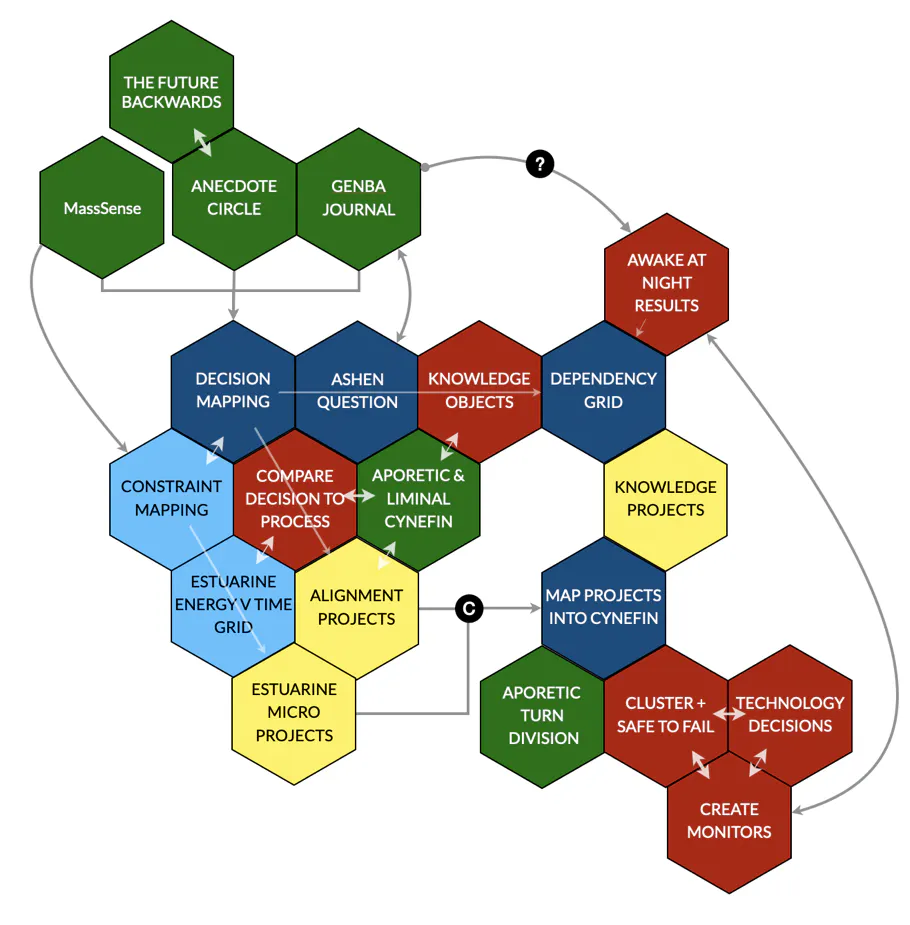
2023 Knowledge Mapping - Hexi approach
- The whole point of Hexi is reuse and trans-initiative integration rather than multiple siloed initiative within a utopian paradigm
Discovery Phase
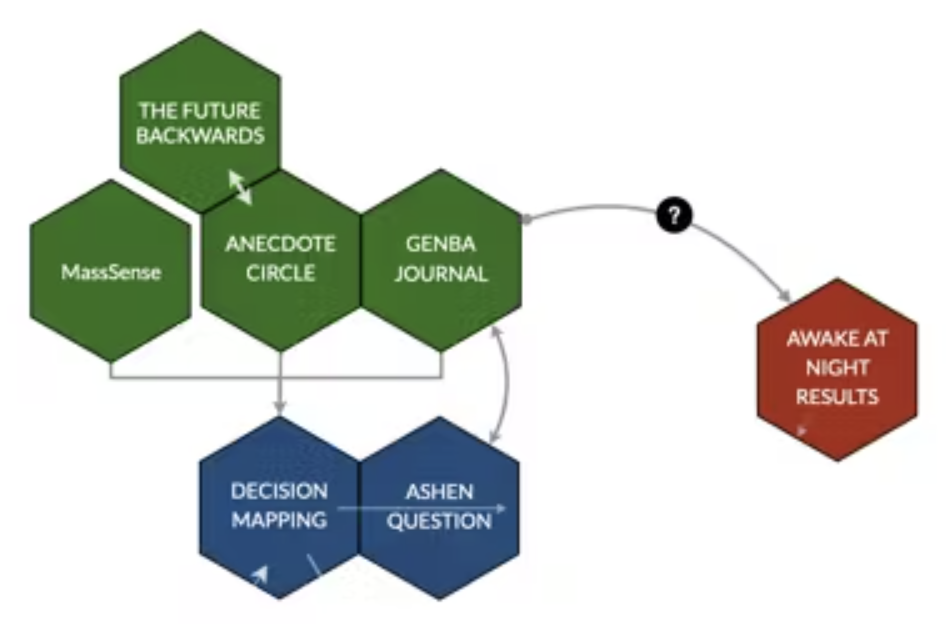
- Two parallel activities
- Gather decisions (to set the meaningful context) and also to ask the ASHEN question
- Discover matters of concern to senior and primarily middle management in a larger organization
- Could be the whole of the organization if needed
Collection methods include:
- Anecdote circles (physical or virtual)
- Gather anecdotal material about actual projects and activities that happened in the past
- Future Backwards
- Fictional stories of what might have happened or might happen in the future
- Fiction is as good, and often a better disclosure technique than seeking facts
- MassSense which is a SenseMaker® application that can present material to stimulate multiple respondents or simply ask them for ideas
- Prompt is a map of key processes
- Used that map as a signifier in SenseMaker® to support material entered and interpreted by each respondent
- Genba, a SenseMaker® application allowing journal based capture of decisions, observations, ideas etc.
- Use one-time or as part of a continuous process
- It is both a journal and a tool for journalists so people can interview other people abut decisions
- Technique works well with senior management and high status professions who will respond to an apprentice but less so to a consultant and don’t think they have time to maintain a journal
- Once gathering is complete we move into decision extraction and identification of various aspects for each decision cluster:
- Information received (and that we would have like to receive)
- How the decision is communicated (and how that communication might have been improved)
- Decision clusters are then given a name and placed onto a brainstorming area (physical or virtual)
- Sequence and connect decisions
- Information out from one decision will be information in to another and so on
- If a decision doesn’t connect to another decision or a start end point then we have missed something and we need hunt it down
- Outcome will be a very messily coherent map
- As we identify the decision clusters we also ask the ASHEN typology question
- Gather the results of that on another work area, randomizing them in initial placement
- In parallel to the above, find out from managers or those with funding what are the current strategic and operational issues that are keeping them awake at night
- We finish this phase with a decision map, a mass of ASHEN elements and a list of things that matter to whoever is the effective sponsor – might be middle management, leadership or the wider workforce or even external stakeholders
- One of the nice things about software methods for discovery is that they not only scale, but they also allow us to capture of a lot of the elements for decision mapping
Sense-making Phase
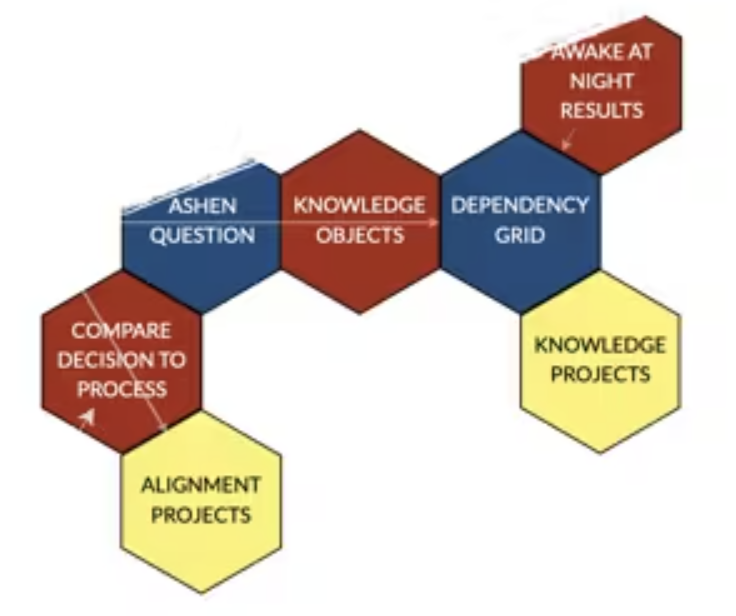
Stream one: reality check on process (vertical on hexi map)
- Compare the decision map (work-as-done) with the process map (work-as-imagined or planned) for the organization
- If they don’t have that then sit down with Executives and get them to describe how they think the process works, draw it up and get their endorsement
- If the differences are so great that meaningful comparison is impossible
- Abandon the how we think it is more or less
- Look at how we can stabilize and consolidate current reality to create something with more transparency and scalability
- In the extreme case where it seems people do not follow process, treat as a learning opportunity
- It may be due to passive aggressive resistance to change which will need a mix of enforcement and understanding
- It may be helpful to introduce Cynefin to describe why people are not following process
- Do they feel close to the Clear/Chaotic boundary?
- Are they confused (Aporetic domain)?
- Do conditions enable uncertainty or unpredictability to emerge {Liminal domain between Complex/Complicated)?
- Making sense of the situation may mean
- agreeing in the middle
- a set of amendments
- exception-based decisions (distributed decision making in which combinations of roles have the authority to change any formal process and even break it, subject to transparency)
- All of the above results in a series of action items
- Items are randomized onto a work space for later use
Stream two: creating the dependency grid (horizontal on hexi map)
- The various ASHEN elements need to be clustered into Knowledge Objects
- Ask people with experience of the domain to cluster all the ASHEN elements into groups of things that cab be managed as a coherent whole
- Remember that ASHEN is a typology so your lists should not say that this is an artefact or a skill, but just say what the question revealed
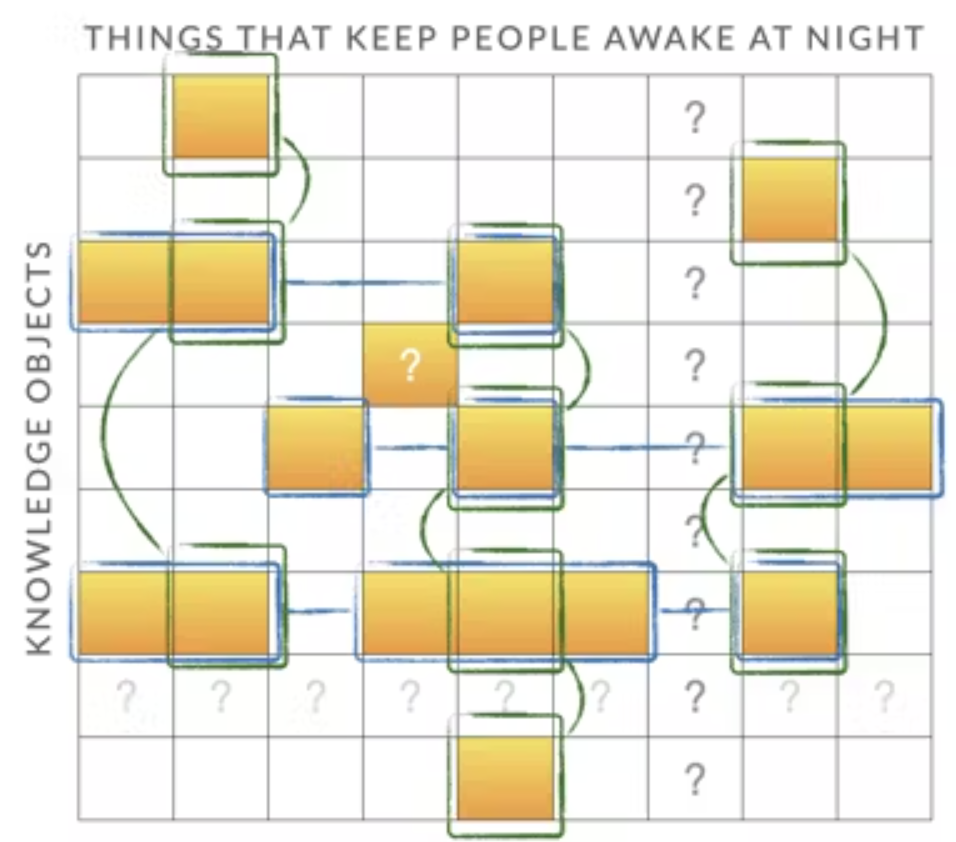
- Knowledge Objects are then placed on the vertical axis of a grid in no particular order but they are tagged based on an assessment of the vulnerability to loss against impact.
- High vulnerability/Low impact = no issue
- High vulnerability/High impact = a priority
- Ask people with experience of the domain to cluster all the ASHEN elements into groups of things that cab be managed as a coherent whole
- Things that keep people aware at night then form the horizontal axis and impact is the main tag
- We then distribute the grid and get people to score dependencies
- Use a 0-5 scale or simplify it to high dependency only
- This can be a spreadsheet distributed to thousands and then the mean scores are used to indicate high dependency (gradated yellow on the picture)
- In a workshop it can be done with simply voting, discussion in parallel with comparison and so on
- Now look at the picture and cross our eyes
- It’s a long standing technique to disrupt perception and sense new patterns
- What we then see are two patterns:
- Horizontal (one knowledge object impacts multiple issues)
- Vertical (one issue requires more effective management of multiple knowledge objects)
- Each of those patterns is a project and they have different characteristics
- Vertical are more difficult to execute but generally have a single owner
- Horizontal are easier to execute but ownership and definition of success are more difficult
- We then look for other patterns
- An issue with no dependencies may mean that we need to acquire knowledge we don’t have
- A knowledge object with no dependencies may be surplus to requirements or may be a neglected opportunity
- Single or limited dependencies require more attention and they are rarer than you would think.
- So we have another portfolio of projects but we also have a built-in prioritization
- Each micro-project is tangible and linked to a clear need
- No platitudes, no idealism just plain pragmatism
- Some projects may contradict others
- We won’t know who was right until we engage
- As a general note , the approach scales
- In Bank of Thailand we had multiple spreadsheets and the overall dependency for thousands of rows by thousands of columns
- In a two day session with the British Treasury (that ended up with the Permanent Secretary staying for the whole process as he was fascinated) we had a single matrix projected onto a screen
- Granularity scales as you can assemble from the same source material at people’s capacity to act: a key principles of anthro-complexity.
Action phase
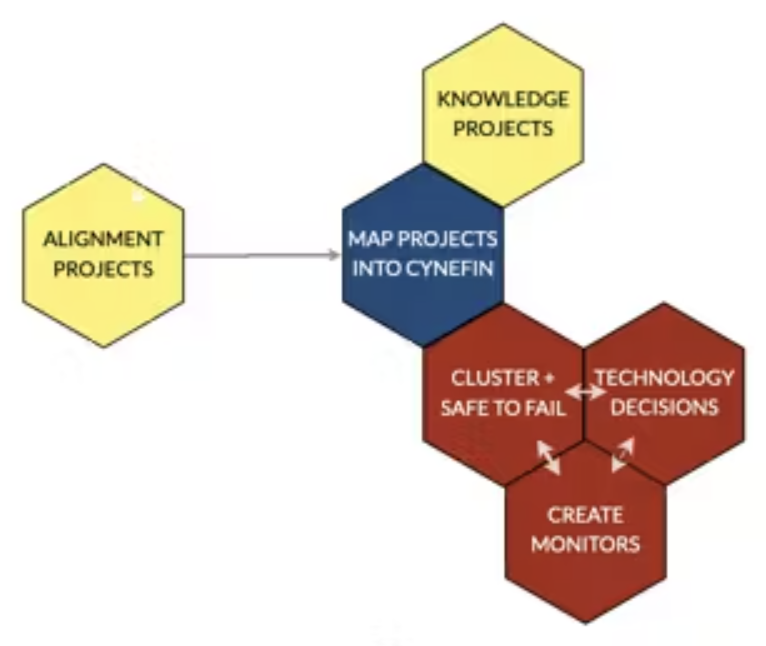
- Cluster the projects and then map them onto Cynefin and they will either fall into a domain, or in the liminal areas between domains
- In some cases they may (per the aporetic turn in the EU Field Guide) be in the centre and require further division
- Clustering into Cynefin will result in
- Ordered projects which just need to be executed,
- Complex projects which require parallel safe-to-fail experiments
- Domain transition projects that require constraint modification
- Hexi forms are available to provide structure as scaffolding helps
- Technology decisions
- Look at common practices
- If data capture is needed from employees then the deployment of SenseMaker® Genba might service multiple projects
- We might need a set of Communities of Practice
- We might need search technology
- The point is we don’t start with technology solutions as those come last
- Look at common practices
- Create monitors per project cluster or project assembly
- Outcome based or vector based
- Rhythm of their use may be different along with the consequences of success or failure
- At this level we would expect significant levels of failure in the short term to increase learning and thus resilience
- In comparison, a top-down knowledge programme is far too vulnerable to failure
- Finally what we are really trying to achieve here is to create a continuous scanning and response process in which the maps change in near real time rather than being a once off technique
- Knowledge is dynamic
- it changes with context and humans, with their capacity for abduction, are really good at handling uncertainty with the right scaffolding
- We just don’t build systems which utilise that capacity as we attempt to eliminate rather than navigate complexity
- Adding in Estuarine Mapping can be done as part and parcel of the same exercise and may be a good way to find things that should be keeping people awake at night
- The end point is another portfolio of projects
- Granularity, the ability to fail and the enablement of emergence – the heart of complexity
Everything together
Colour coding:
- Green are optional methods/tool that can be used standalone or in combination
- Blue (dark and light) represents formal Cynefin methods, the light blue are optional extras
- Yellow represents micro projects
- Red represents workshop of consultancy processes
- The black dot with a C indicates combination or connection
- Double white arrows indicate interaction
- Single arrows represent interaction between processes or method, they are not show where it is obvious