inauguration 3
see main and bak
SEE CORRUPT 3 CHEV EXXON BD ~ FTC OPEC
SEE SIL VLY ZUCK AI ALTMAN MUSK PALANTIR MICRODOFT GGOGLE FACEBOOK META AMAZON BEZOS TIM COOK APL
CRYPTO RIPPLE ROBINHOOD
UBER RIDESHARE
SEE PLUTO DEREG KLEPTO
SEE CORP BAD ACTOR FINE SETTLEMENT CHARGES DROPPED
GEO GP PIC CORE CIVIC
SEE BALLROOM
SYNGENTA DOW
ENERGY CHEVRON COAL API FIRST ENERGY HOUSEHOLDER OHIO
PHARMA ABBOTT LAB
see dereg EPA
JBS MEAT
===
aha this is a bribery/corruption loophole vuln exploit by gop trump kelpto -kaki
See BH gp LEO
ADDING 2024 HERE FOR NOW
NOTE NO TRANS MOU SO UNLTD SECRET MONEY
---
open secrets very long
desmog murray
March 31, 2020
Robert Murray was included in a list by Rolling Stone in an article titled “Climate Enemies: The Men Who Sold the World.” According to the magazine, “bad actors are not only failing to address the crisis, they’re actively exacerbating it.” The list includes “America’s worst offenders, from fossil-fuel industry magnates, to investment gurus, to the president himself.”63
“Murray’s influence extends beyond his floundering dirty-energy company,” the article states. “For years, he pumped money into a diverse portfolio of conservative groups that continue to push disinformation about the climate crisis. Murray also had an oversize influence on Trump’s climate policy, donating $300,000 to his inaugural committee before handing the president a literal wish list of rollback requests, many of which were dutifully carried out by the administration.”64
Concerns and scrutiny
- Regulatory leniency: While El Salvador's embrace of crypto has attracted companies, critics have raised concerns over the country's comparatively relaxed regulatory framework. El Salvador's stablecoin law requires licensed issuers to provide audited financial statements, a standard Tether has resisted elsewhere.
- Bukele regime ties: Tether's move and deep ties to President Bukele's government, which has been criticized for authoritarianism and human rights abuses, have also attracted scrutiny.
- Financial reporting: Tether's financial reporting and the composition of its reserves have long been a subject of controversy, with the company facing persistent questions regarding transparency.
GGL 7 26
AI Overview
FanDuel and DraftKings are pouring tens of millions into lobbying and super PACs, including the $41 million sports betting Win for America super PAC. Both companies donated heavily to Donald Trump’s inaugural committee, with DraftKings giving $502,000 and FanDuel contributing $482,000. [1, 2]
An overview of their political contributions and lobbying efforts reveals:
- Win for America Super PAC: DraftKings and FanDuel are the primary funders of this super PAC, directing millions toward state legislative races to protect and expand online sports betting. [1]
- Bipartisan Congressional Influence: FanDuel gave $500,000 each to the Republican-aligned Senate Leadership Fund and Congressional Leadership Fund. On the same day, the company donated $500,000 each to their Democratic equivalents, the Senate Majority PAC and House Majority PAC. [1]
- Trump Inauguration Donations: Both platforms made six-figure in-kind donations to support President Donald Trump’s inaugural festivities, using the event to connect with state lawmakers. [1]
- Federal Lobbying Expenditures: Both companies have rapidly expanded their direct federal lobbying in Washington, with FanDuel and DraftKings spending nearly $2 million combined on lobbying disclosures through OpenSecrets. [1, 2]
Track official spending disclosures and recipient committees through the OpenSecrets Lobbying Profile and the Federal Election Commission. [1, 2, 3, 4]
---
ggl ai 8 25
reports on donations to former President Trump's second inauguration in January 2025 indicate a total of nearly $240 million was raised. This significantly surpasses the previous record of $107 million raised for his first inauguration in 2017.
Here is a partial list of companies and individuals who donated to Trump's second inauguration, along with the reported amounts:
Corporations
- Amazon: $1 million
- Meta (Facebook parent company): $1 million
- OpenAI: $1 million
- Google: $1 million
- C3 AI: $1 million
- Perplexity AI: $1 million
- Ford Motor Company: $1 million
- Uber: $1 million (company contribution)
- Qualcomm: $1 million
- Coinbase: $1 million
- Kraken: $1 million
- Galaxy Digital Holdings: $1 million
- Crypto.com: $1 million
- Paradigm Operations: $1 million
- Pilgrim's Pride: $5 million
- Ripple: $5 million (in XRP cryptocurrency)
- AT&T: $1 million
- Bank of America: $1 million (2017 donation mentioned in 2025 search results)
- Boeing Co: $1 million (2017 donation mentioned in 2025 search results)
- Chevron Products Co: $525,000 (2017 donation mentioned in 2025 search results)
- Merck: $1 million
- Johnson & Johnson: $1 million
- Pharmaceutical Research and Manufacturers of America (PhRMA): $1 million
- Geo Group: $500,000 (plus an additional $500,000 via lobbying disclosures, and $85,000 to other Trump committees)
- CoreCivic: $500,000
- Coca-Cola: $250,000
- American Beverage Association: $250,000
- Syngenta: $250,000
- International Flavors & Fragrances: $250,000
- Socure: $100,000 ANTI FRAUD TECH CO
- Barnes & Thornburg LLP: $100,000
- JPMorgan Chase: Included among "blue-chip companies" giving at least $1 million
- Delta Air Lines: Included among "blue-chip companies" giving at least $1 million
- Target: Included among "blue-chip companies" giving at least $1 million
Individuals and CEOs
- Sam Altman (OpenAI CEO): $1 million (personal donation)
- Jeff Bezos (Amazon founder): Attended inauguration and his company donated $1 million
- Mark Zuckerberg (Meta CEO): Attended inauguration and his company donated $1 million
- Elon Musk: Close adviser to Trump and attended the inauguration
- Tim Cook (Apple CEO): $1 million (personal donation)
- Dara Khosrowshahi (Uber CEO): $1 million (personal donation)
- Warren Stephens: $4 million (nominated Ambassador to the United Kingdom)
- Jared Isaacman: $2 million (nominated NASA administrator)
- Melissa Argyros: $2 million (nominated Ambassador to Latvia)
- Dan Newlin: $1 million
- Jeffrey Sprecher: $1 million (husband of Trump's Small Business Administrator appointee, Kelly Loeffler)
- Keith Rabois: $1 million
- Ken Howery: $1 million
- Ken Griffin: $1 million
- Miriam Adelson: $1 million
- Scott Bessent: $250,000 (nominated Treasury Secretary)
- Tilman Fertitta: $1 million (nominated Ambassador to Italy)
- Linda McMahon: $1 million (nominated Education Secretary)
- Howard Lutnick: Cantor Fitzgerald (his former employer) gave $1,047,000
- Jeffery Hildebrand: $500K (husband of Trump's Ambassador to Costa Rica nominee)
It's important to note that the full list of donors has not been publicly released, and the information above is based on publicly available reports and news articles. Inaugural committees are required to report aggregate donations of $200 or more within 90 days of the event.
---
AI Overview GGL 10 25
According to reports published in early 2025, Galaxy Digital Holdings, led by CEO Mike Novogratz, donated $1 million to Donald Trump's inaugural fund
. This contribution was part of a broader, record-breaking fundraising effort by the crypto industry for Trump's inauguration.
Details surrounding the donation:
- Donation made after Trump's election: Galaxy Digital Services LLC made the $1 million contribution after Trump's election. Following the election, Novogratz stated that Trump's presidency represented a "whole new world" for the crypto industry and that he expected consistent "good news" for the sector from the new administration.
- Part of a wave of crypto industry donations: Galaxy was one of several crypto-related companies to make a significant donation to Trump's inaugural fund, alongside Coinbase, Kraken, and others. The crypto industry as a whole contributed over $13 million.
- Novogratz's broader political stance: Despite traditionally supporting Democratic candidates and causes, Novogratz is known for his "pro-crypto" stance and for supporting candidates from both parties who align with the crypto industry's interests. He has been critical of Democrats he viewed as anti-crypto, including Senator Elizabeth Warren.
- Crypto industry's changing influence: The large contributions marked a significant shift in corporate behavior, as many tech companies that had distanced themselves from Trump in the past contributed to his 2025 inauguration. Observers believe these donations led to the Trump administration subsequently dropping lawsuits and probes against five crypto companies.
Paradigm Operations LP, a cryptocurrency venture capital firm, donated $1 million to Donald Trump's second inauguration. The firm was one of several crypto companies, including Coinbase, Kraken, and Galaxy Digital, that gave significant donations to the inaugural committee.
- Donation amount: Paradigm Operations LP contributed $1 million.
- Inaugural committee: The donation was made to the Presidential Inaugural Committee for the inauguration of Donald Trump.
- Industry: Paradigm Operations is a crypto-focused venture fund, and its donation was part of a larger trend of financial support from the cryptocurrency industry for Trump's inauguration.
- Other donors: Other companies in the crypto space that made similar donations include Coinbase, Crypto.com, Galaxy Digital, and Kraken.
---
Million-Dollar Donors Flooded Trump’s Second Inauguration | Brennan Center for Justice
JUL 2025 GFX
Trump’s 2025 inauguration didn’t just break fundraising records, it fundamentally redefined them, spotlighting the growing role of the biggest donors. Individuals and corporations, many of which stand to benefit from the actions of the new administration, contributed an unprecedented number of seven-figure checks.
The inaugural committee received more than $245 million in contributions, doubling Trump’s own record-setting $88 million inauguration in 2017 and quadrupling the $61.8 million raised by Joe Biden’s inaugural committee in 2021, when festivities were limited by the Covid-19 pandemic. No previous inaugural committee since at least 1973, even accounting for recent inflation, has come close to the fundraising scale of this year’s inauguration.
While the inauguration itself is a government-run event, newly elected presidents hold many accompanying events that are funded through private donations raised by lightly regulated inaugural committees. Unlike campaign committees, inaugural committees are not subject to contribution limits and have few restrictions imposed by federal law. Inaugurations can legally take donations of unlimited sums from individuals, corporations, and unions, so long as donors are not foreign nationals and certain disclosure rules are followed. Inaugural committees often impose their own caps on contributions, but Trump’s 2025 inaugural committee imposed no such limits.
The following analysis offers the first comprehensive examination of this year’s inaugural finances that includes amended filings and refunds, documenting the inaugural fund’s reliance on its biggest donors. This analysis breaks down funding by major industries, showing that tech interests, including cryptocurrency companies, were far and away the largest source of money. It also notes examples of substantial donations coinciding with advantageous policy or personnel decisions by the Trump administration, as well as an unprecedented number of refunds and millions of dollars in donations for which the true sources are not entirely clear.
Record Giving from the Biggest Donors
The 2025 inauguration attracted more donors who gave $1 million or more than any prior inaugural fund. These seven-figure donors contributed more than the total amount raised for any previous inauguration and collectively accounted for a greater portion of funding than all donors that gave less than $1 million. The top 10 funders to Trump’s 2025 inaugural committee alone account for more than $1 out of every $10 raised for this year’s inauguration.
Inaugural Funding
Donations
of $1 million or more
Donations
of less than $1 million
50100150200$250M200520092013201720212025
$42.3M
$54M
$13.3M
$31.6M
$54.1M
$52.7M
$11M
$50.8M
$152.5M
$92.8M
Note:Figures are shown in nominal dollars, not adjusted for inflation.
Source: Brennan Center analysis of FEC data.
Prior inaugurations generally imposed voluntary contribution caps and other restrictions. Trump’s first inaugural committee, for instance, capped corporate contributions at $1 million. The Biden inaugural committee capped individual contributions at $500,000 and corporate contributions at $1 million, and it pledged to reject contributions from registered lobbyists, foreign agents, and fossil fuel corporations or their executives.
Both of President Barack Obama’s inaugural committees barred contributions from PACs and lobbyists. His first inauguration also capped contributions at $50,000 (although it allowed individuals to bundle contributions from multiple donors) and completely rejected corporate funding, although the second was not subject to these restrictions. George W. Bush imposed limits on his inaugural fundraising too: $100,000 in 2001 and $250,000 in 2005.
Top Industries
The 2025 inauguration’s donors featured corporate giants, tech titans, energy companies, financial institutions, and wealthy individuals. (In some cases, corporate givers touch multiple industries. This analysis counted each donor only once.)
Only six of the hundreds of major corporate donors to Trump’s inauguration had also contributed to super PACs supporting his 2024 presidential bid. While the actual motivations behind any one inaugural donation are not clear, donors who did not give to the president’s campaign have a significant financial stake in his administration’s early policy priorities. The vast majority did not give to his campaign, suggesting that inaugural donations can serve as another, potentially alternative, way to gain influence with the administration.
Silicon Valley investors, Big Tech giants, and burgeoning tech fields such as artificial intelligence (AI), fintech, and cryptocurrency were among the inauguration’s top contributors. Overall, technology interests gave roughly $44.6 million.
Top 20 Industries in 2025 Inaugural Contributions
Technology
$46.2M
Finance
$20.9M
Energy
$16.2M
Health and pharmaceuticals
$15.5M
Food and beverage
$9.8M
Construction and industrial supplies
$5.9M
Motor vehicles
$4.8M
Trust
$3.9M
Tobacco and vaping
$3.9M
Aerospace and defense
$3.6M
Logistics and professional services
$3.4M
Real estate
$3.1M
Nonprofits, advocacy, and politics
$2.7M
Tribes
$2.3M
Manufacturing
$2.1M
Airlines
$2M
Hospitality and entertainment
$1.9M
Retail
$1.7M
Agribusiness
$1.6M
Lobbying and legal services
$1.6M
Source: Brennan Center analysis of FEC data.
Cryptocurrency companies made up at least $13.5 million of that total — enough for the industry to be one of the top five donor industries unto itself. Many other corporate contributors also have interests related to digital currency or blockchain. Trump ran for office on a promise to make the United States “the crypto capital of the world." He has since embraced cryptocurrency with a blitz of strategic appointments, executive actions easing crypto enforcement, and personal investments.
Some of the biggest crypto donors to the inauguration also have direct stakes in specific Trump administration decisions.
Among them is Ripple Labs, a cryptocurrency company whose nearly $4.9 million contribution made it the second-largest donor overall. After the Securities and Exchange Commission (SEC) imposed a $125 million fine on Ripple last year, it more recently agreed to settle with the company for $50 million. However, in May, a federal judge declined to sign off on the settlement, citing procedural errors in the joint filing.
Electronic trading platform Robinhood Markets, which gave $2 million to the inauguration, has also expanded its cryptocurrency trading business under Trump following years of scrutiny and penalties under the Biden administration.
Several industries with major inaugural donors, including pharmaceuticals and semiconductors, also lobbied the Trump administration for industry-wide tariff exemptions.
Other inaugural donors have interests in AI, social media, and other areas facing regulation. Sizable inaugural funds from the AI space included $1 million each from OpenAI CEO Sam Altman, C3 AI, and Perplexity AI. Along with Google, which also contributed $1 million, OpenAI has been lobbying Trump’s administration for an exemption to be able to train AI models on copyrighted material.
Some donors do continue to face adverse actions by the government. Google and Facebook parent company Meta, another million-dollar inaugural contributor, are grappling with scrutiny over content moderation and antitrust issues. Apple, whose CEO Tim Cook personally contributed $1 million to the inauguration, is embroiled in an escalating fight with the Trump administration over tariffs on foreign-made iPhones.
Uber CEO Dara Khosrowshahi personally contributed $1 million to Trump’s inauguration, and the company gave another million. Uber stands to benefit from a tax break on tips for independent contractors such as rideshare drivers in the Trump-backed tax and spending bill that is currently being considered by Congress.
The finance industry contributed $20.9 million to the inauguration. Donors from the industry may benefit from the administration’s moves to dismantle the Consumer Financial Protection Bureau and loosen banking regulations.
Energy interests supplied another $16.2 million. The bulk of that amount — $11.8 million — came from fossil fuel companies, whose contributions Biden’s inaugural committee rejected.
Chevron, one of the companies the Biden administration accused of conspiring to profit off market volatility following Russia’s 2022 invasion of Ukraine, contributed $2 million — putting the oil and gas company among the top three corporate contributors to Trump’s inauguration. Exxon gave the inauguration another $1 million. Both Chevron and Exxon successfully petitioned the administration to revisit their respective mergers with other oil and gas companies in the months following the administration. In addition, millions of inaugural dollars came from alternative energy sources like solar power companies.
Donors from the health, pharmaceuticals, and food and beverage industries also gave to the inauguration. The single largest inaugural contribution came from Pilgrim’s Pride, a subsidiary of Brazilian meat processing conglomerate JBS SA, which gave $5 million. Pilgrim’s Pride has faced antitrust scrutiny in recent years and could stand to benefit from the Trump administration’s move in March to roll back regulation on poultry processing.
Appointments for Top Donors
The top three individual donors to the inauguration each landed nominations for roles in the Trump administration. This phenomenon is not new: Presidents of both parties have long rewarded donors with plum diplomatic posts. However, the millions of dollars that Trump’s fund received from appointees is unrivaled by any prior inauguration. Altogether, individuals nominated for roles in Trump’s administration and their immediate families contributed more than $16.2 million.
Trump nominated the inaugural committee’s top individual donor, Warren Stephens, to be ambassador to the United Kingdom on the same day that Stephens contributed $4 million to the inaugural committee. His contribution is the second-largest individual inaugural contribution of all time, after the late casino executive Sheldon Adelson’s $5 million contribution to Trump’s first inauguration.
Trump nominated two other individual donors that each gave $2 million for roles in his administration. Melissa Argyros is a real estate investor whom Trump nominated to be ambassador to the Republic of Latvia. Jared Isaacman is an entrepreneur and commercial astronaut. Days after Isaacman’s contribution to the inaugural committee, Trump announced his plan to nominate him as the head of NASA, though the president later withdrew the nomination amid tensions with Elon Musk.
Millions in Mysterious Funding
Millions of dollars in contributions to Trump’s second inaugural committee came from previously undisclosed or obscured sources. Several of these contributors are entities with little public-facing presence.
Amended Federal Election Commission (FEC) records filed on May 2 reveal that a $1 million contribution originally attributed to the accounting firm Wipfli LLP was actually made by Alexander Karp, the CEO of Palantir Technologies, which Karp cofounded with billionaire Peter Thiel. The existence of the contribution was first reported by Issue One. SEC filings show that Karp had listed Wipfli LLP as his “care of” address, which matches the address that initially appeared in the inaugural committee’s disclosure. The Trump administration awarded Palantir hundreds of millions in government contracts, including a recent $217.8 million Department of Defense delivery order for data products and advanced analytics to the Space Force. Palantir has been a major government contractor for several years across multiple administrations. Immigration and Customs Enforcement (ICE) has described Palantir’s work as “mission critical” to the agency’s targeting of immigrants for deportation. In April, ICE awarded the Denver-based company another $30 million to develop software that will give the agency “near real-time visibility” on people self-deporting from the United States.
Multiple trusts with varying levels of transparency also contributed to the inaugural committee. The Tang Family Trust gave $2 million, more than any other trust, placing it among the top five organization contributors overall. While the inauguration committee did not disclose the source of this funding in its initial filings or amendments, the address listed matches the Beverly Hills residence of Donald Wei Tang, the CEO of fast-fashion retailer Shein. Shein relies heavily on Chinese imports affected by the administration’s removal in April of a tariff exemption that allowed goods under a certain value to enter the United States duty-free. Trump issued an executive order on May 12, reducing tariffs on Chinese imports from 145 percent to 30 percent for the subsequent 90 days.
Another obscured donor is Quantum Legal Consulting LLC, which gave $1 million. It was initially incorporated as the Athens Project in 2021 by Georgia lawyer Joshua P. Jones then changed its name again to 2HD Consulting LLC in May of this year. While Quantum Legal Consulting was incorporated in Georgia, its address listed in the inauguration filings matches that of the Outside America Foundation, a nonprofit started in 2023 by Jones and Erik Prince, the brother of former Trump Education Secretary Betsy DeVos and founder of the private military company Blackwater.
Record Refunds with Foreign Connections
Trump’s 2025 inaugural committee also made more refunds, totaling more than $6.2 million, than any prior inauguration. Biden’s inaugural committee reported refunding around $550,000, and only two of those refunds reached six figures. Trump’s first inaugural committee reported making just three refunds totaling $37,800. Obama’s two inaugural committees refunded approximately $1 million each.
Why the 2025 inauguration made so many refunds is unclear. FEC filings do not specify whether the refunds were initiated by the inaugural committee or requested by donors. Several of the refunded donors, however, are tied to foreign entities. Foreign nationals are prohibited from donating to a presidential inauguration fund.
The largest refund was $1 million to Freedom Holdings Corporation, dated one day after the inauguration. Freedom Holdings is an investment and financial services firm with a Las Vegas address that was founded by Timur Turlov, a Russian-born Kazakhstani entrepreneur and financier who controls about three-quarters of the corporation.
Two U.S. subsidiaries of South Korean company Hanwha received refunds totaling $1 million. The inaugural committee returned $500,000 to Hanwha Defense USA and another $500,000 to Hanwha Qcells America. While Hanwha is headquartered in South Korea, its affiliates collaborate closely with U.S. defense contractors and have been awarded tens of millions in government contracts since the start of last year. On June 16, Hanwha Systems signed an agreement with U.S. defense contractor Northrop Grumman to jointly develop integrated air defense systems. Earlier in June, Hanwha entered into another agreement to collaborate with defense contractor BAE Systems to collaborate on a “multi-sensor satellite system.”
Hong Kong Go Win Investment Fund, which is listed as Hong Kong Go Investment Fund in refunds disclosed by the inauguration, also received a full refund of its $500,000 contribution. An initial FEC filing omitted the fund’s address, but the Hong Kong location was disclosed in an amendment. The investment fund has little public-facing presence, although a similarly named company, Hongkong Win Go Fund, is incorporated in Hong Kong.
Inversiones Productivas del Norte received a $100,000 refund from Trump’s 2025 inaugural committee. The Mexican company played a key role in a chain of million-peso financial transactions connected to a controversial land deal for Tesla’s proposed factory in Nuevo León, Mexico.
VoltaGrid, a $4 billion Houston-based startup that assembles modular gas-fired power plants to meet the expanding needs of data centers and oil fracking companies, received another $500,000 refund from Trump’s inaugural committee.
Another $250,000 was refunded to Robin Rosenzweig, the wife of Trump fundraiser and former inaugural co-chair Elliott Broidy. Broidy pleaded guilty to conspiring to violate foreign lobbying laws as part of a covert campaign on behalf of foreign interests following a Justice Department investigation into his allegedly offering foreign actors access to the Trump administration.
Alonso Ancira Elizondo, known as the “king of steel” in Mexico, received a $200,000 refund from Trump’s inauguration. Elizondo, who served as president of a major steel plant in Mexico from 1991 to 2023 but is now based in San Antonio, Texas, is known for leading one of the largest scams in Mexico’s history and defrauding the Mexican government of $500 million. The disgraced steel magnate is currently battling allegations of stealing shares in the bankrupt company to help secure his release from prison.
Conclusion
Inaugurations are a venue for powerful donors to curry influence with little accountability, highlighting the need for stronger safeguards for inaugural fundraising and raising questions about donors’ influence over the administration.
The bulk of contributions to Trump’s 2025 inauguration fund came from a small circle of wealthy donors and corporations, including some with clear interests before the administration and others shielded by layers of opacity. The event accentuated a glaring gap in the nation’s political finance safeguards. Some proposals to address the lack of checks on inaugural giving — no matter the party of the president — include mandatory contribution caps, stronger disclosure rules, and prohibitions on obscured donations funneled through intermediaries.
The power of big money in American politics doesn’t stop on Election Day. It shapes priorities and access to the administration from day one.
Anna Massoglia is an investigative analyst, writer, and editor tracking money and influence in politics. She serves as an independent advisor and contributing analyst to multiple newsrooms, academic institutions, and nonprofits. Her work focuses on political finance, foreign influence, government transparency, and accountability. Massoglia has been widely cited by policymakers and featured onThe New York Times, The Washington Post, NPR, and CNN. Previously, Massoglia was the editorial and investigations manager at OpenSecrets. She holds degrees in political science and psychology from North Carolina State University and a JD from the University of the District of Columbia School of Law.}:
---
crypto-money-trump-inauguration-00199088
Jasper Goodman01/17/2025
The cryptocurrency industry, fresh off a 2024 elections spending spree, has turned its influence efforts in recent months to a new target: celebrating the start of President-elect Donald Trump’s second term.
Leading crypto firms have pumped at least $10 million into the Trump inaugural fund, and top executives are flocking to Washington ahead of the incoming president’s swearing-in on Monday.
Crypto companies including Ripple, Coinbase, Kraken, Robinhood and Circle have made seven-figure donations to Trump’s inaugural committee since Election Day — part of a wave of corporate contributions that Trump has reeled in as big businesses scrambled to curry favor with the incoming administration.
The donations, which will fund the glitzy official events surrounding the inauguration, exemplify the giddiness across the digital asset sector as Trump prepares to become the first-ever explicitly pro-crypto U.S. president. The industry is eyeing any avenue of influence as it pushes the incoming administration and a GOP-controlled Congress to complete a regulatory overhaul that could boost its growth.
“This is a moment of celebration for the industry,” said Kristin Smith, CEO of the Blockchain Association, a leading crypto trade association.
The industry laid the groundwork for that celebration by pouring more than $160 million into a super PAC that helped elect a bipartisan slate of lawmakers sympathetic to its agenda. The high-dollar influence campaigns illustrate how the crypto industry has become a major new well that politicians are tapping for contributions, helping it play an outsize role in American politics.
Crypto firms are hosting a sold-out unofficial inaugural ball on Friday at the Andrew W. Mellon Auditorium in downtown Washington. The event, which is set to feature Snoop Dogg as a musical guest, is being put on in part by David Bailey, who runs a bitcoin conference that Trump spoke at last summer. Other sponsors include the Coinbase-backed advocacy group Stand With Crypto and the digital asset firms Exodus, Anchorage Digital and Kraken.
It all comes as crypto executives and their lobbyists are scrambling to gain sway over the policy changes that Trump has vowed to usher in, which include stockpiling bitcoin and putting in place a new framework for how digital assets are regulated — “written by people who love your industry.”
One target of fixation for players in the crypto space is a digital assets advisory council that Trump has vowed to create, led by incoming White House crypto and AI czar David Sacks and former North Carolina Congressional candidate Bo Hines.
“Everyone is jockeying for it,” said one Washington crypto lobbyist, granted anonymity to speak candidly about sensitive dynamics within the industry.
Several top executives are expected to be in town for the inauguration, along with other tech leaders who have taken steps to get in Trump’s good graces in recent months. And many firms have shelled out to fill the inaugural fund’s coffers.
The crypto firm Ripple, a major target of enforcement action from the SEC that the industry decried during the Biden era, donated $5 million in digital tokens to the inaugural committee, according to a spokesperson for the company. Two of the firm’s top executives, CEO Brad Garlinghouse and Chief Legal Officer Stuart Alderoty, who met with Trump earlier this month at Mar-a-Lago, plan to attend the swearing-in.
The U.S. crypto exchanges Coinbase and Kraken and the stablecoin company Circle, which issues a token that is pegged to the value of the U.S. dollar, each donated $1 million to the inaugural fund. Robinhood, a leading online brokerage that dabbles in crypto, donated $2 million, according to a spokesperson. Top Coinbase executives including CEO Brian Armstrong were on Capitol Hill on Friday, ahead of the inauguration. Armstrong has twice met with Trump, according to a spokesperson for the company, including once since Election Day.
“I think it’s important to ensure that industry … can engage with this administration and engage in a meaningful way during the transition period,” Kara Calvert, vice president for U.S. policy at Coinbase, said of the firm’s donation. “This is the most pro-crypto president that we’ve ever seen, and he has made a platform clear now for months. And that is a really attractive characteristic right now.”
The donations have become an early target for Democrats and watchdog groups, who say the president is selling influence.
“Billionaires think they bought this government,” Sen. Elizabeth Warren (D-Mass.), a leading critic of the crypto industry in Congress, told reporters Thursday. “They’re sure throwing their weight around.”
*Irie Sentner and Eleanor Mueller contributed to this report.
---
452,390 views Oct 28, 2025
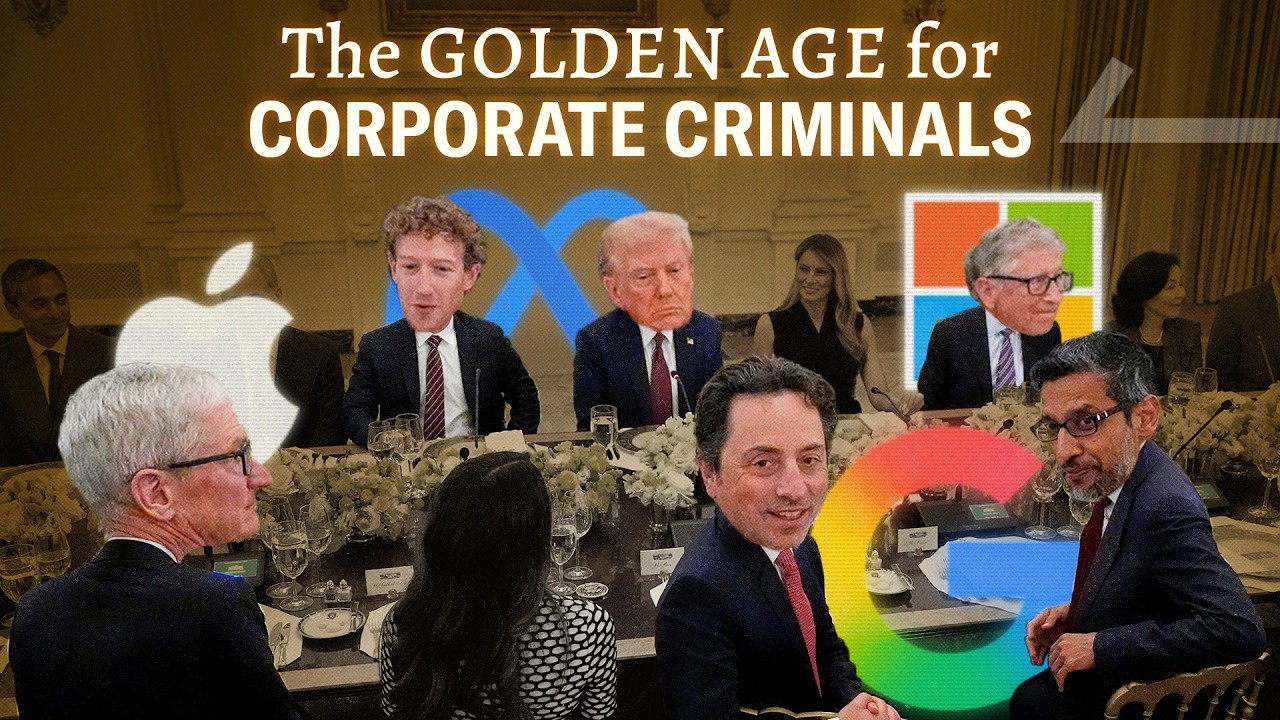
doj anti trust cfpb 1on 3 cases dropped, stock price way up, apple tariffs
...Trump had just announced huge tariffs on all kinds of goods coming from
4:25
foreign countries, tariffs that would raise Apple's cost of doing business by billions.
4:30
Weeks later, after Tim Cook met with Trump, the White House
4:33
announced tariff exemptions for smartphones, computers and chips.
4:37
You know, the things that Apple makes.
4:39
So a $1 million donation for Apple and billions in savings.
4:43
I guess that's what economists would call a return on investment.
4:46
To me it just looks like a bribe with extra steps.
4:49
Microsoft, you guessed it, also got in on the action
4:53
with a $750,000 donation.
4:56
And like Google, they got the FTC off their back–
4:58
a major antitrust case against them dropped for a huge merger they did in 2023 with Activision.
5:04
Amazon reached a big settlement with the FTC for essentially tricking consumers
5:09
into signing up for Amazon Prime,
5:11
a case the FTC could easily have won.
5:14
So why would they suddenly settle?
5:17
Are you starting to see a pattern yet?
....
It seems like the kind of thing that there might a trial over.
8:37
But in May, the Department of Justice made a deal
8:39
with Boeing to not prosecute them for crimes over the 737 crashes,
8:43
as long as Boeing paid about $1.1 billion in fines.
8:47
Sounds like a lot of money until you learn that Boeing had just won a contract
8:51
for $50 billion with the Department of Defense
8:54
to build new F-47 fighter jets.
8:56
Looks a lot like a preferential slap on the wrist to me.
8:59
If you hate the current state of air travel, then you'll be interested
9:02
to hear that Delta and United both made major donations.
9:06
Then the Trump administration turned around and killed new rules
9:09
that would force airlines to compensate passengers for excessive delays.
9:13
In response to this move, and the rollback of other rules
9:16
about hidden fees and flight cancellations, the airline said,
9:19
“We look forward to working with the Department of Transportation on
9:22
implementing President Trump's deregulatory agenda.”
9:26
Yeah, I bet they do.
9:28
The crypto industry also came in with some of the biggest donations for President Trump.
9:32
Crypto companies and schemes rocketed to the center of the Trump world
9:35
at the start of this year when Trump passed the Genius Act, the first major piece of legislation
9:40
that brings cryptocurrencies into the formal economy,
9:42
started dropping major investigations into crypto
9:45
companies, created a strategic cryptocurrency reserve for the government,
9:49
and launched his own meme coin on the Solana blockchain,
9:52
another major donor.
9:55
Which is a long-winded sentence
9:57
that I can't believe I just had to say.
9:59
And maybe the worst part of all of these donors
10:01
are the ones that we don't know anything about:
10:04
the shell companies, political action committees,
10:06
and the fake non-profits that were made to hide who the real donors are.
10:10
Americans for Pharma Reform, Election Freedom, Inc.,
10:14
Axe Capital, all untraceable dark money.
10:18
We'll probably never know who they were or what influence they bought.
10:22
So, yes, technically, no one has broken the law here,
10:25
but shouldn't we care when massive corporations buy influence at the cost of the public?
10:30
$1 million to spare?
10:32
You can have dinner with the president, and he might even listen to your concerns.
10:35
$5 million to spare?
10:37
You can probably buy a whole policy.
10:39
To me, this looks a lot like a system of patronage–
10:42
a government that operates on fealty, bribes, personal favors, and insider access.
10:47
It's not just the inauguration and all this money.
10:50
It's how the Trump administration has attacked big law firms to get them to offer free work.
10:55
It's how they sued media companies to get them to take people off
10:58
the air that don't give Trump favorable coverage.
11:01
It's how they force private companies to bend the knee to comply with Trump's preferences.
11:06
It's how they threaten to withhold funding from states with governors
11:10
that Trump doesn't like.
11:11
The inaugural fund was just one move
11:14
in the playbook, a move that re-centers corporate power at your expense.
Trump used to say that Big Tech is a horrible thing for our country. Now, he’s cozy with Mark Zuckerberg, Tim Cook, and Silicon Valley. What changed? We analyzed all the donors to Trump’s inauguration and uncovered a massive corruption and influence-buying scheme. ----- More Perfect Union is an Emmy-winning, nonprofit newsroom whose mission is to build power for working people. Here’s what that means: We report on the real struggles and challenges of the working class from a working-class perspective. We attempt to connect those problems to potential solutions. We report on the abuses and wrongdoing of corporate power. And we seek to hold accountable the ultra-rich who have too much power over America’s political and economic systems.
---
---
Million-Dollar Donors Flooded Trump’s Second Inauguration | Brennan Center for Justice
Trump’s 2025 inauguration didn’t just break fundraising records, it fundamentally redefined them, spotlighting the growing role of the biggest donors. Individuals and corporations, many of which stand to benefit from the actions of the new administration, contributed an unprecedented number of seven-figure checks.
The inaugural committee received more than $245 million in contributions, doubling Trump’s own record-setting $88 million inauguration in 2017 and quadrupling the $61.8 million raised by Joe Biden’s inaugural committee in 2021, when festivities were limited by the Covid-19 pandemic. No previous inaugural committee since at least 1973, even accounting for recent inflation, has come close to the fundraising scale of this year’s inauguration.
While the inauguration itself is a government-run event, newly elected presidents hold many accompanying events that are funded through private donations raised by lightly regulated inaugural committees. Unlike campaign committees, inaugural committees are not subject to contribution limits and have few restrictions imposed by federal law. Inaugurations can legally take donations of unlimited sums from individuals, corporations, and unions, so long as donors are not foreign nationals and certain disclosure rules are followed. Inaugural committees often impose their own caps on contributions, but Trump’s 2025 inaugural committee imposed no such limits.
The following analysis offers the first comprehensive examination of this year’s inaugural finances that includes amended filings and refunds, documenting the inaugural fund’s reliance on its biggest donors. This analysis breaks down funding by major industries, showing that tech interests, including cryptocurrency companies, were far and away the largest source of money. It also notes examples of substantial donations coinciding with advantageous policy or personnel decisions by the Trump administration, as well as an unprecedented number of refunds and millions of dollars in donations for which the true sources are not entirely clear.
Record Giving from the Biggest Donors
The 2025 inauguration attracted more donors who gave $1 million or more than any prior inaugural fund. These seven-figure donors contributed more than the total amount raised for any previous inauguration and collectively accounted for a greater portion of funding than all donors that gave less than $1 million. The top 10 funders to Trump’s 2025 inaugural committee alone account for more than $1 out of every $10 raised for this year’s inauguration.
Inaugural Funding
Donations
of $1 million or more
Donations
of less than $1 million
50100150200$250M200520092013201720212025
$42.3M
$54M
$13.3M
$31.6M
$54.1M
$52.7M
$11M
$50.8M
$152.5M
$92.8M
Note:Figures are shown in nominal dollars, not adjusted for inflation.
Source: Brennan Center analysis of FEC data.
Prior inaugurations generally imposed voluntary contribution caps and other restrictions. Trump’s first inaugural committee, for instance, capped corporate contributions at $1 million. The Biden inaugural committee capped individual contributions at $500,000 and corporate contributions at $1 million, and it pledged to reject contributions from registered lobbyists, foreign agents, and fossil fuel corporations or their executives.
Both of President Barack Obama’s inaugural committees barred contributions from PACs and lobbyists. His first inauguration also capped contributions at $50,000 (although it allowed individuals to bundle contributions from multiple donors) and completely rejected corporate funding, although the second was not subject to these restrictions. George W. Bush imposed limits on his inaugural fundraising too: $100,000 in 2001 and $250,000 in 2005.
Top Industries
The 2025 inauguration’s donors featured corporate giants, tech titans, energy companies, financial institutions, and wealthy individuals. (In some cases, corporate givers touch multiple industries. This analysis counted each donor only once.)
Only six of the hundreds of major corporate donors to Trump’s inauguration had also contributed to super PACs supporting his 2024 presidential bid. While the actual motivations behind any one inaugural donation are not clear, donors who did not give to the president’s campaign have a significant financial stake in his administration’s early policy priorities. The vast majority did not give to his campaign, suggesting that inaugural donations can serve as another, potentially alternative, way to gain influence with the administration.
Silicon Valley investors, Big Tech giants, and burgeoning tech fields such as artificial intelligence (AI), fintech, and cryptocurrency were among the inauguration’s top contributors. Overall, technology interests gave roughly $44.6 million.
Top 20 Industries in 2025 Inaugural Contributions
Technology
$46.2M
Finance
$20.9M
Energy
$16.2M
Health and pharmaceuticals
$15.5M
Food and beverage
$9.8M
Construction and industrial supplies
$5.9M
Motor vehicles
$4.8M
Trust
$3.9M
Tobacco and vaping
$3.9M
Aerospace and defense
$3.6M
Logistics and professional services
$3.4M
Real estate
$3.1M
Nonprofits, advocacy, and politics
$2.7M
Tribes
$2.3M
Manufacturing
$2.1M
Airlines
$2M
Hospitality and entertainment
$1.9M
Retail
$1.7M
Agribusiness
$1.6M
Lobbying and legal services
$1.6M
Source: Brennan Center analysis of FEC data.
Cryptocurrency companies made up at least $13.5 million of that total — enough for the industry to be one of the top five donor industries unto itself. Many other corporate contributors also have interests related to digital currency or blockchain. Trump ran for office on a promise to make the United States “the crypto capital of the world." He has since embraced cryptocurrency with a blitz of strategic appointments, executive actions easing crypto enforcement, and personal investments.
Some of the biggest crypto donors to the inauguration also have direct stakes in specific Trump administration decisions.
Among them is Ripple Labs, a cryptocurrency company whose nearly $4.9 million contribution made it the second-largest donor overall. After the Securities and Exchange Commission (SEC) imposed a $125 million fine on Ripple last year, it more recently agreed to settle with the company for $50 million. However, in May, a federal judge declined to sign off on the settlement, citing procedural errors in the joint filing.
Electronic trading platform Robinhood Markets, which gave $2 million to the inauguration, has also expanded its cryptocurrency trading business under Trump following years of scrutiny and penalties under the Biden administration.
Several industries with major inaugural donors, including pharmaceuticals and semiconductors, also lobbied the Trump administration for industry-wide tariff exemptions.
Other inaugural donors have interests in AI, social media, and other areas facing regulation. Sizable inaugural funds from the AI space included $1 million each from OpenAI CEO Sam Altman, C3 AI, and Perplexity AI. Along with Google, which also contributed $1 million, OpenAI has been lobbying Trump’s administration for an exemption to be able to train AI models on copyrighted material.
Some donors do continue to face adverse actions by the government. Google and Facebook parent company Meta, another million-dollar inaugural contributor, are grappling with scrutiny over content moderation and antitrust issues. Apple, whose CEO Tim Cook personally contributed $1 million to the inauguration, is embroiled in an escalating fight with the Trump administration over tariffs on foreign-made iPhones.
Uber CEO Dara Khosrowshahi personally contributed $1 million to Trump’s inauguration, and the company gave another million. Uber stands to benefit from a tax break on tips for independent contractors such as rideshare drivers in the Trump-backed tax and spending bill that is currently being considered by Congress.
The finance industry contributed $20.9 million to the inauguration. Donors from the industry may benefit from the administration’s moves to dismantle the Consumer Financial Protection Bureau and loosen banking regulations.
Energy interests supplied another $16.2 million. The bulk of that amount — $11.8 million — came from fossil fuel companies, whose contributions Biden’s inaugural committee rejected.
Chevron, one of the companies the Biden administration accused of conspiring to profit off market volatility following Russia’s 2022 invasion of Ukraine, contributed $2 million — putting the oil and gas company among the top three corporate contributors to Trump’s inauguration. Exxon gave the inauguration another $1 million. Both Chevron and Exxon successfully petitioned the administration to revisit their respective mergers with other oil and gas companies in the months following the administration. In addition, millions of inaugural dollars came from alternative energy sources like solar power companies.
Donors from the health, pharmaceuticals, and food and beverage industries also gave to the inauguration. The single largest inaugural contribution came from Pilgrim’s Pride, a subsidiary of Brazilian meat processing conglomerate JBS SA, which gave $5 million. Pilgrim’s Pride has faced antitrust scrutiny in recent years and could stand to benefit from the Trump administration’s move in March to roll back regulation on poultry processing.
Appointments for Top Donors
The top three individual donors to the inauguration each landed nominations for roles in the Trump administration. This phenomenon is not new: Presidents of both parties have long rewarded donors with plum diplomatic posts. However, the millions of dollars that Trump’s fund received from appointees is unrivaled by any prior inauguration. Altogether, individuals nominated for roles in Trump’s administration and their immediate families contributed more than $16.2 million.
Trump nominated the inaugural committee’s top individual donor, Warren Stephens, to be ambassador to the United Kingdom on the same day that Stephens contributed $4 million to the inaugural committee. His contribution is the second-largest individual inaugural contribution of all time, after the late casino executive Sheldon Adelson’s $5 million contribution to Trump’s first inauguration.
Trump nominated two other individual donors that each gave $2 million for roles in his administration. Melissa Argyros is a real estate investor whom Trump nominated to be ambassador to the Republic of Latvia. Jared Isaacman is an entrepreneur and commercial astronaut. Days after Isaacman’s contribution to the inaugural committee, Trump announced his plan to nominate him as the head of NASA, though the president later withdrew the nomination amid tensions with Elon Musk.
Millions in Mysterious Funding
Millions of dollars in contributions to Trump’s second inaugural committee came from previously undisclosed or obscured sources. Several of these contributors are entities with little public-facing presence.
Amended Federal Election Commission (FEC) records filed on May 2 reveal that a $1 million contribution originally attributed to the accounting firm Wipfli LLP was actually made by Alexander Karp, the CEO of Palantir Technologies, which Karp cofounded with billionaire Peter Thiel. The existence of the contribution was first reported by Issue One. SEC filings show that Karp had listed Wipfli LLP as his “care of” address, which matches the address that initially appeared in the inaugural committee’s disclosure. The Trump administration awarded Palantir hundreds of millions in government contracts, including a recent $217.8 million Department of Defense delivery order for data products and advanced analytics to the Space Force. Palantir has been a major government contractor for several years across multiple administrations. Immigration and Customs Enforcement (ICE) has described Palantir’s work as “mission critical” to the agency’s targeting of immigrants for deportation. In April, ICE awarded the Denver-based company another $30 million to develop software that will give the agency “near real-time visibility” on people self-deporting from the United States.
Multiple trusts with varying levels of transparency also contributed to the inaugural committee. The Tang Family Trust gave $2 million, more than any other trust, placing it among the top five organization contributors overall. While the inauguration committee did not disclose the source of this funding in its initial filings or amendments, the address listed matches the Beverly Hills residence of Donald Wei Tang, the CEO of fast-fashion retailer Shein. Shein relies heavily on Chinese imports affected by the administration’s removal in April of a tariff exemption that allowed goods under a certain value to enter the United States duty-free. Trump issued an executive order on May 12, reducing tariffs on Chinese imports from 145 percent to 30 percent for the subsequent 90 days.
Another obscured donor is Quantum Legal Consulting LLC, which gave $1 million. It was initially incorporated as the Athens Project in 2021 by Georgia lawyer Joshua P. Jones then changed its name again to 2HD Consulting LLC in May of this year. While Quantum Legal Consulting was incorporated in Georgia, its address listed in the inauguration filings matches that of the Outside America Foundation, a nonprofit started in 2023 by Jones and Erik Prince, the brother of former Trump Education Secretary Betsy DeVos and founder of the private military company Blackwater.
Record Refunds with Foreign Connections
Trump’s 2025 inaugural committee also made more refunds, totaling more than $6.2 million, than any prior inauguration. Biden’s inaugural committee reported refunding around $550,000, and only two of those refunds reached six figures. Trump’s first inaugural committee reported making just three refunds totaling $37,800. Obama’s two inaugural committees refunded approximately $1 million each.
Why the 2025 inauguration made so many refunds is unclear. FEC filings do not specify whether the refunds were initiated by the inaugural committee or requested by donors. Several of the refunded donors, however, are tied to foreign entities. Foreign nationals are prohibited from donating to a presidential inauguration fund.
The largest refund was $1 million to Freedom Holdings Corporation, dated one day after the inauguration. Freedom Holdings is an investment and financial services firm with a Las Vegas address that was founded by Timur Turlov, a Russian-born Kazakhstani entrepreneur and financier who controls about three-quarters of the corporation.
Two U.S. subsidiaries of South Korean company Hanwha received refunds totaling $1 million. The inaugural committee returned $500,000 to Hanwha Defense USA and another $500,000 to Hanwha Qcells America. While Hanwha is headquartered in South Korea, its affiliates collaborate closely with U.S. defense contractors and have been awarded tens of millions in government contracts since the start of last year. On June 16, Hanwha Systems signed an agreement with U.S. defense contractor Northrop Grumman to jointly develop integrated air defense systems. Earlier in June, Hanwha entered into another agreement to collaborate with defense contractor BAE Systems to collaborate on a “multi-sensor satellite system.”
Hong Kong Go Win Investment Fund, which is listed as Hong Kong Go Investment Fund in refunds disclosed by the inauguration, also received a full refund of its $500,000 contribution. An initial FEC filing omitted the fund’s address, but the Hong Kong location was disclosed in an amendment. The investment fund has little public-facing presence, although a similarly named company, Hongkong Win Go Fund, is incorporated in Hong Kong.
Inversiones Productivas del Norte received a $100,000 refund from Trump’s 2025 inaugural committee. The Mexican company played a key role in a chain of million-peso financial transactions connected to a controversial land deal for Tesla’s proposed factory in Nuevo León, Mexico.
VoltaGrid, a $4 billion Houston-based startup that assembles modular gas-fired power plants to meet the expanding needs of data centers and oil fracking companies, received another $500,000 refund from Trump’s inaugural committee.
Another $250,000 was refunded to Robin Rosenzweig, the wife of Trump fundraiser and former inaugural co-chair Elliott Broidy. Broidy pleaded guilty to conspiring to violate foreign lobbying laws as part of a covert campaign on behalf of foreign interests following a Justice Department investigation into his allegedly offering foreign actors access to the Trump administration.
Alonso Ancira Elizondo, known as the “king of steel” in Mexico, received a $200,000 refund from Trump’s inauguration. Elizondo, who served as president of a major steel plant in Mexico from 1991 to 2023 but is now based in San Antonio, Texas, is known for leading one of the largest scams in Mexico’s history and defrauding the Mexican government of $500 million. The disgraced steel magnate is currently battling allegations of stealing shares in the bankrupt company to help secure his release from prison.
Conclusion
Inaugurations are a venue for powerful donors to curry influence with little accountability, highlighting the need for stronger safeguards for inaugural fundraising and raising questions about donors’ influence over the administration.
The bulk of contributions to Trump’s 2025 inauguration fund came from a small circle of wealthy donors and corporations, including some with clear interests before the administration and others shielded by layers of opacity. The event accentuated a glaring gap in the nation’s political finance safeguards. Some proposals to address the lack of checks on inaugural giving — no matter the party of the president — include mandatory contribution caps, stronger disclosure rules, and prohibitions on obscured donations funneled through intermediaries.
The power of big money in American politics doesn’t stop on Election Day. It shapes priorities and access to the administration from day one.
Anna Massoglia is an investigative analyst, writer, and editor tracking money and influence in politics. She serves as an independent advisor and contributing analyst to multiple newsrooms, academic institutions, and nonprofits. Her work focuses on political finance, foreign influence, government transparency, and accountability. Massoglia has been widely cited by policymakers and featured onThe New York Times, The Washington Post, NPR, and CNN. Previously, Massoglia was the editorial and investigations manager at OpenSecrets. She holds degrees in political science and psychology from North Carolina State University and a JD from the University of the District of Columbia School of Law.*
---
FRONT GROUP?
AI Overview
Large pharmaceutical companies and lobbying groups, including the Pharmaceutical Research and Manufacturers of America (PhRMA), have donated millions to fund Donald Trump's 2017 and upcoming 2025 inaugurations
. These donations have been criticized as attempts by "Big Pharma" to influence policy, despite Trump's public vows to lower drug prices.
Donations to the 2017 inauguration
In 2017, several pharmaceutical and health companies contributed to Donald Trump's record-breaking inaugural fund, which totaled $107 million:
- Pfizer: Donated $1 million and, along with other donors, gained access to exclusive events with the incoming administration.
- Amgen: Donated $500,000, which provided tickets to an "intimate dinner" with then-Vice President-elect Mike Pence.
- Pharmaceutical Research and Manufacturers of America (PhRMA): The industry's top lobbying group, PhRMA, and its CEO Stephen Ubl had a seat at the table with the incoming administration, despite condemning the January 6, 2021, Capitol riot and initially backing a peaceful transfer of power.
- Other health-related companies: Additional donors included Abbott Laboratories, CVS Health, and several health insurance providers.
Donations to the 2025 inauguration
Leading up to the 2025 inauguration, pharmaceutical companies and lobbying groups once again contributed millions to Trump's inaugural committee. Sources report that the inaugural committee has raised more than $200 million in pledges.
- PhRMA and pharmaceutical companies: The New York Times reported that PhRMA and companies like Pfizer pledged money for the 2025 inauguration. Other major donors cited by different sources include Merck ($1 million), Johnson & Johnson ($1 million), Bayer ($1 million), Eli Lilly ($500,000), and Gilead Sciences ($1 million).
- Nonprofit and shell companies: Donations were also received from less transparent sources, such as "Americans for Pharma Reform," an opaque nonprofit that gave $1 million.
Context for donations
The donations come amidst a complex relationship between Trump and the pharmaceutical industry:
- Trump's rhetoric vs. industry donations: In 2017, Trump publicly pledged to bring down drug prices, even as pharmaceutical companies donated to his inaugural events. In 2025, his administration entered into a deal with Pfizer to lower drug costs, even while accepting large inaugural donations.
- Industry motivations: Pharma companies have historically donated to inaugurations to gain access and influence, particularly when facing potential regulatory changes. This is the first time in at least a decade that PhRMA has agreed to an inauguration donation, signaling a renewed attempt to engage with the administration.
- Concerns over influence: Critics have highlighted the conflict between accepting large sums from corporate interests and promises to "drain the swamp" of Washington influence-peddling. The Campaign Legal Center also noted the use of opaque nonprofits and shell companies to make donations.
*Editor’s note: This story has been updated to correct the amount that a New Jersey company paid to settle foreign bribery charges.
WASHINGTON — Donors to President Donald Trump’s inauguration include big-name pharmaceutical companies with significant New Jersey ties, companies that operate private prisons in the state and a Teaneck firm that paid $25 million to settle federal foreign bribery charges.
Trump, who boasts of his deal-making, raised more than $239 million in donations for his second inauguration, according to a disclosure filed with the Federal Election Commission, the federal agency that oversees campaign finance, a sharp increase from the $107 raised for the events of his 2017 inauguration.
The political committee that raised the money, the Trump-Vance Inaugural Committee, is not required to state how the money was used.
Former President Joe Biden’s inaugural committee raised about $62 million, though social events were significantly limited for his inauguration due to the COVID-19 pandemic.
‘Everybody wants to be my friend’
Across his presidential terms, Trump has made moves that benefited his business empire and helped himself financially, from billing the U.S. Secret Service for using his hotels, to taking money from foreign powers during his first term through his hotel in Washington, D.C. and holding administration events at his club in Florida, Mar-a-Lago.
“The first term, everybody was fighting me,” Trump said in December. “In this term, everybody wants to be my friend.”
The donations to the inaugural committee are separate from the waves of money given during the presidential campaign to and from Trump-aligned super PACs or outside advocacy groups, like the group presidential ally Elon Musk ran to elect Trump and Republicans in Congress.
Unlike donations to a political campaign, donations to an inaugural committee are unlimited, though federal law bans foreign companies and foreign nationals from giving.
Outside entities including trade associations, labor unions and corporations are allowed to give — and many corporate leaders, in particular from digital technology companies, were in the Capitol rotunda when Trump gave his inaugural address Jan. 20.
Technology firms Amazon and Meta each gave $1 million to the Trump inauguration while Microsoft gave $750,000.
Fossil fuel giants gave heavily too: Chevron spent $2 million, while Exxon Mobil and Occidental Petroleum each gave $1 million and the American Petroleum Institute, a lobbying arm of the oil and fossil gas industry, gave $500,000.
Drug and prison companies
Pharmaceutical giant Merck, headquartered in Rahway, gave $1 million. So did drugmaker Johnson & Johnson, which has its world headquarters in New Brunswick. And the industry’s federal lobbying group, the Pharmaceutical Research and Manufacturers of America, or PhRMA, also gave $1 million.

The Johnson & Johnson headquarters is in New Brunswick, New Jersey: The company donated $1 million to Donald Trump’s inauguration.
Drug companies have bristled at the U.S. government’s new powers to negotiate for lower drug costs for patients.
In December, a political action committee for the private prison company Geo Group gave $500,000 to Trump’s inauguration.
That was in addition to a separate $500,000 Geo Group gave to the inauguration, according to lobbying disclosures, and $85,000 the company gave to separate Trump committees.
A separate private prison operator, CoreCivic, donated $500,000 to the inaugural.
Both operate private detention facilities in New Jersey and are lobbying the Trump administration for more business as federal agents carry out a hardline immigration agenda that includes increased detentions.
A new facility, Delaney Hall in Newark, is set to open in June and to be run by Geo Group after approval from the administration in February.
Legal issues
In 2019, Gordon Coburn and Steven Schwartz, executives for Cognizant Technology Solutions Corp., a technology company based in Teaneck, were indicted on criminal charges.
They were charged with violating the Foreign Corrupt Practices Act, which bars U.S. citizens and companies from bribing foreign officials or parties, to get a permit in India for an office.
The Securities and Exchange Commission separately charged Coburn and Schwartz with violating that law, in connection with the same bribery scheme in India. Cognizant agreed in 2019 to pay $25 million to settle charges that it violated the Foreign Corrupt Practices Act, enacted in 1977.
In February, Trump signed an order directing a review of how that law is enforced.
This month, federal prosecutors dropped the case against Coburn and Schwartz.
Ambassador to Ireland
New Jersey donors to the inaugural events include Edward Walsh and his wife, Lynn, who each gave $25,000. They listed an address in Bedminster, where Trump owns a golf property. Trump picked Edward Walsh to be the U.S. ambassador to Ireland.
Mario Kranjac and his wife, Nancy, each gave $25,000. A former mayor of Englewood Cliffs, Kranjac is running a long-shot campaign as a Republican to be New Jersey’s next governor.
The U.S. division of electronics giant Samsung, which has an office in Ridgefield Park, gave $100,000 for Trump’s 2017 inauguration. For Trump’s 2025 events, the donation was $315,000.
Other donors from the state include Verizon, which gave $1 million; real estate company M&M Realty Partners, which gave $1 million; and supermarket Medford Shoprite, which gave about $258,000.
---
health care? ELECTION FREEDOM INC
3366 riverside dr ste 103 upper Arlington ohio 43221
100k trump vance inaug comm
https://docquery.fec.gov/pdf/973/202504209756330973/202504209756330973.pdf
ACTUALLY NOTE INAUG NOT SPEC HERE
see zetero interv bedoyan 8 12? 25
msn 3 mos before aug
trump-wants-to-let-price-fixing-oil-execs-off-the-hook
the Trump administration is giving executives a pass for an alleged price-fixing scheme after they contributed millions to the Republican Party this past election, including the Trump campaign and his inauguration fund.
To reward the oil and gas industry for its political loyalty, Donald Trump’s chair of the Federal Trade Commission (FTC), Andrew Ferguson, took the first steps last month to lift regulatory restrictions imposed on a pair of the sector’s preeminent CEOs and Trump backers. The two were placed under consent orders by the Biden administration for colluding with foreign governments to raise oil prices.
In an op-ed this week, Ferguson made it clear that he intends to fulfill the executives’ petitions to the agency requesting this rollback, so they can rejoin the boards of their companies. “I’m asking my colleagues to undo the onerous and illegal consent decrees put in place by my FTC predecessor against oil and gas companies,” he wrote.
Chevron also submitted a petition to the agency after contributing $2 million to Trump’s inauguration fund.
Under Democratic FTC chair Lina Khan, the agency banned Scott Sheffield, CEO of Pioneer Oil, from joining the board of Exxon, which had recently acquired his company. A few months later, the FTC did the same to block Hess Oil CEO John Hess from taking a board position at Chevron after the two firms merged.
The agency took these actions after finding evidence during their merger reviews that Sheffield and Hess had separately colluded with the Organization of the Petroleum Exporting Countries (OPEC) to manage oil production. OPEC is a cartel of producers from the oil-rich Middle East region and Russia that have an outsize impact on the entire global energy market.
According to a trove of documents and communications obtained by the agency, both execs conspired with OPEC leaders to keep oil supply low and raise prices to capitalize on market volatility following Russia’s invasion of Ukraine in 2022. The FTC referred the case to the Department of Justice for a potential criminal complaint, and Democrats on the Senate Budget Committee opened a wider probe into potential collusion across energy markets. The congressional investigation is still ongoing.
Oil and gas heads were incensed that regulators would take action against two of their most esteemed titans of industry. At a campaign fundraiser last year, Trump personally promised irate oil executives that he’d treat them more favorably after several complained specifically about the FTC’s meddling in their merger and acquisition deals, according to theWashington Post.
Shortly after the FTC imposed the consent orders, campaign contributions from Sheffield and Hess, their family members, business associates, and companies started flowing to the Trump campaign.
Sheffield is a longtime rainmaker in Texas GOP politics, spending a total of $4.2 million in federal and state elections since 2020, including contributions from his family members and his company. His son, Bryan Sheffield — who sold his own oil company to his father in 2021 and went to work for him — gave $413,000 to the Republican National Committee for a fund designated to boost the Trump campaign just weeks after his father was put under consent order by the FTC. The younger Sheffield also maxed out individual contributions to the Trump campaign last year.
Sheffield remains on the board of the Williams Companies, a natural gas producer, which gave $25,000 to the RNC fund last year and $500,000 to other GOP spending vehicles.
Hess, a longtime Trump backer, gave a million to Trump’s first inaugural committee through his oil company and was later named to Trump’s Opening the Country Council in 2020 for post-pandemic economic recovery. Trump received $96 million from fossil fuel interests overall last election cycle, one of his top sources of fundraising.
This article was first published by the*Lever*, an award-winning independent investigative newsroom.
---
---
AN 4 25
An analysis released Monday in the wake of new Federal Election Commission filings shows that the Trump administration has dropped or paused federal enforcement cases against at least 17 corporations that donated to the president's inaugural fund, an indication that companies' attempts to buy favor with the White House are already paying off.
In the new analysis, the watchdog group Public Citizen cross-references FEC data released Sunday with its own Corporate Enforcement Tracker, which documents companies facing federal cases for alleged wrongdoing.
Public Citizen found that corporations facing federal investigations or enforcement lawsuits donated a combined $50 million to President Donald Trump's inaugural committee. Trump raised a record sum of $239 million for his second inauguration, the new FEC filings show.
"Corporations facing federal lawsuits and investigations aren't giving millions to Trump's inauguration out of the kindness of their hearts," said Public Citizen researcher Rick Claypool. "They are trying to buy good will. And when you're a corporation under investigation or facing prosecution, that means the government dropping enforcement actions against you. In some cases, it may even mean receiving pardons in cases in which guilty pleas have already been entered, or retractions of settlements already entered into."
Bank of America, Capital One, Coinbase, DuPont, and JPMorgan are among the corporations that donated to Trump's inauguration and subsequently had federal enforcement cases dismissed.
Public Citizen noted that Google, which donated $1 million to Trump's inaugural committee, could benefit from the Trump Justice Department's decision during an ongoing antitrust case to scrap part of a "proposed breakup plan requiring Google to sell off AI businesses."
Sundar Pichai, the CEO of Google's parent company, was among a number of high-profile corporate executives who were given prominent spots at Trump's inauguration ceremony in January.
"They really never miss an opportunity for some good old-fashioned corporate bribery."
Other inauguration donors have benefited differently from the Trump administration's actions.
As former U.S. Labor Secretary Robert Reich noted on social media late Monday, the Trump administration is poised to end the Internal Revenue Services' free Direct File program after the private tax prep giant Intuit donated $1 million to the president's inauguration.
"Apple donated $1M. Trump exempted most of Apple's imports from tariffs," Reich added. "Coinbase donated $1M. Trump's SEC dropped a major lawsuit against them. See how this works?"
The appearance of pay-to-play corruption has been stark during the opening months of Trump's second term, with critics accusing the president of effectively placing a "for sale" sign on the White House.
CBS Newsreported that much of the White House's Easter Egg Roll on Monday was "sponsored by corporations, a change from the traditional sponsorship by the American Egg Board."
Amazon, Google's YouTube, and Facebook parent company Meta sponsored "various stations at the event," according to CBS.
"Nothing says Happy Easter in Trump 2.0 like having corporate sponsors at the White House Egg Roll," Public Citizen said Monday. "They really never miss an opportunity for some good old-fashioned corporate bribery."
---
---
---
ap
WASHINGTON (AP) — Meta CEO Mark Zuckerberg is cohosting a reception with billionaire Republican donors next week for Donald Trump’s inauguration, the latest sign of the Facebook founder’s embrace of the president-elect.
The reception cohosted by Zuckerberg is set for Monday evening, shortly before the inaugural balls, according to two people familiar with the private plans who spoke to The Associated Press on condition of anonymity to discuss them.
The other cohosts are Miriam Adelson, the Dallas Mavericks owner and widow of casino magnate Sheldon Adelson; Tilman Fertitta, casino magnate, Houston Rockets owner and Trump’s pick to serve as U.S. ambassador to Italy; Todd Ricketts, the co-owner of the Chicago Cubs; and Ricketts’ wife, Sylvie Légère.
Zuckerberg once seemed a foe of the former president, banning him from Facebook and Instagram after a mob of Trump’s supporters attacked the U.S. Capitol on Jan. 6, 2021. But lately, he’s been endearing himself to Trump as one of a number of tech executives who have been seeking to improve their relationships with the new president.
Meta declined to comment Tuesday.
In November, weeks after Trump won the presidential election, Zuckerberg flew to Florida and dined with the Republican at his Mar-a-Lago club. Meta, the parent company of Facebook and Instagram, also donated $1 million to Trump’s inauguration fund.
Zuckerberg announced last week that he was changing Facebook and Instagram content moderation policies, including replacing third-party fact-checking with user-written “community notes.” Trump said the new approach was “probably” due to threats he made against the technology mogul.
===
---
pat lee east palestine grift
intercept 3 25
Ohio AG: Trump Inauguration Official Ran “Phony” East Palestine Fund
---
an 1 25 joe c
Legalized bribery is still bribery -- and there is no other way to describe the celebration that marks the second presidential inauguration of Donald Trump.
With the menacing manner of a mob boss, Trump has extorted million-dollar contributions from dozens of corporations that fear federal retribution against their shareholders or management (as in the case of Meta boss Mark Zuckerberg, who coughed up his million after Trump literally threatened him with "life in prison" not so long ago).
No doubt many of the corporate and billionaire donors are keen to prove their loyalty to a new administration that promises to uphold their interests. They know better than to worry about Republican proclamations that their party now represents "working class" Americans. Nobody who has glanced at Project 2025 or read Elon Musk's posts could harbor any such illusions -- and surely the inaugural donors from outfits such as General Motors, the pharmaceutical lobby, Pratt Industries, Uber, Amazon and Microsoft do not.
Many of the corporations currently greasing Trump withheld donations from his 2016 festivities, apparently repelled by the racism, misogyny and propensity for violence he had flaunted during the campaign. Some combination of fear and greed has overcome any such scruples this year.
Ralph Nader's Public Citizen, a nonprofit that monitors corporate influence, is tracking the payments of tribute, and even its jaded staffers are shocked by the Trump inaugural's brazen style. Said Craig Holman, a government ethics expert at the Nader group: "The record-breaking cesspool of special interest financing for the Trump-Vance Inaugural Committee raises serious concerns about the ability of corporations and wealthy special interests to purchase influence over public policy or lucrative government contracts."
ALSO READ:It's time for liberals to abandon MSNBC's 'sweet little lies'
Estimates of the amount that the presidential inauguration committee will collect from both eager and reluctant donors range up to $200 million, a record sum certain to prompt boasting from Trump and his minions. Impressive though it is, the inaugural hoard only represents a down payment on what portends to be four years of unprecedented and gluttonous corruption.
If you wonder why Trump needs $200 million for this little event, so does everyone who ever ran a prior inauguration. Due to frigid weather in Washington, the 47th president will take the oath of office indoors at a ceremony paid for by the taxpayers. Then the Trump-Vance committee will host only three inaugural balls -- a tiny schedule compared with the number of balls held by his predecessors -- plus a few events at his Trump National Golf Club, miles from the capital.
In other words, they're spending almost none of that big haul.
Yet while the actual expense of parties and fireworks will be nominal, the opportunities for grift are vast. As in so many instances during Trump's first presidency, those golf club events are siphoning big money from the inaugural fund into his business accounts.
The Trumps ran the same kind of scam eight years ago, when the 2016 inaugural committee inked massively overpriced contracts for rooms and services purchased from the Trump hotel in Washington. That pattern continued during his administration, with big profits booked from taxpayers footing hotel and resort bills for Secret Service agents protecting Trump and his family.
Where will all the money go? In 2017, the Trump inaugural raised $107 million, a total far in excess of what the committee spent on its events. The committee -- whose top staff included notorious crooks Rick Gates and Elliot Broidy -- never presented any accounting of its expenditures, let alone an audit. Tens of millions of dollars simply disappeared.
The official story is that funds not spent on this week's inaugural will be transferred to the newly formed Donald J. Trump Presidential Library Fund Inc. -- with the supposed purpose of establishing a repository and museum memorializing his presidency.
Maybe that will happen someday. But the sordid history of the Trump Foundation, ordered to shut down after the New York state attorney general proved its myriad abuses, showed that the Trumps are familiar with every trick for stealing from a nonprofit. The likelihood is that most or all of the tainted inaugural lucre will wind up in their pockets.
Day One won't see a peace agreement between Ukraine and Russia, a drop in grocery prices, or anything else that Trump promised during his campaign. The customary grifting will resume promptly, however. In fact, it has already begun.
---
New York Times
https://www.nytimes.com › 2023 › 10 › 22 › us › politics › anthony-pratt-donald-trump.html
A President, a Billionaire and Questions About Access and National ...
Oct 22, 2023At an event in May 2017 attended by Mr. Trump, Mr. Pratt pledged to invest $2 billion to create manufacturing jobs, mainly in the Midwest. ... on a tour of a new Pratt Industries plant in Ohio in ...
Hindustan Times
https://www.hindustantimes.com › world-news › us-news › who-is-anthony-pratt-aussie-billionaire-donates-15-1mn-to-back-president-elect-donald-trump-101734948823155.html
Aussie billionaire with whom Trump allegedly shared nuke secrets ...
Anthony Pratt, an Australian businessman, is one of the top five donors to Donald Trump, with contributions of more than $15 million to his campaign. Anthony Pratt, an Australian businessman, is ...
---
---
TPM 12 24
Mark Zuckerberg’s Meta donates $1 million to Trump’s inaugural fund
===
===
https://www.alternet.org/2021/04/trump-jr/
lie under oath inaug $
===
SANCTIONED:
Andrew Intrater
Who he is: The founder of Columbus Nova.
Why he's important: Intrater, as founder of a company linked tooligarch Viktor Vekselberg, met with Michael Cohenshortly before the 2016 election. The company later signed a contract with Cohen that paid him $500,000. Intrater himself gave $250,000 to the inaugural committee.
===
https://www.alternet.org/2022/02/john-malone-land-map/
February 19, 2022
John Malone told CNBC https://www.cnbc.com/2021/11/18/john-malone-says-warnermedia-discovery-getting-rid-of-cnn-would-be-the-cowards-way-out.html... John Malone?
“I would like to see CNN evolve back to the kind of journalism that it started with, and actually have journalists, which would be unique and refreshing,” the media billionaire Malone told CNBC (11/18/21) in November.
“I do believe good journalism could have a role in the future portfolio that Discovery/TimeWarner’s going to represent,” he went on.
In the interview with CNBC‘s David Faber, Malone also said:
Fox News, in my opinion, has followed an interesting trajectory of trying to have news news, I mean some actual journalism, embedded in a program schedule of all opinions.
Brian Flood of right-wing Fox News (11/19/21) said of Malone’s CNBC declaration:
Liberty Media chairman John Malone, who sits on the Discovery, Inc. board of directors, wants to see left-wing CNN revert back to nonpartisan journalism following the completion of a merger that would put the liberal network under the Discovery channel.
More than a board member
Malone, in fact, is more than a Discovery board member; he’s its chair and largest shareholder. CNN, started by Ted Turner and now owned by AT&T, is part of an $85 billion acquisition by Discovery, expected to be finalized this year.
Malone’s links to politics include being an active supporter—he’s currently a board member—of the Cato Institute, the Washington-based libertarian think tank that espouses the privatization of numerous US government agencies and programs, including Social Security and the Postal Service.
His Liberty Media empire was among the big contributors to Donald Trump’s 2017 inauguration festivities in Washington, DC, with personal and corporate contributions adding up to $1 million.
However, in 2019, in another interview with Faber on CNBC (11/21/19), Malone said:
Look, I think a lot of things Trump has tried to do—identifying problems and trying to solve them—has been great…. I just don’t think he’s the right guy to do it. Half the people that he’s hired and thrown under the bus are now trying to kill him. I mean, what kind of thing is that?
Malone then said he would vote for former New York Mayor Michael Bloomberg for president in 2020.
No ‘coward’s way out’
Newsmax
Brian Freeman of right-wing Newsmax (11/21/21) said:
CNN will be the key news property in the merged company, one that will be dominated by entertainment programming. There had been rumors that CNN might be spun off or sold, but Malone indicated [in the CNBC interview] that’s not likely.
Malone, Freeman said, described such a move as a “coward’s way out.”
Freeman asserted that “Malone has cause to worry about the left-wing network,” because
CNN’s ratings have collapsed over 50% in the past year and may be suffering from a credibility gap with viewers…. Last March, a Hill/HarrisX poll found that 47% of registered voters believe CNN holds a liberal bias in reporting.
(In the same poll, 48% of respondents said they believed Fox had a conservative bias—but who’s counting?)
Steve Straub of the right-wing website the Federalist Papers (11/22/21) said of Malone’s CNBC comments:
CNN’s soon-to-be new owner just made a startling admission, one that has been obviously apparent to us and many others for some time, that the so-called news network has no actual journalists.
‘The most powerful man you’ve never heard of’
Gentleman’s Journal called Malone “one of the most powerful, yet unknown, individuals in America.”
“John Malone… Meet the Most Powerful Man That You’ve Never Heard Of,” was a heading of a 2018 piece on the website of the British-based Gentleman’s Journal. Malone owns
services and TV channels you’ve most likely used or watched…yet the name John Malone still draws a sea of blank faces…. One of the most powerful, yet unknown, individuals in America…as Liberty Media’s chairman and largest stakeholder, John Malone is one of the world’s most influential media magnates.
In addition to being part-owner of the Atlanta Braves, the website noted,
he currently owns more land in America than anyone else: 2.2 million acresto be precise…. Malone has a net worth of around $9.22 billion, and thanks to his buccaneering role in media deals and land ownership, he’s been nicknamed the “Cable Cowboy.”
The article related how Malone, born in Connecticut, has a Ph.D. in operations research from Johns Hopkins University, and
joined the worldwide management consulting firm McKinsey & Company in 1968. However, fatigued from the constant traveling his job required, he left after five years to join General Instrument; while at GI, he ran Jerrold—a subsidiary which produces minicomputers for the cable TV industry—and was eventually offered the role of CEO of Tele-Communications, Inc… [which] only had 400,000 subscribers and owed creditors $132 million…. Malone was only 29 at the time.
Within 17 years of snapping up smaller operators and acquiring minority stakes in other channels,TCI, under the management of Malone, had accumulated 8.5 million subscribers and grew into the second largest cable company after Time Warner. Because of his business deals in the byzantine world of cable TV, Malone was compared to “Darth Vader” by former US Vice President Al Gore….
At the helm of Liberty Media, the young American changed the organization from just providing cable services to actually owning the networks broadcast on its infrastructure, including theDiscovery Channel, QVC and Virgin Media.
‘CNN could face a reset’
Variety (2/8/22) says former CNN president Jeff Zucker (left) “pushed CNN to be blunt and unstinting in its efforts to hold feet to the fire,” while Discovery‘s David Zaslav (right) is “behind the scenes a relentless operator.”
The headline last week in Variety (2/8/22): “CNN Could Face a Reset Under Discovery Control.” The article by Brian Steinberg spoke of how under its recently resigned president, Jeff Zucker, “CNN became more swashbuckling, more colorful…”
But Discovery is “a media company that tries to maintain a quieter corporate demeanor.” Zucker
changed the culture of the news outlet, shoving it into more direct competition with Fox News Channel and MSNBC…. Will Discovery change the recipe? There are signs that executives at the company see Zucker’s departure as an opportunity for a reset at CNN.
The piece spoke of those who “argue Zucker’s strategies have been good for CNN—and for people who have been helped by its aggressive accountability journalism in Washington.” The article concluded:
Executives charged with leading CNN in the wake of Zucker’s exit have vowed to staffers in internal meetings that his vision for the network will remain intact, but chances are Discovery will dim Zucker’s flash.
That would not be good news.
The future of democracy in the United States is at stake amid the polarization and deadlock of the political process in Washington. Media are increasingly under the control of right-wing zealots like Rupert Murdoch and those behind Newsmax, etc., who are poisoning communications.
Critically needed now is an independent, honest, credible press providing, yes, aggressive accountability journalism—a light to enable people to find their way out of this mess. Instead, the nation’s oldest cable news channel will soon be under the control of someone who appears to want it to follow the “interesting trajectory” of Fox News.
---
https://www.opensecrets.org/news/**2018/03**/secret-contributions-to-trump-inauguration/
rob mcg
the committee that ran President Trump’s inaugural celebrations and surrounding events in January 2017 recently filed its annual tax return with the IRS, giving the public its first glimpse at how it spent the record $107 million it raised in the months after the 2016 election.
But rather than clearing up the questions that swirl around the committee — about charitable contributions, secret donors and massive vendors paydays — the filing only adds to the mystery. So OpenSecrets teamed up with the “Trump Inc” podcast, a partnership between WNYC and ProPublica, to explore some of these questions.
We looked into suspiciously high vendor costs, which included a more than $50 million payday for two firms, and we trekked out to a small Virginia town to try to get to the bottom of what appears to be an anonymous shell corporation that gave $1 million to the inaugural committee.
The Dark Money Inauguration
Trump’s inauguration was not only a bonanza for special interests and high-dollar event planners, it was also a chance for wealthy donors and government contractors to show support for the new administration — and to do so in secret, if they choose.
Since inaugural committees were first required to report their donors to the Federal Election Commission in 2002, no inauguration has reported any significant contributions from secretive dark money groups or shell corporations.
That is, until Trump’s inauguration, which took $2 million from two entities whose sources of funding are mostly or entirely untraceable.
The first came on December 20, 2016, in the form of a $1 million check from a 501(c)(4) social welfare organization closely tied to Paul Ryan and the Republican establishment in the House. The group, called American Action Network, spent more than $5.5 million in 2016 to help House Republicans keep their majority.
Groups likeAmerican Action Network (AAN)can spend heavily in elections without disclosing their donors, which is why they are often referred to as “dark money” groups.
Such groups aren’t just conduits for wealthy individual donors to spend on elections without any fingerprints, they are also attractive to corporations that don’t want their name publicly tied to political attack ads. The beauty is that while the public may not know who provided the money, politicians and party officials almost certainly know who’s bankrolling the groups.
As OpenSecrets has previously reported, tax documents from other organizations show that AAN has received significant funding from trade associations like PhRMA and the**American Petroleum Institute that represent major corporations. In one instance, the health insurer Aetna accidentally disclosed a contribution to the group.
But AAN is downright transparent compared to a limited liability company called BH Group that, two days later, on December 22, gave another $1 million to the inaugural committee. Whereas AAN is an organization with a website, an agenda and employees, BH Group is largely a black hole.

BH Group appears to be little more than an anonymous shell corporation used to shield the original donor (or donors) who provided $1 million to President Trump’s inauguration
Very little is known about the company. Virginia incorporation records show that it was formed four months to the day before it handed its seven-figure check to the inaugural committee. And tax filings obtained by OpenSecrets last year show that sometime between its formation and the end of the year, the BH Group received $750,000 from another dark money group, the Wellspring Committee, as OpenSecrets first reported last November. The Wellspring Committee payment was for “Public Relations,” which is interesting given that the Wellspring Committee appears to have no public-facing operation.

BH Group was paid $750,000 for “Public Relations” by the Wellspring Committee, a dark money group that appears to have no public operations
We went to the address listed on BH Group’s incorporation records only to find that it’s a “virtual office” run by a company called Regus, which rents temporary and virtual office space and provides clients with “call answering services and mail handling.”
A Regus representative would not provide any names or contact information for BH Group, so we left empty-handed.
From there we headed out to Warrenton, Virginia, home to one of the most prominent conservative law firms in the country,Holtzman Vogel Josefiak Torchinsky (HVJT)— which is connected to both the inaugural committee and, potentially, BH Group.
The primary address the inaugural committee listed on its tax return was HVJT’s office. And BH Group’s incorporation records were signed by someone named Donna Smith, which happens to be the name of a longtime paralegal at the firm.
When we arrived at their offices on a Tuesday afternoon, we were not met with the bustle one might expect from one of the most prestigious law firms in the Washington area, but with silence. Many of the offices were dark, and no one was sitting at the reception desk. We rang the bell twice and, finally, someone strolled out to meet us.
We presented BH Group’s incorporation papers and asked if we could speak with Donna Smith about the company. The receptionist called Smith on the phone and proceeded to repeat the words “BH Group” over and over to an apparently stupefied Smith.
Moments later we were met, not by Donna Smith, but by HVJTpartner Michael Bayes, who greeted us, but only provided a very lawyerly “we don’t have any comment on client matters” in response to our questions about Smith and BH Group.
We left their offices with little more than a first hand illustration of why wealthy donors and high-powered political operatives pay top dollar to retain the services of a firm like HVJT: discretion and protection.
It’s an axiom of political dark money that if you have enough money to spend millions on politics, you have enough money to hire the best lawyers in the country to cover your tracks. But one thing to keep in mind is that while the public doesn’t know who’s funding these groups, the people the groups support — in this case, Trump and his administration — almost certainly know, including the source of BH Group’s $1 million.
In other words, they know whose interests to keep in mind when deciding on a matter of policy, and they know whose call to answer when the phone rings.
Vendor Bonanza
On the spending side, the Trump inaugural simply doesn’t make sense. It’s just basic math.
President Obama’s first inauguration in 2009 spent a little under $51 million on five packed days of events and celebrations. Eight years later, the committee responsible for Trump’s inaugural festivities spent nearly double that, more than $97 million, on hardly 48 hours of events, with the rest going to charity.
Roughly speaking, that works out to about $8,600 per minute for Obama’s inauguration — from the morning of January 17, 2009, when he began his whistle-stop tour in Philadelphia, to the end of the National Prayer Service in Washington, D.C. on January 21.
Meanwhile, Trump’s inaugural committee spent about $37,000 per minute from the moment he laid a wreath at the Tomb of the Unknowns on the afternoon of January 19, to the end of the National Prayer Service on January 21.
Not only was Trump’s inauguration schedule shorter than President Obama’s, the inauguration’s less-than-historic turnout should have helped contain the costs that come with managing crowds at events and festivities outside of the swearing-in itself.
So the question is, how could an inauguration that Trump officials were selling as a “workmanlike” affair, and “not a coronation,” manage to spend nearly twice as much as an historic inauguration that was both longer, busier and better attended?
The new tax documents show that one way is to pay vendors an unprecedented amount of money for their services.
For example, the 2009 and 2017 inaugural committees made payments to a Maryland company called Hargrove Inc. for “event production services.” However, the 2009 inauguration paid just over $5 million, whereas the 2017 inaugural paid five times that.

(Bush 2005 numbers do not include contractor payments because such information was not required to be reported before 2008)
Hargrove did not respond to repeated calls and emails from OpenSecrets seeking explanation for what the Trump inauguration got for five times the cost.
But Hargrove was only one of two contractors who received an eight-figure payout from the inaugural committee. The other, first reported by The New York Times last month, was a more than $25.8 million payment to a firm formed just weeks before the inauguration.

California incorporation records show that WIS Media Partners was formed December 6, 2016, just weeks before the inauguration
The firm, Wis Media Partners, was founded by Stephanie Winston Wolkoff, a longtime friend of Melania Trump.
The payouts seem outrageous, and they are unprecedented, at least in recent memory. Organizers of Trump’s inaugural have blamed everything from inexperience to broadcasting costs for the explosion in spending.
“I couldn’t tell you how we possibly could have spent $25 million on a concert,” Steve Kerrigan, head of Obama’s 2013 inaugural committee, told the Associated Press about the cost of Trump’s “Make America Great Again! Welcome Celebration” the night before the inauguration.
OpenSecrets contacted a number of event planning firms that have put on large events, including past inaugurations, to get a sense of just how extraordinary the costs were. None wanted to speak on the record.
Absent expert input, we looked for information on major music festivals. There’s surprisingly little info here, too, so we turned to our IRS data.
We looked at nearly a decade’s worth of IRS data for similarly large payments to firms that do event planning. That review, of more than 70,000 vendor payments reported to the IRS on annual tax returns filed by thousands of nonprofits, showed not a single event payment of $25 million or more.
Only three payments were in the eight-figure range, with the closest being the Mobile World Congress in 2015, which was put on by a trade association called GSMA Limited.
The four-day conference is the world’s largest exhibition for the mobile industry, bringing over 90,000 visitors from 200 countries, with exhibits from 2,000 tech companies — and in 2015, , according to GSMA’s website. A company called Fira Barcelona was paid $22.2 million — less than half of what Trump’s inaugural committee paid its top two contractors — to plan the four-day international conference.
One reason these payments matter is that they could be a way to repay friends and allies by letting vendors charge above-market rates and keep the difference. For example, there is no information in the filing about what subcontractors were paid by Hargrove and Wis Media Partners.
The New York Times reported, for example, that Stephanie Winston Wolkoff, Melania Trump’s friend, only kept about $1.6 million of the $25.8 million her firm was paid. The rest, The Times reports, was spent to “help pay other inaugural workers who reported to” Winston Wolkoff. We will likely never know precisely where the remaining $24 million went, or whether it involved payments to friends or family of the President.
Tom Barrack, a close friend of Trump who served as chairman of the inaugural committee, told the Associated Press last September that “a full and clean external audit has been conducted and completed.”
OpenSecrets sought a copy of the audit from Barrack’s representatives, but none was provided.
---
---
oddly airbnb and lyft good guys?
vs lobby?
judd pop info 1 25
after a violent mob stormed the Capitol building on January 6, 2021, hundreds of corporations took action to communicate to the public that democracy itself was more important than maximizing their political influence. These corporations pledged to stop donating to the 147 members of Congress who voted to overturn the election that day — or stop all political donations — in the wake of the attack. In both cases, the message was the same: standing up for democracy is more important than transactional politics.
Four years later, there has been no meaningful change in position among the 147 members who voted to undermine the democratic process. Except for former Congressman Tom Rice (R-SC), who retired in 2023, none of the members have expressed any regret about their vote. During the 2024 campaign, President-elect Donald Trump repeatedly called January 6, 2021, a "day of love" and pledged to pardon members of the mob who were convicted of crimes. Trump's candidacy was enthusiastically embraced by the same members of Congress who voted against certifying Biden's victory.
And yet, almost all corporations who pledged to stop supporting the politicians who voted to undermine democracy after January 6, 2021, have resumed their contributions.
On January 11, 2021, for example, Amazon released the following statement:
Given the unacceptable attempt to undermine a legitimate democratic process, the Amazon PAC has suspended contributions to any Member of Congress who voted to override the results of the US Presidential election. We intend to discuss our concerns directly with those Members we have previously supported and will evaluate their responses as we consider future PAC contributions.
Beginning in September 2022, however, Amazon quietly resumed donating to members who participated in an "unacceptable attempt to undermine a legitimate democratic process." In October 2022, Amazon told Popular Information that its policy was "not intended to be permanent." Amazon justified his reversal by noting that "[i]t’s been more than 21 months."
As of today, Amazon has donated to dozens of election deniers, tens of thousands more to committees dedicated to putting those members in power, and recently contributed $1 million to Trump's second inauguration.
Similarly, on January 11, 2021, AT&T released a statement saying its federal PAC had decided to "suspend contributions to members of Congress who voted to object to the certification of Electoral College votes."
Thirty-five days later, on February 22, 2021, AT&T donated to the House Conservatives Fund, the Leadership PAC of Congressman Mike Johnson (R-LA). Johnson, who is now the House Speaker, voted against certifying the election. Today, AT&T has donated over $1 million to over 100 members who voted to overturn the election. It also is a major donor to Trump's second inauguration.
The promise keepers
While most companies took the path of Amazon and AT&T, there are a few companies that have stood by their principles. Popular Information has identified 10 companies that pledged to stop donating to members of Congress that voted to overturn the election and, over the last four years, have not broken that promise.
Farmers Insurance
Following the Capitol insurrection, former Farmers Group CEO Jeff Dailey released a statement promising to suspend political donations. “Like many Americans, we were horrified by the acts of violence that took place in our nation’s capital. While we recognize and support all Americans’ right to peacefully protest and exercise free speech, we strongly condemn acts of violence and hateful rhetoric,” Dailey said in the statement, according to CNN. Since January 6, 2021, the insurance company has kept its promise and has not donated to any members of Congress who voted to overturn the election.
Unlike Farmers Group, several other insurance companies — including Cigna, Blue Cross Blue Shield, and Allstate — broke their promises to withhold their money from those who voted against certifying the 2020 election results.
Airbnb
After January 6, 2021, Airbnb released a statement promising to withhold donations from those who voted against certifying the election. “Airbnb strongly condemns last week’s attack on the US Capitol and the efforts to undermine our democratic process,” the company said. The company also released a safety plan for the inauguration, including canceling Airbnb reservations in Washington, D.C., made by those associated with a hate group and banning individuals involved in the Capitol insurrection from the platform. Since January 6, 2021, Airbnb has kept its promise and has not donated to any members of Congress who voted to overturn the election.
Expedia Group
While Expedia Group and Airbnb have not given any money to election deniers since 2021, other travel and hospitality companies have reneged on their vows to do the same. Marriott International and Hilton Worldwide, for example, have both donated to former Republican House Speaker Kevin McCarthy.
Nike
In January 2021, Nike released a statement promising to halt donations to members of Congress who voted to overturn the election. “Nike’s Political Action Committee (PAC) helps our employees support elected officials who understand our business and whose values align with our mission of serving athletes. These nonpartisan values rely upon upholding the principles of democracy,” the statement said. “Nike’s PAC will not support any member of Congress who ignores these principles, including those who voted to decertify the Electoral College results.” Since the Capitol insurrection, Nike has kept its promise and has not donated to any members of Congress who voted to overturn the election.
Clorox
Since 2021, Clorox has not donated any money to election deniers’ campaigns. Ecolab, a company selling similar products to Clorox’s, promised to stop donating to congressional candidates who previously voted against certifying the 2020 election, according to CNN. But during the 2024 election cycle, Ecolab donated thousands of dollars to Steve Scalise (R-LA), Kevin Hern (R-OK), and other members of Congress who tried to overturn the 2020 election.
General Mills
While General Mills upheld its pledge after January 6, 2021, Kraft Heinz has put tens of thousands of dollars into the hands of election deniers after making a similar vow not to do so.
Holland & Hart LLP
Holland & Hart, among the top 200 earning law firms in the world, has not donated to anyone who voted to overturn the 2020 elections. In contrast, Cozen O’Connor, an even bigger firm, reneged on its promise.
Qurate Retail
Unlike other retail brands like Amazon and Walmart that have not followed through on their vows not to give money to election deniers, Qurate Retail has kept its promise.
Whirlpool
Whirlpool, which terminated its political action committee in early 2023, did not give any money to people who voted to overturn the 2020 election. While Whirlpool kept its promise, competitor General Electric did not.
Lyft
Lyft has kept its promise to withhold donations to election deniers after January 6. While Uber never made such a promise, the company and its CEO recently donated $2 million to Trump’s inauguration fund.
===
---
https://newrepublic.com/article/159943/scott-pruitt-epa-whistleblower
NO LNX MANY
Natasha Geiling/October 26, 2020
Scott Pruitt Was Even More Selfish and Vengeful Than We Thought
A new lawsuit sheds light on whistleblower retaliation at the Environmental Protection Agency.
Scott Pruitt speaks at the Faith and Freedom Coalition Road to Majority Policy Conference.]
When former Environmental Protection Agency Administrator Scott Pruitt resigned in July 2018 amid a flurry of ethics scandals, he had already weathered months of inquiries into inappropriate use of the office for personal gain. He had spent over $100,000 of taxpayer money on first-class flights to Italy and Morocco. He had installed a $43,000 private phone booth in EPA headquarters. He ordered the locks in EPA headquarters to be replaced with biometric locks, even though he couldn’t explain to a member of Congress what biometric locks are. And all the while, he paid $50 a night for a condo on Capitol Hill owned by the wife of a lobbyist—a lobbyist whose clients are regulated by the EPA.
Even amid Pruitt’s nonstop public relations nightmares, he maintained President Trump’s support, which made it feel like Pruitt could get away with everything. In the end, there wasn’t a single scandal, or final straw, that precipitated his downfall—it was the endless parade of them. In his resignation letter, Pruitt said that he and his family were victims of “unrelenting attacks.” Trump, for his part, said that Pruitt told him he didn’t want to be a “distraction” for the administration.
The subtext, of course, was that if Pruitt had managed to keep his lavish spending and cozy relationship with lobbyists quiet, he could have stayed atop the EPA indefinitely. Which explains why, days after Pruitt’s resignation, one of the EPA officials who blew the whistle on Pruitt’s behavior took credit for his departure.
“I hate to take a credit for a man losing his job, but I guess I’d have to say that I take the credit,” Kevin Chmielewski, a former EPA employee, told The Hill in July 2018. Chmielewski, who served as deputy chief of staff for operations at the agency throughout most of Pruitt’s tenure, took issue with what he saw as Pruitt’s “chronic abuse of taxpayer dollars.” Chmielewski took concerns about Pruitt directly to the White House and, eventually, to congressional Democrats. In response, Chmielewski was placed on administrative leave without pay. He was one of four EPA officials who were reassigned or demoted or who left the agency because they flagged Pruitt’s ethical and financial misconduct.
:{:{}:
}:
Now comes the long-awaited postscript in this chaotic saga. In a new lawsuit filed in federal court on October 20, Chmielewski paints an even harsher picture of administrative retribution. According to the lawsuit, on February 12, 2018—the day after The Washington Post broke the story about Pruitt’s first-class travel habits—Chmielewski came to work only to find that he had been locked out of his office. He was subsequently escorted from the building and told that if he did not resign, he would be fired from the EPA. Chmielewski did not resign, but a few months later, he was informed in a letter that he was considered to have resigned from the EPA effective March 17, 2018.
Chmielewski’s lawsuit seems to confirm the toxic work environment previously reported at the EPA under Pruitt’s leadership. But the lawsuit also highlights, more specifically, the extent to which Pruitt’s tenure was driven by selfishness. The EPA’s mission is to protect human health and the environment; Scott Pruitt’s mission was to protect himself and his cronies.
“Our job is to enforce the law,” Pruitt told Time in October 2017, railing against the previous administration, which he said had “taken those statutes and stretched them so far.” But when it came time actually to enforce the law, Pruitt supported cutting funds to the EPA’s enforcement office.In the first two years of the Trump administration—the two years in which Pruitt was at the helm of the EPA—prosecutions of environmental crimes, which are investigated by the EPA and pursued by the Department of Justice, dropped precipitously. According to a recent study from the University of Michigan, prosecutions under the country’s two landmark environmental laws, the Clean Air Act and the Clean Water Act, declined by 50 percent and 70 percent, respectively.
Instead, when Pruitt took action, it was always to protect himself and the industry-connected donors who had fueled his political rise. According to a since-deleted tweet Pruitt sent in January 2018, Trump’s deregulatory agenda, carried out at the EPA by Pruitt, saved industry $300 million in regulatory costs. That the repealed regulations would have prevented thousands of premature deaths, heart attacks, and asthma attacks received no mention in Pruitt’s tweet.
When Pruitt tried to defend his first-class plane trips, he blamed “a very toxic environment, politically.” His concern over toxicity apparently did not extend to children and farmworkers sickened by pesticides. In March 2017, in one of his first acts as EPA administrator, Pruitt rejected the recommendation of EPA scientists to ban the pesticide chlorpyrifos on farms. Scientists cited studies connecting use of chlorpyrifos to declines in cognitive health, particularly among young children. Pruitt cited the need for “regulatory certainty.” He did not mention that, 20 days earlier, he had met with the CEO of Dow Chemical, who had also contributed $1 million to Trump’s inauguration.
When viewed in light of Pruitt’s history at the EPA, the allegations in Chmielewski’s lawsuit reveal a familiar pattern of a man far more concerned with self-preservation than ethical considerations. In an EPA typified by deregulation and delay, Chmielewski claims he was elbowed out a day after The Washington Post broke the story about Pruitt’s first-class travel. But it makes sense that retribution would come swiftly for someone who broke Pruitt’s cardinal rule: Never put other people before yourself.
Natasha Geiling @ngeiling
Natasha Geiling is an environmental writer living in Berkeley, California.
---
---
https://www.alternet.org/2020/12/ivanka-trump-2649119014/
investigation testimony also i think barrack
---
==
no lnx
https://www.nytimes.com/2017/04/24/opinion/money-talked-loudest-at-trumps-inaugural.html
Money Talked Loudest at Donald Trump’s Inaugural
By The Editorial Board
April 24, 2017
Bob Murray, one of the coal industry’s loudest voices, spent $300,000 on President Trump’s inauguration and got a lot more than good seats.
:{:{}:
}:
Mr. Murray — whose Murray Energy is a serial violator of federal health and safety rules — demanded that Mr. Trump gut regulatory oversight and pull the United States out of the Paris climate agreement in his first three months.
:{:{}:
}:
“I’m not a patient man,” warned Mr. Murray, who earned infamy when he falsely insisted that the 2007 collapse of his Crandall Canyon mine, which killed six miners, was due to an earthquake, not dodgy mining practices. “I’m going to be watching that things happen as fast as they can.”
:{:{}:
}:
They did. After Mr. Trump’s inauguration Mr. Murray, his son Ryan and Kevin Hughes, Murray Energy’s general manager, stood beaming in the White House as Mr. Trump signed a law killing a rule banning coal mining waste from waterways.
Coal, oil, gas and chemical industries, technology and pharmaceutical companies contributed a big chunk of the record $107 million collected to pay for the inauguration, according to numbers released by the inaugural committee last week. That’s more than double the $53 million President Obama raised in 2009, for bigger festivities that drew many more attendees.If Mr. Trump had divided his inauguration cash among the Americans who stood on the National Mall for his swearing-in, each one would have gotten about $699.
The inaugural committee says any money not spent will be given to charity — but Mr. Trump’s record of lying about his philanthropy puts that in doubt.
:{:{}:
}:
Two presidents before Mr. Trump tried to limit corporate financing of their inaugurations. George W. Bush capped all gifts at $100,000 in 2001 and $250,000 in 2005. President Obama capped contributions to his first inaugural at $50,000 and banned money from lobbyists; he blew through that precedent at his second inaugural, capping individual gifts at $250,000 but accepting corporate cash of up to $1 million. Mr. Trump’s inaugural committee upped that ante by eliminating limits on individual contributions and retaining the $1 million cap on corporate money.
Mr. Trump, as a real estate mogul campaigning for president, often bragged about buying political influence. In office he has dutifully done the bidding of donors who have been brazen in demands for regulatory favors, while failing to make any progress on the health insurance, jobs and middle-class tax cuts he promised to his working-class base.
AT&T gave more than $2 million in cash, plus in-kind donations; Verizon and Comcast pitched in smaller amounts. They’ve been rewarded with efforts by the Federal Communications Commission to scuttle net neutrality and other rules they don’t like. The pharmaceutical companies Amgen and Pfizer kicked in a total of $1.5 million. After Mr. Trump’s White House meeting with Big Pharma, he backed off his campaign promise that government would negotiate lower drug prices for Americans.
Mr. Murray’s contribution was puny compared with the $1 million apiece from other coal industry giants, including J. Clifford Forrest, who owned Freedom Industries, the company charged with leaking a coal-processing chemical into a river in Charleston, W.Va., poisoning the water supply for thousands of residents.
Days after his inauguration, Mr. Trump named Scott Pruitt, a former Oklahoma attorney general friendly to fossil fuels and skeptical of climate science, to lead the Environmental Protection Agency, and announced plans to gut its budget. He has taken aim at the clean water rule protecting American waterways, and the clean power rule limiting harmful emissions from coal-fired power plants.
:{:{}:
}:
Dow Chemical, whose chief executive, Andrew Liveris, is chairman of the president’s panel on manufacturing jobs, gave $1 million. One of Mr. Pruitt’s first moves at E.P.A. was to reject its scientists’ findings that chlorpyrifos, sold by Dow and banned from homes because of its dangers to the brains of children, should be banned from use on farms.
Last week, Thomas Barrack Jr., a financier who chaired the inaugural committee, maintained that the $107 million was given “to commemorate the cornerstone of our American democratic process.” If the cornerstone of our American democratic process is influence-peddling, he’s right.
==
---
https://www.alternet.org/2020/08/epa-chiefs-former-lobbying-clients-are-getting-a-long-list-of-favors-from-agency
At least three former lobbying clients of Environmental Protection Agency chief Andrew Wheeler have received favorable decisions from the EPA under his leadership.
Wheeler spent years as an energy lobbyist at the law firm Faegre Baker Daniels, where he represented companies like the coal giant Murray Energy, whose owner RobertMurray is a major Trump donor. Wheeler signed a pledge in May 2018 to recuse himself from matters related to former clients after he replaced embattled former EPA administrator Scott Pruitt. But the two-year pledge expired earlier this year and he has been repeatedly accused of violating the agreement by approving rules that he lobbied for as a lobbyist for Murray Energy and others.
At least three of Wheeler’s former clients have pushed for rules that the EPA has proposed or implemented under his leadership.
“Andrew Wheeler is overseeing policies that damage the air we breathe and water we drink while his associates benefit,” Chris Saeger, a spokesperson for the progressive watchdog group Accountable.US, told Salon. “This is a clear abuse of his taxpayer-funded position and ethics agreement."
in April, the EPA weakened regulations on the release of mercury and toxic metals from oil and coal-fired power plants, which experts said was aimed at “potentially constraining or handcuffing future efforts by the EPA to regulate air pollution.”
The New York Times described the change as a “particular victory” for Murray, who pressed for the change in a “wish list” of environmental regulation rollbacks he handed to President Trump just weeks after his inauguration. Murray donated $300,000 to Trump’s inaugural committee.
The Trump administration and federal agencies “have completed or are on track to fulfill most of the 16 detailed requests” in Murray’s wish list, the Times reported in 2018. But Murray had “unsuccessfully pressed the administration in 2017” to roll back the mercury emissions rule, E&E News reported, before it was rescinded under Wheeler.
The government watchdog group Citizens for Ethics and Responsibility in Washington filed an ethics complaint against Wheeler last yearover his involvement in the rule change, noting that he “participated in the matter less than a year” after signing the pledge.
“It is becoming more and more clear why coal and energy companies are happy to have their former lobbyist Andrew Wheeler in charge of the EPA,” CREW Executive Director Noah Bookbinder said at the time. “Administrator Wheeler’s apparent failure to abide by ethics obligations and to avoid the reality or appearance of conflicts continues to undermine the EPA’s integrity and weakens public confidence in our government.”
Earlier this year, the EPA also finalized a rule that would extend deadlines to start closing unlined coal ash ponds. Coal ash from coal plants is dumped into excavated holes in the ground, where it mixes with water to create “coal ash ponds,” which can leak if they are not properly lined. The proposed rule would allow some coal plants five more years before requiring them to close the unlined ash ponds.
One of the major backers of the rule is the Utility Solid Waste Activities Group (USWAG), a secretive trade group whose members include Xcel Energy, a longtime former Wheeler client. Xcel Energy called for the rule change and the USWAG petitioned Pruitt for the rule in 2017. The USWAG praised the EPA for proposing the change under Wheeler last year.
Accountable.US criticized the EPA for rolling back regulations on coal ash at the behest of Wheeler’s former client.
“Administrator Wheeler is part of a corrupt pattern in the Trump administration, putting the interests of his allies above the public he is supposed to serve,” Saeger said last month. “This administration is abusing its power to hand out favors to corporate lobbyists, selling out Americans’ health and the environment in the process.”
In May, the EPA proposed no additional measures to mitigate negative air quality impacts associated with renewable fuel standards as required under the Clean Air Act. The proposed rule has been open for public comment ever since but has only received 16 thus far, including one supporting the rule from Growth Energy. The company has been one of the biggest supporters of the rule.
Growth Energy was one of Wheeler’s clients before he joined the EPA, according to his financial disclosure, which said he provided the company “strategic advice and counseling.” Wheeler had pledged to recuse himself from matters related to Growth Energy until shortly before the proposed rule was published.
The trend has played out in other agencies whose heads were appointed by the president. The Interior Department has made at least 15 policy changes or proposals that benefited Secretary David Bernhardt’s former energy industry clients. Several of acting Homeland Security SecretaryChad Wolf’s former lobbying clients have alsoreceived millions in government contracts while he held senior positions in the department. More than 280 of Trump’s political appointments have been former lobbyists, according to an analysis by ProPublica.
CREW has repeatedly called for the EPA’s inspector general to investigate whether Wheeler violated his ethics pledge in connection to rules that benefited his former clients.
“Administrator Wheeler has repeatedly used his government position at EPA to benefit the former clients that made him rich, and to the detriment of the agency’s critical mission,” CREW Deputy Director Donald Sherman said in a statement to Salon. “Administrator Wheeler’s continued lobbying on behalf of industry from within EPA, is clear evidence that patronage is a feature, not a bug, of the Trump administration.”
---
ref
https://www.energyandpolicy.org/uwag-and-uswag-the-secretive-utility-groups-that-target-epa-rules/
may 2019
---
trump inc pod 120
colony barrack baby doc duvalier; meese loan ok'd by inquiry; met manafort in beruit? lebanon; 47 checks for 1 mill$; target 50 riased 107
rick gates on campign, also inaug, also manafort co?
tom b big ambassador gala, basis for global lobbying effort, plan sez start DC office HQ tho never happnened?
ballroom booked by Congr prayer, force majeur, did not back down; ballroom booked 4 days 175K$ per day? planner email said bewarre IRS audit, went aheand anyway, Invanka in loop, owns 7%, bro and dad rest; thus emolument?
---
https://www.alternet.org/2020/01/dc-attorney-general-sues-trump-inaugural-committee-for-alleged-violation-of-nonprofit-status
no lnx
DC attorney general sues Trump inaugural committee for alleged violation of nonprofit status
Written by Alex Henderson January 22, 2020
On Wednesday, Karl A. Racine, attorney general for the District of Columbia, made an announcement: Racine, according to the Washington Post, is suing President Donald Trump’s inaugural committee for allegedly violating its nonprofit status.
The alleged violation, the Post’s Jonathan O’Connell reports, is that Trump’s inaugural committee spent more than $1 million to book a ballroom in Trump’s Washington, D.C. hotel. The committee, according to O’Connell, booked the ballroom for $175,000 a day prior to Trump’s January 2017 inauguration as president and also spent more than $300,000 in food and beverage costs — and did so “over the objections of its own event planner,” O’Connell reports.
After Trump was elected in November 2016, the committee was formed to organize events pertaining to his inauguration. But Racine alleges that the committee “abandoned this purpose and violated District (of Columbia) law when it wasted approximately $1 million of charitable funds in overpayment for the use of event space at the Trump hotel.”
In his complaint, Racine alleges that “these charges were unreasonable and improperly served to enrich” Trump’s businesses.
This isn’t the first time Racine, a Democrat, has brought a lawsuit against Trump. In an earlier lawsuit, Racine and Maryland Attorney General Brian Frosh alleged that Trump violated the Emoluments Clause of the U.S. Constitution by doing business with foreign governments.
---
120 an
no lnx
Trump’s big money inaugural donors are fleeing the president — and donating to Democrats: report
Written by Tom Boggioni / Raw Story January 13, 2020
According to a report in the Daily Beast, major donors who contributed to Donald Trump’s inauguration not only want no part of the president now, but are also contributing to possible Democratic presidential contenders.
The report starts off by noting, “15 such donors who collectively gave more than $700,000 to Trump’s inaugural committee but who have since contributed to the presidential campaigns of Democratic candidates including Pete Buttigieg, Joe Biden, Elizabeth Warren, Cory Booker, Tulsi Gabbard, Amy Klobuchar, Michael Bennet, John Hickenlooper, Eric Swalwell, and John Delaney.”
While many wealthy political campaign contributors are known to give money to both Democrats and Republicans as a way of hedging their bets and keeping the door open for access, many of the Trump donors are rock-ribbed Republicans who have tired of the president.
According to Pritzker, a retired U.S. Army lieutenant colonel, her change of heart stemmed from the administration’s stance on trans rights.
“I’ve grown frustrated as I watch this Republican administration push to ban transgender military service. Anti-transgender platforms are causing me to evaluate my party support,” Pritzker wrote in a Washington Post op-ed. “I have hoped the Republican Party would reform from within and end its assault on the LGBTQ community. Yet, the party continues to champion policies that marginalize me out of existence, define me as an eccentric character and persecute me for using the public restrooms that correspond to my gender identity.”
The report notes that Pritzker has previously not only contributed to Trump , but also to Republicans Ben Carson, Marco Rubio, Jeb Bush, and John Kasich.
“It had only been a couple years since [Jennifer] Pritzker, the world’s only known trans billionaire and a Republican mega-donor, had chipped in a whopping $250,000 to President Donald Trump’s inaugural committee,” the report states. “But three months after publicly objecting to the GOP’s stance on trans issues, she gave $1,000 to Democrat Pete Buttigieg’s presidential campaign.”
“Chrysa Tsakopoulos Demos, the chief executive of California land development company AKT Investments, is a longtime Republican donor who backed Sen. Ted Cruz’s bid for the 2016 Republican presidential nomination. She donated $5,000 to the Trump inaugural, and continued donating to Republicans through 2018, including House Minority Leader Kevin McCarthy, the National Republican Congressional Committee, and Great America Committee, Vice President Mike Pence’s political group,” the G Beast report, before adding, “But Demos’ only federal political contribution so far in the 2020 cycle is the $2,800 she donated last year to Biden’s presidential campaign.”
The report states that Greg Maffei, the chief executive of the Colorado-based media company Liberty Media, was a “$250,000 donor to the Trump inaugural who is backing Democrats in 2020.”
“This time around, though, Maffei has supported the two Democratic presidential candidates from his home state. In March 2019, he gave the per-election maximum of $2,800 to Hickenlooper, the former Colorado governor,” the Beast reports. “Two months later, after a max-out donation to Republican Sen. Cory Gardner, Maffei donated $100,000 to a super PAC supporting Hickenlooper. After Hickenlooper withdrew from the race, Maffei donated the legal maximum to Bennet’s presidential campaign.”
You can read about more high dollar contributors bailing on Trump here.
==
trump epa fail
https://www.alternet.org/2019/07/a-total-disgrace-outrage-as-trump-epa-says-it-wont-ban-pesticide-linked-to-brain-damage-in-children
no lnx
' A total disgrace’: Outrage as Trump EPA says it won’t ban pesticide linked to brain damage in children
Written by Jake Johnson / Common Dreams July 19, 2019
In a move environmentalists denounced as yet another case of the Trump administration putting industry profits over public health, the Environmental Protection Agency announced on Thursday that it will not ban chlorpyrifos, a pesticide linked to brain damage in children.
“By allowing chlorpyrifos to stay in our fruits and vegetables, Trump’s EPA is breaking the law and neglecting the overwhelming scientific evidence that this pesticide harms children’s brains,” Patti Goldman, attorney with Earthjustice said in a statement. “It is a tragedy that this administration sides with corporations instead of children’s health.”
EPA chief Andrew Wheeler’s decision to reject a petition by environmental groups calling for a ban on the neurotoxic chemical ignores the assessments of his agency’s own scientists, said Tiffany Finck-Haynes, pesticides and pollinators program manager for Friends of the Earth.
“The EPA’s refusal to ban chlorpyrifos ignores decades of science showing that this pesticide has irrevocable effects on human health and the environment,” said Finck-Haynes. “The EPA is endangering the lives of children to protect pesticide industry profits.”
Friends of the Earth
@foe_us
Today Trump's @EPA announced that it will not #BanChlorpyrifos — a brain-damaging pesticide that EPA's own scientists have deemed unsafe at any level.
"The EPA is endangering the lives of children to protect pesticide industry profits."https://foe.org/news/trumps-epa-continues-delay-federal-ban-brain-damaging-pesticide-chlorpyrifos-leaving-states-take-action/ …
Trump’s EPA continues to delay federal ban on the brain-damaging pesticide chlorpyrifos, leaving...
Today, the Environmental Protection Agency announced that it will not ban the neurotoxic, brain-damaging pesticide chlorpyrifos. Last summer, a three-judge panel of the 9th Circuit Court of Appeals...
foe.org
Chlorpyrifos has been banned for household use since 2000, but the pesticide is still used by farmers on “more than 50 fruit, nut, cereal, and vegetable crops,” according to the New York Times.
“In 2016,” the Times reported, “more than 640,000 acres were treated with chlorpyrifos in California alone.”
The Obama administration in 2015 proposed banning use of the pesticide on food crops, but former EPA administrator Scott Pruitt authorized its continued use in 2017.
“This is a total disgrace,” Rep. Mike Levin (D-Calif.) tweeted in response to the EPA’s decision on Thursday.
Finck-Haynes ofFriends of the Earthsaid that as the federal government continues to work on behalf of chemical interests, states must take immediate action to protect the public and the environment.
“While the federal government refuses to act, we urge states to step in, ban chlorpyrifos, and demonstrate that they will safeguard public health and the environment,” said Finck-Haynes. “We call on [New York] Governor [Andrew] Cuomo to sign the chlorpyrifos ban bill sitting on his desk and protect New Yorkers from this toxic pesticide.”
In a statement on Thursday, the Natural Resources Defense Council (NRDC) highlighted the Trump administration’s ties to Dow Chemical, the largest producer of chlorpyrifos in the United States.
“The relationship between President Trump and Dow Chemical… has been called into question,” the group said. “Among other things, the chemical manufacturing giant reportedly donated $1 million for Trump’s inauguration, and its CEO previously played a chief advisory role to the president, heading up his now defunct American Manufacturing Council.”
Erik Olson, senior director of health and food at NRDC,said the effort to achieve a ban on chlorpyrifos will continue.
“Until EPA gets this stuff out of our fields and off our food,” said Olson, “this fight is not over.”
---
==
When Brian Ballard signed the lease last year for an office on the second floor of the Homer Building, a downtown Washington
edifice that's home to a number of lobbying firms, he promised himself he would stay in the space for five years. He lasted one.
In February, his firm, Ballard Partners, moved into a bigger office on the fourth floor to accommodate the new lobbyists
Ballard has hired since the election of one of his former clients, President Donald Trump.
==
Episode 5: ‘Inauguration, Inc.’
Producer/Director John Pappas
Donald Trump’s presidential inauguration was the most expensive in the country’s history, with $107 million raised for black-tie parties and bespoke gifts. That’s more than double the previous record set by Barack Obama. Where did the money come from? Where did it all go? And why should we care now?
Some of the biggest controversies dogging the Trump administration — foreign influence, money, conflicts of interest — have their origins in inauguration weekend. As federal investigators look into the inaugural committee’s fund-raising, our reporters comb through the guest lists and add up the receipts.
Featured Reporters
Maggie Haberman is a White House correspondent who was part of the team that won a Pulitzer Prize in 2018 for reporting on President Trump’s advisers and their connections to Russia. She is a driving force behind much of the breaking news on the Trump administration. Follow her on Twitter: @maggieNYT.
Sharon LaFraniere is an investigative reporter who began writing for The Times in 2003 as an international correspondent in southern Africa. She was also part of the team that won a Pulitzer Prize in 2018 for reporting on President Trump’s advisers and their connections to Russia. Follow her on Twitter: @SharonLNYT.
Mark Mazzetti is a Washington investigative correspondent who has covered national security for The Times for 10 years. He too was part of the team that won a Pulitzer Prize in 2018 for reporting on President Trump’s advisers and their connections to Russia. Follow him on Twitter: @MarkMazzettiNYT.
Matthew Rosenberg is a Washington investigative correspondent who was part of the team from 2018 that won a Pulitzer Prize for reporting on President Trump’s advisers and their connections to Russia. He also helped expose how Cambridge Analytica, a firm with ties to the Trump campaign, harvested private information from tens of millions of Facebook users. Follow him on Twitter: @AllMattNYT.
Ken Vogel covers the confluence of money, politics and influence as a reporter in The Times’s Washington bureau. He has covered politics and government at all levels, from small-town cop shops to statehouses, Congress and the presidential campaign trail. Follow him on Twitter: @kenvogel.
###
Show Notes
Behind-the-scenes commentary from director/producer John Pappas
[slide show]
Where Are They Now?
Elliott Broidy resigned as deputy finance chair for the Republican National Committee in 2018 after it was reported that he agreed to pay $1.6 million to a former Playboy model who became pregnant from an affair. He sued the government of Qatar, accusing them of hacking the emails that were leaked to The Times. A judge dismissed the claim, but Broidy is appealing. He’s also suing a lobbyist who worked for Qatar. The Justice Department continues to investigate Broidy’s business and political dealings.
Tom Barrack’s company, Colony Northstar, which changed its name last year to Colony Capital, has won more than $1 billion worth of investments from Saudi Arabia and the United Arab Emirates since Trump won the Republican nomination. His status among the Gulf monarchies has only risen since the inauguration. Prosecutors in New York are looking into donations to the Trump inaugural committee, which was chaired by Barrack, and have been examining his ties to the Middle East.
Rick Gates pleaded guilty to financial fraud and lying to investigators about his work with Paul Manafort, the former chairman of Trump’s campaign. Gates said in court that “it’s possible” he used money from the inaugural for his personal expenses. His sentencing has been delayed several times as heagreed to cooperate with prosecutors looking into matters related to the special counsel investigation led by Robert S. Mueller III.
Stephanie Winston Wolkoff served as an advisor to Melania Trump until they parted ways in 2018. She has been cooperating since last fall with federal prosecutors in Manhattan who are investigating the inaugural committee’s finances.
Pavel Fuks recently filed a lawsuitagainst Yuri Vanetik to get his $200,000 back.
Complete Coverage
- How did Trump’s inaugural committee spend $107 million? There was $10,000 for cosmetics for 20 aides, $30,000 in per diem payments to dozens of staff members and hundreds of thousands of dollars worth of party decorations. The Times’s reportingshows that the committee spent heavily on even the smallest details of the inauguration.
- Not everyone got what they thought they were paying for: Pavel Fuks, a Ukrainian-Russian developer, filed a lawsuit saying he was bilked out of the $200,000 he paid for what he thought would be V.I.P. tickets to the inauguration. He said in the lawsuit that he had paid the money to a firm at the direction of Yuri Vanetik, a prominent Republican fund-raiser and sometime lobbyist. Fuks, who spoke with Ken for this episode of “The Weekly,” once talked to Trump about doing a Moscow real estate project.
- As our reporters have been looking into the Trump team’s activities, federal and state authorities have also been investigating the inaugural committee’s fund-raising. Read the full coverage here.
---
video
https://www.nytimes.com/2019/06/26/the-weekly/trump-inauguration-expensive.html
#5
Watch our new TV show from The New York Times on FX and Hulu.
July 1, 2019
Watch our new TV show from The New York Times on FX and Hulu.
June 26, 2019
A lawsuit by a Ukrainian-Russian developer highlights the lucrative business of accommodating wealthy foreigners’ interests in getting access to the Trump administration.
By Kenneth P. Vogel
June 18, 2019
Federal, state and congressional authorities are investigating Donald J. Trump’s businesses, campaign, inauguration and presidency.
By Larry Buchanan and Karen Yourish
May 13, 2019
Stephanie Winston Wolkoff, a former adviser to the first lady who played a key role in planning President Trump’s inaugural festivities, said she was “thrown under the bus.”
By Maggie Haberman and Ben Protess
May 6, 2019
The panel is seeking information from Stephanie Winston Wolkoff, a top contractor to the inaugural committee, which is also under scrutiny by federal prosecutors.
By Maggie Haberman and Ben Protess
April 3, 2019
We're jaded, but this should be a big scandal.
By Michelle Goldberg
March 12, 2019
The attorney general for the District of Columbia, the latest official to delve into the committee’s fund-raising and spending, appears to be looking for possible evidence of self-dealing.
By Sharon LaFraniere and Maggie Haberman
Feb. 27, 2019
President Trump’s former lawyer, Michael D. Cohen, discussed possible irregularities at the Trump Organization. He wants a reduced prison sentence.
By Ben Protess, William K. Rashbaum and Maggie Haberman
Feb. 22, 2019
A state agency’s administrative subpoena comes after a similar request in a criminal inquiry by federal prosecutors in New York.
By Maggie Haberman and Sharon LaFraniere
Feb. 15, 2019
Imaad Zuberi gave $900,000 to President Trump’s inaugural committee after backing Hillary Clinton in 2016, opening doors but also raising questions.
By Kenneth P. Vogel, David D. Kirkpatrick and Maggie Haberman
Feb. 6, 2019
Prosecutors in Manhattan demanded documents about the committee’s donors, including whether it received illegal foreign donations.
By Maggie Haberman and Ben Protess
Feb. 5, 2019
New details of spending on President Trump’s inaugural two years ago show that it roughly doubled that of his immediate predecessors.
By Maggie Haberman, Sharon LaFraniere and Ben Protess
Jan. 15, 2019
The Ukrainians were in Washington pushing plans that, in some cases, would have steered the incoming administration to lift tough sanctions on Russia.
By Kenneth P. Vogel, Scott Shane, Mark Mazzetti and Iuliia Mendel
Jan. 11, 2019
In an address on Ellis Island, Gov. Andrew M. Cuomo rebuked President Trump even as he conspicuously avoided invoking the president by name.
By Shane Goldmacher
Jan. 2, 2019
Federal prosecutors in New York and Washington are examining whether people from several Middle Eastern countries used straw donors to obscure donations to the funds.
By Sharon LaFraniere, Maggie Haberman and Adam Goldman
Dec. 14, 2018
7.