bitcoin cryptO currency
==
see two 11 24
11 24 dark $ took out sherrod brown, katie porter
SEE 1.5 MUSK CRAFT COAL
see FTX
CV = corps, dark money, outside funder
mandy g
see sil vly edgelords ~ FTC regs
oddly supports and erodes transparency? money laundering corruption
is bitcoin an odd/extreme version of loss of faith in institutions? sovereignty for tech bro's?
BTB thiel paypal x.com proto origin libtard
odd secular apocalypse the End/Crash is near, eg endless Ron Paul web ads for "newsletter" on how to prophet from the coming crash
---
trump 180 when why?
---
gil bk
a16 all purpose mkt framing PR narrative, unicorn bc software, 8th partner, bitcoin mining co; pt winkelvoi sacks, sage buffet " rat poison squared"
PT rnc 2016 speech jet no fly rain
milo 2016 PT rnc speech; sri head fda jim o'neill met djt to discuss
coinbase y comb 21 mine co fail
-=-=
2x?
https://www.alternet.org/2021/10/white-nationalists/
AH
Historically, one of the ways in which opponents of White supremacists, neo-Nazis and other domestic terrorists have attacked them was by going after them monetarily. But extremists, according to the Associated Press and PBS' "Frontline," are finding a way around that: cryptocurrencies such as Bitcoin and Monero.
In an article that is part of an AP/"Frontline" collaboration, reporters Erika Kinetz and Lori Hinnant explain, "Radical right provocateurs are raising significant amounts of money from around the world through cryptocurrencies. Banned by traditional financial institutions, they have taken refuge in digital currencies — which they are using in ever-more-secretive ways to avoid the oversight of banks, regulators and courts, finds an AP analysis of legal documents, Telegram channels and blockchain data from Chainalysis, a cryptocurrency analytics firm."
Kinetz and Hinnant point to the Daily Stormer, founded by White supremacist/neo-Nazi Andrew Anglin in 2013, as an example of an extremist website that has profited from cryptocurrencies in a major way.
"The Daily Stormer website advocates for the purity of the White race, posts hate-filled, conspiratorial screeds against Blacks, Jews and women and has helped inspire at least three racially motivated murders," Kinetz and Hinnant note. "It has also made its founder, Andrew Anglin, a millionaire. Anglin has tapped a worldwide network of supporters to take in at least 112 Bitcoin since January 2017 — worth $4.8 million at today's exchange rate — according to data shared with The Associated Press. He's likely raised even more."
The reporters add that when Anglin was "cut off by credit card processors and banned by PayPal," Bitcoin became "his main source of funding." When Anglin's "Retard's Guide to Using Bitcoin" was published in April 2020, he said that he had been funding the Daily Stormer through Bitcoin exclusively for four years. But Anglin, according to Kinetz and Hinnant, abandoned Bitcoin in favor of another cryptocurrency, Monero, because "the transactions are all hidden."
According to Beth Littrell, an attorney for the Southern Poverty Law Center, cryptocurrencies are making it harder to sue violent extremists than it was in the past.
Littrell told "Frontline" and the AP, "We were able to sue the Ku Klux Klan, a terrorist organization, in essence out of existence…. The law is evolving but lagging behind the harm."
---
---
pop info judd ymail 12 24
chinese Crypto entrepreneur Justin Sun paid $6.2 million for a banana — sold by Sotheby's as conceptual art — and then ate it last Friday.
The banana is not Sun's most notable recent purchase.
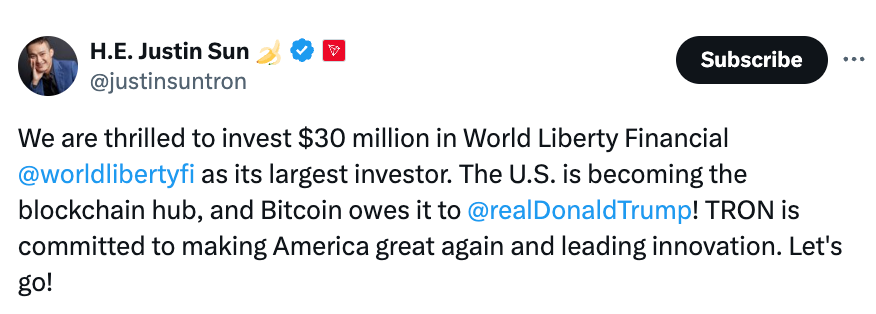
On November 25, Sun purchased $30 million in crypto tokens from World Liberty Financial, a new crypto venture backed by President-elect Donald Trump. Sun said his company, TRON, was committed to "making America great again."
 |
World Liberty Financial planned to sell $300 million worth of crypto tokens, known as WLF, which would value the new company at $1.5 billion. But, before Sun's $30 million purchase, it appeared to be a bust, with only $22 million in tokens sold. Sun now owns more than 55% of purchased tokens.
Sun's decision to buy $30 million in WLF tokens has direct and immediate financial benefits for Trump. A filing by the company in October revealed that "$30 million of initial net protocol revenues" will be "held in a reserve… to cover operating expenses, indemnities, and obligations." After the reserve is met, a company owned by Donald Trump, DT Marks DEFI LLC, will receive "75% of the net protocol revenues."
So before Sun's purchase, Trump was entitled to nothing because the reserve had not been met. But Sun's purchase covered the entire reserve, so now Trump is entitled to 75% of the revenues from all other tokens purchased. As of December 1, there have been $24 million WLF tokens sold, netting Trump $18 million.
Sun is also joining World Liberty Financial as an advisor, making Sun and the incoming president business partners.
While Trump has the cash, Sun's tokens are effectively worthless. To comply with U.S. securities law, WLF tokens are "non-transferable and locked indefinitely in a wallet or smart contract until such time, if ever, [WLF tokens] are unlocked through protocol governance procedures in a fashion that does not contravene applicable law." The only thing that Sun can do with his tokens is participate in the "governance" of World Liberty Financial. Right now, the only thing World Liberty Financial does is sell tokens.
Any foreign national paying an incoming president $18 million weeks before entering the White House should raise red flags. Sun's purchase is even more alarming because the Securities and Exchange Commission (SEC) is currently prosecuting him for fraud.
The SEC's ongoing prosecution of Sun
On March 22, 2023, the SEC charged Sun and three companies he owns. The SEC accused Sun of marketing unregistered securities and "fraudulently manipulating the secondary market" for a crypto token "through extensive wash trading." Wash trading involves "the simultaneous or near-simultaneous purchase and sale of a security to make it appear actively traded without an actual change in beneficial ownership." In other words, according to the SEC, Sun made it seem like there was a lot of interest in crypto tokens he issued when much of the trading was fraudulent and manufactured by Sun.
The SEC also charged Sun with "orchestrating a scheme to pay celebrities to tout" his crypto tokens "without disclosing their compensation." Federal law requires people who endorse securities to "disclose whether they received compensation for the promotion, and to specify the amount." The celebrities involved included Lindsay Lohan, Jake Paul, and Soulja Boy.
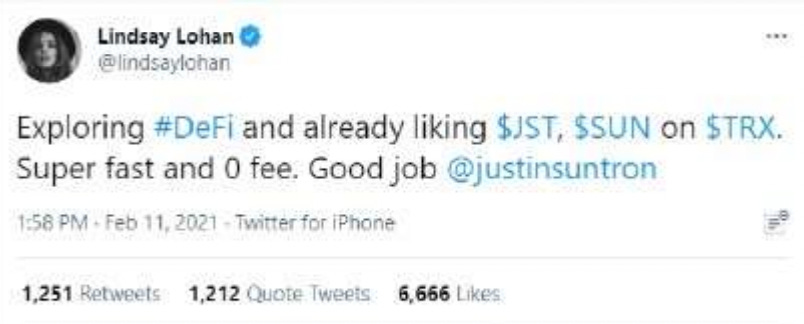 |
Lohan paid $40,000, and Paul paid about $100,000 to settle the charges against them without admitting liability. Soulja Boy did not respond to the lawsuit, and a default judgment was issued against him.
Sun posted on X that he believes the SEC "complaint lacks merit" and complained that "the SEC's regulatory framework for digital assets is still in its infancy and is in need of further development."
The litigation against Sun is ongoing, with a federal judge considering a motion by Sun's attorneys to dismiss the charges. The current SEC Chairman, Gary Gensler, who announced the charges against Sun, will step down when Trump takes office in January. A new SEC commissioner appointed by Trump could settle or dismiss the charges against Sun.
How Trump can use the power of the presidency to unlock hundreds of millions in profits for himself
Through World Liberty Financial, Trump can reap massive personal profits from creating a more permissive regulatory environment for crypto ventures.
In addition to his 75% share of revenues over $30 million, Trump's company was also awarded 22.5 billion WLF tokens. At the current sale price, these tokens are worth more than $300 million. That is more than 20 billion tokens being offered for sale publicly. (This makes the "governance" value of WLF tokens, which was already questionable, effectively worthless. No matter how many tokens you own, Trump will always be able to outvote other token holders.)
Right now, Trump's tokens — like those purchased by Sun — are worthless because they cannot be transferred. But Trump could appoint a new SEC chairman who is friendly to the crypto industry and who would create new rules allowing the WLF tokens and similar crypto assets to be legally traded. If the price of the tokens increases when they hit the open market, which is a possibility for a crypto token backed by the President of the United States, the value of Trump's tokens could be in the billions.
That appears to be exactly the path Trump is taking. WIRED reports that Trump is "asking the crypto industry to weigh in on potential picks." Among the leading contenders is Paul Atkins, a former SEC Commissioner, who, since leaving the agency in 2008, has run a consulting firm that works with crypto companies. Atkins is also co-chair of the Token Alliance, an initiative of the Chamber of Digital Commerce, the lobbying group for the crypto industry. He is also a member of the Chamber of Digital Commerce's Board of Directors.
Another top contender, former SEC General Counsel Robert Stebbins, has said that the SEC should "pause most of its crypto lawsuits while clearing a path for the firms to do business without the overhang of litigation." But Stebbins' candidacy underscores the need for Sun to forge a favorable relationship with Trump. Stebbins acknowledged that, even if it takes a more permissive view toward the crypto industry, it may want to consider continuing to pursue litigation involving fraud.
Major media outlets obsessed with banana, ignore Sun's payment to Trump
A foreign national under federal fraud prosecution making a purchase that results in $18 million cash payment to the president-elect has all the makings of a major scandal. But it has been virtually ignored by several major media outlets.
The New York Times, for example, has published five articles about Sun's purchase of the banana but none about Sun's $30 million purchase of WLF tokens and his business partnership with Trump. The Washington Post has published three articles about the banana, but its coverage of Sun's purchase of WLF tokens was limited to one short paragraph in a larger editorial about the crypto industry. (The paragraph does not explain how Trump personally profits from Sun's token purchase.) The Wall Street Journal did publish a short piece about Sun's token purchase on its "Live Update" blog, but the piece was not viewed as significant enough to be included in the print edition. The paper published two articles, plus a video, focused on the banana. One of the Wall Street Journal articles about the banana was published on the front page of the paper.
an 11 24
Consumer advocacy group Public Citizen feigned surprise on Wednesday over President-elect Donald Trump's nomination of Wall Street CEO Howard Lutnick to lead the U.S. Department of Commerce.
"Oh look, another billionaire has made his way into Trump's Cabinet," said the group, noting Lutnick is also a promoter of cryptocurrency and a Trump megadonor. "The conflicts of interest are almost too many to count."
Among the conflicts are Lutnick's involvement in the crypto industry and federal and state cases against Cantor Fitzgerald.
In addition to running the Wall Street firm, Lutnick is a banker for the "stablecoin" company Tether; purchasers receive a Tether token for $1, with the proceeds invested in reserves and Treasury bonds managed by Lutnick's Cantor Fitzgerald.
As Public Citizennoted, New York Attorney General Letitia James found in 2021 that Tether and another crypto firm "recklessly and unlawfully covered up massive financial losses to keep their scheme going and protect their bottom lines."
The company is also reportedly under federal investigation over alleged criminal violations of anti-money laundering rules and sanctions.
Public Citizen also said that while co-chairing Trump's transition team, Lutnick "may also have helped arrange a meeting between Trump and Coinbase chief Brian Armstrong," who "helped steer a record amount of political spending from the crypto industry into the 2024 election."
Crypto firms poured over $119 million into directly influencing the 2024 federal elections, Public Citizenfound in August, making the industry's spending second only to that of fossil fuel companies.
As Politico reported in October, even other members of Trump's inner circle have accused Lutnick of using his transition team co-chair position to take meetings on Capitol Hill and "talk about matters impacting his investment firm, Cantor Fitzgerald—including high-stakes regulatory matters involving its cryptocurrency business."
Lutnick's nomination, said former Labor Secretary Robert Reich, serves as a reminder that "Trump serves the oligarchy, not the people."
"Debris from crypto's political spending tsunami will jam up more halls in Washington than ever before if Lutnick is confirmed as secretary of commerce," said Bartlett Naylor, a financial policy advocate for Public Citizen. "The president-elect, who once correctly called bitcoin a scam, now surrounds himself with even more crypto enablers. Cryptocurrency won't return good jobs to the heartland or reduce food prices; it will only thin the wallets of those vulnerable to a now government-legitimized con."
Government watchdog Accountable.US pointed to more than $19 million in political donations Lutnick has made since 2009, nearly all of which went to GOP candidates and political action committees. He contributed $6 million to Trump's super PAC, Make America Great Again, Inc., in 2024 alone.
"Howard Lutnick's questionable qualifications to lead the Department of Commerce begin and end with his loyalty to the president-elect," said Accountable.US executive director Tony Carrk.
Tether isn't the only Lutnick-linked company that's been investigated for wrongdoing. The Securities and Exchange Commission fined Cantor Fitzgerald $1.4 million in 2023, saying the company repeatedly failed "to identify and report customers who qualified as large traders." The company also agreed to pay $16 million in fines to the SEC and the Commodity Futures Trading Commission in 2022 for using unauthorized communication channels.
Should Lutnick be confirmed as commerce secretary, Accountable.US said a "major regulatory conflict" could arise due to a dispute between the BGC Group, a spin-off brokerage of Cantor Fitzegerald, and futures and commodities exchange CME Group, over a competing trading platform BGC Group is launching.
"Lutnick's company's violations resulting in financial regulator fines and millions in right-wing political donations shows that political devotion takes precedence over actual experience to do the job in Trump's Cabinet," said Carrk.
Trump campaigned as a champion of working people as he railed against high grocery prices. As The New Republicreportedon Tuesday, Lutnick has showered Trump's plan for across-the-board tariffs with effusive praise—even as leading economists warn the plan to impose tariffs on foreign imports will pass higher costs onto consumers, not foreign countries.
"In September, Lutnick told CNBC that 'tariffs are an amazing tool for the president to use—we need to protect the American worker,'" wrote Edith Olmsted. "Lutnick also gushed about tariffs at Trump's fascistic rally in Madison Square Garden last month, claiming that America was better off 100 years ago, when it had 'no income tax and all we had was tariffs.' His high praise for tariffs came even as he admitted Americans would face higher prices as a direct result."
Lutnick's nomination, said Sen. Elizabeth Warren (D-Mass.), "is a win for the billionaire class at the expense of working people."
"The across-the-board tariff plan," she said, "is a distraction from the MAGA scam to extend tax giveaways for giant corporations and billionaires like Howard Lutnick."
===
politico
the TV ads seem wildly different from each other.
In Ohio, a woman shares how GOP Senate candidate Bernie Moreno invested in her business making uniforms for female police officers. In Iowa, a spot highlights Rep. Zach Nunn’s military credentials and work to lower child care costs. And in Colorado, a Spanish-language ad touts first-term Democratic Rep. Yadira Caraveo’s support for more border patrol agents.
The ads have one major trait in common: They are all part of a massive effort from the cryptocurrency industry to elect its preferred House and Senate candidates across a dozen states this fall. But not a single one mentions crypto.
The nascent industry has quietly become the single biggest outside spender in congressional elections this cycle other than traditional party groups, spending more than environmental PACs, pro-Israel advocates or abortion-rights groups. About 1 in 12 independent expenditure dollars in House and Senate races this year have come from cryptocurrency-linked super PACs.
“The crypto industry is pretty amazing in that 10 years ago, it was the laughing stock of the tech world,” said Moreno, the GOP Senate candidate from Ohio who is challenging Sen. Sherrod Brown and has attracted the most cryptocurrency backing of any candidate. “And in reality, here you are 10 years later, and they’re going to be decisive in helping Republicans win the United States Senate.”
The industry’s ads are about trying to help their preferred candidates win elections — not making cryptocurrency a campaign issue. That reflects a reality acknowledged by several candidates: Cryptocurrency is hardly top-of-mind for most voters. The ads from the various industry-linked super PACs are instead universally positive spots about their candidates, often biographical or hitting on hot-button issues such as the border, the economy and access to IVF.
And cryptocurrency groups are quick to note that they are not innately partisan, instead backing candidates of both parties, including Democratic Senate candidates in Michigan and Arizona.
Many candidates backed by cryptocurrency are vulnerable members who serve on key committees and supported the industry’s legislative priorities this year. And in Ohio, they are looking to oust Brown, a past skeptic of the industry, even if they are not talking about him or cryptocurrency while they do it.
The spending surge has flowed through three distinct super PACs: Defend American Jobs, which has boosted Republican Senate candidates; Protect Progress, which has boosted Democratic Senate candidates; and Fairshake, which has backed House candidates on both sides of the aisle. Fairshake has also sent money to the other two groups while receiving more than $170 million this cycle from a variety of cryptocurrency-backed interests, including the firms Coinbase and Ripple Labs and the partners behind Andreessen Horowitz, the venture capital firm with substantial crypto investments.
The three super PACs have collectively spent $125 million on independent expenditures this cycle, accounting for 8 percent of all outside spending in congressional races, according to data from the Federal Election Commission. That includes more than $80 million spent on the general election.
In response to questions about the candidates backed by Fairshake and the content of the ads, a PAC spokesperson referred to an earlier statement expressing support for “leaders on both sides of the aisle and in both houses who are committed to getting things done and working with the industry to pass responsible regulation that drives innovation, creates jobs, and sustains America’s global leadership.”
Many of the crypto-backed candidates supported one of the industry’s key legislative priorities this year, a bill that would establish regulatory authority for different classes of digital assets that passed the House earlier this year but has not been taken up in the Senate.
But the biggest investment by far this cycle has been to oust Brown, the only race where they have spent against an incumbent. Brown, who chairs the Senate Banking Committee, emerged as a key skeptic of cryptocurrency and warned of the risks it could pose for consumers.
Defend American Jobs has spent more than $40 million on the race. The top two most-run ads in Ohio this year both come from the group, according to data from the ad tracking firm AdImpact. But neither mentions crypto — nor attacks Brown.
One highlights Moreno as a small business owner who raised a family in the state, another touts his support for energy independence and “stopping illegal immigrants from taking Ohio’s tax dollars.”
The cryptocurrency-linked super PACs also support Democrats — even using some of the same issues, like immigration. An ad from Protect Progress backing Rep. Ruben Gallego praised the Arizona Senate candidate for “standing up to his own party to fund 22,000 border patrol agents,” while a Michigan ad boosting Rep. Elissa Slotkin’s Senate candidacy features a clip of her saying “we need to invest in border security.”
In House races, the messaging is even more varied. Most of the nearly two dozen ads that have run in congressional races for the general election have some biographical component. Five ads defending incumbent Democrats tout their credentials on immigration and the border, while two spots backing vulnerable Republicans highlight their support for access to IVF.
It’s not unusual for an interest group to avoid talking about its own issues in advertising: Earlier this year, the pro-Israel super PAC United Democracy Project ran ads in Democratic primaries that focused on issues ranging from public safety to one candidate’s DUI arrest, though the group ran ads on antisemitism in one New York congressional race.
But cryptocurrency may simply not be front-of-mind for most voters. Estimates for the number of Americans who own cryptocurrency vary widely, in part depending on the specifics of how the question is asked. A Federal Reserve survey in 2023 pegged the share at 7 percent while a Federal Reserve Bank of Philadelphia survey this summer found 14.7 percent; cryptocurrency firms and advocates argue the number is even higher.
With cryptocurrency not a key issue in frontline House and Senate races, most candidates are reluctant to talk about the money. The majority of candidates getting backing from cryptocurrency PACs — and their opponents — declined to comment about the industry’s role in their elections.
A few candidates whose opponents were beneficiaries of crypto super PACs also spoke in favor of cryptocurrency. Former Rep. Mike Rogers, running against Slotkin in Michigan, said in a statement the industry is “important for our national security” while accusing outside groups of “trying to put Crypto in the hands of Democrats.” A spokesperson for Republican Senate candidate Kari Lake, facing Gallego in Arizona, said she was a “strong supporter” of crypto.
In Alaska, Nick Begich, the Republican challenging Mary Peltola, said he was surprised to see Fairshake backing the incumbent Democrat, citing his own pro-cryptocurrency stances. (Begich said he was an early adopter of Bitcoin.) For voters, though, questions about digital assets and crypto policy tend to be lower down the list.
“We’ll get an occasional question about cryptocurrency from the public,” Begich said. “But it is not in the top 10 issues that I hear.”
When the industry does message on crypto, those efforts are far smaller in scale than their work to help specific candidates.
Stand With Crypto, a 501(c)(4) nonprofit, has been conducting outreach aiming to encourage crypto users and supporters to vote this year. The organization also grades candidates based on statements and support for legislation related to cryptocurrency, but does not endorse. And its efforts are far smaller: The group said it has received $2.8 million in donations, about 1.5 percent of the money that has flown through Fairshake.
---
YIKES 2024
COMMON DR
Crypto Industry's $40 Million Defeat of Pro-Worker Sherrod Brown Called 'Obscene'
The Ohio Democrat lost his seat because "the billionaire-backed crypto industry donated $40 million to his right-wing opponent," lamented one labor journalist.
Nov 07, 2024
The Republican Party's capture of the U.S. Senate this week was made possible in part by massive spending from the nascent but increasingly influential cryptocurrency industry, which pumped more than $40 million into a successful effort to topple pro-worker progressive Sen. Sherrod Brown in favor of luxury car dealer Bernie Moreno.
Crypto industry spending helped make Ohio's closely watched Senate race the most expensive in the state's history, with Moreno's campaign boosted by around $40.1 million from the super PAC Defend American Jobs—part of what OpenSecrets described as the "triad" of allied pro-crypto groups pouring cash into the 2024 election.
The Washington Postnoted that Moreno "founded a blockchain firm called Ownum in 2018" and "has long immersed himself in blockchain technology, a registry of ownership that essentially underpins all cryptocurrency."
A spokesman for Fairshake, another member of the crypto PAC triad, took credit for Moreno's victory in a statement after the election was called in the Republican's favor and condemned Brown's support for regulating the industry. Fairshake received tens of millions of dollars in donations from the cryptocurrency exchange giant Coinbase—some of which may have been illegal spending, according to the watchdog group Public Citizen, given that the company is a federal contractor.
"Sherrod Brown was a top opponent of cryptocurrency and thanks to our efforts, he will be leaving the Senate," said Fairshake's Josh Vlasto. "Senator-elect Moreno's come-from-behind win shows that Ohio voters want a leader who prioritizes innovation."
Crypto executive Tyler Winklevoss boasted in a social media post, "The crypto army is striking!"
"Sherrod Brown—crypto public enemy, Elizabeth Warren co-conspirator, and Gary Gensler crony—was just ousted by Bernie Moreno for Ohio Senate," wrote Winklevoss, the co-founder of Gemini.
Labor reporter Steven Greenhouse wrote Wednesday that it is "obscene" that Brown lost his seat because "the billionaire-backed crypto industry donated $40 million to his right-wing opponent."
"Sherrod Brown is one of the most pro-worker, pro-middle-class members of the U.S. Senate," Greenhouse added. "He truly fights for workers."
"The strategy was a brazen attempt to buy influence while keeping the public unaware of what they were supporting."
While the Ohio Senate contest was "the biggest single target of crypto money this cycle," as CNBCput it, the industry spread its money widely, backing both Republicans and Democrats in races across the country—underscoring its attempt to gain influence over future regulatory fights in Congress.
Overall, crypto groups spent more than $130 million in support of candidates for federal office this cycle. A tracker created by the Stand With Crypto Alliance estimates that 263 "pro-crypto candidates" were elected to the House and 18 to the Senate in Tuesday's contest.
Former President Donald Trump's victory over Vice President Kamala Harris was also seen as a win for the industry, with Bitcoin's price spiking to a new all-time high on Wednesday. During his campaign, Trump vowed to make the U.S. "the crypto capital of the planet."
"Tonight the crypto voter has spoken decisively—across party lines and in key races across the country," gushed Brian Armstrong, the CEO of Coinbase. "Americans disproportionately care about crypto and want clear rules of the road for digital assets. We look forward to working with the new Congress to deliver it."
But one critic, Better Markets president Dennis Kelleher, cast doubt on the industry's self-serving narrative that the 2024 results amounted to a ringing endorsement of cryptocurrency.
In an op-ed for the San Francisco Chronicle on Thursday, Kelleher pointed out that pro-crypto PACs adopted "generic anodyne names" and bankrolled .
"It's as if Ford ran an ad campaign and never mentioned its cars," Kelleher wrote. "The strategy was a brazen attempt to buy influence while keeping the public unaware of what they were supporting. This way, the industry can claim the now-elected officials they backed have a mandate from the public to support crypto interests—even though they don't."
---
RS
the end of 2023 was not a great time for the crypto industry. In November, Sam Bankman-Fried, the founder of the FTX cryptocurrency exchange, learned that no amount of Michael Lewis gymnastics could save him from being convicted on seven charges of fraud and conspiracy. He was eventually sentenced to 25 years in prison after disappearing $11 billion of other people’s money. The following month, Sen. Elizabeth Warren sent letters to three crypto industry giants, the Blockchain Association, Coin Center, and Coinbase, criticizing them for undermining efforts to rein in crypto’s use in terrorist financing.
Around the same time, crypto groups began making noises about spending money in 2024 to defeat Ohio Sen. Sherrod Brown, the current chairman of the Senate Banking Committee. Brown is a profound skeptic of the industry and signed off on Warren holding hearings on crypto’s possible links to terrorism. Asked about the threats, Brown, a mop-topped Democrat with a raspy voice and wry sense of humor, said he was unconcerned.
“Bring ’em on,” he told reporters, according to Politico. “They’ve had a bad six months. They clearly have betrayed the public interest. If they think that’s the way to attack someone politically? Pretty amazing.”
Brown had no idea.
Rolling Stone has learned that crypto interests are set to spend $32 million on TV ads promoting Bernie Moreno, Brown’s Republican opponent, by the end of September, according to Democratic media buyers. The spending began on August 22 — meaning the crypto interests are spending more than $800,000 per day to flip the Ohio Senate seat, and potentially control of the Senate.
“Outside groups are spending record amounts to try to defeat Sherrod because they know he will always fight for Ohio, not special interests,” said Reeves Oyster, a Brown campaign spokesperson.
So far, the ads have been primarily fluffy positive spots boosting Moreno; some of the spots fearmonger about immigrants and China.
Tracing the roots of Defend American Jobs can be as convoluted as tracing crypto currency itself. The group is effectively a subsidiary of Fairshake — the second-largest fundraiser among Super PACs this season according to OpenSecrets, with over $200 million in its coffers. The bulk of Fairshake’s money has been donated by three crypto monoliths: Coinbase, Andreessen Horowitz, and Ripple.
Coinbase and its affiliates have donated $86 million. The founders of the venture capital firm Andreessen Horowitz have together given $44 million. Ripple has contributed $25 million. (The Winklevoss Twins, who donated nearly $5 million to Fairshake, previously tried to donate $1 million in bitcoin to Donald Trump — well beyond what is legal.)
Most of the money raised by Defend American Jobs has come through Fairshake. Coinbase, Ripple Labs, and the founders of Andreessen Horowitz have donated separately, too.
Coinbase’s CEO Brian Armstrong has led the latest charge to bring crypto into the political mainstream, hosting a Super Tuesday rally with Nas in Los Angeles where he proclaimed, “More Americans own crypto than own electric vehicles or are in a union — yet some people in D.C. are still underestimating how much and how many people care about crypto. In 2024, it will become clear that being anti-crypto is bad politics.”
Rep. Katie Porter found that out the hard way. During the California Democratic Senate primary, Fairshake spent over $10 million against her campaign, apparently because she had the temerity to question the energy uses of the industry. Porter didn’t make the runoff, losing to Adam Schiff, a longtime collaborator with crypto who received an ‘A’ rating from Stand With Crypto, a self-described grassroots advocacy hub nonprofit led by Coinbase and fronted by Armstrong. Porter got an ‘F.’
“I think in 2024, some people need to win an election or lose an election because of their crypto stance,” said Armstrong.
Brown’s skepticism about crypto has been long-standing and largely correct. Shortly after the 2022 Super Bowl featured a raft of celebrity ads promoting the industry, Brown spoke before the Senate Banking Committee.
“If you watched the Super Bowl on Sunday, you saw ad after ad for a product that most Americans have heard of, but almost nobody knows what it really Is,” Brown said. “Big crypto companies are looking to make big profits. They are desperate to reach as many Americans as they can. They brought in celebrities and gimmicks to make crypto sound exciting and daring and profitable, but the ads left a few things out. They didn’t mention the fraud, the scams, and the outright theft. The ads didn’t point out that you can lose big and crypto’s huge price swings. They didn’t tell you about the high fees pocketed by the crypto companies. They sure didn’t explain that the crypto markets lack basic investor protections and oversight. Watching those ads remind a lot of us of some asset bubbles we’ve seen before… We need to look beyond the unproven promises to protect Americans and our entire financial system.”
By the next Super Bowl, Bankman-Fried had been indicted and there were exactly zero crypto ads. Brown wasn’t done ringing the warning bell. On October 23, Brown sent the following tweet regarding alleged ties between crypto and foreign terrorists, including Hamas: “@SenateBanking is examining the financing behind terrorism & working to cut it off at the source. We’re looking at all options including sanctioning state sponsors of terrorism & their proxies & cracking down on cryptocurrency. We must do whatever we can to deny Hamas funding.”
Stand With Crypto gave the statement a ‘Very Anti-Crypto’ rating with a large thumbs down emoji on their website.
So maybe it shouldn’t come as a surprise that Fairshake’s affiliate has gone all in against Brown, especially since his opponent Moreno is a crypto evangelist who founded a property title blockchain startup in 2016. Still, the sheer amount of their expenditure is breath-taking.
From Sept. 4-9, Defend American Jobs spent $6.7 million on television in support of Moreno, more than the Brown campaign and other pro-Brown groups spent combined, and more than the Moreno campaign and other affiliated groups as well.
Not all Fairshake donors think taking out Brown is a great idea.
According to Politico, Crypto advocate and billionaire investor Ron Conway, a Democrat, exploded when he found out Big Crypto was going after Brown, especially since he was meeting with Senate Majority Leader Chuck Schumer about the possibility of crypto-friendly legislation being taken up in the lame duck session after the election. At that point, Conway was into Fairshake’s network for $500,000.
“How short sighted and stupid can you possibly be,” wrote Conway in a group email that included Armstrong, Andreessen Horowitz founders Marc Andreessen and Ben Horowitz, and Ripple head Brad Garlinghouse.
Conway’s complaint did not dissuade them. So far, most of the ads have been Moreno bio commercials with shots of Ohio farmhouses and back roads. But things are getting darker.
One of the ads says Moreno will stop “illegal immigrants from taking Ohio’s tax dollars.” A new ad features a shadowy outline of Brown and scare words about China, and reiterates that Moreno will “stop illegal immigrants from taking our hard earned tax dollars.”

Where they go in the last 50 days — immigrants eating cats propaganda? — is unknown.
A spokesperson for Fairshake declined to comment.
If crypto succeeds in unseating Brown, you may wonder who would replace him as chair of the Senate Banking Committee. That would be Republican Tim Scott.
Stand With Crypto gives him an ‘A.’
---
GGL 11 24
[### Crypto Industry's $40 Million Defeat of Pro-Worker Sherrod ...

Common Dreams
https://www.commondreams.org › ... › cryptocurrency](https://www.commondreams.org/news/sherrod-brown-crypto)
4 hours ago — The Ohio Democrat lost his seat because "the billionaire-backed crypto industry donated $40 million to his right-wing opponent," lamented ...
Missing: FUNDER DONOR
[### Bitcoiners celebrate as Bernie Moreno ousts Sherrod ...

CNBC
https://www.cnbc.com › 2024/11/05 › bitcoiners-celebr...](https://www.cnbc.com/2024/11/05/bitcoiners-celebrate-as-bernie-moreno-ousts-sherrod-brown-ohio-upset.html)
2 days ago — Republican Bernie Moreno, a blockchain entrepreneur, won the Ohio Senate race, knocking off Democratic incumbent Sherrod Brown. · The crypto ...
[### Crypto Comes For Sherrod Brown: $32 Million in Ads ...

Rolling Stone
https://www.rollingstone.com › politics › politics-features](https://www.rollingstone.com/politics/politics-features/sherrod-brown-crypto-bernie-moreno-millions-1235102478/)
Sep 15, 2024 — Crypto companies are spending $800000 a day to take out Sherrod Brown, one of their chief critics in Congress, and replace him with an ally.
[### Why Crypto Billionaires Want to Flip Sherrod Brown's ...

The Intercept
https://theintercept.com › 2024/10/13 › sherrod-brown-...](https://theintercept.com/2024/10/13/sherrod-brown-race-crypto-regulation/)
Oct 13, 2024 — Millions of dollars are pouring into the race to unseat Ohio Sen. Sherrod Brown, who has resisted loosening cryptocurrency regulations.
[### Crypto industry pours tens of millions into Ohio Senate race

Spectrum News
https://spectrumnews1.com › news › 2024/10/17 › cryp...](https://spectrumnews1.com/oh/columbus/news/2024/10/17/crypto-brown-moreno-senate)
Oct 17, 2024 — WASHINGTON, D.C. — The battle between Sen. Sherrod Brown and Bernie Moreno in Ohio is on track to be the most expensive Senate race in ...
[### Crypto PACs Dominate Ohio Senate Race, Spending $40 ...

CoinDesk
https://www.coindesk.com › policy › 2024/09/26 › cry...](https://www.coindesk.com/policy/2024/09/26/crypto-pacs-dominate-ohio-senate-race-spending-40m-on-sherrod-browns-foe/)
Sep 26, 2024 — Crypto-fan candidate Bernie Moreno has caught up in Ohio polls as the industry's cash outpaces other PACs in one of the key US Senate races that may decide the ...
[### Crypto's $245 million campaign finance operation funded ...

CNBC
https://www.cnbc.com › 2024/11/05 › cryptos-245-mill...](https://www.cnbc.com/2024/11/05/cryptos-245-million-campaign-finance-operation-funded-non-crypto-ads.html)
2 days ago — The crypto sector emerged as a top donor this election cycle, but the ads it funded weren't about digital currencies.
Missing: DONOR | Show results with: DONOR
[### The Crypto Industry's Spending on the Election Pays Off

The New York Times
https://www.nytimes.com › 2024/11/06 › technology](https://www.nytimes.com/2024/11/06/technology/crypto-industry-spending-election.html)
4 hours ago — The spending spree fueled a string of victories on Tuesday for congressional candidates who had expressed support for cryptocurrencies.
[### Sen. Sherrod Brown - Campaign Finance Summary

OpenSecrets
https://www.opensecrets.org › members-of-congress › s...](https://www.opensecrets.org/members-of-congress/sherrod-brown/summary?cid=N00003535)
NOTE: All the numbers on this page are for the 2019 - 2024 election cycle and based on Federal Election Commission data released electronically on 11/06/24 for ...
[### Brown, Colleagues Call on Administration to Address ...

Senator Sherrod Brown (.gov)
https://www.brown.senate.gov › press › release › sherro...](https://www.brown.senate.gov/newsroom/press/release/sherrod-brown-colleagues-call-administration-address-crypto-financed-terrorism-after-reports-hamas-raising-millions-crypto-fund-operations)
Oct 18, 2023 — ... Crypto-Financed Terrorism After Reports of Hamas Raising Millions in Crypto to Fund Operations ... WASHINGTON, D.C. – Today, U.S. Senator Sherrod ...
==
---
11 24
Over the weekend, HEATED reported on one of the stranger bedfellowships of the 2024 election: Elon Musk, clean tech billionaire, and Joe Craft, coal billionaire.
ICYMI: Craft is one of the largest donors to Elon Musk’s America PAC. The coal baron made a one-time $1 million donation in June, marking his single-largest-ever campaign contribution.
That Craft would fork over $1 million to a pro-Trump effort is not surprising. What’s surprising is that the money would go to Musk, who once helped South Australia quit coal, and whose business plan for Tesla literally proposes to “eliminate fossil fuels.”
So why would Craft throw his weight behind Musk, of all people? My theory is that it has less to do with Musk’s vision for the future of energy, and more so his vision for the future of cryptocurrency.
Because Craft, like Musk, is a certified crypto bro.And if cryptocurrency soars in the near-term future, then Craft is betting that coal will, too.
The coal company mining Bitcoin
Cryptocurrency mining requires an enormous amount of electricity—so much that in 2020, a coal plant slated for retirement was revived because of Bitcoin mining. This has been great news for Craft’s coal company, Alliance Resource Partners.
In an April earnings call, Craft said that cryptocurrency and artificial intelligence is “driving significant growth in anticipated electricity demand over the next several years.” This increase in demand has “given us some more optimism that our coal operations will continue longer than when we started looking at some of this diversification,” Craft said.
And Craft isn’t just waiting for Bitcoin miners to create demand for coal. He’s creating the demand himself. Over the last four years, Alliance Resource Partners has mined a whopping $30 million worth of Bitcoin, Alliance CFO Cary Marshall said on the April earnings call. “We're not actually out there buying Bitcoin or anything of that nature,” Marshall said. “We're mining the Bitcoin associated with these miners that we have.
Craft went on to explain that Alliance has "effectively built” a data center for Bitcoin mining, and is using the excess electricity from its coal facilities to power the energy-intensive Bitcoin mining process.
In addition, Craft said Alliance is renting its excess data processing capacity to other Bitcoin miners, “to take advantage of the low energy costs we have.”
The extra income from Alliance’s Bitcoin mining operations are helping the coal company remain financially stable, Marshall added. “We're mining the Bitcoin, and we're selling generally on a monthly basis to cover our operating costs,” he said. He added that the company currently owns about 425 Bitcoin and expects to mine between 175 to 190 more this year.
Meanwhile, Forbes has called Musk “one of the biggest Bitcoin and crypto price influencers”—which could extend to the government level if Trump is re-elected. If re-elected, Trump has promised to appoint Musk the head of a new department to oversee and mitigate government spending: The Department of Government Efficiency, or DOGE—a reference to Musk’s favorite cryptocurrency, Dogecoin. (Trump has also pledged to create a bitcoin strategic reserve if elected, as well as form a crypto advisory council).
Musk, for what it’s worth, used to be concerned about the potential negative impacts of cryptocurrency on climate change, particularly with regard to coal. In 2021, just weeks after Tesla announced it hadinvested $1.5 billion in Bitcoin, Musk announced that Tesla would no longer accept car purchases via Bitcoin. "We are concerned about rapidly increasing use of fossil fuels for Bitcoin mining and transactions, especially coal, which has the worst emissions of any fuel," he said. "Cryptocurrency is a good idea... but this cannot come at great cost to the environment."
But like all things related to climate change, Musk seems to have abandoned that concern. Today, Tesla is the third-largest Bitcoin holder among public companies, Yahoo reported, and SpaceX “is said to be holding around 8,285 coins.”
Anyway, just thought that was interesting. What do y’all think?
---
ny CNN 7 24
The Bay Area has long been, and remains, a hippie-dippie bastion of Democrats who voted overwhelmingly for Hillary Clinton in 2016 and Joe Biden in 2020. But there’s a small, powerful sect of Silicon Valley billionaires who are carving a path for the maybe-Trumpers and the MAGA-curious in the tech world.
Elon Musk explicitly endorsed Trump over the weekend and, according to The Wall Street Journal, inked a nine-figure donation promise to a new pro-Trump political action committee called America PAC. David Sacks, the billionaire tech investor, co-hosted a fundraiser last month at his San Francisco home and spoke at the Republican National Convention on Monday. Other contributors to America PAC include the Winklevoss twins, Doug Leone of Sequoia Capital and Palantir co-founder Joe Lonsdale, according to Federal Election Commission filings.
In the last election cycle, the few Trump backers who existed in the Valley largely kept their support under the radar. Their numbers are still small, but they’re no longer hiding, and their wallets are open.
So, what’s gotten into these guys?
For one, there might not be as many Trump supporters in the tech world as you might think.
“A mythology has been marketed by partisans suggesting a non-existent surge of tech titans abandoning the Democratic party support in a rush to support the Trump/Vance campaign. The truth is that most leading tech figures do not support Trump/Vance and those prominent ones who do, were there years ago as well,” Jeffrey Sonnenfeld, dean for leadership studies at the Yale School of Management, told CNN.
And for the ones you might have heard of, most likely, it’s not a sudden fervor for the far right’s Christian extremism or a predilection for red baseball caps. Instead, they’re looking out for the bottom line.
The two biggest pain points for people in tech have been the Biden administration’s record on antitrust enforcement and its attitude toward crypto, Adam Kovacevich, CEO of Chamber of Progress, a center-left tech policy group, told me.
“I don’t think it has as much to do with Trump per se,” he said. “I think they would have probably stayed with Biden if they felt more care and attention was being paid to the innovation economy.”
In other words: It’s not that the billionaires love Trump, it’s that they really don’t like Lina Khan, President Joe Biden’s top antitrust crusader; or Gary Gensler, the Wall Street cop who’s made no secret of his hostility toward digital assets.
Lina Khan, the FTC chair, has led an aggressive antitrust campaign, specifically targeting Big Tech.
Kevin Dietsch/Getty Images
In recent years, Khan has spearheaded lawsuits against Amazon, Microsoft and Meta. In an interview with CNN last year, Khan described those efforts as part of a broader campaign to bring more of the government’s resources to bear on the daily economic problems of ordinary Americans.
But government regulation, however well intentioned, rarely sits well with the people who are getting rich off the status quo.
Two of the most famous venture capitalists in the Valley, Marc Andreessen and Ben Horowitz, have committed to donating to America PAC, according to several news outlets.
The pair haven’t exactly been hiding their frustration with the Biden administration, either.
“The American government is now far more hostile to new startups than it used to be,” they wrote in a recent blog post, which cited regulatory agencies using “brute force investigations, prosecutions, intimidation, and threats to hobble new industries.” They also lamented the Biden administration’s proposed tax on unrealized capital gains, which they said would “absolutely kill” startups and the venture capital industry.
One person familiar with their plans told the Financial Times that their pivot to Trump was because “there is so much at stake on the crypto side” and the growth of artificial intelligence. “It doesn’t mean support for (Trump’s) views on immigration,” the person told the paper.
Historically, Trump hasn’t shown a lot of love for tech bros, whose social media companies he long accused of having anti-conservative bias, especially after several of them suspended his accounts in response to the January 6, 2021, attack on the Capitol. But the recent influx of tech money — facilitated in part by his 39-year-old venture-capitalist VP pick — appears to have softened some of Trump’s Luddite-ish views.
As recently as 2021, he called bitcoin a “scam against the dollar.” Lately, though, he’s positioning himself as the crypto-friendly candidate. While his campaign hasn’t laid out specific policy proposals around digital assets, it began accepting crypto donations this spring, and Trump is scheduled to speak at a national bitcoin conference next week.
The Biden administration, meanwhile, is working to mend ties with industry leaders who say they’ve been stymied by the SEC and Gensler, generally agreed to be the crypto community’s Voldemort.
To be sure, plenty of Big Tech dollars are still flowing to Biden and down-ballot Democrats from tech-world donors, including LinkedIn founder Reid Hoffman and Google co-founder Eric Schmidt. But Trump’s gains from Silicon Valley have come just as some major Democratic donors have hit pause amid conversations about replacing the president on the ballot.
And, as Kovacevich notes, just because there are a few big names turning toward Trump, “they’re not speaking for everybody.”
“In fact, most of the big company CEOs aren’t terribly involved in partisan politics,” Kovacevich says. “They’re going to have to work with whoever wins the election.”
Deepfake Warren Buffett is selling bitcoin scams to TikTok users | Media Matters for America
---
an 5 23 no lnx
Five more Republican lawmakers surrender FTX money to U.S. Marshals Service
Alexandria Jacobson and Raw Story May 18, 2023
This article was paid for by AlterNet subscribers. Not a subscriber? Try us and go ad-free for $1. Prefer to give a one-time tip? Click here.
Money keeps pouring into the U.S. Marshals Service from federal political campaigns and committees who received funds from FTX, the now-defunct cryptocurrency company, according to a Raw Story analysis of federal campaign records.
Another five political campaigns sent $15,500 in campaign cash to the government agency best known for hunting down suspected criminals, adding to at least $160,000 collected from 30 federal political candidates and party committees, as Raw Story first reported.
The five new campaigns that gave up the money are fundraising entities for Rep. Marc Molinaro (R-NY), Rep. Elise Stefanik (R-NY), Rep. Lori Chavez-DeRemer (R-OR), Rep. Bob Latta (R-OH) and Rep. Brian Fitzpatrick (R-PA).
Stefanik is chairwoman of the House Republican Conference, the GOP’s fourth most powerful position in the U.S. House of Representatives.
These mass “disgorgements” to the U.S. Marshals — an extraordinary development with almost no precedent in politics — stem from the Department of Justice urging politicians to return contributions made by FTX executives, including Sam Bankman-Fried, the company’s former CEO. Bankman-Fried faces 13 charges in federal court, including fraud, breaking campaign finance laws and violating the Foreign Corrupt Business Practices Act with analleged $40 million bribe to Chinese authorities.
“Based on our office's investigation, we have cause to believe these donations represent the proceeds of Bankman-Fried's crimes and accordingly are forfeitable under applicable provisions of the federal asset forfeiture statutes,” said a letter sent by the Department of Justice to a member of Congress’ campaign committee, which in turn shared its contents with Raw Story.
The letter continued, “It is the intent of this office to request any funds forfeited be made available to compensate the victims of Bankman-Fried's crimes pursuant to the Department of Justice's restoration and/or remission regulations."
These letters seem to indicate the DOJ taking a harder stance on campaigns taking money from suspected criminals — and could be considered an “aggressive practice,” said Kevin O’Brien, a partner at Ford O’Brien Landy LLP and former assistant U.S. Attorney for the Department of Justice.
“Forced forfeiture is a very onerous process. It's not fun, and I think that might have something to do with why they're so eager to send the money back,” O’Brien said. “Investors pretty much lost their shirt, and so the government has an obligation to collect what it can from other sources, including people who are required under the law to forfeit the proceeds of a crime.”
As for sending the money to the U.S. Marshals, O’Brien called it “unusual” and “weird.” He wasn’t sure why the funds were directed to the U.S. Marshals but theorized it could be a bureaucratic decision. The Marshals could be taking the funds as a part of its Asset Forfeiture Program, which allows the USMS to manage and sell assets seized and forfeited by the DOJ, according to the U.S. Marshals website.
“The Molinaro campaign sent the contribution it received from an FTX Executive to a U.S. Marshals recovery fund. It will benefit those defrauded by FTX,” said Dave Catalfamo, an adviser to the Molinaro campaign.
Four of the five new disgorgements came from FTX executive, Ryan Salame, a frequent political donor, according to Raw Story’s analysis of FEC records.
Salame’s house was searched by the FBI on April 27, but he has not been charged with a crime.
“Since news broke, I have waited on guidance from the bankruptcy court on what to do with the funds I received connected to FTX. Having received said guidance, I have tendered the funds to the court. It is up to the court to decide what to do with the money,” Rep. Morgan Griffiths (R-VA), who previously returned $2,900 in FTX-related contributions, said in a statement.
Among the political contributions that federal political committees have sent the U.S. Marshals to date, according to federal records:
Democratic Senatorial Campaign Committee — $36,500
Republican National Committee — $25,000
Former Republican Sen. Ben Sasse — $5,800
Rep. Mike Simpson (R-ID) — $5,800
Former Rep. Lee Zeldin (R-NY) Campaign Fund — $5,800
Sen. Maggie Hassan (D-NH) — $5,800
Sen. John Boozman (R-AR) — $5,800
Rep. Ruben Gallego (D-AZ) — $5,800
Rep. Marc Molinaro (R-NY) — $2,900
Rep. Elise Stefanik (R-NY) — $2,900
Rep. Bob Latta (R-OH) — $2,900
Rep. Brian Fitzpatrick (R-PA) — $2,900
Rep. Eli Crane (R-AZ) — $2,900
Rep. Larry Bucshon (R-IN) — $2,900
Rep. Chuck Edwards (R-NC) — $2,900
Rep. Alex Mooney (R-WV) — $2,900
Rep. Julia Letlow (R-LA) — $2,900
Rep. Greg Casar (D-TX) — $2,900
Rep. Salud Carbajal (D-CA) — $2,900
Rep. Jeff Duncan (R-SC) — $2,900
Rep. Dan Crenshaw (R-TX) — $2,900
Rep. Morgan Griffith (R-VA) — $2,900
Rep. Maxwell Alejandro Frost (D-FL) — $2,900
Rep. Bill Johnson (R-OH) — $2,900
Rep. John Moolenaar (R-MI) — $2,900
Rep. Joyce Beatty (D-OH) — $2,900
Rep. Kay Granger (R-TX) — $2,900
Sen. Tim Scott (R-SC) Presidential Exploratory Committee — $2,900
Rep. Gary Palmer (R-AL) — $2,900
Rep. Buddy Carter (R-GA) — $2,900
Rep. Mario Diaz-Balart (R-FL) — $2,900
Rep. Kathy Castor (D-FL) — $2,900
Rep. Sean Casten (D-IL) — $2,700
Athena PAC (Democratic Rep. Kathy Castor of Florida) — $2,500
Axne PAC (Democratic Rep. Cynthia Axne of Iowa) — $1,618
Rep. Lori Chavez-DeRemer (R-OR) — $1,000
FROM YOUR SITE ARTICLES
Clarence Thomas opposes a 'landmark precedent' guaranteeing defendants the right to counsel: legal columnist ›
Conservatives defending Harlan Crow’s gifts to Clarence Thomas also have ties to GOP megadonor: report ›
Legal experts explain how Clarence Thomas’ SCOTUS ruling could impact charges against Sam Bankman-Fried ›
RELATED ARTICLES AROUND THE WEB
FTX collapse: Top House Republicans scrutinize SEC investigation ... ›
Bankrupt crypto exchange FTX has recovered $7.3 billion in assets ... ›
The Collapse of FTX: What Went Wrong with the Crypto Exchange? ›
---
https://www.mediamatters.org/charlie-kirk/charlie-kirk-bitcoin-some-ways-has-more-integrity-us-dollar
---
---
https://www.alternet.org/2022/12/elon-musk-right-destroy-twitter/
an 12 22
You break it, you own it. That’s what I was told as a child. But for today’s billionaires, it seems like the opposite is true.
“You own it, you can break it” — at least if you’re rich enough.
Just look at Elon Musk.
He paid a fortune for Twitter and is now busily destroying it — firing half its employees and driving out even more, causing chaos on the platform, making advertisers flee, and threatening bankruptcy.
Or consider Sam Bankman-Fried,who became a billionaire after founding the popular cryptocurrency exchange FTX— until he drove the company into bankruptcy.
Seems FTX was a Ponzi scheme that got out of hand. At least $1 billion in customer funds is reportedly missing.
These billionaires are presumed to be free from responsibility because they own what they’ve had a hand in destroying. So under the rules of capitalism, they have a right to do whatever they want with their money. Right?
Wrong. Millions have come to rely on Twitter as a vital source of information and connection. Investors put their money — and trust — in FTX. These people aren’t mere collateral damage. They’re bearing a big part of the cost.
“You own it, you can break it” is a careless norm for a complex society.
Do we really think that the super-wealthy should be allowed to control so much wealth and wield so much influence?
Absolutely not. We need stronger laws protecting the rest of us from the recklessness of these so-called “disruptors.” [vid]
---
---
https://www.alternet.org/2022/07/crypto-head-fund-facing-bankruptcy/
---
JPMorgan Chase’s Derivatives Spike by $14 Trillion in First Quarter to Six-Year High of $60 Trillion
By Pam Martens and Russ Martens: June 24, 2022 ~ Add JPMorgan Chase, the biggest bank in the United States with an unprecedented five criminal felony counts since 2014, to the growing list of debacles of which the Fed has lost control. The Fed has its bank examiners pouring over the books of JPMorgan Chase on an ongoing basis, but somehow the bank’s dangerous book of derivatives has been allowed to spike by $14.42 trillion in the first quarter of this year, soaring from $45.84 trillion on December 31, 2021 to $60.26 trillion on March 31, 2022. That’s an increase of 24 percent in a three-month span. That information comes from page 18 of the newly-released report on derivatives in the banking system from the Office of the Comptroller of the Currency (OCC). The Dodd-Frank Act of 2010 was supposed to stop the insanity of unfathomable amounts of risky derivatives being … Continue reading →
FacebookTwitterWhatsAppLinkedInEmail
Is the Crypto Threat to U.S. Financial Stability $889 Billion or $10 Trillion?
Visa, Mastercard and Crypto
By Pam Martens and Russ Martens: June 23, 2022 ~ Yesterday, Benzinga reported on a curious statement made by Fed Chair Jerome Powell during his appearance before the Senate Banking Committee on Wednesday. Powell was asked by Senator Kyrsten Sinema (D-AZ) if the Fed had been tracking the events in the crypto markets in the past several weeks. Powell responded that the Fed was watching those events “very carefully” but the Fed “did not see significant macro-economic implications.” The article goes on to lend credence to this observation from the Fed by noting the following: “It is important to note the entire cryptocurrency market cap is $889.25 billion versus the American GDP, which is $25.34 trillion, and an equities market that controls more than $49 trillion.” Before we drill down into the weeds of that crypto market cap figure, it’s important to note that former Fed Chair Alan Greenspan told Congress that he saw no major … Continue reading →
FacebookTwitterWhatsAppLinkedInEmail
Crypto Victims’ Cries for Help Are Piling Up at a Federal Complaint Center
By Pam Martens and Russ Martens: June 22, 2022 ~ The Consumer Financial Protection Bureau (CFPB) is the federal agency that was created under the Dodd-Frank Act of 2010 in response to Wall Street’s harrowing abuses to average Americans in the leadup to the financial crash of 2008. One of its key benefits is that it has a complaint database where consumers can post their complaints to the agency, and the general public and reporters can read those complaints on a public website. The general public benefits by seeing what types of complaints are being made against a financial institution they might be considering doing business with and reporters can look for dangerous patterns that are emerging. We delved into a specific area of complaints at the CFPB yesterday. We put the word “Bitcoin” into the search box and pulled up 1,031 matches. Next we searched under the word “crypto” and … Continue reading →
Has Crypto Endangered Federally-Insured Big Banks? Ask State Street
Ronald P. O'Hanley, Chairman and CEO, State Street
By Pam Martens and Russ Martens: June 21, 2022 ~ There have been a number of articles lately attempting to reassure Americans that the crypto carnage will not cause financial instability or an economic collapse in the U.S. like that of 2008. The fact is, absolutely no one can say with any degree of certainty what will be the outcome of this unprecedented era of reckless investing. That’s because anything that causes the megabanks on Wall Street to pull back from lending to one another or to major counterparties – out of fear that the institution has dangerous crypto exposure – could cause the same contagion effect that occurred in 2008 from opaque derivatives and toxic subprime debt exposures. We decided to have a look at the websites and quarterly SEC filings (10-Qs) made by the megabanks on Wall Street, the ones that since the repeal of the Glass-Steagall Act in … Continue reading →
FacebookTwitterWhatsAppLinkedInEmail
After Crypto Money Piled into Campaign Coffers of Senators Lummis and Gillibrand, They Introduced a Sweetheart Legislative Bill for Crypto
By Pam Martens and Russ Martens: June 20 , 2022 ~ On June 7, Senator Kirsten Gillibrand, a Democrat from New York who sits on the Senate Agriculture Committee which oversees commodities, and Senator Cynthia Lummis, a Republican from Wyoming who sits on the Senate Banking Committee which oversees Wall Street and trading, introduced a bill as an early Christmas present to the crypto industry. It carries the Alice in Wonderland title of the Responsible Financial Innovation Act. In reality, it is an irresponsible piece of legislation whose sponsorship by these two women only makes sense when you understand that their campaign coffers are being stuffed with money from the crypto industry. Let’s start with Lummis. A $5800 donation is not a big deal to every member of Congress. But it is a big deal to a Senator from Wyoming, a state whose population is less than 600,000. According to data … Continue reading →...
Pam Martens and Russ Martens: June 17, 2022
~ Crypto pushers hired themselves Trump’s outgoing SEC Chairman, Jay Clayton; a boatload of celebrities like Matt Damon (see his commercial below), LeBron James, Spike Lee, Tom Brady, Alec Baldwin, among numerous others; and high-priced lobbyists to sway Congress and state legislatures to back off any regulatory push. Crypto even slapped its name on sports stadiums and arenas – similar to Enron and Citigroup just before they blew up from specious business models. Like any other pump and dump scheme, crypto mania worked for a while. Insiders grabbed their windfall profits early and left the unsophisticated with the losses. Now crypto concerns are hiring themselves the likes of Big Law firm Akin Gumpto explain why investors can’t get access to $11 billion in frozen accounts at Celsius Network. The warnings have been out there for years now from experts in the … Continue reading →
---
Help me get through the winter': Texas Gov. Greg Abbott pleads with crypto miners as severe winter weather arrives...Texas Gov. Greg Abbott (R) is reportedly pleading with crypto miners to help the state get through the bitter winter in the event the electric power grid fails.
According to Bloomberg...
---
aha trump not biz man but brand manager // bannon
interesting that currency based on trust, ~ gubmint, fox raison detre hate dems
no lnx
Steve Bannon is pushing an anti-Biden cryptocurrency — but a new report sounds the alarm about hidden risks
Alex Henderson January 19, 2022
Steve Bannon, host of the “War Room” podcast and former White House chief strategist under President Donald Trump, has been promoting his involvement in $FJB — a new cryptocurrency aimed at MAGA Republicans who hate President Joe Biden. But reporters Ali Breland and David Corn, in an article published by Mother Jones this week, warn that according to tech experts, $FJB could pose risks for investors.
The FJB in $FJB stands for “fuck Joe Biden.” Bannon, on his podcast, has called $FJB a “currency for the MAGA movement” — and his MAGA ally Boris Epshteyn has described it as a way to “let your feelings, your primal disapproval, your primal disgust with Biden be heard.”
Breland and Corn point out that starting a cryptocurrency is “surprisingly easy.” Making it profitable for investors, however, is another matter.
“$FJB buyers might want to beware,” Breland and Corn warn. “Not only does every purchase bolster the value of Bannon’s and Epshteyn’s holdings, crypto experts say the currency is designed in a way that affords its operators an unusual amount of discretion in blocking owners of coins from selling their tokens — a power that could cause problems for investors.”
READ: 'Incredibly dumb': Former federal prosecutor mocks Eric Trump for telling NY AG 'we are prosecuting you'
Mother Jones interviewed tech expert Simon de la Rouvier for the article, and he is advising caution.
“The code for $FJB allows the currency’s operators to manually lock an owner’s token balance, an unusual practice in a space that aims to avoid centralized authority,” Breland and Corn explain. “This would prevent an owner from selling coins, according to Simon de la Rouvier, who reviewed the code for Mother Jones. De la Rouvier is a digital artist and co-author of ERC-20, a coding standard used to program contracts on the Ethereum blockchain — which supports Ether, a cryptocurrency second only to Bitcoin in market capitalization.”
According to de la Rouvier, the owners of $FJB are exempt from its restrictions. De la Rouvier told Mother Jones, “They can transfer as much as they want, whenever.”
In a chat on the messaging app Discord, Breland and Corn report, an $FJB user complained, “My wallet has been locked now for the 4th time. This time it’s locked by the new owners of $FJB. It’s an anxious time. (I’m) waiting for answers.”
=== ===
---
an 1 22
no lnx
Economist Paul Krugman analyzes the 'bizarre alliance between Bitcoin and MAGA'
[Sen. Ted Cruz of Texas speaking at the 2021 Young Latino Leadership Summit, hosted by Turning Point USA at the Arizona Biltmore in Phoenix, ]
Alex Henderson January 12, 2022
In MAGA World, it isn’t uncommon to find far-right Republicans trumpeting their love of Bitcoin and other cryptocurrencies. Sen. Ted Cruz, in October 2021, declared that he wanted to “see Texas become the center of the universe for Bitcoin and crypto” — and former Ohio State Treasurer Josh Mandel tweeted that Ohio “must be a pro-God, pro-family, pro-Bitcoin state.” Liberal economist and New York Times opinion writer Paul Krugman analyzes the MAGA far right’s “bizarre” obsession with Bitcoin in his January 10 column, offering some reasons for the obsession.
Krugman writes, “There has long been a strong connection between support for Bitcoin and right-wing extremism — like the traditional association between conservatism and an obsession with gold, only more so…. It does seem important to understand the cultish aspects of the cryptocurrency movement.”
Krugman’s column isn’t critical of Bitcoin itself, but he finds MAGA Republicans’ obsession with it strange — including Mandel’s goofy willingness to equate Bitcoin with “God and country.”
“I still sometimes encounter people who say that we live in a digital age, so we should be using digital money,” Krugman explains. “But we already do! Like many people, I pay for most things by clicking a mouse, tapping my debit card or pressing a button on my phone. I used to keep singles in my wallet to buy fruit and vegetables from New York’s ubiquitous sidewalk stands, but these days, even they often accept Venmo.”
Krugman continues, “All of these payments, however, depend on trusting a third party: People accept debit cards, Apple Pay, Venmo and so on because they’re linked to a bank account. Bitcoin’s whole purpose, as laid out in its original 2008 white paper, was to remove the need for that kind of trust: It would validate payments using methods related to cryptography — coded communication. The goal was to create a peer-to-peer system of payments independent of financial institutions.”
States that submit to the authority of Almighty God // states that don\u2019t\n\nStates that are pro-family // states that aren\u2019t\n\nStates that invest in #bitcoin infrastructure // states that won\u2019t\n\nOhio must be a pro-God, pro-family, pro-bitcoin state. \n\nI promise we will be.
— Josh Mandel (@Josh Mandel) 1640649612
The economist adds that although Bitcoin has been available since January 2009, it hasn’t caught on with the general public the way its strongest proponents would like.
“The truth is that although Bitcoin has been around a long time by internet standards — 13 years! — it and othercryptocurrencies have made hardly any inroads into the traditional role of money, as a medium of exchange used to purchase goods and services,” Krugman notes. “Hard numbers are scarce, but it looks as if a vast majority of cryptocurrency transactions involve market speculation rather than the ordinary business of life. Yet Bitcoin and its rivals now have a combined market valuation of more than $1 trillion.”
Krugman adds, “What do investors think they’re buying? One answer is protection against theperennial fear that governments will inflate away all your wealth.”
The Times columnist argues that the MAGA movement’s obsession withBitcoin fits in with its conspiracy mindset.
Krugman writes, “What’s with the deepening alliance between Bitcoin and MAGA? The answer, I’d argue, is that Bitcoin was supposed to create a monetary system that functions without trust — and the modern right is all about fostering distrust. COVID is a hoax; the election was stolen; California’s forest fires had nothing to do with climate change, and they were started by Rothschild-controlled space lasers. In this context, it’s perfectly natural for MAGAesque politicians to demand an end to a monetary system that runs through banks — we know who controls them, right? — and rests on a currency that’s managed by government-appointed officials.”
Krugman adds, “There’s no evidence of widespread monetary abuse, but that doesn’t matter on the extreme right. The point, then, is that while there are real economic issues associated with cryptocurrencies, their rise has a lot to do with the broader political madness that has American democracy on the brink.”
FROM YOUR SITE ARTICLES
The myths of Ayn Rand pose real threats to democracy - Alternet.org ›
El Salvador becomes first nation to make Bitcoin legal tender amid ... ›
Cryptocurrency is becoming mainstream — but its carbon footprint ... ›
RELATED ARTICLES AROUND THE WEB
Texas Republicans want to make the state the center of the ... ›
What Is Cryptocurrency? – Forbes Advisor ›
Bitcoin could become 'worthless', Bank of England warns | Bitcoin ... ›
---
---
https://www.alternet.org/2021/10/white-nationalists/
AH
Historically, one of the ways in which opponents of White supremacists, neo-Nazis and other domestic terrorists have attacked them was by going after them monetarily. But extremists, according to the Associated Press and PBS' "Frontline," are finding a way around that: cryptocurrencies such as Bitcoin and Monero.
In an article that is part of an AP/"Frontline" collaboration, reporters Erika Kinetz and Lori Hinnant explain, "Radical right provocateurs are raising significant amounts of money from around the world through cryptocurrencies. Banned by traditional financial institutions, they have taken refuge in digital currencies — which they are using in ever-more-secretive ways to avoid the oversight of banks, regulators and courts, finds an AP analysis of legal documents, Telegram channels and blockchain data from Chainalysis, a cryptocurrency analytics firm."
Kinetz and Hinnant point to the Daily Stormer, founded by White supremacist/neo-Nazi Andrew Anglin in 2013, as an example of an extremist website that has profited from cryptocurrencies in a major way.
"The Daily Stormer website advocates for the purity of the White race, posts hate-filled, conspiratorial screeds against Blacks, Jews and women and has helped inspire at least three racially motivated murders," Kinetz and Hinnant note. "It has also made its founder, Andrew Anglin, a millionaire. Anglin has tapped a worldwide network of supporters to take in at least 112 Bitcoin since January 2017 — worth $4.8 million at today's exchange rate — according to data shared with The Associated Press. He's likely raised even more."
The reporters add that when Anglin was "cut off by credit card processors and banned by PayPal," Bitcoin became "his main source of funding." When Anglin's "Retard's Guide to Using Bitcoin" was published in April 2020, he said that he had been funding the Daily Stormer through Bitcoin exclusively for four years. But Anglin, according to Kinetz and Hinnant, abandoned Bitcoin in favor of another cryptocurrency, Monero, because "the transactions are all hidden."
According to Beth Littrell, an attorney for the Southern Poverty Law Center, cryptocurrencies are making it harder to sue violent extremists than it was in the past.
Littrell told "Frontline" and the AP, "We were able to sue the Ku Klux Klan, a terrorist organization, in essence out of existence…. The law is evolving but lagging behind the harm."
---
https://www.alternet.org/2021/06/from-bitcoin-mining-to-atms-illinois-is-positioning-itself-as-a-center-for-the-booming-cryptocurrency-industry/
---
---
https://www.rightwingwatch.org/post/bitclout-the-dystopian-crypto-based-social-app-popularized-by-stop-the-steal-leader-ali-alexander/
bitClout: The Dystopian Crypto-Based Social App Popularized by ‘Stop The Steal’ Leader Ali Alexander
ByKarim Zidan | April 21, 2021 12:49 pm
Website of the BitClout social media network with sing up button on the smartphone screen. (Viktollio / Shutterstock.com)]
“The future of social media just got a lifeline.”
These were the words spoken by Ali Alexander, the far-right organizer behind the so-called Stop the Steal movement, during a recent interview on ” YouTube show. Dressed in his signature plain orange sweater and seated against a beige backdrop that gave no hints as to his whereabouts, Alexander spoke about BitClout, a decentralized social media platform developed on blockchain technology that allows users to buy and sell tokens based on people’s reputations or “clout.” Creators and celebrities can monetize their internet presence by allowing their fans to invest in their “creator coins,” while general users can speculate and invest in people and posts to drive up their value as they would on the stock market.
In a nutshell, BitClout is a combination of Twitter, Patreon, and Robinhood—a one-stop shop that provides a social media platform and crypto-exchange for influencers and content creators.
Alexander’s fascination with BitClout is unsurprising. The application serves as an alternative to mainstream social media platforms such as Twitter and Facebook, both of which have banned his accounts after the events of Jan. 6. And while sites such as Parler and Gab have fashioned themselves as censorship-free alternatives to Twitter, BitClout stands out because of its decentralized nature. According to BitClout’s official website, the application has “no company behind it—just coins and code.”
“It is the most exciting thing I have seen on the internet—ever,” Alexander, who refers to himself as “The BitClout Oracle,” explained during the interview. “This is going places.”
While BitClout has excited users clamoring for a censorship-resistant social media platform, the application has already courted plenty of controversy since its launch in March 2021. The start-up has been criticized for prepopulating its network with some 15,000 accounts created around popular Twitter profiles without their account-holder’s permission, allowing users to invest in coins for people like Joe Biden, Donald Trump, Elon Musk, Kim Kardashian, YouTube sensation Mr. Beast, and Ariana Grande.
BitClout’s commodification of individuals is eerily dystopian. It also raises questions about the future of decentralized social media and the people who profit off it.
A Decentralized, Dystopian Social Space
When a Twitter user informed William Shatner, the renowned Canadian actor best known icon for his portrayal of Captain James T. Kirk in the original “Star Trek” series, that he had an account on BitClout, the actor was not impressed.
“It’s a scam and I’ve not authorized my name or likeness to be used,” Shatner wrote on Twitter in March. “So if you see my name or photo there it’s not been authorized.”
Shatner, whose coin price is currently valued at $553 despite never signing up for an account, is not the only public figure to complain about BitClout’s controversial tactics. Other celebrities have complained about having their likeness monetized without their permission, while prominent crypto law firm Anderson Kill P.C. sent a cease-and-desist letter to the BitClout’s alleged founder on behalf of their client Brandon Curtis, the chief research officer at decentralized cryptocurrency exchange Radar Relay, for using his private information without his consent.
“Adopting Bitcoin’s aesthetic to raise VC funding to carry out unethical and blatantly illegal schemes like BitClout: not cool,” Curtis tweeted.
...
---
https://www.alternet.org/2021/01/stop-the-steal/
In January 2013, a 26-year-old right-wing blogger named Ali Akbar joined the campaign of Curtis Bostic, a former Charleston, South Carolina, city councilman and Tea Party conservative who was running against disgraced former governor Mark Sanford in a Republican congressional primary. Bostic narrowly lost to Sanford (who served two more terms in the House before getting primaried out in 2018), and the campaign disassociated itself from Akbar, whose history as a convicted felon and hack political operative had caught up with him once again.
But over those first three months of 2013, Akbar — now known to the world as Ali Alexander, architect of the 2020 Stop the Steal movement — befriended the candidate's son, Daniel Bostic, then a 20-year-old aspiring model and actor who over the next eight years would partner with Ali in a number of failed ventures, including a cryptocurrency project, a listless consulting agency, a defunct MAGA gossip blog, and a scam donation project created with right-wing trolls Jacob Wohl and Laura Loomer. The partnership's lasting contribution to the world, however, came earlier this month, when the massive pro-Trump rally they organized on the National Mall on Jan. 6 turned into a violent siege of the U.S. Capitol, defiling the seat of American democracy and leaving half a dozen people dead, including two police officers.
Back in 2013, Akbar (as he was then known), a fast-talking aspiring strategist from the Dallas-Fort Worth region, had been casting about for a new gig after Mitt Romney's 2012 presidential bid failed, taking with it his own efforts to make inroads with mainstream Republicans. Conservatives had grown increasingly wary of Akbar's felony fraud convictions and other allegations of improper conduct, such as asking donors for personal information. Akbar's political journalism project, known as National Bloggers Club, was struggling, too, after its founder's history and conduct created complications for top advisers to the Romney campaign. (Akbar was first anti-Romney and then pro-Romney.) He claimed the site was a nonprofit but apparently never registered it as such with the IRS. Its current status is "revoked," according to federal tax records.
"Akbar was a Libertarian, a Reagan conservative, and a Tea Party journo all at the same time," said freelance reporter Ron Brynaert, whose complicated history with Akbar/Alexander stretches back more than a decade. "He's always been a delusional liar with a messiah complex, who talks out of both sides of his mouth and contradicts himself."
Akbar's work with the Bostic campaign focused on boosting name recognition through social media, including creating a hashtag that got a shout-out from former Republican senator and presidential candidate Rick Santorum, who had co-sponsored Akbar's CPAC "Blog Bash" parties two years in a row and flew in to campaign with Bostic for a day. Bostic did see a surge, but it was too little too late — Slate awarded the campaign its "social media fail of the week" during the primary, specifically citing one of Akbar's sites, ViralRead.com, as having become "a one-stop shop for #SC01 news, with a jaundiced view of Sanford."
Notably, Akbar also created a since-deleted donations landing page "paid for by the committee to elect Curtis Bostic," which was quite likely illegal, since the campaign denied ever officially hiring the convicted felon. After Bostic's primary defeat, the campaign dismissed Akbar in the press as an overzealous volunteer.
But Akbar had grown close with Daniel Bostic, who had a certificate in theology from Appalachian Bible College and a few months experience as staff assistant to then-Rep. Tim Scott, R-S.C., now the state's junior senator. Bostic yearned to be a professional actor, but had landed only done a few regional ads for American Eagle and Nokia and some local short films, along with an extra role in an episode of "Army Wives," which he described as something of a formative experience.
Akbar's online footprint dries up a bit after Curtis Bostic's defeat, but he re-entered the political sphere in 2014, with a hybrid PAC called the Black Conservatives Fund, which took in $150,000 from right-wing financier Robert Mercer. But for much of that spring and summer, it seems that Akbar devoted much of his time to helping Daniel Bostic convince people that he was a celebrity with a rabid, obsessive fan base.
Operation Bostic involved a coordinated lineup of fake Twitter fan accounts promoting a number of blog sites, interviews and press releases with Bostic fan content, which Bostic and Akbar most likely either commissioned or created themselves. The profile of one Twitter account, "Daniel's Lover," links out to a Wordpress site called Daniel Bostic Daily, which the account would regularly promote in hundreds of tweets at a time, drawing hardly any response from the larger world. One tweet from May 29, 2013 ("Fans are CRAZY about Daniel's Twitter!") tags Akbar's Twitter account and links to a Daniel Bostic Daily entry that itself quotes a since-deleted tweet from Akbar:
Few folks have the honest joy that @debostic has. It's fun to watch happy positive people online.
— Ali A. Akbar (@ali) May 28, 2013
Three days later, the same blog published another entry titled, "Euphoria for Ladies — Daniel Bostic posted a shirtless picture and became an Instagram sensation," which features said shirtless selfie and a quote about it from a website called Viral Read.
The news site VIRAL READ had this to say:
Walking the fine line between #hotmess and #hotness, Bostic wins the day and lands gracefully in the hotness column. Who knew this skinny kid had this hiding under his bro-tanks? He's the eventual celebrity you'll love to hate and we intend on watching him closely. All of him.
The now-defunct Viral Read was one of Akbar's blog sites, which named controversial right-wing blogger Robert Stacy McCain as editor-in-chief on March 13, 2013, while Akbar was working in South Carolina. The Viral Read article on Bostic from May is similarly titled "Daniel Bostic, Hotness or Hotmess?" and begins like this:
ViralRead was first introduced to the young actor, Daniel Bostic, during a special election run-off in April where his father, Curtis Bostic was up against now-Congressman Mark Sanford. Our Publisher and Editor even traveled down to the lowcountry district. Sadly, they came back with zero pictures of him. Epic fail.
Other Bostic fan sites include "Bostiholics," which migrated from the "allwewantisdaniel" blogspot site. "We are here for one reason and one reason alone," reads the Bostiholics tag line. "We are OBSESSED with Daniel Bostic." Other Twitter accounts include Dan Bostic Is Life and Dan Bostic Daily. It also seems that Akbar helped place Daniel-centric content in other outlets around that same time. In March 2013 alone, as Curtis Bostic was waging a vigorous campaign, posts about his fake celebrity son appeared on sites called Jakes Take, Daily Entertainment News and Entertainment Worlds, as well as in a Newswire press release titled, "Born To Be Distinguished, Daniel Bostic Has Made A Huge Difference In The World Of Acting."
"Being young has not deterred this young actor from climbing heights in this intricate acting career," the release says, then lists "exciting films" in which he has "made headlines": "From Darkness into Light," "Gone for the Day," "Crash" (no, not that "Crash"), "Secrets in the Fall." The release also says Bostic "is much into politics" and "a proud certified black belt Tae-Kwon-Do." His LinkedIn and IMDb pages boast of the 2008 black belt, but for the art of karate.
Two months later, Bostic featured in another Newswire press release, titled, "Bostic Calls on His Fans to Support Oklahoma Tornado Victims." The release is attributed to Marti Youngue, and gives a phone number and address. The address is Curtis Bostic's law firm, but the phone number belongs to Marti Young, former owner of a Nashville agency called Illuminating Talent, which at one point represented Daniel Bostic. Presented with the press release, Young told Salon in a text message, "Wow that's the first time I ever saw this."
While the extent of Akbar's involvement in Bostic content creation is unclear, his prints appear to be on some of the self-promoting replies, including those aimed Dana Loesch and Michelle Malkin, who were relatively obscure at the time but would go on to become big names in right-wing political circles.
By 2014, however, Akbar had moved on from South Carolina's low country, landing himself a consulting gig in Louisiana with his new Mercer-backed PAC, the Black Conservatives Fund. According to investigative journalist Lamar White Jr., this PAC was mostly a proxy for former Louisiana State Sen. Elbert Guillory, who at the time was putting together an ultimately unsuccessful bid for lieutenant governor. CNBC reported the PAC distributed money that year to a handful of successful Black conservative candidates, including Rep. Mia Love of Utah, as well as Bostic's former boss Tim Scott, who won South Carolina's special election to the Senate in 2014.
Bostic in the meantime attended Anderson University, a private Christian school with both online and in-person degrees, eventually earning a BS in international business, according to his LinkedIn page. He appears to have done some political blogging, identifying as a never-Trumper in 2016 and becoming one of the few donors to former Hewlett-Packard CEO Carly Fiorina's ill-fated presidential campaign.
Politico reported in 2018 that a PAC advised by Akbar had accepted $60,000 from Mercer just before the 2016 presidential election. After Trump's victory, Akbar popped up again amid the Unite the Right controversy, and in 2018 tried to help kickstart a Trump-centric alternative to the annual Conservative Political Action Conference (CPAC) called the American Priority Conference, which collapsed in short order.
After that defeat, Alexander (having dumped his original surname at some point) teamed up with longtime Trump confidant Roger Stone, who first conceived of the Stop the Steal movement — which, believe it or not, did not originate with the 2020 election. The name and the "movement" began with the 2018 midterms, and specifically with the Florida U.S. Senate campaign in which then-Gov. Rick Scott narrowly defeated incumbent Democrat Bill Nelson. That was whenRoger Stone launched the group as a kind of tribute or coda to his infamous "Brooks Brothers riot" during the Florida recount of 2000.
Alexander signed on to work for the "Stop the Steal" campaign, which was aimed at locking down Scott's victory over Nelson. In a Periscope , as reported in Right Wing Watch, Alexander said he hoped to motivate not just Republicans, but QAnon followers, Democrats and "homeless people in all the adjacent counties" to keep an eye on the vote count in Broward County.
"Ali Alexander is a noxious political activist who often animates extremist groups and individuals to fulfill his activism goals," Jared Holt, journalist and expert in domestic extremism, told Salon. "Political groups and organizations that have turned to him for his work should be embarrassed and ashamed. The fact that he has a molecule of influence in GOP organizing is a damning indictment of the priorities of pro-Trump politics."
Alexander has associated with a number of young pro-Trump flunkies who would also seem to fit Holt's description, as with his aforementioned ill-fated 2019 joint venture in Minneapolis with right-wing personality Laura Loomer and the recently-indicted Jacob Wohl.
That scam also involved Daniel Bostic. Alexander, Loomer and Wohl directed donations to a company called Cystra Ventures Ltd., which had been created in Bostic's name just three weeks before the group met up in Minnesota. Cystra Ventures is apparently held under Cystra LLC, Bostic's "consulting company," whose website doesn't work (this archived version does) but which received $14,477 in federal coronavirus small business loans this spring — after much apparent consternation on Bostic's part.
Cystra appears to have been designed to get Bostic and Alexander in the cryptocurrency game. In late June 2017, less than two months before Unite the Right in Charlottesville, Alexander and Bostic teamed up to pitch a new cryptocurrency "focused heavily on free speech." According to thepitch, the coin would be "a medium of exchange for individuals who value free speech above all else," and would be exchanged on the Crown platform, based on the Dash network. "Our project will feature no pre-mine and a decentralized governance with the sole goal of promoting free speech," they claimed.
Nothing came of this venture, shockingly, but the duo were back at it in 2018, cranking out a series of pitching the Crown crypto platform, whose "overarching goal is to build a community ofdedicated users who maintain a free, legally compliant, open-access and decentralized sandbox economy." Nothing came of that, either.
Then in 2019, Alexander launched a tabloid called Culttture, a right-wing organ that employed a handful of writers to write breathless gossip about MAGA-world's second-string celebs, often plugging Alexander's tweets and videos in the course of the day. The site's homepage took a hiatus the next spring, however, citing the coronavirus pandemic ("China's virus") for the need to "simplify." Although the homepage still promises a steady stream of content, that promise appears not to have materialized. Twitter suspended Culttture's account when it suspended Alexander, on Jan. 10. Bostic had claimed on his Twitter profile to be a "lead at Culttture," but deleted that sometime after Jan. 9.
Alexander also still retains control over the Black Conservatives Fund, and the group regularly promoted Stop the Steal rallies to its more than 80,000 Facebook followers. One post ahead of the Jan. 6 riots read: "D.C. becomes FORT TRUMP starting today. Fight to #StopTheSteal with President Trump." It then listed rally locations, including at the Capitol building. That post disappeared from the Facebook page after an inquiry from CNBC.
That PAC's treasurer, Patrick Krason, also happens to be treasurer for Stop the Steal PAC— the group that initially registered in November with Bostic as designated agent. During the two months prior to the riot, Bostic, who also listed himself as the media contact for Stop the Steal, helped organize rallies and sometimes addressed crowds briefly himself.
On Jan. 6, Bostic was in Washington with Alexander. The two can be clearly identified in video clips climbing the Capitol steps with Alex Jones.After the violence, Bostic tweeted, "This could've all been avoided if we were shown signatures and allowed to audit our elections. You cannot expect elections to be conducted in secret without repercussions. I do not in any way endorse violence, but path has been traversed time and time again throughout history."
Two days after the attack, Bostic's name was removed from the Stop the Steal PAC's statement of organization. Bostic told Salon that "some answers are too long for Twitter," adding that "you have slandered me, my friends, all to meet your monthly ad revenue quota."
Salon then asked Krason, the PAC's treasurer who manages compliance for a number of political committees, why Bostic was no longer a listed agent. Krason outlined a complex but somewhat plausible scenario in which he had to change bank accounts. Krason would not say what role, if any, Bostic had played in that well-timed change, and would not say whether Bostic had asked to remove his name, or why he had been listed as an agent to begin with.
After Alexander went into hiding, apparently concerned about the authorities, Bostic at first made his Twitter account private. He reopened it again this past Friday, having deleted all tweets prior to Jan. 5 (except for a New Year's Eve post), as well as a number of tweets from Jan. 6, the day of the riot, including one that called Michigan Gov. Gretchen Whitmer "evil" for posting an image of a Stacey Abrams votive candle. Bostic has also removed two tweets that appeared to show live-streamed video which he had captioned "Storming the Capitol." Those tweets are archived here and here, but the media files appear inaccessible. He did, however post that the chants of "Stop the Steal" that day were "indescribable."
That refrain, believe it or not, can be traced all the way back to the apparent ears beginning of Bostic and Alexander's relationship. One of the first tweets from the "Daniel's Lover" fan account is a retweet of an uncannily prescient post from Curtis Bostic, Daniel's dad, whose underdog campaign had just hired Akbar, perhaps unofficially.
"Democracy is two wolves and a lamb voting on what to have for lunch. Liberty is a well-armed lamb contesting the vote." - Benjamin Franklin
10:47 AM · Jan 22, 2013·Twitter for iPhone
Alexander could not immediately be reached for comment.
---
https://www.alternet.org/2020/12/rudy-giuliani-2649560392/
grifter bitcoin cigars utube
---
---
6/20
...The allegations underlying the charges against Abramoff, 62, of Silver Spring, Md., and Andrade, 42, of Missouri City, Texas, are contained in two separate documents: the information filed June 25, 2020, charging Abramoff, and the indictment filed June 22, 2020, charging Andrade. According to the allegations in the charging documents, Andrade and Abramoff conspired to make false and misleading statements to potential purchasers of a proposed new cryptocurrency called AML Bitcoin. According to the indictment, Andrade was the founder and chief executive officer of NAC Foundation, also referred to as the “National AtenCoin Foundation,” an organization that was intended to develop and manage the new cryptocurrency AML Bitcoin. Andrade claimed to be the creator of AML Bitcoin and inventor of its technology that purportedly would prevent money laundering and anonymous use through “biometric technologies.” The charging documents allege Andrade claimed this technology would allow the AML Bitcoin cryptocurrency to comply with anti-money laundering and know-your-customer laws and regulations. According to the charging documents, the defendants misled purchasers through various means when raising money to fund the venture. In addition, the charging documents allege Andrade defrauded investors by misusing funds that were raised and laundered funds that were illegally obtained.
The indictment and information allege that beginning in July 2017 Andrade and his company NAC Foundation began raising money for the development of AML Bitcoin by selling AML Bitcoin to purchasers in the United States and elsewhere, and that sales continued through at least December 2018. According to the charging documents, NAC Foundation raised more than $5 million through the sale of AML Bitcoin. The charging documents allege the defendants engaged in the following criminal condu
- In January and February 2018, Andrade and Abramoff allegedly engaged in a false “rejection campaign” regarding a television commercial that they falsely stated was going to be aired during the 2018 Super Bowl television broadcast. The television commercial portrayed AML Bitcoin as impervious to hacking efforts by the North Korean government and its leader in a manner demeaning to the North Korean government and its leader. Andrade and Abramoff falsely claimed that the advertisement would have aired during the Super Bowl if the television network airing the Super Bowl and the National Football League had not rejected the advertisement as being too politically controversial. In fact, as Abramoff and Andrade knew, the NAC Foundation did not have the funds to purchase the advertising time, did not intend to air the television commercial, and the advertisement was not reviewed or rejected by the television network or the NFL. Abramoff and Andrade used paid op-ed articles, social media, and AML Bitcoin press releases to make statements that the commercial had been rejected in order to promote AML Bitcoin to prospective purchasers.
- Andrade, Abramoff, and Andrade’s NAC Foundation allegedly made false statements to the public and potential purchasers of AML Bitcoin that misrepresented the state of the development of the technology and the viability and timeline for the release of AML Bitcoin cryptocurrency.....
==
220 bktv
Finn Brunton, "Digital Cash"New York University media, culture, and communication professor Finn…
==
Bitcoin Scam Took Buyers for a $722 Million Ride
KELLY WEILL
==
1219 bloomberg
Georgia Governor Brian Kemp is set to pick financial executive Kelly Loeffler to fill the U.S. Senate seat held by retiring GOP Senator Johnny Isakson, the Associated Press and Atlanta Journal-Constitution reported. The choice is a rebuff of President Donald Trump’s lobbying for appointment of one of his biggest supporters in the House.
Loeffler is chief executive officer of Atlanta-based Bitcoin trading platform Bakkt LLC. Bakkt is affiliated with Intercontinental Exchange, where she has worked as an executive and where her husband, Jeff Sprecher, is chief executive officer.
She has donated millions to Republican candidates and super PACs. Recipients have included the Georgia Republican Party, former Senator Saxby Chambliss, current Senator David Perdue, and a super PAC that helped boost the candidacy of 2012 Republican presidential nominee Mitt Romney.
The AP cited an unidentified Republican consultant. The Atlanta Journal-Constitution, which reported last week that Kemp would appoint Loeffler, said the governor has been calling state officials to inform them of his decision, which will be announced within days. Kemp’s spokeswoman, Candice Broce, declined to confirm the reports.
Trump had been pressing Kemp to appoint Representative Doug Collins, who has been a vocal defender of the president during the House impeachment inquiry. The Wall Street Journal reported that Kemp and Trump had a tense meeting at the White House Nov. 24 where the president outlined his objections to Loeffler, mainly that she was politically untested.
Warning of Primary
Another Trump supporter in the House, Florida Representative Matt Gaetz, warned Kemp last week that he might face a primary challenger if he defied Trump by not selecting Collins.
“You are ignoring his request because you THINK you know better than @POTUS,” Gaetz tweeted, referring to the president. “If you substitute your judgment for the president’s, maybe you need a primary in 2022. Let’s see if you can win one w/o Trump.”
Loeffler will have the support of the National Republican Senatorial Committee if she faces a GOP challenge in 2020, said a person familiar with the party committee’s decision.
Kemp is governor of a once-reliably Republican-leaning state that has seen shifts toward Democrats as a result of demographic changes fueled by the growth in Atlanta’s suburbs. Trump won the state by 5 percentage points in 2016, but that’s a smaller margin than that of the GOP presidential candidates in the four prior elections. In 2018, Kemp narrowly defeated Democrat Stacey Abrams in the governor’s race as women and suburban voters increasingly turned away from Republicans.
Loeffler would be the second woman from Georgia to ever serve in the U.S. Senate. The first, Rebecca Latimer Felton, served for a single day in 1922, following an appointment due to the death of Senator Thomas Watson one day before his term in the chamber ended.
Isakson, 74, said in late August he would retire at the end of this year, citing a four-year struggle with Parkinson’s disease, a fall in July and surgery in August to remove a growth from his kidney. Loeffler would hold the seat until a special election is held next year to fill the remaining two years of Isakson’s term.
Isakson’s decision to leave at the end of 2019 sets up an unusual situation in which both of Georgia’s Senate seats, now in GOP control, would be on the ballot in 2020, a presidential election year. Perdue also is up for re-election next year.
==
wired
Hackers Made an App That Kills to Prove a Point
AUTHOR: LILY HAY NEWMANLILY HAY NEWMAN
SCIENCE
Here’s How Elon Musk Plans to Put a Computer in Your Brain
AUTHOR: ADAM ROGERSADAM ROGERS
BACKCHANNEL
Was Bitcoin Created by This International Drug Dealer? Maybe!
AUTHOR: EVAN RATLIFFEVAN RATLIFF
==
https://onezero.medium.com/the-libra-masterplan-dc9560e41c87
libra facebook
---
https://www.democracynow.org/2019/6/19/big_techs_war_for_your_wallet
In a move that could reshape the world’s financial system, Facebook has unveiled plans to launch a new global digital currency called Libra. Facebook announced its plans on Tuesday after secretly working on the cryptocurrency for more than a year. It will launch Libra next year in partnership with other large companies including Visa, Mastercard, PayPal and Uber. Facebook said it wants to create “a simple global currency and infrastructure that empowers billions of people.” The plan has already come under fierce criticism from financial regulators and lawmakers. Democratic Senator Sherrod Brown tweeted, “Facebook is already too big and too powerful, and it has used that power to exploit users’ data without protecting their privacy. We cannot allow Facebook to run a risky new cryptocurrency out of a Swiss bank account without oversight.” We speak with David Dayen, the executive editor of The American Prospect. He recently wrote a piece for The New Republic headlined “The Final Battle in Big Tech’s War to Dominate Your World.”
:{:{}:
}:
GONZÁLEZ: In a move that could reshape the world’s financial system, Facebook has unveiled plans to launch a new global digital currency called Libra. Facebook announced its plans Tuesday after secretly working on the cryptocurrency for more than a year. It plans to launch Libra next year in partnership with other large companies—among them, Visa, Mastercard, PayPal and Uber. Facebook said it wants to create, quote, “a simple global currency and infrastructure that empowers billions of people.” David Marcus, Facebook’s cryptocurrency chief, appeared on CNBC on Tuesday.
DAVID MARCUS: If you want to compare Libra with traditional cryptocurrencies, the first thing and the first big difference is that typically cryptocurrencies are investment vehicles or, you know, investment assets rather than being great medium of exchange. And this is really designed, from the ground up, to be a great medium of exchange, a very high-quality form of digital money that you can use for everyday payments and cross-border payments, microtransactions and all kinds of different things.
AMY GOODMAN: Facebook’s plan has already come under fierce criticism from financial regulators and lawmakers. French Finance Minister Bruno Le Maire said Libra must not become a sovereign currency. In Washington, the chair of the House Financial Services Committee, Congressmember Maxine Waters, called on Facebook to pause its development of Libra until lawmakers and regulators have an opportunity to examine these issues and take action. Democratic Senator Sherrod Brown tweeted, quote, “Facebook is already too big and too powerful, and it has used that power to exploit users’ data without protecting their privacy. We cannot allow Facebook to run a risky new cryptocurrency out of a Swiss bank account without oversight,” Brown said.
To talk more about Facebook’s plans for a new digital currency, we’re joined by David Dayen. He is executive editor of The American Prospect, recently wrote a piece for The New Republic headlined “The Final Battle in Big Tech’s War to Dominate Your World.”
Welcome to Democracy Now! Talk about these major developments, David Dayen. Explain exactly what Libra is and what Facebook is trying to do.
DAVID DAYEN: So, Libra, as Facebook describes it, is a currency, a cryptocurrency. When you talk about that, you kind of think of something like bitcoin. But this would actually have reserves, so they call it sort of a stable coin. It is backed by actual money that is various international currencies and also government securities. And so, that should prevent volatility from the unit of exchange, Libra, going up or down very much. It will fluctuate a little, but not in the ways that, you know, we think of when we think of bitcoin. So, according to Facebook, that is the way that this can be used to purchase goods on the Facebook app or on any other app or website that offers payment in Libra. It’s a way to transfer money to other people on the Facebook app. Obviously, you know, we have, what, over 2 billion people that use Facebook. It’s a way to transfer something of value between those users. And because it’s backed by international currencies and can be used across borders, it’s really supplanting the need to exchange money. You don’t have to go from dollars to euros, necessarily; you can just pay in Libra. So, that’s sort of the pitch that Facebook would make.
The other side of this is that there’s no real regulatory setup. It’s displacing global currencies in some ways. There are serious monetary policy concerns, serious regulatory concerns. Could this be used to facilitate money laundering or tax evasion? There are a whole host of unanswered questions around this.
JUAN GONZÁLEZ: Well, David Dayen, this whole issue of a bunch of private companies, because we’re not talking just about Facebook. They initiated it, but they’ve gotten a buy-in from credit card companies, from PayPal, from Uber, from a variety of very powerful companies, mostly American companies. And you’re, in essence, creating a private organization to run a money system that would stretch across borders. I spent a couple of hours going on their website yesterday, trying to understand even the governance situation of this, and it’s very detailed. They’ve been working on this, obviously, for quite some time in secret. And they talk about creating a Libra Association Council, where if you were going to be a founding member, you have to invest at least $10 million, and supposedly no one company could control this council, because you’d be limited to a 1% voting share, no matter how much money you invested. But if you invest a lot of money, you can designate universities or nonprofits to vote for you on this council. So, in effect, the more money you invest, even though you may not have direct power over how the association functions, you can still have enormous influence on the voting blocs of what would in essence be a new international currency. I’m wondering what—
DAVID DAYEN: Yeah, I mean—
JUAN GONZÁLEZ: What are regulators going to say about this?
DAVID DAYEN: Yeah, there are serious governance questions around it. There are also, you know, financial questions. I mean, the way that this works, as I understand it, is there’s this investment of $10 million from up to a hundred companies, so you’re talking about a billion dollars. And also, all the money—so, if somebody buys Libra, they’re paying that money into this reserve, and they get Libra back. That money can be used to be invested, these reserves, Facebook says, in very low-risk securities, but that money is not returned to the individual. So, if you think about a bank, you get interest on your money that you deposit with the bank, that the bank can use for any purpose that they wish. In this case, the interest stays with these companies. So, you know, there’s a financial incentive for these companies to get involved in this.
And if you think about the scale, the potential scale of something like this, where you’re talking about 2 billion users, any—this is almost an operating system for money. Any other organization can build something to create payment services in this fashion. The possibilities are really endless, and so, you know, the financial possibilities are also endless. And as you correctly cite, Juan, I mean, the governance questions of how this currency will be managed, how capital flows will be understood and facilitated, if you have a country that is experiencing an economic downturn and—Libra is an excellent way for capital flight, which is something we don’t really want when a country is in financial trouble. How is that going to be mitigated or managed? There are just, as I said, just way too many unanswered questions with this.
JUAN GONZÁLEZ: And what about the issue, for instance, of countries that may be in conflict with each other—the United States and Iran right now or the United States and Venezuela? The impact of this kind of a currency on the geopolitical conflicts and the ability of nations to control their own currencies?
DAVID DAYEN: Yeah, I mean, it’s hard to know how sanctions would work under this setup. It’s hard to know how any kind of anti-money-laundering—usually a bank would have to create some suspicious activity report. Will Libra be able to do that? You know, you could use this for ways to harm other countries through removing that currency into Libra. I mean, that would obviously be done at the individual level. But, you know, usually, as you say, countries are in control of their own fiat currency. And if they have this sort of safety valve, this global currency that would displace them in some ways, which an individual could use to make all the purchases that it needs to make, and not use the currency denominated in that particular country, it’s almost unknown. I mean, we’d have no precedent for this. So, it’s hard to say what some of the implications would be. And I think that’s why regulators and politicians are asking to really slow down, so this can sort of be studied.
AMY GOODMAN: On Tuesday, Facebook released a promotional video highlighting what the company sees as possible benefits of the new currency.
>> What if everyone was invited to the global economy with access to the same financial opportunities? Introducing Libra, a new global currency, designed for the digital world, backed by the belief that money should be fast for Ope in Lagos, simple for Saul’s family business in Manila, and secure for Betsabé when sending money home to Mexico City. It’s powered by blockchain, making it safe and accessible, no matter who you are or where you’re from.
AMY GOODMAN: So, David Dayen, executive editor of The American Prospect, if you can respond to this, and also why Libra will be based in Switzerland? Does it have to do with it being a banking center, a tax haven?
DAVID DAYEN: Yeah. So, I mean, the truth is, is that if you were able to create some sort of digital wallet that could be used in any country and purchase and make microtransfers and things like that, it would be convenient. I mean, that’s really what Facebook is banking on, right? I mean, right now the U.S. payment system is pretty clunky, particularly with international transfers, that take several days to clear. There would be a convenience angle here.
And, of course, Facebook believes that if they can get you on their website and using their digital wallet, which they control directly—I mean, there’s this Libra Association that’s based in Switzerland, as you say, probably for tax purposes, that is controlling the governance of the currency. But Calibra, which is what David Marcus, who we heard from at the top, is running, is a digital wallet that’s run by a subsidiary that’s wholly owned by Facebook. So, if Calibra becomes ubiquitous, if it becomes this thing that you really need to make purchases, then you have something like WeChat. And WeChat is the app in China that has become so much a part of people’s lives that it’s very hard to use paper money in China. I mean, this is a social media app, it’s a chat tool, and also it’s a purchase app. It’s something that you can use in that fashion.
And that’s Facebook’s, I think, end goal. If you add payments onto this social media application that is incredibly dominant, you’ve basically locked people into Facebook. And if you’ve done that, then, you know, whether you’re taking a little bit out of every transaction that 2 billion people make on a daily basis, or whether you are just locking people onto the site, knowing what purchases they’ve made and then selling very data-rich ads based on that, you have a prospect of real domination. And, you know, I really think that either this thing is going to not get off the ground, because too many regulators and politicians will have uneasiness about it, or we’ll look back in 20 years, and this will be the week where this thing was announced that created this dominant global company that is, you know, an indispensable digital partner kind of walking you through life.
JUAN GONZÁLEZ: And, David Dayen, the whole issue of security. Facebook is currently a poster child for the violations of privacy data rights of individuals. They’re insisting that they’re going to build a—this Calibra will be a separate subsidiary, that it won’t share the user information of Facebook itself with this payment system that they set up. Could you talk about this issue? Because it almost seems like—or, it does seem like Facebook is basically transferring its monopoly position in social media to then enter the financial transactions world.
DAVID DAYEN: Yeah. I mean, first of all, do you trust Mark Zuckerberg with anything around privacy at this point, after years and years of these revelations? And second of all, it’s a bit of a red herring. So, it’s entirely possible—let’s take Facebook at their word—that the financial data and the social data will be separate. Well, in order to access purchases on Libra, you’re still going to have to make a click within the Facebook app or within WhatsApp or wherever, to find your purchase or to search for a business that you want to solicit or things like that. And that information is certainly going to be available to Facebook. So, the idea that there’s no, you know, extra data that you’d be grabbing here, if you’re Facebook, is really not true. I mean, if you’re spending more time on the app, if you’re clicking around to find things to buy on the app, which is not typically at this point what people do on Facebook, then that’s just much more data that Facebook is going to be able to use to target ads at you and do whatever else it wants.
AMY GOODMAN: So, finally, again, the title of your piece, “The Final Battle in Big Tech’s War to Dominate Your World,” fill that out.
DAVID DAYEN: Sure. So, we’ve been seeing, over the last several months, the big tech companies—Google, Apple, Amazon and Facebook—try to figure out how to become that sort of one partner. I mean, you have Apple, that put out this thing that’s a credit card, called the Apple Card. You have Amazon partnering with other global payment systems on what they call World Pay—or, what they call Amazon Pay, I should say. Google has its own digital wallet. And now you have Facebook with this thing that is—who knows what it is? Is it a bank? Is it a prepaid card? Is it a digital wallet? Is it a global currency? So you have all these companies, that were kind of competing separately, are now all moving into the payment space and also moving into other spaces that are overlapping, like entertainment, to become that thing that is sort of the only kind of digital tool that you will need. So you can make all of your purchases, you can talk to all your friends, you can access all your entertainment, you can do everything that you wish inside this world, whether it’s Facebook, Google, Amazon or Apple.
And that’s really their intention. And that’s why I call it sort of the war of all against all. This is like the final battle for global domination here. And, you know, how that shakes out is sort of indeterminate at this point, but what we know is that if you’re creating this—we already have these companies that are monopolies in their own sort of personal spaces—if they combine sort of together a lot of different options for you as an individual, then you have just this absolute dominant behemoth. And, you know, there are serious concerns around giving that much power to one company.
AMY GOODMAN: Well, of course, we’ll continue to follow this, David Dayen, executive editor of The American Prospect. We’ll link to your piece in The New Republic, “The Final Battle in Big Tech’s War to Dominate Your World.”
---
---
https://kpfa.org/episode/project-censored-november-16-2018/
civil constutution citizen partic stanford fishkin? white list news sites civil.co
---
https://www.cnbc.com/2018/07/18/blockchain-media-startup-civil-doing-what.html
hmmn
tart-up called Civil Media has an ambitious plan to save journalism using blockchain technology and cryptoeconomics.
After assembling 13 start-up newsrooms to kick things off, Civil announcedlast week it will launch its cryptocurrency on Aug. 13, followed by its blockchain-based publishing protocol about a week later.
The company used a lot of buzzwords in its announcement, like calling itself a “protocol” for journalism and saying it valued “decentralization.”
But between the buzzwords, what is the company actually trying to do?
We talked to the company and think we figured it out.
The problem with journalism, according to Civil, is that reporters are compromised by working for companies that value returns to shareholders over the relentless pursuit of truth. Ad-based business models drive reporters to generate shallow content to generate page views, while threats from advertisers or wealthy people threatening lawsuits can cause publishers to alter or remove controversial stories.
Civil believes that one way to restore alignment between reporters and readers is to let readers buy the right to “vote” on whether a newsroom represents fair, quality journalism or not. The only way newsrooms can be challenged is if a majority of involved readers agree.
The currency used in this process: Civil’s cryptocurrency, CVL, which will be based on the Ethereum blockchain.
“The single most significant aspect of why we are applying blockchain and the cryptoeconomic model to what we are trying to do is because we think it has the potential trying to flip the system on its head and create an environment in which journalists can truly be beholden to their readers above all else, not to a company with shareholders and ... a fiduciary responsibility to maximize profits,” co-founder Matt Coolidge said.
Challenging the news
Civil is a platform, not a publisher, Coolidge emphasized. In that respect, it’s more like Facebook or Twitter than The Washington Post.
Right now, 13 fledgling newsrooms have signed up to be on the platform, including the Colorado Sun, a local investigative newsroom staffed by former Denver Post reporters, and Documented, which covers immigrants and immigration policy in New York City....
==
==
https://www.alternet.org/news-amp-politics/dana-rohrabacher-matt-gaetz-chuck-johnson
Reps. Dana Rohrabacher (R-CA) and Matt Gaetz (R-FL) previously drew scrutiny for hanging out with Chuck C. Johnson, a far-right Internet troll and Holocaust denier, and both have tried to explain away the occurence.
But according to Mother Jones, both congressmen somehow ended up fraternizing with him a second time this summer.Specifically, Johnson was on board a yacht fundraiser in Newport Beach, California, on behalf of Gaetz's re-election campaign, at which Rohrabacher gave a speech in support of his colleague. The fundraiser was hosted by public relations executives Alfred Balitzer and Rod Wilson, the former of whom Johnson has referred to as a "mentor."
In January, Gaetz, one of President Donald Trump's closest kindred spirits in Congress, faced controversy and a letter of condemnation from the Anti-Defamation League for providing Johnson a ticket to attend Trump's State of the Union Address as his guest. Gaetz argued that Johnson had simply "showed up at my office" and the invite was not an endorsement of his views, but bizarrely, added in an interview on Fox Business that Johnson is "not a Holocaust denier, he’s not a white supremacist."
Rohrabacher, another Trump ally and Congress' most notorious apologist for Russian President Vladimir Putin, allowed Johnson to sit in on a meeting between himself and Sen. Rand Paul, after Johnson had helped him secure a meeting with WikiLeaks founder Julian Assange in August anddonated $5,400 in Bitcoin to his campaign. Rohrabacher maintains that Johnson was not invited to the meeting with Paul, but admits that he was not asked to leave it either.
Johnson, a former Breitbart reporter who has spent years promoting fake news through his GotNews web site, and who was banned for life from Twitter for inviting people to raise money to help him "take out" Black Lives Matter activist DeRay McKesson, came out as a Holocaust denier in early 2017.
"I do not and never have believed the six million figure," he told a commenter on an alt-right Reddit thread. "I think the Red Cross numbers of 250,000 dead in the camps from typhus are more realistic. I think the Allied bombing of Germany was a ware [sic] crime. I agree … about Auschwitz and the gas chambers not being real."
He has since tried to claim that he does not actually deny the Holocaust, and only said this to see what a reaction it would get.
==
==
https://www.alternet.org/heres-short-history-bitcoin-told-through-five-different-groups-who-bought-it
==
https://www.alternet.org/economy/why-public-must-understand-how-our-monetary-systems-work
podcast
Pettifor
Topics discussed:
- Money - what it is and how it is produced;
- How our banking and monetary systems work;
- Why mainstream economists leave out the activity of Banks, Money, and Private Debt in their thinking and modeling;
- Solutions for fixing and democratizing the global financial system;
- What the general public can do once they understand how our banking and monetary systems work;
- How people can effectively challenge and reverse the influence of extremely powerful financial interests;
- Bitcoin; Job Guarantee vs. UBI; Brexit; Jeremy Corbyn and the state of the Labour Party; European politics and the rise of the Far Right
==
oligarch moving to cryptocurrency to hide assests, PR rico goof place to convert/launder
https://www.democracynow.org/2018/3/21/the_battle_for_paradise_naomi_klein
bitcoin uses as much energy as IsraEl, uses block chain?
NAOMI KLEIN: So, just last week there was a major conference in San Juan in one of the luxury hotels, the Vanderbilt Hotel, which is actually owned by one of these high-net-worth individuals who moved to Puerto Rico because of these favorable tax rates. And so they had this conference, which originally was called “Puerto Crypto,” and then, because of concerns about crypto-colonialism, they renamed themselves “Blockchain Unbound.” Essentially, what it was is a trade show for people who see the future of finance in currencies like Bitcoin.
And they are attracted to Puerto Rico because it holds out the promise that they can convert their cryptocurrencies into harder currencies while paying no taxes whatsoever. And so, that’s—so it was a combination of a trade show for cryptocurrencies and a kind of an advertisement for Puerto Rico put on by the Department of Economic Development and Commerce, pitching the island as this never-ending vacation where you can have this incredible tax holiday.
And part of the irony of this is that cryptocurrencies are one of the fastest-growing sources of greenhouse gas emissions in the world. It is an incredibly wasteful way to create money. It’s the sort of gamification of money. So, right now, Bitcoin uses as much energy in the creation of this currency as the state of Israel uses to—consumes energy. So this is a huge source of greenhouse gas emissions. And here you have Puerto Rico, battered by climate change and also unable to provide power to its own people, being—pitching itself as a hub for the cryptocurrency market.
AMY GOODMAN: We’re speaking to Naomi Klein, senior correspondent for The Intercept. Her piece for The Intercept—she’s just back from Puerto Rico—”The Battle for Paradise: Puerto Ricans and Ultrarich 'Puertopians' Are Locked in a Pitched Struggle over How to Remake the Island.”
==
https://www.nytimes.com/2018/02/02/technology/cryptocurrency-puerto-rico.html
...
“Compassion, respect, financial transparency,” Mr. Pierce said when asked what was guiding them here.
Mr. Pierce, the director of the Bitcoin Foundation, is a major figure in the crypto boom. He co-founded a blockchain-for-business start-up, Block.One, which has sold around $200 million of a custom virtual currency, EOS, in a so-called initial coin offering. The value of all the outstanding EOS tokens is around $6.5 billion.
A former child actor, Mr. Pierce got into digital money early as a professional gamer, mining and trading gold in the video game World of Warcraft, an effort funded partly byStephen K. Bannon, the former Trump adviser. Mr. Pierce is a controversial figure — he has previously been sued for fraud, among other matters.
Downstairs, in the Monastery penthouse, a dozen or so other expats were hanging out. The water was out that night, so the toilets and faucets were dry. Mr. Minor lounged on an alcove chaise.
“The U.S. doesn’t want us. It’s trying to choke off this economy,” Mr. Minor said, referring to the difficulties that crypto investors have with American banks. “There needs to be a place where people are free to invent.”
Mr. Pierce paced the room with his hands in fists. A few times a day, he played a video for the group on his phone and a portable speaker: Charlie Chaplin’s 1940 “The Great Dictator,” in which Chaplin parodies Hitler rallying his forces. He finds inspiration in lines like “More than machinery, we need humanity.”
...
==
ppl power ~ big data?
How Blockchain Technology Could Transform the Food Industry
By Sylvain Charlebois
There has been a lot of noise on cryptocurrencies and Bitcoin of late. While some suggest cryptocurrencies are a fraud, others believe them to be the next biggest economic revolution the world has seen since the internet. Bitcoin has brought to light blockchain technology, which offers great potential for food safety and verification in the agrifood sector. Yet it is far from being the panacea for a range of issues affecting the industry—at least for now.
Simply put, blockchain technology is a way of storing and sharing information across a network of users in an open virtual space. Blockchain technology allows for users to look at all transactions simultaneously and in real-time. In food, for example, a retailer would know with whom his supplier has had dealings. Additionally, since transactions are not stored in any single location, it is almost impossible to hack the information.
For consumers, blockchain technology can make a difference. By reading a simple QR code with a smartphone, data such as an animal's date of birth, use of antibiotics, vaccinations and location where the livestock was harvested can easily be conveyed to the consumer.
https://www.ecowatch.com/blockchain-technology-2519373206.html
==
==
huge electricity, china coal
12.21.17 - 12:00PM
Behind the News – December 21, 2017
Host Doug Henwood covers the worlds of economics and politics and their complex interactions, from the local to the global.
---
http://www.businessinsider.com/trumps-budget-chief-mark-mulvaney-loves-gold-and-bitcoin-2016-12
---
8/17/15 kpfa 10 am ltr and pol
---