afpm 2 bak
==
CURRENT 4 24
519 capt
primary 319 on secret sci, api // and activist suppress
evil pending, at least 14 tags
3 22 all of main
see https://www.desmog.com/**energy4us/**
key SAAB?
SHELL DEFECTOR
https://news.yahoo.com/1-shell-quit-u-refining-105931571.html
reuters
UPDATE 7-Citing climate differences, Shell walks away from U.S. refining lobby
By Ron Bousso
April 2, 2019
* Shell to leave AFPM in 2020 over climate "misalignment"
* Shell releases first report on links with industry groups
* Investor welcomes report as "industry first" (Adds comment from French oil major Total)
By Ron Bousso
LONDON, April 2 (Reuters) - Royal Dutch Shell Plc on Tuesday became the first major oil and gas company to announce plans to leave a leading U.S. refining lobby due to disagreement on climate policies, citing its support for the goals of the Paris climate agreement.
In its first review of its association with 19 key industry groups, Shell said it had found "material misalignment" over climate policy with the American Fuel & Petrochemical Manufacturers (AFPM) and would quit the body in 2020.
The review is part of Shell's drive to increase transparency and show investors it is in line with the 2015 Paris climate agreement's goals to limit global warming by reducing carbon emissions to a net zero by the end of the century.
It is the latest sign of how investor pressure on oil companies, particularly in Europe, is leading to changes in their behavior around climate. Last year, Shell caved in to investor pressure over climate change, setting out plans to introduce industry-leading carbon emissions targets linked to executive pay.
Its chief executive, Ben van Beurden, has since repeatedly urged oil and gas producers to take action over climate and pollution, staking out a more radical position than the heads of other major oil companies.
"AFPM has not stated support for the goal of the Paris Agreement. Shell supports the goal of the Paris Agreement," the Anglo-Dutch company said in its decision.
"The need for urgent action in response to climate change has become ever more obvious since the signing of the Paris Agreement in 2015. As a result, society's expectations in this area have changed, and Shell's views have also evolved," van Beurden said in the report.
The company has disagreed with AFPM on a number of issues for some time, according to two lobbying sources. Shell said it also disagreed with AFPM's opposition to a price on carbon and action on low-carbon technologies.
Shell and AFPM have also been at odds in recent months over regulation over the use of renewable fuels. While Shell and other large refiners invested in cleaner fuel technology, AFPM has fought hard against standards requiring refiners to blend or subsidize the blending of biofuels into the gasoline pool - saying it hurts independent refiners.
Shell and rivals Exxon and BP have in recent years left the American Legislative Exchange Council, a conservative political group, over its stance on climate change.
AFPM Chief Executive Chet Thompson thanked Shell for its "longstanding collaboration."
"We will also continue working on behalf of the refining and petrochemical industries to advance policies that ensure reliable and affordable access to fuels and petrochemicals, while being responsible stewards of the environment," Thompson said in a statement.
AFPM counts around 300 U.S. and international members includingExxon Mobil Corp, Chevron Corp, BP Plc and Total SAthat operate 110 refineries and 229 petrochemical plants, according to its 2018 annual report.
French oil major Total said in a statement to Reuters that consensus required by organizations such as AFPM does not always reflect its position, and that it regularly monitors the relevance of its participation.
"In this case, Total takes a pro-active approach in order to convince its peers, particularly on climate issues. In case of differing points of view, Total publicly defends its position, and is ready to reconsider its participation in case of disagreement," the company said.
Total said it was fully aware of climate issues, has publicly recognized them and takes them into its strategy.
Shell's review was welcomed by Adam Matthews, director of ethics and engagement for the Church of England Pensions Board, which invests in Shell and led discussions with the company over its climate policy.
"This is an industry first," Matthews said. "With this review Shell have set the benchmark for best practice on corporate climate lobbying not just within oil and gas but across all industries. The challenge now is for others to follow suit."
WALK AWAY
Shell also found "some" misalignment with nine other trade associations, including the American Petroleum Institute, the oil and gas industry's main lobby.
Shell said that while it had some climate-related differences with theAPI, it welcomed the lobby's advocacy on a range of state and federal issues such as trade and transport, as well as the API's efforts to reduce methane emissions.
Shell said it will continue to engage with the API and other groups over climate policies and monitor their alignment.
Shell last month urged President Donald Trump's administration to tighten restrictions on emissions of methane, a potent greenhouse gas, instead of weakening them as planned.
(Reporting by Ron Bousso; Additional reporting by Jarrett Renshaw in New York and Bate Felix in Paris; Editing by Louise Heavens, Emelia Sithole-Matarise, Lisa Shumaker and Leslie Adler)
===
==
desmog 4 24
fossil fuel interest groups have mobilized quickly to oppose a new rule issued by the Biden administration designed to speed up America’s transition to hybrid and electric vehicles.
The rule, which the U.S. Environmental Protection Agency (EPA) finalized on March 20, limits emissions from tailpipes on new cars, starting in 2027.
Well before the EPA finalized the new standard, powerful corporate lobbies like the American Fuel & Petrochemical Manufacturers (AFPM) had already promised to spend at least a million dollars campaigning against the rule by falsely portraying it as a “ban” on new cars. The group’s
 warn viewers that their freedoms and choices “will soon be taking a back seat to big government.”
The EPA predicts that the change would result in around two-thirds of new vehicle sales being hybrid or electric by 2032 — up from around eight percent today.
Beyond stopping more than 7 billion tons of carbon pollution, the agency predicts that the rule could save drivers more than $60 billion in fuel and maintenance costs, according to an EPA fact sheet that accompanied the final rule. The pollution reduction benefits would particularly benefit Black and brown communities because they are disproportionately likely to suffer from air pollution.
“These strongest-ever pollution standards for cars solidify America’s leadership in building a clean transportation future and creating good-paying American jobs,” EPA administrator Michael S. Regan said in a statement.
Compared to the EPA’s initial proposal, the final rule was scaled back to give car manufacturers more time to comply, but the New York Times still described the new standard as “one of the most significant climate regulations in the nation’s history.”
The heads of AFPM and the American Petroleum Institute (API) — the leading trade group for the oil and gas industry — declared in a joint statement that the rule “will unequivocally eliminate most new gas cars and traditional hybrids from the U.S. market in less than a decade.”
In February, AFPM had already begun portraying the rule as a “car ban” and announced a “seven-figure issue campaign” featuring TV and digital ads, as well as billboards and text messages. Some of the efforts target electoral swing states, including Michigan, Wisconsin, and Pennsylvania. The group also launched a website that warns readers, in all caps, to “keep the government’s hands off our cars!”
Despite the industry’s attempt to misleadingly brand the new standard, “this is not a ban of internal combustion engines,” Margaret Wooldridge, a professor of mechanical engineering at the University of Michigan, said in a statement.
Last year, AFPM spent nearly $7 million lobbying the federal government — more than any year in its history — according to OpenSecrets.
The top two bills the group reported lobbying for are designed to prevent the EPA from finalizing or enforcing vehicle emissions standards. Both bills passed the House last year. (Chevron, API, Koch Industries, and Marathon Petroleum are among the other industry groups and companies that lobbied for these bills last year.)
In addition to lobbying Congress and running million-dollar public influence campaigns, corporate trade groups have increasingly used lawsuits and the threat of costly, time-consuming litigation to stop or delay climate-related regulations.
Earlier this month, for instance, the U.S. Securities and Exchange Commission (SEC) finalized a long-delayed rule that requires public companies to disclose some of their emissions and climate risks that could impact their businesses. While the published rule was substantially weaker than what the SEC originally proposed, the U.S. Chamber of Commerce was among a handful of conservative interest groups that immediately challenged the measure in court.
Another recent EPA rule targeting methane emissions also met with opposition from Republican officials and oil and gas interests, according to Politico.
And on March 6, barely a month after the EPA finalized a separate rule limiting soot pollution, API, the National Association of Manufacturers, and the Chamber were among eight trade groups that sued the agency in the D.C. Circuit court.
‘Prepared to challenge it in court’
In a blog post, AFPM claims that the EPA “does not have authority to overhaul the U.S. economy or transportation system or compel — directly or otherwise — the use of EVs to address vehicle emissions.”
Similar objections to the authority of federal agencies to issue regulations have found a receptive audience among the Supreme Court’s conservative majority.
If the EPA doesn’t undo the tailpipe emissions rule, “our organizations are certainly prepared to challenge it in court,” the AFPM and API CEOs said in the joint statement that followed the announcement.
In attacking the rule, corporate interest groups like AFPM are following a well-trod path of fighting new climate regulations on every playing field they can find.
During the Trump administration, AFPM helped lead a successful effort to weaken previous EPA fuel efficiency standards. The group helped marshal Republican governors to advocate for the rollback, while also supporting Energy4US, a front group that encouraged Americans to flood the EPA with public comments, as DeSmog previously reported.
“One of the big advantages that oil industry lobbyists like AFPM have is money, and AFPM certainly isn’t afraid to use it,” Jesse Coleman, a senior researcher at the investigative outlet Documented, told DeSmog in an email.
“Million dollar ad campaigns are an unfortunately common way for groups like AFPM to pressure legislators and regulators by raising the political temperature on an issue. Litigation slows things further, leading to years of delays in implementation.”
===
===
https://www.washingtonpost.com/investigations/2023/03/28/ginni-thomas-crowdsourcers-anonymous-donations/
ref
a little-known conservative activist group led by Virginia “Ginni” Thomas, the wife of Supreme Court Justice Clarence Thomas, collected nearly $600,000 in anonymous donations to wage a cultural battle against the left over three years, a Washington Post investigation found.
The previously unreported donations to the fledgling group Crowdsourcers for Culture and Liberty were channeled through a right-wing think tank in Washington that agreed to serve as a funding conduit from 2019 until the start of last year, according to documents and interviews. The arrangement, known as a “fiscal sponsorship,” effectively shielded from public view details about Crowdsourcers’ activities and spending, information it would have had to disclose publicly if it operated as a separate nonprofit organization, experts said.
The Post’s investigation sheds new light on the role money from donors who are not publicly identified has played in supporting Ginni Thomas’s political advocacy, long a source of controversy. The funding is the first example of anonymous donors backing her activism since she founded a conservative charity more than a decade ago. She stepped away from that charity amid concerns that it created potential conflicts for her husband on hot-button issues before the court.
Thomas’s activism has set her apartfrom other spouses of Supreme Court justices. She has allied with numerous people and groups that have interests before the court, and she has dedicated herself to causes involving some of the most polarizing issues in the country.
In 2020, she privately pressed White House Chief of Staff Mark Meadows to pursue efforts to overturn the presidential election, and she sent emails urging swing-state lawmakers to set aside Joe Biden’s popular-vote victory in awarding electoral votes. When those efforts were revealed by The Post last year, they intensified questions about whether her husband should recuse himself from cases related to the election and attempts to subvert it.
In recent months, the high court has faced increasing scrutiny over a range of ethical issues, including the lack of transparency surrounding potential conflicts of interest and a whistleblower’s claimthat wealthy Christian activists sought access to justices at social gatherings to shore up their resolve on abortion and other conservative priorities.
In a brief statement to The Post, Mark Paoletta, a lawyer for Ginni Thomas, said she was “proud of the work she did with Crowdsourcers, which brought together conservative leaders to discuss amplifying conservative values with respect to the battle over culture.”
“She believes Crowdsourcers identified the Left’s dominance in most cultural lanes, while conservatives were mostly funding political organizations,” Paoletta wrote. “In her work, she has complied with all reporting and disclosure requirements.”
He wrote: “There is no plausible conflict of interest issue with respect to Justice Thomas.”
A spokeswoman for the Supreme Court did not respond to questions for Clarence Thomas.
In 2019, anonymous donors gave the think tankCapital Research Center, or CRC, $596,000 that was designated for Crowdsourcers, according to tax filings and audits the think tank submitted to state regulators. The majority of that money, $400,000, was routed through yet another nonprofit, Donors Trust, according to that organization’s tax filings. Donors Trust is a fund that receives money from wealthy donors whose identities are not disclosed and steers it toward conservative causes.
The documents do not say how or whether the money was spent. It is not clear how much compensation, if any, Ginni Thomas received.
CRC, which bills itself as an “investigative think tank,” is dedicated to uncovering anonymously funded influence campaigns by unions, environmental groups and other left-leaning nonprofits. Among its trustees is Edwin Meese III, the conservative elder statesman and former attorney general in the Reagan administration. Its president is Scott Walter, a former aide to President George W. Bush.
Around the time CRC agreed to channel the anonymous donations to Crowdsourcers, CRC signed a brief asking the Supreme Court to hear a case that conservative groups hoped would rein in fuel emission regulations in Oregon, records show. The court voted not to take up the case. As is routine, the votes of the individual justices were not disclosed.
Paoletta wrote that “Ginni Thomas had no knowledge of nor any connection whatsoever to an amicus brief CRC joined.”
Walter did not respond to requests for comment.
Meese said in a brief telephone interview that CRC’s trustees agreed to the arrangement because Crowdsourcers “was a group that had similar objectives and it was felt it would be helpful to them.” Such arrangements are common among other nonprofits, experts said.
Former CRC chairman Michael Franc told The Post that it was “a courtesy for this group so that it could get going without having to start up on its own, something to ease the ability of this group to raise and use their money.”
Walter proposed the Crowdsourcers arrangement to the think tank’s board members and mentioned Ginni Thomas’s involvement, Franc said.
Seeking ‘culture warriors’
On May 18, 2019, Thomas told influential right-wing donors and activists about Crowdsourcers in a private meeting, video from the event shows. The left, she said, was pushing “cultural Marxism” and “eroding the pillars of our country.”
“We have some culture warriors, but we have a lot more to do,” Thomas said at a meeting of the Council for National Policy in Northern Virginia, according to the video, which was obtained by the nonprofit watchdog Documented and has been previously reported. “Conservatives and Republicans are tired of being the oppressed minority."
[pix vid]
May 18, 2019, Virginia “Ginni” Thomas, wife of Supreme Court Justice Clarence Thomas, presented Crowdsourcers for Culture and Liberty in McLean, Virginia. (Video: Council for National Policy via Documented)
The concept for Crowdsourcers had taken shape during discussions with “35 of the best thinkers about what the left is doing,” she said.
Mitchell, chair of the Public Interest Legal Foundation, speaks at the Pennsylvania Leadership Conference in Camp Hill, Pa., in April 2022. (Matt Rourke/AP)
O’Keefe, the founder of Project Veritas, speaks during the Conservative Political Action Conference in National Harbor, Md., on March 4. (Evelyn Hockstein/Reuters)
Thomas said partners in the effort included Cleta Mitchell, chair of the Public Interest Legal Foundation, a nonprofit that submits amicus briefs to the Supreme Court in election law cases. Mitchell planned to establish a political action committee to “protect President [Donald] Trump,” according to a slide Thomas displayed during the closed-door meeting. James O’Keefe, the founder of Project Veritas — known for hidden-camera stings that aim to embarrass liberals — would lead an effort to “protect our heroes,” she said. And Richard Viguerie, a pioneer in conservative direct-mail campaigns, would head up an effort to “brand the left,” she said.
Mitchell said in a brief phone interview that she did not know anything about Crowdsourcers and that nothing ever came of the political action committee.
“Ginni has asked me over the years to do a lot of different things,” she said. “I always try to respond.”
O’Keefe and Viguerie did not respond to requests for comment.
Thomas described herself as having a key role in bringing Crowdsourcers together. “I’m not the answer person. If anyone knows me, you know this. I’m merely a convener,” she said. “I find the talent and I put them in a room and I help them talk to one another.”
She said the group was “now under” the Capital Research Center, though she did not mention the funding. It is not clear exactly when in 2019 the anonymous donations were made.
Crowdsourcers had held its first meeting four months earlier at the Salamander Resort & Spa in Middleburg, Va., a 340-acre bucolic retreat with equestrian facilities. Attendees at the January 2019 meeting gathered for dinner and met in a conference room the next day, splitting into several groups — each dedicated to a theme such as politics, education or family — to brainstorm ways to counter the left, said a person who attended and spoke on the condition of anonymity to describe a private event.
Members communicated through a private Google group, emails obtained by The Post show. The emails contained warnings not to share information that would reveal the identities of the group’s members. “ABSOLUTELY … DO NOT FORWARD EMAILS FROM HERE WITHOUT REMOVING ALL IDENTIFYING INFORMATION FROM THIS LISTSERV,” warned one.
In February 2019, Thomas’s assistant emailed the Google group announcing the addition of new members, including Charlie Kirk, president of the pro-Trump student group Turning Point USA; Larry Solov, chief executive of Breitbart News; and Allen B. West, a former Republican congressman from Florida. Thomas replied, “WELCOME new leaders!!!”
Both Thomas and her assistant used email addresses belonging to her for-profit consulting business, Liberty Consulting.
In that same message, Thomas wrote that she had been trying to raise money for Crowdsourcers. “We had many great meetings with interested donors, but we don’t yet have specific funding yet, so prayers still needed,” she wrote.
She added that Crowdsourcers’ next biweekly conference call would include a presentation from Steve Hantler, an adviser to Bernie Marcus, a Home Depot co-founder and major conservative donor. Hantler is listed as the “principal officer” in a nonprofit group called the Job Creators Network Foundation, its tax filings show. The group has in recent years asked the Supreme Court to strike down the Biden administration’s student loan forgiveness program.
Hantler declined to comment. Spokespeople for Kirk and West did not provide comment for this story. A spokeswoman for Solov said that “sometimes Breitbart people get put on informational lists ... to know what people are thinking and doing.”
By late 2019, Crowdsourcers had engaged Tim Clark, who spearheaded Trump’s 2016 campaign in California, to serve as its national director.
In an email obtained by The Post, Clark issued an invitation to a March 2020 public launch of the group. He made clear that Crowdsourcers did not have the money to pay for members’ travel and lodging for the event, which was to be held in Washington.
The launch was scheduled for March 6, 2020. “Culture Summit 2020 will focus on the Left’s escalating war across American culture and how we go on offense to better preserve America’s liberties for another generation,” read the invitation obtained by The Post.
It’s not clear whether the meeting — which would have taken place just as the nation was beginning to grapple with the spread of the coronavirus — was held as planned.
Clark did not respond to a request for comment.
A ‘temporary accommodation’
CRC’s funding relationship with Crowdsourcers continued through the end of 2021, records show. The relationship was described in CRC tax filings as a “fiscal sponsorship arrangement.” Under such agreements, an existing charity houses a start-up group with a similar mission until the smaller group gets off the ground.
In its tax filings, the think tank wrote that it provided “fiduciary oversight, financial management and other administrative services to help build the capacity” of Crowdsourcers. The filings describe Crowdsourcers as an “informal, unincorporated nonprofit association which serves as an incubator for ideas across a network of conservative leaders, cultural entrepreneurs, and cultural influences.”
Franc, the former CRC chairman, said the idea “didn’t seem like it was particularly controversial” when it was presented to the board for approval. “It was maybe putting some money in one of our accounts to make it easier to access it,” he said. “It was presented to us as a courtesy, something that was more of a temporary accommodation.”
Franc said the think tank had no role in raising the $596,000 that it channeled to Crowdsourcers.
Crowdsourcers was never established as an independent nonprofit group, according to a search of an IRS database.
Philip Hackney, a former IRS attorney who is now an associate law professor at the University of Pittsburgh, said such arrangements are not uncommon or improper. He said they do allow the start-up group to avoid having to disclose information that independent nonprofits must reveal in annual tax filings, such as its officers or details about its spending.
“You would be able to keep names and salaries off of any documents,” he said.
Indeed, Thomas’s title in Crowdsourcers is not a matter of public record and could not be determined.
CRC’s annual audits show that the $596,000 dedicated to Crowdsourcers was “released” from donor restrictions over three years, meaning donors’ conditions on how it could be spent had been satisfied or lifted, experts said.
About $207,000 for Crowdsourcers was released in 2019, $85,000 in 2020 and the remaining $303,000 in 2021, the audits show. CRC’s most recent tax filing in 2021, obtained by Documented, said it had ended its agreement with Crowdsourcers at the close of that year.
An intersection with the court
[pix Justice Clarence Thomas sits with his wife, Virginia “Ginni” Thomas, while he waits to speak at the Heritage Foundation in Washington in October 2021. (Drew Angerer/Getty Images)]
:{
}:
In 2019, the year the funding arrangement began, a trade group that represents industrial companies, the American Fuel and Petrochemical Manufacturers, had unsuccessfully sued Oregon over a program that regulates how fuels are produced and transported.
On Feb. 8 of that year, CRC joined free-market groups including theCato Institute and the Pacific Legal Foundationin an amicus brief urging the Supreme Court to reconsider lower court decisions upholding the program.
It was the only time CRC, founded in 1984, has filed a brief with the court in recent decades, according to Supreme Court records dating to 2001.
For the court to hear a case, at least four justices must agree.
On May 13, 2019, the court declined to hear the case.
The fact that CRC filed an amicus brief before the Supreme Court around the same time it was supporting the work of Crowdsourcers does not on its own present a conflict of interest that would have required Clarence Thomas to recuse himself, according to Stephen Gillers, a legal ethics expert at New York University. If Ginni Thomas was paid for her work with Crowdsourcers — either directly or through her consulting firm — then there could be a recusal issue depending on the size and timing of the payment, Gillers said.
All federal judges, including Supreme Court justices, are required to recuse themselves in certain circumstances, including when they or their spouses have a financial interest in a party before the court or when a reasonable person might question their impartiality. But because the Supreme Court sits atop the judiciary, there is no higher court to review each justice’s recusal decisions.
Gillers said ordinary Americans might find it puzzling that “one half of a married couple is at the ramparts on political issues that then get translated into legal issues that her husband has to decide.” But there is no rule prohibiting that, he said, and it’s not clear how one could be crafted.
Ginni Thomas has long maintained that she and her husband keep their careers separate. “I can guarantee that my husband has never spoken to me about pending cases in the court. It’s an ironclad rule in our house,” she told congressional investigators last year who were examining the Jan. 6, 2021, attack on the Capitol. “Additionally, he’s uninterested in politics, and I generally don’t discuss with him my day-to-day work in politics.”
Controversy over Ginni Thomas’s political activism dates back to at least 2010, after she founded the nonprofit Liberty Central to harness the energy of the then-burgeoning tea party movement. Though she described Liberty Central as “nonpartisan” and focused on the principles of the Founding Fathers, she spoke even then about “activating a community of grass-roots patriots” to wage a cultural war.
“It’s time to wake up and refocus. Just like in a farm setting we need to till the ground, plant the seeds, tend the crops and pray for rain before we can harvest the crops,” she said that year in a speech to the Conservative Political Action Conference. “The left has been tending their crops, you guys. It has occurred in high schools, in K-12 textbooks, in colleges and Hollywood and mainstream media in our churches and in government. We’ve been asleep.”
Ginni Thomas launched Liberty Central with an anonymous donation of $500,000 and another of $50,000, sparking questions about potential conflicts of interest for her husband. (Months after the launch, Politicoreported that the $500,000 investment had come from Harlan Crow, a Texas real estate magnate and major donor to conservative candidates and causes who had also given Clarence Thomas a Bible worth $19,000 that had once belonged to Frederick Douglass, according to the justice’s financial disclosures.)
Amid those questions, Ginni Thomas stepped away from Liberty Central in November 2010. She went on to establish Liberty Consulting. Because Liberty Consulting is a for-profit firm, it is subject to fewer public reporting requirements. Little is known about the firm’s clients, besides those that have listed payments to Liberty in required disclosures.
A nonprofit called the Center for Security Policy, which filed an amicus brief with the court in 2017 in support of the Trump administration’s Muslim ban, reported in its tax filings that it paid Liberty Consulting a total of $236,000 in 2017 and 2018, the New Yorker first reportedlast year. A political action committee run by Viguerie, the Crowdsourcers member and direct-mail pioneer, also reported paying Liberty $5,000 in 2018 for “video production.”
As a Supreme Court justice, Clarence Thomas must list sources of his wife’s income on annual financial disclosure forms, but not the amount. Since 2018, he has reported that Liberty Consulting was the sole source of income for his wife, and that the firm paid her a salary and benefits.
Clarence Thomas is not required to report the firm’s clients.
===
https://theintercept.com/**2022/09/**16/fossil-fuel-industry-climate-free-speech/
REPS. JAMIE RASKIN, D-Md., and Katie Porter, D-Calif., probably didn’t plan for their committee hearings to run at the exact same time this week, but the hearings sure were talking to each other.
In her Committee on Natural Resources hearing, Porter highlighted the role PR firms play in blocking climate policy. Rep. Blake Moore, R-Utah, and his selected witness, Amy Cooke, CEO of the conservative John Locke Foundation, expressed concern that preventing companies and their hired PR firms from spreading misinformation about climate change would have a chilling effect on free speech.
Meanwhile, the House Oversight Subcommittee on Civil Rights and Civil Liberties, chaired by Raskin, focused on free speech attacks against environmentalists, digging into the fossil fuel industry’s attempts to curb citizens’ speech rights via strategic litigation and laws that criminalize protest. Taken together, the two are a perfect illustration of the industry’s First Amendment strategy: expand free speech for corporations, curb it for citizens.
raskin’s free speech hearing focused on two key tactics: the increased filing of strategic lawsuits against public participation, or SLAPPs— defamation suits aimed at penalizing citizens or citizen groups for exercising their First Amendment rights — and theproliferation of so-called critical infrastructure bills, which pile on fines and criminal sentences for those caught trespassing or vandalizing near pipelines, power plants, railroads, or other infrastructure. These anti-protest bills were a direct industry backlash to the Standing Rock protests in 2016 and 2017. Starting with a law passed in Oklahoma in 2017, they proliferated with the help of the industry group American Fuel and Petrochemical Manufacturers and the American Legislative Exchange Council, which drafts and disseminates pro-corporate model legislation for adoption by state governments. Seventeen states now have critical infrastructure laws on the books, with several more considering proposals.
####
“SLAPPs and anti-protest bills are really two sides of the same coin,” said Deepa Padmanabha, deputy general counsel for Greenpeace and a witness at Raskin’s hearing. “They’re tactics used by the same corporate actors to quash dissent. They’re pushing legislation to silence us, to criminalize our critiques through anti-protest bills. And they’re also filing SLAPP suits to silence dissent.”
Greenpeace has dealt with both. Greenpeace USA activists were arrested in 2019 under Texas’s felony critical infrastructure law for unfurling banners on a bridge, which temporarily blocked shipping. The goal of the action was to highlight the connection between the oil industry and climate change.
Greenpeace is engaged in active litigation in a couple of SLAPP suits too. In one, Energy Transfer, the company behind the Dakota Access Pipeline, sued the organization for its role in the Standing Rock protests. The suit was initially filed in federal court and invoked the Racketeer Influenced and Corrupt Organizations Act, orRICO, a law designed to prosecute organized crime. “Energy Transfer was alleging that our advocacy work to uplift Indigenous voices at Standing Rock constituted organized crime,” Padmanabha said.
Because RICO allows for damages to be tripled if a defendant is found guilty, Greenpeace faced a $1 billion fine. Losing that suit would have had a truly chilling effect on free speech. A federal judge threw out the case, but Energy Transfer filed again in North Dakota (minus the RICO charge), a state that doesn’t have an anti-SLAPP law on the books.
:{
“SLAPPs and anti-protest bills are really two sides of the same coin.”
}:
Anti-SLAPP laws allow defendants a quick way to get SLAPP suits dismissed, minimizing the time and money spent on meritless cases. Currently, 31 states and the District of Columbia have adopted anti-SLAPP statutes, which makes it fairly easy for corporate entities to go venue shopping for a court in a state without such a law. To address that gap, Raskin proposed new legislation this week to create federal anti-SLAPP protection. While some players in the fossil fuel industry may oppose Raskin’s bill, others have actually sought to avail themselves of anti-SLAPP protections. Exxon Mobil, for example, in its final attempt to thwart the fraud case against it in Massachusetts, argued that the suit was a SLAPP.
The oil company’s attorney Justin Anderson maintained that Massachusetts Attorney General Maura Healey’s fraud complaint against Exxon was not valid because the company’s public statements on climate policy should be considered political opinion (“petitioning activity,” in legal parlance), not misleading advertising — even when Exxon falsely claimed that climate change wasn’t real and overstated the company’s investments in low-carbon technology.
When one judge asked why Exxon would file an anti-SLAPP complaint rather than make a First Amendment argument in court, Anderson made clear that the point was to avoid discovery, when the corporation would be asked to hand over files and make its executives available for depositions. “The anti-SLAPP statute provides a mechanism to have a case that is brought against someone for petitioning activity dismissed at the outset before burdensome discovery is imposedon the party,” he argued.
The “petitioning activity” argument is one that the industry and its allies have trotted out repeatedly, both in court and in congressional hearings like those held this week. It’s a broad interpretation of free speech rights for corporations, the very sort of protection these same companies are opposed to extending to individuals. In his testimony before Raskin’s subcommittee, Daren Bakst, a senior research fellow on environmental policy and regulation for the Heritage Foundation, said, “The chilling effects are states bringing lawsuits against people for their speech.” It’s hard to tell because he said “people,” but he meant oil companies. Which he made clear by immediately referencing “what municipalities are doing, the government is doing against these fossil fuel companies. And I also see that Massachusetts is doing.”
This view of an oil company as a person who is being silenced for simply sharing their views on climate policy is the basic argument oil companies are making in dozens of cases across the country. These cases, brought by both municipalities and states, hinge either on fraud or nuisance claims and effectively ask that fossil fuel companies pay up for delaying action on climate, which increased both the impacts of the climate crisis and the price of adapting to a warming world. In all of them, the corporate defendants make some version of a free speech argument. They maintain that their public speech about global warming differed from their internal knowledge because their public statements were “petitioning speech,” related to their political views and desires and thus, protected. The industry has been building the foundation for such an argument for about as long as it has known about climate change — since the late 1960s.
:{
“They will try to defend their misinformation efforts as political speech covered by the First Amendment and not subject to false advertising laws.”
}:
The argument arose out of a situation not unlike the one playing out today, with war driving up prices at the pump and oil companies desperate to control public perception.
According to documents from Mobil’s corporate archive at the University of Texas at Austin, the company’s longtime PR whiz Herbert Schmertz and then-CEO, Rawleigh Warner, came up with an idea to help wrestle back control of the narrative. Using Mobil’s PR and advertising budget, they would create “idea advertising” to push the company’s take on key issues of the day and create the sense of Mobil as a citizen with a distinct personality.
They ran weekly :{advertorial:(style="background-color:#ffff66;"):}:s in the New York Times as well as regular placements in a wide range of other publications, from the Los Angeles Times and the Wall Street Journal to Time and Fortune. Then Schmertz proposed TV and radio too. Why not?
In the early 1970s, Mobil took their TV and radio advertorials to all the big broadcast stations and only one, NBC, agreed to run them. CBS and ABC said they preferred to have their journalists cover energy issues. For Schmertz and Warner, it was a battle they had to win. What if the newspapers, or PBS, started to rethink playing nice with Mobil? In a media blitz, the two blasted CBS and ABC from every angle, in their NYT spot, on radio and TV programs, at events. Warner went to various business clubs to talk about the importance of protecting corporate free speech. Schmertz testified before Congress in 1978, urging First Amendment protection for Mobil’s ads and arguing that there was no difference between Mobil advertorials and New York Times editorials, because after all the Times was a business too.
Mobil helped rally support and funding for the first big Supreme Court case on the matter, First National Bank of Boston v. Bellotti, the precursor to Citizens United. The court ruled that corporations could spend whatever money they wanted to influence politics, overruling a Massachusetts statute that said otherwise. “If the restricted view of corporate speech taken by the Massachusetts court were accepted,” Justice Lewis A. Powell wrote, “government would have the power to deprive society of the views of corporations.”
Related
How the Media Launders Fossil Fuel Industry Propaganda Through Branded Content
“I don’t think people really appreciate how big of a deal that was in shifting the rules of speech in the public space,” environmental sociologist Robert Brulle said. “Now, suddenly, corporations could use their budgets — which are enormous, you know, much larger than individuals — to advocate their position in the public space. … It allowed for a systematic distortion of the public space that gives corporations basically a loudspeaker to amplify their voice above everybody else’s.”
The 2010 Citizens United ruling, of course, intensified that dynamic. Whereas Bellotti allowed corporations to publicly campaign for particular ballot initiatives or candidates, Citizens United allowed political speech of any sort without disclosure of who was paying, who was actually speaking. Oil companies have been working to broaden corporate free speech rights even more in recent years, as their arguments in climate litigation and before Congress show.
“They will try to defend their misinformation efforts as political speech covered by the First Amendment and not subject to false advertising laws,” said Brulle, who has co-authored briefs in some of these cases.
Robert Kerr, who’s researched Mobil’s role in the corporate free speech movement for years, said to side with the oil companies’ arguments in these cases, the Supreme Court would have to turn its back on about a century’s worth of legal precedent. “It’s really deeply established even by some of the members of the current Supreme Court that the First Amendment will never protect expression that is fraud,” he said. “The worry now is that with this court there seems to be a majority that wants to say yes to almost any question the corporate interests raise.”
It makes sense then, that the industry and its allies would be working hard to rebrand climate denialism as simply a difference of opinion, to put some distance between greenwashing and fraud, to collectively gasp about the “chilling effect” (a phrase that came up so often in minority witness testimony this week that it’s hard to believe someone somewhere wasn’t disseminating talking points) that tackling misinformation might have on free speech. The fact that those efforts are happening alongside coordinated attempts to criminalize protest is more of the same: corporations drowning out the public.
===
===
XO
https://www.opensecrets.org/news/**2021/02**/biden-climate-change-actions-anger-big-oil/
President Joe Biden signed executive actions last week prioritizing solutions to the “existential threat” of climate change, drawing the ire of many key players in the politically powerful oil and gas industry.
Biden’s actions pressed pause on the leasing of federal lands and waters for oil drilling, set a goal of keeping 30 percent of federal lands for conservation purposes and announced the electrification of the federal government’s fleet of vehicles.The move comes a week after Biden revoked the permits for the controversial Keystone XL pipeline just hours after his inauguration, following through on a campaign-trail promise.
Leading up to the 2020 election, the oil and gas industry contributed around $1.6 million more to former President Donald Trump than to Biden. Trump painted himself as an ally to the industry on the stump and throughout his presidency — though industry insiders told Politico in 2020 that the Trump administration was “a mixed bag” and “more like ‘meh’” than the windfall they had hoped for in 2016.
The oil industry spent millions in 2020 to try to keep a GOP majority in the Senate. Valero, Chevron and ConocoPhillips, among the few corporations that give to super PACs, gave at least $1 million each this election cycle to the Senate Leadership Fund, a conservative super PAC that spent $271 million to campaign against Democrats vying for the Senate.
Pausing land and water leases ‘to the extent possible’
Biden’s decision to halt future leases of federal land, pending a comprehensive review of the climate impact, caused an uproar among oil and gas companies and trade associations. Just hours after Biden formalized the order, the Western Energy Alliance announced it would sue the Biden administration, alleging the move violates existing law.
Most drilling occurs on private land, rather than federal property. In 2017, approximately 24 percent of oil and 13 percent of natural gas extracted in the United States came from federal lands. According to analysis by the U.S. Geological Survey, around a quarter of U.S. emissions come from the combustion and extraction of resources from federal lands.
Oil and gas companies rushed to stockpile drilling permits during Trump’s lameduck period — doubling the number of permit requests over the same period in 2019, according to an AP report.Under Biden’s order, oil and gas companies can continue to obtain new permits to drill on land that has already been leased.
Experts say the executive action likely won’t immediately impact rates of oil extraction in the U.S. As of 2019, there were 38,294 leases active across the country, concentrated mostly in the American West. Once a lease has been issued, companies have 10 years to begin production on the land before the lease terminates.
The oil and gas industry’s leading trade association, the American Petroleum Institute, came out against the order. API President Mike Sommers criticized Biden’s suspension of federal agencies’ authority to issue leases of federal land to drilling companies in a Jan. 21 statement.
“Restricting development on federal lands and waters is nothing more than an ‘import more oil’ policy. Energy demand will continue to rise—especially as the economy recovers—and we can choose to produce that energy here in the United States or rely on foreign countries hostile to American interests,” Sommers said.
In 2020, API’s PAC spent $88,200 to support Republican candidates, giving $5,000 to the Great America PAC, a Trump-aligned Carey committee. API also dropped $5.3 million to employ 40 lobbyists, reporting lobbying 66 individual bills. The institute’s lobbying spending fell during Trump’s administration after trending upward throughout former President Barack Obama’s two terms in office.
Another leading oil and gas industry association, the Independent Petroleum Association of America, has also come out in opposition to the action.
“We think it was really misguided,” Senior Vice President for Government Relations Dan Naatz told an Arkansas TV news team. “It impacts jobs and economies through the inner-Mountain West, all the way through the country.”
In 2020, the organization’s PAC spent $215,300 in campaign contributions, giving $10,000 each to Sens. Steve Daines (R-Mont.), Thom Tillis (R-N.C.), and former Sens. Cory Gardner (R-Colo.) and Martha McSally (R-Ariz.).
Biden framed the executive action as a jobs package,remarking, “today is climate day in the White House which means today is jobs day at the White House,” just before he signed the executive actions. Labor leaders say they are waiting to hear how exactly Biden will replace jobs lost in energy sectors.
“It’s too glib and easy to say someone working in the mines can get a solar job. That is too simplistic,” Jason Walsh, executive director of the BlueGreen Alliance, told the Washington Examiner. “There is a mismatch between where energy jobs are getting lost and where they are created. We have to close that gap, but we also have to be real and help economies diversify their economies in ways based on their own assets.”
Oil corporations emphasize that gap. The Global Energy Institute, a subsidiary of the U.S. Chamber of Commerce, came out against some of Biden’s climate actions, claiming it would lead to widespread unemployment.
“Without the prospect of future leases, investment and planning will begin to dry up immediately, thwarting job creation and the economic growth at the worst possible time,” the Institute’s President Marty Durbin said in a statement.
The Chamber of Commerce perennially favors Republicans and dropped $5.7 million in outside spending in 2020.
Keystone canceled, frustrating some oil companies
The Chamber of Commerce also condemned Biden’s action to cancel the Keystone XL pipeline, a project widely opposed by environmental advocates, indigenous communities and scientists.
“This is a politically motivated decision that is not grounded in science. It will harm consumers and put thousands of Americans in the building trades out of work,” Durbin said.
The Keystone XL pipeline was proposed in 2008, vetoed by Obama in 2015 and promptly re-initiated by Trump in 2016 along with another controversial project, the Dakota Access Pipeline. Environmental and indigenous rights advocates are now calling on Biden to cancel the latter pipeline, which abuts the Standing Rock Indian Reservation.
That pipeline is owned by Energy Transfer Partners, an oil and gas conglomerate that gave more in campaign contributions than any other company in the industry. Ninety-nine percent of its donations went to Republican candidates and committees. In 2020, the company’s co-founder and board chair, Kelcy Warren, donated a whopping $10 million to America First Action, a Trump-affiliated super PAC.
Biden’s climate actions are also drawing criticism from Republican lawmakers from oil-rich states who have benefited from industry contributions. Sens. Jerry Moran (R-Kan.), Steve Daines (R-Mont.), Mike Crapo (R-Idaho), Jim Risch (R-Idaho), John Barrasso (R-Wyo.), Jim Inhofe (R-Okla.), Roger Marshall (R-Kan.) and John Hoeven (R-N.D.) announced Jan. 22 that they would introduce legislation to overturn Biden’s executive action and re-issue permits to the Keystone XL Pipeline, which was slated to pass through Montana, North Dakota, South Dakota and Nebraska before connecting to an existing pipeline in Kansas.
“We came so far during the last administration – from prioritizing American energy development to ending the far-left’s war on fossil fuels,” said Inhofe in a statement announcing the legislation.
Throughout his career, Inhofe has received in excess of $2.2 million in campaign contributions from oil and gas companies. Daines and Barrasso have each received $1.2 million from the industry.
The group’s bill is a symbolic gesture to the industry and its supporters without any real hope of passing the Senate, where Democrats wield a majority, albeit narrowly. The oil and gas industry spent heavily to prevent the upper chamber from swinging blue, giving around $600,000 each to Republican Senate candidates in Georgia Kelly Loeffler and David Perdue, who both lost narrowly to Democratic challengers in January runoffs. The American Petroleum Institute donated $5 million to the Senate Leadership Fund in late November, after every Senate campaign had concluded save the two ultra-expensive Georgia races.
Faced with pressure from Washington, other corporations look to adapt
Some energy companies are taking a different tact, announcing plans to adapt their business model to thrive in a Biden administration that prioritizes conservation and climate action.
Industry giant Exxon Mobil announced Feb. 1, just days after Biden’s executive order, that it would initiate massive investments in carbon capture technology aimed at reducing greenhouse gas emissions. The company, whose employees favored Biden over Trump in 2020 campaign contributions, will spend $3 billion over the next five years to build up a new subsidiary business: ExxonMobil Low Carbon Solutions.
General Motors has committed to only manufacturing zero-emissions vehicles by the year 2035, inline with Biden’s commitment to electrifying the government’s fleet. Ford’s new CEO has also pledged to restructure production plans, prioritizing the addition of electric vehicles to its portfolio, which currently features only one fully-electric model.
The American Fuel and Petrochemical Manufacturers, an oil-refining trade association that spent $3.2 to lobby the government in 2019, responded to that provision by reaching out to an unlikely ally: biofuel manufacturers. AFPM reportedly hopes to create an alliance with the competitor industry to lobby Biden to revise his fleet electrification plans in order to include cars powered by low-emission gasoline made from a mix of gasoline and ethanol.
===
===
https://www.desmog.com/american-fuel-petrochemical-manufacturers-afpm/
american Fuel :{&:(style="box-sizing:border-box"):}: Petrochemical Manufacturers (AFPM) is a national trade association representing 98 percent of oil refining capacity in the United States. The American Fuel and Petrochemical Manufacturers describes itself as the “trade association representing high-tech American manufacturers of virtually the entire U.S. supply of gasoline, diesel, jet fuel, other fuels and home heating oil, as well as the petrochemicals used as building blocks for thousands of vital products in daily life.”1
The AFPM was formerly known as the National Petrochemical & Refiners Association, before rebranding in 2012. Both James Mahoney and Charles Drevna have served in leadership capacities at the association. Mahoney twice served as chairman of the board of the organization, once while it was the NPRA and then again during the group’s rebranding in 2012. Drevna served as President of the AFPM.2
The AFPM hasn’t hidden its position promoting oil interests, and they oppose any legislation that could reduce profits for their sector. For example, they oppose renewable fuel standards,3 support increasing domestic oil and gas production on public and private lands,4 and argue that the EPA has no authority to regulate greenhouse gas emissions.5
Stance on Climate Change
“Greenhouse gases are regulated by the Environmental Protection Agency under the Clean Air Act, even though the Clean Air Act never authorized such regulation. AFPM believes that using this 40-year-old law to control of greenhouse gases (GHG) emissions threatens our nation’s economic and energy security. The Clean Air Act applies only to U.S. companies and was never intended to regulate greenhouse gas emissions. Even the EPA has admitted Clean Air Act GHG emissions will do nothing to reduce global concentrations of these emissions,” AFPM wrote in its archived “Policy Position” on greenhouse gas regulations.6
A more recent, revised statement, begins as follows:7
“AFPM acknowledges climate change is real and is committed to the development of sound policies that enable our members to supply the fuel and petrochemicals that growing global populations and economies need to thrive, and to do so in an environmentally sustainable way.”
Funding
The Conservative Transparency projectlists only four transactions for American Fuel & Petrochemical Manufacturers, and for their AFPM‘s PAC:8
| Donor | Recipient | Amount | Year |
|---|---|---|---|
| Koch Industries PAC | American Fuels and Petrochemical Manufacturers Association PAC | $5,000 | 2015 |
| Koch Industries PAC | American Fuels and Petrochemical Manufacturers Association PAC | $5,000 | 2014 |
| American Petroleum Institute | American Fuel & Petrochemical Manufacturers | $30,000 | 2012 |
| American Petroleum Institute | American Fuel & Petrochemical Manufacturers | $75,000 | 2011 |
990 Forms
...
[big table ppl]
| name | 2016 | :{2019}: | Description | Company (If Listed) |
|---|---|---|---|---|
| Chet Thompson | Y | Y | AFPM Secretary | American Fuel & Petrochemical Manufacturers (AFPM) |
| David Lamp | Y | Y | Member | Western Refining Company |
| Gary R Heminger | Y | Y | Vice Chair | Marathon Petroleum Corporation |
| George Damiris | Y | Y | Treasurer | HollyFrontier Corporation |
| Jeff Ramsey | Y | Y | Member | Flint Hills Resources, :{LP:(style="box-sizing:border-box"):}: |
| Joseph W Gorder | Y | Y | Chairman of the Board | Valero Energy Corporation |
| Rebbie J Riley | Y | Y | Staff Coordinator | American Fuel & Petrochemical Manufacturers (AFPM) |
| Thomas J Nimbley | Y | Y | Member | PBF Energy Inc. |
| Daniel Coombs | Y | Member | LyondellBasell Industries | |
| Doug Sparkman | Y | Member | :{BP:(style="box-sizing:border-box"):}: Products North America | |
| Graeme Burnett | Y | Member | Monroe Energy, LLC | |
| Ian Carr | Y | Member | Exxon Mobil Corporation | |
| Mark Lashier | Y | Member | Chevron Phillips Chemical Company :{LP:(style="box-sizing:border-box"):}: | |
| Michael Coyle | Y | Member | Chevron :{U.S.A.:(style="box-sizing:border-box"):}: Inc. | |
| Michael Nagle | Y | Member | INEOS Olefins & Polymers USA | |
| Robert Herman | Y | Member | Phillips 66 | |
| Dennis Seith | Y | Treasurer | INEOS Olefins & Polymers USA | |
| Gregory J Goff | Y | Chairman of the Board | Tesoro Corporation | |
| Jack Lipinski | Y | Member | CVR Energy, Inc. | |
| James S Loving | Y | Member | CHS Inc. | |
| Jerry Wascom | Y | Member | Exxon Mobil Corporation | |
| Kevin W Brown | Y | Member | LyondellBasell Industries | |
| Lawrence M Ziemba | Y | Vice Chair | Phillips 66 | |
| Mike Coyle | Y | Member | Chevron :{U.S.A.:(style="box-sizing:border-box"):}: Inc. | |
| Patrick Quarles | Y | Member | Celanese |
James Mahoney has been employed by Koch Industries, Inc. since 19889 and serves as their Vice President for Operations Excellence and Compliance, and is a member of the board (he has also been past chairman). James Mahoney served as the chairman of the NPRA from 2007 to 2008 and served as chairman of the board of directors of the AFPM from 2012 to 2014.10
Mahoney helped develop Fueling :{U.S.:(style="box-sizing:border-box"):}: Forward, a Koch-funded campaign designed to promote the benefits of fossil fuels. As investigative journalist Peter Stone revealed in the *Huffington Post*in February 2016, James Mahoney and Charlie Drevna teamed up to pitch the concept of launching a pro-petroleum campaign to refining companies Valero and Tesoro and other energy interests.11
In his piece, The Kochs Are Plotting A Multimillion-Dollar Assault On Electric Vehicles, Stone wrote that the “fledgling Mahoney and Drevna efforts seem to signal an expansion of Koch-backed drives against subsidies and tax breaks for alternative fuels to the transportation sector, at a time when support may be on the rise in Washington and some states for boosting electric vehicles.”12
Charles Drevna, former lobbyist for the oil refining industry, was a senior fellow at the Institute for Energy Research (IER), and previous President of American Fuel & Petrochemical Manufacturers. He is currently heading the Fuelling U.S. Forward campaign, operating as President and CEO.13
According to IER’s website, while he was a senior fellow, Drevna advised IER on a variety of energy topics, particularly fuel and refining issues.14Though Drevnatold DeSmog’s Sharon Kellythat IER is not involved with this Fueling U.S. Forward campaign, it’s worth noting that Drevna developed Fueling U.S. Forward while officially serving as a fellow at IER.15
Committees
The AFPM is operated by experts among its 450+ member companies through a variety of committees and subcommittees including the following. (Committee member lists can only be viewed by authorized members):16
- Communications Committee
- Environmental Committee
- Fuels Committee
- Government Relations Committee
- Issues Committee
- Labor Relations and Human Resources Committee
- Base Oils & Waxes Committee
- Waxes Subcommittee
- Legal Committee
- Reliability & Maintenance Committee
- Manufacturing Committee
- Petrochemical Committee
- Petrochemical Steering Committee
- Petrochemical Statistics Subcommittee
- Plant Automation & Decision Support Committee
- Cybersecurity Subcommittee
- Safety & Health Committee
- Industrial Hygiene Subcommittee
- Regional Process Safety Networks
- Security Committee
Actions
*The Intercept* reported how, in the midst of the Coronavirus Pandemic, the Critical Infrastructure Protection Act was signed by the West Virginia Gov. Jim Justice. The law would create new felony penalties for protests against oil and gas facilities.17
The law mimics model legislation promoted by the American Legislative Exchange Council (ALEC).18
Records obtained by The Intercept and the Energy and Policy Institute revealed that a network of lobbyists working for the natural gas industry had played a part in advancing the bill, including representatives for Dominion Energy, which owns the Atlantic Coast pipeline; the West Virginia Oil and Natural Gas Association; and the American Fuel and Petrochemical Manufacturers. 19
The West Virginia Critical Infrastructure Protection Act was introduced by Delegate John Kelly. Kelly received numerous emails about the bill from constituents, including one where he provided detail of the bill’s origins:
“Simple explanation, this bill reinforces property rights. when a person goes on private property and does intentional damage,” Kelly replied to a constituent. “The bill was requested by the natural gas industry, because protesters entered a drilling site, and destroyed equipment.”
The first critical infrastructure laws aimed at pipeline protestors emerged following the uprising against the Dakota Access pipeline near the Standing Rock Sioux Reservation in North Dakota. After Dakota implemented anti-protest laws in May 2017, ALEC swiftly moved to create its own model legislation.
An AFPM lobbyist reportedly worked with ALEC to help create that model:
“AFPM advocated for the model legislation because of its importance for refineries and for the pipeline infrastructure that delivers products to and from our facilities,” the association’s spokesperson told The Intercept.
According to analysis from Greenpeace, some of the most influential companies pushing for critical infrastructure laws nationally included Marathon Petroleum, Exxon Mobil, and Koch Industries.
November 8, 2019
French oil company Total announced its withdrawal from the American Fuel and Petrochemical Manufacturers trade association. *Bloomberg* reported Total decided not to renew its membership due to “different views on the Paris agreement, carbon pricing and renewable energies.”20
Total’s decision came months after Royal Dutch Shell withdrew its AFPM membership for similar reasons.21
April 2019
Royal Dutch Shell withdrew its membership in the American Fuel and Petrochemical Manufacturers, citing differences over climate change. *The Washington Post*reported “Shell said that it was at odds with the refining and petrochemical group on the Paris climate agreement, carbon pricing, fuel mandates and the reduction of methane emissions.”22
July 2016
The Center for Media and Democracy (CMD) reported AFPM President Chet Thompson attended private, undisclosed meetings with republican attorneys generalto coordinate on defending ExxonMobil and push back against climate change legislation.23
Thompson spoke at the event alongside prominent climate change denier Myron Ebellof the Competitive Enterprise Institute, who was recently selected to head Donald Trump’s “:{EPA:(style="box-sizing:border-box"):}: transition team.” 24
CMD reported Chet Thompson “thanked the attorneys general for their ‘leadership’ and ‘support’ in the investigations of oil companies, and asked for further assistance in blocking the EPA ‘social cost of carbon’ disclosure rules for the fossil fuel industry and halting the college divestment campaigns.”25
October 23, 2015
The American Fuel & Petrochemical Manufacturers (AFPM) joined :{U.S.:(style="box-sizing:border-box"):}: Chamber of Commerce, the National Association of Manufacturers, and others in filing a petition for review (:{PDF:(style="box-sizing:border-box"):}:)attempting to block the Environmental Protection Agency’s Clean Power Plan.26
The full list of petitioners is as follows:
- Chamber of Commerce of the United States of America
- National Association Of Manufacturers
- American Fuel & Petrochemical Manufacturers
- National Federation of Independent Business
- American Chemistry Council
- American Coke And Coal Chemicals Institute
- American Foundry Society
- American Forest :{&:(style="box-sizing:border-box"):}: Paper Association
- American Iron & Steel Institute
- American Wood Council
- Brick Industry Association
- Electricity Consumers Resource Council
- Lignite Energy Council
- National Lime Association
- National Oilseed Processors Association
- Portland Cement Association
March 13, 2015
American Fuel & Petrochemical Manufacturers (AFPM) sued Burlington Northern Santa Fe (:{BNSF}:) for allegedly violating its common carrier obligation under federal law.27 A *DeSmog* investigation suggested that there may be more to the lawsuit than initially meets the eye, and may serve as a distraction to the center issues in the oil-by-rail debate.28
The suit was filed in in the U.S. District Court for the Southern District of Texas, Houston Division. AFPM sued BNSF “for violating its common carrier obligation by imposing a financial penalty” for those carrying oil obtained via hydraulic fracturing (“fracking”) in North Dakota’s Bakken Shale basin and other hazardous petroleum products in :{DOT}:-111 rail cars. Bloomberg reported how
“This $1,000 surcharge on certain PHMSA-authorized rail cars breaches BNSF’s common carrier duty to ship hazardous materials under the auspices of PHMSA’s comprehensive regime governing hazardous materials transportation,” wrote AFPM’s legal team.29 30
:{BNSF:(style="box-sizing:border-box"):}: began imposing a $1,000 surcharge31 for companies carrying explosive Bakken fracked oil in DOT-111 cars, as opposed to “safer” :{CPC}:-1232 cars, at the beginning of 2015.32
November 2014
The American Fuel & Petrochemical Manufacturers (AFPM) released studies that oil producers used to counter oil-by-rail safety measures in the Bakken region. The Wall Street Journal reported that AFPM‘s testing methods “may understate the explosive risk of the crude” from the region.33
Bakken oil gained coverage after the July 2013 oil train derailment in Lac-Magentic, Quebecthat killed 47 people. Since that initial incident, seven more oil trains have derailed.34 DeSmog reportedthat “We now know that oil produced in North Dakota’s Bakken Shale formation is extremely volatile due to its high natural gas liquid content — resulting in the ‘bomb train’ phenomenon.”35
Oil producers rejected calls to stabilize the oil, citing studies by both AFPM and the North Dakota Petroleum Council. The Wall Street Journalnotes that while the AFPM study’s author, Frits Wybenga, claimed that their tests were adequate, a more stringent study by the U.S. government did find more volatile compounds in the Bakken crude. AFPM released a “survey” of Bakken crude on May 14, where it stressed it could be transported using existing railroad cars, under existing rules.36
March 19, 2012
Charles Drevna, then the president of AFPM,testified to Congress. Drevna, representing AFPM, opposed limits on carbon dioxide under the Clean Air act, and also cautioned that we should not move to electric vehicles (read more about the Industry’s fight against electric vehicles at Desmog’s Koch vs. Clean project):37
“As Congress and the Administration seek ways to increase our energy security, economic security, and national security, AFPM urges policymakers to weigh the full spectrum of trade-offs. While weaning the U.S. off oil is a good talking point, artificially forcing the market to adopt expensive new technologies that rely on the fair trade practices of China could bring a new set of challenges. In the meantime, the U.S. can instead develop its own abundant supply of energy, which can increase our energy, economic and national security. The U.S. can do so without subsidies or mandates, all our industry needs is the room to do it. As we look to diversify our energy sources, we must not turn our back on petroleum-derived fuels that we will continue to depend upon for decades to come. To do so would simply disadvantage the consumer, harm our national economy and erode our energy security.”38
Regarding the regulation of Greenhouse Gases (GHGs) under the Clean Air Act, Drevna argued that it would make the U.S. less competitive:
“In the absence of a comprehensive global approach to GHG emissions, imposing these burdens on the U.S. would unilaterally cripple the ability of U.S. manufacturers to compete on a world market against other nations – notably India, China and Brazil – with less stringent environmental regulations.39
June, 2012
Both the American Fuel and Petrochemical Manufacturers (AFPM) and the American Petroleum Institute (API) challenged the :{U.S.:(style="box-sizing:border-box"):}: Renewable Fuel Standard in court, calling renewables “phantom fuels.”40
Related Organizations
AFPM has listed hundreds of member organizations on its website. Note that their membership directory is no longer public. See a 2019 and 2016 archive.
Notable examples include Chevron, DuPont, Exxon Mobil Corporation, Husky Energy, Koch Industries, Inc., Shell Chemical Company, and The Dow Chemical Company. View a full list below:41
| Member | 2016 | 2019 |
|---|---|---|
| Associate Member | ||
| A.T. Kearney, Inc. | Y | |
| Advanced Refining Technologies | Y | Y |
| AdvanSix | Y | |
| AECOM | Y | Y |
| AEGION Energy Services | Y | |
| Aegis Energy Advisors Corp. | Y | Y |
| Afton Chemical Corporation | Y | |
| Aggreko, LLC | Y | |
| Air Liquide Large Industries U.S. LP | Y | Y |
| Air Products and Chemicals, Inc. | Y | |
| Airgas, Inc. | Y | Y |
| Akzo Nobel Polymer Chemicals | Y | |
| Alfa Laval Packinox | Y | Y |
| AlixPartners LLP | Y | Y |
| All4 Inc. | Y | Y |
| Allied Universal | Y | Y |
| Allied Universal Security | Y | Y |
| AltairStrickland, Inc. | Y | Y |
| Altran North America | Y | |
| Ambitech Engineering Corporation | Y | |
| Amec Foster Wheeler | Y | |
| Amerisafe Consulting & Safety Services | Y | |
| Apex Companies, LLC | Y | |
| Apprion, Inc. | Y | |
| Aramco | Y | |
| Argo, Inc. | Y | Y |
| Argus Media | Y | Y |
| ASM Catalysts, LLC | Y | |
| Aspen Technology, Inc. | Y | |
| Asset Performance Networks | Y | Y |
| Athlon Solutions | Y | |
| Athlon, A Halliburton Service | Y | |
| Atlantic Methanol Production Co. | Y | Y |
| Austin Industrial, Inc. | Y | |
| AVEVA | Y | |
| Axens North America | Y | Y |
| AZZ WSI | Y | |
| Babcock & Wilcox | Y | |
| BAKER & O’BRIEN | Y | Y |
| Baker Engineering and Risk Consultants, Inc. | Y | |
| Bantrel Co. | Y | |
| Barr Engineering Company | Y | Y |
| Bay Ltd. | Y | Y |
| Becht Engineering Co., Inc. | Y | Y |
| Bechtel Corporation | Y | Y |
| BIC Alliance | Y | |
| Blue Ridge Partners | Y | |
| Booz Allen Hamilton, Inc. | Y | |
| Bouchard Transportation Co., Inc. | Y | Y |
| Brand Energy and Infrastructure Services | Y | |
| BrandSafway | Y | |
| Brenntag North America, Inc. | Y | Y |
| Brinderson, L.P. | Y | |
| Broadspectrum | Y | |
| Brock Group | Y | Y |
| Brown & Root Industrial Services, LLC | Y | |
| Brown and Caldwell | Y | |
| Burns & McDonnell | Y | Y |
| C&I Engineering | Y | Y |
| Cajun Industries, LLC | Y | |
| Campbell Fittings, Inc. | Y | |
| CARBER | Y | |
| Cat Tech International Ltd | Y | |
| CB&I | Y | |
| Cenovus Energy Inc. | Y | Y |
| CenterPoint Energy | Y | |
| CertifiedSafety, Inc. | Y | Y |
| CF Industries, Inc. | Y | |
| CH2M | Y | |
| Chem32 LLC | Y | |
| Chemical Data | Y | Y |
| Chemium International Corp. | Y | |
| ChemTreat, Inc. | Y | |
| Cheniere Energy | Y | |
| CHEP – Catalyst & Chemical Containers | Y | Y |
| Chevron Lummus Global LLC | Y | Y |
| CIRCON Environmental | Y | |
| Clariant Corporation | Y | Y |
| Clean Air Engineering | Y | Y |
| Clean Harbors Energy and Industrial Services Corp. | 2 | |
| CMC – Commercial Metals Company | Y | |
| CME Group | Y | |
| Colfax Fluid Handling – Reliability Services | Y | |
| Contract Fabricators, Inc. | Y | |
| Cooling Tower Depot, Inc. | Y | |
| Crystaphase | Y | Y |
| Cust-O-Fab, Inc. | Y | Y |
| Deloitte | Y | Y |
| DEWright, Inc. | Y | |
| Distribution Now | Y | |
| Dorf Ketal Chemicals, LLC | Y | Y |
| Downstream Advisors, Inc. | Y | Y |
| Dresser-Rand | Y | |
| DuPont Clean Technologies | Y | |
| DuraTherm, Inc. Division of Clean Harbors ES | Y | |
| EA Engineering, Science, and Technology, Inc. | Y | |
| Echo Group, Ltd. | Y | |
| Electronic Data, Inc. | Y | |
| Emerson Automation Solutions | Y | |
| Emerson Process Management | Y | |
| Emission Monitoring Services, Inc.(EMSI) | Y | Y |
| Environmental Resources Management | Y | Y |
| Envirosystems Inc. | Y | |
| EthosEnergy Field Services, LLC | Y | |
| Ethylene Strategies International, L.P. | Y | |
| Eurecat U.S. Incorporated | Y | Y |
| Evergreen North America Industrial Services | Y | Y |
| Excel Modular Scaffold | Y | Y |
| Firestone Polymers | Y | |
| Flexitallic L.P. | Y | |
| Fluor Corporation | Y | Y |
| Furmanite | Y | |
| G. W. Aru, LLC | Y | |
| Gallop Tower Field Service | Y | Y |
| Gantrade Corporation | Y | Y |
| Gayesco-WIKA USA | Y | |
| GP Strategies Corporation | Y | |
| Graywolf Industrial Company | Y | |
| GTC Technology US, LLC | Y | |
| Gulf Chemical & Metallurgical Corp. | Y | |
| Gulf Energy Information | Y | |
| Gulf Publishing – Hydrocarbon Processing | Y | |
| Gulfspan Industrial, LLC | Y | Y |
| Hagemeyer North America – Technical Services | Y | |
| Haldor Topsoe, Inc. | Y | Y |
| Hargrove Engineers + Constructors | Y | |
| Helm AG | Y | Y |
| Hertz Equipment Rental Corporation | Y | |
| HOERBIGER Compression Technology | Y | |
| Houston Area Safety Council (HASC) | Y | |
| HTI | Y | |
| Hunter Buildings & Manufacturing, LP | Y | |
| HydroChem LLC | Y | |
| HydroChemPSC | Y | |
| IAG | Y | |
| ICIS | Y | Y |
| ICL | Y | Y |
| IHS Chemical | Y | |
| IHS Markit | Y | Y |
| IMI Z&J | Y | Y |
| Industrial Info Resources | Y | |
| Infineum USA L.P. | Y | Y |
| Ingenero | Y | |
| Innospec Fuel Specialties LLC | Y | Y |
| INOVX Solutions | Y | |
| Inserv – Integrated Service Company LLC | Y | Y |
| InterAtlas Chemical Inc. | Y | Y |
| Interchem USA | Y | |
| Intertek PARC | Y | |
| ioMosaic Corporation | Y | Y |
| J.J. White, Inc. | Y | Y |
| Jacobs Engineering Group Inc. | Y | Y |
| James & Luther, Inc. | Y | |
| JCL Safety Services | Y | Y |
| JO Tankers Inc. | Y | |
| Johnson Matthey | Y | |
| Johnson Matthey Process Technologies | Y | |
| Katten Muchin Rosenman LLP | Y | Y |
| KBC Advanced Technologies, Inc. | Y | Y |
| KBR | Y | Y |
| KH Neochem Americas, Inc. | Y | |
| Kiewit | Y | Y |
| KiOR, Inc. | Y | |
| Kirby Inland Marine, LP | Y | Y |
| Kolmar Americas, Inc. | Y | Y |
| KP Engineering, LP | Y | Y |
| :{KPMG:(style="box-sizing:border-box"):}: :{LLP}: | Y | Y |
| Lane Power & Energy Solutions, Inc. | Y | |
| LANXESS Corporation | Y | Y |
| Lauren Engineers & Constructors, Inc. | Y | |
| LBC Houston, LP | Y | Y |
| Leidos Engineering LLC | Y | |
| Lewis Goetz | Y | |
| Linde Engineering North America Inc. | Y | |
| Liskow & Lewis | Y | |
| Loadstar Product Handling Services, LLC | Y | |
| Lucite International Inc. | Y | Y |
| Lummus Technology | Y | Y |
| Magellan Midstream Partners LP | Y | |
| MAHLE Industrial Filtration | Y | |
| Masterank America Inc. | Y | |
| Matheson | Y | Y |
| Matrix Service | Y | Y |
| McDermott | Y | |
| McKinsey :{&:(style="box-sizing:border-box"):}: Company | Y | |
| Merichem Company | Y | |
| Meridium Inc. | Y | |
| MERRICK & Company | Y | Y |
| Messer North America | Y | |
| METECS | Y | |
| Middough Inc. | Y | Y |
| MISTRAS Group Inc. | Y | Y |
| Montrose Environmental Group, Inc. | Y | Y |
| Muse, Stancil & Company | Y | |
| Navigant Consulting, Inc. | Y | |
| Nexant Inc. | Y | |
| Nooter Corporation | Y | Y |
| North West Redwater Partnership (NWR) | Y | |
| Norton Engineering Consultants, Inc. | Y | Y |
| Nouryon | Y | |
| NovaPex | Y | Y |
| Odfjell USA (Houston) Inc. | Y | Y |
| Ohmstede | Y | Y |
| Oiltanking | Y | Y |
| Old World Industries, LLC | Y | Y |
| Olin Chlor Alkali Products and Vinyls | Y | |
| Omni Vision International, Inc. | Y | |
| Opportune LLP | Y | Y |
| OSIsoft | Y | Y |
| ParFab Companies | Y | Y |
| Parpinelli Tecnon | Y | Y |
| Partner Industrial, LP | Y | |
| PAS Global, LLC | Y | |
| PCL Industrial Construction Co. | Y | Y |
| PCS Sales | Y | |
| Performance Contractors, Inc. | Y | Y |
| Perstorp Specialty Chemicals | Y | Y |
| Petroleum Service Corporation | Y | Y |
| Petrotechnics USA, Inc. | Y | |
| Pilko & Associates, Inc. | Y | Y |
| Plant Automation Services, Inc. | Y | |
| Plant Performance Services LLC (P2S) | Y | |
| Porocel International, LLC | Y | Y |
| Praxair Inc. | Y | Y |
| PricewaterhouseCoopers | Y | Y |
| Process Consulting Services Inc. | Y | Y |
| Procter and Gamble Company | Y | Y |
| Provenance Consulting, LLC | Y | |
| PSC | Y | |
| RAMBOLL | Y | |
| RAMBOLL ENVIRON | Y | |
| RAVAGO LM | Y | |
| Recon Refractory Engineering & Const. | Y | |
| RedGuard | Y | |
| Refractory Construction Services Co., LLC | Y | |
| Reichhold | Y | |
| Reliability Management Group (RMG) | Y | Y |
| Rentech Boiler Services, Inc. | Y | Y |
| Repcon, Inc. | Y | Y |
| Richard Industrial Group, Inc. | Y | Y |
| Rive Technology, Inc | Y | Y |
| RLG International Inc. | Y | |
| Roddey Engineering Services, Inc. | Y | |
| S&B Engineers and Constructors Ltd. | Y | Y |
| S8 Engineering Inc | Y | |
| Sabin Metal Corporation | Y | Y |
| Safway Group | Y | |
| Sage ATC Environmental Consulting | Y | Y |
| Satellite Shelters, Inc. | Y | Y |
| Savage Services | Y | Y |
| Scheck Mechanical Corporation | Y | |
| Schneider Electric | Y | |
| :{SCS:(style="box-sizing:border-box"):}: Energy :{LLC}: | Y | |
| Securitas Critical Infrastructure Services, Inc. | Y | |
| Sentinel Integrity Solutions | Y | |
| Service Radio – Industrial Blind Solutions | Y | |
| SGS | Y | |
| Shaw Stone & Webster | Y | Y |
| Shermco Industries | Y | |
| SI Group | Y | Y |
| Siemens Energy, Inc. – Water Solutions | Y | |
| SLR | Y | |
| SLR/E.Vironment, LLC | Y | |
| Smith & Burgess, LLC | Y | |
| SNC-Lavalin | Y | |
| SNC-Lavalin Hydrocarbons & Chemicals USA | Y | |
| Sojitz Corporation of America | Y | Y |
| Solomon Associates LLC | Y | Y |
| Sonneborn, LLC | Y | |
| South Chicago Packing Co. | Y | |
| Southern Chemical Corporation | Y | Y |
| Spiral Software Limited | Y | Y |
| Spirit Environmental | Y | |
| SPX Cooling Technologies | Y | |
| SRI Consulting | Y | Y |
| Stancil & Co. | Y | Y |
| STARCON International Inc. | Y | Y |
| STC | Y | |
| STI Group | Y | |
| Stolt-Nielsen USA, Inc. | Y | |
| Structural Group, Inc. | Y | |
| Sulzer Chemtech USA, Inc. | Y | Y |
| Summit Petrochemical Trading Inc. | Y | |
| Sunbelt Rentals | Y | |
| Superheat FGH Services | Y | |
| Swift Fuels, LLC | Y | Y |
| Systech Environmental Corporation | Y | |
| Systran, Inc. | Y | |
| T.A. Cook | Y | Y |
| TapcoEnpro, LLC. | Y | Y |
| Tauber Oil Company | Y | Y |
| TEAM, Inc. | Y | Y |
| Technip USA | Y | |
| TechnipFMC | Y | |
| Tecnon OrbiChem Ltd. | Y | Y |
| Tetra Tech, Inc. | Y | |
| Texas Aromatics L.P. | Y | Y |
| Textron Aviation | Y | |
| The Babcock & Wilcox Co. | Y | |
| The Equity Engineering Group | Y | Y |
| The Mundy Companies | Y | |
| Third Coast International | Y | Y |
| TIC – The Industrial Company | Y | Y |
| TIMEC | Y | |
| Total Energy Corp. | Y | |
| Total Safety U.S., Inc. | Y | Y |
| Toyota Tsusho America, Inc. | Y | |
| Trammo, Inc. Chemicals Division | Y | |
| TRC | Y | Y |
| Tricon Energy, Ltd. | Y | Y |
| TRICORD Consulting, LLC | Y | |
| Trihydro Corporation | Y | Y |
| Trinity Consultants, Inc. | Y | Y |
| TrinityRail | Y | Y |
| Tristar Global Energy Solutions, Inc. | Y | |
| Turnaround Logistics, Inc | Y | |
| Turner Industries Group, LLC | Y | Y |
| Turner, Mason & Company | Y | Y |
| United Rentals, Inc. | Y | Y |
| United Shutdown Safety | Y | |
| Univar USA Inc. | Y | Y |
| Universal Plant Services, Inc. | Y | Y |
| Vapor Point | Y | Y |
| Veolia North America | Y | Y |
| Vopak Americas | Y | |
| Vopak North America Inc. | Y | |
| Waid Environmental | Y | Y |
| Watson Millican & Co. | Y | |
| Weaver | Y | |
| William W. Rutherford & Associates | Y | |
| Wink Engineering, LLC | Y | |
| Wood | Y | |
| Wood Group Mustang | Y | |
| Wood Mackenzie | Y | Y |
| WorleyParsons | Y | Y |
| Woven Metal Products | Y | |
| Yokogawa | Y | Y |
| Zachry Group | Y | Y |
| Zeeco, Inc. | Y | |
| International Manufacturing Member | ||
| Asahi Kasei Chemicals Corporation | Y | Y |
| Axion Energy | Y | Y |
| Bharat Petroleum Corporation Limited | Y | |
| China Petrochemical Technology Company Limited | Y | Y |
| Consumers’ Co-operative Refineries Ltd | Y | |
| Delamine B.V. | Y | Y |
| Essar Oil Limited | Y | |
| Evonik Corporation | Y | Y |
| Grupo Idesa | Y | Y |
| HPCL – Mittal Energy Ltd. | Y | Y |
| Irving Oil Limited | Y | Y |
| ITOCHU Chemicals America Inc. | Y | Y |
| Marubeni America Corporation | Y | Y |
| MEGlobal | Y | Y |
| Mitsubishi International Corporation | Y | Y |
| Mitsui & Co. (U.S.A.), Inc. | Y | Y |
| Nayara Energy Limited | Y | |
| Parkland Refining (B.C.) Ltd. | Y | |
| Petrojam Limited | Y | |
| PETROTRIN | Y | |
| Reliance Industries Ltd. | Y | Y |
| Samsung C&T America, Inc. | Y | Y |
| SK Energy | Y | |
| Solvay | Y | Y |
| Sumitomo Corporation of Americas | Y | Y |
| The Co-op Refinery Complex | Y | |
| UBE Industries (America), Inc. | Y | |
| Versalis S.p.A. | Y | Y |
| Regular Member | ||
| Albemarle Corporation | Y | Y |
| Alon USA | Y | |
| American Refining Group, Inc. | Y | Y |
| Arkema Inc. | Y | Y |
| Baker Hughes Incorporated | Y | Y |
| :{BASF:(style="box-sizing:border-box"):}: Corporation | Y | Y |
| Big West Oil, LLC | Y | Y |
| :{BP:(style="box-sizing:border-box"):}: Petrochemicals | Y | Y |
| :{BP:(style="box-sizing:border-box"):}: Products North America | Y | Y |
| Braskem America, Inc. | Y | Y |
| Calcasieu Refining Company | Y | |
| Calumet Specialty Products Partners, L.P. | Y | |
| Celanese Ltd. | Y | |
| Chemical Safety & Hazard Investigation | Y | |
| Chevron Phillips Chemical Company :{LP:(style="box-sizing:border-box"):}: | Y | Y |
| Chevron :{U.S.A.:(style="box-sizing:border-box"):}: Inc. | Y | Y |
| CHS Inc. | Y | Y |
| CITGO Petroleum Corporation | Y | Y |
| City of Edmonton | Y | |
| Cornerstone Chemical | Y | Y |
| Countrymark Cooperative Holding Corporation | Y | Y |
| Criterion Catalysts & Technologies | Y | |
| CVR Energy, Inc. | Y | Y |
| Defense Logistics Agency Energy | Y | |
| Delek US | Y | Y |
| Deltech Corporation | Y | |
| DuPont | Y | |
| Eastman Chemical Company | Y | Y |
| Enterprise Products Operating LLC | Y | Y |
| Ergon, Inc. | Y | Y |
| Exxon Mobil Corporation | Y | Y |
| ExxonMobil Chemical Co. | Y | Y |
| Flint Hills Resources | Y | Y |
| Formosa Plastics Corporation, USA | Y | Y |
| Gary-Williams Corporation | Y | |
| :{GE:(style="box-sizing:border-box"):}: Water :{&}: Process Technologies | Y | |
| Government of Alberta | Y | |
| Grace Catalysts Technologies | Y | |
| HollyFrontier Corporation | Y | Y |
| Honeywell Inc. | Y | |
| Honeywell :{UOP:(style="box-sizing:border-box"):}: | Y | Y |
| Houston Refining, LP | Y | Y |
| Hunt Refining Company | Y | Y |
| Huntsman Corporation | Y | Y |
| Husky Energy | Y | Y |
| INEOS Olefins & Polymers USA | Y | Y |
| Koch Industries, Inc. | Y | Y |
| Limetree Bay Refining, LLC | Y | |
| Louisiana Dept. of Economic Development | Y | |
| LyondellBasell Industries | Y | Y |
| Marathon Petroleum Corporation | Y | Y |
| Martin Operating Partners | Y | |
| Merichem Company | Y | |
| Monroe Energy, LLC | Y | Y |
| Motiva Enterprises :{LLC:(style="box-sizing:border-box"):}: | Y | Y |
| :{NALCO:(style="box-sizing:border-box"):}: Champion | Y | Y |
| NOVA Chemicals Corporation | Y | |
| Occidental Chemical Corporation | Y | Y |
| Olin Chlor Alkali Products and Vinyls | Y | |
| Oxea Corporation | Y | Y |
| Par Petroleum LLC | Y | Y |
| Pasadena Refining System, Inc. | Y | |
| PBF Energy Inc. | Y | Y |
| Philadelphia Energy Solutions (PES) | Y | |
| Phillips 66 | Y | Y |
| Placid Refining Company | Y | Y |
| SABIC | Y | Y |
| Sasol Chemicals (:{USA:(style="box-sizing:border-box"):}:) :{LLC}: | Y | |
| Shell Catalysts :{&:(style="box-sizing:border-box"):}: Technologies :{LP}: | Y | |
| Shell Chemical Company | Y | |
| Shell Oil Products :{U.S.:(style="box-sizing:border-box"):}: | Y | |
| Sinclair Oil Corporation | Y | Y |
| Solenis | Y | Y |
| South Hampton Resources, Inc. | Y | Y |
| State of Kansas Dept. of Health & Environment | Y | |
| Strategic Petroleum Reserve | Y | |
| SUEZ Water Technologies & Solutions | Y | |
| Suncor Energy, Inc. | Y | Y |
| TCEQ | Y | |
| Tesoro Corporation | Y | |
| The Dow Chemical Company | Y | Y |
| The International Group, Inc. | Y | Y |
| The Linde Group | Y | |
| The Williams Companies | Y | |
| Total Petrochemicals & Refining USA, Inc. | Y | Y |
| TPC Group | Y | Y |
| U.S. Coast Guard | Y | |
| :{U.S.:(style="box-sizing:border-box"):}: Department of Energy | Y | |
| U.S. Department of Homeland Security | Y | |
| U.S. Department of Labor | Y | |
| U.S. EPA/HQ | Y | |
| U.S. Oil & Refining Co. | Y | |
| Valero Energy Corporation | Y | Y |
| :{W. R.:(style="box-sizing:border-box"):}: Grace :{&}: Co. | Y | |
| Western Refining Company | Y | |
| Westlake Chemical Corporation | Y | Y |
| Wyoming Refining Company | Y |
National Petrochemical & Refiners Association (NPRA)
Former name for the AFPM before rebranding in 2012.42
Social Media
- “American Fuel :{&:(style="box-sizing:border-box"):}: Petrochemical Manufacturers” on LinkedIn
- @:{AFPM:(style="box-sizing:border-box"):}:online on Twitter.
Other Resources
Resources
===
staffer rev dr
===
https://www.alternet.org:{/2021/11/:(style="background-color:#ffff66;"):}:joe-manchin-2655486530/
no lnx
Joe Manchin’s former aides are lobbying Congress for oil, gas, tobacco and pharma companies
Meaghan Ellis November 03, 2021
As Sen. Joe Manchin (D-W.Va.) works tirelessly to roll back President Joe Biden's Build Back Betteragenda, several of his former aides are lobbying Congress on behalf of their corporate clients.
According to CNBC, dozens of filings to Congress indicate "at least six former aides and advisors lobbying members of Congress, including senators, for power players in industries such as coal, pharmaceuticals, oil and gas, tobacco, and finance, according to more than two dozen filings to Congress."
CNBC highlighted the current work of Jonathan Kott, Manchin's former senior advisor who now works for Capitol Counsel and is lobbying for ExxonMobil.
"Kott, Manchin's senior advisor, and communications director for seven years, now works for lobbying giant Capitol Counsel.Kott started lobbying for gas giant ExxonMobil in the third quarter after he was hired by Capitol Counsel in June 2021, according to lobbying disclosures.
"Kott and his colleagues at the firm were paid $10,000 by Exxon to lobby the House and Senate, which included activities such as 'monitoring legislation impacting energy development and production" and lobbying on 'issues related to tax reform, energy taxes and taxation of U.S. multinational corporations.'"
Third-quarter lobbying disclosures also indicate that Kott received a total of $50,000 from the American Fuel & Petrochemical Manufacturers.Per the company's website, they are described as "a trade association 'representing the makers of the fuels that keep Americans moving and the petrochemicals that are the essential building blocks for modern life.'"
The group's board consists of high-ranking representatives from some of the country's largest oil and gas corporations, including ExxonMobil, Chevron,Badische Anilin- und SodaFabrik (BASF), and Dow Chemicals, Inc.
Patrick Hayes, Manchin's former chief of staff and current partner at Kountoupes Denham Carr & Reid, has been lobbying Congress for "mix of clean energy companies and the Industrial Minerals Association, which according to its website is a 'premier trade association representing the interests of North American companies that mine or process the industrial minerals.'"
Read the full report at CNBC.
FROM YOUR SITE ARTICLES
Manchin threatening key climate provision - Alternet.org ›
'Trapped and defensive': Trump aides reportedly warned he's on a ... ›
Bannon is defying Jan. 6 committee subpoena — but other former ... ›
RELATED ARTICLES AROUND THE WEB
Centrist Democrats flex muscles, create headaches for Biden ›
Progressive PAC kick-starts search for challengers to Manchin ... ›
Former Top Aide to Coons, Manchin Heads to Capitol Counsel ... ›
==
drilled
fines boost $150,000 but 10x for organizing (not even on site) 1.5 mil$
treas state...front montana
witchita regional CoC = koch
BP, exxon, API, trade groups; koch reg to lobby ark and alabama...
https://drillednews.com/another-line-3-battleground-free-speech/...
">We’ve covered the ongoing, fossil fuel-backed push to criminalize protest before. In 2017, Oklahoma passed the first of these bills, specifically citing the Standing Rock protest of the Dakota Access Pipeline in North Dakota. ThenAmerican Fuel and Petrochemicals Manufacturers (AFPM), the trade group for refineries and petrochemical facilities, crafted sample legislation based on the Oklahoma bill, and pushed the American Legal Exchange Council (ALEC) to adopt it. In 2020 , the Covid-19 pandemic slowed things down a bit, but in 2021 things are speeding up. In January, Ohio passed a bill that’s been debated for years, bringing the total number of states with so-called “critical infrastructure laws”in place to 14....
what’s defined as critical infrastructure varies a bit from state to state, but pipelines are always included; penalties range, too, but across the board these laws increase both the criminal and financial penalties of protest, potentially landing protestors in jail for years with fines up to $150,000. It’s worth noting that all of these states have trespassing and property damage laws already, it’s not as though those things have been going unpunished; the new laws merely make the consequences much tougher. They also add penalties for organizers and organizing entities.
In Montana, for example, a proposed bill would fine organizations up to a million dollars for being involved in protest....All of which comes into play in Minnesota, where the fight against Line 3is underway. There are currently six bills under consideration in the state, packaged into four legislative packages. If any of them pass, not only could protestors be facing stiffer penalties but also the organizations involved, most of them led by Native women, could find themselves slapped with large fines too.
In this interview, researcher Connor Gibson walks us through the origin of these laws, why they’re picking up steam, and what to expect this year...There’s only one state this year that really has a high profile pipeline protest going on, that’s Minnesota.<...>PBS News Hour: 30 years ago this week, the line three pipeline in northern Minnesota ruptured, spilling one point seven million gallons of crude oil into a frozen river near Grand Rapids, Minnesota. If the river had not been frozen, the oil could have seeped into the Mississippi River and contaminated drinking water for millions. Downstream protests have been ongoing to stop construction, rerouting a section of the line three pipeline, which could impact indigenous communities and local waterways.
Amy Westervelt: Hello and welcome to Drilled, I’m Amy Westervelt. You might have heard recently about the...Line 3 pipeline project in Minnesota. Some people are calling it the next Standing Rock because it’s been at the center of protests for years, particularly from indigenous tribes in the area. Activist and author Winona LaDuke has been involved in that fight for seven years. Here she is talking to PBS news about it earlier this month.<...Winona LaDuke: I’m a grandmother, you know, and we’re standing out there. I have six charges against me for this pipeline. And there’s a bunch of us that are facing charges for, you know, trying to be a water protector.
PBS News Hour:LaDuke and others have been part of this seven year fight opposing the project throughout the state and federal review processes....It is the largest tar sands pipeline in the world. This pipeline is the equivalent of 50 new coal fired power plants. So, you know, if you’re trying to save the planet, this is not the way to do it....Amy Westervelt: I couldn’t get to Minnesota myself. I’m not vaccinated yet, so I don’t want to impose myself on the community. Plus I have kids. But also this is one of those stories where I want to hear from local, and particularly Native journalists. I did want to see, though, whether the evolving Line 3 story dovetailed at all with something else I’ve been tracking: fossil fuel-backed anti-protest bills.
I’ve written about this a few times. A bunch of other journalists have done some great reporting on it as well. There’s some good stuff in Huff Post and The Intercept. I’ll drop some links in the show notes for those of you who want to read more.<...These bills have been passed in 14 statesnow and proposed in about half the states in the country. They differ a little bit from state to state, but in general they increase the fines and jail time associated with trespassing dramatically. They often bump trespassing up from a misdemeanor to a felony. And they seem to be specifically targeting organizers and the organizations they work with, with steep penalties for organizing or training activists who then trespass.
So even if the organizer isn’t there at the protest, they can still be charged. And it turns out there are six—six—anti-protest bills making their way through the Minnesota state legislature right now. Some of them are bundled together, so it amounts to four different legislative packages. But still, that’s a lot. And it’s important because on top of cracking down on pipeline protests, there’s growing concern that these bills will be used to quell other sorts of protests, too. And remember, Minnesota was ground zero for last summer’s Black Lives Matter protests in the days after police murdered George Floyd....to talk about Minnesota’s proposals, where these laws came from in general and how they’re moving through the country right now, I asked researcher Connor Gibson to join me.
He’s been keeping tabs on these bills really since they started to pick up steam in the wake of the Standing Rock protests. That conversation coming up right after this quick break...it seems like all of a sudden the pace has picked up again, but I don’t know if that’s just like a feeling or if that’s actually what happened. So I’m curious to see what you’ve seen on that fron...Connor Gibson: Yes, it is the case that the fossil fuel infrastructure, anti protest bills are currently gaining steam in the 2021 legislative sessions of many states. I think the main difference between this year and last year is last year the pandemic really just messed up the strategy. We still saw plenty of bills and laws passed in twenty twenty. But I think it’s it was reduced by the impact of the pandemic, the confusion and cancelations and delays that caused the state legislature. So I suspect what we’re seeing in twenty twenty one is a lot of what companies intended to do last year. They just weren’t able to do as much as quickly as they would have liked. But that said, bills still passed into law during the pandemic in West Virginia and Kentucky.
And this year we’re seeing more states continue the trend, including some states that failed to pass bills last year, like Illinois, like Alabama. And there’s only one state this year that really has high profile pipeline protests going on, that’s Minnesota, with the Line 3 revamp being done by Enbridge and being hastened along by many other players in the oil industry, so that makes the situation a little bit more relevant and urgent in Minnesota than in other states. I can’t tell you why Arkansas cares so much; its big pipeline resistance kind of happened a couple of years ago with the Diamond Pipeline,...Amy Westervelt: Connor, did that come into play in Oklahoma, too? Is it the same pipeline, the Diamond pipeline?...Amy Westervelt: Yep, it was. I checked. So in early 2017, local newspapers in Arkansas and Oklahoma were reporting that tribes, mostly in Oklahoma, did not approve of the Diamond Pipeline and that several Indigenous activists plan to protest it. There was a lot of hand-wringing about whether this would be the “next Standing Rock.” I’m noticing a theme here. In February 2017, Oklahoma Representative Scott Biggs proposed the anti protest bill that the rest would be based on. Here’s a bit of tape from that session. The person you’ll hear pushing Biggs for answers is Representative Cory Williams...">
Rep Scott Biggs: This issue has definitely risen to the level of concern here in Oklahoma, giving our state status as an oil producer, energy producer and what’s going on in other states. So we took what happened or what bill we passed last year with the critical infrastructure bill regarding flying drones over refineries or Cushing or places like that. And we’ve now expanded that to provide some greater protection for those those critical infrastructures that are necessary for the state to operate. So the proposed committee sub basically lines out. Trespassing helps defines what critical infrastructure is and provides for some enhanced penalties for damage caused by trespassing...
Rep Cory Williams: Thank you, Mr. Chairman. When I was looking through some of the definitions on this, and I am. A lot of them I can see, but a couple of them, I thought, well, that’s pretty open ended if we wanted to prosecute it just as railroad tracks. That’s that’s pretty open ended thing to consider to be critical infrastructure that would have this enhanced penalty along with it. I mean, I understand like a power generation facility and substations and things like that. I guess my question is twofold. Do you think that in a couple of these definitions might be a little bit open ended and allow some abusive prosecution? And then secondly, can you tell can you elaborate more on you said that this has risen to the level of a need. Can you describe the incident that there are incidents that have brought to the forefront?...Rep Scott Biggs: Answer your questions, number one. Absolutely not. I do not believe the prosecutors are abusive in their discretion and their role and their function to protect the state. I know you disagree with me on that. And we have for four years.
But no, they’re not abusive in their discretion. No, I do not disagree, you know, agree with you that these definitions are open ended. I believe that if you have an issue with the rail industry, I’m pretty sure the rail industry could demonstrate how they’re vital to Oklahoma. You know, there in Cushing, just south of your district, is extremely vital. The oil gas industry for all the rail pumping in this crude oil, because the pipelines have been protesting, the pipelines have been built. So now they’re using rail to move that oil, to move those products into our state....
Amy Westervelt: The Oklahoma bill was pointed to as the one that all the other bills were modeled after, but not without some help from the fossil fuel industry. In fact, industry reps were there the day Oklahoma’s bill was introduced. Ready to answer questions...Rep Cory Williams: in your last response, I didn’t actually hear you elaborate on the incidents. It was it just the pipeline incident or I don’t think they did damage to property, but obviously There,...I’m pretty sure they did a whole lot of damage to property in North Dakota....Yes, please join if you want to learn more. We actually have a meeting here at four o’clock today with some individuals from North Dakota that are here to talk to us, talk to the industry about what they’re having to deal with, the aftermath of those protesters up there as four o’clock and McBryde as sponsoring that open meeting to the public. But, yes, that is the main reason behind this.
Amy Westervelt: So there’s a bit of background on the origins of these bills. Now back to my conversation with Connor for more.
Amy Westervelt: OK, so actually maybe I’ll have you back up a little bit and give folks a brief sort of history of these bills that, you know, they sort of started to appear with the Oklahoma bill shortly after Standing Rock, and very much were a reaction to that protest.
Connor Gibson: Sure thing. I’m actually going to take us way back in time to September 11th, 2001, terrible day in world history when the World Trade Centers went down and the Pentagon was attacked and the country was in a state of fear and confusion and very much ready to accept some draconian government restrictions in the name of our national security and not having to live through anything like that. Again, there were some industries that were starting to have this kind of conversation and the first more coherent discussion that I saw about critical infrastructure. And upping penalties for people that are trespassing on it or near it or certainly damaging any of the equipment, those conversations, as far as I can tell, were starting to happen in two thousand three, two thousand four. There was a law that was passed in Louisiana, Act one fifty seven, that set in motion the idea that there would be heightened penalties for trespassing on critical infrastructure sites. I don’t think oil pipelines were included efforts in that Louisiana law. They added that in twenty fifteen.
But at that point, some companies, including oil companies, started talking about this. And there is a group that’s similar to ALEC, but not nearly as captured and partisan called the Council of State Governments.It is a bipartisan consortium of state legislators. They do produce some model legislation in a way that’s similar to ALEC. But in addition to working in ways that are much more broad than Alec does a bunch of different kinds of legislative trainings and working groups on various issues, the Council of State Governments produced a a report that was financed by BP and others that embellished upon some of this. And then I couldn’t really tell you what happens between twenty six 2006] and twenty fifteen. As far as my research went, there didn’t seem to be any major events, but twenty fifteen. And this is before standing rock and before the Dakota Access Pipeline was being hotly protested, Louisiana started updating that critical infrastructure law that it had passed in 2004.
Amy Westervelt: Interesting.
Connor Gibson: And. It wasn’t until 2017 the end of the year, December, that theAmerican Legislative Exchange Council ended up creating a model bill, which is just to say that there were some states starting to field test different avenues with which to restrict oil and gas.Protesters specifically including Alabama, including Michigan, including Washington, they just hadn’t taken coherent shape in terms of this play that we’re seeing now where it’s felony level penalties for people who are committing nonviolent acts of trespass, coupled with compounded fines and jail sentences, often for organizations or individuals who are found to be affiliated with those protesters. They don’t have to have trespass themselves. They don’t have to have damaged anything themselves. If they’re affiliated with somebody that did they wind up being charged in the first state to pass both of those things in a pretty clear and coherent way with Oklahoma in 2017. And that’s usually where the story starts in terms of people that are following and talking about the issue.
But I do think it’s important to know that it didn’t just explode randomly or not so randomly, but in reaction to standing rock, there was activity happening in a lot of these states leading up to that point. And in twenty seventeen things really became codified into the strategy that we’ve seen. It was later that year the American Legislative Exchange Council passed its model bill internally within itself at a meeting in December of that year. And there’s really there was some excellent reporting that was done that actually has really helped inform and understand how this trend took off. There was a letter that was written to the legislators who participated in that specific ALEC meeting in December 2017.
They had not yet approved this critical infrastructure felony law template law yet. And the American Chemistry Council, which is chemical manufacturers, lobbyists, and theEdison Electric Institute, which is electric utility lobbyists and the American Fuel and Petrochemical Manufacturers, which is the refinery companies, in addition to Marathon Petroleum and the American Gas Association, which is gas utility companies, they all signed a letter to ALEC’s legislators and said, please make a model bill out of this, do it at this meeting, do it in the next few days. And they listed a bunch of reasons justifying why a law was needed. One of the examples used was the valve turners, a nonviolent protest that occurred in order to stop the development of the Keystone XL pipeline and and the the valve turners example was the only example that was used by these lobbyists to justify these laws that didn’t have to do actually with oil industry, ex employees or people suffering from serious incidents of mental illness, committing acts of sabotage against U.S. infrastructure.
So much like we’re seeing with the Capitol riots, where George Floyd gets murdered by police, a bunch of time goes by. Republicans theorize about ways to punish the people who are reacting in outrage to the murder of black and brown people in this country by police officers. Then the Capitol riots happen. A bunch of white supremacists stormed the Capitol and now we’re going to be passing riot laws to go after Black people, essentially for the sins committed by white nationalists.
This trend in the oil and gas industry struck me as starkly similar there, justifying going after environmental protesters who are largely nonviolent, committing acts of civil disobedience in order to stop the fossil fuel buildout and blaming them with behavior that actually was had nothing to do with environmental activism. Some of the tribal groups in Montana who protested the bill that is currently making its way through that legislature a terrible, terrible bill, maximum sentence of 30 years in prison, max, fines of one point five million dollars.
If you linked to somebody who was arrested under those offenses, it’s an individual protester in Montana would be subject to a max fine of one hundred and fifty thousand dollars, which is atrocious. That is way bigger than most of these states. The penalties in these states, which are draconian enough, tends to cap around like twenty or twenty five thousand dollars. Montana has upping it to one hundred and fifty thousand, but times ten if you are found to be a supporter of a protester arrested. And of course, Keystone XL cuts through at least one of the reservations in Montana. And I believe that’s the Flathead Tribal Reservation, the LAS. The bill was protested in committee by a lot of different indigenous peoples from different tribal nations and different native organizations, non-profits in Montana, and they were all concerned not only about the ongoing fight over Keystone XL, but just once the laws on the books, who knows what it will be used to punish people for in regard to any future infrastructure project that qualified for critical infrastructure.
Amy Westervelt: And it’s quite broad, right? The definition of critical infrastructure.
Connor Gibson: Yes. And I would have to look at Montana’s definitions again, because all of the states are a little bit different. But roughly following the trend that was set forth by the state of Oklahoma and by the American Legislative Exchange Council is model bill. It includes utility infrastructure, electric transmission lines. It includes pipelines of all kinds. That includes water infrastructure. Some of them include dams. The Louisiana leveeswas attempted to be added to the definitions last year, which failed gas compressor stations, refineries, export terminals. Pretty much everything you can think of that is dirty energy infrastructure qualifies as critical under this bill. Right.
Amy Westervelt: Right. I do wonder how much some of these laws could be used to tamp down on various other types of protests like the Black Lives Matter protests, some new research done, and I’m not sure if it’s out there yet or not around some groups that have been looking at what Gibson Dunn has done in response, both to indigenous tribes in Ecuador suing Chevron and to the standing rock protests against their client energy transfer partners and using RICO. I definitely hear echoes of in these in these anti protest laws, especially the recent ones where they’re going after the quote unquote organizers there.
Connor Gibson: It…the plot thickens, Amy, because in the bill that’s currently being considered in Kansas and it has already passed theSenate in Kansas, it actually has a hearing in the House tomorrow, which is March 17th. That bill includes a RICO provisionand what I believe is the first overlap between corporations using racketeering, anti mafia laws to go after their critics or attorneys representing plaintiffs that inconvenience them or whatever it might be, an anti protest, the fossil fuel anti protest laws specifically, I believe RICO is also starting to creep into the broader trend of riot redefinition and protesting laws where you find the lowest common the common denominator way to accuse somebody of rioting and then you get to charge them with very, very serious felonies. And if some of these states succeed, potentially racketeering implication, as well as if civil disobedience is organized crime.
Amy Westervelt: In very simple terms, that is the attempt that’s underway: it’s to redefine civil disobedience as organized crime. And people should know that the RICO laws were created to to deal with the mob.
Connor Gibson: Yeah, I’m sorry. Just like the more extreme. And I don’t even want to use that word because there’s no explosions or violence or threats involved. But like an activist cutting a fence or throwing a carpet over the razor wire and trespassing or even shutting off a pipeline valve, I’m sorry. That’s not like walking into somebody’s store and breaking their kneecaps for not paying their dues that month or even nearly as threatening about that.
Amy Westervelt: Do you have a count of how many states have enacted these laws and then how many are sort of in play right now?
Connor Gibson: I do. OK,there are a total of 14 states that have so far passed the fossil fuel infrastructure, anti protest bills since twenty seventeen. The most recent one was in 2021 two thousand twenty one. But the the fight actually started years previous, and that’s Ohio. They just passed a law in January. That bill carried over from the previous year. After that, we’ve seen bills pop up in Minnesota for a grand total of six bills. I don’t know, they’re just really disorganized or what. Some of them are concurrent. So it’s really it’s basically four legislative packages in Minnesota in the form of six bills.
Amy Westervelt: That’s really interesting to me in the context of the Line 3 protests right now. Is there any sense that like the number of proposals or the movement on them recently is connected to some sort of reaction to that protest?
Connor Gibson: That’s a great question. I’m going to say my gut tells me yes, because in 2018 there was only one bill. In 2019 there were two bills. And I believe they were they might have been concurrent.And then 2020 there were also two bills. And then suddenly this year are six. There’s also there’s a little bit of difference between some of them. Some of the bills are more focused on the felonies for the individuals, including the loophole that you’re trespassing on a fossil fuel infrastructure facility with the intent to impede or inhibit or and another bill with the intent to disrupt the operation.
I’m going to go ahead and say a aggressive prosecutor would slap me with a felony charge if I was sitting in front of a road because that would impede or inhibit the operation of the facility or disrupt the operation. So that’s like that’s where the loophole is. You’re right. They frame this as if it’s about property damage, as if it’s about violence. Guess what? All of that’s already illegal everywhere it has been. Right.All of this nation’s recent history and all of the state’s recent history. You can’t hurt people. You can’t blow stuff up. You can’t damage property, you can’t trespass. There are laws on the books to deal with those things. So what these bills really aimed to change, then the mills to the Minnesota bills illustrated well is that there is a loophole put in there that if you’re disrupting or interrupting the facility in some minor way, you’re on the hook for the same level felony offense that is normally reserved for somebody who is abusing or hurting another human being.
Amy Westervelt: Yeah, I think that’s a that’s a good way to put it. And an important thing for people to understand that it’s not like in the absence of these bills, there has just been a blanket permissiveness for trespassing and property rights.
Activists protesting you know, the people at Standing Rock in addition to getting blasted by the cops, water cannons and freezing cold temperatures and attacked by dogs and having their arms blown off by concussion grenades and stuff like that, like the people who are arrested, like trespassing in those situations. They do without having to get charged with things. And they do end up having to fight that out in court. And I know that for skeptics of like kind of protest culture and this like perhaps what’s seen as a really self-righteous liberalism to stand up for what’s right, that really irks some people. But I don’t think they think about how the people who engage in acts of civil disobedience really have a lot of shit to deal with after that happens. Or I’ll use myself as an example. Right. Like people are annoyed that somebody like me, this college educated white kid like goes and protest the Keystone XL pipeline in 2011 at the White House, which I did, there was a mass civil disobedience. We all got arrested. We went to jail.
We didn’t have to go to a cell. We just had to pay our hundred dollars and forfeit and we got to leave, you know, but in many of these situations, that is not what happens. You go to jail, you get held, you get out, you have to talk with lawyers. You have to show up for court hearings. Several months to several years of your life is potentially disrupted. Even if you don’t end up going to prison or paying thousands of dollars in fines, you would lose a lot of time and you lose a lot of money in order to take that principled stand. So it’s not just a bunch of spoiled kids that don’t have to deal with any consequence. And they’re really abusing, you know, major loopholes in our legal system. They are accepting those consequences. Right. Or the kind of higher calling and saying no more fossil fuel infrastructure is not OK. More oil spills are not OK, more disruption to the sovereignty of indigenous nations. Treaties we have violated over and over and over again is not OK.
Amy Westervelt: [00:27:22] OK, so you were saying there’s Minnesota, there’s four different legislative packages that are kind of in play in Minnesota.
Connor Gibson: Right. And they’re all aimed in differing ways that felonies for individual violators as well as going after people affiliated with them as well. So you don’t even necessarily have to commit the crimes. And this is so if you’re a Sierra Club or a Greenpeace or any other organization, maybe the American Civil Liberties Union and you’re you’ve been on email threads with these activists, it raises the question, are you liable for the crimes they commit? Like a fool I met could go do something like spray paint, a piece of equipment.
And, you know, that just strikes me as exceptionally unfair that I can possibly held be held to account for that thing that I didn’t give permission to be affiliated with and I wouldn’t have recommended and yadda, yadda. So that’s a big problem with in Kansas. There is a similar bill, as I believe I said earlier, that is part. Out of one of the legislative chambers and it has a hearing tomorrow, there are some groups locally opposing it, Kansas Interfaith Action as testified against the bill, the Kansas Sierra Club has testified against the bill and showing up against them, of course, is the American fuel and petrochemical manufacturers, as well as the Wichita Regional Chamber. I’m going to go ahead and guess much means Koch Industries and Cessna. I don’t know who else in Wichita is a particularly large company. And I’m going to go ahead and guess that Cessna doesn’t care about this law. And the lobbyist did mention we’ve heard a lot from our members about this one. And I was like, yeah, I bet I can tell you which one.
Of the other bills, there’s one in Montana. That law is being supported again by trade associations that represent many of the usual suspects, TransCanada, Enbridge, Exxon Mobil. It’s the but it’s being done through groups that are not quite so, obviously. So in Montana, one of the groups that is supporting the anti protest law is called the Treasure State Resource Association of Montana State Resource Association, it turns out, represents oil and gas companies, among among others. I saw the American Chemistry Council is in there. Enbridge andExxon Mobilare members in Montana Petroleum Association, also supporting the bill in Montana. And I believe it’s pretty much the same oil companies that are the members of the Montana Petroleum Association as well. The other states that are considering bills, Alabama and Arkansas. In Alabama, that bill has not yet moved. Arkansas’s bill has passed in the House and it’s working its way through the Senate. I could not tell you in either of those states who is advocating for it. If those states disclose that information, I haven’t been able to find it. They certainly don’t disclose it. And lobbying registrations, although I can’t say that Coke KOCH] is registered to lobby in both of those states. I noticed.
And then the the kind of outlier, the state that I’m afraid will take a little too much interest for some of the wrong reasons is Illinois because a Democrat is sponsoring the bill in Illinois, and that has been the situation in Illinois since the beginning. So in Illinois as well as Wisconsin, there has been a. A different strategy than has been used in most other states, and that is the oil industry appeals to local trade unions, to the messaging in their hands. This is exactly what happened in Wisconsin. I’m not sure about Illinois. The American Petroleum Institute put messaging and talking points into the hands of the local trade unions who then lobbied Democrats in the legislature and championed the law that passed in Wisconsin and Illinois.
I suspect the trend is similar because just in the last 36 hours, in addition to Enbridge and theAmerican Petroleum Institute and some Illinois based lobbying organizations, there are a lot of trade unions that have just signed on in support of the bill in Illinois. They’re supposed to be hearing today. And I heard that this bill was taken out of the calendar for discussion. I don’t I don’t know why I don’t have more details, but, yeah, it means I have no idea what direction the bill is heading towards. I don’t know if that indicates some sort of conflict or stall or if it’s just a there was some procedural reason why they delayed. But I would keep my eyes out for Illinois. They tried to pass a law in twenty nineteen. It went through one of the legislative chambers, but not the other. And and I’m sure they’re going to try and fight like hell again this year to get a law on the books, because this is a third year in the row that they’ve they’ve tried pushing bills in Illinois.
Amy Westervelt: Hmm. That’s interesting.
Okay thank you so much for spending spending this time with me.
:{
}:
===
https://www.drillednews.com/post/why-is-news-coverage-leaving-out-the-fossil-fuel-funding-of-the-anti-greta
[pix]
Journalists are creating a false equivalence between environmental activist Greta Thunberg and a 19-year-old German Youtuber named Naomi Seibt, without including information about the fossil fuel ties of the group funding her.
Seibt recently joined the Heartland Institute, a think tank with documented fossil fuel industry funding, and is scheduled to speak at the annual Conservative Political Action Conference in Washington, D.C., this week.
The coverage of Seibt, which has appeared in outlets including The Washington Post and The Independent, has focused on her “skepticism” while failing to note her fossil fuel ties, which are not limited to the funding connection. Several of her talking points are demonstrably false, decades-old talking points cooked up by the fossil fuel industry itself.
When mainstream media outlets generally considered to be credible leave out such details, subsequent pieces in smaller outlets tend to follow their framing, which can allow disinformation topropagate more quickly.
The Washington Post, which was the first American media outlet to cover Seibt, described her as “like Greta...blond, eloquent and European.” Thunberg is a brunette, but the more important difference between her and Seibt is that she cites scientific studies, while many of Seibt’s points on climate come from industry, not science.
The Post's story stated that the Heartland Institute is “funded largely by anonymous donors” without mentioning any of the known donors, some of which are fossil fuel companies or trade groups that represent the industry.
When the Post story came out, Seibt had about 50,000 YouTube followers, a relatively small audience for the platform. In the days since, she has gained more than 10,000 more.
During a recentinvestigation by German outlets CORRECTIV and Frontal21, Heartland director James Taylor told undercover journalists that much of the organization's money is funneled through the dark money group Donors Trust, which has ties to Charles Koch.
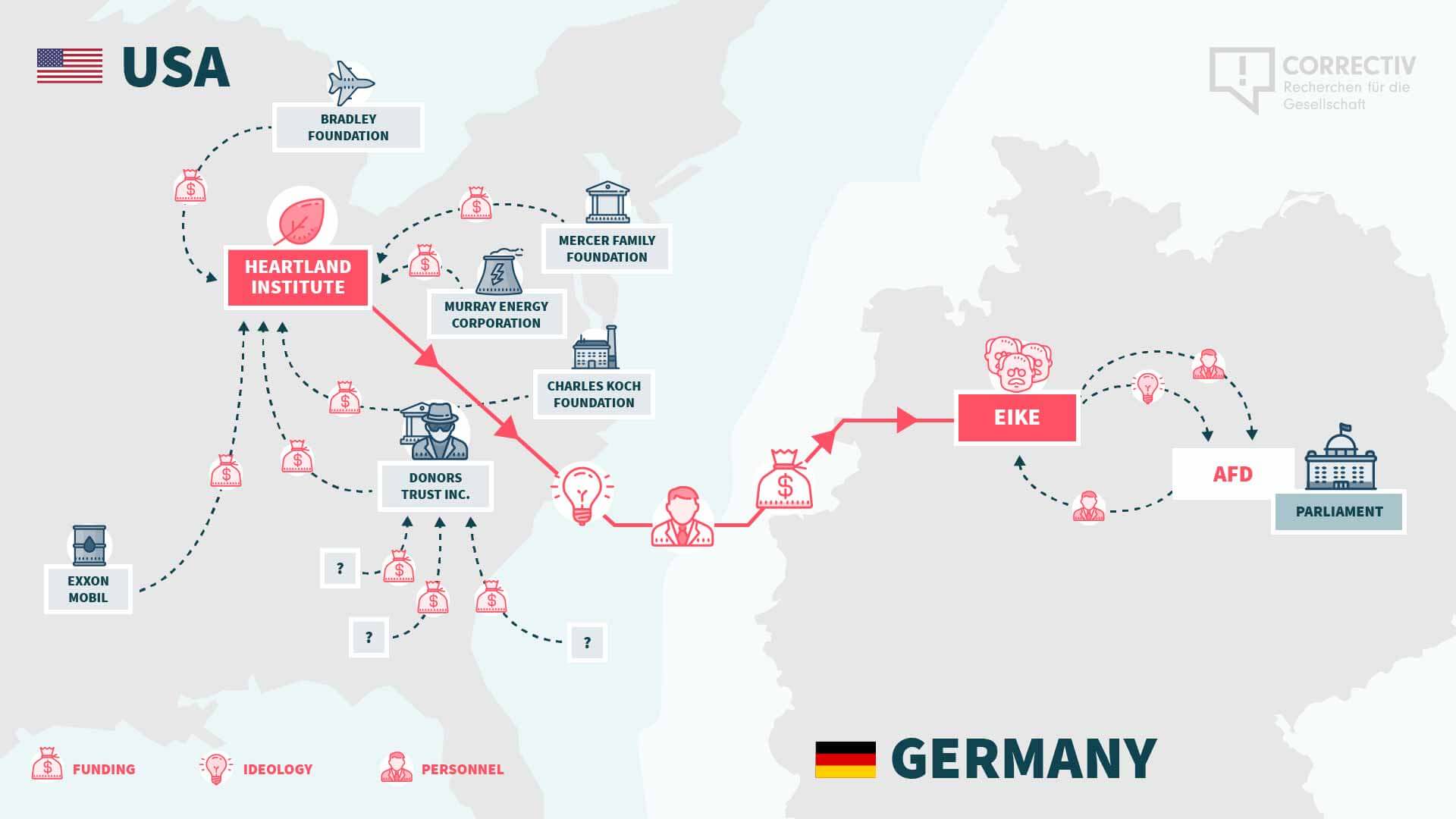
“Donors Trust is now directing between two-thirds and three-quarters of its budget to Heartland to support its climate-skeptical positions," Taylor told the undercover reporters.
The American Fuel and Petrochemical Manufacturers,an industry trade group whose members include ExxonMobil, Chevron and BP, alsogave $75,000 to the Heartland Institute in 2017.
The Post story also quoted Graham Brookie, who directs the Digital Forensic Research Lab, an arm of the nonprofit Atlantic Council. Brookie said the ideology Seibt presents “is not outright disinformation," but that it does "bear resemblance to a model we use called the 4d’s — dismiss the message, distort the facts, distract the audience, and express dismay at the whole thing.”
The Post's story did not mention that the Atlantic Council is funded by ExxonMobil, ConocoPhillips, the Abu Dhabi National Oil Company, Chevron, Shell, and BP.
In response to a request for comment, The Washington Post’s Molly Gannon said only, “Our story speaks for itself.”
Other news outlets seem to have copied the omission. The Guardian, The Independent, France24, the Daily Mail, Mediaite, Mic, and MassLive all published follow-on stories that did not mention the Heartland Institute’s financial backing from the fossil fuel industry.
The Heartland Institute seems to be trying to look like it has the youth on its side. So it has found a Gen Z surrogate who can parrot decades-old fossil fuel talking points, and earned major press coverage that frames her as a figure who compares to Thunberg, while completely leaving out the group's obvious, and documented, oil and gas industry connections.
===
===
:{
}:
who?
:{
}:
For decades, fossil fuel companies have spent millions to spread climate disinformation and delay action on climate change, but now we're one step closer to holding them accountable. After months of public pressure, oil and gas giant Shell has given in to activist and investor demands. It has released a report on the climate policy lobbying of external groups that it funds and cut ties with one anti-climate group.
Unfortunately, other major fossil fuel companies, such as BP, Chevron, ConocoPhillips, and ExxonMobil, are still hiding their anti-climate lobbying behind trade associations. These trade associations, such as the American Petroleum Institute (API) and others, lobby against climate action on behalf of their members, allowing companies to feign support for climate action in public while doing just the opposite behind closed doors.
This is a big deal. Lobbying by Big Oil often tips the scales on climate policy at the federal, state, and local levels—frequently under the cover of third-party groups they fund in secret. While some major fossil fuel companies no longer dispute climate science, most continue to hold leadership positions in industry groups like these that fight against science-based climate policy.
Shell's trade association report isn't perfect.The company did withdraw from the American Fuel & Petrochemical Manufacturers (AFPM), unable to square AFPM's lack of support for carbon pricing and its push for a rollback of Environmental Protection Agency fuel economy standards with Shell’s own climate policies. However, it still maintains membership in two other trade groups that have played well-documented roles in spreading climate disinformation.
Shell's trade association report brings much-needed attention to the fossil fuel industry's political lobbying. It also puts pressure on other companies to follow suit. It's time for BP, Chevron, ConocoPhillips, and ExxonMobil to step up and improve on Shell's first step towards transparency and accountability.
===
https://thinkprogress.org/oil-lobby-groups-epa-secret-science-proposal-clean-water-rules-9de63644deed/
no lnx twt?
EPA’s ‘secret science’ proposal being used by Big Oil to undermine clean water rules
Fossil fuel trade groups don't want the EPA to update a 1970s-era list of polluting petroleum chemicals.
KYLA MANDEL
MAR 22, 2019,
Internal emails reveal two major fossil fuel trade groups are lobbying to stop the Environmental Protection Agency (EPA) from updating a decades-old list of toxic chemicals found in petroleum wastewater — and they’re using the Trump administration’s controversial “secret science” proposal to make their case.
The EPA currently monitors for 16 types of chemicals in wastewater, or effluent, released by petroleum refineries under the Clean Water Act. However, in the more than 40 years since the list was developed, scientific understanding around the number of chemicals and their toxicity levels has grown. As a result, the EPA is in the early stages of determining whether the priority list of chemicals needs to be updated.
But according to emails released to the Sierra Club and reviewed by ThinkProgress, the American Petroleum Institute (API) and the American Fuel and Petrochemical Manufacturers (AFPM) are lobbying to limit the scope of the EPA’s study.
The fossil fuel trade groups want to ensure that two categories of chemicals known to be toxic to aquatic life, and potentially harmful to humans, are excluded from the study: alkylated polynuclear aromatic hydrocarbons (alkylated-PAHs) and naphthenic acids (NAs). The industry even goes so far as to state that including these in a study would risk “legal challenges.”
These two sets of chemicals are not currently on the EPA’s priority list. There are hundreds of different variations of PAH chemicals and levels of toxicity (alkylated-PAHs, for instance, are a derivative of the main “parent” PAH compounds). Burning coal and oil is the main source for these chemicals.
Yet, according to Jan Andersson, a chemistry professor at the University of Münster in Germany who has studied the EPA’s list, roughly 97 percent of the PAH chemical compounds found in crude oil are alkylated chemicals, making any lobbying against their inclusion quite significant. Meanwhile, NAs are found primarily in the byproduct of tar sands oil; the non-biodegradable compounds are stored in giant tailings ponds.
Excluding these types of chemicals from the EPA study would therefore serve to preemptively limit the scope of any potential rule changes in the future.
“They’re trying to cook the books at the very earliest stages of a study for petroleum refinery and ignoring the considerable data that’s out there that alkylated-PAHs are absolutely at least as toxic, if not more toxic, than the ones everybody monitors for right now,” Betsy Southerland, former director of the EPA’s Office of Water’s Office of Science and Technology, told ThinkProgress. Southerland worked for the EPA for 30 years before resigning in 2017 in response to the change in leadership.
At high or prolonged exposure, PAH chemicals can cause tumors in aquatic life and birds as well as impact their reproduction, development, and immunity. Studies show that NAs have similar impacts, along with causing liver and heart damage in mice. Some known health effects to humans from PAH exposure include eye and skin irritation, nausea, and diarrhea, as well as longer-term impacts such as kidney or liver damage and asthma-like symptoms.
Scientists are still studying how the various chemicals impact humans; a range of PAH chemicals are classified as suspected or possibly carcinogenic to humans. What is known though, is that alkylated-PAHs are likely more toxic than other types of PAHs. They also take a longer time to biodegrade in the environment.
The ‘secret science’ argument
Issued by the EPA in 1976, the list of 16 types of PAH chemicals is used to determine which chemicals must be monitored for risks to drinking water and human health. Under the Clean Water Act, petroleum wastewater effluent guidelines establish a national floor — a baseline limit — for these chemicals. So, if there is a discharge of waste such as the release of industrial wastewater, stormwater runoff, or oil spills, only these 16 chemicals are tested to determine the level of toxicity.
The simplicity of the list has made the process easily applicable and cost-effective, and other countries have also turned to it as a resource. The list hasn’t just been used to monitor wastewater, either — environmental studies frequently use it as a basis for research. However, as a 2015 article co-authored by Andersson and published in the academic journal Polycyclic Aromatic Compounds notes, the list leaves out three large groups of these chemical compounds, including alkylated-PAHs. As the paper states, crude oil and coal are “rich” in alkyl compounds.
Despite the potential impact on human health and the environment, the levels of these chemicals currently found in petroleum wastewater is unknown; that’s one thing the EPA’s study would determine. PAH concentrations can vary from site-to-site and by the source of the crude oil. The findings would then help guide any necessary changes to the list of chemicals that should be regulated.
As part of its argument against the EPA measuring these chemicals, the trade groups are using the EPA’s proposed “secret science” rule to argue against disclosure of NAs because that would constitute a risk to companies’ proprietary data.
The proposed rule, also known as the “Strengthening Transparency in Regulatory Science” rule, was introduced last April by former EPA administrator Scott Pruitt. The rule has been supported by climate science deniers and effectively aims to restrict the use of scientific evidence in the rule-making process. The plan has been stalled under Administrator Andrew Wheeler, but if adopted, it would require the EPA to rely only on scientific studies where the underlying data used by the researchers is made public. Critics argue the bill would severely limit the kind of science the EPA could use in justifying regulations (excluding public health data, for instance) and would place a number of unnecessary burdens on EPA scientists.
Some in the chemical and fossil fuel industries, both of which maintain close ties with the Trump administration, have also warned that the rule would expose confidential corporate information. In a June 8, 2018 letter attached to an email to Brian d’Amico, branch chief at the EPA’s Office of Ground Water and Drinking Water, API and AFPM wrote that using the industry’s own proprietary method of analyzing naphthenic acids would be a “clear contradiction” to the EPA’s proposed secret science rule.
“Independent validation is clearly not possible when a proprietary analytical method is used to generate the data,” the organizations argued. “In the interest of transparency, per its own proposed rule, EPA should abandon the use of this proprietary method in the Detailed Study.”
“Data derived from these methods could result in the EPA facing substantial scientific and legal challenge,” API and AFPM warned.
In other words, under the hypothetical scenario where the EPA decides to update its chemicals list at a time when the secret science rule is officially adopted, it would require the results of the EPA’s effluent study be made public, as that would be considered underlying data used to introduce the new chemicals rule. But doing so would, in the eyes of the fossil fuel industry, violate their proprietary methods used to analyze the chemical and so the chemicals should instead be simply excluded from the very beginning to avoid such a scenario.
“Quoting a rule that has not even gone final yet for the reason why [the EPA] shouldn’t be allowed to monitor it is pretty outrageous,” said Southerland.
The EPA did not respond to a request for comment from ThinkProgress about whether or not it will be studying the two types of chemicals the fossil fuel industry has been lobbying against. The API and AFPM also did not respond to requests for comment.
‘Obsolete’ list
The fossil fuel industry is also arguing that the EPA doesn’t have sufficient data to claim that these two groups of chemicals should be regulated.As Roger E. Claff, senior scientific adviser at API, wrote in a February 2018 email to d’Amico, among the concerns is a “lack of toxicity data for decision-making.”
But as Southerland explained, that’s precisely why the EPA is initiating its study; growing scientific findings suggest these chemicals are highly toxic and therefore updates might be warranted. Meanwhile, she said, “API is saying ‘hell no.'”
Andersson made the case for updating the list in his 2015 paper. The 1976 list was created based on what was commercially available at the time, but many more variations of PAH chemicals exist now. Meanwhile, toxicology has improved understanding of the adverse health impacts of a wide range of these chemicals, and “a wealth of new compounds have been added to the inventory of confirmed or suspect carcinogens.”
“This list of compounds is not suitable,” Andersson told ThinkProgress. “Most of them are pretty innocuous… [there are] many that are much more toxic that don’t appear on this list because in 1976, people didn’t know about them. This list looks pretty obsolete.”
‘Collaboration through the years’
The first meeting between the EPA and the fossil fuel trade groups on this issue occurred in May 2016, under the Obama administration. And as a January 2018 slide show presentation to the Trump administration shows, the industry highlighted its “collaboration through the years” with the EPA.
Internal emails released to the Sierra Club show a January 2018 presentation by API to the EPA.
INTERNAL EMAILS RELEASED TO THE SIERRA CLUB SHOW A JANUARY 2018 PRESENTATION BY API TO THE EPA.
Of course, some degree of collaboration is needed in order for the EPA to properly conduct its study and gather the necessary data. However, the internal emails provide insight into the scale of influence the fossil fuel lobby is trying to exert at the very early stages of decision making.
Dalal Aboulhosn, who works onfederal water policy for the Sierra Club, said this shows how under the current administration industry “is allowed to come in and pretty much write their wish list.”
On water specifically she said, there has been a pattern of industry approaching the EPA under both Pruitt and Wheeler with policy ideas before the EPA has actually decided to move on the issue. Shortly after, a change is announced.
“It’s very blatant and it’s across the board when it comes to issues in the agency, and we’re seeing it very starkly on water issues,” Aboulhosn said.
Indeed, after arguing last June that “the science and data for the toxicity of NAs and alkylated-PAHs are still a work in progress,” the two trade groups go so far as to suggest that, should the EPA wish to study them, the agency must address these two groups of chemicals “in a project outside of the Study.”
They argue the EPA should make a new official rule in order to create a new “method” for studying these chemicals. This separate project should undergo “the appropriate public notice and comment period required to gain method approval,” the trade groups’ letter states.
This, however, would be highly uncommon given public notice and comment periods typically apply to new regulations, or changes to existing regulations (such as repealing the Obama-era Clean Power Plan or introducing the “secret science” rule); it would also serve to delay the process by several years.
“It sounds like they’re trying to set some new bar to any future detailed studies,” Southerland said, “where no analyses can be done unless there’s a standard method… that would be a bar not just for petroleum refinery but every industry category.”
It quickly becomes a “chicken and egg” situation, Southerland said; you need a study to determine if a new rule is needed, but the industry is arguing you need a new rule before conducting the study.
But as the June 2018 industry letter to the EPA reads, “API and AFPM members believe in due diligenceand support EPA in developingsound science.”
==
===
https://insideclimatenews.org/news/28032019/pipeline-protest-crackdown-state-law-legislation-south-dakota-conspirators-riot-boosting
This story was updated with a lawsuit filed March 28 over the South Dakota law.
Bills to clamp down on pipeline protests have spread to at least nine new states this year, part of an industry-backed push that began two years ago to heighten penalties for activists who try to block fossil fuel infrastructure projects.
Several of the bills also allow prosecutors to go after people or organizations as "conspirators" or "riot boosters" for merely supporting or coordinating with others who violate the law.
Civil liberties advocates argue that these vague and far-reaching provisions risk violating free speech protections under the First Amendment, and they have already started launching legal challenges.
The latest government move came on Wednesday in South Dakota—one of the states the planned Keystone XL pipeline is slated to cross—whenRepublican Gov. Kristi Noem signed a law that enables state and local governments, as well as "third parties," to seek civil damages from people or organizations that engage in "riot boosting."
Lawmakers in North Dakota, a hub of oil and gas development, also passed a bill this week that stiffens penalties for anyone who interferes with the construction or operation of pipelines and other "critical infrastructure." Once the Senate approves some minor changes, it heads to Republican Gov. Doug Burgum, who has not said whether he will sign it.
The North Dakota bill was based on a law that was enacted in Oklahoma in 2017 and then circulated by the industry-backed American Legislative Exchange Council (ALEC). Versions of that legislation have now been introduced in at least 15 states, three of which have enacted it: Oklahoma, Louisiana and Iowa. A version of the bill passed the Indiana legislature this week, too, though the Senate there must also approve some amendments before sending it to the governor.
While the details vary from state to state, the bills generally increase penalties for trespassing on or tampering with a range of facilities, including pipelines, oil storage tanks, railroads and utility infrastructure. Several of them, including North Dakota's, also include language assigning higher penalties—up to $1 million in some cases—for any group found to be a conspirator in violating the law.
The South Dakota law is different. Rather than imposing new penalties for interfering in pipeline construction, the bill enables state or local governments—or a third party working with government—to seek compensation from anyone who engages in "riot boosting," which includes encouraging or directing someone to engage in a riot, defined by the state as the use of force or violence by three or more people acting together.
Someone can qualify as a "riot booster" even if they reside out of state and act indirectly "through any employee, agent or subsidiary." Anyone found liable would be responsible for three times the ordinary penalty.
The bill was introduced at the end of the legislative session and approved over the course of four days, with only one hearing.
Environmental and civil liberties advocates, as well as many Native American tribes, say the bills are an attempt to stifle legitimate protest by creating harsh penalties for minor infractions and by trying to scare off advocacy groups. An organization that holds a nonviolence training, for example, might be targeted under the law if attendees are later part of a protest that ends in a clash with private security forces or police.
"'Riot boosting' is an unusual and new term. You might be asking yourself what that means, and I think protesters will too," said Vera Eidelman, an attorney with the American Civil Liberties Unionwho has tracked the bills. "I think it poses a unique threat to speech and appears to be targeted at protests. It uses words like 'encouraging' and 'advising' that are very broad and refer to a category of protected speech."
On Thursday, the ACLU sued South Dakota officials in federal court on behalf of indigenous and environmental groups, arguing that the new law and two related statutes violate the Constitution by suppressing free speech and failing to describe what actions could qualify as violations. In a statement, the group said "such vague and broad language invites arbitrary enforcement, will chill protected speech, and will result in indiscriminate targeting of peaceful organizers."
Industry-Backed Group's 'Model Legislation'
The legislation is part of a wave of state bills introduced across the country since President Donald Trump's election in response to high-profile protests like those against the Dakota Access Pipeline on the Standing Rock Reservation in North Dakota in 2016 and 2017.
Oklahoma stateRep. Scott Biggssaid he was responding to those protests when he introduced a bill in 2017 to impose harsh penalties on people or groups who interfere with "critical infrastructure." After ALEC adopted the bill as model legislation, versions quickly spread across several states with active pipeline projects.
The bills' supporters have said they make it easier for prosecutors to go after protesters or vandals who violate the law, and that they do not target free speech.
Advocates have pointed out that the actions in question—trespassing, vandalism—are already covered by existing laws. Instead, they say, the aim of the bills is to intimidate protesters who draw attention to their concerns through civil disobedience, including minor infractions like blocking the gates of construction sites. Advocates say these protests are part of a long tradition of American civil disobedience dating back to the Boston Tea Party.
"Even where these bills are simply introduced, even if they do not move, even if they do not become law, they have potential to chill free speech and curtail activism," said Maggie Ellinger-Locke, a staff attorney with Greenpeace. "We're hearing from people on the frontlines of activism in these states that these bills frighten them."
Pipeline Companies Register Their Support
Energy companies and associations have supported the bills and have continued to push the legislation this year, according to documents compiled by Greenpeace.
TransCanada, the Canadian company behind the Keystone XL pipeline, registered its support for the bill this year in Missouri along with theAmerican Fuel and Petrochemical Manufacturers and other industry groups. In Illinois,TransCanada was joined by Enbridge and Energy Transfer, two other leading pipeline developers, as well as the American Petroleum Institute.
Sen. Janne Myrdal, who sponsored the North Dakota bill this year and is a member of ALEC's energy task force,did not respond to requests for comment. But she told the Associated Press that she introduced the bill in response to a protester who in 2016 broke into a control site for the existing Keystone pipeline that cuts through the state and manually closed one of the valves.
"There was frustration from law enforcement and residents that there wasn't enough teeth in current law to go after these people and the organizations that support them," she said.[pix]
The protester, Michael Foster, was convicted and sentenced to three years in prison, though two of those years were suspended. He ended up serving about half a year.
In South Dakota, Gov. Noem's office did not answer emailed questions about TransCanada's role in drafting the bill, but Noem said in February that she had met with representatives of the company to discuss her legislative package, which also includes a bill that requires pipeline developers to contribute to a fund that would help pay for government costs associated with construction [LIKE POLICE? OVERTIME?].
"I fully support the freedoms of speech and assembly, but we must also have clear expectations and the rule of law," Noem said in a statement issued Wednesday. "My pipeline bills make clear that we will not let rioters control our economic development."
Terry Cunha, a spokesman for TransCanada, said in an email that "we appreciate the efforts of Governor Noem and her administration to help advance Keystone XL construction and other pipelines," adding that "any legislation that deters unlawful activities and encourages the advancement of critical infrastructure projects is a positive step."
Is It Stifling Dissent?
Some activists say the bills are part of a wider effort by the oil and gas industry and its allies in government—through lawsuits, public relations campaigns and legislation—to paint protesters as criminals and even terrorists.
"All of these things I think incorrectly mischaracterize protesters and respond to a powerful pushback against pipelines and other protests, not by trying to engage on the issues but by trying to stifle dissent," Eidelman said. "I think this is really part of a broader trend."
Last year, the ACLU sued the federal government, accusing several agencies of withholding documents detailing preparations for the potential construction of the Keystone XL pipeline. The group had submitted records requests seeking information about the preparations, and the documents that did emerge, mostly from state agencies, showed that law enforcement agencies were conducting trainings for potential protests. The ACLU said the activities risked treating activists as criminals even before protests broke out. State officials have said they are simply doing their jobs.
In January, The Intercept reported on similar concerns in Minnesota, where police had been preparing for a year and a half for protests against Enbridge's proposed Line 3 pipeline expansion project by identifying groups opposed to construction and monitoring some activists.
The ACLU and other civil liberties groups said they are continuing to evaluate the state bills and considering whether they may challenge them as unconstitutional. So far,Louisiana is the only state where protesters have been arrested under the new laws. Bill Quigley, a lawyer who is representing several of the activists, said prosecutors have two years to press charges and have yet to do so.
PUBLISHED UNDER:
==
==
our children's trust broke ranks?
nam
https://insideclimatenews.org/news/26052017/children-climate-change-lawsuit-fossil-fuel:{-api}:
===
no lnx many
How This Oil Refiners Group Rallied GOP Governors' Support for Trump’s Rollback of Auto Standards
By Ben Jervey • Friday, January 25, 2019
As the Trump administration worked to revise and relax federal fuel economy and emissions standards for cars and light trucks, an oil refiners trade group worked connections with Republican governors to rally support for the proposed rollback.
Emails obtained by Documented, a watchdog group that tracks corporate influence in government, revealed that the American Fuel & Petrochemical Manufacturers (AFPM) were actively recruiting Republican Governors to sign onto a public comment letter supporting the weaker CAFE (corporate average fuel efficiency) standards, while also “shopping around” a pre-written op-ed with language borrowed from the American Energy Alliance, a free market advocacy group run by a former Koch Industries lobbyist.
A blockbuster New York Times investigation published in December revealed how AFPM, using a front group called Energy4US, deployed Facebook advertisements to prompt thousands of identical public comments filed in the Federal Register supporting the proposed rule. An earlier article on the Facebook ads by ProPublica had linked AFPM to Energy4US, and researchers at DeSmog's KochvsClean had since connected the front group to more than one-quarter of all public comments that the Department of Transportation (DOT) had received on the proposed rule, while also revealing that the Consumer Energy Alliance was connected to the campaign.
In addition to the more than 3,000 identical comments, the emails obtained by Documented through a number of state open records requests revealed a much broader influence campaign.
Email messages show AFPM representatives reaching out to the staff of Republican governors, soliciting signatures for a formal letter that was eventually submitted to the Department of Transportation and the Environmental Protection Agency (EPA). In another email, AFPM’s Senior Vice President of Federal and Regulatory Affairs shared a pre-written draft of anop-ed with the Wyoming Governor's office, asking if Governor Matt Mead would consider putting his name on it.
How AFPM Rallied Republican Governors to Support the Rollback
AFPM deployed the corporate-backed Republican Governors Association (RGA) and their policy arm, the Republican Governors Public Policy Committee (RGPPC), which helped circulate the letter. AFPM contributed more than $200,000 to RGA during the 2018 election cycle, according to IRS filings.
“Brian Sanderson, the Policy Director with the RGA, has been circulating the letter as well as informational materials to Governors across the country for review. I wanted to reach out to offer to answer any questions and ask for Governor Martinez to consider joining the attached letter,” AFPM’s manager of state and local outreach Peter Barnes wrote in an email to Keith Gardner, chief of staff to New Mexico Governor Martinez. Barnes wrote an identical message asking for support from Mississippi Governor Phil Bryant.
Eventually, governors from Texas, Kansas, Kentucky, Maine, Mississippi, Nebraska, North Dakota, and Oklahoma co-signed the letter, which was sent to the DOT and EPA on October 26, 2018, and subsequently added to the official rulemaking records.
The letter was initially spearheaded byTexas Governor Abbott,[RAGA] whose office sent AFPM talking points on the rule. A close reading of the documents obtained paints a picture of AFPM playing an instrumental role in the organization and dissemination of this governor's letter to others.
AFPM Was Also 'Shopping Around an Op-Ed'
Prior to submitting the letter in the Federal Register, AFPM also asked Republican governors to publish an op-ed supporting the rule. According to an internal memo for Wyoming Governor Matt Mead, AFPM had been “shopping around an op-ed” supporting the changes to fuel economy standards.
“The American Fuel and Petrochemical Manufacturers Association has been shopping around an op-ed which supports the changes and are requesting Governor’s [sic] to sign on (op-ed attached). So far, to my knowledge, the op-ed has been presented to you and the Governors of New Mexico and Nebraska,” the memo stated.
In an email correspondence from AFPM's Senior Vice President of Federal and Regulatory Affairs, Derrick Morgan, to the Nebraska Governor’s office, also obtained by Documented, Morgan alleges that there was “initial interest from Governor Mead of Wyoming.”
“We put together a potential op-ed (draft attached) that will support what the Trump Administration is doing on fuel economy through the EPA and DOT,” Morgan stated in an email to Nebraska Governor Chief of Staff Matt Miltenberger.
The governors ultimately passed on the opportunity to put their names on the op-ed, a decision that might have spared them considerable embarrassment, considering the source of much of the language of the draft.
AFPM’s Op-Ed Borrowed Heavily from the American Energy Alliance
The op-ed draft that was “shopped around” by the AFPM included many sentences lifted entirely from an April letter distributed by the American Energy Alliance (AEA), and which followed the same format as the original letter.
The AEA letter — also signed by representatives of 12 conservative free market groups, including Americans for Prosperity, the Competitive Enterprise Institute, and Americans for Tax Reform — featured sections describing the “fundamental problems” with the Obama-era clean car standards. The sections were titled: “cost to consumers,” “consumer choice,” “inefficiency,” and “It’s a relic.”
The AFPM draft op-ed included similar sections titled: “The mandate makes cars more expensive,” “The mandate minimizes consumer choice,” “The mandate gives California a disproportionate say in the mandate,” and “The mandate fails to recognize our new energy abundance.”
Within each of the mimicked sections, some phrases and sentences are reproduced verbatim from the AEA letter. For example, both texts include a slight variation on the line: “who should decide what cars and trucks you should buy, you and your family or unelected bureaucrats in Sacramento or Washington?”
Compare the two:
The original American Energy Alliance Letter.
The draft op-ed “shopped around” by AFPM.
Both texts also include this often debunked statement: “According to the National Auto Dealers Association, the existing mandates would cause the price of an average vehicle to increase by $3,000 in 2025.”
There are plenty of other examples, which you can see for yourself by comparing the AEA letter with the AFPM draft op-ed.
AFPM has not responded to DeSmog's questions about the provenance of the draft op-ed and if the group was actively working with the American Energy Alliance or others on this issue. So, it's impossible to know whether the group was working in concert with AEA, or whether AFPM staff were simply lifting language from a fellow Koch-affiliated organization. Among other ties, AFPM has received funding from the Koch Industries PAC and has a past board member who worked for Koch Industries.
==
nyt 12/18 see cafe 2
https://www.nytimes.com/2018/12/13/climate/cafe-emissions-rollback-oil-industry.html
...
The Facebook Campaign
The Facebook ads, featuring Mr. Trump waving alongside the message,“SUPPORT OUR PRESIDENT’S CAR FREEDOM AGENDA!,” appeared the week after the administration made public its fuel economy plan in August. At least 10 times during the two-month public comment period on the plan, the ads, which did not state their oil industry origins, asked people to write to the government to back weaker emissions standards.
Public comments matter in federal rule-making. The law requires that citizens’ views be taken into account before a rule is finalized.
“File an official comment to SUPPORT our President’s plan for safer, cheaper cars that WE get to choose,” read one ad, which ran for seven days in early October. The ad leads to a page that provides basic language to submit.
Facebook ads by Energy4Us prompted more than 3,300 of the 12,000 public comments on the administration’s rollback proposal, a Times analysis showed.Credit

Image
Facebook ads by Energy4Us prompted more than 3,300 of the 12,000 public comments on the administration’s rollback proposal, a Times analysis showed.Credit
More than 3,300 of the12,000 public comments that D.O.T. has made public contain language identical to that petition, an analysis of the files showed.
The campaign was a product of the fuel and petrochemical manufacturers trade group, widely known as AFPM. However, neither the Facebook ads nor the site identified the industry group. Instead they name a group called Energy4US, which describes itself as “a coalition of consumers, businesses and workers” promoting affordable energy.
Energy4US has close ties to the industry group. According to internet domain records, Victor Adams, listed as an AFPM web manager, registered Energy4Us.org in 2015 using his work email address. Energy4US lists the group as a coalition member, along with about 50 other groups including energy interests, labor groups, a sheriff’s association and even a recreational fishing alliance.
The AFPM board includes representatives from Exxon, Chevron, Phillips 66, Marathon and Koch Industries. The companies all referred queries to the group.
Derrick Morgan, a senior vice president at AFPM, said the group “regularly works with policymakers, coalition groups and individuals to promote shared goals,” and also will “lead and join groups like Energy4US.”
The Department of Transportation said it was “generally aware” that there were groups urging the public to make comments through online campaigns, but said it does not regulate them.
...
==
https://www.ecowatch.com/washington-carbon-tax-big-oil-2616808725.html
Oil Pours Record $30M to Sway Voters Against Nation's First Carbon Tax
If voters approve Initiative 1631 on Nov. 6,Washington state will take a significant step in climate action by becoming the first state in the nation to enact a fee on carbon emissions. That is, unless Big Oil can stop it.
The U.S. oil industry has pumped a record $30 million to stop the carbon tax, which environmentalists have tried to enact for years, Reuters reported, citing state data. Meanwhile, proponents—including green groups and climate activist billionaires Bill Gates, Michael Bloomberg, Tom Steyer and Laurene Powell Jobs, the widow of Apple founder Steve Jobs—have spent $15.2 million.
"With Big Oil spending $30 million, that makes it a real fight," Bill Holland, state policy director for the League of Conservation Voters, told Reuters. "It has been a frightening amount of money."
Washington ranks fifth in the nation in crude oil refining capacity for making gasoline and other petroleum products, according to the U.S. Energy Information Administration.
Initiative 1631 imposes a starting fee of $15 per metric ton on carbon emissions, beginning in 2020. This fee rises $2 every year until the state hits its 2035 emissions reductions goals and is on track to meet its 2050 goals. If passed, the tax is expected to generate $2.3 billion in revenue for green infrastructure, clean transportation and help communities most impacted by pollution.
A recent statewide Crosscut/Elway Poll among registered voters shows 50 percent approval of the measure, 36 percent opposed and 14 percent undecided, The opposition is led by theWestern States Petroleum Association,a trade organization that has raised $31.2 million from energy companies and business groups for the "No on 1631" campaign—the most money ever spent in Washington state history to defeat a ballot initiative.
BP America contributed the most with $11.5 million, followed by $7.2 million from Phillips 66 and Andeavor with $4.4 million, Reuters said. The three energy companies have refineries in the state.American Fuel & Petrochemical Manufacturersand Valero Energy Corporation also donated funds.
The money has been spent on digital ads, flyers, mailers and television ads aired during this month's Major League Baseball World Series. Opponents say the tax will "be paid by Washington families and small businesses."
RELATED ARTICLES AROUND THE WEB
- Hidden gem for Big Oil in carbon tax plan: an end to climate liability ... ›
- A carbon tax supported by big oil and Bush-era lobbyists. What? - Vox ›
- Taxing Carbon May Sound Like a Good Idea But Does It Work? ›
==
===
https://www.exposedbycmd.org/2018/10/25/exxon-faces-consequences-climate-denial
ExxonMobil, the $78 billion fossil fuel giant, has been lying to its shareholders about the threats of climate change, according to New York Attorney General, Barbara Underwood, following a multi-year investigation.
The New York state lawsuit, filed Wednesday, accuses Exxon of a “longstanding fraudulent scheme” to mislead investors on “the company’s management of the risks posed to its business by climate change regulation,” according to *The New York Times*. Citing messaging to the public that was inconsistent with internal practices, Underwood brought the lawsuit under the Martin Act, which empowers her to investigate and prosecute securities fraud.
The Center for Media and Democracy (CMD) has reported on Exxon’s illegal and unethical efforts to undermine climate science and hide the global impact of its operations for years.
In 2016, the Center for Media and Democracy (CMD) and Common Cause complained to the IRS that Exxon was running an illegal scheme to use the American Legislative Exchange Commission (ALEC) to promote its climate denial policies and legislative agenda “in gross violation of ALEC’s 501(c)(3) charitable status.”
The Industry Plan to Sow Doubt over Climate Science
Evidence presented in the joint CMD/Common Cause IRS filing showed that Exxon had pumped more that $1.7 million into ALEC between 1998 and 2014 to finance lobbying activities that cast doubt on climate science and promoted public policies benefiting the corporation.
The Exxon/ALEC scheme arose from a 1998 “Global Climate Science Communications Action Plan,” authored by the American Petroleum Institute (API). The stated mission of the API plan was to “inform the American public that science does not support the precipitous actions Kyoto [International Climate Treaty] would dictate, thereby providing a climate for theright policy decisions to be made.” [emphasis added]
Exxon was listed as a source of funding for the plan, while ALEC was listed as a “potential fund allocator.” Public records show that Exxon’s funding of ALEC subsequently increased.
Exxon’s more recent efforts to rehabilitate its public image around climate change led the oil giant to split with ALEC in July 2018, reportedly over ALEC’s opposition to the EPA’s findings on greenhouse gases.
Collusion Between Republican AGs and Industry Lobbyists
In 2016, CMD exposed secret, closed-door meetings between state attorneys general and fossil fuel interests to coordinate push-back against New York’s investigation of Exxon. [LA JOLLA SUMMIT?]
CMD published an audio recording of a meeting where representatives of the Competitive Enterprise Institute (CEI) and the American Fuel & Petrochemical Manufacturers (AFPM) — organizations historically funded in part by Exxon — discussed strategies with Republican attorneys general.
The Republican Attorneys General Association (RAGA) facilitated the private sessions, a premium service that the pay-to-play organization provides to corporations that pay RAGA up to $125,000 per year.
“These documents reveal a serious conflict of interest: RAGA is facilitating secret meetings between the profit-motivated fossil fuel industry and attorneys general to engineer pushback on investigations of ExxonMobil — and then raising money from oil and gas companies to keep those same Republican attorneys general in office,” saidNick Surgey, CMD’s Research Directorat the time.
History of Misinformation Campaigns
Numerous investigations have shown that Exxon was fully aware of the risks of climate change from burning fossil fuels as early as the 1970s, despite funding multiple groups like ALEC that denied climate science and humans’ contribution to climate change.
A Harvard University study of Exxon’s communications between 1977 and 2014 found that “ExxonMobil misled the public about climate change,” even as its private and academic research acknowledged serious climate risks.
In 2015, the year New York launched its investigation of Exxon, Inside Climate News reported that Exxon had been aware of climate change but “put its muscle behind efforts to manufacture doubt about the reality of global warming.” Exxon warned top executives of possible climate catastrophe, but then “led efforts to block solutions.” The Los Angeles Times also published an article that year telling a similar story. Exxon dismissed those reports as “cherry picked.”
According to the New York Times, this most recent lawsuit “poses a financial risk to Exxon, as well as a potential reputational blow.”
If history is any indication, Exxon could face significant damages. Similar litigation against tobacco companies found in 2006 that the industry had engaged in “a massive 50-year scheme to defraud the public,” and resulted in a $246 billion settlement
==
https://www.exposedbycmd.org/2017/12/07/alec-hires-former-koch-staffer-lead-energy-task-force
The Koch-funded American Legislative Exchange Council (ALEC) has hired Grant Kidwell, a former analyst from two major Koch-backed groups–Americans for Prosperity and the Charles Koch Institute–to lead its Energy, Environment and Agriculture (EEA) task force, a position that has been left vacant since July.
Funded by numerous fossil-fuel companies, ALEC and its EEA task force has a long history of passing “model bills” undermining environmental protections and opposing policies to combat climate change. The task force is made up of numerous corporate lobbyists and their trade groups that stand to benefit from measures weakening environmental protections: including Koch Industries, Exxon Mobil, Peabody Energy, the Edison Electric Institute, American Fuel & Petrochemical Manufacturers (AFPM), the American Gas Association.
Kidwell’s first week at ALEC comes as the group holds its States and Nation Policy Summit, currently taking place in Nashville, Tennessee. Among the measures being discussed is a resolution urging the EPA to scrap the 2009 endangerment finding for greenhouse gases, which formed the legal basis for the federal government to regulate greenhouse gas pollution. According E&E News, the fossil-fuel funded Heartland Institute is rumored to be behind the resolution.
Before Kidwell’s appointment, Kenneth Stein who now works for the Koch-backed Institute for Energy Research, briefly served as the task force director from April to July 2017.John Eick, who now works for AFPM, [pruitt BS art'l]previously led the task force from 2012-2017. Todd Wynn, who now works at the Department of Interior and previously worked at the Edison Electric Institute, was Director from 2011 to 2013.
This story was originally published in Documented here.
===
Executive Team
Chet Thompson, President and CEO
- Rebbie J. Riley, Executive Assistant
Office of General Counsel
Rich Moskowitz, General Counsel
- Taylor Hoverman, Manager and Associate Counsel
- Maggie O’Connell, Executive Assistant, Advocacy
Outreach, Federal & Regulatory Affairs
Derrick Morgan, Senior Vice President, Federal & Regulatory Affairs
Government Relations
Geoffrey A. Moody, Vice President, Government Relations
Cory Toth, Director, Government Relations
- Justin Sykes, Manager, Government Relations
Industry Analysis
Susan Grissom, Chief Industry Analyst
Outreach
Don Thoren, Vice President, State and Local Outreach
- Jared Hawes, Director, Outreach
- John Eick, Manager, Outreach ALEC PRUITT BS
- Peter Barnes, Manager, State & Local Outreach
- Elizabeth Olds, Manager, Outreach & Regulatory Affairs
- Airika Walker, Specialist, Outreach
Regulatory Affairs
David N. Friedman, Vice President, Regulatory Affairs
Robert Benedict, Director, Transportation & Infrastructure
Jeff Gunnulfsen, Senior Director, Security and Risk Management
Tim Hogan, Director, Motor Fuels
- Ariel Sarandinaki, Manager, Regulatory Affairs
- Michael Burnside, Regulatory Affairs Specialist
Communications
Jaime Zarraby, Senior Vice President, Communications
Rebecca H. Adler, Senior Director, Communications
Diana Cronan, Senior Director, Communications
- Victor Adams, Manager, Web/Database Systems
- Michael Frohlich, Manager, Communications
- Ryan Mills, Manager, Social Media & Digital Communications
- Gail Easley, Coordinator, Communications
Member Services, Programs Department, Technical Departments, and Convention Services
Susan Yashinskie, Senior Vice President, Member Services & Programs
- LaToya Britt, Manager, Member Services
- Naila Stocks, Administrator, Membership Services
Dan Strachan, Director, Industrial Relations and Programs
Health & Safety Programs
Lara Swett, Senior Director, Health & Safety Programs
- Eileen Scherzinger, Senior Manager, Regional Networks
- Daniel Forest, Manager, Safety Programs
- Anna M. Scherer, Manager, Safety Programs & Statistics
- Mawusi Bridges, Administrative Coordinator, Safety Programs
Convention Services
Helen M. Kutska, Senior Director, Convention Services
- Merla Zollinger, Senior Manager, Convention Services
- Brittany Jacobs, Meeting Planner, Convention Services Department
- Kira Short, Meeting Planner, Convention Services Department
- Elena Perez, Registrar, Convention Services
James R. Cooper, Senior Petrochemical Advisor
Gordon Robertson, Director, Technical Programs
- Rose Sabijon, Manager, Petrochemical Programs
- Adam Ali, Manager, Workforce Development
- Tanya Cooper, Specialist, Conference Programs
- Yvette Brooks, Specialist, Technical Programs
Finance and Administration
Gerald R. Van De Velde, Chief Financial Officer
===
https://www.ecowatch.com/our-childrens-trust-motions-2422789150.html
Fossil Fuel Associations Scramble to Quit Kids Climate Lawsuit Before Discovery Deadline
In an unusual procedural move, the American Petroleum Institute (API) and American Fuel & Petrochemical Manufacturersfiled motions Thursday requesting the court's permission to withdraw from the Juliana v. USclimate lawsuit, brought by 21 young people. The associations are following the lead of the National Association of Manufacturers, who filed a similar motion to withdraw on May 22.
Now, all three trade association intervenor defendants have filed motions to withdraw from the case, evading last night's discovery deadline. These motions are especially unusual after numerous legal efforts have tried to get a federal court in Oregon to throw out the lawsuit. For any defendant to leave the litigation, U.S. Magistrate Judge Thomas Coffin must grant permission.
...
"API and its members will not come clean on the facts of climate change because they know it exposes them to liability for the damage they too have caused to the global climate system," Julia Olson, co-lead counsel for plaintiffs and executive director of Our Children's Trust, said.
"After these youths sued the government, the trade associations pleaded their members' interests would be destroyed if they weren't allowed to be in the case, but now they are running for the hills. Now, they've decided they're better off being on the sidelines than subjecting themselves to discovery,."
When youth plaintiffs filed their lawsuit in August 2015, only the federal government and government agencies were named as defendants. In November 2015, the associations intervened in the case on the side of the U.S. government defendants, calling the lawsuit a "direct threat to [their] businesses."
"What is noticeably absent from these withdrawal motions is the reason why the fossil fuel industry wants to leave the case," Philip L. Gregory, co-lead counsel for plaintiffs and a party with Cotchett, Pitre & McCarthy LLP of Burlingame, California, said. "They plead with the court to let them out, yet fail to give Judge Coffin any reason behind their change of heart,"
In a January 2016 proceeding before Judge Coffin, an attorney representing all three trade associations explained how these associations would speak with "one voice" if permitted to join the litigation:
"...having the associations participate as associations in this litigation effectively represents those interests without a multiplicity of disparate viewpoints and voices. Rather, in fact, they have joined to speak with one voice through this intervention motion."
The federal court allowed these fossil fuel industry associations to become full party defendants. However, when these intervenor defendants filed their answer to the allegations in young plaintiffs' complaint, the industry claimed it lacked "sufficient knowledge" to take a position on the science of climate change, and most of the claims in the complaint.
Intervenor defendants since agreed to set forth their positions on the scientific facts by responding to requests for admissions, which Plaintiffs subsequently served on March 24. When the fossil fuel defendants had not submitted their responses, Judge Coffin ordered that they be electronically-filed with the court. At the May 18 case management conference, Judge Coffin granted intervenor defendants an extension to submit their responses until the end of the day, May 25. Rather than take a position on the science or the effects of climate change, the fossil fuel industry chose to seek to back out of the case.
Attorneys for youth plaintiffs have already collected evidence through informal discovery that shows all three associations and their members have had long-standing knowledge of climate danger, and at the same time, used their undue influence over the U.S. government to sabotage efforts to address the urgent problem.
"Our government is a trustee over the atmosphere, and yet the Trump administration is wrongfully colluding with the intervenors to increase carbon emissions," Alex Loznak, 20, of Roseburg, Oregon and one of the youth plaintiffs in the case, said. "These industry groups can't be allowed to interfere with our democracy or our climate system without consequences."
==
==
http://www.ecowatch.com/pruitt-epa-ethics-violations-2323438512.html
pruitt pvt email
---
The Kochs and their fossil-fuel-fed political network are reportedly gunning for the electric car.
According to an anonymous industry source who spoke to journalist Peter Stone, a new advocacy group will "make the public aware of all the benefits of petroleum-based transportation fuels."
If you think this sounds a bit nutty, you have to remember Koch front groups have also fought the implementation of street cars in city after city.
If the group follows the usual Koch playbook, expect bogus "research" studies by Koch-funded "think tanks," well-placed op-eds that repeat Koch talking points without disclosing ties to the network, and fear-mongering ads that hide their fossil fuel funding behind bland names like "Americans for Energy Freedom." (The group's actual name has yet to be announced.)
The effort is reportedly being headed by Koch Industries board member James Mahoney andlobbyist Charlie Drevna, formerly the president of the American Fuel and Petrochemical Manufacturers. The pair have reportedly been meeting with executives at fossil fuel corporations including Koch, Valero Energy, and Tesoro Corp. In his new position at the Koch-funded Institute for Energy Research, Drevna has already put out a paper attacking Tesla, while Mahoney led a seminar at January's Koch network retreat on "Changing the Energy Narrative."
The news of the emerging scheme against electric cars sparked new attention to the Koch network in the car industry, even provoking Tesla founder Elon Musk to mount a critique on Twitter....
http://www.prwatch.org/news/2016/02/13048/kochs-go-after-electric-car-subsidies
recent retirement asAFPM President, Drevna has been named Distinguished Senior Fellow at the Institute for Energy Research (IER). IER is a not-for-profit organization that conducts intensive research and analysis on the functions, operations, and government regulation of global energy markets. IER maintains that freely-functioning energy markets provide the most efficient and effective solutions to today’s global energy and environmental challenges and, as such, are critical to the well-being of individuals and society.
Since 2007 Charles T. Drevna has served as president of the American Fuel & Petrochemical Manufacturers, the national trade association that represents 98 percent of refining capacity in the United States. Drevna joined the association in 2002 as director of policy and planning and named executive vice president in 2006. Drevna managed a team that advocates on behalf of petroleum refiners and petrochemical manufacturers who are instrumental in strengthening our economic and national security, and support two million American jobs. Through his leadership, the association expanded, doubling in size and scope of work to meet the growing demand of a broad range of public policy issues.
In 2012, Drevna supervised a rebranding of the association, formally known as the National Petrochemical & Refiners Association, to better identify the refining industry as high-tech manufacturers of virtually the entire U.S. supply of fuel and home heating oil, as well as the petrochemicals used to produce thousands of consumer products.
Drevna has over 40 years of extensive experience in legislative, regulatory, public policy and marketplace issues involving energy and the environment. His previous positions include director of state and federal government relations for Tosco, Inc.; director of government and regulatory affairs for the Oxygenated Fuels Association; vice president at the Washington consulting firm of Jefferson Waterman International; several positions at Sunoco, including vice president for public affairs for Sun Coal Company; director of environmental affairs for the National Coal Association; and supervisor of environmental quality control for the Consolidation Coal Company.
Drevna received his BA in chemistry from Washington and Jefferson College and performed graduate work at Carnegie-Mellon University.
Featured Content
Press Releases
More Scare Tactics From The White House
.
==
Charles Drevna, Author at IER - Institute for Energy Research
instituteforenergyresearch.org/.../cdrevna/
Institute for Energy Research
Upon his recent retirement as AFPM President, Drevna has been named Distinguished Senior Fellow at the Institute for Energy Research (IER). IER is a ...
Charles T. Drevna Joins IER - IER
instituteforenergyresearch.org/.../charles-t-d...
Institute for Energy Research
May 26, 2015 - WASHINGTON, D.C. — Today, the Institute for Energy Research announced that Charles T. Drevna is joining the organization as a ...
Staff - AFPM
https://www.afpm.org/staff/
Merla Zollinger, Senior Manager, Convention Services; Colleen Van Gieson, Manager, Meetings; Anna M. Scherer, Manager, Process Safety Database; Eileen ...
Charlie Drevna | LinkedIn
https://www.linkedin.com/in/charlie-drevna-43616838
View Charlie Drevna's professional profile on LinkedIn. LinkedIn is the world's largest business network, helping professionals like Charlie Drevna discover ...
Former refining lobbyist joins Institute for Energy Research ...
fuelfix.com/.../former-refining-lobbyist-joins-institute-for-energy-researc...
May 26, 2015 - Charles Drevna is set to become a distinguished senior fellow at the group, roughly a month after he ended an eight-year stint as president of ...
[PDF]Charles T Drevna bio 02 20 13
accf.org/wp-content/uploads/2013/.../Charles-T-Drevna-bio-02-20-13.pd...
American Fuel & Petrochemical Manufacturers President Charles T. Drevna has ... Drevna leads a staff that advocates for petroleum refiners and petrochemical ...
Charlie Drevna Discusses America's Oil Renaissance ...
Video for Charlie Drevna
? 4:34
https://www.youtube.com/watch?v=6V6Jdng1wiY
Aug 27, 2015 - Uploaded by IERDC
IER Distinguished Fellow Charlie Drevna joins Mary Kissel on WSJ Live to explain why American oil ...
Former AFPM President Charlie Drevna Joins Institute for ...
www.downstreambusiness.com/former-afpm-president-charlie-drevna-jo...
Jun 1, 2015 - The Washington, D.C.-based Institute for Energy Research (IER) announced that it has named former American Fuels and Petrochemical ...
Charlie Drevna - - Fortune
fortune.com/author/charlie-drevna/
Dec 1, 2015 - Charlie Drevna is a senior fellow at the Institute for Energy Research. He was formerly president of the American Fuel and Petrochemical ..
==
Significantly, similar legal issues are being considered in a federal lawsuit brought in August 2015 against the federal government by 21 young people from across the U.S. and Dr. James Hansen as guardian for all future generations, in the U.S. District Court for the District of Oregon. Just last week in that case, the world’s largest fossil fuel industry representatives filed a request to intervene to protect their commercial economic interests in fossil fuel exploitation and to thwart the youth’s request for protection of their fundamental constitutional rights. The proposed intervenors, theAmerican Fuel and Petrochemical Manufacturers (representing members ExxonMobil, BP, Shell, Koch Industries and virtually all other major refiners and petrochemical manufacturers), the American Petroleum Institute (representing 625 oil and natural gas companies) and the National Association of Manufacturers, called the youth’s case “a direct threat to [their] businesses.”
:{
}:
http://ecowatch.com/2015/11/20/stem-tide-climate-change
==
Jack Gerard has lobbied at the White House at least twice since President Obama took office, including againis**t Ozone** (smog) regulations alongside high-ranking members of the U.S. Chamber of Commerce, the NPRA (now AFPM--American Fuel and Petrochemical Manufacturers), the National Association of Manufacturers, and the American Chemistry Council, speaking directly to top administration officials, such as Cass Sunstein at OMB's information and regulatory affairs division and EPA's Gina McCarthy. The White House ordered EPA not to enforce the Ozone rule less than a month after the meeting.
===
bs
American Fuel & Petrochemical Manufacturers is the new name of the National Petrochemical & Refiners Association, an organization with a proud 110-year history of serving America. AFPM is the new NPRA. We adopted our new name in January 2012 to better describe who we are and what we do.
AFPM is a trade association representing high-tech American manufacturers of virtually the entire U.S. supply of gasoline, diesel, jet fuel, other fuels and home heating oil, as well as the petrochemicals used as building blocks for thousands of vital products in daily life.
--
Current members of Executive Committee.
| Position | Name | Organization | City | State |
|---|---|---|---|---|
| Chairman of the Board | David Lamp | HollyFrontier Corporation | Dallas | TX |
| Vice Chair | Gregory J Goff | Tesoro Corporation | San Antonio | TX |
| Past Chair | James Mahoney | Koch Industries, Inc. | Wichita | KS |
| Treasurer | Richard Meeks | Ergon, Inc. | Jackson | MS |
| Member | Jack Lipinski | CVR Energy, Inc. | Sugar Land | TX |
| Member | Jerry Wascom | Exxon Mobil Corporation | Fairfax | VA |
| Member | Dennis Seith | INEOS Olefins & Polymers USA | League City | TX |
| Member | Kevin W Brown | LyondellBasell Industries | Houston | TX |
| Member | Gary R Heminger | Marathon Petroleum Corporation | Findlay | OH |
| Member | Thomas D. O'Malley | PBF Energy Inc | West Palm Beach | FL |
| Member | Lawrence Ziemba | Phillips 66 | Houston | TX |
| AFPM Attorney | Richard Moskowitz | American Fuel & Petrochemical Manufacturers (AFPM) | Washington | DC |
| AFPM Secretary | Charlie Drevna | American Fuel & Petrochemical Manufacturers (AFPM) | Washington | DC |
| Staff Coordinator | Rebbie J Riley | American Fuel & Petrochemical Manufacturers (AFPM) | Washington | Washington |
Board of Directors
Current members of Board of Directors.
| Position | Name | Organization | City | State |
|---|---|---|---|---|
| Chairman of the Board | David Lamp | HollyFrontier Corporation | Dallas | TX |
| Vice Chair | Gregory J Goff | Tesoro Corporation | San Antonio | TX |
| Past Chair | James Mahoney | Koch Industries, Inc. | Wichita | KS |
| Treasurer | Richard Meeks | Ergon, Inc. | Jackson | MS |
| Member | Laura Ruiz | Afton Chemical Corporation | Richmond | VA |
| Member | Jeffry Byrne | Air Products and Chemicals, Inc. | Allentown | PA |
| Member | Amy Motto | Albemarle Corporation | Baton Rouge | LA |
| Member | Paul Eisman | Alon USA, LP | Dallas | TX |
| Member | Tim Brown | American Refining Group, Inc. | Bradford | PA |
| Member | Richard Rennard | Arkema Inc. | King of Prussia | PA |
| Member | C. Douglas Shannon | Axiall Corporation | Houston | TX |
| Member | Mark R Keim | Big West Oil, LLC | North Salt Lake | UT |
| Member | Doug Sparkman | BP Amoco Chemical Company | Chicago | IL |
| Member | Nick Spencer | BP Products North America | Whiting | IN |
| Member | Bruce Rubin | Braskem America, Inc. | Philadelphia | PA |
| Member | Russ Willmon | Calcasieu Refining Company | Lake Charles | LA |
| Member | Bill A Anderson | Calumet Lubricants | Indianapolis | IN |
| Member | Mark Lashier | Chevron Phillips Chemical Company LP | The Woodlands | TX |
| Member | Gary Yesavage | Chevron U.S.A. Inc. | San Ramon | CA |
| Member | James S Loving | CHS Inc. | Inver Grove Heights | MN |
| Member | Eduardo Assef | CITGO Petroleum Corporation | Houston | TX |
| Member | Paul Mikesell | Cornerstone Chemical | Waggaman | LA |
| Member | Matthew Smorch | Countrymark Cooperative Holding Corp. | Indianapolis | IN |
| Member | Brian P. Smith | Criterion Catalysts & Technologies | Houston | TX |
| Member | Jack Lipinski | CVR Energy, Inc. | Sugar Land | TX |
| Member | Frederec C Green | Delek Refining Ltd. | Brentwood | TN |
| Member | Zachary Levine | Deltech Corporation | Baton Rouge | LA |
| Member | Glenn Liolios | DuPont | Leawood | KS |
| Member | Michael Berry | Eastman Chemical Company | Kingsport | TN |
| Member | Terry L Hurlburt | Enterprise Products Operating LLC | Houston | TX |
| Member | Jerry Wascom | Exxon Mobil Corporation | Fairfax | VA |
| Member | Jeff Ramsey | Flint Hills Resources, LP | Wichita | KS |
| Member | Stan Ueng | Formosa Plastics Corporation, USA | Point Comfort | TX |
| Member | Raymon C. Barlow | GE Water & Process Technologies | The Woodlands | TX |
| Member | Shawn Abrams | Grace Catalysts Technologies | Columbia | MD |
| Member | Mark Zyskowski | Honeywell Inc. | Houston | TX |
| Member | David Carroll | Hunt Refining Company | Tuscaloosa | AL |
| Member | Janice Latz | Huntsman Corporation | The Woodlands | TX |
| Member | Dennis Seith | INEOS Olefins & Polymers USA | League City | TX |
| Member | Kevin W Brown | LyondellBasell Industries | Houston | TX |
| Member | Richard Bedell | Marathon Petroleum Corporation | Findlay | OH |
| Member | Gary R Heminger | Marathon Petroleum Corporation | Findlay | OH |
| Member | Jeff Warmann | Monroe Energy, LLC | Trainer | PA |
| Member | Robert Pease | Motiva Enterprises LLC | Houston | TX |
| Member | Terry Burleson | NALCO Champion | Sugar Land | TX |
| Member | Mary Beth Forester | Northern Tier Energy | St. Paul Park | MN |
| Member | Naushad Jamani | NOVA Chemicals Corporation | Calgary | Canada |
| Member | Michael Pesch | NuStar Asphalt Refining LLC | Paulsboro | NJ |
| Member | Chuck Anderson | Occidental Chemical Corporation | Dallas | TX |
| Member | John McIntosh | Olin Chlor Alkali Products | Cleveland | TN |
| Member | Purnendu Rai | Oxea Corporation | Dallas | TX |
| Member | Francisco Raymundo de Cerqueira Neto | Pasadena Refining System, Inc. | Pasadena | TX |
| Member | Thomas D. O'Malley | PBF Energy Inc | West Palm Beach | FL |
| Member | Hank Jeans | PetroLogistics | Houston | TX |
| Member | Philip Rinaldi | Philadelphia Energy Solutions (PES) | Philadelphia | PA |
| Member | Lawrence Ziemba | Phillips 66 | Houston | TX |
| Member | Dan Robinson | Placid Refining Company | Dallas | TX |
| Member | Mike Ebert | Safety-Kleen Corporation | East Chicago | IN |
| Member | William P. Brown | Sasol North America | Westlake | LA |
| Member | Steve Rathweg | Shell Chemical Company | Houston | TX |
| Member | Clint W Ensign | Sinclair Oil Corporation | Salt Lake City | UT |
| Member | Nicholas N Carter | South Hampton Resources | Silsbee | TX |
| Member | Joseph A. Vetrone | Suncor Energy, Inc. | Mississauga | Canada |
| Member | Brian J. Ames | The Dow Chemical Company | Midland | MI |
| Member | Ross Reucassel | The International Group, Inc. | Agincourt | Canada |
| Member | Raghu Menon | The Linde Group | Murray Hill | NJ |
| Member | McMillan Hummel | The Williams Companies | Tulsa | OK |
| Member | Graeme Burnett | Total Petrochemicals & Refining USA, Inc. | Houston | TX |
| Member | Mike McDonnell | TPC Group Inc. | Houston | TX |
| Member | Alan J Cabodi | U.S. Oil & Refining Co. | Tacoma | WA |
| Member | Rajeev Gautam | UOP LLC - A Honeywell Company | Des Plaines | IL |
| Member | Joseph Gorder | Valero Energy Corporation | San Antonio | TX |
| Member | William R Klesse | Valero Energy Corporation | San Antonio | TX |
| Member | Lane Riggs | Valero Energy Corporation | San Antonio | TX |
| Member | Paul Foster | Western Refining Company | El Paso | TX |
| Member | Albert Chao | Westlake Chemical Corporation | Houston | TX |
| Member | James Runyan | Wyoming Refining Company | Newcastle | WY |
| AFPM Secretary | Charlie Drevna | American Fuel & Petrochemical Manufacturers (AFPM) | Washington | DC |
| Staff Coordinator | Rebbie J Riley | American Fuel & Petrochemical Manufacturers (AFPM) | Washington | Washington |
AFPM members make modern life possible and keep America moving and growing as they meet the needs of our nation and local communities, strengthen economic and national security, and support nearly 2 million American jobs.
Petrochemicals are used to manufacture just about everything not made from rocks, plants, other living things or metal. These products include everything made of plastic, medicines and medical devices, cosmetics, furniture, appliances, TVs and radios, computers, parts used in every mode of transportation, solar power panels and wind turbines.
AFPM members are there when you need us – providing reliable and proven products for your life every day. Every hour of every day, millions of Americans benefit from products made by members of AFPM.
===
American Petroleum Association
**American** **Petroleum** Institute News a. API lauds court win ending SEC’s anti-competitive disclosure rule. WASHINGTON, July 2, 2013 – The American Petroleum Institute (API) welcomed a … From:http://www.api.org |
PMAA.ORG - The **Petroleum** Marketers **Association** of America ... The Petroleum Marketers Association of America (PMAA) is a federation of 48 state and regional trade associations representing approximately 8,000 From:http://www.pmaa.org |
**American** **Association** of **Petroleum** Geologists The American Association of Petroleum Geologists is an international organization with over 31,000 members in 100-plus countries. The purposes of this Associationare ... From:http://www.aapg.org |
**American** **Petroleum** Institute - SourceWatch The American Petroleum Institute (API), is the largest trade association for the oil and gas industry, claiming to represent around 400 corporations engaged in oil ... From:http://www.sourcewatch.org/index.php?title=American_Petroleum_Institute |
| [PSAAPG | Pacific Section American Association of Petroleum ...](http://psaapg.org/) Pacific Section American Ass2000ociation of Petroleum Geologists . Newsletter. The latest newsletter is available ONLINE . Section Links: AEG Southern California Section ... From:http://psaapg.org |
| [AFPM | American Fuel & Petrochemical Manufacturers](http://www.afpm.org/) U.S. ethanol production and the Renewable Fuel Standard RIN bank. EIA predicts that "the corn ethanol RIN bank… could potentially fall to zero in 2014." From:http://www.afpm.org |
API (**American** **Petroleum** Institute) Code Issues - list of standards
hello guys this are some applicable standards as tips however this document is old a decade! but may be helpful. just shearing. Engineering Rocks!!!
From:http://www.eng-tips.com/viewthread.cfm?qid=160204