HEARTLAND 3
see ICCC
also previous
no merri
see eike
SEE 2025 PJT with ier
afpi rolins
CONF 4 26 ZELDIN VICTORY LAP
SEE MORANO
LEO?
SHILL
see ~ ESG
davos wef zurich forum? 3 26 guk
crypto dirty on naomi s?
---
---
Trump divide among American conservative professors - PMC
...
There are interesting contrasts in clusters of affiliations. The Trumpists tend to cluster around a few think tanks. There are 35 think tanks with 2 or more Trumpists, 19 with 4 or more, and 5 with 8 or more. The clustering tends to occur around ideologically oriented right-wing centers, such as the Claremont Institute (16), the Heritage Foundation (9), the Federalist Society (8), the Heartland Institute (8), the Independent institute (12), the League of the South (5), and the Abbeville Institute (4) (see Table 1) .30
---
---
UP FOR AG? OMG AT HEARTLAND CONF 4 26 2024?
MOJO GUK
Lee Zeldin, the administrator of the US Environmental Protection Agency (EPA), gave the keynote speech at a conference on Wednesday morning, one which was hosted by a prominent climate-denying think tank that previously compared those concerned about the climate crisis to the Unabomber on billboard posters in 2012.
“No longer are we going to rely on bad, flawed assumptions instead of accurate, present-day facts, without apology or regret,” Zeldin said at the Heartland Institute’s conference on climate change in Washington, DC, referring to well-established climate science.
Zeldin has been widely criticized by climate experts. Last month, more than 160 environmental and public health organizations called for him to resign or be fired, saying no EPA administrator in history “has so brazenly betrayed the agency’s core mission.”
In his speech, Zeldin poked fun at the media for calling him “controversial” for not “following blind obedience to whatever the dire, doom and gloom position of the day is from John Kerry or Al Gore or AOC”—referring to the congresswoman Alexandria Ocasio-Cortez. “It’s controversial that we won’t sign up for the script that the world is imminently about to end,” he said.
He derided previous administrations’ heeding of climate scientists’ warnings about the dangers of greenhouse gas emissions, and for ignoring “what’s good and necessary about carbon dioxide for the life of the planet.”
“What happened for years and decades in this country is that the elite, the ruling class, the people who would run the agencies, the people who have decided that they are in charge of the science, the politicians, the biggest grifters: there would be a cabal that would decide exactly which model is the chosen model, which methodology is the higher methodology,” he said. “And if all of you in this room, if any of you in this room dare to challenge any of that, well shame on you.”
“Carbon dioxide, which is required for life on Earth…is not a pollutant and never was.”
Ahead of Zeldin’s Wednesday-morning speech at the Heartland conference, Environmental Defense Fund Action put up posters around Hotel Washington critiquing the EPA administrator’s participation and saying climate denial does not improve Americans’ lives. “Lee Zeldin is executing on the playbook of denial written by the Heartland Institute,” Joanna Slaney, a vice-president of the Environmental Defense Fund, said.
The Heartland Institute has accepted money from big oil companies including Shell and ExxonMobil, and from the Mercers, a family of Republican mega-donors. The thinktank was a contributor to Project 2025, the far-right policy blueprint for Trump’s second administration.
The Heartland Institute rejects the scientific consensus that the climate crisis is real, human-caused and urgent. Since the early 2000s, it has been a leading promoter of climate doubt, even branding climate science as “fake news.”
Experts agree that carbon dioxide and other greenhouse gases are warming the planet, resulting in dangerous increases in temperatures and in the intensity and frequency of extreme weather events. Scientists have long warned that the world must quickly phase out fossil fuels in order to preserve a livable climate.
Donald Trump has repeatedly dismissed the climate crisis as a “hoax” and dismissed environmental policies as a “scam.” And under Zeldin, the EPA has exempted polluting facilities from regulations, shuttered climate and environmental research offices, and shrunk its workforce. It has also rolled back dozens of environmental and climate protections.
“What we are doing in the last 14 months is no surprise,” Zeldin said in his speech. “It is what I pledged during my confirmation hearing, and it is what the American public voted for when they put Donald J Trump back in office. And thank God they did.”
:{:{The EPA administrator also spoke about his most controversial environmental rollback: the shredding of the legal finding underpinning virtually all US climate regulations, known as the “endangerment finding.” Scientists and other experts widely condemned the repeal, but the Heartland Institute has celebrated it.}:
“Carbon dioxide, which is required for life on Earth and happens to result from every single bit of human and animal activity on the planet, is not a pollutant and never was,” Anthony Watts, a senior fellow at the thinktank, said in a February statement praising the repeal.
References to the rollback were met with cheers at the conference in Washington on Wednesday morning, and Zeldin expressed “admiration” for the Heartland Institute’s advocacy against the endangerment finding in his speech.
Craig Rucker, the president of CFACT—a right-wing group which complains about“climate exaggeration,” introduced Zeldin at the conference as a “friend of sound science [and] climate realism, a real rock star.”
Another panel at Wednesday’s conference convened the authors of a contentious Department of Energy report that was written to back up the repeal of the endangerment finding. The publication was derided by climate scientists as making a “mockery of science,” and was not used in the justification for the final repeal of the finding. “While the world warned, a lot of things improved and got better, and continues to do so,” said Ross McKitrick, an author of the report, at the conference.
Another report author, Judith Curry—a climatologist who rails against climate “alarmism”—criticized the “monolithic consensus” on climate science that is “presented to the world.” Though the US government disbanded the group which produced the controversial report on the endangerment finding, Curry said the authors were currently reviewing comments on the report and preparing a new version to release this year.
Earlier on Wednesday morning, the Heartland Institute’s president, James Taylor, kicked off the conference with a rousing speech in which he invoked the debunked climate myth that increased carbon emissions are good for plants: “Restoring CO2 and restoring warmth to our world is…a restoration to more ideal conditions,” he said.
“The truth is clear: there is no climate crisis,” said Taylor. “The science is very clear.”
---
---
nyt
Climate Change Denial Sees a Resurgence in Trump’s Washington
A conference near the White House drew hundreds of people who reject the scientific consensus on climate change. The mood was triumphant.
A man stands in front of a crowd with a slide on a screen. The slide reads, “More CO2 will be a very significant benefit to agriculture and forestry!”
William Happer, a Princeton professor emeritus of physics who has argued that global warming is good for humanity, during a presentation at the Heartland Institute’s International Climate Change Conference in Washington on Wednesday.Credit...Caroline Gutman for The New York Times
Maxine Joselow
By Maxine Joselow
Reporting from Washington
April 9, 2026
Climate change is a hoax perpetrated by “leftist politicians.” Fossil fuels are the greenest energy sources. More carbon dioxide in the atmosphere will be harmless.
These were some of the false claims made at a conference on Wednesday held by groups that reject the overwhelming scientific consensus on climate change. What might have seemed like a fringe event in years past this time boasted a prominent keynote speaker: Lee Zeldin, the administrator of the Environmental Protection Agency and one of President Trump’s possible choices for the next attorney general.
“We aren’t just following blind obedience to whatever the dire, doom-and-gloom prediction of the day is,” Mr. Zeldin said at the conference, which drew around 220 attendees to the basement ballroom of a hotel in downtown Washington.
“We won’t sign up for the script that the world is imminently about to end,” Mr. Zeldin added, drawing applause from the crowd, which had given him a standing ovation before his speech.
The event made clear that climate change deniers are experiencing a triumphant resurgence in Mr. Trump’s Washington after years of feeling sidelined by the scientific and political establishments.
A man holds a pamphlet that reads, "Fossil Fuels are the Greenest Energy Sources."
A vast majority of scientists agree that climate change is real and that it is caused by burning fossil fuels like oil, gas and coal. They expect average global temperatures to rise 1.5 degrees Celsius (2.7 degrees Fahrenheit) above preindustrial levels within the next decade, unleashing dire impacts that include more deadly heat waves, coastal floods, water shortages and crop failures.
Earth has already warmed about 1.2 degrees Celsius (2.3 degrees Fahrenheit) since the Industrial Revolution, scientific estimates suggest.
Mr. Trump, however, has derided the scientific consensus on global warming as “the greatest con job ever perpetrated on the world.” And Mr. Zeldin has said that the E.P.A. is “driving a dagger straight into the heart of the climate change religion” by rolling back dozens of regulations that burdened the fossil fuel industry.
The conference on Wednesday brought together people with varying levels of skepticism of the scientific consensus. Some attendees flatly denied that the planet was warming, while others recognized the trend but argued that it was not an emergency and that the potential solutions were too costly.
The event was organized by the Heartland Institute, a research organization that says it promotes free-market solutions and that has attacked mainstream climate science for decades. Other sponsors included the CO2 Coalition, a nonprofit group that claims falsely that planet-warming carbon dioxide is beneficial to humans.
The influence of both groups waned under the Biden administration, which embraced the science behind climate change and pushed policies designed to address it. Mr. Zeldin’s appearance at the conference underscored how the groups’ sway has grown in the Trump era.
Image
A sign reads "thank you for emitting/"
:{A display at the event.
James Taylor of the Heartland Institute poses for a portrait.
Last month, the CO2 Coalition successfully nominated an eye doctor with no background in air pollution science to a committee that advises the E.P.A. on the latest air pollution research. On Wednesday, the group gave out tote bags, pamphlets, mints and blue-and-green stress balls that resembled miniature Earths to conference attendees. The white lettering on the stress balls read: “Don’t stress. There is no climate crisis.”
Next to the CO2 Coalition’s booth, a chemist and businessman from Wisconsin, Stephen Einhorn, was distributing copies of his own pamphlet, whose cover promised to reveal “what the climate activists don’t know or don’t want you to know.”
Threats to library funding end with a settlement by Trump Administration.
Anna Paulina Luna calls for the quick expulsion of Eric Swalwell from the House.
:{Trump’s explanation for the image of him as Jesus: “I thought it was me as a doctor.”
“I’m very happy that Trump appointed Zeldin,” Mr. Einhorn said in an interview. “I’m surprised at how much progress he’s made toward informing the American people what the actual science is, which is that we have a wonderful climate. We’re blessed. There’s nothing to worry about.”
The Heartland Institute does not disclose its funders. In the past, it has received financial support from oil and gas interests as well as the Mercer Family Foundation, an influential donor to conservative causes.
“Because we’re not as well-funded by industry as people think, we don’t have a fancy green room,” James M. Taylor, the president of the Heartland Institute, said in an interview outside the main ballroom.
The group receives around $4 million each year from foundations and individuals, Mr. Taylor said. If the Heartland Institute had recently received funding from the fossil fuel industry, he added, he wasn’t aware of it.
Pausing to reflect, Mr. Taylor said the second Trump administration had done more for the climate change denial movement than any other administration in history. He pointed to the E.P.A.’s extraordinary move in February to renounce the federal government’s legal authority to combat climate change.
“This is absolutely a moment of triumph,” Mr. Taylor said, adding, “It’s nice to be winning.”
Image
A stack of books including "Climate Change Reconsidered."
Patrick Morrisey, the governor of West Virginia, stands behind a podium.
:
In addition to Mr. Zeldin, the speakers at the conference included West Virginia Gov. Patrick Morrisey, a Republican who has built a career opposing federal climate regulations.
“I’m very hopeful that we’re going to keep the White House for a number of terms, but let’s take advantage of where we are now,” Mr. Morrisey said.
William Happer, a professor emeritus of physics at Princeton University who has argued that global warming is good for humanity, delivered the lunchtime address. He dismissed concerns about rising carbon dioxide levels in the atmosphere over a relatively carbon-intensive lunch of roasted chicken breast, cannellini bean ragù and ricotta cheesecake.
EDF Action, the political arm of the Environmental Defense Fund, put up posters outside the conference that protested the event and highlighted the effects of climate change nationwide.
“Climate denial won’t lower insurance costs,” one poster read, referring to high home insurance premiums in areas prone to wildfires, hurricanes and other disasters fueled by rising global temperatures.
The conference was set to continue on Thursday with a speech by John Clauser, a Nobel physics laureate who has claimed, falsely, that clouds have a net cooling effect on the planet.
Maxine Joselow covers climate change and the environment for The Times from Washington.
A version of this article appears in print on April 10, 2026, Section A, Page 12 of the New York edition with the headline: Gathering Shows Upswing of Climate Denial Groups. Order Reprints | Today’s
---
4 26 ai gem
The International Conference on Climate Change (ICCC), organized by the Heartland Institute, is generally held once every 1 to 2 years, though its schedule has been irregular over the past decade.
Conference Frequency & History
Since the first event in 2008, there have been 16 conferences in total. While it began as an annual event, the frequency has shifted due to funding, participation, and external factors like the pandemic.
- 2008–2012: Mostly annual (sometimes twice a year in different global locations).
- 2013–2023: Shifted to a roughly biennial (every two years) schedule.
- Current Status: The 16th International Conference on Climate Change is taking place right now, from April 8–9, 2026, in Washington, D.C.
| 14th ICCC | October 2021 | Las Vegas, NV | |
|---|---|---|---|
| 15th ICCC | February 2023 | Orlando, FL | |
| 16th ICCC | April 8–9, 2026 | dc | dc |
JANATA 2025
...
Protecting the Fossil Fuel Industry
Just as the tobacco industry once acted to deny the link between tobacco products and cancer in order to protect its business, climate change skeptics have been doing the same to protect the fossil fuel industry. Looking at the organizations created to deny climate change, it becomes clear that their main function is to financially support industry-friendly experts, conceal information from the public to secure corporate profits, and deny the industry’s role in harming public health.
In 2009, ahead of the Copenhagen Climate Change Conference, hackers broke into the emails of climate researchers at the University of East Anglia. Out of thousands of emails, skeptics selectively picked a few that were taken out of context. The aim was to convince the public that the researchers had manipulated data to mislead them about the reality of climate change. The incident became known as the “Climategate” scandal.
The matter was covered in the U.S. media for months, particularly in conservative outlets. Later, multiple independent investigations found no wrongdoing in the scientists’ research. However, the results of these investigations were barely publicized, leading to a decline in public trust in climate science.
A few years ago, a scientist leaked several documents revealing the names of financial backers of the Heartland Institute, a leading organization attacking climate science. After activists increased pressure, corporations such as State Farm Insurance and General Motors cut ties with the influential Heartland Institute. Several other corporations decided they would no longer publicly align themselves with climate change denial.
Presidential Elections and the Fossil Fuel Lobby
...
---
ggl 3 26
Climate Deniers Expected More Resistance to Trump’s Fossil Fuel Blitz - DeSmog
*published in partnership with The Guardian.
As Donald Trump assaults the legal foundation of America’s ability to regulate global warming emissions, climate deniers have been privately celebrating what they claim is the “silent” acquiescence of billionaires, Democrats, climate activists and even reporters to the president’s aggressive pro-fossil fuel agenda.
“In my 26 years of being focused on climate, I’ve never seen anything like this. Trump is gutting everything they ever stood for,” Marc Morano, a long-time climate denier, said in January at the “World Prosperity Forum,” a five-day event in Zurich, Switzerland, billed as a right-wing alternative to the World Economic Forum in Davos.
The event’s sponsor was The Heartland Institute, a conservative think tank that has been at the forefront of spreading climate disinformation for decades, and was also a contributor to Project 2025, the policy blueprint for President Trump’s second administration.
“Billionaires are silent. Democrats in Congress have been silent. Climate activists. There has been no push-back on this,” Morano said — and he may have a point, according to some experts who research the climate denial movement.
“The Trump administration just marched in and destroyed the crown jewel of climate science in the United States,” said Robert Brulle, a professor of environment and society at Brown University, referring to the Trump administration’s dismantling of the country’s premier climate research center, the National Center for Atmospheric Research, in December.
“And nothing happened. There wasn’t even a whimper. I never thought I’d ever say this: Marc Morano is correct.”
Last month, the Trump administration repealed the 2009 “endangerment finding” establishing that greenhouse gas pollution endangers public health. It was a determination that undergirded the federal government’s authority to limit climate-heating pollution from automobiles and power plants.
Elimination of the endangerment finding had long been a core goal of the climate denial movement.
Its repeal is just the latest in a long line of President Trump’s climate-related destruction. Since taking office in January 2025, his administration has significantly curtailed the country’s weather forecasting organizations and climate science research facilities, published reports denying established climate science, and made deep cuts to funding for climate-related energy and community projects.
Under the leadership of Trump appointee Chris Wright, the Department of Energy last year all but banned its key renewable energy department from using terminology like “climate change,” “green,” and “sustainability.”
”Trump overturned Biden’s climate agenda at breakneck speed,” Morano said at the Heartland Institute’s Zurich forum.
Instead of pushing back on this blitz, many Democratic Party representatives have retreated from talking directly about climate change across social media, podcasts, speeches, and in Congress. The party is now embroiled in a debate about whether affordability is a better message than climate action, despite polling suggesting that 63 percent of the American public believes the president and Congress should prioritize clean energy.
This trend hasn’t gone without resistance in the party, however. “Anyone who cares about what fossil fuel pollution is doing to Earth’s natural systems needs to ignore these so-called ‘climate hushers’ — people who think Dems should stop talking about climate,” Sen. Sheldon Whitehouse (D-RI) posted on social media in January.
Genevieve Guenther, a climate communications expert and founding director of the advocacy group End Climate Silence, largely agrees. “The Democrats’ climate hushing is politically foolish,” she said in an email. “It only benefits the Trump regime’s agenda.”
At the Heartland Institute event, Morano expressed delighted “shock” over the “flips on climate” of tech moguls Jeff Bezos and Bill Gates, the founders of Amazon and Microsoft respectively, whose companies have abandoned once-ambitious climate promises as they confront the skyrocketing energy demands of their AI businesses.
Gates, whose foundation has donated millions of dollars to a think tank run by climate crisis denier Bjorn Lomborg, published a controversial memo in October arguing that climate change “will not lead to humanity’s demise” and advocating for ending climate funding in favor of direct humanitarian aid.
Microsoft and Amazon, which have donated large sums to Trump, have both recently embraced fossil-fuel powered AI data centers alongside Trump energy officials and fossil fuel industry players.
In early February, Bezos, who is also the owner of the Washington Post, slashed at least 14 reporters from the venerated paper’s climate desk. Just weeks later, the Post published an editorial board opinion, “EPA is right to reverse Obama overreach,” praising Trump’s repeal of the endangerment finding.
Morano noted that overall, journalists have been reporting less aggressively about Trump’s fossil fuel agenda. “When you have Lee Zeldin, the EPA chief, calling climate a cult, a scam, religion, he doesn’t even get push-back from reporters,” Morano said.
During Trump’s first term, by contrast, environmental officials like Scott Pruitt, who led the Environmental Protection Agency from February 2017 to July 2018, “would have to be very careful on climate,” Morano said. Otherwise “they would be beaten and browed by the media.”
The growing “climate hush” is not limited to the U.S. — a hushed silence about climate change has expanded across the globe.
At Davos in January, world leaders across business and government talked noticeably less about addressing climate change than in previous years.
Why? “In today’s deeply polarizing U.S. political stance, climate discussion has come to feel so radioactive that many leaders would rather avoid it,” Anjali Chaudhry, a business sustainability researcher at Dominican University, wrote about the silence in Forbes.
Even Canadian Prime Minister Mark Carney, who once served as a United Nations Secretary-General Special Envoy on Climate Action and Finance, limited his mentions of climate change at Davos to a quiet reference to the COP climate summit and a simple “Canadians remain committed to sustainability.”
Despite all this quiet, the vast majority of people worldwide, 89 percent, support climate action, even if they underestimate how much others care — a misperception that has added fuel to a “spiral of science.”
What can be done to counteract the trend towards silence? “In this time of ‘climate hushing,’ having conversations about climate change is more important than ever,” Katherine Hayhoe, a climate scientist and climate communications expert, advised in her influential blog.
For environmental sociologist Brulle, addressing the growing hush around climate must go beyond talking.
“I think the climate movement in the United States has failed. It has flat failed, and that means we need to rebuild this movement in a completely different manner,” he said.
Environmentalist Bill McKibben is more optimistic. “I think [the Trump administration] is whistling past the graveyard of their fossil-fueled dreams,” he said in an email. “The real story of the last year is how politicians, movements, entire nations are moving fast towards clean energy. They’re not all doing it in the name of ‘climate,’ but we’re making faster climate progress than we have at any point in the last 40 years.”
McKibben added a caveat: “Fast enough? Of course not. The deniers have delayed change and that continues. But it’s going far faster than they want it to — hence their resort to political gamesmanship.”
---
---
GMAIL
Marc Morano
Weekly update ⋅ October 3, 2025
The Climate Realist President — The Climate Realism Show #175 - The Heartland Institute
The Heartland Institute
Join Anthony Watts, Sterling Burnett, Linnea Lueken, Jim Lakely, and special guest Marc Morano of CFACT for this live broadcast. Tune in LIVE ...
LOOK IN MIRROR: Krugman Accusing Right of Having 'Fossilized Minds' Is Pretty Hilarious
Newsbusters
But as Climate Depot founder Marc Morano told MRC Business: “Krugman needs to examine how energy is produced to understand why coal is a crucial ...
---
---}:
11 24 cmd
In a coordinated effort to undermine climate science and slow environmental progress, prominent American climate change denial organizations recently teamed up with a conservative Austrian trade union known as the Union for Sovereignty and the German climate denialist European Institute for Climate and Energy to strategize on defeating climate solutions that threaten the fossil fuel industry or are otherwise deemed too radical.
:{:{The Heartland Institute, one of the leading climate denial organizations in the U.S., and the Committee for a Constructive Tomorrow (CFACT), a longstanding libertarian group, hosted the 16th International Climate Change Conference (ICCC), which took place from June 13–15 in Vienna — a new stronghold of the far right. :(style="background-color:#ff8000ff"):}:**It was the first time the conference had been held in Europe in almost a decade. According to CFACT, their intention was “to make the case for ‘climate realism,’” a phrase used by right-wing organizations to delegitimize climate change and downplay the urgency of the crisis.}:
Over the past few years, Europe has become a prime target for climate denialists, with fossil fuel lobbyists effectively peddling climate disinformation to far-right parties that oppose climate mitigation policies.
James Taylor, president of the Heartland Institute, that the new political climate in Europe — where the far right has been gaining traction in recent years — presents an opportunity to strengthen a global conservative “coalition” to push back against climate-friendly policies.
Spreading Misinformation and Conspiracy Theories
At the conference, speakers shared strategies for combating both “climate alarmism” and the growth of renewable energy. Craig Rucker, president of CFACT, participating in shareholder meetings to propose anti-green initiatives, drafting model bills against renewables, and drawing more attention to whale deaths to ramp up public opposition to offshore wind farms — using what experts have called a misinformation campaign.
Many presenters, including Taylor and Marc Morano of ClimateDepot.com, framed climate change as an anti-democratic, left-wing plot to consolidate global power, echoing conspiracy theories associated with recent Covid-19 measures.
Morano further claimed that sustainable farming policies would force American farmers to sell their land to tech-world billionaires such as Bill Gates and Jeff Bezos due to rising compliance costs. He also painted net-zero policies like restrictions on gas-powered cars as “corporate government collusion” aimed at benefiting the Chinese EV industry — a claim that echoes the rise in anti-China rhetoric used by Republican politicians and other conservatives. Morano further criticized Natural Asset Companies (NACs) — a boogeyman to conservatives for valuing ecosystems and natural resources — as a Wall Street plot to “take away available land from private citizens.”
The Supporting “Science”
The scientists who presented at the conference, including a Nobel laureate in physics and a former Trump administration scientific advisor, promoted denialist rhetoric by casting doubt on scientific evidence of global warming and the impact of greenhouse gasses. Some reiterated the fringe argument that carbon dioxide is not a pollutant but rather “plant food,” while others questioned mainstream climate models such as those used by the United Nations.
Many of the scientists who presented at the conference have ties to oil industry money and have been criticized for accepting but not disclosing industry funding for their research.
Willie Soon, an astrophysicist formerly associated with the Harvard-Smithsonian Center for Astrophysics, failed to disclose that he had accepted more than $1.2 million in research-related donations from corporate fossil fuel funders, including the Charles G. Koch Charitable Foundation, ExxonMobil, the American Petroleum Institute, and DonorsTrust, according to reporting by the New York Times.
William Happer and John F. Clauser, both of whom kowtowed to the fossil fuel industry by downplaying the role of carbon emissions on climate change, are members of the Koch-funded CO2 Coalition, which also receives funding from the Bradley Foundation, the Mercer Family Foundation, The 85 Fund (run by right-wing legal firebrand Leonard Leo), the Scaife Foundation, and other far-right donors. Additionally, Happer received $8,000 from Peabody Energy in exchange for testimony at a 2015 Minnesota state hearing claiming that carbon dioxide makes a positive impact on society, a Greenpeace investigation revealed.
Host Groups’ Industry Ties
Heartland and CFACT also receive significant funding from the fossil fuel industry. In 2019, a coalition of 19 U.S. Senators accused these groups of creating a “web of denial” to mislead the public about climate change and stymie legislative action. Heartland has received funding from fossil fuel companies such as Murray Energy and the American Fuel and Petrochemical Manufacturers. Since 2014, it has also received over $15 million from Donors Capital Fund and DonorsTrust, identity-scrubbing operations that give Big Oil a way to fund climate misinformation while avoiding bad press. These donor-advised funds have increasingly supported climate denial organizations as the traceability of funding from Big Oil has decreased, a correlation documented by Greenpeace.
Donors to CFACT have included ExxonMobil as well as the Scaife and Koch family foundations, which are largely funded by fossil fuel fortunes. Despite claims by its senior policy advisor that the group stopped accepting fossil fuel money as of 2010, data collected by DeSmogshows small grants from Charles Koch’s foundation and Murray Energy between 2014 and 2018. CFACT has also received more than $8 million from DonorsTrust and Donors Capital Fund over the past 20 years.
While these organizations claim to be “climate realists,” they play a major role in elevating and promoting arguments against net-zero initiatives and climate mitigation strategies critical to addressing the climate crisis. By reconnecting with their counterparts in Europe, they are expanding their global reach in ways that threaten serious efforts to radically reduce carbon emissions before it’s too late.
---
multnomah
...
soon heartland
petition 500 sci
hundred scientists as “coauthors”, implying that “each of the five hundred had a hand in [the] report or, at the very least, signed off on its conclusions.”325 454. Immediately after the report’s release, the scientists listed on the report began protesting. “I am horrified to find my name on such a list. I have spent the last 20 years arguing the opposite,” wrote David Sugden, a professor of geography at the University of Edinburgh.326
“I don’t believe any of my work can be used to support any of the statements listed in the article,” said Robert Whittaker, a professor of biogeography at the University of Oxford.327 And Gregory Cutter, a professor of ocean and atmospheric sciences at Old Dominion University wrote, “I have NO doubts … the recent changes in global climate ARE man-induced. I insist that you immediately remove my name from this list ….”328 455. To support its denialism methods, Heartland received nearly a million dollars from Exxon and $13.5 million in dark money contributions from Donors Trust, a known front group for oil money. 456. In a December 2019 expose of Heartland’s dark money funding from Donors Trust to undermine scientific consensus on climate change, Heartland’s chief strategist, James Taylor, told ...
---
mma 7 24
google demonetized The Heartland Institute in June. Here are 4 more channels that appear to violate its misinformation policy.
Special ProgramsClimate & Energy
Written by Ilana Berger
Published 07/31/24
- Even after demonetizing the YouTube channel of climate-denial think tank The Heartland Institute in June, other large channels still contain climate-denial content that seemingly violates the platform's policies. We found four examples.
- ## YouTube demonetized the Heartland Institute after it frequently posted climate denial videos
- On June 14, Heartland wrote that YouTube demonetized its channel because it posted videos that were harmful to viewers, violating community guidelines. As climate journalist Dave Vetter explained in another thread on X (formerly Twitter), this means that Heartland can no longer earn revenue from its YouTube videos. Twitter/X, [6/14/24, 6/14/24]
- The decision comes after years of researchers and journalists pointing out that Heartland’s content amplifies climate deniers.The think tank is known for lobbying against climate legislation while receiving funding from the oil and gas industry. Heartland started its YouTube channel in 2007. The Washington Post, [2/23/20; Grist, 2/6/23; DeSmog, 8/6/18; YouTube, accessed 7/25/24]
- After the announcement, Heartland still had an ad running on at least one of its videos. As of July 3, at least one video from the Heartland Institute was still being monetized by YouTube. The ad from Pacific Rim Athletics, a company that provides strength training programs, appeared on a January 19 video from Heartland attacking climate scientist Michael Mann. YouTube[, accessed 7/3/24]
- Google announced in 2021 that YouTube would prohibit “ads for, and monetization of, content that contradicts well-established scientific consensus around the existence and causes of climate change,” but researchers have found large channels that violate this policy.A 2023 study from the Climate Action Against Disinformation Coalition identified 100 different videos amplifying climate disinformation that have ads, including videos from Heartland. The Verge, [3/2/23; Google, 10/7/21]
- ## Channels run by Tony Heller, PragerU, John Stossel, and Jordan Peterson are still being monetized while seemingly violating YouTube’s misinformation policies
- Tony Heller
- Like the Heartland Institute,Tony Heller regularly posts YouTube videos that attempt to delegitimize scientific consensus on climate change. In January 2024, the Center for Countering Digital Hate published a report that highlighted Tony Heller as one figure still promoting the false narrative that Arctic sea ice isn’t melting. Since CCDH published its report, which analyzed videos from January 1, 2018, to September 30, 2023, Heller has posted well over 100 videos, many of which promote the idea that the warming we are currently experiencing is not being driven primarily by burning greenhouse gases. For example, Heller posted the documentary Climate: The Movie, which promoted “more than 2 dozen long-debunked myths” according to Skeptical Science, a blog that was launched by academic and disinformation expert John Cook. One such myth is that climate change is caused by the sun; in fact, the sun’s energy has decreased while the Earth warms. Heller also relies on an outdated theory suggesting that a warming period that occurred around 6,000 years ago debunks the idea of man-made climate change. Skeptical Science, [3/23/24; YouTube,
 ,
[7/25/24;](https://youtu.be/ktLIUVEaaQ0&t=1s)7/25/24;Center for Countering Digital Hate, 1/16/24; NOAA,10/21]
- Like the Heartland Institute,Tony Heller regularly posts YouTube videos that attempt to delegitimize scientific consensus on climate change. In January 2024, the Center for Countering Digital Hate published a report that highlighted Tony Heller as one figure still promoting the false narrative that Arctic sea ice isn’t melting. Since CCDH published its report, which analyzed videos from January 1, 2018, to September 30, 2023, Heller has posted well over 100 videos, many of which promote the idea that the warming we are currently experiencing is not being driven primarily by burning greenhouse gases. For example, Heller posted the documentary Climate: The Movie, which promoted “more than 2 dozen long-debunked myths” according to Skeptical Science, a blog that was launched by academic and disinformation expert John Cook. One such myth is that climate change is caused by the sun; in fact, the sun’s energy has decreased while the Earth warms. Heller also relies on an outdated theory suggesting that a warming period that occurred around 6,000 years ago debunks the idea of man-made climate change. Skeptical Science, [3/23/24; YouTube,

- Media Matters found a pro-Trump election ad featuring Republican vice presidential nominee JD Vance running on a May 11 video from Heller.The video included a clip of comedian Bill Maher mocking adult film actress Stormy Daniels and was posted during Trump’s New York hush money trial, where he was ultimately found guilty on 34 felony charges. YouTube,[
 , accessed 7/30/24]
- Media Matters found a pro-Trump election ad featuring Republican vice presidential nominee JD Vance running on a May 11 video from Heller.The video included a clip of comedian Bill Maher mocking adult film actress Stormy Daniels and was posted during Trump’s New York hush money trial, where he was ultimately found guilty on 34 felony charges. YouTube,[
- According to Social Blade, Heller’s estimated monthly earnings from YouTube are $33 to $528.Social Blade, accessed [7/25/24]
- PragerU
- PragerU videos receive millions of views, and the channel has a history of posting videos that feature climate change denial.Media Matters recently identified six videos on PragerU’s website that dismiss the scientific consensus that the changes we are currently experiencing are primarily being driven by burning fossil fuels. These videos can also be found on PragerU’s YouTube channel, and they have over 14.7 million views combined. Media Matters, [4/16/24; YouTube,,,
 ,,
 ,
 ]
- PragerU videos receive millions of views, and the channel has a history of posting videos that feature climate change denial.Media Matters recently identified six videos on PragerU’s website that dismiss the scientific consensus that the changes we are currently experiencing are primarily being driven by burning fossil fuels. These videos can also be found on PragerU’s YouTube channel, and they have over 14.7 million views combined. Media Matters, [4/16/24; YouTube,,,
- Recently, PragerU uploaded a video in which the narrator claims that it’s unclear whether climate warming is “larger than natural climate variability.” In an April video, a scientist who reportedly does climate forecasting for fossil fuel companies Judith Curry suggests that humans may not not be causing the rapid warming we have been experiencing in the 21st century, saying we don’t know “how much warming is associated with our emissions.” According to a Carbon Brief summary of the International Panel on Climate Change’s 2023 report, humans have likely caused “100% of the long-term global warming to date.” Curry concludes that “we can’t predict the future climate. It’s simply not possible. … We can’t control the climate.” PragerU, [4/15/24; Carbon Brief, 3/23/23; DeSmog, 5/15/23]
- On June 28, PragerU posted a video claiming that the June heat wave impacting the mid-Atlantic and central U.S. was “nothing out of the ordinary'' and that heat waves are not becoming more frequent. The video shows a clip of meteorology student Chris Martz saying temperature data collected by NOAA contradicts the claims that “these events are becoming more frequent and more common here in the United States.” Meanwhile, according to NASA’s Earth Observatory website, “Heat waves like the June event have become more frequent in the United States in recent decades, according to researchers at NASA’s Goddard Space Flight Center.” YouTube,[
 ; X/Twitter, accessed 7/26/24; NASA, 6/19/24]
- On June 28, PragerU posted a video claiming that the June heat wave impacting the mid-Atlantic and central U.S. was “nothing out of the ordinary'' and that heat waves are not becoming more frequent. The video shows a clip of meteorology student Chris Martz saying temperature data collected by NOAA contradicts the claims that “these events are becoming more frequent and more common here in the United States.” Meanwhile, according to NASA’s Earth Observatory website, “Heat waves like the June event have become more frequent in the United States in recent decades, according to researchers at NASA’s Goddard Space Flight Center.” YouTube,[
- According to Social Blade, PragerU’s estimated monthly earnings from YouTube are $7,000 to $112,700.Social Blade, accessed [7/25/24]
- Jordan Peterson
- While Peterson does not post videos about climate change denial as often as other influencers or organizations devoted entirely to the topic, his videos have a much larger reach than Heartland’s, amplifying their impact. After the Center for Countering Digital Hate released a report about YouTube climate deniers, Peterson uploaded an interview with climate denier Dr. Patrick Moore, who falsely claims to be a co-founder of Greenpeace. The April 11 video is titled Climate Lies, referring to Moore’s views on the scientific consensus on climate change. The video has over 253,000 views, far more than the 10 most recent videos from the Heartland Institute combined. Greenpeace, [7/6/10; YouTube,, accessed 7/25/24]
- According to Social Blade, as of July 16, Peterson’s estimated monthly YouTube earnings are $5,700 to $91,500.Social Blade, accessed [7/25/24]
- John Stossel
- Former Fox Business host John Stossel sued Meta after it said that two of his videos about climate change were missing context.In 2021, Stossel sued Meta (then Facebook), claiming the company defamed him by adding a fact-checking label to these videos. The lawsuit was ultimately dismissed and the court found that Facebook’s labels were protected under California’s anti-Strategic Litigation Against Public Participation (SLAPP) statute. One of the videos included excerpts from an event Stossel moderated at the Heartland Institute. This video can also be found on YouTube. In it, one climate denier on the panel claimed that climate change is not causing sea level rise because “water has been rising for approximately 20,000 years and probably will continue.” He also claimed that hurricanes are not becoming more intense. E&E News, [9/28/21; Courthouse News, 10/13/22; Climate Change Litigation Databases, 10/11/22;YouTube,]
- Stossel has been involved with the Heartland Institute for years. In addition to moderating the 2019 panel, Stossel has participated in Heartland Institute benefits, including one in September 2023. Heartland Institute, [9/8/23, 2/3/04]
- On May 24, Stossel posted an interview with Judith Curry in which she said there is no “true scientific consensus” on climate change and called it a “manufactured consensus.” While Curry admitted that fossil fuels are warming the planet, she also falsely said that “we still don’t know” how “much of the recent warming is caused by fossil fuels” or if a warming planet is dangerous for humans. YouTube,[
 ; NASA, February 2021]
- On May 24, Stossel posted an interview with Judith Curry in which she said there is no “true scientific consensus” on climate change and called it a “manufactured consensus.” While Curry admitted that fossil fuels are warming the planet, she also falsely said that “we still don’t know” how “much of the recent warming is caused by fossil fuels” or if a warming planet is dangerous for humans. YouTube,[
- At least two of Stossel’s videos related to climate change, including his interview with Curry, had ads as of July 30.Media Matters found an election campaign ad featuring presumptive Democratic presidential nominee Kamala Harris running on Stossel’s video with Curry and an ad for SunValue, a solar project developer, running on his video titled “Juice: Why Wind and Solar Make Our Power Grid Less Reliable.” YouTube, [7/30/24, 7/30/24]
- On May 24, Stossel also posted an interview with pro-fossil fuel activist Alex Epstein, who suggested it’s not “all bad” or “catastrophic” that fossil fuels are driving global warming.“You have to admit it leads to a lot of greening, because CO2 is plant food,” Epstein said. “And you also have to admit that warming is generally desirable in the world.” He also complained that “people do not acknowledge that today we are masters of climate and that any negatives of rising CO2 have been totally overwhelmed by the benefits of fossil fuels.” YouTube,[
 ]
- On May 24, Stossel also posted an interview with pro-fossil fuel activist Alex Epstein, who suggested it’s not “all bad” or “catastrophic” that fossil fuels are driving global warming.“You have to admit it leads to a lot of greening, because CO2 is plant food,” Epstein said. “And you also have to admit that warming is generally desirable in the world.” He also complained that “people do not acknowledge that today we are masters of climate and that any negatives of rising CO2 have been totally overwhelmed by the benefits of fossil fuels.” YouTube,[
- According to Social Blade, as of July 25, Stossel’s estimated monthly YouTube earnings are $395 to $6,300.Social Blade, accessed [7/25/24]
---
Marc Morano
Weekly update ⋅ March 22, 2024
Offshore wind opponents mount court challenge to Virginia project - WorkBoat
WorkBoat
The activist groups got a shout-out from Marc Morano, who runs the website Climate Depot disputing climates scientists' reports about escalating ...
Coalition of Public Interest Groups Will Be Seeking Injunction to Stop Virginia Offshore Wind ...
The Heartland Institute
Marc Morano is the publisher of the award-winning ClimateDepot.com, a global warming and eco-news center founded in 2009. Morano was named one of only ...
'Fiscal sanity': GOP House budget proposal emphasizes US energy production | Fox News
Fox News
FIRST ON FOX: The House Republican Study Committee (RSC), released its annual budget proposal, emphasizing a series of energy policies it said ...
Go Green With Heat Stroke At 2024 Summer Olympic Games in Paris
One America News Network
Go Green With Heat Stroke At 2024 Summer Olympic Games in Paris. with Marc Morano ... Marc Morano. Video still from Tipping Point on One America News ...
mma 2 24
On January 31, Fox News host and serial climate denier Jesse Watters pushed debunked misinformation to argue that climate scientists are “cooking the books.”
In an effort to disprove that 2023 was the hottest year on record, Watters repeated a bogus claim that the National Oceanic and Atmospheric Administration’s placement of thermometers on urban concrete skewed temperature data.
“Concrete and asphalt attract heat and retain heat a lot more than the countryside,” Watters said. “No wonder we think the earth’s warming. We’re literally cooking the books."
:{Video
CitationFrom the January 31, 2024, edition of Fox News' Jesse Watters Primetime
Watters then cited a post from X user @_ClimateCraze claiming that “improperly located” thermometers “produce unrealistic warming through the Urban Heat Island effect.” Conveniently, Fox News cropped out a portion of the post — a link to a debunked “study” from junk science blogger and climate denier Anthony Watts. The 2022 report, produced by fossil fuel-funded think tank the Heartland Institute, falsely claims that 96% of U.S. climate data is “corrupted” due to thermometer placement
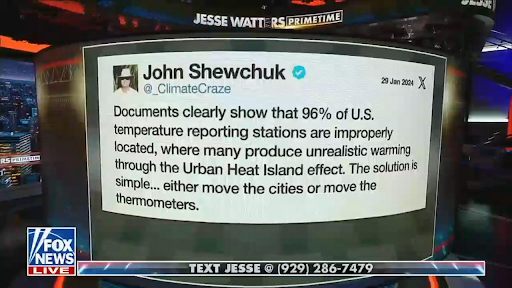
Multiple news outlets and fact-checkers have disproved the Heartland Institute’s bogus study as it spread across social media, with Agence France-Presse noting that past claims about biased data from urban temperature monitoring sites have been “thoroughly refuted.”
PolitiFact pointed out that Heartland’s false claim that the data is corrupted “ignores key facts” including:
First, climate scientists know that weather station data can be impacted by poor siting, and they adjust data accordingly.
Second, climate change analysis focuses on changes over time.
Further, PolitiFact noted that the scientific community has rejected this claim:
"The correct approach is to write a scientific paper and submit it to a scientific journal," said Zeke Hausfather, a climate scientist currently serving as research lead at Stripe, a San Francisco-based technology company. "In this specific case, the author of the report, Anthony Watts, submitted a paper on the topic around 10 years ago, but was unable to successfully convince other scientists of the validity of his findings and to pass the peer review process."
Watters’ reliance on climate misinformation is no surprise; Fox News has repeatedly proved itself to be a shameless climate denial machine.
---
---
2 23 e&e
the lead environmental attorney for former President Donald Trump said that climate change policy is part of a larger plot to “meta control” Americans.
:{
}:
Jeffrey Clark, Trump’s assistant attorney generalfor the Justice Department’s environment and natural resources division, spoke Saturday in Florida at a conference organized by the Heartland Institute, which has spent years attacking climate science.
Clark compared the Biden administration and climate advocates to the authoritarian pig characters in George Orwell’s dystopian novel “Animal Farm.” He said the climate movement’s “foot soldiers,” such as “soccer moms” and recent college students, had been manipulated to believe climate scientists.
"“The pigs who actually run the system, I think they run it for communistic purposes, so that’s what explains the fact that there’s a debate about whether this environmental catastrophe thinking is religious or is it self-interested from dark forces,” he told the crowd. “I think it’s both.”
Clark unsuccessfully pressured Trump to appoint him acting attorney general so he could help the former president try to overturn the 2020 election. He now works for the Center for Renewing America, an organization created largely by former Trump officials to influence the next Republican administration.
The Heartland Institute’s annual conference was a who’s who of climate deniers, Trump administration officials, members of Congress and researchers who claim climate change is not a threat.
As Clark spoke, he held up a piece of cardboard on which he had written “meta control.”
Last year, the congressional committee investigating the Jan. 6, 2021, Capitol riots referred Trump and “others” to the Justice Department for potential criminal prosecution for alleged conspiracy to defraud the United States. Clark’s actions are a significant focus of the report, but it’s not clear if he was referred for prosecution. He claimed that the body cameras worn by law enforcement officials who raided his home in June were intentionally used to embarrass him because he was detained in his underwear in the driveway of his Virginia home as part of the investigation into overturning the election.
After the election, Clark pushed Trump to appoint him as acting attorney general after Bill Barr resigned. The committee found that among the people close to Trump seeking to overturn the 2020 election, Clark “stands out as a participant.” He embraced conspiracy theories about the election and wanted the Justice Department to issue a statement that it had found evidence of widespread voter fraud. The plan failed when senior Justice Department officials told Trump, in an Oval Office meeting days before the Jan. 6 insurrection, that they would resign en masse if Clark took control.
On Saturday, Clark told the Heartland conference that he had been “canceled as a result of the 2020 election, The New York Times, etc., and the Jan. 6th Committee.”
Clark also served as deputy assistant attorney general under then-President George W. Bush in the Environment and Natural Resources Division. He has fought government climate regulations and called himself a longtime “climate hysteria lawyer.”
He said at the Heartland conference that he was scheduled during the Bush administration to have a climate debate with environmental activist Robert F. Kennedy, Jr., but that Kennedy canceled. Clark praised Kennedy’s current embrace of anti-vaccine and Covid-19 conspiracy theories.
He also shared insider stories of his time as Trump’s top environmental lawyer and talked about plans that had been discussed in secret to erode environmental protections. One of those included a form of “climate court” where states could select a jury of sympathetic researchers to challenge the science undergirding environmental protections.
Clark told the Heartland conference that in 2018 a major wind developer pressured him to eliminate environmental protections for migratory birds because they threatened business. Clark said he refused because he thought renewable energy was harming Americans.
“They were begging me, ‘Please, please make this enforcement action go away.’ And of course,I told them to pound sand, because I’m not going to save them from the fact that they’re engaged in an energy boondoggle that hurts the American people,” he said.
Sen. Ron Johnson (R-Wis.), who also spoke at the Heartland conference,said he was the “most ridiculed United States senator, particularly on climate.” Johnson, who has rejected basic climate science, told the audience that he believes rising temperatures are driven by natural warming trends, not the consumption of fossil fuels.
Climate scientists determined years ago that humans are responsible for rising temperatures. The last decade has seen the warmest global temperatures ever recorded.
Johnson, who was the Senate’s _{fourth-highest recipient}_ of oil and gas donations in the last election cycle, told the crowd that he was“naturally skeptical” and refused to believe in settled climate science.
“You’ve got the other side that continues to proclaim that climate change is the greatest threat to mankind or to America,” he said. “I think the theme of my talk here today is that that is not true — the greatest threat to at least America, and I would say mankind, is radical leftism.”
SEE ESG HE HAS BECOME Target, caved anti-sem
// vanguard net zero
https://www.triplepundit.com/story/2022/anti-esg-office-holders/761261
the anti-ESG movement and the “woke capitalism” canard has many U.S. political observers scratching their heads. Instead of the traditional Republican Party support for big business, a growing number of Republican office holders are leveraging their legislative power against corporate efforts to align with ESG (environmental, social and governance) principles. Nevertheless, the pieces of the puzzle are beginning to come together.
The usual suspects: Fossil energy lobbyists
The anti-ESG movement focuses primarily, though not exclusively, on stemming the flow of investor dollars to the renewable firms that that are involved in clean energy and related fields. It’s no surprise, then, to find the Heartland Institute front and center in the anti-ESG movement, which it also calls “anti-woke.” The organization is well known for developing media and legislative playbooks in support of the fossil energy and tobacco industries. The organization is apparently applying the same methodology to stem the flow of investment dollars to renewable energy.
Last June, Heartland catalogued its anti-ESG playbook in a long-form article under the title, “Woke Investing Gets Well-Deserved Pushback.”
“The Heartland Institute has written extensively and testified about the dangers of government agencies mandating banks, companies, and portfolio funds adopt and report on Environment, Social, and Governance (ESG) standards,” noted the article’s author, H. Sterling Burnett.
“Heartland has also provided detailed critiques of efforts by a cabalof large, multinational banks and gigantic financial companies toforce every business to adopt ESG goals,” Burnett continued.
The use of the word “cabal” is not a one-off. Burnett continues to deploy coded words that evoke the anti-Jewish canard of an all-powerful financial cult that pulls the strings of the global economy.
Editor's note: Be sure to [subscribe to our Brands Taking Stands newsletter, which comes out every Wednesday.
“The woke, billionaire corporate elites who run these corporations do this bythreatening to withdraw banking or financial services or by applying pressure through their control over large amounts of a company’s stock,” he added.
Burnett also emphasized that Heartland can take partial credit for the growing number of states that have proposed or enacted anti-ESG legislation. “In a joint effort with likeminded nonprofit organizations, The Heartland Institute’s government relations professionals have pushed back against this by working with legislators in various states to shape and adopt model legislation blocking use of ESG scoring in deciding whether to offer banking and investment services. These efforts have borne fruit,” he wrote.
The other usual suspects: Trump supporters
It’s also no surprise to find investor, former Facebook board member and political kingmaker Peter Thiel involved in the anti-ESG movement. He was instrumental in former U.S. President Donald Trump’s 2016 campaign for office. He also publicly backed two candidates for U.S. Senate this year, both of whom deployed anti-ESG rhetoric during their campaigns.
In addition, Thiel has launched a new financial venture that is apparently aimed at providing an outlet for anti-ESG investors.
Reporters Liz Hoffman and Charley Grant picked up that thread for the Wall Street Journal last May in an article titled, “Woke, Inc.’ Author’s Startup to Take On BlackRock” and subtitled, “Backed by Peter Thiel and Bill Ackman, Vivek Ramaswamy’s Strive will tell CEOs to stay out of politics.”
“An upstart financial firm backed by Peter Thiel and Bill Ackman has a message for American corporations: Focus on making money, not taking stands,” they observed. “Mr. Thiel invested both personally and through his Founders Fund, joined by Palantir Technologies Inc.”
“Vivek Ramaswamy, who made his fortune in pharmaceutical startups before writing a book last year called ‘Woke, Inc.,’ says he has raised $20 million to start a fund manager that would urge companies not to wade into hot-button social or environmental issues,” they added.
The idea seems to be catching on. Last August, reporters Katherine Greifeld and Elaine Chaim of Bloomberg noted that the firm filed for four more equity ETFs. “The filings land just two weeks after the Strive US Energy ETF (ticker DRLL) launched, which has already accumulated nearly$250 million in assets,” they wrote.
The anti-ESG movement embraces Elon Musk and the religious right
Another leading element in the anti-ESG movement that has recently come to light is the nonprofit organization State Financial Officers Foundation. The group reportedly claims that it is not involved in advocating for elected officials. However, its financial “team” is staffed exclusively with Republicans, many of whom hold elected office, according to research by David Armiak of the Center for Media and Democracy. At least four members of the group are elected officials in Texas, West Virginia, Arizona and Kentucky who are known for promoting anti-ESG policies.
Nonpartisan or not, the Foundation has advocated on behalf of the fossil energy industry, as expressed in a public letter to President Joe Biden last April. It has also publicly aligned itself with high-profile personalities and organizations in the anti-ESG movement.
On Tuesday, for example, the organization’s home page featured a tweet from newly minted Twitter owner Elon Musk that read, “ESG is the devil.”The brief message is of a piece with Musk’s earlier anti-ESG pronouncements, as reported by the New York Times.
The day before that, the Foundation's home page highlighted a tweet from the Washington Stand, a publication of the Family Research Council, an evangelical activist group. The tweet linked to an unattributed commentary that described a Foundation conference in November, in which “conservative leaders made it clear that, moving forward, they plan to be woke capital’s worst nightmare,” the Family Research Council wrote.
As with other anti-ESG manifests, the piece leveraged anti-Jewish sentiment by repeatedly focusing attention on the financial firm BlackRock and its Jewish CEO.
Advertisers are already bailing from Twitter on account of Musk’s tolerance for hate speech on his platform. Issues related to his other business ventures may also come into play. Now that the anti-ESG movement has embraced his rhetoric, the likelihood of additional advertisers fleeing from Twitter has grown.
As for the State Financial Officers Foundation, its embrace of Musk’s “free speech” policy should be a red flag to any remaining corporate sponsors and donors that continue to support the organization, and a clear signal that business leaders can no longer count on the safe haven of Republican policy-making to support their interests.
https://climateconference.heartland.org/
Left to right: Rep. Lauren Boebert (R-CO); Sen. Ron Johnson (R-WI);Alex Epstein; and a panel discussion on ESG with Jason Isaac, Paul Watkins, and Marlo Lewis at The Heartland Institute's 15th International Conference on Climate Change in Orlando Florida in 2023.
:{
}:
Breakfast Keynote – Saturday, Feb. 25, 2023 (00:00 – 45:25)
Marlo Oaks is the treasurer of the state of Utah. He spoke about his efforts in his state to fight ESG (Environment, Social, Governance).
:{
}:
Lunch Keynote – Saturday, Feb. 25, 2023 (Johnson 46:26 – 1:41:19; Boebert 1:41:20 – 2:29:06)
U.S. Sen. Ron Johnson (R-WI) on climate and COVID, then and U.S. Rep. Lauren Boebert (R-CO) on climate, energy, and politics.
:{
}:
Dinner Keynote – Saturday, Feb. 25, 2023 (Debate 2:29:07 – 3:30:03; Super Panel 3:30:04 – 4:19:11; James Taylor closing remarks 4:19:12)
:{
}:
Dr. Peter Hartley and Dr. William Happerargue the pros and cons of taxing the emissions of carbon dioxide. PLUS, a “super panel” of several experts to take questions from the audience, and then Heartland Institute President James Taylor delivers remarks to close out The Heartland Institute’s 15th International Conference on Climate Change in Orlando, Florida.
:{
}:
TRACK A (SCIENCE, MOSTLY)
JAY H. LEHR BREAKOUT ROOM
:{
}:
NOTE: The video above has chapters, so float your cursor along the bottom of the video to find the part of the video you want to see.
:{
}:
Panel 5A – Killing Agriculture to Save the Planet(00:00 – 1:21:18)
Gregory Wrightstone on “Climate Change and the Midwest: Life in America’s breadbasket is good and getting better”; Patrick Moore on “Golden Rice Now”; David Legates on “Nitrous Oxide (N2O): the New Satanic Gas.” Followed by audience Q&A.
:{
}:
Panel 6A – Today’s Extreme Weather Is Not That Extreme(1:21:19 – 2:52:19)
Stanley Goldenberg on “Why Does it Seem Like Hurricanes Are Getting Stronger and More Destructive”; Joe Bastardi on “Is Weather Getting Worse?”; Christopher Monckton on “Why Extremer Weather Was Wrongly Expected.” Followed by audience Q&A.
:{
}:
Panel 7A – Climate, Energy, and Animals (including Humans) (2:52:20 – 4:18:50)
H. Sterling Burnett on “The Misuse and Abuse of Animals in the Climate Debate”; David Stevenson on how offshore wind is hurting whales and other marine life; Francis Menton on “Challenging EPA’s Greenhouse Gas ‘Endangerment Finding’ in Court.” Followed by audience Q&A.
:{
}:
Panel 8A – The Right Climate Stuff Team on Energy (4:18:51 – 5:52:35)
Tom Moser on “Climate Change Truth and the Path Forward”; Marty Cornell on “NetZero: Materially Improbable”; Gregg Goodnight on “ERCOT and Renewable Power Integration”‘ and Bob Bauman on “The Future of Nuclear Energy.” Followed by audience Q&A.
:{
}:
TRACK B (POLICY/ENERGY, MOSTLY)
WALT CUNNINGHAM BREAKOUT ROOM
:{
}:
panel5B – Green Energy and Exploitation (00:00 – 1:25:02)
Vijay Jayaraj on “Climate Imperialism”;H. Sterling Burnett on “Green Energy Technology Is Built on Force Labor, Sickness, and Environmental Destruction”; E. Calvin Beisner on “Energy Policy, and the Conquest of Poverty.” Audience Q&A.
Panel 6B – Advancing Reliable Energy (1:25:03 – 2:53:22)
Kevin Dayaratna on “Advancing Reliable Energy: Cost/Benefit Analysis”; Karr Ingham on “Markets: The Key to Abundant, Affordable, Reliable Energy”; Jason Hayes on the “Seven Principles of Sound Energy Policy”; Audience Q&A.
Panel 7B – Why NetZero is Impossible: The Continuing Need and Value of Fossil Fuels (2:53:23 – 4:19:17)
Wolfgang Müller on “The Global Cost of NetZero”; Rob Bradley on “U.S. Electricity: Government vs. Coordination”; Linnea Lueken on “Biofuels Are NOT so Green”; Audience Q&A.
Panel 8B –Government Overreach, or Tyranny?(4:19:18 – 5:48:36)
Jeff Clarkon how he fought to rein in the EPA when he was in the Trump administration, and how it operates with a president in the thrall of the climate cult; Myron Ebellon “Decentralized Totalitarianism”; Audience Q&A.
This video contains all the plenary sessions on Day 1 of The Heartland Institute’s 15th International Conference on Climate Change.
:{
}:
Breakfast Keynote – Friday, Feb. 24, 2023 (00:00 – 45:24)
Patrick Moore, co-founder of Greenpeace and now director at the CO2 Coalition, talks about “fake invisible catastrophes and threats of doom,” his turn away from Greenpace, as well as the benefits of human contributions to carbon dioxide emissions in the atmosphere.
:{
}:
Lunch Keynotes – Friday, Feb. 24, 2023
Geologist Ian Plimer, emeritus professor at the University of Melbourne, Australia,speaks on how knowing the past is key to understanding present climate (56:46 – 1:24:44). Marc Morano on The Great Reset: Global Elites & the Permanent Lockdown (1:24:45 – 2:09:20)
:{
}:
Dinner Keynotes – Friday, Feb 24, 2023
The Heartland Institute pays tribute to friends and scientists who had passed since the last conference with an “In Memoriam” video (2:09:21 – 2:32:40). Craig Rucker presents the 2023 Dauntless Purveyor of Climate Truth Award to Jo Nova (2:32:40 -2:51:46). Ken Haapala presents the 2023 Frederick Seitz Memorial Award to Christopher Essex (2:51:47 – 3:12:59). Alex Epstein on our Fossil Future. (3:13:00 – 4:16:17). Heartland’s Joseph Morris offers inspiring closing remarks (4:16:18 – 4:26:25)
:{
}:
TRACK A (SCIENCE, MOSTLY)
JAY H. LEHR BREAKOUT ROOM
Panel 1A – Taking the Temperature of Global Temperatures (00:00 – 1:21:31)
Anthony Wattson “Corrupted Climate Stations and What to Do About Them”; Willie Soon on “Global warming: Mostly Human-caused or Mostly Natural?”;Joe Bastardi on “More Evidence Debunking CO2 as a Climate Control Knob”; Audience Q&A.
:{
}:
Panel 2A – Understanding What’s Really Happening to the Climate (1:21:32 – 2:48:37)
Ross McKitrick on “Updated Climate Sensitivity Estimates and the Social Cost of Carbon”;Judith Curry on “Why Scientists Disagree About Global Warming”; Richard Lindzen on “What I think the Climate is Really Doing”: Audience Q&A.
:{
}:
Panel 3A – Is Climate Science Scientific? (2:48:38 – 4:04:18)
Tom Sheahen on “In Science, Data Trumps Theory: Correcting Errors in Science”; Howard Hayden on “IPCC’s Exercise in Self-contradiction”;Ken Haapala on “The Primacy of Doubt”; Audience Q&A.
:{
}:
Panel 4A – 4:15pm Green Agenda’s Impact on People (4:04:19 – 5:34:25)
Donna Jackson on how “Environmental Justice” is a Scam;” Bob Carlstrom on the “Impact of Higher Green Energy Costs on the Poor and Elderly”; Margaret Byfield on “The Biden Administration’s 30×30 Land Grab”; Audience Q&A.
:{
}:
TRACK B (POLICY/ENERGY, MOSTLY)
WALT CUNNINGHAM BREAKOUT ROOM
NOTE: The video above has chapters, so float your cursor along the bottom of the video to find the part of the video you want to see.
Panel 1B – Consequences of Scarce Energy (00:00 – 1:14:29)
Vijay Jayaraj on “Green or Blood Red” (unfortunately, technical difficulties eliminated most of this presentation and we’re looking to replace it); Benjamin Zycher, Ph.D. on “Biden Administration Responsible for High Energy Costs”; and Marc Morano on “COVID and Climate: The Parallels Are Screaming at Us”; Audience Q&A.
:{
}:
Panel 2B – Defeating ESG (Environment, Social, Governance) (1:14:30 – 2:41:11)
Jason Isaac on “Raising America’s Energy IQ”; Paul Watkins on “Imposing ESG on Companies”; Marlo Lewison “Arbitrary and Capricious: SEC’s Climate Risk Disclosure Rule”; Audience Q&A.
:{
}:
Panel 3B – What it Takes to Power Our Modern Society (2:41:12 – 4:06:01)
Ronald Stein on “The Elephant in the Room: We’ve Had 200 Years to Replace Fossil Fuels”; Linnea Lueken on “Myths and Legends About the Oil Industry, and How the Truth Combats Them”; Alex Epstein, “Global Human Flourishing Requires Much More Energy”; Audience Q&A.
:{
}:
Panel 4B – Unworkable Climate ‘Solutions’ (4:06:02 – 5:36:36)
Steve Milloy on “Net Zero: Not Needed, Not Possible and Not Survivable”; Kevin Dayaratna on “Unworkable Climate ‘Solutions’ – Carbon-based Regulation”; Ben Lieberman on “The Global War on Air Conditioning”; Audience Q&A.
Click here to see the archive of The Heartland Institute's 14 previous climate conferences
Heartland's Climate Conference - The Heartland Institute
The Heartland Institute
https://climateconference.heartland.org
This video contains all the plenary sessions on Day 1 of The Heartland Institute's 15th International Conference on Climate Change. Breakfast Keynote – Friday, ...
Schedule · Speakers · About · Press Info
15th International Conference on Climate Change
https://heartland.org › events › 15th-international-conf...
15th International Conference on Climate Change. Feb 23-25, 2023. Location: Orlando, Florida.
Heartland Institute Climate Conference 2023: Science Track ...
YouTube
https://www.youtube.com › watch
5:34:26
Climate change refers to long-term shifts in temperatures and weather patterns, mainly caused by human activities, especially the burning of ...
YouTube · The Heartland Institute · Mar 2, 2023
17 key moments
in this video
Heartland Institute Climate Conference 2023 ... - YouTube
YouTube
https://www.youtube.com › watch
5:36:36
Climate change refers to long-term shifts in temperatures and weather patterns, mainly caused by human activities, especially the burning of ...
YouTube · The Heartland Institute · Mar 2, 2023
Science Track (Panel A) from Saturday, Feb. 25 - YouTube
YouTube
https://www.youtube.com › watch
5:52:36
Heartland Institute Climate Conference 2023: Science Track (Panel A) ... to Save the Planet Gregory Wrightstone on "Climate Change and the ...
YouTube · The Heartland Institute · Feb 28, 2023
21 key moments
in this video
Heartland Institute Climate Conference 2023 ... - YouTube
YouTube
https://www.youtube.com › watch
5:48:37
See chapters below these descriptions of the panels and presentations to go directly to that presentation.Panel 5B - Green Energy and ...
YouTube · The Heartland Institute · Mar 1, 2023
19 key moments
in this video
Ian Plimer, a Geologist's View of Climate Change at ...
YouTube
https://www.youtube.com › watch
Mar 7, 2023 — Ian Plimer, a Geologist's View of Climate Change at Heartland Institute Climate Conference, 2023. The Heartland Institute.
International Conference on Climate Change
Wikipedia
https://en.wikipedia.org › wiki › International_Confer...
The International Conference on Climate Change (ICCC) is a conference series organized and sponsored by The Heartland Institute ... The 15th conference will be in Orlando Florida, in
huh?? some fox sponsor, some big FF funders?!
mma 3 23
Fox News published an article Feb. 27, titled “These 51 big businesses target conservatives. Here’s what you can do to stop them,” that calls out several of its own advertisers as being “at war with conservatives” and suggests readers boycott as well.
The February 27 article by Justin Haskins, director of The Heartland Institute’s Socialism Research Center, complains that “over the past decade, hundreds of large U.S. corporations have adopted woke policies, regularly injecting left-wing ideals into their products, services and employment practices.” The article cites a “new project launched by the 1792 Exchange, a nonprofit organization,” that “assesses more than 1,000 companies’ ‘policies, practices, and other relevant criteria to determine the likelihood a company will cancel a contract or client, or boycott, divest, or deny services based on views or beliefs,’” sorting them into “lower risk,” “medium risk,” and “high risk” categories. (Media Matters has written extensively about the Heartland Institute, particularly around its climate denial.)
The list includes 147 companies that the 1792 Exchange has identified as “high risk.” The author chose to spotlight “51 of the most impactful for this article” and suggested that readers should “switch” away from these companies “whenever possible.” He also suggested conservatives should “send a letter to businesses that are engaging in discrimination to tell them that you’re considering leaving because of their actions.”
The 51 companies listed are: Ally Financial, Amalgamated Bank, Bank of America, Berkshire Bank, BMO Harris, Citigroup, Deutsche Bank, Eastern Bank, Fifth Third Bank, First Republic Bank,JPMorgan Chase,Morgan Stanley, PNC, Royal Bank of Canada, Scotiabank, TD Bank, Bancorp, Trillium Asset Management, Truist, US Bank,Wells Fargo, Alaska Airlines, American Airlines, Southwest Airlines, United Airlines, XPO Logistics, Best Buy, Home Depot,Kohl’s, Lululemon, Macy’s, Madewell, Target, Walmart. Alibaba, Amazon, Chewy, eBay, Etsy, Shopify, Warby Parker. Altria, Ben & Jerry’s, Cargill, Coca-Cola,HelloFresh, Kellogg’s, McDonald’s, PepsiCo, Starbucks,and the JM Smucker Company.
Here are some of these companies which have advertised on Fox News over the past year, according to Media Matters’ internal database.
Amazon
Amazon and its subsidiaries have advertised on Fox News over 100 times in the past year.
Bank of America
Bank of America and its subsidiaries have advertised on Fox News over 800 times in the past year.
Chewy
Chewy has advertised on Fox News over 100 times in the past year.
Citigroup
Citigroup has advertised on Fox News over 100 times in the past year.
JPMorgan Chase
JPMorgan Chase and its subsidiaries have advertised on Fox News over 900 times over the past year.
PNC Financial Services
PNC has advertised on Fox News over 300 times over the past year.
Walmart
Walmart has advertised on Fox News over 200 times in the past year.
ref no lnx vid
These 51 big businesses target conservatives. Here’s what you can do to stop them
Banks, transportation firms, retail giants and food companies make up 51 businesses at war with conservatives
Justin Haskins By Justin Haskins | Fox News
Fox News Flash top headlines for February 24
Fox News Flash top headlines are here. Check out what's clicking on Foxnews.com.
NEW
You can now listen to Fox News articles!
It is not a secret that over the past decade, hundreds of large U.S. corporations have adopted woke policies, regularly injecting left-wing ideals into their products, services and employment practices. But some of these businesses have recently gone much further than merely promoting social justice causes; they have chosen to target conservative customers and employees, coercing or forcing Americans to abandon their deeply held beliefs in order to receive important goods or services or to stay employed.
Although many conservatives have heard stories about corporate discrimination in recent years, they have often struggled to keep track of which businesses have been part of this movement, and which have largely stayed on the sidelines. A new project launched by the 1792 Exchange, a nonprofit organization, seeks to shed light on this important problem.
The 1792 Exchange recently launched its Spotlight Report, which assesses more than 1,000 companies’ "policies, practices, and other relevant criteria to determine the likelihood a company will cancel a contract or client, or boycott, divest, or deny services based on views or beliefs."
HOUSE GOP VOTES NEXT WEEK TO KILL BIDEN’S ‘WOKE’ ESG INVESTING RULE
The 1792 Exchange team then used those assessments to assign businesses to three categories — "Lower Risk," "Medium Risk," and "High Risk."
According to the group's website, "‘High Risk’ companies have generally canceled or denied business relationships based on viewpoint disagreements or pose a high risk of canceling people and businesses who do not share their views." Out of the more than 1,000 companies evaluated, 147 are currently classified as "High Risk," which means they are much more likely than other businesses to engage in direct discrimination.
I have carefully reviewed the assessments produced by the 1792 Exchange and have selected 51 of the most impactful for this article. Those companies are grouped by category and listed below.
- Banks
Perhaps the most influential groups of woke companies in the report are banks. Numerous large banks are using their financial might to effectively force business customers into adopting climate change policies, even when it will require that those customers dramatically change their business practices.
Many of these banks have also weaponized their operations to promote social and ideological views favored by the left. For example, Bank of America vets its vendors based on their commitment to LGBTQ views, and it has ceased lending with some gun manufacturers. It has also provided funding to Planned Parenthood, as well as the Southern Poverty Law Center, which has a long track record of targeting conservative groups.
Report rates companies based on likelihood they will go 'woke'Video
Bank of America and its CEO, Brian Moynihan, as well as many of the other banks that have been assigned a "High Risk" score by the 1792 Exchange have been some of the biggest supporters of the radical environmental, social, and governance (ESG) movement. ESG is a kind of social credit scoring model that aims to fundamentally transform the global economy so that it’s more in line with the United Nations’ left-wing Sustainable Development Goals.
The 1792 Exchange identified 21 "High Risk" banks: Ally Financial, Amalgamated Bank, Bank of America, Berkshire Bank, BMO Harris, Citigroup, Deutsche Bank, Eastern Bank, Fifth Third Bank, First Republic Bank, JPMorgan Chase, Morgan Stanley, PNC, Royal Bank of Canada, Scotiabank, TD Bank, Bancorp, Trillium Asset Management, Truist, US Bank, and Wells Fargo.
- Transportation
The 1792 Exchange determined that five large transportation companies fall into its "High Risk" category — Alaska Airlines, American Airlines, Southwest Airlines, United Airlines, and XPO Logistics.
Although the transportation companies listed in the 1792 Exchange report do not regularly refuse to do business based on ideological or religious considerations, they have engaged in left-wing activism and even promoted partisan legislation.
American Airlines is one of five airlines on the ‘High Risk’ list. It fought against the Florida Parental Rights in Education Act.
For instance, American Airlines publicly fought against the Florida Parental Rights in Education Act — commonly and falsely labeled the "Don’t Say Gay Bill" by liberals. The legislation prevents public schools from teaching young children, kindergarten through third grade, about topics related to sex and gender identity.
Similarly, Southwest Airlines fought against state laws that sought to enhance election integrity by limiting questionable practices like mail-in balloting.
- Retail Giants
The 1792 Exchange labeled 15 large businesses in the "Retailing" industry as "High Risk" companies, including popular brick-and-mortar stores Best Buy, Home Depot, Kohl’s, Lululemon, Macy’s, Madewell, Target and Walmart. The online retailers included in the report as "High Risk" are Alibaba, Amazon, Chewy, eBay, Etsy, Shopify and Warby Parker.
The reasons behind the decision to identify these companies as "High Risk" varied, but in every case, the 1792 Exchange provided significant evidence showing that these businesses have actively promoted left-wing ideological views.
Disney+ criticized for reparations-themed rap song in kids showVideo
For example, 1792 Exchange notes Home Depot "advertised flyers to its employees about confronting their ‘white privilege, Christian privilege, heterosexual privilege, able-bodied privilege,’ etc."
Target has removed books from its stores at the request of liberal activists, and it has fought against numerous legislative proposals backed by conservative lawmakers, including election integrity legislation in Georgia.
- Food and Beverage Companies
Ten large food and beverage companies were given "High Risk" ratings in the 1792 Exchange report: Altria, Ben & Jerry’s, Cargill, Coca-Cola, HelloFresh, Kellogg’s, McDonald’s, PepsiCo, Starbucks and the JM Smucker Company.
Although all of these businesses engaged in troubling activities, the company with the most radical practices is, by far, Ben & Jerry’s. The famous Vermont-based ice cream company has promoted "Defund the Police" campaigns, opposed legislation meant to limit election fraud, said that the criminal justice system "must be dismantled," and openly advocated for pro-abortion policies, among many other actions.
Home Depot is one of the 15 retail giants on the ‘High Risk’ list. The woke company confronted workers about ‘white privilege, Christian privilege, heterosexual privilege, able-bodied privilege.'
Fighting Back
Unfortunately, the 51 companies mentioned throughout this article are just the tip of the iceberg. Numerous other important corporations are also actively undermining conservatives and/or discriminating against families or businesses who do not share their radical views.
The 1792 Exchange outlined nearly 100 additional "High Risk" companies in its report, including some of the most powerful in the world, like Alphabet (the owners of Google), Disney, and Apple.
How can conservatives push back against these businesses?
CLICK HERE TO GET THE OPINION NEWSLETTER
The first step is to share instances of discrimination and reports like the one produced by the 1792 Exchange with like-minded friends and family.
Bank of America and its CEO, Brian Moynihan, as well as many of the other banks that have been assigned a "High Risk" score by the 1792 Exchange have been some of the biggest supporters of the radical environmental, social, and governance (ESG) movement.
Conservatives should identify companies that offer similar products and services to those offered by businesses that discriminate and switch, whenever possible. If you can switch products or services, be sure to tell both the business you’re leaving and the new, non-discriminatory business why you’re making the change.
If there aren’t any good alternatives, then send a letter to businesses that are engaging in discrimination to tell them that you’re considering leaving because of their actions. Companies don’t often receive letters like these, so they do have an impact.
CLICK HERE TO GET THE FOX NEWS APP
Finally, conservative lawmakers need to prioritize policies that reject ESG social credit scores and other systematic attempts meant to coerce companies into embracing leftist causes. The legislation proposed by Florida Governor Ron DeSantis earlier this month that would limit the use of ESG scores in banking is a great place to start.
If conservatives don’t soon make a concerted effort to fight back against woke corporations, America could soon be transformed beyond repair. We simply cannot afford to wait any longer.
CLICK HERE TO READ MORE FROM JUSTIN HASKINS
Justin Haskins is the director of the Socialism Research Center at The Heartland Institute and a New York Times bestselling author.
gmail 3 23 morano
The Epoch Times
February 25, 2023 EpochTV Live
Is Climate Change or Policy the True Issue? 15th ICCC Keynote Speech by Marlo Oaks
EpochTV Live
Is climate change or climate policy the real issue? Experts, advocates, and common sense politicians give their thoughts and ideas at the 15th International Conference on Climate Change (ICCC) held by the Heartland Institute in Orlando, Florida.
Utah state Treasurer Marlo Oaks will speak about the “dangers of ESG” in his keynote speechat breakfast at 8:00 a.m. ET on Feb. 25.
mofo on glypho cancer:
https://www.desmog.com/2022/12/09/pesticide-industry-science-denial-monsanto-glyphosate-cancer/
As regulators in the United States and European Union prepare to review and potentially reauthorize the controversial weedkiller glyphosate, anew report reveals the stealth tactics and narrative spin deployed by the chemical’s manufacturer to discredit inconvenient science and protect profits.
The report, published by Friends of the Earth and nonprofit investigative organization U.S. Right to Know, uses the case study of Monsanto (now owned by Bayer) and its widely used glyphosate-based product Roundup to illustrate the pesticide industry’sdeceptive tactics and communications strategies — which mirror those of the tobacco and fossil fuel industries.
“The pesticide industry is not just following in the footsteps of Big Tobacco and Big Oil, they co-wrote the playbook,” Stacy Malkan, lead report author and co-founder of U.S. Right to Know, said.
The pesticide industry used this PR strategy, which involves tactics like distorting science and disseminating misleading messaging through third party allies, to convince regulators and the public that its products were safe and necessary, the report explains.
“This case study provides an important window into how one company worked with many partners across the pesticide and processed food industries, academia, PR firms, and various front groups to sell the world on a toxic pesticide,”said author and advocate Anna Lappé, who contributed to the report. “These disinformation tactics are critical to understand because they have been used to push the entwined myths that we need pesticides to ‘feed the world’ and that they are totally safe.”
Despite mounting scientific evidence of their harms to human health and the environment, pesticides have proliferated, withglobal usage up by about 80 percent since 1990. The most widely used pesticide in the world is Roundup, which is alleged to have caused cancers. Litigation over this cancer link is ongoing, spurred by a 2015 finding from the World Health Organization’s cancer research arm classifying the chemical as a probable human carcinogen.
[twt]
the report, released December 5, brings together internal corporate documents revealed through this litigation, as well as documents obtained through public records requests filed by U.S. Right to Know, to illuminate the extensive campaign by one of the world’s leading pesticide manufacturers — Monsanto, acquired by Bayer in 2018 — to disseminate disinformation and manipulate science regarding the health and environmental impacts of glyphosate.
These strategies have been “used by the pesticide industry for decades now and [their] impact on public health is enormous,” Nathan Donley, PhD, environmental health science director at the Center for Biological Diversity, told DeSmog via email.
Litigation concerning the health hazards of various pesticides, including glyphosate, stems from companies hijacking the regulatory process, he explained. “This can happen multiple ways, from pressuring decision makers at the EPA to producing enormous amounts of biased data that guide the actions of regulators. It’s been very effective unfortunately.”
For example, as noted in the report, under pressure from Monsanto in 1986, EPA overturned its own decision made the previous year to classify glyphosate as a possible human carcinogen. To this day, EPA maintains the position that glyphosate is not carcinogenic and does not pose human health risks if used according to its label. However, the agency is planning to conduct a new review of the chemical after a federal appeals courtstruck down EPA’s previous designation of glyphosate as benign.
The report found that over a five-year period, seven front groups with links to Monsanto spent $76 million “to push corporate disinformation, including attacks on scientists.” During that same period, six industry trade associations that appear in Monsanto PR papers spent $1.3 billion, including on lobbying and PR around glyphosate regulation.
It also argues that the pesticide industry’s current business model “would not be possible if pesticide products were subject to rigorous, independent research and if there were widespread public understanding of the harms and risks of many of these products.”
“It’s clear from this report and all the work that’s been done in this field that corporate influence in science-based decision-making is way too common,” said Genna Reed, director of policy analysis in the Center for Science and Democracy at the Union of Concerned Scientists, and lead author of a2021 study exploring ways to protect scientific integrity from the corporate “disinformation playbook.”
“This isn’t just a wonky policy problem,” Reed added. “This is a massive institutional rot that needs to be fixed to protect public health.”
Fossil Fuel and Pesticide Industry Parallels
In addition to pressuring regulators, Monsanto deployed other strategies to discredit evidence of health and environmental harms of its glyphosate-based product. The report found that Monsanto undermined or even shaped the science, attacked public health experts, bought influence at academic institutions, and used third party messengers to pollute the public discourse. These are the same strategies — and in some instances involved the same actors — that the tobacco and fossil fuel industries used to generate doubt and to deceive the public about the harmful consequences of their products.
According to the report, Monsanto covertly contributed to the scientific literature examining the health risks of glyphosate, ghostwriting papers in toxicology journals, including an influential paper published in April 2000 that concluded that glyphosate-based Roundup “does not pose a health risk to humans.” Internal company emails reveal that Monsanto employees played critical roles in data collection, drafting, editing, and relationship-building with the paper’s authors. In the wake of the 2015 glyphosate classification from the World Health Organization’s cancer research agency, Monsanto ghostwrote scientific manuscripts published in a prestigious journal as an “independent review” on the science of glyphosate. The company also orchestrated a campaign to intimidate cancer researchers and enlist Republican lawmakers to try to defund the World Health Organization’s cancer research arm.
[twt]
monsanto’s influence extended to academia.The report details how the company funded academics and universities to promote educational messaging supportive of pesticides and genetically engineered organisms (GMOs) — seed traits designed to resist toxic chemicals. Emails obtained from records requests reveal that the University of Florida, for example, “had plans for ‘educating the masses’ about GMOs and pesticides with messaging that was ‘harmonious’ with Monsanto’s,” Malkan explained.
This co-opting of academia was part of a larger pro-pesticide PR strategy. As the report explains, PR firms that helped Monsanto defend glyphosate and promote GMOs have worked with other polluting industries, including tobacco and fossil fuels. For example,**FTI Consulting**,which has worked extensively with the oil and gas industry, has also worked closely with Monsanto/Bayer to discredit the science on glyphosate.
Furthermore, as the report details, one industry front group that worked to attack cancer scientists and dispute the evidence linking glyphosate to cancer was the Genetic Literacy Project. Its founder Jon Entine has worked in defense of chemicals, plastics, fracking, and oil companies, and the group’s funding sources “trace back to some of the largest, most consistent funders of climate science denial.” These include foundations like Donors Trust, Scaife Foundation, and Charles Koch Foundation. Other institutions that engaged in climate denial — including Competitive Enterprise Institute,:{ :(style="background-color:#ffff66;"):}::{Heartland Institute:(style="background-color:#ff6600;"):}:,:{ :(style="background-color:#ff6600;"):}::{Cato Institute:(style="background-color:#ffff66;"):}:, andCommittee for a Constructive Tomorrow (CFACT) — also attacked scientists who raised concerns over glyphosate, according to the report.
“This is not surprising since nearly all agricultural chemicals are derived from fossil fuels,” Malkan said, adding that both industries are continuing to mislead the public in portraying their business or products as essential to climate and sustainability solutions.
“Just like Big Oil, pesticide companies are using disinformation tactics to push false solutions for the climate crisis, and stalling action on real solutions,” Malkan added. ADeSmog investigation published in November 2020 described how pesticide companies are now marketing themselves as climate-friendly.
“Pesticide companies are desperately trying to, and in many instances are successfully greenwashing the poisons they make billions of dollars selling,” Lori Ann Burd, senior attorney and environmental health program director at Center for Biological Diversity, said via email. She added that many U.S. government officials have adopted the pesticides industry’s position that their products are necessary.
“USDA, EPA and many members of Congress have largely bought in to industry rhetoric that dangerous pesticides are essential tools for feeding Americans, ignoring the reality that many countries, including Brazil, China and nations within the E.U. continue to eat despite having banned dangerous pesticides that are still widely used in the U.S.,” she explained. UN human rights experts have also pushed back against the claim that pesticides are necessary to feed the world.
Bayer did not immediately respond to a request for comment on the report.
Countering the Disinformation Playbook
The report concludes with some recommendations and steps to take to counter the pesticide industry disinformation playbook. According to this advice, which is aligned with that of other experts in fighting disinformation, exposing the tactics and strategies and enforcing strong disclosure and accountability rules are important steps to mitigate undue industry influence.
“We need to continue to shine a light on these practices and actively work on policies that can serve as firewalls,” Reed of the Union of Concerned Scientists said.
Other recommendations include challenging corporate influence in academia and holding PR firms accountable. Just as there are now campaigns to do just that for fossil fuels, the report calls for similar action and pressure for combatting pesticide industry influence and enablers.
“While the propaganda tactics of Big Oil and Big Tobacco are well-documented and their grave impacts well understood, the pesticide industry’s similar role in widespread disinformation, and its extensive scope and impact, has not been as well documented or publicly understood. We hope this report, and the chorus of recent reporting, will change that,” the report states.
===
https://www.desmog.com/2022/11/30/heartland-institutes-survey-actually-supports-the-97-climate-science-consensus-its-trying-to-attack/
the Heartland Institute, a self-described free-market think tank notorious for its climate science denial efforts, is at it again. This time, Heartland is frantically spinning the results of a survey it commissioned in its latest attempt to dispute the robust scientific consensus on climate change.
To be clear, climate experts overwhelmingly agree that climate change is happening and that humans are primarily responsible. And there’s plenty of evidence about that consensus.
For example, cognitive scientist John Cook and his colleagues examined almost 12,000 abstracts of scientific papers on climate change and global warming published over a 20-year span and found, among the abstracts expressing a position, that upward of 97% accepted that human activity is responsible for the recent increase in average global temperature. They published these results in 2013 in the peer-reviewed journal Environmental Research Letters.
That result wasn’t a fluke, either. Multiple independent studies using different methods have consistently produced estimates of the extent of scientific consensus on anthropogenic climate change among climate scientists. And these estimates converge in the neighborhood of 97%, endowing the number with a certain iconic status.
Yet the headline of a recent Heartland Institute press release on its new survey blared, “97% consensus on climate change? Survey shows only 59% of scientists expect significant harm.” The survey in question was conducted by a survey research unit at Fairleigh Dickinson University — but the desperate contortions to spin its results are classic Heartland.
The fun begins with Heartland’s definition of scientists. The various studies establishing the scientific consensus on climate change generally survey expert scientific opinion, by either inspecting articles on climate change that appear in the peer-reviewed scientific research literature or directly polling the authors of such articles, who typically have earned doctoral degrees in relevant areas of science.
In the Heartland-commissioned survey, however, although the respondents were required to have earned degrees in climatology, meteorology, physics, geology, or hydrology, the majority of them — 76% — attained only a bachelor’s degree, and just 6% earned a Ph.D. Revealingly, only 11% of the 400 respondents reported that their professional activity was best described as research.
So comparing the results of the Heartland-commissioned survey with those of the studies establishing the scientific consensus on climate change is like comparing apples with oranges — equating the opinions of people with a modicum of past exposure to the relevant science with those of scientists currently engaged in advancing scientific knowledge about climate change.
Even so, the survey report reveals that 96% of the respondents to the Heartland-commissioned survey accept that global climate change is occurring. Asked to estimate what percentage of climate change is due to human activity, 92% of the respondents selected a value between 51 and 100%, with the average estimate at 75%. These figures are, of course, not far from the iconic 97% consensus.
For a long time, the Heartland Institute has been heavily invested in disputing the scientific consensus on climate change — and not always tastefully. Back in 2012, it erected a billboard in a Chicago suburb, not far from its headquarters, featuring a glowering photograph of the “Unabomber” Ted Kaczynski, whose bombing campaign killed three and injured nearly two dozen. The billboard read: “I still believe in global warming. Do you?” That stunt was offensive enough for the group to lose a number of its corporate backers.
In 2017, in a campaign with a broader potential effect, the Heartland Institute mailed unsolicited packets of climate denial propaganda, including a booklet entitled “Why Scientists Disagree About Global Warming,” to up to 200,000 public school teachers across the country. Thankfully, the main response of science teachers was to deposit the mailing in the nearest recycling bin. As a welcome side effect, the campaign motivated some educators to redouble their efforts to educate teachers about climate science.
But now, in 2022, Heartland’s own commissioned survey undermines its central message, by confirming the 97% consensus. Amusingly, the Heartland representatives quoted in its press release can’t quite look the facts squarely in the face. “So, climate change? Yes. Humans responsible for most of it? The poll says, ‘yes,’” H. Sterling Burnett, Heartland’s environmental and climate policy center director says, as if he were mistrustful of his own poll.
But that’s not all. Even the press release’s headline is a bait-and-switch. The fact that 59% of respondents to the survey think that global climate change will cause significant harm to people alive today is wholly irrelevant to the estimate of the extent of scientific consensus on climate change. None of the 97% research addressed the issue of the harmful effects of climate change. Yet Heartland focuses on this issue as it tries to snatch a delusive victory from the jaws of statistical defeat.
Unfortunately for Heartland, there is ample evidence, albeit not from survey research, that there is a scientific consensus on the significant harm that climate change will cause — and indeed is causing. For example, in a report this year, the Intergovernmental Panel on Climate Change (IPCC) summarized that “Human-induced climate change, including more frequent and intense extreme events, has caused widespread adverse impacts and related losses and damages to nature and people, beyond natural climate variability.” The IPCC’s reports are produced with the input of leading scientists around the world and undergo rigorous and comprehensive review: they represent expert scientific opinion.
The Heartland Institute, for its part, routinely dismisses the IPCC’s credibility — without any evidence— while disseminating publications produced by something misleadingly called the Non-governmental International Panel on Climate Change (NIPCC), a network that Heartland itself sponsors. In 2011, a news article in the journal Naturedescribed the NIPCC as ignoring “mountains of evidence about the adverse effects of global warming.” That remains sadly accurate.
The Heartland Institute’s recent press release represents yet another attempt to cloud the scientific consensus in order to delay, derail, or degrade action on climate change. Unfortunately, it won’t be the last — or, perhaps, the most absurd.
Glenn Branch is deputy director of the National Center for Science Education, a non-profit organization that defends and promotes the teaching of evolution and climate change.
https://www.heartland.org/policybot/?author=david-t-stevenson
random bs
NOVEMBER 10, 2022
No Consensus on Climate Crisis, Scientist Survey Finds
By H. Sterling Burnett
NOVEMBER 10, 2022
The Systemic Racism of the Teachers' Unions
By Larry Sand
NOVEMBER 9, 2022
Re-elected Governor Newsom’s Energy Literacy Will Be Challenged Over the Next 4 Years
By Ronald Stein, P.E.
badish code no lnx
E-ELECTED GOVERNOR NEWSOM’S ENERGY LITERACY WILL BE CHALLENGED OVER THE NEXT 4 YEARS
NOVEMBER 9, 2022
By Ronald Stein, P.E.
Maybe Newsom will produce a plan in the next four years to finance the billions of dollars for the roads being used by EV’s or just pass that problem on to his predecessor.
Despite Newsom’s statewide policy decisions that are driving up costs of energy in the state, only a few Californians are upset with the ever-increasing costs for their electricity and gasoline, resulting in the excessive costs of living, increasing homelessness and crime. But most voters have just showed their approval of the bizarre energy policies that Newsom promotes and wish to incur four more years of financial torture.
The continuous exodus of residents from the state has resulted in a loss of a representative in Washington for the first time in its 171-year history. Departing residents are being followed by large corporations and privately owned businesses that have moved their headquarters out of California in 2021 at twice their rate in both 2020 and 2019 and at three times their rate in 2018.
California has a history of having the highest gasoline prices in the country. Why? For one, the West Coast fuels market is isolated from other supply/demand centers as California is an energy island. The Sierra Mountains are a natural barrier that prevents the state from pipeline access to any of that excess oil. As such, the West Coast is susceptible to unexpected outages of West Coast refineries as it is unable to backfill an unexpected loss in supply by quickly supplying additional products from outside of the region.
Newsom is emphatically complaining that the oil companies are making outlandish profits, but he may be out of touch with reality as two California refineries have shut down under his current watch and two more may be closing in his new term.
Under Newsom’s watch in the last few years, two of California’s refineries have virtually shut down and are no longer manufacturing gasoline, aviation fuels, or any oil derivatives. Those two, Phillips66 at Rodeo and Marathon at Martinez, are now only focusing on renewable diesel.
More financial sad news may occur under Newsom’s next term with the permanent closure of two more California refineries, the Chevron Refinery at Richmond and the PBF Refinery at Martinez. If the courts uphold the 2021 Bay Area Air Quality Management (BAAQMD) rule 6-5 for a further reduction in particulate emissions, both have stated that they will shut down before spending one billion dollars to retrofit their refineries to comply with further particulate emission reductions.
The world has seen the impact on Germany and Britain with their dependency on Russia for most of its energy, but for the 4th largest economy in the world, in California, Newsom already has the State more than 56 percent dependent on imported crude oil, but continuously seeks further reductions of in-state oil production that places greater dependency on foreign countries.
California’s growing dependency on foreign countries is a national security risk for all of America. Does Newsom expect a better outcome than what Germany and Britain experienced by not controlling more of its energy future demands?
I’m sure that Newsom had a chance to view the 2006 movie “Blood Diamonds” starring Leonardo DiCaprio that portrays many of the similar atrocities now occurring in pursuit of the “Blood Minerals” i.e., those exotic minerals and metals to support the “green” movement within wealthy countries that continue promoting environmental degradation to landscapes in developing countries, and imposes humanity atrocities to citizens with yellow, brown, and black skinned workers being exploited for the green movement of the few wealthy nations.
Despite the Biden administration’s declaration that EV battery materials from China may be tainted by child labor made with materials known to be produced with child or forced labor, Newsom continues to support subsidies to procure EV’s and build more wind and solar when those subsidies are providing financial incentives to the developing countries mining for those “green” materials that promotes further exploitations of poor people in developing countries. I personally thought that Newsom had higher moral and ethical standards that would stop him from exploiting the poor in developing countries.
Newsom seems to be oblivious to the reality that everything that needs electricity is made from the oil derivatives manufactured from crude oil, but Newsom continues to support wind and solar that only generate intermittent electricity but cannot manufacture anything for society. Newsom has yet to identify a replacement for the oil derivatives that are the basis of more than 6,000 products and fuels for our various transportation infrastructures, and the economy.
Life Without Oil is NOT AS SIMPLE AS NEWSOM MAY THINK as renewable energy is only intermittent electricity from breezes and sunshine as NEITHER wind turbines nor solar panels can manufacture anything for society. Climate change may impact humanity but being mandated to live without the products manufactured from oil will necessitate lifestyles being mandated back to the horse and buggy days of the 1800’s and could be the greatest threat to civilization’s eight billion residents.
In Newsom’s all-electric world, Newsom’s bizarre energy policies reflect his believes that all the infrastructures developed in less than two centuries, from the products manufactured from crude oil, are NOT needed by future societies, such as medical, electronics, communications, and the many transportation infrastructures such as airlines, merchant ships, automobiles, trucks, military, and the space programs.
According to the U.S. Energy Information Administration (EIA), California’s high cost of electricity is already fifty percent higher than the national average for residents, and double the national averages for commercial, and are projected to go even higher.
California is the nation’s top producer of electricity from solar, geothermal, and biomass, but the inability to replace the closure of continuously uninterruptable electricity from nuclear and natural gas power plants with intermittent electricity from renewables is causing the state to import more of its electricity.
Again, under Newsom’s watch, the EIA says that California imports more electricity than any other US state, more than twice the amount of Virginia, the second largest importer of electricity.
Newsom’s policies continue to force California to be the only state in contiguous America that imports most of its crude oil energy from foreign countries. That dependence has increased imported crude oil from foreign countries from 5 percent in 1992 to 56 percent today of total consumption.
At today’s price of crude oil approaching $100 per barrel the imported crude oil costs California more than $150 million dollars a day, yes, every day, being paid to oil-rich foreign countries, depriving Californians of jobs and business opportunities, and drivers to pay these premium prices for fuel.
Richer countries now have higher gasoline prices, while poorer countries and countries that produce and export oil have lower cost for fuels. A review of global petroleum gasoline prices per gallon in U.S. dollars shows the international intelligence and trends of gasoline prices of the wealthy countries that have opted to go “green” at any cost, compared with poorer countries and countries that produce and export oil.
Another issue that Newsom will not discuss is funding for future road maintenance. Newsom has mandated no sales of internal combustion engine vehicles after 2035 but appears incapable of acknowledging that heavier EV’s contribute nothing for road maintenance and repairs. California has almost 400,000 miles of roadways that are heavily dependent on road taxes from fuels that contribute more than $8.8 billion annually, the same tax base that also funds the environmental programs that will be diminishing in the decades ahead.
Maybe Newsom will produce a plan in the next four years to finance the billions of dollars for the roads being used by EV’s or just pass that problem on to his predecessor.
California voters had a chance to recall Newsom in 2021 but chose to support his bizarre and expensive energy policies. Following the failed recall, Newsom was just re-elected by the voters that are willing to accept the highest energy costs in America. Voters support his avoidance of addressing those tough energy policy questions that would expose his limited energy literacy over the next four years of financial torture upon the working class that voted for him.
97-percent-climate-consensus-busted
NOVEMBER 8, 2022
97% Consensus on Climate Change? Survey Shows Only 59% of Scientists Expect Significant Harm
By James Taylor, H. Sterling Burnett, Anthony Watts, Linnea Lueken
yahoo mail 11 22
shortly after he took office, President Biden announced a goal of building 30 gigawatts (GW) of offshore wind by 2030, enough clean energy to power 10 million homes. For the administration, the offshore wind target was a part of a larger strategy of reducing carbon pollution and putting the country on track for net-zero greenhouse gas emissions by 2050. But, like many clean energy plans, this one was met with immediate resistance.
In August 2021, CBS News reported that Nantucket Residents Against Turbines — or ACK Rats — launched a lawsuit against the administration's offshore wind plans. The Massachusetts-based resident group argued that offshore wind development “poses a threat to the critically endangered North Atlantic Right Whale.”
A few months later, a resident group in New Jersey launched another lawsuit against the Biden administration. Bob Stern, president of Save Long Beach Island, told Reuters that he and his fellow residents worried that the wind turbines would destroy their local tourism economy.
Within a year of announcing the goal, the Biden administration faced lawsuits from resident groups in every coastal state from Maine to North Carolina. Some groups sued over endangered whales. Others argued that the turbines would hurt their property values or the local fishing industry.
If you only read the news stories about these lawsuits, you might think this was yet another example of wealthy residents blocking clean energy development. Or you might see a familiar story of environmentalists getting in the way of environmental progress. But you’d be missing the most important part of the story. Nearly every story neglects to mention these groups are being funded by a far-right think tank that receives funding from fossil fuel companies and billionaires.
Who’s behind the offshore wind lawsuits?
According to their website, Protect Our Coast NJ — one of the groups opposing Biden’s offshore wind plans — is a group of “residents, homeowners, business owners, fishermen and visitors of the New Jersey coastal communities.” Media reports accept this description at face value.
In May 2022, Ashbury Park Press — the third largest newspaper in New Jersey — ran a story about Protect Our Coast NJ with the headline, “Could offshore wind turbines blow away Long Beach Island tourism?” The story positions Protect Our Coast NJ as a group of residents and features many of the talking points and studies on the nonprofit’s website:
Ric Bertsch, an Ocean City resident and member of the group Protect Our Coast NJ, which opposes the wind projects as they are currently designed, said he worries about the impacts to communities like his own.
He said the county will suffer the consequences of New Jersey's new experiment with offshore wind turbines, which will harm the tourist experience and block large swaths of ocean from commercial fishing
"The only brand (in Ocean City) that we have to offer the world is our old-fashioned values, our quiet, our peaceful place to be," said Suzanne Hornick, also of Ocean City and leading member of Protect Our Coast NJ. "This (wind turbine project) really screws with our brand."
As of this writing, the “Donate” button on the Protect Our Coast NJ website redirects to a PayPal link that reads “Donate to Caesar Rodney Institute.”
| [gfx] |
Caesar Rodney Institute (CRI)is one of more than 50 think tanks in the State Policy Network (SPN). As The Intercept’s Lee Fang reported, CRI receives funding from fossil fuel trade groups like the American Fuel & Petrochemical Association. The think tank also receives funding from Donors Trust, the “dark money ATM of the conservative movement.”
In September 2021, CRI’s David Stevenson — a former member of President Trump’s EPA transition team — held a press conference in front of the Massachusetts State House where he announced a legal fund for groups fighting Biden’s offshore wind plans. By that point, Stevenson had raised $75,000 from his network of donors, and said he hoped to raise $500,000 for the effort.
When asked by E&E’s Ben Storrow who was funding the campaign, Stevenson said, “So far there is no Koch money, not that we wouldn’t take it.”
CRI’s efforts quickly attracted the attention of much larger conservative groups like the Heartland Institute and Committee For A Constructive Tomorrow (CFACT). In September 2022, one year after the press conference, both organizations announced a partnership with CRI to sue an offshore wind project in Virginia.
According to the Union for Concerned Scientists, the Heartland Institute and CFACT have both received about $500,000 in funding from ExxonMobil. The Heartland Institute has been called “a leading force in climate change denial.” Media Matters for America named CFACT Founder Marc Morano its climate denier of the year in 2012. Marano, who began his career working for Rush Limbaugh, has said climate scientists “deserve to be publicly flogged.”
In a press release, CFACT President Craig Rucker said, “We are not only very concerned about the future of the right whale, which extensively uses the ocean waters affected by the wind-power project, but also concerned as to how [the federal government] will address the fact that this project, despite its alleged benefits regarding carbon dioxide and climate change, will actually cause the release of more carbon dioxide into the atmosphere than it will consume.” This, like most of CFACT’s statements about climate change, is false.
Reporters consistently tell a misleading story
None of these connections to the country’s infamous climate denial network are mentioned in the Ashbury Park Press news story about Protect Our Coast NJ. And the local New Jersey newspaper isn’t alone. According to a Popular Information analysis, 11 media outlets have covered Protect Our Coast NJ. None of them mention CRI, its donors, or the legal fund.
Popular Information found that reporters routinely failed to mention connections to CRI when writing about Save Our Beach View, Save Long Beach Island, and Nantucket Residents Against Turbines, three of the other resident groups in the coalition. Instead, these articles spread many of the resident groups’ misleading claims about clean energy.
In January, Reuters wrote a story about Save Long Beach Island’s lawsuit against the federal government. The article did not mention the group's ties to CRI.
Bob Stern, president of Save Long Beach Island, told Reuters that they are concerned by the aesthetic impacts of the turbines, and potential lost tourism due to their interference with Long Beach Island's current unobstructed seascape. The group says tourism is the community's "economic lifeblood."
In 2019, researchers at the University of Rhode Island published a paper analyzing the impacts of offshore wind farms on tourism. They used empirical data based on the United States’ only offshore wind farm off the coast of Block Island, Rhode Island. The researchers concluded that the wind farm resulted in more tourism, not less. This study isn’t mentioned in the Reuters story.
Another frequent concern mentioned by resident groups is the risk to endangered species. CBS covered this last year when they wrote:
The "ACK Residents Against Turbines" who filed the lawsuit said the proposed Vineyard Wind project poses a threat to the critically endangered North Atlantic Right Whale.
Jessica Redfern, a senior scientist at Anderson Cabot Center for Ocean Life, told Cape Cod Times that the greatest threat to the North Atlantic Right Whale’s continued existence “comes from collision with vessels and entanglement in fishing gear, particularly lobster pot buoy lines.” She added, “Another big factor is climate change and one of the ways we can minimize that is adopting clean energy (policies) and offshore wind is a great source of that.” She said she had never heard of Save Long Beach Island.
In addition to misleading readers, this poor coverage creates more opposition to offshore wind projects and funnels local residents to the nonprofits’ websites and Facebook pages, which routinely share misinformation about clean energy.
Decarbonizing America’s electric grid and economy will require support from people in every community in the country. But, letting fossil fuel companies and climate deniers control the narrative is a sure way to turn communities of supporters into groups of passionate opponents.
9 22 mail
The Great Reset and Crazy Energy Policies: Marc Morano - Heartland Institute
Heartland Institute
https://www.heartland.org/multimedia/podcasts/the-great-reset-and-crazy-energy-policies-marc-morano
California, Europe, and beyond the impacts of crazy energy policies they have governments there have imposed are coming home to roost, and its bad for their residents.
In California, Europe, and beyond the impacts of crazy energy policies they have governments there have imposed are coming home to roost, and its bad for their residents. Yet in an effort to push a Great Reset of the global economy, many governments are doubling down on policies that have created the present energy crisis.
It seems rationing and COVID like energy lockdowns are the goal so elites can impose their vision of a planned economy on the worlds people. Because planned economies do poorly, this means everyone, but the elites wielding power must do with less, less resources and less freedom.
h. Sterling Burnett, Ph.D., is the Director of the Arthur B. Robinson Center on Climate and Environmental Policy and the managing editor of Environment & Climate News.
In addition to directing The Heartland Institute's Arthur B. Robinson Center on Climate and Environmental Policy, Burett puts Environment & Climate News together, is the editor of Heartland's Climate Change Weekly email, and the host of the Environment & Climate News Podcast.
Prior to joining The Heartland Institute in 2014, Burnett worked at the National Center for Policy Analysis for 18 years, ending his tenure there as senior fellow in charge of environmental policy. He has held various positions in professional and public policy organizations, including serving as a member of the Environment and Natural Resources Task Force in the Texas Comptroller’s e-Texas commission.
Burnett is a former board member and past president of the Dallas Woods and Water Conservation Club; a senior fellow at the Texas Public Policy Foundation; an academic advisor for Collegians for a Constructive Tomorrow; an advisory board member to the Cornwall Alliance; and an advisor for the Energy, Natural Resources and Agricultural Task Force at the American Legislative Exchange Council (ALEC).
Burnett has an associate's degree in arts and sciences from Eastfield Community College (1984), a B.B.A. and a B.A. in cultural anthropology from Southern Methodist University (1986), and a M.A. (1991) and a Ph.D. (2001) in applied philosophy from Bowling Green State University with a specialization in environmental ethics.
==
omg
no lnx
How Republicans Are ‘Weaponizing’ Public Office Against Climate Action
A Times investigation revealed a coordinated effort by state treasurers to use government muscle and public funds to punish companies trying to reduce greenhouse gases.
Riley Moore stands in an office wearing a dark suit jacket unbuttoned with a white collared shirt without a tie. On the walls hang portraits of presidents and other officials.
Riley Moore, the West Virginia treasurer, announced last week that several major banks would be barred from government contracts with his state.Credit...Kristian Thacker for The New York Times
By David Gelles
Gelles reviewed more than 10,000 pages of documents and emails while reporting for this article.
Aug. 5, 2022
Nearly two dozen Republican state treasurers around the country are working to thwart climate action on state and federal levels, fighting regulations that would make clear the economic risks posed by a warming world, lobbying against climate-minded nominees to key federal posts and using the tax dollars they control to punish companies that want to reduce greenhouse gas emissions.
Over the past year, treasurers in nearly half the United States have been coordinating tactics and talking points, meeting in private and cheering each other in public as part of a well-funded campaign to protect the fossil fuel companies that bolster their local economies.
Last week, Riley Moore, the treasurer of West Virginia, announced that several major banks — including Goldman Sachs, JPMorgan and Wells Fargo— would be barred from government contracts with his state because they are reducing their investments in coal, the dirtiest fossil fuel.
Mr. Moore and the treasurers of Louisiana and Arkansas have pulled more than $700 million out of BlackRock, the world’s largest investment manager, over objections that the firm is too focused on environmental issues. At the same time, the treasurers of Utah and Idaho are pressuring the private sector to drop climate action and other causes they label as “woke.”
And treasurers from Pennsylvania, Arizona and Oklahoma joined a larger campaign to thwart the nominations of federal regulators who wanted to require that banks, funds and companies disclose the financial risks posed by a warming planet.
:{
}:
At the nexus of these efforts is the State Financial Officers Foundation, a little-known nonprofit organization based in Shawnee, Kan., that once focused on cybersecurity, borrowing costs and managing debt loads, among other routine issues.
Then President Biden took office, promising to speed the country’s transition away from oil, gas and coal, the burning of which is dangerously heating the planet.
The foundation began pushing Republican state treasurers, who are mostly elected officials and who are responsible for managing their state’s finances, to use their power to promote oil and gas interests and to stymie Mr. Biden’s climate agenda, records show.
The New York Times reviewed thousands of pages of internal emails and documents obtained through public records requests by Documented, a watchdog group, that shed light on the treasurers’ efforts since January 2021.
At conferences, on weekly calls, and with a steady stream of emails, the foundation hosted representatives from the oil industry and funneled research and talking points from conservative groups to the state treasurers, who have channeled the private groups’ goals into public policy.
The Heritage Foundation, the Heartland Institute and the American Petroleum Institute are among the conservative groups with ties to the fossil fuel industry that have been working with the State Financial Officers Foundation and the treasurers to shape their national strategy.
Many Democratic state treasurers support efforts to combat climate change and want banks and investment firms to be clear about risks posed to returns for retirees and others.Democratic lawmakers in California and New Jersey are working on legislation that would require their state pension systems to divest from fossil fuels.But Democrats have not mounted anything like the national campaign being orchestrated by the State Financial Officers Foundation.
The Republican treasurers skirt the fact that global warming is an economic menace that is damaging industries like agriculture and causing extreme weather that devastates communities and costs taxpayers billions in recovery and rebuilding. Instead, they frame efforts to reduce emissions as a threat to employment and revenue, and have turned climate science into another front in the culture wars.
“This is a departure from their traditional roles,” said Robert Butkin, the former Oklahoma treasurer and a professor at the University of Tulsa. “There used to be a strong nonpartisan and bipartisan ethic among treasurers, but you’ve seen a lot of that erode over the past several years.”
‘Politically motivated’
In November, as major banks and corporations at a global summit in Glasgow were promising to take climate action, the Republican state treasurers were huddling at a State Financial Officers Foundationconference in Orlando, Fla., talking about ways to stop them.
:{
}:
At the meeting, the group’s chief executive, Derek Kreifels, made a presentation about a new law that had been signed by Gov. Greg Abbott of Texas, a Republican. It prohibited state agencies from investing in businesses that have cut ties with fossil fuel companies.
The Biden Administration’s Environmental Agenda
President Biden is pushing stronger regulations, but faces a narrow path to achieving his goals in the fight against global warming.
[Long-Sought Climate Action: After decades of failed attempts, Congress is on the cusp of passing the nation’s first major climate law. The bill avoided the political pitfalls of past legislative attempts by offering only incentives to cut climate pollution, not taxes.
Extreme Heat: President Biden said that he would expand existing federal programs to help Americans cope with the extreme heat wrought by climate change, stopping short of declaring a national emergency.
Supreme Court Ruling: By limiting the Environmental Protection agency’s ability to regulate carbon emissions, the court made it much harder for the president to achieve his climate goals.]
Within weeks, Mr. Moore was working with legislators in West Virginia to write a similar bill, which became law in March. While Texas officials have been slow to enforce their law, Mr. Moore was quick to put it into action.
Last week, he notified five major financial institutions — Goldman Sachs, BlackRock, Wells Fargo, JPMorgan and Morgan Stanley — that they are barred from doing business with West Virginia because they have intentionally wound down their dealings with coal companies.
“If a bank, for instance, decides to say they have a no-lending policy as relates to thermal coal, well, then we’ll find a bank that doesn’t have that policy,” Mr. Moore said in an interview.
Mr. Moore went on to offer a classic denial of the overwhelming scientific consensus that the continued burning of oil, gas and coal will lead to planetary catastrophe.
“The climate has been changing in the world since Earth was created,” Mr. Moore said. “Whether these greenhouse gas emissions are contributing to the warming of the globe, I’m not sure I necessarily agree with that.”
The banks targeted by Mr. Moore say they are not boycotting the fossil fuel industry. All of them still do substantial business with oil and gas companies, but in the long run, they say, moving away from fossil fuels makes economic sense. West Virginia, for example, is the second-largest coal-producing state in the country, but production has declined significantly during the past two decades.
“He’s trying to counter pressure that’s coming from progressives on the left,” said Loren Allen, general counsel of the West Virginia Bankers Association, which lobbied against the new law celebrated by Mr. Moore. “Our banks are tied up in the center of a battle that no one can really win.”
Mr. Kreifels declined an interview but said in a statement that concerns over issues like climate change were “putting politics over profits, and likely reducing shareholder value.”
Kentucky, Tennessee and Oklahoma have passed similar laws this year.“Kentucky joins our growing coalition of states that have taken concrete steps to push back against the woke capitalists who are trying to destroy our energy industries,” Mr. Moore said in a news release praising the moves by the states.
Republican lawmakers in more than a dozen other states, including New York, Oregon and Virginia, are trying to advance similar legislation.
The laws could cost taxpayers. A recent study found that Texas cities, where some financial institutions have voluntarily left the market because of laws targeting companies that embrace environmental, social and governance priorities, collectively known as E.S.G., are likely to incur up to $532 million in higher interest costs in less than a year because of the legislation.
“These officials are using the public finance market to make political statements,” said Daniel Garrett, a finance professor at the Wharton School at the University of Pennsylvania and one of the authors of the study. “They can use these laws as a carrot or stick as they desire, but the costs can be potentially quite large.”
The treasurers are increasingly going after individual financial institutions.
In addition to the banks targeted by Mr. Moore, the treasurers of Utah and Idaho are criticizing plans by S&P Global, the ratings agency, to integrate climate risk into its credit ratings of states. And BlackRock, which manages some $8.5 trillion, has been the target of withering attacks for its stance on environmental issues.
Larry Fink, the BlackRock chief executive, has been outspoken in his desire to steer away from fossil fuels and toward what he considers a more sustainable, greener economy.
:{
}:
“Every government, company, and shareholder must confront climate change,” Mr. Fink wrote in a public letter in 2020 in which he described the integration of climate risk into investment decisions as “a fundamental reshaping of finance.”
:{
}:
In response, Mr. Moore’s office stopped using BlackRock to help manage West Virginia’s operating funds, withdrawing about $20 million.
:{
}:
“Larry Fink has stated it very clearly that he thinks capitalism has the power to shape society,” Mr. Moore said. “But my state doesn’t want the same shape of society that Larry Fink does.”
:{
}:
Other treasurers followed suit. In March, the Arkansas treasurer, Dennis Milligan, pulled $125 million from BlackRock. And in April, the treasurer of Louisiana, John Schroder, emailed Mr. Moore and Marlo Oaks, the Utah treasurer, and boasted about withdrawing more than $600 million from BlackRock accounts. Mr. Schroder said he had also blocked Citibank, Bank of America and JPMorgan from almost $1 billion in bond financing.
:{
}:
“That’s excellent, John!!!” Mr. Moore replied, according to emails reviewed by The Times. “Great work!!!”
BlackRock declined to comment.
Mr. Milligan, the Arkansas treasurer, emailed a statement in which he said, “I feel a strong sense of responsibility to do my part in not allowing the liberal ‘woke’ agenda to disadvantage the very people I was elected to serve.” Mr. Schroder and Mr. Oaks declined requests for interviews.
Withdrawals by a few states represent a tiny slice of BlackRock’s business. But inside banks and investment firms, there is mounting concern that the state bans could spread to pension funds, which account for nearly $4 trillion in investments across the country.
“We already have a lot of divisions in this country,” said Noah Friend, the former general counsel for the Kentucky treasurer. “I don’t like the idea that if you’re a Republican you have to bank with this company and if you’re a Democrat you have to bank with that company. Everything becomes this politicized decision about who you do business with.”
‘A coordinated attack’
Julie Ellsworth, the Idaho treasurer, asked the State Financial Officers Foundation to distribute a memo that misrepresented the position of banks on environmental, social and governance issues.]
Behind the treasurers and the State Financial Officers Foundation is a complex web of conservative groups linked to the fossil fuel industry, as well as some of the biggest names on Wall Street.
In March, Julie Ellsworth, the Idaho treasurer, asked Mr. Kreifels to distribute a memo about the fossil fuel boycott bills to other state treasurers, according to the emails.
The memo had been prepared using research from the Heartland Institute, a think tank with a history of denying climate science, and it misrepresented how banks and other financial institutions were implementing their E.S.G. strategies.
“If you’re a small-business owner with a gasoline powered car, you’re eventually going to be phased out of banks’ portfolios, unless you switch to electric vehicles, of course,” the memo said in a section about how banks would use E.S.G. to force businesses to change. “Similarly, if you want to buy a house in the future that runs on natural gas, you, too, won’t be able to get a mortgage until you put solar panels on the roof.”
No banks have proposed such measures. Ms. Ellsworth declined to comment.
The Heartland Institute has also worked to amplify the treasurers’ message and connect them with influential conservative media personalities including Glenn Beck, records show.
Other groups supporting the treasurers’ efforts include the Heritage Foundation, a think tank that has long opposed action to combat climate change and that has received substantial funding from the oil billionaires Charles G. Koch and David H. Koch.
The State Financial Officers Foundation this year hired CRC Advisors, a conservative strategy firm that was founded by Leonard Leo, who has led a multiyear effort to stack federal courts with judges who oppose climate action. In recent months, CRC Advisors has helped coordinate media responses for treasurers, including Mr. Oaks of Utah, according to emails reviewed by The Times.
And the State Financial Officers Foundation shares many ties with the American Legislative Exchange Council, or ALEC, a conservative group with longstanding ties to the Koch brothers.
The American Legislative Exchange Council chief executive, Lisa Nelson, is on the State Financial Officers Foundation board, and ALEC’s chief economist, Jonathan Williams, is a senior policy adviser to the foundation.
Last July, the State Financial Officers Foundation hosted a conference in conjunction with ALEC, and the two groups have even shared blocks of discounted hotel rooms for their event. Mr. Moore and Mr. Kreifels were among the treasurers attending ALEC’s annual meeting in Atlanta last week.
“The State Financial Officers Foundation is a key node in a network of political groups waging a coordinated attack on climate policy,” said Jesse Coleman, a senior researcher at Documented, the watchdog organization that obtained the emails. The group is working “to weaponize state treasurers’ offices against federal appointees, regulations, and corporate policies that address climate change,” he said.
As a nonprofit organization, the State Financial Officers Foundation is not legally required to disclose its funders. A partial list of the organization’s financial supporters on its website shows that it gets funding from not only conservative groups but also from some of the biggest companies in the world, many of which say they are committed to reducing greenhouse gas emissions. They include JPMorgan, Wells Fargo, Visa, Mastercard, Fidelity, Federated Hermes and SAP — all of which have publicly embraced E.S.G. principles.
Most of the sponsors declined to comment, and many of their contributions were relatively small. In a statement, Beth Richek, a Wells Fargo spokeswoman, acknowledged the bank’s support for the group. “While we may not agree with every position they take, our mutual engagement is important for our company, employees, and customers,” she said.
Blocking federal appointees
Saule Omarova, President Biden’s first nominee to lead the Office of the Comptroller of the Currency, withdrew after treasurers portrayed her as a “radical extremist.”Credit...Sarahbeth Maney/The New York Times]
Mr. Biden came to office with a vision: the entire federal government would be focused on reducing the country’s emissions, with new rules implemented across federal agencies staffed by political appointees who embraced the effort.
Among the obstacles Mr. Biden didn’t anticipate were the state treasurers.
:{
}:
An early sign of turbulence came in May 2021, when 15 treasurers sent a letter to John Kerry, Mr. Biden’s climate envoy, raising concerns about what they said was the administration’s hostility toward the oil and gas industry.
:{
}:
“Reckless attacks on the fossil fuel industry ultimately cut off paychecks for workers and take food off the table for hard-working middle-class families,” the letter read.
By the end of the year, the treasurers were publicly lobbying against a bevy of proposed rules and nominees.
:{
}:
Among their first targets was Saule Omarova, Mr. Biden’s nominee for comptroller of the currency. Ms. Omarova was heavily criticized by Republican senators, some moderate Democrats and the banking industry for her desire to limit speculative trading by banks and to open the Federal Reserve to retail banking.
:{
}:
But she drew the ire of the treasurers for saying that if fossil fuel companies went bankrupt it would help fight climate change. The State Financial Officers Foundation issued a letter signed by more than 20 financial officers calling her a “radical extremist.”
When Ms. Omarova withdrew her nomination in December, Mr. Kreifels sent an email to the treasurers congratulating them. “It’s an honor to work along side you all,” he said in an email titled “VICTORY!”
:{
}:
Two months later, the treasurers focused on another nominee: Sarah Bloom Raskin, whom Mr. Biden had nominated to be the Federal Reserve’s head of bank oversight. Ms. Raskin, a former Federal Reserve and Treasury official, has argued that financial regulators should police climate risks more diligently.
Mr. Kreifels urged the treasurers to speak out against Ms. Raskin, describing her as an “anti-energy climate change alarmist.”
In emails to state treasurers, the foundation provided draft tweets and other messaging strategies. “We must make as much noise about this as possible,” Mr. Kreifels wrote. “Make this THE ‘kitchen table’ issue in your state for the week.”
Like Ms. Omarova, Ms. Raskin withdrew her nomination. “Sarah was subject to baseless attacks from industry and conservative interest groups,” Mr. Biden said in a statement.
The treasurers have also set their sights on new federal rules and regulations intended to strengthen the government’s ability to act on climate change.
Late last year, the State Financial Officers Foundation worked with the Heritage Foundation to respond to proposals from the Financial Stability Oversight Council, a government panel assigned to minimize risk in the financial sector, on ways to reduce the threats posed by climate change, records show.
And soon after that, Mr. Oaks, the Utah treasurer, drafted a letter opposing a potential Department of Labor rule that would allow retirement plans to consider risks from global warming in their investment strategy. Mr. Kreifels distributed the draft to the foundation’s members, and more than a dozen treasurers signed the final letter. The Department of Labor has not decided whether to implement the rule.
This year, the treasurers targeted the Office of the Comptroller of the Currency. After the agency proposed a rule to require banks to consider climate-related financial risk, executives from the Heritage Foundation sent Mr. Kreifels and Mr. Oaks a memo outlining their opposition. Within weeks, dozens of state treasurers and attorneys general from Republican-led states submitted comments objecting to the proposed rule.
“This special concern for and attention to climate-related risks is irrational,” one comment read.
And in May, Mr. Kreifels organized a call with the treasurers to discuss regulations proposed by the Securities and Exchange Commission that would require companies to publicly disclose climate risks to investors. The featured guest was a representative from the American Petroleum Institute, the lobbying arm of the fossil fuel industry.
:{
}:
The next month, the State Financial Officers Foundation sent a 20-page letter signed by more than a dozen treasurers, calling the S.E.C.’s proposed rule, which has not yet been enacted, “irrational climate exceptionalism, elevating climate issues to a place of prominence in disclosures that they do not deserve.”
F&WW on api 2 face:
nOVEMBER 2, 2018
by
Few entities have worked harder to instill doubt in American minds about the science of climate change than the Heartland Institute.
The self-styled “action tank” has published dozens of books and other media amplifying the voices of those who reject the scientific consensus on climate change. Last year, the libertarian organization mailed instructional materials questioning whether global warming is real to science teachers across the nation.
Now, the group is declaring itself victorious in its crusade to convince Americans that climate science is debatable — despite the broad scientific agreement that it is not — and says it is instead pursuing economic and moral arguments to advance policies that bolster domestic fossil fuel production.
“It took a while, but we think we’ve won the battle — Al Gore was wrong,” said Heartland president and CEO Tim Huelskamp, a former Republican Congressman. “Now we’re focusing on implementation.”
The pivot comes at a paradoxical moment: There has never been more evidence that humans are altering the climate; nor has Heartland’s message to the contrary ever enjoyed a more sympathetic ear in the White House. President Donald Trump has in the past described climate change as a “hoax;” last month, days after the United Nations released a report warning that climate change may have catastrophic impact as soon as 2030, Trump said he wasn’t convinced “that it’s man-made.” Trump’s transition team for the Environmental Protection Agency was**led by a close Heartland associate**. Emails obtained by Freedom of Information Act lawsuits revealed that under Trump, EPA officials have corresponded with Heartland leaders, in some cases to drum up support for policies and events. Trump’sdecision to withdraw from the Paris Climate Accord, his proposal to roll back car fuel economy standards and his plan to support old coal-powered plants are all policies that Heartland has advocated.
Heartland anticipated this bonanza. At the climate conference the organization hosted in Washington, D.C. just weeks after Trump’s inauguration in 2017, the mood was jubilant: “This is a wonderful time to be a global warming realist,” :
In that same speech, Bast — who has since semi-retired — hinted at a change in strategy: “The scientific debate is essentially over,” he :
Naomi Oreskes, a Harvard University professor who examined Heartland and its allies in her book Merchants of Doubt, said there may be anotherreason for the pivot: They may have calculated that the science argument is not as effective as it used to be. “Organizations like Heartland are very effective at shifting tactics in response to whatever is happening in that moment,” she said. “If we were to have an unusually cold spell for three years, I wouldn’t be surprised to see them pick up the science again.”
Since its founding in 1984, Chicago-based Heartland has worked on an array of free-market causes. But the organization, historically backed by the fossil fuel industry, is best known for nurturing the idea that climate science is up for debate.
In 2008, Heartland began hosting what it called “International Conferences on Climate Change,” which gathered the world’s most prominent climate contrarians under one roof. The arguments made there against prevailing climate science were diverse and often conflicting: Some speakers denied the Earth’s atmosphere was changing; others said the Earth was actually cooling; others said it was warming for entirely natural reasons; still others accepted that carbon dioxide in the atmosphere was causing the planet to warm, but argued the ensuing changes were good for life on Earth.
Heartland hosted 12 such conferences in 10 years, even as the organization faced setbacks: As its leaders decried global warming a “hoax,” the planet endured year after year of record-breaking global temperatures, and most climate scientists became unwilling to debate with Heartland and its allies, worrying that doing so legitimized their message. Heartland faced widespread criticism in 2012, when it sponsored a billboard showing the “Unabomber” Ted Kaczynski along with the words, “I still believe in global warming. Do you?”
But the message Heartland has promoted reflects the view of many people in America: In 2008, just 47 percent of Americans agreed there was solid evidence that the Earth was warming due to human causes, according to a Pew study; as of 2016, that percentage had not much budged.
Heartland has not hosted a climate change conference since the weeks after Trump’s election. Instead, in November 2017, the organization held an “America First Energy Conference,” named after and championing the president’s energy policy, and coinciding with the U.N’s annual climate talks. It opened with a video message from then-administrator of the EPA, Scott Pruitt, and featured two mid-level Trump administration officials.
In August, it held a second of these conferences in New Orleans. The conference website stated that 300 to 400 people were expected to attend, but most of the day it had an audience of 100 or fewer. Despite the modest attendance, the conference featured three Trump political appointees: Joe Balash, assistant secretary for land and minerals management at Department of Interior; Jason Funes, special assistant in DOI’s Office of Intergovernmental and External Affairs; andBrooke Rollins,who serves as the assistant to the president for strategic innovations and leads the White House Office of American Innovation.
“Despite what the anti-fossil fuel hypocritessay, the everyday American in this country loves fossil fuels,” Funes :
Many other panelists were regulars from Heartland’s climate conferences. One of the day’s panels took direct aim at climate science; others were framed around policy, legal challenges, economic arguments, or moral ones.
According to Oreskes, the economic argument — that climate change is too expensive to fix — have been part of Heartland’s arsenal for years. But the moral argument — the idea that regulating fossil fuels will create “energy poverty” by increasing energy prices so much that people with low incomes can’t afford it — is newer. Oreskes said it’s “one of the most pernicious arguments they’ve ever made.”
“A central truth about climate change is that those of us who have benefited the most from using fossil fuels will suffer the least, while poor people, who have hardly benefited, will bear the brunt of climate change,” she said.
In December, Heartland plans to be in Katowice, Poland during the U.N.’s next major climate conference, where it will release its book “Climate Change Reconsidered II: Fossil Fuels.” The book is the fifth volume Heartland has edited and published by the “Nongovernmental International Panel on Climate Change” (NIPCC) – a moniker derived from the name of the U.N.’s scientific body, the Intergovernmental Panel on Climate Change (IPCC).
The previous four volumes, published between 2009 and 2014, were all attempts to contradict the climate science reported by the U.N. However, according to talking points that Heartland released earlier this month and distributed to state and federal policymakers, this fifth volume barely touches on climate science. Instead, it focuses on a cost-benefit analysis of reducing fossil fuel usage. The summary concludes that “nearly all the impacts of fossil fuel use on human well-being are net positive.”
Heartland’s support for the fossil fuel industry has not been reciprocated, of late. Heartland once received financial support from ExxonMobil, the American Petroleum Institute and Alpha Natural Resources, among others, but those and other donations from the industry have largely dried up; Heartland’s website says most of its funding today comes from individual donors and foundations. In August’s conference on the energy sector, just one person employed by that sector spoke: Joe Leimkuhler, vice president of drilling of Louisiana-based deepwater exploration company LLOG Exploration.
Heartland’s president Huelskamp blamed the lack of participation on companies not wanting to jeopardize government contracts, or backtrack on their efforts to promote an environmentally friendly image.
“All these folks continue to think Hillary Clinton still runs things,” Huelskamp said. “So we’re not here promoting individual companies, we’re promoting free markets.”
Heartland has also lost organizational allies: The program from its March 2008 climate conference boasted 52 co-sponsors from more than 20 countries, nearly all organizations promoting free-market initiatives. That number dwindled over the years, and the program from its 2017 conference listed only 10 co-sponsors, two of which were international. Heartland spokesman Jim Lakely said the decline was due to a policy that co-sponsors must financially support the conference to be listed. “It is no reflection at all on the view of our allies or friends,” he said.
Heartland’s strident policies on climate change may have strained a relationship with one of its most powerful remaining allies: the American Legislative Exchange Council, an influential organization that unites private interests and conservative politicians to craft legislative proposals. Heartland has long been an instrumental member of ALEC, helping draft model legislation on climate change. But its proposals have alienated some of ALEC’s large corporate members. In 2014, eBay, Facebook, Yelp, Microsoft and Google all left the organization; then-Google chairman Eric Schmidt said the company was leaving because ALEC was “just literally lying” about climate change. The exodus has continued: This December, ExxonMobil took issue with a climate resolution that Heartland had backed in an ALEC meeting. The company chose to step away from ALEC in June.
Rep. Chris Taylor (D-Wisc.), who attends ALEC meetings and then writes about them, said that at a meeting in August, an ALEC task force only barely passed a Heartland-backed proposal to rewrite fuel economy standards. “It almost went down, because there were 10 or 11 private industry people voting against it,” she said. “I’d never seen that before.”
“Heartland is being rebuffed again and again and again,” says Kert Davies, founder of the Climate Investigations Center, which monitors organizations that delay action on climate change. “A lot of companies cannot be caught dead supporting the extremist climate denial rhetoric that Heartland proffers.”
Heartland’s James Taylor dismissed rumors of tension between the two libertarian institutions.
“We have the warmest of relationships with ALEC,” he said. “A rift between us is wishful thinking on behalf of the environmental left.”
When asked about tensions between the organizations, ALEC’s chief marketing officer and executive vice president of external relations and strategic partnerships Bill Meierling said in a statement that “differing perspectives generate substantive debate that results in stronger, better policy models.”
Heartland’s leaders say its new strategy has nothing to do with making itself more palatable to funders or allies, and that they are not abandoning their efforts on science — for example, they are working to publish a new book on climate change aimed at science teachers and their students.
“We’ve convinced the people who matter that there’s profound uncertainty in the science,” said Bast. “So the next step is energy policy.”
—Nicole Einbinder contributed reporting.
Katie Worth is a GroundTruth Fellow and a 2018 O’Brien Fellow in Public Service Journalism at Marquette University’s Diederich College of Communication. Katie Worth, Former Reporter, FRONTLINE
thehill 2020
for better or worse, the 50 states serve as the laboratories of democracy. Sometimes states pass laws that are overwhelmingly beneficial, causing other states to follow suit. Other times, states pass laws that are destructive, causing other states to learn valuable lessons about what not to do.
Over the past few decades, California’s embrace of socialist policies is a classic example of the latter. In other words, California’s adoption of far-left ideology, and the devastating toll it has wrought on the Golden State, should serve as a canary in the coal mine for any state wishing to follow California’s example.
The list of California’s socialist policies is extensive. For starters, California has been ground zero for the radical, socialist environmental movement that seeks to upend America’s energy system.
In California, the renewable movement, which is front-and-center in the Green New Deal, has caused massive problems. Energy prices are skyrocketing. According to a recent report by the Center for Jobs and the Economy at the California Business Roundtable, “These outcomes mean that even as many households struggle under the current economic conditions, the state’s energy policies continue to take an increasing share of household incomes both directly in gasoline and utility bills and indirectly as these costs are incorporated into the prices of every other component of the costs of living.”
As if sky-high prices for energy were not bad enough, in California, blackouts have become commonplace because the state’s energy grid, which is more reliant on wind and solar power than any other state, simply cannot meet energy demand.
California Assemblyman Jim Patterson, vice-chair of the Committee on Utilities and Energy, recently said, “I have been warning over and over again that the policies coming out of the Democrat-controlled legislature and governors’ office are creating the conditions for blackouts and brownouts and here we are seeing the evidence.” Patterson is 100 percent correct.
Due to California’s far-left’s Green New Deal-like energy policies, Golden State residents pay extraordinarily high prices to power their homes and fuel their cars. But even worse, these ridiculous policies have led to massive energy shortages for millions of Californians.
But then again, shortages and socialism go together like peanut butter and jelly, so this should not be all that surprising.
Aside from the energy debacle that has harmed Californians, far-left Golden State leaders have also enacted onerous taxes and regulations, which are causing a mass exodus of residents and businesses.
In June, California proposed hiking taxes on the state’s most productive residents yet again. If enacted, it would increase the top tax rate on millionaires in the Golden State to an unprecedented 54 percent. “The tax hikes would be the tipping point for many taxpayers, prompting them to book a one-way trip to one of the 49 states with lower taxes,” said Robert Gutierrez, president of the California Taxpayers Association.
In California, wealth redistribution via super high taxes, a central tenet of socialism, is causing massive turmoil. U.S. Census Bureau data show that 691,145 residents fled the Golden State in 2018.
As multiple reports show, California’s burdensome taxes are the overwhelming reason residents are feeling the state. Unsurprisingly, this has been a common theme in many socialist countries, as well.
There are several other socialist policies that California has implemented over the past few decades that are causing havoc and economic ruin. From outrageous housing costs and water shortages due to asinine environmental regulations to a huge increase in homelessness because of California’s generous welfare payments, the list goes on and on.
And, as these problems fester, California is doubling down on even more radical socialist policies. Already there is a universal basic income pilot program, “free college,” and all sorts of other failed socialist policies in place or on the docket.
In 1932, liberal Supreme Court Justice Louis Brandeis wrote, “It is one of the happy incidents of the federal system that a single courageous state may, if its citizens choose, serve as a laboratory; and try novel social and economic experiments without risk to the rest of the country.”
Amen to that. If California’s decades-long romance with socialism has taught the rest of the country one thing, it is that these policies do not work and should not be implemented anywhere. Maybe one day Californians will realize this as well and reverse course.
Chris Talgo (ctalgo@heartland.org) is an editor at The Heartland Institute.
TAGS CALIFORNIAGREEN NEW DEALPOLITICAL IDEOLOGIESSOCIALIST ECONOMICS
CFACT experts, Climate Hustle 2 film make big impact atHeartland Climate Conferencein Vegas
By: Admin - Climate Depot October 21, 2021
https://www.cfact.org/2021/10/18/cfact-experts-climate-hustle-2-film-make-big-impact-at-heartland-climate-conference/
By Adam Houser |Experts, sound science, and CFACT's Climate Hustle 2 on display at Heartland Climate Conference
Above: CFACT president Craig Rucker addresses conference attendees regarding CFACT’s film, Climate Hustle 2.
Prominent skeptical climate scientists, experts, authors, and activists gathered from around the world to attend the Heartland Institute’s 14th International Conference on Climate Change (ICCC) in Las Vegas, Nevada. CFACT cosponsored the event, and was proud to have several CFACT experts participate in panels and discussions. CFACT also showed its groundbreaking Climate Hustle 2 film to conference attendees.
CFACT experts, Climate Hustle 2 film make big impact at Heartland Climate Conference 1
CFACT volunteer Priscilla asks Dr. Patrick Moore about his new book and environmental issues.
The ICCC is the largest annual gathering of those skeptical of a so-called “climate crisis.” Indeed, despite continued challenges to travel from covid restrictions, many flocked to the conference from across the United States, including quite a few international attendees and experts from Germany, Canada, and Chile.
CFACT President Craig Rucker moderated two panels at the conference. One was titled “How to Oppose Woke Capital, Activist Investors, and Financial Regulators’ Efforts to Cancel Traditional Energy.” Rucker gave insight into how he participated in the now infamous shareholder meeting of Exxon Mobil where activist investors successfully ousted three board members to replace them with climate activists. Rucker and the other panel experts explained how this should be a warning bell to people every where that the radical Left is using economic institutions to achieve their dangerous agenda.
“The Left is clever. It used to be that big business and the Left were sworn enemies,” Rucker said. “Now, the Left can’t get enough of big business. Huge corporations are bending over backwards to go as woke as possible, and they’re using regular freedom-loving Americans’ investment money to do it, most of the time against their will or without their knowledge.”
CFACT’s Marc Morano gave a rousing speech addressing “Degraded Science and the ComingGreat Reset.” Morano pulled headlines and quotes from mainstream media outlets that advocate for climate lockdowns that mimic covid lockdowns in the name of “saving the planet.” Under a climate lockdown, Morano explained, there would be little to no air travel, no new clothing, no private property, no meat eating, and of course, no use of traditional, reliable fossil fuel energy.
“If you’ve loved the last year and a half living under covid lockdowns, you’ll LOVE the coming climate lockdowns,” Morano sarcastically quipped.
CFACT experts, Climate Hustle 2 film make big impact at Heartland Climate Conference 3CFACT is at the 14th International Conference on Climate Change ICCC-14 WATCH NOW 2CFACT experts, Climate Hustle 2 film make big impact at Heartland Climate Conference 5
Left: Marc Morano receives CFACT’s “Dauntless Purveyor of Climate Truth Award.” Center: Heartland president James Taylor hosts an energy discussion with German climate experts Wolfgang Muller and Holger Thuss. Right: CFACT president Craig Rucker is interviewed by a representative from the University of Colorado.
On day two of the conference, CFACT presented its coveted Dauntless Purveyor of Climate Truth Award. The award is given to the climate change expert, spokesperson, or scientist that has done the most to boldly advocate for the facts behind climate change, sometimes despite incredible attacks and opposition from the Left. Previous winners included Lord Cristopher Monckton, Col. Walter Cunningham, Dr. Fred Singer, and Dr. Jay Lehr.
This year, CFACT gave the Dauntless Purveyor of Climate Truth Award to Marc Morano, for his bold commitment to spreading the truth on the climate issue. The catch was that Marc didn’t know this – even though he was the one opening the card announcing the winner! CFACT surprised Marc with a tribute video outlining his achievements throughout the years that can be watched here.
CFACT experts, Climate Hustle 2 film make big impact at Heartland Climate Conference 6
Well over 100 attendees watch CFACT’s Climate Hustle 2 at the culmination of the conference.
At the culmination of the conference, CFACT’s groundbreaking film, Climate Hustle 2: Rise of the Climate Monarchy, was shown to conference attendees. Well over 100 people packed the showing room to watch the movie; some for the second or third time, but many for the first time.
The film outlines the corruption behind the climate change issue, as well as the money and power involved. Leftist elites, activists, scientists, foundations, and politicians are making trillions off of the issue, all while they never apply the same restrictive rules to themselves that they want the common people to follow.
The film was received well, evoked many laughs as itridiculed the Left’s hypocrisyon the issue, and was given a loud ovation at its conclusion.
“Well that was a treat!” Said one attendee at the conclusion. Another said “It almost makes you angry – thinking about all of this and what we’re up against.”
“The film was very educational as well as comedic in a great way,” said Priscilla Houser, a conference attendee and CFACT volunteer. “My favorite part was when Vaclav Klaus, the former president of the Czech Republic, gave his warnings about how we are repeating the descent into communism through environmentalism. It was very alarming.”
Additionally, at CFACT’s table at the conference, attendees thronged to get their own copy of the film. It was so popular, CFACT volunteers sold out of DVD copies!
CFACT experts, Climate Hustle 2 film make big impact at Heartland Climate Conference 8CFACT experts, Climate Hustle 2 film make big impact at Heartland Climate Conference 7CFACT experts, Climate Hustle 2 film make big impact at Heartland Climate Conference 9
Left: Attendees flock to CFACT’s table to get their copy of Climate Hustle 2. Center: CFACT’s Marc Morano and Craig Rucker with astrophysicistDr. Willie Soon address the crowd after the movie showing. Right: Marc Morano participates in a contentious interview with journalists from the United Kingdom.
In addition to CFACT’s efforts at the conference, dozens of experts gave impressive presentations. Climatologist Dr. David Legates discussed his tenure working in government as well as his climate research. Heartland president James Taylor gave motivating speeches about the climate fight, encouraging attendees to keep fighting in the face of record censorship and opposition.
Astrophysicist Dr. Willie Soon gave a great presentation explaining the complicated concept of sunspot activity in a way that even someone unfamiliar with climate issues could understand. Anne Jordan, a nurse in Canada and Vice President of the Canada Health Alliance, explained how modern medicine cannot exist without single use plastics, fossil fuels, and the many other products that come from hydrocarbons.
Meteorologist Anthony Watts and Lord Christopher Monckton also gave speeches, each explaining how to debunk the climate alarmist claims.
Finally, Dr. Holger Thuss and Wolfgang Muller, leaders ofEIKE, a German-based climate skeptic group, gave chilling discussions on the state of energy in their home nation of Germany. Thuss and Muller examined the failed government push to force renewables on the country, and how many Germans now have to deal with forced blackouts in the cold winter because the grid has become so unstable.
CFACT’s delegation to the conference was interviewed by several media outlets and writers. CFACT’s Rucker was interviewed by theEpoch Timesas well as French TV, while Marc Morano gave a contentious interview with a journalist from the United Kingdom.
CFACT experts, Climate Hustle 2 film make big impact at Heartland Climate Conference 10CFACT is at the 14th International Conference on Climate Change ICCC-14 WATCH NOW 3CFACT experts, Climate Hustle 2 film make big impact at Heartland Climate Conference 12
Left: nurse and healthcare expert Anne Jordan discusses the importance of single use plastics to healthcare. Center: Meteorologist Anthony Watts speaks to the conference crowd. Right: Lord Christopher Monckton gives the keynote address virtually from the United Kingdom.
The UN is going “full steam ahead,” so to speak, with their radical climate agenda, and President Biden continues to push Green New Deal style policies through both legislation and regulation. Yet despite these challenges, there still exists large opposition from excellent experts in the science community against these climate alarmist actions in government.
CFACT, for its part, will continue to fight the good fight by publishing expert articles and reports from these scientists and authors, as well as appearing on many television, radio, and internet programs to dispel climate myths.CFACT will also be attending the UN’s COP26 in Glasgow,Scotland to expose the radical agenda being enacted there and to also act as a fly in theUN’s climate alarmistointment.
Stay tuned for more updates on these efforts.
alec energy bills ref chris?
https://www.newyorker.com/news/dispatch/the-battle-for-solar-energy-in-the-countrys-sunniest-state
The Battle for Solar Energy in the Country’s Sunniest State
By Carolyn Kormann
October 24, 2018
Despite the rapid decline in the cost of solar-energy technology and battery storage, Arizona gets only six per cent of its electricity from solar.
In late September, the Heartland Institute, a libertarian think tank that receives donations from fossil-fuel companies, published a blog post titled“California Billionaire’s Renewable Energy Initiative Makes Arizona Ballot.” The billionaire in question was Tom Steyer, whose year-long effort to pass Proposition 127, an amendment to Arizona’s constitution that would require power companies togenerate fifty per cent of their electricity from renewable sources by 2030,has faced aggressive opposition from the state’s largest utility, Arizona Public Service, or A.P.S.
The blog post lamented a failed lawsuit filed by Arizonans for Affordable Energy, a political-action committee funded by A.P.S.’s parent company, to keep Prop 127 off the ballot,and quoted several opponents who believed the measure, now up for a vote in November, would be a costly mistake.
“Prop 127would tie Arizona’s future to technologies that do not deliver baseload electricity,” Mark Finchem, a Republican state representative, said, “and are arguably worse for the environment as a whole than the dependable technologies we already have.” The photograph accompanying the post depicted a wind-turbine farm, and, in the foreground, a dead bald eagle.
Arizona is the sunniest state in the country, with more than three hundred bluebird days per year. It is also projected to endure an additional month of hundred-degree days in the coming decades owing to climate change. Yet, despite the rapid decline in the cost of solar-energy technology and battery storage—to the point that, as an A.P.S. director told me, it now frequently outbids fossil fuels, even natural gas—in 2017, Arizona generated only six per cent of its electricity from solar, according to the ballot initiative’s advocates. The state currently requires utilities to generate eight per cent of their power from sources like solar and wind, scaling up to fifteen per cent by 2025. Natural gas, the largest source of Arizona’s net electricity generation, is imported from out of state. “Our most abundant resource in Arizona is our sunshine,” D. J. Quinlan, a spokesman for Clean Energy for a Healthy Arizona, the Phoenix-based political-action committee that Steyer is funding, said. “We need a nationwide transition to renewables. One of the first places we should be doing it is where it’s most efficient and cost-effective, and that’s here.”
Carolyn Kormann is a staff writer at The New Yorker.
https://www.greenpeace.org/usa/exxon-finally-admits-denialists-cause-problems/
may 2008
Exxon has admitted – for the first time – that the climate deniers it funds are causing problems for action on climate change.
This is a first for the company which has spent, since 1998, $23 million funding the climate denial industry.
And it’s official – Exxon made this statement in this year’s Corporate Citizenship Report, released in time for its shareholder meeting.
The statement reads:
"in 2008 we will distcontinue contributions to several public policy interest groups whose position on climate change could divert attention from the important discussion on how the world will secure the energy required for economic growth in an environmentally responsible manner." (page 41 under "public policy research contributions."
"Could divert attention"? We award Exxon a special prize for the Understatement of the Year. The denial industry can be held responsible for the US’s failure to act on climate. And Exxon has been at the heart of it for more than a decade.
So which groups is Exxon dropping? According to Reuters, gone from the funding list in 2008 are the George C Marshall Institute, the Committee for a Constructive Tomorrow (CFACT), Frontiers of Freedom… and others.
These groups are what you might call the "engine room" of the climate denial industry.
But even Exxon’s walking away from them now.
The company started dropping groups in 2006, with the Competitive Enterprise Institute being the first to go. Last year, it dumped the Heartland Institute, which organised the biggest denial conference for a long time, in New York in March and has been running a slightly ridiculous campaign against Al Gore.
The other groups were all co-sponsors of the Heartland conference which concluded, surprisingly enough, that global warming isn’t happening.
We note that this announcement didn’t come from the usual spokesman from Exxon, Ken Cohen, who chairs the company’s funding committee, but from a new person. Clearly the new CEO Rex Tillerson is trying to shift his company from the poisoned chalice left to him by former CEO and arch denialist, Lee Raymond.
But is cutting nine groups getting the job done?
In short, no. From the 2007 Worldwide Giving Report, posted on Exxon’s website on Friday, we can see that Exxon funded a total of 37 global warming denial groups, to the tune of nearly $2 million, which is pretty similar to 2006. Even cutting nine of them means the company is still funding 28 groups engaged in climate denial.
Tillerson needs to make a much wider sweep if he really wants to shake off Raymond’s legacy – he has started, but we think he should apologise to the global community for the harm his company has caused.
1998 communications strategy groups finally seen off
The latest round of Exxon cuts means an end to the funding of the organisations who gathered together in 1998 to plot a communications strategydesigned to foster public scepticism of climate science and undermine the Kyoto treaty.
The plan was drawn up by a small cabal of groups and companies, including Exxon, Chevron and the big energy provider, the Southern Company, and Fred Singer’s outfit, SEPP. In there were also Frontiers of Freedom and the Marshall Institute, who have both enjoyed Exxon funding ever since.
The memo stated that "Victory will be achieved when:
… average citizens "understand" (recognise) uncertainties in climate science; recognition of uncertainties become part of conventional wisdom;
…"Those promoting the Kyoto Treaty on the basis of extant science appear out of touch with reality."
Well, sorry guys, while you may have achieved a certain level of climate scepticism, the IPCC’s latest report is absolutely clear on the climate science – and governments are acting on it.
Will this stop the denial industry?
Well, no. We note thatWalt Buchholtz, Exxon’s former funding man, left the company and went to work at Heartland for a year. No doubt he helped set up Heartland’s new sources of funding from other members of the business community.
There’s still a ways to go, but it’s a start. When companies like Exxon start questioning this lot, there’s not a lot of people who will continue to support them.
https://climatecrocks.com/2012/02/21/dear-phillip-morris-heartlands-love-letter-to-big-tobacco/
no lnx doc vid
Climate Denial Crock of the Week
with Peter Sinclair
“Dear Phillip Morris” – Heartland’s Love Letter to Big Tobacco
February 21, 2012
Ace researcher John Mashey, whose indispensable investigation into the anti science movement’s leading players and finances has now been posted online, concurrent with release of internal documents from the anti-science “think” tank, Heartland Institute.
Among the gems John has rediscovered, a 1999 love letter (and boot licking appeal for funding) from Heartland chairman Joe Bast to the Phillip Morris Tobacco company. This document is among the trove of materials released thru the tobacco lawsuits of the 90s, and is available in the Tobacco Legacy Library online – so there’s no way for Heartland to run from this further evidence of their dark history. It’s another key bit of evidence showing the tobacco funded roots of the climate denial industry.
The letter is from Bast to Roy Marden, a Phillip Morris executive, and member of the Heartland board. Marden had apparently invited Bast to solicit further funds from the tobacco giant.
Dear Roy:
Thank you for inviting me to request renewed general operating support for The Heartland Institute for 1999.1 note that Philip Morris contributed $5,000 last August (for a Gold Table at our annual benefit) and $25,000 in October (general operating support). It also has allowed you to serve on our Board of Directors, which has produced many positive results for the entire organization.
:{
}:
The letter goes on to extoll Heartland’s tireless efforts to assist the tobacco industry in their sale of death dealing, addictive substances to children and adults around the planet.
Because Heartland does many things that benefit Philip Morris’ bottom line, things that no other organization does, I hope you will consider boosting your general operating support this year to $30,000 and once again reserve a Gold Table for an additional $5,000.
We genuinely need your financial support. Maybe by the end of this letter you’ll agree that we merit even greater support; I certainly hope so!
Bast continues, enumerating various components of their disinformation campaign on behalf of tobacco.
Heartland has devoted considerable attention to defending tobacco (and other industries) from what I view as being an unjust campaign of public demonization and legal harassment. We’re an important voice defending smokers and their freedom to use a still-legal product.
The Heartlander, our monthly newsletter for members, has called attention to the dangerous legal precedents and discriminatory taxes that are part of the campaign against tobacco in cover essays appearing in the October, November, and June issues.
Recent and past Heartland publications on tobacco, including a Heartland Policy Study and several Perspectives, and the 21 documents on the subject available from PoIicyFax, are all available on Heartland’s Web site. Particularly popular are two of my essays, titled “Five Lies About Tobacco” and “Joe Camel is Innocent.”
Finishing up, Bast waxes on about plans for an online “Smoker’s Lounge”, as a clearinghouse for anti-science disinformation promoting tobacco.
We are also revamping our Web site to bring together into one place all the material on tobacco — the policy study, op-eds, PoIicyFax documents, and Heartlander essays — and identify it as the “Smoker’s Lounge” on the homepage. And we have discussed producing an Instant Expert Guide to Tobacco Litigation and reproducing an analysis done of the effect of a federal lawsuit against the tobacco industry on the level of payments states can expect to receive. Both of these projects are likely to come about in the coming months (though the latter only if it is still timely).
Desmog:
May 16–18, 2010
The New Zealand Climate Science Coalition (NZCSC) was a co-sponsorof the Heartland Institute’s Fourth International Conference on Climate Change (ICCC4) in Chicago, IL. [:{15:(style="box-sizing:border-box"):}::{]:(style="box-sizing:border-box"):}:
DeSmogBlog found that 19 of the 65 sponsors (including Heartland itself) had received a total of over $40 million in funding since 1985 from ExxonMobil(who funded 13 of the organizations), and/orKoch Industries family foundations (funded 10 organizations) and/or the Scaife family foundations (funded 10 organizations). :{ [:(style="box-sizing:border-box"):}::{16:(style="box-sizing:border-box"):}::{]:(style="box-sizing:border-box"):}:
mashey 2012 has lots
G.3 Climate outreach, elected officials
In last few years, Heartland has moved more strongly into climate antiscience. Heartland’s current donation page includes:260
IRS-0E, IRS-5L
“Communicates frequently with every state and national elected official,
sending them a publication about every five days and fulfilling thousands of
information requests.
Heartland has recently run (relatively lavish) climate anti-science
conferences, called International Conferences on Climate Change.
261 They
are shown chronologically with the various legislative bills 262 and a few
related Heartland publications.
10/18/07 Lieberman-Warner Climate Security ActS.2191 introduced
12/05/07 Lieberman-Warner passed in Senate EPW committee
03/02/08 Heart#1 –ICCC-1 - New York, -03/04/08
06/06/08 Republicans filibuster Lieberman-Warner
03/08/09 Heart#2 –ICCC-2 -New York, -03/10/09 [6 Barton staffers]
05/15/09 Waxman-Markey introduced, 05/15/09
06/02/09 Heart#3 –ICCC-3 -Washington, DC
06/26/09 Waxman-Markey H.R. 2454263 passed in House, sent to Senate
07/23/09 Legislator’s Guide to Global Warming Experts (G.4)
08/xx/09 Environment and Climate News, Waxman-Markey front page
Z.2009.08-1. Page 2 exhorted E&CN readers to act.
09/30/09 Kerry-BoxerS.1733 introduced264 in Senate
05/12/10Kerry-Lieberman American Power Act introduced in Senate
05/16/10 Heart#4 –ICCC-4 - Chicago, IL -05/18/10 [4 staffers]
10/01/10 Heart#5 - ICCC-5 - Sydney, Australia
06/30/11 Heart#6 - ICCC-6 - Washington, DC -07/01/11
No climate bills were passed, but the history gives context for Heartland’s
big boost in climate PR activities targeted to legislators.
260 heartland.org/donate
261 www.govtrack.us/congress/bill.xpd?bill=h111-2454
en.wikipedia.org/wiki/American_Clean_Energy_and_Security_Act
262 www.govtrackinsider.com/articles/2010-04-27/climate-change has chronology.
263 MAS2010 p.85 lists Heart#1 – Heart#4. Heartland’s nomenclature changed.
climateconference.heartland.org
264 www.govtrack.us/congress/bill.xpd?bill=s111-1733
p 82
W. Environment and Climate News analysis
W.1 Overview
Introduction
Heartland’s 86 PDF issues of E&CN from June 2001 through January
2012400 were skimmed and excerpted, sometimes with annotations.. All 86
issues (1723) pages were combined as one large PDF for simple statistics
gathering, §W.3. §Z contains about 110 pages of material, including most
articles or advertisements on climate or tobacco, and sometimes energy,
pollution and occasional other topics These are shown to give readers a
feel for E&CN,
401 especially with regard to charity education rules, IRS-0E.
Every issue is linked, and the reader is encouraged to sample a few
originals. One good example is Z.2008.07.
Entries here are uniquely labeled for ease of cross-reference and search:
Z.yyyy.mm-nn Year, month, page number (plus “a,b,..” if needed)
yyyy.mm-nn no entry here, but can be found in E&CN issue
Heartland’s E&CN displays the actions of Heartland, Singer and others
who write for it.
Analysis Summary of 11 years of E&CN
Heartland is a tax-free Bast-family media and lobbying business.
E&CN has consistently implemented a “treetops[pols]-grassroots” political
advocacy strategy attractive to its funders: conservative family foundations
who provide most of Heartland’s money, plus industrials that tend to
privatize the profits and socialize the losses or risks, including tobacco and
fossil-interests and some others. Roy Marden of Philip Morris has been on
Heartland’s Board 1996-2008. Smoking-supportive articles and
advertisements appeared as late as 2008, plus Singer’s Z.2011.02-17.
As shown in §W.2,E&CN’s primary audience is state and local elected
officials, whose coverage Bast has touted as competitive advantage over
Washington, DC think tanks. All this is sold to advertisers, and more
importantly, donors, as influence with elected officials:
W.3 Words and viewpoints
Following are rough-estimate counts done by Adobe Acrobat Full Reader
Search403 on 1,723 pages to get a general idea of E&CN’s views.
404 Some
require combinations of searches to remove irrelevancies. These are rough
assessments of the views in E&CN, but are quite consistent.
Heartland usually negative or very negative
2,160 EPA (except OK during Bush administration when fending off CA)
1,476 activis (-t or –m, as in environmental, anti-smoking; some are OK)
1,474 California
880 alarm: 556 alarmist, 94 alarmism, 51 alarming 405 IRS-3E 10
761 renewable
719 environmentalist (except “free-market” or “common-sense” ones)
599 ethanol406
470IPCC
352 Gore (Al) also appears in cartoons, such as Z.2006.07-14.
333 wind farm407
277 wind power
216 myth (as in global warming real, or radiation bad, or solar/wind useful)
209 CAFÉ (standards, or generally, anything that improves fuel economy)
209 solar power
201 lobby (anti-smoker, anti-technology, anti-market, environmentalist.)
If fossil or tobacco lobbies exist, E&CN does not mention those.
199 Obama (Barack)
188 wind turbine
174 Greenpeace
135 junk science (conflation of poor science with mainstream), IRS-3E
124 extremis (-ists, m, as in environmental)408
117 McCain (John, as in McCain-Lieberman bill)
104 Schwarzenegger (usually)
103 Hansen(James, of NASA GISS)
101 fraud (and –ulent, as in scientific, solar, fraudulent data) IRS-3E
100 World Wildlife Fund, WWF
99 so-called (as in greenhouse gases, renewable sources, etc)
94 propaganda (as in alarmist, green, anti-pollution)
94 solar energy
63eco-imperialism
59 sustainability
57 eco-terror: 31 ecoterrorist (conflated with environmentalism)
70 inconvenient (as in An Inconvenient Truth, by Al Gore)
69 hockey (as in hockey stick temperature graph)
59 mongers (as in scaremongers,fear-mongers) IRS-3E
47 solar panel
44 corrupt (and –ion, as of science in thinking AGW real) IRS-3E
42 GISS (NASA Goddard Institute of Space Studies)
35 Waxman (Henry, D-CA)
35 Markey (Edward, D-MA)
25 indoctrinate, indoctrination (as in An Inconvenient Truth)
22 Rachel Carson 409
22 nonsmoker or non-smoker
19 NCAR (flawed, institutionally committed to alarmism)
18 CFL (bad, since deemed major source of mercury)
11 carbon cartel
10 Michael Mann
7 crony, cronyism (as in IPCC or crony capitalism for renewables)
5 anti-smoker lobby
4 warmist(not so common, apparently Heartland message is “alarmist”)
Positive(or acceptable as ~zero risk) including public figures
1,444 Nuclear (power) very positive, no risks
1,070 Bush (George, mostly good, except when did not go far enough)
941 mercury (mostly OK in fish/ elsewhere, except CFLs, geothermal))
935 coal – very positive
830 chemical (any concerns are overblown)
266 radiation – not ever really a problem
627 satellite (as in UAH satellite results showing no warming), §Y.1
560 experts (mostly positive, as in “experts say,” “experts agree”)
528 ozone (OK at ground level)
436 DDT (No problems.)
412 drill (as for oil)
369 pesticide
318 asbestos (no problem, except asbestos litigation is bad)
281 analyst (-s) of which 113 are “analysts” as in “all analysts agree,” etc.
236 Crichton (Michael) - of which 41 are “Crichton is right”
234herbicide
175 drought (generally not a problem, nothing to do with AGW)
140 sound science (as practiced by Heartland, Milloy, Singer, etc.)
410
136 smog (what’s bad are costly smog standards)
140 grassroots (as in become grassroots activist for sound science…)
133arsenic (generally OK,since mostly natural)
130 plastic
128 UAH (University of Alabama at Huntsville, satellites) §Y.1
110 Inhofe (James, Senator, R-OK)
110 market environment (-alist, -alism, usually free-market environmental)
106dioxin
103 common-senseenvironment (-alist or –alism)
69 frack
67 smoker (having deleted 20 nonsmoker)
55 realist, realism (as in climate realists, not alarmists)
44 secondhand (smoke) (OK, no threat)
40NIPCC
28 acid rain
2017 heartland mail list 17pp also cerzeny sp
https://legacy-assets.eenews.net/open_files/assets/2017/10/25/document_gw_10.pdf
921
https://www.desmog.com/heartland-institute/
no lnx
The Heartland Institute
Background
Stance on Climate Change
Funding
Key People
Actions
Heartland International Conference on Climate Change
Related Organizations
Contact & Address
Resources
Sources
Background
The Heartland Institute is a Chicago-based free market think tank and 501(c)(3) charity that has been at the forefront of denying the scientific evidence for man-made climate change. The Heartland Institute has received at least $676,500 from ExxonMobil since 1998 but no longer discloses its funding sources. According to ExxonMobil’s worldwide giving reports, it appears to have stopped funding Heartland among other climate change denial groups around 2007. The Union of Concerned Scientists found (PDF) that “Nearly 40% of the total funds that the Heartland Institute has received from ExxonMobil since 1998 were specifically designated for climate change projects.” [1], [281]
David Padden founded The Heartland Institute in 1984 and served as its Chairman between 1984 and 1995, co-chairing with Joseph Bast. Padden was also one of the original members of the Board of Directors of the Cato Institute. Padden, a Chicago, IL-based investment banker and then owner of Padden & Company, passed away in October 2011. [13]
Padden also served on the original Board of Directors of another organization founded that year, Citizens for a Sound Economy, which later split into two groups, FreedomWorks and Americans for Prosperity (AFP). The Cato Institute and both of these organizations received their initial seed money from Koch Industries. [14]
According to a July 2011 Nature editorial,
“Despite criticizing climate scientists for being overconfident about their data, models and theories, the Heartland Institute proclaims a conspicuous confidence in single studies and grand interpretations… . makes many bold assertions that are often questionable or misleading. … Many climate skeptics seem to review scientific data and studies not as scientists but as attorneys, magnifying doubts and treating incomplete explanations as falsehoods rather than signs of progress towards the truth. … The Heartland Institute and its ilk are not trying to build a theory of anything. They have set the bar much lower, and are happy muddying the waters.” [15]
Murray Energy Funding
Murray Energy bankruptcy filings in 2019 revealed the Heartland Institute received $130,000 from the energy company owned by climate change denier Robert Murray. The filings revealed a wide range of creditors with deep ties to climate change denial including the International Climate Science Coalition, the Competitive Enterprise Institute, and Government Accountability & Oversight. Robert Murray was known for being a major Trump donor, and giving officials a wish list of proposed actions to help the coal industry. See related reporting from The Intercept, Energy and Environment News, and The New York Times. [254], [255], [256]
Other groups funded by Murray Energy include FreedomWorks, the Cato Institute, the Committee for a Constructive Tomorrow, and Judicial Watch. As The New York Times noted, Murray continued to fund climate change denial even as his company was going bankrupt.
2012 Heartland Document Leak
In 2012, leaked documents revealed some of the Heartland Institute’s initiatives and climate change strategy including a tailored high school curriculum. As reported at the New York Times, (“Leak Offers Glimpse of Campaign Against Climate Science”) the Heartland Institute would have help from the Charles G. Koch Foundation to “cast doubt on the scientific finding that fossil fuel emissions endanger the long-term welfare of the planet.”
The documents also discussed “Operation Angry Badger,” which the New York Times described as “a plan to spend $612,000 to influence the outcome of recall elections and related fights … in Wisconsin over the role of public-sector unions.” [2], [3]
Heartland has promoted itself using a partial quote from The Economist that describes Heartland as “the world’s most prominent think-tank promoting scepticism about man-made climate change.” However, the full paragraph in The Economist’s 2012 article provides a more complete picture: “The Heartland Institute, the world’s most prominent think-tank promoting scepticism about man-made climate change, is getting a lot of heat.”
Heartland lost an estimated $825,000 in expected donations, a number of directors and almost its entire branch in Washington, DC shortly after putting up a billboard comparing those who believed in man-made global warming to the Unabomber Ted Kaczynski. At its annual meeting in Chicago, the institute’s president, Joseph Bast, said Heartland had ‘discovered who our real friends are.’ The 100-odd guests who failed to show up for the ‘7th Climate Conference’ were not among them.” [4], [5]
Heartland Institute and Tobacco
In the 1990s, the Heartland Institute worked with the tobacco company Philip Morris to question the science linking second-hand smoke to health risks, and lobbied against government public health reforms. Heartland continues to maintain a “Smoker’s Lounge” section of their website which brings together their policy studies, Op-Eds, essays, and other documents that purport to “[cut] through the propaganda and exaggeration of anti-smoking groups.” [6]
In a 1998 op-ed, former Heartland president Joe Bast claimed that “moderate” smoking doesn’t raise lung cancer risks, and that there were “few, if any, adverse health effects” associated with smoking. In a fundraising letter to Phillip Morris, Bast wrote to a Phillip Morris executive that “Heartland does many things that benefit Philip Morris’s bottom line, things that no other organization does.” Later, in 2014 Bast denied that he had claimed cigarettes were not harmful, until confronted with his own op-ed. [7], [182], [8]
Roy Marden, past Corporate Affairs Policy Analyst and Manager of Industry Affairs at Philip Morris, served as a board member at the Heartland Institute from 1996 until 2008. According to Heartland, “The public health community’s campaign to demonize smokers and all forms of tobacco is based on junk science.” Joseph Bast, current President and CEO, was a strong defender of RJ Reynolds brand Camel’s “Joe Camel” campaign, which some have argued (here, and here, for example) targeted younger children. [9], [10], [11], [12]
President Tim Huelskamp
In June, 2017, The Heartland Institute announced Kansas Rep. Tim Huelskamp would be replacing Joe Bast as president, to begin working starting July, 2017. Bast said he would remain with Heartland as CEO until some time in 2018. Less than two years after starting the role, Huelskamp reportedly resigned from his position in June 2019 with Jim Lakely filing in as interim president. Heartland did not comment on why Huelskamp left the position. [182], [246]
Huelskamp is former chairman of the Tea Party Caucus and a member of the far-right House Freedom Caucus. Huelskamp maintains a lifetime score of 5% with the League of Conservation Voters, with a score of 0% in 2016. A full list of legislation sponsored or cosponsored by Huelskamp is available at Congress.gov. According to his voting record tracked at OnTheIssues, Huelskamp has consistently voted against any legislation that would combat fossil fuel emissions or climate change. [183], [184], [185], [186]
According to data from OpenSecrets, Huelskamp’s top donor is Koch Industries and he has received the highest lifetime campaign contributions from the Oil and Gas industry, totally over one-quarter of a million dollars. Below are career totals added up by OpenSecrets. [187], [188]
Industry Total Contributor Total Indivs PACs
Oil & Gas $252,393 Koch Industries $40,900 $3,400 $37,500
Retired $209,441 Watco Companies $36,200 $36,200 $0
Crop Production & Basic Processing $196,178 American Bankers Assn $35,000 $0 $35,000
Republican/Conservative $167,254 B&G Production $34,400 $34,400 $0
Leadership PACs $152,163 House Freedom Fund $34,025 $250 $33,775
Health Professionals $124,755 National Assn of Home Builders $32,500 $0 $32,500
Misc Manufacturing & Distributing $102,850 Russell Stover Candies $32,200 $32,200 $0
Commercial Banks $93,600 Vess Oil Corp $30,000 $30,000 $0
Real Estate $75,310 Hodgdon Powder $28,700 $28,700 $0
Railroads $67,848 Onyx Collection $25,500 $25,500 $0
Agricultural Services/Products $65,700 KMG Tool $24,400 $24,400 $0
General Contractors $59,647 Berexco Inc $23,700 $23,700 $0
Food & Beverage $59,550 National Auto Dealers Assn $22,500 $0 $22,500
Home Builders $58,900 Citizens United $22,000 $0 $22,000
Securities & Investment $55,286 Every Republican is Crucial PAC $20,000 $0 $20,000
Misc Finance $53,250 AT&T Inc $19,500 $500 $19,000
Livestock $51,025 American Medical Assn $19,000 $1,000 $18,000
Insurance $50,613 National Assn of Realtors $19,000 $0 $19,000
Retail Sales $44,700 Ariel Corp $18,900 $18,900 $0
Lawyers/Law Firms $42,422 Ag Services $18,250 $18,250 $0
Tim Huelskamp also a signatory to Americans for Prosperity‘s “No Climate Tax”pledge. The pledge reads as follows:[189]
“I, __, pledge to the American people that I will oppose any legislation relating to climate change that includes a net increase in government revenue”
He also told HuffPost that he didn’t believe that climate change was “settled “science.” [190]
“I don’t think there’s a scientific consensus on that,” Huelskamp said. “If you want to print that life begins at conception, that’s settled science.”
Alternative for Germany (AfD) & Heartland Institute Connections
In May 2019, Spiegel reported EIKE was working closely with the right populist Alternative for Germany (AfD) party. Spiegel notes that “EIKE is not a scientific institute, but merely an association. There are no legal restrictions on the term ‘institute.’” [244]
“On its website, the group argues that climate policy is a ‘pretense’ for leaders to ‘control the economy and the population’ and to “burden people with taxes,” Spiegel ads. “It tries to stir up hatred against the ‘Friday for Future’ demonstrations and against Greta Thunberg, who some EIKE members refer to as ‘Greta Tuna’ or that ‘climate protection hussy.’ As far as institutes go, this one only seems to churn out unsophisticated propaganda.” [244]
Michael Limburg of EIKE claimed by phone that ”EIKE is unaffiliated with any political party.” However, “Limburg himself ran as an AfD candidate in the national election in Gerany and co-wrote a paper for the party’s federal committee on energy policy, which now serves as the basis for the party’s climate policy. EIKE spokesperson Horst-Joachim Lüdecke, a physicist, was invited by the AfD as an expert on multiple occasions.” [244]
Spiegel also highlights EIKE‘s connection to the Heartland Institute, which “which provides EIKE with support at conferences.” When asked about the ties to Heartland, Limburg confirmed thatEIKE was “loosely connected” to both Heartland and the Committee for a Constructive Tomorrow (CFACT). Both groups have recieved significant funding from both the oil industry (over $500,000 apiece from ExxonMobil) and right-wing foundations like the Mercers and Koch Family Foundations. [244]
Stance on Climate Change
“Probably two-thirds of the warming in the 1990s was due to natural causes; the warming trend already has stopped and forecasts of future warming are unreliable; and the benefits of a moderate warming are likely to outweigh the costs.
“Global warming, in other words, is not a crisis.” [16]
“You may also know us from our work exposing the shoddy science and missing economics behind the global warming delusion. Our videos, books, studies, and international conferences changed the debate and led to the defeat of ‘cap and trade.’” [17]
“Some environmentalists call for a ‘save-the-day’ strategy to ‘stop global warming,’ saying it is better to be safe than sorry. Such a position seems logical until we stop to think: Immediate action wouldn’t make us any safer, but it would surely make us poorer. And being poorer would make us less safe.” [18]
“Unfortunately, global warming is an issue that is well suited to political demagoguery, which can be defined as pandering to misinformed voters and promising unrealistic solutions. Since opinion polls indicate a majority of the public believes warming is happening, politicians might think the safe strategy is to say ‘I believe global warming is a serious problem and I support measures to reduce global warming pollution by supporting renewable fuels and energy efficiency.’ Such politicians should be ‘outed’ for claiming to be smarter than scientists who have studied climate for many years and for using scare tactics to win elections.” [19]
“There is no consensus about the causes, effects, or future rate of global warming.” [20]
Comments Surrounding 2021 Capitol Insurrection
On Jan. 10, 2021, following the Capitol insurrection on Jan. 6, 2021, the Heartland Institute’s social media account retweeted a thread by @jlakely, calling it “A good thread.” The thread compares tech giants’ refusal to do business with Parler, a social media site that had declined to remove specific calls for violence, to the actions of the East German secret police, the Stasi (who were notorious for their embrace of surveillance and extrajudicial executions). [272], [273], [274]
The Heartland Institute has also posted on social media about a conspiracy theory known as “the Great Reset,” which the linked website describes as “a multi-faceted plan that seeks to undermine free-market capitalism, redistribute wealth on a global scale, and rewrite the ‘social contract, among many other disturbing things.” [275]
BBC News fact checked the “Great Reset” conspiracy theory here, writing, “the suggestion that politicians planned the virus, or are using it to destroy capitalism is wholly without evidence. So too is the notion that the World Economic Forum has the authority to tell other countries what to do, or that it is coordinating a secret cabal of world leaders.” The conspiracy theory has also been accused of encouraging anti-semitic sentiments. [276], [277]
On Jan. 29, 2021, the Heartland Institute’s social media account retweeted a claim that “The Simulation is spiraling out of control” in response to the news that the Black Lives Matter movement was nominated for a Nobel peace prize:
Funding
501(c)(3) Charitable Status
According to Heartland in 2011, “Approximately 1,800 supporters support an annual budget of $6 million. Heartland does not accept government funding. Contributions are tax-deductible under Section 501(c)(3) of the Internal Revenue Code.” As of June 2015, that number has increased to 8,300 supporters, (budget remains listed at $6 million). [21], [22]......
https://archive.thinkprogress.org/exposed-the-19-public-corporations-funding-the-climate-denier-think-tank-heartland-institute-2b4a345ab636/
2/2017
one in a series of posts about the :{Heartland Institute’s inner workings:(style="box-sizing:inherit"):}:, from :{internal documents:(style="box-sizing:inherit"):}: acquired by :{ThinkProgress Green:(style="box-sizing:inherit"):}:. Heartland has issued a :{press release:(style="box-sizing:inherit"):}: claiming that some of these documents were sent to an outsider under false pretenses and that one document in the set is a fake, but the AP :{independently verified:(style="box-sizing:inherit"):}: their contents.
Internal documents acquired by ThinkProgress Green reveal that the climate-denial think tank Heartland Institute received funding from at least 19 publicly traded corporations in 2010 and 2011. The companies’ combined contributions exceeded $1.3 million for an array of projects. As Think Progress Green reported on Tuesday, the Heartland Institute’s projects included a secret plan to teach children that climate change is a hoax.
The companies backing the Heartland Institute:
DENIERGATE COMPANIES:
CompanyTicker Symbol2010–2011 TotalProject Code
Altria Client Services Inc.MO$90,000BTN
Amgen, USAAMGN$25,000HCN
Anheuser-Busch Companies Inc.BUD$5,000
ITTNAT&T;T$100,000
ITTN BB&T;
BBT$16,105ECN
Comcast CorporationCMCSA$35,000 ITTN
DiageoDEO$10,000 GO
Eli Lilly & CompanyLLY$25,000 HCN
General Motors FoundationGM$30,000 SRN
GlaxoSmithKlineGSK$50,000
HCN KCIKCI $115,000 FIRE
LKQ CorporationLKQX$24,500 FIRE
Microsoft CorporationMSFT$59,908 ITTN
Nucor CorporationNUE$502,000 ECN
PepsiCo, Inc.PEP$5,000 BTN
Pfizer PFE$130,000 HCN
Reynolds American Inc.RAI$110,000 FIRE
Time Warner CableTWC$20,000 ITTNXL
GroupXL$35,000
FIRE Projects:BTN=Budget & Tax News; ECN=Environment & Climate News; FIRE=Finance Insurance and Real Estate ; GO=General Operating; HCN=Health Care News; ITTN=Information Technology & Telecom News; SRN=School Reform News.
some companies have issued statements about their contributions, but none have committed to ending their support for the Heartland Institute.
“Diageo provided a small contribution (nearly two years ago) to Heartland Institute — related to an excise tax issue,” a spokesperson said. “We vigorously oppose climate skepticism and our actions are proof of this. We will be reviewing any further association with this organization.”
While disavowing climate denial, Microsoft has indicated no intention to stop its in-kind tax-deductible contributions to the think tank.
“GSK absolutely does not endorse or support the Heartland Institute’s views on the environment and climate change,” a Glaxo Smith Kline spokesperson said. “We have in the past provided a small amount of funding to support the Institute’s healthcare newsletter and a meeting.”
Asked about the contributions, General Motors defended the Heartland Institute as “careful and considerate,” even though the radical think tank has accused “Government Motors” of “corporate welfare-sucking” and told people to “never again buy a GM car or truck.” Forecast The Facts has established a petition to GM asking them to stop funding climate denial.
Update:
ThinkProgress is among several publications to have published documents attributed to the Heartland Institute and sent to us from an anonymous and then unknown source. The source later revealed himself. Heartland Institute has issued several press releases claiming that one document (“2012 Climate Strategy”) is fake and asserting other claims regarding the other documents. ThinkProgress has taken down the “2012 Climate Strategy” document as it determines the document’s authenticity.
https://newrepublic.com/article/158797/climate-change-alarmism-greta-thunberg-naomi-seibt
no lnx
Stella Levantesi, Giulio Corsi/August 6, 2020
Climate “Realism” Is the New Climate Denial
Climate change deniers like Naomi Seibt claim to be fighting Greta Thunberg’s “alarmism,” but their real target is climate action itself.
Climate skeptic Naomi Seibt at Conservative Political Action Conference (CPAC) 2020.]
Going by headlines and poll results, climate change awareness has never been higher. While social media provides fertile ground for propaganda techniques, smear campaigns, fake experts, and conspiracy theories, the increasingly visible proof of climate disruption, along with movements such as Fridays for Future and Extinction Rebellion, seem to be persuading more people by the day. Climate change denial—the multitude of strategies deployed by the fossil fuel industry and its political allies to downplay the threat of global warming and suggest an ongoing debate on the existence of climate change—appears to be in retreat.
But climate change denial has not disappeared. Instead, it has shifted—its adherents adopting new language and tactics. The denial machine has a new communications strategy and an “us versus them” narrative: not climate deniers versus climate believers but climate “realists” versus climate “alarmists.”
It’s a canny approach to discrediting a legitimate scientific warning. By associating themselves with the term “realist,” those employing this rhetoric reiterate a longstanding principle of climate change denial: that those who warn about the catastrophic impacts of the climate emergency are out of touch with reality, “alarmists” who want us to “panic” rather than “think,” as 19-year-old German YouTuber and prominent climate skeptic Naomi Seibt has put it. “Evidence is growing that climate alarmists—those peddling the delusion that human-caused climate change is destroying the Earth—are growing ever more desperate,” an article at the libertarian and climate denial-promulgatingHeartland Institute, which has employed Seibt, declared in January. These sorts of sentences present climate science as emotional and deniers as grounded and rational.
Curious about the development of this new communicative strategy on social media, we recently collected all English-language tweets that contained a set of keywords linked to climate alarmism and realism since the launch of Twitter in 2006. That amounted to a total of 66,561 tweets, with a tweet matching the keywords first appearing in December 2007. While the use of both expressions on Twitter was negligible until 2016 (an average of fewer than 200 tweets per year), the use of the two terms started increasing in 2016. Not until 2019 did the terms climate “realism” and “alarmism” become commonplace: Between January 2016 and March 2020, the use of these terms grew by 900 percent, with the largest yearly increase recorded between 2018 and 2019.
This obviously wasn’t a peer-reviewed statistical study, which would need to investigate how these trends compared to broader trends on Twitter: the growth of tweeting overall, for example. But we were interested in what these tweets, laid alongside rhetoric shifts from prominent institutions and individuals, suggested about the way this narrative was developing and being deployed in reaction to individual events. The jump from 2018 to 2019, for instance, corresponds to another trend: 2019 represented a watershed year for climate action and public awareness on the climate crisis, so much so that it has been defined on more than one occasion as “the year the world woke up to climate change.”
Peaks in tweeting activity on alarmism and realism often correspond to high-profile speeches by Swedish activist Greta Thunberg; the highest level of alarmism/realism tweeting activity came on the day of Greta’s famous “How Dare You” speech during the U.N. Climate Summit. This is consistent with a longstanding pattern others have observed as well: The climate change denial machine always goes in full gear just as global action on climate change becomes a higher priority for government policies, much like the tobacco industry and its misinformation campaign reached a peak as government regulation of it was about to be enacted.
The term “alarmists” has been used by deniers in the past, mostly to denigrate climate scientists. But today, the dichotomy of alarmism and realism appears to be carefully constructed around Thunberg, whom deniers consider a stereotypical “alarmist.”
While some use of the term “alarmist” may be organic, some of it seems more deliberate.Over the past year, the Heartland Institute has enlisted Naomi Seibt as a counter-figure to Thunberg. Seibt denounced the scientists’ and Thunberg’s “climate alarmism,” contrasting it with the “climate realism” of those who,Seibt and Heartland would have it, are merely skeptics grounded in reality. In March,Friends of Science, a notorious climate change denial website, published a video with a title that all too clearly summarized the communicative strategy: “Greta or Naomi: Climate Alarmism v Realism.”
Accumulating proof of anthropogenic global warming and climate disruption within our ecosystems has made it increasingly difficult even for deep-pocketed deniers to argue against emissions-curbing laws. In the face of record-high temperatures, melting ice caps and rising seas, and more intense, frequent fires, floods, and extreme weather events, how do you keep convincing people that climate change is not an immediate priority and also not humanity’s (or, more specifically, the fossil fuel industry’s) responsibility?
Results from our data analysis show that between 50 and 60 percent of the top users most frequently tweeting on climate realism and alarmism follow the Heartland’s Twitter account. The think tank also frequently used the terms both on its Twitter account and website and, around the end of 2019, went so far as to launch the website climaterealism.com.
The Heartland Institute has received extensive funding from the fossil fuel industry. Most of Heartland’s income comes through Donors Capital Fund and its affiliated organization Donors Trust, both described as the “dark money ATM” of the conservative movement for their ability to funnel funding while concealing identities. Greenpeace’s ExxonSecrets reports that the Heartland Institute has received $676,500 from ExxonMobil since 1998 and at least $55,000 from Koch Industries. But the total today might be even higher. A 2019 Influence Map report found that “the five largest publicly-traded oil and gas majors (ExxonMobil, Royal Dutch Shell, Chevron, BP, and Total) have invested over $1Bn of shareholder funds in the three years following the Paris Agreement on misleading climate-related branding and lobbying.”
While Seibt reportedly chose not to renew her contract with Heartland as of April 2020 after facing potential fines from a regional broadcasting authority, the Heartland’s YouTuber phase is crucial to the understanding of the climate denial machine. Seibt offered a strong online presence to counter Thunberg, creating the perception of an ongoing debate on climate change and the degree and timing of its impacts. Transforming climate change into a political issue rather than a scientific one, and making sure it stays that way, allows the denial machine—the fossil fuel industry, the conservative think tanks, the ultra-conservative politicians and their media platforms—to exploit public polarization and to keep telling “their side of the story.”
Framing the debate as “realism” versus “alarmism” feeds off emotions and exploits the public’s fear of an altered planet and the sense of losing control over our future. Who doesn’t want to hear that worst-case scenarios—the loss of beloved cities, the collapse of biodiversity and agriculture, deaths through severe weather and starvation—are mere hysteria? But the deniers’ campaigns are fundamentally economical—it’s about power and money. By spreading doubt and misinforming, the fossil fuel industry can delay emission-control measures and continue to pursue its billion-dollar profits undisturbed.
Current denial tactics, from climate to vaccination or the coronavirus, share fundamental dynamics. The issues are rooted in science, but denial makes them political. Experts who have warned about the dangers of the coronavirus and the importance of acting on the science have also been called out as “alarmists”; those who fear for their assets and their position—including the president of the United States—initially denied the existence of the problem and then downplayed its threat, with dire consequences for the people.
This is what denial does: It reshapes reality, like a funhouse mirror. Calling various activists “alarmists” shouldn’t necessarily be seen as softer than outright denial. Calling those worried about worst-case scenarios “alarmists” denies one of the fundamental principles of climate science: that scientists can predict a range of scenarios but don’t yet know exactly which one will play out. Crucially, that’s not the same as saying scientists have no idea what will happen. And as report after report emerges, suggesting global warming is happening faster, not slower, than earlier projections, the case for so-called alarmism is only growing.
Stella Levantesi @StellaLevantesi
Stella Levantesi is a journalist based in Italy and New York.
Giulio Corsi @gcorsi_
Giulio Corsi is a Ph.D. student at Cambridge University. He studies climate change disinformation.
https://theintercept.com/2020/12/08/great-reset-conspiracy/
...
The Great Reset is an attempt to create a plausible impression that the huge winners in this system are on the verge of voluntarily setting greed aside to get serious about solving the raging crises that are radically destabilizing our world.
So no, the Great Reset is not just another name for the Green New Deal, as many a right-winger with a digital chalkboard and an unhealthy AOC obsession is absurdly claiming. It is, first and foremost, about blocking a real Green New Deal, which most assuredly would not have the support of BP, Mastercard, the Prince of Wales, and all of the other Great Reset partners.
And yet, in recent weeks, a slew of right-wing commentators on Fox News, as well as Brazil’s minister of foreign affairs and prominent opposition politicians in Australia and Canada, have claimed to be confused about this and are suddenly giving oxygen to what was, until recently, amarginal conspiracy. Laura Ingraham, Tucker Carlson, and Ben Shapiro have all been terrifying their huge audiences with claims that green socialism is about to be forced down their throats via Schwab’s Great Reset, which, they explain, is the very same thing as President-elect Joe Biden’s “Build Back Better” plan, which is itself a thin cover for Rep. Alexandria Ocasio-Cortez’s Green New Deal. (Like an early fan of an indie punk band, Glenn Beck has been using his perch at The Blaze to point out that he was ranting about the Great Reset when it was just a gleam in Schwab’s eye.)
Do these people honestly think that Schwab is in cahoots with AOC and using the pandemic to put BP out of business — with the full cooperation of BP? Of course not. But President Donald Trump is on his way out, and the Green New Deal is popular — precisely because it is as far away from Davos as it could be, grounded in a polluter-pays ethos and in programs like a jobs guarantee and universal health care that enjoy broad working-class support. For right-wing politicians and the oil companies that back them, the more climate action can be conflated with an organization known for its traffic jams of private jets and its Bond villain founder, the easier it will be to resist any climate plan at all. That’s why the earliest alarmism about the Great Reset came from the Heartland Institute, ground zero of the climate change denial machine.
[Jason Kenney, leader of the United Conservative Party,speaks during a news conference in Calgary, Alberta, Canada, on Friday, April 5, 2019. Kenney said he would create a C$1 billion ($750 million) crown corporation to support Indigenous resource projects including pipelines if he's elected to lead Alberta's government this month, according to an emailed statement. Photographer: Todd Korol/Bloomberg via Getty ImagesJason Kenney, leader of the United Conservative Party, speaks during a news conference in Calgary, Canada, on April 5, 2019. Photo: Todd Korol/Bloomberg/Getty Images
This messaging is gaining traction not because people are suckers but because they are mad — and they have every right to be. Lockdown policies have demanded months of individual sacrifice for the collective good without providing the most basic collective protections to keep families from slipping into starvation and homelessness, or to keep small businesses afloat. Meanwhile, trillions have been spent to backstop markets and bail out multinationals, and pandemic profiteering is rampant. Is it any wonder that so many find it entirely plausible that the same elites who expect them to swallow all the coronavirus-related sacrifices while they party in the Hamptons and on private islands would also be willing to exaggerate the risks of the disease to get them to the accept more bitter “green” medicine, for the common good? As that first Davos theme made clear, trust between the people and the mountaintop has been broken — and it most certainly has not been rebuilt.
For a glimpse of how all of this fits together, take a look at what is going on in Alberta, Canada, under its truly reprehensible premier, one Jason Kenney. Kenney came to power pledging to serve as a shameless valet for the Alberta oil patch, specifically its extra-fast-planet-cooking tar sands. He promised to ram through all pipelines, no matter the opposition, and create a “war room” to surveil all opponents....
9/20 ain't nothin' but a swamp thing

SEPTEMBER 12, 2020
Real Climate Science from David Legates Seems to Scare the Media, Will it Scare NOAA?
By Jim Lakely
SEPTEMBER 11, 2020
Cut Carbon Dioxide, Cause Misery
By H. Sterling Burnett
SEPTEMBER 11, 2020
Separating Fact From Fiction About Wildfires
By H. Sterling Burnett
SEPTEMBER 2, 2020
CLINTEL challenges IChemE climate scaremongering
By David Wojick
==
hunter kos
https://www.alternet.org/2020/09/fill-the-swamp-team-trump-taps-an-infamous-oil-funded-climate-denier-for-noaa-role
although the election is almost upon us, Team Trump continues to fill the swamp to whatever new high-water mark they can possibly manage, putting the Absolute Least Competent People in charge of every government agency. It continues with the appointment of David Legates to the National Oceanic and Atmospheric Administration (NOAA), where he will act as “deputy assistant secretary of commerce for observation and prediction.”
Have you heard of David Legates? You might have. He’s a notorious climate change denier. And now he’s evidently being given a key role in “observation and prediction.” Or in other words, a perfect perch from which todo to government climate science what Trump’s team is furiously doing to the nation’s pandemic science: deny that the bad things are happening while claiming that scientific evidence to the contrary is a dangerous plot against Dear Leader and Dear Leader’s rich, dumb friends.
There is literally nothing “conservative” rule cannot turn into a national disaster. And there doesn’t seem to be a single thing Trump’s Republican allies are content to not turn into a national disaster.
NPR speculates that Legates’ new position “suggests he reports directly” to acting NOAA head Neil Jacobs, putting him in a powerful position to sabotage whatever reports the agency’s climate scientists produce. NPR also reports that neither NOAA or Legates was willing to so much as comment on why he was hired or what he will be doing, which is always a near-certain sign that crookedness is afoot. If a government agency is going out of its way to hide what a new hire will be doing, and it’s not the CIA doing the hiring, you can bet it’s because nobody involved thinks the details will make them look good.
as for Legates’ qualifications, they are negative in nature. He is explicitly anti-qualified. Legates has been a climate crank for years, casting doubt on scientific findings with his own research funded by the oil industry and Koch Industries or, less ambitiously, simply by sniping from the sidelines. He is a Heartland Institute associate whose latest writing for the group was a scoffing Paul Driessen-cowritten attackon expert predictions that 100,000 Americans could die in the current pandemic—one that unironically parroted the “cure is worse than the disease” condemnation of shutdown orders,which smoothly segued into the claim that if pandemic experts were giving such outrageous predictions, then What If all of climate science was also similarly false and inflated.
Yeah. Whoops. Funny how that worked out.
Look, fuckers.If you got the pandemic numbers wrong by a factor of All Of Them a mere few months back, you don’t get to feign science-knowing on anything else. Sit your fraudulent asses down, Team Heartland. [Author’s note: It shall now be considered every American’s patriotic duty to use swear words when referencing any of the conservative charlatans whose “cure is worse than the disease” bullshit killed 200,000 Americans and counting. If you’re not calling them crooked fake-ass hoax-spewing shit-for-brains oilfuckers, I’m just saying you might not love America as much as you say you do.]
So that is presumably what we can expect from Legates in his new Trump-enabling role: ostentatiously written but bullshit-heavy feints against government scientists while ignoring his own incompetent death-producing wrongness from oh, say, Last Damn April. It is the climate denier schtick. It is the Heartland schtick on absolutely everything, all the time, and never varies in the slightest.
He and his Heartlandians thought predictions of 100,000 deaths were just crazy talk, in a nationwide pandemic, but don’t you worry: They’re even more paycheck-collectingly sure the climate change that we are currently seeing is a similar hoax, and doing similar unnecessary damage to the Great American Business Model of We Have Money, So You All Can Fuck Off. (Hilariously, Legates’ Heartland biography mentions that he was presented with the “Courage in Defense of Science Award,”without mentioning that the award is, and this is not a joke, issued by the Heartland Institute itself. The group is self-parodying.)
Anyhoo, if you’re looking for a more lengthy description of just how brazenly pigheaded Team Trump’s new “observation and prediction” swamp-creature is, when it comes to pooh-poohing the rest of science while claiming he alone has the Correct Answers, you can go elsewhere for the details. Even as some of the most notorious climate deniers have been forced to alter their stances, given the evidence, to recognize climate change as happening and as a product of human-caused atmospheric changes, Legates has through the years continued to claim that no evidence of human-based change exists at all.
This is less scientific courageousness than apparent ideological commitment. Indeed, his claims tip precariously on the conspiracy-mongering side of things, with pronouncements that carbon dioxide has become “that molecule by which [governments] can take control of our lives, of your efforts, and everything that goes on.” (How …Gohmertian?)
And in his Heartland role, he has certainly been willing to praise the “bold” Donald Trump—a place every one of these dishonest fake-conservative talking point-dispensing charlatans naturally ends up, after selling their soul to all comers for a decade or two.
An aside: It’s uncanny how every die-hard conservative hack has fallen into line behind Trump with no apparent effort, in their eagerness to wage war on the government no matter what methods are used or who the commanding general is. It’s uncanny how every conservative “science” guy slips into the same exact talking points as all the others, to the point where their speeches and claims are indistinguishable, from person to person and year to year. While, of course, claiming that they are the true free-thinkers of the world.
Whatever. Whether the Heartland crew in particular were initially drawn in by Trump’s devotion to tax fraud, racism, and rape or merely willing to overlook those flaws to embrace Trump’s “bold” stance of having whatever policy some random check-cashing hack appearing on the Sean Hannity show tells him to have isn’t known, so we are free to guess. Given the massive quantities of Actual Damn Crime among every category of Trump supporter from “government appointee” to “boat owner,” [guo?] though, we’re probably still underestimating just how closely Trump’s heart and motives resonate with conservatism’s most devoted adherents.
What we do know is that the conservatives surrounding Trump are now making an all-out effort to destroy as much of the nation’s government and expertise as they can manage, before they are each pried back out of the buildings again. The damage will last, at this point, literally forever.
ref
https://www.heartland.org/news-opinion/news/fauci-birx-climate-models
no lnx many [margin]
AUCI-BIRX CLIMATE MODELS?
APRIL 13, 2020
By Paul Driessen, David Legates
Honest, evidence-based climate models could avoid trillions of dollars in policy blunders.
President Trump and his Coronavirus Task Force presented some frightening numbers during their March 31 White House briefing. Based on now 2-week-old data and models, as many as 100,000 Americans at the models’ low end, to 2.2 million at their high end, could die from the fast-spreading virus, they said.
However, the President, Vice President Pence, and Drs. Anthony Fauci and Deborah Birx hastened to add, those high-end numbers are based on computer models. And they are “unlikely” if Americans keep doing what they are doing now to contain, mitigate and treat the virus. Although that worst-case scenario “is possible,” it is “unlikely if we do the kinds of things that we’re essentially outlining right now.”
On March 31,Dr. Fauci said, the computer models were saying that, even with full mitigation, it is “likely” that America could still suffer at least 100,000 deaths. But he then added a very important point:
“The question is, are the models really telling us what’s going on? When someone creates amodel, they put in various assumptions. And the models are only as good and as accurate as the assumptions you put into them. As we get more data, as the weeks go by, that might change. We feed the data back into the models and relook at the models.” The data can change the assumptions – and thus the models’ forecasts.
“If we have more data like the NY-NJ metro area, the numbers could go up,” Dr. Birx added. But if the numbers coming in are more like Washington or California, which reacted early and kept their infection and death rates down – then the models would likely show lower numbers. “We’re trying to prevent that logarithmic increase in New Orleans and Detroit and Chicago – trying to make sure those cities work more like California than like the New York metro area.” That seems to be happening, for the most part.
If death rates from corona are misattributed or inflated, if other model assumptions should now change, if azithromycin,hydroxychloroquine and other treatments, and people’s immunities are reducing infections – then business shutdowns and stay-home orders could (and should) end earlier, and we can go back to work and life, rebuild America’s and the world’s economies ... and avoid different disasters, like these:
Millions of businesses that never reopen. Tens of millions of workers with no paychecks. Tens of trillions of dollars vanished from our economy. Millions of families with lost homes and savings. Millions of cases of depression, stroke, heart attack, domestic violence, suicide, murder-suicide, and early death due to depression, obesity and alcoholism, due to unemployment, foreclosure and destroyed dreams.
In other words, numerous deaths because of actions taken to prevent infections and deaths from COVID.
It is vital that they recheck the models and assumptions – and distinguish between COVID-19 deaths actually due to the virus... and not just associated with or compounded by it, but primarily due to age, obesity, pneumonia or other issues. We can’t afford acure that’s worse than the disease – or a prolonged and deadly national economic shutdown that could have been shortened by updated and corrected models.
Now just imagine: What if we could have that same honest, science-based approach to climate models?
What if the White House, EPA, Congress, UN, EU and IPCC acknowledged that climate models are only as good and as accurate as the assumptions built into them? What if – as the months and years went by and we got more real-world temperature, sea level and extreme weather data – we used that information to honestly refine the models? Would the assumptions and therefore the forecasts change dramatically?
What if we use real science to help us understand Earth’s changing climate and weather? And base energy and other policies on real science that honestly examines manmade and natural influences on climate?
Many climate modelersclaim we face existential manmade climate cataclysms caused by our use of fossil fuels. They use models to justify calls to banish fossil fuels that provide 80% of US and global energy; close down countless industries, companies and jobs; totally upend our economy; give trillions of dollars in subsidies to fossil fuel replacement companies; and drastically curtail our travel and lifestyles.
Shouldn’t we demand that these models be verified against real-world evidence?Natural forces have caused climate changes and extreme weather events throughout history. What proof is there that what we see today is due to fossil fuel emissions, and not to those same natural forces? We certainly don’t want energy “solutions” that don’t work and are far worse than the supposed manmade climate and weather ‘virus.’
And we have the climate data. We’ve got years of data.The data show the models don’t match reality.
Model-predicted temperatures are more than 0.5 degrees F above actual satellite-measured average global temperatures – and “highest ever” records are mere hundredths of a degree above previous records from 50 to 80 years ago. Actual hurricane, tornado, sea level, flood, drought, and other historic records show no unprecedented trends or changes, no looming crisis, no evidence that humans have replaced the powerful natural forces that have always driven climate and weather in the real world outside the modelers’ labs.
Real science – and real scientists – seek to understand natural phenomena and processes. They pose hypotheses that they think best explain what they have witnessed, then test them against actual evidence, observations and data. If the hypotheses (and predictions based on them) are borne out by their subsequent observations or findings, the hypotheses become theories, rules or laws of nature – at least until someone finds new evidence that pokes holes in their assessments, or devises better explanations.
Real scientists often employ computers to analyze data more quickly and accurately, depict or model complex natural systems, or forecast future events or conditions. But they test their models against real-world evidence. If the models, observations and predictions don’t match up, real scientists modify or discard the models, and the hypotheses behind them. They engage in robust discussion and debate.
Real scientists don’t let models or hypotheses become substitutes for real-world data, evidence and observations. They don’t alter or “homogenize” raw or historic data to make it look like the models actually work. They don’t tweak their models after comparing predictions to actual subsequent observations, to make it look like the models “got it right.” They don’t “lose” or hide data and computer codes, restrict peer review to closed circles of like-minded colleagues who protect one another’s reputations and funding, claim “the debate is over,” or try to silence anyone who asks inconvenient questions or criticizes their claims or models. Climate modelers have done all of this – and more.
Put bluntly, what climate modelers are essentially saying is this: We don’t need data; we have models. If real world observations don’t conform to our computer model predictions, the real world must be wrong.
Climate models have always overstated the warming. But even though modelers have admitted that their models are “tuned” – revised after the fact to make it look like they predicted temperatures accurately – the modelers have made no attempt to change the climate sensitivity to match reality. Why not?
They know disaster scenarios sell. Disaster forecasts keep them employed, swimming in research money – and empowered to tell legislators and regulators that humanity must we take immediate, draconian action to eliminate all fossil fuel use – the economic, human and environmental consequences be damned. And they probably will never admit their mistakes or duplicity, much less be held accountable.
“Wash your hands! You could save millions of lives!” has far more impact than “You could save your own life, your kids’ lives, dozens of lives.” When it comes to climate change, you’re saving the planet.
With Mann-made climate change, we are always shown the worst-case scenario: RCP 8.5, the “business-as-usual” ... ten times more coal use in 2100 than now ... “total disaster.” Alarmist climatologists know their scenario has maybe a 0.1% likelihood, and assumes no new energy technologies over the next 80 years. But energy technologies have evolved incredibly over the last 80 years – since 1940, the onset of World War II! Who could possibly think technologies won’t change at least as much going forward?
Disaster scenarios are promoted because most people don’t know any better – and voters and citizens won’t accept extreme measures and sacrifices unless they are presented with extreme disaster scenarios.
The Fauci-Birx team is trying to do science-based modeling for theChiCom-WHO coronavirus – feeding updated data into their models. Forecasts for infections and deaths are down significantly. Thankfully.
So now we must demand honest, factual, evidence-based climate model as well. No more alarmists and charlatans setting climate and energy policy. Our economy, livelihoods, lives and liberties are too vital.
The fact is, models are also only as good as the number of variables they can handle, and the data quality for every variable. There is no way models can possibly factor in the hundreds of infection, treatment, death and other variables associated with COVID – and Earth’s climate is vastly more complex. Simply put, models play a role but should never be a primary driving force in setting important public policies.
==
==
guk
https://www.theguardian.com/environment/2020/feb/28/naomi-seibt-anti-greta-activist-white-nationalist-inspiration
no lnx guk
naomi Seibt: 'anti-Greta' activist called white nationalist an inspiration
German teenager spoke at an event at US rightwing conference CPAC
Stephanie Kirchgaessner and Emily Holden in Washington
Fri 28 Feb 2020 11.00 ESTLast modified on Fri 28 Feb 2020 15.50 EST
Naomi Seibt
Naomi Seibt styles herself as a ‘climate realist’. Photograph: YouTube
A young campaigner who has been hailed by climate sceptics as the right’s answer to Greta Thunberg has previously described a white nationalist who appeared to promote “white genocide” theories as one of her “inspirations”.
Naomi Seibt, a 19-year-old from Münster, Germany, who styles herself as a “climate realist”, has also had to deny she made remarks that could be seen as antisemitic following an attack on a synagogue last year.
Seibt has been described as the darling of climate change deniers and spoke at a small side event of the Conservative Political Action Conference (CPAC) – a high-profile annual meeting of rightwing activists in Washington that will also feature the US president, Donald Trump.
:{
}:
She has been called a young, fresh voice for “free markets and climate realism” for questioning the scientific consensus on the climate crisis, which she has called “ridiculous”.
“Today climate change science really is not science at all,” Seibt has said. “The goal [of climate scientists] is to shame humanity. Climate change alarmism at its very core is a despicably anti-human ideology and we are told to look down at our achievements with guilt, with shame and disgust, and not even to take into account the many major benefits we have achieved by using fossil fuels as our main energy source.”
An examination of the young activist’s YouTube videos and interviews has revealed that Seibt has shown support for an alt-right activist.
In a YouTube discussion last year that was highlighted in a report by the German broadcaster ZDF, Seibt discussed an attack on a synagogue in Halle that killed two people who were outside the temple, and said Jews were considered to be “at the top” of groups who were seen as being oppressed. “Ordinary Germans”, she said, were “at the bottom”. Muslims, she added, were somewhere in between.
The remarks were part of a video discussion that appears to have been deleted. They were seen by some experts as saying that Germans had less pity for “ordinary German” victims of crime than for Jews and Muslims. A portion of the discussion was included in a report by ZDF and is still available online.
Seibt did not respond to a request for comment from the Guardian, although her mother argued she is not a supporter of the far right.
At the conservative event, Seibt was asked twice about this article. She called it “ridiculous how the media cherrypicks things that I said” and said she is not an antisemite.
“In fact, I was commenting that I think it’s wrong to comment on different races and to view them differently,” Seibt said. “We should just all be regarded as the same. That is what I was actually saying, that is how I perceived the public view on different races or different religions.”
“It is clear that she is articulating – no matter how inarticulately – age-old tropes of Jewish power and white grievance: the idea that Jews are a privileged class and that white people are oppressed by them,” said Imran Ahmed, the chief executive of the Center for Countering Digital Hate, who studied the remarks.
When Seibt was challenged by German reporters about whether the remarks could be seen as antisemitic, Seibt replied: “If someone perceives [my remarks] as meaning something different, well, then of course I cannot influence this perception.”
In another YouTube interview describing her embrace of “views that were outside the mainstream”, Seibt referred to the Canadian alt-right internet activist Stefan Molyneux as an “inspiration”.
Molyneux has been described as an “alleged cult leader who amplifies scientific racism, eugenics and white supremacism” by the Southern Poverty Law Center, which monitors extremism and white supremacy.
Molyneux said in a statement to the Guardian: “I have always opposed the idea of racial superiority/inferiority.”
In 2019, Molyneaux said: “I’ve always been skeptical of the ideas of white nationalism, of identitarianism, and white identity. However, I am an empiricist, and I could not help but notice that I could have peaceful, free, easy, civilized and safe discussions in what is, essentially, an all-white country.”
Seibt defended that comment, saying it was out of context.
“He is not devaluing other races, not at all, he’s just describing his experience in western countries, and I agree with that … it’s not that we are better in any way in western countries, and that’s not the point that Molyneaux is trying to make – it’s just that we still have freedom of speech in these countries, and we’re very happy that’s the case.”
Seibt has been hired by a US thinktank called the Heartland Institute, which has traditionally been financed by fossil fuel and coal companies and is known for pushing radical anti-science theories about the climate crisis.
In 2012, Heartland set up a billboard in Illinois that featured a photograph of the “Unabomber” Ted Kaczynski and the words “I still believe in global warming. Do you?”
The move led to some high-profile defections of corporate sponsors. In another case, the group was criticised for sending hundreds of thousands of “educational pamphlets” to schools across the country that promoted false theories about global heating.
The Mercer Family Foundation, which is run by Rebekah Mercer, a financial donor to Donald Trump and the daughter of the hedge fund mogul Robert Mercer, has previously been one of Heartland’s biggest contributors, with records showing a total of $7.5m in donations since the group’s founding.
Records show that the public backing by the Mercers has waned over the last several years, while another organisation called Donors Trust – and its affiliates – have become Heartland’s primary funder.
Donors Trust and associated organisations have donated more than $20m to Heartland, according to records compiled and analysed by DeSmog, which tracks the funding of climate denying groups. The Mercer Family Foundation is a donor to Donors Trust and its affiliates.
Heartland officials did not respond to multiple requests for comment about Seibt, her previous remarks, or questions about who is funding the campaigner’s work for Heartland. The Mercer Family Foundation did not respond to a request for comment about its support for Heartland.
Brendan DeMelle, the executive director of DeSmog, said Heartland was considered so extreme in Washington that “they can’t even get support any more from Exxon”.
Sheldon Whitehouse, a Democratic senator from Rhode Island who has called for action on the climate crisis, said in a statement to the Guardian: “Even among … climate denial groups, Heartland’s … behaviour and brazen attacks on science stand out.”
Kert Davies, the founder of the Climate Investigations Center, which investigates climate denying groups, said Heartland was promoting a counter-narrative to the environmentalists but would ultimately fail.
“They are trying to ride Greta’s wave, but there is no way this person is going to win hearts and minds the way Greta has,” Davies said. “They are trying to blunt the impact of Greta.”
==
==
https://www.washingtonpost.com/climate-environment/2020/02/23/meet-anti-greta-young-youtuber-campaigning-against-climate-alarmism/
no lnx vid
Climate and Environment
The anti-Greta: A conservative think tank takes on the global phenomenon
How a group allied with the Trump administration is paying a German teen to question established climate science.
Naomi Seibt poses for a portrait near her home in Munster, Germany. Seibt, 19, uses YouTube to denounce “climate alarmism,” countering the arguments of young climate activist Greta Thunberg.
Naomi Seibt poses for a portrait near her home in Munster, Germany. Seibt, 19, uses YouTube to denounce “climate alarmism,” countering the arguments of young climate activist Greta Thunberg. (Sebastien Van Malleghem for TheWashington Post)
By
Desmond Butler and
Juliet Eilperin
Feb. 23, 2020
For climate skeptics, it’s hard to compete with the youthful appeal of global phenomenon Greta Thunberg. But one U.S. think tank hopes it’s found an answer: the anti-Greta.
Naomi Seibt is a 19-year-old German who, like Greta, is blond, eloquent and European. But Naomi denounces “climate alarmism,” calls climate consciousness “a despicably anti-human ideology,” and has even deployed Greta’s now famous “How dare you?” line to take on the mainstream German media.
“She’s a fantastic voice for free markets and for climate realism,” said James Taylor, director of the Arthur B. Robinson Center for Climate and Environmental Policy at the Heartland Institute, an influential libertarian think tank in suburban Chicago that has the ear of the Trump administration.
In December, Heartland headlined Naomi at its forum at the UN climate conference in Madrid, where Taylor described her as “the star” of the show. Last month, Heartland hired Naomi as the young face of its campaign to question the scientific consensus that human activity is causing dangerous global warming.
“Naomi Seibt vs. Greta Thunberg: whom should we trust?” asked Heartland in a digital video. Later this week, Naomi is set to make her American debut at the Conservative Political Action Conference, or CPAC, a high-profile annual gathering just outside Washington of right-leaning activists.
If imitation is the highest form of flattery, Heartland’s tactics amount to an acknowledgment that Greta has touched a nerve, especially among teens and young adults. Since launching her protest two years ago outside the Swedish parliament at age 15, Greta has sparked youth protests across the globe and in 2019 was named Time magazine’s “Person of the Year,” the youngest to ever win the honor.
The teenager has called on the nations of the world to cut their total carbon output by at least half over the next decade, saying that if they don’t, “then there will be horrible consequences.”
“I want you to panic,” she told attendees at the World Economic Forum in Davos, Switzerland, last year. “I want you to feel the fear I feel every day. And then I want you to act.”
Naomi, for her part, argues that these predictions of dire consequences are exaggerated. In a video posted on Heartland’s website, she gazes into the camera and says, “I don’t want you to panic. I want you to think.”
Graham Brookie directs the Digital Forensic Research Lab, an arm of the nonprofit Atlantic Council that works to identify and expose disinformation. While the campaign “is not outright disinformation,” Brookie said in an email, it “does bear resemblance to a model we use called the 4d’s — dismiss the message, distort the facts, distract the audience, and express dismay at the whole thing.”
Brookie added: “The tactic is intended to create an equivalency in spokespeople and message. In this case, it is a false equivalency between a message based in climate science that went viral organically and a message based in climate skepticism trying to catch up using paid promotion.”
Naomi said her political activism was sparked a few years ago when she began asking questions in school about Germany’s liberal immigration policies. She said the backlash from teachers and other students hardened her skepticism about mainstream German thinking. More recently, she said that watching young people joining weekly “Fridays For Future” protests inspired by Greta helped spur her opposition to climate change activism.
“I get chills when I see those young people, especially at Fridays for Future. They are screaming and shouting and they’re generally terrified,” she said in an interview. “They don’t want the world to end.”
Naomi said she does not dispute that greenhouse gas emissions are warming the planet, but she argues that many scientists and activists have overstated their impact.
“I don’t want to get people to stop believing in man-made climate change, not at all,” she said. “Are manmade CO2 emissions having that much impact on the climate? I think that’s ridiculous to believe.”
Naomi argues that other factors, such as solar energy, play a role — though the amount of solar energy reaching the Earth has actually declined since the 1970s, according to federal measurements. A slew of peer-reviewed reports, from scientific bodies in the U.S. and elsewhere, have concluded that greenhouse gas emissions are the dominant cause of warming since the mid-20th century, producing a range of devastating effects from massive marine die-offs in South America to severe wildfires in Australia and sinking ground in the Arctic.
In addition to climate change, Naomi echoes far-right skepticism about feminism and immigration. The German media have described her as sympathetic to the nationalist Alternative for Germany (AfD), the biggest opposition party in parliament, whose leaders have spoken of fighting “an invasion of foreigners.” Naomi says she is not a member of AfD — she describes herself as libertarian — but acknowledges speaking at a recent AfD event.
Her path to Heartland began in November with a speech at EIKE, a Munich think tank whose vice president is a prominent AfD politician.By then, Naomi was already active on YouTube, producing videos on topics ranging from migration to feminism to climate change. In the audience was Heartland’s Taylor. He said he immediately recognized her potential and approached her about working with Heartland.
Founded in 1984 and funded largely by anonymous donors, Heartland has increasingly focused on climate change over the past decade. Its staff and researchers enjoy ready access to the Trump administration, and one of its senior fellows, William Happer, served as a senior director on the White House National Security Council between September 2018 and 2019.
An emeritus professor of physics at Princeton University, Happer has repeatedly argued that carbon emissions should be viewed as beneficial to society — not a pollutant that drives global warming. During his time with the Trump administration, he sought to enlist Heartland’s help in promoting his ideas and objected to a U.S. intelligence official’s finding that climate impacts could be “possibly catastrophic,” according to documents obtained by The Washington Post.
Why would an American think tank want to get involved in German politics? Because it worries that Berlin’s strong stance on reducing greenhouse-gas emissions could be contagious, according to a recent investigation aired on German television.
For two decades, Germany has been a leader in pressing other nations to curb carbon output and shift to renewable energy. Though it is falling short of its ambitious goals, Germany has pledged to cut its greenhouse gas emissions this year by 40 percent compared to 1990 — and by up to 95 percent by mid-century.
In December, during the Madrid climate conference, two undercover staffers from the nonprofit investigative newsroom CORRECTIV approached Taylor and claimed to work for a wealthy donor from the auto industry who wanted to give Heartland a half-million euros. Taylor took the bait, and followed up with a three-page proposal outlining a campaign to push back against German efforts to regulate emissions.
“These restrictive environmental programs are largely unnecessary,” says the document, a copy of which was obtained by The Post. “Worse, other nations — including the United States and European Union nations — are increasingly being influenced by unwise German policy.”
The proposal described Naomi as “the star” of a “Climate Reality Forum” organized by Heartland during the Madrid talks. With “over 100,000 people viewing her talk on climate realism,” the proposal said, Naomi was well-positioned to fight German climate policies.
“Funding for our Germany Environmental Issues project will enable Heartland to provide Naomi with the equipment and the sources she needs to present a series of effective videos calling attention to the negative impacts of overreaching environmental regulations,” the proposal says.
CORRECTIV aired its report on Heartland earlier this month on German TV. Taylor dismissed the report, saying, “Heck, I would have spoken with them if they told us who they were, and the answers would have been pretty much the same.”
The investigators filmed Naomi at a public event, posing as would-be donors. She struck back with her own video response. Invoking Greta, she said, “To the media, I have a few last words: How dare you?"
Greta Thunberg confronts world leaders at the U.N. climatre summit: 'How dare you?'
Despite echoes of Greta’s style, Naomi has objected to the comparison.
“The reason I don’t like the term anti-Greta is that it suggests I myself am an indoctrinated puppet, I guess, for the other side,” she says in one video. Asked if she meant that as a criticism of Greta, Naomi says: “That sounds kind of mean, actually.” She added: “I don’t want to shame her in any way.”
Taylor said the tendency to associate Naomi with Greta is “kind of natural” — and benefits Heartland’s message.
“To the extent that Naomi is pretty much the same, just with a different perspective, yeah, I think that it’s good that people will look at the two as similar in many ways,” he said.
Still, Naomi has a long climb to reach the level of global attention lavished on Greta. While Greta measures her social media following in the millions, Naomi counts slightly under 50,000 YouTube subscribers.
Through her spokespeople, Greta declined to comment.
==
==
https://insideclimatenews.org/news/12032020/heartland-instutute-climate-change-skeptic
[naomi Seibt, a 19-year-old climate change skeptic and self-proclaimed climate realist, speaks during a workshop at the Conservative Political Action Conference 2020 on Feb. 28, 2020. Credit: Samuel Corum/Getty Images]
:{
}:
:{
}:
The conservative Heartland Institute, which made its name undercutting mainstream climate science, has launched a new effort to try to influence public discussion and political debate about global warming.
The move comes as the organization is reportedly struggling financially and has fallen into renewed controversy over its work in Europe promoting climate denial there. Last week it laid off staff just weeks after it announced the hiring of a teenage German climate skeptic to counter the global popularity of environmental activist Greta Thunberg.
The new website, called Climate at a Glance, includes brief explanations of key climate science and policy issues, many of which are either misleading or inaccurate.
"It's attempting to emulate a more scientific website than previously," said Robert Brulle, a visiting professor at Brown University who has studied public relations campaigns by the fossil fuel industry. "Other than that it's still the same sort of systematic distortion."
An explainer of a carbon tax, for example, claims wind and solar power are "already very expensive." In fact, those sources of energy are now competitive with or even cheaper than new coal or natural gas plants. A discussion of sea level rise claims that "there has been very little recent acceleration." In truth, the rate of rise has more than doubled in recent years compared to during most of the 20th century.
The website comes amid evidence that the clout of Heartland and other groups that have promoted skepticism about climate change may be waning. An increasing number of Republican politicians have sought to distance themselves from climate denial. Last month, House Minority Leader Kevin McCarthy of California, a Republican, introduced a package of bills to promote carbon capture and sequestration technology. Sen. Lisa Murkowski (R-Alaska), in her final year as chair of the Senate Energy and Natural Resources Committee, has been attempting to lead a bipartisan effort to pass energy efficiency and technology investment.
"I think they're becoming more and more marginal," Brulle said of Heartland, noting that some major corporate funders such as ExxonMobil distanced themselves from the group years ago. "You have all the big fossil fuel companies, they're not attacking climate science any more."
Last week's layoff was part of what Heartland called a reorganization. But the HuffPost reported that the downsizing of "more than half" the staff was a result of financial problems for the organization. Their report said it was primarily mismanagement, rather than falling revenue, that led to the problems. In recent years, the group's funders have included hedge fund billionaire Robert Mercer, who was President Donald Trump's largest campaign donor in 2016.
It was just the latest bad news for the Illinois-based organization. In February, European journalists published an investigation about Heartland's efforts to sow its climate denial in Europe. The journalists went undercover, posing as public relations consultants working for clients in the energy and auto industries. The report detailed Heartland's methods for channeling donations through a third party, and "how disinformation is professionally scattered around society."
Heartland did not reply to email or phone requests for comment for this article.
The organization has also come under fire for its hiring of a 19-year-old German woman to serve as the face of a new campaign against what it calls "climate alarmism." Naomi Seibt, a YouTube star, has been criticized for her ties to Germany's far-right and for comments that some challenged as anti-Semitic.
The new website is not Heartland's first attempt to inject its materials about climate science into public discourse. And interviews suggest that, at least to an extent, the organization may be achieving at least some of its goal of spreading doubt.
Heartland has been trying to influence science curricula in schools for years.In 2017, it sent hundreds of thousands of copies of its publication "Why Scientists Disagree About Global Warming" to teachers around the country.
One of the recipients was Jane Ramos, who teaches 8th grade science at Vincent J. Gallagher Middle School in Smithfield, Rhode Island. She said she's never used it with her students, but has referred to it on her own and was struck by its tone, which she found misleading.
"They take something that seems quite straightforward, and then they make you say, 'Oh wait a minute,'" she said. "They put out all these other facts that sound so scientific, and I feel like it muddies the waters."
Michael Whaley, who teaches environmental science at Pendleton High School and at Tri-County Technical College in South Carolina, said he has used the materials as "a conversation starter." He said he thinks all sources are biased, so he has pointed his students to Heartland's materials as an example of one side of the story.
"I do like what Heartland is doing, because they do call attention to it," he said. "I think what you see in the media is heavily biased more towards alarmism. No matter where you look it's easier to find that stuff, so they're playing a role in at least keeping it even."
While the new website's launch comes amid Heartland's latest controversies and financial problems, the organization registered the website last summer, before any of this was news.
In this light, the campaign may be the latest sign, along with the hiring of Seibt, that Heartland is shifting its messaging. The climate movement and public discourse about global warming have changed dramatically over the past 18 months.
Millions of students and activists have taken to the streets, lawmakers have introduced the first piece of a Green New Deal, and even Republican leaders have begun to move away from Heartland's old line.
It's not surprising that the institute would fall back on tactics that have worked well for it in the past, but it's unclear if those will be as effective in this new landscape.
PUBLISHED UNDER:
ref germany
https://correctiv.org/en/top-stories-en/2020/02/11/the-heartland-lobby/
see eike
==
omg punked wapo
https://www.drillednews.com/post/why-is-news-coverage-leaving-out-the-fossil-fuel-funding-of-the-anti-greta
[pix]
Journalists are creating a false equivalence between environmental activist Greta Thunberg and a 19-year-old German Youtuber named Naomi Seibt, without including information about the fossil fuel ties of the group funding her.
Seibt _{recently joined}_ the Heartland Institute, a think tank with documented fossil fuel industry funding, and is scheduled to speak at the annual Conservative Political Action Conference in Washington, D.C., this week.
The coverage of Seibt, which has appeared in outlets including The Washington Post and The Independent, has focused on her “skepticism” while failing to note her fossil fuel ties, which are not limited to the funding connection. Several of her talking points are demonstrably false, decades-old talking points cooked up by the fossil fuel industry itself.
When mainstream media outlets generally considered to be credible leave out such details, subsequent pieces in smaller outlets tend to follow their framing, which can allow disinformation to_{ propagate more quickly}_.
The Washington Post, which was the first American media outlet to cover Seibt, described her as “like Greta...blond, eloquent and European.” Thunberg is a brunette, but the more important difference between her and Seibt is that she cites scientific studies, while many of Seibt’s points on climate come from industry, not science.
The Post's story stated that the Heartland Institute is “funded largely by anonymous donors” without mentioning any of the known donors, some of which are fossil fuel companies or trade groups that represent the industry.
When the Post story came out, Seibt had about 50,000 YouTube followers, a relatively small audience for the platform. In the days since, she has _{gained more than 10,000 more.}_
During a recentinvestigation by German outlets CORRECTIV and Frontal21, Heartland director James Taylor told undercover journalists that much of the organization's money is _{funneled through the dark money}_ group Donors Trust, which has _{ties to Charles Koch}_.
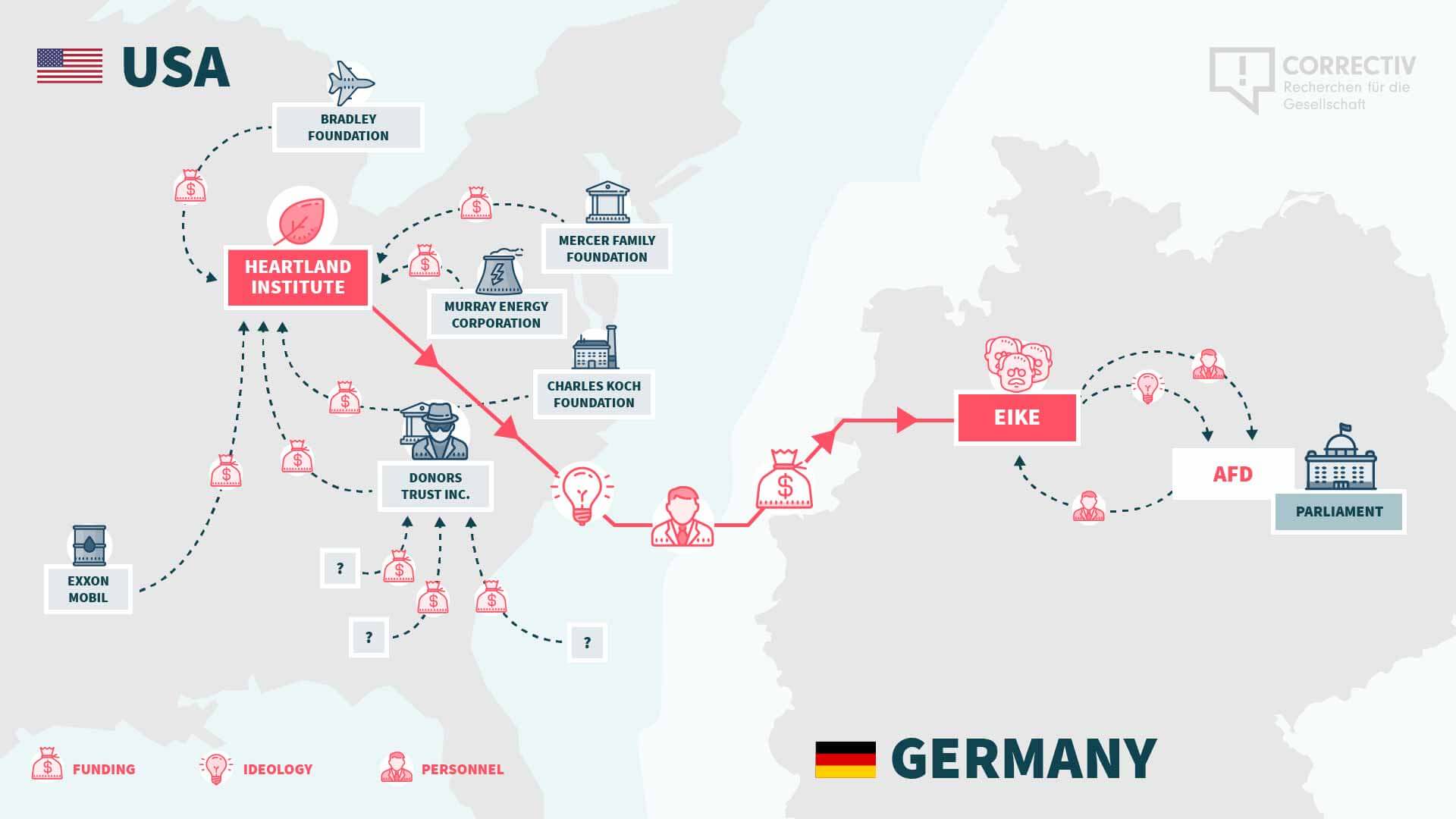
“Donors Trust is now directing between two-thirds and three-quarters of its budget to Heartland to support its climate-skeptical positions," Taylor told the undercover reporters.
The American Fuel and Petrochemical Manufacturers, an industry trade group whose members include ExxonMobil, Chevron and BP, also _{gave $75,000}_ to the Heartland Institute in 2017.
The Post story also quoted Graham Brookie, who directs the Digital Forensic Research Lab, an arm of the nonprofit Atlantic Council. Brookie said the ideology Seibt presents “is not outright disinformation," but that it does "bear resemblance to a model we use called the 4d’s — dismiss the message, distort the facts, distract the audience, and express dismay at the whole thing.”
The Post's story did not mention that the Atlantic Council _{ is funded by}_ ExxonMobil, ConocoPhillips, the Abu Dhabi National Oil Company, Chevron, Shell, and BP.
In response to a request for comment, The Washington Post’s Molly Gannon said only, “Our story speaks for itself.”
Other news outlets seem to have copied the omission. _{The Guardian}_, _{The Independent}_, _{France24}_, _{the Daily Mail}_, _{Mediaite}_, _{Mic}_, and _{MassLive}_ all published follow-on stories that did not mention the Heartland Institute’s financial backing from the fossil fuel industry.
The Heartland Institute seems to be trying to look like it has the youth on its side. So it has found a Gen Z surrogate who can parrot decades-old fossil fuel talking points, and earned major press coverage that frames her as a figure who compares to Thunberg, while completely leaving out the group's obvious, and documented, oil and gas industry connections.
i'm confused; did hrtland jump the shark?
ucs 2018?
...
American Legislative Exchange Council: Fossil fuel industry ‘bill mill’
On July 12, ExxonMobil announced it had ended its longtime membership in the American Legislative Exchange Council after a disagreement over the corporate lobby group’s climate policy. From 1998 through last year — when Exxon Mobil reported it gave the group $60,000 — ALEC received $1.93 million from the oil company.
Over the last two decades, ALEC has routinely featured climate science deniers at its conferences and supplied state lawmakers with a range of fossil fuel industry-drafted sample legislation, including bills that would restrict investment in renewables, eliminate incentives for electric vehicles, and hamper the solar industry from selling electricity directly to residential and business customers.
Since 2012, more than 100 corporations, including BP, ConocoPhillips, Royal Dutch Shell and electric utilities Entergy, Pacific Gas & Electric and Xcel Energy, have severed ties with ALEC, in many cases because of its regressive policy positions.
ExxonMobil’s exit from ALEC came just months after the company fought to defeat a draft resolution sponsored by the Heartland Institute — an ExxonMobil grantee from 1998 through 2006 — calling on the Environmental Protection Agency to “reopen and review” its “flawed” conclusion that climate change poses a threat to human health. The EPA’s “endangerment finding” requires the agency to regulate carbon dioxide and other global warming emissions as hazardous pollutants under the Clean Air Act.
After ExxonMobil and the Edison Electric Institute (EEI), a utility trade group, objected to the resolution, the Heartland Institute withdrew it and accused the two of being in league with the likes of Greenpeace and the Sierra Club.
“Big corporations like ExxonMobil and trade groups like EEI have long been members of the discredited and anti-energy global warming movement,” Heartland’s president, Tim Huelskamp, said in a December 7 press release. “They’ve put their profits and ‘green’ virtue signaling above sound science and the interests of their customers.”
Huelskamp’s ludicrous assertion notwithstanding,some might construe ExxonMobil’s exit from ALEC as a welcome change in direction. The company’s money trail, however, clearly shows that it is still financing climate science denier groups that denigrate any and all climate policy options and provide cover for Congress and the current administration to do nothing. Until ExxonMobil stops funding these groups, its avowed support for a carbon tax, the Paris agreement and other climate initiatives can’t be seen as anything more than a cynical PR ploy.
Posted in: Energy, Global Warming Tags: carbon tax, Climate Denier, Climate Science, ExxonMobil, fossil fuel, Global warming
==
BS blog
May 24 2014
Common Core’s Global Warming Agenda
Vicki E. Alger
http://www.iwf.org/blog/2794034/Common-Core%E2%80%99s-Global-Warming-Agenda
viki alger
Earlier this month, Wyoming became the first state to reject Common Core “Next Generation” Science Standards because they push man-made global warming as a settled fact. Also a growing number of scientists have been issuing scathing rebuttals against reputedly “scientific” findings on global warming, including the White House’s National Climate Assessment. Moreover, a majority of scientists believe that global warming is largely nature-made, not man-made (see here, here, here, and here).
TheHeartland Institute’s James Rust, a retired professor of nuclear engineering, takes the standards to task, suggesting Wyoming and other states are right to question adoption of politicized standards:
The coverage mentions computer modelsare used for predicting future climate and weather conditions for the planet. The report claimed, “However, it is clear not only that human activities play a major role in climate change but also that impacts of climate change—for example, increased frequency of severe storms due to ocean warming—have begun to influence human activities . The prospect of future impacts of climate change due to further increases in atmospheric carbon is prompting consideration of how to avoid or restrict such increases.” There is insufficient coverage that computer models fail to replicate what happens in the future when data for comparisons are available. In my opinion climate models should not be included in K-12 education because our understanding of forces influencing climate is incomplete and model’s failure to be validated. Material in the book does not make this clear. …
Our science programs should stimulate students to be adept in analysis and have an inquiring mind. Never be exposed to ideas of “the science is settled”. It is my opinion the science portion of Common Core is dangerous for the country. Damage from its implementation for a few decades could harm the country for many years.
Abandoning basic elements of scientific inquiry in favor of politicized agendas is bad enough. But Rust goes on to note that worst of all:
It is easy for teachers to be caught up in promoting teachings of the catastrophic climate change movement because of “warm feelings” from working to save the planet. Over-zealous teachers, perhaps in concert with environmental groups, may wish to develop slogans, songs, T-shirts, and even arm bands for students to use to help spread the gospel of human-caused global warming. … Potentials for mischief to the country over teachings of perverted science are enormous. …
The entire Common Core program provides opportunities to instill propaganda in our young people ages 5 to 18. Common Core should be discarded from an intellectual point of view.
And that’s saying something, considering that Common Core national standards are intended to make American students college- and career-ready.
==
===
https://www.desmogblog.com/2019/08/11/heartland-deniers-deflated-climate-reality
Climate science deniers are becoming desperate as their numbers diminish in the face of incontrovertible evidence that human-caused global warming is putting our future at risk. Although most people with basic education, common sense, and a lack of financial interest in the fossil fuel industry accept what scientists worldwide have proven through decades of research, some media outlets continue to publish inconsistent, incoherent opinions of people who reject climate science.
Over the past few weeks, Canada's Postmedia chain has run columns denying or downplaying the seriousness of climate change by Fraser Institute senior fellow :{Ross:(style="background-color:#ffff66;"):}::{McKitrick:(style="background-color:#ffcc66;"):}:, defeated politician Joe Oliver, and fossil fuel executive and Fraser Institute board member Gwyn Morgan, who is also former chair of scandal-plagued SNC-Lavalin.
McKitrick, an economist, has also signed the Cornwall Alliance Evangelical Declaration on Global Warming, which says, in part, “We believe Earth and its ecosystems — created by God's intelligent design and infinite power and sustained by His faithful providences — are robust, resilient, self-regulating, and self-correcting, admirably suited for human flourishing, and displaying His glory. Earth's climate system is no exception.” Other prominent deniers, including Roy Spencer and David Legates, have also signed.
South of the border, the Heartland Institute, a leading U.S. denial organization with ties to Canadian organizations such as the misnamed International Climate Science Coalition, still holds its annual denial fest.But even that organization is feeling hard times in the face of evidence—similar to the proof that made it walk back its previous support for the tobacco industry to the point that its members now admit smoking is bad but defend vapingand other “smokeless” tobacco-industry products.
Heartland's 13th International Conference on Climate Change — held at the Washington, D.C., Trump International Hotel — was down from three days to one.It once attracted more than 50 sponsors, but this year drew just 16 — and one was fake! Fossil fuel companies have also cut funding, realizing that denial is not an effective way to gain social licence. Attendance was limited to a couple hundred mostly older white men.
As usual, the conference speakers' reasons for denying climate science were all over the map.
Some simply rejected all evidence. According to British eccentric ChristopherMonckton, who has no scientific credentials, droughts, wildfires and hurricanes are decreasing; sea levels are falling, not rising; and rising carbon dioxide emissions are improving life on Earth!
Others argued that CO2 levels aren't rising, while some claimed the planet is cooling. In other words, the arguments were mostly easily debunked, contradictory nonsense in service of the most profitable and polluting industry in human history.
You'd think Heartland would be riding high under a government that shares its antiscience views. But even holding the conference in a Trump hotel blocks from the White House didn't gain it the profile organizers would have liked.Tom Harris, a discredited Canadian fossil fuel promoter who works with Heartland and the International Climate Science Coalition, penned a sad article with fellow denier, Heartland “science director,” and convicted criminal Jay Lehr, crying: “No one from the Trump administration will be in attendance,” which, they whined, is “a huge loss since ICCC-13 will reveal that neither science nor economics back up the climate scare.”
Lehr, a groundwater hydrologist by training, also worked for the Advancement of Sound Science Coalition, an organization founded by Phillip Morris and by PR firm APCO Worldwide to cast doubt on the scientific evidence regarding harms caused by tobacco. Harris also worked for APCO Worldwide.
It's getting harder for anyone to deny the reality staring us in the face. Those who continue to spread doubt and confusion about climate science are starting to look even more ridiculous with their many conflicting, insubstantial arguments.
Even some prominent deniers have come around. Political consultant Frank Luntz — who once advised the U.S. government to cast doubt on scientific certainty around climate change and to use the term “climate change” rather than “global warming” because it sounds less scary — now says, “I was wrong in 2001.” In recent testimony before the U.S. Senate, Luntz said: “Rising sea levels, melting ice caps, tornadoes, and hurricanes more ferocious than ever. It is happening.”
Yes, it is happening. And it's time for deniers to accept evidence and reason or get the hell out of the way.
==
==
mma
no lnx video
The climate-denying Heartland Institute hosted its 13th International Conference on Climate Change on July 25 at the Trump International Hotel in Washington, D.C. The conference typically attracts “dozens of climate change skeptics” who “converge to discuss issues and strategies to oppose climate action” and this year’s conference was no different.
During the event’s keynote address, climate-denying meteorologist Joe Bastardi -- who regularly appears on Fox News programs such as Hannity to downplay extreme weather events -- gave a speech titled “Weaponizing Hurricanes.” In an apparent attempt to lighten the mood a few minutes in to his remarks, Bastardi received a phone call from a President Donald Trump impersonator. What followed was a bizarre and cringe-worthy interaction which included the presidential impersonator claiming that climate change is “a complete hoax,” “just like the fake news story on Russia,” adding, “There is no collusion between CO2 and temperature.”
JOE BASTARDI (METEOROLOGIST): And I’m often amazed by his -- Could you hold on a second here? Hold on a second. Oh my gosh. Hello? Hello?
PRESIDENTIAL IMPERSONATOR: Hello, Joe. Joe, this is Donald. This is Donald. Is this a bad time?
BASTARDI: No, Mr. President, I’m talking here at --
IMPERSONATOR: Well, you don’t even need to answer because it's never a bad time talking to Donald Trump. I was actually just sitting here, down the street at the White House. And I’m actually streaming the climate conference live, and I just saw you come on. And I just wanted to say a couple of things. I wanted to say that Heartland’s running a great organization with great people, wonderful people, doing some great work on climate, unbelievable work on climate. And I love climate, I love climate, and I’m working hard on climate.
But Heartland, very smart people, some of the smartest people. You want to know how I know they’re smart people? They’re holding their conference at Trump International Hotel. What a wonderful hotel. An unbelievable hotel. Am I right, is it a wonderful hotel? Everybody, is it a wonderful hotel?
BASTARDI: Yeah, your wine’s a little expensive, but yeah.
IMPERSONATOR: And it was on time and under budget by the way, I just wanted everybody to know that. But I’m hearing so many great Americans are over there at the hotel, at the conference, and actually, I’m hearing there’s so many -- there was thousands and thousands of people that couldn’t even get in the door, just like a Trump rally. It’s unbelievable over there.
And I even hear -- listen to this -- I even hear there’s non-Americans that love our country that are there, I hear that. And I’m not sure if this is true, but I hear the great Lord [Christopher] Monckton was in attendance today. And that is a guy -- he loves America, loves Trump, which is beautiful, it’s a beautiful thing. And Joe, listen to this real quick, I’m actually hearing from the State Department, and this is unbelievable, the State Department wants to trade AOC and the squad for Lord Monckton. Unbelievable, that’s unbelievable to me. It sounds like a wonderful deal. It sounds like a wonderful deal. She can go to the U.K. and talk with Prince Charles about the world ending in 18 months, and they can spend their last few months there, while we get a great man in our country. It will be unbelievable. It’s a wonderful deal. I think it’s a great deal.
BASTARDI: Well, Mr. President -- does everybody appreciate the president checking in? I’ve got to go back to this talk because I’m trying to explain what’s going on with hurricanes, OK?
IMPERSONATOR: Joe, can I say one thing on climate real quick? One thing on climate -- it's just like the fake news story on Russia, which was a complete hoax by the way, a complete hoax. There is no collusion between CO2 and temperature. No collusion whatsoever. Take care, Joe -- if you have half a good a speech as the ones I make, it will be a wonderful speech. Take care.
BASTARDI: Goodnight, Mr. President.
http://inthesetimes.com/article/21980/i-went-to-a-climate-change-denial-conference-heartland-institute-trump
There’s no need to worry about reducing the greenhouse gases driving climate change—all that carbon dioxide is actually “greening the planet.” The Green New Deal, on the other hand, would send the country back to the stone age, or at least the pre-industrial era. Those were among the eye-popping and often-conflicting views expressed yesterday at the Heartland Institute’s 13th International Climate Change Conference, a gathering of climate change deniers that took place at theTrump Hotel in Washington, D.C., just blocks from the White House.
The vast majority of the world’s climate scientists agree that climate change could prove devastating to life as we know it unless we take swift and sweeping action to decarbonize the economy . But those “wild predictions have been pronouncedly exaggerated,” according to the British gadfly Lord Christopher Monckton, who holds the title 3rd Viscount Monckton of Brenchley.
One of the more colorful figures in the climate denial universe, Monckton ticked off a list of problems scientists have linked to climate change that Monckton says we really don’t need to worry about. According to him, the world is seeing less, not more, drought; sea levels are falling not rising; forest fires are causing less damage; hurricane activity is decreasing, too; and carbon dioxide is actually improving the global environment by “greening” places like Australia’s Great Sandy Desert. “That’s why we need more CO2, because it greens the planet,” he declared.
Other conference panelists joined Monckton in cycling through a series of theories long debunked by peer-reviewed science. Some believe, like Monckton, that carbon dioxide levels in the atmosphere are growing but provide more benefits than threats. (One Heritage Foundation official went so far as to suggest carbon dioxide emitters should get paid a subsidy rather than face the kind of carbon tax scheme policymakers have discussed; of course, the oil industry already does receive billions in subsidies.) Others argued that CO2 levels are in fact not rising, while still others say we should be more concerned about a coming ice age.
“The real problem is we have a lot more to worry about with global cooling than with global warming,” said Rodger Bezdek, an energy analyst and Heartland policy advisor.
If the speakers and audience members don’t all agree on why we shouldn’t worry about climate change, the few hundred people assembled in a hotel ballroom yesterday do share a number of other ideas: chiefly, that the fossil fuel industry is under unfair attack and deserves public support, while the Green New Deal is a totalitarian communist plot to steal American liberties and cast the world into “energy poverty.”
Kevin D. Dayaratna, a senior statistician at the Heritage Foundation, told the audience the Left had already begun to take control of the country and would continue its authoritarian advance with a Green New Deal.
On the surface, times would seem to be good for Heartland and the climate change denial movement, with the world’s most prominent climate change denier living in the White House. President Donald Trump has run with many of this group’s longtime demands such as withdrawing the United States from the United Nations’ Paris climate accord and rolling back Obama-era pollution rules.
But the evidence has never been stronger that climate change is already happening and will have increasingly catastrophic impacts on human civilization (not to mention other species) unless the world takes action. Meanwhile, the surprisingly fierce rise of children activists demanding climate action has boosted public concern worldwide and helped sweep progressive politicians supporting a Green New Deal into U.S. Congress.
This may be part of why climate denialists (who prefer to be called “climate realists”) appear to be struggling to remain relevant and attract younger followers. Yesterday’s speakers and audience members were overwhelmingly old, white and male. After the first panel session, there were so many white-haired men waiting for the men’s room that a long line snaked out the door, past the gold-plated trash bins embossed with the Trump name. The line for the women’s room, by contrast, was significantly shorter.
To recruit younger generations, one audience member suggested warning them that Green New Deal supporters want to take their iPhones away and return the country to a time before electricity—never mind that electricity, in the form of solar and wind, is central to the Green New Deal proposal. (Of course, panelists and audiences expressed extreme skepticism about renewables, as well.)
Not only does the climate denial movement appear in danger of aging out, raising funds is getting more difficult.Traditionally funded by fossil fuel companies, Heartland’s oil and gas money has dried up in recent years as the scientific consensus around climate change has grown stronger, putting oil and gas companies under pressure from shareholders and the public to stop funding groups that deny the problem.
Earlier this year the libertarian Cato Institute disbanded its climate denial program, the Center for the Study of Science. And yesterday’s Heartland conference had fewer than half the number of speakers and panelists as its first International Climate Change Conference in 2008. The number of sponsoring organizations has also fallen by more than half since 2008.
Despite these developments, climate change denialism continues to get more than its fair share of media coverage, according to an analysis by the Public Citizen published Wednesday to coincide with the conference. The nonprofit consumer advocacy organization found thatmedia coverage of climate denial by Heartland, Heritage and three other think tanks increased from 2014 to 2018.
“The mounds of scientific evidence … should lead to a radical decline in the influence of climate deniers in the media,” Allison Fisher, outreach program director for Public Citizen’s climate program, said in a press release. “Amazingly, coverage of the deniers’ messages has risen over the past five years as the climate crisis has worsened, with much of it being uncritical.”
It seems possible to conceive of a time, not all that far off in the future, when the effects of climate change will become so evident and frequent that denying it’s happening will no longer be an option. But that’s hardly a comforting thought.
==
https://www.desmogblog.com/2019/04/13/problematic-white-supremacy-roots-heartland-institute-tim-benson-satire
On Wednesday, the Daily Caller published an opinion piece by Heartland Institute policy analyst Timothy Benson that we can only assume is satire. Benson argues in the piece that when it comes to addressing the existential threat of climate change, “if we can’t persuade” the current-top-emitters of China, Russia and India to cut their emissions, then the U.S. “will have to invade and occupy these countries” and force the emission reductions.
The only way to do this, per Benson, would be by “reinstitution of the draft.” This shouldn’t be a problem, he explains, because progressive “children should be filled with patriotic zeal and fervor” and be excited to “be the first kid on their block to get a confirmed kill in the name of saving the planet.” Benson concludes by admitting that “perhaps millions of American youth will die ridding the world of the climate menace, but what a noble sacrifice.”
It’s obvious that Benson simply intended his piece to mock calls for the WWII-style mobilization to fight climate change. He isn’t the first, because no one is seriously going to propose sacrificing millions of American children and, by extension, millions of Russian, Chinese and Indian citizens. After all, the whole point of fighting climate change is to prevent death and destruction, not to merely cut emissions at any cost.
But a glance at Benson’s Twitter account reveals similarly problematic, joking-not-joking comments that also deserve attention. For example, in the context of hostilities between India and Pakistan, he tweeted “a reminder that the British ruled the Subcontinent, Muslim and Hindu, relatively peacefully for over 100 years with only 25,000 men.”
Just a reminder that the British ruled the Subcontinent, Muslim and Hindu, relatively peacefully for over 100 years with only 25,000 men.
— Tim Benson (@BenceAthwart) February 27, 2019
Given that British rule included a massacre of approximately a thousand innocent civilians and a famine that killed millions more, describing Britain's rule as “relatively [peaceful]” is quite a stretch. And of course, the fact that controlling the region took “only 25,000 men” speaks pretty plainly to the brutality required to keep power.
No doubt, though, that if pressed on this and other risible tweets (“you can take Thriller out of my cold, dead hands”), Benson will fall back on the old reliable defense that “it’s just a joke!”
Comments like these are certainly jokes, but that doesn’t make them harmless. Jokes that derive humor from the slaughter of mainly non-white populations at the hands of white colonialists, be they British forces or American children drafted into service, aren’t just jokes–they’re a key tactic for spreading white nationalism and anti-Semitism. The use of “ironic” racism was an informal strategy during the first rise of Nazism, and it has since become a formal part of the neo-Nazi approach to messaging.
We know this because it is literally written in the style guide for the anti-Semitic neo-Nazi website The Daily Stormer, as HuffPost’s Ashley Feinberg revealed in 2017.
The guide’s section on tone notes that “the unindoctrinated should not be able to tell if we are joking or not.” The use of racial slurs, of which there is an approved list, “should come across as half-joking” so that “the reader is at first drawn in by curiosity or the naughty humor, and is slowly awakened to reality by repeatedly reading the same points.”
While we doubt anyone is going to use Benson’s naughty humor as an excuse for real-world violence in the name of climate change, the link between online jokes and real world violence is hardly obscure. On the same day Benson’s piece ran, the Daily Beast reported on how the man who burned down three black churches in Louisiana also made “white power” jokes on a neo-Nazi-adjacent Facebook page. Similarly, the manifesto for the New Zealander who murdered 50 people in two Mosques was filled with satire, memes, and irony-rich “jokes.”
So while we usually try and end these roundups with something light-hearted and funny, in honor of Benson’s “jokes,” today we’re going to instead provide some links: to how fighting climate change needs to include facing up toan imperial history, to how plastic pollution intersects with colonialism, to how Bill “Gates’s favourite infographic takes the violence of colonisation and repackages it as a happy story of progress” and, perhaps most importantly, to how climate solutions like “the Green New Deal can avoid climate colonialism.”
==
off bs
https://www.heartland.org/news-opinion/news/heartland-weekly-leadership-changes-at-the-heartland-institute
Lakely is the Interim President and Director of Communications of The Heartland Institute.
Reporters, editors, producers, and hosts can reach Jim to book a Heartland interview at jlakely@heartland.org or via text/call to his mobile: 312-731-9364.
Heartland has an in-house TV studio from which we can connect to any outlet in the world on a moment's notice. [RED TEXT]
https://www.heartland.org/news-opinion/news/heartland-weekly-leadership-changes-at-the-heartland-institute
artland's Board of Directors elected Lakely Interim President in June 2019.
Prior to joining Heartland in 2008, Lakely spent 16 years in daily-deadline journalism. He covered Capitol Hill and was a member of the White House Press Corps from The Washington Times covering the George W. Bush administration. Lakely has appeared on C-SPAN, the Fox News Channel, MSNBC, CNN, and many national and local television and radio news programs. He’s been an editorial writer and columnist for the Tribune-Reviewin Pittsburgh, Pennsylvania; The Free Lance-Star in Fredericksburg, Virginia; and The Press-Enterprise in Riverside, California.
He often serves as “master of ceremonies” at The Heartland Institute's public events, and manages the creation and production of Heartland's major conferences, such as the International Conferences on Climate Change, the America First Energy Conference, and Heartland's annual benefit dinners. Lakely also led Heartland's 2015 contingents to Rome to bring climate realism to Pope Francis, and the United Nations Conference of the Parties (COP-21) in Paris. Lakely can speak with authority on environment and climate issues from a “climate realist” perspective, as he has to various audiences around the world.
Lakely's opinion pieces have appeared in the San Francisco Chronicle, New York Post, Chicago Sun-Times, Washington Examiner, American Thinker, Breitbart, Daily Caller,and many other publications around the world. He has shared his insight on politics and policy on many nationally syndicated radio programs.
He is executive producer (and occasional host) of the Heartland Daily Podcast, which listeners downloaded 3.2 million times in 2018. He supervises the production of Heartland's public policy videos, including  ” and “In the Tank.” He is also the editor-in-chief of Heartland's blog, Freedom Pub, and a contributing author at *Ricochet*.
Born in New York City, Lakely spent his formative years in Dayton, Ohio and Pittsburgh, Pennsylvania. He graduated from the University of Pittsburgh in 1992 with a degree in English Writing. Lakely is an avid fan of the Steelers, Penguins and his beloved Pitt Panthers.
Follow Jim's personal tweets on Twitter (@jlakely). Also follow @HeartlandInst on Twitter, as well as Heartland's Facebook page, YouTube Channel, and Instagram account to keep up with the organization.
==
HEARTLAND WEEKLY: LEADERSHIP CHANGES AT THE HEARTLAND INSTITUTE
JUNE 10, 2019
By Jim Lakely
Week of June 3, 2019
These new hires and changes to Heartland's organizational chart will boost our productivity and have an impact in several key areas.
Earlier this week, Tim Huelskamp resigned as President of The Heartland Institute and the Board elected Director of Communications Jim Lakely as Interim President. The Board also elected other new officers and approved several new hires and changes to our organizational chart that will boost our productivity and impact in several key areas including research, development, and marketing.
Kevin Fitzgerald was elected Chief Executive Officer (CEO). He previously worked as Heartland's art director, left to take an opportunity in corporate management, and returned as executive vice president before leaving once again to launch a branding and web development service for up-and-coming businesses in the management and data analytics sectors.
Wanda Davis was promoted to Executive Vice President, and in that role she will oversee day-to-day management of Heartland’s seven departments.
David Hoyt will join Heartland next week as Executive Director of Development, allowing Gwendayln Carver to move to her new position as Marketing Director.
Justin Haskins has been promoted to Editorial Director, and he and Ed Hudgins are overseeing Heartland’s newly energized research department. Lennie Jarratt was also recently appointed interim Director of Government Relations.
If you have any questions, email Jim Lakely at jlakely@heartland.org.
--
If you don’t visit Freedom Pub and the Heartlander digital magazine every day, you’re missing out on some of the best news and commentary on liberty and free markets you can find. But worry not, freedom lovers! Heartland Weekly is here for you every Monday with a highlight show. Subscribe to the email today, and read this week’s edition below.
Bernie Sanders' Latest Socialist Pipe Dream
Justin Haskins
Fox News
Presidential hopeful Sen. Bernie Sanders, I-Vt., is once again proving that it’s easy to be a democratic socialist. All you have to do is make wildly unrealistic promises and blame rich people for the world’s problems.
Changes in Leadership This Week at Heartland
Joseph Bast
The Heartland Institute
Earlier this week, Tim Huelskamp resigned as president of The Heartland Institute and the Board elected Director of Communications Jim Lakely as Interim President and made other changes at Heartland.
Global Sea-Level Rise: A Look at the Data
Idso, Legates, and Singer
Heartland Policy Brief
The time has come for parents to strike back at self-serving teachers unions. Supporting strike vouchers would be a great start.
Talking About No Safe Spaces'
Host: Jim Lakely
Guest: Mark Joseph
The producer of the upcoming documdrama film “No Safe Spaces,” a look at modern oppression of our free speech rights in America, discusses his career and his latest project.
El Nino and 21st Century Warming
Host: Anthony Watts
Guest: Roy Spencer, Ph.D.
The Principal Research Scientist at the University of Alabama in Huntsville, joins Anthony Watts to discuss why radical change such as the Green New Deal is unwarranted.
Forces Against CON Repeal
Host: AnneMarie Schieber
Guests: Reps. Jason Chipman, Daniel Martin, and Cameron Sexton
State representatives from the great states of Missouri and Tennessee talk about what happened with the bills they introduced this year dealing with Certificate of Need (CON) laws. Expanding HSAs Can Fix Broken Health Insurance AnneMarie Schieber Townhall A recent survey revealed only one in five people currently enrolled in an employer-sponsored health plan have a health savings account (HSA). More unsettling, few use them to save money for future health expenses.
Ocasio-Cortez and Bernie Jump the Shark
Chris Talgo
Stopping Socialism
Sen. Bernie Sanders (I-VT) and Rep. Alexandria Ocasio-Cortez (D-NY) recently introduced the Loan Shark Prevention Act, which they claim will end the plague of unfettered, unscrupulous usury in the United States.
Republicans Must Lead on Climate Change?
Tom Harris and Jay Lehr
Citizens Journal
There have always been prominent Republicans prepared to support the climate scare. It is a huge problem for President Trump who understands, correctly, that the concerns are not based on solid science.
Teacher Incompetence or Lack of Training?
Sandra Stotsky
The Heartland Institute
When a large group of kids in a state have not learned beginning reading skills by the end of grade 3, it is fair to ask if the problem may lie with their teachers’ training programs, not their teachers.
Can Cleaning the Ocean Be Marketed?
Daniel Sutter
The Heartland Institute
Trillions of pieces of plastic are creating huge garbage patches in the world’s oceans. One company’s efforts to do something about this problem can lead us to rethink some perceived economic wisdom.
Why Neo-liberalism is Really Neo-socialism
Richard Ebeling
AIER
The world we live in reflects the ideas and policies of neo-liberalism, but it is not the free- market liberalism that the new, more radical “progressives” and democratic socialists portray it to be.
RELATED NEWS & OPINION VIEW ALL NEWS
JUNE 13, 2019
Around the World Backlash Increases Against Climate Change Policies
By H. Sterling Burnett
JUNE 11, 2019
Guest Post: High School Climate Indoctrination Using AP Environment Textbooks
JUNE 11, 2019
Washington State to Allow Composting of Human Corpses
By Kenneth Artz
JUNE 10, 2019
Federal Court Rejects Northeastern States Bid to Expand Ozone Regulations to Other States
==
heartland2619
see prior and tag
ICCC and iccc2
2/17
capt 2/18 619
https://thinkprogress.org/trump-international-hotel-will-host-a-climate-denial-conference-5cf2c28b695d/
In late July, climate science deniers will descend upon the Trump International Hotel in Washington, D.C. — located right across the street from the Environmental Protection Agency (EPA) — to attend the Heartland Institute’s annual climate conference. The theme this year is “Best Science, Winning Energy Policies.”
The conference will feature “the courageous men and women who spoke the truth about climate change during the height of the global warming scare,” as the event’s own description puts it. “Now, many of them are advising the new administration or joining it in senior positions.”
Fringe climate science deniers have surrounded and infiltrated the administration since President Donald Trump was elected — from working on Trump’s transition team, to meetings with top EPA officials. Trump himself has said climate change is a Chinese hoax, tweeted repeatedly that winter snowstorms disprove global warming, and said that climate scientists have a political agenda. And many top government officials in this administration deny the science on climate change.
When Trump announced in June 2016 that the United States would withdraw from the Paris climate deal, representatives from longtime anti-climate action groups like Koch-funded think tanks the American Energy Alliance, the Competitive Enterprise Institute, and the Heritage Foundation were all present in the Rose Garden.
Many of these same think tanks will be attending Heartland‘s conference next month, where speakers will offer up policy ideas “to lead a post-alarmist world in climate realism” as well as discussing “the benefits of ending the Democrats’ war on fossil fuels.”
This denialism is in stark contrast to the reality facing the world. Scientists have long established that climate change is real, is the result of burning fossil fuels, and that its impacts are visible here and now — from more intense hurricanes and wildfires to both increased drought and rainfall depending on the region. The very first line of the government’s own National Climate Assessment released last fall states, “The impacts of climate change are already being felt in communities across the country.”
Despite the scientific consensus, the Trump administration has been taking aggressive action to roll back vital environmental protections, often in line with industry demands. Supporting the coal industry, in particular, has been a top priority for the administration.
The Trump International Hotel isn’t just a top choice for climate deniers: Last year, two executives from coal companies close with the administration — Murray Energy and Craft Alliance Partners — were “VIP” guests of the downtown D.C. hotel. Last June, the hotel hosted a reception for industry trade group the American Coalition for Clean Coal Electricity.
The hotel — referred to by one Department of Energy staffer as “Republican Disneyland” — has received hundreds of thousands of dollars from oil, coal, natural gas, and mining interests who come to attend events frequented by administration officials. Last March, the Independent Petroleum Association of America’s (IPAA) annual “Congressional Call-Up” was held at Trump’s hotel.
Oil and gas lobbyists gather at Trump Hotel for annual D.C. meeting
This is at least the third energy industry group to choose the Trump International Hotel.
Meanwhile, Trump has refused to sever ties with the Trump Organization, which holds the lease for the Old Post Office building where the hotel is located. Prosecutors for lawsuits in New York, Maryland, and D.C. argue Trump is illegally profiting off of his presidency; the more guests and events at the hotel, the more the president profits.
But while the fossil fuel industry, and the climate deniers who have received fossil fuel funding over the years, flock to the hotel, lawmakers on both sides of the aisle are increasingly starting to recognize the importance of tackling the climate crisis.
For the first time, climate change is a leading issue in the 2020 presidential campaign, and a growing number of Democratic candidates are offering up climate policy proposals. Meanwhile, Sen. Lindsey Graham (R-SC) recently told reporters that the Republican Party needs its own climate plan.
At the same time, coal continues to be on the decline no matter what the administration does to help the industry. More coal plants shut down during Trump’s first two years than during President Barack Obama’s entire first term.
More coal plants shut down in Trump’s first two years than in Obama’s entire first term
The administration's own data reveal coal isn't coming back.
Heartland’s conference comes as the head of the group, former Republican Kansas Rep. Tim Huelskamp, abruptly stepped down last week, just two years after taking the position, while offering no explanation. The think tank has in recent years faced funding uncertainties, with even ExxonMobil no longer donating to the organization. As head of Heartland, Heulskamp focused on energy policy and promoting coal at the state level as opposed to vocal attacks on climate science as his predecessor Joseph Bast did.
The news of Huelskamp leaving his post comes shortly after another Koch-funded libertarian think tank, the Cato Institute, quietly announced it was disbanding its climate denial program, the Center for the Study of Science. A Cato spokesperson at the time, however, said this didn’t change the organization’s stance on human-caused climate change.
==
https://www.desmogblog.com/2019/01/18/climate-advocates-underestimate-power-fossil-fuel-misinformation-campaign-brulle
Climate Advocates Underestimate Power of Fossil Fueled Misinformation Campaigns, Say Top Researchers
By Graham Readfearn • Friday, January 18, 2019 - 08:51
Myron Ebell at a Heartland Institute conference
Climate action advocates have underestimated the strength and sophistication of decades-long fossil fuel-funded misinformation campaigns and need a coordinated set of strategies to fight back, say leading academics.
Among those strategies, say the three researchers from Yale and Brown University, are promoting financial transparency, suing misinformers and their funders, and researching the vast networks of think tanks and front groups.
Writing in the journal Nature Climate Change, Yale University's Professor Justin Farrell and Kathryn McConnell, together with Brown University’s Professor Robert Brulle, say people working on responses to climate change “cannot afford to underestimate the economic influence, institutional complexity, strategic sophistication, financial motivation, and societal impact of the networks” behind climate misinformation campaigns.
Brulle, who is also an academic at Drexel University, told DeSmog that after conversations with leaders of environment groups and foundations, he had concluded “there is virtually no understanding of the nature or extent of misinformation efforts and organized efforts to stop climate action.”
Misinformation Ignored
He said: “So in my opinion, the efforts to promote climate action are failing to take into account opposition efforts in their strategies. I can assure you that this is not the situation for the organized efforts to stop climate action — which I call the climate countermovement.”
Brulle and Farrell have each produced several major studies in leading academic journals on the funding and influence of the “climate countermovement” and its fossil fuel interests. In 2018, Brulle joined several academics in criticizing the United Nations Intergovernmental Panel on Climate Change (IPCC) for ignoring in a major report swaths of research and evidence on the impact of organized climate science denial.
In this most recent commentary, they lay out the pervasive nature of misinformation campaigns on climate change in the United States and how those campaigns captured Republicans.
Singled out in the paper are groups including the Heartland Institute, companies including oil giant Exxon, individuals like former Trump Environmental Protection Agency (EPA) transition team members Steve Milloy and Myron Ebell, and the vast network of groups funded by billionaire Robert Mercer and the petrochemical businesses controlled by Charles Koch and brother David Koch.
...
https://www.desmogblog.com/2018/10/02/climate-science-deniers-trump-admin-happer-wehrum-rollins-wynn-simmons
readfearn
here are five folks spearheading the United States government who think that when it comes to climate change, they know better than all of the world’s main scientific institutions.
There’s Donald Trump himself, of course, who famously tweeted that climate change was a hoax invented by the Chinese, and said that a cold snap in the weather overturns a century or more of scientific inquiry.
Then there’s energy secretary Rick Perry, whose fuzzy logic on the science sees him unconvinced that CO2 is the key driver of climate change.
Ryan Zinke, Secretary of the Interior, is similarly confused and non-committal about the impacts of burning fossil fuels, as is former coal-lobbyist-turned-EPA head Andrew Wheeler. Secretary of Housing and Urban Development Ben Carson said in 2015 that climate change was “irrelevant,” that temperatures were driven by natural cycles and, since then, has avoided questions about the role of human activity in climate change.
OK, so there are more than five (with Mike Pence, Mike Pompeo, and Jeff Sessions among those who have denied the science in the past), but these five are well positioned to influence the energy and climate policies of the nation.
Wheeler, for example, is driving through cuts to national efficiency standards for motor vehicles and is relaxing pollution rules on coal power plants. Zinke and Perry are aggresively promoting fossil fuel growth with Trump as the climate-wrecker-in-chief. Carson heads an agency that has a role in promoting (or not) climate change adaptation and resilience for homes and properties, particularly after natural disasters.
Remembering not only do these five reject the advice of the world’s major science academies, but also the expertise of the scientists working in their own government agencies.
But while these five might be relative household names with their views well reported, DeSmog presents five lesser-known climate science deniers inside the administration who are also in positions to gut federal action on climate and promote fossil fuel-friendly policies, backed by their own convictions that climate change just isn't much of a problem.
Will Happer
Will Happer, emeritus professor from Princeton University, was once in the running as Trump’s science advisor but has now been appointed to the National Security Council, specializing in emerging technologies.
After news of Happer’s appointment became public, Science, republishing E&E News, characterized the 79-year-old physicist as a “vocal critic of mainstream climate science.”
But Happer is more than a mere critic — he has acted as an enabler and activist against action on climate change for well over a decade.
For years, Happer was chairman at the George Marshall Institute and then, when that was shuttered, he founded the CO2Coalition with former Exxon director, the late Roger Cohen. Both groups took fringe positions on the science of climate change, with Happer claiming that adding more fossil fuel emissions into the atmosphere will be good for humans.
In 2015, Happer was caught in a sting by Greenpeace when he offered to write a report on the “benefits” of CO2 for a fake oil client and then hide the funding, which would be directed to the CO2 Coalition. Since then, that group has received funding from the foundation of Trump backer and hedge fund billionaire Robert Mercer.
In December 2016, Happer attended a conference organized by conspiracy theorist G. Edward Griffin. Now he’s on the National Security Council.
Late in 2017, the Trump administration nixed climate change from a list of global threats to the U.S. in the National Security Strategy.
It's safe to say Happer won't be leading any pushes to add it back in.
Bill Wehrum
Bill Wehrum is the U.S. government’s most senior official on air pollution, as the assistant administrator in the Office of Air and Radiation at the Environmental Protection Agency (EPA).
Wehrum is a long-serving lawyer for the coal industry, as well as petrochemical and petroleum industry groups (such as Koch Industries).
Wehrum’s office is also tasked with looking at regulations to tackle power plant pollution and climate change and recently proposed the Affordable Clean Energy rule as a replacement for Obama's Clean Power Plan.
But as the New York Times reported, Wehrum has been delivering big time for his former fossil fuel industry clients by proposing the new rule, which EPA's own analysis shows would increase premature deaths from pollution.
One former EPA director, Bruce Buckheit, told the New York Times: “They basically found the most aggressive and knowledgeable fox and said, ‘Here are the keys to the hen-house.'”
Over a decade earlier, Wehrum was in the same position at EPA as he is now and back then argued against granting California a Clean Air Act waiver to set more stringent pollution standards for vehicles.
Back in power at the EPA, he ran the agency's midterm review of auto emissions standards, which this year recommended rolling back the stricter standards proposed by the Obama administration.
Under question during his confirmation hearings, Wehrum claimed that CO2 emissions as a main driver of climate change, which the government’s own scientists confirm, was to him an “open question." [vid]
Brooke Rollins
Rollins was an aide to Texas Governor Rick Perry before spending 15 years leading the Texas Public Policy Foundation (TPPF), which she left in early 2018 to become assistant to the president in the Office of American Innovation (OIA), based in the White House (some wonder what the OIA actually does).
During her time at TPPF, Rollins promoted the work of the organization’s Kathleen Hartnett White, a climate science denier and fossil fuel evangelist whose controversial nomination to lead the White House Council on Environmental Quality was ultimately withdrawn.
In August 2018, Rollins appeared at the Heartland Institute’s energy conference alongside that think tank’s new president Tim Huelskamp.
At the conference, Rollins nodded as Huelskamp suggested American schoolchildren’s heads were being “filled with mush” about the dangers of CO2.
When asked if the inner-workings of the White House were as chaotic as some media had claimed, Rollins replied: “Is there chaos? Yes. But I would say it’s like the chaos of my home — having four children in five years.”
Home life was like a “goat rodeo,” she said, and working in the White House wasn’t “much different.”
While at TPPF, Rollins wrote that Trump should exit the Paris climate agreement.
What she's actually doing in her role with OIA remains unclear, but the fact that she appeared at the America First Energy Conference, hosted by a climate science denying think tank, indicates she isn't likely straying from her previous positions on climate and energy.
Todd Wynn
...
==
wow grafix
https://www.desmogblog.com/2018/08/06/doing-lord-s-work-heartland-institute-gathers-climate-deniers-america-first-energy-conference
One of the world’s most notorious climate science denial groups — the Heartland Institute — will gather its supporters and fellow ideologues this week for a one-day energy conference in Louisiana.
Aside from the conference’s fanatical devotion to fossil fuels, the line-up includes the usual pushers of junk science who are sure that every major science academy in the world is wrong about the dangers of adding CO2 to the atmosphere.
Gathering at the conference will be “hundreds of state and national elected officials, think tank leaders, and policy analysts.”
Front and center in New Orleans will be Fred Palmer, a veteran coal industry lobbyist who was behind what was probably the very first fossil-fuel funded attacks on the science linking coal burning to dangerous climate change.
After more than 30 years with the Western Fuels Association and then coal giant Peabody, Palmer now spends his time as a senior fellow at the Heartland Institute.
Shortly after Donald Trump won the U.S. Presidency, Palmer told DeSmog that he would be “reaching out to the fossil fuel community” for cash to fund the institute. This would be added to the more than $5 million the institute has received from major Trump financial backer Robert Mercer, the hedge fund billionaire whose daughter Rebekah Mercer was a key member of the President’s transition team.
Given the backing of the Mercers, it’s perhaps not surprising that Heartland has borrowed the title of Trump’s energy policy in holding its “America First Energy Conference.”
A favorite talking point from climate science deniers around the world — including those at the Heartland Institute — is that governments and scientists around the world have adopted climate science as a new “green religion” and it’s this fanaticism that is clouding their judgment.
Heartland likes to pitch global warming as “facts vs faith,” as a “green religion,” and to tell its followers that environmentalism is like a church where climate change is the new religion.
This is a curious position to take, when you compare it to the beliefs of Fred Palmer and other speakers at the Heartland conference. Quite literally, they believe that coal was put there by a god for humans to use.
“It’s hard not to concede that coal hasn’t been put on Earth and other fossil fuels as part of a divine plan,” Palmer has told DeSmog.
In July 2018, Palmer gave a speech to the Western Conservative Summit in Colorado. In audio obtained by DeSmog, Palmer says of Heartland’s efforts on climate change: “We are, I know, doing the Lord’s work.”
But this literal religious zeal is not restricted to Palmer at Heartland’s conference this week.
One session — titled Why CO2 Emissions are not a climate crisis — includes panelists Dr. Roy Spencer and Professor David Legates, who are both old hands at pushing back on all that green religion.
In 2015, Legates was featured in a series of videos attacking climate science and environmentalism produced by the Cornwall Alliance for the Stewardship of Creation.
“There has to be a designer — a creator behind this to make something as complex as it is, yet as robust as it is,” says Legates.
“To be a true Christian means you have to believe and understand what we are being taught through the Bible and through God’s word.”
Scheduled beside Legates on the Heartland Institute panel is Dr. Roy Spencer of the University of Alabama in Huntsville.
Spencer once wrote that he had analyzed Biblical claims that “the universe and all life within it had been created by some greater intelligent Being, not by mere chance.”
His conclusion? The “theory of creation actually had a much better scientific basis than the theory of evolution.”
There are many well-credentialed climate scientists who are also people of faith.
But the argument from denialists that climate scientists are blinded by their own faith in a “climate change religion,” belies their own quite literal belief that they are doing the work of god.
As a presumably god-given debating tactic, it’s as flawed as their science.
==
nola 818 why worry?
When climate science deniers and fossil fuel evangelists met Tuesday in New Orleans for the Heartland Institute's second "America First" conference on U.S. energy, they had every reason to celebrate the unprecedented influence they enjoy in the Trump administration.
Instead, they found plenty of reasons for dread.
With carbon tax proposals floating, climate lawsuits advancing, big corporations embracing the need for action and states and cities getting into the act, many of those gathered grappled with the reality that a fossil future was not secure—despite a largely pliant White House and Congress.
Contrarian scientists, policy professionals and lawyers affiliated with conservative interests contemplated the spread of the climate action agenda as if it were a malignancy. While speakers at the live-streamed sessions universally praised President Donald Trump and his regulatory rollbacks, the overwhelming diagnosis was that more aggressive policy surgery was needed.
High on their list of targets was the Environmental Protection Agency's finding that greenhouse gases are a danger to human health and welfare. That determination, affirmed by the Supreme Court, is what empowers the agency to regulate global warming pollution.
But the acting EPA administrator, Andrew Wheeler, has said he considers the endangerment finding "settled law" and does not wish to revisit it.
"Complete nonsense," said Atlanta lawyer Harry Macdougald, who was part of the legal team that unsuccessfully challenged the endangerment finding in court during the Obama administration. "It is a direct threat to the president's energy dominance agenda. And the next Democratic administration—and there will be one—will turn the screws."
Corporations 'Jumping on Climate Change'
Another theme running through the sessions was exasperation with corporations that have decided to take climate action on their own—or at least have refused to challenge the consensus science that human activity is the driver for global warming.
"A number of regulated utilities across the country—no reason to name names, but there are about a dozen of them—have announced they are going to ... reduce greenhouse gas emissions 80 percent by 2050 from their generating fleet, which is the Barack Obama plan and the Hillary Clinton plan," said Frederick Palmer, a senior fellow with the Heartland Institute and a former vice president for the coal company Peabody Energy. "So it's as if Donald Trump wasn't elected president of the United States as far as they are concerned."
Palmer, who sits on the National Coal Council, a federal advisory committee to the U.S. energy secretary, said the council will soon release a study calling for action to bar coastal states from prohibiting coal export terminals, as Washington State has done. "We've got to get the left coast figured out," he said.
Palmer also called for a federal moratorium on the retirement of coal plants, as a national security imperative. He wasn't the only one to suggest that conservatives may have to scrap laissez-faire principles to keep fossil fuel energy flowing.
Joe Leimkuhler, vice president for drilling for LLOG Exploration, a Covington, Louisiana producer focused on the Gulf of Mexico, called for more royalty relief for offshore drilling to help the industry survive in an era of low prices.
Craig Richardson, executive director of E&E Legal, a conservative legal group that repeatedly sued the Obama administration's regulatory agencies, said he now sees his group as "trying to be a supportive arm of this new administration." But he lamented what he and others called "virtue signaling" by corporations "jumping on climate change."
Richardson complained about ExxonMobil leaving the conservative advocacy group, the American Legislative Exchange Council (ALEC), over a clash on climate policy. (Last year, Heartland wanted ALEC to approve a resolution calling on the EPA to withdraw the endangerment finding. Exxon was among several corporations and utilities that convinced ALEC to shelve a vote on the resolution.)
Heartland co-founder Joseph Bast provoked laughter by recounting carmaker GM's response to the Trump administration proposal unveiled last week to freeze fuel economy standards. Quoting the vision statement of GM CEO Mary Barra—that the company is working toward a future of "zero crashes, zero emissions, and zero congestion"—Bast said: "That is impossible, and it's absolutely ludicrous. Zero of each of those things mean zero cars. It means zero respect for people's personal choices of transportation. It would mean a devastating impact on the economy."
"Big companies," Bast said, "are willing to throw their customers under the bus when it comes to appearing to be green or when it comes to appeasing an administration," a reference to carmakers' deal with the Obama administration that led to the fuel economy standards. The auto companies now want the rules weakened, though not as aggressively as Trump has proposed.
Heartland has received funding in the past from Exxon and other fossil fuel interests. The group is not required to disclose its funders. Conservative hedge fund billionaire Robert Mercer, who helped bankroll Trump's campaign, is known to be a donor, according to Mercer Family Foundation tax returns.
Peter Ferrara, Heartland's senior fellow for legal affairs, told the conference that his group opted not to intervene in the climate lawsuit that San Francisco and Oakland filed against Exxon and other oil companies because of the risk that it would be forced to disclose its donors. Instead, Heartland laid out its arguments against mainstream climate science on its website and in an op-ed in The Wall Street Journal. The oil companies' victory in that case would be a "valuable precedent," he said. Others in attendance criticized the oil giants for not opposing, in their legal arguments, the science that global warming is human-caused.
'Hearts and Minds of Americans' OMFG
The highest Trump administration official to appear at the conclave was Brooke Rollins, the former CEO and president of the conservative Texas Public Policy Foundation. Rollins serves in the White House as assistant to the president in the Office of American Innovation. Heartland President Tim Huelskamp, a former Kansas Congress member who chaired the Tea Party caucus, asked her if Trump would take on the endangerment finding and other "golden calves of the left." Rollins offered no answer, but urged the group to keep pushing.
"We know the research of CO2 being a pollutant is just not valid," Rollins said. "And yet it's time to really continue research, and continue making that argument, and continue changing the hearts and minds of Americans."
Jay Lehr, the Heartland Institute's science director, noted the "major role" that Heartland played in urging Trump to withdraw from the Paris climate accord.
Lehr asked Rollins if Trump would stay the course. "People keep thinking he could still back down," he said.
"All of my experience has proven out that when this president says he believes in something, then there is no one more bold or courageous or fearless," Rollins said. "Does that mean I can say today he will never change his mind? No. But it does go to the question of how important organizations like Heartland and Texas Public Policy Foundation are."
PUBLISHED UNDER:
CLIMATE DENIAL POLITICS
DONALD TRUMP
==
oops 2x see below, infl djt
no lnx
https://insideclimatenews.org/news/22122017/big-oil-heartland-climate-science-misinformation-campaign-koch-api-trump-infographic
A Pulitzer Prize-winning, non-profit, non-partisan news organization dedicated to covering climate change, energy and the environment.
How Big Oil Lost Control of Its Climate Misinformation Machine
One of the longest and most consequential campaigns against science in modern history is becoming more extreme-and turning against its originators.
By Neela Banerjee
DEC 22, 2017
The Heartland Institute, a conservative think tank, launched a billboard campaign in 2012 to compare believers in global warming to "murderers and madmen" such as the Unabomber, Charles Manson and Osama bin Laden. The backlash was so severe that Heartland pulled the plug within 24 hours, but it still lost major donors and political allies and faced criticism that its fight against climate science was beyond extreme.
Five years later, on June 1, 2017, the group's chief executive, Joseph Bast, was a guest of Donald Trump in the White House Rose Garden as the president announced the withdrawal of the United States from the Paris climate agreement.
"We are winning in the global warming war," Bast declared later in an email to supporters.
Heartland's rebound is striking. Its ascent into the Trump administration's orbit, where it now advises the Environmental Protection Agency on climate change issues, marks the most dramatic success yet in a decades-long crusade, first funded by fossil fuel money, against the mainstream scientific conclusion that human activity is warming the planet and inviting disastrous consequences.
Choke Hold Series
Hundreds of millions of dollars from corporations such as ExxonMobil and wealthy individuals such as the billionaires Charles and David Koch have supported the development of a sprawling network, which includes Heartland and other think tanks, advocacy groups and political operatives. They have cast doubt on consensus science, confused public opinion and forestalled passage of laws and regulations that would address the global environmental crisis. It is one of the largest, longest and most consequential misinformation efforts mounted against mainstream science by an industry. Climate denial, thanks to the network's influence, has become a core message of the Republican Party, now in control of the White House and Congress.
"This didn't come out of nowhere. Trump was taught to say these things on climate by Heartland, the Competitive Enterprise Institute and other think tanks. They maintained this denial space in public policy dialogue," said Kert Davies, director of the Climate Investigations Center, a watchdog group. "And you can definitely credit Exxon and Koch brothers' money for giving the think tanks the megaphone to keep climate science denial in the world."
But now, just like the Republican upstarts that threaten the party establishment, Heartland is taking climate denial farther than many fossil fuel companies can support. While ExxonMobil today publicly accepts the reality of human-caused climate change and the need to address the problem, Heartland argues for the benefits of a warming world. The group is pushing the EPA to overturn its official conclusion-known as the endangerment finding-that excessive carbon dioxide is a danger to human health and welfare. The finding, affirmed by the Supreme Court, is what empowers the agency to regulate carbon dioxide and other greenhouse gases.
Climate Denial: The Long Campaign of Misinformation
This rift was on display at a recent meeting of the American Legislative Exchange Council, a group that influences state governments to adopt conservative priorities. Heartland wanted ALEC to approve a resolution calling on the EPA to withdraw the endangerment finding. But ExxonMobil, once at the forefront of climate denial, was among several corporations and utilities that convinced ALEC to shelve a vote on the resolution.
ExxonMobil had become just another member of "the discredited and anti-energy global warming movement," complained Heartland's president, Tim Huelskamp, a former Republican congressman from Kansas. "They've put their profits and 'green' virtue signaling above sound science."
ExxonMobil is among an early group of donors that slowed or ended its funding of climate denial. But the misinformation apparatus the corporations helped create is now so independent and robust, it no longer needs-or trusts-them.
Jerry Taylor bio
"Robespierre beheading Danton is pretty apt here," said Jerry Taylor, president of the bipartisan, pro-climate action think tank Niskanen Center, referring to French revolutionaries executing the moderates among them during the Reign of Terror. "There used to be some degree of interest in projecting an image of seriousness, of expertise and evenhandedness on climate, and there isn't anymore."
The new goal is making sure that denial is "part of the ideological catechism of the conservative base," Taylor said. "They are trying to keep the hard Right animated."
Taylor knows this universe from the inside. Once a prominent climate skeptic, he worked at ALEC as staff director for energy and environment issues early in his career. From 1991 to 2014, he was a vice president at the Cato Institute, focusing on energy and climate issues. And, his brother, James Taylor, is a senior environmental fellow at Heartland.
Whatever their differences today, corporations such as ExxonMobil were crucial to getting the denial network up and running.
According to climate watchdogs Greenpeace/ExxonSecrets, ExxonMobil led corporate donations to think tanks, giving nearly $31 million between 1998 and 2014 to 69 groups that spread climate misinformation. The Koch brothers, whose conservative ideology dovetails with their petrochemical business interests, led giving among individual magnates, donating more than $100 million since 1997 to 84 groups.
The Heartland Institute rejects suggestions that it was ever part of any group fostered by corporations. "Heartland has long supported and promoted scientists skeptical of man-caused global warming on principle," Jim Lakely, the organization's spokesman, told InsideClimate News.
Data from Greenpeace/ExxonSecrets shows the organization received $650,000 from ExxonMobil between 1998 and 2006. Heartland points out that it ramped up its work on climate after its Exxon funding ended, and that the only Koch-connected contribution it received in the past 15 years, of $25,000, supported its work on health care issues.
ExxonMobil and Koch Industries did not respond to requests for comment.
As Money Flowed, Strategies Passed Like a Baton
Social scientists are still trying to gauge the full breadth of spending on climate denial because of the large number of players involved, the growth of money from secretive sources, and the wide range of public relations tactics fossil fuel companies use to delay action, according to Robert Brulle, professor of sociology at Drexel University.
Brulle mined IRS and other public filings to show that between 2003 and 2010, 91 groups promulgating climate denial received more than a half-billion dollars from 140 foundations. Corporations such as ExxonMobil pared back their funding in that decade; most of the money came from financial vehicles such as Donors' Trust, which shields funders' identities.
As the money flowed through and nurtured the network over the decades, its misinformation strategies passed like a baton to a shifting array of coalitions and initiatives that protected fossil fuel interests in the climate debate. Some groups produced reports that cast doubt on the accumulating evidence of manmade climate change, and others amplified the alternative findings. Think tanks in the network held conferences, sponsored panels, wrote op-eds and letters, and created an echo chamber loud enough to command equal time in the mainstream media.
U.S. Secretary of State Rex Tillerson was Exxon's CEO from 2006 to 2016, after working his way up in the oil company. Credit: Eric Piermont/AFP/Getty Images
U.S. Secretary of State Rex Tillerson was Exxon's CEO from 2006 to 2016, after working his way up in the oil company. According to climate watchdogs Greenpeace/ExxonSecrets, ExxonMobil gave nearly $31 million between 1998 and 2014 to 69 groups that spread climate misinformation. Credit: Eric Piermont/AFP/Getty Images
Still, in 2007, under pressure from its shareholders, ExxonMobil announced in its Corporate Citizenship report that it would stop funding a number of climate denial groups. The following year, the presidential nominees of both major political parties felt safe promising voters they would address the threat of climate change if elected.
Then in 2010 the equilibrium changed. The Supreme Court's decision in Citizens United vs. FEC removed caps on corporate and nonprofit political donations and opened the floodgates on campaign spending. Billionaires such as the Kochs moved millions of dollars to support the rise of the Tea Party movement and ultra-conservative candidates who saw climate denial as the bedrock of party orthodoxy. Soon, few Republicans running for federal office would admit to accepting the reality of manmade climate change. After conservative populism put Donald Trump in office, the hard-right's social media ecosystem, empowered by a president eager to tweet, has accelerated the spread of false climate narratives, making them more difficult to counter, much less uproot.
"They decided that if they have to choose between an argument that is solid and serious and one that is dodgy but easily understandable by the base, they'll go with the latter," Taylor said. "Anything that moves the needle for the Fox News or Breitbart reader."
The machinery of climate misinformation has gone global and now runs itself. A false story that appeared last February in the Daily Mail, a British tabloid, got pushed by right-wing outlets and social media deep into the halls of Congress. "Exposed: How world leaders were duped into investing billions over manipulated global warming data," its headline said. The story claimed that American government scientists had manipulated climate research to advance the Paris accord.
Ten days later, Texas Republican Lamar Smith, a fossil fuel champion and chair of the powerful House Committee on Science and Technology, pressed the government to release the data the scientists had allegedly misused. The story of scientific deception was fake news. A British media oversight body forced the Daily Mail to retract the story, but that was six months after it was published.
'Delay and Defeat': A Strategy Evolves
Oil companies began developing strategies to sow doubt about science that could lead to regulation long before global warming became an issue.
Caltech scientist Arie Haagen-Smit discovered in the early 1950s that oil was the cause of dangerous smog shrouding Los Angeles. The industry then conducted its own research to try to discredit his findings. Credit: California Institute of Technology
Biochemist Arie Haagen-Smit discovered in the early 1950s that oil was the cause of dangerous smog shrouding Los Angeles. The industry tried to discredit his findings. Credit: California Institute of Technology
Beginning in the 1940s, smog routinely choked Los Angeles, fueling a public health crisis. The city hired Arie Haagen-Smit, a biochemist from the California Institute of Technology, to investigate the cause. He quickly identified oil as the culprit, showing that nitrogen oxide emissions and uncombusted hydrocarbons from car tailpipes and refineries formed smog when exposed to sunlight.
The Smoke and Fumes committee at the American Petroleum Institute (API), the industry's main lobbyist, counter-attacked. It funded scientists who rebutted Haagen-Smit and disparaged him personally. The industry asserted that the science of smog was too uncertain to justify new laws or expensive pollution-control equipment.
By the mid-1950s, industry's own researchers confirmed Haagen-Smit's findings. And the first Clean Air Act, in 1963, soon put industry in the crosshairs of federal regulators. Oil companies began campaigns claiming smog controls would cripple the economy.
Smoggy L.A. day in 1955. Credit: Los Angeles Public Library Photo Collection
A smoggy day in Los Angeles in 1955. Credit: Los Angeles Public Library Photo Collection
API has continued the decades-long fight against stricter smog limits, with new rules delayed along the way by Republican and Democratic administrations alike. The 1970 Clean Air Act, meanwhile, has provided trillions of dollars in health and economic benefits, far exceeding the cost of regulations. One Environmental Protection Agency study calculated that the benefits of the 1990 amendments to the law would amount to $2 trillion a year by 2020.
Louis McCabe, Los Angeles's first smog regulator, summarized in 1949 what would become an enduring industry strategy: "Why have we generally failed in our efforts to control air pollution?" he asked. "We have failed because industry believed that air pollution control cost too much. Smoke and dusts were the wages of a prosperous industrial community...There were 'cooperative' programs with the dual objectives of delay and defeat."
The Corporate Pivot to Uncertainty
As the oil industry bolstered its own research into air pollution in the 1950s, some of its scientists began conducting basic research into carbon dioxide emissions from fossil fuels, following work published by leading academics. In 1968, the industry's main pollution-control consultants warned API that it should pay close attention to carbon dioxide emissions.
By the mid-1970s, Exxon began to take carbon pollution seriously. In July 1977, James Black, a senior scientist at Exxon, told top executives that carbon dioxide emissions from burning fossil fuels would warm the atmosphere and endanger human life. Company leaders knew that if fossil fuel emissions made the planet hotter, politicians would likely take steps to cut pollution. So Exxon launched its own sampling of carbon dioxide in the air and oceans and conducted rigorous climate modeling to better understand how the planet was warming, when temperatures might rise, and the effect on human life. Exxon believed that its own peer-reviewed research would give it a credible voice in policymaking if the government decided to regulate emissions. Other fossil fuel companies followed Exxon's lead.
Exxon scientists measure carbon dioxide in the oceans and atmosphere from aboard the tanker Esso Atlantic. Credit: Richard Werthamer
Exxon scientists led research into carbon dioxide changes in the oceans and atmosphere in the early 1980s, but then the corporate tone shifted. Credit: Richard Werthamer
But the industry's forthright approach started to shift toward denial after landmark events in 1988. NASA's James Hansen, a leading climate expert, raised alarm bells in Congress with his testimony that the warming trend was driven by carbon dioxide emissions. The United Nations that year established the Intergovernmental Panel on Climate Change (IPCC) to provide assessments of evolving climate science. More than 300 scientists and policymakers met at a climate conference in Toronto, declaring, "it is imperative to act now." They called for cutting greenhouse gas emissions 20 percent over two decades. Regulation of carbon pollution went from a distant possibility to an imminent threat to fossil fuel businesses.
In December 1988, API helped sponsor a conference on preparing for climate change. And the oil industry and utility companies began to pivot to a new narrative: There was uncertainty and, thus, no urgency to heed the emerging science. In late 1995, Leonard S. Bernstein, a scientist for Mobil Oil Corp., drafted a primer about climate science for the industry's Global Climate Coalition (GCC). In it, Bernstein wrote: "the potential for human impact on climate is based on well-established scientific fact, and should not be denied." But he later added, "It is still not possible to accurately predict the magnitude (if any), timing or impact of climate change."
Lee Raymond bio
As the international community moved in 1997 to curb emissions with the Kyoto Protocol, Exxon's Chairman and CEO Lee Raymond focused on amplifying scientific doubt.
"Let's agree there's a lot we really don't know about how climate will change in the 21st century and beyond," Raymond said in a 1997 speech. "We need to understand the issue better, and fortunately, we have time."
Doubts about climate change were echoed by think tanks that the corporations nurtured with donations starting in the 1990s. Boosted by a grant from Exxon, the Competitive Enterprise Institute organized the Cooler Heads Coalition in 1998, which over time has brought together more than 30 conservative groups into an influential echo chamber of climate denial. The group still exists.
Halting climate action has been a leading priority of this coalition and its allies, not reluctant to promote questionable information if it supports their cause.
In one instance, the Spanish economist Gabriel Calzada Alvarez published a study in 2009 that said Spain's push to develop renewable energy had hurt employment, costing 2.2 jobs for every clean energy job created. The Spanish government and the U.S. National Renewable Energy Laboratory showed that Calzada's methodology was flawed. But this did not stop deniers from embracing his narrative.
Calzada was a fellow at the Center for the New Europe, a free-market think tank funded in part by ExxonMobil and the Koch brothers. Koch-supported advocacy organizations spread Calzada's findings through blog posts and friendly media. Calzada delivered testimony to the U.S. House of Representatives. Three years later, Kenneth Green of the American Enterprise Institute for Public Policy Research (AEI), another conservative think tank, cited the Spanish study in House testimony against federal support of green jobs. AEI received nearly $5 million from the Kochs and ExxonMobil from 1998 to 2012.
Fossil Fuel Fingerprints on Contrarian Research
Think tanks needed support from science, which proved tricky to get, because 97 percent of peer-reviewed articles published about climate change show that it is driven by human activity. So, industry directly funded the work of contrarians within the climate science community.
Among the best known is Willie Soon, a proponent of the theory that solar cycles drive climate change. His notion has been discredited by mainstream science, which determined that the influence of solar fluctuations has been too small to account for the magnitude of modern warming. Yet deniers and politicians cite his papers as evidence that scientists are divided about what causes climate change.
In 2015, it emerged that Soon's research had received hundreds of thousands of dollars in grants from 2003 to 2015 from API, ExxonMobil, the Charles Koch Foundation and the Southern Company, one of the country's largest coal-burning electric utilities. He called his papers "deliverables" in return for the funding.
"I have a big super-duper paper soon to be accepted on how the sun affects the climate system," Soon wrote in a 2009 email to a research specialist with Southern.
Willie Soon, In His Own Words
Denialist think tanks and politicians convinced many Americans that scientists such as Soon are as numerous as those whose work shows fossil fuel consumption to be the main driver of climate change. A 2016 survey by the Pew Research Center quantified the success of their effort. Fewer than 30 percent of Americans know that the vast majority of climate scientists and the peer-reviewed literature support the conclusion that global warming is manmade.
'The Earth Is Greening'
The Heartland Institute's rise to policy prominence marks a break from previous brokers of climate denial, because it promotes a narrative that was once rejected as too extreme and divorced from accepted climate science.
Kathleen Hartnett White bio
The narrative-that excessive carbon dioxide is beneficial for the Earth-is now backed by some in the EPA and the White House and is deployed as a weapon against the endangerment finding. One of Heartland's policy experts, Kathleen Hartnett White, who has called carbon dioxide "the gas of life," was nominated by the administration to lead the White House Council on Environmental Quality.
The EPA and the White House did not respond to requests for comment.
In his email to supporters, dated Oct. 12, 2017, and leaked to E&E News, Heartland's CEO Bast detailed plans for how to "market" the positive narrative about excessive carbon dioxide. For instance, he suggests convincing the EPA and the courts that doubling atmospheric CO2 would increase crop yields, and suing companies for not increasing emissions.
Surveys show "we are winning the public opinion battle, since most Americans don't believe global warming is a problem that merits the attention being given to it by the media and politicians," Bast wrote. "The best messages are positive: CO2 increases crop yields, the earth is greening."
Heartland rejects claims that it "denies science." Rather, it asserts that the idea of a scientific consensus that climate change is human-caused is without merit. "The scientists we work with have looked at the data and have concluded climate change is not driven by human activity," Lakely told InsideClimate News. "And the consequences of our uncontrollable warming world are not universally bad, but have a lot of positives, according to the scientists and other experts Heartland communicates and work with."
When the Global Climate Coalition disbanded in early 2002, its members said their work was done because they had succeeded in keeping the United States out of the Kyoto Protocol, the first global climate treaty that paved the way for the Paris Agreement. Now, a dozen years later, climate misinformation is emanating directly from the White House. The administration has orchestrated a rollback of regulatory measures on climate change adopted during the Obama years, and the exit from the Paris accord that President Trump announced with much fanfare from the Rose Garden.
"The basic parameters of the long-term threat posed by climate change were well described and known by 1979," Brulle of Drexel said, referring to a major report on climate change issued by the National Academy of Sciences. "But here we are, coming up on nearly 40 years, and there still is confusion and a lack of willingness to act. So I guess in that sense, the effort to stop climate action has won, as if this is a winning position in any sense of the term."
Read more about the Heartland Institute's outreach to educators.
RELATED
Wind turbines near Convoy, Ohio. Credit: Tom Hart/CC-BY-2.0
How Fossil Fuel Allies Are Tearing Apart Ohio's Embrace of Clean Energy
https://www.exposedbycmd.org/2018/07/12/alec-extreme-exxon-long-term-alec-board-member-dumps-alec-climate-denial-policy
armiak mb
ExxonMobil, the largest oil and gas company in the world, will not renew its membership in the American Legislative Exchange Council (ALEC) after a split within the corporate lobbying group over how to address climate change, Bloomberg reported earlier today.
Exxon’s exit follows a disagreement over a resolution introduced in December by the Heartland Institute, a Chicago-based think tank that denies climate change, that would have asked the federal government to reconsider its findings that greenhouse gasses are harmful to human health.
The EPA did its spadework and laid out the scientific foundation of the endangerment findings in over 200 pages of technical documentation in 2009. Former EPA Administrator Scott Pruitt failed to reconsider those findings, much to the disappointment of the Koch crowd.
Although large companies like Ford, Google, Microsoft, Coca-Cola and many others have cut ties with ALEC, few have given and supported ALEC as much as Exxon has. Exxon was listed as a “major contributor” to ALEC as far back as 1981 and has given ALEC millions over the years to promote its corporate agenda. Exxon has also consistently served on ALEC’s Private Enterprise Board.
REACTION TO THE ANNOUNCEMENT
“This is a major loss for ALEC. It’s not just the financial support that Exxon provides, which has been significant over the years. This also represents a growing split between oil and gas majors that are increasingly concerned about their public image, and groups like ALEC that still regularly promote debates about climate science on their agenda,” said Nick Surgey, co-director of Documented.
“Exxon’s departure should send a strong message to ALEC that it’s extreme agenda and undemocratic, secretive operations have no place in American politics,” said Jay Riestenberg, campaigns & media strategist at Common Cause.
“It’s very significant when a giant of the fossil fuels world thinks that ALEC ‘s denial of the existence of climate change is intolerable. I hope that other responsible corporations that are still members of ALEC will follow suit,” said Wisconsin State Rep. Chris Taylor, who has attended ALEC events and written about its climate denial positions.
With regard to ALEC and the Koch brothers’ hostility to renewable energy and public transportation, Taylor said, “Their positions belong in the dinosaur age. We need to be investing in transit and renewables, and they just keep throwing up road block after road block.”
“Other major oil companies, including BP, Royal Dutch Shell and ConocoPhillips, left ALEC years ago. It’s about time ExxonMobil finally did, too,” said Kathy Mulvey, fossil fuel accountability campaign director at the Union of Concerned Scientists, in a formal statement. “But the company has a lot more to do to set things straight.” Exxon continues to fund the U.S. Chamber of Commerce and the National Association of Manufacturers, both of which continue to do battle with groups and regulators attempting to address climate change, Mulvey said.
EXXON USED ALEC TO PROMOTE CLIMATE CHANGE DENIAL FOR DECADES
In October 2016, the Center for Media and Democracy (CMD) and Common Cause filed additional evidence for their 2012 IRS whistleblower complaint against ALEC detailing how Exxon had pumped $1.7 million into the front group “to promote the oil giant’s climate denial policies and legislative agenda, in gross violation of ALEC’s 501(c)(3) charitable status.”
ALEC claims to spend zero dollars on lobbying but the complaint showed that Exxon had deliberately used ALEC over two decades as its lobbying arm to advance its position on cap-and-trade policies, the Keystone Pipeline, the Obama Clean Power Plan, and fracking.
CMD brought this concern to the attention of the Senate Committee on Foreign Relations in January 2017 when ExxonMobil’s former CEO, Rex Tillerson, was nominated to be President Trump’s Secretary of State.
“For years, Exxon used ALEC as a key asset in a fossil fuel industry campaign to sow uncertainty about climate science, undermine international climate treaties and block legislation to reduce emissions,” said Arn Pearson, executive director of the Center for Media and Democracy, who drafted the 2016 IRS complaint. “And New York and other states have been investigating Exxon for its role in hiding evidence of its climate impact from shareholders and the public. So it is ironic that ALEC’s anti-science stance has apparently become too extreme even for Exxon.”
Exxon did not respond to CMD requests for comment.
==
JUMPED THE SHARK
ref
PRESS RELEASE: HEARTLAND INSTITUTE STATEMENT ON ALEC ENDANGERMENT FINDING RESOLUTION
DECEMBER 7, 2017
By Tim Huelskamp, Ph.D.
‘Heartland thanks Rep. Piscopo for taking the lead on this important issue, and thanks ALEC for allowing this debate to take place.’ – Tim Huelskamp, Ph.D.
ALEC logo
Yesterday, a task force of the American Legislative Exchange Council (ALEC) debated a resolution calling for a review of the Environmental Protection Agency’s 2009 “Endangerment Finding.” After a lively debate and straw vote, the sponsor of the resolution, Rep. John Piscopo (R-CT), along with Bette Grande, a research fellow for The Heartland Institute who helped draft the resolution, withdrew it for now, saying “the final decision on this issue will be made by the Trump Administration.”
Background links:
Resolution to review the Endangerment Finding [click here]
Coalition letter in favor of the resolution [click here]
Letter withdrawing the resolution [click here]
Rep. Piscopo and Ms. Grande agreed to withdraw the resolution after corporate members of ALEC, led by ExxonMobil and Edison Electric Institute (EEI), packed the meeting room with lobbyists and allies and indicated they would vote against the resolution. Heartland’s discussions with state legislators on the task force, as well as a straw vote of elected officials attending the committee meeting, showed a majority of them supported the resolution.
The following statement from Tim Huelskamp, Ph.D., president of The Heartland Institute – may be used for attribution. For more comments or to book Dr. Huelskamp on your radio or television program, please contact Director of Communications Jim Lakely at jlakely@heartland.org and 312/377-4000 or (cell) 312/731-9364.
[OMFG]
“This result is disappointing, but not surprising. Big corporations like ExxonMobil and trade groups like EEI have long been members of the discredited and anti-energy global warming movement. They’ve put their profits and ‘green’ virtue signaling above sound science and the interests of their customers.
“Heartland thanks Rep. Piscopo for taking the lead on this important issue, and thanks ALEC for allowing this debate to take place. The debate will continue both inside ALEC, where a majority of legislative members and policy advisors agree that the Endangerment Finding ought to be reviewed, as well as outside the organization. We will continue to work with scientists, economists, policy experts, and allies at ALEC to strengthen the case for rescinding the Endangerment Finding.
“This discussion at ALEC changes nothing at the federal level, where action to repeal the Endangerment Finding will take place. President Trump and EPA Administrator Scott Pruitt have rejected unscientific alarmism, embraced sound science, and are implementing pro-energy, pro-America policies. Rescinding the Endangerment Finding is the logical and necessary next step. We are optimistic that the self-serving regulatory capture and green preening of big corporations like ExxonMobil may delay but will not prevent that step.”
The Heartland Institute is a 33-year-old national nonprofit organization headquartered in Arlington Heights, Illinois. Its mission is to discover, develop, and promote free-market solutions to social and economic problems. For more information, visit our website or call 312/377-4000.
==
e-cigs
Conley has also joined the libertarian-leaning Heartland Institute as a research fellow on tobacco and nicotine policy and regulation. He practices law independently in New Jersey, where he earned a Master's of Business Administration and a Juris Doctor ("doctor of laws") degree from Rutgers University. He has testified before the FDA and before a variety of legislative committees, and his writings have been widely published, in outlets such as The National Review Online, The New York Post, the libertarian publication Reason Online, and Convenience Store Decisions, a trade news source for stores that comprise the major e-cigarette and cigarette sales locations. Conley quit smoking when he began vaping, in August, 2010.
https://www.ecowatch.com/epa-sued-correspondence-heartland-institute-2548433710.html
EPA Sued Over Failure to Release Correspondence With Heartland Institute
The U.S. Environmental Protection Agency (EPA) is being sued for its "unlawful and unreasonable delay" in responding to requests for information about the agency's communications with the Heartland Institute, according to a complaint by the Southern Environmental Law Center (SELC) and the Environmental Defense Fund (EDF).
The Heartland Institute is an Illinois-based think tank that rejects the science of man-made climate change and has received funding from the Koch brothers and the fossil fuel industry.
The lawsuit centers around the EDF and SELC's Freedom of Information Act (FOIA) requests for communications between the EPA and the Heartland Institute in August and October of 2017, respectively.
The requests were made after Heartland Institute Communications Director Jim Lakely said last July, "The White House and the Environmental Protection Agency have reached out to the Heartland Institute to help identify scientists who could constitute a red team, and we've been happy to oblige."
EPA Administrator Scott Pruitt, a climate change denier who has close ties to the fossil fuel industry, has long insisted on a nationally publicized "red team-blue team" debate that would pit climate skeptics against scientists who accept the facts about global warming. However, news emerged this week that White House Chief of Staff John F. Kelly has reportedly put a stop to Pruitt's plan.
According to the complaint, filed Thursday in the U.S. District Court for the Western District of Virginia, the EPA acknowledged both requests and asked for some initial clarification, but has subsequently stopped communicating with SELC and provided vague responses to EDF's outreach that do not indicate any expectation of near-term progress on EDF's FOIA request.
There certainly appears to be some—and even extensive—contact between the EPA and the Heartland Institute. As seen below, the complaint states that the EPA's own search for correspondence between agency employees and Heartland yielded between 200 and 600 records.
==
https://insideclimatenews.org/news/22122017/big-oil-heartland-climate-science-misinformation-campaign-koch-api-trump-infographic
How Big Oil Lost Control of Its Climate Misinformation Machine
One of the longest and most consequential campaigns against science in modern history is becoming more extreme—and turning against its originators.
By Neela Banerjee
DEC 22, 2017
The Heartland Institute, a conservative think tank, launched a billboard campaign in 2012 to compare believers in global warming to "murderers and madmen" such as the Unabomber, Charles Manson and Osama bin Laden. The backlash was so severe that Heartland pulled the plug within 24 hours, but it still lost major donors and political allies and faced criticism that its fight against climate science was beyond extreme.
Five years later, on June 1, 2017, the group's chief executive, Joseph Bast, was a guest of Donald Trump in the White House Rose Garden as the president announced the withdrawal of the United States from the Paris climate agreement.
"We are winning in the global warming war," Bast declared later in an email to supporters.
Heartland's rebound is striking. Its ascent into the Trump administration's orbit, where it now advises the Environmental Protection Agency on climate change issues, marks the most dramatic success yet in a decades-long crusade, first funded by fossil fuel money, against the mainstream scientific conclusion that human activity is warming the planet and inviting disastrous consequences.
Choke Hold Series
Hundreds of millions of dollars from corporations such as ExxonMobil and wealthy individuals such as the billionaires Charles and David Koch have supported the development of a sprawling network, which includes Heartland and other think tanks, advocacy groups and political operatives. They have cast doubt on consensus science, confused public opinion and forestalled passage of laws and regulations that would address the global environmental crisis. It is one of the largest, longest and most consequential misinformation efforts mounted against mainstream science by an industry. Climate denial, thanks to the network's influence, has become a core message of the Republican Party, now in control of the White House and Congress.
"This didn't come out of nowhere. Trump was taught to say these things on climate by Heartland, the Competitive Enterprise Institute and other think tanks. They maintained this denial space in public policy dialogue," said Kert Davies, director of the Climate Investigations Center, a watchdog group. "And you can definitely credit Exxon and Koch brothers' money for giving the think tanks the megaphone to keep climate science denial in the world."
But now, just like the Republican upstarts that threaten the party establishment, Heartland is taking climate denial farther than many fossil fuel companies can support. While ExxonMobil today publicly accepts the reality of human-caused climate change and the need to address the problem, Heartland argues for the benefits of a warming world. The group is pushing the EPA to overturn its official conclusion—known as the endangerment finding—that excessive carbon dioxide is a danger to human health and welfare. The finding, affirmed by the Supreme Court, is what empowers the agency to regulate carbon dioxide and other greenhouse gases.
Climate Denial: The Long Campaign of Misinformation
This rift was on display at a recent meeting of the American Legislative Exchange Council, a group that influences state governments to adopt conservative priorities. Heartland wanted ALEC to approve a resolution calling on the EPA to withdraw the endangerment finding. But ExxonMobil, once at the forefront of climate denial, was among several corporations and utilities that convinced ALEC to shelve a vote on the resolution.
ExxonMobil had become just another member of "the discredited and anti-energy global warming movement," complained Heartland's president, Tim Huelskamp, a former Republican congressman from Kansas. "They've put their profits and 'green' virtue signaling above sound science."
ExxonMobil is among an early group of donors that slowed or ended its funding of climate denial. But the misinformation apparatus the corporations helped create is now so independent and robust, it no longer needs—or trusts—them.
Jerry Taylor bio
"Robespierre beheading Danton is pretty apt here," said Jerry Taylor, president of the bipartisan, pro-climate action think tank Niskanen Center, referring to French revolutionaries executing the moderates among them during the Reign of Terror. "There used to be some degree of interest in projecting an image of seriousness, of expertise and evenhandedness on climate, and there isn't anymore."
The new goal is making sure that denial is "part of the ideological catechism of the conservative base," Taylor said. "They are trying to keep the hard Right animated."
Taylor knows this universe from the inside. Once a prominent climate skeptic, he worked at ALEC as staff director for energy and environment issues early in his career. From 1991 to 2014, he was a vice president at the Cato Institute, focusing on energy and climate issues. And, his brother, James Taylor, is a senior environmental fellow at Heartland.
Whatever their differences today, corporations such as ExxonMobil were crucial to getting the denial network up and running.
According to climate watchdogs Greenpeace/ExxonSecrets, ExxonMobil led corporate donations to think tanks, giving nearly $31 million between 1998 and 2014 to 69 groups that spread climate misinformation. The Koch brothers, whose conservative ideology dovetails with their petrochemical business interests, led giving among individual magnates, donating more than $100 million since 1997 to 84 groups.
The Heartland Institute rejects suggestions that it was ever part of any group fostered by corporations. "Heartland has long supported and promoted scientists skeptical of man-caused global warming on principle," Jim Lakely, the organization's spokesman, told InsideClimate News.
Data from Greenpeace/ExxonSecrets shows the organization received $650,000 from ExxonMobil between 1998 and 2006. Heartland points out that it ramped up its work on climate after its Exxon funding ended, and that the only Koch-connected contribution it received in the past 15 years, of $25,000, supported its work on health care issues.
ExxonMobil and Koch Industries did not respond to requests for comment.
As Money Flowed, Strategies Passed Like a Baton
Social scientists are still trying to gauge the full breadth of spending on climate denial because of the large number of players involved, the growth of money from secretive sources, and the wide range of public relations tactics fossil fuel companies use to delay action, according to Robert Brulle, professor of sociology at Drexel University.
Brulle mined IRS and other public filings to show that between 2003 and 2010, 91 groups promulgating climate denial received more than a half-billion dollars from 140 foundations. Corporations such as ExxonMobil pared back their funding in that decade; most of the money came from financial vehicles such as Donors' Trust, which shields funders' identities.
As the money flowed through and nurtured the network over the decades, its misinformation strategies passed like a baton to a shifting array of coalitions and initiatives that protected fossil fuel interests in the climate debate. Some groups produced reports that cast doubt on the accumulating evidence of manmade climate change, and others amplified the alternative findings. Think tanks in the network held conferences, sponsored panels, wrote op-eds and letters, and created an echo chamber loud enough to command equal time in the mainstream media.
U.S. Secretary of State Rex Tillerson was Exxon's CEO from 2006 to 2016, after working his way up in the oil company. Credit: Eric Piermont/AFP/Getty Images
U.S. Secretary of State Rex Tillerson was Exxon's CEO from 2006 to 2016, after working his way up in the oil company. According to climate watchdogs Greenpeace/ExxonSecrets, ExxonMobil gave nearly $31 million between 1998 and 2014 to 69 groups that spread climate misinformation. Credit: Eric Piermont/AFP/Getty Images
Still, in 2007, under pressure from its shareholders, ExxonMobil announced in its Corporate Citizenship report that it would stop funding a number of climate denial groups. The following year, the presidential nominees of both major political parties felt safe promising voters they would address the threat of climate change if elected.
Then in 2010 the equilibrium changed. The Supreme Court's decision in Citizens United vs. FEC removed caps on corporate and nonprofit political donations and opened the floodgates on campaign spending. Billionaires such as the Kochs moved millions of dollars to support the rise of the Tea Party movement and ultra-conservative candidates who saw climate denial as the bedrock of party orthodoxy. Soon, few Republicans running for federal office would admit to accepting the reality of manmade climate change. After conservative populism put Donald Trump in office, the hard-right's social media ecosystem, empowered by a president eager to tweet, has accelerated the spread of false climate narratives, making them more difficult to counter, much less uproot.
"They decided that if they have to choose between an argument that is solid and serious and one that is dodgy but easily understandable by the base, they'll go with the latter," Taylor said. "Anything that moves the needle for the Fox News or Breitbart reader."
The machinery of climate misinformation has gone global and now runs itself. A false story that appeared last February in the Daily Mail, a British tabloid, got pushed by right-wing outlets and social media deep into the halls of Congress. "Exposed: How world leaders were duped into investing billions over manipulated global warming data," its headline said. The story claimed that American government scientists had manipulated climate research to advance the Paris accord.
Ten days later, Texas Republican Lamar Smith, a fossil fuel champion and chair of the powerful House Committee on Science and Technology, pressed the government to release the data the scientists had allegedly misused. The story of scientific deception was fake news. A British media oversight body forced the Daily Mail to retract the story, but that was six months after it was published.
'Delay and Defeat': A Strategy Evolves
Oil companies began developing strategies to sow doubt about science that could lead to regulation long before global warming became an issue.
Caltech scientist Arie Haagen-Smit discovered in the early 1950s that oil was the cause of dangerous smog shrouding Los Angeles. The industry then conducted its own research to try to discredit his findings. Credit: California Institute of Technology
Biochemist Arie Haagen-Smit discovered in the early 1950s that oil was the cause of dangerous smog shrouding Los Angeles. The industry tried to discredit his findings. Credit: California Institute of Technology
Beginning in the 1940s, smog routinely choked Los Angeles, fueling a public health crisis. The city hired Arie Haagen-Smit, a biochemist from the California Institute of Technology, to investigate the cause. He quickly identified oil as the culprit, showing that nitrogen oxide emissions and uncombusted hydrocarbons from car tailpipes and refineries formed smog when exposed to sunlight.
The Smoke and Fumes committee at the American Petroleum Institute (API), the industry's main lobbyist, counter-attacked. It funded scientists who rebutted Haagen-Smit and disparaged him personally. The industry asserted that the science of smog was too uncertain to justify new laws or expensive pollution-control equipment.
By the mid-1950s, industry's own researchers confirmed Haagen-Smit's findings. And the first Clean Air Act, in 1963, soon put industry in the crosshairs of federal regulators. Oil companies began campaigns claiming smog controls would cripple the economy.
Smoggy L.A. day in 1955. Credit: Los Angeles Public Library Photo Collection
A smoggy day in Los Angeles in 1955. Credit: Los Angeles Public Library Photo Collection
API has continued the decades-long fight against stricter smog limits, with new rules delayed along the way by Republican and Democratic administrations alike. The 1970 Clean Air Act, meanwhile, has provided trillions of dollars in health and economic benefits, far exceeding the cost of regulations. One Environmental Protection Agency study calculated that the benefits of the 1990 amendments to the law would amount to $2 trillion a year by 2020.
Louis McCabe, Los Angeles's first smog regulator, summarized in 1949 what would become an enduring industry strategy: "Why have we generally failed in our efforts to control air pollution?" he asked. "We have failed because industry believed that air pollution control cost too much. Smoke and dusts were the wages of a prosperous industrial community...There were 'cooperative' programs with the dual objectives of delay and defeat."
The Corporate Pivot to Uncertainty
As the oil industry bolstered its own research into air pollution in the 1950s, some of its scientists began conducting basic research into carbon dioxide emissions from fossil fuels, following work published by leading academics. In 1968, the industry's main pollution-control consultants warned API that it should pay close attention to carbon dioxide emissions.
By the mid-1970s, Exxon began to take carbon pollution seriously. In July 1977, James Black, a senior scientist at Exxon, told top executives that carbon dioxide emissions from burning fossil fuels would warm the atmosphere and endanger human life. Company leaders knew that if fossil fuel emissions made the planet hotter, politicians would likely take steps to cut pollution. So Exxon launched its own sampling of carbon dioxide in the air and oceans and conducted rigorous climate modeling to better understand how the planet was warming, when temperatures might rise, and the effect on human life. Exxon believed that its own peer-reviewed research would give it a credible voice in policymaking if the government decided to regulate emissions. Other fossil fuel companies followed Exxon's lead.
Exxon scientists measure carbon dioxide in the oceans and atmosphere from aboard the tanker Esso Atlantic. Credit: Richard Werthamer
Exxon scientists led research into carbon dioxide changes in the oceans and atmosphere in the early 1980s, but then the corporate tone shifted. Credit: Richard Werthamer
But the industry's forthright approach started to shift toward denial after landmark events in 1988. NASA's James Hansen, a leading climate expert, raised alarm bells in Congress with his testimony that the warming trend was driven by carbon dioxide emissions. The United Nations that year established the Intergovernmental Panel on Climate Change (IPCC) to provide assessments of evolving climate science. More than 300 scientists and policymakers met at a climate conference in Toronto, declaring, "it is imperative to act now." They called for cutting greenhouse gas emissions 20 percent over two decades. Regulation of carbon pollution went from a distant possibility to an imminent threat to fossil fuel businesses.
In December 1988, API helped sponsor a conference on preparing for climate change. And the oil industry and utility companies began to pivot to a new narrative: There was uncertainty and, thus, no urgency to heed the emerging science. In late 1995, Leonard S. Bernstein, a scientist for Mobil Oil Corp., drafted a primer about climate science for the industry's Global Climate Coalition (GCC). In it, Bernstein wrote: "the potential for human impact on climate is based on well-established scientific fact, and should not be denied." But he later added, "It is still not possible to accurately predict the magnitude (if any), timing or impact of climate change."
Lee Raymond bio
As the international community moved in 1997 to curb emissions with the Kyoto Protocol, Exxon's Chairman and CEO Lee Raymond focused on amplifying scientific doubt.
"Let's agree there's a lot we really don't know about how climate will change in the 21st century and beyond," Raymond said in a 1997 speech. "We need to understand the issue better, and fortunately, we have time."
Doubts about climate change were echoed by think tanks that the corporations nurtured with donations starting in the 1990s. Boosted by a grant from Exxon, the Competitive Enterprise Institute organized the Cooler Heads Coalition in 1998, which over time has brought together more than 30 conservative groups into an influential echo chamber of climate denial. The group still exists.
Halting climate action has been a leading priority of this coalition and its allies, not reluctant to promote questionable information if it supports their cause.
In one instance, the Spanish economist Gabriel Calzada Alvarez published a study in 2009 that said Spain's push to develop renewable energy had hurt employment, costing 2.2 jobs for every clean energy job created. The Spanish government and the U.S. National Renewable Energy Laboratory showed that Calzada's methodology was flawed. But this did not stop deniers from embracing his narrative.
Calzada was a fellow at the Center for the New Europe, a free-market think tank funded in part by ExxonMobil and the Koch brothers. Koch-supported advocacy organizations spread Calzada's findings through blog posts and friendly media. Calzada delivered testimony to the U.S. House of Representatives. Three years later, Kenneth Green of the American Enterprise Institute for Public Policy Research (AEI), another conservative think tank, cited the Spanish study in House testimony against federal support of green jobs. AEI received nearly $5 million from the Kochs and ExxonMobil from 1998 to 2012.
Fossil Fuel Fingerprints on Contrarian Research
Think tanks needed support from science, which proved tricky to get, because 97 percent of peer-reviewed articles published about climate change show that it is driven by human activity. So, industry directly funded the work of contrarians within the climate science community.
Among the best known is Willie Soon, a proponent of the theory that solar cycles drive climate change. His notion has been discredited by mainstream science, which determined that the influence of solar fluctuations has been too small to account for the magnitude of modern warming. Yet deniers and politicians cite his papers as evidence that scientists are divided about what causes climate change.
In 2015, it emerged that Soon's research had received hundreds of thousands of dollars in grants from 2003 to 2015 from API, ExxonMobil, the Charles Koch Foundation and the Southern Company, one of the country's largest coal-burning electric utilities. He called his papers "deliverables" in return for the funding.
"I have a big super-duper paper soon to be accepted on how the sun affects the climate system," Soon wrote in a 2009 email to a research specialist with Southern.
Willie Soon, In His Own Words
Denialist think tanks and politicians convinced many Americans that scientists such as Soon are as numerous as those whose work shows fossil fuel consumption to be the main driver of climate change. A 2016 survey by the Pew Research Center quantified the success of their effort. Fewer than 30 percent of Americans know that the vast majority of climate scientists and the peer-reviewed literature support the conclusion that global warming is manmade.
'The Earth Is Greening'
The Heartland Institute's rise to policy prominence marks a break from previous brokers of climate denial, because it promotes a narrative that was once rejected as too extreme and divorced from accepted climate science.
Kathleen Hartnett White bio
The narrative—that excessive carbon dioxide is beneficial for the Earth—is now backed by some in the EPA and the White House and is deployed as a weapon against the endangerment finding. One of Heartland's policy experts, Kathleen Hartnett White, who has called carbon dioxide "the gas of life," was nominated by the administration to lead the White House Council on Environmental Quality.
The EPA and the White House did not respond to requests for comment.
In his email to supporters, dated Oct. 12, 2017, and leaked to E&E News, Heartland's CEO Bast detailed plans for how to "market" the positive narrative about excessive carbon dioxide. For instance, he suggests convincing the EPA and the courts that doubling atmospheric CO2 would increase crop yields, and suing companies for not increasing emissions.
Surveys show "we are winning the public opinion battle, since most Americans don't believe global warming is a problem that merits the attention being given to it by the media and politicians," Bast wrote. "The best messages are positive: CO2 increases crop yields, the earth is greening."
Heartland rejects claims that it "denies science." Rather, it asserts that the idea of a scientific consensus that climate change is human-caused is without merit. "The scientists we work with have looked at the data and have concluded climate change is not driven by human activity," Lakely told InsideClimate News. "And the consequences of our uncontrollable warming world are not universally bad, but have a lot of positives, according to the scientists and other experts Heartland communicates and work with."
When the Global Climate Coalition disbanded in early 2002, its members said their work was done because they had succeeded in keeping the United States out of the Kyoto Protocol, the first global climate treaty that paved the way for the Paris Agreement. Now, a dozen years later, climate misinformation is emanating directly from the White House. The administration has orchestrated a rollback of regulatory measures on climate change adopted during the Obama years, and the exit from the Paris accord that President Trump announced with much fanfare from the Rose Garden.
"The basic parameters of the long-term threat posed by climate change were well described and known by 1979," Brulle of Drexel said, referring to a major report on climate change issued by the National Academy of Sciences. "But here we are, coming up on nearly 40 years, and there still is confusion and a lack of willingness to act. So I guess in that sense, the effort to stop climate action has won, as if this is a winning position in any sense of the term."
Read more about the Heartland Institute's outreach to educators.
https://www.heartland.org/multimedia/podcasts/marc-morano-climate-alarmists-make-absurd-contradictory-claims-on-cold-and-snow
omg random blog:
ANUARY 25, 2018
California Invests Public Employee Retirement Funds in Sustainable Energy… To Pitiful Results (Guest: Tim Doyle)
JANUARY 24, 2018
A Bullied Child’s Mother Cries out for School Choice (Guest: Karin Hughes)
JANUARY 23, 2018
Fighting Chicago’s Food-Truck Cronyism (Guest: Robert Frommer)
JANUARY 19, 2018
In The Tank (ep123) – Grading Trump's First Year - Education, Health Care, Budget and Tax, Energy and Environment
JANUARY 18, 2018
Why National School Choice Week Is Bigger than Ever
==
OMG
Tim Huelskamp served for three terms in Congress, representing the 1st District of Kansas. During his time in congress, he worked on the Veterans Affairs Committee where, according to his profile at the Heartland Institute, he “was a leader in exposing the corruption and failures at the VA and pushing through a historic health care choice option for veterans.” He also chaired the Elections and Local Government, Information Technology, and Medicaid Reform committees. [2]
He was elected for his first term in November 2010, and subsequently re-elected in 2012 and 2014. Huelskamp was chairman of the the Tea Party Caucus from February 2015. He ran for re-election in 2016 to be defeated in the Republican primary by Roger Marshall. His House term ended January 3, 2017. [3], [4]
“In Congress, Congressman Huelskamp is a leading conservative advocate for life, marriage, cutting spending, reducing taxes, lowering regulatory burdens, and repealing Obamacare,” his archived Congressional biography reads. He also proudly declares “He leading the battle to reduce government regulations, such as the intrusive Waters of the United States rule and the Endangered Species Act.” Among his stances, Huelskamp has also strongly supported defunding Planned Parenthood and is against gay marriage. [3], [2], [5], [6]
In June, 2017, the Heartland Institute announced that Huelskamp would replace Joe Bast as the Institute's president, beginning his work in July 2017. Huelskamp maintains a lifetime score of 5% with the League of Conservation Voters, with a score of 0% in 2016. A full list of legislation sponsored or cosponsored by Huelskamp is available at Congress.gov. According to his voting record tracked at OnTheIssues, Huelskamp has consistently voted against any legislation that would combat fossil fuel emissions or climate change. [7], [8], [9], [10]
==
https://www.exposedbycmd.org/2017/12/07/alec-hires-former-koch-staffer-lead-energy-task-force
The Koch-funded American Legislative Exchange Council (ALEC) has hired Grant Kidwell, a former analyst from two major Koch-backed groups–Americans for Prosperity and the Charles Koch Institute–to lead its Energy, Environment and Agriculture (EEA) task force, a position that has been left vacant since July.
Funded by numerous fossil-fuel companies, ALEC and its EEA task force has a long history of passing “model bills” undermining environmental protections and opposing policies to combat climate change. The task force is made up of numerous corporate lobbyists and their trade groups that stand to benefit from measures weakening environmental protections: including Koch Industries, Exxon Mobil, Peabody Energy, the Edison Electric Institute, American Fuel & Petrochemical Manufacturers (AFPM), the American Gas Association.
Kidwell’s first week at ALEC comes as the group holds its States and Nation Policy Summit, currently taking place in Nashville, Tennessee. Among the measures being discussed is a resolution urging the EPA to scrap the 2009 endangerment finding for greenhouse gases, which formed the legal basis for the federal government to regulate greenhouse gas pollution. According E&E News, the fossil-fuel funded Heartland Institute is rumored to be behind the resolution.
Before Kidwell’s appointment, Kenneth Stein who now works for the Koch-backed Institute for Energy Research, briefly served as the task force director from April to July 2017. John Eick, who now works for AFPM, previously led the task force from 2012-2017. Todd Wynn, who now works at the Department of Interior and previously worked at the Edison Electric Institute, was Director from 2011 to 2013.
This story was originally published in Documented here.
==
12/17 popping up in odd places w/ som freq?
https://www.exposedbycmd.org/research-cited/letter-climate-deniers-electric-vehicles/
aZ ltr to ed
Re: the Aug. 27 pro and con columns "Should California extend its 'Tesla rebates'?
H. Sterling Burnett's response to the question of Tesla rebates was well written but full of what I suspected were really arguments against electric vehicles in general. This led me to research more about the author and the organization that employs him. My suspicions were confirmed when I checked the Center for Media and Democracy's website and found that the Heartland Institute is a right-wing libertarian think tank and and according to The Economist is one of the most active "climate denier" organizations in the U.S. which receives the bulk of its funding from the petroleum industry, the Koch brothers and other climate change denier groups. In essence the arguments put forth by Burnett are just reformatted and regurgitated arguments that argue that climate change isn't real and that we don't need to worry about it.
https://www.desmogblog.com/2017/06/13/epa-chief-scott-pruitt-red-team-climate-science-eight-year-old-talking-point-heartland-institute
Like many of his Trump administration colleagues, Environmental Protection Agency (EPA) chief Scott Pruitt has never really been down with the whole climate science thing.
Pruitt has denied that carbon dioxide from fossil fuel burning is the key driver of climate change, instead hedging his bets with an assortment of ifs, buts, and maybes.
Now, Pruitt is suggesting that what the American public really needs is more debate, more false equivalence, and more delay on policies to cut greenhouse gas emissions.
In an interview on a Breitbart online radio segment, Pruitt has backed the idea of pitting climate science deniers up against actual climate scientists in what he called a “Red Team, Blue Team” debate.
Citing an idea from a column in the Wall Street Journal, Pruitt suggested “those scientists get into a room and ask, ‘What do we know? What don’t we know? What risk does it pose to health in the United States and the world, with respect to this issue of CO2?’”
According to Pruitt, this would be a “true, legitimate, peer reviewed, objective, transparent discussion about CO2” — a discussion “the American people deserve.”
On the face of it, the suggestion might seem reasonable. What’s wrong with a good old debate, right?
Before we look at the people who have been pushing this “red team” idea, it’s worth clarifying something.
The Real Red Team
A version of this “red team” process already exists, and it’s called scientific peer review.
Scientists do research, write-up their findings, and submit them to a journal. The journal sends the paper to other qualified scientists who critique the work, sometimes mercilessly. That work may get published; at which point other scientists can build on the findings or find ways to reject them.
This is partly why, after the publication of tens of thousands of research papers going back a century or more, science academies and institutions around the world agree that global warming is real, is caused by humans, and is a serious problem.
So in the blue corner, you have all the credible and reasonable science, and in the red corner, you have something else.
In reality, the climate science denial industry has been touting itself as a viable “red team” for more than a decade.
Media Matters for America (MMFA), a think tank that monitors media outlets for “conservative misinformation,” has traced some of the history of the “red team” talking point back to a 2014 submission to the EPA from Professor John Christy, an atmospheric scientist at the University of Alabama in Huntsville.
After the submission, Christy continued to promote the idea in congressional testimony and to receptive media, says MMFA.
Heartland Institute as the Red Team
But before all this, one of America’s most notorious groups pushing climate science denial — the Heartland Institute — was touting the “red team” concept.
Since 2009, Heartland has been paying contrarian scientists to produce a report that specifically aims to undermine the scientific assessments produced by the United Nations Intergovernmental Panel on Climate Change (IPCC).
Heartland calls its reports the Nongovernmental International Panel on Climate Change (NIPCC). Others call them cherry-picked, selective pseudo-science.
In Heartland’s first NIPCC report in 2009, the group framed their critique as an innocent and disinterested “Team B.”
“It is a time-honored tradition in science to set up a ‘Team B’ which examines the same original evidence but may reach a different conclusion,” the preface mused.
In a follow-up 2011 “interim report,” Heartland again touted its credentials as a “Team B,” explaining its formative roots at a meeting in Milan in 2003 organized by Fred Singer and his Science and Environmental Policy Project (SEPP).
But in the following 2013 report — Climate Change Reconsidered II — the language had been tweaked. What was “Team B” was now a “Red Team.”
Heartland's 2013 NIPCC report used the term “red team.”
Long-serving Heartland scientist and NIPCC coordinator, the late Australian Dr. Bob Carter, wrote about the “red team” in a September 2013 column for the Rupert Murdoch–owned tabloid, the Daily Telegraph, based in Sydney.
Carter wrote: “In classic Green Team: Red Team tactical management style, the NIPCC has the role of providing an alternative Red Team view of the science of global warming, acting as a sort of 'defense counsel' to verify and counter the arguments mounted for climate alarm by the IPCC's Green Team prosecution.”
China Crisis
Later that year, Carter was in California to present the NIPCC report to the Ayn Rand Institute, alongside Singer and Heartland president Joe Bast.
Bast outlined how his institute had identified climate change in the early 90s as “the mother of all environmental scare stories” but then suggested the science was actually a sinister cover for something else entirely.
“Groups on the left understand if we can control energy, you can control human beings, and that’s what it was all about,” claimed Bast.
Environmentalists were trying to “shut down the engines of the world,” Bast said, without saying why they might want to do any of those things.
“This was a search for a scientific justification for a political agenda,” Bast added. “The whole idea is to control energy.” (As a group that tirelessly defends the use of fossil fuels while attacking renewable energy, you have to wonder if it’s actually Heartland that wants to “control energy.”)
“We concluded we have to go after the science,” he said, adding Heartland’s “products and programs” would look to reach “all the way down to elementary school classrooms.” In recent weeks, Heartland has been mailing a condensed version of its NIPCC report to tens of thousands of school teachers across the country.
Bast told the room that two NIPCC reports had been “peer reviewed by the authors themselves,” which, by the way, is not how peer review works.
Bast said the NIPCC report had been “translated by the Chinese Academy of Sciences” while his communications director, Jim Lakely, held the Chinese version aloft.
After a round of applause, Bast said he hoped “other academies of science,” including Australia, would follow suit, implying the Chinese Academy of Sciences had somehow endorsed the report.
At the time of the Chinese version being released, Bast had issued a press release claiming a “historic moment” for global warming science. He sent Heartland staff, including Carter, to Beijing for a press opportunity.
But as DeSmog reported, the CAS issued a statement saying: “The claim of the Heartland Institute about CAS’ endorsement of its report is completely false.”
Bast was forced to apologize and had to pull the publication from his website and withdraw the original press release. But once Carter was out of China, Bast re-issued the press release and rejected the criticisms of the CAS.
Oddly, none of this detail made its way into Bast’s opening remarks.
Fake Discussion
Trump’s decision to withdraw from the Paris climate agreement provides no clear benefits to American workers or industries. His announcement on Thursday merely hands a symbolic victory to his political base — nationalists who resent internationalism and global cooperation.
During a 28-minute speech announcing that the U.S. — which has released more climate pollution than any other country — “will withdraw from the Paris climate accord,” or try to renegotiate it, Trump said the move would put America first.
“The Paris Agreement handicaps the United States economy in order to win praise from the very foreign capitals and global activists that have long sought to gain wealth at our country’s expense,” Trump said. “They don’t put America first. I do, and I always will.”
For a president who cherishes victories but has suffered political and legal setbacks in his attempts to build a border wall and ban Muslims from traveling to the U.S., withdrawing from the Paris agreement offered an easy win, and one that’s unlikely to be hampered by lawmakers or the courts.
“It’s one of the few things that he’s able to do,” said Cary Coglianese, a professor of law and political science at Penn Law. “For Trump supporters it looks like he’s delivering on a campaign promise — it looks like he’s standing up for Americans against the rest of the world.”
Trump announced his intended withdrawal to polite applause amid the pageantry of the White House’s rose garden — fitting pomp given that the announcement was largely symbolic.
Under the terms of the Paris agreement, Trump could not pull the U.S. out of it until around the time of the 2020 election. He needs to provide only one year’s formal notice beforehand. A future president could rejoin.
“A lot of the rhetoric in his speech was us against them,” Coglianese said. “There’s an insularity and a shortsightedness of a segment of the American public that’s unable to see that, actually, America can win when we can have expanded global markets and have leadership on vital issues.”
Trump’s announcement came days after he held meetings abroad that raised tensions with European leaders and longtime allies, prompting German Chancellor Angela Merkel to warn her citizens that “the times in which we could rely fully on others — they are somewhat over.”
After it was reported that Trump was preparing to pull out of the pact, Bette Grande, a researcher at the Heartland Institute, which opposes efforts to protect the climate, said in a supportive statement that “globalism would take a big hit” from the move. “Angela Merkel and what is left of the E.U. are not happy (itself a victory).”
Indeed, condemnation from abroad was swift and united on Thursday, with France, Germany and Italy issuing a joint statement rejecting his bid to renegotiate the pact. The European Union and China plan to issue a joint statement supporting climate action.
off bs
Bette Grande is a research fellow for energy and pension issues at The Heartland Institute. Prior to coming to Heartland, she served as a North Dakota state representative from 1996–2014, representing the 41st district.
As a North Dakota lawmaker, she served as chairman of the Employee Benefits Programs Committee and as a member of the House Appropriations Committee and the Education and Environment Division.
Grande has also served as chair of the energy division of the American Legislative Exchange Council’s Energy, Environment and Agriculture Task Force, energy committee member of the Council of State Governments, and member of the National Conference of State Legislatures.
Grande spent 12 years studying and reforming the pension system in North Dakota, working to move the state’s use of defined-benefit plans to defined-contribution plans in an effort to remove unfunded liabilities from the state taxpayers. As a result of Grande’s efforts, North Dakota now allows all state employees to opt into a portable defined-contribution plan.
Grande holds a Bachelor of Science degree in education from the University of North Dakota. She has been married to her husband Don for 34 years, and they have three adult children and one grandson. Born and raised in Williston, North Dakota, Grande’s family operates a multiple-generation family business in the Williston Basin, which is located in the heart of the Bakken formation.
RECENT ARTICLES AND PUBLICATIONS view all by this author
JUNE 9, 2017
Heitkamp's Venting and Flaring Mythology
By Bette Grande
Radical environmentalists are once again winning the messaging battle. This time, it's the Bureau of Land Management methane venting and flaring rule, which is supposedly aimed at restricting the amount of methane that is vented or flared in the productio
Tags
Energy
landscape
JUNE 1, 2017
PRESS RELEASE: Heartland Institute Experts React to Trump Withdrawal from Paris Climate Agreement
By Joseph Bast, Frederick D. Palmer, H. Sterling Burnett, Jim Lakely, Tim Benson, Bette Grande, S.T. Karnick, Tom Harris, Craig Idso, Laurence Gould, Thomas Walton, Nick Loris
"It’s been a long time since we had a president who cared as much about real science, energy policy, and the importance of economic growth" - Joseph Bast
Tags
Environment
Climate Change
landscape
MAY 30, 2017
PRESS RELEASE: Heartland Institute Experts React to Reports President Trump Will Pull U.S. Out of Paris Climate Treaty
By Joseph Bast, Frederick D. Palmer, Isaac Orr, Bette Grande, S.T. Karnick, Tom Harris, H. Sterling Burnett
"In the next few days, Donald Trump can show he has what it takes to become one of America’s greatest presidents." - Joseph Bast
Tags
Environment
Climate Change
MAY 25, 2017
Lessons from the Dakota Access Pipeline
By Bette Grande
The Dakota Access Pipeline (DAPL) is expected to begin carrying crude oil from western North Dakota to Illinois by May, but the Standing Rock Sioux Tribe plans to pursue efforts in and out of court to stop it and other energy infrastructure projects.
Tags
Energy
JANUARY 31, 2017
Testimony Before the North Dakota House Education Committee On Education Savings Accounts
By Bette Grande
Testimony Before the North Dakota House Education Committee On Education Savings Accounts
Tags
Education
African American girl in dentist's chair with dental professional
JANUARY 13, 2017
The Case for Licensing Dental Therapists in North Dakota
By Michael Hamilton, Bette Grande, John Davidson
A joint publication of The Heartland Institute and Texas Public Policy Foundation, this Policy Brief makes a case for the licensing of dental therapists in North Dakota to improve access to basic and preventative oral care.
Tags
Health Care
landscape
MAY 11, 2015
Research & Commentary: North Dakota Federal Environmental Law Impact Review Fund
By Bette Grande
The North Dakota House of Representatives has passed a new law to form a committee to review federal legislation and agency regulations that detrimentally impact, or have the potential to detrimentally impact, the state’s agricultural, coal, and/or oil
==
Four Democratic senators are sharply criticizing a conservative think tank’s efforts to bring climate change skepticism into the nation’s public schools as “industry funded” and “possibly fraudulent” and demanding to know whether federal education officials have been in contact with the group.
The Heartland Institute has been sending books, DVDs and pamphlets to science teachers across the country promoting its stance that climate change is caused by natural phenomena rather than human activities — a view rejected by nearly all climate scientists. Heartland’s campaign to influence how climate science is taught in public schools was first reported by FRONTLINE and The GroundTruth Project in March.
The Illinois-based non-profit vows to continue its efforts, saying it has already sent more than 300,000 packages to K-12 and college-level science teachers since the launch of the campaign earlier this year. Mailings have wrapped up for the summer break, according to Heartland spokesman Jim Lakely. He added, however, “This is not the end of Heartland’s efforts to bring balance to the climate debate in our schools, but just the beginning.”
In a letter sent to Education Secretary Betsy DeVos on Wednesday, Sens. Sheldon Whitehouse (D-R.I.), Brian Schatz (D-Hawaii), Edward Markey (D-Mass.) and Elizabeth Warren (D-Mass.) — all of whom have been outspoken on climate change issues — described the campaign as an effort “to disseminate fossil-fuel industry talking points as curriculum for science teachers.”
The senators asked DeVos whether any Education Department officials have had contact with individuals associated with the Heartland Institute “on climate, science, or science education issues,” and whether any informational resources put out by the department have been created in collaboration with Heartland.
The senators also asked DeVos whether she was aware of any discussions between the White House staff and Heartland. In March, the group’s president and CEO, Joseph Bast, told FRONTLINE and GroundTruth, “We’re getting a lot of requests for expert opinion from the White House … That’s very new.”
Heartland was founded in 1984 and has a history of promoting causes that align with the interests of industry. In the 1990s, for instance, the organization lobbied against smoking bans, for which it was rewardedwith donations from tobacco company Philip Morris. Today, the group promotes a bevy of libertarian and conservative causes, including oneDeVos has spent years advocating for: The school choice movement, which would allow students to spend public dollars to attend private and religious schools.
But Heartland is perhaps best known for its position as a leader in the movement to reject the scientific consensus on global warming. Among the group’s arguments is that curbing greenhouse gases would damage the economy — the primary reason given by President Donald Trump last week for pulling out of the Paris climate accord.
DeVos has, until recently, been relatively quiet on her personal view about climate change. During her nomination process in January, she was asked by Whitehouse whether she believed that humans cause climate change. DeVos answered that because the Education Department has no jurisdiction over climate change, “I would respectfully defer to my colleagues in other agencies” on the issue, and noted that the department “is prohibited from dictating curricula in our nation’s schools.” States and school districts, rather than the Education Department, direct curricula and science standards.
However, last week DeVos issued a statement praising President Donald Trump’s decision to withdraw from the Paris climate accord. “The announcement made today by the President is one more example of his commitment to rolling back the unrealistic and overreaching regulatory actions by the previous Administration,” the statement read.
It was that statement that prompted Whitehouse and his colleagues to write the letter, he said. “It raises at least a suggestion that there may be more mischief going on between the fossil fuel industry and its denial front groups and the administration through Secretary DeVos,” the senator said in an interview.
DeVos did not immediately respond to a request for comment.
Heartland declined to comment on whether anyone at the organization has corresponded or met with staff at the Education Department, but in a written statement Bast said that his organization stands by the materials it has sent to teachers, and will continue to send out copies as it sees fit. Bast said the senators’ letter consisted of “purely partisan rhetoric apparently aimed at undermining the presidency of Donald Trump,” and said that Whitehouse is guilty of the very thing Heartland has frequently been accused of: bringing “politics into high school classrooms.”
The senators’ letter isn’t the first Democratic condemnation of the mailing campaign: In April, three ranking Democrats in the House publicly urged Heartland to stop the mailing campaign
Whitehouse also sent letters to a dozen scientific and educational organizations to “alert” them to “factually inaccurate and scientifically unsound materials on climate change.” He said he worries that the Heartland materials will successfully sway some teachers’ opinions of climate change.
“It takes a bit of sincere effort to do the research and find how fraudulent many of their assertions are, and that’s an effort that busy teachers may not undertake,” he said. “So it leaves at least a passing impression in an innocent teacher’s mind that there may actually be something to this.”
Twenty-five thousand science teachers opened their mailboxes this month and found a package from the Heartland Institute, a libertarian think tank that rejects the scientific consensus on climate change.
It contained the organization’s book “Why Scientists Disagree About Global Warming,” as well as a DVD rejecting the human role in climate change and arguing instead that rising temperatures have been caused primarily by natural phenomena. The material will be sent to an additional 25,000 teachers every two weeks until every public-school science teacher in the nation has a copy, Heartland president and CEO Joseph Bast said in an interview last week. If so, the campaign would reach more than 200,000 K-12 science teachers.
Accompanying the materials is a cover letter from Lennie Jarratt, project manager of Heartland’s Center for Transforming Education. He asks teachers to “consider the possibility” that the science is not settled. “If that’s the case, then students would be better served by letting them know a vibrant debate is taking place among scientists,” he writes. The letter also points teachers to an online guide to using the DVD in their classrooms.
The Heartland initiative dismisses multiple studies showing scientists are in near unanimous agreement that humans are changing the climate. Even if human activity is contributing to climate change, the book argues, it “would probably not be harmful, because many areas of the world would benefit from or adjust to climate change.”
The campaign elicited immediate derision from the National Center for Science Education (NCSE), a nonprofit in Oakland, California that monitors climate change education in classrooms.
“It’s not science, but it’s dressed up to look like science,” said NCSE executive director Ann Reid. “It’s clearly intended to confuse teachers.”
It’s too early to know how the materials will be used in schools around the country. There aren’t uniform standards for teaching climate change, and the subject has caused rigorous debate in some states. Even when it is taught, Reid says, “what goes on behind the classroom door is really up to the teacher.”
The campaign comes at a time when Heartland’s influence on national climate policy is at an apex. Myron Ebell, a leading climate change skeptic and a longtime ally of the Heartland Institute, ran President Donald Trump’s transition efforts for the Environmental Protection Agency. That process led to the appointment of climate change skeptic Scott Pruitt as administrator of the EPA. Pruitt, a former Oklahoma attorney general, has publicly questioned the scientific consensus around climate change, and has brought in like-minded officials who support dismantling policies that curb fossil fuel emissions.
Trump took a major step toward that goal on Tuesday when he signed an executive order rolling back the Clean Power Plan, an Obama administration initiative that aimed to regulate carbon dioxide emissions from power plants.
“We’re getting a lot of requests for expert opinion from the White House,” said Bast. “That’s very new. We haven’t had those calls for eight years. Even 12 years.”
Last week in Washington, D.C., Heartland held its annual conference challenging the idea that there is a scientific consensus on climate change. The conference focused on the future of energy and climate policy under Trump. Bast opened the meeting by saying, “This is a wonderful time to be a global warming realist,” using the term that those in the movement use to describe themselves.
“Those of us in the room who have been working on this issue for a decade or longer can finally stand up and say hallelujah and welcome to the party,” said Bast. He was met with applause from the 200 or so people in the audience.
This isn’t the first time the movement has targeted teachers. As early as 1998, a group of fossil fuel officials, lobbyists and conservative think tanks planned to distribute climate-change skeptical curricula for classrooms nationwide. In 2012, an internal Heartland document outlined plans to do the same.
Their message has been embraced by some educators. A survey of 1,500 science teachers nationwide, funded by NCSE and published in the journal Science last year, found more than half taught their students that humans are unequivocally causing climate change. But 31 percent of teachers told their students that the cause of climate change is still being debated. About one in 10 teachers teach children that humans had no significant role in climate change, the study showed.
The author of the survey, Eric Plutzer, professor of political science at Pennsylvania State University, said those results reflect the fact that climate change can be challenging to teach: It doesn’t slide neatly into any of the required sciences, comprising some biology, some chemistry and some physics. Science teachers themselves may not have encountered the science of climate change much in their own education.
Bast said he was not shocked that four in 10 teachers mention or advocate contrarian views, though he hesitated to take credit for it.
“Science teachers are smart. Smarter than the average reporter. Smarter than the average environmental activist,” he said.
Heartland’s mailing campaign began in mid-March. Bast declined to disclose the project cost; the book’s suggested retail price is $6.95. He said the group has been actively fundraising around educational initiatives. The organization’s total budget in 2015, the most recent year available through public filings, was $5.3 million.
Bast said the organization has already received several messages from teachers who appreciated the information, or asked for a Heartland speaker to come to class.
But the campaign is not being well received by everyone.
Lori Baker, a sixth-grade science teacher at North Putnam Middle School in Roachdale, Indiana, found the package in her school mailbox and was dismayed by its contents. “I read quite a bit of the book, actually, and it was extremely frustrating. It’s an attempt to sound science literate, but there’s very little actual data,” she said.
Baker pointed to the first paragraph of the foreword, written by Marita Noon, executive director of Citizens’ Alliance for Responsible Energy, a nonprofit and lobbying group that advocates for the use of fossil fuels. In it, Noon writes that Obama’s description of climate change as the greatest threat facing mankind is “laughable” at a time when “ISIS is beheading innocent people.”
“That as a foreword to something claiming to be scientific is pretty shocking,” said Baker.
Plutzer said the Heartland book is likely to be dismissed out of hand by teachers like Baker, who already view climate change denial as a fringe movement. But it may be welcomed by those already skeptical of the scientific consensus. “This could increase polarization within the science teaching profession, though probably not a great deal.”
That polarization could easily be exacerbated at South Whidbey High School in Washington state, where biology and physics teacher Greg Ballog received the material. Ballog said that one of his colleagues is a “borderline climate denier,” which has already caused tensions in the school’s science department.
“I’m not going to show this stuff to him,” he said. “It’s pretty slick. I think he might use it.”
This story was produced as part of a collaboration between FRONTLINE and The GroundTruth Project examining climate change and its impact on women and children.
==
http://www.alternet.org/environment/heartland-institute-peddling-misinformation-teachers-about-climate-change-again
==
https://www.heartland.org/about-us/who-we-are/lennie-jarratt
see book cd blitz dvd
Lennie Jarratt is the project manager for the Center for Transforming Education at The Heartland Institute.
Jarratt is the former managing editor (2013 - 2014) of Champion News, an Illinois based news website focused on reporting on Education and Illinois Politics. Jarratt was the managing editor (2004 - 2011) of Education Matters which researched education in local school districts across Illinois.
Jarratt has presented analysis on Common Core and education choice on Fox News, Breitbart, ABC Chicago and multiple radio outlets and newspapers across the United States. He has been a presenter on panels discussing education choice, common core, homeschooling, and Illinois Freedom of Information Laws with groups such as American Majority, Americans for Prosperity (AFP), Illinois Tea Party groups, homeschool conventions, and state legislative hearings.
Jarratt received his bachelor’s degree from Virginia State University where he studied mathematics and computer science.
http://www.pbs.org/wgbh/frontline/article/democrats-condemn-climate-change-skeptics-for-targeting-teachers/
Three top Democrats have urged a libertarian think tank to stop mailing climate change skeptical classroom materials to teachers across America.
The ranking Democrats on the House committees overseeing education, natural resources and science condemned the group’s mass-mailing campaign and counseled teachers to throw away the materials when they arrive.
But the Heartland Institute said it has no intention of desisting: It has continued to send books and DVDs rejecting the human role in global warming to public school science teachers in all 50 states. Heartland project manager Lennie Jarratt said packages are also being distributed to science teachers at private and charter schools and to college professors.
An initial batch of 25,000 books was mailed out in early March, and two additional batches have been sent since, Jarratt said. In total, he said, more than 200,000 packages will be sent, with the goal of getting the materials into the hands of every science teacher in the country.
The packages contain a book titled “Why Scientists Disagree about Climate Change” and a related DVD; both dispute the scientific consensus that climate change is a crisis. Accompanying them is a cover letter from Jarratt, who leads Heartland’s Center for Transforming Education. The letter points teachers to an online guide to using the DVD in classrooms.
The campaign was first reported by FRONTLINE in collaboration with The GroundTruth Project.
“Lying to children about the world we live in to further corporate polluter profits is cruel,” said Rep. Raúl M. Grijalva (D-Ariz.), ranking Democrat on the Committee on Natural Resources in a statement released last week.
Rep. Bobby Scott (D-Va.) of the Committee on Education and the Workforce told educators, “Public school classrooms are no place for anti-science propaganda, and I encourage every teacher to toss these materials in the recycling bin.”
“Is this a belated April Fools’ Day joke?” wrote Heartland executive director and CEO Joe Bast in response to the lawmakers’ statement. “If not, it should be. This is hilarious.”
Distributing materials on matters of public policy is part of Heartland’s mission, he said, “And no, we’re not going to stop because you happen to disagree with us.”
In an interview, Rep. Eddie Bernice Johnson (D-Texas), the ranking Democrat on the House Committee on Science, Space and Technology, said that besides drawing attention to the issue, lawmakers have few options.
“It’s unfortunate that they are willing to skew information and put it in the minds of young people,” she said. “But in a free society, you can spread your information as you see fit, so there’s hardly anything we can do.”
Heartland has spent decades promoting doubt about climate change, and it embraces a variety of arguments to that end. At its 12th annual climate change conference last month in Washington, D.C., some speakers claimed that climate change isn’t happening. Others conceded it is happening, but that humans aren’t at fault. Others still argued that even if humans are the cause, change won’t be so bad for the planet.
The organization has long had allies in the Republican party, but its influence has grown with the election of President Donald Trump, who has called climate change a hoax. Trump chose Myron Ebell, a longtime ally of Heartland, to run his transition efforts for energy and the environment. Trump’s appointed administrator of the Environmental Protection Agency, Scott Pruitt, has also expressed doubts about the human role in climate change, and as attorney general of Oklahoma sued the very agency he now runs 14 times, including over a plan to regulate climate-warming emissions.
Among Heartland’s most influential allies in Congress is Rep. Lamar Smith (R-Texas), chairman of the House science committee and a keynote speaker at Heartland’s climate conference last month.
Asked about the mailing campaign, Smith’s spokeswoman, Kristina Baum, defended Heartland’s right to distribute what it wants.
“The Heartland Institute is welcome to send materials to schools, at no cost to taxpayers, whenever they want, just as environmentalist organizations routinely do,” she said.
The executive director of the National Science Teachers Association (NSTA), David Evans, said he was not aware of any such mailings from environmental groups. And representatives for a number of leading environmental groups, including Greenpeace, the Nature Conservancy, the Sierra Club and Climate Reality, said that while they have created educational materials, they have never blanket-mailed them to schools.
Heartland spokesman Jim Lakely said in an email that the organization’s mass mailing campaign is its “attempt to counter the wholly one-sided, alarmist presentation of climate science ” that is currently “deeply embedded in the curriculum of our public schools.”
Despite the scientific consensus around the human role in rising temperatures, there is no uniform national standard for how to teach global warming — each state sets its own science standards. Some of those guidelines are clear about how to teach climate change to children, while others send mixed messages about it.
To help guide teachers after Heartland’s packages began arriving in schools, Evans sent a memo to all 55,000 NSTA members reinforcing that scientists do not disagree about the causes of climate change, and referring educators to curricula supported by established climate science.
Evans said he first heard about the materials on a discussion board for science teachers. The comments were overwhelmingly negative, he said. “One person’s recommendation was to shred it. ‘I would hate for someone to find it and think it was reputable,’” Evans said, quoting a message on the board.
The discussion continued in the hallways of the NSTA’s annual conference in late March, Evans said, where teachers discussed who had received the Heartland material. He said there were several sessions on teaching climate science, and they were “largely standing room only.”
Bob Farrace, spokesman for the National Association of Secondary School Principals, said principals will tend to advise their staff on how to handle climate change education depending on their political leanings.
“The lines are already drawn on climate change, and frankly, with last fall’s election, those lines are only becoming clearer and firmer,” he said. “For educators who are skeptical of what the climate science is telling us, this package will likely reinforce their views. But for the vast majority of educators who believe in science, it’s the kind of thing they won’t even give a second look.”
This story was produced as part of a collaboration between FRONTLINE and The GroundTruth Project examining climate change and its impact on women and children.
==
http://www.ecowatch.com/heartland-institute-climate-science-2334892782.html
Koch-Funded Group Tries to Persuade 200,000 Science Teachers That Climate Change Is Debatable
The Heartland Institute is trying to nurture the next generation of climate change deniers.
The conservative and libertarian think tank has sent out 25,000 copies of the organization's book, Why Scientists Disagree About Global Warming, and an accompanying 10-minute DVD to 25,000 science teachers this month, according to a Frontline report. The book argues that climate change is not settled science.
Katie Worth, who authored the Frontline report, called the effort a "massive propaganda campaign by the nation's leading climate change skeptical think tank."
The Heartland Institute, which has received funding from polluting industries such as Exxon and the Koch family, rejectsthe scientific community's widespread consensus that human activity causes climate change.
The organization plans to send the materials to another 25,000 teachers every two weeks until every public-school science teacher in the nation has a copy, Heartland president and CEO Joseph Bast said.
This means the book and DVD could end up in the mailboxes of more than 200,000 K-12 science teachers in the country. The campaign began in mid-March.
Frontline also published a cover letter of the materials from Lennie Jarratt, project manager of Heartland's Center for Transforming Education, who asks that the teacher "consider the possibility" that climate science is not settled.
img
The 2015 book is coauthored by Drs. Craig D. Idso, Robert M. Carter and S. Fred Singer, who have been heavily involved in the "debate" over global warming.
Here are some tidbits about the authors:
According to DeSmog, Idso believes that "CO2 is not a pollutant" and is the chairman and former resident of the Center for the Study of Carbon Dioxide and Global Change, which has a mission is to "separate reality from rhetoric in the emotionally-charged debate that swirls around the subject of carbon dioxide and global change."
Carter, who passed away last year, was an Australian marine geologist and a paid climate change denier, SourceWatch noted. He once asserted that the Intergovernmental Panel on Climate Change has not found evidence that global warming was caused by human activity.
Singer, a former space scientist and government scientific administrator, founded the Science & Environmental Policy Project in 1990, a 501(c)(3) "educational group" focusing on global warming denial, according to DeSmog. Idso and Singer helped develop the Heartland Institute's "Nongovernmental International Panel on Climate Change. Singer said in Jan. 2016 that "the real threat to humanity comes not from any (trivial) greenhouse warming but from cooling periods creating food shortages and famines."
The letter directs teachers to visit Izzit.org to access an online guide to using the DVD. Izzit.org is a "right-wing advocacy organization" that provides free educational videos to U.S. educators and homeschoolers.
The National Center for Science Education, an Oakland, California nonprofit that monitors climate change education in classrooms criticized the mailing campaign.
"It's not science, but it's dressed up to look like science," NCSE executive director Ann Reid told Frontline. "It's clearly intended to confuse teachers."
Climatologist Michael Mann also tweeted that the Heartland Institute is trying to "indoctrinate children with climate denial propaganda."
Bast, Heartland's president, said that some teachers have appreciated the information and even asked for a Heartland speaker to visit a class.
However, many science teachers have not welcomed the campaign.
As Frontline wrote:
Lori Baker, a sixth-grade science teacher at North Putnam Middle School in Roachdale, Indiana, found the package in her school mailbox and was dismayed by its contents. "I read quite a bit of the book, actually, and it was extremely frustrating. It's an attempt to sound science literate, but there's very little actual data," she said.
Baker pointed to the first paragraph of the foreword, written by Marita Noon, executive director of Citizens' Alliance for Responsible Energy, a nonprofit and lobbying group that advocates for the use of fossil fuels. In it, Noon writes that Obama's description of climate change as the greatest threat facing mankind is "laughable" at a time when "ISIS is beheading innocent people."
"That as a foreword to something claiming to be scientific is pretty shocking," said Baker.
==
http://www.alternet.org/right-wing/5-most-deranged-conspiracy-theories-gop-mega-donors-bizarro-climate-conference
monckton
...
==
http://www.ecowatch.com/climate-deniers-trump-mercer-2333225289.html
Despite having fellow deniers at the wheel at both the White House and U.S. Environmental Protection Agency (EPA), reports surfaced this week that climate deniers are unhappy with rhetoric and actions coming from the Trump administration.
Prominent deniers have expressed disappointment that the administration seems to have ignored Myron Ebell's transition plan for the EPA and are outraged at reports that Scott Pruitt successfully argued against draft language in a previous version of today's executive order that took aim at the EPA's 2009 endangerment finding.
Deniers should be soothed that some influential Trump players are still paying close attention: The Washington Post reported Monday that Robert and Rebekah Mercer, prominent Trump donors who have also bankrolled denier efforts in the past, attended last week's climate-denier-heavy Heartland conference.
According to DeSmogBlog:
The Mercer family were key financial backers of Trump's successful presidential campaign, but were also key influencers in the make-up of Trump's administration.
As key investors in Breitbart, the Mercers worked with that right-wing outlet's former boss Steve Bannon, who is now Trump's chief strategist.
The Mercer Family Foundation, led by Rebekah, has given heavily to climate science denial groups like Heartland.
Their latest $100,000 donation, declared in the Mercer Family Foundation's 2015 tax form, takes their financial backing of Heartland to more than $5million since the first $1million check was written in 2008.
As DeSmog has reported, the Mercers have also donated to several of the Heartland Institute conference sponsors, including the Heritage Foundation and the Media Research Center, which has received more than $13 million from the Mercer Family Foundation.
But as is the custom for Rebekah and Robert, they declined interview requests from journalists and stayed in the background of a conference characterised by no short measure of triumphalism mixed with some frustration that the Trump administration is not pushing even harder to pull apart regulations and rules tied to action on climate change.
For a deeper dive:
Deniers: New Republic, Axios, DeSmogBlog
Mercers: Washington Post, The Hill
Deniers in charge: New York Times
==
==