API4
api3 has links from api2bak but will not save
how related to IPAA?
see benzene evil coverup, legal suppression, derg
API KNEW 1954 kEELING?!
see methane 180 BS // NAM?
see GREENWASH 2
EDF tag:https://blogs.edf.org/energyexchange/category/methane-2/
trump swamp things
role in paris?
---
SEE CLIMATE LAWSUITS 2 AND THREE (MAINE
SEE CALIF v big5+API
see fossil fuel ceo
see big 4 FF
see darren woods
disaster capitalism / shock doctrine
SEE RAGA TEAM RED ~ STATE REGS API
---
defectors: shell bailed from AFPM on paris and renewables, and threats to defect from API but no one has? review promised/ delivered?
-------
GMAIL 3 26 HEATED
Fossil fuel propaganda is evolving
A new analysis of nearly 2,000 fossil fuel ads finds Big Oil has moved from green promises to insisting oil and gas are inevitable. (They're not).
A side effect of the war in Iran is that fossil fuels are falling out of favor. People are starting to realize that sunlight can’t get stuck in the Strait of Hormuz; that EVs can’t have their fuel supply held hostage on a tanker; and that there’s no such thing as a barrel of wind.
It’s probably no coincidence, then, that Big Oil is working overtime to polish its reputation as prices surge and black clouds of poison fill Tehran’s skies. Take this ad from the American Petroleum Institute that aired last week on The New York Times podcast The Daily, during an interview with climate writer and activist Rebecca Solnit.
[
Dr. Ayana Elizabeth Johnson on Instagram: "A++ greenwashing for…
“Today, America’s natural gas and oil keeps the country moving, growing and building, and makes every day a little easier,” the ad’s narrator says. “But energy demand is growing, and the infrastructure built today will help secure a more affordable, reliable future, with enough energy to go around.”
It’s strange, given the current geopolitical situation, hearing the oil industry tell us that the only way we’re going to have an affordable, safe, and consistent future is to continue to invest in fossil fuels (reminder: even “American” oil is still priced on a volatile global market).
But this type of messaging is not just limited to this political moment, or toThe Daily.A new report from the advocacy group Clean Creatives reveals that the oil industry has systematically reshaped its advertising over the past four years to portray fossil fuels as permanent, indispensable, and necessary for economic stability and national security.
Put another way, fossil fuel companies are no longer trying to convince us they are good-faith partners in the fight to preserve a safe and stable climate.
Now, they are focused on convincing us that the world is only safe and stable if they are in charge.
---
NYT
NO LNX
She Inspired Laws to Hold the Fossil Fuel Industry Accountable. Now She’s a Target.
A conservative group is suing for emails of a law professor who helped create legislation to force oil, gas and coal companies to pay for climate damage.
By Coral Davenport
March 27, 2025
Fresh out of law school in 2022, Rachel Rothschild wrote a memo laying out the legal justification for a new strategy to fight climate change: States could force oil and gas companies to pay for the damage caused by extreme floods and wildfires that are made worse by the use of their products.
Ms. Rothschild’s work was foundational. It provided the basis for the nation’s first “climate superfund” laws, which were passed in New York and Vermont last year and could be adopted by as many as six more states as soon as this year. If implemented, they could cost oil companies billions of dollars.
Her work made Ms. Rothschild a target. She is one of a number of lawyers, law professors and judges who have been the focus of a campaign to discredit them led by a conservative group with ties to the fossil fuel industry and the Trump administration.
Shortly after the passage of the Vermont law last June, the group sued the University of Michigan, where Ms. Rothschild now teaches, after the university refused its request for Ms. Rothschild’s emails related to “climate superfunds.” As a public institution, the university is subject to the state’s public records law. The group, called Government Accountability and Oversight, has also sought to have Ms. Rothschild undergo a deposition.
The university, which has filed a motion to dismiss the lawsuit, maintains Ms. Rothschild’s communications are not subject to public records requests because they were written on her private email account. Still, the university told Ms. Rothschild that she must comply with the request for a deposition.
Experts said the actions against Ms. Rothschild seemed designed to discourage her or others from similar work.
“Legal actions and public records requests may be used in a manner that can intimidate or silence scholars, and when that happens, it threatens not only the targeted individuals but also the progress of knowledge and informed debate,” Kyle Logue, the interim dean of the University of Michigan Law School, said in a statement.
The actions regarding Ms. Rothschild appear to be part of a campaign by the fossil fuel industry to quash new legal tools for holding companies accountable for climate pollution. As President Trump moves to end federal efforts to fight climate change, the new state-level “polluter-pays” laws and lawsuits are seen as the next frontier in the battle over global warming.
Image
Protesters unfurl a banner sign outside an office building that shows the Statue of Liberty partially submerged in rising waters. The sign says, "Gov. Hochul: Sign or Sink! Make Polluters Pay!"
Climate activists held a rally outside New York Gov. Kathy Hochul’s office in Manhattan to deliver thousands of petitions asking her to sign the Climate Change Superfund Act last year.Credit...Erik McGregor/Sipa USA, via Reuters Connect
Executives from nearly two dozen oil and gas companies raised their concerns about the climate superfund laws at a meeting last week with President Trump at the White House. They want the Justice Department to file briefs in support of their litigation against the state laws, said two people familiar with the matter who spoke on the condition of anonymity because they were not authorized to publicly discuss the private meeting.
The campaign is being waged by a group that has largely been funded by the foundation created by Joseph Craft III, chief executive of the nation’s third largest coal company and an ally of and campaign donor to President Trump.
Ms. Rothschild’s initial memo — now making its way through statehouses — laid out the case for states to use the model of the 1980 Superfund law, which requires polluters to pay to clean abandoned toxic waste sites, and apply it to the climate damage caused by emissions from the burning of oil, gas and coal. Lawmakers in California, Maryland, Massachusetts, New Jersey, Oregon, Rhode Island and Connecticut are now considering climate superfund legislation.
In addition, more than 30 lawsuits have been filed by states and municipalities aimed at forcing oil and gas companies to pay for repairs or adaptations linked to damage from climate change. Many of those cases, some of which could end up before the Supreme Court, argue that the companies knew for years about the dangers of climate change linked to their products but concealed that information.
The approach is similar to those of past lawsuits that led to landmark settlements with the tobacco industry and opioid manufacturers.
The fossil fuel industry counters that climate change is a global problem and that individual state laws are an unconstitutional attempt to assert control over the nation’s energy system.
“These extraordinary, unprecedented laws impose massive retroactive penalties going back decades for lawful, out-of-state conduct that was regulated by Congress,” said Daryl Joseffer, executive vice president and chief counsel for the litigation arm of the United States Chamber of Commerce, which has sued both New York and Vermont to overturn the climate superfund laws.
Twenty-two other states, led by their Republican attorneys general, are challenging the New York law in federal court.
Ryan Meyers, senior vice president and general counsel at the American Petroleum Institute, an industry group that is also fighting to overturn the climate superfund laws in New York and Vermont, said they were part of “a coordinated campaign against an industry that is vital to everyday life and serves as the engine of America’s economy.”
A key player in the campaign to stop the effort to hold fossil fuel companies financially accountable for damages is Christopher Horner, a lawyer and conservative activist who served on the transition team for the Environmental Protection Agency during Mr. Trump’s first term.
For years, Mr. Horner has used public records laws to unearth emails of climate scientists and disseminate them in ways that aim to undermine their work.
“Chris Horner is the nation’s most prolific user of FOIA and its state equivalents to go after anyone fighting climate change who works for a public entity,” said Michael Gerrard, an expert in climate law at Columbia University.
In 2011, the board of the American Association for the Advancement of Science complained that Mr. Horner was making “unreasonable, excessive Freedom of Information Act requests for personal information and voluminous data that are then used to harass and intimidate scientists.”
When President Barack Obama tried to pass a climate law, allies of Mr. Horner worked to spread the emails of climate scientists, gathered by Mr. Horner, to Republicans in Congress.
In a 2017 interview with The New York Times, Mr. Horner said that had helped kill the bill.
Now, Mr. Horner and his allies are focused on the architects behind the “polluter pays” laws.
Mr. Horner did not respond to several requests for comment.
From 2018 to 2021, Mr. Horner served as a board member for Government Accountability and Oversight, the group that filed suit against Ms. Rothschild. As recently as January, Mr. Horner wrote an article for The Washington Reporter, a conservative media website, in which he said he represented the Government Accountability and Oversight group in federal and state open records matters.
According to public records, a major donor to the group is a nonprofit foundation formed by Mr. Craft, the chief executive of Alliance Resource Partners, the country’s third largest coal company. The Joseph Craft III Foundation contributed $300,000 a year to the Government Accountability and Oversight group from 2020 to 2023, for a total of $1.2 million, according to its public tax filings. That appears to make it a major funder of the group’s activities: During those years, G.A.O.’s total annual revenue averaged $576,172.
Mr. Craft and his wife, Kelly, who served as ambassador to the United Nations in the first Trump administration, have given nearly $3 million to Mr. Trump’s presidential campaigns, the Republican Party and a Republican super PAC.
Image
Joseph Craft III, dressed in a dark sports jacket, white shirt, dark pants and sunglasses, walks on a brick sidewalk next to Kelly Craft, who is wearing a white blouse, a black and white polka-dot skirt and pointy shoes.
Joseph Craft III with his wife, Kelly, in Washington in 2018.Credit...Brendan Smialowski/Agence France-Presse — Getty Images
The Craft foundation and Alliance Resource Partners did not respond to requests for comment.
Matthew Hardin, who serves on the board of Government Accountability and Oversight, wrote in a statement, “Like all nonprofits, G.A.O. relies on contributions from donors to fulfill its independent, charitable mission of seeking transparency in public institutions and educating the public.”
The group’s interest in Ms. Rothschild appears focused on her communications with Lee Wasserman, the director of the Rockefeller Family Fund, a philanthropy that has supported efforts to sue oil companies over what it calls climate deception.
It was Mr. Wasserman who first wondered if lawmakers could combine the old Superfund law with new penalties for climate polluters.
Mr. Wasserman brought the idea to the Institute for Policy Integrity, a nonprofit research organization that is housed in New York University’s law school, where Ms. Rothschild was then working as a fellow. She researched whether the idea could stand up legally. The Rockefeller Family Fund donated $50,000 to the Institute for Policy Integrity to fund her research, which led New York and Vermont lawmakers to propose legislation.
When it comes to climate and environmental matters, states often rely on academics for legal advice because many private law firms represent fossil fuel companies, which can create a conflict of interest.
After writing her memo, Ms. Rothschild joined the faculty at the University of Michigan, where she continued to work on climate superfund legislation in her free time, briefing lawmakers and testifying before legislative committees.
“I’m proud of the fact that I do a lot of pro bono work in areas where I have particular expertise, and I was glad I could help states like Vermont and New York draft these laws,” she said in a statement.
Ms. Rothschild’s pro bono work was “critical” to passage of the law in New York, said Justin Flagg, director of environmental policy for Liz Krueger, a Democratic New York state senator who sponsored the legislation. “This was something that had not yet been tested in court,” he added. “So we really hung our hat on her analysis.”
Environmental law professors at other public universities have been targets of similar campaigns. During the Biden administration, Mr. Horner used the state public records law to obtain the emails of Ann Carlson, who teaches at the University of California, Los Angeles.
Ms. Carlson, who had consulted on climate damage lawsuits, was nominated by President Joseph R. Biden Jr. to run a federal agency that writes rules aimed at reducing climate-warming tailpipe pollution — a position requiring Senate confirmation.
Government Accountability and Oversight gave Ms. Carlson’s emails to Fox News, which published stories about her on its website including one titled, “Biden nominee coordinated dark money climate nuisance lawsuits involving Leonardo DiCaprio.”
Image
Ann Carlson, who has shoulder-length wavy brown hair and large glasses, looks into the distance.
Professor Ann Carlson at the University of California, Los Angeles.Credit...Joyce Kim for The New York Times
Senator Ted Cruz, Republican of Texas, used the emails to fight Ms. Carlson’s confirmation, at one point calling her an “ethically challenged, environmental zealot.” He introduced an amendment on the Senate floor to strip the salary from her position.
While the amendment failed, she ultimately withdrew her nomination, although she did end up serving in the role in an acting capacity.
“It was ruthless, relentless and baseless,” Ms. Carlson said of the experience of having her emails used against her. “This is a tactic designed to dissuade people from working on important climate policies.”
The campaign has extended to at least one judge. In 2023, Mark Recktenwald, the chief justice of the Hawaii Supreme Court, wrote a unanimous decision that the local government in Honolulu could move forward with a climate liability lawsuit against major oil companies.
Justice Recktenwald gave a remote presentation to the Environmental Law Institute, a Washington, D.C.-based nonprofit group that runs seminars on environmental litigation.
Conservative media outlets including as The Daily Caller and Fox News ran stories noting that a member of the institute’s board had worked at a law firm that defended the climate law in the Honolulu case. The stories did not mention that oil executives also serve on the institute’s board. Justice Recktenwald had also asked both parties in the Honolulu lawsuit for any concerns about his plans to speak at the seminar, and neither side had objected.
But in virtually every story, a group called Energy Policy Advocates, which has named Mr. Horner as its lawyer, charged that Justice Recktenwald’s participation showed improper bias.
Justice Recktenwald declined to comment. The effort to devalue the legal scholars involved in the climate cases reflects the potential impact of the new laws and litigation, experts said.
“These new state laws and this avalanche of lawsuits are threatening the survival of these fossil fuel companies,” said Patrick Parenteau, an emeritus professor at the Vermont Law and Graduate School.
Karen Zraick contributed reporting.
Coral Davenport covers energy and environment policy, with a focus on climate change, for The Times.
A version of this article appears in print on March 29, 2025, Section A, Page 11 of the New York edition with the headline: Her Work Inspired Climate Superfund Laws. Now She’s a Target..
---
1 26 GMAIL
Big Oil’s coordinated lobbying efforts to secure legal immunity from climate accountability lawsuits are ramping up. State-level bills aiming to block communities from taking the fossil fuel industry to court have been introduced in Oklahoma and Utah while lobbyists continue to push Congress for a liability shield that could force the rising bill for climate change onto taxpayers and set a harmful legal precedent that protects corporations instead of communities.
Communities across the country are coming together for a national Week of Action to Make Polluters Pay. During the week of January 26, communities will gather in the streets, coordinate letter writing campaigns, and raise attention to Big Oil’s push for legal immunity. See what events are happening near you. If you live in Minnesota or Washington State, you can also sign your state’s petition demanding No Immunity for Big Oil.
Upcoming bills in New York and Hawaiʻi would empower the states to sue Big Oil for fueling the insurance crisis. As climate-related extreme weather triggers higher insurance premiums across the country, states are looking to make the fossil fuel industry — not everyday Americans — pay for the climate damage they knowingly fueled for decades.
“Shouldn’t the entities that caused climate change contribute? Why do residents have to foot the whole bill for the situation we’re now in when they did not profit off it the way the polluters did?”
Hawaiʻi state Sen. Jarrett Keohokalole
Climate change has reduced U.S. incomes by 12% since 2000, a new study finds. Climate chaos — fueled by decades of Big Oil deception — has caused nationwide delays and disruptions to production and trade, leading to significant income loss.
CCI January 15, 2026
Big Oil and its allies have spent the past year quietly building a campaign urging Congress to give fossil fuel companies total legal immunity from the growing wave of climate deception lawsuits filed by communities demanding accountability for their climate lies. As of this week, they’re saying the quiet part out loud.
The American Petroleum Institute (API), the nation’s largest oil and gas trade association, said this week that one of its top 2026 priorities is to stop “state climate lawsuits.”
In his speech at its annual State of American Energy event, API President and CEO Mike Sommers claimed that the U.S. has reached “public consensus” on the need for increased oil production that is currently being “blocked by red tape, delay and endless lawsuits.”
The declaration comes after numerous news outlets have reported that the fossil fuel industry has been lobbying Congress for immunity from climate accountability lawsuits filed by 11 attorneys general and dozens of municipal and tribal governments across the U.S. While Big Oil defendants have been fighting to block and delay the cases at every turn, lawsuits from communities across the country continue to move through the courts and closer to discovery and trial.
“Big Oil is openly asking Congress for a ‘get-out-of-jail-free’ card because fossil fuel companies are desperate to avoid facing the evidence of their climate lies in court,” CCI President Richard Wiles said in response to API’s priorities. “Congress must make clear that any proposal to strip Americans of their right to hold corporations accountable for the damage they cause when they lie to the public about the harms of their products will be dead on arrival.”
Big Oil’s push to put itself above the law is already in the works. Last year, 16 Republican attorneys general proposed creating a “liability shield” for fossil fuel companies modeled on a 2005 law protecting gun manufacturers from lawsuits, and state-level immunity bills for the fossil fuel industry have already been introduced this year in Utah and Oklahoma.
These efforts are not without pushback. A Congressional appropriations bill introduced last year originally included language that would prohibit the District of Columbia from using any funds to enforce its consumer protection laws “against oil and gas companies for environmental claims,” clearly targeting D.C.’s ongoing climate accountability lawsuit against ExxonMobil, BP, Shell, and other oil majors. However, the latest version of the bill no longer includes the restrictive language that aimed to bar D.C. communities from accessing the courts.
“I think anyone in America who breathes the air around them and also believes in corporate accountability ought to be very concerned about these types of end-runs against accountability,” Jay Inslee, the former governor of Washington state, told *The Guardian.
---
---
LAND MAN FUEL-LESS api you cant be cool wo fuel 1995 clueless
personal responibililty recycle
part of -- harn env but we are reversong that trend aa sci teacher
The Forbidden Film Big Oil Tried to Erase

677K subscribers
279,888 views Dec 17, 2025
Stricter standards have been adopted. Take back your personal data with Incogni! Use code CLIMATE and get 60% off an annual plan: https://incogni.com/climatePatreon:  / climatetown sUbScRiBe FoR mOrE ViDeOs: https://www.youtube.com/c/climatetown... Want to support us and also get access to behind the scenes videos, discounted live show tickets, and a secret phone line you can call and talk to Rollie? Well then you’ll be shocked to find that’s exactly what our Patreon offers:
 / climatetownWanna see Climate Town but live and in person? Well you’re in luck because we’re going back to San Francisco Sketchfest on January 21st for a show at the Great Star Theater. We’re going to perform a live version of an episode before it’s released here on YouTube, and then never perform that show live again. It’s a once in a lifetime experience: https://www.eventbrite.com/e/climate-...

How Oil Propaganda Sneaks Into TV Shows:  • How Oil Propaganda Sneaks Into TV Shows | ... The Brainwashing of America’s Children: [
 • The Brainwashing Of America's Children | C...](https://www.youtube.com/watch?v=_pNRuafoyZ4&pp=0gcJCR0AztywvtLA) The News Media Is Selling You Out:
 • The News Media Is Selling You Out | Climat... It’s Time To Break Up With Our Gas Stoves:
 • It’s Time To Break Up With Our Gas Stoves ... Exxon Lobbyist Caught on Camera Going Full Cartoon Villain:
 • Exxon Lobbyist Caught on Camera Going Full... We also have a podcast! It’s called The Climate Denier’s Playbook and you can listen to it right here: https://linktr.ee/deniersplaybook And good lord we have a newsletter too! You can check it out here: https://www.climatetown.news/EPISODE SOURCES & CITATIONS: https://www.climatetownproductions.co...
===
heated 2 25
Earthjustice has filed “the first environmental lawsuit against the Trump administration.”The environmental law firm sued “to stop the Trump administration from opening up vast new areas to offshore oil and gas drilling,” the New York Times reports. “The suit is an opening shot in what is likely to be a series of cases aimed at thwarting the White House’s push for what it calls “energy dominance” by pivoting toward fossil fuels and away from cleaner energy sources like solar and wind.
Minnesota’s lawsuit seeking to hold Big Oil financially responsible for climate change is moving forward. A state judge denied a motion seeking to dismiss Minnesota’s 2020 lawsuit accusing Exxon, the American Petroleum Institute, and Koch Industries of running a “campaign of deception” to mislead consumers about climate change.
===
===
note corp person
ymail 6 24
These bills aim to make polluters pay
Climate superfund legislation is gaining traction in state legislatures across the country. How do the bills fit into the broader movement to hold Big Oil accountable?
EXXONKNEWS
JUN 27
Emily Sanders is senior reporter at ExxonKnews.
As communities across the United States grapple with the rising costs to protect residents and infrastructure from the worsening impacts of climate change, some state legislators are targeting a potential new source of resilience funding: fossil fuel companies.
Sometimes called “polluter pays” bills or “climate superfund” bills, a new wave of state legislation aims to make oil companies bear a portion of the expenses necessary to adapt to climate impacts and recover from climate disasters fueled by those companies’ greenhouse gas emissions. The bills are quickly gaining momentum in statehouses: Vermont passed one into law in May, another in New York awaits Governor Kathy Hochul’s signature, and similar proposals are under consideration in California, Massachusetts, and Maryland.
Oil and gas companies have generated the majority of the world’s climate pollution, the bill sponsors argue, and therefore they should help pay for the damage that pollution is inflicting on communities. While each state’s legislation has unique features and different mechanisms to determine how much oil and gas companies would pay, they all draw inspiration from the federal Superfund program, first enacted in 1980 and administered by the Environmental Protection Agency, which makes polluters pay to clean up hazardous waste they’ve dumped into the environment.
State climate superfunds established by these bills would function similarly by making fossil fuel companies pay for a portion of the damages caused by their greenhouse gas emissions.
“States and municipalities are suffering enormous costs from the damage associated with climate change and the money they have to spend now to prepare for the consequences they're going to face in the future, at the same time as fossil fuel industry actors are posting record profits from creating these harms,” said Martin Lockman, climate law fellow at the Sabin Center for Climate Change Law and associate research scholar at Columbia Law School. While the superfund bills would not cover the full amount states will spend on climate adaptation, he said, communities “are looking for any tools that they have available to make sure that the people who are profiting from causing them harm pay for [that] harm.”
So how exactly do the bills work, how do they interact with the growing number of distinct state and local lawsuits seeking to hold Big Oil accountable for climate deception, and what challenges will they face? Here’s what you need to know.
How climate superfund bills work
All of the currently proposed climate superfund bills would assess a dollar figure that companies owe to the fund based on the amount of emissions attributed to the fossil fuels they sold over a set period of time: 2000 to 2018 in New York’s case, or 1995 to 2024 in Vermont’s for example. The costs of those emissions, or how they are proportioned among companies, are calculated using attribution science — a growing field also tapped for climate accountability lawsuits. Those calculations rely on companies’ self-reported data to the Securities and Exchange Commission (SEC).
“It's looking at something they already did, and saying ‘this had a negative effect and now you have to clean up the mess you made,’” said Maggie Coulter, senior attorney at the Center for Biological Diversity, a group that supports a climate superfund bill in California that was recently shelved by its author but could be reintroduced later in the year.
Some of the bills direct a state agency to conduct a cost assessment of the climate harms companies’ emissions caused during a set time frame. In Vermont’s case, the state’s Agency of Natural Resources will have until the start of 2027 to conduct that assessment and determine each company’s appropriate share of the costs.
Those costs could include some portion of the estimated $1 billion response and recovery costs incurred after major floods devastated Vermont last summer, or the price of fortifying roads, bridges, and floodplains to lessen the damage caused by rain storms intensified by climate change. The agency will also help determine which resiliency programs — programs that could help municipalities, businesses, and farms in Vermont adapt to climate impacts — will be covered.
The law “is a common sense manifestation of a very well-established principle of American environmental law, which is that the polluter pays,” said Christophe Courchesne, assistant professor of law and director of the Environmental Advocacy Clinic at Vermont Law School, which voiced its support for the bill before it passed. “It's not new, even as the application of this policy to climate damages is new, and is an extremely important concept that we certainly hope will be a model to other states.”
Other bills have already set a total cost that would be divided up by companies — like New York’s, which would require the oil majors to pay into a $75 billion fund that could be used for projects such as air conditioning schools or upgrading roads, bridges, subways, and stormwater drainage systems to account for more extreme weather. Still, that $75 billion is nowhere near the total costs New York faces for climate adaptation; in 2021, the city estimated it would cost $100 billion just to “recalibrat[e] our sewers for storms like Ida.”
Proponents of the bills say their popularity reflects growing public demand for polluters to pay; polling last year found that 70% of likely voters supported making fossil fuel companies pay for climate disasters including wildfires, droughts, and floods. “The science is more than clear on the outsized impact these companies have had on the climate crisis,” said Cassidy DiPaola, communication director for Fossil Free Media, one of the groups behind that poll. “It's time for them to pay their fair share, and this is one step in the right direction, but still not nearly enough.”
“Very complimentary, parallel tracks”
The bills come at the same time that dozens of state and local lawsuits to hold Big Oil accountable for climate fraud and damages are steadily advancing through the courts. So how do the two mechanisms interact?
The two tracks have some fundamental differences and aim to accomplish different things. Unlike the bills, the lawsuits center on disinformation, not pollution. They accuse the companies of engaging in deceptive behavior, citing evidence that the fossil fuel industry has misled the public for decades about the harms their products cause. Through the courts, the cases aim to stop companies from lying to consumers and hold them accountable through a range of remedies, including paying for the damage their deception has caused.
Lawsuits can also help address past disinformation by forcing defendants to set the record straight. A Minnesota lawsuit brought against Exxon, Koch Industries, and the American Petroleum Institute under the state’s consumer protection laws, for example, seeks to make the companies “disclose, disseminate, and publish all research previously conducted directly or indirectly… that relates to the issue of climate change,” and “fund a corrective public education campaign in Minnesota relating to the issue of climate change, administered and controlled by an independent third party.”
Similar remedies came out of lawsuits brought against the tobacco industry by U.S. states and territories for misleading consumers about the connection between smoking and cancer. Through the 1998 Master Settlement Agreement, major tobacco companies were made to fund the Truth Initiative, a public education campaign that has drastically reduced youth smoking rates.
Discovery, the process of obtaining evidence for trial, can also produce internal company documents that shed further light on the industry’s deception about its products for legislators and the public — and can help inform a response. Such documents were obtained through litigation against the tobacco and opioid industries and made publicly available.
The climate superfund legislation, on the other hand, “does nothing to prevent [companies] from continuing business as usual if they want to,” said Coulter. “It's just saying that the business that you conducted has caused damage and you need to pay for that.” That’s why the bills and lawsuits, she emphasized, are “very complimentary, parallel tracks,” which together can both make the fossil fuel industry pay for a share of its pollution and bring an end to continued deceptive acts.
A similar dual strategy was applied in California, where the California Childhood Lead Poisoning Prevention Act of 1991 taxed manufacturers of products containing lead to fund evaluations and medical services for children who were exposed. In 2019, 10 California cities and counties were still able to recover a court settlement from lead paint manufacturers after they sued the companies under public nuisance claims.
“This is how our democracy works,” California’s Attorney General Rob Bonta recently told Politico when asked about the relationship between California’s proposed superfund bill and the accountability lawsuit his office brought against Big Oil companies last year. “Different leaders elected to do their jobs think about the authority that they have, the jurisdiction that they own, and the action that they can take to solve a problem that affects their constituents.”
Legal battles ahead
The bills will likely implicate many of the same major oil companies facing climate deception lawsuits in state courts, including Exxon, Chevron, Shell, and BP. The industry’s lead trade association, the American Petroleum Institute, has already expressed its strong opposition to the bills, calling them “a punitive new fee” that “represents yet another step in a coordinated campaign to undermine America’s energy advantage and the economic and national security benefits it provides.”
Legal experts expect API and others to challenge the laws in court.
In March, API sent a letter to Vermont lawmakers claiming that the state's bill “retroactively imposes costs and liability on prior activities that were legal” and “violates equal protection and due process rights by holding companies responsible for the actions of society at large.”
But experts and advocates refute those claims. “This bill is premised on a well-established, reasonable approach to assigning liability for pollution harms,” said Courchesne, of Vermont Law. “These issues around due process and the retroactivity of liability have been litigated and those laws have been upheld.”
Big Oil’s public communications have sought to shift the blame for climate change to consumers for years, despite growing evidence that the companies intentionally mislead the public about the harms their fossil fuel products cause.
While the superfund bills don’t rely on that evidence of deception like the lawsuits do, there is still plenty of precedent for laws that hold producers liable for their pollution, Lockman explained. “If you buy a product, and the company that made that product was dumping toxic chemicals into a river and killing off species, is the consumer responsible for that?” he asked. “Generally, as a society and a legal system, we’ve decided that it’s OK to hold the most immediate actors responsible for the pollution they’re causing.”
Thanks for reading ExxonKnews!
---
---
gmail cci
News & Analysis
November 26, 2024
Maine is suing major oil companies and their top trade association for lying about the dangers of fossil fuels and driving the climate crisis that is now battering the coastal state. The lawsuit marks the 9th state to take fossil fuel companies to court over their decades of climate deception.
Maine Attorney General Aaron Frey’s lawsuit accuses Exxon, Chevron, Shell, BP, Sunoco, and the American Petroleum Institute for “failing to warn Mainers and concealing their knowledge about the devastating consequences of the increasing use of fossil fuels on Maine’s people, economy, and environment.”
“For over half a century, these companies chose to fuel profits instead of following their science to prevent what are now likely irreversible, catastrophic climate effects,” said Attorney General Frey, who joined 10 other attorneys general taking Big Oil to court. “In so doing, they burdened the State and our citizens with the consequences of their greed and deception.”
Maine Governor Janet Mills gave her support to the lawsuit, pointing to the toll that extreme weather is taking on the state’s residents and economy. “For decades, big oil companies have made record profits, taking billions out of the pockets of Maine people while deliberately deceiving them about the harmful impacts of fossil fuels – impacts that Maine people see and feel every day,” she said.
Maine is asking for a jury trial in state court. Its lawsuit seeks to make the Big Oil defendants pay for climate damages, stop engaging in deceptive practices, and give up the profits that they illegally obtained while lying to consumers about the dangers of their products.
“With Maine’s lawsuit, the demands that Big Oil faces accountability for decades of climate lies are growing louder and more powerful,” said CCI President Richard Wiles.
===
---
jake an 5 24
A top U.S. House Democrat announced Tuesday that he is demanding answers from fossil fuel executives after Washington Post reporting revealed last week that former Republican President Donald Trump recently told industry leaders he would gut climate regulations if they raised $1 billion for his 2024 presidential campaign.
Maryland Congressman Jamie Raskin, ranking member of the Committee on Oversight and Accountability, on Monday wrote to the heads of the American Petroleum Institute (API) and eight companies: Cheniere Energy, Chesapeake Energy, Chevron, Continental Resources, EQT Corporation, ExxonMobil, Occidental Petroleum, and Venture Global LNG.
Raskin's letters note that the executives "appear to have attended" Trump's fundraising dinner at Mar-a-Lago in Florida last month and "media reports raise significant potential ethical, campaign finance, and legal issues that would flow from the effective sale of American energy and regulatory policy to commercial interests in return for large campaign contributions."
"Mr. Trump's unvarnished quid pro quo offer is especially troubling evidence in light of recent accounts that the 'U.S. oil industry is drawing up ready-to-sign executive orders for Donald Trump aimed at pushing natural gas exports, cutting drilling costs, and increasing offshore oil leases in case he wins a second term,'" he wrote, citing Politico. "These preparatory actions suggest that certain oil and gas companies, which have a track record of using deceitful tactics to undermine effective climate policy, may have already accepted or facilitated Mr. Trump's explicit corrupt bargain."
...
Raskin also highlighted findings from a January Oversight Committee Democrats staff report, which shows that "when Mr. Trump was in office, he accepted at least $7.8 million from kings, princes, and foreign states, including the People's Republic of China and Saudi Arabia, in blatant violation of the Constitution's foreign emoluments clause, and rendered a sequence of foreign policy favors to his patrons."
The congressman—and constitutional scholar—asked the executives to respond to questions and document requests by May 27. He is seeking the names of employees who attended the April 11 fundraiser, copies of materials distributed during the event, descriptions of all policy proposals and related campaign contributions discussed, and draft executive orders or policy paperwork prepared by members of the companies.
"The Committee on Oversight and Accountability is the principal oversight committee of the House of Representatives and has broad authority to investigate 'any matter' at 'any time,'" Raskin explained. "The requested information is needed to investigate and legislate on matters related to presidential and presidential-candidate ethics and to continue to address the major ethics crisis created by Donald Trump's efforts to profit off the presidency."
As Raskin released the letters on Tuesday, Media Matters for America's Allison Fisher pointed out that "unfortunately, over a four-day period, TV news broadcast and cable networks—with the exception of MSNBC—did not cover Trump's proposition to oil executives."
However, Trump has made his policy plans clear. Even before the fundraiser, he publicly pledged to "drill, baby, drill" if he beats Democratic President Joe Biden in November. One March analysis found that a second Trump term would lead to the release of 4 billion more tons of planet-heating carbon dioxide—the combined annual emissions of the European Union and Japan—by 2030 than if Biden were reelected.
The letters aren't the first time Raskin has taken aim at the fossil fuel industry this month. At the beginning of May, he testified before the U.S. Senate Budget Committee about a nearly three-year investigation into "Big Oil's campaign of deception and distraction," which he said "undermines the efforts we need to mobilize our people and government to save our climate, our habitat, and our species."
"Unless the deception ends, and until the industry is held accountable," the congressman warned, "we are unlikely ever to be able to muster the national political will to effectively tackle climate change."
=
===
ymail 4 24
In 2021, Congressional Democrats subpoenaed Big Oil for internal documents detailing the industry’s role in worsening the climate crisis.
Some of the documents have already been released. But today, we got some more.
The internal materials are from Exxon, Chevron, Shell, BP, the American Petroleum Institute, and the Chamber of Commerce. They’re being released today as part of the Senate Budget Committee’s upcoming hearing on Wednesday morning, titled “Denial, Disinformation, and Doublespeak: Big Oil’s Evolving Efforts to Avoid Accountability for Climate Change.”
 Source: X
Both the hearing and the documents mark the revival of the House Oversight Committee’s two-year investigation into the fossil fuel industry, and its role in misleading Americans about climate change. That investigation was put on ice when Republicans won back control of the chamber in late 2022.
Democrats say their new findings provide “a rare glimpse into the extensive efforts undertaken by fossil fuel companies to deceive the public and investors about their knowledge of the effects of their products on climate change and to undermine efforts to curb greenhouse gas emissions.”
HEATED got a chance to review the new documents prior to their publication today. And while we don’t think the revelations are necessarily all that “rare,” here are five things we found notable.
1. BP really, really loves Princeton
To influence academia, fossil fuel companies have spent at least $700 million on partnerships with U.S. universities. The longest-running of these partnerships is between BP and Princeton.
The new documents provide some insight into why: because Princeton gives BP unprecedented access to discussions about research. In 2016 emails, BP officials discussed cutting funding to Harvard and Tufts and boosting it for Princeton, because research discussions at Harvard and Tufts “are directed by the universities and much less relevant to BP.” They said “personality and structural issues” at Harvard and Tufts made it “difficult to achieve the same BP focus.”
Achieving a “BP focus” meant two things: pushing research about the benefits of carbon capture and methane gas. And that’s what Princeton’s Carbon Mitigation Initiative did.
In 2018, an internal BP presentation marked “confidential” recommended Princeton CMI director Stephen Pacala as a preferred expert in defending methane gas as a climate solution. And in a 2020 email, BP officials discussed an upcoming call with Pacala, in which BP would recommend developing a net zero plan “with emphasis on CCUS [carbon capture utilization and storage] — building ‘backbone’ of pipelines to transport carbon from emitters to the Permian and Gulf Coast sites.”
CMI did eventually develop a net zero study with an emphasis on carbon capture. BP officials celebrated, writing, “Princeton’s net zero study is expected to be a guide for the Biden Administration.”
Today, sure enough, the Biden Administration is making massive investments in carbon capture—just as BP’s vice president of U.S. policy and regulatory affairs predicted. In a 2020 email, he said BP’s relationship with Princeton was “becoming increasingly synergistic.” If Biden won, the VP said, “I would not be surprised to see some of our friends in senior government policymaking roles, as well!”
2. Oil companies know they can’t meet their public climate goals
While they publicly tout their efforts to fight climate change, oil companies privately say they don’t believe the world could ever reach a safe, livable climate.
For example: Exxon first publicly supported the Paris Agreement in 2015, but internally the company revealed that it did not believe the climate treaty’s goals were realistic. “We don’t yet see the world even approaching a 2°C pathway … let alone a 1.5°C pathway,” Exxon’s former manager of environmental policy and planning Peter Trelenberg wrote in a 2018 email. “Both 2°C and 1.5°C would require unprecedented changes to the global energy system and economy, at a rate and scale never before demonstrated, and with technologies not yet available and affordable.”...
ref
EXECUTIVE SUMMARY
This joint staff report on Big Oil’s decades-long deception campaign is the culmination of a nearly three year-long investigation by the Democratic staff of the House Committee on Oversight and Accountability (House Oversight), which has worked with Democratic staff of the Senate Budget Committee staff during the 118th Congress.
The investigation, focused on ExxonMobil Corporation (Exxon), Chevron Corporation (Chevron), Shell USA Inc. (Shell), BP America Inc. (BP), the American Petroleum Institute (AI), and the Chamber of Commerce (the Chamber), provides a rare glimpse into the extensive efforts undertaken by fossil fuel companies to deceive the public and investors about their knowledge of the effects of their products on climate change and to undermine efforts to curb greenhouse gas emissions.
This final joint staff report builds on the House Oversight Committee’s earlier hearings, public memoranda, and document releases, and it presents new findings from the investigation.
The key findings include: Documents demonstrate for the first time that fossil fuel companies internally do not dispute that they have understood since at least the 1960s that burning fossil fuels causes climate change and then worked for decades to undermine public understanding of this fact and to deny the underlying science.
In fall 2015, blockbuster reporting by Inside Climate News and the Los Angeles Times revealed that Big Oil companies such as Exxon knew that burning fossil fuels was a major contributor to climate change. Companies publicly rejected the reporting at the time, but new documents corroborate the reporting and show that fossil fuel companies internally did not dispute the findings but tried to dismiss them as “hyperbolic” and “journalistic malpractice.” Big Oil’s deception campaign evolved from explicit denial of the basic science underlying climate change to deception, disinformation, and doublespeak.
The fossil fuel industry evolved from denying climate science to spreading disinformation and perpetuating doublespeak about the safety of natural gas and its commitment to reducing greenhouse gas emissions.
New documents demonstrate that Big Oil companies: seek to position natural gas as a “bridge fuel” between coal and cleaner, renewable energy, while enmeshing natural gas in the U.S. energy economy for the long-term; seek to portray natural gas as a green, climate-friendly fuel, while internally acknowledging that there is significant scientific evidence that the lifecycle emissions from gas are as bad as coal and are incompatible with scientific emissions reduction targets;
make public pledges to support the Paris Agreement and to achieve net zero emissions while internally recognizing that they could not achieve those goals or referring to them as outside of their business plans;
EXECUTIVE SUMMARY 2
privately lobby—either directly or through their trade associations— against pro-climate legislation and regulations that they publicly claimed to support;
publicly celebrate carbon capture technologies to help reduce harmful emissions while privately acknowledging that the technology is expensive and claiming that it cannot be scaled without federal government investment;
and publicly promoted algae-based biofuels as an innovative low-carbon technology while investing little in its research and development and then cancelling the programs entirely.
The fossil fuel industry relies on trade associations to spread confusing and misleading narratives and to lobby against climate action. Fossil fuel companies use trade associations, think tanks, and other nonprofits to influence public policy proposals and messaging, including API and the Chamber, as well as the Oil and Gas Climate Initiative, Natural Gas Supply Association, and Western States Petroleum Association.
New emails between fossil fuel executives and these groups demonstrate how the companies influenced and leveraged the associations and other organizations to control their messaging and use them to lobby for unpopular proposals that they do not want to be associated with.
The fossil fuel industry strategically partners with universities to lend an aura of credibility to its deception campaigns while also silencing opposition voices. Fossil fuel companies establish funded partnerships with academic institutions to enhance their credibility, shape academic research programs to provide studies supportive of a prolonged life for oil and gas, leverage the resulting research to their advantage, and bolster access to policymakers.
New documents reveal previously unknown funding levels and show how companies condition their funding on academics’ cooperation and alignment with companies’ business needs.
Additional documents demonstrate that companies actively tracked individuals and organizations critical of the industry and monitored their social media. All six entities—Exxon, Chevron, Shell, BP, API, and the Chamber—obstructed and delayed the Committees’ investigation.
Despite valid subpoenas, the entities refused to fully comply with the investigation, making baseless legal arguments and flouting longstanding congressional practices and norms for investigations.
The companies further obstructed the investigation by significantly redacting or entirely withholding more than 4,000 documents without any valid basis...
:{:{II. THE HOUSE OVERSIGHT COMMITTEE’S INVESTIGATION}:
On October 23, 2019, in view of the risks posed by climate change and public reporting about the role the fossil fuel industry has played in suppressing scientific evidence, the Subcommittee on Civil Rights and Civil Liberties of the House Oversight Committee held the first congressional hearing about climate denialism, “Examining the Oil Industry’s Efforts to Suppress the Truth About Climate Change.” At this hearing, former Exxon scientists confirmed that Exxon knew the reality of climate change as early as the 1970s but concealed that reality from the public. Dr. Martin Hoffert, a former Exxon consultant, testified that Exxon’s actions were “immoral” and “greatly set back efforts to address climate change.”10 }:
Two years later, on September 16, 2021, the House Oversight Committee launched an investigation into the fossil fuel industry’s decades-long deception campaign.11 The House Oversight Committee sent investigative letters to ExxonMobil (Exxon), BP America Inc. (BP), Shell Oil Company (Shell), Chevron Corporation (Chevron), the American Petroleum Institute (API), and the Chamber of Commerce (the Chamber). None of the entities met the deadline for responding to the Committee’s requests for information and documents, and each eventually ...
:{:{made only a limited production primarily containing non-substantive, trivial and publicly available materials such as press clippings, regulatory filings, and pages from the entities’ own websites. On October 21, 2021, the House Oversight Committee sent additional letters to all six entities, extending the production due date to October 25, 2021. Still, none of the entities made substantial productions of the key documents the House Oversight Committee requested.12 As a result of their initial obstruction, on November 2, 2021, the House Oversight Committee subpoenaed all six entities. 13 The subpoenas required the six entities to produce all documents dating from November 30, 2015, that (1) were sent, received, or created by board members and executives and related to climate change and clean energy, including documents addressing industry marketing and advertising on those topics; (2) were sufficient to demonstrate the amount and itemization of all direct or indirect funding to employees and external contractors related to climate change and clean energy; and (3) related to the entities’ plans to reduce greenhouse gases.14}:
:{:{ Even after receiving these subpoenas, the entities failed to comply fully— or, in some cases, at all—as discussed in Chapter 6 of this staff report. As part of its investigation, the House Oversight Committee also held hearings demonstrating the ways that Big Oil was fueling the climate crisis. At the first hearing, titled “Fueling the Climate Crisis: Exposing Big Oil’s Disinformation Campaign to Prevent Climate Action,” CEOs from Exxon, BP, Chevron, Shell, API, and the Chamber testified. House Oversight Committee Members questioned the CEOs about their organizations’ roles in the fossil fuel industry’s “long-running, industry-wide campaign to spread disinformation about the role of fossil fuels in causing global warming.”15}:
At the second hearing, titled “Fueling the Climate Crisis: Examining Big Oil’s Climate Pledges,” climate and environmental experts testified about “the urgent need for fossil fuel companies to fundamentally alter their operations and reduce emissions, and assess[ed] whether the companies’ climate pledges will meet that goal, or are instead just the latest example of climate disinformation.”16 At the final hearing, titled “Fueling the Climate Crisis: Examining Big Oil’s Prices, Profits, and Pledges,” individuals directly affected by the climate crisis offered firsthand accounts about surviving climate change-induced severe weather events. In a second panel,}:}:
...
:{:{experts on economic, environmental, and energy policy examined Exxon’s, Chevron’s, BP’s, and Shell’s record-breaking profits and the inadequacy of their climate pledges.17 In September 2022, in connection with that third hearing, and again in December 2022, the House Oversight Committee released memoranda and documents obtained by the Committee. These memoranda and documents showed that fossil fuel companies had misled the public and investors about their supposed commitments to reduce greenhouse gas emissions and had continued to obstruct the House Oversight Committee’s investigation despite being subpoenaed. 18}:
Alongside this joint staff report, the House Oversight Committee’s Democratic staff, at the direction of Ranking Member Jamie Raskin, is releasing additional documents obtained through the investigation commenced during the 117th Congress. These documents further demonstrate that fossil fuel companies—directly and through their trade associations—worked in concert to deceive the public and investors and to undermine efforts to curb greenhouse gas emissions}:
---
doublespk ch
:{:{...B. Emissions Reductions Policies}:
Beyond methane, companies contradicted their public positions supporting emissions reduction by directly lobbying against climate legislation and regulations or by funding candidates who opposed them. One series of documents highlights BP’s strategy to oppose climate policies. A document from 2016 states that its Communications and External Affairs (C&EA) “team exists entirely to protect BP’s license to operate in the U.S., help BP businesses achieve their objectives in the United States and protect the company’s reputation.”
The document instructs that those goals can be achieved by “develop[ing] and wag[ing] strategic campaigns that favorably influence legislative, regulatory and public opinion outcomes,” mitigating “the potentially harmful impact of ... detrimental policy and political developments,” and expanding “the company’s capacity to influence regulators on key climate-related initiatives.”137 A similar 2016 document emphasizes that BP’s primary goal was to remain “a trusted voice for those who can influence BP’s ability to operate in the U.S.,” including by “preventing harmful legislation or regulation (examples include climate, ozone, RFS, Dodd Frank, exports, and taxes.)”138 }:
In Alaska, BP’s C&EA team aimed to “support passage of LNG [liquid natural gas—or methane gas] project enabling legislation in 2016 and voter approval of a constitutional amendment on the November 2016 ballot.”139
A 2020 draft email shows BP mobilized its employees and retirees to elect preferred candidates in Texas who would oppose climate regulations. BP encouraged employees to contribute to BP’s employee PAC (BPEPAC). The email states that “BPEPAC is used to advance the interests of BP in America by making political contributions to candidates or organizations who share our philosophy on energy advancement and climate.
Contributions are approved by the BPEPAC Board to candidates based on recommendations from several stakeholders, including our government and public affairs team.”140 The draft email argues that “Texas [was] shifting politically,” meaning that:...
---
CHAPTER 4: FOSSIL FUEL INDUSTRY COLLABORATION
Fossil fuel companies rely on trade associations, think tanks, and other nonprofits to spread misleading narratives to the public, without having to put their names directly on advertisements, lobbying, or PR campaigns.186 They work together to ensure that their messaging and financial contributions to these third-party groups are consistent. Several documents uncovered in the course of the House Oversight Committee’s investigation showcase the collaboration between fossil fuel companies and their trade associations and other industry groups.
I. FOSSIL FUEL INDUSTRY TRADE ASSOCIATIONS AND OTHER ORGANIZATIONS An armada of trade associations, organizations, and coalitions works with and for fossil fuel companies to perpetuate deceptive and misleading industry narratives; API and the Chamber were direct subjects of the House Oversight Committee’s investigation. Documents also shed light on other organizations the fossil fuel companies coordinate with—or take advantage of—to obstruct climate progress. A. American Petroleum Institute API is the nation’s leading oil and gas trade organization. Its membership includes 600 oil and gas companies, including major corporations in upstream, midstream, and downstream operations such as BP, Chevron, Exxon, and Shell.187 Through initiatives like API Energy Excellence and the Climate Committee, API portrays itself as engaging in environmental and safety progress by encouraging the development of new technologies and transparent reporting.188
:{However, API’s Climate Action Framework, purportedly aimed at accelerating low-carbon technologies and innovation, mitigating emissions, and advocating for government carbon pricing policies, has been criticized for a “lack of specifics.”189 Its focus on carbon pricing was belied by an Exxon lobbyist “caught on camera ... saying that a carbon tax will never happen and that support for the measure was a public relations ploy intended to stall more serious measures.”190}:
API serves as a hub for industry coordination against climate progress. In 2018, Exxon CEO Darren Woods assumed the role of chairman of API’s board of directors. He emailed other board members, including representatives from Shell, BP, Chevron, Enbridge, Anadarko, Noble, Marathon, Phillips66, and Conoco, and noted that API’s upcoming Executive Committee meeting would include a “strategic alignment” segment to focus on “WHAT gaps we have vs. WHY we have them (i.e. no finger pointing/blame games).”
He described that the meeting’s objective was to “put together an assessment of API’s strengths, opportunities and ideas for potential improvements,” including “above and beyond advocacy priorities,” based on “an ExxonMobil view.” 191 This email illustrates that fossil fuel companies directly determine API’s strategy to undermine and oppose climate legislation and regulations.}:
...
B. United States Chamber of Commerce
The Chamber has long played an organizing and convening role for the fossil fuel industry, opposing climate action and preserving business as usual. In 2007, for example, the Chamber ran television advertisements against climate legislation claiming that it would prevent people from heating their homes and driving to work. The Chamber publicly opposed significant climate legislation including the Waxman-Markey cap-and-trade bill that died in the Senate in 2010.192 In 2014, the Chamber convened “about 30 corporate lawyers, coal lobbyists and Republican political strategists” to devise “a legal strategy for dismantling the climate change regulations” they expected to be promulgated by the Obama Administration.193
The Chamber has repeatedly been labeled one of the most powerful political opponents to climate progress in the United States.194 Last year, independent researchers at InfluenceMap released renewed evidence of the Chamber’s persistent lobbying against climate policies. According to InfluenceMap, the Chamber has “continued opposition to meaningful legislation and regulation introduced by the federal government” while simultaneously issuing “positive PR […] to create the impression of reform for climate-conscious investors and corporate members.”195 As Politico explained, the InfluenceMap analysis demonstrated that the Chamber’s “positions on climate policies mostly reflect the views of its fossil fuel members.”196 Notably, the Chamber has refused to disclose, even to its members, the extent of its funding from fossil fuel interests.
:{:{The Chamber has opposed various legislative climate efforts.197 In 2022, the Chamber sought to block the Inflation Reduction Act, the most significant climate bill Congress has ever passed. It funded ads specifically aimed at pressuring the U.S. senators from Arizona to vote against the bill.198 On the regulatory side, the Chamber opposes the EPA’s recent “Power Plant Rule,” a proposed rule that would protect public health and reduce harmful pollutants while delivering up to $85 billion in climate and health benefits over the next two decades.199}:
The Chamber opposes EPA’s recent proposed rules for vehicle greenhouse gas emissions standards for light-, medium-, and heavy-duty vehicles.200 The Chamber opposed the Securities and Exchange Commission’s (SEC) proposed climate disclosure rules, writing that they “exceed the SEC’s lawful authority and are vast and unprecedented in their scope, complexity, rigidity and prescriptive particularity.”201 In courtrooms, as a litigant and as an amicus curiae, the Chamber has a long history of opposing climate rules and laws, and supporting deregulatory theories propounded by polluting industries to fetter people’s ability to protect themselves from pollution and climate harms.202}:
C. Oil and Gas Climate Initiative
:{:{OGCI is a CEO-led effort that claims to assist the oil and gas industry in curtailing its greenhouse gas emissions, primarily by advocating for CCUS and methane emissions reduction initiatives. Comprised of 12 of the world’s largest energy companies, OGCI members collectively account for approximately one-third of the global oil and gas supply.203}:
While OGCI attempts to}:
:{:{“promote a climate-friendly image,” its stated goal to reach net zero emissions omits Scope 3 emissions,—i.e., the emissions produced by the burning of fossil fuels for energy—which “make up the vast majority of an oil company’s total carbon footprint.”204 Members include BP, Chevron, Exxon, and Shell. Exxon and Chevron were initially hesitant about joining OGCI at its outset but ultimately became members in 2018.205 Documents demonstrate that Exxon hesitated because of concerns that the group was “very disorganized, its overarching propose [sic] / objective was generally unclear and that the governance was basically undefined.”206}:
Exxon revisited the matter in 2015 after Shell and BP had joined but still believed that the initiative was “more about ‘window dressing’ in preparation for COP21 [the 2015 UN Climate Change Conference] than trying to achieve lasting results.”207 Once Exxon did join the group, it provided “critical edits” for OGCI announcements, statements, and its annual report, with which Chevron was “generally aligned.” Some of these edits included removing references to the Paris Agreement and language that “potentially commits members to enhanced climate-related governance, strategy, risk management, and performance metrics and targets.”208 These memoranda demonstrate the collaboration among [no gfx]}:
:{:{fossil fuel companies to control messaging of organizations of which they are members to avoid additional commitments regarding climate.}:
D. Natural Gas Supply Association
The Natural Gas Supply Association (NGSA) is the sole domestic trade association focusing on producer-marketer issues within the natural gas industry.209 NGSA’s membership includes nine of the largest natural gas suppliers in the country, including BP, Chevron, Exxon, and Shell.210 The association is a partner organization of the Center for Liquefied Natural Gas, which advocates for the interests of the LNG industry.211 Publicly, NGSA expresses support for achieving economy-wide net-zero greenhouse gas emissions by 2050, in alignment with the Paris Agreement goals. 212 }:
But NGSA opposes certain “inappropriate” regulations that hinder its members’ ability to provide “affordable and reliable” natural gas—an objective that often conflicts with reducing greenhouse gas emissions.213 In June 2021, NGSA emailed its “Business Leadership Committee” asking for feedback from its members in crafting a response to Department of Energy Secretary Jennifer Granholm, who was quoted as saying that natural gas should only be considered clean in a Clean Energy Standard if combined with CCS. BP internally expressed concern that the “Administration [was] moving towards squeezing out gas” and asked, “what we need to be doing with Administration (besides pushing f
[no gfx]
...
E. Western States Petroleum Association
The Western States Petroleum Association (WSPA) is one of the oldest oil and gas trade associations in the United States. BP, Chevron, Exxon, and Shell are members, among others. InfluenceMap describes the organization as “actively engaged on climate policy with strongly negative positions, particularly on state-level policy in California, Washington, and Oregon.”215 WSPA has lobbied against bills designed to reduce emissions, including by working to establish a network of “citizen activist” groups in western states.216
Two key documents obtained by the House Oversight Committee reveal BP’s comprehensive campaign in Washington, in collaboration with WSPA, to oppose state and local policies that would have cut climate-warming emissions. After a Washington county proposed an ordinance that would require one of BP’s refineries to reduce its carbon emissions and make it more difficult to obtain permits to expand or upgrade refineries, BP launched a statewide campaign to oppose it. In an internal memorandum, BP outlined a planned “$300,000 advocacy campaign to build opposition to the proposal in its current form and persuade local officials to amend, postpone or give up on the plan.”217
The document noted that WSPA would “also run a coordinated $200,000 grassroots voter activation campaign on behalf of its membership.”218 In the memorandum, BP explained that, “given the opposition to our industry in this area of the United States[,] ... we are also developing a comprehensive Washington State strategy” for “managing business and reputational risk from our West Coast operations” in the long-term.219 A document from a few months after the memorandum shows how BP’s statewide strategy evolved. 220
In the document, BP identified a handful of key actions and investments to exert its influence in the region. BP planned to enhance “external education, community engagement, political influence and advocacy [that] can change the narrative, stem the flow of bad policy and create opportunities for business growth.”221 The team asked for a “significant increase in C&EA funding” as well as $2.5 million to construct a salmon hatchery that, officials believed, “would change the dynamic of how the public and elected officials view the refinery.” The team requested between $2.5 and $4.5 million for “hard persuasion” tactics, such as television advertising, and $300,000 for “soft persuasion” to be invested in the community and grow support that “will be helpful with elected officials.”222 BP believed that its Washington strategy was necessary because they feared that their reputation would “only get worse unless we change the public's perception of us and the elected official’s lack of respect for our business.”223
II. ABUSE OF THE NATIONAL PETROLEUM COUNCIL
The National Petroleum Council (NPC) serves as a domestic advisory committee representing oil and gas industry views to the Secretary of Energy. Housed within the Department of Energy’s Office of Fossil Energy and Carbon Management, NPC consists of approximately 200 individuals appointed by the Secretary. According to the agency, these members serve without compensation as representatives of industry or associated interests collectively, not as delegates of specific companies or affiliations.224
NPC members currently include David Lawler, Chairman and President of BP America Inc.; Michael Wirth, Chairman of the Board and CEO of Chevron Corporation; Darren Woods, Chairman, President, and CEO of ExxonMobil Corporation; and Gretchen Watkins, President of Shell USA Inc.225
Despite the agency’s assertion that members act independently, it is clear that the direct involvement of top fossil fuel executives has allowed them to influence NPC’s work in a way that benefits their companies’ interests.
For example, Exxon produced NPC’s Topic Paper #1, Role of Natural Gas in a Low Carbon Economy. In one of the later versions of this document, edits sent around by Southwestern Energy, a fossil fuel company, removed all references to natural gas’s “potential greater use to displace higher carbon intensive fossil fuels,” such as coal and oil, despite industry claims that natural gas is a bridge fuel between these more carbon intensive fossil fuels and a clean energy future.226 }:
NPC’s most recent report, released in 2019, focused on the expansion of carbon capture deployment domestically.227 Meeting minutes show that the report was led by BP America and included ExxonMobil, Total, and Occidental Oil and Gas Corporation among others, as part of the Coordinating Subcommittee (CSC) for the study. The meeting minutes show that McKinsey & Company would provide support to the study, including interviews with companies on the NPC study.228}:
:{:{CSC “agreed to work language to reduce reputation risk” for the fossil fuel companies involved.229 NPC’s report sought to describe a “roadmap” to scaling up carbon capture deployment in the energy and industrial sectors as a fossil fuel-friendly climate “solution.” The report did not mention that industry investment was inadequate to employ carbon capture technology at a scale necessary to meet ambitious climate targets. However, the cost should not have been any surprise to the companies. As far back as 2007, then-CEO of ExxonMobil and Chairman of NPC Lee Raymond acknowledged that carbon capture is “a huge, huge undertaking ... and the cost is going to be very, very significant.”230}:
Companies did not invest sufficiently in the technology, leading the IEA to characterize the fossil fuel industry’s reliance on carbon capture to reduce emissions as “an illusion.”231 Fossil fuel companies not only fail to invest in carbon capture technologies at scale but also then use the mere existence of the technologies to justify new oil and gas projects.}:}:
CHAPTER 5: TARGETING UNIVERSITIES, THE PRESS, AND CRITICS
I. CULTIVATING RELATIONSHIPS WITH ACADEMIC INSTITUTIONS
The oil and gas industry cultivates partnerships with academic institutions as a way to influence climate research toward an energy transition that favors maintaining fossil fuels for as long as possible; bolster its ability to claim expertise on climate science; and gain access to thought leaders.232 In the words of one BP official, the academics’ research was to be “informed by the business challenges we need solved.”233
Although the existence of relationships between industry and academia has long been known, documents released by the House Oversight Committee (1) reveal for the first time previously unknown funding amounts and (2) shed light on how companies condition grants on cooperation from academics and their perception of the relationship’s business value.
...
no gfx]
:{:{University’s School of Public and Environmental Affairs; $140,000 to Stanford University; and $50,000 to the University of Massachusetts Amherst.248}:
Similarly, Chevron has partnered with major universities for workforce development and facility upgrades, including the Colorado School of Mines; Louisiana State University; MIT; Stanford University; Texas A&M University; UC Berkeley; UC Davis; the University of Texas, Austin; Tuskegee University; North Carolina A&T State University; Prairie View A&M University; and Florida International University.249}:
:{:{It does not appear that Chevron produced relevant documents on this subject, even though the scope of the House Oversight Committee’s subpoena covered these documents. B. Conditioning Grants on Cooperation from Researchers Fossil fuel companies conditioned their funding to academic institutions on the extent of their cooperation and sensitivity to industry business needs.}:
A 2016 internal document marked “confidential” reveals that BP officials recommended cutting the budget for Harvard and Tufts research partnerships because it was finding it difficult to “obtain more value” as compared to the perceived success of BP’s partnership with Princeton, explaining that the “CMI discussions are directly relevant to BP whereas the Harvard/Tufts discussions” were not. Accordingly, the official recommended cutting funding to Harvard in favor of “a tighter focus limited to climate policy and geopolitics,” which “should enable a more integrated approach between the policy work at Harvard/Tufts and the scientific work at CMI.”}:
The official recommended marginalizing researchers with whom BP worked less well and propping up those who were more favorable to BP. His final recommendation was to renew the Harvard grant at a “[m]aximum of $400k,” preferring “zero for geopolitics but understand[ing] it may need to be $50–$100k if necessary to manage the relationship
...
BP reduced funding for the Harvard and Tufts programs by around 40%. Harvard’s grant decreased from $700,000 annually to $400,000, and Tufts grant decreased from $215,000 to $200,000.251
C. Studying the Disruption of Climate Change to Core Business
:{:{Other documents show that, through their academic partnerships, the companies had clear knowledge of the effect of climate change on their business. A slide presentation prepared by a Princeton researcher funded through BP’s CMI titled “The Challenge of Climate Change” reveals BP’s understanding of the threats to BP’s core business posed by a shift from fossil fuel consumption to lower carbon alternatives: “the climate problem has the potential to disrupt BP’s core business” because “effective climate policies can emerge that discourage fossil fuel consumption ... and that subsidize or otherwise promote efficiency and low carbon energy.”}:
The presentation identifies incremental changes for BP to address climate change, such as reining in flaring and methane leaks, and supplanting coal usage in Asia with natural gas. 252 In a separate email, a BP official applauded the Princeton researcher’s perspective that shifting toward natural gas, in part through increased LNG exports, would cut overall global emissions. 253 }:
The email described the CMI-funded researcher as a “big advocate of this as part of our case for gas.”254 D. Using Academic Programs to Bolster Access to Policymakers Fossil fuel companies sought to gain access to policymakers and influential thought leaders by funding academic research programs. One internal BP email describes the Tufts program as “the policy complement to our longstanding Carbon Mitigation Initiative (CMI) climate science program with Princeton,” noting that it benefits BP because “many of their faculty are former senior government officials with deep insight, credibility and influence with US and global policymakers.”255
Similarly, a “confidential” document from around 2018 describes the benefit of the BP partnership with Harvard and Tufts as “access to unparalleled expertise at the forefront of research in the areas of climate change science, technology and policy,” which helps BP “provide a business perspective to help shape international policy.”256 In a 2020 email, BP coordinated with Princeton officials on the Net Zero America study, which maps different pathways by which the United States could decarbonize its economy
...
:{:{BP provided “just under $2 m[illion]” to fund the Net Zero America study, which the company viewed as important because the study had some alignment with the Biden-Harris Administration’s climate policy agenda. Specifically, the BP official noted that the study “clearly plays to Biden’s green agenda” and that principal researchers were “already advising Biden’s transition team.”}:
As a result, BP could “leverage the study with the USG [United States government].”258 As the 2020 presidential elections approached and it appeared that President Biden would win, BP’s Vice President of U.S. Policy and Regulatory Affairs pointed out that BP’s relationship with Princeton was “becoming increasingly synergistic.” BP admitted that, “[i]f the Presidential elections go the way it looks now, I would not be surprised to see some of our friends in senior government policymaking roles, as well!”259}:
II. TRACKING CRITICS AND PRESSURING NEWS OUTLETS
Documents obtained by the House Oversight Committee reveal that the fossil fuel industry actively tracks individuals, organizations, and news outlets critical of the industry. One particularly disturbing email demonstrates that Exxon’s chief security officer was tasked with tracking a specific activist, noting that he “has been very active in his communications of late. We are monitoring his location (now living in Vermont) and his social media.”260
The activist in question, a retired petroleum and industrial engineer who used to work for Exxon, provided testimony to the Vermont state legislature on fossil fuel infrastructure and had written op-eds concerning presidential climate plans, among other advocacy activities. }:
:{:{A Shell email similarly demonstrated that climate activist activity is shared internally. The email, from May 2020, acknowledges that the coronavirus pandemic limited the ability of activist groups to protest, but that there was, in turn, a “sharp spike—43% more than average in social media ad spending.”}:
This caused concern that the activists “are not sitting on their hands—they are adapting and we expect that they will raise more than $1 billion this year to build their army of boots-on-the-ground supporters with the goal of killing off the fossil fuel industry.”261 Other documents show that fossil fuel companies tracked outside advocacy efforts related to emissions reductions and environmental accountability. A BP official expressed concern about an “uptick in citizen suits” due to the “wide availability of high-tech monitoring devices” that citizens can use to measure pollution from hazardous chemicals in their local environments.}:
....
He worried that “NGOs will have more info” than what industry is required to report to the EPA.262 Documents produced by BP include numerous “Weekly Activist Report[s]” that track global critics and protest activity focused on the fossil fuel industry’s role in climate change. One Weekly Activist Report identified specific activism, such as “Protests in Washington as part of ‘Green New Deal’” and “Sunrise Movement occupies office of US Representative in Washington, DC.”263
API also tracked activities of climate activist groups via an email from an outside consulting group, which promised to contact API “if there is any concerning or threatening content related to API.”264 The fossil fuel industry tracks critical social media content.
One email from API to its internal Communications email list, titled “API Media Monitoring,” appears to be part of a regular mass email blast that tracks critics of the industry. A 2017 email describes social media conversations on climate change following damaging snowstorms and wildfires throughout the country.265 Another shows Exxon tracking social media content, including public posts on Facebook and Twitter discussing ExxonMobil and climate change, including “a review of tweets that use the hashtags #ExxonKnew and #EnergyLiesHere.”266}:
Internal documents show companies pressuring news outlets pursuing stories that the companies believed were instigated by activists. In a 2016 email, an Exxon Media Relations Manager reacted angrily to questions from a Reuters journalist on Exxon’s relationship with the American Legislative Exchange Council (ALEC), a nonprofit organization that has frequently undertaken political advocacy activities that appear to violate Internal Revenue Service (IRS) rules governing its tax-exempt status.267
:{:{Providing a statement that could be used “if Reuters is taking this crap seriously,” the official responded “how tone deaf are these guys for asking the IRS to investigate ALEC – an organization made up of more than 2000 conservative state lawmakers – after the IRS scandal last year? Of course anything passes for news when you slap the ‘climate denier’ label on it.” When the journalist responded, “I hear you,” the Exxon media relations manager replied, “Don’t hear me. Kill the story.”268}:
CHAPTER 6: OBSTRUCTION OF THE CONGRESSIONAL INVESTIGATION
:{:{As documented in the House Oversight Committee’s memorandum dated December 9, 2022, Exxon, Chevron, Shell, BP, API, and the Chamber refused to fully cooperate with the House Oversight Committee’s investigation, even after then-Chairwoman Maloney issued subpoenas to each company. Their obstruction is evident in many of the documents reviewed by the House Oversight Committee and released today.}:
I. ATTEMPTING TO UNDERMINE CONGRESSIONAL INVESTIGATION LEGAL FRAMEWORKS AND NORMS
A. Power and Scope of Congressional Investigative Authority There is a clear legal framework supporting Congress’s broad latitude to conduct investigations and requiring private sector entities to comply fully with congressional subpoenas. The Supreme Court has long recognized Congress’s power conduct investigations, a power inherent in the legislative process, holding as early as 1927 that “[t]he power of inquiry—with process to enforce it—is an essential and appropriate auxiliary to the legislative function .... A legislative body cannot legislate wisely or effectively in the absence of information.”269
The Supreme Court has also made clear that such power is broad: “[The] power of the Congress to conduct investigations is inherent in the legislative process. That power is broad. It encompasses inquiries concerning the administration of existing laws as well as proposed or possibly needed statutes.”270 Indeed, the “scope of the power of inquiry ... is as penetrating and far-reaching as the potential power to enact and appropriate under the Constitution.”271 Courts defer to Congress’s “broad power” to seek information “when the purpose asserted is supported by references to specific problems which in the past have been or which in the future could be the subjects of appropriate legislation.}:}:}:
...
Congress also has a long history of investigating the activities of companies and corporations.273 The fact that such entities are not governmental is irrelevant, as “[i]t is unquestionably the duty of all citizens to cooperate with the Congress in its efforts to obtain the facts needed for intelligent legislative action. It is their unremitting obligation to respond to subpoenas, to respect the dignity of the Congress and its committees, and to testify fully with respect to matters within the province of proper investigations.”274 The companies here have failed to respect these well-established judicial interpretations and resulting practices. B.
Baseless First Amendment and Privilege Arguments
Some companies claimed that the First Amendment or undefined “privilege” protected them from the House Oversight Committee’s subpoena. Exxon argued that the subpoena appeared “designed to intrude on ExxonMobil’s First Amendment activities, including its constitutionally protected right to petition the government.275 Neither the First Amendment nor the petitioning clause permits the categorical withholding of documents from Congress.276 Indeed, recent case law has affirmed Congress’s right to conduct investigations into activities and subpoena documents that have been claimed to be protected by the First Amendment.277
In effect, the fossil fuel industry proposes a novel theory of “privilege” in which the people’s power of investigation through their Congress evaporates whenever the subject is a matter of public debate or legislative lobbying, and without even the customary requirements in courts of a privilege log identifying the documents withheld and the specific privilege asserted.
C. Disregard for Longstanding Congressional Practice and Norms
The companies’ positions would upend longstanding House Oversight Committee and congressional practice. In 2006, the then-House Committee on Government Reform sought records and communications relating to Jack Abramoff’s lobbying of White House officials via his lobbying firm Greenberg Traurig LLP. After issuing a subpoena to the firm, the House Oversight Committee obtained more than 14,000 pages of responsive documents.278
More recently, as part of a long-running investigation into the pharmaceutical industry, the House Oversight Committee requested—and received through voluntary compliance—internal communications and documents from several pharmaceutical companies related to lobbying activities, including through their trade association.279
II. SIGNIFICANTLY REDACTING OR WITHHOLDING DOCUMENTS
Despite the clear legal framework upholding Congress’s broad latitude to conduct investigations and requiring private sector entities to comply with congressional subpoenas, companies heavily redacted or entirely withheld documents despite repeated objections by House Oversight Committee staff. Of the six recipients of subpoenas, the Chamber obstructed the investigation most significantly. The Chamber produced only 5,503 documents in total—less than 9% of the average number of documents provided by the other companies under investigation. Of those 5,503 documents, only 24 were within scope.
:{:{The Chamber was also the only entity that failed to produce any internal communications. Given the significant public information available about the Chamber’s lobbying efforts on climate policies, the Chamber’s failure to produce documents is not because the documents do not exist, but because the Chamber willfully failed to comply with the subpoena. More broadly, the investigation identified 4,180 documents that were significantly redacted.280}:
These documents include board minutes, communication plans, and emails and contracts about advertising. BP’s production made up the vast majority of the redacted documents, with at least 3,733 documents with significant redactions—90% of the total number of significantly redacted documents and nearly 8% of the total documents produced by BP. In one example, BP redacted all content from an email except “Sent from my iPhone” and the sender’s email signature from an email thread between senior officials in BP’s C&EA team with the subject “Conference: Climate Change Implementation.”...}:
[many redected doc egs]
CONCLUSION
The investigation and this report have set out new evidence about the extent of the fossil fuel industry’s evolving efforts to avoid accountability for climate change. As previously understood, fossil fuel companies first approached climate change by branding it a “hoax” and denying outright that the burning of fossil fuels contributed to a warming planet. But as the science about climate change became too overwhelming to continue to deny its existence, Big Oil needed to pivot.
Accordingly, as new documents set out in this report demonstrate, the fossil fuel industry engaged in an elaborate campaign of deception and doublespeak—supported by its armada of trade associations—marked by public claims to support climate action and significant private steps to avoid it as well as disinformation about the climate safety of natural gas and its role as a bridge fuel to a fossil-free future. For more than half a century, Big Oil has misled the American public about its role in the climate crisis, doing everything in its power to keep the United States and the world dependent on its polluting products. It is long past time to hold Big Oil accountable for its deception campaign and to take action to undo the harms it has perpetrated.
===
2024
lobbyists?cycle=2023&id=D000031493
| Lobbying Firm Hired | Total Amount* | Client | Lobbyist |
|---|---|---|---|
| American Petroleum Institute | $6,160,000 | Chris Boness | |
| American Petroleum Institute | $6,160,000 | Geoffrey Brand | |
| American Petroleum Institute | $6,160,000 | Jordan Christman | |
| American Petroleum Institute | $6,160,000 | Aindriu Colgan | |
| American Petroleum Institute | $6,160,000 | Jack Cramton | |
| American Petroleum Institute | $6,160,000 | Alexander Dominguez | |
| American Petroleum Institute | $6,160,000 | Amanda Eversole | |
| American Petroleum Institute | $6,160,000 | Kelley Hudak | |
| American Petroleum Institute | $6,160,000 | Owen McDonough | |
| American Petroleum Institute | $6,160,000 | Aaron Padilla | |
| American Petroleum Institute | $6,160,000 | Lance Jr West | |
| American Petroleum Institute | $6,160,000 | Emily Wong | |
| Brownstein, Hyatt et al | $360,000 | American Petroleum Institute | Samantha Carl-Yoder |
| Brownstein, Hyatt et al | $360,000 | American Petroleum Institute | Lauren Diekman |
| Brownstein, Hyatt et al | $360,000 | American Petroleum Institute | William Dunham |
| Brownstein, Hyatt et al | $360,000 | American Petroleum Institute | Nadeam Elshami |
| Brownstein, Hyatt et al | $360,000 | American Petroleum Institute | Brian Mcguire |
| Brownstein, Hyatt et al | $360,000 | American Petroleum Institute | Alfred Mottur |
| Brownstein, Hyatt et al | $360,000 | American Petroleum Institute | Zachary Pfister |
| Brownstein, Hyatt et al | $360,000 | American Petroleum Institute | Russell Sullivan |
| Brownstein, Hyatt et al | $360,000 | American Petroleum Institute | Gregory Sunstrum |
| Brownstein, Hyatt et al | $360,000 | American Petroleum Institute | Andrew Usyk |
| Brownstein, Hyatt et al | $360,000 | American Petroleum Institute | Mark Warren |
| CGCN Group | $310,000 | American Petroleum Institute | Steve Clark |
| CGCN Group | $310,000 | American Petroleum Institute | Jay N III Cranford |
$6,160,000
Total Lobbying Expenditures, 2023
52
Number of Lobbyists
35 (67.31%)
Number of Revolvers ?more info
Lobbyists representing American Petroleum Institute, 2023
imore info
Filter by Revolving Door Profiles:
All
Filter by Former Members of Congress:
All
Filter results
| Lobbying Firm Hired | Total Amount* | Client | Lobbyist |
|---|---|---|---|
| CGCN Group | $310,000 | American Petroleum Institute | Sam K Geduldig |
| CGCN Group | $310,000 | American Petroleum Institute | Susan Griffiths |
| CGCN Group | $310,000 | American Petroleum Institute | Jill Hamaker |
| CGCN Group | $310,000 | American Petroleum Institute | Amber Kirchhoefer |
| CGCN Group | $310,000 | American Petroleum Institute | Martha Miller |
| CGCN Group | $310,000 | American Petroleum Institute | Michael Nielsen |
| CGCN Group | $310,000 | American Petroleum Institute | Tim Pataki |
| CGCN Group | $310,000 | American Petroleum Institute | Alex Renjel |
| CGCN Group | $310,000 | American Petroleum Institute | Scott Riplinger |
| CGCN Group | $310,000 | American Petroleum Institute | John Stipicevic |
| CGCN Group | $310,000 | American Petroleum Institute | Aaron Szabo |
| Majority Group | $50,000 | American Petroleum Institute | Daniel M Archer |
| Majority Group | $50,000 | American Petroleum Institute | Robert Ellsworth |
| Ogilvy Government Relations | $320,000 | American Petroleum Institute | Dee Buchanan |
| Ogilvy Government Relations | $320,000 | American Petroleum Institute | Tony Bullock |
| Ogilvy Government Relations | $320,000 | American Petroleum Institute | Chris Giblin |
| Ogilvy Government Relations | $320,000 | American Petroleum Institute | Jen Daulby Kaleta |
| Ogilvy Government Relations | $320,000 | American Petroleum Institute | Conrad A Lass |
| Ogilvy Government Relations | $320,000 | American Petroleum Institute | Moses Mercado |
| Ogilvy Government Relations | $320,000 | American Petroleum Institute | Tucker Shumack |
| Ogilvy Government Relations | $320,000 | American Petroleum Institute | Gordon Taylor |
| S-3 Group | $240,000 | American Petroleum Institute | Matthew Bravo |
| S-3 Group | $240,000 | American Petroleum Institute | Kevin Casey |
| S-3 Group | $240,000 | American Petroleum Institute | Jose Ceballos |
| S-3 Group | $240,000 | American Petroleum Institute | Martin Delgado |
Revolving Door Profile Former Member of Congress
| Lobbying Firm Hired | Total Amount* | Client | Lobbyist |
|---|---|---|---|
| S-3 Group | $240,000 | American Petroleum Institute | Mike Ference |
| S-3 Group | $240,000 | American Petroleum Institute | Martin Reiser |
Revolving Door Profile Former Member of Congress
carbon dioxide pipeline rupture in the small village of Satartia, Mississippi, sent nearly 50 people to the hospital with “zombie”-like conditions in 2020, and now another major leak from a pipeline in Sulphur, Louisiana, has once again exposed the risks carbon dioxide pipelines pose to communities in their path.
Soon, pipelines like this could be coming to cities and towns throughout the country. Spurred by federal tax incentives from the Biden Administration, the fossil fuel industry is planning to build tens of thousands of miles of carbon dioxide (CO2) pipelines across the United States for experimental carbon capture and storage — a process aimed at sequestering carbon emissions from power plants, sending it through pipelines, and injecting it underground.
While regulators are working to craft updated safety rules for these pipelines, major fossil fuel companies and their trade groups — including Chevron, ConocoPhillips, the American Petroleum Institute, and the Liquid Energy Pipeline Association — have launched a lobbying blitz to scale back regulations and target the regulators themselves so they can construct new pipelines as quickly as possible.
Carbon dioxide is an asphyxiant. Upon entering the atmosphere during a pipeline leak or rupture, it can travel long distances, shut down vehicles, and sicken, suffocate, or even kill people and wildlife.
Only about 5,000 miles of carbon dioxide pipelines currently exist across the country, largely operating in states across the Midwest and Gulf Coast. Many communities, landowners,and environmental and public health groups have staunchly opposed and, in some cases, successfully prevented their build-out, such as eliminating the proposed 1,300-mile Navigator pipeline that would have crossed through five Midwestern states.
But now, this pipeline network could be greatly expanded. According to the U.S. Department of Energy and financial industry estimates, it could take up to 96,000 miles of new carbon dioxide pipelines — enough to wrap around the earth four times — to transport just 15 percent of U.S. greenhouse gas emissions.
The Pipeline and Hazardous Materials Safety Administration, the federal agency tasked with pipeline safety, announced in 2022 that it would update rules for carbon dioxide pipelines.
The agency, which is overseen by Transportation Secretary Pete Buttigieg and was implicated in the train derailment in East Palestine, Ohio, is itself up for reauthorization, meaning Congress will reconsider its lawmaking mandates and funding. Now the pipeline industry, represented by its main lobbying group, the Liquid Energy Pipeline Association, is using both the rule-making and reauthorization processes to push its agenda forward.
“There is no need for adding a host of punitive provisions on the pipeline industry,” reads written January testimony from Andrew Black, the lobbying group’s president and CEO, to the House Energy and Commerce Committee, which has proposed a bill on the pipeline safety agency’s reauthorization. “The data just does not support those who wish to impose harsh new mandates or penalties on pipeline operators.”
On March 6, the Liquid Energy Pipeline Association arranged a meeting with the White House Office of Management and Budget, which is currently reviewing the draft carbon dioxide safety rules. Also present at the meeting were representatives from ExxonMobil, BP, Chevron, Marathon, TC Energy, Kinder Morgan, Phillips 66, and Valero, along with representatives from the Department of Transportation.
“THE ADMINSTRATION [sic] SHOULD AVOID AN OVERLY BROAD OR UNSUBSTANTIATED CO2 PIPELINES RULEMAKING THAT RISKS DELAY AND IMPERILS FINALIZATION,” reads the all-caps intro to the lobbying group’s talking points for that meeting.
In response to a request for comment, Liquid Energy Pipeline Association’s president and CEO Andy Black offered several reasons “why we think a measured approach to pipeline safety legislation is appropriate.” According to Black, federal data shows “the number of CO2 pipeline incidents is flat over the last 5 years,” and “Federal regulation imposes dozens of safety requirements on interstate CO2 pipelines on everything from design and construction to inspection, maintenance, and emergency response.”
Robin Rorick, one of the American Petroleum Institute's vice presidents, said in an email, “The safe use and development of CO2 pipelines will be critical as our industry and the nation as a whole advances its emissions reduction efforts. API will continue to work with [Pipeline and Hazardous Materials Safety Administration] and industry experts to safely accelerate the widescale, responsible deployment of CO2 pipelines while protecting the environment and communities where we live and work.”
An Invisible Menace
The urgency of this issue reemerged this month after a carbon dioxide leak from a pipeline in Sulphur, Louisiana, co-owned by ExxonMobil and Denbury, a carbon capture developer that owns the country's largest carbon dioxide pipeline network.
Residents within a quarter mile of the leak received a phone notification to shelter in place. But others only received the news from a Facebook post by local officials, citing a “bust” in Exxon’s high-pressure carbon dioxide pipeline in Sulphur and warning residents to shut their doors and windows, turn off any ventilation, and wait.
While the proper procedure is to evacuate, local fire chief Todd Parker said changing winds near the leak made that impossible. “For the homes that were affected, they had to drive through the release to be able to get out, so we couldn’t evacuate them,” Parker explained. He said it took more than two hours for pipeline operators to stop the leak, which was called in by a resident who reported seeing “white clouds” coming from the pipeline.
In the meantime, Roishetta Ozane, a Sulphur resident and local environmental justice organizer, began fielding calls from panicked residents.
“People were reaching out asking me about what CO2 is,” Ozane said. But as a mom of six children, she was also scared and confused. “We know that this is colorless and odorless, so I just kept my children inside and made sure they were OK,” said Ozane. “Pipelines leak, CO2 leaks, and you don’t know it’s happened until tragedy has struck.”
She remembered the incident in Satartia, where another Denbury carbon dioxide pipeline rupture caused mass asphyxiation, turning people into dazed and unresponsive “zombies,” with some losing consciousness. As hundreds rushed to evacuate, vehicles became paralyzed, since cars need oxygen to burn fuel. Some residents still face serious health issues years later.
The Pipeline and Hazardous Materials Safety Administration slapped Denbury with the second-largest fine in its history after the Satartia disaster for neglecting to address hazards to its pipeline system and notify emergency responders of the leak or train them to address such an accident before it happened.
The leak in Sulphur is “a very sobering introduction to how the companies will probably try to handle similar incidents,” said journalist Dan Zegart, who reported in depth on the Satartia disaster. “I say ‘similar incidents’ not even really knowing what [kind of leak] we’re talking about here, which is a perfect example of what we’re worried about in the future.”
No injuries have been reported so far in Sulphur — regulators are still investigating the leak and the local municipality said it did not have records to provide — but the bewildering incident highlights the uncertain future for residents in the path of the carbon dioxide pipeline build-out.
“It is alarming that we have been organizing, educating the community, educating ourselves, and trying to get answers from the government on [carbon capture and storage] in Louisiana for three years now, and we still did not have the information or frankly relationships necessary to get real-time information on what was happening [in Sulphur],” said Jane Patton, a campaign manager at the nonprofit advocacy group, the Center for International Environmental Law.
“[The Liquid Energy Pipeline Association] supports Congress mandating and [Pipeline and Hazardous Materials Safety Administration] imposing new safety requirements on CO2 pipelines reflecting the lessons learned from the Satartia, MS pipeline incident,” said Black, the lobbying group’s president, in his email to The Lever. He added that the organization “looks forward to the results of Sulphur, LA pipeline incident review and any recommendations it produces for how to improve CO2 pipeline safety further.”
A Carbon Capture Future?
ExxonMobil — which purchased Denbury last year — is planning to build carbon capture infrastructure throughout Louisiana, where about a third of the nation’s carbon capture projects have been proposed.
Exxon did not respond to requests for comment.
“We’ve got plans to grow our carbon capture business and really focus on emitters all along that Denbury pipeline,” Exxon CEO Darren Woods told Louisiana newspaperThe Advocatein February. “What we’re doing is taking advantage of the ability to pump carbon dioxide back into the ground, and store it very safely. It’s isolated from the rest of the community.”
Patton says that such statements are just “another lie that we're being sold” by the fossil fuel industry.
“Louisiana is magic, and I want to be able to pass this magic onto the next generation behind me,” she said. “We deserve a future here and that future is not in carbon capture.”
Scientists have been sounding the alarm that carbon capture and sequestration is not an effective way to reduce emissions and is most often used for enhanced oil recovery, which means accessing more fossil fuels to be burned. The Department of Energy just announced it would invest $23 million in two projects to evaluate the potential for enhanced oil recovery using captured carbon dioxide.
In internal company documents, the oil and gas industry has privately admitted that though CCS is “complex, costly, and will require additional power,” it will “enable the use of petroleum and natural gas” well into the future.
But thanks to the Inflation Reduction Act, which ratcheted up tax credits available for carbon capture technology, the race is on to build out carbon dioxide pipelines.
Meanwhile, advocates say their concerns are being ignored. “You’ve got communities, NGOs on pipeline safety, governmental experts on pipeline safety all raising alarm about the hazards of what is being planned,” said Monique Harden, director of Law and Policy at the Deep South Center for Environmental Justice. “What you don’t have is the response of protection or response that validates those concerns. Instead, what you have is silence.”
Last week, U.S. Department of Energy Assistant Secretary Brad Crabtree told the Illinois newspaper The Springfield State-Journal Register, “I would argue that our electric transmission and distribution infrastructure, it’s essential to modern life, but it also results in injuries and fatalities… But as a result of those risks, we do not have people saying we shouldn’t have electric transmission and distribution… CO2 pipelines are no different in that regard.”
Many of the proposed pipeline projects would run through communities like Sulphur — low-income communities of color already burdened by polluting petrochemical and fossil fuel facilities. These communities often have minimal resources to respond to worsening extreme weather events, like a tornado that destroyed the office of Ozane’s disaster-relief and environmental justice nonprofit not far from Sulphur just days after the leak.
“On top of the fact that this is taking public money, it is essentially a program where the federal government pays the oil and gas industry to deal with its own waste product in a way that burdens communities and makes us demonstrably less safe,” said Patton. “Accidents that happen along CO2 pipeline routes are going to become more common and much more dangerous if this program is allowed to move forward.”
While significant public resources are being deployed to develop this technology, understanding of carbon dioxide pipeline leaks — how they happen, the extent of their damage, and how they should be addressed — lags far behind.
“Often you need the knowledge gaps to be filled before you can fully fill the regulatory gaps,” said Bill Caram, executive director of Pipeline Safety Trust, an organization that advocates for stronger regulations on pipeline safety. “Right now, CO2 pipelines are relatively rare and relatively rural, and we’re moving toward building a lot more CO2 pipelines closer to communities. I don't think we are ready to do that safely.”
Current carbon dioxide pipelines are largely located in small communities with underpaid or volunteer fire departments, many of which lack equipment to respond to and monitor for carbon dioxide leaks. In Sulphur’s case, the fire chief said he had not seen an emergency response protocol from the company until after the leak occurred.
Environmental and public health groups are pushing federal regulators for additional pipeline safety provisions, including updated “dispersion modeling” requirements, which show how carbon dioxide moves and would help emergency personnel respond to accidents, and adding odorants to the carbon dioxide to warn community members of a leak.
Groups are also advocating for new limits on contaminants in the pipelines that can lead to corrosion; mandates for training and coordination between pipeline operators and first responders; and additional rules for transporting gaseous and liquid carbon dioxide, which are currently unregulated.
Pipeline Pushback
But companies, and the lobbying groups that represent them, are pushing back. Since the Pipeline and Hazardous Materials Safety Administration announced its intention to make new rules on carbon dioxide pipelines in 2022, records show that Chevron, ConocoPhillips, Enbridge, Marathon, Shell, and Targa, along with trade associations like Liquid Energy Pipeline Association, American Fuel & Petrochemical Manufacturers, the American Petroleum Institute, have been lobbying the agency on pipeline infrastructure, rule-making, and safety, and/or lobbying on the agency’s reauthorization, among other issues.
During their March meeting at the White House Office of Management and Budget, fossil fuel interests appeared to push for rulemaking that prioritizes secrecy and expediency over safety and transparency.
“Any emergency response requirements should ensure the protection of sensitive information and be aligned with industry current best practices,” reads API’s talking points from the meeting. “The rule must be technically feasible and set realistic timelines for implementation to ensure it supports rather than hinders the build-out of this additional CO2 pipeline infrastructure.”
Maggie Coulter, senior attorney at the Center for Biological Diversity’s Climate Law Institute, said advocacy groups are particularly concerned about the industry’s attempts to keep data about potential pipeline leaks hidden from the public. One of the bills being considered for Pipeline and Hazardous Materials Safety Administration’s safety reauthorization, which has received broad support from industry trade groups, contains a provision for the “protection of sensitive information in responding to a public request for information regarding carbon dioxide dispersion modeling.”
“There’s an additional cost in doing things safely, and increased public scrutiny when you’re affirmatively tasked with informing first responders and members of the public,” said Coulter. “Right now we just have to trust the company.”
Black, president of the Liquid Energy Pipeline Association, said in his comment to The Lever that his organization “supports operators sharing the results of pipeline modeling with state and local emergency planning officials and first responders,” but advocates for “limiting general public sharing of security sensitive information, as is the current approach for crude oil pipelines, to prevent bad actors from misusing this information to harm surrounding communities.”
Black did not respond directly to questions about evidence showing that pipeline operators have failed to communicate with first responders ahead of and properly respond to CO2 pipeline disasters in the past.
Caram of Pipeline Safety Trust said that given the risks that carbon dioxide pipelines pose to communities across the country, the companies involved shouldn’t be allowed to dictate their own safety standards.
“It's like the difference between a speed limit of 55 MPH as opposed to a sign saying ‘please drive safely,’” Caram said. “We need something specific to hold them to.”
===
3 24
exxonknewS
y mail
Shell announced this week that it will once again scale back its stated climate targets. The oil giant now plans to lower the “carbon intensity” of its fossil fuel emissions from 20% to a less strict 15-20% by 2030, after reaping billions in profits last year and defending its intention to keep doubling down on oil and gas production.
As fossil fuel companies steadily backslide on their already-questionable climate and clean energy promises, governments, shareholders, and international agencies have continued to plead with the industry to step up its investments in a renewable energy transition. “What we need are company chief executives, looking to the future and investing in that future and accelerating the transition to that future," former U.S. climate envoy John Kerry said in July when oil majors dropped their climate plans in favor of more fossil fuels.
But if you ask Dario Kenner, a Visiting Research Fellow at the University of Sussex, governments and advocates should be looking at why our economies are so heavily dependent on fossil fuels — not pressuring oil companies to be part of the transition or debating the details of their climate plans. In new research first reported by The Guardianlast week, Kenner documented a trove of evidence showing that the fossil fuel industry has systematically lobbied to block the transition to clean energy.
Trying to get the industry to change its business model is “ridiculous” and “very likely to be a massive waste of time,” said Kenner. “They are the same industry that’s clearly tried to kill green technology for decades.”
Kenner combed through public statements from the American Petroleum Institute (API) and European oil and gas trade association FuelsEurope dating back to the 1960s and found a pattern of industry trade associations battling government support of wind, solar, and EV technologies on both sides of the Atlantic.
That dossier of evidence, reviewed by ExxonKnews, included repeated instances of the trade groups lobbying against tax credits and other forms of support for electric vehicles, wind, and solar panels, clean air and auto emissions standards, and government backing of research into green technologies.
In 1973, API — along with staff from member companies Shell and Exxon — pressured Congress to weaken auto emission standards that would have favored electric vehicles, arguing that it would impact “the oil industry’s continuing ability to meet its share of the Nation’s growing energy needs, not only for gasoline, but also for other petroleum products.”
Nearly a half a century later in 2018, the largest U.S. oil and gas trade group lobbied against tax credits for electric vehicles, claiming government support for EVs would “distort the free market and ultimately increase consumer costs,” and maintaining that “API opposes government intervention in the markets to pick winners and losers because it creates an un-level playing field.” API still uses free market talking points to fight clean energy today.
*Posted on X.
As The Guardian points out, fossil fuel companies have benefited from hundreds of billions of dollars in subsidies each year while fighting action to address climate change.
“The market’s already rigged in favor of fossil fuels,” said Kenner, yet the industry embarked on a longstanding effort to “destroy the conditions under which renewables would have flourished.”
Today, the fossil fuel industry claims that renewable energy simply can’t supply the world’s energy needs on its own. Wind, solar, and electric vehicles are “not sufficient” to meet society’s energy demand despite climate concerns, said Exxon CEO Darren Woods in his recent interview with Fortune, claiming that society has “waited too long” to fund technology that would reduce greenhouse gas emissions and “today’s technology will not solve this problem.” API chief executive Mike Sommers recently said he rejects the term “energy transition” because it “suggests we’re going to be moving from one thing to another — and very rarely has that happened in the history of energy.”
Those comments intentionally “hide the decades of lobbying they’ve done to shape the consumption options for the majority of the population and shape society’s needs to be based around fossil fuels,” said Kenner.
At the same time, major oil companies are promoting themselves as capable of leading the development of “low-carbon technologies” — as long as they don’t challenge the continued production of fossil fuels. “At our heart, we’re a technology company,” Woods told Fortune before touting the company’s carbon capture projects.
Exxon and other oil companies have invested heavily in carbon capture projects and expansion plans, claiming they’ll reduce carbon emissions without necessitating a shift away from their core business in fossil fuels. But experts and advocates have called CCS a “dangerous distraction” that’s eating up tax dollars (like Exxon’s 2021 ask of the federal government to help fund its $100 billion carbon capture hub in Texas) and heading us down the path of more oil and gas. According to a 2021 analysis by the Center for International Environmental Law, more than 80% of existing carbon capture technology has been used for “enhanced oil recovery” — or using captured carbon to extract otherwise inaccessible crude oil.
“Carbon capture and storage is, at its core, a technology for producing more oil,” wrote former Exxon scientist and whistleblower Lindsey Gulden in a recent LinkedIn post. “It requires more carbon to be expended to inject #co2 at pressure than it keeps out of the atmosphere. It is not and will not be a viable solution to climate change.”
Documents obtained by a House Oversight Committee investigation in 2022 show that major oil companies view carbon capture as a way to help them maintain their existing business models and social license to operate — and thus support government help in getting the technology off the ground. “API supports policy reforms to infrastructure permitting and development for CCUS [carbon capture use and storage] as well as research, development, and deployment funding to support technology breakthrough,” according to one internal document. “API also supports federal tax provisions incentivizing CCUS investment and deployment.”
“They’re against technology and progress when it’s a rival technology, and very happy to be leading technology companies in their own fossil fuel technologies,” said Kenner. “They’d like time to stop, and [for society] to just carry on using oil and gas. But you can’t stop time.”
---
mma 2 24 LNG export freakout
...
- ## Right-wing media are platforming and parroting the fossil fuel industry
- Fox Business host Larry Kudlow said we “desperately need” new LNG terminals. He continued on to say the decision to pause approvals “not only damages our domestic economy and its security, it damages our national security. … It’s just remarkable to me how mistaken their priorities were.” Fox Business, *Kudlow*, [1/30/24]
- OANN host Alison Steinberg claimed that the pause was indicative of a “war on American energy independence” even though it only impacts some exports destined for other countries.Steinberg called the reasoning for the pause outlined in the White House’s statement “talking points for manufacturing consent” for the “mainstream meat puppets.” “It’s just this continued effort to destroy everything that we have here,” she concluded. OANN, *In Focus*, [1/29/24]
- On Fox Business’ Cavuto Live, market analyst and frequent contributor Phil Flynn called the pause “a devastating blow to the environment” and incorrectly claimed twice during the segment that natural gas “burns 80% cleaner than coal.” In reality, natural gas produces about half as much CO2 pollution as coal. Natural gas is mostly made of methane, however, and scientists say methane leaks are likely much worse than previously thought, potentially rivaling the environmental impacts of coal. Fox Business, *Cavuto Live*, [1/27/24; Axios, 3/25/22; Inside Climate News, 1/30/20]
- Kudlow boosted an American Petroleum Institute executive and the president of an investor-owned utility association that wages deceptive public relations campaigns to fight renewable energy. Kudlow called the permitting pause part of the “Green New Deal war on fossil fuels” and featured a clip in which API’s Senior Vice President of Policy, Economics and Regulatory Affairs Dustin Meyer contended that scarce natural gas supply would lead countries to turn to coal. Kudlow then interviewed the president of the Edison Electric Institute, who claimed that natural gas will have a “positive environmental impact.” EEI has helped lobbyists and fossil fuel industry executives develop controversial strategies for fighting renewable energy campaigns. Fox Business, *Kudlow*, [1/26/24; DeSmog, 2/21/23; Energy and Policy Institute 8/27/20]
- Former Republican House Speaker Kevin McCarthy said on Fox News that Biden is “taking Putin’s position by saying no more LNG."Fox News, *America’s Newsroom*, [1/26/24]
- On Fox Business' America Reports, economist and former Ronald Reagan adviser Art Laffer said that pausing the review process was “waging war against energy.”“That's pure and simple and it's just true,” he said, “It's hurting the economy a lot.” Fox News, *America Reports*, [1/26/24]
- Turning Point USA founder Charlie Kirk said that pausing permitting to reevaluate climate change impacts “makes no sense” and is based on “abstract ideological fantasies.” He said the idea that “you can transition away from oil and gas” was a “bizarre academic theory.” Real America’s Voice, *The Charlie Kirk Show*, [1/26/24]
- Fox Business host Charles Payne called the decision a “wreckless appeasement to the climate utopia crowd.” He wrote on X, “Natural gas has been and will be the bridge between fossil fuels and an alternative (nuclear best choice now but hydrogen might ultimate answer). It's a gift to have so much we can share with the world for a fortune.” Twitter/X, [1/26/24]
- On Fox Business, Payne and right-wing commentator David Bahnsen pushed misinformation about natural gas being a “bridge fuel” and said that pausing the permit approvals would help Putin. “If you want a bridge between fossil fuels and whatever you think can run the world in the future, it has to be natural gas,” said Payne. Bahnsen followed by claiming that the decision would help “one person, Vladimir Putin.” Fox Business,*Making Money with Charles Payne*, [1/25/24]
- Fox News Digital ran an article with the subheading: “Fossil fuel industry says Biden's expected actions would undermine American credibility and threaten American jobs." Writer Thomas Catenacci quoted several industry executives in the article who claimed the decision “would hurt the climate and lead to increased emissions,” but did not include any details about potential climate impacts. Even though demand for LNG is waning in Europe, Catenacci also insisted that “LNG export facilities are vital to meet energy demand in Europe and Asia as nations look to wean off Russian natural gas supplies.” Fox News, [1/25/24; Energy Monitor, 4/6/23]
- Fox Business host Cheryl Casone said on Fox & Friends Firstthat “this would shock the global energy market if they start putting the breaks on projects like this.”Fox News, *Fox & Friends First*, [1/26/24]
- Former Trump Federal Energy Regulatory Commission Chair Neil Chatterjee said on Fox Business' The Evening Edit that these LNG “projects are vital to energy security, to our geopolitical allies.” He also said the climate activists “are just ignoring” that U.S. LNG “lowers global carbon emissions.” Fox Business, *The Evening Edit*, [1/25/24]
- The Wall Street Journal Editorial Board suggested that an LNG permit pause would “hurt allies and the U.S. economy to please the climate change lobby.”The Wall Street Journal, [1/22/24]
- Kudlow claimed the Biden administration “won’t permit any new LNG projects and installations, which is just as nutty as can be.”Fox Business,*Kudlow:(style="background-color:#ffbb16ff"):}:***:{, [1/15/24]
- Fox Business’ Lauren Simonetti said that reevaluating the permitting process would hurt the United States’ “reliability on the world’s stage” and complained that it’s already too long. “The greens would be satisfied, but our reliability on the world stage, to heck with that, right? These are numbers from the American Petroleum Institute, to kind of highlight how bad this administration is for our energy security: In this administration, 330 days to review an LNG permit. Almost a year. Trump, 49 days.” Fox Business, *Varney & Co.*, [1/10/24]
...
---
GMAIL 2 24
fossil-fuel-companies-paid-for-proof-of-their-climate-destruction-in-1954
New documents confirm the oil industry was not only warned of the dangers their products posed to the climate in 1954 — they paid for the proof.
The fossil fuel industry notoriously cast doubt on climate science for decades. Newly uncovered documents, however, confirm that the fossil fuel industry was not only informed that climate change was real and measurable in 1954 — they were the ones who funded the research to prove it.
In 1954, the automobile and petroleum industries paid climate scientist Charles Keeling via a private foundation to research carbon dioxide levels in the atmosphere, and that research continues to underpin our modern-day understanding of climate change. Documents, discovered by researcher Rebecca John and published in DeSmog, show that representatives from the American Petroleum Institute, Western States Petroleum Association, and BP all held influential roles at the private foundation funding Keeling’s work.
The uncovered documents show that the potential climate impacts of burning fossil fuels were communicated to the private foundation in November 1954. A research proposal sent to the fossil fuel-funded foundation warned that the “possible consequences of a changing concentration of the CO2 in the atmosphere with reference to climate … may ultimately prove of considerable significance to civilization.”
The oil industry has historically produced and advanced climate change research. Exxon’s scientific researchers predicted climate change with shocking accuracy in the 1970s, for example. However, the discovery of Keeling’s 1954 fossil fuel funders is the earliest example of the industry’s instrumental role in establishing evidence on the devastating impacts of oil and gas emissions on the climate — which they proceeded to publicly deny for decades.
“These findings are a startling confirmation that big oil has had its finger on the pulse of academic climate science for 70 years – for twice my lifetime – and a reminder that it continues to do so to this day,” climate accountability researcher and professor Geoffrey Supran told The Guardian. “They make a mockery of the oil industry’s denial of basic climate science decades later.”
This additional evidence of Big Oil’s climate deception further bolsters the evidence against fossil fuel companies in a growing number of climate accountability lawsuits that are steadily marching toward trial.
---
omg
west va v epa
7 22 intercept
...Today’s Supreme Court decision marks perhaps the biggest payoff yet for Koch’s decades of plotting against environmental regulations — and the most devastating loss for everyone else. Three of the extremist judges who joined the decision — Gorsuch, Barrett, and Kavanaugh — wound up on the Supreme Court in large part because of Koch’s activism and contributions.
Americans for Prosperity, an astroturf political group founded by Charles Koch and his brother David, conducted extraordinary campaigns to put all three judges on the highest bench. To support Kavanaugh’s nomination, the group reached out to more than 1.2 million Americans through mail, phone calls, and knocking on doors, according to a flyer released by the organization. The group also pushed hard for Barrett, whose father worked for Shell and the American Petroleum Institute, a powerful trade group for the oil and gas industry. And it campaigned for Gorsuch, whose mother presided — disastrously — over the EPA under President Ronald Reagan. Charles Koch is also closely connected to Leonard Leo, co-chair of the Federalist Society, a conservative organization Koch has supported directly and through his family foundation.
The case itself can also be tied directly to Koch. The challengers are27 Republican attorneys general, who were supported by the Koch-funded Republican Attorneys General Association. At least four Koch-funded entities have filed amicus briefs in the case: the Cato Institute, which was co-founded by Charles Koch; the Competitive Enterprise Institute; the New Civil Liberties Alliance; and Americans for Prosperity. Another foundation that filed an amicus brief, the Landmark Legal Foundation, denied receiving Koch funding, though Jane Mayer reports in her book “Dark Money” that Koch helped subsidize it....
---
CHEVRON CORPORATION, ET AL., Petitioners, v. CITY OF OAKLAND, CALIFORNIA, ET AL., Respondents. On Petition for a Writ of Certiorari to the United States Court of Appeals for the Ninth Circuit BRIEF FOR THE AMERICAN PETROLEUM INSTITUTE AS AMICUS CURIAE SUPPORTING PETITIONERS PAUL G. AFONSO JOHN P. WAGNER AMERICAN PETROLEUM INSTITUTE 200 Massachusetts Ave., NW Washington, DC 20001 WILLIAM M. JAY Counsel of Record ANDREW KIM GOODWIN PROCTER LLP 1900 N Street, NW Washington, DC 20036 wjay@goodwinlaw.com (202) 346-4000 March 11, 2021
==
...
API officials did not respond to interview requests from the Center for Public Integrity. On its website, the institute says, "We negotiate with regulatory agencies, represent the industry in legal proceedings, participate in coalitions and work in partnership with other associations to achieve our members’ public policy goals."
Neomi Rao at a congressional hearing for her 2017 appointment to the Office of Information and Regulatory Affairs, a division of the White House Office of Management and Budget. U.S. Senate]
‘Regulate the regulators’
“I asked my staff for a joke, but it’s still going through cost-benefit analysis,” Neomi Rao said from a podium in October, drawing hearty laughs from a mostly male crowd of lobbyists, lawyers and policy analysts at the Heritage Foundation — a libertarian think tank based in Washington.
It was a tongue-in-cheek nod to the little-known agency Rao has led since July — the Office of Information and Regulatory Affairs, which she called a “small but mighty” division of the White House Office of Management and Budget. Her staff of roughly 50reviews the costs and benefits of all major federal rules, providing the stamp of approval needed to turn proposals into regulations — or spiking them.
“If you are a very pro-regulatory administration, then you are not going to appreciate the work that OIRA does,” Rao warned the audience, likening her office to a “roadblock” against burdensome policies that hurt the economy.“The pace and scope of deregulation that’s occurred is truly unprecedented, and we’re just getting started.”
“The pace and scope of deregulation that’s occurred is truly unprecedented, and we’re just getting started.”
Rao — a constitutional scholar who clerked for conservative Supreme Court Justice Clarence Thomas and often shared pizza with the late Antonin Scalia — has embraced her role as “regulatory czar,” pledging to surpass a Trump executive order to eliminate two existing regulations for each one created. Though she is an ardent supporter of leaner and more restrained government, she plans to staff up OIRA and broaden its powers.
How, exactly, she’ll do this is a mystery — much like the inner workings of OIRA itself.The agency has routinely come up short of basic transparency guidelines recommended by the Government Accountability Office, garnering a reputation on Capitol Hill as a black box that heavily edits or kills regulations with little explanation in Republican and Democratic administrations alike. Cass Sunstein, who led the office during the Obama administration, has since defended the practice of derailing particular rules by putting them on a “shit list.”
While OIRA has resisted public scrutiny, it has held its doors open for industry. Since April 2014, 35 of OIRA’s 712 meetings on proposed EPA regulations have been with API representatives — including a 2015 conference call with institute President Gerard over ozone. The institute, along with the American Chemistry Council and ExxonMobil, ranked among the top 10 groups that met with OIRA from 2001 to 2011. Such encounters carry weight: A 2015 study by University of Wisconsin-Madison researchers found the agency was more likely to edit rules when lobbied by industry than by public-interest groups. Rao’s office did not respond to requests for comment, but OIRA notes on its website that it will meet with “any party interested in discussing issues on a rule under review.” [NON-DENIAL DENIAL? I TALK TO TRUMP ALL THE TIME]
The office’s bias toward industry can be traced to its founding. Though OIRA was created in 1980, its roots date to the EPA’s formation in 1970. As a counterweight, President Richard Nixon established the National Industrial Pollution Control Council, an advisory committee within the Commerce Department made up entirely of industry executives.
Frank N. Ikard, former API president]
“Virtually no major move is made in environmental policy without drawing on your advice and criticism,” Secretary of Commerce (and, later, Nixon campaign adviser and Watergate figure) Maurice Stans told the committee in 1971. Members regularly reviewed and commented on draft regulations before they were released to the public, weighing in on matters such as leaded gasoline and the Clean Air Act.
Stans took special interest in the pollution committee’s oil and gas subgroup led by Standard Oil Chairman J.K. Jamieson, who regularly invited API President Frank Ikard and API public-affairs executive P.M. Gammelgard to its meetings. Staff from the National Petroleum Council were also on hand. Together the men coordinated a public-relations effort emphasizing the enormous costs the oil industry claimed it was absorbing to improve the environment.
[Excerpt from the National Petroleum Council’s 1971 summary report to the White House National Archives and Records Administration]
In February 1971, the pollution committee advised Nixon aides to prioritize costs. The White House budget office obliged that October by creating a new program called “Quality of Life Review,” which would assess major environmental, health and safety regulations. Tapped to lead the agency was bureaucrat Jim Tozzi, who had shown a passion for deregulation at the U.S. Army Corps of Engineers.
Jim Tozzi describes himself as the father of the Office of Information and Regulatory Affairs
Administrative Conference of the United States]
“Quality of Life” became all about reining in the EPA, Tozzi explained during an interview with the Center for Public Integrity. Occupying a floor of the Executive Office Building next to the White House, his office quickly went to work on the EPA’s proposed Clean Air Act guidelines. “I was like a little despot,” Tozzi said. “Somebody needed to regulate the regulators.”
Under Jimmy Carter, the “Quality of Life” program became OIRA in 1980, with Tozzi as deputy administrator. In 1983, Tozzi left the agency to join a law firm headed by William Ruckelshaus — the EPA’s first administrator, a Nixon appointee and an early champion of cost-benefit analysis. Tozzi now runs the Center for Regulatory Effectiveness, a think tank he founded and staffed with former OIRA employees that assesses regulations.
Tozzi said his plan for policing the EPA — and every other federal agency — has survived nine consecutive administrations and looks bright under Rao. “The Trump administration,” he said admiringly, “has gotten the number of regulations going out to a trickle.”
‘Virtually indistinguishable’
As Nixon’s pollution control committee quietly lobbied on industry’s behalf, the National Petroleum Councilwas doing its part to paint Big Oil as a linchpin of the U.S. economy.
Council members had grudgingly agreed to an Interior Department request to assess the industry’s environmental track record and plans following a 1969 oil spill off Santa Barbara, California. The disaster sent an estimated three million gallons of crude gushing into the Pacific Ocean; television broadcasts showed shorelines littered with tarred birds and dolphins.
The 1969 Santa Barbara oil spill in California became a pivotal point in the environmental movement.]
But the petroleum council’s ensuing two-volume report in 1972 was anything but apologetic. Totaling more than 500 pages, it defiantly cast the Santa Barbara spill as an anomaly and urged the government to continue fostering oil and gas development. Echoing economic arguments made by Nixon’s pollution committee, the council’s report cautioned against regulation that would dampen industry’s bottom line.
Among the report’s authors were Union Oil President Fred Hartley, whose company was responsible for the spill, and Standard Oil Chairman Jamieson of Nixon’s cost-obsessed pollution committee.
Citing research by API, the report also played down climate change. “Carbon dioxide concentrations do appear to be increasing for reasons not well understood,” the council wrote, adding that scientists would have to wait until the year 2000 to determine “whether or not a serious problem exists.” Even if the gas were having an effect, controlling such a ubiquitous pollutant could “impose impossible administrative and enforcement burdens,” the report said.
But things weren’t as ambiguous as the council made them sound. API papers on atmospheric pollutants in 1968 and 1969 made it clear that rising carbon dioxide levels came from the burning of fossil fuels and that warming was inevitable. The 1968 paper warned that there could be “melting of the Antarctic ice cap, a rise in sea levels [and] warming of the oceans,” while the 1969 paper noted that carbon dioxide levels would rise “as our combustion economy continues to consume increasing amounts of fossil fuel.”Several authors of the petroleum council’s report likely knew this, given that they were top API officials – including President Ikardand public-affairs executive Gammelgard.
....
---
kert WSJ inside exxon strat many docs in discovey finder 1988 frank sprow
https://www.wsj.com/business/energy-oil/exxon-climate-change-documents-e2e9e6af
"Inside Exxon’s Strategy to Downplay Climate Change" | SEJ
no lnx
WSJ NEWS EXCLUSIVE
Inside Exxon’s Strategy to Downplay Climate Change
Internal documents show what the oil giant said publicly was very different from how it approached the issue privately in the Tillerson era
By Christopher M. Matthews
and Collin Eaton
Sept. 14, 2023
2487 RESPONSES
Exxon Mobil issued its first public statement that burning fossil fuels contributes to climate change in 2006, following years of denial. In public forums, the company argued that the risk of serious impact on the environment justified global action.
Yet behind closed doors, Exxon took a very different tack: Its executives strategized over how to diminish concerns about warming temperatures, and they sought to muddle scientific findings that might hurt its oil-and-gas business, according to internal Exxon documents reviewed by The Wall Street Journal and interviews with former executives.
Exxon’s public acceptance in 2006 of the risks posed by climate change was an early act of Rex Tillerson, an Exxon lifer who became CEO that year. Some viewed him as a moderating force who brought Exxon in line with the scientific consensus.
The documents reviewed by the Journal, which haven’t been previously reported, cast Tillerson’s decadelong tenure in a different light. They show that Tillerson, as well as some of Exxon’s board directors and other top executives, sought to cast doubt on the severity of climate change’s impacts. Exxon scientists supported research that questioned the findings of mainstream climate science, even after the company said it would stop funding think tanks and others that promoted climate-change denial.
Exxon is now a defendant in dozens of lawsuits around the U.S. that accuse it and other oil companies of deception over climate change and that aim to collect billions of dollars in damages. Prosecutors and attorneys involved in some of the cases are seeking some of the documents reviewed by the Journal, which were part of a previous investigation by New York’s attorney general but never made public.
One of the lawsuits is from Hawaii’s Maui County, where wildfires killed more than 100 people in August. The lawsuit, filed in 2020, alleged the island faced increased climate-related risks, including more dangerous wildfires, caused by fossil-fuel companies. Some of the lawsuits may go to trial as soon as next year.
:{“I know how this information looks—when taken out of context, it seems bad,” Exxon CEO Darren Woods said in response to the Journal’s inquiry about the documents. “But having worked with some of these colleagues earlier in my career, I have the benefit of knowing they are people of good intent. None of these old emails and notes matter though. All that does is that we’re building an entire business dedicated to reducing emissions—both our own and others—and spending billions of dollars on solutions that have a real, sustainable impact.”}:
Under Woods, who became CEO in 2017, Exxon has committed to spend $17 billion over five years on emissions-reducing technologies. Exxon didn’t address detailed questions sent by the Journal.
WHAT’S NEWS
Exclusive: Exxon’s Strategy to Downplay Climate Change
Tillerson declined to comment through a representative.
Exxon turned millions of pages of documents over to the New York attorney general during that office’s yearslong investigation, announced in 2015, into whether the company misled investors about the impact of climate regulation on its business. The Journal reviewed summaries of the documents that Exxon’s lawyers had determined were the most significant. After the attorney general narrowed the focus of the case, the documents weren’t made public.
The documents summarize emails between top executives, board meetings and Tillerson’s edits of speeches, among other things.
After a nearly three-week trial in 2019, Justice Barry Ostrager of the New York State Supreme Court ruled the New York attorney general failed to prove its case.
“Nothing in this opinion is intended to absolve Exxon Mobil from responsibility for contributing to climate change,” Ostrager wrote.
Throughout Tillerson’s tenure between 2006 and 2016, Exxon executives in their internal communications attempted to push back against the notion that humans needed to curtail oil and gas use to help the planet—despite the company’s public statements that action was needed.
In 2012, after the pre-eminent scientific authority on climate change warned of global calamity if carbon emissions continued unabated, Tillerson disagreed and directed Exxon researchers to “influence” the group.
As pressure mounted to stop drilling in the Arctic due to rapid glacial melting and other environmental impacts, Exxon fretted about a key project in Russia’s far north and worked to “de-couple climate change and the Arctic.”
July 2013
Exxon’s deal to explore the Arctic with Russia’s Rosneft came amid
growing public concern about melting polar ice caps. In an email discussion
with other executives about how to protect the project, a corporate issues
adviser wrote:
“
As this shapes up, part of the moral argument for leaving the Arctic alone
will be based on this notion that it is fundamentally unjust for the people
who prompted the ice melt to then profit from development. It’s one reason
I think we will need to push back hard- albeit in a nuanced way- against this
notion that the whole area is ‘pristine’ and untouched by the hand of man.”
“The general perception is that Tillerson was softer and stopped funding the bad guys” that were espousing climate change denial, said Lee Wasserman, the director of the Rockefeller Family Fund, a charity that partly focuses on environmental issues. “This is the first X-ray into Tillerson’s head and shows he wanted to throw climate mitigation off the rails. It’s obituary-changing.”
The fund has issued grants financing litigation and other support for around two dozen cases against Exxon, whose predecessor, Standard Oil, was founded by family patriarch John D. Rockefeller. The fund has invested millions of dollars in a broader campaign against big oil companies.
Seminal warning
A study published earlier this year in the journal Science determined Exxon’s climate modelers had predicted warming temperatures with precision since the 1970s, in line with the scientific consensus. The study was funded, in part, by a grant from the Rockefeller Family Fund.
In the summer of 1988, NASA scientist James Hansen issued what’s now seen as a seminal warning on climate change when he testified before Congress that Earth was warming dangerously and humans were causing it.
Frank Sprow, then Exxon’s head of corporate research, sent a memo to colleagues a few months later articulating what would become a central pillar of Exxon’s strategy.
“If a worldwide consensus emerges that action is needed to mitigate against Greenhouse gas effects, substantial negative impacts on Exxon could occur,” wrote Sprow. “Any additional R&D efforts within Corporate Research on Greenhouse should have two primary purposes: 1. Protect the value of our resources (oil, gas, coal). 2. Preserve Exxon’s business options.”
Sprow’s memo was adopted by Exxon as policy, he said in a recent interview.
Exxon stopped most internal climate research, instead funding it through university and research organizations, Sprow said. Exxon’s corporate research division was redirected from broader scientific study to focus on “science to support our business.”
Sprow said he and former Exxon CEO Lee Raymond acknowledged the climate was changing but questioned to what extent human activity was causing it and how serious and rapid the impacts would be. The January study in Science said that Exxon’s climate modelers mostly attributed the changes to humans.
Martin Hoffert, who worked as a consultant to Exxon on climate science in the 1980s, said Sprow’s memo sent another message: “It’s an oblique way of saying we’re in the oil business and we’re not going to get out of the oil business, and we’ll do everything we can to make money on the oil business.”
By the time Tillerson became CEO in 2006, Exxon’s positions on climate change had become a public-relations nightmare, according to Sprow, who retired from the company in 2005.
Public shift
Exxon’s public shift on climate change came after the Royal Society, a British scientific academy, criticized the company for spreading “inaccurate and misleading” views on climate science in 2006. Exxon responded in a letter that it recognized “the accumulation of greenhouse gases in the Earth’s atmosphere poses risks that may prove significant for society and ecosystems.”
An Eagle Scout and a civil engineer by training, Tillerson spent his entire career at Exxon before becoming CEO in 2006. He left in 2017 to become then-President Trump’s Secretary of State.
His views on climate change were influenced by the previous generation of Exxon executives, said former company executives who worked with him. During his tenure, Tillerson took little action to curb the company’s emissions and instead believed the onus was on governments to push companies to address climate change, they said.
In 2011, scientists working for the Intergovernmental Panel on Climate Change, convened by the United Nations, warned of global calamity if carbon emissions caused temperatures to rise more than 4 degrees Celsius above preindustrial levels by 2100, its worst-case scenario.
Tillerson told a top Exxon climate researcher the scenario was “not credible,” the documents show. Tillerson was “dissatisfied with media coverage,” the researcher, Haroon Kheshgi, told colleagues in a 2012 email about the findings. Further, Tillerson wanted to engage with IPCC “to influence [the group], in addition to gathering info.”
Chris Field was the co-chair of an IPCC working group during Tillerson’s tenure at Exxon. He rejected Tillerson’s criticism that the worst-case scenario laid out by the group wasn’t credible. Though emissions reductions are preventing the worst case, Field said, the science has held up over time.
“I’m honestly flattered that he thought IPCC was consequential enough to want to influence it,” said Field, who is now director of the Stanford Woods Institute for the Environment. He added that the IPCC process is structured to prevent undue influence from individual businesses or other entities and that the Exxon scientists he’d dealt with were professional.
While Tillerson and others played down the risks posed by climate change, Exxon’s scientists were themselves modeling alarming increases in carbon emissions without dramatic reductions in fossil-fuel consumption.
“It’s almost reluctantly that we address C02 emissions,” Scott Nauman, a corporate planning manager, wrote in a January 2009 email as the company was preparing its annual energy outlook. “It is not a positive story. Global emissions continue to rise throughout the outlook timeframe – that’s clearly a cause for concern.”
Exxon routinely pushed back against the idea that dramatic curtailment of fossil-fuel consumption was necessary. Instead, it suggested that technological solutions, including making cars and other machines more efficient, were the most effective measure to halt global warming. Fossil fuels are responsible for more than 75% of the world’s greenhouse gas emissions, according to the IPCC.
Before giving a speech at an event hosted by Stanford University’s Global Climate & Energy Project in February 2009, Tillerson appeared to make edits to avoid embracing positions that would hurt Exxon’s business.
In one part of the draft speech he crossed out “oil, natural gas and coal will not meet all of the world’s needs to the year 2030.” Later, he added, “the most cost effective steps we can take to address this energy and environmental challenge is to extend our energy efficiency gains.”
Weeks earlier, Nauman had concluded in his January email that emissions would increase through 2030 despite such gains.
“We would like them to be lower, but given the state of technology, given the need for energy, given the practical choices for energy, emissions rise despite aggressive efficiency gains,” Nauman wrote.
‘Skeptic arguments’
In 2008, Exxon announced it would stop funding think tanks and other groups that questioned climate science, saying their positions “could divert attention from the important discussion on how the world will secure the energy required for economic growth in an environmentally responsible manner.”
Exxon researchers continued to support scientific research that cast doubt on climate science and its impacts, documents show.
Later in 2008, Gene Tunison, a manager of global regulatory affairs and research planning, said Exxon should direct a scientist to help the American Petroleum Institute, the industry’s influential lobbying group, write a paper about climate science uncertainty.
“I support [Exxon] co-authoring a paper on uncertainty in measuring GHGs,” Tunison wrote in an email.
May 2012
Exxon researchers met regularly about developments in climate science
but continued to discuss doubts about the scientific consensus. Ahead of
a meeting dubbed ‘Friday climate overview’ among Exxon’s top climate
scientists, one researcher said:
“Under ‘some skeptic arguments disproven’ - my question is, are there any
‘skeptic’ arguments that we consider to be not yet disproven, or credible
and worthy of further investigation?”
Tillerson also pushed back against some of the dire consequences of rising temperatures predicted by climate scientists. After a 2011 meeting, Tillerson’s chief of staff, William Colton, emailed colleagues about the CEO’s feedback on a draft disclosure about carbon emissions. Tillerson wanted the words “weather extremes and storms” deleted.
“His view was that even mentioning a possible connection between climate change and weather was possibly giving the notion more credibility than he would like,” Colton wrote.
During a 2012 board meeting about “Developments in Climate Science and Policy,” Exxon board member Peter Brabeck-Letmathe said there was “still uncertainty in predicting future climate changes and impacts.”
“Money and effort spent on climate change is misplaced,” said Brabeck-Letmathe, the former CEO of Nestlé.
In December 2015, Exxon publicly stated its support of the just-signed Paris climate agreement, a nonbinding United Nations treaty that commits countries to work to limit global warming to well below 2 degrees Celsius. Climate scientists have warned that if Earth warms more than 2 degrees it could cross irreversible climate tipping points. During his Senate confirmation hearing to become Secretary of State in 2017, Tillerson said he supported staying in the agreement.
Months before the treaty was signed, Tillerson had expressed skepticism about its aims.
Following a presentation on climate science to Exxon’s board of directors in April 2015, Tillerson called the 2 degrees target “something magical,” according to a summary of the meeting.
“Who is to say 2.5 is not good enough,” said Tillerson, noting that it was “very expensive” to cut the emissions needed to meet such a target.
June 2015
Tillerson received regular updates on climate science from Exxon’s chief
researchers and in some instances asked about uncertainty in
climate-change modeling. An Exxon executive wrote Kheshgi:
“Rex called this afternoon with a couple of pretty detailed questions on
climate science: [1] Do climate scientists understand and are they able to
quantify the radiative forcing/GHG/climate impacts of events like
volcanos and forest fires. If so, how and how well? Is there differentiation
between major events like Mt Pinatubo and other much smaller events?
[2] Does the climate modeling community include these events and
effects in their climate models and projections of future temperatures and
impacts? If so, how and how well? Are these types of events/impacts a
major or minor source of uncertainty?”
“When people like Tillerson argue that 2 degrees is magical, it’s in the context of how you try,” said Field, the former IPCC co-chair. “Two degrees can be affordable with the right costs and benefits globally, even if it is not the right costs and benefits for Exxon.”
Last week, the United Nations warned countries are far from meeting the Paris agreement’s goals. Exxon said in August that the world isn’t currently on track to reach the targets of the agreement, which it continues to support publicly.
Shortly after replacing Tillerson in 2017, Darren Woods spread the word that he was in search of transformative new ideas. A plan to invest in offshore wind projects made its way to the most senior levels of the company, according to people familiar with the proposal. Karen Hughes, a former top official in the George W. Bush administration and an adviser to Exxon, said she counseled that investing in renewable energy would be good for the environment and improve the company’s reputation.
To date, Woods hasn’t invested in renewable energy, arguing it’s a low-return business outside Exxon’s skill set. Instead the company has vowed to spend about $3.4 billion a year on average through 2027 curbing its emissions and helping other companies do the same, and investing in areas including carbon capture, biofuels and lithium mining. It also recently struck a deal to buy Denbury, which operates a large network of pipelines that move carbon dioxide, for about $5 billion.
Exxon currently plans to spend as much as $25 billion a year in capital expenditures through 2027, mostly on oil and gas.
Write to Christopher M. Matthews at christopher.matthews@wsj.com and Collin Eaton at collin.eaton@wsj.com
: 87990cbe856818d5eddac44c7b1cdeb8}:
Appeared in the September 15, 2023, print edition as 'Inside Exxon’s Climate Two-Step'.
---
june 2022
https://www.vox.com/23058987/sec-climate-finance-disclosure
as drought spreads and sea levels rise, the economic impacts of climate change will run in the trillions of dollars. The insurance firm Swiss Re projects climate disasters would cost the world as much as $23 trillion by 2050, bigger than the impact from the pandemic and the Great Recession of 2009 combined.
It’s reasonable business planning to account for all this foreseeable risk — just like planning for cyberattacks or business disruptions from a pandemic. Last year, for instance, the US had to spend $145 billion dealing with floods, fires, and other climate-related disasters.
Yet somehow, climate change has fallen through the cracks of US financial regulation. Publicly traded companies are required to disclose information about “material” risks that affect their company regardless of their cause, from sanctions to supply chain chaos. But there are no uniform standards for disclosing how much fossil fuel pollution they generate or the impact that climate change could have on their future growth. Instead, companies have been left free to inflate their environmental progress, all with little scrutiny from the public.
This kind of information is, in theory, essential to a functioning free market, so investors can make decisions based on complete information. But fossil fuel interests, conservative ideologues, and corporate trade groups are striving to keep shareholders in the dark on climate risks.
The Biden administration is trying to make companies more publicly accountable for the risk of the climate crisis. A linchpin of Biden’s plan is a draft rule theSecurities and Exchange Commission (SEC)proposed in March. Over 500 pages, the SEC rule proposes that publicly traded companies disclose how climate change affects their business outlook and identify a board member or board committee to focus on climate-related risks.
Once the rule is finalized, companies will have to disclose how their operations are affected by extreme weather events and the impact of climate change on the short- and medium-term business outlook. They’ll also have to report the emissions both from their company’s operations and from how their products are used. This is particularly bad news for fossil fuel companies with business models predicated on selling pollution. Until this rule, they haven’t had to fully account for the environmental impact from things like selling gas that’s burned by consumers’ cars.
This is a rule, in other words, that helps the free market act like the free market, giving investors exactly the information they need to make the decisions,” Emory University business law expert George Georgiev said.
As the draft rule’s comment period came to a close, it’s clear any regulation on climate change faces serious headwinds. The loudest protests have come from right-wing groups and corporate-aligned nonprofits that have flooded the public comments with previews of the argument they’ll take to courts.
Plenty of businesses in the financial sector stand to benefit from this rule, like the investing giant BlackRock, which has pledged to align its assets with climate goals. But some could be hurt. The companies that benefit from greenwashing their climate commitments are doing everything they can to protect the chaotic status quo.
Financial transparency on climate change is hardly a radical idea
The SEC has required and standardized public company disclosures since 1933. In recent decades, the SEC has issued nonbinding guidance on how publicly traded companies should consider Covid-19 disruptions, Russia’s invasion of Ukraine, and even a feared “Y2K” meltdown at the turn of the 21st century, so the companies would meet their fiduciary duty.
But the SEC has been painfully slow on climate change. Right now, businesses disclose the risks and costs of their business on the climate on a voluntary, patchy basis with no clear standardization.
A 2020 Government Accountability Office surveyed 32 midsize and large publicly traded companies and found little consistency. Airlines, for example, used years anywhere between 1990 and 2017 as the baseline for calculating their climate footprint. Water companies have used completely different measurements for reporting water extraction. Some companies would just report carbon emissions, while others would report total greenhouse gas emissions (including sources like methane).
The proposed SEC rule cites other evidence of companies not paying attention to this risk, like an internal survey of climate-related keywords in companies’ 10-Ks between June 2019 and December 2020. They found only 31 percent mentioned climate change at all.
This information is not just to benefit climate change efforts; it is also useful to investors. It makes clearer, for instance, that a retail company’s warehouses might be threatened by increased flooding, that an airline company might have to ground more flights because of rising heat waves, or that a bank’s backing of major fossil fuel expansion has the strong chance of backfiring in a world that transitions to renewables. Without any regulation and standardization, companies will just continue to try to outshine one another on their environmental and social commitments without hard data to back it. This mismatch will become an existential risk to financial instability if, for example, extreme weather pummels a business that did not prepare accordingly.
Environmental activists have pushed for more from companies by proposing shareholder resolutions at annual meetings that ask for more transparency, but have met with mixed success in shareholder votes that don’t bind the company to taking action.
In this regulatory vacuum, voluntary global affiliations have cropped up, including the Net Zero Assets Managers Initiative, representing some $43 trillion in assets, and Climate Action 100+, representing more than $60 trillion. Another of these groups is run out of the Financial Stability Board as a Task Force on Climate-related Financial Disclosures (TCFD), a voluntary system that has grown to more than 3,000 companies. The task force’s recommendations tell companies to consider the short-, medium-, and long-term climate impacts, emissions that result from investment decisions, and their operations’ pollution, and account for the changing climate’s consequences for the business. The hundreds of companies that voluntarily comply with these standards aren’t necessarily green or good for the environment, but it’s an extra gold star for their sustainability transparency.
Eight countries, including the UK, have passed laws that will mirror the TFCD’s recommendations, but the US would remain an outlier without the SEC rule. “Investors put their money where they think there’s a good opportunity and good information,” said Steven Rothstein, managing director of the Ceres Accelerator for Sustainable Capital Markets. “If we don’t have good information, we run the risk of falling behind internationally.”
The SEC’s rule is basically the US playing catch-up, based on standards the mainstream corporate community aligned with TFCD have already backed.
Initially, companies will have to spend extra to comply with the rule — up to $530,000 a year for larger companies by the SEC’s estimate, but it will vary depending on how much companies are doing already on climate disclosure. Typically, the costs of rules shrink over time. Otherwise, the rule itself is quite modest. The SEC is “not saying you should or shouldn’t invest in climate products,” Rothstein said. “They’re just saying, tell investors what you’re doing and do it in a consistent way.”
Environmentalists and some Democratic lawmakers argue the SEC could be doing even more. The SEC does not change how companies disclose climate-related activities like PR campaigns and political influence, the kind of activities that tend to be outsourced to nonprofits that shield their activities from the public. In March, Sen. Sheldon Whitehouse (D-RI) called it a “failure of nerve that shies away from a perfectly legal, necessary response to the climate danger we face” because political efforts remain “the single most material disclosures a company could make to achieve climate safety.”
Right-wing groups claim financial transparency is an attack on free speech
Unsurprisingly, the SEC is facing immense pressure to withdraw this rule because of the same shadowy political spending that companies don’t have to disclose in the first place. Groups like the US Chamber of Commerce, the National Association of Manufacturers, Americans for Prosperity, and the Competitive Enterprise Institute have flooded the SEC with comments that argue company free speech would be violated.
Trade groups and right-wing think tanks have argued that requiring companies to report these emissions is akin to violating their First Amendment rights of free speech, pointing to a court case that ruled a regulation requiring the disclosure of conflict-zone minerals would amount to “compelled speech” and violated the companies’ rights.
The American Petroleum Institute, the oil industry lobby, has argued the rule “could raise serious First Amendment issues under recent applying strict scrutiny to content-based laws compelling speech.”
The argument has found purchase with conservative lawmakers, like West Virginia Attorney General Patrick Morrisey,who picked up the argument in his 2021 letter to Treasury last year. In Congress, 19 Republican senators argued in their submitted comments that the rule is “not within the SEC’s mission to protect investors, maintain fair, orderly, and efficient markets, and facilitate capital formation.” Another 40 Republican representatives wrote that the rule will act to “undermine and shame public companies,” while Republican attorneys general describes the rule as a “total reordering of [the SEC’s] present disclosure regime.”
The attack on regulation under the guise of First Amendment rights has become more familiar in recent years. “Unfortunately, the Supreme Court has been steadily giving corporations more and more leeway, more and more rights,” said Ciara Torres-Spelliscy, a corporate law expert who has published several books on corporate speech.
The court also opened the door to more of these lawsuits, striking down a California law that required nonprofits to disclose their donors, siding with the Americans for Prosperity Foundation’s argument against disclosing their donors and providing IRS 990 forms to the state. Other legal challenges to campaign finance laws and unions have used the First Amendment.
Legal experts supportive of the SEC rule consider the argument a long shot in courts. “I think that argument is really far-fetched,” Emory’s Georgiev said.
But it’s still worrisome. If it succeeds, whether in courts or as a scare tactic to get the SEC to backtrack, it sets a dangerous precedent for the financial system at large. “If this climate rule is violating the First Amendment, it’s been all nine decades [the SEC has been] violating the First Amendment,” Georgiev said. “They will definitely try it out in courts. At the end of the day, a lot of far-fetched arguments succeed in courts.”
---
https://www.documentcloud.org/documents/20892344-comments-to-sec-on-esg-rule#document/p33/a2075289
comments from acc chem, AEI, AFP, API, cato, cei heartland etc CTT, CoC, co2 coalition, conoco phillips, enbridge, inst for free speech, heritage, nam, NMA, noia, lifepoerwed TPPF, WEA western energy? US oil and gas
Comments to SEC on ESG rule
supports principles based framework p. 1
Any reporting framework adopted by the rr Commission should be conductive to flexible and diverse climate change disclosures that reflect the different factors driving a company's business. p. 2
railroad industry has already taken steps to voluntarily comply with... SASB and TCFD... Adopting an existing, widely used program would lessen transition time. p. 2
not impose strict liability. furnish separately instead of file p. 2
Supports "furnishing" approach p. 5
We believe a business-specific "materiality standard that acknowledges differences across and within industries... p. 5
ACCinvolved in development of SASB standards, ACC member companies are using for voluntary disclosure p. 5
private market standard-setters often develop climate change disclosures with an implicit bias based on their perception of an industry's reputation p. 5
The liability standard imposed on information filed with the SEC is an inappropriate standard for such forward-looking and aspirational disclosures p. 6
ESG reporting "futile" p. 8
If public companies are driven to use the same (or similar) sets of assumptions about central parameters, a very real danger would arise of more-or-less homogenous predictions inconsistent with historical, ongoing, and prospective climate phenomena." p. 9
...and there is no evidence in support of the ubiquitous assertions of a climate "crisis," whether ongoing or looming, and no evidence in support of the even more extreme "existential threat" argument. p. 10
Again, public companies conducting climate "risk" analysis will have powerful incentives to choose among assumptions on future emissions and atmospheric concentrations, climate sensitivity, and other crucial parameters so as to insulate themselves from political attack, adverse regulatory actions, and litigation p. 14
Again, public companies conducting climate "risk" analysis will have powerful incentives to choose among assumptions on future emissions and atmospheric concentrations, climate sensitivity, and other crucial parameters so as to insulate themselves from political attack, adverse regulatory actions, and litigation p. 14
Those political pressures will lead public companies and government agencies not to consider the benefits of increasing atmospheric concentrations of GHG p. 14
...it is not easy to separate natural from anthropogenic effects on temperatures and other climate phenomena. p. 15
Accordingly, the data are unclear as to whether there is occurring an acceleration in sea level rise p. 16
The reality is that a "climate risk" disclosure requirement would be deeply speculative. p. 18
What about massive volcanic eruptions? Asteroid impacts? Powerful earthquakes? p. 19
Constitutional objection to ESG reporting p. 22
SEC Climate Disclosure Mandates Risk Compelling Speech at Odds with the First Amendment p. 23
...expressing views they may not hold or would prefer to express in different ways. p. 23
...could imply that the speaker had adopted a position on the topic of climate change... p. 24
Commissioner Hester Peirce identified some of the risk of compelled speech in this context during June 2019 remarks before the American Enterprise Institute, including public shaming and shunning based on nebulous, incomplete, arbitrary, inconsistent, and political information which would be incorporated as part of an SEC climate or ESG disclosure regime. p. 25
explain in a forthcoming article p. 25
...the evidence of ESG-certified investments -- whether by governments or third parties -- achieving financial or environmental objectives is likely overblown. p. 26
As Commissioner Peirce has articulated, the use of global, one-size-fits-all ESG and climate disclosure regimes may undermine the bottom-up, non-government innovations that respond to those investor and consumer interests p. 27
...represents a sweeping expansion of government power and mission creep for many parts of the federal government. p. 27
APIseeks to serve as a resource and an active participant p. 29
API developing framework based on EEI/AGA template p. 30
disclosure requirements beyond materiality "could raise serious First Amendment issues" p. 33
Central Hudson Doctrine p. 34
"industry issuers may be best positioned to define the standard for require climate disclosures" p. 34
API encourages SEC to view industry resources as key starting points for evaluating need to develop new reporting requirements p. 37
constitutional limitations on SEC's ability to require companies p. 38
look forward to working with SEC "through the rulemaking process" p. 40
ESG reporting "important" and AXPC is committed to "progress" p. 42
AXPCmetric framework and template p. 43
materiality is key p. 43
'neutrality'; any disclosures should not "discriminate against any economic sector or sectors" p. 44
urging adherence to procedural requirements/allowing additional input from industry p. 45
AXPC urges SEC not to include scope 3 emissions in reporting requirements p. 47
does not believe SEC should require auditing/believes companies should be able to rely on third party auditors p. 50
would urge Commission to not require certification of climate disclosures p. 51
"strong supports a 'comply or explain' framework" p. 51
unclear mandatory disclosure can provide a net benefit p. 53
the SEC is not tasked with environmental regulation p. 53
...also raises questions about the SEC's ability to evaluate prescriptive disclosure frameworks and fairly enforce compliance with them. p. 53
90% of the companies in the S&P 500 were publishing a sustainability report. p. 54
the SEC would be stepping in to pick "winners" and "losers" p. 55
Evolving understandings of climate change p. 56
Corporate environmental sustainability disclosures--and ESG disclosures more generally--have come to fruition as a result of exogenous demand for such information, and an industry has grown up around the provision of such information. p. 57
The SEC should not extend any climate change-related disclosures requirements to private companies. p. 59
"name and shame" -type of strategy p. 59
...the losses they may incur as climate policies devalue and strand their assets and courts compel them to pay compensation to climate change victims. p. 61
In practice, however, it is often hard to distinguish what component of current risks is due to climate change rather than just plain old climate. p. 62
Advocates for climate risk disclosure: p. 64
If the state of the world is improving, including in regard to cilmate-related risks, why now compel publicly-traded companies to quantify climate-related risks as though their financial lives depend on it? p. 72
Third, CO2 emissions have positive as well as negative externalities. p. 74
adaptation requires wealth, and mitigation targets that strand 42.1 percent fossil fuel industry assets by 2030 would destroy trillions of dollars of wealth. p. 77
The NetZero agenda is the political equivalent of war on the fossil fuel industry. p. 77
Death spiral p. 78
Disclosure advocates warn of a carbon bubble but the Paris treaty and NetZero agendas may be setting the stage for a green bubble. p. 85
Solyndra! p. 85
ESG exceeds powers of SECp. 93
...mission creep for the agency... p. 93
Accounting firms, consultants, and law firms with compliance practices can be expected to welcome more disclosure requirements for self-interested professional reasons. p. 97
the Scientification of Non-Knowledge p. 100
...some climate and ESG-themed disclosure mandates could become compelled speech thatconflicts with First Amendment protections. p. 100
At least some proposed climate disclosure provisions, by which companies must confess to having metaphorical blood on their hands with regard to future catastrophic effects of climate change, would face similar First Amendment concerns." p. 101
Should a U.S. firm end a contract with a textile factory in Bangladesh over the average age of its workers or will that simply cause those teenage employees and their families to fall even further into poverty when their factory closes? Isn't poverty alleviation itself a major ESG goal? p. 104
The agency should continue to defer to the materiality threshold to help continue to prevent securities from becoming politicized p. 107
companies are already required to disclose material ESG information under current law p. 108
advocating a flexible, principles-based approach with tailoring for different industries and companies p. 110
it is critical to avoid finding "fraud by hindsight" p. 110
Third-party standard setters may not be insulated enough from stakeholder and other policy agendas... important questions to answer about organizational governance, due process, and funding sources. p. 111
SEC should take a closer look at transparency and conflicts of interest [in third party ESG assessments] p. 112
SEC should allow a commensurate market-based approach to third-party assurance for climate-related reporting p. 113
Disclosure... should not be a tool for advancing political interests or achieving policy goals p. 113
Chevron has a "long history" of reporting on ESG p. 115
supports disclosure for "consistency and comparability of climate-related information" with existing frameworks and a phased approach p. 115
support for reporting times to line up with other agencies p. 116
Chevron working with API to develop 'voluntary template' p. 116
"Chevron's climate change reporting experience" p. 117
urging a "phased" approach p. 118
advocating for a principle-based approach rooted in 'materiality' p. 118
SEC should focus on "decision-useful information" p. 118
SEC should build on existing sustainability-related disclosure requirements p. 118
support for global sustainability standard; encouraging SEC to use TCFD framework/voluntary standards/private sector industry standards p. 119
Chevron offers assistance as the SEC "moves forward with Climate disclosure" p. 119
"There is no climate crisis" p. 120
"We have long recognized the need for action to address climate change" and "understand investor interest" in ESG p. 122
recommend SEC adopt existing reporting frameworks (TCDF, SASB) p. 122
standards-setting organizations and industry can successfully/should work together p. 123
phased approach / based in materiality / "harmonize" disclosure requirements with other sustainability reporting requirements p. 123
urging a "hybrid-approach" to disclosure: company specific while "minimizing categorical discrimination among industries" p. 123
data should be presented in way that is useful for investors p. 124
"materiality" for climate disclosures: "reasonable investor would consider it important in deciding how to vote" p. 124
should apply liability protections / ESG disclosures should be "furnished" not "filed" p. 125
Our members are leading the transition to the lower-carbon energy economy p. 127
brags about "recognizing the importance of climate change disclosure" p. 127
"we support the Commission's focus" p. 128
ESG requirement should be collab between registrants and investors, flexible, sector-specific p. 128
best to work with investors to disclose relevant information p. 129
"climate change data and disclosure are inherently uncertain" - companies should not be liable p. 130
"forward-looking societal climate impacts or other externalities" are not useful to investors/decision-making p. 131
"forward-looking societal climate impacts or other externalities" are not useful to investors/decision-making p. 131
should not be a one-size fits all approach p. 132
"caution against delegating the development of public-company disclosure requirements to NGOs or private companies" p. 134
"we recommend the Commission prioritize standards applicable to registrants subject to its rules" p. 139
advocating for ownEEI-AGA ESG/Sustainability Reporting Template p. 140
do not believe additional certifications or reviews are necessary p. 140
need to be careful that disclosures do not lead to additional litigation p. 141
"existing requirement to disclose material risk factors" re climate is sufficient p. 142
"our perspective is drawn from our long and sustained history of voluntary disclosure" related to ESG p. 148
ESG must remain rooted in SEC's mission "to protect investors; maintain fair, orderly and efficient markets; and facilitate capital formation" p. 149
SEC must remember "purpose of reporting": investors and materiality at forefront p. 149
need to allow degree of flexibility/customization p. 149
"harmonized and uniform global framework for climate change disclosure... seems unrealistic" p. 149
advocating for adoption of existing frameworks p. 149
disclosures "should be subject to a safe harbor or limitation on liability" p. 150
"phased approach" needed p. 150
"no statutory authority" for ESG disclosure p. 151
"compelling ESG information from companies... is the type of humanitarian and social benefit regulation that has been struck down as unconstitutional under the First Amendment" p. 151
SEC climate regulation "cannot overcome even Central Hudson intermediate scrutiny" p. 152
ESG regulation will have negative consequences p. 154
Climate Science "Highly Uncertain" p. 160
calls for policing of fund management firms for ESG fraud p. 162
arguing ESG is essentially a tax on workers p. 177
arguing ESG is essentially a tax on workers p. 177
"allow for flexible disclosure" but in support of "principle based framework" p. 184
Any rule is premature p. 201
supports "new regulatory framework" p. 213
supports "a systemic approach to addressing the climate challenge" p. 216
TPPF comment through "Life:Powered" p. 217
"Risks to Human Welfare from Climate Are Decreasing, Not Increasing" p. 218
Additional disclosure requirements will result in First Amendment violations p. 220
Example of conflict minerals disclosure.p. 220
WEA and USOGA Comment p. 222
"uncertainties" on "extent of anthropogenic contributions and the amount of warming " p. 223
WEA uses paper that critiques decades long campaign to promote misinformation on climate by oil and gas p. 226
Preference for SASB on governance issues p. 229
WEA questions SEC's sincerity p. 231
Original Document (PDF) »
Contributed by Jesse Coleman (Documented)
see Document
==
omg
https://www.nytimes.com/2022/08/05/climate/republican-treasurers-climate-change.html
no lnx
How Republicans Are ‘Weaponizing’ Public Office Against Climate Action
A Times investigation revealed a coordinated effort by state treasurers to use government muscle and public funds to punish companies trying to reduce greenhouse gases.
Riley Moore stands in an office wearing a dark suit jacket unbuttoned with a white collared shirt without a tie. On the walls hang portraits of presidents and other officials.
Riley Moore, the West Virginia treasurer, announced last week that several major banks would be barred from government contracts with his state.Credit...Kristian Thacker for The New York Times
By David Gelles
Gelles reviewed more than 10,000 pages of documents and emails while reporting for this article.
Aug. 5, 2022
Nearly two dozen Republican state treasurers around the country are working to thwart climate action on state and federal levels, fighting regulations that would make clear the economic risks posed by a warming world, lobbying against climate-minded nominees to key federal posts and using the tax dollars they control to punish companies that want to reduce greenhouse gas emissions.
Over the past year, treasurers in nearly half the United States have been coordinating tactics and talking points, meeting in private and cheering each other in public as part of a well-funded campaign to protect the fossil fuel companies that bolster their local economies.
Last week, Riley Moore, the treasurer of West Virginia, announced that several major banks — including Goldman Sachs, JPMorgan and Wells Fargo— would be barred from government contracts with his state because they are reducing their investments in coal, the dirtiest fossil fuel.
Mr. Moore and the treasurers of Louisiana and Arkansas have pulled more than $700 million out of BlackRock, the world’s largest investment manager, over objections that the firm is too focused on environmental issues. At the same time, the treasurers of Utah and Idaho are pressuring the private sector to drop climate action and other causes they label as “woke.”
And treasurers from Pennsylvania, Arizona and Oklahoma joined a larger campaign to thwart the nominations of federal regulators who wanted to require that banks, funds and companies disclose the financial risks posed by a warming planet.
:{
}:
At the nexus of these efforts is the State Financial Officers Foundation, a little-known nonprofit organization based in Shawnee, Kan., that once focused on cybersecurity, borrowing costs and managing debt loads, among other routine issues.
Then President Biden took office, promising to speed the country’s transition away from oil, gas and coal, the burning of which is dangerously heating the planet.
The foundation began pushing Republican state treasurers, who are mostly elected officials and who are responsible for managing their state’s finances, to use their power to promote oil and gas interests and to stymie Mr. Biden’s climate agenda, records show.
The New York Times reviewed thousands of pages of internal emails and documents obtained through public records requests by Documented, a watchdog group, that shed light on the treasurers’ efforts since January 2021.
At conferences, on weekly calls, and with a steady stream of emails, the foundation hosted representatives from the oil industry and funneled research and talking points from conservative groups to the state treasurers, who have channeled the private groups’ goals into public policy.
The Heritage Foundation, the Heartland Institute and the American Petroleum Institute are among the conservative groups with ties to the fossil fuel industry that have been working with the State Financial Officers Foundation and the treasurers to shape their national strategy.
Many Democratic state treasurers support efforts to combat climate change and want banks and investment firms to be clear about risks posed to returns for retirees and others.Democratic lawmakers in California and New Jersey are working on legislation that would require their state pension systems to divest from fossil fuels.But Democrats have not mounted anything like the national campaign being orchestrated by the State Financial Officers Foundation.
The Republican treasurers skirt the fact that global warming is an economic menace that is damaging industries like agriculture and causing extreme weather that devastates communities and costs taxpayers billions in recovery and rebuilding. Instead, they frame efforts to reduce emissions as a threat to employment and revenue, and have turned climate science into another front in the culture wars.
“This is a departure from their traditional roles,” said Robert Butkin, the former Oklahoma treasurer and a professor at the University of Tulsa. “There used to be a strong nonpartisan and bipartisan ethic among treasurers, but you’ve seen a lot of that erode over the past several years.”
‘Politically motivated’
In November, as major banks and corporations at a global summit in Glasgow were promising to take climate action, the Republican state treasurers were huddling at a State Financial Officers Foundationconference in Orlando, Fla., talking about ways to stop them.
:{
}:
At the meeting, the group’s chief executive, Derek Kreifels, made a presentation about a new law that had been signed by Gov. Greg Abbott of Texas, a Republican. It prohibited state agencies from investing in businesses that have cut ties with fossil fuel companies.
The Biden Administration’s Environmental Agenda
President Biden is pushing stronger regulations, but faces a narrow path to achieving his goals in the fight against global warming.
[Long-Sought Climate Action: After decades of failed attempts, Congress is on the cusp of passing the nation’s first major climate law. The bill avoided the political pitfalls of past legislative attempts by offering only incentives to cut climate pollution, not taxes.
Extreme Heat: President Biden said that he would expand existing federal programs to help Americans cope with the extreme heat wrought by climate change, stopping short of declaring a national emergency.
Supreme Court Ruling: By limiting the Environmental Protection agency’s ability to regulate carbon emissions, the court made it much harder for the president to achieve his climate goals.]
Within weeks, Mr. Moore was working with legislators in West Virginia to write a similar bill, which became law in March. While Texas officials have been slow to enforce their law, Mr. Moore was quick to put it into action.
Last week, he notified five major financial institutions — Goldman Sachs, BlackRock, Wells Fargo, JPMorgan and Morgan Stanley — that they are barred from doing business with West Virginia because they have intentionally wound down their dealings with coal companies.
“If a bank, for instance, decides to say they have a no-lending policy as relates to thermal coal, well, then we’ll find a bank that doesn’t have that policy,” Mr. Moore said in an interview.
Mr. Moore went on to offer a classic denial of the overwhelming scientific consensus that the continued burning of oil, gas and coal will lead to planetary catastrophe.
“The climate has been changing in the world since Earth was created,” Mr. Moore said. “Whether these greenhouse gas emissions are contributing to the warming of the globe, I’m not sure I necessarily agree with that.”
The banks targeted by Mr. Moore say they are not boycotting the fossil fuel industry. All of them still do substantial business with oil and gas companies, but in the long run, they say, moving away from fossil fuels makes economic sense. West Virginia, for example, is the second-largest coal-producing state in the country, but production has declined significantly during the past two decades.
“He’s trying to counter pressure that’s coming from progressives on the left,” said Loren Allen, general counsel of the West Virginia Bankers Association, which lobbied against the new law celebrated by Mr. Moore. “Our banks are tied up in the center of a battle that no one can really win.”
Mr. Kreifels declined an interview but said in a statement that concerns over issues like climate change were “putting politics over profits, and likely reducing shareholder value.”
Kentucky, Tennessee and Oklahoma have passed similar laws this year.“Kentucky joins our growing coalition of states that have taken concrete steps to push back against the woke capitalists who are trying to destroy our energy industries,” Mr. Moore said in a news release praising the moves by the states.
Republican lawmakers in more than a dozen other states, including New York, Oregon and Virginia, are trying to advance similar legislation.
The laws could cost taxpayers. A recent study found that Texas cities, where some financial institutions have voluntarily left the market because of laws targeting companies that embrace environmental, social and governance priorities, collectively known as E.S.G., are likely to incur up to $532 million in higher interest costs in less than a year because of the legislation.
“These officials are using the public finance market to make political statements,” said Daniel Garrett, a finance professor at the Wharton School at the University of Pennsylvania and one of the authors of the study. “They can use these laws as a carrot or stick as they desire, but the costs can be potentially quite large.”
The treasurers are increasingly going after individual financial institutions.
In addition to the banks targeted by Mr. Moore, the treasurers of Utah and Idaho are criticizing plans by S&P Global, the ratings agency, to integrate climate risk into its credit ratings of states. And BlackRock, which manages some $8.5 trillion, has been the target of withering attacks for its stance on environmental issues.
Larry Fink, the BlackRock chief executive, has been outspoken in his desire to steer away from fossil fuels and toward what he considers a more sustainable, greener economy.
:{
}:
“Every government, company, and shareholder must confront climate change,” Mr. Fink wrote in a public letter in 2020 in which he described the integration of climate risk into investment decisions as “a fundamental reshaping of finance.”
:{
}:
In response, Mr. Moore’s office stopped using BlackRock to help manage West Virginia’s operating funds, withdrawing about $20 million.
:{
}:
“Larry Fink has stated it very clearly that he thinks capitalism has the power to shape society,” Mr. Moore said. “But my state doesn’t want the same shape of society that Larry Fink does.”
:{
}:
Other treasurers followed suit. In March, the Arkansas treasurer, Dennis Milligan, pulled $125 million from BlackRock. And in April, the treasurer of Louisiana, John Schroder, emailed Mr. Moore and Marlo Oaks, the Utah treasurer, and boasted about withdrawing more than $600 million from BlackRock accounts. Mr. Schroder said he had also blocked Citibank, Bank of America and JPMorgan from almost $1 billion in bond financing.
:{
}:
“That’s excellent, John!!!” Mr. Moore replied, according to emails reviewed by The Times. “Great work!!!”
BlackRock declined to comment.
Mr. Milligan, the Arkansas treasurer, emailed a statement in which he said, “I feel a strong sense of responsibility to do my part in not allowing the liberal ‘woke’ agenda to disadvantage the very people I was elected to serve.” Mr. Schroder and Mr. Oaks declined requests for interviews.
Withdrawals by a few states represent a tiny slice of BlackRock’s business. But inside banks and investment firms, there is mounting concern that the state bans could spread to pension funds, which account for nearly $4 trillion in investments across the country.
“We already have a lot of divisions in this country,” said Noah Friend, the former general counsel for the Kentucky treasurer. “I don’t like the idea that if you’re a Republican you have to bank with this company and if you’re a Democrat you have to bank with that company. Everything becomes this politicized decision about who you do business with.”
‘A coordinated attack’
Julie Ellsworth, the Idaho treasurer, asked the State Financial Officers Foundation to distribute a memo that misrepresented the position of banks on environmental, social and governance issues.]
Behind the treasurers and the State Financial Officers Foundation is a complex web of conservative groups linked to the fossil fuel industry, as well as some of the biggest names on Wall Street.
In March, Julie Ellsworth, the Idaho treasurer, asked Mr. Kreifels to distribute a memo about the fossil fuel boycott bills to other state treasurers, according to the emails.
The memo had been prepared using research from the Heartland Institute, a think tank with a history of denying climate science, and it misrepresented how banks and other financial institutions were implementing their E.S.G. strategies.
“If you’re a small-business owner with a gasoline powered car, you’re eventually going to be phased out of banks’ portfolios, unless you switch to electric vehicles, of course,” the memo said in a section about how banks would use E.S.G. to force businesses to change. “Similarly, if you want to buy a house in the future that runs on natural gas, you, too, won’t be able to get a mortgage until you put solar panels on the roof.”
No banks have proposed such measures. Ms. Ellsworth declined to comment.
The Heartland Institute has also worked to amplify the treasurers’ message and connect them with influential conservative media personalities including Glenn Beck, records show.
Other groups supporting the treasurers’ efforts include the Heritage Foundation, a think tank that has long opposed action to combat climate change and that has received substantial funding from the oil billionaires Charles G. Koch and David H. Koch.
The State Financial Officers Foundation this year hired CRC Advisors, a conservative strategy firm that was founded by Leonard Leo, who has led a multiyear effort to stack federal courts with judges who oppose climate action. In recent months, CRC Advisors has helped coordinate media responses for treasurers, including Mr. Oaks of Utah, according to emails reviewed by The Times.
And the State Financial Officers Foundation shares many ties with the American Legislative Exchange Council, or ALEC, a conservative group with longstanding ties to the Koch brothers.
The American Legislative Exchange Council chief executive, Lisa Nelson, is on the State Financial Officers Foundation board, and ALEC’s chief economist, Jonathan Williams, is a senior policy adviser to the foundation.
Last July, the State Financial Officers Foundation hosted a conference in conjunction with ALEC, and the two groups have even shared blocks of discounted hotel rooms for their event. Mr. Moore and Mr. Kreifels were among the treasurers attending ALEC’s annual meeting in Atlanta last week.
“The State Financial Officers Foundation is a key node in a network of political groups waging a coordinated attack on climate policy,” said Jesse Coleman, a senior researcher at Documented, the watchdog organization that obtained the emails. The group is working “to weaponize state treasurers’ offices against federal appointees, regulations, and corporate policies that address climate change,” he said.
As a nonprofit organization, the State Financial Officers Foundation is not legally required to disclose its funders. A partial list of the organization’s financial supporters on its website shows that it gets funding from not only conservative groups but also from some of the biggest companies in the world, many of which say they are committed to reducing greenhouse gas emissions. They include JPMorgan, Wells Fargo, Visa, Mastercard, Fidelity, Federated Hermes and SAP — all of which have publicly embraced E.S.G. principles.
Most of the sponsors declined to comment, and many of their contributions were relatively small. In a statement, Beth Richek, a Wells Fargo spokeswoman, acknowledged the bank’s support for the group. “While we may not agree with every position they take, our mutual engagement is important for our company, employees, and customers,” she said.
Blocking federal appointees
Saule Omarova, President Biden’s first nominee to lead the Office of the Comptroller of the Currency, withdrew after treasurers portrayed her as a “radical extremist.”Credit...Sarahbeth Maney/The New York Times]
Mr. Biden came to office with a vision: the entire federal government would be focused on reducing the country’s emissions, with new rules implemented across federal agencies staffed by political appointees who embraced the effort.
Among the obstacles Mr. Biden didn’t anticipate were the state treasurers.
:{
}:
An early sign of turbulence came in May 2021, when 15 treasurers sent a letter to John Kerry, Mr. Biden’s climate envoy, raising concerns about what they said was the administration’s hostility toward the oil and gas industry.
:{
}:
“Reckless attacks on the fossil fuel industry ultimately cut off paychecks for workers and take food off the table for hard-working middle-class families,” the letter read.
By the end of the year, the treasurers were publicly lobbying against a bevy of proposed rules and nominees.
:{
}:
Among their first targets was Saule Omarova, Mr. Biden’s nominee for comptroller of the currency. Ms. Omarova was heavily criticized by Republican senators, some moderate Democrats and the banking industry for her desire to limit speculative trading by banks and to open the Federal Reserve to retail banking.
:{
}:
But she drew the ire of the treasurers for saying that if fossil fuel companies went bankrupt it would help fight climate change. The State Financial Officers Foundation issued a letter signed by more than 20 financial officers calling her a “radical extremist.”
When Ms. Omarova withdrew her nomination in December, Mr. Kreifels sent an email to the treasurers congratulating them. “It’s an honor to work along side you all,” he said in an email titled “VICTORY!”
:{
}:
Two months later, the treasurers focused on another nominee: Sarah Bloom Raskin, whom Mr. Biden had nominated to be the Federal Reserve’s head of bank oversight. Ms. Raskin, a former Federal Reserve and Treasury official, has argued that financial regulators should police climate risks more diligently.
Mr. Kreifels urged the treasurers to speak out against Ms. Raskin, describing her as an “anti-energy climate change alarmist.”
In emails to state treasurers, the foundation provided draft tweets and other messaging strategies. “We must make as much noise about this as possible,” Mr. Kreifels wrote. “Make this THE ‘kitchen table’ issue in your state for the week.”
Like Ms. Omarova, Ms. Raskin withdrew her nomination. “Sarah was subject to baseless attacks from industry and conservative interest groups,” Mr. Biden said in a statement.
The treasurers have also set their sights on new federal rules and regulations intended to strengthen the government’s ability to act on climate change.
Late last year, the State Financial Officers Foundation worked with the Heritage Foundation to respond to proposals from the Financial Stability Oversight Council, a government panel assigned to minimize risk in the financial sector, on ways to reduce the threats posed by climate change, records show.
And soon after that, Mr. Oaks, the Utah treasurer, drafted a letter opposing a potential Department of Labor rule that would allow retirement plans to consider risks from global warming in their investment strategy. Mr. Kreifels distributed the draft to the foundation’s members, and more than a dozen treasurers signed the final letter. The Department of Labor has not decided whether to implement the rule.
This year, the treasurers targeted the Office of the Comptroller of the Currency. After the agency proposed a rule to require banks to consider climate-related financial risk, executives from the Heritage Foundation sent Mr. Kreifels and Mr. Oaks a memo outlining their opposition. Within weeks, dozens of state treasurers and attorneys general from Republican-led states submitted comments objecting to the proposed rule.
“This special concern for and attention to climate-related risks is irrational,” one comment read.
And in May, Mr. Kreifels organized a call with the treasurers to discuss regulations proposed by the Securities and Exchange Commission that would require companies to publicly disclose climate risks to investors. The featured guest was a representative from the American Petroleum Institute, the lobbying arm of the fossil fuel industry.
:{
}:
The next month, the State Financial Officers Foundation sent a 20-page letter signed by more than a dozen treasurers, calling the S.E.C.’s proposed rule, which has not yet been enacted, “irrational climate exceptionalism, elevating climate issues to a place of prominence in disclosures that they do not deserve.”
BACK IN LATE 2021, as Russian President Vladimir Putin began mobilizing troops at the Ukraine border, the fossil fuel industry got its foot soldiers ready too. With the threat of Russian aggression and subsequent sanctions looming, gas prices were on the rise, and the fossil fuel industry wanted the public to know that there was only one culprit: climate policy.
“There are a lot of factors at play as to why energy prices are surging,” Mike Sommers, president of the American Petroleum Institute, or API, :{t:(style="background-color:#ff9900;"):}::{old CNBC:(style="background-color:#ffff66;"):}: at the time. “But certainly one of the key factors is that the Biden administration has made an effort to reduce production in the United States. One of their first acts, for example, was cutting off the Keystone XL pipeline. One of their second acts was cutting up leasing and permitting on federal lands, and then they cut off access to ANWR,” referring to the Arctic National Wildlife Refuge in Alaska.
He gave roughly the same interview every week for months. On March 7, two weeks after the invasion of Ukraine, he repeated it again, telling a CBS reporter, “You know, first they cut off the Keystone XL pipeline. Then they put a moratorium on leasing and permitting on federal lands and on offshore waters. And then they cut off supply from the Alaska natural national wildlife refuge.”
[no lnx]
that’s some consistent messaging! For the record, about 25 percent of fossil fuel drilling happens on public lands; the rest is entirely controlled by private companies. The fossil fuel industry is sitting on at least a decade’s worth of unused leases, so it’s unlikely that a lack of new leases has impacted current production or supply.
The Keystone XL pipeline was intended to transport tar sands oil from Canada to export terminals in the Gulf of Mexico, where two-thirds of it was earmarked for non-U.S. customers. It was nowhere near functional when it was canceled: About 8 percent of the pipeline had been built, and TC Energy, the company behind the project, still needed to find $6.9 billion of the $8 billion construction cost to finish it.
As for the Arctic National Wildlife Refuge, the holy grail for U.S. oil companies, it has been off-limits to oil drilling since 1977. For a brief moment in 2017, the Trump administration reversed that, but no major oil companies — no API members — even bid on leases.These are the only pieces of climate policy Sommers continuously referred to because they’re the only ones the Biden administration has actually managed to pass, but none of them have had any impact on the current supply of domestic oil and gas in the United States or the price at the pump.
But the facts don’t matter if you’re the first one to frame a story and you repeat it often enough.A new report out this week shows that consistent messaging, coordinated messengers, and a massive advertising blitz combined to deliver major policy wins to the fossil fuel industry as early as two weeks from the start of Russia’s invasion of Ukraine.
“On February 24, within hours of Putin’s invasion, I was just watching these serious patterns emerge,” said Christina Arena, a public relations and climate disinformation expert. Arena worked for the PR firm Edelman when it handled the API account, so she knows a campaign when she sees one. “API and other trade associations were echoing similar talking points immediately, anti-Biden talking points, anti-renewable energy talking points.” That kind of consistency and media training takes months, not days, to prep, she said.
That prompted Arena to reach out to InfluenceMap, a think tank that tracks the influence of corporate lobbying on climate policy. InfluenceMap teamed up with Media Matters for America and Triplecheck to look into what various fossil fuel interests were saying about Russia-Ukraine and how those messages were being amplified. The organizations’ resulting report pinpoints the top messages and messengers, and how they map to big policy wins.
Some of the findings are to be expected. API went big, as did Chevron, ConocoPhillips, and the U.S. Chamber of Commerce. The usual suspects amplified the industry’s messaging: Breitbart News, Fox News, conservative commentator Ben Shapiro, Texas Sen. Ted Cruz, Texas Gov. Greg Abbott, and Tennessee Sen. Marsha Blackburn.All told, API placed 651 Facebook ads from the end of January to April 1, reaching more than 19 million people.On February 24, the day of the invasion, API and its network got busy. “There’s a huge peak where we get to 100 fossil fuel misinformation posts that yielded over5 million likes, comments, and shares,” Arena noted.
[“I think you could call it a disinformation-driven heist of public policy.”
But there are some less expected findings too. After battling gas bans for two years, the gas side of the industry seems to have fully embraced the fact that the climate movement doesn’t see it as its friend anymore. Gas entities that joined the party include the American Gas Association (a trade group for gas utilities), Hess Corp., and Sempra Infrastructure.
The types of messages were also a surprise. After a decade or so of greenwashing, the fossil fuel industry is going full culture war. The report finds three key messages across hundreds of social media posts and media appearances: American fossil fuel production ensures freedom and national security; high gas prices are caused by climate policy, and the solution is more drilling; and climate change is something only liberal “woke” elites care about.
There’s also a push to convince people that some kind of Green New Deal-adjacent policy is in place and that is what’s driving up gas prices. “I think you could call it a disinformation-driven heist of public policy,” Arena said.
And there’s the timeline, and the dividends this campaign has paid to the industry. By mid-March, the Energy Department was starting to grant permits to increase the volume at some liquid natural gas export terminals. “So that’s two weeks maybe from the start of the crisis,” said Faye Holder, the lead author of the InfluenceMap report. “We’ve seen a heavy, heavy use of social media, both in advertising and organic content. And then they’re feeding off of media too. A lot of the things that are retweeted by API, for instance, are Mike Sommers on Fox News.”
By March 25, Biden was announcing a U.S.-European Union liquefied natural gas deal that the Trump administration had tried and failed to get done: 15 billion cubic meters in 2022, with a standing order for 50 billion cubic meters a year until 2030. “That’s just a little over four weeks. That’s a very short interval,” Arena said. “And I feel that interval should alarm lawmakers. It should alarm people in the climate community. That’s disaster capitalism.”
---
some lnx
...but there are some less expected findings too. After battling gas bans for two years, the gas side of the industry seems to have fully embraced the fact that the climate movement doesn’t see it as its friend anymore. Gas entities that joined the party include the American Gas Association (a trade group for gas utilities), Hess Corp., and Sempra Infrastructure.
The types of messages were also a surprise. After a decade or so of greenwashing, the fossil fuel industry is going full culture war. The report finds three key messages across hundreds of social media posts and media appearances: American fossil fuel production ensures freedom and national security; high gas prices are caused by climate policy, and the solution is more drilling; and climate change is something only liberal “woke” elites care about.
There’s also a push to convince people that some kind of Green New Deal-adjacent policy is in place and that is what’s driving up gas prices. “I think you could call it a disinformation-driven heist of public policy,” Arena said.
And there’s the timeline, and the dividends this campaign has paid to the industry. By mid-March, the Energy Department was starting to grant permits to increase the volume at some liquid natural gas export terminals. “So that’s two weeks maybe from the start of the crisis,” said Faye Holder, the lead author of the InfluenceMap report. “We’ve seen a heavy, heavy use of social media, both in advertising and organic content. And then they’re feeding off of media too. A lot of the things that are retweeted by API, for instance, are Mike Sommers on Fox News.”
By March 25, Biden was announcing a U.S.-European Union liquefied natural gas deal that the Trump administration had tried and failed to get done: 15 billion cubic meters in 2022, with a standing order for 50 billion cubic meters a year until 2030. “That’s just a little over four weeks. That’s a very short interval,” Arena said. “And I feel that interval should alarm lawmakers. It should alarm people in the climate community. That’s disaster capitalism.”
ref
https://influencemap.org/report/US-Oil-and-Gas-and-the-War-in-Ukraine-19009
How the US oil/gas sector is using the war in Ukraine to undermine Paris-aligned climate policy
See coverage in Agence France-Presse, Forbes Middle East, DeSmog, and The Intercept
This research details an active effort from the US oil and gas industry use the war in Ukraine to advocate for long-standing policy asks relating to the continued expansion of oil and gas. The research looks at the month following the invasion of Ukraine on the 24th February 2022. This has happened across social media, traditional media, public presentations, investor calls, and direct interactions with America’s policymakers. This lobbying behavior mirrors that seen from the oil and gas industry following the COVID-19 crisis.
The industry appears to be using a number of key narratives to push its pro-fossil fuel agenda, many of which appear to include misleading claims or misinformation. These narratives include blaming the Biden Administration's climate policies for the increase in gas prices, calling for the development of more US oil and gas to lower gas prices and increase energy security, promoting LNG as a clean solution to the US's 'allies'.
These narratives are being used to push for a long-term role for oil and fossil gas in the energy mix and appear to be targeted towards specific policy demands. These include advocating for policies which encourage new and/or increased oil and gas production, and rolling back previous climate policy decisions that limited the production of oil and gas or required climate considerations in new projects.
While calling for policies to increase the production of oil and gas, the oil and gas industry continues to actively oppose a number of state level policies designed to reduce the need for fossil fuels. These include opposing fossil gas bans in new buildings and electric vehicle mandates.
---
report
executive Summary :
This research details an active effort from the US oil and gas industry to use the war in Ukraine to advocate for long-standing policy asks relating to the continued expansion of oil and gas. This has happened across social media, traditional media, public presentations, investor calls, and direct interactions with America’s policymakers. This research focuses on the month following the invasion of Ukraine on February 24th, 2022.
The main actors identified in this briefing are the American Petroleum Institute, American Gas Association, National Association of Manufacturers, US Chamber of Commerce, and Consumer Energy Alliance. The lobbying evidence collected covers letters to policymakers, large social media advertising campaigns, and public statements by CEOs. The latter of which also includes speeches and media comments from company CEOs and presidents such as Mike Wirth from Chevron and Ryan Lance from ConocoPhillips.
The research identifies several key narratives used by the industry to push a pro-fossil fuel agenda during this period. Some of these narratives, particularly those about the causes of the current crises appear to include misleading claims or elements of misinformation. These narratives include: o That the Biden Administration's climate policies have caused a decrease in the supply of oil and gas, leading to high gas prices. A similar narrative used is that the Biden Administration's policies have undermined US energy independence, making America reliant on foreign oil. Both narratives have been found to be misleading by AFP fact-checker.
o That the way to fix gas prices and increase energy security/independence is to increase the supply of US oil and gas, which can be achieved through favorable government policies.
o That LNG is a clean, low-carbon source of energy that can help transition the energy mix and achieve emissions reduction goals. This claim has previously been regulated against by advertising authorities in the UK for containing misleading claims. Moreover, increasing the production of oil and gas is at odds with the advice of the Intergovernmental Panel on Climate Change in its latest report "Mitigation of Climate Change".
InfluenceMap has seen these narratives used by CEOs of major oil and gas companies in the US, particularly during CERAWeek, a major energy conference. For example, Ryan Lance, CEO...
conocoPhillips, stated that “poor energy policy, poor regulatory policy […] rapid push to renewable
energy and a maligning of the of fossil fuel industry" has led to the increase in gas prices.
These narratives have also been heavily pushed on social media. For example, between February
4th and March 31st, 2022, theAmerican Petroleum Institute created and ran an ad campaign
through its astroturf group, Energy Citizens, which consisted of 233 individual ads that were seen
roughly19.6 million times, equivalent to around 10% of all US users of Facebook (Q1 2022). All of
these ads promoted 'American-made energy' or 'energy independence'.
These narratives are being used to push for a long-term role for oil and fossil gas in the energy mix.
The companies and industry associations identified in the research appear to have targeted the
following policy issues:
o Introducing measures that encourage new and/or increased oil and gas production.
o Rolling back previous policy decisions that limit the production of oil and gas or introduce
considerations for climate change in approval processes for oil and gas production.
o Opposing current state-level policies that would reduce the need for oil and gas and
alleviate pressures stemming from demand for oil and gas.
Recent wins for the US oil and gas industry resulting from this lobbying include the rollback of the
FERC's proposal to consider climate change when permitting new gas projects on March 24th
2022, and the approval of two new LNG export terminals on March 16th 2022.
==
https://insideclimatenews.org/news/15052022/philippines-fossil-fuels-climate-liability
icn 5 22 nick k
when Typhoon Haiyan struck the Philippines in 2013, it made a direct hit on the hometown of Yeb Saño’s family. Saño,the country’s chief climate negotiator at the time, had to attend the United Nations climate change conference in Poland only days after the storm passed. As he addressed the other delegates, his brother was helping collect the dead.
“My brother remembered exactly how many bodies he picked up with his own hands,” Saño said. “Seventy-three dead bodies exactly.”
Haiyan ultimately killed more than 6,000 people in the Philippines and damaged more than 1 million homes, uprooting lives with devastation from which the country still hasn’t recovered. While the storm may have been an act of nature, Saño and others were convinced that humans, ultimately, were responsible.
In 2015, working with Greenpeace Southeast Asia, Saño sought to hold those people accountable, petitioning the Philippines’ Commission on Human Rights to declare the world’s largest fossil fuel companies “accountable for either impairing, infringing, abusing or violating human rights” because of their contribution to climate change.
earlier this month, the commission issued its conclusions. Saño felt vindicated. In a damning and lucidly-written report, the commission found that the world’s largest fossil fuel companies had “engaged in willful obfuscation and obstruction to prevent meaningful climate action.” The companies continue to deny climate science and try to slow a transition away from fossil fuels, the report said, driven “not by ignorance, but by greed.”
As the first national human rights body to weigh in on fossil fuel companies’ role in driving climate change, the commission determined that corporations have obligations under human rights law and can be held liable if they neglect them. While the commission has no power to compel companies or governments to act on its findings, legal experts said its report carries broad implications for other cases.
“This is a milestone for the narrative that climate impacts result in the infringement of human rights,” said Saño, now the executive director of Greenpeace Southeast Asia. “So this report means a lot to Filipinos who confront the adverse effects of the climate crisis. This means a lot for the pursuit of climate justice.”
Some of the companies named in the petition, which included Chevron, ExxonMobil and other major producers, sought to have it dismissed, the report said, arguing that the commission had no jurisdiction beyond its borders and that the topic reached outside its traditional realm of political and civil rights. But the commission rejected these appeals, determining that it had a mandate “to test boundaries and create new paths; to be bold and creative, instead of timid and docile.”
Some experts said the report’s impacts extend beyond the Philippines, increasing the legal risks that fossil fuel companies are facing from a raft of lawsuits around the world. Despite the commission’s lack of enforcement powers, legal experts said its findings provide new strength and evidence for cases that have already been filed and will help people file new challenges in courts and human rights commissions elsewhere.
“I think corporations, their boards, their leaders should really start taking this potential liability seriously,” said John Knox, an expert in international and human rights law at Wake Forest Law who testified to the Philippines commission. “This is the harbinger of much more to come.”
The commission’s multi-year inquiry and its final report are part of a growing effort globally to reframe climate change as a threat to human rights. Last year, the United Nations Human Rights Council created a new special rapporteur on human rights in the context of climate change. Aside from better recognizing the impacts of warming on people’s health and well-being—now evident around the world in the form of more extreme weather—advocates of this framing say it provides a solid base for holding governments and corporations accountable if they fail to cut greenhouse gas emissions.
Saño said he has been in touch with colleagues in other parts of Asia, Africa, Latin America and Europe about the report’s findings.
“Many of them were just waiting for this to be completed,” he said, “and now that we have seen the culmination of the Philippines case it provides a lot of energy into those other possibilities.”
A Roadmap to Document Harm
The Philippines is one of the most climate-vulnerable countries in the world, an archipelago south of Taiwan that is hit by an average of 20 cyclones each year, according to the commission’s report. The country has also contributed only a tiny portion of the greenhouse gases that humans have pumped into the atmosphere over the last century-and-a-half. The pairing of the Philippines’ vulnerability with its relative lack of culpability makes it a powerful venue for an inquiry into climate change and human rights.
In 12 public hearings and many hours of testimony, the commission gathered an exhaustive catalog of evidence about the science of climate change and its impacts, and fossil fuel companies’ efforts to sow doubt about that science as they lobbied against government attempts in the United States and other countries to reduce dependence on coal, oil and gas.
The petition by Greenpeace drew on the research of Richard Heede, who leads the Climate Accountability Institute and has published studies linking specific levels of greenhouse gas emissions to specific companies, the so-called “carbon majors.” According to Heede’s research, Saudi Aramco, the state-owned oil company of Saudi Arabia, is responsible for more emissions than any other company, with Chevron and Exxon close behind.
Carroll Muffett, president of the Center for International Environmental Law, which filed an amicus brief in support of the petitioners, said the new report was perhaps the most comprehensive compendium of all the research that has been published on fossil fuel companies’ role in driving emissions.
But what stood out, Muffett said, is that the report tied those greenhouse gas emissions to immediate threats to specific human rights of Filipinos, including their rights to life, health, food security and sanitation.
“Through every one of those rights, the commission pulls out witness testimony that says this was the lived experience of this,” Muffett said. “It is very much a roadmap to show how you document human rights impacts of climate change not only on entire nations, but on individuals and the communities who are being harmed, and that is, I think, extremely important.”
One chieftain from the southern Philippines testified that her people have been unable to practice traditional rituals based on seasonal rhythms because erratic weather has disrupted the once-predictable patterns. A rice farmer reported decreased harvests as a result of extreme heat.
One storm survivor told of losing three children, a son-in-law and four grandchildren to Typhoon Sendong in 2011. Veronica Cabe, one of the petitioners, spoke about the destabilizing effects of having her home destroyed by a storm.
“We felt displaced, we didn’t have our own space,” she told the commission. “We were forced to live with friends who were willing to share their homes with us. We were separated from each other.”
The commission held several hearings in New York and London, and traveled to the Netherlands, too, in a mostly-failed attempt to have some of the 47 fossil fuel companies named in the petition testify or meet with the commissioners.
The report focuses in particular on arguments made by theAmerican Petroleum Institute, the American coal industry and others, beginning in the 1990s, against efforts to limit emissions from fossil fuels, despite those organizations’ knowledge of the dangers of failing to do so.
In the report, the commission cites international human rights laws and standards to say that corporations, in addition to states, have obligations to protect human rights. It points to the continued financing of politicians who oppose climate action as evidence that fossil fuel companies are still working to deflect needed action. And it adds that financial institutions that fund fossil fuel production share in the responsibility and, potentially, liability for continuing to drive emissions higher.
Scott Lauermann, a petroleum institute spokesman, said, “At a time of rising energy costs and geopolitical volatility around the world, it’s more apparent than ever that we must both reduce emissions and ensure access to affordable, reliable energy for U.S. consumers, and that’s exactly what our industry has been focused on for decades” He added, “Any suggestion to the contrary is false.”
Creighton Welch, a spokesman for Chevron, said, “Chevron intends to be a leader in efficient and lower-carbon production of traditional energy—in high demand today and for years to come—while growing the lower-carbon businesses that will be a bigger part of the future.”
Todd Spitler, an Exxon spokesman, said the company was “developing comprehensive roadmaps to reduce greenhouse gas emissions from our operated assets around the world and in support of society’s net-zero ambitions,” including investments in low-carbon technologies such ascarbon capture and storage, hydrogen and biofuels. He added, “Our commitment to emissions reduction isn’t new; we have supported the Paris Agreement from its inception and made consistent progress on short- and medium-term emissions-reduction plans.”
A spokesperson for Saudi Aramco declined to comment.
The report was the first to be issued by a national human rights commission, and experts said it was only the second official finding to tie fossil fuel companies’ actions and responsibilities directly to the human rights impacts of climate change. Last year, a Dutch court ordered Shell to reduce its emissions in a ruling that drew in part on human rights laws.
Muffett and others said the report will add to a growing list of rulings and evidence laying the groundwork for holding specific companies liable for their role in fueling warming.
“What the commission is saying is there are adequate bases here for seeking to hold these companies liable,” Muffett said. “And I think that’s really significant because this report provides a pretty clear roadmap to human rights bodies and courts around the world, to then take up cases to do precisely that.”
In the report, the commission acknowledged that it had no enforcement powers, and instead was providing recommendations to companies and governments for how they could meet their obligations to protect human rights with respect to climate change. For companies, chief among those was halting the exploration of new oil and gas fields and contributing to a climate fund for mitigation and adaptation. The report said states must enact policies to make sure companies take these steps, and to penalize those that don’t.
Saño said he hopes the report would have immediate impacts in the Philippines, where the son of the former dictator Ferdinand Marcos Sr. was just elected president on Monday. He said successive governments have failed to address injustices in the country, including the concentration of power in a small elite, that exacerbate the impacts of climate change. The new government has an obligation to better protect its citizens from the storms that hit its coastlines every year, Saño said, and “this really paves the way for a lot of change, we hope.”
XO
https://www.opensecrets.org/news/**2021/02**/biden-climate-change-actions-anger-big-oil/
President Joe Biden signed executive actions last week prioritizing solutions to the “existential threat” of climate change, drawing the ire of many key players in the politically powerful oil and gas industry.
Biden’s actions pressed pause on the leasing of federal lands and waters for oil drilling, set a goal of keeping 30 percent of federal lands for conservation purposes and announced the electrification of the federal government’s fleet of vehicles.The move comes a week after Biden revoked the permits for the controversial Keystone XL pipeline just hours after his inauguration, following through on a campaign-trail promise.
Leading up to the 2020 election, the oil and gas industry contributed around $1.6 million more to former President Donald Trump than to Biden. Trump painted himself as an ally to the industry on the stump and throughout his presidency — though industry insiders told Politico in 2020 that the Trump administration was “a mixed bag” and “more like ‘meh’” than the windfall they had hoped for in 2016.
The oil industry spent millions in 2020 to try to keep a GOP majority in the Senate. Valero, Chevron and ConocoPhillips, among the few corporations that give to super PACs, gave at least $1 million each this election cycle to the Senate Leadership Fund, a conservative super PAC that spent $271 million to campaign against Democrats vying for the Senate.
Pausing land and water leases ‘to the extent possible’
Biden’s decision to halt future leases of federal land, pending a comprehensive review of the climate impact, caused an uproar among oil and gas companies and trade associations. Just hours after Biden formalized the order, the Western Energy Alliance announced it would sue the Biden administration, alleging the move violates existing law.
Most drilling occurs on private land, rather than federal property. In 2017, approximately 24 percent of oil and 13 percent of natural gas extracted in the United States came from federal lands. According to analysis by the U.S. Geological Survey, around a quarter of U.S. emissions come from the combustion and extraction of resources from federal lands.
Oil and gas companies rushed to stockpile drilling permits during Trump’s lameduck period — doubling the number of permit requests over the same period in 2019, according to an AP report.Under Biden’s order, oil and gas companies can continue to obtain new permits to drill on land that has already been leased.
Experts say the executive action likely won’t immediately impact rates of oil extraction in the U.S. As of 2019, there were 38,294 leases active across the country, concentrated mostly in the American West. Once a lease has been issued, companies have 10 years to begin production on the land before the lease terminates.
The oil and gas industry’s leading trade association, the American Petroleum Institute, came out against the order. API President Mike Sommers criticized Biden’s suspension of federal agencies’ authority to issue leases of federal land to drilling companies in a Jan. 21 statement.
“Restricting development on federal lands and waters is nothing more than an ‘import more oil’ policy. Energy demand will continue to rise—especially as the economy recovers—and we can choose to produce that energy here in the United States or rely on foreign countries hostile to American interests,” Sommers said.
In 2020, API’s PAC spent $88,200 to support Republican candidates, giving $5,000 to the Great America PAC, a Trump-aligned Carey committee. API also dropped $5.3 million to employ 40 lobbyists, reporting lobbying 66 individual bills. The institute’s lobbying spending fell during Trump’s administration after trending upward throughout former President Barack Obama’s two terms in office.
Another leading oil and gas industry association, the Independent Petroleum Association of America, has also come out in opposition to the action.
“We think it was really misguided,” Senior Vice President for Government Relations Dan Naatz told an Arkansas TV news team. “It impacts jobs and economies through the inner-Mountain West, all the way through the country.”
In 2020, the organization’s PAC spent $215,300 in campaign contributions, giving $10,000 each to Sens. Steve Daines (R-Mont.), Thom Tillis (R-N.C.), and former Sens. Cory Gardner (R-Colo.) and Martha McSally (R-Ariz.).
Biden framed the executive action as a jobs package,remarking, “today is climate day in the White House which means today is jobs day at the White House,” just before he signed the executive actions. Labor leaders say they are waiting to hear how exactly Biden will replace jobs lost in energy sectors.
“It’s too glib and easy to say someone working in the mines can get a solar job. That is too simplistic,” Jason Walsh, executive director of the BlueGreen Alliance, told the Washington Examiner. “There is a mismatch between where energy jobs are getting lost and where they are created. We have to close that gap, but we also have to be real and help economies diversify their economies in ways based on their own assets.”
Oil corporations emphasize that gap. The Global Energy Institute, a subsidiary of the U.S. Chamber of Commerce, came out against some of Biden’s climate actions, claiming it would lead to widespread unemployment.
“Without the prospect of future leases, investment and planning will begin to dry up immediately, thwarting job creation and the economic growth at the worst possible time,” the Institute’s President Marty Durbin said in a statement.
The Chamber of Commerce perennially favors Republicans and dropped $5.7 million in outside spending in 2020.
Keystone canceled, frustrating some oil companies
The Chamber of Commerce also condemned Biden’s action to cancel the Keystone XL pipeline, a project widely opposed by environmental advocates, indigenous communities and scientists.
“This is a politically motivated decision that is not grounded in science. It will harm consumers and put thousands of Americans in the building trades out of work,” Durbin said.
The Keystone XL pipeline was proposed in 2008, vetoed by Obama in 2015 and promptly re-initiated by Trump in 2016 along with another controversial project, the Dakota Access Pipeline. Environmental and indigenous rights advocates are now calling on Biden to cancel the latter pipeline, which abuts the Standing Rock Indian Reservation.
That pipeline is owned by Energy Transfer Partners, an oil and gas conglomerate that gave more in campaign contributions than any other company in the industry. Ninety-nine percent of its donations went to Republican candidates and committees. In 2020, the company’s co-founder and board chair, Kelcy Warren, donated a whopping $10 million to America First Action, a Trump-affiliated super PAC.
Biden’s climate actions are also drawing criticism from Republican lawmakers from oil-rich states who have benefited from industry contributions. Sens. Jerry Moran (R-Kan.), Steve Daines (R-Mont.), Mike Crapo (R-Idaho), Jim Risch (R-Idaho), John Barrasso (R-Wyo.), Jim Inhofe (R-Okla.), Roger Marshall (R-Kan.) and John Hoeven (R-N.D.) announced Jan. 22 that they would introduce legislation to overturn Biden’s executive action and re-issue permits to the Keystone XL Pipeline, which was slated to pass through Montana, North Dakota, South Dakota and Nebraska before connecting to an existing pipeline in Kansas.
“We came so far during the last administration – from prioritizing American energy development to ending the far-left’s war on fossil fuels,” said Inhofe in a statement announcing the legislation.
Throughout his career, Inhofe has received in excess of $2.2 million in campaign contributions from oil and gas companies. Daines and Barrasso have each received $1.2 million from the industry.
The group’s bill is a symbolic gesture to the industry and its supporters without any real hope of passing the Senate, where Democrats wield a majority, albeit narrowly. The oil and gas industry spent heavily to prevent the upper chamber from swinging blue, giving around $600,000 each to Republican Senate candidates in Georgia Kelly Loeffler and David Perdue, who both lost narrowly to Democratic challengers in January runoffs. The American Petroleum Institute donated $5 million to the Senate Leadership Fund in late November, after every Senate campaign had concluded save the two ultra-expensive Georgia races.
Faced with pressure from Washington, other corporations look to adapt
Some energy companies are taking a different tact, announcing plans to adapt their business model to thrive in a Biden administration that prioritizes conservation and climate action.
Industry giant Exxon Mobil announced Feb. 1, just days after Biden’s executive order, that it would initiate massive investments in carbon capture technology aimed at reducing greenhouse gas emissions. The company, whose employees favored Biden over Trump in 2020 campaign contributions, will spend $3 billion over the next five years to build up a new subsidiary business: ExxonMobil Low Carbon Solutions.
General Motors has committed to only manufacturing zero-emissions vehicles by the year 2035, inline with Biden’s commitment to electrifying the government’s fleet. Ford’s new CEO has also pledged to restructure production plans, prioritizing the addition of electric vehicles to its portfolio, which currently features only one fully-electric model.
The American Fuel and Petrochemical Manufacturers, an oil-refining trade association that spent $3.2 to lobby the government in 2019, responded to that provision by reaching out to an unlikely ally: biofuel manufacturers. AFPM reportedly hopes to create an alliance with the competitor industry to lobby Biden to revise his fleet electrification plans in order to include cars powered by low-emission gasoline made from a mix of gasoline and ethanol.
==
JANUARY 26, 2021
THE AMERICAN PETROLEUM INSTITUTE EXPOSED: THEIR HYPOCRISY ON BOLD CLIMATE ACTION
https://climatepower.us/resources/api-exposed-hypocrisy-on-climate-action/
last week, President Biden and his Climate Cabinet got to work, taking swift climate action to rejoin the Paris Climate Agreement, undo the last four years of rollbacks, and lay the groundwork to build back better with clean energy. In response, the American Petroleum Institute (API), the oil and gas industry’s largest trade association, exposed their hypocrisy and provided us with a glimpse of their strategy to attack climate action.
:{
}:
At the same time they were “:{praising:(style="margin:0px;padding:0px;transition-property:var(--t8n_p1);cursor:pointer;box-sizing:border-box"):}:” President Biden’s decision to rejoin the Paris Agreement, API spread :{lies about the Keystone XL Pipeline:(style="margin:0px;padding:0px;transition-property:var(--t8n_p1);cursor:pointer;box-sizing:border-box"):}: and the:{ impacts of drilling on our public lands:(style="margin:0px;padding:0px;transition-property:var(--t8n_p1);cursor:pointer;box-sizing:border-box"):}:. In addition, they started to run an attack ad from their :{“Energy Citizens” front group:(style="margin:0px;padding:0px;transition-property:var(--t8n_p1);cursor:pointer;box-sizing:border-box"):}: claiming that schools benefit from the very same royalty payments they tried to cut.
:{
}:
Here’s a glimpse of API’s hypocrisy:
:{
}:
Track Record of Lies and Misinformation
:{
}:
- Misplaced priorities: :{API }
 :{touts:(style="margin:0px;padding:0px;transition-property:var(--t8n_p1);cursor:pointer;box-sizing:border-box"):}::{ the oil and gas industry’s efforts to lower emissions, even }::{crediting:(style="margin:0px;padding:0px;transition-property:var(--t8n_p1);cursor:pointer;box-sizing:border-box"):}::{ “the industry’s leadership in reducing emissions to record low levels,” while rolling back limits on greenhouse gas emissions was at the top of their }::{priorities list:(style="margin:0px;padding:0px;transition-property:var(--t8n_p1);cursor:pointer;box-sizing:border-box"):}::{ for the Trump administration.}:
- :{
}:
- Misleading the public: API has faced :{consumer fraud lawsuits:(style="margin:0px;padding:0px;transition-property:var(--t8n_p1);cursor:pointer;box-sizing:border-box"):}: from :{Minnesota:(style="margin:0px;padding:0px;transition-property:var(--t8n_p1);cursor:pointer;box-sizing:border-box"):}:, :{Delaware:(style="margin:0px;padding:0px;transition-property:var(--t8n_p1);cursor:pointer;box-sizing:border-box"):}:, the :{District of Columbia:(style="margin:0px;padding:0px;transition-property:var(--t8n_p1);cursor:pointer;box-sizing:border-box"):}:, and :{Hoboken, NJ:(style="margin:0px;padding:0px;transition-property:var(--t8n_p1);cursor:pointer;box-sizing:border-box"):}: alleging they misled the public about the dangers of climate change. :{Responding to the sui:(style="margin:0px;padding:0px;transition-property:var(--t8n_p1);cursor:pointer;box-sizing:border-box"):}:t, API’s lawyer said “The record of the past two decades demonstrates that the industry has achieved its goal of providing affordable, reliable American energy to U.S. consumers while substantially reducing emissions and our environmental footprint.” :{Recent research:(style="margin:0px;padding:0px;transition-property:var(--t8n_p1);cursor:pointer;box-sizing:border-box"):}: warns that emissions might rise by 30% by 2025.
- :{
}:
Track Record of Misleading Ad Campaigns
:{
}:
- A “Climate Progress” ad campaign: API is running an :{ad campaign:(style="margin:0px;padding:0px;transition-property:var(--t8n_p1);cursor:pointer;box-sizing:border-box"):}: about a cleaner future while :{promising to fight:(style="margin:0px;padding:0px;transition-property:var(--t8n_p1);cursor:pointer;box-sizing:border-box"):}: any significant policies to address the climate crisis. API even recently :{lost a major oil member:(style="margin:0px;padding:0px;transition-property:var(--t8n_p1);cursor:pointer;box-sizing:border-box"):}: because it’s too out of step in its refusal to address climate change.
- :{
}:
- Direct attacks on climate bills: We’ve seen this before. Just days before Barack Obama’s 2009 inauguration, API CEO :{Jack Gerard said:(style="margin:0px;padding:0px;transition-property:var(--t8n_p1);cursor:pointer;box-sizing:border-box"):}: about climate change: “We intend to be part of the solution and look forward to a continuing dialogue on meeting this global challenge.” Then they ran a :{series of ads:(style="margin:0px;padding:0px;transition-property:var(--t8n_p1);cursor:pointer;box-sizing:border-box"):}: attacking climate change legislation, :{spent millions:(style="margin:0px;padding:0px;transition-property:var(--t8n_p1);cursor:pointer;box-sizing:border-box"):}: lobbying against it, and :{organized rallies:(style="margin:0px;padding:0px;transition-property:var(--t8n_p1);cursor:pointer;box-sizing:border-box"):}: in 20 states to oppose it.
- :{
}:
- A “citizen” front-group for oil and gas: API’s Energy Citizens campaign is :{running an ad:(style="margin:0px;padding:0px;transition-property:var(--t8n_p1);cursor:pointer;box-sizing:border-box"):}: about oil and gas contributing to school funding, even though they :{lobbied:(style="margin:0px;padding:0px;transition-property:var(--t8n_p1);cursor:pointer;box-sizing:border-box"):}: to lower the rates that oil and gas producers pay towards local school budgets.
- :{
}:
- “Real people” played by actors: API’s Energy Citizens campaign tries to frame their arguments in terms of real people, like “Ben” who was :{featured in an ad:(style="margin:0px;padding:0px;transition-property:var(--t8n_p1);cursor:pointer;box-sizing:border-box"):}: about oil and gas workers. Ben was actually played by :{actor Rigo Nova:(style="margin:0px;padding:0px;transition-property:var(--t8n_p1);cursor:pointer;box-sizing:border-box"):}:, who also played “Carlos” the bartender in the right-wing dystopian fantasy film “:{Obamaland Part 1: Rise of the Trumpublikans:(style="margin:0px;padding:0px;transition-property:var(--t8n_p1);cursor:pointer;box-sizing:border-box"):}:.”
- :{
}:
Record of Supporting Climate Deniers and Election Objectors
:{
}:
- Follow the money: API :{claims:(style="margin:0px;padding:0px;transition-property:var(--t8n_p1);cursor:pointer;box-sizing:border-box"):}: to “support the ambitions” of the Paris Climate Agreement but gave more than :{$50,000:(style="margin:0px;padding:0px;transition-property:var(--t8n_p1);cursor:pointer;box-sizing:border-box"):}: to House members who :{voted against:(style="margin:0px;padding:0px;transition-property:var(--t8n_p1);cursor:pointer;box-sizing:border-box"):}: sticking to the goals of the Paris agreement. They also :{fund:(style="margin:0px;padding:0px;transition-property:var(--t8n_p1);cursor:pointer;box-sizing:border-box"):}: the American Council on Capital Formation, which funded a :{widely panned study:(style="margin:0px;padding:0px;transition-property:var(--t8n_p1);cursor:pointer;box-sizing:border-box"):}: attacking the Paris Agreement.
- :{
}:
- Backing right-wing extremists: API President Mike Sommers :{called:(style="margin:0px;padding:0px;transition-property:var(--t8n_p1);cursor:pointer;box-sizing:border-box"):}: the Jan. 6th attacks on the Capitol “:{heartbreaking:(style="margin:0px;padding:0px;transition-property:var(--t8n_p1);cursor:pointer;box-sizing:border-box"):}:” and “:{absolutely sickening:(style="margin:0px;padding:0px;transition-property:var(--t8n_p1);cursor:pointer;box-sizing:border-box"):}:,” yet Sommers personally :{contributed:(style="margin:0px;padding:0px;transition-property:var(--t8n_p1);cursor:pointer;box-sizing:border-box"):}: $5,600 to Minority Leader Kevin McCarthy, whom Rep. Mo Brooks :{called:(style="margin:0px;padding:0px;transition-property:var(--t8n_p1);cursor:pointer;box-sizing:border-box"):}: “part of the team” trying to overturn the results of the election, and API :{contributed:(style="margin:0px;padding:0px;transition-property:var(--t8n_p1);cursor:pointer;box-sizing:border-box"):}: $133,500 to members of the Sedition Caucus. Sommers :{said:(style="margin:0px;padding:0px;transition-property:var(--t8n_p1);cursor:pointer;box-sizing:border-box"):}: “the parties responsible [for the insurrection] should be held accountable,” yet refuses to acknowledge his organization’s role in enabling the lawmakers who incited it.
- :{
}:
- Spreading misinformation: API has :{U.S. Senators spreading:(style="margin:0px;padding:0px;transition-property:var(--t8n_p1);cursor:pointer;box-sizing:border-box"):}: its :{debunked:(style="margin:0px;padding:0px;transition-property:var(--t8n_p1);cursor:pointer;box-sizing:border-box"):}: :{talking point:(style="margin:0px;padding:0px;transition-property:var(--t8n_p1);cursor:pointer;box-sizing:border-box"):}: that “as a result of greater use of clean-burning natural gas,” the U.S. is “a world leader in reducing carbon emissions and other air pollutants.” In reality, the U.S. has :{cut a much lower percentage:(style="margin:0px;padding:0px;transition-property:var(--t8n_p1);cursor:pointer;box-sizing:border-box"):}: of its total emissions than other countries, largely because of API’s :{decades:(style="margin:0px;padding:0px;transition-property:var(--t8n_p1);cursor:pointer;box-sizing:border-box"):}: of :{deceiving the public:(style="margin:0px;padding:0px;transition-property:var(--t8n_p1);cursor:pointer;box-sizing:border-box"):}: on climate science and :{lobbying against climate action:(style="margin:0px;padding:0px;transition-property:var(--t8n_p1);cursor:pointer;box-sizing:border-box"):}:.
- :{
}:
- Funding science denial: API :{claims:(style="margin:0px;padding:0px;transition-property:var(--t8n_p1);cursor:pointer;box-sizing:border-box"):}: to support policies that “continue to advance understanding of global climate change.” In reality, the :{organization:(style="margin:0px;padding:0px;transition-property:var(--t8n_p1);cursor:pointer;box-sizing:border-box"):}: :{funds:(style="margin:0px;padding:0px;transition-property:var(--t8n_p1);cursor:pointer;box-sizing:border-box"):}: :{groups:(style="margin:0px;padding:0px;transition-property:var(--t8n_p1);cursor:pointer;box-sizing:border-box"):}: and :{campaigns:(style="margin:0px;padding:0px;transition-property:var(--t8n_p1);cursor:pointer;box-sizing:border-box"):}: that :{peddle:(style="margin:0px;padding:0px;transition-property:var(--t8n_p1);cursor:pointer;box-sizing:border-box"):}: climate :{misinformation:(style="margin:0px;padding:0px;transition-property:var(--t8n_p1);cursor:pointer;box-sizing:border-box"):}:, :{discredit:(style="margin:0px;padding:0px;transition-property:var(--t8n_p1);cursor:pointer;box-sizing:border-box"):}: established :{climate science:(style="margin:0px;padding:0px;transition-property:var(--t8n_p1);cursor:pointer;box-sizing:border-box"):}:, and :{attack:(style="margin:0px;padding:0px;transition-property:var(--t8n_p1);cursor:pointer;box-sizing:border-box"):}: climate scientists.
ref food & ww
11.21.14
By Alison Grass
The science is in: climate change is a threat, and fracking worsens climate change. Fracking also brings many other well-documented problems, including water contamination, air pollution and adverse health effects. Clean, safe energy solutions are available, such as wind and solar power, energy efficiency technologies and conservation policies. To harness these solutions, we must remake the U.S. energy system -- but the oil and gas industry stands in the way.
The oil and gas industry has captured U.S. energy policy. To see that U.S. energy policy continues to serve the industry’s bottom line, it has erected a huge money machine to push a pro-fracking agenda at all levels of government. Whether it’s lobbying the halls of Congress or spreading misinformation in the media, the following groups are helping the oil and gas industry manipulate public opinion so it can continue drilling and fracking for fossil fuels. Here is our list of some of the main players helping to push fracking on the American public.
Trade Associations
America's Natural Gas Alliance (ANGA)
- ANGA was formed in 2009 by a group of 27 independent natural gas companies to lobby for an industry-friendly climate bill.
- ANGA “… works with industry, government and customer stakeholders to promote increased demand for and continued availability of our nation’s abundant natural gas resource … ”
- ANGA lobbies for natural gas interests and spends millions of dollars on advertising and public relations aimed at convincing people to carry out its agenda.
- ANGA spent $300,000 on lobbying in the early stages of the failed climate bill in 2009, to push for natural gas incentives.
- In 2012, ANGA gave $50,000 to a group called Longmont Taxpayers for Common Sense, the largest donation to help keep a local fracking ban off of the ballot in Longmont, Colorado.
- In one of its most egregious public relations stunts, which can be seen in its 2012 IRS 990 form, ANGA gave $1 million to help fund “Truthland,” a short film devised by the oil and gas industry to respond to the 2010 documentary “Gasland.”
American Gas Association (AGA)
- AGA is a natural gas utility trade association that advocates for the use of natural gas and “represents companies delivering natural gas to consumers …”
- AGA’s president and CEO, Dave McCurdy, is a former Democratic congressman from Oklahoma. Among McCurdy’s priorities at AGA is to expand the use of natural gas for transportation, so as to serve the AGA membership’s interests in increasing demand for natural gas.
- AGA is credited with positioning natural gas as a “bridge fuel” decades ago. This positioning has allowed natural gas to be viewed as part of the solution to climate change, but climate pollution stemming from natural gas dependence is a major threat.
American Petroleum Institute (API)
- API is “the only national trade association that represents all aspects of America’s oil and gas industry.”
- API uses its financial power to back several dark money groups, including the Coalition for American Jobs, a 501(c)(6) group, which was set up by API lobbyists and is also supported by the chemical industry to air political ads for supportive candidates.
- Since 2008, API has been led by its president, oil lobbyist Jack Gerard. Under Gerard’s leadership, API has invested heavily in public relations campaigns, like its Vote4Energyadvertisements that inundated televisions during the 2012 presidential election.
- According to the Center for Public Integrity, in 2012 API spent $85.5 million to four PR and advertising firms including $51.9 million to just one firm—Edelman, which calls itself “the world’s largest public relations firm.” The API is Edelman’s biggest client.
- A bulk of API’s advertising and lobbying is done under names of its front groups: Energy Nation, Energy Citizens, EnergyTomorrow and America’s Energy Forum.
- API’s front groups aggressively employ astroturf campaigns to give the appearance of grassroots support by organizing rallies and spreading misinformation to promote its agenda.
Independent Petroleum Association of America (IPAA)
- IPAA is a national trade association that represents companies focused on exploration and production of oil and natural gas.
- IPAA is responsible for creating Energy In Depth (EID), an industry-biased media outlet designed to respond to hydraulic fracturing criticism.
- In 2011, DeSmogBlog revealed an IPAA leaked memo from 2009 that stated: “For months, IPAA’s government relations and communications teams have been working around-the-clock on a new industry-wide campaign — known as “Energy In Depth (energyindepth.org) — to combat new environmental regulations, especially with regard to hydraulic fracturing.”
Marcellus Shale Coalition (MSC)
- The MSC is a trade association working to promote drilling and fracking for shale gas from the Marcellus and Utica shale formations.
- The MSC comprises a large number of companies and law firms with stakes in expanded drilling and fracking for natural gas in the region, and across the country.
- One of the MSC’s associate members, Aqua America, the second largest U.S. investor-owned water company, sells water to shale drillers.
- The MSC’s Executive Board is run by industry employees from Range Resources, Williams, XTO Energy, CONSOL Energy, EOG Resources and numerous other companies profiting from fracking.
- The group spends big money on public relations initiatives, has funded industry-biased fracking studies and has given money to colleges.
- Many of Pennsylvania’s elected officials, regulators, lobbying groups and law firms have direct ties to the natural gas industry and the MSC.
- For example, in 2010, the MSC brought on former Department of Homeland Security Secretary and Pennsylvania GovernorTom Ridge for a year as a strategic adviser under a $900,000 contract, shared by his two consulting firms.
Astroturf Campaigns and Front Groups
American Clean Skies Foundation (ACSF)
- While ACSF benignly describes itself as “an independent nonprofit working for cleaner energy in the U.S. transportation and power sectors,” it is, at best, an astroturf group that works to advance the natural gas industry.
- ACSF was co-founded in 2007 by Aubrey McClendon, the former Chesapeake Energy CEO who was stripped of his chairmanship in 2012 after it was revealed that major financial backers of Chesapeake issued personal loans to McClendon in order for him to take personal stakes in the company’s wells.
- Although McClendon stepped down from the ACSF board in 2013, its leadership still has ties to oil and gas industry interests.
- One way that ACSF exerts its influence is through its financial backing of academic studies — funding so-called “frackademia” — such as the high-profile 2011 MIT study, The Future of Natural Gas, led by Ernest Moniz, now U.S. Secretary of Energy.
- In 2011, before the report was released, Moniz was appointed to a profitable position on the Board of Directors of ICF International, a consulting firm with strong ties to the oil and gas industry.
- Moniz also served on the NGP Energy Technology Partners advisory board for several years (although it is unclear whether or not he was compensated), in addition to his many other professional ties to the energy sector.
America's Energy Forum
- America’s Energy Forum, launched in 2008 by the American Petroleum Institute (API), is a lobbying group.
- In a presentation by API, the target audience of America’s Energy Forum is described as: “Politically influential third parties — 'grasstops' — including ‘political family’ members of local, state, federal lawmakers and federal candidates.”
- API says that the mission of America’s Energy Forum is to: “Orchestrate new public policy outcomes for the industry by surrounding lawmakers with the most politically persuasive grass-top constituents supporting energy issues.”
- For an example of how the group operates, in early 2014 America’s Energy Forum managed to write, and have a North Carolina mayor sign, a letter of support for oil exploration off the state’s coast.
Big Green Radicals
- On March 6, 2014, Big Green Radicals, an industry front group, launched an attack on Food & Water Watch, and two other activist groups, with a full-page ad in The Wall Street Journal, a 90-second commercial online and a website calling us a “big green radical.”
- Big Green Radicals is led by PR flack/lobbyist Rick Berman, a man nicknamed “ Dr. Evil.” He has been the force behind many industry front groups pushing the interests of tobacco companies, payday lenders and casinos, and is often hired by companies to attack consumer and public interest groups.
- Berman runs an advertising firm, Berman and Company, which shares office space with many of his industry-driven nonprofits, devised to appear like grassroots advocacy groups or independent research institutions.
- Big Green Radicals is a project of Berman’s Environmental Policy Alliance.
Center for Sustainable Shale Development (CSSD)
- The Center for Sustainable Shale Development (CSSD) greenwashes the public with the delusion that widespread drilling and fracking can be done safely and sustainably, as long as the industry follows the CSSD’s drafted voluntary guidelines and performance standards.
- These “standards” are the basis for the CSSD’s certification scheme, which it shamelessly likens to the U.S. Green Building Council’s Leadership in Energy and Environmental Design (LEED) program for recognizing green building design. For $30,000, applicants that meet certain standards are rubberstamped and the company can flaunt that it has met certain “sustainability” criteria.
- Launched in March 2013, the CSSD was formed by a group of 11 companies, foundations and nonprofits: Chevron, CONSOL Energy, EQT, Shell, PennFuture, Group Against Smog and Pollution, Pennsylvania Environmental Council, Clean Air Task Force, Environmental Defense Fund, The Heinz Endowments and William Penn Foundation.
- In reality, the CSSD is a portal for the oil and gas industry to exert its influence and help “scrub the image” of drilling and fracking.
Consumer Energy Alliance (CEA)
- CEA poses itself as a grassroots organization, claiming that it works as “the voice of the energy consumer” and that it “provide[s] consumers with sound, unbiased information on U.S. and global energy issues.”
- However, HBW Resources — an oil and gas lobbying firm — formed CEA in the late 2000s, and an IRS 990 form shows that CEA is run out of HBW Resources’ Houston office; many of the listed CEA staff are also employed at HBW Resources.
- CEA has been a staunch advocate of the Keystone XL Pipeline, of drilling offshore from Florida to Maine and of fracking.
- In 2011, CEA funded a public relations campaign that helped defeat a fracking ban ordinance in Peters Township, Pennsylvania.
- More than once, CEA president David Holt, also a managing partner at HBW Resources, has written articles attacking Food & Water Watch, alleging without support that we are misrepresenting the risks and harms from fracking. Science makes clear the significant risks and harms.
- However, CEA is misleading the public by claiming that it is a grassroots group. Its members consist of industry trade associations and oil and gas companies, while it receives funding from oil and gas industry groups, including the American Petroleum Institute.
Energy Citizens
- Energy Citizens is one of the American Petroleum Institute’s (API’s) front groups and has a presence in every congressional district in the United States.
- Energy Citizen’s mission is to “identify, recruit, educate, engage, and mobilize citizens to voice support, participate in the energy-policy debate, and affect change at all levels of government” in order to fulfill oil and gas industry interests.
- API describes its Energy Citizen membership base as mostly males with “nationalistic tendencies,” who consider themselves “eternal pragmatists,” “very religious” and “right of center,” and who “Love Sports — in particular Motorsports.”
- According to a 2012 presentation by API’s Director of External Mobilization, the target audience for Energy Citizens is “Voters without a direct connection to the oil and natural gas industry.”
- A leaked memo, however, exposed that in 2009, Energy Citizens planned astroturf rallies against climate change legislation that year, rallies that were fully organized from the top down and paid for by API, other industry lobbyists and API member companies, so that employees of those companies would participate.
- The memo noted: “API will provide the up-front resources to ensure logistical issues do not become a problem. This includes contracting with a highly experienced events management company that has produced successful rallies for presidential campaigns, corporations and interest groups. It also includes coordination with the other interests who share our views on the issues, providing a field coordinator in each state, conducting a comprehensive communications and advocacy activation plan for each state, and serving as central manager for all events.”
- Energy Citizens propagates its agenda by using the web to “educate, activate, and organize,” while also attending Vote4Energy rallies, holding roundtables and participating in hearings.
Energy In Depth (EID)
- EID acts as a PR arm for the oil and gas industry.
- EID uses pseudo-grassroots tactics to build opposition against fracking activists, and it aggressively attacks any group, person or media outlet that displays concerns about or objections to fracking, in order to discredit them.
- Among its tactics, in 2011 EID bribed citizens into testifying at public hearings in Pennsylvania on the industry’s behalf by offering free Pittsburgh Pirates tickets, paid airfare or bus transportation, and meals, in an effort to fill the space with pro-industry members of the public.
- In response to “Gasland,” IPAA and EID spearheaded the pro-fracking short documentary “Truthland.”
- EID’s “Contact Us” page on its website used to describe itself as, “… a project of America’s small, independent oil and natural gas producers…” Conversely, major fracking companies have heavily funded EID.
- As an IPAA memo noted: “The ‘Energy In Depth’ project would not be possible without the early financial commitments of: El Paso Corporation, XTO Energy, Occidental Petroleum, BP, Anadarko, Marathon, EnCana, Chevron, Talisman, Shell, API, IPAA, Halliburton, Schlumberger and the Ohio Oil and Gas Association.”
- EID’s influence is extensive. For example, former EID spokesperson John Krohn is now employed with the U.S. Energy Information Administration.
Energy Nation
- Energy Nation, one of the American Petroleum Institute’s front groups, is a fleet of fracking advocates made up of current and former oil and gas industry employees, vendorsand their families.
- Although backed by major oil and gas interests, Energy Nation attempts to rally itself like a grassroots organization. As illustrated in this presentation, the group strongly fosters employee mobilization to get current and former employees to be active “brand ambassadors.”
Energy Tomorrow
- Energy Tomorrow is centralto the American Petroleum Institute’s misinformation projects.
- A key method of disseminating its propaganda is through TV advertisements, in which Energy Tomorrow spokesperson Brooke Alexander — a former soap opera actress — hypes the “benefits” of natural gas jobs.
Environmental Policy Alliance
- Environmental Policy Alliance — “EPA”! — is a project of the Center for Organizational Research & Education, formerly known as the Center for Consumer Freedom, and has the same registered address as Rick Berman’s PR firm Berman and Company.
- The Environmental Policy Alliance says it is “ … devoted to uncovering the funding and hidden agendas behind environmental activist groups and exploring the intersection between activists and government agencies.” In reality, the group is operating on its own financial interests, not the public interest:
- In July 2014, the Environmental Policy Alliance launched a snarky and misleading advertisement in Colorado to counter fracking activists who have been campaigning to get anti-fracking ballot measures on the November ballot.
- The ad spotmocks, insults and ridicules fracking activists, claiming that activists’ opposition to fracking is rooted in asinine assumptions, ignorant of science — even though science makes clear the significant risks and harms.
- In June 2014, Anastasia Swearingen, who works for Rick Berman and the Environmental Policy Alliance, published two pro-fracking newspaper op-eds attacking the Bureau of Land Management for not yet opening up federal lands to fracking and drilling.
- Swearingen’s op-eds are based on findings from a University of Wyoming study authored by Timothy Considine, a notorious figure in the world of frackademia, who has led industry-skewed studies funded by the Marcellus Shale Coalition and American Petroleum Institute.
- In March 2014, five days after Swearingen published an op-ed attacking LEED certification in USA Today, the paper added an editorial update stating that it found out that she was “… employed by public relations firm Berman and Co., not the Environmental Policy Alliance.”
- The editorial update went on to say: “The Environmental Policy Alliance, a tax-exempt group, has no employees and is housed at the same address as Berman, which controls the recently created group, according to Berman spokeswoman Sarah Longwell.”
United Shale Advocates (USA)
- On March 20, 2014, the Marcellus Shale Coalition launched a new initiative in Pennsylvania, United Shale Advocates, “focused on ensuring that [they] advance common sense, predictable policies that encourage investment and job growth across the Commonwealth.”
- This group, with its noticeably patriotic abbreviation (USA) is billed by the MSC as “a movement to tie together those interested in Pennsylvania energy and it’s a platform for them to engage further.”
- As previously mentioned, the MSC is a consortium of major oil and gas industry players and their special brand of “grassroots” organizing, which should really be called “gasroots” organizing.
- On May 6, 2014, “USA” hosted a rally in Harrisburg, Pennsylvania, to oppose any efforts to impose taxes on the oil and gas industry in the state, and in support of fracking jobs and further development of the Marcellus Shale in Harrisburg.
Vote4Energy
- Launched on January 1, 2012, Vote4Energy is another American Petroleum Institute astroturf campaign, which staged fake citizen support with commercials that highlight “real Americans” who are “energy voters.”
- Activists revealed, after responding to the Vote4Energy casting call sent out on behalf of API, that the campaign initiative was an election-related advertising package with CNN, tied to the network’s political coverage for maximum political influence.
- The casting call, sent on December 1, 2011, stated:
- “We are writing to you because we need all ages and races to express their views in a Commercial Spot on American Made Energy!”
- The call listed five qualifications that they were seeking, including:
- “You are willing to go on camera and state your beliefs” and;
- “You are comfortable portraying YOURSELF! They want REAL PEOPLE not Actors!”
- Yet several people were kicked out if they didn’t agree to read API’s script verbatim.
Astroturf Propaganda
"Truthland"
- “Truthland” is a short film conceived by the oil and gas industry as a rebuttal to “Gasland.” Its name, however, is an oxymoron, as the film is rather misleading.
- The film, released in 2012, initially had its web domain registered to Chesapeake Energy Corporation.
- It was eventually changed so that it was registered to MFL Holdings, ATTN TRUTHLANDMOVIE.COM, care of Network Solutions, but LittleSis (a project of Public Accountability Initiative) was able to save a cached screen shot of its domain when it was registered to Chesapeake.
- According to the movie’s website, it is a project of Energy In Depth and IPAA, and according to an EID document acquired by LittleSis, Fred Davis, a Republican media strategist, produced “Truthland.”
- Biased appearances were also made by: Marcellus Shale Advisory Commission member and fracking advocate, Terry Engelder; former Pennsylvania Department of Environmental Protection (DEP) Secretary, John Hanger; and former Pennsylvania DEP Deputy Secretary for Mineral Resources Management, J. Scott Roberts.
“FrackNation”
- “FrackNation,” a pro-fracking documentary, was released in 2013 in response to “Gasland 2” — with its public debut at the same time as Matt Damon’s “Promised Land.”
- The people behind “FrackNation” claim that it is an independent, grassroots-funded film, free from financial backing from the industry. But that doesn’t mean it is without its biases.
- Once described as “stars of the Republican Party,” the producers/directors of “FrackNation” are climate change-denying couple Phelim McAleer and Ann McElhinney, who have significant ties to powerful right-wing entities.
- McAleer and McElhinney’s first two films received money from Donors Trust/Donors Capital, a nonprofit that siphons money into the climate change denial agenda and has financial ties to the Koch Brothers.
- In a 2012 Pittsburgh Post-Gazette article, McAleer referred to environmentalism as “outsiders coming in and treating people like children.”
- McAleer and McElhinney are reportedly “proud” that film critics compared one of their early films, “Mine Your Own Business,” to “pornography” and “Nazi propaganda.”
- “FrackNation,” endorsed by countless oil and gas groups, also spotlights several industry persons, a former Big Tobacco champion, and climate change deniers, dubbed as “independent experts.”
- DeSmogBlog has described how “FrackNation” takes a page from the Big Tobacco playbook and tries to turn clear scientific concerns into a matter of opinion, or into a “he-said, she-said” debate.
2/10
thinkprog
the extremist Conservative Political Action Conference (CPAC) is being fueled by Big Oil. CPAC’s “Radio Row” — featuring “top conservative talk show hosts” — is officially sponsored by the American Petroleum Institute (API), the “only national trade association that represents all aspects of America’s oil and natural gas industry.” ThinkProgress is at the convention and took a picture of the prominent API sign:
Although API concedes that oil and gas pollution “may be helping to warm our planet by enhancing the natural greenhouse effect of the atmosphere,” the participants at CPAC believe global warming is a hoax. On the other hand, one would expect that the attendees — who decry groups with “allies like Iran” — would not want to take money from oil companies doing business in countries with ties to terrorism.
https://www.worldoil.com/news/2022/3/1/api-letter-calls-on-biden-administration-to-support-american-energy-leadership/
no lnx
API letter calls on Biden administration to support American energy leadership
American Petroleum Institute (API)3/1/2022
Ahead of Tuesday’s State of the Union Address, American Petroleum Institute (API) President and CEO Mike Sommers sent a letter to Department of Energy (DOE) Secretary Jennifer Granholm and other administration officials outlining steps key regulatory agencies should take to ensure long-term American energy leadership and security at a time of increased geopolitical volatility.
“Recent developments illustrate the importance of the government working collaboratively with industry to ensure U.S. energy and economic security, as well as that of our allies in Europe and around the world,” API President and CEO Mike Sommers said. “Now more than ever, the administration should speak clearly and without equivocation that the United States will be a reliable producer and supplier of oil and natural gas to our allies around the world both now and in the future.”
The United States is now the world’s leading producer of oil and natural gas and exporter of liquefied natural gas (LNG). In fact, for a period last month, US LNG exports to Europe exceeded Russian pipeline deliveries. At the same time, in recent weeks, decisions across the administration, including at the Department of Energy (DOE), the Federal Energy Regulatory Commission (FERC), the Department of the Interior (DOI), Environmental Protection Agency (EPA), and other agencies, have introduced significant uncertainty that will negatively impact American energy investments.
“We commend the administration’s focus on addressing climate change and share the goal of reducing emissions across the economy, but we cannot let that objective detract from the clear and present need for continued responsible investment in oil and natural gas development,” Sommers continued.
In the letter, Sommers outlined a list of concrete policy solutions that the administration should immediately implement to ensure long-term American energy leadership and security.
The administration should clearly commit to the continued export of crude oil, natural gas, and refined petroleum products.
TheDOE, along with FERC, should swiftly approve all LNG applicationsand establish clear and consistent timelines to approve future applications.
The DOI should issue a final notice of lease sale (NOS) under the current five-year offshore oil and gas leasing program by March 2, 2022. This will provide sufficient time to hold the lease sale prior to the expiration of the current program on June 30, 2022.
The DOI should complete the new five-year program with regularly scheduledGulf of Mexico lease sales to minimize the unprecedented gap in offshore lease sales.
The DOI should schedule, and complete, quarterly onshore leasing sales as required under the Minerals Leasing Act, with sufficient acreage and equitable terms.
The administration should work with FERC, US Army Corps of Engineers, and other relevant agencies to ensure NEPA, CWA Sec. 401, the FERC policy statement, and other permitting processes for oil and natural gas infrastructure are designed and implemented in a manner that ensures consistency, transparency, and timelinessin their application.
The administration should work through the Commerce Department and our US allies toencourage investment in the full range of energy projects around the world and especially in Eastern Europe.
API also submitted a letter to Secretary Deb Haaland seeking clarification on DOI’s response to Louisiana v. Biden regarding leasing and permitting delays and urging the department to prioritize and move forward with its statutory requirements to issue quarterly lease sales and issue a five-year plan for offshore development.
RELATED NEWS ///
Biden scraps offshore oil auctions in Alaska and Gulf of Mexico (3/1)
Energy Workforce & Technology Council namesOklahoma Senator 'Champion of American Energy'(3/1)
https://www.worldoil.com/news/2022/5/11/energy-workforce-technology-council-names-oklahoma-senator-champion-of-american-energy/
U.S. oil output slips as higher costs hit drillers (3/1)
Energy Workforce & Technology Council names Texas Congressman 'Champion of American Energy’ (3/1)
kevin brady
...“It is an honor to name Congressman Brady with our Champion of American Energy award,” said Leslie Beyer, CEO, Energy Workforce and Technology Council. “Congressman Brady has been a long-time stalwart of free markets, low taxation, energy independence and the American worker. He was a leader in the House to end the oil export ban, and his work in Congress has led to growth in the energy services industry and helped boost domestic energy production. We will definitely miss him when he retires at the end of this Congress.”
:{
}:
Congressman Brady is the Republican leader of the House Ways and Means committee, one of the most influential committees in Congress with control over taxes, international trade, health care, Medicare, Social Security and welfare. He served as Chairman of the committee for six years prior to becoming the Republican leader. As Chairman, Brady successfully negotiated an end to the 40-year ban on selling U.S. crude oil overseas, leading to American energy independence.
“It’s a tremendous honor to receive this award from my friends at the Energy Workforce & Technology Council. EWTC has been a vital partner in the fight for American energy dominance, which has kept prices low for everyday Americans, provided countless economic benefits, and ultimately strengthened our nation’s security on the world stage. I look forward to our continued partnership as we advocate for a cleaner, more sustainable and more affordable energy future that puts Americans first,:{” said Congressman Kevin Brady (TX-08).
Congressman Brady has also served as Chairman of the Joint Committee on Taxation and as a member of the Joint Economic Committee of the House and Senate. He has chaired both the Health Care and Trade Subcommittees of Ways and Means. }:
Prior to his election to Congress in 1997, Congressman Brady worked as a Chamber of Commerce executive for 18 years and served six years in the Texas House of Representatives, where he was named Top 10 Legislator for Families & Children and one of Five Outstanding Young Texans.
Steel market losing momentum as U.S. faces severe OCTG supply shortage (3/1)
Senate, House Democrats show why Gulf of Mexico oil & gas is a bipartisan endeavor (3/1)
no lnx
https://www.washingtonexaminer.com/policy/energy/us-oil-lobby-endorses-carbon-pricing-to-counter-command-climate-policies
uS oil lobby endorses carbon pricing to counter 'command and control' climate policies
by Josh Siegel, Energy and Environment Reporter | :{:(style="box-sizing:border-box;display:inline-block;font-variant-numeric:normal;font-variant-east-asian:normal;font-stretch:normal;text-rendering:auto;-webkit-font-smoothing:antialiased"):}:
|March 25, 2021
American Petroleum Institute endorsed carbon pricing on Thursday, putting the weight of the largest U.S. oil and gas lobbying group behind what many economists consider to be the most efficient policy to combat climate change.
API’s support for the policy after years of resistance shows how pricing carbon, either through a tax or cap-and-trade program, has become the most palatable option for business groups despite its political unpopularity.
MITT ROMNEY LEANS IN ON CARBON TAX TO SPUR CLEAN ENERGY TECHNOLOGY BREAKTHROUGHS] INNOVATION BS]
The oil and gas industry is looking to demonstrate commitment to fighting climate change whilefending off mandates and regulations that have become the preferred approaches of the Biden administration and most Democrats.
“The administration is talking about command and control approaches,” API CEO Mike Sommerstold the Washington Examiner. “We want to enter into this debate on one of biggest issues of the day to pursue a more market-based approach.”
API’s new position is a clear shift from its previous stance and follows similar positioning by the U.S. Chamber of Commerce, which recently endorsed a “market-based approach” to accelerate emissions reductions across the economy, a term that generally means a carbon tax or cap-and-trade policy.Economists have long contended that a carbon tax is the simplest and most efficient way to address greenhouse gas emissions, since it would reorient the market to support clean energy without mandating it.
A carbon tax would apply a per-ton fee for large emitters such as power plants and refineries that would encourage energy producers to switch to cleaner alternatives if doing so would cost less than paying the tax. A carbon price, at least initially, could benefit natural gas by pricing coal out of the market.
“There is a recognition [PASSIVE] that a price signal through a market-based mechanism is the best way to incentivize investments in technology to continue to lower emissions and to address climate change,” Sommers said.
:{
}:
API has acknowledged in recent years that climate change is a problem that needs to be addressed. It has backed policies such as funding federal research and tax breaks forcarbon capture technologies that can enable fossil fuel operators to continue to operate as long as they prevent their emissions from reaching the atmosphere.
But Sommers said that API and its members are facing pressure from shareholders and investors, and its own workers, to do more, and he made clear the group now supports a comprehensive federal policy to address climate change across the economy, not just a series of one-offs.
“When I came into API two years ago, we did not have a climate policy,” said Sommers, who was the chief of staff to former GOP House Speaker John Boehner. “This change was really driven by the membership.”
Along with its support for carbon pricing, API released a broader "climate action framework"Thursday.
:{
}:
The group said it will continue to advocate for funding to support clean energy technologies, includingcarbon capture and hydrogen, which is increasingly being viewed as a critical technology to curb emissions in the power and industrial sectors. Natural gas groups see an opportunity to use their pipeline infrastructure to transport hydrogen and generate electricity with it.
API also reiterated its shift announced in January to support the direct federal regulation of methane, a potent greenhouse gas, from new and existing oil and gas operations.
And it vowed to expand its guidance [EXPAMD FROM WHAT? WHAT EXPERTISE?] to member oil and gas companies on how to disclose their risks from climate change. The Biden administration’s Securities and Exchange Commission took a first step last week toward requiring public companies to disclose the risks they face from climate change and emissions reduction policies, so the oil and gas industry is looking to show that it is acting voluntarily.
But API’s shift on carbon pricing is the biggest development, although it remains to be seen whether the nod from the oil industry will persuade lawmakers to back the policy.
:{
}:
API is not endorsing a specific carbon pricing policy, leaving unanswered critical questions about how high a tax on companies should be and how to handle the revenue raised by it.
That’s intentional, Sommers said, because API wants to “provide flexibility to lawmakers as they develop these policies.”
Sommers said API won’t be lobbying for a carbon tax to be included as part of the Biden administration’s forthcoming infrastructure package, which is expected to feature major spending on clean energy.
:{
}:
“We would not support adding a price on carbon to abig infrastructure bill as a pay-for,” Sommers said. “We are not designing this to be some new flywheel for government spending. It is meant to address climate change.”
CLICK HERE TO READ MORE FROM THE WASHINGTON EXAMINER
Critics say the support of business groups for carbon pricing won’t spur a legislative breakthrough unless they pour lobbying money behind the policy.
“Time will tell if industry support is any more than the political theater of the moment,” said Ben Ratner, the senior director with the Environmental Defense Fund+Business. “It’s one thing to support a concept and quite another to support a bill.”
TAGS: News Energy and Environment Fossil Fuels Carbon Tax Climate Change American Petroleum Institute Chamber of CommercE
API talking points, see ukraine watershed (demonized")
https://www.mediamatters.org/climate-deniers/fox-news-dominated-coverage-congressional-hearing-big-oil-and-gas-prices
no lnx vid grf
Fox News dominated coverage of congressional hearing on Big Oil and gas prices
Fox’s Big Oil hearing coverage was more than triple CNN’s and MSNBC’s coverage combined
CLIMATE & ENERGY
WRITTEN BY ALLISON FISHER
PUBLISHED 04/08/22
Since last year, Fox News has been trying to pin the blame of rising fuel costs on President Joe Biden through its relentless coverage. The April 6 congressional hearing — by the House Oversight and Investigations Subcommittee — on the oil industry’s role in driving record high gas prices and earning record profits posed a threat to that right-wing media narrative.
:{
}:
In response, Fox News programs devoted 49 minutes of coverage to the hearing, much of which defended Big Oil and insisted that Biden’s policies are responsible for high gas prices. In comparison, CNN and MSNBC covered the hearings for only 10 minutes and 4 minutes, respectively, effectively letting Fox shape the narrative around this moment and failing to use it as a catalyst to inform viewers on the myriad factors that are driving the price at the pump.
Fox covered Big Oil hearing for over three times as long as CNN and MSNBC combined
Fox leveraged the Big Oil hearing to defend the industry and redirect blame at Biden
:{
}:
On April 6, nearly every hour on Fox News — from 4 a.m. to 7 p.m. EDT — featured coverage of the congressional hearing on the oil industry and gas prices. The vast majority of this coverage ran cover for the industry while shoring up one of the network’s most dominant narratives around gas prices — that Biden is to blame.
The claim is false; presidents and their policies have little effect on the price at the pump in the short term and even less impact on how gas is priced in the global market. It also ignores the fact that prices have been rebounding since economies across the globe began reopening from the COVID-19 lockdowns last year. But that hasn’t stopped Fox News from repeatedly tethering gas price hikes to Biden’s policies.
Fox’s coverage of the hearing started with the network’s early morning program,Fox & Friends First. Fox Business correspondent Cheryl Caseonereported on the hearing and cited “misguided policies from the administration” as the key drivers of inflation and high energy cost. Other segments throughout the day highlighted industry talking points, including the claim that “rhetoric from the Biden administration” has had a “chilling effect” on oil production. Anchor Martha MacCullum began her coverage of the Big Oil hearing on The Story with Martha MacCullum by highlighting the findings of a recent Fox poll (a self-fulfilling prophecy) that “Republicans and 68% of registered voters say that the Biden administration is to blame for high prices at the pump.”
Video From the April 6, 2022, episode of Fox News' The Story with Martha MacCallum
In defense of oil companies, Fox host and guests, which included oil industry executives, suggested they were a scapegoat for Biden’s failed policies. Appearing on America’s Newsroom, American Petroleum Institute CEO Mike Sommers said:
“We all know that the real reasonfor high prices are a consequence of low production because of some of these Biden administration policies, but also some other factors that are going on throughout the world. So — but this is a typical blame game we see all the time on Capitol Hill. It is pretty outrageous, though, that they're hauling American executives that supply 11 million American jobs up before Congress to blame them for something that they themselves can be blamed for.”
Similarly, Dan Eberhart, another oil industry CEO, appeared on America Reports and called the hearing a “big show trial.”[anti-commie]
Earlier in the program congressional correspondent Chad Pergram began his report by saying: “Democrats who control the House, Senate, and White House are struggling to address the price surge, so they need a scapegoat. Oil companies. Attacking big business is good politics for the Democratic base.They tried to focus on profits and turned on the witnesses.”
In reality, the industry’s record profits and related decisions to not increase production at a time consumers are hurting from high energy costs seems to expose something wrong, if not unjust, that should be examined by policymakers.
Some segments went so far as to defend Big Oil’s record profits, including by highlighting the losses the industry faced during the early phases of the pandemic when gas demand plummeted due to nationwide stay-at-home ordinances. Anchor Sandra Smith on America Reports listed all the major oil companies’ losses and profits over the past two years, saying that it was important context to understand the profit loss in 2020 as the companies are being “demonized” for profiting in 2021.
Video From the April 6, 2022, episode of Fox News' America Reports
Notably, while oil industry profits did dip during the pandemic, CEO salaries did not. According to an analysis by BailoutWatch, reported by Gizmodo, oil executives' salaries remained intact in 2020 as the industry was laying off workers while receiving federal handouts:
“The analysis finds that at a dozen oil companies—including big names like Chevron, ConocoPhillips, and Phillips 66—CEO pay in 2020 was more than 100 times that of the median worker’s pay. All of those companies laid people off last year, including thenine companies that collectively got $4.8 billion in federal bailout money.”
CNN and MSNBC missed an opportunity to hold Big Oil accountable
CNN and MSNBC dedicated only 10 minutes and 4 minutes, respectively, to covering the April 6 hearing — even as the issue of high gas prices remains a mainstay of cable news. One segment on CNN accounted for nearly all of CNN’s coverage — an over 7-minute joint interview on CNN Newsroom with Ana Cabrera withRobert Reich, a public policy professor and former labor secretary, and Daniel Raimi, energy analyst with Resources for the Future.
The segment served, in part, as an example of how CNN and MSNBC could have used the hearing to more robustly cut through reductive and agenda-driven industry and right-wing media talking points to provide a more holistic understanding of why gas prices are high and what tools are available to help alleviate cost to consumers.
Video From the April 6, 2022, episode of CNN Newsroom with Ana Cabrera
The majority of MSNBC’s 4 minutes of hearing coverage was aired in the closing moments of The 11th Hour with Stephanie Ruhle. Host Stephanie Ruhle first laid out the contrasting positions by Democrats and Republicans overseeing the hearing and then told her viewers:
:{
}:
“This might be a good time to let you know thatmembers of this very subcommittee received a whopping $383,000 from Big Oil. And according to the FEC, 97% of that money went to Republicans. So, what did the oil executives have to say about the high prices Americans are paying at the pump? They said it's not their fault.”
Video
CitationFrom the April 6, 2022, episode of MSNBC's The 11th Hour With Stephanie Ruhle
While good, both segments only scratched the surface of the information (on gas prices) and accountability (of the oil industry).
In fact, in October, CNN and MSNBC managed to devote a modest amount of coverage to a congressional hearing on Big Oil disinformation, providing a glimmer of what accountability journalism could look like if cable news shows began seriously interrogating the fossil fuel industry. But the sparse coverage of this latest hearing represents a failure on part of the networks to both build on that accountability and, particularly in this moment, provide necessary context around high prices.
Fox News is shaping discussion around climate and energy issues
The April 6 hearing is not the first time Fox News has dominated coverage of key climate and energy actions or newsworthy moments. After the Green New Deal was introduced in 2019, Fox News relentlessly attacked the climate and justice actions and hammered the same messaging — tethering the proposal to radical socialism, climate alarmism, and economic devastation, while vilifying those who champion it. In comparison, other TV news networks made only a cursory attempt to articulate what the Green New Deal is and what it would accomplish. As a result, for Fox viewers, the Green New Deal has become synonymous with extreme socialism manifested by a fake climate crisis.
In the month following candidate Joe Biden unveiling his climate agenda in July 2019, Fox News aired 7 times the number of segments CNN aired and more than 4 times the segments aired on MSNBC. In fact, the network’s coverage of energy and climate issues in the fall months of the 2020 presidential campaign played a role shaping the related presidential debate questions.
After Biden took office on January 27, 2021, Fox spent approximately 1 hour and 50 minutes that day discussing Biden’s day one executive orders (including canceling the Keystone XL pipeline). CNN spent nearly half as much time, at approximately 53 minutes, MSNBC spent 1 hour and 24 minutes discussing the topics. While this data may not be as striking, it doesn’t include the amount of time Fox spent covering, for example, the canceled Keystone XL pipeline long after the other networks had moved on. Even now, Fox News has still repeatedly invoked the scrapped pipeline as one of the reasons contributing to the current energy crisis, even though the pipeline would not have had an impact on gas prices.
It is troubling to see CNN and MSNBC repeatedly yield coverage of major climate and energy stories to Fox News, and it’s time for the networks to step up.
Methodology
MAP legal arm$:
... Its emergence represented a call by national pro-fossil fuel organizations for local actors to associate, to build an anti-CPP movement that extended beyond the fight’s central political juggernauts like ExxonMobil, Southern Company, and the U.S. Chamber of Commerce. While the PBEF’s member organizations feature some especially prominent influencers of right-wing energy policy and climate denialism such as the American Petroleum Institute,the organization’s direct leadership is tied to the National Association of Manufacturers (NAM)and U.S. Chamber of Commerce’s Global Energy Institute/Institute for 21st Century Energy, whose respective presidents Jay Timmons [nam] and Karen Harbert serve as PBEF co-chairs. Both leaders boast impressive careers within the conservative network, and are still central actors today.
Timmons, whose NAM has received millions each from Free Enterprise America, Freedom Partners, and theAmerican Petroleum Institute, was recently featured in an October New York Times article about the United States-Canada-Mexico Agreement speaking on behalf of all American “industry groups.” Harbert has been very active in the last decade, advocating for hydraulic fracturing and the Keystone XL pipeline in 2013, testifying in the Senate to ban crude oil exports in 2015, vocally opposing the Clean Power Plan in 2016, and maintaining throughout the position that climate change is “an open discussion” not necessarily caused...
U.S. Chamber of Commerce
Learn more about the Chamber's deception >>
New research found that the Chamber of Commerce knew about the dangers posed by the burning of fossil fuels for decades, but deliberately skewed their external messaging to sow doubt and uncertainty about climate science whenever key climate policy proposals were on the table.
Citing data from U.K.-based think tank InfluenceMap, a recent report from the Senate Committee on the Climate Crisis called the Chamber of Commerce one of “the two most influential opponents of climate action,” along with its founding organization, the National Association of Manufacturers.
Explore the #SlipperySix
The American people deserve answers, and as the Chamber’s President and CEO, Clark must testify. Here is just some of the evidence that members of the House Oversight Committee should ask her to explain:
The Chamber of Commerce Knew About the Dangers of Climate Change Early On
- According to research from Brown University, the Chamber had knowledge of the link between fossil fuels and climate change since at least the 1980s.
- Harvey Alter, a resources and policy official at the time, gave an internal speech to the International Chamber of Commerce in 1989 during which he detailed the dire climate consequences of burning fossil fuels with astounding accuracy -- including flooding in Bangladesh, drought in California, and the spread of vector-borne disease.
- Despite that knowledge, by 1991, the Chamber was already claiming that, “While possible global warming is cause for concern, genuine scientific disputes remain as to the existence, causes, and potential consequences of global climate change.”
The Chamber Worked Diligently on Behalf of Big Oil Member Corporations to Promote Climate Denial, Downplay Climate Risks and Obstruct Action
- Between the introduction of the Kyoto Protocol and the EPA’s Endangerment Finding in 2009 (which found that the EPA had the authority to regulate CO2 emissions under the Clean Air Act), crucial years for the development of the United States’ stance on climate policy, the Chamber launched concerted messaging campaigns using “sixteen unique discourses of delay” to encourage skepticism about climate science and enforce the idea that climate action would hurt jobs and the economy.
- The Global Climate Coalition, an industry front group where the Chamber of Commerce was a member and consistently served on its board of directors, led a massive lobbying and PR campaign for over a decade to spread climate denial and disinformation, even while its own scientists reinforced the consensus that burning fossil fuels would indeed cause dangerous global warming.
- In 2009, several member companies, including utility companies Exelon, PG&E, and New Mexico utility PNM, publicly exited the Chamber in response to its extreme climate denial.
- In the same year, while the Chamber claimed to support “common sense” climate legislation, the Chamber submitted a petition to the EPA challenging its Endangerment Finding and again refuting the science behind climate change and even suggesting it might be beneficial.
- During this year’s Chamber of Commerce Energy Summit in East Texas, Senator John Cornyn told an enthusiastic audience that those concerned about climate change and demanding action were part of a “cult” and that climate change “isn’t science, it’s religion.”
The Chamber is the Most Powerful Lobbying Force on Capitol Hill -- and Uses That Power to Oppose Climate Action.
- Representatives from fossil fuel companies and utilities like Chevron, ConocoPhillips, Shell, Phillips 66, Entergy, and other major corporations sit on the Chamber’sboard of directors.
- In 2019, the Chamber began to claim that climate “inaction is simply not an option” and purported to support businesses’ so-called climate leadership. But a report by Change the Chamber, a nationwide coalition working to hold the Chamber accountable, details the Chamber’s recent lobbying efforts to oppose and weaken U.S. climate policy, including public health protections, at the expense of the American public.
- As referenced in that study, the Chamber successfully lobbied to alter the EPA’s National Environmental Protection Act to ensure that the agency would no longer measure how new fossil fuel infrastructure might contribute to climate change. The Chamber also successfully lobbied the Senate to vote down three moratoriums on oil offshore drilling, and to vote down a joint resolution to nullify the EPA’s repeal of the Clean Power Plan.
- The Chamber has spent nearly $150 million on Congressional candidates opposed to climate action since Citizens United, according to a 2020 Senate report.
- In 2017, the Chamber funded a misleading economic study about the costs of joining the Paris Agreement that was widely cited by President Trump as reason for the U.S. to withdraw.
- The Chamber is now threatening to pull its support from lawmakers who back President Biden’s $3.5 trillion infrastructure package, which includes crucial climate legislation, and has vowed to “do everything we can to prevent this tax raising, job killing reconciliation bill from becoming law.”
Looking into the Future of Capitalism
Published January 27, 2021
Earlier this month, oil major Total took the unusual step of abandoning the American Petroleum Institute (API), the influential trade group that has advocated for the industry’s interests in Washington for more than a century.
As an explanation for quitting the group, Total cited API’s support for the rollback of curbs on methane emissions, its opposition to electric vehicle subsidies, and its funding of electoral candidates who opposed the US’ participation in the Paris Agreement on climate change.
its departure is the starkest example yet of a broader shift of oil companies quitting their memberships in industry bodies and lobbying groups—particularly those that, like API, have been accused of obstructing climate change initiatives.
On its website, API commits to “delivering solutions that reduce the risks of climate change.” On the ground, however, it has been found to have repeatedly stymied new climate-friendly legislation and supported moves such as Donald Trump’s decision to invite drillers into the Arctic National Wildlife Refuge in Alaska.
In 2019, Total left the American Fuel & Petrochemical Manufacturers, a more niche lobbying group. Shell quit that group as well, as did BP, which additionally left the Western States Petroleum Association and the Western Energy Alliance.
Shell and BP remain members of API, however, as do other major companies such as Siemens Energy, Chevron, LafargeHolcim, and Echinor. A Shell spokesperson told Quartz that the company is “now updating and assessing its membership in 36 global trade associations (API among them)” but that groups like API aren’t expected to be “monolithic in their platforms or advocacy approach.”
A Siemens Energy spokesperson said the company supports decarbonization of the world’s energy system, but that this transformation would not happen overnight: “Natural gas will remain an important interim solution for our global energy system for years to come. Our customers and API share this vision.”
Megan Baldino, the head of corporate communications for BP, said the company monitors its trade association memberships, “especially those we view as only ‘partially aligned’ with us on climate-related issues. We remain committed to trying to influence those associations from within and will publish a trade association update” in the second quarter of this financial year.
Echinor, LafargeHolcim, and Chevron did not respond to a request for comment.
agnes Hall, the campaigns director for 350.org, an advocacy group pressing for laws to combat climate change, identified a buildup from activists and institutional investors as the driving force behind some of these realignments. This buildup has occurred over the course of several years, intensifying since 2015, when the Paris Agreementwas signed.That year, 25 institutional investors with more than £45 billion ($62 billion) in assets urged nine listed companies to quit European trade groups such as FuelsEurope and Cefic.
Investors and asset managers have also been demanding more transparency about trade group memberships and lobbying expenditure. Hall said that more than 1,300 investors worth over $14 trillion have pledged to divest from fossil fuels.
Evelyn Dietsche, a senior business lead at the research institute swisspeace, which studies companies in high-risk business environments, also pointed to frictions within firms as a reason for these shifts in stances. “Within these companies, you’ll have some people tasked with looking for the opportunities in the transition to gas or renewable fuels and the company’s future in that, and you’ll have others who, at least until recently, focused their attention on prolonging the status quo,” she said. “At some point, it should become untenable to gloss over that ambiguity.”
But Hall, at 350.org, called these publicly announced departures from trade associations “a clear greenwashing strategy.”
“If Total, BP, Shell, and the oil majors wanted to be coherent with what they try to pass as climate leadership, they would not only leave trade associations pushing back on ambitious climate policies, but they would also immediately start a rapid transition of their business model,” she said.
afmp api big 4: CAFE
Image
Facebook ads by Energy4Us prompted more than 3,300 of the 12,000 public comments on the administration’s rollback proposal, a Times analysis showed.
Credit
More than 3,300 of the 12,000 public comments that D.O.T. has made public contain language identical to that petition, an analysis of the files showed.
The campaign was a product of the fuel and petrochemical manufacturers trade group, widely known as AFPM. However, neither the Facebook ads nor the site identified the industry group. Instead they name a group called Energy4US, which describes itself as “a coalition of consumers, businesses and workers” promoting affordable energy.
Energy4US has close ties to the industry group. According to internet domain records, Victor Adams, listed as an AFPM web manager, registered Energy4Us.org in 2015 using his work email address. Energy4US lists the group as a coalition member, along with about 50 other groups including energy interests, labor groups, a sheriff’s association and even a recreational fishing alliance.
The AFPM board includes representatives from Exxon, Chevron, Phillips 66, Marathon and Koch Industries. The companies all referred queries to the group.
https://news.bloomberglaw.com/business-and-practice/oil-lobbying-powerhouse-api-notes-concerns-with-fed-pick-raskin
Oil Lobby Powerhouse API Voices Concerns on Fed Pick Raskin
Jan. 31, 2022,
The top U.S. oil and gas trade group expressed concerns about Sarah Bloom Raskin’s nomination for vice chair for supervision of the Federal Reserve but stopped short of opposing her candidacy, in a break with some industry leaders.
American Petroleum Institute senior vice president of policy Frank Macchiarola said Monday that the group has concerns over some of Raskin’s comments on addressing climate-related financial risk
“We believe that climate-related stress testing and restrictions on capital could undermine our industry’s efforts to deliver affordable and reliable energy while addressing the climate challenge,” Macchiarola said in an emailed statement
Macchiarola said ...
To read the full article log in.
the fossil fuel industry has been using the ongoing Russian war against Ukraine as a pretext to call for continued, and deepened, reliance on its dirty and dangerous products. Fox News’ coverage throughout the crisis has largely echoed the industry’s talking points, specifically the idea that America needs to drill and produce more oil. Critiques from President Joe Biden and his administration related to the industry's untapped leases and record profits have also prompted Fox and guests to leap to Big Oil’s defense in recent weeks.
In the face of another onslaught of fossil fuel talking points from Fox News, other cable news networks have not held the industry accountable by reporting on its role in driving the climate crisis, polluting the environment, and exacerbating geopolitical conflicts. In pivotal moments like this, viewers deserve to learn how our reliance on fossil fuels is leaving us more vulnerable to crises ranging from climate change to foreign wars.
Fox News has absolved Big Oil of any responsibility for energy price increases, while accusing the Biden administration of scapegoating
The fossil fuel industry has waged a billion-dollar campaign to erode the public consensus on climate change, fool the public about its commitment to addressing the climate crisis, and thwart any climate action that could impact its bottom line. The industry’s spin campaign has continued as the crisis in Ukraine escalated, causing economic disruption around the world. Faced with public majorities that are outraged at Russian aggression against Ukraine and “favor developing alternative energy, including wind and solar, over increasing production of fossil fuels like oil, coal and natural gas,” the industry has instead chosen to obfuscate its refusal to produce more oil and gas, pad its record 2021 profits via anti-consumerist practices, and move to deepen the world’s reliance on its products.
And one of its biggest media cheerleaders has been Fox News.
As tensions between Russia and Ukraine ratcheted up, Fox has been nearly unrelenting in pushing a narrative that the Biden administration’s climate policies emboldened Russian President Vladmir Putin to invade. This push includesFox figures mentioning the canceled Keystone pipeline approximately 141 times in segments about the Ukraine crisis from February 22-28 and mentioning “energy independence” or “energy security” – industry talking points to promote more domestic drilling for oil and gas – at least 329 times from February 24 through March 9.
After Biden’s March 8 announcement that the United States was banning Russian fossil fuel imports, Fox News hosts and guests blamed him for instituting the same policy that they had previously demanded – all while praising oil and gas companies as “the greatest industry around the world,” deflecting criticism of them as “unpatriotic,” and arguing they are “basically our national defense.”
On the March 8 episode of *America’s Newsroom*, for example, anchor Sandra Smith parroted the American Petroleum Institute’s (API) debunked talking point about the Biden administration discouraging fossil fuel investment.Fox host and former Trump adviser Larry Kudlow attacked the Biden administration for criticizing the industry’s price gouging and record profits on the March 8 episode of *America Reports*.
Later that evening on Hannity, host Sean Hannity amplified API talking points that the Biden administration is making it hard to produce more oil; allowed fossil fuel shillDaniel Turner to claim that the Biden administration “wants to send a message to the environmental left” by attacking the industry; and gave energy analyst Phil Flynn a platform to claim that “there’s absolutely no gouging” in gas prices and that the Federal Reserve has been “weaponized” against oil and gas companies. [vid 8th]
the drumbeat of Big Oil talking points continued in the ensuing days.
On the March 9 episode of :{**The Faulkner Focus**:(style="box-sizing:border-box"):}:, anchor Harris Faulkner hosted API President Mike Sommersto blame Biden for high energy prices: “Some of the policies that are being pursued right now by this administration are putting us on a road to more dependence – not independence.”
Similarly, Fox host Jesse Watters hosted oil company CEO Dan Eberhart on the March 10 episode ofJesse Watters Primetimeto push for more domestic drilling and complained that the Biden administration has been treating the industry as “war profiteers.”
The narrative was still being pushed into this new week. On the March 15 episode of :{The Story with Martha MacCallum:(style="box-sizing:border-box"):}:, Fox News anchor Sandra Smith suggested that the Biden administration should decrease energy prices for “the American family, the American consumer who is suffering right now” in part by taking a “friendlier approach to the oil and gas industry." Smith repeated this and other arguments to “increase and incentivize drilling” on the March 15 episode of :{**The Five**:(style="box-sizing:border-box"):}:, citing API’s claim that the Biden administration should demonstrate it's not out to “demonize oil companies.”
Fox personality Charles Payne echoed the idea that the Biden administration was “demonizing” oil companies during the March 16 episode of America Reports. [vid]
there is a desperate need for cable news to ramp up its accountability journalism
Despite not promoting these false narratives during the Ukraine crisis as much as Fox News, CNN and MSNBC have largely failed to hold the fossil fuel industry accountable for exploiting geopolitical conflicts for profit while driving the climate crisis and degrading the environment for billions of people. The networks have also featured very little coverage about the myriad benefits of clean energy, which include economic stability and energy security (clean energy generation is more price stable and politically stable than fossil fuels).
There is a very clear story that needs to be told about the fossil fuel industry, especially in this moment of rising gas prices and wartime sanctions. As explained by the nonprofit environmental law organizationEarthjustice: “Gas prices are not dictated by White House policy, and the industry’s argument that federal leasing and permitting policies are the source of high gas prices is a flat-out lie crafted to deceive the American public.”
Chasing more fossil fuel leases on public lands and waters would increase industry profits but wouldn’t do anything to decrease today’s gas prices at the pump. It also would keep sending us down the same road of fossil fuel production that is the main driver of the worsening climate crisis. The industry gets the profits, and the American people get handed the resulting wildfires, droughts, hurricanes, and coastal flooding caused and exacerbated by climate change. There’s a better road to go down, and it’s the road of clean energy. For as long as we’re addicted to oil for energy, Americans will be subject to big cost increases when a foreign dictator decides to invade another country or there is a change in the world economy.
As a key cog in the fossil fuel industry’sdisinformation network, Fox News will never cover this reality. But CNN and MSNBC can no longer afford to miss opportunities to hold the fossil fuel industry accountable in favor of echoing and **amplifying**Big Oil talking pointswhile the window for meaningful climate action is rapidly closing.
https://www.mediamatters.org/fox-news/fox-news-heaps-praise-fossil-fuel-industry-russian-war-ukraine-rages
https://news.bloomberglaw.com/business-and-practice/u-s-oil-industry-trade-group-changes-lawyers-as-gas-prices-soar
march 17, 2022,
Ryan Meyers replaces Paul Afonso at American Petroleum Institute
Trade group copes with fallout from the Russia-Ukraine conflagration
The American Petroleum Institute, the largest lobbying group for the U.S. oil and gas industry, has promoted from within to replace its former legal chief, Paul Afonso.
Ryan Meyers takes over as the new senior vice president and general counsel, the organization announced Wednesday. Meyers has been vice president and deputy general counsel for the Washington-based association.
A bounce-back message from Afonso’s work email address stated that he’s “no longer with API.” Media representatives for the organization didn’t respond to a request for comment about his departure. Afonso, hired by API in late 2019, also didn’t respond to an inquiry sent to his personal email.
The institute has been grappling with rising U.S. gas prices as it battles the Biden administration over calls to ramp up production to offset shortfalls caused in part by a ban on Russian oil. The group’s chief executive officer, Mike Sommers, criticized the administration this month over oil permits.
API wants the U.S. government embrace shale as a means of easing production woes. Oil industry executives and U.S. officials met this month to discuss the growing energy crisis against the backdrop of Russia’s invasion of Ukraine.
Changing of the Guard
Meyers, a former counsel to now retired Sen. Jon Kyl (R-Ariz.), was a longtime deputy general counsel at the U.S. Chamber of Commerce before joining API in 2020.
He started his career as an associate at Gibson, Dunn & Crutcher in Washington before going on to serve as general counsel to former Sen. Elizabeth Dole (R-N.C.). Meyers also spent time at the Commerce Department and Treasury Department during the second administration of President George W. Bush.
“Ryan has become a trusted adviser to me and many others,” Sommers said in a statement. “Ryan’s broad experience in Washington and across government will serve API well.”
Meyers didn’t respond to a request for comment, nor did assistant general counsel John Wagner, who was elevated to succeed him as API’s deputy general counsel.
In the organization’s statement, Meyers said he’s looking forward to helping “advance America’s energy leadership.”
API hired Sommers, a one-time chief of staff to former House Speaker John Boehner (R-Ohio), to be its leader in 2018.
The organization has numerous lawyers on its payroll, including former Bracewell partner Frank Macchiarola and Kevin O’Scannlain, a former of counsel at DLA Piper and senior counsel at Chevron Corp. who served in the Trump administration.
O’Scannlain, the brother of former Labor Department solicitor Kate O’Scannlain, joined API last year as a vice president of upstream policy. Macchiarola was hired in 2016 and is now senior vice president of policy, economics, and regulatory affairs.
Legal Expenditures
API’s most recent federal tax filing shows that Afonso was paid nearly$394,000 in 2019 after being hired in November of that year to succeed former general counsel and corporate secretary Stacy Linden, who received $678,500 from the trade group.
Linden spent a dozen years at API before joining **Stoel Rives**as a partner in mid-2019. She left that law firm the following year to become a senior director for ethics and compliance at global drug giant AstraZeneca PLC.
Afonso joined the organization after serving as a partner at Brown Rudnick in Boston, where he co-chaired the firm’s energy and utility group and government law and strategies group. At API, his title was chief legal officer and corporate secretary.
API’s 2019 tax filing shows that the registered nonprofit paid nearly $2.2 million in legal fees that year to Covington & Burling, which currently employs Kyl as a senior adviser in Washington. Covington has had a role on more than 25% of cases involving API in U.S. federal courts since 2007, according to Bloomberg Law data.
In recent years, API has found itself caught up in climate change litigation filed by municipalities against major oil industry players for allegedly making misleading statements about the potential harmful environmental effects caused by greenhouse gas emissions from the fossil-fuel industry.
To contact the reporter on this story: Brian Baxter in New York at bbaxter@bloomberglaw.com
To contact the editors responsible for this story: Chris Opfer at copfer@bloomberglaw.com; John Hughes at jhughes@bloombergindustry.com
alpha news syndicator/aggregator? "bios coming soon" new lamestream press will not cover BS
(Daily Caller News Foundation)— Major U.S. oil and gas industry groups urged the Biden administration Thursday to boost domestic energy production amid the ongoing Russian invasion of Ukraine.
On Thursday, the global price of oil surged past $100 per barrel for the first time in nearly eight years after Russia unleashed a full-scale offensive against Ukraine. Oil prices are the largest factor in determining gas prices for fossil fuel companies.
Russia provided more oil to the U.S. than any other country except Canada between January 2021 and November 2021, U.S. Energy Information Administration data showed. The country, which exported nearly 65% of the 10.5 million barrels of crude oil per day it drilled in 2020, isEurope’slargest oil supplier as well.
On Thursday, President Joe Biden unveiled another round of economic sanctions targeting Russia along with Western allies. The president acknowledged during remarks at the White House that energy costs, including pump prices, may increase as a result of the sweeping sanctions package, but he said it was critical to respond aggressively to Russia.
“API condemns Russia’s invasion into Ukraine, andAmerican natural gas and oil producers have a critical role to play in supporting our European allies with access to a stable supply of reliable and affordable energy,” American Petroleum Institute (API) President and CEO Mike Sommers said in a statement.
“With both geopolitical tensions and energy costs rising, American energy leadership can serve as astabilizingforce while strengthening global energysecurity,” Sommers said. “Our industry is committed to working with the administration to do everything possible to minimize any impacts on U.S. consumers while supporting our allies overseas.”
API represents around 600 different energy firms, making it one of the largest U.S. oil and gas industry groups. Another major industry group, the Independent Petroleum Association of America (IPAA), also stressed the need for domestic production, saying it would benefit both the interests of the U.S. and its allies.
“The United States has shown its global energy dominanceover the past decade. Unfortunately, this has been threatened by the current Administration’s policies against domestic natural gas and oil production,” IPAA COO Jeff Eshelman told the Daily Caller News Foundation in a statement. “Make no mistake, natural gas and oil production here at home benefits not only our nation, but also our worldwide allies. For America, it means less reliance on oil imports from unfriendly countries.”
Eshelman added that greater American energy production means “freedom from hostile nations” for people across the world.
Additionally, Power the Future, a group that advocates for U.S. energy independence, wrote a letter to the White House on Thursday, urging the administration to reverse course on its energy policies. The letter, obtained by the DCNF, said the president’s energy agenda has proven to be a failure.
Since taking office, Biden has waged a war on fossil fuels, nixing the Keystone XL oil pipeline, ditching an oil drilling project in Alaska, staying silent on a court ruling that prohibited an offshore drilling lease in the Gulf of Mexico, attempting to ban new drilling leases on federal lands and making it harder for utilities to gain approval for natural gas projects.
The U.S. is set to return to being a net importer of crude oil in 2022 under the Biden administration, according to federal projections. The U.S. became a net exporter of total energy in 2019, factoring in both coal and natural gas trade, and a net oil exporter in 2020.
Meanwhile, Europe has faced an energy crisis throughout the winter as wind power has underperformed and countries turned to natural gas imported from Russia. Russia provides Europe with almost 47% of its natural gas supply, the latest European Union data showed.
Russia, though, manipulated gas flows to Europe in recent months, causing massive price surges. On Tuesday, Germany halted the certification of direct Russia-to-Germany natural gas pipeline Nord Stream 2, which was completed in September 2021 after the Biden administration stripped sanctions on the $11 billion project.
The American Gas Association (AGA), a group that represents U.S. energy utilities, said the Biden administration must heed the lessons from the European crisis. The current cost of natural gas in the U.S. is $4.38 per million British thermal units (mmBtu) compared to the roughly $40 per mmBtu Europeans are paying.
“With the unfolding chaos abroad and disruption to Europe’s energy markets, natural gas prices for America’s homeowners and business are expected to remain stable,” AGA President and CEO Karen Harbert told the DCNF in a statement. “America’s abundant natural gas supply and vast delivery system insulates us from instability across the ocean and unstable leaders with reckless political agendas.”
“But we cannot ignore the fact that there are areas of the country that have refused to build the necessary infrastructure to bring natural gas to customers that need it, resulting in reliance on shipments of liquified natural gas from abroad, thehigh prices and instabilitythat go along with that,” she said.
Harbert noted that European consumers are facing significantly higher energy bills because leaders have “turned their backs on natural gas and the delivery infrastructure.”
“We should not follow their example,” she said.[nordstream 2?!]
On Jan. 25, as tensions increased along Ukraine’s borders, the White House announced it would help facilitate greater non-Russian natural gas flows into Europe. Such imports would come from North Africa, the Middle East, Asia and the U.S.
https://www.api.org/news-policy-and-issues/blog/2022/03/01/voters-to-biden-us-gas-oil-strengthens-global-security
news: President Joe Biden delivers hisState of the Union address tonight. Americans will be listening closely to how he defines our security challenges and charts the path ahead. While it’s unclear what lies ahead as Russia invades Ukraine, we know one thing for sure: American energy is a positive force in difficult times, helping to provide stability for ourselves and our allies in Europe. Indeed, because of their commitment to technology and innovation, America’s natural gas and oil producers are able to use the vast abundance of energy right under our feet.
Perspective: According to one estimateby the International Energy Agency (IEA), nearly half of all energy used globally in 2040 will come from natural gas and oil – even if all 196 nations party to the Paris Climate Agreement meet their emissions reduction goals. Whileinnovationsare well underway to meet a lower-carbon future, the fact is that we’ll need more of these critical resources – not less – as the world’s population hits a projected 9 billion people by midcentury.
The Big Question: So the important consideration is where that natural gas and oil gets produced: Here in America, which requires operators to meet environmental standards and safety laws [HALLIBURTON DR GAG 2005 YOU BASTARD] that are among the most stringent on the planet? Or, should production shift overseas to nations which may have fewer environmental protections and regulatory oversight?
Here At Home: The answer is obvious and voters agree, :{according to new:{ polling by Morning Consult on behalf of API:(style="background-color:#ffff66;"):}::(style="box-sizing:border-box;padding-left:21px;background-image:url("):}::
- 90 percent of voters support the U.S. developing its own domestic sources of energy rather than relying on other regions of the world (Democrats 92%; Independents 86%; Republicans 90%).
- 85 percent believe producing natural gas and oil here in the U.S. helps America maintain a leadership role during a period of global uncertainty (Democrats 82%; Independents 78%; Republicans 91%).
- 85 percent believe that producing natural gas and oil here in the U.S. could help lower energy costs for American consumers and small businesses (Democrats 81%; Independents 80%; Republicans 90%).
- 84 percent agree that producing natural gas and oil here in the U.S. helps make our country and allies more secure against actions by other countries such as Russia (Democrats 83%; Independents 78%; Republicans 88%).
30,000-Foot View: With global supplies disrupted, America has the energy abundance and the expertise to sustain reliable supply in the decades ahead and is currently working full throttle to enhance energy security for our allies abroad. As President Biden enters the House Chamber this evening, few things are more paramount than increasing energysecurity at home and abroad. Taking actions to restrict U.S. natural gas and oil are steps in the wrong direction.
Action Items: Here are several actions America’s natural gas and oil producers hope that the President will take in tonight’s State of the Union speech:
- Emphasize Energy Security and LNG Infrastructure: As Russia escalated threats against our European allies late last year, the U.S. overtook Australia and Qatar as the world’s largest liquefied natural gas (LNG) exporter. Experts predict America will surpass all other nations in creating the most LNG capacity by year’s end. And for a period in January, American LNG shipments to Europe overtook Russian natural gas pipeline deliveries for the first time ever. America’s allies agree: LNG is an energy security game-changer – and the administration should take actions to ensure supply and build infrastructure. Absent restrictions and polices to curtail production, the U.S. can do even more to help Europe. The administration can move faster in authorizing additional LNG exports and should ensure LNG facilities here have the flexibility to increase export volumes if needed. It should also ease barriers that block U.S. support for overseas natural gas infrastructure projects.
- Reduce Permitting Uncertainty: News last week that the Federal Energy Regulatory Commission (FERC) had voted along partisan lines to significantly increase regulatory barriers for approving natural gas pipelines could have a direct impact on America’s response to the current geopolitical situation. FERC’s decision inserts more uncertainty into the approval process at exactly the time operators need clarity. Unfortunately, FERC is not alone in issuing restrictive policies. In an op-ed in The Hill, Ellen R. Wald, a senior fellow with the Atlantic Council, detailed the many restrictive actions the administration has put in place at the same time they’ve asked oil producers to increase production: “Oil prices are high enough that companies should be producing more and planning for growth, but they are not,” Wald wrote. “The White House should be working to alleviate producers’ concerns about … the permitting process and other regulatory issues so that producers can feel confident investing profits in future oil production. After all, more supply means more reasonable prices. This is perhaps the quickest way to lessen pain at the gasoline pump.”
- Reject Protectionist Policies: Americans are struggling with inflation and rising energy bills. And instituting an export ban on LNG, as 10 Senators asked President Biden to implement is not a solution. Increasing LNG exports are not to blame for higher domestic costs. (For example, an Energy Information Administration report cited pipeline restrictions in New England as a key factor in local price increases.) Only about 10% of U.S. natural gas is sent overseas as LNG. And when exports grew the most, in 2019, domestic natural gas prices not only didn’t rise, but fell to three-year lows. Department of Energy studies under the Obama and Trump administrations concluded that rising LNG exports have a negligible impact on domestic prices. Amid high inflation, global instability and a worsening European energy crisis, the most important move federal policymakers can make is to signal that America is well-positioned to provide stability amid any supply disruption – and can do so without increasing costs at home. Hopefully, President Biden will continue to reject export bans that would undermine energy security.
- Promote American Energy Leadership: Over the previous decade, as the benefits of the Shale Revolution were realized and policies were put in place to allow natural gas and oil development, America gained our energy independence and became a net exporter of natural gas and oil. And as the world emerges from the economic chaos and disruption caused by the pandemic, America is again the world’s top producer of natural gas and oil. However, a dip in production has meant a return to being a slight net importer in crude and refined products. The path to restoring energy dominance is in avoiding policies that restrict future investment or hinder supply. Last weekend’s decision by the Interior Department to freeze certain new oil and gas leases on federal lands and waters is a great example. President Biden should announce its reversal tonight. Imperiling lease sales threatens supply and discourages the kinds of investments that enables energy leadership and lower, stable consumer costs. The President should also ensure the completion of the next five-year offshore leasing program, which should be in place July 1, 2022. President Biden should move forward with a new plan to head off another massive restriction on American energy production.
What They’re [HUH?] Saying: “We commend the administration’s focus on addressing climate change and share the goal of reducing emissions across the economy, but we cannot let that objective detract from the clear and present need for continued responsible investment in oil and natural gas development. Recent developments illustrate the importance of the government working collaboratively with industry to ensure U.S. energy and economic security, as well as that of our allies in Europe and around the world. Now more than ever, the administration should speak clearly and without equivocation that the United States will be a reliable producer and supplier of oil and natural gas to our allies around the world both now and in the future.” –API President and CEO Mike Sommers
About The Author
Lem Smith is API’s vice president for Federal Relations.Lem joined API in February 2020 as vice president for Upstream Policy & Industry Operations. He previously served as a principal at Squire Patton Boggs, an international law and public-policy firm, where he advised private and public sector clients on federal and multi-state policy matters and provided counsel on communications strategies, campaign affairs and crises management. Previously, Lem was director, U.S. Government & Regulatory Affairs at Encana,and responsible for all aspects of U.S. government relations and regulatory policy matters at the state and federal levels. Prior to that, Lem was director of Government Relations for Kerr-McGee Corporation. Lem began his career on Capitol Hill, working for U.S. Senate Majority Leader Trent Lott, U.S. Rep. Roger Wicker (Mississippi) and the late U.S. Rep. Charlie Norwood (Georgia), where he negotiated key member priorities within the 2005 Energy Policy Act (EPAct). Lem is a graduate of the University of Mississippi.
API attacks on methane safeguards contradict science and drag the industry backwards
https://blogs.edf.org/energyexchange/**2019/03**/01/api-attacks-on-methane-safeguards-contradict-science-and-drag-the-industry-backwards/
methane is a powerful pollutant responsible for more than 25 percent of climate change we experience today—and the oil and gas sector is the largest industrial source of methane emissions. Recent scientific evidence only underscores the importance of addressing methane emissions from the oil and gas industry.
Unfortunately, at the request of the American Petroleum Institute (API) and others in industry, the Trump administration has issued a proposal to dramatically weaken common sense standards that address oil and gas emissions, allowing for an increase in pollution. In addition, reports suggest that EPA is moving forward with a second proposal that could entirely remove the direct regulation of methane in the oil and gas sector, which would fly in the face of the well-established scientific record documenting the harms of this powerful pollutant and would disregard the substantial amount of pollution emitted from oil and gas sources.
While some companies like Exxon and Shell are increasingly recognizing the critical importance of taking actions (including supporting methane regulations) to reduce this harmful pollution, API is doing its best to drag the industry backwards by pushing EPA to disregard the scientific evidence and deregulate methane altogether.
In December, the industry association continued its longstanding opposition to methane safeguards in its comments on EPA’s first proposal to weaken common sense methane standards for new and modified sources in the oil and natural gas sector. API’s comments encouraged EPA to dramatically weaken current requirements, and suggested that the agency does not need to regulate methane emissions directly—despite the oil and gas industry’s well-recognized methane problem. ExxonMobil and other companies broadly endorsed API comments on weakening current requirements, a position at odds with company commitments to support sound and effective methane regulation. However, ExxonMobil did break from API by urging EPA to continue regulating methane emissions directly – an important recognition of the threat methane poses.
Unfortunately, many companies, including some that have made commitments to methane reduction, continue to allow API to speak for them—tacitly endorsing a position at odds with science that only deepens risks to industry’s license-to-operate. Now is the time for responsible companies, who themselves have recognized the importance of addressing this significant problem, to distance themselves from API’s harmful positions.
API’s longstanding opposition to methane regulation
API’s recent comments continue its long history of trying to block progress on methane reductions. For example, when EPA was first developing methane standards for new facilities in the oil and gas industry in 2015, API argued that direct regulation of methane was “unlawful” and “unnecessary,” claiming methane emissions from the sector aren’t a significant contributor to climate change. This opposition stemmed in part from the group’s recognition that methane standards for new sources “would trigger an obligation” for EPA to address pollution from existing oil and natural gas sources—which account for the vast majority of methane emissions from the sector. While EPA rejected API’s arguments in the final 2016 new source standards, API has continued to push for weakening and removal of methane standards in its most recent comments while making claims that voluntary initiatives are sufficient to address the industry’s methane issues.
API’s positions are increasingly out-of-step with industry leaders, such as ExxonMobil and other companies in the Oil and Gas Climate Initiative (OGCI), which recognize the threat that methane emissions poses for both the climate and for any future role of natural gas.
A dangerous stance
Fundamentally, API’s opposition to methane regulation (and resistance to even recognizing methane as a pollutant) ignores the serious harm posed by methane pollution from the oil and gas industry. EPA recognized this threat in 2016 when it adopted the New Source Performance Standards for the oil and gas industry (NSPS), where the agency underscored, based on extensive evidence, that methane is a harmful pollutant and the oil and gas sector is a substantial source of this pollution. The agency concluded it had an obligation to adopt common sense standards to reduce the pollution.
Since the finalization of the NSPS, new evidence has emerged conveying the scale of oil and gas methane pollution, such as a study last year that found methane emissions from the industry are more than 60% higher than estimated by EPA. The new data, combined with the destructive impacts of climate change, only reinforce the importance of addressing this powerful pollution. Just this month, a new paper from the American Geophysical Union described atmospheric methane’s increase since 2007, saying methane reductions from the oil and gas industry are urgently needed and “essential” to meeting global climate protection goals.
API’s attempts to encourage the Trump administration to remove methane regulation completely ignore this overwhelming (and growing) body of scientific information. Previous Trump administration attempts to deregulate the oil and gas sector—where the agency took actions at odds with the underlying factual record—have already run afoul of the courts. EPA’s recent proposal exhibits these same shortcomings.
Should EPA move forward with a proposal to remove methane regulation, as urged by API, the agency would be disregarding an enormous body of scientific evidence and doubling down on its deeply flawed approach. Even as some in industry recognize that their continued legitimacy in the public sphere depends on recognizing climate science and taking action in line with widely shared and scientifically-based climate goals, they continue to endorse API’s retrograde advocacy.
And while companies like Exxon have recognized standards for controlling methane emissions from existing sources are important to reduce this harmful pollution, as well as feasible and critical for natural gas’ future in the clean energy transition, API continues to reflexively oppose regulation at these facilities. This lowest common denominator approach is out of step with the successful methane management programs that many API member companies are already implementing, including at existing sources. For example, companies like Noble and Anadarko are complying with—and thriving under—protective Colorado leak detection standards for existing sources. Other companies are going beyond compliance and making investments in the future of methane mitigation, as Equinor has with their work on drone-based mobile methane monitoring.
EDF supports companies’ commitments to reduce methane emissions from their own operations and has worked with industry to develop innovative methane solutions. However, market incentives and voluntary reductions aren’t enough to address the full scope of the methane problem in the oil and gas sector, as API has long claimed. Because companies capture additional product when they cut methane emissions, methane abatement programs are often extremely cost-effective—but pure market mechanisms do not account for the harm to society from methane, and are therefore insufficient to drive the emissions reductions that are needed from the industry, as Catherine Hausman of the University of Michigan described in a recent policy brief. Likewise, voluntary programs don’t address the full scope of the problem—for instance, only about one percent of America’s thousands of oil and natural gas producers are members of API’s voluntary program to address methane emissions, the Environmental Partnership.
Strong methane regulations are needed to provide protections for all Americans and a baseline, level playing field for all in the industry. API’s advocacy against methane regulations ignores the clear health and environmental threat of unchecked methane emissions and further exacerbates risks the industry faces as investors and consumers increasingly demand clean energy. It is time for industry leaders to stop allowing API to drag them backwards.
Related Posts
- **ExxonMobil and Shell lead**as counterparts lag on EPA’s first methane rollback proposal
- Leading methane commitment from Exxon’s U.S. driller: Why it matters
- **In tackling methane, Exxon signals commitment to maximize opportunity for New Mexico**
oil and gas producers in Texas are set to face fewer regulations on greenhouse gas emissions, as the EPA finalized on Thursday its rollback of Obama-era methane regulations for the industry.
Under the new rules, oil and gas producers are no longer required to detect and repair methane leaks from wells, pipelines and storage sites.
Methane is a potent greenhouse gas. By some estimates, it's 25 times more powerful than carbon dioxide at heating the atmosphere, though it stays in the atmosphere for less time.
Oil and gas operations make up the largest industrial source of methane emissions in the U.S. — and much of those emissions come from Texas, the country's top oil and gas producer.
"We are the largest oil and gas producing state. We do not have methane regulations in Texas," said Colin Leyden, the Director of Regulatory and Legislative Affairs with the Environmental Defense Fund. "Our only protection comes from these federal rules."
Leyden said tackling methane is one of the most cost-effective ways of reducing greenhouse gas emissions in the oil and gas industry.
"It can be done relatively cheaply — it is being done in other states that have state rules — and with very little to no impact on oil and gas operations," he said. "So it’s really the biggest bang for your buck when it comes to removing climate pollutants right now."
Because methane stays in the atmosphere for a shorter period of time — about a decade — reducing methane emissions can be felt more immediately.
"It’s something that we can do that can have an impact in the very short term on climate," Leyden said.
Methane accounts for 10% of greenhouse gas emissions in the country, according to estimates by the EPA. But some research has put into question how the EPA is calculating methane emissions — particularly in the Permian Basin.
Data from the Environmental Defense Fund, found about 3.5% of the gas produced in the Permian Basin is leaked into the air, nearly triple the EPA's nationwide estimate.
At a press conference in Pittsburgh Thursday to announce the rollbacks, EPA Administrator Andrew Wheeler said the new rules are meant to ease the regulatory burdens facing the industry. He said the rules will save the oil and gas industry between $17-$19 million a year.
"These are important savings, especially to small and mid-size oil and gas operators," Wheeler said.
The American Petroleum Institute and many independent oil companies — though not all — have supported the rollback.
"We support this revision as it is consistent with the requirements of the Clean Air Act," API Senior Vice President of Policy, Economics and Regulatory Affairs Frank Macchiarola said in a press release. "Our industry continues to drive down methane emissions from operations while meeting America's energy needs every day.”
The trade group said that monitoring for volatile organic compounds will also decrease methane emissions and that monitoring specifically for methane adds “another layer of government regulation.”
But major oil companies like Shell, BP and ExxonMobil have spoken out against the rollbacks and pledged to reduce their methane emissions.
"There is a minimal cost of doing business in the fossil fuel industry," John Hofmeister, the former president of Shell Oil, **previously** told KUT. "If you can't bear that cost because your business model requires you to emit [methane], then there's something wrong with your business model and you shouldn't be doing business."
Leyden said as other countries start to prioritize cleaner, more climate-friendly gas, Texas gas could lose its competitive advantage.
"These EPA methane rollbacks, they’re not just bad for climate policy, but they’re a competitive disadvantage for U.S. gas in a world that’s demanding cleaner energy," he said.
Though the final rule was published today, it's likely to face legal challenges, and could be undone if presidential candidate Joe Biden wins the election in November.
A copy of the new rules can be viewed, here.
https://www.texastribune.org**/2021/11**/02/epa-methane-emissions-oil-gas/
no lnx
As world leaders seek to rein in methane, Texas' oil and gas industry pressured to cut emissions
A proposed Environmental Protection Agency rule could require oil and gas producers to monitor and reduce emissions of methane in the field.
BY ERIN DOUGLAS NOV. 2, 2021
A gas flare in the Eagle Ford oil patch south of San Antonio. Texas flares the most gas of any state, according to data compiled by S&P Global Platts.]
The Environmental Protection Agency proposed tighter controls Tuesday on the oil and gas industry’s emissions of methane, one of the most potent greenhouse gases that causes climate change.
As world leaders meet in Scotland this week to seek international agreements to slow and mitigate the effects of climate change, federal regulators released a draft of a new rule to require oil and gas companies to monitor and reduce emissions of methane, a gas that is released during the drilling of oil wells and can be leaked from oil and gas equipment.
“It is now abundantly clear that America is back and leading by example in confronting the climate crisis with bold ambition,” EPA Administrator Michael Regan said in a statement. “With this historic action, EPA is addressing existing sources from the oil and natural gas industry nationwide, in addition to updating rules for new sources, to ensure robust and lasting cuts in pollution across the country.”
The Texas Tribune]
The rule, if approved, could require companies to use specialized equipment to identify the colorless gas on a quarterly basis and repair leaks, as well as impose tighter restrictions on controlling emissions from both new and old wells.The EPA estimates the rule could reduce methane emissions by 41 million tons by 2035. The agency intends to issue a final rule before the end of 2022.
Texas will play a key role in the nation’s efforts to reduce methane emissions. The state produces the largest share of the nation’s oil, a major contributor to global methane emissions. But state leaders have protested calls to shift the energy industry — a key pillar of the state’s economy — away from its reliance on producing the greenhouse gas-emitting fossil fuels.
After United Nations Secretary-General António Guterres said Texas needs to reduce its reliance on oil — and suggested the state could lead the way in a transition to renewable energy sources — Gov. Greg Abbott responded with a tweet that said “Pound Sand”and pointed to high gasoline prices to argue that “Texas oil and gas is needed right now.”
A spokesperson for the governor did not respond to questions about the proposed methane rule.
Methane emissions are the second-largest contributor to global warming after carbon dioxide, and methane is commonly referred to as a “potent” greenhouse gas because of its dramatic ability to warm the earth. Methane traps about 30 to 90 times more heat in the atmosphere than carbon dioxide, according to an Intergovernmental Panel on Climate Change report, but lasts in the atmosphere for a few decades rather than a few centuries.
For that reason, climate scientists say that cutting methane emissions is one of the most effective short-term tools humanity has to reduce immediate damage from climate change.
The EPA’s proposed rule comes after UN scientists said in a recent report that the oil and gas industry has the largest potential of any sector to reduce its methane emissions and as theU.S. and the European Union announced a pledge to dramatically cut the potent greenhouse gas’ emissions. It also follows intense questioning of oil and gas company executives by a congressional committee last week.
The committee questioned top executives at major companies including ExxonMobil and Chevron the same day that the president announced the revised framework for the Build Back Better Act that targets $555 billion for climate initiatives.
Congress is still negotiating whether to include a fee on methane emissions in the legislation, which oil and gas lobbying groups have opposed. During the House Committee on Oversight and Reform hearing on climate misinformation Thursday, U.S. Rep. Ro Khanna, D-Calif., pressed ExxonMobil, Chevron Corp., Shell and BP executives on their support for trade organizations that have sought to block the fee.
:{
}:
“You’re funding these groups, and they’re really having an impact,” Khanna said. “You could tell them to knock it off, for the sake of the planet. You could end the lobbying.”
:{
}:
The executives did not commit to ending their support for such groups, instead stating that they would be “active members.”
The largest source of methane emissions in the U.S. is from fossil fuels, according to a 2020 study in Environmental Research Letters. Sixty percent of methane concentrations in the atmosphere come from human sources, like cow patties, landfills and oil production. Globally, the agriculture and waste sector and the fossil fuel sector contributed roughly the same increases in methane concentrations to the atmosphere in 2017.
Methane emissions are climbing — and they didn’t slow last year even as lower economic activity early in the COVID-19 pandemic caused carbon dioxide emissions to fall. Instead, concentrations of methane increased by 15 parts per billion last year, the biggest increase since the National Oceanic and Atmospheric Administration’s records began almost four decades ago. Scientists say methane emissions don’t follow short-term economic activity as closely. For example, the number of cattle was largely unchanged by business closures in 2020, but carbon dioxide emissions fell dramatically when many people stopped driving their cars.
“When I see big jumps, that’s frightening because methane is such a strong warming agent,” said Rob Jackson, a professor of Earth system science at Stanford University. “We’re loading the atmosphere with additional warming.”
The Texas oil and gas industry has been under pressure for years to curb methane emissions that escape during production as natural gas, which is primarily made up of methane and other hydrocarbons, comes up along with oil during fracking.
“Every natural gas leak, or intentional release of natural gas through venting or other processes, constitutes a release of methane,” according to the EPA’s proposed rule. “Reducing human-caused methane emissions, such as controlling natural gas leaks and releases as proposed in these actions, would contribute substantially to global efforts to limit temperature rise.”
The colorless gas can leak from oil and gas equipment during normal operations. Companies also burn off natural gas in the oilfields when drilling wells or during emergencies, such as when facilities need to shut down on short notice.
At times, the industry burns off excess gas that is unearthed along with oil (a higher-priced product) in a process called flaring. If a flare isn’t wholly lit, raw methane escapes into the atmosphere.
Routine flaring without permission from regulators is barred by state law, but companies often request exceptions from the rules; the Texas Railroad Commission, which oversees the state’s oil and gas industry, authorized almost 7,000 flaring and venting exceptions in 2019, according to agency data. In 2020, the agency granted about 4,500 exceptions, according to agency data, as the COVID-19 pandemic caused an economic downturn in the oil and gas industry.
Railroad Commission spokesperson Andrew Keese said agency data suggests there has been a positive downward trend of flaring in Texas. Keese added that the Railroad Commission revised its exception form last year to require more detailed data, which he said puts the agency in a better position to track compliance and correct potential violations.
But multiple independent analyses, including one by S&P Global using National Oceanic and Atmospheric Administration satellite data, found that oil and gas companies are flaring gas in the field more frequently than approved by regulators. Instruments placed by the Environmental Defense Fund to detect methane in West Texas’ Permian Basin, a major oil-producing shale play, have found that oil and gas facilities are leaking raw methane into the air.
Under President Barack Obama’s administration, the EPA sought to issue rules that would plug those methane leaks in the oilfield, but they were never implemented after the agency rolled them back under the Trump administration.
This week’s draft rule is stronger than the Obama-era rule. It could impose rules on older oil wells that previously avoided regulation. While it stops short of a flat-out ban on flaring, the rule would require operators to monitor flares to detect malfunctions that result in increased methane emissions.
Texas flares the most gas of any state. It also produces the most oil, 40% of the nation’s crude. Regulators have insisted that they’ve cracked down on flaring, an unpopular practice among both Republicans and Democrats. Flaring in Texas was down 50% in 2020 versus 2019 as the pandemic spurred a downturn in oil production, according to an analysis of satellite data by S&P Global Platts, and Texas oil producers burn less natural gas per barrel of oil produced than in North Dakota.
But 2020 data shows that reducing flaring won’t be enough to curb emissions of methane from Texas’ oilfields. While the amount of flared gas has fallen, methane emissions in the West Texas oilfield have continued to climb due to leaking gases from production facilities, according to data compiled by S&P Global Platts Analytics.
“Venting or leakage occurs frequently, specifically in the Permian Basin,” said Andrew Cooper, a low-carbon crude analyst at S&P Global Platts.
He said equipment and storage leaks, unlit flares and old oil wells contribute to methane emissions. The Texas Commission on Environmental Quality, which regulates air emissions in Texas, would be charged with implementing the EPA’s rule on such “fugitive” emissions (like the methane leaks from equipment).
State leaders resist climate efforts
The Texas Railroad Commission has long been criticized for not taking a stronger stance on methane emissions. But the Republican commissioners, who are elected in statewide races, have loudly protested the claim that they haven’t controlled the politically unpopular practice of flaring.
“Citizens are not aware of the good job our staff and this industry has done for a cleaner environment,” Chair Wayne Christian said during a meeting last week.
:{
}:
Still, Christian also called the proposed federal rule on methane “very dangerous.”
“That’s a high-cost risk to every family in the United States,” Christian said.
David Cooney Jr., an attorney in the Railroad Commission’s office of general counsel, said the agency is “poised and ready to cooperate” with the federal rules.
U.S. Rep. Kevin Brady, R-The Woodlands, said during the committee hearing with oil executives Thursday that the Biden administration’s climate policies were a “relentless attack” on energy workers and argued that political leaders should instead support the oil and gas industry to spur technology to reduce emissions.
“Instead of vilifying them and trying to end their existence, Congress should be working with them,” Brady said.
Some oil companies have already announced plans to cut back on methane emissions. Royal Dutch Shell said it plans to end routine flaring by 2025, five years earlier than its previous target, the Houston Chronicle reported.
Despite some industry commitments, the EPA rule, if implemented, would be a sharp shift for Texas oil producers that have enjoyed less stringent rules than producers in neighboring states such as New Mexico and Colorado, which have dramatically reduced flaring, venting and leaks through regulation, according to data compiled by S&P Global Platts Analytics.
Scientists say the benefits to cutting methane concentrations in the atmosphere are significant: It would “especially contribute” to reducing climate change-related damages in the near term and decrease peak warming during this century, according to the recent UN report. Methane concentrations in the atmosphere are currently 260% higher than during pre-industrial times.
“We can do something about the excess methane in the atmosphere in a decade, easily, if we choose to, and have a strong bang for our buck,” said Jackson, the Stanford University scientist.
Mitchell Ferman contributed to this story.
Disclosure: Environmental Defense Fund and Exxon Mobil Corp. have been financial supporters of The Texas Tribune, a nonprofit, nonpartisan news organization that is funded in part by donations from members, foundations and corporate sponsors. Financial supporters play no role in the Tribune's journalism. Find a complete list of them here.
mahdi
https://books.google.com/books?id=2p6LDwAAQBAJ
3 mil$ nat res almost 2 gas and oil sector; 13x Gore; 1998-2003 hallib over 1 mil$ gop 55k$ dems]; b43 got more oil $ than any other fed cand; 9 days before inaug API HQ K street mtg to draw up wishlist;ez drill fed land, more alaska an GOM, lower royalty for offshore etc; --> energy plan may 2001; API appt to admin: newsweek says not since rise of railroads so many footsoldiers; energy ceo 22.5m$ to BC has constant access to secret energy task force; lay b43 pal had most access; cheney starts mtgs w/ ff ceo contributors;energy sec [NPI advisors] had 109 mtds spencer abraham betw jan and may 2001, incl chevtex, exxxonmobil and enron, all big donors;
arbusto fail bought by spectrum? fail bought by harken (soros and harvard] for 2.25m$ in stock; b43 go 600K$ and bd seat 50-120K/yr
cheney secdeg 1990 got b41 to go after saddam in kuwait b/c of oil; aei kazakstan caspian pipeline operated by chevron, hallib built refineries Tengiz; azerjajan --> hallib ceo oct 1995 (he had good rel w/ saudis as secdef] 1994-2001 rev up 127%
Drilled S3Ep1: The Father of Public Relations
ByGuest
onApr 26, 2020 @ 10:55 PDT
Hosted and reported by climate journalist Amy Westervelt, DrilledNews. Featuring: Bob Brulle, environmental sociology researcher at Brown University; and clips from Naomi Oreskes, science histo...
Big Oil's first publicist advised Nazi Germany - HEATED ...https://heated.world › big-oils-first-publicist-advised
Jan 21, 2020 — By 1913, Rockefeller had hired Ivy Lee as Standard Oil's first publicist—meaning the first PR professional in the United States was doing ...
Drilled S3Ep2: The Oil-Nazi-Propaganda Triangle - DeSmog https://www.desmog.com › s3ep2-oil-nazi-propaganda-...
Apr 26, 2020 — That man was Standard Oil PR guy Ivy Lee. He had been working for Farben in the U.S. for about $4,000 a year since 1929.
https://www.desmog.com/s3ep2-oil-nazi-propaganda-triangle/
...A couple years later, Lee has another big breakthrough. He realizes another key part of shaping the story is shaping the language journalists use to describe his clients and what they’re doing.
So by this point his firm has shut down, he and George have parted ways, and he’s working full-time for the Pennsylvania Railroad. He writes the first P.R. advice book, and in it he says the key thing that companies need to worry about is getting the public on their side. And he talks about how you can use language to do that. He gives the example of railroads and the Full Crew Law.
So like I said, at the time there were a lot of wrecks. And actually a lot of them were happening because of negligence and because trains were understaffed. So, the government steps in and they try to impose what they called “full crew” regulations … basically you have to have full staff on your train to make sure it’s safe. But Lee flipped the script on that. He had Pennsylvania Railroad start talking about these regulations as “extra crew” requirements. So just think about that for a second. The difference between “full” and “extra” and what a stroke of genius this was. “Full” implies that the railroads are cutting corners, that their crews are lacking in some way. “Extra” implies that this is not a necessity, that the government is asking railroads to do more than they need to and imposing a burden on them. It’s totally standard industry spin today, but we have Ivy Lee to thank for that.
And that’s a good thing to remember that this kind of thinking was going on in the background of corporate communications, very strategically, more than a 100 years ago, especially when you listen to the way the industry describes itself today.
Oil company ad: We’re leading the world in oil and natural gas production. That means lower energy costs, more growth, more security for Americans. More energy, means more opportunity. We just need the right policies to make it happen.
Amy Westervelt: By the time Ivy Lee began working with Rockefeller in 1914, he was a master at this stuff. And shortly after that, the U.S. joins WWI and Lee is tapped to run publicity for the American Red Cross.
That job puts him in regular contact with the government’s propaganda department, which was also run by a former journalist turned political campaigner, a guy named George Creel. Creel had helped campaign for President Woodrow Wilson with the slogan “He Kept Us Out of the War.” So, now that Wilson was joining the war, he wanted Creel’s help convincing the American public that it was a good idea. And Creel was up to the task. He pulled together both journalists and publicity experts, graphic designers, musicians, filmmakers basically anyone who had worked in or around media and entertainment in any way. And he launches a full blown propaganda campaign across film, print and radio.
Even Ida Tarbell was a member of that commission. It was all hands on deck.
The Creel Commission, and Ivy Lee at the Red Cross, were also tasked with creating a positive image of America outside the country. The guy in charge of that for Creel was Edward Bernays, who just so happened to be the nephew of Sigmund Freud. Bernays put all of his uncle’s psychological know-how to work on behalf of the country. He went on to become one of Lee’s top competitors and, like Lee, to have a large influence on Hitler’s approach to propaganda. But in those days they were focused on selling America to the world, and learning a lot from each other.
One of Bernays’ strokes of genius was to enlist Hollywood in the effort, banning the export of anything that showed America in an even slightly negative light, and funding movies that highlighted the bravery of American soldiers.
It was the broadest and best-funded P.R. effort Lee had ever seen, and the experience taught him one very key thing: if you can pool together enough resources, you can wage an all-out psychological war that’s impossible to beat.Which of course gave him an idea for his best client, Standard Oil. One company, even a company run by the Rockefellers, could only do so much. But what if they came together as an industry? They’d already kinda done it. A Petroleum board of all the companies was pulled together during the war to make sure there was a steady supply of fuel to the front. If they could come together during war, why couldn’t they do it to benefit the industry in peacetime?
Here’s environmental sociologist Bob Brulle:
Bob Brulle: ivy Lee draws on his experience in the war propaganda board effort to start developing larger institutional public relations efforts. And he works with the head of Standard Oil of New Jersey, which we now know as Exxon Mobil, to form the American Petroleum Institute in 1919. And so the American Petroleum Institute is now one hundred years old, and it’s considered to be the really the first modern, sophisticated, public relations oriented trade association in the world.
Amy Westervelt: So in 1919, Ivy Lee begins representing not just the various Standard Oil companies. But also a new oil industry group: the American Petroleum Institute. With the resources of the entire industry behind it, the API didn’t have to choose between media relations and lobbying, or influencing the film industry and the news press. It could do all of it, and more. This is really Ivy Lee’s great and lasting contribution to how the world sees the oil industry today.
For more than a century now, the API has been running a multi-pronged propaganda campaign, indoctrinating Americans with the idea that the oil industry is a fundamental part of American life. It started just after WWI, went right through WWII, and has carried on ever since. Here’s a bit from a short film the API released in 1950 called 24 Hours of Progress:
API clip: The production of oil is a measure ofamerican progress. As our nationgrows, so grows the need for petroleum.
Amy Westervelt: Now compare that with this 2018 campaign they ran, called Power Past Impossible:
API clip: I believe the things we’re doing with technology, we’re pushing the boundary of what the oil and gas industry has seen.
Amy Westervelt: So before this guy talks there is a lot of hard-pumping music and some patriotic word salad on screen connecting the oil industry to everything you know and love about America. It is really heavy handed, and very America! Fuck yeah! And it’s clearly trying to target young people. Part of this ad ran during the Super Bowl, other parts showed up all over YouTube and various podcasts. But again, remember the big lesson Ivy Lee brought home from World War I to the oil industry was not just, pool all these resources into a big group that can’t be tracked, but also pool all the resources so you can wage a multi-front, all out propaganda war. So it’s not just commercials that we’re talking about here, it’s way broader and deeper than that. Here’s Dr. Brulle again:
Bob Brulle: The American Petroleum Institute was actively engaging in public relations activity. And I did find some material about their educational outreach to elementary and secondary schools in the 1960s about, you know, getting their viewpoint about energy and petroleum into schools, which starts certainly in the ’60s and continues to this very day.
Amy Westervelt: It’s every aspect of society and culture, from Superbowl ads to educational materials in schools. For 100 years. Repeating the same message: oil is good, oil is American, oil is necessary for progress. Oil is good. Oil is American. Oil is necessary for Progress.
Next time on Drilled, we’ll meet our next spinmaster – Daniel Edelman....
Drilled S3Ep1: The Father of Public Relations - DeSmoghttps://www.desmog.com › ...
Apr 26, 2020 — And the American Petroleum Institute, their trade organization, ... Amy Westervelt: Ivy Ledbetter Lee is widely considered the father of ...
no lnx
drillers.com
...in January 11, 1918, President Wilson signed an Executive Order establishing an Oil Division within the Fuel Administration imposing controls like those on the coal industry. Oil producers of more than 100,000 barrels per year had to get licenses from the Fuel Administration. The administrator obtained the power to allocate oil distributions to those in the greatest need and to establish a system of priorities.
Later in 1918, the National Petroleum War Service Committee began a publicity campaign towards the oil industry warning them of possible government control of the entire industry as it recently did to the railroads. They used the National Petroleum News magazine to claim:
“But the oil industry has a chance to avoid this unhappy issue…It can respond with every energy at its command…organizing itself into a complete unit”.
Their goal was to encourage self-integration of the oil industry.
[ pix The National Petroleum War Service Committee. Sitting with the Committee is Mr. M.L. Requa, General Director of the Oil Division of the U.S. Fuel Administration. It’s through this committee that Mr. Reque was seeking to have theoil industry self-regulating during the period of the war. Taken in the Board of Director’s room of the Standard Oil Co (of New Jersey) 26 Broadway, New York City. Taken: 8/17/1918]
This committee became instrumental in obtaining cooperation between the federal government and the oil industry through World War I and afterward. These led to production control, pooling fuel oil, and price stabilization.
After the war ended, committee members wanted to continue functioning. That decision eventually led to the formation of a new oil industry trade association. This movement caught fire when the federal government tried to impose a war tax.
:{
}:
On September 6, 1918, a New York Times news story reported that a congressional House bill proposed a “war profits and excess profits tax” which threatened future oil explorations and drilling. That story revealed:
“The prediction was made in a report issued yesterday by a committee of prominent oil producers that the exploration for new oil fields and the drilling of wells in unproven territory will practically cease unless some measure of relief from the war profits and excess profits taxes as proposed in the House bill is granted.”
This prediction created a panic within the oil industry.
Thus, the postwar years required the formation of a national association to represent the entire industry to protect themselves from federal government interference.
Formation of the American Petroleum Institute
On March 14, 1919, the committee members met with oil industry representative in New York City to draft a constitution and by-laws for a new trade association. Ten days later a second meeting occurred in Chicago at the American Petroleum League’s annual meeting.On March 26, the league voted to dissolve the National War Service Committee in favor of a new American Petroleum Institute (API).
The API’s original charter emphasized the importance of the industry to the public and country.The charter set forth its purposes as:
Affording a means for cooperating with the government about the industry;
Fostering domestic and foreign trade in American petroleum products;
Promoting the interests of the petroleum industry in its entirety; and
Promoting mutual improvements of its members by studying the arts and sciences related to the oil and natural gas industry.
In the spring of 1919, the API began looking at several federal government agencies. They started with the Federal Trade Commission investigating several oil companies giving away pumps to gas stations to get their business. Should the API try to settle with the FTC or wait for a lawsuit?
Several bills before Congress and state legislatures called for the leasing of public oil lands. Tax laws affecting the oil industry also caught the API’s attention. Also, auto manufacturers approached the API about future output and resolving common problems.
Formulating conservation policies at both the state and federal levels also demanded API attention.
Finally, the emphasis on providing statistics to facilitate future planning by oil producers took precedence.
President Wilson dissolved many of the wartime agencies after the war. Soon after the formation of the API, the federal Fuel Administration began the process for final dissolution. It focused on minor problems instead of national fuel. This left a vacuum for the API to advocate on behalf of the oil industry about national fuel policies and intra-industry cooperation.
The abolishment of many wartime federal agencies between 1918 and 1919 left the oil industry to police itself.
How the U.S. Government Depended on the API
In 1980, a journal article by the Cambridge University Press about the “Formative Years of the American Petroleum Institute” explained how the API used statistics to influence government agencies. It claimed:
“Several understaffed and underfunded government agencies …came to rely on the API’s expanding statistical services instead of further developing their own capacities in this area.”
In essence, the API became the leading source on oil industry statistics for the government from 1920 into the 1970s.
API Mission
The API website declares its mission to promote global industry safety and to influence public policy supporting a viable, strong U.S. oil and natural gas industry.
Over 600 API members include companies involved with...
ref atty 14 pp no duty to warn? eg
ref2 off bs
no lnx
mike Sommers
President & CEO
Megan Bloomgren
Vice President
Communications
Marty Durbin
Executive Vice President & Chief Strategy Officer
Amanda Eversole
Chief Operating Officer
Rolf Hanson
Vice President
State Government Relations
Kyle Isakower
Vice President
Regulatory & Economic Policy
Bill Koetzle staffer rev dr hastert
Vice President
Federal Affairs
bill Koetzle serves as senior vice president of Government Affairs, leading advocacy efforts in Congress, the Administration and federal agencies on industry priority issues. BENZENE?
Before joining API, Koetzle spent a decade at Chevron, managing the company’s legislative, regulatory and political affairs, including the development of the company’s policy positions and advocacy strategy to achieve top priorities. While at Chevron, Koetzle spent time in Asia leading advocacy on Chevron’s tax and environmental priorities, managing government relations, internal and external communications, and community engagement activities in support of the company’s investments in six countries, including China and Thailand.
Prior to his time at Chevron, Koetzle spent a decade working in leadership and policy development roles in the House of Representatives, including as Deputy Republican Staff Director for the Committee on Energy and Commerce, Assistant to the Speaker for Policy and Illinois Director, and Legislative Director for Representative Dennis Hastert (R–Ill.) beginning in 1998. During his time in Congress, Koetzle managed the congressional and district offices for the Representative-turned-Speaker of the House, as well as constituent services and appropriations and was the primary advisor to Speaker Hastert on energy, environment, telecommunications, natural resources and agricultural issues. Koetzle later served as the Senior Vice President for Public Policy at the Institute for Energy Research, a non-profit organization that conducts research and analysis on impacts to global energy markets.
Koetzle graduated summa cum laude from the University of California at Irvine. He went on to earn his master’s and Ph.D. in political science, also from the University of California at Irvine. Koetzle and his family reside in northern Virginia.
Stacy Linden
Vice President, General Counsel & Corporate Secretary
Office of the General Counsel
Frank Macchiarola
Vice President
Downstream and Industry Operations
Erik Milito
Vice President
Upstream & Industry Operations
Debra Phillips
Vice President
Global Industry Services (GIS)
Robin Rorick
Vice President
Midstream and Industry Operations
Todd Snitchler
Vice President
Market Development
http://web.archive.org/web/**2018**1126074659/https://www.api.org/about/organization
governance
API is governed by a Board of Directors, which chooses API's officers. The board carries out API's mission by designating segment committees, resource committees, and strategic committees. API members participate in any committees where they have assets and interests.
Segment Committees
API has patterned our organization to reflect America’s oil and natural gas industry and ensure every member has a voice. Our members are producers, refiners, suppliers, pipeline operators and marine transporters. They come from the largest oil companies to the smallest independents.
The Upstream Committee is open to companies producing oil or natural gas in the United States (vertically integrated companies may be members of more than one API segment).
- Focuses on upstream regulatory policy, legislative issues, and industry technical standards and recommended practices.
- Emphasizes efforts to ensure that operations are conducted in a safe, efficient and environmentally responsible manner.
The Market Development Committee is open to companies producing oil or natural gas in the United States (vertically integrated companies may be members of more than one API segment).
- Focuses on identifying policy opportunities and impediments to sustaining and growing demand for U.S. natural gas resources in targeted markets, advocating for legislative and regulatory policy and market designs that leverage the full value of natural gas.
- Educates potential customers and decision makers on the abundance, reliability, affordability and environmental advantages of natural gas.
The Midstream Committee is open to companies gathering, processing, storing and transporting oil and natural gas in the United States (vertically integrated companies may be members of more than one API segment).
- Develops policy positions for gathering, processing, storing and transportation and oversees the review of related federal, state, and local laws and regulations.
- Identifies opportunities for technical studies and research to address issues related to development of U.S. infrastructure, use of equipment, development of operational procedures, and safety, health and environmental performance.
The Downstream Committee is open to companies that refine and market petroleum products in the United States (vertically integrated companies may be members of more than one API segment).
- Provides guidance on the impact of legislative and regulatory proposals on downstream operations and provides scientific, economic, environmental, and risk analysis information on associated issues.
- Develops standards, practices and positions that allow industry to provide products to consumers in the most safe, efficient and environmentally responsible way.
The General Membership Committee addresses the needs of non-oil company members such as service companies, drilling contractors, and other suppliers to the oil and natural gas industry. Members can provide services to any industry segment, including upstream, downstream, marine or pipeline.
- Works closely with all other industry segments to promote the shared interests of the industry.
- Focuses on both domestic and international issues, particularly international trade issues, since many members in this segment supply products and services worldwide.
Resource Committees
The Committee on Communications oversees API’s outreach to the media and other external audiences to ensure they have the facts and information to develop informed perspectives on energy and industry issues. This includes media relations, external communications, materials and publications development, Internet-based communications, community engagement and other educational outreach.
The Committee on Economics and Statistics oversees API's Policy and Statistics Departments. Committee members provide guidance to API staff in policy analysis and statistical preparation. The committee vets fundamental policy positions and provides guidance to other API departments.
The Committee on Federal Relations implements API policies and programs on industry issues before Congress and the executive branch, and coordinates the government relations efforts of API and its member companies. The committee is composed of the heads of member company offices in Washington, DC, responsible for federal government relations.
The Committee on Finance focuses on internal and external issues related to auditing, accounting, insurance and risk management. It formulates industry responses to regulatory and legislative initiatives and to developments in industry finance areas. The committee, composed of oil industry chief financial officers, sponsors API's Finance and Accounting Program.
The Committee on Health, Environment and Safety is responsible for identifying major health, environment and safety issues that could impact the industry and oversees those programs within API. The committee also promotes sharing best practices and improving industry health, environmental and safety performance.
The Committee on Information Management and Technology oversees API’s interests in information technology; electronic business and telecommunications systems and management; cyber security; data privacy; and industry-level projects for evolving information systems. This committee sponsors API's Information Technology Program.
The Committee on Law ensures API’s legal affairs are handled properly and efficiently. The committee is responsible for reviewing and approving any litigation with which API becomes involved and works closely with other committees to ensure consistency of legal positions on industry issues. The committee is composed of member companies’ general counsels.
The Committee on State Relations establishes industry policy for and ensures the proper management of state legislative and regulatory issues in the 34 states where API staffs state petroleum councils. The committee coordinates with other API committees on policies and priorities at the state level.
The Global Industry Services Committee has jurisdiction over all non-dues programs, such as revenue-generating and cost recovery programs and special solicitations. The committee provides financial oversight, works with API segment committees, and ensures that new opportunities meet API policy.
The Committee on Taxation formulates API tax policy and provides tax advice to the API president and board. The committee determines the priority tax issues, both legislative and regulatory, and sets the overall agenda for the various tax subcommittees and the API Tax Department. The committee is composed of senior taxation professionals at member companies.
==
no lnx pix
Bloated and bed-ridden, his skin browned by blood transfusions, John Thompson succumbed to leukemia on November 11, 2009.
A carpenter by trade, Thompson, then 70, had spent much of his life building infrastructure for the petrochemical industry in his native Texas — synthetic rubber plants in Port Neches, chemical facilities in Orange. Throughout the 1960s and early 1970s, he often encountered benzene, stored on job sites in 55-gallon drums, which he used as a cleaning solvent. He dipped hammers and cutters into buckets full of the sweet-smelling liquid; to expunge tar, he soaked gloves and boots in it.
Thompson never figured the chemical could do him harm. Not when it stung his hands or turned his skin chalky white. Not even when it made him faint. But after being diagnosed with a rare form of leukemiain 2006, relatives say, he came to believe his exposure to benzene had amounted to a death sentence. Oil and chemical companies knew about the hazard, Thompson felt, but said nothing to him and countless other workers.
“They put poison on his skin and in the air he breathed,” said Chase Bowers, Thompson’s nephew. “He died because of it.”
Thompson died before a lawsuit filed by his family against benzene suppliers could play out in court, where science linking the chemical to cancer could be put on display. Over the past 10 years, however, scores of other lawsuits, most filed by sick and dying workers like Thompson, have uncovered tens of thousands of pages of previously secret documents detailing the petrochemical industry’s campaign to undercut that science.
Internal memorandums, emails, letters and meeting minutes obtained by the Center for Public Integrity over the past year suggest that America’s oil and chemical titans, coordinated by their trade association, the American Petroleum Institute, spent at least $36 million on research “designed to protect member company interests,” as one 2000 API summary put it. Many of the documents chronicle an unparalleled effort by five major petrochemical companies to finance benzene research in Shanghai, China, where the pollutant persists in workplaces. Others attest to the industry’s longstanding interest in such “concerns” as childhood leukemia.
Exposed: Decades of denial on poisons
Taken together, the documents — put in context by interviews with dozens of lawyers, scientists, academics, regulators and industry representatives — depict a “research strategy” built on dubious motives, close corporate oversight and painstaking public relations. They comprise an industry playbook to counteract growing evidence of benzene’s toxic effects, which continue to command the attention of federal and state regulators and be fiercely debated in court.
benzene graf
What is benzene?
Benzene is a highly flammable, colorless (light yellow at room temperature), liquid, volatile organic compound with a sweet smell. It evaporates into the air quickly and dissolves only slightly in water. It comes from both natural and industrial sources, and can be found in water, air and soil. It is a known human carcinogen.
How common is benzene?
Benzene is the 17th most-produced chemical in the U.S. and is used in the manufacturing of common household items such as plastics, lubricants, dyes, adhesives and pesticides. The main sources of human exposure to benzene are gasoline and cigarette smoke exposure.
How harmful is benzene?
There is an association with leukemia at a chronic exposure level of 10 parts per million, or lower. A worker exposed at 10 ppm of benzene for 40 years is 155 times more likely to die from leukemia than an unexposed worker.
Benzene is found in:
Cigarette smoke
Solvents
Crude Oil
Diesel exhaust
Gasoline
Styrofoam
Ingredients used to make synthetic rubber, lubricants, dyes, detergents, drugs and pesticides
Occupations linked to benzene exposure:
Steel workers
Refinery workers
Printers
Shoe makers
Laboratory technicians
Gas station employees
Firefighters
"The conspiracy exists, and the conspiracy involves hiding the true hazards of benzene at low doses."
- Robert Black, a Houston plaintiff's lawyer who has filed benzene lawsuits
“The conspiracy exists, and the conspiracy involves hiding the true hazards of benzene at low doses,” said Robert Black, a Houston lawyer who represents plaintiffs in toxic tort cases. Since 2004, while handling dozens of lawsuits filed on behalf of workers sickened byleukemia, lymphoma and other diseases associated with benzene, Black has obtained 16,000 pages of internal records detailing the industry’s research tactics, which he shared with the Center. Other lawyers provided an additional 5,000 pages.
The documents may represent the tip of the iceberg. For decades, the petrochemical industry has employed what one litigation guide calls a “comprehensive strategy” for defending against workers’ legal claims. Penned by a senior attorney at Shell Oil, the undated document lays out a coordinated “industry response” aimed at shielding internal company records on benzene. It warns defense attorneys to “avoid unnecessary or inadvertent disclosure of sensitive documents or information,” for instance, and to “disclose sensitive benzene documents only on court order.”
“We don’t know what the health effects are because they’re not going to let us know,” Black said. “It’s an American tragedy.”
Five million Americans at risk
Benzene emissions in the United States have declined sharply since 1987, when federal regulators set the occupational exposure limit at 1 part per million. Over roughly the same period, there has been a66-percent drop in releases of the chemical into the environment.Yet experts say it remains a formidable threat. “You’re still seeing elevated risks of leukemias and lymphomas among occupational groups exposed to benzene,” said Peter Infante, a former director of the office that reviews health standards at the Occupational Safety and Health Administration, who has studied the pollutant for 40 years, “as well as populations being polluted from these benzene sources.”
In May, the U.S. Environmental Protection Agency estimated that 5 million Americans — not counting those with workplace exposures — face heightened cancer risks from benzene and 68 other carcinogens spewed into the air by one such source: the nation’s 149 oil refineries. “We are concerned about benzene,” said Kelly Rimer of the EPA’s Office of Air Quality Planning and Standards, which has proposed a rule that would require refinery operators to monitor for the chemical along their fence lines.
Internal documents reveal industry 'pattern of behavior' on toxic chemicals
By David Heath and Jim Morris December 4, 2014
A dozen dirty documents
By Kristen Lombardi and Jared Bennett December 5, 2014
New battlefront for petrochemical industry: benzene and childhood leukemia
By Kristen Lombardi December 8, 2014
“It’s a known human carcinogen,” Rimer said, “and it’s emitted from lots of sectors.”
One month later, California officials lowered the long-term exposure level for benzene from 20 parts per billion to 1 ppb — among the lowest in the country— setting the stage for further emissions cuts at refineries and bulk-oil terminals in that state. Melanie Marty, of the California Office of Environmental Health Hazard Assessment, said regulatory limits are now “getting lower and lower for [benzene’s] non-cancer risks” — dizziness, rapid heart rate, neurological problems, anemia — and not just its carcinogenic effects.
“We have to make sure we’re not exposing people to things we can do something about,” she said.
A naturally occurring component of crude oil, benzene is used to make household products such as plastics, pesticides and dyes. It remains a key ingredient in gasoline, a source of exposure for workers as well as the public: In 2006, the EPA found benzene to be such a “significant contributor to cancer risk from all outdoor air toxics” that it limited levels in fuel. Even oil executives acknowledge its ubiquity;in documents, they call it “universal” and “a basic petrochemical building block.” Benzene ranks 17th among the top 20 chemicals produced in the United States, according to the federal government.
The petrochemical industry’s decade-long research effort on benzene echoes those launched by other industries — asbestos, tobacco, plastics — that used science tocreate doubt. These industries have employed a host of tactics to try to convince courts and regulators that a chemical or product causes no harm. At times, they funded their own studies in an attempt to show the lack of adverse effects. Experts say the petrochemical industry has bankrolled more research — at greater cost — than anyone but Big Tobacco, which coined the phrase “manufacturing doubt.”
“The more they feel threatened by the outcome of independent research, the more they will quote-unquote invest in their own,” said Celeste Monforton, a public health researcher and lecturer at George Washington University, who has written about corporate corruption of science. Monforton considers the petrochemical companies’ study of workers exposed to benzene in Shanghai to be the most expensive and elaborate effort by any industry to try to refute damning scientific evidence.
The reason, in her mind, is clear: “Litigation is continuing and potential for environmental exposures is still significant,” she said. “They need to protect their economic interests.”
Underwritten by the biggest names in petrochemicals — British Petroleum, Chevron, ConocoPhillips, ExxonMobil and Shell Chemical— and administered by the powerful APIlobby, the Shanghai Health Study purported to examine how benzene exposure affects workers’ health.It consisted of three inquiries: The first investigated the link between benzene and non-Hodgkin’s lymphoma as well as acute myeloid leukemia, or AML; the second, progression of diseases caused by the chemical; and the third, the exposure level at which such biological markers as lower blood cell counts indicate benzene's toxicity.
But the study’s outcome seemed to some like a foregone conclusion. Documents suggest oil companies set out to counter U.S. government research tying benzene to more types of cancer and at lower exposure levels than previously known. They show how company executives and scientists plotted objectives and “expected” results before the study began, banking on conclusions that would play down health hazards.
“This is just appalling,” said Carl Cranor, a philosophy professor at University of California, Riverside, who has read some of the Shanghai documents. “This does not sound like a scientific inquiry where you’re not sure what the outcome will be.”
Infante, the former OSHA official, who now testifies for plaintiffs in benzene litigation, put it more bluntly: “It’s called potential bias.”
Study’s authors: No bias
Industry representatives and the scientists they paid to do the Shanghai work say such criticism is unwarranted. Some oil executives, they say, may have been seeking an alternative to government research; others may have wanted to better understand benzene’s connection to disease. Whatever the impetus, they argue, scientific integrity was not compromised.
“There could have been the best intentions or the worst intentions,” said Harvey Checkoway, an epidemiology professor at University of California, San Diego, who served on a scientific review panel created by the petrochemical companies to review the study. “We set that aside for the research.”
Richard Irons, one of the study’s two principal investigators and now head of a consulting firm that does research for the petrochemical industry, said that “if you’re ignorant, it’s a logical conclusion” to view the work as biased. “But it’s an accusation not founded in fact.” Irons acknowledged that he has never testified for a plaintiff in a benzene exposure case. The API has financed his work on benzene since the early 1990s, documents show. Irons said he’s no longer receiving money from the institute but has gotten $100,000 for a small benzene project from the American Chemistry Council, the chemical industry’s main lobby group.
Defenders of the Shanghai study stress the independence of its design. Scientists, they say, have operated under the guidance of not just the scientific review panel, but of two Chinese government ministries and two university boards, all ensuring a proper inquiry. Many of the results — positive and negative, they say — have been published in peer-reviewed journals.
“The results don’t support the presumption of bias,” Irons said, explaining that, so far, the research has confirmed benzene’s association with AML as well as myelodysplastic syndrome, or MDS, a cancer of the bone marrow.
The study’s co-principal investigator, Otto Wong, who directed the work on AML and non-Hodgkin’s lymphoma, said, “I was interested in doing a cutting-edge study and I was confident I had control over our [portion]. The rest is really not a concern.” Wong acknowledged that he has never testified for a plaintiff in a benzene exposure case. His ties to the oil industry date to the 1970s. Now retired, Wong said he has “no contact with the API people at all.”
Representatives of BP, Chevron and ConocoPhillips all declined to comment for this article, referring questions to the API, which did not respond to repeated interview requests. In a one-paragraph statement, Shell said the company’s financial “support for the study reflects our ongoing commitment to health, safety, and product stewardship,” stressing that “the study was wholly independent of Shell.”
ExxonMobil, whose scientists participated in the Shanghai study, said in a written statement that it “supports scientific research through funding and technical support,” painting its involvement in this project — as well as a 2012 ExxonMobil-sponsored study of benzene-exposed workers showing adverse health effects at levels below legal occupational limits — as part of a longstanding corporate commitment to better understanding the chemical. The 2012 results in particular prompted ExxonMobil to “voluntarily reduce allowable benzene exposure limits to one-half of OSHA legal limits” at its workplaces, it said — or 0.5 ppmfor an eight-hour shift.
By contrast, the National Institute for Occupational Safety and Health (NIOSH), part of the Centers for Disease Control and Prevention, recommends that workers limit their benzene exposure to an average of0.1 ppm during a shift.
“Our conservative approach to setting workplace benzene exposure limits is influenced by the most up-to-date scientific evidence, which includes the 2012 study,” ExxonMobil said, noting that its short-term limit is five times lower than OSHA’s.
As the Shanghai findings seep into the scientific literature and, ultimately, the courts, the petrochemical industry generally admits that benzene causes AML and MDS at higher doses. But other blood and bone marrow cancers continue to kill — at lower and lower exposures to the chemical.
Michael Boley in April, 1994. Courtesy of the Boley family
On February 27, 2012, Michael Boley, 68, died of a disease Shanghai researchers say can’t be tied to benzene: chronic myelomonocytic leukemia, a form of MDS, combined with another bone-marrow condition known as “myeloproliferative disease.”
Strong and industrious, with a knack for avoiding even the flu, Boley spent 23 years at a Goodyear Tire & Rubber plant in St. Marys, Ohio, site of a seminal benzene study by NIOSH in the 1970s. The research quantified for the first time the leukemia risk for workers exposed to the chemical in the plant’s Pliofilm unit, prompting OSHA to work on the benzene standard that took effect in 1987.
Michael Boley worked at a Goodyear plant in St. Mary's, Ohio, for 23 years. His 15th anniversary with the company appeared in Goodyear's newsletter. Courtesy of the Boley family
Boley didn’t make the benzene-soaked rubber film for which the unit was named; rather, he was a plant electrician, supervisor and engineer who worked there for an hour or two daily. Still, he knew benzene was in the air: While in the unit he noticed “Authorized Personnel Only” signs for Pliofilm workers who, he testified in a deposition, “were monitored on a regular basis.” At times, he complained about the unit’s “sweeter-than-gasoline” smell. Once, Boley asked a supervisor if he could have the same blood test the company administered to Pliofilm workers.
“His comment was, no, we wouldn’t require monitoring,” Boley testified. “Our levels would be safe.”
Four decades later, after enduring the fatigue, feebleness and shortness of breath accompanying a diagnosis of chronic monomyelocytic leukemia, or CMML, Boley sued Goodyear and its benzene suppliers, including ExxonMobil. “He wanted them to know what had happened to him,” said his widow, Cheryl. But the suit went nowhere: In 2011, Boley settled the litigation in a confidential mediation. His still-pending workers’ compensation claim has seen little traction.
“He couldn’t prove it,” Cheryl said, alluding to the companies’ claims that benzene couldn’t have caused her husband’s illness. Those claims were supported by Irons and other scientists affiliated with the Shanghai study, who reported in a journal article last year that “benzene exposure does not appear to be a significant predictor of CMML.”
Mounting evidence against benzene:
1928
First case
The first case of benzene-induced leukemia is reported.
1948
Only safe concentration is zero
The American Petroleum Institute concludes that “the only absolutely safe concentration for benzene is zero.”
1977
Goodyear study
The National Institute for Occupational Safety and Health launches a study of two Goodyear plants in Ohio where workers are exposed to benzene at high levels — 10 parts per million to 100 ppm. Responding to the study, theOccupational Safety and Health Administration issues an emergency temporary standard for benzene of 1 ppm, down from 10 ppm.
1978
Final standard
OSHA issues its final benzene standard of 1 ppm, sparking alegal challenge from API that lasts nearly a decade and goes to the U.S. Supreme Court.
1981
Ohio results
NIOSH researchers examining the two Ohio plants establish that theexposures increased five-fold the workers’ risk of developing leukemia.
1990
Benzene Task Force
The API’s Benzene Task Force kicks off an industry campaign to counter the Ohio study.The oil lobby acknowledges that “high doses of benzene can cause some forms of cancer,” but not necessarily “low concentrations.”
1994
National Cancer Institute study
A National Cancer Institute study of benzene-exposed workers in Shanghai, China, appears on the petrochemical industry’s radar.
1997
National Cancer Institute study
The first NCI paper reports significantly elevated risks of leukemia, myelodysplastic syndrome and non-Hodgkins lymphoma at levels of benzene exposure around the OSHA limit of 1 ppm.
2000
A new Shanghai study
The Benzene Task Force outlines the strategy for the industry’s own Shanghai study as well as other benzene research efforts “designed to protect member company interests…” Documents paint the research as a counterweight to the NCI study.
2001
"Benefits" to bottom lines
BP, Chevron, ExxonMobil, ConocoPhillips and Shell Chemical sign an agreement with the task force and API launching what will become the Benzene Health Research Consortium to fund what’s expected to be a five-year study costing approximately $20 million.
2003
Project unveiled
The Shanghai study is publicly unveiled at China’s Fudan University, home to the project’s multi-million-dollar, state-of-the-art laboratory.
2004
No safe exposure
The NCI releases its second major study of benzene-exposed Chinese workers. It shows that workers who inhaled less than 1 ppm of benzene had fewer white blood cells than unexposed workers, strongly suggesting there is no safe exposure threshold for the chemical.
2005
Shanghai costs soar
Shanghai project expenses soar to more than $26 million.
2006
Benzene regulations launched
The EPA launches what some experts consider its most substantive effort to regulate benzene in years — a rule requiring the reformulation of fuel to reduce benzene content. “Benzene is the most significant contributor to cancer risk from all outdoor air toxics,” EPA officials state.
2007
"Risk management"
An API memo details the lobby group’s benzene “risk management” program, which aims to “develop scientific data . . . for use in science advocacy, risk management, litigation support.” The memo states that benzene is “of particular concern to the industry” because “tighter regulation . . . could impose substantial costs.”
2009
Shangai project ends
The Shanghai project officially ends, though articles about the research will continue to appear in scientific journals and be used by industry to defend lawsuits by U.S. workers exposed to benzene.
2014
Continued impact
As of October, 30 papers have been published with consortium funds;in general, the Shanghai study has found that only certain subtypes of acute myelogenous leukemia (AML) and myelodysplastic syndrome (MDS) show statistically significant associations with the chemical. It also has shown “a possible association” between benzene and a subtype of non-Hodgkins lymphoma — a controversial finding that some industry scientists dispute.
Only safe level ‘is zero’
The petrochemical industry has known about benzene’s dangers since the turn of the last century. As far back as 1948, the API’s toxicological profile of the chemical discussed “reasonably well documented instances of the development of leukemia as a result of chronic benzene exposure,” cautioning that “the only absolutely safe concentration … is zero.”
Later, as scientific evidence of benzene’s hazards accumulated and regulatory limits on workplace and environmental levels tightened, the industry took a different stance. By 1990, the API and member companies such as BP, Chevron, Mobil and Shell had launched a research program meant to keep further restrictions at bay — or, minutes from an API meeting in 1992 state, research “that will be most useful in improving risk assessment and influencing regulation.”
Within years, the catalyst for the Shanghai Health Study appeared. In 1995, company representatives turned their attention to work by the National Cancer Institute, which was repeating the Pliofilm study in China to examine the effects on workers exposed to benzene at levels below the OSHA limit. Exxon, which had yet to merge with Mobil, even sent company scientists on a fact-finding visit to interview government researchers.
“We are monitoring the NCI studies,” an Exxon memo explained, “because of their potential impact concerning the health risks at low benzene exposures.”
In 1997, the NCI published a landmark study on benzene-exposed workers in Shanghai. The results reinforced past research showing the chemical causes leukemia, said Richard Hayes, a former NCI epidemiologist and the study’s lead author, but “what moved the science forward” were two findings: That workers with chronic benzene exposures had an increased risk of developing MDS and non-Hodgkin’s lymphoma — i.e., diseases other than leukemia — and that such effects could be triggered by doses of the chemical as low as the OSHA limit.
In 2004, the NCI released the results of a second study. It found that Chinese shoe makers inhaling benzene in amounts below the OSHA limit had fewer white blood cells than unexposed workers, suggesting the chemical has no safe threshold.
“In general,” Hayes said, “we found benzene was a larger problem than we originally thought.”
The industry quickly attacked the NCI’s work. Documents show that the API commissioned a $25,000 “critical review” of the government research from California epidemiologist Wong. In a 10-page paper, Wong challenged the NCI study from every conceivable angle. “The findings,” he wrote, “are unreliable.”
Wong insists today that his corporate funding had no influence on this conclusion. “My critique of the NCI study was comprehensive and specific,” he said. “I was responsible for every comment.”
For the industry, the review had the desired effect:It cast enough doubt on the NCI’s first studyto convince the EPA, in 2000, not to rely on the research for estimating benzene’s carcinogenic effects. “We thought there were methodological issues that might be questionable,” said Bob Sonawane, of the EPA’s Office of Research and Development, who has overseen agency assessments of benzene’s health risks. The agency did use the NCI work to assess non-cancer effects in 2002, Sonawane said.
By then, industry representatives were already thinking beyond conventional critiques. Wong remembers reaching out to Chinese scientists about a possible benzene study before broaching it to industry contacts. “I knew quite a few people at API and member companies,” he said. “We just started a conversation.” The campaign to finance an alternative study in China was kicked off in earnest in the late 1990s, when the API approachedIrons, then a pathology professor at University of Colorado, Boulder.Irons said API officials asked him to visit Shanghai in 1999 and consider doing a study similar to the NCI’s, which examined workers’ diseases and estimated their benzene exposures after the fact and “had some provocative findings.”
Irons went to China. Upon his return, he urged the API to instead conduct what he calls “a real-time clinical study,” in which researchers examine workers’ diseases as they occur. Within a year, he, Wong and ExxonMobil scientists had drafted proposals for the Shanghai study, which the API circulated among its members to drum up financing.
API representatives went from company to company, giving what amounted to a sales pitch for the Shanghai study. They laid out just what executives might anticipate in return.
A 2001 document listed the following “expected” results:
Provide strong scientific support for a lack of a risk of leukemia…at current ambient benzene concentrations to the general population.
Establish … current occupational exposure limits do not create a significant risk.
Refute the allegation that Non-Hodgkin’s lymphoma can be induced by benzene exposure.
Other documents show that the industry was counting on such findings to combat stringent regulation and stave off “tremendous” costs that would come from having to cut benzene emissions. “Significant issues of concern” identified in a 2001 PowerPoint include potential requirements to reformulate gasoline and “control emissions from stationary sources.”
Liability also was a worry.Documents warned of “litigation costs due to perceptions about the risks of even very low exposures to benzene” and lawsuits “alleging induction of various forms of leukemia and other hematopoietic diseases,” including more commonly diagnosed lymphomas.
For some in the industry, the bait proved enticing.
“Given the magnitude of [health, safety and environment] issues surrounding benzene as well as the litigation claims we continue to see, I believe it would beworthwhile to participate,” a Shell executive wrote in an email in 2000, a year before the company and its four counterparts formed the Shanghai study’s official sponsor: the Benzene Health Research Consortium.
Later, as consortium members tried to plug an ever-increasing budget gap — boosting the research’s price tag from $19 million in 2001 to more than $35 million in 2008 — their argument turned repeatedly to economics. One 2003 script for a CEO-level phone call states, “This study will positively impact our global business concerns.”
Critics say such documents expose the Shanghai study for what it is: An industry attempt to buy scientific evidence. “It’s all about influencing science to get what industry wants,” said Myron Mehlman, formerly chief toxicologist at Mobil, who became a whistleblower in 1989 after the company fired him for complaining about benzene levels in its gasoline. He sued Mobil, winning a $7 million judgment.
Mehlman remembers hearing about the Shanghai study in 2005 and immediately firing off letters to 45 executives at sponsoring companies. “I knew the scientists would do whatever it takes and whatever the industry needs done,” he said. In response, he said, he got a consortium form letter that “just re-confirmed how the study is being done for a single purpose — to get desirable outcomes.”
Industry-funded researchers bristle at the science-for-sale accusations.
“I didn’t see refuting anything as my charge,” said Irons, the study’s co-principal investigator, “and I wouldn’t have responded favorably to that.”
In depositions, however, Irons conceded that oil companies had a vested interest in the project.
“The oil companies … expected … it would be used for regulation, litigation, and for understanding the health effects of benzene,” he testified in 2010, adding that he didn’t believe a “funding source or the amount of money necessarily impacts on the [study’s] objectivity.”
Wong sounds a similar note. “We didn’t know what the results were before the study began,” he said, claiming he wasn’t privy to “any discussion” among the sponsoring companies. He considers it “just unthinkable” that critics would suggest “all those outside scientists, together with us, tried to create some results.”
Noting that the study relied on actual cases from 29 Shanghai hospitals, Wong explained, “It’s very difficult to argue that we have influenced our data one way or another.”
Members of the Shanghai study’s scientific review panel echo this sentiment. They saw no signs of overt bias in the design, they say, no way to yield preconceived results. “That wasn’t my experience,” said John Cherrie, a former panelist now heading occupational health research at a British nonprofit that has worked for the petrochemical industry. “The studies were designed to investigate the true situation without any obvious bias.”
Some would-be funders weren’t so sure, documents show.
In 2002, consortium members landed a meeting with seven scientists from Dow Chemical Company to pitch the Shanghai study. The meeting came after the scientists had voiced what one described as “specific technical concerns” about its design. Dow eventually opted not to contribute.
In a deposition two years later, Dow’s head of epidemiology, James Collins, testified that the company feared the study could generate inaccurate risk estimates and thus “be biased.”
‘Independent’ review panels
Documents suggest the Shanghai study’s sponsors were keenly aware of such perceptions. To deflect criticism, they set up “independent” review panels consisting of 10 ethicists and scientists, reputable leaders in fields like epidemiology, clinical medicine and bio-statistics. By 2001, panelists were meeting investigators and reviewing protocols — “essentially quality control,” said Jerry Rice, who chaired the scientific panel. Advisory in nature, the boards have remained involved in nearly every aspect of research.
Industry representatives viewed the boards as essential for lending credibility to the study. “There are going to be people out there who will want to misinterpret and criticize the study,” one argued in a 2003 email. “It is important that ‘the integrity’ … be maintained” with the panels.
Panelists insist the boards weren’t simply for show. They say industry representatives routinely encouraged them to offer criticisms and recommendations, and they obliged. Documents show investigators incorporated so many panel suggestions that research costs soared $3 million in one year alone.
“I never felt there was any desire to muzzle or tone down criticism,” said Rice, formerly with the World Health Organization’s International Agency for Research on Cancer, who oversaw the agency’s evaluations of chemicals for carcinogenic risks from 1996 to 2002. At IARC, Rice had come to know oil industry executives, who recruited him for the panel. “If there had been any of that, we’d have all quit.”
Still, company executives maintained tight control over the study. Documents indicate the consortium operated like a corporation, replete with committees governing research, finances and communications. Once a year, it hosted a meeting of 50 or so participants, flying American and Chinese scientists as well as review panelists to a two-day retreat to discuss the work as executives observed. Twice a year, consortium members combed through detailed progress reports filed by investigators.
The consortium also required industry review of draft manuscripts until 2005, when Irons penned his first. In it, Irons announced preliminary results linking a previously unrecognized form of myelodysplastic syndrome -- MDS -- to benzene exposure. The draft set off debate within ExxonMobil and Shell, both of which alerted the EPA — as the law required — to what was vaguely described in a consortium email as “health findings reported in a draft publication.”
At the time, Irons expressed reservations over the manuscript-review requirement.
Consortium members dropped it but kept the review boards. For years, panelists kept circulating “ready-for-submission manuscripts” for “feedback,” documents show.
Consortium members have worked especially hard on controlling their message. Before the Shanghai study began, the communications committee was crafting its marketing strategy. Documents reveal reams of “if asked” statements and media-relations plans, listing objectives such as “counter activists’ negativity.” Among the committee’s tasks, according to a 2001 email:
perception needs to be that this is not being done to protect against litigation
use a consulting attorney to address these issues of perceived motivation
Consortium sales pitches to prospective contributors, expressed in recruitment briefs, “call sheets” and “adaptable” slideshows, epitomize this corporate spin. Publicly, members have claimed altruistic motives for backing the Shanghai study. During a presentation in 2002 at PetroChina, a Chinese oil firm targeted for sponsorship, one Shell scientist proclaimed, according to a company email, “We believe it is important to understand the hazards of the products we make and sell, and we believe it is the right thing to do!”
Privately, consortium members betrayed less charitable motives. A draft of a 2002 recruitment brief reminded potential sponsors that “there is continued concern with the potential health effects of benzene as it relates to worker exposure … and personal injury claims.”
In response, a Shell executive urged colleagues to “delet[e] the reference to legal liabilities” and emphasized that “the only reason we are doing this is in support of protecting workers.”
Widows like Carolyn Wright have trouble processing such statements. Her husband, Eric, was a consummate company man whose closets brimmed with Shell awards, buckles, hats and magnets. Wright spent 34 years, from 1976 to 2010, working on offshore vessels for five oil companies — 18 at Shell. A trained “gun shooter,” he repaired sonar equipment, breaking down air guns. He soaked parts in benzene-laced solvents in a diesel-engine room, breathing in the chemical at exposures estimated to be two to five times greater than the legal limit.
Eric Wright guiding a seismic streamer cable in 1976, his first of 34 years working on offshore rigs. Courtesy of the Wright family
Wright died, at 63, of leukemia in 2010, exactly five months after receiving an MDS diagnosis.Most of that time he remained hospitalized, beset by body sores, eye infections and a failing gall bladder. Within weeks, he couldn’t feed or bathe himself; eventually, he couldn’t hold up his head. Carolyn remembers leaving her husband’s bedside twice — first, to get clothes and then to visit a funeral home.
“They took away my best friend,” she said, referring to Shell and eight other petrochemical companies she and her husband sued 14 days before his death. “They were responsible because they made the benzene.” She settled the case for an undisclosed amount, most of which went toward her husband’s outstanding medical bills and legal fees. Shell admitted no liability.
“I’d rather have my husband,” Carolyn said. “There is not another one like him.”
Seeding the literature
The petrochemical industry’s research strategy had another key component: publication.Oil and chemical companies have long seeded the scientific literature, paying consultants to publish in peer-reviewed journals. They often use the published articles to advance their positions in regulatory and legal arenas. Infante, the former OSHA official, considers benzene “a good example of how the general scientific literature is being polluted by people working for industry.”
A 2002 Shell summary of the Shanghai project defined a “Key Measure/Indicator of Success” as a “Cost effective study reported in public literature … [that would] support … advocacy.”
By the time the research consortium disbanded in 2009, Irons and his colleagues had released results in 20 journal articles as well as at an “international benzene symposium,” in Germany. Industry-funded scientists have added to the literature since; according to Irons, the consortium’s dollars have yielded a total of 30 papers.
Such publications can play a critical role in benzene litigation. The Shanghai study has helped companies deny liability by casting doubt on causation, the central issue in a toxic-tort lawsuit. One tactic the industry has employed — with aid from the study — is to separate cancers into subsets, making it harder to prove a specific link between benzene and the disease. David Eastmond, a toxicology professor at University of California, Riverside, said that the petrochemical industry “gets sued on a fairly regular basis” over “a wide range of diseases.”
“If [it] could narrow down which subtypes are caused by benzene,” he explained, “the industry could eliminate a number of lawsuits.”
Industry-funded Shanghai researchers found that only certain subtypes of MDS and AML are significantly linked to benzene.
Now, in claims involving auto mechanics, gas station attendants and printers, plaintiff’s lawyers are seeing this claim play out in court. There is the case, for example, of a contract worker for southeast Texas refineries and chemical plants who washed his tools in benzene and later developed MDS. Citing a 2009 article by Irons, defense lawyers argued that the worker didn’t have the subtype of MDS associated with benzene exposure. The worker’s family resolved the case under terms that remain confidential.
In another case, a refinery technician who used benzene in laboratory experiments developed the very MDS subtype the 2009 article tied to the chemical. In testimony, however, defense experts used the Shanghai research not to affirm this link, but rather to debate whether his MDS was, in fact, properly diagnosed. The case settled in 2010 as part of a confidential agreement.
"You don’t want to find out you have cancer at that age because of somebody else’s wrongdoing."- Brian Milward
Some find such defenses scientifically disingenuous. Hayes, the former NCI scientist, who is now head of epidemiology at New York University’s medical school, explained that scientists cannot eliminate a disease subtype simply because a study doesn’t show an association with benzene exposure. “It doesn’t mean there isn’t any effect,” he said. “The end result is to sow the seeds of doubt.”
Wong said that all he and his fellow researchers can do is report their findings — positive and negative. “I’m sure some people use the results in their own way,” he said, referring to defense lawyers. “I can’t really speak to that.”
Acknowledging that “no study can prove a negative,” Irons defends the Shanghai research as “the best available evidence” benzene causes only certain disease subtypes. That “doesn’t reduce the fact that benzene is associated with MDS,” he said — or, for that matter, AML. And ultimately, some say, these findings aren’t as conclusive as oil executives may have wanted.
“In terms of something that would once and forever cause the petroleum industry’s legal liability problems to go away,” said review panelist Rice, “it didn’t do that.”
In fact, some outcomes have hurt defendants in court. In 2004, after 30 years fixing refrigerators at ice-skating rinks and meat-packing plants — receiving a daily dose of petroleum-based products — Brian Milward developed a rare condition known as acute promyelocytic leukemia, or APL. At the time, he was 47 years old.
“You don’t want to find out you have cancer at that age because of somebody else’s wrongdoing,” Milward said, explaining he had no idea the solvents and paints he used to clean and seal pipes contained benzene until after he was diagnosed.
Brian Milward with his granddaughter while Milward was receiving chemotheropy treatment. Courtesy of Brian Milward]
In 2007, he filed suit against Rustoleum Paints and 20 other manufacturers, whose experts argued no epidemiological studies show a link between benzene and APL. Experts hired by Milward countered that evidence linking benzene to AML essentially links it to all subtypes, including APL. The judge disagreed, ruling for the defendants. But the debate has stymied the case, fueling appeals on both sides, and sparking a brief signed by 27 preeminent scientists affirming benzene can cause any leukemia.
Meanwhile, the Shanghai study affirmed the very link Milward’s lawyers tried to draw. In a 2010 article confirming benzene’s tie to “an increased risk of AML,” Wong discussed the relationship by disease subtype. APL was the “most strongly related” to benzene exposure, he wrote.
While the ruling against Milward eventually was struck down, he has yet to appear before a jury. After settling with every defendant but Rustoleum, he has watched the company challenge the science again. This time, defense experts question whether his workplace exposures could have caused his cancer. A second appeal is pending.
Now in remission, Milward must grapple with cancer’s lasting effects. Nearly a decade of chemotherapy, along with diabetes and a rare bowel disorder, have left him battling what he calls “absolutely ridiculous” fatigue. Retired and on disability, he remembers returning to work twice. First, he resorted to napping to endure an eight-hour shift. When his boss assigned him to office duty, pushing paper and making calls, he still fell asleep at his desk.
“I can’t really do anything,” said Milward, 57 — at least, not what he loves: repairing race cars, working in his yard, playing with his grandchildren. “It just sucks when you get a cancer like this.”
‘He never complained’
To family and friends in Deweyville, Texas, a pine-shaded town along the Louisiana border, John Thompson was “John” — a life-long resident, church deacon and carpentry teacher who reinforced souls as much as structures. To Irons, the Shanghai study investigator who charged $600 per hour as an expert witness, he was “John H. Thompson” — deceased, one of three case referrals from a corporate-defense firm, all in lawsuits alleging cancers caused by benzene.
Thompson had built scaffolding for refineries and chemical plants in the 1960s and early '70s. At the end of most workdays he'd be covered in a thick adhesive known as mastic and woulduse pure benzene to get it off his hands, clothes and tools. In 2010, three months after Thompson’s death, Irons flew to Houston from China to testify in the benzene litigation, armed with what he has called “the largest single study of AML in history” —the Shanghai study. In a deposition, the scientist touted the research, saying it “inform[ed] with respect to disease specificity to a much greater degree than other previous epidemiological studies.”
“Assumptions and presumptions,” Irons testified, “have to be modified and re-assessed.”
The comment proved prescient in Thompson’s case.
In 2006, the former contract worker was mowing his lawn when he mentioned feeling fatigued. A pillar of a man, Thompson, then 66, had gotten two heart stents without uttering a gripe. “He never complained,” said Chase Bowers, his nephew. Not when he broke both arms on an oil rig, or lost his left eye in a shop accident. Bowers, who, as a teenager, was raised by Thompson and his wife, Carol, remembers watching a tree branch rip open his uncle’s ear. One emergency-room visit and Thompson returned to work.
“That’s the kind of guy he was,” Bowers said.
Within days of the lawn-mowing episode, Thompson learned he had acquired AML — specifically, a subtype of AML known as “inversion 16.”
"If oil companies are willing to spend $36 million to fund research, how much are they afraid of losing?"- Chase Bowers, nephew to John Thompson
In the contentious world of toxic-tort litigation, Thompson’s case seems like a classic: The only leukemia the petrochemical industry has admitted benzene can cause is AML — especially at higher doses.According to the Shell benzene-litigation defense guide, the industry might have classified Thompson’s case as “high risk”: He not only suffered from AML, but, as the guide states, “pure benzene is involved,” and his “exposure took place prior to OSHA involvement.” Experts hired by the family estimated Thompson’s cumulative benzene exposures were five times greater than the legal limit.
At trial, however, the case turned out to be anything but a slam dunk. Citing the Shanghai study, Irons worked to debunk a link between benzene and the type of AML afflicting Thompson. The Shanghai research has shown approximately two of the 20 AML subtypes are significantly associated with the chemical, he testified — neither of them “inversion 16.”
“We found many cases of inversion 16,” Irons said in court. “We did not find an association between benzene exposure and inversion 16.” Other scientists disagree, arguing that if benzene causes one subtype of AML, it likely causes all of them.
Keith Hyde, a Beaumont, Texas, lawyer who represents plaintiffs in toxic-tort cases, including the Thompsons, remembers Irons highlighting one Shanghai article after another at trial, raising doubt. “You have doubt here and there through all these industry studies,” Hyde said. “Let’s just say they do their job.”
After two weeks of testimony, the Thompson case ended in mistrial. The suit ultimately was resolved under terms that remain confidential.
In April, Carol, Thompson’s widow, died of liver cancer.In the years after the benzene trial, she rarely mentioned the ordeal — too many painful memories. She had to relive her husband’s death daily in court, watching videos and hearing testimony on his decline. “It was devastating for my aunt,” Bowers said. In his view, she never understood the extent to which oil and chemical companies hid benzene’s hazards and tried to spin the science.
“There’s obvious vested interest here,” Bowers said of the Shanghai study. “If oil companies are willing to spend $36 million to fund research, how much are they afraid of losing?”
Ashley Schwartz contributed to this story.
More stories about
Companies listed on the New York Stock Exchange, ExxonMobil, Commodity chemicals, Benzene, Chemical industry, Mutagens, Petrochemicals, BP, Acute myeloid leukemia, Toxic tort, Myelodysplastic syndrome, PetroChina, Richard Irons, John Thompson, Chase Bowers
https://apps.publicintegrity.org/united-states-of-petroleum/century-of-influence/
no lnx many ? 1 graf
A CENTURY OF INFLUENCE
The unlikely partnership between Big Oil and the White House
How the industry stalled action on climate change from the inside and sold America on fossil fuels
by Jie Jenny Zou
Chris Young, Rachel Leven contributed reporting
December 12, 2017
A version of this article was co-published with Guardian US.
When Rick Perry [2 22 early trump coup "aggressive stratrgy"] was interrupted by climate-change protesters during his address to the National Petroleum Council in late September, the energy secretary was ready with a retort.
“You want to talk about something that saves lives? It’s the access to energy around the globe,” Perry said, countering a woman worried about deadly hurricanes and a man whose hometown is being submerged by the rising Philippine Sea. “I am proud to be a part of this industry. I am proud to be an American."
It was an opportunity for the former Texas governor to champion an industry he’d long embraced by showing fealty to the petroleum council, an arcane federal advisory committee dominated by energy executives. Picking up on Perry’s message was Interior Secretary Ryan Zinke, who has pledged to fast-track drilling and open more areas to fossil-fuel development.
The two took turns reassuring the council’s nearly 200 members during a meeting at the opulent Hay-Adams hotel in Washington, D.C., that the White House would be a friend, not foe, to Big Oil. “We’re now in the business of being partners, rather than adversaries,” Zinke said. “If I were in the industry, I’d be pretty happy.”
It wasn’t the first time that global warming had been cast aside by the Energy Department’s petroleum council, successor to a wartime body created by President Harry Truman. In 1972, the council buried the industry’s own climate research with the help oftop executives at the American Petroleum Institute (API), a longtime ally that once shared a building with the council.
API has gone far beyond the lobbying typical of trade associations, helping spawn permanent substructures within the executive branch that ensure its voice is heard. These government entities, which include the petroleum council and an obscure but powerful White House office, have for decades worked in tandem with API to fortify the oil and gas industry, its critics say, often at the public’s expense.
Excerpt from a transcript of API’s 1959 “Energy and Man” symposium at Columbia University in New York. The Hagley Museum]
API’s history on climate issues goes back farther than most realize. As early as 1959, it grappled with global warming, hosting a conference where the looming, manmade catastrophe was discussed. As the environmental movement was blossoming, API — with the government’s support — was working behind the scenes to undermine it by distorting projections of regulatory costs. An enduring false narrative was constructed: the economy or the environment.
For nearly a century, API has enjoyed special access to the executive branch,furtively shaping policy from the inside. Now, under Donald Trump, the industry smells victory on multiple fronts with a White House that openly detests regulation as much as it does. Days before Trump’s inauguration, API President Jack Gerard heralded the “once-in-a-generation opportunity” to reshape energy policy.
Fifty-two environmental rules have since been overturned or are in the process of being rolled back. API has publicly supported at least 23 of these actions. In May, the institute also sent a25-page wish list to the U.S. Environmental Protection Agency. Among the items it wants reconsidered: tougher standards forozone— the main ingredient in smog — andregulation of methane, a greenhouse gas that is far more potent than carbon dioxide.
API officials did not respond to interview requests from the Center for Public Integrity. On its website, the institute says, "We negotiate with regulatory agencies, represent the industry in legal proceedings, participate in coalitions and work in partnership with other associations to achieve our members’ public policy goals."
Neomi Rao at a congressional hearing for her 2017 appointment to the Office of Information and Regulatory Affairs, a division of the White House Office of Management and Budget. U.S. Senate]
‘Regulate the regulators’
“I asked my staff for a joke, but it’s still going through cost-benefit analysis,” Neomi Rao said from a podium in October, drawing hearty laughs from a mostly male crowd of lobbyists, lawyers and policy analysts at the Heritage Foundation — a libertarian think tank based in Washington.
It was a tongue-in-cheek nod to the little-known agency Rao has led since July — the Office of Information and Regulatory Affairs, which she called a “small but mighty” division of the White House Office of Management and Budget. Her staff of roughly 50reviews the costs and benefits of all major federal rules, providing the stamp of approval needed to turn proposals into regulations — or spiking them.
“If you are a very pro-regulatory administration, then you are not going to appreciate the work that OIRA does,” Rao warned the audience, likening her office to a “roadblock” against burdensome policies that hurt the economy.“The pace and scope of deregulation that’s occurred is truly unprecedented, and we’re just getting started.”
“The pace and scope of deregulation that’s occurred is truly unprecedented, and we’re just getting started.”
Rao — a constitutional scholar who clerked for conservative Supreme Court Justice Clarence Thomas and often shared pizza with the late Antonin Scalia — has embraced her role as “regulatory czar,” pledging to surpass a Trump executive order to eliminate two existing regulations for each one created. Though she is an ardent supporter of leaner and more restrained government, she plans to staff up OIRA and broaden its powers.
How, exactly, she’ll do this is a mystery — much like the inner workings of OIRA itself.The agency has routinely come up short of basic transparency guidelines recommended by the Government Accountability Office, garnering a reputation on Capitol Hill as a black box that heavily edits or kills regulations with little explanation in Republican and Democratic administrations alike. Cass Sunstein, who led the office during the Obama administration, has since defended the practice of derailing particular rules by putting them on a “shit list.”
While OIRA has resisted public scrutiny, it has held its doors open for industry. Since April 2014, 35 of OIRA’s 712 meetings on proposed EPA regulations have been with API representatives — including a 2015 conference call with institute President Gerard over ozone. The institute, along with the American Chemistry Council and ExxonMobil, ranked among the top 10 groups that met with OIRA from 2001 to 2011. Such encounters carry weight: A 2015 study by University of Wisconsin-Madison researchers found the agency was more likely to edit rules when lobbied by industry than by public-interest groups. Rao’s office did not respond to requests for comment, but OIRA notes on its website that it will meet with “any party interested in discussing issues on a rule under review.” [NON-DENIAL DENIAL? I TALK TO TRUMP ALL THE TIME]
The office’s bias toward industry can be traced to its founding. Though OIRA was created in 1980, its roots date to the EPA’s formation in 1970. As a counterweight, President Richard Nixon established the National Industrial Pollution Control Council, an advisory committee within the Commerce Department made up entirely of industry executives.
Frank N. Ikard, former API president]
“Virtually no major move is made in environmental policy without drawing on your advice and criticism,” Secretary of Commerce (and, later, Nixon campaign adviser and Watergate figure) Maurice Stans told the committee in 1971. Members regularly reviewed and commented on draft regulations before they were released to the public, weighing in on matters such as leaded gasoline and the Clean Air Act.
Stans took special interest in the pollution committee’s oil and gas subgroup led by Standard Oil Chairman J.K. Jamieson, who regularly invited API President Frank Ikard and API public-affairs executive P.M. Gammelgard to its meetings. Staff from the National Petroleum Council were also on hand. Together the men coordinated a public-relations effort emphasizing the enormous costs the oil industry claimed it was absorbing to improve the environment.
[Excerpt from the National Petroleum Council’s 1971 summary report to the White House National Archives and Records Administration]
In February 1971, the pollution committee advised Nixon aides to prioritize costs. The White House budget office obliged that October by creating a new program called “Quality of Life Review,” which would assess major environmental, health and safety regulations. Tapped to lead the agency was bureaucrat Jim Tozzi, who had shown a passion for deregulation at the U.S. Army Corps of Engineers.
Jim Tozzi describes himself as the father of the Office of Information and Regulatory Affairs
Administrative Conference of the United States]
“Quality of Life” became all about reining in the EPA, Tozzi explained during an interview with the Center for Public Integrity. Occupying a floor of the Executive Office Building next to the White House, his office quickly went to work on the EPA’s proposed Clean Air Act guidelines. “I was like a little despot,” Tozzi said. “Somebody needed to regulate the regulators.”
Under Jimmy Carter, the “Quality of Life” program became OIRA in 1980, with Tozzi as deputy administrator. In 1983, Tozzi left the agency to join a law firm headed by William Ruckelshaus — the EPA’s first administrator, a Nixon appointee and an early champion of cost-benefit analysis. Tozzi now runs the Center for Regulatory Effectiveness, a think tank he founded and staffed with former OIRA employees that assesses regulations.
Tozzi said his plan for policing the EPA — and every other federal agency — has survived nine consecutive administrations and looks bright under Rao. “The Trump administration,” he said admiringly, “has gotten the number of regulations going out to a trickle.”
‘Virtually indistinguishable’
As Nixon’s pollution control committee quietly lobbied on industry’s behalf, the National Petroleum Council was doing its part to paint Big Oil as a linchpin of the U.S. economy.
Council members had grudgingly agreed to an Interior Department request to assess the industry’s environmental track record and plans following a 1969 oil spill off Santa Barbara, California. The disaster sent an estimated three million gallons of crude gushing into the Pacific Ocean; television broadcasts showed shorelines littered with tarred birds and dolphins.
The 1969 Santa Barbara oil spill in California became a pivotal point in the environmental movement.]
But the petroleum council’s ensuing two-volume report in 1972 was anything but apologetic. Totaling more than 500 pages, it defiantly cast the Santa Barbara spill as an anomaly and urged the government to continue fostering oil and gas development. Echoing economic arguments made by Nixon’s pollution committee, the council’s report cautioned against regulation that would dampen industry’s bottom line.
Among the report’s authors were Union Oil President Fred Hartley, whose company was responsible for the spill, and Standard Oil Chairman Jamieson of Nixon’s cost-obsessed pollution committee.
Citing research by API, the report also played down climate change. “Carbon dioxide concentrations do appear to be increasing for reasons not well understood,” the council wrote, adding that scientists would have to wait until the year 2000 to determine “whether or not a serious problem exists.” Even if the gas were having an effect, controlling such a ubiquitous pollutant could “impose impossible administrative and enforcement burdens,” the report said.
But things weren’t as ambiguous as the council made them sound. API papers on atmospheric pollutants in 1968 and 1969 made it clear that rising carbon dioxide levels came from the burning of fossil fuels and that warming was inevitable. The 1968 paper warned that there could be “melting of the Antarctic ice cap, a rise in sea levels [and] warming of the oceans,” while the 1969 paper noted that carbon dioxide levels would rise “as our combustion economy continues to consume increasing amounts of fossil fuel.”Several authors of the petroleum council’s report likely knew this, given that they were top API officials – including President Ikardand public-affairs executive Gammelgard.
[Excerpt from a 1969 API scientific study on atmospheric pollutants. API]
The council and API occupied the same K Street building in Washington during the 1940s. Ikard — so close to Nixon that the president wrote thank-you notes to Ikard’s wife for homemade fruitcake and get-well messages — maintained an office there. In 1972, Ikard traveled to Sweden at the White House’s behest to represent the United States at the United Nations Conference on the Human Environment — the first international meeting of its kind. There Ikard would have been in a position to spread the word about global warming. There is no documentation to suggest he did.
API’s research during the 1960s makes the case “compellingly that the science is really sound,” said Carroll Muffett, president of the Center for International Environmental Law, an advocacy group that tracked down the climate studies. Muffett claims the petroleum council’s report is proof that high-level API executives were aware of the grave threats of warming and worked to hide the revelations. Climate-change doubters followed suit, mischaracterizing API’s early research as evidence that warming was a hoax.
Digging through archives, Stanford University researcher Ben Franta found what he believes is API’s earliest public reckoning with climate change: a November 1959 conference it hosted at Columbia Universitywhere a renowned scientist posited the emerging threat before 300 “government officials, economists, historians, scientists and executives.”
Within years, API was feverishly commissioning air-pollution research that resulted in the 1968 and 1969 papers. “API had this long-running awareness of climate change and climate science, and in that history the message they were getting from scientists was that climate change was real,” said Franta, who is writing his dissertation on the trade group’s activities. “If they wanted to head off that threat, they were going to have to think about acting then."
API leaders have played key roles at the National Petroleum Council, a federal body chartered in 1946 whose reports claim to be nonpartisan and in the national interest. The council was founded during World War II as a quasi-government agency that aided the war effort. It later became an adviser to the Interior Department and is now attached to the Energy Department, which did not respond to requests for comment. Members of the privately funded council are prohibited from lobbying and self-dealing but a review of its secretive, 71-year history shows it has long carried water for industry, minimizing environmental concerns while promoting deeper and riskier drilling.
While the council insists it’s not a trade association, its structure is similar to API’s. Both are organized as nonprofit business leagues funded privately by annual member dues. Though the council has a spare staff of under a dozen, it took in more than $5 million in 2015 donations.
Executive Director Marshall Warfield Nichols, who began working for the council in 1971, received compensation topping $840,000 in 2015, records show. The same year, the council spent $325,000 on a contract with FTI Consulting, the same K Street firm retained by API to lobby for favorable trade policies and aggressively rebut negative press on the oil and gas industry.
When a Center for Public Integrity reporter visited the council’s office in August, staff members refused to discuss a federal law that requires the council to make the bulk of its records publicly available. It subsequently released transcripts of some of its annual public meetings but did so unevenly, with some transcripts incomplete or heavily edited in handwriting. Some were missing.
The council has refused to provide the Center with any of its subcommittee records, and declined to provide all documents prior to 1973 — including records underlying its 1972 environmental report.Executive director Nichols declined to be interviewed, writing in an email that “it is not our practice to comment in public on matters between the Secretary of Energy and the Council or its members.” Nichols, however, shared records denied the Center with three private researchers who authored a sponsored history of the council in 2004. One of the writers had been previously hired by API to author the trade group’s own history.
The council’s composition and views have been fodder for complaints from those outside of industry. Its leaders have been the biggest, loudest voices in oil; until February, former ExxonMobil CEO and current Secretary of StateRex Tillerson was council chairman. Halliburton CEO Dick Cheneyled the group before he became vice president in 2001.
In 2000, Fred Krupp of the Environmental Defense Fund resigned from the council, taking issue with an oil-refining report that criticized an EPA plan to curb sulfur in diesel, citing high costs to industry. In a letter to then-Energy Secretary Bill Richardson, Krupp wrote that he disagreed with the council’s recommendation to “delay and weaken … programs that are necessary for cleaner, healthier air quality.”
Of the council’s 170 members at the time, only Krupp represented an environmental nonprofit. He encouraged Richardson to diversify the body’s membership to include public-health advocates and regulators. Otherwise, he wrote, its perspectives would continue to be “virtually indistinguishable from the views of the refining trade organizations.”
Peter Lehner, then with the Natural Resources Defense Council, resigned from the council’s advisory committee about seven years ago after just a few months as a member, writing that his “goals were fundamentally distinct from the members of the petroleum industry whose perspectives continue to dominate the [council].”
Things haven’t changed much since Krupp and Lehner left. Of 192 members on the council’s roster, 144 come from the oil and gas industry. Over its lifetime, the council claims, almost a third of its 2,800 recommendations have been “fully implemented.”
These recommendations —to open more of the Arctic to drilling, for example — stand a good chance of being embraced by the Trump administration. At the petroleum council’s meeting in September, energy secretary Perry put his audience at ease. “The government’s not going to be in your way,” he said.
https://apps.publicintegrity.org/united-states-of-petroleum/venue-of-last-resort/
no lnx many
VENUE OF LAST RESORT [pun?]
Wave of climate lawsuits threatens the future of Big Oil
Fossil-fuel interests are working to seed the courts, long viewed as apolitical
by Jie Jenny Zou, Chris Young
December 12, 2017
In early October, 22 state and federal judges hailing from Honolulu to Albany got a crash course in scientific literacy and economics.The three-day symposium was billed as a way to help the judges better scrutinize evidence used to defend government regulations.
But the all-expenses-paid event hosted by George Mason University’s Law & Economics Center in Arlington, Virginia, served another purpose: It was the first of several seminars designed to promote “skepticism” of scientific evidence among likely candidates for the 140-plus federal judgeships President Trump will fill over the next four years.
Louis Anthony “Tony” Cox Jr.
Read more about how air quality is the new frontier for climate-change skeptics long tied to API »
The lone science instructor was Louis Anthony Cox Jr., a risk analyst with deep industry ties whose recent appointment as chair of the U.S. Environmental Protection Agency’s Clean Air Scientific Advisory Committee drew condemnation in public-health circles.Since 1988, Cox has consulted for the American Petroleum Institute, a lobby group that spent millions to dispute the cancer-causing properties of benzene, an ingredient in gasoline, and is now working to discredit the science on smog-causing ozone. He’s also testified on behalf of the chemical industry and done research for tobacco giant Philip Morris.
For a $4,000 honorarium, Cox delivered two closed-door lectures at George Mason: “a primer on the scientific method,” followed by a session aimed at “understanding what science can and cannot do.” Included in his presentation were slides urging judges to be wary of EPA science on fine particles — a pollutant he has been researching for API.
The symposium included a “mandatory” dinner at Capitol Hill’s upscale Charlie Palmer Steak, whose website says it “moves the political power meetings out of the back room and into private dining spaces.” Events such as the symposium are one way Big Oil is trying to impart free-market values to judges and attorneys general as the industry gears up for legal battles on multiple fronts.
Based in George Mason’s Antonin Scalia Law School,the Law & Economics Center espouses a free-market approach to policy. A 2013 investigation by the Center for Public Integrity found that the libertarian think tank hosted more judicial conferences than any other university program in the nation, fueled by conservative and big-business donors. Over the past two years, roughly $4.5 million of $18.6 million in contributions to the Law & Economics Center came from oil and gas interests, including Koch Industries, ConocoPhillips,ExxonMobil and API, which represents more than 650 corporations.
The center claims to have trained more than 5,000 state and federal judges, including three sitting Supreme Court justices. Almost 1,000 state attorneys general and their staff attorneys have attended its programs. Its advisory board includes three judges on the U.S. Court of Appeals for the District of Columbia Circuit, widely considered the nation’s second-most powerful court and, often, the final arbiter for federal administrative law cases.
In a White House riven by discord and staff departures, judicial appointments have been a bright spot. Senate Republicans have embraced the chance to fill a glut of vacancies, helping Trump install more conservative judges and potentially transform the legal landscape for decades to come. Once confirmed, a federal judge can serve for life, presiding over an average of 500 to 600 cases a year.
A Washington trade group with 300-plus employees, APIhas spent more than $40 million to lobby Congress since 2013. But the courts have also been a focal point for API, which has spent the better part of a century helping the oil and gas industry pivot from being a prime antitrust target to being a proactive litigation force. The institute, along with other free-market trade groups, has routinely injected itself into cases in an attempt to shape policy or stall government initiatives. API officials did not grant interview requests from the Center for Public Integrity.
“Time is on industry’s side.”
With a new era of environmental deregulation under way, issues ranging from the Obama administration’s Clean Power Plan to offshore drilling in the Arctic are landing in the courts for final say. The stakes are enormous for the industry, which is simultaneously confronting a wave of lawsuits that seek billions of dollars in damages for climate-change impacts. Among the defendants areAPI members such as ExxonMobil.
Unlike government and the public, industry can afford to wait. “In many of these matters, litigation goes on decades and decades,” said Michael Gerrard, director of Columbia University’s Sabin Center for Climate Change Law. “Time is on industry’s side.”
American Petroleum Institute, et al.
Time has worked to API’s advantage. The institute was founded in 1919 amid congressional demands to nationalize the oil industry during World War I, forcing competing companies to band together for survival. In the near-century since, API has helped thwart regulations by tying them up in court.
Archives at the Lenexa Federal Records Center are located 60 feet below ground in limestone caves.]
Buried in limestone caves 60 feet below Lenexa, Kansas, is an esoteric slice of API history. Yellowing records at the National Archives annex there are all that remain of a 1940 lawsuit so expansive that three pages of the complaint simply list defendants — all 379 of them.
United States of America v.American Petroleum Institute,et al. alleged widescale collusion and price-fixing by 22 major oil companies and their 300-plus affiliates, which controlled a total of $9 billion in assets (the equivalent of $160 billion today). The U.S. Department of Justice charged that the industry was unlawfully consolidating — with the institute’s help — and vowed to take the antitrust case all the way to the Supreme Court.
“The industry is dominated and controlled by the 22 defendant majors who transact more than 85 percent of the total business of the industry,” the Justice Department wrote in its complaint. “Where normal competition once flourished, the rapid development of the completely integrated defendants has substantially destroyed competition.”
Read more about Big Oil's unlikely alliance with the White House ]
American Petroleum Institute, et al. never made it to trial. The case was neutered early on by 11 oil executives working closely with the White House to ensure an Allied victory in World War II. The executives — nine of whom were affiliated with defendant companies — asked the attorney general to strike from the complaint a provision that would have forced companies to divest assets such as pipelines. This, the men warned, could hamper the war effort and “becloud relationships between the government and industry.”
After languishing in the courts for years, the lawsuit was dismissed in 1951 by the Justice Department, which found it to be a logistical nightmare. Gone, too, was the government’s interest in dissolving API as a monopolistic tool of industry. This year, API wriggled out of public scrutiny once more. In yet another potentially landmark case, lawyers suing the U.S. government for inaction on climate change tried to compel the institute to turn over decades of internal records. API had joined the case to help defend the government but dropped out rather than reveal what it knew about global warming, and when.
“They're a highly sophisticated, integrated political operation,” said Bob Brulle, an environmental sociologist at Drexel University. API’s effectiveness, Brulle said, lies in its partnerships with like-minded groups such as the American Chemistry Council, the National Association of Manufacturers and the U.S. Chamber of Commerce — amplifying its message “in a very directed, coordinated way.” In 2016, the institute absorbed its only real competitor, America’s Natural Gas Alliance.
With ample resources at their disposal, groups such as API — which employs a full-time legal staff and can also tap into the legal teams of its member companies — can quickly blunt federal regulatory efforts or simply wait for the political winds to change.
On November 30, 1999, for example, representatives of more than 20 lobby groups met at the institute’s Washington, D.C., headquarters to muster opposition to an EPA plan to regulate greenhouse gases under the Clean Air Act. Leading the meeting was API lobbyist Phil Cooney. In a memo, the institute offered to coordinate on the alliance’s behalf, pushing out the message to politicians and the news media. But by 2001, the political climate had changed. Cooney had become head of environmental policy for George W. Bush’s White House, where he altered federal reports to sow doubt on climate change. Under Bush, the EPA retreated from its earlier position, claiming it didn’t have the authority to regulate greenhouse gases after all. Cooney could not be located for comment.
The issue came to a head in 2003 when 12 states sued the EPA to force its hand. Coming to the agency’s defense was the CO2 Litigation Group, a newly formed coalition of 14 trade associations — including API. The coalition represented a spectrum of fossil-fuel companies, which argued that the EPA had “oversimplified” and overstated the certainty of climate change’s effects.
The case, Massachusetts v. EPA, was decided in the states’ favor by the Supreme Court in 2007. But the matter continued to be tied up in the courts and the EPA bureaucracy, and it wasn’t until 2011 that the agency finally began regulating greenhouse gases. This gave rise to Obama’s 2015 Clean Power Plan, which targeted carbon dioxide emissions and became mired in litigation before the Trump administration marked it for extinction.
‘Irreparably harmed’
The back-and-forth of politics can be dispiriting. For that reason, James Hansen has staked his family's future — and the planet’s — on the courts. His granddaughter, Sophie Kivlehan, is one of 21 child and teenage plaintiffs inJuliana v. United States, a 2015 lawsuit that faults the government for failing to address climate change over half a century.
“What we want is a plan — just for the government to have a plan,” said Hansen, a former NASA scientist who now directs the Earth Institute at Columbia University and is acting as a scientific expert in the case. Last year, industry groups including API became parties to the case.
It was Hansen’s congressional testimony as director of NASA’s Goddard Institute for Space Studies in the sweltering summer of 1988 that elevated global warming from simmering concern to boiling reality. With “99-percent” certainty, Hansen explained that the trend was a side effect of fossil-fuel combustion that would worsen without swift action. Months later, a group that would come to include 170 scientists from 25 countries united to confront what it called “the greatest global environmental challenge facing mankind.”
When Hansen returned to Capitol Hill in 1989, he found his testimony heavily edited by the White House Office of Management and Budget under President George H.W. Bush. The office softened his conclusions, tacked on a paragraph qualifying his findings and otherwise stirred uncertainty about man-made causes of climate change.
While many have focused on what, and when, companies such as ExxonMobil knew about climate change, Julia Olson — a lawyer with Our Children’s Trust, a legal aid group representing the Juliana plaintiffs — is making a case for government complicity.
After years of litigating environmental cases, Olson realized she was dealing with symptoms of a disease, not the disease itself. “We were just playing a game of Whac-a-mole. One new part of our fossil fuel energy system would pop up, and we’d challenge it, and then it’d pop up somewhere else.”
She turned her attention to the government, which “chooses the winners and losers” and has long abetted fossil fuels, she said, allowing the industry to drill, mine and build. “Everyone wants Exxon to be the enemy,” Olson said, but, “every administration has made that decision to perpetuate fossil fuels.”
After digging through presidential archives, her researchers found what they believe is the earliest White House reference to climate change: a 1961 letter from Sen. Clinton Anderson of New Mexico toPresident John F. Kennedy, recounting a meeting a day earlier at which they discussed a Fortune article warning of sea-level rise from a warming climate.
Lyndon B. Johnson was the first president to publicly acknowledge such warming. In a speech in January 1965, he described how “a steady increase in carbon dioxide from the burning of fossil fuels” was permanently altering the planet. By year’s end, his science advisory board had delivered a detailed report on the “invisible pollutant” capable of melting ice caps and raising sea levels.
Despite these early warnings, little has been done, Olson said. Since Hansen’s 1988 testimony, there have been more excessively hot years than at any other time on record. Two international accords tackling climate change have been brokered, with the United States conspicuously absent on both.
Though not named in Juliana, API , the National Association of Manufacturers and the American Fuel & Petrochemical Manufacturers quickly intervened in the lawsuit,asserting their right to protect their members’ economic interests. The move awkwardly put the fossil-fuel groups on the same side as the Obama administration.
Their involvement in Juliana was short-lived.In late February, plaintiffs filed a detailed 21-page discovery request for API alone, seeking decades of internal communications, policies and reports related to climate change. By late June, all three trade groups had exited a case they had voluntarily joined. A judge allowed them to drop out after they were unable to agree on the causes and effects of greenhouse gases. Sen. Sheldon Whitehouse, D-R.I., suspects the groups “fled to avoid having to make the disclosures.” A vocal supporter of the Juliana action, Whitehouse believes the courts will hold industry accountable. “You have a judge and you have sanctions for not telling the truth, and that is a combination that for decades the fossil fuel industry has sought to avoid like Kryptonite."
Other climate-related lawsuits have followed Juliana, which is set for trial in 2018. Last summer, three California coastal communities filed suit against 37 fossil-fuel companies, blaming their greenhouse-gas emissions for rising sea levels. In September, San Francisco and Oakland became the first major U.S. cities to sue oil companies to cover past and future flood damage. In November, a Pennsylvania lawsuit alleged that the Trump administration is using “junk science” to roll back climate policies. A lawsuit pitting Portuguese schoolchildren against 47 European nations for failing to act on climate is in the works.
‘Unwarranted and exaggerated’
WhenGregory Conkobegan organizing the October judges’ symposium at George Mason University,he wanted to ensure that participants left knowing science’s limitations. “Even good science cannot always answer the questions regulatory agencies ask,” he wrote to Louis “Tony” Cox, the risk analyst, in a May email obtained by the Center for Public Integrity through a records request. “Even the best science is not capable of yielding normative judgments about whether something is necessarily good or bad, safe or dangerous, etc."
Conko headed the Competitive Enterprise Institute — a libertarian think tank known for fostering climate-change denial — before joining Mason’s Law & Economics Center last winter. Before Conko settled on Cox to lead the seminar, Nancy Beck, a former policy director for the American Chemistry Council who is now the EPA’s top official on toxic chemicals, was a candidate, emails show. So was Michael Gough, a toxicologistwith ties to the tobacco industry and oil-backed climate-change denial groups. Conko declined requests for an interview.
“Even good science cannot always answer the questions regulatory agencies ask.”
Like Beck and Gough, Cox has championed narratives amenable to industry’s bottom line but not supported by mainstream science. In 2015, Cox said that “no detectable public health benefits” would result from a stricter EPA ozone limit. His testimony was cited in an op-ed by API President Jack Gerard, who ended the column with a warning: “Economic recovery is far from complete, and saddling the nation’s job creators with burdensome new restrictions threatens to deal another blow to the middle-class economy.”
What Gerard didn’t mention was Cox’s history with the institute, which spans decades. At the time the column was published, Cox was receiving funding from both the institute and the American Chemistry Council, which also represents petrochemical companies.
In an interview, Cox denied that industry funding influences his findings. He criticized EPA science as flawed, saying it assumes links that haven’t been proven.
“I see a tremendous lack of clarity when agencies say there’s reason to believe X causes Y,” Cox said. “The proposition that the science is settled — ‘We don’t need to look at this’ — it’s a bad proposition.”
Cox holds a doctorate in electrical engineering and computer science and a master’s degree in operations research, which focuses on decision-making — both from MIT.
Asked about his involvement in the George Mason symposium, Cox said that “judges in particular should have a healthy skepticism, especially about claims of causality.”
Fellow risk analyst and friend Adam Finkel counts Cox among an elite few who have the credentials for risk analysis, an amalgam of health sciences, economics, policy-making and statistics. But their views on what should or shouldn’t be regulated couldn’t be further apart.
A former director of health standards programs at the U.S. Department of Labor’s Occupational Safety and Health Administration, Finkel has spent his career trying to strengthen worker protections against toxic substances. “It’s disappointing to me that someone as smart as he is can make such a stupid mistake,” Finkel, a senior fellow at the University of Pennsylvania Law School and a professor of environmental health sciences at the University of Michigan, said of Cox. “I don’t ascribe evil intent to him; he’s just lost his way.”
The weight of evidence, Finkel said, isn’t on Cox’s side. “He’s not just saying, ‘We should wait for the right answer.’ He’s saying, ‘We should be more protective of the economy than of human health.’”
==
may 2002 47 pp
p6
Thisreport, Denial and Deception: A Chronicle of ExxonMobil’s Efforts to Corrupt the Global Warming Debate, details more than a decade of deliberate and persistent efforts by ExxonMobil and its front groups to derail the evolving global warming treaty and the scientific consensus that urgently supports the international agreement. The report also delves into emerging ties between the ExxonMobil agenda and the damaging global warming legacy of the Bush administration. Since the early 1990s, Exxon and Mobil have taken leading roles in industry efforts to cast doubt over climate science. With the now defunct Global Climate Coalition front group and others, ExxonMobil has claimed that the scientists are getting it wrong on global warming and the role of fossil fuels. This ongoing effort was spawned by the revelations of the first report of the Intergovernmental Panel on Climate Change (IPCC) in 1990, which pointed to strong and growing evidence of temperature rise, sea level rise and other changes resulting from rising emissions of carbon dioxide (CO2) and other greenhouse gases. That report stressed the need for a 60 to 80 percent cut in CO2 emissions just to stabilize rising atmospheric concentrations of this greenhouse gas. This call for emission cuts was received by Exxon, Mobil and others as a direct attack on their core business.
ExxonMobil’s campaign to slow the progress of scientific validation of global warming started with the use of paid skeptic scientists to publicly rebut scientific advances. Exxon has also actively engaged in manipulation of international scientific assessments. In 1998, Exxon was involved in developing a $6 million American Petroleum Institute communications plan for a two-year campaign intended to reshape the climate debate – where the ultimate victory was the defeat of the Kyoto Protocol, and making those promoting it appear ‘out of touch with reality’.iii The latest attack on climate science was revealed this year in a secret ExxonMobil memo to President Bush. The memo asked for the removal of Dr. Robert Watson, the Chair of IPCC.
The Bush administration climate team and its allies executed ExxonMobil’s will in mid-April of 2002. In addition to this latest tale of the working relationship between ExxonMobil and Bush, this report delves into some of what is known of the company’s close history with George W. Bush dating back to Bush’s days as Governor of Texas. In 1997, then Governor Bush consulted Exxon and Marathon oil to draft a proposal to deal with Texas’s debilitating air pollution problem from so called “grandfathered” facilities, those that do not pass modern pollution regulations, but are allowed to continue to operate. Rather like asking the fox to design the chicken coop, the resulting proposed regulations were not surprisingly voluntary and full of loopholes.
Eventually the secret consultations between Exxon and Governor Bush were revealed and the plan was thrown out. This report also tracks ExxonMobil’s broad array of political dirty tricks aimed at slowing the progress of global warming policy agreements. From the funding and dissemination of “chicken little” economic scare reports on global warming policy to anti-global warming treaty advertising on television and in newspapers, ExxonMobil has carried this war on the climate treaty from international negotiations to Capitol Hill—around the world and back again. ExxonMobil’s use of divisive tactical rhetoric is best exemplified by its two faced argument on the role of developing countries in the climate treaty. While arguing in the U.S. policy arena that America should reject a treaty that does not conscript developing countries to act, Exxon simultaneously has lobbied developing countries not to support the treaty saying that they will be economically harmed by it. In the lead up to 1997 Kyoto climate negotiations, Exxon and Mobil, through the Global Climate Coalition and other front groups, were heavily pushing the message in the United States that developing countries were..
p10 [bogus accuweather study]
, drawing its data from only three U.S. cities. Although the study was unsupportable scientifically, it gained considerable media and public attention when it was heavily promoted by the GCC. The IPCC Second Assessment Reportwas released in December of 1995. It concluded that “the balance of evidence suggests a discernible human influence on the global climate” and that “significant reductions in net greenhouse gas emissions are technically possible and can be economically feasible.”15
The president of the American Petroleum Instituteat the time, Charles DiBona, called the IPCC’s Second Assessment Report “inflammatory,” because it stated that “the balance of evidence suggests that there is a discernible human influence on global climate.”16 It is notable that oil producing countries such as Kuwait and Saudi Arabia tried to delay the report’s release because of this “strong language”, and argued against the use of the words “appreciable,” “notable,” “measurable,” and “detectable” in place of “discernable.”17 Also in 1995, the GCC attempted to orchestrate a character assassination of an IPCC scientist, Dr. Benjamin Santer. It accused Santer of “scientific cleansing” – claiming in the press that he had secretly and substantially altered the 1995 IPCC report. Other scientists came to Santer’s defense and confirmed that the allegations were false.18 1997: In the lead up to the negotiations in Kyoto, Japan Mobil ran a series of advertisements in major U.S. newspapers regarding climate change. One of the most extreme appeared in The Washington Post one month before Kyoto: “Science: What We Know and Don’t Know.” It featured a large pie chart purporting to show that human activities are responsible for only 3 to 4 percent of total CO2 emissions in the Earth’s atmosphere. While this is true, it is highly misleading as it conceals the fact that overall CO2 levels have increased about 30 percent due mainly to the burning of fossil fuels and deforestation. British Petroleum withdrew from theGlobal Climate Coalition in 1997, distancing itself from Exxon, Mobil and other corporations that continued to refute the
p11
This would be achieved by recruiting and training five “independent” scientists – “new faces… without a long history of visibility in the climate debate” to participate in media outreach. The American Petroleum Institute aimed to “maximize the impact of scientific views consistent with ours, with Congress, the media and other key audiences” and admitted shamelessly that it would target teachers and students, in order to “begin to erect a barrier against further efforts to impose Kyoto-like measures in the future.”21 (See appendix for full text of memo.) On 25 April 1998, The New York Times reported that the American Petroleum Institute intended to “spend millions of dollars to convince the public that the [Kyoto Protocol] is based on shaky science…” and to give global warming skeptics “the logistical and moral support they have been lacking.”
...In June 1998, prior to the climate negotiations session in Bonn, Germany, theGlobal Climate Coalition (GCC) distributed a pamphlet to diplomats, entitled “Climate Change: The Case Against Scientific Certainty.” In this document, the GCC argued that: “While it is certain that the Protocol would impose enormous burdens on America’s economy, there is no scientific certainty that human activity affects global climate.” Perennial skeptic, TV journalist John Stossel, is named in the strategy document to get a major national story run “examining the scientific underpinnings of the Kyoto treaty.” Potential funding sources for the strategy were identified as the American Petroleum Institute, U.S. Business Roundtable, Edison Electric Institute, and the National Mining Association and all of its corporate members. Among the potential “fund allocators” were Competitive Enterprise Institute (CEI), the Committee for a Constructive Tomorrow (CFACT), Frontiers for Freedom and the George C. Marshall Institute.23 It is clear that the disclosure of this plan by The New York Times did not impede its progress.
...
p13
On 11 March 2002, in a speech given at Stanford University, Sir John Browne, Chairman and CEO of British Petroleum,explained why his company broke ranks with other oil corporations in 1997 and decided to face up to climate change: First, it was clear that reputable science could not be ignored. The science wasn’t complete – but science is never complete…. But they knew enough to say that there were long-term risks and that precautionary action was necessary if we were to avoid the greater risk - of the evidence mounting to the point where draconian action was unavoidable.46...
p15
ExxonMobil - Funding the Skeptics One of the most high profile skeptics in the climate change debate, S. Fred Singer, has recently denied receiving any oil company money, and claimed that his consulting for oil companies was solely “on the subject of oil pricing, some 20 years ago….”59 Yet Exxon’s own documents60 show that in 1998, the company gave a grant of $10,000 to the Science and Environmental Policy Project (SEPP), of which Singer is the founding president, and another $65,000 to the Atlas Economic Research Foundation, which promotes and supports Singer’s work.61 In addition, in the past Singer has acknowledged receiving funding from Exxon.62 According to the Wall Street Journal63,
ExxonMobil also funds the ultra-conservative and anti-environmentalist Frontiers of Freedom Institute, of which Singer is a staff member. Frontiers of Freedom was cited in the American Petroleum Institute (API) 1998 Global Science Communications Action Plan as a possible organization to help operationalize their anti-Kyoto strategy, to be funded by API and others in the fossil fuel industry.64 Singer has a history of public attacks on the integrity of the IPCC process.65
He has fabricated quotes from the former chair of the IPCC, Dr. Bert Bolin, in an attempt to suggest that Dr. Bolin had changed his mind about climate change.66 Singer was also the mastermind behind a Committee for a Constructive Tomorrow (CFACT) project that took fifty Republican students from the United States, trained in the skeptics’ arguments, to the climate negotiations in Bonn in 2001, to demonstrate in favor of Bush’s abandonment of the Kyoto Protocol.67CFACT was also listed in the 1998 API plan mentioned above. Throughout the years, Singer, a seemingly professional generic skeptic, has argued against an international treaty to ban whaling, and against action on acid rain, ozone depletion and clean air. He has stated that most people would survive a nuclear war and that resultant climatic changes would be minor and short-lived. He has also argued that the lung cancer risk from second-hand smoke was statistically insignificant.68 (See appendix for details.) However, aside from one technical comment, Singer has been unable to publish his work in any peer-reviewed scientific journals for at least 15 years.69
...
Sallie Baliunas has published several reports which attempt to show that human activities such as the burning of fossil fuels play no role in global warming, that science does not support the prospect of dangerous climate change70, and that scientific findings do not support federal regulation of emissions.71 The Global Climate Coalition (of which Exxon and Mobil were prominent members) hired her to go on a media tour in 1994 to refute the science of global climate change.72 She was also a “co-author” of the paper which imitated the National Academy of Sciences format, and was the basis for the 1998 “Oregon Petition” with signatures from “17,000 scientists” dismissing the scientific consensus on climate change.73 Other prominent skeptics funded by Exxon include Patrick Michaels, Robert Balling, and Sherwood Idso. 74
All are veterans of the 1991 coal-industry funded skeptic campaign coordinated by the Information Council on the Environment (ICE). According to strategy papers developed for the campaign, the ICE campaign sought to “re-position global warming as theory (not fact)” and attempted to target “older, less educated males from larger households who are not typically information seekers” and “younger, lower income women.”75 In 1998, Exxon gave a grant of $15,000 to The Cato Institute’s Environment and Natural Resources program, of which Patrick Michaels is a senior fellow. Michaels argues in four directions: global warming is not happening, science that detects global warming is flawed, industry-funded science is viable and objective, and global warming will be good for the planet and humankind.
Contradicting his claims that global warming is not occurring, in 1998 Michaels wrote that: “The earth’s climate is not necessarily changing in a deleterious fashion…. These changes may bear, at least in part, a fingerprint of human activity.”76 Exxon also funds the Pacific Research Institute for Public Policy, which published Robert Balling’s 1992 book on climate change, The Heated Debate. 77 Balling has argued that climate change, when or if it occurs, will be beneficial, particularly for the United States. “Do something to stimulate plant growth in areas prone to degradation of graze lands: burn fossil fuels and help to increase atmospheric CO2 levels....
The pastures of the world, along with the animals (and people) depending on those ecosystems, will be in your debt!”78
Sherwood Idso is the scientific advisor for the Center for the Study of Carbon Dioxide and Global Change in Arizona, which received a $10,000 grant from Exxon in 1998. Idso’s past contribution to the climate debate was a 1991 coal industry funded video The Greening of Planet Earth – which claims that global warming is good for humanity. It was the subject of congressional hearings in the early 1990s.79
p19 Kyoto
...Administration.” The op-ed stated that “the unrealistic and economically damaging Kyoto process needs to be rethought.”99 Meanwhile, ExxonMobil and its oil industry colleagues were lobbying Capitol Hill and the White House as well. Following Bush’s March 2001 statement regarding his formal opposition to the Kyoto Protocol, the Chief Executive of theAmerican Petroleum Institute wrote a letter of support and congratulations to the Chair of the Energy and Air Quality Subcommittee, Congressman Joe Barton, thanking him for the “strong leadership” he had demonstrated on the issue.
The letter indicated that Barton had asked the API for its view on the status of the international negotiations to implement the Kyoto Protocol on 26 March 2001, days before Bush’s rejection of the treaty. The letter re-stated the usual skeptic’s arguments against Kyoto (the economic implications and lack of developing countries participation), much of the language echoing that of both Bush (“the Kyoto Protocol represents a fundamentally flawed approach…”) and of Exxon’s statements (“the long term challenge of potential climate change”) (emphases added).
Like ExxonMobil, theAPI still calls for more research to reduce “the scientific gaps and uncertainties surrounding the potential of human impacts on the climate.”100 The U.S. Council on International Business (USCIB), of which ExxonMobil is a member, wrote to Bush on 11 April 2001, after his withdrawal from the Kyoto Protocol, suggesting that “the U.S. should move quickly to chart a path forward that will avoid the Kyoto protocol’s unrealistic targets, timetables and lack of developing country participation.”101...
p21
Influencing U.S. Energy Policy
Documents obtained by the National Resources Defense Council110 thus far, through the Freedom of Information Act, regarding theBush-Cheney Energy Task Force indicate that there were many conversations with industry, including ExxonMobil, regarding the formulation of U.S. energy policy in early 2001. Because numerous documents have been withheld to date, the extent to which ExxonMobil influenced the Bush-Cheney energy plan has yet to be determined. The American Petroleum Institute was the lead organization in the energy task force brought together by Vice President Dick Cheney to formulate an energy plan. Lee Raymond, CEO and Chairman of ExxonMobil, was a member of the API board at the time.. Under pressure from the U.S. media, ExxonMobil admitted that it was involved in the drafting of the Bush-Cheney energy plan, and at least one direct consultation between Raymond and Cheney’s office has been disclosed.111
The resultant plan calls for increasing domestic supplies of oil and gas, and opening federal lands for drilling, thus giving renewed support to the coal and nuclear power industries.
Bush Echoes ExxonMobil
The similarities between ExxonMobil’s statements and the words coming out of Bush’s mouth are uncanny and likely not coincidental.In April 2001, ExxonMobil paid for advertisements that described the Kyoto Protocol as “fundamentally flawed” and “fatally politicized.” After Bush rejected the treaty, he described the Kyoto Protocol as “fatally flawed in fundamental ways.”112 Bush’s reasons for withdrawing the United States from the Kyoto Protocol reflected ExxonMobil’s arguments of the past decade.
:{
}:
Bush rejected the treaty because113:
• The emissions targets set forth in the protocol are not scientifically justified; • The Kyoto Protocol is “fatally flawed” and “ineffective;”
• It would hurt the U.S. economy and mean massive job losses;
• The largest developing countries are exempt – even though his father approved their initial exemption in the 1992 UN Framework Convention on Climate Change at the Rio Earth Summit.
:{
}:
Despite Dahan’s claim that “It is ridiculous to suggest that our contributions could buy influence on U.S. government policy,”114 immediately following his speech in London (October 2001), Dahan boasted to the Financial Times that the Bush alternative to the Kyoto Protocol “will not be very different from what you are hearing from us.”115 In fact, he was right. Below are ExxonMobil’s recommendations for a “sounder climate policy,” followed by the Bush plan as announced on 14 February 2002....
p23
Political Dirty Tricks
On the One Hand: Developing Country Commitments and the Byrd-Hagel Resolution
Although developing countries emit only a fraction of global greenhouse gases, and the historical burden for emissions rests on the industrialized world, ExxonMobil continues to argue that the Kyoto Protocol excludes developing countries such as China and India, and that developing countries should make the same binding commitments to immediate reductions in emissions as the industrialized world. However, the Kyoto Protocol is a crucial and significant first step towards tackling global warming, which does include developing countries. Under the Kyoto Protocol, developing countries are allowed some increases in emissions in the short term, and more time to bring their emissions under control, in keeping with an international treaty signed in 1992, that included the United States.
At the Earth Summit in Rio in 1992, all nations agreed to the United Nations Framework Convention on Climate Change (UNFCCC). The first President Bush signed this convention, and the U.S. Senate ratified it, making it U.S. law. Under the UNFCCC, all parties agreed that the developed countries – those responsible for the vast majority of greenhouse gas (GHG) emissions since the dawn of the industrial age – would take the lead in reducing emissions. Once developed countries, such as the United States, have made progress on reducing their own emissions, developing countries will be required to reduce emissions as well. However, until the United States takes the lead and starts to set an example, we cannot expect developing nations to make commitments to reduce emissions.
[mobil ad]
That is why it is incumbent on all nations to participate in the solution even in the short term.”126 • After the vote, Mobil took out further advertisements expressing support for the concerns raised by the Senate vote over the equity of a climate treaty that excluded developing countries and might result in “serious harm to the economy of the United States.” It suggested that “when the Congress speaks this forcefully, the American public as well as the administration should take notice.”127 •
In the run up to the Senate vote, the American Petroleum Institute signed a U.S. newspaper advertisement on 23 June 1997, addressed to President Clinton and stating API’s support for the anti-Kyoto resolution byByrd and Hagel.128 Hagel had close links with the API at this time; he spoke at its conference in November that year, just prior to Lee Raymond, who quoted Hagel’s resolution in his speech.129 •
The U.S. Business Roundtable (BRT) ran a $1 million advertising campaignon climate change in June 1997, urging the Clinton administration not to rush into policy commitments without fully understanding the consequences. This campaign included full-page advertisements in The Wall Street Journal and The Washington Post, signed by both Exxon and Mobil.130 The BRT also sent a letter to Senator Hagel on 8 July 1997, supporting his upcoming senate resolution, on the basis that “the science is less than compelling.”131
:{
}:
On the Other Hand, Developing Countries Should Not Commit
:{
}:
In October 1997, just prior to the international climate negotiations in Kyoto, Japan, Exxon CEO Lee Raymond urged Asian governments at the World Petroleum Congress in Beijing to continue to fight emissions regulations for at least the next two decades. Having previously argued that the lack of developing country participation was unfair to the United States, he now threatened that developing countries would lose foreign investment if binding targets were agreed upon at Kyoto:...
p28
ExxonMobil Behind the Curve In addition to these voices, other fossil fuel companies have called for the ratification of the Kyoto Protocol. On 7 November 2001, Greg Bourne, the President of British Petroleum for South Australia and Australasia, called on the Australian government to ratify the Kyoto Protocol. He said that the Australian economy would suffer if the nation did not commit to ratification.158 Bourne said that “the world is going to have to change its energy use pattern” and that postponing this change will make the transition more difficult, and “cause too much social upheaval.” Further, in contrast to ExxonMobil’s charge that the Kyoto Protocol will bring massive unemployment, Bourne’s “own belief is that there will be many more jobs created by changes into a newer economy than there will be lost.”159...
[in in early December 2001, Robert A.G. Monks, founder of the leading U.S. corporate-governance consulting firm, InstitutionalShareholderServices, Inc., announced the introduction of a shareholder resolution calling for ExxonMobil’s board to rein in Lee Raymond, charging that Raymond’s “increasingly extreme position on global warming and other environmental and social issues was harming the company’s reputation and share values.”162
In March 2002, ExxonMobil shareholders gained an important victory when the Securities and Exchange Commission (SEC) ruled in support of two shareholder resolutions in the corporation’s proxy for 2002. The resolutions, which were filed by 56 investor groups which are concerned about ExxonMobil’s position on climate change, call for executive compensation to be linked to the company’s social and environmental performance, and for the publication of a report on the company’s efforts to develop renewable energy technologies. ExxonMobil had challenged the resolutions at the SEC.163]
p30
Global Climate Coalition (GCC) “Over the past decade, the Global Climate Coalition has spent millions of dollars to defuse the global warming issue, lobbying members of Congress to thwart any corrective action, conducting economic studies that conclude that any such measures would irreparably harm the economy, and sponsoring skeptics on speaking tours to question whether global warming is the crisis other scientists say it is.”173 The GCC was established in 1989 and, for more than a decade, was the most outspoken and confrontational lobby group battling emissions reduction commitments. It invested enormous resources into fullscale attacks on international climate agreement, waging extensive, multi-million dollar dis-information campaigns.174
Both Exxon and Mobil were board members of the GCC and supported the organization.175 It was recently reported that during the 1990s, Exxon and Mobil spent approximately $1 billion financing the GCC, though accurate figures may never be known.176In 1997, British Petroleum (BP) left the GCCafter admitting that climate change required action. During the period 1999-2000, there was a large-scale defection of companies such as Ford, Texaco and General Motors, but ExxonMobil remained. ExxonMobil was the last to leave the GCC, and left only because the coalition stopped listing corporations as member, accepting only trade associations.177 The GCC folded in early 2002, declaring that President Bush and the Senate were enacting their agenda and thus it had achieved its goals.178
American Petroleum Institute (API)
ExxonMobil is a financial supporter of the API and sits on the board. Lee Raymond, CEO of ExxonMobil, was the chair of the API from 1995-1997.179 U.S. Vice President Dick Cheney has been a member of its board of directors, and the API remained a member of the Global Climate Coalition until the GCC folded in early 2002.
International Chamber of Commerce (ICC) The ICC is an industry lobby group that has active at many sessions of the Kyoto negotiations. At the 6th Conference of the Parties (COP 6) in The Hague, Netherlands, in November 2000, ExxonMobil’s Chief Scientific Advisor, Brian Flannery, was registered as a representative of the ICC and was one of the group’s main spokespeople.
International Petroleum Industry Environmental Conservation Association (IPIECA) Exxon and Mobil were both members of the IPIECA in 1996 when it attempted to influence the December climate talks with dire economic forecasts resulting from emissions reductions. ExxonMobil remains a member. U.S. Business Round Table (BRT) The BRT is made up of CEOs from more than 200 large corporations, including ExxonMobil. The climate agenda it pushes calls for global agreements that include developing countries, voluntary agreements for industry, “flexible policies,” and tradable emissions permits between countries. Tax and regulatory measures are strongly opposed. Its 1997 position statement proposed that “a climate policy which fails to include all nations should be opposed,” despite the fact that in 1992, parties to the UN Framework Convention on Climate Change, including the United States, agreed that developed countries should act first.180
Global Climate Information Project (GCIP) In the run up to the international climate change negotiations in Kyoto, Japan in 1997, this industry coalition ran a $13 million advertising campaign in the U.S. press, and U.S. national and local television and radio stations that opposed U.S. commitments to the upcoming global warming agreement, claiming that developing countries were not included and the treaty would harm the U.S. economy.181 It was sponsored by the GCC and by API while Lee Raymond was chair. U.S. Council on International Business (USCIB) ExxonMobil is a member of this corporate lobby group which actively lobbied for President George W. Bush’s rejection of the Kyoto Protocol.
...Pushing ExxonMobil’s Economic Agenda 1996:
In 1996, the American Petroleum Institute commissioned and funded an economic model to predict the costs of reducing carbon emissions. The model – produced by U.S. consulting firm Charles River Associates– predicted that any commitment to legally binding emissions targets within the next decade would entail large costs.182 This model failed to compare these potential Kyoto Protocol implementation costs with economic costs of inaction or delay on climate protection, nor the costs of past and future climate change impacts on humans and the environment. Furthermore, it did not incorporate the economic benefits that would result from new markets and jobs created through emissions reduction policies and the development and use of renewable energy and more energy efficient technologies. The author of the model, David Montgomery, spoke at a briefing organized by the U.S. Council for International Business and chaired by the head of the International Chamber of Commerce (ExxonMobil is a member of both organizations) at the UN climate negotiations in Geneva, December 1996. He was quoted widely in the media throughout that year.183
At the December 1996 climate talks, the IPIECA circulated a briefing paper which concluded that: “Current proposals for near term (10-20 years) emissions reductions in developed countries, which imply curbs on fossil fuel based energy use, would result in substantial costs that would inhibit economic growth and negatively affect trade, investment, competitiveness, employment and lifestyles.”184 Exxon and Mobil were both members of the IPIECA at the time.185 1997: In February of 1997, 2000 top economists (including six Nobel Laureates) signed a statement affirming that many potential climate protection policies “would slow climate change without harming American living standards, and these measures may in fact improve U.S. productivity in the long run.” They urged the United States to play a leadership role at the Kyoto negotiations.186...
p35
However, experience in the United States, Europe, Japan and elsewhere has demonstrated that government policy is the most important factor in determining the success of renewable energy technologies. Furthermore, policies that create a market for these technologies encourage private investment in renewables research and development (R&D) and production capability, and enable the experience in installation, operation and maintenance, and the economies of scale that can significantly reduce the costs of renewable energy.209 If a corporation of ExxonMobil’s size – one of the world’s largest – were to shift significant investment out of fossil fuels and into renewable energy, it could play an important role in further reducing the costs of renewable energy.
Unfortunately, ExxonMobil dismisses non-fossil fuel sources of energy such as renewables, despite the growing investments in these technologies by other major international oil companies including British Petroleum (BP) and Royal Dutch/Shell. But, rather than investing in renewable energy, ExxonMobil is investing more and more money in oil and gas. ExxonMobil is not interested in developing renewables, but in finding alternative ways to use fossil fuels. Its “solutions” to climate change range from “cleaner fuels,” to advanced drilling techniques, to increased energy efficiency of their operations, to tree planting. None of these actions will reduce carbon dioxide emissions.
“Cleaner fuels” such as low-sulfur diesel reduce some airborne pollutants, but do not reduce the emissions that cause global warming. Hydrogen fuelcell vehicles offer great future potential – but the energy generated will be carbon-free only if the hydrogen fuel is produced with renewable energy. It is no surprise then that the fuel cell vehicle ExxonMobil is working to develop, in coordination with auto manufacturers, will use gasoline to produce the hydrogen fuel. In 2001, ExxonMobil earned $15.3 billion in profits...
By contrast, BP and Shell have both agreed to spend hundreds of millions of dollars each on their renewable energy divisions.Both companies have stressed that they want to turn what could be a regulatory burden into an eventual profit. “The element of profit stems from our belief that commercial mechanisms, such as those included in the [Kyoto] protocol, are the way to solve problems like global warming,” says BP spokesman Roddy Kennedy.212 BP and Shell spend a fraction on renewables of what they spend exploring and developing fossil fuels, and a mere fraction of what they could spend on renewables. Yet the divide between these companies and ExxonMobil is enormous.
...
16 “Petroleum Group Disputes that Burning Fossil Fuels Warms Planet,” Thomson Energy Report, 18 March 1996
TRUMP MEETS WITH API, CEOs: The president’s White House meeting with the American Petroleum Institute revolved around “the important role natural resources play in our energy sector,” White House spokeswoman Lindsay Walters said. The guest list for the confab includedExxon CEO Darren Woods, Chevron CEO Mike Wirth, Shell Oil President Bruce Culpepper, BP America President John Mingé and API President Jack Gerard, among a host of other executives, Pro’s Ben Lefebvre reports. Vice President Mike Pence was also in attendance, API spokesman Eric Wohlschlegel said in a press release. Before heading to the White House, API had convened a two-day meeting at a Trump hotel.
https://littlesis.org/person/115251:{-Darren_W_Woods:(style="background-color:#ff9900;"):}:
Business Positions
ExxonMobil Oil and gas exploration, production, and marketing
• President and CEO (Jan 1 '17→?)* entity-page#toggleRelationship" style="box-sizing: border-box; margin-left: 10px; cursor: pointer;">[+1]
• Position ('92→'01)entity-page#toggleRelationship" style="box-sizing: border-box; margin-left: 10px; cursor: pointer;">
ExxonMobil Petroleum & Chemical, BVBA Belgian subsidiary of Exxon Mobil Corp.
• Senior Vice President (?→'15)entity-page#toggleRelationship" style="box-sizing: border-box; margin-left: 10px; cursor: pointer;">
• Vice President (?→'15)entity-page#toggleRelationship" style="box-sizing: border-box; margin-left: 10px; cursor: pointer;">
• Vice President (?→'15)entity-page#toggleRelationship" style="box-sizing: border-box; margin-left: 10px; cursor: pointer;">
ExxonMobil Refining & Supply Company
• President (Aug 1 '12→?)entity-page#toggleRelationship" style="box-sizing: border-box; margin-left: 10px; cursor: pointer;">
Saudi Aramco Mobil Refinery Company Ltd. Crude oil refining facilities in Saudi Arabia
• Board Member (past)entity-page#toggleRelationship" style="box-sizing: border-box; margin-left: 10px; cursor: pointer;">
Other Positions
American Petroleum Institute Oil and natural gas industry association
US-China Business Council The US-China Business Council, Inc. (USCBC) is a private, nonpartisan, nonprofit organization of roughly 220 American companies that do business with China
• Board Memberentity-page#toggleRelationship" style="box-sizing: border-box; margin-left: 10px; cursor: pointer;">
Bloomberg New Economy Forum Policy Discussions Joining East and West
• Advisory Board Member*entity-page#toggleRelationship" style="box-sizing: border-box; margin-left: 10px; cursor: pointer;">
Memberships
National Petroleum Council Advisory committee to the Secretary of Energy composed of oil & gas executives
• Member
Business Roundtable Conservative-leaning pro-business policy group of leading chief executives
• Member
Donation/Grant Recipients
Exxon Mobil Corporation Political Action Committee (Exxonmobil PAC)
• 32 contributions · 12,069 USD (Jul 31 '13→Jun 30 '16
National Republican Congressional Committee
• 3 contributions · 10,000 USD (Mar 11 '13→Mar 24 '16)entity-page#toggleRelationship" style="box-sizing: border-box; margin-left: 10px; cursor: pointer;">
John Cornyn Republican US Senator from Texas
• 1 contribution · 2,600 USD (Aug 27 '14)entity-page#toggleRelationship" style="box-sizing: border-box; margin-left: 10px; cursor: pointer;">
Charter Communications Inc PAC
• 4 contributions · 40 USD (Oct 23 '15→Dec 18 '15)entity-page#toggleRelationship" style="box-sizing: border-box; margin-left: 10px; cursor: pointer;">
Other Affiliations
Proponents of Tax on Carbon Individuals and organizations in favor of a Tax on Carbon
---
many pages
:{
}:
:{
People in Common Orgs
People with positions in the same orgs as Darren W Woods
}:
woods
many pages
Donors to Common Recipients
Recipients of donations from Darren W Woods also received donations from these orgs and people
data
| Position | Chairman | (current) | |
|---|---|---|---|
| Position | Advisory Board Member | ||
|
Conservative-leaning pro-business policy group of leading chief executives | Membership | Member | |
| Celtic Exploration Ltd | Position | Vice President | ? - 2015 |
| Charter Communications Inc PAC | Donation/Grant | 4 contributions · 40 USD | ? - 2015 |
| Exxon Company International | Position | Position | ? - 2001 |
| Exxon Mobil Corporation Political Action Committee (Exxonmobil PAC) | Donation/Grant | 32 contributions · 12,069 USD | ? - 2016 |
| Exxonmobil Canada | Position | Vice President | ? - 2015 |
| Position | Senior Vice President | ? - 2015 | |
| ExxonMobil Refining & Supply Company | Position | President | (past) |
| Position | Senior Vice President | (past) | |
| Position | President and CEO | (current) | |
| Donation/Grant | 1 contribution · 2,600 USD | ? - 2014 | |
|
Advisory committee to the Secretary of Energy composed of oil & gas executives | Membership | Member | (current) |
| National Republican Congressional Committee | Donation/Grant | 3 contributions · 10,000 USD | ? - 2016 |
| Generic | includes | (current) | |
| Position | Board Member | (past) | |
| Position | Board Member | (current) |
no lnx docs see bomb train
https://yyy.theguardian.com/environment/**2021/j**ul/19/big-oil-climate-crisis-lobby-group-api
no lnx GUK
How a powerful US lobby group helps big oil to block climate action
An ad paid for by API as part of its Energy For Progress campaignto cast natural gas as climate-friendly. API’s chief executive has pledged to resist a raft of Biden’s environmental measures.
]
The American Petroleum Institute receives millions from oil companies – and works behinds the scenes to stall or weaken legislation
Chris McGreal
Mon 19 Jul 2021
When Royal Dutch Shell published its annual environmental report in April, it boasted that it was investing heavily in renewable energy. The oil giant committed to installing hundreds of thousands ofcharging stations for electric vehicles around the world to help offset the harm caused by burning fossil fuels.
On the same day, Shell issued a separate report revealing that its single largest donation to political lobby groups last year was made to the American Petroleum Institute, one of the US’s most powerful trade organizations, which drives the oil industry’s relationship with Congress.
Contrary to Shell’s public statements in support of electric vehicles, API’s chief executive, Mike Sommers, has pledged to resist a raft of Joe Biden’s environmental measures, including proposals to fund new charging points in the US. He claims a “rushed transition” to electric vehicles is part of “government action to limit Americans’ transportation choice”.
Shell donated more than $10m to API last year alone.
And it’s not just Shell. Most other oil conglomerates are also major funders, including ExxonMobil, Chevron and BP, although they have not made their contributions public.
The deep financial ties underscore API’s power and influence across the oil and gas industry, and what politicians describe as the trade group’s defining role in setting major obstacles to new climate policies and legislation.
Critics accuse Shell and other major oil firms of using API as cover for the industry. While companies run publicity campaigns claiming to take the climate emergency seriously, the trade group works behind the scenes in Congress to stall or weaken environmental legislation.
Earlier this year, an Exxon lobbyist in Washington was secretly recorded by Greenpeace describing API as the industry’s “whipping boy” to direct public and political criticism away from individual companies.
Senator Sheldon Whitehouse, a Rhode Island Democrat and strident critic of big oil’s public relations tactics, accused API of “lying on a massive industrial scale” about the climate crisis in order to stall legislation to combat global heating.
“The major oil companies and API move very much together,” he said.
Whitehouse said the oil and gas industry now recognizes it is no longer “socially acceptable” to outright deny climate change, and that companies are under pressure to claim they support new energy solutions that are less harmful to the environment. But that does not mean their claims should be taken at face value.
“The question as to whether they’re even sincere about that, or whether this is just ‘Climate is a hoax 2.0’, is an unknown at this point,” he added.
Shell has defended its funding by saying that while it is “misaligned” with some of API’s policies, the company continues to sit on the group’s board and executive committee in order to have “a greater positive impact” from within. The petroleum firm claims that its influence helped manoeuvre API, which represents about 600 drilling companies, refiners and other interests such as plastics makers, toward finally supporting a tax on carbon earlier this year.
With Biden in the White House and growing public awareness of global heating, there are signs API’s influence may be weakening as its own members become divided on how to respond.
The French oil company Total quit the group earlier this year over its climate policies. Shareholder rebellions are pressing Exxon and Chevron to move away from dependence on oil. Top clean energy executives at Shell quit in December over the pace of change by the company.
API is also fighting a growing number of lawsuits, led by the state of Minnesota, alleging that the trade group was at the heart of a decades-long “disinformation campaign” on behalf of big oil to deny the threat from fossil fuels.
But despite threats to API’s lasting influence, Whitehouse argues the trade organization represents the true face of the industry. Instead of using its considerable power to push for environmentally friendly energy laws, API is still lobbying to stall progress with the oil industry’s blessing.
“Their political effort at this point is purely negative, purely against serious climate legislation. And many of them continue to fund the fraudulent climate denialists that have been their mouthpieces for a decade or more,” Whitehouse said.
Since API was founded in 1919 out of an oil industry cooperation with the government during the first world war, it has evolved into a major political force with nearly $240m in annual revenue.
Its board has been dominated by heavyweights from big oil, such as Rex Tillerson, the Exxon chief who went on to become Donald Trump’s secretary of state, and Tofiq Al Gabsani, the chief of Saudi Refining, a subsidiary of the giant state-owned Aramco oil giant. Al Gabsani was also registered as a lobbyist for the Saudi government.
API also hired professional lobbyists, including Philip Cooney,who went on to serve under George W Bush as chief of staff of the Council on Environmental Quality until he was forced to resign in 2005 after tampering with government climate assessments to downplay scientific evidence of global heating and to emphasise doubts. Shortly afterward, Cooney was hired by Exxon.
API came into its own as the realities of the climate crisis crept into public and political discourse, and the industry found itself on the defensive. The trade group, which claimed to represent companies supporting 10m jobs and nearly 8% of the US economy, played a central role in efforts to combat new environmental regulations.
In many cases, API was prepared to carry out the dirty work that individual companies did not want to be held responsible for. In 1998, after countries signed the Kyoto Protocol to help curb carbon emissions, API drew up a multimillion-dollar disinformation campaign to ensure that “climate change becomes a non-issue”. The plan said “victory will be achieved” when “recognition of uncertainties become part of the ‘conventional wisdom’”.
Much of this is the basis of several lawsuits against API. The first was filed last year by theMinnesota attorney general, Keith Ellison, who accuses the group of working alongside ExxonMobil and Koch Industries to lie about the scale of the climate crisis. The suit alleges that “previously unknown internal documents” show that API and the others well understood the dangers for decades but “engaged in a public-relations campaign that was not only false, but also highly effective” to undermine climate science.
The city ofHoboken in New Jersey is also suing API, claiming that it engaged in a conspiracy by joining and funding “front groups” that ran “deceptive advertising and communications campaigns that promote climate disinformation and denialism”.
The lawsuits allege that API funded scientists known to deny or underplay climate changes, and gave millions of dollars to ostensibly independent organisations, such as the Cato Institute and the George C Marshall Institute, which denied or downplayed the growing environmental crisis.
“API has been a member of at least five organizations that have promoted disinformation about fossil-fuel products to consumers,” Ellison alleges in Minnesota’s lawsuit. “These front groups were formed to provide climate disinformation and advocacy from a seemingly objective source, when, in fact, they were financed and controlled by ExxonMobil and other sellers of fossil-fuel products.”
It wasn’t always this way.
:{
}:
When Terry Yosie joined API in 1988as vice-president for health and environment, the trade group had spent years funding scientists to research climate issues after hearing repeated warnings. In 1979, API and its members formed the Climate and Energy Task Force of oil and gas company scientists to share research.
:{
}:
Yosie, who moved to API from the Environmental Protection Agency, controlled a $15m budget, part of which he used to give workshops on climate change by EPA officials and other specialists.
“I brought them together in front of oil industry senior level executives for the sole purpose of making sure this industry had some understanding as to what other significant stakeholders thought about climate change, where they saw the issue evolving, what information they were relying on,” he said.
When Yosie left API in 1992, he believed oil the lobby group was still serious about addressing the growing evidence of climate change. But a year later, it disbanded the task force at the same time that Exxon abandoned one of the industry’s biggest research programmes to measure climate change.
Yosie believes that confronted with the true extent of the looming disaster, API and the oil companies ran scared, choosing instead to pursue an agenda informed by climate denialism. FORK2
“As the climate issue began to move from the periphery to the centre stage, I think there was a collective loss of confidence in the entire industry, a fear that this was not a debate that was winnable,” he said.
API and its financial backers founded a front organisation, the deceptively named Global Climate Coalition, to drum up purported evidence that the climate crisis was a hoax. In the late 1990s, the GCC’s chairman, William O’Keefe, was also API’s executive vice-president, a man who falsely claimed that “climate scientists don’t say that burning oil, gas and coal is steadily warming the earth”.
API and the GCC led attacks on Bill Clinton’s support for the Kyoto protocol with a “global climate science communications plan” that misrepresented the facts about global heating.[ALSO BTU?]
The relationship between API and big oil remained exceptionally close throughout. Exxon’s chief executive served on the lobby group’s executive committee for most of the past three decades, and the two worked together in promoting denialism over the climate crisis.
The focus of API’s efforts were on Congress, where it led the industry’s opposition to policies, such as the 2009 cap-and-trade legislation to control carbon emissions.
“Most of the funding for the Republican party, and probably a very considerable amount of the big dark money funding behind the Republican party, comes out of the fossil fuel industry,” said Whitehouse. Last year, API indirectly gave $5m to the conservative Senate Leadership Fund to back Republican election candidates (many of whom question climate science), and to the campaigns of members of the energy committees in both houses of Congress.
Marty Hoffert, Professor Emeritus of Physics at New York University, poses for a portrait in his garage, surrounded by his RC planes, in Ocala, Florida on Sunday afternoon, June 27, 2021.
(Zack Wittman for The Guardian)
The scientists hired by big oil who predicted the climate crisis long ago
Read more]
Growing public disquiet, and the departure of oil-friendly Donald Trump from the White House, shifted the ground for API. In March it launched a Climate Action Framework, which for the first time endorsed policies such as carbon pricing. It also stated its support for the Paris climate agreement.
API called the plan “robust” but others noted the lack of specifics and its sincerity was called into question when an Exxon lobbyist was caught on camera earlier this year saying that a carbon tax will never happen and that support for the measure was a public relations ploy intended to stall more serious measures.
And between API’s lost support from Total, and the Shell executives who resigned in December over what they regarded as the company’s foot-dragging on greener fuels, there are signs of shifting attitudes within the industry itself.
Shell and BP have said they will continue to review their support for API. Shell said that where it disagrees with API’s position, the company “will pursue advocacy separately”.
However, Peter Frumhoff, director of science and policy at the Union of Concerned Scientists, is sceptical that there has been any significant change in direction.
“I think it’s fair to say that API and its prominent member companies have have a broadly shared goal, which is to keep the social licence of the oil and gas industry operating, and therefore enabling them to continue to extract oil and gas for as long as possible, as profitably as possible,” he said.
This story is published as part of Covering Climate Now, a global collaboration of news outlets strengthening coverage of the climate story
https://www.desmog.com/**2019**/10/16/**fact-checking-american-petroleum-institute-gas-ads/**
in 1998, the U.S.’s largest oil and gas industry lobbying group, the American Petroleum Institute (:{API:(style="box-sizing:border-box"):}:), was involved with a communications plan whose goal was promoting “uncertainties in climate science” among the American public. Over 20 years later, their communications plan looks a little different but still needs fact-checking.
In September, API began running:{TV:(style="box-sizing:border-box"):}:, billboard, and social media ads promoting natural gas as a climate solution.  ,” the ads claim, and
 .” But is all of that true?
In fact, U.S. carbon dioxide emissions actually rose 3.4 percent in 2018. While API appears to be specifically referring to emissions from power generation — attributing those savings to the switch from coal power to natural gas — even the power sector saw emissions rise 1.9 percent last year[pix]
from an American Petroleum Institute advertisement. ]
It’s true that U.S. CO2 emissions are down from the peak of 2005, which was a period of booming economic growth, but it was followed by a major recession just a couple years later. It’s also true that replacing coal with natural gas for electricity has contributed in part to that reduction, but so has the rise of solar and wind power and battery storage.
However, emissions from transportation — the direct result of burning oil produced by the petroleum industry — also increased in 2018. With the Trump administration aiming to weaken fuel efficiency standards, that rise in transportation emissions is likely to continue.
While the oil and gas industry — or as API‘s new ads call it, “the natural gas and oil industry” — is touting natural gas as a way to decrease emissions, the :{U.S.:(style="box-sizing:border-box"):}: Energy Information Administration predicts that natural gas will have the greatest increase in carbon dioxide emissions growth of any fuel source through 2050. That would make the U.S. a world leader in increasing CO2 emissions from natural gas.
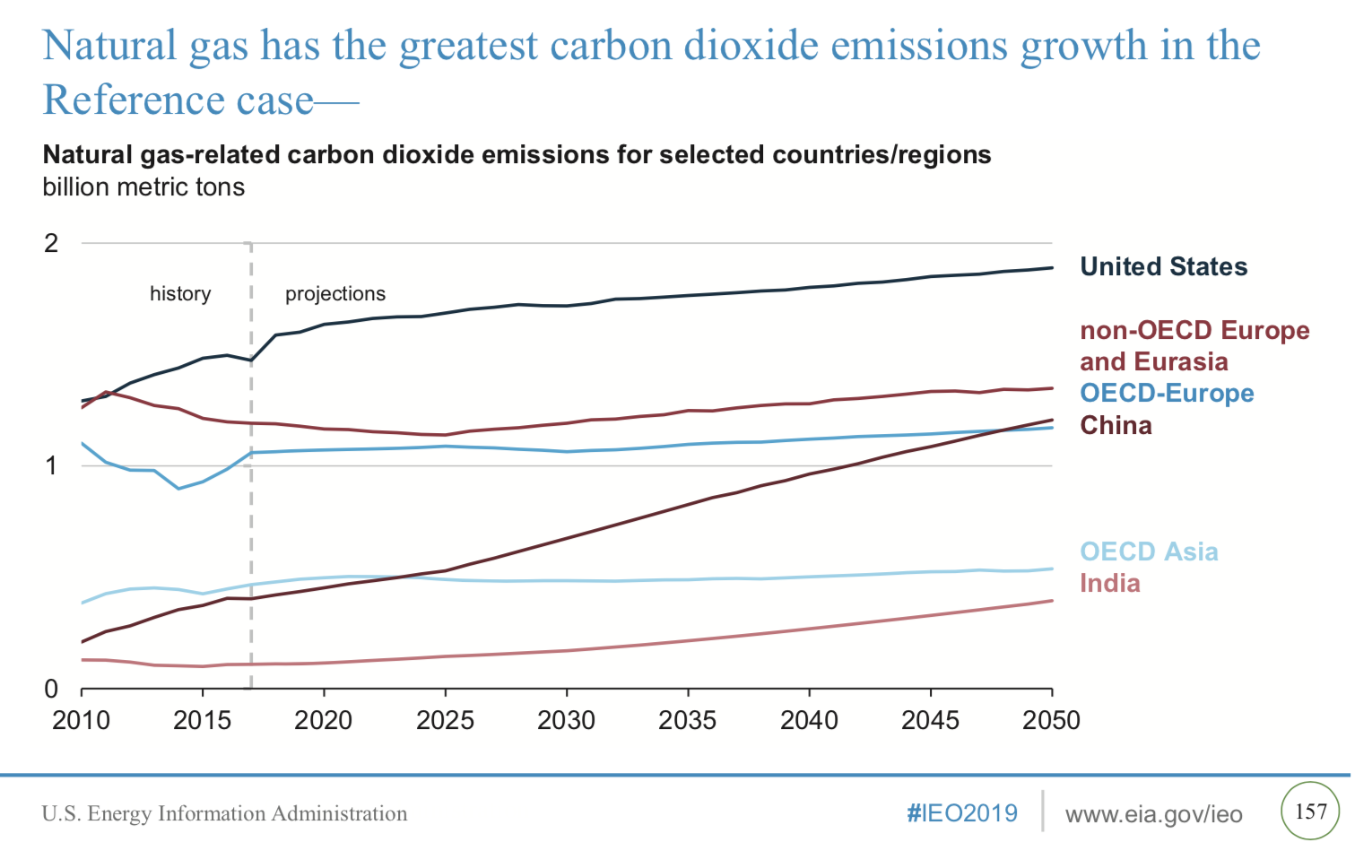
A reference case scenario in the 2019 Annual Energy Outlook forecasts considerable growth in carbon dioxide emissions in the U.S., and globally, from natural gas. Credit: :{U.S.:(style="box-sizing:border-box"):}: Energy Information Administration
About That Methane…
All of this so far is only focused on carbon dioxide emissions, but when discussing emissions and natural gas, you can’t leave out methane, a potent but short-lived greenhouse gas that is the primary constituent of natural gas. (Methane is also emitted by other sources, such as wetlands, landfills, and livestock.)
In one of the new API ads, viewers are presented with the claim that the largest producing oil and gas regions have seen a “60 percent reduction in emissions,” a point prominently flashed across the screen[pix]
from an ]
At first glance, that seems like a great accomplishment, but a close listen to the video’s narrator (and a close reading of the :{API:(style="box-sizing:border-box"):}: website) reveals the industry has reduced emission rates, not overall emissions, by 60 percent in the most productive oil and gas fields. That means greenhouse gas emissions are not increasing in these regions as fast as they once were, but that doesn’t mean they are going down.
However, methane emissions, both in the U.S. and globally, have surged in the past decade, and a 2019 Cornell University study points to fracked shale oil and gas production as a major culprit. Considering how much more powerful methane is at warming the climate compared to CO2 in the short term, these claims by API are misleading at best.
The Trump administration has proposed rolling back a regulation addressing methane leaks from oil and gas production, a move broadly opposed by large oil and gas companies like Exxon and BP but welcomed by API and the smaller firms it also represents.
Erik Milito, a vice president at API, voiced his support for replacing the methane rule with a looser one, telling the New York Times, “We think it’s a smarter way of targeting methane emissions.”
Meanwhile, global methane emissionscontinue to rise.
Flaring and Venting
As DeSmog has reported, the flaring and venting, or burning and direct release, of natural gas as part of the U.S. fracking industry is largely unregulated. These common oil and gas field activities are contributing to increasing carbon dioxide and methane emissions in states like North Dakota and Texas.
In Texas, the industry, while drilling for oil, is flaring enough natural gas to power the entire state, but because the gas is just being burned out in the oil fields, it’s not actually powering anything.
“It’s a black eye for the Permian basin,” Pioneer Natural Resources CEO Scott Sheffield said at an energy conference at Columbia University this spring. “The state, the pipeline companies, and the producers — we all need to come together to figure out a way to stop the flaring." [twt]
one way to stop flaring would be federal or state rules banning or limiting the practice, coupled with strong oversight from regulators. But in industry-friendly states like Texas and North Dakota, regulators have failed to enforce any real restrictions on flaring, and so the problem continues to grow.
The fracking industry has been losing money for more than a decade, which means shale oil firms are eager to keep costs low in an already expensive business. Flaring and venting natural gas, which is in oversupply and fetching low prices, saves these firms money when the alternative is building pricey pipelines and processing plants to otherwise deal with it. Ethan H. Bellamy, senior research analyst at Baird Equity Research, summed up the situation: “The business and regulatory question is what to waste, money or molecules?”
As always, the question comes back to profits. And the industry’s answer to that question is to “waste” molecules of natural gas by flaring or venting because this practice allows fracking firms to lose less money than they otherwise would, while still paying executive salaries and bonuses.
Even the International Energy Agency (:{IEA:(style="box-sizing:border-box"):}:) realizes this problem with natural gas.
IEA executive director Fatih Birol recentlytold :{CNBC:(style="box-sizing:border-box"):}:, “When you look at the future, the Achilles heel of the gas industry is the methane emissions.”
Despite the American Petroleum Institute’s new advertising claims, shifting power sources to natural gas won’t stave off the climate crisis.
But as viewers of API‘s new ad, “Together, We’re On It,” will note, the industry is starting to acknowledge public unrest over these issues.Framing it as “the energy debate,” the ad shows a young man sitting in a diner, watching a video of protesters on his laptop as a similar protest — perhaps the hoards of climate strikers who were slated to take the streets in September — marches by, reflected in the window.
Meanwhile, a sympathetic female narrator attempts to soothe this unrest, saying, “The energy debate, the pundits, the chatter, it’s constant. It can feel overwhelming,” before pivoting to a talking point about “the millions of problem solvers working in natural gas." [vid]
is the Gas Boom Already Over?
The oil and gas industry has been shifting its :{PR:(style="box-sizing:border-box"):}: narrative in recent years, with some like API trying to convince the world that natural gas is a climate solution, as companies move to lock in future demand by rapidly building new gas pipelines, power plants, and other infrastructure.
That’s despite reports like those from the nonpartisan but pro-clean energy nonprofit the Rocky Mountain Institute, which recently forecast that up to 90 percent of natural gas power plants (and many pipelines)may be more expensive to run than renewables by 2035. Reports like these show natural gas is a bad investment for both economics and a livable climate.
Along those lines, a recent headline from oil and energy news site Oilprice.com should concern natural gas investors, asking, “Is The :{U.S.:(style="box-sizing:border-box"):}: Gas Boom Already Over?”
The U.S. natural gas industry, whose growth largely has been driven by advances in fracking and drilling technology, has been plagued by losses, and investors are apparently getting tired of loaning money to companies that make it disappear.
Had an interesting lunch with @brucenilles today and heard about how the decline of natural gas, just like the decline of coal, is going to happen faster than people expect & catch industry flat-footed.
— David Roberts (@drvox) October 9, 2019
It isn’t hard to understand why API is now marketing natural gas using language about emissions reductions and energy demand. Rising pressure is coming from a public concerned about the climate crisis and from the increasingly cost-competitive renewables and storage industry.
An excellent example of this economic pressure came earlier this month. A northwest power company owned by billionaire Warren Buffet’s investment firm Berkshire Hathaway — which has no problem investing heavily in oil and gas — recently announced plans to shut down most of its coal plants serving Washington, Oregon, Wyoming, and Utah, and replace them with renewables and battery storage by 2038. That’s despite the abundance of very cheap natural gas in the U.S.
API knows the industry is feeling the heat, and it looks to be employing the same misinformation playbook that it used to sow doubt about the well-supported science of climate change and the resulting action the science demands.
https://www.desmog.com/2021/07/09/exxon-tapes-american-petroleum-institutes-lobbying-oil-trains/
no lnx see bomb trains
Senior ExxonMobil lobbyists were recently exposed by undercover reporting from UnEarthed, an investigative journalism project of Greenpeace, which captured footage of the employees explaining how the oil giant influences policy makers using trade associations like the American Petroleum Institute (API).
The undercover footage revealed Exxon lobbyists boasting about wins for the company under the Trump administration and admitting to continued efforts to sow doubt about climate change and undermine action to tackle the crisis.
The recordings also confirmed the findings of years of DeSmog research on API’s lobbying tactics. “Did we aggressively fight against some of the science? Yes. Did we hide our science? Absolutely not,” Keith McCoy, a senior director in ExxonMobil’s Washington, D.C. government affairs team, told the undercover reporter Lawrence Carter. “Did we join some of these ‘shadow groups’ to work against some of the early efforts? Yes, that’s true. But there’s nothing illegal about that. You know, we were looking out for our investments; we were looking out for our shareholders.”
These revelations exposed by UnEarthed and first published by Channel 4 News help shed light on API’s lobbying strategies, particularly when it comes to transporting oil by rail. The rise of fracking in 2009 created a transportation problem in U.S. regions like North Dakota’s Bakken Shale, which lacked sufficient pipelines and other infrastructure to move the sudden glut of oil. In response, the oil industry started ramping up transport of its products by train around 2012, but several high-profile fires and explosions of these oil trains also followed, starting in July 2013.
DeSmog’s coverage of the years-long process of creating new oil train regulations in the wake of 2013’s deadly Lac-Mégantic, Quebec, oil train disaster documented the tactics described by Exxon lobbyist Keith McCoy — and revealed just how effective the company is at watering down efforts by regulatory agencies to protect the public and environment. [twt pix]
after years of covering the regulatory process governing oil trains, one fact stood out: API was almost always leading the process.Even though the process was supposed to be about improving rail safety, the oil industry played the dominant role. Exxon representatives were rarely seen in the many public Congressional or regulatory agency hearings and did not take a public role in fighting the regulations. However, as DeSmog reported, Exxon was meeting in private with federal regulators and arguing against stronger regulations on oil trains.
Much of my book Bomb Trains: How Industry Greed and Regulatory Failure Put the Public at Risk highlights how API successfully uses “The Hill” — i.e. Congress — to stop regulation and describes the central role the organization plays, as noted in this passage in which National Transportation Safety Board Chair Deborah Hersman asks API representative Lee Johnson when safer rail tank cars could be expected:
In Congressional hearings, at rail industry conferences, and in funding supposedly independent studies of the issue, it was always API dictating what happened on “The Hill.”
As revealed by UnEarthed, Exxon lobbyist McCoy spelled out how it works in the recently released recordings:
“So you start to build out a coalition of associations. Now, companies feed into that privately where we have meetings, but the public face of it are the associations: they go to the Hill, they have these conversations.”
Exxon was rarely mentioned in the oil-by-rail regulatory process even though API was omnipresent. However, as McCoy noted, Exxon is directing API. On the tapes, he described how it worked, saying, “And so the API staff person who worked on that issue, We’d say, you know, ‘Hey Tom, you need to go to The Hill and you need to have a conversation with the committee.’”
This is similar to what Scott Sheffield, CEO of U.S. oil company Pioneer Resources, said in 2020 when he told CNBC that it was Exxon leading discussions on a possible industry bailout and that Exxon “controls the API.”
Exxon’s Slide from a 2014 presentation to the Office of Information and Regulatory Affairs Arguing Against Thicker Tank Shells for Oil Tank Cars
On the tapes released by UnEarthed, McCoy also mentioned another tactic, in this instance regarding the “forever chemicals” PFAS, that trade groups like API also employed to fight oil-by-rail safety regulations and even have repealed the regulations that the Department of Transportation approved in 2015. As UnEarthed reported:
“McCoy claimed that an Exxon-instigated advocacy push had delayed tighter regulations on PFAS by successfully lobbying for a government study of the chemicals.”
These studies are often commissioned by Congress, take years to complete, and then often are used to prevent or repeal regulations.
The reason oil-by-rail needed new regulations is because oil trains kept blowing up when they derailed — with five oil train derailments resulting in large fires by the time API representative Lee Johnson began downplaying the risks of these trains in the 2014 hearings on new regulations In the idyllic town of Lac-Mégantic, that disaster resulted in the death of 47 people. Those people died because the Bakken oil being transported by rail is highly volatile and flammable. The science is very clear on this.
This week was the 8th anniversary of the Lac-Mégantic disaster. Yet today, that highly volatile and flammable oil is still being moved by rail, in part because API fought regulations and won. How? By pushing for more studies of the issue as a delay tactic.
A year after the 2013 accident, oil industry associations funded two studies which were held up as evidence by API CEO Jack Gerard that the volatile Bakken oil shouldn’t be regulated to reduce the risk of explosions and fires in derailments.
“It is essential to separate fact from fiction as we work to enhance the safe transportation of crude oil,” API CEO Jack Gerard said in 2014, “Multiple studies have now debunked the idea that Bakken crude is meaningfully different than other crudes.”
This statement has no basis in science. But it worked to stop proposed regulation and it was helped by a study requested by Congress that was released in mid-2105. The study was immediately touted by API as more proof that Bakken oil should not be regulated.
The API press release at the time stated: “The Department of Energy found no data showing correlation between crude oil properties and the likelihood or severity of a fire caused by a derailment.”
This video shows two members of Congress reading prepared statements in a hearing that used API’s language about that study’s conclusion, word for word [vid hardy]
it should be no surprise that these tactics, first employed by the tobacco industry, were also adopted by other lobbyists, including oil and rail industry lobbyists.
As DeSmog reported, in 2017 the rail industry was able to get regulations requiring modern braking systems for trains repealed based on another congressionally requested study. This government-funded study, however, did not accurately reflect the science on the issue. In this case, the rail industry had even touted the known science for years before reversing course and insisting to the public and lawmakers that it was not valid.
In 2016, Suzanne Lemieux, a representative of the American Petroleum Institute, spoke at an energy-by-rail conference. She argued against the idea that the volatile oil being transported by rail needed to be regulated in a presentation titled, “Crude Oil Volatility: Myth vs. Fact.”
Her message was quite clear.
“I would say that all of these conversations about [how] Bakken is inherently more dangerous, it’s more volatile, etcetera, etcetera, those things from a chemical properties perspective just aren’t true. And so we in the oil and gas industry see this as a very dangerous conversation.”
Forty seven people died because of the oil industry’s dangerous product. However, API took the position that even discussing how to avoid a repeat of the oil train explosion at Lac-Megantic was too dangerous of a conversation to have.
And it worked.
DeSmog contacted Exxon and the American Petroleum Institute inquiring if the two coordinated efforts to influence oil-by-rail regulations.
“As a member-driven organization, we collaborate across our membership on a wide range of policy issues, from advancing smart and effective regulations and strong standards for rail safety to advocating for lower-carbon solutions to tackle climate change,” said API spokeswoman Bethany Aronhalt via email. “We also continue to advocate for modernized pipeline infrastructure, which is the safest most efficient way to deliver the energy Americans rely on every single day.”
Exxon did not respond other than to ask for specific questions, which were provided, but not answered.
For much greater detail on how the oil-by-rail regulatory process unfolded, read Chapter 4, “Follow the Money,” of my book Bomb Trains, which dives into API’s role in the process. https://www.desmog.com/wp-content/uploads/2021/07/Chapter-4-Follow-The-Money.pdf
https:/**/influencemap.org/**influencer/American-Petroleum-Institute-API
sum:
Climate Lobbying Overview: The American Petroleum Institute appears to be broadly hostile to progressive climate policy. It does not seem to fully support the need to drastically cut emissions to limit global temperature increase to below 2C and seems to have pushed a deregulatory agenda over ambitious climate action. It does not seem to support the transition of the energy mix, emphasizing the importance of oil and gas to the American economy and opposing measures to limit fossil fuel development. Furthermore, it also appears to not support several other policies intended to cut emissions such as renewable fuel standards and carbon taxation.
Top-line Messaging on Climate Policy: The American Petroleum Institute appears to be broadly unsupportive of progressive climate policy in its top-line messaging. Although in various comments throughout 2020, it has indicated general support for unspecified levels of emissions reductions to respond to climate change, this does not appear to be aligned with IPCC advice. For example, in July 2020, it appeared to question the feasibility of reaching net-zero emissions, following statements in December 2019 that the technology “does not yet exist” to limit temperature rise to well below 2°C.
It appears to emphasize that climate policies should not compromise economic growth, as well as appearingto prioritize market-based mechanisms over other kinds of policy. In March 2021, it was reported that the API would change its position and start to support carbon pricingas the "primary government climate policy instrument to reduce CO2 emissions", while still appearing to not support other "prescriptive regulatory action".
Comments from CEO Mike Sommers in December 2020 also appear to suggest that government regulation to respond to climate change is unnecessary. In his keynote speech for the API's annual State of American Energy report in 2021, Sommers said 'Mandates get us nowhere', and that the surest way to bring recovery to a stop following COVID-19 was with 'more regulations, more taxes, more restrictions on access' to federal lands and waters for oil and gas development.
The American Petroleum Institute has not taken a formal position on theParis Agreement but in December 2019 stated it supported the “ambition” of the agreement. This position was repeated in its 2021 State of American Energy report, however, in the same report, API called the goals of the Paris Agreement ‘aggressive’ and seemed to be ambiguous as to whether the U.S. should participate in meeting the goals.
Engagement with Climate-Related Regulations: The American Petroleum Institute appears to be highly opposed to specific climate-related regulations and since the 2016 US election, the group seems to have promoted a deregulatory agenda in the country over ambitious policy to respond to climate change. API has continued to promote this deregulatory agenda in 2020 in response to the COVID-19 crisis, advocating President Trump waive testing and reporting requirements for a range of policies, including those relevant for GHG emissions.
The API has also continued to oppose specific policies intended to cut emissions. In October 2020, it stated it would oppose any carbon tax that would increase the price of US oil and gas exports, following comments from February 2019 submitted to the Pennsylvania House Environmental Resources and Energy Committee that “New and increased taxes… can only slow growth and investment.”In March 2021, the API announced an apparent change in its position to support carbon pricing, but still stopped short of explicitly endorsing a carbon tax. In addition, the API has heavily criticized the Renewable Fuels Standard, tweeting in April 2020 that “it is time to get rid of this broken mandate”. Furthermore, in November 2019, the API directly advocated against the EPA’s proposed increases in biofuel blending requirements under the Renewable Energy Standard. API has again called for the repeal of the RFS in January 2021.[ETHANOL?]
Until January 2021, the API appeared to strongly oppose regulation of methane emissions, supporting the EPA rollback of methane regulations in August 2020, reportedly **having previously met with White House and EPA staff in an attempt to loosen these regulations**.In addition, in the first quarter of 2020, API appears to have **opposed**more ambitious oil well bonding legislation that would require industry to commit more money to fix methane leaks from abandoned wells.
In January 2021, however, the API appears to have reversedits position on the federal and direct regulation of methane and has now stated it supports such a policy. This follows Total S.A revoking its membership to API after the industry association's State of American Energy address. In its communications on methane regulation, API has stated it would support 'sensible' and 'workable' regulations. It remains unclear at this point what API deems sensible and workable with regard to methane regulation. In May 2021, the API appeared to not fully support an ambitious implementation of methane regulation under the PIPES Act, stating in a submission to that "stringent regulatory mandates... must consider the cost to ratepayers and the ability of utilities to effectively comply". In September 2021, the API coordinated with other oil and gas industry groups to send a joint letter to the Committee on Environment and Public Works opposing the Methane Emissions Reduction Act of 2021, which would introduce a tax on methane emissions from oil and gas operations.
Positioning on Energy Transition:API does not appear to support the transition of the energy mix.In its public messaging, it has repeatedly stressed the importance of oil and gas to the US economy and US national security and in June 2019 argued that oil and gas “will supply more than half of America’s energy needs for decades to come”.[ROWE]
API’s preferred method of reducing emissions appears to becoal-to-natural-gas switching, which it also claimsis essential to support renewable energy expansion. However, it shows mixed support for government measures to actually phase coal out of the energy mix. In August 2019, it appeared to oppose government intervention to prohibit new or expanded coal mines, but in May 2019, it opposed legislation in Ohio that would introduce subsidies for coal power plants and in July 2018, it appeared to oppose federal plans to bailout uneconomic coal plants.
It appears to have lobbied heavily in favor of measures that will help maintain a high GHG energy mix, for example in November 2020, supporting the removal of restrictions on oil and gas production in theArctic National Wildlife Refuge, as well as suggesting punitive measures, such as preventing access to Covid-19 relief funding, for banks that have chosen not to fund Arctic-drilling projects.
API appears to oppose government interventionthat will limit fossil fuel development. For example, in September 2020, API opposed an expanded moratorium on offshore oil and gas development off the coast of Florida and in November 2020, CEO Mike Sommers stated that API would use ‘“every tool at its disposal” including legal action’ to block a proposed ban on fracking on federal land and water.
Furthermore, statements from August 2020 suggest API appears to support continued subsidies for the fossil fuel industry, arguing these are “tax loopholes and deductions available to all industries”. These positions have been repeated in its 2021 State of American Energy Report, in which API argues against a ban on fracking, opposing restrictions on federal waters and land for oil and gas production, the weakening of the National Environmental Policy Act and renewalof the Nationwide Permit 12 program– both of which serve to make permitting approval processes for oil and gas infrastructure quicker and easier.
In addition, API does not appear to support the electrification of transport. In the first half of 2020, API launched the Transportation Fairness Alliance, a coalition described by Desmog as intended “to counter policies designed to accelerate the transition away from petroleum-powered transportation”. API appears to have opposed several specific policies to encourage the electrification of transport in 2020, including the rebate for drivers who trade in ICE vehicles for EVs as well as financial incentives for electric vehicles. In its 2021 State of American Energy report, API again opposed policies designed to incentivize the uptake of electric vehicles, arguing that subsidies, credits and sales mandates, that favor electric vehicles, like those in California, would ‘hinder America’s progress’.
----
InfluenceMap
Score F
Performance Band
:{
}:
24%
Organisation Score
47% Scores under 50 indicate increasingly significant misalignment between the Paris Agreement and the detailed climate policy engagement of the company’s industry associations,
Engagement Intensity 47%?
----
The InfluenceMap Scoring System
InfluenceMap maintains a global system for tracking, assessing and scoring companies on their engagement with climate change policy against Paris-aligned benchmarks, currently covering around 300 companies along with 150 of their key industry associations. Full details of our methodology can be found here.
:{
}:
How do you define policy engagement? InfluenceMap defines "policy engagement" based on the UN Guide for Responsible Corporate Engagement in Climate Policy (2013), which defines a range of corporate activities as engagement, such as advertising, social media, public relations, and direct contact with regulators and elected officials.
:{
}:
How do you define climate policy? InfluenceMap’s system considers existing, evolving, and likely future climate-related policy measures proposed by mandated bodies. “Mandated bodies” are defined here as various levels of government or government-authorized bodies responsible for or supporting efforts to implement Nationally Determined Contributions (NDCs) in their regions. InfluenceMap’s system also captures high-level corporate communications that influence the broader public narrative concerning these policies (e.g. concerning the role of different low-carbon technologies).
:{
}:
How do you collect evidence? Each entity’s engagement activities on climate-related policy are assessed using publicly accessible data sources to gather reliable and representative evidence. These data sources include organizational website disclosures and social media channels, top management statements, financial disclosures and investor communications, regulatory consultation comments, and reliable media reporting.
:{
}:
How do you assess evidence? This research process can collect hundreds of items of evidence pertaining to an entity’s engagement with climate-related policy. This evidence is analyzed against Paris Agreement-aligned Governmental Policy and Science-Based Policy benchmarks (drawn from IPCC analysis of achieving 1.5°C aligned emission reductions) to provide a robust assessment of whether an entity’s climate policy engagement activities are aligned with the Paris Agreement’s goals.
:{
}:
How is the overall assessment calculated? Metrics describing each entity’s overall climate policy engagement - direct and indirect - are produced by InfluenceMap’s proprietary platform, with weightings to adjust for factors such as time (e.g. with more recent evidence heavily weighted in the final scores). InfluenceMap's system is updated continuously as new information becomes available. The results are freely available and in the public domain, along with all the primary evidence used in the analysis. InfluenceMap's metrics are explained below:
:{
}:
Organisation Score
Organisation Score (expressed as a percentage from 0 to 100) is a measure of how supportive or obstructive the company’s direct engagement is towards climate policy aligned with the Paris Agreement, with 0 being fully opposed and 100 being fully supportive.
:{
}:
Scores below 50 indicate increasingly significant misalignment between the Paris Agreementand the company’s detailed climate policy engagement, with scores below 25 indicating material and significant opposition. Scores between 50 and 75 indicate mixed engagement with Paris-aligned policy. Scores above 75 indicate broad alignment with, and support for, Paris-aligned policy. If limited evidence has been collected on a company's direct policy engagement, the Organisation Score is signified with an ‘n/a’ (not available).
:{
}:
Relationship Score
Relationship Score (expressed as a percentage score from 0 to 100) is a measure of how supportive or obstructive the company’s industry associations are towards climate policy aligned with the Paris Agreement, with 0 being fully opposed and 100 being fully supportive.
:{
}:
The Relationship Score is an aggregate assessment of the climate policy engagement of a company’s industry associations and measures the extent to which this is in line with the goals of the Paris Agreement. This calculation accommodates an assessment of the strength of the relationship between a company and an industry association, for example a stronger weighting will be attributed where a company has a representative on the board of an industry association.
:{
}:
Scores under 50 indicate increasingly significant misalignment between the Paris Agreement and the detailed climate policy engagement of the company’s industry associations, with scores below 25 indicating material and significant opposition. Scores between 50 and 74 indicate mixed engagement with Paris-aligned policy. Scores above 75 indicate broad alignment with, and support for, Paris-aligned policy by the company’s industry associations. If limited evidence has been collected on a company's industry association links, the Relationship Score is signified with an ‘n/a’ (not available).
:{
}:
Performance Band
Performance Band (A+ to F) is a full measure of a company’s climate policy engagement, accounting for both its own engagement and that of its industry associations. For companies, the ‘Organisation Score’ and ‘Relationship Score’ are combined to result in a total score that places the company in a Performance Band. Industry associations do not have a ‘Relationship Score’, so the Performance Band for industry associations is made up of only the ‘Organisation Score’.
:{
}:
There are 16 Performance Bands from A+ (representing a total score from 95-100%) through to E- (a score of 25-30%), with scores below 25% falling in the red "F" band. Grades from A+ to B (i.e. above 75%) indicate broad support for Paris-aligned climate policy, with grades from D to F (i.e. below 50%) indicating increasingly obstructive climate policy engagement. If limited evidence has been collected either on a company's direct policy engagement (Organisation Score) or industry association links (Relationship Score), the Performance Band is signified with an 'n/a' (not available).
:{
}:
Engagement Intensity
Engagement Intensity (expressed as a percentage score from 0 to 100) is a measure of the level of policy engagement by the company, whether positive or negative. Scores above 12 indicate active engagement with climate policy, and scores above 25 indicate highly active or strategic engagement with climate policy. Scores below 5 indicate low-level engagement with climate policy. Entities with scores below 5 are not attributed a Performance Band.
---
QUERIES
DATA SOURCES
Main Web Site
:{
}:
Social Media
:{
}:
CDP Responses
:{
}:
Legislative Consultations
:{
}:
Media Reports
:{
}:
CEO Messaging
:{
}:
Financial Disclosures
:{
}:
Communication of Climate Science
:{
}:
0 NS NA -2 -1 NS NA
Alignment with IPCC on Climate Action
:{
}:
-1 -1 NA 0 -1 -1 NA
Supporting the Need for Regulations
:{
}:
-1 0 NA -1 0 0 NA
Support of UN Climate Process
:{
}:
0 0 NA NS 0 0 NA
Transparency on Legislation
:{
}:
-1 NA NA NA NA NA NA
Carbon Tax
:{
}:
NS -2 NA -2 -1 -1 NA
Emissions Trading
:{
}:
NS -1 NA NS NS -1 NA
Energy and Resource Efficiency
:{
}:
NS NS NA NS -2 NS NA
Renewable Energy
:{
}:
-2 -2 NA -2 -2 -2 NA
Energy Transition & Zero Carbon Technologies
:{
}:
-1 -1 NA -1 -2 -1 NA
GHG Emission Regulation
:{
}:
0 -1 NA -1 -1 0 NA
Disclosure on Relationships
:{
}:
0 NS NA NA NA NA NA
https://littlesis.org/org/40360-American_Petroleum_Institute
relationships:
Leadership & Staff
Showing 1-10 of 162 :: see all
William A Koetzle Vice President of Federal Affairs, API; former Manager of Federal Government Affairs, Chevron
• Vice President of Federal Affairs (Sep '18→?)
Tracee Bentley Colorado Petroleum Council, API
• Director, Colorado Petroleum Council (Mar 1 '15→?)entity-page#toggleRelationship" style="box-sizing: border-box; margin-left: 10px; cursor: pointer;">
Louis Finkel Vice president at prominent oil lobby American Petroleum Institute
• Executive Vice President for Government Relations (Apr 1 '14→?)entity-page#toggleRelationship" style="box-sizing: border-box; margin-left: 10px; cursor: pointer;">
Tara Smith Anderson Director, External Mobilization, API
• director, external mobilization (Apr '11→?)entity-page#toggleRelationship" style="box-sizing: border-box; margin-left: 10px; cursor: pointer;">
Deryck Spooner API
• Senior Director for External Mobilization (Mar 1 '10→?)entity-page#toggleRelationship" style="box-sizing: border-box; margin-left: 10px; cursor: pointer;">
Jack Gerard Big Oil lobbyist
John E Robertson VP and CFO, American Petroleum Institute
• Vice President and CFO (Sep '07→?)entity-page#toggleRelationship" style="box-sizing: border-box; margin-left: 10px; cursor: pointer;">
Khary Cauthen Lobbyist, Ex-Bush Administration official
• Washington, DC Representative, Lobbyist ('06→?)entity-page#toggleRelationship" style="box-sizing: border-box; margin-left: 10px; cursor: pointer;">
Darren W Woods CEO and chairman ExxonMobil (2017-present)
• Chairman*entity-page#toggleRelationship" style="box-sizing: border-box; margin-left: 10px; cursor: pointer;">
Kyle Isakower Board Member for the American Petroleum Institute
• Board Memberentity-page#toggleRelationship" style="box-sizing: border-box; margin-left: 10px; cursor: pointer;">
Owners
Keystone Energy Forum Natural Gas Industry Front Group
• Ownerentity-page#toggleRelationship" style="box-sizing: border-box; margin-left: 10px; cursor: pointer;">
Child Organizations
Associated Petroleum Industries of Pennsylvania State office of American Petroleum Institute
• Child Orgentity-page#toggleRelationship" style="box-sizing: border-box; margin-left: 10px; cursor: pointer;">
American Petroleum Institute Political Action Committee (Api PAC)
Members
Showing 1-10 of 12 :: see all
ExxonMobil Oil and gas exploration, production, and marketing
• memberentity-page#toggleRelationship" style="box-sizing: border-box; margin-left: 10px; cursor: pointer;">
A R Tony Sanchez Jr Sanchez Oil & Gas Corporation
• Memberentity-page#toggleRelationship" style="box-sizing: border-box; margin-left: 10px; cursor: pointer;">
Philip J Carroll Former President & CEO, Shell Oil Company
• honorary life memberentity-page#toggleRelationship" style="box-sizing: border-box; margin-left: 10px; cursor: pointer;">
TransCanada PipeLines Limited Energy infrastructure company in North America
• Memberentity-page#toggleRelationship" style="box-sizing: border-box; margin-left: 10px; cursor: pointer;">
Fluor Corporation Engineering, procurement, construction, and maintenance services
• Memberentity-page#toggleRelationship" style="box-sizing: border-box; margin-left: 10px; cursor: pointer;">
• Memberentity-page#toggleRelationship" style="box-sizing: border-box; margin-left: 10px; cursor: pointer;">
• Memberentity-page#toggleRelationship" style="box-sizing: border-box; margin-left: 10px; cursor: pointer;">
Anadarko Petroleum Corporation Independent oil and gas producer
• Memberentity-page#toggleRelationship" style="box-sizing: border-box; margin-left: 10px; cursor: pointer;">
• Memberentity-page#toggleRelationship" style="box-sizing: border-box; margin-left: 10px; cursor: pointer;">
Transportation Fairness Alliance Pro-oil/gas, anti-EV coalition
• Memberentity-page#toggleRelationship" style="box-sizing: border-box; margin-left: 10px; cursor: pointer;">
Memberships
Showing 1-10 of 12 :: see all
BP plc Global energy company
• memberentity-page#toggleRelationship" style="box-sizing: border-box; margin-left: 10px; cursor: pointer;">
USMCA Coaliton Coalition that pushed for the passage of the USMCA
• Memberentity-page#toggleRelationship" style="box-sizing: border-box; margin-left: 10px; cursor: pointer;">
• Memberentity-page#toggleRelationship" style="box-sizing: border-box; margin-left: 10px; cursor: pointer;">
IPIECA The global oil and gas industry association for environmental and social issues
• memberentity-page#toggleRelationship" style="box-sizing: border-box; margin-left: 10px; cursor: pointer;">
The United States Conference of Mayors
• business council memberentity-page#toggleRelationship" style="box-sizing: border-box; margin-left: 10px; cursor: pointer;">
National Ocean Policy Coalition Pro-industry ocean group
• Memberentity-page#toggleRelationship" style="box-sizing: border-box; margin-left: 10px; cursor: pointer;">
Oil Sands Fact Check Petroleum industry group advocating oil sands production and Keystone XL
• Memberentity-page#toggleRelationship" style="box-sizing: border-box; margin-left: 10px; cursor: pointer;">
America's Wetland Foundation Louisiana oil front group
• National Sponsorentity-page#toggleRelationship" style="box-sizing: border-box; margin-left: 10px; cursor: pointer;">
Alliance for Energy and Economic Growth US Chamber/NAM global warming group
• Memberentity-page#toggleRelationship" style="box-sizing: border-box; margin-left: 10px; cursor: pointer;">
Association Committee of 100 C100 members recommend Chamber policy
• Memberentity-page#toggleRelationship" style="box-sizing: border-box; margin-left: 10px; cursor: pointer;">
Donation/Grant Recipients
Showing 1-10 of 65 :: see all
• Grant · 1,000,000 USD ('10)entity-page#toggleRelationship" style="box-sizing: border-box; margin-left: 10px; cursor: pointer;">
Oil and Natural Gas Industry Labor-Management Committee
• Grant · 220,000 USD ('10)entity-page#toggleRelationship" style="box-sizing: border-box; margin-left: 10px; cursor: pointer;">
STRONGER State Review of Oil and Natural Gas Environmental Regulations
• Grant · 200,000 USD ('10)entity-page#toggleRelationship" style="box-sizing: border-box; margin-left: 10px; cursor: pointer;">
University of California Davis
• Grant · 180,000 USD ('10)entity-page#toggleRelationship" style="box-sizing: border-box; margin-left: 10px; cursor: pointer;">
Congressional Hispanic Caucus Institute
• Grant · 125,000 USD ('10)entity-page#toggleRelationship" style="box-sizing: border-box; margin-left: 10px; cursor: pointer;">
Independent Petroleum Association of America Oil and gas trade group
• Grant · 100,000 USD ('10)entity-page#toggleRelationship" style="box-sizing: border-box; margin-left: 10px; cursor: pointer;">
Montana Department of Environmental Quality
• Grant · 66,642 USD ('10)entity-page#toggleRelationship" style="box-sizing: border-box; margin-left: 10px; cursor: pointer;">
• Grant · 50,000 USD ('10)entity-page#toggleRelationship" style="box-sizing: border-box; margin-left: 10px; cursor: pointer;">
Americans for Tax Reform Grover Norquist anti-tax group
• Grant · 50,000 USD ('10)entity-page#toggleRelationship" style="box-sizing: border-box; margin-left: 10px; cursor: pointer;">
National Fish and Wildlife Foundation The National Fish and Wildlife Foundation (NFWF) is a 501(c)(3) non-profit that preserves and restores our nation’s native wildlife species and habitats.
• Grant · 50,000 USD ('10)entity-page#toggleRelationship" style="box-sizing: border-box; margin-left: 10px; cursor: pointer;">
Services/Transactions
Showing 1-10 of 43 :: see all
Bolton-St. Johns Lobbying firm
• Lobbying Firm · 26,600 USD (Nov '13→?)entity-page#toggleRelationship" style="box-sizing: border-box; margin-left: 10px; cursor: pointer;">
Allison Lee Lobbyist, DKC
• lobbyist ('12→?)entity-page#toggleRelationship" style="box-sizing: border-box; margin-left: 10px; cursor: pointer;">
Paul Zuber Lobbyist, DKC
• lobbyist ('12→?)entity-page#toggleRelationship" style="box-sizing: border-box; margin-left: 10px; cursor: pointer;">
Andrew Marocco Lobbyist, DKC
• lobbyist ('12→?)entity-page#toggleRelationship" style="box-sizing: border-box; margin-left: 10px; cursor: pointer;">
Michelle Tuchman Lobbyist, DKC
• lobbyist ('12→?)entity-page#toggleRelationship" style="box-sizing: border-box; margin-left: 10px; cursor: pointer;">
Mike O'Leary DKC
• lobbyist ('12→?)entity-page#toggleRelationship" style="box-sizing: border-box; margin-left: 10px; cursor: pointer;">
Daniel Cain Lobbyist, DKC
• lobbyist ('12→?)entity-page#toggleRelationship" style="box-sizing: border-box; margin-left: 10px; cursor: pointer;">
Mercury Public Affairs LLC public relations firm
• media advisor ('12→?)entity-page#toggleRelationship" style="box-sizing: border-box; margin-left: 10px; cursor: pointer;">
DKC Dan Klores Communications PR and government realtions firm
• lobbying firm ('12→?)*entity-page#toggleRelationship" style="box-sizing: border-box; margin-left: 10px; cursor: pointer;">
Battelle Memorial Institute The world’s largest independent research and development organization
• contracted research firm ('12→?)entity-page#toggleRelationship" style="box-sizing: border-box; margin-left: 10px; cursor: pointer;">
Other Affiliations
interlocks eg many pages:
donor to (many pages)
People Have Given To
People with positions in American Petroleum Institute have made donations to
'No shame': how the Trump administration granted big oil's ...https://www.theguardian.com › us-news › dec › big-oil-...
Dec 12, 2017 — The EPA has fulfilled almost all major demands made by the American Petroleum ... On March 22, Pruitt met with API executives at the Trump ...
Missing: zinke | Must include: zinke
guk no lnx
https://yyy.theguardian.com/us-news/2017/dec/12/big-oil-lobby-get-what-it-wants-epa-trump-pruitt
This article is more than 3 years old
'No shame': how the Trump administration granted big oil's wishlist
This article is more than 3 years old
The EPA has fulfilled almost all major demands made by the American Petroleum Institute within its first year under Trump
Demonstrators in California protest against Donald Trump’s executive order fast-tracking the Keystone XL and Dakota Access oil pipelines. ]
Tue 12 Dec 2017
The Trump administration’s zeal for environmental rollbacks has enabled it to fulfill almost all of the top priorities in a “wishlist” drawn up by the American Petroleum Institute (API), the leading lobby group for US oil and gas companies.
[API White house
How big oil is tightening its grip on Donald Trump's White House
Read more]
In a document called “comments on specific regulations” sent to the Environmental Protection Agency (EPA) in May, API highlighted eight key changes it wanted to ease the regulation of air and water pollution. An analysis shows that theEPA has now so far either partially or wholly delivered on six out of these eight key demands within the first year of the Trump administration,which solicited input on government rules from a number of trade groups.
This comes as the Guardian and the Center for Public Integrity publish an investigation into the way the oil lobby has worked for decades to influence US government policy – and is tightening its hold.
Earlier this year a letter penned by Howard Feldman, senior director of regulatory affairs at API, accompanied the lobby group’s wish list for government, and it stated that fossil fuel companies are thriving “despite the unprecedented level of federal regulatory actions targeting our industry”.
Timeline
Big oil and the US government]
Feldman called for the federal government to alter regulations in a way that “promotes access to domestic oil and natural gas resources, streamlined permitting and cost-effective regulations”.
The letter is addressed to Samantha Dravis, an EPA associate administratorwho previously held a senior role at the Republican Attorneys General Association and was counsel to Freedom Partners, one of the groups in the Koch brothers network.
Donald Trump displays one of five executive orders he signed related to the oil pipeline industry on 24 January 2017.]
The 25-page list of API’s suggested regulatory changes places particular emphasis on eight key demands that peel away standards primarily imposed under Barack Obama’s administration.The EPA’s administrator, Scott Pruitt, previously a harsh critic of the agency who has pledged to rein in its “out of control, anti-energy agenda”, has overseen the delay or repeal moves in line with six of API’s eight highest priorities.
“There’s no question that energy lobbyists are calling the shots in this administration, which has been all too willing to roll back public health protections,” said Jeremy Symons, vice-president of Environmental Defense Fund. “Anyone who doubts that can just look at their record.”
Pruitt and his team have made it clear that oil, gas and coal industries trump science
Liz Purchia Gannon, former EPA communications head]
:{
}:
On March 22, Pruitt met with API executives at the Trump International Hotel in Washington DC.Less than a month later, Pruitt wrote to Feldman, as well as three other oil and gas industry representatives, to tell them he was temporarily suspending regulations that curb leaks from drilling operations while the EPA reconsiders the rule.
In June, the EPA proposed a two-year pause to the rule, which was drawn up under the Obama administration in 2016 and aimed to reduce “fugitive” emissions such as methane, a potent greenhouse gas. In July, a federal court blocked the attempted suspension of the rule.
The EPA has fared better in fulfilling other top API priorities. In June, Pruitt signed a two-year delay to regulations designed to improve the safety of chemical facilities. API argued that the rule, which followed several disastrous incidents at chemical plants, would be burdensome and do little to improve safety.
API said the EPA “should reverse” a separate regulation requiring power plants to follow air pollution rules when they are starting up, shutting down or undergoing maintenance. Pruitt, who previously sued the EPA to halt the rule, is now reassessing it.
Implementation of new standards to reduce ozone, a pollutant that helps form smog, was delayed by a year at Pruitt’s behest in June, a month after the API called for the EPA to reconsider the rule. Several states and health groups have launched legal action against the EPA after it missed a deadline to designate which areas of the country are failing to meet the tightened standards on smog.
:{
}:
API also secured an early victory in February, when Donald Trump issued an executive order to scrap the “waters of the United States” rule, which was put in place under the Obama administration to protect streams and rivers that provide drinking water to around a third of Americans. The regulation has been opposed by some farmers and owners of golf courses and industrial plants as being too stringent.
[Donald Trump has ditched the world in favor of big oil's titans
Jill Abramson
Read more]
Several of API’s lower priority proposals have also been fulfilled, with Pruitt introducing new rules for members of the EPA’s scientific boardswhich open the way for more industry involvement and, separately, deciding to not introduce new financial responsibility requirements that API feared may have impacted the petroleum industry.
“Pruitt and his team have no shame,”said Liz Purchia Gannon, former head of communications at the EPA under the Obama administration. “They have made it clear from the start that oil, gas and coal industries trump science, the American people and public health and environmental organizations.
“What we can see from his schedule is an alarming pattern of meeting with special interest groups before making policy decisions favoring their bottom line at the expense of Americans’ health and the environment.”
When contacted for comment, the API said it was happy for its previous statements to speak for themselves. The EPA did not respond to a request for comment.
Inside Pruitt's calendar - POLITICO https://www.politico.com › newsletters › 2018/03/16 › i...
Mar 16, 2018 — INSIDE PRUITT'S CALENDAR: EPA Administrator Scott Pruitt met last year ... TRUMP MEETS WITH API, CEOs: The president's White House meeting ...
Recordings Show Oil Executives Love Having So Much ...https://www.rollingstone.com › politics › politics-news
Mar 23, 2019 — Last week we were talking to [EPA] Secretary [Scott] Pruitt, and in about two weeks we have a meeting with [Interior] Secretary Zinke.
Missing: api | Must include: api
Secretary Zinke Statement in Support of President Trump's ...https://www.doi.gov › pressreleases › secretary-zinke-st...
Mar 28, 2017 — Trump, Secretary of the Interior Ryan Zinke, Administrator of the Environmental Protection Agency (EPA) Scott Pruitt, and Secretary of Energy ...
Missing: api | Must include: api
Trump administration officials on energy and the environmenthttps://ballotpedia.org › Trump_administration_officials...
Trump administration officials on energy and the environment · Contents · Donald Trump · Mike Pence · Rex Tillerson · Scott Pruitt · Ryan Zinke · Rick Perry · Recent ...
Tate Bennett, First Interim Production, Sierra Club v. EPAhttps://www.epa.gov › sites › files › documents › t...PDF
Dec 21, 2018 — The Florida Petroleum Council is a division of API, ... Administrator Scott Pruitt on "President Trump's Deregulatory Agenda at EPA - Year 1.
222 pages
Methane Promises Are No Substitute for Rules | NRDChttps://www.nrdc.org › experts › briana-mordick › metha...
Dec 6, 2017 — And given that API is supporting the Trump administration's efforts to delay ... for example, providing EPA Administrator Scott Pruitt with ...
EPA Chief Scott Pruitt Encouraged Oil Executives To Apply ...https://www.buzzfeednews.com › article › zahrahirji › s...
Jun 25, 2018 — Although neither went to the EPA, the emails give yet another example of the Trump administration offering jobs to industry officials and ...
Missing: zinke | Must include: zinke
Oil and Gas Ties Run Deep in the Trump Administration https://psmag.com › Environment
Jan 5, 2018 — Zinke himself is something of a cheerleader for the oil and gas ... Environmental Protection Agency chief Scott Pruitt isn't much better.
Missing: api | Must include: api
Redefining EPA | Page 217 | InsideEPA.comhttps://insideepa.com › topics › redefining-epa
Continuing coverage of the Trump administration's environmental policy moves ... counsel who joins the agency from the American Petroleum Institute (API).
API ZINKE GGL 10 21
The Energy 202: Oil industry afraid about what Trump might ...https://www.washingtonpost.com › paloma › 2017/09/26
Sep 26, 2017 — API has another ask of Trump that will be harder for the president to fulfill: preserving a key investment-dispute provision of the North ...
Trump administration officials on energy and the environment https://ballotpedia.org › Trump_administration_officials...
During his first 100 days, President Donald Trump signed executive orders ... offshore oil and gas leasing plan for 2017-2022, Zinke said in April 2017, ...
How big oil is tightening its grip on Donald Trump's White Househttps://www.theguardian.com › environment › dec › bi...
Dec 12, 2017 — Under Donald Trump, the American Petroleum Industry smells victory on ... on proposed EPA regulations have been with API representatives ...
'No shame': how the Trump administration granted big oil's ...https://www.theguardian.com › us-news › dec › big-oil-...
Dec 12, 2017 — The EPA has fulfilled almost all major demands made by the American Petroleum Institute within its first year under Trump.
Secretary Zinke Statement in Support of President Trump's ...https://www.doi.gov › pressreleases › secretary-zinke-st...
Mar 28, 2017 — Trump, Secretary of the Interior Ryan Zinke, Administrator of the Environmental Protection Agency (EPA) Scott Pruitt, and Secretary of Energy ...
Missing: api | Must include: api
Inside Pruitt's calendar - POLITICO https://www.politico.com › newsletters › 2018/03/16 › i...
Mar 16, 2018 — INSIDE PRUITT'S CALENDAR: EPA Administrator Scott Pruitt met last year ... TRUMP MEETS WITH API, CEOs: The president's White House meeting ...
Letters or Comments - American Petroleum Institutehttps://www.api.org › news-policy-and-issues › letters-o...
See API letters and comments regarding government regulations and policies that ... and we share Interior Secretary Zinke's commitment to reducing waste and ...
Oil lobby met with interior secretary at Trump hotel - Latest ...https://money.cnn.com › 2017/06/06 › investing › oil-l...
Jun 6, 2017 — Interior Secretary Ryan Zinke addressed the American Petroleum Institute's (API) board of directors on that day at the Trump International ...
Missing: epa | Must include: epa
Oil industry group asks Trump administration to lessen ...https://thehill.com › policy › energy-environment › 48...
Mar 23, 2020 — Meanwhile, a letter from API's senior vice president of policy, economics and regulatory affairs, Frank Macchiarola, to the EPA laid out more ...
Missing: zinke | Must include: zinke
Recordings Show Oil Executives Love Having So Much...https://www.rollingstone.com › politics › politics-news
Mar 23, 2019 — Bernhardt is now up for a promotion: he is Acting Secretary of the Interior and is Trump's nominee to replace former Interior chief Ryan Zinke.
Missing: api | Must include: api
https://www.ucsusa.org/sites/default/files/2021-10/Colorado-Targeted-by-Fossil-Fuel-Industry-Disinformation-Playbook.pdf
40 pp
Colorado Targeted by
Fossil Fuel Industry’s
Disinformation
Playbook
Climate Deception Harms Communities’ Health
and Safety
www.ucsusa.org/resources/colorado-fossil-fuel-industry-disinformation
https://doi.org/10.47923/2021.14291
CONTENTS
Chapter 1 Deceiving the Public: The Disinformation Playbook 4
The Disinformation Playbook and Colorado Oil and Gas Operations 5
Chapter 2 Disinformation Tactic: The Fix 7
Lobbying to Weaken Public Health and Safety Protections and Enhance Fossil Fuel Profits 8
Overwhelming Public Voices to Thwart Ballot Initiatives 9
Table 1. An Example of How Industry Spending Overwhelms Health and Safety 10
Pitting Local Leaders Against the Health and Safety of Their Constituents 11
Influencing Public Policy Positions from Inside and Out 11
Using Proxy Groups to Confuse the Public and Undermine Support for Climate
Accountability Lawsuits 12
Chapter 3 Disinformation Tactic: The Diversion 13
Elevating Industry Interests Above Community Voices 13
Fabricating the Appearance of Local Support 14
Figure 1. Colorado’s Climate Disinformation Complex 15
Greenwashing Your Screens 16
Chapter 4 Disinformation Tactic: The Screen 18
Building Credibility by Hiding Behind Trusted State Institutions 18
Burnishing Industry’s Reputation through Association with Respected Nonprofits 19
Chapter 5 Disinformation Tactic: The Fake 21
Chapter 6 A Litany of Harms: Health and Safety 23
Cancer-Causing and Other Dangerous Chemicals in the Air and Water 24
Poor Air Quality 24
New Research Identifies Even More Dangerous Ozone Problems 25
Figure 2. Fossil Fuel Industry Emissions are Higher in High Racial-Minority Census
Tracts 26
Dangerous Inactive Wells 26
Climate Change Impacts 27
Chapter 7 A Litany of Harms: Economic 28
Bogus Complaints about High Taxes 28
Inflated Jobs Claims 28
Union of Concerned Scientists | 3
Figure 3. Oil and Gas Extraction’s Boom-and-Bust Contribution to the Colorado
Economy 29
Other Harms, Some Difficult To Monetize 29
Chapter 8 Recommendations 31
Acknowledgments 32
...For more than a decade, Colorado oil and gas exploration and development have intensified, often putting dangerous and polluting industrial activities in close proximity to homes, schools, playgrounds, and other public spaces. This report exposes how the fossil fuel industry positions itself as the backbone of the state economy, often framing any community opposition to this industry’s dangerous operations as a fight against local interest in the form of tax revenue, school funding, and jobs. The industry largely glosses over evidence it causes health, economic, or environmental damage, and its clout enables oil and gas extraction and expansion to continue with little regard for those facing the adverse health and economic impacts. In Colorado, the oil and gas industry is comprised of powerful transnational corporations, including ExxonMobil and Chevron, along with companies such as Noble Energy (now owned by Chevron), Anadarko (now owned by Occidental Petroleum), and Suncor (a large Canadian tar-sands operation with close ties to ExxonMobil and Royal Dutch Shell).
The industry’s interests are represented by heavyweight national lobbying outfits like the American Petroleum Institute (API), as well as local trade associations, like the Colorado Oil and Gas Association (COGA). A proliferation of industry-created and backed front groups includes several with ties to the private multinational conglomerate Koch Industries.They often all work together to run the same Disinformation Playbook. Of course, the fossil fuel industry uses similar tactics and wields considerable political clout in other oil- and gas-producing states and at the federal level. Consider its success in stalling any meaningful climate action for more than two decades and its ability to despoil public and Native lands and waters with drilling and pipelines. Or consider the API’s nationwide TV and digital ad campaign, launched ahead of the 2020 elections and targeting not only Colorado, New Mexico, Pennsylvania, and other key oil- and gas-producing states but also Wisconsin, Michigan, and other political swing states (API 2020a; API 2020b)....
Lobbying to Weaken Public Health and Safety Protections and Enhance Fossil Fuel Profits
In the early years of fracking in Colorado, API and its local division, the Colorado Petroleum Council (CPC), pushed the state legislature to enact the little-known ad valorem tax credit, which allows oil and gas companies to deduct local property taxes from the severance tax that fossil fuel companies must pay to the state. As local property taxes have increased, particularly for oil and gas operations, the state’s pool of severance taxes, based on production and profits, has shrunk—even though severance-tax revenues are needed to remediate abandoned and orphaned wells. Such wells are often underground pathways through which toxic fluids and gases migrate upward into air, water, and homes. These wells are also a significant source of leaked methane, a heat-trapping pollutant that has 80 times the warming power of carbon dioxide during the first 20 years after it reaches the atmosphere (Bushkin-Bedient et al. 2020).
Thanks to the ad valorem tax credit, some oil and gas operations have paid nothing to the state in recent years, leaving old wells unremediated and dangerous to residents (Eason 2020; Legislative Council Staff, n.d.; Silbaugh 2020). In April 2017, a house in Firestone, Colorado blew up, killing two residents and seriously injuring a third. The explosion was traced to gas leaking from an old well that had not been disconnected from the wellhead or properly capped (Markus 2018; Osher 2017; Svaldi and Finley 2017).In direct response to the explosion, the legislature took up a science-based bill to require regulators to map oil and gas pipelines throughout the state; a filibuster in the Republican-controlled state Senate killed the proposal. Lobbying disclosure reports and campaign-finance records showed that Anadarko and Noble Energy, both of which opposed the bill, spent significantly in support of Senate Republican candidates in the 2016 election as well as to directly lobby against the bill (Osher 2017; Sirota 2017).
Also in April 2017, the legislature considered a bill mandating that new oil and gas facilities be set back a certain distance from school property. Such a policy is intended to reduce children’s exposure to toxic releases by keeping them a safer distance from potential explosions. By a one-vote margin along party lines, a Senate committee killed the bill to establish a buffer zone separating oil and gas wells and associated facilities from occupied buildings and property lines. COGA, CPC, and other industry representatives led the opposition, arguing that “energy is the cornerstone of [the state’s] prosperity” (Glick and Ray 2017)—overstating the industry’s economic importance while ignoring the value of keeping children safe. An investigative report put oil and gas industry clout into some perspective: “Most of the people who testified in favor of the school setback bill were residents. . . . Virtually all who opposed it were paid lobbyists, most from industry associations” (Glick and Ray 2017).
:{
}:
With the passage of Senate Bill 181 in 2019, the state got serious about tightening health and safety controls on the oil and gas industry. The industry, which aggressively opposed the bill, lobbied successfully for a late language change that weakened the ability of local governments to protect public health and safety. At the behest of industry lobbyists, the terms “necessary Union of Concerned Scientists | 9 and reasonable” were added as qualifiers to the bill’s text, potentially limiting the ability of cities and counties to require new protective measures (Bloom 2019)....
Overwhelming Public Voices to Thwart Ballot Initiatives
In 2016, aggressive campaigns by Protect Colorado and Coloradans for Responsible Energy Development (CRED)—front groups funded by API, CPC, Noble Energy, and Occidental Petroleum—prevented two grassroots-driven ballot measures from getting in front of voters (Dyer 2016a). One measure would have increased local control over oil and gas expansion, with the aim of putting science at the forefront of decision-making on siting, reporting, and safety requirements designed to protect the communities.
The other measure would have improved community health and safety by requiring fracking operations be set back 2,500 feet from any occupied structure (homes, schools, businesses) or “areas of concern” (drinking water sources, lakes, parks). The current scientific consensus is that a setback of 2,000 to 2,500 feet is needed to protect health and safety, especially that of children (Lewis, Greiner, and Union of Concerned Scientists | 10 Brown 2018; Milton et al. 2014; McKenzie et al. 2012). The setback would have reduced exposure to air and water pollution, lessened noise pollution, and kept children further from potential explosions. Opponents outraised proponents by a ratio of 24–1, with 99.9 percent of the opponents’ nearly $17 million total coming from energy industry companies or front groups; their campaign drowned out the public health and safety arguments at the heart of initiative (Table 1) (Blake 2016; Claypool 2016)....
,,,Protect Colorado repeated the play again two years later, in 2018, spending almost $40 million to oppose Proposition 112 (Sirota and Woodruff 2018b), which would have required new oil and gas development projects to be set back 2,500 feet from occupied buildings and other areas of concern. In addition to donating millions of dollars to Protect Colorado PAC to oppose Proposition 112, Noble Energy directly funded spots on at least 12 TV stations in the month before the election (Sirota and Woodruff 2018b). One ad explicitly told voters: “When you vote, we need your support to stop Proposition 112, so we can continue producing the natural gas and oil that power our daily lives.”
This ad ignored the initiative’s health and safety intent, instead advancing a bogus economic argument that stronger protective measures would put the industry out of business (Sirota and Woodruff 2018a). In 2020, the industry poured money into ad campaigns even with no initiatives on the ballot or legislation in the works. Protect Colorado spent hundreds of thousands of dollars on a statewide online and TV ad campaign aimed at Governor Polis and the COGCC, threatening to challenge any new regulations, particularly on siting setbacks, that the industry deemed unreasonable(Bunch 2020). The industry promoted 500-foot setbacks—about one-fourth the distance that scientists say is best to protect communities, especially vulnerable populations (Lewis, Greiner, and Brown 2018; Milton et al. 2014)....
[rev dr]
Using Proxy Groups to Confuse the Public and Undermine Support for Climate Accountability Lawsuits
In 2018, Boulder and San Miguel counties and the city of Boulder sued ExxonMobil and Suncor, arguing that the companies violated state law by deceiving the public about the dangers of their fossil fuel products. These local governments are demanding that the companies pay their fair share of remediating climate damages accruing in their communities (Boulder County, n.d.; City of Boulder, n.d.; EarthRights International, n.d.; San Miguel County, n.d.).
Almost immediately, ExxonMobil and Suncor launched a counteroffensive, using proxy groups to distort the public’s understanding of the case.The defendants, falsely suggesting that the local governments were seeking a back-door path to achieve legislative goals, attempted to redirect attention away from the on-the-ground reality that communities face budget-busting expenses due to climate change-related fires, flooding, bad air quality, and extreme heat.Industry PR companies, particularly Western Wire (an ExxonMobil executive serves on its board of directors) and Energy In Depth (a project of the Independent Petroleum Association of America), ramped up their substantial media buys to discredit the legal strategy (EarthRights International 2018).
Industry groups also attacked and attempted to discredit a public forum at the University of Colorado Law School on holding fossil fuel companies liable for climate change harms in the state (MAP 2019; University of Colorado Law School 2019). Further, their representatives posed as journalists to try to interview plaintiff’s attorneys outside of appropriate court channels (EarthRights International 2018; EarthRights International 2019). For more than three years, the defendants have used procedural tactics to keep this case—like other recent climate accountability complaints against fossil fuel companies—from being considered on its merits....
Chapter 3 Disinformation Tactic:
The Diversion Manufacture uncertainty about science (including economics) and facts where little or no uncertainty exists
In an infamous 1969 memorandum, a tobacco executive captured the Diversion tactic well: “Doubt is our product, since it is the best means of competing with the ‘body of fact’ that exists in the minds of the general public” (Mulvey and Shulman 2015).
To create doubt, undermine science, influence public opinion, and gain access to policymakers while maintaining the illusion of independence, fossil fuel companies in Colorado have deployed trade associations, front groups with innocuous-sounding names, and “greenwashing” advertising campaigns that paint oil and gas as sources of clean energy and central to climate solutions. Corporate interests even create, fund, and control so-called “astroturf” groups that falsely portray themselves as grassroots.
To rig the system in its favor, Colorado’s fossil fuel industry uses “The Diversion” to exert political power over crucial legislative, regulatory, and grassroots-led initiatives, commonly engaging in a variety of activities, including: • Elevating industry interests above community voices; • Fabricating the appearance of local support; and • Greenwashing your screens. Elevating Industry Interests Above Community Voices
At least three oil and gas industry trade associations operate aggressively in Colorado: the American Petroleum Institute, the Colorado Petroleum Council (the API’s local affiliate), and the Colorado Oil and Gas Association. Also active are the Colorado Petroleum Association, the Western Energy Alliance, the Independent Petroleum Association of America (IPAA), and the CO-WYO Petroleum Marketers Association.
Wielding its wealth and political power, the industry is able to supercharge its advocacy and drown out community voices. Sometimes visibly and sometimes behind the scenes, these trade associations engage in extensive Union of Concerned Scientists | 14 legislative and regulatory lobbying and pour hundreds of thousands of dollars into campaigns to sway public opinion, especially investing in large-scale TV, radio, and social-media advertising. Fossil fuel trade associations use their clout to spread disinformation. For example, their lobbyists routinely exaggerate the industry’s economic benefits while downplaying the health and safety risks to community members. In 2017 testimony to a state Senate committee hearing on the proposed legislation on setbacks from school properties, COGA’s president claimed that protective setback extensions would undermine oil and gas as “the cornerstone of prosperity” in the state (Glick and Ray 2017).
The industry has peddled that exaggeration for years, even though the oil and gas sector is a notoriously unstable, “boom and bust” enterprise that accounts for roughly 1 percent of Colorado jobs. At the same time, it offloads onto the state and its communities innumerable externalities, such as air pollution, fouled waters, and abandoned mines (PwC 2017; API 2017; BEA, n.d.b). The industry also downplays, even denies, the health risks from contaminants released during oil and gas exploration and extraction. During the 2017 setback hearing, CPC’s executive director told the press that the idea of protecting school children “was based on the presumption that being near oil and gas facilities is dangerous,” adding that CPC “absolutely rejects that notion” (Glick and Ray 2017).
Yet current oil and gas production releases a host of dangerous chemicals into the air and water—including those that cause cancer and disrupt the endocrine system—and it creates significant noise and light pollution. Science shows that children are particularly sensitive to those dangerous chemicals (Bushkin-Bedient et al. 2020, 60, 86; Glick and Ray 2017, McKenzie et al. 2017). An API TV ad opposing a 2019 package of oil and gas reforms in the legislature is another example of how industry advertising spreads falsehoods and misrepresentations. The ad claimed that the measures would “shut down energy production in Colorado”—a claim with no economic basis (API 2019). The ad suggested that lawmakers, acting in bad faith, had snuck the bill out of committee “in the middle of the night.”
In reality, the relevant committee voted at 2:00 a.m. only after hearing more than 12 hours of testimony from both supporters and opponents (Woodruff 2019).
Fabricating the Appearance of Local Support
A plethora of oil and gas industry front groups litters the political landscape in Colorado, often with ambiguous or purposely confusing names, sometimes using dirty-trick tactics, and rarely disclosing ties to the industry (Yowell 2018). To conceal its lobbying activities, the industry hides behind astroturf organizations, created to falsely appear as grassroots in their opposition to forward-looking climate and energy policy ( see Figure 1)....
In 2019, the industry ran an aggressive and misleading campaign in opposition to Senate Bill 181. In addition to TV and radio ads, it invested in social-media advertising. Using the Facebook Ad Library, an investigative reporter identified “dozens of sponsored posts from astroturf groups like ‘Energy Citizens’ and ‘Energy Nation’ opposing SB181,” paid for with tens of thousands of dollars from the API. The ads recorded millions of impressions (Woodruff 2019; Davies 2011).
Perhaps the most ubiquitous of the front groups is Coloradoans for Responsible Energy Development. Created and generously funded by Anadarko Petroleum and Noble Energy, CRED describes itself as an educational organization, yet it engages deeply in overt political activities. Mark Truax,in his presentation to the Interstate Oil and Gas Compact Commission in 2015, described these activities. As CRED’s director of operations and coalitions, he also boasted about the vast amount of money the organization invested in those activities (Dyer 2016a; Glick and Ray 2016).
The trade associations and front groups create astroturf groups that are industry-funded and led by industry representatives and political operatives. CRED created its political arm, Protect Colorado, for the purpose of defeating grassroots-led anti-fracking ballot initiatives Union of Concerned Scientists | 16 (Protect Colorado, n.d.). For example, to defeat the 2016 setback and local control initiatives, Protect Colorado initiated a “decline to sign” campaign, discouraging Coloradans from signing a petition to get the initiatives on the ballot; it used various grassroots organizing techniques funded with nearly $17 million by CRED, Anadarko Petroleum,Noble Energy, and several other oil and gas companies (Blake 2016; Claypool 2016).
As tracked byPublic Citizen,“The widest disparity between spending by corporate-backed groups and their mostly noncorporate opposition was found in the race for Colorado’s Mandatory Setback from Oil and Gas Development Amendment” (Claypool 2016). Also as part of 2016 efforts to keep setback and local-control initiatives off the statewide ballot, Protect Colorado hired people to carry signs saying “decline to sign #75 and #78” (Evans 2016; Glick and Ray 2016; KGNU 2016).
Protect Colorado was similarly behind efforts to harass signature gatherers and petition signers. Protesters followed a Denver mom out gathering signatures, screaming in her face, “You’re taking our jobs!” No one answered when she asked her harassers questions about the “jobs” they had in the industry (Glick and Ray 2016). These dirty tricks continued and even expanded in 2018. The industry again hired protesters who followed petition-signature gatherers, sometimes harassing and threatening them, in an effort to keep the setback initiative off the ballot(Yowell, 2018). An undisclosed pro-industry group paid a signature-gathering firm to stop its work on the initiative; the contractor admitted on tape to initiative organizers: “Nobody threatened me. You know what they’re doing. They’re going around and buying people” (Olabi 2018). The industry also created new astroturf organizations with names strikingly similar to those of initiative supporters, apparently attempting to confuse voters about who was behind the campaigns (Yowell 2018).
https://heated.world/p/big-oils-first-publicist-advised
Big Oil's first publicist advised Nazi Germany
His fingerprints are "all over the oil industry's disinformation campaigns" today.
emily akin
this is Ivy Ledbetter Lee.
He’s been called “the father of modern public relations,” often credited for inventing the field itself. The former journalist was one of the first people to successfully mold public opinion on behalf of his wealthy clients—and he did it by using the tools of journalism to influence reporters and the public at large.
One of Lee’s most famous PR successes was the oil billionaire John D. Rockefeller. In 1914, Rockefeller was under fire for :{orchestrating a :(style="background-color:#ffffff;"):}::{bloody massacre against coal miners:(style="background-color:#ffff66;"):}:—his own employees—who were on strike. In the wake of the massacre, Rockefeller was widely seen as a monster. But after he hired Ivy Lee, Rockefeller turned into a kind-hearted philanthropist—the way he is most remembered to this day.
Shaping Rockefeller’s public image, however, is only a small part of Ivy Lee’s legacy, as climate journalist Amy Westervelt documents in the third season of her podcast, Drilled.
Indeed, Lee’s bigger legacy is creating the PR playbook for the entire oil industry—which the industry still uses 100 years later.
“Ivy Ledbetter Lee’s fingerprints are all over the oil industry’s disinformation campaigns,” Westervelt narrates in Season 3, Episode 1, which is out today. “They’re the same tactics Lee used to rehabilitate Rockefeller’s image way back then: fake news, crisis actors, corporate philanthropy as a PR move, all to shift the public focus away from a company’s bad behavior.”
They’re also the same tactics Lee used to advise the Nazis.
Lee’s advice: “Even though you’re doing fascist things, you can’t sound fascist.”
Titled “The Mad Men of Climate Denial,” Season 3 of Drilled seeks to trace the history of what Westervelt calls “Big Oil’s Big Propaganda Machine,” and explain and why it’s so effective today. In a phone call last week, I asked Westervelt what surprised her most during the reporting process.
“I was surprised to discover how much of the history of fossil fuels is also the history of public relations and propaganda,” she said.
The American oil industry itself only started in the 1870s, Westervelt said—and was controlled almost entirely by Rockefeller’s Standard Oil. By 1913, Rockefeller had hired Ivy Lee as Standard Oil’s first publicist—meaning the first PR professional in the United States was doing oil industry PR.
What Lee sought to do for Standard Oil was give the company social license to operate; to convince the public that “Oil is good; oil is necessary; oil in inherent for American progress,” as Westervelt repeats in the podcast. Lee did this by encouraging Standard Oil not to be secretive with journalists, but to actively get them on the company’s side.
Lee also said companies like Standard Oil should also be hiring “staff journalists” to tell the story of their companies—to paint themselves in a favorable light using the language and tools of objective journalism. “Communicating with the press in this way gave you an opportunity to shape the story,” Westervelt says in the podcast. “So this is a big shift in how the public gets information.”
This also mirrors the advice Lee gave the Nazis in the 1930s, as Hitler’s regime was spreading in Germany but struggling to gain legitimacy abroad. Working as an adviser for the German chemical company IG Farben, Lee told Hitler’s Foreign Minister Joseph Goebbels that he shouldn’t kick out the foreign press from Germany, or spread explicit propaganda in the United States. Instead, Lee said, the Nazis should befriend American journalists, and feed them objective-sounding information if they wanted to achieve their goals.
A few documents provided by Westervelt confirm that narrative, including:
- A 1934 New York Times article about Lee’s testimony before Congress about his work for Nazi Germany.

- An excerpt from the 1934 diary of U.S. Ambassador to Germany William Dodd.

- Lee’s own testimony before the House Committee on Un-American Activities.


Lee’s real legacy: The American Petroleum Institute
Lee’s most controversial legacy may be the advice he gave to the Nazis in the 1930s. But his most lasting legacy is his creation of the oil and gas industry’s first trade group—the American Petroleum Institute—over a decade before, in 1919.
“After the war ended, there was an interest in sort of coordinating an industry position for the petroleum industry to represent their interests to the public,” environmental sociologist Robert Brulle tells Westervelt in Season 3, episode 2 of the podcast. “Ivy Lee draws on his experience in the war propaganda board effort to start developing larger institutional public relations efforts. And he works with the head of Standard Oil of New Jersey, which we now know as ExxonMobil, to form the American Petroleum Institute in 1919.”
Today, the American Petroleum Institute remains a powerful PR force for fossil fuels in an era of climate emergency. Representing more than 600 corporations, it is the largest U.S. trade group for the oil and gas industry—and its members spend a cumulative billions of dollars a year trying to convincing the public that oil is good, and American, and necessary for progress.
In fact, earlier this month, Ivy Lee’s brainchild API announced a new “seven figure” PR campaign and advertising push to convince the public that the oil and gas industry is a good-faith partner in the fight against climate change. The group’s campaign comes after decades of funding climate science denial and climate policy delay.
The API has deemed the push “Energy for Progress.” According to the group’s president, Mike Sommers, "What it really is all about is going on offense to tell the story of this industry.”
Sounds familiar, doesn’t it.
If you see something, say something
Today, the American Petroleum Institute’s ads run in nearly every respected media outlet. The New York Times; the Washington Post; on Vox and Politico and MSNBC. They also run on buildings; on billboards; on public transit and elsewhere.
HEATED is tracking these ads on an Instagram account called @fossilfuelads, to visually demonstrate how the industry’s deceptive messaging infiltrates our daily lives.
If you see any fossil fuel ads in your daily life, please send them to fossilfuelads@heated.world.
==
Big Oil's first publicist advised Nazi Germany
His fingerprints are "all over the oil industry's disinformation campaigns" today.
Jan 20, 2020 — Lee's real legacy: The American Petroleum Institute ... In fact, earlier this month, Ivy Lee's brainchild API announced a new “seven figure” ...
The World's First Publicist Worked for Big Oil - Drilled News
https://drillednews.com › the-world-s-first-publicist-wor...
Jan 1, 2020 — First up, in episodes 1 and 2, is Ivy Ledbetter Lee, widely considered the father of ... the American Petroleum Institute, back in 1919.
Missing: API | Must include: API
Drilled S3Ep1: The Father of Public Relations - DeSmog
https://www.desmog.com › ...
Apr 26, 2020 — And the American Petroleum Institute, their trade organization, ... Amy Westervelt: Ivy Ledbetter Lee is widely considered the father of ...
https://www.desmog.com › s3ep2-oil-nazi-propaganda-...
Apr 26, 2020 — Ivy Lee worked with Standard Oil and the Rockefellers for the rest of his life, helping to establish the American Petroleum Institute in 1919, ...
“Clean Creatives” Campaign Calls on PR and Ad Agencies to ...
https://cleancreatives.org › news › clean-creatives-camp...
Nov 19, 2020 — The “Father of PR,” Ivy Lee, worked to transform the image of John D. Rockefeller after the public turned against Standard Oil. PR firms like ...
Podcast turns up the heat on 'the Mad Men of Climate Denial'
https://thehill.com › sustainability › climate-change › 4...
Feb 5, 2020 — Ivy Ledbetter Lee, who had been responsible for rehabilitating Rockefeller's image, ... was modeled after the American Petroleum Institute.
API | Members - American Petroleum Institute
The American Petroleum Institute (API) is the only national trade association that represents all aspects of America's oil and natural gas industry.
Missing: ivy | Must include: ivy
How Propaganda Became Public Relations: Foucault and the ...https://books.google.com › books
Cory Wimberly · 2019 · Philosophy
“About API,” American Petroleum Institute, accessed January 9, 2018, www.api.org/about. The Ivy L. Lee papers contain thousands of examples and well ...
Antitrust and Regulation During World War I and the ...https://books.google.com › books
Robert F. Himmelberg · 1994 · Business & Economics
A tradition of public sector reliance on the API for many petroleum ... to the American Petroleum Institute and then the petroleum industry , ” Lee worked ...
The Unseen Power: Public Relations: A Historyhttps://books.google.com › books
Scott M. Cutlip · 2013 · Language Arts & Disciplines
At Lee's suggestion, the American Petroleum Institute (API) was founded in 1919 by the men and companies who had been active in the Committee on ...
https://www.api.org › membership › members
The American Petroleum Institute (API) is the only national trade association that represents all aspects of America's oil and natural gas industry.
Missing: ivy | Must include: ivy
How Propaganda Became Public Relations: Foucault and the ...
https://books.google.com › books
Cory Wimberly · 2019 · Philosophy
“About API,” American Petroleum Institute, accessed January 9, 2018, www.api.org/about. The Ivy L. Lee papers contain thousands of examples and well ...
Antitrust and Regulation During World War I and the ...
https://books.google.com › books
Robert F. Himmelberg · 1994 · Business & Economics
A tradition of public sector reliance on the API for many petroleum ... to the American Petroleum Institute and then the petroleum industry , ” Lee worked ...
The Unseen Power: Public Relations: A History
https://books.google.com › books
Scott M. Cutlip · 2013 · Language Arts & Disciplines
At Lee's suggestion, the American Petroleum Institute (API) was founded in 1919 by the men and companies who had been active in the Committee on ...