i360 data gotv
==
4 22 now generic for gop GOTV data mgmt see ALEC5
see also mercer data? cambridge anal
kochs not trump fans but did RNC have access?
i am guessing:
mta? doku ‘Bad Faith’ a Must-See for Americans Concerned About Christian Nationalism
as the aggressive Christian nationalism that infuses the MAGA movement and Republican Party intensifies, journalists and filmmakers are paying closer attention to the threat this political ideology and its adherents pose to freedom in America. A must-watch new documentary, “Bad Faith: Christian Nationalism’s Unholy War on Democracy,” will be available for streaming on AppleTV, Amazon Prime, and Google Play beginning Friday, April 26.
Directed by Stephen Ujlaki and Christopher Jacob Jones and narrated by Peter Coyote, “Bad Faith” makes masterful use of archival and current footage of Christian nationalist religious and political figures, infographics, and interviews with scholars, religious leaders, political analysts, and even a former Trump administration official.
The film draws a compelling through line from the scheming power-building of Paul Weyrich, the right-wing operative who recruited Jerry Falwell and other evangelical preachers to create the religious-right as a political movement in the late 1970s, to the institution-destroying antidemocratic ambitions of MAGA insiders like Steve Bannon, as well as Donald Trump’s dominionist “prophets” and “apostles” and the Jan. 6 insurrectionists they inspired.
As Owen Gleiberman noted in a review for Variety, “what sounded like crackpot raving” from Weyrich’s tear-it-all-down manifesto 15 years ago is “now the cutting edge of the mainstream Republican Party.”
“Bad Faith” explains how that transformation happened, documenting the role played by the Council for National Policy, a partnership between anti-regulation, economically libertarian oil barons and the religious-right leaders who intended to remake the Republican Party, take over the Supreme Court, and use their political power to enforce “traditional” views of family, sexuality, and gender on the rest of the nation.
The Koch brothers poured tens of millions of dollars into “a state-of-the-art political data platform” that Council for National Policy groups use to collect personal information—including personal mental health, behavioral health, and treatment data—and use that information to micro-target individuals. (In “God & Country,” another documentary released earlier this year, Ralph Reed is shown bragging that his organization tracked “147 different data points” on the conservative Christians they targeted for turnout operations.)
“Bad Faith” also connects the modern Christian nationalist movement to a longer history. As the Rev. William Barber points out in the film, the use of religion to justify “all kinds of evils” is not a new phenomenon. At its peak in 1924, the KKK claimed 8 million members, mostly white evangelicals. Linda Gordon, author of “The Second Coming of the KKK,” describes that movement’s belief that new immigrants were subverting the destiny of America to be a white Protestant country. Sound familiar?
Sociologist Samuel Perry notes in the film that Christian Nationalism emerges at times of cultural conflict when those in power—mostly White Christian men—think their power is threatened. Randall Balmer, author of a 2021 book that shares the “Bad Faith” title, describes how court rulings challenging the tax-exempt status of racially segregationist schools, not abortion, motivated evangelical leaders to seek political power in the 1970s. They settled on abortion as a more politically palatable motivator than the defense of racial segregation. As “Freedom Road” author Lisa Sharon Harper notes, religious-right activists targeting the Supreme Court waved the banner of abortion in order to advance white supremacy.
As “Bad Faith” makes clear, religious-right leaders viewed Trump as a powerful blunt weapon in a long-term political and spiritual war against the federal government and institutions dominated by progressive forces. “The Council’s gambit had paid off,” the film notes about Trump’s time in office. “Christian nationalists were firmly embedded at the highest levels of government. The Supreme Court had an absolute majority of justices poised to overturn landmark civil and women’s rights decisions. Paul Weyrich’s vision of a Christian nation was becoming a reality.”
That explains why Christian nationalist leaders were willing to dismantle democracy to keep Trump in power. Members of the Council for National Policy and its political action arm went into “full combat mode” to promote Trump’s big lie, and, as Right Wing Watch documented, they supportedhis efforts to keep power after the 2020 election, portraying it as a holy war between the forces of good and evil. As Samuel Perry notes in the film, viewing politics as spiritual warfare between the forces of God and Satan makes it easy for those who see themselves on God’s side to “justify just about anything.”
While Rev. William Barber offers “Bad Faith” viewers hope that a nationwide justice-seeking movement can reach some of the people who have embraced the Christian nationalist movement, the documentary also argues that our democracy is more fragile that most Americans understand. The Republican Party, says strategist Steve Schmidt, is “more extreme, more dangerous, more committed to the autocratic project of gaining power than it was on Jan. 6, 2021. And this has to be confronted. And there is no issue that supersedes it.”
The Christian nationalist movement is going all-out to put Trump back in power, and its Project 2025 is preparing to “take the reins of government” if he wins. But the political infrastructure built by the Christian right and its allies is far bigger than Trump himself. “Regardless of what happens to Donald Trump, it’s the machinery of the Council for National Policy that has the staying power,” says Anne Nelson, author of “Shadow Network.” “And it’s that machinery that presents the lasting threat to our democracy.”
*“Bad Faith: Christian Nationalism’s Unholy War on Democracy”is a Panarea Production. Directed, Produced and Written by Stephen Ujlaki. Co-Director/Co-Producer: Chris Jones. Executive Producers: Peter D. Graves, John Ptak, Todd Stiefel, Mike Steed. Co-Producer: Doug Blush.
===
https://www.citywatchla.com/index.php/cw/guest-words/24209-the-money-trail-ginni-thomas-emails-to-overturn-biden-s-election-leads-to-charles-koch
2020 ELECTION CONSPIRACY - The Washington Post’s Bob Woodward and Bob Costa of CBS News have unleashed a fury of renewed interest in the work of the House Select Committee investigating the January 6 attack on the Capitol.
Last Thursday, Woodward and Costa set off a political firestorm when they released the contents of emails that Ginni Thomas, wife of the sitting Supreme Court Justice, Clarence Thomas, had sent to President Donald Trump’s Chief of Staff, Mark Meadows, in 2020, urging him to overturn the Biden election win and attempting to steer his efforts in that regard.
A total of 29 emails were obtained by Woodward and Costa, with the bulk of the emails occurring in just the month of November 2020, raising questions as to how many more emails are still out there from Thomas to the White House from December 1, 2020 through January 20, 2021 when Biden was sworn in.
Much of the current news debate around the emails is focusing on whether Clarence Thomas should recuse himself from cases involving groups with which his wife is involved and whether the Select Committee should subpoena Ginni Thomas to testify. While those are certainly important issues, what has thus far been ignored is the smoking gun trail that leads directly to the doorstep of billionaire and right-wing Republican political mastermind, Charles Koch, the Chairman, CEO (and majority owner with the heirs of his deceased brother David) of the fossil fuels conglomerate Koch Industries.
Wall Street On Parade has previously documented that at least three of the front groups that fomented the Big Lie that the 2020 presidential election had been stolen from Trump and that actively solicited thousands of people to turn out for the January 6 event at the Capitol, were funded by Koch Industries or its front groups.
The smoking gun in the Ginni Thomas email thread occurs in an email dated November 10, 2020 when she tells Meadows to “Listen to Rush. Mark Steyn, Bongino, Cleta.” Thomas is clearly referring to conservative commentators Rush Limbaugh, Mark Steyn and Dan Bongino, and lawyer, Cleta Mitchell.
Cleta Mitchell is best known in the Trump election saga as the lawyer who was on the January 2, 2021 call with Donald Trump when he phoned the Secretary of State of Georgia, Brad Raffensperger, and told him this: “I only need 11,000 votes. Fellas, I need 11,000 votes. Give me a break.” That call took place two months after the presidential election. (Mitchell stepped down from her long-term employment at law firm Foley & Lardner after her presence on that call made the news cycle.)
But Cleta Mitchell’s relationship with Ginni Thomas dates back at least a decade earlier – and not in a good way.
Cleta Mitchell had filed an amicus briefin the Citizens Unitedcase before the Supreme Court that was decided on January 21, 2010. That case would be the tipping point to allow unlimited sums from corporations – like Koch Industries — in U.S. elections.
Just eight days after Justice Thomas voted in favor of that decision to open the floodgates to corporate money in campaigns, Cleta Mitchell made a move that looked very much like a quid pro quo to Ginni Thomas. Mitchell, then still a partner at Foley & Lardner, filed an application with the Internal Revenue Service to set up a nonprofit called Liberty Central, Inc.on behalf of Ginni Thomas. According to IRS tax filings, Liberty Central received a combined $1.478 million from dark money donors in 2009 and 2010.
On the IRS tax filings for Liberty Central for 2009 and 2010, Ginni (Virginia) Thomas is listed as President and CEO. The 2010 tax filing shows that Ginni Thomas received $120,511 in compensation from Liberty Central that year. She eventually stepped down from an official post at the nonprofit, stating she would serve as a consultant.
Liberty Central had the fingerprints of Charles Koch all over it. Acting as General Counsel in 2010 for Liberty Central was a former lawyer for the Charles G. Koch Foundation, Sarah Field. A former Koch lobbyist, Matt Schlapp, served on the Board of Liberty Central at inception.
Mitchell’s law firm, Foley & Lardner, employed three attorneys working as lobbyists for a Koch Industries affiliate, Koch Companies Public Sector, LLC in Madison, Wisconsin in 2011. The Koch-related lobbyists were Ray Carey, Jason Childress and Kathleen Walby.
Mitchell, herself, was a former lobbyist at the federal level in years 2005 through 2008 for the Alliance for Charitable Reform, a project of The Philanthropy Roundtable, another tax-exempt organization. Donors Trust and Donors Capital Fund, two dark money groups which also have Charles Koch’s fingerprints all over them, were spun off from the Philanthropy Roundtable in 1999. (See our report: Koch Footprints Lead to Secret Slush Fund to Keep Fear Alive.)
Mitchell is listed on the 2018 federal tax filing for SteveBannon’s charity, Citizens of the American Republic, as an officer of the organization, holding the position of Secretary. Bannon and others were charged in August of 2021 by the Department of Justice with bilking donors out of hundreds of thousands of dollars through that charity.
Senator Ron Johnson, a Republican from Wisconsin, was one of those pushing the narrative on television that the election had been stolen from Donald Trump. According to the Center for Responsive Politics, lawyers and staff ofFoley & Lardner were the third largest donor to Johnson’s campaign committees since 2015. Employees and officials of Koch Industries ranked fifth.
There were only eight Republican Senators who refused to certify the votes for the challenged states of Arizona and/or Pennsylvania. Those Republican Senators were: Ted Cruz of Texas; Josh Hawley of Missouri; Rick Scott of Florida; Tommy Tuberville of Alabama; Roger Marshall of Kansas; Cindy Hyde-Smith of Mississippi; John Kennedy of Louisiana; and Cynthia Lummis of Wyoming. Every Republican Senator who refused to certify the election results on January 6 received funding from Koch Industries PAC.
Trump’s Chief of Staff, Mark Meadows, whom Ginni Thomas enlisted in the White House to help overturn Biden’s election win, was previously a member of the House of Representatives from North Carolina from 2013 to 2020. He also received campaign funding from the Koch Industries PAC throughout his time in Congress.
Charles Koch is usually very careful in keeping an arm’s length relationship between himself and his political operations. But on at least one occasion Koch conducted a dinner meeting directly with sitting Justice Clarence Thomas at a private club in California.
In January 2008, Justice Thomas attended an all-expenses-paid, four-day trip to the Koch brothers’ semi-annual political gathering in the Palm Springs area of California. (According to his 2008 disclosure form and the Supreme Court’s public information office, Thomas’ expenses for that trip were paid by the Federalist Society, a conservative nonprofit that Koch foundations have generously supported.)
Justice Thomas’ trip to the Koch event occurred in the same year that the Citizens United case was accepted by the Supreme Court. The Court accepts less than two percent of all cases appealed to it.
Wall Street On Parade was previously able to confirm with Scott Markley, Public Information Specialist at the Supreme Court, that during that January 2008 visit to the Koch political gathering, Justice Thomas was hosted by Charles Koch and his wife, Elizabeth, at the private Vintage Club where Charles Koch is a member.
The Citizens United decision did not pass the smell test when it was approved in a 5-4 vote by the Supreme Court. Four of the nine justices wrote a scathing dissent that raised the issue of unprincipled behavior, writing that the majority had ruled on issues that were not even legally before the court.
The money that the Koch political machine pumped into putting Trump in the Oval Office quickly paid big dividends in his first term (and made it clear as to why Charles Koch would have wanted to see a second Trump term).
Koch Industries’ law firm, Jones Day, sent 12 of its law partners to staff up key positions in the Trump administration on the very day Trump was inaugurated. Jones Day has since sacked the press release it issued at the time but you can read the reporting on it at the American Bar Association Journal.
Once Trump was settled in the Oval Office, a Koch front group, then known as Freedom Partners, mapped out the agenda it expected Trump to march to. In a document titled “Roadmap to Repeal: Removing Regulatory Barriers to Opportunity,” the group listed the laws and regulations it expected to be repealed in the first 100 days of Trump’s administration. The Trump administration dutifully marched to the beat. Repeal the Paris Climate Accord – done. Tax cuts for corporations and the wealthy – done. Gutting federal regulations and the Environmental Protection Agency – done.
By the spring of 2018, 12 people who previously worked at Freedom Partners were working in the Trump administration. Freedom Partners has since disbanded but when we last took a look at the nonprofit in July 2018, we found that all but one of Freedom Partners’ 9-member Board of Directors was a current or former Koch company employee. The Board Chair of Freedom Partners at that time was the same Mark Holden that was the General Counsel of Koch Industries.
It’s time for the House Select Committee to subpoena not just Ginni Thomas and Cleta Mitchell. It’s time to hear from Charles Koch directly on how so much money bearing his fingerprints ended up fomenting the attack on the Capitol on January 6.
There will never be a better time than now for the American people to finally get at the truth.
(Pam Martens & Russ Martens are authors at CounterPunch.org. This originally appeared on Wall Street on Parade.)
ref 1/20/21
Money Trail to the Siege at the Capitol Leads to Charles Koch and Koch Industries
the FBI has asked the public for help in collecting evidence surrounding the siege at the Capitol on January 6 — an insurrection that left five people dead, dozens injured, and Congressional members’ offices ransacked and laptops stolen. The violent scenes at the Capitol played out live on TV, humiliating the United States around the world. The world will watch President-Elect Joe Biden’s inauguration today, surrounded by 25,000 National Guard Troops in Washington, D.C. These images will further undermine the standing of the United States among world leaders.
Because the FBI seems to have ignored for decades the serial warning signs regarding Charles Koch, Koch Industries and their intrusions into elections, we’re providing the FBI a simple and clear roadmap today.
Charles Koch is the billionaire Chairman and CEO of Koch Industries, one of the largest private corporations in the world. Koch Industries is a conglomerate with interests in fossil fuels, refineries, chemicals, paper products and extensive trading operations. For the past forty years, Charles Koch has been involved in a stealthy network of front groups that seek to gut the federal government of its regulatory functions and kill off popular federal programs like the U.S. Post Office, Social Security and Medicare.
To understand the full scope of Koch’s involvement in the events of January 6, let’s first remember what actually fomented the attack on the Capitol. It was based on the Big Lie that the election had been stolen from Donald Trump through voter fraud — something that Trump’s own cyber security chief, Chris Krebs, and Attorney General, William Barr, dismissed as lacking a factual basis. The playbook for the Capitol attack on January 6 was to intimidate Republican members of the Senate and House into refusing to certify the election results, thus withholding the Presidency from Joe Biden.
These are the red flags that lead to the doorstep of Charles Koch and Koch Industries and should play a significant role in any serious investigation conducted by Congress, the FBI, or U.S. intelligence agencies.
Red Flag # 1: There were only eight Republican Senators who refused to certify the votes for the challenged states of Arizona and/or Pennsylvania. (All Democrats voted to certify all states.) Those Republican Senators are: Ted Cruz of Texas; Josh Hawley of Missouri; Rick Scott of Florida; Tommy Tuberville of Alabama; Roger Marshall of Kansas; Cindy Hyde-Smith of Mississippi; John Kennedy of Louisiana; and Cynthia Lummis of Wyoming.
Every Republican Senator who refused to certify the election results on January 6 received funding from Koch Industries PAC.
On January 2, ten Senators joined with Senator Ted Cruz to announce that they planned to “vote on January 6 to reject the electors from disputed states as not ‘regularly given’ and ‘lawfully certified’ ” until an emergency audit was commissioned. Six of those Senators backed down from challenging the certification after the attack on the Capitol occurred. Those six Senators were: Ron Johnson of Wisconsin; James Lankford of Oklahoma; Steve Daines of Montana; Marsha Blackburn of Tennessee; Mike Braud of Indiana; and Bill Hagerty of Tennessee. All six of these Senators have also been on the receiving end of campaign largesse from the Koch Industries PAC and/or Koch family members.
The money to these 14 Senators from Koch-related entities has been documented by Alex Kotch and David Armiak in a January 5 report at the Center for Media and Democracy. Kotch and Armiak also note that Koch-funded Super PACs boosted the election chances for Blackburn, Daines, Hawley and Marshall, writing that Americans for Prosperity Action has “spent $11.9 million” to promote those candidates.
The authors also note that the Koch-backed Freedom Partners Action Fund, “dropped nearly $3 million into the Wisconsin Senate race to support Johnson and attack his liberal opponent, Russ Feingold.”
Wall Street On Parade also looked at data compiled by the Center for Responsive Politics based on Federal Election Commission records. We found that since 2012 Koch Industries has ranked between the second to six largest donor to Ron Johnson in every fundraising cycle. The Center’s data also shows that Koch Industries was the number one donor to Senator Lankford in the current 2019-2020 cycle. (The money comes from the Koch PAC, employees or family members of employees of Koch Industries, not the corporation itself.)
Red Flag # 2:At least three of the “nonprofit” groups that fomented the Big Lie that the election had been stolen and actively solicited thousands of people to turn out for the January 6 event were funded by Koch Industries or its front groups.
According to the TrumpMarch.com website, which was sponsored by Women for America First, its “Coalition Partners” for the January 6 event at the Capitol included the Rule of Law Defense Fund; the Tea Party Patriots; and Turning Point Action, among others. The TrumpMarch.com website has since been taken down but it was captured on January 2, 2021 (give it a little time to load) by the Internet Archives’ Wayback Machine.
Rule of Law Defense Fund is the dark money arm of Republican Attorneys General Association (RAGA), a group that is raising millions of dollars from corporate felons in order to elect the highest law enforcement officers at the state level. (See our in-depth report of January 14, 2021.) According to IRS filings made by RAGA, it has received $511,400 from Koch Industries and a subsidiary since 2014.
A division of Koch Industries, i360, has a massive voter database that some suggest is far more sophisticated than that of the Republican National Committee.The database includes phone numbers of people likely to turn out for an event of this nature. Its program, Predictive Dialer, says it can “scale call volume quickly so you aren’t let down as you ramp up your campaigns, from hundreds of outbound calls per hour to more than 100,000.” The Congressional Committees that are investigating the attack at the Capitol need to ascertain if Koch’s i360 services were used to make robo calls for the event.
As originally reported by Jamie Corey at the watchdog group, Documented, the dark money arm of RAGA made robo calls to boost turnout for the January 6 event at the Capitol. The message was as follows:
“I’m calling for the Rule of Law Defense Fund with an important message. The ‘March to Save America’ is tomorrow in Washington D.C. at the Ellipse in President’s Park between E St. and Constitution Avenue on the south side of the White House, with doors opening at 7:00 a.m. At 1:00 p.m., we will march to the Capitol building and call on congress to stop the steal. We are hoping patriots like you will join us to continue to fight to protect the integrity of our elections. For more information, visit MarchtoSaveAmerica.com. This call is paid for and authorized by the Rule of Law Defense Fund, 202-796-5838.”
Another of the Coalition Partners, Turning Point Action, Tweeted that it was “honored to help make this happen, sending 80+ buses full of patriots to DC to fight for this president.” The Tweet was first reported by DailyDot.com.
Turning Point Action is a dark money group that does not report its donors to the Federal Election Commission. However, according to the Center for Media and Democracy, its sister group, Turning Point USA, has received $610,000 from Donors Trust since 2017. (We should note that the IRS has not posted the 990 tax filings as yet for Donors Trust’s tax years of 2019 and 2020 so it is quite possible that the cash haul is far greater than $610,000.)
Charles Koch’s footprints are all over Donors Trust, another dark money group, as we exclusively reported in 2010. (See Koch Footprints Lead to Secret Slush Fund to Keep Fear Alive.) We wrote at the time:
“There are shades of Charles Koch all over Donors Capital and Donors Trust. Two grantees receiving repeat and sizeable grants from Donors Capital are favorites of the Koch foundations: George Mason University Foundation and Institute for Humane Studies. Another tie is Claire Kittle. A project of Donor’s Trust isTalent Market.org, a headhunter for staffing nonprofits with the ‘right’ people. Ms. Kittle serves as Talent Market’s Executive Director and was the former Program Officer for Leadership and Talent Development at the Charles G. Koch Charitable Foundation. Then there is Whitney Ball, President of both Donors Capital Fund and Donors Trust. Ms. Ball [now deceased] was one of the elite guests at the invitation-only secret Aspen bash thrown by Charles Koch in June of this year,as reported by ThinkProgress.org. Also on the guest list for the Koch bash was Stephen Moore, a member of the Editorial Board at the Wall Street Journal. Mr. Moore is a Director at Donors Capital Fund. Rounding out the ties that bind is Lauren Vander Heyden, who serves as Client Services Coordinator at Donors Trust. Ms. Vander Heyden previously worked as grants coordinator and policy analyst at the Charles G. Koch Charitable Foundation.”
According to the April 1, 2020 report at the Center for Media and Democracy, “In 2014-15, the Koch’s Knowledge and Progress Fund gave $5.3 million to Donors Trust, and the Charles Koch Foundation has given $980,000 to it since 2014. The connected Donors Capital Fund, to which Koch family foundations have also contributed large sums, donated $100,000 to TPUSA [Turning Point USA] in 2016.”
Another Coalition Partner for the January 6 event, Tea Party Patriots, has received at least $200,000 from Freedom Partners, a Koch front group. Tea Party Patriots has also received donations from Donors Trust.
We are unable to report if Women for America First, which obtained the permit for the speeches and rally that preceded the march on the Capitol, has ties to Koch funding because it is such a new group that it has yet to file an IRS 990 form. However, its Chair, Amy Kremer, held previous positions in two tea party groups. The tea party movement was a Koch Industries and Big Tobacco creation, as insider Jeff Nesbit explains in his book, :{Poison Tea: How Big Oil and Big Tobacco Invented the Tea Party and Captured the GOP:(style="background-image:initial;background-position:initial;background-size:initial;background-repeat:initial;background-attachment:initial;background-origin:initial;background-clip:initial;border:0px;margin:0px;padding:0px;vertical-align:baseline"):}:.
Red Flag # 3: Charles Koch and Koch Industries were heavily vested in wanting to ensure that Donald Trump had another four-years as President.
One of the Koch front groups that played a major role in the 2016 election was Freedom Partners, which closed up shop in 2019. It was hard to tell where Freedom Partners begins and Koch Industries ends. When the group was still active in 2018, we took a look at its Board of Directors. We found that all but one of its Board Members was a current or former Koch company employee. According to the Center for Media and Democracy, Freedom Partners ended up with 12 of its former employees working in the Trump Administration.
Freedom Partners Action Fund,a related organization that ran attack ads against Democrats, had received at least $14 million from Charles Koch and his trust before it shuttered its operations.
Freedom Partners laid down their marching orders for the Trump administration in a formal memo and their handmaidens in the Trump administration delivered: from the withdrawal from the Paris Climate Accord to the massive tax cut for corporations and one percenters to the gutting of federal regulations and putting industry lobbyists in charge of federal agencies.
But that was just the beginning. Koch Industries law firm, Jones Day, sent 12 of its law partners to staff up key positions in the Trump administration on the very day Trump was inaugurated. Jones Day has since removed the press release it issued at the time but you can read the reporting on it at the American Bar Association Journal. Wall Street On Parade also reported on it at the time, finding it unusual that the Trump transition team would give so many key slots to Jones Day when its partners had supported Hillary Clinton for President. This is another matter worthy of Congressional and FBI investigation.
Red Flag # 4: Koch Industries, through its ownership ofi360,was deeply entangled in the campaigns of members of Congress who voted against certifying the votes for Joe Biden. (What kind of intelligence agencies and FBI would allow a private fossil fuels conglomerate like Koch Industries to directly run campaign activities for federal candidates for Congress?) We broke the news in 2018 that Koch Industries had purchased i360. We obtained that information from an internal newsletter at Koch that was available online and from the fact that help-wanted ads for i360 sent applicants to apply at Koch Industries. (The company hasn’t denied our reporting over the past two years.)
We reported this at the time:
“The i360 website says that its database now has information on 199 million voters from all 50 states; information on 290 million consumers with 700+ data points; information on precinct election returns as well as data from the Census, NOAA, the Bureau of Labor Statistics and geo-spatial data; individual sentiment information on candidates and issues from its social media operations; and information from its grassroots groups (read Americans for Prosperity) and paid door-to-door knockers who are using a sophisticated hand-held device to update the database in real time in the pivotal weeks before an election.
“But i360 is far more than just a voter database. It has social media targeting operations and really scary data collection that reaches into people’s homes. Consider this from their website:
‘Through an exclusive partnership with D2 Media Sales, the strategic relationship between DirectTV and Dish, i360 is able to identify households that meet your target criteria and serve ads uniquely to those households – no matter which stations or programs they are watching. With dozens of i360 custom segments pre-matched to more than 20 million DIRECTV and DISH homes, campaigns can now reach the largest addressable TV advertising platform in the nation. One-to-one television targeting combines the emotional impact of TV advertising with the precision and accuracy of direct mail marketing – resulting in the most cost-effective and high impact buying solutions.”
According to Federal Election Commission records, a number of Republican House Reps who objected to the certification of Biden’s win utilized the services of i360. For example, Mike Johnson of Louisiana paid i360 $15,580 for what he called “electronic media expense.” Elise Stefanik of New York paid i360 more than $128,000 which she tagged as telephone service, web service, equipment rental, or simply “subscription.” Barry Moore of Alabama paid i360 $12,815 in 2020 for fundraising mailouts and ad buys.
Senator Tommy Tuberville, who objected to the certification of Biden’s win, also engaged the services of i360 in 2020. Tuberville paid i360 $50,875 for data subscriptions and making phone calls. As the Capitol was under siege and Trump was watching these scenes on TV, he spoke with the newly-sworn in Senator Tuberville by phone, urging Tuberville to make more objections to the certification of the vote, according to reporting at CNN.At around 7 p.m., Trump’s attorney, Rudy Giuliani, made a second call to Tuberville. The call went to voice mail. Giuliani left this message for Tuberville, according to CNN, based on a report from The Dispatch:
“Sen. Tuberville? Or I should say Coach Tuberville. This is Rudy Giuliani, the President’s lawyer. I’m calling you because I want to discuss with you how they’re trying to rush this hearing and how we need you, our Republican friends, to try to just slow it down so we can get these legislatures to get more information to you. I know they’re reconvening at 8 tonight, but it … the only strategy we can follow is to object to numerous states and raise issues so that we get ourselves into tomorrow — ideally until the end of tomorrow…”
The nagging question, of course, is what Trump and Giuliani had planned for “tomorrow.”
not much coverage
moline fla
An organization backed by major corporations gave state legislators, including at least two from Florida, campaign software worth thousands of dollars in violation of state campaign-finance law, according to complaints filed by three progressive organizations.
The alleged gifts from the American Legislative Exchange Council, which Gov. Ron DeSantis addressed last week in Salt Lake City, amount to illegal in-kind campaign contributions, according to the Center for Media and Democracy (CMD), Common Cause, and the Alliance for a Better Utah.
Recipients in Florida include, but might not be limited to, Republicans Rep. Spencer Roach and Rep. Jason Fischer, according to a complaint filed with the Florida Elections Commission. Roach is an attorney and represents part of Lee County in the Legislature. He is listed as vice chair of the Public Integrity & Elections Committee in the state House. Fischer represents part of Duval County.
It’s hard to know the exact number of Florida legislators who may be involved because ALEC doesn’t release its membership list, the organizations said.
“ALEC keeps its membership list secret — they don’t publish it,” said David Armiak, research director for CMD, during a telephone interview.
A separate whistleblower complaint filed with the Internal Revenue Service alleges the software transfer to ALEC’s predominantly GOP membership evidences broader campaign-related activity in violation of ALEC’s tax-exempt status as a nonprofit.
“Voters deserve to know who is buying influence with their elected officials, and that is exactly what ALEC is doing in providing this software to legislators,” Karen Hobert Flynn, president of Common Cause, said in a written statement.
“This is sophisticated software worth thousands of dollars that aids the reelection efforts of these legislators, and the legislators know that. This isn’t buying a legislator a cup of coffee to bend their ear about your bill. These are valuable in-kind contributions, plain and simple,” she said.
“ALEC has abused its tax-exempt status for a decade or more,” said Eric Havian, an attorney for CMD. “I can only hope that we have not become too accustomed to fraud in plain sight, and that the IRS will finally take action to stop taxpayers from subsidizing ALEC’s partisan electioneering and lobbying.”
Fischer and Roach have yet to reply to requests for comment.
The progressive organizations have filed similar complaints in 14 other states, asking government watchdogs to investigate and if possible identify other lawmakers who received the software.
ALEC, backed by some of the country’s biggest corporations, gathers state lawmakers for workshops and distributes model legislation for introduction in statehouses. Recent examples would ban state limits on greenhouse gas emissions to fight climate change and an “Energy Discrimination Elimination Act,” forbidding discouragement of fossil fuels.
“While ALEC publicly emphasizes the ‘constituent research and engagement’ benefits of the [software] service, the voter database and management software provided by ALEC is clearly designed to help ALEC legislators win reelection,” the elections complaint alleges.
ALEC has claimed the software, “ALEC CARE,” developed by GOP affiliated consultancy VoterGravity, would normally cost $3,000 but distributed it as a “member benefit,” the complaint adds.
“Voter Gravity explicitly markets the software as a ‘powerful’ tool for political campaigns from ‘an approved mobile app vendor for the Republican National Committee and fully integrated with the RNC’s database,” the complaint says.
Florida law defines a campaign contribution as “a gift, subscription, conveyance, deposit, loan, payment, or distribution of money or anything of value, including contributions in kind having an attributable monetary value in any form, made for the purpose of influencing the results of an election or making an electioneering communication.”
The law limits contributions to $1,000 per legislative candidate. Persons knowingly making or accepting gifts worth above that amount are guilty of a first-degree misdemeanor, punishable by up to one year imprisonment. Corporate violators face fines of as much as $10,000 and could love their right to do business in Florida.
“Provision of the voter management software to support election campaigns constitutes an illegal in-kind campaign contribution by ALEC whether or not ALEC members ultimately used it for their campaigns,” the complaint alleges.
“ALEC’s disclaimers and transparent repackaging of a powerful campaign tool as “constituent communications” do nothing to reduce its campaign value.”
The IRS complaint identifies the whistleblower as “a current legislative member of ALEC,” identified in the document as “Legislator,” calling this person “a classic insider” appalled at what ALEC was doing.
The software log-in page states that the tools can’t be used for a political campaigns, but “many of its features can have no other plausible use,” the document says.
“The software came preloaded with individual-level voting information, including voter history and political party ideology; views on ‘hot button’ electoral issues like taxation and gun control; income and donor status; metrics like ‘Turnout Score’ and Republican National Committee voter identification numbers; and numerous other data points exceedingly helpful for a re-election campaign but largely irrelevant to ‘constituent service,’” the complaint says.
“Moreover, Legislator noted that CARE’s analytical and dashboard tools were also primarily campaign related and not particularly useful for constituent service, tracking elements like ‘Identified Supporters,’ ‘Door Knocks,’ ‘Walklist Stats,’ and ‘Phone Bank Stats,’” it says.
“ALEC CARE is a brazen scheme to help ALEC’s overwhelmingly Republican members win reelection,” Arn Pearson, CMD’s executive director, said in a written statement.
“The fact that ALEC’s constituent management program typically costs ‘thousands of dollars,’ but it is being provided free of charge to selected legislators, would constitute a contribution to the legislator,” Marcus Owens, former director of the Exempt Organizations Division of the Internal Revenue Service, told CMD.
“The fact that there may well be sub rosa links, meaning secret, between databases created by the management program and organizations engaged in partisan political activity suggests another potential electioneering event,” Owens said.
BILL MOYERS: –said the Council for National Policy's executive committee president, Bill Walton.Ralph Reed, chairman of the nonprofit, Faith and Freedom Coalition told the CNP audience that conservatives are going to be harvesting ballots in churches. “We're going to be specifically going in, not only to white evangelical churches, but into Hispanic and Asian churches and collecting those ballots.'"And then, here's the one that really stands out. At that meeting, J. Christian Adams, a former Justice Department official and the president of the Public Interest Legal Foundation, a charity, described mail-in voting as the number one left-wing agenda. He urged the activists not to worry about the criticism that might come their way. Quote, “Be not afraid of the accusations that you're a voter suppressor." Any of that surprise you?
ANNE NELSON: Not in the least. On the contrary, you'll find the footprints of those statements in my book. One of the techniques that this movement has used is using data profiles and directing information to voters to either get them to vote for Republicans or to suppress the vote if they're not likely to. The Koch brothers brought state-of-the-art political data operations to the table with an organization called i360. And that was harnessed to organizations that were run by CNP members.
So, for example, one of them was the Susan B. Anthony List, which is anti-abortion. One of them was the NRA. They also combined data from churches and from political data and consumer data. So that allowed canvassers for these organizations to do their door-to-door canvassing having a huge amount of information about each individual voter, and a tailored individual script for them. So, for example, if you are canvassing in Springfield, Missouri, and you're working for the Susan B. Anthony List, you know that at such-and-such an address, there's a Catholic housewife with six kids there who watched an anti-abortion film on Netflix and ordered LIVES OF THE SAINTS from Amazon. You have all of that in your cell phone, and you also have a script that's been prepared and tailored for that voter, right? But you're going to have a totally different script based on the data for the next-door neighbor who's a gun owner who's all about the second amendment.
And the Democrats have lagged behind, not in terms of the data they have, but the way they've networked data across state lines and to organizations that are doing their political groundwork. So that's been a factor.The use of data has been very important in the last few campaigns, and not always well-understood. But there's also a really important matter of how data is used to suppress votes. And that's where I would direct people to a news story done by Channel Four in Britain. The Council for National Policy partners and the Koch brothers' data platform i360 used data from Cambridge Analytica with several hundred million voters, with some 2,000 data points for every voter. So that includes you and me, Bill, okay? They know a lot about us, and so what they did in this story documenting what happened with African Americans in Milwaukee, Wisconsin, was find that if voters were not likely to vote for Republicans. If they leaned Democratic, they would target them with misinformation that would disincline them to vote at all. And in other cases, such as what's been documented in Michigan, some 90,000 African American voters were persuaded not to vote for the top of the ticket for Hillary Clinton by these methods. So, in these states, they always go by very, very narrow margins. So, I would argue that a lot of these data operations, some of them of questionable legality, have actually changed the course of electoral history.
BILL MOYERS: What do you think they're doing for this election in two weeks?
ANNE NELSON: Well, we know that the Trump 2020 app has highly questionable practices, in terms of its privacy and the way it accesses people's cell phone directories, all of their contacts, friends and family, and then sends messages out to them, often without the user knowing that they're doing it. They also combine that with consumer data. So, for example, if you downloaded their app on one phone that was a different account, they could trace your credit card records back to your own account. They also use geolocation, so once you download the app, they figure out where you are and what kind of messaging would appeal to you and leverage you to attract other voters. And they use this through beacons that are placed around areas like political rallies and churches, right, to locate the people with the apps and then engage them for political purpose. It has been recently revealed that thesebeacons had even been implanted in Trump yard signs. So, they're really, I would say, on the cutting edge of political technology. And it's in this very murky area of law where there are abusive practices involving privacy, but there's no clear legal framework to govern it.
BILL MOYERS: And what stuns me is their ability to connect this very sophisticated information gained by very up-to-date, modern technology to a lot of poor pastors in East Texas and Southern Alabama who are concerned about the state of the world. And here, they've been led into, one of the most sophisticated political campaigns that really has not their interest at heart. And they become soldiers in the crusade–
https://theintercept.com/2019/09/09/koch-anti-immigrant-data-i360/
lee f
In RECENT YEARS, Charles Koch, the billionaire industrialist megadonor to Republicans and libertarian causes, has carefully recalibrated his public image, releasing a variety of statements to assert that he supports immigration and opposes President Donald Trump’s blatant scapegoating of undocumented immigrants and foreigners.
At the same time, however, Koch’s sprawling political network’s in-house technology company has mined consumer data to motivate Republican voters with dehumanizing messages that depict immigrants as an invading army of criminals and potential terrorists.
Last year, when many GOP candidates across the country turned to vicious anti-immigrant advertisements to turn out voters in the midterm elections, some turned to i360, Koch’s state-of-the-art data analytics company. The company is one of the several appendages of the Koch political machine — one that includes a suite of voter outreach organization, lobbying, and campaign messaging tools.
Dozens of GOP candidates for state and federal office contracted with the Koch data company to identify voter segments and push out targeted ads on television and social media in 2018. And the company looks to be expanding its role in GOP campaigns going into 2020; more than a dozen federal candidates list the firm as a contractor.
The path to one Republican’s successful 2018 Senate run is detailed on i360’s website. Then-Tennessee Rep. Marsha Blackburn aired at least four different television advertisements and a wave of social media advertisements focused on immigration, often with false or inflammatory language. She ended up beating out Tennessee Gov. Phil Bredesen, a Democrat, who had been leading in the polls for months.
“A CARAVAN OF 14,000 illegal immigrants is marching on America … gang members, known criminals, people from the Middle East, possibly even terrorists,” an ad for Blackburn, flashing images of Hispanic men and warning of a flood of immigrants welcomed by her Democratic opponent, Bredesen.
“Phil Bredesen gave driver’s licenses to illegal immigrants. Phil Bredesen opposes the Trump immigration ban,”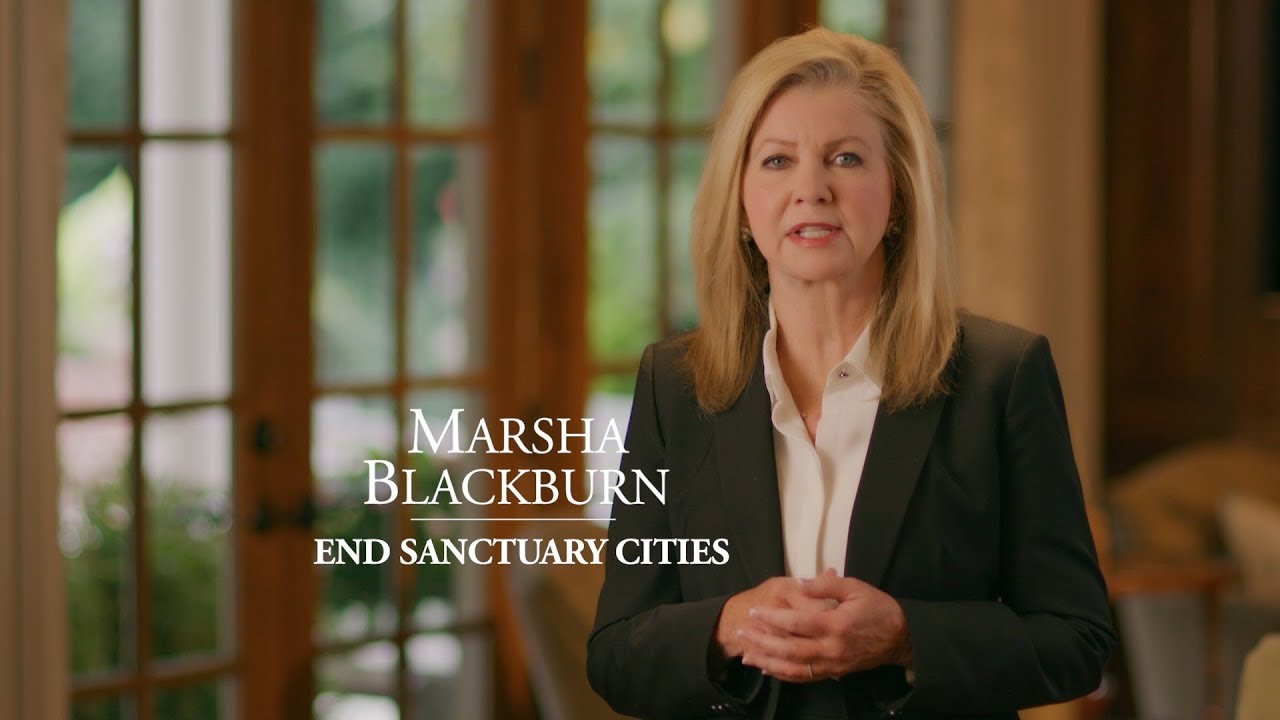 another Blackburn ad. At one point, the ad displays an image of the Middle East and Africa.
The messages about the caravan were far-fetched given the fact that there is no evidence that the migrant caravan from Honduras contained any terrorists or members from the Middle East, as fact-checkers noted during the campaign. The driver’s license claim was also misleading: Tennessee briefly offered driver’s licenses to those without a Social Security number through a 2001 law signed by former Republican Gov. Don Sundquist. The law was later amended and repealed under Bredesen’s tenure as governor.
“It was Phil Bredesen who lured illegal immigrants to Tennessee,” other Blackburn advertisements on television and social media .
“The invading force approaching our southern border is seeking to enter the country is wrong,” read a grammatically challenged paid advertisement on Facebook posted by the Blackburn campaign. Another promoted post from the Blackburn campaign decried the “illegal alien mob marching on our border.”
The ads, crude as they might have appeared, were distributed using an empirical approach to motivating Republican voters. The Blackburn campaign had turned to Koch’s i360 company to develop “a series of custom predictive models” to peel Republican voters away from Bredesen, according to a testimonial for potential clients.
Blackburn, a firebrand of the religious right who positioned herself as a steadfast ally to Trump and opponent of allowing Muslim refugees into the country, was clearly aligned with Koch priorities. Blackburn also supports judicial appointments favored by the business-friendly Federalist Society, corporate tax cuts, and scaling back most forms of environmental regulations, the criteria on which the Koch network has made its political endorsements historically.
Americans for Prosperity, the primary political advocacy arm of the Koch network, founded by Charles’s brother David,who passed away in August, and financed by Charles’s close-knit group of likeminded business owners, spent $5.6 million to Blackburn’s Senate run through its nonprofit and Super PAC arm. That much is well reported and public. But the role of i360 in guiding the campaign’s anti-immigrant messages did not become clear until after the election.
THE COMPANY SEGMENTED Republican supporters for Bredesen, a Democrat, using its vast database of voter profiles. The data suggested immigration could be used as a wedge. “From there,” the testimonial notes, “i360 further segmented the universe using the Sanctuary Cities model which identified voters likely to oppose Sanctuary City policies like allowing illegal immigrants to get drivers’ licenses — a policy Bredesen favored while Governor.”
The i360 database was integrated into the Blackburn campaign’s media strategy. The company’s television advertising service, i360 Rabbit Ears, allows campaigns to target television programs and schedules favored by various behavioral profiles. I360 sorts television programs by over 40 voter profiles, including anti-immigrant sentiment. The company refers to this voting bloc as: “Individuals who have a high likelihood of believing that undocumented immigrants should be required to leave the United States.”
Blackburn’s media consultants, through a company called Smart Media Group, not only relied on i360 data to inform its advertisement buying strategy, but its data findings were merged into Blackburn’s canvassing effort as well. Field staff used the i360 voter profiles to determine which messages to use when knocking on doors of potential voters and could “educate voters about Marsha’s positions by showing them videos right from their iPads.”
The i360 team also developed “140 unique segments,” an advertising term that refers to unique demographic profiles, “against which the campaign delivered millions of impressions across several different platforms including Google and Facebook.” The individual segments allowed the Blackburn campaign to send customized messages to each voter profile over a variety of platforms, a dynamic that allowed the campaign to “tailor their messaging to ensure they were talking about the issues that mattered to each voter.”
In the end, i360 boasts that the Blackburn campaign used its technology to shape 3 million voter contact calls, 1.5 million doors knocked, $8.4 million spent on television ads, and 314,000 campaign text messages — advocacy that led to Blackburn’s commanding victory over Bredesen, who had been favored in the polls for the months leading up to the election.
Federal Election Commission records show that Blackburn’s campaign paid $188,366 to i360 for a variety of services — a small price for the significant campaign services the company provided.
FOUNDED IN THE aftermath of the 2012 election, in which Republican candidates favored by Koch fared poorly, i360 was envisioned as a way to revolutionize right-wing pressure campaigns and election efforts by incorporating the latest in data science. The company, based in the same Arlington, Virginia, office complex that houses other Koch groups, harvests troves of data to build profiles of every voter and potential voter in the country. Over the course of four years, the Koch network poured $50 million into i360 to develop its capabilities.
Journalist Sue Halperin noted that i360 acts as somewhat of a data broker, combining “commercial sources, such as shopping habits, credit status, homeownership, and religious affiliation, with voting histories, social media content, and any connections a voter might have had with advocacy groups or other campaigns” to build its voter database.
The i360 profiles offer a dizzying array of ways to segment voter preferences. The company allows GOP campaigns to target voters based on equity held in their home, likelihood that an individual has been personally affected by the heroin crisis, views on gay marriage, interest in dogs, levels of religious devotion, and even psychological profiles that measure an individual’s ego, based on previous purchases of monogrammed clothing.
Notably, according to CNET, i360 partners with D2 Media Sales, a joint venture with DirectTV and Dish, “‘to push TV ads to specific households that meet a candidate’s criteria ‘no matter which stations or programs they’re watching.'”
And the firm appears to still be a central cog in the Koch advocacy machine. Demeter Analytics Services, the holding company that owns i360, is listed as a subsidiary of the Seminar Network Chamber of Commerce, the nonprofit that serves as the central clearing house for the Koch political spending, in its most recent tax filing.
Media attention has swirled over the role of technology firms that have harnessed sophisticated targeting methods to influence campaigns. Billionaire hedge fund investor Robert Mercer, once a participant in the Koch network, split off and formed his own array of groups, including an effort to fund Cambridge Analytica’s 2016 targeting methods. Less scrutiny has been paid to i360’s role in shaping the political climate. Both firms vacuum up incredible amounts of data to develop personalized voter outreach methods, allowing campaigns to peer deeply into the hearts of voters and trigger emotional responses — a revolution in campaign strategy that gives well-heeled donors with access to the technology a tremendous advantage.
Over the last year, Charles Koch has stated his support for lofty, high-minded goals such as ending over-incarceration, scaling back America’s military empire, defending free speech, and providing legal status for undocumented youth. These laudable positions, however, have not translated to changing the behavior of his political advocacy apparatus.
The Intercept has previously reported on Koch’s financing of tough-on-crime advocacy and support for Congress’ most militaristic, surveillance-friendly lawmakers. That the Koch political operation also deliberately fine-tunes anti-immigrant messages further undermines Koch’s purported beliefs. Neither Blackburn nor Mark Holden, the Koch Industries executive who simultaneously helps manage the company’s political and philanthropic investments, responded to a request for comment.
==
https://www.alternet.org/koch-brothers-are-watching-you-and-new-documents-reveal-just-how-much-they-know
new documents uncovered by the Center for Media and Democracy show that the billionaire Koch brothers have developed detailed personality profiles on 89 percent of the U.S. population; and are using those profiles to launch an unprecedented private propaganda offensive to advance Republican candidates in the 2018 midterms.
The documents also show that the Kochs have developed persuasion models — like their "Heroin Model" and "Heroin Treatment Model" — that target voters with tailored messaging on select issues, and partner with cable and satellite TV providers to play those tailored messages during “regular” television broadcasts.
Over the last decade, big data and microtargeting have revolutionized political communications. And the Kochs, who are collectively worth $120 billion, now stand at the forefront of that revolution — investing billions in data aggregation, machine learning, software engineering and Artificial Intelligence optimization.
In modern elections, incorporating AI into voter file maintenance has become a prerequisite to producing reliable data. The Kochs’ political data firm, i360 states that it has “been practicing AI for years. Our team of data scientists uses components of Machine learning, Deep Learning and Predictive Analytics, every day as they build and refine our predictive models.”
Thanks to that investment (and the Supreme Court’s campaign finance rulings that opened the floodgates for super PACs), the Koch network is better positioned than either the Democratic Party or the GOP to reach voters with their individually tailored communications.
That is a dangerous development, with potentially dramatic consequences for our democracy.
The Kochs and i360
The Kochs formally entered the data space nine years ago, developing the “Themis Trust” program for the 2010 midterms — an uncommonly impactful election cycle where Republican operatives executed their REDMAP program and algorithmically gerrymandered congressional maps across the country in their favor.
In 2011, the Kochs folded Themis into a data competitor it acquired, i360 LLC, which was founded by Michael Palmer, the former chief technology officer of Sen. John McCain’s 2008 presidential campaign. Palmer still leads the organization.
Back then, as journalists Kenneth Vogel and Mike Allen documented, the Kochs’ long-term funding commitments to i360 allowed the organization to think bigger than their political competitors.
“Right now, we’re talking about and building things that you won’t see in 2016, because it’s not going to be ready until 2018,” Michael Palmer said in the wake of the 2014 midterm cycle.
Those programs are now operational. And according to a successful GOP campaign manager, i360 is the “best in the business” at providing Republicans with voter data.
i360’s client list reflects that data superiority. The country’s most notorious and effective political spenders, like the National Rifle Association, use the platform to identify and influence voters, as do Republican party committees, and U.S. House and Senate campaigns.
(A full list of i360’s clients is available here. Some clients, like the Republican Party of Wisconsin, have multiple sub-campaigns they run. It is also important to note that many Koch political groups, like Americans for Prosperity and the Libre Initiative, signed data sharing agreements with i360 in 2016 that are most likely still in effect.)
i360 sweetens the deal to its clients by offering its services at below-market rates. And once clients are locked into the i360 platform, they have access to the company’s voter file — the beating heart of modern political campaigns.
Conservatives agree that the Kochs are subsidizing i360. The losses they sustain by undercharging clients, however, are a pittance compared to the down-stream public policy returns and political power the Kochs receive from operating what amounts to a shadow political party in the United States — one that vigilantly guards the fossil fuel subsidies, deregulatory schemes, and regressive tax structures that enable Koch Industries to bring in $115 billion annually in private revenue.
Inside the i360 Voter File
i360’s voter file identifies “more than 199 million active voters and 290 million U.S. consumers,” and provides its users with up to 1,800 unique data points on each identified individual.
As a result, i360 and the Kochs know your vitals, ethnicity, religion, occupation, hobbies, shopping habits, political leanings, financial assets, marital status and much more.
They know if you enjoy fishing — and if you do, whether you prefer salt or fresh water. They know if you have bladder control difficulty, get migraines or have osteoporosis. They know which advertising mediums (radio, TV, internet, email) are the most effective. For you.
i360 has the following attribute tags, among hundreds of others, ranked 1-10, or subdivided otherwise in their voter file.
Here’s an example of an i360 attribute tag and code name, using a 1-10 value scale:
But i360 attribute codes are not limited to that 1-10 scale. Their knowledge of your financial standing is granular, from how much equity you have in your home to your net wealth and expendable income.
They know where you live, what your mortgage status is and even how many bathrooms are in your house.
i360 has also created a set of 70 “clustercodes” to humanize its data for campaign operatives. These categories range from “Faded Blue Collars” to “Meandering Millennials,” and have flamboyant descriptions that correspond with their attribute headings.
Here are some examples:
Koch Persuasion Models
Additionally, i360 has developed a series of persuasion models for its voter file. These models are often regionally sensitive — since voters have regional concerns — and are being used in federal elections and down-ballot races to assist Republicans across the country.
In 2016, i360 created a set of regional models while working with Sen. Rob Portman’s 2016 re-election campaign in Ohio. Portman started out the race polling nine points behind his Democratic opponent, Gov. Ted Strickland, but ultimately won with 58 percent of the vote.
The company developed a model that could predict whether a voter supported Portman or Strickland with 89 percent accuracy, and others that predicted voter policy preferences. Well aware of the 2016 landscape, i360 also made a Trump/Clinton model, an Anti-Hillary model, and a Ticket Splitter model.
Much of i360’s success in the race, however, was linked to understanding (after conducting extensive polling) that a “key local issue facing Ohio was the opioid epidemic.” In response, the company created a “heroin model” and a “heroin treatment model” that were particularly effective at convincing voters to support Portman.
When describing how they employed their “heroin model,” i360 was clear that Portman’s “position” on the crisis depended on the voter, emphasizing health care solution communications for some, and criminal justice solution communications for others.
Here is i360 on the subject:
…the issue of opioid abuse was particularly complex in that it was relatively unknown whether it was considered a healthcare issue or a criminal justice issue. The answer to this would dictate the most effective messaging. In addition, this was a particularly personal issue affecting some voters and not others.
By leveraging two predictive models — the Heroin model identifying those constituents most likely to have been affected by the issue of opioid abuse and the Heroin Treatment model determining whether those individuals were more likely to view the issue as one of healthcare or of criminal justice — the campaign was able to effectively craft their messaging about Senator Portman’s extensive work in the Senate to be tailored to each individual according to their disposition on the topic.
This manipulation of the opioid crisis for political gain has a perverse irony given the Kochs’ long-running work to provide corporate interests, including health care and pharmaceutical interests, with undue political power and influence over public policy decisions. The Kochs have gifted over a million dollars to ALEC, for example, an organization that counts Purdue Pharma — the unconscionable manufacturer of OxyContin — as a member.
The company also stated it joined Portman’s campaign 21 months before the election, and that, “Together, i360 and the campaign strategized a plan to execute one of the most custom-targeted, integrated campaigns to date with a focus on getting the right message to the right voter wherever that might be.”
This is notable because during the 2016 election, i360 also ran $11.7 million worth of “independent” expenditures for the National Rifle Association Political Victory Fund, Freedom Partners Action Fund, and Americans for Prosperity in Portman’s race.
These outside spenders, two of which are Koch-funded groups, and Portman’s campaign all used i360 to coordinate their digital marketing, phone banks and television ad buys, in the same market, in the same election.
Additionally, i360 supplied Portman’s campaign with other issue-based models on gun control, gay marriage and abortion that the company continues to supply to its clients in 2018.
Here are some examples of i360’s issue-based models:
The list goes on, but the structure stays the same. The Kochs are tailoring their advertising to you, because they know nearly everything about you.
==
palast says tracks credit card purchases 3/18 kpfa
suppress vote
spinoff recall scoot walker; found vote dem absentee, rural own guns, wrong date and address
so carolina, so states
https://kpfa.org/episode/talkies-march-27-2018/
==
538 sort of saw trump win coming?
Data doesn’t win elections; candidates do. Presumptive Republican nominee Donald Trump bet on that idea last week when he announced his plan to rely on his personality and rallies in the general election instead of collecting data on voters. Trump has a point: The effect of “big data” and improved analytics on elections is often overhyped. Even David Plouffe — the architect of President Obama’s 2008 and 2012 campaigns, the most data-savvy in history — agreed that Obama’s “data processing machine” was not responsible for his wins.1(http://fivethirtyeight.com/features/trumps-scorning-of-data-may-not-hurt-him-but-itll-hurt-the-gop/#fn-1)
But Republicans are worried, and for good reason: Trump’s assumption that the sole value of data is to win more votes is too narrow.His decision to limit the role of data probably won’t be the deciding factor in the 2016 election, but data organization and access are an investment in the future of the party. A presidential campaign presents a rare opportunity to cultivate the next generation of talent and collect a ton of new data on voters, and Trump’s refusal to do so means that Republicans may need to wait until 2020 or beyond to even the playing field with Democrats.
Presidential elections, when turnout routinely exceeds midterm and off-cycle elections, produce an influx of data to public voter files and staffers who earn experience analyzing that data. Two examples of innovations in data-driven strategy — direct mail after 1964 and digital data analytics after 2004 — demonstrate that even losing presidential campaigns have paid huge dividends.
Trump’s candidacy is often compared to the 1964 campaign of Barry Goldwater, and generally not as a compliment. Goldwater lost to Lyndon Johnson by nearly 23 percentage points, receiving only 27 million votes out of 70 million cast. Despite this historic loss, Goldwater’s campaign was a launching point for the national conservative movement largely because of the data it produced and the innovations it enabled.
Direct mail was a new tool for campaigns at the time. It was used to market a message directly to voters while raising money, much as online advertisements and emails do for today’s candidates. Messages are only as useful as the audience they reach, however, and the Republican Party was unorganized in most of the South and West. The “Draft Goldwater” committee, comprised of conservative activists who wanted to steer the Republican Party rightward, sought out “silent supporters” to become delegates and donors for Goldwater — creating reliable national lists of conservative Republicans in the process.
For these conservative activists, the Goldwater campaign was not a failure — it identified 27 million Americans willing to support a solidly conservative candidate, and generated data on where to find them. One activist, Richard Viguerie, went to the clerk of the House of Representatives and copied (by hand) the names of donors who gave Goldwater $50 or more, forming the basis for his mailing list. In his book, Viguerie claims that he used this data to send 70 million letters per year and 1 billion pieces of conservative direct mail between 1974 and 1980, when conservative Ronald Reagan was elected president. Goldwater’s ideological legacy was secured using strategies that relied upon the data generated by his failed campaign.
Political data has moved far beyond card catalogues and mailing lists. Making sense of today’s data requires experience with database software and statistical modeling. The software used by campaigns cannot be bought “off the shelf” or assembled quickly because it relies on data controlled and managed by the parties.2(http://fivethirtyeight.com/features/trumps-scorning-of-data-may-not-hurt-him-but-itll-hurt-the-gop/#fn-2)
In 2005, after winning two consecutive presidential elections, the Republican Party’s data was more centralized and better organized than Democrats’. This success led to a sense of complacency among Republicans. Meanwhile, after two straight losses, Democrats were open to new campaigning techniques at the same time that online and digital tools were emerging.
Like conservatives post-Goldwater, the Democrats used their data effectively after a loss in a presidential election. In this case, failed 2004 Democratic candidate Howard Dean — whose campaign was known for its innovative use of the internet — became chair of the Democratic National Committee in 2005. He prioritized the creation of a national voter database with one company in charge (NGP VAN). This investment made it easier for future candidates to incorporate data analytics into their strategy, giving them incentive to hire employees who could innovate and build on each other’s work — even after elections ended. Since 2004, Democrats have founded 67 firms and organizations dedicated to digital campaigning and data analytics, while former Republican staffers founded 13.3(http://fivethirtyeight.com/features/trumps-scorning-of-data-may-not-hurt-him-but-itll-hurt-the-gop/#fn-3) These firms apply their expertise down the ballot by providing services to Democratic gubernatorial, Senate and House candidates, all of whom work from the same dataset.
Democrats now hold a substantial expertise advantage in digital data-driven campaigning, and the GOP admitted as much in their 2012 election post-mortem. John McCain hired only 15 data staffers in 2008, compared with Obama’s 131. To his credit, Mitt Romney increased the number of data hires to 87 in 2012. (Obama had 342). In 2016, Republicans were positioned to build on this effort and narrow the analysis gap between the parties, pivoting off of two consecutive losses into an innovative data strategy — just like in 1964 and 2004.
But Republicans seem set to squander the opportunity. Trump currently employs as few as two staffers dedicated to data, according to reports. (The Trump campaign did not respond to a request to confirm the number of staffers it has devoted to data.) The Republican Party has not consolidated data as Democrats did, instead relying on “a jumble of firms not always working in concert.” Independent firms such as i360, funded by the Koch brothers, have not integrated with the party database.
Meanwhile, Democratic consolidation and expertise building continues. Hillary Clinton set out to assemble a data team three times the size of Obama’s formidable 2012 operation. Several members of her digital and analytics leadership team worked for Civis Analytics, BlueLabs, and Blue State Digital4(http://fivethirtyeight.com/features/trumps-scorning-of-data-may-not-hurt-him-but-itll-hurt-the-gop/#fn-4) — all firms founded by former Obama or Dean employees. After this election, win or lose, Clinton’s data staff will be positioned to bring their expertise back to these companies or found new ones while Republicans continue to chase the data advantage they wasted after 2004.
Listen to our podcast special on the history of political data in U.S. elections.
==
BS
http://www.washingtonexaminer.com/rnc-soups-up-2016-voter-turnout-program/article/2559419
RNC soups up 2016 voter-turnout program
By DAVID M. DRUCKER (@DAVIDMDRUCKER) • 1/28/15 1:22 PM
The Republican National Committee promises better, smarter voter turnout programs for the 2016 presidential election, the RNC's leader said Wednesday. The new programs will operate on an all-the-time basis and, in a switch from previous practice, will be available to GOP primary candidates rather than being available just for the nominee in the general election.
“As we begin our road to the White House there are going to be new and bigger demands on our digital, data and technology teams. I look forward to working with my team as we expand our mission building on our successes from the midterms,” RNC Chairman Reince Priebus said in a statement.
With memories of Mitt Romney's unloved Project Orca fading, Priebus, fresh off large GOP congressional gains in November, must prepare the party's eventual nominee to compete in what is expected to be a billion-dollar-plus campaign.
The RNC has reorganized its digital voter-turnout operation to take the software from a midterm to a presidential footing and has made a series of senior staff changes in the digital, data and technology departments. To accommodate the demands of a national campaign, the RNC is hiring more personnel, developing new technology and launching a major fundraising push.
Stay abreast of the latest developments from nation's capital and beyond with curated News Alerts from the Washington Examiner news desk and delivered to your inbox.
The fundraising pressure increases exponentially for the RNC heading into 2016. The committee invested more than $100 million in the 2014 election cycle to build from scratch and operate its digital get-out-the-vote programs. This cycle, the party has obligations to raise millions of dollars through the “Presidential Trust” for the eventual White House nominee, and millions more to expand and run its data shop.
The RNC has determined a projected budget for this but committee officials declined to reveal specifics. Expansion and refinement plans include items as simple as new features at the RNC’s “GOP.com” website as well as labor-heavy, technologically complex changes including:
• Voter file “hygiene.” Much voter targeting data depends on accurate voter lists that are constantly updated by state and local agencies. The RNC invests time and personnel to update its voter rolls.
• Data hosting environment. Housing and sharing the massive amounts of data the RNC has collected and continues to aggregate since going digital requires regular improvement, and the committee is in the process of another major upgrade.
• Expanded voter scores and analytics. With the launch of its digital program after the 2012 elections, the RNC increased the amount of data it relies on to forecast voter behavior by a factor of 38, or 9.6 billion “modeled data points.” For the 2016 race, the committee plans to grow the amount of micro targeting data it collects.
Clinton camp to take part in Wisconsin recount, fueling fears of hacked election
Also from the Washington Examiner
Clinton camp to take part in Wisconsin recount, fueling fears of hacked election
By Philip Wegmann • 11/26/16 2:56 PM
• Online donor prospecting. Democrats have held the advantage over Republicans in accessing small online campaign contributions that are very cost effective to raise. The RNC plans to invest more money to develop a relationship with these types of donors, who tend to be younger and more tech savvy.
• Multi-channel marketing. The RNC is upping its advertising budget to reach people in social media communities. This sort of effort, employed by the RNC for the first time last cycle, was pioneered by President Obama’s campaigns and is an effective way to reach supporters, find out what makes them tick, and raise money.
• More technology. The RNC is investing in new applications for mobile devices like iPhones to be used by volunteers who go door to door to target voters. The committee also is spending money to refine the technology that allows party committees and other approved users to access and use all of the RNC’s data.
The RNC’s digital GOTV programs are going to be accessible to all approved candidates who seek the party’s White House nomination. The committee declined to reveal what the conditions for access are going to be, but officials said the party is in talks with the prospective candidates. Broadly, some sort of declaration of actual candidacy is going to be required to access the RNC’s data for the primary campaign.
The RNC’s digital and data analytics voter turnout programs were developed following Mitt Romney’s disappointing loss to Obama in the 2012 presidential election. The president’s operation, years in the making, were vastly superior to what was then a very antiquated Republican operation.
White House denies that Russia hacked election for Donald Trump win
Also from the Washington Examiner
White House denies that Russia hacked election for Donald Trump win
By Philip Wegmann • 11/26/16 1:48 PM
Priebus also determined that the demands of a competitive, modern GOTV program required a system that operates year-around — every year. In 2012, as in every presidential election before in which the incumbent was not a Republican, the RNC would wait until a nominee was crowned and then spend the four months before the general election hastily assembling voter turnout mechanisms.
Priebus’ new approach was tested last year and received rave reviews from successful GOP candidates. The party picked up nine seats in the Senate, winning control of the chamber for the first time in eight years, while adding to its majority in the House by a dozen seats. In an interview with the Washington Examiner five days before the November elections, the RNC provided what turned out to be very accurate forecasts of GOP victories in competitive Senate races.
On Tuesday, the RNC announced staff changes, with Deputy Chief of Staff Chuck DeFeo leaving to take a job with i360, a data analytics firm that is a part of a group of political entities under the umbrella of billionaire industrialists Charles and David Koch. Also departing: Chief Technology Officer Andy Barkett, the main brain behind the RNC's digital offerings. Barkett will continue to advise the committee on technology issues. Replacing them are GOP digital strategist Mindy Finn; Azarias Reda, the RNC's current chief digital officer; and Jesse Kamzol, Reda's deputy.
Reda was promoted to succeed Barkett, and Kamzol was bumped up to chief data officer. Finn was hired from the outside. Politico first reported the news of the staff changes.
==
Koch brothers have created a ground game where Donald Trump has failed, not to elect Trump but to elect all those Republican senators who won't dump him. See, they're too pure to sully their hands with him, but not so to elect his enablers.
FAIRLESS HILLS, Pa. (AP) — To the Republicans in the red "Can't Afford Katie" T-shirts, it's as if Donald Trump doesn't even exist.
These activists have been sprinting through Pennsylvania neighborhoods, talking to people about how bad Democrat Katie McGinty would be as a U.S. senator. Here to help save Republican Sen. Pat Toomey — and, more broadly, the party's control of the Senate — are employees and volunteers for Americans for Prosperity, the best-known group financed by conservative billionaires Charles and David Koch.
Similar scenes are playing out in North Carolina, Florida and Ohio.[…]
Four years after spending heavily in a futile effort to prevent President Barack Obama's second term, the Kochs have pushed all of their resources down ballot. And their resources are ample: They're on track to spend about $250 million on policy and politics in the two years leading to Election Day.
They've spent about $42 million of that on TV, and are now pulling all ads to focus their money on door-to-door voter contact, something the Trump campaign isn't doing. They've got about 1,200 employees across 36 states doing the grunt work to make sure the Senate majority remains Koch-friendly. They're using their massive voter database, which has long-since eclipsed the GOP's, to target some 5 million solid Republican voters who might be tempted to sit this election out because of Trump.
BUT MIGHT HAVE GOTV FOR TRP?
That would be disaster for the Kochs. They need their bought Senate, as much as ever
==
ref
https://apnews.com/a09a1c51058e4816ac07b0df7e063b84/Koch-brothers
Pennsylvania
Koch brothers' network focusing on GOP Senate, not Trump
FAIRLESS HILLS, Pa. (AP) — To the Republicans in the red "Can't Afford Katie" T-shirts, it's as if Donald Trump doesn't even exist.
These activists have been sprinting through Pennsylvania neighborhoods, talking to people about how bad Democrat Katie McGinty would be as a U.S. senator. Here to help save Republican Sen. Pat Toomey — and, more broadly, the party's control of the Senate — are employees and volunteers for Americans for Prosperity, the best-known group financed by conservative billionaires Charles and David Koch.
Similar scenes are playing out in North Carolina, Florida and Ohio.
In addition to having nail-biting Senate races this year, those four states are some of the most important battlegrounds in the presidential race. Yet the Koch activists interacting with millions of people who could be Trump's most crucial voters aren't supposed to utter a word about him or Hillary Clinton, a Democrat they'd been preparing for years to attack.
Four years after spending heavily in a futile effort to prevent President Barack Obama's second term, the Kochs have pushed all of their resources down ballot. And their resources are ample: They're on track to spend about $250 million on policy and politics in the two years leading to Election Day.
The brothers and many of their wealthy donor friends who fund the political and policy groups known as the Koch network have no interest in backing Trump. In a television interview in April, Charles Koch called Clinton and Trump "terrible role models" and trashed Trump's "monstrous" proposal for a temporary ban of foreign Muslims entering the U.S.
In the months since, while many Republicans flipped back and forth as to whether to support their nominee, the Kochs never considered engaging in a Trump-Clinton match, even when some donors pressed them at a conference in August.
Instead, Koch groups have spent about $42 million on TV, radio and digital advertising in Senate races. As of this month, they have abandoned paid media altogether, preserving their money for what is a much more critical hole to plug: door-to-door advocacy.
Trump's campaign has eschewed traditional political grunt work, leaving that to overworked national and state Republican parties, which must advocate for GOP candidates from Trump down to the local council members.
Outside groups led by a former chief of staff to Senate Majority Leader Mitch McConnell, R-Ky., continue to spend on ads — they'll hit about $100 million by Election Day. But the Senate GOP campaigns could really use help on the ground, and that's where the Koch network comes in. Americans for Prosperity and other groups employ more than 1,200 across 36 states.
To operate as effectively as possible, the Kochs' data analytics shop, called i360, identified what it believes are 5 million Senate control-deciding voters in eight states. Those voters are either Republicans who seem unenthusiastic this year, perhaps turned off by the ugliness of presidential race, or people who hadn't quite made up their minds about the Senate contest but lean Republican.
Roughly 600,000 of those key voters are in Pennsylvania.
During a recent weekend push in Bucks County, one of the most politically contested areas of the country, Americans for Prosperity temporarily imported employees from New Jersey and New Hampshire. There's no Senate race in New Jersey, and the Kochs aren't assisting Sen. Kelly Ayotte, R-N.H., largely because she sided with the Obama administration's moves to cut carbon emissions; that's at odds with the Kochs' push for fewer regulations.
At a hotel conference room one Thursday evening, Pennsylvania AFP field director Jeremy Baker prepped the out-of-state helpers for the no-nonsense attitude of many southeastern Pennsylvanians: "Well, they don't want you to knock on their door at all, but when you do knock on the door, you want to be concise. You're not going to have a 30-minute conversation with these folks. That being said, this is an area where we can have a lot of impact on this election."
Part of the team had been out that afternoon, shoving their electronic tablets into Ziploc bags to protect them from a steady rainfall. They're averaging about 11,000 door-knocks per week across the state. Very little stops them from going out every day.
"We're asking people to vote against Katie McGinty," Ed Saterstad, a 37-year-old part-time AFP employee, said to the man who'd answered the door, Bob Ryan.
Saterstad began a short survey portraying McGinty as liberal and bad for Pennsylvania, asserting, for example, that her energy policies would raise prices. Saterstad chronicled Ryan's responses on his tablet.
Less than a minute later, Saterstad concluded, "After hearing all this about Katie McGinty, does that make you more likely or less likely to support her?" Ryan chuckled. "I wasn't going to support her anyway, but, less."
Ryan later told a reporter no one had yet knocked on his door to talk about the presidential race. It's just as well. Asked for his thoughts on it, he sighed heavily.
"I just can't believe it's the best we can do," said the Republican-turned-independent. "I think Trump's a disaster, and I think Clinton is a pure political opportunist. I'm aghast that that's the best we can do, let's put it that way."
He wasn't sure if he'd cast a vote for president. But if he does vote, he said, it'll be for Toomey.
==
OMG
http://www.politico.com/story**/2015/**11/the-koch-brothers-intelligence-agency-215943
The political network helmed by Charles and David Koch has quietly built a secretive operation that conducts surveillance and intelligence gathering on its liberal opponents, viewing it as a key strategic tool in its efforts to reshape American public life.
The operation, which is little-known even within the Koch network, gathers what Koch insiders refer to as “competitive intelligence” that is used to try to thwart liberal groups and activists, and to identify potential threats to the expansive network.
The competitive intelligence team has a staff of 25, including one former CIA analyst, and operates from one of the non-descript Koch network offices clustered near the Courthouse metro stop in suburban Arlington, Va.It has provided network officials with documents detailing confidential voter-mobilization plans by major Democrat-aligned groups. It also sends regular “intelligence briefing” emails tracking the canvassing, phone-banking and voter-registration efforts of labor unions, environmental groups and their allies, according to documents reviewed by POLITICO and interviews with a half-dozen sources with knowledge of the group.
The competitive intelligence team has gathered on-the-ground intelligence from liberal groups’ canvassing events in an effort to assess the technology and techniques of field efforts to boost Democrats, according to the sources. And they say the team utilizes high-tech tactics to track the movements of liberal organizers, including culling geo-data embedded in their social media posts.
Such stealth activities are the kind that campaigns and party operatives often fantasize about but mostly shy away from ― both because of cost and potential political backlash if exposed.
Marc Short,president of Freedom Partners Chamber of Commerce, the network’s central group, declined to discuss its efforts to track the left, generally, or to comment on the competitive intelligence team, which operates as a unit within his group. But he did not dispute that the effort is a focus for the Koch network as it tries to rebound from the disappointment of the 2012 elections and gears up to spend a jaw-dropping $889 million on policy and political battles headed into November 2016.
“We were caught off guard by what the left was doing in 2012, and we'd be foolish to be caught in that position again,” he told POLITICO.
The increasingly robust Koch network has seized on significant tactical advantages afforded to big-money independent organizations ― but not party committees ― in modern politics. Unlike party committees, which are mostly subject to five-figure donation limits, donor disclosure and all manner of campaign finance laws and party rules, the Koch network of non-profit groups and for-profit companies can accept unlimited cash without disclosing donors and faces few spending restrictions.
The Koch ATM
The competitive intelligence effort, reported here for the first time, also hints at the audaciousness of the Koch network’s mission. While the Republican Party focuses on winning elections, the Kochs want to realign American politics, government and society around free enterprise philosophies that they hope to spread more broadly.
A key to accomplishing the mission, from the Kochs' perspective, is countering super PACs and other big-money groups funded by rich liberals, as well as allied public sector unions and academic and media elites. The Kochs’ allies feel that those forces have worked together for decades with Democratic politicians and government bureaucrats to institutionalize the philosophy that heavy regulation and taxation of business is the only way to ensure an equitable society.
The Kochs concluded that defeating this well-funded left-wing infrastructure requires tracking the professional left in real time ― a capability they realized they lacked after the 2012 election. In the run-up to that election, the Koch network spent $400-million-plus attacking Democratic politicians and policies, only to see President Barack Obama win re-election and his party maintain control of the Senate. A forensic audit of the network’s efforts concluded the Kochs had been out-maneuvered by the left on the airwaves, in the data war and on the ground. Vowing not to let that happen again, the network began investing in the competitive intelligence team and other efforts to keep tabs on the left.
To be sure, the Kochs’ operation isn’t the only one focused on pulling back the curtain on its opponents. In fact, liberal activists and groups have frequently worked to expose the activities of the Koch brothers and their network. But the competitive intelligence team, like so many other Koch-backed programs, appears to be unique in its scale and its thoroughly methodological approach.
‘The Opposition: Understanding Their Strategy and Infrastructure’
The Koch network’s interest in intelligence on the inner workings of the left was revealed by a secret audio recording of a panel at a June 2014 closed-door donor gathering at the tony St. Regis hotel in Dana Point, Calif. The session, called “The Opposition: Understanding Their Strategy and Infrastructure,” focused on the group that the Kochs’ inner circle regards as the Rosetta stone for figuring out, and ultimately neutralizing, the big-money left ― theDemocracy Alliance.
The group, which is meeting this week in Washington, D.C., is a club of wealthy liberal donors and influential operatives. Since its creation in 2005, the DA, as the club is known, has steered more than $500 million to endorsed groups supporting Democratic politicians and liberal causes like fighting carbon emissions, income inequality and the role of money in politics, while expanding voter access, abortion rights and gay rights.
As a fundraising vehicle, it's the closest thing on the left to a mirror image of the Kochs’ operation, though the cash raised by the Koch network in recent years has far eclipsed the amount credited to the DA. Donors to both networks write huge and mostly untraceable checks to a collection of endorsed for-profit companies and non-profit groups registered under sections of the tax code ― 501(c)3 and 501(c)4 ― that do not require the disclosure of donors’ identities.
During the session at the St. Regis, Mark Holden, a key Koch legal and policy advisor, pointed out the irony in liberal attacks on the Kochs’ secretive spending, calling the DA “a shadowy network of c(3)s, c(4)s ― who don’t disclose their donors, remember — who attack us as a shadowy network of c(3)s, c(4)s) … Whatever they may say about us goes the same for them.”
But Holden told the donors, according to the audio recording, which was obtained and posted by a liberal blogger, “We’ve been able to learn a lot more details about them in the last couple of months from documents that someone in the group, Democracy Alliance, left behind at their last seminar. And it’s very interesting stuff. And, at the end of the sessions here, we’re going to have some handouts, and you’ll be able to see some of the documents that we were able to get a hold of.” He adds quickly ― and to some laughter ― “I’m general counsel and I just want to say it was all legit, legal, appropriate.”
As Holden discussed the Democracy Alliance's efforts, internal DA documents were projected onto a screen at the front of the bronze-chandelier-lit St. Regis ballroom, including a “portfolio snapshot” featuring descriptions of 21 groups that the DA recommended for funding and a breakdown of the “core functions of the progressive movement.”
‘Like the CIA’
It is unclear precisely which documents Holden presented to donors (though similar documents appear to have been published in the weeks before and after his presentation by a handful of media outlets, including POLITICO) or precisely how the documents were obtained.
Holden ― who sits on the board of Freedom Partners Chamber of Commerce,which organized the St. Regis gathering and which oversees the competitive intelligence team ― declined to comment.
The competitive intelligence team is run by a veteran Republican researcher named Mike Roman, who is listed as Freedom Partners' vice president of research on the tax filing that group publicly released on Tuesday. That filing cites Roman's salary and benefits at $286,000 last year.
His team is part of Freedom Partners, but is managed through a limited liability company called American Strategies Group LLC, or ASG for short. ASG is set up as a type of corporate structure known as a “disregarded entity”, which exists only as a part of its parent group ― in this case Freedom Partners ― for the purposes of mitigating legal risk and separating revenue streams for accounting and tax compliance purposes.
ASG was the conduit for $13.3 million of Freedom Partners' cash between late 2012 and the end of last year, according to tax filings submitted to the Internal Revenue Service by Freedom Partners, including the filing publicly released on Tuesday covering 2014. It shows that ASG controls a holding company called CAVHOCO, Inc., which received a capital contribution of $17.5 million from Freedom Partners last year. CAVHOCO sits at the center of a confusing web of disregarded entities and holding companies, including one calledDemeter Analytics Services, Inc. That entity, which is the holding company for the Freedom Partners-owned data firm i360, was paid $11 million by Freedom Partners in 2014 for professional services, according to the tax return. Separate tax returns also listed Roman as trustee of a mysterious non-profit group called Public Engagement Group Trust, which appears to be dormant.
Roman, who did not respond to requests for comment, has worked to keep himself and his activity low-profile even within the discreet Koch operation.
One former network official said that when people were summoned to meetings at ASG’s offices, they sometimes had trouble finding the suite. “They told people that’s the way they liked it,” the official recalled. “They act all cloak and dagger – like the CIA. There was a joke about how hardly anyone ever met Mike Roman. It was like, if you wanted to find him, he’d be in a trench coat on the National Mall,” said the former official.
The regular intelligence briefings from Roman's team, which are sent from an address ending in “http://amersg.org” to high-ranking network employees, begin with a warning that “This briefing contains information that is confidential and may be legally privileged. If you are not an authorized recipient, you are hereby notified that you are forbidden to read, disseminate, distribute or copy any of the material contained within. Authorized recipients are hereby notified that any dissemination, distribution, or copying of this briefing is strictly prohibited.”
One such briefing sent in the weeks before the 2014 midterm elections and obtained by POLITICO contained highly detailed race-by-race breakdowns of the activities of liberal campaigns and their big-money supporters ― as well as conservative big-money groups ostensibly allied with the Kochs. It’s the sort of granular briefing that could be used to help the Koch network decide the most impactful ways to direct its own election spending. And it bears the hallmarks of research that combines close tracking of public information with original analysis of source documents, and possibly a dash of on-the-ground intel like that which could be gleaned by having an operative attend campaign events.
The briefing notes that in Arkansas, where there was a hotly contested Senate race between Koch network favorite Tom Cotton and Democratic incumbent Sen. Mark Pryor,Democrats were holding a statewide get-out-the-vote training in Little Rock, as well as a college organizing conference, while an immigrant rights group was “phone banking regularly with the intent of registering voters.” But the briefing also contains big-picture analysis flagging that union-affiliate Working America “has 400 paid canvassers knocking on 5,000 doors daily across 13 states through Election Day, especially focusing on Senate races in AK, IA, KY, MI, and NC. NRSC Vice Chair for Finance Sen. Rob Portman (R-OH) said the NRSC isn’t planning to devote any more significant resources to shore up key candidates in the red states of Kansas, Kentucky and Georgia.”
‘Scared to death of moles’
In addition to delving into the left, the competitive intelligence team also monitors potential Koch network threats, according to sources familiar with it. It tracks people deemed suspicious outside the offices of Koch network groups, circulating be-on-the-lookout photos to internal network email lists, while keeping an eye on the network's own ranks for possible leakers or disloyal employees.
One former network executive remembers an email containing a photo of a man identified as an operative with the environmental group Greenpeace who allegedly had been spotted taking his own photos outside the network’s cluster of offices in the Courthouse neighborhood of Arlington.
Connor Gibson, a Greenpeace researcher who focuses on the Koch network, said he visits its component groups’ offices once a year to pick up their tax filings, and he speculated he could have been the operative photographed by the competitive intelligence unit. While he said he’s never sought to conceal his identity during such visits, he added “If the Kochs consider me an opponent, I’m flattered.”
In another instance, sources say, Roman's team set out to identify an IT contractor who was working for one of the network's groups and was posting anonymous messages to Reddit, proclaiming that he worked for the Koch brothers but despised their stances. Within 48 hours, the team had sleuthed out the offender and his contract was terminated.
“They were scared to death of moles,” said the former executive.
A separate source ― an organizer who’s worked with the unit ― described it as “a full opposition research operation, only at about 10-times the level of any political campaign.” The organizer added “my guess is that most people inside the network don’t even know about it.”
Koch allies emphasize that the brothers and their network have been targets of regular sleuthing by the left. A nonprofit group called American Bridge 21st Century ― which is aligned with Hillary Clinton and the Democracy Alliance ― this year launched a $3-million project dedicated to researching, tracking and attacking the Kochs. Its staffers have been spotted recording the proceedings at Koch network events and appearances by the brothers, and it took credit for unearthing a trove of documents featured in a New York Timesstory about David Koch’s 1980 Libertarian vice presidential campaign. The group does not appear to be behind the untraceable recordings made from inside closed-door Koch donor gatherings over the years ― like the one of Holden’s dissection of the Democracy Alliance at the St. Regis.
Holden told the donors at the St. Regis that the big-money liberal groups in the Democracy Alliance were pursuing a two-pronged strategy that bears some similarities to the tactics of the Koch network. “What they do is they try to build a permanent infrastructure to win elections, and they obsess about us ― all of you,” Holden said. “And it’s the old quote ― first they ignore you, then they mock you, then they attack you, and then we win. We’re close to winning. I don’t know how close, but we should be, because they can’t attack the ideas. They don’t have the real path. All they do is target and they just try to silence people. You know, they’re afraid of us. They really are. They’re afraid of this room.”
==
Most recently, party leaders have been in a tussle with the Koch network over a voter-data operation, i360, controlled by the Kochs that operates outside the party structure but is used by many Republican candidates who find it superior to the party’s data platform. The bad news for the party is that the data collected on those candidates’ behalf is not shared with the Republican National Committee; it stays within the Koch-linked operation. (Kenneth P. Vogel and Mike Allen have goods on the GOP data wars here.)
==
http://www.prwatch.org/news/2016/01/13025/cmd-and-crew-allege-koch-backed-group-broke-law
Trees of Liberty, a dark money non-profit financed and operated by the Koch political network, broke the law in helping Joni Ernst win her primary election in 2014, according to a complaint filed today by the Center for Media and Democracy (CMD) and Citizens for Responsibility and Ethics in Washington (CREW).
Trees of Liberty was set up by veteran Koch network political operatives a few months after Ernst appeared at a Koch donor retreat, and started running ads in Iowa within a week of its creation. Despite spending almost all of its budget to attack Ernst's primary opponent, Mark Jacobs, the group claimed on its tax filings with the IRS that it did not engage in political activity in 2014. Making false statements on a signed form to the IRS was a criminal violation. Additionally, Trees of Liberty violated its tax-exempt status by engaging primarily in political activity for the private benefit of now-Sen. Joni Ernst and the Koch network, the complaint alleges.
"Trees of Liberty appears to have violated the law the in three ways: the group misled the IRS by claiming it was not involved in political activity, engaged in more political activity than allowed and operated for the private interests of Sen. Ernst and the Koch political network," CREW Executive Director Noah Bookbinder said. "Any one of these violations should be enough for the IRS to act on; taken together, they overwhelmingly support the need for investigation and vigorous enforcement."
Freedom Partners Chamber of Commerce, often referred to as "the Koch brothers’ secret bank," provided $400,000 of the $440,000 the group raised.The group then spent $412,000—an incredible 94% of its expenditures—on "advertising campaigns on television, radio and online," most of which benefited Ernst. Over $346,000 of Trees of Liberty’s budget was paid to i360, a data analyst and ad buying firm described as the "Koch data mine."
"The Koch network is effectively a political party, and Trees of Liberty is operating to advance the Koch party's interests, rather than anything resembling 'social welfare,'" said Brendan Fischer, Center for Media and Democracy's General Counsel. "The evidence shows that the Koch network secretly used Trees of Liberty to play a decisive role in a primary election, but the American people may never get a full accounting of how much the Kochs are spending on primaries this presidential election year, or what they get in return."
==
http://www.politico.com/story/2015/12/koch-brothers-network-gop-david-charles-217124
2x? no links
How the Koch network...
The billionaires and their allies have built a private political machine without precedent.
By KENNETH P. VOGEL 12/30/15 05:17 AM EST Updated 12/30/15 05:22 PM EST
David Koch, the executive vice president of Koch Industries, at his Madison Avenue, New York office during an exclusive interview with Newsmax Magazine September 25, 2012.
The decision by David Koch (pictured in 2012) and Charles Koch to build their own, independent political organization was prompted largely by their dissatisfaction with George W. Bush and his Republican congressional majorities. |
The Koch Machine: About the series
This series examines the increasing political influence of the billionaire industrialists Charles and David Koch and their mega-donor allies.
How the Kochs launched Joni Ernst New details reveal the billionaire brothers' network efforts to reshape the GOP are more ambitious than previously reported.
The Koch intelligence agency As the billionaires’ network works to reshape U.S. politics, it keeps a close eye on the left.
How the Koch network created the Ex-Im fight The issue had little audience until the billionaire brothers’ network stepped in.
The Kochs' war on poverty Free turkeys, holiday parties, classes in 'dinner on a dime,' with a side dish of conservative proselytizing.
How the Koch network rivals the GOP The billionaires and their allies have built a private political machine without precedent.
The political machine that Charles Koch launched a dozen years ago in a Chicago hotel conference room with 16 other rich conservatives has exploded in size and influence in the past few elections and now eclipses the official GOP in key areas.
Koch and his brother David Koch have quietly assembled, piece by piece, a privatized political and policy advocacy operation like no other in American history that today includes hundreds of donors and employs 1,200 full-time, year-round staffers in 107 offices nationwide. That’s about 3½ times as many employees as the Republican National Committee and its congressional campaign arms had on their main payrolls last month, according to POLITICO’s analysis of tax and campaign documents and interviews with sources familiar with the network. And the staggering sum the network plans to spend in the 2016 election run-up ? $889 million ? is more than double what the RNC spent in the previous presidential cycle.
While rich donors have held considerable sway over the political process in past eras, the Kochs’ network is different. Its mission is in some ways more ambitious than the Republican Party’s ? to fundamentally reshape American public life around a libertarian-infused brand of conservatism ? but it also is encroaching on the GOP’s traditional turf. The Koch network’s data operation is now regarded by many candidates and campaigns as superior to the party’s, and it has invested in efforts to become the leading force on the right for training activists and registering voters. Its biggest group, Americans for Prosperity, plans to place full-time staff in all but eight states by late 2016 and aspires to copy the National Rifle Association’s broad-based membership plan for longevity, according to a POLITICO investigation. It found that the group has even discussed expanding its influence by writing and pushing model state budgets, a technique similar to the one used by the American Legislative Exchange Council to push various state legislative initiatives.
As the network has grown, though, internal audits at times have raised concerns about its management culture, spending and lack of coordination among core groups that compose the network. Insiders have questioned huge staff bonuses, fancy restaurant meals,purchases of Twitter followers and sporting event-related costs, as well as contracts directed to firms connected to top network operatives.
To address its growing pains, the network has tapped into a powerful resource unavailable to traditional parties, POLITICO’s investigation found ? the talent and management philosophies developed by the brothers’ giant multinational industrial conglomerate, Koch Industries.
In the post-Citizens United era of relaxed campaign finance laws, the Kochs and their megadonor allies, more than any other group of affluent political partisans, have leveraged their financial clout to do things that traditional party and political committees can’t or won’t do, as POLITICO’s investigation has shown. It revealed that the Koch network quietly launched sophisticated initiatives to recruit like-minded candidates, collect intelligence on rivals and win converts among the disadvantaged.
:{
}:
“I don’t know of any precedent for this,” said campaign finance scholar Robert E. Mutch, whose 2014 book “Buying the Vote; a History of Campaign Finance Reform,” traced the influence of ultrarich donors from the Gilded Age through the 2012 general election. “The rich guys who wanted to be politically active used to be politically active in the party. What’s different now is you’ve got them being active outside the party,” he said, adding that, while other megadonors are trying to build their own political operations, the Kochs have pushed this phenomenon to new heights.
Delegates and guests to the 2015 Republican National Committee summer meeting move through the lobby of the Renaissance Hotel on August 5, 2015 in Cleveland.
2016
Trump given access to RNC's voter file
By KENNETH P. VOGEL
While the Kochs’ decision to build their own independent political organization was prompted largely by their dissatisfaction with George W. Bush and his Republican congressional majorities, so far, the network’s forays have almost exclusively complemented those of the official GOP. And the network is expected to spend heavily in 2016 on ads and other voter outreach boosting the party’s efforts to retake the White House and protect its congressional majorities. RNC and Koch network officials even meet periodically to discuss their respective efforts, to the limited extent that is legally permissible, POLITICO has learned. But the Koch network hasn’t hesitated to call out Republicans who violate the brothers’ brand of small-government fiscal conservatism. And perhaps more worrisome for the GOP, Koch operatives have signaled they’re looking for more chances to take on Republicans, including in primary campaigns.
“Our mission is to advance a free society that helps people improve their lives, not to prop up or defend the Republican Party,” said Marc Short, president of Freedom Partners Chamber of Commerce, the nonprofit overseeing the Koch network.
Nonetheless, conservative leaders have grumbled that too much of their movement is being centralized under one umbrella ? the Kochs ? while GOP officials have openly fretted about the possibility of the party losing at least some control to “a group of very strong, well-financed individuals who have no accountability to anyone,” as RNC chief of staff Katie Walsh put it this year.
Permanent ground army
Charles and David Koch first dipped into their fortunes to influence American public policy in the 1970s, mostly pumping money into libertarian think tanks like the Cato Institute and George Mason University’s Mercatus Center.
They began getting more politically involved in response to what they saw as a reckless government expansion led by Bush and his GOP congressional majorities, including a costly Medicare expansion, the Iraq war and risky lending policies blamed for causing a housing bubble.
In 2004, not long after Charles Koch convened the Chicago donors’ meeting, the brothers provided seed funding for the group that would become the network’s most muscular political arm, Americans for Prosperity, which joined a pre-existing foundation arm that was spun off from another group the previous year. In 2004, AFP and AFP’s foundation had chapters in three states and a combined $2 million budget, according to tax filings. By last year, the main and foundation arms had morphed into the right’s most powerful nonparty group, with chapters in more than 30 states, a combined $104 million budget and a staff of 948 ? by far the network’s biggest footprint.
Internal network plans call for AFP to expand into several more states by the end of next year, sources tell POLITICO, leaving only Connecticut, Hawaii, Massachusetts, New York, Oregon, Rhode Island, Vermont and Washington without an outpost. While the group’s stated mission is to advocate small-government policies, its evolution has been strategically tailored for maximum political impact. In recent years, the network has channeled more spending into red states where it can influence GOP governing majorities rather than fighting for swing votes. That strategy was shaped by Charles Koch’s longtime right-hand man, Rich Fink, who is considered the network’s “grand strategist” and who had privately advocated “owning” conservative states, according to network sources. Indeed, AFP has taken credit for major policy victories — including enacting tax cuts, fighting Obamacare and restricting union power ? in Republican-controlled states where it has a major presence, such as Arkansas, Indiana, Kansas, North Carolina and Wisconsin. Likewise, it has shuttered chapters in deep blue states such as Connecticut, Oregon and Washington, where conservative reforms seem unlikely.
There’s also been a buildup in key swing states like Colorado, Florida, Nevada, North Carolina, Ohio, Pennsylvania and Virginia ? suggesting that the network has its eye not just on policy but also on political impact.
In Florida, for example, the Koch network’s core groups employ 77 full-time staffers, including AFP’s field staff of 50. Concerned Veterans for America, which courts veterans with fiscally conservative messaging, has 15 Florida staffers, while the LIBRE Initiative, which appeals to Latino voters, has nine. Generation Opportunity, a young voter outreach group, has three. Freedom Partners-backed outfits that aren’t considered core network groups ? the senior-focused 60 Plus Association, Concerned Women for America ? are courting other Florida voting blocs.
The network’s Sunshine State staffing rivals that of the Florida Republican Party and its local and legislative affiliates, according to sources familiar with Florida GOP politics, though the Republican Party presence in Florida and other key states will surge as the RNC ramps up its joint victory program with state party committees. RNC officials said that, by Election Day, they aim to have more than 4,500 paid staff on the ground across the country through the victory program, along with roughly 2,000 volunteer “fellows” trained through a program launched last year called the Republican Leadership Initiative. Those figures don’t include additional staff provided or subsidized by the National Republican Senatorial Committee and the National Republican Congressional Committee. And the party committees, unlike Koch network groups, are able to coordinate with candidates’ campaigns to mobilize volunteers and get out the vote.
“The Kochs’ efforts are helpful to the overall conservative movement, but they can never do the core functions that the party does,” said RNC chief strategist Sean Spicer. He argued that questions about whether the RNC is ceding influence to the Koch network prove “that POLITICO fundamentally lacks a basic understanding of how the political system and parties work.” But the committee’s own post-mortem analysis of the 2012 election openly acknowledged that changes in campaign finance and the rise of outside groups have led to “a troubling diminishment of the role of political parties and even candidates themselves in our democracy.” They “no longer have the loudest voices in campaigns or even the ability to determine the issues debated in campaigns. Outside groups now play an expanded role affecting federal races and, in some ways, overshadow state parties in primary and general elections,” the report says. It concluded that the situation “has caused a splintered Congress with little party cohesion so that gridlock and polarization grow as the political parties lose their ability to rally their elected officeholders around a set of coherent governing policies.”
Not only is the official GOP barred from accepting the unlimited and often undisclosed checks that fuel most of the Kochs’ groups, it’s also more thinly spread. That’s because the party’s mission is to try to win every election, even if that means backing less conservative nominees. Outside players like the Kochs, on the other hand, can focus more selectively on groups, races or states that fit their agenda.
In the 2014 election run-up, AFP quietly launched an initiative to add sympathetic voters to the rolls in 14 key states,according to sources familiar with the project. That’s a function that has mostly been the GOP’s domain.But Koch operatives concluded after the 2012 election that “the left outmaneuvered the right by … expanding the universe of voters,” according to network documents obtained by POLITICO.
The network also stepped up to fill what its operatives see as a void in data analytics on the right? itsFreedom Partners-owned data shop i360 has eclipsed the RNC data operation as the choice for many GOP candidates and committees. Last year, the network also invested heavily in what its officials privately call a “leadership factory” that they see as rivaling training programs of both the Republican Party and competing conservative groups, according to sources familiar with it. The Grassroots Leadership Academy, as it is now known, was absorbed into AFP’s foundation arm in 2014 and sources say it boasted a 2014 budget of more than $2 million, which it used to provide training to all network groups.
A newly created Freedom Partners division ? headed by an operative named Nathan Nascimento — works to coordinate ground initiatives run by the different network groups in the states.This effort, like many in the network, stemmed partly from shortcomings identified in corporate-style efficiency audits, which have raised concerns about duplicative spending and poor coordination, POLITICO has learned.
Audits also flagged insufficient understanding of fiscal conservatism by AFP field staff, an issue deemed “critically important to correct,” according to sources familiar with the findings. Another assessment found an “overwhelming” percentage of the 2 million members claimed by the group were not actually involved and “do not self-identify as being volunteers.” Findings about weak volunteer engagement were taken very seriously, sources tell POLITICO, because they undermined AFP’s positioning as a grass-roots army of millions.
“They’re the most effective”
The network’s corporate-style efficiency measures are central to the donor pitches delivered by Koch operatives, who argue that they use cash more efficiently than rival conservative groups or the Republican Party.
While the super PACs devoted to various 2016 GOP presidential aspirants raised huge sums from ultrarich conservatives this year, AFP president Tim Phillips this month predicted in an interview “a lot of donors are going to give a second thought to the super PAC investments. They’re short-term strictly — no long-term value creation, A, and, B, you cannot hold them accountable as a donor. I mean, with an institution like us or some other (c)(4) that has boards and such, you can hold them accountable for how they spend your money over the long-term to actually do something.”
THE KOCH MACHINE
The Kochs' war on poverty
By KENNETH P. VOGEL
That framing appears to be paying off, as evidenced by the evolution of the Kochs’ twice-a-year donor gatherings. Sixteen donors joined Charles Koch at the first gathering at Chicago’s Peninsula Hotel in 2003, while the most recent summit drew more than 400 ? and many of the leading GOP presidential candidates ? to a slickly produced August affair at the St. Regis in Dana Point, California. Donors give at least $100,000 each year to join Freedom Partners and attend the “seminars,” as the gatherings are known in the Koch orbit. They have in some ways replaced the party’s convention as the most coveted ticket among some major donors, and now draw a more ideologically diverse crowd than the mostly libertarian-minded donors like variety store mogul Art Pope who attended the first one ? from religious conservatives like mutual fund pioneer Foster Friess to socially moderate neocons like Las Vegas casino magnate Sheldon Adelson.
“It’s about community and it’s also about commitment,” said Nancy Pfotenhauer, an AFP board member, Freedom Partners adviser and Koch confidante. “If you’re bringing in 40- to 50-percent more new people each time, that says there’s an appetite for what we’re doing and a shared level of concern.”
At an April 2013 gathering, POLITICO reported that Louisiana metals titan Ned Diefenthal complained to Sen. Ron Johnson about the incompetence of the RNC and its chairman, Reince Priebus. He “keeps sending me letters asking for money. I’m not giving him any money. He doesn’t know what to do with it,” Diefenthal said of Priebus. While Diefenthal’s family had donated $280,000 to the RNC over the years, he suggested to Johnson that the Koch network is a better investment.
Minnesota media mogul Stan Hubbard, a billionaire megadonor who regularly attends the Kochs’ gatherings, this month told POLITICO, “it isn’t just the Kochs’ money. Remember, most of the money comes from others.” Hubbard, his family and their company have donated nearly $5 million over the years to Republican and conservative candidates and groups that disclose their donors, but he told POLITICO that the Koch groups, which mostly are not required to disclose their donors, have been a leading recipient of his family’s cash.
“They’re one of the very biggest, if not the biggest, because I think they’re the most effective,” said Hubbard. “Being effective means they put resources in, they do research and they learn. They’ve learned every time they do something. If it doesn’t work the way they like, they do it differently. Like any business, they learn from experience. Any political party should learn.”
Some insiders argue that the efficiency, effectiveness and robustness are aspirational but sometimes don’t match the reality on the ground.
“It’s smoke and mirrors, and AstroTurf,” said one former network official, who did not want to be identified revealing internal network conversations. “It’s something that is being sold to donors. The notion that it is a grass-roots army is ludicrous. And the rest of it ? whether it’s the 1,200 operatives or the door-knockers or Twitter followers ? it’s all bought and paid for.”
Levi Russell, a spokesman for AFP, said suggestions that the group is a paper tiger “lack all credibility. One visit to one of the many AFP field offices around the country will show a vibrant, engaged and passionate force of grass-roots volunteers who power our field program.”
While the network boasts of cost controls, its groups’ fundraising success also means that they are among the biggest spenders on the right. They have paid out annual bonuses that can exceed a full year’s salary. Short, the head of Freedom Partners, earned a 2014 base salary of $235,000 but pulled in $525,000 in bonuses, tax filings show, putting him well ahead of Priebus, who made $153,000 last year, but far behind U.S. Chamber of Commerce CEO Tom Donohue, who was paid $4.9 million in 2011. And the network has financed contracts to consultants favored by donors (last year, Freedom Partners paid pollster Frank Luntz $1.5 million) or with connections to its operatives.
Americans for Prosperity’s chief technology officer, Adam Stryker, left in September after some AFP operatives questioned his spending of group funds and contracts signed with his friends’ firms, multiple sources familiar with Stryker’s tenure at the group told POLITICO. They said Stryker, a Las Vegas native, ran up expenses on donor meals at tony restaurants and accompanied vendors to exclusive events like the Kentucky Derby and the Stanley Cup Finals. One operative who worked with AFP told POLITICO that a number of AFP officials spent heavily. “There were checks and balances, but they weren’t effective,” the operative said.
In an email, Stryker ? who like many departed network employees signed a nondisclosure agreement preventing him from discussing his former employer ? said his departure was not related to questions about spending, but otherwise refused to comment. An internal AFP staff email said he was leaving “to pursue new opportunities in the private sector” but would remain as a consultant through March 2016.
AFP declined to comment, saying it does not discuss personnel matters. AFP and network officials both pointed to rigorous accounting practices for evaluating, approving and tracking contracts and other expenses that they say flag problem spending in real time and keep their rates among the lowest in politics.
Many spending and contracting controls were introduced after the 2012 election, during which the Koch network spent more than $400 million but failed to oust President Barack Obama or the Democratic Senate majority. Afterward, attention inside the network turned to an operative named Sean Noble, who oversaw a strategy that outsourced many key functions to consulting firms, including his own. Three firms owned by Noble were paid $24 million by a Koch-backed nonprofit.
Market Based Management
A forensic internal analysis after the election found the network was ill-served by redundancies and infighting among Koch-backed efforts, an inability to measure impact and too much spending by consultants ? including Noble ? who were technically independent from the Koch operation, according to multiple sources familiar with the analysis.
To avoid a repeat, the network centralized and rejiggered its organizational flow chart to bring more functions under the umbrella of Freedom Partners Chamber of Commerce. At one point, Noble was offered a job working for the group that became Freedom Partners but turned it down, sources told POLITICO. Freedom Partners sought to reduce the network’s reliance on Noble and other outside consultants by building its own message testing, polling and advertising operations, partly by acquiring a Koch-backed nonprofit called Public Notice.
Freedom Partners became the vehicle for disseminating cash and coordinating strategy among the network’s allied groups. It has given out $384 million in grants to dozens of groups between its creation in late 2011 through the end of last year, the most recent period covered by publicly available tax returns. And it unceremoniously terminated underperforming initiatives, including the voter registration project, which was judged too costly for what it was delivering. Another was a well-financed initiative called Race Fans 4 Freedom, which in the run-up to the 2012 election endeavored to win converts to the network’s free market causes among people attending auto races in key states including Ohio and Virginia. It was found not to justify the cost of sponsoring the races.
Another move involved consolidating the network’s far-flung Washington-area headquarters offices at considerable cost into a cluster of glass office towers in the Courthouse neighborhood of Arlington County, Virginia, in Washington’s near suburbs. At the center is an office building that houses Freedom Partners, the Charles Koch Institute and the Charles Koch Foundation. A block away sits Americans for Prosperity's sleek new offices, which are near the AFP Foundation and the Koch-backed data firm i360. Although the relocation was intended to facilitate greater collaboration, the network now occupies so many scattered offices in similar-looking buildings that the map can prove difficult to navigate even for insiders.
In fact, sources within the network tell POLITICO there is internal talk about purchasing an entire office building, though some of the sources say that’s unlikely, partly because Charles Koch views buildings as vanity projects.
While David Koch has welcomed attention for his cultural, medical and political philanthropy — even accepting a role as an alternate delegate to the 2012 GOP convention — Charles Koch rarely appears at fundraisers beyond those for the network. In fact, he has complained about the vagaries of politics — from pandering politicians to big consulting contracts to internecine competition — and has worked to rid his political network of what he sees as inefficiencies endemic to politics, partly by infusing it with talent, techniques and resources from Koch Industries.
Koch Industries’ corporate counsel, Mark Holden, who was already on the Freedom Partners board, joined AFP’s board and chairs its powerful executive committee. Rich Fink, who has served in various executive positions at Koch Industries, sat on the boards of the Charles Koch Institute, Freedom Partners and Americans for Prosperity Foundation, though he left AFP’s foundation board last month. And numerous high-ranking officials have cycled through the network, including roles at its administrative division, the Center for Shared Services, which handles human resources and IT services for all network groups. This entity was patterned off Koch Business Solutions, which fills the same function for Koch Industries. The Center, which originally was a stand-alone nonprofit, was rolled into Freedom Partners this past summer and trains network employees in Market-Based Management ? the organizational philosophy Charles Koch has honed over the years at Koch Industries.
Insiders say it’s impossible to overestimate the impact of 80-year-old Charles Koch or to gauge how his death would affect the network’s political efforts, especially fundraising.
“There’s definitely some concern about what happens after Charles dies,” said one operative who works with the network. “Many of the donors are there because they see Charles as the lead investor, and it’s not clear whether people are going to be as enthused about giving if they don’t see him at the helm.”
While Charles Koch is said to be in good health (his brother David is 75 and has battled prostate cancer), he has increasingly brought his son Chase Koch into the family’s political and corporate efforts. But there’s no indication that donors would rally to the son in the same way.
“What you have in the Koch organization is what you have in nondemocratic societies ? a succession problem,” said Mutch, the campaign finance historian. He views the Kochs as a case study of how much influence can be amassed by super-rich partisans in the new big-money era — and how long they can hold onto their power.
“This may be a short term consequence of Citizens United, and, if it doesn’t work out really well, maybe the billionaires themselves will say ‘OK, we’ll just let the party handle this.’ I just don’t know. I mean, nobody knows.”
==
Inside the Koch data mine
Meet the guys building the right’s new machine.
By MIKE ALLEN and KENNETH P. VOGEL 12/08/1405:32 AM EST
The Koch brothers and their allies are pumping tens of millions of dollars into a data company that’s developing detailed, state-of-the-art profiles of 250 million Americans, giving the brothers’ political operation all the earmarks of a national party.
The move comes as mainstream Republicans, led by Mitch McConnell, are trying to reclaim control of the conservative movement from outside groups. The Kochs, however, are continuing to amass all of the campaign tools the Republican National Committee and other party arms use to elect a president.
The Koch network also has developed in-house expertise in polling, message-testing, fact-checking, advertising, media buying, dial groups and donor maintenance. Add mastery of election law, a corporate-minded aggressiveness and years of patient experimentation — plus seemingly limitless cash — and the Koch operation actually exceeds the RNC’s data operation in many important respects.
“The Koch operations are the most important nonparty political players in the U.S. today, and no one else is even close,” said a top Republican who has been involved in the last eight presidential campaigns.
( Also on POLITICO: End of a D.C. institution)
The least-known vehicle for the Kochs is a for-profit company known as i360, started by a former adviser to John McCain’s presidential campaign after McCain lost to Barack Obama in 2008.Subsequently, it merged with a Koch-funded data nonprofit. The Koch-affiliated Freedom Partners, formed in late 2011, eventually became an investor, officials confirmed to POLITICO.
Spending more than $50 million in cash over the past four years, i360 links voter information with consumer data purchased from credit bureaus and other vendors. Information from social networks is blended in, along with any interaction the voter may have had with affiliated campaigns and advocacy groups. Then come estimated income, recent addresses, how often a person has voted, and even the brand of car they drive. Another i360 service slices and dices information about TV viewing to help campaigns target ads more precisely and cost efficiently.
GOP campaigns can get less-expensive data through the RNC, but happily pay i360 for its superior profiles. Midterm clients included several of the GOP’s marquee Senate and gubernatorial victors,including Sens.-elect Tom Cotton of Arkansas and Joni Ernst of Iowa, and Gov.-elect Larry Hogan in Maryland.
Michael Palmer, a Florida native who started i360 after being chief technology officer of Sen. John McCain’s 2008 presidential campaign, said i360 has been able to develop superior campaign tools precisely because it isn’t beholden to the political calendar. With a steady stream of money comes the ability to think about the long term, he said.
“Right now, we’re talking about and building things that you won’t see in 2016, because it’s not going to be ready until 2018,” Palmer said.
One of the reasons that i360 has made such leaps is that the Kochs and their business-minded backers enforced a painful after-action review after the embarrassing Senate losses of 2012, looking across the organization at what could be done better. “We discovered, after 2012, that having a great database isn’t all that useful unless you can make it actionable for people, by building tools and software,” Palmer said.
So for this year’s midterms, he said, i360 offered “mobile canvassing apps or data management interfaces, so our clients can actually access that data, report against it, manipulate it, and put it to use.”
Palmer said i360 embeds experiments “into absolutely everything that we do.” In Colorado, for instance, Americans for Prosperity — the most muscular part of the Koch network — worked with i360 to isolate 297,000 voters who were not likely to vote in 2014, but were likely to oppose the policies of Democratic Sen. Mark Udall, who wound up being defeated by GOP Rep. Cory Gardner.
Among the 297,000 voters, some got no contact at all from AFP. About 60,000 voters were broken into six “treatment groups”: One group got a knock on the door, plus a volunteer phone call and a mail piece. Another got door plus mail. Another got door only, and so forth. Within those groups, the messages varied. Now, as part of its midterm after-action review, i360 is figuring out which approach was most efficient in turning out a reluctant voter.
The RNC, which is part of a data-sharing partnership with i360 that was announced in August, is also building up its digital assets. Sean Spicer, RNC communications director, said: “i360 is a great part of the larger team. One of the biggest differences is that the party supports anybody who has an ‘R’ next to their name. The RNC is providing the vast majority of data to House, Senate and gubernatorial candidates. And we’ve been in the data game for 20 years. … All general election Republican candidates had access to our data, and it was our data that the highly successful ground game was run on.”
This deep dive into the mechanics of politics reflects the Koch brothers’ growing awareness that traditional forms of advocacy aren’t, in isolation, effective enough to achieve the kind of conservative transformation the network’s supporters envision.
For decades, the Kochs had pursued their goals by sinking tens of millions of dollars into wonky research and advocacy groups. It was only during George W. Bush’s presidency that the brothers and their allies began to question whether the power of their ideas alone could carry the day. A movement that started with 15 rich conservatives gathering in Chicago and a single main group — Americans for Prosperity — by 2008 became a congregation of roughly 100 major donors backing a handful of think tanks, grass-roots advocacy networks and political organizations.
In 2012, the newly created Freedom Partners — the umbrella group for the Kochs’ political operation — raised and spent roughly $250 million. Headed by Marc Short, a former top staffer in the House and Senate, Freedom Partners dispenses funds and expertise to myriad affiliate groups in the network. This year, it began wading into political and policy fights on its own — spinning off a super PAC that spent at least $24 million boosting Republican Senate candidates.
Heading into 2016, the Koch network — under the auspices of Freedom Partners — has in many ways surpassed the reach and resources of the RNC. And, unlike the party, it isn’t bound by rules requiring it to maintain neutrality in primaries. Though the network has yet to engage in primaries, that could be the next logical step in its progression from apolitical think tank consortium to aggressive privatized political machine.
With good data, we can target them with the right message at the right moment.
The Kochs and their donors and operatives have been sought out by most of the leading 2016 GOP prospects – from Sens. Ted Cruz of Texas and Rand Paul of Kentucky to Govs. Chris Christie of New Jersey and Rick Perry of Texas. Their allies are acutely aware of the potential for the Koch groups and their donors to sway the primaries — even if they don’t formally back a candidate.
A key adviser to one of the top GOP presidential prospects said: “If I could have Karl Rove or Marc Short to run a presidential campaign today, I’d take Marc Short. He understands all the technical tools available to a modern campaign and how to apply them to the nominating process. He also has a deep understanding of the political dynamics of the GOP base vote.”
Short’s connection to another potential GOP presidential candidate, Indiana Gov. Mike Pence, is among the biggest reasons that the Kochs are considering whether going all-in on a presidential campaign would be a good investment. Short was chief of staff to the House Republican Conference when then-Rep. Pence was the chairman, and Short remains a close adviser to Pence.
Veterans of GOP presidential campaigns say that while the Kochs could not, by themselves, provide the credibility necessary to create a candidate for president, their weapons could make a decisive difference for someone who was already running a viable campaign for the nomination — someone like Pence, whose record could make him a bridge between the GOP’s evangelical and establishment wings.
A candidate favored by the Kochs and their allies could potentially benefit from the full range activities of groups in the Koch network. The biggest presence is AFP, which spent $130 million in the midterms, with 550 paid staff, including 50 in Florida alone.
The LIBRE Initiative, a network-backed group aimed at Hispanics, has 40 staff at its Arlington, Virginia, headquarters and 40 field staff(25 of them part-time) in seven states. Generation Opportunity, the Kochs’ outreach arm for 18- to 34-year-olds, has 30 full-time, paid grass-roots staffers running boots-on-the-ground activism in 10 states. Concerned Veterans for America, another Koch-backed group based in Arlington, has 60 paid staff in 14 states.
Pete Hegseth, an infantry captain in the Army National Guard who is the group’s CEO, says veterans are “reflexively conservative, and they know how to organize.”
“With good data, we can target them with the right message at the right moment,” Hegseth said. “They could be much more powerful than they are. There’s no reason veterans can’t be the unions of the right.”
Hegseth doesn’t talk much about the Koch connection, but says it’s an asset. “You can deny or engage,” he said. “Other groups have been a flash in the pan. The bureaucracy will try to out-wait them. We’re not going anywhere. We’re able to plan for the long term.”
==