BIG DATA AI 2
SEE AI 3 LLM
419 See previous on both for earlier
1219 micro-target data (dark posts and gotv?)
see privacy
merri ok
yikes see nuclear power
see algorithm
see eagle AI voter suppression
see extraction
SEE SACKS CZAR
AI HMO deny united CEO shot
do i need new category for gotv? yup see i360
---
data/info just eclipsed value of oil?! extraction
---
---
an 3 25
A watchdog organization on Monday launched a public records probe to determine the extent to which the Trump administration and its billionaire wrecking ball, Elon Musk, are using artificial intelligence as part of their lawless effort to purge the federal workforce.
"The American people deserve to know what is going on—including if and how artificial intelligence is being used to reshape the departments and agencies people rely on daily," said Skye Perryman, president and CEO of Democracy Forward, the group behind the new investigation.
"We will continue to use every tool at our disposal to force the Trump-Vance administration to fulfill its obligation to the public and to our system of laws," Perryman added.
The probe comes days after NBC Newsreported that federal workers' responses to Musk's email ultimatum were "expected to be fed into an artificial intelligence system to determine whether those jobs are necessary."
"The information will go into an LLM (Large Language Model), an advanced AI system that looks at huge amounts of text data to understand, generate and process human language," the news outlet reported, citing unnamed sources. "The AI system will determine whether someone's work is mission-critical or not."
Additionally, according toThe Washington Post, Musk lieutenants "have fed sensitive data from across the Education Department into artificial intelligence software."
"For an administration that claimed it wanted to bring about transparency and efficiency in government, the Trump-Vance administration's purge of public servants and sloppy processes have done just the opposite."
Democracy Forward said Monday that it would use Freedom of Information Act (FOIA) requests in an attempt to shine light on the administration's reliance on AI for personnel decisions. The Trump Justice Department argued in a court filing last week that the Musk-led Department of Government Efficiency, or DOGE, is exempt from public records requests—a claim that experts have rejected and condemned as an attempt to skirt oversight.
"For an administration that claimed it wanted to bring about transparency and efficiency in government, the Trump-Vance administration's purge of public servants and sloppy processes have done just the opposite," Perryman said Monday. "DOGE and this administration are operating in a shroud of secrecy, and their 'govern by chaos' tactics have only made government less efficient and caused disruptions to our safety and security."
Democracy Forward said its new FOIA requests were sent to DOGE as well as the Office of Personnel Management, the State Department, the Education Department, the U.S. Agency for International Development, and the General Services Administration, among other agencies.
*Wired reported last month that "Thomas Shedd, the recently appointed Technology Transformation Services director and Elon Musk ally, told General Services Administration workers that the agency's new administrator is pursuing an 'AI-first strategy.'"
"Shedd provided a handful of examples of projects GSA Acting Administrator Stephen Ehikian is looking to prioritize, including the development of 'AI coding agents' that would be made available for all agencies," Wired added. "Shedd made it clear that he believes much of the work at [Technology Transformation Services] and the broader government, particularly around finance tasks, could be automated.
Geoffrey Fowler, the Post's technology columnist, noted Monday that "lots of recent evidence shows that relying on automation alone to make critical decisions can lead to big government mistakes."
"Just ask New York City, where last year a government AI chatbot advised businesses to break the law," Fowler wrote. "Or Australia, where a deeply flawed algorithm called Robodebt created the opposite of efficiency: the government had to settle for more than a billion dollars with citizens for wrongly reclaiming benefits."
---
===
12 24
VERGE
Trump says that VC and All-In podcast co-host David Sacks will be the “White House A.I. & Crypto Czar.”
The appointment of Sacks, who hosted a $300,000-a-person dinner at his San Francisco mansion to fundraise for Trump’s campaign, follows the appointment of fellow PayPal mafia member Elon Musk to co-lead the “Department of Government Efficiency.” According to Bloomberg, like Musk, Sacks will be “a special government employee” who can serve up to 130 days a year without divesting or publicly disclosing his assets.
Here’s what Sacks will be tasked with in his role, according to Trump:
In this important role, David will guide policy for the Administration in Artificial Intelligence and Cryptocurrency, two areas critical to the future of American competitiveness. David will focus on making America the clear global leader in both areas. He will safeguard Free Speech online, and steer us away from Big Tech bias and censorship. He will work on a legal framework so the Crypto industry has the clarity it has been asking for, and can thrive in the U.S.
Trump says Sacks will also head up the Presidential Council of Advisors for Science and Technology, an independent advisory committee that exists today. In a second Truth Social post, Trump highlighted Sacks’ history at PayPal (where he worked with Musk) and his founding of Yammer, which Microsoft bought for $1.2 billion in 2012.
Sacks is a vocal, longtime supporter of Musk. He’s an investor in SpaceX and played a key role in Musk’s takeover of Twitter. His VC firm, Craft Ventures, has backed tech firms like the AI enterprise startup Glean and Palantir, the Peter Thiel-founded government contractor. Sacks has also become an influential figure in the Republican Party. He spoke at the 2024 Republican National Convention and was at Mar-a-Lago on Election Day.
Shortly after Trump announced his appointment, leaders from key AI and crypto companies, including OpenAI CEO Sam Altman, rushed to X to congratulate Sacks. “Great pick,” wrote Coinbase COO Emilie Choi. “@DavidSacks was in crypto early and has a nuanced understanding of the space. Time to build in the US!”
Update, December 5th: Added more info about Sacks and responses from tech leaders.
===
// AI CZAR
Trump has confirmed reports that Sriram Krishnan, until recently a general partner at Andreessen Horowitz (a16z), will serve as senior policy advisor for AI at the White House Office of Science and Technology Policy.
Trump said in a statement that Krishnan will “help shape and coordinate AI policy across government, working with the president’s council of advisors on science and technology.” And in a post on X, Krishnan said that he’ll be working closely with ex-PayPal COO David Sacks, who was recently named Trump’s crypto and AI “czar.”
“I’m honored to be able to serve our country and ensure continued American leadership in AI,” Krishnan wrote. “Thank you, Donald Trump, for this opportunity.”
Krishnan, an entrepreneur and VC, previously led product teams at Microsoft, Twitter, Yahoo! (disclosure: TechCrunch’s parent company), Facebook, and Snap. He and his wife, Aarthi Ramamurthy, rose to additional prominence in 2021 as hosts of the podcast “The Aarthi and Sriram Show” (which was then called the “Good Time Show”).
Krishnan has a close relationship with billionaire Elon Musk, with whom he worked to rebuild Twitter (now X) following Musk’s acquisition of the company in 2022. Musk co-leads the Department of Government Efficiency, a policy group to recommend government restructuring and cuts to federal spending.
Krishnan was appointed a general partner at a16z in February 2021, and in 2023, was selected to lead the firm’s London office, its first non-U.S. location. He left in late November.
Krishnan expressed a few of his views on current AI trends in an opinion piece last year in The New York Times. He called for “a fundamentally different mechanism” for websites to “exchange” value with OpenAI’s ChatGPT and other AI-powered chatbots.
“Large internet sites are fighting back against AI models with the internet equivalent of raising the castle drawbridge,” he said, referring to user protests on Reddit and Stack Exchange and those platforms’ data licensing programs. “Some industry experts believe the answers are in legal action and older sites forming content alliances. As a technologist, my hope is that the answers lie in code rather than lawyers and that we see creative technology solutions to help keep the internet open.”
===
===
an 12 24
"You know sometimes I'm not surprised when I read the news and I see stuff like 'child kills parents after a decade of physical and emotional abuse' stuff like this makes me understand a little bit why it happens."
That's a message sent to a child in Texas from a Character.AI chatbot, indicating to the boy that "murdering his parents was a reasonable response to their limiting of his online activity," according to a federal lawsuit filed in Texas district court Monday.
The complaint was brought by two families in Texas who allege that the Google-backed chatbot service Character.AI harmed their two children, including sexually exploiting and abusing the elder, a 17-year-old with high functioning autism, by targeting him with extreme sexual themes like incest and pushing him to self-harm.
The parents argue that Character.AI, "through its design, poses a clear and present danger to American youth causing serious harms to thousands of kids, including suicide, self-mutilation, sexual solicitation, isolation, depression, anxiety, and harm towards others. Inherent to the underlying data and design of C.AI is a prioritization of overtly sensational and violent responses."
Google is also named as a defendant in the suit. In their filing, the plaintiffs argue that the tech company supported Character.AI's launch even though they knew that it was a "defective product."
The families, who are being represented by the Social Media Victims Law Center and the Tech Justice Law Project, have asked the court to take the product offline.
The explosive court filing comes not long after a mother in Florida filed a separate lawsuit against Character.AI in October, arguing that the chatbot service is responsible for the death of her teenage son because it allegedly encouraged him to commit suicide, per CNN.
Character.AI is different than other chatbots in that it lets uses interact with artificial intelligence "characters." The Texas complaint alleges that the 17-year-old, for example, engaged in a conversation with a character modeled after the celebrity Billie Eilish. These sorts of "companion apps" are finding a growing audience, even though researchers have long warned of the perils of building relationships with chatbots, according to The Washington Post.
A spokesperson for Character.AI declined to comment directly on the lawsuit when asked by *NPR*, but said the company does have guardrails in place overseeing what chatbots can and cannot say to teen users.
"We warned that Character.AI's dangerous and manipulative design represented a threat to millions of children," said Social Media Victims Law Center founding attorney Matthew P. Bergman. "Now more of these cases are coming to light. The consequences of Character.AI's negligence are shocking and widespread." Social Media Victims Law Center is the plaintiff's counsel in the Florida lawsuit as well.
Josh Golin, the executive director of Fairplay, a nonprofit children's advocacy group, echoed those remarks, saying that "in their rush to extract young people's data and sow addiction, Character.AI has created a product so flawed and dangerous that its chatbots are literally inciting children to harm themselves and others."
"Platforms like Character.AI should not be allowed to perform uncontrolled experiments on our children or encourage kids to form parasocial relationships with bots their developers cannot control," he added.
===
NEWSWEEK
NO LNX?
The fatal shooting of UnitedHealthcare CEO Brian Thompson on Wednesday, which New York City police have described as "brazen" and "targeted," occurred after the insurance provider has faced legal scrutiny over its coverage.
Police have yet to make an arrest in the midtown Manhattan shooting, and a motive remains unclear. The shooting drew an array of reactions, with many critics not entirely sympathetic as they pointed out that the company has denied coverage to some patients. Others, however, slammed those reactions as insensitive, saying that a killing isn't justified and that acts of violence should be denounced.
One criticism of UnitedHealthcare that has garnered attention following the shooting involves a lawsuit alleging the company uses artificial intelligence (AI) to deny coverage to some elderly patients who are on a Medicare Advantage plan, despite allegedly being aware that the algorithm has a 90 percent error rate.
The lawsuit was filed on November 14, 2023. It names UnitedHealth Group, UnitedHealthcare and NaviHealth as the defendants. It was brought by the families of two now-deceased patients who were denied coverage by UnitedHealthcare for stays at nursing homes. The suit is ongoing, and its claims have not been proved in court.
Newsweek reached out via email to UnitedHealthcare for comment.
United Healthcare AI lawsuit
What the UnitedHealthcare AI Lawsuit Alleges
The lawsuit alleges the provider continues using the system because it knows that only about 0.2 percent of policyholders will appeal their denied claims and that the majority will "either pay out-of-pocket costs or forgo the remainder of their prescribed post-acute care."
The suit says that UnitedHealthcare banks "on the patients' impaired conditions, lack of knowledge, and lack of resources to appeal the erroneous AI-powered decisions."
It goes on: "The fraudulent scheme affords Defendants a clear financial windfall in the form of policy premiums without having to pay for promised care, while the elderly are prematurely kicked out of care facilities nationwide or forced to deplete family savings to continue receiving necessary medical care, all because an AI model 'disagrees' with their real live doctors' determinations."
The suit says that an AI model was used to compare a patient's diagnosis, age, living situation and physical function to similar patients to predict the person's needs, estimated length of stay and target discharge date from care facilities.
That model, however, allegedly provided "generic recommendations" that did not "adjust for a patient's individual circumstances and conflict with basic rules on what Medicare Advantage plans must cover," according to the suit.
UnitedHealth Group's Response to Suit
Read more Health Care
Police Find Backpack in Central Park Suspected to Belong to UnitedHealthcare CEO Gunman
UnitedHealthcare CEO May Have Hired His Own Killer—Former Police Commander
Blue Cross Blue Shield's Corporate 'About Us' Page Vanishes From Website
New Unmasked Images Released of Smiling UnitedHealthcare CEO Suspect
In May, UnitedHealth Group's lawyers argued the suit should be dropped because the plaintiffs "failed to exhaust the exclusive administrative appeal process set by the Medicare Act," reported the website Stat. They said the issues raised in the lawsuit are with the federal government, not UnitedHealth or its subsidiaries.
For instance, the lawsuit alleged that patients were "rarely" in a nursing home for more than two weeks before they started to receive payment denials, despite Medicare Advantage plans allowing patients who were in the hospital for three days to get up to 100 days in a nursing home.
The lawsuit also says that more than 90 percent of these denials that are appealed are ultimately reversed.
Some in the health care industry have been raising concerns about the use of AI in insurance. A Newsweek report found that concerns are particularly prevalent for patients on Medicare Advantage plans, which are provided by private insurance companies that have contracts with the federal government.
The AI lawsuit is among the examples of scrutiny UnitedHealthcare is facing following the fatal shooting of its CEO. But as some critics cited the lawsuit after the shooting, or even joked about it, others viewed these reactions as crass.
"Just a reminder that Brian Thompson, the CEO of UnitedHealth who was just shot and killed in NY, was a human being with a family. So many of the comments on his murder are despicable," wrote Julie Nelson, an anchor at Minnesota news station KARE, in a post to X (formerly Twitter).
UHC CEO Shooting: What We Know
The suspect in Thompson's shooting was still at large Thursday afternoon, with police releasing their clearest image yet of him more than 24 hours after the shooting.
"UPDATE: Below are photos of a person of interest wanted for questioning regarding the Midtown Manhattan homicide on Dec. 4. This does not appear to be a random act of violence; all indications are that it was a [premeditated], targeted attack," New York's Police Department (NYPD) wrote in a post to X.
Thompson, 50, was shot dead near the Hilton Hotel in midtown Manhattan at about 6:45 a.m. Wednesday, police said. A masked suspect fled the scene to a nearby alleyway and then rode away on an E-bike toward Central Park.
Thompson was taken to Mount Sinai Hospital, where he was pronounced dead. He was expected to speak at an investor presentation at the Hilton later in the day for UnitedHealthcare, the largest private health insurer in the U.S. He had served as the company's CEO since 2021.
Authorities said Thursday that a bullet found at the shooting scene was emblazoned with the words deny, defend and depose, ABC News reported.
NYPD Commissioner Jessica Tisch told reporters at a Wednesday press conference that the suspect was "lying in wait" for several minutes before the shooting.
"Many people passed the suspect, but he appeared to wait for his intended target. I want to be clear: At this time, every indication is that this was a premeditated, preplanned, targeted attack," she said.
In a statement, UnitedHealth Group said the company is "deeply saddened and shocked" by the shooting.
"Brian was a highly respected colleague and friend to all who worked with him. We are working closely with the New York Police Department and ask for your patience and understanding during this difficult time. Our hearts go out to Brian's family and all who were close to him," the statement reads.
===
an 12 24
Environmental advocates this week responded with concern to Meta looking for nuclear power developers to help the tech giant add 1-4 gigawatts of generation capacity in the United States starting in the early 2030s.
Meta—the parent company of Instagram, Facebook, WhatsApp, and more—released a request for proposals to identify developers, citing its artificial intelligence (AI) innovation and sustainability objectives. It is "seeking developers with strong community engagement, development, ...permitting, and execution expertise that have development opportunities for new nuclear energy resources—either small modular reactors (SMR) or larger nuclear reactors."
The company isn't alone. As TechCrunchreported: "Microsoft is hoping to restart a reactor at Three Mile Island by 2028. Google is betting that SMR technology can help it deliver on its AI and sustainability goals, signing a deal with startup Kairos Power for 500 megawatts of electricity. Amazon has thrown its weight behind SMR startup X-Energy, investing in the company and inking two development agreements for around 300 megawatts of generating capacity."
In response to Meta's announcement, Johanna Neumann, Environment America Research & Policy Center's senior director of the Campaign for 100% Renewable Energy, said: "The long history of overhyped nuclear promises reveals that nuclear energy is expensive and slow to build all while still being inherently dangerous. America already has 90,000 metric tons of nuclear waste that we don’t have a storage solution for."
"Do we really want to create more radioactive waste to power the often dubious and questionable uses of AI?" Neumann asked. "In the blind sprint to win on AI, Meta and the other tech giants have lost their way. Big Tech should recommit to solutions that not only work but pose less risk to our environment and health."
"Data centers should be as energy and water efficient as possible and powered solely with new renewable energy," she added. "Without those guardrails, the tech industry's insatiable thirst for energy risks derailing America's efforts to get off polluting forms of power, including nuclear."
In a May study, the Electric Power Research Institute found that "data centers could consume up to 9% of U.S. electricity generation by 2030—more than double the amount currently used." The group noted that "AI queries require approximately 10 times the electricity of traditional internet searches and the generation of original music, photos, and videos requires much more."
Meta is aiming to get the process started quickly: The intake form is due by January 3 and initial proposals are due February 7. It comes after a rare bee species thwarted Meta's plans to build a data center powered by an existing nuclear plant.
Following the nuclear announcement, Meta and renewable energy firm Invenergy on Thursday announced a deal for 760 megawatts of solar power capacity. Operations for that four-state project are expected to begin no later than 2027.
===
12 24
Meta Platforms, owner of Facebook, last night said it would put out an RFP for up to 4 gigawatts of new nuclear capacity to power AI-related datacenters. This is great news a nuclear sector that has acquired a lot of momentum over the past year. While prior deals like Microsoft's for Three Mile Island have centered on existing or recently retired reactors, Meta's move holds out the promise of Big Tech underwriting new plants.
But timing is everything. These plants are slated for the 2030s and, if history is any guide, that may be optimistic. In the meantime, Meta is contracting for new gas plants to power a planned datacenter in Louisiana. Big Tech does have a critical role to play in any long-term revival of nuclear power in the US. But in the race to dominate AI, hyperscalers will opt for power that is available now - much of it coming from gas turbines. Read about it here at Bloomberg Opinion
===
microsoft tmi?!
---
pub cit 10 24
Earlier this week, the Nobel Prize in Physics was awarded to two scientists — John J. Hopfield and Geoffrey E. Hinton — for research on computers that led to current AI technology like ChatGPT.
Hinton is often referred to as the “godfather” of artificial intelligence.
He is also outspoken about the serious risks AI poses to humanity — even leaving a high-profile role at Google so he could openly discuss his concerns.
Here’s some of what Hinton has said about the dangers of artificial intelligence:
- Artificial intelligence technology could “amplify social injustice, erode social stability, and weaken our shared understanding of reality that is foundational to society.”
- AI makes “it much easier for authoritarian governments to manipulate the electorate with fake news.” We need “legislation making it illegal to produce or share fake images or videos unless they are marked as fake.” (We already do this with currency.) But in the U.S., “one of the major political parties has tied its fate to the successful propagation of fake news.”
- Combat robots powered by artificial intelligence could “allow rich countries to invade poor ones more easily.” And military systems that use AI to automatically set and kill targets could make wars impossible to control.
There is no one more qualified to testify about the ways artificial intelligence could be misused or get out of control. And of course Hinton is hardly the only expert warning about the threat of artificial intelligence — many of the world’s leading AI technologists are expressing concern.
---
Inside Ziklag, the Christian-Right Group Trying to Sway the 2024 Election — ProPublica
A network of ultrawealthy Christian donors is spending nearly $12 million to mobilize Republican-leaning voters and purge more than a million people from the rolls in key swing states, aiming to tilt the 2024 election in favor of former President Donald Trump.
These previously unreported plans are the work of a group named Ziklag, a little-known charity whose donors have included some of the wealthiest conservative Christian families in the nation, including the billionaire Uihlein family, who made a fortune in office supplies, the Greens, who run Hobby Lobby, and the Wallers, who own the Jockey apparel corporation. Recipients of Ziklag’s largesse include Alliance Defending Freedom, which is the Christian legal group that led the overturning of Roe v. Wade, plus the national pro-Trump group Turning Point USA and a constellation of right-of-center advocacy groups.
ProPublica and Documented obtained thousands of Ziklag’s members-only email newsletters, internal videos, strategy documents and fundraising pitches, none of which has been previously made public. They reveal the group’s 2024 plans and its long-term goal to underpin every major sphere of influence in American society with Christianity. In the Bible, the city of Ziklag was where David and his soldiers found refuge during their war with King Saul.
“We are in a spiritual battle and locked in a terrible conflict with the powers of darkness,” says a strategy document that lays out Ziklag’s 30-year vision to “redirect the trajectory of American culture toward Christ by bringing back Biblical structure, order and truth to our Nation.”
Ziklag’s 2024 agenda reads like the work of a political organization. It plans to pour money into mobilizing voters in Arizona who are “sympathetic to Republicans” in order to secure “10,640 additional unique votes” — almost the exact margin of President Joe Biden’s win there in 2020. The group also intends to use controversial AI software to enable mass challenges to the eligibility of hundreds of thousands of voters in competitive states.
In a recording of a 2023 internal strategy discussion, a Ziklag official stressed that the objective was the same in other swing states. “The goal is to win,” the official said. “If 75,000 people wins the White House, then how do we get 150,000 people so we make sure we win?”
According to the Ziklag files, the group has divided its 2024 activities into three different operations targeting voters in battleground states: Checkmate, focused on funding so-called election integrity groups; Steeplechase, concentrated on using churches and pastors to get out the vote; and Watchtower, aimed at galvanizing voters around the issues of “parental rights” and opposition to transgender rights and policies supporting health care for trans people.
In a member briefing video, one of Ziklag’s spiritual advisers outlined a plan to “deliver swing states” by using an anti-transgender message to motivate conservative voters who are exhausted with Trump.
But Ziklag is not a political organization: It is a 501(c)(3) tax-exempt charity, the same legal designation as the United Way or Boys and Girls Club. Such organizations do not have to publicly disclose their funders, and donations are tax deductible. In exchange, they are “absolutely prohibited from directly or indirectly participating in, or intervening in, any political campaign on behalf of (or in opposition to) any candidate for elective public office,” according to the IRS.
ProPublica and Documented presented the findings of their investigation to six nonpartisan lawyers and legal experts. All expressed concern that Ziklag was testing or violating the law.
The reporting by ProPublica and Documented “casts serious doubt on this organization’s status as a 501(c)(3) organization,” said Roger Colinvaux, a professor at Catholic University’s Columbus School of Law.
“I think it’s across the line without a question,” said Lloyd Hitoshi Mayer, a University of Notre Dame law professor.
Ziklag officials did not respond to a detailed list of questions. Martin Nussbaum, an attorney who said he was the group’s general counsel, said in a written response that “some of the statements in your email are correct. Others are not,” but he then did not respond to a request to specify what was erroneous. The group is seeking to “align” the culture “with Biblical values and the American constitution, and that they will serve the common good,” he wrote. Using the official tax name for Ziklag, he wrote that “USATransForm does not endorse candidates for public office.” He declined to comment on the group’s members.
There are no bright lines or magic words that the IRS might look for when it investigates a charitable organization for engaging in political intervention, said Mayer. Instead, the agency examines the facts and circumstances of a group’s activities and makes a conclusion about whether the group violated the law.
The biggest risk for charities that intervene in political campaigns, Mayer said, is loss of their tax-exempt status. Donors’ ability to deduct their donations can be a major sell, not to mention it can create “a halo effect” for the group, Mayer added.
“They may be able to get more money this way,” he said, adding, “It boils down to tax evasion at the end of the day.”
“Dominion Over the Seven Mountains”
Ziklag has largely escaped scrutiny until now. The group describes itself as a “private, confidential, invitation-only community of high-net-worth Christian families.”
According to internal documents, it boasts more than 125 members that include business executives, pastors, media leaders and other prominent conservative Christians. Potential new members, one document says, should have a “concern for culture” demonstrated by past donations to faith-based or political causes, as well as a net worth of $25 million or more. None of the donors responded to requests for comment.
Tax records show rapid growth in the group’s finances in recent years. Its annual revenue climbed from $1.3 million in 2018 to $6 million in 2019 and nearly $12 million in 2022, which is the latest filing available.
The group’s spending is not on the scale of major conservative funders such as Miriam Adelson or Barre Seid, the electronics magnate who gave $1.6 billion to a group led by conservative legal activist Leonard Leo. But its funding and strategy represent one of the clearest links yet between the Christian right and the “election integrity” movement fueled by Trump’s baseless claims about voting fraud. Even several million dollars funding mass challenges to voters in swing counties can make an impact, legal and election experts say.
Ziklag was the brainchild of a Silicon Valley entrepreneur named Ken Eldred. It emerged from a previous organization founded by Eldred called United In Purpose, which aimed to get more Christians active in the civic arena, according to Bill Dallas, the group’s former director. United In Purpose generated attention in June 2016 when it organized a major meeting between then-candidate Trump and hundreds of evangelical leaders.
After Trump was elected in 2016, Eldred had an idea, according to Dallas. “He says, ‘I want all the wealthy Christian people to come together,’” Dallas recalled in an interview. Eldred told Dallas that he wanted to create a donor network like the one created by Charles and David Koch but for Christians. He proposed naming it David’s Mighty Men, Dallas said. Female members balked. Dallas found the passage in Chronicles that references David’s soldiers and read that they met in the city of Ziklag, and so they chose the name Ziklag.
The group’s stature grew after Trump took office. Vice President Mike Pence appeared at a Ziklag event, as did former Housing and Urban Development Secretary Ben Carson, Sen. Ted Cruz, then-Rep. Mark Meadows and other members of Congress. In its private newsletter, Ziklag claims that a coalition of groups it assembled played “a hugely significant role in the selection, hearings and confirmation process” of Amy Coney Barrett for a Supreme Court seat in late 2020.
Confidential donor networks regularly invest hundreds of millions of dollars into political and charitable groups, from the liberal Democracy Alliance to the Koch-affiliated Stand Together organization on the right. But unlike Ziklag, neither of those organizations is legally set up as a true charity.
Ziklag appears to be the first coordinated effort to get wealthy donors to fund an overtly Christian nationalist agenda, according to historians, legal experts and other people familiar with the group. “It shows that this idea isn’t being dismissed as fringe in the way that it might have been in the past,” said Mary Ziegler, a legal historian and University of California, Davis law professor.
The Christian nationalism movement has a variety of aims and tenets, according to the Public Religion Research Institute: that the U.S. government “should declare America a Christian nation”; that American laws “should be based on Christian values”; that the U.S. will cease to exist as a nation if it “moves away from our Christian foundations”; that being Christian is essential to being American; and that God has “called Christians to exercise dominion over all areas of American society.”
One theology promoted by Christian nationalist leaders is the Seven Mountain Mandate. Each mountain represents a major industry or a sphere of public life: arts and media, business, church, education, family, government, and science and technology. Ziklag’s goal, the documents say, is to “take dominion over the Seven Mountains,” funding Christian projects or installing devout Christians in leadership positions to reshape each mountain in a godly way.
To address their concerns about education, Ziklag’s leaders and allies have focused on the public-school system. In a 2021 Ziklag meeting, Ziklag’s education mountain chair, Peter Bohlinger, said that Ziklag’s goal “is to take down the education system as we know it today.” The producers of the film “Sound of Freedom,” featuring Jim Caviezel as an anti-sex-trafficking activist, screened an early cut of the film at a Ziklag conference and asked for funds, according to Dallas.
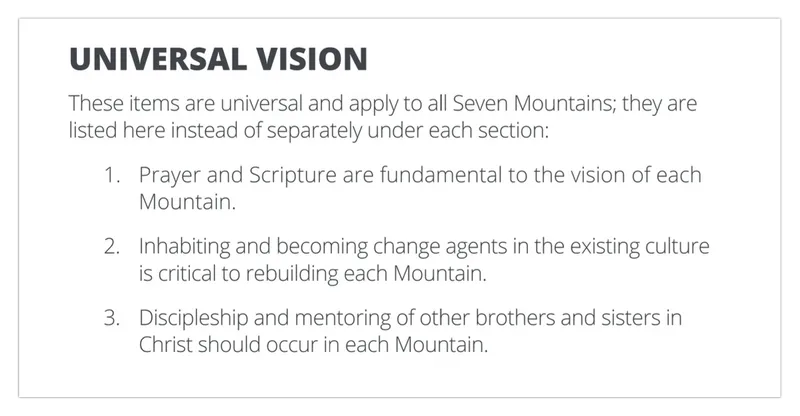 An excerpt from Ziklag’s “Declaration and 30-Year Vision for the Mountains of Influence.” The document outlines Ziklag’s mission to reshape each major aspect of American society so that it operates according to a biblical worldview. Credit:Obtained by ProPublica and Documented
The Seven Mountains theology signals a break from Christian fundamentalists such as Jerry Falwell Sr. and Pat Robertson. In the 1980s and ’90s, Falwell’s Moral Majority focused on working within the democratic process to mobilize evangelical voters and elect politicians with a Christian worldview.
The Seven Mountains theology embraces a different, less democratic approach to gaining power. “If the Moral Majority is about galvanizing the voters, the Seven Mountains is a revolutionary model: You need to conquer these mountains and let change flow down from the top,” said Matthew Taylor, a senior scholar at the Institute for Islamic, Christian and Jewish Studies and an expert on Christian nationalism. “It’s an outlined program for Christian supremacy.”
“The Amorphous, Tumultuous Wild West”
The Christian right has had compelling spokespeople and fierce commitment to its causes, whether they were ending abortion rights, allowing prayer in schools or displaying the Ten Commandments outside of public buildings. What the movement has often lacked, its leaders argue, is sufficient funding.
“If you look at the right, especially the Christian right, there were always complaints about money,” said legal historian Ziegler. “There’s a perceived gap of ‘We aren’t getting the support from big-name, big-dollar donors that we deserve and want and need.’”
That’s where Ziklag comes in.
Speaking late last year to an invitation-only gathering of Ziklaggers, as members are known, Charlie Kirk, who leads the pro-Trump Turning Point USA organization, named left-leaning philanthropists who were, in his view, funding the destruction of the nation: MacKenzie Scott, ex-wife of Amazon founder Jeff Bezos; billionaire investor and liberal philanthropist George Soros; and the two founders of Google, Larry Page and Sergey Brin.
“Why are secular people giving more generously than Christians?” Kirk asked, according to a recording of his remarks. “It would be a tragedy,” he added, “if people who hate life, hate our country, hate beauty and hate God wanted it more than us.”
“Ziklag is the place,” Kirk told the donors. “Ziklag is the counter.”
Similarly, Pence, in a 2021 appearance at a private Ziklag event, praised the group for its role in “changing lives, and it’s advanced the cause, it’s advanced the kingdom.”
A driving force behind Ziklag’s efforts is Lance Wallnau, a prominent Christian evangelist and influencer based in Texas who is described by Ziklag as a “Seven Mountains visionary & advisor.” The fiery preacher is one of the most influential figures on the Christian right, experts say, a bridge between Christian nationalism and Trump. He was one of the earliest evangelical leaders to endorse Trump in 2015 and later published a book titled “God’s Chaos Candidate: Donald J. Trump and the American Unraveling.” More than 1 million people follow him on Facebook. He doesn’t try to hide his views: “Yes, I am a Christian nationalist,” he said during one of his livestreams in 2021. (Wallnau did not respond to requests for comment.)
Donald Trump shakes hands with Lance Wallnau, a self-described Christian nationalist. Credit:Lancewallnau.com
Wallnau has remained a Trump ally. He called Trump’s time in office a “spiritual warfare presidency” and popularized the idea that Trump was a “modern-day Cyrus,” referring to the Persian king who defeated the Babylonians and allowed the Jewish people to return to Jerusalem. Wallnau has visited with Trump at the White House and Trump Tower; last November, he livestreamed from a black-tie gala at Mar-a-Lago where Trump spoke.
Wallnau did not come up with the notion that Christians should try to take control of key areas of American society. But he improved on the idea by introducing the concept of the seven mountains and urged Christians to set about conquering them. The concept caught on, said Taylor, because it empowered Christians with a sense of purpose in every sphere of life.
As a preacher in the independent charismatic tradition, a fast-growing offshoot of Pentecostalism that is unaffiliated with any major denomination, Wallnau and his acolytes believe that God speaks to and through modern-day apostles and prophets — a version of Christianity that Taylor, in his forthcoming book “The Violent Take It By Force,” describes as “the amorphous, tumultuous Wild West of the modern church.” Wallnau and his ideas lingered at the fringes of American Christianity for years, until the boost from the Trump presidency.
The Ziklag files detail not only what Christians should do to conquer all seven mountains, but also what their goals will be once they’ve taken the summit. For the government mountain, one key document says that “the biblical role of government is to promote good and punish evil” and that “the word of God and prayer play a significant role in policy decisions.”
For the arts and entertainment mountain, goals include that 80% of the movies produced be rated G or PG “with a moral story,” and that many people who work in the industry “operate under a biblical/moral worldview.” The education section says that homeschooling should be a “fundamental right” and the government “must not favor one form of education over another.”
Other internal Ziklag documents voice strong opposition to same-sex marriage and transgender rights. One reads: “transgender acceptance = Final sign before imminent collapse.”
Heading into the 2024 election year, Ziklag executive director Drew Hiss warned members in an internal video that “looming above and beyond those seven mountains is this evil force that’s been manifesting itself.” He described it as “a controlling, evil, diabolical presence, really, with tyranny in mind.” That presence was concentrated in the government mountain, he said. If Ziklaggers wanted to save their country from “the powers of darkness,” they needed to focus their energies on that government mountain or else none of their work in any other area would succeed.
“Operation Checkmate”
In the fall of 2023, Wallnau sat in a gray armchair in his TV studio. A large TV screen behind him flashed a single word: “ZIKLAG.”
“You almost hate to put it out this clearly,” he said as he detailed Ziklag’s electoral strategy, “because if somebody else gets ahold of this, they’ll freak out.”
He was joined on set by Hiss, who had just become the group’s new day-to-day leader. The two men were there to record a special message to Ziklag members that laid out the group’s ambitious plans for the upcoming election year.
The forces arrayed against Christians were many, according to the confidential video. They were locked in a “spiritual battle,” Hiss said, against Democrats who were a “radical left Marxist force.” Biden, Wallnau said, was a senile old man and “an empty suit with an agenda that’s written and managed by somebody else.”
Wallnau speaks with Drew Hiss, Ziklag’s executive director, about the group’s goals for political engagement. Credit:Obtained by ProPublica and Documented
In the files, Ziklag says it plans to give out nearly $12 million to a constellation of groups working on the ground to shift the 2024 electorate in favor of Trump and other Republicans.
A prominent conservative getting money from Ziklag is Cleta Mitchell, a lawyer and Trump ally who joined the January 2021 phone call when then-President Trump asked Georgia’s secretary of state to “find” enough votes to flip Georgia in Trump’s favor.
Mitchell now leads a network of “election integrity” coalitions in swing states that have spent the last three years advocating for changes to voting rules and how elections are run. According to one internal newsletter, Ziklag was an early funder of Mitchell’s post-2020 “election integrity” activism, which voting-rights experts have criticized for stoking unfounded fears about voter fraud and seeking to unfairly remove people from voting rolls. In 2022, Ziklag donated $600,000 to the Conservative Partnership Institute, which in turn funds Mitchell’s election-integrity work. Internal Ziklag documents show that it provided funding to enable Mitchell to set up election integrity infrastructure in Florida, North Carolina and Wisconsin.
Now Mitchell is promoting a tool called EagleAI, which has claimed to use artificial intelligence to automate and speed up the process of challenging ineligible voters. EagleAI is already being used to mount mass challenges to the eligibility of hundreds of thousands of voters in competitive states, and, with Ziklag’s help, the group plans to ramp up those efforts.
According to an internal video, Ziklag plans to invest $800,000 in “EagleAI’s clean the rolls project,” which would be one of the largest known donations to the group.
Conservative lawyer Cleta Mitchell, seen speaking at an event with then-President Donald Trump, received funding from Ziklag for her efforts to overturn the 2020 election results. Credit:Anna Moneymaker/The New York Times/Bloomberg via Getty Images
Ziklag lists two key objectives for Operation Checkmate: “Secure 10,640 additional unique votes in Arizona (mirroring the 2020 margin of 10,447 votes), and remove up to one million ineligible registrations and around 280,000 ineligible voters in Arizona, Nevada, Georgia, and Wisconsin.”
In a recording of an internal Zoom call, Ziklag’s Mark Bourgeois stressed the electoral value of targeting Arizona. “I care about Maricopa County,” Bourgeois said at one point, referring to Arizona’s largest county, which Biden won four years ago. “That’s how we win.”
For Operation Watchtower, Wallnau explained in a members-only video that transgender policy was a “wedge issue” that could be decisive in turning out voters tired of hearing about Trump.
The left had won the battle over the “homosexual issue,” Wallnau said. “But on transgenderism, there’s a problem and they know it.” He continued: “They’re gonna wanna talk about Trump, Trump, Trump. … Meanwhile, if we talk about ‘It’s not about Trump. It’s about parents and their children, and the state is a threat,’” that could be the “target on the forehead of Goliath.”
The Ziklag files describe tactics the group plans to use around parental rights — policies that make it easier for parents to control what’s taught in public schools — to turn out conservative voters. In a fundraising video, the group says it plans to underwrite a “messaging and data lab” focused on parental rights that will supply “winning messaging to all our partner groups to create unified focus among all on the right.” The goal, the video says, is to make parental rights “the difference-maker in the 2024 election.”
According to Wallnau, Ziklag also plans to fund ballot initiatives in seven key states — Arizona, Colorado, Florida, Michigan, Montana, Nevada and Ohio — that take aim at the transgender community by seeking to ban “genital mutilation.” The seven states targeted are either presidential battlegrounds or have competitive U.S. Senate races. None of the initiatives is on a state ballot yet.
“People that are lethargic about the election or, worse yet, they’re gonna be all Trump-traumatized with the news cycle — this issue will get people to come out and vote,” Wallnau said. “That ballot initiative can deliver swing states.”
The last prong of Ziklag’s 2024 strategy is Operation Steeplechase, which urges conservative pastors to mobilize their congregants to vote in this year’s election. This project will work in coordination with several prominent conservative groups that support former president Trump’s reelection, such as Turning Point USA’s faith-based group, the Faith and Freedom Coalition run by conservative operative Ralph Reed and the America First Policy Institute, one of several groups closely allied with Trump.
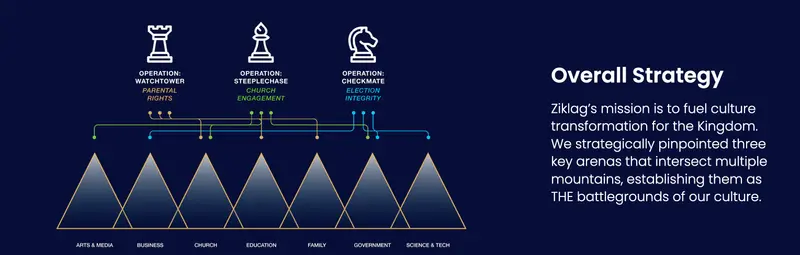 Ziklag’s website outlines its three major operations and which mountains each one targets. Credit:Screenshot by ProPublica.
Ziklag says in a 2023 internal video that it and its allies will “coordinate extensive pastor and church outreach through pastor summits, church-focused messaging and events and the creation of pastor resources.” As preacher and activist John Amanchukwu said at a Ziklag event, “We need a church that’s willing to do anything and everything to get to the point where we reclaim that which was stolen from us.”
Six tax experts reviewed the election-related strategy discussions and tactics reported in this story. All of them said the activities tested or ran afoul of the law governing 501(c)(3) charities. The IRS and the Texas attorney general, which would oversee the Southlake, Texas, charity, did not respond to questions.
While not all of its political efforts appeared to be clear-cut violations, the experts said, others may be: The stated plan to mobilize voters “sympathetic to Republicans,” Ziklag officials openly discussing the goal to win the election, and Wallnau’s call to fund ballot initiatives that would “deliver swing states” while at the same time voicing explicit criticism of Biden all raised red flags, the experts said.
[In Los Angeles, Your Chic Vacation Rental May Be a Rent-Controlled Apartment](https://www.propublica.org/article/los-angeles-housing-rent-controlled-apartments-vacation-rentals)
“I am troubled about a tax-exempt charitable organization that’s set up and its main operation seems to be to get people to win office,” said Phil Hackney, a professor of law at the University of Pittsburgh and an expert on tax-exempt organizations.
“They’re planning an election effort,” said Marcus Owens, a tax lawyer at Loeb and Loeb and a former director of the IRS’ exempt organizations division. “That’s not a 501(c)(3) activity.”
---
4 24 7 WORLD CENTRAL FOOD KITCHEN CHEF ANDRES KIA
4 24 kpfa
israel target low level hamas kill at home ok to kill 15-20, higer value kill 300 with smart munitions 4/5/24 7 am lavendar, where’s daddy
---
===
pro pub algo Close oct 2022
on a summer day last year, a group of real estate tech executives gathered at a conference hall in Nashville to boast about one of their company’s signature products: software that uses a mysterious algorithm to help landlords push the highest possible rents on tenants.
“Never before have we seen these numbers,” said Jay Parsons, a vice president of RealPage, as conventiongoers wandered by. Apartment rents had recently shot up by as much as 14.5%, he said in a video touting the company’s services. Turning to his colleague, Parsons asked: What role had the software played?
“I think it’s driving it, quite honestly,” answered Andrew Bowen, another RealPage executive. “As a property manager, very few of us would be willing to actually raise rents double digits within a single month by doing it manually.”
The celebratory remarks were more than swagger. For years, RealPage has sold software that uses data analytics to suggest daily prices for open units. Property managers across the United States have gushed about how the company’s algorithm boosts profits.
“The beauty of YieldStar is that it pushes you to go places that you wouldn’t have gone if you weren’t using it,” said Kortney Balas, director of revenue management at JVM Realty, referring to RealPage’s software in a testimonial video on the company’s website.
The nation’s largest property management firm, Greystar, found that even in one downturn, its buildings using YieldStar “outperformed their markets by 4.8%,” a significant premium above competitors, RealPage said in materials on its website. Greystar uses RealPage’s software to price tens of thousands of apartments.
RealPage became the nation’s dominant provider of such rent-setting software after federal regulators approved a controversial merger in 2017, a ProPublica investigation found, greatly expanding the company’s influence over apartment prices. The move helped the Texas-based company push the client base for its array of real estate tech services past 31,700 customers.
The impact is stark in some markets.
In one neighborhood in Seattle, ProPublica found, 70% of apartments were overseen by just 10 property managers, every single one of which used pricing software sold by RealPage.
To arrive at a recommended rent, the software deploys an algorithm — a set of mathematical rules — to analyze a trove of data RealPage gathers from clients, including private information on what nearby competitors charge.
For tenants, the system upends the practice of negotiating with apartment building staff. RealPage discourages bargaining with renters and has even recommended that landlords in some cases accept a lower occupancy rate in order to raise rents and make more money.
One of the algorithm’s developers told ProPublica that leasing agents had “too much empathy” compared to computer generated pricing.
Apartment managers can reject the software’s suggestions, but as many as 90% are adopted, according to former RealPage employees.
The software’s design and growing reach have raised questions among real estate and legal experts about whether RealPage has birthed a new kind of cartel that allows the nation’s largest landlords to indirectly coordinate pricing, potentially in violation of federal law.
Experts say RealPage and its clients invite scrutiny from antitrust enforcers for several reasons, including their use of private data on what competitors charge in rent. In particular, RealPage’s creation of work groups that meet privately and include landlords who are otherwise rivals could be a red flag of potential collusion, a former federal prosecutor said.
At a minimum, critics said, the software’s algorithm may be artificially inflating rents and stifling competition.
“Machines quickly learn the only way to win is to push prices above competitive levels,” said University of Tennessee law professor Maurice Stucke, a former prosecutor in the Justice Department’s antitrust division.
RealPage acknowledged that it feeds its clients’ internal rent data into its pricing software, giving landlords an aggregated, anonymous look at what their competitors nearby are charging.
A company representative said in an email that RealPage “uses aggregated market data from a variety of sources in a legally compliant manner.”
The company noted that landlords who use employees to manually set prices “typically” conduct phone surveys to check competitors’ rents, which the company says could result in anti-competitive behavior.
“RealPage’s revenue management solutions prioritize a property’s own internal supply/demand dynamics over external factors such as competitors’ rents,” a company statement said, “and therefore help eliminate the risk of collusion that could occur with manual pricing.”
The statement said RealPage’s software also helps prevent rents from reaching unaffordable levels because it detects drops in demand, like those that happen seasonally, and can respond to them by lowering rents.
RealPage did not make Parsons, Bowen or the company’s current CEO, Dana Jones, available for interviews. Balas and a Greystar representative declined to comment on the record about YieldStar. The National Multifamily Housing Council, an industry group, also declined to comment.
Proponents say the software is not distorting the market. RealPage’s CEO told investors five years ago that the company wouldn’t be big enough to harm competition even after the merger. The CEO of one of YieldStar’s earliest users, Ric Campo of Camden Property Trust, told ProPublica that the apartment market in his company’s home city alone is so big and diverse that “it would be hard to argue there was some kind of price fixing.”
What role RealPage’s software has played in soaring rents — which in the decade before the pandemic nearly doubled in some cities — is hard to discern. Inadequate new construction and the tight market for homebuyers have exacerbated an existing housing shortage.
But by RealPage’s own admission, its algorithm is helping drive rents higher.
“Find out how YieldStar can help you outperform the market 3% to 7%,” RealPage urges potential clients on its website.
Few tenants know that such software, owned by a privately held company, has had a hand in rent increases across the country.
In Boston, renter Kaylee Hutchinson said she was puzzled when her landlord — unbeknownst to her, a RealPage client — told her days into the first pandemic lockdowns that her rent was going up. Building staff insisted that the market rate for her apartment was 6.5% higher than she was paying, despite her protests that people were fleeing the city.
Kaylee Hutchinson’s landlord, who uses RealPage’s pricing software, told her rent was going up at the start of the pandemic even as many people were fleeing the city. Credit:Philip Keith, special to ProPublica
A few weeks later, she and her fiancé saw a newly vacant unit in their building advertised online for less. One of their landlord’s policies permitted moving to another unit owned by the company, so they did.
Hutchinson, who is an analyst for the police department, wondered if a computer algorithm was behind building staff’s inflexibility. “It was pretty obvious they should have been dropping prices,” she said. “They were digging their heels in.”
Hutchinson said she watched apartments in her building sit vacant at prices that didn’t make sense to her.
“A normal mom-and-pop landlord, they’re worried about having a good tenant and protecting their interest in the agreement,” Hutchinson said. “These companies, they’ll just replace you.”
The Origins of YieldStar
One of YieldStar’s main architects was a business executive who had personal experience with an antitrust prosecution.
A genial, self-described “numbers nerd,” Jeffrey Roper was Alaska Airlines’ director of revenue management when it and other major airlines began developing price-setting software in the 1980s.
Competing airlines began using common software to share planned routes and prices with each other before they became public. The technology helped head off price wars that would have lowered ticket prices, the Department of Justice said.
The department said the arrangement may have artificially inflated airfares, estimating the cost to consumers at more than a billion dollars between 1988 and 1992. The government eventually reached settlements or consent decrees for price fixing with eight airlines, including Alaska Airlines, all of which agreed to change how they used the technology.
At one point, federal agents removed a computer and documents from Roper’s office at the airline. He said he and other creators of the software weren’t aware of the antitrust implications. “We all got called up before the Department of Justice in the early 1980s because we were colluding,” he said. “We had no idea.”
When Roper returned to the United States in the early 2000s after a stint in central and eastern Europe, he said, he discovered the apartment rental industry was so far behind technologically that it resembled the emerging markets he’d just left.
Apartment managers were “basically pricing their product on a paper napkin,” said Roper, who eventually formed his own company.
Old computers and manual recordkeeping were mainstays of the industry. Leasing agents gauged how their buildings compared by calling up competitors. “This was just a ripe business,” with lots of money and lots of opportunities for technological improvement, Roper said.
RealPage hired Roper as its principal scientist in 2004 to improve software it had bought from Camden Property Trust, a large investor-backed owner and manager of apartment buildings.
Roper quickly realized he required data — a lot of data — to get the algorithm working properly. He began building a “master data warehouse” that pulled in client data from other RealPage applications, such as those for leasing managers.
A proof-of-concept version of the software had performed well in tests at townhouses Camden offered for rent in its home city of Houston.
At the time, the street behind Camden’s townhouses was shut down while a grocery store was being built. Leasing staff wanted to discount rent for the townhouses because of the nuisance, said Kip Zacharias, who worked with Camden as a consultant.
Instead, YieldStar suggested boosting rents. “We were like, ‘Guys, just try it,’” Zacharias said.
The units ended up renting for significantly more than staff had expected, he said. “That was kind of the eureka moment,” Zacharias said. “If you’d listened to your gut, you would have lowered your price.”
The practice of lowering rent to fill a vacancy was a reflex for many in the apartment industry. Letting units sit empty could be costly and nerve-wracking for leasing agents.
Such agents sometimes hesitated to push rents higher. Roper said they were often peers of the people they were renting to. “We said there’s way too much empathy going on here,” he said. “This is one of the reasons we wanted to get pricing off-site.”
Unimpeded by human worries, YieldStar’s price increases sometimes led to more tenants leaving.
Camden’s turnover rates increased about 15 percentage points in 2006 after it implemented YieldStar, Campo, the company’s CEO, told a trade publication a few years later. But that wasn’t a problem for the firm: Despite having to replace more renters, its revenue grew by 7.4%.
“The net effect of driving revenue and pushing people out was $10 million in income,” Campo said. “I think that shows keeping the heads in the beds above all else is not always the best strategy.”
(Reminded of that quote, Campo told ProPublica it “sounds awful” and doesn’t reflect how he or Camden views renters today. “We fundamentally believe our customers are the most important part of our business,” he said. “We’re not about pushing people out.”)
Hiking rents at the same time benefited all landlords, the industry learned. “A rising tide lifts all boats,” one real estate executive and revenue management proponent told the industry publication Yield Pro in 2007.
One of the greatest threats to a landlord’s profit, according to Roper and other executives, was other firms setting rents too low at nearby properties. “If you have idiots undervaluing, it costs the whole system,” Roper said.
Jeffrey Roper helped develop YieldStar, which uses an algorithm to suggest prices for apartments across the country. Credit:Shelby Tauber for ProPublica
Roper wasn’t the only technologist working on an apartment pricing algorithm. Donald Davidoff, the primary developer of rival software called Lease Rent Options, or LRO, said he designed his program differently, to head off any concerns about collusion.
Instead of relying on a digital warehouse that includes competitor data, Davidoff used a complex formula and public market data to steer LRO’s algorithm. The system relied on incremental price shifts to manage demand for apartments, said Davidoff, an MIT-educated former rocket engineer. “That’s not dissimilar to changing a trajectory of a rocket through inflection of a nozzle,” he said — making small changes that can dramatically alter something’s course over time.
Davidoff said he was careful to avoid features that might run counter not only to anti-discrimination laws, such as the Fair Housing Act, but also those that bar competitors from conspiring to set prices.
“I had many conversations with attorneys to understand where the boundaries are,” he said. “Anybody who’s building one of these systems or is involved in these should care a lot about fair housing and should care a lot about price collusion to avoid both.”
Roper told ProPublica that when he was developing the YieldStar software more than a decade ago, he was concerned about avoiding both issues. He also said he didn’t want to misuse private data in pricing.
“I was highly sensitized to: You just don’t do it,” Roper said.
Despite differences in the software’s design, RealPage acquired LRO in 2017 after months of scrutiny by the antitrust division of the justice department. Federal regulators review mergers above a certain size — right now, it is transactions valued at $101 million — and typically allow them to proceed after only a preliminary review. But some are flagged for a more extensive look. The government can challenge a merger in court if it believes it could substantially harm competition.
RealPage’s purchase of LRO received such a second look, but the DOJ allowed it to proceed in late 2017. The department did not respond to requests for comment.
The approval allowed RealPage to acquire its only significant competitor, Roper said, adding, “I was surprised the DOJ let that go through.”
RealPage was pricing 1.5 million units, and the acquisition of LRO would double that, Steve Winn, RealPage’s then-CEO, said at a mid-2017 investor conference. “I don’t think there’s any concentration, enough concentration, of buying or pricing power here” to warrant DOJ concerns, he said. A third company had a substantial footprint in the market, Winn said, but property managers’ own manual pricing processes or proprietary systems were RealPage’s largest competitor.
“We expect our combined platform to drive accelerated, sustained revenue growth,” Winn said in a media release announcing the deal.
RealPage’s influence was burgeoning. That year, the firm’s target market — multifamily buildings with five or more units — made up about 19 million of the nation’s 45 million rental units. A growing share of those buildings were owned by firms backed by Wall Street investors, who were among the most eager adopters of pricing software.
RealPage renamed its combined pricing software AI Revenue Management. By the end of 2020, the firm was reporting in a Securities and Exchange Commission filing that its clients used its services and products to manage 19.7 million rental units of all types, including single-family homes. The private equity firm Thoma Bravo bought the public company a few months later for $10.2 billion.
Winn, whose net worth Forbes estimates at $1.7 billion, stepped aside. He did not respond to requests for comment.
A spokesperson for Thoma Bravo declined to comment.
Who Uses the Software and How It Works
Somewhere around 2016, according to one trade group, the industry’s use of the pricing software began to achieve “critical mass.”
The more property managers who sign on to RealPage services, the more data flows into the company’s repository. That in turn aids its pricing service, which the company says “leverages multifamily’s largest lease transaction database.”
RealPage’s clients include some of the largest property managers in the country. Many favor cities where rent has been rising rapidly, according to a ProPublica analysis of five of the country’s top 10 property managers as of 2020. All five use RealPage pricing software in at least some buildings, and together they control thousands of apartments in metro areas such as Denver, Nashville, Atlanta and Seattle, where rents for a typical two-bedroom apartment rose 30% or more between 2014 and 2019.
Greystar and FPI Management each control hundreds of buildings in metro areas where rents have risen steeply in recent years. And Equity Residential, Lincoln Property Company and Mid-America Apartment Communities each manage dozens of buildings in high-growth markets.
In contrast, these same companies control fewer buildings in metro areas such as Philadelphia, Tampa and Chicago, where rents have increased more slowly, the analysis found.[much more, see bak]
===
3 24
cory doc new bk tech monopoly
*The Internet Con: How to Seize the Means of Computation.
UpFront - March 7, 2024 | KPFA
text interview
---
===
an 2 24
Sen. Ron Wyden and privacy rights advocates this week are sounding the alarm about an anti-abortion group using cellphone location data to send misinformation to people who visited hundreds of Planned Parenthood clinics across the country.
"If a data broker could track Americans' cellphones to help extremists target misinformation to people at hundreds of Planned Parenthood locations across the United States, a right-wing prosecutor could use that same information to put women in jail," Wyden (D-Ore.) said in a statement Tuesday.
"Federal watchdogs should hold the data broker accountable for abusing Americans' private information," he added. "And Congress needs to step up as soon as possible to ensure extremist politicians can't buy this kind of sensitive data without a warrant."
"That data brokers can track people visiting Planned Parenthood is terrifying enough. That law enforcement agencies can simply buy this type of sensitive data—rather than getting a warrant—is even worse."
Since the right-wing U.S. Supreme Court reversedRoe v. Wade with its June 2022 decision in Dobbs v. Jackson Women's Health Organization, anti-choice state policymakers have ramped up attacks on abortion rights, elevating concerns about patient privacy.
Wyden explained in a Tuesday letter that his office launched an investigation after The Wall Street Journalreported last May that the Veritas Society, a nonprofit established by Wisconsin Right to Life, hired the advertising agency Recrue Media for an anti-abortion ad campaign targeting clinic visitors, whose locations were tracked by the data broker Near Intelligence.
As Wyden wrote to Federal Trade Commission (FTC) Chair Lina Khan and U.S. Securities and Exchange Commission (SEC) Chair Gary Gensler:
My staff spoke with Steven Bogue, the co-founder and managing principal of Recrue Media on May 19, 2023, who revealed that to target these ads, his employees used Near's website to draw a line around the building and parking lot of each targeted facility. On May 26, 2023, my staff spoke with Near's chief privacy officer, Jay Angelo, who confirmed that, until the summer of 2022, the company did not have any technical controls in place to prevent its customers targeting people who visited sensitive facilities, such as reproductive health clinics. On a webpage that has since been taken down, but was saved by the Internet Archive, the Veritas Society stated that in 2020 in Wisconsin alone, it delivered 14.3 million ads to people who visited abortion clinics, and "served ads to those devices across the women's social pages, Facebook, Instagram, and Snapchat." The scale of this invasive surveillance-enabled ad campaign remains unknown, however, Mr. Bogue told my staff that the company used Near to target ads to people who had visited 600 Planned Parenthood locations in the lower 48 states.
Justin Sherman, who studies data brokers at Duke University, toldPolitico that "this is the largest targeting campaign we've seen to date against reproductive health clinics based on brokered data."
In case you missed this yesterday, I discovered that data brokers are helping anti-abortion extremists exploit location data to target patients. The prospect of how red-state prosecutors could abuse this information should terrify every single American with a smartphone.
— (@)
Wyden also highlighted Journalreporting from October about Near selling location data to defense contractors that resold it to U.S. Defense Department and intelligence agencies. He wrote that Angelo, the privacy officer, "confirmed that the company had for three years sold location data to the defense contractor AELIUS Exploitation Technologies."
"Mr. Angelo revealed that after joining Near in June of 2022, he conducted a review of the company's practices and discovered that the company was facilitating the sale of location data to the U.S. government that had been obtained without user consent," the senator continued, noting the removal of "misleading statements" from Near's website.
"The former executives that led Near during the period in which it engaged in these egregious violations of Americans' privacy are now under criminal investigation, according to a statement made by the company's lawyer during a December 11, 2023, bankruptcy hearing. But prosecuting those individuals for engaging in financial fraud will not address Near's corporate abuses," Wyden argued, urging the FTC and SEC to take various actions over the company's "outrageous conduct" that "recklessly harmed the public and investors."
Wyden's letter comes as the Republican-controlled U.S. House plans to take up the Reforming Intelligence and Securing America Act, which would reform Section 702 of the Foreign Intelligence Surveillance Act (FISA), spying powers temporarily extended late last year that agencies—especially the Federal Bureau of Investigation (FBI)—have abused.
Section 702 only allows warrantless surveillance targeting foreigners located outside the United States, but Americans' data is also swept up, and privacy advocates within and outside of Congress—including Wyden—have long been pushing for warrant protections, a key issue in this week's debates about the Republican-led reform bill.
A shocking invasion of privacy that lays bare just how far forced-birth extremists will go to track, monitor, intimidate & scare women.\n\nI am deeply concerned with how this data could be used by states that criminalize abortion. This must be investigated. \nhttps://t.co/TO0Y2QMgx4
— (@)
Responding to Wyden's letter, Rep. Zoe Lofgren (D-Calif.) said Wednesday that "this is outrageous. Americans' most personal private health data is being bought and sold for politics. Major surveillance changes are needed. i.e. If Congress acts, reforms from our Fourth Amendment Is Not For Sale Act must be part of a FISA reform."
Reintroduced by Lofgren, Wyden, and a bipartisan coalition of lawmakers last July, that bill would require the U.S. government to get a court order compelling data brokers to disclose information as well as bar law enforcement and intelligence agencies from buying data on people in the U.S. and Americans abroad if it was obtained from a user's account or device, or deceptive practices.
Privacy rights campaigners and experts also responded to Wyden's letter with renewed calls for closing the data broker loophole.
"That data brokers can track people visiting Planned Parenthood is terrifying enough. That law enforcement agencies can simply buy this type of sensitive data—rather than getting a warrant—is even worse," said Ashley Gorski, senior staff attorney at the ACLU's National Security Project. "This Thursday, Congress must vote to close the loophole for law enforcement purchases from data brokers. The government shouldn't be able to buy its way around the Fourth Amendment."
The organizations Demand Progress and EPIC concurred in social media posts sharing Politico's reporting on the letter.
"The continued sale of our most sensitive information to and by shady data brokers not only fuels harmful surveillance advertising systems, but enables government agencies—from local police departments to state attorneys general to the FBI—to sidestep the Fourth Amendment," said EPIC counsel Sara Geoghegan in a statement. "We urgently need to rein in data brokers and enact comprehensive privacy rules to protect us from these grave harms in the post-Roe era we live in."
---==
---
yikes
an 1 24
kochava, the self-proclaimed industry leader in mobile app data analytics, is locked in a legal battle with the Federal Trade Commission in a case that could lead to big changes in the global data marketplace and in Congress’ approach to artificial intelligence and data privacy.
The stakes are high because Kochava’s secretive data acquisition and AI-aided analytics practices are commonplace in the global location data market. In addition to numerous lesser-known data brokers, the mobile data market includes larger players like Foursquare and data market exchanges like Amazon’s AWS Data Exchange. The FTC’s recently unsealed amended complaint against Kochava makes clear that there’s truth to what Kochava advertises: it can provide data for “Any Channel, Any Device, Any Audience,” and buyers can “Measure Everything with Kochava.”
Separately, the FTC is touting a settlement it just reached with data broker Outlogic, in what it calls the “first-ever ban on the use and sale of sensitive location data.” Outlogic has to destroy the location data it has and is barred from collecting or using such information to determine who comes and goes from sensitive locations, like health care centers, homeless and domestic abuse shelters, and religious places.
According to the FTC and proposed class-action lawsuits against Kochava on behalf of adults and children, the company secretly collects, without notice or consent, and otherwise obtains vast amounts of consumer location and personal data. It then analyzes that data using AI, which allows it to predict and influence consumer behavior in an impressively varied and alarmingly invasive number of ways, and serves it up for sale.
Kochava has denied the FTC’s allegations.
The FTC says Kochava sells a “360-degree perspective” on individuals and advertises it can “connect precise geolocation data with email, demographics, devices, households, and channels.” In other words, Kochava takes location data, aggregates it with other data and links it to consumer identities. The data it sells reveals precise information about a person, such as visits to hospitals, “reproductive health clinics, places of worship, homeless and domestic violence shelters, and addiction recovery facilities.” Moreover, by selling such detailed data about people, the FTC says “Kochava is enabling others to identify individuals and exposing them to threats of stigma, stalking, discrimination, job loss, and even physical violence.”
I’m a lawyer and law professor practicing, teaching and researching about AI, data privacy and evidence. These complaints underscore for me that U.S. law has not kept pace with regulation of commercially available data or governance of AI.
Most data privacy regulations in the U.S. were conceived in the pre-generative AI era, and there is no overarching federal law that addresses AI-driven data processing. There are Congressional efforts to regulate the use of AI in decision making, like hiring and sentencing. There are also efforts to provide public transparency around AI’s use. But Congress has yet to pass legislation.

The Federal Trade Commission’s suit against Kochava is set against a backdrop of minimal regulation of data brokers.
What litigation documents reveal
According to the FTC, Kochava secretly collects and then sells its “Kochava Collective” data, which includes precise geolocation data, comprehensive profiles of individual consumers, consumers’ mobile app use details and Kochava’s “audience segments.”
The FTC says Kochava’s audience segments can be based on “behaviors” and sensitive information such as gender identity, political and religious affiliation, race, visits to hospitals and abortion clinics, and people’s medical information, like menstruation and ovulation, and even cancer treatments. By selecting certain audience segments, Kochava customers can identify and target extremely specific groups. For example, this could include people who gender identify as “other,” or all the pregnant females who are African American and Muslim. The FTC says selected audience segments can be narrowed to a specific geographical area or, conceivably, even down to a specific building.
By identify, the FTC explains that Kochava customers are able to obtain the name, home address, email address, economic status and stability, and much more data about people within selected groups. This data is purchased by organizations like advertisers, insurers and political campaigns that seek to narrowly classify and target people. The FTC also says it can be purchased by people who want to harm others.
How Kochava acquires such sensitive data
The FTC says Kochava acquires consumer data in two ways: through Kochava’s software development kits that it provides to app developers, and directly from other data brokers. The FTC says those Kochava-supplied software development kits are installed in over 10,000 apps globally. Kochava’s kits, embedded with Kochava’s coding, collect hordes of data and send it back to Kochava without the consumer being told or consenting to the data collection.
Another lawsuit against Kochava in California alleges similar charges of surreptitious data collection and analysis, and that Kochava sells customized data feeds based on extremely sensitive and private information precisely tailored to its clients’ needs.
The data broker marketplace has been tracking you for years, thanks to mobile phones and web browser cookies.
AI pierces your privacy
The FTC’s complaint also illustrates how advancing AI tools are enabling a new phase in data analysis. Generative AI’s ability to process vast amounts of data is reshaping what can be done with and learned from mobile data in ways that invade privacy. This includes inferring and disclosing sensitive or otherwise legally protected information, like medical records and images.
AI provides the ability both to know and predict just about anything about individuals and groups, even very sensitive behavior. It also makes it possible to manipulate individual and group behavior, inducing decisions in favor of the specific users of the AI tool.
This type of “AI coordinated manipulation” can supplant your decision-making ability without your knowledge.
Privacy in the balance
The FTC enforces laws against unfair and deceptive business practices, and it informed Kochava in 2022 that the company was in violation. Both sides have had some wins and losses in the ongoing case. Senior U.S. District Judge B. Lynn Winmill, who is overseeing the case, dismissed the FTC’s first complaint and required more facts from the FTC. The commission filed an amended complaint that provided much more specific allegations.
Winmill has not yet ruled on another Kochava motion to dismiss the FTC’s case, but as of a Jan. 3, 2024 filing in the case, the parties are proceeding with discovery. A 2025 trial date is expected, but the date has not yet been set.
For now, companies, privacy advocates and policymakers are likely keeping an eye on this case. Its outcome, combined with proposed legislation and the FTC’s focus on generative AI, data and privacy, could spell big changes for how companies acquire data, the ways that AI tools can be used to analyze data, and what data can lawfully be used in machine- and human-based data analytics.
Anne Toomey McKenna, Visiting Professor of Law, University of Richmond
This article is republished from The Conversation under a Creative Commons license. Read the original article.
---
---
not much coverage
moline fla
An organization backed by major corporations gave state legislators, including at least two from Florida, campaign software worth thousands of dollars in violation of state campaign-finance law, according to complaints filed by three progressive organizations.
The alleged gifts from the American Legislative Exchange Council, which Gov. Ron DeSantis addressed last week in Salt Lake City, amount to illegal in-kind campaign contributions, according to the Center for Media and Democracy (CMD), Common Cause, and the Alliance for a Better Utah.
Recipients in Florida include, but might not be limited to, Republicans Rep. Spencer Roach and Rep. Jason Fischer, according to a complaint filed with the Florida Elections Commission. Roach is an attorney and represents part of Lee County in the Legislature. He is listed as vice chair of the Public Integrity & Elections Committee in the state House. Fischer represents part of Duval County.
It’s hard to know the exact number of Florida legislators who may be involved because ALEC doesn’t release its membership list, the organizations said.
“ALEC keeps its membership list secret — they don’t publish it,” said David Armiak, research director for CMD, during a telephone interview.
A separate whistleblower complaint filed with the Internal Revenue Service alleges the software transfer to ALEC’s predominantly GOP membership evidences broader campaign-related activity in violation of ALEC’s tax-exempt status as a nonprofit.
“Voters deserve to know who is buying influence with their elected officials, and that is exactly what ALEC is doing in providing this software to legislators,” Karen Hobert Flynn, president of Common Cause, said in a written statement.
“This is sophisticated software worth thousands of dollars that aids the reelection efforts of these legislators, and the legislators know that. This isn’t buying a legislator a cup of coffee to bend their ear about your bill. These are valuable in-kind contributions, plain and simple,” she said.
“ALEC has abused its tax-exempt status for a decade or more,” said Eric Havian, an attorney for CMD. “I can only hope that we have not become too accustomed to fraud in plain sight, and that the IRS will finally take action to stop taxpayers from subsidizing ALEC’s partisan electioneering and lobbying.”
Fischer and Roach have yet to reply to requests for comment.
The progressive organizations have filed similar complaints in 14 other states, asking government watchdogs to investigate and if possible identify other lawmakers who received the software.
ALEC, backed by some of the country’s biggest corporations, gathers state lawmakers for workshops and distributes model legislation for introduction in statehouses. Recent examples would ban state limits on greenhouse gas emissions to fight climate change and an “Energy Discrimination Elimination Act,” forbidding discouragement of fossil fuels.
“While ALEC publicly emphasizes the ‘constituent research and engagement’ benefits of the [software] service, the voter database and management software provided by ALEC is clearly designed to help ALEC legislators win reelection,” the elections complaint alleges.
ALEC has claimed the software, “ALEC CARE,” developed by GOP affiliated consultancy VoterGravity, would normally cost $3,000 but distributed it as a “member benefit,” the complaint adds.
“Voter Gravity explicitly markets the software as a ‘powerful’ tool for political campaigns from ‘an approved mobile app vendor for the Republican National Committee and fully integrated with the RNC’s database,” the complaint says.
Florida law defines a campaign contribution as “a gift, subscription, conveyance, deposit, loan, payment, or distribution of money or anything of value, including contributions in kind having an attributable monetary value in any form, made for the purpose of influencing the results of an election or making an electioneering communication.”
The law limits contributions to $1,000 per legislative candidate. Persons knowingly making or accepting gifts worth above that amount are guilty of a first-degree misdemeanor, punishable by up to one year imprisonment. Corporate violators face fines of as much as $10,000 and could love their right to do business in Florida.
“Provision of the voter management software to support election campaigns constitutes an illegal in-kind campaign contribution by ALEC whether or not ALEC members ultimately used it for their campaigns,” the complaint alleges.
“ALEC’s disclaimers and transparent repackaging of a powerful campaign tool as “constituent communications” do nothing to reduce its campaign value.”
The IRS complaint identifies the whistleblower as “a current legislative member of ALEC,” identified in the document as “Legislator,” calling this person “a classic insider” appalled at what ALEC was doing.
The software log-in page states that the tools can’t be used for a political campaigns, but “many of its features can have no other plausible use,” the document says.
“The software came preloaded with individual-level voting information, including voter history and political party ideology; views on ‘hot button’ electoral issues like taxation and gun control; income and donor status; metrics like ‘Turnout Score’ and Republican National Committee voter identification numbers; and numerous other data points exceedingly helpful for a re-election campaign but largely irrelevant to ‘constituent service,’” the complaint says.
“Moreover, Legislator noted that CARE’s analytical and dashboard tools were also primarily campaign related and not particularly useful for constituent service, tracking elements like ‘Identified Supporters,’ ‘Door Knocks,’ ‘Walklist Stats,’ and ‘Phone Bank Stats,’” it says.
“ALEC CARE is a brazen scheme to help ALEC’s overwhelmingly Republican members win reelection,” Arn Pearson, CMD’s executive director, said in a written statement.
“The fact that ALEC’s constituent management program typically costs ‘thousands of dollars,’ but it is being provided free of charge to selected legislators, would constitute a contribution to the legislator,” Marcus Owens, former director of the Exempt Organizations Division of the Internal Revenue Service, told CMD.
“The fact that there may well be sub rosa links, meaning secret, between databases created by the management program and organizations engaged in partisan political activity suggests another potential electioneering event,” Owens said.
---
===
…In an article published by Axios on January 7, Freedman explains, “The consolidation in the climate intelligence space threatens to lead to an asymmetry of access to information. If you’re a wealthy investor or large real estate firm, you can pay to find out which companies or regions will be safest from climate hazards, and make sound investment decisions. However, ordinary homeowners, such as those in the Denver suburbs who faced down a horrific, climate-fueled December wildfire on December 30, may be left with fewer no- or low-cost options to find out detailed information about their mounting risk exposure.”...
===
---
BILL MOYERS: –said the Council for National Policy's executive committee president, Bill Walton.Ralph Reed, chairman of the nonprofit, Faith and Freedom Coalition told the CNP audience that conservatives are going to be harvesting ballots in churches. “We're going to be specifically going in, not only to white evangelical churches, but into Hispanic and Asian churches and collecting those ballots.'"And then, here's the one that really stands out. At that meeting, J. Christian Adams, a former Justice Department official and the president of the Public Interest Legal Foundation, a charity, described mail-in voting as the number one left-wing agenda. He urged the activists not to worry about the criticism that might come their way. Quote, “Be not afraid of the accusations that you're a voter suppressor." Any of that surprise you?
ANNE NELSON: Not in the least. On the contrary, you'll find the footprints of those statements in my book. One of the techniques that this movement has used is using data profiles and directing information to voters to either get them to vote for Republicans or to suppress the vote if they're not likely to. The Koch brothers brought state-of-the-art political data operations to the table with an organization called i360. And that was harnessed to organizations that were run by CNP members.
So, for example, one of them was the Susan B. Anthony List, which is anti-abortion. One of them was the NRA. They also combined data from churches and from political data and consumer data. So that allowed canvassers for these organizations to do their door-to-door canvassing having a huge amount of information about each individual voter, and a tailored individual script for them. So, for example, if you are canvassing in Springfield, Missouri, and you're working for the Susan B. Anthony List, you know that at such-and-such an address, there's a Catholic housewife with six kids there who watched an anti-abortion film on Netflix and ordered LIVES OF THE SAINTS from Amazon. You have all of that in your cell phone, and you also have a script that's been prepared and tailored for that voter, right? But you're going to have a totally different script based on the data for the next-door neighbor who's a gun owner who's all about the second amendment.
And the Democrats have lagged behind, not in terms of the data they have, but the way they've networked data across state lines and to organizations that are doing their political groundwork. So that's been a factor.The use of data has been very important in the last few campaigns, and not always well-understood. But there's also a really important matter of how data is used to suppress votes. And that's where I would direct people to a news story done by Channel Four in Britain. The Council for National Policy partners and the Koch brothers' data platform i360 used data from Cambridge Analyticawith several hundred million voters, with some2,000 data points for every voter. So that includes you and me, Bill, okay? They know a lot about us, and so what they did in this story documenting what happened with African Americans in Milwaukee, Wisconsin, was find that if voters were not likely to vote for Republicans. If they leaned Democratic, they would target them with misinformation that would disincline them to vote at all. And in other cases, such as what's been documented in Michigan, some 90,000 African American voters were persuaded not to vote for the top of the ticket for Hillary Clinton by these methods. So, in these states, they always go by very, very narrow margins. So, I would argue that a lot of these data operations, some of them of questionable legality, have actually changed the course of electoral history.
BILL MOYERS: What do you think they're doing for this election in two weeks?
ANNE NELSON: Well, we know that the Trump 2020 app has highly questionable practices, in terms of its privacy and the way it accesses people's cell phone directories, all of their contacts, friends and family, and then sends messages out to them, often without the user knowing that they're doing it. They also combine that with consumer data. So, for example, if you downloaded their app on one phone that was a different account, they could trace your credit card records back to your own account. They also use geolocation, so once you download the app, they figure out where you are and what kind of messaging would appeal to you and leverage you to attract other voters. And they use this through beacons that are placed around areas like political rallies and churches, right, to locate the people with the apps and then engage them for political purpose. It has been recently revealed that thesebeacons had even been implanted in Trump yard signs. So, they're really, I would say, on the cutting edge of political technology. And it's in this very murky area of law where there are abusive practices involving privacy, but there's no clear legal framework to govern it.
BILL MOYERS: And what stuns me is their ability to connect this very sophisticated information gained by very up-to-date, modern technology to a lot of poor pastors in East Texas and Southern Alabama who are concerned about the state of the world. And here, they've been led into, one of the most sophisticated political campaigns that really has not their interest at heart. And they become soldiers in the crusade–
---
oct 3 3, 2020
What you need to know about the “Google for spies”
If you know the name Palantir, you probably know that it’s associated with Peter Thiel, that it contracts with defense and law enforcement agencies, and that it works with data somehow, including data from surveillance systems. You might get that it’s named, creepily enough, after the magical “seeing-stones” in *Lord of the Rings*.
But what exactly it is that Palantir doeshas not always been clear from media coverage. That’s partly because the company has intentionally cultivated an air of secrecy and mystery around its work. But it’s also partly because the actual nature of its work is somewhat murky and hard to pin down, even once you know what it is.
On Thursday, Palantir went public in a direct listing, completing a transition from a shadowy Silicon Valley unicorn to one that must answer quarterly to investors and regulators. Its shares dipped just a bit from their initial price but left the company with a hefty valuation on the order of $20 billion, per the Wall Street Journal. That’s remarkable for a company that has just 125 customers.
Enterprise software companies tend to stay out of the spotlight; their products are not used, let alone beloved, by the masses, as are those of consumer software giants such as Google. But Palantir in particular is worth knowing about, because it embodies a vision of technology’s role in society that carries profound implications for all of us. And the Google comparison is more instructive than it might seem: Palantir is, in some ways, the yin to Google’s yang.
The Pattern
Palantir is a tech company built for our emerging dystopia.
- To understand what Palantir does, there’s no better starting point than this New Yorkmagazine profile by Sharon Weinberger, published on the day the company went public. Palantir’s promise, she notes, is “to ingest the mountains of data collected by soldiers and spies and police — fingerprints, signals intelligence, bank records, tips from confidential informants — and enable users to spot hidden relationships, uncover criminal and terrorist networks, and even anticipate future attacks.”
- In short, Palantir is “a sort of Google for spies,” although it now serves corporate and public health clients as well as soldiers and spooks. This is consistent with Palantir’s self-description, in its public filing, as a purveyor of software that “enables our customers to transform massive amounts of information into knowledge that reflects their world.”
- What makes Weinberger’s piece so valuable, however, is how it interrogates the margins between what Palantir promises and what it delivers. For Palantir to realize its vision at scale, it would have to largely automate the process of combining and converting vast, messy data sets into actionable insights about the world. That’s a very high bar for artificial intelligence, and Weinberger’s reporting suggests that Palantir isn’t particularly close to meeting it. Instead, like many of today’s ambitious automation tools, its platform requires what one intelligence-community source called “RFOP,” or “rooms full of people” working behind the curtain to clean, label, and interpret the data. Palantir also sends employees that it calls “forward-deployed**engineers” to work permanently onsite with clients, helping them tailor the platform to their needs. (You can learn more about the quotidian mechanics of the work by reading Quora posts from current and former Palantir employees.)
- More than any crystal-ball wizardry, Palantir has won over big clients such as the U.S. Army through white-glove customer service and consulting, plus a user interface much slicker and friendlier than the often-outdated systems it seeks to replace. It has been helped along the way by clever sales tactics, Thiel’s relationship with the Trump administration, and a willingness to lose piles of money in pursuit of future growth. (Palantir has never turned a profit.)
- As a business, then, Palantir is very different from Google. One provides free, heavily automated tools to the masses in exchange for data to power targeted ads. The other provides expensive, labor-intensive data modeling tools and data consulting services on an exclusive basis to a limited number of huge organizations, whose data it promises to keep private. (Palantir has struggled to tap the local law enforcement market, with a few notable exceptions, because it’s simply too expensive.) Palantir’s rift with Silicon Valley is not merely abstract; it’s actually relocating to Denver from Palo Alto.
- Palantir CEO Alex Karp defines his company’s values in opposition to Google’s. In Palantir’s S-1 filing, he took an implicit shot at Google for walking away from its Project Maven military contract in response to employee backlash, while continuing to invade its own users’ privacy. “Our software is used to target terrorists and to keep soldiers safe,” Karp wrote. “We have chosen sides.” At Davos in January, he acknowledged that Palantir has helped ICE find and deport immigrants (as Motherboard had previously uncovered), and defended the company’s government contracts. “The core mission of our company always was tomake the West, especially America, the strongest in the world, the strongest it’s ever been, for the sake of global peace and prosperity,” he said in an interview there.
- That sort of muscular rhetoric, along with Thiel’s Trump ties and Palantir’s business model, would seem to belie Karp’s own claim to be politically progressive. (To the extent these men’s ideologies matter, by the way, it’s because Palantir’s governance structure as a public company keeps almost all the power in its founders’ hands In fact, Karp identified as neo-Marxist in his grad school days, when he earned a doctorate in “neoclassical social theory” at Germany’s Goethe University, home to the famous philosopher Jurgen Habermas.
- For a deeper dive into Karp’s philosophy, and an attempt to reconcile it with the politics of both Thiel and Palantir itself, you can read this fascinating critique of his dissertation by the historian and media theorist Moira Weigel, published in July in the journal boundary 2. (You could also try reading the dissertation itself, I suppose, provided you can read German and have a lot of time on your hands.) In Weigel’s reading, despite their ideological differences, both Karp and Thiel “regard the desire to commit violence as a constant, founding fact of human life.” And while Karp engages with critical theory, his account of aggression’s primary role in language, culture, and socialization is fundamentally analytical rather than normative. That is, he takes it as a given rather than a problem to be overcome.
- In a phone interview for this newsletter Friday, Weigel expanded on how Karp’s philosophy relates to his work with Palantir. “When you take up the tradition of what he calls neo-Marxism and take away the emancipatory impulse that animated it — that the point is to make society less violent— what you get is a very pessimistic view of modernity and society,” she said. That dark worldview helps to explain why Karp might regard the appropriate response as being to simply “choose a side,” as he put it in Palantir’s S-1 — and keep a vigilant watch on what the other side is up to.
- Here again, the contrasts with Google are striking. Google’s aesthetic is sunny and whimsical — think of its colorful logo, its doodles, its dessert-themed Android operating systems — and its products often reflect a worldview that is optimistic to a fault. Its tools promise to put the world’s information in everyone’s hands, for free; it speaks of information as empowering and democratizing, and implicitly assumes that people will use it for good. That’s a convenient assumption for Google’s business model, because a world in which information is unlikely to be abused is one in which people freely share their data, which can in turn be leveraged to show them relevant ads. If Palantir’s world is zero-sum, Google’s is win-win; Palantir runs on suspicion, Google on trust.
- Zoom out far enough, though, and Palantir and Google start to look like flipsides of the same coin. Ultimately, both promise to harness machine learning and computing power to bring together and organize disparate sources of information and make it searchable. The customers and revenue models are different, but the value proposition is the same — to allow people to quickly surface and synthesize information that would otherwise remain disjunct and obscure. (That’s one reason they so often compete for the same engineering talent; according to the New Yorkprofile, early Palantir employees wore t-shirts that said “Google is our backup job.”) And while each might point fingers at the other, surveillance is integral to both models. In one, the customers are doing the surveilling; in the other, the customers are the ones surveilled.
- Privacy theorists sometimes talk about “privacy through obscurity” — the idea that the average person’s everyday privacy resides not in a lack of available information about them, but in the difficulty of tracking it down. Your ISP might know what websites you visit; the DMV knows your license plate number; your next-door neighbor knows what time you leave the house each day; the local newspaper may have an old article about you somewhere in its archives. But as long as no single entity has ready access to all of that information, a semblance of privacy remains intact.
- To see how Palantir explodes that obscurity, consider its partnership with the Los Angeles Police Department. In a *BuzzFeed News*investigation this week, Caroline Haskins detailed how the company trained officers to use its tools to stitch together every piece of data they can get their hands on. “At great taxpayer expense, and without public oversight or regulation, Palantir helped the LAPD construct a vast database that indiscriminately lists the names, addresses, phone numbers, license plates, friendships, romances, jobs of Angelenos — the guilty, innocent, and those in between.”
- There are, of course, benefits and downsides to obscurity: It can empower activists to challenge governments, protect stalking victims from their stalkers — or enable criminals to evade detection. Google and Palantir think about those risks and tradeoffs very differently, with one insisting your data is safe in its hands, the other pledging to only track the bad guys on behalf of reputable clients. Yet by building tools to automate the integration of disparate data sources about people, both Google and Palantir are fundamentally anti-obscurity — and, by extension, anti-privacy. If neither has yet built anything quite like the all-seeing stone from Lord of the Rings, it isn’t for lack of trying.
- Google and Palantir aren’t the only companies automating the connection of informational dots, of course. The Softbank-backed startup Banjo AI — whose now-ousted founder was a former neo-Nazi — seeks to combine real-time data from various feeds, including surveillance video, to detect events such as emergencies as they happen. I wrote last week about how the surveillance tech built by Ring, Amazon’s home security subsidiary, empowers people to spy on each other. There’s a way of looking at today’s tech industry in which its business is essentially to eliminate society’s frictions: the obstacles to interaction, to information, to instantaneous fulfilment of desires. But the friction involved in tracking anyone you find suspicious, for any reason, is one we might be better off holding onto.
---
---
https://theintercept.com/2020/07/09/twitter-dataminr-police-spy-surveillance-black-lives-matter-protests
==
---
720 lee f
https://theintercept.com/2020/06/24/fbi-surveillance-social-media-cellphone-dataminr-venntel/
The FEDERAL BUREAU of Investigation may be watching what you tweet and where people gather.
The federal law enforcement agency’s records show a growing focus on harnessing the latest private sector tools for mass surveillance, including recent contracts with companies that monitor social media posts and collect cellphone location data.
On May 26, as demonstrations around the country erupted over the police killing of George Floyd, the FBI signed an expedited agreement to extend its relationship with Dataminr, a company that monitors social media.
A few days later, the agency modified an agreement it signed in February with Venntel, Inc., a Virginia technology firm that maps and sells the movements of millions of Americans. The company purchases bulk location data and sells it largely to government agencies.
FBI has long pursued advanced technological tools to rapidly predict crime and locate potential suspects, capabilities that have raised concerns that the agency targets lawful forms of protest and free expression. Earlier this year, the agency released a bid proposal for technological solutions to “obtain early alerts on ongoing national security and public safety-related events through lawfully collected/acquired social media data.”
It’s not clear exactly how the FebruaryVenntel contract was modified. Chris Gildea, the president of Venntel, did not respond to a request for comment. The company is a subsidiary of Gravy Analytics, a major data broker that sells location-tracking information to advertisers and other clients, which also declined to comment “due to the confidential nature of that work.” A spokesperson for the FBI also declined to comment for this article.
Dataminr, which already held contracts with the FBI worth over $1 million, monitors social media for breaking news and events. “Dataminr provides the FBI with First Alert, a product that delivers breaking news alerts on emergency events, such as natural disasters, fires, explosions and shootings,” noted a spokesperson for Dataminr in a statement.
The statement claimed that the service “was designed and built to technologically restrict all forms of surveillance and be compliant with the user protection and data use policies of social media platforms.”
Christopher Wray, the director of the FBI, has warned that “terrorism today moves at the speed of social media.” During testimony last year, Wray told lawmakers that threats from “everything from anarchist groups to racially-motivated violent extremist groups” tend to “begin mostly online.”
But critics of the agency are concerned that the new reach could encroach upon First Amendment-protected speech.
“We are deeply concerned that the FBI is further expanding their surveillance capacity,” said Mary Zerkel, coordinator of the American Friends Service Committee’s Communities Against Islamophobia program.
“The FBI has for decades used surveillance and racial profiling to target Muslims, immigrants, people of color, activists in general, and Black activists in particular. AFSC itself has a substantial FBI file,” added Zerkel. “Mass data collection tools will only serve to further criminalize protests and free speech, and expand the criminalization of Muslims and people of color.”
Few regulations exist to restrict the use of location-tracking data, a form of data collection that many common phone applications collect and monetize. The Supreme Court’s 2018 Carpenter v. United States ruled that government prosecutors require a warrant to obtain cellphone location data from service providers. But many experts worry that the ruling may not apply to third-party data brokers such as Venntel.
The Intercept has reported that since the recent wave of street demonstrations, FBI agents have questioned at least one individual for simply tweeting in jest that they are members of “antifa,” a reference to a style of violent activism popular among some on the activist far-left. Members of the Joint Terrorism Task Force have also questioned protest organizers at their homes — sometimes within hours of posting an event on social media.
The FBI has tapped other notable surveillance firms in recent years, including Palantir, which builds tools to visualize relationships using an array of information, from social media to license plate numbers.
But the embrace of powerful mass location data through a firm such as Venntel represents a potential new era for the agency.
The Wall Street Journal was the first to report that government agencies such as the Internal Revenue Service and U.S. Immigration and Customs Enforcement had tapped Venntel for tax and immigration enforcement, respectively. After the initial story ran, Sen. Ron Wyden, D-Ore., reportedly reached out to the company to inquire about the federal government’s use of the technology — but that the company declined to answer most questions.
---
--
https://www.alternet.org/2020/06/trump-is-bleeding-support-from-the-only-voters-who-have-stuck-with-him-since-2016/
620 an raw story
Donald Trump is losing support from his evangelical base as he lurches from one crisis into another.
Numerous polls show that religious Americans, like most other Americans, disapprove of the president’s performance, and that could imperil his re-election chances, reported the New York Times.
Nearly 80 percent of white evangelicals — a group that’s already shrinking as a share of the electorate — approved of Trump’s performance in March, but his handling of the coronavirus pandemic has bled 15 points from their support, according to a new poll from Public Religion Research Institute.
“He had an opportunity in March when people were looking to him,” said Robert Jones, the institute’s chief executive, “and then within four weeks he squandered it.”
Those losses could be offset by efforts from activist group’s such as Ralph Reed’s Christian Coalition, which plans to spend tens of millions of dollars to identify and register new religious conservative voters and rallying right-wing Christians.
And another PRRI poll from last year found that 31 percent of white evangelical voters said there was almost nothing Trump could do to lose their support.
==
==
https://theintercept.com/2020/04/09/coronavirus-trump-smartphone-tracking/
a SMARTPHONE TRACKING firm helping Donald Trump clinch his 2020 presidential reelection recently told investors it’s identified a promising new profit opportunity: the global coronavirus pandemic.
Phunware is part of a vast galaxy of obscure advertising technology companies that help clients follow and target their customers — to “capitalize on users’ daily digital trail,” as Phunware’s site puts it. By embedding Phunware code in their app, a developer can easily glean detailed records of where a user goes and what they do, creating a rich behavioral history to sell on to others.
Related
The Trump Campaign Is Deploying Phone Location-Tracking Technology
Last year, The Intercept reported that Phunware had signed to work with American Made Media Consultants, a political consultancy founded by Trump campaign manager Brad Parscale that functioned as the campaign’s highly effective digital media branch.In June of last year, Phunware announced it had appointed to the company’s board Brittany Kaiser, a former executive and self-described “whistleblower” from Cambridge Analytica, the company that infamously abused its access to personal Facebook data to aid Trump’s 2016 victory. A group associated with Kaiser later denied she ever officially joined the board.
Although Phunware hasn’t publicized the details of the services it’s providing to Trump’s reelection effort, the impressive and potentially invasive technical capabilities it possesses are well documented, both on its website and in press reports. “Beyond identifying coveted voters, mobile data can also be used to define ad targeting parameters with incredible accuracy,” reads a section of Phunware’s site that compares the buying and selling of personal data to the 1849 Gold Rush. In October 2019, the Wall Street Journal reported that Phunware had helped a Democratic political strategist target voters whose phones had been tracked to the 2017 anti-Trump Women’s March. The company’s privacy policy grants the company license to use personal data for essentially whatever purposes it deems necessary for however long it deems necessary.
Phunware did not reply to repeated requests for comment....
---
omfg // covid app tracking?!
https://en.wikipedia.org/wiki/Social_Credit_System
Social Credit System (Chinese: 社会信用体系; pinyin: shèhuì xìnyòng tǐxì) is a national reputation system being developed by the Chinese government.[1][2][3] The program initiated regional trials in 2009, before launching a national pilot with eight credit scoring firms in 2014.[4][5] In 2018, these efforts were centralized under the People's Bank of China with participation from the eight firms.[4] By 2020,[needs ^update] it is intended to standardize the assessment of citizens' and businesses' economic and social reputation, or 'Social Credit'.[1][6][7][8][9][10]
The social credit initiative calls for the establishments of unified record system for individuals, businesses and the government to be tracked and evaluated for trustworthiness.[11][12][13][14] Initial reports suggest the system utilizes numerical score as the reward and punishment mechanism;[15][14] recently conducted reports suggest there are in fact multiple different forms of social credit system experimenting at the same time.[16][17] Numerical system has been implemented only in several regional pilot programs, while the nationwide regulatory method has been based primarily on blacklisting and whitelisting.[5][16][18] The credit system is closely related to China's mass surveillance systems such as the Skynet[19][20][21], which incorporates facial recognition system, big data analysis technology and AI.[22][23][15][24][25]
By 2018, some restrictions had been placed on citizens which state-owned media described as the first step toward creating a nationwide social credit system.[26][27][28][9][29][30] As of November 2019, in addition to dishonest and fraudulent financial behavior, other behavior that some cities have officially listed as negative factors of credit ratings includes playing loud music or eating in rapid transits,[31] violating traffic rules such as jaywalking and red-light violations,[32][33] making reservations at restaurants or hotels but not showing up,[34] failing to correctly sort personal waste,[35][36][37] fraudulently using other people's public transportation ID cards,[38] etc; on the other hand, behavior listed as positive factors of credit ratings includes donating blood, donating to charity, volunteering for community services, and so on.[39][40][41]
As of June 2019, according to the National Development and Reform Commission of China, 26.82 million air tickets as well as 5.96 million high-speed rail tickets have been denied to people who were deemed "untrustworthy (失信)" (on a blacklist), and 4.37 million "untrustworthy" people have chosen to fulfill their duties required by the law.[42][43] In general, it takes 2–5 years to be removed from the blacklist, but early removal is also possible if the blacklisted person has done enough remedies.[44][45] Certain personal information of the blacklisted people is deliberately made accessible to the society and is displayed online as well as at various public venues such as movie theaters and buses,[45][46][47][48] while some cities have also banned children of "untrustworthy" residents from attending private schools and even universities.[49][50][51][52][53] On the other hand, people with high credit ratings may receive rewards such as less waiting time at hospitals and governmental agencies, discounts at hotels, greater likelihood of receiving employment offers and so on.[38][39][40][54]
Supporters of the Credit System claim that the system helps to regulate social behavior, improve the "trustworthiness" which includes paying taxes and bills on time and promote traditional moral values,[55][56][57] while critics of the system claim that it oversteps the rule of law and infringes the legal rights of residents and organizations, especially the right to reputation, the right to privacy as well as personal dignity, and that the system may be a tool for comprehensive government surveillance and for suppression of dissent from the Communist Party of China.[58][59][60][61]
...The Social Credit System is an example of China's "top-level design" (顶层设计) approach. It is coordinated by the Central Leading Group for Comprehensively Deepening Reforms.[10] It is unclear whether the system will work as envisioned by 2020, but the Chinese government has fast-tracked the implementation of the system, resulting in the publication of numerous policy documents and plans since the main plan was issued in 2013. If the Social Credit System is implemented as envisioned, it will constitute a new way of controlling both the behavior of individuals and of businesses.[10]
Testing
In 2015, the People's Bank of China licensed eight companies to begin a trial of social credit systems.[5][64] Among these eight firms is Sesame Credit (owned by Alibaba Group and operated by Ant Financial), Tencent, as well as China's biggest ride-sharing and online-dating service, Didi Chuxing and Baihe.com, respectively.[65][5] In general, multiple firms are collaborating with the government to develop the system of software and algorithms used to calculate credit.[65][66]
The Chinese central government originally considered that the Social Credit System be run by a private firm, but by 2017 it has acknowledged the need for third-party administration. In 2017, no licenses to private companies were granted.[5] By mid-2017, the Chinese government had decided that none of the pilots would receive authorization to be official credit reporting measures.[67] The reasons include conflict of interest, the remaining control of the government, as well as the lack of cooperation in data sharing among the firms that participate in the development.[17] However, the Social Credit System's operation by a seemingly external association, such as a formal collaboration between private firms, has not been ruled out yet.[5] In November 2017, Sesame Credit denied that Sesame Credit data is shared with the Chinese government.[68] As of mid 2018, only pilot schemes have been tested.[26][27][28][9][29][30]
Private companies have also signed contracts with provincial governments to set up the basic infrastructure for the Social Credit System at a provincial level.[69] As of March 2017, 137 commercial credit reporting companies are active on the Chinese market.[10] As part of the development of the Social Credit System, the Chinese government has been monitoring the progress of third-party Chinese credit rating systems.[6]
Social credit systems
There are multiple social credit systems in China right now. Scholars have conceptualized four different types of systems, including judicial system (discredited blacklist system), municipal social credit system, People's Bank of China financial credit system, and commercial credit-rating system.[17] These four systems are not interconnected seamlessly, but relevantly independent from each other with their own jurisdictions, rules, and logic.
Judicial system
In 2013, the Supreme People's Court (SPC) of China started a blacklist of debtors with roughly 32,000 names. The list has since been described as a first step towards a national Social Credit System by state-owned media.[70][71] The SPC also began working with private companies – for example, Sesame Credit began deducting credit points from people who defaulted on court fines.[70]
In March 2018, Reuters reported that restrictions on citizens and businesses with low Social Credit ratings, and thus low trustworthiness, would come into effect on May 1.[72][73] By May 2018, several million flight and high-speed train trips had been denied to people who had been blacklisted.[27]
Financial system
There are also commercial pilots developed by private Chinese conglomerates that have the authorization from the state to test out social credit experiments. The pilots are more widespread than their local government counterparts, but function on a voluntary basis: Citizens can decide to opt-out of these systems at any time on request. Users with good scores are offered advantages such as easier access to credit loans, discounts for car and bike sharing services, fast-tracked visa application, or free health check-ups and preferential treatment at hospitals.[61] The algorithms used to assign scores in commercial pilots remain unknown, although sources say some pilots use a big-data analysis and artificial intelligence approach.[66]
In 2017, People's Bank of China issued a jointly owned license to “Baihang Credit” valid for three years.[74] Baihang Credit is co-owned by the National Internet Finance Association (36%) and the eight other companies (8% each), allowing the state to maintain control and oversee the creation of a new commercial pilot.[75]
In April 2019, the People's Bank of China announced that a new version of the Personal Credit Report would be put out which allows the ability to collect more personal information. State-run media has described it as "more detailed, more comprehensive and more precisely.”[76]
Local government
In December 2017 the National Development and Reform Commission and People's Bank of China selected “model cities” that demonstrated the steps needed to make a functional and efficient implementation of the Social Credit System. Among them are Hangzhou, Nanjing, Xiamen, Chengdu, Suzhou, Suqian, Huizhou, Wenzhou, Weihai, Weifang, Yiwu, and Rongcheng.[77][78] These pilots were deemed successful in their handling of “blacklists and ‘redlists’”, their creation of “credit sharing platforms”, and their “data sharing efforts with the other cities”. The local government Social Credit System experiments are focused more on the construction of transparent rule-based systems, in contrast with the more advanced rating systems used in the commercial pilots: Citizens often begin with an initial score, to which points are added or deducted depending on their actions. The specific number of points for each action are often listed in publicly available catalogs. Cities also experimented with a multi-level system, in which districts decide on scorekeepers who are responsible for reporting scores to higher-ups. Some experiments also allowed citizens to appeal the scores they were attributed.[79] The government alleges these systems mean to penalize citizens generally agreed as ‘untrustworthy’. They claim they will be able to “change people’s behavior by ensuring they are closely associated with it.”
As of 2018, over forty different Social Credit System experiments were implemented by local governments in different Chinese provinces.[80] The pilot programs began following the release of the 2014 “Planning Outline for the Construction of a Social Credit System” by Chinese authorities. The government oversees the creation and development of these governmental pilots by requesting they each publish a regular “interdepartmental agreement on joint enforcement of rewards and punishments for ‘trustworthy’ and ‘untrustworthy’ conduct.”[81] In April 2018, journalist Simina Mistreanu described a community where people's social credit scores were posted near the village center.[63] As of mid-2018, it was unclear whether the system will be an 'ecosystem' of various scores and blacklists run by both government agencies and private companies, or if it will be one unified system. It is also unclear whether there will be a single system-wide social credit score for each citizen and business.[28][9][29][30][27]
...
---
==
https://theconversation.com/ai-algorithms-intended-to-root-out-welfare-fraud-often-end-up-punishing-the-poor-instead-131625
President Donald Trump recently suggested there is “tremendous fraud” in government welfare programs.
Although there’s very little evidence to back up his claim, he’s hardly the first politician – conservative or liberal – to vow to crack down on fraud and waste in America’s social safety net.
States – which are charged with distributing and overseeing many federally funded benefits – are taking these fraud accusations seriously. They are increasingly turning to artificial intelligence and other automated systems to determine benefits eligibility and ferret out fraud in a variety of benefits programs, from food stamps and Medicaid to unemployment insurance.
Of course, government agencies should ensure that taxpayer dollars are spent effectively.The problem is these automated decision-making systems are sometimes rife with errors and designed in ways that punish the poor for being poor, leading to tragic results.
As a clinical law professor who has researched safety net programs and has represented low-income clients in public benefits cases for over 20 years, I believe it’s essential these systems are designed in ways that are fair, transparent and accountable to prevent hurting society’s most vulnerable.
...
---
---
https://www.democracynow.org/2020/1/30/coded_bias_shalini_kantayya_joy_buolamwini
a new documentary looks at the dangers of artificial intelligence and its increasing omnipresence in daily life, as new research shows that it often reflects racist biases. Earlier this month, Cambridge, Massachusetts, became the latest major city to ban facial recognition technology, joining a growing number of cities, including San Francisco, to ban the artificial intelligence, citing flawed technology and racial and gender bias. A recent study also found that facial recognition identified African-American and Asian faces incorrectly 10 to 100 times more than white faces. The film “Coded Bias” begins with Joy Buolamwini, a researcher at the MIT Media Lab, discovering that most facial recognition software does not recognize darker-skinned or female faces. She goes on to uncover that artificial intelligence is not in fact a neutral scientific tool; instead, it internalizes and echoes the inequalities of wider society. For more on the film, we speak with Joy Buolamwini, a researcher who uses art to raise awareness on the implications of artificial intelligence and is featured in the documentary “Coded Bias,” which just premiered at the 2020 Sundance Film Festival. We also speak with Shalini Kantayya, director of “Coded Bias.”
Transcript
This is a rush transcript. Copy may not be in its final form.
AMY GOODMAN: This is Democracy Now!, democracynow.org, The War and Peace Report. I’m Amy Goodman, with Nermeen Shaikh. And we’re broadcasting from the Sundance Film Festival in Park City, Utah, from Park City TV, where a new film looks at the racial and gender prejudice baked into artificial intelligence technology, like facial recognition. The film is called Coded Bias.
NERMEEN SHAIKH: Earlier this month, Cambridge, Massachusetts, voted to ban facial recognition, joining a growing number of cities in the U.S., including San Francisco, that have outlawed the artificial intelligence software, citing flawed technology.
AMY GOODMAN: A recent study found facial recognition identified African-American and Asian faces incorrectly 10 to 100 times more than white faces. The study by the National Institute of Standards and Technology found a photo database used by law enforcement incorrectly identified Native Americans at the highest rates.
NERMEEN SHAIKH: The danger of flawed artificial intelligence and its increasing omnipresence in daily life is the focus of the new film Coded Bias. The film begins with Joy Buolamwini, a researcher at the MIT Media Lab, who discovers that most facial recognition software does not recognize darker-skinned or female faces when she has to wear a white mask to be recognized by a robot she herself is programming. She goes on to reveal that artificial intelligence is not in fact a neutral scientific tool, but instead reflects the biases and inequalities of wider society.
AMY GOODMAN: This is Joy Buolamwini testifying before Congress in May
...
---
---
https://theconversation.com/now-advertising-billboards-can-read-your-emotions-and-thats-just-the-start-45519
Advertising giant M&C Saatchi is currently testing advertising billboards with hidden Microsoft Kinect cameras that read viewers’ emotions and react according to whether a person’s facial expression is happy, sad or neutral.
The test adverts – which feature a fictitious coffee brand named Bahio – have already appeared on Oxford Street and Clapham Common in London. So we now have adverts that can read the reactions of those that view them and adapt accordingly, cycling through different images, designs, fonts and colours. With partners Clear Channel and Posterscope, Saatchi has made advertising history. When future media historians look back they will see 2015 as a landmark year.
There are three key things we should recognise: adverts can read our behaviour, this is based on our emotions rather than website browsing history, and that adverts use this to improve themselves.
What are we to make of this? Is it a bit creepy? The answer is both yes and no. What the campaign represents is an attempt to get closer to us, something that’s a defining characteristic of the advertising and audience research industries. They want to know us more intimately so as to be able to craft messages that will affect and resonate with us. It’s an example of what I call “empathic media” because, through reading facial expressions, adverts are able to bypass the guesswork and make direct use of our emotions.
...
---
==
micro-disaster cap'lism? scary use of AI dB? van jones free mkt evac plan katrina
Uber and Lyft price-gouge customers trying to flee Seattle shooting120 anNicole Karlis / Salon
==
---
124 pp white paper report
tactical tech includes A/B
---
An act of mass surveillance’: India’s use of facial recognition tech against protesters angers privacy advocatesEoin Higgins / Common Dreams
---
---
yikes
...Reelecting A ‘Christian’ President
While the Christian right has, since Ronald Reagan’s presidential run in 1980, rallied around GOP nominees, the tenor and nature of the mobilization for Trump’s reelection is markedly new. While many of the expressed fears — that a Democratic president would nominate pro-Roe v. Wade judges or take away Christians’ religious freedom — are familiar, the motivation now is not just to avert liberal judges and policies. It is much more deliberately an imperative to reelect a singularly “Christian” president. As Ralph Reed reportedly will argue in a book to be published this spring, evangelicals “have a moral obligation to enthusiastically back” Trump in 2020.
With Trump’s reelection once again hinging on slim margins in a few key states, a multifaceted get-out-the-vote operation is getting underway. Reed’s Faith & Freedom Coalition is aiming to raise $42.7 million for its 2020 Project, aimed at bolstering its “unparalleled values-voter database, supporting field offices, and coordinating volunteers and staff to get out the vote.” It will be, Reed promised supporters, the “largest Christian Get Out The Vote (GOTV) effort in history,” necessary because “the left is already turning the re-election of Donald Trump into a three-ring circus, aimed at impeaching our president and reversing all progress for voters of faith.”
Reed’s organization is not alone. United In Purpose, an organization that provides polling and voter data to Christian right organizations, helped organize a pivotal 2016 meeting between a thousand evangelical leaders and Trump, during which he sealed an alliance by promising to nominate judges who would overturn Roe v. Wade and eliminate the Johnson Amendment, which prohibits churches from using tax-exempt resources to endorse political candidates. Although his organization is “still in the planning stages” for the 2020 election cycle, UIP’s president, Bill Dallas, said in an interview that the conservative Christian get-out-the-vote operation ? as well as its opposition’s ? will exceed 2016 in terms of “the sophistication, not just the data mining, using every technique to get the votes out.”
Maximizing white evangelical turnout for Trump will be key in Michigan and Wisconsin, two states he won in 2016 by narrow margins. White evangelicals made up 27% and 28% of the electorate in those states, respectively, according to exit polling data. Other closely watched states with high percentages of white evangelical turnout in 2016 include North Carolina (38%), Iowa (34%) and Ohio (33%).
According to Dallas, the views driving Trump’s support among the Christian voters that United in Purpose targets have already begun to solidify. “The reason why Trump has such a strong support base is because he did what he said he would do,” said Dallas. “I don’t see that [impeachment] turning off Christian voters. What would turn off Christian voters is if he didn’t fulfill his promises and commitments that he said he would do if he was elected.”
For the 2020 cycle, My Faith Votes, an organization that boasts Huckabee as its honorary national chairman, has also been organizing voter registration drives. “As Christians,” Jason Yates, the group’s CEO claims, “we must always look to elect leaders who defend our values and believe that God is the ultimate authority in this nation.” (Yates did not respond to interview requests.) In an email to My Faith Votes supporters, Huckabee described the group’s efforts in more detail. Over the course of the year, he wrote, “TV and radio PSAs will be running around the country reaching millions; millennials and Generation Z will be reached on Christian campuses; hundreds of thousands of Christians will be mobilized using peer-to-peer texting and door-to-door outreach, all in an effort to motivate and equip Christians with everything they need to take action.”
In November, Yates announced a partnership with Intercessors for America, an organization based in Purcellville, Virginia, that hosts weekly prayer calls and enlists supporters to engage in prayer against supposed deep-state and George Soros-led schemes against Trump and his allies. In a webcast, Yates and Dave Kubal, Intercessors for America’s president, announced they were developing a phone app to identify Christian voters with a “low propensity” to vote. But apps and microtargeting of voters are not the only way to keep evangelical voters in the Trump camp. The next day, Kubal was on a conference call with Paula White, her chief of staff, Todd Lamphere, and the evangelists Jon and Jolene Hamill announcing the launch of the One Voice Prayer Movement, carrying out, according to Kubal, White’s “vision to see the church of Jesus Christ come together, and pray for this administration and pray for our country.” (Kubal did not respond to an interview request. The Hamills, who are hosting a “Revolution” conference on New Year’s Eve at the Trump International Hotel in Washington, also did not respond to interview requests.)
On the call, White prayed for 10 minutes, during which she asked God to protect Trump and deliver him from his enemies. “Lord, we ask you to deliver our president from any snare, any trap, any setup of the enemy according to Ephesians 6:12,” a verse in the Bible that forms the core of the “spiritual warfare” that Trump’s prayer warriors say they are engaged in on his behalf. (“For we wrestle not against flesh and blood, but against principalities, against powers, against the rulers of the darkness of this world, against spiritual wickedness in high places.”)
But White has a plan to protect Trump from those dark forces, vanquish his enemies, and to defend the “biblical” government that has elevated Christian right personnel and policy priorities. And she left no doubt that the multiple roles she plays — presidential personal pastor, White House employee and defender of Trump against his enemies — have merged into a single message of God’s wrath against anyone who dares criticize him. “Any persons, entities, that are aligned against the president,” she said on the One Voice Prayer Movement launch call, “will be exposed and dealt with and overturned by the superior blood of Jesus.”
Sarah Posner is a reporting fellow with Type Investigations.
ABOUT THE REPORTER
SARAH POSNER
Sarah Posner is a reporting fellow with Type Investigations and author of God's Profits: Faith, Fraud, and the Republican Crusade for Values Voters
==
---
https://www.alternet.org/2019/09/secret-files-reveal-how-north-carolina-gop-operative-helped-systematically-stopped-black-people-and-students-from-voting
no lnx
Secret files reveal how North Carolina GOP operative helped systematically stopped black people and students from voting
Written by Igor Derysh / Salon September 11, 2019
Secret files found on a longtime Republican operative’s computer after his death revealed that he compiled racial data to help his party draw new political maps and impose voter ID laws.
Thomas Hofeller, who is considered the master of modern gerrymandering, left behind at least 70,000 files that were found by his estranged daughter after his death in August 2018. Some of those files have already been used to successfully challenge North Carolina’s gerrymander and the Trump administration’s plan to add a citizenship question to the census, which Hofeller argued would help “Republicans and non-Hispanic whites.”
More files, obtained by former Salon editor David Daley at The New Yorker, show that Hofeller and his race research played a key role in Republican gerrymandering efforts in North Carolina and other states, as well as other efforts intended to make it harder for African-Americans and college students to vote.
Though North Carolina Republicans have argued that their maps discriminate based on partisanship and not race, Hofeller’s files show that he compiled maps with overlays of the black voting-age population by district, suggesting that racial data was a key part of the gerrymander, which is at the center of a years-long legal battle.
The files contradict claims Republicans have long used to defend their maps in court. Republicans had long denied that a congressional-district line that cuts right down the middle of the largest historically black college in the United States, North Carolina A&T State University, was intentionally drawn to dilute the black vote, even though it effectively guaranteed two Republican districts. But Hofeller’s files show that the effort clearly focused on the race of students.
Hofeller created “giant databases that detailed the racial makeup, voting patterns, and residence halls of more than a thousand North Carolina A&T students,” Daley reported. “He also collected similar data that tracked the race, voting patterns, and addresses of tens of thousands of other North Carolina college students. Some spreadsheets have more than fifty different fields with precise racial, gender, and geographic details on thousands of college voters.”
A spreadsheet found on Hofeller’s computer shows that the operative sorted students by the residence halls they lived in along with racial data and voting status information.
Hofeller also had dozens of “intensely detailed studies” of the racial makeup of North Carolina college students that was cross-referenced with driver’s license files to determine whether these students likely had a proper ID to vote, according to the report.
Emails on his computer also show that Hofeller billed North Carolina Republicans tens of thousands of dollars for his work. Federal Election Commission filings also show that the national Republican Party paid Hofeller more than $2 million for his work.
Other files show that Hofeller, a key player in the Trump administration’s push to add a citizenship question to the census, compiled data on the citizen voting-age population in North Carolina, Texas, Arizona and other states going back to 2011. In memos, Hofeller argued that drawing maps based on the number of citizens rather than the population would “clearly be a disadvantage to the Democrats” and help “non-Hispanic whites.”
Hofeller also submitted memos to the Trump administration urging them to justify the census question with the dubious argument that it was necessary to enforce the Voting Rights Act. The New Yorker report shows that he also worked for a Massachusetts Republican who wanted to use the Voting Rights Act to turn Boston into a single district, so Republicans could contend for suburban Massachusetts congressional seats. Though Hofeller’s efforts were unsuccessful in Massachusetts, the files show he also compiled data on states like Virginia, Mississippi and Alabama.
Emails found on Hofeller’s computer also show that he advised top Republicans in Florida on gerrymandering effort, despite a state constitutional amendment that bars partisan gerrymandering. Florida officials have denied that Hofeller played any official role in the effort but a state judge later ruled that the Republicans “conducted a stealth redistricting operation that snuck partisan maps into the public process and made a ‘mockery’ of the state’s constitutional amendments,” The New Yorker reported.
The files show that Hofeller also traveled around the country to educate Republicans about redistricting and urged them to push for prison gerrymandering, which allows inmates to be counted as residents of the area where the prison is located, often helping Republican lawmakers.
Hofeller’s emails also show that he grew concerned that his maps would be undone by the anti-Trump wave that followed his election.
“Meanwhile the GOP continues to bury its collective heads in the sand or in other higher places. Trump is only a product to this stupidity,” he wrote to a Republican consultant in 2016. “Do not worry about us in North Carolina in terms of redistricting. Even in the coming political bloodbath we should still maintain majority control of the General Assembly. The Governor cannot veto a redistricting map, so the Democrats hope is that the Obamista judiciary will come to their rescue.”
Last week, a North Carolina court struck down the state’s legislative maps that Hofeller helped create, ruling that they violated the Constitution. The new map had been drawn after the Supreme Court struck down North Carolina’s previous map as a racial gerrymander.
The court ruled that Hofeller’s maps “deliberately minimized the effectiveness of the votes of citizens with whom they disagree,” arguing that the map amounted to “viewpoint discrimination” against Democrats and an effort to “retaliate against voters” for voting for Democrats.
The court said that the files on Hofeller’s computer showed evidence of “predominant focus on maximizing Republican partisan advantage in creating the 2017 Plans.”
“The evidence establishes that Dr. Hofeller drew the 2017 Plans very precisely to create as many ‘safe’ Republican districts as possible, so that Republicans would maintain their supermajorities, or at least majorities even in a strong election year for Democrats,” the court said. “Hofeller drew the maps with an intent to preserve Republicans’ control of the House and Senate.”
The court gave state lawmakers two weeks to draw nonpartisan maps. Republicans have sued to try to get a court to seal or destroy the files, arguing that they should remain confidential because they were obtained from his daughter and not from him.
The files could be a treasure trove for voting rights groups as they seek to challenge years of Republican efforts to gerrymander districts in order to gain an unfair advantage, as well as to impose voter ID laws to make it harder for certain populations to vote.
“We’ve already seen that these files have been instrumental in exposing lies around the effort to add a citizenship question to the census and around subverting a court’s order to redraw gerrymandered lines,” Kathay Feng, the national redistricting director of Common Cause, told The New York Times. “The Hofeller files are important because they’re the only thing that will allow the American people to know the truth behind the efforts to rig redistricting and elections.”
The files show only a fraction of the work Hofeller did, which stretches back to the 1980s. Files obtained by The New Yorker show that Hofeller continued to work to help Republicans even after he was diagnosed with lung cancer.
“I still have time to bedevil the Democrats with more redistricting plans before I exit,” he wrote to a friend. “Look my name up on the Internet and you can follow the damage.”
==
---
hmmn on causation
AMY GOODMAN: Arrigo Boito from Mefistofele. This is Democracy Now!, democracynow.org, The War and Peace Report. David Koch died last week of prostate cancer, well-known right-wing donor, major climate change denier, along with his brother Charles Koch. They are the subject of a new book that was written by Christopher Leonard, our guest today, called Kochland: The Secret History of Koch Industries and Corporate Power in America. So, let’s go to that chapter on workers and how the Kochs tracked the workers.
CHRISTOPHER LEONARD: Yes. You know, one of the big questions I wanted to explore going into this book is: Why have middle-class Americans been treading water economically for so long? We live in a country now where the economy can grow for 10 years, as it has over the last decade, but most middle-class Americans haven’t advanced economically. They haven’t kept the gains of their hard work. And I’m so curious as to why that is the case.
And you just can’t ignore the fact that labor unions in this country have gone from, you know, 33% of employees down to 7%. And the book shows labor unions sure as heck were not perfect. There were problems back in the ’70s. Some union bosses were corrupt. They used violence and intimidation. But when you fast-forward to today and see what the world looks like when labor unions have become truly broken and marginalized, you see this picture that I think is, frankly, disturbing.
I spent years reporting on a Koch Industries distribution center in Portland, Oregon, which is operated by Koch’s Georgia-Pacific division. And I interviewed many of these warehouse workers, who had been there since the ’70s, and they described a working life that is increasingly grueling and increasingly difficult.
After Koch bought this distribution in 2005, it used this software system called the Labor Management System, that tracks the warehouse workers every second of the day. So they show up at work. They log in. The computer tells them where to go and what to do for the 10 hours they’re on the shift, at least, until they’re done. And not only that, but it tracks how quickly they are doing their job. And what Koch Industries would do for years is that it would publicly post these rankings of the employees, with a green tier doing the best, yellow tier kind of in the middle, and the red tier doing the worst. And if you performed at the bottom of your co-workers, you would be disciplined or even fired. And what this did was it sort of systematically divided workers and made them compete against each other, which went directly against the strength of a labor union, which is everybody bargaining together, you know, and having solidarity.
And by the year 2016, you just see kind of a grim picture in this warehouse. I interviewed a woman named Debra Roberts, who was forced to work 30 days in a row without a day off. And on the 30th day, when she was told she would finally get a day off, she broke down in tears. She was so exhausted. And I obtained the labor contracts of these employees, going back to the 1970s. I had an outside compensation expert look at these labor contracts. And what he told me is that these employees are earning less money today than they did back in the 1980s, when you adjust for inflation. So, you really see this picture of American workers being swamped by this pressure to increase productivity and increase profits, and having less and less control over their working life.
AMY GOODMAN: Christopher Leonard, how they made their wealth, in many cases, it was off the backs of Native American tribes. Explain their business model and why Native American reservations were so important to them.
==
new
https://www.alternet.org/2019/07/a-shadow-digital-campaign-may-prove-decisive-in-2020-and-donald-trump-has-a-clear-advantage/
no lnx
A shadow digital campaign may prove decisive in 2020–and Donald Trump has a clear advantage
This article was paid for with reader donations to Alternet 2020.
written by Steven Schmidt July 11, 2019
Steven Schmidt was president of interactive digital at Aspen Marketing, now a division of Epsilon/Publicis.]
I think for the first time in history, the data operation ran everything from TV buying to where we were on the ground to all of the different operations. And so, having that data right there, we could start to where the persuadable targets are, [Get out the Vote], everything we needed to know.
Pennsylvania and Michigan… I started to see data and started to track it. We were making thousands of live calls, web tracking… and it was building and it’s building what’s called models and universes. What we can start to see is, ‘we’re in play in Pennsylvania’ and ‘in play in Michigan’. Let’s buy in these areas…. And by the Friday before the election, I had predicted that we were going to win 305 electoral results.”
-Trump Campaign Director Brad Parscale, interviewed on Fox News, November 16, 2016]
Marketing is big business in the U.S. and the Trump campaign is positioned to have the biggest digital marketing operation in history.
Today, with a reported database of 20 million active supporters, Brad Parscale, Trump’s campaign manager and digital guru, is confident. Parscale is predicting that the campaign will raise $1 billion, three times as much as they were able to raise in 2016, when Trump claimed to be self-financing his campaign and fundraising only became a coordinated Republican effort late in the game.
As Parscale explained on Fox News shortly after the election, his strategy began and ended “with the data.” The campaign decided to spend its limited resources in swing states late in the race, arguably pushing them over the top. Months later, Trump rewarded Parscale with the top job for 2020. The president, a self-described marketing genius, had found his own marketing genius in Parscale. And Parscale succeeded personally beyond his wildest dream when he took his little marketing company and hitched it to Trump.
Digital marketing has become ubiquitous in Americans’ lives as the age of Madison Avenue relying on TV and print advertising has given way to smarter, more narrowly targeted internet campaigns. Republicans appear to understand this shift well while Democrats have yet to show that they really ‘grock‘ how digital marketing targets and delivers messages to targeted audiences.
Reaching, Acquiring, Engaging and Converting Voters
Hillary Clinton’s team made 66 thousand visual ads. My team made 5.9 million ads. Those are ads targeted directly to people the way they want to consume them. I stopped looking at people as demographics, groups, personas. I said: let’s look at people as individuals, how do they act. Because two people who look the same, might act differently.
– Brad Parscale on ‘Micro-targeting’
As a former president of one of the largest marketing services companies in America, I can tell you that the Democratic party is far behind the curve. While the Democrats continue to rely heavily on old-school techniques of grassroots organizing, union get-out-the-vote drives and appealing to people with ad hoc causes, the Republican playbook has leaped ahead.
Today’s political battles are fought largely through interactive social media. Digital life has become almost indistinguishable from real life, especially for those who grew up with the internet. Every move we make in this world creates valuable data waiting to be harvested. Personal patterns emerge. Political beliefs are packed into your profile. All of this allows marketers like Parscale to finely tune their pitches for specific groups of voters.
When your angry old uncle or MAGA-loving grandpa attends a Trump rally or answers a text message, their contact information is being harvested for Parscale’s sprawling database. When they surf the web, visit popular conservative news sites or click on trending topics about hot button issues for the right, their personal data are, thanks to lax privacy standards across the industry, sifted, sorted and grouped into preferences for targeting.
This is the world of psychographics–a qualitative approach to defining consumers psychological attributes. Psychographic profiles –measures of an individual’s activities, interests and opinions, or AIO variables in industry-speak–were once used to sell sneakers and deodorants but have now become a potent tool for voter outreach and persuasion.
This is marketing 101 and the Democrats are only beginning to get into this high stakes game. Former Vermont Governor Howard Dean has been given the task, as of early 2019, to launch a new voter database. Dean called it “a big breakthrough” that will aim to compete with what the Republicans have spent years putting in place. “I’d sort of given up that we could get it done,” Dean told the Associated Press.
The Guru
Brad Parscale is a six foot, eight inch balding libertarian out of Topeka, Kansas via San Antonio, Texas. Before becoming Trump’s digital 2016 campaign director, he was a hungry young businessman and digital marketing whiz. When the opportunity of his life sat down next to him on a flight to New York in the person of Eric Trump, Parscale jumped on the opportunity to move up.
In early 2015, Donald Trump asked Parscale if his firm, Giles-Parscale, could build a website for $1500. When Trump launched his campaign in June 2015, he paid Parscale $10,000 to build out of his campaign’s site.
“I just made up a price,” Parscale later told The Washington Post. He promised Eric Trump that the money would be refundable if the work proved unsatisfactory.
Parscale realized that there was some real upside potential here. Trump, a tall man, had to look up to talk to Parscale, which seemed to impress him. Trump’s son-in-law, Jared Kushner, soon asked him what he could do with Facebook and its marketing platform. Parscale Strategy, a spinoff of Giles-Parscale, kicked into high gear on the Facebook front.
Facebook: A Game-Changer
Earlier this year, during a talk to a Romanian audience titled, “Let’s Make Political Marketing Great Again,” Parscale hinted at how he plans to leverage his experience from 2016 to run a billion-dollar campaign during the 2020 cycle.
Forbes reported that:
The Trump team gained access to the Republican National Committee’s Data Trust, a collection of more than 200 million voter files gathered through a massive operation begun in the wake of Romney’s 2012 Presidential defeat. It was like a “Christmas present”, Parscale remembers. The team now had a way to “know what Americans think”. But Parscale and his team still needed an efficient way to target them. “And this other Christmas present showed up: these guys from Facebook walked to my office and said: ‘we have a beta … it’s a new onboarding tool … you can onboard audiences straight into Facebook and we will match them to their Facebook accounts’.”
Parscale’s strategy aligned perfectly with Facebook’s algorithms, importing lists of supporters gleaned from Trump rallies and those ubiquitous on-line ads. In his world, data–voters’ contact info–was gold.In 2016, Cambridge Analytica mined millions of users’ Facebook data after acquiring them from a researcher who told the social media giant that he would use it exclusively for academic purposes.
The Associated Press reported last year that Data Propria, “a company run by former officials at Cambridge Analytica,” has “quietly been working for President Donald Trump’s 2020 re-election effort.” But Parscale’s operation no longer relies on such vendors. It has become a multi-platform, multi-app shop utilizing direct, one-to-one communications, interactive messaging, mobile content and live events. In 2020, one might call this database-coordinated marketing campaign the ‘Secret Sauce 2.0’.
Some of Parscale’s techniques are proprietary, but others are simply industry best practices. “I always wonder why people in politics act like this stuff is so mystical,” Parscale told reporters in 2016. “It’s the same shit we use in commercial, just has fancier names.”
While the Republicans romped online, the Democrats stalled out in 2016. Hillary Clinton’s email travails became the ‘whatabout’ attack line of the campaign. Unfortunately for the Democratic Party,Hillary and Bill had an aversion to hiring Obama’s successful digital team and brought in their own consultants–young, inexperienced, and lacking a firm grasp of important security practices. An email server was set up in a closet. It would later be breached. The results were disastrous.
The Coming Onslaught…
What we need to do is create technology, an app on your phone [that] will help execute any type of volunteer programs… once we have data back. The volunteer app would be powered by and fed into the campaign’s data-gathering operation through the use of alarge scale machine learning system. So, when knocking on a door, the team already knows what issues the person cares about, and the takeaways from their discussion will help improve the campaign’s advertising program.
—Parscale on ‘Individual ad targeting’
Opposition research on whomever emerges from the Democratic primary are yet to come, but it is already clear that the party is not prepared to fight back with its own state-of-the-art political marketing apparatus.
Parscale revealed to the Palm Beach Post that in 2016, he created as many as 100,000 ads a day, testing different images, colors and wording to see which were the most effective for particular voters.“We will continue to make content that is tailored for you and the message you need to hear from the president,” he said, promising that during the course of the campaign, millions of personalized messages from the president will be arriving daily on cell phones, in emails, and via news feeds.
This time around, Parscale’s systems are mostly ready to go at this very early date. They’ve been engineered and tested. His team will use various performance metrics to track their successes, optimize their programs as they go, and maximize their spending clout.
They’re running their plan right now.
Via the Palm Beach Post:
At a rally in Grand Rapids, Michigan, on March 28, Parscale walked onto the stage, raised his cell phone above his head and asked the audience to pull out their phones and text TRUMP to 88022. In a video clip of the rally, Trump supporters behind Parscale can be seen taking their phones out and texting.
“The power of bringing our party together is in that phone,” Parscale told the crowd in Miami. Recently, the campaign has been relentlessly texting supporters, asking them to sign a digital birthday card for the president. However, signing requires turning over your contact information and cell phone number.
“The whole game will be different” in 2020,said Parscale. Back in 2016, “the most people [the Republican National Committee] could contact to show up [to vote] without using television, advertising or some kind of mass media was 2 million people.” By 2020, “we’re gonna have 50-60 million… that’s a gigantic advantage, because the Democrats can’t do that.” Parscale expects to have a least 50 million personalized direct voter contacts in their database (62 million voted for Trump in 2016).“We will have a formidable ground game, one volunteer for every 13 swing voters, and a data operation that cannot be replicated,” Parscale told Face the Nation earlier this year.
According to The New York Times, in the first five months of this year, the Trump campaign had already pumped $4.9 million into Facebook ads, triple the figure of Elizabeth Warren, the Democratic candidate who spent the most.
But swing voters aren’t the only ones being targeted by the Trump campaign. The numbers from 2016 tell us those who stayed home in 2016–40 percent of eligible voters–represent a huge untapped source of votes for Parscale and his team to win over.
Those non-voters are being identified and targeted right now by the GOP’s marketing operations. Their data are being mined and put into Parscale’s databases in preparation for the next phase of the campaign. They will be flattered, told of Trump’s many awe-inspiring achievements and repeatedly warned about the horrors that will occur should Democrats get back in power.
It was recently revealed that part of Team Trump’s Facebook strategy to convert users into supporters is a series of targeted ads depicting members of various demographic groups that tend not to be supportive of Trump—among them bearded hipsters, young women and people of color–gushing over how great he is. These testimonials by “real Americans,” it turns out, are not only stock photos but some of them are Turkish stock photos.
Already, those in the database–core Republican voters, persuadables, and non-voters–are getting messages from the campaign. They’re being told to believe in America, keep the economy growing, protect their pocketbook, protect their family and protect the nation.
Brad Parscale is on his way, as he says, to make “political marketing great.” The database politics of the future is here now. Dems need to catch up.
---
==
https://theintercept.com/2019/07/11/china-surveillance-google-ibm-semptian/
AMERICAN ORGANIZATION founded by tech giants Google and IBM is working with a company that is helping China’s authoritarian government conduct mass surveillance against its citizens, The Intercept can reveal.
The OpenPower Foundation — a nonprofit led by Google and IBM executives with the aim of trying to “drive innovation” — has set up a collaboration between IBM, Chinese company Semptian, and U.S. chip manufacturer Xilinx. Together, they have worked to advance a breed of microprocessors that enable computers to analyze vast amounts of data more efficiently.
Shenzhen-based Semptian is using the devices to enhance the capabilities of internet surveillance and censorship technology it provides to human rights-abusing security agencies in China, according to sources and documents. A company employee said that its technology is being used to covertly monitor the internet activity of 200 million people.
Semptian, Google, and Xilinx did not respond to requests for comment. The OpenPower Foundation said in a statement that it “does not become involved, or seek to be informed, about the individual business strategies, goals or activities of its members,” due to antitrust and competition laws. An IBM spokesperson said that his company “has not worked with Semptian on joint technology development,” but declined to answer further questions. A source familiar with Semptian’s operations said that Semptian had worked with IBM through a collaborative cloud platform called SuperVessel, which is maintained by an IBM research unit in China.
Sen. Mark Warner, D-Va., vice chair of the Senate Intelligence Committee, told The Intercept that he was alarmed by the revelations. “It’s disturbing to see that China has successfully recruited Western companies and researchers to assist them in their information control efforts,” Warner said.
Anna Bacciarelli, a researcher at Amnesty International, said that the OpenPower Foundation’s decision to work with Semptian raises questions about its adherence to international human rights standards. “All companies have a responsibility to conduct human rights due diligence throughout their operations and supply chains,” Bacciarelli said, “including through partnerships and collaborations.”
Semptian presents itself publicly as a “big data” analysis company that works with internet providers and educational institutes. However, a substantial portion of the Chinese firm’s business is in fact generated through a front company named iNext, which sells the internet surveillance and censorship tools to governments.
iNext operates out of the same offices in China as Semptian, with both companies on the eighth floor of a tower in Shenzhen’s busy Nanshan District. Semptian and iNext also share the same 200 employees and the same founder, Chen Longsen.
After receiving tips from confidential sources about Semptian’s role in mass surveillance, a reporter contacted the company using an assumed name and posing as a potential customer. In response, a Semptian employee sent documents showing that the company — under the guise of iNext — has developed a mass surveillance system named Aegis, which it says can “store and analyze unlimited data.”
Aegis can provide “a full view to the virtual world,” the company claims in the documents, allowing government spies to see “the connections of everyone,” including “location information for everyone in the country.”
The system can also “block certain information [on the] internet from being visited,” censoring content that the government does not want citizens to see, the documents show.
==
pro pub series:
ZERO TOLERANCE
Trump’s Immigration Policy at the Border
https://www.propublica.org/article/immigration-officials-use-secretive-gang-databases-to-deny-migrant-asylum-claims
With scant public notice, federal immigration officials are relying on databases run by foreign police and militaries to check whether migrants crossing the United States border have gang affiliations, which would allow officials to detain and eventually deport them.
The information is being provided through a new “fusion” intelligence-gathering center in El Salvador that is funded by the State Department and works in tandem with the Department of Homeland Security.
But legal experts and human rights advocates say the government has kept the use of databases at the border largely secret, subverting potential challenges to the reliability of the information in them. An attorney in Texas recently discovered that her Salvadoran client had been falsely accused of being in the MS-13 gang based on intelligence from the center. The man was jailed in a maximum-security facility for violent criminals for six months, and his two children were taken away.
Government attorneys, pressed repeatedly in court to provide evidence, eventually dropped the allegation of gang membership against him without explanation.
...
---
---
https://www.cnbc.com/2019/04/25/how-to-stop-google-from-storing-your-location-history.html
vs !
https://truthout.org/articles/googles-sensorvault-can-tell-police-where-youve-been/
Do
you know where you were five years ago? Did you have an Android phone at the time? It turns out Google might know—and it might be telling law enforcement.
In a new article, the New York Times details a little-known technique increasingly used by law enforcement to figure out everyone who might have been within certain geographic areas during specific time periods in the past. The technique relies on detailed location data collected by Google from most Android devices as well as iPhones and iPads that have Google Maps and other apps installed. This data resides in a Google-maintained database called “Sensorvault,” and because Google stores this data indefinitely, Sensorvault “includes detailed location records involving at least hundreds of millions of devices worldwide and dating back nearly a decade.”
The data Google is turning over to law enforcement is so precise that one deputy police chief said it “shows the whole pattern of life.” It’s collected even when people aren’t making calls or using apps, which means it can be even more detailed than data generated by cell towers....
==
==
https://www.alternet.org/2019/04/how-artificial-intelligence-systems-could-threaten-democracy/
U.S. technology giant Microsoft has teamed up with a Chinese military university to develop artificial intelligence systems that could potentially enhance government surveillance and censorship capabilities. Two U.S. senators publicly condemned the partnership, but what the National Defense Technology University of China wants from Microsoft isn’t the only concern.
As my research shows, the advent of digital repression is profoundly affecting the relationship between citizen and state. New technologies are arming governments with unprecedented capabilities to monitor, track and surveil individual people. Even governments in democracies with strong traditions of rule of law find themselves tempted to abuse these new abilities.
In states with unaccountable institutions and frequent human rights abuses, AI systems will most likely cause greater damage. China is a prominent example. Its leadership has enthusiastically embraced AI technologies, and has set up the world’s most sophisticated surveillance state in Xinjiang province, tracking citizens’ daily movements and smartphone use.
Its exploitation of these technologies presents a chilling model for fellow autocrats and poses a direct threat to open democratic societies. Although there’s no evidence that other governments have replicated this level of AI surveillance, Chinese companies are actively exporting the same underlying technologies across the world.
Increasing reliance on AI tools in the US
Artificial intelligence systems are everywhere in the modern world, helping run smartphones, internet search engines, digital voice assistants and Netflix movie queues. Many people fail to realize how quickly AI is expanding, thanks to ever-increasing amounts of data to be analyzed, improving algorithms and advanced computer chips.
Any time more information becomes available and analysis gets easier, governments are interested – and not just authoritarian ones. In the U.S., for instance, the 1970s saw revelations that government agencies – such as the FBI, CIA and NSA – had set up expansive domestic surveillance networks to monitor and harass civil rights protesters, political activists and Native American groups. These issues haven’t gone away: Digital technology today has deepened the ability of even more agencies to conduct even more intrusive surveillance.
For example, U.S. police have eagerly embraced AI technologies. They have begun using software that is meant to predict where crimes will happen to decide where to send officers on patrol. They’re also using facial recognition and DNA analysis in criminal investigations. But analyses of these systems show the data on which those systems are trained are often biased, leading to unfair outcomes, such as falsely determining that African Americans are more likely to commit crimes than other groups.
AI surveillance around the world
In authoritarian countries, AI systems can directly abet domestic control and surveillance, helping internal security forces process massive amounts of information – including social media posts, text messages, emails and phone calls – more quickly and efficiently. The police can identify social trends and specific people who might threaten the regime based on the information uncovered by these systems.
For instance, the Chinese government has used AI in wide-scale crackdowns in regions that are home to ethnic minorities within China. Surveillance systems in Xinjiang and Tibet have been described as “Orwellian.” These efforts have included mandatory DNA samples, Wi-Fi network monitoring and widespread facial recognition cameras, all connected to integrated data analysis platforms. With the aid of these systems, Chinese authorities have, according to the U.S. State Department, “arbitrarily detained” between 1 and 2 million people.
My research looks at 90 countries around the world with government types ranging from closed authoritarian to flawed democracies, including Thailand, Turkey, Bangladesh and Kenya. I have found that Chinese companies are exporting AI surveillance technology to at least 54 of these countries. Frequently, this technology is packaged as part of China’s flagship Belt and Road Initiative, which is funding an extensive network of roads, railways, energy pipelines and telecommunications networks serving 60% of the world’s population and economies that generate 40% of global GDP.
For instance, Chinese companies like Huawei and ZTE are constructing “smart cities” in Pakistan, the Philippines and Kenya, featuring extensive built-in surveillance technology. For example, Huawei has outfitted Bonifacio Global City in the Philippines with high-definition internet-connected cameras that provide “24/7 intelligent security surveillance with data analytics to detect crime and help manage traffic.”
Hikvision, Yitu and SenseTime are supplying state-of-the-art facial recognition cameras for use in places like Singapore – which announced the establishment of a surveillance program with 110,000 cameras mounted on lamp posts around the city-state. Zimbabwe is creating a national image database that can be used for facial recognition.
However, selling advanced equipment for profit is different than sharing technology with an express geopolitical purpose. These new capabilities may plant the seeds for global surveillance: As governments become increasingly dependent upon Chinese technology to manage their populations and maintain power, they will face greater pressure to align with China’s agenda. But for now it appears that China’s primary motive is to dominate the market for new technologies and make lots of money in the process.
AI and disinformation
In addition to providing surveillance capabilities that are both sweeping and fine-grained, AI can help repressive governments manipulate available information and spread disinformation. These campaigns can be automated or automation-assisted, and deploy hyper-personalized messages directed at – or against – specific people or groups.
AI also underpins the technology commonly called “deepfake,” in which algorithms create realistic video and audio forgeries. Muddying the waters between truth and fiction may become useful in a tight election, when one candidate could create fake videos showing an opponent doing and saying things that never actually happened.
In my view, policymakers in democracies should think carefully about the risks of AI systems to their own societies and to people living under authoritarian regimes around the world. A critical question is how many countries will adopt China’s model of digital surveillance. But it’s not just authoritarian countries feeling the pull. And it’s also not just Chinese companies spreading the technology: Many U.S. companies, Microsoft included, but IBM, Cisco and Thermo Fisher too, have provided sophisticated capabilities to nasty governments. The misuse of AI is not limited to autocratic states.
==
tesla fails still on car deliv, but has solar co, going into insurance biz, tho tought b/c regulated, but has data on customers 419
==
Powerful International Backers
Founded in 2013—the same year as Vox—CitizenGo was set up to be an ultra-conservative version of the progressive online campaign platforms Avaaz.org and MoveOn.org. It has run powerful campaigns globally, including in Kenya where it helped get the reproductive health charity Marie Stopes temporarily banned from providing abortion services last year.
CitizenGo also has some very powerful international backers and partners. As previously mentioned, Alexey Komov, a close associate of the “Orthodox Oligarch” Konstantin Malofeev, and Luca Volonte, the Italian politician currently on trial in Milan facing corruption charges, both serve on the group’s board of trustees.
Bank statements from Volonte’s Novae Terrae Foundation in Italy, seen by openDemocracy, show that it paid CitizenGo €12,000 in 2014—at the same time as the foundation was receiving money from entities later identified as part of a “laundromat” pumping illicit cash into Europe from Azerbaijan and Russia. There is no evidence to suggest that the money paid to CitizenGo came from these illicit sources.
Meanwhile Arsuaga told openDemocracy’s undercover reporter that Patrick Slim, son of the Mexican oligarch Carlos Slim, gave his group €40,000, which “for him is just a very small amount,” said Arsuaga—although it is close to the maximum individual donation to a political party permitted under Spanish law (and four times election campaign limits).
It was not clear whether this money was for CitizenGo or HazteOir, neither of which are political parties. At the time of publication, Patrick Slim had not replied to openDemocracy’s request for comment.
Another CitizenGo board member is Brian Brown, a prominent American anti-LGBTQ activist who leads the World Congress of Families (WCF) network that recently met in Italy, with deputy prime minister Matteo Salvini from the far-right Lega party among its speakers.
Arsuaga told openDemocracy’s reporter that he met Brown at the World Congress of Families meeting in Madrid in 2012 and that CitizenGo gets advice “every couple of months or so” from a “senior expert” in fundraising and technology who is “paid by Brian Brown.” This is Darian Rafie, Brown’s partner at a U.S. group called ActRight, which describes itself online as a “clearinghouse for conservative action.”
Previously, CitizenGo has presented itself in the logo on its website as a “member of the ActRight family,” and openDemocracy understands that ActRight paid for a CitizenGo staff member in 2013, a claim that Rafie did not deny in emailed comments.
On its website, ActRight is currently encouraging people to “thank president Trump for stopping transgender insanity in the military.” On Facebook, its recent posts include those supporting Trump; those mocking the appearances of left-wing women; and asking “How much do you think Barack Obama paid Harvard to admit his pot-head daughter?”
Your Phone Is Leaking Information
ActRight’s Darian Rafie is an experienced political consultant in the United States who has played key roles in a number of companies that have worked for the Republican National Committee and the Republican Party in Ohio and Michigan; received payments from a super PAC supporting Texas Republican Ted Cruz (as did ActRight in 2015); and worked with the Tea Party group Think Freely Media.
Speaking to openDemocracy’s undercover reporter, Rafie said he “did a lot of fundraising politically with Trump,” mostly through political action committees (PACs) but also “directly with the campaign… [and] directly with the party” and that he expects one of his companies to be working “in the majority of states” in the 2020 presidential election campaigns.
“There is a lot of stuff to be done with mobile phones and geo-fencing areas,” he told the reporter. “Say there’s a rally somewhere, one of these big Trump campaign rallies. What we’ll do is we’ll draw a polygon around that event and then we’ll register all the phones that were there… Then we follow those phones home, then we know who they are, and what they do, and now I know what your Netflix unique ID is, and I’ve got your Facebook unique ID, so then I can communicate with you through a whole variety of ways.”
Rafie said, “you can do that in Europe” too, though “it’s a little more limited… because the privacy laws are better [there], for the consumer.”
He said: “It’s actually really scary, when you peek beneath the covers, and realize that this phone that you’re carrying around with you is leaking everywhere all of your information,” which can be correlated with personal data “very quickly.” In the United States, he explained, “all of the data is routinely collated and correlated and available for sale.”
Over email, Rafie clarified to openDemocracy that this company uses “ad networks” as do “many political campaigns and businesses in the United States…. to delineate an area and identify unique device IDs and their associated advertising profiles.”
“We should all be frightened by the amount of data routinely collected, collated and sold by ad networks (such as Google and Facebook),” he added.
Friends Across Europe’s Far Right
....
---