VENEZ 3
ESTB 1 26 TRUMP 2ND TERM MADURO INVASION BOAT STRIKES
merri ok
SEE EXTRA JUD KILL FOX NOTICIAS
see main for older
---
-=-
GIL BK
// GAZA
MARK LUTTER GMU VENEZ EMERG V
...
-=-=
-=-=
THOM 3
AN 9 26
President Donald Trump's new scheme to try and reduce fuel costs ahead of the election was to announce that he'd be taking some of the Venezuelan oil. But, Congress told the Pentagon it's not legal, Semafor reported Thursday.
Experts have made it clear that the thick, tar-like oil in Venezuela's fields requires a specialized refineries to process the oil into usable fuel. There's also a major infrastructure issue. The country lacks the necessary upgrades to get it out of the oil fields. Infrastructure has suffered years of under-investment and deterioration, CNBC reported. Repairing pipelines, power systems, drilling equipment and upgrades could take years.
But oil reserves aren't the same as barrels currently being produced. Experts agree that, at most, Trump's plot could put modest downward pressure on prices over the longer term, but it likely wouldn't impact fuel prices for 10-15 years, the report said.
Semafor cited a person familiar with the matter who said that Congress told the Pentagon's Office of Strategic Capital that it doesn't have the authority to take an equity stake in a private company. Trump used the Pentagon's Office of Strategic Capital to take an equity stake in the second-largest oil firm in Venezuela.
"It did so by declining to pass legislative proposals that would have granted the office the legal authority to seek equity stakes that were submitted by the Pentagon in recent years," the person told Semafor.
Skeptical lawmakers on both sides of the aisle are asking the Trump administration to give information about the effort and how it would work.
The more immediate problem is accessing oil elsewhere, like Iran. Analysts made it clear that the Iran conflict and disruptions in global oil routes are exerting a much greater short-term influence on prices than Trump's Venezuela scheme.
U.S. pump prices respond to worldwide crude prices, refinery capacity, transportation costs, seasonal demand and geopolitical disruptions. It trades on the global market. So, even Trump flooding the U.S. market with oil from the Strategic Petroleum Reserve (SPR) can only go on so long. The Reserve continues to blow through its nearly 290 million barrels left in an effort to soften the blow of soaring gas prices.
Currently, U.S. refineries are operating at near capacity (97 percent), the *Wall Street Journal* reported this week. More oil doesn't automatically mean more gasoline if there isn't enough refinery capacity to process it.
Venezuelan oil would be only one additional source of supply and could not control the global market on its own.
-=-=
---
7 26
Secretary of State Marco Rubio has a deputy he can't seem to rein in, seven senior officials told Axios.
According to the report, Chris Landau, Rubio's second at the State Department, is secretly working to undermine President Donald Trump in Venezuela, where his father once served as the ambassador.
“There’s a widespread belief that Landau went rogue,” said one Axios source. “And the evidence supports that belief.” Another staffer added: “Marco isn’t happy” with the deputy over the move.
After two earthquakes hit the Venezuelan capital Caracas on June 24, killing over 3,500 people and injuring thousands, exiled opposition leader María Corina Machado tried to get back to Venezuela to help. The Trump administration stopped her both times, despite her loyalty to Trump.
Machado was once an ally of Trump world, but Axios described her relationship with the White House as strained. It could come from the fact that she won the Nobel Peace Prize last year instead of Trump. She donated the medal to him after he complained so relentlessly that Norway was fearful Trump would come after their country.
After he staged a kidnapping mission in Venezuela to seize President Nicolás Maduro, Trump handed the top spot to Maduro's VP, Delcy Rodriguez, instead of giving it to the opposition leader.
The Rubio aide has a close relationship with Machado’s team.
“He’s eerily incapable of saying anything positive” about Rodriguez's interim government and certainly there's nothing “negative about Machado.”
Machado called Landau and other officials in the administration after the earthquake, requesting help with getting her back to the country.
One person described it as “forum-shopped,” a reference to those who search for the perfect person to give them what they want. And "Landau was happy to help.”
Landau spoke with the Netherlands ambassador, who said he would help get her to Venezuela by going through the Dutch island of Curaçao. The ambassador then checked with other officials and found she hadn't been cleared to travel and lacked a Venezuelan passport. Her plane was forced to return on June 25, as she learned mid-flight that she couldn't enter the country.
Axios said that she eventually spoke to Rubio who mentioned the existing U.S. policy. Instead of that being the end, Landau also “then miscommunicated the same sentiment a second time to a second foreign official," the report said.
So, on June 26, Landau told Panama’s foreign minister that he was arranging Machado’s return through their country. Machado was able to land and a few days later tried to make her way to Curaçao, but she was blocked again. Her next option may be to fly into Colombia and cross the Venezuelan border via roads or trains.
Landau swore that at no point did he misrepresent U.S. policy on Venezuela in any of the conversations he had with international leaders.
The State Department gave a statement to Axios, saying they all remain “in lockstep behind President Trump and Secretary Rubio in advancing the president’s foreign policy agenda.”
---
6 26 mma
At election denial summit, media figures endorse ICE at the polls and suggest executing a “prominent traitor” from the deep state “to improve our elections”
Podcaster David Clements: “The one thing that we need to see is a prominent traitor brought before you ... and after that due process, they get to suffer the legally prescribed penalty, which may or may not include a firing squad”
Written by Alex Kaplan
Published 06/25/26
Last week, multiple promoters of election denial conspiracy theories spoke at a summit co-led by a QAnon influencer, calling on attendees to monitor voting precincts and to use “a tribunal” and a “legally prescribed penalty” like “a firing squad” as a possible solution to “improve our elections.” Some speakers touted connections to the Trump administration.
The Fraud-Fighter Summit, which took place between June 15-17 in Las Vegas, aimed to “confront fraud in elections” and featured “powerful presentations and discussions on topics such as tabulator vulnerabilities and advanced methods for detecting manipulation in election processes.” The event seems to have been coordinated by two figures in the election denial movement, Wayne Willott and Matt Meck. Willott, known online as Juan O. Savin, helped organize a coalition of election denial candidates for the 2022 midterm elections and claimed to have been involved with a proposed “national emergency” executive order for President Donald Trump to control elections. Meck is a board member of Fight Voter Fraud — an organization which “has been criticized in the past for repeatedly advancing unfounded claims based on its misinterpretation of voter registration information and other data,” — and also apparently Savin’s “chief of staff.”
Speakers and presenters included Tina Peters, Steve Bannon, Jim Marchant, David Clements, Peter Ticktin, Martin Rodil, and Douglas Frank.
Notable moments from the summit include:
- War Roomhost and former Trump official Steve Bannon appeared multiple times during the summit. During his appearances, Bannon told attendees that “we need to be at every precinct,” and said whether “you’re armed or not, that depends upon what your state laws are.” He also said “ICE has to be there and has to be there to back you up.”
Video
Citation
From the Fraud-Fighter Summit on June 16, 2026, streamed on Rumble
- David Clements, a podcaster who Lawfarereportedhas “criss-crossed the country to evangelize about purported election fraud,” suggested at the summit “a tribunal” for “a prominent traitor” in the deep state could “improve our elections” as clerks will “start paying attention to executive orders.” While discussing Trump’s actions ahead of the midterm elections, Clements said, “When people ask me, ‘David, one thing, one thing to improve our elections,’ they’re thinking get rid of this machines, get rid of the e-poll book. And those are fair questions. The one thing that we need to see is a prominent traitor brought before you with due process, of course. And after that due process, they get to suffer the legally prescribed penalty, which may or may not include a firing squad. Then all of a sudden, all of a sudden your clerks are gonna start paying attention to executive orders.” He also suggested that Trump invoking the Defense Production Act for military stockpiles meant that somehow the president had “declared a national emergency” and was urging Washington to “restore elections.”
Video
Citation
From the Fraud-Fighter Summit on June 17, 2026, streamed on Rumble
- Martin Rodil, a Venezuelan expatriate who haspromoted the conspiracy theorythat Venezuela was involved with election fraud in America, claimed that he “recently met with a U.S. government official who has been on top of investigating” the conspiracy theory and told Rodil that he only “found 5% of the problem.” While introducing Rodil, Meck said that Rodil had “been briefing” former Director of National Intelligence Tulsi Gabbard, the White House, Trump administration official Kurt Olsen, and the Department of Justice.
Video
Citation
From the Fraud-Fighter Summit on June 17, 2026, streamed by UnAuthorized
- Juan O. Savin spoke on a panel that also included Tina Peters and Peter Ticktin. Ticktin is an attorney for Peters who has also represented Donald Trump, and he was reportedly involved with the draft national emergency executive order related to elections. Peters is a former county clerk of Mesa County, Colorado, who was “convicted in 2024 for her role in a brazen plot to examine voting machines under her control after the 2020 election” before Colorado Gov. Jared Polis commuted her sentence. During the talk, Savin said the executive order proposal was a “coalition effort” that Ticktin “helped push … with the president,” and Ticktin appeared to agree with Savin that there needed to be a “pause” on the midterm elections to stop supposed election fraud.
Video
Citation
From the Fraud-Fighter Summit on June 17, 2026, streamed on the “Bannons War Room” Rumble channel
- Petersappeared on stage withSavin, who hasclaimed to have advised herover the years, and said election fraud can “happen in every country around the world. And, of course, they’re trying to do it to our country.”
Video
Citation
From a video of the Fraud-Fighter Summit uploaded to Telegram on June 16, 2026
- Jim Marchant — the currentRepublican nomineefor Nevada secretary of state who alsopartnered with Savinin 2022 to put together a coalition of election denial candidates — suggested that if elected, “I will get rid of the machines. We’re going to get rid of mail-in ballots.”He continued, “We’re going to vote on a precinct level basis, and we’re going to count the vote on a precinct level basis, and we’re finally going to have a fair election here in Nevada.” Savin, who was on stage with Marchant, urged attendees to support Marchant’s campaign.
Video
Citation
From the Fraud-Fighter Summit on June 16, 2026, streamed on Rumble
- In addition to U.S. elections, the summit also featured substantial discussion of Brazil and South Korea, both of whichhave been a focusfor far-right American pundits in recent years. The first night of the summit was in part dedicated to a movie about former Brazilian President Jair Bolsonaro. One speaker at the conference was Douglas Frank, who visited South Korea as part of a “Korea-US Election Fraud Joint Investigation Team.” Frank claimed the people of South Korea had “lost their country” after “corrupt elections.” During his appearance, Frank also spoke with former South Korean Prime Minister Hwang Kyo-ahn, who claimed via translator that “the days of election fraud will be numbered.”
[vid]
//
:{10/28/25
:{03/11/22
02/11/26
---
---
ref
The Miami Trial Exposing Foreign Influence In Trumpland
Inside a $50 million Venezuelan lobbying deal and a court battle ensnaring White House power brokers — including Secretary of State Marco Rubio and chief of staff Susie Wiles.
 Luke Goldstein
ShareFollow *The Lever* On Google
At every stage in Marco Rubio’s political ascent, David Rivera has been by his side.
Twenty years ago, the two Miami-raised Cuban-American Republicans earned the nicknames “Batman and Robin” as they rose to power in the Florida House of Representatives. When Rubio sought the speaker’s gavel, Rivera, known as Rubio’s “enforcer,” whipped the necessary votes. The young legislators even put down a mortgage together for a Tallahassee bachelor pad near the state Capitol.
Later, when Rubio was debating whether to launch a long-shot bid for the U.S. Senate, Rivera convinced him to run and campaigned for him across Florida. And when Rubio decided to propose to his now-wife, Rivera helped him pick out the engagement ring.
This month, the two will be by one another’s side once again — except this time on opposite sides of a courtroom.
Rivera is standing trial in Miami federal court for allegedly acting as a foreign agent on behalf of Venezuela, and Rubio, now secretary of state, is scheduled to testify as a government witness against him.
The blockbuster case hasn’t just ensnared Rubio, a central architect of President Donald Trump’s recent overthrow of the Venezuelan government. It provides a rare glimpse into a constellation of powerful figures in Trump’s orbit — including his White House chief of staff — who have profited from shaping U.S. policy on Venezuela, potentially without always disclosing the true nature of their work.
Now-Secretary of State Marco Rubio, left, talks to reporters as David Rivera looks on. (AP Photo/Alan Diaz)
Alongside Rubio, the cast of characters in the case includes a Florida oilman currently advising Trump on Venezuela policy; former Trump senior counselor Kellyanne Conway; a powerful Republican congressman code-named “Sombrero”; a notorious player in the Iran-Contra scandal; a convicted cocaine trafficker with cartel ties; the legal counsel for Jeffrey Epstein’s associate, Ghislaine Maxwell; and even Venezuela’s deposed president, Nicolás Maduro.
Filings in the case, alongside those in related lawsuits and countersuits, hint at hundreds of pages of unreleased documents detailing illicit business networks running from Caracas, Venezuela, to Miami and Washington, D.C. The limited records available describe clandestine operations, government bribes, multimillion-dollar kickbacks, drug smugglers, FBI informants, and secret deals involving Venezuela’s acting president.
The biggest bombshell of all? Documents presented by defense attorneys indicate that Rivera may not have been the only unregistered foreign agent working for Venezuela. According to a subpoena and a judicial decision, representatives of an ascendant lobbying firm in D.C. may also have been hired to promote the Venezuelan government’s interests without the proper disclosures. That includes one of Trump’s top officials: Susie Wiles, his chief of staff.
The trial — and its revelations about foreign influence — is poised to bedevil the White House, even as it tries to move on from its Venezuela ventures to its next regime-change operations in Iran. Under Trump’s increasingly hawkish second administration, the foreign lobbying industry has been booming, with new foreign-agent registrants reaching record highs over the past year.
Legal insiders in Miami interviewed by The Lever never expected the Justice Department’s case against Rivera, initiated in 2022 during the Biden administration, to reach trial under Rubio’s watch. Many still anticipate it will end in a sweetheart deal, given the Trump administration’s freewheeling approach toward pardoning allies.
“This Trump DOJ has been notorious for dropping cases and giving pardons, pointing the finger at the Biden administration, claiming this is some sort of witch hunt,” said Joseph DeMaria, a former prosecutor with the Justice Department’s organized crime strike force who is now a Miami-based defense attorney familiar with the Rivera case. “The question is, why wait until the eve of the trial for this one?”
The Justice Department did not respond to a request for comment on the case. But whichever route it chooses, the government is caught in a bind.
Dropping the case — and appearing to go soft on an alleged Venezuelan foreign agent just as government prosecutors build their narco-terrorism case against the country’s former leader and reportedly prepare corruption charges against his replacement — could spark a media firestorm.
Keeping the case alive, however, could expose the administration’s inner circle to scrutiny and potentially damning revelations.
A $50 Million Mystery
By the time Rubio and Rivera sold their Tallahassee home in 2015 after facing foreclosure over disputed bank payments, Rivera had become a political liability.
During their four terms together in the Florida state legislature, Rubio harnessed the flair and showmanship of political theater. Rivera was the workhorse.
A power broker with meticulous attention to detail, Rivera wielded political muscle behind the scenes to pass landmark legislation on projects ranging from the buildout of the Port of Miami tunnel to a free trade agreement with Colombia. An inveterate policy wonk, Rivera would fondly cite arcane provisions from these measures years later.
But alongside those accomplishments came accusations of graft. In Tallahassee, Rivera garnered a reputation as a “Nixonian” political operator for the lengths he would go to win. He once rear-ended a truck carrying incriminating campaign leaflets from his political opponent, according to a 2002 police report.
By the time Rivera lost his reelection for U.S. Congress in 2013 after serving one term, he had been plagued by so many scandals that colleagues described his behavior as “pathological.” And some of his schemes reportedly implicated Rubio.
In the 2000s, the FBI investigated Rivera for a variety of transgressions, although it never brought charges. Among other matters, agents examined whether the legislator accepted bribes from gambling industry executives seeking to block Native American tribes from expanding their casino operations.
In a separate incident, both Rivera and Rubio faced scrutiny for voting to exonerate a fraudulent investment company that wagered on life insurance policies held by elderly and infirm AIDS patients after the two lawmakers received thousands of dollars in donations from a political action committee cofounded by the head of the operation.
Soon after, federal authorities investigated the company for allegedly laundering drug cartel money, eventually shutting it down and sending its top executive to prison.
In 2017, the Federal Election Commission filed a lawsuit against Rivera, alleging that he financed a straw candidate to run against his Democratic opponent in the 2012 primary for Florida’s 25th district in an unsuccessful effort to damage his electoral prospects. After pursuing the matter for years, regulators dropped the case at the start of 2025.
The State Department did not respond to a request for comment regarding Rubio and Rivera’s long-standing friendship and other matters. But for years, despite the slew of controversies, Rubio publicly defended his old roommate as he rose through the Republican ranks.
In 2022, however, Rivera faced charges that were far more difficult to overlook.
That year, federal prosecutors arrested Rivera and charged him — along with a fellow political consultant, Esther Nuhfer — with working for Venezuela in violation of the Foreign Agents Registration Act (FARA), which requires individuals and organizations to register with the Department of Justice when engaging in U.S. political activity on behalf of foreign governments.
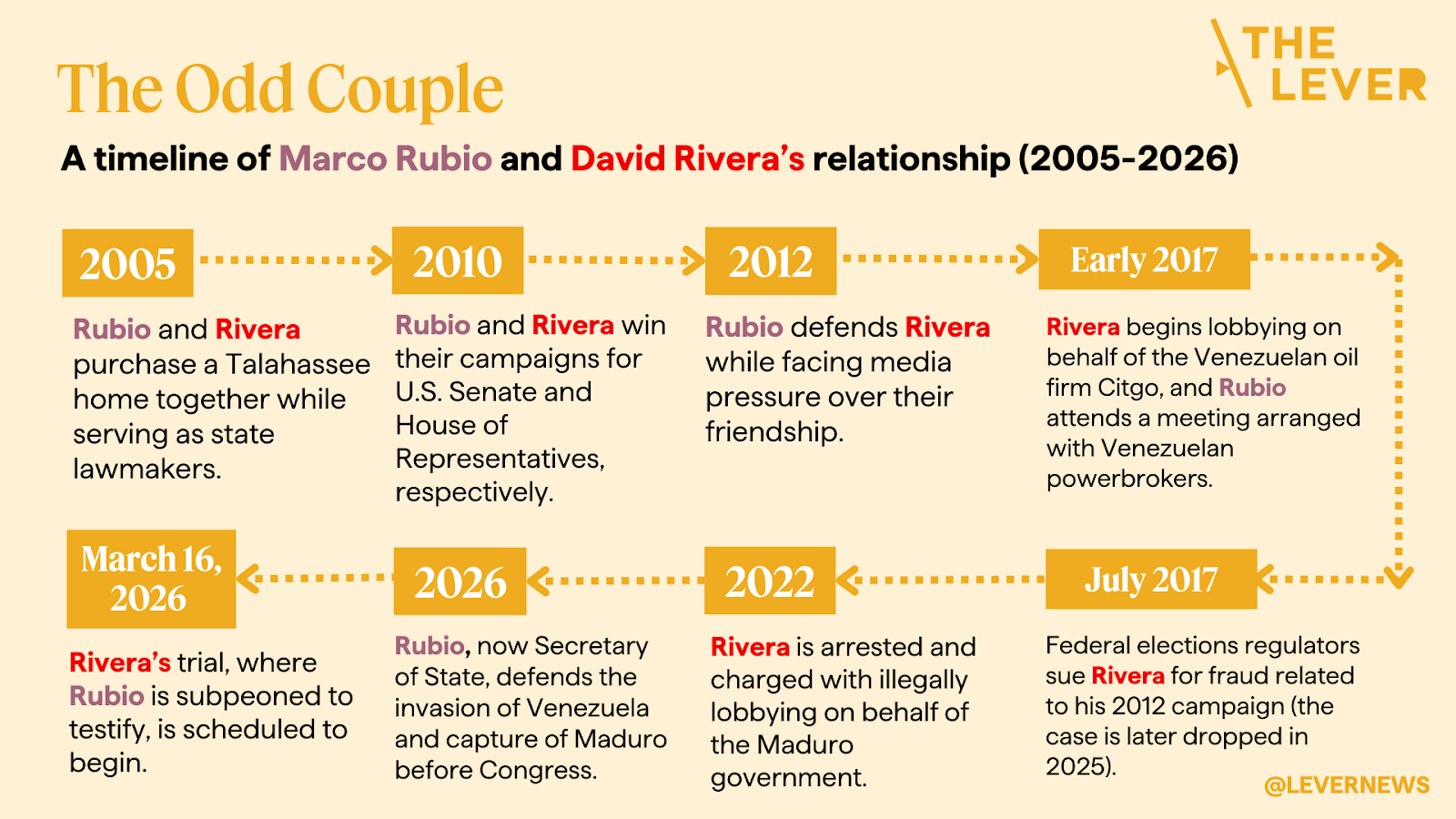 A graphic illustrating Marco Rubio and David Rivera’s relationship. (Source: The Lever)
Enacted in 1938 in response to rising Nazi propaganda in the United States, the Foreign Agents Registration Act requires more stringent disclosures than ordinary lobbying, since foreign clients may have national interests that conflict with those of the United States.
“The question under the law is whether the benefit [of the lobbying] is purely private, divorced from a benefit or control by a foreign government or party,” said Joshua Rosenstein, a lawyer at the Washington firm Sandler Reiff, which advises clients on compliance with lobbying and ethics laws. “The greater the involvement of a foreign government or political party, the less likely it is that you can shoehorn your activities under an exemption.”
The statute also applies to “a person whose activities are directly or indirectly supervised, directed, controlled, financed, or subsidized” by a foreign principal.
According to the Justice Department’s indictment of Rivera, the problems originated in 2017, when he began lobbying on behalf of Citgo, the U.S. subsidiary of Venezuela’s state-owned oil company.
For his work, Citgo paid Rivera’s consulting firm $50 million, a massive sum of money for a single lobbying firm. For comparison, the entire U.S. oil and gas industry spent just over $120 million on federal lobbying in 2022.
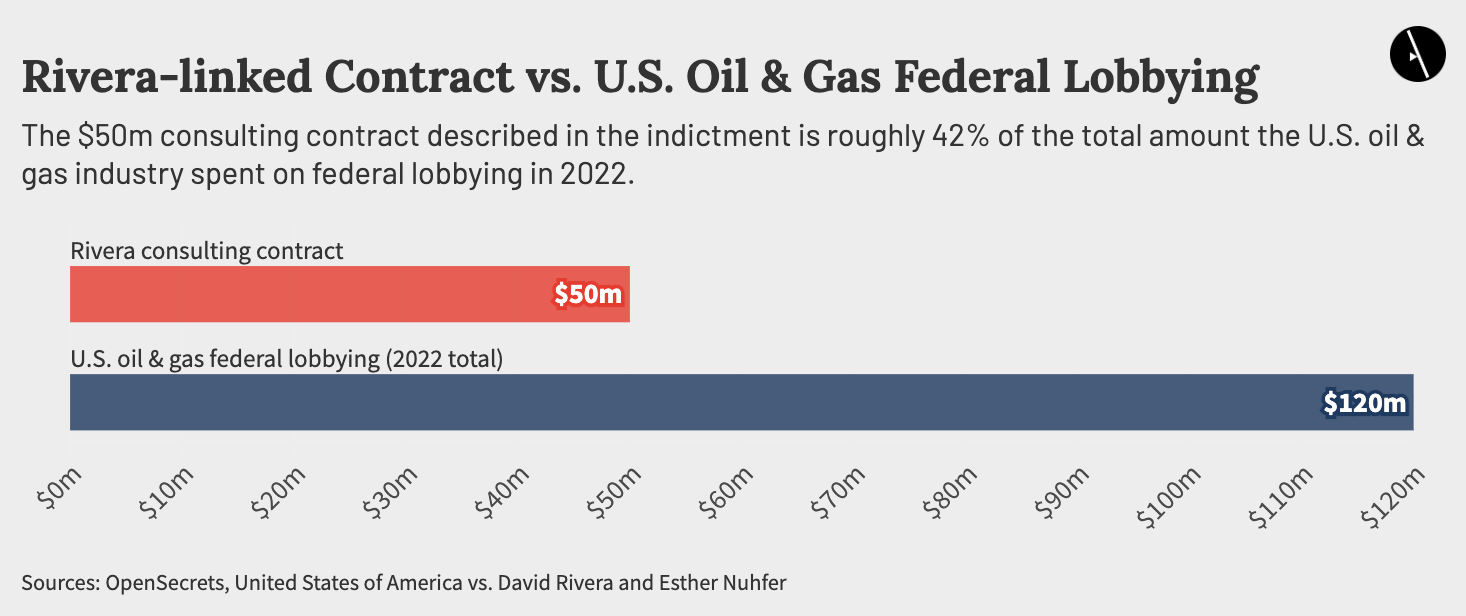 A graphic illustrating the size of David Rivera’s Citgo lobbying contract. (Source: The Lever)
Federal prosecutors allege that Rivera’s lobbying contract was actually a front for a foreign-influence campaign designed to avoid registering under the Foreign Agents Registration Act to conceal the full scope of the operation.
According to the indictment, Rivera was operating as an unregistered foreign agent to normalize relations between Venezuela and the U.S. — two countries that have been adversaries since socialist leader Hugo Chávez came to power in 1999.
Rivera was allegedly working for representatives of the Maduro government, which took power after Chávez’s death in 2013. Among the officials involved, prosecutors say, was then-Vice President Delcy Rodríguez, who now serves as Venezuela’s president.
“It was the purpose of the conspiracy for the defendants to unlawfully enrich themselves… in an effort to influence United States foreign policy towards Venezuela and to conceal these efforts by failing to register under FARA as agents of the Government of Venezuela,” the indictment reads.
Rivera allegedly used his political connections as a longtime Republican lawmaker to arrange meetings between Venezuelan power brokers and U.S. officials.
According to prosecutors, those meetings included a sit-down with Rubio as well as a meeting in Caracas between Maduro and Rep. Pete Sessions (R-Texas), who represents the oil-rich Lone Star State, which has financial interests in Venezuela’s mammoth oil reserves. At the time, Sessions chaired the House Rules Committee, which plays a pivotal role in deciding what legislation receives votes on the House floor.
Kellyanne Conway, a senior counselor to Trump during his first term, also participated in several of the meetings, according to text messages included in the indictment.
Sessions and Conway could not be reached for comment.
In text message exchanges cited by prosecutors, Rivera and his associates used pseudonyms to obscure the specifics of these meetings. The Texas congressman was referred to as “Sombrero,” while millions of dollars were called “melones.” Their code name for Maduro was “El Guaguero,” a reference to the president’s early career as a bus driver.
These 2017 and 2018 meetings— some reported at the time — came at a fraught moment in U.S.-Venezuela relations. Inside the Trump administration, officials were split over Venezuela policy, including proposals to tighten sanctions or normalize U.S. business ties.
Officials ultimately chose the former, ramping up sanctions in 2017 and again in 2020.
At the end of 2025, Rivera’s defense team subpoenaed Rubio to testify about those meetings. Federal prosecutors subsequently decided to call Rubio themselves, apparently concluding that his testimony would strengthen the government’s case.
Rivera, whose lawyers refused to make him available for an interview with The Lever, denies any wrongdoing. His attorneys have argued in court filings that Rivera, a longtime critic of Venezuela’s communist government, was working to undermine Maduro, not help him.
“We confidently believe that the evidence proves the opposite of what the government has alleged,” Rivera’s lawyers wrote in a December letter to the State Department requesting Rubio’s testimony.
“Specifically, then Senator Rubio and Mr. Rivera were focused only on their support for the Opposition [political leaders] in Venezuela, on sanctions against the Maduro government, and on removing Maduro as head of state in Venezuela.”
The Tycoon, The Trafficker, And The Trump Whisperer
As part of their defense, Rivera’s attorneys appear ready to suggest that the foreign-agent violations leveled against their client could just as easily be applied to another political operative: Wiles, Trump’s chief of staff.
To make their case, Rivera’s lawyers are zeroing in on two businessmen named in the indictment: a wealthy Venezuelan media mogul named Raúl Gorrín and a convicted cocaine trafficker named Hugo Perera.
Court documents claim that Gorrín, the politically connected head of a Caracas-based media company called Globovisión, helped orchestrate the alleged foreign-agent operation and served as a go-between for Rivera and the upper echelons of the Venezuelan government.
According to Rivera’s indictment, Gorrín took part in several of the meetings brokered by Rivera, including a sit-down with Rubio. Rivera also reportedly tried to use Gorrín’s private jet for the rendezvous with Conway.
An employee at Globovision works at the channel’s headquarters in Caracas, Venezuela. (AP Photo/Leslie Mazoch)
Gorrín, who was sanctioned by the U.S. government in 2019 for his purported involvement in foreign bribes and money laundering, was reportedly paid handsomely for his work.
In 2020, Citgo filed a lawsuit against Rivera for breach of contract. According to the suit, Rivera paid $4 million of his $50 million contract fee to Gorrín as a kickback for helping him land the arrangement. Rivera apparently funneled the money through Gorrín’s Miami-based yacht company.
The Lever did not receive a response from Globovisión for a request for comment from Gorrín.
The Citgo lawsuit also alleges Rivera paid $5 million to another subcontractor for help arranging the Citgo contract: Perera, a Miami real estate developer who was convicted in the 1990s for his role in a drug-smuggling operation run by the Cali Cartel in Colombia.
Perera’s name is notably absent in the government’s indictment, and he’s agreed to act as a cooperating witness against Rivera at trial. In retaliation, Rivera has countersued Perera for allegedly violating their confidentiality agreement. Rivera has also claimed in a court deposition that the FBI told him that Perera was an informant.
Perera, who now runs a Miami real estate company, did not respond to a request for comment.
At the same time that Gorrín and Perera were working with Rivera, court documents indicate that both men were engaged in related activities for Ballard Partners, a powerful U.S. lobbying firm that Wiles co-led at the time.
In 2017, the first year of the alleged foreign-agent scheme involving Rivera, Ballard Partners also registered to lobby on behalf of Gorrín’s Globovisión, seeking to expand the network’s presence on U.S. television platforms. Ballard earned $450,000 from the contract, making Globovisión the firm’s third-largest client that year.
Ballard’s work for Gorrín appears to have been extensive. In a subpoena letter sent to the White House requesting Wiles to testify in the upcoming trial, Rivera’s defense team describes roughly 400 pages of documents related to Wiles’ lobbying work gathered during the discovery phase of the case.
Court filings also reference numerous emails exchanged between Gorrín, Wiles, and other Ballard lobbyists. One of those lobbyists was Otto Reich, a former U.S. ambassador to Venezuela who previously ran the interagency office that helped coordinate the Iran-Contra weapons sales during the Ronald Reagan administration.
Other Ballard emails went to Harry Sargeant, an oil executive who is currently advising Trump on his post-regime-change efforts in Venezuela. (Trump’s attorney general, Pam Bondi, began working at Ballard Partners in 2019 after serving as Florida’s attorney general, though she is not referenced in the correspondence described in the filings.)
Based on these email exchanges, Rivera’s lawyers also claim Perera was simultaneously working for Ballard while also serving as a subcontractor for Rivera.
“Discovery documents show that Hugo Perera, an important government witness in the case, was involved in these pro-Venezuelan activities through Ballard Partners at the same time the government has alleged that Mr. Rivera and Ms. Nuhfer were supporting pro-Maduro efforts on behalf of Venezuela,” the attorneys wrote.
 A graphic showing how Venezuelan oil money moved through a network of Washington power brokers. (Source: The Lever)
“I Happen To Know That My Government Wants A Way Out”
Rivera’s lawyers do not accuse Wiles or her Ballard colleagues of illegal conduct. But their filings suggest the government’s legal standard for charging Rivera could potentially implicate a far wider circle of MAGA operatives — including the president’s chief of staff.
No federal records show that Wiles or Ballard Partners ever registered under the Foreign Agents Registration Act for any Venezuelan entity.
“We’re not taking a position on that [legal question] in the case,” said Ed Shohat, one of the defense attorneys representing Rivera.
Ballard Partners did not respond to multiple requests for comment. But the firm has publicly maintained that it complied with all foreign and domestic lobbying laws and that its work related only to Globovisión’s commercial interests in the U.S. The lobbying firm dropped Gorrín as a client in 2018, amid a federal investigation that would lead to U.S. sanctions against him the following year.
“Ballard Partners’ work for Globovisión involved Globovisión’s efforts to expand its TV network into the U.S. market,” Brian Ballard, the founder of Ballard Partners, said in a statement to the Miami Herald.
But a key document in the Rivera case obtained by the Miami Herald appears to suggest that Ballard’s work for Gorrín may have gone beyond strictly commercial interests.
In 2017, Ballard reportedly drafted a memo for Gorrín to provide to Trump, though he ultimately never delivered it. The letter apparently outlined a proposal to mend strained U.S.-Venezuela relations by offering Maduro a path out of the country in exchange for a transition in leadership. As described by the Miami Herald, the document did not directly relate to, or mention, Globovisión’s access to U.S. markets or other commercial interests.
“I happen to know that my government wants a way out, a way to save their skins and fortunes,” the draft letter from Gorrín read. “The opposition, on the other hand, wants a way in but is not unified in how to achieve its goals.”
Should Ballard Partners’ work on the Gorrín letter — or its other lobbying efforts — have required the firm to register under the Foreign Agents Registration Act? That’s likely impossible to determine without additional information about Globovisión’s relationship with the Venezuelan government.
“An exemption [to FARA] would be available, provided the client (Globo) isn’t directed/controlled by a foreign government or political party, and the principal beneficiary of the work wasn’t a government or political party,” said Rosenstein, the lobbying lawyer. “That’s a factual question.”
According to Rosenstein, foreign lobbying involves many legal gray areas, in part because the Justice Department has prosecuted relatively few cases, leaving the law with limited judicial precedent. Under Attorney General Pam Bondi, the Trump Justice Department has curtailed enforcement of foreign corruption and lobbying laws.
Made with Flourish • Create a chart
A graphic illustrating where key figures connected to the alleged Venezuelan lobbying network are based. (Source: The Lever)
The hundreds of pages of Ballard records described by Rivera’s attorneys could shed light on the matter, but the documents may never become public. Last month, a federal magistrate judge in Florida’s Southern District Court granted a Justice Department petition allowing Wiles to avoid testifying at Rivera’s trial, thereby permitting related documents to remain under seal.
But in his ruling, the judge made a surprising admission.
“To be clear, no one disputes that Ballard Partners registered under FARA and dealt with Gorrín openly,” wrote Magistrate Judge Edwin Torres.
Torres’ office refused to comment. But if Torres is correct, it would mean that — despite no publicly available record of the filing — Trump’s chief of staff previously worked as a registered foreign agent for a government the U.S. recently moved to overthrow.
Under Pressure
Miami insiders say Rivera’s aggressive defense strategy isn’t just legal maneuvering ahead of trial; it’s also a political effort to pressure the Trump administration to drop the case.
That campaign includes issuing subpoenas to a striking list of high-profile witnesses, including not just Rubio, but also Conway and Sessions. Rivera’s attorneys even subpoenaed Maduro, Venezuela’s deposed president, who is currently awaiting his own trial on U.S. narco-terrorism charges. Maduro’s attorneys resisted the subpoena, saying their client would plead the Fifth.
Former U.S. Rep. David Rivera speaks with media outside Miami federal court in Miami, Dec. 20, 2022. (AP Photo/Joshua Goodman)
While Miami defense lawyer Joseph DeMaria believes some of these witnesses could provide crucial testimony for Rivera’s defense, he also notes the political optics of such subpoenas.
“A lot of this strategy is political — to try to put pressure on the Trump administration to leave Rivera alone,” said DeMaria. ”Depending on how the judge rules on [the defense’s requests for testimony], that could lead them to wanting to make a deal with Rivera.”
Rivera’s legal team has a track record of exploiting political leverage when evidence-based legal defenses don’t pan out in the courtroom. One of Rivera’s attorneys is David Markus, a renowned Miami defense lawyer who also represents Ghislaine Maxwell, Jeffrey Epstein’s associate and convicted sex trafficker.
“A lot of this strategy is political — to try to put pressure on the Trump administration to leave Rivera alone.”
As Maxwell’s counsel, Markus has openly proposed a deal with the Trump administration in which his client would receive “clemency” in exchange for being allowed to speak “fully and honestly” about whether the president was involved in any potential sex crimes, or the crimes for which she was convicted.
In a *Vanity Fair*interview about his work, Markus embraced the ethos of a defense attorney: “I love representing the underdog.”
If David Rivera is an underdog, he’s an underdog with powerful friends in Washington — some of whom may soon be called to testify.
---
---
AN 2 26
President Donald Trump is costing US taxpayers “billions” with his various military ventures, an expert wrote on Tuesday, even though both he and his critics have been strangely silent on the subject.
From his quite real military action in Venezuela to his threatened activities in Colombia, Mexico, Nigeria, Gaza, Iran and Greenland, Trump is repeatedly actually or potentially engaging in multibillion dollar military campaigns all over the globe, according to a report by Bloomberg. For example Operation Southern Sphere in January, during which Trump captured Venezuelan President Nicolás Maduro, cost $31 million per day, according to an analysis by the Washington think tank the Center for Strategic & International Studies.
“That comes to more than $11 billion a year if the US maintains its current level there,” reported Bloomberg’s Wes Kosova. If Trump successfully pushes US oil companies to spend $100 billion to rebuild Venezuela’s energy industry, “that means you’re bringing in some kind of occupation,” explained Heidi Peltier, director of programs at Brown University’s Costs of War project. “US taxpayers would be rebuilding the oil industry and paying for a military presence there to stabilize the country and make it a safe enough investment.”
Similarly Trump’s threatened attacks against Iran, which he said would be “far worse” than the B-2 bomber attacks from last year, would cost $8 million daily or $2.9 billion annually.
“That’s on top of the at least $2 billion the US spent on military action against Iran and its proxies in 2025, according to calculations by the Costs of War project,” Bloomberg wrote. “Needless to say, those numbers will climb dramatically if Trump orders further strikes.” And that doesn’t include the cost of Trump’s threatened occupation of Greenland (roughly $700 billion).
“No matter how compelling a president’s argument may be for missile strikes or troop deployments, the current practice of heaping war costs atop the nation’s already staggering pile of debt can last only so long,” Bloomberg reported. “At the start of the Iraq War, US debt held by the public was $3.7 trillion, or 33 percent of the nation’s gross domestic product. Today it’s more than $30 trillion, equal to 97 percent of GDP.”
Bloomberg is not alone within the business world in looking askance at Trump’s invasion of Venezuela. TotalEnergies CEO Patrick Pouyanné told reporters that he quit the country in 2022 and Trump’s invasion has not changed that.
"It was too expensive and too polluting," Pouyanné said, "and that is still the case.”
Similarly Exxon CEO Darren Woods has described the Venezuelan market as “uninvestable.” Trump replied by threatening to sideline the Exxon leader by “playing too cute.” Trump’s former National Security Adviser John Bolton also observed in January that oil companies might not feel comfortable investing in Venezuela because of the instability injected by Trump’s policies.
“If I were an oil company executive being pressured by Trump to invest billions of dollars of capital expenditures to revive Venezuela's oil infrastructure, I would want a regime in place committed to the rule of law,” Bolton said.
Overall the economic risk involved in Venezuela stems from the uncertainty baked into the military operation’s future, said one expert.
"Tactically, it was executed with precision," retired U.S. Army Lt. Gen. Mark Hertling said for the conservative publication The Bulwark. "But the immediate aftermath revealed a strategic uncertainty. Even in the (Trump) Administration's first press briefings, it was unclear who was in charge in Caracas, what authority Washington claimed to exercise, and what political end state the United States was pursuing. That ambiguity has not improved with time."
---
---
AN 2 26
President Donald Trump’s decision last month to invade Venezuela has not persuaded Total Energies, one of the Big Oil companies Trump urged to return to the country, that overthrowing former President Nicolás Maduro will be good for business.
Although Trump is insisting Big Oil will invest heavily in US-occupied Venezuela because they “have Trump as a president,” TotalEnergies CEO Patrick Pouyanné told reporters that his company initially quit the country in 2022 for reasons that Trump's invasion has not changed.
"It was too expensive and too polluting," Pouyanné explained, "and that is still the case.”
Pouyanné is not alone among Big Oil CEOs to not back Trump's Venezuela policy. After visiting the White House and speaking with Trump, Exxon CEO Darren Woods made headlines for saying that the Venezuelan market is “uninvestable” in its current state. Trump responded by raging at Woods, threatening to sideline Exxon because its leader was, in Trump's words, “playing too cute.”
Trump’s former National Security Adviser John Bolton predicted in January that, despite Trump’s claim oil companies would happily invest in Venezuela, his own actions raised questions about the financial wisdom of doing so.
“If I were an oil company executive being pressured by Trump to invest billions of dollars of capital expenditures to revive Venezuela's oil infrastructure, I would want a regime in place committed to the rule of law,” Bolton said.
This lack of political stability can, according to critics, be laid at Trump’s feet. Earlier this month retired U.S. Army Lt. Gen. Mark Hertling wrote in the conservative publication The Bulwark that although he had no criticisms of Trump’s initial invasion, he believes the administration is flying blind when it comes to how to reconstruct the country.
"One month ago, the United States launched a dramatic military operation in Caracas that ended with the capture of Nicolás Maduro and his wife," Hertling said. "The military strike was fast, precise, and unmistakably American in its execution. Within hours, President Trump and various Cabinet officials stood before cameras to declare success, describe the removal of a criminal regime, and suggest the beginning of a new chapter for Venezuela."
Hertling continued, "They implied the end of Venezuela's longstanding authoritarian leadership. Tactically, it was executed with precision. But the immediate aftermath revealed a strategic uncertainty. Even in the (Trump) Administration's first press briefings, it was unclear who was in charge in Caracas, what authority Washington claimed to exercise, and what political end state the United States was pursuing. That ambiguity has not improved with time."
---
---
DOING YOGA ON BEACH VENEZ ATTACK THO EX NO WAR BS
AN 2 26
Tulsi Gabbard is said to be conducting her own "solo" investigation into the 2020 election, according to a new report from The Guardian, one of multiple investigations currently underway as Donald Trump's obsession with his reelection loss nearly six years ago ramps back up.
On Friday, FBI agents conducted a raid at an election center in Fulton County, Georgia, seizing records and ballots related to the 2020 election. This came not long after comments from Trump indicating that he was ramping up his focus on the false claims that the election, which he lost to Joe Biden, was stolen from him due to widespread fraud.
Gabbard, meanwhile, generated headlines, confusion and controversy when she was spotted at the site of the raid, for reasons that were not clear. As the Director of National Intelligence, her focus would typically be far from issues pertaining to the FBI, especially since she otherwise lacks any sort of law enforcement experience.
According to a Wednesday report from The Guardian, three officials with knowledge of the matter said that Gabbard is conducting her own parallel investigation of Trump's accusations of voter fraud in 2020. One of the sources said simply, "She’s doing her own thing." This, the report argued, suggests the increased scope and focus that Trump's 2020 obsession is now taking up.
Gabbard has reportedly been briefing Trump and other "senior White House advisers" about her investigation on a weekly basis. The president was reported to have specifically requested that she be present for the raid to observe it. Administration officials had previously claimed that Gabbard had just so happened to be in Atlanta when the operation took place.
"The parallel investigations into the 2020 election underscore the extent to which it has returned as a priority for the president," the outlet explained. "And Gabbard being sent to the raid showed the interest on voting machine manipulation claims that Trump has cited as evidence the election was stolen. The review led by the office of the director of national intelligence (ODNI), authorized on the basis that it is assessing election integrity, has been focused for months on potential vulnerabilities in voting machines and the possibility of foreign interference."
Trump's renewed focus on his 2020 loss gained significant attention during his address to the World Economic Forumin Davos two weeks ago, where he falsely claimed that his accusations had been proven and threatened that prosecutions would begin shortly.
---
an 1 26
Republican U.S. Senate candidate Mike Rogers was a member of an advisory board at Telefonica, a cell phone service provider operating largely in Latin America which admitted in 2022 to collaborating with the Venezuelan government — then led by the now-deposed Nicolas Maduro — to spy on its citizens.
Rogers, a former Congressman who represented a mid-Michigan district from 2001 to 2015, sat on the company’s cybersecurity and technical innovations board for more than five years, earning nearly $100,000 in compensation as a result, according to public financial disclosures filed during his 2024 run for the U.S. Senate and his most recent bid.
When asked, Rogers’ campaign claimed that it was the first the former representative knew of the connection between Telefonica and the Maduro regime, despite the incident being widely reported by both a Spanish news outlet and The Washington Post.
Rogers’ campaign also said that his work with the board largely focused on advising Telefonica’s cybersecurity division on technical items and threats from China.
The campaign further blamed Democrats working against him for drawing a connection to him and Maduro that it claims did not exist, and chalked it up to “fake news about a former House Intelligence Chair and national security expert having ties to the very regime he has outspokenly condemned, and celebrated the downfall of.”
“Mike merely served on a technology advisory board, where he advised on how to stop the Chinese Communist Party from infecting the company’s networks,” said Rogers spokesperson Alyssa Brouillet. “This is nothing more than a flailing attempt to distract from the fact that the Michigan Democrat candidates are out-of-touch with working people and consistently trailing Mike Rogers by every barometer.”
The campaign was asked to provide Michigan Advance with a job description outlining Rogers’ role with the company showing that his work was focused solely on China.
An offer letter from Telefonica outlining Rogers’ role states that he would provide the board with “input, ideas and expert advice about Telefonica’s security decisions as requested by the company from time to time” according to the board’s specific charter.
The offer letter does not, however, specifically note that Rogers’ input and expertise was solely focused on Chinese security and network threats.
For years, there have been suspicions about the pervasiveness of tapped calls and the excessive and unjustified monitoring of other forms of communication, but this report has shed a light for the first time on the real scope of this threat to civil and digital rights across the country.
– Watchdog group Ve Sin Filtro on the handing over of data by Telefonica to the Venezuelan government.
Whether Rogers knew the extent of the company’s collaboration with the Venezuelan government while he worked for Telefonica between April 2018 and October 2024 remains an open question, but what is certain is that Rogers has not publicly denounced the collaboration between Telefonica and the former Maduro regime.
The Advance asked Rogers’ campaign if it would do so now.
Brouillet said that Rogers believes any company that conspires with a criminal regime should be held accountable.
Rogers has, in the inverse, publicly praised President Donald Trump taking military action to depose Maduro, extradite him to the U.S. and put the former dictator up on drug trafficking charges in New York.
Rogers has a history of positioning himself as a major critic of Maduro
Maduro came into power following Hugo Chavez’s death in 2013 and remained the head of state until the U.S. government, under the Trump regime, took action against Maduro earlier this month.
On the day Maduro was captured, Rogers made a public statement praising Trump’s action.
“President Trump sent a loud and clear message: don’t mess with the US. Any foreign adversary who tries to kill Americans will pay the price. Bin Laden learned that lesson when I served as House Intel Chair,” Rogers said in a statement. “Today, Maduro was held accountable for endangering our nation with deadly poison. More Americans have died from drug overdose since 2018 than in World War I, World War II, & the Vietnam War combined. The crisis has to stop. Thankfully, President Trump is taking bold action to keep our communities safe. Our borders are secure, murders in US cities are down with drug interdiction and deportation of criminal illegal aliens, and waterborne drugs running into the US are down over 90%. Now, we’re bringing narcoterrorists to justice.”
A search of Rogers’ social media pages shows that he was quick to criticize both Maduro, in 2019, and former President Joe Biden, in 2024, over crime and immigration issues.
Rogers, as a featured guest on WOOD 106.9 FM, stated his belief that the world was better off without Maduro in power.
In 2019, Rogers posted to X, then Twitter, an article from insightcrime.org detailing criminal connections between Maduro and drug traffickers — an early pretext for charging Maduro with the crimes he now faces in the U.S. The article exposes what a former head of Venezuelan military intelligence witnessed in his time working for the regime, which included top figures in Maduro’s political orbit allowing drug traffickers to move freely in and out of Venezuela.
“This is the real Venezuela,” Rogers wrote in that post.
In 2024, Rogers criticized former President Joe Biden in a series of posts on X, saying the former president should declare the Tren de Aragua criminal gang a terrorist organization. Rogers brings up Maduro again in one post, as well.
It’s past time Joe Biden declares Tren da Aragua for what it is: An international criminal organization, terrorizing Americans.
Maduro is emptying his prisons and flooding America with dangerous criminals through our wide open border. Enough is enough.
— Mike Rogers (@MikeRogersForMI) March 18, 2024
An interview with Rogers conducted by former congressman Dave Camp for the University of Michigan’s Gerald R. Ford School of Public Policy notes that the podcast was a vehicle to share his insider knowledge of foreign policy, federal police work and security insights.
Much of his work with the boards he served on in his post-congressional life centered around the same insider knowledge. Still, Rogers’ campaign said that it had first heard about Telefonica’s connection to Maduro, through its business in Venezuela, when the Advance had asked for a comment in the course of reporting this story.
The Telefonica-Maduro connection was widely reported in 2021
Telefonica’s security and cybersecurity advisory council was created in 2018, which the company said would reinforce its digital and comprehensive security strategy, as well as play a role in protecting its own assets and the data of its customers.
The council included Rogers, and highlighted his work with the FBI but also as a member of the U.S. House Intelligence Committee.
Public records show Rogers served on Telefonica’s Ingenieria Y Seguridad committee for six years. It was one of several boards he sat on after leaving the U.S. House of Representatives in 2015, each focused on cybersecurity and data intelligence, which falls in line with Rogers’ experience as chair of the House Intelligence Committee and as a special agent with the Federal Bureau of Investigation.
Multiple financial disclosure reports filed for his Senate campaigns, the first of which he narrowly lost to now-Sen. Elissa Slotkin, are accessible to the public on the Senate’s online database. They show Rogers received $94,241 as board compensation from Telefonica Ingenieria Y Seguridad.
Compensation that he received from the board between 2018 and 2022 is not publicly available.
Telefonica, based in Madrid, Spain, has business throughout Latin America, working with different subsidiaries to provide region-specific cell phone services.
One of those regions is Venezuela, operating as Telefonica Movistar. In 2022, Telefonica released a transparency report that revealed a wide swath of data interceptions into the private communications of Venezuelan Telefonica Movistar customers at the behest of Maduro’s security agencies, according to the watchdog group Ve Sin Filtro.
The report said that the company, in 2021, worked at the behest of the Maduro regime to intercept those communications against 1.5 million customers in Venezuela, more than 20% of both telephone and internet lines offered by Telefonica Movistar. Calls were tapped, text messages were monitored and the locations of customer phones were handed over to Venezuelan authorities, Ve Sin Filtro reported. The interceptions also included the capturing of customer internet traffic.
Other nations within the region that were included in the report also had data interception within their home countries, but at a much lower rate than what Venezuela had acquired.
In some cases, specific internet pages were blocked and accounts hacked, which rang true in the case of a Venezuelan human rights organization. Some of these requests came from the National Telecommunications Commission, or CONATEL, which is the Venezuelan government’s regulatory body over telecommunications within its borders.
The watchdog group noted that data interceptions performed by telecoms on orders from their regulating governments can be key ways for law enforcement to investigate serious crimes, but the wide array of interceptions performed by Maduro’s regime pointed more toward systemic abuse of human rights standards and judicial due process.
Ve Sin Filtro reported that agencies that were able to access who a user was calling, how long the calls lasted, what the subscriber’s data showed, included the military, Venezuela’s public ministry, its main criminal investigation agency, police forces, and its National Experimental Security University.
“Nowhere does it mention that the orders come from courts or come with the approval of judges, as they do in other countries, which means there isn’t evidence of the validation of courts for these interventions as it is required by Venezuelan law, with particular exceptions such as the case of emergencies and flagrant crimes, in which the CICPC can make a direct request,” the group said, referring to Telefonica’s transparency report. “But even in these cases the prosecutor must be notified and it must be included in the file.”
Spanish newspaper El Pais reported on the document, noting that the admission fell in line with what human rights organizations have called massive surveillance of the Venezuelan people over the course of the last decade. It also noted that human rights defenders in Venezuela believed the espionage targeted opposition politicians and activists.
The Washington Post also reported on the company’s report and findings, writing that the incursions included wire taps but also the censoring of content like news websites, political commentary portals, and even streaming media websites like SoundCloud. Three human rights organizations were blocked by Telefonica and the Maduro regime and two websites providing VPN, or virtual private network, services. People in restrictive nations often use private networks to access internet service or webpages that are censored in their regions, and have played a key role in pushing out social media content during times of protest or revolution.
The Post also interviewed Miguel Henrique Otero, president of El Nacional, one of Venezuela’s last remaining independent newspapers, when it wrote about the issue in 2022.
He said it was clear to him and other like-minded Venezuelans that Telefonica was complicit in following orders from the Maduro regime to violate human rights, without justification or due process.
---}:
HCR 1 12 26
...The Senate advanced a bill to stop the Trump administration from additional attacks on Venezuela without congressional approval. And, just two days after Trump had reversed the victims and offenders in the January 6, 2021, insurrection, suggesting that Capitol Police officers had been among the offenders, the Senate unanimously agreed to hang a plaque honoring the police who protected the U.S. Capitol on January 6, 2021. Congress passed a law in March 2022 mandating that the plaque be hung, but Republicans until now had prevented its installation.
Friday was a busy day at the White House.
On Friday, Trump threatened Greenland, saying that he was “going to do something on Greenland, whether they like it or not.”
Trump’s threat against a North Atlantic Treaty Organization (NATO) ally has had American lawmakers and foreign allies scrambling ever since. In a joint statement, the leaders of Denmark, France, Germany, Italy, Poland, Spain, and the United Kingdom said that “Greenland belongs to its people.” Senator Chris Murphy (D-CT) released a video explaining that “what you are essentially talking about here is the United States going to war with NATO, the United States going to war with Europe. You’re talking about the U.S. and France being at war with each other over Greenland.”
Trump’s threats against Greenland came at a meeting with oil executives. When he attacked Venezuela to capture Maduro, Trump told reporters that United States oil companies would spend billions of dollars to fix the badly broken infrastructure of oil extraction in that country. But apparently the oil companies had not gotten the memo. They have said that they are not currently interested in investing in Venezuela because they have no idea how badly oil infrastructure there has degraded and no sense of who will run the country in the future.
What oil executives did suggest to Trump on Friday was that they would quite like to be repaid for their losses from the 2007 nationalization of their companies from the sale of Venezuelan oil Trump has promised to control. ConocoPhillips, for example, claims it is owed about $12 billion. “We’re not going to look at what people lost in the past, because that was their fault,” Trump told them. “That was a different president. You’re going to make a lot of money, but we’re not going to go back.”
Yesterday the government made public an executive order President Donald J. Trump signed on Friday, declaring yet another national emergency—his tenth in this term, by my count—and saying that any use of the revenue from the sale of Venezuelan oil to repay the billions of dollars owed to oil companies “will materially harm the national security and foreign policy of the United States.”
Specifically, the executive order says, such repayment would “interfere with our critical efforts to ensure economic and political stability in Venezuela” and, by extension, jeopardize U.S. foreign policy objectives including “ending the dangerous influx of illegal immigrants and the flood of illicit narcotics;…protecting American interests against malign actors such as Iran and Hezbollah; and bringing peace, prosperity, and stability to the Venezuelan people and to the Western Hemisphere more generally.” So, it appears, Trump wants to retain control of the money from the sale of Venezuelan oil.
===
AN 1 26
President Donald Trump and senior members of his administration are now openly communicating that the only law they respect is that "might is right." One conservative is warning that Americans should take their words very seriously.
In a Monday article for anti-Trump conservative website The Bulwark, editor Jonathan V. Last pointed to a recent post by far-right social media influencer Matt Walsh justifying the recent capture of Venezuelan President Nicolás Maduro. Walsh referred to Maduro as a "s——little tinpot third world dictator" whose ouster was necessary because he was "harming our country" and "interfering with our national interests."
"'International law' is fake and gay. The only international law is that big and powerful countries get to do what they want," Walsh wrote on X. "It has been that way since the dawn of civilization. It will always be that way. And we are the most powerful country on the planet. It's about time that we start acting like it."
Last also observed that White House deputy chief of staff Stephen Miller made a similar argument in an interview with CNN host Jake Tapper. When Tapper asked him about Trump not ruling out using the U.S. military to seize Greenland from Denmark, Miller defended the president by arguing that powerful countries should be able to assert their authority by force if necessary.
"We live in a world, in the real world ... that is governed by strength, that is governed by force, that is governed by power," Miller said. "These are the iron laws of the world since the beginning of time."
The Bulwark editor doubted if this worldview stopped at international law, and posited that the Trump administration likely viewed domestic laws as able to bent and broken to accommodate the wishes of the powerful. He opined that Trump is "seeking a return to an old international order which antedates the modern, rules-based era" in which global hegemons carve up the world into "spheres of influence where the strong do what they can while the weak suffer what they must."
"Tell me: Do you think it is impossible that Trump and his revanchists also seek to return America to an old order in which control of the military is control of the government?" He wrote. "He wants Russia and China’s foreign policy. Why would he not also want their domestic policies?"
"[T]he law says that federal agents cannot brutalize the citizenry. But the practical reality is that the federal agents outnumber and outgun local law enforcement. So they cannot be arrested for brutalizing the citizenry," he added. "The law of the jungle is already here."
Click here to read Last's full article for The Bulwark.
===
---
AN GRIST 1 26
On Saturday, hours after U.S. forces in Caracas killed at least 80 people and kidnapped Venezuelan President Nicolás Maduro, Donald Trump sounded less like a wartime commander than a developer surveying a newly acquired property. The country’s future, he told reporters at his Mar-a-Lago resort, belonged to “very large United States oil companies,” which would soon be pumping “a tremendous amount of wealth out of the ground.”
The land in question includes the largest proven oil reserves on Earth — at some 300 billion barrels, roughly 17 percent of global totals. But after years of political turmoil and U.S. sanctions, Venezuela accounts for barely 1 percent of global crude production. “It’s true that they know the oil is there,” said Samantha Gross, the director of the Energy Security and Climate Initiative at the Brookings Institution. “But the aboveground risks are huge.”
Chevron is the only major U.S. firm still operating in Venezuela, after other oil giants pulled out in 2007 when former president Hugo Chávez nationalized the industry. By continuing to operate as a minority partner under the state oil company’s terms, Chevron preserved its infrastructure, personnel, and legal foothold — giving it geopolitical leverage in the ongoing tug-of-war between the United States, China, and the Maduro government. “We play a long game,” CEO Mike Wirth explained in November at a U.S.-Saudi investment summit in Washington.
Today, Chevron is uniquely positioned in the aftermath of the invasion: Its leadership and board have long orbited Republican circles, with deep ties to the Trump administration and a history of big GOP donations. “Chevron’s in [Venezuela],” Trump said on Saturday, but “they’re only there because I wanted them to be there.” The company did not respond to requests for comment.
When Trump returned to office, his administration revoked Biden-era licenses that had allowed the oil major to operate in Venezuela despite the sanctions. Though told to stop producing by April, the company made no attempt to wrap up contracts, pull out personnel, or wind down supply chains. Francisco Monaldi, director of the Latin American energy program at Rice University, said in March that it appeared “Chevron is very confident it can obtain an extension.”
Behind the scenes, executives were busy meeting with Trump and top officials, spending almost $4 million on lobbying in the first half of the year to keep their Venezuelan foothold alive. In March, Wirth joined Trump in the Oval Office, hashing out how to tweak or extend Chevron’s license. The president finds Wirth’s TV appearances entertaining, regularly calling him after cable news appearances. The CEO followed that blitz up with private sit-downs with Secretary of State Marco Rubio, Treasury Secretary Scott Bessent, and staffers from the National Security Council, making the case for his company’s continued presence in the country.
By July, the gamble had paid off. The administration issued a new license, letting Chevron resume operations in Venezuela. As it did so this fall, the company saw record-breaking production and earned $3.6 billion in its last reported quarter. Though Venezuela accounts for just 100,000 to 150,000 barrels daily — a sliver of Chevron’s production — that oil is heavy, the kind the company’s Gulf Coast refineries are designed to process. Having access to Venezuelan crude can help those facilities run more efficiently, increasing supplies and reducing costs.
Just before Chevron celebrated its renewed lifeline, it scored another victory: After years of wrangling with the Federal Trade Commission, it finally acquired Hess Corporation, one of the biggest independent oil producers in the United States. Last year, the agency had banned CEO John Hess from joining Chevron’s board as part of its anti-trust review, alleging that he had colluded with OPEC representatives to fix oil prices.
That victory, however, did not occur in a vacuum. The Hess family is a major donor to the Republican party and contributed more than $1 million to Trump’s first inauguration. (Chevron, for its part, donated $2 million to the president’s 2025 ceremony.) Hess — whom Trump has called “a friend of mine for a long time” — petitioned the FTC to revisit its decision. The agency later reversed course, unlocking the deal. On July 18, Chevron officially closed its $53 billion merger, and Hess took his seat on the board.
This bought Chevron’s entry into what many analysts call the decade’s most consequential oilfield, in Guyana, Venezuela’s neighbor. In 2015, Exxon Mobil announced a huge reserve off the tiny country’s shoreline. That discovery catapulted Guyana — a nation of fewer than 1 million people — into the petroleum spotlight. Hess’ 30 percent stake in the project was a key part of Chevron’s recent acquisition.
Thanks to Trump, one of the largest remaining political obstacles to the Guyana project was just removed. Maduro had challenged Guyana’s control over the offshore area. Venezuela has periodically claimed the territory since the 1960s under a long-running border dispute. As production in the region ramped up in 2019 and as Venezuela’s own industry faltered, Maduro escalated his attacks, sending naval ships into Guyanese waters and vowing Venezuela would take “all necessary actions” to stop its development — rhetoric remarkably similar to what Trump used to justify his own actions against Maduro this week.
But though Trump claims he spoke with oil companies before and after the invasion, taking over the Venezuelan government may have been more than the industry bargained for. “There aren’t oil companies just running to get rid of tens of billions of dollars right now to rebuild the Venezuelan industry,” David Mares, the former Institute of the Americas Endowed Chair for Inter-American Affairs at the University of California San Diego, told Grist. “It’s not even clear there’s a legitimate government in place to make the contracts they sign for legal.”
Then there’s the question of Venezuela’s tangled debt. Petróleos de Venezuela, S.A., the state oil company, has racked up more than $150 billion in liabilities over decades of defaults and expropriations. Creditors — from energy companies like ConocoPhillips to so-called “vulture funds” that bought defaulted contracts at deep discounts — have pursued arbitration against the country, and won court rulings for damages that remain unpaid. China has been the country’s largest foreign lender, loaning it more than $60 billion over the years. Only some of that has been repaid, mostly in the form of oil exports. As Mares notes, “As soon as Venezuelan oil starts to flow, some of those claimants can attach the proceeds, and they’re going to demand their money back.”
Experts warn that returning to even modest levels of production would require upgrading Venezuela’s aging infrastructure, a process that would require massive investment and political stability — conditions that have eluded Caracas for years and seem unlikely to materialize anytime soon. “There is no realistic prospect of immediately increasing Venezuela’s crude output,” Gus Vasquez, the head of oil pricing in the Americas for commodity markets analyst Argus Media, wrote in an emailed statement. “Venezuelan oil infrastructure would take years and possibly hundreds of billions to bring up to something close to its former capacity. Repairing refineries would be even harder.”
Chevron’s existing assets give the company a very different calculus than newcomers would face. But the timing could not be worse: Global crude oil prices have steadily declined over the last several years, recently dropping below $60 a barrel — approaching the break-even point for many American operators. That’s been driven by global supply surpluses and by weakening demand, as renewable energy prices drop. “I think what we’re seeing is that the days of the oil and gas industry being the growth engine of economies is well behind us,” said Trey Cowan, an oil and gas energy analyst at the Institute for Energy Economics and Financial Analysis.
Despite these structural shifts, Gross notes, “Trump has a very old-school way of thinking about resource economics,” as a blunt lever of power. As companies like Chevron have found, aligning with his priorities can bring financial and regulatory advantages, even if they are not supported by broader market conditions. This week, the company’s stock jumped 6 percent.
On TruthSocial on Tuesday, Trump announced that Caracas would be “turning over” between 30 and 50 million barrels of “sanctioned oil” that will then be sold. “[T]hat money will be controlled by me,” he wrote. Trump hopes to lower oil prices to $50 a barrel, which would squeeze shale producers and destabilize the U.S. oil industry. On Wednesday, the Department of Energy issued a brief announcement elaborating, as Chevron entered talks with the administration to increase its operations and resell oil to other refiners. The statement declares the U.S. will sell the sovereign nation’s crude on the global marketplace and describes the proceeds as going to “U.S.-controlled accounts at globally recognized banks,” an unusual setup that bypasses the U.S. Treasury. The money is vaguely promised to serve both Americans and Venezuelans, and the arrangement will be indefinite. “You’re going to see, probably, a growth in Chevron activities there quickly,” Secretary of Energy Chris Wright said on Thursday.
Senate Democrats have launched an investigation into the Trump administration’s communications with oil companies, which they claim occurred 10 days before the invasion, while Congress was not briefed. “The suggestion that taxpayers could pay the cost of rebuilding Venezuela’s oil infrastructure raise serious concerns about how the Trump administration engaged with the oil companies prior to his decision to use military force,” they wrote. Gross says to the extent Trump can be described as a populist, it is largely a performance — one “he might play on TV” — but she added that typically, “When you see populist governments take over oil industries, it doesn’t usually turn out well.”
In all the turmoil, what no one appears to be asking is what is good for Venezuela. “The saddest part of this is that unwinding the Maduro regime does not seem to be a part of what Trump policy is aiming for,” said Cynthia Arson, former director of the Woodrow Wilson International Center’s Latin American Program. In its statements after the strike, the White House has largely overlooked questions about a democratic transition, sidelining concerns about human rights abuses and the treatment of political prisoners.
Even when oil starts flowing, a new Venezuelan government will likely struggle to meet public expectations while attracting foreign investment. Before Chávez, the country’s oil contracts typically gave the government around 50 percent of revenue, helping fund social programs and the middle class. U.S. oil majors, by contrast, often offer royalties around 12 percent.
The contrast highlights just how fragile and uncertain the path ahead is: Years of economic collapse, which have driven millions abroad, have left those remaining struggling with profound political and social upheaval that can’t be solved by oil alone. “If good things happen, they’re going to take time,” Gross said. “Bad things could actually happen pretty quickly.”
This article originally appeared in Grist at https://grist.org/energy/how-chevron-played-the-long-game-in-venezuela/.
Grist is a nonprofit, independent media organization dedicated to telling stories of climate solutions and a just future. Learn more at Grist.org
---
AN 1 26
Politico reports giant energy companies are worried about President Donald Trump pressuring them to invest resources in Venezuela and are quietly planning to ignore him.
Trump is reportedly now pressing American oil giants to spend “billions of dollars reopening Venezuela,” after he sent troops to arrest Venezuelan leader Nicolás Maduro. However, Politico reported Thursday that the companies with the most resources and experience to drill in the South American nation are on the fence about the project, according to six anonymous oil company executives and industry lobbyists.
According to Politico, Trump is planning a White House meeting Friday that may include executives from companies with experience in Venezuela, including U.S.-based Exxon Mobil, Chevron and ConocoPhillips. But executives tell Politico that the assembly could turn into an arm-twisting session.
“Some of the CEOs fear that Trump will use the meeting — and invite television cameras — to pressure them to make public commitments sooner than they would like,” Politico reports.
Executives want to know who will guarantee their companies’ security and property in a country still run by the same corrupt politicians who stole millions of dollars’ worth of their oil exploration and drilling equipment two decades ago. In addition to who will pay company bills and in what currency, Politico reports there remains the question of how much information the White House is sharing with acting President Delcy Rodriguez’s interim government. Industry insiders are still unsure whether the White House has even told Venezuelan officials that the it has given some companies licenses to sell 50 million barrels of oil that Trump claims the nation was “turning over” to U.S invading forces.
In addition to questions of safety, companies are wondering why they should invest in hard-to-process heavy Venezuelan crude oil given the nation’s busted infrastructure and uncertain political environment, only to dump more oil on a global market and hurt their bottom line with the resulting cheaper oil prices.
With so many reasons not to invest, Politico reports oil executives may simply string Trump along with big promises while delivering nothing.
“Companies may follow the playbook of promising the White House they are interested in investing in Venezuela just to stay on Trump’s good side but ultimately not following through,” one business lobbyist told Politico. This tactic — called “Everyone Makes Promises And Never Actually Does Anything” — is so common for dealing with the distracted president that it’s got its own acronym.
“My impression is it’s EMPANADA all over again,” an anonymous executive told Politico.
Read the Politico report at this link.
---
AN 1 26
Trump energy secretary says US gov will take over Venezuela oil industry 'indefinitely'
LINDSAY FUCKING GRAHAM SMILING ON AF 1
---
heated gmail 1 26
...The real reason the government is doing this is simple: Because it’s bought and paid for by Big Oil, the most profitable and powerful industry in the world. Before the election, Trump promised oil executives he would give them whatever they wanted in exchange for campaign support, floating a $1 billion price tag. How much the industry actually gave is impossible to know, thanks to dark money and opaque PACs. But from what we can see, Big Oil spent $219 million to influence the 2024 election, with at least $75 million going directly to Trump’s campaign and affiliated PACs. Eighty-eight percent of oil and gas money went to Republicans.
And now, the government is deploying the U.S. military to help the industry dump even more of these climate-altering chemicals into the atmosphere.
Trump explicitly stated his intention for the U.S. to control Venezuela’s oil. He laid it out plain as day: “We’re going to have our very large United States oil companies, the biggest anywhere in the world, go in, spend billions of dollars, fix the badly broken infrastructure, the oil infrastructure, and start making money for the country.”
Trump didn’t tell Congress about the Venezuela attack before it happened. But he did claim to tell oil executives. Let that sink in. The presidentreportedly informed private oil companies about a military invasion before informing the people’s elected representatives. So who does the government work for, exactly?
The oil industry has tried to deny receiving advance notice prior to the invasion—but only through anonymous sources. To this I remind you: Oil companies are notorious liars. They spent decades lying about climate change, burying their own research showing fossil fuels were destroying the planet, and funding disinformation campaigns to confuse the public. If they really didn’t speak to Trump, why don’t they say it loudly and proudly?
Now, plenty of people have correctly pointed out that it will be difficult and expensive for U.S. oil companies to take over Venezuela’s oil. But that’s much less of a problem when the government works for you. After industry sources told CNN that oil companies “were reluctant to commit to reinvesting” in Venezuela, Trump immediately fell over himself to offer to help them—with taxpayer money, of course. Trump said oil companies rebuilding Venezuela’s infrastructure will “get reimbursed by us, or through revenue,” with the U.S. government potentially subsidizing efforts by energy companies to rebuild the country’s oil industry.
Oil companies are trying to publicly act like they don’t want Venezuela’s oil. But here’s what’s indisputable. Chevron’s stock soared as much as 10 percent after the invasion. Exxon and ConocoPhillips shares rose around 3 to 4 percent. Oil service companies like SLB, Baker Hughes, and Halliburton jumped between 4 percent and 9 percent. And U.S. refiners Marathon Petroleum, Phillips 66, PBF Energy, and Valero Energy were up between 3.4 percent and 9.3 percent.
Another thing that’s indisputable: Venezuela’s new acting president, Delcy Rodríguez, is the country’s oil minister. She’s long been the go-to contact for senior oil executives, with strong ties to Republicans in the oil industry who actively pushed for her to lead post-Maduro Venezuela. I’m sure that’s just a crazy coincidence.
Perhaps all of this could be defensible if the outcome for ordinary Americans were actually positive. Trump insists it will be—that oil expansion means jobs, security, and prosperity.
That claim is the heart of the conspiracy. It’s not that Trump and the oil industry are working together; that part is in plain sight. It’s that the public is being told this partnership exists for our benefit, when in reality it exists to preserve fossil fuel dominance in a world where that dominance is threatened by people simply understanding the truth—that oil and gas pollution is transforming the climate, making us sicker, poorer, and less safe.
That’s why Trump works to obscure emissions data, suppress climate science, and discredit anyone who explains the harm. It’s why he’s willing to spend taxpayer money, deploy military force, and rewrite foreign policy. Not because any of this serves the public interest, but because all of it serves the same goal: keeping fossil fuels flowing, even as the scientific case for transitioning away from them becomes overwhelming.
And doing that requires a public that is less informed, more economically strained, and easier to distract—too busy coping with rising costs and mounting crises to demand a transition that would reduce pollution, lower long-term costs, and make wars over energy unnecessary.
So no, you don’t need to worry about chemtrails. You need to worry about who controls energy—and what they’re willing to do to keep it that way.
ref bloomberg
Patricia Garip
Updated Tue, January 6, 2026
(Bloomberg) —
As the US threatened Nicolás Maduro’s grip on power in recent months, a cadre of executives, lawyers and investors tied to the oil industry made their case to anyone who would listen — the Trump administration, congressional aides: His familiar No. 2 Delcy Rodríguez should fill his shoes in Venezuela.
An oil minister herself, Rodríguez has long been the go-to contact for senior executives, whom she impressed by navigating Venezuela’s industry through international sanctions, economic pressures and internal mismanagement. Her loyalty to the Maduro regime notwithstanding, she’d be best positioned to shepherd through the US plan to restore Venezuela to its glory days as an oil gusher, argued executives and lobbyists.
President Donald Trump’s inner circle came to the same conclusion, though people familiar with the matter say they did so independently. Both groups believed that the vice president, long seen as a bridge between the government and private sector, could stabilize Venezuela’s oil-based economy and facilitate American business faster than leading dissident María Corina Machado could, said the people.
Administration officials were mindful of the chaos that ensued in Iraq after the fall of Saddam Hussein. Business interests aside, maintaining a semblance of business continuity will be critical to a successful transition — one that the Trump administration has yet to define. And Rodríguez fits both those bills: she oversees Venezuela’s oil apparatus and has decades of relationships among the remaining socialist stronghold in government.
The advocates for Rodríguez didn’t directly include the biggest US oil majors, who were surprised by the removal of Maduro and are still racing to figure out how to work with Washington on next steps, according to people familiar with the matter. But there’s a wider universe of US and international companies that have operated in Venezuela for years, and many have contacts in the White House and on Capitol Hill, the people said.
A spokesperson for Chevron Corp., the only major US oil company licensed to operate in Venezuela, said it “had no advance notice of the recent operation and did not engage in any discussions with administration officials regarding governance for a post-Maduro Venezuela.” It also said operations in the country were continuing uninterrupted and in full compliance with laws and regulations.
In a triumphal press conference Saturday, Trump endorsed Rodríguez to lead Venezuela for now. Machado, he said, lacked “respect” to lead the country, a stunning blow to the recent Nobel Peace Prize winner and the regime opponents at home and abroad who have pinned their hopes on her.
The White House declined to comment beyond remarks made Sunday by Secretary of State and National Security Adviser Marco Rubio, who is playing a key role in managing Venezuela. He said that the US would leverage its oil blockade and regional military presence to further its policy goals. He also said the US would watch Rodríguez’s actions more than her rhetoric.
In a Bloomberg Television appearance Monday, Greylock Capital Management Chief Executive Hans Humes, who is part of the creditor committee of Venezuela’s sovereign debt, reiterated what some global oil executives have said in private regarding Rodríguez: “If you want somebody who can operate in reasonably OK conditions, get the person who operated in the worst conditions,” he said.
He added that Trump was making a big gamble, one that if successful, could “reorder the entire energy configuration of the world.”
That conclusion dovetailed with a Central Intelligence Agency report that one person familiar with the matter said senior US officials had recently commissioned to examine near-term succession scenarios. The document drew on numerous intelligence sources including open-source and human collection, and was meant to give Trump the best information possible as he considered the operation, according to the person.
The assessment concluded that top members of the regime, including Rodriguez, would be best placed to lead the government if Maduro were no longer in power, the Wall Street Journal reported Monday.
Global Oil Interests
Oil companies with interests in Venezuela, home to some of the world’s largest hydrocarbon reserves, now want to make sure that the Trump administration swiftly eases those sanctions to ensure that Rodríguez can start delivering results. There is no time to waste, said the sources, who spoke on condition of anonymity because they are not authorized to speak publicly.
In late December, Venezuela had already started closing oil wells because it had run out of storage to hold production stranded by the blockade. More shut-ins would make it harder for Venezuela to recover its economy and jeopardize Rodríguez’s hold on power, the sources said.
So far she looks to be consolidating control on the regime’s existing foundations. On Monday, she was sworn in by the National Assembly as acting president. In a fiery speech on Saturday, she described Maduro’s capture as a “kidnapping” and called for his return, but the sources said they believe her rhetoric was meant to shield her from internal reprisals.
On Sunday, she took a more conciliatory tone, inviting the US “to work together on a cooperation agenda, aimed at shared development, within the framework of international law, and to strengthen lasting community coexistence.”
Rodríguez, 56, had been a key figure in Maduro’s tight inner circle, heading a string of key portfolios including the Foreign Ministry that enabled her to build international bridges. She was named oil minister in 2024 after Maduro’s widely contested reelection, putting her in charge of the national oil company, Petróleos de Venezuela SA, with the task of cleaning up corruption and bringing more transparency to the bloated firm’s accounts.
An accomplished table-tennis player, Rodríguez regularly fields calls from senior executives at international oil companies, from Houston to Mumbai, and has longstanding relationships in Beijing and Moscow, which she visits on her government jet.
One of the companies with the most to gain from a successful revival of Venezuela’s oil industry is Chevron. ConocoPhillips, a US peer that’s owed some $10 billion in unpaid arbitration awards from the 2007 state seizure of its Venezuelan assets, would gain as well if it decides to implement a proposal to return to the country to recoup its debt. Among non-US companies, Shell Plc has an offshore Venezuelan gas deal on ice that could be reactivated on short notice. Other incumbents in Venezuela include Spain’s Repsol SA, Italy’s Eni SpA and France’s Maurel et Prom SA.
The Revolutionary’s Daughter
Rodríguez began her political career under late former President Hugo Chávez after graduating as a lawyer from the Central University of Venezuela.
Her father, Jorge Antonio Rodríguez, was a prominent leftist in the 1960s and 1970s and a Marxist party founder. He died in 1976 after being tortured in prison by state security forces, a defining feature of Delcy’s political narrative. Her brother, Jorge Rodríguez, is another regime stalwart and was Maduro’s longtime chief negotiator with the US.
Those who have worked alongside the new acting president often remark on her long hours, with Maduro recently saying she responded to messages well into the night and early morning. She was also by Maduro’s side as he ordered the most aggressive wave of repression the country has seen to crack down on dissidents in the aftermath of his contested reelection in 2024.
In meetings with financial advisers in the weeks ahead of Maduro’s capture, Rodríguez was very focused on the status of Venezuela’s debts and relationships with US oil majors, among other international financial matters, according to one of the sources.
Such diligence, together with the absence of a US indictment that had dogged Maduro for years, made Rodríguez the favorite, not just for oil companies, but also some bondholders who are looking to restructure some $60 billion of debt.
The endorsement by the White House is “a very clear-eyed sort of realist approach,” said Kimberly Breier, assistant secretary of state for Western Hemisphere Affairs during Trump’s first term.
Rodríguez “liaises with energy companies, and they have been able to deal with her, but that doesn’t mean she is a long-term solution,” Breier added, highlighting her deep association with a regime blamed for widespread human rights violations.
In 2021 Rodríguez showed two Bloomberg News journalists the room at the Economy Ministry in downtown Caracas where she’d practice table tennis, with three of her sparring partners on hand to demonstrate. The cavernous space contained two ping-pong tables. Portraits of Maduro, Chávez and Simón Bolívar, who liberated Venezuela from Spanish rule, looked on.
—With assistance from Erik Schatzker, Maria Elena Vizcaino and Natalia Drozdiak.
---
---
am prospect
The $30 Billion Identity Theft of Venezuela
How Juan Guaidó sucked a weary nation dry, and primed it for the current U.S.-led assault
 by Maureen TkacikNovember 26, 2025
-
In 2018, Henri Falcón tried to save Venezuela. As governor of the populous western state of Lara, Falcón had drawn overwhelming electoral victories and admiring profiles in the Western press for his humble demeanor, military precision, and reputation for finishing infrastructure projects on time and under budget. (“Efficient Revolution” was one of his campaign slogans.) But as oil prices and U.S. economic sanctions plunged the country into a harrowing depression, his ambitions grew humbler. “The overriding priority of my administration will be to make sure that not one Venezuelan child goes to bed without having eaten,” he wrote in a somber New York Times op-ed announcing his presidential candidacy.
Just before the op-ed went to press, Falcón was called to a meeting at the U.S. embassy, at which officials expressed their displeasure with him. The hard-right political parties that had plotted the failed but violent 2002 coup attempt against Hugo Chávez reacted to Nicolás Maduro’s first election with bloody riots, rolling blackouts, and a strategy of manufactured chaos. But the disgruntled aristocrats, living outside Venezuela while drawing generous salaries from USAID-funded NGOs, had decided to boycott the election, and believed everyone else should, too.
Falcón was incredulous: Replacing Maduro with a competent technocrat like himself was the rational way to save the economically ravaged country from the fate of Somalia or Haiti. But he was told that the White House saw the elections as by definition illegitimate, because the Supreme Court had banned the “most popular politicians” in the country from running. Participating in them was tantamount to collaboration with the Maduro regime. Should Falcón choose to go ahead with his candidacy anyway, they said, he should not be surprised to find himself and his immediate family members on an Office of Foreign Assets Control blacklist, which would effectively lock him out of the global financial system, a cruel irony given that a pillar of his platform was establishing a strict currency peg to the dollar.
In short, the State Department was threatening to financially destroy him—for running against Maduro.
Falcón soon learned he wasn’t the only one who had been summoned to the embassy for such a “talk.” While most opposition politicians grudgingly acceded to the boycott, they did so out of fear more than solidarity. The “popular politicians” banned from running, like Leopoldo López, Henrique Capriles, and María Corina Machado, had been implicated in plotting violent riots, industrial sabotage efforts, and military coups, things normie Venezuelans opposed. The idea behind the boycott was that opposition needed to have solidarity, but Venezuela-based opposition politicians like himself knew all too well solidarity was a one-way street with the Miami right wing.
In his Times column, Falcón framed his decision in Washington consensus logic: “A comprehensive Brookings study of 171 cases of boycotting around the world found that 96 percent of the time, the movements promoting the boycotts did not see positive results,” he wrote. But not in a million years could he have imagined how uniquely catastrophic the results would be.
At the time, Falcón’s opposition coalition (MUD) had controlled the Venezuelan legislature after a shock landslide election in 2015. The elections were preceded by a two-year campaign of weapons-grade State Department–funded psychological warfare, outlined in an astonishing July 2013memo titled “Plan Estratégico Venezolano” (Venezuelan Strategic Plan) drafted under USAID supervision by a consortium of Colombian think tanks and a major American restructuring firm. The reality on the streets of Caracas reflected the memo’s orders to opposition coalition members to “maintain and increase acts of sabotage that affect services to the population, particularly the electrical system”; “increase problems with shortages of basic food items”; and “create crisis situations in the streets that facilitate U.S. and NATO intervention, with the support of the Colombian government. Whenever possible, the violence should result in deaths or injuries … [emphasis added]”
:{:{The victory was a turning point for Ricardo Hausmann, a pre-Chávez government economist who was at the time playing the part of a moderate, nonideological empiricist, working on growth projects in countries as diverse as Kazakhstan, Paraguay, South Africa, and Peru, and running an outfit called the Growth Lab for the Kennedy School’s Center for Economic Development. But he was married to an anti-Chávez hard-liner named Ana Julia Jatar, who worked for a Venezuelan nonprofit founded by Machado, this year’s Nobel Peace Prize winner, currently making the rounds claiming that Maduro is harboring Hamas militants.}:
In 2006, Jatar even published a book,Apartheid in the 21st Century, depicting Venezuela’s public relations campaigns as a neo-segregationist system of oppression. (Notably, her father had written a book, Disabling the Extreme Left, about his experience “eliminating leftist groups” in Venezuela as an official in the ruling Acción Democrática party during the 1960s, according to the journalist Anya Parampil’s indispensable 2023 book Corporate Coup: Venezuela and the End of U.S. Empire.) The election win led Hausmann to, “Why can’t Venezuela be a day job?”}:
The 2018 presidential election came and went. Voter turnout was 45 percent, the lowest in recent memory. Although one of the most respected pollsters in the country had predicted a seven-point loss for the Chavistas just months earlier, Maduro won by 55 points, Falcón became Walter Mondale, and his chief adviser Francisco Rodríguez returned to New York, where he served as chief economist for a small investment bank that specialized in Latin American debt. The MUD opposition coalition began purging supporters of Falcón and other candidates who had broken the boycott, many of whom were also sanctioned by the United States for their supposed collusion with the Maduro regime. “Opposition politicians,” Rodríguez later wrote, had become “more adept at lobbying Washington than doing the hard work of mobilizing voters to oppose Maduro.”
Hausmann to an audience convened by the World Affairs Council of Greater Houston on November 1, 2018, what the real plan was for Venezuela. “The international community is now focused on the idea that … January 10 [2019] is the end of the presidential period of Nicolás Maduro.”
IAN BRODIE WAS A VANCOUVER PENNY STOCK PROMOTER who specialized in acquiring controlling stakes in obscure publicly traded companies, starting rumors of some major deal in the works, then dumping the stock after the inevitable share price run-up. At some point in the late 1980s, Brodie acquired control of Petroflame International, named himself CEO, and announced it had acquired mineral rights to the world’s largest untapped gold mine, near Venezuela’s border with Guyana. In fact, Petroflame had purchased something purporting to be the rights to mine gold from an unscrupulous miner who had in turn bought them from an unscrupulous lawyer who had expropriated them from a childless widow client who had proceeded to die without clearly willing the mine to anybody.
The stock went wild, only to fall back to Earth when the Vancouver mining giant Placer Dome announced it would be developing the same site in a joint venture with the Venezuelan government, and the Venezuela Supreme Court issued a judgment decreeing Petroflame’s ownership claim so dubious as to be unworthy of discovery—by which point, Brodie was long gone and Petroflame had changed its name to Crystallex.
:{:{Undeterred, Crystallex litigated its Hail Mary claim with Placer Dome and Venezuela for nearly two decades, while raining down extravagant compensation on far-flung executives with dubious résumés. In 1998, following a congressional investigation, bribery accusations, and a series of fascinating investigations in the National Post, Venezuela’s Supreme Court once again ordered Crystallex to cease and desist, with an influential congressman telling reporters: “This is the plain simple truth: Crystallex does not have the rights it is claiming and which it is telling investors it had.”}:
But following Hugo Chávez’s election, the passage of new mining legislation, and a slide in gold prices, Crystallex won a contract to develop the mine in 2002. It embarked on a series of feasibility studies, photo ops, and new litigation battles culminating in a bond issuance to finance the project—at which point the Chávez government unilaterally called the whole thing off, citing the company’s long history of delays and violations of worker rights and environmental laws, but most importantly for legal purposes, the necessity to preserve state ownership of vital resources during periods of financial turmoil, such as the unprecedented credit crunch that paralyzed global financial markets in 2008.}:
A shrewder team of lawyers would doubtless have handled Crystallex differently. Team Chávez might have made the case that Crystallex, in all its chicanery and glacial progress, had forced the government’s hand, and coughed up a substantial enough settlement to avoid the inevitable litigation. But the timing could not have been worse: The oil prices that determined Venezuela’s solvency went into free fall during the fall of 2008, collapsing to $35 a barrel from $150 earlier that year.
Crystallex filed for Chapter 15 protection in Delaware, after negotiating a bankruptcy loan with a newly founded “special situations” hedge fund called Tenor Capital Management. In exchange for paying the requisite battalion of top-shelf lawyers and consultants, Tenor negotiated a majority stake in Crystallex’s claim against the Venezuelan government and began to assemble a legal team to argue its case before the International Centre for Settlement of Investment Disputes, a World Bank court based in Washington. Although Crystallex had only spent roughly $100 million developing the mine, Tenor sued Venezuela for $3.6 billion, and in 2016 a panel of three judges awarded Crystallex $1.2 billion, plus interest and fees.
That’s where Tenor got clever. Elliott Investment Management had rewritten the rules of international hedge fund assholery in 2012, when it convinced the Ghanaian government to seize an Argentine navy frigate that had docked in one of its ports—with more than 250 sailors aboard—to settle a decade-old dispute over defaulted bonds it had scooped up for pennies on the dollar. An international court ultimately deemed the seizure illegal, but four years later Argentina’s neoliberal president finally forked over $2.4 billion it didn’t have to settle the dispute.
Hoping a similar gambit would expedite Venezuela’s settlement, Tenor sued Citgo, the Texas refining giant Venezuela’s state-owned oil company had owned since 1991, quite famously to Americans in states where the company supplied free and subsidized heating oil to homeless shelters and low-income city dwellers during the Chávez years. It was a far bigger Hail Mary than the Argentine frigate, since Citgo wasn’t directly owned by the Venezuelan government, but by a holding company that was in turn owned by the Venezuelan state-owned oil company PDVSA, which like dozens of other state-owned oil companies from Malaysia to Qatar was legally distinct from the Venezuelan government in innumerable ways codified under American law.
But an economist and lawyer named José Ignacio Hernández argued otherwise. The Caracas professor had carved out a niche for himself as an expert in the nuances and loopholes of Venezuelan administrative law. In 2017, Hernández was recruited by none other than Ricardo Hausmann to be a fellow at the Growth Lab at Harvard’s Kennedy School. Together, they would preside over one of the most horrific periods of negative economic growth in world history.
IN A SWORN DECLARATION IN APRIL 2017, Hernández argued that PDVSA and any and all subsidiaries and offshoots were “alter egos” of the Venezuelan government itself. He cited the government connections of most PDVSA board members, the use of PDVSA’s surpluses to fund social spending programs, and the periodic purges of Citgo executives and workers who were disloyal to the government—though not the participation of said purged executives and workers in the 2002 coup that briefly replaced Chávez with the Chamber of Commerce president—to make his case. In another filing in November, he argued that the various ministries and institutions of the Venezuelan government did not have distinct “legal personalities” under the Venezuelan constitution, and should instead be seen as “subdivisions of Venezuela.”
Delaware federal judge Leonard Stark was persuaded: In an unusual 76-page opinion regurgitating many of Hernández’s arguments, he ordered the sale of Citgo to pay off Venezuela’s debt to Crystallex. Venezuela’s lawyers quickly appealed the ruling, wiring $500 million to Crystallex and another $950 million to PDVSA’s bondholders around the same time just to underline their seriousness. They had ample reason to believe they would ultimately prevail.
But then came the day Hausmann had teased his audience in Houston about: the January 10, 2019, meeting of the Organization of American States, at which the Permanent Council passed a resolution refusing to recognize Maduro as the legitimate president of Venezuela, on the premise that the 2018 election—which the opposition had boycotted and the OAS had declined multiple invitations to monitor—had been fraudulent. Earlier that week, a tall, youthful engineer named Juan Guaidó had been sworn in as the new leader of the National Assembly with a fiery speech about how he planned to rescue the country from Maduro. No one had heard of Guaidó; a former PDVSA engineer and opposition activist named Jorge Alejandro Rodríguez told the Prospect he was initially hopeful upon hearing the speech, then skeptical after his daughter asked how it could be that the new leader of the legislature had just 1,200 followers on Instagram.
But what Juan Guaidó lacked in social media friends he more than made up for in friends in high places. On January 23, 2019, when Guaidó proclaimed himself the “interim president” of an incredulous Venezuela, Secretary of State Mike Pompeo announced that the Trump administration would recognize Guaidó as the Bolivarian Republic’s genuine leader, and unveiled a suite of tough new sanctions on PDVSA, pitched as a bid to force Maduro to step down. The whole thing seemed like a joke, a throwback to the days when our foreign-policy establishment insisted a drug-trafficking warlord on an island of six million was the “real” leader of the world’s most populous country—though at least most Chinese knew who Chiang Kai-shek was when he fled to Taiwan in 1949 to preside over what the United Nations insisted on calling the “Republic of China.” Only the Miami Heraldnoted an unusual provision of the new arrangement, explained by then-Treasury Secretary Steve Mnuchin, who told the newspaper “that if Guaidó succeeds in forming a government, the money” from international sales of Venezuelan oil that he was freezing under the new sanctions regime “would go to him.” On Twitter, Guaidó promised this new arrangement would “prevent the looting from continuing.”
But Francisco Rodríguez began to feel a sinking sensation that the looting had just begun. As a self-taught expert on the nuances of “alter ego” law after years in the trenches of the Venezuelan bond market, he believed the country would ultimately prevail in its assertion that Venezuela, PDVSA, and Citgo were legally separate entities. But in mid-February, Guaidó named entirely new slates of board members to PDVSA, its U.S. holding company, and Citgo, a move Rodríguez knew would strengthen Crystallex’s case. That same week, the glass manufacturer Owens-Illinois, which had been awarded a half-billion-dollar arbitration judgment over two Coke bottle factories Chávez had expropriated in 2010, sued Citgo on the basis that it was an “alter ego” of the state. Owens-Illinois had expert witness assistance from none other than José Ignacio Hernández, whom Guaidó had just named the attorney general of the shadow government.
“I said to myself, this is a disaster,” Francisco Rodríguez remembers. “I called my friends in the opposition and said, ‘Look, you guys messed up, you shouldn’t have done this, my advice is you correct this as soon as possible because the country could lose billions of dollars because of this.’ And they said, ‘Thanks for letting us know, we knew nothing about this, we’re gonna do something about it.’ And then a few hours later they call me back and say, ‘We can’t do anything about it, this is coming from Guaidó, the whole legal strategy is being designed by Hernández and it’s a perfect legal strategy.’”
Jorge Alejandro Rodríguez, who belonged to the moderate opposition that had rallied in vain around Falcón’s presidential bid, separately tried to sound the alarm with some legislators from Guaidó’s party. During a June 5 meeting, he “told the lawmakers: ‘I don’t give this [case] more than a couple of months … once you see the case and the things that Hernández did … you can see that it was of such a benefit to Crystallex, that for the judges it became a clear case.”
But his warnings fell on deaf ears. Hernández issued a memorandum, co-authored with Hausmann and some other Guaidó appointees, containing preliminary guidelines for a planned restructuring of Venezuelan debt. In a section headed “Equal Treatment,” the memo stated: “[N]o different treatment shall be accorded to eligible foreign currency-denominated claims as a result of their origin (for example, whether arising pursuant to a debt instrument, an unpaid invoice, an expropriation, etc.), the nature or domicile of the holder of the claim, and/or the identity of the public sector obligor (the Republic, PDVSA or another public sector entity, whether the claim has been reduced to a court judgment or otherwise.”
This was unambiguous “proof” that Citgo, PDVSA, and Venezuela were one and the same, as a long list of international creditors well understood. (It was also some Banana Republic shit: equal treatment of all claims related to entities connected to the Venezuelan government, no matter which entity had incurred the debt? The bonds had paid different interest rates, and now that they were in default, traded at different prices.) Most surreally, Citgo had not been so thoroughly cut off from Venezuela since the 1980s, as Team Guaidó had blocked PDVSA’s oil tankers from entering its ports and terminated the company’s email contact with its parent in “compliance” with Trump’s sanctions. Citgo was forced to spend hundreds of millions of dollars retrofitting its facilities to refine lighter oils than the Venezuelan heavy crude for which they had been designed, and Venezuela lost 1.34 million barrels per day in refining capacity overnight. After consulting with some Trump administration contacts, Jorge Rodríguez quickly tapped out the first of what would ultimately become a string of formal complaints piecing together Hernández’s scheme as he understood it, and submitted it to the Foreign Corrupt Practices Act enforcement desk of the Justice Department.
By that time, Trump had taken to calling Juan Guaidó “the Beto O’Rourke of Venezuela” behind closed doors, having generally bored of the quest to unseat Maduro, for whom he had developed a grudging respect. While variously depicted as a bus driver with delusions of grandeur and “Stalin of the Caribbean” by the Western media, Maduro is understood by everyone who knows him as a pragmatic negotiator, always on the lookout for a deal. In 2017, he summoned the elusive billionaire Harry Sargeant III, a former fighter pilot with a family asphalt business that had sourced crude oil in Venezuela since the 1980s, to rehabilitate three oil fields that had been destroyed by years of abandonment and vandalism, in a last-ditch effort to ward off famine. Sargeant, a longtime Mar-a-Lago member who had bundled donations for the Florida Republican Party for decades and plays golf with the president on a near-weekly basis, began in turn to nudge Trump and administration insiders, from Lev Parnas during the first Trump administration to Laura Loomer today, to make deals, not war. The Pentagon convened a collection of insiders and consensus-friendly regime change wonks like Douglas Farah to conduct a “war game” that projected the overthrow of Maduro would result in chaos and civil war.
“We were always fearful that he would want to exercise [the] option” of meeting Maduro face-to-face, a former Trump aide told The New York Times in 2020; the president had first floated the idea himself back in 2017 during a meeting widely depicted in the media as the time Trump suggested invading Venezuela. But the regime change lobby was simply too entrenched, as former NSC official Fernando Cutz semi-intentionally conceded in the process of explaining that the administration’s Venezuela policy had been designed to appeal to “swing voters in Florida”—not a swing state. “Maduro filled a hole that had been missing in the lives of a lot of these Florida reactionaries,” explains a money manager who has lobbied the administration on Venezuela policy. “They needed a villain, and he became their new Castro.”
:{:{If the momentum around Guaidó liberating Venezuela had stalled, it was picking up in Judge Leonard Stark’s Delaware courtroom. The inevitable August ruling that Venezuela and Citgo were one and the same had touched off a race to shake down the oil refiner for cash, and new creditors were coming out of the woodwork. A long-divested subsidiary of Northrop Grumman showed up to collect on a 20-year-old ship refurbishment contract Chávez had terminated in the late 1990s. ConocoPhillips sued to collect on an oil project it had discovered in 1999 but abandoned in 2007 after deciding it didn’t like the government’s terms.}:
Koch Industries showed up demanding its equity interest in a fertilizer plant Chávez had nationalized in 2010, and whose bondholders made a 60 percent return on the deal. The arbitration claims against Citgo quickly ballooned to $24 billion, of which Judge Stark deemed about $21 billion to be legitimate, on top of a class of PDVSA bondholders whose bonds had been secured by Citgo shares, an agreement with Russia’s state-owned oil company that purported to be collateralized by the company’s equity, and a parade of former political prisoners who had begun lining up to sue Maduro in a long-shot effort to nab a piece of the action.}:
“The magnitude of what was lost here is almost inconceivable,” Francisco Rodríguez, the economist, told the Prospect. “I know everyone is mad at Scott Bessent because he gave $20 billion to Argentina to bail out his buddy. But for Venezuela, this is the equivalent of Bessent giving $20 trillion to Argentina.”
Called for questioning by opposition leaders in 2020, Hernández himself conceded that the Guaidó government had fucked up big-time, though he swore he’d had nothing to do with the shadow government’s handling of Citgo, for which he credited Guaidó’s appointed ambassador to the United States, Carlos Vecchio, a former Exxon executive whose central role led some to speculate that the oil giant had somehow masterminded the Citgo sell-off, though its former CEO Rex Tillerson took pains to distance himself from the regime change plot after Trump fired him as secretary of state.
“I hope that this meeting will be confidential because it is not good for our weaknesses to come to light,” Hernández said in response to a specific question he never got around to answering. “But I am going to tell you that I am surprised at how long these protective walls that it has built have lasted … If we add a possible political change in the United States, in Venezuela we can be six months at most from an even worse situation than it was in January 2019.”
OPERATION GIDEON IN THE SPRING OF 2020 was the Trump administration’s last-ditch attempt to oust Maduro. It began when a clique of Trump insiders, principally longtime personal bodyguard Keith Schiller, approached a Florida ex-Green Beret named Jordan Goudreau to organize a military coup. After meeting with a dizzying string of intermediaries in the professional Venezuelan exile community of South Florida along with Trump administration bigwigs (including Elliott Abrams and John Bolton), Goudreau secured a contract signed by Juan Guaidó himself, promising some $212.9 million to execute a coordinated defection of the top military brass alongside Cliver Alcalá, a Venezuelan general who had defected to Colombia in 2018.
But just a week before the operation was slated to launch, the DOJ indicted Alcalá on charges of conspiracy to commit narco-terrorism. The indictment contained no specifics other than a single mention of Alcalá’s supposed presence at a 2008 meeting of various alleged bosses in the alleged Cartel de los Soles, and one of the prosecutors working on it had informed his attorney two years earlier that the office had decided not to charge him for lack of evidence. Team Gideon should have taken the hint, but went ahead with the operation anyway, by which point the plot had reportedly been infiltrated by intelligence operatives on both poles of the ideological spectrum. The Biden administration indicted Goudreau on arms trafficking charges a few months before a documentary on him called Men of War premiered at the Toronto International Film Festival.
In a recent interview with Max Blumenthal, Goudreau accused the CIA and its menagerie of assets in the Venezuelan perma-exile community of sabotage, but many of the amateurish details of Operation Gideon suggested that the sabotage call was coming from inside the house. Goudreau’s explanation for whythe intelligence community would pull the plug on its last hope of ousting Maduro before the 2020 elections, however, struck me as potentially … perceptive. “I just think … they were making a lot of money,” he told Blumenthal.
:{:{Without a doubt, many of “them” certainly were. The expatriate perma-opposition had long been flush with fellowships, stipends, and subcontracts supplied by USAID, which spent nearly $2.3 billion on democracy promotion and humanitarian assistance earmarked for Venezuela between 2017 and 2021; and corporate-funded think tanks like Hausmann’s Growth Lab, whose Venezuela research is endowed by a handful of Latin American oligarchs in the timber, banking, and petrochemical industries.}:
But by mid-2019, Guaidó, who reportedly received $98 million from USAID to sustain his shadow government, was facing an apparent liquidity crisis; in June, the Panama Postreported that his ambassador to Colombia had bounced a $7,000 check written to help settle a $20,000 outstanding tab at a hotel where the shadow government, USAID, and the U.N. High Commissioner for Refugees were housing former Venezuelan military officials in advance of an anticipated coup. Even more lucratively, the Treasury Department’s increasing fondness for financial sanctions had spawned a $30 billion cottage industry of OFAC lobbyists and sanctions compliance specialists who charge retainers as high as a million dollars to help them navigate the Kafkaesque hell of excommunication from the global financial system—and whose livelihoods were threatened by the possibility of normalized relations.}:
A godfather of that industry happened to be a former Venezuelan embassy worker named Martin Rodil, who is currently wanted in Spain on charges of running a global extortion ring in cahoots with an Israeli special forces veteran and bot farmer accused of meddling in 33 elections. But in Washington, where he has been based for most of his career, Rodil is a classic policy entrepreneur: “consulting” rich Venezuelans hoping to “relocate” abroad by coughing up intel on the “illicit” financial activities of Venezuelan government linked companies, then “consulting” those same companies’ business partners on how to avoid running afoul of the punishing economic sanctions the Treasury Department imposes on countries it doesn’t like. Spanish law enforcement claims Rodil exploited the effective criminalization of Venezuelan commerce to extort no less than 20 million euros out of rich Venezuelans in recent years. Getting rid of Maduro and the sanctions regime that accompanied him would have shut down that gravy train.
For the Guaidó shadow government, the Maduro sanctions regime gave the opposition unfettered access not just to Citgo’s bank accounts, but a vast array of Venezuelan government assets, all without any practical means of sending those funds back to Venezuela. Those assets included bank accounts at the New York Federal Reserve containing some $400 million, according to former National Security Council official Juan Sebastian Gonzalez, who directed Venezuela policy during the Biden administration. That figure included a $342 million transfer from Citigroup Venezuela had posted as collateral for a swap agreement that was canceled when the country lost access to credit markets. According to an internal document Francisco Rodríguez posted on X, that number has since dwindled to just over $30 million; no wonder they had second thoughts about Goudreau’s $213 million.
Citgo’s billions of dollars in annual cash flow have bankrolled not only $4,750-per-month stipends for Guaidó’s handpicked board members, but money for a veritable army of lobbyists, publicists, social media influencers, and unspecified South Florida–based LLCs. In 2024, following the Biden Treasury’s decision not to block its forced sale to pay off creditors, Citgo retained the Daschle Group at a retainer of $100,000 a month to convince legislators like Debbie Wasserman Schultz to issue strongly worded statements condemning the usurpation of Venezuela’s oil refineries to pay off international vulture funds; around the same time, it employed Rodil’s former business partner José Cárdenas, to draft press releases on Citgo’s purported success under Guaidó’s leadership and brainstorm with ideological comrades like Elliott Abrams over how to convince the Biden administration to bail the oil company out.
And for years now, Citgo or some alter ego has been paying a long list of propagandists, lawyers, influencers, and obscure “civil society organizations,” nearly all based in South Florida, to promote a narrative of its impending sale that casts Maduro as its arsonist and Rodríguez, the whistleblower, as his mendacious collaborator. “They’re all the same: Maduro, Guaidó, Chavista, opposition. They are all just … thieves,” Jorge Rodríguez told the Prospectfrom his home in Switzerland. He has attempted on numerous occasions to sue Guaidó’s appointed ad hoc PDVSA board chairman, and a long list of his collaborators, for defamation and racketeering, alleging that critics of their grift fear for their lives, but the complaints are largely redacted and have so far been dismissed; he can’t afford to hire an attorney, so he writes his own complaints. “Experience and academic evidence show the extent into which criminal activities by well connected officers have found fertile ground in countries returning to democracy, leaving behind a tyranny, or without real control within a nation’s territory,” he noted in one brief. “The cases of former communist countries provide clear evidence on this.”
Roen Kraft, a shadowy natural resources financier who helped bankroll Operation Gideon as what Goudreau described as a “way to monetize the aftermath of a Maduro-free Venezuela,” reached the same conclusion, according to an account written by an FBI agent who interviewed him for its investigation into Goudreau. “He said that if the Venezuelans see something they will steal it,” he told the agent, leaving unacknowledged his own agenda for Venezuela’s untapped mineral wealth. “This is what he observed from the culture there.”
Others have observed that a similar culture inside the Delaware courtrooms and Zoom calls hosting the sale process helmed by Judge Stark and his appointed “special master” Bob Pincus, responsible for sifting through the granular details to determine the fate of Venezuela’s long-lost refineries, seems designed to add maximal insult to injury. Pincus’s team alone has thus far run up more than $100 million in fees overseeing a maddeningly opaque process that seems destined to gift Citgo to the notorious vulture fund (and former Rodil client) Elliott Investment Management, despite a bid of just $5.86 billion—“so low it shocks the conscience of the court,” Venezuela’s attorneys opined in one filing—more than $1.5 billion lower than a competing offer from the Vancouver mining firm Gold Reserve Ltd. at a valuation Venezuela’s experts estimate at between $32 billion and $40 billion.
But a creditor involved in the case says the bigger problem with Elliott’s offer is what it plans to do with Citgo: merge its refineries with those held by Philips 66, a smaller energy firm in which it owns about 20 million shares, whose board it partially controls following a proxy battle earlier this year. Merging the refining capacity would create the country’s third-biggest oil refiner after Valero and Marathon, but it would almost certainly come at the expense of both Venezuela and Citgo’s own competitive advantage, because Citgo’s refineries were built specifically to process Venezuelan heavy crude, and the company buys that at a substantial discount to light crude. “By not reintegrating into the Venezuela pipeline Citgo is leaving two billion dollars a year gross profit on the table, and at the same time condemning Venezuela to spend another five, ten years or more trying to resurrect its oil production,” the creditor says.
The fact that the Elliott entity that submitted is helmed by two recently departed Exxon board members has fueled speculation that the bid is partially motivated by the desire to hobble Exxon’s biggest domestic competitor Chevron, which operates what is left of Venezuela’s oil extraction in a joint venture with PDVSA. Meanwhile the Gold Reserve bidders have expressed their intention to reintegrate the company into Venezuela’s oil production pipeline as soon as possible, an agenda more favorable to Chevron and to Venezuela’s horrific hunger crisis. “Reintegrating is also so much better for the trade imbalance and American industry, because Venezuela has enormous demand for oil refining agents that it would otherwise source from Iran and China,” the creditor adds. “But that’s a public policy argument, not a legal argument, so it’s not even really admissible.”
Instead, Venezuela and Gold Reserve have argued that Elliott’s bid should be thrown out because the lawyers who advised Pincus to anoint the hedge fund the winning bidder were already working for Elliott on other deals and scheming to win more business for their firms Weil, Gotshal and Evercore, and until September, shamelessly lying about all of it, according to a motion filed by Venezuela’s lawyers. The motion notes that Weil disclosed just one monthlong September 2024 Elliott engagement to bidders and creditors when in reality its “ongoing commercial relationship” with the hedge fund had yielded more than $5 million in fees on over a dozen cases since 2023. As a result, Weil attorneys allowed Elliott to blow bid deadlines, view data that was inaccessible to its competitors, and sidestep various other formalities because, as one senior Weil attorney remarked to another in an email about the Citgo bid, “I hate for them to not want to work with us.” Gold Reserve recently sued another creditor, Rusoro Mining, for pretending to join its bid only to turn around and conspire with Eliott to sabotage Gold Reserve.
So far, none of these conflicts have convinced Stark the process is irrevocably corrupted, but some observers are still holding out hope that they might convince him to re-evaluate the bids, and others are fairly certain the U.S. will intervene to halt the sale altogether if and when Maduro is overthrown.
“The only good thing, potentially, is that everyone is incentivized for this to drag out another two years so they can rack up more hours,” a shareholder in one creditor told the Prospect. “When I started to get involved, everyone told me, watch out, the Maduro government is notoriously corrupt. But…the corruption of the American corporate lawyers working in Delaware courts has been pretty impressive, too.”
NOW THE TRUMP ADMINISTRATION ISback on regime change in Venezuela, with Secretary of State Marco Rubio again playing thechief agitator role he shared in 2018 with fellow Senate Foreign Relations Committee (and new jailed) hard-liner Bob Menendez. Many of the same ideologues (Mauricio Claver-Carone, Rodil, and his collaborator and Tren de Aragua “expert” former CIA agent Gary Berntsen) who helped “mastermind” the 2019 coup still call the shots on Proyecto 2025.
Then as now, Trump is wavering on invasion, seemingly more interested in having the country’s hard-right elitesoust Maduro themselves. But that’s an even taller order this time around, with Colombia’s current left-wing government far less hospitable than in 2019 to allowing Green Berets to temporarily annex their border provinces, and Trump’s approval rating throughout Latin America roughly on par with his approval rating in Chicago and L.A. “It will be hard to talk down María Corina [Machado], because she really wants it now,” says the money manager. “But like so many in the opposition, she’s gotten carried away, promised too many things to too many people, and if the government collapses it’ll just be anarchy … they already robbed, pawned, and gambled away the country’s biggest functioning asset.”
Rodríguez, the economist, would ultimately publish a great and depressing book, The Collapse of Venezuela: Scorched Earth Politics and Economic Decline: 2012–2020, placing the Citgo dumpster fire in the broader context of the normalization of economic sabotage as a political weapon. Neoliberal economists like to blame the Chavistas for Venezuela’s economic crisis by nationalizing industries, rewarding loyalty over expertise, and choosing to maintain state control over the means of production. But as Rodríguez points out, the data demonstrates unequivocally that it was only after the death of Chávez himself—and with it, the end of the expropriation sprees that had so enraged the Davos crowd—that the organized opposition began the multipronged campaigns of financial and industrial terrorism that pulled Venezuela into an economic black hole with virtually no equivalent in the modern era, dragging its own reputation among Venezuelans into the abyss along with it.
The hard-right opposition and its American backers cheered on deadly attacks on vital Venezuelan infrastructure, like the unprecedented failure at the massive Guri Dam hydroelectric power plant that caused a collective 200 hours of electrical blackouts in nearly every household in Venezuela in March 2019 alone. The Maduro regime never prosecuted anyone over the attacks, but Guaidó’s failed coup plotter Goudreau recently The Grayzone that an intelligence consultancy had “been doing infrastructure attacks or helping to facilitate infrastructure attacks for a decade or so” in the country. He provided the publication with a pitch deck obtained in discovery, which was produced for then-Vice President Mike Pence by a group called “Virtual Democracy.” It outlined a detailed 29-page regime change proposal consisting of sabotage plans including “contamination with hepatitis (A, B and C), influenza, measles and piglet to the social clubs where the top officials of the narco-regime meet” and “forced stoppage of public and private transport in all forms” that would culminate in the replacement of the Bolivaran constitution with a “simple federalist constitutional text that prohibits communism and socialism,” with training to commence on a North Carolina training camp operated by Constellis, formerly known as Blackwater.
That plan never got off the ground, perhaps because it required the Treasury Department to grant the plotters “a Swift clearance passport from the US government to transfer accounts of the US government an approximate amount of US $14,500,000,000 in assets expropriated from the narco-regime and make it available to Virtual Democracy.”
It’s perhaps little wonder that a community of expats that concocts such plots would almost universally cheer on the draconian economic sanctions that directly caused the vast majority of Venezuela’s suffering during Trump’s first term. The suffering was presaged during the Obama years by a campaign of agitation for the government to simultaneously default on, and the global financial community to boycott buying, its so-called “Hunger Bonds,” on the “theory” that every penny the government paid in interest to foreign creditors was a penny not being used to feed a starving child.
The campaign was logically ridiculous, since feeding its citizens required Venezuela to access international credit markets to sell oil and buy flour, and defaulting on its obligations would make that more expensive and difficult. But never mind reality: Starting in 2016, the “Hunger Bonds” crowd staged astroturf shaming operations to taunt institutions that purchased them or even included them in emerging market indexes. More recently, during the October IMF meetings someone hired a billboard truck to drive around a hotel that was hosting a cocktail party for the hedge fund Greylock Capital Management. “GREYLOCK CAPITAL FEAST: Enablers of Maduro’s Tyrannical Dictatorship,” one side blared. “Greylock: Where Ethics Default. Your activities enable the narco-terrorist regime. HAVE YOU NO SHAME?”
Guaidó is out of the picture, living in exile in Miami since 2023, but in 2024 the opposition once again got its chance. Machado was barred from running for president, and after one false start found an unknown surrogate, the grandfatherly Edmundo González. In one of the first truly organic political trends to sweep Venezuela in many years, a grassroots campaign emerged to get voters and poll workers to audit the results by submitting the results from their polling station, and González won in a landslide. Rodríguez was not surprised, as the population is truly desperate for change: 1 in 3 Venezuelan children have such severe chronic malnutrition that they cannot grow to their full height. But Maduro did not budge, blaming foreign hackers, inevitably dispatched by the CIA, for disabling the counting machines. González fled to Spain the week after the election after signing an agreement to not dispute the results.
Machado did not push the issue before U.S. elections; Trump had been so good to Miami anti-communists during his first term, after all. But perhaps Machado and her minions had finally realized the permanent opposition was their real comfort zone. The month she won the Nobel Peace Prize, a poll of 1,200 Venezuelans revealed that 91 percent of respondents disapprovedof her. As parodic and insane as it was to bestow such an award upon a woman who has asked numerous U.S. presidents and also Benjamin Netanyahu to invade her country, it’s impossible to visualize Machado, whose family was one of the biggest slaveholders in Venezuela during the 19th century, being feted as some kind of human rights champion if she had to actually govern.
“The question is, if the hard-right opposition takes power, what happens to the half of the country that still identifies as Chavista?” asks a bond investor. “That is the thing that truly terrifies me. Because I think you will see really scary human rights abuses.”
In his book, the economist Rodríguez proposes an algorithm for explaining how the ostensibly rational actions of competing political elites could lead to a death spiral bigger than three Great Depressions combined. “A party may decide that it prefers the rewards that it is able to reap from conflict to those that emerge even from winning an election,” he writes.
It’s an obvious enough observation, and we see it in our own politics every day, like when the Republicans nominated Bob Dole so they could continue to cynically dine out on the never-ending moral turpitude of the Clinton presidency, or the Democrats refused to renounce the ritual slaughter in Gaza because they would hate for ethno-supremacist billionaires to not want to work with them, or when either side chooses to run a sure loser because he’s good at raising money while ratfucking an obvious winner because she’s a little toogood at raising money. They’re all doing a variation on this same trade-off, and pawning your democracy in the process.
am pros The $30 Billion Identity Theft of Venezuela - The American Prospect
---
---
rww
MAGA Cultist Hank Kunneman Claims God Praised Capture Of Nicolás Maduro | People For
01/05/2026
by
One day after President Donald Trump announced that the U.S. military had captured Venezuelan president Nicolás Maduro, MAGA cultist and self-proclaimed "prophet" Hank Kunneman used his Sunday service to announce that God was thrilled by the Trump administration's actions.
Kunneman, a far-right conspiracy theorist who has steadfastly refused to admit that his multiple prophecies that Trump would win the 2020 election were wrong, took to the stage on Sunday to deliver what he claimed was a message from God praising Trump for seizing control of Venezuela's oil.
"They say you have seized Venezuela for the oil," Kunneman proclaimed, purporting to speak on behalf of God. "Yes, this is true."
"The enemy has sought and was seeking to bring war and to bring conflict through Venezuela and to control the oil of the Earth," Kunneman thundered. "But the spiritual oil and the natural oil does not belong to the forces of darkness or to those who thought that they could bring a One World Order. This is my reset and the oil of the natural and the oil of the spirit is mine, says the Lord."
"There will be a flow, not only of oil in the Earth, that will cause the pressure and cause that which has suppressed the people of nations," he continued. "I will lift it through the oil of the natural, but this is the work of the oil of my spirit, says the living God, that is destroying yokes and undoing heavy burdens through the oil of my spirit, and it will be seen in the signs of the natural oil and its refineries."
"Watch as the prices of oil go down, down, down, down, down, and a surge of acceleration shall come unto the economies of the Earth," Kunneman declared. "I speak to you, America, because you have cried out to me. I will show the Earth what a nation looks like when they have called on God to come, for blessed is the nation who the Lord is their God, and I will show the Earth!"
=--
MAGA influencers are suggesting that the United States overthrew Venezuelan dictator Nicolás Maduro in retaliation for Venezuela, via election technology companies, purportedly rigging the 2020 U.S. election against President Donald Trump — a false conspiracy theory that the president appeared to endorse following Saturday’s military strikes.
Benny Johnson, a MAGA slop artist with close ties to the Trump administration, claimed on Sunday that “Nicolás Maduro might be Trump's final revenge for the election theft of 2020.”
“Smartmatic and Dominion Voting Systems were the voting systems being used at this time [in 2020] and in these states and all around the world,” he said. “They are Venezuelan by design and by systems, storage facilities and through their actual technology. These systems, I have on extremely good authority, can and do rig elections around the world.”
Johnson claimed to have a source who says that Maduro “told him directly that he has direct hard evidence of the election of 2020 being rigged, that he knows exactly how it was done, that they had a hand in it, but it wasn't really Venezuela running the op. It was probably more likely China. And that he is in possession of all of that evidence.”
Smartmatic and Dominion have sued several right-wing outlets and activists that promoted conspiracy theories tying the companies to the purported 2020 election theft. Fox News, which currently faces a $2.7 billion lawsuit from Smartmatic, ultimately settled a similar suit from Dominion for a record $787.5 million in 2023; filings in the case show that Fox executives and stars privately acknowledged that the election had not been tainted by large-scale fraud, even as the network broadcast false claims tying Dominion to Venezuela and suggesting it had rigged the 2020 vote.
But both companies may be less willing or able to defend themselves as these conspiracy theories reignite. Dominion settled several other suits against Trump allies during its October 2025 purchase by (and at the reported behest of) Liberty Vote, an election technology company helmed by a former Republican official with ties to Trump Justice Department official Ed Martin. The same month, the DOJ indicted Smartmatic for allegedly bribing a Philippines official.
Trump has repeatedly referenced the purported role Venezuela played in his yearslong derangement over the 2020 election he falsely claims was stolen from him — most recently in the early hours of Monday morning.
Amid a stream of posts and reposts on his Truth Social platform suggesting that the 2020 election had been rigged in Nevada, Colorado, Arizona, Wisconsin, Michigan, and Pennsylvania, the president highlighted QAnon influencer Chad Vivas’ claim that “the CIA outsources election rigging technology like Smartmatic and Dominion from Venezuela.” Vivas, known online as “KagDrogo,” suggested it was not “coincidence” that Trump had been promoting claims “about Dominion voting machine fraud” right after Maduro’s capture.
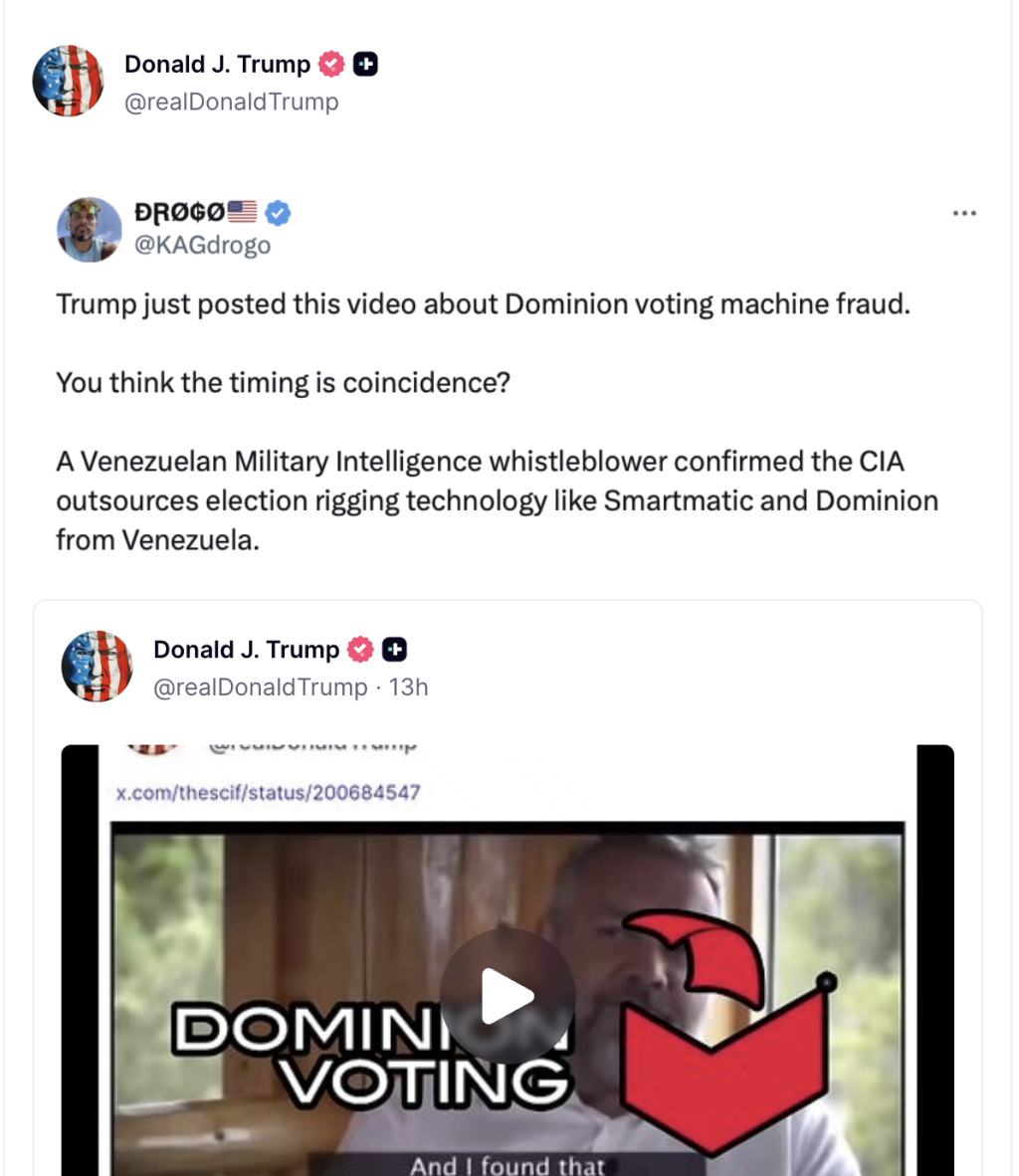
Several right-wing accounts with large followings highlighted Trump’s posts as “confirming” a connection between the U.S. attack on Venezuela and the purportedly rigged 2020 U.S. election.
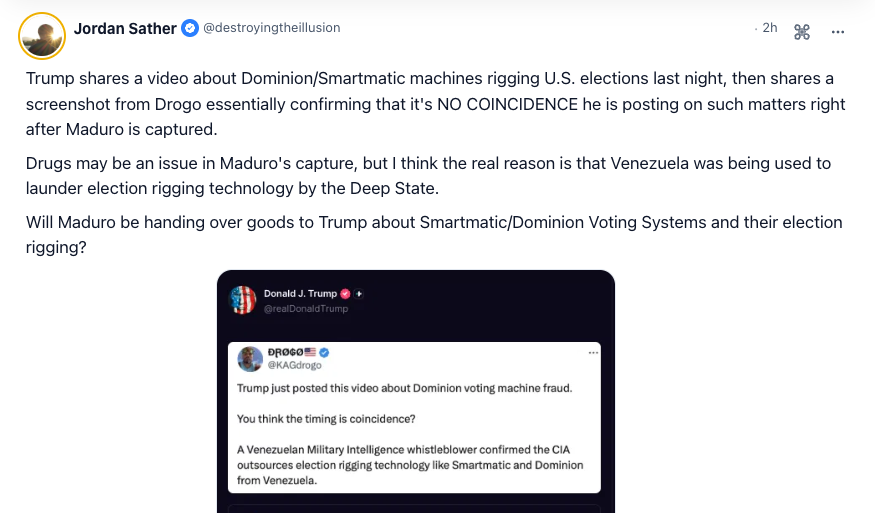
While Fox hosts largely stayed away from conspiracy theories about election technology companies following the lawsuits, hardcore election deniers like former Overstock.com CEO Patrick Byrne and MyPillow founder Mike Lindell remained fixated on Dominion. In the fall of 2025 — as the Trump administration escalated its pressure on Maduro, surged U.S. Navy ships into the Caribbean Sea, and destroyed boats it alleged were carrying drugs while murdering those onboard — the purported Venezuela connection took on new life.
“There’s never been as necessary a war since the Civil War, that we go down and take care of Venezuela,” Byrne told host Emerald Robinson in an October 7, 2025, appearance on her show on Lindell’s LindellTV network. “It’s more important than World War I or World War II to the viability of the United States. The U.S. was overthrown, and Venezuela’s technology was part of it.”
Allegations of a Venezuelan role in the purported theft of the 2020 U.S. election reportedly jumped from the fever swamp to the hyper-partisan Trump Justice Department. On November 21, 2025, The Guardian reported U.S. attorney for Puerto Rico Stephen Muldrow, “a staunch Republican and Trump supporter,” had been briefed on “the old voting conspiracy and the allegations that Venezuela helped rig elections worldwide” by former CIA officer Gary Berntsen (who claims to have first convinced Trumpist lawyers Sidney Powell and Rudy Giuliani that the 2020 election was stolen) and Venezuelan expatriate Martin Rodil.
Berntsen and author Ralph Pezzullo rehashed the allegations in an interview with far-right podcaster Lara Logan which that same day. And on November 23, 2025, Trump himself reposted Logan’s post about that interview, commenting, “We must focus all of our energy and might on ELECTION FRAUD!!”
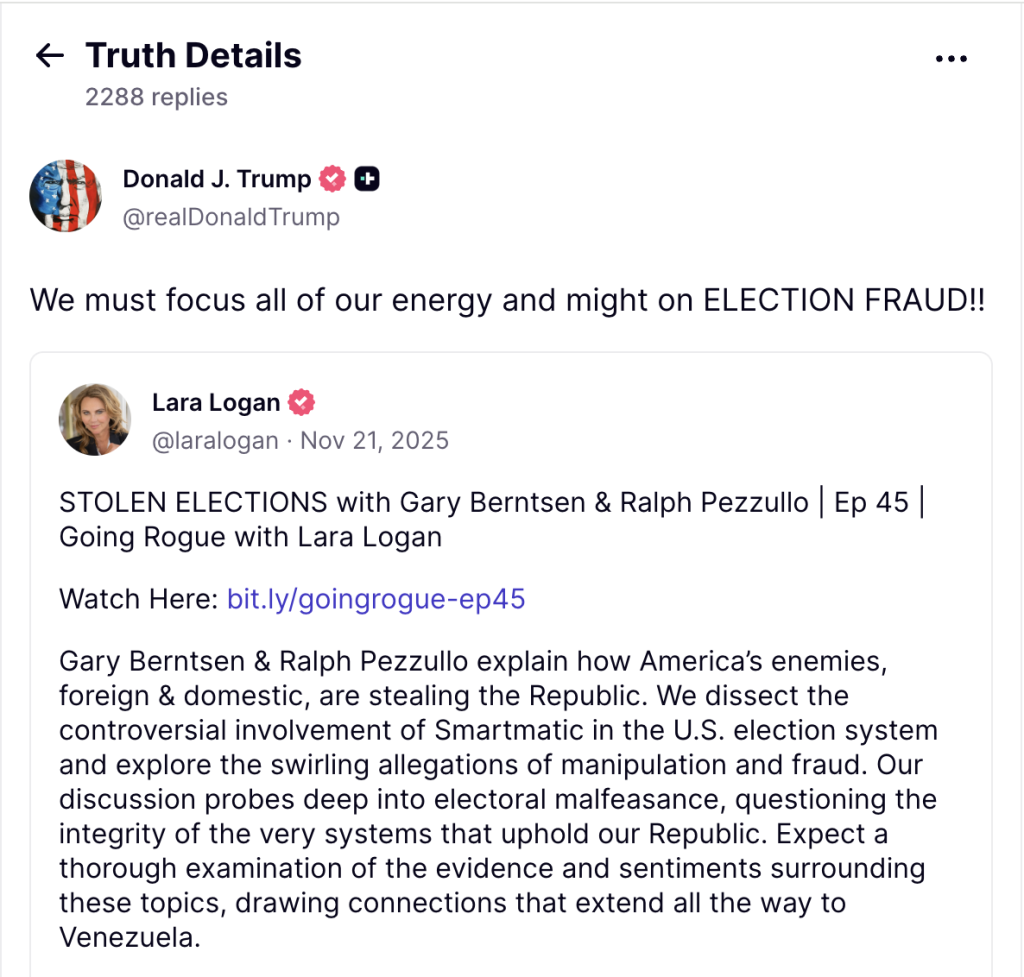
With Trump himself apparently convinced by the conspiracy theory, it seems plausible that the federal government will start putting the screws to Maduro, who appeared in a New York courtroom on Monday alongside his wife to plead not guilty to charges of drug trafficking, to get him to confirm it.
Benny Johnson is already telling his viewers that Maduro will “sing like a canary” about his purported accomplices and “how they stole the election.”
“Who will he give up?” Johnson asked Sunday. “Soros? China? Left-wing NGOs? Left-wing billionaires?”
“He'll sing,” Johnson added ominously. “He'll tell them everything. They got his wife. This is why they took him alive. I learned all this from my conversation, and it really checks out, quite frankly. It really checks out.”
MMA
//
11/25/25 9:58 AM EST
01/21/21 1:40 PM EST
12/01/25
---
an 1 26
Captured Venezuelan leader Nicolás Maduro appeared in court on Monday with his wife after the U.S. military staged a raid in Caracas in the early morning hours of Saturday. One exchange during the proceeding was striking enough to prompt a legal expert to say it was "unlike anything I've ever seen."
Outside of the New York courtroom, MS NOW legal analyst Lisa Rubin told host Chris Jansing that at one point during the hearing, Nicolás Maduro faced off against someone sitting in the courtroom.
Toward the end of the hearing, Maduro stood to make his way from the courtroom when a man "sitting in about the third or fourth row" confronted the leader, who was voted out last year.
The man "suddenly stood up and jabbed a finger at him and said what our producer, Kay Guerrero, says in Spanish was, 'You will pay!' At which point Maduro calmly looked at him and said, 'Soy hombre de Dios!' Meaning, 'I am a man of God.' And then said, 'Soy prisionero de guerra.' [Meaning] 'I am a prisoner of war.'"
She said that the exchange between them began to continue before a court officer "jabbed his finger at the guy and said, 'You! Out!'"
Rubin said that the courtroom was filled with federal employees like DEA agents and DOJ lawyers. This man was wearing a suit and looked like any other audience member, she said.
It all occurred while the judge stood up to leave the courtroom, meaning everyone else in the court also stood, and it created confusion as court officers approached the man who "tried to force a confrontation with Maduro," said Rubin.
---
MMA
01/05/26 3:14 PM EST
01/05/26 2:53 PM EST
01/05/26 2:45 PM EST
01/05/26 2:29 PM EST
01/05/26 1:28 PM EST
01/05/26 12:03 PM EST
01/05/26 9:19 AM EST
[## Tim Pool: “I think the reason we're getting involved in Venezuela largely is because Trump is like, the economy is not doing too well. Let's go get some oil, baby.”
12/16/25 10:30 AM EST](https://www.mediamatters.org/tim-pool/tim-pool-i-think-reason-were-getting-involved-venezuela-largely-because-trump-economy-not)
---
AN 1 5 26
Tump threatens interim Venezuelan leader will 'pay a very big price'
Sarah K. Burris
Trump decision to ignore Congress proves War Powers Act 'outright work of fiction': analysis
Sarah K. Burris
Trump’s own words make his war aims in Venezuela clear
Jake Johnson
Rubio says Venezuela attack was not a military action
Sarah K. Burris
Trump's excuse for ignoring Congress on Venezuela does 'not hold a lot of water': reporter
Sarah K. Burris
Even some of Donald Trump’s closest allies take issue with Venezuela move
Sarah K. Burris
Thousands stranded in Caribbean islands after Trump’s Venezuela attack
Sarah K. Burris
How Venezuela has been preparing for a US invasion for more than two decades
Gemma Ware
Critics troubled by 'slurring' Trump's plan to 'run' Venezuela
Adam Lynch
'Crazy and disproven' MAGA conspiracy likely fueling Venezuela invasion: analysis
Adam Lynch
---
AN 1 26
Early Saturday morning, January 3, the news broke that leftist Venezuelan President Nicolas Maduro had been captured by U.S. forces. Maduro, transported to the U.S., is now being held in a New York City detention center while in Venezuela, Vice President Delcy Rodríguez is in charge — not opposition leader María Corina Machado.
Although Machado is applauding the ousting of Maduro, Trump is saying that she doesn't have enough "respect" in Venezuela to lead the troubled South American country.
The fact that Venezuela is, for now, being led by an ally of Maduro and the late Venezuelan President Hugo Chávez is raising questions about Trump's motivations. Those questions are addressed by reporters Adam Taylor, Samantha Schmidt, Natalie Allison and Karen DeYoung in an article published by the Washington Post on January 4.
One of journalist Jonathan Chait's main takeaways from their reporting is Trump's desire to win the Nobel Peace Prize.
Chait, in a January 4 post on X, formerly Twitter, writes, "Why did Trump pick a left-wing authoritarian to rule Venezuela? Because the opposition leader won his peace prize."
According to the Post reporters, "Two people close to the White House said the president's lack of interest in boosting Machado, despite her recent efforts to flatter Trump, stemmed from her decision to accept the Nobel Peace Prize — an award the president has openly coveted. Although Machado ultimately said she was dedicating the award to Trump, her acceptance of the prize was an 'ultimate sin,' said one of the people."
One of the White House-adjacent sources told the Post, "If she had turned it down and said, 'I can't accept it because it's Donald Trump's,' she'd be the president of Venezuela today."
*Read the full Washington Post article at this link (subscription required).
---
HUH?
MMA
12/16/25
---
---
VENEZ TANKER GRABBED IRAN OIL TO CUBA?
- ### Fox Noticias host suggests military buildup in the Caribbean could lead to a US invasion of Cuba
12/11/25
---
---
AN 12 254
White House Press Secretary Karoline Leavitt on Wednesday amplified an op-ed article calling for a Trump-backed regime change in Venezuela as administration continues to float the possibility of a ground war in the country.
The New York Post, a notably MAGA-friendly outlet often described as President Donald Trump's "favorite paper," published the piece Leavitt's official government X account shared on Wednesday. It was written María Corina Machado, an Venezuelan activist and leader of the country's opposition against President Nicolás Maduro. She was the recipient of the 2025 Nobel Prize, and has frequently praised Trump for his opposition to Maduro and attempted to court his help in removing the Venezuelan president from office.
Leavitt's account shared a link to the piece alongside its headline, "President Trump is a champion in the fight for ‘Venezuelan freedom.'"
"White House press secretary amplifies column calling for US-led regime change in Venezuela," Olivier Knox, a senior political reporter for U.S. News & World Report, wrote in comment responding to Leavitt's.
In the piece, Machado characterized the Maduro government as hijacking the country by way of a regime-backed drug cartel, Cartel de los Soles. The Trump administration recently designated the group as a terrorist organization, though critics have pointed out that the term "Cartel de los Soles" does not refer to a specific, distinct organization, but it rather used as a catch-all term for corrupt government officials involved in drug trafficking.
She further accuses the Maduro government of "crimes against humanity and other grave atrocities," and of running Venezuela "the way mobsters control territory: through fear, torture and the systematic destruction of the nation’s democratic pillars."
She also praises Trump's actions against Maduro as "decisive action" and dismisses criticisms that military intervention would destabilize Venezuela.
Critics have accused the Trump administration of seeking to gain access to Venezuelan oil fields by deposing Maduro, not pursuing regime change to support democracy. Machado has also been criticized overall for her enthusiastic support of Trump, raising concerns the country would become overly deferential to him with her in power.
---
---
MMA
As Trump threatens regime change in Venezuela, right-wing media embrace opposition figure María Corina Machado
Conservative pundits have given Machado a platform to agitate in favor of Trump’s aggressive military campaign, while she’s given them fuel for discredited conspiracy theories
Written by John Knefel
Research contributions from Alex Kaplan, Sophie Lawton, Monica Rodriguez & Ben Van Bloem
Published 12/03/25
Right-wing media figures have spent the last year championing Venezuela opposition figure María Corina Machado, who has supported President Donald Trump’s threats of regime change in her home country.
The relationship between Machado and conservative media is mutually reinforcing: She provides right-wing outlets with inflammatory claims about President Nicolás Maduro — including exaggerated or false accusations of tampering in U.S. elections and running narcotics enterprises — and in return these outlets provide her with a platform to agitate for his ouster. As The New York Times reported, Machado recently endorsed the debunked conspiracy theory that Venezuela interfered in the 2020 U.S. election, further ingratiating herself to MAGA by adopting one of the movement’s core tenets. She has also claimed without evidence that Maduro is the leader of two drug cartels, one of which doesn't even exist as a discrete or coherent organization, according to many experts.
Since early September, President Donald Trump has ordered airstrikes on at least 21 boats, killing at least 83 people, in the Caribbean Sea and Pacific Ocean — part of a larger pressure campaign aimed at removing Maduro from office. In October, the administration ended diplomatic outreach to the country, though Trump and Maduro reportedly spoke over the phone in late November. Secretary of State Marco Rubio, a key Machado-backer, has been pushing for Maduro’s ouster for months with what some believe is an eye toward eventually collapsing the government of Cuba as well.
Right-wing media responded to Trump’s escalation by defending the extrajudicial boat strikes and pushing for even greater incursions into Venezuela, including toppling Maduro’s government. Many in conservative media have told their audiences that regime change in Venezuela would be easy, despite all evidence to the contrary.
- ### Right-wing media celebrate Machado
Right-wing coverage of Machado often relies on a blurry distinction between supporting Machado and cheering the removal of Maduro on the one hand while misleadingly claiming to oppose U.S.-led regime change on the other — arguably a distinction without a difference. Sometimes Machado employs this sleight-of-hand rhetorical device herself, seemingly to assure her audience that attacking Maduro’s government would not result in a replay of George W. Bush’s unpopular forever wars.
Fox News’ Rachel Campos-Duffy is perhaps Machado’s most significant ally in right-wing media, having interviewed her in both English- and Spanish-language media. Campos-Duffy’s colleagues at Fox have also praised Machado, as has Donald Trump Jr. on his Triggered podcast. Other conservative figures celebrated her even prior to Trump’s election in November 2024.
- In July 2024, Sebastian Gorka discussed Machado on hisAmerica Firstshow with a guest who said Machado “has been the real leader of Venezuela for years.” Guest Joseph Humire was, at the time, executive director of a think tank focused on national security issues and now serves as deputy assistant secretary of war for Western Hemisphere affairs, according to his LinkedIn page. A later analysis of Humire’s think tank found that it spread false information about Tren de Aragua, a criminal organization in Venezuela. Gorka, now a counterterrorism adviser to Trump, and Humire were discussing the recent election in Venezuela, in which Maduro claimed victory despite international observers determining the election did not meet democratic standards. Salem Media Group, *America First with Sebastian Gorka*, [7/29/24; LinkedIn, accessed 10/7/25; C-SPAN, 8/21/25; The Carter Center, 7/30/24; The Guardian, 8/13/25]
- In January, just days before Trump’s second inauguration, Campos-Duffy said Machado is “considered Venezuela’s liberator” and floated the possibility of regime change within the year. Campos-Duffy then paraphrased Trump’s approach to the Western Hemisphere, saying, “We will control our backyard, our neighborhood. And that is what you’re seeing play out right now.” She continued: “Venezuela couldn’t be happier that Donald Trump won, but it’s going to be difficult to take this dictator out of power. It’s going to be a very interesting year for Venezuela.” Fox News, *Fox & Friends*, [1/10/25]
- In March, Donald Trump Jr. interviewed longtime U.S. mercenary and Blackwater founder Erik Prince, who said the Maduro government is “going to have to be pushed out. And it doesn’t require U.S. military — it can be covert action from the intelligence community or covert action from Venezuelan patriots helped by outsiders.” Earlier in the interview, Prince said: “María Corina Machado is a brave woman and deserving of our help and our support. And they did to her what they tried to do to your dad.” Prince added that “the Maduro regime” is “effectively a narco-state,” and accused it of “exporting leftist, communist money to all the other political parties all across the continent.” Earlier, in February, Trump Jr. gave Machado a friendly interview on his program as well. Rumble, *Triggered*, [3/17/25, 2/26/25; The Wall Street Journal, 8/16/25]
- Trump Jr. returned to the subject in April in an interview with Secretary of State Marco Rubio, during which Trump referred to Machado as “clearly the choice of the Venezuelan people.” Rubio added that Machado was “one of the bravest people in the world.” Rumble, *Triggered*, [4/8/25]
- :{:{In July, former GOP congressman and current One America News host Matt Gaetz interviewed right-wing activist Roderick Navarro, who has long supported the overthrow of Maduro and now said that “it is necessary that María Corina Machado, which is the leader of the opposition, the true opposition, can be aligned with the Secretary of State Marco Rubio, to end this situation as soon as possible.” Navarro’s statement came in response to a question from Gaetz about how change could come to Venezuela following the disputed election the previous year. One America News,:(style="background-color:#ffff00ff"):}: *The Matt Gaetz Show*, [7/20/25; The Guardian, 12/14/18]}:
- In August, Trump Jr. interviewed Deputy Secretary of State Chris Landau, who said Machado is “somebody that I admire tremendously, and clearly she won the election last year.” Landau continued: “I very much look forward to a day, very soon, when we have constitutional order restored in Venezuela.” Earlier in the interview, Landau cautioned against U.S.-led regime change. Rumble, *Triggered*, [8/11/25]
- The same month, Campos-Duffy interviewed Machado, giving her an opportunity to persuade Americans who support Trump “taking on Nicolás Maduro” but worry that “this kind of smells like regime change.” Machado responded: “This has nothing to do with regime change for two reasons. First, because the change of the regime was already mandated by the presidential election we won by a landslide. And secondly, because this is about dismantling a criminal terrorist enterprise that has taken the power of Venezuela by force.” She added: “We are ready to take power — the legitimate government, elected. Venezuela will move orderly and peacefully to the transition.” Fox News, *Jesse Watters Primetime*, [8/13/25]
- Two days after Trump’s initial boat strike on September 2, Machado said in an interview with Campos-Duffy that Maduro “is understanding, finally, that the time of impunity is over and it is in his best interest to accept the will of the people that voted against him. It’s time to go.” Campos-Duffy replied, “The pressure is mounting and he is feeling more and more like a caged animal.” Fox News, *Fox & Friends*, [9/4/25; The New York Times, 9/2/25]
- On September 6, Campos-Duffy argued that “Latin American social media” was proof of “cries from the entire hemisphere of, yes, do it, we need to get rid of these cartels, we need to have our countries back, liberate us President Trump” because “they know it can only happen with him.” During her appearance on Fox & Friends Weekend, which replayed her Machado interview, Fox’s Brian Brenberg added, “Machado is one of the most impressive leaders around the globe, and your interview with her was awesome. Following that story is like following the story of liberty, and I hope it has a very successful ending.” Fox News, *Fox & Friends Weekend*, [9/6/25]
- On September 30, Campos-Duffy again interviewed Machado, who said outright that “Maduro is not the president.” Machado added, “Maduro is illegitimate, as the secretary of state, Marco Rubio, has repeated so many times,” and said that “regime change was demanded last year with the vote of the Venezuelans.” Fox Deportes, *Fox Noticias*, [9/30/25]
- :{:{In October, Fox News host Sean Hannity said Machado “sounds like a pretty good leader to me for the people of Venezuela and the end of narco terrorism.” Fox News:(style="background-color:#ffbb16ff"):}:, *Hannity*, [10/20/25]}:
- A few days later, Campos-Duffy hinted that the Rubio-led campaign against Venezuela could expand to other Latin American countries. “A lot of people saying, we’ve heard María Corina Machado say it on our show as well, if Venezuela returns to the people who won the election last July, to the opposition party, and the Marxist, you know, socialist government of Maduro goes down, so will Cuba and so will Nicaragua. It will essentially get all of the communists out of our hemisphere,” Campos-Duffy said. Fox News, *Fox & Friends Weekend*, [10/25/25]
- OnSunday Night In America with Trey Gowdy, after Rep. Maria Salazar (R-FL) mentioned that Venezuelan opposition leader Maria Machado is planning to “open the oil rigs” to U.S. companies, host Trey Gowdy mentioned that “she may be leading that country here in the not-too-distant future.” Fox News, *Sunday Night in America with Trey Gowdy*, [10/26/25]
- On November 19, Campos-Duffy teased an upcoming interview with Machado, arguing that “unlike other countries where you’ve seen regime change and the U.S. has been in some way involved, Brian, this is a country that doesn't need to be stood up economically.” Earlier in the segment, host Brian Kilmeade asked: “Rachel, it looks like she’s preparing to take over. Does she know something that we don’t?” Fox News, *Fox & Friends*, [11/19/25]
- The interview aired a few days later on November 22, with Machado predicting that Venezuela “will see an orderly and peaceful transition … that will happen very soon.” During a separate segment of the interview, Machado argued that “regime change was already mandated by the Venezuelan people by a landslide.” She said “Maduro started this war; President Trump is ending this war,” adding that “we are solving and dismantling a criminal structure that has produced great pain and turn our country, our nation, into the best ally of the United States — a security shield for the Americas and a huge opportunity for energy security.” Fox News, *Fox & Friends Weekend*, [11/22/25, 11/22/25]
Machado’s rise has also given election deniers an opportunity to revive the long debunked conspiracy theory that Venezuela interfered in the 2020 U.S. election against Trump. Machado — who had recently been awarded the Nobel Peace Prize — repeated that false claim during an October 31 interview on a Bloomberg podcast. “I have no doubt that Nicolás Maduro, Jorge Rodríguez, and many others are, you know, the masterminds of a system that has rigged elections in many countries, including in the U.S.,” Machado said. “I have no doubt about that.”
Former Overstock CEO and "prominent election denier" Patrick Byrne mocked a post criticizing Machado’s interview on his Telegram channel, writing that people who say the 2020 U.S. was fair “doth protest too much.” In August, Byrne claimed that Smartmatic, which provides electronic voting systems, is “a spinoff of the Venezuelan government” and that the company “has been rigging elections for people around the world.” In October, Bryne said the United States had to “overthrow the governments of Venezuela and Cuba" because they “overthrew our republic.”
In November, Trump promoted a right-wing show on social media during which a guest said “there are at least a dozen people in Venezuela that have more money and power” than the CIA, adding: “This is the largest transnational criminal organization in the world that no one knew about, or no one wanted to talk about, until they stole our election in 2020."
- ### What comes next
For all of the right-wing media claims that Maduro interfered in the 2020 election, it’s worth underscoring that in 2002 the United States at least tacitly supported a failed coup against then-President of Venezuela Hugo Chavez. During Trump’s first term, his administration engineered an unsuccessful campaign to oust Maduro and install opposition figure Juan Guaidó.
:{:{Despite those failures, conservative media have embraced Machado in a way that’s reminiscent of earlier episodes in U.S. foreign policy, when media and government officials celebrated opposition figures in the early years of the invasions and occupations of Afghanistan and Iraq.}:
As The New York Times notes, Machado has been a “darling” of Washington for decades, and her people are in constant contact with Secretary Rubio, the Trump administration figure leading the charge to topple Maduro. One possible reason Washington has been enthralled with her for so long is that, according to Bloomberg, she “favors privatizing all industries in Venezuela,” including the state-owned oil company, if the United States takes out Maduro. Ian Bremmer noted that U.S. action in Venezuela “in large part about the oil.”}:
Should Trump's plan move forward, Machado is the most likely candidate for his administration to rally behind. She’s already won over right-wing outlets — but as U.S. campaigns in Iraq and Afghanistan showed, sometimes an opposition figure’s charm offensive is the easiest battle of the war.
---
MMA
Right-wing media outlets are claiming regime change in Venezuela would be easy. Evidence and history suggest otherwise.
Conservative pundits are promising a small US footprint and an easy transition should the Trump administration topple Maduro, but the reality would likely be much more complicated
Written by John Knefel
Research contributions from Sophie Lawton
Published 10/29/25
Right-wing media outlets have spent months telling their audiences that a U.S. military campaign to topple the Venezuelan government would be simple and straightforward, requiring a minimal military footprint or lasting commitments to the country. In some cases, these outlets have suggested that the transition to a new government, following the toppling of President Nicolás Maduro, would be easy and organic.
Even if the United States were able to defeat the Venezuelan military fairly quickly in a conventional war, many experts warn that regime collapse would likely lead to an extended, bloody conflict that could have lasting ramifications throughout Venezuela, the surrounding region, and potentially the entire hemisphere. To date, the United States has carried out 13 known strikes on boats the Trump administration has alleged, without evidence, were engaged in the drug trade, killing at least 57 people, and has amassed the largest show of force in the region since the Cuban missile crisis.
Right-wing media suggest U.S.-supported “indigenous regime change” in Venezuela would be simple
According to numerous media outlets, Secretary of State Marco Rubio is leading the Trump administration’s campaign to topple the Maduro government, a long-running obsession of his. Rubio nominated opposition leader María Corina Machado for the Nobel Peace Prize, which she won this year, and praised her in Time magazine’s 2025 list of 100 most influential people in the world. Machado, in turn, has been a rallying point for U.S. interests seeking Maduro’s ouster.
Right-wing media figures have frequently cited Machado’s standing as evidence that Maduro could be overthrown and replaced with few complications.
In March, Erik Prince, arguably the United States’ most prominent mercenary, appeared on Donald Trump Jr.’s Triggered podcast to make that argument. Prince said the Maduro government is “going to have to be pushed out.”
“And it doesn’t require U.S. military,” he continued. “It can be covert action from the intelligence community or covert action from Venezuelan patriots helped by outsiders.” It’s not hard to imagine Prince considering himself or his allies as the “outsiders” in question, given his reported ties to anti-Maduro forces.
“María Corina Machado is a brave woman and deserving of our help and our support,” Prince said earlier in the interview.
Video
Citation
From the March 17, 2025, edition of Triggered
In August, as conservative outlets began beating the drums of war, Fox News’ Rachel Campos-Duffy — a vocal opponent of Maduro — conducted an interview with Machado. Campos-Duffy asked her to persuade Americans who support Trump “taking on Nicolás Maduro” but worry that “this kind of smells like regime change.”
“This has nothing to do with regime change … because the change of the regime was already mandated by the presidential election,” Machado replied. She added: “We are ready to take power — the legitimate government, elected. Venezuela will move orderly and peacefully to the transition.”
Video
Citation
From the August 13, 2025, edition of Fox News' Jesse Watters Primetime
The same month, The Daily Wire’s Matt Walsh pushed to escalate in Venezuela based on what he referred to as “American chauvinism."
“They're a small, weak, pathetic, puny, poor country, and so they just have to do what we say,” Walsh said. “A war with Venezuela would last about four minutes.”
On September 10, following the Trump administration’s initial boat strike, Campos-Duffy appeared in a breezy segment with Defense Secretary Pete Hegseth aboard a U.S. naval ship in the region.
“I was literally in awe of what I saw. And it's not just the military equipment,” Campos-Duffy said.
“It's the soldiers. It's how well-trained they are. How fit they are,” she continued. “How well-fed they are, which I say ‘well-fed’ because Maduro, of course, is threatening with his own militia, which we know is starving over there — they don't have anything that even comes a fraction of close to what we saw here on the USS Iwo Jima.”
The more recent U.S. invasions of Iraq and Afghanistan should serve as cautionary tales of American hubris
As Trump’s extrajudicial killing spree escalated in mid-September, The Wall Street Journal’s editorial board argued that “disgruntled military who want to liberate their country are living under the repressive arm of Mr. Maduro’s military counter-intelligence.”
In October, Fox News host Jesse Watters predicted that “there is going to be major action against Maduro pretty soon.” Even as he acknowledged it could go “sideways,” he stressed that it could be a “layup” to depose Maduro. Watters went on to pun on the Monroe Doctrine — referring to the “Don-roe Doctrine” — to argue that the United States has the right to interfere in Latin American countries’ internal affairs virtually at will.
On October 20, Fox News host Sean Hannity made that case directly, arguing that Machado “sounds like a pretty good leader for the people of Venezuela and the end of narco terrorism.”
A week later, The Daily Wire’s Ben Shapiro argued that a “full-scale ground invasion of Venezuela” would not “be a good policy for the United States.” But, he countered, “if some sort of covert CIA action were to topple the regime in Venezuela, that would be a good thing.”
Shapiro argued there is a “bizarre idea that the best available scenario is always to leave the worst dictator in power because: Saddam Hussein,” but that that analysis “is benighted.” He added: “Sometimes the analogies work and sometimes they just don’t.”
Video
Citation
From the October 27, 2025, edition of The Daily Wire's The Ben Shapiro Show
The same day, former Trump Deputy National Security Adviser KT McFarland said in an interview on Newsmax that she gets “really nervous” when “people start talking about regime change and implying that it's going to be the American Marines who do it.” She then reassured viewers that Trump has “always been very, very hesitant about American military force, American Marines’ boots on the ground.”
“Now, he's been very much in favor of regime change,” McFarland continued. “But how does that come about? That comes about because of the people of every country want a regime change.”
“It's an indigenous regime change,” she said.
McFarland escalated her rhetoric just two days later on Fox News. “Behind Maduro, there’s a very strong opposition leader, who, if — and that’s not with the U.S. Marines — but if there was a regime change in that country, there’s a very credible, powerful, potential Trump ally waiting in the wings as the new leader.”
What Venezuela regime collapse could look like
At a baseline level, the U.S. military could likely overwhelm the Venezuelan army in a conventional war fairly quickly, though Venezuela’s air and missile defenses are robust and could pose a threat to U.S. fighters, bombers, and ships in the area.
Even if the Trump administration opted for a “shock and awe”-style bombing campaign that decimated Maduro’s government, what comes after that is anybody’s guess. Reporting from The Guardian suggests that U.S. or aligned forces would not only come up against Venezuela’s official military, but could also face substantial informal resistance.
The history of Latin America is rife with examples of U.S. intervention leading to extended periods of civil war and brutal crackdowns on civilians
If Maduro were assassinated or forced to flee, factions within his government and outside armed forces would likely attempt to assert power over parts of the country. The history of Latin America is rife with examples of U.S. intervention leading to extended periods of civil war and brutal crackdowns on civilians. The more recent U.S. invasions of Iraq and Afghanistan should serve as cautionary tales of American hubris; in both cases elites were convinced that an opposition leader could simply be installed with few complications — assumptions that proved to be catastrophically wrong.
And while pro-war conservative pundits point to Venezuela’s 2024 election, which failed to meet free and fair standards, as proof of mass support for the opposition, those dynamics could shift if Caracas’ new government were installed on the back of U.S. tanks or as a result of a CIA-backed coup. The United States gave tacit approval, at least, for a coup attempt in 2002 that briefly removed Hugo Chavez from power, and in Trump’s first term he tried to install then-opposition leader Juan Guaidó into office in a pressure campaign. Both efforts ultimately failed.
The Monroe Doctrine and a Fox pundit’s dream of a right-wing Latin America
MAGA media figures have pushed to reinvigorate their version of the Monroe Doctrine, which conceives of the Western Hemisphere as the rightful dominion of the United States, for years. The escalation against Venezuela is a key part of this ideology, as is right-wing media’s support for Argentine President Javier Milei and its defense of former President of Brazil Jair Bolsonaro, both MAGA favorites. At the same time, Trump has waged a pressure campaign against President Gustavo Petro of Colombia, a leftist, by imposing sanctions on him and his family for alleged involvement in the drug trade. Trump has additionally threatened Colombia with increased tariffs and cutting off aid.
A recent comment from Fox’s Campos-Duffy suggests that the Rubio-led campaign against Venezuela is in fact even larger in scope than is currently appreciated.
“A lot of people saying, we’ve heard María Corina Machado say it on our show as well, if Venezuela returns to the people who won the election last July, to the opposition party, and the Marxist, you know, socialist government of Maduro goes down, so will Cuba and so will Nicaragua. It will essentially get all of the communists out of our hemisphere,” Campos-Duffy said. (Some observers believe Rubio’s campaign to remove Maduro is a precursor to his goal of overthrowing Cuba’s communist government.)
Video
Citation
From the October 25, 2025, edition of Fox News' Fox & Friends Weekend
Campos-Duffy’s scheme, if put into practice, would not represent the first time the United States has tried to crush left-wing governments and social movements in Latin America. As journalist Vincent Bevins details in The Jakarta Method, which examines the history of U.S.-supported anticommunist efforts around the world, forces backed by the U.S. military and CIA have been responsible for the deaths of hundreds of thousands of people suspected of leftist sympathies across Central and South America.
That bloody history doesn’t fit neatly within the current right-wing media fantasy of a quick and easy operation in Venezuela. So, like the many victims of U.S.-backed regimes in Latin America, that context simply gets disappeared.
---
Fox praised and validated Trump's legally questionable boat strikes in the Caribbean
Some at the network have been pressing for further US intervention – even regime change in Venezuela
Written by Jack Winstanley & Emma Mae Weber
Published 10/29/25
Fox News has celebrated the Trump administration's lethal strikes against supposed drug smuggling boats in the Caribbean, despite concerns from legal experts over the strikes’ legality and bipartisan warnings from congressional members that they have seen no evidence to support the administration's claims that the strikes are targeting drug traffickers.
Along with championing the strikes — many of which have targeted boats coming from Venezuela — as “pretty spectacular” and a “great move” and praising the administration’s “aggressive” approach, some Fox figures and guests have gone so far as to suggest they would support regime change in Venezuela, claiming that the Maduro government is “part of the cartel.”
\Trump’s attacks on boats in the Caribbean draw legal questions from experts and legislators
- The Trump administration has conducted numerous strikes in the Caribbean, attacking at least 13 boats and killing at least 51 people, claiming they are targeting the drug trade. President Donald Trump said of the strikes, many of which targeted Venezuelan boats, “It is violent and it is very — it’s amazing, the weaponry.” He has also hinted at further escalation, saying, “The land is going to be next.” Trump additionally authorized covert CIA action in the region, while the buildup of U.S. military assets in the region grows. The Guardian, [10/28/25; AP News, 10/24/25; YouTube,
 ; Twitter/X, 10/23/25; The New York Times, 10/15/25, 10/8/25]
- The Trump administration has conducted numerous strikes in the Caribbean, attacking at least 13 boats and killing at least 51 people, claiming they are targeting the drug trade. President Donald Trump said of the strikes, many of which targeted Venezuelan boats, “It is violent and it is very — it’s amazing, the weaponry.” He has also hinted at further escalation, saying, “The land is going to be next.” Trump additionally authorized covert CIA action in the region, while the buildup of U.S. military assets in the region grows. The Guardian, [10/28/25; AP News, 10/24/25; YouTube,
- :{:{Numerous legal experts say the killings are illegal.As The New York Times writes, “A broad range of specialists in laws governing the use of lethal force have called Mr. Trump’s orders to the military patently illegal. … The administration insists that the killings are lawful, invoking legal terms like ‘self-defense’ and ‘armed conflict.’ But it has offered no legal argument explaining how to bridge the conceptual gap between drug trafficking and associated crimes, as serious as they are, and the kind of armed attack to which those terms can legitimately apply.”}:
NPR noted that the Trump administration “has designated several South and Central American drug cartels and gangs as foreign terrorist organizations, but Congress has not authorized the use of force against them” and quoted a former State Department legal adviser, who said, “Outside of armed conflict, there is a word for the premeditated killing of people, and that word is 'murder.'" He added, “And just because the administration puts together this fig leaf of a legal justification does not legitimize these premeditated killings in the Caribbean.” The New York Times, [10/24/25; NPR, 10/24/25]}:
- Trump has repeatedly claimed that the strikes are saving thousands of Americans from drug overdoses, but there’s no evidence to support the claim. According to Trump, “Every boat that we knock out we save 25,000 American lives.” Trump has used this figure multiple times to defend the strikes, but the administration has not provided evidence showing drugs were destroyed during the attacks. Additionally, as PolitiFact notes, drug experts have said it is difficult to calculate how many lives are saved as a result of drug interception efforts but that Trump’s claim is “mathematically dubious.” “For Trump’s statement to be accurate, the drugs on five boats would have been responsible for 125,000 deaths, nearly double the number of overdose deaths in one year,” PolitiFact wrote. PolitiFact, [10/16/25]
- The strikes have drawn bipartisan concern, as legislators question the Trump administration's claims and their lack of supporting evidence. On Fox News Sunday, according to The Hill, Sen. Rand Paul (R-KY) stated that Congress has seen “no evidence presented” to support the administration's claims that the targets are drug traffickers. Similarly, Sen. Mark Kelly (D-AZ) stated that the evidence he has seen in support of the strikes “does not back up” the administration's claims that the boats were transporting fentanyl. The Hill, [10/26/25]
- ## Fox figures and guests cheered on the strikes and celebrated the administration's actions
- Fox host Laura Ingraham called the strikes “pretty spectacular” and concluded, “I love this” and “Trump is actually trying to do something.” Former Army Special Forces member Jim Hanson said the “reward” for bringing “that poison into our country” is “getting turned into an oil slick on the Caribbean.” Jason Redman, a former Navy SEAL, applauded the U.S. for taking the “lead” and said we have to “break the will” of “individuals who are willing to go out in those boats and smuggle drugs into America.” Fox News, *The Ingraham Angle*, [10/24/25]
- In the week prior, Ingraham stated that “Trump's working overtime on issues that really matter,” such as “taking out deadly threats before they even arrive on our shores.” Ingraham played a video of a boat being bombed, adding her own “boom” sound effect. After playing a bleeped clip of Trump saying Venezuelan President Nicolás Maduro “doesn’t want to f— around with the United States,” Ingraham concluded, “Bombs and the f-bombs. At least we know President Trump will never stop trying to save American lives.” Fox News, *The Ingraham Angle*, [10/17/25]
- OnAmerica’s Newsroom, former FBI agent Dan Brunner called the strikes a “great move,” adding, “Let’s go on offense. Let’s push the envelope.” Brunner added that “we need to utilize” the FBI, Homeland Security, and CIA. He said: “We’ve got a lot of experience in conducting investigations into these cartels. … Blowing up a boat, yes, that stops that shipment. But we need to find out where all the shipments are coming from and going through the root system.” Fox News, *America’s Newsroom*, [10/17/25]
- After a guest argued Trump should “keep pushing forward” as it's “the only way these traffickers will stop,” Fox host Lara Trump replied: “I think a lot of people agree with you. … Fortunately we have a president who is doing just that, meeting them with strength.” Trump also praised her father-in-law for dubbing his targets “ISIS of the Western hemisphere,” saying, “What a great name for these narco-terrorists. That’s exactly what I think they should be identified as.” Fox News, *My View with Lara Trump*, [10/25/25]
- Host Jesse Watters described a strike by saying: “Trump just smoked another coke boat in the Caribbean, and he’s just getting started.” In the segment that followed, correspondent David Spunt reported: “We can confirm the Pentagon deploying massive help in support of the operation to root out drugs being smuggled into the United States.” The chyron read, “Pentagon drops the hammer on smugglers.” Fox News, *Jesse Watters Primetime*, [10/24/25]
- OnAmerica’s Newsroom, former acting Drug Enforcement Administration Administrator Derek Maltz called fentanyl “a weapon of mass destruction” and said he’s “very thankful” for the administration's “aggressive” approach. He also claimed that “of course it's fair game” to attack cartels on land. Fox News, *America’s Newsroom*, [10/24/25]
- OnFox Noticias, guest Jesus Romero claimed that Trump is deploying “a military contingent to carry a message, not only to President Maduro, but also to all the criminals.” Romero added, “This is the message, and this is the response of the president of the United States“ to “return peace and tranquility and to stop the flow of drug trafficking into the United States.” Fox Deportes, *Fox Noticias*, [9/26/25]
- ## Fox justified the strikes and repeated Trump's unproven claim that they save large numbers of American lives
- Fox & Friendsco-host Ainsley Earhardt repeated the claim that “every boat that we strike is 25,000 American lives that have been saved.” Earhardt elaborated, saying, “We’re talking about … fentanyl pills, we’re talking about fentanyl powder, illegal guns, methamphetamine, cocaine, pounds of heroin.” Co-host Lawrence Jones, taking aim at naysayers, added, “You are going to have to choose a side. Are you going to be on the side of the cartels, which is the new ISIS, or are you going to be side of the American people?” Fox News, *Fox & Friends*, [10/24/25]
- Host Laura Ingraham claimed, “Countless American lives will be saved because of our aggressive posture.” Ingraham praised Trump, saying he is “working overtime … targeting drug cartels that poison and kill hundreds of thousands of Americans with fentanyl and cocaine.” Fox News, *The Ingraham Angle*, [10/23/25]
- OnThe Story with Martha MacCallum, Derek Maltz claimed of the cartels: “We’ve never had any terrorist organizations, even if you combine Al Qaeda, ISIS, Hezbollah, killing this many Americans.” He also argued of the supposed drug trafficking, “It's not even just a threat to our country, but once again President Trump is helping keep the world safe.” Fox News, *The Story with Martha MacCallum*, [10/20/25]
- Fox Noticiashost Rachel Campos-Duffy said, “If you are a criminal trafficking lethal drugs into this country that kill its people, you will face lethal consequences.” She added that “President Trump is not sorry” about the boat strike. Fox Deportes, *Fox Noticias*, [9/4/25]
- ## Fox hosts and guests called for further violence and US intervention – with some even supporting Venezuelan regime change
- OnThe Five, co-host Jesse Watters said the boat strikes are “more about regime change in Venezuela,” adding later, “There is going to be major action against Maduro pretty soon.” Watters said the action might be “a layup” and if it is, and “Maduro is deposed, we’re basically Monroe Doctrine-ing — we call it the Don-roe doctrine-ing — out of Latin America and China and Russia,” which would add up to Trump “wielding a lot of power internationally.” Fox News, *The Five*, [10/16/25]
- Jim Shedd, a former DEA agent, argued on Fox that “we should be striking the Venezuelan military outposts.” Shedd added that “the national guard of Venezuela and the Venezuelan army and the air force has to be destroyed because they are co-conspirators in the distribution of narcotics into this country, which has been causing death and havoc for decades.” Fox News, *The Story with Martha MacCallum*, [10/24/25]
- OnFox Noticias, Jovel Alvarez, an independent journalist, said, “I hope that President Donald Trump takes the initiative to remove Maduro from power.” He added that Trump could “practically” become the “liberator of Venezuela.” Fox Deportes, *Fox Noticias*, [10/15/25]
- OnFox & Friends, retired Gen. Jack Keane said of Venezuela, “I think it’s high time we went after this thing that was polluting our population so much.” Keane argued that the Venezuelan government is “supporting the cartel in the sense the government is part of the cartel. Because they take the revenue from that source.” Fox News, *Fox & Friends*, [10/24/25]
- OnSunday Night In America with Trey Gowdy, after Rep. Maria Salazar (R-FL) mentioned that Venezuelan opposition leader Maria Machado is planning to “open the oil rigs” to U.S. companies, host Trey Gowdy mentioned that “she may be leading that country here in the not-too-distant future.” Fox News, *Sunday Night in America with Trey Gowdy*, [10/26/25]
- OnFox Report, Manhattan Institute fellow Daniel Di Martino described Trump’s actions against Venezuela as “the same as fighting ISIS,” arguing the U.S. needs “to do everything possible.” He said: “And if that means striking inside Venezuela where Maduro is, who is a cartel leader, that the U.S. government doesn't recognize as president, this is the same as fighting ISIS, except that they’re actually bringing drugs and terrorism to America directly right now.” Di Martino also claimed, without citing evidence, that “80% of Venezuelans support” the strikes. He added that he is “very happy about hearing about the CIA operations in Venezuela, about bringing the carrier.” Fox News, *Fox Report with John Scott*, [10/26/25]
mma //
:{:{05/28/25}:
:{:{09/05/25}:
09/05/25
---
---
mma
10/24/25
===
---}:
digby an 10 25
President Donald Trump's former "tormenter" turned Secretary of State, Marco Rubio, has become a "MAGA powerhouse," driving an "illegal war on Venezuela," writes Salon's Heather Digby Parton.
Digby Parton recalls Rubio's "most-cringe prime time performances" when he gave the rebuttal to President Barack Obama's 2013 State of the Union speech and , "cementing his reputation as the thirstiest man in the U.S. Senate."
What was viewed by many as the end of Rubio's career has long been forgotten, or at least ignored, and, Digby Parton writes, "it’s a testament to his limitless ambition that he came back from that and is now one of the most powerful people in the world."
The former Florida senator, she writes, "showed early on an aptitude for sensing which way the wind was blowing," and "over the years he held both moderate and conservative positions on most issues."
Rubio, she says, initially "rejected the scientific consensus on climate change and then, a few years later, decided it was true." He was also "once one of the Republican Party’s most vocal advocates for comprehensive immigration reform and even sponsored the DREAM Act," she writes.
"Now he energetically supports Donald Trump on the most draconian deportation program in American history," she writes, adding that "he broke with the GOP on more than one occasion when it came to budget battles, at times striking a pose as populist defender of the little guy, but overall he was a standard-issue right-wing conservative on taxes and spending."
Rubio's focus, she says, has always been national security and foreign policy as an "unreconstructed hawk," but has also taken a hard-line stance against human rights violations in China, Turkey and Venezeula.
Rubio also served as co-chair of the Senate Select Committee on Intelligence with Sen. Mark Warner (D-VA), with whom he led a three-year investigation that found clear evidence of Russian interference on Trump’s behalf in the 2016 election, exactly as Robert Mueller’s investigation had established, Digby Parton notes.
Rubio even once taunted Trump about his "small hands," something that Digby Parton says "for a man who carries around grudges like precious offspring, it’s odd that Trump has apparently decided to overlook all that, but Rubio worked hard to abase himself and get into the inner circle."
And while the political establishment and many Democrats were "relieved" when Trump chose Rubio as Secretary of State, thinking he would "keep Trump foreign policy from going off the rails," Digby Parton writes, "little did they know that Rubio had happily made a deal with the devil and now seems to relish the idea of ripping up the world order in Trump’s image."
"They certainly couldn’t have anticipated how eagerly Rubio would join in thedeportationcrusade by targeting foreign students for visa violations, as well as for unauthorized opinions about Israel and Charlie Kirk," she writes.
Among Rubio's other turns include his endorsement of the Trump administration's shutdown of medical and food programs of the U.S. Agency for International Development (USAID), of which Rubio had always been supportive.
"It came a something of a shock," she writes, adding "he even agreed to betray informants under U.S. protection to Salvadoran President Nayib Bukele in exchange for an agreement to lock up purported Venezuelan gang members in El Salvador’s gruesome gulag."
When Russia first invaded Ukraine, Rubio condemned President Vladimir Putin's aggression, but then quickly "changed his tune," "voting against military aid early on and adopting the Trump line that a negotiated settlement was the only way out."
Rubio's stance on Venezuela, she says, comes from his background as a member of "the anti-Castro Cuban-American community of South Florida."
"Rubio has a strong strain of anti-left ideology which has made him especially obsessed with Nicolás Maduro, Venezuela’s socialist authoritarian president," Digby Parton says.
According to recent reports in the *Wall Street Journal*, "the extrajudicial killings, CIA covert actions and pending war plans against Venezuela are all being driven by Rubio," she writes. "Rubio and deputy White House chief of staff Stephen Miller have carried the day with a full-fledged plan to pressure and perhaps depose the Venezuelan leader."
Rubio's future ambitions, she says, is the driving force in all of his actions.
"Marco Rubio almost certainly intends to run for president in 2028 and sees his service in that cause as the best way to fulfill his own agenda and expand both his power and his political profile," she says, adding "He’s a fully paid-up MAGA fanatic now, and no one should think otherwise."
---
---
troll? an 10 25
Fox News host Sean Hannity that President Donald Trump should forget Canada and make Venezuela America's 51st state, according to The Daily Beast.
This suggestion comes after the winner of the Nobel Peace Prize, Venezuelan opposition leader María Corina Machado, dedicated it to Trump and “the suffering people of Venezuela." Trump and his supporters relentlessly campaigned for him to win the prize.
“I dedicated this award to the Venezuelan people and President Trump because I believe that’s absolutely fair,” Machado, a Trump supporter, said. “We, the Venezuelan people, are absolutely grateful to President Trump for the way he has supported democracy and freedom in the Americas.”
“This opposition leader in Venezuela that won the Nobel Prize, and said it really deserved to go to Donald Trump, sounds like a pretty good leader to me for the people of Venezuela, and the end of narcoterrorism, and a better relationship with the U.S.,” Hannity said to Sen. Lindsey Graham (R-SC). “Or, if they choose, maybe the 51st state.”
“Sounds good to me!” Graham exclaimed.
While Trump may not 'get' Venezeula as the 51st state, he does think he still has a shot at the Nobel Peace Prize.
"So the person who actually got the Nobel prize called today, called me and said, I’m accepting this in honor of you because you really deserved it,” he said at a press conference. “I didn’t say, ‘Then give it to me,’ though. I could have. I think she might have.”
---
---
RWW 3 WAY POw XGE? INCL ANDRY
07/23/2025
by
- Steve Benen @ The Maddow Blog: Justice Department reportedly told Trump in May that his name is in the Epstein files
A new Wall Street Journal report said the president's name "appeared multiple times" in the Jeffrey Epstein files — and he was told that during a briefing.
- Kiera Butler @ Mother Jones: Did Christian Nationalist Leaders Prompt Mike Johnson’s Epstein Flip-Flop?
Forget about putting “everything out there and let the people decide it.” That was last week.
- Sarah K. Burris @ Raw Story: First lady of France sues right-wing firebrand Candace Owens over claims she's a man
First Lady Brigitte Macron is suing right-wing firebrand Candace Owens for a “relentless and unjustified smear campaign” that alleges Macron is secretly a man.
- Hemant Mehta @ Friendly Atheist: Textbook publishers are largely rejecting Ryan Walters' MAGA curriculum in Oklahoma
Ryan Walters' far-right curriculum changes are getting snubbed by publishers who refuse to rewrite history.
- Teo Armus, Samantha Schmidt, Helena Carpio and Arelis R. Hernández @ The Washington Post: U.S. deportees, freed from Salvadoran prison, describe ‘horror movie’
Three Venezuelans, released last week from the Terrorism Confinement Center, said they were repeatedly beaten and denied access to lawyers.
- Julie Turkewitz, José Bautista and Frances Robles @ The New York Times: American Convicted of Murder Is Freed by Trump From Venezuela Prison
The Trump administration said it was protecting Americans unjustly held abroad. One of the rescued men, Dahud Hanid Ortiz, killed three people, according to court documents.
- Global Project Against Hate And Extremism: Tulsi Gabbard’s “Claims” that the Obama Administration Staged a “Coup” Fuel Far Right’s Fantasies of Political Violence
On July 18, Director of National Intelligence Tulsi Gabbard made a post on Twitter alleging “the most powerful people in the Obama administration,” including former President Barack Obama, were involved in a “years-long coup” and a “treasonous conspiracy” against Donald Trump. Her post quickly went viral, amassing over 13 million views over the weekend, and galvanized the online fringe to fantasize about violence against their political enemies. Trump fanned Gabbard’s flames, sharing a racist AI-generated video of Obama being arrested on Truth Social, which Trump owns.
---
guk no lnx
guk
maga since forever’: mercenary mogul Erik Prince pushes to privatize Trump deportation plans
Notorious Blackwater founder is lobbying allies in White House for private contractors to assist in mass deportations
Ben Makuch
Sun 16 Mar 2025