DR Congo DRC
---
see kabila dictator
see uber1 for history
---
6 26 EBOLA OUTBREAK POST MUSK WOODCHIPPER 800? SICK?
DART RAPID RESP PGM GONE?
---
npr
In March 2025, Nicholas Enrich was the top U.S. official for global health when two major events were happening at the same time: The Trump administration was dismantling USAID, and an Ebola outbreak was spreading in Uganda.
It was Enrich's job to manage the U.S. response. He says he was stymied at every turn.
"I was told by one of the political appointees, who was the head of the Bureau for Humanitarian Assistance, that Ebola is a scam," Enrich says.
A year later, as the worst Ebola outbreak in more than a decade spreads in the Democratic Republic of the Congo, Enrich has published a timely book with a title drawn from Elon Musk's plans for the premier U.S. foreign aid agency: Into the Woodchipper: A Whistleblower's Account of How the Trump Administration Shredded USAID.*
Simon & Schuster
It's written from the perspective of a civil servant who served at the premier U.S. foreign aid agency under four administrations –- until he was put on leave and then dismissed after leaking memos about plans to dismantle the agency.
In an interview with NPR , Enrich talked about his view of the agency and his perspective on the current Ebola outbreak in a world where USAID no longer exists.
This interview has been edited for length and clarity.
Let's start with a controversial question. The administration gave various rationales to justify the sunsetting of USAID –- accusations of political bias, waste, fraud and abuse. Did you agree with any of their points?
Okay, I'm gonna say yes, but before I talk about them, it's important to recognize that the agency was not destroyed because it was wasteful or because it didn't work or because they wanted to realign aid with the American First priorities. It was destroyed by a bunch of people who did not understand what the agency did, who were completely uninformed and unqualified about our programs, and who were there tearing down the agency that they didn't get for the sole purpose of soothing the ego of a billionaire.
That's a very stark explanation.
One of the reasons I wrote this book was to make sure that it's very, very clear why the agency was destroyed and why it wasn't. That said, I think that there are ways that aid could have been more efficient and could have been less likely to foster dependency in ways that it had.
But you know, I also want to make the point that USAID actually was considered one of the most efficient agencies within the government [operating] on less than 1% of the federal budget. We, among many other things, saved the lives of 92 million people over the last 20 years alone, which is a staggering impact for a relatively shoestring budget. So it's not that we weren't efficient, it's just that, of course, there were ways that we could have become more so.
You were put on leave immediately after leaking the memos. Looking back, is there anything you would have done differently in your final months there?
I do feel like I was quite naive. I was a civil servant for my whole career, and I was no activist or advocate. So it did not come naturally to me to stop and say: "Wait a minute. This is not an opportunity for me to figure out how to administer the policies of this administration. This is completely off the rails and is a violation of laws, of court orders, of congressional intent and it is unethical and causing destruction and harm to public safety." And I wish that I had been able to say earlier, "This is not okay and I cannot continue to work within the bounds of these walls that are collapsing around me to try to save this tiny bit of our program."
I wish I had said I need to not agree to some of the directives, because I did [agree]. I did implement directives from our political leadership that I'm not proud of, like making lists of our staff, knowing that some of those people would be terminated, or taking life-saving activities off the list of what I was asking to be approved.
For example…?
I was told by the political appointees, for example, that they wouldn't be approving any of the Ebola activities, because Ebola was a scam, and so I made a decision that I regret to this day of removing Ebola activities from those that I was hoping to get approved.
You were involved in Ebola efforts even before the Uganda outbreak last year. What was the agency's position on the virus?
I was thrust into the top official of global health role for the agency and my job was to set up a robust U.S. government response to the Ebola outbreak, and I was just stopped at every single turn. It started with the refusal to even allow us to screen passengers at international airports for symptoms of Ebola before they got onto flights that were headed to Europe and potentially onward to the United States.
And we were never able to even get a team into the country. They had banned us from communicating with our sister agencies like the CDC, which made it extremely difficult to manage an Ebola outbreak in the ways that we were used to. For example, in preparation for an outbreak like this one [we] had pre-positioned personal protective equipment in nearby Kenya so that it could be delivered to the outbreak zone within a matter of hours. But we were never able to move that, because the warehouse was owned by the World Health Organization, and our political leadership wouldn't even let us talk to the World Health Organization.
What's going through your mind as you see the news of the current Ebola outbreak in the Democratic Republic of the Congo?
This is the first Ebola outbreak since USAID has been destroyed. I think about the systems and the expertise and the experience that USAID had in leading and coordinating responses to Ebola outbreaks — the way that we would immediately get our DART [Disaster Assistance Response Team] teams into place to move PPE [personal protective equipment], to coordinate partners in the country, to do contact tracing on a massive scale and community education and safe burial procedures. This is what we need in an outbreak — response with speed — and what instead we have without that expertise and systems from USAID is a State Department that, in the best of light, is rapidly trying to respond but is reinventing the wheel and trying to improvise systems that used to exist.
You were at USAID during the 2014 outbreak of Ebola as well. Were there lessons learned during that response that could have been implemented now with this outbreak if the agency were still around?
Because of the 2014 Ebola outbreak, we completely changed the way that we do infectious disease preparedness and have an entirely new global health security strategy. We invested billions of dollars in that time period to set up what my former boss [Atul Gawande] used to call the global immune system, which allowed for early detection and early response efforts. So we could make sure that our surveillance is in place and our testing is working and our community health workers know what to be looking for –- so we are detecting outbreaks at such an early stage that there's no time for them to spread.
And what has happened to that system?
That entire system was ripped apart in 2025. What we're seeing with Ebola in DRC {Democratic Republic of Congo] and Uganda and the recent hantavirus outbreak, these are a couple of examples within just a few weeks of how far American leadership has fallen in detection and response to infectious disease outbreaks.
It does make me nervous that if there is a pathogen that is more likely to be the next pandemic that we're just way, way underprepared as compared to how we were just a few months ago.
How do you think we should be talking about USAID at this moment?
I think of it as an era that I'm very proud of in American history and extremely proud of myself for getting just the opportunity to be a part of when the official policy of the United States government was to make the world a safer and healthier place. I'm sad that it's gone. I do remain optimistic, however, that we will need to have a new and independent agency that does international development and foreign aid — in the same way that no one would be satisfied folding the State Department into the Department of Defense because they do completely different pillars of foreign policy, so too does international development need a separate and unique kind of organizational structure to provide the third leg of the foreign policy stool.
---
---
rww
12/04/2025
by
- Dan Diamond, Alec Dent and Katharine Houreld @ The Washington Post: The renamed ‘Donald J. Trump Institute of Peace’ hosts first event
Trump joined leaders from Rwanda and the Democratic Republic of Congo to sign an accord — and to marvel at the new name his administration gave the building.
- Edith Olmstead @ The New Republic: Did Pete Hegseth Even Read the Signalgate Report?
The Pentagon spokesman insisted the report completely exonerated Hegseth.
- Charlie Nash @ Mediaite: Fox Host Tells Women They’ll Get ‘Hotter’ if They Join GOP: ‘All Republican Women Are Hot’
Fox Business host Katrina Campins advised women that they would get “hotter” if they joined the Republican Party on Wednesday, declaring, “All Republican women are hot.”
- Moria Donegan @ The Guardian: Rightwingers are trying to destroy women’s right to vote
Calls for disenfranchisement rest on a single assumption: that women’s citizenship is partial and conditional.
- Adam Lynch @ AlterNet: Conservative professor warns GOP to stop 'playing footsie' with extremist bigots
Conservative Princeton University professor Robert P. George is warning the Republican Party and the modern conservative movement to jettison its growing bigot wing quickly before they destroy the party.
- Coleman Hughes: Nick Fuentes Knows Exactly What He’s Doing
---
dci
[### DRC : Moïse Katumbi off to Washington for Trump's ...

Africa Intelligence
https://www.africaintelligence.com › Central Africa](https://www.africaintelligence.com/central-africa/2025/01/17/moise-katumbi-off-to-washington-for-trump-s-inauguration,110364231-art)
Jan 17, 2025 — Congolese opposition leader Katumbi will be attending Donald Trump's swearing-in ceremony on 20 January, having been working for several ...
[### Moise Katumbi: DR Congo Magnate, Soccer Fan And ...

Barron's
https://www.barrons.com › articles › moise-katumbi-dr-...](https://www.barrons.com/articles/moise-katumbi-dr-congo-magnate-soccer-fan-and-presidential-contender-49adea3e)
Dec 12, 2023 — DR Congo millionaire businessman and chairman of the country's leading football club, Moise Katumbi is a long-time opposition figure, ...
---
Who is Moïse Katumbi, and why has he returned?
Moïse Katumbi is one of the richest persons in the Democratic Republic of Congo (DRC) – and a political force to be reckoned with. A self-made man, he accumulated his wealth running mining and transport companies in the southern Katanga province. He is popular in Katanga, in part because he is president of a successful football team, Tout Puissant Mazembe, based in the provincial capital Lubumbashi.
Katumbi first fled the DRC to neighbouring Zambia in the chaos of the civil war in the 1990s. In the early 2000s, President Joseph Kabila, who had succeeded his father, Laurent, after his assassination in 2001, invited Katumbi back to the country to help him fix Katanga’s mining sector. Katumbi chose to return on 11 July 2003, to coincide with the date when the state of Katanga declared its short-lived independence – a period many Katangais still recall with nostalgia.
His political career took off in 2007 when he was elected Katanga’s governor. He boosted his popularity by contributing to the province’s economic development – targeting corruption, encouraging foreign investment and improving infrastructure. For years, he was a member of Joseph Kabila’s People’s Party for Reconstruction and Democracy. In the summer of 2015, however, he had a falling-out with Kabila after trying and failing to dissuade the former president from seeking a third term. (The Congolese constitution bound Kabila to a maximum of two terms, but he long sought ways to overcome this limitation.) In September of that year, Katumbi resigned as governor.
Many Congolese expected him to run for president in elections initially scheduled for November 2016. But in May, after the government accused Katumbi of hiring mercenaries in a coup plot, he fled the country again, this time to Belgium. He subsequently was convicted in absentia on separate property fraud allegations and sentenced to three years in jail. Katumbi has consistently denied all charges, calling them politicised. In August 2018, he tried to re-enter the DRC in order to submit his candidacy for president in polls that Kabila, after several delays, had finally slated for that December. The government denied him entry.
The legislative balance of power could shift further were FCC deputies to defect, whether out of political opportunism or for other reasons.
Ultimately, under pressure from African and Western governments, Kabila decided not to runfor a third term. Instead, he sought to handpick his successor. That proved no easy feat. His preferred candidate, Ramazani Shadary, failed to win at the polls and a parallel vote count, widely regarded as credible, suggested that Martin Fayulu, an opposition politician backed by Katumbi, had prevailed in a landslide. Yet the Electoral Commission declared Félix Tshisekedi, another opposition figure, the winner. Kabila appears to have engineered victory for Tshisekedi, whom he viewed as less dangerous to his interests than Fayulu; Kabila and Tshisekedi reportedly struck an informal deal pursuant to which the new president gave his predecessor unspecified assurances about his future.
Under Tshisekedi, the DRC’s political space is opening up. In his inaugural speech he pledged to free political prisoners, close the secret police’s detention centres and allow exiled politicians to return. He has made some progress toward fulfilling all these promises. Katumbi has been one beneficiary: in late April, the Court of Cassation, the DRC’s supreme court of appeals, overturned the property fraud conviction. In May, prosecutors also dropped the coup plot investigation, paving the way for Katumbi’s return.
In keeping with his proclivity for historically resonant dates, he chose 20 May for his return to Lubumbashi, three years to the day since his exile, and a national holiday under the DRC’s long-time president, Joseph-Desiré Mobutu (1965-1997). Dressed in white – a colour he chose to symbolise peace – Katumbi arrived in Lubumbashi, where he was welcomed by tens of thousands of supporters, also wearing white, who proceeded to rally peacefully in the city centre. National and local media covered the homecoming favourably.
What impact will his return have on the DRC’s politics?
Tshisekedi could use an ally in pursuing his ambitious political agenda, and Katumbi arguably fits the bill.
The new president is struggling in the face of resistance by Kabila, who remains an important power behind the scenes. Though Kabila’s intended successor Shadary lost the presidential election, his Common Front for Congo (FCC) coalition won a parliamentary majority in the legislative contests, the results of which were equally disputed. The FCC’s several constituent groups control almost three quarters – 346 of 500 – of the National Assembly seats and the constitution mandates that the prime minister hail from the parliamentary majority’s ranks. It took Kabila and Tshisekedi four months to settle on a candidate before finally naming Sylvestre Ilunga Ilunkamba, a member of Kabila’s party and experienced politician, on the day of Katumbi’s return, diverting some attention from events in Lubumbashi.
Although Tshisekedi cannot come close to challenging the FCC’s majority even if he forges an alliance with Katumbi, he could nonetheless strengthen his position. Katumbi’s Ensemble is the largest opposition coalition, with at least 66 seats, and Tshisekedi’s Heading for Change alliance has at least 47. (Both could gain additional seats in Beni, Butembo and Yumbi where polls were postponed due to security concerns.) Moreover, the legislative balance of power could shift further were FCC deputies to defect, whether out of political opportunism or for other reasons.
In short, a Tshisekedi-Katumbi alliance might not carry immediate benefits for the new president but it would help balance Kabila’s overwhelming influence. Yet, although it would be more natural than his tense “marriage of convenience” (as press outlets have called it) with Kabila, it would represent a break from the recent past.
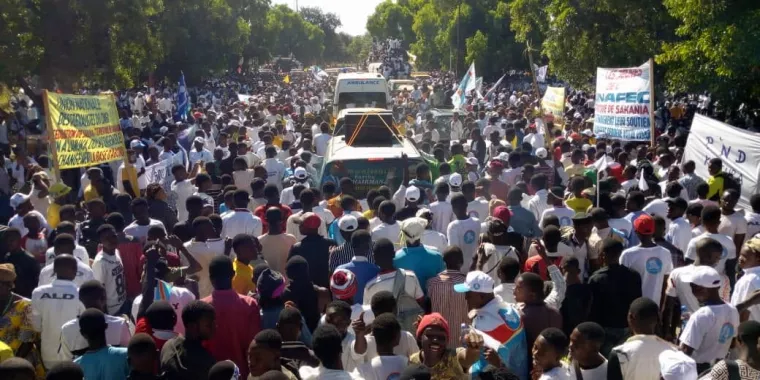
Katumbi was welcomed in Lubumbashi by tens of thousands of supporters, who proceeded to a peaceful rally in the city centre. Lubumbashi, 20 May 2019. CRISISGROUP/Paul Kaboba
Indeed, in a sign of friction between the two men, Katumbi backed Tshisekedi’s rival Fayulu in the 2018 presidential race. Along with other major opposition leaders, Katumbi and Tshisekedi had formed a coalition called Lamuka (“Wake Up”, in Lingala) to contest the elections. Lamuka decided to throw its weight behind the relatively unknown Fayulu as its presidential candidate. But Tshisekedi broke ranks shortly after the coalition was formed, under pressure from his party, the Union for Democracy and Social Progress, to run separately. Fayulu, convinced that he was robbed of his victory, has maintained his call for new elections and for Tshisekedi’s resignation.
In an interview with Crisis Group on 15 May, Katumbi said he saw no point in being too hard on Tshisekedi. “The enemy of the population is not the one who won the elections, but the one who organised them”, he explained. While refraining from overtly supporting Tshisekedi, he praised the new president for his work to protect freedom of expression. Referring to the Court of Cassation decision, he maintained his innocence and rejected the idea that the court’s decision to rescind his conviction was politically motivated. Importantly, he stressed the importance of separating Tshisekedi from Kabila and avoiding pushing the president into his predecessor’s arms. He sounded the same note while addressing the crowd in Lubumbashi on 20 May, when he urged Kabila to afford his successor some space, using the metaphorical phrase “un véhicule ne peut pas avoir deux chauffeurs (a car can’t have two drivers)”.
What does Katumbi’s return mean for the Congolese opposition?
With Katumbi now serving as its rotating head, Lamuka is still projecting a united front. But it is unclear how long this can hold. The coalition featured Katumbi’s return prominently on Twitter, and in interviews announcing his return he reaffirmed his commitment to the opposition coalition. He likewise has made clear that he would not join the government. Still, when he spoke to Crisis Group, Katumbi said he has advised Fayulu to forget the past and move forward, because his demand for new elections is untenable. He cited this stance as evidence that he is “un homme pragmatique (a pragmatic man)”.
Lamuka’s other major figure is Jean-Pierre Bemba, Kabila’s vice president from 2003-2006. Bemba was also barred from running in 2018 and likely continues to harbour presidential ambitions. On 13 May, with Fayulu by her side, Eve Bazaiba, secretary general of Bemba’s Movement for the Liberation of the Congo, announced that Bemba would also be returning to the DRC within three weeks. His homecoming may further strain the coalition. Like Katumbi, he will tour the DRC’s 26 provinces in the coming months. Whether he will do so with Katumbi or with Fayulu has not been confirmed.
The DRC’s political landscape remains fractured, with shifting alliances and ongoing tactical manoeuvring. This presents the president with a dilemma: enjoying only a relatively weak base of support, he will need to look to the opposition to bolster his presidency’s stability; yet the main opposition figures also have their own ambitions and, if given significant space, could quickly become powerful contenders in the 2023 election.
---
American Legislative Exchange Council (ALEC) has a history of defending controversial and harmful legislation, but the man behind ALEC’s public relations machine, Bill Meierling, has defended actions far worse than anything done by ALEC.
Two of Africa’s most notorious dictators hired Meierling to downplay their abuses of power and build political support for their authoritarian regimes: Equatorial Guinea’s Teodoro Obiang Nguema Mbasogo and Democratic Republic of Congo’s Joseph Kabila.
Meierling helped set up the information ministry of Equatorial Guinea for the country’s tyrant, Obiang, and in the Democratic Republic of Congo he advocated for Joseph Kabila’s illegal attempt at a third term as president.
A “former member of ALEC who grew disillusioned with the organization” sourced the materials for this story to the Center for Media and Democracy (CMD), which were confirmed through Foreign Agent Registration Act filings. Anyone representing the interests of a foreign government has to register as a lobbyist and disclose their activities.
Meierling officially joined ALEC in January 2013as executive vice president for external relations and strategic partnerships. As head of the group’s spin machine, he has since retained that role and become the chief marketing officer. Meierling “manages crisis response and provides senior level counsel to investor-, government-, and public relations divisions of Fortune 500 member companies regarding state and federal advocacy; environmental, social and governance (ESG) activism; and other concerns.”
In Meierling, ALEC found an experienced propagandist who led the organization through a donor crisis and member exodus when its promotion of “Stand Your Ground” legislation was tied to the death of the unarmed Black teenager Trayvon Martin. He managed PR when Google’s executive chairman said ALEC was “literally lying” about the climate emergency, and when corporations again dropped ALEC for its keynote speaker David Horowitz’s racist and bigoted remarks at a 2018 annual meeting.
Meierling Assisted in Equatorial Guinea Propaganda Campaign
Before joining ALEC, Meierling ran his own PR firm, OpinionMakers International. Through OpinionMakers, he was hired in 2007 as asubcontractor of lobbying firm Cassidy & Associates to work for the Equatorial Guinea government and President Teodoro Obiang. He was paid handsomely, raking in $15,000 a month in fees for his firm. Cassidy and Associates made headlines with their work for Obiang when an executive bragged about how they were able to get Obiang off Parade Magazine’s top ten list of worst dictators. Obiang only “improved” to being ranked the world’s 13th worst dictator.
Meierling fondly recounted his time in Equatorial Guinea in an interview, saying, “I was brought there in the mid 2000’s to help train them and help prop up the information ministry within the country.” The Ministry to which he referred is not so much one of information as it is propaganda.In its 2007 Freedom of the Press Report, the organization Freedom House described Equatorial Guinea as having “virtually no independent media” and stated that “all domestic radio and television stations are owned directly by the government or by the president’s family. State-owned media are dominated by sycophantic coverage of the government and the president.” The country still ranks at the bottom of Freedom House’s rankings with no independent journalism or freedom of speech.
The coverage by state run media is so atrocious, a presidential aide once compared President Obiang to Godwhile on a radio interview in 2003. “He [Obiang] can decide to kill without anyone calling him to account and without going to hell because it is God himself, with whom he is in permanent contact, and who gives him this strength,” said the aide. Obiang uses the state controlled media to stay in office, most recently in 2016 when he won a sham election with over 90 percent of the vote.
“It was just an incredible opportunity to build something from the ground up and to work in a developing nation with the people and the government that was really interested in growing, changing, and telling their story,” Meierling said of his work in Equatorial Guinea.
As part of that job, Meierling specifically worked to spin the dictator’s dismal human rights record.
In August of 2007, Meierling wrote a press release highlighting a visit by the United Nations Working Group on Arbitrary Detentions and the Equatorial Guinea’s supposed progress on “deprivation of liberty” and other human rights abuses.
Whatever progress allegedly occurred, however, was short-lived. In October of 2007, opposition party member Salvador Ndong Nguema died from injuries after being tortured in prison.
Later in 2010, four political opponents of President Obiang were abducted by Equatorial Guinean security forces in Benin after fleeing the country years earlier. They were held in the notorious Black Beach prison, where they allegedly confessed to a 2009 attempted coup. The military executed them after a brief military trial. Human rights observers viewed the military trial as a sham and believed the men were coerced to confess after being tortured.
Meierling also consulted with Equatorial Guinea on the development of its oil industry. In 2008, he wrote a press release for the government highlighting a trip by Sen. Johnny Isakson (R-Ga.) to the country’s new liquefied natural gas facility. A biography on Meierling for another PR firm that was recently removed described his work on the project and touted his connections to the Obiang regime. “When the Republic of Equatorial Guinea and Marathon Oilsought American support for construction of the world’s largest LNG export train from Bioko, Malabo, Equatorial Guinea to Elba Island, Georgia, the African nation’s leadership turned to him,” it said.
While the country’s oilfields have proven to be plentiful, the average citizen of Equatorial Guinea still lives in poverty. Despite having a per capita gross domestic product higher than that of Brazil and China, the country ranks 141st out of 189 on the United Nations Human Development Index.
Meierling has also worked for Obiang’s son, Teodorin, directly. In March, Meierling’s website listed Teodorin and his girlfriend at the time, Eve, as former clients for “reputation” management services, but the content has since been removed.
Teodorin has been the subject of numerous corruption investigations, and has assets have been seized by U.S., French, Swiss, and Brazilian authorities based on what the U.S. Justice Department characterized as “relentless embezzlement.”
According to a 2010 U.S. Senate investigation,
From 2004 to 2008, Teodoro [Teodorin] Nguema Obiang Mangue, son of the President of Equatorial Guinea, has used U.S. lawyers, bankers, real estate agents, and escrow agents to move over $110 million in suspect funds into the United States. Mr. Obiang is the subject of an ongoing U.S. criminal investigation, has been identified in corruption complaints filed in France, and was a focus of a 2004 Subcommittee hearing showing how Riggs Bank facilitated officials from Equatorial Guinea in opening accounts and engaging in suspect transactions.
The report attributed the success of Obiang and his family’s ability to embezzle funds to the help they received from numerous lawyers, lobbyists, and consultants to gain influence.
Meierling Assisted Congo Dictator in Misinformation Campaign to Keep Him in Office
In 2017, while working in his current capacity as chief marketing officer for ALEC, Meierling was paid $20,000 per month for public relations work by the Democratic Republic of the Congo (DRC). Meierling described the work done through a company calledHow Handy is ThatLLC as “strategic communications services” and reported that he would be “writing for, advising or representing the foreign principal.”
Documents disclosed in compliance with the Foreign Agents Registration Act show a series of op-eds appearing in the Washington Times in 2017, many of which attack Moise Katumbi, a candidate who was running in opposition to DRC President Joseph Kabila. While the articles are labeled as “sponsored,” none of them disclose the DRC government as the sponsor. One of the pieces authored by Meierling describes the electoral situation in the DRC as follows:
As President Joseph Kabila of the Democratic Republic of Congo (DRC) readies his country and its government for Congo’s next free and fair national election, some of the very opposition groups with whom he worked to arrange next year’s vote are coordinating with powerful forces outside of DRC who are deploying millions of dollars in foreign money to influence its outcome, undermine its integrity and financially benefit from its aftermath.
Meierling brazenly misinformed readers about the elections in the DRC when he described them as being “free and fair.” At the time, Kabila was illegally holding office, as his constitutionally limited two terms had expired in 2016.
Kabila’s government delayed the presidential election until 2018, claiming to need more time to update the country’s voter registry. Protests erupted in response to the delay, and the United Nations reported that government security forces killed 49 protesters.
The group Journalists in Danger “reported 121 cases of attacks on media from November 2017 to October [2018] and attributed 77 percent of these attacks to government agents, including nearly half to state security forces.”
Meierling is not currently registered as a foreign agent.
CMD reached out to ALEC for comment twice for this piece and received no response.
:{:{}:
===
disaster capitalism?
Eastern Africa
FSG’s ‘focus region’ (Frontier Services Group)]
FSG’s public focus is on providing security and logistical help to eastern African countries such as South Sudan, Kenya, Somalia and the DRC.
“When you want logistics done in Africa, you call DHL,” said Sean McFate, a former military contractor in Africa and current expert on mercenaries at the Atlantic Council. “When you want muscle, you call Erik Prince.”
One of FSG’s ventures appears to help oust the extremist militant group, Al Shabaab, from southwest Somalia—an area it has largely controlled for years. “We have brought together strong international business leaders to team-up with talented Somali entrepreneurs to make development in South West Somalia a reality,” an FSG statement reads.
“The project will include an integrated solution of air-land-sea logistics capabilities and advanced security management.”
China
FSG’s headquarters is in Hong Kong, and though it publicly states that its focus is on eastern Africa, FSG is now reported to be doing domestic work on behalf of the Chinese government.
FSG is partially owned by CITIC, a Chinese-government own investment firm. CITIC is slowly taking more and more control of FSG and is reportedly already the dominant shareholder, meaning it has greater power than Prince to determine the company’s vision and business deals.
covid 2x!
https://www.ecowatch.com/rainforest-deforestation-coronavirus-2646072407.html
As the COVID-19 virus was spreading around the world, deforestation in the world's rainforests rose at an alarming rate, the German arm of the World Wildlife Fund (WWF) said in a study published on Thursday.
The study, which analyzed satellite data of 18 countries compiled by the University of Maryland, found that deforestation rose by 150% this March compared 2017-2019 average for the same calendar month.
Around 6,500 square kilometers (2,510 square miles) of rainforest were felled in March alone — an area seven times the size of Berlin, the WWF said.
"This indicates that we're dealing with a coronavirus effect on the exploding rates of deforestation," Christoph Heinrich, the head of nature conservation with WWF Germany, said in a statement.
Indonesia Forests Hit Hardest
The forests most heavily hit by deforestation in March were in Indonesia, with more than 1,300 square kilometers lost.
The Democratic Republic of Congo saw the second-largest forest loss with 1,000 square kilometers followed by Brazil with 950 square kilometers.
The Brazilian non-profit research institute Imazon told news agency DPA that deforestation was up in April as well. The institute recorded a loss of 529 square kilometers in the Amazon in April, a rise of 171% compared to last year.
Tied to COVID-19
The WWF says there's ample evidence to suggest the boom in rainforest deforestation is being fueled by the COVID-19 pandemic.
With stay-at-home orders and strict lockdowns in place in countries around the world, authorities haven't been able to patrol nature preserves and indigenous territories as often — a situation that criminal organizations and illegal loggers have been using to their advantage.
The virus has also prompted massive job losses in many countries, leaving many newly-unemployed people increasingly desperate for sources of income.
The WWF noted that the legal timber trade is a substantial source of income for several African countries but is virtually on ice amid various coronavirus shutdowns. The broken supply chains have led to concerns that the forests are losing their value and forest conservation efforts are losing their foothold.
Along the Mekong River in southeast Asia, tourists have disappeared and with them a substantial source of income for local merchants selling forest products like honey, nuts or berries. Many have left the cities and returned to their home villages and are cutting down trees for firewood or a source of income.
The WWF said governments providing financial and technological support to locals could help reduce the rise in deforestation.
==
==
ntbcw to be confused with the neighbouring Republic of the Congo.]
Democratic Republic of the Congo French: République démocratique du Congo [kɔ̃ɡo]), also known as DR Congo, the DRC, DROC,[5][6] Congo-Kinshasa, or simply the Congo, is a country located in Central Africa. It was formerly called Zaire (1971–1997). It is, by area, the largest country in sub-Saharan Africa, the second-largest in all of Africa (after Algeria), and the 11th-largest in the world. With a population of over 84 million,[7][8] the Democratic Republic of the Congo is the most populous officially Francophone country, the fourth-most-populous country in Africa, and the 16th-most-populous country in the world. Eastern DR Congo has been the scene of ongoing military conflict in Kivu, since 2015.
Centred on the Congo Basin, the territory of the DRC was first inhabited by Central African foragers around 90,000 years ago and was reached by the Bantu expansion about 3,000 years ago. In the west, the Kingdom of Kongo ruled around the mouth of the Congo River from the 14th to 19th centuries. In the centre and east, the kingdoms of Luba and Lunda ruled from the 16th and 17th centuries to the 19th century.
In the 1870s, just before the onset of the Scramble for Africa, European exploration of the Congo Basin was carried out, first led by Henry Morton Stanley under the sponsorship of Leopold II of Belgium. Leopold formally acquired rights to the Congo territory at the Berlin Conference in 1885 and made the land his private property, naming it the Congo Free State. During the Free State, his colonial military unit, the Force Publique, forced the local population to produce rubber. From 1885 to 1908, millions of the Kongo people died as a consequence of disease and exploitation. In 1908, Leopold, despite his initial reluctance, formally annexed the so-called Free State to Belgium, thus it became known as the Belgian Congo.
Congo achieved independence from Belgium on 30 June 1960 under the name Republic of the Congo. Congolese nationalist Patrice Lumumba was elected the first Prime Minister, while Joseph Kasa-Vubu became the first President. Conflict arose over the administration of the territory, which became known as the Congo Crisis. The provinces of Katanga, under Moïse Tshombe, and South Kasai attempted to secede. After the UN and Western governments refused his requests for aid and Lumumba stated that he was open to any country , including the Soviet Union for assistance in the crisis, the U.S. and Belgium became wary and oversaw his removal from office by Kasa-Vubu on 5 September and ultimate execution by Belgian-led Katangese troops on 17 January 1961.
On 25 November 1965, Army Chief of Staff Joseph-Désiré Mobutu, who later renamed himself Mobutu Sese Seko, officially came into power through a coup d'état. In 1971, he renamed the country Zaire. The country was run as a dictatorial one-party state, with his Popular Movement of the Revolution as the sole legal party. Mobutu's government received considerable support from the United States, due to its anti-communist stance during the Cold War. By the early 1990s, Mobutu's government began to weaken. Destabilisation in the east resulting from the 1994 Rwandan genocide and disenfranchisement among the eastern Banyamulenge (Congolese Tutsi) population led to a 1996 invasion led by Tutsi FPR-ruled Rwanda, which began the First Congo War.[1]
On 17 May 1997, Laurent-Désiré:{**Kabila**:(style="background-color:#ff9900;"):}:, a leader of Tutsi forces from the province of South Kivu, became President after Mobutu fled to Morocco, reverting the country's name to the Democratic Republic of the Congo. Tensions between President Kabila and the Rwandan and Tutsi presence in the country led to the Second Congo War from 1998 to 2003. Ultimately, nine African countries and around twenty armed groups became involved in the war,[9] which resulted in the deaths of 5.4 million people.[10][11][12][13] The two wars devastated the country. President Laurent-Désiré Kabila was assassinated by one of his bodyguards on 16 January 2001 and was succeeded eight days later as President by his son Joseph.
The Democratic Republic of the Congo is extremely rich in natural resources but has had political instability, a lack of infrastructure, issues with corruption and centuries of both commercial and colonial extraction and exploitation with little holistic development. Besides the capital Kinshasa, the two next largest cities Lubumbashi and Mbuji-Mayi are both mining communities. DR Congo's largest export is raw minerals, with China accepting over 50% of DRC's exports in 2012. In 2016, DR Congo's level of human development was ranked 176th out of 187 countries by the Human Development Index.[14] As of 2018, around 600,000 Congolese have fled to neighbouring countries from conflicts in the centre and east of the DRC.[15] Two million children risk starvation, and the fighting has displaced 4.5 million people.[16] The sovereign state is a member of the United Nations, Non-Aligned Movement, African Union, and COMESA.
- :{1:(style="display:table-cell;padding-left:0px;padding-right:0.5em"):}::{Etymology:(style="display:table-cell"):}:
- :{2:(style="display:table-cell;padding-left:0px;padding-right:0.5em"):}::{History:(style="display:table-cell"):}:
- :{2.1:(style="display:table-cell;padding-left:0px;padding-right:0.5em"):}::{Early history:(style="display:table-cell"):}:
- :{2.2:(style="display:table-cell;padding-left:0px;padding-right:0.5em"):}::{Congo Free State (1877–1908):(style="display:table-cell"):}:
- :{2.3:(style="display:table-cell;padding-left:0px;padding-right:0.5em"):}::{Belgian Congo (1908–60):(style="display:table-cell"):}:
- :{2.4:(style="display:table-cell;padding-left:0px;padding-right:0.5em"):}::{Independence and political crisis (1960–65):(style="display:table-cell"):}:
- :{2.5:(style="display:table-cell;padding-left:0px;padding-right:0.5em"):}::{Mobutu and Zaire (1965–97):(style="display:table-cell"):}:
- :{2.6:(style="display:table-cell;padding-left:0px;padding-right:0.5em"):}::{Continental and Civil wars (1996–present):(style="display:table-cell"):}:
- :{2.7:(style="display:table-cell;padding-left:0px;padding-right:0.5em"):}::{Kivu conflict:(style="display:table-cell"):}:
- :{2.8:(style="display:table-cell;padding-left:0px;padding-right:0.5em"):}::{Kabila's term in office and multiple anti-government protests:(style="display:table-cell"):}:
- :{2.9:(style="display:table-cell;padding-left:0px;padding-right:0.5em"):}::{Upsurge in violence:(style="display:table-cell"):}:
- :{2.10:(style="display:table-cell;padding-left:0px;padding-right:0.5em"):}::{Tribal conflict:(style="display:table-cell"):}:
- :{2.11:(style="display:table-cell;padding-left:0px;padding-right:0.5em"):}::{2018 election and new president:(style="display:table-cell"):}:
- :{3:(style="display:table-cell;padding-left:0px;padding-right:0.5em"):}::{Geography:(style="display:table-cell"):}:
- :{4:(style="display:table-cell;padding-left:0px;padding-right:0.5em"):}::{Politics:(style="display:table-cell"):}:
- :{4.1:(style="display:table-cell;padding-left:0px;padding-right:0.5em"):}::{Government:(style="display:table-cell"):}:
- :{4.2:(style="display:table-cell;padding-left:0px;padding-right:0.5em"):}::{Corruption:(style="display:table-cell"):}:
- :{4.3:(style="display:table-cell;padding-left:0px;padding-right:0.5em"):}::{Human rights:(style="display:table-cell"):}:
- :{4.4:(style="display:table-cell;padding-left:0px;padding-right:0.5em"):}::{Foreign relations:(style="display:table-cell"):}:
- :{4.5:(style="display:table-cell;padding-left:0px;padding-right:0.5em"):}::{Military:(style="display:table-cell"):}:
- :{5:(style="display:table-cell;padding-left:0px;padding-right:0.5em"):}::{Economy and infrastructure:(style="display:table-cell"):}:
- :{5.1:(style="display:table-cell;padding-left:0px;padding-right:0.5em"):}::{Mining:(style="display:table-cell"):}:
- :{5.2:(style="display:table-cell;padding-left:0px;padding-right:0.5em"):}::{Transportation:(style="display:table-cell"):}:
- :{5.2.1:(style="display:table-cell;padding-left:0px;padding-right:0.5em"):}::{Rail:(style="display:table-cell"):}:
- :{5.2.2:(style="display:table-cell;padding-left:0px;padding-right:0.5em"):}::{Road:(style="display:table-cell"):}:
- :{5.2.3:(style="display:table-cell;padding-left:0px;padding-right:0.5em"):}::{Water:(style="display:table-cell"):}:
- :{5.2.4:(style="display:table-cell;padding-left:0px;padding-right:0.5em"):}::{Air:(style="display:table-cell"):}:
- :{5.3:(style="display:table-cell;padding-left:0px;padding-right:0.5em"):}::{Energy:(style="display:table-cell"):}:
- :{5.4:(style="display:table-cell;padding-left:0px;padding-right:0.5em"):}::{Education:(style="display:table-cell"):}:
- :{5.5:(style="display:table-cell;padding-left:0px;padding-right:0.5em"):}::{Health:(style="display:table-cell"):}:
- :{5.6:(style="display:table-cell;padding-left:0px;padding-right:0.5em"):}::{Crime and law enforcement:(style="display:table-cell"):}:
- :{6:(style="display:table-cell;padding-left:0px;padding-right:0.5em"):}::{Demographics:(style="display:table-cell"):}:
- :{6.1:(style="display:table-cell;padding-left:0px;padding-right:0.5em"):}::{Largest cities:(style="display:table-cell"):}:
- :{6.2:(style="display:table-cell;padding-left:0px;padding-right:0.5em"):}::{Ethnic groups:(style="display:table-cell"):}:
- :{6.3:(style="display:table-cell;padding-left:0px;padding-right:0.5em"):}::{Migration:(style="display:table-cell"):}:
- :{6.4:(style="display:table-cell;padding-left:0px;padding-right:0.5em"):}::{Religion:(style="display:table-cell"):}:
- :{6.5:(style="display:table-cell;padding-left:0px;padding-right:0.5em"):}::{Languages:(style="display:table-cell"):}:
- :{7:(style="display:table-cell;padding-left:0px;padding-right:0.5em"):}::{Culture:(style="display:table-cell"):}:
- :{7.1:(style="display:table-cell;padding-left:0px;padding-right:0.5em"):}::{Music:(style="display:table-cell"):}:
- :{7.2:(style="display:table-cell;padding-left:0px;padding-right:0.5em"):}::{Sports:(style="display:table-cell"):}:
- :{7.3:(style="display:table-cell;padding-left:0px;padding-right:0.5em"):}::{Food:(style="display:table-cell"):}:
- :{7.4:(style="display:table-cell;padding-left:0px;padding-right:0.5em"):}::{Media:(style="display:table-cell"):}:
- :{7.5:(style="display:table-cell;padding-left:0px;padding-right:0.5em"):}::{Literature:(style="display:table-cell"):}:
- :{8:(style="display:table-cell;padding-left:0px;padding-right:0.5em"):}::{Environmental issues:(style="display:table-cell"):}:
- :{8.1:(style="display:table-cell;padding-left:0px;padding-right:0.5em"):}::{Species and Biodiversity loss:(style="display:table-cell"):}:
- :{8.1.1:(style="display:table-cell;padding-left:0px;padding-right:0.5em"):}::{Deforestation:(style="display:table-cell"):}:
- :{8.1.2:(style="display:table-cell;padding-left:0px;padding-right:0.5em"):}::{Bush meat:(style="display:table-cell"):}:
- :{8.1.3:(style="display:table-cell;padding-left:0px;padding-right:0.5em"):}::{Conflicts:(style="display:table-cell"):}:
- :{8.1:(style="display:table-cell;padding-left:0px;padding-right:0.5em"):}::{Species and Biodiversity loss:(style="display:table-cell"):}:
- :{9:(style="display:table-cell;padding-left:0px;padding-right:0.5em"):}::{See also:(style="display:table-cell"):}:
- :{10:(style="display:table-cell;padding-left:0px;padding-right:0.5em"):}::{Citations:(style="display:table-cell"):}:
- :{11:(style="display:table-cell;padding-left:0px;padding-right:0.5em"):}::{References:(style="display:table-cell"):}:
- :{12:(style="display:table-cell;padding-left:0px;padding-right:0.5em"):}::{Further reading:(style="display:table-cell"):}:
- :{13:(style="display:table-cell;padding-left:0px;padding-right:0.5em"):}::{External links:(style="display:table-cell"):}:
Etymology[
Further information: Congo River and Kongo people
The Democratic Republic of the Congo is named after the Congo River, which flows throughout the country. The Congo River is the world's deepest river and the world's second largest river by discharge. The Comité d'études du haut Congo ("Committee for the Study of the Upper Congo"), established by King Leopold II of Belgium in 1876, and the International Association of the Congo, established by him in 1879, were also named after the river.[17]
==
https://www.thedailybeast.com/apple-and-google-named-in-lawsuit-over-congolese-child-cobalt-mining-deaths?ref=home
world’s biggest tech firms have been named in a U.S. lawsuit brought byCongolese families who say their children were killed while mining for cobalt used to power smartphones, laptops, and electric cars.The Guardianreports that Apple, Google, Dell, Microsoft, and Teslahave all been named as defendants in the lawsuit filed on behalf of 14 parents and children from the Democratic Republic of the Congo. The companies are accused of aiding and abetting in the death and serious injury of children. The families say their children were working illegally in mines that produced battery-grade cobalt used in products made by the tech giants. The families claim children were paid as little as $2 a day, and say some were killed in tunnel collapses while others were paralyzed or suffered life-changing injuries from accidents. Cobalt is an essential component of rechargeable lithium batteries. The companies haven’t commented on the lawsuit, but a spokesperson for Glencore—the company that owns the mines— said it “does not tolerate any form of child, forced, or compulsory labor.”
===
:{:{adam hochscheild audio interview, panel 4/19
}:}:
:{https://kpfa.org/episode/against-the-grain-april-29-2019/
}:
:{==
}:
4/4/19
}:
Belgium Apologizes for Kidnapping Children From African Colonies
:{https://historynewsnetwork.org/article/171688
}:
===
:{adam hochschield audio interview
}:
rubber vines grew wild in belg congo, much of men forced to harvest
:{https://kpfa.org/episode/upfront-february-2-2018/
}:
==
https://www.alternet.org/world/rudy-giuliani-lobbyists-joseph-kabila-democratic-republic-congo
Tuesday, The Independent reported that President Donald Trump's attorney, Rudy Giuliani, met with lobbyists from the Democratic Republic of the Congo for a reception at a D.C. hotel in July:
An invitation for the reception billed it as an opportunity to learn about "the role Africa plays in gaining access to critical minerals, such as cobalt" and to discuss "the strategic relationship" between the United States and the nations of Africa.
In fact, the reception was part of an aggressive $8 million lobbying and public relations campaign that used lobbyists with ties to the Trump administration to try to ease concerns about Congolese President Joseph Kabila, whose government was facing threats of additional sanctions from the Trump administration for human rights abuses and corruption.
Joseph Kabila became leader of the Democratic Republic of the Congo following the assassination of his father, Laurent-Désiré Kabila. His second term was supposed to end in 2016 and he is constitutionally barred from running again, but he has resisted any transition of power or free elections, which were finally scheduled to take place later this month. Kabila's regime has been accused of extrajudicial arrests and killings, torture, political corruption, use of child soldiers, and persecution of women and LGBTQ persons.
The Trump administration has imposed sanctions and tariffs on a number of countries. Some of these, like targeted sanctions against Venezuelan President Nicolas Maduro, arguably serve a purpose, while others, like tariffs on Canada, make no sense.
Autocratic regimes facing sanctions, however, have stepped up their lobbying efforts to fight back, and per The Independent, they have been spurred "by the willingness projected by Mr Trump and his team to make deals around sanctions and tariffs exemptions."
The worry is that while previous administrations had career officials following strict guidelines to review foreign lobbying efforts free of political concerns, this president and his officials are uniquely responsive to personal gain. Trump has dragged his feet on condemning the Jamal Khashoggi killing by Saudi Arabia, a country whose royal family is heavily invested in his real estate empire. And it is increasingly looking like one of Trump's motivations for his close ties to Russia was his desire to build real estate in Moscow.
The American people, and the whole international order, deserve assurances that the Trump administration is not going to decide how strongly to pursue human rights issues based on the flattery and perks offered his team by lobbyists.
==
==
Congo Basin Rainforest Could Be Gone by 2100
By Morgan Erickson-Davis
Africa's Congo Basin is home to the second largest rainforest on the planet. But according to a new study, this may soon not be the case. It finds that at current rates of deforestation, all primary forest will be gone by the end of the century.
The study was conducted by researchers at the University of Maryland (UMD) in the U.S. who analyzed satellite data collected between 2000 and 2014. Their results were published Wednesday in Science Advances. It reveals that the Congo Basin lost around 165,000 square kilometers (approximately 64,000 square miles) of forest during their study period.
Keep reading...
==
Congolese factions lobbying for U.S. intervention
November 15, 2017 | In April, one of the Democratic Republic of the Congo’s most powerful opposition leaders requested Secretary Rex Tillerson’s support for his return from exile in a letter sent through a prominent Washington lobbying firm. Akin Gump Strauss Hauer & Feld submitted the letter on behalf of Moise Katumbi, the leading opposition candidate in the Congo’s…
==
11/16
Joseph Kabila - Wikipedia
https://en.wikipedia.org/wiki/Joseph_Kabila
2.
Early life and education · Guerrilla and army years · First presidential term
In the news
Congo cabinet resigns as part of deal for Kabila to stay
Reuters - 6 hours ago
Congo's prime minister and cabinet resigned on Monday as part of a deal that extends the tenure of President Joseph Kabila, who also ...
==
http://thinkprogress.org/world/2016/05/28/3782221/democratic-republic-congo-mining-deals/
In the Democratic Republic of Congo (DRC), the vast majority of people live in extreme poverty, earning only around $400 a year. The country is reeling from instability, hunger, and disease. One in seven children dies before they turn 5 years old. And more than 5.4 million people have died since 1993 because of armed conflict. But the issues plaguing Congolese citizens are in sharp contrast to the country’s wealth. The DRC sits on untapped, raw mineral ores worth $24 trillion — money that isn’t directly benefiting the people who live there.
“Why are we living through hell in paradise?” Vital Kamerhe, a Congolese politician and leader of the Union for the Congolese Nation, asks in the film When Elephants Fight, which details how foreign interests have ravaged the Congo region. “That is the paradox of Congo.”
Foreign companies have made large investments in eastern Congo’s mines, buying from suppliers funding armed groups within the country. This type of foreign investment in the Congo’s extraction industry has led to a loss of at least $1 billion in resource revenue that could otherwise be used to reform the country’s security, health, and education sectors.
Now, two well-known activists have begun a campaign to pressure mining companies, the DRC government, and Western governments to disclose exactly what they’re doing in the region. Alongside House of Cards television star Robin Wright, JD Stier, the president of the social activism organization Stier Forward, created the #StandWithCongo campaign to get mining entities to disclose the beneficial owners of offshore companies that are profiting from these mining deals.
Why are we living through hell in paradise?
“The #StandWithCongo campaign is addressing shady billion-dollar mining contracts — mostly relating to mining concessions in the south of the country,” Stier told ThinkProgress. “Transparency from technology companies to mining multinationals can ensure that the human rights of Congolese are respected and that more revenue can support development for Congolese people.”
The affected mines, mainly in Congo’s Katanga and Kivu provinces, contain some of the world’s largest reserves of cobalt, gold, copper, and diamonds, as well as tin, tungsten, and tantalum.
These raw minerals have fueled one of the world’s bloodiest conflicts globally since World War II to an obscene degree: 48 women are raped every hour in the Congo while 10,000 civilians are estimated to die every month. Militia groups made an estimated $185 million from conflict minerals in 2008, while gold remains a steady source of funding for them and for Congo’s army.
And, because the minerals mined in the Congo are used to make everyday objects like smartphones, lightbulbs, computers, and jewelry, nearly everyone reading this article is complicit in the ongoing conflict.
At least some of the mines purportedly belong to Israeli billionaire Dan Gertler, named more than 200 times in the Panama Papers. An ally to Congo President Joseph Kabila, Gertler allegedly had a hand in the mining deals in 2011 “that robbed the Congolese people of more than $1bn,” The Guardian reported.
Congolese President Joseph Kabila
CREDIT: AP PHOTO/MARY ALTAFFER
The Africa Progress Panel, a panel that promotes the equitable and sustainable development for Africa, estimated that the sale of mining contracts to five anonymous British Virgin Island companies deprived Congolese citizens of $1.35 billion, or about twice their health and education budgets combined. And while assets were sold at one-sixth their commercial value, these offshore companies bankrolled 500 percent in profits.
“The DRC government should commit to immediate full disclosure of state-owned companies’ revenues and spending, to the publication of all mining contracts, and to ensuring company compliance with Organization for Economic Co-operation and Development (OECD) standards on conflict minerals,” Stier said. The OECD, an international economic organization, has helped to issue due-dilligence guidance for companies to move away from the use of such minerals.
Conflict in the Congolese region may only accelerate as the country’s term-limited president, Joseph Kabila, appears poised to extend his incumbency into a third term. Though he is bound by the DRC’s constitution to step down after two consecutive terms, Kaliba — under whom many abuses in the region, particularly those against women, have gone unpunished — has not categorically said that he will not seek a third term. In order to stay in power, Kabila could delay the November 2016 elections or change the constitution.
Kabila’s cling to power has so far resulted in the arrest and detention of opposition supporters. As many as 40 people were killed last year during protests opposing a draft law that would have extended his term. And on Thursday, peaceful protesters who took to the streets in Goma, an eastern city in the DRC, were met by armed security personnel who used tear gas to disperse the protests. As many as six people were shot, including a 12-year-old boy and 6-year-old child, according to a Human Rights Watch researcher.
Although the use of conflict minerals is unlikely to completely halt, Stier is hopeful that the DRC and Western governments may be able to follow other countries’ example to implement sustainable, peaceful trade “that fosters human rights.”
In this photo taken Aug. 17, 2012, one of the few remaining miners digs out soil which will later be filtered for traces of cassiterite, the major ore of tin, at Nyabibwe mine, in eastern Congo. Gold is now the primary source of income for armed groups in eastern Congo, and is ending up in jewelry stores across the world, according to a report published Thursday, Oct. 25, 2012, by the Enough Project.
CREDIT: AP PHOTO/MARC HOFER
“In recent years, activist efforts have led to significant reforms in the technology sector,” Stier said. “Tech giants Apple and Intel acknowledged their products contain minerals linked to the financing of rape and war in eastern Congo, and have since invested significant resources in tracking their supply chains — moving in the direction of a closed loop, traceable minerals supply chain.”
Apple Inc. announced in March that it would now audit 100 percent of its suppliers sourcing minerals from the DRC. Intel Corp., the world’s largest chip maker, said in 2014 that the company was “committed to using only conflict-free mineral resources” and would track raw materials, though it appears to be a work in progress as evidence of fraud, smuggling, and a lack of oversight has plagued the current audit system.
There’s also been some legislative movement here in the United States. Under the Dodd-Frank Wall Street Reform and Consumer Protection Act, companies using gold, tin, tungsten, and tantalum are required to make efforts to determine whether those minerals came from the DRC and whether those mineral purchases are funding armed groups in eastern DRC.
According to the policy organization Enough Project, “216 out of approximately 324 smelters and refiners worldwide (67 percent) have passed conflict-free audits and an additional 50 smelters/refiners are in the process of being audited, for a total of 266 participating companies (82 percent).” A 2014 International Peace Information Service study also found that “70 percent of tin, tungsten, and tantalum mines surveyed in eastern Congo were no longer controlled by armed groups, and 204 mines in Congo are now officially certified as conflict-free.”
One of the biggest myths about the DRC is that it is hopeless.
“We may not have serious strategic interests in this region, but that doesn’t mean we don’t care,” U.S. Special Envoy to the Great Lakes Region of Africa Thomas Perriello told ThinkProgress. “One of the biggest myths about the DRC is that it is hopeless. While that’s a convenient excuse for inaction, we have seen major progress from constitutionalism to conflict-free mineral programs.”
And Stier believes the momentum will only continue.
“Many people in the West feel detached from Congo and the conflicts there,” he said. “However, Millennials get it. They are Skyping with people around the world… and have the pragmatic idealism to act when they see some of the greatest unaddressed injustices on the planet. Further, they recognize that Congolese will ultimately create peace in their country but that we can help support these efforts.”
TAGS
==
http://www.democracynow.org/2015/8/21/in_victory_for_corporations_court_rejects
==
t. 22 (Bloomberg) -- The U.S. Chamber of Commerce and National Association of Manufacturers asked a federal court to modify or scrap U.S. Securities and Exchange Commission rules governing so-called conflict minerals.
The SEC adopted a regulation in August that requires companies using gold, tin, tungsten and tantalum in their products to make “reasonable” efforts to determine if those materials came from the Democratic Republic of Congo or an adjoining country. Business groups have complained the measure is burdensome, costly to administer and ineffective.
Trade in those minerals -- used in electronic devices -- is helping to finance conflict and contributing to a humanitarian crisis in the central African nation, according to the SEC.
“Petitioners request that this rule be modified or set aside in whole or in part,” the two Washington-based business advocacy groups said in a joint filing with the U.S. Court of Appeals in Washington on Oct. 19.
The measure was mandated by the 2010 Dodd-Frank Wall Street Reform and Consumer Protection Act. It applies to companies with SEC-reporting obligations for whom the minerals are “necessary to the functionality or production” of an item they manufacture, the agency said in an Aug. 22 statement announcing the rule’s adoption.
It applies to Apple Inc., Boeing Co. and thousands of other U.S-listed manufacturers whose products incorporate the metals.
The first disclosure reports are due by May 31, 2014, the agency said.
“While the petitioners did not state a basis for a challenge in their filing, we believe our legal interpretation and economic analysis are sound and we look forward to defending the rule that Congress directed us to write,” John Nester, a spokesman for the SEC, said in a statement.
‘Complex Issue’
In a joint statement, the groups that though the measure was well-intentioned, it “is not an effective approach to this complex issue.”
“The final conflict mineral rule imposes an unworkable, overly broad and burdensome system that will undermine jobs and growth and may not achieve Congress’s overall objectives.”
The case is National Association of Manufacturers v. U.S. Securities and Exchange Commission, 12-1422, U.S. Court of Appeals for the District of Columbia Circuit (Washington).
To contact the reporter on this story: Andrew Harris in Chicago ataharris16@bloomberg.net
To contact the editor responsible for this story: Michael Hytha at mhytha@bloomberg.net
http://en.wikipedia.org/wiki/Democratic_Republic_of_the_Congo
The Democratic Republic of the Congo (/:{ˈ:(style="border-bottom-width:1px;border-bottom-style:dotted"):}::{k:(style="border-bottom-width:1px;border-bottom-style:dotted"):}::{ɒ:(style="border-bottom-width:1px;border-bottom-style:dotted"):}::{ŋ:(style="border-bottom-width:1px;border-bottom-style:dotted"):}::{ɡ:(style="border-bottom-width:1px;border-bottom-style:dotted"):}::{oʊ:(style="border-bottom-width:1px;border-bottom-style:dotted"):}:/; French: République démocratique du Congo French pronunciation: [kɔ̃ɡo]), also known as DR Congo, DRC, Congo, Congo-Kinshasa,DROC,[5][6] or RDC (known as Zaïre 1965–97), is a country located in Central Africa. It borders the Republic of the Congo, the Central African Republic, and South Sudan to the north,Uganda, Rwanda, Burundi and Tanzania to the East, Zambia and Angola to the south and the Atlantic Ocean to the west. It is the second largest country in Africa by area and the eleventh largest in the world. With a population of over 75 million,[1] the Democratic Republic of the Congo is the most populous officially Francophone country, the fourth most populous nation in Africa and the nineteenth most populous country in the world.
The Congolese Civil Wars, beginning in 1996, brought about the end of Mobutu Sese Seko's 31 year reign, devastated the country, and ultimately involved nine African nations, multiple groups of UN peacekeepers and twenty armed groups.[7][8] The wars resulted in the deaths of 5.4 million people since 1998[9][10][11] with more than 90% of those deaths the result of malaria, diarrhea, pneumonia and malnutrition, aggravated by displacement and unsanitary and over-crowded living conditions.[12] Nearly half of the victims were children under five.[9] As of 2013, according to the Human Development Index (HDI), DR Congo has a low level of human development, ranking 186 out of 187 countries.[4]
DR Congo is extremely rich in natural resources, but political instability, a lack of infrastructure and a culture of corruption have limited development, extraction and exploitation efforts. Besides the capital, Kinshasa, the other major cities, Lubumbashi and Mbuji-Mayi, are both mining communities. DR Congo's largest export is raw minerals, with China accepting over 50% of DRC's exports in 2012.
Contents
- 1 Etymology
- 2 History
- 3 Geography
- 4 Politics
- 5 Economy and infrastructure
- 6 Demographics
- 7 Culture
- 8 See also
- 9 References
- 10 Further reading
- 11 External links
In 1908, the Belgian parliament, despite initial reluctance, bowed to international pressure (especially that from the United Kingdom) and took over the Free State from King Leopold II. On 18 October 1908, the Belgian parliament voted in favour of annexing the Congo as a Belgian colony. Executive power rested with the Belgian Minister of Colonial Affairs, assisted by a Colonial Council (Conseil Colonial) (both located in Brussels) and the Belgian parliament exercised legislative authority over the Belgian Congo. In 1926, the colonial capital moved from Boma to Léopoldville, some 300 km further upstream in the interior.
The transition from the Congo Free State to the Belgian Congo was a break but it was also marked by a large degree of continuity. The last Governor-general of the Congo Free State, Baron Wahis, remained in office in the Belgian Congo and the majority of Leopold II’s administration with him.[21] Opening up the Congo and its natural and mineral riches for the Belgian economy remained the main motive for colonial expansion – however, other priorities, such as healthcare and basic education, slowly gained in importance.
The Belgian population of the colony increased from 1,928 in 1910 to nearly 89,000 in 1959.Colonial administrators ruled the territory and a dual legal system existed (a system of European courts and one of indigenous courts, tribunaux indigènes). Indigenous courts had only limited powers and remained under the firm control of the colonial administration. In 1936 it was recorded that there were 728 Belgian administrators controlling the Colony. No political activity was permitted in the Congo whatsoever[22] and the Force Publique, a locally recruited army under Belgian command put down any attempts at rebellion.
...
By 1996, following the Rwandan Civil War and genocide and the ascension of a Tutsi-led government, Rwandan Hutu militia forces (Interahamwe) fled to eastern Zaïre and used refugee camps as a base for incursion against Rwanda. They allied with the Zairian armed forces (FAZ) to launch a campaign against Congolese ethnic Tutsis in eastern Zaïre.[32]
...
n the resulting M23 rebellion, M23 briefly captured the provincial capital of Goma in November 2012.[35][36] Neighboring countries, particularly Rwanda, have been accused of using rebels groups as proxies to gain control of the resource rich country and of arming rebels, a claim they deny.[37][38] In March 2013, the United Nations Security Council authorized the United Nations Force Intervention Brigade, the first offensive United Nations peacekeeping unit, to neutralize armed groups.[39] On November 5, 2013, M23 declared an end to its insurgency.[40]
:{
In 2009, people in the Congo may still be dying at a rate of an estimated 45,000 per month,}:[44] and estimates of the number who have died from the long conflict range from 900,000 to 5,400,000.[45] The death toll is due to widespread disease and famine; reports indicate that almost half of the individuals who have died are children under five years of age.[46] There have been frequent reports of weapon bearers killing civilians, destroying property, widespread sexual violence,[47] causing hundreds of thousands of people to flee their homes or otherwise breaching humanitarian and human rights law. A new study says more than 400,000 women are raped in the Democratic Republic of Congo every year.[48]Additionally, in northern Katanga, the Mai-Mai created by Laurent Kabila slipped out of the control of Kinshasa with Gédéon Kyungu Mutanga's Mai Mai Kata Katanga briefly invading the provincial capital ofLubumbashi in 2013 and 400,000 persons displaced in the province as of 2013.[41] On and off fighting in the Ituri conflict occurred between the Nationalist and Integrationist Front (FNI) and the Union of Congolese Patriots (UPC) who claimed to represent the Lendu and Hema ethnic groups, respectively. In the northeast, Joseph Kony's LRA moved from their original bases in Uganda and South Sudan to DR Congo in 2005 and set up camps in the Garamba National Park.[42][43]
In 2015 major protests broke out across the country and protesters demanded that Joseph Kabila step down as President. The protests began after the passage of a law by the Congolese lower house that, if also passed by the Congolese upper house, would keep Kabila in power at least until a national census was conducted (a process which would likely take several years and therefore keep him in power past the planned 2016 elections, which he is constitutionally barred from participating in).
This bill was passed, however, it was gutted of language that would keep Joseph Kabila in power until a census took place. A census is supposed to take place, but it is no longer tied to when the elections take place. Currently, elections are scheduled for late 2016 and a tenuous peace holds over the Congo.
==
Elephants, Hippos and Rhinos (see also videos above and Featured Stories)
Elephant Massacre Uncovered InDemocratic Republic of Congo;30 Animals Killed In 15 Days 3/15.
Dallas Safari Club Cancels Plans To Auction Off African Elephant Hunt 3/15.
This Is What Wildlife Crime Looks Like (GRAPHIC PHOTOS).
China Suspends Ivory Imports, But African Elephants Still In Danger Of Extinction 3/15.
Can Drones Stop Poaching and Save Rhinos and Elephants?(Update 3/15), not if NRA can help it
20,000+ Elephants Poached in Africa in 2013 6/14. See Africa.
Chinese State Visit To Tanzania Used To Smuggle Ivory, Report Says 11/14.
PBS Newshour update on poaching 9/14 video.
U.S. Prepares To Crack Down On Illegal Ivory Trade As Elephant Populations Dwindle 2/14.
Ivory Coast's Elephant Relocation Program Is First Of Its Kind In Africa 1/14.
Elephants Pushed Toward Extinction as Terrorist Groups Bankrolled With Ivory Trade to US and China 1/14.
N. White rhinos in trouble 10/14.
Smuggled Rhino Horns Seized In Largest European Bust Ever, Worrying Conservationists.
==