MANN 2
===
see main
merri ok
6/15 capt 219
what is outcome of lawsuits?
see ball JOS ATI
===
---
---
context
ggl 6 26
AI Overview
Billionaire publisher Richard Mellon Scaife, who owned the Pittsburgh Tribune-Review until his death in 2014, utilized his vast financial resources and media empire to heavily fund the climate change denial movement. Through his charitable foundations and publications, he promoted skepticism of global warming and opposed environmental regulations. [1, 2, 3, 4]
Philanthropic and Media Funding
- Foundation Backing: Scaife was a prolific funder of conservative think tanks and organizations that consistently pushed back against mainstream climate science. His family foundations provided millions of dollars to denial groups, including the Heartland Institute, which published "Climate Change Reconsidered" to challenge IPCC consensus. [1, 2, 3]
- Editorial Influence: The Pittsburgh Tribune-Review itself frequently served as a platform to publish letters to the editor and opinion pieces that attacked environmentalists and questioned the validity of human-caused global warming. [1, 2]
- Targeting Scientists: Organizations and figures backed by Scaife often utilized the "Serengeti strategy"—a tactic of going after individual climate scientists (like Michael Mann) to undermine established environmental research and obscure the scientific consensus. [1, 2]
Legacy and Context
While much of the media attention surrounding opposition to carbon regulation focused on fossil fuel companies, Scaife's foundations represented a major independent financial source for climate denialism. His contributions were part of a larger network of conservative foundations that actively repressed climate science and eased restrictions on power plant pollution. [1, 2]
---
wow really good
Bulletin of the Atomic Scientists
The Serengeti strategy: How special interests try to intimidate scientists, and how best to fight back
Michael E. MannView all authors and affiliations
https://doi.org/10.1177/0096340214563674
Contents
Abstract
Much as lions on the Serengeti seek out vulnerable zebras at the edge of a herd, special interests faced with adverse scientific evidence often target individual scientists rather than take on an entire scientific field at once. Part of the reasoning behind this approach is that it is easier to bring down individuals than an entire group of scientists, and it still serves the larger aim: to dismiss, obscure, and misrepresent well-established science and its implications. In addition, such highly visible tactics create an atmosphere of intimidation that discourages other scientists from conveying their research’s implications to the public.
This “Serengeti strategy” is often employed wherever there is a strong and widespread consensus among the world’s scientists about the underlying cold, hard facts of a field, whether the subject be evolution, ozone depletion, the environmental impacts of DDT, the health effects of smoking, or human-caused climate change. The goal is to attack those researchers whose findings are inconvenient, rather than debate the findings themselves. This article draws upon the author’s own experience to examine the “Serengeti strategy,” and offers possible countermeasures to such orchestrated campaigns. It examines what responses by scientists have been most successful, and how to combat the doubt-sowing that industry has done regarding the science behind climate change and other fields.
Critics of science frequently present scientific knowledge as if all our understanding of a given field hinges on the work of just one scientist. Forget the thousands of evolutionary biologists whose work over more than a century has repeatedly confirmed the theory of evolution; to creationists, it is just “Darwinism”—the conclusions of one ostensibly suspect individual named Charles Darwin.
And it is labeled as “just a theory,” as if that somehow diminishes its validity. (For that matter, gravity is “just a theory” as well. Yet no one steps off a tall building to test it.)
This reflects a popular misconception of what a theory is to scientists. While in common parlance the word “theory” conveys something speculative, tentative, or uncertain, in the field of science the word refers to an understanding of an aspect of the natural world that has held up repeatedly to scrutiny and testing over time.
Industry-funded front groups and their hired guns have learned that they can use this confusion over terminology to their benefit. Rather than admit that decades of research has revealed dangerous effects of DDT on our environment, these organizations try to lead the public into believing that concerns about these chemical contaminants are just the hysterical speculations of one scientist named Rachel Carson. For example, the Competitive Enterprise Institute (http://www.cei.org)—an advocacy group funded by fossil fuel and chemical industry concerns and conservative private interests—maintains a website, RachelWasWrong (http://www.rachelwaswrong.org), dedicated to discrediting Carson and her legacy as a way of casting doubt upon all environmental concerns.
This is a classic ad hominem attack, consisting of innuendo and obfuscation, often focusing on irrelevant items, whose net effect is to direct attention away from the merits of an argument and instead to the character of the person making it. This approach appeals to feelings, emotions, and prejudices rather than intellect—exactly the point when the attacker is on the wrong side of the facts. This approach is not held in high regard by those interested in reason and rationalism, based as it is upon tenets that are the opposite of science.
But it is effective, for a number of reasons. By singling out a sole scientist, it is possible for the forces of “anti-science” to bring many more resources to bear on one individual, exerting enormous pressure from multiple directions at once, making defense difficult. It is similar to what happens when a group of lions on the Serengeti seek out a vulnerable individual zebra at the edge of a herd, which is why I call it the “Serengeti strategy” in my book The Hockey Stick and the Climate Wars (Mann, 2012).
An additional part of the motivation behind the targeting of individuals: It is difficult to take on an entire group of scientists at once. But bringing down individuals is easier, and it serves the larger effort of dismissing, obscuring, and misrepresenting well-established science and its implications. What’s more, these highly visible tactics create such a negative atmosphere that other scientists are discouraged from conveying their research’s implications to the public.
This strategy falls under the umbrella of a larger, overall conception, which some researchers refer to as the “tobacco strategy” because it characterizes the way that tobacco interests sought to discredit research that linked their products to lung cancer (Oreskes and Conway, 2010). Whatever it is called, it has repeatedly been adopted by the chemical industry, big agriculture, the pharmaceutical industry, and just about any corporate interest that has found itself on a collision course with scientific research—particularly research that reveals specific potential damages or threats caused by their product.
It is educational to see how long the use of these tactics has been around, and how it was applied on a massive, wide-reaching scale to make a meme—a cultural idea or belief system, similar in some ways to a catchphrase—go viral, long before the social media era. And of course, this technique has now been refined and expanded upon, to include a barrage of messages from authoritatively named pseudo-news outlets, an alphabet soup of legitimate-sounding front groups, and a bevy of experts-for-hire with impressive—or at least impressive-sounding—credentials, who together form a “Potemkin Village” (Oreskes and Conway, 2010) of antiscientific disinformation. One can observe this strategy writ large in the current public discourse in the United States over whether or not human-caused climate change exists—a debate that has been largely settled in other parts of the world, such as the European countries whose citizens have overwhelmingly accepted the evidence for it.
Indeed, when overseas Americans encounter the widespread acceptance of anthropogenic climate change, they are often surprised. “After my climate change book came out, I had dinner with a Dutch minister from a right-wing, conservative party—and he sounded like a Greenpeace guy,” commented author Elizabeth Kolbert (The Bulletin of the Atomic Scientists*, 2014) about the European reception to her book *The Sixth Extinction: An Unnatural History (Kolbert, 2014).
Climate change: A quick recap
A quick refresher about the present state of the discourse in the United States about climate change: Despite first impressions, only a minority of our populace clings to a wholesale rejection of all the established evidence for anthropogenic climate change. Yet this rejection can be powerful (and backed by powerful interests), as I wrote in The New York Times:
This virulent strain of anti-science infects the halls of Congress, the pages of leading newspapers, and what we see on TV, leading to the appearance of a debate where none should exist. In fact, there is broad agreement among climate scientists not only that climate change is real (a survey and a review of the scientific literature published say about 97 percent agree), but that we must respond to the dangers of a warming planet. If one is looking for real differences among mainstream scientists, they can be found on two fronts: the precise implications of those higher temperatures, and which technologies and policies offer the best solution to reducing, on a global scale, the emission of greenhouse gases. (Mann, 2014a)
Such a high level of agreement among any group of people is extraordinary; just try to get 97 percent of Americans to agree about favorite pizza toppings. Nothing in the field of science ever gets 100 percent agreement—there’s still a Flat Earth Society that holds monthly meetings—but the fact that a few contrarians still exist around the topic of climate change may be one reason why the public gets confused when hearing about the issue. They expect all experts everywhere to be in complete agreement, all the time.
There is no longer any reasonable doubt among mainstream researchers about the fact that climate change is real, caused by human activity, and a potential threat to civilization. That is the conclusion of every major scientific organization that deals in any of the underlying areas of science, including the American Physical Society, the American Meteorological Society, the American Chemical Society, the Geological Society of America, the American Geophysical Union, and several dozen more. Indeed, it is the conclusion of the national academies of every major industrial nation on the planet.1
But faced with this overwhelming scientific consensus about the threat of human-caused climate change—and, by implication, the necessity to reduce global carbon emissions—fossil fuel interests have in many cases chosen not to accept the evidence, nor to engage in good-faith discussion about possible solutions. Instead, they have opted to deny the problem exists.
For more than two decades now, leading fossil fuel companies like ExxonMobil, as well as privately held fossil fuel interests like Koch Industries, have been orchestrating attacks on the science of climate change through their various front groups (Mann, 2012; Oreskes and Conway, 2010). As the evidence has grown stronger and the scientific case more firm, they have simply doubled down on the assault.
Many of the attacks have been aimed at undermining one of the scientific community’s great strengths—the trust that the public has in scientists as communicators and messengers. A poll conducted by Yale University and George Mason University indicated that climate scientists are the most trusted source of information about global warming for voting-age Americans (Yale Project, 2012). This is in line with a number of polls regarding science that have been conducted over the years, which consistently show that the public ranks scientists near the top for trustworthiness (Pew Research Center, 2009)—while they put members of Congress, TV reporters, and used-car salesmen near the bottom. (At the very bottom are lobbyists, who have only a 6 percent approval rating for honesty and ethics (Gallup, 2014)).
In their effort to discredit the genuine science behind climate change, fossil fuel interests and their front groups have sought to undermine that trust in science and scientists.
Swiftboating comes to climate science
The earliest attacks on climate scientists were aimed at physicist-turned-climate scientist Stephen Schneider of Stanford University, a particularly effective messenger at communicating climate change risk to the public. Climate change deniers found an opening in Schneider’s use of loosely phrased, off-the-cuff comments that could be taken out of context. For example, 25 years ago Schneider did an interview for Discover magazine in which he stated:
On the one hand, as scientists we are ethically bound to the scientific method, in effect promising to tell the truth, the whole truth, and nothing but—which means that we must include all the doubts, the caveats, the ifs, ands, and buts. On the other hand, we are not just scientists but human beings as well. And like most people we’d like to see the world a better place, which in this context translates into our working to reduce the risk of potentially disastrous climatic change. To do that we need to get some broad-based support, to capture the public’s imagination. That, of course, entails getting loads of media coverage. So we have to offer up scary scenarios, make simplified, dramatic statements, and make little mention of any doubts we might have. This “double ethical bind” we frequently find ourselves in cannot be solved by any formula. Each of us has to decide what the right balance is between being effective and being honest. I hope that means being both. (Schneider, 1989: 47)
Climate change critics2 have frequently taken this statement completely out of context, editing it down to the snippet “we have to offer up scary scenarios, make simplified, dramatic statements, and make little mention of any doubts we might have.” By cutting out the sentences that follow, and not providing the full context, Schneider’s detractors misrepresented the point Schneider was actually making: that we can, and should, be both effective and honest in communicating the science and its implications to the public.
The critics ratcheted up their campaign in the mid-1990s. In December 1995, just as I was finalizing my dissertation on the topic of natural climate variability—research that had little if anything to do with the topic of human-caused climate change—a group of hundreds of leading climate experts from around the world were assessing the state of the science of climate change. Known as the Intergovernmental Panel on Climate Change, or IPCC, the group issued a report that concluded that there was now a “discernible human influence on climate” (Mann, 2012). This was the first time such a statement had been made.
Ben Santer, a relatively young scientist at the time, was the lead author of the key chapter on the “detection and attribution” of climate change—which demonstrated that the “signal” of anthropogenic climate change and global warming was now discernible from the background “noise” of natural climate variability. Santer’s own scientific work was critical to that conclusion; as a result, he found himself at the center of a campaign in which his integrity was impugned by industry affiliates, along with charges of “scientific cleansing” similar to ethnic cleansing in Wall Street Journal op-eds. His job and even his life were threatened (Mann, 2012). The assaults against Santer were just a sign of what was to come.
The hockey stick and the Serengeti strategy
From the late 1980s through the mid-1990s, scientists like Schneider and Santer were subject to “swiftboat”-like3 attacks, owing to the prominence of their work in raising awareness of the threat of climate change. I was the involuntary next member in this lineage.
My work as a postdoctoral researcher in the late 1990s reconstructing past temperature changes led my colleagues and me to publish the now well-known “hockey stick”4 curve depicting temperature changes over the past thousand years. Looking much like a hockey stick lying on its side—which is why it got its name—this curve graphically illustrated in easy-to-understand terms the past century’s warming spike (the “blade”), as it rose above the range of natural variation over the past millennium (the “handle”). As it sloped downward from left to right, the lengthy handle indicated that there were only relatively modest changes in Northern Hemisphere temperatures for almost 1,000 years—as far back as our data went at the time of publication. (In its September 2013 report, the IPCC extended the stick farther back in time, reflecting their conclusion that the recent warming was unprecedented for at least 1,400 years.) In contrast, the short and abruptly upturned blade, at the extreme right of the graph, indicated the abrupt rise in temperatures since the mid-1800s—which roughly corresponded to the arrival of the Industrial Revolution in the Northern Hemisphere and the emission of much more carbon into the atmosphere (see Figure 1).
...
The hockey stick was featured in the summary for policy makers of the IPCC Fourth Assessment Report of 2001. It emerged as an iconic image of human-caused climate change, conveying a simple, straightforward message about the reality of global warming. To mix metaphors, this graph became a lightning rod of debate—and its publication turned me into a reluctant public figure. Some years after his own experiences, Ben Santer stated: “There are people who believe that if they bring down Mike Mann, they can bring down the IPCC” (Pearce, 2006).
I recount my experiences in full in my book The Hockey Stick and the Climate Wars (Mann, 2012), but include a brief summary of a few highlights here. I was vilified in the editorial pages of The Wall Street Journal and on Fox News. I was in the sights now of powerful, well-heeled interests such as the Scaife Foundations and the Koch brothers (Mann, 2012). A Scaife-funded front group known as the Commonwealth Foundation unsuccessfully pressured Penn State University to fire me, while the Scaife-owned Pittsburgh Tribune-Review frequently published attacks upon me personally. I’ve stopped counting the number of attacks by individuals, organizations, and front groups connected to the Koch brothers—conservative activists who are heavily invested in fossil fuel extraction and transportation (see, e.g., Mayer, 2010).
I was subject to what The Washington Post and The New York Times denounced as an “inquisition” and a “witch hunt”5 by politicians in the pay of fossil fuel interests (Mann, 2012), looking to discredit my work.6
The former chair of the House Energy and Commerce Committee, Texas Republican Joe Barton, attempted in 2005 to subpoena all of my personal records and those of my two “hockey stick” co-authors, even though the vast majority of what he was demanding was already in the public domain. (Among the fiercest critics of Barton’s behavior were two powerful senior members of his own party—the chair of the House Science Committee, Rep. Sherwood Boehlert of New York, and Sen. John McCain of Arizona.)
Subsequently, Ken Cuccinelli, the newly minted attorney general of Virginia, who’d received significant Koch brothers support (see Blumenthal, 2013; Cramer, 2013; and Vogel, 2011), attempted to obtain all of my personal e-mails with more than 30 scientists around the world from the 1999 to 2005 time period, during which I was a professor at the University of Virginia, under the aegis of a civil subpoena designed to root out state Medicare fraud. After Cuccinelli was repeatedly rebuffed by the courts all the way to the state Supreme Court, a Koch-funded group called the American Tradition Institute (ATI) sought to demand the same e-mails through misuse of state open-records laws. The ATI too was rebuffed all the way to the state Supreme Court, which ultimately demanded that they pay both the University of Virginia and me damages for their frivolous petitioning of the court (Sturgis, 2014).
Many of the attacks claimed that the hockey stick was simply wrong, or bad science, or that it was debunked or discredited, despite all evidence to the contrary—such as the reaffirmation of our findings by the National Academy of Sciences,7 the subsequent reports of the IPCC,8 and the most recent peer-reviewed research.9
Others were challenges to my integrity and honesty. Most worrisome were thinly veiled threats leveled against my family and me. (And some not so veiled, such as letters and e-mails threatening my life and my family’s lives, including an envelope sent in the mail that contained a white powder, subsequently investigated by the FBI (Mann, 2012: Chapter 14.))
Then came the manufactured, so-called “climategate” controversy (Mann, 2012: Chapter 14), in which climate change deniers stole thousands of e-mails and mined them for words and phrases that could be taken out of context and made to sound as if scientists had been doctoring data or otherwise engaged in misbehavior. Nine investigations later,10 we know that the only wrongdoing was the criminal theft of the e-mails in the first place. ]...?
Fighting back against the doubt-sowers
In this poisonous environment, we are each faced with a choice. Should we avoid the fray? Should we simply don our lab coats, perform our research, publish it in peer-reviewed literature, present our results at scientific meetings, and leave it to others to translate them for consumption by the public and policy makers? Do we not owe it to society to explain the potential implications of our work?
I was not given the choice of remaining outside the public arena. Arguably, I could have tried to ignore the attacks in the hope they would eventually go away. But retreating into my lab and simply focusing on my work did not feel like a responsible option. For one, it would signal the success of the Serengeti strategy, and it would encourage similar behavior against other climate scientists. It would set a poor example for younger scientists just entering the field, showing them that it is unsafe to participate in public outreach about the implications of their scientific research. What if the tobacco interests had ultimately been successful in intimidating health researchers out of studying and reporting on the link between tobacco products and lung cancer and other smoking-related ailments? The cost would have been measured in millions more human lives lost. Unchecked climate change could take an even greater toll. That is why some (Hansen, 2008) have characterized bad-faith attacks on the science of climate change a “crime against humanity.”
Perhaps it is because of my experiences in the center of the battle over climate change that I have become a passionate believer in the role of the “scientist-advocate” (Schneider, 1993). I think that it is indeed our responsibility collectively, as scientists, to convey the societal implications of our work (Mann, 2014a). Just because we are scientists does not mean that we should check our citizenship at the door of a public meeting. There is nothing inappropriate about drawing on our scientific knowledge to speak out about the very real implications of our research. As Stephen Schneider used to say, being a scientist-advocate is not an oxymoron. If scientists choose not to engage on matters of policy-relevant science, then we leave a void that will be filled by industry-funded disinformation.
While this is not what I signed up for—I majored in physics and mathematics, obtained a master’s degree in physics, and earned a doctorate in the Department of Geology and Geophysics at Yale University—in my view, there is nothing that could be more noble than striving to communicate, in terms that are simultaneously accurate and accessible, the implications of our scientific knowledge. When it comes to fighting against disinformation, the old adage “the best defense is a good offense” rings true. Consequently, I have devoted an increasing part of my career to communicating the science and its implications to the larger public, to the best of my abilities.
Successful responses
While engaged in a full-time round of teaching, advising students, performing and publishing research, and attempting to meet all my other obligations as a university professor, I spend a good deal of my time these days engaged in outreach and communication. This takes the form of more than 50 public lectures, panel discussions, and other public-speaking engagements per year; hundreds of newspaper, magazine, television, and radio interviews; and dozens of op-eds, commentaries, and letters to the editor.
In addition, I co-founded a popular science blog known as RealClimate (http://www.realclimate.org) nearly a decade ago—in part as a reaction to the fact that if one did a web search on terms like “global warming” or “climate change” what one mostly got back were links to industry-funded, antiscientific propaganda. I have also chosen to embrace newer modes of communication, including social media vehicles such as Facebook and Twitter (where I’m @MichaelEMann). Because an increasingly large share of the public—younger audiences in particular—no longer gets its news from “traditional” media sources, scientists must increasingly leave their “comfort zone” and take the social media plunge if they are to reach the broadest possible audience.
There is also something very satisfying about being able to communicate information directly to the public, without the “middleman” of journalists or media organizations. That is not to say that journalists and traditional media don’t remain vital sources of information for the public, but that scientists now find themselves in a more complex new-media “ecosystem” where they risk limiting their reach if they don’t embrace the full range of informational vehicles available.
The message I convey, naturally, depends on the venue and the audience, but if there is a common theme it is that climate change is real, it is caused by us, and it remains a grave threat if we don’t do something about it. When it comes to the issue of uncertainty, which is sometimes used as a crutch by those arguing against action, I strive to convey the idea that uncertainty is not a reason for inaction but a reason for even more immediate and greater action, because of the possibility that the impacts will be substantially worse than scientists currently predict. (This is the same principle underlying why we purchase fire insurance—it isn’t because we think it likely that our house will burn down, but because the damages would be so great if it did occur that it makes sense to invest now to hedge against this catastrophic outcome).
As for climate change denial and disinformation, I find it useful to let the words and actions of the critics speak for themselves. It can provide moments of levity, and I’m a firm believer in the principle that scientists must retain a sense of humor, even when discussing a rather dour topic like climate change. A case in point is the way that climate change contrarians like to present themselves as modern-day Galileos, fighting against the hegemony of mainstream scientific thinking. The phenomenon even has a name—the Galileo gambit. But denial for the sake of denial, without presenting any supporting evidence, is not true scientific skepticism. In fact, it is quite the opposite. When climate change deniers attempt to play the “They laughed at Galileo too” card, I’m fond of citing Carl Sagan’s retort: “They also laughed at Bozo the Clown.”11
Where skeptics express doubt in what appears to be good faith, scientists should attempt to engage with them constructively. There may well be an opportunity to disabuse them of misconceptions, inform them of the facts, and arm them with helpful resources they can rely upon in the future. My favorite is the smartphone app offered by the site Skeptical Science (http://www.skepticalscience.com) which provides, at the touch of a finger, the responses—at the beginner, intermediate, and advanced level—to more than a hundred common denialist myths.
Yet where good faith is not evident and when critics appear more interested in personal insults, inflammatory rhetoric, and argument purely for its own sake, another quote, this time from Mark Twain, is apropos: “Never argue with a fool; onlookers may not be able to tell the difference.” Translating to 21st-century Internet-speak: “Don’t feed the trolls.” It is far better to expend your time and effort engaging with those individuals who display a capacity to reconsider their viewpoints—who are receptive to new information and evidence—than waste it on those who are not. It is also better for your emotional health (and blood pressure).
Looking forward
There is some evidence that flat-out climate change denial has lost favor over the past few years. With authoritative reports coming in from not just the scientific community but the business community, the national security community, and even some conservative groups that climate change is a very real and existential threat to society, a new breed of climate change contrarian—the delayer—has now emerged.
Examples of individuals occupying that niche in the media today are folks like Judith Curry of the Georgia Tech School of Earth and Atmospheric Sciences, former UC Berkeley astrophysicist Richard Muller, and “skeptical environmentalist” Bjorn Lomborg. Rather than flat-out denying the existence of human-caused climate change, delayers claim to accept the science, but downplay the seriousness of the threat or the need to act. The end result is an assertion that we should delay or resist entirely any efforts to mitigate the climate change threat through a reduction of fossil fuel burning and carbon emissions. Despite claiming to assent to the scientific evidence, delayers tend to downplay the climate change threat by assuming unrealistic, low-end projections of climate change, denying the reality of key climate change effects, and employing lowball estimates of the costs of those impacts. When the cost-benefit analysis of taking action is skewed by a downwardly biased estimate of the cost of inaction, it is far easier to make the Pollyanna-ish argument that technology and the free market will simply solve the problem on their own. It is a backdoor way of saying that we do not need to pursue clean, non-fossil fuel energy sources, which are arguably the only real ways to avoid locking in dangerous climate change.
So while the battle is far from over, the tide does appear to be turning. We are seeing the slow but steady retreat of climate change contrarians down the “ladder of denial” (Mann, 2012). The window of public discourse appears to be shifting away from the false debate over whether there is a problem toward the worthy debate about what to do about it. That is reason for optimism. And optimism is important, for people respond poorly to messages of doom and gloom that lack any sign of hope. Defeatism is indeed self-fulfilling. People must see a way forward, and fortunately it exists. There is still time to act so that we avert leaving a fundamentally degraded planet for future generations. But time is running out, and there is unprecedented urgency now in taking action (Mann, 2014a).12
That brings us back, finally, to the role of the scientist in the public arena, and I find myself compelled to return to the “double ethical bind” that Schneider spoke so eloquently about. We scientists must hold ourselves to a higher standard than the deniers-for-hire. We must be honest as we convey the threat posed by climate change to the public. But we must also be effective. The stakes are simply too great for us to fail to communicate the risks of inaction.
The good news is that scientists have truth on their side, and truth will ultimately win out. That too is reason for optimism.
Acknowledgements
The author would like to acknowledge very helpful conversations over the years about the broad topics explored here with folks such as Steve Schneider, Naomi Oreskes, Susan Joy-Hassol, Stefan Rahmstorf, Ray Bradley, Malcolm Hughes, Ben Santer, Richard Somerville, and Gavin Schmidt. The author would also like to thank Pete Fontaine, Scott Mandia, and Josh Wolfe and the Climate Science Legal Defense Fund for their efforts.
Funding
This research received no specific grant from any funding agency in the public, commercial, or not-for-profit sectors.
---
2 22 morano quoted in ltr to ed on trib live:
pielke bs
NO LNX
REF 2 HB BS MAR 2025
simberg and steyn alfred s irving jr dubya
[](https://substackcdn.com/image/fetch/$s_!76on!,f_auto,q_auto:good,fl_progressive:steep/https%3A%2F%2Fsubstack-post-media.s3.amazonaws.com%2Fpublic%2Fimages%2F0b37bd89-3aa7-43b6-a39d-9f4ec687ce9c_765x430.png)Michael Mann and his lawyers preparing for a very fateful day in court. Jan 2024.
The DC Court that heard the defamation case brought by climate scientist Michael Mann against two bloggers has ruled today that Mann and his lawyers acted in “bad faith” during the case, by presenting false claims on multiple occasions related to Mann’s grant funding:
Here, the Court finds, by clear and convincing evidence, that Dr. Mann, through [his lawyers] Mr. Fontaine and Mr. Williams, acted in bad faith when they presented erroneous evidence and made false representations to the jury and the Court regarding damages stemming from loss of grant funding. . . The Court does not reach this decision lightly.
This ruling follows closely on the heels of the same court reducing the punitive damages awarded to Mann against one of the defedents from $1,000,000 to $5,000. That reduction follows the Court’s order that Mann pay $530,820.21 of legal expenses that his lawsuit resulted in for National Review —which Mann had also sued, but whose case was dismissed.
Today things went from really bad to a whole lot worse for Dr. Mann.
In today’s ruling the judge pulled no punches, writing of Mann and his two lead lawyers:
They each knowingly made a false statement of fact to the Court and Dr. Mann knowingly participated in the falsehood, endeavoring to make the strongest case possible even if it required using erroneous and misleading information.
That sentence has me thinking of RCP8.5, Billion Dollar Disasters, and the fake ICAT dataset, but I digress.
This case is part of a larger culture war in which research is distorted and the truth about the climate threat is dissembled
Michael Mann and Peter Fontaine in the NYT, 15 Feb 2024
The Court was none-too-pleased with the arguments put forward by Mann and his counsel:
Dr. Mann’s assertion that there was no falsehood or misrepresentation in his testimony or his counsel’s conduct borders on frivolity. Cf. In re Pearson, 228 A.3d 417, 424 (D.C. 2020) (“Ultimately, a position ‘is frivolous when it is wholly lacking in substance and not based upon even a faint hope of success on the legal merits.’” (quoting In re Spikes, 881 A.2d 1118, 1125 (D.C. 2005))). As detailed supra, the record plainly shows the deliberate and knowing misconduct of Dr. Mann’s counsel in eliciting false testimony from Dr. Mann and misrepresenting his grant funding.
The Court has awarded monetary sanctions:
:{:{The Court determines that the appropriate sanction is to award each Defendant the approximate expenses they incurred in responding to Dr. Mann’s bad faith trial misconduct, starting with Mr. Fontaine’s redirect examination. The Court arrives at such a sanction because the misconduct of Dr. Mann and his counsel (1) was extraordinary in its scope, extent, and intent;}:
(2) subjected a jury not only to false evidence and grievous misrepresentations about a crucial part of Dr. Mann’s case, but also to additional trial proceedings for correcting the record and the jury’s impressions thereof that otherwise likely would have been unnecessary; (3) further complicated a trial already rife with convoluted and difficult legal and factual issues; and (4) burdened Defendants and the Court with the time-and resource-intensive task of ascertaining the true extent of the misconductand determining appropriate remedial measures for the same, all without any meaningful acknowledgement of the nature of the misconduct by Dr. Mann or his attorneys.}:
The total amonut of these sanctions — based on my decidedly inexpert reading — is unlikely to be large (low $10,000s I’d guess).
The larger significance of this ruling is that a case which was widely celebrated within the scientific community as “a victory for climate researchers” reveals the putative hero to have engaged in misconduct involving the presentation of emprically-verifiable facts — Which was supposed to have been the focus of the case against the anti-heros.
The editor of*Science*, H. Holden Thorp, followed the original jury verdict with an impassioned defense of Mann’s long track record of egregiously bad behavior, arguing that it is misconduct, not passion that matters:
Although Mann has expressed strong—and even intemperate—emotions and words in political discourse, the finding of the District of Columbia Superior Court boiled down to the fact that it is not an opinion that determines when scientific misconduct occurs but rather, misconduct can be established using known processes.
The irony here is deep — The lawsuit Mann brought on the basis that he was intemperately accused of misconduct winds up revealing that Mann engaged in misconduct that was “extraordinary in its scope, extent, and intent.” It’ll be interesting to see what the climate science community does now.
{You can read today’s judgment here. You can read the judgment reducing Mann’s jury award from $1,000,000 to $5,000 here. Note: I was a witness in the case, and you can read my commentary about it after appearing in the trial here. This case has plenty more room to run, with appeals underway.*}:
ref
:{:{university of Pennsylvania climate scientist Michael Mann was awarded more than $1 million in a lawsuit against bloggers who accused him of scientific misconduct in inflammatory terms, likening his treatment of data to what a noted child molester did to children. The verdict suggests that there are limits to which scientists working on politically sensitive topics can be falsely attacked.}:
But the case also says something profound about the difference between matters of opinion and scientific interpretations that can be worked out through normal academic processes. Although Mann has expressed strong—and even intemperate—emotions and words in political discourse, the finding of the District of Columbia Superior Court boiled down to the fact that it is not an opinion that determines when scientific misconduct occurs but rather, misconduct can be established using known processes.}:
When Mann published his famous “hockey stick paper” in Nature in 1998, he began receiving attacks because the paper reported a sharp and alarming increase in global temperature after the Industrial Revolution. Numerous reviews of the paper’s findings were subsequently conducted by the National Science Foundation, Pennsylvania State University (where Mann was at the time), and the National Academy of Sciences. Although a correction was added to the paper to clarify a data matter, the evaluations all concluded that the paper stood. The jury therefore found that accusing Mann of fraud without sufficient evidence was defamatory—the bloggers’ allegation that Mann committed scientific misconduct was false. “It’s perfectly legitimate to criticize scientific findings,” said legal scholar Michael Gerrard, “but this verdict is a strong signal that individual scientists shouldn’t be accused of serious misconduct without strong evidence.” Further, the jury concluded that the bloggers’ statements were written with “maliciousness, spite, ill will, vengeance or deliberate intent to harm.”
Mann told me that he’s aware that he is passionately outspoken but said the hockey stick paper evoked relentless berating and condemnation. It’s perfectly human to react when attacked. Mann noted that former Editor-in-Chief of Science Donald Kennedy—who wrote fiery editorials about climate change—helped him to understand that the denunciations were about something bigger than himself. Kennedy “gave me the philosophical outlook to persevere,” he said. Mann lamented, “I would hate to think that young scientists would have to make a choice to withstand attack if they want to study politically contentious topics.” He also sees assaults on science as advancing the conservatives’ agenda. “They want to make doing science in these areas so toxic that young people won’t want to go into it,” he said.
:{:{SIGN UP FOR THE AWARD-WINNING SCIENCEADVISER NEWSLETTER}:
The hockey stick graph stands as published because the data were peer-reviewed and addressed questions from experts. Accusations of misconduct were addressed by running established processes outlined by federal agencies, journals, and universities. The paper has not been retracted, and calling it fraud thus met the standards for defamation. A lesson of the verdict is that despite its flaws, the process for vetting, publishing, and curating scientific findings in the literature is still the best game in town. Although some free speech advocates warn that the verdict will have a chilling effect on the criticism of scientific findings, perhaps the verdict can be viewed more optimistically as appropriately directing matters of opinion to blogs and opinion columns while matters of scientific disagreement are handled in the literature of scientific record.
Another lesson is that although some may prefer scientists to be more restrained and circumspect than Mann, expressing passionate views does not justify false accusations from critics. Opinions are protected speech, and both scientists and their critics should be welcome to express them. There is a debate in the scientific community about whether scientists undermine their credibility by being outspoken. Suppressing one’s humanity harms one’s credibility even more. What’s important is that scientists are dispassionate in their research publications, not on social media or in opinion pages.
Kwame Anthony Appiah, an advocate for the judicious usefulness of appearing neutral, told me that he views scientists as having “offstage” and “onstage” personas, and that the “onstage” version is present in the literature and at conferences. The Mann verdict validates Appiah’s analysis. Human passion varies over a range. But scientific consensus is reached rationally and through established processes.
---
//
by no name watts up?
About – Iowa Climate Science Education
Handle: CR795537289
Mailing Address: DomainsByProxy.com 100 S. Mill Ave, Suite 1600, Tempe, Arizona, 85281
---
---
cbc 2024
Canadian writer Mark Steyn ordered to pay climate scientist $1M US after defamation trial
Steyn, who represented himself at trial, plans to appeal jury award to Michael Mann
:{The Associated Press · Posted: Feb 09, 2024
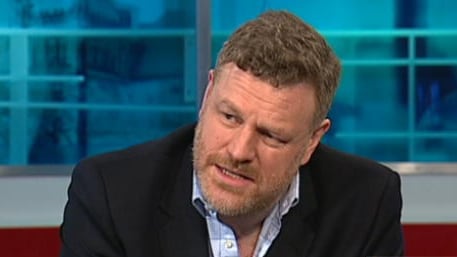
Mark Steyn is shown in an undated appearance on CBC's Power & Politics. (CBC)
A jury on Thursday awarded $1 million US to climate scientist Michael Mann, who sued a pair of conservative writers 12 years ago after they compared his depictions of global warming to a convicted child molester.
Mann, a professor of climate science at the University of Pennsylvania, rose to fame for a graph first published in 1998 in the journal Nature that was dubbed the "hockey stick" for its dramatic illustration of a warming planet.
The work brought Mann wide exposure but also many skeptics, including the two writers Mann took to court for comments that he said affected his career and reputation in the U.S. and internationally.
"It feels great," Mann said Thursday after the six-person jury delivered its verdict. "It's a good day for us, it's a good day for science."
In 2012, a libertarian think-tank named the Competitive Enterprise Institute published a blog post by Rand Simberg, then a fellow at the organization, that compared investigations into Mann's work to the case of Jerry Sandusky, a former assistant football coach at Penn State University who was convicted of sexually assaulting multiple children. At the time, Mann also worked at Penn State.
*WATCH l Academic research often no match for virality of social media climate claims:
Climate Misinformation: are you immune?
March 14, 2023|
Duration7:08
Despite the growing number of extreme weather events-- Climate change denial is still very much out there-- particularly on social media While a lot of people may ignore it, that doesn't mean it doesn't make a lasting impact. Jaela Bernstien looks into the issue.
Mann's research was investigated after his and other scientists' emails were leaked in 2009 in an incident that brought further scrutiny of the "hockey stick" graph, with skeptics claiming Mann manipulated data. Investigations by Penn State and others found no misuse of data by Mann, but his work continued to draw attacks, particularly from conservatives.
"Mann could be said to be the Jerry Sandusky of climate science, except for instead of molesting children, he has molested and tortured data," Simberg wrote.
Canadian writer Mark Steyn later referenced Simberg's article in his own piece in National Review, where he referred to Mann as "the man behind the fraudulent climate-change 'hockey-stick' graph, the very ringmaster of the tree-ring circus."
"Not sure I'd have extended that metaphor all the way into the locker-room showers with quite the zeal Mr. Simberg does, but he has a point," Steyn wrote.
Huge disparity in compensatory, punitive awards
The jury in Superior Court of the District of Columbia found that Simberg and Steyn made false statements, awarding Mann $1 in compensatory damages from each writer. It awarded punitive damages of $1,000 from Simberg and $1 million from Steyn, after finding that the pair made their statements with "maliciousness, spite, ill will, vengeance or deliberate intent to harm."
During the trial, Steyn represented himself, but said through his manager Melissa Howes that he would be appealing the $1-million award in punitive damages, saying it would have to face "due process scrutiny."
Scientist Michael Mann is shown on June 21, 2016, attending a screening of the HBO documentary How to Let Go of the World and All the Things Climate Can't Change. (Slaven Vlasic/Getty Images for HBO)
Mann argued that he had lost grant funding as a result of the blog posts — an assertion for which both defendants said Mann did not provide sufficient evidence. The writers countered during the trial that Mann instead became one of the world's most well-known climate scientists in the years after their comments.
"We always said that Mann never suffered any actual injury from the statement at issue," Steyn said on Thursday through his manager. "And today, after 12 years, the jury awarded him one dollar in compensatory damages."
Simberg's attorney Mark DeLaquil said his client was "disappointed in the verdict" and would appeal the jury's decision.
*LISTEN l Some YouTube users find a way around climate denial ban:
Day 610:27A new kind of climate change denialism has taken hold on YouTube, says research group
Imran Ahmed, the CEO of the Center for Countering Digital Hate, says the center's new report shows that climate misinformation has evolved in ways that make it possible for a lot of it to evade YouTube’s advertising ban on content that denies climate change while generating millions of dollars of revenue in the process.
Jury given specific instructions
Steyn, who has authored several books and written columns for the National Post and Maclean's, has provoked strong reactions with his writing before. The Canadian Islamic Congress launched complaints with the Canadian Human Rights Commission and B.C. Human Rights Tribunal over a series of articles wrote for Maclean's about Islam, though the complaints were dismissed.
In the Mann case, both writers argued that they were merely stating opinions.
Lyrissa Lidsky, a constitutional law professor at the University of Florida, said it was clear the jurors found that Steyn and Simberg had "recklessly disregarded the falsity of their statements."
Lidsky added that the discrepancy between what the jury awarded in compensatory and punitive damages could result in the judge reducing the punitive damages.
*WATCH l RCMP, government officials push back on false wildfire claims:
Who's fuelling the wild theories about Canada’s wildfires
June 14, 2023|
Duration5:44
False claims about the origins of Canada’s wildfires have been getting millions of views online. The National’s Adrienne Arsenault talks with investigative reporter Justin Ling about who’s behind the disinformation and why they’re pushing it.
Many scientists have followed Mann's case for years as misinformation about climate change has grown on some social media platforms.
"I hope people think twice before they lie and defame scientists," said Kate Cell of the Union of Concerned Scientists. "We are so far outside the bounds of a civil conversation about facts that I hope this verdict can help us find our way back."
In 2021, the D.C. Superior Court held that the National Review and the Competitive Enterprise Institute were not liable for defamation in the matter. Mann said Thursday he still plans to appeal that ruling.
---
FROM CCD
Michael Mann’s Social Media Rants Turn Anger Into Alienation
Angry Michael Mann isolates himself as climate exaggeration backfires.
:{[August 23, 2025,
in Energy, Extreme Weather, News and Opinion, Politics, Science

Michael “ClimateGate” Mann cannot get out of his own way.
His arrogant, condescending social tweets speak for themselves—just as the words, sentences, and paragraphs of the East Anglia emails did. [some emphasis, links added]
“And yes, there is empirical, peer-reviewed support for the conclusion that climate deniers, in general, are truly awful human beings.” (–Michael Mann, via X)
He is not the kind of person you would want in just about any endeavor, much less as a climate scientist trying to present a case.
This post traces Mann’s angst on X and then at BlueSky, his successor to X:
And how has that gone, Michael?
Here is a sampling of Mann’s anger and despair at his critics, and even the Left, which is weakening in the face of utter rejection from the political majority.
Start with this one:
And then his headlines:
“Scientists brace ‘for the worst’ as trump purges climate mentions from website…”
“The keys to the car have been given to the polluters and fossil fuel plutocrats and they intend to drive it off the climate cliff.”
“Conservative and Concerned about Climate Change? You’re Not Alone – A Conversation with Bob Inglis and Michael Mann”
“Humans brought the heat. Earth says we pay the price”
“‘They Know They’re Lying’: The Fossil Fueled War on Science, Humanity: Latest #BradCast“ ”The US is poised to become an authoritarian state ruled by plutocrats and fossil fuel interests.”
The US withdrawing from the Paris Agreement is unfortunate, but multilateral climate action has proven resilient and is stronger than any single countries politics and policies.”
“I just reported [X] as a ‘violent & hateful entity’. You can too.”
Mad at Allies
“@HuffPost has offered no explanation of why it has chosen to act as an enabler of fascism, racism, bigotry, misogyny, and authoritarianism.”
“The sad irony of an account that purports to speak for science (a) referring to the overwhelming evidence for human-caused climate change as a matter of “belief” while (b) ignoring what the science actually says here …
“To save the planet, stop reading The [Washington] Post.”
“Note to journalists: If you are writing about these wildfires and not mentioning climate change at all, you are complicit w/ an agenda-driven campaign of misinformation by the right.”
“one of the more dangerous forms of trollbot, the ‘divider’. They pose as climate activists but they are actually ‘agent provocateurs’, whose m.o. is to create conflict, discredit experts, and divide the community of climate advocates. Make sure to report and block!” (January 11, 2025 on X)
“A reminder, Bjorn Lomborg & the WSJ editorial page habitually team up to promote disinformation about climate change and extreme weather events, especially wildfire.”
“MAGA is everything that is evil in this world. And they must be viewed and dealt with as such.”
“These people constitute a threat to us and the planet: #PeterThiel#ElonMusk #VladmirPutin #MBS #RupertMurdoch #LeonardLeo#DonaldTrump #CharlesKoch“
“Actually, the greed of a small number of malicious plutocrats & autocrats we can count on the fingers of our hands: #Thiel #Musk#Putin #MBS #Murdoch #LeonardLeo #Trump.”
“The malicious lies spread by Musk, Putin, Trump & their MAGA parrots represent an existential threat to us and the planet.”
“Self-styled climate “centrists” deflecting attention from the PRIMARY underlying contributor to these disasters (fossil fuel burning and human-caused warming) are a free gift to polluters and petrostates.” January 11, 2025
‘Wildfires will get worse as the planet gets warmer.”
“Trump continues to be one of the most despicable people on the planet. He hates America and Americans (unless they bend the knee). An utter disgrace.”
“Well, @WSJ/Murdoch are a central cog in the fossil fuel disinformation machine, and Lomborg is their chosen liar-for-hire.”
“And yes, there is empirical, peer-reviewed support for the conclusion that climate deniers, in general, are truly awful human beings.” Source here
“The United States is now poised to become an authoritarian state ruled by plutocrats and fossil fuel interests. It is now, in short, a petrostate.”
More Recently (BlueSky)
“Scientists decry Trump energy chief’s plan to ‘update’ climate reports: ‘Exactly what Stalin did’ [yeah, that was me]” (12 days ago)
“Zeldin and EPA doing ‘opposite’ of protecting Americans from environmental threats with rollbacks. Lee Zeldin parrots discredited fossil fuel industry climate denier talking points.” (5 months ago)
“To be fair, the reputation and credibility of those five individuals [of the DOE science study] was already in tatters.” (17 days ago)
“There’s a reason it’s called the “enDANGERment finding”. Carbon pollution from fossil fuel burning represents a danger to both us and our planet.” (19 days ago)
“I don’t understand how any parent could so willingly serve as an enabler of the destruction of our world.” (20 days ago)
“I can’t think of anyone more qualified to present antiscientific [sic] climate denial propaganda than these five. And I can’t think of anyone more likely to seek out these fossil fuel apologists than Christopher Wright.” (22 days)
“It’s naive and unhelpful to argue this is just about some old man and his grudge against wind turbines. In fact, it’s in service of an agenda promoted by his deep-pocketed plutocrat backers. To ignore that connection is to play into their disinformation campaign. (23 days ago)
“Wondering why Trump is suddenly spending all his time bashing renewable energy? It’s to placate the petrostate actors & fossil fuel interests who installed him in the first place. He’s begging them to stand by him, knowing the very worst is yet to come….” (24 days ago)
“Sadly, it’s young American males who are buying into a really warped sense of masculinity (with plenty of help of course from a full court press by polluters, petrostates, plutocrats, and yes in many cases our press). Don’t simply blame the messenger.” (June 26, 2025)
“Trump (and more to the point, the polluters whose decades-old, focus-group-tested climate denial talking points he’s parroting) aren’t this ignorant. They’re banking on the fact that the American public is.” (2 months ago)
Final Comment
This is enough to keep a psychologist busy. Mann stepped into his own manhole, and he kept digging down.
Like Al Gore, he hurts his cause more than he helps it, as 97 percent of his colleagues (just an estimate) are more rational and quieter than he is on the same subject.
 *
Read more at Master Resource
---
LI --> 10 25 ~ pielke
“Petrostates, polluters, politicians”, or “plutocrats, pros, propagandists” and sometimes also “the press”; there is no lack of aliterations when it comes to Michael E. Mann and Peter J. Hotez new book “Science Under Siege: How To Fight The Five Most Powerful Forces That Threaten Our World”.
The dynamic duo of academic heavy hitters are no strangers to sparring with many of the forces of anti-science aggression they outline in their book.
:{:{Michael Mann, a destinguished climate scientist most famous for introducing the now iconic Hockey-stick graph into public climate awareness learned first what it meant to become a target in the information age. Ever since hackers stole and misrepresented scientists’ — including Mann´s — emails to cast doubt on climate research right before the 2009 global climate summit in Copenhagen to sabotage international collaboration, Michael Mann has found himself at the center of the public storm over truth in science.}:
Though multiple independent investigations cleared him and his colleagues of any wrongdoing, the “Climategate” smear campaign cast him as an early villain in what we know understand to be the desired manipulative mirrorworld created by coordinated disinformation networks that Science Under Siege describes. Rather than retreating into the safety of academia, Mann turned outward, becoming one of the most visible defenders of climate science and of scientists’ right to speak without fear.}:
Peter Hotez, a renowned vaccine scientists, has fought a parallel battle on another front: public health. Even before the COVID-19 pandemic, the vaccine scientist and pediatrician found himself vilified by anti-vaccine activists — most notably, now HHS secretary RFK Jr cast him as the “OG villain” for writing his deeply personal book about how vaccines did not cause the autism of his daughter, but that autism is a complex genetic disease.
Like Mann, Hotez experienced firsthand the personal cost of promoting evidence-based medicine and confronting misinformation — harassment, threats, and the relentless distortion of his work, which just escalated beyond recognition during the COVID-19 pandemic. Yet Hotez, too, refused to withdraw. His advocacy for vaccines and global health equity, and his insistence that science must serve humanity rather than ideology, echo throughout this book.
*“the most profound impression lingering is the uncharacteristically sharp and plain-speaking tone and tenor the two bring into its pages”
Despite the depths of consideration for the human condition - to preserve human health and a livable planet - and appeals to the better angles of humanity shining throughout the book, the most profound impression lingering is the uncharacteristically sharp and plain-speaking tone and tenor the two bring into its pages.
With scathing commentary and righteous fury, the authors rejected to beat around the bush or the all-too-common academic retreat to euphemisms, rather opting for refreshing — even scorched-earth — clarity of where they stand and who their opponents are. One can not help escape the conclusion that the book is drawing a line in the sand with every chapter; a rebuke to the silent and accomodating institutions that rather surrender academic independence than put up a fight.
There is no appeasement when the fight is existential, the authors remind us; often with some heavy leaning into fictional metaphors, such as The Lord of the Rings:
“The battle for Middle Earth wasn´t won by appeasing the dark lord and his forces. It was won by defeating them”
From fossil fuel magnates and billionaire tech pros to the US congress and a captured SCOTUS, or autocratic petrostates and their agents, to home-grown propagandists and media makers, the authors do not shy away from implicating key players and their malevolent activities that pose a threat to our health, our planet, and more and more, our democracy and freedom.
What malevolant activities? The anti-science ecosystem has long grown beyond shadowy think tanks and closed-door fundraisers to lobby politicians; state-actor sabotage, plutocrat campaigns and dark-money sponsorship has since extended to prop up the “pros” and “propagandists” on social media (or “anti-social media and the bots of war”, one subtitle reads); empowering and amplifying their use of emotional myths and conspiracy theories to dominate online discourse, sway bystanders, and with it indirectly how the “press” covers these events.
“For propagandists, a key feature of the antiscience playbook is its reliance on conspiracy theories and conspiracy-filled rhetoric”
Hotez and Mann do a fantastic job in exposing pay-for-play connections, dirty relationships and how they led to inauthentic outcomes in supposedly democratic real-world events. Much of the book is concerned with the important task of correcting the record on some of the misleading highlights of the last years; which for many people not in the weeds of it, might be as surprising as devastating to learn. From COVID-19 lab leak conspiracies to climate doomism fostered by the mainstream press, from New York Times to Washington Post to the Wall Street Journal and Fox News and most mainstream outlets inbetween, the seasoned authors hold a special grudge to previous bastions of evidence-based reporting and good-willed truth-seeking institutions that seem to be no more, or at least, strongly diminished when it comes to uphold science. Worse, some like the New York Times actively have become powerful allies of aggressors, justifying the rightwing assault on science and scientists:
With both COVID and climate, the mainstream media have helped keep alive a pernicious but misguided narrative that - to the extent there is distrust of the science by some members of the public - it is the scientists´ fault.
The book describes the “collapse” of the fourth estate and the rise of “client journalism” that has been felt society-wide, and unfortunately, scientists have lost a critical ally in the press when expertise gets discarded or subverted in favor of media content serving vested interests. Even worse, our recent shift into a new dark age of myth, manipulation and magical thinking has made scientists canaries in the coalmine of democracy, and when reading this book, one is left with the sinking feeling that the carbon monoxide has already filled the chamber.
“Our list of allies is growing thin”
The authors report, another reference to The Lord of the Rings. And yet, rather than concede, the authors end the book with broad strokes outlining how the war can still be won, offering “battle plan” and urgency for all of us who want to defend science, democracy and an evidence-based worldview.
The “antiscience superstorm packs a one-two-three punch, and each of the threats must be addressed in concert with the other”, they caution, but for all of them, they advise a 3-pronged strategy for scientists. Communicating constructively because the “best defense is indeed a good offense”; proactively addressing the “triple threat” of invisible scientists, missing science journalism and performative press neutrality head-on. Protecting scientists is another key ingredient, institutionally and legally, that become targets of anti-science assault. And lastly, destroying the disinformation machine; which of course is a challenge that extends far beyond science. On that part, “punishing the pros, propagandists and the press”, “pressuring the plutocrats” and “mending the media”, with the force of the law, new regulations, and ultimately, our pocketbooks and democratic organizing might not surprise the avid reader and democratic citizen who likely has asked themselves the same question at least since the 2024 US election.
“We have to be the change we want to see in the world“
the authors credibly advise, given their own personal trajectories and accomplishments, before ending with another The Lord of the Rings rallying cry that it is worth fighting for what is good in the world, for us, our children and future generations.
Even in dark times, my suspicion is that the furious and clear-eyed moral argument advanced by “Science under siege” will age as well as the science it defends — not because the good guys always win, but because truth and integrity never go out of style.
---
Thanks for reading Protagonist Science! This book review is public so feel free to share it.
---
Science Under Siege: A Conversation With Dr. Peter Hotez & Dr. Michael Mann
Find tickets & information for Science Under Siege: A Conversation With Dr. Peter Hotez & Dr. Michael Mann. happening at Rice Universitys Baker Institute for Public Policy, Houston, TX on Tue, 09 Sep, 2025 at 12:00 pm. Register or Buy Tickets, Price information.
---
gmail 9 25
collegians For A Constructive Tomorrow (CFACT) Say "No" to Michael Mann}:
News provided by
Committee For A Constructive Tomorrow
:{Sep 10, 2025,
HOUSTON, Sept. 10, 2025 /PRNewswire/ -- College students today protested the promotion of climate activist Dr. Michael Mann at a Rice University Baker Institute for Public Policy event, holding signs with slogans like "Hands off my future!," "Dr. Mann hates debate," and "Limp Stick Energy."
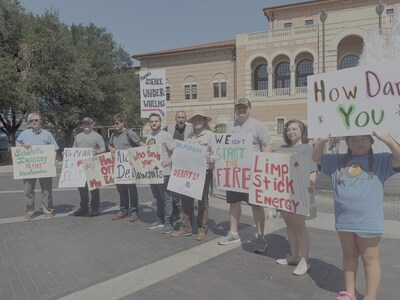
CFACT students protest at Rice University.
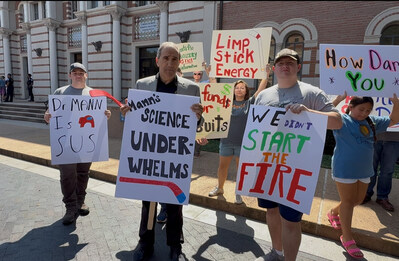
Marc Morano joins the students at Rice University to challenge Mann on
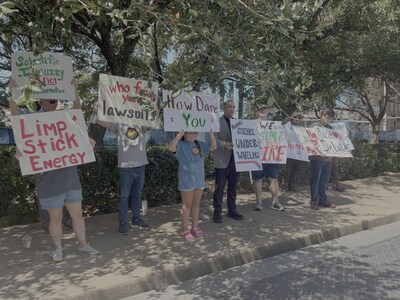
Students held signs with slogans like “Hands off my future!,” “Dr. Mann hates debate,” and “Limp Stick Energy.”
"Elevating Michael Mann at an institution of higher learning is completely counterintuitive," said Rice University undergraduate Cristobal Spielmann. "He has repeatedly demonstrated that questioning his version of consensus gets you labeled a climate denier, whom he calls 'horrible people…typically bigoted, xenophobic, racist, misogynistic, homophobic, antisemitic' – if not sued. We reject his oppressive tactics and narrow worldview."
Mann rose to prominence as the lead author of a report that was the first to estimate climate trends using what the New York Times called a "grab bag of evidence." It included what became known as the "hockey stick" graph depicting an upward spike in temperatures in the Northern Hemisphere. Leaked emails from the University of East Anglia's Climatic Research Unit later showed Mann working with others to suppress climate debate even as he withheld data from analysts seeking to replicate his findings. He has filed lawsuits against people and media organizations for criticizing him.
"We've been taught that testing, challenging and modifying hypotheses, and retesting are all part of the scientific method," said CFACT Collegian activist Nicolas Walker. "Yet Dr. Mann treats questions and requests for data as attacks rather than rigorous intellectual challenges. He has bullied, sued, and tried to censor people who dare to disagree with him, both publicly and behind the scenes. Now he's touting a book that encourages everyone to act like him."
The students have a simple message: college campuses should be sponsors of debate, not celebrating people like Mann who shut it down.
"We are extremely proud of our college students for standing up to Michael Mann's demonstrated bullying tactics by refusing to accept debate being treated as dangerous and anti-science," said Nate Myers, National Collegians Director. "Where can inquiry thrive if not on campus?"
MEDIA CONTACT: Judy Kent, 703-477-7476, jkent@cfact.org
SOURCE Committee For A Constructive Tomorrow
---
===
win defam
On February 8, climate scientist Michael Mann won a defamation lawsuit against two conservative writers Rand Simberg and National Review contributor Mark Steyn. Steyn was once a regular presence on Fox News where he appeared more than 300 times between 2017 and 2021, both as a guest and a guest host.
According to The New York Times, in addition to finding them guilty of defaming Mann, “The jury also found the writers had made their statements with ‘maliciousness, spite, ill will, vengeance or deliberate intent to harm,’ and levied punitive damages of $1,000 against Mr. Simberg and $1 million against Mr. Steyn in order to deter others from doing the same.”
On February 9, Mann appeared on CNN News Central to discuss the outcome of the trial. During his interview Mann explained how these ideological and politically motivated attacks "chill the discourse” and discourage scientists from sharing their findings. Mann said he hoped the verdict will “create some space where scientists feel a little bit more … comfortable in leaving the laboratory, in communicating their findings to the public.”
Video
CitationFrom the February 9, 2024, edition of CNN News Central
BRIANNA KEILAR (ANCHOR) Michael, what do you worry is the effect on whether it's public health, or even global health, the health of our planet, which affects us all, when you have people making bogeymen out of scientists like yourself?
MICHAEL MANN: Well, I really worry about that, right? Especially young scientists, who see the attacks on scientists like myself, scientists like Anthony Fauci and my good friend Peter Hotez. They look at that, and that chills the discourse. That potentially leads them to sort of withdraw into their laboratories. They don't want to get involved, get into the fray, and to be part of the effort to communicate their scientific findings to the public, out of fear that they will be attacked, that they will be viciously attacked, again, by those who have vested interest in discrediting science that's inconvenient to their economic interests or their political viewpoints. And so this is a message to my fellow scientists, that, you know, that it is not OK for people to attack you, to make false allegations against you, to defame you.
And hopefully, that will create some space where scientists feel a little bit more, you know, that they're more comfortable in leaving the laboratory, in communicating their findings to the public, because we rely upon the best available science, as you said, both when it comes to our own health and the health of this planet. What could be more important than the health of our -- of us and, and our fellow human beings, and the planet that we live on? That's -- those are really the stakes here.
KEILAR: Yeah. We don't want there to be that chilling effect. Michael, great to have you.
While Mann is certainly one of the most prominent climate scientists to be in the crosshairs of right-wing media, he is far from alone. Attacks against climate scientists have been on the rise the last few years, especially on Elon Musk’s Twitter/X where many scientists have left the platform due to harassment.
mma 2 24
===
reaction to win
Marc Morano
Weekly update ⋅ February 16, 2024
America is Wasting Over a Trillion Dollars on "Green" Programs | NewsRadio 740 KTRH
NewsRadio 740 KTRH
According to Marc Morano from The Climate Depot, the bill was merely a disguised 'green pork barrel' falsely labeled as the 'Inflation Reduction ...
WaPo: Wear Clothes Made From Human Hair to Save the Earth
One America News Network
WaPo: Wear Clothes Made From Human Hair to Save the Earth. with Marc Morano. An error occurred. Try watching this video on www.youtube.com, or ...
DC Jury Found 'Hockey Stick' Critics Defamed Scientist. What Does That Mean For Scientific ...
The Daily Caller
... Marc Morano, a former senior staffer for the Senate Environment and Public Works Committee who later founded ClimateDepot.com, told the Daily ...
---
Inflation Reduction Act's 30C EV Charging Tax Credit - One America News Network
One America News Network
To watch the full show, head over to OAN Live where you can download the OAN Live app to gain access to all our exclusive full-length content. Share ...
interesting ~ to myth of gubmint scientist paid
https://yyy.theguardian.com/science/2022/mar/21/universities-must-reject-fossil-fuel-cash-for-climate-research-say-academics
no lnx many
Universities must reject fossil fuel cash for climate research, say academics
Open letter from 500 academics likens fossil-energy funding of climate solutions to tobacco industry disinformation
Michael Mann, director of the Earth System Science Center at Pennsylvania State University, speaks to media before a Climate Emergency Summit in Melbourne
Michael Mann, director of the Earth System Science Center at Pennsylvania State University, said fossil-fuel funding ‘has been used to compromise leading academic institutions’. Photo]
Fiona Harvey environment correspondent
Mon 21 Mar 2022
Universities must stop accepting funding from fossil fuel companies to conduct climate research, even if the research is aimed at developing green and low-carbon technology, an influential group of distinguished academics has said.
Rowan Williams, the former archbishop of Canterbury, the Nasa data scientist Peter Kalmus, and prominent US climate scientist Michael Mann are among close to 500 academics from the US and the UK who have written an open letter addressed to all university leaders in the two countries, calling on them to reject all funding from fossil fuel companies.
Accepting money from fossil fuel companies represented “an inherent conflict of interest” and could “taint” essential research and “compromise” academic freedom, they wrote. For the companies, it was a chance to “greenwash” their reputations and skew the findings of research in a way favourable to them.
The letter draws a comparison to the tobacco industry and its disinformation campaigns, noting that numerous public heath and research institutions reject tobacco funding for these reasons and calling on fossil fuel cash to be treated similarly.
“Universities and the research they produce are vital to delivering a rapid, just transition away from fossil fuels. However, such efforts are undermined by fossil fuel industry funding. Academics should not be forced to choose between researching climate solutions and inadvertently aiding corporate greenwashing,” the signatories wrote.
Michael Mann, director of the Earth System Science Center at Pennsylvania State University, told the Guardian: “This sort of funding has been used to compromise leading academic institutions.It’s a two-for for polluters: they purchase the imprimatur of these institutions and their presumed authority and objectivity, while funding research that often translates into advocacy for false solutions and ‘kick the can down the road’ prescriptions like massive carbon capture, which is unproven at scale, and geoengineering, which is downright dangerous. That is entirely the wrong path forward.”
Genevieve Guenther, founder and director of the End Climate Silence campaign, and an affiliate at the New School university in New York, said: “Funding research enables oil and gas companies to ground their promotional statements in enough truth to give substance to the green shadows in which they hide their most polluting and deadly activities. We must remove fossil-energy interests from our institutions so that our children can have a chance at a liveable future.”
Universities have been under pressure from their students and some academics for several years to divest their investments, such as pension funds and endowments, away from fossil fuels, and many have done so. However, this is the first major call from senior academics for them to go further and cut all research ties with fossil fuel companies.
There is no clear estimate for how much money universities accept from fossil fuel companies, as most do not publish their sources. An investigation for the Observer last year found UK universities alone had taken at least £89m from oil companies in the previous four years.
Some scientists disagree with the letter. James Hansen, former chief scientist at Nasa and one of the first scientists to warn governments of the impending climate crisis, told the Guardian: “It’s the wrong focus, causing young people to waste their energy on unproductive activities, while they actually have the potential to lead a solution.”
Bob Ward, policy director at the Grantham Research Institute on Climate Change and the Environment at the London School of Economics, said it was reasonable for universities to accept funding from fossil fuel companies if those businesses showed genuine commitment to transforming themselves. “Fossil fuel companies that are genuinely committed to the transition [to a low-carbon economy], including net zero emissions, can and should receive help from university researchers, particularly with the development of technologies for carbon capture and storage, renewables and emissions reductions. However, universities should be careful about accepting funding directly or indirectly from oil, gas and coal companies that are not genuinely committed to the clean energy transition and which are attempting to greenwash their reputations.”
A spokesperson for Imperial College London, which the Observer found last year had accepted £54m from oil companies since 2017, said: “Decarbonisation is our top priority when working with energy companies. This goal requires a radical shift in industrial systems, technologies and business models in the energy sector. We are using our influence and expertise to accelerate this transition and actively engage with energy companies to push them to meet the Paris Agreement targets. We will monitor progress and only continue to work with companies who demonstrate commitment and credible action to achieving these targets.”
Some academics argue that fossil fuel funding is needed to develop the technologies necessary for a low-carbon economy, and that if western universities reject such funding it will be accepted in other countries around the world.
Guenther disagreed: “It’s a myth that fossil-energy companies are spending large sums to aid the green transition. According to the IEA’s 2021 World Energy Investment report, a mere 1% of fossil-energy companies’ capital expenditure is devoted to research, development or deployment of technologies that either abate or do not produce greenhouse gas emissions.”
At the end of this month, the Intergovernmental Panel on Climate Change will publish the third part of its comprehensive review of climate science, examining the potential ways of cutting greenhouse gas emissions. This will include technology such as renewable energy and nuclear power, and novel ideas such as sucking carbon dioxide out of the air.
The report will throw the spotlight on the potential technological solutions to the climate crisis, which will require tens or hundreds of billions of pounds in funding to be brought to market and deployed widely around the world.
Jason Hickel, an economic anthropologist who is signatory to the letter, said the funding should come from governments. “The US and UK are among the richest countries on Earth, and their governments enjoy total monetary sovereignty. They have the capacity to finance the necessary research many times over, at the touch of a button. Most of the major innovations and public projects that have changed history over the past century have relied on public funding for research,” said Hickel, who is professor of environmental science at the Autonomous University of Barcelona and a fellow of the LSE.
The letter did not specify whether companies with interests in fossil fuels amid a broader portfolio should be included in the ban. Ilana Cohen, a Harvard student who led the organisation of the letter, said it was directed at the top 200 fossil fuel companies.
Cohen said the organisers had confined the call to US and UK universities for now as these are where many fossil fuel companies are concentrating their funding, but that it could be widened in future to a global effort.
===
===
mashey 2012
...Singer has certainly supported demands for Michael Mann’s email by Ken
Cuccinelli130
One might wonder how often Randol and other interesting
people would appear if Singer’s emails were subpoenaed. One might
suspect they would be far more interesting than Mann’s.
Tobacco companies funded some good, but irrelevant, medical science.
ExxonMobil has funded some good energy research. Still, when someone
not a medical researcher has taken tobacco money, and has taken fossil
money, while doing everything possible to discredit climate science,
people might reflect on possible influences.
126 MAS2010, p.147.
127 MAS2010, pp.19-20, 147. Singer’s wife Candace Crandall represented SEPP.
128 vaseee.org Scientists and Engineers for Energy and Environment
129 mailman.mcmaster.ca/mailman/private/cdn-nucl-l/1008/msg00001.html
MAS2011f, p.20
130 www.americanthinker.com/2010/11/the_global_warming_court_battl.html
===
looks at b&s BS 2003 jrnl artl
https://en.wikipedia.org/wiki/The_Hockey_Stick_and_the_Climate_Wars
The Hockey Stick and the Climate Wars: Dispatches from the Front Lines is a 2012 book about climate change by the American climatologist and geophysicist Michael E. Mann. In the book Mann describes how he became a researcher investigating the temperature record of the past 1000 years and was lead author, with Raymond S. Bradley and Malcolm K. Hughes, on the 1999 reconstruction that was the first to be dubbed the hockey stick graph. He concisely explains the basics of climate science including statistical methodology dealing with paleoclimate proxy data, and examines the tactics which opponents of action on climate change use to distort the science and attack the reputations of climate scientists. The book describes both this controversy and the broader context of skepticism in science and contrarians rejecting evidence of human influence on climate.[1]
The book was picked by Physics Today books editor Jermey Matthews as one of the five top books of the 49 they had reviewed in 2012.[2]
Reviews[
Publishers Weekly described the book as a "meticulous and engaging brief on climate change research and the political backlash to legitimate scientific work", with a tendency to over-technical language offset by "charming personal anecdotes from his life and work".[3] Kirkus Reviews called it "an important and disturbing account" of attempts to spread doubt about climate science, and said "This blistering indictment of corporate-funded chicanery demands a wide audience."[4]
For Simon Lewis, reviewing the book for Nature, the book became "riveting" when it came to the research which produced the "hockey stick" graphs, following which "Mann's shocking first-hand testimony of the repeated attempts to discredit him and his work gives his book power." While basically agreeing with Mann, Lewis was uncomfortable with seeing the dispute as a binary "climate war", preferring the less polarised metaphor of a "street fight".[5]
In the Geoscientist magazine of the Geological Society of London, Colin Summerhayes described Mann as "a pioneer in analysing proxy records of climate change covering the past 1,000 years" whose early work had attracted vituperative attacks but had been supported by subsequent studies, and would "heartily recommend this book for an unusually clear view of the action on the front line of climate science".[6]
Rudy M. Baum in the magazine of the American Chemical Society said it was "one of the most useful books yet in explaining climate science", particularly paleoclimatology, as well as examining "the tactics used by climate-change deniers to distort the science of climate change and smear the reputations of climate scientists." Helpful explanations of concepts were backed by extensive citations and notes, and while casual readers would not turn to these pages, the notes included some important insights.[1] Michael Marshall, environment reporter for New Scientist, commented that although other studies showed the "hockey stick" graph was essentially correct, it came under persistent attack over statistical issues that the book explains in detail, difficult reading material which "will be invaluable for anyone confused by the many claims and counterclaims found online." It was "an admirable attempt to tell the behind-the-scenes story of one of today's most vicious scientific battles."[7]
Anne Jolis of The Wall Street Journal said that for what she called "anti-carbon crusaders" the "hockey stick" graph demonstrates the danger "that man poses to the planet", but for "global-warming skeptics, though, the graph and the name are prime examples of the overblown claims and sloppy science behind much of climatology." She said the book was largely "score-settling with anyone who has ever doubted his integrity or work: free-market think tanks, industrialists, 'scientists for hire,' 'the corruptive influence of industry,' the 'uninformed' media and public. So, a long list", and describes Mann as a "scientist-turned-climate-warrior."[8]
References[
- ^ :{Jump up to::(style="user-select:none;top:-99999px;clip:rect(1px, 1px, 1px, 1px);overflow:hidden;position:absolute !important;padding:0px !important;border:0px !important;height:1px !important;width:1px !important"):}:^a b(https://en.wikipedia.org/wiki/The_Hockey_Stick_and_the_Climate_Wars#cite_ref-Baum_1-1) Baum, Rudy M. (10 December 2012). "Michael Mann's Hockey Stick". Chemical & Engineering News. 90 (50): 52–53. doi:10.1021/cen-09050-books.
- ^ Matthews, Jermey (5 December 2012). "The year in reviews: Five books that stood out in 2012". Bookends. Physics Today. doi:10.1063/PT.4.0495.
- ^ "Nonfiction Book Review: The Hockey Stick and the Climate Wars: Dispatches from the Front Lines by Michael E. Mann". Publishers Weekly. 23 January 2012. Retrieved 10 January 2014.
- ^ "The Hockey Stick and the Climate Wars by Michael E. Mann". Kirkus Reviews. 16 January 2012. Retrieved 10 January 2014.
- ^ Lewis, S. (2012). "Climate science: At the storm front". Nature. 483 (7390): 402–403. Bibcode:2012Natur.483..402L. doi:10.1038/483402a.
- ^ Summerhayes, Colin (June 2012). "Book review: Michael E. Mann, The Hockey Stick and the Climate Wars". Geoscientist. Missing or empty
|url=(help) - ^ "CultureLab: The man behind the hockey stick graph". Retrieved 10 January 2014.
- ^ Book review, "The Hockey Stick and the Climate Wars" by Anne Jolis, WSJ, Updated March 15, 2012
- Oreskes, N. (2012). "The Hockey Stick and the Climate Wars: Dispatches from the Front Lines". Physics Today. 65 (6): 54. Bibcode:2012PhT....65f..54O. doi:10.1063/PT.3.1607.
- Mann, Michael E. (March 2012). *The Hockey Stick and the Climate Wars: Dispatches from the Front Lines*. Columbia University Press. ISBN 978-0-231-15254-9. — Preview at Google books
External links[
- Book review, Michael Mann’s ‘Hockey Stick’ Dispatches', The Yale Forum on Climate Change & The Media
- Eilperin, Juliet (25 May 2012). "Book review: Michael Mann's 'The Hockey Stick and the Climate Wars:{':(style="padding-right:0.2em"):}:". The Washington Post. Retrieved 12 January 2014.
===
===
https://www.alternet.org/2020/09/scientists-find-new-signs-of-climate-breakdown-in-study-of-warming-oceans
In a rare calm moment during a historically active Atlantic hurricane season, an international team of climate scientists on Monday published a new study in the journal Nature Climate Change showing that human-caused global heating is making the world's oceans more "stable"—which, as co-author Michael Mann explained, is "very bad news."
Mann, director of the Earth System Science Center at Penn State, detailed researchers' findings about ocean stratification in a piece for Newsweek. Using "more comprehensive data and a more sophisticated method for estimating stratification changes" than past studies, the scientists found that "oceans are not only becoming more stable, but are doing so faster than was previously thought."
The team—led by Guancheng Li of the Institute of Atmospheric Physics in China—specifically found that stratification globally increased by a "substantial" 5.3% from 1960 to 2018, mostly in the upper 650 feet or so of the world oceans. "This seemingly technical finding has profound and troubling implications," Mann noted.
"The more stable the upper ocean, the less vertical mixing that takes place. This mixing is a primary means by which the ocean buries warming surface waters. So the surface warms up even faster. It's what we call a 'positive feedback'—a vicious cycle," he wrote. "That's bad for a number of reasons."
Thank you to @MichaelEMann for patiently and clearly explaining to non scientists why increased ocean stabilizati… https://t.co/yW2BmQhKGp
— Dr Naomi Wolf (@Dr Naomi Wolf)1601306893.0
Noting the ongoing storm season and previous warnings from scientists—including him—that the increasingly devastating recent hurricanes "have fed off warmer surface waters," Mann explained that "a more stably stratified ocean potentially favors more intense, destructive hurricanes." Warmer waters also "absorb less atmospheric carbon dioxide" and "hold less dissolved oxygen."
In other words, the new study indicates that "humans have made the oceans more stable, and the result will be more extreme weather and the acceleration of climate change," as study co-author John Abraham wrote Monday for The Guardian. Like Mann, he detailed the research team's findings about the stratification of the oceans, and the implications. Then, he added:
It is not all doom and gloom. The good news is we know why the climate is changing and we know how the oceans are responding. We can do something about this problem—we have the ability to slow down climate change. We just lack the will and leadership.
But if 2020 has shown us anything, it has revealed that humans can change and adapt quickly to situations. There is hope that we can navigate the challenges resulting from a more stable ocean—but we must start immediately.
Both co-authors' pieces provoked calls for swift, bold, global efforts to address the climate crisis:
Canada has oceans on 3 sides-we can't ignore the climate news that The Oceans Appear to Be Stabilizing. Here's Why… https://t.co/SfWJWWRHr7
— Friends Of Halifax Common (@Friends Of Halifax Common)1601308426.0
"Das bedeutet, dass das CO2-Budget, das zur Vermeidung kritischer Erhitzung (z.B. 1,5°C) übrig bleibt, möglicherwei… https://t.co/675YBTSybJ
— Parents For Future #SystemChangeNotClimateChange (@Parents For Future #SystemChangeNotClimateChange)1601315583.0
Ending his piece on a similar note, Mann wrote that "in short, it's unwise to be complacent given the accumulating scientific evidence that climate change and its impacts may well be in the upper end of the range that climate scientists currently project. There is ever-greater urgency when it comes to acting on climate. But there is agency as well. Our actions make a difference—something to keep in mind as we head into a presidential election whose climate implications are monumental."
Mann is on the mounting list of climate experts and advocates supportingDemocratic presidential nominee Joe Biden in his effort to oust President Donald Trump—who has, at various points, ignored and exacerbated the climate emergency. Earlier this month, the editors ofScientific American as well as the political action arms of both 350 and Friends of the Earth also endorsed the former vice president.
"The stakes are clear and present," Tamara Toles O'Laughlin from 350 Action said of the general election, for which early voting is already underway in some states. "The planet cannot withstand four more years of Trump."
===
===
february 4, 2018
In January 2018, more than 200 scientistsendorsed an open lettercalling on the American Museum of Natural History (AMNH) to remove climate change denier Rebekah Mercer from its board and to “end ties to anti-science propagandists and funders of climate science misinformation.” *The New York Times* reported that those among the AMNH letter calling for Mercer to step down were Michael E. Mann, director of the Earth System Science Center at Pennsylvania State University, and Katharine Hayhoe, director of the Climate Science Center at Texas Tech University. [60]
==
https://www.desmogblog.com/2019/01/26/competitive-enterprise-institute-climate-denial-target-nbc-cities-liability-suits
ref
https://www.climateliabilitynews.org/2018/12/12/ucla-law-professor-ann-carlson-cara-horowitz-cei/
Marco Poggio
A conservative think tank with deep ties to the fossil fuel industry has sued UCLA to obtain email correspondence between two UCLA climate law professors and pro-environment individuals involved in climate change litigation.
The lawsuit was filed last month in California Superior Court by the Competitive Enterprise Institute (CEI), a libertarian group that lobbies against limits on greenhouse gas emissions and claims that CO2 is good for the environment. CEI argued the university hasn’t complied with two public record requests made in February and May under the California Public Records Act.
According to the lawsuit, :{Competitive Enterprise Institute v. Regents of the University of California}:*,*the emails show environmental law professors Cara Horowitz and Ann E. Carlson discussed future meetings with others, including staffers from several attorney general offices, to discuss new legal actions against major carbon producers.
The lawsuit mimics the ones filed to obtain email correspondence by several climate scientists, including prominent climatologist Michael Mann of Penn State, which was ended by the Virginia Supreme Court in 2012. Another continues to embroil University of Arizona scientists Jonathan Overpeck and Malcolm Hughes, who were recently ordered to release 13 years of emails demanded by another fossil fuel ally.
“This appears to be yet another effort by hired guns funded by polluting interests to badger, intimidate, and silence scientists whose findings prove inconvenient to those who continue to profit from our dependence on fossil fuels,” Mann said of the suit against UCLA.
Among the emails Horowitz and Carlson have been asked to release are those exchanged with litigators in direct contact with offices of pro-environment attorneys general around the country. That includes former New York Attorney General Eric Schneiderman, who in 2015 began investigating Exxon for possible climate change-related fraud.
Carlson told Climate Liability News that UCLA is working on complying with CEI’s record request, sorting through hundreds of emails.
“I don’t feel intimidated. I don’t have anything to hide,” Carlson said, “I don’t have a problem, so far, with what I’ve been required to turn over.
“I do worry that these tactics, more broadly, are designed to discourage public discourse about important topics, like climate change and who should pay for climate damages.”
Specifically, CEI has asked for correspondence between the two UCLA scholars andShaun Goho, a Harvard lecturer and environmental lawyer with a record of environmental litigation in state and federal court.
Goho said the lawsuit is just an harassment tactic meant to divert the energy and resources of people fighting climate change away from their work.
“I don’t see how academics speaking with government officials about matters of public concern is a conspiracy. It doesn’t seem to make sense to me,” Goho said.
“This lawsuit doesn’t stand alone. It’s really part of a broader campaign by fossil fuels companies and their allies to harass people who are taking action trying to try to address climate change in various ways, whether it’s climate scientists, lawyers or others who are researching legal issues related to climate change and the relationship between climate change and the fossil fuel industry.”
CEI has deep ties to the fossil fuel industry. Exxon was its biggest funder until 2006, when public criticism pushed the company to distance itself from CEI’s climate denial campaigns.
CEI has also sought emails containing the names of other pro-environment lawyers and climate scientists, including Peter Frumhoff, the director of science and policy at the Union of Concerned Scientists,and Sharon Eubanks, one of the attorneys involved in the federal tobacco litigation against Philip Morris.
Additionally, CEI demanded emails regarding two separate events—one held at Harvard and one at UCLA—attended by Carlson and Horowitz and employees of various state attorney general offices, private lawyers,academics and environmental activists, who were set to discuss causes of action against major carbon producers.
“Public records show that Professors Horowitz and Carlson are using their positions at your public university to coordinate with certain activists groups in organizing andpursuing law enforcement and civil investigations and litigation against private opponents of a particular political agenda.We seek correspondence and other records illuminating this use of a public university faculty position and resources,” the request’s text reads.
Frumhoff declined to comment for this story.
Central to the lawsuit are the UCLA and Harvard meetings, in which Carlson, Horowitz and other parties discussed legal actions against polluters.
The “secret meetings” as they were described in some of the emails, were attended byFrumhoff and Matthew Pawa, a lawyer with Hagens Berman, which is involved in several climate liability suits filed by communities against the fossil fuel industry. Those meetings also included staffers from attorney general offices around the country, including those of New York and California.
A CEI representative declined to comment, citing pending litigation, but referred to the organization’s website for a statement concerning the lawsuit.
“This ‘secret meeting’ agenda shows UCLA faculty briefed the attorneys general and prospective donors on potential legal actions they could pursue. Attorneys general are now pursuing the types of investigations urged by UCLA faculty,” Chris Horner, a senior fellow at CEI who signed the petition, wrote in the statement.
“Thisdonor-funded scheme of using law enforcement to pursue a failed political agenda, raises significant constitutional and other legal issues,as well as ethics concerns. With the revelation that this involves the use of public institutions in this mercenary campaign, the public has a right to knowwhat their employees are doingin their name, and on their dime,” Horner’s statement said the statement continues.
In its lawsuit, CEI claimed the subject matter contained in the emails is of “great public interest”and that the university has violated the California Constitution because delays in handing over the records practically meant a refusal to comply with the request.
The lawsuit presents new challenges to law practitioners in the field of environmental litigation, paving the way for an aggressive use of public record access law that some fear would stymie the process of accountability of carbon producers.
“I don’t know exactly where this is all leading. I do think it’s part of a broader campaign to try to divert attention away from oil industry’s own activities and own efforts to try to dissuade the public about the legitimacy and validity of climate science, and I worry about that,” Carlson said.
The use of public record access laws as a tool to hit back critics in the academic world is a fairly recent practice embraced by trade groups of several industries, not just oil and gas, to target opponents.
“Requests can be burdensome on government agencies,” said David Snyder, an expert in California public record access law who directs the First Amendment Coalition, a nonprofit nonpartisan advocacy group that promotes free speech and public access to government information.
The law effectively puts academics in the same position as public officials that might have strong interests in not having their communications disclosed to the public.
“It seems like an odd fit, I acknowledge, for a college professor to sit in the same category as officials at city hall or at the governor’s office,” Snyder said. “Nonetheless, UCLA is a public agency, and employees of that public agency are subject to the public records act.”
A study compiled by the Climate Science Legal Defense Fund, a nonprofit providing legal assistance to researchers, ranked each of the 50 states based on the level of protection from open records laws they grant to scientists working at publicly-funded institutions.
Only three states, Delaware, Maine, and Pennsylvania, exclude some forms of scientific and academic research from their open records laws. Laws in four other states, including Arkansas, Montana, New Mexico and North Carolina, contain no protection for researchers whatsoever. The remaining states guarantee different types of statutory exemption, deliberative process exemption and balancing tests that offer different degrees of protection.
“The breadth and strength of state open records laws and the federal equivalent Freedom of Information Act (FOIA) have made them powerful tools, but have also made them vulnerable to misuse and abuse by groups who try to harass researchers and stifle scientific research they dislike,” the study reads.
The right to exemption from having to turn over documents is often hard to balance with the right to access public records, which is critical to ensure transparency in institutions, Snyder said.
“It’s tricky,” Snyder said. “Under the public records act, by design, government agencies are not allowed to single out the requesters based on the reasons for which they want the records.”
“They can’t say, ‘we’re not gonna give you the records because we know that you espouse these views, because you want to use the records for this purpose,’ that’s expressly forbidden,” Snyder said. “You don’t want the government picking sides.”
==
==
619 mojo no lnx docs
https://www.motherjones.com/environment/2019/06/a-scientist-took-climate-change-deniers-to-court-and-wrested-an-apology-from-them/
ENVIRONMENT
JUNE 16, 2019
A Scientist Took Climate Change Deniers to Court and Wrested an Apology From Them
In the fight against climate disinformation, experts like him are turning to new arenas.
EMMA MCINTOSH
Scientist Michael Mann attends the New York screening of the HBO documentary, "How To Let Go Of The World And All The Things Climate Can't Change" in New York City.Slaven Vlasic/Getty/HBO
This story was originally published by National Observer and is shared here as part of the Climate Desk collaboration.
In 2011, renowned scientist Michael E. Mann sued a Canadian think tank that published an interview suggesting his work on climate change was fraud.
Eight years later, the Winnipeg-based Frontier Centre for Public Policy—which often promotes climate change denial—apologized Friday and wiped the inflammatory interview from its website.
“(The apology) gives me faith in our legal system that truth can still win out, even in an era of ‘fake news’ and ‘alternative facts,'” Mann said in an email to National Observer.
In the fight against climate disinformation, experts like Mann, an atmospheric scientist at Pennsylvania State University, are turning to new arenas.
Mann is best known as the lead researcher on a landmark 1998 paper on climate change. He and three colleagues reconstructed global temperatures going back about 500 years, producing a now-infamous sideways-hockey-stick-like graph of global temperatures that showed a sharp upswing beginning in the 1900s.
Mann has spent the two decades since the paper’s publication defending it and his reputation against climate change deniers—sometimes in court. He settled with the Frontier Centre on Friday, but a related case in British Columbia and a similar one in the United States are ongoing.
In a message posted to its website, the Frontier Centre apologized for publishing “untrue and disparaging” comments about Mann.
“Although the Frontier Centre for Public Policy still does not see eye to eye with Mr. Mann on the subject of global warming and climate change, we now accept that it was wrong to publish allegations by others that Mr. Mann did not comply with ethical standards…” the think tank wrote in part.
@MichaelEMann
I've settled my claims in BC Supreme Court against The Frontier Centre for Public Policy Inc. on a basis which includes the following retraction & apology.I have not settled my claims against Tim Ball, who remains a defendant in that lawsuit: https://fcpp.org/retraction-and-apology-to-michael-mann/ …
1,173
12:29 PM - Jun 7, 2019
In an email to National Observer, Frontier president and CEO Peter Holle said the group is choosing to address the issue of climate change through its other activities instead of the courts.
“The organization had an opportunity to settle with Mann to avoid further expenditure of time and resources on the matter,” Holle wrote.
Though Mann said the Frontier Centre was smart to retract and apologize, he also pointed out that the case was about untrue allegations of misconduct, not the group’s stance on climate change, making it an outlier.
“Making false and malicious allegations about a scientist is illegal,” Mann said by email. “The law is the appropriate recourse, and often an effective one, as this latest episode demonstrates.”
Climate scientists should be challenging climate disinformation publicly more often, said University of Calgary climatologist Shawn Marshall, “but it is a matter of picking our battles.” Scientists aren’t marketers, Marshall added, but now find themselves in the business of convincing the public their findings are real—an especially difficult task in the polarized realm of social media.
One example played out in real-time Saturday when Milton MP and deputy Conservative party leader Lisa Raitt—who has a master’s degree in environmental biochemical toxicology—tweeted a link to a Financial Post opinion piece that falsely claimed, against scientific consensus and a report released by the federal government in April, that there’s “no solid connection between climate change and the major indicators of extreme weather.” The story was authored by an economist who does not believe in climate change.
Soon after, climate scientist Katharine Hayhoe replied.
“Hi Lisa—I am a climate scientist,” tweeted Hayhoe, a Canadian working at Texas Tech University, linking to YouTube videos explaining the climate crisis. “The article you quote above is incorrect and dangerously misleading. For the sake of our shared country, please have the courage and the integrity to update your understanding.”
Hayhoe shared several more links and invited Raitt to reach out if she had questions. Raitt deleted the original tweet in short order and shared one of Hayhoe’s, saying it was “important to read this as well.”
Lisa Raitt
@lraitt
Well I’ve learned my lesson in tweeting anything about climate change. I’m going to be transparent & let you know I’m deleting the earlier tweets. I’m not the one to fight with on this because like most I believe that emissions cause climate change and we should reduce emissions
“Well I’ve learned my lesson in tweeting anything about climate change,” Raitt posted later the same day. “I’m not the one to fight with on this because like most I believe that emissions cause climate change and we should reduce emissions.”
Hayhoe replied with a thank you: “If all our politicians were like this, we would be in a much better place!” she tweeted.
Most people who deny climate change do so because they’ve received information that lines up with their beliefs from a source they trust, Hayhoe told National Observer.
“It’s not a case of people doing this largely for nefarious reasons, for selfish reasons, for greedy reasons, for evil reasons,” she said.
In an interview with National Observer Wednesday, Raitt said the original tweet wasn’t an attempt at a climate change-denying political statement—she was sharing an article she’d read, and wasn’t aware of the author’s background.Once Hayhoe and others pointed out the clash between the article and scientific consensus, she realized she “didn’t want to be a lightning rod on this topic” and deleted it, Raitt said.
“(Hayhoe’s) tweet spoke to me, because it was clearly somebody who was giving me the benefit of the doubt that I wasn’t trying to make a political statement,” Raitt said. The two later had a conversation in private messages and made plans to meet the next time Hayhoe is in Ontario.
The science of attributing extreme weather events to climate change is an emerging one, and Raitt said she’s just learning about it now. However, she said she “fundamentally” believes in climate change and the need to reduce greenhouse gas emissions—something she then took flack over from climate change deniers on Twitter.
==
https://www.desmogblog.com/2018/11/29/michael-mann-statement-arizona-emails-released-eeli
Nearly a decade ago, in late 2009, a server at the University of East Anglia was hacked and thousands of emails from the university’s Climatic Research Unit were subsequently released in the run-up to the Copenhagen climate talks. Within these thousands of emails, climate change deniers attempted to cherry-pick a few sentences to falsely suggest scientific malfeasance. This so-called “Climategate” incident managed to briefly cast doubt on the public’s acceptance of the scientific realities of climate change. But ultimately, numerous investigations found there was no wrongdoing, and the media storm was found to only have a fleeting public impact.
I have discussed the manufactured scandal in the context of the larger industry-funded, bad faith attack on climate science in my book The Hockey Stick and the Climate Wars.
In increasingly desperate attempts to recreate this short-lived machination, there have since been repeated efforts to obtain my and other climate scientists’ emails via fishing expeditions through misuse of the legal system. Led by David Schnare, one coal-funded group masquerading as a think tank — which currently goes by the name of Energy & Environment Legal Institute (E&E Legal) — brought a lawsuit in Virginia seeking to obtain virtually every email I had ever sent or received during the six years I was a professor at the University of Virginia.
The case was struck down by the Virginia Supreme Court, but E&E Legal has continued to essentially relitigate the matter in friendlier forums. E&E Legal targeted two other prominent climate scientists at the University of Arizona, Jonathan Overpeck and Malcolm Hughes (the latter being one of my longtime co-authors), seeking a total of 13 years of emails from them, including correspondence with or about me or my research.
Much of the litigation over scientists’ emails is done via state open records laws. These laws, which (nobly) allow taxpayers to request copies of government records, have been misused by anti-science groups to target scientific research. Unfortunately, hostile groups have attempted to use these laws to conduct witch hunts by requesting years and years of emails from public university professors. In response to this abuse by both conservative and liberal groups, many states have started implementing reforms and clarifying that university research should be awarded certain protections under open records laws. But for the states which have not yet caught up — such as Arizona — it has a destructive and chilling long-term impact on public universities and their faculty.
It impedes the abilities of public university researchers to pursue collaborative research with private universities, and damages the ability of public universities to compete for recruitment of the best minds. Given a choice between subjecting oneself to effectively being watched by “Big Brother” at a public university, or avoiding all of this at a private university, who would choose the public university?
I have spent much effort in the years since “Climategate” explaining why scientists’ research correspondence needs to be protected from legal bullying. Anyone who truly cares about the research can and should review the published papers and underlying data, directly evaluating a study’s methodologies, analyses, and conclusions. But seeking thousands of emails serves only to stifle collaboration and discourage the frank, creative exchange of ideas, and chill the candor needed during the confidential peer review process.
Why request emails then? Because it provides opportunities for hostile groups to take phrases, including scientific jargon, out of context in order to mislead and confuse the public. And because the time-intensive demands of legal review and litigation diverts time, energy, and resources away from science.
This is not mere conjecture; these outcomes were observed during “Climategate” and replicated many times since. Unfortunately, in the recent Arizona case, the judge seemingly did not understand the importance of protecting scientific research and ordered the release of thousands of my colleagues’ emails — and by extension, many of my emails I exchanged with them.
E&E Legal has called climate scientists “alarmists” and claims to have a mission of “free market environmentalism.” It has argued that researchers should be forced to turn over every email in the name of “transparency.” (Interestingly, however, E&E Legal does not offer up its own emails or, more importantly, the names of its funders.)
I have fought repeatedly to protect myself and other researchers, and our emails, from groups like E&E Legal who have no interest whatsoever in legitimate scientific discourse but instead seek to misrepresent and malign scientists in an effort to undermine the public’s faith in climate science.
E&E Legal will no doubt post the Arizona emails once they receive them, distributing them online with a series of misleading and disingenuous mischaracterizations, choosing a few phrases here and there to misrepresent me and other scientists and to falsely accuse us of all manner of misdeeds.
Consequently, I am sharing my emails here (enter “mail_guest” for both username and password). Moreover, a group of independent climate science experts have gone through the emails providing context for interpreting the exchanges and discussions contained within.
To see context notes, click the link at the bottom of an email:

Of course, I wish I did not need to do this.
But since these emails will be handed over any day now to David Schnare, it is our hope to use this exercise instead as a teaching moment and an opportunity to further public appreciation and understanding of science, by
(a) using these emails to show how scientists are making an honest and diligent effort to understand the science underlying Earth’s climate system,
(b) showing how scientists are engaged in the good-faith give-and-take that is central to the scientific enterprise, which includes appropriate skepticism and critical assessment not only of other scientists’ work but our own, as evident through internal deliberations between the scientists, and
(c) demonstrating the understandable frustration that scientists have with those who intentionally misrepresent them and their research for the purpose of advancing an ideological agenda.
- Dr. Michael Mann
==
https://www.ecowatch.com/mann-clean-power-plan-paris-2503801859.html
==
mannbk
belated, see hard copy notes
mann bk: de F Christy complained to U va (--> USAToday Op-ed)
made bones on diff between satellite ad surface temps (--> meme) based on calc error
he would only share part of his CODE; wegman said he could not share his b/c classified (navy intel)
ch 12: 2007 big year: inc truth,
IPCC ARA 4, Nobel
even Luntz 180 after 2002 memo
ARA ~ pillars of deniers
but 2008 Nature jrnl artl misrepped, --> GW stopped meme --> Geo Will Wapo op ed; superFreakonomics 2009
Jrnl G res defreitas, carter amd ---
M&M PNAS
ch 13
cnn weatherman chad meyers --> inhofe
dobbs 180 BACK!
apr 17 2009 lisa J endangerment 9buildson 2007 scotus) initial --> 12/7 final ~ CoC, cei, coal)
oct 09 ce and inhofe forced extend comment period b/c of data destruction (nope)
Singer and happer try to roll Am Phys Soc (Chron Higher Edm, w/ Cohen Exxon?
Sci Lie meme; Briffa: McI --> McK M&M --> blogs --> rw press
FOIA lbj 1966; McI ~ SANTER and NOAA 11/08 extents to EMAILs
DREISSEN: "FRAUD" Fall 09; in Post Chronicle and Town Hall (cites Carlin sci bs) Mann says strategy in Luntz 2002 strat msg memo; sci --> rich and powerfil, or gov --> powerful. Dreissen sez 89B$ in gov't res $
Phil JONES CRU threat with misconduct, // Wang
univ(s?) have to respond to charges, even if clearly bogos (p 205)
ploy: a sci sez can't reproduce results --> accusation/implication (McCulloch makes error)
---
ch 14 climategate
11/17/09 bs pr sez "random" but targeted scrape of names: MM santer, briffa, trenberth, jones
1st www link by McI (hack from N Am via turkey), then saudi (used at Cop 15) --> USSR server
"smoking gun" ebell --> meme ~ AGW
alo pat ichaels "gate-keeper" final nail in coffin)
--> inhohe igloo bs, Palin WaPo
Overpeck
Jones suggests deleting email as precaution against recent FOIS's ? 11/20-6
--> Horner call for investigatuons Fox, punked NYT, wapo, UK Guard!
CNN >CBS (latter later trued to compensate0
Guterl newsweek discover mag
Some correction by jrnl but little and late; ABC got better
...
UK Parl cleared Jones CRU
as did Penn MM; NSG OIG
parl? found minor problems U East Anglia
CBS, CNN even Fox and pitt news-trib but WSJ stuck with Whitewash
[carlin, cei June 09 --> Beck
massey mine kia and gulf spill, also climate denial machine beng outed in press, so a win needed.
a weaver ubc lab breakin to gewt email got nothing.spr '10
COOCH: bither, homophobe, ~ACA (un-Const) ~ EPA GHG sci unsound
went after all MM records UVa 99-05, fraud statuete --> CID (CEI foia had failed)
complied, but then asked for more? ~ state gop rep, Rep Moran D Va, wapo, aclu, aaup, FIRE, may 5 UVa faculty
12/09 Mashey and Deep Climate bloger ~ WEGMAN rept (USA today)
found 1/3 plag and distored from Badly's well knon textbook!
Irony is that wegman lied to congress, which is what he tried and failed to prove about MM!
stole? McL fig(s?)
apr 2010 formal invest at GMU
MM support by Don Kennedy stanford pres?, nye, ehrlich may 10 250 sci, NAS 11 nobels, open ltr to Sci mag
markey house sci suppression
UCS nature jrnl ~ cooch. AMS, UCAR, AAAS
2010 campaign chest beating on ~ sci, but when failed --> EPA endangerment
aug 2010 jusge sez cooch fishing, but he kept trying. 11/11
epilogue: climategate did not caise Cop15 fail, and may be pos tip pt
Lessons:
.. sci is in s street fight"
seth borensten AP
==
http://scienceblogs.com/gregladen/2011/11/02/an-important-victory-for-clima/
===
http://www.desmogblog.com/michael-mann-suing-tim-ball-libel
Michael Mann suing Tim Ball for libel
By Richard Littlemore • Tuesday, March 29, 2011
http://www.desmogblog.com/sites/beta.desmogblog.com/files/Mann-Ball%20Libel%20Claim.pdf
Update: Notice of Civil Claim now attached below
Dr. Michael Mann, Director of the Earth Systems Science Center at Penn State University, is suing theclimate change denier Dr. Tim Ball and the think tank/web site :{Frontier Centre :(style="background-color:#ffff66;"):}:for Public Policy for libel - and particularly for suggesting that Mann is somehow guilty of criminal fraud for his part in what has come to be known as “climategate.”
In the interview, an anonymous questioner (“John Doe” in court documents, says this to Ball: Various government and academic agencies have whitewashed the Climategate scandal so far. Do you think anyone will be prosecuted for fraud?” Ball responds, “Michael Mann at Penn State should be in the State Pen, not Penn State.”
The Frontier Centre is a Canadian version of the Heartland Institute. The website wasreportedly given an opportunity to apologize for the slight, which they declined - although they cleansed the interview of the quote featured above. (It originally appeared directly after the line: “There is a move amongst the Attorney Generals in the States to start prosecuting.”)
The suits are also stacking up for Ball, who is already facing a similar action from the Canadian climate scientist Andrew Weaver.
Ball’s last foray into the court ended badly. Ball attempted to sue another Canadian scientist, Dr. Dan Johnson, in 2006, complaining that a letter that Johnson had written to the Calgary Herald suggested that Ball had lied about his resume. When Johnson’s Statement of Defence demonstrated that Ball HADlied about his resume, Ball abandoned the suit.
In the Notice of Civil Claim, filed on March 25, 2011 in the Supreme Court of British Columbia, lawyer Roger McConchie lays out the specifics of Mann’s complaint and then writes this:
“The defendants have been guilty of reprehensible, insulting, high-handed, spiteful, malicious and oppressive conduct, and such conduct by the defendants justifies the court imposing a substantial penalty of exemplary damages on the defendant and an award of special costs in favour of the plaintiff, in addition to an award of general damages for injury to reputation.”
McConchie goes on to make a bid for aggravated and special damages, as well.
==
see libel lawsuits steyn, cooch, tim ball
greg laden science blog
http://scienceblogs.com/gregladen/2011/11/02/an-important-victory-for-clima/
You’ve heard about “ClimateGate.” ClimateGate was a very successful but illegal campaign by anti-science to discredit climate science and climate scientists. Rest assured, the climate science is fine and the climate scientists are just trying to do their jobs, and doing quite well at that. Nonetheless, a combination of inaccurate representation of the contents of various emails written between climate scientists and what amounts to unethical treatment of climate science by the press resulted in a shift among the general populous in the US from about half of the people thinking that Global Warming is some sort of hoax (at worst) or bad science (at best) to something closer to 80% of citizens thinking this to be the case.
:{
As a followup on ClimateGate, anti-science forces have continued to harass climate sciences, and this harassment has involved suing to have access to private correspondence among climate scientists which wouldallegedly include evidence that they were making up data in order to get grant money.}:
In 2010 newly-elected Virginia Attorney General Ken Cuccinelli, a climate change denier, sued the University of Virginia to get Mann’s private papers. Cuccinelli wanted to sift through them in the wake of “climategate” to see if he could find anything he could spin into a case under the state’s Fraud Against Taxpayers Act, arguing that while an employee of UVA, Mann’s work on climate change may have used public money to perpetrate a fraud.*
This initial attempt failed. Then, a group called the Western Tradition Partnership, backed by the energy industry and the Republican Party, which later changed its name to the American Tradition Partnership (ATP), initiated a suit against the University of Virginia to gain access to the same private information.
Michael Mann, one of the top climate scientists in the world and creator of the so-called “Hockey Stick Graph” would be one of the main targets of this vigilante investigation, but was not part of the suit. So, he went to court to make a motion that he be allowed to intervene in the suit in order to protect his own interests. One might expect that an institution like UVA would have a different point of view regarding access to private information than the person who’s information is being pillaged, so this seemed a reasonable request.
Yesterday a hearing was held to determine the outcome of Mann’s motion.
At Tuesday’s hearing, attorneys representing Mann and UVA went on the offensive. Mann’s attorney, Peter Fontaine of the firm Cozen O’Connor, called ATI an extreme right-wing group bent on attacking climate scientists and preventing any kind of action on global warming. After documenting links to various conservative organizations, Fontaine said ATI is part of a “shadowy political network that is largely funded by petroleum companies.”
My colleague John Abraham has been in touch with Mike Mann, and relayed this information yesterday:
ATI could not convince the court that he (Mike Mann) did not have legal standing. The court has allowed him legal standing so he can be a party in the settlement.
Second, the court allowed that there was reason for UVA to reopen the protective order before the court. The original protective order would have allowed ATI to review the emails themselves. That court order is now invalid. ATI will not see the exempt emails.
The only matter to be resolved is the process by which ATI can challenge the exempt emails. Now, a neutral party will be able to see the emails, not ATI. The neutral party must be agreed upon by all parties in the good.
The broader message is that this is a major victory and a huge setback for ATI. ATI might appeal this to the Supreme Court.
A small but important victory for science. And the planet, actually.
My summary of this situation lacks many important details, but several other people have written extensively and intensively about this over the last 12 hours or so. Here is a set of links to those reports:
Shawn Lawrence Otto, author of Fool Me Twice, wirting for the Huffington Post: Climate Scientist Wins A Round for America:
What is at stake in Mann’s case is something much larger and more precious than papers and emails, or partisan politics — what is at stake is Americans’ freedom to investigate, debate and express ideas that run counter to those of corporations. Attacks on this basic freedom are a step away from democracy and toward tyranny.
Jeff Tollefson writing for Nature:
Initially worried when UVA granted ATI access to his emails, Mann says he is pleased that he and the university are now on the same legal page. But he nonetheless wants to maintain his own representation going forward – along with some funding from a new organization called the Climate Science Legal Defense Fund. “Universities are often quite limited in what they can do when academics are under attack,” Mann says. “These skeptic groups are trying to exploit that.”
Chris Mooney, writing for DeSmogBlog:
Yesterday in a Virginia courtroom, Michael Mann–who is quickly becoming the Galileo of climate science–triumphed over the conservative American Tradition Institute, and ongoing attempts at scientist-harassment.
Global Warming: Man or Myth has this summary and a list of links to prior writing on this topic.
Suzanne Goldenberg writes at The Guardian:
Mann has been repeatedly cleared of any scientific misconduct. But Cuccinelli, and more recently the ATI, launched their own investigations, alleging Mann may have manipulated data to help get government research grants. Cuccinelli lost his case but it is under appeal.
Deep Climate has an open thread on which this topic has come up.
===
We continue ourDeSmog UKepic history series with the sceptics’ endless search for any evidence that Mann had manipulated science in producing his hockey stick graph.
The climate deniers' hunt for any shred of evidence that Michael Mann had manipulated science in producing his hockey stick graph went unabated, and in the mid-2000s started to interest the media.
Ross McKitrick, senior fellow at Vancouver-based libertarian think tank the Fraser Institute, his collaborator, Steve McIntyre, a mining executiveand author of the sceptic blog Climate Audit, and a senator named Joe Barton were unrelenting in their pursuit.
Their strategy was to find any mathematical or methodological flaws in the hockey stick graph, despite the fact the main findings of the study had been replicated by independent scientists and Mann was moving on to other research.
McKitrick was accused of living in a glass house when the computer scientist Tim Lambert discovered he had, in fact, mixed up degrees and radians in a study he claimed proved climate change was not caused by humans.
Science Journals
McIntyre and McKitrick submitted a paper to Nature in January 2004 but the respected peer-reviewed journal refused to publish their critique.
So instead, the two published the article online along with correspondence between themselves, the journal and Mann. And, in February the following year their paper was accepted and published by Geophysical Research Letters.
At last, they had a major breakthrough to celebrate: the first time a “real science journal” had lent credence to a sceptic attack on the hockey stick.
The paper was picked up by Antonio Regalado at the Wall Street Journal which ran an attention-grabbing front page storywith a cartoon illustration on Valentine's Day 2005 presenting McIntyre, the minerals consultant, as a David successfully delivering a knockout blow to the Goliath of climate science.
Mann later complained: “The major deficiency in Regalado’s article was that it conveyed the highly misleading impression that McIntyre had invalidated our work. He hadn’t.”
Barton's Inspiration
The splash did, however, catch the eye of Joe Barton, the Republican member of the House of Representatives for Texas and a Tea Party supporter.
McIntyre’s work had inspired Barton, the chair of the House Committee on Energy and Commerce, to investigate Mann, and the following June, he wrote to the scientist and demanded the raw data behind the hockey stick.
“Questions have been raised,” the letter stated, “about the significance of methodological flaws and data errors in your studies of the historical records of temperatures and climate change.”
A similar letter was also sent to Dr Rajendra Pachauri, chair of the UN Intergovernmental Panel on Climate Change (IPCC). Mann handed over the data, but this did nothing to stop Barton’s charge.
The following month, McIntyre’s paper attacking Mann was being championed by dean of deniers Senator Jim Inhofe, chairman of the Senate Committee on Environment and Public Works.
Industry Influence
Environmentalists were furious that the attack on Mann gained significant attention in the media and in American democratic institutions. They pointed to the fact McIntyre was a mining consultant who worked closely with the energy industry and who had served as a former president of Northwest Exploration Co Ltd, and as a “strategic advisor” to the same oil and gas exploration company after it became CGX Energy.
They also pointed to the huge financial contributions from oil that the men had enjoyed.
Barton, for example, received $426,000 from electricity companies and a further $247,600 from the gas and oil industry during the same period, according to the Centre for Responsive Politics' analysis of published campaign funds.
Years later, McIntyre said: “I had no idea that there would be any interest in my work, and the fact that some people have found it interesting, I find very flattering.”
Next time, theDeSmog UKepic history series will introduce you to an environmental journalist who later took money from ExxonMobil, placing blame on consumers rather than fossil fuels for causing climate change.
tAGS:
===
DeSmog UK visited Washington DC earlier this month to check out the Heartland Institute's annual climate denial conference. There, amongst the conference's hand-outs, we discovered a promotional bookmark advertising a new book attacking Michael Mann's hockey stick as “a disgrace to the profession”. Greg Laden, biological anthropologist and science communicator, takes a closer look.
There is a new attack by an anti-science and anti-environment talking head on a well-respected climate scientist and his work. Mark Steyn is self-publishing a book of quotes by scientists that allegedly disparage Dr. Michael Mann and the “Hockey Stick.”
If the three examples Steyn provides to advertise his book are representative, Steyn’s book is unlikely to impress.
Like previous attempts to separate a key individual from the herd, Steyn’s latest money making scheme could make him a few bucks (his fans seem gullible) but in the end will destroy anything that happens to be left of his credibility and, possibly, his legal argument that he is not actively and maliciously attempting to defame an individual.
Here’s The Story
Conservative political commentator Mark Steyn has a new book coming out. I haven’t seen it yet, but looking at the publicity material provided by Steyn (the book is self-published) it appears to be a collection of scientist’s comments disparaging the work of Michael Mann and criticizing the famous “Hockey Stick” research.
This is a bit odd because Steyn is currently being sued by Mann for defamation, and this book looks like it could be more defamation. It would appear he has not consulted his lawyers!
The Hockey Stick is a concept, and a graphic, that arose as the result of a paper produced in 1999 by Michael Mann, Raymond Bradley, and Malcolm Hughes. The researchers constructed a proxy northern hemisphere temperature curve, from ice cores and tree rings, which showed temperature variability over the previous 1,000 years.
This curve was matched with direct temperature measurements from the previous century, and ultimately played an important role in demonstrating the effects of human greenhouse gas pollution on the global surface heat balance. The graph showed the dramatic change in surface temperature after industrialization, indicates a steady increase in temperature, and showed how dramatic this change is in relation to previous time periods.
This and other related research, by the same group and others, also showed that previous known historical climate swings such as the so-called “Medieval Warm Period” and “Little Ice Age” were minor compared to recent warming (and also relatively regional, not global).
As with all important scientific work, there was some controversy but the work was good and over subsequent years it was verified by other research.
PAGES 2K
Indeed, during the several years that have passed since the publication of that study, the global surface temperature has continued to rise, as expected. A post at Climate Progress, written in 2013 by Stefan Rahmstorf, “Most Comprehensive Paleoclimate Reconstruction Confirms Hockey Stick,”, summarizes the confirmation of the “Hockey Stick” in a landmark study known as the PAGES 2K project. Of the confirmation of the Hockey Stick results by PAGES 2K, Rahmstorf writes (the graph he refers to is the one I placed above):
The first comparable hockey stick curve was published in 1998 and 1999 by Mann et al. – at that time based on data only from the northern hemisphere. …
For the scientific community, the confirmation of the old hockey stick is no surprise (except perhaps for the closeness of the match); many other climate reconstructions with a similar time evolution have already appeared since. Mann et al. at the time cautiously assumed a wide margin of uncertainty (light blue) because of their limited data base and a possible underestimation of the variance by their method; later reconstructions run largely within this margin. The work of Mann and colleagues has gained the highest recognition. For example, Bradley was honoured in 2007 with the Oeschger Medal of the European Geosciences Union and Mann likewise in 2012, and both were (as well as Hughes) elected as fellows of the American Geophysical Union. Politically motivated attacks on their work were immense, however – both Bradley and Mann have published books about that experience."
The PAGES 2K work was published in Nature Geoscience as “Continental-scale temperature variability during the past two millennia” authored by the “PAGES 2K Consortium,” a long list of authors ranging across the entire alphabet from A (Moinuddin Ahmed) to Z (Eduardo Zorita).
In essence, these authors found that Michael Mann and his colleagues were right, and the Hockey Stick configuration of global temperature change is correct.
A Disgrace
Now, back to Mark Steyn’s forthcoming work. The book is, “‘A Disgrace To The Profession’ The World’s Scientists, In Their Own Words, On Michael E Mann, His Hockey Stick And Their Damage To Science: Volume I” Compiled and edited by Mark Steyn
Steyn provides three quotes that he implies are representative of the statements of “World’s Scientists” criticizing Mann and the Hockey Stick research. They are:
*“Do I expect you to publicly denounce the hockey stick as obvious drivel? Well, yes.”
-Jonathan Jones, Professor of Atomic and Laser Physics, University of Oxford*
*“Michael Mann, Phil Jones and Stefan Rahmstorf should be barred …because the scientific assessments in which they may take part are not credible anymore.”
-Eduardo Zorita, Senior Scientist at Germany’s Institute for Coastal Research*
*“Did Mann et al get it wrong? Yes, Mann et al got it wrong.”
-Simon Tett, Professor of Climate Science, University of Edinburgh*
Now, if I was writing a book that mainly included quotes by experts on something, then picked out three quotes from the entire book to be representative, there are two things I would do.
First, I would make sure the quotes were from credible experts. Second, I would make sure that the quotes are key indisputable examples of what those experts think.
So, I asked myself, does it make sense that Jonathan Jones, Eduardo Zorita, and Simon Tett think Michael Mann got it all wrong, and the Hockey Stick concept is bunk?
I contacted all three of these individuals to see what they thought about this. Let’s start with Simon Tett.
Frankly, I was very surprised to see his quote used by Steyn, because as far as I know, Dr. Tett is a mainstream climate scientist who has made important contributions to understanding variability in the climate record.
Indeed, he has contributed to the Hockey Stick reconstruction by advancing research on the role of aerosols. Tett and Michael Mann have published together on this issue. It made no sense that Tett would be bashing Mann and his work, because some of that is his own work.
I wondered if the quote is taken out of context. Would Mark Steyn take a scholar’s quote out of context, totally changing the meaning, in order to associate that scholar with discredited ideas, or maybe turn one scholar against another?
Of course he would. That is his modus operendi. Maybe he likes getting sued?
Simon Tett
Anyway, when I asked Simon Tett about this, he told me that he does not recall the quote, though perhaps it was from a private email (like this) and has all the context removed. Note that the quote is supposed to have come from 2001, so Tett assumes it would have been, had he actually said it, a criticism of the hockey stick paper.
He told me, “I think my criticism was that it was likely missing some variances. My view then and still is that recent warming is very likely outside the range of natural variability.”
I have not seen Tett’s quote in its original exact context, but I think it is part of a larger bit of text that makes up part of the so-called Climategate 2.0 emails. If so, Tett said:
I think there are issues in Mann et al’s approach −− recall the Esper et al paper which produced a reconstruction with lots more low frequency variability than others. From the comment on the paper by Keith Briffa and Tim Osborn (attached) you can see that Mann’s reconstruction had the least variability of any of the reconstructions. Did Mann et al get it wrong? Yes Mann et al got it wrong. How wrong is still under debate and the ECHO−G/HadCM3 results may be over-exaggerating the variance loss for some model-specific reasons.
This provides more context to Tett’s quote, indicating that this is an argument over variability in Mann et al’s reconstruction of Northern Hemisphere temperatures over the last thousand years.
But there is even more to it than that.
Climate Variability
There was vigorous argument over which models should ultimately be used in the IPCC report that included the Hockey Stick, including one (or two) by Tett that show a similar pattern to Mann et al’s original findings.
In asking around about what was happening in those days I learned a lot more than needed for this humble blog post. Suffice it to say, there was arguing about important details, but not about the basic reality of climate change and recent warming.
All of the discussion had to do with how much variation there was in the older record, and most of that uncertainty has been addressed over the subsequent decade.
Tett’s contribution to climate science has been to address that variability. He has recently co-authored articles with Mike Mann that confirm the Hockey Stick pattern of temperature changes and seek to understand that pattern in terms of natural and human drives of climate. Clearly, he is one of the nearly 100 percent of scientists who view global warming as real and caused by human greenhouse gas pollution.
So. That’s settled. Steyn got it wrong.
Eduardo Zorita
Then I looked at Eduardo Zorita.
He is a paleoclimatologist, so he’s in the game and may have expertise that matters. He has contributed to one IPCC report. He is famous for having suggested that climate scientists adjust their findings under political pressure. From Wikipedia:
Zorita was quoted in the Wall Street Journal as saying that the “scientific debate [on climate change] has been in many instances hijacked to advance other agendas”, and that climate science students are “often tempted to tweak their data so as to fit the ‘politically correct picture’.” Zorita continued, “some, or many issues, about climate change are still not well known. Policy makers should be aware of the attempts to hide these uncertainties ….”
That was in 2009.
So, Zorita is a real climate scientist who has concerns about the way some of the research is conducted. That’s good. Scientists should always be concerned about how the research is conducted, and it is healthy to have such conversations.
But is Zorita a Hockey Stick denier like Mark Steyn implies he is? No.
I gave you a clue to this earlier in the post when I mentioned the PAGES 2K study. Did you notice that Zorita is an author of that major paper, known, among other things, for confirming the Hockey Stick?
Personally I can’t think of a worse choice to list as a person criticizing the hockey stick than an author of the largest effort by scientists that confirmed the hockey stick. Maybe Steyn didn’t know. Maybe he should know stuff before he writes a book about it.
Perception of Objectivity
Zorita did get back to me about Steyn’s use of his quote. He told me that the quote is essentially accurate, and that he has put it on his personal web page several years ago. He was concerned about the perception of objectivity in the IPCC process, so perhaps these researchers should not be part of the process given the controversy at the time caused by the famous Climategate hacked emails.
However, he was careful to note that his statement was “not related to the quality of their scientific work. Actually, my statement was a suggestion to isolate the IPCC process from the credibility crisis linked to Climategate.”
So this is about perception, not about the quality of the science or the validity of the Hockey Stick.
He went on to say, “I feel that those political attacks, especially those against Michael Mann in the US, have no justification.”
Zorita told me that he felt the Hockey Stick was something of a public relations mistake.
“The irony is that the hockey-stick is not a proof and not a disproof of anthropogenic climate change. As Stefan Rahmstorf correctly wrote, if the hockey-stick had not existed the case for [anthropogenic global warming] AGW would not be stronger or weaker. But the hockey-stick had become its symbol and the subject of political manoeuvring.”
Interesting idea. Zorita also indicated that he is in the camp of seeing much more variability in the older surface temperature record than the original Mann Et Al research indicated, adding “this has had no relevance for the case of AGW.”
So, just as with the case of Tett, Zorita is a bad choice for Steyn to use in criticizing the scientists or the science, unless his book is going to support the current science of global warming, but with a detailed look at pre-industrial climate variation. I doubt that is the case.
Jonathan Jones
Jonathan Jones, at Oxford, the third quoted scientist, is a physicist in an area of physics that has absolutely nothing to do with climate change. I think he is a tutor there, but I’m not sure. He published a few things many years ago then seems to have trailed off in academic activity, but nothing on climate science.
Back in the day, he went after the “Hockey Stick” and actually did one of those “Freedom of Information” requests to obtain some data he thought was being kept from him, in order to strike a blow for freedom. (That data was already being shared among various collaborators, but apparently not among random people who demanded it … this is a huge data base and not something you pop in an email and send off to someone.)
He got the data, but never did anything with it as far as I can tell. The rapidly growing consensus on human caused climate change did not fall to some insightful analysis by Jonathan Jones.
Jones responded to my question by simply sending the link to his original quote. The context turns out to be interesting.
The original quote by Jones was a lengthy screed critical of the climate science and the scientists in which he explicitly implores Richard Betts to denounce the hockey stick. (Betts is a climate scientist at the UK’s Met Office, and a lead author for the IPCC 4th assessment report and other IPCC documents.)
Jones indicates that the whole global warming thing is pathological science, will eventually go away, and he hopes he can soon get back to his own research in an utterly unrelated field. Which, I think, he may have done.
Maybe Jonathan Jones, as a non-climate scientist who is also a climate science denier, is an appropriate person to quote in Steyn’s book. One in three … not a very good result.
I’m thinking this is not going to be a very big book. Certainly not a very good one. Maybe Steyn is counting on a lot of pre-orders.
This article has been cross posted from Science Blogs.
TAGS:
http://www.desmog.uk/2015/06/24/mark-steyn-s-newest-attack-michael-mann-and-hockey-stick
==
retro
DeSmog UKepic history series continues with a look at the creation of Michael Mann’s hockey stick graph and the counter-attack launched by the climate deniers.
Michael Mann was “still relatively fresh” out of graduate school when his work demonstrating the rise in global temperatures caught the attention of senior climate scientists. He was quickly selected as lead author for a new report on climate change.
The paper by Mann, and Professor Raymond Bradley and Professor Malcolm Hughes was titled *Global-Scale Temperature Patterns and Climate Forcing Over the Past Six Centuries*. It introduced into the scientific literature what would soon become known as the ‘hockey stick’ graph.
The scientists estimated the global average temperature of the world over the last 600 years using ‘proxy’ information such as tree rings and ice cores when thermometer readings were not available.
The study concluded that the heat from the sun and dust from volcanoes had caused climate changes in the past “with greenhouse gases emerging as the dominant forcing [sic] during the twentieth century.”
‘Warmer Than Any Other Year’
The paper, which became known among scientists as MBH98 (using the first initial of each author’s surname), set out the stark and worrying finding that temperatures in the northern hemisphere during three of the past eight years were “warmer than any other year since (at least) AD 1400.”
The publication of this breakthrough scientific paper landed on Earth Day, 22 April 1998, and coincided with the warmest winter America had experienced in recorded history.
Mann recalled: “I was caught completely off-guard by the amount of media attention the article received … some commentators attached an almost diabolical significance to the timing, as if nature was somehow conspiring with the world’s environmental activists.”
The hockey stick graph was improved the following year with MBH99 which took the proxy records even further back in time.
Most Convincing Illustration
The hockey stick was by far the simplest and most convincing illustration showing that the current rise in global temperatures was unprecedented and that something truly fundamental was happening to the earth’s climate.
Many scientists who had until then remained sceptical of climate change were convinced and the headlines and broadcasts meant that large swathes of the public were simultaneously concerned about the activities of the oil companies, the profligate use of coal and oil in developed countries, and the amount of carbon dioxide pouring into the atmosphere.
The oil-funded sceptics recognised the threat posed by this scientific paper and immediately launched a counter-offensive.
Sceptic Attack
The sceptic Richard Lindzen, a Massachusetts Institute of Technology professor and fellow at the Exxon-funded Cato Institute, attacked Mann through the pages of the American. He claimed that the MBH99 hockey stick reconstruction used tree rings from only four locations, when in fact the paper used data from 34 independent sites as well as results from ice cores.
Patrick Michaels, also from the Cato Institute, used his Western Fuels Association-funded website, the World Climate Report, to attack the first hockey stick. He authored Science Pundits Miss Big Picture Again in May 1998 and then three months later published an article by Drs Willie Soon and Sallie Baliunas of the Harvard–Smithsonian Center for Astrophysics.
When Mann wrote to Michaels, the sceptic agreed to publish his reply on the same website.
Mann told me: “At that point, I still believed there was some level of good faith here. I hadn’t completely dismissed Michaels at that point. I quickly learnt as things escalated that there was nothing fair at all about the way they conducted themselves and the increasingly dishonest nature of the criticisms.”
Fred Singer of the sceptic Science and Environmental Policy Project also joined the fight and, in May of the following year, held a press conference on Capitol Hill in Washington with the apparent aim being to persuade policymakers that Mann should not be trusted as a scientist.
McIntyre’s Curiosity
Steven McIntyre, a millionaire minerals and mining consultant living in Toronto, Canada, was among the members of the public who would stumble across the hockey stick in the national media. He was not a climate scientist but had excelled at maths as an undergraduate at Cambridge University and still enjoyed a challenge.
He thought he recognised the hockey stick from the bogus-looking business proposals that would cross his desk with depressing regularity, showing that a lacklustre company was about to hit the big time.
McIntyre was curious and began, independently, to research Mann and his paper on the internet. It was the beginning of a journey that would see the two men engage in a hot-tempered duel over the truth that would be reported breathlessly by the international media and would ultimately culminate in the Climategate email hacking.
OurDeSmog UK epic history series will continue with the merger between two oil giants, Exxon and Mobil.
==