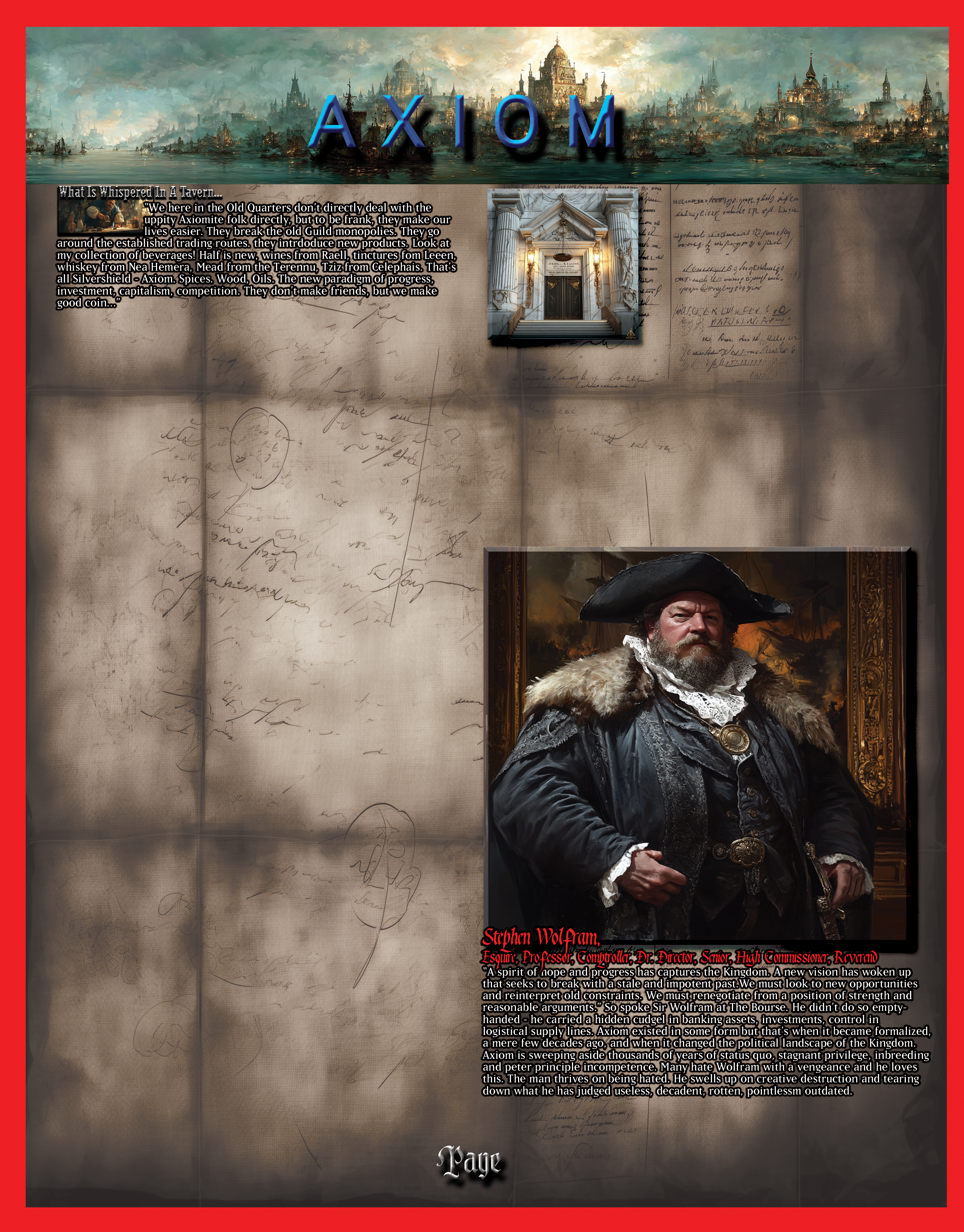
The Axiom Alignment
In the taverns of the Old Quarters, where merchants warm their hands over imported spirits and speak more freely than they would in counting houses, there is a saying: if you want poetry, go to the Empyrean; if you want prophecy, seek the Nadir; but if you want something built, something delivered, something that works tomorrow and not in a hundred years—go to Axiom. It is not a philosophy that announces itself with banners or hymns. It arrives with contracts, schedules, and crates unloaded before dawn. It does not promise transcendence. It promises progress, measured in shipments received, streets paved, monopolies broken, and markets opened where yesterday there was only dust.
Axiom began, as most enduring forces do, not as a revelation but as a correction. The Kingdom had grown accustomed to inherited privilege, guild stagnation, and the quiet rot of comfortable power. Titles passed from parent to child like heirlooms, positions calcified, and entire districts existed to preserve the illusion that what had always been must always be. Into this atmosphere stepped men and women who were less impressed by lineage than by output. They did not deny tradition; they simply asked what it produced. They did not despise ceremony; they demanded it justify its expense. In the language of Axiom, sentiment is tolerated, but inefficiency is not.
To walk among Axiom’s adherents is to feel the pulse of ambition harnessed to structure. They are industrial in temperament even when no factory smoke marks the sky. They are drawn to ledgers, to infrastructure, to networks of supply that bind port to capital and capital to hinterland. Their heroes are not saints or conquerors but organizers: the one who mapped the river routes, the one who stabilized the grain price during famine, the one who secured investment enough to build rail and road across impossible terrain. They do not make friends easily, but they make coin, and coin, in their view, is a universal solvent for stagnation.
The alignment does not deny the harshness of its methods. Axiom understands that disruption breeds discomfort. Old monopolies do not dissolve without protest; entrenched families do not yield their privileges with grace. When Axiom breaks a guild’s stranglehold or introduces a new product that renders an artisan’s life’s work obsolete, it does so with the conviction that progress outweighs preservation. This is not cruelty for its own sake, but neither is it gentle. Axiom believes that markets, like forests, must sometimes burn to renew themselves. The cost is acknowledged, though not always mourned.
Yet it would be a mistake to see Axiom as merely acquisitive. At its best, it is animated by a belief that human potential is squandered in systems that reward inertia over initiative. The child born without title but with talent should not be barred from ascent. The inventor should not be smothered by guild law. The port city should not languish because an inland noble fears competition. Axiom’s rhetoric—when it bothers with rhetoric at all—speaks of opportunity, of rational reform, of a Kingdom invigorated by enterprise rather than anesthetized by comfort. It has little patience for nostalgia that demands sacrifice from the living to honor the habits of the dead.
In practical terms, Axiom’s presence is felt in trade houses and counting rooms, in the bustle of newly opened markets, in the clatter of innovation. Its adherents cultivate relationships across borders, negotiating with Celephais for spices, with distant realms for rare metals, with frontier settlements for timber and grain. They are cosmopolitan not out of romance but necessity; commerce is a language spoken in many dialects, and Axiom prides itself on fluency. Where others see foreignness, Axiom sees supply chains.
To align with Axiom as a player is to accept a worldview grounded in tangible outcomes. Success is not defined by moral purity alone, nor by adherence to ancient codes, but by the measurable improvement of systems. A bridge that stands is preferable to a speech that inspires. A reformed tax structure that funds schools and roads is preferable to a tradition that preserves the dignity of a few at the expense of many. This does not make Axiom virtuous by default; it makes it pragmatic. It evaluates choices through the lens of utility, scalability, and long-term return.
This pragmatism extends to personal conduct. Axiom respects discipline, punctuality, and the cultivation of skill. It admires those who can endure criticism, iterate on failure, and refine processes until they function with precision. It is skeptical of grand gestures unaccompanied by implementation. In social settings, its adherents may appear blunt, even brusque, but their bluntness is rarely arbitrary. They value clarity over comfort. A promise, once made, is expected to be kept—not because of honor in the romantic sense, but because reliability is the bedrock of commerce and cooperation alike.
Critics argue that Axiom reduces the world to profit margins and balance sheets. Its defenders counter that prosperity is the soil in which other virtues can grow. A starving populace does not compose symphonies or debate philosophy; it riots. A realm that cannot finance its own defense does not remain sovereign for long. In this sense, Axiom positions itself as the engine beneath the Kingdom’s more luminous achievements. It claims no halo, but it insists on its necessity.
There is, however, a tension at the heart of Axiom. Progress demands constant motion. Markets evolve, technologies shift, and yesterday’s breakthrough becomes today’s baseline. To stand still is to fall behind. This relentless forward drive can strain communities and individuals alike. Not all thrive in an environment where adaptation is perpetual. Some long for stability over opportunity, for preservation over disruption. Axiom hears these concerns, but it rarely allows them to halt momentum. Its wager is that the long arc of advancement justifies the short-term turbulence.
For players, Axiom offers a compelling framework for action. It encourages engagement with infrastructure, trade, and reform. It rewards strategic thinking, negotiation, and the willingness to make difficult choices in pursuit of systemic change. It invites characters to challenge ossified hierarchies, to build alliances across traditional divides, and to measure success not only in personal glory but in the transformation of institutions. It is neither purely heroic nor inherently villainous; it is a force that amplifies the consequences of ambition.
In the end, Axiom does not ask to be loved. It asks to be taken seriously. It does not promise comfort. It promises capability. In a Kingdom where dreams, faith, and shadow each claim their due, Axiom stands as the embodiment of the material: the ledger balanced, the road laid, the contract fulfilled. Whether one sees it as the harbinger of renewal or the herald of ruthless efficiency depends largely on one’s tolerance for change. But few can deny that where Axiom sets its hand, the world does not remain the same.