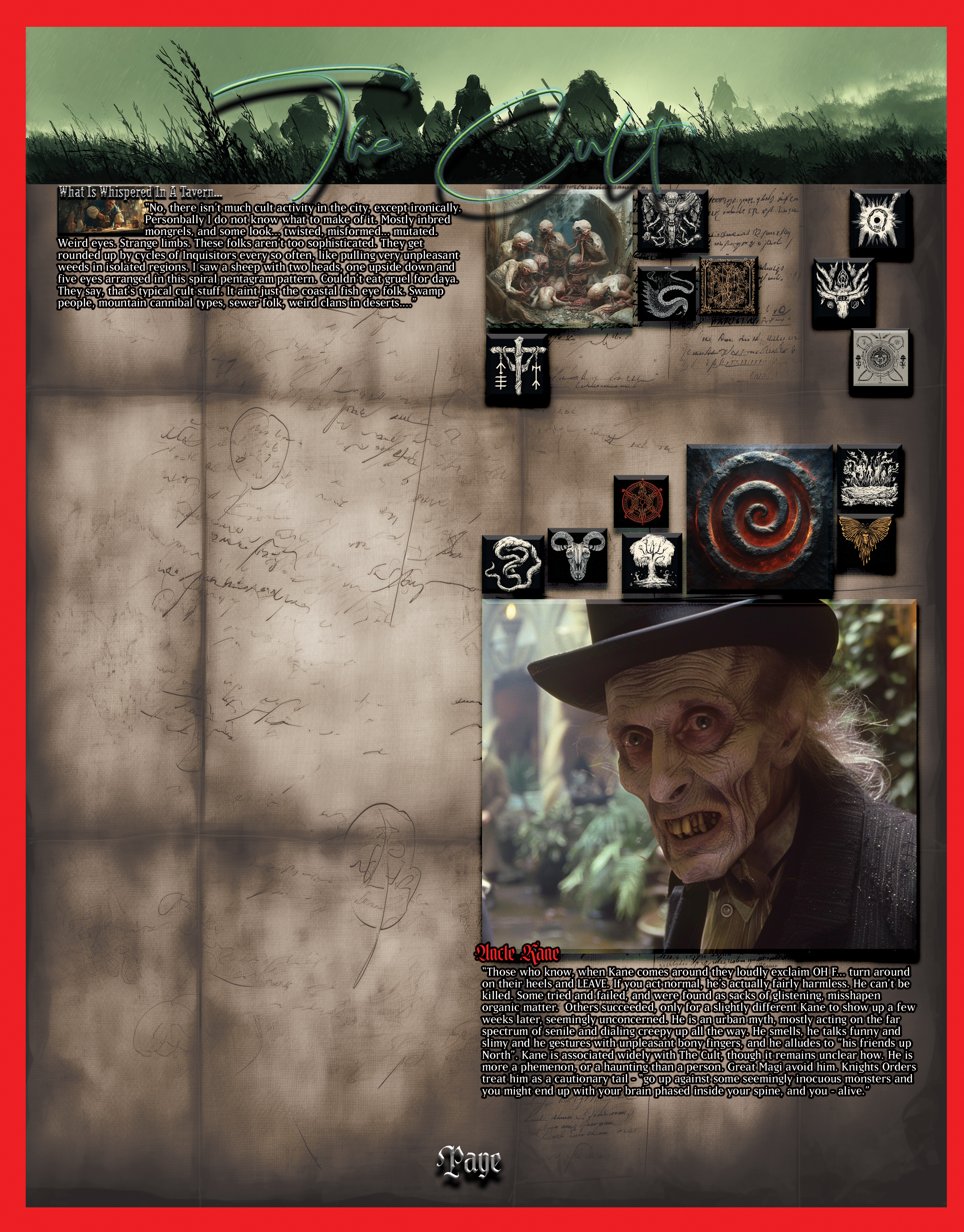
The Cult Alignment
There are places in the world where the ground does not quite behave as ground should. Not dramatically so, not in the way of flaming fissures or chanting chasms, but in the manner of a story half-remembered. You walk through such country and find yourself uncertain whether you have walked it before. The hills appear ordinary, wind-worn and sheep-cropped, yet from certain angles the ridgelines seem to watch the valleys below with an attention that is not easily dismissed. The people who dwell there do not speak of curses or demons; they speak instead of weather, of soil, of the way things have always been. It is in these regions, at the frayed hems of certainty, that the alignment commonly referred to as The Cult takes root. It is less an organization than a condition, less a conspiracy than a temperament shared by those who have lived too long beside the unsealed edges of the real.
The Cult is not defined by a unified creed, nor by temples, nor by high doctrine preserved in illuminated manuscripts. It persists through inheritance, imitation, and a gradual accommodation to phenomena others refuse to acknowledge. Those aligned with it do not necessarily gather under banners or kneel before idols. Many would deny belonging to anything at all. They are shepherds, millers, ferrymen, charcoal burners, and the stray scholar who stayed too long in a rural parish and found the parish studying him in return. They speak in pidgin explanations and half-formed analogies. They pass down gestures more faithfully than words. A mark carved on a boundary stone, a story told about a neighbor who changed but did not, a habit of turning mirrors to the wall at dusk—these are the forms in which their alignment expresses itself. It is diffuse, patient, and curiously resistant to eradication, because it is not anchored in leadership but in landscape and in lived accommodation.
To understand The Cult, one must first abandon the comforting assumption that reality is a stable contract between observer and world. Those who dwell in Cult-touched lands come to suspect that the contract was always provisional. Cause and effect hold most of the time, but not always in the order one expects. Dreams do not merely reflect anxieties; they sometimes rehearse events that later insist on happening. Livestock are born wrong, and not with the spectacular deformities that inspire traveling inquisitors, but with subtle variations that feel less like error than alternative intention. The people do not recoil in horror; they adjust. They make room. They learn which streams not to cross on certain nights and which songs to avoid singing after harvest. What an outsider might name madness is, to them, a survival strategy within a field of unstable outcomes.
It would be a mistake to imagine that those aligned with The Cult command great and deliberate power. Their influence is neither precise nor easily directed. Yet in moments of stress, when fear thickens the air and certainty falters, the world around them may answer in disquieting ways. Apparitions manifest that cannot be cleanly categorized as summoned or spontaneous. Accidents arrange themselves with narrative symmetry. Unlikely coincidences cluster until coincidence itself seems an insufficient explanation. Wizards trained in the high arts often find their formulae yielding results that are technically correct yet contextually wrong. Spells resolve, but into outcomes misaligned with intent. It is not that The Cult overpowers established magical disciplines; rather, it inhabits a region where those disciplines no longer describe the whole terrain. Many learned practitioners, recognizing the diminishing reliability of their craft, choose discretion over confrontation and withdraw without spectacle.
From the perspective of the wider world, The Cult is troublesome not because it marches or declares war, but because it erodes confidence. Investigations yield inconsistent testimony. Attempts to map affected regions produce charts that seem accurate until compared with prior drafts. Officials tasked with restoring order discover that the populace does not experience itself as oppressed or even particularly endangered. They are wary, certainly, but they have adapted. They do not seek liberation from the strange; they seek continuity within it. This refusal to dramatize their condition frustrates would-be reformers and inquisitors alike. Without a clear enemy to name or hierarchy to dismantle, efforts to purge The Cult tend to dissipate into procedural fatigue.
For players considering alignment with The Cult, it is essential to understand that the alignment does not grant certainty, prestige, or dominion. It grants proximity to ambiguity. A character aligned in this manner retains agency and intention, yet operates within a narrower margin of epistemic comfort. Perception may not always align with consensus. Memories might compete with one another without an obvious falsehood among them. Decisions still matter, but outcomes may arrive by paths that resist tidy explanation. Such a character is not a raving fanatic; indeed, many are quiet, observant, and unsettlingly composed. They have learned that panic wastes energy in a world that does not promise coherence. Their strength lies in tolerance for the unresolved, in the ability to function without demanding that the universe justify itself.
Socially, Cult-aligned individuals often occupy ambiguous positions. They may be sought out for local knowledge, for they understand the moods of their territory in ways outsiders cannot. At the same time, they are treated with caution. There is a sense that prolonged association carries a subtle contagion—not of disease, but of doubt. Companions may find themselves second-guessing their own recollections after extended travel in Cult lands. Was that ruin always there? Did the river truly run in that direction yesterday? The Cult does not insist upon belief; it fosters exposure. Proximity does the rest. Those who remain anchored in other alignments may feel an increasing need to reassert their frameworks, to name and categorize with renewed vigor. The Cult neither argues nor refutes; it simply persists.
Morally, The Cult resists simple classification. It is not inherently malicious, though harm may arise in its wake. It does not preach cruelty, yet its accommodation of instability can appear callous to those who demand intervention. When confronted with anomalies that alarm visitors, Cult-aligned characters are more likely to ask how to live with the phenomenon than how to eradicate it. This pragmatic acceptance can be read as wisdom or as surrender, depending on one’s philosophical commitments. In truth, it is an adaptation born of long familiarity with a world that cannot be forced into permanent alignment with human expectation.
Ultimately, The Cult represents a threshold state within the broader cosmology of the world. It is not the abyss, nor is it a gateway to transcendent revelation. It is the margin where definitions thin and certainties fray. To stand there is to relinquish the comfort of rigid metaphysics without fully abandoning the structures that make action possible. Players who choose this alignment step into a narrative space where reality is less a fixed stage and more a shifting field, where horror is seldom theatrical and often domestic, and where survival depends not on conquering the unknown but on enduring its quiet insistence. In such company, one learns that the most unsettling truths are rarely shouted; they are lived, day after day, until the distinction between strange and ordinary dissolves into something that no longer requires a name.