The Logos Alignment
In every kingdom there are those who swing swords, those who till soil, those who whisper to gods, and those who count coin. And then there are those who count the counters, who measure the measure itself, who ask not merely what is true but why truth holds together at all. These are the people of Logos. You will not always recognize them by robes or sigils, though some certainly dress the part; you will recognize them by the way conversations subtly bend around them, by the way disputes quiet when they clear their throat, by the way rulers request their presence before signing decrees they do not fully understand. Logos is not merely learning, nor is it simple scholarship. It is the disciplined conviction that reality is structured, that meaning can be refined, that power must justify itself in the language of coherence.
The great Magisteriums scattered across the Kingdom stand as the visible citadels of this alignment, vast universities whose towers hold archives of law, treatises of metaphysics, astronomical charts, surgical diagrams, economic ledgers, and theological disputations that span centuries. Within their halls, alchemists debate metaphysicians without raising their voices, jurists annotate royal edicts as though they were sacred texts, and occultists dissect ritual not for ecstasy but for principle. Logos is grassroots in a peculiar way; it is embedded in guild charters, merchant contracts, civic codes, and even in the mundane etiquette of debate. Yet it remains distinctly elevated, drawing to itself patrons, sponsors, philosophers, bankers, and political architects who understand that the shape of an argument can be as decisive as the swing of a blade. If Chaos intoxicates and Concord remembers, Logos drafts the charter that defines what either may lawfully become.
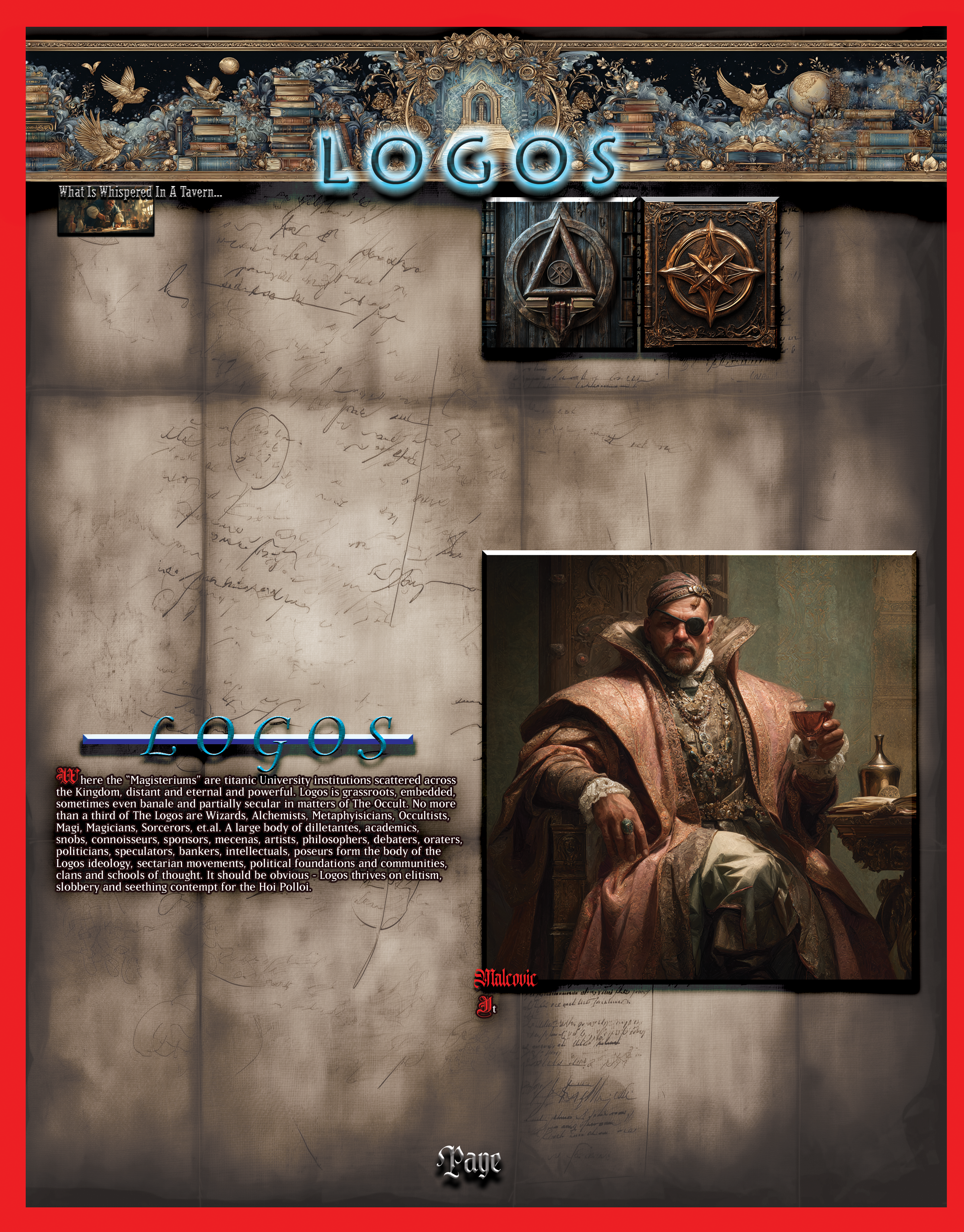
To the common ear, Logos is whispered about with a mixture of admiration and resentment. In taverns one hears that the Magisteriums train minds sharp enough to slice a throne in half without ever touching it, that their scholars can prove a man wrong so elegantly he thanks them for the humiliation, that no tax, tithe, or treaty escapes their annotation. It is said that Logos thrives on elitism, that its devotees cultivate a certain cultivated disdain for the hoi polloi, and that their salons are less gatherings than examinations in disguise. Yet even its critics concede that when plagues spread, when currencies collapse, when sorcerous anomalies ripple across the countryside, it is the Logos-aligned who convene symposia and produce frameworks rather than panic. They may not inspire cheers, but they stabilize the narrative.
Logos is not a cult, though it may appear sectarian from a distance. Its adherents do not kneel to a single idol; instead they orient themselves toward the proposition that the cosmos is intelligible, that even the occult can be diagrammed, that even passion has an architecture. Within its broad canopy you will find jurists who revere precedent as a sacred chain of reasoning, economists who treat markets as living equations, metaphysicians who map the invisible currents of the Dreamlands with the patience of cartographers, and rhetoricians who believe that a society rises or falls on the precision of its words. The diversity is vast, but the throughline is unmistakable: a refusal to accept brute force or blind faith as sufficient explanation.
Power, in the view of Logos, must be defensible. A king may claim divine right, but a Logos councilor will ask for the argument beneath the claim. A revolutionary may cry justice, but a Logos philosopher will demand a coherent account of what justice entails and how it will be administered once the banners are lowered. This is not necessarily kindness, nor is it cruelty. It is a posture of insistence. In courts and councils, Logos-aligned figures serve as architects of legitimacy, ensuring that governance rests upon articulated principles rather than mere charisma. They draft constitutions, codify magical practice, standardize measures, and compile the indices by which knowledge persists beyond any single generation.
It would be naïve to imagine that Logos is free from ambition. The alignment attracts those who understand that ideas, once institutionalized, become enduring engines of influence. To define a curriculum is to define what a generation considers possible. To establish a canon is to determine which voices echo across centuries. The Magisteriums therefore function not only as repositories of wisdom but as crucibles of status. Debates are fierce, reputations are forged and shattered in lecture halls, and the subtle hierarchies of citation and endorsement can elevate a scholar to near-oracular authority. Logos does not celebrate raw dominance, yet it understands the quiet supremacy of intellectual gatekeeping.
In matters of the Occult, Logos occupies a fascinating middle ground. It does not deny mystery, nor does it surrender to it. Rituals are analyzed, symbols compared, cosmologies cross-referenced. Where others might fall to ecstatic devotion or nihilistic dread, the Logos practitioner asks how a phenomenon operates, under what constraints, and whether it can be reproduced or mitigated. This stance has led some to accuse the alignment of hubris, suggesting that to dissect the sacred is to risk profaning it. Yet the adherents of Logos would counter that ignorance is the greater sacrilege, that to refuse inquiry is to abandon stewardship of the mind.
Socially, Logos tends toward salons rather than festivals, colloquia rather than crusades. Its gatherings are structured, its disputes moderated, its rivalries couched in citations rather than insults. There is a certain theatricality to its public disputations, where two scholars may spar for hours over a single clause in an ancient charter while an audience takes notes as though attending a duel. Outsiders sometimes misread this as coldness, but within the alignment there is genuine fervor, a belief that ideas matter profoundly because they shape the invisible scaffolding of society. Where others see abstraction, Logos sees destiny.
For players who align with Logos, the path is neither ascetic nor indulgent but disciplined. One cultivates clarity, learns to distinguish assertion from argument, studies the precedents of history, and treats language as both instrument and responsibility. You may find yourself serving as advisor to a duke who needs a treaty untangled, as mediator between rival magical orders whose doctrines threaten to destabilize the realm, or as author of a treatise that reframes how the Kingdom understands its own origins. The alignment does not demand detachment from the world; it demands engagement with its underlying logic.
To walk with Logos is to accept that reality, however chaotic it may appear, yields patterns to those patient enough to seek them. It is to believe that civilization is not sustained by spectacle alone but by the careful weaving of arguments, codes, and institutions that outlast any single hero. You will not always be loved. You may even be accused of arrogance. But when crises arise and passions flare, it is often the quiet architect of reason who prevents collapse, who drafts the bridge across the abyss, who ensures that power, once seized or inherited, can be explained in terms that endure.
Logos does not promise glory in the traditional sense. It offers something subtler: the chance to shape the grammar of the world.