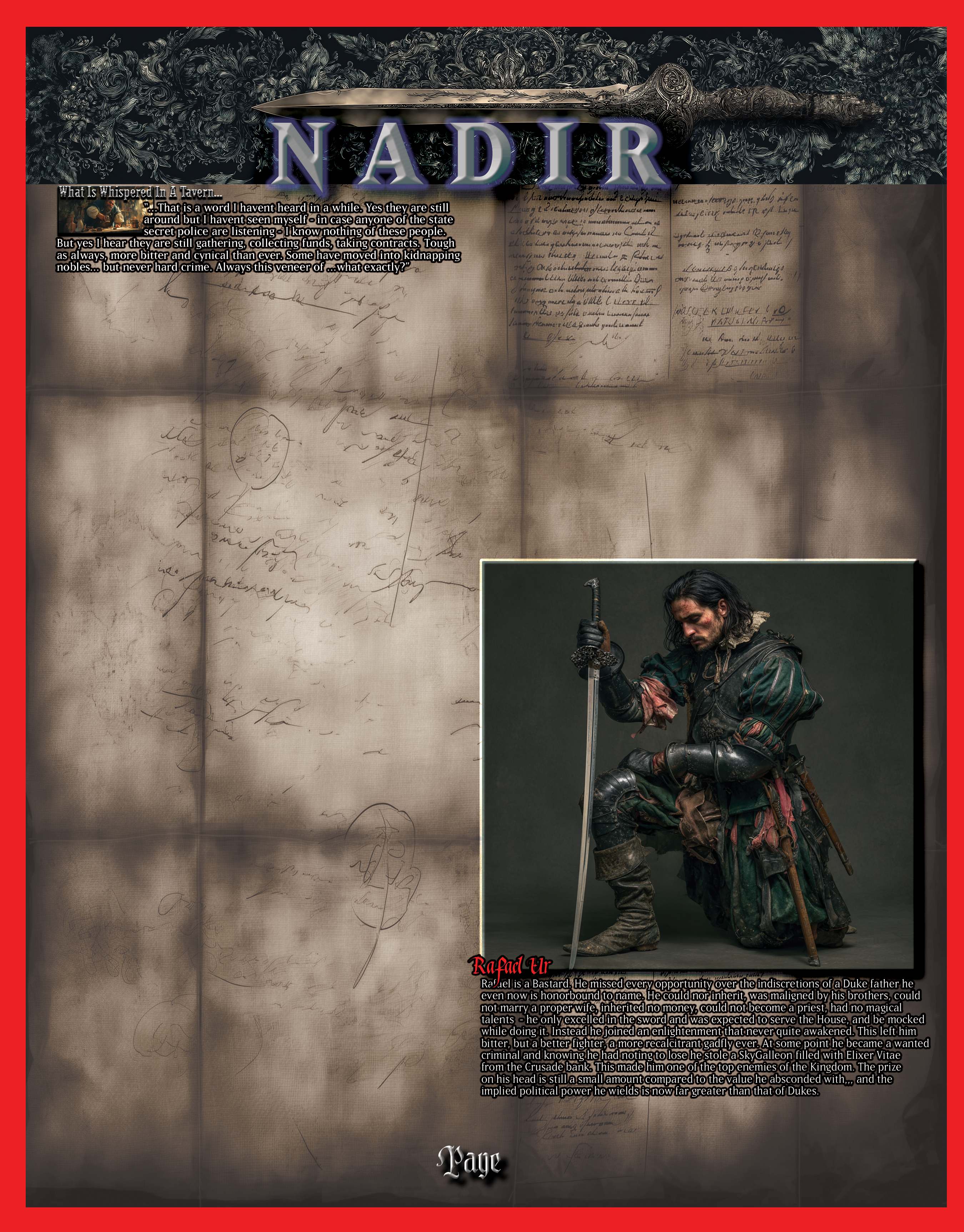
The Nadir Alignment
There are words that are spoken loudly in the Kingdom—Honor, Faith, Crown, Order, Destiny—and there are words that are spoken more quietly, usually after the second cup of wine, when the tavern shutters are drawn and the lamps burn low. Nadir is one of those quieter words. It is not a banner flown from towers, nor a creed recited in academies. It is a murmur that persists in the margins of history, a name given to those who remember that the world might once have turned differently.
In the Kingdom’s long and peculiar arc, there was an age—scholars argue precisely when—when thought surged forward like a tide. Printing presses clattered in hidden courtyards, treatises circulated in stitched folios, and certain minds dared to ask whether power must always descend from ancient blood and sanctioned miracle. It was not a time of chaos, as the court historians now claim, but of unbearable possibility. Ideas of common dignity, civic obligation, and measured governance bloomed in scattered cities and fortified towns. For a generation or two, it seemed plausible that the feudal lattice which bound the land might loosen its grip.
It did not.
The tide withdrew. Some say it was crushed. Others say it was bought, diluted, rebranded, sanctified, or simply exhausted. The presses did not vanish, but what they printed changed. The militias did not disband, but they were folded into retinues. The language of human worth survived, yet it grew strangely narrow, twisted into a rhetoric of exclusion rather than emancipation. The Enlightenment of the Dream did not die in flame; it stalled, as though history itself had struck a hidden reef and broken its momentum. The old order endured, not because it was flawless, but because it was patient.
From that stalled age comes Nadir.
Nadir is not a movement in the formal sense. It has no central council, no uniform insignia, no public doctrine to be pinned upon a wall and debated in lecture halls. If anything unites those who are named Nadir, it is a shared historical consciousness. They know that the world once bent toward change and then snapped back. They know that revolutions have names, martyrs have graves, and that both can be quietly appropriated by the very structures they opposed. This knowledge does not make them idealists, nor does it make them cynics. It makes them attentive.
To encounter someone of Nadir alignment is not to meet a firebrand or a prophet. It is more often to meet a person who has tested belief against reality and carries the scar discreetly. Some were once students of reformist academies, or retainers who watched their lieges negotiate away hard-won concessions, or mercenaries who fought under banners of liberation only to find themselves unpaid and denounced. Others were born into the aftermath, inheriting stories of failed assemblies and broken charters the way other families inherit silverware. What distinguishes them is not that they hate the Kingdom, but that they understand its resilience in a way that few courtiers do.
Nadir-aligned individuals tend to move where tension gathers. They take contracts that respectable houses prefer not to acknowledge. They broker exchanges between factions who publicly denounce one another. They extract nobles from riots and, on other occasions, remove nobles who have grown too certain of their invulnerability. It would be inaccurate to call them anarchists, for they do not seek the collapse of all structure. It would be equally inaccurate to call them loyalists, for their allegiance is rarely to a throne or lineage. Their loyalty, if it can be called that, is to a memory: the idea that power must occasionally be reminded of its contingency.
In taverns, one hears that Nadir is bitter. There is truth in that. Bitterness, however, is not the same as malice. It is the taste left behind when expectation has soured. Many within Nadir speak little of grand reform, not because they cannot imagine it, but because they have seen how swiftly such visions are absorbed and neutralized. They are not naive about heroism. They know that martyrs are useful symbols for regimes that survive them. As a result, they prefer leverage to spectacle. A carefully placed rumor, a discreetly funded expedition, a calculated refusal to participate—these are tools as potent as swords.
Yet swords remain among their tools. The Kingdom is not an abstract debating chamber; it is a land of steel, spellcraft, and stratified privilege. Nadir does not reject force outright. Rather, it treats force as one instrument among many, to be used with clarity rather than fervor. The difference is subtle but significant. Where a crusader might fight for a promised dawn, a Nadir-aligned fighter acts to prevent the night from deepening further. Their victories are rarely celebrated in song, and their defeats are seldom recorded with accuracy, but their interventions leave marks in the ledger of events.
Other alignments misinterpret Nadir in predictable ways. The devout often assume they are faithless, mistaking restraint for disbelief. The aristocratic consider them envious, unable to comprehend that criticism of inherited power is not merely a disguised hunger for it. The utopian-minded accuse them of timidity, of settling for incremental adjustments where sweeping change is required. Even the Cabal, with its own disciplined cynicism, sometimes mistakes Nadir for a lesser form of opportunism. Each of these readings contains a fragment of truth, yet none captures the whole.
For players who choose Nadir, understand that this alignment does not grant the comfort of purity. It offers instead a vantage point from which the Kingdom’s patterns become visible. You will recognize cycles where others see destiny, compromises where others see tradition, and fractures where others see stability. Your character may once have believed more fervently than they do now. That history is not erased; it informs every decision. You are not obligated to abandon ideals, but you will be acutely aware of the cost of pursuing them without calculation.
Nadir characters often operate in the grey corridors between factions. They can serve as mediators, troubleshooters, investigators, or reluctant enforcers. They may support reforms in measured ways, seeking to anchor them in durable practice rather than rhetorical flourish. They may expose hypocrisy not to humiliate, but to rebalance. In moments of crisis, they are capable of decisive action, precisely because they are not waiting for perfection. They understand that the Kingdom is unlikely to transform overnight, but they also know that stagnation carries its own dangers.
In the long view, Nadir is a reminder that history is not a straight ascent nor an inevitable decline. It is a field of forces, some visible, some concealed. Those aligned with Nadir inhabit that field with open eyes. They do not expect applause, nor do they crave martyrdom. They remember that there was once an awakening that faltered, and they live in the wake of that faltering with a sober determination to shape what can still be shaped. If there is hope in Nadir, it is not radiant or naive. It is the quieter conviction that even in an age where grand transformations have stalled, choices still matter, and memory itself can be a form of resistance.