The Cabal Alignment
An Alignment of Silence, Leverage, and Old Money
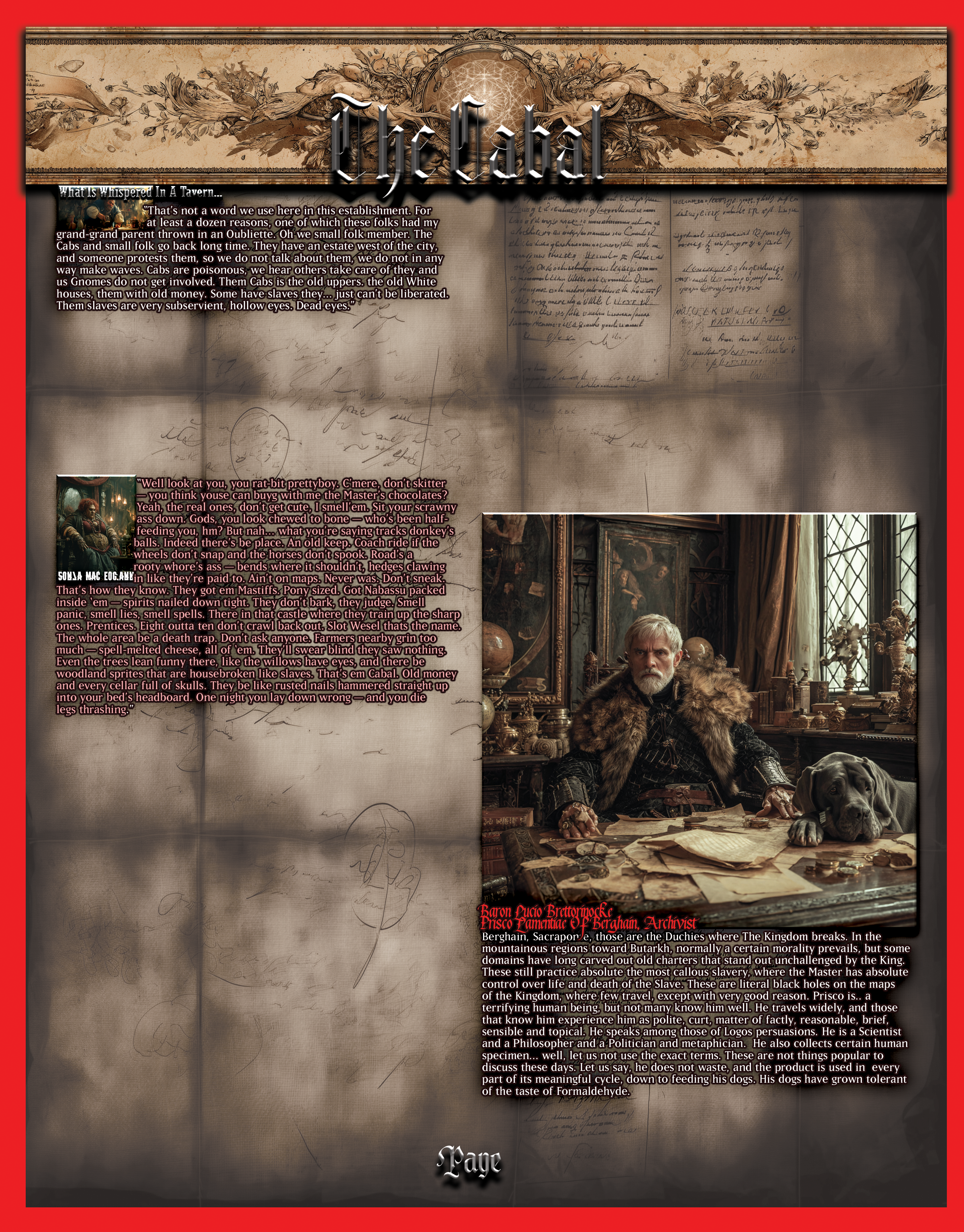
There are names spoken loudly in Rinyldissen, and there are names spoken only when the doors are shut and the lamps turned low. The Cabal belongs to the latter category, though even that word is seldom used in polite company. It is not an order with banners or public creeds, nor a sect that seeks converts in the streets. It does not build temples or preach doctrines. It is better understood as a current running beneath institutions that appear respectable, rational, even admirable. Where wealth consolidates quietly and reputations are curated with care, where influence is exercised without spectacle, there the Cabal may be found, though never announced.
To the untrained eye, Cabalists are indistinguishable from the city’s most accomplished citizens. They sit on councils, endow lectureships, sponsor civic improvements, and dine in well-appointed halls. They speak fluently of policy, of trade routes, of stability and continuity. Their manners are impeccable, their tempers restrained, their philanthropy strategic. They are not given to flamboyant cruelty or theatrical villainy; indeed, they tend to find such displays vulgar. The Cabal does not roar. It adjusts. It calibrates. It waits.
In the capital, one sometimes hears that the Cabal is “old money,” though that phrase does not quite capture it. Old money may decay, dissipate, or grow complacent. The Cabal does not. It reinvests in influence rather than luxury, in leverage rather than applause. Its holdings are rarely ostentatious; its estates, though grand, are seldom open to admiration. A Cabalist house may appear dignified but understated, its grounds well kept but not inviting. Visitors are received with courtesy and assessed with precision. One leaves such places with the faint sense of having been measured, weighed, and entered into a ledger that cannot be seen.
It would be a mistake to imagine the Cabal as numerous. It is not. Its strength lies in density, not breadth. Each member occupies a position that touches many others, and each position is chosen with care. Where another Alignment might cultivate mass loyalty or open allegiance, the Cabal cultivates interdependence. Contracts are drafted with clauses that anticipate betrayal. Debts are structured to mature at inconvenient moments. Favors are granted in ways that cannot be repaid without acknowledgment. Nothing is wasted, least of all opportunity.
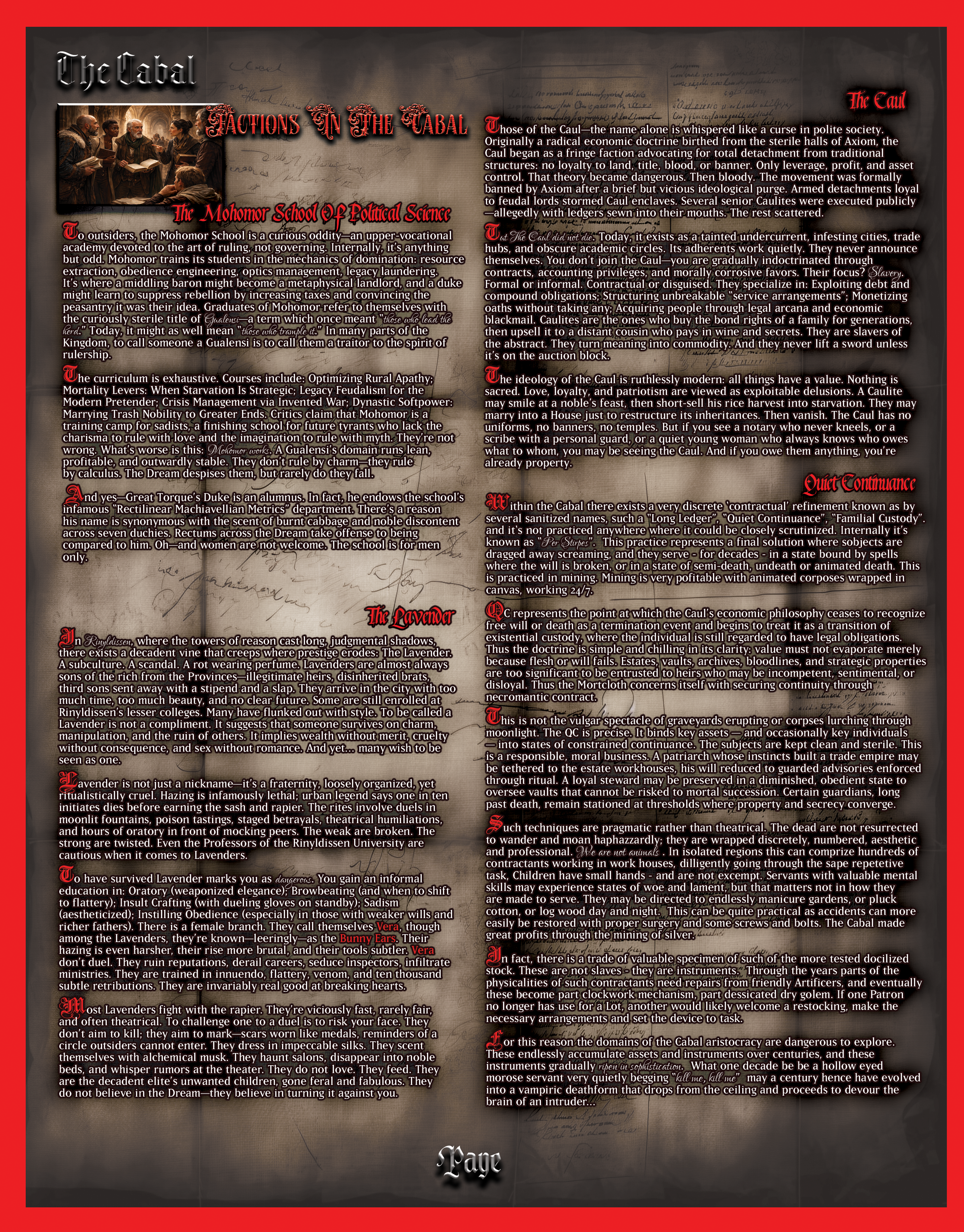
Much is whispered about the Cabal’s relationship to academia in Rinyldissen, though nothing is ever proven. The city’s colleges and lesser academies have long fostered societies and fraternities, some convivial, others competitive, and a few notoriously severe. It is said that among these circles there exist houses whose initiation rites are remembered only in fragments and whose alumni advance with uncanny regularity into positions of consequence. These houses do not advertise themselves as Cabalist, nor do they need to. Those who pass through them emerge altered in subtle ways: less sentimental, more patient, more attuned to the language of leverage. Whether the Cabal founded these traditions or merely refined them is a matter of speculation, and speculation is seldom healthy.
In matters of governance, the Cabal prefers stability over upheaval, though not from altruism. Turbulence disrupts supply lines and unsettles markets; stability preserves assets and protects long investments. When reforms are proposed, Cabalists rarely oppose them outright. They inquire, amend, adjust, and redirect. A policy that threatens their interests may survive, but only in a form that has been rendered harmless or profitable. In this way, they acquire a reputation for pragmatism. They are often described as “realists,” a word that, in certain circles, functions as both compliment and warning.
As for their moral philosophy, if such a term can be applied, it is neither evangelical nor grandiose. Cabalists do not claim divine mandate or cosmic destiny. They do not seek transcendence. Their ethos is continuity. Institutions must endure, assets must compound, influence must not dissipate. Individuals are secondary to structures; sentiment is secondary to outcome. This outlook can be unsettling to those who value ideals above results, yet it has a cold coherence that many find difficult to refute in practice. A Cabalist will listen patiently to a speech about justice and then ask how it will be funded, enforced, and protected against sabotage. In that question, entire movements have withered.
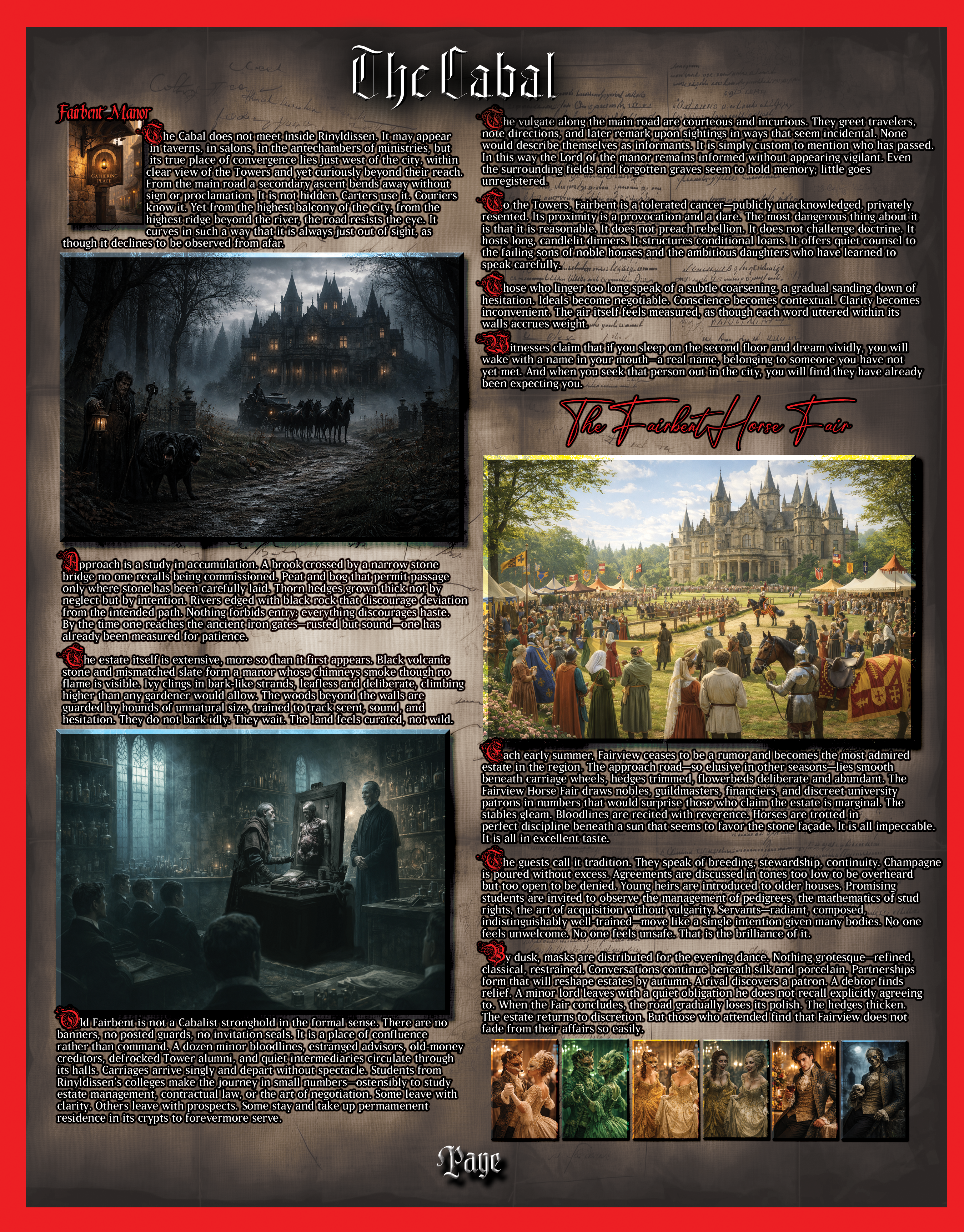
Rumors persist of estates beyond the city where the Cabal’s influence is less diluted by public scrutiny. One such place, often mentioned and never confirmed, lies along a winding road that appears unremarkable until one realizes it is absent from official maps. Travelers speak of high trees that seem to lean inward, of iron gates that open without visible attendants, of hounds that watch without barking. These tales vary in detail and flourish, and it would be unwise to treat them as reliable accounts. What is consistent is the tone in which they are told: not outrage, but resignation. Whatever occurs at such estates, it is understood to be beyond ordinary recourse.
The Cabal’s detractors accuse it of cynicism, of reducing all human relations to transaction. There is some truth in this, though it is incomplete. Cabalists are capable of loyalty, but their loyalty is rarely spontaneous. It is constructed, tested, and reinforced. Apprenticeship, mentorship, and patronage play significant roles in their internal culture, yet these relationships are not casual. Advancement is earned through endurance, discretion, and an aptitude for navigating ambiguity. Those who thrive in such an environment tend to be resilient and formidable. Those who do not rarely speak of their experience, and when they do, their accounts are dismissed as exaggeration or envy.
In the broader constellation of Alignments, the Cabal is neither the loudest nor the most mystical. It does not summon spectacles or wage public crusades. Its victories are incremental and often invisible. A rival discredited at a critical moment, a contract awarded to the “safer” candidate, a regulation adjusted just enough to shift the balance of power—these are its methods. One does not see the blade; one sees only the outcome and the reasonable explanation that accompanies it.
To play Cabal-aligned characters is to inhabit a worldview in which power is a resource to be conserved and deployed with precision. It is to value patience over passion and leverage over applause. Such characters need not be cartoonish villains; indeed, the most effective Cabalists are courteous, articulate, and seemingly indispensable. Their danger lies not in overt brutality but in their capacity to shape circumstances long before conflict becomes visible. They are the rusted nails driven into the headboard of an otherwise comfortable bed: easy to forget, fatal to ignore.
The Cabal does not seek admiration, nor does it require belief. It persists through habit, through contract, through the quiet arithmetic of advantage. Whether one views it as a necessary counterweight to chaos or as a malignancy embedded within the body politic depends largely on where one stands in relation to its interests. What is certain is that the Cabal endures, not because it is loved or feared in equal measure, but because it understands the simple truth that institutions outlive outrage, and influence, once secured, rarely relinquishes itself without cost.