Ibsen
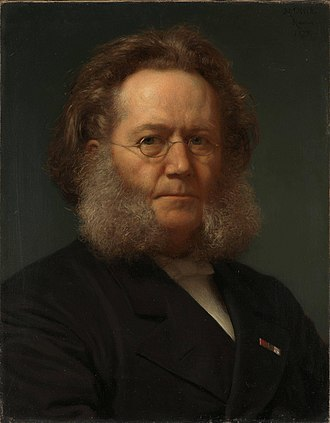
Name: Henrik Johan Ibsen
Achievements: Norwegian playwright
Born: March 20, 1828; Skien, Norway
Died: May 23, 1906; Kristiana (now Oslo), Norway. Aged 78
Field & Discipline: Art; Theater; Playwright
Language: Norwegian
Father: Knud Ibsen
Mother: Marichen Altenburg Ibsen (m. 1825)
Siblings: Johan; Johan Andreas; Hedvig Kathrine; Nicolai Alexander; Ole Paus
Spouse: Suzannah Daae Thoresen (m. June 18, 1858; 1836-1914)
Children: Sigurd (b. December 23, 1859)
Education: Primary school in Skien; Scheel House, a school run by 2 local theology students (1841-43)
Major Work:
Brand (1866)
Peer Gynt (1867)
The League of Youth (1869)
The Pillars of Society (1877)
A Doll's House (1879)
Ghosts (1881)
An Enemy of the People (1882)
The Wild Duck (1884)
Rosmersholm (1886)
The Lady from the Sea (1888)
Hedda Gabler (1890)
The Master Builder (1892)
Little Eyolf (1894)
John Gabriel Borkman (1896)
When We Dead Awaken (1899)
Life & Times:
In April 1850 Ibsen moved to Kristiana, the capital of Norway and studied for university entrance examinations, settling into the student quarter. He did not, however, settle into his classes. He had also been late making payments to Sophie Birkedalen, the mother of his illegitimate child, several times, and was sentenced to forced labour at Akershus Prison until the outstanding debt was paid. He was, however, saved from jail by the virtuoso violinist Ole Bull, who arrived in Kristiana to raise money for the new, entirely Norwegian, theatre he had opened in Bergen.
Ibsen, among other students, decided to raise money for him with an “Evening of Musical Entertainment,” for which Ibsen wrote the prologue and a nationalist song, “The Power of Art.” Bull was so impressed that he offered Ibsen the post of dramatist-in-residence at the Bergen Theatre, in which capacity he was required to write a new play every year. He and left for Bergen that October.
At this time, the Norwegian stage seemed to be dominated by French playwright Eugene Scribe and also by the Danish language. In order to gain inspiration, he left to visit theatres in Copenhagen, Berlin, Dresden and Hamburg, returning three months later, in 1852, to begin work on his national drama, which occupied him for the next six years.
While in Bergen, he met nineteen year old Suzannah Daae Thoresen, whom he married in the summer of 1858. Suzannah gave birth to the couple’s only son, Sigurd, on December 23 1859. Possibly due to a difficult birth, she later announced that she would have no more children, but what she probably meant was that she and Ibsen no longer had a sexual relationship, although their marriage lasted for forty years.
In 1862, Ibsen wrote “Kjaerlighedens Komedie” (Love’s Comedy) which was largely unpopular with its audience. The following year, he wrote “Kongsemnerne” (The Pretenders) dramatising the inner power that distinguishes a true man, which became his long-awaited national drama. Unfortunately, at this time, the Norwegian Theatre went bankrupt and Ibsen was blamed.
In May 1863 he managed to secure a travel grant to spend a year in Rome and Paris to study art, art history and literature. He left in April 1864. Suzannah and Sigurd joined him in Rome in 1865 and they all lived abroad for the next twenty-seven years, returning to Norway briefly in 1874 and 1885.
In Rome in 1866 he wrote “Brand,” a successful verse drama about a rural pastor obsessively dedicated to his religious calling. That year Ibsen met [collaborated with] Grieg*, who was in Rome for the winter of 1865-66. They were both present at a concert at the Scandinavian Club on the 9th of April.
In 1873, Ibsen approached Grieg to provide the incidental music for “Peer Gynt,” and the two began a highly successful collaboration. The premier was staged at Kristiana on February 24, 1876 and was an immediate success.
Ibsen left Rome in the spring of 1868, and settled in Dresden, where he wrote a new play “The League of Youth,” badly received in October 1869 at the Kristiana Theatre. The family spent the autumn of that year in Egypt for the opening of the [attended opening of] Suez Canal*.
In 1872, the writer [visited by] Andersen* visited the Ibsens in Dresden, but it is unclear whether Ibsen ever met [may have met] Dostoyevsky*, who lived close by from August 1869 to July 1871. It was in Dresden that Ibsen wrote “The Pillars of Society,” 1877, an immediate and widespread success, and which was performed all over Germany and Scandinavia.
“A Doll’s House,” written in Amalfi, and premiered in Munich on 18th February 1880, caused a sensation.
Another hugely important event of this period was his meeting with the young Englishman [made famous by] Archer*, who turned Ibsen into the most talked-about dramatist on the London stage. Archer arrived in Rome in November 1881 to spend the winter there, largely with the intention of meeting Ibsen. They met at the Scandinavian Club, and Ibsen gave him the manuscript of “Ghosts.”
Archer and Ibsen met frequently over the next six months while debate raged over the play’s themes of sexual infidelity, marital desertion, hereditary madness and syphilis. Ibsen then wrote “An Enemy of the People” (1882), followed by “The Wild Duck” (1884).
Ibsen lived in Munich from 1885, where he wrote The Lady from the Sea, in 1888, “Hedda Gabler” (1890), The Master Builder, in 1892, Little Eyolf in 1894, John Gabriel Borkman in 1896 and When We Dead Awaken, in 1899.
Returning to Norway, Ibsen continued to write plays until he suffered a stroke in 1900, became bedridden in 1901 and died in Kristiana on 23rd May 1906.
Ibsen is often ranked as one of the most distinguished playwrights in the European tradition,[9] and is widely regarded as the foremost playwright of the nineteenth century.[9][10] He influenced other playwrights and novelists such as George Bernard Shaw, Oscar Wilde, Harley Granville Barker, Arthur Miller, Marguerite Yourcenar, James Joyce, Eugene O'Neill, and Jon Fosse. Ibsen was nominated for the Nobel Prize** in Literature in 1902, 1903, and 1904.[11]
Extra Connections:
[introduced to America by] WD Howells* introduced his work to America.
In a letter to George Brandes shortly before the Paris Commune, Ibsen expressed anarchist views that Brandes later positively related to the Paris Commune. Ibsen wrote that the state "is the curse of the individual.… The state must be abolished."[
[his roles played by] Duse* starred in his roles
[popularized by] Eleanor Marx* popularized his work
He was an exponent of [exponent of] naturalism*
[written about by] Salome* and [written about by] Shaw* wrote about his work
Assessment: The major Norwegian playwright.
Oneliner: Henrik Ibsen, great Norwegian playwright
Bibliography:
- Ferguson, Robert, Henrik Ibsen: A New Biography, London: Richard Cohen Books, 1996.