D'Holbach
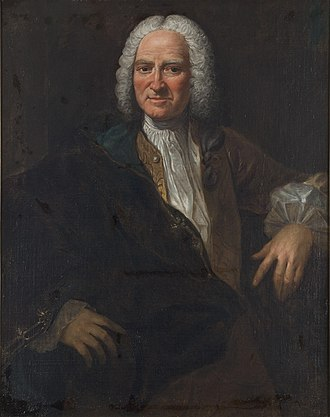
Name: Paul-Henri Dietrich, Baron d' Holbach
Achievements: Rich atheist and materialist. Ran French ‘philosophe’ gatherings.
Born: December 1723; Edesheim, near Landau, Rhenish Palatinate (Germany)
Died: June 21, 1789; Paris, France (Aged 65)
Field & Discipline: Philosophy
Language: French
Education: University of Leyden (1744-48)
Major Work:
“Système de la nature” (“The System of Nature,” published 1770)
Life & Times:
By the time he was twelve, d'Holbach was living in Paris with his parents. In the 1740s, during the war of Austrian Succession, d'Holbach went to stay on his uncle's property in the Netherlands, near Maastricht. In term time he attended the University of Leyden (1744-48), across the border in Holland. At Leyden, one of his fellow students was [a pal of] Wilkes, John*, with whom he established a life-long friendship.
At the end of the war he returned to Paris and in August 1749, he became a French citizen. Soon afterwards, in 1751, he married Basil-Genevieve Susanne d'Aine, the eldest daughter of his cousin Susanna d'Aine. She died in 1754 and two years later he married her sister, Charlotte Susanne, by whom he had three children.
In 1753, on his uncle's death, d'Holbach inherited his title and half of his estate and then, in 1754, his father-in-law died. M. d'Aine had been a king’s counsellor, and d'Holbach bought the right of succession to the office.
This was a sinecure which included the privilege of entry to the nobility and the court, a prospective income of 5,500 livres a year and liability for mandatory loans to the King whenever war or maladministration affected the royal credit.
The University of Leyden during the 1740s had been a centre of remarkable coffee parties, club suppers and constant group conversations and in Paris, during 1749 and 1750, d'Holbach began entertaining his friends lavishly in the same style. Initially, d'Holbach's dinners grouped his social friends and the young intellectuals of Paris, notably [a pal of] Diderot* and [a pal of] Rousseau*.
Within a short time his dinners had attracted figures of already established reputations, such as [a pal of] d'Alembert* and [a pal of] Buffon*. In the course of the 1750s, Rousseau, Buffon and d'Alembert ceased to attend his salon, disagreeing with his extreme views.
To those who remained, d'Holbach added new friends, such as [a pal of] Helvetius*, [a pal of] Condillac*, [a pal of] Turgot*, [a pal of] Grimm*, [a pal of] Hume*, and Wilkes. As the dinners achieved an increasingly esoteric and philosophical level, d'Holbach's more mundane friends appeared only on rare occasions. Denis Diderot remained a close friend of d'Holbach until the end of his life and was the most constant of his guests.
In 1759 d'Holbach bought his home on the rue Royale and he also entertained at his family's estate at Grandval, a few miles from Paris, where, during the summer, guests would often stay for weeks on end. He would entertain his guests with fine food and wines and permit them entry to his vast library.
He was also generous in assisting writers, painters or musicians in financial difficulty, including Rousseau. D’Holbach was known for his letters and philosophy, although the vast majority of his work was published anonymously.
His most famous work was the “Systeme de la nature,” published in 1770 under the name of J.B. Mirabaud. Its powerful atheism shocked eighteenth century France.
Between 1751 and 1765, d'Holbach contributed three hundred and seventy six articles to Diderot's “Encyclopédie.” These took the form of translations from German texts, mostly on chemistry and allied scientific topics. Many were short, but he also wrote long essays on fossils, glaciers, the sea, mountains, stones, strata, earthquakes, and volcanoes, on mines and metallurgy and all metals and precious stones.
In 1765, d’Holbach travelled to London, on his only visit to the English capital, when he stayed with [a pal of] Garrick*, a regular visitor to d’Holbach’s home.
Four years later, in 1773, “Système social” was published. It portrayed those in politics as immoral and self absorbed, driven purely by self-interest.
Some felt that d’Holbach’s writings were no more than extracts from conversations at his salons. [criticized by] Voltaire* was of the opinion that d’Holbach’s works were in error, but men like [supported by] Goethe* and [supported by] Percy Bysshe Shelley* shared his opinions.
He died in Paris.
Extra Connections: [visited by] Adam Smith* visited Holbach’s house(1766), as did [visited by] Horace Walpole*, [visited by] Gibbon*, [visited by] Joseph Priestley*, and [visited by] Franklin*.
From c. 1750 to c. 1790, Baron d'Holbach used his wealth to maintain one of the more notable and lavish Parisian *salons*, which soon became an important meeting place for the contributors to the Encyclopédie.
Meetings were held regularly twice a week, on Sundays and Thursdays, in d'Holbach's home in rue Royale.[18][19] Visitors to the salon were exclusively males, and the tone of discussion highbrow, often extending to topics more extensive than those of other salons.[20] This, along with the excellent food, expensive wine, and a library of over 3000 volumes, attracted many notable visitors. Among the regulars in attendance at the salon—the coterie holbachique—were the following: Diderot, Grimm, Condillac, Condorcet, D'Alembert, Marmontel, Turgot, La Condamine, Raynal, Helvétius, Galiani, Morellet, Naigeon and, for a time, Jean-Jacques Rousseau.[21] The salon was also visited by prominent British intellectuals, amongst them Adam Smith, David Hume, John Wilkes, Horace Walpole, Edward Gibbon, David Garrick, Laurence Sterne; the Italian Cesare Beccaria; and the American Benjamin Franklin.[22][23]
Morellet, a regular attendee at D'Holbach's salon, described it as:
the place to hear the freest, most animated, and most instructive conversation that ever was...in regard to philosophy, religion, and government; light pleasantries had no place there.[24]
In a frequently narrated story about a discussion that had taken place in D'Holbach's salon, David Hume had questioned whether atheists actually existed whereupon D'Holbach had clarified that Hume was sitting at a table with seventeen atheists.[25] ...
According to Marmontel, d'Holbach "had read everything and never forgotten anything of interest."[47] Jean-Jacques Rousseau commented that d'Holbach could hold his own among scholars since he was learned and knowledgeable.[47] Diderot enthusiastically endorsed d'Holbach's book System of Nature.[48]
D'Holbach's philosophy influenced Marat, Danton, and Camille Desmoulins. According to Faguet: "d'Holbach, more than Voltaire, more than Diderot, is the father of all the philosophy and all the anti-religious polemics at the end of the eighteenth and the first half of the nineteenth century."[49]
During the French Directory, a book of d'Holbach was circulated to all departmental heads in a bid to rein in religious revivalism. In England, d'Holbach's views influenced Priestley, Godwin, and Shelley. In Germany, d'Holbach's views influenced Immanuel Kant.[49][note 3] It is speculated that d'Holbach's views influenced the historical materialism of Karl Marx.[49][50]
Asteroid (6956) Holbach is named in honour of d'Holbach.
Assessment: D’Holbach became famous due to his association with many brilliant contemporary figures
Oneliner: Baron d’Holbach, French atheist philosopher
Bibliography:
- Kors, Alan Charles, D'Holbach's Coterie: An Enlightenment in Paris, Princeton, N.J.: Princeton University Press, 1976.
- Wickwar, W. H., Baron D'Holbach: A Prelude to the French Revolution, London: George Allen & Unwin, 1935.
Father: Jacobaea Holbach (1684- c.1730)
Johannes Jacobus Thiry(1672-1756)
Siblings: None
Spouse: 1) Basile-Genevieve Susanne d'Aine (m. 1751, d. 1754); 2) Charlotte Susanne d'Aine (m. 1756, 1734-1814)
Children: by Charlotte: Charles Marius (b. August 1757); Amelie Susanne (twin, b. January 1760); Laure Pauline (twin, b. January 1760)