Arnim B von
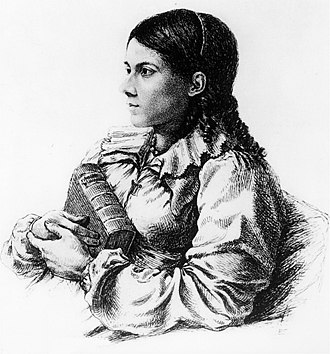
Full Name: Bettina von Arnim
Nickname/Alias: von Arnim, Anna Elizabeth (nee Brentano)
Achievements: Became famous for her relationship with Goethe
Born: April 4, 1785; Frankfurt/Main, Germany
Died: January 2, 1859; Berlin (Aged 73)
Field & Discipline: Literature; Writer
Language: German
Father: Peter Anton Brentano
Mother Maximiliane
Siblings: Brother: Clemens Brentano; Sisters Sophie, Gunda and Lulu.
Spouse: Achim von Arnim
Children: Daughters: Maximiliane, Armgardt and Gisela;
Sons: Siegmund, Freimund, Friedemund and Kuhenemund
Education: Ursuline Convent, Fritzlar (1793-1797)
Major Work:
“Correspondence with a Child” (1834)
Life & Times:
Bettina was the daughter of a Frankfurt businessman. After the death of her mother in 1793 she and her sisters spent four years at the Ursuline convent at Fritzlar. In 1797 she went to Offenbach, to live with her grandmother, the novelist Sophie de la Roche, in whose house she was in frequent contact with intellectuals and writers such as [knew] Herder*.
From 1802 she lived in Marburg, in close touch with her brother [sister of] Clemens Brentano*, and her confidante Caroline von Guenderrode. In 1807 during a visit to Weimar (and again in 1810 and 1811) she met [met] Goethe* and from then on hero-worshipped him, visiting and writing to him until his death nearly 30 years later.
In 1808 she met [met] De Stael* (who was in Germany collecting material for her book on German culture) and was not taken by the famous beauty. In 1810, while in Vienna, she met [a pal of] Beethoven* and they became friends. They would meet every day during her stay and he would play for her.
In 1811 she married [married] Achim von Arnim*. The event occurred in typically Romantic fashion: Achim stopped passers-by in the street until one turned out to be a priest, who then married them (thus avoiding the threat of their friends the brothers [a pal of] Grimm* to come to their wedding dressed as storks).
In 1817 they moved to Berlin, where Bettina enjoyed a lively and cultured life in the city and Achim practically retired to his nearby estates.
In 1831 Achim was found dead by a servant. Goethe died the following year. In 1834 Bettina published her letters to Goethe as: “Correspondence with a child.” The letters caused some shock, given their frank and romantic tone. Her daughters Maximiliane and Armgardt returned to live with Bettina and she became active in the literary world. In 1843 she published: “This Book Belongs to the King,” (dedicated to Friedrich IV of Prussia) in which she took on contemporary social problems, especially the issue of crime and punishment.
Bettina supported the cause of Polish independence and opposed the 1848 Prussian intervention there. She also defended the brothers Grimm when they were exiled from Hanover, and persuaded the king to give them jobs in Berlin.
In 1852 she suffered a slight stroke. In 1853, during a visit to Bonn, she met [met] Clara Schumann* and visited [visited] Robert Schumann* in the asylum where he was temporarily staying. In 1859 she suffered another stroke and died.
Extra Connections: She knew [knew] Brahms* (who dedicated a composition to her), [knew] Meyerbeer*, [knew] Mendelssohn*, and [knew] Alexander von Humboldt*
She met [met] Liszt* and [met] Turgenev*
She influenced the work of [influenced] Louisa May Alcott*
Assessment: Famous for her relationship with Goethe and for trying to liberalize King Friedrich IV of Prussia, Bettina von Arnim was talented and eccentric, and a militant Romantic.
Oneliner: Bettina von Arnim, child-sweetheart of Goethe
Bibliography:
- Helps, A. & Howard, E J Bettina: a portrait . Chatto & Windus 1957.