James, William 2
See Main William James node
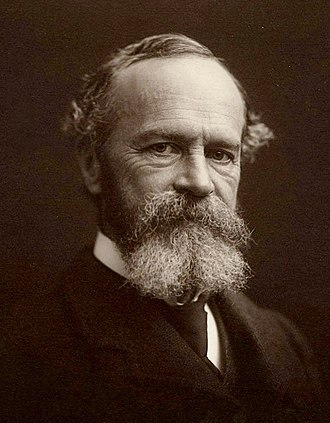
William James (January 11, 1842 – August 26, 1910) was an American philosopher, historian, and psychologist, and the first educator to offer a psychology course in the United States.[4] James is considered to be a leading thinker of the late 19th century, one of the most influential philosophers of the United States, and the "Father of American psychology".[5][6][7]
Along with Charles Sanders Peirce, James established the philosophical school known as pragmatism, and is also cited as one of the founders of functional psychology. A Review of General Psychology analysis, published in 2002, ranked James as the 14th most eminent psychologist of the 20th century.[8] A survey published in American Psychologist in 1991 ranked James's reputation in second place,[9] after Wilhelm Wundt, who is widely regarded as the founder of experimental psychology.[10][11] James also developed the philosophical perspective known as radical empiricism. James's work has influenced philosophers and academics such as Émile Durkheim, W. E. B. Du Bois, Edmund Husserl, Bertrand Russell, Ludwig Wittgenstein, Hilary Putnam, Richard Rorty, and Marilynne Robinson.[12]
Born into a wealthy family, James was the son of the Swedenborgian theologian Henry James Sr. and the brother of both the prominent novelist Henry James and the diarist Alice James. James trained as a physician and taught anatomy at Harvard, but never practiced medicine.
Instead he pursued his interests in psychology and then philosophy. He wrote widely on many topics, including epistemology, education, metaphysics, psychology, religion, and mysticism. Among his most influential books are The Principles of Psychology, a groundbreaking text in the field of psychology; Essays in Radical Empiricism, an important text in philosophy; and The Varieties of Religious Experience, an investigation of different forms of religious experience, including theories on mind-cure.[13]
Early life
[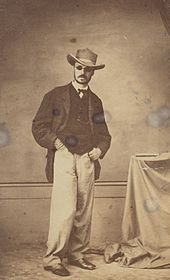
William James in Brazil, 1865
William James was born at the Astor House in New York City on January 11, 1842. He was the son of Henry James Sr., a noted and independently wealthy Swedenborgian theologian well acquainted with the literary and intellectual elites of his day. The intellectual brilliance of the James family milieu and the remarkable epistolary talents of several of its members have made them a subject of continuing interest to historians, biographers, and critics.
William James received an eclectic trans-Atlantic education, developing fluency in both German and French. Education in the James household encouraged cosmopolitanism. The family made two trips to Europe while William James was still a child, setting a pattern that resulted in thirteen more European journeys during his life. James wished to pursue painting, his early artistic bent led to an apprenticeship in the studio of William Morris Hunt in Newport, Rhode Island, but his father urged him to become a physician instead. Since this did not align with James's interests, he stated that he wanted to specialize in physiology. Once he figured this was also not what he wanted to do, he then announced he was going to specialize in the nervous system and psychology. James then switched in 1861 to scientific studies at the Lawrence Scientific School of Harvard College.
In his early adulthood, James suffered from a variety of physical ailments, including those of the eyes, back, stomach, and skin. He was also tone deaf.[14] He was subject to a variety of psychological symptoms which were diagnosed at the time as neurasthenia, and which included periods of depression during which he contemplated suicide for months on end. Two younger brothers, Garth Wilkinson (Wilky) and Robertson (Bob), fought in the Civil War. James himself was an advocate of peace. He suggested that instead of youth serving in the military that they serve the public in a term of service, "to get the childishness knocked out of them." The other three siblings (William, Henry, and Alice James) all suffered from periods of invalidism.[citation needed]
He took up medical studies at Harvard Medical School in 1864 (according to his brother Henry James, the author). He took a break in the spring of 1865 to join naturalist Louis Agassiz on a scientific expedition up the Amazon River, but aborted his trip after eight months, as he suffered bouts of severe seasickness and mild smallpox. His studies were interrupted once again due to illness in April 1867. He traveled to Germany in search of a cure and remained there until November 1868; at that time he was 26 years old. During this period, he began to publish; reviews of his works appeared in literary periodicals such as the North American Review.
James finally earned his MD degree in June 1869 but he never practiced medicine. What he called his "soul-sickness" would only be resolved in 1872, after an extended period of philosophical searching. He married Alice Gibbens in 1878. In 1882 he joined the Theosophical Society.[15]
James's time in Germany proved intellectually fertile, helping him find that his true interests lay not in medicine but in philosophy and psychology. Later, in 1902 he would write: "I originally studied medicine in order to be a physiologist, but I drifted into psychology and philosophy from a sort of fatality. I never had any philosophic instruction, the first lecture on psychology I ever heard being the first I ever gave".[16]
Career
James interacted with a wide array of writers and scholars throughout his life, including his godfather Ralph Waldo Emerson, his godson William James Sidis, as well as Charles Sanders Peirce, Bertrand Russell, Josiah Royce, Ernst Mach, John Dewey, Macedonio Fernández, Walter Lippmann, Mark Twain, Horatio Alger, G. Stanley Hall, Henri Bergson, Carl Jung, Jane Addams and Sigmund Freud.
James spent almost all of his academic career at Harvard. He was appointed instructor in physiology for the spring 1873 term, instructor in anatomy and physiology in 1873, assistant professor of psychology in 1876, assistant professor of philosophy in 1881, full professor in 1885, endowed chair in psychology in 1889, return to philosophy in 1897, and emeritus professor of philosophy in 1907.
James studied medicine, physiology, and biology, and began to teach in those subjects, but was drawn to the scientific study of the human mind at a time when psychology was constituting itself as a science. James's acquaintance with the work of figures like Hermann Helmholtz in Germany and Pierre Janet in France facilitated his introduction of courses in scientific psychology at Harvard University. He taught his first experimental psychology course at Harvard in the 1875–1876 academic year.[17]
During his Harvard years, James joined in philosophical discussions and debates with Charles Peirce, Oliver Wendell Holmes, and Chauncey Wright that evolved into a lively group informally known as The Metaphysical Club in 1872. Louis Menand (2001) suggested that this Club provided a foundation for American intellectual thought for decades to come. James joined the Anti-Imperialist League in 1898, in opposition to the United States annexation of the Philippines.

William James and Josiah Royce, near James's country home in Chocorua, New Hampshire in September 1903. James's daughter Peggy took the picture. On hearing the camera click, James cried out: "Royce, you're being photographed! Look out! I say Damn the Absolute!"
Among James's students at Harvard University were Boris Sidis, Theodore Roosevelt, George Santayana, W. E. B. Du Bois, G. Stanley Hall, Ralph Barton Perry, Gertrude Stein, Horace Kallen, Morris Raphael Cohen, Walter Lippmann, Alain Locke, C. I. Lewis, and Mary Whiton Calkins. Antiquarian bookseller Gabriel Wells tutored under him at Harvard in the late 1890s.[18]
His students enjoyed his brilliance and his manner of teaching was free of personal arrogance. They remember him for his kindness and humble attitude. His respectful attitude towards them speaks well of his character.[19]
Following his January 1907 retirement from Harvard, James continued to write and lecture, publishing Pragmatism, A Pluralistic Universe, and The Meaning of Truth. James was increasingly afflicted with cardiac pain during his last years. It worsened in 1909 while he worked on a philosophy text (unfinished but posthumously published as Some Problems in Philosophy). He sailed to Europe in the spring of 1910 to take experimental treatments which proved unsuccessful, and returned home on August 18. His heart failed on August 26, 1910, at his home in Chocorua, New Hampshire.[20] He was buried in the family plot in Cambridge Cemetery, Cambridge, Massachusetts.
He was one of the strongest proponents of the school of functionalism in psychology and of pragmatism in philosophy. He was a founder of the American Society for Psychical Research, as well as a champion of alternative approaches to healing. In 1884 and 1885 he became president of the British Society for Psychical Research for which he wrote in Mind and in the Psychological Review.[21] He challenged his professional colleagues not to let a narrow mindset prevent an honest appraisal of those beliefs.
In an empirical study by Haggbloom et al. using six criteria such as citations and recognition, James was found to be the 14th most eminent psychologist of the 20th century.[22]
Family
William James was the son of Henry James (Senior) of Albany, and Mary Robertson Walsh. He had four siblings: Henry (the novelist), Garth Wilkinson, Robertson, and Alice.[23] William became engaged to Alice Howe Gibbens on May 10, 1878; they were married on July 10. They had 5 children: Henry (born May 18, 1879), William (June 17, 1882 – 1961), Herman (born 1884, died in infancy), Margaret (born March 1887) and Alexander (the artist) (born December 22, 1890). Most of William James's ancestors arrived in America from Scotland or Ireland in the 18th century. Many of them settled in eastern New York or New Jersey.
All of James's ancestors were Protestant, well educated, and of character. Within their communities, they worked as farmers, merchants, and traders who were all heavily involved with their church. The last ancestor to arrive in America was William James's paternal grandfather also named William James. He came to America from Ballyjamesduff, County Cavan, Ireland in 1789 when he was 18 years old. There is suspicion that he fled to America because his family tried to force him into the ministry. After traveling to America with no money left, he found a job at a store as a clerk. After continuously working, he was able to own the store himself.
As he traveled west to find more job opportunities, he was involved in various jobs such as the salt industry and the Erie Canal project. After being a significant worker in the Erie Canal project and helping Albany become a major center of trade, he then became the first Vice-President of the Albany Savings Bank. William James (grandfather) went from being a poor Irish immigrant to one of the richest men in New York. After his death, his son Henry James inherited his fortune and lived in Europe and the United States searching for the meaning of life.[citation needed]
Writings
William James wrote voluminously throughout his life. A non-exhaustive bibliography of his writings, compiled by John McDermott, is 47 pages long.[24]
He gained widespread recognition with his monumental The Principles of Psychology (1890), totaling twelve hundred pages in two volumes, which took twelve years to complete. Psychology: The Briefer Course, was an 1892 abridgement designed as a less rigorous introduction to the field. These works criticized both the English associationist school and the Hegelianism of his day as competing dogmatisms of little explanatory value, and sought to re-conceive the human mind as inherently purposive and selective.
President Jimmy Carter's Moral Equivalent of War Speech, on April 17, 1977, equating the United States' 1970s energy crisis, oil crisis and the changes and sacrifices Carter's proposed plans would require with the "moral equivalent of war," may have borrowed its title, much of its theme and the memorable phrase from James's classic essay "The Moral Equivalent of War" derived from his last speech, delivered at Stanford University in 1906, and published in 1910, in which "James considered one of the classic problems of politics: how to sustain political unity and civic virtue in the absence of war or a credible threat ..." and which "... sounds a rallying cry for service in the interests of the individual and the nation."[25][26][27][28]
James was remembered as one of America's representative thinkers, psychologist, and philosopher. William James was also one of the most influential writers on religion, psychical research, and self-help. He was told to have a few disciples that followed his writing since they were inspired and enriched by his research.
Epistemology
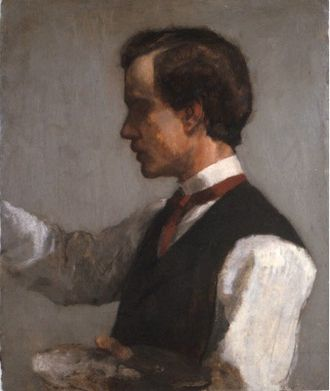
Portrait of William James by John La Farge, circa 1859
James defined true beliefs as those that prove useful to the believer. His pragmatic theory of truth was a synthesis of correspondence theory of truth and coherence theory of truth, with an added dimension. Truth is verifiable to the extent that thoughts and statements correspond with actual things, as well as the extent to which they "hang together," or cohere, as pieces of a puzzle might fit together; these are in turn verified by the observed results of the application of an idea to actual practice.[29][30]
The most ancient parts of truth … also once were plastic. They also were called true for human reasons. They also mediated between still earlier truths and what in those days were novel observations. Purely objective truth, truth in whose establishment the function of giving human satisfaction in marrying previous parts of experience with newer parts played no role whatsoever, is nowhere to be found. The reasons why we call things true is the reason why they are true, for 'to be true' means only to perform this marriage-function.
— "Pragmatism's Conception of Truth," Pragmatism (1907), p. 83.
James held a world view in line with pragmatism, declaring that the value of any truth was utterly dependent upon its use to the person who held it. Additional tenets of James's pragmatism include the view that the world is a mosaic of diverse experiences that can only be properly interpreted and understood through an application of 'radical empiricism.'
Radical empiricism, not related to the everyday scientific empiricism, asserts that the world and experience can never be halted for an entirely objective analysis; the mind of the observer and the act of observation affect any empirical approach to truth. The mind, its experiences, and nature are inseparable. James's emphasis on diversity as the default human condition—over and against duality, especially Hegelian dialectical duality—has maintained a strong influence in American culture. James's description of the mind-world connection, which he described in terms of a 'stream of consciousness,' had a direct and significant impact on avant-garde and modernist literature and art, notably in the case of James Joyce....
Philosophy of religion
James did important work in philosophy of religion. In his Gifford Lectures at the University of Edinburgh he provided a wide-ranging account of The Varieties of Religious Experience (1902) and interpreted them according to his pragmatic leanings. Some of the important claims he makes in this regard:
- Religious genius (experience) should be the primary topic in the study of religion, rather than religious institutions—since institutions are merely the social descendant of genius.
- The intense, even pathological varieties of experience (religious or otherwise) should be sought by psychologists, because they represent the closest thing to a microscope of the mind—that is, they show us in drastically enlarged form the normal processes of things.
- In order to usefully interpret the realm of common, shared experience and history, we must each make certain "over-beliefs" in things which, while they cannot be proven on the basis of experience, help us to live fuller and better lives.
- A variety of characteristics can be seen within a single individual. There are subconscious elements that compose the scattered fragments of a personality. This is the reflection of a greater dissociation which is the separation between science and religion.
- Religious Mysticism is only one half of mysticism, the other half is composed of the insane and both of these are co-located in the 'great subliminal or transmarginal region'.[54]
James investigated mystical experiences throughout his life, leading him to experiment with chloral hydrate (1870), amyl nitrite (1875), nitrous oxide (1882), and peyote (1896).[citation needed] James claimed that it was only when he was under the influence of nitrous oxide that he was able to understand Hegel.[55] He concluded that while the revelations of the mystic hold true, they hold true only for the mystic; for others, they are certainly ideas to be considered, but can hold no claim to truth without personal experience of such. American Philosophy: An Encyclopedia classes him as one of several figures who "took a more pantheist or pandeist approach by rejecting views of God as separate from the world."[56]
Mysticism
William James provided a description of the mystical experience, in his famous collection of lectures published in 1902 as The Varieties of Religious Experience.[57] These criteria are as follows
- Passivity – a feeling of being grasped and held by a superior power not under your own control.
- Ineffability – no adequate way to use human language to describe the experience.
- Noetic – universal truths revealed that are unable to be acquired anywhere else.
- Transient – the mystical experience is only a temporary experience.
James's preference was to focus on human experience, leading to his research of the subconscious. This was the entryway for the awakening transformation of mystical states. Mystical states represent the peak of religious experience. This helped open James's inner process to self-discovery.
Instincts
See also: Instinct
Like Sigmund Freud, James was influenced by Charles Darwin's theory of natural selection.[58] At the core of James's theory of psychology, as defined in The Principles of Psychology (1890), was a system of "instincts". James wrote that humans had many instincts, even more than other animals.[58] These instincts, he said, could be overridden by experience and by each other, as many of the instincts were actually in conflict with each other.[58] In the 1920s, however, psychology turned away from evolutionary theory and embraced radical behaviorism.[58]
Theory of emotion
James is one of the two namesakes of the James–Lange theory of emotion, which he formulated independently of Carl Lange in the 1880s. The theory holds that emotion is the mind's perception of physiological conditions that result from some stimulus. In James's oft-cited example, it is not that we see a bear, fear it, and run; we see a bear and run; consequently, we fear the bear. Our mind's perception of the higher adrenaline level, heartbeat, etc. is the emotion.
This way of thinking about emotion has great consequences for the philosophy of aesthetics as well as to the philosophy and practice of education.[59] Here is a passage from his work, The Principles of Psychology, that spells out those consequences:
[W]e must immediately insist that aesthetic emotion, pure and simple, the pleasure given us by certain lines and masses, and combinations of colors and sounds, is an absolutely sensational experience, an optical or auricular feeling that is primary, and not due to the repercussion backwards of other sensations elsewhere consecutively aroused. To this simple primary and immediate pleasure in certain pure sensations and harmonious combinations of them, there may, it is true, be added secondary pleasures; and in the practical enjoyment of works of art by the masses of mankind these secondary pleasures play a great part. The more classic one's taste is, however, the less relatively important are the secondary pleasures felt to be, in comparison with those of the primary sensation as it comes in. Classicism and romanticism have their battles over this point.
The theory of emotion was also independently developed in Italy by the anthropologist Giuseppe Sergi.[60][61]...
Philosophy of history
One of the long-standing schisms in the philosophy of history concerns the role of individuals in social change.
One faction sees individuals (as seen in Dickens' A Tale of Two Cities and Thomas Carlyle's The French Revolution, A History) as the motive power of history, and the broader society as the page on which they write their acts. The other sees society as moving according to holistic principles or laws, and sees individuals as its more-or-less willing pawns. In 1880, James waded into this controversy with "Great Men, Great Thoughts, and the Environment", an essay published in the Atlantic Monthly. He took Carlyle's side, but without Carlyle's one-sided emphasis on the political/military sphere, upon heroes as the founders or overthrowers of states and empires.
A philosopher, according to James, must accept geniuses as a given entity the same way as a biologist accepts as an entity Darwin's "spontaneous variations". The role of an individual will depend on the degree of its conformity with the social environment, epoch, moment, etc.[64]
James introduces a notion of receptivities of the moment. The societal mutations from generation to generation are determined (directly or indirectly) mainly by the acts or examples of individuals whose genius was so adapted to the receptivities of the moment or whose accidental position of authority was so critical that they became ferments, initiators of movements, setters of precedent or fashion, centers of corruption, or destroyers of other persons, whose gifts, had they had free play, would have led society in another direction.[65]
View on spiritualism and associationism
[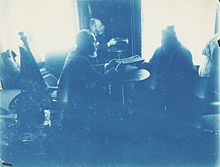
James in a séance with a spiritualist medium
James studied closely the schools of thought known as associationism and spiritualism. The view of an associationist is that each experience that one has leads to another, creating a chain of events. The association does not tie together two ideas, but rather physical objects.[66] This association occurs on an atomic level. Small physical changes occur in the brain which eventually form complex ideas or associations. Thoughts are formed as these complex ideas work together and lead to new experiences.
Isaac Newton and David Hartley both were precursors to this school of thought, proposing such ideas as "physical vibrations in the brain, spinal cord, and nerves are the basis of all sensations, all ideas, and all motions …"[67] James disagreed with associationism in that he believed it to be too simple. He referred to associationism as "psychology without a soul"[68] because there is nothing from within creating ideas; they just arise by associating objects with one another.
On the other hand, a spiritualist believes that mental events are attributed to the soul. Whereas in associationism, ideas and behaviors are separate, in spiritualism, they are connected. Spiritualism encompasses the term innatism, which suggests that ideas cause behavior. Ideas of past behavior influence the way a person will act in the future; these ideas are all tied together by the soul. Therefore, an inner soul causes one to have a thought, which leads them to perform a behavior, and memory of past behaviors determine how one will act in the future.[68]
James had a strong opinion about these schools of thought. He was, by nature, a pragmatist and thus took the view that one should use whatever parts of theories make the most sense and can be proven.[67] Therefore, he recommended breaking apart spiritualism and associationism and using the parts of them that make the most sense. James believed that each person has a soul, which exists in a spiritual universe, and leads a person to perform the behaviors they do in the physical world.[67]
James was influenced by Emanuel Swedenborg, who first introduced him to this idea. James stated that, although it does appear that humans use associations to move from one event to the next, this cannot be done without this soul tying everything together. For, after an association has been made, it is the person who decides which part of it to focus on, and therefore determines in which direction following associations will lead.[66]
Associationism is too simple in that it does not account for decision-making of future behaviors, and memory of what worked well and what did not. Spiritualism, however, does not demonstrate actual physical representations for how associations occur. James combined the views of spiritualism and associationism to create his own way of thinking. James discussed tender-minded thinkers as religious, optimistic, dogmatic, and monistic. Tough-minded thinkers were irreligious, pessimistic, pluralists, and skeptical. Healthy-minded individuals were seen as natural believers by having faith in God and universal order. People who focused on human miseries and suffering were noted as sick souls.
James was a founding member and vice president of the American Society for Psychical Research.[69] The lending of his name made Leonora Piper a famous medium. In 1885, the year after the death of his young son, James had his first sitting with Piper at the suggestion of his mother-in-law.[70] He was soon convinced that Piper knew things she could only have discovered by supernatural means. He expressed his belief in Piper by saying, "If you wish to upset the law that all crows are black, it is enough if you prove that one crow is white. My white crow is Mrs. Piper."[71]
However, James did not believe that Piper was in contact with spirits. After evaluating sixty-nine reports of Piper's mediumship he considered the hypothesis of telepathy as well as Piper obtaining information about her sitters by natural means such as her memory recalling information. According to James the "spirit-control" hypothesis of her mediumship was incoherent, irrelevant and in cases demonstrably false.[72]
James held séances with Piper and was impressed by some of the details he was given; however, according to Massimo Polidoro a maid in the household of James was friendly with a maid in Piper's house and this may have been a source of information that Piper used for private details about James.[73] Bibliographers Frederick Burkhardt and Fredson Bowers who compiled the works of James wrote "It is thus possible that Mrs. Piper's knowledge of the James family was acquired from the gossip of servants and that the whole mystery rests on the failure of the people upstairs to realize that servants [downstairs] also have ears."[74]
James was convinced that the "future will corroborate" the existence of telepathy.[75] Psychologists such as James McKeen Cattell and Edward B. Titchener took issue with James's support for psychical research and considered his statements unscientific.[76][77] Cattell in a letter to James wrote that the "Society for Psychical Research is doing much to injure psychology".[78]
James's theory of the self
James's theory of the self divided a person's mental picture of self into two categories: the "Me" and the "I". The "Me" can be thought of as a separate object or individual a person refers to when describing their personal experiences; while the "I" is the self that knows who they are and what they have done in their life.[37] Both concepts are depicted in the statement; "I know it was me who ate the cookie." He called the "Me" part of self the "empirical me" and the "I" part "the pure Ego".[79] For James, the "I" part of self was the thinking self, which could not be further divided. He linked this part of the self to the soul of a person, or what is now thought of as the mind.[80] Educational theorists have been inspired in various ways by James's theory of self, and have developed various applications to curricular and pedagogical theory and practice.[59]
James further divided the "Me" part of self into: a material, a social, and a spiritual self, as below.[79]
Material self
The material self consists of things that belong to a person or entities that a person belongs to. Thus, things like the body, family, clothes, money, and such make up the material self. For James, the core of the material self was the body.[80] Second to the body, James felt a person's clothes were important to the material self. He believed a person's clothes were one way they expressed who they felt they were; or clothes were a way to show status, thus contributing to forming and maintaining one's self-image.[80] Money and family are critical parts of the material self. James felt that if one lost a family member, a part of who they are was lost also. Money figured in one's material self in a similar way. If a person had significant money then lost it, who they were as a person changed as well.[80]
Social self
Our social selves are who we are in a given social situation. For James, people change how they act depending on the social situation that they are in. James believed that people had as many social selves as they did social situations they participated in.[80] For example, a person may act in a different way at work when compared to how that same person may act when they are out with a group of friends. James also believed that in a given social group, an individual's social self may be divided even further.[80] An example of this would be, in the social context of an individual's work environment, the difference in behavior when that individual is interacting with their boss versus their behavior when interacting with a co-worker.
Spiritual self
For James, the spiritual self was who we are at our core. It is more concrete or permanent than the other two selves. The spiritual self is our subjective and most intimate self. Aspects of a spiritual self include things like personality, core values, and conscience that do not typically change throughout an individual's lifetime. The spiritual self involves introspection, or looking inward to deeper spiritual, moral, or intellectual questions without the influence of objective thoughts.[80] For James, achieving a high level of understanding of who we are at our core, or understanding our spiritual selves is more rewarding than satisfying the needs of the social and material selves.
Pure ego
What James refers to as the "I" self. For James, the pure ego is what provides the thread of continuity between our past, present, and future selves. The pure ego's perception of consistent individual identity arises from a continuous stream of consciousness.[81] James believed that the pure ego was similar to what we think of as the soul, or the mind. The pure ego was not a substance and therefore could not be examined by science.[37]
Notable works...
Knowledge Web Content:
Achievements: Philosopher who contributed to the understanding of mental illness.
Born: January 11, 1842; New York, NY
Died: August 26, 1910; Chocora, New Hampshire (Aged 68)
Field & Discipline: Philosophy; Psychology; Philosopher; Psychologist
Language: English
Father: Henry James
Mother: Mary Robertson Walsh
Siblings: Henry; Garth; Robertson; Alice
Spouse: Alice Howe Gibbens
Children: Henry; William; Alexander; Margaret
Education: Tutors; Private schools in New York City
Major Works:
"The Principles of Psychology"
"The Varieties of Religious Experience"
"The Will to Believe"
Life & Times:
After a number of years traveling in Europe with his family (including his brother, the future novelist [brother was] Henry James*), James enrolled at 19 in the scientific school of Harvard, where he attended lectures by zoologist/geologist [taught by] Louis Agassiz* before majoring in comparative anatomy. He left after two years to enter Harvard Medical School. His first published works were reviews, one of which dealt with [reviewed work of] TH. Huxley*'s lectures on comparative anatomy, and another with [reviewed work of] Wallace*'s "The Origin of the Human Races", in which James supported [supported theory of] Charles Darwin*'s theory of evolution.
In 1865, at 23, James accompanied Agassiz to the Amazon basin on a scientific expedition. In 1867, he began an 18-month stay in Europe, studying physiology in Berlin under [taught by] Helmholtz*, who was researching the correlation between physical changes in nerves and sense perceptions. He also attended lectures by [attended lectures by] Bernard* and [attended lectures by] Virchow*.
Back in Boston, James got his degree from Harvard Medical School in 1869, but suffered an intellectual crisis that led to a mental breakdown in 1870. He was torn between his reason and his senses, and his reading of psychophysicist [influenced by] Fechner*, who claimed that sensation could be reduced to a mathematical formula, threw him into turmoil. While recovering, he wrote articles for "Nation", the "North American Review" and the "Atlantic Monthly." He also made another brief trip to Europe. In lectures in Baltimore and Boston in 1878, James rejected the generally-held idea that consciousness was simply the evidence of physiological activity in the brain. He maintained that consciousness could guide the brain's physiological activity because it was selective, and by focusing its attention on a particular stimulant, and ignoring others, it helped the human organism respond more effectively.
Also in 1878, James contracted to write "The Principles of Psychology", a book he worked on for 12 years. In 1879, he lectured on the philosophy of evolution. In 1880, he published "Great Men, Great Thoughts, and the Environment", in which he declared that great men make a difference to history. In 1882, he wrote his only published work on physiology, "The Sense of Dizziness in Deaf Mutes", in which he showed that the semicircular canals of the ears are organs of balance.
Back in Europe in 1882-83, he met Austrian scientist [influenced by] Mach* and English philosopher Leslie Stephen. In 1885, James was made professor of philosophy at Harvard, where his pupils included [taught] Santayana*. "The Principles of Psychology", published in 1890, became the most important psychology textbook in the United States and Europe. James's intention was to separate metaphysics from psychology, which he thought should be developed as a natural science with the aid of physiology. He suggested that "neural currents wear out paths in the brain and that such paths are correlated with all organized mental functions". He viewed consciousness as a stream, not as a collection of simple discrete ideas. He outlined a theory of emotion, habit, and association. He devised theories about self, thought, and consciousness within the framework of the new biological sciences. After "Principles of Psychology", James turned to the study of abnormal psychology and became a member of the American Society for Psychical Research. In 1890, he published "The Hidden Self," a critique of the work of French doctor Pierre Janet on hysteria and multiple personality. In 1896, he lectured at the Brooklyn Institute of Arts and Sciences and the Lowell Institute in Boston on unusual mental states such as possession, hysteria, and trances.
James developed a system of philosophy that he called "radical empiricism". Its structure was made up of a postulate, a hypothesis, and statements on reality. He held that discussions of consciousness must be based on experience and that there are many different realities, created by the associations related to any particular experiences. He maintained that consciousness is a function, not an entity. In 1897, he published "The Will to Believe", a collection of essays on radical empiricism.
In 1902, James published "The Varieties of Religious Experience," which became his most popular work and kicked off the psychological study of religion. The book was a collection of lectures on abnormal mental states, delivered at Edinburgh University, Scotland. James spent the rest of his life working on his "radical empiricism" philosophy. On his retirement in 1907, he recommended that a man he admired, philosopher/educator [an admirer of] John Dewey*, succeed him, but the University authorities disagreed. In his latter years, James was a prominent supporter of the move to reform mental hospitals.
Extra Connections: Taught [taught] Stein*.
Met[met] Keller* and [met] Morrell*
Friend of [a pal of] Howells*.
Knew [knew] Tielhard de Chardin*
Le Roy*? Bergson*? Swedenborg*?
Was an admirer of [a fan of] Spencer* and [a fan of] Markham*
He influenced the work of [influenced] WD Scott*
Assessment: James was a representative of the physiological psychology developing in Europe and was also an influential writer on religion, psychical research and self-help.
Oneliner: William James, pioneer in mental illness
Bibliography:
- Allen, Gay Wilson, William James, Rupert Hart-Davis, London, 1967.
- Myers, Gerald E.William James, His Life and Thought, Yale University Press, London, 1986.