James, William
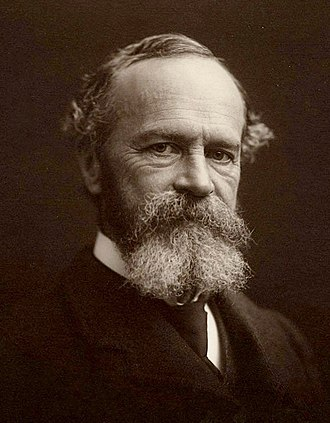
Name: William James
Achievements: Philosopher who contributed to the understanding of mental illness.
Born: January 11, 1842; New York, NY
Died: August 26, 1910; Chocora, New Hampshire (Aged 68)
Field & Discipline: Philosophy; Psychology; Philosopher; Psychologist
Language: English
Father: Henry James
Mother: Mary Robertson Walsh
Siblings: Henry; Garth; Robertson; Alice
Spouse: Alice Howe Gibbens
Children: Henry; William; Alexander; Margaret
Education: Tutors; Private schools in New York City
Major Work:
"The Principles of Psychology"
"The Varieties of Religious Experience"
"The Will to Believe"
Life & Times:
After a number of years traveling in Europe with his family (including his brother, the future novelist [brother was] Henry James*), James enrolled at 19 in the scientific school of Harvard, where he attended lectures by zoologist/geologist [taught by] Louis Agassiz* before majoring in comparative anatomy. He left after two years to enter Harvard Medical School.
His first published works were reviews, one of which dealt with [reviewed work of] TH. Huxley*'s lectures on comparative anatomy, and another with [reviewed work of] Wallace*'s "The Origin of the Human Races", in which James supported [supported theory of] Charles Darwin*'s theory of evolution.
In 1865, at 23, James accompanied Agassiz to the Amazon basin on a scientific expedition. In 1867, he began an 18-month stay in Europe, studying physiology in Berlin under [taught by] Helmholtz*, who was researching the correlation between physical changes in nerves and sense perceptions. He also attended lectures by [attended lectures by] Bernard* and [attended lectures by] Virchow*.
Back in Boston, James got his degree from Harvard Medical School in 1869, but suffered an intellectual crisis that led to a mental breakdown in 1870. He was torn between his reason and his senses, and his reading of psychophysicist [influenced by] Fechner*, who claimed that sensation could be reduced to a mathematical formula, threw him into turmoil. While recovering, he wrote articles for "Nation", the "North American Review" and the "Atlantic Monthly." He also made another brief trip to Europe.
In lectures in Baltimore and Boston in 1878, James rejected the generally-held idea that consciousness was simply the evidence of physiological activity in the brain. He maintained that consciousness could guide the brain's physiological activity because it was selective, and by focusing its attention on a particular stimulant, and ignoring others, it helped the human organism respond more effectively.
Also in 1878, James contracted to write "The Principles of Psychology", a book he worked on for 12 years. In 1879, he lectured on the philosophy of evolution. In 1880, he published "Great Men, Great Thoughts, and the Environment", in which he declared that great men make a difference to history. In 1882, he wrote his only published work on physiology, "The Sense of Dizziness in Deaf Mutes", in which he showed that the semicircular canals of the ears are organs of balance.
Back in Europe in 1882-83, he met Austrian scientist [influenced by] Mach* and English philosopher Leslie Stephen. In 1885, James was made professor of philosophy at Harvard, where his pupils included [taught] Santayana*.
"The Principles of Psychology", published in 1890, became the most important psychology textbook in the United States and Europe. James's intention was to separate metaphysics from psychology, which he thought should be developed as a natural science with the aid of physiology. He suggested that "neural currents wear out paths in the brain and that such paths are correlated with all organized mental functions". He viewed consciousness as a stream, not as a collection of simple discrete ideas. He outlined a theory of emotion, habit, and association. He devised theories about self, thought, and consciousness within the framework of the new biological sciences.
After "Principles of Psychology", James turned to the study of abnormal psychology and became a member of the American Society for Psychical Research. In 1890, he published "The Hidden Self," a critique of the work of French doctor Pierre Janet on hysteria and multiple personality. In 1896, he lectured at the Brooklyn Institute of Arts and Sciences and the Lowell Institute in Boston on unusual mental states such as possession, hysteria, and trances.
James developed a system of philosophy that he called "radical empiricism". Its structure was made up of a postulate, a hypothesis, and statements on reality. He held that discussions of consciousness must be based on experience and that there are many different realities, created by the associations related to any particular experiences. He maintained that consciousness is a function, not an entity. In 1897, he published "The Will to Believe", a collection of essays on radical empiricism.
In 1902, James published "The Varieties of Religious Experience," which became his most popular work and kicked off the psychological study of religion. The book was a collection of lectures on abnormal mental states, delivered at Edinburgh University, Scotland.
James spent the rest of his life working on his "radical empiricism" philosophy. On his retirement in 1907, he recommended that a man he admired, philosopher/educator [an admirer of] John Dewey*, succeed him, but the University authorities disagreed. In his latter years, James was a prominent supporter of the move to reform mental hospitals.
Extra Connections: Taught [taught] Stein*.
Met[met] Keller* and [met] Morrell*
Friend of [a pal of] Howells*.
Knew [knew] Tielhard de Chardin*
Le Roy*? Bergson*? Swedenborg*?
Was an admirer of [a fan of] Spencer* and [a fan of] Markham*
He influenced the work of [influenced] WD Scott*
Assessment: James was a representative of the physiological psychology developing in Europe and was also an influential writer on religion, psychical research and self-help
Oneliner: William James, pioneer in mental illness
Bibliography:
- Allen, Gay Wilson, William James, Rupert Hart-Davis, London, 1967.
- Myers, Gerald E. William James, His Life and Thought, Yale University Press, London, 1986.