Mach
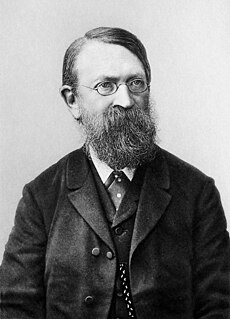
ACHIEVEMENTS: Discovery of shock waves
DATE AND PLACE OF BIRTH:
18 February 1838, Chirlitz-Turas, Moravia, Austrian Empire
DATE AND PLACE OF DEATH AND AGE AT DEATH:
19 February 1916, Haar, Germany. Aged 78
DISCIPLINE: Physicist and philosopher
FIELD: Optics, wave dynamics, mechanics
LANGUAGE: German
EDUCATION:
Privately at home
High school, Kremsier, Moravia
University of Vienna
MAJOR WORK:
"The History of Mechanics" (1883)
"The Analysis of Sensations" (1886)
"Popular Scientific Lectures" (1896)
"Space and Geometry" (1906)
"The Principles of Physical Optics" (1925)
LIFE AND TIMES:
Mach became interested in physics as applied to physiology and psychology partly as a result of attending lectures given by Brucke*.
In 1862-3 Mach gave a series of public lectures in the new field of psychophysics, and, in 1863-4, on Helmholtz's* latest acoustical discoveries. In 1864 he was made professor of mathematics at Graz University where he taught courses in physics, physiology and psychology as well as mathematics.
At Graz he discovered what are now called the Mach Bands: light or dark bands seen by the human eye near the boundaries between areas of strongly contrasting illumination. Mach suggested that the bands reflected neurological inhibitions and that measuring instruments independent of the human eye would probably not pick them up. His work attracted little interest and it was not until long after his death that Mach's suggestion was validated. The importance of Mach's discovery lay in the thought that observers should be aware that there was a subjective element to their perceptions.
In 1867 Mach took up the post of professor of experimental physics in Prague, where he remained for the following twenty-eight years. A chance sighting of an apparent inclination of houses and trees as his train rounded a curve stimulated him to undertake experiments on movement and acceleration.
His original idea that the direction of acceleration influenced the optical distortion of the vertical was later proved wrong by Breuer* who showed that optical distortion of the vertical was due to an involuntary reflex movement of the eye.
In 1873 Mach sat with a paper box on his head in a specially constructed chair which whirled him around. He discovered that when the speed of the rotation lessened or increased he felt a sense of motion but when it was constant he felt no motion. He eventually came to the conclusion that pressure from inertia on the liquid in the semicircular canals was caused the sensation of motion. Mach's paper on this was submitted just eight days before that of Josef Breuer, who had come to the same conclusion.
Mach conducted more experiments which involved putting an electric current through his own ear labyrinth, and stunning fish to test their sense of balance. He published his results in "Outlines of the Theory of the Motor Sensations" (1875).
Between 1873 and 1893 Mach worked on developing optical techniques to measure sound waves. In 1875 he conducted a series of experiments using electric spark discharges to blow soot across a glass plate. This was an attempt to measure the distance the spark waves travel. He did this because the speed of sound was already known, and if he could also get the distance, he would get an exact measurement of time.
He discovered something he had not expected: the pattern of the blown soot showed that the spark wave went faster than the speed of sound. It was not therefore an acoustical wave, it was a shock wave. In 1878 Mach made attempts to get a sharper photograph of the soot pattern by using the "schlieren" method invented by Toepler*.
In 1883 he published his "History of Mechanics" which Einstein* read a few years later, and which he acknowledged as a major influence on his own development.
In June 1886, at Fiume on the Adriatic, he took the first two photographs of projectile shock waves. They explained soldiers' reports of hearing two bangs when a distant gun was fired: the first report was from the leading shock wave which was faster than the speed of sound, the second was from normal sound waves coming from the exploding gun powder. When only one report was heard, the projectile was travelling slower than the speed of sound.
In 1887 Mach established the principles of supersonics and what is now called the Mach number (1 = the speed of sound).
Mach left Prague in 1895 and returned to Vienna as professor of inductive philosophy. Mach believed that any physical theory must be proved by sensory experience. This meant that he did not accept such concepts as absolute time and absolute space (an idea which influenced the logical positivists such as Carnap*).
Mach held that the human mind was constructed of various 'elements' in the same way as physical objects, and that there was no deep divide between mind and matter. This view indirectly influenced the logical atomism of British mathematician and philosopher Russell*.
Mach thought all science was part of a whole, with physics and psychology approaching the same material from different viewpoints.
Mach had a severe stroke in 1898 and retired in 1901. He continued to lecture and write and was made a member of the Austrian Parliament.
ASSESSMENT: Einstein said that Mach influenced all physicists.
EXTRA CONNECTIONS: Met William James*.
Was influenced by Fechner* and Comte*. Opposed Boltzmann’s* theories.
Karman* used his schlieren techniques.
He used Krupp*’s shooting range.
He influenced Hume*, Ostwald* and Schrodinger*
He taught Mohorovicic*
His work related to that of Samuel Morse*
His work was extended by Prandtl*
ONELINER: Ernst Mach, discoverer of shock waves
BIBLIOGRAPHY:
Blackmore, John T, Ernst Mach, His Work, Life and Influence, University of California Press, London, 1972
PARENTS:
Father: Johann Nepomuk Mach
Mother: Josephine Lanhaus
SIBLINGS:
2 sisters: Octavia, Marie
SPOUSE:
Ludovica Marussig
CHILDREN:
4 sons: Ludwig, Heinrich, Felix, Victor
1 daughter: Carolina