Siddons, Sarah
NAME:
Siddons, Sarah
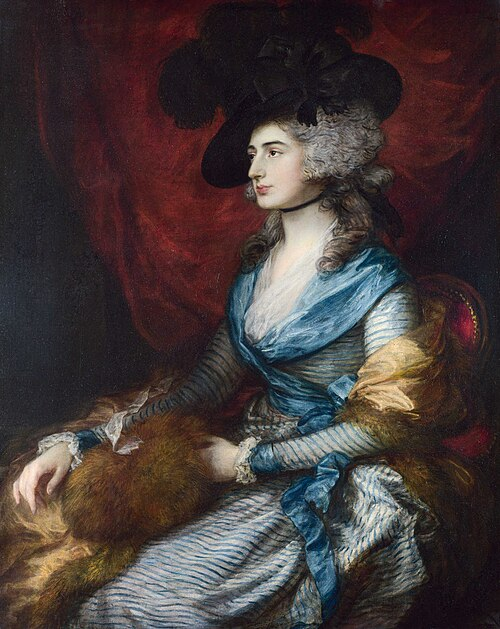
Portrait of Sarah Siddons by Thomas Gainsborough, 1785
ACHIEVEMENTS:
The greatest actress of her times.
NICKNAME/ALIAS:
None
DATE AND TIME OF BIRTH:
5 July 1755, Brecon, Wales
DATE AND TIME OF DEATH AND AGE AT DEATH:
8 June 1831, London, England. Aged 76
DISCIPLINE:
Actor
FIELD:
Theatre
LANGUAGE:
English
PARENTS:
Father: Roger Kemble
Mother: Sarah Ward
SIBLINGS:
11
SPOUSE:
William Siddons
CHILDREN:
2 sons: Henry, George
3 daughters: Sally, Maria, Cecilia
EDUCATION:
Various schools
MAJOR WORK:
None
LIFE AND TIMES:
Sarah Siddons was sent to be a lady's maid in Warwickshire where Sarah used to entertain both the servants' hall and her employers' aristocratic guests with recitations. In 1773 she married and she and her husband joined an acting company.
Word of her work got back to the actor manager <supported by> Garrick* in London and he sent an agent to see her. He was also impressed and in 1775, at the age of twenty, Siddons appeared on the London stage for the first time. After that, she triumphed all over the country, playing an exceptionally large repertoire and becoming known as the queen of tragedy.
In 1782, she was reluctantly persuaded back to London where on October 10 she played Isabella in Thomas Southerne's "Fatal Marriage" at Drury Lane. The performance has become celebrated in theatrical history and Siddons was an immediate and resounding success. People started breakfasting near the theatre so they could be first in the queue for tickets.
The Queen appointed Siddons to give education lessons to the royal children and Drury Lane had one of its most prosperous seasons ever. The following year her brother John <brother was> Kemble* joined her at Drury Lane to play "Hamlet" and the two of them stayed at the theatre for over a decade.
When the London seasons ended, Siddons played in the country during the summer. The press, the public and fashionable society were all at her feet. She was drawn by <drawn by> Romney* in 1783 and in 1784 was painted by <painted by> Sir Joshua Reynolds* who signed his name on the hem of her garment. <painted by> Gainsborough* painted her portrait in 1785.
During the 1790's, Siddons was also painted by <painted by> Sir Thomas Lawrence*, then a brilliant young painter, who became a close friend and who fell in love with two of Siddons' daughters.
In 1803, Siddons, together with John Kemble, left Drury Lane for Covent Garden theatre where she remained until she retired from the stage. In 1805, the young <played opposite> Kean* played opposite her in Ireland when he was an unknown eighteen-year-old. Siddons retired from the stage in 1812.
Her success appears to have been founded on her complete identification with the role she was playing which resulted in a tragic intensity that her audiences found profoundly affecting. Her final appearance was in her most famous role, that of Lady Macbeth.
The last twenty years of Siddons' life was spent in retirement. She gave not very good private recitals, and suffered much from the death of three of her children. She died in 1831 and 5,000 people gathered to mourn at her funeral in London.
ASSESSMENT: Siddons was revered during her time as a great tragic actress.
EXTRA CONNECTIONS: Knew <knew> Thomas Bruce Elgin*
Inspired <inspired> Lamb*
Met writer <met> Washington Irving*
She worked with <worked with> Macready*
She starred in Pizarro by <starred in Pizarro by> Sheridan*
American director Joseph L. Mankiewicz used the 1784 portrait by Reynolds extensively in his film All About Eve, winner of the 1950 Academy Award for Best Picture. The portrait is seen at the top of an entrance staircase. Mankiewicz also invented the (then) fictitious Sarah Siddons Society for the film.
Theatre biographer Henry Barton Baker wrote:
Wonderful stories are told of her powers over the spectators. Macready relates that when she played Aphasia in Tamburlaine, after seeing her lover strangled before her eyes, so terrible was her agony as she fell lifeless upon the stage, that the audience believed she was really dead, and only the assurance of the manager could pacify them. One night Charles Young was playing Beverly to her Mrs. Beverly in The Gamester, and in the great scene was so overwhelmed by her pathos that he could not speak. Unto the last she received the homage of the great; even the Duke of Wellington attended her receptions, and carriages were drawn up before her door nearly all day long.[27]^
In Covent Garden.[13]^ on 29 June 1812, after 57 performances that season, that she gave what was credited as perhaps the most extraordinary farewell performance in theatre history.[17]^ The audience refused to allow Macbeth to continue after the end of the sleepwalking scene. Eventually, after tumultuous applause from the pit, the curtain reopened and Siddons was discovered sitting in her own clothes and character – whereupon she made an emotional farewell speech to the audience. Some records stated that her farewell lasted eight minutes, others suggested ten, all indicating that she was visibly distraught.[34]^
Siddons formally retired from the stage in 1812, but reappeared on special occasions. An 1816 request by Princess Charlotte of Wales to see Lady Macbeth brought Siddons out of retirement.[17]^
ONELINER: Sarah Siddons, greatest actress of he time
BIBLIOGRAPHY:
Manvell, Roger, Sarah Siddons, Portrait of an Actress, William Heinemann Ltd., London, 1970.