Garrick, David
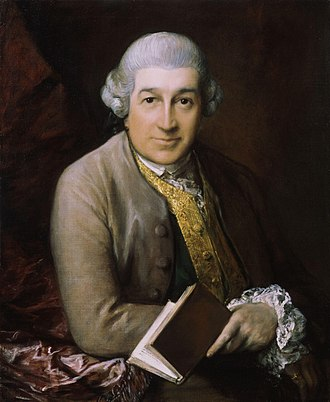
Achievements: Actor, producer, dramatist, poet, and co-manager of the Drury Lane Theatre
Born: February 10, 1717; Hereford, England
Died: January 20, 1779; London, England (Aged 61)
Field & Discipline: Art; Literature; Actor; Writer; Impresario
Language: English
Father: Peter Garrick
Mother: Arabella Clough
Siblings: Peter; Magdalene; George; Jane; Merrial; William
Spouse: Eva Maria Violette Veigel
Children: None
Education: Lichfield Grammar School; Lincoln's Inn, London
Major Work:
"The Clandestine Marriage"
Life & Times:
At 19, Garrick was sent to an academy (near Lichfield), just opened by [taught by] Dr Johnson*. The school failed after a few months, and Garrick left with Johnson for London to join his brother Peter in a wine-importing business.
Garrick had been smitten by the theater early on and before long left the wine business to try his hand at writing and acting. In 1740, Drury Lane Theatre produced his first comedy, a mythical burlesque: "Lethe, or Esop in the Shades." In 1741, he played the role of Harlequin at a small, unlicensed theater in Goodman's Fields, owned by Henry Giffard.
After the show closed, he went with Giffard to Ipswich for the summer season, where, under the name of Lydall, he played a variety of roles, and got good notices. After the Ipswich season, Garrick applied for an acting job with Drury Lane manager Charles Fleetwood and Covent Garden manager [turned down by] Rich*, but both turned him down.
Garrick returned to Giffard's theater, where he played the title role in Shakespeare's "Richard III" so stunningly that crowds began flocking to the theater and Garrick became an overnight celebrity. His success was mainly due to his approach to the role. Rather than play it in the pompous, recitative style imposed by French tradition, he played it in a natural and versatile way that excited the audience.
Throughout 1741, Garrick played both comic and tragic parts. He made a hit in "Pamela" (a dramatization of Samuel Richardson's novel), Thomas Otway's "The Orphan" and "Venice Preserv 'd ", fellow-actor [acted onstage with] Cibber*'s "Love Makes a Man: or, The Fop's Fortune," and Shakespeare's "King Lear."
He also appeared in his own farce, "The Lying Valet ". Among his admirers was the poet [a fan was] Pope*, who publicly praised his talents. Within months, Garrick was heralded as the greatest actor of his generation (his one flop that year was Henry Fielding's "The Wedding Day ").
At the end of 1741, Garrick was lured away from Giffard's theater by Drury Lane's Fleetwood, who offered him a big salary. It was the beginning of a successful career that would last until Garrick's retirement 35 years later. In the winter of 1745-46 Garrick moved to Dublin, sharing the direction of the Theatre Royal with playwright and actor-manager Thomas Sheridan, father of playwright [ran theater with] Sheridan*. At the same time, Garrick was negotiating to become part owner and manager of Drury Lane and came to terms in 1747.
At Drury Lane, Garrick introduced reforms. He forbade the public from getting on stage, or even visiting behind the scenes, discontinued the practice of cheaper prices for late-comers or early-leavers, brought the orchestra down from the gallery, and enlarged the auditorium. In 1765, he installed footlights and sidelights (actually oil lamps with reflectors). These were replaced with [his footlights replaced by] Argand* lights in the late 18th century.
Besides having a talent for acting, Garrick could also pick out talent in others and formed an excellent company. He also had a keen sense of public taste and chose plays and methods of production that almost always pleased the audience.
The best of his own works were the farces: "Miss in her Teens, or the Medley of Lovers " (1747), in which he played the role of Fribble to critical raves; and "Bon Ton ", better known by its subtitle "High Life Above Stairs "(1775). In June, 1749, Garrick married Eva Maria Veigel, a Viennese opera dancer.
Garrick was friends with [a pal of] Hogarth* and [a pal of] Gainsborough*, both of whom painted his portrait. (Garrick refused to sit for [refused to sit for] Romney*.) He kept up relations with Dr. Johnson, the wealthy bluestocking [a pal of] Mrs. Wortley Montagu*, [a pal of] Sir Joshua Reynolds, and [a pal of] Burke*.
Garrick was unpopular with [unpopular with] Goldsmith* and [unpopular with] Smollett*.
For two years, from 1763 to 1765, Garrick toured the Continent with his wife, and in Naples was painted by well-known Swiss artist Angelica [possible affair with] Kauffmann* with whom he may have had an affair.
He retired in 1776, passing on his share in Drury Lane to Sheridan, Ford, and [a pal of] Linley*. Garrick had no trouble adapting to retirement. He joined Johnson's Literary Club in London, being initiated at the same time as orientalist [a pal of] Sir William Jones*.
He also became a member of Brooks' Club, where he made friends with author [a pal of] Hannah More*, who moved into his house in Hampton in 1776. While spending New Year's of 1779 at the home of Lord and Lady Spencer at Althorp Park, Northamptonshire, Garrick took ill and died in London shortly after.
Extra Connections: Influenced actor Edmund [influenced] Kean*.
Lady Dorothy [his patron was] Savile* was a patron
He employed gardener [employed gardener] Capability Brown*
He knew French philosopher [knew] D’Holbach*
Leased one of [leased house by] Adam*’s new Adelphi London houses.
He knew the author Fanny [a pal of] Burney*’s family.
He met [met] De Stael*, [met] Jefferson*
He gave actress Sarah [started career of] Siddons* her professional start.
Theologian [was seen by] Paley* attended a performance.
Close friend of historian [a pal of] Gibbon*, author [a pal of] Samuel Richardson*
Author [hired] Fielding* wrote for him.
He starred in [starred in play by] Vanbrugh*’s “The Provok’d Wife.”
He staged a play by Gen. John [staged play by]Burgoyne*
Assessment: A great theatrical presence both as actor and manager, brought about a radical change in acting style, replacing formal declaration with natural speech and movement
Oneliner: David Garrick, great English actor-manager
Bibliography:
- Dictionary of National Biography.
- Encyclopedia Britannica.
- Oxford Companion to the Theatre.
- McIntyre, Ian, Garrick, London: Allen Lane. The Penguin Press, 1999.