Jenkin, Fleeming
Full Name: Henry Charles Fleeming Jenkin
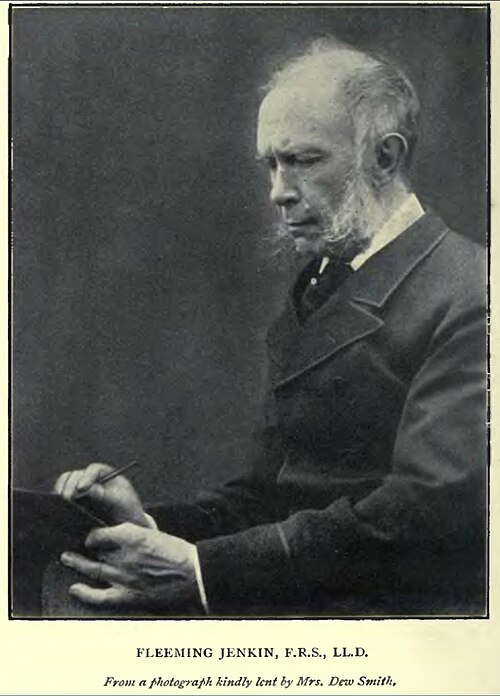
Achievements: Classified the ohm as an absolute measure of resistance.
Born: March 25, 1833; Dungeness, Kent, England
Died: June 12, 1885; Edinburgh, Scotland (Aged 52)
Field & Discipline: Engineering; Electrical Engineer
Language: English
Father: Charles Jenkin
Mother: Henrietta Camilla Jackson
Siblings: None.
Spouse: Anne Austin (married in 1859)
Children: Austin; Charles Frewen; Bernard
Education: Jedburgh; Edinburgh Academy; Genoa University (1851)
Major Work:
Establishment of the ohm as an absolute unit of resistance
Life & Times:
Fleeming (pronounced 'Fleming') Jenkin was the only child of Charles Jenkin, a naval officer, and Henrietta Camilla Jackson, a political liberal and popular novelist.
Jenkin was born near Dungeness, in Kent, where his father was then serving in the Coastguard. He was named after Admiral Fleeming, one of his father's patrons in the navy.
As a young boy, Jenkin was educated at Jedburgh in Scotland and at the Edinburgh Academy until 1846, when owing to reduced financial circumstances his family moved to Europe, spending a year at Frankfurt, another in Paris and then three years in Genoa, where he studied physical sciences and art at the university, receiving an MA in 1851.
That year, the family returned to Britain and Jenkin was apprenticed at [apprenticed to] Fairbairn's* Works in Manchester, learning the practicalities of mechanical engineering. After taking part in a railway survey in Switzerland in 1855, he then became a draughtsman at Penn's works in Greenwich, London, but soon afterwards moved to the company of Liddel & Gordon in London, where they were designing and manufacturing the earliest long submarine cables and associated cable-laying equipment.
In 1855, he met Alfred Austin and his wife and on 21stFebruary 1859, he married their daughter, Anne. In the same year he met Sir William Thomson (later, Lord [a pal of] Kelvin*), with whom he became close friends.
Jenkin was largely occupied with the making and laying of submarine telegraph cables and traveled the world to supervise the work. He often shared the consultant duties with Thomson and, of his thirty-five British patents, many of those on cable-laying inventions were held by both men.
In 1861 Thomson set up the Committee on Electrical Standards of the British Association for the Advancement of Science, to which Jenkin was appointed reporter.
Jenkin's lasting reputation in electrical science rests largely on his contributions to the work of this committee, through policy direction, participation in experiments, and the writing and editing of six reports between 1862 and 1869. Jenkin's 1862 report, 'Experimental Researches on the Transmission of Electric Signals through Submarine Cables', gave the first true measurement of the specific inductive capacity of [worked on] gutta-percha*.
In 1865, Jenkin was elected Fellow of the Royal Society in London and Professor of Engineering at University College, London. The following year, he wrote a detailed essay contradicting [disagreed with theory of] Charles Darwin's* theory of evolution.
It was Jenkin's view that indefinite variation and natural selection, outlined in Darwin's 'Origin of the Species', was mistaken because, through genetic probabilities, the potential variations of an existing species must be limited and diluted by the breeding of the rest of the population.
Three years later, in 1868, his earlier engineering patents began to pay well and he was made Professor of Engineering at the University of Edinburgh. He and his family moved to Scotland that year and it was there at the university that he taught [taught] Robert Louis Stevenson*, who became a close friend.
In 1869, Jenkin was back laying cable on the sea-bed, this time on the 'Great Eastern' across the Atlantic. He then supervised the laying of the Brazilian cable, at Pernambuco, in 1873. In 1873 Jenkin published his textbook, 'Magnetism and Electricity,' which was very successful, with many editions and translations.
Then, in 1876, he waged a vigorous campaign against unsanitary plumbing practices in Edinburgh and elsewhere, with his book on 'Healthy Houses', published in 1878, doing much to promote sanitary reform.
Having read about [influenced by] Ayrton* and Perry's electric railway block system in 1882, Jenkin developed the idea of 'telpherage', or the automatic electric transport of industrial raw materials by monorail and cable car. This involved running electrically-powered vehicles along a steel rod, suspended on wooden supports, and occupied much of Jenkin's later years. Unfortunately he did not live to see the completion of his system in the first telpher line, which was built at Glynde in Sussex, England soon after his death.
Following a small operation on his foot, Jenkin contracted blood poisoning and he died in Edinburgh on 12thJune 1885.
Extra Connections: Was friendly with the painter [a pal of] Whistler*.
His work related to that of [work related to] Field*.
He was on board the Great Eastern while she laid the French Atlantic cable from Brest to Saint-Pierre.
Robert Louis Stevenson says in his memoir of Jenkin that it was his principle to enjoy each day's happiness as it arises, like birds and children.
Assessment: His most important achievements were the development of precise methods to determine electrical resistance and the classification of the ohm as an absolute unit of resistance.
Oneliner: Fleeming Jenkin, expert in cable-laying
Bibliography:
- Stevenson, Robert Louis, Memoir of Fleeming Jackson, London: Heron Books, 1969.