Guericke
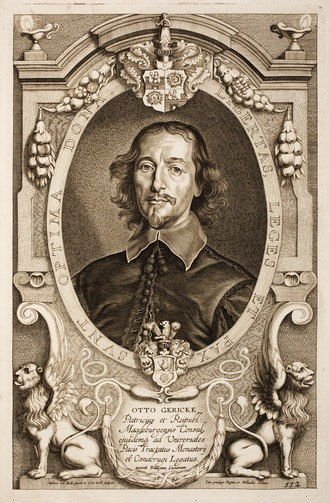
Name: Otto von Guericke
Achievements: Discovered electricity. Invented the first air pump and used it to study the phenomenon of vacuum and the role of air in combustion and respiration.
Born: November 20, 1602; Magdeburg, Prussian Saxony (now in Germany).
Died: May 11, 1686; Hamburg, Germany (Aged 83)
Field & Discipline: Science; Physics; Engineering
Language: German
Education: University of Leipzig, 1617-20; University of Helmstedt, 1620;
University of Jena, 1621-22; University of Leiden, 1622-24.
Major Work:
“New Magdeburg Experiments on the Vacuum.” 1672.
Life & Times: Guericke left the University of Leyden in 1624 and spent two years travelling in France and England before going back to Magdeburg. On his return he was made an alderman of the city and in 1630 was given responsibility for architectural affairs.
After Magdeburg was destroyed in May 1631, Guericke moved with his family to Brunswick and Erfurt, where he worked as a construction engineer in the army of [served under] Gustavus Adolphus* of Sweden, returning to Magdeburg in 1635 to help the Electorate of Saxony rebuild the city.
Guericke served the city of Magdeburg through his working life, acting as envoy to the occupying powers during the later years of the Thirty Years' War and then representing Magdeburg at the subsequent peace conferences. From 1646 to 1678, he was mayor of Magdeburg and magistrate for Brandenburg.
From his university engineering studies, Guericke had developed an interest in the new sciences and took advantage of his visits to international congresses and foreign courts to learn about new developments and exchange scientific ideas. He learned of the denial of a vacuum by [influenced by] Descartes*, and proposed an experiment designed to resolve the problem.
He theorized that if Descartes was right, and the air was pumped out of a strong container but not replaced by other new material, the vessel would implode. He constructed his air pump, a suction pump using a cylinder and piston to which he added two flap valves. He then used this to pump air out of a sealed hollow copper globe fitted with a stopcock, and
managed to create a partial vacuum.
He had originally thought that the air inside the globe would sink and be evacuated from the stopcock at the bottom, but in more experiments he placed the outlet at varying points on the copper sphere, proving that the air left in the globe during the process of evacuation became distributed evenly throughout the interior.
Guericke’s discovery of the elasticity of air was perhaps the most important result of these experiments, leading him to investigate the decrease of the density of air with height and then to theorize about empty space beyond the Earth’s atmosphere.
He studied variations of air pressure corresponding to changes in the weather and in 1660 was successful in making barometric weather forecasts (meteorology). He proposed systematic weather reporting through a network of observation stations and noted that light traveled through a vacuum but sound did not.
In 1654, Guericke published a description of his air pump, whose design was improved five years later by the English experimenter [work improved by] Boyle*. Guericke had discovered the work capacity of air and 1657 came the famous series of experiments performed at Magdeburg, when Guericke put together two copper bowls, now known as “Magdeburg hemispheres,” made so that the edges fitted together snugly to form an airtight hollow sphere about 14 inches across.
After he had pumped out the air, Guericke demonstrated the tremendous force of air pressure, by showing that two teams of eight horses were unable to pull the hemispheres apart, even though they were held together only by the pressure of air around them. This dramatic experiment was repeated at the Emperor's court at Vienna in 1657, and before the German Elector Friedrich Wilhelm at his court in Berlin six years later. In 1657, the experiments were reported by Gaspar Schott in “Mechanica Hydraulico-pneumatica” and again in 1664 in “Technica Curiosa.”
In 1663, considering why compass needles pointed north, Guericke showed that, when rubbed, a sulphur ball attracted the needle and could be used experimentally as an Earth analog. The rubbing also produced a spark and a glow. Guericke had accidentally produced the first static electricity generator, leading to further experiments by the English physicists [work furthered by] Hauksbee* and [work furthered by] Stephen Gray*.
In the same year, in Amsterdam, he published the results of his experiments as “New Magdeburg Experiments on the Vacuum,” which inspired Boyle, [work furthered by] Christiaan Huyghens*, [work furthered by] Leibniz* and [work furthered by] Papin*.
Guericke’s other studies included astronomy and incorporated the prediction that comets would return regularly from outer space. In 1666, was ennobled by Emperor Leopold I and became known as Otto von Guericke. He retired as mayor of Magdeburg in 1678 and in 1681 moved to Hamburg, in order to live with his only son, a magistrate for Brandenburg.
Extra Connections: His work influenced that of [influenced] Blaise Pascal*, and [influenced] Perier*
Assessment: He made a major contribution to investigation of the vacuum and electricity.
Oneliner: Otto von Guericke, discoverer of electricity
Bibliography:
- Dictionary of Scientific Biography.
- Encyclopedia Britannica.
Father: Hans Gericke
Mother: Anna von Zweidorff
Siblings: Unknown
Spouse: 1) Margarethe Alemann (married 1626; d. 1645); Dorothea Lentke (married
1652)
Children: One son