Dryden, John
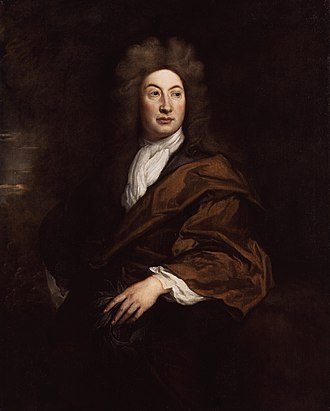
Achievements: Poet Laureate.
Born: August 19, 1631; Aldwinkle, Northamptonshire, England.
Died: May 1, 1700; London, England (Aged 69)
Field & Discipline: Art; Literature; Theatre; Poet; Dramatist; Critic
Language: English.
Education: Westminster School, London; Trinity College, Cambridge
Major Work: "Absalom and Achitophel" (1681)
Life & Times:
Among Dryden's contemporaries at Westminster school was the philosopher, [school-fellow was] Locke*. After graduating from Cambridge in 1654, Dryden worked as a civil servant, obtaining the job through his cousin Sir Gilbert Pickering. Although the work he did as a civil servant is not recorded, it is most likely that Dryden was employed to write the Latin correspondence in the diplomatic office. Two other poets, [a pal of] Milton* and [a pal of] Marvell*, worked for the Latin secretary, also being graduates of Cambridge, and all three poets marched in [attended funeral of] Cromwell's* funeral procession.
In 1660, the year of the Restoration of the monarchy, he wrote "Astraea Redux" to celebrate the return of [celebrated return of] Charles II*, whose coronation inspired Dryden to write "To His Sacred Majesty.”
In 1662 a friend proposed him for membership of the Royal Society, one of whose founding members was the scientist, [knew] Robert Boyle*, a relation of Robert Howard, a close friend of Dryden's. Dryden married Robert Howard's sister, Elizabeth, the youngest daughter of the Earl of Berkshire. Dryden's first play was not a success, but in 1664 he had more luck with "The Indian Queen" written with Robert Howard. The sequel: "The Indian Emperor,” performed in 1665, was a popular success. In 1667 Dryden wrote "Secret Love" in which [knew] Gwynne*, soon to be the King's mistress, played the part of a maid of honor. That year, Dryden published his poem "Annus Mirabilis," written to celebrate the English victory over the Dutch fleet in 1666, and the survival of London in the Great Fire of that year.
In 1668, Dryden turned to dramatic criticism, when he published "Of Dramatick Poesie, an Essay," was appointed Poet Laureate, and accepted a contract to write three plays a year for Thomas Killigrew's theatrical company. In 1669 he was sent a copy of John Milton's "Paradise Lost’, to which he commented, "that poet has cut us all out.” Within the next ten years, Dryden had completed a number of plays, including “Tyrannick Love” and "The Conquest of Granada by the Spaniards.” Both were highly successful heroic dramas. Equally successful was an elegant and witty portrayal of the battle of the sexes, the comedy 'Marriage a-la-Mode', and 'All for Love,' a tragedy based on Shakespeare's 'Anthony and Cleopatra'. In 1678 he left Killigrew's company and gave his new play "Oedipus" to another theatre.
At the beginning of the 1680s, Dryden became a political writer at a time of a rumored plot, masterminded by the Jesuits, to assassinate the King and impose Catholicism on England, when his Catholic brother, the Duke of York, would take the throne. Dryden’s poem, 'Absalom and Achitophel', published in 1681, expressed support for the King and was one of the greatest pieces of political satire in English literature. Using the Bible story of King David, his favorite son Absalom and the false Achitophel, he mirrored the contemporary facts, where the Earl of Shaftesbury, Achitophel, persuades the Duke of Monmouth, Absalom, to act against his father Charles II. The poem was published anonymously but Dryden was soon known as the author.
Surprisingly,
Dryden was described by a contemporary as "the mildest creature breathing." His friend the playwright [a pal of] William Congreve* wrote that he "was of a nature exceedingly humane and compassionate.” On the accession of the Duke of York as King James II in 1685, Dryden became a Catholic. He wrote the poem "The Hind and the Panther" in 1687, which put the case for Catholicism. The poem is an allegory in which the hind, the Church of Rome, discusses theology with a panther, the Church of England. When James abdicated, in 1688, Dryden was replaced as Poet Laureate and turned back to the theatre. He wrote "Amphitryon,” in 1690, which was a success and for which [used music by] Henry Purcell* wrote the music. He also worked with Purcell on the opera "King Arthur" in 1691.
In his final years his great work was a translation of Virgil, published in 1697. He also supervised anthologies of poetry and wrote "Fables Ancient and Modern,” published in 1700, a collection of fables from Ovid, Boccaccio and Chaucer, most of them adapted into verse and with a critical preface. Dryden died on 1st May 1700, and was buried at St Anne's Church in Soho, London.
Extra Connections:
Influenced by [influenced by] Boileau*.
[preface written by] Joseph Addison* wrote a preface to his “Georgics” translation
He wrote about [wrote about] William Gilbert*
A friend of his was [a pal of] Cibber*
His cousin was [cousin was] Swift*
Assessment: Dryden was a master of prose. As a poet, satirist and a critic he was unrivalled in his time.
Oneliner: John Dryden, great English writer
Bibliography:
- Winn, James Anderson, John Dryden and His World, Yale University Press, New Haven and London, 1987.
Father: Erasmus Dryden
Mother: Mary Pickering.
Siblings: Erasmus; Henry; James; Agnes; Rose; Mary; Lucy; Martha; Abigail; Hester; Hannah; Frances; Elisabeth
Spouse: Elizabeth Howard (youngest daughter of the 1st Earl of Berkshire)
Children: Erasmus-Henry; Charles; John