Shelley PB
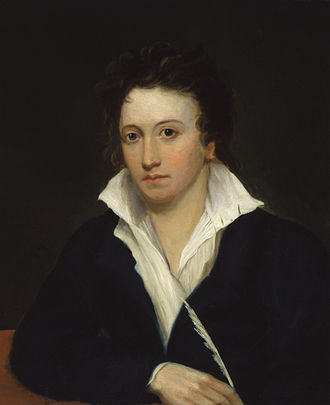
Achievements: Major Romantic poet.
Born: August 4, 1792; Field Place, near Horsham, Sussex, England
Died: July 8, 1822; off Livorno, Tuscany, Italy (Aged 30)
Field & Discipline: Literature; Poet
Language: English
Father: Sir Timothy Shelley
Mother: Unknown
Siblings: Unknown
Spouse: 1) Harriet Westbrook; 2) Mary Wollstonecraft Godwin
Children: by Westbrook: Charles; Ianthe. by Wollstonecraft Godwin: Percy Florence
Education: Syon House Academy; Eton College, Eton; Oxford University (briefly)
Major Work:
"Complete Works" (first edition. 1839-40)
"Prometheus Unbound"
Best-known short poems:
"Ozymandias"
"To a Skylark"
"Ode to the West Wind"
"Ode to Liberty"
"The Cloud"
Life & Times:
In the summer of 1811 Shelley eloped with Harriet Westbrook, the daughter of a London innkeeper.
A meeting with the poet [influenced by] Southey, R*, influenced Shelley greatly. As a result of talks with Southey, Shelley went to Dublin in 1812 with his wife and her sister, Eliza. There he wrote and distributed pamphlets which stirred up Irish issues: Roman catholic political rights, and self-rule for Ireland.
He and Harriet then returned to England and went to Lynmouth in Devon where Shelley continued his campaign of rebellion. In 1812-13 they lived in North Wales for several months until Shelley was forced to return to London because he needed to borrow money.
In 1813 he published "Queen Mab," his first major poem. It was a vehicle for his political beliefs and in it he attacked the established authorities of church and monarchy, the institution of marriage, war, trade and meat-eating.
In London, Shelley became part of the literary and political set of free-thinkers and radicals, many of whom met at the house of the writer and philosopher [father-in-law was] Godwin*. Shelley also met Godwin's daughter Mary, whose mother [mother-in-law was] Wollstonecraft* had died soon after Mary's birth.
In 1814 Shelley fell in love with Mary, convinced that he had at last found his ideal soul-mate. Godwin refused to accept the idea of their union, so they eloped in July of that year, and she became [married] Mary Shelley*. They travelled on the continent for several weeks, together with Mary's stepsister Claire Clairmont, before returning to London.
After his first wife gave birth to Shelley's son in November 1814, Shelley's father was legally forced to pay of Shelley's debts and give him an income. Shelley and Mary settled outside London near Windsor and in 1816 Shelley published a first collection of his poems. They spent the summer of 1816 in Italy in a rented house above Lake Geneva in Switzerland where Shelley's friend, the poet [a pal of] Byron* had a villa nearby. They were again accompanied by Claire, who had started an affair with Byron.
During that summer Shelley wrote "Mont Blanc" and "Hymn to Intellectual Beauty" while Mary wrote the first draft of her novel "Frankenstein". In December 1816, after the suicide of Shelley's first wife, he married Mary. His friendship with Leigh Hunt, the editor and critic, brought Shelley into a new circle of friends who included the writers Hazlitt, [a pal of] Lamb* and the poet [a pal of] Keats*.
After some months in London, the Shelleys, who by now had two children of their own, settled at Marlow. There Shelley wrote "Laon and Cythna; or, The Revolution of the Golden City", an epic poem about a peaceful revolution. After revisions, it was brought out in 1818 as "The Revolt of Islam".
During a visit to the British Museum in London Shelley saw the huge statue of Rameses II, taken from Thebes. He and a friend, Horace Smith, decided to write a poem about the statue. Shelley produced one of his most famous poems: "Ozymandias."
In March 1818 the Shelley’s moved to Italy. At Bagni di Lucca, he translated Plato's "Symposium" and wrote an essay "On Love". In a poem called "Rosalind and Helen" he portrayed a young poet ('Lionel') who goes to prison for his radical beliefs and dies young. One of his best-known poems: "Ode to the West Wind" was written at this time.
At the end of that year, they met Byron in Venice and travelled via Rome to Naples, where they spent the winter before returning to Rome. During this time, both their children died. Among other works while staying at Este Shelley wrote "Lines Written Among the Euganean Hills", a poem which expresses his hopes for a successful political revolution in Italy.
At Livorno, in the summer of 1819, he began his Elizabethan tragedy "The Cenci". When he heard news of a popular uprising in England and its brutal repression by the authorities (the Massacre of Peterloo, August 1917), Shelley wrote "The Masque of Anarchy" and a number of songs which he hoped would inspire the English people to peaceful but active political protest. In the same vein, he attacked corruption in Britain in "Peter Bell the Third" which was a satire on [satirized] Wordsworth’s* "Peter Bell" and also contained a subtle attack on the poet [attacked] Coleridge*. He also drafted a prose work: "A Philosophical View of Reform". Fear of retribution prevented the immediate publication of all these works.
In Florence that autumn Shelley completed "Prometheus Unbound: A Lyrical Drama". The play is written in blank verse and is considered a poetic masterpiece. "Oedipus Tyrannus; or, Swellfoot the Tyrant", a play satirizing the relationship between George IV of England and his estranged wife, was published anonymously in 1820 and was almost immediately suppressed.
In his essay "A Defence of Poetry", written in 1821, Shelley puts forward the concept that moral values and ideal society are first envisaged by poets who then communicate them, an idea summed up in his well-known aphorism, "Poets are the unacknowledged legislators of the World". "Adonais" (1821), one of his finest and most frequently quoted poems, is an elegy on the death of Keats.
In the summer of 1822, the Shelley’s and their son Percy, took house in a fishing village in the Bay of Lerici. They were accompanied by Edward and Jane Williams. He began working on "The Triumph of Life" which remains as a fragment and spent much of his time sailing in a boat he had commissioned. On 1 July he and Edward Williams and the boat-boy set off from Lerici for Livorno to greet Hunt on his arrival there. During a storm on the way back the boat sank and they all drowned.
Extra Connections: Shared philosopher [agreed with views of] D’Holbach’s* views on politics.
Met writer [met] De Stael* in Geneva, and [met]Giuseppe Rossetti* in Italy
Assessment: Shelley is now remembered as a major lyric poet of the English Romantic movement but in his lifetime he regarded himself as a radical poet-philosopher and his poetical talents as a vehicle for his political ideals.
Oneliner: Percy Bysshe Shelley, major Romantic poet
Bibliography:
- Holmes, Richard, Shelley, the Pursuit, Elizabeth Sifton Books, Penguin Books, Ltd., London 1987.