Cardano, G
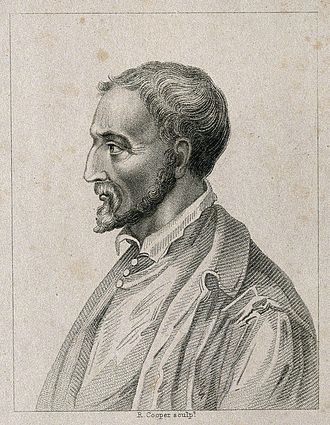
Name: Gerolamo Cardano
Nickname/Alias: Jerome Cardan; Geronimo Cardano; Girolamo Cardano
Achievements: Algebra
Born: September 24, 1501; Pavia, Milan, Italy
Died: September 21, 1576; Rome, Italy (Aged 75)
Field & Discipline: Medicine; Mathematics; Physician; Mathematician
Language: Italian
Father: Fazio Cardano
Mother: Chiara Alberio
Siblings: Unknown
Spouse: Lucia Bandarini
Children: 2 sons; 1 daughter
Education: University of Pavia; University of Padua
Major Work:
"The Great Art" (1545)
"Book on Games of Chance"
Life & Times:
Cardano's father was a lawyer with an interest in medical science and mathematics who had been consulted several times by [father knew] Da Vinci* on geometric matters. When he was nineteen, Cardano entered the University of Pavia to study medicine. When war between France and Spain closed Pavia he transferred to Padua. He was a brilliant student and was elected rector, an annual post involving a lot of expenditure which Cardano funded through gambling on cards and dice, and it was at his time that he began making notes on probability.
He received his doctorate and applied for admission to the College of Physicians in Milan. Rumours of his illegitimacy gave his enemies the chance to refuse his application and Cardano spent the years between 1526-32 as a doctor in the small village of Sacco, just outside Pavia. After marrying the daughter of the captain of the local militia, he needed to make money to support his family and in 1532 moved to the small town of Gallarate near Milan.
He was given lodgings by a young nobleman, Filippo Archinto, an amateur astronomer who wanted somebody to write up his observations. Cardano's finances, however, did not improve, his repeated applications to the College of Physicians were all turned down, and the manuscripts he had written on games of chance, and handwriting, did not interest the publishers. When Archinto was called up for military service, Cardano took his family to Milan where he was forced to enter the poorhouse.
His luck changed when Archinto returned from the wars in 1535 and got him a job as public lecturer in mathematics.. He also secretly practised medicine. An old friend from Pavia, working as a printer, turned up in Milan and was astounded to find that none of the brilliant Cardano's works had been accepted for publication. He offered to publish them and Cardano tempted fate by giving him a manuscript which attacked the contemporary state of medicine. "On the Bad Practice of Medicine in Common Use" came out in 1536 and was a hit with the public. Unsurprisingly, the medical establishment did not like it and renewed their attack.
Archinto again came to the rescue, on behalf of one of the patients Cardano had treated secretly, Francesco Gaddi, prior of the order of Augustinian Friars in Milan, who had been so impressed by Cardano's treatment that he now wished to appoint Cardano as official physician at the Priory. Since Cardano had a medical degree, the College of Physicians were powerless to prevent his acceptance of the position.
He was an outstanding physician and in 1539 the College was forced to admit him as a member. At the request of Archinto he wrote a couple of treatises for Pope Paul III who was interested in astronomy and astrology. One of these was a horoscope of the life of Christ.
Through his correspondence with mathematicians in other countries, Cardano became aware of a bet between two Venetians, Antonio Maria Fiore and [had row with] Tartaglia* , concerning the solving of an algebraic question. Tartaglia had found the solution which involved solving cubic equations but refused to reveal it until he had copyright. Cardano had a more modern, humanist attitude and believed that knowledge should be freely available. Eventually, Cardano either worked the matter out for himself or found out the secret, but promised to let Tartaglia publish it himself.
Cardano, meanwhile brought out his "Practice of Mathematics and Individual Measurements” which turned out to be a bestseller. It was based on his public lectures and written in a popular style. The book was read all over Europe and a Nurnberg printer offered to print anything Cardano sent him. He also offered the services of the scholar [work edited by] Osiander* as editor. Cardano had not stopped gambling but the College of Physicians could not ignore his eminence and in 1541 he was appointed rector of the College.
Second only to [work related to] Vesalius*, Cardano was now the most prominent physician in Europe and received offers to become personal medical adviser to the pope and to royal and imperial rulers all over Europe. In 1543 Cardano became professor of medicine at Pavia.
Two years later, having discovered that Tartaglia had not been the first to solve the theory of cubic equation, Cardano felt released from his promise and published the solution in his major mathematical work "The Great Art," making an enemy of Tartaglia.
In December 1551 he set out to treat [treated for asthma] John Hamilton*, Archbishop of St Andrews in Scotland, who suffered severely from asthma. Cardano travelled via Lyons, Paris, and Boulogne, arriving in Edinburgh in the summer of 1552, and within a couple of months he had restored the archbishop to health. He returned to Italy with his finances in a healthy state after receiving generous fees from Scottish and English nobles for medical and astrological advice.
On route through Europe he visited Antwerp, Cologne, Strasbourg and Basel and was received as an honoured guest in each city.
He continued to write popular scientific books, of which the best known were two collections of essays on science and natural philosophy (1550): "The Subtlety of Things" and (1557): "The Variety of Things", both of which were reprinted several times. In 1560 his eldest son was executed for the murder of his wife. Cardano was deeply affected and in 1562 he moved to Bologna to take up the chair of medicine there.
It was probably at Bologna that he revised and completed "Book on the Games of Chance" which was eventually published after his death and in which he attempted the first systematic presentation of the laws of probability. In October 1570, Cardano was arrested without warning and jailed as a heretic. The reason for this is uncertain and he may have been used to act as a warning to others but the horoscope of Christ's life was used as evidence against him.
After several months he was released and went to Rome where he was welcomed. He was invited to join the College of Physicians and was granted a pension by the Pope.
Assessment: Cardano's book on algebra was an important advance in the subject.
Extra Connections:
Cardano made several contributions to hydrodynamics and held that perpetual motion is impossible, except in celestial bodies. He published two encyclopedias of natural science which contain a wide variety of inventions, facts, and occult superstitions. He also introduced the Cardan grille, a cryptographic writing tool, in 1550.
Significantly, in the history of education of the deaf, he said that deaf people were capable of using their minds, argued for the importance of teaching them, and was one of the first to state that deaf people could learn to read and write without learning how to speak first. He was familiar with a report by Rudolph Agricola about a deaf mute who had learned to write.
Cardano's medical writings included: a commentary on Mundinus' anatomy and of Galen's medicine, along with the treaties Delle cause, dei segni e dei luoghi delle malattie, Picciola terapeutica, Degli abusi dei medici and Delle orine, libro quattro.[20]
Cardano has been credited with the invention of the so-called Cardano's Rings, also called Chinese Rings, but it is very probable that they predate Cardano. The universal joint, sometimes called Cardan joint, was not described by Cardano.
Oneliner: Gerolamo Cardano, major 16th-century Italian mathematician
Bibliography:
- Ore, Oystein, Cardano, The Gambling Scholar, Dover Publications, Inc., New York, 1953.
- Wykes, Alan, Doctor Cardano, Physician Extraordinary, Frederick Muller, London, 1969.
Additional information:
Language: Italian
Father: Fazio Cardano
Mother: Chiara Alberio
Siblings: Unknown
Spouse: Lucia Bandarini
Children: 2 sons; 1 daughter
Next stopon the tour