Gauguin
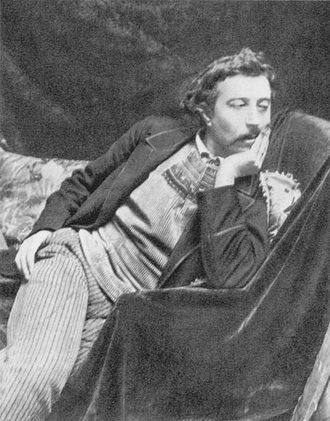
Gauguin, (Eugene-Henri) Paul.
ACHIEVEMENTS: Primitive paintings.
DATE/PLACE OF BIRTH: 7th June 1848, Paris, France.
DATE/PLACE OF DEATH/AGE AT DEATH: 8th May 1903, Hiva Oa, Marquesas Islands, French Polynesia. Aged 55.
DISCIPLINE: Painter.
FIELD: Art.
LANGUAGE: French.
EDUCATION: Jesuit Seminary, Orleans, France. Pre-Naval College, Paris.
MAJOR WORK: "Yellow Christ" 1889, "Self-Portrait with Halo" 1889, "Manau Tupapau" 1892, "Nevermore" 1896, "Contes barbares" 1902.
LIFE AND TIMES:
At the age of seventeen, Gauguin was sent to sea, his first voyage being from Le Havre to Rio de Janeiro (as had Edouard Manet who, thirty years earlier, also wanted to go to sea, had also failed his exams, and also entered the merchant marine, and whose first voyage was the same as Gauguin's). In 1871, he returned to Paris and took a job as a stockbroker. Two years later he married a Danish woman, Mette Gad, and for the next ten years led a settled bourgeois life in Paris. Every Sunday, he painted landscapes and attended evening life classes at the Academy Colarossi.
The Impressionists began holding exhibitions in 1874 and he began to collect contemporary works of art. He bought paintings by Cezanne*, Manet*, Pissarro*, Monet* and others. With Pissarro, he formed a friendship and the older man advised Gauguin on his technique. This resulted in one of Gauguin’s landscape paintings being accepted by the Paris Salon in 1876.
In 1879, Pissarro invited him to show his work at the Impressionist exhibition and the two began working together, developing their ideas on the use of colour and light, and sharing their interest in the work of Cezanne. In 1882, the financial crisis affected Gauguin's income now that he had decided to paint full time, so the family moved to Rouen. Within a year, his wife had taken herself and two of their five children to Copenhagen where their elder son, Emil, was already being educated. Gauguin followed with the other two children, but in Copenhagen in the winter of 1884, it was too cold for open air painting and the materials for oil paintings were not as good as those in Paris. So he returned to Paris in the summer of 1885 and lived in rented rooms.
In 1886, he went to Brittany for three months, attracted, like many French art students, by the cheap life and the working-class atmosphere. By spring 1887, his finances were in a bad state, so Gauguin took a ship for America with fellow artist, Charles Laval, planning to spend time on an island in the Pacific. His plans went wrong and he ended up doing manual work on the Panama Canal, where he became sick and returned to Paris, in poor physical shape. Here he met the artist van Gogh.*
In 1888, van Gogh wrote from Provence, where he had rented a house, inviting Gauguin to stay. The experiment in living and painting together came to an abrupt end by Christmas, following a violent quarrel which culminated in van Gogh cutting his ear off. Gauguin returned to Paris. Gauguin now decided to concentrate on primitive art and for the rest of his life painted in places untainted by bourgeois civilisation.
In 1889, at the Universal Exposition in Paris, a portrayal of life in the French colonies re-kindled Gauguin's desire for a tropical paradise. The following year he left for Tahiti, where he rented a bamboo hut about forty five miles from the capital, Papeete, and took a thirteen year old bride who became the subject of one of his best-known paintings "Manau Tupapau" (1892 ). Later, he wrote an account of his experiences in Tahiti called "Noa Noa" which was to have a powerful influence on Picasso*.
In 1893, he returned to France, to find that the avant garde group of young painters, centred around Matisse*, were enthusiastic about his work but, despite this, only eleven of the forty-four pictures Gauguin displayed that year were sold.In 1894, he inherited a legacy from his paternal uncle, but declined to share with his wife Mette, thus bringing about their separation. He then decided to sell his entire stock of work and return to Tahiti. Degas* was among the purchasers. He had asked Strindberg*, the Swedish dramatist, to write a preface for the sales catalogue. Strindberg refused.
Since there no hope of a family reunion, and Europe was hostile to his art, on 18th February 1895, he left again for Tahiti In 1896 following the death of a child by one of his Tahitian child brides he painted "Nevermore", which was bought by the composer Delius*. For the next two years, desperate for money, he took a desk job at the office of Public Works and Surveys, in Papeete. After 1901, he moved to the Marquesas Islands, more remote and primitive than Tahiti. Here, although he was now ill with syphillis, he did some biographical writing and continued to paint until his death in 1903.
ASSESSMENT: Gauguin introduced exotic and primitive elements into the art of the time and his colour and symbolism gave his paintings great intensity.
EXTRA CONNECTIONS: He was a pal of Mucha*,Verlaine* and Mallarme*
He met and did not impress Sickert*
His work influenced sculptor Henry Moore*
ONELINER: Paul Gauguin, naïve painter
BIBLIOGRAPHY:
Thomson, Belinda, Gauguin, Thames and Hudson, London, 1987.
PARENTS: Father, Clovis Gauguin. Mother, Aline Chazal.
SIBLINGS: One sister, Fernande Marcelline Marie.
SPOUSE: Mette Gad.
CHILDREN: Four sons: Emil, Clovis, Jean-René, Paul-Rollon. One daughter: Aline.