Dewey, John
Name: John Dewey
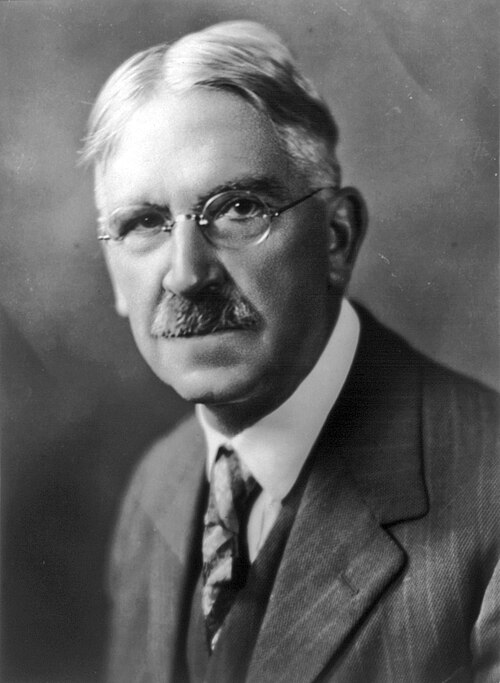
Achievements: Major contributions to the philosophy of education
Born: October 20, 1859; Burlington, Vermont
Died: June 1, 1952; New York, NY. Aged 92
Field & Discipline: Philosophy; Education; Philosopher; Teacher
Language: English
Father: Archibald Sprague Dewey
Mother: Lucina Artemisia Rich
Siblings: 1 brother
Spouse: 1) Harriet Alice Chipman; 2) Roberta Lowitz Grant
Children: seven (by Harriet Chipman); 2 adopted children (with Grant)
Education: University of Vermont, Burlington, Vermont
Major Work:
"Experience and Nature"
Life & Times:
Dewey was fascinated by Charles Darwin's theory of evolution and also became a follower of German philosopher [a follower of] Hegel*. After university, he taught at the University of Michigan.
In 1886, he wrote two articles for the British publication "Mind", gaining a favorable reputation among European philosophers, reinforced in 1887, with the publication of his first major book, "Psychology". Heavily influenced by neo-Hegelianism, Dewey attempted to arrive at a synthesis between psychology and philosophy. After a brief spell as a professor of philosophy at the University of Minnesota in 1888, Dewey returned to Michigan as head of the philosophy department.
Dewey's next publications, "Outlines of a Critical Theory of Ethics" (1891) and "The Study of Ethics: A Syllabus" (1894), reflected [influenced by] William James’* idea of humans existing as biological organisms in a material world. Dewey stressed the function of intelligence as a tool to help a human organism adjust to its physical and cultural environment.
Morality, he said, comes not from an absolute ethical source but from an individual's assessment of what is desirable and possible. He called his concept "experimental idealism", and declared it was not incompatible with his religious beliefs or his idealism.
In 1894, Dewey moved to Chicago to become professor of philosophy and psychology. In 1896, he published "The Reflex Arc Concept in Psychology," in which he rejected the stimulus-response theory and proposed the idea of an organism which relates to its environment through selecting and conditioning its own stimuli.
At his own request, Dewey was named head of a department of pedagogy at Chicago, and in 1896, founded the university elementary school (also known as the laboratory school), which attempted to steer a middle way between the two main systems then in fashion: (a) orthodox teaching of set subjects; or (b) the child-centered system, where responding to a child's natural curiosity was considered more important than the subject being taught.
Dewey wanted to make education appropriate to a society changing fast through industrialization, which he believed was widening the principles of democracy.
But Dewey considered himself first and foremost a philosopher and in 1903, with the help of colleagues, published "Studies in Logical Theory", which introduced a practical functionalism for logic, similar to that used for psychology by James.
In 1905, Dewey became professor of philosophy at Columbia University and at Columbia's Teachers’ College, where the philosophical debate was between the realists and the idealists. Dewey believed that "instrumentalism" would be a bridge between these two concepts. In his view, human organisms must react to the real life environment, but they can use ideas as tools to modify reality. The inner environment of the organism and the exterior one of real life, act upon each other.
Dewey helped form teachers' unions and became involved in the women's suffrage movement. During the First World War (1914-18), he supported U.S. intervention in Europe, while also upholding the rights of those who believed in pacifism. In 1920, he was one of the founders of the American Civil Liberties Union.
In 1925, Dewey published what is seen as his major work, "Experience and Nature," in which he reasserted his belief that reality can be known only through experience and that ideas are instrumental and not revelatory. He also emphasized the social and cultural aspects of experience, and for the first time included anthropological and historical factors.
He visited Mexico in 1926 and wrote favorably about the socialist reforms he saw there. In 1928, he visited the Soviet Union, publishing his impressions in the radical "New Republic", and urging the U.S. government to recognize the Soviet Union.
In 1929, Dewey published "The Quest for Certainty", in which he took up physicist Percy Bridgman's idea of "operationalism," the concept that the value of ideas is determined by their outcome and that the outcome is determined by ongoing experimental tests. Dewey also maintained that science and technology applied to social institutions could improve life immeasurably.
In "Art and Experience" in 1934, Dewey declared that esthetic experience, like any other experience, was part of the interaction between the human organism and its environment and not a separate experience involving a particular sense. He said that the satisfaction gained from an esthetic experience was what gave art its meaning.
In 1937, Dewey was one of the founders of the American Committee for the Defense of the Russian leader [supported] Trotsky*, living in exile in Mexico. Trotsky demanded a fair hearing before an impartial tribunal and Dewey chaired the commission set up to hear him. (Trotsky was murdered in 1940.)
Dewey's most important educational publication was "Experience and Education" (1938), which stressed the importance of a thorough understanding of the philosophy of experience as a foundation for a philosophy of education. Dewey abandoned his policy of neutrality when Hitler invaded Poland and supported America's entry into the Second World War in 1941.
He was one of the founders of the Committee for Cultural Freedom, which condemned abuses against freedom in Germany, Italy, Japan, Spain and the Soviet Union. As chair of the Committee, Dewey supported [supported] Russell* when his appointment at the College of the City of New York was withdrawn because of his atheism.
A major celebration of his 90th birthday in New York was attended by [birthday party attended by] Nehru*.
Extra Connections: He was influenced by the ideas of [influenced by] FWA Froebel*.
[taught] Watson* studied under him at Chicago
Assessment: Regarded by most philosophers as one of the most innovative thinkers of the 20th century
Oneliner: John Dewey, educational philospoher
Bibliography:
- Dykhuizen, George, The Life and Mind of John Dewey, Southern Illinois University Press, London, 1973.