Turgot
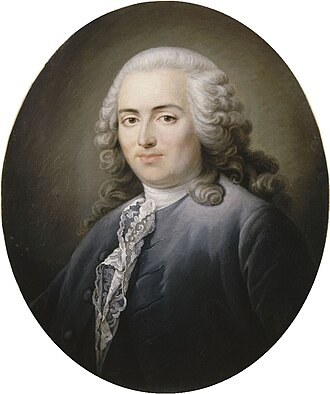
Anne-Robert-Jacques Turgot, Baron de Laune
Achievements: One of the pioneers of economic science (whose reforms, if they had been introduced, might have prevented the French Revolution).
Born: May 10, 1727; Paris, France
Died: March 18, 1781; Paris, France (Aged 55)
Field & Discipline: Finance; Government; Agronomics; Statesman; Economic Reformer
Language: French
Father: Michel-Etienne Turgot
Mother: Magdalene Francois
Siblings: 2 brothers; 1 sister
Spouse: None
Children: None
Education: College Duplessis (later, Louis-le-Grand); Saint-Supplice Seminary; Sorbonne, Paris
Major Work:
"Reflections on the Formation and Distribution of Wealth" (1766)
"Letters on the Freedom of the Grain Trade" (1770)
Life & Times:
At seminary, Turgot met [a pal of] Voltaire* who introduced him to the work of English thinkers such as [studied work of] Locke*. His scholarly reputation and family connections got him the job of deputy solicitor general and by 1753 he was a junior judge, which entitled him to a seat in the French parliament. Turgot was at ease in the intellectual salons of Paris although he later came to mistrust many of the thinkers he met, such as [mistrusted] Helvetius* and [mistrusted] d'Holbach*, but he did agree to contribute to [wrote for] Diderot’s* Encyclopedia with which many of them were connected.
He wrote articles on entymology, existence and charitable foundations, before disassociating himself from the Encyclopedists because he thought their views were too dogmatic. Among his closest friends were [a pal of] Condorcet* and [a pal of] Pierre-Samuel du Pont*, both thinkers who were also members of the school formed around the political economist [influenced by] Quesnay* (Physiocrats). Turgot was greatly influenced by Quesnay's economic ideas. In 1759, Turgot made a visit of inspection to south-eastern France and Switzerland, collecting geological data and information on the economic activities in the area, and in Geneva he renewed his acquaintance with Voltaire.
On his return to Paris, he applied for various administrative jobs and was appointed Intendant of the province of Limousin in 1761. It was a remote, poor region and Turgot saw an opportunity to put the ideas of Quesnay and his own reforming ideas about justice into practice. He remained in Limousin for thirteen years and struggled to introduce economic and legal reforms.
Turgot wanted a more equitable system of taxation, and to stamp out some of the corruption involved in the collection of taxes through the use of paid collectors and receipts for tax paid. He also wanted to compile a new tax register which would take into account new factors in assessment for relief. Turgot saw what a disproportionate share of the national tax was borne by the Limousin, and he unsuccessfully urged land valuation as a way of calculating tax so that the amount of tax levied would take into consideration the effect it had on the wages and productive work of an area. He corresponded with the Scottish philosopher [corresponded with] Hume* on this subject.
Hume strongly disapproved of Turgot's libertarian approach to economics. In 1766, Turgot explained his ideas in an essay entitled "Reflections on the Formation and Distribution of Wealth". One of the most notorious taxes was the "corvee" (the unpaid labour used to maintain France's roads) which Turgot succeeded in replacing in Limousin with a modest cash tax.
He took a hands-on approach to the building of roads in the area and personally conducted surveys with his chief engineer, Pierre Tresaguet. By 1774, 960 kms of new roads - constructed without the use of the corvee - linked Limousin with Paris, Lyons, Bordeaux, Poitiers and La Rochelle.
In 1769-70 there was a famine in Limousin, and on his own authority Turgot imposed several liberal measures , including breaking the bakers' monopoly because they were taking advantage of the famine and raising their prices. Against strong opposition, he maintained free trade in grain.
His "Letters on the Freedom of the Grain Trade", setting out the position for free trade, came out in 1770. When Louis XV died in 1774, Turgot was recalled to Paris as Minister in the Council. [official of] Louis XVI* appointed the venerable statesman [knew] Maurepas* as his senior minister and on Maurepas' recommendation the king appointed Turgot Minister of Marine. A month later, Turgot was appointed Comptroller General by Louis, who promised Turgot his support for his financial reforms which included no bankruptcy, increase of taxes and no borrowing. But the nobility opposed Turgot because he attacked their tax privileges. The tax collectors and financiers thought he would make their services redundant. The Church mistrusted his religious tolerance and the Court was jealous of his influence with the king.
One of Turgot's enemies was [enemy of] Necker*, the financier, who wanted Turgot's job. In 1775 Necker published a pamphlet attacking Turgot's free trade policy on grain at a time when there were riots over shortages. Turgot had more success in dealing with animal disease in the south. He had earlier helped to establish the principle that professional veterinarians should be responsible for animal health and in 1775 he sent the scientist Felix [employed] Vicq d'Azyr* to oversee operations, with the result that the epidemic was contained.
Opposition to Turgot intensified when he persuaded Louis to register his Six Edicts by invoking his royal prerogative and by-passing parliament. The Edicts, which included free trade reforms, also included the abolition of the corvee. The King was lobbied, and on 12 May 1776 Turgot was fired and his reforms abandoned. His only public reaction to criticism was regarding the comment in a pamphlet written by [read work of] Price* in England that he was politically clumsy, and Price agreed to remove the remark from future editions of his pamphlet.
In the remaining years of his life, Turgot was able to devote time to reading, and to scientific studies that included working with the chemist [worked with] Lavoisier*.
Extra Connections: He knew Julie de [knew] Lespinasse* and Mme du [knew] Deffand*
Assessment: Turgot attempted to reform the corrupt finances of the ancien regime but was defeated by vested interests.
Oneliner: A-R-J Turgot, French reforming economist
Bibliography:
- Hill, Malcolm Statesman of the Enlightenment, The Life of Anne-Robert Turgot, Othila Press, London, 1999.