Mondrian
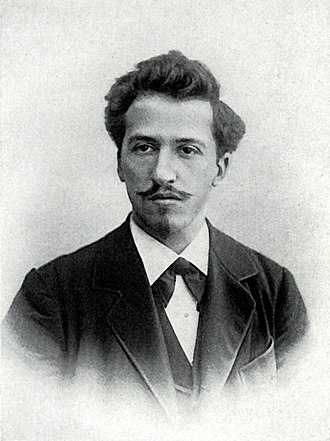
OTHER-NAME: Pieter Cornelis Mondriaan, Jr.; Pieter Mondriaan
BIRTH: 7 March 1872; Amerfoort, Holland
DEATH: 1944; New York, NY
CATEGORY: Fine Arts & Crafts
DISCIPLINE: Abstract and Neo-plastic painting and theory
ASSESSMENT: One of the most influential of the artists and art theorists of the early Twentieth Century.
LANGUAGES: Dutch; French; English
EDUCATION: Largely self-taught; studied with Jan Toorop though his parents objected; earned his intermediate drawing certificate allowing him to teach art at the secondary school level; studied in evening classes in drawing; studied painting at the Amsterdam academy, Rijksakademie van Beeldende Kunsten, from 1892 to 1897; a major exhibition of the works of Mondrian, Jan Sluyters, and Cornelis Spoor was held at the Stedelijk Museum, Amsterdam in 1909; met regularly with Cubist painters in Paris 1911(?)-1914, but he left the Cubist art movement to pursue his own exploration of art.
ACHIEVEMENTS: Joined the Theosophical society in 1909; co-founder of the de Stijl art movement in Holland 1916-1917; wrote theoretical essays for the magazine De Stijl which were collected and later published as Le Neo-placticisme in 1920 and 1925; his work and ideas formed the basis for the De Stijl and Baushaus movements in Holland and Germany; abstraction and Neo-plasticism in Europe and New York; influential as “minimalist” exploring art at the “most pure and elemental level” (eventually using horizontal and vertical lines with primary colors of red, blue and yellow, and neutrals of black white and gray.
MAJOR-WORK: Landscape ( 1907; pastel and black chalk on tan wove paper, 45.72 x 57.15 cm (18 x 22 ½ In, Minneapolis Institute of Art); Evening-Red Tree (1908; Oil on canvas, 31 x 42 ½ in.; Gemeentesmuseum, The Hague); Irises (1910; Oil on canvas, 57.8 x 31.8 cm (22 ¾ x 12 ½ in.); Minneapolis Institute of Art); Composition with Gray and Light Brown (1918; Oil on canvas, 80.2 x 49.9 cm; Museum of Fine Arts, Houston, Texas); Composition with Red, Yellow and Blue (1921; Oil on canvas, 39 x 35 cm. Gemeentesmuseum, The Hague);
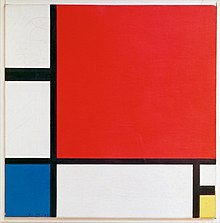
Lozenge Composition with Yellow, Black, Blue, Red, and Gray (1921; Oil on canvas; 60.1 x 60.1 cm (23 5/8 x 23 5/8 in); Vertical axis 84.5 cm (33 1/4in); The Art Institute of Chicago); Composition No. III Blanc-Jaune (1935-42; Oil on canvas, 101 x 51 cm; Christie's, NewYork); Composition No. 10 (1939-42; Oil on canvas, 80 x 73 cm; Private collection); Broadway Boogie-Woogie (1942-43; Oil on canvas,127 x 127 cm; The Museum of Modern Art, New York)
DETAILS: As a teenager, Mondrian was instructed in drawing by his schoolmaster father and uncle, though neither expected it to be Piet’s career. He began his art career against his parents’ wishes.
His early study and painting efforts evolved through several art styles including: the naturalism of his early landscapes; Symbolism; Impressionism, with its emphasis on how light scatters as it is reflected from objects; Post-Impressionism, which is a group of styles by artists influenced by Impressionism; Fauvism, in which color was used in non-realistic ways to express emotions; Cubism, in which forms were simplified into planes and facets of shapes to show the object with the emphasis put on the shapes, not realism; and finally into Abstraction. (“Abstraction” eliminates much of the detail of an object or scene, and shows multiple views of the same object). Mondrian was influenced especially by Van Gogh*.
In 1911, Mondrian went to Paris to study. While there he met with other artists, and also met theosophist Annie Besant*. Theosophy was a semi-religious movement, which believed in a unified spirit behind the physical dimensions of life” and Mondrian’s artistic work evolved around the ability to express his beliefs about “the dynamic opposition of the dual forces of matter and spirit.”
By 1912 Piet’s work had become one of linear abstraction with Cubist facets (use of “flat plane” areas). He still retained “frontality” that he had developed in his work. This means his work presented the objects facing directly towards the viewer.
Piet worked to eliminate the three-dimensional illusion of depth, to search for an art form independent of traditional values of beauty, and founded a new way of structuring art, which he called “Neo-plasticism.” This became the De Stijl movement and this led to other movements of the Twentieth Century.
In 1919 Mondrian returned to Amsterdam. When World War I began, Mondrian was unable to travel or leave Holland. He met Bart Van der Leck and Theo van Doesburg, with whom he was co-founder of the de Stijl art movement.
De Stijl was based on Oriental philosophy and theosophy. It did not imitate nature and was a “concrete” style: simple, clean, geometric. It was adopted in designing furniture, buildings, and in art. It emphasized white canvas, primary colors, and mainly vertical and horizontal lines.
The style influenced the work of the architectural school known as the Bauhaus, founded by Mondrian’s admirer Walter Gropius*.
In the 1930s Mondrian met other fellow artists, such as Chagall*,Nicholson* and Calder*.
In 1925 in Paris a large exhibition of “non-imitative, plastic art” was held. Mondrian did not sell one painting. The exhibition included work by friend, Ben Nicholson, well as such greats as Klee, Miro and Villion.
A wealthy American divorcee living in Paris, Peggy Guggenheim*, who opened a gallery named “Guggenheim-Jeune Gallery” to show all these artists’ works, and bought at least one from each.
In 1938, after the rise of Nazi Germany, Mondrian went to London to join his friend Ben Nicholson. In 1940 they moved to New York, where Chagall also lived and where Mondrian met Leger*. It was in New York that some of Mondrian’s late paintings expressed the music of the Swing and Jazz eras and the dynamic quality of urban New York life.
EXTRA CONNECTIONS: None
ONELINER: Piet Mondrian, modern Dutch artist
BIBLIOGRAPHY:
Arnason, H.H. and Daniel Wheeler. History of Modern Art, 3rd ed. New York: Harry N. Abrams, 1985.
Arnason, H.H. and Marla F. Prather. History of Modern Art, 4th ed. New York: Harry N. Abrams, 1998.
Ashton, Dore, ed. Twentieth Century Artists on Art. New York: Pantheon Books, 1985. Cappelleveen, R.T. “Piet Mondrian.” AbsoluteFacts. 2000. 5 Dec 2003. http://www.absolutefacts.com/data/mondrianpiet.htm.
Kline, Fred S. and Christin J. Mamiya. Gardner’s Art Through the Ages, 11th ed. San Diego, Calif.: Thompson Learning, 2000.
Malyon, John. “Piet Mondrian.” Artcyclopedia. 20 Aug 2003. 5 Dec 2003 http://www.artcyclopedia.com/artists/mondrian_piet.html.
“Piet Mondrian” Arty City. Amazon.com.uk.http://www.artycity.com/biography/PIET-MONDRIAN.htm.
Multimedia:
AUDIO-VISUAL:
The "Mondrian Machine." Peoples’Tank. 2001-2003. 4 Dec 2003.
<http://www.ptank.com/mondrian/#about>
The “ Mondrian Machine” is an interactive site, which allows a person to click and create Mondrian-like images of his neoplastic works. A click divides a space using vertical and horizontal black lines and assigns a primary color to the new space.
Lindart, Stephen. “Mondrimat.” Stephen Linhart Home Page. 20 Oct. 1998. Dec 2003.
<http://www.stephen.com/mondrimat/mondrian/bh.html>
“The MONDRIMAT is a simple, interactive system, which lets you experiment with space, color and visual rhythm in accordance with the theories of Piet Mondrian. For some reason pleasing, stimulating, even exciting results seem to occur quite frequently.” (This site allows for more personal designing than the “Mondrian Machine” site listed above.)
PARENTS: Pieter Cornelis Mondriaan; Mother unknown
SPOUSE: none
SIBLINGS: unknown
CHILDREN: none